WO2019044601A1 - タングステン酸化物の処理方法及び六フッ化タングステンの製造方法 - Google Patents
タングステン酸化物の処理方法及び六フッ化タングステンの製造方法 Download PDFInfo
- Publication number
- WO2019044601A1 WO2019044601A1 PCT/JP2018/030913 JP2018030913W WO2019044601A1 WO 2019044601 A1 WO2019044601 A1 WO 2019044601A1 JP 2018030913 W JP2018030913 W JP 2018030913W WO 2019044601 A1 WO2019044601 A1 WO 2019044601A1
- Authority
- WO
- WIPO (PCT)
- Prior art keywords
- tungsten
- oxide
- hexafluoride
- tungsten oxide
- gas
- Prior art date
- Legal status (The legal status is an assumption and is not a legal conclusion. Google has not performed a legal analysis and makes no representation as to the accuracy of the status listed.)
- Ceased
Links
Images


Classifications
-
- C—CHEMISTRY; METALLURGY
- C01—INORGANIC CHEMISTRY
- C01G—COMPOUNDS CONTAINING METALS NOT COVERED BY SUBCLASSES C01D OR C01F
- C01G41/00—Compounds of tungsten
- C01G41/04—Halides
-
- C—CHEMISTRY; METALLURGY
- C23—COATING METALLIC MATERIAL; COATING MATERIAL WITH METALLIC MATERIAL; CHEMICAL SURFACE TREATMENT; DIFFUSION TREATMENT OF METALLIC MATERIAL; COATING BY VACUUM EVAPORATION, BY SPUTTERING, BY ION IMPLANTATION OR BY CHEMICAL VAPOUR DEPOSITION, IN GENERAL; INHIBITING CORROSION OF METALLIC MATERIAL OR INCRUSTATION IN GENERAL
- C23F—NON-MECHANICAL REMOVAL OF METALLIC MATERIAL FROM SURFACE; INHIBITING CORROSION OF METALLIC MATERIAL OR INCRUSTATION IN GENERAL; MULTI-STEP PROCESSES FOR SURFACE TREATMENT OF METALLIC MATERIAL INVOLVING AT LEAST ONE PROCESS PROVIDED FOR IN CLASS C23 AND AT LEAST ONE PROCESS COVERED BY SUBCLASS C21D OR C22F OR CLASS C25
- C23F15/00—Other methods of preventing corrosion or incrustation
-
- C—CHEMISTRY; METALLURGY
- C23—COATING METALLIC MATERIAL; COATING MATERIAL WITH METALLIC MATERIAL; CHEMICAL SURFACE TREATMENT; DIFFUSION TREATMENT OF METALLIC MATERIAL; COATING BY VACUUM EVAPORATION, BY SPUTTERING, BY ION IMPLANTATION OR BY CHEMICAL VAPOUR DEPOSITION, IN GENERAL; INHIBITING CORROSION OF METALLIC MATERIAL OR INCRUSTATION IN GENERAL
- C23G—CLEANING OR DE-GREASING OF METALLIC MATERIAL BY CHEMICAL METHODS OTHER THAN ELECTROLYSIS
- C23G5/00—Cleaning or de-greasing metallic material by other methods; Apparatus for cleaning or de-greasing metallic material with organic solvents
-
- H—ELECTRICITY
- H10—SEMICONDUCTOR DEVICES; ELECTRIC SOLID-STATE DEVICES NOT OTHERWISE PROVIDED FOR
- H10P—GENERIC PROCESSES OR APPARATUS FOR THE MANUFACTURE OR TREATMENT OF DEVICES COVERED BY CLASS H10
- H10P50/00—Etching of wafers, substrates or parts of devices
Definitions
- the present invention relates to a processing method, etc., in which tungsten oxide is chemically reacted with tungsten hexafluoride to be converted into tungstic acid fluoride.
- Tungsten hexafluoride is known as a precursor for chemical vapor deposition of metallic tungsten and tungsten compounds.
- As an industrial production method of these precursors there is known a method in which metal tungsten is brought into contact with fluorine or nitrogen trifluoride as shown in the reaction formulas (1-1) to (1-2).
- Reaction formula (1-1) W + 2NF 3 ⁇ WF 6 + N 2 ...
- the metal tungsten is used in the industrial manufacturing method of tungsten hexafluoride, the metal tungsten exposed even once to the atmosphere is covered with surface oxide. As shown in the reaction formulas (2-1), (2-2), (3-1) and (3-2), this oxide is a tungstate fluoride and hexafluoride by F 2 and NF 3 . It is converted to tungsten. However, since these conversion reactions have slower apparent reaction rates than the reactions of metallic tungsten with F 2 and NF 3 (Reaction equations (1-1), (1-2)) The conversion of 2 and NF 3 is reduced. WO 3 + 2F 2 ⁇ WOF 4 + O 2 ...
- Reaction formula (2-1) WO 3 + 4/3 NF 3 ⁇ WOF 4 + O 2 + 2/3 N 2 ...
- Reaction formula (2-2) WOF 4 + F 2 ⁇ WF 6 + 1/2 O 2 ...
- Reaction formula (3-1) WOF 4 + 2 / 3NF 3 ⁇ WF 6 +1 / 3N 2 + 1/2 O 2 ...
- Reaction formula (3-2)
- the first conceivable method for removing the surface oxide of metallic tungsten is a method of reducing the oxide, and when the reducing agent is hydrogen gas, the tungsten oxide is reduced at a temperature of 800 K or more to metallic tungsten. It is reported that it is converted to (see the reaction formula (4)).
- Patent Document 1 discloses a method in which tungsten oxide is converted into a compound having a high vapor pressure and removed by bringing the compound and the like into contact with each other (see Patent Document 1).
- a fourth method is to remove the oxide by bringing an aqueous alkaline solution (sodium hydroxide, potassium hydroxide, etc.) into contact with the oxide and converting it to tungstate (Reaction formula (6- 1), (6-2)).
- aqueous alkaline solution sodium hydroxide, potassium hydroxide, etc.
- Reaction formula (6-1) WO 3 + 2 NaOH (aq) ⁇ Na 2 WO 4 (aq) + H 2 O ...
- Reaction formula (6-1) WO 3 + 2 KOH (aq) ⁇ K 2 WO 4 (aq) + H 2 O ...
- Table 1 shows the boiling point and melting point of WF 6 , WOF 4 and WO 3 at 1 atm.
- Patent Document 1 is difficult to apply because there is a possibility that chlorine, bromine, and iodine contained in an interhalogen compound may be mixed into tungsten hexafluoride as an impurity.
- the reactivity of the interhalogen compound is high, it reacts not only with the oxide but also with the underlayer, such as metal tungsten and a wafer substrate, so that it is difficult to apply.
- the wet removal method of the oxide film by the alkaline aqueous solution can remove tungsten oxide efficiently, it is difficult to apply since the oxide film is formed again when drying to remove water.
- An object of the present invention is to provide a method for selectively converting tungsten oxide to a substance having a high vapor pressure with respect to metallic tungsten at a reaction temperature of less than 500 ° C. and without generating oxygen and water by the reaction. It is.
- reaction formula (7) shows The present invention has been made in view of the fact that it can be converted to tungstic acid fluoride having a high vapor pressure by reaction or the like, and tungsten oxide can be removed.
- tungsten oxide to a substance having a high vapor pressure with respect to metallic tungsten at a reaction temperature of less than 500 ° C. and without generating oxygen and water by the reaction.
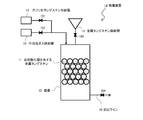
- FIG. 10 It is a figure showing processing device 10 of a natural oxide film concerning one embodiment of the present invention. It is a figure which shows the processing apparatus 20 of the tungsten oxide film which concerns on other embodiment of this invention. It is a figure which shows the processing apparatus 30 in an Example and a comparative example.
- the method for treating tungsten oxide according to the present invention comprises contacting tungsten oxide represented by the general formula WO x (0 ⁇ x ⁇ 3) with tungsten hexafluoride at a temperature of 0 ° C. or more and less than 500 ° C. And tungstate fluoride fluoride WO y F 6-2 y (0 ⁇ y ⁇ 3) having a high vapor pressure.
- tungsten oxide for example, a substance selected from the group consisting of WO 3 , WO 2 and W 2 O 3 can be mentioned, and as the tungstate fluoride, for example, a group consisting of WOF 4 and WO 2 F 2 The substance chosen from can be mentioned.
- Tungsten hexafluoride hardly reacts with metallic tungsten and selectively reacts with tungsten oxide with respect to metallic tungsten.
- tungsten oxide WO 3 (melting point 1400 ° C., boiling point 1800 ° C.) is brought into contact with tungsten hexafluoride WF 6 , oxygen is not generated by a chemical reaction as shown in the above-mentioned reaction formula (7) It can be converted to tungstate fluoride WOF 4 (melting point 106 ° C., boiling point 187 ° C.). WOF 4 is easily removed at around 80 ° C. because its vapor pressure is much higher than WO 3 .
- the temperature at which tungsten oxide and tungsten hexafluoride are in contact is preferably 0 ° C. or more and less than 500 ° C., and more preferably 80 ° C. or more and 350 ° C. or less. If the temperature is lower than 0 ° C., tungsten hexafluoride solidifies and the reaction with tungsten oxide becomes slow, which is not preferable. When the temperature is less than 80 ° C., tungsten oxide and tungsten hexafluoride react to form tungstate fluoride fluoride WOF 4, but an additional post-treatment to vaporize the product is required.
- the method of post-treatment is not particularly limited, and examples thereof include heating, degassing, and purging with an inert gas.
- the inert gas metal tungsten, a material which does not react with tungsten hexafluoride, for example, nitrogen, helium, argon, carbon tetrafluoride and the like can be used.
- the temperature exceeds 350 ° C., it is not preferable because the material of the container for carrying out the present invention is limited.
- the temperature is 500 ° C. or higher, the material of the container for carrying out the present invention is further restricted.
- a temperature of 180 ° C. or higher is preferable in that tungsten oxide can be converted to tungstate fluoride in a short time.
- Liquid and gas states can be selected as the state of tungsten hexafluoride when in contact with tungsten oxide, but tungsten hexafluoride has a melting point of 2 ° C. and a boiling point of 17 ° C. The state is preferred.
- Tungsten hexafluoride may be stationary (fixed) or may be moving (flowing). The same applies to tungsten oxide to be contacted.
- tungsten hexafluoride As a method of supplying tungsten hexafluoride in contacting with tungsten oxide, tungsten hexafluoride may be contained in the gas in contact with tungsten oxide, and it is limited to the method of directly supplying tungsten hexafluoride. It may not be used but may be supplied indirectly. As a method of supplying indirectly, for example, using fluorine, nitrogen trifluoride, and metal tungsten as raw materials, the tungsten hexafluoride produced by the reaction formula (1-1), (1-2) is brought into contact It is also good.
- ⁇ Atmosphere when contacting tungsten hexafluoride with tungsten oxide if the atmosphere of the container and the device contains moisture and oxygen, the underlying layer of tungsten oxide may be oxidized, and therefore moisture and oxygen are not included as much as possible.
- an atmosphere in which the concentration of water and oxygen is less than 100 ppm by volume is preferred.
- An inert gas can be mentioned as the atmosphere of the container and the device.
- the pressure at which tungsten hexafluoride and tungsten oxide are brought into contact with each other is preferably 0.01 kPa or more and 300 kPa or less in absolute pressure, and more preferably 0.01 kPa or more and 100 kPa or less in absolute pressure. If the absolute pressure is less than 0.01 kPa, the load on the facility for holding the pressure increases, which is not preferable. If the pressure is 300 kPa or more, tungsten hexafluoride may be liquefied, and tungsten hexafluoride may leak from the apparatus, which is not preferable.
- the natural oxide film processing apparatus 10 shown in FIG. 1 includes a container 12 filled with metallic tungsten 11 having a natural oxide film, a metallic tungsten feeder 13, a tungsten hexafluoride gas feeder 14, an inert gas feeder 15, It comprises the discharge line 16.
- the metal tungsten supply device 13 supplies metal tungsten.
- the shape of the metallic tungsten is not particularly limited, and examples thereof include powdery, granular, massive, rod-like and plate-like shapes.
- the latter stage of the discharge line 16 is connected to a vacuum degassing pump and a detoxifying device (not shown).
- the processing device 10 can be temperature controlled by a temperature regulator (not shown).
- Metallic tungsten 11 is supplied to the container 12 from the metallic tungsten supply device 13.
- the exhaust line 16 and the inert gas supplier 15 are used to gas replace the container 12 a plurality of times.
- the vessel 12 is depressurized and tungsten hexafluoride is fed from the tungsten hexafluoride feeder 14, and the pressure decreases as the reaction equation (7) progresses.
- the container 12 is heated to a predetermined temperature, and after a predetermined time has elapsed, the unreacted tungsten hexafluoride gas and the generated metal oxyfluoride are exhausted as gases from the discharge line 16.
- the inert gas may be entrained while the inert gas is supplied from the inert gas supply device 15, and the metal oxyfluoride may be exhausted as a gas from the discharge line 16.
- any supply method may be used either continuously or intermittently.
- the atmosphere of the metal tungsten supply device 13 is usually an inert gas, a tungsten hexafluoride gas may be added to the atmosphere to accompany the tungsten hexafluoride gas when supplying the metal tungsten.
- a method of supplying for example, a method of connecting a feeder such as a rotary valve, a screw feeder, a table feeder, a bin dispenser, or the like to a hopper and supplying the container 12 can be used. Alternatively, it may be supplied from the hopper directly to the container 12 by free fall.
- the natural oxide film of metallic tungsten can be removed at less than 500 ° C. without plasma, without reacting the metallic tungsten of the underlayer and generating oxygen and water by the reaction.
- the processing apparatus 20 for tungsten oxide film shown in FIG. 2 includes a chamber 21, a stage 22, a tungsten hexafluoride gas supply unit 23, a nitrogen gas supply unit 24, and a discharge line 25. Is installed. The latter stage of the discharge line 25 is connected to a vacuum degassing pump and a detoxifying device (not shown).
- the processing device 20 can be temperature controlled by a temperature regulator (not shown).
- the sample 26 is a sample in which a tungsten oxide film is formed on a film containing metallic tungsten.
- a film containing metallic tungsten is formed on a substrate such as a silicon wafer, and a tungsten oxide film is further formed thereon Samples are included.
- Films containing metallic tungsten include not only films of metallic tungsten but also films of alloys of tungsten and other metals.
- the tungsten oxide film includes not only a tungsten oxide film formed by a sputtering method but also a natural oxide film of a film containing metallic tungsten.
- the chamber 21 is replaced with the inert gas a plurality of times using the discharge line 25 and the inert gas supplier 24.
- the chamber 21 is depressurized, tungsten hexafluoride is supplied from a tungsten hexafluoride supply device 23, and the pressure decreases as the reaction equation (7) progresses.
- the chamber 21 is heated to a predetermined temperature, and after a predetermined time has elapsed, the unreacted tungsten hexafluoride gas and the generated metal oxyfluoride are exhausted as gases from the discharge line 25.
- the metal oxyfluoride gas may be exhausted by being accompanied by the inert gas from the discharge line 25 while supplying the inert gas from the inert gas supply device 24.
- the tungsten oxide film formed on the film containing metallic tungsten is removed at less than 500 ° C. without plasma, without reacting the metallic tungsten in the underlayer and without generating oxygen and water. can do.
- tungsten hexafluoride can be suitably obtained by supplying and reacting fluorine gas or nitrogen trifluoride gas with metallic tungsten from which the natural oxide film has been removed by the method for treating tungsten oxide according to the present invention.
- the method of treating tungsten oxide according to the present invention will be described by way of specific examples.
- An experimental apparatus for evaluating the processing of tungsten oxide in the example is shown in FIG.
- the method for treating tungsten oxide of the present invention is not limited by the following examples.
- the reaction between tungsten hexafluoride and tungsten oxide or metal tungsten was evaluated using a metal tungsten plate having tungsten oxide on the surface.
- Example 1 Regarding the processing apparatus 30 for removing tungsten oxide, the heater 36 is provided in a container 32 made of Ni having an outer diameter of 25.4 mm, an inner diameter of 22.1 mm, and a length of 300 mm to supply a processing gas for processing tungsten oxide.
- An apparatus 33, a nitrogen gas supply apparatus 34 for replacing the apparatus with gas, and a discharge line 35 in which a vacuum pump is installed at the rear stage are connected.
- a metal tungsten plate (thickness 2 mm, length 10 mm, width 10 mm) on the surface of which tungsten oxide is formed by exposure to the atmosphere is placed in the container 32, vacuum degassing in the discharge line 35, and nitrogen gas from the nitrogen gas feeder 34. Was carried out several times to replace the container 32 with nitrogen gas.
- the heater 36 is heated to a temperature of 80 ° C., and the tungsten hexafluoride gas is circulated from the processing gas supply device 33 at a flow rate of 10 sccm (volume flow rate cm 3 / min at 0 ° C., 1 atm) for 60 minutes, and then the discharge line 35 and nitrogen gas
- Example 2 A metal tungsten plate was treated in the same manner as in Example 1 except that the temperature of the heater 36 was 110 ° C. In the surface analysis by the X-ray photoelectron spectrometer, WO x / W was 0.8, and the weight change was less than ⁇ 0.1%.
- Example 3 A metallic tungsten plate was treated in the same manner as in Example 1 except that the temperature of the heater 36 was set to 180 ° C. In the surface analysis by the X-ray photoelectron spectrometer, WO x / W was less than 0.01, and the weight change was less than ⁇ 0.1%.
- Example 4 A metallic tungsten plate was treated in the same manner as in Example 1 except that the temperature of the heater 36 was set to 200 ° C. In the surface analysis by the X-ray photoelectron spectrometer, WO x / W was less than 0.01, and the weight change was less than ⁇ 0.1%.
- Comparative Example 1 The metal tungsten plate was treated in the same manner as in Example 4 except that the treatment gas supplied from the treatment gas supply unit 33 was nitrogen gas. In the surface analysis by the X-ray photoelectron spectrometer, WO x / W exceeded 2.5, and the weight change was less than ⁇ 0.1%.
- Comparative Example 2 A metal tungsten plate was treated in the same manner as in Example 4 except that the treatment gas supplied from the treatment gas supply unit 33 was hydrogen gas. In the surface analysis by the X-ray photoelectron spectrometer, WO x / W exceeded 2.5, and the weight change was less than ⁇ 0.1%.
- Comparative Example 3 The metal tungsten plate was processed in the same manner as in Example 1 except that the temperature of the heater 36 was set to 250 ° C. and the processing gas supplied from the processing gas supply unit 33 was changed to fluorine. During processing, the temperature of the vessel rose above the initial set point temperature. Surface analysis with an X-ray photoelectron spectrometer gave a WO x / W of ⁇ 0.01 and a weight reduction of 30%.
- Comparative Example 4 A metal tungsten plate was processed in the same manner as in Comparative Example 3 except that nitrogen trifluoride was used as the processing gas supplied from the processing gas supply unit 33. During processing, the temperature of the vessel rose above the initial set point temperature. Surface analysis with an X-ray photoelectron spectrometer gave a WO x / W of ⁇ 0.01 and a weight reduction of 38%.
- Comparative Example 5 The metal tungsten plate was treated in the same manner as in Comparative Example 3 except that the temperature of the heater 36 was 25 ° C. and the treatment gas supplied from the treatment gas supply unit 33 was chlorine trifluoride. During processing, the temperature of the vessel rose above the initial set point temperature. Surface analysis with an X-ray photoelectron spectrometer gave a WO x / W of ⁇ 0.01 and a weight reduction of 32%.
- the tungsten oxide can be selectively removed without reacting with metal tungsten which is a base material of the tungsten oxide (film).
- hydrogen which is a conventional technique
- tungsten hexafluoride can not be removed and reduced at 200 ° C. where the oxides can be removed.
- fluorine, nitrogen trifluoride and chlorine trifluoride were used as the processing gas, tungsten oxide could be removed, but it reacts with the metal tungsten which is the base material and tungsten oxide is oxidized Only the objects could not be selectively removed.
- processing apparatus 11 metal tungsten having a natural oxide film 12: container 13: metal tungsten feeder 14: tungsten hexafluoride feeder 15: inert gas feeder 16: discharge line 101, 102, 103, 104: partition Valve 20: Processing device 21: Chamber 22: Stage 23: Tungsten hexafluoride supply 24: Inert gas supply 25: Discharge line 26: Sample 201, 202, 203: Gate valve 30: Processing device 31: Natural oxide film Metal tungsten plate with 32: container 33: treatment gas supply 34: nitrogen gas supply 35: discharge line 36: heater 301, 302, 303: gate valve
Landscapes
- Chemical & Material Sciences (AREA)
- Organic Chemistry (AREA)
- Metallurgy (AREA)
- Engineering & Computer Science (AREA)
- Materials Engineering (AREA)
- Mechanical Engineering (AREA)
- General Chemical & Material Sciences (AREA)
- Chemical Kinetics & Catalysis (AREA)
- Inorganic Chemistry (AREA)
- Inorganic Compounds Of Heavy Metals (AREA)
- Cleaning And De-Greasing Of Metallic Materials By Chemical Methods (AREA)
- Preventing Corrosion Or Incrustation Of Metals (AREA)
- Internal Circuitry In Semiconductor Integrated Circuit Devices (AREA)
- Chemical Vapour Deposition (AREA)
Abstract
反応温度が500℃未満で、かつ反応によって酸素及び水を生成させることなく、金属タングステンに対して選択的にタングステン酸化物を蒸気圧の高い物質へ変換する方法を提供する。六フッ化タングステンは金属タングステンとほとんど反応しないが、本発明の方法では、タングステン酸化物を六フッ化タングステンに接触させて、反応式(7)に示す反応などにより、蒸気圧の高いタングステン酸フッ化物に転化される。 WO3+2WF6→3WOF4 …反応式(7)
Description
本発明は、タングステン酸化物を六フッ化タングステンと化学反応させて、タングステン酸フッ化物へ変換させる処理方法などに関する。
金属タングステンおよびタングステン化合物を化学気相蒸着する際の前駆体として、六フッ化タングステンが知られている。これら前駆体の工業的な製造方法として、反応式(1-1)~(1-2)に示すように、金属タングステンとフッ素又は三フッ化窒素を接触させる方法が知られている。
W+3F2→WF6 …反応式(1-1)
W+2NF3→WF6+N2 …反応式(1-2)
W+3F2→WF6 …反応式(1-1)
W+2NF3→WF6+N2 …反応式(1-2)
六フッ化タングステンの工業的な製造方法では、金属タングステンが使用されているが、大気に一度でも暴露された金属タングステンは表面酸化物で覆われている。この酸化物は、反応式(2-1)、(2-2)、(3-1)、(3-2)に示すように、F2、及びNF3によってタングステン酸フッ化物及び六フッ化タングステンに転化される。しかし、これらの転化反応は、金属タングステンとF2、及びNF3との反応(反応式(1-1)、(1-2))よりも、見掛けの反応速度が遅いため、反応初期ではF2とNF3の転化率が低下する。
WO3+2F2→WOF4+O2 …反応式(2-1)
WO3+4/3NF3→WOF4+O2+2/3N2 …反応式(2-2)
WOF4+F2→WF6+1/2O2 …反応式(3-1)
WOF4+2/3NF3→WF6+1/3N2+1/2O2 …反応式(3-2)
WO3+2F2→WOF4+O2 …反応式(2-1)
WO3+4/3NF3→WOF4+O2+2/3N2 …反応式(2-2)
WOF4+F2→WF6+1/2O2 …反応式(3-1)
WOF4+2/3NF3→WF6+1/3N2+1/2O2 …反応式(3-2)
そこで、転化率を向上させるために、金属タングステンの表面酸化物を除去することが求められる。
金属タングステンの表面酸化物を除去するための考えられる一つ目の方法は、酸化物を還元させる方法であり、還元剤が水素ガスの場合、温度800K以上でタングステン酸化物は還元されて金属タングステンに変換されることが報告されている(反応式(4)参照)。
WOx+xH2→W+xH2O …反応式(4)
WOx+xH2→W+xH2O …反応式(4)
二つ目の方法として、排気系内に堆積したタングステン酸化物とF2またはフッ素含有ハロゲン間化合物(ClF、ClF3、ClF5、BrF、BrF3、BrF5、IF3、IF5、IF7等)とを接触させ、タングステン酸化物を蒸気圧の高い化合物に変換して除去する方法が開示されている(特許文献1参照)。
フッ化ナトリウムを成型助剤として成型したタングステン酸化物と、フッ素又は三フッ化窒素を400℃程度で反応させ、六フッ化タングステンを得る方法が開示されている(特許文献2、3参照)。この方法から、三つ目の方法として、酸化物にF2とNF3を接触させ、六フッ化タングステンに変換して除去できることが予想される(反応式(5-1)、(5-2)参照)。
WO3+3F2→WF6+3/2O2 …反応式(5-1)
WO3+2NF3→WF6+3/2O2+N2 …反応式(5-2)
WO3+3F2→WF6+3/2O2 …反応式(5-1)
WO3+2NF3→WF6+3/2O2+N2 …反応式(5-2)
四つ目の方法として、アルカリ水溶液(水酸化ナトリウム、水酸化カリウムなど)を酸化物に接触させて、タングステン酸塩に変換させることで酸化物を除去する方法が考えられる(反応式(6-1)、(6-2)参照)。
WO3+2NaOH(aq)→Na2WO4(aq)+H2O …反応式(6-1)
WO3+2KOH(aq)→K2WO4(aq)+H2O …反応式(6-2)
WO3+2NaOH(aq)→Na2WO4(aq)+H2O …反応式(6-1)
WO3+2KOH(aq)→K2WO4(aq)+H2O …反応式(6-2)
表1にWF6、WOF4、WO3の1気圧での沸点と融点を示す。

しかしながら、タングステン酸化物を金属タングステンに還元するために水素ガスを利用する前記反応式(4)の方法を、工業的規模の製造を行う装置に適用する場合、可燃性ガスの水素を利用するため、支燃性ガスである六フッ化タングステン、フッ素、及び三フッ化窒素との接触で爆発的に反応するおそれがあり危険を伴う。また、還元させる際の温度が500℃以上と高く、さらに、還元により生じた水分を除去する必要があるため、適用することは難しい。
また、特許文献1に記載の方法は、ハロゲン間化合物に含まれる塩素、臭素、ヨウ素が六フッ化タングステンに不純物として混入するおそれがあるため、適用することが難しい。また、ハロゲン間化合物の反応性が高いため、酸化物だけでなく、下地層、例えば金属タングステンやウエハ基板など、とも反応するため、適用することが難しい。
特許文献2、3による酸化膜の除去方法(前記反応式(5-1)、(5-2))については、生成する酸素が金属タングステンと反応して再び酸化物を形成するため、除去するために時間を要する。また、フッ素と三フッ化窒素は反応性が高いため、酸化物だけでなく、下地層のタングステンとも前記の反応式(1-1)、(1-2)のとおり優先的に且つ局所的に反応するため、金属タングステンの酸化物を均一且つ選択的に除去させることが難しい。
アルカリ水溶液による酸化膜の湿式除去方法は、タングステン酸化物を効率良く除去できるが、水分を除去するのに乾燥させる際に再度酸化膜が形成されるため、適用することが難しい。
本発明の課題は、反応温度が500℃未満で、かつ反応によって酸素及び水を生成させることなく、金属タングステンに対して選択的にタングステン酸化物を蒸気圧の高い物質へ変換する方法を提供することである。
本発明者らは、上記課題を解決すべく鋭意検討した結果、六フッ化タングステンは金属タングステンとほとんど反応しないが、タングステン酸化物を六フッ化タングステンに接触させると、反応式(7)に示す反応などにより、蒸気圧の高いタングステン酸フッ化物に転化され、タングステン酸化物を除去できることに着目し、本発明にいたった。
WO3+2WF6→3WOF4 …反応式(7)
WO3+2WF6→3WOF4 …反応式(7)
本発明によれば、反応温度が500℃未満で、かつ反応によって酸素及び水を生成させることなく、金属タングステンに対して選択的にタングステン酸化物を蒸気圧の高い物質へ変換することができる。
本発明のタングステン酸化物の処理方法などの実施形態を、詳細に説明する。しかしながら、本発明は、以下に示す実施の形態に限定されるものではない。
本発明のタングステン酸化物の処理方法は、一般式WOx(0<x≦3)で表されるタングステン酸化物を六フッ化タングステンと温度0℃以上500℃未満で接触させて、化学反応によって、蒸気圧の高いタングステン酸フッ化物WOyF6-2y(0<y<3)へ変換することを特徴とする。タングステン酸化物としては、例えば、WO3、WO2、W2O3からなる群から選ばれる物質を挙げることができ、タングステン酸フッ化物としては、例えば、WOF4、WO2F2からなる群から選ばれる物質を挙げることができる。六フッ化タングステンは、金属タングステンとほとんど反応せず、金属タングステンに対して選択的にタングステン酸化物と反応する。
例えば、タングステン酸化物WO3(融点1400℃、沸点1800℃)を六フッ化タングステンWF6と接触させると、前述の反応式(7)に示すように、化学反応によって酸素を発生させることなく、タングステン酸フッ化物WOF4(融点106℃、沸点187℃)に変換することができる。WOF4は、WO3よりも遥かに蒸気圧が高いため、80℃程度で容易に除去される。
<温度>
タングステン酸化物と六フッ化タングステンが接触するときの温度として、0℃以上500℃未満であることが好ましく、80℃以上350℃以下であることがより好ましい。0℃未満では六フッ化タングステンが固化して、タングステン酸化物との反応が遅くなるため好ましくない。80℃未満ではタングステン酸化物と六フッ化タングステンは反応し、タングステン酸フッ化物WOF4が生成するが、生成物を気化させるための後処理が別途必要となる。後処理の方法は特に限定されないが、例えば、加熱、脱気、不活性ガスによるパージなどがある。不活性ガスとしては、金属タングステン、六フッ化タングステンと反応しない材料、例えば、窒素、ヘリウム、アルゴン、四フッ化炭素などを使用することができる。350℃を超える場合、本発明を実施するための容器の材質が制限されるため好ましくない。500℃以上の場合、本発明を実施するための容器の材質が更に制限されるため好ましくない。特に、180℃以上であると、短時間でタングステン酸化物をタングステン酸フッ化物に変換することができる点で好ましい、
タングステン酸化物と六フッ化タングステンが接触するときの温度として、0℃以上500℃未満であることが好ましく、80℃以上350℃以下であることがより好ましい。0℃未満では六フッ化タングステンが固化して、タングステン酸化物との反応が遅くなるため好ましくない。80℃未満ではタングステン酸化物と六フッ化タングステンは反応し、タングステン酸フッ化物WOF4が生成するが、生成物を気化させるための後処理が別途必要となる。後処理の方法は特に限定されないが、例えば、加熱、脱気、不活性ガスによるパージなどがある。不活性ガスとしては、金属タングステン、六フッ化タングステンと反応しない材料、例えば、窒素、ヘリウム、アルゴン、四フッ化炭素などを使用することができる。350℃を超える場合、本発明を実施するための容器の材質が制限されるため好ましくない。500℃以上の場合、本発明を実施するための容器の材質が更に制限されるため好ましくない。特に、180℃以上であると、短時間でタングステン酸化物をタングステン酸フッ化物に変換することができる点で好ましい、
<六フッ化タングステンとタングステン酸化物の接触方法>
タングステン酸化物と接触させる際の六フッ化タングステンの状態として、液体及び気体の状態を選択することができるが、六フッ化タングステンは融点2℃、沸点17℃であることから、取扱いやすい気体の状態が好ましい。
タングステン酸化物と接触させる際の六フッ化タングステンの状態として、液体及び気体の状態を選択することができるが、六フッ化タングステンは融点2℃、沸点17℃であることから、取扱いやすい気体の状態が好ましい。
タングステン酸化物と六フッ化タングステンを接触させる方法として、バッチ式、連続式の何れでもよい。六フッ化タングステンは静止(固定)していてもよく、移動(流動)していてもよい。接触されるタングステン酸化物についても同様である。
<六フッ化タングステンの供給方法>
タングステン酸化物と接触させる際の六フッ化タングステンの供給方法として、タングステン酸化物に接触するガス中に六フッ化タングステンが含まれていればよく、六フッ化タングステンを直接供給する方法だけに限定されず、間接的に供給する方法でもよい。間接的に供給する方法として、例えば、原料としてフッ素、三フッ化窒素、及び金属タングステンを使用して反応式(1-1)、(1-2)によって生成した六フッ化タングステンを接触させてもよい。但し、未反応のフッ素、三フッ化窒素が六フッ化タングステンに含まれている場合、未反応のフッ素、三フッ化窒素が処理対象となるタングステン酸化物の下地層と反応するおそれがあるため、フッ素、三フッ化窒素の転化率は99%以上が好ましい。
タングステン酸化物と接触させる際の六フッ化タングステンの供給方法として、タングステン酸化物に接触するガス中に六フッ化タングステンが含まれていればよく、六フッ化タングステンを直接供給する方法だけに限定されず、間接的に供給する方法でもよい。間接的に供給する方法として、例えば、原料としてフッ素、三フッ化窒素、及び金属タングステンを使用して反応式(1-1)、(1-2)によって生成した六フッ化タングステンを接触させてもよい。但し、未反応のフッ素、三フッ化窒素が六フッ化タングステンに含まれている場合、未反応のフッ素、三フッ化窒素が処理対象となるタングステン酸化物の下地層と反応するおそれがあるため、フッ素、三フッ化窒素の転化率は99%以上が好ましい。
<六フッ化タングステンとタングステン酸化物を接触させる際の雰囲気>
タングステン酸化物と六フッ化タングステンを接触させるとき、容器及び装置の雰囲気に水分及び酸素が含まれると、タングステン酸化物の下地層が酸化されるおそれがあるため、水分及び酸素が極力含まれない、例えば、水分と酸素の濃度が100体積ppm未満の雰囲気が好ましい。容器及び装置の雰囲気として、不活性ガスを挙げることができる。
タングステン酸化物と六フッ化タングステンを接触させるとき、容器及び装置の雰囲気に水分及び酸素が含まれると、タングステン酸化物の下地層が酸化されるおそれがあるため、水分及び酸素が極力含まれない、例えば、水分と酸素の濃度が100体積ppm未満の雰囲気が好ましい。容器及び装置の雰囲気として、不活性ガスを挙げることができる。
<圧力>
六フッ化タングステンとタングステン酸化物を接触させる際の圧力が絶対圧で0.01kPa以上300kPa以下であることが好ましく、絶対圧で0.01kPa以上100kPa以下であることがより好ましい。絶対圧0.01kPa未満では、圧力を保持するための設備の負荷が大きくなるため、好ましくない。300kPa以上では、六フッ化タングステンが液化する可能性がある上に、装置から六フッ化タングステンが漏えいするおそれがあるため好ましくない。
六フッ化タングステンとタングステン酸化物を接触させる際の圧力が絶対圧で0.01kPa以上300kPa以下であることが好ましく、絶対圧で0.01kPa以上100kPa以下であることがより好ましい。絶対圧0.01kPa未満では、圧力を保持するための設備の負荷が大きくなるため、好ましくない。300kPa以上では、六フッ化タングステンが液化する可能性がある上に、装置から六フッ化タングステンが漏えいするおそれがあるため好ましくない。
(金属タングステンの自然酸化膜のクリーニング方法)
本発明のタングステン酸化物の処理方法を用いたクリーニング方法の一実施形態を、図1を用いて説明する。図1に示す自然酸化膜の処理装置10は、自然酸化膜を有する金属タングステン11が充填された容器12、金属タングステン供給器13、六フッ化タングステンガス供給器14、不活性ガス供給器15、排出ライン16で構成される。金属タングステン供給器13からは、金属タングステンが供給される。金属タングステンの形状は特に限定されないが、粉末状、粒状、塊状、棒状、板状などの形状が挙げられる。排出ライン16の後段は図示しない真空脱気ポンプ及び無害化装置に接続されている。処理装置10は図示しない温度調整器によって温度制御できる。
本発明のタングステン酸化物の処理方法を用いたクリーニング方法の一実施形態を、図1を用いて説明する。図1に示す自然酸化膜の処理装置10は、自然酸化膜を有する金属タングステン11が充填された容器12、金属タングステン供給器13、六フッ化タングステンガス供給器14、不活性ガス供給器15、排出ライン16で構成される。金属タングステン供給器13からは、金属タングステンが供給される。金属タングステンの形状は特に限定されないが、粉末状、粒状、塊状、棒状、板状などの形状が挙げられる。排出ライン16の後段は図示しない真空脱気ポンプ及び無害化装置に接続されている。処理装置10は図示しない温度調整器によって温度制御できる。
以下、金属タングステンの自然酸化膜のクリーニング方法を説明する。金属タングステン供給器13から容器12に金属タングステン11を供給する。排出ライン16と不活性ガス供給器15を用いて、容器12を複数回ガス置換する。容器12を減圧にして、六フッ化タングステン供給器14から六フッ化タングステンを供給し、反応式(7)の進行によって圧力が減少する。容器12を所定温度に加熱し、所定時間経過後、排出ライン16から、未反応の六フッ化タングステンガス、及び生成した酸フッ化金属をガスとして排気する。なお、不活性ガス供給器15から不活性ガスを供給しながら、不活性ガスを同伴させて排出ライン16から酸フッ化金属をガスとして排気してもよい。
金属タングステン供給器13から容器12に金属タングステン11を供給する方法として、連続的及び間欠的、いずれの供給方式でもよい。金属タングステン供給器13の雰囲気は通常は不活性ガスであるが、雰囲気に六フッ化タングステンガスを添加して、金属タングステンを供給する際に六フッ化タングステンガスを同伴させてもよい。供給する方法として、例えば、ホッパーにロータリーバルブ、スクリューフィーダー、テーブルフィーダー、ビンディスチャージャーなどの供給器を接続し、容器12に供給する方法を用いることができる。また、ホッパーから容器12に直接、自由落下によって供給してもよい。
該クリーニング方法により、金属タングステンの自然酸化膜を、下地層の金属タングステンを反応させず、且つ反応によって酸素と水を発生させることなく、プラズマレスで500℃未満で除去することができる。
このようにして自然酸化膜を除去した金属タングステンに対して、フッ素ガスや三フッ化窒素ガスを供給して、前記の反応式(1-1)、(1-2)の反応により、六フッ化タングステンを得ることができる。自然酸化膜が無いため、反応初期より、金属タングステンとフッ素ガスなどが反応し、F2又はNF3の転化率が高くなる。
(タングステン膜の酸化膜のクリーニング方法)
本発明の酸化膜の処理方法を用いたクリーニング方法の他の実施形態を、図2を用いて説明する。図2に示すタングステン酸化物膜の処理装置20は、チャンバー21、ステージ22、六フッ化タングステンガス供給器23、窒素ガス供給器24、排出ライン25で構成され、ステージ22上には、サンプル26が設置されている。排出ライン25の後段は図示しない真空脱気ポンプ及び無害化装置に接続されている。処理装置20は図示しない温度調整器によって温度制御できる。
本発明の酸化膜の処理方法を用いたクリーニング方法の他の実施形態を、図2を用いて説明する。図2に示すタングステン酸化物膜の処理装置20は、チャンバー21、ステージ22、六フッ化タングステンガス供給器23、窒素ガス供給器24、排出ライン25で構成され、ステージ22上には、サンプル26が設置されている。排出ライン25の後段は図示しない真空脱気ポンプ及び無害化装置に接続されている。処理装置20は図示しない温度調整器によって温度制御できる。
サンプル26は、金属タングステンを含む膜の上にタングステン酸化物膜を形成したサンプルであり、例えば、シリコンウェハなどの基板に金属タングステンを含む膜が形成され、その上にさらにタングステン酸化物膜が形成されたサンプルが挙げられる。金属タングステンを含む膜には、金属タングステンの膜だけでなく、タングステンと他の金属の合金の膜も含まれる。また、タングステン酸化物膜には、スパッタリング法などにより形成されたタングステン酸化物の膜だけでなく、金属タングステンを含む膜の自然酸化膜も含まれる。
以下、サンプル26のタングステン酸化物膜のクリーニング方法を説明する。排出ライン25と不活性ガス供給器24を用いて、チャンバー21を複数回、不活性ガスで置換する。チャンバー21を減圧にして、六フッ化タングステン供給器23から六フッ化タングステンを供給し、反応式(7)の進行によって圧力が減少する。チャンバー21を所定温度に加熱し、所定時間経過後、排出ライン25から、未反応の六フッ化タングステンガス、及び生成した酸フッ化金属をガスとして排気する。なお、不活性ガス供給器24から不活性ガスを供給しながら、排出ライン25から不活性ガスに同伴させて酸フッ化金属ガスを排気してもよい。
該クリーニング方法により、金属タングステンを含む膜の上に形成されたタングステン酸化物膜を、下地層の金属タングステンを反応させず、且つ酸素と水を発生させることなく、プラズマレスで500℃未満で除去することができる。
また、本発明のタングステン酸化物の処理方法により自然酸化膜を除去した金属タングステンに、フッ素ガスまたは三フッ化窒素ガスを供給・反応させることにより、六フッ化タングステンを好適に得ることができる。
具体的な実施例により、本発明のタングステン酸化物の処理方法を説明する。実施例におけるタングステン酸化物の処理を評価する実験装置を図3に示す。しかしながら、本発明のタングステン酸化物の処理方法は、以下の実施例により限定されるものではない。以下の実施例・比較例では、表面にタングステン酸化物を有する金属タングステン板を用いて、六フッ化タングステンとタングステン酸化物又は金属タングステンとの反応を評価した。
[実施例1]
タングステン酸化物を除去する処理装置30に関して、Ni製の外径25.4mm、内径22.1mm、長さ300mmの容器32に、ヒーター36が具備され、タングステン酸化物を処理するための処理ガス供給器33、装置をガス置換するための窒素ガス供給器34、真空ポンプが後段に設置されている排出ライン35が接続されている。容器32に大気暴露によってタングステン酸化物が表面に形成された金属タングステン板(厚さ2mm、縦10mm、横10mm)を設置し、排出ライン35で真空脱気、及び窒素ガス供給器34から窒素ガスの供給を複数回実施して、容器32を窒素ガスで置換した。処理ガスで処理する前の金属タングステン板の表面をX線光電子分光分析装置(ULVAC-PHI製、PHI5000 VersaProbeIIシリーズ)で表面を分析した結果、金属タングステン(軌道4f7/2、束縛エネルギー31.6eV)に対するタングステン酸化物(軌道4f7/2、束縛エネルギー36.1eV)のピーク面積比WOx/Wは2.5を超えていた。ヒーター36を温度80℃に加熱して、処理ガス供給器33から六フッ化タングステンガスを流量10sccm(0℃、1atmにおける体積流量cm3/min)で60分間流通後、排出ライン35と窒素ガス供給器34を利用して容器32を窒素ガスで置換した。容器32が室温程度まで降温したことを確認して、大気に暴露させないように金属タングステン板を取り出して、X線光電子分光分析装置による表面分析ではWOx/W=0.9であり、重量変化は±0.1%未満だった。
タングステン酸化物を除去する処理装置30に関して、Ni製の外径25.4mm、内径22.1mm、長さ300mmの容器32に、ヒーター36が具備され、タングステン酸化物を処理するための処理ガス供給器33、装置をガス置換するための窒素ガス供給器34、真空ポンプが後段に設置されている排出ライン35が接続されている。容器32に大気暴露によってタングステン酸化物が表面に形成された金属タングステン板(厚さ2mm、縦10mm、横10mm)を設置し、排出ライン35で真空脱気、及び窒素ガス供給器34から窒素ガスの供給を複数回実施して、容器32を窒素ガスで置換した。処理ガスで処理する前の金属タングステン板の表面をX線光電子分光分析装置(ULVAC-PHI製、PHI5000 VersaProbeIIシリーズ)で表面を分析した結果、金属タングステン(軌道4f7/2、束縛エネルギー31.6eV)に対するタングステン酸化物(軌道4f7/2、束縛エネルギー36.1eV)のピーク面積比WOx/Wは2.5を超えていた。ヒーター36を温度80℃に加熱して、処理ガス供給器33から六フッ化タングステンガスを流量10sccm(0℃、1atmにおける体積流量cm3/min)で60分間流通後、排出ライン35と窒素ガス供給器34を利用して容器32を窒素ガスで置換した。容器32が室温程度まで降温したことを確認して、大気に暴露させないように金属タングステン板を取り出して、X線光電子分光分析装置による表面分析ではWOx/W=0.9であり、重量変化は±0.1%未満だった。
[実施例2]
ヒーター36の温度を110℃にする以外は、実施例1と同様に金属タングステン板を処理した。X線光電子分光分析装置による表面分析ではWOx/Wは0.8であり、重量変化は±0.1%未満だった。
ヒーター36の温度を110℃にする以外は、実施例1と同様に金属タングステン板を処理した。X線光電子分光分析装置による表面分析ではWOx/Wは0.8であり、重量変化は±0.1%未満だった。
[実施例3]
ヒーター36の温度を180℃にする以外は、実施例1と同様に金属タングステン板を処理した。X線光電子分光分析装置による表面分析ではWOx/Wは0.01未満であり、重量変化は±0.1%未満だった。
ヒーター36の温度を180℃にする以外は、実施例1と同様に金属タングステン板を処理した。X線光電子分光分析装置による表面分析ではWOx/Wは0.01未満であり、重量変化は±0.1%未満だった。
[実施例4]
ヒーター36の温度を200℃にする以外は、実施例1と同様に金属タングステン板を処理した。X線光電子分光分析装置による表面分析ではWOx/Wは0.01未満であり、重量変化は±0.1%未満だった。
ヒーター36の温度を200℃にする以外は、実施例1と同様に金属タングステン板を処理した。X線光電子分光分析装置による表面分析ではWOx/Wは0.01未満であり、重量変化は±0.1%未満だった。
[比較例1]
処理ガス供給器33から供給する処理ガスを窒素ガスとする以外は、実施例4と同様に金属タングステン板を処理した。X線光電子分光分析装置による表面分析ではWOx/Wは2.5を超えており、重量変化は±0.1%未満だった。
処理ガス供給器33から供給する処理ガスを窒素ガスとする以外は、実施例4と同様に金属タングステン板を処理した。X線光電子分光分析装置による表面分析ではWOx/Wは2.5を超えており、重量変化は±0.1%未満だった。
[比較例2]
処理ガス供給器33から供給する処理ガスを水素ガスとする以外は、実施例4と同様に金属タングステン板を処理した。X線光電子分光分析装置による表面分析ではWOx/Wは2.5を超えており、重量変化は±0.1%未満だった。
処理ガス供給器33から供給する処理ガスを水素ガスとする以外は、実施例4と同様に金属タングステン板を処理した。X線光電子分光分析装置による表面分析ではWOx/Wは2.5を超えており、重量変化は±0.1%未満だった。
[比較例3]
ヒーター36の温度を250℃とし、処理ガス供給器33から供給する処理ガスをフッ素とする以外は、実施例1と同様に金属タングステン板を処理した。処理中、容器の温度が初期の設定温度より上昇した。X線光電子分光分析装置による表面分析ではWOx/Wは<0.01であり、重量は30%減少した。
ヒーター36の温度を250℃とし、処理ガス供給器33から供給する処理ガスをフッ素とする以外は、実施例1と同様に金属タングステン板を処理した。処理中、容器の温度が初期の設定温度より上昇した。X線光電子分光分析装置による表面分析ではWOx/Wは<0.01であり、重量は30%減少した。
[比較例4]
処理ガス供給器33から供給する処理ガスを三フッ化窒素とする以外は、比較例3と同様に金属タングステン板を処理した。処理中、容器の温度が初期の設定温度より上昇した。X線光電子分光分析装置による表面分析ではWOx/Wは<0.01であり、重量は38%減少した。
処理ガス供給器33から供給する処理ガスを三フッ化窒素とする以外は、比較例3と同様に金属タングステン板を処理した。処理中、容器の温度が初期の設定温度より上昇した。X線光電子分光分析装置による表面分析ではWOx/Wは<0.01であり、重量は38%減少した。
[比較例5]
ヒーター36の温度を25℃とし、処理ガス供給器33から供給する処理ガスを三フッ化塩素とする以外は、比較例3と同様に金属タングステン板を処理した。処理中、容器の温度が初期の設定温度より上昇した。X線光電子分光分析装置による表面分析ではWOx/Wは<0.01であり、重量は32%減少した。
ヒーター36の温度を25℃とし、処理ガス供給器33から供給する処理ガスを三フッ化塩素とする以外は、比較例3と同様に金属タングステン板を処理した。処理中、容器の温度が初期の設定温度より上昇した。X線光電子分光分析装置による表面分析ではWOx/Wは<0.01であり、重量は32%減少した。
以上の実施例、比較例を以下の表にまとめた。
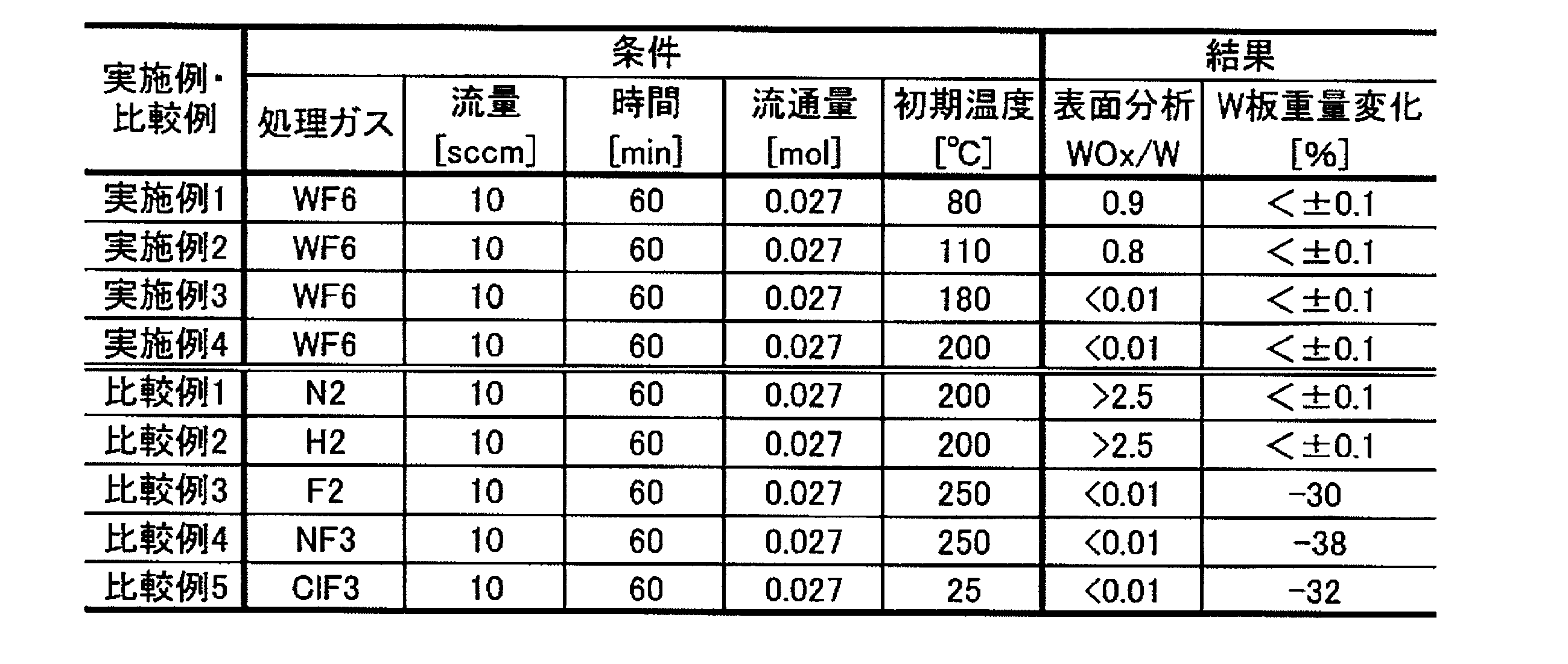
以上の通り、処理ガスとして、六フッ化タングステンを用いた場合、タングステン酸化物(膜)の下地材である金属タングステンと反応することなく、タングステン酸化物を選択的に除去できた。一方、従来の技術である水素を処理ガスとして用いた場合、六フッ化タングステンでは酸化物を除去できた200℃では、タングステン酸化物を除去及び還元することはできなかった。また、処理ガスとして、フッ素、三フッ化窒素、及び三フッ化塩素を処理ガスとして用いた場合、タングステン酸化物を除去することはできたが、下地材である金属タングステンと反応し、タングステン酸化物のみを選択的に除去することはできなかった。
10: 処理装置
11: 自然酸化膜を有する金属タングステン
12: 容器
13: 金属タングステン供給器
14: 六フッ化タングステン供給器
15: 不活性ガス供給器
16: 排出ライン
101、102、103、104: 仕切弁
20: 処理装置
21: チャンバー
22: ステージ
23: 六フッ化タングステン供給器
24: 不活性ガス供給器
25: 排出ライン
26: サンプル
201、202、203: 仕切弁
30: 処理装置
31: 自然酸化膜を有する金属タングステン板
32: 容器
33: 処理ガス供給器
34: 窒素ガス供給器
35: 排出ライン
36: ヒーター
301、302、303: 仕切弁
11: 自然酸化膜を有する金属タングステン
12: 容器
13: 金属タングステン供給器
14: 六フッ化タングステン供給器
15: 不活性ガス供給器
16: 排出ライン
101、102、103、104: 仕切弁
20: 処理装置
21: チャンバー
22: ステージ
23: 六フッ化タングステン供給器
24: 不活性ガス供給器
25: 排出ライン
26: サンプル
201、202、203: 仕切弁
30: 処理装置
31: 自然酸化膜を有する金属タングステン板
32: 容器
33: 処理ガス供給器
34: 窒素ガス供給器
35: 排出ライン
36: ヒーター
301、302、303: 仕切弁
Claims (5)
- 一般式WOx(0<x≦3)で表されるタングステン酸化物を、温度0℃以上500℃未満で六フッ化タングステンと接触させて、化学反応によって一般式WOyF6-2y(0<y<3)で表されるタングステン酸フッ化物へ変換することを特徴とするタングステン酸化物の処理方法。
- 前記温度が80℃以上500℃未満であることを特徴とする請求項1に記載のタングステン酸化物の処理方法。
- 前記タングステン酸化物が、金属タングステンの自然酸化膜であることを特徴とする請求項1に記載のタングステン酸化物の処理方法。
- 前記タングステン酸化物が、金属タングステンを含む膜の上に形成されたタングステン酸化物膜であることを特徴とする請求項1に記載のタングステン酸化物の処理方法。
- 金属タングステンの自然酸化膜を、請求項1に記載のタングステン酸化物の処理方法により除去する工程と、
自然酸化膜を除去した前記金属タングステンにフッ素ガスまたは三フッ化窒素ガスを供給し、化学反応によって六フッ化タングステンを得る工程と、
を有することを特徴とする六フッ化タングステンの製造方法。
Applications Claiming Priority (2)
| Application Number | Priority Date | Filing Date | Title |
|---|---|---|---|
| JP2017-163938 | 2017-08-29 | ||
| JP2017163938 | 2017-08-29 |
Publications (1)
| Publication Number | Publication Date |
|---|---|
| WO2019044601A1 true WO2019044601A1 (ja) | 2019-03-07 |
Family
ID=65526327
Family Applications (1)
| Application Number | Title | Priority Date | Filing Date |
|---|---|---|---|
| PCT/JP2018/030913 Ceased WO2019044601A1 (ja) | 2017-08-29 | 2018-08-22 | タングステン酸化物の処理方法及び六フッ化タングステンの製造方法 |
Country Status (2)
| Country | Link |
|---|---|
| JP (1) | JP7029068B2 (ja) |
| WO (1) | WO2019044601A1 (ja) |
Cited By (2)
| Publication number | Priority date | Publication date | Assignee | Title |
|---|---|---|---|---|
| WO2020036026A1 (ja) * | 2018-08-17 | 2020-02-20 | セントラル硝子株式会社 | 六フッ化タングステンの製造方法 |
| JP2021507509A (ja) * | 2017-12-14 | 2021-02-22 | アプライド マテリアルズ インコーポレイテッドApplied Materials,Incorporated | エッチング残留物の少ない金属酸化物のエッチング方法 |
Citations (3)
| Publication number | Priority date | Publication date | Assignee | Title |
|---|---|---|---|---|
| JPH0831932A (ja) * | 1994-07-12 | 1996-02-02 | Hitachi Ltd | 半導体集積回路装置の製造方法 |
| KR101376827B1 (ko) * | 2013-01-24 | 2014-03-20 | 최병구 | 육불화텅스텐의 제조방법 |
| US20170148670A1 (en) * | 2015-11-25 | 2017-05-25 | Applied Materials, Inc. | Methods for forming low-resistance contacts through integrated process flow systems |
Family Cites Families (2)
| Publication number | Priority date | Publication date | Assignee | Title |
|---|---|---|---|---|
| US5286520A (en) * | 1991-12-13 | 1994-02-15 | Ford Motor Company | Preparation of fluorine-doped tungstic oxide |
| DE4340952A1 (de) * | 1992-12-24 | 1994-06-30 | Balzers Hochvakuum | Verfahren zur Reinigung von nachmals zu beschichtenden Oberflächen |
-
2018
- 2018-08-13 JP JP2018152165A patent/JP7029068B2/ja active Active
- 2018-08-22 WO PCT/JP2018/030913 patent/WO2019044601A1/ja not_active Ceased
Patent Citations (3)
| Publication number | Priority date | Publication date | Assignee | Title |
|---|---|---|---|---|
| JPH0831932A (ja) * | 1994-07-12 | 1996-02-02 | Hitachi Ltd | 半導体集積回路装置の製造方法 |
| KR101376827B1 (ko) * | 2013-01-24 | 2014-03-20 | 최병구 | 육불화텅스텐의 제조방법 |
| US20170148670A1 (en) * | 2015-11-25 | 2017-05-25 | Applied Materials, Inc. | Methods for forming low-resistance contacts through integrated process flow systems |
Cited By (6)
| Publication number | Priority date | Publication date | Assignee | Title |
|---|---|---|---|---|
| JP2021507509A (ja) * | 2017-12-14 | 2021-02-22 | アプライド マテリアルズ インコーポレイテッドApplied Materials,Incorporated | エッチング残留物の少ない金属酸化物のエッチング方法 |
| JP7366019B2 (ja) | 2017-12-14 | 2023-10-20 | アプライド マテリアルズ インコーポレイテッド | エッチング残留物の少ない金属酸化物のエッチング方法 |
| WO2020036026A1 (ja) * | 2018-08-17 | 2020-02-20 | セントラル硝子株式会社 | 六フッ化タングステンの製造方法 |
| JPWO2020036026A1 (ja) * | 2018-08-17 | 2021-08-12 | セントラル硝子株式会社 | 六フッ化タングステンの製造方法 |
| JP7273323B2 (ja) | 2018-08-17 | 2023-05-15 | セントラル硝子株式会社 | 六フッ化タングステンの製造方法 |
| US12145857B2 (en) | 2018-08-17 | 2024-11-19 | Central Glass Company, Limited | Method for producing tungsten hexafluoride |
Also Published As
| Publication number | Publication date |
|---|---|
| JP2019044264A (ja) | 2019-03-22 |
| JP7029068B2 (ja) | 2022-03-03 |
Similar Documents
| Publication | Publication Date | Title |
|---|---|---|
| JP7157299B2 (ja) | 酸フッ化金属の処理方法及びクリーニング方法 | |
| JP6867581B2 (ja) | フッ素ガスの精製方法 | |
| TW201715603A (zh) | 乾蝕刻方法、半導體元件之製造方法以及腔室清潔方法 | |
| JP4634199B2 (ja) | フッ素含有ガスによる表面改質方法及びその装置 | |
| WO1991004942A1 (fr) | Procede d'epuration de trifluorure d'azote a l'etat gazeux | |
| WO2019044601A1 (ja) | タングステン酸化物の処理方法及び六フッ化タングステンの製造方法 | |
| JP3727797B2 (ja) | 三フッ化窒素の製造方法 | |
| CN111918839A (zh) | 六氟化钼的制造方法和制造装置 | |
| WO2018105220A1 (ja) | 高純度五塩化タングステン及びその製造方法 | |
| US12145857B2 (en) | Method for producing tungsten hexafluoride | |
| EP0946407B1 (en) | Device and method for the storage, transportation and production of active fluorine | |
| JPWO2019188030A1 (ja) | 基板処理用ガス、保管容器および基板処理方法 | |
| TWI732848B (zh) | 半導體製造裝置的洗滌方法 | |
| JP4170447B2 (ja) | 炭素材料の高純度化処理方法、及び高純度化処理装置 | |
| JP2823555B2 (ja) | 薄膜形成装置の表面清浄に三フッ化塩素を用いる方法 | |
| JP2007176770A (ja) | 高純度フッ素ガスの製造方法および高純度フッ素ガス製造装置 | |
| CN121730011A (zh) | 金属氧化物的气相热蚀刻 | |
| JP2768666B2 (ja) | 薄膜形成装置内の付着物を除去する方法 | |
| WO2024215408A1 (en) | Vapor-phase etch of metal-containing materials | |
| JP3090966B2 (ja) | 三弗化窒素ガスの精製方法 | |
| KR20260053005A (ko) | 정제 불소 함유 가스 조성물의 제조 방법, 반도체 디바이스의 제조 방법, 에칭 장치 | |
| WO2025134869A1 (ja) | フッ素ガスの除去方法 |
Legal Events
| Date | Code | Title | Description |
|---|---|---|---|
| 121 | Ep: the epo has been informed by wipo that ep was designated in this application |
Ref document number: 18850746 Country of ref document: EP Kind code of ref document: A1 |
|
| NENP | Non-entry into the national phase |
Ref country code: DE |
|
| 122 | Ep: pct application non-entry in european phase |
Ref document number: 18850746 Country of ref document: EP Kind code of ref document: A1 |