WO2019035401A1 - 高硬度かつ靱性に優れる鋼 - Google Patents
高硬度かつ靱性に優れる鋼 Download PDFInfo
- Publication number
- WO2019035401A1 WO2019035401A1 PCT/JP2018/029752 JP2018029752W WO2019035401A1 WO 2019035401 A1 WO2019035401 A1 WO 2019035401A1 JP 2018029752 W JP2018029752 W JP 2018029752W WO 2019035401 A1 WO2019035401 A1 WO 2019035401A1
- Authority
- WO
- WIPO (PCT)
- Prior art keywords
- less
- steel
- toughness
- high hardness
- carbides
- Prior art date
- Legal status (The legal status is an assumption and is not a legal conclusion. Google has not performed a legal analysis and makes no representation as to the accuracy of the status listed.)
- Ceased
Links
Classifications
-
- C—CHEMISTRY; METALLURGY
- C22—METALLURGY; FERROUS OR NON-FERROUS ALLOYS; TREATMENT OF ALLOYS OR NON-FERROUS METALS
- C22C—ALLOYS
- C22C38/00—Ferrous alloys, e.g. steel alloys
- C22C38/18—Ferrous alloys, e.g. steel alloys containing chromium
- C22C38/40—Ferrous alloys, e.g. steel alloys containing chromium with nickel
- C22C38/46—Ferrous alloys, e.g. steel alloys containing chromium with nickel with vanadium
-
- C—CHEMISTRY; METALLURGY
- C21—METALLURGY OF IRON
- C21D—MODIFYING THE PHYSICAL STRUCTURE OF FERROUS METALS; GENERAL DEVICES FOR HEAT TREATMENT OF FERROUS OR NON-FERROUS METALS OR ALLOYS; MAKING METAL MALLEABLE, e.g. BY DECARBURISATION OR TEMPERING
- C21D1/00—General methods or devices for heat treatment, e.g. annealing, hardening, quenching or tempering
- C21D1/26—Methods of annealing
- C21D1/28—Normalising
-
- C—CHEMISTRY; METALLURGY
- C21—METALLURGY OF IRON
- C21D—MODIFYING THE PHYSICAL STRUCTURE OF FERROUS METALS; GENERAL DEVICES FOR HEAT TREATMENT OF FERROUS OR NON-FERROUS METALS OR ALLOYS; MAKING METAL MALLEABLE, e.g. BY DECARBURISATION OR TEMPERING
- C21D6/00—Heat treatment of ferrous alloys
- C21D6/004—Heat treatment of ferrous alloys containing Cr and Ni
-
- C—CHEMISTRY; METALLURGY
- C21—METALLURGY OF IRON
- C21D—MODIFYING THE PHYSICAL STRUCTURE OF FERROUS METALS; GENERAL DEVICES FOR HEAT TREATMENT OF FERROUS OR NON-FERROUS METALS OR ALLOYS; MAKING METAL MALLEABLE, e.g. BY DECARBURISATION OR TEMPERING
- C21D6/00—Heat treatment of ferrous alloys
- C21D6/005—Heat treatment of ferrous alloys containing Mn
-
- C—CHEMISTRY; METALLURGY
- C21—METALLURGY OF IRON
- C21D—MODIFYING THE PHYSICAL STRUCTURE OF FERROUS METALS; GENERAL DEVICES FOR HEAT TREATMENT OF FERROUS OR NON-FERROUS METALS OR ALLOYS; MAKING METAL MALLEABLE, e.g. BY DECARBURISATION OR TEMPERING
- C21D6/00—Heat treatment of ferrous alloys
- C21D6/008—Heat treatment of ferrous alloys containing Si
-
- C—CHEMISTRY; METALLURGY
- C21—METALLURGY OF IRON
- C21D—MODIFYING THE PHYSICAL STRUCTURE OF FERROUS METALS; GENERAL DEVICES FOR HEAT TREATMENT OF FERROUS OR NON-FERROUS METALS OR ALLOYS; MAKING METAL MALLEABLE, e.g. BY DECARBURISATION OR TEMPERING
- C21D6/00—Heat treatment of ferrous alloys
- C21D6/02—Hardening by precipitation
-
- C—CHEMISTRY; METALLURGY
- C22—METALLURGY; FERROUS OR NON-FERROUS ALLOYS; TREATMENT OF ALLOYS OR NON-FERROUS METALS
- C22C—ALLOYS
- C22C38/00—Ferrous alloys, e.g. steel alloys
-
- C—CHEMISTRY; METALLURGY
- C22—METALLURGY; FERROUS OR NON-FERROUS ALLOYS; TREATMENT OF ALLOYS OR NON-FERROUS METALS
- C22C—ALLOYS
- C22C38/00—Ferrous alloys, e.g. steel alloys
- C22C38/001—Ferrous alloys, e.g. steel alloys containing N
-
- C—CHEMISTRY; METALLURGY
- C22—METALLURGY; FERROUS OR NON-FERROUS ALLOYS; TREATMENT OF ALLOYS OR NON-FERROUS METALS
- C22C—ALLOYS
- C22C38/00—Ferrous alloys, e.g. steel alloys
- C22C38/002—Ferrous alloys, e.g. steel alloys containing In, Mg, or other elements not provided for in one single group C22C38/001 - C22C38/60
-
- C—CHEMISTRY; METALLURGY
- C22—METALLURGY; FERROUS OR NON-FERROUS ALLOYS; TREATMENT OF ALLOYS OR NON-FERROUS METALS
- C22C—ALLOYS
- C22C38/00—Ferrous alloys, e.g. steel alloys
- C22C38/02—Ferrous alloys, e.g. steel alloys containing silicon
-
- C—CHEMISTRY; METALLURGY
- C22—METALLURGY; FERROUS OR NON-FERROUS ALLOYS; TREATMENT OF ALLOYS OR NON-FERROUS METALS
- C22C—ALLOYS
- C22C38/00—Ferrous alloys, e.g. steel alloys
- C22C38/04—Ferrous alloys, e.g. steel alloys containing manganese
-
- C—CHEMISTRY; METALLURGY
- C22—METALLURGY; FERROUS OR NON-FERROUS ALLOYS; TREATMENT OF ALLOYS OR NON-FERROUS METALS
- C22C—ALLOYS
- C22C38/00—Ferrous alloys, e.g. steel alloys
- C22C38/06—Ferrous alloys, e.g. steel alloys containing aluminium
-
- C—CHEMISTRY; METALLURGY
- C22—METALLURGY; FERROUS OR NON-FERROUS ALLOYS; TREATMENT OF ALLOYS OR NON-FERROUS METALS
- C22C—ALLOYS
- C22C38/00—Ferrous alloys, e.g. steel alloys
- C22C38/18—Ferrous alloys, e.g. steel alloys containing chromium
- C22C38/40—Ferrous alloys, e.g. steel alloys containing chromium with nickel
- C22C38/44—Ferrous alloys, e.g. steel alloys containing chromium with nickel with molybdenum or tungsten
-
- C—CHEMISTRY; METALLURGY
- C21—METALLURGY OF IRON
- C21D—MODIFYING THE PHYSICAL STRUCTURE OF FERROUS METALS; GENERAL DEVICES FOR HEAT TREATMENT OF FERROUS OR NON-FERROUS METALS OR ALLOYS; MAKING METAL MALLEABLE, e.g. BY DECARBURISATION OR TEMPERING
- C21D2211/00—Microstructure comprising significant phases
- C21D2211/004—Dispersions; Precipitations
-
- C—CHEMISTRY; METALLURGY
- C21—METALLURGY OF IRON
- C21D—MODIFYING THE PHYSICAL STRUCTURE OF FERROUS METALS; GENERAL DEVICES FOR HEAT TREATMENT OF FERROUS OR NON-FERROUS METALS OR ALLOYS; MAKING METAL MALLEABLE, e.g. BY DECARBURISATION OR TEMPERING
- C21D2211/00—Microstructure comprising significant phases
- C21D2211/008—Martensite
-
- C—CHEMISTRY; METALLURGY
- C21—METALLURGY OF IRON
- C21D—MODIFYING THE PHYSICAL STRUCTURE OF FERROUS METALS; GENERAL DEVICES FOR HEAT TREATMENT OF FERROUS OR NON-FERROUS METALS OR ALLOYS; MAKING METAL MALLEABLE, e.g. BY DECARBURISATION OR TEMPERING
- C21D6/00—Heat treatment of ferrous alloys
Definitions
- the present invention relates to machines such as automobiles, aircraft, ships, other transport machines, civil engineering machines, construction machines, industrial machines, etc.
- Drive system application parts such as gears and shafts, reduction gear parts, drilling mechanism application parts or peripheral mechanism application parts
- the present invention relates to a high hardness and toughness steel which is used particularly for parts such as bearing parts and the like and which is excellent in wear resistance and durability.
- the hardness of a steel material having a martensitic structure as a main component by quenching is determined by the content of C (carbon), the hardness of the steel material can be increased by increasing the C content to achieve high hardness.
- the increase in hardness of the steel material lowers the toughness on the other hand, when an impact is applied, the steel material tends to be cracked. Therefore, such a steel material is required to have a balance of hardness and toughness.
- Patent Document 1 JP-A-2000-204444 (Patent Document) 1 See. While the proposed invention does not require V to be added as an essential element as in the present invention, it only regulates the maximum carbide diameter in the structure after tempering to 8 ⁇ m or less, so a large size near 8 ⁇ m or 8 ⁇ m Although it is characterized in that it is excellent in rolling fatigue life even if it contains carbides, there is no description as to whether or not even high toughness can be obtained in a compatible manner, and Patent Document 1 is directed to high toughness. There is no suggestion on the response of
- Patent Document 2 Japanese Patent Application Laid-Open No. 2017-057479 (Patent Document 2)).
- the structure is adjusted to martensite and spheroidized cementite after being heated to a temperature range which becomes a two phase zone of austenite and cementite, and the size, shape and distribution of the carbide are controlled In particular, by removing carbides from grain boundaries, it is intended to greatly improve the toughness.
- heating in a two-phase region and subsequent hardening are essential operations, it is necessary to strictly control the holding time and temperature in order to obtain an appropriate carbide state. The problem is that the process load on implementation is increased.
- the problem to be solved by the invention of the present application is high-temperature quenching from the austenite region above the solid solution temperature of cementite for steel containing medium carbon or more, that is, steel called medium carbon steel or high carbon steel.
- An object of the present invention is to provide a high hardness and high toughness steel which can adopt a simple heat treatment method.
- the means of this invention is set as the steel which added V to the steel which contains C of medium carbon or more in a chemical component.
- V is contained as an essential additive element
- the V-containing fine carbides present in the austenite region where the processing temperature is high can pin the movement of austenite grain boundaries and keep the austenite grain size fine, so By this, the martensite grain size generated after quenching is kept minute, and high toughness is obtained by being mainly ductile fracture.
- the first means is, by mass%, C: 0.40 to 1.00%, Si: 0.10 to 2.00%, Mn: 0.. 10 to 1.00%, P: 0.030% or less, S: 0.030% or less, Cr: 1.10 to 3.20%, Al: 0.010 to 0.10%, V: 0.15 Containing ⁇ 0.50%, Ni: 2.50% or less and Mo: 1.00% or less of one or two kinds, and (C + V) amount is 0.60% or more by mass% Yes, the rest is steel consisting of Fe and unavoidable impurities.
- this steel is a high hardness and high toughness steel having a martensitic structure which has a microstructure tempered at a low temperature of 130 ° C. to 250 ° C. and has a prior austenite grain size of 20 ⁇ m or less.
- the second means has the chemical composition and the microstructure of the first means of the present invention, and the martensitic structure tempered at a low temperature of 130 ° C. to 250 ° C.
- Fine carbides containing V (hereinafter referred to as V-containing fine carbides) are dispersed, and the amount of precipitation of the V-containing fine carbides accounts for all martensite volumes (hereinafter referred to as "total martensite volume"). In terms of percentage, 0.10 to 0.90 vol. %, Which is a steel excellent in the high hardness and toughness of the first means.
- the third means has the chemical composition and microstructure of the first means of the present invention, and the amount of cementite precipitation in a martensitic structure tempered at low temperatures of 130 ° C. to 250 ° C. is 0.50 vol of the total martensite volume . It is a steel excellent in the high hardness and toughness of the first means, which is not more than 10%.
- the fourth means has the chemical composition and the microstructure of the first means of the present invention and the microstructure of the second means, and the amount of cementite precipitation in the martensitic structure tempered at a low temperature of 130 ° C. to 250 ° C. 0.50 vol. It is a steel excellent in the high hardness and toughness of the second means, which is not more than 10%.
- high hardness which can not be obtained by high temperature tempering is obtained by tempering at a temperature of 130 ° C. to 250 ° C. to form a martensitic structure in which Fe-based ⁇ carbides are finely dispersed.
- V as an essential additive element
- the V-containing fine carbide existing at the heating temperature of quenching pin the movement of the austenite grain boundaries to keep the austenite grain size as fine as 20 ⁇ m or less
- the martensite structure becomes finer due to the prior austenite grain size being 20 ⁇ m or less, whereby the form of fracture becomes a ductile fracture main body, and high toughness can be obtained.
- V-containing fine carbides having a diameter of 0.50 ⁇ m or less are dispersed and precipitated, and the amount of precipitation is 0.10 to 0.90 vol. %,
- the grain refining effect is obtained without causing the toughness decrease due to the brittleness of the V-containing fine carbide itself, and the coarsening of the prior austenite grain size is suppressed.
- the high toughness is achieved despite the high hardness. To be achieved.
- the amount of cementite precipitation in the martensitic structure tempered at a low temperature of 130 ° C. to 250 ° C. is set to 0.50 vol.
- the toughness is reduced by limiting quantitatively the precipitation amount of cementite which tends to easily grow on grain boundaries and easily cause cracks along grain boundaries after quenching and tempering by setting the content to less than 10%. I do not let you do it.
- each steel excluding Fe and unavoidable impurities which are the constituent features of the invention according to the means of the present invention
- the microstructure of each invention steel Reason for setting martensite structure tempered at low temperature at 250 ° C Reason for limiting the size of V-containing carbide in martensite structure and the amount of precipitation, Precipitation amount of cementite in martensite structure occupying in whole martensite volume
- the reason for limiting the ratio of W and the reason for limiting the grain size of the prior austenite will be sequentially described below.
- % in a chemical component is mass%.
- C 0.40 to 1.00% C is an element which improves hardness, wear resistance and fatigue life after quenching and tempering. However, if C is less than 0.40%, sufficient hardness can not be obtained. On the other hand, if C is more than 1.00%, not only the toughness is impaired, but also the hardness of the steel material is increased, and the machinability and forgeability etc. are inhibited. Therefore, C is set to 0.40 to 1.00%, preferably 0.50 to 1.00%, and more preferably 0.50% to 0.90%.
- Si 0.10 to 2.00%
- Si is an element effective for deoxidation of steel, and serves to provide the steel with the necessary hardenability and to increase the strength. In order to obtain these effects, Si needs to be 0.10% or more, desirably 0.20% or more.
- Si when the content of Si is large, the hardness of the material is increased, and the machinability and the formability such as forgeability are impaired. Therefore, Si needs to be 2.00% or less, desirably 1.55% or less. Therefore, the Si content is preferably 0.10 to 2.00%, and more preferably 0.20 to 1.55%.
- Mn 0.10 to 1.00%
- Mn is an element effective for deoxidation of steel, and further, is an element necessary for imparting the necessary hardenability to steel and enhancing the strength.
- Mn needs to be added at 0.10% or more, desirably 0.15% or more.
- Mn is added in a large amount, it has an action to lower the toughness, and further it has the action to lower the toughness even by forming MnS by bonding with S, and promoting a crack during processing. It is necessary to be not more than .00%, preferably not more than 0.70%. Therefore, the Mn content is 0.10 to 1.00%, preferably 0.15 to 1.00%, and more preferably 0.15 to 0.70%.
- P 0.030% or less
- P is an impurity element which is unavoidably contained in steel, and segregates in grain boundaries to deteriorate toughness. Therefore, P should be 0.030% or less, preferably 0.015% or less.
- S 0.030% or less S is an element that combines with Mn to form MnS and degrades toughness. Therefore, S should be 0.030% or less, preferably 0.010% or less.
- Cr 1.10 to 3.20% Cr is an element improving the hardenability, and in order to sufficiently obtain the effect, Cr needs to be at least 1.10%, preferably at least 1.20%, more preferably at least 1.35%. is there. On the other hand, excessive addition of Cr promotes carbide precipitation in grain boundaries in the cooling process after quenching, which adversely affects toughness. In order to prevent this, Cr needs to be 3.20% or less. It is preferably 2.50% or less, more preferably 2.30% or less. Therefore, Cr should be 1.10 to 3.20%, preferably 1.20 to 2.50%, and more preferably 1.35 to 2.30%.
- Al 0.010 to 0.10%
- Al is an essential element for deoxidation of steel, and addition is performed. Furthermore, it combines with N to form AlN, which has the effect of suppressing coarsening of crystal grains. In order to obtain these effects, Al needs to be 0.010% or more. On the other hand, when Al is added in a large amount, it impairs the hot workability, so 0.10% or less is necessary, desirably 0.050% or less. Therefore, Al should be 0.010 to 0.10%, preferably 0.015 to 0.050%.
- V 0.15 to 0.50% V combines with C to form fine carbides, and the carbides have the function of pinning the grain boundaries and holding the grains fine during heating for quenching, and attaining high toughness by refining the grains Is an essential element for In order to effectively pin the grain boundaries of the steel with carbides, the steel is once heated to solid solution of carbides above the solid solution temperature of the carbides, and it is finely formed at the time of heating to the quenching temperature. It is necessary to precipitate. However, when a carbide-forming element such as Nb or Ti is added with respect to the amount of C of the component of the present invention, the carbide can be sufficiently dissolved even by heating at 1250 ° C.
- a carbide-forming element such as Nb or Ti
- V-containing carbides have a feature of solid solution at a lower temperature, and can be effectively used for pinning of grain boundaries. In order to obtain the effect, V needs to be added at 0.15% or more, desirably 0.20% or more, and more desirably 0.25% or more.
- V when V is contained more than 0.50%, not only the effect of grain refinement is saturated, but coarse carbides containing V are formed, and this V-containing coarse carbides have hot workability. Inhibit or reduce toughness. Therefore, V needs to be 0.5% or less, preferably 0.45% or less. Therefore, V is set to 0.15 to 0.50%, preferably 0.20 to 0.50%. More preferably, it is 0.25 to 0.45%.
- Ni and Mo are elements in which any one or two elements are contained, and the following are the reasons for limitation.
- Ni 2.50% or less
- Ni includes the content as an impurity (for example, a content of 0.07%) in the present invention, but is an effective element for improving the hardenability and toughness, and may be added.
- Ni is an expensive element and increases the cost. Therefore, Ni in the case of addition is set to 2.50% or less, preferably 1.70% or less.
- Mo 1.00% or less Mo includes the content as an impurity (for example, a content of 0.04%) in the present invention, but is an effective element for improving hardenability and toughness, and may be added. .
- Mo is an expensive element and increases the cost. Therefore, Mo in the case of addition is set to 1.00% or less, preferably 0.50% or less.
- C + V 0.60% or More
- the total amount of C and V needs to be at least 0.60% or more.
- the microstructure is a martensitic structure in which Fe-based ⁇ carbides are finely dispersed.
- Martensite in which Fe-based ⁇ carbides are finely dispersed is obtained by low-temperature tempering at 130 ° C. to 250 ° C.
- high toughness can be obtained in the as-quenched state by the chemical composition and other regulations defined in the means of the present invention, and excellent toughness can be maintained in low temperature tempering at 130 ° C. to 250 ° C. Therefore, there is no need to add alloying elements more than necessary.
- the precipitation amount of V-containing carbide is 0.10 vol. % Or more, desirably, the precipitation amount of the V-containing fine carbide is 0.15 vol. % Or more.
- the precipitation amount of V-containing fine carbides is 0.90 vol. %, The amount of precipitation becomes too large and the grains themselves containing V-containing carbides become brittle and the toughness decreases, so 0.90 vol. % Or less, preferably 0.80 vol. % Or less. Therefore, the maximum diameter of the V-containing carbide is regulated to 0.50 ⁇ m or less, and the precipitation amount of the V-containing carbide is 0.10 to 0.90 vol. %, Preferably 0.15 to 0.80 vol. And%.
- cementite tends to grow on austenite grain boundaries during heating, which tends to cause cracks along the grain boundaries after quenching and tempering, which causes a decrease in toughness. Therefore, the precipitation amount of cementite is at most 0.50 vol. % Or less.
- the grain size of the prior austenite is set to 20 ⁇ m or less, preferably 15 ⁇ m or less.
- the heating temperature conditions for this hardening are No. of Example steel.
- the steels 1 to 9 were selected so as to satisfy the claims of the present invention.
- the heating conditions of the example steels are used.
- the chemical components themselves containing V, etc. are No. 1 of comparative steels within the scope of the present invention.
- No. 11 is subjected to spheroidizing annealing at a heating temperature of 810 ° C.
- the steel of this comparative example No. 11 were the conditions for measuring the Charpy impact value when heating was performed in a cementite-austenite dual phase region in a V-added steel. This was done to compare with the 1 to 9 example steels.
- No. 1 of the example steels. Nos. 1 to 9 and comparative example steel No. 10, 12, 13, 14 and 15 are not particularly implemented in the above treatment, but for the purpose of improving the processability of the material, a spheroidizing annealing treatment is added after the normalizing treatment.
- the spheroidizing annealing conditions in that case are not limited to the upper limit temperature described in the present embodiment, and may be adjusted according to the steel type.
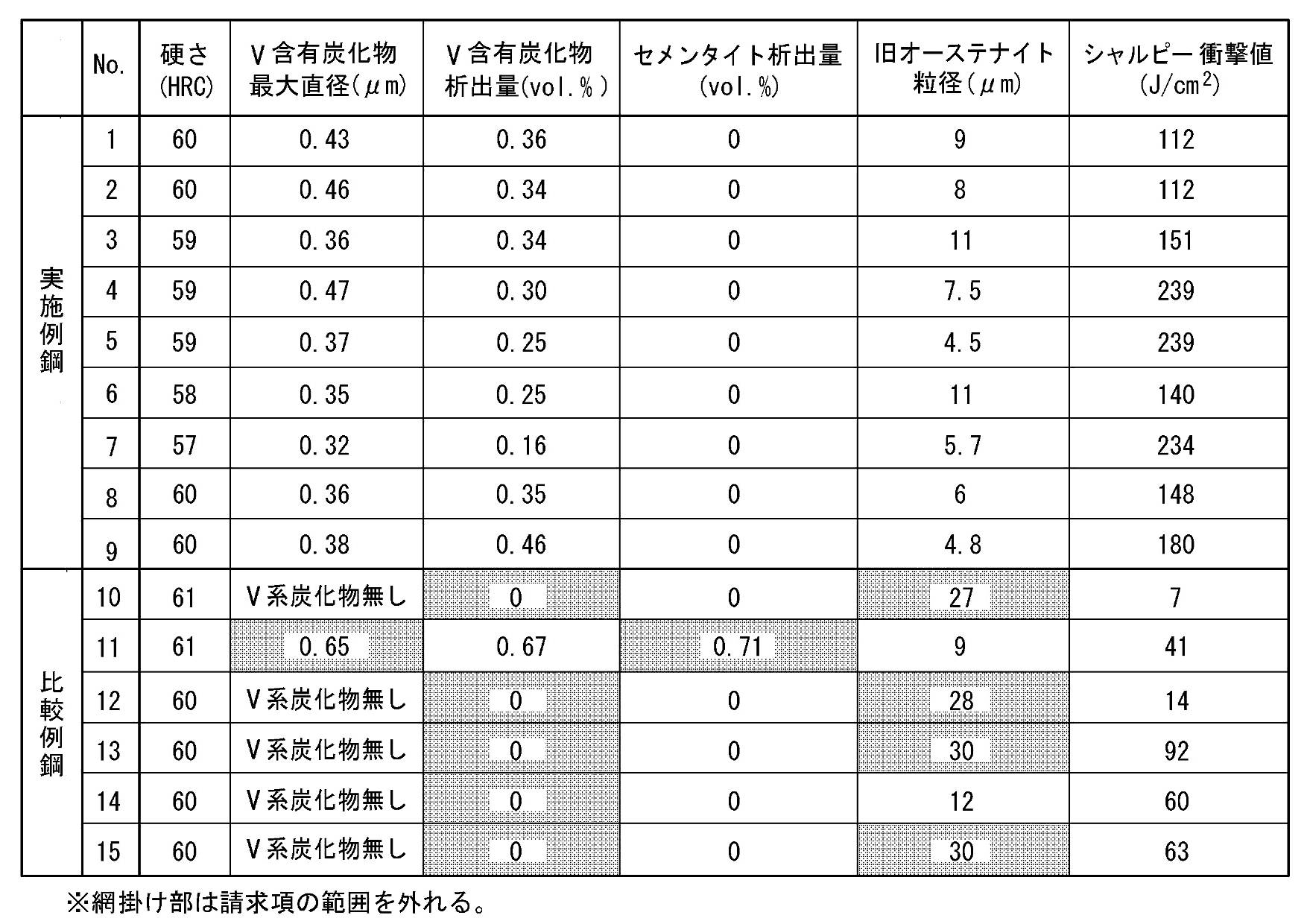
- Table 2 shows the hardness indicated by HRC, the maximum diameter of V-containing carbides, the V-containing carbide precipitation amount relative to the total martensite volume, and the precipitation of cementite under the embodiments of the invention steels of the example steels and the comparison steels. Amount, prior austenite grain size, and Charpy impact value are shown respectively.
- Example. 1 to 9 are very excellent in toughness, for example, the Charpy impact value of the 10 RC notch exceeds 100 J / cm 2 while each of them is a high hardness of 57 HRC or more. This high toughness is not due to the brittle fracture of the test specimen during striking with a Charpy impact tester in the steel of the present invention as essential addition to V, but by a certain ductility deformation before the fracture. It will be achieved. Comparative steel No. No. 10, 12, 13, 14 and 15 are V-free and V-free. No. 11 is within the scope of the present invention, but as a result of heat treatment, it is out of the scope of the present invention, and in all cases, the impact value is lower than that of the example steel.
Landscapes
- Chemical & Material Sciences (AREA)
- Engineering & Computer Science (AREA)
- Materials Engineering (AREA)
- Mechanical Engineering (AREA)
- Metallurgy (AREA)
- Organic Chemistry (AREA)
- Physics & Mathematics (AREA)
- Thermal Sciences (AREA)
- Crystallography & Structural Chemistry (AREA)
- Heat Treatment Of Articles (AREA)
- Heat Treatment Of Steel (AREA)
Abstract
Description
Cは、焼入れ焼戻し後における、硬度、耐摩耗性および疲労寿命を向上させる元素である。しかし、Cが0.40%未満では十分な硬度は得られない。一方、Cが1.00%より多いと、靱性を阻害するのみならず、鋼素材の硬さが増加し、被削性および鍛造性などの加工性を阻害する。そこで、Cは0.40~1.00%とし、望ましくは0.50~1.00%とし、さらに望ましくは0.50%~0.90%とする。
Siは、鋼の脱酸に有効な元素であり、鋼に必要な焼入性を付与し強度を高める働きをする。これらの効果を得るためには、Siは、0.10%以上必要であり、望ましくは0.20%以上必要である。一方、Siは、多く含有されると、素材硬さを増加し、被削性および鍛造性などの加工性を阻害する。そのため、Siは2.00%以下にする必要があり、望ましくは1.55%以下とする。そこで、Siは0.10~2.00%、望ましくは0.20~1.55%とするのがよい。
Mnは、鋼の脱酸に有効な元素であり、さらに、鋼に必要な焼入れ性を付与し、強度を高めるために必要な元素である。そのためには、Mnは0.10%以上添加する必要があり、望ましくは0.15%以上必要である。一方、Mnは多量に添加すると、靱性を低下させる作用があり、さらにSと結合することでMnSを形成することによっても靱性を低下させたり、加工中の割れを助長する作用があるため、1.00%以下とする必要があり、望ましくは0.70%以下とする。よって、Mnは0.10~1.00%とし、望ましくは0.15~1.00%とし、さらに望ましくは0.15~0.70%とする。
Pは、鋼中に不可避的に含有される不純物元素であり、粒界に偏析し、靱性を劣化させる。そこで、Pは、0.030%以下、望ましくは0.015%以下とするのがよい。
Sは、Mnと結合してMnSを形成して靱性を劣化させる元素である。そこで、Sは、0.030%以下、望ましくは0.010%以下とするのがよい。
Crは、焼入れ性を向上させる元素であり、その効果を十分に得るには、Crは、1.10%以上必要で、望ましくは1.20%以上、さらに望ましくは1.35%以上必要である。一方、Crは過剰に添加すると、焼入れ後の冷却過程で粒界の炭化物析出を促すため、靱性に悪影響があり、それを防ぐためにCrは3.20%以下にする必要がある。望ましくは2.50%以下、さらに望ましくは2.30%以下とする。そこで、Crは、1.10~3.20%、望ましくは1.20~2.50%、さらに望ましくは1.35~2.30%とするのがよい。
Alは、鋼の脱酸に不可欠な元素であり、添加が行われる。さらにNと結合してAlNを生成して、結晶粒粗大化を抑制する効果がある。これらの効果を得るためには、Alは0.010%以上必要である。一方、Alは多量に添加されると熱間加工性を損なうので0.10%以下にする必要があり、望ましくは0.050%以下とする。したがって、Alは0.010~0.10%とし、望ましくは0.015~0.050%とするのがよい。
Vは、Cと結合して微細な炭化物を形成し、その炭化物が焼入れの加熱時に結晶粒界をピン止めして結晶粒を微細に留める作用があり、結晶粒の微細化によって高い靱性を得るために必須の元素である。鋼の結晶粒界を炭化物で効果的にピン止めするためには、炭化物の固溶温度以上にいったん鋼を加熱して炭化物を固溶させておき、焼入温度への加熱の際に微細に析出させる必要がある。ところがNbやTiのような炭化物形成元素は、本願発明成分のC量に対して添加した場合、実用的な鋼材の加熱温度を大きく超える1250℃の加熱によっても炭化物を十分に固溶させることができないため、ピン止めに対して十分効果的でなく、かつ粗大な炭化物が残りやすいことから靱性に対しても悪影響がある。これに対して、V含有炭化物は、それより低温で固溶する特長があり、結晶粒界のピン止めに効果的に活用することが可能である。その効果を得るには、Vは0.15%以上の添加が必要であり、望ましくは0.20%以上、さらに望ましくは0.25%以上である。一方、Vは0.50%より多く含有されると、結晶粒微細化の効果が飽和するのみならず、Vを含有する粗大な炭化物が形成し、このV含有粗大炭化物が熱間加工性を阻害したり、靱性を低下させる。よってVは0.5%以下にする必要があり、望ましくは0.45%以下である。そこで、Vは0.15~0.50%とし、望ましくは0.20~0.50%とする。さらに望ましくは0.25~0.45%である。
Niは、本発明では不純物としての含有(例えば、0.07%の含有量)も含むが、焼入れ性と靱性を向上させる有効な元素であり、添加してもよい。一方、Niは高価な元素であり、コストを増加させる。そこで、添加する場合のNiは2.50%以下、望ましくは1.70%以下とする。
Moは、本発明では不純物としての含有(例えば、0.04%の含有量)も含むが、焼入れ性と靱性を向上させる有効な元素であり、添加してもよい。一方、Moは高価な元素であり、コストを増加させる。そこで、添加する場合のMoは1.00%以下、望ましくは0.50%以下とする。
V含有微細炭化物の分散による結晶粒微細化作用を得るためには、CとVの合計量を少なくとも0.60%以上とする必要がある。
本願発明の鋼に高硬度を付与するためにミクロ組織はFe系のε炭化物が微細分散したマルテンサイトとする。Fe系のε炭化物が微細分散したマルテンサイトは、130℃~250℃の低温焼戻し処理により得られる。本願発明の鋼は、化学成分やその他本発明の手段に規定する規制によって、焼入れままで靱性の高い状態が得られることとなり、130℃~250℃の低温焼戻しにおいて優れた靱性が保たれることから、合金元素を必要以上に添加する必要が無い。他方、低温焼戻しに代えて、本願発明の成分範囲の鋼に対して500℃以上の温度で行われる高温焼戻しを行ってしまうと、2次硬化に寄与する合金元素量が少ないために、硬度が低下することとなる。すると、靱性はさらに高いものが得られるものの、高硬度が得られなくなることとなるので、必要とされる高硬度と高靱性が両立できなくなってしまう。そこで、130℃~250℃で低温焼戻しされたFe系のε炭化物が微細分散したマルテンサイト組織としている。
マルテンサイト中に直径0.50μm以下のV含有微細炭化物を分散させることで、旧オーステナイト粒径の粗大化を抑制して20μm以下とし、その結果、高硬度でありながら高い靱性を達成できる。これに対して分散しているV含有炭化物の直径が0.50μm以上の場合、結晶粒微細化の効果が小さくなり、靱性が低下する。また、V含有炭化物の析出量が体積%に換算して全マルテンサイト体積の0.10vol.%未満では、旧オーステナイトナイト粒径を微細にする効果が十分得られない。そこで、V含有炭化物の析出量は0.10vol.%以上とし、望ましくはV含有微細炭化物の析出量は、0.15vol.%以上とする。一方で、V含有微細炭化物の析出量が0.90vol.%を超えると、析出量が多くなりすぎてV含有炭化物を含む結晶粒自体が脆くなり、靱性が低下するため、0.90vol.%以下とし、望ましくは0.80vol.%以下とする。よって、V含有炭化物の最大直径は0.50μm以下に規制し、V含有炭化物の析出量は全マルテンサイト体積の0.10~0.90vol.%とし、望ましくは0.15~0.80vol.%とする。
セメンタイトは加熱時にオーステナイト粒界上で成長しやすく、これは焼入れ焼戻し後には粒界に沿った割れを引き起こしやすいため靱性を低下させる原因となる。そこで、セメンタイトの析出量は多くとも全マルテンサイト体積の0.50vol.%以下とする。
焼入焼戻し状態における旧オーステナイト粒径を微細化することで、脆性破壊を抑制することができるため、靱性を向上させことができる。さらに、旧オーステナイト粒径を細かくすることによって体積中の粒界面積が増加し、PやSといった粒界に偏析して靱性を劣化させる不純物元素が多くの粒界に分散することで個々の粒界への不純物の偏析量が軽減されることも、靱性の向上に寄与する。よって、旧オーステナイト粒径を20μm以下、望ましくは15μm以下とする。

Claims (4)
- 質量%で、C:0.40~1.00%、Si:0.10~2.00%、Mn:0.10~1.00%、P:0.030%以下、S:0.030%以下、Cr:1.10~3.20%、Al:0.010~0.10%、V:0.15~0.50%を含有し、さらに、Ni:2.50%以下およびMo:1.00%以下の少なくとも1種を含有し、(C+V)量が質量%で0.60%以上であり、残部がFeおよび不可避不純物からなる鋼であり、ミクロ組織がFe系のε炭化物が微細分散したマルテンサイト組織であり、その旧オーステナイト粒径が20μm以下である、高硬度かつ靱性に優れる鋼。
- 請求項1の化学成分およびミクロ組織を有し、130℃~250℃で低温焼戻しされたマルテンサイト組織中に直径0.50μm以下のV含有微細炭化物が分散して析出しており、V含有微細炭化物の析出量は全マルテンサイト体積の0.10~0.90vol.%である、請求項1に記載の高硬度かつ靱性に優れる鋼。
- 請求項1の化学成分およびミクロ組織を有し、130℃~250℃で低温焼戻しされたマルテンサイト組織中におけるセメンタイト析出量が全マルテンサイト体積の0.50vol.%以下であるミクロ組織を有する、請求項1に記載の高硬度かつ靱性に優れる鋼。
- 請求項1の化学成分およびミクロ組織並びに請求項2のミクロ組織を有し、130℃~250℃で低温焼戻しされたマルテンサイト組織中におけるセメンタイト析出量が全マルテンサイト体積の0.50vol.%以下である、請求項2に記載の高硬度かつ靱性に優れる鋼。
Priority Applications (5)
| Application Number | Priority Date | Filing Date | Title |
|---|---|---|---|
| AU2018318501A AU2018318501B2 (en) | 2017-08-18 | 2018-08-08 | Steel with High Hardness and Excellent Toughness |
| DE112018000976.9T DE112018000976B4 (de) | 2017-08-18 | 2018-08-08 | Stahl mit hoher Härte und ausgezeichneter Zähigkeit |
| US16/467,225 US11162162B2 (en) | 2017-08-18 | 2018-08-08 | Steel with high hardness and excellent toughness |
| JP2019536749A JP7223997B2 (ja) | 2017-08-18 | 2018-08-08 | 高硬度かつ靱性に優れる鋼 |
| CN201880019997.1A CN110462083B (zh) | 2017-08-18 | 2018-08-08 | 高硬度并且韧性优异的钢 |
Applications Claiming Priority (2)
| Application Number | Priority Date | Filing Date | Title |
|---|---|---|---|
| JP2017158007 | 2017-08-18 | ||
| JP2017-158007 | 2017-08-18 |
Publications (1)
| Publication Number | Publication Date |
|---|---|
| WO2019035401A1 true WO2019035401A1 (ja) | 2019-02-21 |
Family
ID=65362767
Family Applications (1)
| Application Number | Title | Priority Date | Filing Date |
|---|---|---|---|
| PCT/JP2018/029752 Ceased WO2019035401A1 (ja) | 2017-08-18 | 2018-08-08 | 高硬度かつ靱性に優れる鋼 |
Country Status (6)
| Country | Link |
|---|---|
| US (1) | US11162162B2 (ja) |
| JP (1) | JP7223997B2 (ja) |
| CN (1) | CN110462083B (ja) |
| AU (1) | AU2018318501B2 (ja) |
| DE (1) | DE112018000976B4 (ja) |
| WO (1) | WO2019035401A1 (ja) |
Cited By (1)
| Publication number | Priority date | Publication date | Assignee | Title |
|---|---|---|---|---|
| JP2021109993A (ja) * | 2020-01-08 | 2021-08-02 | 日本製鉄株式会社 | 軸受用鋼 |
Families Citing this family (1)
| Publication number | Priority date | Publication date | Assignee | Title |
|---|---|---|---|---|
| CN114774800B (zh) * | 2022-04-19 | 2023-08-08 | 河南科技大学 | 一种超高强度、高塑韧性马氏体钢及其制备方法 |
Citations (3)
| Publication number | Priority date | Publication date | Assignee | Title |
|---|---|---|---|---|
| JPH07300651A (ja) * | 1994-04-28 | 1995-11-14 | Nippon Steel Corp | 耐遅れ破壊特性に優れた高強度鋼棒およびその製造方法 |
| WO2017039012A1 (ja) * | 2015-09-04 | 2017-03-09 | 新日鐵住金株式会社 | ばね用鋼線およびばね |
| JP2017057479A (ja) * | 2015-09-18 | 2017-03-23 | 国立大学法人大阪大学 | 高硬度かつ靭性に優れた鋼 |
Family Cites Families (7)
| Publication number | Priority date | Publication date | Assignee | Title |
|---|---|---|---|---|
| JPS5827956A (ja) * | 1981-08-11 | 1983-02-18 | Aichi Steel Works Ltd | 耐へたり性の優れたばね用鋼 |
| KR20010034008A (ko) | 1998-11-11 | 2001-04-25 | 이토오 도요아키 | 고온용 회전 베어링 부품 |
| JP4458592B2 (ja) | 1998-11-11 | 2010-04-28 | Ntn株式会社 | 高温用転がり軸受部品 |
| JP4658695B2 (ja) * | 2005-06-03 | 2011-03-23 | 株式会社神戸製鋼所 | 耐水素割れ性にすぐれた鍛造用鋼およびクランク軸 |
| JP2007231345A (ja) * | 2006-02-28 | 2007-09-13 | Jfe Steel Kk | 軸受用鋼部品およびその製造方法 |
| JP5760972B2 (ja) | 2011-11-10 | 2015-08-12 | 新日鐵住金株式会社 | 耐遅れ破壊特性に優れた高強度ボルト鋼および高強度ボルト |
| CN103255351B (zh) * | 2013-04-16 | 2016-02-24 | 宝钢特钢有限公司 | 一种高均质大规格超高强度钢锭及其制造方法 |
-
2018
- 2018-08-08 US US16/467,225 patent/US11162162B2/en active Active
- 2018-08-08 WO PCT/JP2018/029752 patent/WO2019035401A1/ja not_active Ceased
- 2018-08-08 AU AU2018318501A patent/AU2018318501B2/en active Active
- 2018-08-08 DE DE112018000976.9T patent/DE112018000976B4/de active Active
- 2018-08-08 CN CN201880019997.1A patent/CN110462083B/zh active Active
- 2018-08-08 JP JP2019536749A patent/JP7223997B2/ja active Active
Patent Citations (3)
| Publication number | Priority date | Publication date | Assignee | Title |
|---|---|---|---|---|
| JPH07300651A (ja) * | 1994-04-28 | 1995-11-14 | Nippon Steel Corp | 耐遅れ破壊特性に優れた高強度鋼棒およびその製造方法 |
| WO2017039012A1 (ja) * | 2015-09-04 | 2017-03-09 | 新日鐵住金株式会社 | ばね用鋼線およびばね |
| JP2017057479A (ja) * | 2015-09-18 | 2017-03-23 | 国立大学法人大阪大学 | 高硬度かつ靭性に優れた鋼 |
Cited By (2)
| Publication number | Priority date | Publication date | Assignee | Title |
|---|---|---|---|---|
| JP2021109993A (ja) * | 2020-01-08 | 2021-08-02 | 日本製鉄株式会社 | 軸受用鋼 |
| JP7469596B2 (ja) | 2020-01-08 | 2024-04-17 | 日本製鉄株式会社 | 軸受用鋼 |
Also Published As
| Publication number | Publication date |
|---|---|
| US11162162B2 (en) | 2021-11-02 |
| CN110462083B (zh) | 2021-06-01 |
| JPWO2019035401A1 (ja) | 2020-09-24 |
| DE112018000976T5 (de) | 2019-11-28 |
| JP7223997B2 (ja) | 2023-02-17 |
| US20200080180A1 (en) | 2020-03-12 |
| AU2018318501A1 (en) | 2019-09-26 |
| CN110462083A (zh) | 2019-11-15 |
| AU2018318501B2 (en) | 2020-09-03 |
| DE112018000976B4 (de) | 2024-12-19 |
Similar Documents
| Publication | Publication Date | Title |
|---|---|---|
| JP5862802B2 (ja) | 浸炭用鋼 | |
| JP4965001B2 (ja) | 焼戻し軟化抵抗性に優れた鋼部品 | |
| JP6432932B2 (ja) | 耐ピッチング性および耐摩耗性に優れる高強度高靱性機械構造用鋼製部品およびその製造方法 | |
| JP6794012B2 (ja) | 耐結晶粒粗大化特性、耐曲げ疲労強度および耐衝撃強度に優れた機械構造用鋼 | |
| JP2007031734A (ja) | 耐遅れ破壊特性に優れた高強度ボルトおよびその製造方法 | |
| JP2009299148A (ja) | 高強度浸炭部品の製造方法 | |
| CN108350538B (zh) | 高硬度且韧性优异的钢 | |
| JP2010007120A (ja) | 高強度浸炭部品の製造方法 | |
| WO2017115842A1 (ja) | 肌焼鋼、浸炭部品および肌焼鋼の製造方法 | |
| JP2012237052A (ja) | 冷間鍛造性および結晶粒粗大化抑制能に優れた肌焼鋼とその製造方法 | |
| CN109790602B (zh) | 钢 | |
| KR102374800B1 (ko) | 가스 터빈 디스크재 및 그 열처리 방법 | |
| JP6620490B2 (ja) | 時効硬化性鋼 | |
| JP2009299165A (ja) | 高強度浸炭部品の高周波焼入れによる製造方法 | |
| JP2003201513A (ja) | 高強度肌焼鋼 | |
| JP7223997B2 (ja) | 高硬度かつ靱性に優れる鋼 | |
| JP4344126B2 (ja) | ねじり特性に優れる高周波焼もどし鋼 | |
| JP5688742B2 (ja) | 靭性、耐磨耗性に優れる鋼の製造方法 | |
| JP7176877B2 (ja) | 耐衝撃性に優れた機械構造用合金鋼 | |
| JP6282078B2 (ja) | 結晶粒度特性および衝撃特性に優れた機械構造用鋼からなる鋼部品の製造方法 | |
| JP2010059484A (ja) | 静的強度に優れた浸炭部品 | |
| CN120905584A (zh) | 优异低温冲击韧性的高强度贝氏体非调质圆钢及其制造方法 | |
| KR101254782B1 (ko) | 침탄열처리 후 오일 담금질 및 뜨임을 생략한 공기경화형 고강도 기계구조용 부품강 및 그 제조방법 | |
| JP2010235969A (ja) | 機械構造用部品およびその製造方法 |
Legal Events
| Date | Code | Title | Description |
|---|---|---|---|
| 121 | Ep: the epo has been informed by wipo that ep was designated in this application |
Ref document number: 18846077 Country of ref document: EP Kind code of ref document: A1 |
|
| ENP | Entry into the national phase |
Ref document number: 2018318501 Country of ref document: AU Date of ref document: 20180808 Kind code of ref document: A |
|
| ENP | Entry into the national phase |
Ref document number: 2019536749 Country of ref document: JP Kind code of ref document: A |
|
| 122 | Ep: pct application non-entry in european phase |
Ref document number: 18846077 Country of ref document: EP Kind code of ref document: A1 |