WO2019013182A1 - ポリイミド粉体の製造方法 - Google Patents
ポリイミド粉体の製造方法 Download PDFInfo
- Publication number
- WO2019013182A1 WO2019013182A1 PCT/JP2018/025947 JP2018025947W WO2019013182A1 WO 2019013182 A1 WO2019013182 A1 WO 2019013182A1 JP 2018025947 W JP2018025947 W JP 2018025947W WO 2019013182 A1 WO2019013182 A1 WO 2019013182A1
- Authority
- WO
- WIPO (PCT)
- Prior art keywords
- polyimide
- polyimide powder
- solvent
- powder
- group
- Prior art date
- Legal status (The legal status is an assumption and is not a legal conclusion. Google has not performed a legal analysis and makes no representation as to the accuracy of the status listed.)
- Ceased
Links
- 0 *(C1=CC=CCC1)C1=CC=CCC1 Chemical compound *(C1=CC=CCC1)C1=CC=CCC1 0.000 description 4
- HIMYAKKZMNXEED-UHFFFAOYSA-N Cc(cc(c(C(C(F)(F)F)(C(F)(F)F)O)c1)N)c1-c(cc1C(C(F)(F)F)(C(F)(F)F)O)c(C)cc1N Chemical compound Cc(cc(c(C(C(F)(F)F)(C(F)(F)F)O)c1)N)c1-c(cc1C(C(F)(F)F)(C(F)(F)F)O)c(C)cc1N HIMYAKKZMNXEED-UHFFFAOYSA-N 0.000 description 1
- VQVIHDPBMFABCQ-UHFFFAOYSA-N O=C(c(cc1C(O2)=O)ccc1C2=O)c(cc1)cc(C(O2)=O)c1C2=O Chemical compound O=C(c(cc1C(O2)=O)ccc1C2=O)c(cc1)cc(C(O2)=O)c1C2=O VQVIHDPBMFABCQ-UHFFFAOYSA-N 0.000 description 1
Classifications
-
- C—CHEMISTRY; METALLURGY
- C08—ORGANIC MACROMOLECULAR COMPOUNDS; THEIR PREPARATION OR CHEMICAL WORKING-UP; COMPOSITIONS BASED THEREON
- C08G—MACROMOLECULAR COMPOUNDS OBTAINED OTHERWISE THAN BY REACTIONS ONLY INVOLVING UNSATURATED CARBON-TO-CARBON BONDS
- C08G73/00—Macromolecular compounds obtained by reactions forming a linkage containing nitrogen with or without oxygen or carbon in the main chain of the macromolecule, not provided for in groups C08G12/00 - C08G71/00
- C08G73/06—Polycondensates having nitrogen-containing heterocyclic rings in the main chain of the macromolecule
- C08G73/10—Polyimides; Polyester-imides; Polyamide-imides; Polyamide acids or similar polyimide precursors
-
- C—CHEMISTRY; METALLURGY
- C08—ORGANIC MACROMOLECULAR COMPOUNDS; THEIR PREPARATION OR CHEMICAL WORKING-UP; COMPOSITIONS BASED THEREON
- C08J—WORKING-UP; GENERAL PROCESSES OF COMPOUNDING; AFTER-TREATMENT NOT COVERED BY SUBCLASSES C08B, C08C, C08F, C08G or C08H
- C08J3/00—Processes of treating or compounding macromolecular substances
- C08J3/12—Powdering or granulating
Definitions
- the present invention relates to a method of producing polyimide powder.
- Polyimides are used in the electronics and aerospace industries because they are excellent in heat resistance, mechanical strength, electrical properties and solvent resistance.
- aromatic polyimides have particularly excellent heat resistance, electrical properties and mechanical strength, and in the electronics industry, applications such as interlayer insulating films for flexible wiring boards or large scale integrated circuits (LSI) and optical waveguides Used in Also, in recent years, polyimides having excellent transparency and gas separation properties have been developed, and their use in transparent substrates and gas separation membranes is expected to be expanded.
- LSI large scale integrated circuits
- Patent Document 1 depending on the application of the polyimide, a powdery polyimide soluble in an organic solvent is dissolved in the organic solvent and then molded and used in an increasing number. It is described that the solubility to the organic solvent in the state of a polyimide is required. If a polyimide is made into powder form, it will not only be easy to shape
- Patent Document 1 describes a method for producing a polyimide powder wherein a polyamic acid in a solution containing polyamic acid is imidized to obtain a solution containing a polyimide, and a powder of the polyimide is extracted from the solution. It is disclosed to use a tertiary amine having a pKBH + of 6.00 or less as an imidization promoter (imidization catalyst) in an imidization reaction (hereinafter sometimes referred to simply as imidization) to obtain a polyimide from There is.
- imidization catalyst imidization catalyst
- Patent Document 1 discloses a polyamic obtained by polymerizing fluoromethyl acid dianhydrides to express the solubility of an aromatic polyimide in an organic solvent and to facilitate the pulverization of the polyimide. It is disclosed to use an acid as a raw material of aromatic polyimide.
- Patent Document 2 discloses that a powder of a carboxy group-containing polyimide is obtained by volatilizing the organic solvent while spraying the organic solvent containing a carboxy group-containing polyimide soluble in the organic solvent, and the obtained carboxy It is described that a powder of a group-containing polyimide is dissolved in an organic solvent to obtain a carboxy group-containing polyimide solution, and in the example, it is dried under a nitrogen atmosphere at 85 ° C. using a spray dryer. Further, in Patent Document 2, when the content of the organic solvent in the carboxy group-containing polyimide resin is high, an additional drying step is additionally provided to desolvate the organic solvent in the particles and completely remove the organic solvent. It is stated that it is preferable to remove.
- Patent Document 3 discloses a diamine in which an HFIP group is bonded to a plurality of aromatic rings, which is an aromatic polycyclic compound, and a polyimide using the diamine.
- Patent Document 4 discloses a diamine in which an HFIP group is bonded to an aromatic ring, which is an aromatic single ring compound, and a polyimide having a HFIP group synthesized using the diamine.
- the aromatic diamine containing HFIP group may be called HFIP group containing diamine
- the aromatic polyimide which has HFIP group may be called HFIP group containing polyimide.
- the HFIP group-containing polyimide has water repellency, oil repellency, low water absorbency, heat resistance, weather resistance, corrosion resistance, transparency, photosensitivity, low refractive index, or low dielectric constant. It is stated that it is possible to develop the properties etc. and to be able to use in the field of advanced polymer materials, and for electronic devices having low dielectric property, high solubility, high contrast etc. by having HFIP group It is described that it can be used as a photosensitive insulating film.
- Patent Document 5 discloses a gas separation membrane containing an HFIP group-containing polyimide, and the HFIP group-containing polyimide, which is an aromatic single ring compound or an aromatic two ring compound, contained in the present gas separation membrane is a polar group HFIP. It is described that it is soluble in a specific organic solvent, particularly a polar solvent, according to the effect of containing a group, and N, N-dimethylacetamide (DMAc), N, N-dimethylformamide (which is an amide type solvent) is described as a polar solvent.
- DMAc N-dimethylacetamide
- N, N-dimethylformamide which is an amide type solvent
- DMF N-methyl-2-pyrrolidone
- GBL lactone ⁇ -butyrolactone
- GBL ⁇ -valerolactone
- Patent Document 6 discloses an HFIP group-containing polyimide which can be easily dissolved in a specific organic solvent and can be formed into a film by solution casting, and an HFIP group-containing diamine which is a raw material thereof.
- a HFIP group-containing diamine and tetracarboxylic acid dianhydride as raw materials, using DMAc as a solvent, and polymerizing polyamic acid in DMAc, pyridine as an imidization catalyst, and a dehydrating agent It is described that the polyamic acid was imidized using acetic anhydride or propionic anhydride as (1) to obtain an HFIP group-containing polyimide soluble in an organic solvent.
- pyridine When pyridine is used as an imidization catalyst and DMAc is used as a solvent in the production of polyimide, it is required in industrial production to minimize the generation of wastes containing these toxic substances and not pollute the environment. Also, pyridine and DMAc are compounds that must be avoided inhalation and skin contact.
- JP 2004-285355 A JP, 2011-168743, A JP 2007-119503 A JP 2007-119504 A JP, 2013-10096, A JP 2014-129340 A
- An object of the present invention is to provide a method for producing a polyimide powder without reducing the molecular weight of the polyimide when producing a polyimide powder from a polyimide solution.
- Another object of the present invention is to improve the storage stability of the produced polyimide powder.
- the inventors of the present invention stored the HFIP group-containing polyimide solution prepared according to the conventional method in the state of a solution, the molecular weight decreased with time. Also, the polyimide powder produced by developing the same polyimide solution in a poor solvent also decreased in molecular weight with time.
- the present inventors developed a solution containing the HFIP group-containing polyimide disclosed in Patent Document 3 in a poor solvent and powdered it, and used it in the polymerization of the polyimide powder and the HFIP group-containing polyimide. It was difficult to completely remove the imidizing agent or the solvent, and it was found that the polyimide powder from which the imidizing agent and the solvent were not completely removed had poor molecular weight and poor storage stability over time ((1) Comparative Examples 1 to 3 and 7 to 9 in Table 2).
- the decrease in molecular weight with time is due to the property of the polyimide that causes depolymerization due to alkaline decomposition, hydrolysis, etc., and can not be prevented unless the imidization agent and the solvent are removed from the polyimide powder. It was done.
- the present inventors sprayed an HFIP group-containing polyimide solution to obtain a first polyimide powder containing a solvent, and the first polyimide powder obtained. It has been found that by heating the body under reduced pressure, it is possible to obtain a second polyimide powder in which the solvent and the imidizing agent accompanying the HFIP group-containing polyimide solution do not substantially remain (do not contain), We came to complete the method of producing powder.
- the second polyimide powder produced by the method for producing a polyimide powder of the present invention did not show a decrease in molecular weight with time.
- the present invention includes the following inventions 1 to 17.
- R 1 is a divalent organic group containing a 2-hydroxy-1,1,1,3,3,3-hexafluoroisopropyl group
- R 2 is a tetravalent organic group.
- R 1 in the repeating unit is a divalent organic group represented by the formula (2), the second method for manufacturing a polyimide powder of the present invention 1.
- R 3 represents a single bond, oxygen atom, sulfur atom, CO, CH 2 , CH 2 CH 2 , SO, SO 2 , C (CH 3 ) 2 , C (CH 3 ) (CH 2 CH 3 ) , NHCO, C (CF 3 ) 2 , an aromatic ring or an alicyclic ring
- R 4 and R 5 each independently represent a hydrogen atom, an alkyl group or a fluoroalkyl group
- a and b each independently represent 0 to 0 It is an integer of 2, and 1 ⁇ a + b ⁇ 4.
- a solvent comprising at least one solvent selected from the group consisting of amide solvents, ether solvents, aromatic solvents, halogen solvents, ketone solvents, lactone solvents, alcohol solvents, and glycol ether solvents
- invention 8 The method for producing a second polyimide powder according to any of the first to seventh aspects, wherein the polyimide solution is a polyimide solution further containing an imidizing agent.
- the second polyimide powder of the eighth invention wherein the imidizing agent is an imidizing agent comprising an imidation catalyst selected from the group consisting of pyridine, quinoline, picoline and triethylamine and a dehydrating agent selected from acetic anhydride or propionic anhydride. How to make the body.
- the imidizing agent is an imidizing agent comprising an imidation catalyst selected from the group consisting of pyridine, quinoline, picoline and triethylamine and a dehydrating agent selected from acetic anhydride or propionic anhydride. How to make the body.
- invention 10 A second method for producing a polyimide powder according to any of the first to ninth aspects of the present invention, wherein a spraying device provided with a multi-fluid nozzle is used in the spraying step.
- invention 11 The method for producing a second polyimide powder according to any of Inventions 1 to 10, wherein the heating temperature in the heating and drying step is 30 ° C or more and 350 ° C or less.
- invention 12 The method for producing a second polyimide powder according to any of Inventions 1 to 11, wherein the pressure in the heating and drying step is 0.013 KPa or more and 50 KPa or less.
- a drying device selected from the group consisting of a box dryer, a band dryer, a tunnel dryer, a rotary dryer, a fluidized bed dryer, a flash dryer, a disc dryer and an inverted cone dryer is used.
- R 1 in the repeating unit is a divalent organic group represented by Formula (2) or a divalent organic group represented by Formula (3),
- R 3 represents a single bond, oxygen atom, sulfur atom, CO, CH 2 , CH 2 CH 2 , SO, SO 2 , C (CH 3 ) 2 , C (CH 3 ) (CH 2 CH 3 ) , NHCO, C (CF 3 ) 2 , an aromatic ring or an alicyclic ring
- R 4 and R 5 each independently represent a hydrogen atom, an alkyl group or a fluoroalkyl group
- a and b each independently represent 0 to 0 It is an integer of 2, and 1 ⁇ a + b ⁇ 4.
- R 2 in the repeating unit is any of the following tetravalent organic groups: )
- invention 16 The polyimide powder of invention 15 whose weight average molecular weight is 5000 or more and 500000 or less.
- invention 17 The polyimide powder of the invention 15 or 16 whose median diameter is 0.1 micrometer or more and 100 micrometers or less.
- the method for producing a second polyimide powder according to the present invention comprises spraying the HFIP group-containing polyimide solution of the present invention to obtain a first polyimide powder and heating the obtained first polyimide powder under reduced pressure.
- the extent to which the weight average molecular weight of the HFIP group-containing polyimide is reduced during production is low, and a polyimide powder from which the imidizing agent and the solvent in the HFIP group-containing polyimide solution have been substantially removed can be obtained.
- the second polyimide powder obtained by the present invention has a molecular weight as compared with the polyimide powder obtained by reprecipitating a polyimide solution in a poor solvent or the HFIP group-containing polyimide solution disclosed in the prior art. Does not decrease with time and is excellent in storage stability.
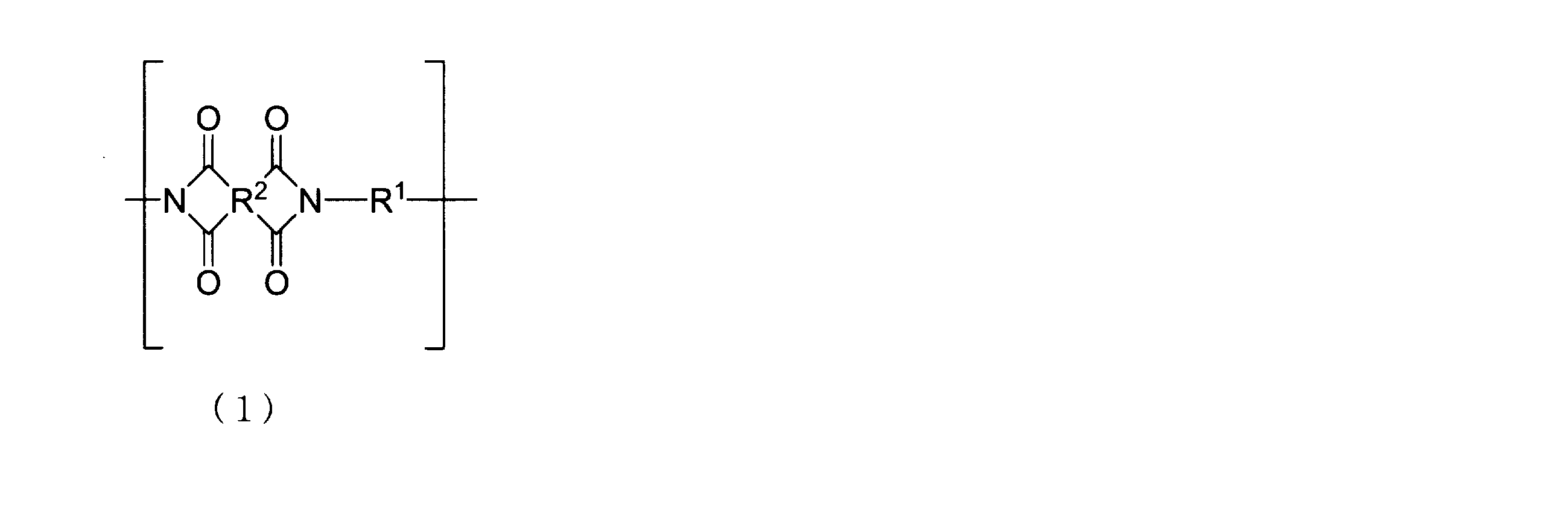
- a polyimide solution containing an HFIP group-containing polyimide having a repeating unit represented by the following formula (1) and a solvent is sprayed to form a first polyimide powder containing a solvent.
- R 1 is a divalent organic group containing a 2-hydroxy-1,1,1,3,3,3-hexafluoroisopropyl group (HFIP group), and R 2 is a tetravalent organic group Is)
- the HFIP group-containing polyimide used in the second method for producing a polyimide powder of the present invention is a polyimide containing a repeating unit represented by the formula (1).
- a polyimide having a repeating unit represented by formula (1) may be referred to as polyimide (1).
- R 1 is a divalent organic group containing an HFIP group
- R 2 is a tetravalent organic group.
- the divalent organic group R 1 contained in the repeating unit (1) has one or more fragrances It has a ring, and two bonds are present on the same or different aromatic ring, and at least one of the HFIP groups is attached to the aromatic ring.
- a benzene ring is preferable, and it is preferable that the aromatic ring which HFIP group couple
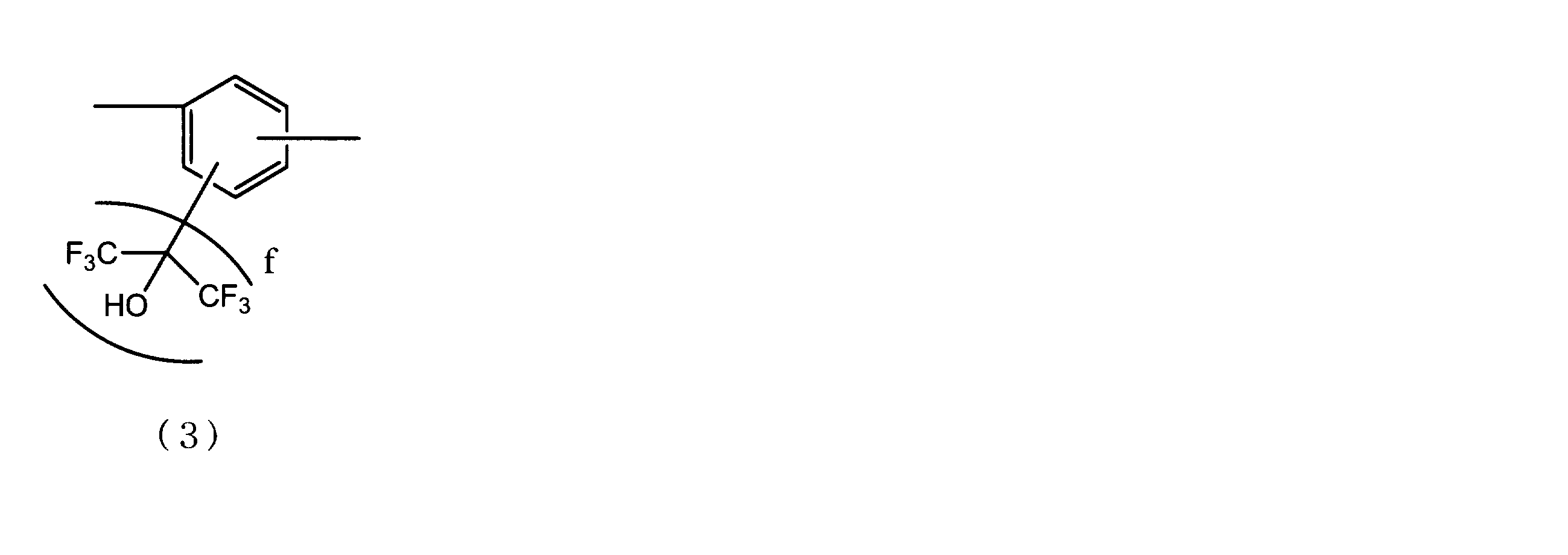
- R 1 is preferably any one of divalent organic groups represented by the following formulas (2) to (3) in order to dissolve in a solvent to obtain an HFIP group-containing polyimide solution.
- R 3 represents a single bond, oxygen atom, sulfur atom, CO, CH 2 , CH 2 CH 2 , SO, SO 2 , C (CH 3 ) 2 , C (CH 3 ) (CH 2 CH 3 ) , NHCO, C (CF 3 ) 2 , an aromatic ring or an alicyclic ring
- R 4 and R 5 each independently represent a hydrogen atom, an alkyl group or a fluoroalkyl group
- a and b each independently represent 0 to 0 It is an integer of 2, and 1 ⁇ a + b ⁇ 4.
- the organic group R 1 represented by the formula (2) contained in the repeating unit (1) is preferably any of the following organic groups depending on the easiness of synthesis.
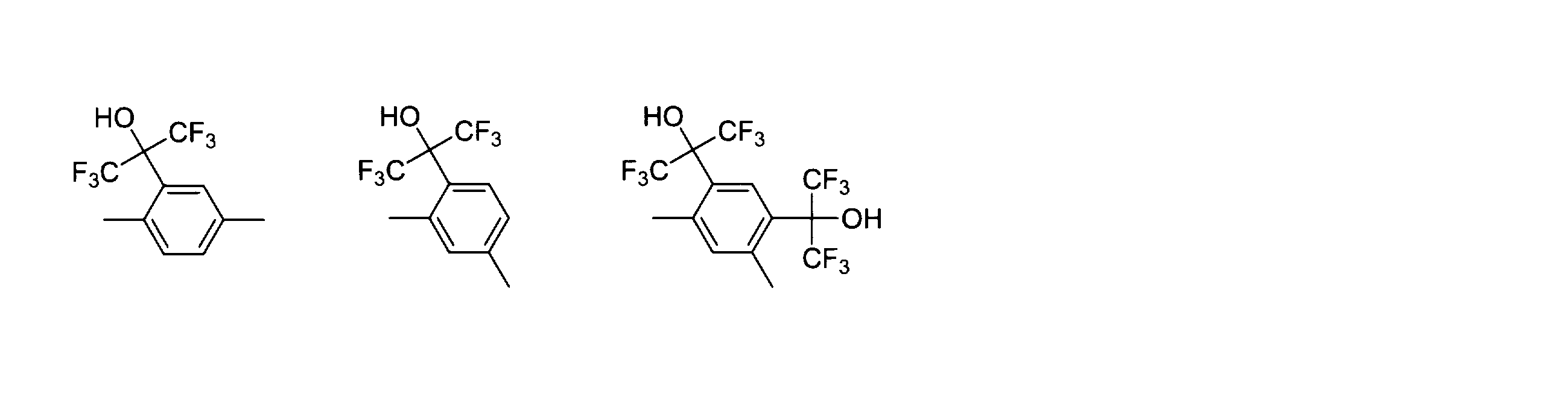
- the organic group R 1 represented by the formula (3) contained in the repeating unit (1) is preferably any of the following organic groups, from the easiness of synthesis of the polyimide (1): It is.
- the tetravalent organic group R 2 contained in the repeating unit (1) is an alicyclic ring, an aromatic ring And at least one selected from the group consisting of and an alkylene group may be contained, and it is not particularly limited.
- the tetravalent organic group may contain a fluorine atom, a chlorine atom, an oxygen atom, a sulfur atom or a nitrogen atom in the structure.
- a hydrogen atom is contained in the structure, part or all of the hydrogen atoms may be substituted with an alkyl group, a fluoroalkyl group, a carboxyl group, a hydroxy group or a cyano group.
- the contained tetravalent organic group R 2 is preferably any of the following organic groups in the ease of synthesis of the polyimide (1).
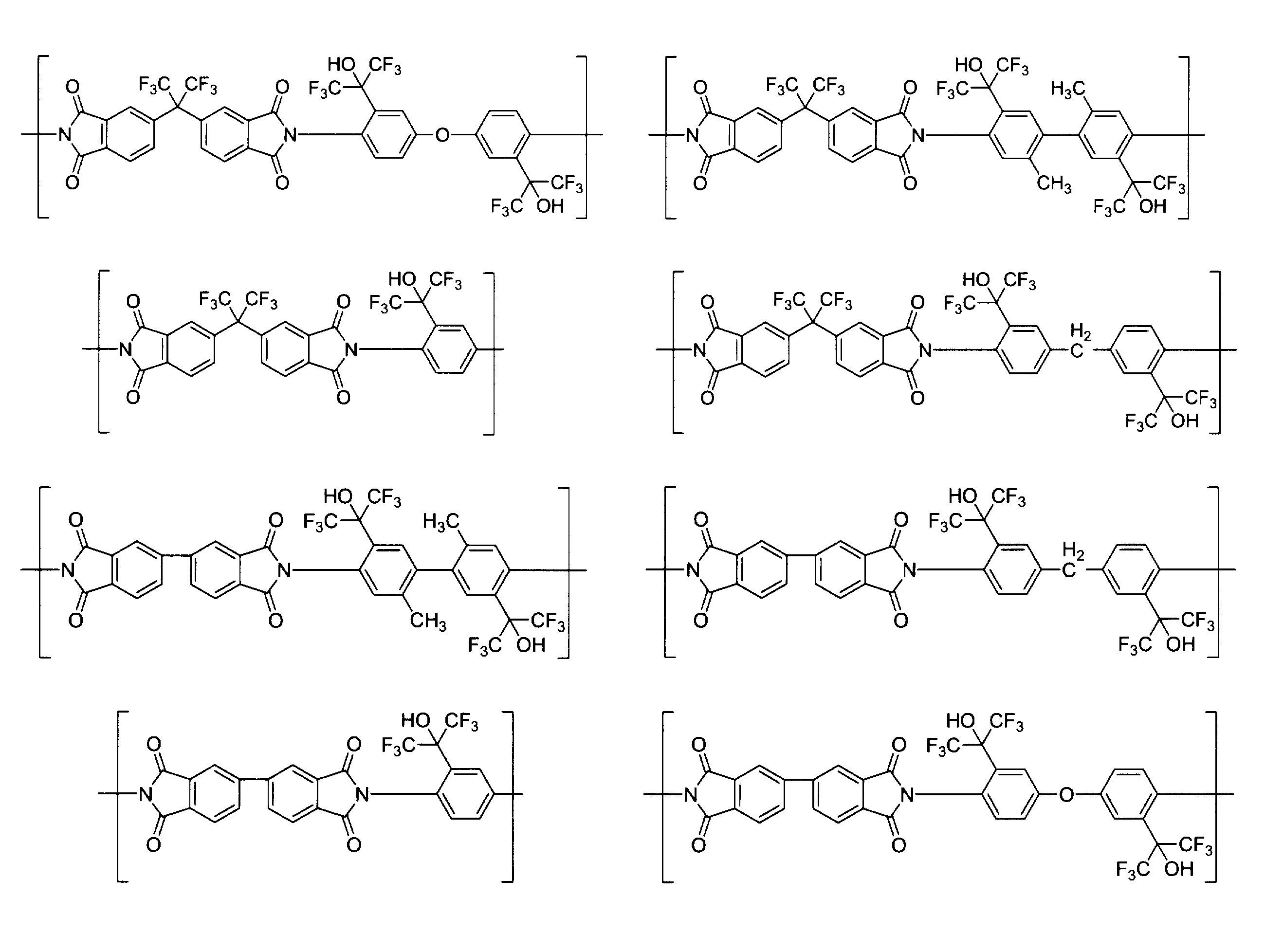
- the polyimide (1) particularly preferably contains any of the following repeating units.
- the weight average molecular weight (Mw) of the polyimide (1) is preferably 5,000 or more and 500,000 or less, and particularly preferably 10,000 or more and 200,000 or less. If the molecular weight is less than 5,000, production of the polyimide (1) powder tends to be difficult, and if it is more than 500,000, it tends to be difficult to dissolve in the solvent. In the present invention, the weight average molecular weight is a value obtained by gel permeation chromatography (GPC) measurement and polystyrene conversion using a standard polystyrene calibration curve.
- GPC gel permeation chromatography
- Solvent As a solvent which HFIP group content polyimide solution contains, a condensation polymerization solvent used for heat removal etc. can be mentioned in a condensation polymerization reaction at the time of synthesis of polyamic acid which is a precursor of polyimide (1). Or the dilution solvent for density
- condensation polymerization solvent used in the second method for producing a polyimide powder of the present invention dissolves polyamic acid and polyimide (1) which are precursors of polyimide (1) and does not inhibit the above-mentioned condensation polymerization reaction It is not particularly limited as long as Examples thereof include amide solvents, ether solvents, aromatic solvents, halogen solvents, lactones, ketone solvents, alcohol solvents, and glycol ether solvents, and these may be used alone, or More than species may be used in combination.
- amide solvent N, N-dimethylacetamide (DMAc), N, N-dimethylformamide (DMF), hexamethylphosphoric acid triamide, or N-methyl-2-pyrrolidone (NMP) can be exemplified.
- DMAc N, N-dimethylacetamide
- DMF N, N-dimethylformamide
- NMP N-methyl-2-pyrrolidone
- THF tetrahydrofuran
- Aromatic solvent As an aromatic solvent, benzene, anisole, diphenyl ether, nitrobenzene, benzonitrile, p-chlorophenol or xylene can be exemplified.
- Halogen solvent As the halogen-based solvent, chloroform, dichloromethane, 1,2-dichloroethane, or 1,1,2,2-tetrachloroethane can be exemplified.
- lactone solvents examples include ⁇ -butyrolactone (GBL), ⁇ -valerolactone, ⁇ -valerolactone, ⁇ -caprolactone, ⁇ -caprolactone, or ⁇ -methyl- ⁇ -butyrolactone.
- ketones include acetone, methyl ethyl ketone and methyl isobutyl ketone.
- Alcohol-based solvent As an alcohol solvent, n-butyl alcohol can be exemplified.
- glycol ether solvents examples include 2-methoxyethanol, 2-ethoxyethanol, and 2-butoxyethanol.
- HFIP group-containing diamine and tetracarboxylic acid dianhydride as raw materials of polyimide (1), and solubility of polyamic acid as precursor and ease of polycondensation, N, N-dimethylacetamide (DMAc, boiling point 165 ° C.), N-methyl pyrrolidone (NMP, boiling point 202 ° C.), N, N-dimethylformamide (DMF, boiling point 153 ° C.), ⁇ -butyrolactone (GBL, boiling point 204 ° C.), tetrahydrofuran (THF, boiling point 108.4 ° C.) is preferred.
- DMAc or NMP is preferred.
- Dilution solvent any solvent may be used as long as the polyimide (1) in the condensation polymerization solvent does not precipitate, and polar solvents can be mentioned.
- Polar solvents include N, N-dimethylacetamide (DMAc, boiling point 165 ° C.), N-methylpyrrolidone (NMP, boiling point 202 ° C.), N, N-dimethylformamide (DMF, boiling point 153 ° C.), ⁇ -butyrolactone (GBL) (Boiling point 204 ° C.) and tetrahydrofuran (THF, boiling point 108.4 ° C.) can be exemplified.
- DMAc N-dimethylacetamide
- NMP N-methylpyrrolidone
- DMF N-dimethylformamide
- GBL ⁇ -butyrolactone
- THF tetrahydrofuran
- the dilution amount is 1% by mass or more and 99% by mass or less with respect to the total mass of the polyimide (1) solution after condensation polymerization depending on viscosity. If it is less than 1% by mass, there is no effect of viscosity adjustment, and it is not necessary to make it more than 99% by mass.
- Method for Producing Polyimide (1) A method for producing the polyimide (1) contained in the HFIP group-containing polyimide solution will be described.
- the production method of the polyimide (1) uses, as a raw material compound, an HFIP group-containing diamine represented by the formula (1A) and a tetracarboxylic acid dianhydride represented by the following formula (1B) as shown below:
- the method of obtaining a polyimide (1) can be mentioned by polycondensing in an organic solvent to obtain a polyamic acid and then subjecting the polyamic acid to dehydration ring closure and imidization.
- the HFIP group-containing diamine represented by the formula (1A) and the tetracarboxylic acid dianhydride represented by the formula (1B) includes the following formulas (2A) to It is preferable to use a diamine having an HFIP group represented by (3A).
- a diamine having an HFIP group represented by the formulas (2A) to (3A) can be used as the diamine having a HFIP group, and tetracarboxylic acid dianhydrides represented by the HFIP group containing diamines (2A) to (3A) and the formula (1B). It may be called carboxylic dianhydride (1B).
- other diamines other than diamines (2A) to (3A) having an HFIP group, or other tetracarboxylic acid dianhydrides other than tetracarboxylic acid dianhydride (1B) as the raw material Or both may be added.
- the content of other diamines and other tetracarboxylic acid dianhydrides is 0% by mass or more and 20% by mass or less based on the total amount of diamine and tetracarboxylic acid dianhydride as a raw material of the polyimide (1) .
- the starting compounds HFIP group-containing diamines (2A) to (3A) and tetracarboxylic acid dianhydride (1B) are shown below.
- R 3 to R 5 and a and b are the same as the meanings of R 3 to R 5 and a and b, respectively, in formula (2).
- the reaction for condensation-reacting the diamine and the tetracarboxylic acid dianhydride to obtain the polyamic acid is carried out substantially at a molar ratio of 1 to 1.
- the molar ratio of the raw material HFIP group-containing diamine (1A) or other diamine to the tetracarboxylic acid dianhydride (1B) or other tetracarboxylic acid dianhydride is represented by 1 It is preferable that the pair be one to one.
- the reaction temperature is usually from -20.degree. C. or more to 80.degree. C. or less.
- the condensation polymerization solvent is used to remove the heat of reaction.
- another diamine is the meaning of the diamine which does not belong to HFIP group containing diamine (1A)
- the other tetracarboxylic acid anhydride is a tetracarboxylic acid anhydride which does not belong to tetracarboxylic acid dianhydride (1B)
- polyimide (1) For the purpose of adjusting physical properties of polyimide (1) to be obtained, meaning, it can be used within 20% each, expressed in mol% with respect to the total amount of diamine and the total amount of tetracarboxylic acid dianhydride It does not have to be.
- the polyimide (1) is obtained by dehydrating and ring-closing the polyamic acid obtained by the above condensation polymerization reaction and imidation.
- the dehydration ring closure is performed by heating or adding an imidizing agent.
- the polyimide (1) can be obtained by heating the solution of polyamic acid to 150 ° C. or more and 250 ° C. or less.
- a solution of the polyamic acid obtained by the above condensation polymerization reaction is treated as an imidization catalyst for removing the total amount of diamine in the raw material at a temperature of 0 ° C. or more and 50 ° C. or less.
- Each of the agents is added in an amount of 2 molar equivalents or more and 10 molar equivalents or less to form an imidization solution to obtain a polyimide (1) solution.
- the reaction for imidizing a polyamic acid to obtain a polyimide is shown below.
- the obtained polyimide (1) solution may be used as it is for the production of polyimide powder described later, or may be concentrated or diluted, or the solvent is removed from the solution to obtain polyimide (1) alone. You may get
- the production of the polyimide (1) comprises, as essential materials, at least one or more of the HFIP group-containing diamines (2A) and (3A), and tetracarboxylic dianhydride (1B).
- dissolve at (degreeC or more and 250 degrees C or less, mixing, and obtaining a polyimide (1) without a condensation polymerization solvent can be mentioned.
- An organic base can be mentioned as said imidation catalyst.
- tertiary amines are preferred.
- pyridine, picoline, quinoline or triethylamine can be exemplified.
- acetic anhydride or propionic anhydride can be exemplified.
- the imidization agent is preferably a combination of these tertiary amines and acetic anhydride, particularly preferably a combination of pyridine and acetic anhydride.
- Acetic anhydride consumed in the imidization reaction is contained (remained) in the polyimide solution as acetic acid.
- the method for producing a second polyimide powder of the present invention comprises spraying a polyimide solution containing a polyimide (1) and a solvent, or a polyimide (1) and a solvent and an imidizing agent, And drying the first polyimide powder under reduced pressure in a drying apparatus, and substantially free of the solvent. That is, according to the second method for producing a polyimide powder of the present invention, it is possible to obtain a second polyimide powder which does not substantially remain (contains) the solvent and the imidizing agent involved in the polyimide solution.
- the second method for producing a polyimide powder according to the present invention is characterized in that the waste in the removal is an HFIP group-containing polyimide, as compared with the conventional method of developing the powder by obtaining an HFIP group-containing polyimide solution in a poor solvent of polyimide.
- the amount of waste can be reduced because the solution is only the one obtained by removing the solute containing the HFIP group-containing polyimide.
- Spraying step The spraying apparatus used in the spraying step according to the second method for producing a polyimide powder of the present invention is not particularly limited as long as the first polyimide powder is obtained, and a commercially available spray dryer (spray dryer) Can be used. If a spray dryer is used, the polyimide solution can be sprayed into the heated gas to remove the solvent, or the solvent and the imidizing agent, to obtain the first polyimide powder.
- the spray dryer comprises a pressure nozzle for spraying the polyimide solution and a chamber filled with a heated gas at atmospheric pressure (atmospheric pressure, about 101.325 kPa) for spraying the polyimide solution and removing the solvent.
- a spray dryer described in JP-A-1-194901, or a sprayer described in JP-A-8-299701 can be used.
- a rotary disc type As a spray method, a rotary disc type, a nozzle cocurrent type, a nozzle countercurrent type, or a nozzle countercurrent type can be mentioned.
- the shape of the nozzle may employ a single-fluid nozzle or a multi-fluid nozzle.
- the polyimide solution and the compressed gas can be jetted from another nozzle, and a first polyimide powder with a small particle diameter can be obtained from the one-fluid nozzle.
- nozzles having an even number of nozzles are common, and a two-fluid nozzle or a four-fluid nozzle is preferred.
- the polyimide powder can be crushed by a high-speed air flow from the compressed gas nozzle by the nozzle divided into two systems of the polyimide solution and the compressed gas, and polyimide with a small particle size can be manufactured.
- a four-fluid nozzle it is possible to obtain a first polyimide powder with a finer particle diameter by four jets of two systems of polyimide solution and two systems of compressed gas.
- the temperature of the spraying step may be adjusted according to the boiling point of the solvent to be used, but in order to obtain solid (powder) polyimide, the temperature must be at least 50 ° C. lower than the boiling point of the solvent used. preferable. More preferably, it is at least higher than 40 ° C. lower temperature, and particularly preferably at least higher than 25 ° C. lower temperature. If the temperature of the spraying step is lower than the temperature 50 ° C. lower than the boiling point of the solvent, drying may be insufficient and the first polyimide powder may not be obtained.
- the upper limit of the temperature of the spraying step is preferably 200 ° C. or less, preferably 100 ° C. or less, and particularly preferably 50 ° C. or less. If the temperature is higher than 200 ° C., the solvent may evaporate rapidly and the desired first polyimide powder may not be obtained, or the polyimide may be solidified in the spray device to cause clogging.
- Heating and drying step The heating and drying step of heating and drying the first polyimide powder obtained in the above spraying step under reduced pressure removes impurities including the solvent and the imidization agent from the first polyimide powder, substantially It is only necessary to obtain a second polyimide powder not containing a solvent and an imidizing agent, and a vacuum dryer is used.
- the heating temperature in the heating and drying step is preferably 30 ° C. or more and 350 ° C. or less.
- the temperature is more preferably 50 ° C. or more and 300 ° C. or less, still more preferably 100 ° C. or more and 250 ° C. or less. If the temperature is less than 30 ° C., the drying of the second polyimide powder may be insufficient and the solvent may remain. In a temperature range higher than 350 ° C., there is a possibility that thermal decomposition of polyimide may occur, which is not preferable.
- the heating and drying process is performed under reduced pressure.
- it is 0.013 KPa or more and 50 KPa or less, more preferably 0.02 KPa or more and 10 KPa or less. If the pressure is less than 0.013 KPa, the vacuum pump may be burdened, and if the pressure is higher than 50 KPa, the drying of the polyimide powder may be insufficient, which is not preferable.
- the median diameter of the polyimide powder is preferably 0.1 micrometer or more and 100 micrometers or less. If the median diameter is less than 0.1 micrometer, aggregation of the polymer powder may occur or handling may be difficult, and if it is larger than 100 micrometers, the solvent may be difficult to remove during the heating and drying process. Unfavorable because there is.
- the median diameter is the particle diameter corresponding to the 50% cumulative value in the integrated distribution curve of the powder, and when the powder is divided from a certain particle diameter into two, the larger side and the smaller side It means the diameter where the abundance ratio of is equal.
- the reference of the abundance ratio there are volume reference (volume distribution), number reference (number distribution), etc. In the laser diffraction scattering method, it is the volume reference.
- polyimide powder By the second method for producing a polyimide powder of the present invention, a polyimide powder having a repeating unit represented by the following formula (1) and containing substantially no solvent and no imidization agent is obtained.
- the term "does not substantially contain a solvent” means that the solvent is 1% by mass or less with respect to the total amount of the polyimide powder.
- substantially free of imidizing agent means that the amount of imidizing agent is less than 0.1% by mass based on the total amount of the polyimide powder.
- R 1 in the repeating unit is a divalent organic group represented by Formula (2) or a divalent organic group represented by Formula (3),
- R 3 represents a single bond, oxygen atom, sulfur atom, CO, CH 2 , CH 2 CH 2 , SO, SO 2 , C (CH 3 ) 2 , C (CH 3 ) (CH 2 CH 3 ) , NHCO, C (CF 3 ) 2 , an aromatic ring or an alicyclic ring
- R 4 and R 5 each independently represent a hydrogen atom, an alkyl group or a fluoroalkyl group
- a and b each independently represent 0 to 0 It is an integer of 2, and 1 ⁇ a + b ⁇ 4.
- R 2 in the repeating unit is any of the following tetravalent organic groups:
- the weight average molecular weight (Mw) of the polyimide powder of the present invention is preferably 5,000 or more and 500,000 or less, and particularly preferably 10,000 or more and 200,000 or less. If the weight average molecular weight is less than 5,000, production of the polyimide powder tends to be difficult, and if it is more than 500,000, it tends to be difficult to dissolve in the solvent.
- the median diameter of the polyimide powder of this invention is 0.1 micrometer or more and 100 micrometers or less. If the median diameter is less than 0.1 micrometers, aggregation of the polymer powder may easily occur or handling may be difficult. If it is more than 100 micrometers, the solvent may not be easily removed during the heating and drying process. Not desirable because
- the content of the solvent is preferably 1% by mass or less based on the entire polyimide powder.
- the lower limit is 0.0001% by mass or more.
- the content of the imidization agent is preferably 0.1% by mass or less with respect to the entire polyimide powder.
- the lower limit is 0.0001% by mass or more.
- polyimide solution (A) a solution of polyimide (A) represented by the following formula (hereinafter sometimes referred to as polyimide solution (A)).
- a high-speed GPC apparatus manufactured by Tosoh Corporation, model name: HLC-8320GPC, column: TSKgel SuperHZM-H, tetrahydrofuran (THF) was used as a developing solvent.
- THF tetrahydrofuran
- polyimide solution (C) a solution of polyimide (C) represented by the following formula (hereinafter sometimes referred to as polyimide solution (C)).
- polyimide solution (E) a solution of polyimide (E) represented by the following formula (hereinafter sometimes referred to as polyimide solution (E)).
- first polyimide solution (F) a solution of polyimide (F) represented by the following formula (hereinafter sometimes referred to as first polyimide solution (F)).
- Example 1 [Spray of Polyimide Solution (A)] After diluting the polyimide solution (A) obtained in Preparation Example 1 with DMAc so that the concentration of the polyimide (A) is 5% by mass, a sprayer (manufactured by Fujisaki Electric Co., Ltd., model MDL-015, spray method) The powder of polyimide (A) was obtained by spraying under the conditions of liquid flow rate of 20 g / min, nozzle gas pressure of 0.5 MPa, inlet temperature of 175 ° C. using a four-fluid nozzle) (hereinafter, polyimide powder (A) Sometimes called)). The median diameter of the first polyimide powder (A) was 7 ⁇ m.
- the median diameter of the polyimide powder was determined using the volume-based refractive index of particles measured by a wet laser diffraction scattering method using a particle size distribution measuring device (manufactured by Horiba, Ltd., product name, LA-300). It is the value of the median diameter assumed to be 50. Hereinafter, the median diameter was similarly measured using the said particle size distribution measuring apparatus.
- Example 3 Heat drying of the first polyimide solution (B)] Place 1.2 g of the first polyimide powder (B) in the same tray drier as in Example 1, decompress to 200 ° C., 50 Torr (6.666 KPa), and heat-dry for 5 hours to obtain a second polyimide powder. I got a body (B-2).
- Examples 4 to 5 [Spray of polyimide solution (C)] After diluting the polyimide solution (C) obtained in Preparation Example 3 with DMAc so that the concentration of the polyimide (C) is 5% by mass, using the same sprayer as in Example 1, spraying is performed under the same conditions A powder of polyimide (C) was obtained (hereinafter sometimes referred to as first polyimide powder (C)). The median diameter of the first polyimide (C) was 7 ⁇ m.
- Example 4 Heat drying of first polyimide powder (C)
- the first polyimide powder (C) 30.8 g was placed in the same tray drier as in Example 1, vacuum-reduced to 200 ° C., 2 Torr (0.2666 kPa), and heat-dried for 5 hours to obtain a second polyimide powder. I got a body (C-1).
- Example 5 Heat drying of first polyimide powder (C) Place 2.0 g of the first polyimide powder (C) in the same tray dryer as in Example 1, decompress to 200 ° C., 20 Torr (2.666 kPa), and heat-dry for 7 hours to obtain a second polyimide powder. I got a body (C-2).
- Example 6 [Spray of polyimide solution (D)] After diluting the polyimide solution (D) obtained in the above Preparation Example 4 with DMAc so that the concentration of the polyimide (D) would be 5% by mass, using the same sprayer as in Example 1, under the same conditions The powder was sprayed to obtain a powder of polyimide (D) (hereinafter sometimes referred to as first polyimide powder (D)). The median diameter of the first polyimide powder (D) was 5 ⁇ m.
- Example 7 [Spray of polyimide solution (F)] After diluting the polyimide solution (F) obtained in the above Preparation Example 6 with DMAc so that the concentration of the polyimide (F) is 5% by mass, using the same spray machine as Example 1, under the same conditions The powder was sprayed to obtain a powder of polyimide (F) (hereinafter sometimes referred to as first polyimide powder (F)). The median diameter of the first polyimide powder (F) was 5 ⁇ m.
- Table 1 shows the molecular weight of the second polyimide powder obtained, DMAc as a solvent for the second polyimide powder, pyridine as an imidization catalyst, acetic anhydride as a dehydrating agent, acetic acid as a residue of the dehydrating agent It shows the content, and solubility in four organic solvents used as dilution solvents, DMAc, NMP, THF and acetone.
- the organic solvent solubility was described as “dissolving” when the polyimide powder was completely dissolved in all four types, and “insoluble” when the residue of the polyimide powder was recognized in any of the organic solvents.
- the second polyimide powder obtained was dissolved in all of the organic solvents DMAc, NMP, THF and acetone, all four organic solvents, and had a weight average molecular weight of at least 50,000.
- the solid second polyimide powder was obtained.
- the total amount of solvents such as pyridine, acetic acid, acetic anhydride, and polymerization solvent was reduced to 1% by mass or less.
- the content of pyridine, acetic acid and acetic anhydride was not observed.
- the first polyimide powder obtained by spraying the HFIP group-containing polyimide solution is dried by heating according to Examples 1 to 7, high molecular weight It has also been found that it is possible to produce a second polyimide powder substantially free of solvent and imidizing agent, which is highly pure and soluble in organic solvents.
- the second method for producing a polyimide powder of the present invention it is possible to obtain a second polyimide powder from which an imidation agent and a solvent in an HFIP group-containing polyimide solution have been removed, and through a spraying step and a drying step. Also, it was found that the degree of lowering the weight average molecular weight of the HFIP group-containing polyimide was lowered.
- Comparative Examples 4 to 6 [Dropping of polyimide solution to poor solvent] 100 g of each of the polyimide solutions (A) to (C) prepared in Preparation Examples 1 to 3 were slowly added dropwise while stirring in 2000 g of methanol. The precipitate of the polyimide solution (A) and the polyimide solution (C) was filtered to obtain a polyimide powder (Comparative Examples 4 and 6). When the polyimide solution (B) was used, the obtained precipitate became a gel-like viscous liquid, and no polyimide powder was obtained (Comparative Example 5).
- Comparative Examples 7-8 [Dropping of polyimide solution to poor solvent] 100 g of each of the polyimide solutions (A) and (C) prepared in Preparation Examples 1 and 3 were slowly added dropwise to 2000 g of methanol while stirring. The precipitate of the polyimide solutions (A) and (C) was filtered to obtain a polyimide powder.
- Comparative Example 9 [Production of polyimide powder by heating / vacuum drying / grinding of polyimide solution] DMAc is added to the polyimide solution (F) prepared in Preparation Example 6 to adjust the concentration of the polyimide (F) to 20% by mass, 100 g of this solution is placed in an eggplant type flask, 100 ° C., 25 Torr (3 It decompressed to .333 kPa and dried under reduced pressure for 2 hours. The obtained solid content was put into a mixer and ground for 1 minute to obtain a polyimide powder.
- the polyimide powders obtained in Comparative Examples 1 to 3 had Mw less than 50,000. Further, Comparative Examples 2 and 3 contained a large amount of DMAc and pyridine which is an imidization catalyst, and acetic acid which is a residue of a dehydrating agent. The polyimide powder obtained in Comparative Examples 4 and 6 did not dissolve in all of the four organic solvents DMAc, NMP, THF and acetone. In Comparative Example 5, no polyimide powder was obtained. The polyimide powders obtained in Comparative Examples 7 to 8 each contained 2% by mass or more of acetic acid and pyridine based on the polyimide powder. The polyimide powder obtained in Comparative Example 9 contained 2% by mass or more of acetic acid and DMAc with respect to the polyimide powder.
- the polyimide powder obtained by the second method for producing a polyimide powder of the present invention is a polyimide powder disclosed in the prior art, obtained by reprecipitating a polyimide solution in a poor solvent, a solvent, and an imidization agent. In addition to the absence of the residue, the molecular weight does not decrease with time and the storage stability is excellent.
- the polyimide powder of the present invention is easy to transport and store, and gives more freedom in manufacturing choices, such as the place of manufacture. Moreover, since it is easily soluble in an organic solvent, it is easy to obtain a polyimide molded body which has been dissolved in the organic solvent and formed into a desired shape. From such advantages, the method for producing the polyimide powder of the present invention and the polyimide powder can be used in applications such as flexible wiring substrates, interlayer insulating films for LSIs, optical waveguides, transparent substrates or gas separation films. Have.
Landscapes
- Chemical & Material Sciences (AREA)
- Health & Medical Sciences (AREA)
- Chemical Kinetics & Catalysis (AREA)
- Medicinal Chemistry (AREA)
- Polymers & Plastics (AREA)
- Organic Chemistry (AREA)
- Macromolecular Compounds Obtained By Forming Nitrogen-Containing Linkages In General (AREA)
Abstract
開示されているのは、下記式(1)で示される繰り返し単位を有するポリイミドとイミド化剤と溶剤を含むポリイミド溶液を噴霧し、溶剤を含む第1のポリイミド粉体を形成する噴霧工程と、前記第1のポリイミド粉体を減圧下、加熱乾燥し、実質的に溶剤を含まない第2のポリイミド粉体を得る加熱乾燥工程を含む、第2のポリイミド粉体の製造方法である。この方法によって、HFIP基含有ポリイミド溶液中のイミド化剤および溶剤を完全に除去し、除去における廃棄物を極力少なくし、重量平均分子量を低下させることなく保存安定性に優れたポリイミド粉体を得ることができる。式(1)中、R1は、2-ヒドロキシ-1,1,1,3,3,3-ヘキサフルオロイソプロピル基を含む2価の有機基であり、R2は4価の有機基である。
Description
本発明は、ポリイミド粉体の製造方法に関する。ポリイミドは、耐熱性、機械的強度、電気特性および耐溶剤性に優れるため、エレクトロニクス産業、航空宇宙産業に用いられる。
ポリイミドは化学構造を変えることによって物性を調整し、用途に応じた物性を得ることが可能である。なかでも芳香族ポリイミドは、とりわけ優れた耐熱性、電気特性、機械的強度を有し、エレクトロニクス産業において、フレキシブル配線基板またはLSI(large scale integrated circuit)用の層間絶縁膜、および光導波路等の用途に用いられている。また、近年、優れた透明性やガス分離性を持つポリイミドが開発され、透明基板や気体分離膜の用途において、その利用の拡大が見込まれている。
特許文献1に、ポリイミドの用途に応じて、有機溶剤に可溶なポリイミドを粉体状にしたものを有機溶剤に溶解した後に成形して用いられることが増えてきており、ポリアミック酸ばかりでなくポリイミドの状態での有機溶剤への溶解性が必要とされることが記載されている。ポリイミドを粉体状にすれば、用途に応じた形態または形状に成形することが容易となるばかりでなく、保存および輸送が簡便となる。
特許文献1には、ポリアミック酸を含む溶液中のポリアミック酸をイミド化してポリイミドを含む溶液を得、該溶液からポリイミドの粉体を抽出するポリイミド粉体の製造方法であって、反応によりポリアミック酸からポリイミドを得るイミド化反応(以下、単にイミド化と呼ぶことがある)に際し、pKBH+が6.00以下である三級アミンをイミド化の促進剤(イミド化触媒)として用いることが開示されている。
しかしながら、芳香族ポリイミドは有機溶剤への溶解性が低いことが知られている。そこで、特許許文献1には、芳香族ポリイミドに有機溶剤に対する溶解性を発現し、前記のポリイミドの粉体化を容易とするために、フルオロメチル酸二無水物類を重合して得られるポリアミック酸を芳香族ポリイミドの原料に使用することが開示されている。特許文献1の実施例において、2,2’-ビス(トリフルオロメチル)-4,4´-ジアミノビフェニル(TFMB)と2,2‘-ビス(3,4-ジカルボキシフェニル) ヘキサフルオロプロパン酸二無水物(6FDA)から合成したポリアミック酸を用い、本ポリアミック酸のN,N-ジメチルアセトアミド(以下、DMAcと呼ぶことがある)溶液中で、イミド化触媒として三級アミンであるピリジンまたはキノリン、および脱水剤(脱H2O剤)として無水酢酸または無水プロピオン酸を用いイミド化し、ポリイミド溶液を得、次いで、本ポリイミド溶液を貧溶媒であるメタノール中に展開し繊維状に析出させ攪拌により分断し、ポリイミド粉体を得たことが記載されている。
また、特許文献2には、有機溶剤に可溶なカルボキシ基含有ポリイミドを含む有機溶剤を噴霧させながら、該有機溶剤を揮発させてカルボキシ基含有ポリイミドの粉体を得ること、および得られたカルボキシ基含有ポリイミドの粉体を有機溶剤に溶解させ、カルボキシ基含有ポリイミド溶液を得ることが記載され、その実施例においては、スプレードライヤを用い、窒素雰囲気、85℃下で乾燥している。また、特許文献2には、カルボキシ基含有ポリイミド樹脂中の有機溶剤の含有率が高い場合には、さらに別途乾燥工程を設けて、粒子中の有機溶剤を脱溶媒して、有機溶剤を完全に除去することが好ましいと記載されている。
芳香族ポリイミドにおいて、極性基である2-ヒドロキシ-1,1,1,3,3,3-ヘキサフルオロイソプロピル基(-C(CF3)2OH、以下、HFIP基と呼ぶことがある。)が芳香環に結合した芳香族ポリイミドが、特許文献3および特許文献4に開示されている。
例えば、特許文献3には、芳香族多環化合物である、複数の芳香環にHFIP基が結合したジアミン、およびそれを用いたポリイミドが開示されている。特許文献4には、芳香族単環化合物である、芳香環にHFIP基が結合したジアミン、およびそれを用いて合成したHFIP基を有するポリイミドが開示されている。以下、HFIP基を含む芳香族ジアミンをHFIP基含有ジアミン、HFIP基を有する芳香族ポリイミドをHFIP基含有ポリイミドと呼ぶことがある。
特許文献3および特許文献4には、HFIP基含有ポリイミドは、撥水性、撥油性、低吸水性、耐熱性、耐候性、耐腐食性、透明性、感光性、低屈折率性、または低誘電性等を発現し、先端高分子材料分野に供することが可能であることが記載されており、HFIP基を有することで、低誘電性、高溶解性、または高コントラスト等を有した電子デバイス用感光性絶縁膜として使用することが可能であることが記載されている。
特許文献5には、HFIP基含有ポリイミドを含む気体分離膜が開示され、本気体分離膜が含む、芳香族単環化合物または芳香族2環化合物であるHFIP基含有ポリイミドは、極性基であるHFIP基の含有効果により、特定の有機溶剤、特に極性溶剤に可溶であることが記載され、極性溶剤としてアミド系溶媒であるN,N-ジメチルアセトアミド(DMAc)、N,N-ジメチルホルムアミド(以下、DMFと呼ぶことがある)またはN-メチル-2-ピロリドン(以下、NMPと呼ぶことがある)、ラクトンであるγ-ブチロラクトン(以下、GBLと呼ぶことがある)またはγ-バレロラクトンが例示されている。
特許文献6には、特定の有機溶剤に易溶で溶液流延により成膜可能なHFIP基含有ポリイミドおよびその原料であるHFIP基含有ジアミンが開示されている。特許文献6の実施例には、原料にHFIP基含有ジアミンとテトラカルボン酸二無水物を用いて、溶剤としてDMAcを用い、DMAc中でポリアミック酸を重合した後、イミド化触媒としてピリジン、脱水剤として無水酢酸または無水プロピオン酸を用い、ポリアミック酸をイミド化することで、有機溶剤に可溶なHFIP基含有ポリイミドが得られたことが記載されている。
ポリイミドの製造において、イミド化触媒としてピリジン、溶剤としてDMAcを用いた場合、工業生産においては、これら有毒物質を含む廃棄物の発生を極力少なくして環境を汚染しないことが求められる。また、ピリジンおよびDMAcは吸入および皮膚の接触を避けなければならない化合物である。
本発明は、ポリイミド溶液からポリイミド粉体を製造する際に、ポリイミドの分子量を低下させることのない、ポリイミド粉体の製造方法を提供することを目的とする。
また、本発明は、製造したポリイミド粉体の保存安定性を向上させることを他の目的とする。
本発明者らが、従来法に従って、調製したHFIP基含有ポリイミド溶液を溶液の状態で保存したところ、経時的に分子量が低下した。また、同じポリイミド溶液を貧溶媒中に展開し製造したポリイミド粉体も、分子量が経時的に低下した。
また、本発明者らは、特許文献3に開示されるHFIP基含有ポリイミドを含む溶液を、貧溶媒中に展開し粉体化したところ、ポリイミド粉体から、HFIP基含有ポリイミドの重合において用いたイミド化剤または溶剤を完全に除去することは困難であり、イミド化剤および溶剤が完全に除去されていないポリイミド粉体は、経時的に分子量が低下し保存安定性に劣ることが分かった([表2]の比較例1~3、7~9参照)。
一方、経時的な分子量の低下は、アルカリ分解および加水分解等で解重合を起こすポリイミドの性質に起因するものであり、ポリイミド粉体からイミド化剤および溶剤を除去しない限り、防げないものと想定された。
そこで、本発明者らは、前記課題を解決するため鋭意検討を重ねた結果、HFIP基含有ポリイミド溶液を噴霧して溶剤を含む第1のポリイミド粉体を得、得られた第1のポリイミド粉体を減圧下で加熱することで、HFIP基含有ポリイミド溶液に伴われる溶剤およびイミド化剤が実質的に残存しない(含まない)第2のポリイミド粉体が得られることを見出し、本発明のポリイミド粉体の製造方法を完成させるに至った。
本発明のポリイミド粉体の製造方法で製造された、第2のポリイミド粉体は経時的な分子量の低下が観察されなかった。
すなわち、本発明は以下の発明1~17を含む。
[発明1]
下記式(1)で示される繰り返し単位を有するポリイミドと、溶剤とを、含むポリイミド溶液を噴霧し、溶剤を含む第1のポリイミド粉体を形成する噴霧工程と、
前記第1のポリイミド粉体を減圧下、加熱乾燥し、実質的に溶剤を含まないポリイミド粉体を得る加熱乾燥工程を含む、
第2のポリイミド粉体の製造方法。
下記式(1)で示される繰り返し単位を有するポリイミドと、溶剤とを、含むポリイミド溶液を噴霧し、溶剤を含む第1のポリイミド粉体を形成する噴霧工程と、
前記第1のポリイミド粉体を減圧下、加熱乾燥し、実質的に溶剤を含まないポリイミド粉体を得る加熱乾燥工程を含む、
第2のポリイミド粉体の製造方法。

(式中、R1は、2-ヒドロキシ-1,1,1,3,3,3-ヘキサフルオロイソプロピル基を含む2価の有機基であり、R2は4価の有機基である。)
[発明2]
前記繰り返し単位中のR1が、式(2)で表される2価の有機基である、発明1の第2のポリイミド粉体の製造方法。
前記繰り返し単位中のR1が、式(2)で表される2価の有機基である、発明1の第2のポリイミド粉体の製造方法。
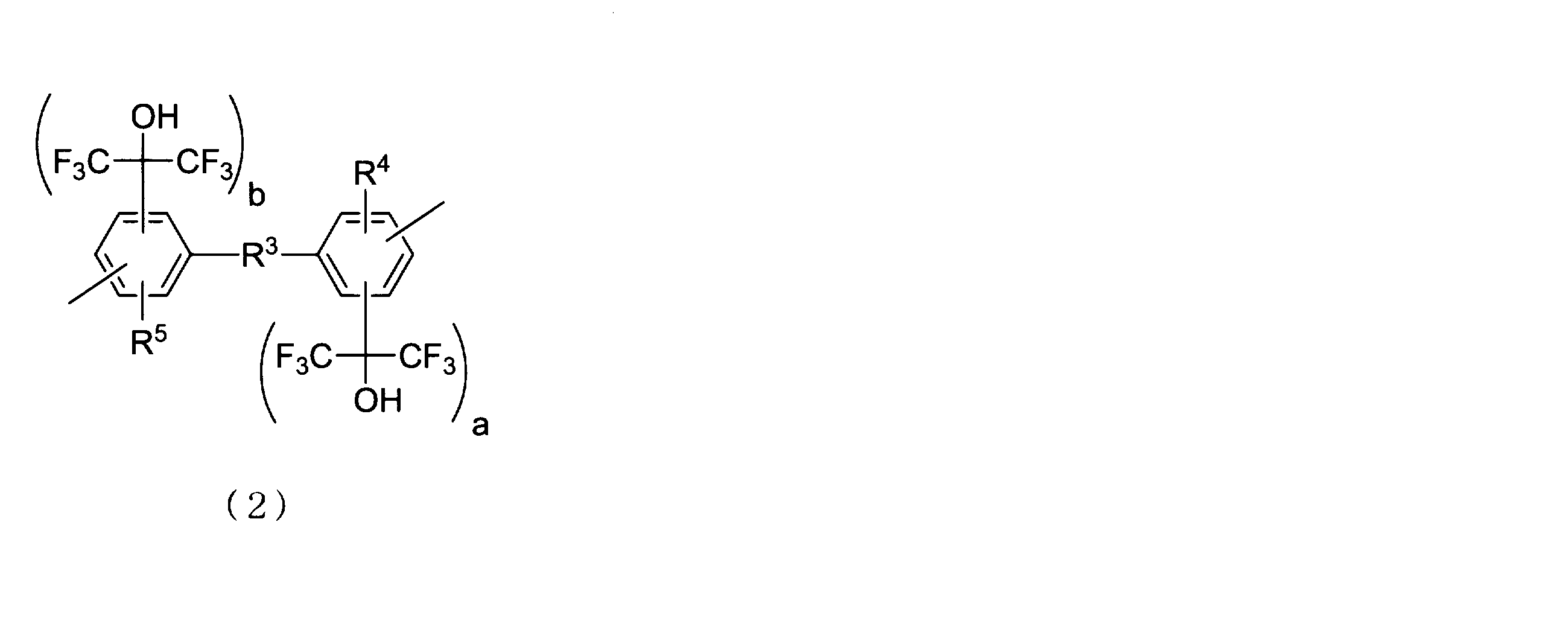
(式中、R3は、単結合、酸素原子、硫黄原子、CO、CH2、CH2CH2、SO、SO2、C(CH3)2、C(CH3)(CH2CH3)、NHCO、C(CF3)2、芳香環または脂環であり、R4およびR5は、それぞれ独立に水素原子、アルキル基またはフルオロアルキル基であり、aおよびbは、それぞれ独立に0~2の整数であり、1≦a+b≦4である。)
[発明3]
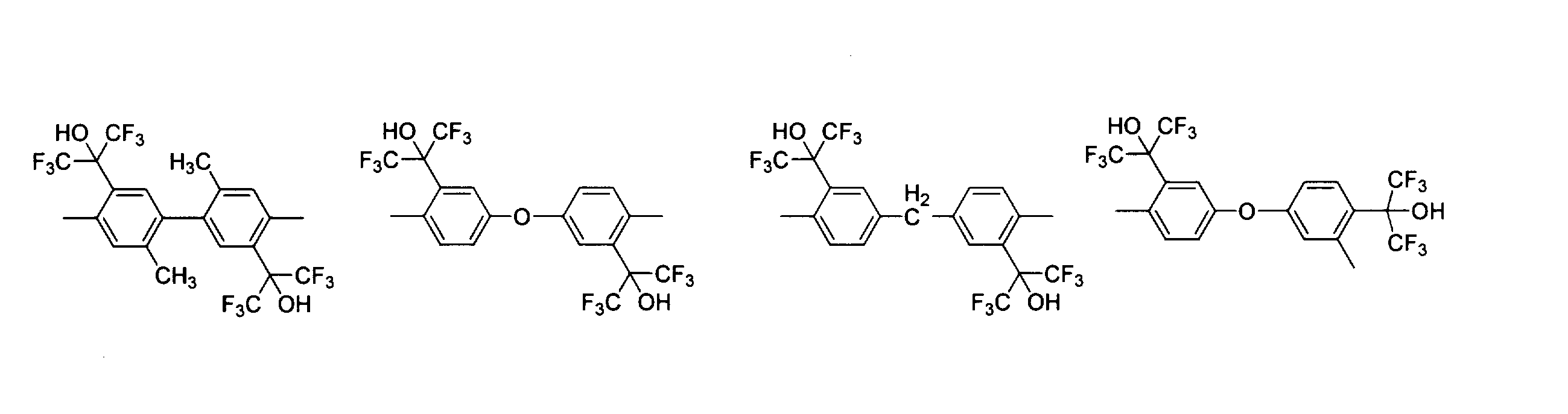
式(2)で表される2価の有機基が、以下のいずれかの2価の有機基である、発明2の第2のポリイミド粉体の製造方法。
式(2)で表される2価の有機基が、以下のいずれかの2価の有機基である、発明2の第2のポリイミド粉体の製造方法。
[発明4]
前記繰り返し単位中のR1が、式(3)で表される2価の有機基である、発明1~3の第2のポリイミド粉体の製造方法。
前記繰り返し単位中のR1が、式(3)で表される2価の有機基である、発明1~3の第2のポリイミド粉体の製造方法。

[発明5]
式(3)で表される2価の有機基が、以下のいずれかの2価の有機基である、発明4の第2のポリイミド粉体の製造方法。
式(3)で表される2価の有機基が、以下のいずれかの2価の有機基である、発明4の第2のポリイミド粉体の製造方法。

[発明6]
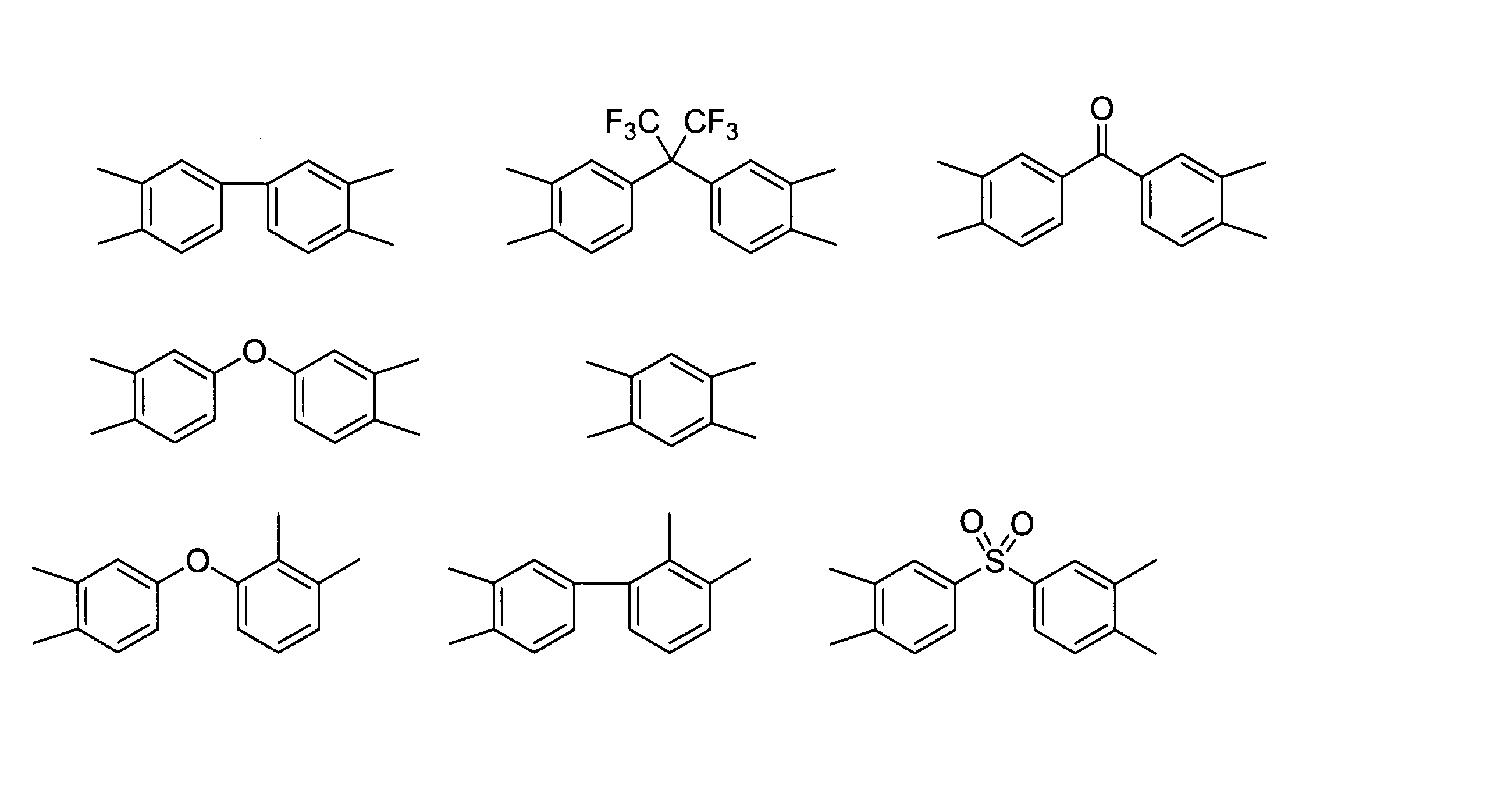
前記繰り返し単位中のR2が、以下のいずれかの4価の有機基である、発明1~5の第2のポリイミド粉体の製造方法。
前記繰り返し単位中のR2が、以下のいずれかの4価の有機基である、発明1~5の第2のポリイミド粉体の製造方法。
[発明7]
溶剤が、アミド系溶剤、エーテル系溶剤、芳香族系溶剤、ハロゲン系溶剤、ケトン系溶剤、ラクトン系溶剤、アルコール系溶剤、およびグリコールエーテル系溶剤からなる群から選ばれる少なくとも一つの溶剤を含む溶剤である、発明1~6の第2のポリイミド粉体の製造方法。
溶剤が、アミド系溶剤、エーテル系溶剤、芳香族系溶剤、ハロゲン系溶剤、ケトン系溶剤、ラクトン系溶剤、アルコール系溶剤、およびグリコールエーテル系溶剤からなる群から選ばれる少なくとも一つの溶剤を含む溶剤である、発明1~6の第2のポリイミド粉体の製造方法。
[発明8]
ポリイミド溶液が、さらにイミド化剤を含むポリイミド溶液である、発明1~7の第2のポリイミド粉体の製造方法。
ポリイミド溶液が、さらにイミド化剤を含むポリイミド溶液である、発明1~7の第2のポリイミド粉体の製造方法。
[発明9]
イミド化剤が、ピリジン、キノリン、ピコリンおよびトリエチルアミンからなる群から選ばれるイミド化触媒と、無水酢酸または無水プロピオン酸から選ばれる脱水剤を含むイミド化剤である、発明8の第2のポリイミド粉体の製造方法。
イミド化剤が、ピリジン、キノリン、ピコリンおよびトリエチルアミンからなる群から選ばれるイミド化触媒と、無水酢酸または無水プロピオン酸から選ばれる脱水剤を含むイミド化剤である、発明8の第2のポリイミド粉体の製造方法。
[発明10]
噴霧工程に、多流体ノズルを備える噴霧装置を用いる、発明1~9の第2のポリイミド粉体の製造方法。
噴霧工程に、多流体ノズルを備える噴霧装置を用いる、発明1~9の第2のポリイミド粉体の製造方法。
[発明11]
加熱乾燥工程の加熱温度が、30℃以上、350℃以下である、発明1~10の第2のポリイミド粉体の製造方法。
加熱乾燥工程の加熱温度が、30℃以上、350℃以下である、発明1~10の第2のポリイミド粉体の製造方法。
[発明12]
加熱乾燥工程の圧力が、0.013KPa以上、50KPa以下である、発明1~11の第2のポリイミド粉体の製造方法。
加熱乾燥工程の圧力が、0.013KPa以上、50KPa以下である、発明1~11の第2のポリイミド粉体の製造方法。
[発明13]
加熱乾燥工程に、箱型乾燥機、バンド乾燥機、トンネル乾燥機、回転乾燥機、流動層乾燥機、気流乾燥機、円盤乾燥機および逆円錐乾燥機からなる群から選ばれる乾燥装置を用いる、発明1~12の第2のポリイミド粉体の製造方法。
加熱乾燥工程に、箱型乾燥機、バンド乾燥機、トンネル乾燥機、回転乾燥機、流動層乾燥機、気流乾燥機、円盤乾燥機および逆円錐乾燥機からなる群から選ばれる乾燥装置を用いる、発明1~12の第2のポリイミド粉体の製造方法。
[発明14]
ポリイミド粉体のメジアン径が、0.1マイクロメートル以上、100マイクロメートル以下である、発明1~13の第2のポリイミド粉体の製造方法。
ポリイミド粉体のメジアン径が、0.1マイクロメートル以上、100マイクロメートル以下である、発明1~13の第2のポリイミド粉体の製造方法。
[発明15]
下記式(1)で示される繰り返し単位を有する、実質的に溶剤およびイミド化剤を含まないポリイミド粉体。
下記式(1)で示される繰り返し単位を有する、実質的に溶剤およびイミド化剤を含まないポリイミド粉体。
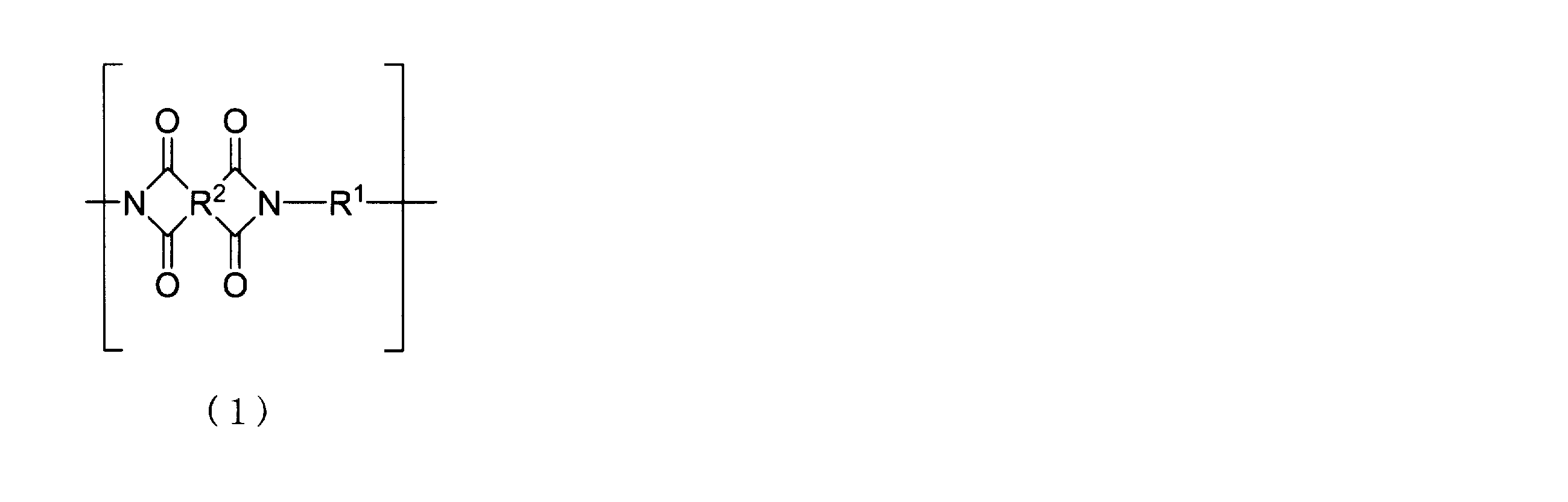
(前記繰り返し単位中のR1が、式(2)で表される2価の有機基または式(3)で表される2価の有機基であり、

(式中、R3は、単結合、酸素原子、硫黄原子、CO、CH2、CH2CH2、SO、SO2、C(CH3)2、C(CH3)(CH2CH3)、NHCO、C(CF3)2、芳香環または脂環であり、R4およびR5は、それぞれ独立に水素原子、アルキル基またはフルオロアルキル基であり、aおよびbは、それぞれ独立に0~2の整数であり、1≦a+b≦4である。)
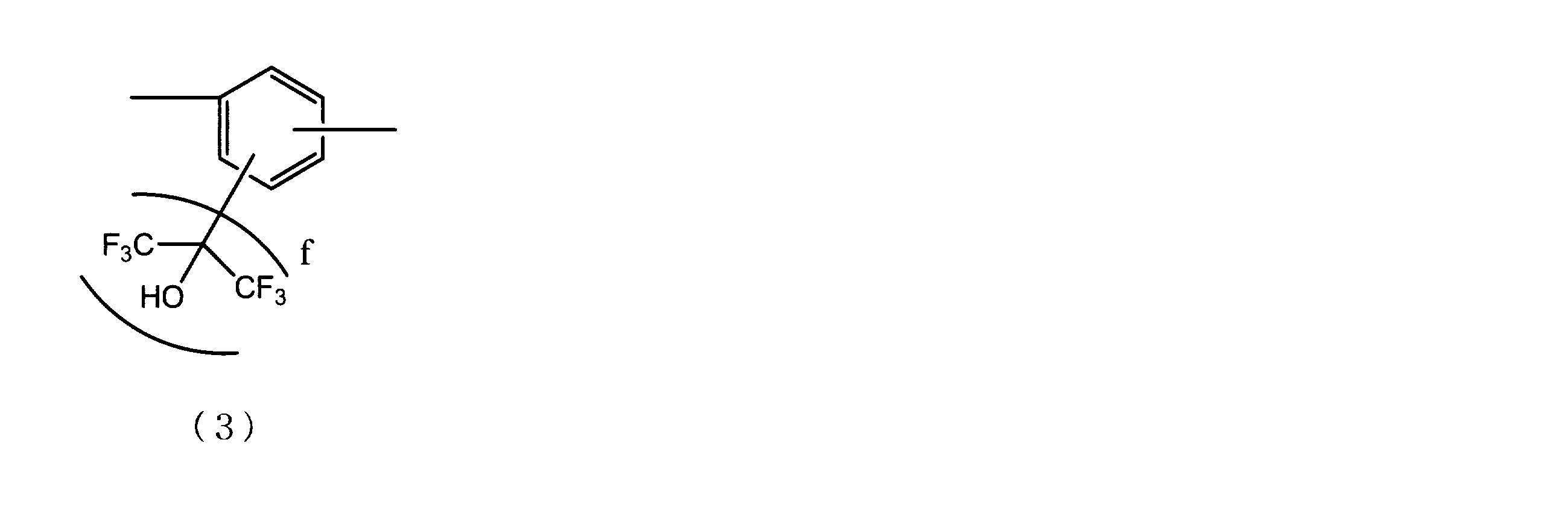
(式中、fは1または2である。)
前記繰り返し単位中のR2が、以下のいずれかの4価の有機基である。)

前記繰り返し単位中のR2が、以下のいずれかの4価の有機基である。)
[発明16]
重量平均分子量が、5000以上、500000以下である、発明15のポリイミド粉体。
重量平均分子量が、5000以上、500000以下である、発明15のポリイミド粉体。
[発明17]
メジアン径が、0.1マイクロメートル以上、100マイクロメートル以下である、発明15または発明16のポリイミド粉体。
メジアン径が、0.1マイクロメートル以上、100マイクロメートル以下である、発明15または発明16のポリイミド粉体。
本発明のHFIP基含有ポリイミド溶液を噴霧して第1のポリイミド粉体を得、得られた第1のポリイミド粉体を減圧下で加熱する第2のポリイミド粉体の製造方法は、ポリイミド粉体製造時にHFIP基含有ポリイミドの重量平均分子量を低下させる程度が低く、HFIP基含有ポリイミド溶液中のイミド化剤および溶剤を実質上、除去したポリイミド粉体を得ることができる。
本発明により得られた第2のポリイミド粉体は、従来技術に開示される、ポリイミド溶液を貧溶媒に再沈させて得られたポリイミド粉体、またはHFIP基含有ポリイミド溶液と比較して、分子量が経時的に低下することがなく、保存安定性に優れる。
以下の実施形態における各構成およびそれらの組み合わせは、本発明の実施形態の一例であり、本発明の趣旨から逸脱しない範囲内で、構成の付加、省略、置換およびその他の変更が可能である。また、本発明は実施形態によって限定されることはなく、特許請求の範囲によってのみ限定される。
本発明の第2のポリイミド粉体の製造方法は、下記式(1)で示される繰り返し単位を有するHFIP基含有ポリイミドと溶剤を含むポリイミド溶液を噴霧し、溶剤を含む第1のポリイミド粉体を形成する噴霧工程と、前記第1のポリイミド粉体を減圧下、加熱乾燥し、実質的に溶剤を含まない第2のポリイミド粉体を得る加熱乾燥工程を含む。
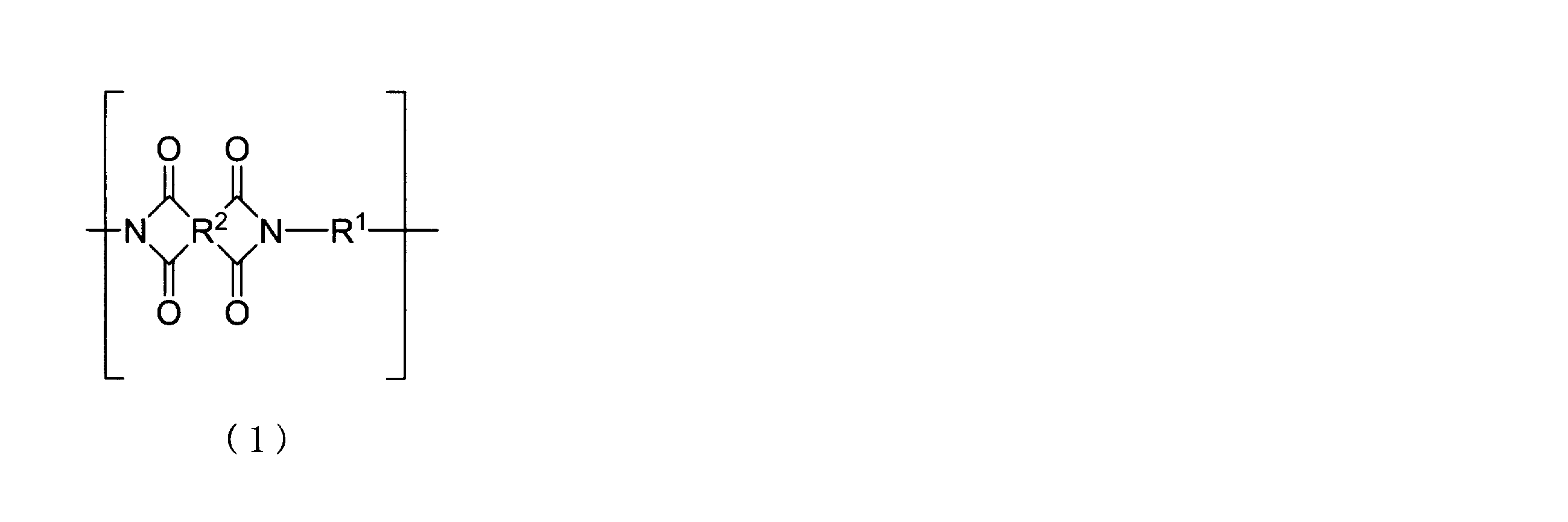
(式中、R1は、2-ヒドロキシ-1,1,1,3,3,3-ヘキサフルオロイソプロピル基(HFIP基)を含む2価の有機基であり、R2は4価の有機基である。)
以下、本発明の第2のポリイミド粉体の製造方法に係る、ポリイミド溶液が含むHFIP基含有ポリイミドおよび溶剤について、順を追って説明する。
1.HFIP基含有ポリイミド
[式(1)で表される繰り返し単位を有するポリイミド]
本発明の第2のポリイミド粉体の製造方法において使用する、HFIP基含有ポリイミドは式(1)で表される繰り返し単位を含むポリイミドである。(式(1)で表される繰り返し単位を有するポリイミドをポリイミド(1)と呼ぶことがある。)
本発明の第2のポリイミド粉体の製造方法において使用する、HFIP基含有ポリイミドは式(1)で表される繰り返し単位を含むポリイミドである。(式(1)で表される繰り返し単位を有するポリイミドをポリイミド(1)と呼ぶことがある。)

(式中、R1は、HFIP基を含む2価の有機基であり、R2は4価の有機基である。)
1-1.有機基R1
本発明の第2のポリイミド粉体の製造方法において、HFIP基含有ポリイミド溶液が含むポリイミド(1)において、その繰り返し単位(1)が含有する2価の有機基R1は、1つ以上の芳香環を有し、2つの結合手は同一または異なる芳香環に存在し、HFIP基の少なくとも1つはその芳香環に結合する。芳香環としてはベンゼン環が好ましく、HFIP基が結合する芳香環が主鎖を形成することが好ましい。R1は、溶剤に溶解しHFIP基含有ポリイミド溶液を得るために、以下の式(2)~(3)で表される2価の有機基のいずれかであることが好ましい。
本発明の第2のポリイミド粉体の製造方法において、HFIP基含有ポリイミド溶液が含むポリイミド(1)において、その繰り返し単位(1)が含有する2価の有機基R1は、1つ以上の芳香環を有し、2つの結合手は同一または異なる芳香環に存在し、HFIP基の少なくとも1つはその芳香環に結合する。芳香環としてはベンゼン環が好ましく、HFIP基が結合する芳香環が主鎖を形成することが好ましい。R1は、溶剤に溶解しHFIP基含有ポリイミド溶液を得るために、以下の式(2)~(3)で表される2価の有機基のいずれかであることが好ましい。
以下、式(2)~(3)で表される2価の有機基について説明する。
[式(2)で表される2価の有機基]

(式中、R3は、単結合、酸素原子、硫黄原子、CO、CH2、CH2CH2、SO、SO2、C(CH3)2、C(CH3)(CH2CH3)、NHCO、C(CF3)2、芳香環または脂環であり、R4およびR5は、それぞれ独立に水素原子、アルキル基またはフルオロアルキル基であり、aおよびbは、それぞれ独立に0~2の整数であり、1≦a+b≦4である。)
ポリイミド(1)において、その繰り返し単位(1)が含有する式(2)で表される有機基R1は、合成のし易さにより、好ましくは、以下のいずれかの有機基である。

[式(3)で表される2価の有機基]

(式(3)中、fは1もしくは2の整数である。)
ポリイミド(1)において、その繰り返し単位(1)が含有する式(3)で表される有機基R1は、ポリイミド(1)の合成のし易さより、好ましくは、以下のいずれかの有機基である。
1-2.有機基R2
本発明の第2のポリイミド粉体の製造方法において、HFIP基含有ポリイミド溶液が含むポリイミド(1)において、その繰り返し単位(1)が含有する4価の有機基R2は、脂環、芳香環およびアルキレン基からなる群より選ばれる少なくとも一種を含有すればよく、特に限定されない。この4価の有機基は、構造中にフッ素原子、塩素原子、酸素原子、硫黄原子または窒素原子を含有していてもよい。また、構造中に水素原子を有する場合には、その水素原子の一部または全部が、アルキル基、フルオロアルキル基、カルボキシル基、ヒドロキシ基またはシアノ基で置換されていてもよい。
本発明の第2のポリイミド粉体の製造方法において、HFIP基含有ポリイミド溶液が含むポリイミド(1)において、その繰り返し単位(1)が含有する4価の有機基R2は、脂環、芳香環およびアルキレン基からなる群より選ばれる少なくとも一種を含有すればよく、特に限定されない。この4価の有機基は、構造中にフッ素原子、塩素原子、酸素原子、硫黄原子または窒素原子を含有していてもよい。また、構造中に水素原子を有する場合には、その水素原子の一部または全部が、アルキル基、フルオロアルキル基、カルボキシル基、ヒドロキシ基またはシアノ基で置換されていてもよい。
ポリイミド(1)において、その含有する4価の有機基R2は、好ましくは、ポリイミド(1)の合成のし易さにおいて、以下の何れかの有機基である。

1-3.繰り返し単位(1)
以上の中でも、ポリイミド(1)は、特に好ましくは、以下のいずれかの繰り返し単位を含有するものである。
以上の中でも、ポリイミド(1)は、特に好ましくは、以下のいずれかの繰り返し単位を含有するものである。
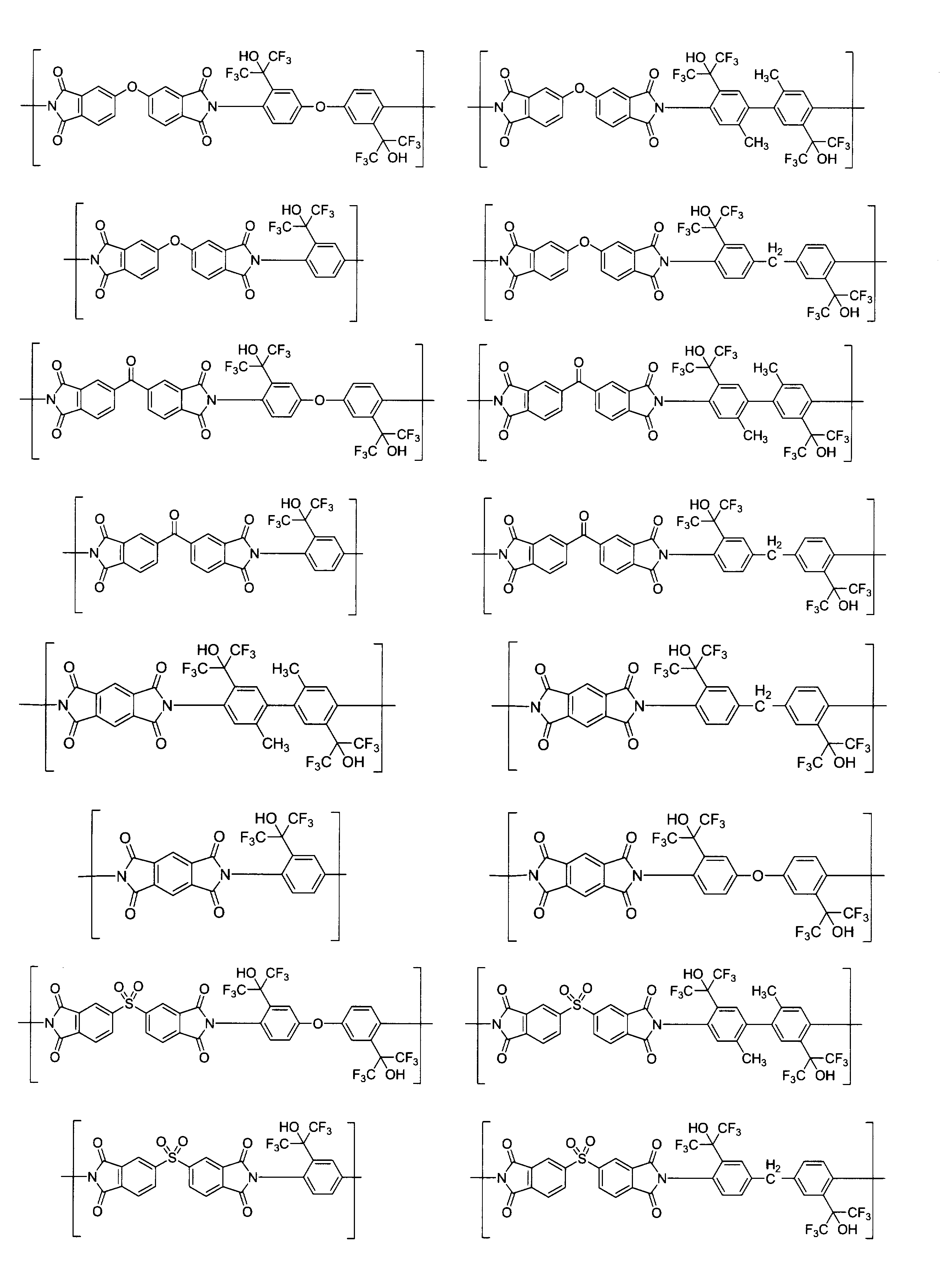
1-4.分子量
ポリイミド(1)の重量平均分子量(Mw)は、好ましくは、5000以上、500000以下であり、特に好ましくは10000以上、200000以下である。分子量が5000未満では、ポリイミド(1)粉体の製造が容易ではなくなる傾向があり、500000より大きいと溶剤に溶け難くなる傾向がある。本発明において、重量平均分子量は、ゲル・パーミエーション・クロマトグラフィ(GPC)により測定し、標準ポリスチレン検量線を用いポリスチレン換算して得られる値である。
ポリイミド(1)の重量平均分子量(Mw)は、好ましくは、5000以上、500000以下であり、特に好ましくは10000以上、200000以下である。分子量が5000未満では、ポリイミド(1)粉体の製造が容易ではなくなる傾向があり、500000より大きいと溶剤に溶け難くなる傾向がある。本発明において、重量平均分子量は、ゲル・パーミエーション・クロマトグラフィ(GPC)により測定し、標準ポリスチレン検量線を用いポリスチレン換算して得られる値である。
2.溶剤
HFIP基含有ポリイミド溶液が含む溶剤としては、ポリイミド(1)の前駆体であるポリアミック酸の合成時の縮重合反応において除熱等のために用いる縮重合溶剤を挙げることができる。または、HFIP基含有ポリイミド溶液を噴霧する際の濃度調製のための希釈溶剤を挙げることができる。
HFIP基含有ポリイミド溶液が含む溶剤としては、ポリイミド(1)の前駆体であるポリアミック酸の合成時の縮重合反応において除熱等のために用いる縮重合溶剤を挙げることができる。または、HFIP基含有ポリイミド溶液を噴霧する際の濃度調製のための希釈溶剤を挙げることができる。
2-1.縮重合溶剤
本発明の第2のポリイミド粉体の製造方法に用いる縮重合溶剤は、ポリイミド(1)の前駆体であるポリアミック酸およびポリイミド(1)を溶解し、前記縮重合反応を阻害しないものであれば特に限定されない。例えば、アミド系溶剤、エーテル系溶剤、芳香族系溶剤、ハロゲン系溶剤、ラクトン類、ケトン系溶剤、アルコール系溶剤、またはグリコールエーテル系溶剤が挙げられ、これらは単独で用いてもよいし、二種以上を併用してもよい。
本発明の第2のポリイミド粉体の製造方法に用いる縮重合溶剤は、ポリイミド(1)の前駆体であるポリアミック酸およびポリイミド(1)を溶解し、前記縮重合反応を阻害しないものであれば特に限定されない。例えば、アミド系溶剤、エーテル系溶剤、芳香族系溶剤、ハロゲン系溶剤、ラクトン類、ケトン系溶剤、アルコール系溶剤、またはグリコールエーテル系溶剤が挙げられ、これらは単独で用いてもよいし、二種以上を併用してもよい。
[アミド系溶剤]
アミド系溶剤としては、N,N-ジメチルアセトアミド(DMAc)、N,N-ジメチルホルムアミド(DMF)、ヘキサメチルリン酸トリアミド、またはN-メチル-2-ピロリドン(NMP)を例示することができる。
アミド系溶剤としては、N,N-ジメチルアセトアミド(DMAc)、N,N-ジメチルホルムアミド(DMF)、ヘキサメチルリン酸トリアミド、またはN-メチル-2-ピロリドン(NMP)を例示することができる。
[エーテル系溶剤]
エーテル系溶剤としては、テトラヒドロフラン(以下、THFと呼ぶことがある。)を例示することができる。
エーテル系溶剤としては、テトラヒドロフラン(以下、THFと呼ぶことがある。)を例示することができる。
[芳香族系溶剤]
芳香族系溶剤としては、ベンゼン、アニソール、ジフェニルエーテル、ニトロベンゼン、ベンゾニトリル、p-クロロフェノール、またはキシレンを例示することができる。
芳香族系溶剤としては、ベンゼン、アニソール、ジフェニルエーテル、ニトロベンゼン、ベンゾニトリル、p-クロロフェノール、またはキシレンを例示することができる。
[ハロゲン系溶剤]
ハロゲン系溶剤としては、クロロホルム、ジクロロメタン、1,2-ジクロロエタン、または1,1,2,2-テトラクロロエタンを例示することができる。
ハロゲン系溶剤としては、クロロホルム、ジクロロメタン、1,2-ジクロロエタン、または1,1,2,2-テトラクロロエタンを例示することができる。
[ラクトン系溶剤]
ラクトン類としては、γ-ブチロラクトン(GBL)、γ-バレロラクトン、δ-バレロラクトン、γ-カプロラクトン、ε-カプロラクトン、またはα-メチル-γ-ブチロラクトンを例示することができる。
ラクトン類としては、γ-ブチロラクトン(GBL)、γ-バレロラクトン、δ-バレロラクトン、γ-カプロラクトン、ε-カプロラクトン、またはα-メチル-γ-ブチロラクトンを例示することができる。
[ケトン系溶剤 ]
ケトン類としては、アセトン、メチルエチルケトン、メチルイソブチルケトンを例示することができる。
ケトン類としては、アセトン、メチルエチルケトン、メチルイソブチルケトンを例示することができる。
[アルコール系溶剤]
アルコール系溶剤としては、n-ブチルアルコールを例示することができる。
アルコール系溶剤としては、n-ブチルアルコールを例示することができる。
[グリコールエーテル系溶剤]
グリコールエーテル系溶剤としては、2-メトキシエタノール、2-エトキシエタノール、または2-ブトキシエタノールを例示することができる。
グリコールエーテル系溶剤としては、2-メトキシエタノール、2-エトキシエタノール、または2-ブトキシエタノールを例示することができる。
これらの溶剤の中でも、ポリイミド(1)の原料であるHFIP基含有ジアミンおよびテトラカルボン酸二無水物、前駆体であるポリアミック酸の溶解性および重縮合のし易さから、N,N-ジメチルアセトアミド(DMAc、沸点165℃)、N-メチルピロリドン(NMP、沸点202℃)、N,N-ジメチルホルムアミド(DMF、沸点153℃)、γ-ブチロラクトン(GBL、沸点204℃)、テトラヒドロフラン(THF、沸点108.4℃)が好ましい。特に、DMAcまたはNMPが好ましい。
2-2.希釈溶剤
希釈溶剤としては、縮重合溶剤中のポリイミド(1)が析出しない溶剤であればよく、極性溶剤を挙げることができる。極性溶剤としては、N,N-ジメチルアセトアミド(DMAc、沸点165℃)、N-メチルピロリドン(NMP、沸点202℃)、N,N-ジメチルホルムアミド(DMF、沸点153℃)、γ-ブチロラクトン(GBL、沸点204℃)、テトラヒドロフラン(THF、沸点108.4℃)を例示することができる。希釈量は、粘度によるが縮重合後のポリイミド(1)溶液の全質量に対して、1質量%以上、99質量%以下である。1質量%より少ないと粘度調整の効果がなく、99質量%より多くする必要はない。
希釈溶剤としては、縮重合溶剤中のポリイミド(1)が析出しない溶剤であればよく、極性溶剤を挙げることができる。極性溶剤としては、N,N-ジメチルアセトアミド(DMAc、沸点165℃)、N-メチルピロリドン(NMP、沸点202℃)、N,N-ジメチルホルムアミド(DMF、沸点153℃)、γ-ブチロラクトン(GBL、沸点204℃)、テトラヒドロフラン(THF、沸点108.4℃)を例示することができる。希釈量は、粘度によるが縮重合後のポリイミド(1)溶液の全質量に対して、1質量%以上、99質量%以下である。1質量%より少ないと粘度調整の効果がなく、99質量%より多くする必要はない。
3.ポリイミド(1)の製造方法
HFIP基含有ポリイミド溶液が含む、ポリイミド(1)の製造方法について説明する。ポリイミド(1)の製造方法は、以下に示す様に、式(1A)で表されるHFIP基含有ジアミンと、下記式(1B)で表されるテトラカルボン酸二無水物とを原料化合物とし、有機溶剤中で縮重合してポリアミック酸を得て、次いで該ポリアミック酸を脱水閉環させてイミド化することでポリイミド(1)を得る方法を挙げることができる。
HFIP基含有ポリイミド溶液が含む、ポリイミド(1)の製造方法について説明する。ポリイミド(1)の製造方法は、以下に示す様に、式(1A)で表されるHFIP基含有ジアミンと、下記式(1B)で表されるテトラカルボン酸二無水物とを原料化合物とし、有機溶剤中で縮重合してポリアミック酸を得て、次いで該ポリアミック酸を脱水閉環させてイミド化することでポリイミド(1)を得る方法を挙げることができる。

(式中のR1およびR2は、式(1)中のR1およびR2の示す意味と同義である。)
3-1.式(1A)で表されるHFIP基含有ジアミンと、式(1B)で表されるテトラカルボン酸二無水物
式(1A)で表されるHFIP基含有ジアミンとしては、以下の式(2A)~(3A)で表されるHFIP基を有するジアミンを用いることが好ましい。
式(1A)で表されるHFIP基含有ジアミンとしては、以下の式(2A)~(3A)で表されるHFIP基を有するジアミンを用いることが好ましい。
以下、式(2A)~(3A)で表されるHFIP基を有するジアミンを、HFIP基含有ジアミン(2A)~(3A)、式(1B)で表されるテトラカルボン酸二無水物を、テトラカルボン酸二無水物(1B)と呼ぶことがある。
これらの方法においては、例えば、前記原料に、HFIP基を有するジアミン(2A)~(3A)以外のその他のジアミン、またはテトラカルボン酸二無水物(1B)以外のその他のテトラカルボン酸二無水物、あるいはその両方を加えてもよい。その他のジアミン、その他のテトラカルボン酸二無水物の含有量は、ポリイミド(1)の原料としてのジアミンおよびテトラカルボン酸二無水物の全量に対して、0質量%以上、20質量%以下である。原料化合物であるHFIP基含有ジアミン(2A)~(3A)、テトラカルボン酸二無水物(1B)を以下に示す。
[HFIP基含有ジアミン(2A)]
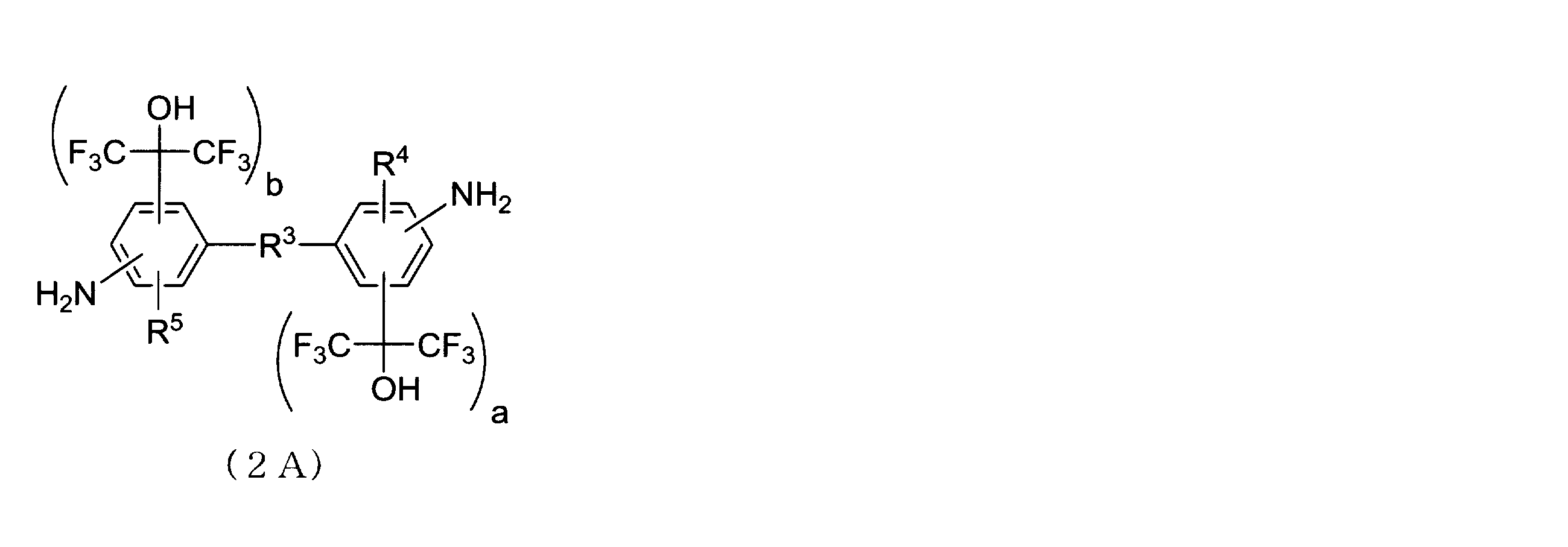
(式中のR3~R5およびa、bは、式(2)中のR3~R5、およびa、bの示す意味とそれぞれ同義である。)
[HFIP基含有ジアミン(3A)]
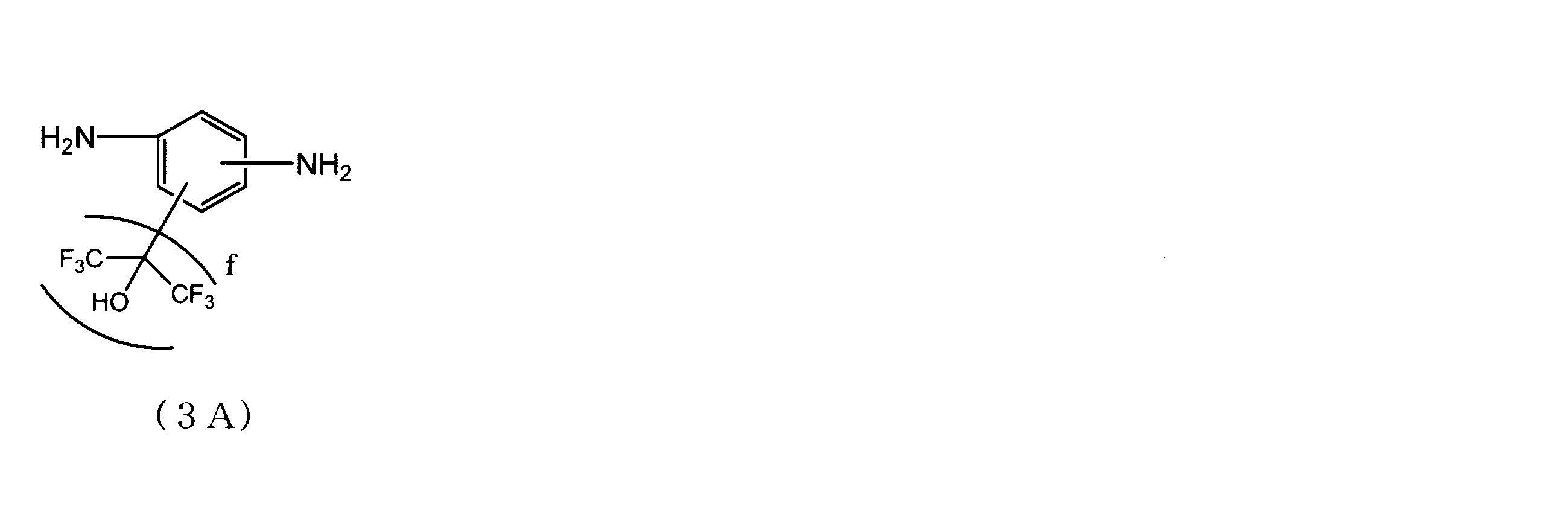
(式中のfは、式(3)中のfの示す意味と同義である。)
3-2.ポリアミック酸の製造方法
以下、式(1A)で表されるHFIP基含有ジアミンと、式(1B)で表されるテトラカルボン酸二無水物を用いたポリアミック酸の製造について説明する。
以下、式(1A)で表されるHFIP基含有ジアミンと、式(1B)で表されるテトラカルボン酸二無水物を用いたポリアミック酸の製造について説明する。
一般的に、ジアミンとテトラカルボン酸二無水物とを縮重合反応させポリアミック酸を得る反応は、実質的に1対1のモル比で行われる。縮重合反応において、原料であるHFIP基含有ジアミン(1A)またはその他のジアミンと、テトラカルボン酸二無水物(1B)またはその他のテトラカルボン酸二無水物の存在比を、モル比で表して1対1となるようにすることが好ましい。前記重縮合溶剤の存在下、反応温度は、-20℃以上、80℃以下で行うのが通常である。縮重合反応において、反応熱の除熱のために前記縮重合溶剤を用いる。
なお、その他のジアミンとはHFIP基含有ジアミン(1A)に属さないジアミンの意味であり、その他のテトラカルボン酸無水物とはテトラカルボン酸二無水物(1B)に属さないテトラカルボン酸無水物の意味であり、得られるポリイミド(1)の物性調整等の目的で、ジアミンの全量、テトラカルボン酸二無水物の全量に対し、モル%で表して、各々20%以内で用いることができるが用いなくてもよい。
HFIP基含有ジアミン(1A)とテトラカルボン酸二無水物(1B)とを縮重合反応させポリアミック酸を得る反応を以下に示す。
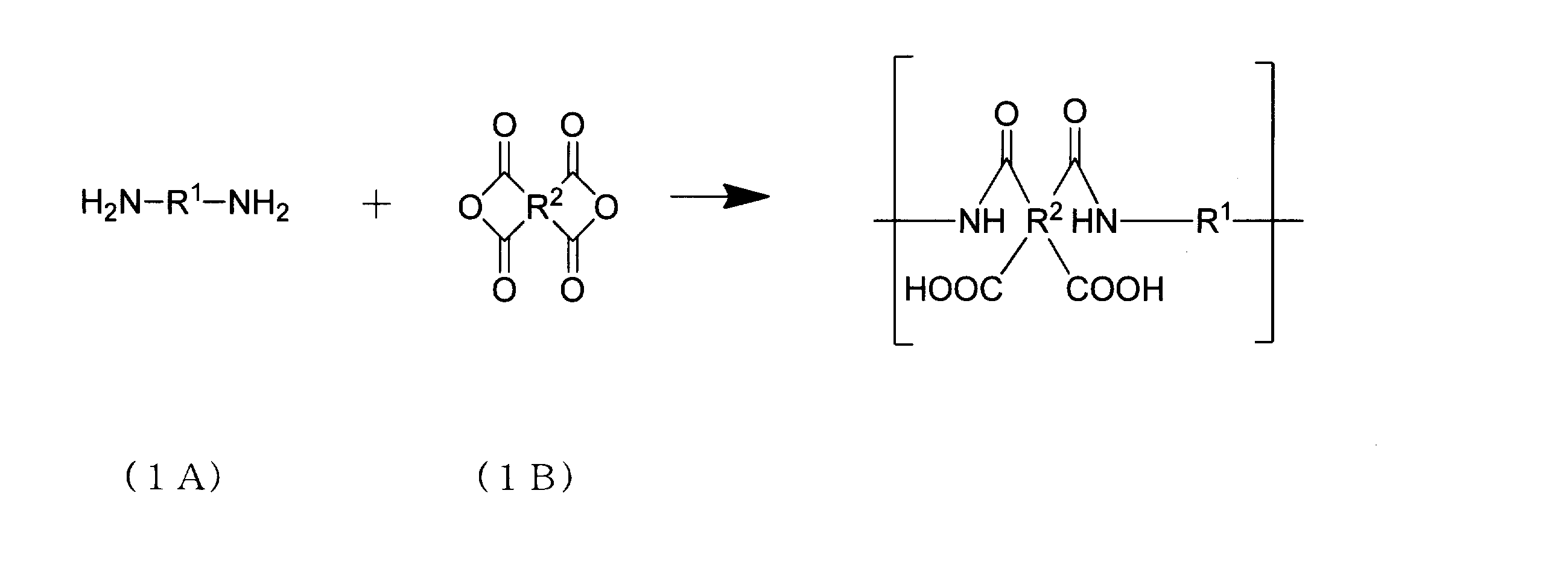
3-3.ポリイミド(1)の製造方法
ポリイミド(1)は、前記縮重合反応で得られたポリアミック酸を脱水閉環させイミド化することにより得られる。脱水閉環は、加熱するか、イミド化剤を添加することで行う。
ポリイミド(1)は、前記縮重合反応で得られたポリアミック酸を脱水閉環させイミド化することにより得られる。脱水閉環は、加熱するか、イミド化剤を添加することで行う。
加熱による場合、ポリアミック酸の溶液を150℃以上、250℃以下に加熱することで、ポリイミド(1)を得ることができる。
イミド化剤を使用する場合、前記縮重合反応で得られたポリアミック酸の溶液に、温度0℃以上、50℃以下で、原料中のジアミン全量に対し、イミド化剤として、イミド化触媒および脱水剤各々2モル当量以上10モル当量以下、加えることでイミド化し、ポリイミド(1)溶液を得ることができる。ポリアミック酸をイミド化しポリイミドを得る反応を以下に示す。

得られたポリイミド(1)溶液は、そのまま後述のポリイミド粉体の製造に供してもよく、あるいは、濃縮または希釈してもよく、あるいは、溶液中から溶剤等を除去してポリイミド(1)単体を得てもよい。
また、ポリイミド(1)の製造は、上述の他に、前記HFIP基含有ジアミン(2A)、(3A)の少なくとも1種以上と、テトラカルボン酸二無水物(1B)とを必須原料とし、150℃以上、250℃以下で相互に溶融させた後混合させ、縮重合溶剤なしでポリイミド(1)を得る方法を挙げることができる。
3-4.イミド化剤
前記イミド化触媒としては、有機塩基を挙げることができる。有機塩基としては、三級アミンが好ましい。三級アミンとしては、ピリジン、ピコリン、キノリンまたはトリエチルアミンを例示することができる。
前記イミド化触媒としては、有機塩基を挙げることができる。有機塩基としては、三級アミンが好ましい。三級アミンとしては、ピリジン、ピコリン、キノリンまたはトリエチルアミンを例示することができる。
脱水剤としては、無水酢酸または無水プロピオン酸を例示することができる。
イミド化剤は、好ましくは、これらの三級アミンと無水酢酸の組み合わせであり、特に好ましくは、ピリジンと無水酢酸の組み合わせである。なお、イミド化反応で消費された無水酢酸は、酢酸としてポリイミド溶液に含有(残存)する。
4.第2のポリイミド粉体の製造方法
本発明の第2のポリイミド粉体の製造方法は、ポリイミド(1)と溶剤、またはポリイミド(1)と溶剤とイミド化剤を含むポリイミド溶液を噴霧し、溶剤を含む第1のポリイミド粉体を形成する噴霧工程と、前記第1のポリイミド粉体を乾燥装置内減圧下、加熱乾燥し、実質的に溶剤を含まない加熱乾燥工程とを含む。即ち、本発明の第2のポリイミド粉体の製造方法は、ポリイミド溶液に伴われる溶剤およびイミド化剤を実質的に残存しない(含まない)第2のポリイミド粉体を得ることができる。
本発明の第2のポリイミド粉体の製造方法は、ポリイミド(1)と溶剤、またはポリイミド(1)と溶剤とイミド化剤を含むポリイミド溶液を噴霧し、溶剤を含む第1のポリイミド粉体を形成する噴霧工程と、前記第1のポリイミド粉体を乾燥装置内減圧下、加熱乾燥し、実質的に溶剤を含まない加熱乾燥工程とを含む。即ち、本発明の第2のポリイミド粉体の製造方法は、ポリイミド溶液に伴われる溶剤およびイミド化剤を実質的に残存しない(含まない)第2のポリイミド粉体を得ることができる。
本発明の第2のポリイミド粉体の製造方法は、HFIP基含有ポリイミド溶液をポリイミドの貧溶媒中に展開し粉体を得る従来の方法と比較して、除去における廃棄物が、HFIP基含有ポリイミド溶液から溶質であるHFIP基含有ポリイミドを除いた物のみであるので、廃棄物の量が少なくて済む。
4-1.噴霧工程
本発明の第2のポリイミド粉体の製造方法に係る噴霧工程で用いる噴霧装置は、第1のポリイミド粉体が得られれば、特に限定されず、市販される噴霧乾燥機(スプレードライヤ)を用いることができる。スプレードライヤを用いれば、加熱した気体中に、ポリイミド溶液を噴霧して溶剤、あるいは溶剤およびイミド化剤を除去し、第1のポリイミド粉体を得ることができる。スプレードライヤは、ポリイミド溶液を噴霧するための圧力ノズルと、ポリイミド溶液を噴霧し溶剤を除去するための、常圧(大気圧、約101.325kPa)の加熱した気体で満たされた室を備える。
本発明の第2のポリイミド粉体の製造方法に係る噴霧工程で用いる噴霧装置は、第1のポリイミド粉体が得られれば、特に限定されず、市販される噴霧乾燥機(スプレードライヤ)を用いることができる。スプレードライヤを用いれば、加熱した気体中に、ポリイミド溶液を噴霧して溶剤、あるいは溶剤およびイミド化剤を除去し、第1のポリイミド粉体を得ることができる。スプレードライヤは、ポリイミド溶液を噴霧するための圧力ノズルと、ポリイミド溶液を噴霧し溶剤を除去するための、常圧(大気圧、約101.325kPa)の加熱した気体で満たされた室を備える。
噴霧工程を減圧下で行うと、スプレードライヤ装置が複雑および高価となるため、常圧(大気圧)下で行うことが好ましい。
スプレードライヤは、例えば、特開平1-194901号公報に記載されたスプレードライヤ装置、または特開平8-299701号公報に記載された噴霧機等を用いることができる。
噴霧方式は、回転ディスク式、ノズル並流式、ノズル向流式、またはノズル向・並流式を挙げることができる。ノズルの形状は、1流体ノズル、あるいは多流体ノズルを採用することができる。1流体ノズルを用い、ポリイミド溶液のみを噴霧しても第1のポリイミド粉体を得ることもできるが、粒径の小さい第1のポリイミド粉体を得ることが難しく、多流体ノズルを用いることが好ましい。多流体ノズルを用いれば、ポリイミド溶液と圧縮気体を別のノズルから噴き出すことができ、1流体ノズルより、粒径の小さい第1のポリイミド粉体を得ることができる。市販の多流体ノズルにおいて偶数のノズルを有するノズルが一般的であり、2流体ノズルまたは4流体ノズルが好ましい。
例えば、2流体ノズルを用いればポリイミド溶液と圧縮気体2系統に分けられたノズルによって、圧縮気体ノズルからの高速気流によってポリイミド粉体を粉砕し粒径の小さいポリイミドを製造できる。4流体ノズルを用いれば、ポリイミド溶液2系統と圧縮気体2系統の4つの噴出口により、さらに粒径の細かい第1のポリイミド粉体を得ることができる。
噴霧工程の温度は、用いる溶剤の沸点に応じて調整すればよいが、固形(粉体)のポリイミドを得るためには、用いる溶剤の沸点から、50℃低い温度より少なくとも高い温度であることが好ましい。より好ましくは、40℃低い温度より少なくとも高い温度であり、特に好ましくは25℃低い温度より少なくとも高い温度である。噴霧工程の温度が、溶剤の沸点より50℃低い温度より低いと、乾燥が不十分となり、第1のポリイミド粉体が得られないことがある。噴霧工程の温度の上限は、200℃以下が好ましく、好ましくは100℃以下であり、特に好ましくは50℃以下である。200℃より温度が高いと溶剤が急に蒸発して所望の第1のポリイミド粉体が得られない、または、噴霧装置内でポリイミドが固化して目詰まりが起こることがある。
4-2.加熱乾燥工程
前記噴霧工程で得られた第1のポリイミド粉体を減圧下で加熱乾燥する加熱乾燥工程は、第1のポリイミド粉体から溶剤およびイミド化剤を含む不純物を除去し、実質的に溶剤およびイミド化剤を含まない第2のポリイミド粉体を得ることができればよく、減圧乾燥機を用いる。
前記噴霧工程で得られた第1のポリイミド粉体を減圧下で加熱乾燥する加熱乾燥工程は、第1のポリイミド粉体から溶剤およびイミド化剤を含む不純物を除去し、実質的に溶剤およびイミド化剤を含まない第2のポリイミド粉体を得ることができればよく、減圧乾燥機を用いる。
加熱乾燥工程における加熱温度は30℃以上、350℃以下であることが好ましい。より好ましくは50℃以上、300℃以下であり、さらに好ましくは、100℃以上、250℃以下である。30℃未満であれば、第2のポリイミド粉体の乾燥が不十分となり、溶剤が残存する虞がある。350℃より高温域では、ポリイミドの熱分解が起こる虞があるため、好ましくない。
加熱乾燥工程は減圧下で行う。好ましくは0.013KPa以上、50KPa以下であり、より好ましくは0.02KPa以上、10KPa以下である。0.013KPa未満では、真空ポンプに負担がかかる虞があり、50KPaより高い圧力では、ポリイミド粉末の乾燥が不十分となる虞があるため、好ましくない。
4-3.ポリイミド粉体のメジアン径
本発明の第2のポリイミド粉体の製造方法において、ポリイミド粉体のメジアン径は、0.1マイクロメートル以上、100マイクロメートル以下であることが好ましい。メジアン径が0.1マイクロメートル未満では、ポリマー粉体の凝集が起こる、または、取扱いが困難となる虞があり、100マイクロメートルより大きいと、加熱乾燥工程時に溶剤の除去が困難となる虞があるため、好ましくない。
本発明の第2のポリイミド粉体の製造方法において、ポリイミド粉体のメジアン径は、0.1マイクロメートル以上、100マイクロメートル以下であることが好ましい。メジアン径が0.1マイクロメートル未満では、ポリマー粉体の凝集が起こる、または、取扱いが困難となる虞があり、100マイクロメートルより大きいと、加熱乾燥工程時に溶剤の除去が困難となる虞があるため、好ましくない。
なお、本発明において、メジアン径とは、粉体の積算分布曲線における50%累積値に対応する粒子径であり、粉体をある粒子径から大小2つに分けたとき、大きい側と小さい側の存在比率が等量となる径のことを言う。存在比率の基準としては体積基準(体積分布)、個数基準(個数分布)等があるが、レーザー回析散乱法では体積基準となる。
5.ポリイミド粉体
本発明の第2のポリイミド粉体の製造方法によって、以下の式(1)で示される繰り返し単位を有する、実質的に溶剤およびイミド化剤を含まないポリイミド粉体が得られる。なお、本発明のポリイミド粉体の製造方法およびポリイミド粉体において、実質的に溶剤を含まないとは、ポリイミド粉体全量に対して、溶剤が1質量%以下であることを言う。実質的にイミド化剤を含まないとは、ポリイミド粉体全量に対して、イミド化剤が0.1質量%未満であることを言う。
本発明の第2のポリイミド粉体の製造方法によって、以下の式(1)で示される繰り返し単位を有する、実質的に溶剤およびイミド化剤を含まないポリイミド粉体が得られる。なお、本発明のポリイミド粉体の製造方法およびポリイミド粉体において、実質的に溶剤を含まないとは、ポリイミド粉体全量に対して、溶剤が1質量%以下であることを言う。実質的にイミド化剤を含まないとは、ポリイミド粉体全量に対して、イミド化剤が0.1質量%未満であることを言う。
[下記式(1)で示される繰り返し単位を有する、実質的に溶剤およびイミド化剤を含まないポリイミド粉体]

前記繰り返し単位中のR2が、以下のいずれかの4価の有機基である。

本発明のポリイミド粉体の重量平均分子量(Mw)は、好ましくは、5000以上、500000以下であり、特に好ましくは10000以上、200000以下である。重量平均分子量が5000未満では、ポリイミド粉体の製造が容易ではなくなる傾向があり、500000より大きいと溶剤に溶け難くなる傾向がある。
本発明のポリイミド粉体のメジアン径は、0.1マイクロメートル以上、100マイクロメートル以下であることが好ましい。メジアン径が0.1マイクロメートル未満では、ポリマー粉体の凝集が起こり易い、または、取扱いが困難となる虞があり、100マイクロメートルより大きいと、加熱乾燥工程時に溶剤の除去が困難となる虞があるため、好ましくない。
本発明のポリイミド粉体において、溶剤の含有は、ポリイミド粉体全体に対して、溶剤が1質量%以下であることが好ましい。下限は、0.0001質量%以上である。イミド化剤の含有は、ポリイミド粉体全体に対して0.1質量%以下であることが好ましい。下限は、0.0001質量%以上である。
以下、実施例により本発明を詳細に説明するが、本発明は係る実施例に限定されるものではない。
1.ポリイミド溶液の調製
1-1.調製例1
[ポリイミド(A)のDMAc溶液の調製]
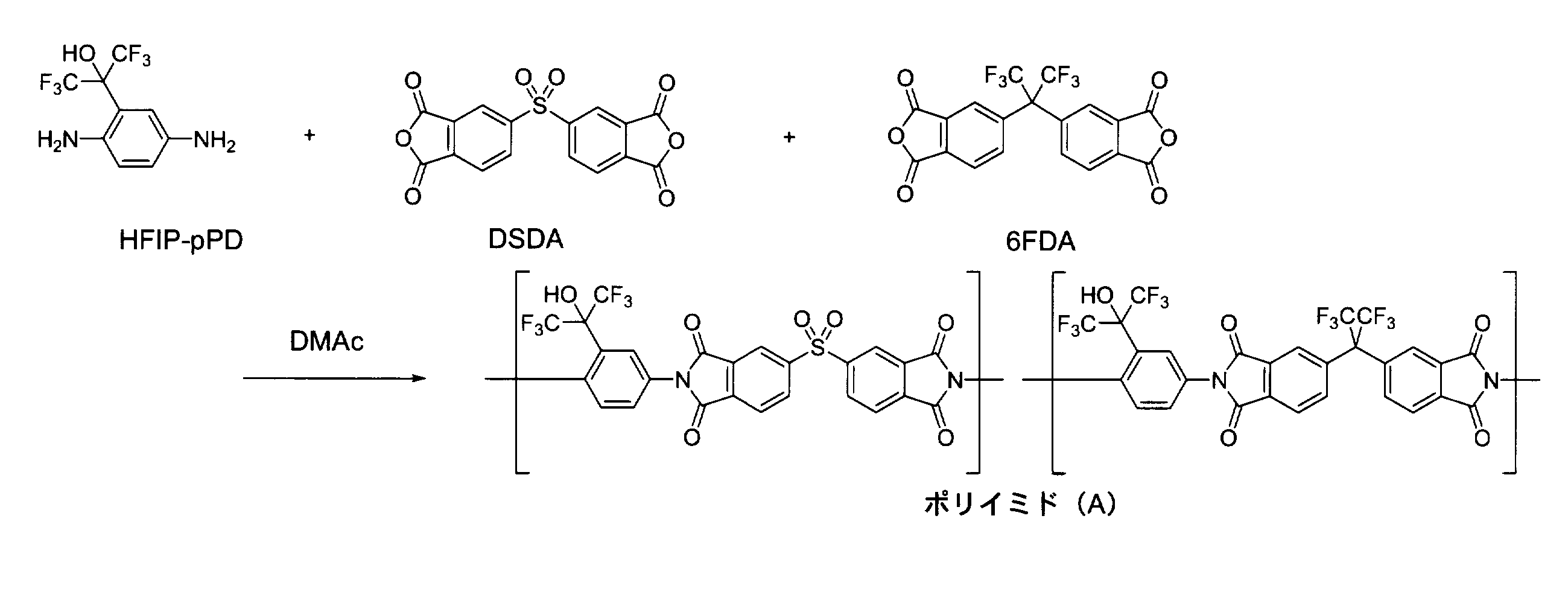
窒素導入管および攪拌翼を備えた容量2Lの三口フラスコに、以下に示すHFIP-pPD、55.0g(201mmol)、DSDA、35.9g(100mmol)、および6FDA、44.6g(100mmol)を加え、溶剤としてDMAc、358gを加えた後、窒素雰囲気下、室温で攪拌しポリアミック酸を含む反応液を得た。
1-1.調製例1
[ポリイミド(A)のDMAc溶液の調製]
窒素導入管および攪拌翼を備えた容量2Lの三口フラスコに、以下に示すHFIP-pPD、55.0g(201mmol)、DSDA、35.9g(100mmol)、および6FDA、44.6g(100mmol)を加え、溶剤としてDMAc、358gを加えた後、窒素雰囲気下、室温で攪拌しポリアミック酸を含む反応液を得た。
前記反応液に、イミド化触媒として、ピリジン、33.3g(421mmol)、脱水剤として、無水酢酸、43.0g(421mmol)の順に加え、さらに3時間攪拌し、イミド化反応を行った。イミド化反応終了後、加圧濾過し、以下の式に示すポリイミド(A)の溶液を得た(以下、ポリイミド溶液(A)と呼ぶことがある)。
[GPC測定結果]
ポリイミド(A)のDMAc溶液のゲル・パーミエーション・クロマトグラフィ(以下、GPCと呼ぶことがある)による分子量の測定結果は、Mw=122000、Mw/Mn=3.1であった。Mwは重量平均分子量、Mnは数平均分子量である。Mw/Mnは分散度であった。
ポリイミド(A)のDMAc溶液のゲル・パーミエーション・クロマトグラフィ(以下、GPCと呼ぶことがある)による分子量の測定結果は、Mw=122000、Mw/Mn=3.1であった。Mwは重量平均分子量、Mnは数平均分子量である。Mw/Mnは分散度であった。
GPCによる分子量の測定には、高速GPC装置(東ソー株式会社製、機種名:HLC-8320GPC、カラム:TSKgel SuperHZM-Hを用い、展開溶媒にはテトラヒドロフラン(THF)を用いた。以下、前記高速GPC装置を用い、同様に分子量を測定した。
1-2.調製例2
[ポリイミド(B)のDMAc溶液の調製]
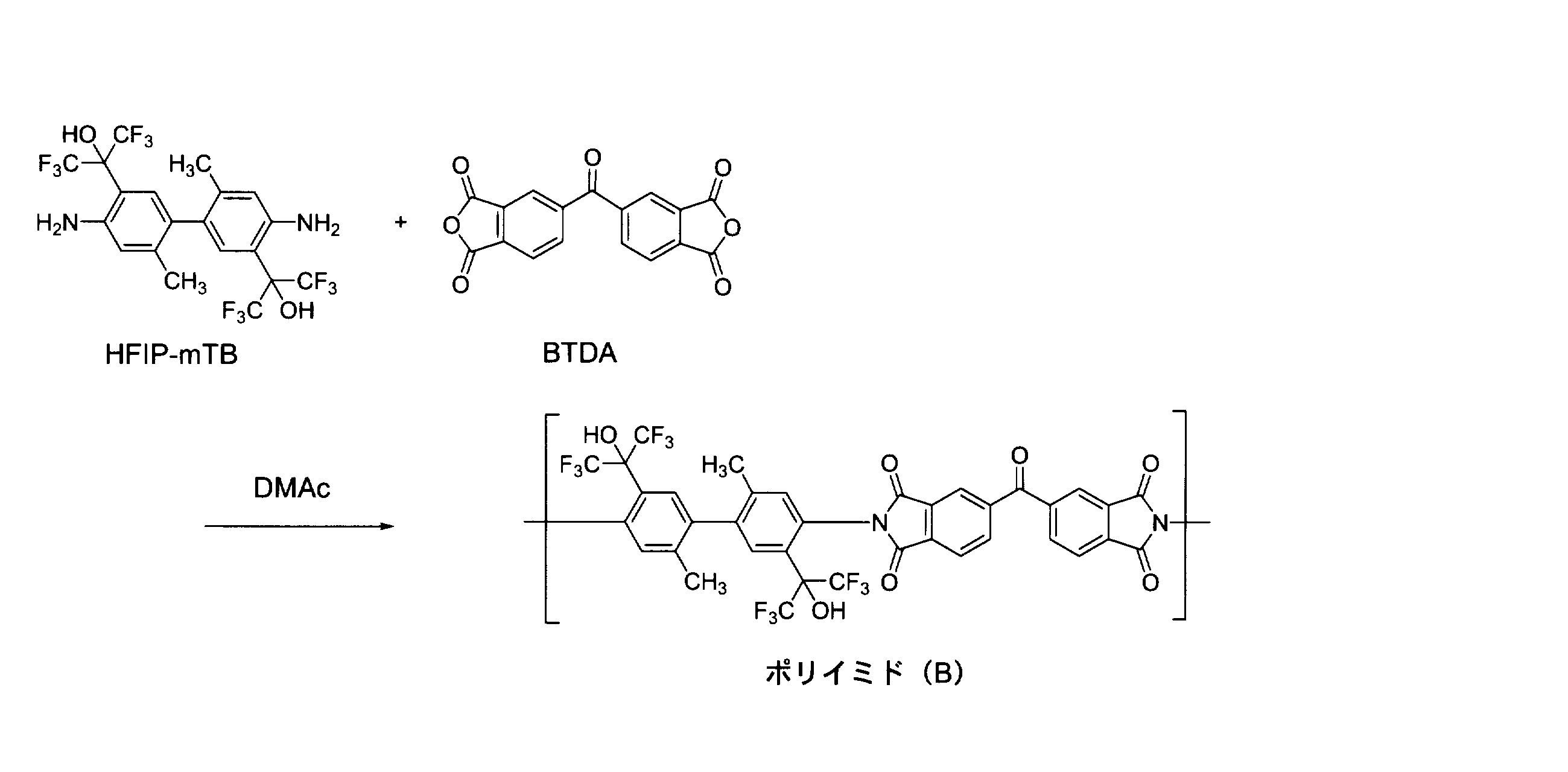
窒素導入管および攪拌翼を備えた容量2Lの三口フラスコに、以下に示すHFIP-mT、80.0g(147mmol)、BTDA、47.4g、(147mmol)を加え、溶剤としてDMAcを237g加えた後、窒素雰囲気下、室温で攪拌しポリアミック酸を含む反応液を得た。
[ポリイミド(B)のDMAc溶液の調製]
窒素導入管および攪拌翼を備えた容量2Lの三口フラスコに、以下に示すHFIP-mT、80.0g(147mmol)、BTDA、47.4g、(147mmol)を加え、溶剤としてDMAcを237g加えた後、窒素雰囲気下、室温で攪拌しポリアミック酸を含む反応液を得た。
前記反応液に、ピリジン、24.4g(309mmol)、無水酢酸、31.5g(309mmol)の順に加え、さらに24時間攪拌し、イミド化反応を行った。イミド化反応終了後、加圧濾過し、以下に示すポリイミド(B)の溶液を得た(以下、ポリイミド溶液(B)と呼ぶことがある)。
[GPC測定結果]
ポリイミド(B)のDMAc溶液のGPCによる分子量の測定結果は、Mw=138000、Mw/Mn=2.0であった。
ポリイミド(B)のDMAc溶液のGPCによる分子量の測定結果は、Mw=138000、Mw/Mn=2.0であった。
1-3.調製例3
[ポリイミド(C)のDMAc溶液の調製]
窒素導入管および攪拌翼を備えた容量2Lの三口フラスコに、以下に示すHFIP-MDA、90.0g(170mmol)、BPDA、49.9g(170mmol)を加え、溶剤としてDMAc、371gを加えた後、窒素雰囲気下、室温で攪拌しポリアミック酸を含む反応液を得た。
[ポリイミド(C)のDMAc溶液の調製]
窒素導入管および攪拌翼を備えた容量2Lの三口フラスコに、以下に示すHFIP-MDA、90.0g(170mmol)、BPDA、49.9g(170mmol)を加え、溶剤としてDMAc、371gを加えた後、窒素雰囲気下、室温で攪拌しポリアミック酸を含む反応液を得た。
前記反応液に、ピリジンを28.2g(356mmol)、無水酢酸を36.4g(356mmol)の順に加え、さらに24時間攪拌し、イミド化反応を行った。イミド化反応終了後、加圧濾過し、以下の式に示すポリイミド(C)の溶液を得た(以下、ポリイミド溶液(C)と呼ぶことがある)。
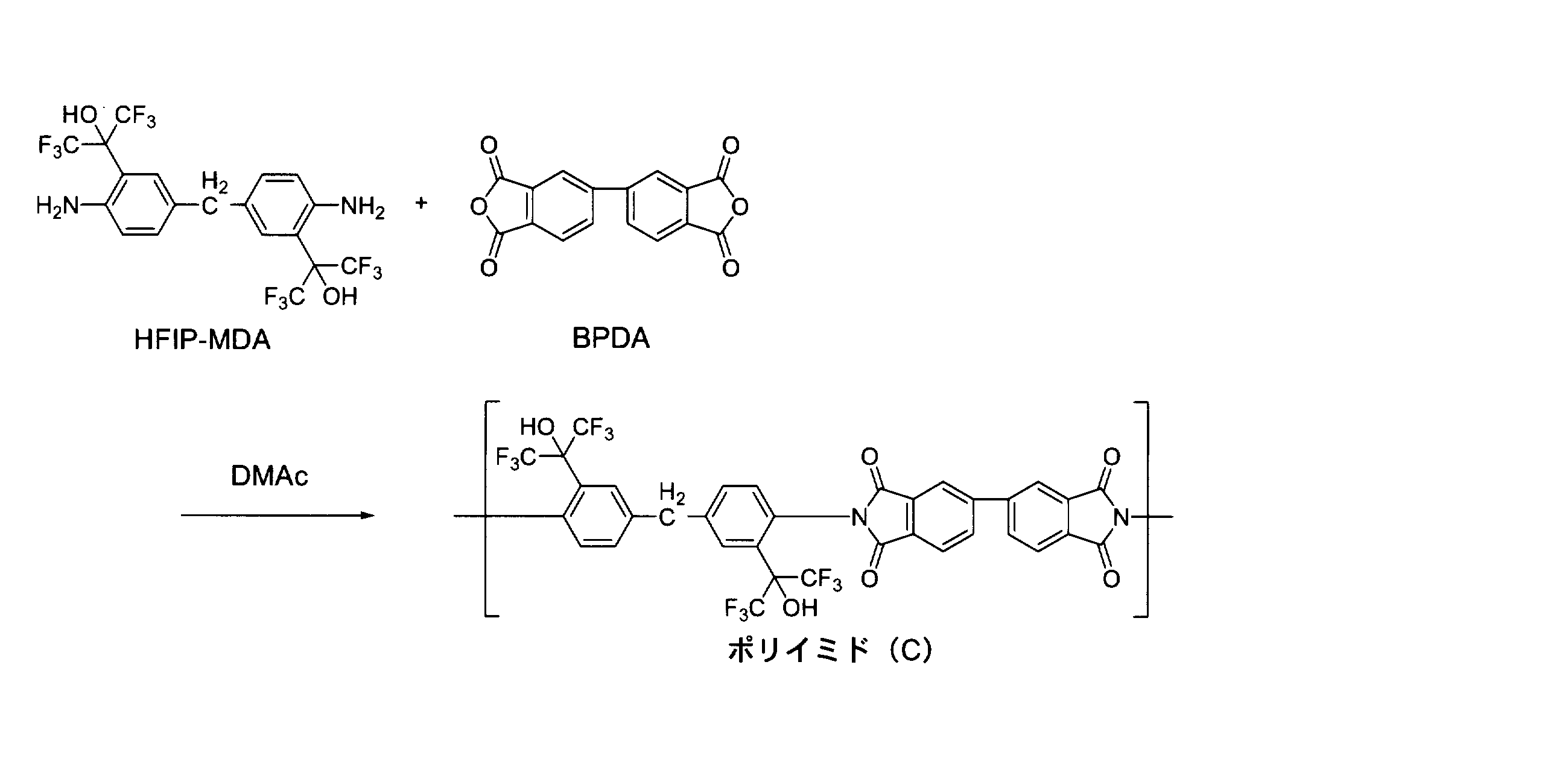
[GPC測定結果]
ポリイミド(C)のDMAc溶液のGPCによる分子量の測定結果は、Mw=136000、Mw/Mn=1.8であった。
ポリイミド(C)のDMAc溶液のGPCによる分子量の測定結果は、Mw=136000、Mw/Mn=1.8であった。
1-4.調製例4
[ポリイミド(D)のDMAc溶液の調製]
窒素導入管および攪拌翼を備えた容量2Lの三口フラスコに、以下に示すHFIP-mTBを27.2g(50mmol)、BPDAを14.7g(50mmol)加え、溶剤としてDMAcを72.4g加えた後、窒素雰囲気下、室温で攪拌しポリアミック酸を含む反応液を得た。
[ポリイミド(D)のDMAc溶液の調製]
窒素導入管および攪拌翼を備えた容量2Lの三口フラスコに、以下に示すHFIP-mTBを27.2g(50mmol)、BPDAを14.7g(50mmol)加え、溶剤としてDMAcを72.4g加えた後、窒素雰囲気下、室温で攪拌しポリアミック酸を含む反応液を得た。
前記反応液に、ピリジン、8.3g、(105mmol)、無水酢酸、10.7g(105mmol)の順に加え、さらに24時間攪拌し、イミド化反応を行った。イミド化反応終了後、加圧濾過し、以下の式に示すポリイミド(D)の溶液を得た(以下、ポリイミド溶液(D)と呼ぶことがある)。

[GPC測定結果]
ポリイミド(D)のDMAc溶液のGPCによる分子量の測定結果は、Mw=149000、Mw/Mn=2.6であった。
ポリイミド(D)のDMAc溶液のGPCによる分子量の測定結果は、Mw=149000、Mw/Mn=2.6であった。
1-5.調製例5
[ポリイミド(E)のDMAc溶液の調製]
窒素導入管および攪拌翼を備えた容量2Lの三口フラスコに、以下に示すHFIP-mTB、33.3g(61mmol)、6FDA、27.2g(61mmol)を加え、溶剤としてDMAcを62g加えた後、窒素雰囲気下、室温で攪拌しポリアミック酸を含む反応液を得た。
[ポリイミド(E)のDMAc溶液の調製]
窒素導入管および攪拌翼を備えた容量2Lの三口フラスコに、以下に示すHFIP-mTB、33.3g(61mmol)、6FDA、27.2g(61mmol)を加え、溶剤としてDMAcを62g加えた後、窒素雰囲気下、室温で攪拌しポリアミック酸を含む反応液を得た。
前記反応液に、ピリジンを19.4g(245mmol)、無水酢酸を25.0g(245mmol)の順に加え、さらに24時間攪拌し、イミド化反応を行った。イミド化反応終了後、加圧濾過し、以下の式に示すポリイミド(E)の溶液を得た(以下、ポリイミド溶液(E)と呼ぶことがある)。
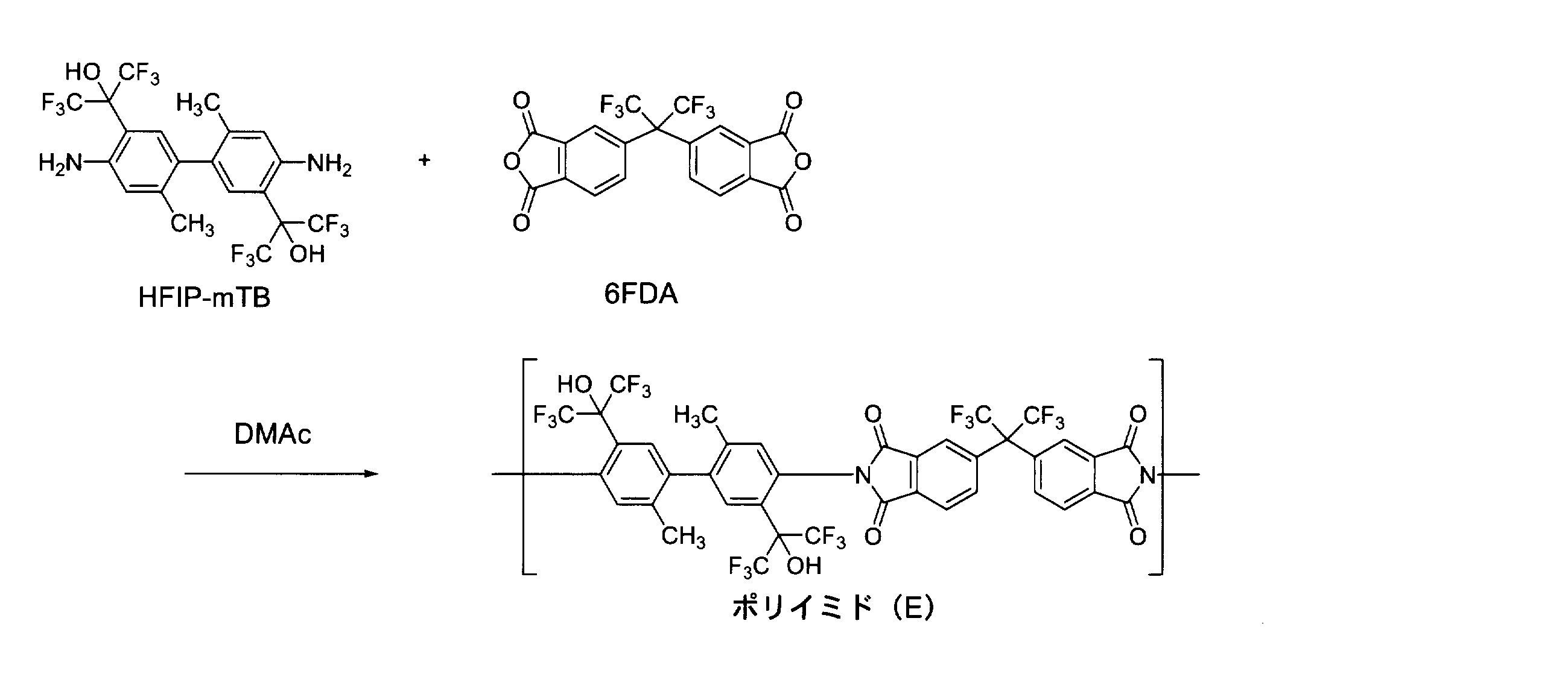
[GPC測定結果]
ポリイミド(E)のDMAc溶液のGPCによる分子量の測定結果は、Mw=102000、Mw/Mn=2.2であった。
ポリイミド(E)のDMAc溶液のGPCによる分子量の測定結果は、Mw=102000、Mw/Mn=2.2であった。
1-5.調製例6
[ポリイミド(F)のDMAc溶液の調製]
窒素導入管および攪拌翼を備えた容量2Lの三口フラスコに、以下に示すHFIP-MDAを26.5g(50mmol)、ODPAを15.1g(50mmol)を加え、溶剤としてDMAc、123g加えた後、窒素雰囲気下、室温で攪拌しポリアミック酸を含む反応液を得た。
[ポリイミド(F)のDMAc溶液の調製]
窒素導入管および攪拌翼を備えた容量2Lの三口フラスコに、以下に示すHFIP-MDAを26.5g(50mmol)、ODPAを15.1g(50mmol)を加え、溶剤としてDMAc、123g加えた後、窒素雰囲気下、室温で攪拌しポリアミック酸を含む反応液を得た。
前記反応液に、ピリジン、8.3g(105mmol)、無水酢酸、10.7g(105mmol)の順に加え、さらに24時間攪拌し、イミド化反応を行った。イミド化反応終了後、加圧濾過し、以下の式に示すポリイミド(F)の溶液を得た(以下、第1のポリイミド溶液(F)と呼ぶことがある)。
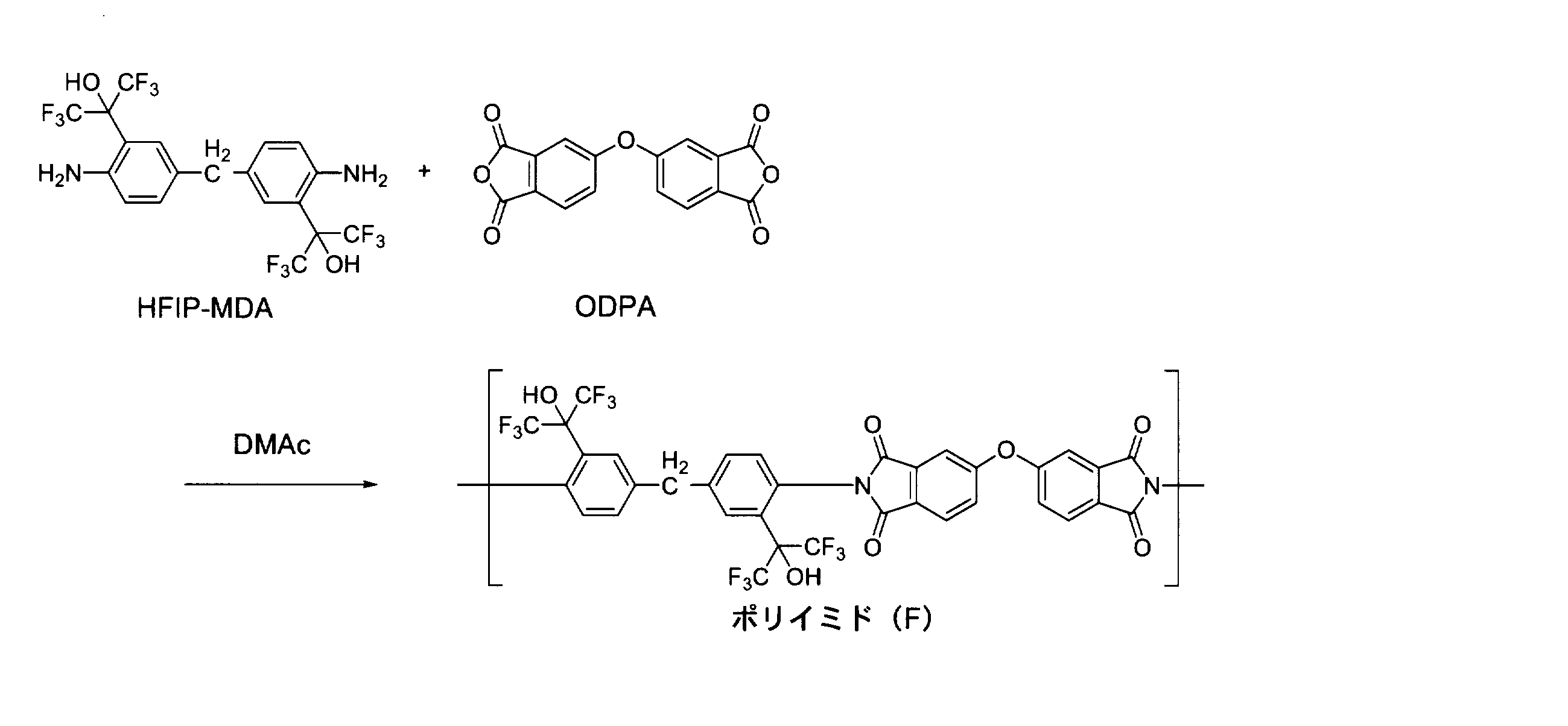
[GPC測定結果]
ポリイミド(F)のDMAc溶液のGPCによる分子量の測定結果は、Mw=113000、Mw/Mn=3.3であった。
ポリイミド(F)のDMAc溶液のGPCによる分子量の測定結果は、Mw=113000、Mw/Mn=3.3であった。
2.第2のポリイミド粉体の製造
2-1.実施例1
[ポリイミド溶液(A)の噴霧]
調製例1で得られたポリイミド溶液(A)を、ポリイミド(A)の濃度が5質量%になるようにDMAcで希釈した後、噴霧機(藤崎電機株式会社製、機種MDL-015、噴霧方式、4流体ノズル)を用いて、送液流量20g/min、ノズルガス圧力0.5MPa、入口温度175℃の条件で噴霧し、ポリイミド(A)の粉体を得た(以下、ポリイミド粉体(A)と呼ぶことがある)。第1のポリイミド粉体(A)のメジアン径は、7μmであった。
2-1.実施例1
[ポリイミド溶液(A)の噴霧]
調製例1で得られたポリイミド溶液(A)を、ポリイミド(A)の濃度が5質量%になるようにDMAcで希釈した後、噴霧機(藤崎電機株式会社製、機種MDL-015、噴霧方式、4流体ノズル)を用いて、送液流量20g/min、ノズルガス圧力0.5MPa、入口温度175℃の条件で噴霧し、ポリイミド(A)の粉体を得た(以下、ポリイミド粉体(A)と呼ぶことがある)。第1のポリイミド粉体(A)のメジアン径は、7μmであった。
なお、ポリイミド粉体のメジアン径は、粒子径分布測定装置(株式会社堀場製作所製、品名、LA-300)を用いて、湿式レーザー回折散乱法により測定した体積基準による粒子の屈折率を1.50と仮定したメジアン径の値である。以下、前記粒子径分布測定装置を用い、同様にメジアン径を測定した。
[ポリイミド粉体(A)の加熱乾燥]
得られた第1のポリイミド粉体(A)30.8gを棚段乾燥機(東京理科器械株式会社製、機器名VOS-451SD)に入れ、200℃、2Torr(0.2666kPa)に減圧し5時間加熱乾燥し、第2のポリイミド粉体(A-1)を得た。
得られた第1のポリイミド粉体(A)30.8gを棚段乾燥機(東京理科器械株式会社製、機器名VOS-451SD)に入れ、200℃、2Torr(0.2666kPa)に減圧し5時間加熱乾燥し、第2のポリイミド粉体(A-1)を得た。
2-2.実施例2~3
[ポリイミド溶液(B)の噴霧]
調製例2で得られたポリイミド溶液(B)を、ポリイミド(B)の濃度が5質量%になるようにDMAcで希釈した後、実施例1と同じ噴霧機を用い、同様の条件で噴霧しポリイミド(B)の粉体を得た(以下、第1のポリイミド粉体(B)と呼ぶことがある)。第1のポリイミド粉体(B)のメジアン径は、7μmであった。
[ポリイミド溶液(B)の噴霧]
調製例2で得られたポリイミド溶液(B)を、ポリイミド(B)の濃度が5質量%になるようにDMAcで希釈した後、実施例1と同じ噴霧機を用い、同様の条件で噴霧しポリイミド(B)の粉体を得た(以下、第1のポリイミド粉体(B)と呼ぶことがある)。第1のポリイミド粉体(B)のメジアン径は、7μmであった。
2-2-1実施例2
[第1のポリイミド粉体(B)の加熱乾燥]
前記第1のポリイミド粉体(B)31.3gを、実施例1と同じ棚段乾燥機に入れ、180℃、2Torr(0.2666kPa)に減圧し5時間加熱乾燥し、第2のポリイミド粉体(B-1)を得た。
[第1のポリイミド粉体(B)の加熱乾燥]
前記第1のポリイミド粉体(B)31.3gを、実施例1と同じ棚段乾燥機に入れ、180℃、2Torr(0.2666kPa)に減圧し5時間加熱乾燥し、第2のポリイミド粉体(B-1)を得た。
2-2-2.実施例3
[第1のポリイミド溶液(B)の加熱乾燥]
前記第1のポリイミド粉体(B)1.2gを、実施例1と同じ棚段乾燥機に入れ、200℃、50Torr(6.666KPa)に減圧し5時間加熱乾燥し、第2のポリイミド粉体(B-2)を得た。
[第1のポリイミド溶液(B)の加熱乾燥]
前記第1のポリイミド粉体(B)1.2gを、実施例1と同じ棚段乾燥機に入れ、200℃、50Torr(6.666KPa)に減圧し5時間加熱乾燥し、第2のポリイミド粉体(B-2)を得た。
2-3.実施例4~5
[ポリイミド溶液(C)の噴霧]
調製例3で得られたポリイミド溶液(C)を、ポリイミド(C)の濃度が5質量%になるようにDMAcで希釈した後、実施例1と同じ噴霧機を用い、同様の条件で噴霧しポリイミド(C)の粉体を得た(以下、第1のポリイミド粉体(C)と呼ぶことがある)。第1のポリイミド(C)のメジアン径は、7μmであった。
[ポリイミド溶液(C)の噴霧]
調製例3で得られたポリイミド溶液(C)を、ポリイミド(C)の濃度が5質量%になるようにDMAcで希釈した後、実施例1と同じ噴霧機を用い、同様の条件で噴霧しポリイミド(C)の粉体を得た(以下、第1のポリイミド粉体(C)と呼ぶことがある)。第1のポリイミド(C)のメジアン径は、7μmであった。
2-3-1.実施例4
[第1のポリイミド粉体(C)の加熱乾燥]
前記第1のポリイミド粉体(C)30.8gを、実施例1と同じ棚段乾燥機に入れ、200℃、2Torr(0.2666kPa)に減圧し5時間加熱乾燥し、第2のポリイミド粉体(C-1)を得た。
[第1のポリイミド粉体(C)の加熱乾燥]
前記第1のポリイミド粉体(C)30.8gを、実施例1と同じ棚段乾燥機に入れ、200℃、2Torr(0.2666kPa)に減圧し5時間加熱乾燥し、第2のポリイミド粉体(C-1)を得た。
2-3-2.実施例5
[第1のポリイミド粉体(C)の加熱乾燥]
前記第1のポリイミド粉体(C)2.0gを、実施例1と同じ棚段乾燥機に入れ、200℃、20Torr(2.666kPa)に減圧し7時間加熱乾燥し、第2のポリイミド粉体(C-2)を得た。
[第1のポリイミド粉体(C)の加熱乾燥]
前記第1のポリイミド粉体(C)2.0gを、実施例1と同じ棚段乾燥機に入れ、200℃、20Torr(2.666kPa)に減圧し7時間加熱乾燥し、第2のポリイミド粉体(C-2)を得た。
2-4.実施例6
[ポリイミド溶液(D)の噴霧]
前述の調製例4で得られたポリイミド溶液(D)を、ポリイミド(D)の濃度が5質量%になるようにDMAcで希釈した後、実施例1と同じ噴霧機を用い、同様の条件で噴霧しポリイミド(D)の粉体を得た(以下、第1のポリイミド粉体(D)と呼ぶことがある)。第1のポリイミド粉体(D)のメジアン径は、5μmであった。
[ポリイミド溶液(D)の噴霧]
前述の調製例4で得られたポリイミド溶液(D)を、ポリイミド(D)の濃度が5質量%になるようにDMAcで希釈した後、実施例1と同じ噴霧機を用い、同様の条件で噴霧しポリイミド(D)の粉体を得た(以下、第1のポリイミド粉体(D)と呼ぶことがある)。第1のポリイミド粉体(D)のメジアン径は、5μmであった。
[第1のポリイミド粉体(D)の加熱乾燥]
得られた第1のポリイミド粉体(D)14.3gを実施例1と同じ棚段乾燥機に入れ、200℃、20Torr(2.666kPa)に減圧し5時間加熱乾燥し、第2のポリイミド粉体(D-1)を得た。
得られた第1のポリイミド粉体(D)14.3gを実施例1と同じ棚段乾燥機に入れ、200℃、20Torr(2.666kPa)に減圧し5時間加熱乾燥し、第2のポリイミド粉体(D-1)を得た。
2-5.実施例7
[ポリイミド溶液(F)の噴霧]
前述の調製例6で得られたポリイミド溶液(F)を、ポリイミド(F)の濃度が5質量%になるようにDMAcで希釈した後、実施例1と同じ噴霧機を用い、同様の条件で噴霧しポリイミド(F)の粉体を得た(以下、第1のポリイミド粉体(F)と呼ぶことがある)。第1のポリイミド粉体(F)のメジアン径は、5μmであった。
[ポリイミド溶液(F)の噴霧]
前述の調製例6で得られたポリイミド溶液(F)を、ポリイミド(F)の濃度が5質量%になるようにDMAcで希釈した後、実施例1と同じ噴霧機を用い、同様の条件で噴霧しポリイミド(F)の粉体を得た(以下、第1のポリイミド粉体(F)と呼ぶことがある)。第1のポリイミド粉体(F)のメジアン径は、5μmであった。
[ポリイミド粉体(F)の加熱乾燥]
得られた第1のポリイミド粉体(F)13.9gを実施例1と同じ棚段乾燥機に入れ、200℃、20Torr(2.666kPa)に減圧しで5時間加熱乾燥し、第2のポリイミド粉体(F-1)を得た。
得られた第1のポリイミド粉体(F)13.9gを実施例1と同じ棚段乾燥機に入れ、200℃、20Torr(2.666kPa)に減圧しで5時間加熱乾燥し、第2のポリイミド粉体(F-1)を得た。
2-6.ポリイミド粉体の評価
[GPC測定]
ポリイミド粉体の分子量を前記調製例と同じ高速GPC装置で測定した。
[GPC測定]
ポリイミド粉体の分子量を前記調製例と同じ高速GPC装置で測定した。
[NMR測定]
ポリイミド粉体中の溶剤(DMAc)、イミド化触媒(ピリジン)、脱水剤(無水酢酸)、脱水剤の残渣(酢酸)およびポリイミド含有量を、核磁気共鳴スペクトル、1H-NMR(基準物質:TMS、測定溶媒:重DMSO、観測周波数:400MHz、測定温度:室温、積算回数:32回、測定装置:日本電子株式会社製、AL400)の積分値から算出した。
ポリイミド粉体中の溶剤(DMAc)、イミド化触媒(ピリジン)、脱水剤(無水酢酸)、脱水剤の残渣(酢酸)およびポリイミド含有量を、核磁気共鳴スペクトル、1H-NMR(基準物質:TMS、測定溶媒:重DMSO、観測周波数:400MHz、測定温度:室温、積算回数:32回、測定装置:日本電子株式会社製、AL400)の積分値から算出した。
[有機溶剤溶解性]
ポリイミド粉体にDMAc、NMP、THFまたはアセトンを加えて、固形分濃度を20質量%に調製し、目視にて溶解性を評価した。
ポリイミド粉体にDMAc、NMP、THFまたはアセトンを加えて、固形分濃度を20質量%に調製し、目視にて溶解性を評価した。
[評価]
表1に、得られた第2のポリイミド粉体の分子量、第2のポリイミド粉体に対する溶剤であるDMAc、イミド化触媒であるピリジン、脱水剤である無水酢酸、脱水剤の残渣である酢酸の含有量、および希釈溶剤として用いる4種類の有機溶剤、DMAc、NMP、THFおよびアセトンに対する溶解性を示す。なお、有機溶剤溶解性は、ポリイミド粉体が4種類の全てに完全に溶解した場合を「溶解」、いずれかの有機溶剤においてポリイミド粉体の残渣が認められる場合を「不溶」と記載した。
表1に、得られた第2のポリイミド粉体の分子量、第2のポリイミド粉体に対する溶剤であるDMAc、イミド化触媒であるピリジン、脱水剤である無水酢酸、脱水剤の残渣である酢酸の含有量、および希釈溶剤として用いる4種類の有機溶剤、DMAc、NMP、THFおよびアセトンに対する溶解性を示す。なお、有機溶剤溶解性は、ポリイミド粉体が4種類の全てに完全に溶解した場合を「溶解」、いずれかの有機溶剤においてポリイミド粉体の残渣が認められる場合を「不溶」と記載した。
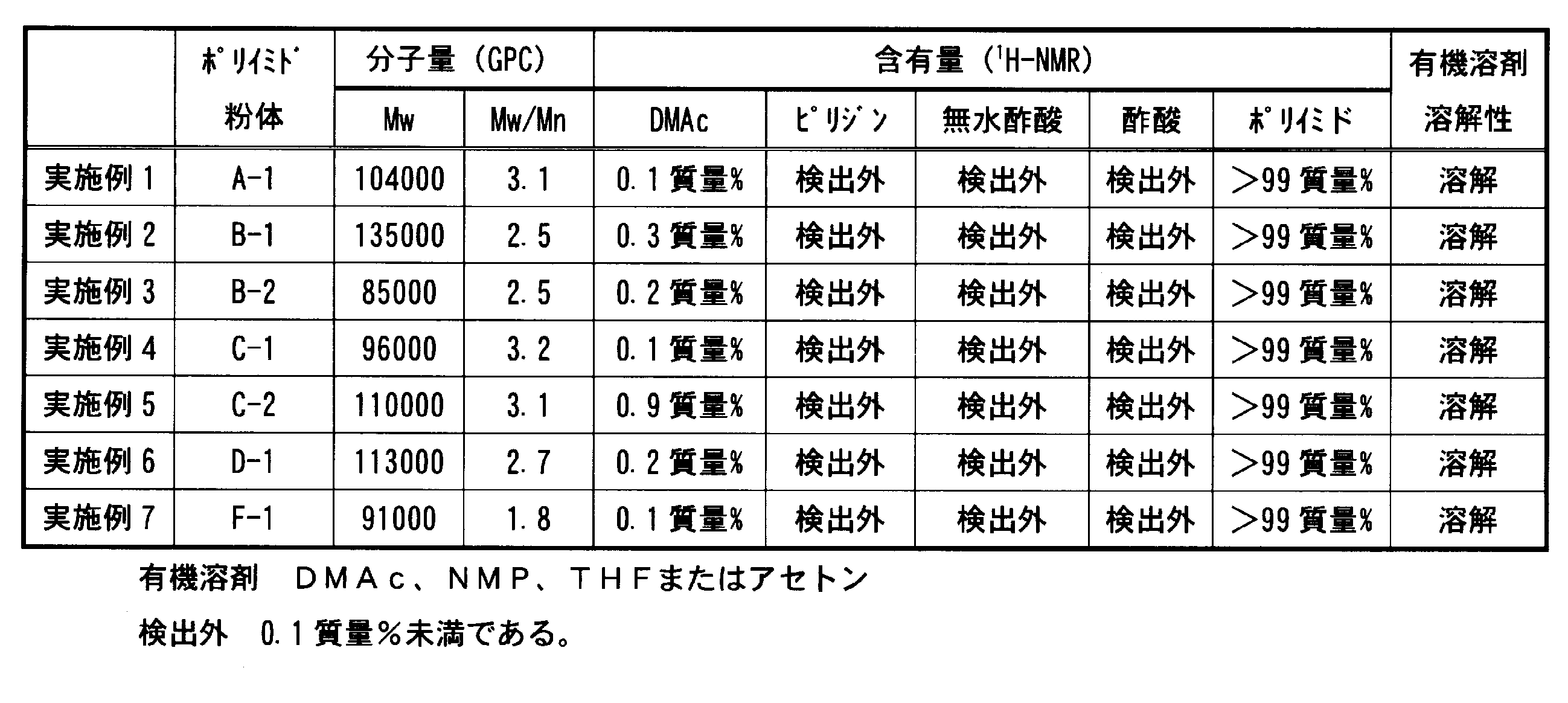
実施例1~7のいずれにおいても、得られた第2のポリイミド粉体は有機溶剤であるDMAc、NMP、THFおよびアセトン、4種の有機溶剤の全てに溶解した、重量平均分子量が5万以上の固形の第2のポリイミド粉体が得られた。得られた第2のポリイミド粉体は、いずれにおいても、ピリジン、酢酸、無水酢酸、および重合溶媒等の溶剤の総量が、1質量%以下に低減していた。また、ピリジン、酢酸、無水酢酸の含有は、認められなかった。
従って、実施例1~7より、HFIP基含有ポリイミド溶液を噴霧させることで得られる第1のポリイミド粉体を加熱乾燥する、本発明の第2のポリイミド粉体の製造方法を用いれば、高分子量且つ高純度で有機溶剤に可溶な、実質的に溶剤およびイミド化剤を含まない第2のポリイミド粉体を製造することができることがわかった。
本発明の第2のポリイミド粉体の製造方法を用いれば、HFIP基含有ポリイミド溶液中のイミド化剤および溶剤を除去した第2のポリイミド粉体を得ることができ、噴霧工程および乾燥工程を経たとしても、HFIP基含有ポリイミドの重量平均分子量を低下させる程度が低くなることがわかった。
3.ポリイミド溶液の貧溶媒の滴下によるポリイミド粉体の製造
3-1.比較例1
[ポリイミド溶液の貧溶媒への滴下]
調製例2で得たポリイミド溶液(B)を、ポリイミド(B)の濃度が10質量%になるようにDMAcで希釈した後、この溶液100gを、水2200gに、攪拌しながら、ゆっくりと滴下し、沈殿物を濾過しポリイミド粉体を得た。
3-1.比較例1
[ポリイミド溶液の貧溶媒への滴下]
調製例2で得たポリイミド溶液(B)を、ポリイミド(B)の濃度が10質量%になるようにDMAcで希釈した後、この溶液100gを、水2200gに、攪拌しながら、ゆっくりと滴下し、沈殿物を濾過しポリイミド粉体を得た。
[ポリイミド粉体の加熱乾燥]
前記ポリイミド粉体1.0gを、実施例1と同じ棚段乾燥機に入れ、200℃、7Torr(0.933kPa)に減圧し24時間加熱乾燥した。
前記ポリイミド粉体1.0gを、実施例1と同じ棚段乾燥機に入れ、200℃、7Torr(0.933kPa)に減圧し24時間加熱乾燥した。
3-2.比較例2~3
[ポリイミド溶液の貧溶媒への滴下]
調製例4~5で調製したポリイミド溶液(D)、(E)の各々の25gを、メタノール250gと水250gを混合した溶液に、攪拌しながら、ゆっくりと滴下し、沈殿物を濾過しポリイミド粉体を得た。
[ポリイミド溶液の貧溶媒への滴下]
調製例4~5で調製したポリイミド溶液(D)、(E)の各々の25gを、メタノール250gと水250gを混合した溶液に、攪拌しながら、ゆっくりと滴下し、沈殿物を濾過しポリイミド粉体を得た。
[ポリイミド粉体の加熱乾燥]
前記ポリイミド粉体、各々1.0gを、実施例1と同じ棚段乾燥機に入れ、100℃、20Torr(2.666kPa)に減圧し12時間加熱乾燥した。得られたポリイミド粉体の分子量、溶剤およびイミド化剤の含有量を、実施例1~5と同様に測定した。
前記ポリイミド粉体、各々1.0gを、実施例1と同じ棚段乾燥機に入れ、100℃、20Torr(2.666kPa)に減圧し12時間加熱乾燥した。得られたポリイミド粉体の分子量、溶剤およびイミド化剤の含有量を、実施例1~5と同様に測定した。
3-3.比較例4~6
[ポリイミド溶液の貧溶媒への滴下]
調製例1~3で調製したポリイミド溶液(A)~(C)各々100gを、メタノール2000gに攪拌しながら、ゆっくりと滴下した。ポリイミド溶液(A)およびポリイミド溶液(C)の沈殿物を濾過しポリイミド粉体を得た(比較例4、6)。ポリイミド溶液(B)を用いた場合、得られた沈殿物は、ゲル状の粘性液体となり、ポリイミド粉末は得られなかった(比較例5)。
[ポリイミド溶液の貧溶媒への滴下]
調製例1~3で調製したポリイミド溶液(A)~(C)各々100gを、メタノール2000gに攪拌しながら、ゆっくりと滴下した。ポリイミド溶液(A)およびポリイミド溶液(C)の沈殿物を濾過しポリイミド粉体を得た(比較例4、6)。ポリイミド溶液(B)を用いた場合、得られた沈殿物は、ゲル状の粘性液体となり、ポリイミド粉末は得られなかった(比較例5)。
[ポリイミド粉体の加熱乾燥]
前記ポリイミド粉体、各々1.0gを、実施例1と同じ棚段乾燥機に入れ、200℃、2Torr(0.2666kPa)に減圧し12時間加熱乾燥した。得られたポリイミド粉体は、極性溶剤であるDMAc、NMP、THFおよびアセトンに溶解しなかった。
前記ポリイミド粉体、各々1.0gを、実施例1と同じ棚段乾燥機に入れ、200℃、2Torr(0.2666kPa)に減圧し12時間加熱乾燥した。得られたポリイミド粉体は、極性溶剤であるDMAc、NMP、THFおよびアセトンに溶解しなかった。
3-4.比較例7~8
[ポリイミド溶液の貧溶媒への滴下]
調製例1及び3で調製したポリイミド溶液(A)、(C)の各々の100gを、メタノール2000gに、攪拌しながら、ゆっくりと滴下した。ポリイミド溶液(A)、(C)の沈殿物を濾過しポリイミド粉体を得た。
[ポリイミド溶液の貧溶媒への滴下]
調製例1及び3で調製したポリイミド溶液(A)、(C)の各々の100gを、メタノール2000gに、攪拌しながら、ゆっくりと滴下した。ポリイミド溶液(A)、(C)の沈殿物を濾過しポリイミド粉体を得た。
[ポリイミド粉体の加熱乾燥]
前記ポリイミド粉体、各々1.0gを、実施例1と同じ棚段乾燥機に入れ、100℃、20Torr(2.666kPa)に減圧し12時間加熱乾燥した。
前記ポリイミド粉体、各々1.0gを、実施例1と同じ棚段乾燥機に入れ、100℃、20Torr(2.666kPa)に減圧し12時間加熱乾燥した。
3-5.比較例9
[ポリイミド溶液の加熱減圧乾燥・粉砕によるポリイミド粉体の製造]
調製例6で調製したポリイミド溶液(F)にDMAcを加え、ポリイミド(F)の濃度が20質量%になるように調製し、この溶液100gを、ナス型フラスコに入れ、100℃、25Torr(3.333kPa)に減圧し2時間減圧乾燥した。得られた固形分をミキサーに入れ、1分間粉砕し、ポリイミド粉体を得た。
[ポリイミド溶液の加熱減圧乾燥・粉砕によるポリイミド粉体の製造]
調製例6で調製したポリイミド溶液(F)にDMAcを加え、ポリイミド(F)の濃度が20質量%になるように調製し、この溶液100gを、ナス型フラスコに入れ、100℃、25Torr(3.333kPa)に減圧し2時間減圧乾燥した。得られた固形分をミキサーに入れ、1分間粉砕し、ポリイミド粉体を得た。
3-6.ポリイミド粉体の評価
実施例1~7と同様に得られたポリイミド粉体の評価を行った。
表2に、用いたポリイミド溶液の種類、得られた各ポリイミド粉体の分子量、ポリイミド粉体に対する溶剤であるDMAc、イミド化剤であるピリジン、無水酢酸および酢酸の含有量、および希釈溶剤として用いる有機溶剤としてのDMAc、NMP、THFおよびアセトンに対する溶解性を示す。なお、ポリイミド粉体が得られたものを「可」、得られなかったものを「否」とした。
実施例1~7と同様に得られたポリイミド粉体の評価を行った。
表2に、用いたポリイミド溶液の種類、得られた各ポリイミド粉体の分子量、ポリイミド粉体に対する溶剤であるDMAc、イミド化剤であるピリジン、無水酢酸および酢酸の含有量、および希釈溶剤として用いる有機溶剤としてのDMAc、NMP、THFおよびアセトンに対する溶解性を示す。なお、ポリイミド粉体が得られたものを「可」、得られなかったものを「否」とした。

比較例1~3で得られたポリイミド粉体は、Mwが5万未満となった。また、比較例2、3は、DMAcおよびイミド化触媒であるピリジン、脱水剤の残存物である酢酸が多量に含有していた。比較例4、6で得られたポリイミド粉体は、DMAc、NMP、THFおよびアセトン、4種類の有機溶剤の全てに溶解しなかった。比較例5においては、ポリイミド粉体が得られなかった。比較例7~8で得られたポリイミド粉体は、酢酸とピリジンが、ポリイミド粉体に対し、それぞれ2質量%以上含有していた。比較例9で得られたポリイミド粉体は、酢酸とDMAcが、ポリイミド粉体に対し、それぞれ2質量%以上含有していた。
4.ポリイミド粉体とポリイミド溶液の保存安定性の比較
表1に示す、実施例1、2、4、6および7で得られた実質的に溶剤およびイミド化剤を含まない各々の第2のポリイミド粉体(A-1)、(B-1)、(C-1)、(D-1)および(F-1)を密閉容器内で25℃下、1月間保管した後、分子量を測定した。その結果、これらのポリイミド粉末の分子量の低下は認められなかった。
表1に示す、実施例1、2、4、6および7で得られた実質的に溶剤およびイミド化剤を含まない各々の第2のポリイミド粉体(A-1)、(B-1)、(C-1)、(D-1)および(F-1)を密閉容器内で25℃下、1月間保管した後、分子量を測定した。その結果、これらのポリイミド粉末の分子量の低下は認められなかった。
一方、前述の調製例6で得られたポリイミド(F)のDMAc溶液を25℃で2週間保管した後の分子量を測定した結果、調製時、Mw=113000、Mw/Mn=3.3であったものは、保管後は、Mw=68000、Mw/Mn=2.7に低下していた。
同様に、表2に示す、比較例3で得られたポリイミド粉体を密閉容器内で25℃、1月間保管した後、分子量を測定した。その結果、このポリイミド粉末の分子量は、Mw=44000、Mw/Mn=1.6であったものが、保管後は、Mw=20000、Mw/Mn=2.7に低下していた。
本発明の第2のポリイミド粉体の製造方法により得られたポリイミド粉体は、従来技術に開示される、ポリイミド溶液を貧溶媒に再沈させて得られたポリイミド粉体、溶剤およびイミド化剤の残存がないばかりか、分子量が経時的に低下することがなく保存安定性に優れる。本発明のポリイミド粉体は、輸送および保管が容易であり、製造場所等、製造における選択の自由度が上がる。また、有機溶剤に溶けやすいことから、有機溶剤に溶解した後に所望の形状に成形したポリイミド成形体を得ることが容易である。このような利点から、本発明のポリイミド粉体の製造方法、およびポリイミド粉体は、フレキシブル配線基板、LSI用の層間絶縁膜、光導波路、透明基板または気体分離膜等の用途において、利用可能性を有する。
Claims (17)
- 下記式(1)で示される繰り返し単位を有するポリイミドと、溶剤と、を含むポリイミド溶液を噴霧し、溶剤を含む第1のポリイミド粉体を形成する噴霧工程と、
前記第1のポリイミド粉体を減圧下、加熱乾燥し、実質的に溶剤を含まない第2のポリイミド粉体を得る加熱乾燥工程を含む、
第2のポリイミド粉体の製造方法。

- 前記繰り返し単位中のR1が、式(2)で表される2価の有機基である、請求項1に記載の第2のポリイミド粉体の製造方法。

- 式(2)で表される2価の有機基が、以下のいずれかの2価の有機基である、請求項2に記載の第2のポリイミド粉体の製造方法。
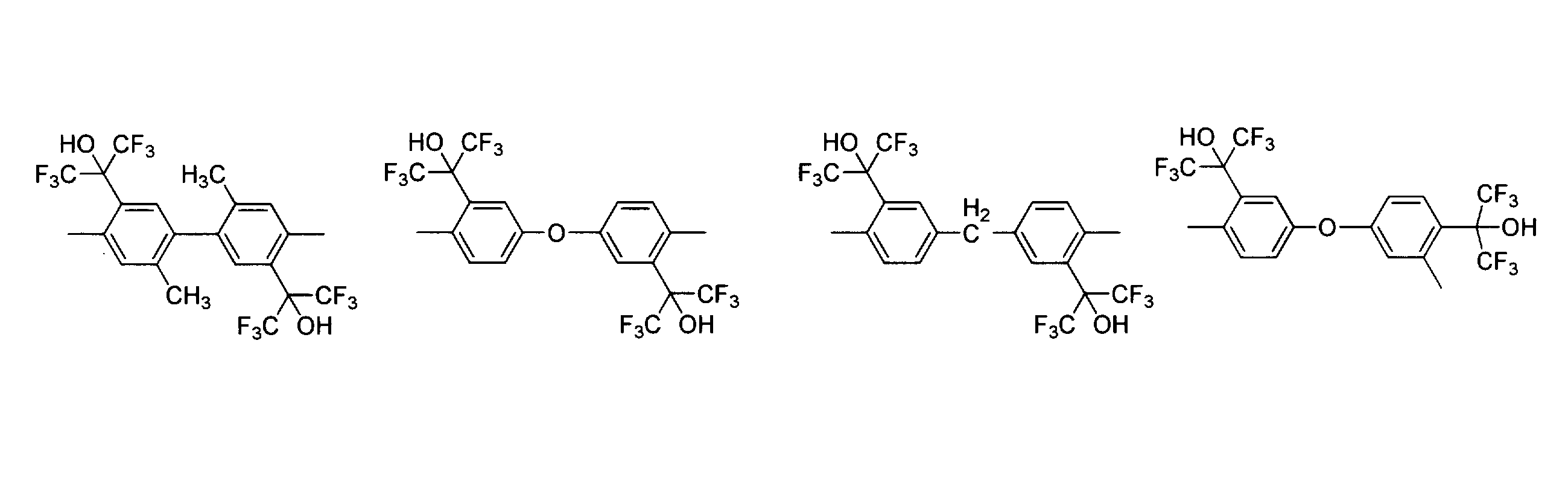
- 前記繰り返し単位中のR1が、式(3)で表される2価の有機基である、請求項1乃至請求項3のいずれか1項に記載の第2のポリイミド粉体の製造方法。

- 式(3)で表される2価の有機基が、以下のいずれかの2価の有機基である、請求項4に記載の第2のポリイミド粉体の製造方法。
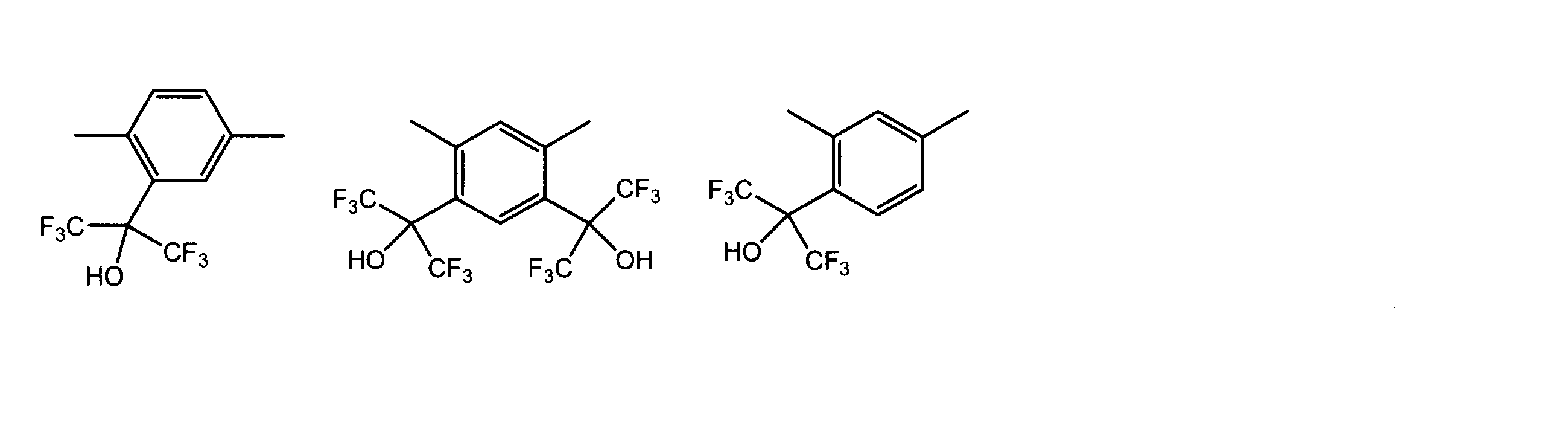
- 前記繰り返し単位中のR2が、以下のいずれかの4価の有機基である、請求項1乃至請求項5のいずれか1項に記載の第2のポリイミド粉体の製造方法。
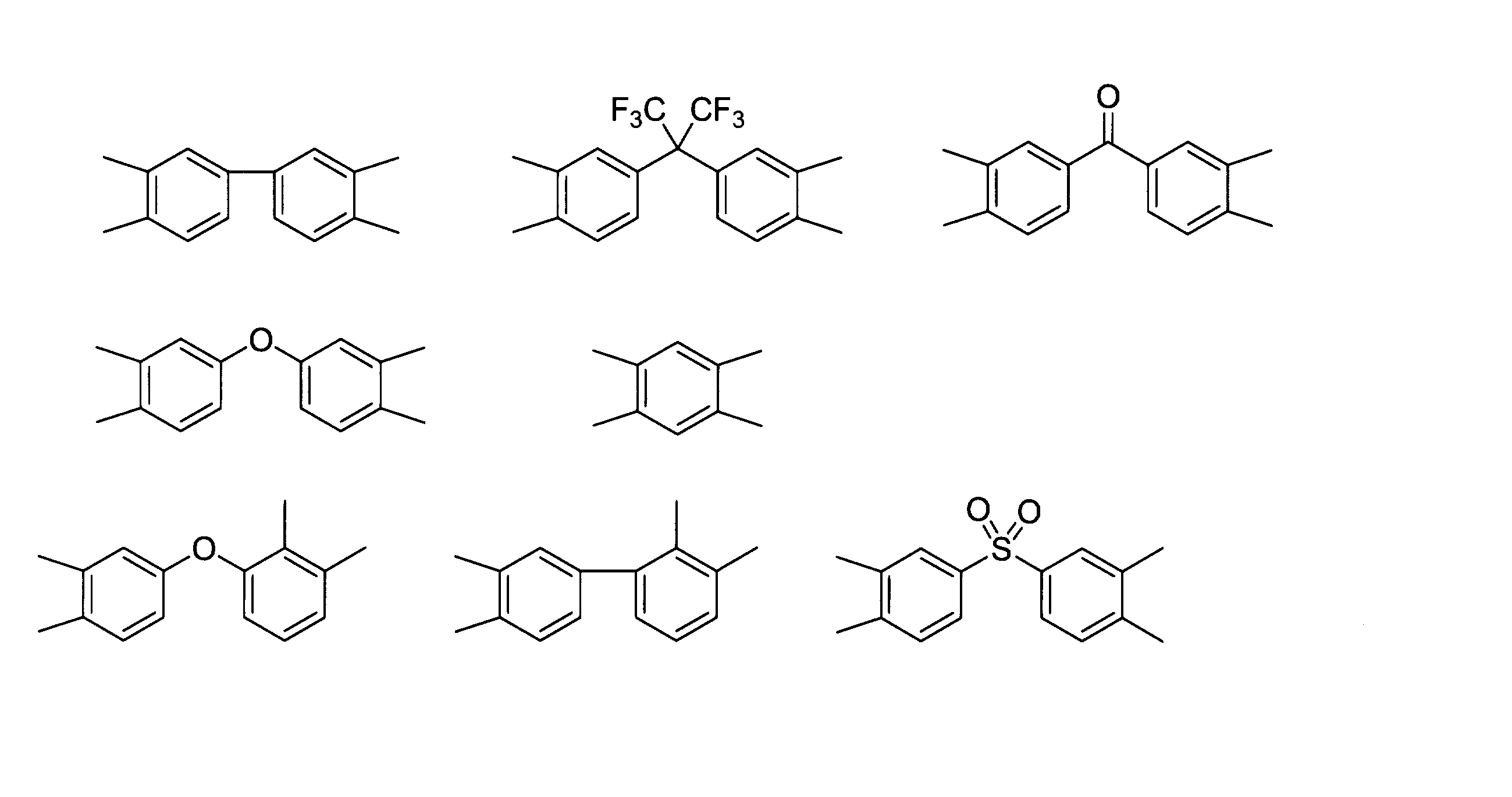
- 溶剤が、アミド系溶剤、エーテル系溶剤、芳香族系溶剤、ハロゲン系溶剤、ケトン系溶剤、ラクトン系溶剤、アルコール系溶剤およびグリコールエーテル系溶剤からなる群から選ばれる少なくとも一つの溶剤を含む溶剤である、請求項1乃至請求項6のいずれか1項に記載の第2のポリイミド粉体の製造方法。
- ポリイミド溶液が、さらにイミド化剤を含むポリイミド溶液である、請求項1乃至請求項7のいずれか1項に記載の第2のポリイミド粉体の製造方法。
- イミド化剤が、ピリジン、キノリン、ピコリンおよびトリエチルアミンからなる群から選ばれるイミド化触媒と、無水酢酸または無水プロピオン酸から選ばれる脱水剤を含むイミド化剤である、請求項8に記載の第2のポリイミド粉体の製造方法。
- 噴霧工程に、多流体ノズルを備える噴霧装置を用いる、請求項1乃至請求項9のいずれか1項に記載の第2のポリイミド粉体の製造方法。
- 加熱乾燥工程の加熱温度が、30℃以上、350℃以下である、請求項1乃至請求項10のいずれか1項に記載の第2のポリイミド粉体の製造方法。
- 加熱乾燥工程の圧力が、0.013KPa以上、50KPa以下である、請求項1乃至請求項11のいずれか1項に記載の第2のポリイミド粉体の製造方法。
- 加熱乾燥工程に、箱型乾燥機、バンド乾燥機、トンネル乾燥機、回転乾燥機、流動層乾燥機、気流乾燥機、円盤乾燥機および逆円錐乾燥機からなる群から選ばれる乾燥装置を用いる、請求項1乃至請求項12のいずれか1項に記載の第2のポリイミド粉体の製造方法。
- ポリイミド粉体のメジアン径が、0.1マイクロメートル以上、100マイクロメートル以下である、請求項1乃至請求項13のいずれか1項に記載の第2のポリイミド粉体の製造方法。
- 下記式(1)で示される繰り返し単位を有する、実質的に溶剤およびイミド化剤を含まないポリイミド粉体。


前記繰り返し単位中のR2が、以下のいずれかの4価の有機基である。)
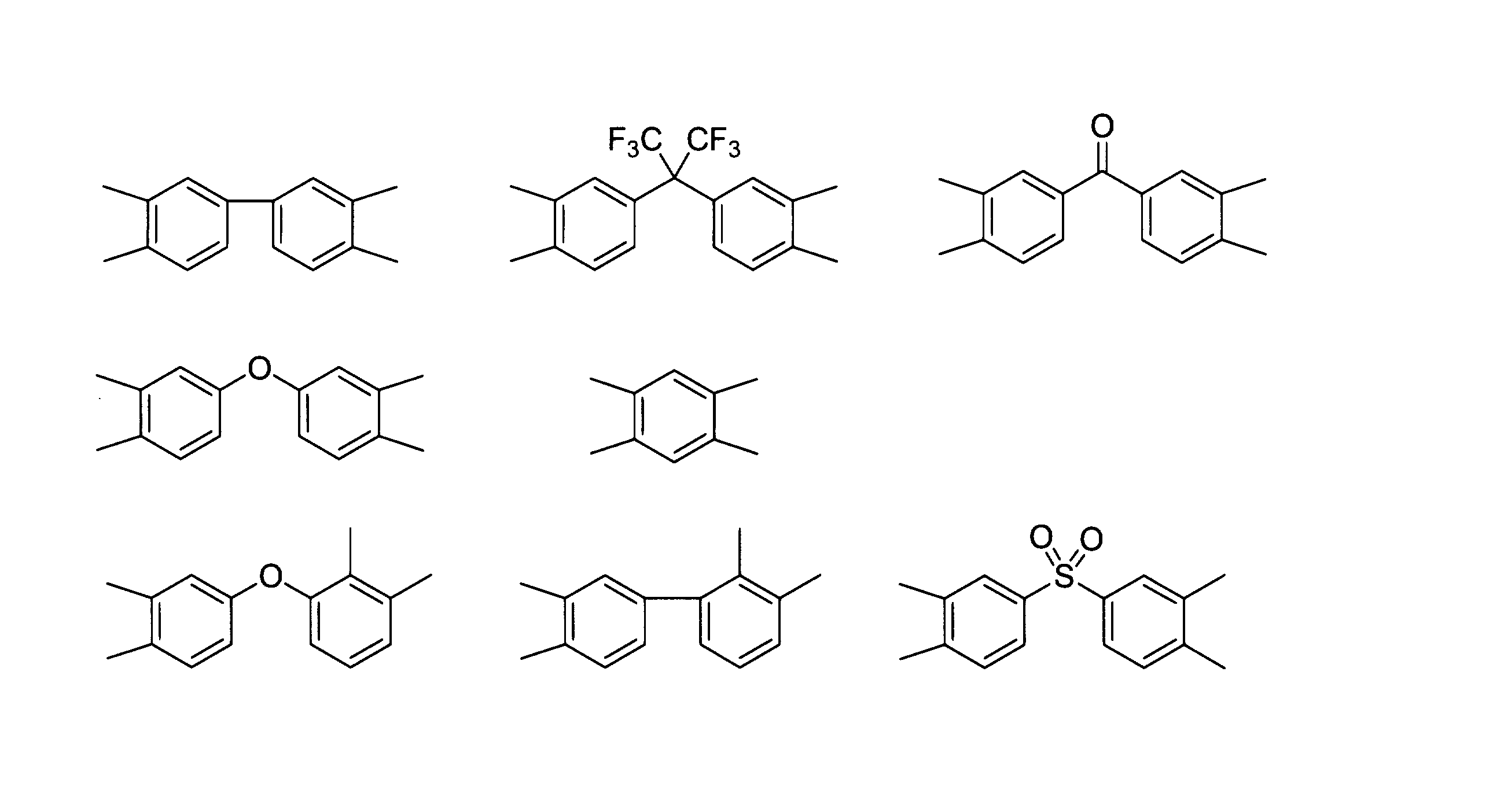
- 重量平均分子量が、5000以上、500000以下である、請求項15に記載のポリイミド粉体。
- メジアン径が、0.1マイクロメートル以上、100マイクロメートル以下である、請求項15または請求項16に記載のポリイミド粉体。
Applications Claiming Priority (6)
| Application Number | Priority Date | Filing Date | Title |
|---|---|---|---|
| JP2017-137378 | 2017-07-13 | ||
| JP2017137378 | 2017-07-13 | ||
| JP2017235878 | 2017-12-08 | ||
| JP2017-235878 | 2017-12-08 | ||
| JP2018-128656 | 2018-07-06 | ||
| JP2018128656A JP7125598B2 (ja) | 2017-07-13 | 2018-07-06 | ポリイミド粉体の製造方法 |
Publications (1)
| Publication Number | Publication Date |
|---|---|
| WO2019013182A1 true WO2019013182A1 (ja) | 2019-01-17 |
Family
ID=65001233
Family Applications (1)
| Application Number | Title | Priority Date | Filing Date |
|---|---|---|---|
| PCT/JP2018/025947 Ceased WO2019013182A1 (ja) | 2017-07-13 | 2018-07-10 | ポリイミド粉体の製造方法 |
Country Status (1)
| Country | Link |
|---|---|
| WO (1) | WO2019013182A1 (ja) |
Cited By (2)
| Publication number | Priority date | Publication date | Assignee | Title |
|---|---|---|---|---|
| WO2020184972A1 (ko) * | 2019-03-13 | 2020-09-17 | 주식회사 엘지화학 | 폴리이미드 공중합체, 폴리이미드 공중합체의 제조방법, 이를 이용한 감광성 수지 조성물, 감광성 수지 필름 및 광학 장치 |
| KR20210124330A (ko) * | 2019-02-06 | 2021-10-14 | 샌트랄 글래스 컴퍼니 리미티드 | 1,1,1-트리플루오로-2,2-비스아릴에탄의 제조방법 및 1,1,1-트리플루오로-2,2-비스아릴에탄 |
Citations (5)
| Publication number | Priority date | Publication date | Assignee | Title |
|---|---|---|---|---|
| JPS4865296A (ja) * | 1971-11-30 | 1973-09-08 | ||
| JP2007119504A (ja) * | 2004-10-20 | 2007-05-17 | Central Glass Co Ltd | 含フッ素重合性単量体及びそれを用いた高分子化合物 |
| JP2007119503A (ja) * | 2004-10-13 | 2007-05-17 | Central Glass Co Ltd | 含フッ素重合性単量体及びそれを用いた高分子化合物 |
| JP2011168743A (ja) * | 2010-02-22 | 2011-09-01 | Dic Corp | カルボキシ基含有ポリイミド樹脂溶液、粉体およびそれらの製造方法 |
| JP2013010096A (ja) * | 2011-05-30 | 2013-01-17 | Central Glass Co Ltd | 気体分離膜 |
-
2018
- 2018-07-10 WO PCT/JP2018/025947 patent/WO2019013182A1/ja not_active Ceased
Patent Citations (5)
| Publication number | Priority date | Publication date | Assignee | Title |
|---|---|---|---|---|
| JPS4865296A (ja) * | 1971-11-30 | 1973-09-08 | ||
| JP2007119503A (ja) * | 2004-10-13 | 2007-05-17 | Central Glass Co Ltd | 含フッ素重合性単量体及びそれを用いた高分子化合物 |
| JP2007119504A (ja) * | 2004-10-20 | 2007-05-17 | Central Glass Co Ltd | 含フッ素重合性単量体及びそれを用いた高分子化合物 |
| JP2011168743A (ja) * | 2010-02-22 | 2011-09-01 | Dic Corp | カルボキシ基含有ポリイミド樹脂溶液、粉体およびそれらの製造方法 |
| JP2013010096A (ja) * | 2011-05-30 | 2013-01-17 | Central Glass Co Ltd | 気体分離膜 |
Cited By (12)
| Publication number | Priority date | Publication date | Assignee | Title |
|---|---|---|---|---|
| KR20210124330A (ko) * | 2019-02-06 | 2021-10-14 | 샌트랄 글래스 컴퍼니 리미티드 | 1,1,1-트리플루오로-2,2-비스아릴에탄의 제조방법 및 1,1,1-트리플루오로-2,2-비스아릴에탄 |
| KR102797312B1 (ko) | 2019-02-06 | 2025-04-18 | 샌트랄 글래스 컴퍼니 리미티드 | 1,1,1-트리플루오로-2,2-비스아릴에탄의 제조방법 및 1,1,1-트리플루오로-2,2-비스아릴에탄 |
| US12351685B2 (en) | 2019-02-06 | 2025-07-08 | Central Glass Company, Limited | Polyamide acid, polyimide, optical film, display device and production methods thereof |
| US12435185B2 (en) | 2019-02-06 | 2025-10-07 | Central Glass Company, Limited | Method for producing 1,1,1-trifluoro-2,2-bisarylethane, and 1,1,1-trifluoro-2,2-bisarylethane |
| WO2020184972A1 (ko) * | 2019-03-13 | 2020-09-17 | 주식회사 엘지화학 | 폴리이미드 공중합체, 폴리이미드 공중합체의 제조방법, 이를 이용한 감광성 수지 조성물, 감광성 수지 필름 및 광학 장치 |
| KR20200109598A (ko) * | 2019-03-13 | 2020-09-23 | 주식회사 엘지화학 | 폴리이미드 공중합체, 폴리이미드 공중합체의 제조방법, 이를 이용한 감광성 수지 조성물, 감광성 수지 필름 및 광학 장치 |
| CN112041372A (zh) * | 2019-03-13 | 2020-12-04 | 株式会社Lg化学 | 聚酰亚胺共聚物、用于制备聚酰亚胺共聚物的方法、使用其的光敏树脂组合物、光敏树脂膜和光学器件 |
| JP2021519851A (ja) * | 2019-03-13 | 2021-08-12 | エルジー・ケム・リミテッド | ポリイミド共重合体、ポリイミド共重合体の製造方法、これを利用した感光性樹脂組成物、感光性樹脂フィルムおよび光学装置 |
| KR102303748B1 (ko) | 2019-03-13 | 2021-09-16 | 주식회사 엘지화학 | 폴리이미드 공중합체, 폴리이미드 공중합체의 제조방법, 이를 이용한 감광성 수지 조성물, 감광성 수지 필름 및 광학 장치 |
| JP7046414B2 (ja) | 2019-03-13 | 2022-04-04 | エルジー・ケム・リミテッド | ポリイミド共重合体、ポリイミド共重合体の製造方法、これを利用した感光性樹脂組成物、感光性樹脂フィルムおよび光学装置 |
| CN112041372B (zh) * | 2019-03-13 | 2023-05-23 | 株式会社Lg化学 | 聚酰亚胺共聚物、用于制备聚酰亚胺共聚物的方法、使用其的光敏树脂组合物、光敏树脂膜和光学器件 |
| US12018126B2 (en) | 2019-03-13 | 2024-06-25 | Lg Chem, Ltd. | Polyimide copolymer, method for preparing the polyimide copolymer, photosensitive resin composition, photosensitive resin film, and optical device using the polyimide copolymer |
Similar Documents
| Publication | Publication Date | Title |
|---|---|---|
| CN113412299B (zh) | 聚酰胺酸和聚酰亚胺、光学薄膜和显示装置、以及它们的制造方法 | |
| CN105566633B (zh) | 一种含咔唑结构的超支化聚酰亚胺及其制备方法和用途 | |
| JP6831590B2 (ja) | ポリイミド粉体およびその製造方法 | |
| WO2010050491A1 (ja) | ポリイミド前駆体溶液組成物 | |
| CN102352039A (zh) | 基于芴结构的可溶性功能聚酰亚胺及其制备方法和应用 | |
| JP2013216776A (ja) | ポリイミド前駆体溶液の製造方法及びこれを用いたポリイミド前駆体溶液、多孔質ポリイミド | |
| CN113667120B (zh) | 一种聚酰亚胺及其制备方法 | |
| CN105829400A (zh) | 聚酰亚胺的制造方法及由该制造方法所得到的聚酰亚胺 | |
| JP2015512983A (ja) | ポリイミドの調製法 | |
| KR20170125973A (ko) | 신규 테트라카르복시산 이무수물, 및 산이무수물로부터 얻어지는 폴리이미드 및 폴리이미드 공중합체 | |
| JP2014118519A (ja) | ポリイミド樹脂溶液 | |
| JP7125598B2 (ja) | ポリイミド粉体の製造方法 | |
| WO2019013182A1 (ja) | ポリイミド粉体の製造方法 | |
| JP4787552B2 (ja) | 可溶性末端変性イミドオリゴマーおよびワニス並びにその硬化物 | |
| WO2017130703A1 (ja) | ポリイミド成形体の製造方法 | |
| KR101709378B1 (ko) | 가압 조건 하에서 수행되는 폴리이미드 제조방법 | |
| JP2016196630A (ja) | 新規なポリイミド共重合体 | |
| JP5435207B2 (ja) | 末端変性イミドオリゴマー | |
| JP4364691B2 (ja) | 可溶性ポリイミド | |
| JP6103992B2 (ja) | ポリイミド | |
| CN114854011B (zh) | 聚酰胺酸溶液、聚酰亚胺膜及其制备方法 | |
| JP2004285355A (ja) | ポリイミド樹脂粉体の製造方法 | |
| CN107163248B (zh) | 一类含磷和三氟甲基的可溶性聚酰亚胺及其制备方法 | |
| JP2004315815A (ja) | ポリアミド酸及び可溶性ポリイミド | |
| CN108997579B (zh) | 一种含蒽结构的芳香族超支化聚酰亚胺及其制备方法和应用 |
Legal Events
| Date | Code | Title | Description |
|---|---|---|---|
| 121 | Ep: the epo has been informed by wipo that ep was designated in this application |
Ref document number: 18831031 Country of ref document: EP Kind code of ref document: A1 |
|
| NENP | Non-entry into the national phase |
Ref country code: DE |
|
| 122 | Ep: pct application non-entry in european phase |
Ref document number: 18831031 Country of ref document: EP Kind code of ref document: A1 |