WO2019003941A1 - 装飾製品 - Google Patents
装飾製品 Download PDFInfo
- Publication number
- WO2019003941A1 WO2019003941A1 PCT/JP2018/022743 JP2018022743W WO2019003941A1 WO 2019003941 A1 WO2019003941 A1 WO 2019003941A1 JP 2018022743 W JP2018022743 W JP 2018022743W WO 2019003941 A1 WO2019003941 A1 WO 2019003941A1
- Authority
- WO
- WIPO (PCT)
- Prior art keywords
- test
- decorative layer
- molybdenum
- atm
- decorative
- Prior art date
- Legal status (The legal status is an assumption and is not a legal conclusion. Google has not performed a legal analysis and makes no representation as to the accuracy of the status listed.)
- Ceased
Links
Images


Classifications
-
- B—PERFORMING OPERATIONS; TRANSPORTING
- B44—DECORATIVE ARTS
- B44F—SPECIAL DESIGNS OR PICTURES
- B44F1/00—Designs or pictures characterised by special or unusual light effects
- B44F1/02—Designs or pictures characterised by special or unusual light effects produced by reflected light, e.g. matt surfaces, lustrous surfaces
- B44F1/04—Designs or pictures characterised by special or unusual light effects produced by reflected light, e.g. matt surfaces, lustrous surfaces after passage through surface layers, e.g. pictures with mirrors on the back
- B44F1/045—Designs or pictures characterised by special or unusual light effects produced by reflected light, e.g. matt surfaces, lustrous surfaces after passage through surface layers, e.g. pictures with mirrors on the back having mirrors or metallic or reflective layers at the back side
-
- C—CHEMISTRY; METALLURGY
- C22—METALLURGY; FERROUS OR NON-FERROUS ALLOYS; TREATMENT OF ALLOYS OR NON-FERROUS METALS
- C22C—ALLOYS
- C22C27/00—Alloys based on rhenium or a refractory metal not mentioned in groups C22C14/00 or C22C16/00
- C22C27/04—Alloys based on tungsten or molybdenum
-
- C—CHEMISTRY; METALLURGY
- C03—GLASS; MINERAL OR SLAG WOOL
- C03C—CHEMICAL COMPOSITION OF GLASSES, GLAZES OR VITREOUS ENAMELS; SURFACE TREATMENT OF GLASS; SURFACE TREATMENT OF FIBRES OR FILAMENTS MADE FROM GLASS, MINERALS OR SLAGS; JOINING GLASS TO GLASS OR OTHER MATERIALS
- C03C17/00—Surface treatment of glass, not in the form of fibres or filaments, by coating
- C03C17/06—Surface treatment of glass, not in the form of fibres or filaments, by coating with metals
- C03C17/09—Surface treatment of glass, not in the form of fibres or filaments, by coating with metals by deposition from the vapour phase
-
- C—CHEMISTRY; METALLURGY
- C03—GLASS; MINERAL OR SLAG WOOL
- C03C—CHEMICAL COMPOSITION OF GLASSES, GLAZES OR VITREOUS ENAMELS; SURFACE TREATMENT OF GLASS; SURFACE TREATMENT OF FIBRES OR FILAMENTS MADE FROM GLASS, MINERALS OR SLAGS; JOINING GLASS TO GLASS OR OTHER MATERIALS
- C03C17/00—Surface treatment of glass, not in the form of fibres or filaments, by coating
- C03C17/34—Surface treatment of glass, not in the form of fibres or filaments, by coating with at least two coatings having different compositions
- C03C17/36—Surface treatment of glass, not in the form of fibres or filaments, by coating with at least two coatings having different compositions at least one coating being a metal
- C03C17/38—Surface treatment of glass, not in the form of fibres or filaments, by coating with at least two coatings having different compositions at least one coating being a metal at least one coating being a coating of an organic material
-
- C—CHEMISTRY; METALLURGY
- C22—METALLURGY; FERROUS OR NON-FERROUS ALLOYS; TREATMENT OF ALLOYS OR NON-FERROUS METALS
- C22C—ALLOYS
- C22C27/00—Alloys based on rhenium or a refractory metal not mentioned in groups C22C14/00 or C22C16/00
-
- C—CHEMISTRY; METALLURGY
- C22—METALLURGY; FERROUS OR NON-FERROUS ALLOYS; TREATMENT OF ALLOYS OR NON-FERROUS METALS
- C22C—ALLOYS
- C22C27/00—Alloys based on rhenium or a refractory metal not mentioned in groups C22C14/00 or C22C16/00
- C22C27/06—Alloys based on chromium
-
- C—CHEMISTRY; METALLURGY
- C23—COATING METALLIC MATERIAL; COATING MATERIAL WITH METALLIC MATERIAL; CHEMICAL SURFACE TREATMENT; DIFFUSION TREATMENT OF METALLIC MATERIAL; COATING BY VACUUM EVAPORATION, BY SPUTTERING, BY ION IMPLANTATION OR BY CHEMICAL VAPOUR DEPOSITION, IN GENERAL; INHIBITING CORROSION OF METALLIC MATERIAL OR INCRUSTATION IN GENERAL
- C23C—COATING METALLIC MATERIAL; COATING MATERIAL WITH METALLIC MATERIAL; SURFACE TREATMENT OF METALLIC MATERIAL BY DIFFUSION INTO THE SURFACE, BY CHEMICAL CONVERSION OR SUBSTITUTION; COATING BY VACUUM EVAPORATION, BY SPUTTERING, BY ION IMPLANTATION OR BY CHEMICAL VAPOUR DEPOSITION, IN GENERAL
- C23C14/00—Coating by vacuum evaporation, by sputtering or by ion implantation of the coating forming material
- C23C14/06—Coating by vacuum evaporation, by sputtering or by ion implantation of the coating forming material characterised by the coating material
- C23C14/14—Metallic material, boron or silicon
- C23C14/18—Metallic material, boron or silicon on other inorganic substrates
-
- C—CHEMISTRY; METALLURGY
- C23—COATING METALLIC MATERIAL; COATING MATERIAL WITH METALLIC MATERIAL; CHEMICAL SURFACE TREATMENT; DIFFUSION TREATMENT OF METALLIC MATERIAL; COATING BY VACUUM EVAPORATION, BY SPUTTERING, BY ION IMPLANTATION OR BY CHEMICAL VAPOUR DEPOSITION, IN GENERAL; INHIBITING CORROSION OF METALLIC MATERIAL OR INCRUSTATION IN GENERAL
- C23C—COATING METALLIC MATERIAL; COATING MATERIAL WITH METALLIC MATERIAL; SURFACE TREATMENT OF METALLIC MATERIAL BY DIFFUSION INTO THE SURFACE, BY CHEMICAL CONVERSION OR SUBSTITUTION; COATING BY VACUUM EVAPORATION, BY SPUTTERING, BY ION IMPLANTATION OR BY CHEMICAL VAPOUR DEPOSITION, IN GENERAL
- C23C14/00—Coating by vacuum evaporation, by sputtering or by ion implantation of the coating forming material
- C23C14/22—Coating by vacuum evaporation, by sputtering or by ion implantation of the coating forming material characterised by the process of coating
- C23C14/34—Sputtering
-
- B—PERFORMING OPERATIONS; TRANSPORTING
- B44—DECORATIVE ARTS
- B44C—PRODUCING DECORATIVE EFFECTS; MOSAICS; TARSIA WORK; PAPERHANGING
- B44C3/00—Processes, not specifically provided for elsewhere, for producing ornamental structures
- B44C3/02—Superimposing layers
-
- B—PERFORMING OPERATIONS; TRANSPORTING
- B44—DECORATIVE ARTS
- B44F—SPECIAL DESIGNS OR PICTURES
- B44F1/00—Designs or pictures characterised by special or unusual light effects
- B44F1/02—Designs or pictures characterised by special or unusual light effects produced by reflected light, e.g. matt surfaces, lustrous surfaces
- B44F1/04—Designs or pictures characterised by special or unusual light effects produced by reflected light, e.g. matt surfaces, lustrous surfaces after passage through surface layers, e.g. pictures with mirrors on the back
-
- B—PERFORMING OPERATIONS; TRANSPORTING
- B44—DECORATIVE ARTS
- B44F—SPECIAL DESIGNS OR PICTURES
- B44F1/00—Designs or pictures characterised by special or unusual light effects
- B44F1/06—Designs or pictures characterised by special or unusual light effects produced by transmitted light, e.g. transparencies, imitations of glass paintings
-
- C—CHEMISTRY; METALLURGY
- C03—GLASS; MINERAL OR SLAG WOOL
- C03C—CHEMICAL COMPOSITION OF GLASSES, GLAZES OR VITREOUS ENAMELS; SURFACE TREATMENT OF GLASS; SURFACE TREATMENT OF FIBRES OR FILAMENTS MADE FROM GLASS, MINERALS OR SLAGS; JOINING GLASS TO GLASS OR OTHER MATERIALS
- C03C2217/00—Coatings on glass
- C03C2217/20—Materials for coating a single layer on glass
- C03C2217/25—Metals
- C03C2217/257—Refractory metals
- C03C2217/26—Cr, Mo, W
-
- C—CHEMISTRY; METALLURGY
- C03—GLASS; MINERAL OR SLAG WOOL
- C03C—CHEMICAL COMPOSITION OF GLASSES, GLAZES OR VITREOUS ENAMELS; SURFACE TREATMENT OF GLASS; SURFACE TREATMENT OF FIBRES OR FILAMENTS MADE FROM GLASS, MINERALS OR SLAGS; JOINING GLASS TO GLASS OR OTHER MATERIALS
- C03C2217/00—Coatings on glass
- C03C2217/20—Materials for coating a single layer on glass
- C03C2217/25—Metals
- C03C2217/261—Iron-group metals, i.e. Fe, Co or Ni
-
- C—CHEMISTRY; METALLURGY
- C03—GLASS; MINERAL OR SLAG WOOL
- C03C—CHEMICAL COMPOSITION OF GLASSES, GLAZES OR VITREOUS ENAMELS; SURFACE TREATMENT OF GLASS; SURFACE TREATMENT OF FIBRES OR FILAMENTS MADE FROM GLASS, MINERALS OR SLAGS; JOINING GLASS TO GLASS OR OTHER MATERIALS
- C03C2217/00—Coatings on glass
- C03C2217/20—Materials for coating a single layer on glass
- C03C2217/25—Metals
- C03C2217/27—Mixtures of metals, alloys
-
- C—CHEMISTRY; METALLURGY
- C03—GLASS; MINERAL OR SLAG WOOL
- C03C—CHEMICAL COMPOSITION OF GLASSES, GLAZES OR VITREOUS ENAMELS; SURFACE TREATMENT OF GLASS; SURFACE TREATMENT OF FIBRES OR FILAMENTS MADE FROM GLASS, MINERALS OR SLAGS; JOINING GLASS TO GLASS OR OTHER MATERIALS
- C03C2217/00—Coatings on glass
- C03C2217/70—Properties of coatings
- C03C2217/72—Decorative coatings
-
- C—CHEMISTRY; METALLURGY
- C03—GLASS; MINERAL OR SLAG WOOL
- C03C—CHEMICAL COMPOSITION OF GLASSES, GLAZES OR VITREOUS ENAMELS; SURFACE TREATMENT OF GLASS; SURFACE TREATMENT OF FIBRES OR FILAMENTS MADE FROM GLASS, MINERALS OR SLAGS; JOINING GLASS TO GLASS OR OTHER MATERIALS
- C03C2218/00—Methods for coating glass
- C03C2218/10—Deposition methods
- C03C2218/15—Deposition methods from the vapour phase
- C03C2218/154—Deposition methods from the vapour phase by sputtering
Definitions
- the present invention relates to decorative products. More particularly, the present invention relates to a decorative product applied to vehicle accessories.
- Alloys containing nickel, chromium, and molybdenum have high corrosion resistance to acids, alkalis, and the like, and are excellent in heat resistance. Therefore, the piping of a chemical plant, the combustion chamber of a jet engine, etc. It is widely applied to parts where corrosion resistance and heat resistance are required.
- Patent Document 1 an electronic component excellent in moisture resistance and oxidation resistance is obtained while maintaining a low electrical resistance value by applying the above-mentioned alloy as a laminated wiring film laminated on a substrate of the electronic component.
- An object of the present invention is to provide a decorative product provided with a decorative layer which is excellent in weather resistance and has a high surface reflectance.
- the decoration product of the present invention is provided with the decoration layer which contains nickel, chromium, and molybdenum as a component, and the content rate of molybdenum in the decoration layer is 50 atm% or less, and the above-mentioned decoration layer
- the total content of nickel, chromium and molybdenum in the above is 95 atm% or more.
- the content of nickel in the decorative layer is 10 atm% to 75 atm%
- the content of chromium in the decorative layer is 10 atm% to 60 atm%
- the content of molybdenum in the decorative layer is It is preferable that they are 15 atm% or more and 50 atm% or less.
- the decoration layer is preferably a half mirror layer that transmits a part of incident light and reflects a part of the incident light.
- the thickness of the decorative layer is preferably 20 nm or more and 100 nm or less.
- the decorative product provided with the decorative layer which is excellent in a weather resistance and has a high surface reflectance is obtained.
- the fragmentary sectional view of the decoration product of this embodiment The figure which shows the composition of nickel of the decoration layer, chromium, and molybdenum. The figure which shows the measurement result of the reflectance of the decoration layer surface.
- the exterior component 10 of the present embodiment has a structure in which a base material 11, a decorative layer 12 having luster and a protective layer 13 for protecting the decorative layer 12 are sequentially laminated, As a cover member which covers the part L, it is attached to the vehicle.
- the light emitting unit L is configured by an LED lamp or the like.
- the exterior component 10 functions as a half mirror. That is, when viewed from the protective layer 13 side, the exterior component 10 exhibits a bright appearance based on the decoration layer 12 when the light emitting portion L does not emit light, and transmits light from the light emitting portion L when the light emitting portion L emits light.
- the substrate 11 is made of transparent resin or transparent glass.
- the transparent resin is not particularly limited as long as it is colorless and transparent or colored and transparent, and conventionally known resins can be used.
- thermoplastic resins such as polyethylene resin, polypropylene resin, polyethylene terephthalate resin, vinyl chloride resin, polystyrene resin, acrylonitrile butadiene styrene copolymer (ABS) resin, acrylic resin, polyamide resin, polycarbonate resin, etc.
- thermosetting resins such as phenol resin, melamine resin, unsaturated polyester resin, and epoxy resin.
- the transparent glass is not particularly limited as long as it is colorless and transparent or colored and transparent, and examples thereof include alkali glass and non-alkali glass.
- the decoration layer 12 is a metal film made of an alloy containing nickel, chromium and molybdenum as constituents.
- the decoration layer 12 has a thickness of 100 nm or less.
- Nickel functions in particular as a matrix of the alloy constituting the decorative layer 12.
- the content of nickel in the decorative layer 12 is preferably 10 to 75 atm%, more preferably 10 to 55 atm%. By setting the nickel content in the above range, a stable decorative layer 12 can be formed.
- Chromium particularly improves the weather resistance of the decorative layer 12 and improves the corrosion resistance to acids, alkalis, and the like.
- the chromium content in the decorative layer 12 is preferably 10 to 60 atm%, more preferably 30 to 60 atm%.
- Molybdenum particularly affects the weatherability of the decorative layer 12.
- the content of molybdenum in the decorative layer 12 is 50 atm% or less. By setting the content of molybdenum to 50 atm% or less, the weather resistance, particularly the water resistance, of the decorative layer 12 is improved. Molybdenum also affects the color tone (brightness) of the decorative layer 12. When the content of molybdenum is high, the reflectance of the decorative layer 12 is high. Therefore, by increasing the content of molybdenum, it is possible to impart to the decorative layer 12 a color tone with a slightly bluish depth, close to the color tone of hexavalent chromium plating which is a general metal plating. Such shades are particularly favored by users as a cool decoration. Therefore, the content of molybdenum in the decorative layer 12 is preferably 15 atm% or more, and more preferably 20 atm% or more.
- the decoration layer 12 may contain other components other than nickel, chromium, and molybdenum in the range where the total content of nickel, chromium, and molybdenum is 95 atm% or more.
- Other components include, for example, metal elements such as iron, cobalt, tungsten, manganese and silicon.
- the thickness of the decorative layer 12 is preferably 10 to 100 nm, more preferably 20 to 60 nm, and still more preferably 20 to 40 nm. By setting the thickness of the decorative layer 12 to 100 nm or less, the decorative layer 12 becomes a half mirror layer that reflects a part of incident light and transmits a part of the incident light. In addition, when the thickness of the decorative layer 12 is in the range of 10 to 100 nm, generation of cracks in the decorative layer 12 is suppressed.
- the transmittance of the decorative layer 12 is preferably 10 to 50%, and more preferably 10 to 20%.
- the reflectance of the decorative layer 12 is preferably 48.0% or more, more preferably 48.6% or more. In this case, the same bright appearance as the hexavalent chromium plating layer can be easily obtained.
- Examples of the method for forming the decorative layer 12 include known thin film forming methods such as sputtering and metal deposition.
- the substrate 11 is held in the chamber of the sputtering apparatus. Then, the pressure in the chamber is reduced to a predetermined pressure, and then argon gas as a sputtering gas is injected into the chamber. Next, a voltage is applied to excite argon gas, particles of the target material are ejected by argon ions, and particles of the target material are deposited and deposited on the surface of the substrate 11.
- the decoration layer 12 may be formed by a single sputtering process using a target material containing nickel, chromium, and molybdenum as constituent components.
- the decoration layer 12 may be formed by repeating the sputtering process while changing the target material using a plurality of single component target materials.
- the protective layer 13 is not particularly limited, and a layer made of a conventionally known transparent resin can be appropriately adopted.
- resin which comprises the protective layer 13 acrylic resin, such as acrylic urethane, is mentioned, for example.
- the thickness of the protective layer 13 is, for example, preferably 10 to 30 nm, and more preferably 15 to 25 nm.
- the decorative product of the present embodiment includes the decorative layer 12 containing nickel, chromium and molybdenum as constituent components.
- the content of molybdenum in the decorative layer 12 is 50 atm% or less. Therefore, the decorative layer 12 excellent in weather resistance and water resistance is obtained.
- the decorative product of the present embodiment includes the decorative layer 12 containing nickel, chromium and molybdenum as constituents.
- the total content of nickel, chromium and molybdenum in the decorative layer 12 is 95 atm% or more.
- iron and tungsten can be mentioned as typical ones that can be in solid solution with metal elements other than molybdenum.
- L value the lightness
- the formation of the decorative layer 12 is facilitated.
- the sputtering rate of tungsten is lower than that of nickel, chromium and molybdenum.
- the melting point of tungsten is higher than that of nickel, chromium and molybdenum. Therefore, it is difficult to form a solid solution having a high content of tungsten. Therefore, by limiting the content of tungsten in the decoration layer 12, a solid solution can be easily formed. Thus, the formation of the decorative layer 12 is facilitated.
- the chromium content in the decorative layer 12 is 10 to 60 atm%. Therefore, a decorative product excellent in water resistance, corrosion resistance to acid and alkali, and resistance to snow melting salt can be obtained.
- the above embodiment may be modified as follows. Also, the following modifications may be combined.
- a decoration layer is formed by sputtering process was demonstrated in the decoration product of the said embodiment, you may form a decoration layer by a metal vapor deposition process. Also in this case, the decorative layer becomes a half mirror layer by controlling the thickness of the decorative layer to 10 to 100 nm.
- the decorative product of the above embodiment functions as a half mirror
- the decorative product may be applied to applications that do not require a function as a half mirror.
- the thickness of the decoration layer 12 may exceed 100 nm.
- the protective layer 13 is laminated on the decorative layer, but the protective layer 13 can be omitted. Moreover, in the range which does not impair the luminosity and the weather resistance of the decoration layer 12, layers other than the protective layer 13 may be provided.
- the decorative product is not limited to exterior parts for vehicles, and may be applied to interior parts for vehicles or may be applied to uses other than vehicles. Next, technical ideas that can be grasped from the above embodiment will be described.
- the content of nickel in the decorative layer is 10 to 55 atm%, the content of chromium in the decorative layer is 30 to 60 atm%, and the content of molybdenum in the decorative layer is 20 to 50 atm% .
- Test 1 A decorative product having a decorative layer containing nickel, chromium and molybdenum was made. More specifically, the decorative layer was formed to have a plurality of portions with different contents of nickel, chromium and molybdenum. And the reflectance of the decoration product was measured.
- Test sample A sample having an alkali-free glass substrate and a decorative layer formed on the surface of the alkali-free glass substrate was used as a test sample.
- the decorative layer was formed by depositing and depositing nickel, chromium and molybdenum on the surface of the non-alkali glass substrate.
- the decorative layer was formed according to the composition distribution shown in FIG. 2 using a combinatorial sputtering apparatus (manufactured by Comet Co., Ltd .: CMS-6420).
- the thickness of the decoration layer was set to 20 nm. As shown in FIG. 2, the decoration layer of the test sample has a higher content of nickel as it is closer to the first vertex of the triangle (the upper vertex of FIG.
- Test Sample 1 and Test Product 2 A decorative product of Test Sample 1 and Test Product 2 having decorative layers having different contents of nickel, chromium and molybdenum was produced.
- the test product 1 and the test product 2 are each formed so as to satisfy the conditions for which the point that the reflectance is excellent in the test 1 is confirmed. That is, each of the test product 1 and the test product 2 contains three components of nickel, chromium, and molybdenum.
- the content of molybdenum in each of the test product 1 and the test product 2 is set to 70 atm% or less.
- the initial stage adhesiveness and the weather resistance were evaluated about the test article 1 and the test article 2.
- Test item 1 A decorative layer was formed on the surface of a base material molded of polycarbonate resin using a target having nickel, chromium and molybdenum as its constituents by a sputtering apparatus (manufactured by Shibaura Mechatronics Inc .: i-miller II). The thickness of the decoration layer was set to 30 nm. The composition of the decorative layer was measured to be 50 atm% of nickel, 20 atm% of chromium, and 30 atm% of molybdenum. Then, on the decorative layer, a 20 nm-thick protective layer made of an acrylic urethane resin was formed, and this was used as a test product 1.
- Test item 2 A decorative layer was formed on the surface of a substrate molded of polycarbonate resin in the same manner as in Test Sample 1 except that targets having different compositions were used. As in the case of the test product 1, the thickness of the decorative layer was set to 30 nm. The composition of the decorative layer was measured to be 20 atm% of nickel, 20 atm% of chromium, and 60 atm% of molybdenum. Then, on the decorative layer, a 20 nm-thick protective layer made of an acrylic urethane resin was formed, and this was used as a test product 2.
- the initial adhesion test was implemented with respect to the test article 1 and the test article 2 by the following method, and the initial adhesion of the decoration layer was evaluated.
- the initial adhesion test was performed by the cross cut test of JIS K 5400. Specifically, on each surface of the test product 1 and the test product 2, a grid of 100 squares in total was formed in which 10 square grids each having a size of 2 mm square were arranged in rows and columns. And in each of the test product 1 and the test product 2, when the adhesive tape stuck on the surface was peeled off, the number of squares which peeled was measured.
- Test Sample 1 and Test Product 2 were immersed in hot water at 40 ° C. for 240 hours. Thereafter, Test Article 1 and Test Article 2 were taken out of the hot water, and the surface color difference ⁇ E and the surface gloss retention GR were measured, and the cross-cut test similar to the initial adhesion test of Test 1 was performed.
- the surface color difference ⁇ E was measured based on the method of JIS Z 8730.
- Surface color difference ⁇ E compares the object color L * a * b * values of the decorative layer surface before and after water resistance test was calculated as the geometric mean of the differences of L * a * b * values.
- a surface color difference ⁇ E of 3.0 or less was regarded as pass.
- the gloss retention GR of the surface of the decorative layer was measured based on the method of JIS K 5600-4-7. A sheet having a gloss retention rate GR of 80% or more was considered to pass. The results are shown in Table 1.
- Test Sample 1 provided with a decorative layer containing 50 atm% of nickel, 20 atm% of chromium, and 30 atm% of molybdenum, good results were obtained in both the initial adhesion test and the water resistance test.
- test sample 2 provided with the decorative layer containing 20 atm% of nickel, 20 atm% of chromium and 60 atm% of molybdenum, the result of the initial adhesion test was good.
- the decorative layer disappeared during the test, and the measurement itself could not be performed.
- the decorative layer is easily dissolved in water because the content of molybdenum is high, and it is considered that the decorative layer is dissolved and disappears in warm water.
- Heat test The heat resistance test was implemented with respect to the test article 1 by the following method, and the weather resistance of the decoration layer was evaluated.
- the test product 1 was put in a thermostat of 80 ° C. and taken out after 240 hours. Then, in the same manner as in Test 2, the surface color difference ⁇ E and the surface gloss retention GR were measured, and the cross-cut test similar to the initial adhesion test in Test 1 was performed.
- Test Sample 1 was placed in a thermostatic chamber at 50 ° C. and 95% humidity, and taken out after 240 hours. Then, in the same manner as in Test 2, the surface color difference ⁇ E and the surface gloss retention GR were measured, and the cross-cut test similar to the initial adhesion test in Test 1 was performed.
- test piece 1 was irradiated with a xenon lamp so that the integrated light amount would be 500 MJ. Then, in the same manner as in Test 2, the surface color difference ⁇ E and the surface gloss retention GR were measured, and the cross-cut test similar to the initial adhesion test in Test 1 was performed.
- test article 1 was evaluated based on the CASS test method. More specifically, an aqueous solution prepared by adding cupric chloride and acetic acid to 5% NaCl was continuously sprayed on the surface of the test sample 1 for 80 hours. Then, in the same manner as in Test 2, the surface color difference ⁇ E was measured, and the presence or absence of appearance abnormality was observed, and the cross-cut test similar to the initial adhesion test in Test 1 was performed.
- test product 1 was left outdoors in Miyakojima, Okinawa for half a year. Then, in the same manner as in Test 2, the surface color difference ⁇ E was measured, and the presence or absence of appearance abnormality was observed, and the cross-cut test similar to the initial adhesion test in Test 1 was performed.
- the test product 1 provided with the decorative layer containing 50 atm% of nickel, 20 atm% of chromium and 30 atm% of molybdenum, the heat resistance test, the moisture resistance test, the accelerated weathering resistance test, the snow melting salt corrosion resistance test, and the outdoor Good results were obtained for all of the exposure tests.
Landscapes
- Chemical & Material Sciences (AREA)
- Engineering & Computer Science (AREA)
- Materials Engineering (AREA)
- Organic Chemistry (AREA)
- Mechanical Engineering (AREA)
- Metallurgy (AREA)
- Chemical Kinetics & Catalysis (AREA)
- Life Sciences & Earth Sciences (AREA)
- General Chemical & Material Sciences (AREA)
- Geochemistry & Mineralogy (AREA)
- Inorganic Chemistry (AREA)
- Laminated Bodies (AREA)
- Physical Vapour Deposition (AREA)
Abstract
装飾製品は、ニッケル、クロム、及びモリブデンを構成成分として含有する装飾層を備える。装飾層におけるモリブデンの含有率は50atm%以下である。装飾層におけるニッケル、クロム、及びモリブデンの合計含有率は95atm%以上である。
Description
本発明は、装飾製品に関する。より詳しくは、車装品に適用される装飾製品に関する。
ニッケル、クロム、及びモリブデンを構成元素とする合金(例えば、ハステロイ合金)は、酸及びアルカリ等に対する耐食性が高く、耐熱性に優れていることから、化学プラントの配管やジェットエンジンの燃焼室等、耐食性及び耐熱性が要求される部分に広く適用されている。例えば、特許文献1には、電子部品の基板上に積層される積層配線膜として上記合金を適用することにより、低い電気抵抗値を維持しつつ耐湿性及び耐酸化性に優れた電子部品を得る技術が開示されている。
ところで、耐食性及び耐熱性の向上を目的として、車装品等の装飾製品に光輝性を付与するための装飾層に、ニッケル、クロム、及びモリブデンを構成元素とする合金を適用することが考えられる。装飾製品は、配管及び電子部品とは異なり人目に付く開放された空間で用いられる。そのため、装飾製品の装飾層に上記合金を適用する場合、装飾層には、光輝性を視認できる反射率を有すること及び優れた耐候性を有することが求められる。
本発明の目的は、耐候性に優れるとともに表面の反射率の高い装飾層を備えた装飾製品を提供することである。
上記の課題を解決するため、本発明の装飾製品は、ニッケル、クロム、及びモリブデンを構成成分として含有する装飾層を備え、前記装飾層におけるモリブデンの含有率は50atm%以下であり、前記装飾層におけるニッケル、クロム、及びモリブデンの合計含有率は95atm%以上である。
上記の発明において、前記装飾層におけるニッケルの含有率が10atm%以上75atm%以下であり、前記装飾層におけるクロムの含有率が10atm%以上60atm%以下であり、前記装飾層におけるモリブデンの含有率が15atm%以上50atm%以下であることが好ましい。
上記の発明において、前記装飾層は、入射光の一部を透過し、入射光の一部を反射するハーフミラー層であることが好ましい。
上記の発明において、前記装飾層の厚さは、20nm以上100nm以下であることが好ましい。
上記の発明において、前記装飾層の厚さは、20nm以上100nm以下であることが好ましい。
本発明によれば、耐候性に優れるとともに表面の反射率の高い装飾層を備えた装飾製品が得られる。
以下、本発明の装飾製品を車両用の外装部品に具体化した一実施形態について説明する。
図1に示すように、本実施形態の外装部品10は、基材11と、光輝性を有する装飾層12と、装飾層12を保護する保護層13とが順に積層された構造をなし、発光部Lを覆うカバー部材として、車両に取り付けられている。発光部LはLEDランプ等により構成される。外装部品10はハーフミラーとして機能する。即ち、外装部品10は、保護層13側から見た場合に、発光部Lの非発光時には装飾層12に基づく光輝外観を示し、発光部Lの発光時には発光部Lからの光を透過させる。
図1に示すように、本実施形態の外装部品10は、基材11と、光輝性を有する装飾層12と、装飾層12を保護する保護層13とが順に積層された構造をなし、発光部Lを覆うカバー部材として、車両に取り付けられている。発光部LはLEDランプ等により構成される。外装部品10はハーフミラーとして機能する。即ち、外装部品10は、保護層13側から見た場合に、発光部Lの非発光時には装飾層12に基づく光輝外観を示し、発光部Lの発光時には発光部Lからの光を透過させる。
基材11は、透明樹脂又は透明ガラスにより構成される。透明樹脂としては、無色透明或いは有色透明なものであれば特に限定されるものではなく、従来公知のものを使用することができる。例えば、透明樹脂としては、ポリエチレン樹脂、ポリプロピレン樹脂、ポリエチレンテレフタレート樹脂、塩化ビニル樹脂、ポリスチレン樹脂、アクリロニトリル・ブタジエン・スチレン共重合体(ABS)樹脂、アクリル樹脂、ポリアミド樹脂、ポリカーボネート樹脂等の熱可塑性樹脂や、フェノール樹脂、メラミン樹脂、不飽和ポリエステル樹脂、エポキシ樹脂等の熱硬化性樹脂が挙げられる。また、透明ガラスとしては、無色透明或いは有色透明なものであれば特に限定されるものではなく、アルカリガラス、無アルカリガラス等が挙げられる。
装飾層12は、ニッケル、クロム、及びモリブデンを構成成分として含有する合金からなる金属膜である。装飾層12は100nm以下の厚みを有している。
ニッケルは、特に、装飾層12を構成する合金の母材として機能する。装飾層12におけるニッケルの含有率は、10~75atm%であることが好ましく、10~55atm%であることがより好ましい。ニッケルの含有率を上記範囲内に設定することにより、安定した装飾層12を形成することができる。
ニッケルは、特に、装飾層12を構成する合金の母材として機能する。装飾層12におけるニッケルの含有率は、10~75atm%であることが好ましく、10~55atm%であることがより好ましい。ニッケルの含有率を上記範囲内に設定することにより、安定した装飾層12を形成することができる。
なお、数値範囲として「A~B」と称する場合、「A以上B以下」であるものとする。
クロムは、特に、装飾層12の耐候性を向上させるとともに、酸及びアルカリ等に対する耐食性を向上させる。装飾層12におけるクロムの含有率は、10~60atm%であることが好ましく、30~60atm%であることがより好ましい。クロムの含有率を上記範囲内に設定することにより、装飾層の耐水性及び耐食性が向上する。また、塩分に対する耐食性が向上するため、寒冷地方で用いられる融雪塩に対する耐性が向上する。
クロムは、特に、装飾層12の耐候性を向上させるとともに、酸及びアルカリ等に対する耐食性を向上させる。装飾層12におけるクロムの含有率は、10~60atm%であることが好ましく、30~60atm%であることがより好ましい。クロムの含有率を上記範囲内に設定することにより、装飾層の耐水性及び耐食性が向上する。また、塩分に対する耐食性が向上するため、寒冷地方で用いられる融雪塩に対する耐性が向上する。
モリブデンは、特に、装飾層12の耐候性に影響を与える。装飾層12におけるモリブデンの含有率は、50atm%以下である。モリブデンの含有率を50atm%以下に設定することにより、装飾層12の耐候性、特に耐水性が向上する。また、モリブデンは、装飾層12の色調(明度)に影響を与える。モリブデンの含有率が高いと、装飾層12の反射率が高くなる。そのため、モリブデンの含有率を高くすることにより、一般的な金属めっきである6価クロムめっきの色調に近い、やや青味がかった深みのある色調を装飾層12に付与することができる。こうした色調は、涼しげな装飾としてユーザーに特に好まれている。そのため、装飾層12におけるモリブデンの含有率は、15atm%以上であることが好ましく、20atm%以上であることがより好ましい。
装飾層12は、ニッケル、クロム、及びモリブデンの合計含有率が95atm%以上となる範囲において、ニッケル、クロム、及びモリブデン以外の他の成分を含有してもよい。他の成分としては、例えば、鉄、コバルト、タングステン、マンガン、ケイ素等の金属元素が挙げられる。
装飾層12の厚みは、10~100nmであることが好ましく、20~60nmであることがより好ましく、20~40nmであることがさらに好ましい。装飾層12の厚みを100nm以下に設定することにより、装飾層12は、入射光の一部を反射するとともに、入射光の一部を透過させるハーフミラー層となる。また、装飾層12の厚みが10~100nmの範囲内であると、装飾層12にクラックが生じることが抑制される。
装飾層12の透過率は、10~50%であることが好ましく、10~20%であることがより好ましい。また、装飾層12の反射率は、48.0%以上であることが好ましく、48.6%以上であることがより好ましい。この場合には、6価クロムめっき層と同等の光輝外観が得られやすい。
装飾層12を形成する方法としては、スパッタリング処理や金属蒸着処理等の公知の薄膜形成方法が挙げられる。例えば、スパッタリング処理により装飾層12を形成する場合には、スパッタリング装置のチャンバ内に基材11を保持する。そして、チャンバ内を所定の圧力となるまで減圧した後、スパッタリングガスとしてのアルゴンガスをチャンバ内に注入する。次いで、電圧を印加してアルゴンガスを励起し、アルゴンイオンによりターゲット材の粒子を弾き出して基材11の表面にターゲット材の粒子を付着及び堆積させる。このとき、ニッケル、クロム、及びモリブデンを構成成分とするターゲット材を用いて一度のスパッタリング処理により装飾層12を形成してもよい。或いは、単一成分の複数のターゲット材を用いて、ターゲット材を変更しつつスパッタリング処理を繰り返して行うことにより装飾層12を形成してもよい。
保護層13は特に限定されるものではなく、従来公知の透明樹脂からなる層を適宜、採用することができる。保護層13を構成する樹脂としては、例えば、アクリルウレタン等のアクリル系樹脂が挙げられる。保護層13の厚みは、例えば、10~30nmであることが好ましく、15~25nmであることがより好ましい。
本実施形態の装飾製品によれば、次のような効果を奏することができる。
(1)本実施形態の装飾製品は、ニッケル、クロム、及びモリブデンを構成成分として含有する装飾層12を備えている。装飾層12におけるモリブデンの含有率は50atm%以下である。そのため、耐候性及び耐水性に優れた装飾層12が得られる。
(1)本実施形態の装飾製品は、ニッケル、クロム、及びモリブデンを構成成分として含有する装飾層12を備えている。装飾層12におけるモリブデンの含有率は50atm%以下である。そのため、耐候性及び耐水性に優れた装飾層12が得られる。
(2)装飾層12におけるモリブデンの含有率が高いと、装飾層12の反射率が高くなる。そのため、装飾層12の表面に好適な明度を付与することができる。従来の6価クロムめっき層と同等の明度を得ることができるため、装飾製品の光輝外観を向上させることができる。
(3)装飾層12におけるモリブデンの含有率が高いと、モリブデン特有のやや青味がかった深みのある色調を装飾層12の表面に付与することができる。こうした色調は、従来の6価クロムめっき層の色調に近いため、6価クロムめっき層と同等の色調を得ることができる。やや青味がかった深みのある色調を装飾製品に付与することができるため、涼しげな外観の装飾製品が得られる。
(4)本実施形態の装飾製品は、ニッケル、クロム、及びモリブデンを構成成分として含有する装飾層12を備えている。装飾層12におけるニッケル、クロム、及びモリブデンの合計含有率は95atm%以上である。ニッケル-クロム系合金において、モリブデン以外の金属元素で固溶体になり得る代表的なものとして、鉄及びタングステンが挙げられる。しかし、鉄の含有率が高くなると還元雰囲気下での耐食性が低下し、タングステンの含有率が高くなると明度(L値)が低下する傾向にある。そのため、ニッケル、クロム、モリブデン以外の成分である鉄、タングステンの合計含有率を所定値以下とすることにより、優れた耐食性と好適な明度とを有する装飾層12が得られる。
また、上記構成によれば、装飾層12の形成が容易になる。例えば、スパッタリング処理により装飾層12を形成する場合において、特定成分の含有率を高めるためには、スパッタリング率に応じて、ターゲットとなる固溶体における特定成分の含有率を高める必要がある。しかし、タングステンのスパッタリング率は、ニッケル、クロム、モリブデンのスパッタリング率に比べて低い。また、タングステンの融点は、ニッケル、クロム、モリブデンの融点に比べて高い。そのため、タングステンの含有率の高い固溶体を形成することは困難である。そのため、装飾層12におけるタングステンの含有率を制限することにより、固溶体を容易に形成することができる。よって、装飾層12の形成が容易になる。
(5)装飾層12におけるクロムの含有率が10~60atm%である。そのため、耐水性、酸及びアルカリに対する耐食性、並びに、融雪塩に対する耐性に優れた装飾製品が得られる。
上記実施形態を以下のように変更してもよい。また、以下の変更例を組み合わせてもよい。
上記実施形態の装飾製品では、装飾層をスパッタリング処理によって形成する場合について説明したが、装飾層を金属蒸着処理によって形成してもよい。この場合も装飾層の膜厚を10~100nmに制御することによって、装飾層はハーフミラー層となる。
上記実施形態の装飾製品では、装飾層をスパッタリング処理によって形成する場合について説明したが、装飾層を金属蒸着処理によって形成してもよい。この場合も装飾層の膜厚を10~100nmに制御することによって、装飾層はハーフミラー層となる。
上記実施形態の装飾製品はハーフミラーとして機能するものであったが、ハーフミラーとしての機能を必要としない用途に装飾製品を適用してもよい。この場合には、装飾層12の厚みは100nmを超えてもよい。
上記実施形態の装飾製品は、装飾層の上に保護層13が積層されているが、保護層13は省略することができる。また、装飾層12の光輝性及び耐候性を損なわない範囲において、保護層13以外の他の層が設けられていてもよい。
装飾製品は、車両用の外装部品に限定されるものではなく、車両用の内装部品に適用してもよいし、車両以外の用途に適用してもよい。
次に、上記実施形態から把握できる技術思想について記載する。
次に、上記実施形態から把握できる技術思想について記載する。
(A)前記装飾層におけるニッケルの含有率が10~55atm%であり、前記装飾層におけるクロムの含有率が30~60atm%であり、前記装飾層におけるモリブデンの含有率が20~50atm%である。
ニッケル、クロム、及びモリブデンの含有率を上記範囲内に設定することにより、耐候性に優れるとともに表面の反射率の高い装飾層を備えた装飾製品が得られる。
次に、実施例を挙げて上記実施形態をさらに具体的に説明する。
(試験1)
ニッケル、クロム、及びモリブデンを含有する装飾層を有する装飾製品を作製した。より詳しくは、装飾層を、ニッケル、クロム、及びモリブデンの含有率が異なる複数の部分を備えるように形成した。そして、その装飾製品の反射率を測定した。
(試験1)
ニッケル、クロム、及びモリブデンを含有する装飾層を有する装飾製品を作製した。より詳しくは、装飾層を、ニッケル、クロム、及びモリブデンの含有率が異なる複数の部分を備えるように形成した。そして、その装飾製品の反射率を測定した。
(試験サンプル)
無アルカリガラス基材と、当該無アルカリガラス基材の表面に形成された装飾層とを有するものを試験サンプルとして使用した。装飾層は、ニッケル、クロム、及びモリブデンを無アルカリガラス基材の表面に付着及び堆積させることにより形成した。装飾層は、コンビナトリアルスパッタ装置(株式会社コメット製:CMS-6420)を用いて、図2に示す組成分布に従うように形成した。装飾層の厚みは20nmに設定した。図2に示すように、試験サンプルの装飾層は、三角形の第1頂点(図2の上側の頂点)に近いほどニッケルの含有率が高く、第2頂点(図2の右下側の頂点)に近いほどクロムの含有率が高く、第3頂点(図2の左下側の頂点)に近いほどモリブデンの含有率が高くなるように形成されている。
無アルカリガラス基材と、当該無アルカリガラス基材の表面に形成された装飾層とを有するものを試験サンプルとして使用した。装飾層は、ニッケル、クロム、及びモリブデンを無アルカリガラス基材の表面に付着及び堆積させることにより形成した。装飾層は、コンビナトリアルスパッタ装置(株式会社コメット製:CMS-6420)を用いて、図2に示す組成分布に従うように形成した。装飾層の厚みは20nmに設定した。図2に示すように、試験サンプルの装飾層は、三角形の第1頂点(図2の上側の頂点)に近いほどニッケルの含有率が高く、第2頂点(図2の右下側の頂点)に近いほどクロムの含有率が高く、第3頂点(図2の左下側の頂点)に近いほどモリブデンの含有率が高くなるように形成されている。
(反射率の測定)
試験サンプルの装飾層における組成の異なる部分毎の反射率を測定した。反射率の測定は、マルチチャンネル分光器(大塚電子株式会社製:MCPD-3700)を用いて、XYテーブルで測定点を移動しながら行った。その結果を図3に示す。
試験サンプルの装飾層における組成の異なる部分毎の反射率を測定した。反射率の測定は、マルチチャンネル分光器(大塚電子株式会社製:MCPD-3700)を用いて、XYテーブルで測定点を移動しながら行った。その結果を図3に示す。
図3に示すように、クロムの含有率が高くなるほど、反射率が高くなる傾向が確認できた。また、三成分のうちの二成分のみ又は一成分のみを含有する部分や、モリブデンを極めて高濃度で含有する部分(80atm%以上)の反射率が低くなる傾向が確認できた。これらの結果から、ニッケル、クロム、及びモリブデンの三成分を含有し、モリブデンの含有率が70atm%以下である装飾層を形成することにより、高い反射率を有する装飾製品が得られることが分かった。
<試験2>
ニッケル、クロム、及びモリブデンの含有割合の異なる装飾層を有する試験品1及び試験品2の装飾製品を作製した。試験品1及び試験品2は、試験1において反射率が優れる点が確認された条件を満たすようにそれぞれ形成されている。すなわち、試験品1及び試験品2の各々は、ニッケル、クロム、及びモリブデンの三成分を含有している。試験品1及び試験品2の各々におけるモリブデンの含有率は70atm%以下に設定されている。そして、試験品1及び試験品2について、初期付着性及び耐候性を評価した。
ニッケル、クロム、及びモリブデンの含有割合の異なる装飾層を有する試験品1及び試験品2の装飾製品を作製した。試験品1及び試験品2は、試験1において反射率が優れる点が確認された条件を満たすようにそれぞれ形成されている。すなわち、試験品1及び試験品2の各々は、ニッケル、クロム、及びモリブデンの三成分を含有している。試験品1及び試験品2の各々におけるモリブデンの含有率は70atm%以下に設定されている。そして、試験品1及び試験品2について、初期付着性及び耐候性を評価した。
(試験品1)
ポリカーボネート樹脂で成形された基材の表面に、ニッケル、クロム、及びモリブデンを構成成分とするターゲットを用いて、スパッタリング装置(芝浦メカトロニクス株式会社製:i-miller II)により装飾層を形成した。装飾層の厚みは30nmに設定した。装飾層の組成を測定したところ、ニッケル50atm%、クロム20atm%、モリブデン30atm%であった。そして、その装飾層の上に、アクリルウレタン系樹脂からなる厚み20nmの保護層を形成し、これを試験品1とした。
ポリカーボネート樹脂で成形された基材の表面に、ニッケル、クロム、及びモリブデンを構成成分とするターゲットを用いて、スパッタリング装置(芝浦メカトロニクス株式会社製:i-miller II)により装飾層を形成した。装飾層の厚みは30nmに設定した。装飾層の組成を測定したところ、ニッケル50atm%、クロム20atm%、モリブデン30atm%であった。そして、その装飾層の上に、アクリルウレタン系樹脂からなる厚み20nmの保護層を形成し、これを試験品1とした。
(試験品2)
組成の異なるターゲットを用いた点を除いて、試験品1と同様にして、ポリカーボネート樹脂で成形された基材の表面に装飾層を形成した。試験品1と同様に、装飾層の厚みは30nmに設定した。装飾層の組成を測定したところ、ニッケル20atm%、クロム20atm%、モリブデン60atm%であった。そして、その装飾層の上に、アクリルウレタン系樹脂からなる厚み20nmの保護層を形成し、これを試験品2とした。
組成の異なるターゲットを用いた点を除いて、試験品1と同様にして、ポリカーボネート樹脂で成形された基材の表面に装飾層を形成した。試験品1と同様に、装飾層の厚みは30nmに設定した。装飾層の組成を測定したところ、ニッケル20atm%、クロム20atm%、モリブデン60atm%であった。そして、その装飾層の上に、アクリルウレタン系樹脂からなる厚み20nmの保護層を形成し、これを試験品2とした。
(初期付着性試験)
試験品1及び試験品2に対して、以下の方法により初期付着性試験を実施し、装飾層の初期付着性を評価した。
試験品1及び試験品2に対して、以下の方法により初期付着性試験を実施し、装飾層の初期付着性を評価した。
初期付着性試験は、JIS K 5400の碁盤目試験により行った。具体的には、試験品1及び試験品2のそれぞれの表面に、2mm角の大きさのマス目が縦横にそれぞれ10列並んだ合計100マスの碁盤目を形成した。そして、試験品1及び試験品2のそれぞれにおいて、表面に貼り付けた粘着テープを剥がした際にはがれたマス目の個数を計測した。
その結果を表1に示す。
(耐水試験)
試験品1及び試験品2に対して、以下の方法により耐水試験を実施し、装飾層の耐候性を評価した。
(耐水試験)
試験品1及び試験品2に対して、以下の方法により耐水試験を実施し、装飾層の耐候性を評価した。
耐水試験は、40℃の温水中に浸漬した試験品1及び試験品2について評価した。試験品1及び試験品2を、40℃の温水中に240時間浸漬した。そして、その後、試験品1及び試験品2を温水中から取り出し、表面色差ΔE及び表面の光沢保持率GRを測定するとともに、試験1の初期付着性試験と同様の碁盤目試験を行った。
表面色差ΔEは、JIS Z 8730の方法に基づいて測定した。表面色差ΔEは、耐水試験前後での装飾層表面の物体色L*a*b*値を比較し、L*a*b*値の差分の相乗平均として算出した。表面色差ΔEが3.0以下のものを合格とした。
装飾層の表面の光沢保持率GRは、JIS K 5600-4-7の方法に基づいて測定した。光沢保持率GRが80%以上のものを合格とした。
その結果を表1に示す。
その結果を表1に示す。

<試験3>
試験2において耐水試験の結果が良好であった試験品1について、耐熱試験、耐湿試験、促進耐候性試験、融雪塩耐食性試験、及び屋外曝露試験を実施し、その耐候性を評価した。
試験2において耐水試験の結果が良好であった試験品1について、耐熱試験、耐湿試験、促進耐候性試験、融雪塩耐食性試験、及び屋外曝露試験を実施し、その耐候性を評価した。
(耐熱試験)
試験品1に対して、以下の方法により耐熱試験を実施し、装飾層の耐候性を評価した。
耐熱試験では、試験品1を80℃の恒温槽内に入れて240時間経過後に取り出した。そして、その後、試験2と同様にして、表面色差ΔE及び表面の光沢保持率GRを測定するとともに、試験1の初期付着性試験と同様の碁盤目試験を行った。
試験品1に対して、以下の方法により耐熱試験を実施し、装飾層の耐候性を評価した。
耐熱試験では、試験品1を80℃の恒温槽内に入れて240時間経過後に取り出した。そして、その後、試験2と同様にして、表面色差ΔE及び表面の光沢保持率GRを測定するとともに、試験1の初期付着性試験と同様の碁盤目試験を行った。
その結果を表2に示す。
(耐湿試験)
試験品1に対して、以下の方法により耐湿試験を実施し、装飾層の耐候性を評価した。
(耐湿試験)
試験品1に対して、以下の方法により耐湿試験を実施し、装飾層の耐候性を評価した。
耐湿試験では、試験品1を50℃、湿度95%の恒温槽内に入れて240時間経過後に取り出した。そして、その後、試験2と同様にして、表面色差ΔE及び表面の光沢保持率GRを測定するとともに、試験1の初期付着性試験と同様の碁盤目試験を行った。
その結果を表2に示す。
(促進耐候性試験)
試験品1に対して、以下の方法により促進耐候性試験を実施し、装飾層の耐候性を評価した。
(促進耐候性試験)
試験品1に対して、以下の方法により促進耐候性試験を実施し、装飾層の耐候性を評価した。
促進耐候性試験では、試験品1にキセノン灯を積算光量が500MJとなるように照射した。そして、その後、試験2と同様にして、表面色差ΔE及び表面の光沢保持率GRを測定するとともに、試験1の初期付着性試験と同様の碁盤目試験を行った。
その結果を表2に示す。
(融雪塩耐食性試験)
試験品1に対して、CASS試験方法に基づいた評価を行った。より詳しくは、5%NaClに塩化第2銅、酢酸を添加した水溶液を、試験品1の表面に80時間連続噴射した。そして、その後、試験2と同様にして、表面色差ΔEを測定するとともに、外観異常の有無を観察し、試験1の初期付着性試験と同様の碁盤目試験を行った。
(融雪塩耐食性試験)
試験品1に対して、CASS試験方法に基づいた評価を行った。より詳しくは、5%NaClに塩化第2銅、酢酸を添加した水溶液を、試験品1の表面に80時間連続噴射した。そして、その後、試験2と同様にして、表面色差ΔEを測定するとともに、外観異常の有無を観察し、試験1の初期付着性試験と同様の碁盤目試験を行った。
その結果を表2に示す。
(屋外曝露試験)
試験品1に対して、以下の方法により屋外曝露試験を実施し、装飾層の耐候性を評価した。
(屋外曝露試験)
試験品1に対して、以下の方法により屋外曝露試験を実施し、装飾層の耐候性を評価した。
屋外曝露試験では、試験品1を沖縄県宮古島の屋外で半年間放置した。そして、その後、試験2と同様にして、表面色差ΔEを測定するとともに、外観異常の有無を観察し、試験1の初期付着性試験と同様の碁盤目試験を行った。
その結果を表2に示す。
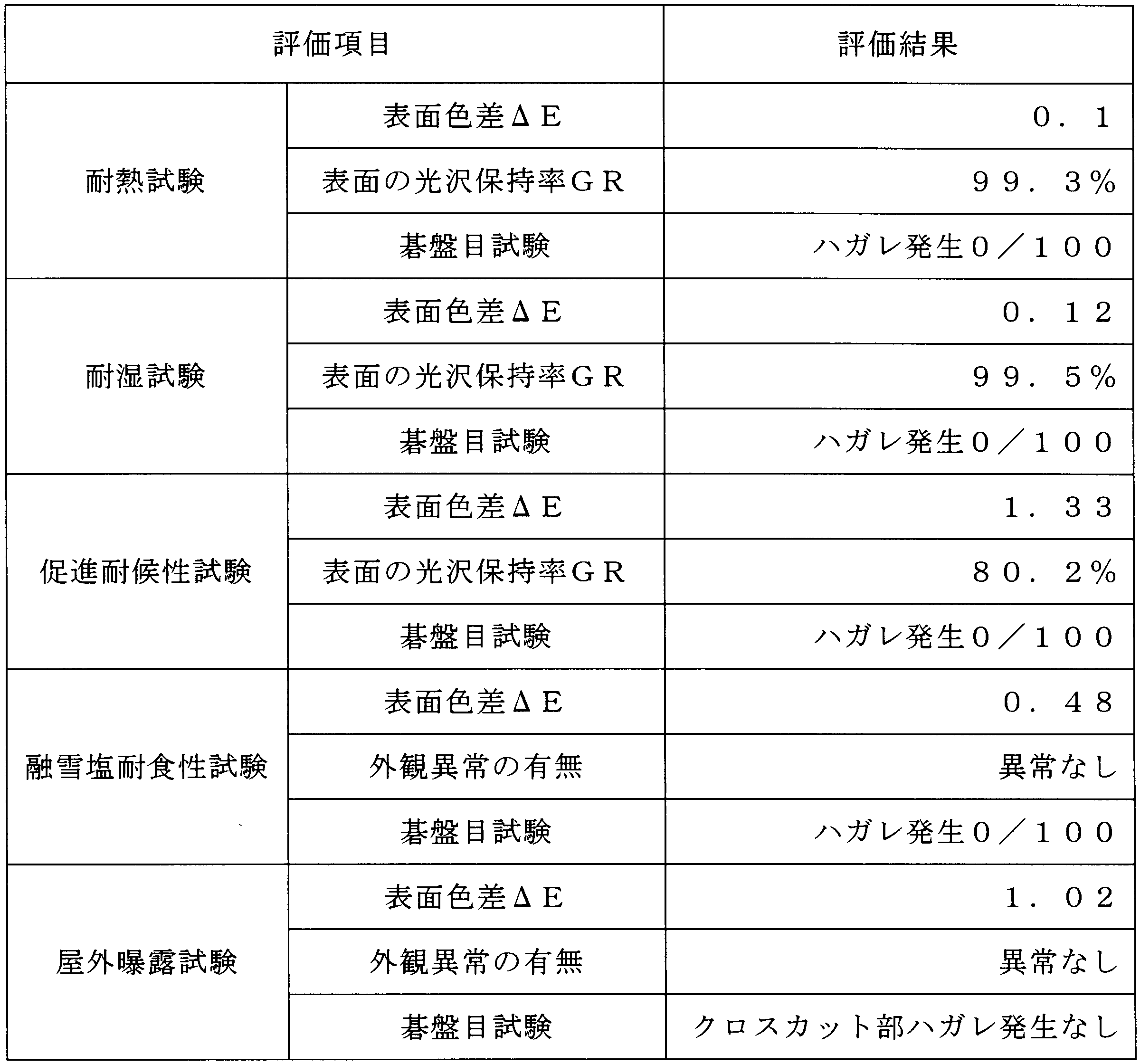
試験1~3の結果から、ニッケル、クロム、及びモリブデンを構成成分として含有し、かつモリブデンの含有率が特定値以下(50atm%以下)である装飾層を形成することにより、光輝性を視認できる反射率を有し、耐候性に優れた装飾製品を得ることができることが分かる。
Claims (4)
- ニッケル、クロム、及びモリブデンを構成成分として含有する装飾層を備え、
前記装飾層におけるモリブデンの含有率は50atm%以下であり、
前記装飾層におけるニッケル、クロム、及びモリブデンの合計含有率は95atm%以上であることを特徴とする装飾製品。 - 前記装飾層におけるニッケルの含有率が10atm%以上75atm%以下であり、
前記装飾層におけるクロムの含有率が10atm%以上60atm%以下であり、
前記装飾層におけるモリブデンの含有率が15atm%以上50atm%以下であることを特徴とする請求項1に記載の装飾製品。 - 前記装飾層は、入射光の一部を透過し、入射光の一部を反射するハーフミラー層であることを特徴とする請求項1又は請求項2に記載の装飾製品。
- 前記装飾層の厚さは、20nm以上100nm以下であることを特徴とする請求項3に記載の装飾製品。
Priority Applications (3)
| Application Number | Priority Date | Filing Date | Title |
|---|---|---|---|
| CN201880042284.7A CN110799349B (zh) | 2017-06-29 | 2018-06-14 | 装饰产品 |
| US16/617,910 US20200324570A1 (en) | 2017-06-29 | 2018-06-14 | Decorative product |
| JP2019526793A JP6891958B2 (ja) | 2017-06-29 | 2018-06-14 | 装飾製品 |
Applications Claiming Priority (2)
| Application Number | Priority Date | Filing Date | Title |
|---|---|---|---|
| JP2017127268 | 2017-06-29 | ||
| JP2017-127268 | 2017-06-29 |
Publications (1)
| Publication Number | Publication Date |
|---|---|
| WO2019003941A1 true WO2019003941A1 (ja) | 2019-01-03 |
Family
ID=64740567
Family Applications (1)
| Application Number | Title | Priority Date | Filing Date |
|---|---|---|---|
| PCT/JP2018/022743 Ceased WO2019003941A1 (ja) | 2017-06-29 | 2018-06-14 | 装飾製品 |
Country Status (4)
| Country | Link |
|---|---|
| US (1) | US20200324570A1 (ja) |
| JP (1) | JP6891958B2 (ja) |
| CN (1) | CN110799349B (ja) |
| WO (1) | WO2019003941A1 (ja) |
Citations (3)
| Publication number | Priority date | Publication date | Assignee | Title |
|---|---|---|---|---|
| JPS61253364A (ja) * | 1985-04-30 | 1986-11-11 | Nissan Motor Co Ltd | 真空めつき品 |
| WO2006022313A1 (ja) * | 2004-08-25 | 2006-03-02 | Sunarrow Limited | ハーフミラー加飾を施したキーシート及びキートップ |
| JP2014185393A (ja) * | 2013-02-20 | 2014-10-02 | Hitachi Metals Ltd | 金属薄膜および金属薄膜形成用Mo合金スパッタリングターゲット材 |
Family Cites Families (5)
| Publication number | Priority date | Publication date | Assignee | Title |
|---|---|---|---|---|
| CN100573761C (zh) * | 2004-08-25 | 2009-12-23 | 三箭株式会社 | 实施了半反射镜装饰的键槽及键顶 |
| JP2007069561A (ja) * | 2005-09-09 | 2007-03-22 | Sumitomo Metal Mining Co Ltd | 2層フレキシブル基板とその製造方法 |
| JP5570730B2 (ja) * | 2006-03-03 | 2014-08-13 | ジェンテックス コーポレイション | 改良薄膜コーティング、電気光学要素、及びこれらの要素を組み込んだアセンブリ |
| TWI427682B (zh) * | 2006-07-04 | 2014-02-21 | 半導體能源研究所股份有限公司 | 顯示裝置的製造方法 |
| JP4695631B2 (ja) * | 2007-09-10 | 2011-06-08 | 小島プレス工業株式会社 | 加飾樹脂成形品及びその製造方法 |
-
2018
- 2018-06-14 JP JP2019526793A patent/JP6891958B2/ja active Active
- 2018-06-14 WO PCT/JP2018/022743 patent/WO2019003941A1/ja not_active Ceased
- 2018-06-14 US US16/617,910 patent/US20200324570A1/en not_active Abandoned
- 2018-06-14 CN CN201880042284.7A patent/CN110799349B/zh active Active
Patent Citations (3)
| Publication number | Priority date | Publication date | Assignee | Title |
|---|---|---|---|---|
| JPS61253364A (ja) * | 1985-04-30 | 1986-11-11 | Nissan Motor Co Ltd | 真空めつき品 |
| WO2006022313A1 (ja) * | 2004-08-25 | 2006-03-02 | Sunarrow Limited | ハーフミラー加飾を施したキーシート及びキートップ |
| JP2014185393A (ja) * | 2013-02-20 | 2014-10-02 | Hitachi Metals Ltd | 金属薄膜および金属薄膜形成用Mo合金スパッタリングターゲット材 |
Also Published As
| Publication number | Publication date |
|---|---|
| CN110799349B (zh) | 2021-12-21 |
| US20200324570A1 (en) | 2020-10-15 |
| CN110799349A (zh) | 2020-02-14 |
| JPWO2019003941A1 (ja) | 2020-04-02 |
| JP6891958B2 (ja) | 2021-06-18 |
Similar Documents
| Publication | Publication Date | Title |
|---|---|---|
| EP2817150B1 (de) | Mehrschichtaufbau als reflektor | |
| CN108276898A (zh) | 镀膜涂料系统、具有金属效果涂层的塑胶件及其制备工艺 | |
| EP2530495A1 (en) | Reflective film laminate | |
| CN103451689B (zh) | 铜系材料的制造方法及由该方法制造的铜系材料 | |
| WO2006132414A1 (ja) | 反射率・透過率維持特性に優れた銀合金 | |
| JP2007138270A (ja) | 樹脂製品及びその製造方法並びに金属皮膜の成膜方法 | |
| CN112020422A (zh) | 电磁波透过性金属光泽物品、及装饰构件 | |
| JP2007162125A (ja) | 樹脂製品及びその製造方法並びに金属皮膜の成膜方法 | |
| US20110171396A1 (en) | Thermally sprayed metal coatings on wood or wood composite surfaces | |
| WO2006039479A1 (en) | Reflective or semi-reflective metal alloy coatings | |
| KR20210011048A (ko) | 광고용 필름 | |
| WO2019003941A1 (ja) | 装飾製品 | |
| WO2015123056A1 (en) | Sputter coating a work piece | |
| CN105228756A (zh) | 具有金属表面处理的塑料基材的光泽度调节 | |
| WO2021058420A1 (de) | Durchleuchtbare metallisierte designfläche | |
| JP5260452B2 (ja) | 耐温水性に優れるAl合金反射膜、およびスパッタリングターゲット | |
| WO2006132416A1 (ja) | 反射率・透過率維持特性に優れた銀合金 | |
| JP7755345B1 (ja) | 金色加飾フィルム | |
| KR20180112536A (ko) | 광고용 필름 | |
| EP4059708B1 (en) | Laminated film, metallic product, and metallic signboard | |
| JP5784923B2 (ja) | 合成樹脂鏡およびその製造方法 | |
| JP7836133B1 (ja) | メタリックカラーフィルム | |
| JP7777903B1 (ja) | メタリックカラーフィルム | |
| JP6689709B2 (ja) | 加飾樹脂成形品 | |
| JP5260008B2 (ja) | 半透過鏡およびその製造方法 |
Legal Events
| Date | Code | Title | Description |
|---|---|---|---|
| 121 | Ep: the epo has been informed by wipo that ep was designated in this application |
Ref document number: 18822917 Country of ref document: EP Kind code of ref document: A1 |
|
| ENP | Entry into the national phase |
Ref document number: 2019526793 Country of ref document: JP Kind code of ref document: A |
|
| NENP | Non-entry into the national phase |
Ref country code: DE |
|
| 122 | Ep: pct application non-entry in european phase |
Ref document number: 18822917 Country of ref document: EP Kind code of ref document: A1 |