WO2018228440A1 - 一种非布司他控释组合物及其制备方法 - Google Patents
一种非布司他控释组合物及其制备方法 Download PDFInfo
- Publication number
- WO2018228440A1 WO2018228440A1 PCT/CN2018/091101 CN2018091101W WO2018228440A1 WO 2018228440 A1 WO2018228440 A1 WO 2018228440A1 CN 2018091101 W CN2018091101 W CN 2018091101W WO 2018228440 A1 WO2018228440 A1 WO 2018228440A1
- Authority
- WO
- WIPO (PCT)
- Prior art keywords
- febuxostat
- controlled release
- composition according
- release composition
- component
- Prior art date
- Legal status (The legal status is an assumption and is not a legal conclusion. Google has not performed a legal analysis and makes no representation as to the accuracy of the status listed.)
- Ceased
Links
Images



Classifications
-
- A—HUMAN NECESSITIES
- A61—MEDICAL OR VETERINARY SCIENCE; HYGIENE
- A61P—SPECIFIC THERAPEUTIC ACTIVITY OF CHEMICAL COMPOUNDS OR MEDICINAL PREPARATIONS
- A61P19/00—Drugs for skeletal disorders
- A61P19/06—Antigout agents, e.g. antihyperuricemic or uricosuric agents
Definitions
- the present invention relates to a febuxostat controlled release composition and a process for the preparation thereof.
- Febuxostat chemical name is 2-[(3-cyano-4-isobutoxy)phenyl]-4-methyl-5-thiazolecarboxylic acid, the molecular formula is C 16 H 16 N 2 O 3 S, molecular weight 316.374, its structural formula is as follows:
- febuxostat The main side effect of febuxostat is the onset of gout during treatment, accompanied by liver dysfunction, nausea, joint pain, and rash. Clinical data show that febuxostat is accompanied by a high probability of cardiovascular thromboembolic events or even death during treatment. According to the relevant research results, the concentration of febuxostat above 100 ng/ml can maintain the uric acid inhibition level of more than 80%, and the absorption of febuxostat is mainly in the small intestine, and the bioavailability of the proximal small intestine is 96.63%. The bioavailability of the small intestine was 84.05%.
- the commercially available febuxostat is an ordinary immediate-release tablet, which rapidly disintegrates and absorbs after taking it, and the blood drug concentration rises rapidly, but the low-term maintenance of the effective blood concentration (>100 ng/ml) is short. Poor patient compliance increases the incidence of adverse reactions and limits the clinical use of febuxostat.
- CN103210084A discloses an improved release pharmaceutical composition
- an immediate release febuxostat (febuxostat) bead and a delayed release febuxostat bead wherein the delayed release portion of the inert core and the drug-containing layer are enteric coated
- the polymer layer is coated, the delayed release portion has a solubility at a pH level greater than or equal to 6.8 and febuxostat is provided over a 4-6 hour period.
- CN102641255A discloses an osmotic pump controlled release tablet of febuxostat for the purpose of prolonged release.
- CN101773498B discloses a preparation method of an oral sustained-release preparation containing febuxostat, which is a skeleton type tablet or capsule, and the sustained-release skeleton is hypromellose and polyoxygen. a mixture of one or more of ethylene and alginate.
- CN101658505A discloses a sustained release preparation of febuxostat comprising two parts, an immediate release and a sustained release, which are prepared by a basket method at a rpm of 900 rpm in 900 ml of pure water at 37 ° C for 12 h release greater than 12 h. 90%.
- the ordinary sustained-release preparation is transported to the rear end of the intestine after taking it for 4-6 hours, resulting in the inability of the drug to be effectively absorbed and maintained for a longer period of time. Blood concentration.
- the oral floating preparation of the present invention can effectively increase the residence time in the stomach, greatly prolong the effective release and absorption time of febuxostat, and thereby maintain an effective blood concentration for a longer period of time.
- the febuxostat controlled release composition disclosed in the present invention can effectively lower the Cmax value of the blood drug peak and maintain an effective blood concentration (>100 ng/ml) for a longer period of time, thereby achieving therapeutic purposes.
- the present invention provides a febuxostat controlled release composition
- a febuxostat controlled release composition comprising: a) a febuxostat immediate release component, and b) a febuxostat floating component.
- the febuxostat floatation component of the febuxostat controlled release composition of the present invention is a delayed release floating component, and specifically, the delayed release component of the present invention releases the drug at a pH of ⁇ 5.5.
- the delayed release floating component of the febuxostat controlled release composition provided by the present invention is prepared by hot melt extrusion.
- the febuxostat delayed release floating component of the febuxostat controlled release composition of the present invention contains at least one enteric polymer.
- the delayed release drug component containing the enteric polymer of the present invention releases the drug at a pH of ⁇ 5.5.
- the enteric polymer in the febuxostat controlled release composition provided by the invention is selected from the group consisting of polyvinyl alcohol acetate phthalate, cellulose acetate phthalate, and 1,2,4-benzenetricarboxylic acid acetate fiber.
- the methacrylic acid-ethyl acrylate copolymer is a 1:1 copolymer corresponding to commercially available Eudragit l100-55 or Kollicoat MAE 100P.
- the methyl vinyl ether-maleic anhydride copolymer is commercially available. series.
- the methacrylic acid-methyl methacrylate copolymer is a 1:1 or 1:2 copolymer corresponding to Eudragit L100 and Eudragit S100, respectively.
- the mixture of polyvinyl acetate and polyvinylpyrrolidone K30 is Kollidon SR.
- the enteric polymer described herein is an Eudragit polymer, such as Eudragit L, Eudragit S or Eudragit L 100-55.
- the enteric polymer described in the present invention is hydroxypropyl methylcellulose acetate succinate (HPMCAS), hydroxypropyl methyl acetate succinate disclosed in the prior art US 4,266,981 B, CN 104208713 A, and CN 103153343 A. Cellulose is included within the scope of this application.
- HPMCAS sold by Shin-Etsu Chemical Co., Ltd. (Tokyo, Japan) is classified into three grades having different combinations of substituent levels to provide enteric protection at various pH levels.
- AS-LF and AS-LG grades (“F” means fine and "G” means granules) provide enteric protection at a pH of up to 5.5.
- the AS-MF and AS-MG grades provide enteric protection at pH values up to 6.0, while the AS-HF and AS-HG grades provide enteric protection at pHs up to 6.8.
- the ratio of febuxostat to enteric polymer in the febuxostat delayed release component of the febuxostat controlled release composition provided by the present invention is selected from the group consisting of 1:0.1 to 1:100, preferably 1:0.1- 1:50, more preferably 1:1 to 1:25.
- the febuxostat controlled release composition provided by the present invention is characterized in that the mass ratio of the immediate release component to the febuxostat in the floating component is from 1:0.1 to 1:20, preferably from 1:0.5 to 1:15. Most preferably from 1:1 to 1:10, the total amount of febuxostat is from 10 to 120 mg, preferably from 20 to 100 mg, most preferably from 30 to 90 mg.
- the febuxostat controlled release composition provided by the present invention, the hot melt extrusion method has the participation of a solvent, and the solvent participation in the present invention refers to the need of the invention, before hot melt extrusion or hot melt extrusion.
- the solvent is added online during the process.
- the solvent can only be volatilized after the end of the hot melt extrusion process.
- the boiling point of the solvent is limited to 30-110 ° C, specifically selected from the group consisting of water, methanol, ethanol, and isopropyl.
- At least one of alcohol, acetone, pentane, hexane, heptane, cyclohexane, dichloromethane, and tetrahydrofuran is preferably water or ethanol.
- the febuxostat controlled release composition provided by the present invention is characterized in that the febuxostat floating component is in a multi-unit form.
- the multi unit form of the febuxostat controlled release composition provided by the present invention is a microtablet, pellet, granule, preferably granule.
- the febuxostat floatation component of the febuxostat controlled release composition provided by the present invention is porous under electron microscopy.
- the febuxostat floatation component of the febuxostat controlled release composition provided by the present invention immediately floats in a solution of FaSSGF at pH 5.0.
- the febuxostat floatation component of the febuxostat controlled release composition provided by the present invention floats in a solution of FaSSGF at pH 5.0 for more than 24 hours.
- the febuxostat controlled release composition provided by the present invention is characterized in that the density of the febuxostat floating component is from 0.1 to 1.0 g/cm 3 , preferably from 0.2 to 0.8 g/cm 3 , most preferably from 0.3 to 0.7 g. /cm 3 .
- the febuxostat controlled release composition provided by the present invention is characterized in that the febuxostat floating component is in a dissolution medium of 300 mL of FaSSGF at pH 5.0, basket method, 37 ° C, 100 rpm, 5 h cumulative dissolution Less than 30%, more preferably less than 20%, and most preferably less than 10%.
- the febuxostat controlled release composition provided by the present invention is characterized in that the controlled release composition can maintain the plasma of febuxostat greater than 0.1 ⁇ g/mL in the patient after oral administration.
- the concentration time is 12h-24h, preferably 13-22h, and more preferably 15-20h.
- the compositions of the present disclosure can be administered orally to a subject in need of treatment thereof to maintain a plasma concentration of febuxostat greater than about 0.1 [mu]g/mL in the subject for about 12 h, about 13 h, about 14 h. , about 15h, about 16h, about 17h, about 18h, about 19h, about 20h, about 21h, about 22h, about 23h, about 24h.
- the preferred mode of administration of the febuxostat controlled release composition of the present invention is after a meal.
- the febuxostat controlled release composition provided by the present invention, wherein the febuxostat in the febuxostat floating component maintains a crystalline state after hot melt extrusion.
- the febuxostat controlled release composition provided by the invention can be used for the treatment of gout, hyperuricemia, prostatitis, inflammatory bowel disease, prolongation of QT interval, myocardial infarction, cardiac hypertrophy, hypertension, nephrolithiasis, chronic Diseases such as kidney disease, metabolic syndrome, diabetes, diabetic nephropathy, and congestive heart failure.
- the febuxostat delayed release floating component of the febuxostat controlled release composition of the present invention optionally further comprises at least one plasticizer selected from the group consisting of triethyl citrate and hydrazine.
- the immediate release component and/or the controlled release floating component of the febuxostat controlled release composition provided by the present invention further comprises at least one pharmaceutically acceptable other excipient, and the pharmaceutically acceptable excipient includes However, it is not limited to a filler, a lubricant, a glidant, a binder, or a disintegrator.
- excipients are conventionally incorporated into solid dosage forms to facilitate ease of handling and to improve the performance of the dosage form.
- Common excipients include diluents or fillers, lubricants, binders and the like. Wherein a diluent or filler is added to increase the weight of the individual dose to a size suitable for tablet compression.
- Suitable diluents include powdered sugar, calcium phosphate, calcium sulfate, microcrystalline cellulose, lactose, mannitol, kaolin, sodium chloride, dried starch, sorbitol, and the like.
- the lubricant reduces the friction between the particles and the mold wall during compression and discharge. This prevents the particles from adhering to the tablet punches, facilitating their discharge from the tablet press, and the like.
- suitable lubricants include, but are not limited to, talc, stearic acid, vegetable oils, calcium stearate, zinc stearate, magnesium stearate, and the like.
- Glidants are used to improve the flow characteristics of the particles.
- suitable glidants include, but are not limited to, silica, corn starch, micronized silica gel, talc, polyethylene glycol.
- a binder is usually used.
- suitable binders include, but are not limited to, pyrrolidone, polyvinylpyrrolidone, xanthan gum, cellulose gums such as carboxymethylcellulose, methylcellulose, hydroxyethylcellulose, hydroxypropylcellulose, hydroxypropyl Methylcellulose, hydroxycellulose, gelatin, starch and pregelatinized starch.
- the disintegrant refers to a substance which can rapidly break up a tablet into fine particles in a gastrointestinal fluid, so that the functional component dissolves and absorbs rapidly, and functions.
- the disintegrants described in the present invention include, but are not limited to, one or more of low-substituted hydroxypropylcellulose, croscarmellose sodium, sodium carboxymethyl starch, and crospovidone.
- febuxostat controlled release compositions provided herein, and other excipients that may also be included in the compositions include, but are not limited to, preservatives, antioxidants, or any other excipients commonly used in the pharmaceutical industry, and the like.
- febuxostat controlled release compositions are ultimately presented in a pharmaceutically acceptable form for administration to a patient, optionally as a tablet or capsule.
- the febuxostat controlled release composition provided by the present invention does not contain calcium phosphate dihydrate, Nakamichi (International Journal of Pharmace-Utics 218 (2001) 103-112), and others add calcium phosphate dihydrate to the drug and the matrix, and pass the heat. After melt extrusion, a floatant is prepared.
- the febuxostat controlled release composition provided by the present invention does not contain a substance such as NaHCO 3 or Na 2 CO 3 which is prone to generate carbon dioxide (CO 2 ) gas.
- the present invention also provides a process for the preparation of the febuxostat controlled release composition of the present invention, which comprises the steps of: 1) at least one solvent, febuxostat prior to hot melt extrusion. Mixing with at least one enteric polymer to obtain a premixed crude product or mixing at least one solvent, febuxostat and at least one enteric polymer in a melt extrusion process to obtain a premixed crude product; 2) premixing crude product The extrudate is exited through the die after passing through the heated screw zone of the extruder.
- the preparation method provided by the present invention is characterized in that the solvent only needs to be able to be volatilized after the end of the hot melt extrusion process.
- the boiling point of the solvent is limited to 30-110 ° C, specifically,
- the solvent is selected from the group consisting of water, methanol, ethanol, isopropanol, acetone, pentane, hexane, heptane, cyclohexane, dichloromethane, tetrahydrofuran, preferably water and ethanol.
- the preparation method provided by the present invention is characterized in that the solvent is used in an amount of 0.1% to 70%, preferably 1% to 50%, most preferably 10% to 30% (% by mass, based on the total mass of the solid components of 100) ).
- the preparation method provided by the present invention is characterized in that the die temperature is from 100 to 200 ° C, preferably from 110 to 180 ° C, more preferably from 120 to 160 ° C.
- the temperature of the front end heating zone should be greater than the glass transition temperature (Tg) of febuxostat and the hot polymer.
- the solvent injection screw zone temperature is 10-90 °C.
- the solvent having a low boiling point and being relatively volatile may be substantially volatilized during extrusion according to the nature of the solvent itself and the temperature of the die, and the solvent having a low boiling point and being volatile is included, but not limited to, ethanol.
- Substantially volatilized as used herein means that the residual amount of solvent in the extrudate is less than 15%, preferably less than 12%, and most preferably less than 10%.
- the method provided by the present invention when a solvent having a higher boiling point is selected, may be followed by a step of desolvating the extrudate after the end of hot melt extrusion.
- the solvent in the extrudate is removed under elevated temperature and/or vacuum conditions.
- the elevated temperature is sufficient to convert the solvent from a liquid to a gaseous state.
- the solvent in the extrudate is removed under reduced pressure conditions.
- the method of preparing a febuxostat controlled release composition provided herein further comprises the step of extruding the extrudate.
- the preparation method of the immediate release portion of the present invention includes wet granulation, dry granulation, powder direct pressing and the like.
- the preparation method provided by the present invention is characterized in that the extruder is a single screw extruder, an intermeshing screw extruder, a twin screw extruder, preferably a twin screw extruder.
- the composition provided by the present invention due to the floating time in the gastric juice environment, prolongs the transit time of the composition in the gastrointestinal tract, wherein the delayed release of the gastric floating particles will transport with the gastrointestinal tract or the food enters the small intestine after being floated for a period of time, and is absorbed in the small intestine.
- the formation of pulsed administration can avoid the drawback that the sustained release drug misses the absorption site and causes a large decrease in bioavailability compared with the conventional sustained release preparation.
- the controlled release composition provided by the present invention maintains the effective blood concentration for a longer period of time than the composition disclosed in the prior art CN103210084B, and the obtained preparation has good stability, and the preparation method provided by the method of the invention is simple and continuous. Easy to industrial production.
- delayed release refers to a type of improved release wherein the pharmaceutical dosage form exhibits a time delay between oral administration of the pharmaceutical dosage form and release of the drug from the dosage form.
- the delayed release release dosage form will have little or no release of the active compound for a predetermined period of time or until predetermined conditions are met, such as exposure to a certain pH level, and then the release of the active compound occurs immediately thereafter.
- controlled release in the context of the invention refers to a type of extended release formulation wherein the gradual release of the drug is controlled or manipulated for an extended period of time.
- HPMCAS used in the examples of the present invention was purchased from Shin-Etsu Chemical Co., Ltd., and the hot melt extruder was Thermo Fisher's twin-screw hot melt extrusion instrument.
- the single capsule comprises an immediate release component and a delayed release floating component
- the immediate release component is a microtablet containing 8 mg of febuxostat active ingredient
- the delayed release floating component is a particulate A containing 32 mg of febuxostat active ingredient, granules A is released above pH 6.
- the immediate release febuxostat microtablets were prepared by a wet granulation process, the formulation of which is listed in Table 1 below.
- the specific preparation process wet granulation mechanism granules, mixing raw materials and auxiliary materials, adding binder, stirring, 1500 rpm cutting, sieving, drying, to moisture ⁇ 3%, passing through 30 mesh sieve, and then using Chuangbo C&C600B single Stamping machine, 4.76mm punch press. Tablet weight: theory 61.5mg, the actual control is 59-65mg, the hardness is about 30N.
- the febuxostat bleaching granule A was prepared by a hot melt extrusion process, the formulation of which is listed in Table 2 below.
- the febuxostat and HPMCAS MG were weighed and mixed uniformly in a blender, and the hot melt extruder (Simofly) was set as shown in Table 3.
- the speed is 700ul/min
- Zone2 feeding the speed is 4g/min
- the rotation speed of the screw is set to 100rpm
- the extrudate is cut into segments
- the residual amount of ethanol is 3%
- the extrudate is cut. Dry in an oven at 60 ° C for 2 h, the ethanol content is less than 0.5%, and pulverize to 2 mm after drying.
- a single capsule contains an immediate release component and a delayed release floating component
- the immediate release component is a pellet containing 8 mg of febuxostat active ingredient
- the remainder of the capsule contains a delayed release of febuxostat containing 32 mg of febuxostat.
- Floating particles B this delayed release of floating enteric particles B is rapidly released above pH 6.
- the immediate release febuxostat pellets were prepared by a blank pellet core drug preparation process, and the prescription composition is shown in Table 4.
- the febuxostat controlled release floating granules B were prepared by a hot melt extrusion process, and the formulation composition thereof is shown in Table 5.
- febuxostat 150 g of febuxostat and 90 g of HPMCAS MG and 360 g of hydroxypropylmethylcellulose were weighed and mixed uniformly in a blender.
- the temperature setting of the hot melt extruder was as shown in Table 3.
- the ethanol was added to the Zone 4 of the hot melt extruder at a speed of 700 ul/min, the Zone 2 was fed at a speed of 4 g/min, and the rotation speed of the screw was set to 100 rpm. After cutting into sections, the extrudate was oven-dried at 60 ° C for 2 h, and the ethanol content was ⁇ 0.5%. After drying, it is pulverized to 4 mm, and the controlled release granule B of febuxostat is obtained.
- the single capsule comprises an immediate release component and a controlled release floating component
- the immediate release component is a microtablet containing 8 mg of febuxostat
- the remainder of the capsule comprises a total of 32 mg of febuxostat gastric floating particles C, the gastric floating particles C is released above pH 5.
- the immediate release febuxostat microtablets were prepared by a wet granulation process, the formulation of which is listed in Table 1 above.
- the febuxostat controlled release floating granule C was prepared by a hot melt extrusion process, and its prescription composition is shown in Table 6.
- hot melt extrusion was carried out, and the temperature parameter setting was the same as that of the preparation of the pellet A.
- the hot melt extruder's Zone4 was added with ethanol at a speed of 600 ul/min, Zone 2 was fed at a speed of 2 g/min, the screw speed was 60 rpm, the extrudate was cut into segments, and the extrudate was oven dried at 60 ° C for 2 h.
- the ethanol content is ⁇ 0.5%, and after pulverization, it is pulverized to 4 mm long particles, and the febuxostat floating particles C are obtained.
- Example 4 is a febuxostat formulation consisting of 40% immediate release febuxostat microtablets and 60% febuxostat floating particles C which release the drug above pH 5
- the single capsule contains an immediate release component and a controlled release floating component
- the immediate release component is a microchip containing 16 mg of febuxostat
- the remainder of the capsule contains a total of 24 mg of febuxostat delayed release floating particle C, which is delayed release.
- the floating controlled release granule C is released above pH 5.
- the immediate release febuxostat microchip was prepared by a wet granulation process, the formulation of which is listed in Table 1 above, and the febuxostat controlled release floating granule C was the same as in Example 3.
- Example 5 a febuxostat formulation consisting of immediate release febuxostat pellets and delayed release febuxostat floating particles D 5
- a single capsule contains an immediate release component and a controlled release floating component.
- the immediate release component is a pellet containing 8 mg of febuxostat active ingredient, and the remainder of the capsule contains a delay of 32 mg of febuxostat containing 32 mg of febuxostat.
- the floating particles D are released, and the gastric floating delayed release particles D are slowly released while floating in the gastric juice.
- the immediate release febuxostat pellets were prepared by a blank pellet core drug preparation process, and the prescription compositions are listed in Table 4 above.
- the febuxostat gastric floating controlled release granule D was prepared by a hot melt extrusion process, and the composition of the formulation is shown in Table 7.
- the febuxostat After blending the febuxostat with the quaternary amino methacrylate copolymer type B and hypromellose, it was sheared in a wet granulator while slowly adding triethyl citrate dropwise.
- the mixed materials were hot melt extruded, the temperature parameters were set as in Table 3, ethanol was added in Zone 4, the speed was 1000 ul/min, Zone 2 was fed, the speed was 4 g/min, the screw speed was set to 100 rpm, and the extrusion was performed.
- the material was cut into sections, and then the extrudate was oven-dried at 60 ° C for 2 h, and the ethanol content was ⁇ 0.5%. After drying, it is pulverized to 4 mm long granules, and the controlled release granule D of febuxostat is obtained.
- Example 6 consists of an immediate release febuxostat microplatelet and a febuxostat formulation consisting of delayed release of febuxostat floating particles E 6
- the single capsule contains an immediate release component and a controlled release floating component.
- the immediate release component is a microtablet containing 8 mg of febuxostat.
- the remainder of the capsule contains a total of 32 mg of febuxostat delayed release floating particles E, which floats on the stomach.
- the controlled release granule E is slowly released while floating in the gastric juice.
- the immediate release febuxostat microchips were prepared by a wet granulation process, and the formulation of the compositions is shown in Table 1.
- the febuxostat gastric floating delayed release granule E was prepared by a hot melt extrusion process, and its prescription composition is shown in Table 8.
- the febuxostat was mixed with other excipients in a prescribed amount and then subjected to hot melt extrusion.
- the temperature parameters were set as shown in Table 3. Add ethanol to Zone 4 at a rate of 300 ul/min, Zone 2 feed at a speed of 4 g/min, set the screw speed to 100 rpm, cut the extrudate into sections, and have a residual ethanol content of 1.5%. °C oven drying for 2h, ethanol content ⁇ 0.5%, pulverized to 4mm long particles, both obtained buftastat gastric floating controlled release particles E.
- Example 7 is a non-busestat formulation consisting of an immediate release febuxostat microparticle and a controlled release febuxostat floating particle F
- the single capsule contains the immediate release component and the controlled release floating component, and the immediate release component is a microchip containing 8 mg of febuxostat.
- the remainder of the capsule contains a total of 32 mg of febuxostat floating particles F, which is controlled by the stomach.
- the release granule E is slowly released while floating in the gastric juice.
- the immediate release febuxostat microtablets were prepared by a wet granulation process, the formulation of which is listed in Table 1.
- the febuxostat gastric floating controlled release granule F was prepared by a hot melt extrusion process, and its formulation composition is shown in Table 9.
- the febuxostat was mixed with other excipients in a prescribed amount and then subjected to hot melt extrusion.
- the temperature parameters were set as shown in Table 3.
- the content is ⁇ 0.5%, and after pulverization, it is pulverized to 4 mm long particles, and the controlled release granule F of febuxostat is obtained.
- Example 8 is a febuxostat formulation consisting of an immediate release febuxostat microplatelet and a febuxostat floating particle G which releases the drug above pH 5.5.
- the single capsule comprises an immediate release component and a delayed release floating component
- the immediate release component is a microtablet containing 8 mg of febuxostat active ingredient
- the delayed release floating component is a particulate G containing 32 mg of febuxostat active ingredient, granules A is released above pH 5.5.
- the immediate release febuxostat microtablets were prepared by a wet granulation process, the formulation of which is shown in Table 1, and the formulation of febuxostat delayed release floating granules G is shown in Table 10.
- Table 11 The hot melt extrusion and temperature settings are shown in Table 11.
- Zone4 is added with water, the feeding speed is 5g/min, the watering speed is 0.9ml/min, the screw rotation speed is set to 100rpm, the extrudate is cut into segments, and the extrudate is dried in an oven at 60°C for 2 hours. Moisture ⁇ 3%, pulverized to 2 mm after drying, test density was 0.5 g/cm 3 , and the obtained febuxostat granule G and the febuxostat microderage obtained in Example 1 were filled into capsules to obtain febuxostat preparation. 8.
- Example 12 The human pharmacokinetic study was carried out together with the preparations obtained in Example 3 and Example 4 using a commercially available 40 mg-sized febuxostat as a reference preparation, and the results of the study are shown in Table 12 below.
- T max maximum blood concentration time
- AUC 0 ⁇ drug time curve area
- Example 3 and Example 4 can reduce the maximum peak concentration of the drug compared with the commercially available febuxostat reference preparation, greatly prolong the duration of action, and exert controlled release of the drug.
- pH5.0FaSSGF 300mL of pH5.0FaSSGF was used as the dissolution medium to observe the floating condition of the gastric floating particles under simulated gastric fluid. After observation, all the particles immediately floated and floated for a long time. After 24 hours, the particles remained floating and stopped. Observed.
- the rate of dissolution can indicate the rate at which the drug is released from the formulation in the gastrointestinal environment, and the lower rate of release response is a lower Cmax and longer release time on the pharmacokinetic data.
- the dissolution rate of the preparation prepared in the present invention is remarkably lowered, and it can be inferred that the preparations of the present invention (Examples 1 to 7) can achieve a reduction in the C max value as compared with the immediate release tablets. To extend the effective blood concentration time.
- the traits of the particle G were observed by scanning electron microscopy, and it was found that the particle G was porous under the electron microscope, as shown in Fig. 5.
- the powder diffraction pattern for the crystalline state of the febuxostat and the non-busestat after extrusion, as shown in Fig. 6, is maintained in a crystalline state after hot melt extrusion.
- the febuxostat and HPMCP were mixed uniformly and hot melt extruded.
- the temperature parameters were set as shown in Table 13 (°C).
- Zone4 is added with water, the screw rotation speed is set to 100 rpm, the water adding speed is 700-900 ul/min, the extrudate is oven-dried at 60 ° C for 2 h, the water content is ⁇ 3%, and the pulverization is 2 mm after drying.
- the sample can expand and the sample can float.
- the febuxostat and HPMCP were mixed uniformly and hot melt extruded.
- the temperature parameters were set as shown in Table 14 (°C).
- Zone2 feeding in Zone2, adding ethanol to Zone4, setting the screw rotation speed to 50 rpm, adding ethanol speed to 700/min, drying the extrudate in an oven at 60 ° C for 2 h, moisture ⁇ 3%, and pulverizing to 2 mm after drying.
- the sample can expand and the sample can float.
Landscapes
- Medicinal Preparation (AREA)
Abstract
一种非布司他控释组合物及其制备方法,所述非布司他控释组合物含有非布司他速释组分和非布司他漂浮组分,从而可以有效降低血浆中药物浓度峰值,延长有效药物作用时间,减少副作用,提高患者的依从性。
Description
本申请要求申请日为2017年6月14日的中国专利申请CN201710448092.3的优先权。本申请引用上述中国专利申请的全文。
本发明涉及一种非布司他控释组合物及其制备方法。
非布司他(Febuxostat)化学名为2-[(3-氰基-4-异丁氧基)苯基]-4-甲基-5-噻唑羧酸,分子式为C
16H
16N
2O
3S,分子量为316.374,其结构式如下:

其由日本帝人公司于2004年在日本申请上市,其年底在美国申请上市,IPSEN公司在欧洲申请上市,目前非布司他片国内已有上市。非布司他为新一代黄嘌呤氧化酶的有效的、非嘌呤的选择性抑制剂,可选择性抑制黄嘌呤氧化酶(XO),降低高尿酸血症痛风患者血液中的尿酸水平,治疗痛风,其血浆蛋白结合率高达99.3%,V
d为33-66L,主要在肝中代谢成葡萄糖苷酸,少部分被氧化和以原型药物形式代谢,t
1/2为5-8小时,CL为10-20L/h。
非布司他主要的副反应是在治疗过程中出现痛风发作,并伴有肝功能紊乱、恶心、关节痛、皮疹。临床数据显示,非布司他在治疗过程中伴随有较高概率的心血管血栓栓塞事件,甚至死亡。根据相关研究结果,非布司他浓度在100ng/ml以上,可保持80%以上的尿酸抑制水平,且非布司他吸收主要在小肠,其近端小肠的生物利用度为96.63%、远端小肠的生物利用度为84.05%。而目前市售非布司他均为普通速释片,服用后迅速崩解吸收,血药浓度迅速上升,但非布司他清除快维持有效血药浓度(>100ng/ml)时间短,导致患者顺应性差,增加了不良反应的发生率,限制了非布司他在临床上的使用。
CN103210084A公开了一种含有立即释放非布索坦(非布司他)珠和延迟释放非布索坦珠的改进的释放药物组合物,其中延迟释放部分的惰性核芯以及含药层被肠溶聚合物层包覆,延迟释放部分在大于或等于6.8的pH水平的溶解度并且在4-6小时的时间内 提供非布索坦。CN102641255A公开了一种非布索坦的渗透泵控释片,来达到延长释放的目的。CN101773498B公开了一种含有非布司他的口服缓控释制剂的制备方法,该缓控释制剂为骨架型的片剂或者胶囊,所述的缓控释骨架为羟丙甲纤维素、聚氧乙烯、海藻酸盐中的一种或者几种的混合物。CN101658505A公开了一种非布索坦的缓释制剂,包含速释和缓释两个部分,该制剂采用转篮法于100rpm在37℃的900ml纯水中测定时该制剂体外溶出为12h释放大于90%。
《World Journal of Pharmaceutical Research》,2015,4(1):1063-1082公开了一种非布司他的胃内滞留片剂,采用亲水凝胶骨架羟丙甲基纤维(HPMC)K4M和泡腾剂碳酸钠以及其他辅料通过制剂压片的方式得到。现有市售非布司他普通制剂存在溶出速度过快、突释效应明显、有效血药浓度时间过短及不良反应发生率高的问题,如何开发出新型的非布司他制剂来克服上述问题仍然是本领域技术人员面临的难题。由于非布司他在肠道的后端吸收差,普通的缓释制剂在服用4-6小时后,即被转运至肠的后端,导致药物无法有效的吸收并更长时间的维持有效的血药浓度。本发明的口服的漂浮型制剂能够有效的增加在胃部的滞留时间,大幅延长了非布司他的有效释放和吸收时间,从而能够更长时间的维持有效的血药浓度。
发明内容
本发明中公开的非布司他的控释组合物可以有效降低血药峰的C
max值,并在较长时间段内维持有效血药浓度(>100ng/ml),从而达到治疗目的。
本发明提供一种非布司他控释组合物,所述组合物包含:a)非布司他速释组分,b)非布司他漂浮组分。
本发明提的非布司他控释组合物中非布司他漂浮组分为延迟释放漂浮组分,具体而言,本发明中延迟释放组分在pH≥5.5的条件下释放药物。
本发明提供的非布司他控释组合物中延迟释放漂浮组分通过热熔挤出的方法制备。
本发明提供的非布司他控释组合物中所述非布司他延迟释放漂浮组分含有至少一种肠溶性聚合物。本发明所述的含有肠溶性聚合物的延迟释放药物组分在pH≥5.5的条件下释放药物。
本发明提供的非布司他控释组合物中所述肠溶性聚合物选自聚乙烯醇乙酸苯二甲酸酯、邻苯二甲酸乙酸纤维素、1,2,4-苯三甲酸乙酸纤维素、邻苯二甲酸羟丙基甲基纤维素、1,2,4-苯三甲酸羟丙基甲基纤维素、琥珀酸乙酸纤维素、醋酸羟丙甲纤维素琥珀酸酯、醋酸羟丙基甲基纤维素酞酸酯、甲基丙烯酸-丙烯酸乙酯共聚物、甲基乙烯基醚-马来酸酐共 聚物、甲基丙烯酸-丙烯酸乙酯共聚物水分散体、甲基丙烯酸-甲基丙烯酸甲酯共聚物、丙烯酸乙酯-甲基丙烯酸甲酯-甲基丙烯酸氯化三甲胺基乙酯共聚物、聚乙酸乙烯酯、乙基纤维素、聚醋酸乙烯酯与聚乙烯吡咯烷酮K30混合物,优选醋酸羟丙甲纤维素琥珀酸酯、基丙烯酸-甲基丙烯酸甲酯共聚物、甲基丙烯酸-丙烯酸乙酯共聚物、邻苯二甲酸羟丙基甲基纤维素。
在一些实施方案中,甲基丙烯酸-丙烯酸乙酯共聚物为1:1共聚物,对应市售Eudragit l100-55或者Kollicoat MAE100P。
在一些实施方案中,甲基乙烯基醚-马来酸酐共聚物对应市售
 系列。
系列。
在一些实施方案中,甲基丙烯酸-甲基丙烯酸甲酯共聚物为1:1或者1:2共聚物,分别对应Eudragit L100以及Eudragit S100。
在一些实施方案中,聚醋酸乙烯酯与聚乙烯吡咯烷酮K30混合物为Kollidon SR。
在一些实施方案中,本发明中所述肠溶性聚合物是Eudragit聚合物,例如Eudragit L,Eudragit S或EudragitL 100-55。
在一些实施方案中,本发明中所述的肠溶性聚合物是乙酸琥珀酸羟丙基甲基纤维素(HPMCAS),现有技术US4226981B、CN104208713A及CN103153343A中公开的乙酸琥珀酸羟丙基甲基纤维素包含在本申请的范围内。
Shin-Etsu Chemical Co.,Ltd.(日本东京)销售的HPMCAS分三种等级,其具有取代基水平不同的组合,以在各种不同pH水平下提供肠溶保护。AS-LF和AS-LG级(“F”表示细且“G”表示颗粒状)在最高5.5的pH下提供肠溶保护。AS-MF和AS-MG级在最高6.0的pH下提供肠溶保护,而AS-HF和AS-HG级在最高6.8的pH下提供肠溶保护。
本发明提供的非布司他控释组合物中所述非布司他延迟释放组分中非布司他与肠溶性聚合物的比例选自1:0.1-1:100,优选1:0.1-1:50,更优选1:1-1:25。
本发明提供的非布司他控释组合物,其特征在于速释组分与漂浮组分中非布司他的质量比为1:0.1-1:20,优选1:0.5-1:15,最优选1:1-1:10,非布司他总量为10-120mg,优选20-100mg,最优选30-90mg。
本发明提供的非布司他控释组合物,所述的热熔挤出方法有溶剂的参与,本发明中所述溶剂参与是指为发明需要,在热熔挤出前或者热熔挤出过程中在线加入溶剂。
本发明提供所述溶剂只需要满足在热熔挤出过程结束后可以被挥发即可,优选的,本发明将溶剂的沸点限定为30-110℃,具体选自水、甲醇、乙醇、异丙醇、丙酮、戊烷、己烷、庚烷、环己烷、二氯甲烷、四氢呋喃的至少一种,优选水、乙醇。
本发明提供的非布司他控释组合物,其特征在于所述非布司他漂浮组分为多单元形 式。
本发明提供的非布司他控释组合物中所述多单元形式为微片、微丸、颗粒,优选颗粒。
本发明提供的非布司他控释组合物中的非布司他漂浮组分在电镜下为多孔状。
本发明提供的非布司他控释组合物中的所述非布司他漂浮组分在pH5.0的FaSSGF的溶液中立即起漂。
本发明提供的非布司他控释组合物中的非布司他漂浮组分在pH5.0的FaSSGF的溶液中漂浮时间大于24h。
本发明提供的非布司他控释组合物,其特征在于所述非布司他漂浮组分密度为0.1-1.0g/cm
3,优选0.2-0.8g/cm
3,最优选0.3-0.7g/cm
3。
本发明提供的非布司他控释组合物,其特征在于所述非布司他漂浮组分在300mL的pH5.0的FaSSGF的溶出介质中,篮法,37℃,100rpm,5h的累积溶出小于30%,更优选小于20%,最优选小于10%。
本发明提供的非布司他控释组合物,其特征在于所述控释组合物以口服给药的方式被患者服用后,可在患者体内维持大于0.1μg/mL的非布司他的血浆浓度时间为12h-24h,优选13-22h,更有选15-20h。更具体地,本公开组合物口服给药于需要其治疗的受试者后可在受试者中保持大于约0.1μg/mL的非布司他的血浆浓度达约12h、约13h、约14h、约15h、约16h、约17h、约18h、约19h、约20h、约21h、约22h、约23h、约24h的时间。
本发明所述的非布司他控释组合物优选的服用方式为饭后服用。
本发明提供的非布司他控释组合物,所述非布司漂浮组分中非布司他在热熔挤出后保持晶型状态。
本发明提供的非布司他控释组合物可用于治疗治疗痛风、高尿酸血症、前列腺炎、炎性肠病、QT间期延长、心肌梗塞、心脏肥大、高血压、肾石病、慢性肾脏疾病、代谢综合征、糖尿病、糖尿病性肾病、充血性心力衰竭的疾病等疾病。
本发明提供的非布司他控释组合物中所述非布司他延迟释放漂浮组分还任选含至少一种塑化剂,所述塑化剂选自枸橼酸三乙酯、枸橼酸三丁酯、聚乙二醇、邻苯二甲酸三乙酯、邻苯二甲酸三丁酯、癸二酸二丁酯、癸二酸二乙酯、硬脂酸甘油酯、丁二酸二乙酯、丙二醇、蓖麻油和三乙酸甘油酯,优选枸橼酸三乙酯,所述增塑剂的含量为0.01%-50%,优选0.1%-30%,最优选2.5%-15%(质量百分比,以固体组分的总质量为100计算)。
本发明提供的非布司他控释组合物中所述速释组分和/或控释漂浮组分还包含至少一种药学上可接受的其他赋形剂,药学上常用的赋形剂包括但不限于填充剂、润滑剂、助流剂、粘合剂、崩解剂。
如本领域技术人员所熟知的,常规地将药物赋形剂混入固体剂型中从而使操作过程容易进行以及改善剂型的性能。常见的赋形剂包括稀释剂或填充剂、润滑剂、粘合剂等。其中稀释剂或填充剂以便增加单个剂量的重量至适于片剂压缩的大小。适当的稀释剂包括糖粉、磷酸钙、硫酸钙、微晶纤维素、乳糖、甘露醇、高岭土、氯化钠、干燥淀粉、山梨醇等。
润滑剂降低了在压缩和排出期间颗粒和模具壁之间的摩擦力。这防止颗粒粘附于片剂冲压机(tablet punches),促进其从片剂冲压机中排出等。可使用的适当的润滑剂的实例包括但不限于滑石、硬脂酸、植物油、硬脂酸钙、硬脂酸锌、硬脂酸镁等。
助流剂用于改善颗粒的流动特征。适当的助流剂的实例包括但不限于二氧化硅、玉米淀粉、微粉硅胶、滑石粉、聚乙二醇。
如果组合物的制备包括制粒步骤,则通常使用粘合剂。适当的粘合剂的实例包括但不限于吡咯烷酮、聚乙烯吡咯烷酮、黄原胶、纤维素胶如羧甲基纤维素、甲基纤维素、羟乙基纤维素、羟丙基纤维素、羟丙基甲基纤维素、羟基纤维素、明胶、淀粉和预胶化淀粉。
崩解剂是指能使片剂在胃肠液中迅速裂碎成细小颗粒的物质,从而使功能成分迅速溶解吸收,发挥作用。本发明中所述崩解剂包括但不限于低取代羟丙基纤维素、交联羧甲基纤维素钠、羧甲基淀粉钠以及交联聚维酮中的一种或者多种。
本发明提供的非布司他控释组合物,还可包含在该组合物中的其它赋形剂包括但不限于防腐剂、抗氧化剂或任何通常用于制药工业的其它赋形剂等。
本发明提供的非布司他控释组合物最终呈现为易于患者服用的药用形式,可选片剂或者胶囊。
本发明提供的非布司控释组合物不含二水磷酸钙,Nakamichi(International Journal of Pharmace-Utics 218(2001)103–112),等人将二水磷酸钙加入药物和基质,并通过热熔挤出后,制备得到漂浮剂。
本发明提供的非布司他控释组合物不含NaHCO
3,Na
2CO
3等遇酸易产生二氧化碳(CO
2)气体药的物质。
本发明还提供一种制备本发明中所述的非布司他控释组合物的制备方法,其特征在于包含以下步骤:1)在热熔挤出前将至少一种溶剂、非布司他和至少一种肠溶性聚合物 混合得预混粗品或者在熔挤出过程中在线将至少一种溶剂、非布司他和至少一种肠溶性聚合物混合得预混粗品;2)预混粗品通过挤出机的加热螺杆区后经口模离开得挤出物。
本发明提供的制备方法,其特征在于所述溶剂只需要满足在热熔挤出过程结束后可以被挥发即可,优选的,本发明将溶剂的沸点限定为30-110℃,具体的,所述溶剂选自水、甲醇、乙醇、异丙醇、丙酮、戊烷、己烷、庚烷、环己烷、二氯甲烷、四氢呋喃,优选水和乙醇。
本发明提供的制备方法,其特征在于所述溶剂的用量为0.1%-70%,优选1%-50%,最优选10%-30%(质量百分比,以固体组分的总质量为100计算)。
本发明提供的制备方法,其特征在于口模温度为100-200℃,优选110-180℃,更优选120-160℃。
本发明公开的方法中,口模前端加热区的温度应大于非布司他与热速聚合物的玻璃化转变温度(Tg)。
本发明提供的制备方法中溶剂注入螺杆区温度为10-90℃。
本发明提供的方法中,根据溶剂本身的性质以及口模的温度,沸点低易挥发的溶剂在挤出过程中可基本上被挥发,沸点低易挥发的溶剂包括但不限于乙醇。
本发明中所述的基本上被挥发是指挤出物中溶剂残留量小于15%,优选小于12%,最优选小于10%。
本发明提供的方法,当选用沸点较高的溶剂时,可在热熔挤出结束后紧跟将挤出物去溶剂的步骤。
在一些实施方案中,除去挤出物中溶剂在升温度和/或真空条件下。
在一些实施方案中,升高的温度足以使溶剂由液态转化为气态即可。
在一些实施方案中,除去挤出物中溶剂在减压条件下完成。
在一些实施方案中,本发明提供的非布司他控释组合物的制备方法还进一步包含挤出物被切割的步骤。
本发明所述的速释部分的制备方法包括湿法制粒、干法制粒、粉末直压等。
本发明提供的制备方法,其特征在于所述挤出机为单螺杆挤出机、啮合螺杆挤出机、双螺杆挤出机,优选双螺杆挤出机。
本发明提供的组合物,由于胃液环境下的漂浮延长组合物在胃肠道中的转运时间,其中胃漂浮延迟释放颗粒在一段时间的漂浮后会随胃肠转运或是食物进入小肠,在小肠吸收形成脉冲式给药与传统缓释制剂相比可避免缓释药物错过吸收部位而导致生物利用度大幅下降的弊端。
本发明提供的控释组合物相对于现有技术CN103210084B中公开的组合物而言,维持有效血药浓度的时间更长,所得制剂稳定性良好,本发明提供的方法所述制备方法简便、连续、易于工业生产。
本发明中所用的术语“延迟释放”是指改进释放的类型,其中药物剂型在口服给药药物剂型和从所述剂型释放药物之间表现出时间延迟。通常,延延迟释放放剂型在预定时间内或者直到满足预定条件例如暴露于某种pH水平,几乎没有或没有释放活性化合物,然后在此后立即发生活性化合物的释放。
本发明中术语“控释”是指延长释放制剂的类型,其中药物的逐渐释放在某个延长的时间段内是受控的或受操作的。
如本文所用的术语“约”与术语“大约”同义使用。例示地,术语“约”的使用表示略微在引用值之外的值,即加或减10%。这样的剂量由此通过引用术语“约”和“大约”的权利要求的范围来涵盖。
图1.制剂3、制剂4以及普通速释片的药时曲线图;
图2.实施例1-7中得到的漂浮颗粒的溶出曲线图;
图3.颗粒G的溶出曲线图;
图4.制剂3、制剂4以及普通速释片的溶出曲线图;
图5.颗粒G的电镜扫描图;
图6.颗粒G中非布司他热熔挤出前后粉末衍射图;
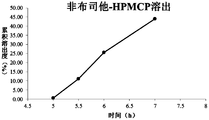
图7.实施例10溶出曲线图;
图8.实施例11溶出曲线图。
以下为本发明的具体实施方式,实施例是为进一步描述本发明而不是限制本发明,凡与本发明等效的技术方案均属于本发明的保护范围。
本发明实施例中所用HPMCAS购买自日本信越化学株式会社,热熔挤出仪为赛默飞的双螺杆热熔挤出仪器。
实施例1.由速释非布司他微片和在pH6以上释放药物的非布司他漂浮颗粒A组成的非布司他制剂1
单个胶囊包含速释组分和延迟释放漂浮组分,速释组分为含8mg非布司他活性成分 的微片,延迟释放漂浮组分为含32mg非布司他活性成分的颗粒A,颗粒A在pH6以上释放。速释非布司他微片由湿法制粒工艺制备,其处方组成列在下表1中。
表1.速释非布司他微片处方
| 作用 | 8mg片 | |
| 非布司他 | 主药 | 13.3% |
| 乳糖 | 填充剂 | 35.0% |
| MCC | 填充剂 | 27.3% |
| 交联羧甲基纤维素纳 | 崩解剂 | 10.8% |
| 微粉硅胶 | 助流剂 | 2.2% |
| HPMC-E5 | 黏合剂 | 3.6% |
| 水 | 黏合剂溶剂 | |
| 羧甲基淀粉钠 | 崩解剂 | 8.3% |
| 硬脂酸镁 | 润滑剂 | 1.2% |
具体制备工艺:湿法制粒机制粒,将原辅料混合,加入粘合剂,搅拌,1500rpm切刀剪切后过筛,烘干至水分<3%,过30目筛,后采用创博C&C600B单冲压片机,4.76mm冲头压片。片重:理论61.5mg,实际控制在59-65mg,硬度约30N。
非布司他漂颗粒A由热熔挤出工艺制备,其处方组成列在下表2中。
表2:非布司他漂浮颗粒A处方
| 含量(g) | 百分比 | |
| 非布司他 | 150 | 25% |
| HPMCAS MG | 450 | 75% |
称取非布司他和HPMCAS MG在混料机中混合均匀,热熔挤出仪(赛默飞),温度设置如表3。
表3.热熔挤出机温度(℃)
| Die | Zone8 | Zone7 | Zone6 | Zone5 | Zone4 | Zone3 | Zone2 |
| 140 | 110 | 90 | 70 | 40 | 30 | 30 | 30 |
具体在Zone4加乙醇,速度为700ul/min,Zone2喂料,速度为4g/min,螺杆的转速设定为100rpm,将挤出物切成段,乙醇残余量为3%,后将挤出物60℃烘箱烘干2h,乙 醇含量小于0.5%,烘干后粉碎至2mm。
实施例2.由速释非布司他微丸和在pH6以上快速释放药物的非布司他延迟释放漂浮颗粒B组成的非布司他制剂2
单个胶囊包含速释组分和延迟释放漂浮组分,速释组分为含8mg非布司他活性成分的微丸,胶囊的剩余部分包含共含32mg非布司他的非布司他延迟释放漂浮颗粒B,此延迟释放漂浮肠溶颗粒B在pH6以上快速释放。速释非布司他微丸由空白丸芯上药工艺制备,其处方组成如表4。
表4.速释非布司他微丸处方组成:
| 8mg微丸 | |
| 非布司他 | 32% |
| 糖丸 | 52% |
| 羟丙甲纤维素 | 18% |
非布司他控释漂浮颗粒B由热熔挤出工艺制备,其处方组成如表5。
表5.非布司他漂浮颗粒B处方
| 含量 | |
| 非布司他 | 25% |
| 羟丙甲基纤维素 | 60% |
| HPMCAS MG | 15% |
称取150g非布司他和90g HPMCAS MG以及360g羟丙甲基纤维素在混料机中混合均匀。热熔挤出机温度设置如表3,在热熔挤出机的Zone4加乙醇,速度为700ul/min,Zone2喂料,速度为4g/min,螺杆的转速设定为100rpm,将挤出物切成段,后将挤出物60℃烘箱烘干2h,乙醇含量<0.5%。烘干后粉碎至4mm,既得非布司他胃漂浮控释颗粒B。
实施例3.由20%速释非布司他微片和80%在pH5以上释放药物的非布司他漂浮颗粒C组成的非布司他制剂3
单个胶囊包含速释组分和控释漂浮组分,速释组分为含8mg非布司他的微片,胶囊的剩余部分包含共含32mg非布司他胃漂浮颗粒C,此胃漂浮颗粒C在pH5以上释放。速释非布司他微片由湿法制粒工艺制备,其处方组成列在上表1中。非布司他控释漂浮颗粒C由热熔挤出工艺制备,其处方组成如表6。
表6.非布司他漂浮颗粒C处方
| 含量 | |
| 非布司他 | 25% |
| HPMCAS LG | 75% |
将150g非布司他和450g HPMCAS LG混合均匀后,进行热熔挤出,温度参数设置同制备颗粒A。热熔挤出机的Zone4加乙醇,速度为600ul/min,Zone2喂料,速度为2g/min,螺杆转速为60rpm,将挤出物切割成段,后将挤出物60℃烘箱烘干2h,乙醇含量<0.5%,烘干后粉碎至4mm长颗粒,既得非布司他漂浮颗粒C。
实施例4由40%速释非布司他微片和60%在pH5以上释放药物的非布司他漂浮颗粒C组成的非布司他制剂4
单个胶囊包含速释组分和控释漂浮组分,速释组分为含16mg非布司他的微片,胶囊的剩余部分包含共含24mg非布司他延迟释放漂浮颗粒C,此延迟释放漂浮控释颗粒C在pH5以上释放。速释非布司他微片由湿法制粒工艺制备,其处方组成列在上表1中,非布司他控释漂浮颗粒C同实施例3。
实施例5由速释非布司他微丸和延迟释放非布司他漂浮颗粒D组成的非布司他制剂5
单个胶囊包含速释组分和控释漂浮组分,速释组分为含8mg非布司他活性成分的微丸,胶囊的剩余部分包含共含32mg非布司他的非布司他胃延迟释放漂浮颗粒D,此胃漂浮延迟释放颗粒D在胃液中漂浮的同时缓慢释放。速释非布司他微丸由空白丸芯上药工艺制备,其处方组成列在上表4中。
非布司他胃漂浮控释颗粒D由热熔挤出工艺制备,处方组成如表7。
表7.非布司他漂浮颗粒D处方

将非布司他与季胺基甲基丙烯酸酯共聚物B型及羟丙甲纤维素混合均匀后,在湿法制粒机中剪切,同时缓慢滴加柠檬酸三乙酯。将混合好的物料进行热熔挤出,温度参数 设置同表3,在Zone4加乙醇,速度为1000ul/min,Zone2喂料,速度为4g/min,螺杆的转速设定为100rpm,将挤出物切成段,后将挤出物60℃烘箱烘干2h,乙醇含量<0.5%。烘干后粉碎至4mm长颗粒,既得非布司他胃漂浮控释颗粒D。
实施例6由速释非布司他微片和在延迟释放非布司他漂浮颗粒E组成的非布司他制剂6
单个胶囊包含速释组分和控释漂浮组分,速释组分为含8mg非布司他的微片,胶囊的剩余部分包含共含32mg非布司他延迟释放漂浮颗粒E,此胃漂浮控释颗粒E在胃液中漂浮的同时缓慢释放。速释非布司他微片由湿法制粒工艺制备,其处方组成列如表1。非布司他胃漂浮延迟释放颗粒E由热熔挤出工艺制备,其处方组成如表8。
表8.非布司他漂浮颗粒E处方

将非布司他与其他赋形剂按处方量混合均匀后进行热熔挤出,温度参数设置如表3。在Zone4加乙醇,速度为300ul/min,Zone2喂料,速度为4g/min,螺杆的转速设定为100rpm,将挤出物切成段,乙醇残余量为1.5%,后将挤出物60℃烘箱烘干2h,乙醇含量<0.5%,粉碎至4mm长颗粒,既得非布司他胃漂浮控释颗粒E。
实施例7由速释非布司他微片和在控释非布司他漂浮颗粒F组成的非布司他制剂7
单个胶囊包含速释组分和控释漂浮组分,速释组分为含8mg非布司他的微片,胶囊的剩余部分包含共含32mg非布司他胃漂浮颗粒F,此胃漂浮控释颗粒E在胃液中漂浮的同时缓慢释放。速释非布司他微片由湿法制粒工艺制备,其处方组成列在表1中。非布司他胃漂浮控释颗粒F由热熔挤出工艺制备,其处方组成如表9。
表9.非布司他漂浮颗粒F处方


将非布司他与其他赋形剂按处方量混合均匀后进行热熔挤出,温度参数设置如表3。在Zone4加乙醇,速度为300ul/min,Zone2喂料,速度为4g/min,螺杆的转速设定为100rpm,将挤出物切成段,后将挤出物60℃烘箱烘干2h,乙醇含量<0.5%,烘干后粉碎至4mm长颗粒,既得非布司他胃漂浮控释颗粒F。
实施例8由速释非布司他微片和在pH5.5以上释放药物的非布司他漂浮颗粒G组成的非布司他制剂8
单个胶囊包含速释组分和延迟释放漂浮组分,速释组分为含8mg非布司他活性成分的微片,延迟释放漂浮组分为含32mg非布司他活性成分的颗粒G,颗粒A在pH5.5以上释放。速释非布司他微片由湿法制粒工艺制备,其处方组成如表1,非布司他延迟释放漂浮颗粒G处方组成如表10,热熔挤出及温度设置如表11所示。
表10.非布司他延迟释放漂浮颗粒G
| 比例 | |
| 非布司他 | 25% |
| HPMCAS LF | 75% |
Pharma11热熔挤出仪(赛默飞),设定温度如表11。
表11.热熔挤出机温度设置(℃)。
| Die | Zone8 | Zone7 | Zone6 | Zone5 | Zone4 | Zone3 | Zone2 |
| 140 | 130 | 100 | 90 | 80 | 70 | 60 | 50 |
具体在Zone2喂料,Zone4加水,喂料速度为5g/min,加水速度为0.9ml/min,螺杆转速设置为100rpm,挤出物切成段,后将挤出物60℃烘箱烘干2h,水分<3%,烘干后粉碎至2mm,测试密度为0.5g/cm
3,将所得非布司他颗粒G与实施例1所得的非布司他微片灌胶囊,得非布司他制剂8。
实施例9人体药代动力学研究
以市售40mg规格非布司他片作为参比制剂,与实施例3和实施例4所获得的制剂一同进行人体药代动力学研究,研究结果见下表12。
表12.不同制剂药代动力学参数


C
max:最大血药峰浓度
T
max:最大血药浓度时间
AUC
0→∞:药时曲线面积
T
C≥100μg/mL:有效血药浓度C≥100μg/mL时间
Fr:相对生物利用度
药代动力学研究结果表明,与市售非布司他片参比制剂相比,实施例3和实施例4能够降低药物的最大血药峰浓度,大幅延长作用时间,发挥药物的控释治疗作用,从而降低药物的副作用,结果如图1所示。
实验例1
使用300mL的pH5.0FaSSGF为溶出介质,观察胃漂浮颗粒在模拟胃液下的漂浮情况,经观察,各颗粒均立即起漂,且长时间漂浮,观察至24小时后,各颗粒仍然维持漂浮,停止观察。
根据中国药典2015版二部附录溶出检测方法1(篮法,100rpm,37℃),检测非布司他延迟释放漂浮颗粒A、颗粒B、颗粒C、颗粒D、颗粒E、颗粒F、颗粒G。
使用300mL的pH5.0FaSSGF为溶出介质,检测胃漂浮颗粒在模拟胃液下的溶出情况,再换用900mL的pH6.5FaSSIF为溶出介质,检测胃漂浮颗粒在模拟肠液下的溶出情况,结果如图2、图3(颗粒G)所示。
根据中国药典2015版二部附录溶出检测方法1(篮法,100rpm,37℃),使用900mL的pH 6.8的磷酸盐缓冲液为溶出介质,检测实施例3和实施例4中得到制剂3、制剂4及速释微片的溶出曲线,结果如图4所示。
溶出速度可以提示制剂在胃肠道环境下药物从制剂出释放的速度,更低的释放速度反应在药动学数据上为更低的Cmax及更长的释放时间。与普通速释片相比,本发明中所制备的制剂溶出速率有明显降低,可推测出与速释片相比,本发明中的制剂(实施例1-7)均可实现降低C
max值,延长有效血药浓度时间的目的。
用电镜扫描观察颗粒G的性状,发现在电镜下颗粒G为多孔状,具体见图5。
对于非布司他原料及挤出后非布司他的晶型状态测试粉末衍射图谱,具体如图6所示,热熔挤出后非布司他依旧保持为晶型状态。
实施例10非布司他(30mg)非布司他:HPMCP=1:3
将非布司他和HPMCP混合均匀,进行热熔挤出,温度参数设置如表13(℃)。
表13
| Zone2 | Zone3 | Zone4 | Zone5 | Zone6 | Zone7 | Zone8 | Die |
| 40 | 50 | 60 | 70 | 80 | 80 | 100 | 130 |
具体在Zone2喂料,Zone4加水,螺杆转速设置为100rpm,加水速度为700-900ul/min,将挤出物60℃烘箱烘干2h,水分<3%,烘干后粉碎至2mm。
现象:样品能够膨胀,且样品能够漂浮。
实施例10溶出数据如图7所示。
实施例11非布司他(30mg)非布司他:HPMCP=1:3
将非布司他和HPMCP混合均匀,进行热熔挤出,温度参数设置如表14(℃)。
表14
| Zone2 | Zone3 | Zone4 | Zone5 | Zone6 | Zone7 | Zone8 | Die |
| 30 | 30 | 40 | 50 | 80 | 90 | 110 | 130 |
具体在Zone2喂料,Zone4加乙醇,螺杆转速设置为50rpm,加乙醇速度为700/min,将挤出物60℃烘箱烘干2h,水分<3%,烘干后粉碎至2mm。
现象:样品能够膨胀且样品能够漂浮。
实施例11溶出数据如图8所示。
虽然以上描述了本发明的具体实施方式,但是本领域的技术人员应当理解,这些仅是举例说明,在不背离本发明的原理和实质的前提下,可以对这些实施方式做出多种变更或修改。因此,本发明的保护范围由所附权利要求书限定。
Claims (32)
- 一种非布司他控释组合物,所述组合物包含:a)非布司他速释组分,b)非布司他漂浮组分。
- 根据权利要求1所述的非布司他控释组合物,其特征在于所述非布司他漂浮组分为在pH≥5.5的条件下释放药物的延迟释放漂浮组分。
- 根据权利要求1或2所述的非布司他控释组合物,其特征在于所述非布司他延迟释放漂浮组分通过热熔挤出的方法制备。
- 根据权利要求1-3任一项所述的非布司他控释组合物,其特征在于所述非布司他延迟释放漂浮组分含有至少一种肠溶性聚合物。
- 根据权利要求4所述的非布司他控释组合物,其特征在于所述肠溶性聚合物选自聚乙烯醇乙酸苯二甲酸酯、邻苯二甲酸乙酸纤维素、1,2,4-苯三甲酸乙酸纤维素、邻苯二甲酸羟丙基甲基纤维素、1,2,4-苯三甲酸羟丙基甲基纤维素、琥珀酸乙酸纤维素、醋酸羟丙甲纤维素琥珀酸酯、醋酸羟丙基甲基纤维素酞酸酯、甲基丙烯酸-丙烯酸乙酯共聚物、甲基乙烯基醚-马来酸酐共聚物、甲基丙烯酸-丙烯酸乙酯共聚物水分散体、甲基丙烯酸-甲基丙烯酸甲酯共聚物、丙烯酸乙酯-甲基丙烯酸甲酯-甲基丙烯酸氯化三甲胺基乙酯共聚物、聚乙酸乙烯酯、乙基纤维素、聚醋酸乙烯酯与聚乙烯吡咯烷酮K30混合物,优选醋酸羟丙甲纤维素琥珀酸酯、甲基丙烯酸-甲基丙烯酸甲酯共聚物、甲基丙烯酸-丙烯酸乙酯共聚物、邻苯二甲酸羟丙基甲基纤维素。
- 根据权利要求4或5所述的非布司他控释组合物,其特征在于所述非布司他延迟释放漂浮组分中非布司他与肠溶性聚合物的比例选自1:0.1-1:100,优选1:0.1-1:50,更优选1:1-1:25。
- 根据权利要求1-6任一项所述的非布司他控释组合物,其特征在于速释组分与漂浮组分中非布司他的质量比为1:0.1-1:20,优选1:0.5-1:15,最优选1:1-1:10,非布司他总量为10-120mg,优选20-100mg,最优选30-90mg。
- 根据权利要求3所述的非布司他控释组合物,其特征在于在所述热熔挤出前或者热熔挤出过程中加入溶剂。
- 根据权利要求8所述的非布司他控释组合物,其特征在于所述溶剂沸点选自30-110℃。
- 根据权利要求9所述的非布司他控释组合物,其特征在于所述溶剂选自水、甲醇、乙醇、异丙醇、丙酮、戊烷、己烷、庚烷、环己烷、二氯甲烷、四氢呋喃的至少一种, 优选水和乙醇。
- 根据权利要求1-10任一项所述的非布司他控释组合物,其特征在于所述非布司他漂浮组分为多单元形式。
- 根据权利要求11所述的非布司他控释组合物,其特征在于所述多单元形式为微片、微丸、颗粒,优选颗粒。
- 根据权利要求1-10任一项所述的非布司他控释组合物,其特征在于所述非布司他漂浮组分为多孔状。
- 根据权利要求1-10任一项所述的非布司他控释组合物,其特征在于所述非布司他漂浮组分在pH5.0的FaSSGF的溶液中立即起漂。
- 根据权利要求1-10任一项所述的非布司他控释组合物,其特征在于所述非布司他漂浮组分在pH5.0的FaSSGF的溶液中漂浮时间大于24h。
- 根据权利要求1-10任一项所述的非布司他控释组合物,其特征在于所述非布司他漂浮组分密度为0.1-1.0g/cm 3,优选0.2-0.8g/cm 3,最优选0.3-0.7g/cm 3。
- 根据权利要求1-10任一项所述的非布司他控释组合物,其特征在于所述非布司他漂浮组分在300mL的pH5.0的FaSSGF的溶出介质中,篮法,37℃,100rpm,5h的累积溶出小于30%,更优选小于20%,最优选小于10%。
- 根据权利要求1-10任一项所述的控释非布司他组合物,其特征在于所述控释组合物以口服给药的方式被患者服用后,可在患者体内维持大于0.1μg/mL的非布司他的血浆浓度时间为12h-24h,优选13-22h,更有选15-20h。
- 根据权利要求3-10任一项所述的非布司他控释组合物,其特征在于所述非布司漂浮组分中非布司他在热熔挤出后保持晶型状态。
- 根据权利要求1-10任一项所述的非布司他控释组合物在制备用于治疗治疗痛风、高尿酸血症、前列腺炎、炎性肠病、QT间期延长、心肌梗塞、心脏肥大、高血压、肾石病、慢性肾脏疾病、代谢综合征、糖尿病、糖尿病性肾病、充血性心力衰竭的疾病中的用途。
- 根据权利要求1-10任一项所述的非布司他控释组合物,其特征在于所述非布司他延迟释放漂浮组分任选包含至少一种塑化剂,所述塑化剂选自枸橼酸三乙酯、枸橼酸三丁酯、聚乙二醇、邻苯二甲酸三乙酯、邻苯二甲酸三丁酯、癸二酸二丁酯、癸二酸二乙酯、硬脂酸甘油酯、丁二酸二乙酯、丙二醇、蓖麻油和三乙酸甘油酯,优选枸橼酸三乙酯,所述增塑剂的含量为0.01%-50%,优选0.1%-30%,最优选2.5%-15%(质量百分比,以固体组分的总质量为100计算)。
- 根据权利要求1-10任一项所述的非布司他控释组合物,其特征在于所述速释组分和/或延迟释放漂浮组分还包含至少一种药学上可接受的其他赋形剂。
- 根据权利要求4所述的非布司他控释组合物,其特征在于所述赋形剂选自填充剂、润滑剂、粘合剂、崩解剂。
- 根据权利要求1-10任一项所述的非布司他控释组合物,其为片剂或胶囊。
- 一种权利要求3-10任一项所述的非布司他控释组合物的制备方法,其特征在于包含以下步骤:1)在热熔挤出前将至少一种溶剂、非布司他和至少一种肠溶性聚合物混合得预混粗品或者在熔挤出过程中在线将至少一种溶剂、非布司他和至少一种肠溶性聚合物混合得预混粗品;2)预混粗品通过挤出机的加热螺杆区后经口模离开得挤出物。
- 根据权利要求25所述的制备方法,其特征在于所述溶剂优选沸点在30-110℃之间的溶剂。
- 根据权利要求26所述的制备方法,其特征在于所述溶剂选自水、甲醇、乙醇、异丙醇、丙酮、戊烷、己烷、庚烷、环己烷、二氯甲烷、四氢呋喃,优选水、乙醇。
- 根据权利要求25所述的制备方法,其特征在于所述溶剂的用量为0.1%-70%,优选1%-50%,最优选10%-30%(质量百分比,以固体组分的总质量为100计算)。
- 根据权利要求25所述的制备方法,其特征在于口模温度为100-200℃,优选110-180℃,更优选120-160℃。
- 根据权利要求25所述的制备方法,其特征在于溶剂注入螺杆区温度为10-90℃。
- 根据权利要求25-30任一项所述的制备方法,其特征在于还包含任选以下的步骤:1)将挤出物冷却的步骤,2)将挤出物去溶剂的步骤;3)将挤出物切割的步骤。
- 根据权利要求2-30任一项所述的制备方法,其特征在于所述挤出机为单螺杆挤出机、啮合螺杆挤出机、双螺杆挤出机,优选双螺杆挤出机。
Priority Applications (1)
| Application Number | Priority Date | Filing Date | Title |
|---|---|---|---|
| CN201880008325.0A CN110214008A (zh) | 2017-06-14 | 2018-06-13 | 一种非布司他控释组合物及其制备方法 |
Applications Claiming Priority (2)
| Application Number | Priority Date | Filing Date | Title |
|---|---|---|---|
| CN201710448092.3 | 2017-06-14 | ||
| CN201710448092 | 2017-06-14 |
Publications (1)
| Publication Number | Publication Date |
|---|---|
| WO2018228440A1 true WO2018228440A1 (zh) | 2018-12-20 |
Family
ID=64658893
Family Applications (1)
| Application Number | Title | Priority Date | Filing Date |
|---|---|---|---|
| PCT/CN2018/091101 Ceased WO2018228440A1 (zh) | 2017-06-14 | 2018-06-13 | 一种非布司他控释组合物及其制备方法 |
Country Status (3)
| Country | Link |
|---|---|
| CN (1) | CN110214008A (zh) |
| TW (1) | TWI745598B (zh) |
| WO (1) | WO2018228440A1 (zh) |
Cited By (1)
| Publication number | Priority date | Publication date | Assignee | Title |
|---|---|---|---|---|
| CN112972396A (zh) * | 2019-12-17 | 2021-06-18 | 南京海辰药业股份有限公司 | 一种非布司他控释组合物及其制备方法 |
Families Citing this family (1)
| Publication number | Priority date | Publication date | Assignee | Title |
|---|---|---|---|---|
| CN112336696B (zh) * | 2020-12-01 | 2022-08-05 | 苏州中化药品工业有限公司 | 一种长效脉冲制剂及其制备方法 |
Citations (3)
| Publication number | Priority date | Publication date | Assignee | Title |
|---|---|---|---|---|
| US5626876A (en) * | 1988-02-05 | 1997-05-06 | Lts Lohmann Therapie-Systeme Gmbh & Co., Kg | Floating system for oral therapy |
| CN103210084A (zh) * | 2010-06-16 | 2013-07-17 | 武田制药美国有限公司 | 黄嘌呤氧化还原酶抑制剂或黄嘌呤氧化酶抑制剂的新的改进的释放剂型 |
| CN103432131A (zh) * | 2013-09-11 | 2013-12-11 | 中国药科大学 | 一种含有盐酸吡格列酮和盐酸二甲双胍的复方制剂及其制备方法 |
Family Cites Families (2)
| Publication number | Priority date | Publication date | Assignee | Title |
|---|---|---|---|---|
| GB0909243D0 (en) * | 2009-05-29 | 2009-07-15 | Univ Dundee | Angina treatment |
| CN101658505A (zh) * | 2009-09-29 | 2010-03-03 | 北京华禧联合科技发展有限公司 | 非布索坦的缓释制剂及其制备方法 |
-
2018
- 2018-06-13 WO PCT/CN2018/091101 patent/WO2018228440A1/zh not_active Ceased
- 2018-06-13 CN CN201880008325.0A patent/CN110214008A/zh active Pending
- 2018-06-14 TW TW107120542A patent/TWI745598B/zh not_active IP Right Cessation
Patent Citations (3)
| Publication number | Priority date | Publication date | Assignee | Title |
|---|---|---|---|---|
| US5626876A (en) * | 1988-02-05 | 1997-05-06 | Lts Lohmann Therapie-Systeme Gmbh & Co., Kg | Floating system for oral therapy |
| CN103210084A (zh) * | 2010-06-16 | 2013-07-17 | 武田制药美国有限公司 | 黄嘌呤氧化还原酶抑制剂或黄嘌呤氧化酶抑制剂的新的改进的释放剂型 |
| CN103432131A (zh) * | 2013-09-11 | 2013-12-11 | 中国药科大学 | 一种含有盐酸吡格列酮和盐酸二甲双胍的复方制剂及其制备方法 |
Cited By (1)
| Publication number | Priority date | Publication date | Assignee | Title |
|---|---|---|---|---|
| CN112972396A (zh) * | 2019-12-17 | 2021-06-18 | 南京海辰药业股份有限公司 | 一种非布司他控释组合物及其制备方法 |
Also Published As
| Publication number | Publication date |
|---|---|
| TWI745598B (zh) | 2021-11-11 |
| CN110214008A (zh) | 2019-09-06 |
| TW201904572A (zh) | 2019-02-01 |
Similar Documents
| Publication | Publication Date | Title |
|---|---|---|
| JP7551182B2 (ja) | 難溶性薬剤の経口徐放性組成物およびその調製方法 | |
| JP6976946B2 (ja) | 生理活性の強い、urat1のインヒビターを含む医薬組成物 | |
| WO2018228441A1 (zh) | 一种控释药物组合物及其制备方法 | |
| CN101888828A (zh) | 脉冲胃滞留剂型 | |
| CN105658207A (zh) | 用于以低的日剂量施用的含富马酸二甲酯的药物组合物 | |
| JP2008303223A (ja) | 脈動用量薬剤経口送達システム | |
| JPH10194969A (ja) | 錠剤組成物 | |
| CN101636152A (zh) | 含有西洛他唑的控释制剂及其制备方法 | |
| CN101631533B (zh) | 含有西洛他唑的控释制剂及其制备方法 | |
| CN113476421B (zh) | 一种非布司他的控释组合物及其制备方法 | |
| CN1744889A (zh) | 坦洛新的控释药物组合物 | |
| EP2533766B1 (en) | Pharmaceutical mini-tablets for sustained release of flecainide acetate | |
| CN103751137B (zh) | 雷诺嗪多单元缓释微丸片 | |
| KR20120075029A (ko) | 위체류 약물 전달시스템을 이용한 경구용 방출제어형 레바미피드-함유 이층정 제제 및 그 제조방법 | |
| KR102104507B1 (ko) | 팔미토일-l-프롤릴-l-프롤릴-글리실-l-타이로신 나트륨을 포함하는 약제학적 제제 및 이의 제조방법 | |
| CN115721600B (zh) | 一种胃滞留型普瑞巴林缓释组合物及其制备方法 | |
| WO2018228440A1 (zh) | 一种非布司他控释组合物及其制备方法 | |
| TW202312988A (zh) | 沙庫巴曲纈沙坦鈉緩釋組合物、其製備方法及應用 | |
| CN115297848B (zh) | 一种非布司他片 | |
| KR101925590B1 (ko) | 개선된 생체이용률을 갖는 페노피브릭산 제제 | |
| CN114712306A (zh) | 一种适于口服的盐酸氨溴索控释混悬剂及其制备方法 | |
| EP4132472A1 (en) | Oleyl phosphocholine containing granulates | |
| RU2277416C2 (ru) | Препараты для перорального введения с замедленным высвобождением | |
| JP7642026B2 (ja) | 腸溶性製剤 | |
| JP2015516971A (ja) | ざ瘡の処置方法 |
Legal Events
| Date | Code | Title | Description |
|---|---|---|---|
| 121 | Ep: the epo has been informed by wipo that ep was designated in this application |
Ref document number: 18817407 Country of ref document: EP Kind code of ref document: A1 |
|
| NENP | Non-entry into the national phase |
Ref country code: DE |
|
| 122 | Ep: pct application non-entry in european phase |
Ref document number: 18817407 Country of ref document: EP Kind code of ref document: A1 |