WO2018186181A1 - 遮光性顔料組成物及びディスプレイ用遮光性部材 - Google Patents
遮光性顔料組成物及びディスプレイ用遮光性部材 Download PDFInfo
- Publication number
- WO2018186181A1 WO2018186181A1 PCT/JP2018/011310 JP2018011310W WO2018186181A1 WO 2018186181 A1 WO2018186181 A1 WO 2018186181A1 JP 2018011310 W JP2018011310 W JP 2018011310W WO 2018186181 A1 WO2018186181 A1 WO 2018186181A1
- Authority
- WO
- WIPO (PCT)
- Prior art keywords
- light
- pigment
- parts
- shielding
- substituent
- Prior art date
- Legal status (The legal status is an assumption and is not a legal conclusion. Google has not performed a legal analysis and makes no representation as to the accuracy of the status listed.)
- Ceased
Links
Classifications
-
- C—CHEMISTRY; METALLURGY
- C09—DYES; PAINTS; POLISHES; NATURAL RESINS; ADHESIVES; COMPOSITIONS NOT OTHERWISE PROVIDED FOR; APPLICATIONS OF MATERIALS NOT OTHERWISE PROVIDED FOR
- C09D—COATING COMPOSITIONS, e.g. PAINTS, VARNISHES OR LACQUERS; FILLING PASTES; CHEMICAL PAINT OR INK REMOVERS; INKS; CORRECTING FLUIDS; WOODSTAINS; PASTES OR SOLIDS FOR COLOURING OR PRINTING; USE OF MATERIALS THEREFOR
- C09D17/00—Pigment pastes, e.g. for mixing in paints
- C09D17/003—Pigment pastes, e.g. for mixing in paints containing an organic pigment
-
- C—CHEMISTRY; METALLURGY
- C09—DYES; PAINTS; POLISHES; NATURAL RESINS; ADHESIVES; COMPOSITIONS NOT OTHERWISE PROVIDED FOR; APPLICATIONS OF MATERIALS NOT OTHERWISE PROVIDED FOR
- C09B—ORGANIC DYES OR CLOSELY-RELATED COMPOUNDS FOR PRODUCING DYES, e.g. PIGMENTS; MORDANTS; LAKES
- C09B67/00—Influencing the physical, e.g. the dyeing or printing properties of dyestuffs without chemical reactions, e.g. by treating with solvents grinding or grinding assistants, coating of pigments or dyes; Process features in the making of dyestuff preparations; Dyestuff preparations of a special physical nature, e.g. tablets, films
- C09B67/0033—Blends of pigments; Mixtured crystals; Solid solutions
-
- C—CHEMISTRY; METALLURGY
- C09—DYES; PAINTS; POLISHES; NATURAL RESINS; ADHESIVES; COMPOSITIONS NOT OTHERWISE PROVIDED FOR; APPLICATIONS OF MATERIALS NOT OTHERWISE PROVIDED FOR
- C09D—COATING COMPOSITIONS, e.g. PAINTS, VARNISHES OR LACQUERS; FILLING PASTES; CHEMICAL PAINT OR INK REMOVERS; INKS; CORRECTING FLUIDS; WOODSTAINS; PASTES OR SOLIDS FOR COLOURING OR PRINTING; USE OF MATERIALS THEREFOR
- C09D17/00—Pigment pastes, e.g. for mixing in paints
-
- C—CHEMISTRY; METALLURGY
- C09—DYES; PAINTS; POLISHES; NATURAL RESINS; ADHESIVES; COMPOSITIONS NOT OTHERWISE PROVIDED FOR; APPLICATIONS OF MATERIALS NOT OTHERWISE PROVIDED FOR
- C09D—COATING COMPOSITIONS, e.g. PAINTS, VARNISHES OR LACQUERS; FILLING PASTES; CHEMICAL PAINT OR INK REMOVERS; INKS; CORRECTING FLUIDS; WOODSTAINS; PASTES OR SOLIDS FOR COLOURING OR PRINTING; USE OF MATERIALS THEREFOR
- C09D5/00—Coating compositions, e.g. paints, varnishes or lacquers, characterised by their physical nature or the effects produced; Filling pastes
-
- G—PHYSICS
- G02—OPTICS
- G02B—OPTICAL ELEMENTS, SYSTEMS OR APPARATUS
- G02B5/00—Optical elements other than lenses
- G02B5/20—Filters
-
- G—PHYSICS
- G02—OPTICS
- G02F—OPTICAL DEVICES OR ARRANGEMENTS FOR THE CONTROL OF LIGHT BY MODIFICATION OF THE OPTICAL PROPERTIES OF THE MEDIA OF THE ELEMENTS INVOLVED THEREIN; NON-LINEAR OPTICS; FREQUENCY-CHANGING OF LIGHT; OPTICAL LOGIC ELEMENTS; OPTICAL ANALOGUE/DIGITAL CONVERTERS
- G02F1/00—Devices or arrangements for the control of the intensity, colour, phase, polarisation or direction of light arriving from an independent light source, e.g. switching, gating or modulating; Non-linear optics
- G02F1/01—Devices or arrangements for the control of the intensity, colour, phase, polarisation or direction of light arriving from an independent light source, e.g. switching, gating or modulating; Non-linear optics for the control of the intensity, phase, polarisation or colour
- G02F1/13—Devices or arrangements for the control of the intensity, colour, phase, polarisation or direction of light arriving from an independent light source, e.g. switching, gating or modulating; Non-linear optics for the control of the intensity, phase, polarisation or colour based on liquid crystals, e.g. single liquid crystal display cells
- G02F1/133—Constructional arrangements; Operation of liquid crystal cells; Circuit arrangements
- G02F1/1333—Constructional arrangements; Manufacturing methods
- G02F1/1335—Structural association of cells with optical devices, e.g. polarisers or reflectors
Definitions
- the present invention relates to a light-shielding pigment composition capable of realizing a high optical density and a light-shielding member for a display using the light-shielding pigment composition.
- a liquid crystal panel in which a color filter on array (COA) in which a color filter substrate and a TFT (Thin Film Transistor) array substrate are integrated is attracting attention.
- COA color filter on array
- TFT Thin Film Transistor
- Such a resin black matrix for COA is required to have a thick film because it requires a high light shielding property.
- the difference in crosslink density in the film thickness direction at the exposed portion increases, so that high sensitivity can be achieved and a black pattern with a good shape can be obtained.
- the conventionally known blue pigment has a small absorption intensity near 555 nm, which greatly contributes to the OD value representing the light shielding property (the numerical value representing the optical density and the light shielding performance, indicating that the larger the numerical value is, the higher the light shielding performance).
- the absorption intensity at 365 nm used for curing the ultraviolet curable resin is large, when it is black combined with the short wavelength region absorption pigment and the medium wavelength region absorption pigment, the light shielding is insufficient and the exposure sensitivity is reduced. There was a problem. Under such circumstances, a blue pigment having a large absorption intensity at 555 nm and a small absorption intensity at 365 nm, which greatly contributes to the optical density, has been demanded.
- the problem to be solved by the present invention is to provide a light-shielding pigment composition having high optical density and high exposure sensitivity. Moreover, it is providing the light-shielding member for a display containing this light-shielding pigment composition.
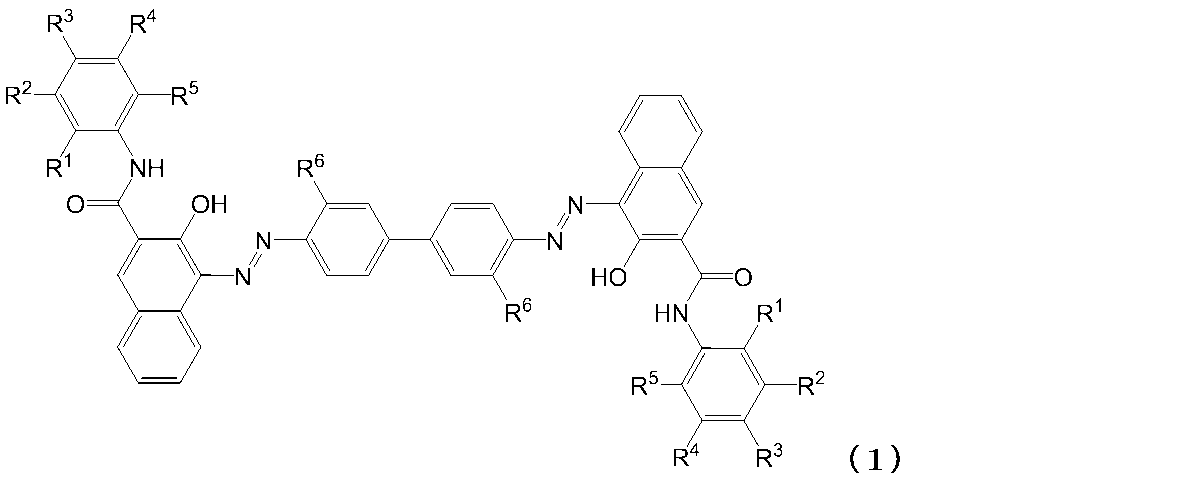
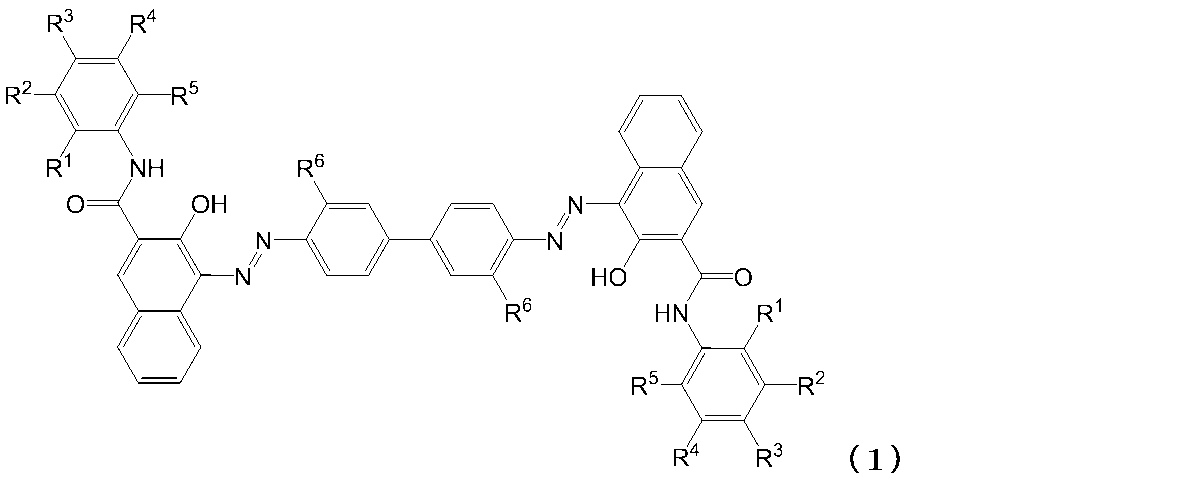
- the present inventors paid attention to a blue pigment that has a great influence on the performance of a light-shielding composition containing a plurality of organic pigments. While many blue pigments are known, the present inventors have found that the above problems can be solved by using a specific organic pigment described later as a blue pigment, and have completed the present invention. That is, the present invention is a light-shielding pigment composition containing two or more organic pigments, As an organic pigment, at least the following general formula (1):
- R 1 to R 6 each independently represents a hydrogen atom, a halogen atom, a nitro group, an alkoxy group which may have a substituent, an amino group which may have a substituent, or a substituent.
- a light-shielding pigment composition comprising an organic pigment (A).
- the organic pigment (A) is C.I. I. It is related with the light-shielding pigment composition characterized by being the pigment 25 or 26.
- the organic pigment (A) has a maximum absorbance in the following conditions (condition: visible light region (380 nm to 780 nm) at a wavelength of 580 nm to 780 nm, and the absorbance at 365 nm is 50, which is the maximum absorbance. % Or less, the absorbance at 555 nm and 700 nm is 50% or more of the maximum absorbance.) And a light-shielding pigment composition characterized by being an organic pigment (A).
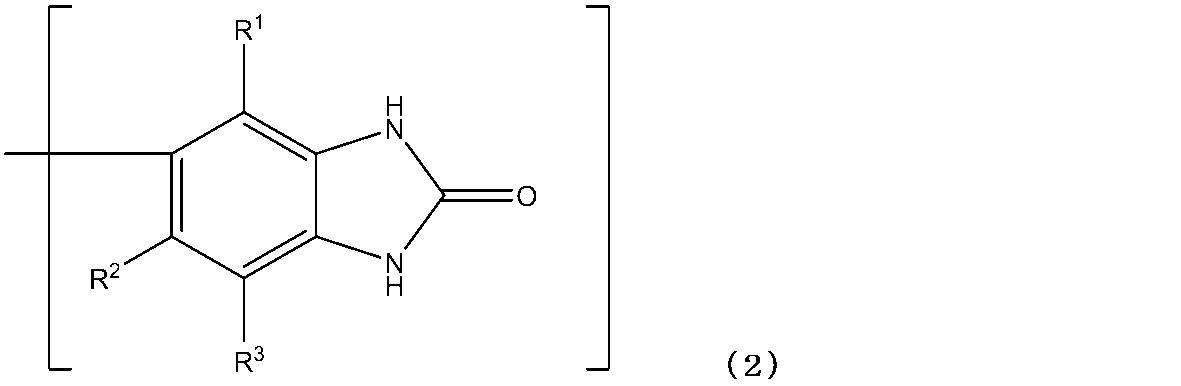
- the light-shielding pigment composition of the present invention further comprises a benzimidazolone pigment having a chemical structure represented by the following general formula (2) and general formula (3)
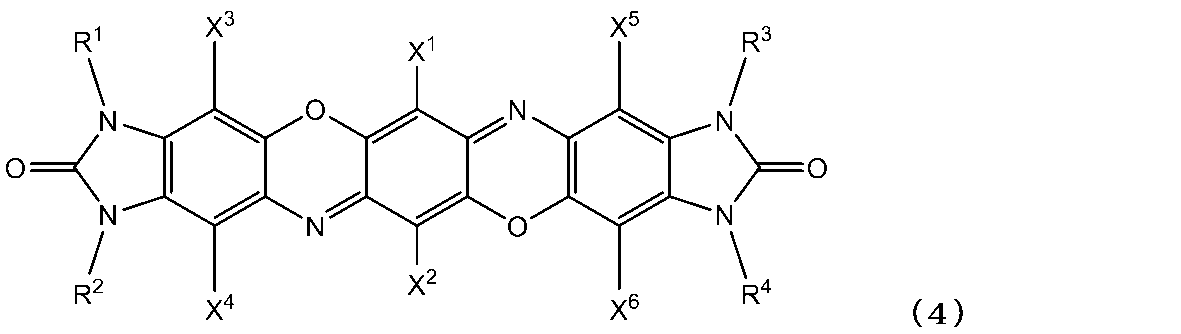
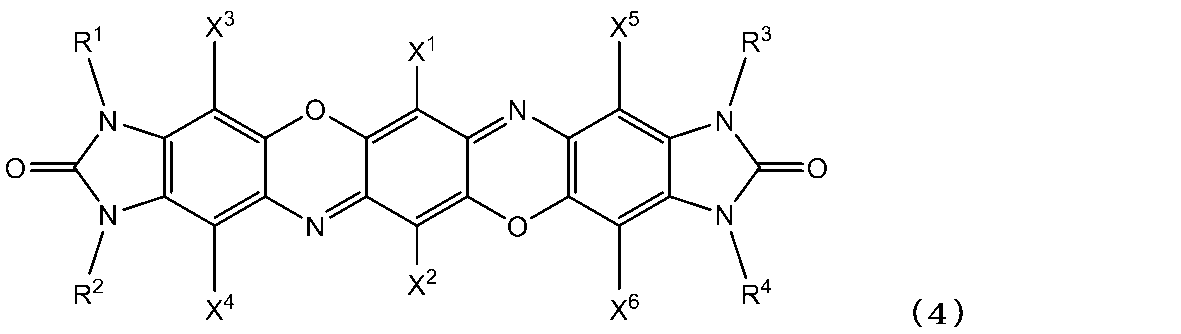
- the present invention relates to a light-shielding pigment composition comprising one or both of benzimidazolone dioxazine pigments having a chemical structure represented by (4).
- R 1 to R 3 each represent a hydrogen atom, a halogen atom or a monovalent hydrocarbon group which may have a substituent.
- X 1 , X 2 , X 3 , X 4 , X 5 and X 6 each independently represent a hydrogen atom or a halogen atom; one or more of X 3 , X 4 , X 5 and X 6 Is a halogen atom; R 1 , R 2 , R 3 and R 4 each independently represents a hydrogen atom or a monovalent hydrocarbon group which may have a substituent)
- the present invention relates to a light-shielding member for display containing the light-shielding pigment composition of the present invention.
- the light-shielding pigment composition of the present invention has a high optical density and high exposure sensitivity, it can be suitably used as a light-shielding member for displays.
- the light-shielding pigment composition of the present invention contains a specific organic pigment (the organic pigment (A)) as an essential component, and further uses a black, light-shielding light by using organic pigments such as orange, yellow, purple, and red together. Constituting a functional pigment composition.
- the light-shielding member for display containing such a light-shielding pigment composition of the present invention has excellent performance such as high optical density and high exposure sensitivity.
- the organic pigment (A) has the following general formula (1):
- R 1 to R 6 each have a hydrogen atom, a halogen atom, a nitro group, an alkoxy group which may have a substituent, an amino group which may have a substituent, or a substituent.
- Such an organic pigment is a blue pigment having a large absorption intensity at 555 nm and a small absorption intensity at 365 nm, which greatly contributes to the optical density, and obtains an excellent optical density when used as a light-shielding composition.
- the halogen atom represents a fluorine atom, a chlorine atom, a bromine atom or an iodine atom
- the alkyl part of the alkoxy group may be one having 1 to 6 carbon atoms.
- C.I. I. Pigment Blue 25 also referred to as PB25
- PB25 and PB26 are both organic pigments that have been known for a long time, but their use has been limited to use as a colorant (use that expects blue coloration).
- UV rays are frequently used for curing UV curable resins.
- Ultraviolet light refers to light having a wavelength of 100 nm to 400 nm, and the shorter the wavelength, the greater the energy.
- the wavelength is 200 nm or less, energy is consumed for oxygen decomposition or is easily absorbed by oxygen. Therefore, light sources of 254 nm and 365 nm are mainly used for ultraviolet curing.
- the high-pressure mercury lamp that emits 365 nm light has the same length as the low-pressure mercury lamp that emits 254 nm light and can have a wattage of 20 times. Therefore, a high-pressure mercury lamp that emits 365 nm ultraviolet light for ultraviolet curing. It is desirable to use
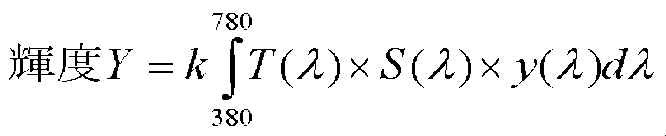
- the OD value serving as a light-shielding index can be obtained from the following formula according to JIS Z 8701.
- Y Brightness (brightness)
- k constant
- T transmittance
- S light source intensity
- y color matching function (sensitivity of the human eye)
- the color matching function y can use the one described in JIS Z 8701
- the light source intensity S can use the C light source (the auxiliary illuminant C for colorimetry) described in JIS Z 8720.
- the light absorption intensity at 555 nm where the constant for calculating the y ⁇ C light source intensity at each wavelength is the maximum value contributes greatly to the OD value, the light absorption intensity at 555 nm is used as a simple light-blocking index. be able to.
- JIS Z 8722 a method for measuring a range of 400 nm to 700 nm with a second type spectrophotometer is mentioned as a color measuring method.
- 700 nm is close to the limit where human eyes can perceive a color, and light having a wavelength longer than 700 nm contributes very little to the apparent color and OD value.
- the apparent blackness can be increased by having uniform absorption at 400 nm to 700 nm. Therefore, in order to obtain a desired appearance blackness as a black light-shielding composition and a high OD value, it is desirable that a pigment having absorption in a long wavelength region used for mixing has a high absorbance at 700 nm.
- organic pigments (A) it is preferable to select an organic pigment satisfying the following conditions from the viewpoint of obtaining an excellent optical density. Conditions: Absorbance in the visible light region (380 nm to 780 nm) is maximum at a wavelength of 580 nm to 780 nm, absorbance at 365 nm is 50% or less of the maximum absorbance, and absorbances at 555 nm and 700 nm are 50% or more of the maximum absorbance.
- Whether or not the above conditions are satisfied is determined by dispersing the target organic pigment in PMA (propylene glycol monomethyl ether acetate), diluting the dispersion with PMA, and then using a spectrophotometer (U3900, Hitachi High-Tech Science Corporation). The absorption spectrum is measured and the peak top position, the maximum absorbance, the absorbance at 365 nm, the absorbance at 555 nm, and the absorbance at 700 nm can be easily identified.
- PMA propylene glycol monomethyl ether acetate
- the organic pigment represented by the formula (1) may be used as it is, but in order to satisfy the above conditions, the adjustment of the average primary particle diameter, the crystal structure The above-mentioned conditions can be satisfied and used by adjustment, adjustment of dispersibility in a solvent, and the like.
- the organic pigment represented by the above formula (1) when used as the organic pigment (A), the organic pigment preferably has an average primary particle diameter in the range of 30 nm to 190 nm by a small angle X-ray scattering method. More preferably, it is in the range of 50 nm to 160 nm. By adjusting the average primary particle diameter within such a range, the absorbance at 555 nm and 700 nm can be increased, and the optical density can be further increased.
- the light-shielding pigment composition of the present invention includes conventional copper phthalocyanine and C.I. I. Compared to the case where CI Pigment Blue 60 is used as the blue pigment in the mixed color organic pigment, it is possible to obtain a light-shielding member for a display which is remarkably excellent in optical density and exposure sensitivity as shown in Examples (Table 2) described later. it can.
- the display is a device that displays a video signal of a still image or a moving image output from a device such as a computer or a television. Also called a monitor, there are a plasma display (PDP), a liquid crystal display (LCD), an EL display (ELD), a field emission display (FED), a crystal LED display (CLED), and the like.
- PDP plasma display
- LCD liquid crystal display
- ELD EL display
- FED field emission display
- CLED crystal LED display
- the light-shielding member for display of the present invention is a material for shielding light emission from a light-emitting member such as a visible light region or a backlight in a display.
- a light-emitting member such as a visible light region or a backlight in a display.
- a black matrix there are a black matrix, a TFT light shielding film, a black mask, a black seal, a black column spacer, an electric field limiting layer in ELD, and the like.
- other organic pigments, inorganic pigments, dyes and other colorants may be mixed so as not to impair the balance of transparency in the visible region.
- colorants to be mixed include azo pigments, condensed azo pigments, azomethine pigments, phthalocyanine pigments, quinacridone pigments, isoindolinone pigments, isoindoline pigments, dioxazine pigments, selenium pigments, perylene pigments, perinone pigments, quinophthalone pigments, diketo.
- Insulating organic pigments such as pyrrolopyrrole pigments, thioindigo pigments, benzimidazolone pigments, and indanthrene pigments are preferred, and particularly contain at least one organic pigment selected from yellow, orange, red, and purple. It is advantageous.
- a combination of blue and orange, a combination of blue, orange and purple, a combination of blue, yellow and purple, a combination of blue, yellow and red and the like can be mentioned.
- two or more blue pigments may be used, for example, similar colors may be combined, or other color pigments may be further combined with similar color combinations.
- a blue pigment other than the organic pigment (A) may be used in combination, or a plurality of pigments corresponding to the organic pigment (A) may be used.
- the organic pigment used and the combination thereof may be obtained as long as the blackness required for the target black matrix or the like is obtained. For example, subtracting the three primary colors of blue, yellow, and red into black by subtractive color belongs to the technical common sense of those skilled in the art, and the mixing ratio thereof is not particularly limited. Examples of each color pigment are shown below.
- blue pigments that may be added include C.I. I. Pigment Blue 1, 1: 2, 9, 14, 15, 15: 1, 15: 2, 15: 3, 15: 4, 15: 6, 16, 17, 19, 27, 28, 29, 33, 35, 36, 56, 56: 1, 61, 61: 1, 62, 63, 66, 67, 68, 71, 72, 73, 74, 75, 76, 78, 79, 80 and the like.
- yellow pigments examples include C.I. I. Pigment Yellow 1, 1: 1, 2, 3, 4, 5, 6, 9, 10, 12, 13, 14, 16, 17, 24, 31, 32, 34, 35, 35: 1, 36, 36: 1, 37, 37: 1, 40, 41, 42, 43, 48, 53, 55, 61, 62, 62: 1, 63, 65, 73, 74, 75, 81, 83, 87, 93, 94, 95, 97, 100, 101, 104, 105, 108, 109, 110, 111, 116, 117, 119, 120, 126, 127, 127: 1, 128, 129, 130, 133, 134, 136, 138, 139, 142, 147, 148, 150, 151, 153, 154, 155, 157, 158, 159, 160, 161, 162, 163, 164, 165, 166, 167, 168, 169, 170, 17 , 173, 174, 175, 176, 180, 181, 182, 183
- orange pigments examples include C.I. I. Pigment Orange 1, 2, 5, 13, 16, 17, 19, 20, 21, 22, 23, 24, 34, 36, 38, 39, 43, 46, 48, 49, 61, 62, 64, 65, 67, 68, 69, 70, 71, 72, 73, 74, 75, 77, 78, 79, 81, and the like. Of these, C.I. I. Pigment orange 36, 38, 60, 62, 64, 72.
- brown pigments examples include C.I. I. And CI Pigment Brown 23, 25, and 41.
- red pigments examples include C.I. I. Pigment Red 1, 2, 3, 4, 5, 6, 7, 8, 9, 12, 14, 15, 16, 17, 21, 22, 23, 31, 32, 37, 38, 41, 47, 48, 48: 1, 48: 2, 48: 3, 48: 4, 49, 49: 1, 49: 2, 50: 1, 52: 1, 52: 2, 53, 53: 1, 53: 2, 53: 3, 57, 57: 1, 57: 2, 58: 4, 60, 63, 63: 1, 63: 2, 64, 64: 1, 68, 69, 81, 81: 1, 81: 2, 81: 3, 81: 4, 83, 88, 90: 1, 101, 101: 1, 104, 108, 108: 1, 109, 112, 113, 114, 122, 123, 144, 146, 147, 149, 151, 166, 168, 169, 170, 172, 173, 174, 175, 176, 177, 178, 17 , 181, 185, 187, 188, 190, 193, 194, 200
- C.I. I. Pigment Red 48 1, 122, 168, 177, 202, 206, 207, 209, 224, 242, 254, and more preferably C.I. I. Pigment red 177, 209, 224, 254.
- purple pigments examples include C.I. I. Pigment Violet 1, 1: 1, 2, 2: 2, 3, 3: 1, 3: 3, 5, 5: 1, 14, 15, 16, 19, 23, 25, 27, 29, 31, 32, 37, 39, 42, 44, 47, 49, 50 and the like. Of these, C.I. I. Pigment violet 19, 23, 29, and more preferably C.I. I. And CI Pigment Violet 23.
- green pigments examples include C.I. I. Pigment green 1, 2, 4, 7, 8, 10, 13, 14, 15, 17, 18, 19, 26, 36, 45, 48, 50, 51, 54, 55, 58, 59. . Of these, C.I. I. And CI Pigment Green 7 and 36.
- a benz having a chemical structure represented by the following general formula (2) and general formula (3) from the viewpoint of obtaining a more suitable light-shielding property It is preferable to use one or both of an imidazolone pigment and a benzimidazolone dioxazine pigment having a chemical structure represented by the following general formula (4).
- R 1 to R 3 each represent a hydrogen atom, a halogen atom or a monovalent hydrocarbon group which may have a substituent.
- X 1 , X 2 , X 3 , X 4 , X 5 and X 6 each independently represent a hydrogen atom or a halogen atom; one or more of X 3 , X 4 , X 5 and X 6 Is a halogen atom; R 1 , R 2 , R 3 and R 4 each independently represents a hydrogen atom or a monovalent hydrocarbon group which may have a substituent)
- the compound of the above formula (4) is not particularly limited and can be produced by appropriately using a conventionally known method. Hereinafter, an embodiment of a method for producing the compound of the above formula (4) will be described.
- the compound of the above formula (4) can be produced, for example, by synthesizing a compound of the formula (V) described later by the method described in JP-A No. 11-335575 and halogenating it by a halogenation reaction described later. Can do. Details are given below.
- a base such as sodium acetate, sodium hydrogen carbonate, triethylamine and the like
- the mixture is stirred under reflux for 1 to 10 hours, then the solid product is filtered off while hot and washed with a solvent such as ethanol, dimethylacetamide, etc. at 60 ° C. to 100 ° C. and then with boiling water. .
- the product is suspended in a solvent such as dimethylformamide, dimethylacetamide, and the suspension is heated at 80 ° C. to 150 ° C. for 1 hour to 10 hours and filtered while hot. It is washed with a solvent such as ethanol and dimethylacetamide at 100 ° C., then with boiling water and dried at 90 ° C. to 120 ° C.
- X 1 and X 2 each independently represent a hydrogen atom or a halogen atom
- X 7 and X 8 each independently represent a leaving group such as a halogen atom or an alkoxy group.
- R 1 and R 2 each independently represent a hydrogen atom or a monovalent hydrocarbon group which may have a substituent.
- R 3 and R 4 each independently represent a hydrogen atom or a monovalent hydrocarbon group which may have a substituent.
- X 1 and X 2 each independently represent a hydrogen atom or a halogen atom; R 1 , R 2 , R 3 and R 4 each independently have a hydrogen atom or a substituent. A good monovalent hydrocarbon group.
- ⁇ Halogen addition reaction 1 to 32 moles of a halogenating reagent such as bromine, N-bromosuccinimide, trichloroisocyanuric acid, N-iodosuccinimide and the like are added to concentrated sulfuric acid having a temperature of 10 ° C. or less, and then the above formula (V 1 mol of the compound represented by) is added and stirred at room temperature for 2 to 48 hours. This is then poured onto ice and the resulting precipitate is filtered, washed with water until no acid is detected, then washed with ethanol, dried at 90 ° C. to 120 ° C., and the benzene ring is 1 to 6 halogen atoms.
- a halogenating reagent such as bromine, N-bromosuccinimide, trichloroisocyanuric acid, N-iodosuccinimide and the like are added to concentrated sulfuric acid having a temperature of 10 ° C. or less, and
- the obtained mixture is separated by silica gel column chromatography, each solution having a single compound is concentrated, and a solvent such as N, N-dimethylacetamide and an acid such as toluene-4-sulfonic acid monohydrate are concentrated. And stirred at 100 ° C. to 200 ° C. for 2 to 24 hours to obtain a precipitate. The precipitate is filtered, washed with a solvent such as N, N-dimethylacetamide, and dried at 90 to 120 ° C. to obtain the compound of the above formula (4).
- each organic pigment may be pulverized individually and mixed in accordance with the specifications of the light-shielding member for display.
- the method for refining the pigment can be performed by a publicly known method and is not particularly limited.
- a solvent salt milling method a sulfuric acid dissolution method, a dry grinding method, a pigmentation method by normal pressure and pressurization with an organic solvent and water, or a combination of these methods can be employed.
- An organic dye derivative may be mixed with the composition of the present invention, and the organic dye derivative has any chemical structure as long as it has a sulfonic acid group, a phthalimide group, or is an organic dye derivative that is a sulfonate. Also good. Organic pigment derivatives having sulfonic acid groups, phthalimide groups, or sulfonates are often added to improve the dispersibility of organic pigments in binders and solvent systems, and their effects are well known. . The number of substituents of the sulfonic acid group is 1 to 4 per molecule, preferably 1 to 2. Since the pigment composition of the present invention is black, any organic dye derivative can be used.
- azo structure there are an azo structure, a benzimidazolone structure, a quinacridone structure, a diketopyrrolopyrrole structure, a phthalocyanine structure, a dioxazine violet structure, and among them, copper phthalocyanine sulfonic acid or a salt thereof, phthalimidomethyl copper phthalocyanine Quinacridonesulfonic acid or a salt thereof, phthalimidomethylquinacridone.
- the metal that forms a salt with the sulfonic acid is a monovalent or divalent metal such as Ca, Na, K, Mg, Fe, Co, Ni, Cu, and Zn.
- salts other than metal salts include organic amine salts such as aliphatic amines (NHR 2 , NH 2 R, [NR 4 ] + (R: alkyl group having 1 to 20 carbon atoms)).
- Organic pigment derivative is contained in the range of 1 to 20 parts per 100 parts of organic pigment. Considering hue and productivity, it is preferably contained in the range of 1 to 15 parts.
- the timing of adding the organic pigment derivative may be added in the step of refining the organic pigment carried out in the present invention, or may be added after washing and refining the organic pigment after the step of refining. . However, in consideration of imparting a dispersibility effect by an organic dye derivative having a sulfonic acid group or a salt thereof, it is preferable to treat the organic pigment after being refined.
- the organic pigment derivative is treated by dyeing with a solid or alkali and adsorbing it on the surface of the organic pigment in an acidic state.
- a solid it is added to a wet cake containing a refined organic pigment and a solvent such as water.
- Dyeing of organic pigment derivatives with alkali is usually carried out at pH 8-12, then mixed with finely divided organic pigment in a slurry, and then the inside of the system is adjusted to acidity, usually pH 3-5, on the surface of the organic pigment.
- An organic pigment derivative is precipitated.
- a colored composition is prepared from the pigment composition of the present invention and, if necessary, a resin dispersant and an organic solvent.
- a colored composition in which each color organic pigment, organic solvent and dispersant are dispersed may be mixed separately, or all organic pigments may be dispersed with the organic solvent and dispersant at once. good.
- a resin-based dispersant When dispersing these pigment compositions in an organic solvent, a resin-based dispersant is used in combination for improving dispersibility and dispersion stability.
- This resin-based dispersant has a function of binding the organic pigment and the anchor site, and the compatible part extends into the dispersion medium to form a dispersion.
- An alkali used for the preparation of the photosensitive composition described later is used.
- the soluble resin and the photopolymerizable monomer are different types.
- the resin dispersant examples include those having a polymer chain, such as polyurethane resin, polyethyleneimine, polyoxyethylene glycol diester, acrylic resin, polyester resin, and the like.
- polyester resin dispersants and / or acrylic resin dispersants are preferable in terms of dispersibility, heat resistance, and light resistance.
- resinous dispersants include trade names, Ajisper (manufactured by Ajinomoto Fine Techno Co., Ltd.), EFKA (manufactured by BASF Corp.), DISPERBYK (manufactured by Big Chemie Corp.), Disparon (manufactured by Enomoto Kasei Co., Ltd.), SOLPERSE (Lubrisol) Company-made), KP (manufactured by Shin-Etsu Chemical Co., Ltd.), polyflow (manufactured by Kyoeisha Chemical Co., Ltd.) and the like.
- 1 type may be used for these dispersing agents, and 2 or more types can be used together by arbitrary combinations and a ratio.
- the resin-based dispersant is usually 30 to 60 parts, preferably 38 to 50 parts, per 100 parts in terms of the total mass of the organic pigments of each color.
- organic solvent used here examples include diisopropyl ether, mineral spirit, n-pentane, amyl ether, ethyl caprylate, n-hexane, diethyl ether, isoprene, ethyl isobutyl ether, butyl stearate, n-octane, and valsol.
- Apco # 18 solvent diisobutylene, amyl acetate, butyl acetate, apcocinner, butyl ether, diisobutyl ketone, methylcyclohexene, methyl nonyl ketone, propyl ether, dodecane, soak solvent no. 1 and no.
- At least n-amyl methyl ketone (2-heptanone) is preferably used as the organic solvent contained in the coloring composition.
- one organic solvent may be used alone, or two or more organic solvents may be used in any combination and ratio.
- the organic solvent is preferably used in an amount of usually 300 to 800 parts, preferably 400 to 600 parts, per 100 parts in terms of the total mass of the organic pigments of each color.
- various pigment derivatives can be used in combination as required.
- the substituent of the pigment derivative include a sulfonic acid group, a sulfonamide group and a quaternary salt thereof, a phthalimidomethyl group, a dialkylaminoalkyl group, a hydroxyl group, a carboxyl group, and an amide group directly on the pigment skeleton or an alkyl group and an aryl group. And those bonded via a heterocyclic group or the like.
- the coloring composition can be prepared by stirring and mixing the organic pigment composition of each color described above, the resin dispersant, and the organic solvent. If necessary, it can also be prepared by shaking and dispersing the mixture over a required time in the presence of various grinding media such as beads and rods, and removing the media by filtration or the like.
- the coloring composition requires a black matrix or black mask of a color filter, which is a component of a display, a column spacer or black seal of a liquid crystal layer, a TFT light shielding film, an electric field limiting layer in an ELD, or other light shielding by a conventionally known method. It can be used for the member.
- a typical production method of a color filter is a photolithography method, and a black matrix is prepared by applying a photosensitive composition described later prepared from the coloring composition of the present invention onto a transparent substrate for a color filter and heating. After drying (pre-baking), pattern exposure is performed by irradiating ultraviolet rays through a photomask to cure the photo-curable compound at the location corresponding to the black matrix portion, and then developing the unexposed portion with a developer. The non-pixel portion is removed and the pixel portion is fixed to the transparent substrate. By this method, a black matrix portion made of a cured colored film of the photosensitive composition is formed on the transparent substrate.
- Each of the RGB pixel portions can also be prepared in the same manner as described above from a photosensitive composition prepared from each color organic pigment having a larger specific surface area.
- Examples of a method for applying a photosensitive composition described later on a transparent substrate such as glass include a spin coating method, a roll coating method, a slit coating method, and an inkjet method.
- the drying condition of the coating film of the photosensitive composition applied to the transparent substrate is usually about 50 to 150 ° C. for about 1 to 15 minutes, although it depends on the kind of each component, the blending ratio, and the like. This heat treatment is generally referred to as “pre-baking”.
- pre-baking This heat treatment is generally referred to as “pre-baking”.
- light used for photocuring the photosensitive composition it is preferable to use ultraviolet rays or visible light having a wavelength range of 200 to 500 nm. Various light sources that emit light in this wavelength range can be used.
- Examples of the developing method include a liquid filling method, a dipping method, and a spray method.
- the transparent substrate on which the black matrix or the pixel portion of the necessary color is formed is washed with water and dried.
- the color filter thus obtained is subjected to a heat treatment (post-baking) at 100 to 280 ° C. for a predetermined time with a heating device such as a hot plate or an oven to remove volatile components in the colored coating film, and at the same time,
- the unreacted photocurable compound remaining in the cured colored film of the curable composition is thermally cured to complete the color filter.
- the photosensitive composition for forming the black matrix part of the color filter has the coloring composition of the present invention, an alkali-soluble resin, a photopolymerizable monomer, and a photopolymerization initiator as essential components, and these are mixed. Can be prepared.
- the colored resin film forming the black matrix portion is required toughness that can withstand baking performed in the actual production of the color filter, only the photopolymerizable monomer is used in preparing the photosensitive composition. In addition, it is essential to use this alkali-soluble resin together. When an alkali-soluble resin is used in combination, it is preferable to use an organic solvent that dissolves it.
- the colored composition of the present invention is prepared in advance, and then an alkali-soluble resin, a photopolymerizable monomer, and a photopolymerization initiator are added to the photosensitive composition.
- the method of making a product is common.
- alkali-soluble resin used in the preparation of the photosensitive composition examples include a resin containing a carboxyl group or an acidic hydroxyl group, such as a novolak-type phenol resin, a (meth) acrylic acid alkyl ester- (meth) acrylic acid copolymer, Examples thereof include styrene- (meth) acrylic acid copolymers and styrene-maleic acid copolymers.
- description with (meth) acryl is a general term which combined acrylic and methacryl.
- an alkali-soluble resin containing polymerized units of an imide structure, styrene, and (meth) acrylic acid is preferable to use.
- This alkali-soluble resin does not have the function of binding the organic pigment and the anchor part and having the compatible part extend into the dispersion medium to constitute the dispersion, but on the other hand, it is in contact with the alkali. This is used exclusively for the purpose of removing unexposed portions of the photosensitive composition, taking advantage of the characteristics of dissolution.
- photopolymerizable monomer examples include 1,6-hexanediol di (meth) acrylate, ethylene glycol di (meth) acrylate, neopentyl glycol di (meth) acrylate, triethylene glycol di (meth) acrylate, bis [( (Meth) acryloxyethoxy] bisphenol A, bifunctional monomers such as 3-methylpentanediol di (meth) acrylate, trimethylol propaton tri (meth) acrylate, pentaerythritol tri (meth) acrylate, tris (2-hydroxy Ethyl) isocyanurate tri (meth) acrylate, dipentaerythritol hexa (meth) acrylate, dipentaerythritol penta (meth) acrylate, ditrimethylolpropane tetra (meth) acrylate Relatively high molecular weight of small polyfunctional monomer, polyester
- photopolymerization initiator examples include acetophenone, benzophenone, benzyldimethylketanol, benzoyl peroxide, 2-chlorothioxanthone, 1,3-bis (4′-azidobenzal) -2-propane, 1,3-bis (4 -Azidobenzal) -2-propane-2'-sulfonic acid, 4,4'-diazidostilbene-2,2'-disulfonic acid, ethanone, 1- [9-ethyl-6- [2-methyl-4- ( 2,2-dimethyl-1,3-dioxolanyl) methoxybenzoyl] -9. H. -Carbazol-3-yl]-, 1- (O-acetyloxime) and the like.
- the photosensitive composition of the present invention is black, it is preferable to use a photopolymerization initiator having excellent curability.
- the total of the alkali-soluble resin and the photopolymerizable monomer is 3 to 20 parts per 100 parts of the colored composition of the present invention, and 0.05 parts per part of the photopolymerizable monomer.
- Photosensitivity for forming a black matrix part by adding ⁇ 3 parts photopolymerization initiator and, if necessary, the organic solvent used for the preparation of the colored composition as described above, and stirring and dispersing so as to be uniform. Can be obtained.
- the nonvolatile content is 5 to 20% in terms of mass. It is preferable to prepare such that
- the developer a known and commonly used alkaline aqueous solution can be used.
- the photosensitive composition contains an alkali-soluble resin, washing with an aqueous alkaline solution is effective for forming the black matrix portion.
- the excellent heat resistance of the photosensitive composition of the present invention is exhibited in a method for producing a color filter in which baking is performed after such alkali washing.
- a color filter may be manufactured by forming a method such as a micellar electrolysis method or a PVED (Photo Voltaic Electro Deposition) method.
- the color filter uses a red organic pigment, a green organic pigment, a blue organic pigment, and a photosensitive composition of each color obtained by using the coloring composition of the present invention, and encapsulates a liquid crystal material between a pair of parallel transparent electrodes.
- the transparent electrode is divided into discontinuous fine sections, and red (R), green (G), and blue (B) are divided into fine sections divided in a lattice pattern by the black matrix on the transparent electrode. It can be obtained by providing a color filter coloring pixel portion selected from any one color alternately in a pattern, or by forming a color filter coloring pixel portion on a substrate and then providing a transparent electrode.
- the black matrix portion obtained from the photosensitive composition of the present invention contains the above-described organic pigments so as to be black.
- the photosensitive compositions of the respective colors are mixed to form a black photosensitive composition. It seems that the same black matrix can be obtained as in the case of preparing the product, but in the present invention, in the preparation of the coloring composition, which is a stage before the photosensitive composition, the organic pigment of each color is prepared in advance. As a result, more uniform mixing is achieved, and a black matrix having better characteristics is obtained.
- Pigment Blue 25 (synthesized based on JP-A-51-97633) is mixed with sodium chloride and diethylene glycol, and subjected to wet grinding with a stainless steel kneader (manufactured by Inoue Seisakusho Co., Ltd.), pigment A-1 to A-5 was prepared.
- the average primary particle sizes of the pigments A-1 to A-5 were measured using the USAXS method of SmartLab (manufactured by Rigaku Corporation).
- Pigment A-1 was 36 nm
- Pigment A-2 was 53 nm
- Pigment A-3 was 94 nm
- Pigment A-4 was 155 nm
- Pigment A-5 was 189 nm
- Example 1 0.4 parts of the pigment A-1 obtained, 0.5 parts of LPN-21116 (manufactured by BYK, resin-based dispersant), and 7.4 parts of propylene glycol monomethyl ether acetate are mixed, and 0.2 to 0. 3 mm ⁇ zirconia beads were added and dispersed with a paint conditioner (manufactured by Toyo Seiki Co., Ltd.) for 2 hours to obtain a colored composition (B-1). To 0.1 part of the colored composition (B-1), 99.9 parts of propylene glycol monomethyl ether acetate was added to prepare an evaluation composition (C-1).
- a paint conditioner manufactured by Toyo Seiki Co., Ltd.
- Example 2 An evaluation composition (C-2) was obtained in the same manner as in Example 1 except that Pigment A-1 was changed to Pigment A-2.
- Example 3 An evaluation composition (C-3) was obtained in the same manner as in Example 1 except that Pigment A-1 was changed to Pigment A-3.
- Example 4 An evaluation composition (C-4) was obtained in the same manner as in Example 1 except that Pigment A-1 was changed to Pigment A-4.
- Example 5 An evaluation composition (C-5) was obtained in the same manner as in Example 1 except that Pigment A-1 was changed to Pigment A-5.
- Comparative Example 1 An evaluation composition (C-6) was obtained in the same manner as in Example 1 except that Pigment A-1 was changed to Palogen Blue L6360 (CI Pigment Blue 60 manufactured by BASF Corporation).
- Comparative Example 2 An evaluation composition (C-7) was prepared in the same manner as in Example 1 except that Pigment A-1 was changed to Fastogen Blue EP-CF (CI Pigment Blue 15: 6, manufactured by DIC Corporation). Got.
- Example 6 Pigment A-3 (CI Pigment Blue 25, Colorant 1) 12.0 parts, Chromophthal Orange K 2960 (manufactured by BASF Corporation, CI Pigment Orange 64, Colorant 2) 1.5 parts, Paliogen Red Violet K 5411 (BASF Corporation, CI Pigment Violet 29, Colorant 3) 1.5 parts, LPN-21116 (BYK Corporation, resin dispersant) 4.5 parts, propylene glycol monomethyl ether To a mixture of 73.8 parts of acetate, 0.2 to 0.3 mm ⁇ zirconia beads were added and dispersed for 2 hours with a paint conditioner to obtain a colored composition (D-1).
- the photosensitive resin composition (E-1) prepared above was applied using a spin coater. After vacuum drying for 1 minute, it was heated and dried at 90 ° C. for 90 seconds on a hot plate to obtain a coating film having a dry film thickness of about 3.5 ⁇ m. Thereafter, from the coating film side, two types of exposure are performed: one that exposes an image through a fine line pattern mask with a width of 15 ⁇ m (pattern 1) and one that exposes the entire surface without passing through a mask (pattern 2). It was.
- the exposure conditions were 50 mJ / cm 2 (i-line standard) using a 3 kW high-pressure mercury lamp.
- a shower composed of an aqueous solution containing 0.05% potassium hydroxide and 0.08% nonionic surfactant (“A-60” manufactured by Kao) was used, and a shower with a water pressure of 0.15 MPa at 23 ° C.
- development was stopped with pure water and washed with water spray to obtain a black matrix (F-1).
- the shower development time was adjusted between 10 and 120 seconds, and was 1.5 times as long as the unexposed coating film was dissolved and removed.
- Example 7 Except for changing Colorant 1 of Example 6 to 7.5 parts of Pigment A-3, Colorant 2 to 3.75 parts of Chromophthal Orange K 2960, and Colorant 3 to 3.75 parts of Palogen Red Violet K 5411. The same operation as in Example 6 was performed to obtain a black matrix (F-2).
- Example 8 Except for changing Colorant 1 of Example 6 to 3.0 parts of Pigment A-3, Colorant 2 to 6.0 parts of Chrophtal Orange K 2960, and Colorant 3 to 6.0 parts of Palaiogen Red Violet K 5411. The same operation as in Example 6 was performed to obtain a black matrix (F-3).
- Example 9 Colorant 1 of Example 6 is added to 12.0 parts of Pigment A-3, Colorant 2 is added to 1.5 parts of PV Fast Orange H4GL01 (Clariant, CI Pigment Orange 72), and Colorant 3 is added to Paliogen.
- a black matrix (F-4) was obtained in the same manner as in Example 6 except for changing to 1.5 parts of Red Violet K 5411.
- Example 10 Except for changing Colorant 1 of Example 6 to 7.5 parts of Pigment A-3, Colorant 2 to 3.75 parts of PV Fast Orange H4GL01, and Colorant 3 to 3.75 parts of Palogen Red Violet K 5411. The same operation as in Example 6 was performed to obtain a black matrix (F-5).
- Example 11 Except for changing Colorant 1 of Example 6 to 3.0 parts of Pigment A-3, Colorant 2 to 6.0 parts of PV Fast Orange H4GL01, and Colorant 3 to 6.0 parts of Palogen Red Violet K 5411 The same operation as in Example 6 was performed to obtain a black matrix (F-6).
- Example 12 Example 6 above, except that Colorant 1 of Example 6 is changed to 12.0 parts of Pigment A-3, Colorant 2 is changed to 1.5 parts of Compound G, and Colorant 3 is changed to 1.5 parts of Chromophthal Orange K 2960.
- the black matrix (F-7) was obtained in the same manner as in Example 1.
- Compound G was prepared by the following operation. 53 parts of N-bromosuccinimide is added to 52500 parts of concentrated sulfuric acid having a temperature of 10 ° C. or less, and then 350 parts of compound H (the following structure) synthesized by the method described in JP-A-11-335575 is added, and the mixture is stirred at room temperature for 20 hours. Stir. Next, this was poured into 525,000 parts of ice to obtain a precipitate. The resulting precipitate was filtered, washed with water until no acid was detected, then washed with 30000 parts ethanol and dried at 90 ° C. to give 390 parts of product I.
- the product C obtained by separating the obtained product C by silica gel column chromatography (developing solvent: chloroform / methanol / dimethyl sulfoxide) was concentrated, and 500 parts of N, N-dimethylacetamide and toluene were concentrated. 50 parts of -4-sulfonic acid monohydrate was added and stirred at 130 ° C. for 4 hours to obtain a precipitate. The precipitate was filtered, washed with 200 parts of N, N-dimethylacetamide and 800 parts of methanol, and dried at 90 ° C. to obtain Compound G (3.4 parts, yield 0.6%).
- Example 13 Example 6 with the exception that Colorant 1 of Example 6 was changed to 7.5 parts of Pigment A-3, Colorant 2 to 3.75 parts of Compound G, and Colorant 3 to 3.75 parts of Chromophthal Orange K 2960. The same operation as in No. 6 was performed to obtain a black matrix (F-8).
- Example 14 Example 6 except that Colorant 1 of Example 6 was changed to 3.0 parts of Pigment A-3, Colorant 2 to 6.0 parts of Compound G, and Colorant 3 to 6.0 parts of Chromophthal Orange K 2960. The same operation as in No. 6 was performed to obtain a black matrix (F-9).
- Example 15 Example 6 except that Colorant 1 of Example 6 was changed to 1.5 parts of Pigment A-3, Colorant 2 to 10.5 parts of Compound G, and Colorant 3 to 3.0 parts of Chromophthal Orange K 2960. The same operation as in No. 6 was performed to obtain a black matrix (F-10).
- Example 16 Example 6 except that Colorant 1 of Example 6 was changed to 7.5 parts of Pigment A-1, Colorant 2 to 3.75 parts of Compound G, and Colorant 3 to 3.75 parts of Chromophthal Orange K 2960. The same operation as in No. 6 was performed to obtain a black matrix (F-11).
- Example 17 Example 6 except that Colorant 1 of Example 6 was changed to 7.5 parts of Pigment A-2, Colorant 2 was changed to 3.75 parts of Compound G, and Colorant 3 was changed to 3.75 parts of Chromophthal Orange K 2960. The same operation as in No. 6 was performed to obtain a black matrix (F-12).
- Example 18 Example 6 with the exception that Colorant 1 of Example 6 was changed to 7.5 parts of Pigment A-4, Colorant 2 to 3.75 parts of Compound G, and Colorant 3 to 3.75 parts of Chromophthal Orange K 2960. The same operation as in No. 6 was performed to obtain a black matrix (F-13).
- Example 19 Example 6 except that Colorant 1 of Example 6 was changed to 7.5 parts of Pigment A-5, Colorant 2 to 3.75 parts of Compound G and Colorant 3 to 3.75 parts of Chromophthal Orange K 2960. The same operation as in No. 6 was performed to obtain a black matrix (F-14).
- Comparative Example 3 The same as Example 6 except that Colorant 1 to 3 of Example 6 was changed to 12.0 parts Fastogen Blue EP-CF, 1.5 parts of Chromophthal Orange K 2960, 1.5 parts of Palaiogen Red Violet K 5411 Operation was performed to obtain a black matrix (F-15).
- Comparative Example 4 The same as Example 6 except that the colorants 1 to 3 of Example 6 were changed to 7.5 parts of Fastogen Blue EP-CF, 3.75 parts of Chromophthal Orange K 2960, and 3.75 parts of Palaiogen Red Violet K 5411. Operation was performed to obtain a black matrix (F-16).
- Comparative Example 5 The same as Example 6 except that the coloring agents 1 to 3 of Example 6 were changed to 3.0 parts Fastogen Blue EP-CF, 6.0 parts Cromot Orange K 2960, 6.0 parts Palaiogen Red Violet K 5411 Operation was performed to obtain a black matrix (F-17).
- Example 6 Comparative Example 6 The above procedure was repeated except that Colorant 1 to 3 of Example 6 was changed to 12.0 parts Fastogen Blue EP-CF and 3.0 parts FASTOGEN Super Red ATY-TR (DIC Pigment Red 177 manufactured by DIC Corporation). The same operation as in Example 6 was performed to obtain a black matrix (F-18).
- Comparative Example 7 The same procedure as in Example 6 was performed, except that Colorant 1 to 3 of Example 6 was changed to 7.5 parts Fastogen Blue EP-CF and 7.5 parts FASTOGEN Super Red ATY-TR. -19) was obtained.
- Comparative Example 8 The same procedure as in Example 6 was performed, except that the colorants 1 to 3 of Example 6 were changed to 3.0 parts Fastogen Blue EP-CF and 12.0 parts FASTOGEN Super Red ATY-TR. ⁇ 20) was obtained.
- Comparative Example 9 The same operation as in Example 6 was performed except that Colorant 1 to 3 of Example 6 was changed to 1.5 parts of Palaiogen Blue L6360, 1.5 parts of Chromophthal Orange K 2960, 1.5 parts of Palaiogen Red Violet K 5411. As a result, a black matrix (F-21) was obtained.
- Comparative Example 10 The same operations as in Example 6 were performed except that Colorant 1 to 3 of Example 6 was changed to 7.5 parts of Palogen Blue L6360, 3.75 parts of Chromophthal Orange K 2960, and 3.75 parts of Palogen Red Violet K 5411. And a black matrix (F-22) was obtained.
- Comparative Example 11 The same operations as in Example 6 were performed except that Colorant 1 to 3 of Example 6 was changed to 3.0 parts of Palogen Blue L6360, 6.0 parts of Chromophthal Orange K 2960, 6.0 parts of Paliogen Red Violet K 5411. And a black matrix (F-23) was obtained.
- the black matrix obtained from the composition of the present invention had a lower absorbance at 365 nm than the black matrix of Comparative Example 4, the OD value was significantly improved as compared with the black matrices of Comparative Examples 3 to 11.
- the black matrices of Examples 7, 10, 13, 16, 17, 18, and 19 containing 50% PB-25 were compared, Examples 13, 16, 17, and the combination of PB-25 and Compound G were used.
- the 18 and 19 black matrices are preferred because of their large absorbance at 700 nm.
- the absorbance at 700 nm of the black matrixes of Examples 13, 16, 17, 18, and 19 can be regarded as the same as long as the value is around 200 as compared with Comparative Example 4. In this case, the OD is larger than the absorbance at 700 nm.
- the magnitude of the value is an important characteristic.
- the black matrices of Examples 13, 17, and 18 containing pigments A-2, A-3, and A-4 having an average primary particle diameter in the range of 50 nm to 160 nm, respectively, have a large absorbance at 700 nm, and It can be seen that it has a high OD value and exhibits particularly excellent performance.
Landscapes
- Physics & Mathematics (AREA)
- Chemical & Material Sciences (AREA)
- Organic Chemistry (AREA)
- Nonlinear Science (AREA)
- Optics & Photonics (AREA)
- General Physics & Mathematics (AREA)
- Engineering & Computer Science (AREA)
- Materials Engineering (AREA)
- Wood Science & Technology (AREA)
- Life Sciences & Earth Sciences (AREA)
- Mathematical Physics (AREA)
- Crystallography & Structural Chemistry (AREA)
- Chemical Kinetics & Catalysis (AREA)
- Optical Filters (AREA)
- Materials For Photolithography (AREA)
- Paints Or Removers (AREA)
Abstract
Description
このようなCOA用の樹脂ブラックマトリクスには、高い遮光性が必要とされるため、厚膜化が要求されている。しかしながら、樹脂ブラックマトリクスの膜厚が増大するにつれて、露光された部分での膜厚方向に対する架橋密度の差が拡大してしまうため、高感度化を達成し良好な形状のブラックパターンを得ることが困難になる。また、高遮光化の手段として、遮光性の高いカーボンブラックを用いた場合も同様に、露光感度が低下するという問題があった。
このような欠点を解消するために、カーボンブラックに代えて、複数の有機顔料を黒色となるように混合して得た黒色有機顔料組成物(有機ブラックマトリクス)を遮光材に用いる試みが最近活発に行われている(例えば、特許文献1)。
ここで、長波長域(550nm~780nm)の遮光には主にフタロシアニンやインダンスレンといった青色顔料が使用されている。しかしながら、従来公知の青色顔料は遮光性を表すOD値(光学濃度、遮光性能を表す数値であり、数値が大きいほど遮光性能が高いことを示す)に大きく寄与する555nm付近の吸収強度が小さく、また、紫外線硬化樹脂の硬化に用いる365nmの吸収強度が大きいことから短波長域吸収顔料、中波長域吸収顔料と組み合わせて黒色としたとき、遮光が不十分であり、かつ露光感度が低下するといった問題があった。
このような中、光学濃度に大きく寄与する555nmの吸収強度が大きく、かつ、365nmの吸収強度が小さい青色顔料が求められていた。
即ち本発明は、2以上の有機顔料を含有してなる遮光性顔料組成物であって、
有機顔料として、少なくとも、下記一般式(1):
また、本発明の別の態様として、前記有機顔料(A)が、下記条件(条件:可視光領域(380nm~780nm)における吸光度が波長580nm~780nmにおいて最大となり、365nmにおける吸光度が最大吸光度の50%以下、555nm及び700nmにおける吸光度が最大吸光度の50%以上である。)を満たす有機顔料(A)であることを特徴とする遮光性顔料組成物に関する。



前記有機顔料(A)は、下記一般式(1):
なお、ここでハロゲン原子はフッ素原子、塩素原子、臭素原子又はヨウ素原子を示し、アルコキシ基のアルキル部分については炭素数1~6のものなどがあえて挙げるとすれば挙げられる。
k:定数
T:透過率
S:光源強度
y:等色関数(人間の目の感度)
OD=log10(最大輝度/Y)=log10(100/Y)
ここで等色関数yはJIS Z 8701に記載されているものを使用し、光源強度SはJIS Z 8720に記載されているC光源(測色用補助イルミナントC)を使用することができる。各波長におけるy×C光源強度を算出した定数が最大値となる555nmにおける光の吸収強度はOD値への寄与が大きくなるため、555nmにおける光の吸収強度を簡易的な遮光性の指標とすることができる。
条件:可視光領域(380nm~780nm)における吸光度が波長580nm~780nmにおいて最大となり、365nmにおける吸光度が最大吸光度の50%以下、555nm及び700nmにおける吸光度が最大吸光度の50%以上である。


酢酸ナトリウム、炭酸水素ナトリウム、トリエチルアミンなどの塩基1モル及び下記式(II)のp-ベンゾキノン化合物2モルをエタノール、ジメチルアセトアミドなどの溶剤中に懸濁し、そしてこの懸濁液を40℃~70℃に加熱する。下記式(III)のアミン化合物1モルを1時間かけて添加し、そしてこの混合物を引き続き還流下で1時間~10時間加熱する。次いで更に酢酸ナトリウム、炭酸水素ナトリウム、トリエチルアミンなどの塩基1モルを添加し、次いで、下記式(IV)のアミン化合物1モルを添加する。この混合物を還流下で1時間~10時間撹拌し、次いで固体生成物を熱いうちに濾別し、そして60℃~100℃のエタノール、ジメチルアセトアミドなどの溶剤で洗浄し、次いで沸騰水で洗浄する。生成物をジメチルホルムアミド、ジメチルアセトアミドなどの溶剤中に懸濁し、この懸濁液を80℃~150℃にて1時間~10時間加熱し、熱いうちに濾過し、この固体生成物を60℃~100℃のエタノール、ジメチルアセトアミドなどの溶剤で洗浄し、次いで沸騰水で洗浄し、90℃~120℃で乾燥させる。
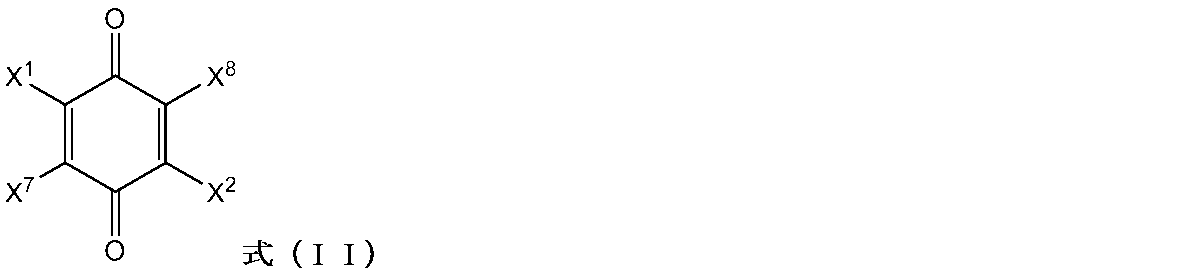

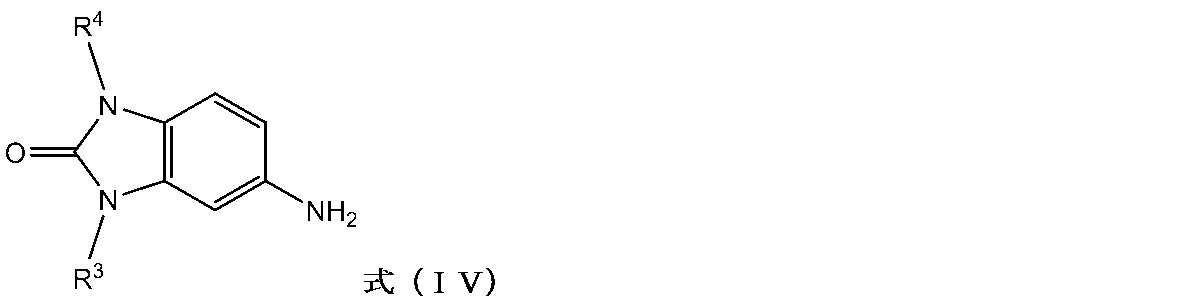
前記縮合反応で得られた生成物を、10℃以下の濃硫酸に1時間かけて添加する。次いで二酸化マンガン2モル~4モルを3時間かけて添加し、この混合物を引き続き室温にて18時間~48時間攪拌する。この混合物を、冷却しながら水を添加することにより硫酸濃度80%に希釈する。過剰の二酸化マンガンを、過酸化水素(30%)を用いて破壊する。この混合物をポリプロピレンフィルターにて濾過し、この固体生成物を硫酸(80%)で洗浄し、次いで硫酸(50%)で洗浄し、引続き水で洗浄する。90℃~120℃で乾燥し、下記式(V)で表される化合物を得る。
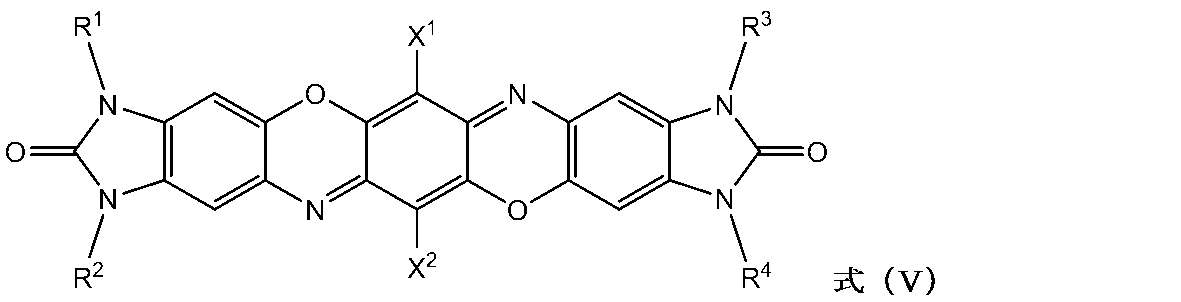
臭素、N-ブロモスクシンイミド、トリクロロイソシアヌル酸、N-ヨードスクシンイミドなどのハロゲン化試薬1モル~32モルを温度が10℃以下の濃硫酸に添加し、次いで前記閉環反応で得られた上記式(V)で表される化合物1モルを添加し、室温で2時間~48時間撹拌する。次いでこれを氷に注ぎ、得られた沈殿物を濾過し、酸が検出されなくなるまで水で洗浄し、次いでエタノールで洗浄し、90℃~120℃で乾燥し、ベンゼン環がハロゲン原子で1~4置換された化合物の混合物として得られる。この方法を経て単一化合物として得る場合は、得られた混合物を、N,N-ジメチルホルムアミドなどの溶剤に添加し、次いで4-ジメチルアミノピリジンなどの塩基、ジ-tert-ブチルジカーボネート(「tert」はターシャリーの意味で記載している)などのカーボネート化合物を添加し、室温で2時間~48時間攪拌する。次いでこれを水に注ぎ、クロロホルムなどの溶剤で抽出し、溶剤層を減圧下で濃縮し混合物を得る。得られた混合物を、シリカゲルカラムクロマトグラフィーで分離して得られる単一化合物を有する溶液それぞれを濃縮し、N,N-ジメチルアセトアミドなどの溶剤及びトルエン-4-スルホン酸一水和物などの酸を添加し、100℃~200℃で2時間~24時間攪拌し、沈殿物を得る。沈殿物を濾過し、N,N-ジメチルアセトアミドなどの溶剤で洗浄し、90℃~120℃で乾燥し、上記式(4)の化合物を得ることができる。
本明細書で用いる主な評価方法について詳述する。
(1)ピークトップ位置など
評価対象の顔料をPMA(プロピレングリコールモノメチルエーテルアセテート)に分散後、PMAを用いて分散液を希釈し、分光光度計(U3900、株式会社日立ハイテクサイエンス製)で吸光スペクトルを測定し、ピークトップの位置、最大吸光度、365nmにおける吸光度、555nmにおける吸光度、700nmにおける吸光度を確認した。
(2)光学濃度(OD値)の測定
ブラックマトリクスを作製し、分光光度計(U-3900)で365nmにおける吸光度、700nmにおける吸光度、各波長における透過率(I0/I)を測定した。JIS Z 8701に従い、下記式よりブラックマトリクスのOD値を求めた。

k:定数
T:透過率
S:光源強度
y:等色関数(人間の目の感度)
OD=log10(最大輝度/Y)=log10(100/Y)
C.I.ピグメントブルー25(特開昭51-97633号公報を基に合成)を塩化ナトリウム、ジエチレングリコールと混合し、ステンレス製ニーダー(株式会社井上製作所製)により湿式磨砕を行うことで、顔料A-1~A-5を作成した。顔料A-1~A-5の平均一次粒子径をSmartLab(株式会社リガク製)のUSAXS法を用いて測定した。(顔料A-1は36nm、顔料A-2は53nm、顔料A-3は94nm、顔料A-4は155nm、顔料A-5は189nmであった)
得られた顔料A-1 0.4部、LPN-21116(BYK株式会社製、樹脂系分散剤)0.5部、プロピレングリコールモノメチルエーテルアセテート7.4部を混合し、0.2~0.3mmφのジルコニアビーズを加え、ペイントコンディショナー(東洋精機株式会社製)で2時間分散し、着色組成物(B-1)を得た。着色組成物(B-1)0.1部にプロピレングリコールモノメチルエーテルアセテート99.9部を添加し、評価用組成物(C-1)を調製した。
顔料A-1を顔料A-2に変えた以外は前記実施例1と同様な操作を行い、評価用組成物(C-2)を得た。
顔料A-1を顔料A-3に変えた以外は前記実施例1と同様な操作を行い、評価用組成物(C-3)を得た。
顔料A-1を顔料A-4に変えた以外は前記実施例1と同様な操作を行い、評価用組成物(C-4)を得た。
顔料A-1を顔料A-5に変えた以外は前記実施例1と同様な操作を行い、評価用組成物(C-5)を得た。
顔料A-1をPaliogen Blue L6360 (BASF株式会社製C.I.ピグメントブルー60)に変えた以外は前記実施例1と同様な操作を行い、評価用組成物(C-6)を得た。
顔料A-1をFastogen Blue EP-CF (DIC株式会社製C.I.ピグメントブルー15:6)に変えた以外は前記実施例1と同様な操作を行い、評価用組成物(C-7)を得た。
上記実施例1~5及び比較例1~2で得られた評価用組成物の吸光スペクトルを分光光度計(U3900、株式会社日立ハイテクサイエンス製)により測定した。結果を表1に示す。

実施例6
顔料A-3(C.I.ピグメントブルー25、着色剤1)12.0部、Cromophtal Orange K 2960(BASF株式会社製、C.I.ピグメントオレンジ64、着色剤2)1.5部、Paliogen Red Violet K 5411(BASF株式会社製、C.I.ピグメントバイオレット29、着色剤3)1.5部、LPN-21116(BYK株式会社製、樹脂系分散剤)4.5部、プロピレングリコールモノメチルエーテルアセテート73.8部の混合物に0.2~0.3mmφのジルコニアビーズを加え、ペイントコンディショナーで2時間分散し、着色組成物(D-1)を得た。
<感光性樹脂組成物の作製工程>
着色組成物(D-1)100部、アルカリ可溶性樹脂としてメタクリル酸/こはく酸モノ(2-メタクリロイロキシエチル)/N-フェニルマレイミド/スチレン/ベンジルメタクリレート共重合体(共重合質量比=25/10/30/20/15、Mw=12,000、Mn=6,500)5部、光重合性モノマーとしてジペンタエリスリトールヘキサアクリレート10部、光重合開始剤としてエタノン,1-〔9-エチル-6-[2-メチル-4-(2,2-ジメチル-1,3-ジオキソラニル)メトキシベンゾイル]-9.H.-カルバゾール-3-イル〕-,1-(O-アセチルオキシム)を1部、および有機溶剤としてジプロピレングリコールジメチルエーテル25部、プロピレングリコールモノメチルエーテルアセテート25部、3-メトキシブチルアセテート75部、シクロヘキサノン50部を混合して、感光性樹脂組成物(E-1)を調製した。
<ブラックマトリクスの作製工程>
10cm角のガラス基板(日本電気硝子製カラーフィルタ用ガラス板「OA-10」)を信越化学製シランカップリング剤「KBM-603」の1%希釈液に3分間浸漬し、10秒間水洗して、エアーガンで水切り後、110℃のオーブンで5分間乾燥した。このガラス基板上に、上記にて調製した感光性樹脂組成物(E-1)をスピンコーターを用いて塗布した。1分間真空乾燥後、ホットプレート上で90℃にて90秒間加熱乾燥し、乾燥膜厚約3.5μmの塗布膜を得た。その後、塗布膜側から、15μm幅の細線パターンマスクを介して画像露光を施すもの(パターン1)と、マスクを介さずに全面に露光を施すもの(パターン2)との2通りの露光を行った。露光条件は、それぞれ3kW高圧水銀灯を用い50mJ/cm2(i線基準)とした。次いで、0.05%の水酸化カリウムと0.08%のノニオン性界面活性剤(花王製「A-60」)を含有する水溶液よりなる現像液を用い、23℃において水圧0.15MPaのシャワー現像を施した後、純水にて現像を停止し、水洗スプレーにて洗浄しブラックマトリクス(F-1)を得た。なお、シャワー現像時間は、10~120秒間の間で調整し、未露光の塗布膜が溶解除去される時間の1.5倍とした。
実施例6の着色剤1を顔料A-3 7.5部に、着色剤2をCromophtal Orange K 2960 3.75部に、着色剤3をPaliogen Red Violet K 5411 3.75部に変更した以外は前記実施例6と同様な操作を行い、ブラックマトリクス(F-2)を得た。
実施例6の着色剤1を顔料A-3 3.0部に、着色剤2をCromophtal Orange K 2960 6.0部に、着色剤3をPaliogen Red Violet K 5411 6.0部に変更した以外は前記実施例6と同様な操作を行い、ブラックマトリクス(F-3)を得た。
実施例6の着色剤1を顔料A-3 12.0部に、着色剤2をPV Fast Orange H4GL01(Clariant社製、C.I.ピグメントオレンジ72) 1.5部に、着色剤3をPaliogen Red Violet K 5411 1.5部に変更した以外は前記実施例6と同様な操作を行い、ブラックマトリクス(F-4)を得た。
実施例6の着色剤1を顔料A-3 7.5部に、着色剤2をPV Fast Orange H4GL01 3.75部に、着色剤3をPaliogen Red Violet K 5411 3.75部に変更した以外は前記実施例6と同様な操作を行い、ブラックマトリクス(F-5)を得た。
実施例6の着色剤1を顔料A-3 3.0部に、着色剤2をPV Fast Orange H4GL01 6.0部に、着色剤3をPaliogen Red Violet K 5411 6.0部に変更した以外は前記実施例6と同様な操作を行い、ブラックマトリクス(F-6)を得た。
実施例6の着色剤1を顔料A-3 12.0部に、着色剤2を化合物G 1.5部、着色剤3をCromophtal Orange K 2960 1.5部に変更した以外は上記実施例6と同様な操作を行い、ブラックマトリクス(F-7)を得た。
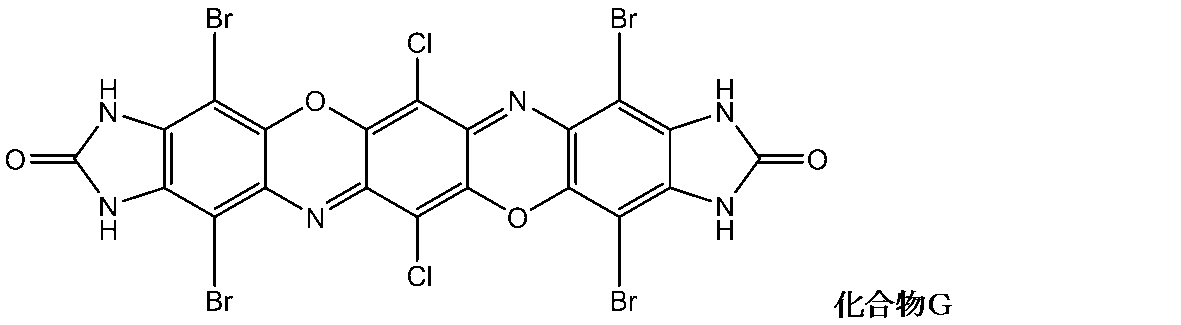
N-ブロモスクシンイミド 53部を温度が10℃以下の濃硫酸52500部に添加し、次いで特開平11-335575に記載の方法で合成した化合物H(下記構造)350部を添加し、室温で20時間撹拌した。次いでこれを氷525000部に注ぎ、沈殿物を得た。得られた沈殿物を濾過し、酸が検出されなくなるまで水で洗浄し、次いで30000部のエタノールで洗浄し、90℃で乾燥し、生成物I 390部を得た。

実施例6の着色剤1を顔料A-3 7.5部に、着色剤2を化合物G 3.75部に、着色剤3をCromophtal Orange K 2960 3.75部に変更した以外は前記実施例6と同様な操作を行い、ブラックマトリクス(F-8)を得た。
実施例6の着色剤1を顔料A-3 3.0部に、着色剤2を化合物G 6.0部に、着色剤3をCromophtal Orange K 2960 6.0部に変更した以外は前記実施例6と同様な操作を行い、ブラックマトリクス(F-9)を得た。
実施例6の着色剤1を顔料A-3 1.5部に、着色剤2を化合物G 10.5部に、着色剤3をCromophtal Orange K 2960 3.0部に変更した以外は前記実施例6と同様な操作を行い、ブラックマトリクス(F-10)を得た。
実施例6の着色剤1を顔料A-1 7.5部に、着色剤2を化合物G 3.75部に、着色剤3をCromophtal Orange K 2960 3.75部に変更した以外は前記実施例6と同様な操作を行い、ブラックマトリクス(F-11)を得た。
実施例6の着色剤1を顔料A-2 7.5部に、着色剤2を化合物G 3.75部に、着色剤3をCromophtal Orange K 2960 3.75部に変更した以外は前記実施例6と同様な操作を行い、ブラックマトリクス(F-12)を得た。
実施例6の着色剤1を顔料A-4 7.5部に、着色剤2を化合物G 3.75部に、着色剤3をCromophtal Orange K 2960 3.75部に変更した以外は前記実施例6と同様な操作を行い、ブラックマトリクス(F-13)を得た。
実施例6の着色剤1を顔料A-5 7.5部に、着色剤2を化合物G 3.75部に、着色剤3をCromophtal Orange K 2960 3.75部に変更した以外は前記実施例6と同様な操作を行い、ブラックマトリクス(F-14)を得た。
実施例6の着色剤1~3をFastogen Blue EP-CF 12.0部、Cromophtal Orange K 2960 1.5部、Paliogen Red Violet K 5411 1.5部に変更した以外は上記実施例6と同様な操作を行い、ブラックマトリクス(F-15)を得た。
実施例6の着色剤1~3をFastogen Blue EP-CF 7.5部、Cromophtal Orange K 2960 3.75部、Paliogen Red Violet K 5411 3.75部に変更した以外は上記実施例6と同様な操作を行い、ブラックマトリクス(F-16)を得た。
実施例6の着色剤1~3をFastogen Blue EP-CF 3.0部、Cromophtal Orange K 2960 6.0部、Paliogen Red Violet K 5411 6.0部に変更した以外は上記実施例6と同様な操作を行い、ブラックマトリクス(F-17)を得た。
実施例6の着色剤1~3をFastogen Blue EP-CF 12.0部、 FASTOGEN Super Red ATY-TR(DIC株式会社製C.I.ピグメントレッド177) 3.0部に変更した以外は上記実施例6と同様な操作を行い、ブラックマトリクス(F-18)を得た。
実施例6の着色剤1~3をFastogen Blue EP-CF 7.5部、 FASTOGEN Super Red ATY-TR 7.5部に変更した以外は上記実施例6と同様な操作を行い、ブラックマトリクス(F-19)を得た。
実施例6の着色剤1~3をFastogen Blue EP-CF 3.0部、 FASTOGEN Super Red ATY-TR 12.0部に変更した以外は上記実施例6と同様な操作を行い、ブラックマトリクス(F-20)を得た。
実施例6の着色剤1~3をPaliogen Blue L6360 12.0部、Cromophtal Orange K 2960 1.5部、Paliogen Red Violet K 5411 1.5部に変更した以外は上記実施例6と同様な操作を行い、ブラックマトリクス(F-21)を得た。
実施例6の着色剤1~3をPaliogen Blue L6360 7.5部、Cromophtal Orange K 2960 3.75部、Paliogen Red Violet K 5411 3.75部に変更した以外は上記実施例6と同様な操作を行い、ブラックマトリクス(F-22)を得た。
実施例6の着色剤1~3をPaliogen Blue L6360 3.0部、Cromophtal Orange K 2960 6.0部、Paliogen Red Violet K 5411 6.0部に変更した以外は上記実施例6と同様な操作を行い、ブラックマトリクス(F-23)を得た。
実施例6~19、比較例3~11で作製したブラックマトリクスのOD値、365nm吸光度及び700nm吸光度を、比較例4の値を100に換算して、下表に記載した。
ラックマトリクスより低いにも関わらず、比較例3~11のブラックマトリクスに比べてOD値が顕著に向上した。

Claims (5)
- 2以上の有機顔料を含有してなる遮光性顔料組成物であって、
有機顔料として、少なくとも、下記一般式(1):

- 前記有機顔料(A)が、C.I.ピグメントブルー25又はC.I.ピグメントブルー26であることを特徴とする請求項1に記載の遮光性顔料組成物。
- 前記有機顔料(A)が、下記条件を満たす有機顔料であることを特徴とする請求項1又は2に記載の遮光性顔料組成物。
(条件:可視光領域(380nm~780nm)における吸光度が波長580nm~780nmにおいて最大となり、365nmにおける吸光度が最大吸光度の50%以下、555nm及び700nmにおける吸光度が最大吸光度の50%以上である。) - さらに、下記一般式(2)および一般式(3)で表される化学構造を含むベンズイミダゾロン系顔料、下記一般式(4)で表される化学構造を含むベンズイミダゾロンジオキサジン系顔料のうち、一方又は両方を含有することを特徴とする請求項1~3いずれか一項に記載の遮光性顔料組成物。

- 請求項1~4いずれか一項に記載の遮光性顔料組成物を含有するディスプレイ用遮光性部材。
Priority Applications (2)
| Application Number | Priority Date | Filing Date | Title |
|---|---|---|---|
| KR1020187034194A KR102425173B1 (ko) | 2017-04-07 | 2018-03-22 | 차광성 안료 조성물 및 디스플레이용 차광성 부재 |
| JP2018536311A JP6424991B1 (ja) | 2017-04-07 | 2018-03-22 | 遮光性顔料組成物及びディスプレイ用遮光性部材 |
Applications Claiming Priority (2)
| Application Number | Priority Date | Filing Date | Title |
|---|---|---|---|
| JP2017076766 | 2017-04-07 | ||
| JP2017-076766 | 2017-04-07 |
Publications (1)
| Publication Number | Publication Date |
|---|---|
| WO2018186181A1 true WO2018186181A1 (ja) | 2018-10-11 |
Family
ID=63712561
Family Applications (1)
| Application Number | Title | Priority Date | Filing Date |
|---|---|---|---|
| PCT/JP2018/011310 Ceased WO2018186181A1 (ja) | 2017-04-07 | 2018-03-22 | 遮光性顔料組成物及びディスプレイ用遮光性部材 |
Country Status (3)
| Country | Link |
|---|---|
| JP (1) | JP6424991B1 (ja) |
| KR (1) | KR102425173B1 (ja) |
| WO (1) | WO2018186181A1 (ja) |
Cited By (3)
| Publication number | Priority date | Publication date | Assignee | Title |
|---|---|---|---|---|
| JP2022083711A (ja) * | 2020-11-25 | 2022-06-06 | サカタインクス株式会社 | ブラックマトリックス用顔料分散組成物、ブラックマトリックス用レジスト組成物、及び、ブラックマトリックス |
| JP2022154723A (ja) * | 2021-03-30 | 2022-10-13 | 住友化学株式会社 | 赤色着色組成物 |
| CN116410656A (zh) * | 2021-12-30 | 2023-07-11 | 上海飞凯材料科技股份有限公司 | 遮光组合物及其制备方法、显示装置 |
Families Citing this family (1)
| Publication number | Priority date | Publication date | Assignee | Title |
|---|---|---|---|---|
| KR102105483B1 (ko) * | 2019-10-23 | 2020-04-28 | 가톨릭대학교 산학협력단 | 테트라하이드로파파베린 및 il-6 억제제를 유효성분으로 포함하는 tnf-관련 질환 예방 또는 치료용 조성물 및 이를 이용한 tnf 활성 억제 방법 |
Citations (7)
| Publication number | Priority date | Publication date | Assignee | Title |
|---|---|---|---|---|
| JPS5197633A (en) * | 1975-02-25 | 1976-08-27 | Benchijinganryono seiho | |
| JPS62157041A (ja) * | 1985-12-28 | 1987-07-13 | Ricoh Co Ltd | 電子写真用感光体 |
| JP2001513119A (ja) * | 1997-01-27 | 2001-08-28 | チバ スペシャルティ ケミカルズ ホールディング インコーポレーテッド | 改良された溶解性基を有する可溶性発色団 |
| JP2006160981A (ja) * | 2004-12-10 | 2006-06-22 | Toray Ind Inc | ポリエステルフィルム |
| JP2011214010A (ja) * | 2011-07-16 | 2011-10-27 | Nitto Denko Corp | 粘着テープ又はシート |
| WO2015015961A1 (ja) * | 2013-08-01 | 2015-02-05 | Dic株式会社 | カラーフィルタ用顔料組成物及びカラーフィルタ |
| WO2018051877A1 (ja) * | 2016-09-14 | 2018-03-22 | Dic株式会社 | ベンズイミダゾロンジオキサジン化合物 |
Family Cites Families (2)
| Publication number | Priority date | Publication date | Assignee | Title |
|---|---|---|---|---|
| JPH09302265A (ja) | 1996-05-16 | 1997-11-25 | Toppan Printing Co Ltd | 遮光膜形成用着色樹脂組成物、アレイ基板素子及び液晶表示装置 |
| CN105392847B (zh) * | 2014-03-10 | 2017-12-29 | Dic株式会社 | 遮光性颜料组合物和显示器用遮光性构件 |
-
2018
- 2018-03-22 JP JP2018536311A patent/JP6424991B1/ja active Active
- 2018-03-22 WO PCT/JP2018/011310 patent/WO2018186181A1/ja not_active Ceased
- 2018-03-22 KR KR1020187034194A patent/KR102425173B1/ko active Active
Patent Citations (7)
| Publication number | Priority date | Publication date | Assignee | Title |
|---|---|---|---|---|
| JPS5197633A (en) * | 1975-02-25 | 1976-08-27 | Benchijinganryono seiho | |
| JPS62157041A (ja) * | 1985-12-28 | 1987-07-13 | Ricoh Co Ltd | 電子写真用感光体 |
| JP2001513119A (ja) * | 1997-01-27 | 2001-08-28 | チバ スペシャルティ ケミカルズ ホールディング インコーポレーテッド | 改良された溶解性基を有する可溶性発色団 |
| JP2006160981A (ja) * | 2004-12-10 | 2006-06-22 | Toray Ind Inc | ポリエステルフィルム |
| JP2011214010A (ja) * | 2011-07-16 | 2011-10-27 | Nitto Denko Corp | 粘着テープ又はシート |
| WO2015015961A1 (ja) * | 2013-08-01 | 2015-02-05 | Dic株式会社 | カラーフィルタ用顔料組成物及びカラーフィルタ |
| WO2018051877A1 (ja) * | 2016-09-14 | 2018-03-22 | Dic株式会社 | ベンズイミダゾロンジオキサジン化合物 |
Cited By (5)
| Publication number | Priority date | Publication date | Assignee | Title |
|---|---|---|---|---|
| JP2022083711A (ja) * | 2020-11-25 | 2022-06-06 | サカタインクス株式会社 | ブラックマトリックス用顔料分散組成物、ブラックマトリックス用レジスト組成物、及び、ブラックマトリックス |
| JP7569209B2 (ja) | 2020-11-25 | 2024-10-17 | サカタインクス株式会社 | ブラックマトリックス用顔料分散組成物、ブラックマトリックス用レジスト組成物、及び、ブラックマトリックス |
| JP2022154723A (ja) * | 2021-03-30 | 2022-10-13 | 住友化学株式会社 | 赤色着色組成物 |
| JP7594962B2 (ja) | 2021-03-30 | 2024-12-05 | 住友化学株式会社 | 赤色着色組成物 |
| CN116410656A (zh) * | 2021-12-30 | 2023-07-11 | 上海飞凯材料科技股份有限公司 | 遮光组合物及其制备方法、显示装置 |
Also Published As
| Publication number | Publication date |
|---|---|
| KR102425173B1 (ko) | 2022-07-26 |
| JP6424991B1 (ja) | 2018-11-21 |
| JPWO2018186181A1 (ja) | 2019-04-11 |
| KR20190132188A (ko) | 2019-11-27 |
Similar Documents
| Publication | Publication Date | Title |
|---|---|---|
| TWI509358B (zh) | 著色組成物、彩色濾光片及顯示元件 | |
| JP5817028B2 (ja) | カラーフィルタ用着色組成物、およびカラーフィルタ | |
| KR20140006871A (ko) | 착색 경화성 조성물 및 컬러 필터 | |
| JP6938871B2 (ja) | カラーフィルタ用顔料組成物、その製造方法及びカラーフィルタ | |
| TWI641656B (zh) | Light-shielding pigment composition and light-shielding member for flat display | |
| JP6424991B1 (ja) | 遮光性顔料組成物及びディスプレイ用遮光性部材 | |
| TWI791690B (zh) | 著色組成物及濾色器 | |
| TW201638232A (zh) | 酞青顏料、著色組成物及彩色濾光片 | |
| TWI631189B (zh) | 彩色濾光片用顏料組成物及彩色濾光片 | |
| WO2015015962A1 (ja) | カラーフィルタ用顔料組成物及びカラーフィルタ | |
| TW201738281A (zh) | 著色組成物、著色硬化膜、顯示元件、固體攝像元件及聚合物 | |
| TW201738325A (zh) | 酞菁顏料、著色組合物及彩色濾光片 | |
| KR20150112807A (ko) | 착색 경화성 조성물, 경화막, 컬러필터, 컬러필터의 제조방법, 고체촬상소자 및 화상표시장치 | |
| TWI640578B (zh) | 著色組成物、著色硬化膜及顯示元件 | |
| CN104570600B (zh) | 着色组合物、着色固化膜和显示元件 | |
| JP2015172652A (ja) | トリアリールメタン色素、およびその用途 | |
| JP4539477B2 (ja) | カラーフィルタ用顔料組成物、その製造方法及びカラーフィルタ | |
| JP7046777B2 (ja) | 着色硬化性樹脂組成物、カラーフィルタ及び表示装置 | |
| US12369454B2 (en) | Method for preparing pixel define layer | |
| WO2016076028A1 (ja) | 遮光性顔料組成物及びディスプレイ用遮光性部材 | |
| JP7107205B2 (ja) | 着色組成物及びカラーフィルタ | |
| CN102346370B (zh) | 着色组合物、滤色器以及显示元件 | |
| TW202206528A (zh) | 著色組成物、及彩色濾光片 |
Legal Events
| Date | Code | Title | Description |
|---|---|---|---|
| ENP | Entry into the national phase |
Ref document number: 2018536311 Country of ref document: JP Kind code of ref document: A |
|
| 121 | Ep: the epo has been informed by wipo that ep was designated in this application |
Ref document number: 18781631 Country of ref document: EP Kind code of ref document: A1 |
|
| ENP | Entry into the national phase |
Ref document number: 20187034194 Country of ref document: KR Kind code of ref document: A |
|
| NENP | Non-entry into the national phase |
Ref country code: DE |
|
| 122 | Ep: pct application non-entry in european phase |
Ref document number: 18781631 Country of ref document: EP Kind code of ref document: A1 |