WO2018173648A1 - 液晶配向膜の製造方法および液晶素子 - Google Patents
液晶配向膜の製造方法および液晶素子 Download PDFInfo
- Publication number
- WO2018173648A1 WO2018173648A1 PCT/JP2018/007184 JP2018007184W WO2018173648A1 WO 2018173648 A1 WO2018173648 A1 WO 2018173648A1 JP 2018007184 W JP2018007184 W JP 2018007184W WO 2018173648 A1 WO2018173648 A1 WO 2018173648A1
- Authority
- WO
- WIPO (PCT)
- Prior art keywords
- liquid crystal
- group
- polymer
- alignment film
- reaction
- Prior art date
- Legal status (The legal status is an assumption and is not a legal conclusion. Google has not performed a legal analysis and makes no representation as to the accuracy of the status listed.)
- Ceased
Links
- XDJYOCCANAKQSQ-UHFFFAOYSA-N CC(CC1)CCC1C1CCC(CCc(cc2)ccc2Oc(ccc(N)c2)c2N)CC1 Chemical compound CC(CC1)CCC1C1CCC(CCc(cc2)ccc2Oc(ccc(N)c2)c2N)CC1 XDJYOCCANAKQSQ-UHFFFAOYSA-N 0.000 description 1
Definitions
- the present disclosure relates to a method for manufacturing a liquid crystal alignment film and a liquid crystal element.
- the liquid crystal element has a liquid crystal alignment film for aligning liquid crystal molecules.
- a liquid crystal alignment film for aligning liquid crystal molecules.
- demands for display performance of liquid crystal panels have become more severe with the expansion of usage and usage environment.
- various studies have been made on liquid crystal alignment films for improving various characteristics of the liquid crystal panel (see, for example, Patent Documents 1 and 2).
- Patent Document 1 discloses a photo-alignment method with high mass productivity in an in-plane switching mode or the like.
- Patent Document 2 discloses that a photo-alignment liquid crystal aligning agent obtained using a diamine having a specific structure as a raw material exhibits good characteristics in the vertical alignment mode.
- a lower tilt angle is required to lower the pretilt angle than the conventional one in order to improve luminance reduction with higher definition.
- ⁇ tilt is a pretilt angle difference before and after voltage application when a voltage is applied to the liquid crystal element for a predetermined time (for example, several to several tens of hours).
- the present disclosure has been made in view of the above problems, and an object thereof is to provide a method for manufacturing a liquid crystal alignment film that can achieve both a low tilt angle and a ⁇ tilt characteristic in a vertical alignment type liquid crystal element.
- the following means are provided. ⁇ 1> [I] The process of apply
- R 1 is a photo-alignment group
- R 2 is a group in which at least one hydrogen atom bonded to a carbon atom of an alkyl group having 1 to 40 carbon atoms is substituted with a halogen atom, * is a bond, is there.
- ⁇ 2> The method for producing a liquid crystal alignment film according to ⁇ 1>, wherein the heating temperature of the coated surface is 160 ° C. or higher.
- ⁇ 3> The method for producing a liquid crystal alignment film according to ⁇ 1>, wherein the heating temperature of the coated surface is 180 ° C. or higher.
- a liquid crystal device comprising a liquid crystal alignment film obtained by the manufacturing method according to any one of the above items ⁇ 1> to ⁇ 3>.
- the method for producing a liquid crystal alignment film of the present disclosure includes a step of applying a liquid crystal aligning agent on a substrate and then irradiating the application surface with polarized radiation, and further heating the application surface during irradiation with polarized radiation or after irradiation with polarized radiation. To do. Specifically, the production method includes the following steps [0] to [II].
- Step [0]: Preparation step] This step is a step of preparing a liquid crystal aligning agent for forming a liquid crystal alignment film on the substrate.
- a liquid crystal aligning agent a polymer having a partial structure represented by the following formula (1) (hereinafter also referred to as a specific polymer) and other additives optionally blended as necessary are contained in the solvent. A composition dissolved in is used.
- the liquid crystal aligning agent is for forming an alignment film having a vertical alignment ability.
- R 1 is a photo-alignment group
- R 2 is a group in which at least one hydrogen atom bonded to a carbon atom of an alkyl group having 1 to 40 carbon atoms is substituted with a halogen atom, * is a bond, is there.
- the specific polymer has a partial structure represented by the above formula (1) in the side chain.
- the group represented by “—R 1 —” in the above formula (1) is a photo-alignment group, and examples thereof include an azobenzene-containing group, a cinnamic acid structure-containing group, a chalcone-containing group, a benzophenone-containing group, and a coumarin-containing group. It is done. Among these, a cinnamic acid structure-containing group is preferable in terms of high photosensitivity and easy introduction into a side chain.
- R 1 is a cinnamic acid structure-containing group
- the partial structure represented by the above formula (1) is a group represented by the following formula (cn-1) or a group represented by the following formula (cn-2) It is particularly preferred.
- R 12 represents a phenylene group, a biphenylene group, a terphenylene group, or a cyclohexylene group, or at least a part of hydrogen atoms of these groups is a halogen atom or a carbon number of 1 to 10
- a 11 is a single bond, an oxygen atom, a sulfur atom, an alkanediyl group having 1 to 3 carbon atoms, —CH ⁇ CH— , —NH—, * 1 —COO—, * 1 —OCO—, * 1 —NH—CO—, * 1 —CO—NH
- R 13 is a halogen atom, an alkyl group having 1 to 3 carbon atoms, an alkoxy group having 1 to 3 carbon atoms, or a cyano group.
- 5 and R 6 are each independently a hydrogen atom Halogen atom, .
- X 1 is a cyano group or a monovalent organic group, an oxygen atom or -NR 4 - (provided that, R 4 is a hydrogen atom, a hydroxyl group or a monovalent organic group, R 4 is other group A may be a ring structure together with a nitrogen atom, and a is an integer of 0 to 3, and b is an integer of 0 to 4.
- R 12 when b is 2 or more, a plurality of R 12 , A 11 and R 13 may be the same or different, X 3 is a single bond or an oxygen atom, R 2 has the same meaning as in the above formula (1), and “*” is a bond. It shows that there is.)
- R 15 is a halogen atom, an alkyl group having 1 to 3 carbon atoms, an alkoxy group having 1 to 3 carbon atoms, or a cyano group.
- a 12 is an oxygen atom, * 1 —COO -, * 1 -OCO -, * 1 -NH-CO- or * 1 -CO-NH - (.
- R 16 is a C1- 6 is an alkanediyl group, a phenylene group or a cyclohexylene group, wherein R 5 and R 6 are each independently a hydrogen atom, a halogen atom, a cyano group or a monovalent organic group, and X 1 is an oxygen atom or —NR 4 — (wherein R 4 is a hydrogen atom, a hydroxyl group or a monovalent organic group, and R 4 may be bonded to another group to form a ring structure with the nitrogen atom).
- R 21 and R 22 are each independently a substituted or unsubstituted phenylene group or A cyclohexylene group black
- X 4 is a single bond or a divalent linking group, c is 0 or 1, d is an integer of 0 to 4, and e is an integer of 0 to 2, provided that d for but 2 or more, plural R 15 may be the same or different and when e is 2, a plurality of X 2, R 22 is optionally be the same or different .
- X 5 is A single bond or an oxygen atom, R 2 has the same meaning as in formula (1) above, and “*” represents a bond.
- the monovalent organic group represented by R 4 is preferably a hydrocarbon group having 1 to 10 carbon atoms, and more preferably an alkyl group having 1 to 5 carbon atoms.
- the divalent linking group for X 4 include an oxygen atom, a sulfur atom, an alkanediyl group having 1 to 3 carbon atoms, —CH ⁇ CH—, —NH—, * 3 —COO—, * 3 —OCO—, * 3 —NH—CO—, * 3 —CO—NH—, * 3 —O—CH 2 —, * 3 —CH 2 —O— (“* 3 ” represents a bond to R 16 ), etc.
- * 3 —COO— is preferable.
- the group represented by “—R 2 ” in the above formula (1) is a group in which at least one hydrogen atom bonded to a carbon atom of an alkyl group having 1 to 40 carbon atoms is substituted with a halogen atom.
- R 2 is preferably a linear or branched alkyl halide group having 1 to 20 carbon atoms, and the halogen atom is preferably a fluorine atom.
- R 2 has preferably 2 or more halogen atoms, more preferably 3 or more, and further preferably 3 to 7 halogen atoms.
- R 2 is more preferably a linear or branched fluoroalkyl group having 1 to 16 carbon atoms.
- R 2 is more preferably a linear fluoroalkyl group having 2 to 12 carbon atoms in terms of achieving a better balance between low tilt angle and ⁇ tilt characteristics.
- the groups shown are preferred.
- * -R 21 -R 22 (2) (Wherein R 21 is a linear alkanediyl group having 1 to 11 carbon atoms, R 22 is a linear fluoroalkyl group having 1 to 3 carbon atoms, and * is a bond bonded to R 1. ) However, the total number of carbon atoms of R 21 and R 22 is 12 or less.)
- R 21 preferably has 2 to 11 carbon atoms, more preferably 2 to 10 carbon atoms, and still more preferably 3 to 10 carbon atoms.
- R 22 is preferably a perfluoroalkyl group having 1 to 3 carbon atoms, and particularly preferably a perfluoroalkyl group having 1 or 2 carbon atoms.
- the total number of carbon atoms of R 21 and R 22 is preferably 2 to 10.
- R 2 include, for example, 2,2,2-trifluoroethyl group, 3,3,3-trifluoro-n-propyl group, 4,4,4-trifluoro-n-butyl group, 3 , 3,4,4,4-pentafluoro-n-butyl group, 5,5,5-trifluoro-n-pentyl group, 4,4,5,5,5-pentafluoro-n-pentyl group, 4 , 4,5,5,6,6,6-heptafluoro-n-hexyl group, 6,6,7,7,7-pentafluoro-n-heptyl group, 7,7,8,8,8-penta Fluoro-n-octyl group, 9,9,9-trifluoro-n-nonyl group, 8,8,9,9,9-pentafluoro-n-nonyl group, 10,10,10-trifluoro-n- Decyl group and the like, and 4,4,4
- the type of the main skeleton of the specific polymer is not particularly limited, but from the viewpoint of affinity with liquid crystal and mechanical strength, a polymer of a monomer having a polymerizable unsaturated bond (hereinafter referred to as “polymer (PAc ) "), At least one selected from the group consisting of polyamic acid, polyimide, polyamic acid ester, polyorganosiloxane, and polyamide, and is capable of improving the voltage holding ratio and light resistance of the liquid crystal element. More preferably, it is at least one selected from the group consisting of a combination (PAc) and polyorganosiloxane, and polyorganosiloxane is particularly preferable in that the ⁇ tilt characteristic can be further improved.
- PAc polymer of a monomer having a polymerizable unsaturated bond
- the polymer (PAc) is not particularly limited as long as it has a polymerizable unsaturated bond, examples thereof include (meth) acrylic compounds, conjugated diene compounds, aromatic vinyl compounds, maleimide compounds, and the like. It is done.
- the polymer (PAc) is a polymer obtained using a monomer containing a (meth) acrylic compound, an aromatic vinyl compound, and a maleimide compound as a raw material in that the effect of improving the light resistance of the liquid crystal element is high. preferable.
- the polymer (PAc) can be obtained, for example, by polymerizing a monomer having a polymerizable unsaturated bond in the presence of a polymerization initiator.
- the monomer to be used preferably contains a compound having a polymerizable unsaturated bond and a partial structure represented by the above formula (1) (hereinafter also referred to as monomer Ac1).
- monomer Ac2 a compound having no partial structure represented by the above formula (1)
- Examples of the monomer Ac2 include carboxyl group-containing monomers such as (meth) acrylic acid and vinyl benzoic acid; and epoxy group-containing monomers such as 3,4-epoxycyclohexylmethyl (meth) acrylate.
- the proportion of the monomer Ac1 used is preferably 5 to 80% by mass, more preferably 10 to 70% by mass, based on the total amount of monomers used for the synthesis. preferable.
- Examples of the polymerization initiator used in the above polymerization include 2,2′-azobis (isobutyronitrile), 2,2′-azobis (2,4-dimethylvaleronitrile), 2,2′-azobis (4- And azo compounds such as methoxy-2,4-dimethylvaleronitrile).
- the use ratio of the polymerization initiator is preferably 0.01 to 30 parts by mass with respect to 100 parts by mass of all monomers used in the reaction.
- the polymerization is preferably performed in an organic solvent. Examples of the organic solvent used in the reaction include alcohols, ethers, ketones, amides, esters, hydrocarbon compounds, and the like.
- the reaction temperature is preferably 30 ° C. to 120 ° C., and the reaction time is preferably 1 to 36 hours.
- the amount of organic solvent used (a) should be such that the total amount of monomers (b) used in the reaction is 0.1 to 60% by mass relative to the total amount of reaction solution (a + b). Is preferred.
- the polystyrene equivalent weight average molecular weight (Mw) measured by gel permeation chromatography (GPC) of the polymer (PAc) is preferably 250 to 500,000, more preferably 500 to 100,000. More preferably, it is 1,000 to 50,000.
- a polymer (PAc) can be used individually by 1 type or in combination of 2 or more types.
- polyamic acid (A) The polyamic acid (hereinafter also referred to as "polyamic acid (A)") as the specific polymer is not particularly limited as long as it has a partial structure represented by the above formula (1).
- A polyamic acid
- at least one of a tetracarboxylic dianhydride having a partial structure represented by the above formula (1) and a diamine compound having a partial structure represented by the above formula (1) is used as a raw material. It can be obtained by polymerization used in 1. It includes a tetracarboxylic dianhydride having no partial structure represented by the above formula (1) and a diamine having a partial structure represented by the above formula (1) in that the degree of freedom in selecting monomers is high. It is preferable to use a method in which a diamine compound is reacted.
- the tetracarboxylic dianhydride and diamine compound used for the synthesis of the polyamic acid (A) may be only the tetracarboxylic dianhydride and diamine compound having a partial structure represented by the above formula (1). You may use together the tetracarboxylic dianhydride and diamine compound which do not have the partial structure represented by Formula (1).
- Such tetracarboxylic dianhydrides and diamine compounds are not particularly limited, and known tetracarboxylic dianhydrides and diamine compounds can be used.
- a carboxyl group-containing diamine is preferably used as a diamine compound having a group capable of reacting with a crosslinking group possessed by the crosslinking agent.
- the proportion of the monomer having the partial structure represented by the above formula (1) is 5 to 99 mol% based on the total amount of the monomers used for the synthesis of the polyamic acid (A).
- the content is 10 to 95 mol%.
- the polyamic acid (A) can be obtained by reacting the above tetracarboxylic dianhydride and a diamine compound together with a molecular weight modifier as necessary.
- the ratio of the tetracarboxylic dianhydride and the diamine compound used for the polyamic acid synthesis reaction is such that the acid anhydride group of the tetracarboxylic dianhydride is 0.2 with respect to 1 equivalent of the amino group of the diamine compound. A ratio of ⁇ 2 equivalents is preferred.
- the molecular weight modifier examples include acid monoanhydrides such as maleic anhydride and phthalic anhydride, monoamine compounds such as aniline, cyclohexylamine and n-butylamine, and monoisocyanate compounds such as phenyl isocyanate and naphthyl isocyanate. It is preferable that the usage-amount of a molecular weight modifier shall be 20 mass parts or less with respect to a total of 100 mass parts of tetracarboxylic dianhydride and a diamine compound.
- the synthesis reaction of the polyamic acid (A) is preferably performed in an organic solvent.
- the reaction temperature at this time is preferably ⁇ 20 ° C. to 150 ° C., and the reaction time is preferably 0.1 to 24 hours.
- the organic solvent used in the reaction include aprotic polar solvents, phenol solvents, alcohols, ketones, esters, ethers, halogenated hydrocarbons, hydrocarbons, and the like.
- organic solvents are N-methyl-2-pyrrolidone, N, N-dimethylacetamide, N, N-dimethylformamide, dimethyl sulfoxide, ⁇ -butyrolactone, tetramethylurea, hexamethylphosphortriamide, m-cresol, xylenol. And at least one selected from the group consisting of halogenated phenols, or a mixture of one or more of these with another organic solvent (for example, butyl cellosolve, diethylene glycol diethyl ether, etc.) preferable.
- another organic solvent for example, butyl cellosolve, diethylene glycol diethyl ether, etc.
- the amount of organic solvent used (a) should be such that the total amount (b) of tetracarboxylic dianhydride and diamine is 0.1 to 50% by mass with respect to the total amount (a + b) of the reaction solution. Is preferred.
- a reaction solution obtained by dissolving the polyamic acid (A) is obtained. This reaction solution may be used for the preparation of the liquid crystal aligning agent as it is, or may be used for the preparation of the liquid crystal aligning agent after isolating the polyamic acid contained in the reaction solution.
- the polyamic acid ester as the specific polymer is, for example, a method of reacting the polyamic acid (A) obtained by the above synthesis reaction with an esterifying agent (for example, alcohols); a tetracarboxylic acid diester and a diamine It can be obtained by a method of reacting a compound; a method of reacting a tetracarboxylic acid diester dihalide and a diamine compound, or the like.
- the resulting polyamic acid ester may have only an amic acid ester structure, or may be a partially esterified product in which an amic acid structure and an amic acid ester structure coexist.
- reaction solution formed by dissolving the polyamic acid ester may be used for the preparation of the liquid crystal aligning agent as it is, or may be used for the preparation of the liquid crystal aligning agent after isolating the polyamic acid ester contained in the reaction solution. Good.
- the polyimide as the specific polymer can be obtained, for example, by dehydrating and ring-closing the polyamic acid (A) synthesized as described above to imidize.
- the polyimide may be a completely imidized product obtained by dehydrating and cyclizing all of the amic acid structure possessed by the polyamic acid that is the precursor, and only a part of the amic acid structure may be dehydrated and cyclized. It may be a partially imidized product in which a ring structure coexists.
- the polyimide used for the reaction preferably has an imidization ratio of 20 to 99%, more preferably 30 to 90%. This imidation ratio represents the ratio of the number of imide ring structures to the total of the number of polyimide amic acid structures and the number of imide ring structures in percentage.
- the dehydration ring closure of the polyamic acid is performed, for example, by dissolving polyamic acid in an organic solvent, adding a dehydrating agent and a dehydration ring closure catalyst to the solution, and heating as necessary.
- a dehydrating agent for example, acid anhydrides such as acetic anhydride, propionic anhydride, and trifluoroacetic anhydride can be used.
- the amount of the dehydrating agent used is preferably 0.01 to 20 mol with respect to 1 mol of the amic acid structure of the polyamic acid.
- the dehydration ring closure catalyst for example, tertiary amines such as pyridine, collidine, lutidine, triethylamine and the like can be used.
- the amount of the dehydration ring closure catalyst used is preferably 0.01 to 10 moles per mole of the dehydrating agent used.
- Examples of the organic solvent used in the dehydration ring-closing reaction include the organic solvents exemplified as those used for the synthesis of polyamic acid.
- the reaction temperature of the dehydration ring closure reaction is preferably 0 to 180 ° C.
- the reaction time is preferably 1.0 to 120 hours. In this way, a reaction solution containing polyimide is obtained. This reaction solution may be used for the preparation of the liquid crystal aligning agent as it is, or may be used for the preparation of the liquid crystal aligning agent after isolating the polyimide.
- the solution viscosity of the polyamic acid, polyamic acid ester and polyimide as the specific polymer is preferably 10 to 800 mPa ⁇ s, and preferably 15 to 500 mPa ⁇ s when the solution has a concentration of 10% by mass. More preferably, it has a solution viscosity of s.
- the solution viscosity (mPa ⁇ s) is E type for a polymer solution having a concentration of 10% by mass prepared using a good solvent for these polymers (eg, ⁇ -butyrolactone, N-methyl-2-pyrrolidone, etc.). It is a value measured at 25 ° C. using a rotational viscometer.
- the weight average molecular weight (Mw) in terms of polystyrene measured by GPC of polyamic acid, polyamic acid ester and polyimide is preferably 1,000 to 500,000, more preferably 2,000 to 300,000.
- the molecular weight distribution (Mw / Mn) represented by the ratio between Mw and the polystyrene-equivalent number average molecular weight (Mn) measured by GPC is preferably 15 or less, more preferably 10 or less.
- polyorganosiloxane (C) The polyorganosiloxane as the specific polymer (hereinafter also referred to as "polyorganosiloxane (C)") is not particularly limited as long as it has a partial structure represented by the above formula (1).
- the method for synthesizing the polyorganosiloxane (C) is not particularly limited. As an example, a hydrolyzable silane compound having an epoxy group is hydrolyzed and condensed with another silane compound as necessary, and then a carboxylic acid having a partial structure represented by the above formula (1) is obtained. The method of making it react is mentioned.
- silane compound having an epoxy group examples include 3-glycidyloxypropyltrimethoxysilane, 3-glycidyloxypropylmethyldimethoxysilane, 3-glycidyloxypropyltriethoxysilane, 3-glycidyloxypropylmethyldiethoxysilane, 2- ( 3,4-epoxycyclohexyl) ethyltrimethoxysilane and the like.
- Other silane compounds are not particularly limited as long as they are hydrolyzable compounds.
- tetramethoxysilane, methyltriethoxysilane, phenyltrimethoxysilane, p-styryltrimethoxysilane, vinyltriethoxysilane, 3-mercapto Examples include propyltriethoxysilane, 3-aminopropyltrimethoxysilane, 3- (meth) acryloxypropyltrimethoxysilane, and trimethoxysilylpropyl succinic anhydride.
- a silane compound may be used individually by 1 type, and may be used in combination of 2 or more type.
- the use ratio of the silane compound having an epoxy group is preferably 5 mol% or more, preferably 10 mol% or more, based on the total amount of the hydrolyzable silane compound used for the synthesis of the polyorganosiloxane (C). More preferably, it is more preferably 20 mol% or more.
- the hydrolysis / condensation reaction is performed by reacting one or more silane compounds with water, preferably in the presence of a suitable catalyst and an organic solvent.
- the amount of water used is preferably 1 to 30 mol with respect to 1 mol of the silane compound (total amount).
- the catalyst to be used include acids, alkali metal compounds, organic bases, titanium compounds, zirconium compounds and the like.
- the amount of catalyst used varies depending on the type of catalyst, reaction conditions such as temperature, and the like, but is 0.01 to 3 times the mol of the total amount of silane compounds, for example.
- the organic solvent to be used examples include hydrocarbons, ketones, esters, ethers, alcohols, and the like, and it is preferable to use a water-insoluble or poorly water-soluble organic solvent.
- the organic solvent is used in an amount of preferably 10 to 10,000 parts by mass with respect to 100 parts by mass in total of the silane compounds used in the reaction.
- the above reaction is preferably carried out by heating with an oil bath or the like. At that time, the heating temperature is preferably 130 ° C. or less, and the heating time is preferably 0.5 to 12 hours.
- the organic solvent layer separated from the reaction solution is dried with a desiccant as necessary, and then the solvent is removed to obtain an epoxy group-containing polyorganosiloxane.
- the reaction between the epoxy group-containing polyorganosiloxane and the carboxylic acid is preferably carried out in the presence of a catalyst and an organic solvent.
- the ratio of the carboxylic acid used is preferably 5 mol% or more, more preferably 10 to 80 mol%, based on the epoxy group of the epoxy group-containing polyorganosiloxane.
- the proportion of the carboxylic acid having the partial structure represented by the above formula (1) is the total amount of the carboxylic acid used in the reaction. On the other hand, it is preferably 30 mol% or more, more preferably 50 mol% or more, and further preferably 70 mol% or more.
- carboxylic acid which does not have the partial structure represented by the said Formula (1) (meth) acryl group containing carboxylic acid, protected carboxyl group containing carboxylic acid, etc. are mentioned, for example.
- the catalyst for example, a known compound as a so-called curing accelerator that accelerates the reaction of an organic base or an epoxy compound can be used.
- the ratio of the catalyst used is preferably 100 parts by mass or less with respect to 100 parts by mass of the epoxy group-containing polysiloxane.
- the organic solvent to be used include 2-butanone, 2-hexanone, methyl isobutyl ketone, cyclopentanone, cyclohexanone and butyl acetate.
- the organic solvent is preferably used in such a ratio that the solid content concentration is 5 to 50% by mass.
- the reaction temperature in the above reaction is preferably 0 to 200 ° C., and the reaction time is preferably 0.1 to 50 hours. After completion of the reaction, the organic solvent layer separated from the reaction solution is dried with a desiccant as necessary, and then the solvent is removed to obtain a polyorganosiloxane (C) having a photo-alignment group. Can do.
- the method for synthesizing the polyorganosiloxane (C) is not limited to the hydrolysis / condensation reaction described above.
- the polyorganosiloxane (C) may be reacted by a method in which a hydrolyzable silane compound is reacted in the presence of oxalic acid and alcohol.
- a polymerization method using a hydrolyzable silane compound having a photoalignable group as a raw material may be employed.
- the polyorganosiloxane (C) has a polystyrene-equivalent weight average molecular weight measured by GPC of preferably 500 to 1,000,000, more preferably 1,000 to 100,000, and more preferably 1, It is preferably 000 to 50,000.
- polyorganosiloxane (C) may be used individually by 1 type, and may be used in combination of 2 or more type.
- the polyamide is selected from the group consisting of endocyclic enol esters, exocyclic enol esters, endocyclic acylamide esters, exocyclic acylamide esters, and oxime esters.
- a polyamide (hereinafter, also referred to as polyamide (C)), which is a reaction product of at least one kind of heterocyclic-containing compound and a diamine compound, can be preferably used.
- An example of a reaction scheme for obtaining polyamide (C) is shown below. (In the above reaction scheme, A 1 is a divalent organic group, which may be bonded to another ring structure to form a condensed ring together with the other ring structure.
- R 31 to R 35 represents Independently, they are a hydrogen atom, a halogen atom, or a monovalent organic group having 1 or more carbon atoms, Z 0 to Z 7 are each independently a divalent organic group, and Y 2 represents the above formula (1 And a divalent organic group obtained by removing two primary amino groups from a diamine having a partial structure represented by
- the diamine compound in the synthesis of the polyamide (C), only a diamine having a partial structure represented by the above formula (1) may be used, or other diamine may be used in combination.
- the proportion of the diamine having the partial structure represented by the above formula (1) is preferably 5 mol% or more, more preferably 10 mol% or more with respect to the total amount of the diamine compound used in the synthesis. preferable.
- the weight average molecular weight (Mw) in terms of polystyrene measured by GPC of the polyamide (C) is preferably 1,000 to 300,000, more preferably 2,000 to 100,000.
- the molecular weight distribution (Mw / Mn) is preferably 5 or less, more preferably 3 or less.
- the polyamide (C) used for preparation of a liquid crystal aligning agent may be only 1 type, and may combine 2 or more types.
- the liquid crystal aligning agent of the present disclosure may contain other components other than the specific polymer.
- a polymer other than the specific polymer a compound having at least one epoxy group in the molecule, a functional silane compound, a crosslinking agent, an antioxidant, a metal chelate compound, a curing accelerator, a surfactant, A filler, a dispersing agent, a photosensitizer, etc. are mentioned.
- the blending ratio of the other components can be appropriately selected according to each compound within a range not impairing the effects of the present disclosure.
- the polymer having no photo-alignable group in the side chain (hereinafter also referred to as polymer [P]) is used together with the specific polymer in that the effect of reducing the tilt angle can be further enhanced. ) Is preferably used.
- the polymer [P] is preferably a polymer having no partial structure represented by the above formula (1).
- the main skeleton of the polymer [P] is not particularly limited, but is particularly preferably at least one selected from the group consisting of polyamic acid, polyamic acid ester and polyimide.
- the blending ratio of the specific polymer is preferably 1 to 200 parts by mass with respect to 100 parts by mass of the polymer [P].
- the amount is more preferably 5 to 150 parts by mass, and further preferably 10 to 100 parts by mass.
- Polymer [P] may be used individually by 1 type, and may be used in combination of 2 or more type.
- the crosslinking agent examples include compounds having a crosslinkable group such as a (meth) acryloyl group, an alkenyl group, a vinylphenyl group, an epoxy group, an isocyanate group, a blocked isocyanate group, a carboxyl group, a protected carboxyl group, and a maleimide group. It is done.
- the number of crosslinkable groups possessed by the crosslinking agent is preferably 2 or more, and preferably 2 to 6.
- the specific polymer has a group that reacts with a cross-linkable group of the cross-linking agent in the side chain in order to reduce the tilt angle and increase the effects of ⁇ tilt angle characteristics.
- the use ratio of the crosslinking agent is preferably 0.1 to 100 parts by mass, and preferably 0.5 to 70 parts by mass with respect to 100 parts by mass of the total amount of the polymer components contained in the liquid crystal aligning agent. More preferred.
- organic solvent used for preparing the liquid crystal aligning agent examples include N-methyl-2-pyrrolidone, N-ethyl-2-pyrrolidone, 1,2-dimethyl-2-imidazolidinone, ⁇ -butyrolactone, ⁇ -butyrolactam, N, N-dimethylformamide, N, N-dimethylacetamide, 4-hydroxy-4-methyl-2-pentanone, ethylene glycol monomethyl ether, butyl lactate, butyl acetate, methyl methoxypropionate, ethyl ethoxypropionate , Ethylene glycol methyl ether, ethylene glycol ethyl ether, ethylene glycol-n-propyl ether, ethylene glycol-i-propyl ether, ethylene glycol-n-butyl ether (butyl cellosolve), ethylene glycol dimethyl ether, ethylene Glycol ethyl ether acetate, diethylene glycol dimethyl ether,
- the solvent component of the liquid crystal aligning agent is at least one selected from the group consisting of compounds represented by the following formulas (E-1) to (E-5), and has a boiling point of 180 at 1 atm. You may use the solvent (henceforth "the specific solvent") which is below ° C. Use of a specific solvent as at least a part of the solvent component is preferable in that a liquid crystal element excellent in display characteristics can be obtained even when heating during film formation is performed at a low temperature (for example, 200 ° C. or lower).
- R 41 is an alkyl group having 1 to 4 carbon atoms or CH 3 CO—
- R 42 is an alkanediyl group having 1 to 4 carbon atoms or — (R 47 —O).
- R 47 and R 48 are each independently an alkanediyl group having 2 or 3 carbon atoms, and r is an integer of 1 to 4), and R 43 is a hydrogen atom Or an alkyl group having 1 to 4 carbon atoms.
- R 44 is an alkanediyl group having 1 to 4 carbon atoms.
- R 45 and R 46 are each independently an alkyl group having 1 to 8 carbon atoms.
- R 49 is a hydrogen atom or a hydroxyl group
- R 50 is a hydrocarbon group having 1 to 9 carbon atoms when R 49 is a hydrogen atom
- R 49 is a hydroxyl group.
- R 51 and R 52 are each independently a monovalent hydrocarbon group having 1 to 6 carbon atoms or a monovalent group having an oxygen atom between the carbon-carbon bonds.
- Specific examples of the specific solvent include, for example, propylene glycol monomethyl ether, propylene glycol monomethyl ether acetate, diethylene glycol methyl ethyl ether, 3-methoxy-1-butanol, ethylene glycol monomethyl as the compound represented by the above formula (E-1).
- Ether ethylene glycol monoethyl ether, ethylene glycol monopropyl ether, ethylene glycol-n-butyl ether (butyl cellosolve), ethylene glycol dimethyl ether, ethylene glycol ethyl ether acetate, diethylene glycol dimethyl ether, etc .
- Examples of the compound represented by the formula (E-2) include cyclobutanone, cyclopentanone, and cyclohexanone
- Examples of the compound represented by the above formula (E-3) include acetone, methyl ethyl ketone, methyl-n-propyl ketone, methyl-n-butyl ketone, diethyl ketone, methyl-i-butyl ketone, methyl-n-pentyl ketone, ethyl- n-butylketone, methyl-n-hexylketone, di-i-butylketone, trimethylnonanone, cyclopen
- Monoalcohols such as 3,3,5-trimethylcyclohexanol, benzyl alcohol, diacetone alcohol, and polyvalents such as ethylene glycol, 1,2-propylene glycol, 1,3-butylene glycol, 2,4-pentanediol Alcohol;
- Examples of the compound represented by the above formula (E-5) include partial esters of polyhydric alcohols (for example, ethylene glycol monomethyl ether, ethylene glycol monobutyl ether, ethylene glycol monohexyl ether, ethylene glycol mono-2-ethylbutyl ether, diethylene glycol)
- Partial esters of polyhydric alcohols such as monomethyl ether, diethylene glycol monopropyl ether, diethylene glycol monobutyl ether, propylene glycol monomethyl ether, propylene glycol monoethyl ether, propylene glycol monopropyl ether, propylene glycol monobutyl ether, dipropylene glycol monopropyl
- the content rate of a specific solvent is 20 mass% or more with respect to the whole quantity of the solvent contained in a liquid crystal aligning agent, and it is 40 mass% or more. More preferably, it is more preferably 50% by mass or more, and particularly preferably 80% by mass or more.
- the solid content concentration in the liquid crystal aligning agent (the ratio of the total mass of components other than the solvent of the liquid crystal aligning agent to the total mass of the liquid crystal aligning agent) is appropriately selected in consideration of viscosity, volatility, etc. It is in the range of 1 to 10% by mass. That is, the liquid crystal aligning agent is applied to the substrate surface as will be described later, and preferably heated to form a coating film that is a liquid crystal alignment film or a coating film that becomes a liquid crystal alignment film. At this time, when the solid content concentration is less than 1% by mass, the film thickness of the coating film is too small to obtain a good liquid crystal alignment film. On the other hand, when the solid content concentration exceeds 10% by mass, it is difficult to obtain a good liquid crystal alignment film because the film thickness is excessive, and the viscosity of the liquid crystal aligning agent increases and the applicability decreases. There is a tendency.
- Step I Step of applying liquid crystal aligning agent
- the above-mentioned liquid crystal aligning agent is applied onto the substrate, and then the coated surface is heated as necessary to form a coating film on the substrate.
- the substrate for example, glass such as float glass or soda glass; a transparent substrate made of plastic such as polyethylene terephthalate, polybutylene terephthalate, polyethersulfone, polycarbonate, poly (cycloaliphatic olefin) can be used.
- a NESA film (registered trademark of US PPG) made of tin oxide (SnO 2 ), an ITO film made of indium oxide-tin oxide (In 2 O 3 -SnO 2 ), etc.
- coating film means both a state in which only a part of the solvent is removed from the liquid crystal aligning agent applied on the substrate to form a liquid crystal alignment film and a state in which all of the solvent is removed. It means to include.
- preheating is preferably performed for the purpose of preventing dripping of the applied liquid crystal aligning agent.
- the prebake temperature is preferably 30 to 150 ° C.
- the prebake time is preferably 0.25 to 10 minutes.
- Step II Step of irradiating the coating film with polarized radiation
- liquid crystal alignment ability is imparted to the coating film by irradiating polarized radiation to the coated surface in which the liquid crystal aligning agent is applied to the substrate.
- the radiation for example, ultraviolet rays and visible rays including light having a wavelength of 150 to 800 nm can be used.
- it is an ultraviolet ray containing light having a wavelength of 200 to 400 nm. Irradiation may be performed from a direction perpendicular to the substrate surface, may be performed from an oblique direction, or a combination thereof.
- a light source to be used for example, a low-pressure mercury lamp, a high-pressure mercury lamp, a deuterium lamp, a metal halide lamp, an argon resonance lamp, a xenon lamp, an excimer laser, or the like can be used.
- Ultraviolet rays in a preferable wavelength region can be obtained by means of using a light source in combination with, for example, a filter, a diffraction grating, or the like.
- the irradiation dose is preferably 100 to 50,000 J / m 2 , more preferably 200 to 20,000 J / m 2 .
- the coated surface is heated at least one of during irradiation of polarized radiation on the coated surface in Step II and after irradiation of polarized radiation.
- This heating is a process for removing the solvent from the coated surface, and may be hereinafter referred to as “main baking”.
- the main calcination may be performed for the purpose of thermal imidization of the amic acid structure in the polymer.
- the heating temperature at this time is preferably higher than the prebake temperature. Specifically, the temperature is preferably 80 to 300 ° C, more preferably 160 to 250 ° C, and particularly preferably 180 to 230 ° C.
- the heating time is preferably 5 to 200 minutes, more preferably 10 to 150 minutes, and particularly preferably 15 to 120 minutes.
- Step III Construction of liquid crystal cell
- two substrates on which the liquid crystal alignment film is formed as described above are prepared, and a liquid crystal cell can be manufactured by disposing a liquid crystal between the two substrates disposed to face each other.
- the sealing agent include an epoxy resin containing a curing agent and aluminum oxide spheres as a spacer.
- the liquid crystal include nematic liquid crystal and smectic liquid crystal. Among them, nematic liquid crystal is preferable. For example, Schiff base liquid crystal, azoxy liquid crystal, biphenyl liquid crystal, phenyl cyclohexane liquid crystal, ester liquid crystal, terphenyl liquid crystal, biphenyl cyclohexane. Liquid crystal, pyrimidine liquid crystal, dioxane liquid crystal, bicyclooctane liquid crystal, and cubane liquid crystal. Further, a cholesteric liquid crystal, a chiral agent, a ferroelectric liquid crystal or the like may be added to these liquid crystals.
- a liquid crystal element is obtained by attaching a polarizing plate to the outer surface of the liquid crystal cell as necessary.
- the polarizing plate include a polarizing plate comprising a polarizing film called an “H film” in which iodine is absorbed while stretching and orientation of polyvinyl alcohol is sandwiched between cellulose acetate protective films, or a polarizing plate made of the H film itself.
- the liquid crystal element including the liquid crystal alignment film obtained by the manufacturing method described above can be effectively applied to various applications.
- various display devices such as watches, portable games, word processors, notebook computers, car navigation systems, camcorders, PDAs, digital cameras, mobile phones, smartphones, various monitors, liquid crystal televisions, information displays, It can be used for a light control film.
- the liquid crystal element of the present disclosure can also be applied to a retardation film.
- the weight average molecular weight Mw and epoxy equivalent of the polymer were measured by the following methods.
- Weight average molecular weight Mw of the polymer From the result measured by gel permeation chromatography under the following conditions using the following apparatus, it was obtained as a polystyrene conversion value using monodisperse polystyrene as a standard substance.
- Measuring device Model “8120-GPC” manufactured by Tosoh Corporation Column: “TSKgelGRCXLII” manufactured by Tosoh Corporation Solvent: Tetrahydrofuran or N, N-dimethylformamide solution containing lithium bromide and phosphoric acid Sample concentration: 5% by weight Sample injection volume: 100 ⁇ L Column temperature: 40 ° C Column pressure: 68 kgf / cm 2 [Epoxy equivalent]: Measured according to “hydrochloric acid-methyl ethyl ketone method” of JIS C2105.
- EPS-1 a polymer (EPS-1) was obtained as a viscous transparent liquid.
- EPS-1 a polymer (EPS-1) was obtained as a viscous transparent liquid.
- ⁇ chemical shift
- ⁇ 3.2 ppm according to the theoretical intensity. It was confirmed that no side reaction occurred.
- the polymer (EPS-1) had a weight average molecular weight of 2,200 and an epoxy equivalent of 186 g / mol.
- Synthesis Example 1-2 In Synthesis Example 1-1, except that 1.0 g of the compound represented by the above formula (m-1) and 10.4 g of the compound represented by the following formula (m-2) were used as the carboxylic acid, Synthesis Example 1 By performing the same operation as in No. 1, 20.6 g of polymer (Si-2) was obtained as a white powder. This polymer (Si-2) had a weight average molecular weight Mw of 12,700.
- Synthesis Example 1-4 In Synthesis Example 1-1, except that 14.9 g of the compound represented by the above formula (m-3) and 3.2 g of the compound represented by the following formula (m-4) were used as the carboxylic acid, Synthesis Example 1 By performing the same operation as in No. 1, 27.4 g of the polymer (Si-4) was obtained as a white powder. The weight average molecular weight Mw of this polymer (Si-4) was 15,200.
- EPS-2 a polymer (EPS-2) was obtained as a viscous transparent liquid.
- the polymer (EPS-2) had a weight average molecular weight of 3,000 and an epoxy equivalent of 248 g / mol.
- This reaction solution was concentrated under reduced pressure at 60 ° C., and further vacuum-dried, and a mixture of a compound represented by the following formula (DE-1a) and a compound represented by the following formula (DE-1b) (hereinafter referred to as DE-1a) / B.) 36.84 g was obtained.
- the resulting polymerization solution was diluted with NMP and slowly poured into methanol with stirring to solidify.
- the precipitated solid was recovered, stirred and washed twice in methanol, and vacuum dried at 60 ° C. to obtain a white powder polyamic acid ester (PAE-1).
- the number average molecular weight Mn of this polymer was 11,000, and the molecular weight distribution Mw / Mn was 3.0.
- the weight average molecular weight Mw measured in terms of polystyrene by GPC was 30,000, and the molecular weight distribution Mw / Mn was 3.
- NMP N-methyl-2-pyrrolidone
- BC butyl cellosolve
- a liquid crystal aligning agent was prepared by filtering this solution through a filter having a pore diameter of 1 ⁇ m.
- liquid crystal alignment film On the transparent electrode surface of a glass substrate with a transparent electrode made of an ITO film, the liquid crystal alignment agent prepared in the above example was applied with a spinner, and prebaked on a hot plate at 80 ° C. for 1 minute. A coating film having a thickness of 0.08 ⁇ m was formed. Next, the surface of the coating film was irradiated with polarized ultraviolet light 200 J / m 2 containing a 313 nm emission line at a room temperature from a direction inclined by 40 ° from the substrate normal line using a Hg—Xe lamp and a Grand Taylor prism.
- liquid crystal display element Screen of an epoxy resin adhesive containing aluminum oxide spheres having a diameter of 3.5 ⁇ m on the outer periphery of the surface having one liquid crystal alignment film among the substrates on which the liquid crystal alignment film is formed in (2) above
- the liquid crystal alignment film surfaces of a pair of substrates are made to face each other, and pressure-bonded so that the projection direction of the optical axis of the ultraviolet rays of each substrate to the substrate surface is antiparallel, and bonded at 150 ° C. for 1 hour.
- the agent was heat cured.
- a negative liquid crystal (MLC-6608, manufactured by Merck & Co., Inc.) was filled into the gap between the substrates from the liquid crystal injection port, and then the liquid crystal injection port was sealed with an epoxy adhesive. Furthermore, in order to remove the flow alignment at the time of liquid crystal injection, this was heated at 150 ° C. and then gradually cooled to room temperature. Next, the polarizing plates are bonded to both outer surfaces of the substrate so that the polarization directions thereof are orthogonal to each other and form an angle of 45 ° with the projection direction of the optical axis of the liquid crystal alignment film onto the substrate surface. Thus, a liquid crystal display element was manufactured.
- MLC-6608 manufactured by Merck & Co., Inc.
- pretilt angle was measured for the liquid crystal display device obtained in (3) above.
- the pretilt angle is measured using a crystal using He—Ne laser light in accordance with the method described in the non-patent document “TJ Scheffer et. Al. J. Appl. Phys. Vo. 19, p. 2013 (1980)”.
- the value of the tilt angle of the liquid crystal molecules from the substrate surface was measured by the rotation method, and this was defined as the pretilt angle [°]. As a result, the pretilt angle was 87.3 °.
- the pretilt angle is 86.0 ° or more and less than 87.0 ° is “A”
- the case where it is 87.0 ° or more and less than 87.5 ° is “B”
- the case where it is 87.5 ° or more and less than 88.0 ° was “C”
- the case of 88.0 ° to less than 89.0 ° was “D”
- the case of 89.0 ° to 90.0 ° was “E”. It can be said that the lower the tilt angle, the more from E to A.
- the evaluation was impossible.
- Examples 2 to 16, Comparative Examples 1 to 4 The same solvent as in Example 1 except that the types and amounts (parts by mass) of polymer components used in the preparation of the liquid crystal aligning agent and the types and amounts (parts by mass) of additives were changed as shown in Table 1 below.
- the liquid crystal aligning agent was prepared by ratio and solid content concentration, respectively.
- Each additive in Table 1 is a compound represented by each of the following formulas (K-1) to (K-4).
- Example 1 While producing the liquid crystal display element like Example 1 except the point which changed the liquid crystal aligning agent to be used as the following Table 1, and the point which made the conditions of this baking the following Table 1.
- the pretilt angle and ⁇ tilt were evaluated in the same manner as in Example 1. The results are shown in Table 1 below.
- the timing of the main baking is indicated as “UV irradiation”
- the irradiation with polarized radiation is performed on the hot plate several minutes after the start of the main baking, and each heating time ( The heated state was maintained until the time (minutes) of the main firing described in Table 1 below passed.
- pre-baking is performed under the same conditions as in Example 1, and then the main baking is performed without irradiation with polarized ultraviolet rays.
- a liquid crystal alignment film was formed by irradiating the coating film with polarized ultraviolet rays at room temperature.
- the liquid crystal elements of Examples 1 to 16 can achieve both a low tilt angle and a ⁇ tilt characteristic.
- Comparative Examples 1 to 4 showed a high value of the pretilt angle of 88.0% or more, and the tilt angle was not sufficiently lowered as compared with the Example.
- the ⁇ tilt characteristics were inferior to those of the Examples.
Landscapes
- Liquid Crystal (AREA)
- Macromolecular Compounds Obtained By Forming Nitrogen-Containing Linkages In General (AREA)
- Epoxy Resins (AREA)
Abstract
垂直配向型の液晶素子における低チルト角化とΔチルト特性とを両立する液晶配向膜の製造方法を提供する。[I]式(1)で示される部分構造を有する重合体を含有する液晶配向剤を基板に塗布する工程と、[II]液晶配向剤を塗布した基板の塗布面に偏光放射線を照射する工程と、を含み、偏光放射線の照射時及び偏光放射線の照射後の少なくともいずれかに塗布面を加熱する、液晶配向膜の製造方法。
*-R1-R2 …(1)
(式中、R1は光配向性基、R2は炭素数1~40のアルキル基の炭素原子に結合する少なくとも1個の水素原子がハロゲン原子で置換された基、*は結合手、である。)
Description
本出願は、2017年3月23日に出願された日本出願番号2017-56749号に基づくもので、ここにその記載内容を援用する。
本開示は、液晶配向膜の製造方法および液晶素子に関する。
液晶素子は、液晶分子を配向させるための液晶配向膜を有する。近年では、使用用途や使用環境の拡大に伴い、液晶パネルの表示性能に対する要求はさらに厳しくなっている。そのため、液晶パネルの各種特性を改善するための液晶配向膜の検討が種々行われている(例えば、特許文献1,2参照)。特許文献1には、イン・プレーン・スイッチングモード等における量産性の高い光配向法が開示されている。また、特許文献2には、特定構造を有するジアミンを原料として得られた光配向性液晶配向剤により、垂直配向モードにおける良好な特性を示すことが開示されている。
垂直配向型の液晶素子では、高精細化に伴う輝度低下改善のため、プレチルト角を従来よりも低くする低チルト角化が求められている。一方、低チルト角化により、Δチルトが生じやすい問題があり、その両立が困難であった。Δチルトとは、液晶素子に所定時間(例えば数~数十時間)電圧を印加した場合の電圧印加の前後におけるプレチルト角差である。
本開示は、上記課題に鑑みなされたものであり、垂直配向型の液晶素子における低チルト角化とΔチルト特性を両立できる液晶配向膜の製造方法を提供することを一つの目的とする。
本開示によれば、以下の手段が提供される。
<1> [I]下記式(1)で示される部分構造を有する重合体を含有する液晶配向剤を基板に塗布する工程と、
[II]前記基板の塗布面に偏光放射線を照射する工程と、を含み、
前記偏光放射線の照射時及び前記偏光放射線の照射後の少なくともいずれかに前記塗布面を加熱する、液晶配向膜の製造方法。
*-R1-R2 …(1)
(式中、R1は光配向性基、R2は炭素数1~40のアルキル基の炭素原子に結合する少なくとも1個の水素原子がハロゲン原子で置換された基、*は結合手、である。)
<2> 上記<1>において、前記塗布面の加熱温度が160℃以上である、液晶配向膜の製造方法。
<3> 上記<1>において、前記塗布面の加熱温度が180℃以上である、液晶配向膜の製造方法。
<4> 上記<1>~<3>のいずれか1の製造方法によって得られた液晶配向膜を具備する液晶素子。
<1> [I]下記式(1)で示される部分構造を有する重合体を含有する液晶配向剤を基板に塗布する工程と、
[II]前記基板の塗布面に偏光放射線を照射する工程と、を含み、
前記偏光放射線の照射時及び前記偏光放射線の照射後の少なくともいずれかに前記塗布面を加熱する、液晶配向膜の製造方法。
*-R1-R2 …(1)
(式中、R1は光配向性基、R2は炭素数1~40のアルキル基の炭素原子に結合する少なくとも1個の水素原子がハロゲン原子で置換された基、*は結合手、である。)
<2> 上記<1>において、前記塗布面の加熱温度が160℃以上である、液晶配向膜の製造方法。
<3> 上記<1>において、前記塗布面の加熱温度が180℃以上である、液晶配向膜の製造方法。
<4> 上記<1>~<3>のいずれか1の製造方法によって得られた液晶配向膜を具備する液晶素子。
本開示の液晶配向膜の製造方法によれば、垂直配向型の液晶素子における低チルト角化とΔチルト特性の両立を達成することができる。
本開示の液晶配向膜の製造方法は、基板上に液晶配向剤を塗布し、次いでその塗布面に偏光放射線を照射する工程を含み、さらに偏光放射線照射時又は偏光放射線照射後に上記塗布面を加熱するものである。具体的には、当該製造方法は、以下[0]~[II]の工程を含むものである。
[工程[0]:準備工程]
本工程は、基板上に液晶配向膜を形成するための液晶配向剤を準備する工程である。液晶配向剤としては、下記式(1)で示される部分構造を有する重合体(以下、特定重合体ともいう。)、及び必要に応じて任意的に配合されるその他の添加剤が、溶剤中に溶解された組成物が使用される。当該液晶配向剤は垂直配向能を有する配向膜の形成用である。
*-R1-R2 …(1)
(式中、R1は光配向性基、R2は炭素数1~40のアルキル基の炭素原子に結合する少なくとも1個の水素原子がハロゲン原子で置換された基、*は結合手、である。)
本工程は、基板上に液晶配向膜を形成するための液晶配向剤を準備する工程である。液晶配向剤としては、下記式(1)で示される部分構造を有する重合体(以下、特定重合体ともいう。)、及び必要に応じて任意的に配合されるその他の添加剤が、溶剤中に溶解された組成物が使用される。当該液晶配向剤は垂直配向能を有する配向膜の形成用である。
*-R1-R2 …(1)
(式中、R1は光配向性基、R2は炭素数1~40のアルキル基の炭素原子に結合する少なくとも1個の水素原子がハロゲン原子で置換された基、*は結合手、である。)
<特定重合体>
特定重合体は、上記式(1)で示される部分構造を側鎖に有するものである。上記式(1)における「-R1-」で表される基は光配向性基であり、例えばアゾベンゼン含有基、桂皮酸構造含有基、カルコン含有基、ベンゾフェノン含有基、クマリン含有基等が挙げられる。これらのうち、光感度が高い点及び側鎖への導入が容易な点で、桂皮酸構造含有基が好ましい。R1が桂皮酸構造含有基である場合、上記式(1)で示される部分構造は、下記式(cn-1)で表される基又は下記式(cn-2)で表される基であることが特に好ましい。

(式(cn-1)中、R12は、フェニレン基、ビフェニレン基、ターフェニレン基若しくはシクロヘキシレン基、又はこれらの基が有する水素原子の少なくとも一部が、ハロゲン原子、炭素数1~10のアルキル基、炭素数1~10のアルコキシ基若しくはシアノ基で置換された基である。A11は、単結合、酸素原子、硫黄原子、炭素数1~3のアルカンジイル基、-CH=CH-、-NH-、*1-COO-、*1-OCO-、*1-NH-CO-、*1-CO-NH-、*1-CH2-O-又は*1-O-CH2-(「*1」はR12との結合手を示す。)である。R13は、ハロゲン原子、炭素数1~3のアルキル基、炭素数1~3のアルコキシ基又はシアノ基である。R5及びR6は、それぞれ独立に水素原子、ハロゲン原子、シアノ基又は1価の有機基である。X1は、酸素原子又は-NR4-(ただし、R4は水素原子、水酸基又は1価の有機基であり、R4が他の基に結合して窒素原子と共に環構造を形成してもよい。)である。aは0~3の整数であり、bは0~4の整数である。但し、bが2以上の場合、複数のR12、A11、R13は同じでも異なっていてもよい。X3は、単結合又は酸素原子である。R2は上記式(1)と同義である。「*」は結合手であることを示す。)
特定重合体は、上記式(1)で示される部分構造を側鎖に有するものである。上記式(1)における「-R1-」で表される基は光配向性基であり、例えばアゾベンゼン含有基、桂皮酸構造含有基、カルコン含有基、ベンゾフェノン含有基、クマリン含有基等が挙げられる。これらのうち、光感度が高い点及び側鎖への導入が容易な点で、桂皮酸構造含有基が好ましい。R1が桂皮酸構造含有基である場合、上記式(1)で示される部分構造は、下記式(cn-1)で表される基又は下記式(cn-2)で表される基であることが特に好ましい。

上記式(cn-1)及び式(cn-2)において、R4の1価の有機基は、炭素数1~10の炭化水素基が好ましく、炭素数1~5のアルキル基がより好ましい。X4の2価の連結基としては、例えば酸素原子、硫黄原子、炭素数1~3のアルカンジイル基、-CH=CH-、-NH-、*3-COO-、*3-OCO-、*3-NH-CO-、*3-CO-NH-、*3-O-CH2-、*3-CH2-O-(「*3」はR16との結合手を示す。)等が挙げられ、好ましくは*3-COO-である。
上記式(1)における「-R2」で表される基は、炭素数1~40のアルキル基の炭素原子に結合する少なくとも1個の水素原子がハロゲン原子で置換された基である。R2は、炭素数1~20の直鎖状又は分岐状のハロゲン化アルキル基であることが好ましく、ハロゲン原子としてはフッ素原子が好ましい。R2が有するハロゲン原子の数は、2個以上であることが好ましく、3個以上であることがより好ましく、3~7個であることがさらに好ましい。
かかるR2としては、直鎖状又は分岐状の炭素数1~16のフルオロアルキル基がより好ましい。低チルト角化とΔチルト特性とのバランスをより良好にできる点で、R2は、炭素数2~12の直鎖状のフルオロアルキル基がさらに好ましく、具体的には下記式(2)で示される基であることが好ましい。
*-R21-R22 …(2)
(式中、R21は炭素数1~11の直鎖状のアルカンジイル基、R22は炭素数1~3の直鎖状のフルオロアルキル基、*はR1に結合する結合手、である。ただし、R21とR22の炭素数の合計は12以下である。)
かかるR2としては、直鎖状又は分岐状の炭素数1~16のフルオロアルキル基がより好ましい。低チルト角化とΔチルト特性とのバランスをより良好にできる点で、R2は、炭素数2~12の直鎖状のフルオロアルキル基がさらに好ましく、具体的には下記式(2)で示される基であることが好ましい。
*-R21-R22 …(2)
(式中、R21は炭素数1~11の直鎖状のアルカンジイル基、R22は炭素数1~3の直鎖状のフルオロアルキル基、*はR1に結合する結合手、である。ただし、R21とR22の炭素数の合計は12以下である。)
上記式(2)において、R21は、炭素数2~11が好ましく、炭素数2~10がより好ましく、炭素数3~10がさらに好ましい。R22は、炭素数1~3のパーフルオロアルキル基であることが好ましく、炭素数1又は2のパーフルオロアルキル基であることが特に好ましい。R21とR22の合計の炭素数は2~10であることが好ましい。
R2の好ましい具体例としては、例えば2,2,2-トリフルオロエチル基、3,3,3-トリフルオロ-n-プロピル基、4,4,4-トリフルオロ-n-ブチル基、3,3,4,4,4-ペンタフルオロ-n-ブチル基、5,5,5-トリフルオロ-n-ペンチル基、4,4,5,5,5-ペンタフルオロ-n-ペンチル基、4,4,5,5,6,6,6-ヘプタフルオロ-n-ヘキシル基、6,6,7,7,7-ペンタフルオロ-n-ヘプチル基、7,7,8,8,8-ペンタフルオロ-n-オクチル基、9,9,9-トリフルオロ-n-ノニル基、8,8,9,9,9-ペンタフルオロ-n-ノニル基、10,10,10-トリフルオロ-n-デシル基などを挙げることができ、4,4,4-トリフルオロ-n-ブチル基、5,5,5-トリフルオロ-n-ペンチル基、4,4,5,5,5-ペンタフルオロ-n-ペンチル基、9,9,9-トリフルオロ-n-ノニル基、8,8,9,9,9-ペンタフルオロ-n-ノニル基が好ましい。
R2の好ましい具体例としては、例えば2,2,2-トリフルオロエチル基、3,3,3-トリフルオロ-n-プロピル基、4,4,4-トリフルオロ-n-ブチル基、3,3,4,4,4-ペンタフルオロ-n-ブチル基、5,5,5-トリフルオロ-n-ペンチル基、4,4,5,5,5-ペンタフルオロ-n-ペンチル基、4,4,5,5,6,6,6-ヘプタフルオロ-n-ヘキシル基、6,6,7,7,7-ペンタフルオロ-n-ヘプチル基、7,7,8,8,8-ペンタフルオロ-n-オクチル基、9,9,9-トリフルオロ-n-ノニル基、8,8,9,9,9-ペンタフルオロ-n-ノニル基、10,10,10-トリフルオロ-n-デシル基などを挙げることができ、4,4,4-トリフルオロ-n-ブチル基、5,5,5-トリフルオロ-n-ペンチル基、4,4,5,5,5-ペンタフルオロ-n-ペンチル基、9,9,9-トリフルオロ-n-ノニル基、8,8,9,9,9-ペンタフルオロ-n-ノニル基が好ましい。
特定重合体の主骨格の種類は特に限定されないが、液晶との親和性や機械的強度などの観点から、好ましくは、重合性不飽和結合を有するモノマーの重合体(以下、「重合体(PAc)」ともいう。)、ポリアミック酸、ポリイミド、ポリアミック酸エステル、ポリオルガノシロキサン及びポリアミドよりなる群から選ばれる少なくとも一種であり、液晶素子の電圧保持率及び耐光性をより良好にできる点で、重合体(PAc)及びポリオルガノシロキサンよりなる群から選ばれる少なくとも一種であることがより好ましく、Δチルト特性をより優れたものとすることができる点で、ポリオルガノシロキサンが特に好ましい。
・重合体(PAc)
重合体(PAc)の重合に用いるモノマーは、重合性不飽和結合を有していれば特に限定されないが、例えば(メタ)アクリル系化合物、共役ジエン化合物、芳香族ビニル化合物、マレイミド化合物等が挙げられる。液晶素子の耐光性の改善効果が高い点で、重合体(PAc)は、(メタ)アクリル系化合物、芳香族ビニル化合物、マレイミド化合物を含むモノマーを原料として用いて得られる重合体であることが好ましい。
重合体(PAc)の重合に用いるモノマーは、重合性不飽和結合を有していれば特に限定されないが、例えば(メタ)アクリル系化合物、共役ジエン化合物、芳香族ビニル化合物、マレイミド化合物等が挙げられる。液晶素子の耐光性の改善効果が高い点で、重合体(PAc)は、(メタ)アクリル系化合物、芳香族ビニル化合物、マレイミド化合物を含むモノマーを原料として用いて得られる重合体であることが好ましい。
重合体(PAc)は、例えば重合性不飽和結合を有するモノマーを重合開始剤の存在下で重合することにより得ることができる。使用するモノマーは、重合性不飽和結合と上記式(1)で表される部分構造とを有する化合物(以下、単量体Ac1ともいう。)を含んでいることが好ましい。なお、重合体(PAc)の合成に際しては、重合性不飽和結合を有するモノマーとして、上記式(1)で表される部分構造を有さない化合物(以下、単量体Ac2ともいう。)を併用してもよい。単量体Ac2としては、例えば(メタ)アクリル酸、ビニル安息香酸等のカルボキシル基含有モノマー;3,4-エポキシシクロヘキシルメチル(メタ)アクリレート等のエポキシ基含有モノマー等が挙げられる。重合体(PAc)の合成に際し、単量体Ac1の使用割合は、合成に使用するモノマーの全量に対して、5~80質量%とすることが好ましく、10~70質量%とすることがより好ましい。
上記重合に使用する重合開始剤としては、例えば2,2’-アゾビス(イソブチロニトリル)、2,2’-アゾビス(2,4-ジメチルバレロニトリル)、2,2’-アゾビス(4-メトキシ-2,4-ジメチルバレロニトリル)等のアゾ化合物が挙げられる。重合開始剤の使用割合は、反応に使用する全モノマー100質量部に対して0.01~30質量部とすることが好ましい。上記重合は、好ましくは有機溶媒中で行われる。反応に使用する有機溶媒としては、例えばアルコール、エーテル、ケトン、アミド、エステル、炭化水素化合物などが挙げられ、具体例としては、例えばジエチレングリコールエチルメチルエーテル、プロピレングリコールモノメチルエーテルアセテート、テトラヒドロフラン等が挙げられる。反応温度は30℃~120℃とすることが好ましく、反応時間は、1~36時間とすることが好ましい。有機溶媒の使用量(a)は、反応に使用するモノマーの合計量(b)が、反応溶液の全体量(a+b)に対して、0.1~60質量%になるような量にすることが好ましい。
重合体(PAc)のゲルパーミエーションクロマトグラフィ(GPC)で測定したポリスチレン換算の重量平均分子量(Mw)は、250~500,000であることが好ましく、500~100,000であることがより好ましく、1,000~50,000であることが更に好ましい。なお、重合体(PAc)は1種を単独で又は2種以上を組み合わせて使用することができる。
・ポリアミック酸
特定重合体としてのポリアミック酸(以下「ポリアミック酸(A)」ともいう。)は、上記式(1)で表される部分構造を有するものであれば特に限定されない。こうしたポリアミック酸を得るには、例えば上記式(1)で表される部分構造を有するテトラカルボン酸二無水物及び上記式(1)で表される部分構造を有するジアミン化合物の少なくともいずれかを原料に用いた重合により得ることができる。モノマーの選択の自由度が高い点で、上記式(1)で表される部分構造を有さないテトラカルボン酸二無水物と、上記式(1)で表される部分構造を有するジアミンを含むジアミン化合物と、を反応させる方法によることが好ましい。
特定重合体としてのポリアミック酸(以下「ポリアミック酸(A)」ともいう。)は、上記式(1)で表される部分構造を有するものであれば特に限定されない。こうしたポリアミック酸を得るには、例えば上記式(1)で表される部分構造を有するテトラカルボン酸二無水物及び上記式(1)で表される部分構造を有するジアミン化合物の少なくともいずれかを原料に用いた重合により得ることができる。モノマーの選択の自由度が高い点で、上記式(1)で表される部分構造を有さないテトラカルボン酸二無水物と、上記式(1)で表される部分構造を有するジアミンを含むジアミン化合物と、を反応させる方法によることが好ましい。
ポリアミック酸(A)の合成に使用するテトラカルボン酸二無水物及びジアミン化合物は、上記式(1)で表される部分構造を有するテトラカルボン酸二無水物及びジアミン化合物のみとしてもよいが、上記式(1)で表される部分構造を有さないテトラカルボン酸二無水物及びジアミン化合物を併用してもよい。かかるテトラカルボン酸二無水物及びジアミン化合物は特に限定されず、公知のテトラカルボン酸二無水物及びジアミン化合物を使用することができる。例えば、液晶配向剤に架橋剤を配合する場合、架橋剤が有する架橋性基と反応し得る基を有するジアミン化合物として、カルボキシル基含有ジアミンが好ましく用いられる。ポリアミック酸(A)の合成に際し、上記式(1)で表される部分構造を有するモノマーの使用割合は、ポリアミック酸(A)の合成に使用するモノマーの全量に対して、5~99モル%とすることが好ましく、10~95モル%とすることがより好ましい。
ポリアミック酸(A)は、上記のようなテトラカルボン酸二無水物とジアミン化合物とを、必要に応じて分子量調整剤とともに反応させることにより得ることができる。ポリアミック酸の合成反応に供されるテトラカルボン酸二無水物とジアミン化合物との使用割合は、ジアミン化合物のアミノ基1当量に対して、テトラカルボン酸二無水物の酸無水物基が0.2~2当量となる割合が好ましい。分子量調整剤としては、例えば無水マレイン酸、無水フタル酸などの酸一無水物、アニリン、シクロヘキシルアミン、n-ブチルアミンなどのモノアミン化合物、フェニルイソシアネート、ナフチルイソシアネートなどのモノイソシアネート化合物等が挙げられる。分子量調整剤の使用割合は、テトラカルボン酸二無水物及びジアミン化合物の合計100質量部に対して、20質量部以下とすることが好ましい。
ポリアミック酸(A)の合成反応は、好ましくは有機溶媒中において行われる。このときの反応温度は-20℃~150℃が好ましく、反応時間は0.1~24時間が好ましい。反応に使用する有機溶媒としては、例えば非プロトン性極性溶媒、フェノール系溶媒、アルコール、ケトン、エステル、エーテル、ハロゲン化炭化水素、炭化水素などを挙げることができる。特に好ましい有機溶媒は、N-メチル-2-ピロリドン、N,N-ジメチルアセトアミド、N,N-ジメチルホルムアミド、ジメチルスルホキシド、γ-ブチロラクトン、テトラメチル尿素、ヘキサメチルホスホルトリアミド、m-クレゾール、キシレノール及びハロゲン化フェノールよりなる群から選択される1種以上を溶媒として使用するか、あるいはこれらの1種以上と、他の有機溶媒(例えばブチルセロソルブ、ジエチレングリコールジエチルエーテルなど)との混合物を使用することが好ましい。有機溶媒の使用量(a)は、テトラカルボン酸二無水物及びジアミンの合計量(b)が、反応溶液の全量(a+b)に対して、0.1~50質量%になる量とすることが好ましい。
以上のようにして、ポリアミック酸(A)を溶解してなる反応溶液が得られる。この反応溶液はそのまま液晶配向剤の調製に供してもよく、反応溶液中に含まれるポリアミック酸を単離したうえで液晶配向剤の調製に供してもよい。
以上のようにして、ポリアミック酸(A)を溶解してなる反応溶液が得られる。この反応溶液はそのまま液晶配向剤の調製に供してもよく、反応溶液中に含まれるポリアミック酸を単離したうえで液晶配向剤の調製に供してもよい。
・ポリアミック酸エステル
特定重合体としてのポリアミック酸エステルは、例えば、上記合成反応により得られたポリアミック酸(A)とエステル化剤(例えばアルコール類など)とを反応させる方法;テトラカルボン酸ジエステルとジアミン化合物とを反応させる方法;テトラカルボン酸ジエステルジハロゲン化物とジアミン化合物とを反応させる方法、などによって得ることができる。得られるポリアミック酸エステルは、アミック酸エステル構造のみを有していてもよく、アミック酸構造とアミック酸エステル構造とが併存する部分エステル化物であってもよい。なお、ポリアミック酸エステルを溶解してなる反応溶液は、そのまま液晶配向剤の調製に供してもよく、反応溶液中に含まれるポリアミック酸エステルを単離したうえで液晶配向剤の調製に供してもよい。
特定重合体としてのポリアミック酸エステルは、例えば、上記合成反応により得られたポリアミック酸(A)とエステル化剤(例えばアルコール類など)とを反応させる方法;テトラカルボン酸ジエステルとジアミン化合物とを反応させる方法;テトラカルボン酸ジエステルジハロゲン化物とジアミン化合物とを反応させる方法、などによって得ることができる。得られるポリアミック酸エステルは、アミック酸エステル構造のみを有していてもよく、アミック酸構造とアミック酸エステル構造とが併存する部分エステル化物であってもよい。なお、ポリアミック酸エステルを溶解してなる反応溶液は、そのまま液晶配向剤の調製に供してもよく、反応溶液中に含まれるポリアミック酸エステルを単離したうえで液晶配向剤の調製に供してもよい。
・ポリイミド
特定重合体としてのポリイミドは、例えば上記の如くして合成されたポリアミック酸(A)を脱水閉環してイミド化することにより得ることができる。ポリイミドは、その前駆体であるポリアミック酸が有していたアミック酸構造のすべてを脱水閉環した完全イミド化物であってもよく、アミック酸構造の一部のみを脱水閉環し、アミック酸構造とイミド環構造とが併存する部分イミド化物であってもよい。反応に使用するポリイミドは、そのイミド化率が20~99%であることが好ましく、30~90%であることがより好ましい。このイミド化率は、ポリイミドのアミック酸構造の数とイミド環構造の数との合計に対するイミド環構造の数の占める割合を百分率で表したものである。
特定重合体としてのポリイミドは、例えば上記の如くして合成されたポリアミック酸(A)を脱水閉環してイミド化することにより得ることができる。ポリイミドは、その前駆体であるポリアミック酸が有していたアミック酸構造のすべてを脱水閉環した完全イミド化物であってもよく、アミック酸構造の一部のみを脱水閉環し、アミック酸構造とイミド環構造とが併存する部分イミド化物であってもよい。反応に使用するポリイミドは、そのイミド化率が20~99%であることが好ましく、30~90%であることがより好ましい。このイミド化率は、ポリイミドのアミック酸構造の数とイミド環構造の数との合計に対するイミド環構造の数の占める割合を百分率で表したものである。
ポリアミック酸の脱水閉環は、例えば、ポリアミック酸を有機溶媒に溶解し、この溶液中に脱水剤及び脱水閉環触媒を添加し必要に応じて加熱する方法により行う。脱水剤としては、例えば無水酢酸、無水プロピオン酸、無水トリフルオロ酢酸などの酸無水物を用いることができる。脱水剤の使用量は、ポリアミック酸のアミック酸構造の1モルに対して0.01~20モルとすることが好ましい。脱水閉環触媒としては、例えばピリジン、コリジン、ルチジン、トリエチルアミン等の3級アミンを用いることができる。脱水閉環触媒の使用量は、使用する脱水剤1モルに対して0.01~10モルとすることが好ましい。脱水閉環反応に用いられる有機溶媒としては、ポリアミック酸の合成に用いられるものとして例示した有機溶媒を挙げることができる。脱水閉環反応の反応温度は、好ましくは0~180℃である。反応時間は、好ましくは1.0~120時間である。このようにしてポリイミドを含有する反応溶液が得られる。この反応溶液は、そのまま液晶配向剤の調製に供してもよく、ポリイミドを単離したうえで液晶配向剤の調製に供してもよい。
特定重合体としてのポリアミック酸、ポリアミック酸エステル及びポリイミドの溶液粘度は、濃度10質量%の溶液としたときに、10~800mPa・sの溶液粘度を持つものであることが好ましく、15~500mPa・sの溶液粘度を持つものであることがより好ましい。なお、当該溶液粘度(mPa・s)は、これら重合体の良溶媒(例えばγ-ブチロラクトン、N-メチル-2-ピロリドンなど)を用いて調製した濃度10質量%の重合体溶液につき、E型回転粘度計を用いて25℃において測定した値である。
ポリアミック酸、ポリアミック酸エステル及びポリイミドのGPCにより測定したポリスチレン換算の重量平均分子量(Mw)は、好ましくは1,000~500,000であり、より好ましくは2,000~300,000である。また、Mwと、GPCにより測定したポリスチレン換算の数平均分子量(Mn)との比で表される分子量分布(Mw/Mn)は、好ましくは15以下であり、より好ましくは10以下である。
ポリアミック酸、ポリアミック酸エステル及びポリイミドのGPCにより測定したポリスチレン換算の重量平均分子量(Mw)は、好ましくは1,000~500,000であり、より好ましくは2,000~300,000である。また、Mwと、GPCにより測定したポリスチレン換算の数平均分子量(Mn)との比で表される分子量分布(Mw/Mn)は、好ましくは15以下であり、より好ましくは10以下である。
・ポリオルガノシロキサン
特定重合体としてのポリオルガノシロキサン(以下「ポリオルガノシロキサン(C)」ともいう。)は、上記式(1)で表される部分構造を有するものであれば特に限定されない。また、ポリオルガノシロキサン(C)を合成する方法は特に制限されない。一例としては、エポキシ基を有する加水分解性のシラン化合物と、必要に応じてその他のシラン化合物とを加水分解・縮合し、次いで、上記式(1)で表される部分構造を有するカルボン酸を反応させる方法が挙げられる。
特定重合体としてのポリオルガノシロキサン(以下「ポリオルガノシロキサン(C)」ともいう。)は、上記式(1)で表される部分構造を有するものであれば特に限定されない。また、ポリオルガノシロキサン(C)を合成する方法は特に制限されない。一例としては、エポキシ基を有する加水分解性のシラン化合物と、必要に応じてその他のシラン化合物とを加水分解・縮合し、次いで、上記式(1)で表される部分構造を有するカルボン酸を反応させる方法が挙げられる。
エポキシ基を有するシラン化合物としては、例えば3-グリシジルオキシプロピルトリメトキシシラン、3-グリシジルオキシプロピルメチルジメトキシシラン、3-グリシジルオキシプロピルトリエトキシシラン、3-グリシジルオキシプロピルメチルジエトキシシラン、2-(3,4-エポキシシクロヘキシル)エチルトリメトキシシラン等が挙げられる。その他のシラン化合物としては、加水分解性の化合物であれば特に制限されないが、例えばテトラメトキシシラン、メチルトリエトキシシラン、フェニルトリメトキシシラン、p-スチリルトリメトキシシラン、ビニルトリエトキシシラン、3-メルカプトプロピルトリエトキシシラン、3-アミノプロピルトリメトキシシラン、3-(メタ)アクリロキシプロピルトリメトキシシラン、トリメトキシシリルプロピルコハク酸無水物などが挙げられる。なお、シラン化合物は1種を単独で使用してもよく、2種以上を組み合わせて使用してもよい。エポキシ基を有するシラン化合物の使用割合は、ポリオルガノシロキサン(C)の合成に使用する加水分解性のシラン化合物の全量に対して、5モル%以上とすることが好ましく、10モル%以上とすることがより好ましく、20モル%以上とすることがさらに好ましい。
加水分解・縮合反応は、シラン化合物の1種又は2種以上と水とを、好ましくは適当な触媒及び有機溶媒の存在下で反応させることにより行う。反応に際し、水の使用割合は、シラン化合物(合計量)1モルに対して、好ましくは1~30モルである。使用する触媒としては、例えば酸、アルカリ金属化合物、有機塩基、チタン化合物、ジルコニウム化合物などを挙げることができる。触媒の使用量は、触媒の種類、温度などの反応条件などにより異なるが、例えばシラン化合物の合計量に対して0.01~3倍モルである。使用する有機溶媒としては、例えば炭化水素、ケトン、エステル、エーテル、アルコールなどが挙げられ、非水溶性又は難水溶性の有機溶媒を用いることが好ましい。有機溶媒の使用割合は、反応に使用するシラン化合物の合計100質量部に対して、好ましくは10~10,000質量部である。また、上記反応は、油浴などにより加熱して実施することが好ましい。その際、加熱温度は130℃以下とすることが好ましく、加熱時間は0.5~12時間とすることが好ましい。反応終了後において、反応液から分取した有機溶媒層を、必要に応じて乾燥剤で乾燥した後、溶媒を除去することによりエポキシ基含有ポリオルガノシロキサンが得られる。
エポキシ基含有ポリオルガノシロキサンとカルボン酸との反応は、好ましくは触媒及び有機溶媒の存在下で行われる。カルボン酸の使用割合は、エポキシ基含有ポリオルガノシロキサンが有するエポキシ基に対して、好ましくは5モル%以上、より好ましくは10~80モル%である。エポキシ基含有ポリオルガノシロキサンとカルボン酸との反応において使用するカルボン酸のうち、上記式(1)で表される部分構造を有するカルボン酸の使用割合は、当該反応に使用するカルボン酸の全量に対して、30モル%以上とすることが好ましく、50モル%以上とすることがより好ましく、70モル%以上とすることがさらに好ましい。上記式(1)で表される部分構造を有さないカルボン酸としては、例えば(メタ)アクリル基含有カルボン酸、保護されたカルボキシル基含有カルボン酸等が挙げられる。
上記触媒としては、例えば有機塩基、エポキシ化合物の反応を促進するいわゆる硬化促進剤として公知の化合物などを用いることができる。触媒の使用割合は、エポキシ基含有ポリシロキサン100質量部に対して、好ましくは100質量部以下である。使用する有機溶媒の好ましい具体例としては、2-ブタノン、2-ヘキサノン、メチルイソブチルケトン、シクロペンタノン、シクロヘキサノン及び酢酸ブチル等が挙げられる。有機溶媒は、固形分濃度が5~50質量%となる割合で使用することが好ましい。上記反応における反応温度は、好ましくは0~200℃であり、反応時間は、好ましくは0.1~50時間である。反応終了後においては、反応液から分取した有機溶媒層を、必要に応じて乾燥剤で乾燥した後、溶媒を除去することにより、光配向性基を有するポリオルガノシロキサン(C)を得ることができる。
なお、ポリオルガノシロキサン(C)の合成方法は上記の加水分解・縮合反応に限らず、例えば加水分解性シラン化合物をシュウ酸及びアルコールの存在下で反応させる方法などにより行ってもよい。また、光配向性基を側鎖に有するポリオルガノシロキサンを得るには、光配向性基を有する加水分解性シラン化合物を原料に用いた重合による方法を採用してもよい。
ポリオルガノシロキサン(C)につき、GPCにより測定したポリスチレン換算の重量平均分子量は、500~1,000,000であることが好ましく、1,000~100,000であることがより好ましく、さらに1,000~50,000であることが好ましい。なお、ポリオルガノシロキサン(C)は1種を単独で使用してもよく、2種以上を組み合わせて使用してもよい。
・ポリアミド
特定重合体がポリアミドである場合、当該ポリアミドとしては、環内エノールエステル類、環外エノールエステル類、環内アシルアミドエステル類、環外アシルアミドエステル類及びオキシムエステル類よりなる群から選ばれる少なくとも一種である複素環含有化合物と、ジアミン化合物との反応生成物であるポリアミド(以下、ポリアミド(C)ともいう。)を好ましく使用することができる。ポリアミド(C)を得るための反応スキームの一例を以下に示す。
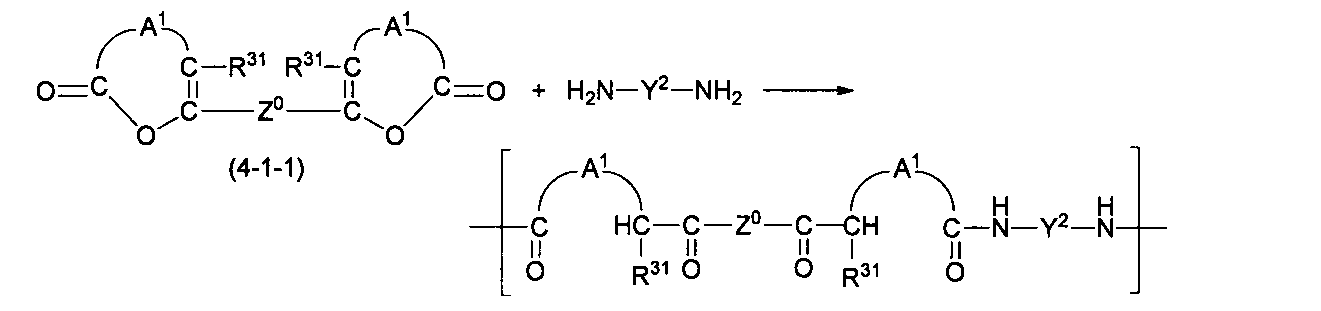

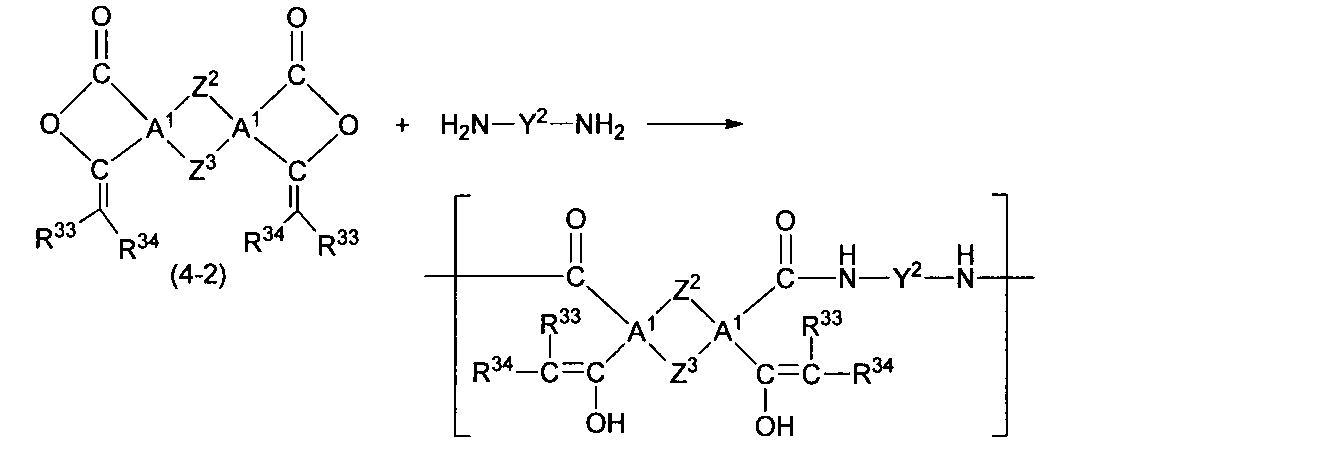

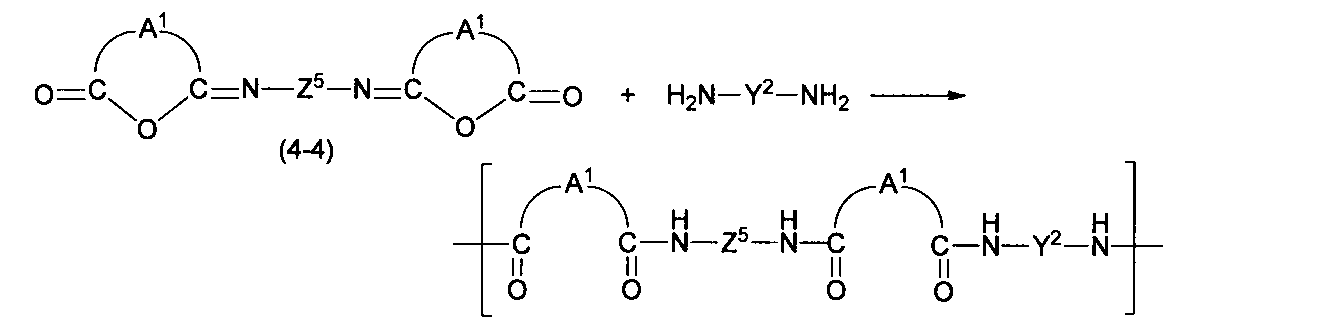
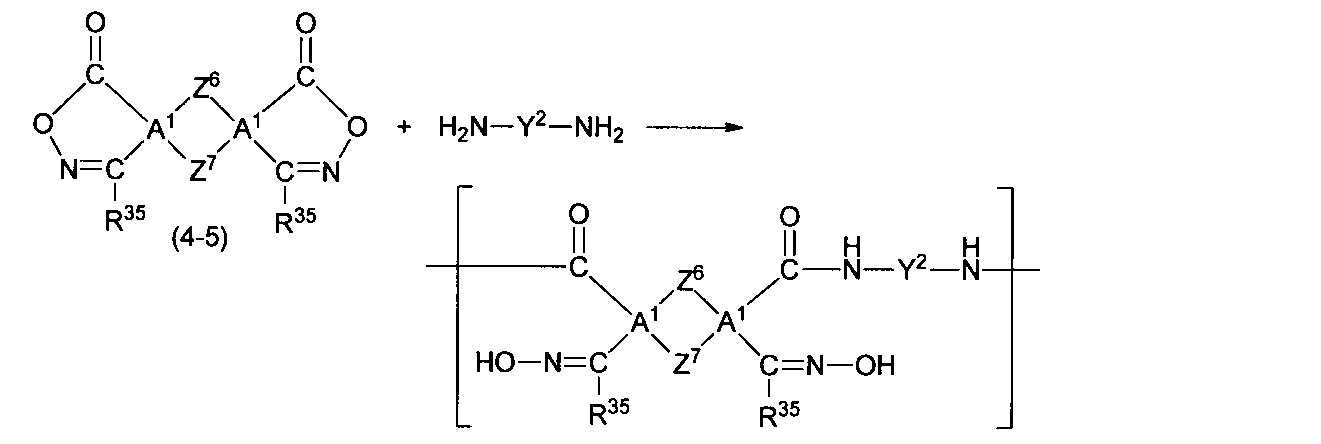
(上記の反応スキーム中、A1は2価の有機基であり、他の環構造に結合して当該他の環構造とともに縮合環を形成していてもよい。R31~R35は、それぞれ独立して、水素原子、ハロゲン原子又は炭素数1以上の1価の有機基である。Z0~Z7は、それぞれ独立して2価の有機基であり、Y2は、上記式(1)で表される部分構造を有するジアミンから2個の1級アミノ基を取り除いた2価の有機基である。)
特定重合体がポリアミドである場合、当該ポリアミドとしては、環内エノールエステル類、環外エノールエステル類、環内アシルアミドエステル類、環外アシルアミドエステル類及びオキシムエステル類よりなる群から選ばれる少なくとも一種である複素環含有化合物と、ジアミン化合物との反応生成物であるポリアミド(以下、ポリアミド(C)ともいう。)を好ましく使用することができる。ポリアミド(C)を得るための反応スキームの一例を以下に示す。
上記式(4-1-1)、(4-1-2)及び(4-2)~(4-5)のそれぞれで表される化合物の具体例としては、例えば下記式(b-1)~式(b-11)のそれぞれで表される化合物等が挙げられる。式中、「Ph」はフェニル基を表す。

ポリアミド(C)の合成に際し、ジアミン化合物としては、上記式(1)で表される部分構造を有するジアミンのみを使用してもよいし、その他のジアミンを併用してもよい。上記式(1)で表される部分構造を有するジアミンの使用割合は、合成に使用するジアミン化合物の全量に対して、5モル%以上とすることが好ましく、10モル%以上とすることがより好ましい。
ポリアミド(C)のGPCにより測定したポリスチレン換算の重量平均分子量(Mw)は、好ましくは1,000~300,000であり、より好ましくは2,000~100,000である。分子量分布(Mw/Mn)は、好ましくは5以下であり、より好ましくは3以下である。なお、液晶配向剤の調製に使用するポリアミド(C)は、1種のみでもよく、2種以上を組み合わせてもよい。
ポリアミド(C)のGPCにより測定したポリスチレン換算の重量平均分子量(Mw)は、好ましくは1,000~300,000であり、より好ましくは2,000~100,000である。分子量分布(Mw/Mn)は、好ましくは5以下であり、より好ましくは3以下である。なお、液晶配向剤の調製に使用するポリアミド(C)は、1種のみでもよく、2種以上を組み合わせてもよい。
本開示の液晶配向剤は、特定重合体以外のその他の成分を含有していてもよい。その他の成分としては、特定重合体以外の重合体、分子内に少なくとも一つのエポキシ基を有する化合物、官能性シラン化合物、架橋剤、酸化防止剤、金属キレート化合物、硬化促進剤、界面活性剤、充填剤、分散剤、光増感剤などが挙げられる。その他の成分の配合割合は、本開示の効果を損なわない範囲で各化合物に応じて適宜選択することができる。
液晶配向剤の調製に際しては、低チルト角化の効果をより高くできる点で、特定重合体と共に、光配向性基を側鎖に有さない重合体(以下、重合体[P]ともいう。)を用いることが好ましい。重合体[P]は、好ましくは上記式(1)で表される部分構造を有さない重合体である。重合体[P]の主骨格は特に限定されないが、ポリアミック酸、ポリアミック酸エステル及びポリイミドよりなる群から選ばれる少なくとも一種であることが特に好ましい。液晶配向剤中に特定重合体と重合体[P]とを含有させる場合、特定重合体の配合割合は、重合体[P]100質量部に対して、1~200質量部とすることが好ましく、5~150質量部とすることがより好ましく、10~100質量部とすることがさらに好ましい。重合体[P]は、1種を単独で使用してもよく、2種以上を組み合わせて使用してもよい。
架橋剤としては、例えば(メタ)アクリロイル基、アルケニル基、ビニルフェニル基、エポキシ基、イソシアネート基、ブロックイソシアネート基、カルボキシル基、保護されたカルボキシル基、マレイミド基等の架橋性基を有する化合物が挙げられる。架橋剤が有する架橋性基は2個以上であることが好ましく、2~6個であることが好ましい。液晶配向剤が架橋剤を含有する場合、特定重合体は、低チルト角化とΔチルト角特性の効果を高めるために、架橋剤が有する架橋性基と反応する基を側鎖に有していることが好ましい。架橋剤の使用割合は、液晶配向剤に含有される重合体成分の全量100質量部に対して、0.1~100質量部とすることが好ましく、0.5~70質量部とすることがより好ましい。
(溶剤)
液晶配向剤の調製に使用する有機溶媒としては、例えばN-メチル-2-ピロリドン、N-エチル-2-ピロリドン、1,2-ジメチル-2-イミダゾリジノン、γ-ブチロラクトン、γ-ブチロラクタム、N,N-ジメチルホルムアミド、N,N-ジメチルアセトアミド、4-ヒドロキシ-4-メチル-2-ペンタノン、エチレングリコールモノメチルエーテル、乳酸ブチル、酢酸ブチル、メチルメトキシプロピオネ-ト、エチルエトキシプロピオネ-ト、エチレングリコールメチルエーテル、エチレングリコールエチルエーテル、エチレングリコール-n-プロピルエーテル、エチレングリコール-i-プロピルエーテル、エチレングリコール-n-ブチルエーテル(ブチルセロソルブ)、エチレングリコールジメチルエーテル、エチレングリコールエチルエーテルアセテート、ジエチレングリコールジメチルエーテル、ジエチレングリコールジエチルエーテル、ジエチレングリコールモノメチルエーテル、ジエチレングリコールモノエチルエーテル、ジエチレングリコールモノメチルエーテルアセテート、ジエチレングリコールモノエチルエーテルアセテート、ジイソブチルケトン、イソアミルプロピオネート、イソアミルイソブチレート、ジイソペンチルエーテル、エチレンカーボネート、プロピレンカーボネート、3-メトキシブチルアセテート、ジプロピレングリコールメチルエーテルアセテート、乳酸アセチルエチル、等を挙げることができる。これらは、1種を単独で又は2種以上を混合して使用することができる。
液晶配向剤の調製に使用する有機溶媒としては、例えばN-メチル-2-ピロリドン、N-エチル-2-ピロリドン、1,2-ジメチル-2-イミダゾリジノン、γ-ブチロラクトン、γ-ブチロラクタム、N,N-ジメチルホルムアミド、N,N-ジメチルアセトアミド、4-ヒドロキシ-4-メチル-2-ペンタノン、エチレングリコールモノメチルエーテル、乳酸ブチル、酢酸ブチル、メチルメトキシプロピオネ-ト、エチルエトキシプロピオネ-ト、エチレングリコールメチルエーテル、エチレングリコールエチルエーテル、エチレングリコール-n-プロピルエーテル、エチレングリコール-i-プロピルエーテル、エチレングリコール-n-ブチルエーテル(ブチルセロソルブ)、エチレングリコールジメチルエーテル、エチレングリコールエチルエーテルアセテート、ジエチレングリコールジメチルエーテル、ジエチレングリコールジエチルエーテル、ジエチレングリコールモノメチルエーテル、ジエチレングリコールモノエチルエーテル、ジエチレングリコールモノメチルエーテルアセテート、ジエチレングリコールモノエチルエーテルアセテート、ジイソブチルケトン、イソアミルプロピオネート、イソアミルイソブチレート、ジイソペンチルエーテル、エチレンカーボネート、プロピレンカーボネート、3-メトキシブチルアセテート、ジプロピレングリコールメチルエーテルアセテート、乳酸アセチルエチル、等を挙げることができる。これらは、1種を単独で又は2種以上を混合して使用することができる。
液晶配向剤の溶剤成分としては、下記式(E-1)~式(E-5)のそれぞれで表される化合物よりなる群から選ばれる少なくとも一種であって、かつ1気圧での沸点が180℃以下である溶剤(以下、「特定溶剤」ともいう。)を使用してもよい。溶剤成分の少なくとも一部として特定溶剤を用いることにより、膜形成時の加熱を低温(例えば200℃以下)で行った場合にも表示特性に優れた液晶素子を得ることができる点で好ましい。

(式(E-1)中、R41は、炭素数1~4のアルキル基又はCH3CO-であり、R42は、炭素数1~4のアルカンジイル基又は-(R47-O)r-R48-(ただし、R47及びR48は、それぞれ独立に炭素数2又は3のアルカンジイル基であり、rは1~4の整数である。)であり、R43は、水素原子又は炭素数1~4のアルキル基である。)

(式(E-2)中、R44は、炭素数1~4のアルカンジイル基である。)

(式(E-3)中、R45及びR46は、それぞれ独立に炭素数1~8のアルキル基である。)

(式(E-4)中、R49は、水素原子又は水酸基であり、R50は、R49が水素原子の場合、炭素数1~9の炭化水素基であり、R49が水酸基の場合、炭素数1~9の2価の炭化水素基又は当該炭素-炭素結合間に酸素原子を有する2価の基である。)

(式(E-5)中、R51及びR52は、それぞれ独立に炭素数1~6の1価の炭化水素基又は当該炭素-炭素結合間に酸素原子を有する1価の基である。)
特定溶剤の具体例としては、上記式(E-1)で表される化合物として、例えばプロピレングリコールモノメチルエーテル、プロピレングリコールモノメチルエーテルアセテート、ジエチレングリコールメチルエチルエーテル、3-メトキシ-1-ブタノール、エチレングリコールモノメチルエーテル、エチレングリコールモノエチルエーテル、エチレングリコールモノプロピルエーテル、エチレングリコール-n-ブチルエーテル(ブチルセロソルブ)、エチレングリコールジメチルエーテル、エチレングリコールエチルエーテルアセテート、ジエチレングリコールジメチルエーテル等を;
上記式(E-2)で表される化合物として、例えばシクロブタノン、シクロペンタノン、シクロヘキサノンを;
上記式(E-3)で表される化合物として、例えばアセトン、メチルエチルケトン、メチル-n-プロピルケトン、メチル-n-ブチルケトン、ジエチルケトン、メチル-i-ブチルケトン、メチル-n-ペンチルケトン、エチル-n-ブチルケトン、メチル-n-ヘキシルケトン、ジ-i-ブチルケトン、トリメチルノナノン、シクロペンタノン、シクロヘキサノン、シクロヘプタノン、シクロオクタノン、メチルシクロヘキサノン、2,4-ペンタンジオン、アセトニルアセトン、ジイソブチルケトン等を;
上記式(E-4)で表される化合物として、例えばメタノール、エタノール、プロパノール、ブタノール、ペンタノール、3-メトキシ-1-ブタノール、ヘキサノール、ヘプタノール、フルフリルアルコール、フェノール、シクロヘキサノール、メチルシクロヘキサノール、3,3,5-トリメチルシクロヘキサノール、ベンジルアルコール、ジアセトンアルコール等のモノアルコールや、エチレングリコール、1,2-プロピレングリコール、1,3-ブチレングリコール、2,4-ペンタンジオール等の多価アルコールを;
上記式(E-5)で表される化合物として、例えば多価アルコールの部分エステル(例えば、エチレングリコールモノメチルエーテル、エチレングリコールモノブチルエーテル、エチレングリコールモノヘキシルエーテル、エチレングリコールモノ-2-エチルブチルエーテル、ジエチレングリコールモノメチルエーテル、ジエチレングリコールモノプロピルエーテル、ジエチレングリコールモノブチルエーテル、プロピレングリコールモノメチルエーテル、プロピレングリコールモノエチルエーテル、プロピレングリコールモノプロピルエーテル、プロピレングリコールモノブチルエーテル、ジプロピレングリコールモノプロピルエーテル等の多価アルコールの部分エステル)、酢酸メチル、酢酸エチル、酢酸プロピル、酢酸n-ブチル、酢酸i-ブチル、酢酸t-ブチル、酢酸3-メトキシブチル、酢酸2-エチルヘキシル、アセト酢酸メチル、アセト酢酸エチル、酢酸エチレングリコールモノメチルエーテル、酢酸ジエチレングリコールモノメチルエーテル、酢酸ジエチレングリコールモノエチルエーテル、酢酸プロピレングリコールモノメチルエーテル、酢酸プロピレングリコールモノエチルエーテル、酢酸プロピレングリコールモノプロピルエーテル、酢酸ジプロピレングリコールモノメチルエーテル、ジ酢酸グリコール、酢酸メトキシトリグリコール、プロピオン酸エチル、プロピオン酸n-ブチル、シュウ酸ジ-n-ブチル、乳酸メチル、乳酸エチル、乳酸n-ブチル、乳酸n-アミル、マロン酸ジエチル、フタル酸ジメチル等を、それぞれ挙げることができる。なお、特定溶剤としては、1種を単独で用いてもよく、2種以上を組み合わせて用いてもよい。
上記式(E-2)で表される化合物として、例えばシクロブタノン、シクロペンタノン、シクロヘキサノンを;
上記式(E-3)で表される化合物として、例えばアセトン、メチルエチルケトン、メチル-n-プロピルケトン、メチル-n-ブチルケトン、ジエチルケトン、メチル-i-ブチルケトン、メチル-n-ペンチルケトン、エチル-n-ブチルケトン、メチル-n-ヘキシルケトン、ジ-i-ブチルケトン、トリメチルノナノン、シクロペンタノン、シクロヘキサノン、シクロヘプタノン、シクロオクタノン、メチルシクロヘキサノン、2,4-ペンタンジオン、アセトニルアセトン、ジイソブチルケトン等を;
上記式(E-4)で表される化合物として、例えばメタノール、エタノール、プロパノール、ブタノール、ペンタノール、3-メトキシ-1-ブタノール、ヘキサノール、ヘプタノール、フルフリルアルコール、フェノール、シクロヘキサノール、メチルシクロヘキサノール、3,3,5-トリメチルシクロヘキサノール、ベンジルアルコール、ジアセトンアルコール等のモノアルコールや、エチレングリコール、1,2-プロピレングリコール、1,3-ブチレングリコール、2,4-ペンタンジオール等の多価アルコールを;
上記式(E-5)で表される化合物として、例えば多価アルコールの部分エステル(例えば、エチレングリコールモノメチルエーテル、エチレングリコールモノブチルエーテル、エチレングリコールモノヘキシルエーテル、エチレングリコールモノ-2-エチルブチルエーテル、ジエチレングリコールモノメチルエーテル、ジエチレングリコールモノプロピルエーテル、ジエチレングリコールモノブチルエーテル、プロピレングリコールモノメチルエーテル、プロピレングリコールモノエチルエーテル、プロピレングリコールモノプロピルエーテル、プロピレングリコールモノブチルエーテル、ジプロピレングリコールモノプロピルエーテル等の多価アルコールの部分エステル)、酢酸メチル、酢酸エチル、酢酸プロピル、酢酸n-ブチル、酢酸i-ブチル、酢酸t-ブチル、酢酸3-メトキシブチル、酢酸2-エチルヘキシル、アセト酢酸メチル、アセト酢酸エチル、酢酸エチレングリコールモノメチルエーテル、酢酸ジエチレングリコールモノメチルエーテル、酢酸ジエチレングリコールモノエチルエーテル、酢酸プロピレングリコールモノメチルエーテル、酢酸プロピレングリコールモノエチルエーテル、酢酸プロピレングリコールモノプロピルエーテル、酢酸ジプロピレングリコールモノメチルエーテル、ジ酢酸グリコール、酢酸メトキシトリグリコール、プロピオン酸エチル、プロピオン酸n-ブチル、シュウ酸ジ-n-ブチル、乳酸メチル、乳酸エチル、乳酸n-ブチル、乳酸n-アミル、マロン酸ジエチル、フタル酸ジメチル等を、それぞれ挙げることができる。なお、特定溶剤としては、1種を単独で用いてもよく、2種以上を組み合わせて用いてもよい。
液晶配向剤中に含まれる溶剤成分につき、特定溶剤の含有割合は、液晶配向剤中に含まれる溶剤の全量に対して、20質量%以上であることが好ましく、40質量%以上であることがより好ましく、50質量%以上であることがさらに好ましく、80質量%以上であることが特に好ましい。
液晶配向剤における固形分濃度(液晶配向剤の溶媒以外の成分の合計質量が液晶配向剤の全質量に占める割合)は、粘性、揮発性などを考慮して適宜に選択されるが、好ましくは1~10質量%の範囲である。すなわち、液晶配向剤は、後述するように基板表面に塗布され、好ましくは加熱されることにより、液晶配向膜である塗膜又は液晶配向膜となる塗膜が形成される。このとき、固形分濃度が1質量%未満である場合には、塗膜の膜厚が過小となって良好な液晶配向膜が得にくくなる。一方、固形分濃度が10質量%を超える場合には、塗膜の膜厚が過大となって良好な液晶配向膜が得にくく、また、液晶配向剤の粘性が増大して塗布性が低下する傾向にある。
[工程I:液晶配向剤を塗布する工程]
次に、基板上に上記の液晶配向剤を塗布し、次いで必要に応じて塗布面を加熱することにより基板上に塗膜を形成する。基板としては、例えばフロートガラス、ソーダガラスなどのガラス;ポリエチレンテレフタレート、ポリブチレンテレフタレート、ポリエーテルスルホン、ポリカーボネート、ポリ(脂環式オレフィン)などのプラスチックからなる透明基板を用いることができる。基板の一面に設けられる透明導電膜としては、酸化スズ(SnO2)からなるNESA膜(米国PPG社登録商標)、酸化インジウム-酸化スズ(In2O3-SnO2)からなるITO膜などを用いることができる。なお、本明細書において「塗膜」とは、液晶配向膜を形成するために基板上に塗布した液晶配向剤から溶剤の一部のみを除去した状態及び当該溶剤の全部を除去した状態の両方を含む意味である。
次に、基板上に上記の液晶配向剤を塗布し、次いで必要に応じて塗布面を加熱することにより基板上に塗膜を形成する。基板としては、例えばフロートガラス、ソーダガラスなどのガラス;ポリエチレンテレフタレート、ポリブチレンテレフタレート、ポリエーテルスルホン、ポリカーボネート、ポリ(脂環式オレフィン)などのプラスチックからなる透明基板を用いることができる。基板の一面に設けられる透明導電膜としては、酸化スズ(SnO2)からなるNESA膜(米国PPG社登録商標)、酸化インジウム-酸化スズ(In2O3-SnO2)からなるITO膜などを用いることができる。なお、本明細書において「塗膜」とは、液晶配向膜を形成するために基板上に塗布した液晶配向剤から溶剤の一部のみを除去した状態及び当該溶剤の全部を除去した状態の両方を含む意味である。
液晶配向剤を塗布した後、塗布した液晶配向剤の液垂れ防止などの目的で、好ましくは予備加熱(プレベーク)が実施される。プレベーク温度は、好ましくは30~150℃であり、プレベーク時間は、好ましくは0.25~10分である。
[工程II:上記塗膜に偏光の放射線を照射する工程]
本工程では、基板に液晶配向剤を塗布した塗布面に対し、偏光放射線を照射することにより塗膜に液晶配向能を付与する。放射線としては、例えば150~800nmの波長の光を含む紫外線及び可視光線を用いることができる。好ましくは、200~400nmの波長の光を含む紫外線である。放射線の照射は、基板面に垂直の方向から行ってもよく、斜め方向から行ってもよく、又はこれらを組み合わせて行ってもよい。
使用する光源としては、例えば低圧水銀ランプ、高圧水銀ランプ、重水素ランプ、メタルハライドランプ、アルゴン共鳴ランプ、キセノンランプ、エキシマレーザーなどを使用することができる。好ましい波長領域の紫外線は、光源を、例えばフィルター、回折格子等と併用する手段等により得ることができる。放射線の照射量は、好ましくは100~50,000J/m2であり、より好ましくは200~20,000J/m2である。
本工程では、基板に液晶配向剤を塗布した塗布面に対し、偏光放射線を照射することにより塗膜に液晶配向能を付与する。放射線としては、例えば150~800nmの波長の光を含む紫外線及び可視光線を用いることができる。好ましくは、200~400nmの波長の光を含む紫外線である。放射線の照射は、基板面に垂直の方向から行ってもよく、斜め方向から行ってもよく、又はこれらを組み合わせて行ってもよい。
使用する光源としては、例えば低圧水銀ランプ、高圧水銀ランプ、重水素ランプ、メタルハライドランプ、アルゴン共鳴ランプ、キセノンランプ、エキシマレーザーなどを使用することができる。好ましい波長領域の紫外線は、光源を、例えばフィルター、回折格子等と併用する手段等により得ることができる。放射線の照射量は、好ましくは100~50,000J/m2であり、より好ましくは200~20,000J/m2である。
本製造方法においては、工程IIで塗布面に偏光放射線を照射している間、及び偏光放射線を照射した後のうち少なくともいずれかにおいて塗布面を加熱する。この加熱は、塗布面から溶剤を除去するための処理であり、以下では「本焼成」ということもある。重合体にアミック酸構造が存在する場合には、重合体中のアミック酸構造を熱イミド化することを目的として本焼成が実施されてもよい。このときの加熱温度は、プレベーク温度より高いことが好ましい。具体的には、80~300℃とすることが好ましく、より好ましくは160~250℃、特に好ましくは180~230℃である。加熱時間は、5~200分とすることが好ましく、より好ましくは10~150分、特に好ましくは15~120分である。本焼成のための加熱を偏光放射線の照射中及び偏光放射線の照射後のうち少なくともいずれかに行うことにより、得られる液晶素子において低チルト角化とΔチルト特性との両立を達成することが可能となる。この理由は必ずしも定かではないが、加熱により自己組織化(加熱再配列)が促進されたことによることが推測される。低チルト角化の改善効果が高い点及びプロセスコストの点から、加熱(本焼成)は偏光放射線を照射した後に行うことが好ましい。具体的には、予備加熱を行った後であって本焼成を行う前に塗膜に偏光放射線を照射することが好ましい。このようにして形成される液晶配向膜の膜厚は、好ましくは0.001~1μmである。
[工程III:液晶セルの構築]
続いて、上記のようにして液晶配向膜が形成された基板を2枚準備し、対向配置した2枚の基板間に液晶を配置することにより液晶セルを製造することができる。具体的には、一対の基板の周辺部をシール剤によって貼り合わせ、基板表面及びシール剤により区画されたセルギャップ内に液晶を注入充填した後、注入孔を封止する方法;一方の基板の液晶配向膜側の周辺部にシール剤を塗布し、さらに液晶配向膜面上の所定の数箇所に液晶を滴下した後、液晶配向膜が対向するように他方の基板を貼り合わせるとともに液晶を基板の全面に押し広げ、その後シール剤を硬化する方法(ODF方式)、などが挙げられる。
シール剤としては、例えば硬化剤及びスペーサーとしての酸化アルミニウム球を含有するエポキシ樹脂などが挙げられる。液晶としては、ネマチック液晶及びスメクチック液晶を挙げることができ、中でもネマチック液晶が好ましく、例えばシッフベース系液晶、アゾキシ系液晶、ビフェニル系液晶、フェニルシクロヘキサン系液晶、エステル系液晶、ターフェニル系液晶、ビフェニルシクロヘキサン系液晶、ピリミジン系液晶、ジオキサン系液晶、ビシクロオクタン系液晶、キュバン系液晶などが挙げられる。また、これらの液晶にコレステリック液晶、カイラル剤、強誘電性液晶などを添加して使用してもよい。
続いて、上記のようにして液晶配向膜が形成された基板を2枚準備し、対向配置した2枚の基板間に液晶を配置することにより液晶セルを製造することができる。具体的には、一対の基板の周辺部をシール剤によって貼り合わせ、基板表面及びシール剤により区画されたセルギャップ内に液晶を注入充填した後、注入孔を封止する方法;一方の基板の液晶配向膜側の周辺部にシール剤を塗布し、さらに液晶配向膜面上の所定の数箇所に液晶を滴下した後、液晶配向膜が対向するように他方の基板を貼り合わせるとともに液晶を基板の全面に押し広げ、その後シール剤を硬化する方法(ODF方式)、などが挙げられる。
シール剤としては、例えば硬化剤及びスペーサーとしての酸化アルミニウム球を含有するエポキシ樹脂などが挙げられる。液晶としては、ネマチック液晶及びスメクチック液晶を挙げることができ、中でもネマチック液晶が好ましく、例えばシッフベース系液晶、アゾキシ系液晶、ビフェニル系液晶、フェニルシクロヘキサン系液晶、エステル系液晶、ターフェニル系液晶、ビフェニルシクロヘキサン系液晶、ピリミジン系液晶、ジオキサン系液晶、ビシクロオクタン系液晶、キュバン系液晶などが挙げられる。また、これらの液晶にコレステリック液晶、カイラル剤、強誘電性液晶などを添加して使用してもよい。
続いて、必要に応じて液晶セルの外側表面に偏光板を貼り合わせることにより液晶素子が得られる。偏光板としては、ポリビニルアルコールを延伸配向させながらヨウ素を吸収させた「H膜」と称される偏光フィルムを酢酸セルロース保護膜で挟んだ偏光板又はH膜そのものからなる偏光板が挙げられる。
上記で説明した製造方法により得られた液晶配向膜を具備する液晶素子は種々の用途に有効に適用することができる。具体的には、例えば、時計、携帯型ゲーム、ワープロ、ノート型パソコン、カーナビゲーションシステム、カムコーダー、PDA、デジタルカメラ、携帯電話、スマートフォン、各種モニター、液晶テレビ、インフォメーションディスプレイなどの各種表示装置や、調光フィルム等に用いることができる。また、本開示の液晶素子は位相差フィルムに適用することもできる。
以下、実施例により更に具体的に説明するが、本発明はこれらの実施例に限定されるものではない。
以下の例において、重合体の重量平均分子量Mw及びエポキシ当量は以下の方法により測定した。
[重合体の重量平均分子量Mw]:以下の装置を用いて、以下の条件におけるゲルパーミエーションクロマトグラフィーによって測定した結果から、標準物質として単分散ポリスチレンを用いてポリスチレン換算値として求めた。
測定装置:東ソー(株)製、型式「8120-GPC」
カラム:東ソー(株)製、「TSKgelGRCXLII」
溶媒:テトラヒドロフラン、又はリチウムブロミド及びリン酸含有のN,N-ジメチルホルムアミド溶液
試料濃度:5重量%
試料注入量:100μL
カラム温度:40℃
カラム圧力:68kgf/cm2
[エポキシ当量]:JIS C2105の「塩酸-メチルエチルケトン法」に準じて測定した。
[重合体の重量平均分子量Mw]:以下の装置を用いて、以下の条件におけるゲルパーミエーションクロマトグラフィーによって測定した結果から、標準物質として単分散ポリスチレンを用いてポリスチレン換算値として求めた。
測定装置:東ソー(株)製、型式「8120-GPC」
カラム:東ソー(株)製、「TSKgelGRCXLII」
溶媒:テトラヒドロフラン、又はリチウムブロミド及びリン酸含有のN,N-ジメチルホルムアミド溶液
試料濃度:5重量%
試料注入量:100μL
カラム温度:40℃
カラム圧力:68kgf/cm2
[エポキシ当量]:JIS C2105の「塩酸-メチルエチルケトン法」に準じて測定した。
[合成例1-1]
撹拌機、温度計、滴下漏斗及び還流冷却管を備えた反応容器に、2-(3,4-エポキシシクロヘキシル)エチルトリメトキシシラン100.0g、メチルイソブチルケトン500g及びトリエチルアミン10.0gを仕込み、室温で混合した。次いで、脱イオン水100gを滴下漏斗より30分かけて滴下した後、還流下で混合しつつ、80℃で6時間反応させた。反応終了後、有機層を取り出し、これを0.2質量%硝酸アンモニウム水溶液により洗浄後の水が中性になるまで洗浄したのち、減圧下で溶媒及び水を留去することにより、エポキシ基含有ポリオルガノシロキサンとして重合体(EPS-1)を粘調な透明液体として得た。この重合体(EPS-1)につき、1H-NMR分析を行ったところ、化学シフト(δ)=3.2ppm付近にオキシラニル基に基づくピークが理論強度どおりに得られ、反応中にエポキシ基の副反応が起こっていないことが確認された。この重合体(EPS-1)の重量平均分子量は2,200、エポキシ当量は186g/モルであった。
次いで、100mLの三口フラスコに、上記で得た重合体(EPS-1)9.3g、メチルイソブチルケトン26g、カルボン酸として下記式(m-1)で表される化合物14.3g、及び商品名「UCAT 18X」(サンアプロ社製の4級アミン塩)0.10gを仕込み、80℃で12時間撹拌下に反応を行った。反応終了後、反応混合物をメタノールに投入して生成した沈殿物を回収し、これを酢酸エチルに溶解して溶液とし、該溶液を3回水洗した後、溶剤を留去することにより、重合体(Si-1)を白色粉末として23.4g得た。この重合体(Si-1)の重量平均分子量Mwは14,200であった。

撹拌機、温度計、滴下漏斗及び還流冷却管を備えた反応容器に、2-(3,4-エポキシシクロヘキシル)エチルトリメトキシシラン100.0g、メチルイソブチルケトン500g及びトリエチルアミン10.0gを仕込み、室温で混合した。次いで、脱イオン水100gを滴下漏斗より30分かけて滴下した後、還流下で混合しつつ、80℃で6時間反応させた。反応終了後、有機層を取り出し、これを0.2質量%硝酸アンモニウム水溶液により洗浄後の水が中性になるまで洗浄したのち、減圧下で溶媒及び水を留去することにより、エポキシ基含有ポリオルガノシロキサンとして重合体(EPS-1)を粘調な透明液体として得た。この重合体(EPS-1)につき、1H-NMR分析を行ったところ、化学シフト(δ)=3.2ppm付近にオキシラニル基に基づくピークが理論強度どおりに得られ、反応中にエポキシ基の副反応が起こっていないことが確認された。この重合体(EPS-1)の重量平均分子量は2,200、エポキシ当量は186g/モルであった。
次いで、100mLの三口フラスコに、上記で得た重合体(EPS-1)9.3g、メチルイソブチルケトン26g、カルボン酸として下記式(m-1)で表される化合物14.3g、及び商品名「UCAT 18X」(サンアプロ社製の4級アミン塩)0.10gを仕込み、80℃で12時間撹拌下に反応を行った。反応終了後、反応混合物をメタノールに投入して生成した沈殿物を回収し、これを酢酸エチルに溶解して溶液とし、該溶液を3回水洗した後、溶剤を留去することにより、重合体(Si-1)を白色粉末として23.4g得た。この重合体(Si-1)の重量平均分子量Mwは14,200であった。
[合成例1-2]
合成例1-1において、カルボン酸として上記式(m-1)で表される化合物1.0g及び下記式(m-2)で表される化合物10.4gを用いた以外は合成例1-1と同様の操作を実施することにより、重合体(Si-2)を白色粉末として20.6g得た。この重合体(Si-2)の重量平均分子量Mwは12,700であった。

合成例1-1において、カルボン酸として上記式(m-1)で表される化合物1.0g及び下記式(m-2)で表される化合物10.4gを用いた以外は合成例1-1と同様の操作を実施することにより、重合体(Si-2)を白色粉末として20.6g得た。この重合体(Si-2)の重量平均分子量Mwは12,700であった。
[合成例1-3]
合成例1-1において、カルボン酸として下記式(m-3)で表される化合物8.9gを用いた以外は合成例1-1と同様の操作を実施することにより、重合体(Si-3)を白色粉末として18.2g得た。この重合体(Si-3)の重量平均分子量Mwは9,700であった。

合成例1-1において、カルボン酸として下記式(m-3)で表される化合物8.9gを用いた以外は合成例1-1と同様の操作を実施することにより、重合体(Si-3)を白色粉末として18.2g得た。この重合体(Si-3)の重量平均分子量Mwは9,700であった。
[合成例1-4]
合成例1-1において、カルボン酸として上記式(m-3)で表される化合物14.9g及び下記式(m-4)で表される化合物3.2gを用いた以外は合成例1-1と同様の操作を実施することにより、重合体(Si-4)を白色粉末として27.4g得た。この重合体(Si-4)の重量平均分子量Mwは15,200であった。

合成例1-1において、カルボン酸として上記式(m-3)で表される化合物14.9g及び下記式(m-4)で表される化合物3.2gを用いた以外は合成例1-1と同様の操作を実施することにより、重合体(Si-4)を白色粉末として27.4g得た。この重合体(Si-4)の重量平均分子量Mwは15,200であった。
[合成例1-5]
合成例1-1において、カルボン酸として下記式(m-5)で表される化合物9.5gを用いた以外は合成例1-1と同様の操作を実施することにより、重合体(Si-6)を白色粉末として18.8g得た。この重合体(Si-6)の重量平均分子量Mwは13,900であった。

合成例1-1において、カルボン酸として下記式(m-5)で表される化合物9.5gを用いた以外は合成例1-1と同様の操作を実施することにより、重合体(Si-6)を白色粉末として18.8g得た。この重合体(Si-6)の重量平均分子量Mwは13,900であった。
[合成例1-6]
撹拌機、温度計、滴下漏斗及び還流冷却管を備えた反応容器に、2-(3,4-エポキシシクロヘキシル)エチルトリメトキシシラン257.9g、3-(メタクロイルオキシ)プロピルトリメトキシシラン86.9g、メチルイソブチルケトン500g及びトリエチルアミン10.0gを仕込み、室温で混合した。次いで、脱イオン水100gを滴下漏斗より30分かけて滴下した後、還流下で混合しつつ、80℃で6時間反応させた。反応終了後、有機層を取り出し、これを0.2質量%硝酸アンモニウム水溶液により洗浄後の水が中性になるまで洗浄したのち、減圧下で溶媒及び水を留去することにより、エポキシ基含有ポリオルガノシロキサンとして重合体(EPS-2)を粘調な透明液体として得た。この重合体(EPS-2)につき、1H-NMR分析を行ったところ、化学シフト(δ)=3.2ppm付近にオキシラニル基に基づくピークが理論強度どおりに得られ、反応中にエポキシ基の副反応が起こっていないことが確認された。この重合体(EPS-2)の重量平均分子量は3,000、エポキシ当量は248g/モルであった。
次いで、100mLの三口フラスコに、上記で得た重合体(EPS-2)8.0g、メチルイソブチルケトン26g、上記式(m-3)で表される化合物15.3g、及び商品名「UCAT 18X」(サンアプロ社製の4級アミン塩)0.10gを仕込み、80℃で12時間撹拌下に反応を行った。反応終了後、反応混合物をメタノールに投入して生成した沈殿物を回収し、これを酢酸エチルに溶解して溶液とし、該溶液を3回水洗した後、溶剤を留去することにより、重合体(Si-5)を白色粉末として23.2g得た。この重合体(Si-5)の重量平均分子量Mwは14,100であった。
撹拌機、温度計、滴下漏斗及び還流冷却管を備えた反応容器に、2-(3,4-エポキシシクロヘキシル)エチルトリメトキシシラン257.9g、3-(メタクロイルオキシ)プロピルトリメトキシシラン86.9g、メチルイソブチルケトン500g及びトリエチルアミン10.0gを仕込み、室温で混合した。次いで、脱イオン水100gを滴下漏斗より30分かけて滴下した後、還流下で混合しつつ、80℃で6時間反応させた。反応終了後、有機層を取り出し、これを0.2質量%硝酸アンモニウム水溶液により洗浄後の水が中性になるまで洗浄したのち、減圧下で溶媒及び水を留去することにより、エポキシ基含有ポリオルガノシロキサンとして重合体(EPS-2)を粘調な透明液体として得た。この重合体(EPS-2)につき、1H-NMR分析を行ったところ、化学シフト(δ)=3.2ppm付近にオキシラニル基に基づくピークが理論強度どおりに得られ、反応中にエポキシ基の副反応が起こっていないことが確認された。この重合体(EPS-2)の重量平均分子量は3,000、エポキシ当量は248g/モルであった。
次いで、100mLの三口フラスコに、上記で得た重合体(EPS-2)8.0g、メチルイソブチルケトン26g、上記式(m-3)で表される化合物15.3g、及び商品名「UCAT 18X」(サンアプロ社製の4級アミン塩)0.10gを仕込み、80℃で12時間撹拌下に反応を行った。反応終了後、反応混合物をメタノールに投入して生成した沈殿物を回収し、これを酢酸エチルに溶解して溶液とし、該溶液を3回水洗した後、溶剤を留去することにより、重合体(Si-5)を白色粉末として23.2g得た。この重合体(Si-5)の重量平均分子量Mwは14,100であった。
[合成例2-1]
テトラカルボン酸二無水物として2,3,5-トリカルボキシシクロペンチル酢酸二無水物100モル部、並びにジアミンとして下記式(DA-1)で表される化合物90モル部及び下記式(DA-2)で表される化合物10モル部をN-メチル-2-ピロリドン(NMP)に溶解し、40℃で3時間反応させることにより、ポリアミック酸として重合体(PA-1)を10質量%含有する溶液を得た。

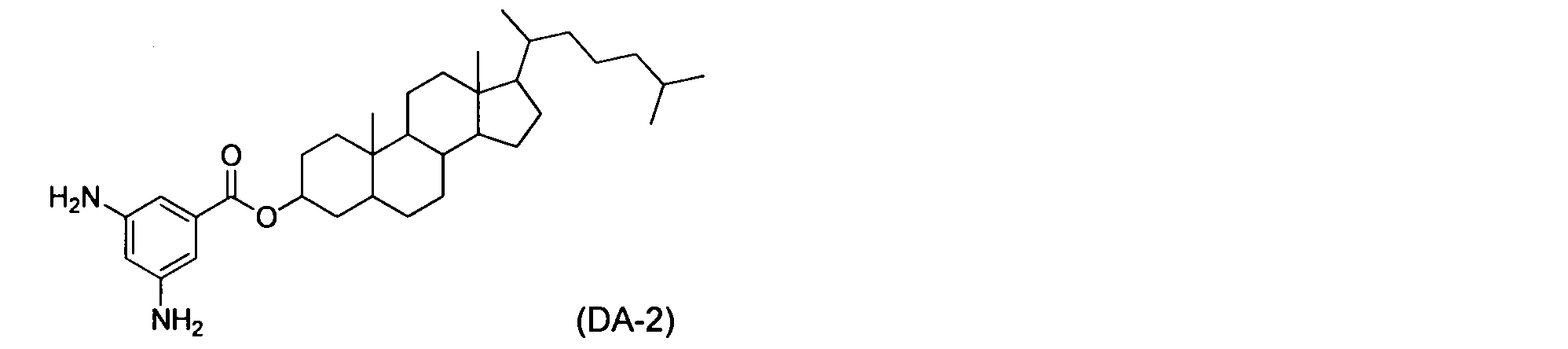
テトラカルボン酸二無水物として2,3,5-トリカルボキシシクロペンチル酢酸二無水物100モル部、並びにジアミンとして下記式(DA-1)で表される化合物90モル部及び下記式(DA-2)で表される化合物10モル部をN-メチル-2-ピロリドン(NMP)に溶解し、40℃で3時間反応させることにより、ポリアミック酸として重合体(PA-1)を10質量%含有する溶液を得た。
[合成例2-2]
テトラカルボン酸二無水物として1,2,3,4-シクロブタンテトラカルボン酸二無水物100モル部、並びに及びジアミンとして上記式(DA-2)で表される化合物30モル部及び下記式(DA-3)で表される化合物70モル部をNMPに溶解し、40℃で3時間反応させることにより、ポリアミック酸として重合体(PA-2)を10質量%含有する溶液を得た。

テトラカルボン酸二無水物として1,2,3,4-シクロブタンテトラカルボン酸二無水物100モル部、並びに及びジアミンとして上記式(DA-2)で表される化合物30モル部及び下記式(DA-3)で表される化合物70モル部をNMPに溶解し、40℃で3時間反応させることにより、ポリアミック酸として重合体(PA-2)を10質量%含有する溶液を得た。
[合成例2-3]
テトラカルボン酸二無水物としてピロメリット酸二無水物100モル部、並びにジアミンとして上記式(DA-2)で表される化合物20モル部及び上記式(DA-3)で表される化合物80モル部をNMPに溶解し、40℃で3時間反応させることにより、ポリアミック酸として重合体(PA-3)を10質量%含有する溶液を得た。
テトラカルボン酸二無水物としてピロメリット酸二無水物100モル部、並びにジアミンとして上記式(DA-2)で表される化合物20モル部及び上記式(DA-3)で表される化合物80モル部をNMPに溶解し、40℃で3時間反応させることにより、ポリアミック酸として重合体(PA-3)を10質量%含有する溶液を得た。
[合成例2-4]
テトラカルボン酸二無水物として1,2,3,4-シクロブタンテトラカルボン酸二無水物100モル部、並びにジアミンとして上記式(DA-2)で表される化合物15モル部、上記式(DA-3)で表される化合物70モル部及び下記式(DA-4)で表される化合物15モル部をNMPに溶解し、40℃で3時間反応させることにより、ポリアミック酸として重合体(PA-4)を10質量%含有する溶液を得た。

テトラカルボン酸二無水物として1,2,3,4-シクロブタンテトラカルボン酸二無水物100モル部、並びにジアミンとして上記式(DA-2)で表される化合物15モル部、上記式(DA-3)で表される化合物70モル部及び下記式(DA-4)で表される化合物15モル部をNMPに溶解し、40℃で3時間反応させることにより、ポリアミック酸として重合体(PA-4)を10質量%含有する溶液を得た。
[合成例2-5]
重合体(PA-1)をNMPに溶解して濃度10質量%の溶液とし、ここにピリジン及び無水酢酸を、重合に使用したテトラカルボン酸二無水物1モルに対してそれぞれ1モルずつ添加し、100℃において8時間脱水閉環反応を行った。反応終了後の反応混合物を大過剰のメタノール中に注ぎ、反応生成物を沈澱させた。回収した沈殿物をメタノールで洗浄した後、減圧下40℃において15時間乾燥することにより、ポリイミドである重合体(PI-1)を得た。得られた重合体(PI-1)のイミド化率は60%であった。
[合成例2-6]
重合体(PA-1)に代えて重合体(PA-2)を用いた以外は合成例2-5と同様の操作を行うことにより重合体(PI-2)を得た。得られた重合体(PI-2)のイミド化率は70%であった。
重合体(PA-1)をNMPに溶解して濃度10質量%の溶液とし、ここにピリジン及び無水酢酸を、重合に使用したテトラカルボン酸二無水物1モルに対してそれぞれ1モルずつ添加し、100℃において8時間脱水閉環反応を行った。反応終了後の反応混合物を大過剰のメタノール中に注ぎ、反応生成物を沈澱させた。回収した沈殿物をメタノールで洗浄した後、減圧下40℃において15時間乾燥することにより、ポリイミドである重合体(PI-1)を得た。得られた重合体(PI-1)のイミド化率は60%であった。
[合成例2-6]
重合体(PA-1)に代えて重合体(PA-2)を用いた以外は合成例2-5と同様の操作を行うことにより重合体(PI-2)を得た。得られた重合体(PI-2)のイミド化率は70%であった。
[合成例3-1]
窒素導入管、還流冷却管、及び温度計を備えた200mL三口フラスコに、下記式(TA-3)で表される化合物を22.42g(100mmol)、テトラヒドロフランを100mL、ピリジンを0.79g(10.0mmol)入れ、窒素気流下で撹拌して懸濁させた。この懸濁液にβ-メタリルアルコール15.14g(210mmol)を加え、室温で2時間撹拌した。さらに60℃で8時間反応させ、無色透明な溶液を得た。この反応溶液を60℃で減圧濃縮し、さらに真空乾燥し、下記式(DE-1a)で表される化合物と下記式(DE-1b)で表される化合物との混合物(以下、DE-1a/bという。)36.84gを得た。

窒素導入管、還流冷却管、及び温度計を備えた200mL三口フラスコに、下記式(TA-3)で表される化合物を22.42g(100mmol)、テトラヒドロフランを100mL、ピリジンを0.79g(10.0mmol)入れ、窒素気流下で撹拌して懸濁させた。この懸濁液にβ-メタリルアルコール15.14g(210mmol)を加え、室温で2時間撹拌した。さらに60℃で8時間反応させ、無色透明な溶液を得た。この反応溶液を60℃で減圧濃縮し、さらに真空乾燥し、下記式(DE-1a)で表される化合物と下記式(DE-1b)で表される化合物との混合物(以下、DE-1a/bという。)36.84gを得た。
[合成例3-2]
窒素導入管及び還流冷却管を備えた100mLナスフラスコに、DE-1a/bを18.42g(50.0mmol)、トルエンを100mL入れ、80℃で30分間撹拌した。その後、撹拌しながら室温まで冷却し、さらに室温で30分間撹拌した。得られた懸濁液をろ過し、トルエン5mLで2回洗浄した。得られた固体を60℃で真空乾燥し、白色粉末の化合物(DE-1a) 15.47gを得た(42.0mmol、収率84%)。
窒素導入管及び還流冷却管を備えた100mLナスフラスコに、DE-1a/bを18.42g(50.0mmol)、トルエンを100mL入れ、80℃で30分間撹拌した。その後、撹拌しながら室温まで冷却し、さらに室温で30分間撹拌した。得られた懸濁液をろ過し、トルエン5mLで2回洗浄した。得られた固体を60℃で真空乾燥し、白色粉末の化合物(DE-1a) 15.47gを得た(42.0mmol、収率84%)。
[合成例3-3]
窒素導入管、還流冷却管、及び温度計を備えた500mL三口フラスコに、化合物(DE-1a)を14.74g(40.0mmol)、ヘプタンを80mL、ピリジンを0.032g(0.40mmol)入れ、窒素気流下75℃で撹拌した。塩化チオニル14.28g(120mmol)を20分かけてゆっくり滴下し、反応の進行に伴う発泡を確認した。滴下終了後、75℃で2時間反応させ、無色透明な溶液を得た。この反応溶液を60℃で減圧濃縮し、過剰の塩化チオニルを留去した。得られた液体にヘプタン80mLを加えて室温で撹拌し、析出した不溶分をろ過により除去した。このろ液を60℃で減圧濃縮し、さらに高真空下60℃で4時間乾燥し、無色透明液体の下記式(DC-1a)で表される化合物15.89gを得た(39.2mmol、収率98%)。

窒素導入管、還流冷却管、及び温度計を備えた500mL三口フラスコに、化合物(DE-1a)を14.74g(40.0mmol)、ヘプタンを80mL、ピリジンを0.032g(0.40mmol)入れ、窒素気流下75℃で撹拌した。塩化チオニル14.28g(120mmol)を20分かけてゆっくり滴下し、反応の進行に伴う発泡を確認した。滴下終了後、75℃で2時間反応させ、無色透明な溶液を得た。この反応溶液を60℃で減圧濃縮し、過剰の塩化チオニルを留去した。得られた液体にヘプタン80mLを加えて室温で撹拌し、析出した不溶分をろ過により除去した。このろ液を60℃で減圧濃縮し、さらに高真空下60℃で4時間乾燥し、無色透明液体の下記式(DC-1a)で表される化合物15.89gを得た(39.2mmol、収率98%)。
[合成例3-4]
窒素導入管及び温度計を備えた50mL三口フラスコに、上記式(DC-1a)で表される化合物を3.89g(9.6mmol)、上記式(DA-1)で表される化合物を5.19g(10.0mmol)、NMPを58.2g、トリエチルアミンを0.51g(5.0mmol)入れ、約10℃に冷却し、トリアジン系脱水縮合剤であるDMT-MMを8.30g(30.0mmol)加え、窒素気流下室温で24時間反応させた。得られた重合溶液をNMPにより希釈し、メタノール中に撹拌しながらゆっくり注ぎ凝固させた。沈殿した固体を回収し、メタノール中で撹拌洗浄を2回繰り返し、60℃で真空乾燥し、白色粉末のポリアミック酸エステル(PAE-1)を得た。この重合体の数平均分子量Mnは11,000、分子量分布Mw/Mnは3.0であった。
窒素導入管及び温度計を備えた50mL三口フラスコに、上記式(DC-1a)で表される化合物を3.89g(9.6mmol)、上記式(DA-1)で表される化合物を5.19g(10.0mmol)、NMPを58.2g、トリエチルアミンを0.51g(5.0mmol)入れ、約10℃に冷却し、トリアジン系脱水縮合剤であるDMT-MMを8.30g(30.0mmol)加え、窒素気流下室温で24時間反応させた。得られた重合溶液をNMPにより希釈し、メタノール中に撹拌しながらゆっくり注ぎ凝固させた。沈殿した固体を回収し、メタノール中で撹拌洗浄を2回繰り返し、60℃で真空乾燥し、白色粉末のポリアミック酸エステル(PAE-1)を得た。この重合体の数平均分子量Mnは11,000、分子量分布Mw/Mnは3.0であった。
[合成例4]
下記式(MI-1)で表される化合物5.00g(8.6mmol)、3,4-エポキシシクロヘキシルメチルメタアクリレート3.39g(17.3mmol)、メタクリル酸0.74g(8.6mmol)、及び4-ビニル安息香酸1.28g(8.6mmol)、ラジカル重合開始剤として2,2’-アゾビス(2,4-ジメチルバレロニトリル)0.31g(1.3mmol)、連鎖移動剤として2,4-ジフェニル-4-メチル-1-ペンテン0.52g(2.2mmol)、並びに溶媒としてテトラヒドロフラン25mlを加え、窒素下70℃で5時間重合した。n-ヘキサンに再沈殿した後、沈殿物を濾過し、室温で8時間真空乾燥することで目的の重合体(StMI-1)を得た。GPCによるポリスチレン換算で測定される重量平均分子量Mwは30,000、分子量分布Mw/Mnは3であった。

下記式(MI-1)で表される化合物5.00g(8.6mmol)、3,4-エポキシシクロヘキシルメチルメタアクリレート3.39g(17.3mmol)、メタクリル酸0.74g(8.6mmol)、及び4-ビニル安息香酸1.28g(8.6mmol)、ラジカル重合開始剤として2,2’-アゾビス(2,4-ジメチルバレロニトリル)0.31g(1.3mmol)、連鎖移動剤として2,4-ジフェニル-4-メチル-1-ペンテン0.52g(2.2mmol)、並びに溶媒としてテトラヒドロフラン25mlを加え、窒素下70℃で5時間重合した。n-ヘキサンに再沈殿した後、沈殿物を濾過し、室温で8時間真空乾燥することで目的の重合体(StMI-1)を得た。GPCによるポリスチレン換算で測定される重量平均分子量Mwは30,000、分子量分布Mw/Mnは3であった。
[合成例5]
窒素下、100mL二口フラスコに、下記式(BL-1)で表される複素環化合物3.34g(10mmol)をNMP30gに溶解し、ジアミン化合物として上記式(DA-1)で表される化合物5.66g(11mmol)を加えて、60℃で4時間反応を行った。得られたポリアミド(これを重合体(P-1)とする。)をNMPにて10質量%となるように調製した。

窒素下、100mL二口フラスコに、下記式(BL-1)で表される複素環化合物3.34g(10mmol)をNMP30gに溶解し、ジアミン化合物として上記式(DA-1)で表される化合物5.66g(11mmol)を加えて、60℃で4時間反応を行った。得られたポリアミド(これを重合体(P-1)とする。)をNMPにて10質量%となるように調製した。
[実施例1]
(1)液晶配向剤の調製
上記合成例1-1で得た重合体(Si-1)20質量部、上記合成例2-2で得た重合体(PA-2)100質量部を混合し、これにN-メチル-2-ピロリドン(NMP)及びブチルセロソルブ(BC)を加え、溶媒組成がNMP:BC=50:50(質量比)、固形分濃度が4.0質量%の溶液とした。この溶液を孔径1μmのフィルターで濾過することにより液晶配向剤を調製した。
(2)液晶配向膜の形成
ITO膜からなる透明電極付きガラス基板の透明電極面上に、上記実施例で調製した液晶配向剤をスピンナーにより塗布し、80℃のホットプレートで1分間プレベークを行い、膜厚0.08μmの塗膜を形成した。次いで、この塗膜表面に、Hg-Xeランプ及びグランテーラープリズムを用いて313nmの輝線を含む偏光紫外線200J/m2を、基板法線から40°傾いた方向から室温で照射した。次いで、庫内を窒素置換したオーブン中、160℃で40分間加熱(本焼成)して液晶配向膜とした。同じ操作を繰り返して、液晶配向膜を形成した基板を一対(2枚)作成した。
(1)液晶配向剤の調製
上記合成例1-1で得た重合体(Si-1)20質量部、上記合成例2-2で得た重合体(PA-2)100質量部を混合し、これにN-メチル-2-ピロリドン(NMP)及びブチルセロソルブ(BC)を加え、溶媒組成がNMP:BC=50:50(質量比)、固形分濃度が4.0質量%の溶液とした。この溶液を孔径1μmのフィルターで濾過することにより液晶配向剤を調製した。
(2)液晶配向膜の形成
ITO膜からなる透明電極付きガラス基板の透明電極面上に、上記実施例で調製した液晶配向剤をスピンナーにより塗布し、80℃のホットプレートで1分間プレベークを行い、膜厚0.08μmの塗膜を形成した。次いで、この塗膜表面に、Hg-Xeランプ及びグランテーラープリズムを用いて313nmの輝線を含む偏光紫外線200J/m2を、基板法線から40°傾いた方向から室温で照射した。次いで、庫内を窒素置換したオーブン中、160℃で40分間加熱(本焼成)して液晶配向膜とした。同じ操作を繰り返して、液晶配向膜を形成した基板を一対(2枚)作成した。
(3)液晶表示素子の製造
上記(2)で液晶配向膜を形成した基板のうちの1枚の液晶配向膜を有する面の外周に直径3.5μmの酸化アルミニウム球入りエポキシ樹脂接着剤をスクリーン印刷により塗布した後、一対の基板の液晶配向膜面を対向させ、各基板の紫外線の光軸の基板面への投影方向が逆平行となるように圧着し、150℃で1時間かけて接着剤を熱硬化させた。次いで、液晶注入口より基板間の間隙に、ネガ型液晶(メルク社製、MLC-6608)を充填した後、エポキシ系接着剤で液晶注入口を封止した。さらに、液晶注入時の流動配向を除くために、これを150℃で加熱してから室温まで徐冷した。次に、基板の外側両面に、偏光板を、その偏光方向が互いに直交し、かつ、液晶配向膜の紫外線の光軸の基板面への射影方向と45°の角度をなすように貼り合わせることにより液晶表示素子を製造した。
上記(2)で液晶配向膜を形成した基板のうちの1枚の液晶配向膜を有する面の外周に直径3.5μmの酸化アルミニウム球入りエポキシ樹脂接着剤をスクリーン印刷により塗布した後、一対の基板の液晶配向膜面を対向させ、各基板の紫外線の光軸の基板面への投影方向が逆平行となるように圧着し、150℃で1時間かけて接着剤を熱硬化させた。次いで、液晶注入口より基板間の間隙に、ネガ型液晶(メルク社製、MLC-6608)を充填した後、エポキシ系接着剤で液晶注入口を封止した。さらに、液晶注入時の流動配向を除くために、これを150℃で加熱してから室温まで徐冷した。次に、基板の外側両面に、偏光板を、その偏光方向が互いに直交し、かつ、液晶配向膜の紫外線の光軸の基板面への射影方向と45°の角度をなすように貼り合わせることにより液晶表示素子を製造した。
(4)プレチルト角の測定
上記(3)で得られた液晶表示素子につきプレチルト角を測定した。プレチルト角の測定は、非特許文献「T. J. Scheffer et. al. J. Appl. Phys. vo. 19, p. 2013(1980)」に記載の方法に準拠して、He-Neレーザー光を用いる結晶回転法により液晶分子の基板面からの傾き角の値を測定し、これをプレチルト角[°]とした。その結果、プレチルト角は87.3°であった。ここでプレチルト角が86.0°以上87.0°未満の場合を「A」、87.0°以上87.5°未満の場合を「B」、87.5°以上88.0°未満の場合を「C」、88.0°以上89.0°未満の場合を「D」、89.0°以上90.0°以下の場合を「E」とした。EからAにいくほど低チルト角化が促進されたといえる。なお、86.0°未満の場合には評価不可とした。
上記(3)で得られた液晶表示素子につきプレチルト角を測定した。プレチルト角の測定は、非特許文献「T. J. Scheffer et. al. J. Appl. Phys. vo. 19, p. 2013(1980)」に記載の方法に準拠して、He-Neレーザー光を用いる結晶回転法により液晶分子の基板面からの傾き角の値を測定し、これをプレチルト角[°]とした。その結果、プレチルト角は87.3°であった。ここでプレチルト角が86.0°以上87.0°未満の場合を「A」、87.0°以上87.5°未満の場合を「B」、87.5°以上88.0°未満の場合を「C」、88.0°以上89.0°未満の場合を「D」、89.0°以上90.0°以下の場合を「E」とした。EからAにいくほど低チルト角化が促進されたといえる。なお、86.0°未満の場合には評価不可とした。
(5)Δチルトの測定
上記(3)で得られた液晶表示素子につき、交流電圧(AC)7Vを室温で20時間印加し、電圧印加前後のプレチルト角差(Δチルト[°])を測定した。その結果、Δチルトは0.38°であった。ここでΔチルト角が0.1°未満の場合を「A」、0.1°以上0.2°未満の場合を「B」、0.2°以上0.3°未満の場合を「C」、0.3°以上0.4°未満の場合を「D」、0.4°以上の場合を「E」とした。EからAにいくほどΔチルトが小さく、液晶表示素子の信頼性に優れているといえる。
上記(3)で得られた液晶表示素子につき、交流電圧(AC)7Vを室温で20時間印加し、電圧印加前後のプレチルト角差(Δチルト[°])を測定した。その結果、Δチルトは0.38°であった。ここでΔチルト角が0.1°未満の場合を「A」、0.1°以上0.2°未満の場合を「B」、0.2°以上0.3°未満の場合を「C」、0.3°以上0.4°未満の場合を「D」、0.4°以上の場合を「E」とした。EからAにいくほどΔチルトが小さく、液晶表示素子の信頼性に優れているといえる。
[実施例2~16、比較例1~4]
液晶配向剤の調製に使用する重合体成分の種類及び量(質量部)、並びに添加剤の種類及び量(質量部)を下記表1に示す通り変更した以外は、上記実施例1と同じ溶剤比及び固形分濃度で液晶配向剤をそれぞれ調製した。表1中の添加剤はそれぞれ、下記式(K-1)~(K-4)のそれぞれで表される化合物である。
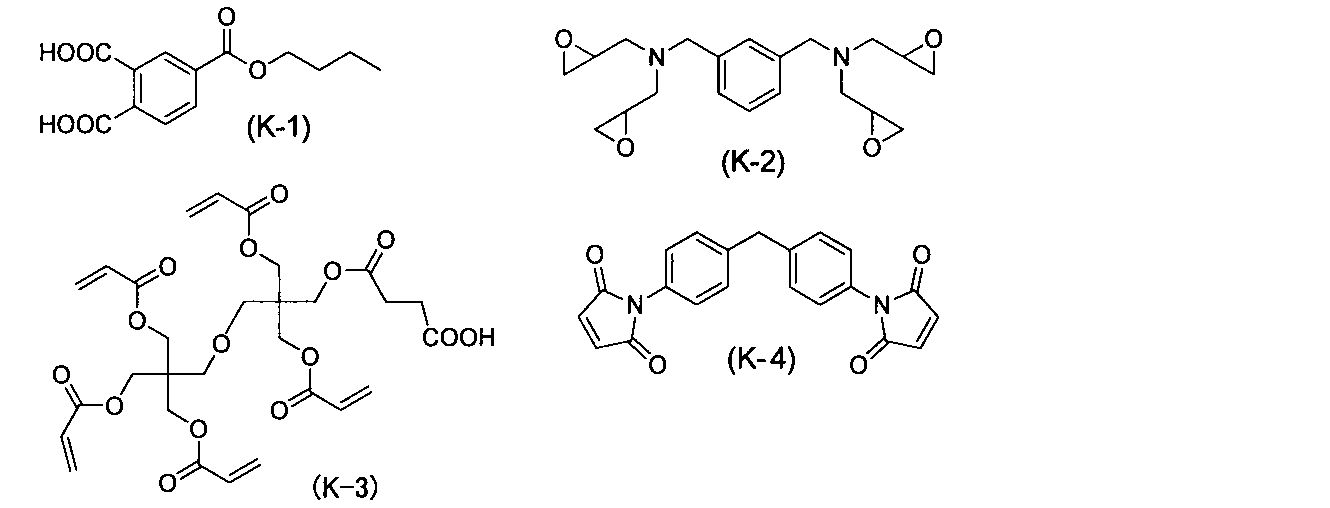
液晶配向剤の調製に使用する重合体成分の種類及び量(質量部)、並びに添加剤の種類及び量(質量部)を下記表1に示す通り変更した以外は、上記実施例1と同じ溶剤比及び固形分濃度で液晶配向剤をそれぞれ調製した。表1中の添加剤はそれぞれ、下記式(K-1)~(K-4)のそれぞれで表される化合物である。
また、使用する液晶配向剤を下記表1の通りに変更した点、及び本焼成の条件を下記表1の通りとした点以外は、実施例1と同様にして液晶表示素子を製造するとともに、実施例1と同じくプレチルト角、Δチルトの評価を行った。それらの結果を下記表1に示した。なお、本焼成のタイミングを「UV照射中」と示した例では、本焼成を開始してから数分後にホットプレート上で偏光放射線を照射し、照射後も引き続きホットプレート上で各加熱時間(下記表1に記載の本焼成の時間(分))が経過するまで加熱した状態を保持した。「UV照射前」と示した例では、液晶配向膜を基板上に形成する際には、実施例1と同じ条件でプレベークを行い、その後偏光紫外線を照射せずに本焼成を行った後、塗膜に対し、偏光紫外線を室温で照射することにより液晶配向膜を形成した。
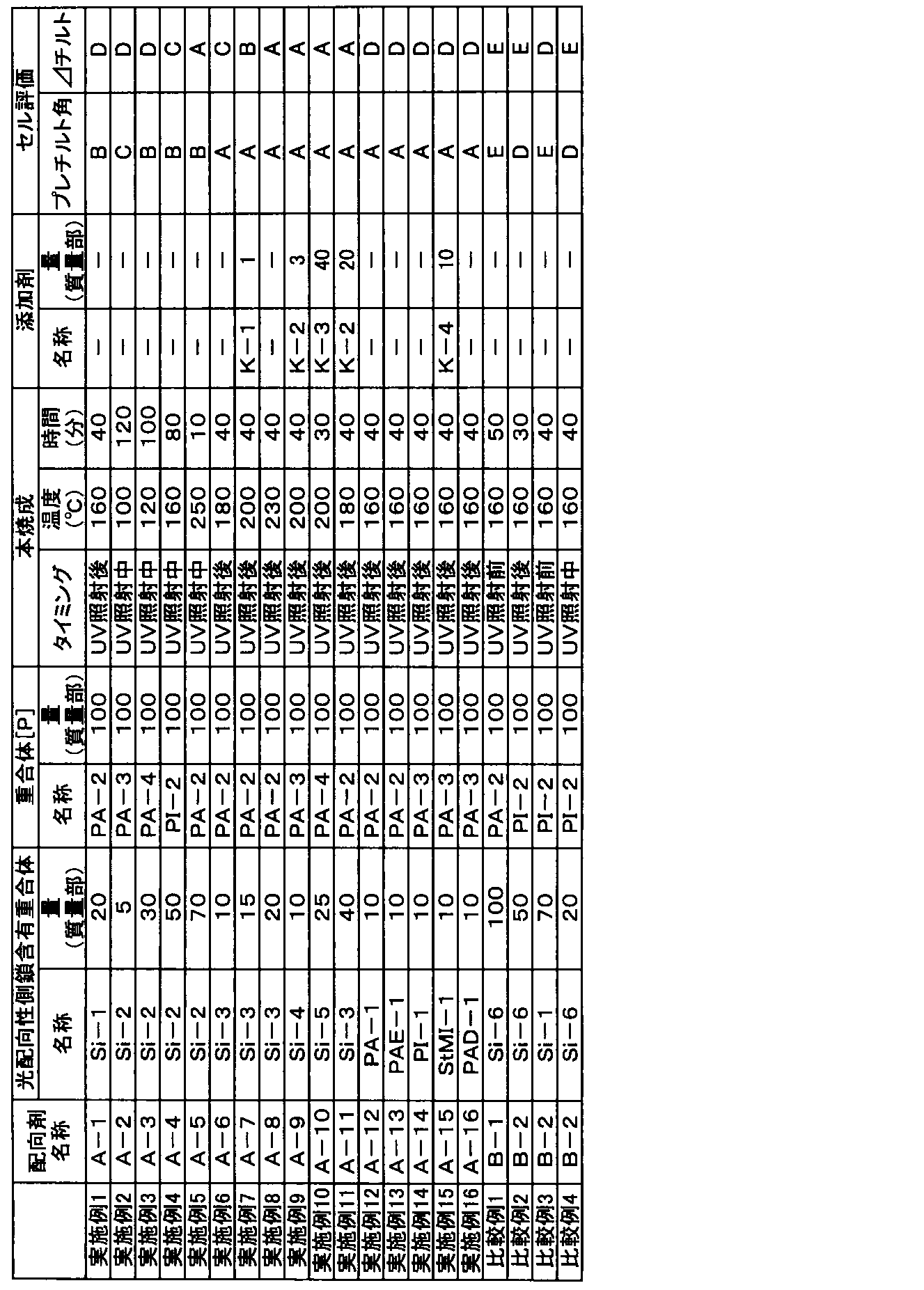
表1から明らかなように、実施例1~16の液晶素子は、低チルト角化とΔチルト特性を両立できるものとなっていた。これに対し、比較例1~4は、プレチルト角が88.0%以上の高い値を示し、実施例に比べて低チルト角化が十分でなかった。また、比較例1,2,4では、Δチルト特性が実施例より劣っていた。
本開示は、実施形態に準拠して記述されたが、本開示は上記実施形態や構造に限定されるものではないと理解される。本開示は、様々な変形例や均等範囲内の変形をも包含する。加えて、様々な組み合わせや形態、さらには、それらに一要素のみ、それ以上、あるいはそれ以下、を含む他の組み合わせや形態をも、本開示の範疇や思想範囲に入るものである。
Claims (6)
- [I]下記式(1)で示される部分構造を有する重合体を含有する液晶配向剤を基板に塗布する工程と、
[II]前記基板の塗布面に偏光放射線を照射する工程と、を含み、
前記偏光放射線の照射時及び前記偏光放射線の照射後の少なくともいずれかに前記塗布面を加熱する、液晶配向膜の製造方法。
*-R1-R2 …(1)
(式中、R1は光配向性基、R2は炭素数1~40のアルキル基の炭素原子に結合する少なくとも1個の水素原子がハロゲン原子で置換された基、*は結合手、である。) - 前記塗布面の加熱温度が160℃以上である、請求項1に記載の液晶配向膜の製造方法。
- 前記塗布面の加熱温度が180℃以上である、請求項1又は2に記載の液晶配向膜の製造方法。
- 上記式(1)で示される部分構造を有する重合体は、重合性不飽和結合を有するモノマーの重合体、ポリアミック酸、ポリアミック酸エステル、ポリイミド、ポリオルガノシロキサン及びポリアミドよりなる群から選ばれる少なくとも一種である、請求項1~3のいずれか一項に記載の液晶配向膜の製造方法。
- 架橋剤をさらに含有し、
上記式(1)で示される部分構造を有する重合体は、前記架橋剤が有する架橋性基と反応する基を有する、請求項1~4のいずれか一項に記載の液晶配向膜の製造方法。 - 請求項1~5のいずれか一項に記載の製造方法によって得られた液晶配向膜を具備する液晶素子。
Applications Claiming Priority (2)
| Application Number | Priority Date | Filing Date | Title |
|---|---|---|---|
| JP2017056749A JP2020079812A (ja) | 2017-03-23 | 2017-03-23 | 液晶配向膜の製造方法および液晶素子 |
| JP2017-056749 | 2017-03-23 |
Publications (1)
| Publication Number | Publication Date |
|---|---|
| WO2018173648A1 true WO2018173648A1 (ja) | 2018-09-27 |
Family
ID=63584762
Family Applications (1)
| Application Number | Title | Priority Date | Filing Date |
|---|---|---|---|
| PCT/JP2018/007184 Ceased WO2018173648A1 (ja) | 2017-03-23 | 2018-02-27 | 液晶配向膜の製造方法および液晶素子 |
Country Status (3)
| Country | Link |
|---|---|
| JP (1) | JP2020079812A (ja) |
| TW (1) | TW201840646A (ja) |
| WO (1) | WO2018173648A1 (ja) |
Cited By (5)
| Publication number | Priority date | Publication date | Assignee | Title |
|---|---|---|---|---|
| WO2019146320A1 (ja) * | 2018-01-25 | 2019-08-01 | Jsr株式会社 | 液晶配向剤、液晶配向膜、液晶素子及び液晶素子の製造方法 |
| WO2019193855A1 (ja) * | 2018-04-05 | 2019-10-10 | Jsr株式会社 | 液晶配向剤、液晶配向膜、液晶素子及び液晶素子の製造方法 |
| EP3922233A4 (en) * | 2019-02-07 | 2022-03-16 | FUJIFILM Toyama Chemical Co., Ltd. | MEDICAL DRUG VERIFICATION DEVICE, MEDICAL DRUG VERIFICATION METHOD AND MEDICAL DRUG VERIFICATION SYSTEM |
| CN118027991A (zh) * | 2024-02-06 | 2024-05-14 | 长沙道尔顿电子材料有限公司 | 一种液晶取向剂及其制备方法和应用 |
| WO2025018399A1 (ja) * | 2023-07-20 | 2025-01-23 | 株式会社レゾナック | (メタ)アクリル樹脂溶液の製造方法 |
Families Citing this family (1)
| Publication number | Priority date | Publication date | Assignee | Title |
|---|---|---|---|---|
| JP7166643B2 (ja) * | 2020-04-28 | 2022-11-08 | 株式会社ニューギン | 遊技機 |
Citations (3)
| Publication number | Priority date | Publication date | Assignee | Title |
|---|---|---|---|---|
| JP2005528486A (ja) * | 2002-05-31 | 2005-09-22 | エルシコン・インコーポレーテッド | 液晶配向層用ハイブリッドポリマー材料 |
| WO2009051207A1 (ja) * | 2007-10-19 | 2009-04-23 | Jsr Corporation | 液晶配向剤および液晶配向膜の形成方法 |
| JP2009294333A (ja) * | 2008-06-04 | 2009-12-17 | Jsr Corp | 液晶配向剤、液晶配向膜の形成方法および液晶表示素子 |
-
2017
- 2017-03-23 JP JP2017056749A patent/JP2020079812A/ja active Pending
-
2018
- 2018-02-27 WO PCT/JP2018/007184 patent/WO2018173648A1/ja not_active Ceased
- 2018-03-16 TW TW107109085A patent/TW201840646A/zh unknown
Patent Citations (3)
| Publication number | Priority date | Publication date | Assignee | Title |
|---|---|---|---|---|
| JP2005528486A (ja) * | 2002-05-31 | 2005-09-22 | エルシコン・インコーポレーテッド | 液晶配向層用ハイブリッドポリマー材料 |
| WO2009051207A1 (ja) * | 2007-10-19 | 2009-04-23 | Jsr Corporation | 液晶配向剤および液晶配向膜の形成方法 |
| JP2009294333A (ja) * | 2008-06-04 | 2009-12-17 | Jsr Corp | 液晶配向剤、液晶配向膜の形成方法および液晶表示素子 |
Cited By (5)
| Publication number | Priority date | Publication date | Assignee | Title |
|---|---|---|---|---|
| WO2019146320A1 (ja) * | 2018-01-25 | 2019-08-01 | Jsr株式会社 | 液晶配向剤、液晶配向膜、液晶素子及び液晶素子の製造方法 |
| WO2019193855A1 (ja) * | 2018-04-05 | 2019-10-10 | Jsr株式会社 | 液晶配向剤、液晶配向膜、液晶素子及び液晶素子の製造方法 |
| EP3922233A4 (en) * | 2019-02-07 | 2022-03-16 | FUJIFILM Toyama Chemical Co., Ltd. | MEDICAL DRUG VERIFICATION DEVICE, MEDICAL DRUG VERIFICATION METHOD AND MEDICAL DRUG VERIFICATION SYSTEM |
| WO2025018399A1 (ja) * | 2023-07-20 | 2025-01-23 | 株式会社レゾナック | (メタ)アクリル樹脂溶液の製造方法 |
| CN118027991A (zh) * | 2024-02-06 | 2024-05-14 | 长沙道尔顿电子材料有限公司 | 一种液晶取向剂及其制备方法和应用 |
Also Published As
| Publication number | Publication date |
|---|---|
| TW201840646A (zh) | 2018-11-16 |
| JP2020079812A (ja) | 2020-05-28 |
Similar Documents
| Publication | Publication Date | Title |
|---|---|---|
| TWI564345B (zh) | 液晶配向劑以及化合物 | |
| US9791745B2 (en) | Photoalignment polyimide copolymer and liquid crystal alignment layer | |
| TW201840646A (zh) | 液晶配向膜的製造方法及液晶元件 | |
| JP7136187B2 (ja) | 液晶配向剤、液晶配向膜及び液晶素子 | |
| TWI771380B (zh) | 化合物、液晶組成物及液晶顯示元件 | |
| CN107111191A (zh) | 液晶取向剂、液晶取向膜、液晶取向膜的制造方法、液晶显示元件、聚合物及化合物 | |
| KR102663141B1 (ko) | 막 형성용 조성물, 경화막, 액정 배향막 및 위상차 필름 | |
| KR102398327B1 (ko) | 액정 배향제, 액정 소자의 제조 방법, 액정 배향막, 액정 소자 및 화합물 | |
| JP5708914B2 (ja) | 液晶表示素子の製造方法 | |
| JP2018054761A (ja) | 液晶素子及びその製造方法 | |
| JP6617529B2 (ja) | 液晶配向剤、液晶配向膜、液晶素子及び液晶配向膜の製造方法 | |
| KR102404078B1 (ko) | 액정 배향제, 액정 배향막, 액정 소자 및 액정 소자의 제조 방법 | |
| TWI683829B (zh) | 液晶取向劑、液晶取向膜以及液晶元件 | |
| TWI814748B (zh) | 液晶配向劑、液晶配向膜、液晶元件及液晶配向膜的製造方法 | |
| CN114502609B (zh) | 液晶取向剂、液晶取向膜、液晶元件、聚合物及化合物 | |
| WO2019159470A1 (ja) | 液晶配向剤、液晶配向膜及び液晶素子 | |
| KR102404080B1 (ko) | 액정 배향제, 액정 배향막, 액정 소자 및 액정 소자의 제조 방법 | |
| JP6828360B2 (ja) | 液晶配向剤、液晶配向膜、液晶素子、並びに液晶配向膜及び液晶素子の製造方法 | |
| JP7092442B2 (ja) | 液晶配向剤組成物、これを用いた液晶配向膜の製造方法、これを用いた液晶配向膜および液晶表示素子 | |
| JP2022173076A (ja) | 液晶配向剤、液晶配向膜及びその製造方法、液晶素子、液晶表示装置、並びに重合体 | |
| TWI785018B (zh) | 液晶配向劑、液晶配向膜、液晶元件及聚有機矽氧烷 | |
| TW202405140A (zh) | 液晶配向劑、液晶配向膜及其製造方法、及液晶元件 |
Legal Events
| Date | Code | Title | Description |
|---|---|---|---|
| 121 | Ep: the epo has been informed by wipo that ep was designated in this application |
Ref document number: 18771495 Country of ref document: EP Kind code of ref document: A1 |
|
| NENP | Non-entry into the national phase |
Ref country code: DE |
|
| 122 | Ep: pct application non-entry in european phase |
Ref document number: 18771495 Country of ref document: EP Kind code of ref document: A1 |
|
| NENP | Non-entry into the national phase |
Ref country code: JP |