WO2018173601A1 - 光学フィルム、その製造方法、それを具備した偏光板及び表示装置 - Google Patents
光学フィルム、その製造方法、それを具備した偏光板及び表示装置 Download PDFInfo
- Publication number
- WO2018173601A1 WO2018173601A1 PCT/JP2018/006116 JP2018006116W WO2018173601A1 WO 2018173601 A1 WO2018173601 A1 WO 2018173601A1 JP 2018006116 W JP2018006116 W JP 2018006116W WO 2018173601 A1 WO2018173601 A1 WO 2018173601A1
- Authority
- WO
- WIPO (PCT)
- Prior art keywords
- group
- optical film
- general formula
- ring
- compound
- Prior art date
- Legal status (The legal status is an assumption and is not a legal conclusion. Google has not performed a legal analysis and makes no representation as to the accuracy of the status listed.)
- Ceased
Links
- HNEHYQBTADFGLT-CIEPRGCISA-N CCCC(C)N1c2ccccc2C(C)(C)/C1=C\C=C(\C(C(/C(/C1=O)=C\C=C(/C2(C)C)\N(C(C)CCC)c3c2cccc3)=O)=O)/C1=O Chemical compound CCCC(C)N1c2ccccc2C(C)(C)/C1=C\C=C(\C(C(/C(/C1=O)=C\C=C(/C2(C)C)\N(C(C)CCC)c3c2cccc3)=O)=O)/C1=O HNEHYQBTADFGLT-CIEPRGCISA-N 0.000 description 1
- JDYCKNMEISYOSC-PHDVRBOBSA-N CCCCC(CC)CN1c(ccc2c3cccc2)c3O/C1=C\C=C(\C(C(/C(/C1=O)=C\C=C2/Oc3c(cccc4)c4ccc3N2CC(CC)CCCC)=O)=O)/C1=O Chemical compound CCCCC(CC)CN1c(ccc2c3cccc2)c3O/C1=C\C=C(\C(C(/C(/C1=O)=C\C=C2/Oc3c(cccc4)c4ccc3N2CC(CC)CCCC)=O)=O)/C1=O JDYCKNMEISYOSC-PHDVRBOBSA-N 0.000 description 1
- PSEBGLPTJLTNAV-JRPPHLNVSA-N CCCCN(/C(/C(C)(C)c1c2)=C/C=C(\C(C(/C(/C3=O)=C/C=C(\C(C)(C)c4c5)/N(CCCC)c4ccc5F)=O)=O)/C3=O)c1ccc2F Chemical compound CCCCN(/C(/C(C)(C)c1c2)=C/C=C(\C(C(/C(/C3=O)=C/C=C(\C(C)(C)c4c5)/N(CCCC)c4ccc5F)=O)=O)/C3=O)c1ccc2F PSEBGLPTJLTNAV-JRPPHLNVSA-N 0.000 description 1
- CAWOAFWFIPPGRC-ITSMGIRVSA-N CCCCN(/C(/Oc1c2)=C/C=C(\C(C(/C(/C3=O)=C/C=C4\Oc(cc(cc5)-c6ccccc6)c5N4CCCC)=O)=O)/C3=O)c1ccc2-c1ccccc1 Chemical compound CCCCN(/C(/Oc1c2)=C/C=C(\C(C(/C(/C3=O)=C/C=C4\Oc(cc(cc5)-c6ccccc6)c5N4CCCC)=O)=O)/C3=O)c1ccc2-c1ccccc1 CAWOAFWFIPPGRC-ITSMGIRVSA-N 0.000 description 1
- PCWWJCMEIVJVJM-MOFUGIIJSA-N CCCCN1c(cc2OCOc2c2)c2O/C1=C\C=C(\C(C(/C(/C1=O)=C\C=C2/Oc(cc3OCOc3c3)c3N2CCCC)=O)=O)/C1=O Chemical compound CCCCN1c(cc2OCOc2c2)c2O/C1=C\C=C(\C(C(/C(/C1=O)=C\C=C2/Oc(cc3OCOc3c3)c3N2CCCC)=O)=O)/C1=O PCWWJCMEIVJVJM-MOFUGIIJSA-N 0.000 description 1
- HRYUDKGCIDLKQJ-UWYIAKLYSA-N CCCCN1c(ccc(C#N)c2)c2N(CC)/C1=C\C=C(\C(C(/C(/C1=O)=C\C=C(/N(CC)c2c3)\N(CCCC)c2ccc3C#N)=O)=O)/C1=O Chemical compound CCCCN1c(ccc(C#N)c2)c2N(CC)/C1=C\C=C(\C(C(/C(/C1=O)=C\C=C(/N(CC)c2c3)\N(CCCC)c2ccc3C#N)=O)=O)/C1=O HRYUDKGCIDLKQJ-UWYIAKLYSA-N 0.000 description 1
- RCXBAAJYSFTPLT-JMWFQGNNSA-N CCCCN1c(cccc2)c2N(CC)/C1=C\C=C(\C(C(/C(/C1=O)=C\C=C2\N(CCCC)c(cccc3)c3N2CC)=O)=O)/C1=O Chemical compound CCCCN1c(cccc2)c2N(CC)/C1=C\C=C(\C(C(/C(/C1=O)=C\C=C2\N(CCCC)c(cccc3)c3N2CC)=O)=O)/C1=O RCXBAAJYSFTPLT-JMWFQGNNSA-N 0.000 description 1
- DNOBAWAQJDHRRF-JMWFQGNNSA-N CCCCN1c2ccccc2C(C)(C)/C1=C\C=C(\C(C(/C(/C1=O)=C\C=C(/C2(C)C)\N(CCCC)c3c2cccc3)=O)=O)/C1=O Chemical compound CCCCN1c2ccccc2C(C)(C)/C1=C\C=C(\C(C(/C(/C1=O)=C\C=C(/C2(C)C)\N(CCCC)c3c2cccc3)=O)=O)/C1=O DNOBAWAQJDHRRF-JMWFQGNNSA-N 0.000 description 1
Images

Classifications
-
- C—CHEMISTRY; METALLURGY
- C08—ORGANIC MACROMOLECULAR COMPOUNDS; THEIR PREPARATION OR CHEMICAL WORKING-UP; COMPOSITIONS BASED THEREON
- C08J—WORKING-UP; GENERAL PROCESSES OF COMPOUNDING; AFTER-TREATMENT NOT COVERED BY SUBCLASSES C08B, C08C, C08F, C08G or C08H
- C08J5/00—Manufacture of articles or shaped materials containing macromolecular substances
- C08J5/18—Manufacture of films or sheets
-
- C—CHEMISTRY; METALLURGY
- C08—ORGANIC MACROMOLECULAR COMPOUNDS; THEIR PREPARATION OR CHEMICAL WORKING-UP; COMPOSITIONS BASED THEREON
- C08K—Use of inorganic or non-macromolecular organic substances as compounding ingredients
- C08K5/00—Use of organic ingredients
- C08K5/16—Nitrogen-containing compounds
- C08K5/32—Compounds containing nitrogen bound to oxygen
-
- C—CHEMISTRY; METALLURGY
- C08—ORGANIC MACROMOLECULAR COMPOUNDS; THEIR PREPARATION OR CHEMICAL WORKING-UP; COMPOSITIONS BASED THEREON
- C08K—Use of inorganic or non-macromolecular organic substances as compounding ingredients
- C08K5/00—Use of organic ingredients
- C08K5/16—Nitrogen-containing compounds
- C08K5/34—Heterocyclic compounds having nitrogen in the ring
- C08K5/3412—Heterocyclic compounds having nitrogen in the ring having one nitrogen atom in the ring
- C08K5/3432—Six-membered rings
-
- C—CHEMISTRY; METALLURGY
- C08—ORGANIC MACROMOLECULAR COMPOUNDS; THEIR PREPARATION OR CHEMICAL WORKING-UP; COMPOSITIONS BASED THEREON
- C08K—Use of inorganic or non-macromolecular organic substances as compounding ingredients
- C08K5/00—Use of organic ingredients
- C08K5/16—Nitrogen-containing compounds
- C08K5/34—Heterocyclic compounds having nitrogen in the ring
- C08K5/3442—Heterocyclic compounds having nitrogen in the ring having two nitrogen atoms in the ring
- C08K5/3445—Five-membered rings
- C08K5/3447—Five-membered rings condensed with carbocyclic rings
-
- C—CHEMISTRY; METALLURGY
- C08—ORGANIC MACROMOLECULAR COMPOUNDS; THEIR PREPARATION OR CHEMICAL WORKING-UP; COMPOSITIONS BASED THEREON
- C08L—COMPOSITIONS OF MACROMOLECULAR COMPOUNDS
- C08L101/00—Compositions of unspecified macromolecular compounds
-
- G—PHYSICS
- G02—OPTICS
- G02B—OPTICAL ELEMENTS, SYSTEMS OR APPARATUS
- G02B1/00—Optical elements characterised by the material of which they are made; Optical coatings for optical elements
- G02B1/10—Optical coatings produced by application to, or surface treatment of, optical elements
- G02B1/14—Protective coatings, e.g. hard coatings
-
- G—PHYSICS
- G02—OPTICS
- G02B—OPTICAL ELEMENTS, SYSTEMS OR APPARATUS
- G02B5/00—Optical elements other than lenses
- G02B5/20—Filters
- G02B5/22—Absorbing filters
-
- G—PHYSICS
- G02—OPTICS
- G02B—OPTICAL ELEMENTS, SYSTEMS OR APPARATUS
- G02B5/00—Optical elements other than lenses
- G02B5/30—Polarising elements
-
- G—PHYSICS
- G02—OPTICS
- G02F—OPTICAL DEVICES OR ARRANGEMENTS FOR THE CONTROL OF LIGHT BY MODIFICATION OF THE OPTICAL PROPERTIES OF THE MEDIA OF THE ELEMENTS INVOLVED THEREIN; NON-LINEAR OPTICS; FREQUENCY-CHANGING OF LIGHT; OPTICAL LOGIC ELEMENTS; OPTICAL ANALOGUE/DIGITAL CONVERTERS
- G02F1/00—Devices or arrangements for the control of the intensity, colour, phase, polarisation or direction of light arriving from an independent light source, e.g. switching, gating or modulating; Non-linear optics
- G02F1/01—Devices or arrangements for the control of the intensity, colour, phase, polarisation or direction of light arriving from an independent light source, e.g. switching, gating or modulating; Non-linear optics for the control of the intensity, phase, polarisation or colour
- G02F1/13—Devices or arrangements for the control of the intensity, colour, phase, polarisation or direction of light arriving from an independent light source, e.g. switching, gating or modulating; Non-linear optics for the control of the intensity, phase, polarisation or colour based on liquid crystals, e.g. single liquid crystal display cells
- G02F1/133—Constructional arrangements; Operation of liquid crystal cells; Circuit arrangements
- G02F1/1333—Constructional arrangements; Manufacturing methods
- G02F1/1335—Structural association of cells with optical devices, e.g. polarisers or reflectors
Definitions
- the present invention relates to an optical film, a method for producing the same, a polarizing plate and a display device provided with the optical film, and more specifically, an optical film containing a compound that absorbs light of a specific wavelength, in a high-temperature and high-humidity environment.
- the present invention relates to an optical film or the like that suppresses the bleed-out of the compound even if it is placed, is transparent, has little color unevenness, and is excellent in oblique color reproducibility (color shift).
- a light emitting diode In a liquid crystal display (LCD), a light emitting diode (LED) is used as a backlight light source, but the LED has an inherent wavelength dependency, and color purity depends on an unnecessary emission wavelength. As a result, color reproduction in a wide band was difficult.
- LED light emitting diode
- OLED Organic Light Emitting Diode
- a color material also referred to as a pigment or a dye
- a binder resin as a substrate or a specific color material layer of an image sensor.
- Embodiments are disclosed.
- Patent Document 1 has a problem in that the color material is thermally decomposed by reflow heating in the manufacturing process of the image sensor, and the absorption wavelength changes. In addition, there is a problem that the color material bleeds out when the humidity resistance is low and the temperature and humidity are high.
- Patent Document 2 discloses a configuration in which a transparent resin layer containing a colorant such as a cyanine dye is formed on a substrate.
- a transparent resin layer containing a colorant such as a cyanine dye
- the transparent resin layer is disclosed. It is necessary to add a sufficient amount of the coloring material. However, if a sufficient amount is added, bleeding out tends to occur. Particularly, in the case where the transparent resin layer is in contact with a fluid material such as an adhesive layer, the dye moves under a high temperature and high humidity environment. As a result, there is a problem that bleed-out is further promoted.
- the present invention has been made in view of the above-described problems and situations, and a solution to the problem is an optical film containing a compound that absorbs light of a specific wavelength, even in a high-temperature and high-humidity environment.
- an optical film that suppresses bleeding out of the compound is transparent, has small color unevenness, and is excellent in color reproducibility (color shift) in an oblique direction, a manufacturing method thereof, a polarizing plate and a display device including the optical film. That is.
- an optical film containing a resin having a specific solubility in dichloromethane and a compound having a specific structure has a high temperature. It has been found that even in a high humidity environment, bleeding of the compound is suppressed, an optical film that is transparent, has little color unevenness, and has excellent color reproducibility (color shift) in an oblique direction can be obtained.
- An optical film comprising a resin having a solubility in dichloromethane of 5 to 50% by mass at 1.23 ° C. and a compound having a structure represented by the following general formula (A).
- R 1 represents a substituted or unsubstituted alkyl group, alkenyl group, alkynyl group, or aryl group having 3 to 20 carbon atoms.
- R 2 and R 3 each independently represents a hydrogen atom or a halogen atom.
- Z is an atomic group necessary for forming a 5- or 6-membered ring with a nitrogen atom, and may have a substituent
- Y may form a condensed ring
- Y is an atomic group necessary for forming a 5- or 6-membered ring together with a carbonyl group, may have a substituent, or may form a condensed ring.
- N represents an integer of 1 to 2.
- m is an integer of 1 to 4 and is an integer of n or more.
- R 1 to R 4 each independently represents a hydrogen atom or a halogen atom, a substituted or unsubstituted alkyl group, alkenyl group, alkynyl group, acyl group, aryl group, heterocyclic ring, alkoxycarbonyl group, carbamoyl group
- a group, an alkoxy group, an amide group, an amino group, a cyano group, a nitro group, a hydroxy group, a carboxy group or a sulfonic acid group, R 1 and R 2 , R 2 and R 3 , or R 3 and R 4 are bonded to each other.
- the ring formed may have a substituent
- R 5 represents a substituted or unsubstituted alkyl group, alkenyl group, alkynyl group or aryl group having 3 to 20 carbon atoms.
- .X to represent a substituted or unsubstituted, alkyl group or alkoxycarbonyl group, O, N 8, S, or .R 8 ⁇ R 10 representing a CR 9 R 10 are independently a hydrogen atom, a substituted or unsubstituted, alkyl group, alkenyl group, .A 1 alkynyl group or to an aryl group, (Selected from the following structural formulas (A1-1) to (A1-10))
- R 11 to R 16 have the same meanings as the groups represented by R 1 to R 4 in formula (1).
- X 1 and X 2 each independently represents an oxygen atom or a sulfur atom. (Connected to the general formula (1) at the wavy line)
- R 1 to R 4 and R 8 to R 11 are synonymous with R 1 to R 4 in the general formula (1).
- R 1 and R 2 , R 2 and R 3 , R 3 and R 4, R 8 and R 9, R 9 and R 10, or R 10 and R 11 may be bonded to each other to form a ring, the formed ring may have a substituent .
- R 5 and R 12 is synonymous with R 5 in general formula (1)
- R 6 , R 7 , R 13 , and R 14 are synonymous with R 6 and R 7 in general formula (1).
- X represents O, NR 15 , S, or CR 16 R 17 .
- R 15 to R 17 have the same meanings as R 8 to R 10 in the general formula (1).
- B 1 is selected from the following structural formulas (B1-1) to (B1-5). )
- R 18 and R 19 are synonymous with the groups represented by R 1 to R 4 in the general formula (1). They are connected to the general formula (2) at the wavy line part.
- R 1 ⁇ R 4 have the same meanings as in formula (1)
- R 1 ⁇ R 4 in .R 1 and R 2, or R 3 and R 4 may combine with each other to form a ring well, the formed ring may have a substituent .
- R 5 have the same meaning as R 5 in the general formula (1) .
- R 6 and R 7 the general formula (1) R 6 and in the same meaning as R 7 .
- a 1 has the same meaning as a 1 in formula (1).
- R 5 represents a branched alkyl group having 4 to 16 carbon atoms. the film.
- R 5 and R 12 each represent a branched alkyl group having 4 to 16 carbon atoms, according to any one of the first, second, and fourth items, Optical film.
- the compound having the structure represented by the general formula (1) to the general formula (3) has an absorption maximum peak in the wavelength range of 480 to 520 nm or in the wavelength range of 580 to 620 nm in the spectral absorption spectrum.
- Item 8 The optical film according to any one of Items 1 to 7, wherein the haze is in the range of 0.05 to 1.50%.
- a polarizing plate comprising the optical film according to any one of items 1 to 8 as a polarizing plate protective film.
- a display device comprising the optical film according to any one of items 1 to 8.
- an optical film containing a compound that absorbs light of a specific wavelength the bleed-out of the compound is suppressed even in a high-temperature and high-humidity environment, and it is transparent and small in color unevenness.
- the optical film which is excellent also in the color reproducibility (color shift) of a diagonal direction, its manufacturing method, a polarizing plate provided with the same, and a display apparatus can be provided.
- a resin having a solubility in dichloromethane at 23 ° C. in the range of 5 to 50% by mass for example, cellulose ester resin, acrylic resin, cyclic olefin resin, polycarbonate resin, and polyimide resin
- the optical film containing the compound having the structure represented by the general formula (A) according to the present invention has been found to have extremely suppressed bleeding out of the compound even in a high temperature and high humidity environment. This is presumed to be due to the structure in which the compound fits exactly in the gap between the network chains of the resin during dissolution of the solvent.
- a compound having a structure in which the polar group of the resin faces the polar solvent side and the polar group is represented by the general formula (A) It is inferred that the interaction between the C ⁇ O bonding group and the compound is formed into a film as it is, so that the interaction between the resin and the compound is strong and bleed-out is difficult.
- the bleed-out tends to be noticeable in a system that usually contains two kinds of compounds, but when two kinds of compounds having different absorption maximum peaks are contained as in the structure of the present invention, the general formula (A)
- the dimethine skeleton represented By interposing the dimethine skeleton represented, it is speculated that the compatibility of another type of compound with the resin is greatly improved, and it becomes possible to produce a highly transparent film without bleeding out from each other.
- the optical path length becomes longer than when the compound is contained in a thin layer such as the transparent resin layer or the hard coat layer described above. Since the angle dependency of taste is relaxed, a display device (also referred to as a display) with favorable color reproducibility (color shift) in an oblique direction can be manufactured by providing the optical film. It is guessed.
- the optical film of the present invention comprises a resin having a solubility in dichloromethane of 5 to 50% by mass at 23 ° C. and a compound having a structure represented by the general formula (A). To do.
- This feature is a technical feature common to or corresponding to the claimed invention.
- the compound having the structure represented by the general formula (A) is a compound having a structure represented by the general formula (1), the general formula (2), or the general formula (3). This is a preferred embodiment from the viewpoint of the light absorption ability of the wavelength and the suppression of bleed out.
- the compound having the structure represented by the general formula (A) has an absorption maximum peak in the wavelength range of 480 to 520 nm or in the wavelength range of 580 to 620 nm in the spectral absorption spectrum of the compound, display is performed.
- it is an optical film that improves broadband color reproducibility, which is preferable.
- the haze of the optical film is in the range of 0.05 to 1.50%, when used for a polarizing plate protective film and a display device, preferable.
- the optical film of the present invention has a structure represented by the general formula (A) because it can be manufactured by a solution casting film forming method, and an optical film can be formed at a relatively low temperature. This is a preferable production method because the decomposition of the compound can be suppressed.
- the optical film of the present invention is provided in a polarizing plate or a display device, thereby improving broadband color reproducibility and further improving oblique color reproducibility (color shift).
- ⁇ is used to mean that the numerical values described before and after it are included as a lower limit value and an upper limit value.
- the optical film of the present invention comprises a resin having a solubility in dichloromethane at 23 ° C. in the range of 5 to 50% by mass and a compound having a structure represented by the following general formula (A): To do.
- R 1 represents a substituted or unsubstituted alkyl group, alkenyl group, alkynyl group, or aryl group having 3 to 20 carbon atoms.
- R 2 and R 3 each independently represents a hydrogen atom or a halogen atom.
- Z is an atomic group necessary for forming a 5- or 6-membered ring with a nitrogen atom, and may have a substituent
- Y may form a condensed ring
- Y is an atomic group necessary for forming a 5- or 6-membered ring together with a carbonyl group, may have a substituent, and may form a condensed ring.
- N represents an integer of 1 to 2.
- m is an integer of 1 to 4 and is an integer of n or more.
- the resin is dissolved in 100 g of dichloromethane whose liquid temperature is adjusted to 23 ° C. while stirring the liquid, the upper limit amount (g) that can be dissolved is measured, and the solubility is obtained from the following equation.
- Solubility (%) ⁇ the upper limit amount (g) in which resin can be dissolved / 100 g of dichloromethane ⁇ ⁇ 100
- the upper limit of the thickness is not particularly limited, but in the case of forming a film by a solution casting film forming method, the upper limit may be about 250 ⁇ m from the viewpoints of applicability, foaming, solvent drying and physical properties. preferable.
- the haze of the optical film of the present invention is in the range of 0.05 to 1.5%, and can be used as a general-purpose optical film. Unnecessary light when used in a polarizing plate protective film or a display device. It is also preferable from the viewpoint of suppressing scattering.
- the haze can be measured with a haze meter NDH-2000 (manufactured by Nippon Denshoku Industries Co., Ltd.) in accordance with JIS K-7136.
- the light source of the haze meter is a halogen bulb of 5V9W
- the light receiving part is a silicon photocell (with a relative visibility filter)
- the measurement can be performed under conditions of 23 ° C. and 55% RH.
- R 1 examples include alkyl groups such as propyl, isopropyl, n-butyl, sec-butyl, isobutyl, tert-butyl, n-pentyl, sec-pentyl, and isopentyl.
- alkenyl group include an allyl group, and an alkynyl group. As, for example, propynyl group and the like can be mentioned.
- aryl group examples include a phenyl group.
- An alkyl group having 3 to 20 carbon atoms is preferable, and a branched alkyl group having 4 to 16 carbon atoms is more preferable.
- the carbon number is in the above-described range, in addition to excellent solvent solubility, an effect of reducing haze is expected.
- R 2 and R 3 include alkyl groups such as methyl, ethyl, propyl, isopropyl, n-butyl, sec-butyl, isobutyl, tert-butyl, n- Represents a pentyl group, sec-pentyl group, isopentyl group, neopentyl group, tert-pentyl group, cyclopentyl group, hexyl group, cyclohexyl group, 2-ethylhexyl group, octyl group, dodecyl group, etc.
- alkoxycarbonyl group a methyloxycarbonyl group, an ethyloxycarbonyl group, a butyloxycarbonyl group etc. are mentioned, for example.
- it is a hydrogen atom.
- the molecular weight of the compound having the structure represented by the general formula (A) is preferably in the range of 100 to 1000 so that the compound fits in the gap between the network chains of the resin during dissolution of the solvent. More preferably, it is within the range of 300 to 800.
- the compound having the structure represented by the general formula (A) is preferably a compound having an absorption maximum peak in the light wavelength range of 480 to 520 nm or in the range of 580 to 620 nm.
- the full width at half maximum of the absorption maximum peak is preferably 100 nm or less, more preferably 50 nm or less, more preferably 40 nm or less, and particularly preferably 30 nm or less.
- the compound having the structure represented by the general formula (A) is a compound having an absorption maximum peak in the light wavelength range of 480 to 520 nm or in the range of 580 to 620 nm. And can be measured with a spectrophotometer by a conventional method.
- the compound having the structure represented by the general formula (A) has an absorption maximum peak in the wavelength range of 480 to 520 nm or in the wavelength range of 580 to 620 nm in the spectral absorption spectrum of the compound. It is preferable that the optical absorptance at the absorption maximum peak wavelength at 23 ° C. is in the range of 20 to 99%.
- the optical film of the present invention contains, in the spectral absorption spectrum, a compound having an absorption maximum peak in a wavelength range of 480 to 520 nm and a compound having an absorption maximum peak in a wavelength range of 580 to 620 nm. It is preferable that at least one of the compounds is a compound having a structure represented by the general formula (A), and the light absorption rate at the absorption maximum peak wavelength at 23 ° C. is in the range of 20 to 99%.
- the light absorption rate (%) of the absorption maximum peak wavelength in the light wavelength range of 480 to 520 nm or in the range of 580 to 620 nm can be determined as follows.
- Optical absorptance (%) of absorption maximum peak wavelength in light wavelength range of 480 to 520 nm or 580 to 620 nm 100 ⁇ ⁇ (Spectral transmittance of absorption maximum peak wavelength in light wavelength range of 480 to 520 nm or 580 to 620 nm) ⁇ (Spectrum of absorption maximum peak wavelength in range of light wavelength of 480 to 520 nm or 580 to 620 nm) Reflectance) ⁇ Spectral transmittance and spectral reflectance can be measured using a spectrophotometer. In the present invention, the measurement is performed using an ultraviolet-visible near-infrared spectrophotometer V-670 manufactured by JASCO Corporation.
- the temperature inside the temperature-controlled room is set to 23 ° C. and 55% RH so that the temperature of the optical film as the measurement object is 23 ° C., and the optical film is left in the temperature-controlled room for 3 hours.
- the above measurement is performed after equilibration.
- the means for setting the light absorption rate within the range of 20 to 99% can be controlled, for example, by adjusting the addition amount of the compound.
- the amount of addition varies depending on the absorption coefficient of the compound, but is approximately in the range of 0.01 to 1 part by mass, more preferably in the range of 0.1 to 1 part by mass with respect to 100 parts by mass of the resin. is there.
- the compound having the structure represented by the general formula (A) is preferably a compound having a structure represented by the following general formula (1) to general formula (3).
- R 1 to R 4 each independently represents a hydrogen atom or a halogen atom, a substituted or unsubstituted alkyl group, alkenyl group, alkynyl group, acyl group, aryl group, heterocyclic ring, alkoxycarbonyl group, carbamoyl group
- a group, an alkoxy group, an amide group, an amino group, a cyano group, a nitro group, a hydroxy group, a carboxy group or a sulfonic acid group, R 1 and R 2 , R 2 and R 3 , or R 3 and R 4 are bonded to each other.
- the ring formed may have a substituent
- R 5 represents a substituted or unsubstituted alkyl group, alkenyl group, alkynyl group or aryl group having 3 to 20 carbon atoms.
- R 6 and R 7 each independently represent a hydrogen atom or a halogen atom
- .X to represent a substituted or unsubstituted, alkyl group or alkoxycarbonyl group, O, N 8, S, or .R 8 ⁇ R 10 representing a CR 9 R 10 represent each independently a hydrogen atom, a substituted or unsubstituted, alkyl group, alkenyl group, alkynyl group or an aryl group.
- R 1 to R 4 include a halogen atom such as a fluorine atom, a chlorine atom, a bromine atom, and an iodine atom.
- the alkyl group include a methyl group, an ethyl group, a propyl group, Isopropyl group, n-butyl group, sec-butyl group, isobutyl group, tert-butyl group, n-pentyl group, sec-pentyl group, isopentyl group, neopentyl group, tert-pentyl group, cyclopentyl group, hexyl group, cyclohexyl group , 2-ethylhexyl group, octyl group, dodecyl group and the like.
- Examples of the alkenyl group include vinyl group and allyl group.
- Examples of the alkynyl group include ethynyl group and propynyl group.
- Acyl groups include, for example, acetyl, ethylcarbonyl, propylcarbonyl, pe
- Examples of the aryl group include a phenyl group, a tolyl group, and the like.
- Examples of the aryl group include a phenyl group, a tolyl group, and the like.
- Examples include an oxazole ring, a quinoline ring, a benzothiazole ring, a benzoxazole ring, a thiophene ring, a furan ring, and a pyrrole ring.
- Examples include an oxy group, an octyloxy group, a dodecyloxy group, and the like.
- Examples of the alkoxycarbonyl group include a methyloxycarbonyl group, an ethyloxycarbonyl group, and a butyloxycarbonyl group.
- Examples of the carbamoyl group include an amino group.
- Examples include carbonyl group, methylaminocarbonyl group, dimethylaminocarbonyl group, ethylaminocarbonyl group, diethylaminocarbonyl group and the like.
- Examples of the amide group include methylcarbonylamino group, ethylcarbonylamino group, dimethylcarbonylamino group, propylcarbonyl group, and the like.
- Examples include amino group, pentylcarbonylamino group, cyclohexylcarbonylamino group, 2-ethylhexylcarbonylamino group, phenylcarbonylamino group, naphthylcarbonylamino group, and the like.
- Examples of the group include amino group, ethylamino group, dimethylamino group, butylamino group, cyclopentylamino group, 2-ethylhexylamino group, dodecylamino group, anilino group, naphthylamino group, 2-pyridylamino group and the like. It is done.
- Preferred are a hydrogen atom, a halogen atom, an alkyl group, an acyl group, an aryl group, and a cyano group, and more preferred are a hydrogen atom, an alkyl group, and an aryl group.
- R 5 include alkyl groups such as propyl, isopropyl, n-butyl, sec-butyl, isobutyl, tert-butyl, n-pentyl, sec-pentyl, and isopentyl.
- alkenyl group include an allyl group, and an alkynyl group. As, for example, propynyl group and the like can be mentioned.
- aryl group examples include a phenyl group.
- An alkyl group having 3 to 20 carbon atoms is preferable, and a branched alkyl group having 4 to 16 carbon atoms is more preferable.
- the carbon number is in the above-described range, in addition to excellent solvent solubility, an effect of reducing haze is expected.
- X represents O, NR 8 , S, or CR 9 R 10 . From the viewpoint of color reproducibility, NR 8 , O, and S are preferable. More preferably, it is S.
- R 8 to R 10 each independently represents a hydrogen atom, an alkyl group, an alkenyl group, an alkynyl group, or an aryl group.
- R 6 and R 7 include alkyl groups such as methyl, ethyl, propyl, isopropyl, n-butyl, sec-butyl, isobutyl, tert-butyl, n- Represents a pentyl group, sec-pentyl group, isopentyl group, neopentyl group, tert-pentyl group, cyclopentyl group, hexyl group, cyclohexyl group, 2-ethylhexyl group, octyl group, dodecyl group, etc.
- alkoxycarbonyl group a methyloxycarbonyl group, an ethyloxycarbonyl group, a butyloxycarbonyl group etc. are mentioned, for example.
- it is a hydrogen atom.
- R 8 to R 10 include alkyl groups such as methyl, ethyl, propyl, isopropyl, n-butyl, sec-butyl, isobutyl, tert-butyl, n- Examples include pentyl group, sec-pentyl group, isopentyl group, neopentyl group, tert-pentyl group, cyclopentyl group, hexyl group, cyclohexyl group, 2-ethylhexyl group, octyl group, dodecyl group, etc.
- alkyl groups such as methyl, ethyl, propyl, isopropyl, n-butyl, sec-butyl, isobutyl, tert-butyl, n- Examples include pentyl group, sec-pentyl group, isopentyl group, neopentyl group, tert-pentyl group,
- Examples of the alkenyl group include Examples of the alkynyl group include an ethynyl group and a propynyl group.
- Examples of the aryl group include a phenyl group, a tolyl group, a mesityl group, a xylyl group, a naphthyl group, and a biphenyl group. Group, a terphenyl group, etc. are mentioned, Preferably it is an alkyl group.
- a 1 is selected from the following structural formulas (A1-1) to (A1-10).
- R 11 to R 16 have the same meanings as the groups represented by R 1 to R 4 in formula (1).
- X 1 and X 2 each independently represents an oxygen atom or a sulfur atom. (Connected to the general formula (1) at the wavy line)
- (A1-1), (A1-2), (A1-3), (A1-4), (A1-5), and (A1-6) are preferable from the viewpoint of color reproducibility and bleed-out suppression. Particularly preferred is (A1-6).
- the compound having the structure represented by the general formula (A) is preferably a compound having a structure represented by the following general formula (2).
- R 1 to R 4 and R 8 to R 11 are synonymous with R 1 to R 4 in the general formula (1).
- R 1 and R 2 , R 2 and R 3 , R 3 and R 4, R 8 and R 9, R 9 and R 10, or R 10 and R 11 may be bonded to each other to form a ring, the formed ring may have a substituent .
- R 5 and R 12 is synonymous with R 5 in general formula (1)
- R 6 , R 7 , R 13 , and R 14 are synonymous with R 6 and R 7 in general formula (1).
- X represents O, NR 15 , S, or CR 16 R 17 .
- R 15 to R 17 have the same meanings as R 8 to R 10 in the general formula (1).
- NR 8 , O, or S is preferable. More preferably, it is S.
- B 1 is selected from the following structural formulas (B1-1) to (B1-5). )
- R 18 and R 19 are synonymous with the groups represented by R 1 to R 4 in the general formula (1). They are connected to the general formula (2) at the wavy line part.) From the viewpoint of color reproducibility and suppression of bleed out, B 1 is preferably (B1-4).
- the compound represented by the general formula (A) is a compound represented by the following general formula (3).
- R 1 ⁇ R 4 have the same meanings as in formula (1) R 1 ⁇ R 4 in .R 1 and R 2, or R 3 and R 4 may combine with each other to form a ring well, the formed ring may have a substituent .
- R 5 have the same meaning as R 5 in the general formula (1) .
- R 6 and R 7 the general formula (1) R 6 and in the same meaning as R 7 .
- a 1 has the same meaning as a 1 in formula (1).
- Specific examples of the substituent in the compounds having the structures represented by the general formula (A) and the general formulas (1) to (3) are as follows.
- substituents examples include a halogen atom (eg, fluorine atom, chlorine atom, bromine atom, iodine atom), an alkyl group (eg, methyl group, ethyl group, n-propyl group, isopropyl group, tert-butyl group).
- halogen atom eg, fluorine atom, chlorine atom, bromine atom, iodine atom
- alkyl group eg, methyl group, ethyl group, n-propyl group, isopropyl group, tert-butyl group.
- ⁇ Dyeing process> 4.2 g of intermediate (1-2), 2.4 g of 1-butyl-3- (2-ethylhexyl) barbituric acid and acetonitrile were added and stirred at 60 ° C. for about 30 minutes. Thereafter, a solution obtained by adding 0.81 g of acetic anhydride and 1.6 g of triethylamine to acetonitrile was slowly added dropwise to the reaction solution, followed by stirring at 75 ° C. for about 2 hours. After completion of the reaction, the solvent was distilled off and dissolved in ethyl acetate.
- ⁇ Synthesis Example 6 Exemplary Compound 99> Synthesis was performed in the same manner as in Synthesis Example 1 except that 4-methylpyridine was used in place of 2-methylbenzothiazole in Synthesis Example 1, and Example Compound 99 was obtained.
- the absorption maximum peak wavelength of the obtained compound in an acetone solution was 492 nm, and the half width was 41 nm.
- ⁇ Synthesis Example 8 Exemplary Compound 131>
- 1,3-indandione is used instead of 1-butyl-3- (2-ethylhexyl) barbituric acid
- 4-methylquinoline is used instead of 2-methylbenzothiazole
- p- Exemplified compound 131 was obtained in the same manner as in Synthesis Example 1 except that p-toluenesulfonic acid-2-ethylhexyl was used instead of butyltoluenesulfonate.
- the absorption maximum peak wavelength of the obtained compound in an acetone solution was 589 nm, and the half width was 26 nm.
- Resin The resin according to the present invention is characterized in that the solubility in dichloromethane at 23 ° C. is in the range of 5 to 50% by mass.
- solubility When the solubility is less than 5% by mass, the compatibility with the compound having the structure represented by the general formula (A) according to the present invention is lowered, and bleed out is likely to occur. On the other hand, if it exceeds 50% by mass, the polymer chain as an optical film is likely to be thermally contracted, and the film properties are likely to be deteriorated.
- any resin satisfying the solubility can be used without particular limitation.
- the cellulose ester resin (also referred to as cellulose ester) that can be used in the present invention includes cellulose (di, tri) acetate, cellulose propionate, cellulose butyrate, cellulose acetate propionate, It is preferably at least one selected from cellulose acetate butyrate, cellulose acetate phthalate, and cellulose phthalate.
- particularly preferred cellulose esters include cellulose triacetate, cellulose propionate, cellulose butyrate, cellulose acetate propionate, and cellulose acetate butyrate.
- substitution degree of the mixed fatty acid ester when an acyl group having 2 to 4 carbon atoms is used as a substituent, the substitution degree of the acetyl group is X, and the substitution degree of the propionyl group or butyryl group is Y.
- a cellulose resin containing a cellulose ester that simultaneously satisfies the following formulas (I) and (II) is preferable.
- the total substitution degree of the acyl group of the cellulose ester can be about 1.0 to 3.0.
- the total substitution degree of the acyl group is preferably in the range of 2.0 to 2.95 from the viewpoint of reducing moisture permeability.
- substitution degree of the acyl group of the cellulose ester can be measured by a method prescribed in ASTM D817-96.
- the number average molecular weight of the cellulose ester is preferably in the range of 6 ⁇ 10 4 to 3 ⁇ 10 5 in order to increase the mechanical strength of the obtained film.
- the molecular weight is in the range of 7 ⁇ 10 4 to 2 ⁇ 10 5 . It is more preferable that
- the cellulose ester used in the present invention preferably has a weight average molecular weight Mw / number average molecular weight Mn ratio of 1.5 to 5.5, particularly preferably 2.0 to 5.0,
- the cellulose ester resin is preferably 2.5 to 5.0, more preferably 3.0 to 5.0.
- the weight average molecular weight (Mw) and number average molecular weight (Mn) of the cellulose ester are measured using gel permeation chromatography (GPC).
- the measurement conditions are as follows.
- the raw material cellulose of the cellulose ester resin used in the present invention may be wood pulp or cotton linter, and the wood pulp may be softwood or hardwood, but softwood is more preferable.
- a cotton linter is preferably used from the viewpoint of peelability during film formation.
- the cellulose ester made from these can be mixed suitably or can be used independently.
- the ratio of cellulose ester derived from cellulose linter: cellulose ester derived from wood pulp (coniferous): cellulose ester derived from wood pulp (hardwood) is 100: 0: 0, 90: 10: 0, 85: 15: 0, 50:50: 0, 20: 80: 0, 10: 90: 0, 0: 100: 0, 0: 0: 100, 80:10:10, 85: 0: 15, 40:30:30.
- cellulose ester resin 1 g is added to 20 mL of pure water (electric conductivity 0.1 ⁇ S / cm or less, pH 6.8), and the pH when stirred in a nitrogen atmosphere at 25 ° C. for 1 hr is 6 It is preferable that the electric conductivity is 1 to 100 ⁇ S / cm.
- Acrylic resin The acrylic resin that can be used in the present invention includes a methacrylic resin.
- the acrylic resin may be a homopolymer of (meth) acrylic acid ester or a copolymer of (meth) acrylic acid ester and other copolymerization monomers.
- the (meth) acrylic resin may be one type or a mixture of two or more types.
- the (meth) acrylic acid ester is preferably methyl methacrylate.
- the content ratio of the structural unit derived from methyl methacrylate in the copolymer is preferably 50% by mass or more, and more preferably 70% by mass or more.
- Examples of the copolymerization monomer that forms a copolymer with methyl methacrylate include alkyl methacrylates having 2 to 18 carbon atoms in the alkyl portion; alkyl acrylates having 1 to 18 carbon atoms in the alkyl portion; Obtained alkyl (meth) acrylates having 1 to 18 carbon atoms in the alkyl moiety having a hydroxy group; ⁇ , ⁇ -unsaturated acids such as acrylic acid and methacrylic acid; unsaturated groups such as maleic acid, fumaric acid and itaconic acid Containing divalent carboxylic acids; aromatic vinyl compounds such as styrene and ⁇ -methylstyrene; ⁇ , ⁇ -unsaturated nitriles such as acrylonitrile and methacrylonitrile; maleic anhydride, maleimide, N-substituted maleimide, glutaric anhydride, Acrylamide derivatives such as acryloylmorpholine (ACMO
- alkyl acrylates such as methyl acrylate, ethyl acrylate, n-propyl acrylate, n-butyl acrylate, s-butyl acrylate, 2-ethylhexyl acrylate, Alkyl (meth) acrylates having a hydroxy group such as methyl (hydroxymethyl) acrylate and ethyl 2- (hydroxymethyl) acrylate are preferred.
- the weight average molecular weight Mw of the (meth) acrylic resin is preferably in the range of 2.0 ⁇ 10 4 to 5.0 ⁇ 10 5 , more preferably 5.0 ⁇ 10 4 to 4.5 ⁇ 10 5 . Within the range, more preferably within the range of 1.0 ⁇ 10 5 to 4.0 ⁇ 10 5 . If the weight average molecular weight Mw of the (meth) acrylic resin is 8.0 ⁇ 10 4 or more, the brittleness resistance of the film is easily improved, and if it is 5.0 ⁇ 10 5 or less, the haze of the film tends to be low.
- the weight average molecular weight Mw of the (meth) acrylic resin can be measured by gel permeation chromatography in the same manner as the method for measuring the weight average molecular weight Mw of the cellulose ester.
- any known method such as suspension polymerization, emulsion polymerization, bulk polymerization, or solution polymerization may be used.
- a polymerization initiator a normal peroxide type and an azo type can be used, and a redox type can also be used.
- the polymerization temperature may be 30 to 100 ° C. for suspension or emulsion polymerization, and 80 to 160 ° C. for bulk or solution polymerization.
- polymerization can be carried out using alkyl mercaptan or the like as a chain transfer agent.
- acrylic resins can be used.
- an acrylic resin having a lactone ring unit as described in JP-A-2008-9378 has high heat resistance and is preferably used.
- acrylic resins can also be used.
- Delpet 60N, 80N (Asahi Kasei Chemicals Co., Ltd.), Dianal BR52, BR80, BR83, BR85, BR88 (Mitsubishi Rayon Co., Ltd.), KT75 (Denki Kagaku Kogyo Co., Ltd.) and the like can be mentioned. .
- Cyclic Olefin Resin in the present invention, it is also preferable to use a cyclic olefin resin.
- the cyclic olefin resin include norbornene resins, monocyclic olefin resins, cyclic conjugated diene resins, vinyl alicyclic hydrocarbon resins, and hydrides thereof.
- norbornene-based resins can be suitably used because of their good transparency and moldability.
- Examples of the norbornene-based resin include a ring-opening polymer of a monomer having a norbornene structure, a ring-opening copolymer of a monomer having a norbornene structure and another monomer, a hydride thereof, and a norbornene structure.
- a ring-opening (co) polymer hydride of a monomer having a norbornene structure is particularly suitable from the viewpoints of transparency, moldability, heat resistance, low hygroscopicity, dimensional stability, lightness, and the like. Can be used.
- Examples of the monomer having a norbornene structure include bicyclo [2.2.1] hept-2-ene (common name: norbornene), tricyclo [4.3.0.1 2,5 ] deca-3,7-diene. (Common name: dicyclopentadiene), 7,8-benzotricyclo [4.3.0.1 2,5 ] dec-3-ene (common name: methanotetrahydrofluorene), tetracyclo [4.4.0. 1 2,5 . 1 7,10 ] dodec-3-ene (common name: tetracyclododecene) and derivatives of these compounds (for example, those having a substituent in the ring).
- examples of the substituent include an alkyl group, an alkylene group, and a polar group.
- a polar group is preferable from the viewpoint of solubility.
- these substituents may be the same or different and a plurality may be bonded to the ring.
- the monomer which has a norbornene structure can be used individually by 1 type or in combination of 2 or more types.
- Examples of the polar group include a hetero atom or an atomic group having a hetero atom.
- Examples of the hetero atom include an oxygen atom, a nitrogen atom, a sulfur atom, a silicon atom, and a halogen atom.
- Specific examples of the polar group include carboxy group, carbonyloxycarbonyl group, epoxy group, hydroxy group, oxy group, ester group, silanol group, silyl group, amino group, nitrile group, and sulfone group.
- a monomer that is a polar group represented by the formula — (CH 2 ) nCOOR is such that the resulting cycloolefin resin has a high glass transition temperature, a low hygroscopic property, and excellent adhesion to various materials. This is preferable.
- monomers capable of ring-opening copolymerization with monomers having a norbornene structure include monocyclic olefins such as cyclohexene, cycloheptene, and cyclooctene and derivatives thereof, cyclic conjugated dienes such as cyclohexadiene, cycloheptadiene, and the like. And derivatives thereof.
- a ring-opening polymer of a monomer having a norbornene structure and a ring-opening copolymer of a monomer having a norbornene structure and another monomer copolymerizable with the monomer have a known ring-opening polymerization catalyst. It can be obtained by (co) polymerization in the presence.
- Examples of other monomers that can be addition-copolymerized with a monomer having a norbornene structure include, for example, ⁇ -olefins having 2 to 20 carbon atoms such as ethylene, propylene, and 1-butene, and derivatives thereof; cyclobutene, cyclopentene, Examples include cycloolefins such as cyclohexene and derivatives thereof; non-conjugated dienes such as 1,4-hexadiene, 4-methyl-1,4-hexadiene, and 5-methyl-1,4-hexadiene. These monomers can be used alone or in combination of two or more. Among these, ⁇ -olefin is preferable, and ethylene is more preferable.
- An addition polymer of a monomer having a norbornene structure and an addition copolymer of another monomer copolymerizable with a monomer having a norbornene structure can be used in the presence of a known addition polymerization catalyst. It can be obtained by polymerization.
- a known hydrogenation catalyst containing a transition metal such as nickel or palladium is added to the polymer solution, and the carbon-carbon unsaturated bond is preferably hydrogenated by 90% or more.
- X bicyclo [3.3.0] octane-2,4-diyl-ethylene structure and Y: tricyclo [4.3.0.1 2,5 ] decane-7 are used as repeating units.
- 9-diyl-ethylene structure the content of these repeating units is 90% by mass or more based on the entire repeating units of the norbornene resin, and the X content ratio and the Y content ratio are The ratio of X: Y is preferably 100: 0 to 40:60.
- the molecular weight of the cyclic olefin resin used in the present invention is appropriately selected according to the purpose of use.
- the polyisoprene or polystyrene equivalent weight average molecular weight (Mw) measured by gel permeation chromatography using cyclohexane (toluene if the polymer resin does not dissolve) as a solvent is usually 20000 to 150,000. It is preferably 25,000 to 100,000, more preferably 30,000 to 80,000. When the weight average molecular weight is in such a range, the mechanical strength and molding processability of the film are highly balanced and suitable.
- the glass transition temperature of the cyclic olefin resin may be appropriately selected according to the purpose of use. From the viewpoint of durability and stretchability, it is preferably in the range of 130 to 160 ° C, more preferably 135 to 150 ° C.
- the molecular weight distribution (weight average molecular weight (Mw) / number average molecular weight (Mn)) of the cyclic olefin resin is 1.2 to 3.5, preferably 1.5 to 3.0, from the viewpoint of relaxation time, productivity and the like. More preferably, it is 1.8 to 2.7.
- a polymer material collectively referred to as polycarbonate is a generic term for a polymer material in which a polycondensation reaction is used in its synthesis method and the main chain is linked by a carbonic acid bond.
- Phosgene, diphenyl carbonate and the like obtained by polycondensation.
- an aromatic polycarbonate represented by a repeating unit having 2,2-bis (4-hydroxyphenyl) propane called bisphenol-A as a bisphenol component is preferably selected.
- bisphenol derivatives should be selected as appropriate.
- an aromatic polycarbonate copolymer can be constituted.
- bisphenol-A bis (4-hydroxyphenyl) methane, 1,1-bis (4-hydroxyphenyl) cyclohexane, 9,9-bis (4-hydroxyphenyl) fluorene, 1,1 -Bis (4-hydroxyphenyl) -3,3,5-trimethylcyclohexane, 2,2-bis (4-hydroxy-3-methylphenyl) propane, 2,2-bis (4-hydroxyphenyl) -2-phenyl Ethane, 2,2-bis (4-hydroxyphenyl) -1,1,1,3,3,3-hexafluoropropane, bis (4-hydroxyphenyl) diphenylmethane, bis (4-hydroxyphenyl) sulfide, bis ( 4-hydroxyphenyl) sulfone and 1,1-bis (4-hydroxyphenyl) -3,3,5 It can be mentioned trimethyl cyclohexane.
- aromatic polyester carbonate partially containing terephthalic acid and / or isophthalic acid components.
- a structural unit as a part of the structural component of the aromatic polycarbonate composed of bisphenol-A, the properties of the aromatic polycarbonate, such as heat resistance and solubility, can be improved.
- the present invention is also effective for coalescence.
- the aromatic polycarbonate used here preferably has a viscosity average molecular weight of 1 ⁇ 10 4 or more and 4 ⁇ 10 5 or less.
- a viscosity average molecular weight of 2 ⁇ 10 4 to 1.2 ⁇ 10 5 is particularly preferable. If a resin having a viscosity average molecular weight lower than 1 ⁇ 10 4 is used, the mechanical strength of the obtained film may be insufficient, and if it has a high molecular weight of 4 ⁇ 10 5 or more, the viscosity of the dope becomes too high, causing problems in handling. Since it occurs, it is not preferable.
- the viscosity average molecular weight can be measured by commercially available high performance liquid chromatography.
- the glass transition temperature of the aromatic polycarbonate used in the present invention is preferably 200 ° C. or higher for obtaining a highly heat-resistant film, and more preferably 230 ° C. or higher. These can be obtained by appropriately selecting the copolymerization component.
- the glass transition temperature can be measured with a DSC apparatus (differential scanning calorimetry apparatus). For example, the Seiko Instruments Inc. product: RDC220 calculates the temperature at 10 ° C./min. It is the temperature that begins to do.
- the polyimide resin used in the present invention is a resin having an imide structure, and a resin containing an imide bond in a repeating unit.
- the polyimide is preferably formed from diamine or a derivative thereof and an acid anhydride or a derivative thereof.
- Preferred polyimide resins for the present invention from the viewpoint of solubility include polyimides, polyamideimides, polyetherimides, and polyesterimides having a structure represented by the following formula (1.1). It is preferable to use a polyimide having a structure represented by the formula (1.1).
- Polyimide having a structure represented by the formula (1.1) As a polyimide that can be used in the present invention, in particular, a polyimide having a repeating unit represented by the following formula (1.1) (Hereinafter referred to as polyimide (A)) is preferable.
- R represents an aromatic hydrocarbon ring or an aromatic heterocyclic ring, or a tetravalent aliphatic hydrocarbon group or alicyclic hydrocarbon group having 4 to 39 carbon atoms.
- A represents a group consisting of a divalent aliphatic hydrocarbon group having 2 to 39 carbon atoms, an alicyclic hydrocarbon group, an aromatic hydrocarbon group, or a combination thereof, and as a bonding group, —O—, — At least one selected from the group consisting of SO 2 —, —CO—, —CH 2 —, —C (CH 3 ) 2 —, —OSi (CH 3 ) 2 —, —C 2 H 4 O—, and —S—.
- One group may be contained.
- Examples of the aromatic hydrocarbon ring represented by R include fluorene ring, benzene ring, biphenyl ring, naphthalene ring, azulene ring, anthracene ring, phenanthrene ring, pyrene ring, chrysene ring, naphthacene ring, triphenylene ring, o- Terphenyl ring, m-terphenyl ring, p-terphenyl ring, acenaphthene ring, coronene ring, fluoranthrene ring, naphthacene ring, pentacene ring, perylene ring, pentaphen ring, picene ring, pyrene ring, pyranthrene ring, and anthra An anthrene ring etc. are mentioned.
- examples of the aromatic heterocycle represented by R include a silole ring, a furan ring, a thiophene ring, an oxazole ring, a pyrrole ring, a pyridine ring, a pyridazine ring, a pyrimidine ring, a pyrazine ring, a triazine ring, and an oxadiene ring.
- Azole ring triazole ring, imidazole ring, pyrazole ring, thiazole ring, indole ring, benzimidazole ring, benzthiazole ring, benzoxazole ring, quinoxaline ring, quinazoline ring, phthalazine ring, thienothiophene ring, carbazole ring, azacarbazole ring ( Any one of the carbon atoms constituting the dicarbosyl ring, dibenzofuran ring, dibenzothiophene ring, benzothiophene ring or dibenzofuran ring.
- Examples of the tetravalent aliphatic hydrocarbon group having 4 to 39 carbon atoms represented by R include a butane-1,1,4,4-tetrayl group, an octane-1,1,8,8-tetrayl group, And groups such as decane-1,1,10,10-tetrayl group.
- Examples of the tetravalent alicyclic hydrocarbon group having 4 to 39 carbon atoms represented by R include cyclobutane-1,2,3,4-tetrayl group, cyclopentane-1,2,4,5. -Tetrayl group, cyclohexane-1,2,4,5-tetrayl group, bicyclo [2.2.2] oct-7-ene-2,3,5,6-tetrayl group, bicyclo [2.2.2] Octane-2,3,5,6-tetrayl group, 3,3 ′, 4,4′-dicyclohexyltetrayl group, 3,6-dimethylcyclohexane-1,2,4,5-tetrayl group, and 3,6 And groups such as -diphenylcyclohexane-1,2,4,5-tetrayl group.
- the group represented by A is preferably a divalent aromatic hydrocarbon group having 2 to 39 carbon atoms having a linking group, or a combination of the aromatic hydrocarbon group and an aliphatic hydrocarbon group.
- a group represented by the following structural formula is preferred.
- the polyimide of formula (1.1) is prepared by reacting an aromatic, aliphatic or alicyclic tetracarboxylic acid or derivative thereof with a diamine or derivative thereof to prepare a polyamic acid, and imidizing the polyamic acid. Is obtained.
- aliphatic or alicyclic tetracarboxylic acid derivatives examples include aliphatic or alicyclic tetracarboxylic acid esters, aliphatic or alicyclic tetracarboxylic dianhydrides, and the like. Of the aliphatic or alicyclic tetracarboxylic acids or derivatives thereof, alicyclic tetracarboxylic dianhydrides are preferred.
- Examples of the aliphatic tetracarboxylic acid include 1,2,3,4-butanetetracarboxylic acid.
- aliphatic tetracarboxylic acid esters examples include monoalkyl esters, dialkyl esters, trialkyl esters, and tetraalkyl esters of the above aliphatic tetracarboxylic acids.
- Examples of the aliphatic tetracarboxylic dianhydride include 1,2,3,4-butanetetracarboxylic dianhydride.
- aromatic tetracarboxylic acid examples include 4,4′-biphthalic anhydride, 4,4 ′-(hexafluoroisopropylidene) diphthalic anhydride, and 2,3,3 ′, 4′-biphenyltetracarboxylic acid.
- dianhydrides 4,4'-oxydiphthalic anhydride, 3,3 ', 4,4'-benzophenone tetracarboxylic dianhydride, and the like.
- an acid anhydride having a fluorene structure and 9,9-bis (3,4-dicarboxyphenyl) fluorenic dianhydride, and 9,9-bis [4- (3,4) -Dicarboxyphenoxy) phenyl] fluorenic dianhydride is preferably used from the viewpoint of heat resistance and transparency.
- an aromatic diamine or a derivative thereof for example, an aromatic diamine or an isocyanate is preferable, and an aromatic diamine is preferable.
- aromatic diamine refers to a diamine in which an amino group is directly bonded to an aromatic ring, and an aliphatic hydrocarbon group, an alicyclic hydrocarbon group, or any other part of its structure.
- a substituent for example, a halogen atom, a sulfonyl group, a carbonyl group, an oxygen atom, etc. may be contained.
- aliphatic diamine refers to a diamine in which an amino group is directly bonded to an aliphatic hydrocarbon group or an alicyclic hydrocarbon group, and an aromatic hydrocarbon group or other substituent (for example, a halogen atom, a sulfonyl group, a carbonyl group, an oxygen atom, etc.) may be included.
- aromatic diamines include, for example, p-phenylenediamine, m-phenylenediamine, 2,4-diaminotoluene, 2,6-diaminotoluene, benzidine, o-tolidine, m-tolidine, bis (trifluoromethyl) Benzidine, octafluorobenzidine, 3,3'-dihydroxy-4,4'-diaminobiphenyl, 3,3'-dimethoxy-4,4'-diaminobiphenyl, 3,3'-dichloro-4,4'-diaminobiphenyl 3,3′-difluoro-4,4′-diaminobiphenyl, 2,6-diaminonaphthalene and the like.
- the diamine used in the present invention is 9,9-bis (4-aminophenyl) fluorene, 9,9-bis (4-amino3-methylphenyl) fluorene, or 9,9-bis (3-fluoro- 4-aminophenyl) fluorene is preferable, and the acid anhydride is 9,9-bis (3,4-dicarboxyphenyl) fluorene dianhydride or 9,9-bis [4- (3 , 4-Dicarboxyphenoxy) phenyl] fluorenic dianhydride is preferable from the viewpoint of improving non-coloring property, whitening and bending resistance.
- the polyimide used in the present invention contains a fluorinated polyimide from the viewpoint of excellent transparency of the polyimide film and easy thermal correction by thermal shrinkage.
- the fluorine content is more preferably in the range of 1 to 40% by mass in the film because the effect of the present invention is great.
- the polyamic acid can be obtained by polymerizing at least one of the tetracarboxylic acids and at least one of the diamines in a suitable solvent.
- polyimide is a method in which a polyamic acid solution is heated to imidize the polyamic acid (thermal imidization method), or a method in which a polycyclic acid (imidation catalyst) is added to the polyamic acid solution to imidize the polyamic acid. (Chemical imidization method).
- the polyamic acid in the polymerization solvent is heated for 0.1 to 200 hours in a temperature range of, for example, 80 to 300 ° C. to advance imidization.
- the temperature range is preferably 150 to 200 ° C., and by setting the temperature range to 150 ° C. or higher, imidization can be reliably progressed and completed. It is possible to prevent an increase in the resin concentration due to oxidation of unreacted raw materials and volatilization of the solvent.
- a known ring closure catalyst is added to the polyamic acid in the polymerization solvent to advance imidization.
- the ring-closing catalyst include aliphatic tertiary amines such as trimethylamine and triethylenediamine, and heterocyclic tertiary amines such as isoquinoline, pyridine and picoline.
- optical film of the present invention may further contain various additives as described below, if necessary.
- the optical film of the present invention can contain a sugar ester other than the cellulose ester resin described above from the viewpoint of improving the plasticity of the optical film.
- the sugar ester that can be used in the present invention refers to a compound having 1 to 12 furanose structures or pyranose structures in which all or part of the hydroxy groups in the compound are esterified.
- sugar esters represented by the following general formula (FA).
- R 1 to R 8 in formula (FA) each independently represent a hydrogen atom, a substituted or unsubstituted alkylcarbonyl group, or a substituted or unsubstituted arylcarbonyl group.
- R 1 to R 8 may be the same as or different from each other.
- the substituted or unsubstituted alkylcarbonyl group is preferably a substituted or unsubstituted alkylcarbonyl group having 2 or more carbon atoms.
- Examples of the substituted or unsubstituted alkylcarbonyl group include a methylcarbonyl group (acetyl group).
- the substituted or unsubstituted arylcarbonyl group is preferably a substituted or unsubstituted arylcarbonyl group having 7 or more carbon atoms.
- the arylcarbonyl group include a phenylcarbonyl group.
- the substituent that the aromatic hydrocarbon ring group has include an alkyl group such as a methyl group, an alkoxyl group such as a methoxy group, and the like.
- the average substitution degree of the acyl group of the sucrose ester is preferably in the range of 3.0 to 7.5. When the average substitution degree of the acyl group is within this range, for example, sufficient compatibility with the cellulose ester is easily obtained.
- the content of the sugar ester is preferably in the range of 0.5 to 35.0% by mass, more preferably in the range of 5.0 to 30.0% by mass with respect to the cellulose ester.
- the optical film of the present invention may contain a plasticizer in order to improve the fluidity of the composition during film production and the flexibility of the film as long as the effects of the present invention are not impaired.
- plasticizers include polyester plasticizers, polyhydric alcohol ester plasticizers, polycarboxylic acid ester plasticizers (including phthalate ester plasticizers), glycolate plasticizers, ester plasticizers ( Citrate ester plasticizers, fatty acid ester plasticizers, phosphate ester plasticizers, trimellitic ester plasticizers, and the like). These may be used alone or in combination of two or more.
- the polyester plasticizer is a compound obtained by reacting a monovalent to tetravalent carboxylic acid and a monovalent to hexavalent alcohol, and preferably a compound obtained by reacting a divalent carboxylic acid and a glycol. It is.
- divalent carboxylic acid examples include succinic acid, glutaric acid, itaconic acid, adipic acid, phthalic acid, azelaic acid, sebacic acid and the like.
- a compound using succinic acid, adipic acid, phthalic acid or the like as the divalent carboxylic acid can impart good plasticity.
- glycols include ethylene glycol, propylene glycol, 1,3-butylene glycol, 1,4-butylene glycol, 1,6-hexamethylene glycol, neopentylene glycol, diethylene glycol, triethylene glycol, and dipropylene glycol Is included.
- divalent carboxylic acid and glycol may be one kind, or two or more kinds may be used in combination.
- the polyester plasticizer may be any of ester, oligoester, and polyester.
- the molecular weight of the polyester plasticizer is preferably in the range of 100 to 10,000, and more preferably in the range of 600 to 3,000 because the effect of imparting plasticity is great.
- the viscosity of the polyester plasticizer depends on the molecular structure and molecular weight. However, in the case of an adipic acid plasticizer, the compatibility with the cellulose ester is high and the effect of imparting plasticity is high. It is preferably in the range of s (25 ° C.).
- the polyester plasticizer may be used alone or in combination of two or more.
- the polyhydric alcohol ester plasticizer is an ester compound (alcohol ester) of a dihydric or higher aliphatic polyhydric alcohol and a monocarboxylic acid, preferably a divalent to 20-valent aliphatic polyhydric alcohol ester.
- the polyhydric alcohol ester compound preferably has an aromatic ring or a cycloalkyl ring in the molecule.
- aliphatic polyhydric alcohol examples include ethylene glycol, propylene glycol, trimethylolpropane, pentaerythritol and the like.
- the monocarboxylic acid can be an aliphatic monocarboxylic acid, an alicyclic monocarboxylic acid, an aromatic monocarboxylic acid, or the like.
- One kind of monocarboxylic acid may be sufficient and a mixture of two or more kinds may be sufficient.
- all of the OH groups contained in the aliphatic polyhydric alcohol may be esterified, or a part of the OH groups may be left as they are.
- the aliphatic monocarboxylic acid is preferably a fatty acid having a straight chain or a side chain having 1 to 32 carbon atoms.
- the number of carbon atoms of the aliphatic monocarboxylic acid is more preferably 1-20, and still more preferably 1-10.
- Examples of such aliphatic monocarboxylic acids include acetic acid, propionic acid, butyric acid, valeric acid, and the like, and acetic acid may be preferable in order to enhance compatibility with the cellulose ester.
- Examples of the alicyclic monocarboxylic acid include cyclopentane carboxylic acid, cyclohexane carboxylic acid, cyclooctane carboxylic acid and the like.
- aromatic monocarboxylic acids examples include benzoic acid; one having 1 to 3 alkyl groups or alkoxy groups (for example, methoxy group or ethoxy group) introduced into the benzene ring of benzoic acid (for example, toluic acid, etc.); benzene ring Aromatic monocarboxylic acids having two or more (for example, biphenyl carboxylic acid, naphthalene carboxylic acid, tetralin carboxylic acid, etc.) are included, and benzoic acid is preferred.
- the molecular weight of the polyhydric alcohol ester plasticizer is not particularly limited, but is preferably in the range of 300 to 1500, and more preferably in the range of 350 to 750. In order to make it hard to volatilize, the one where molecular weight is larger is preferable. In order to improve moisture permeability and compatibility with the cellulose ester, a smaller molecular weight is preferable.
- polyhydric alcohol ester plasticizer examples include trimethylolpropane triacetate, pentaerythritol tetraacetate, and an ester compound (A) represented by the general formula (I) described in JP-A-2008-88292. included.
- the polyvalent carboxylic acid ester plasticizer is an ester compound of a divalent or higher, preferably 2 to 20 valent polycarboxylic acid and an alcohol compound.
- the polyvalent carboxylic acid is preferably a 2-20 valent aliphatic polyvalent carboxylic acid, a 3-20 valent aromatic polyvalent carboxylic acid, or a 3-20 valent alicyclic polyvalent carboxylic acid.
- polyvalent carboxylic acids include trivalent or higher aromatic polyvalent carboxylic acids such as trimellitic acid, trimesic acid, pyromellitic acid or derivatives thereof; succinic acid, adipic acid, azelaic acid, sebacic acid, oxalic acid Contains aliphatic polycarboxylic acids such as fumaric acid, maleic acid and tetrahydrophthalic acid; oxypolycarboxylic acids such as tartaric acid, tartronic acid, malic acid and citric acid, etc., and suppresses volatilization from the film. For this, oxypolycarboxylic acids are preferred.
- the alcohol compound examples include an aliphatic saturated alcohol compound having a straight chain or a side chain, an aliphatic unsaturated alcohol compound having a straight chain or a side chain, an alicyclic alcohol compound, or an aromatic alcohol compound.
- the carbon number of the aliphatic saturated alcohol compound or the aliphatic unsaturated alcohol compound is preferably 1 to 32, more preferably 1 to 20, and further preferably 1 to 10.
- Examples of the alicyclic alcohol compound include cyclopentanol, cyclohexanol and the like.
- the aromatic alcohol compound include phenol, paracresol, dimethylphenol, benzyl alcohol, cinnamyl alcohol and the like.
- One kind of alcohol compound may be sufficient and a mixture of two or more kinds may be sufficient.
- the molecular weight of the polyvalent carboxylic acid ester plasticizer is not particularly limited, but is preferably in the range of 300 to 1000, and more preferably in the range of 350 to 750. A larger molecular weight of the polyvalent carboxylic acid ester plasticizer is preferable from the viewpoint of suppressing bleeding out. From the viewpoint of moisture permeability and compatibility with cellulose ester, a smaller one is preferable.
- the acid value of the polyvalent carboxylic acid ester plasticizer is preferably 1 mgKOH / g or less, more preferably 0.2 mgKOH / g or less.
- the acid value refers to the number of milligrams of potassium hydroxide necessary for neutralizing the acid (carboxy group present in the sample) contained in 1 g of the sample. The acid value is measured according to JIS K0070.
- polycarboxylic acid ester plasticizer examples include an ester compound (B) represented by the general formula (II) described in JP-A-2008-88292.
- the polycarboxylic acid ester plasticizer may be a phthalate ester plasticizer.
- the phthalate ester plasticizer include diethyl phthalate, dimethoxyethyl phthalate, dimethyl phthalate, dioctyl phthalate, dibutyl phthalate, di-2-ethylhexyl phthalate, dicyclohexyl phthalate, and dicyclohexyl terephthalate.
- glycolate plasticizers include alkylphthalyl alkyl glycolates.
- alkyl phthalyl alkyl glycolates include methyl phthalyl methyl glycolate, ethyl phthalyl ethyl glycolate, propyl phthalyl propyl glycolate, butyl phthalyl butyl glycolate, and octyl phthalyl octyl glycolate It is.
- the ester plasticizer includes a fatty acid ester plasticizer, a citrate ester plasticizer, a phosphate ester plasticizer, a trimellitic acid plasticizer, and the like.
- Examples of the fatty acid ester plasticizer include butyl oleate, methylacetyl ricinoleate, dibutyl sebacate and the like.
- Examples of the citrate plasticizer include acetyl trimethyl citrate, acetyl triethyl citrate, acetyl tributyl citrate and the like.
- Examples of the phosphate ester plasticizer include triphenyl phosphate, tricresyl phosphate, cresyl diphenyl phosphate, octyl diphenyl phosphate, diphenyl biphenyl phosphate, trioctyl phosphate, tributyl phosphate and the like.
- trimellitic acid plasticizers include octyl trimellitic acid, n-octyl trimellitic acid, isodecyl trimellitic acid, and isononyl trimellitic acid.
- the plasticizer content is preferably in the range of 0.5 to 30.0% by mass with respect to the cellulose ester. If the content of the plasticizer is 30.0% by mass or less, the optical film hardly causes bleed out.
- the optical film of the present invention may further contain an ultraviolet absorber.
- the ultraviolet absorber may be benzotriazole, 2-hydroxybenzophenone, salicylic acid phenyl ester, or the like.
- an ultraviolet absorber having a molecular weight of 400 or more is difficult to volatilize at a high boiling point, and is difficult to scatter even at high temperature molding. Therefore, even if the addition amount is relatively small, weather resistance is imparted to the obtained film. Can do.
- ultraviolet absorbers having a molecular weight of 400 or more examples include 2- [2-hydroxy-3,5-bis ( ⁇ , ⁇ -dimethylbenzyl) phenyl] -2-benzotriazole, 2,2-methylenebis [4- Benzotriazoles such as (1,1,3,3-tetrabutyl) -6- (2H-benzotriazol-2-yl) phenol]; Hindered amines such as bis (2,2,6,6-tetramethyl-4-piperidyl) sebacate, bis (1,2,2,6,6-pentamethyl-4-piperidyl) sebacate; 2- (3,5-di-t-butyl-4-hydroxybenzyl) -2-n-butylmalonate bis (1,2,2,6,6-pentamethyl-4-piperidyl), 1- [2- [3- (3,5-di-tert-butyl-4-hydroxyphenyl) propionyloxy] ethyl] -4- [3- (3,5-di
- the optical film of the present invention may contain fine particles composed of an inorganic compound or an organic compound for the purpose of imparting slipperiness and improving handleability.
- inorganic compounds include silicon dioxide, titanium dioxide, aluminum oxide, zirconium oxide, calcium carbonate, calcium carbonate, talc, clay, calcined kaolin, calcined calcium silicate, hydrated calcium silicate, aluminum silicate, magnesium silicate , And calcium phosphate.
- organic compounds include polytetrafluoroethylene, cellulose acetate, polystyrene, polymethyl methacrylate, polypropyl methacrylate, polymethyl acrylate, polyethylene carbonate, acrylic styrene resin, silicone resin, polycarbonate resin, benzoguanamine resin, melamine Resin, polyolefin-based powder, polyester-based resin, polyamide-based resin, polyimide-based resin, pulverized classification of organic polymer compound (polyfluorinated ethylene-based resin, starch, etc.), polymer compound synthesized by suspension polymerization method, spray drying High molecular compounds made spherical by the method or dispersion method are included.
- the fine particles can be composed of a compound containing silicon, preferably silicon dioxide, from the viewpoint that the haze of the obtained film can be kept low.
- silicon dioxide fine particles examples include Aerosil R972, R972V, R974, R812, 200, 200V, 300, R202, OX50, and TT600 (manufactured by Nippon Aerosil Co., Ltd.).
- Aerosil 200V and Aerosil R972V are particularly preferable because they can increase the slipperiness of the film surface while keeping the haze of the optical film low.
- zirconium oxide fine particles examples include Aerosil R976 and R811 (manufactured by Nippon Aerosil Co., Ltd.).
- the polymer compound examples include a silicone resin, a fluororesin, a (meth) acrylic resin, and the like, preferably a silicone resin, and more preferably a silicone resin having a three-dimensional network structure.
- silicone resins include Tospearl 103, 105, 108, 120, 145, 3120, 240 (above, manufactured by Toshiba Silicone Co., Ltd.) and the like.
- the average primary particle size of the fine particles is preferably in the range of 5 to 400 nm, more preferably in the range of 10 to 300 nm.
- the fine particles may form secondary aggregates mainly having a particle size in the range of 0.05 to 0.30 ⁇ m. If the average particle size of the fine particles is in the range of 100 to 400 nm, they can exist as primary particles without agglomeration.
- the dynamic friction coefficient of at least one surface of the optical film is in the range of 0.2 to 1.0.
- the content of the fine particles is preferably in the range of 0.01 to 1.00% by mass, more preferably in the range of 0.05 to 0.50% by mass with respect to the cellulose ester.
- Phase difference control agent In order to improve the display quality of an image display device such as a liquid crystal display device, a retardation control agent is added to the optical film or an alignment film is formed to provide a liquid crystal layer. By combining the phase difference, the optical compensation ability can be imparted to the optical film.
- Examples of the retardation control agent include aromatic compounds having two or more aromatic rings as described in EP 911,656A2, and rod-like compounds described in JP-A-2006-2025. It is done. Two or more aromatic compounds may be used in combination.
- the aromatic ring of the aromatic compound is preferably an aromatic heterocyclic ring including an aromatic heterocyclic ring in addition to the aromatic hydrocarbon ring.
- the aromatic heterocycle is generally an unsaturated heterocycle. Of these, the 1,3,5-triazine ring described in JP-A-2006-2026 is preferable.
- the addition amount of these retardation control agents is preferably in the range of 0.5 to 20% by mass, more preferably in the range of 1 to 10% by mass with respect to 100% by mass of the resin for film. preferable.
- the optical film of the present invention may further contain an antioxidant, an antistatic agent, a flame retardant and the like for preventing thermal decomposition during molding and coloring due to heat.
- optical film of the present invention can be used as an optical film for image display devices such as organic EL display devices and liquid crystal display devices.
- the optical film of the present invention is preferably used for a polarizing plate protective film, a retardation film, and an optical compensation film. It is preferable that the retardation film or the optical compensation film also serves as a polarizing plate protective film.
- the retardation value of the optical film of the present invention is not particularly limited and can be appropriately adjusted according to the use of the optical film.
- the retardation value is preferably small, and the following conditions 1 and 2 are preferably satisfied.
- An in-plane retardation value Ro (590) represented by the following formula (I) measured at a wavelength of 590 nm under an environment of a temperature of 23 ° C. and a relative humidity of 55% is in the range of 0 to 40 nm.
- Formula (I): Ro (n x -n y) ⁇ d Condition 2: Retardation value Rt (590) in the thickness direction represented by the following formula (II) measured at a wavelength of 590 nm in an environment of a temperature of 23 ° C. and a relative humidity of 55% is within a range of ⁇ 20 to 50 nm. It is.
- Desired retardation can be adjusted by controlling the stretching ratio at the time of film production, the addition amount of the retardation increasing agent, the type and substitution degree of acyl groups, the film thickness of the film in the case of cellulose ester.
- the above Ro and Rt can be measured using an automatic birefringence meter, for example, AxoScan manufactured by Axometric, and KOBRA-21ADH manufactured by Oji Scientific Instruments.
- the film thickness of the optical film is preferably in the range of 10 to 250 ⁇ m from the viewpoint of thinning the display device and productivity. If the film thickness is 10 ⁇ m or more, a certain level of film strength and retardation can be expressed. If the film thickness is 250 ⁇ m or less, fluctuations in the phase difference due to heat and humidity can be suppressed. Preferably, it is in the range of 20 to 100 ⁇ m.
- the visible light transmittance of the optical film of the present invention is preferably 90% or more, and more preferably 93% or more.
- the elongation at break in at least one direction measured according to JIS-K7127-1999 is preferably 10% or more, more preferably 20% or more, and further preferably 30. % Or more.
- optical film of the present invention can be produced by a solution casting method or a melt casting method.
- the solution casting method is preferred from the viewpoint of suppressing optical defects such as coloring of optical films, foreign matter defects, and die lines.
- Solution casting film forming method The method for producing an optical film by the solution casting film forming method is A1) a compound having at least a resin and a structure represented by the general formula (A) according to the present invention, and A step of preparing a dope by dissolving other additives in a solvent as necessary, A2) a step of casting a dope on an endless metal support, A3) a web by evaporating the solvent from the cast dope And A4) a step of peeling the web from the metal support, and A5) a step of drying the web and then stretching it to obtain a film, if necessary.
- A1 a compound having at least a resin and a structure represented by the general formula (A) according to the present invention, and A step of preparing a dope by dissolving other additives in a solvent as necessary, A2) a step of casting a dope on an endless metal support, A3) a web by evaporating the solvent from the cast dope And A4) a step of peeling the web from the metal support,
- FIG. 1 is a diagram schematically showing an example of an apparatus used in a dope preparation step, a casting step, a drying step, and a stretching step of a solution casting film forming method preferable for the present invention.
- a melting pot 101 As an example of an apparatus to be used, in FIG. 1, a melting pot 101, filters 103, 106, 112, 115, stock pots 104, 113, liquid feed pumps 102, 105, 111, 114, conduits 108, 116, additive charging pot 110 , Merge pipe 120, mixer 121, pressurizing die 130, metal belt 131, web 132, peeling position 133, first drying device 134, stretching device 135, second drying device 136, winding device 138, charging kettle 141,
- the stock pot 142, the pump 143, and the filter 144 can be mentioned, respectively. However, it is not limited to this.
- A1 Dope preparation step In a dissolution vessel, a dope is prepared by dissolving a resin, a compound having a structure represented by the general formula (A) according to the present invention, and, if necessary, other additives in a solvent.
- the solvent can be used without limitation as long as it dissolves the resin, the compound having the structure represented by the general formula (A) according to the present invention, and other additives.
- the chlorinated organic solvent dichloromethane
- the non-chlorinated organic solvent methyl acetate, ethyl acetate, amyl acetate, acetone, tetrahydrofuran, 1,3-dioxolane, 1,4-dioxane, cyclohexanone, ethyl formate, 2 , 2,2-trifluoroethanol, 2,2,3,3-hexafluoro-1-propanol, 1,3-difluoro-2-propanol, 1,1,1,3,3,3-hexafluoro-2 -Methyl-2-propanol, 1,1,1,3,3,3-hexafluoro-2-propanol, 2,2,3,3,3-pentafluoro-1-propanol, nitroethane,
- the dope preferably further contains 1 to 40% by mass of a linear or branched aliphatic alcohol having 1 to 4 carbon atoms.
- a linear or branched aliphatic alcohol having 1 to 4 carbon atoms.
- the ratio of the alcohol in the dope is high, the web is gelled and peeling from the metal support becomes easy.
- the ratio of alcohol in the dope is small, dissolution of cellulose acetate in a non-chlorine organic solvent system can be promoted.
- linear or branched aliphatic alcohols having 1 to 4 carbon atoms examples include methanol, ethanol, n-propanol, iso-propanol, n-butanol, sec-butanol, tert-butanol and the like. . Of these, ethanol is preferred because of high dope stability, relatively low boiling point, and high drying properties.
- the dope preferably contains a solvent dichloromethane and a linear or branched aliphatic alcohol having 1 to 4 carbon atoms.
- the resin concentration in the dope is preferably higher in order to reduce the drying load, but it is difficult to filter if the resin concentration is too high. Therefore, the concentration of the resin in the dope is preferably in the range of 10 to 35% by mass, more preferably in the range of 15 to 25% by mass.
- the method of dissolving the resin in the solvent can be, for example, a method of dissolving under heating and pressure.
- a higher heating temperature is preferable from the viewpoint of increasing the solubility of the resin. If the temperature is too high, it is necessary to increase the pressure, and the productivity is lowered. Therefore, the heating temperature is preferably in the range of 45 to 120 ° C.
- the additive may be added batchwise to the dope, or an additive solution may be separately prepared and added inline.
- an additive solution may be separately prepared and added inline.
- thermoplastic resin When adding an additive solution in-line, it is preferable to dissolve a small amount of resin in order to facilitate mixing with the dope.
- the content of the thermoplastic resin is preferably in the range of 1 to 10 parts by mass, more preferably in the range of 3 to 5 parts by mass with respect to 100 parts by mass of the solvent.
- an in-line mixer such as a static mixer (manufactured by Toray Engineering) or SWJ (Toray static type in-pipe mixer Hi-Mixer) is preferably used.
- the obtained dope may contain insoluble matters such as impurities contained in a resin as a raw material, for example. Such an insoluble matter can become a bright spot foreign material in the obtained film. In order to remove insoluble matter, it is preferable to further filter the obtained dope.
- the dope filtration is preferably performed so that the number of bright spot foreign substances in the obtained film is a certain value or less.
- the number of bright spot foreign matters having a diameter of 0.01 mm or more is 200 / cm 2 or less, preferably 100 / cm 2 or less, more preferably 50 / cm 2 or less, and still more preferably 30 Filtration is performed so that the number of particles / cm 2 or less, particularly preferably 10 / cm 2 or less.
- the bright spot foreign matter having a diameter of 0.01 mm or less is also preferably 200 pieces / cm 2 or less, more preferably 100 pieces / cm 2 or less, further preferably 50 pieces / cm 2 or less, It is more preferably 30 pieces / cm 2 or less, particularly preferably 10 pieces / cm 2 or less, and most preferably none.
- the number of bright spot foreign matter on the film can be measured by the following procedure.
- A2) Casting step The dope is cast on the endless metal support from the slit of the pressure die.
- the metal support a stainless steel belt or a drum whose surface is plated with a casting is preferably used.
- the surface of the metal support is preferably mirror-finished.
- the cast width can be in the range of 1-4m.
- the surface temperature of the metal support in the casting step is set to ⁇ 50 ° C. or more and below the temperature at which the solvent boils and does not foam. A higher temperature is preferable because the web can be dried at a higher speed, but it is within a temperature range in which foaming of the web and deterioration of flatness can be prevented.
- the surface temperature of the metal support is preferably in the range of 0 to 100 ° C., more preferably in the range of 5 to 30 ° C.
- the metal support may be cooled so that the web is gelled and can be peeled off from the drum in a state containing a large amount of residual solvent.
- the method for adjusting the temperature of the metal support is not particularly limited, and there are a method of blowing hot air or cold air, and a method of bringing hot water into contact with the back side of the metal support. It is preferable to use warm water because heat transfer is performed efficiently, so that the time until the temperature of the metal support becomes constant is short.
- A3) Solvent evaporation step The web (dope film obtained by casting the dope on the metal support) is heated on the metal support to evaporate the solvent.
- the drying method and drying conditions of the web can be the same as in the above-described A2) casting step.
- A4) Peeling Step The web obtained by evaporating the solvent on the metal support is peeled off at the peeling position on the metal support.
- the residual solvent amount of the web at the time of peeling at the peeling position on the metal support is preferably in the range of 10 to 150% by mass, and 20 to 40% by mass in order to improve the flatness of the obtained film. % Or in the range of 60 to 130% by mass, and more preferably in the range of 20 to 30% by mass or 70 to 120% by mass.
- the amount of residual solvent in the web is defined by the following formula.
- Residual solvent amount (%) (mass before web heat treatment ⁇ mass after web heat treatment) / (mass after web heat treatment) ⁇ 100 Note that the heat treatment for measuring the residual solvent amount means a heat treatment at 115 ° C. for 1 hour.
- the web obtained by peeling from the metal support is dried as necessary and then stretched.
- the web may be dried while being conveyed by a large number of rollers arranged above and below, or may be dried while being conveyed while fixing both ends of the web with clips.
- the method for drying the web may be a method of drying with hot air, infrared rays, a heating roller, microwaves, or the like, and a method of drying with hot air is preferable because it is simple.
- the optical film having a desired retardation is obtained by stretching the web.
- the retardation of the optical compensation film can be controlled by adjusting the magnitude of tension on the web.
- the web is stretched in one of the web width direction (TD direction), the transport direction (MD direction), and the diagonal direction.
- the optical film of the present invention When used as a ⁇ / 4 retardation film for antireflection of an organic EL display device, it can be stretched at least in an oblique direction, specifically in a 45 ° direction with respect to the web conveyance direction. preferable.
- a circularly polarizing plate can be easily produced by simply laminating a film with a roll-to-roll so that the longitudinal directions overlap each other. The cut loss of the film can be reduced, which is advantageous in production.
- the web may be stretched uniaxially or biaxially.
- Biaxial stretching may be sequential biaxial stretching or simultaneous biaxial stretching.
- the draw ratio depends on the film thickness of the obtained optical film and the required retardation, but for example, the draw ratio in the biaxial direction perpendicular to each other is finally 0.8 to 1 in the casting direction.
- the draw ratio in the biaxial direction perpendicular to each other is finally 0.8 to 1 in the casting direction.
- Within a range of 5 times preferably within a range of 1.1 to 2.5 times in the width direction, within a range of 0.8 to 1.0 times in the casting direction, and 1.2 to 2 times in the width direction It is more preferable to be within the range of 2.0 times.
- the stretching ratio in the oblique direction is preferably in the range of 1.1 to 5.0 times, more preferably in the range of 1.2 to 2.5 times.
- the draw ratio is represented by the ratio W / W0 of the film length in the drawing direction before and after stretching (W represents the length before stretching, and W0 represents the length after stretching).
- W represents the length before stretching
- W0 represents the length after stretching
- the stretching temperature is preferably in the range of 120 to 230 ° C., more preferably in the range of 130 to 220 ° C., and even more preferably in the range of greater than 140 ° C. and 210 ° C. or less.
- the stretching method of the web is not particularly limited, and a method of making a difference in circumferential speed between a plurality of rollers and stretching in the casting direction (conveying direction) using the circumferential speed difference (roller stretching method), both ends of the web Fix with clips and pins, widen the gap between clips and pins in the casting direction and stretch in the casting direction, spread in the width direction and stretch in the width direction, both in the casting direction and in the width direction It may be a method of expanding and stretching in both the casting direction and the width direction (tenter stretching method).
- a tenter that can independently control the web gripping length (distance from the start of gripping to the end of gripping) left and right by gripping means that grips the left and right in the width direction may be used. These stretching methods may be combined.
- Examples of the stretching apparatus having a mechanism for stretching in an oblique direction include the stretching apparatus described in Example 1 of Japanese Patent Laid-Open No. 2003-340916, the stretching apparatus illustrated in FIG. The stretching apparatus described in 2007-30466 and the stretching apparatus used in Example 1 of Japanese Patent Laid-Open No. 2007-94007 are included.
- the residual solvent of the web at the start of stretching is preferably 20% by mass or less, more preferably 15% by mass or less.
- the film after stretching is dried as necessary and then wound.
- the film may be dried while being transported by a large number of rollers arranged on the top and bottom (roller method), or may be dried while being transported while fixing both ends of the web with clips. (Tenter method).
- the optical film of the present invention can also be formed by a melt casting film forming method.
- the method of producing the optical film of the present invention by the melt casting film forming method is as follows: B1) Step of producing molten pellet (pelletizing step), B2) Step of extruding after melting and kneading the molten pellet (melt extrusion step), B3) a step of cooling and solidifying the molten resin to obtain a web (cooling solidification step), and B4) a step of stretching the web (stretching step).
- the resin composition containing the resin as the main component of the optical film and the compound having the structure represented by the general formula (A) according to the present invention is preferably kneaded and pelletized in advance.
- Pelletization can be performed by a known method. For example, a resin composition containing the above-described resin and, if necessary, an additive such as a plasticizer, is melt-kneaded in an extruder, and then stranded from a die. Extrude into a shape. The molten resin extruded in a strand form can be cooled with water or air, and then cut to obtain pellets.
- the mixture of the antioxidant and the resin may be mixed with each other, or the resin may be impregnated with an antioxidant dissolved in a solvent, You may spray and mix antioxidant in resin.
- the atmosphere around the feeder portion of the extruder and the outlet portion of the die is preferably an atmosphere of dehumidified air or nitrogen gas in order to prevent deterioration of the raw material of the pellet.
- low shear force or low so as not to cause degradation of the resin (decrease in molecular weight, coloring, gel formation, etc.) or decomposition of the compound having the structure represented by the general formula (A) according to the present invention.
- a temperature For example, when kneading with a twin-screw extruder, it is preferable to use a deep groove type screw so that the rotational directions of the two screws are the same.
- two screw shapes mesh with each other.
- the resin composition containing the resin and the compound having the structure represented by the general formula (A) according to the present invention is not pelletized, and is not melt-kneaded and represented by the general formula (A) according to the present invention.
- An optical film may be produced by using a compound having a structure as it is as a raw material and then melt-kneading with an extruder.
- the melting temperature of the film material in the extruder depends on the type of the film material, it is preferably in the range of Tg to (Tg + 100 ° C.), more preferably, when the glass transition temperature of the film is Tg (° C.). Is in the range of (Tg + 10 ° C.) to (Tg + 90 ° C.).
- a mixing device such as a static mixer is further arranged on the downstream side of the extruder to uniformly mix these components. May be.
- the molten resin extruded from the extruder is filtered through a leaf disc filter or the like as necessary, and further mixed with a static mixer or the like, and extruded from a die into a film.
- the extrusion flow rate is preferably stabilized using a gear pump.
- the leaf disk filter used for removal of a foreign material is a stainless fiber sintered filter.
- the stainless steel fiber sintered filter is an integrated, intricately intertwined stainless steel fiber body that is compressed and sintered by integrating the contact points. The density is changed according to the thickness of the fiber and the amount of compression, and the filtration accuracy is adjusted. it can.
- the melting temperature of the resin at the exit of the die can be in the range of about 200-300 ° C.
- Cooling and solidifying step The resin extruded from the die is nipped between the cooling roller and the elastic touch roller to make the film-like molten resin a predetermined thickness. Then, the film-like molten resin is cooled and solidified stepwise by a plurality of cooling rollers.
- the surface temperature of the cooling roller can be Tg or less, where Tg is the glass transition temperature of the obtained film.
- Tg is the glass transition temperature of the obtained film.
- the surface temperatures of the plurality of cooling rollers may be different.
- the elastic touch roller is also called a pinching rotary body.
- a commercially available elastic touch roller can also be used.
- the film surface temperature on the elastic touch roller side can be in the range of Tg to (Tg + 110 ° C.) of the film.
- the film-like molten resin solidified from the cooling roller is peeled off with a peeling roller or the like to obtain a web.
- peeling the film-like molten resin it is preferable to adjust the tension in order to prevent deformation of the obtained web.
- Stretching step The obtained web is stretched with a stretching machine to obtain a film. Stretching is performed in any of the web width direction, the conveyance direction, or the oblique direction.
- the optical film of the present invention When used as a ⁇ / 4 retardation film for antireflection of an organic EL display device, it can be stretched at least in an oblique direction, specifically in a 45 ° direction with respect to the web conveyance direction. preferable.
- the web stretching method, stretching ratio and stretching temperature are preferably the same as in the solution casting film forming method.
- optical film of the present invention is used for a liquid crystal display device or an organic EL display as a polarizing plate of the present invention and a display device of the present invention using the polarizing film. Can do.
- the optical film of the present invention can be used as a polarizing plate protective film or a retardation film. In the case of a retardation film, it is preferable that the film also serves as a polarizing plate protective film. In that case, it is not necessary to prepare an optical film having a retardation separately from the polarizing plate protective film. The thickness can be reduced and the manufacturing process can be simplified.
- a polarizing plate protective film used on the surface side of a liquid crystal display device it is preferable to have an antireflection layer, an antistatic layer, an antifouling layer, and a backcoat layer in addition to an antiglare layer or a clear hard coat layer.
- a polarizer which is a main component of a polarizing plate, is an element that allows only light of a plane of polarization in a certain direction to pass.
- a typical polarizer currently known is a polyvinyl alcohol-based polarizing film, which is polyvinyl alcohol.
- iodine is dyed on a system film and one in which dichroic dye is dyed.
- the polarizer is formed by forming a polyvinyl alcohol aqueous solution into a film and dyeing the film by uniaxial stretching or dyeing or uniaxially stretching, and then performing a durability treatment with a boron compound.
- the thickness of the polarizer is preferably in the range of 5 to 30 ⁇ m, particularly preferably in the range of 10 to 20 ⁇ m.
- the polarizing plate according to the present invention can be produced by a general method.
- the optical film of the present invention is preferably bonded to at least one surface of a polarizer prepared by subjecting the polarizer side of the optical film to alkali saponification treatment and immersion drawing in an iodine solution using a completely saponified polyvinyl alcohol aqueous solution. .
- curable adhesives such as active energy ray-curable adhesives, urethane adhesives, epoxy adhesives, aqueous polymer-isocyanate adhesives, thermosetting acrylic adhesives, moisture-curing urethane adhesives,
- An anaerobic adhesive such as polyether methacrylate type, ester methacrylate type, and oxidized polyether methacrylate, cyanoacrylate instantaneous adhesive, acrylate and peroxide type two-component instantaneous adhesive, and the like can be used.
- the pressure-sensitive adhesive may be a one-component type or a two-component type in which two or more components are mixed before use.
- the adhesive may be a solvent system using an organic solvent as a medium, or an aqueous system such as an emulsion type, a colloidal dispersion liquid type, or an aqueous solution type that is a medium containing water as a main component, or a solvent-free type. It may be a mold.
- the concentration of the adhesive solution may be appropriately determined depending on the film thickness after bonding, the coating method, the coating conditions, and the like, and is usually 0.1 to 50% by mass.
- the optical film of the present invention or other polarizing plate protective film can be bonded.
- the optical film of the present invention is provided in a liquid crystal display device, the optical film is preferably disposed on the surface of the polarizer opposite to the liquid crystal cell. In this case, the film is bonded to the other surface of the polarizer.
- a conventional polarizing plate protective film or retardation film can be used.
- a commercially available cellulose ester film for example, Konica Minoltack KC8UX, KC5UX, KC8UCR3, KC8UCR4, KC8UCR5, KC8UY, KC6UY, KC4UY, KC4UE, KC8UE-HA, KC8UY-HA, HAC KC8UXW-RHA-C, KC8UXW-RHA-NC, KC4UXW-RHA-NC, manufactured by Konica Minolta Co., Ltd.
- a commercially available cellulose ester film for example, Konica Minoltack KC8UX, KC5UX, KC8UCR3, KC8UCR4, KC8UCR5, KC8UY, KC6UY, KC4UY, KC4UE, KC8UE-HA, KC8UY-HA, HAC KC8UXW-RHA-C, KC8UXW-RHA
- the optical film and polarizing plate of the present invention can be used in liquid crystal display devices of various drive systems such as STN, TN, OCB, HAN, VA (MVA, PVA), IPS, OCB.
- VA VA, PVA
- IPS IPS type liquid crystal display devices.
- a large-screen liquid crystal display device having a 30-inch or larger screen can reduce coloration during black display due to light leakage and can provide a liquid crystal display device with excellent visibility such as front contrast.
- the optical film of the present invention is a polarizing plate protective film on the LED backlight side or the surface side of the liquid crystal display device when the liquid crystal display device has two polarizing plates with the liquid crystal cell sandwiched therebetween. It is preferable to arrange as a polarizing plate protective film.
- Organic electroluminescence display device The optical film of the present invention can be suitably used for an organic electroluminescence (EL) display device.
- EL organic electroluminescence
- the organic EL display device is a display device using an organic EL element.
- An organic EL element is an element including an organic light emitting material that emits light by current injection from a pair of electrodes. The energy when electrons injected from the cathode and holes injected from the anode are recombined in the organic light emitting material is taken out as light.
- the organic EL display device has a sealing material, a light reflecting electrode, a light emitting layer, a transparent electrode layer, and a transparent substrate in this order, and the optical film of the present invention has a surface opposite to the light emitting layer of the transparent substrate. It is preferable to be used as the transparent substrate.
- the sealing material has a function of protecting an organic layer such as a light emitting layer by blocking oxygen and moisture from the outside, and a material having extremely small oxygen permeability, moisture permeability, etc., such as aluminum foil is used. .
- the light reflecting electrode is preferably made of a metal material having a high light reflectance.
- the metal material include Mg, MgAg, MgIn, Al, LiAl, and the like.
- the flatter surface of the light reflecting electrode is preferable because irregular reflection of light can be prevented.
- the light reflecting electrode can be formed by a sputtering method.
- the light reflecting electrode may be patterned. Patterning is performed by etching.
- the light emitting layer includes R (red), G (green) and B (blue) light emitting layers.
- Each light emitting layer contains a light emitting material.
- the light emitting material may be an inorganic compound or an organic compound, and is preferably an organic compound.
- Each of the R, G, and B light emitting layers may further include a charge transport material and further have a function as a charge transport layer.
- Each of the R, G, and B light emitting layers further includes a hole transport material, and may further have a function as a hole transport layer.
- the organic EL display device may further include a charge transport layer or a hole transport layer.
- the light emitting layer can be formed by evaporating a light emitting material.
- Each of the R, G, and B light emitting layers is obtained by patterning. Patterning can be performed using a photomask or the like.
- the transparent electrode layer can generally be an ITO (indium tin oxide) electrode.
- the transparent electrode layer 16 can be formed by a sputtering method or the like.
- the transparent electrode layer 16 may be patterned. Patterning can be performed by etching. The light emitted from the organic EL is extracted from this side.
- the transparent substrate may be any material that can transmit light, and may be a glass substrate, a plastic film, or the like.
- the organic EL display device When the organic EL display device is energized between the light reflecting electrode and the transparent electrode layer, the light emitting layer emits light and can display an image.
- the light emitting layer since each of the R, G, and B light-emitting layers is configured to be energized, a full-color image can be displayed.
- the optical film of the present invention includes not only the organic EL display device having the above-described configuration, but also the organic EL display device described in International Patent Application Nos. 96/34514, JP-A Nos. 9-127585 and 11-45058. It can also be applied to.
- Fine particles Fine particles (Aerosil R972V manufactured by Nippon Aerosil Co., Ltd.): 11 parts by mass Ethanol: 89 parts by mass
- dichloromethane was charged into the dissolution tank, and the prepared fine particle dispersion was slowly added in the following addition amount with sufficient stirring.
- the fine particles are filtered through Finemet NF (manufactured by Nippon Seisen Co., Ltd.) to obtain a fine particle additive solution. .
- the obtained dope was uniformly cast on a stainless belt support using an endless belt casting apparatus.
- the solvent in the dope film cast (cast) was evaporated until the residual solvent amount became 75% by mass, and the obtained web was peeled from the stainless steel belt support.
- the peeled web was conveyed while being gripped by a clip of a tenter stretching apparatus.
- the obtained film was dried while being conveyed by a number of rollers in a drying zone.
- the width direction end of the film held by the tenter clip was slit-removed with a laser cutter, and then wound up to obtain an original film.
- the obtained raw film was unwound and stretched in the width direction of the film at a stretching temperature of glass transition temperature Tg + 20 ° C. and a stretching ratio of 1.10 times to obtain an optical film 101.
- the film thickness of the optical film 101 was 50 ⁇ m.
- optical films 102 to 108 were produced in the same manner as in the production of the optical film 101 except that Exemplified Compound 1 was replaced with the compounds described in Table I.
- optical film 109 An optical film 109 was produced using the dope 2 in the same manner except that the preparation of the dope 1 was changed as follows.
- optical film 112 In the production of the optical film 109, the optical film 112 was produced in the same manner except that the exemplified compound 39 and the exemplified compound 129 were replaced with the following comparative compound 1 and comparative compound 2 (described in JP-A-2015-36796). .
- 24 g of octyl mercaptan and 24 g of stearyl alcohol as a release agent were added and stirred and dissolved.
- the monomer mixture in which the polymerization initiator, the chain transfer agent and the release agent thus obtained were dissolved was converted into a 40-liter SUS polymerization reaction apparatus (deionized water, dispersion-stabilized) equipped with the stirrer described above.
- the peeled web was evaporated at 35 ° C., and the solvent was slit to 1 m width, then 1.1 times in the transport direction (MD direction) by zone stretching, and 1. in the width direction (TD direction) by tenter stretching. It was made to dry at 135 degreeC drying temperature, extending
- the film thickness was 40 ⁇ m.
- optical films 114 and 115 were produced in the same manner as in the production of the optical film 113 except that the exemplified compound 37 was replaced with the compounds described in Table I.
- a dope 5 having the following composition was prepared. First, dichloromethane and ethanol were added to the pressure dissolution tank. A cycloolefin resin, an additive, and a fine particle additive solution were added to a pressure dissolution tank containing dichloromethane with stirring. This was heated and completely dissolved with stirring, and this was dissolved in Azumi filter paper No. 1 manufactured by Azumi Filter Paper Co., Ltd. The dope 5 was prepared by filtration using 244.
- the solvent was evaporated on the stainless steel belt support until the amount of residual solvent in the cast film was 30% by mass. Subsequently, it peeled from the stainless steel belt support body with the peeling tension of 128 N / m. The peeled film was stretched 1.1 times in the width direction at 160 ° C. The residual solvent at the start of stretching was 5% by mass. Next, drying was completed while transporting the drying zone with a large number of rollers, and the end sandwiched between tenter clips was slit with a laser cutter, and then wound up to obtain an optical film 116 with a film thickness of 40 ⁇ m.
- optical films 117 and 118 were produced in the same manner as in the production of the optical film 116 except that the exemplified compound 37 was replaced with the compounds described in Table I.
- the obtained polycarbonate was heated at 25 ° C. to 350 ° C. under a nitrogen stream (20 ml / min) at a rate of temperature increase of 10 ° C./min using DSC220, and then immediately cooled immediately to obtain a sample.
- the glass transition temperature was measured according to JIS K 7121 at the same rate of temperature increase. As a result, the glass transition temperature of this polycarbonate was 154 ° C.
- the weight average molecular weight of the polycarbonate was 60000, and the content of components having a weight average molecular weight of 1000 or less was 4% by mass from the profile.
- optical film 119 was produced in the same manner as in the production of the optical film 116, except that the same amount of the obtained polycarbonate (PC-1) was used instead of the cycloolefin resin.
- PC-1 polycarbonate
- Optical films 120 and 121 were produced in the same manner as in the production of the optical film 119 except that the exemplified compound 37 was replaced with the compounds described in Table I.
- a dope 6 having the following composition was prepared. First, dichloromethane (boiling point 40 ° C.) was added to the pressure dissolution tank. The prepared polyimide solution A and the remaining components were charged into a pressure dissolution tank containing a solvent while stirring. While this was heated and stirred, it was completely dissolved, and this was dissolved in Azumi Filter Paper No. The dope 6 was prepared by filtering using 244.
- the solvent was evaporated until the amount of residual solvent in the cast film cast was 75%, and then peeled off from the stainless steel belt support with a peeling tension of 180 N / m. .
- the peeled cast film was dried at a first drying temperature of 200 ° C. so that the amount of residual solvent at the start of stretching became a desired value to obtain a film.
- the dried film was heated at 120 ° C. and stretched 1.1 times in the width direction using a clip type tenter.
- the residual solvent amount at the start of stretching was 10% by mass.
- the stretched film was dried at a second drying temperature of 120 ° C. until the residual solvent amount was less than 0.5% by mass with a transport tension of 100 N / m and a drying time of 15 minutes, to obtain a polyimide film having a dry film thickness of 62 ⁇ m. .
- the obtained polyimide film was wound up to obtain an optical film 122.
- optical films 123 and 124 were produced in the same manner as in the production of the optical film 122 except that the exemplified compound 37 was replaced with the compounds described in Table I.
- the produced optical films 101 to 112 were prepared, and the surface thereof was subjected to corona discharge treatment.
- the corona discharge treatment was performed at a corona output intensity of 2.0 kW and a line speed of 18 m / min.
- a 3% aqueous solution of polyvinyl alcohol (PVA-117H manufactured by Kuraray) is used as an adhesive on the corona discharge-treated surface of the film, and the adhesive layer is coated with a bar coater so that the film thickness after curing is about 3 ⁇ m. Formed.
- the polyvinyl alcohol-iodine polarizer was bonded to the obtained adhesive layer.
- Konica Minolta KC4UE manufactured by Konica Minolta Co., Ltd. was bonded to produce a polarizing plate.
- 3,4-Epoxycyclohexylmethyl-3,4-epoxycyclohexanecarboxylate 45 parts by mass Epolide GT-301 (Daicel's alicyclic epoxy resin) 40 parts by mass 1,4-butanediol diglycidyl ether 15 parts by mass Triarylsulfonium hexafluorophosphate 2.3 parts by mass 9,10-dibutoxyanthracene 0.1 parts by mass 1,4-diethoxynaphthalene 2.0 parts by mass
- the produced optical films 113 to 124 were prepared, and the surface thereof was subjected to corona discharge treatment.
- the corona discharge treatment was performed at a corona output intensity of 2.0 kW and a line speed of 18 m / min.
- an adhesive layer was formed on the corona discharge-treated surface of the film by coating with a bar coater so that the film thickness after curing was about 3 ⁇ m as the ultraviolet curable adhesive.
- the polyvinyl alcohol-iodine polarizer was bonded to the obtained adhesive layer.
- Konica Minolta Konica Minolta KC4UE manufactured by Konica Minolta Co., Ltd. was bonded to the other surface of the polarizer to produce a polarizing plate.
- UV light is irradiated from both sides of the bonded laminate using an ultraviolet irradiation device with a belt conveyor (the lamp uses a D bulb manufactured by Fusion UV Systems) so that the integrated light quantity becomes 750 mJ / cm 2. Then, the ultraviolet curable adhesive layer was cured.
- liquid crystal display devices 101 to 124 corresponding to the optical films 101 to 124 were produced, and the following evaluations were performed. ⁇ Evaluation ⁇ ⁇ Haze> About each optical film immediately after preparation, haze value (%) was measured using the haze meter (NDH2000, Nippon Denshoku Industries Co., Ltd.), and the following references
- A 0.5 or less O: More than 0.5 and 1.5 or less ⁇ : Greater than 1.5 If it is more than 1.5, there is no practical problem.
- the light absorption rate (%) at the absorption maximum peak wavelength in the light wavelength range of 480 to 520 nm or in the range of 580 to 620 nm was determined as follows.
- Optical absorptance (%) of absorption maximum peak wavelength in light wavelength range of 480 to 520 nm or 580 to 620 nm 100 ⁇ ⁇ (Spectral transmittance of absorption maximum peak wavelength in light wavelength range of 480 to 520 nm or 580 to 620 nm) ⁇ (Spectrum of absorption maximum peak wavelength in range of light wavelength of 480 to 520 nm or 580 to 620 nm) Reflectance) ⁇ Spectral transmittance and spectral reflectance were measured using an ultraviolet-visible near-infrared spectrophotometer V-670 manufactured by JASCO Corporation and evaluated according to the following criteria.
- A 80% or more B: 20% or more and 80% or less B: Less than 20% B
- the optical film After setting the temperature inside the temperature-controlled room to be 23 ° C. and 55% RH so that the temperature of the optical film as the measurement object is 23 ° C., the optical film is left in the temperature-controlled room for 3 hours to be in an equilibrium state, The above measurements were made.
- the liquid crystal display device after storage for 500 hours before storage (temperature 23 ° C., humidity 55% RH) and in a high temperature and high humidity environment (temperature 60 ° C., humidity 90% RH) is 2
- the chromaticity in the CIE1931 color system when white is displayed at a viewing angle of 1000 cd / m2 is measured using a spectral radiance meter CS-1000 (manufactured by Konica Minolta Co., Ltd.), before and after storage.
- the chromaticity change amounts ⁇ x and ⁇ y in the chromaticity space were obtained and evaluated according to the following criteria.
- ⁇ : ⁇ x and ⁇ y are 0.03 or less ⁇ : ⁇ x and ⁇ y are more than 0.03 and 0.05 or less ⁇ : ⁇ x and ⁇ y are larger than 0.05 ⁇ If it is more than ⁇ , there is no practical problem. .
- ⁇ : ⁇ x and ⁇ y are 0.03 or less ⁇ : ⁇ x and ⁇ y are more than 0.03 and 0.05 or less ⁇ : ⁇ x and ⁇ y are larger than 0.05 ⁇ If it is more than ⁇ , there is no practical problem. .
- an optical film using the resin according to the present invention and a compound having a structure represented by general formula (A) or general formula (1) to general formula (3) is an optical film using a comparative compound.
- bleed-out is suppressed, the color is not transparent, the color unevenness is small, and the color reproducibility (color shift) in the oblique direction is excellent.
- the optical film of the present invention is an optical film containing a compound that absorbs light of a specific wavelength, and even when placed in a high-temperature and high-humidity environment, the bleed-out of the compound is suppressed, and it is transparent and small in color unevenness. And since it is excellent also in the color reproducibility (color shift) of an oblique direction, it is utilized suitably for a polarizing plate and a display apparatus.
Landscapes
- Chemical & Material Sciences (AREA)
- Physics & Mathematics (AREA)
- Chemical Kinetics & Catalysis (AREA)
- Medicinal Chemistry (AREA)
- Polymers & Plastics (AREA)
- Organic Chemistry (AREA)
- Health & Medical Sciences (AREA)
- Optics & Photonics (AREA)
- General Physics & Mathematics (AREA)
- Nonlinear Science (AREA)
- Manufacturing & Machinery (AREA)
- Engineering & Computer Science (AREA)
- Mathematical Physics (AREA)
- Crystallography & Structural Chemistry (AREA)
- Materials Engineering (AREA)
- Polarising Elements (AREA)
- Liquid Crystal (AREA)
- Optical Filters (AREA)
Abstract
Description
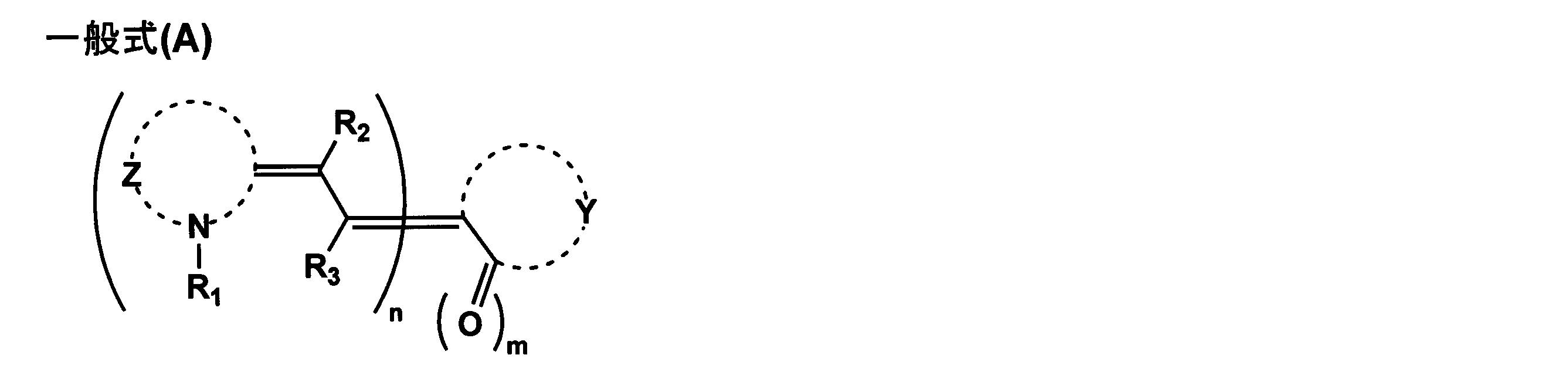


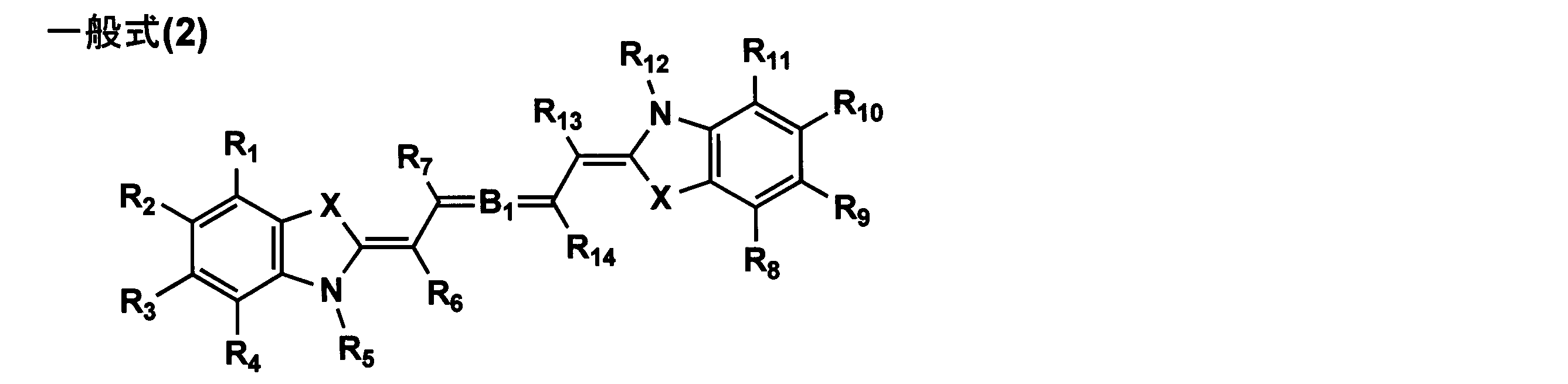


本発明の光学フィルムは、23℃でのジクロロメタンに対する溶解度が5~50質量%の範囲内である樹脂と、下記一般式(A)で表される構造を有する化合物とを含有することを特徴とする。
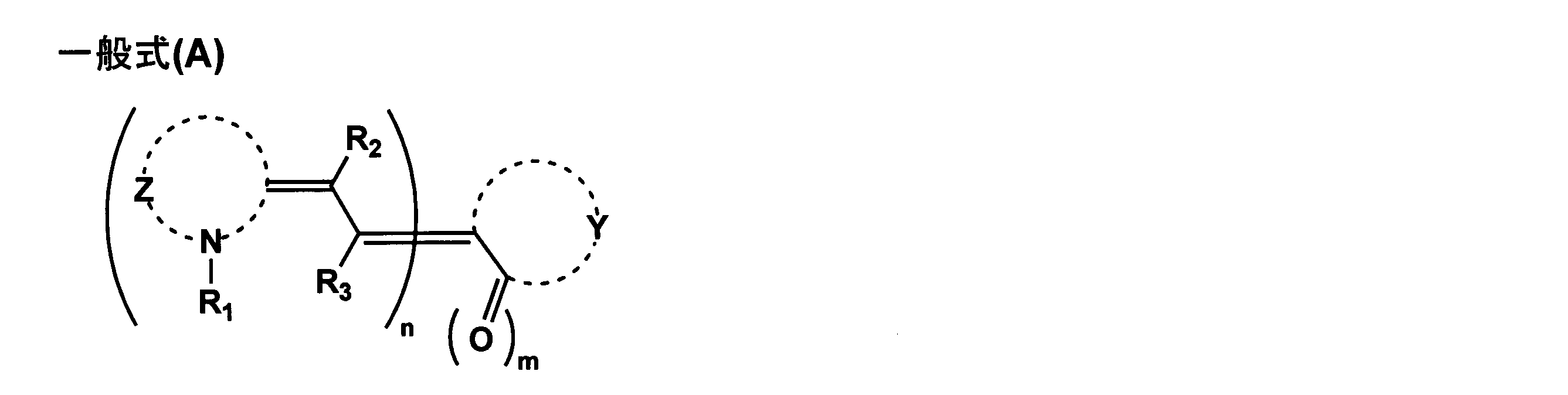
本発明に係る樹脂は、23℃でのジクロロメタンに対する溶解度が5~50質量%の範囲内であることを特徴とするものであるが、以下の方法によって溶解度を測定する。
光学フィルムの厚さは、用途に応じて、適宜、適当な厚さを選定することが好ましい。厚さの上限は、特に限定されるものではないが、溶液流延製膜法でフィルム化する場合は、塗布性、発泡、溶媒乾燥及び物性などの観点から、上限は250μm程度であることが好ましい。
本発明の光学フィルムは、前記一般式(A)で表される構造を有する化合物を含有することを特徴とする。
=100-{(光波長480~520nmの範囲又は580~620nmの範囲における吸収極大ピーク波長の分光透過率)-(光波長480~520nmの範囲又は580~620nmの範囲における吸収極大ピーク波長の分光反射率)}
分光透過率及び分光反射率は、分光光度計を用いて測定することができる。本発明においては、日本分光社製紫外可視近赤外分光光度計V-670を用いて測定する。
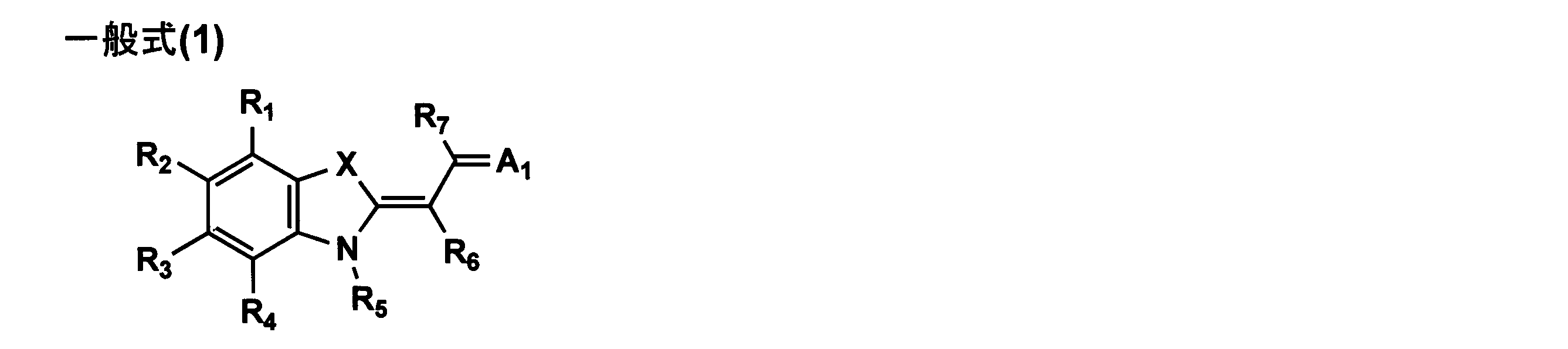
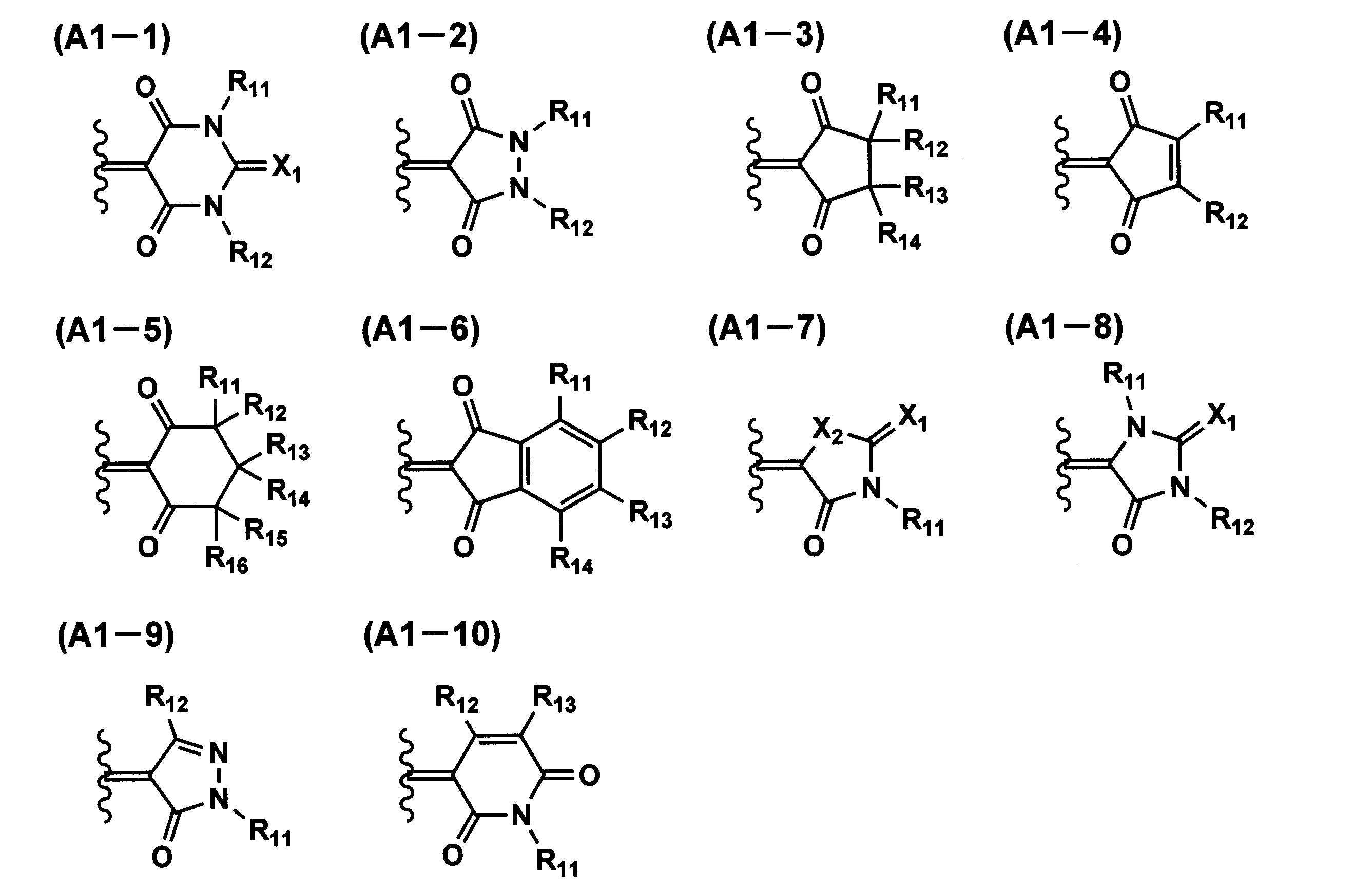
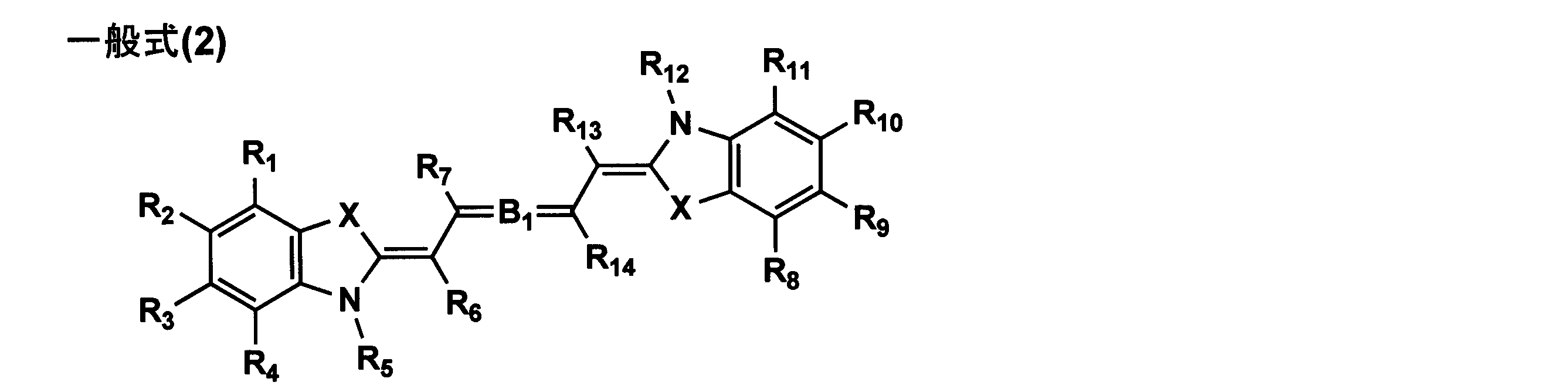
Xは、O、NR15、S、又はCR16R17を表す。R15~R17は、一般式(1)中のR8~R10と同義である。)
色再現性の観点から、好ましくは、NR8、O、又はSである。更に好ましくは、Sである。

色再現性、ブリードアウト抑制の観点から、B1は、(B1-4)が好ましい。

上記一般式(A)及び一般式(1)~一般式(3)で表される構造を有する化合物における置換基の具体例は以下のとおりである。
本発明に係る一般式(A)で表される構造を有する化合物、一般式(1)、一般式(2)及び一般式(3)で表される構造を有する化合物の合成は以下の方法によって行うことができる。
〈第1工程〉
2-メチルベンゾチアゾール22.4g、p-トルエンスルホン酸ブチル41.1gを加えて、150℃で約4時間撹拌した。反応後110℃まで冷却し、トルエンを加え、室温までゆっくり冷却した。析出した粗結晶を濾取した後、酢酸エチルを加えて、70℃で約30分懸濁精製することで、中間体(1-1)を36.9g得た。
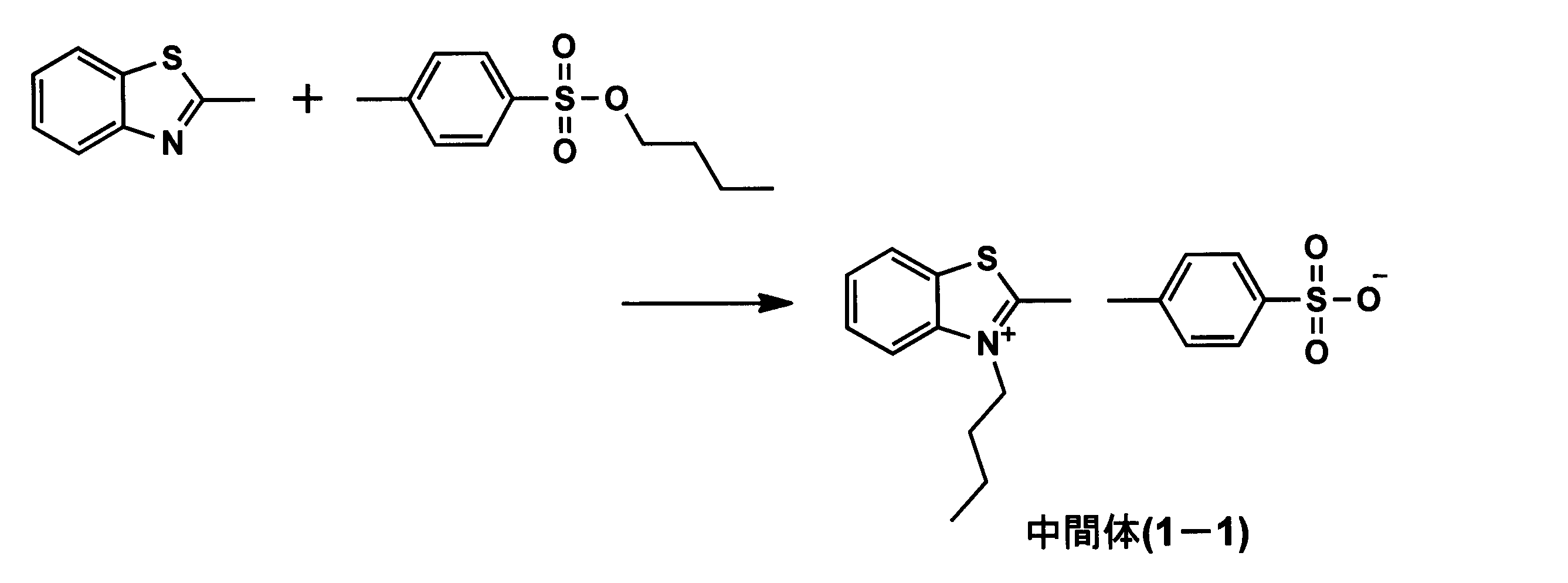
中間体(1-1)を35.9g、N,N’-ジフェニルホルムアミジンを22.4g、無水酢酸を11.6gを加えて、加熱還流下で約3時間撹拌した。反応後、酢酸エチル/メタノール溶液(v/v=100/2)を用いて、シリカゲルクロマトグラフィー精製した。得られた固体に酢酸エチルを加えて、70℃で約30分懸濁精製することで、中間体(1-2)を18.4g得た。
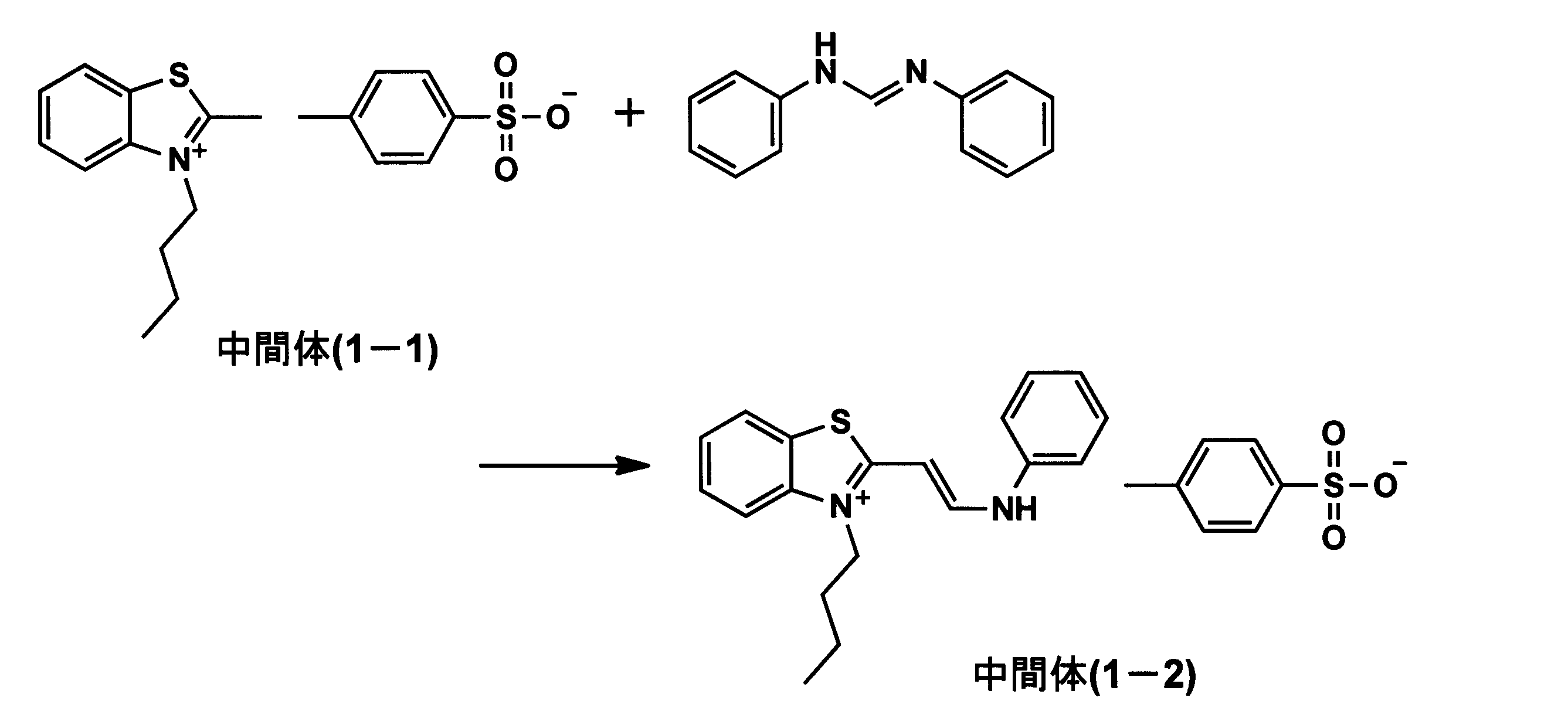
中間体(1-2)を4.2g、1-ブチル-3-(2-エチルヘキシル)バルビツール酸を2.4g 、アセトニトリルを加えて、60℃で約30分間撹拌した。その後、アセトニトリルに無水酢酸0.81gとトリエチルアミン1.6gを加えた溶液をゆっくりと、前記反応液に滴下した後、75℃で約2時間撹拌した。反応終了後、溶媒留去し、酢酸エチルに溶解した。飽和食塩水で有機相を洗浄したのち、無水硫酸マグネシウムを加えて、室温で約10分撹拌後、無水硫酸マグネシウムをろ過で除去した。ろ液を溶媒留去し、析出した固体をアセトニトリルで再結晶することで、例示化合物1を1.6g得た。得られた化合物のアセトン溶液中の吸収極大ピーク波長は480nm、半値幅は30nmであった。

〈合成例2:例示化合物31〉
合成例1において、1-ブチル-3-(2-エチルヘキシル)バルビツール酸に代えて、1,2-ジフェニルピラゾリジン-3,5-ジオンを用いた以外は、合成1と同様に合成を行い、例示化合物31を得た。得られた化合物のアセトン溶液中の吸収極大ピーク波長は482nm、半値幅は35nmであった。
合成例1において、1-ブチル-3-(2-エチルヘキシル)バルビツール酸に代えて、1,3-インダンジオンを用いた以外は、合成例1と同様に合成を行い、例示化合物37を得た。得られた化合物のアセトン溶液中の吸収極大ピーク波長は506nm、半値幅は29nmであった。
合成例1において、1-ブチル-3-(2-エチルヘキシル)バルビツール酸に代えて、1,3-インダンジオンを用い、p-トルエンスルホン酸ブチルに代えて、p-トルエンスルホン酸-2-エチルヘキシルを用いた以外は、合成例1と同様に合成を行い、例示化合物39を得た。得られた化合物のアセトン溶液中の吸収極大ピーク波長は506nm、半値幅は29nmであった。
合成例1において、1-ブチル-3-(2-エチルヘキシル)バルビツール酸に代えて、3-tert-ブチル-1-(2-エチルヘキサノイル)-5-ピラゾロンを用いた以外は、合成例1と同様に合成を行い、例示化合物61を得た。
合成例1において、2-メチルベンゾチアゾールに代えて、4-メチルピリジンを用いた以外は、合成例1と同様に合成を行い、例示化合物99を得た。得られた化合物のアセトン溶液中の吸収極大ピーク波長は492nm、半値幅は41nmであった。
合成例1において、1-ブチル-3-(2-エチルヘキシル)バルビツール酸に代えて、1,3-インダンジオンを用い、2-メチルベンゾチアゾールに代えて、4-メチルキノリンを用いた以外は、合成例1と同様に合成を行い、例示化合物129を得た。得られた化合物のアセトン溶液中の吸収極大は589nm、半値幅は26nmであった。
〈合成例8:例示化合物131〉
合成例1において、1-ブチル-3-(2-エチルヘキシル)バルビツール酸に代えて、1,3-インダンジオンを用い、2-メチルベンゾチアゾールに代えて、4-メチルキノリンを用い、p-トルエンスルホン酸ブチルに代えて、p-トルエンスルホン酸-2-エチルヘキシルを用いた以外は、合成例1と同様に合成を行い、例示化合物131を得た。得られた化合物のアセトン溶液中の吸収極大ピーク波長は589nm、半値幅は26nmであった。

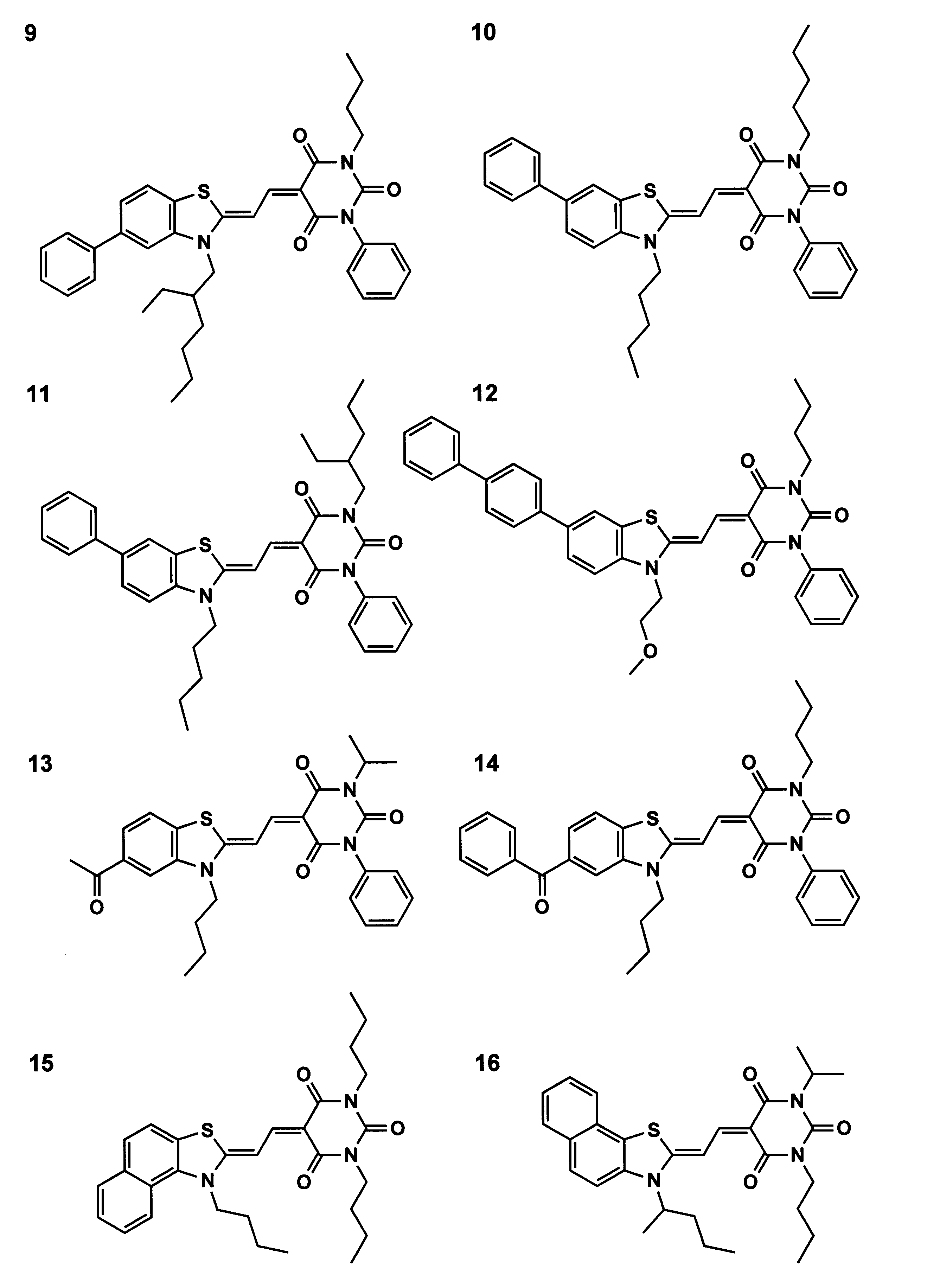
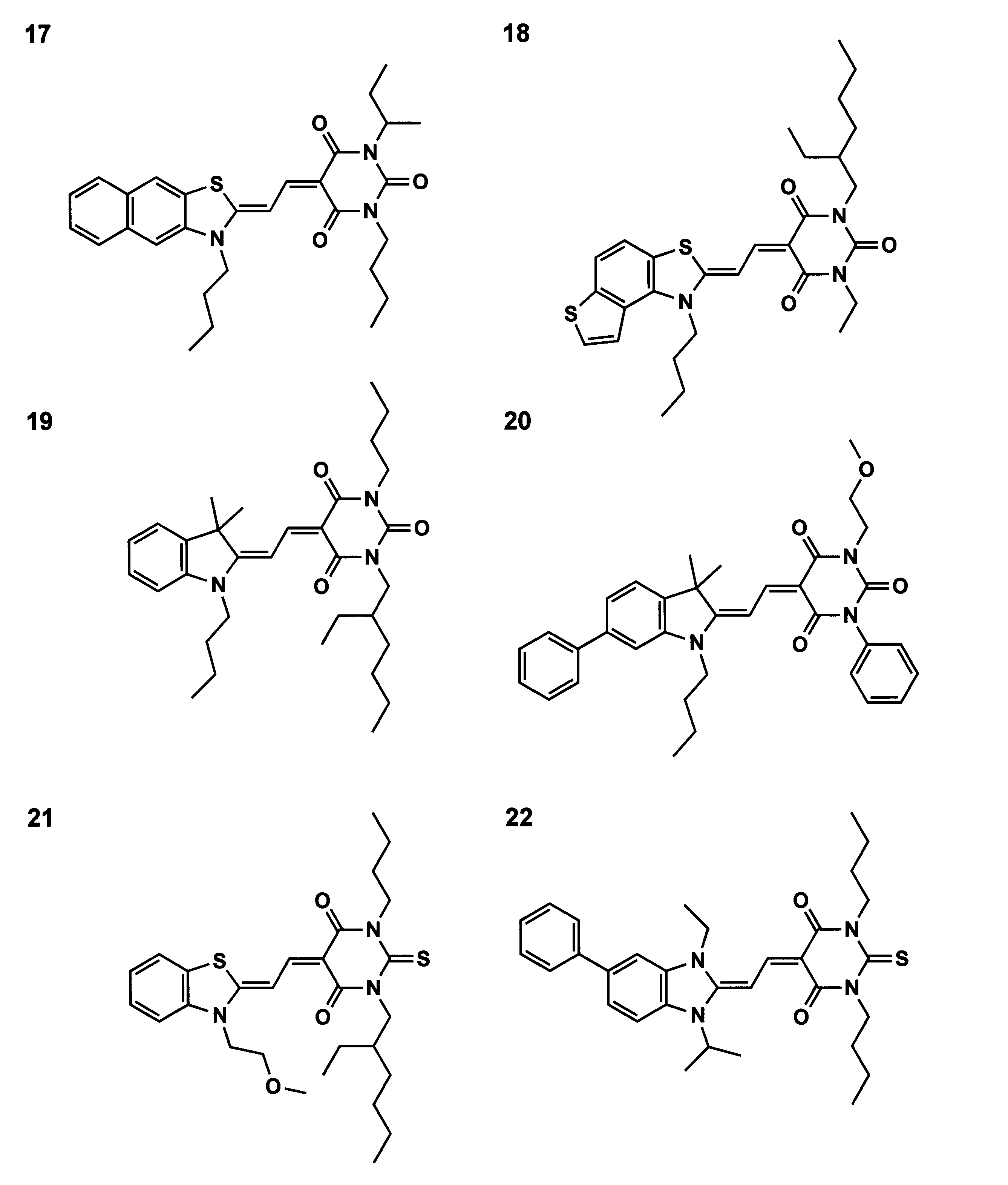
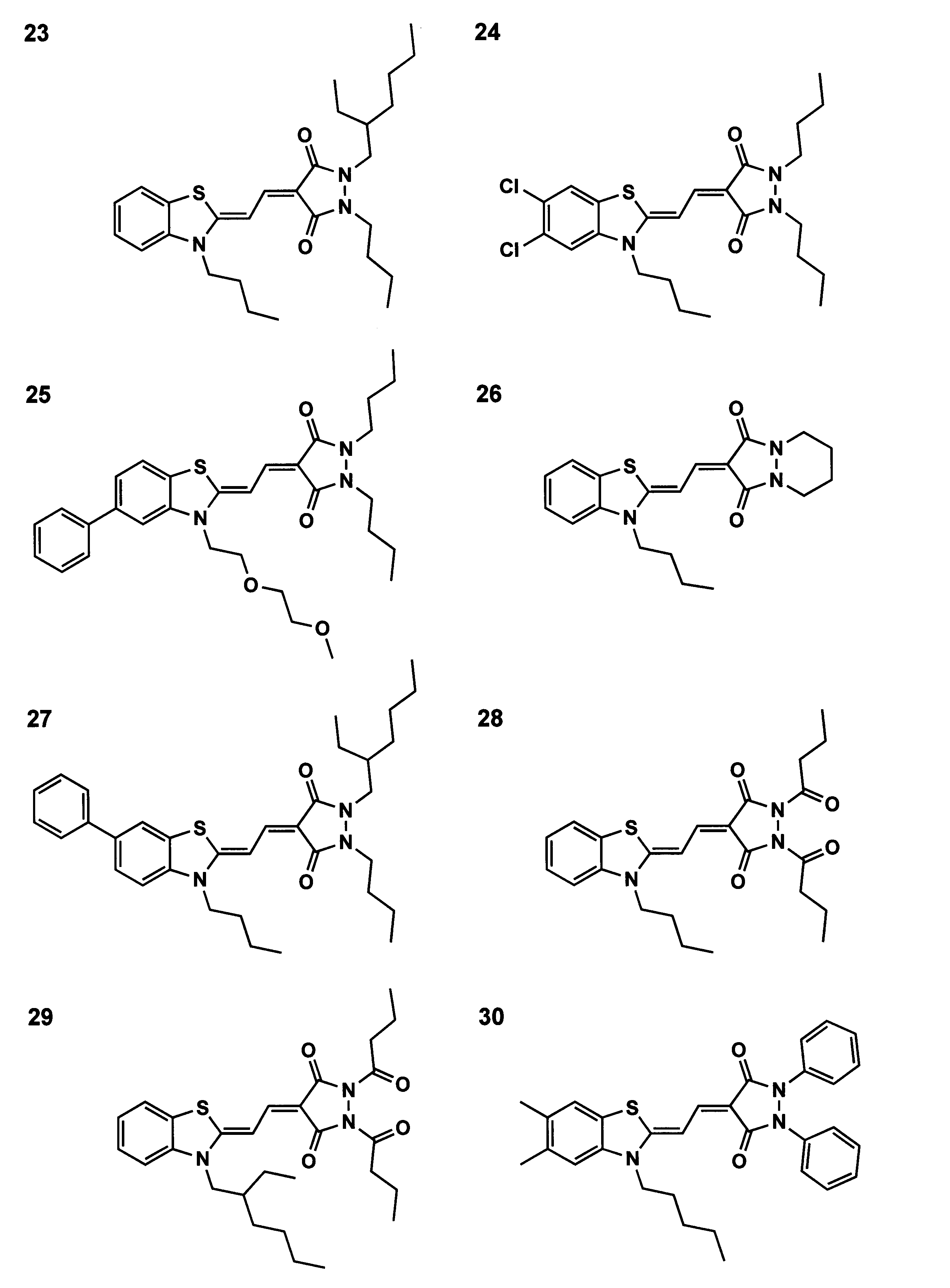


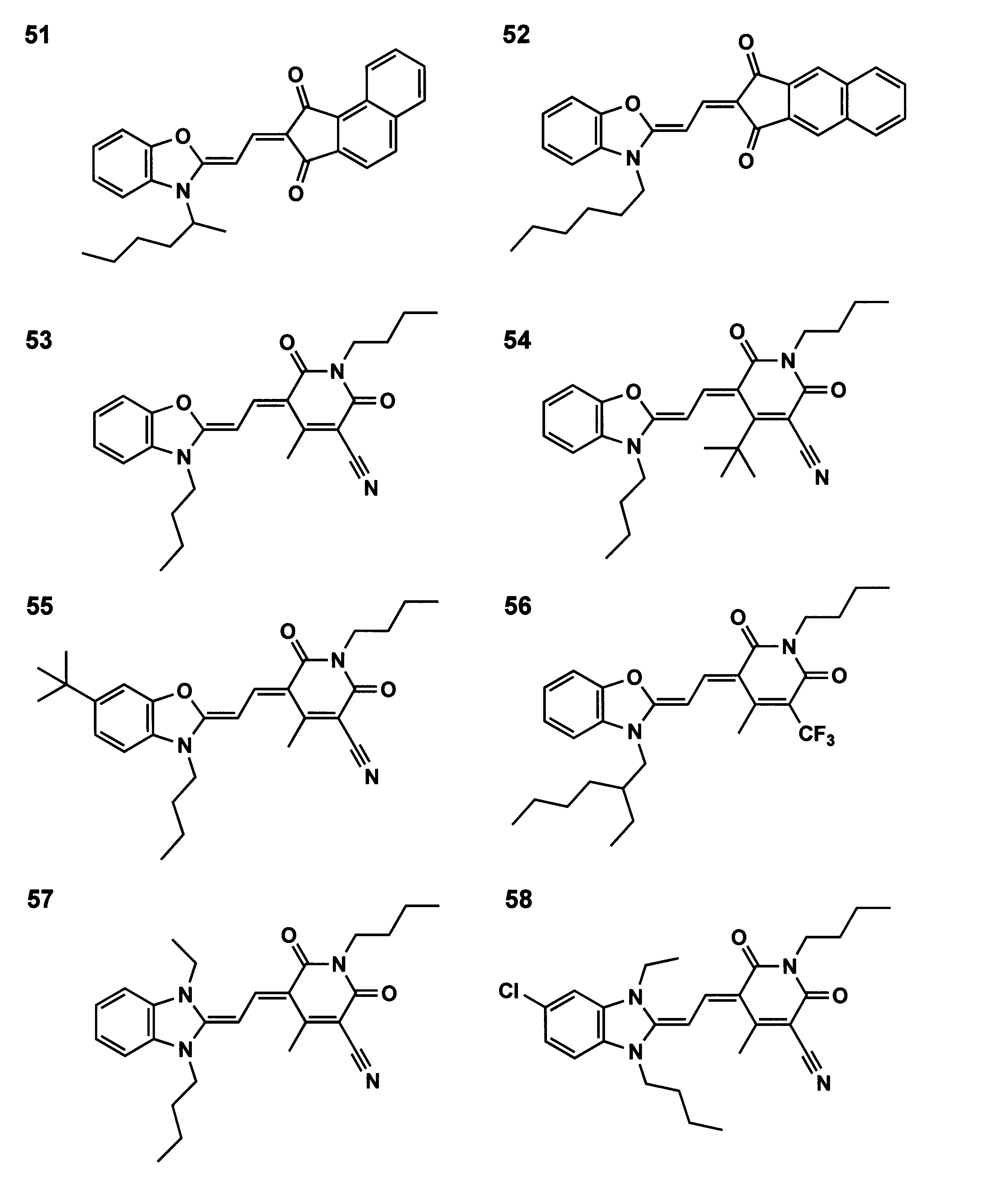

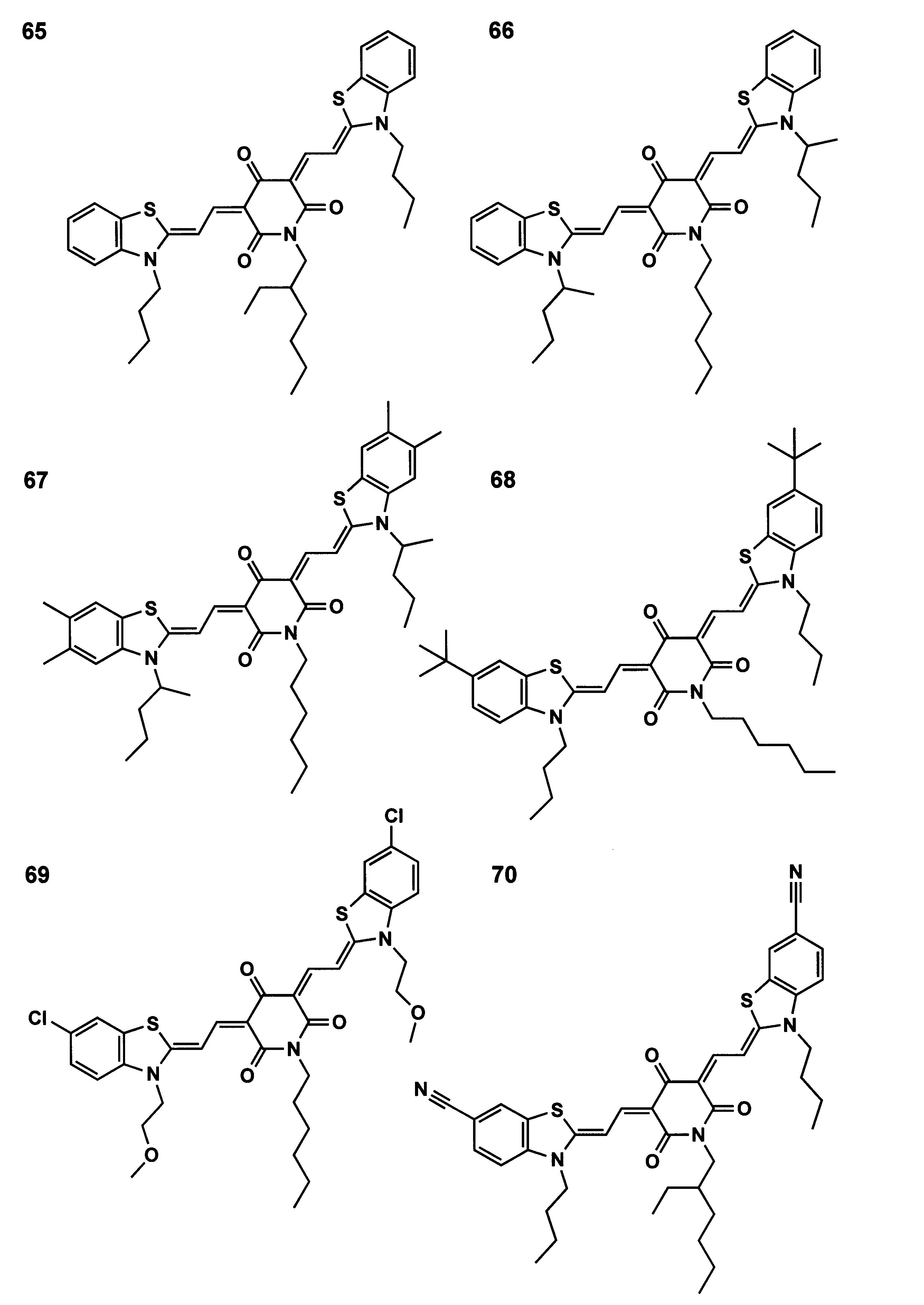
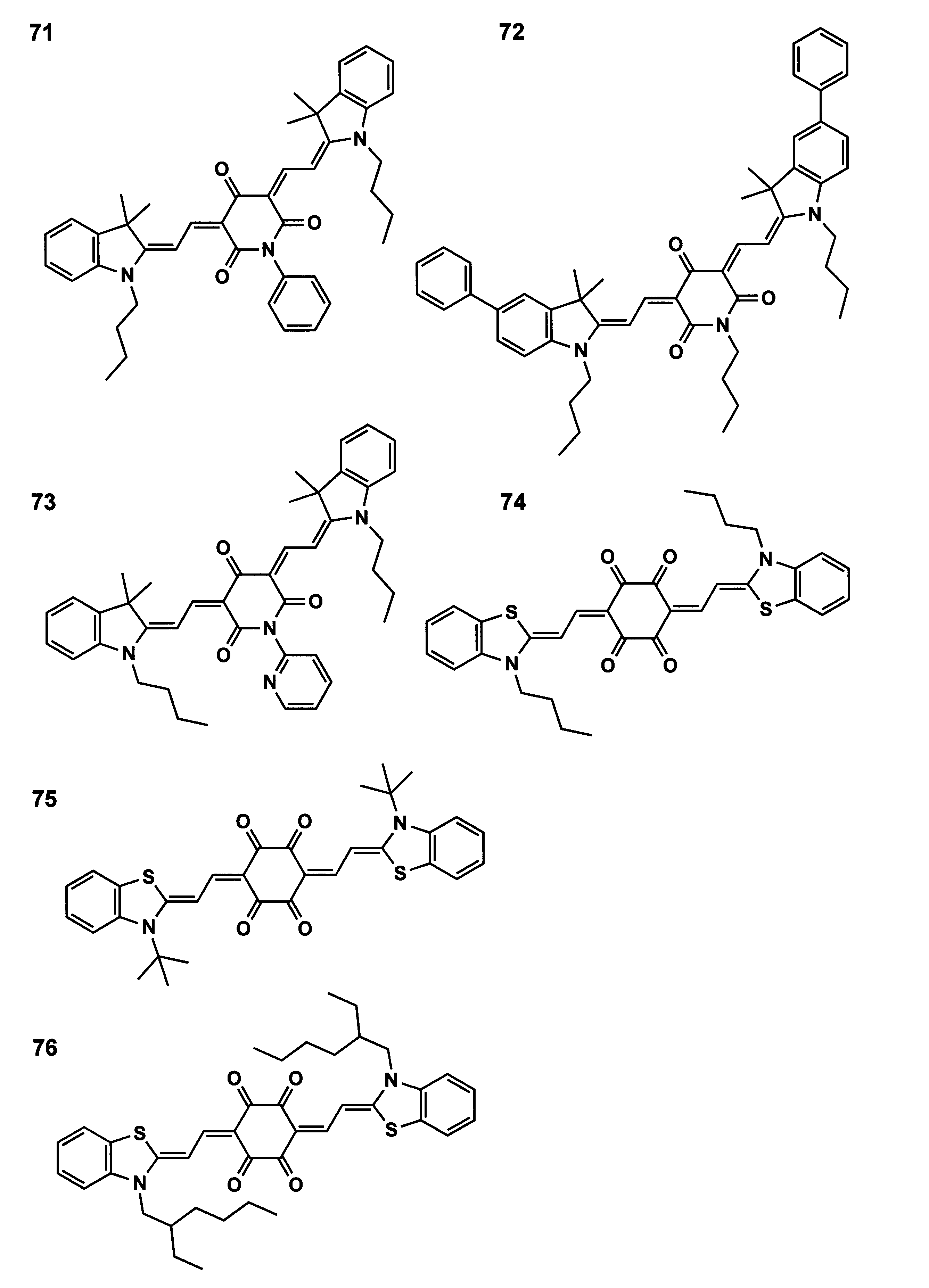
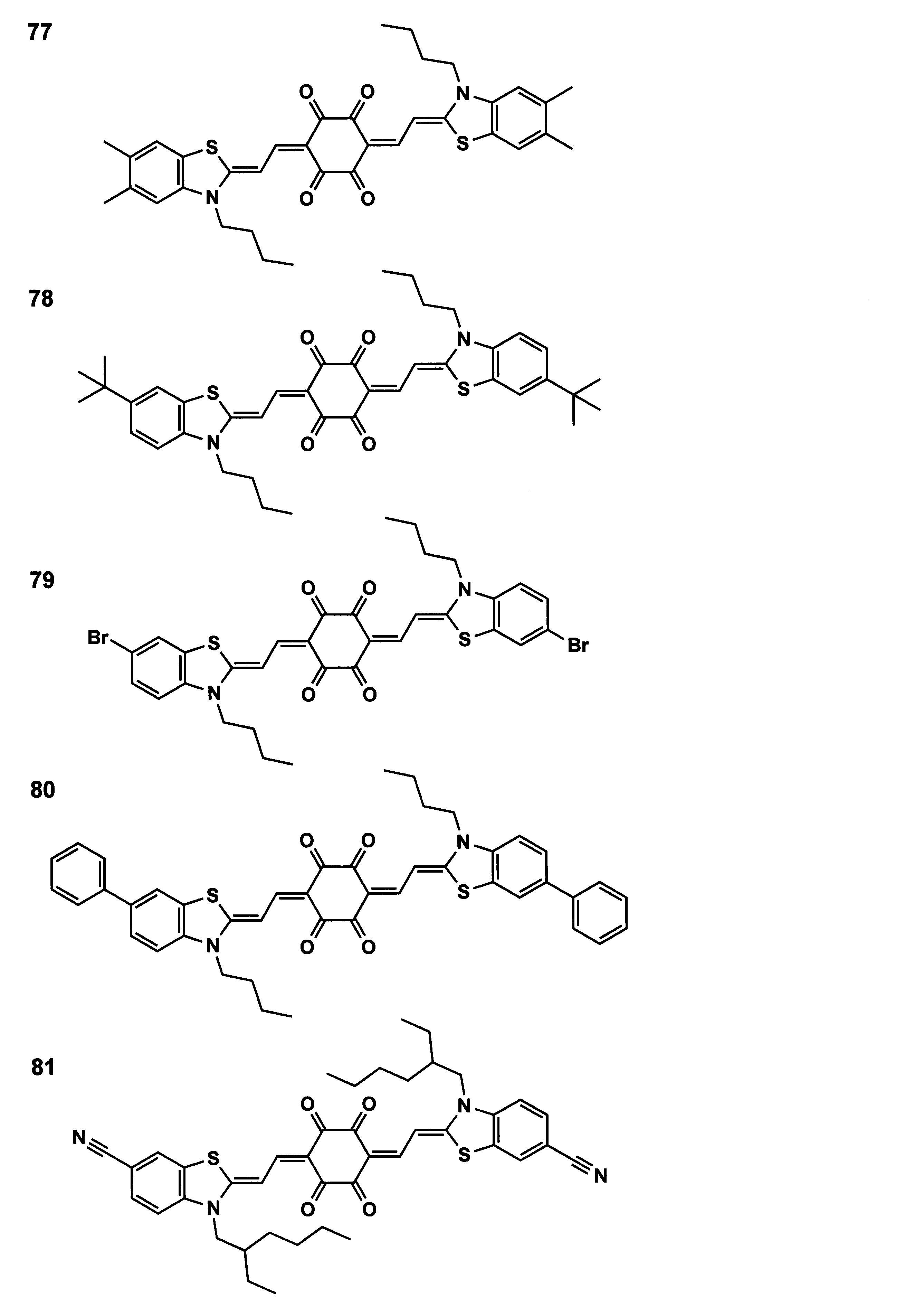
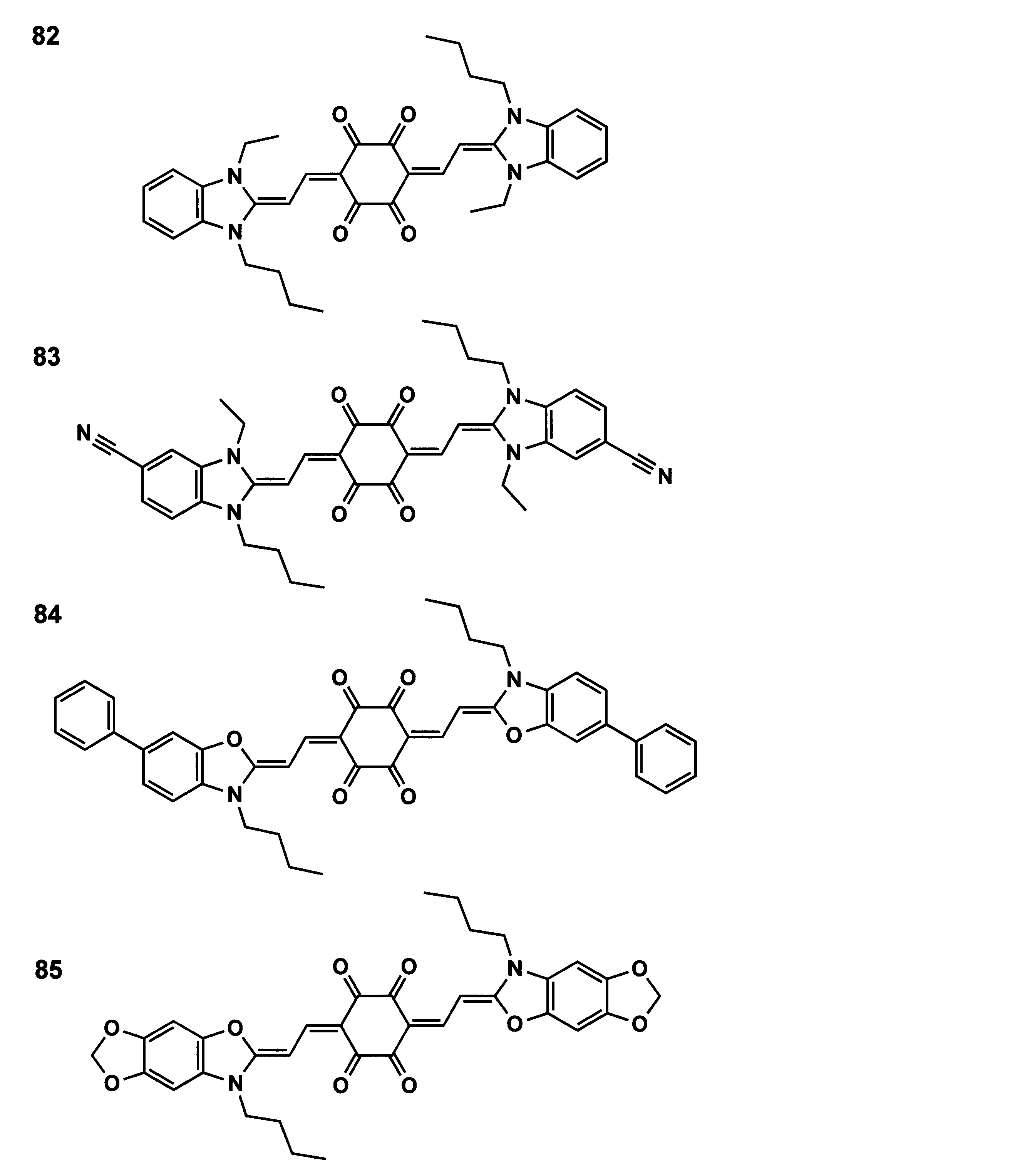

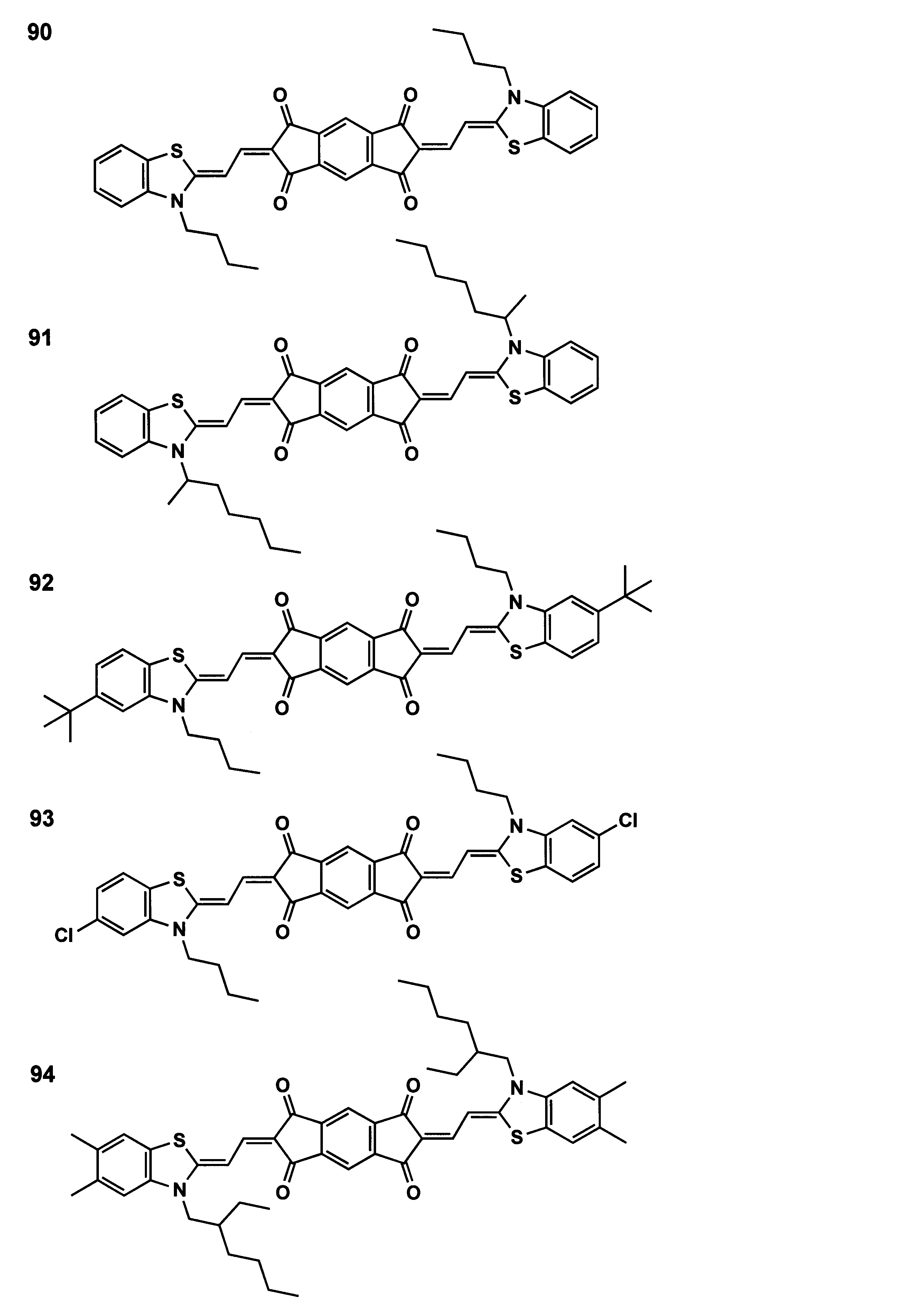

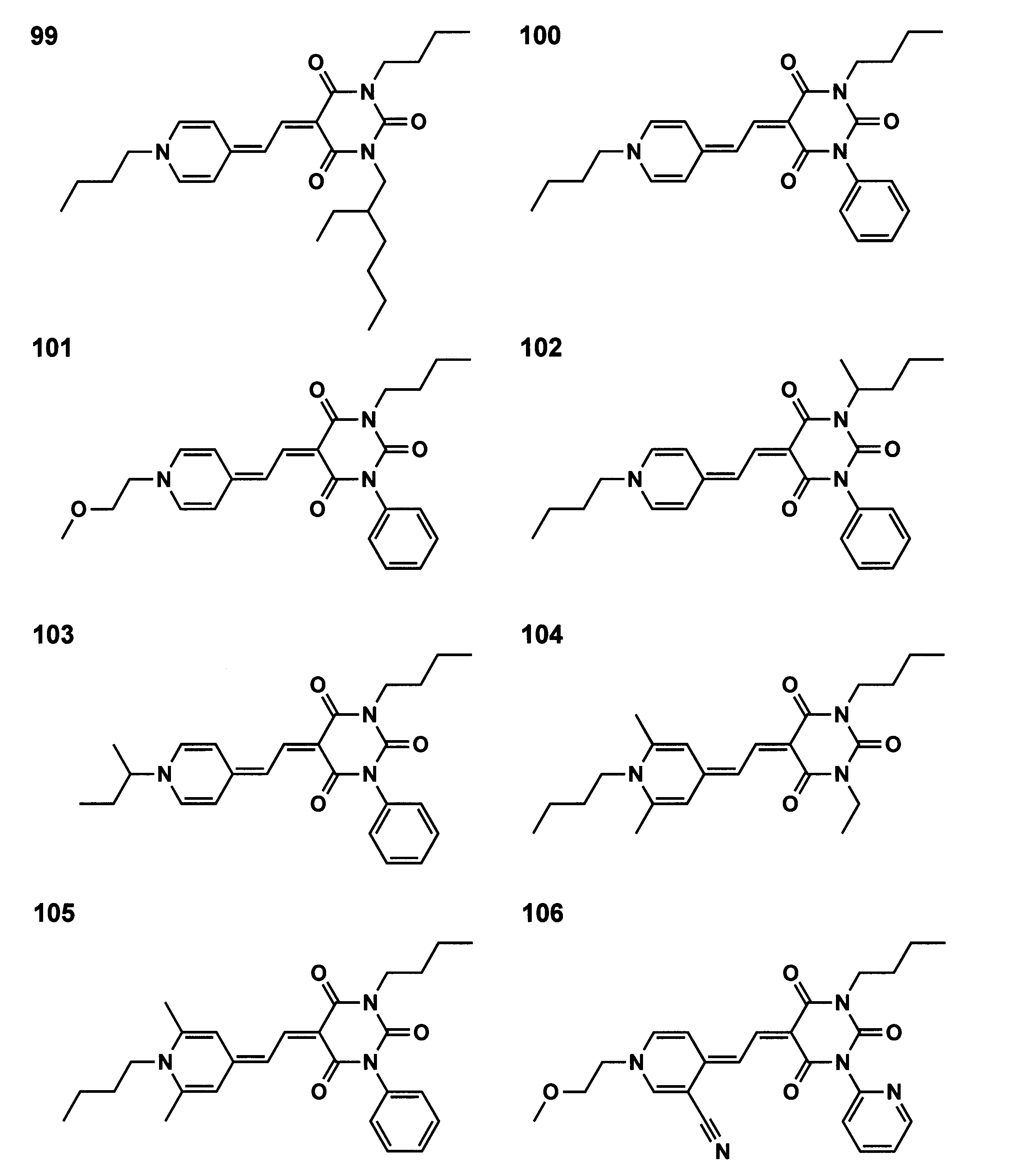
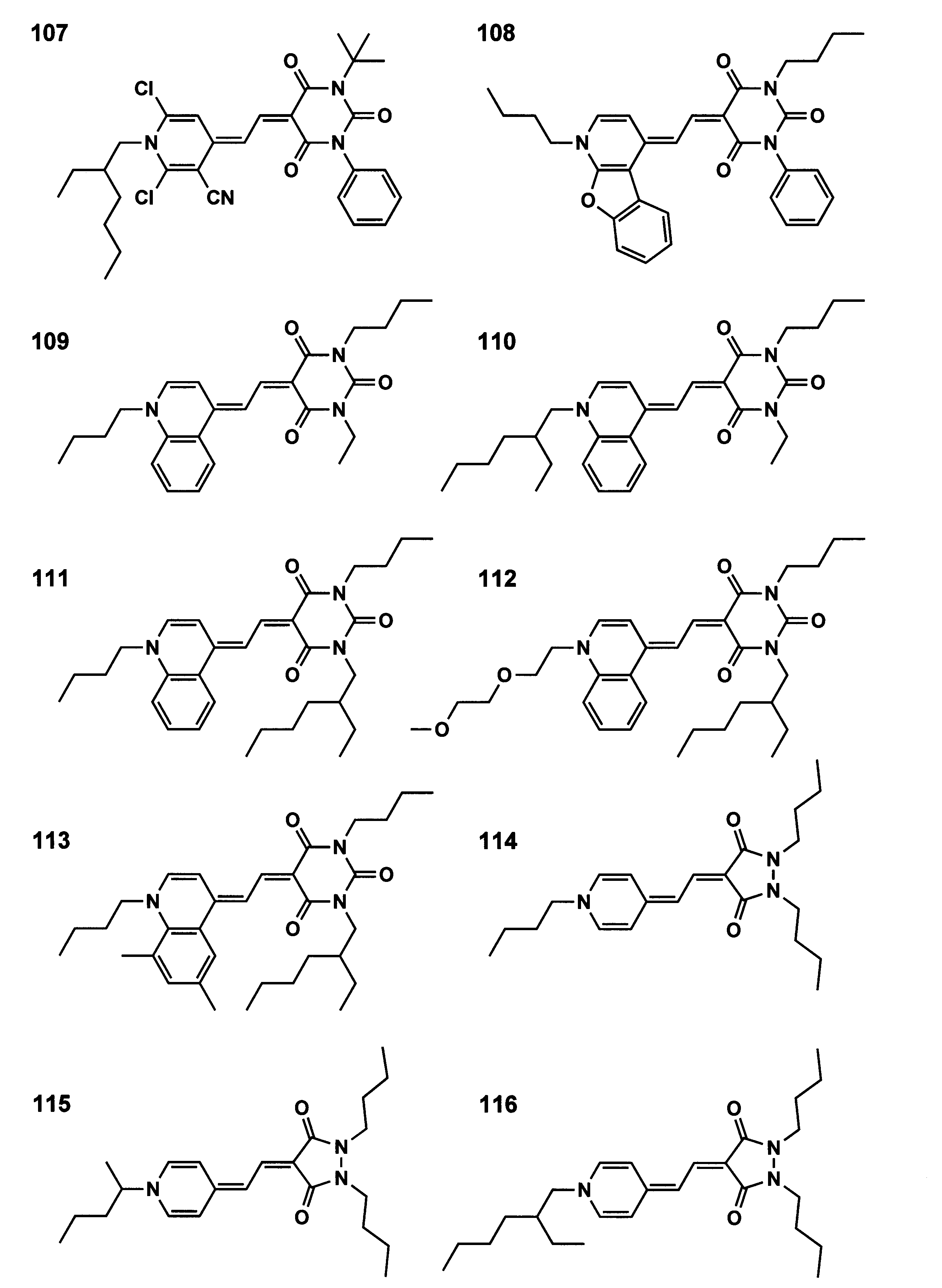


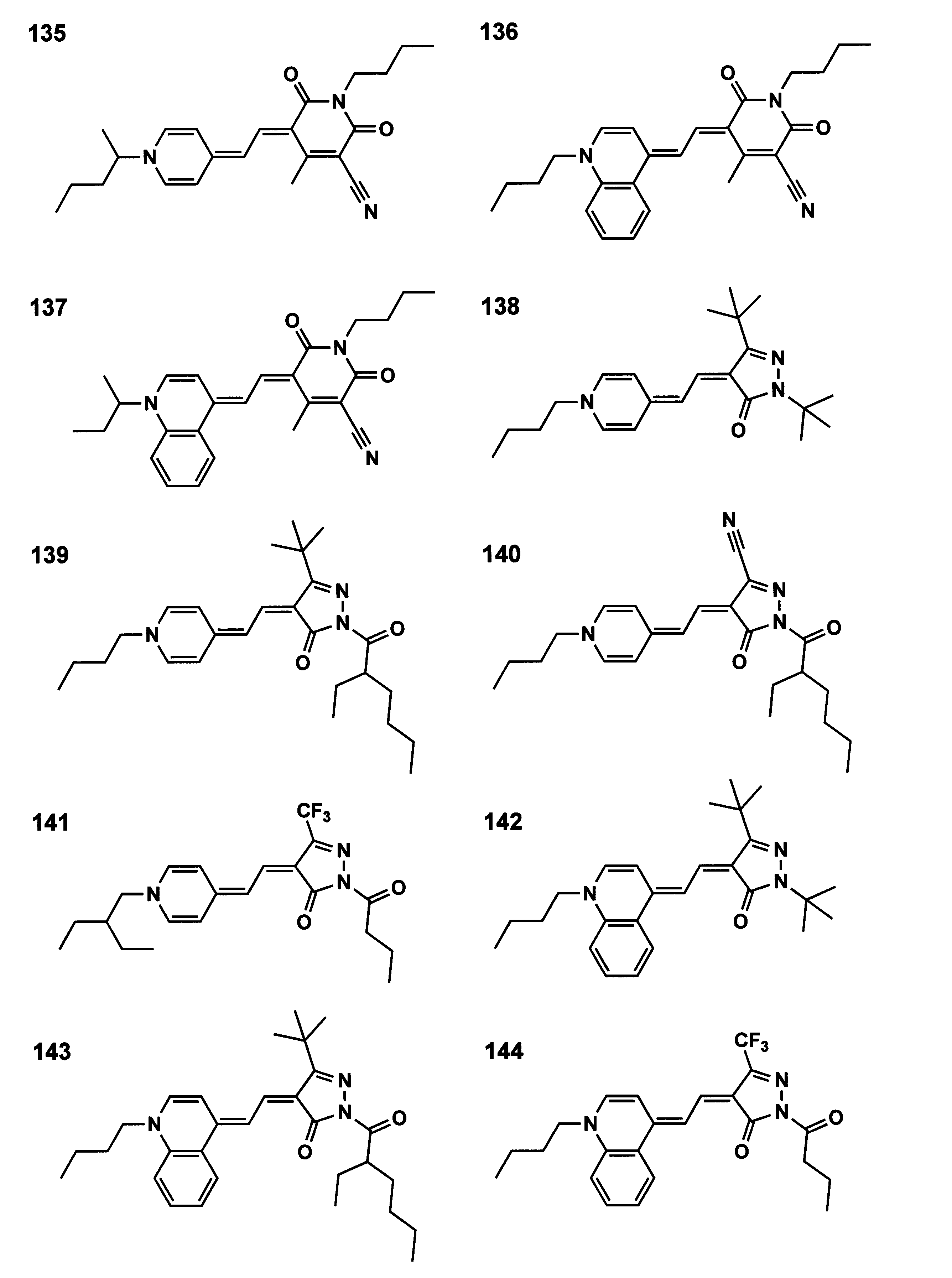
本発明に係る樹脂は、23℃でのジクロロメタンに対する溶解度が5~50質量%の範囲内であることを特徴とする。
本発明に用いることができるセルロースエステル樹脂(セルロースエステルともいう。)は、セルロース(ジ、トリ)アセテート、セルロースプロピオネート、セルロースブチレート、セルロースアセテートプロピオネート、セルロースアセテートブチレート、セルロースアセテートフタレート、及びセルロースフタレートから選ばれる少なくとも1種であることが好ましい。
式(II) 0≦X≦2.5
セルロースエステルのアシル基の総置換度は、1.0~3.0程度としうる。アシル基の総置換度は、透湿性を低くする観点からは、2.0~2.95の範囲内であることが好ましい。
カラム:Shodex K806、K805、K803G(昭和電工株式会社製)を3本接続して使用する;
カラム温度:25℃; 試料濃度:0.1質量%;
検出器:RI Model 504(GLサイエンス社製);
ポンプ:L6000(日立製作所株式会社製);
流量:1.0ml/min
校正曲線:標準ポリスチレンSTK standard ポリスチレン(東ソー株式会社製) Mw=500~1000000の13サンプルによる校正曲線を使用する。13サンプルは、ほぼ等間隔に用いる。
本発明に用いることができるアクリル樹脂は、メタクリル樹脂も含まれる。
本発明においては、環状オレフィン樹脂を用いることも好ましい。環状オレフィン樹脂としては、ノルボルネン系樹脂、単環の環状オレフィン系樹脂、環状共役ジエン系樹脂、ビニル脂環式炭化水素系樹脂、及び、これらの水素化物等を挙げることができる。これらの中で、ノルボルネン系樹脂は、透明性と成形性が良好なため、好適に用いることができる。
本発明では、種々の公知のポリカーボネート樹脂も使用することができる。本発明においては、特に芳香族ポリカーボネートを用いることが好ましい。当該芳香族ポリカーボネートについて特に制約はなく、所望するフィルムの諸特性が得られる芳香族ポリカーボネートであれば特に制約はない。
本発明に用いられるポリイミド樹脂は、イミド構造を有する樹脂であり、繰り返し単位にイミド結合を含む樹脂である。ポリイミドは、ジアミン又はその誘導体と酸無水物又はその誘導体とから形成されることが好ましい。
本発明に用いることのできるポリイミドとしては、特に、下記式(1.1)で表される繰り返し単位を有するポリイミド(以下、ポリイミド(A)と称する。)が好ましい。


〈ポリアミド酸の合成〉
ポリアミド酸は、適当な溶剤中で、前記テトラカルボン酸類の少なくとも一種と、前記ジアミン類の少なくとも一種を重合反応させることにより得られる。
ここで、ポリイミドは、ポリアミド酸溶液を加熱してポリアミド酸をイミド化させる方法(熱イミド化法)、又はポリアミド酸溶液に閉環触媒(イミド化触媒)を添加してポリアミド酸をイミド化させる方法(化学イミド化法)により得ることができる。
本発明の光学フィルムは、必要に応じて下記のような種々の添加剤をさらに含有していてもよい。
本発明の光学フィルムは、光学フィルムの可塑性を向上させる観点から、前述したセルロースエステル樹脂以外の糖エステルを含有することができる。
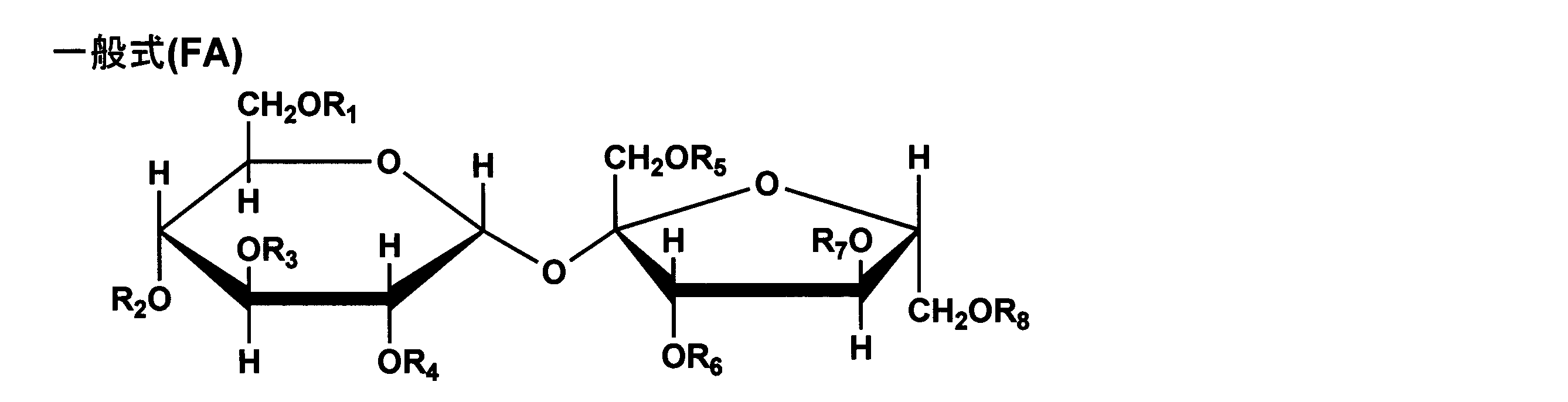
本発明の光学フィルムは、本発明の効果を阻害しない範囲で、フィルム製造時の組成物の流動性や、フィルムの柔軟性を向上するために可塑剤を含有していていもよい。可塑剤の例には、ポリエステル系可塑剤、多価アルコールエステル系可塑剤、多価カルボン酸エステル系可塑剤(フタル酸エステル系可塑剤を含む)、グリコレート系可塑剤、エステル系可塑剤(クエン酸エステル系可塑剤、脂肪酸エステル系可塑剤、リン酸エステル系可塑剤、トリメリット酸エステル系可塑剤等を含む)等が含まれる。これらは、単独で用いても、2種類以上を組み合わせて用いてもよい。
本発明の光学フィルムは、紫外線吸収剤をさらに含有していてもよい。紫外線吸収剤は、ベンゾトリアゾール系、2-ヒドロキシベンゾフェノン系、サリチル酸フェニルエステル系等であり得る。具体的には、2-(5-メチル-2-ヒドロキシフェニル)ベンゾトリアゾール、2-[2-ヒドロキシ-3,5-ビス(α,α-ジメチルベンジル)フェニル]-2H-ベンゾトリアゾール、2-(3,5-ジ-t-ブチル-2-ヒドロキシフェニル)ベンゾトリアゾール等のトリアゾール類;2-ヒドロキシ-4-メトキシベンゾフェノン、2-ヒドロキシ-4-オクトキシベンゾフェノン、2,2’-ジヒドロキシ-4-メトキシベンゾフェノン等のベンゾフェノン類等が挙げられる。
ビス(2,2,6,6-テトラメチル-4-ピペリジル)セバケート、ビス(1,2,2,6,6-ペンタメチル-4-ピペリジル)セバケート等のヒンダードアミン系;
2-(3,5-ジ-t-ブチル-4-ヒドロキシベンジル)-2-n-ブチルマロン酸ビス(1,2,2,6,6-ペンタメチル-4-ピペリジル)、1-[2-[3-(3,5-ジ-t-ブチル-4-ヒドロキシフェニル)プロピオニルオキシ]エチル]-4-[3-(3,5-ジ-t-ブチル-4-ヒドロキシフェニル)プロピオニルオキシ]-2,2,6,6-テトラメチルピペリジン等の分子内にヒンダードフェノールとヒンダードアミンの構造を共に有するハイブリッド系;
等が含まれ、好ましくは2-[2-ヒドロキシ-3,5-ビス(α,α-ジメチルベンジル)フェニル]-2-ベンゾトリアゾールや2,2-メチレンビス[4-(1,1,3,3-テトラブチル)-6-(2H-ベンゾトリアゾール-2-イル)フェノール]である。これらは、1種類であっても、2種類以上を併用してもよい。
本発明の光学フィルムは、滑り性を付与し取り扱い性を向上する目的で、無機化合物又は有機化合物からなる微粒子を含有してもよい。
液晶表示装置等の画像表示装置の表示品質の向上のため、光学フィルム中に位相差制御剤を添加するか、配向膜を形成して液晶層を設け、偏光板保護フィルムと液晶層由来の位相差を複合化することにより、光学フィルムに光学補償能を付与することができる。
本発明の光学フィルムは、成形加工時の熱分解や熱による着色を防止するための酸化防止剤、帯電防止剤や難燃剤等をさらに含有していていもよい。
本発明の光学フィルムは、有機EL表示装置や液晶表示装置等の画像表示装置の光学フィルムとして用いることができる。本発明の光学フィルムは、偏光板保護フィルム、位相差フィルム、光学補償フィルムに好ましく用いられる。位相差フィルム又は光学補償フィルムが偏光板保護フィルムを兼ねていることが好ましい。
条件2:温度23℃、相対湿度55%の環境下で、波長590nmで測定した下式(II)で表される厚さ方向のリターデーション値Rt(590)が、-20~50nmの範囲内である。
(ここで、フィルムの面内における遅相軸方向の屈折率をnx、フィルムの面内における遅相軸に直交する方向の屈折率をny、フィルムの厚さ方向の屈折率をnz、dはフィルムの厚さ(nm)をそれぞれ表す。)
また、本発明の光学フィルムを垂直配向型液晶表示装置用の光学補償フィルムとして用いる場合は、リターデーション値が下記条件3及び条件4を満たすことが、視野角拡大に好適である。
本発明の光学フィルムは、溶液流延製膜法又は溶融流延製膜法で製造され得る。
光学フィルムを溶液流延製膜法で製造する方法は、A1)少なくとも樹脂と本発明に係る一般式(A)で表される構造を有する化合物、及び必要に応じて他の添加剤とを溶剤に溶解させてドープを調製する工程、A2)ドープを無端の金属支持体上に流延する工程、A3)流延したドープから溶媒を蒸発させてウェブとする工程、A4)ウェブを金属支持体から剥離する工程、A5)ウェブを乾燥後、必要な場合には延伸してフィルムを得る工程を含む。
溶解釜において、樹脂と本発明に係る一般式(A)で表される構造を有する化合物、及び必要に応じて他の添加剤とを溶剤に溶解させてドープを調製する。
ドープを、加圧ダイのスリットから無端状の金属支持体上に流延させる。
ウェブ(ドープを金属支持体上に流延して得られたドープ膜)を金属支持体上で加熱し、溶媒を蒸発させる。ウェブの乾燥方法や乾燥条件は、前述のA2)流延工程と同様とし得る。
金属支持体上で溶媒を蒸発させたウェブを、金属支持体上の剥離位置で剥離する。
なお、残留溶媒量を測定する際の加熱処理は、115℃で1時間の加熱処理を意味する。
金属支持体から剥離して得られたウェブを、必要に応じて乾燥させた後、延伸する。ウェブの乾燥は、ウェブを、上下に配置した多数のローラーにより搬送しながら乾燥させてもよいし、ウェブの両端部をクリップで固定して搬送しながら乾燥させてもよい。
本発明の光学フィルムは溶融流延製膜法で製膜することもできる。
光学フィルムの主成分である樹脂と本発明に係る一般式(A)で表される構造を有する化合物とを含む樹脂組成物は、あらかじめ混練してペレット化しておくことが好ましい。ペレット化は、公知の方法で行うことができ、例えば前述の樹脂と、必要に応じて可塑剤等の添加剤とを含む樹脂組成物を、押出機にて溶融混錬した後、ダイからストランド状に押し出す。ストランド状に押し出された溶融樹脂を、水冷又は空冷した後、カッティングしてペレットを得ることができる。
得られた溶融ペレットと、必要に応じて他の添加剤とを、ホッパーから押出機に供給する。ペレットの供給は、ペレットの酸化分解を防止するため等から、真空下、減圧下又は不活性ガス雰囲気下で行うことが好ましい。そして、押出機にて、フィルム材料である溶融ペレット、必要に応じて他の添加剤を溶融混練する。
ダイから押し出された樹脂を、冷却ローラーと弾性タッチローラーとでニップして、フィルム状の溶融樹脂を所定の厚さにする。そして、フィルム状の溶融樹脂を、複数の冷却ローラーで段階的に冷却して固化させる。
得られたウェブを、延伸機にて延伸してフィルムを得る。延伸は、ウェブの幅方向、搬送方向又は斜め方向のいずれかに行う。
〔6.1〕偏光板
本発明の光学フィルムは、本発明の偏光板、それを用いた本発明の表示装置として液晶表示装置又は有機ELディスプレイ等に使用することができる。本発明の光学フィルムは、偏光板保護フィルム又は位相差フィルムとして用いることができる。位相差フィルムの場合は、偏光板保護フィルムの機能を兼ねたフィルムとされることが好ましく、その場合偏光板保護フィルムと別に位相差を有する光学フィルムを用意する必要がないため、液晶表示装置の厚さを薄く、かつ製造プロセスを簡略化することができる。
本発明の光学フィルムを用いた偏光板を液晶表示装置に用いることによって、種々の視認性に優れた本発明の表示装置を作製することができる。
本発明の光学フィルムは、有機エレクトロルミネッセンス(EL)表示装置に好適に用いることができる。
〔光学フィルム101の作製〕
下記成分を、ディゾルバーで50分間撹拌混合した後、マントンゴーリンで分散させて、微粒子分散液を調製した。
微粒子(アエロジル R972V 日本アエロジル(株)製):
11質量部
エタノール: 89質量部
下記微粒子添加液の成分のうち、ジクロロメタンを溶解タンクに投入し、調製した微粒子分散液を下記の添加量で、十分撹拌しながらゆっくりと添加した。次いで、微粒子の二次粒子の粒径が所定の大きさとなるようにアトライターにて分散させた後、ファインメットNF(日本精線(株)製)でろ過して、微粒子添加液を得た。
ジクロロメタン: 99質量部
微粒子分散液: 5質量部
下記ドープの成分のうち、ジクロロメタンとエタノールを加圧溶解タンクに投入した。次いで、下記セルロースエステル、一般式(1)で表される構造を有する例示化合物1、糖エステルS及び調製した微粒子添加液を撹拌しながら投入し、加熱、撹拌して完全に溶解させた。得られた溶液を、安積濾紙(株)製の安積濾紙No.244を使用してろ過し、ドープ1を調製した。
ジクロロメタン: 520質量部
エタノール: 45質量部
セルロースエステル(セルロースアセテート(TAC):アセチル基置換
度2.80、重量平均分子量20万) 100質量部
例示化合物1: 0.1質量部
糖エステルS: 5質量部
微粒子添加液: 1質量部
以下に、可塑剤として加えた糖エステルSの構造を示す。

得られたドープを、無端ベルト流延装置を用いて、ステンレスベルト支持体上に均一に流延させた。ステンレスベルト支持体上で、流延(キャスト)したドープ膜中の溶媒を、残留溶媒量が75質量%になるまで蒸発させ、得られたウェブをステンレスベルト支持体上から剥離した。剥離したウェブを、テンター延伸装置のクリップで把持しながら搬送した。次いで、得られたフィルムを、乾燥ゾーン内で、多数のローラーで搬送させながら乾燥させた。テンタークリップで把持していたフィルムの幅方向端部をレーザーカッターでスリット除去した後、巻き取って原反フィルムを得た。
光学フィルム101の作製において、例示化合物1を表I記載の化合物に代えた以外は同様にして、光学フィルム102~108を作製した。
〔光学フィルム109の作製〕
ドープ1の調製を以下のように代えた以外は同様にして、ドープ2を用いて、光学フィルム109を作製した。
ジクロロメタン: 520質量部
エタノール: 45質量部
セルロースエステル(セルロースアセテート:アセチル基置換度2.80
、重量平均分子量20万) 100質量部
糖エステルS: 5質量部
例示化合物39: 0.1質量部
例示化合物129: 0.1質量部
微粒子添加液: 1質量部
〔光学フィルム110及び111の作製〕
光学フィルム101の作製において、例示化合物1を下記の比較化合物1又は2に代えた以外は同様にして、光学フィルム110及び111を作製した。
光学フィルム109の作製において、例示化合物39及び例示化合物129を、下記比較化合物1及び比較化合物2(特開2015-36796号公報に記載)に代えた以外は同様にして、光学フィルム112を作製した。

〔光学フィルム113の作製〕
〈アクリル共重合体の合成〉
攪拌機を備えた内容積40リットルのSUS製重合反応装置に、脱イオン水24リットルを入れ、分散安定剤としてアニオン系高分子化合物水溶液30g、分散安定助剤として硫酸ナトリウム36gを加え攪拌・溶解させた。また、別の攪拌機を備えた容器に、メタクリル酸メチル9600g、メタクリル酸イソボルニル2400gの単量体混合物に、重合開始剤として2,2′-アゾビスイソブチロニトリル12g、連鎖移動剤としてn-オクチルメルカプタン24g、離型剤としてステアリルアルコール24gを加え攪拌・溶解させた。このようにして得られた重合開始剤、連鎖移動剤及び離形剤を溶解した単量体混合物を、上述した攪拌機を備えた内容積40リットルのSUS製重合反応装置(脱イオン水、分散安定剤及び分散安定助剤を収容する)に投入し、窒素置換しながら175rpmで15分間攪拌した。その後、80℃に加温して重合を開始させ、重合発熱ピーク終了後、115℃で10分間の熱処理を行い、重合を完結させた。得られたビーズ状重合体を濾過、水洗し、80℃で24hr乾燥し、メタクリル酸メチルとメタクリル酸イソボルニルのアクリル共重合体(重量平均分子量15万)を得た。
アクリル共重合体(MMA80質量%とイソボルニルメタクリレート20
質量%の共重合体) 100質量部
例示化合物37: 0.1質量部
マット剤:R972V(日本アエロジル(株)製、シリカ粒子、平均粒径
=16nm) 0.3質量部
剥離助剤:エレカットS412(竹本油脂社製) 0.5質量部
ジクロロメタン 300質量部
エタノール 40質量部
上記調製したドープ4を、ベルト流延装置を用い、温度22℃、2m幅でステンレスバンド支持体に均一に流延した。ステンレスバンド支持体で、残留溶剤量が100%になるまで溶媒を蒸発させ、剥離張力162N/mでステンレスバンド支持体上からウェブを剥離した。
光学フィルム113の作製において、例示化合物37を表I記載の化合物に代えた以外は同様にして、光学フィルム114及び115を作製した。
(微粒子分散液及び添加液の調製)
11.3質量部の微粒子(アエロジル R972V、日本アエロジル(株)製)と、84質量部のエタノールとを、ディゾルバーで50分間撹拌混合した後、マントンゴーリンで分散した。
下記組成のドープ5を調製した。まず加圧溶解タンクにジクロロメタン及びエタノールを添加した。ジクロロメタンの入った加圧溶解タンクにシクロオレフィン系樹脂、添加剤と微粒子添加液を撹拌しながら投入した。これを加熱し、撹拌しながら完全に溶解し、これを安積濾紙(株)製の安積濾紙No.244を使用してろ過して、ドープ5を調製した。
シクロオレフィン樹脂(ARTON G7810、JSR(株)製:表I
中COPと表記) 100質量部
ジクロロメタン 200質量部
エタノール 10質量部
例示化合物37: 0.1質量部
微粒子添加液 3質量部
次いで、無端ベルト流延装置を用い、ドープを温度31℃、1800mm幅でステンレスベルト支持体上に均一に流延した。ステンレスベルトの温度は28℃に制御した。ステンレスベルトの搬送速度は20m/minとした。
光学フィルム116の作製において、例示化合物37を表I記載の化合物に代えた以外は同様にして、光学フィルム117及び118を作製した。
〈ポリカーボネートの合成〉
ポリカーボネートPC-1を、下記モノマー比率にて、界面重合法により作製した。
界面重合法により、ビスフェノール成分が、2,2-ビス(4-ヒドロキシフェニル)プロパン(以下、BisAと称す)のみからなるポリカーボネートを合成した。
〔光学フィルム120及び121の作製〕
光学フィルム119の作製において、例示化合物37を表I記載の化合物に代えた以外は同様にして、光学フィルム120及び121を作製した。
〔光学フィルム122の作製〕
〈ポリイミド溶液Aの調製〉
乾燥窒素ガス導入管、冷却器、トルエンを満たしたDean-Stark凝集器、撹拌機を備えた4口フラスコに、2,2-ビス(3,4-ジカルボキシフェニル)-1,1,1,3,3,3-ヘキサフルオロプロパン二無水物(酸無水物:ダイキン工業株式会社製)25.59g(57.6mmol)をN,N-ジメチルアセトアミド(134g)に加え、窒素気流下、室温で撹拌した。
下記組成のドープ6を調製した。まず、加圧溶解タンクにジクロロメタン(沸点40℃)を添加した。溶剤の入った加圧溶解タンクに、上記調製したポリイミド溶液A及び残りの成分を撹拌しながら投入した。これを加熱し、撹拌しながら、完全に溶解し、これを安積濾紙(株)製の安積濾紙No.244を使用して濾過し、ドープ6を調製した。
ジクロロメタン 350質量部
ポリイミド溶液A 固形分として100質量部
例示化合物37: 0.1質量部
マット剤(アエロジル R812、日本アエロジル(株)製)
0.5質量部
次いで、無端ベルト流延装置を用い、ドープを温度30℃、1500mm幅でステンレススチールベルト支持体上に均一に流延した。ステンレススチールベルトの温度は30℃に制御した。
光学フィルム122の作製において、例示化合物37を表I記載の化合物に代えた以外は同様にして、光学フィルム123及び124を作製した。
〔2.1〕水糊による偏光板の作製
(偏光子の作製)
厚さ70μmのポリビニルアルコールフィルムを、35℃の水で膨潤させた。得られたフィルムを、ヨウ素0.075g、ヨウ化カリウム5g及び水100gからなる水溶液に60秒間浸漬し、さらにヨウ化カリウム3g、ホウ酸7.5g及び水100gからなる45℃の水溶液に浸漬した。得られたフィルムを、延伸温度55℃、延伸倍率5倍の条件で一軸延伸した。この一軸延伸フィルムを、水洗した後、乾燥させて、厚さ20μmの偏光子を得た。
前記作製した光学フィルム101~112を準備し、その表面にコロナ放電処理を施した。なお、コロナ放電処理の条件は、コロナ出力強度2.0kW、ライン速度18m/分とした。次いで、当該フィルムのコロナ放電処理面に、ポリビニルアルコール(クラレ製PVA-117H)3%水溶液を接着剤として、硬化後の膜厚が約3μmとなるようにバーコーターで塗工して接着剤層を形成した。得られた接着剤層に、前記ポリビニルアルコール-ヨウ素系偏光子を貼合した。偏光子のもう一方の面には、コニカミノルタ(株)製コニカミノルタタックKC4UEをそれぞれを貼合して、偏光板を作製した。
(紫外線硬化型接着剤液の調製)
下記の各成分を混合した後、脱泡して、紫外線硬化型接着剤液を調製した。なお、トリアリールスルホニウムヘキサフルオロホスフェートは、50%プロピレンカーボネート溶液として配合し、下記にはトリアリールスルホニウムヘキサフルオロホスフェートの固形分量を表示した。
ンカルボキシレート 45質量部
エポリードGT-301(ダイセル社製の脂環式エポキシ樹脂)
40質量部
1,4-ブタンジオールジグリシジルエーテル 15質量部
トリアリールスルホニウムヘキサフルオロホスフェート 2.3質量部
9,10-ジブトキシアントラセン 0.1質量部
1,4-ジエトキシナフタレン 2.0質量部
前記作製した光学フィルム113~124を準備し、その表面にコロナ放電処理を施した。なお、コロナ放電処理の条件は、コロナ出力強度2.0kW、ライン速度18m/分とした。次いで、当該フィルムのコロナ放電処理面に、上記紫外線硬化型接着剤として、硬化後の膜厚が約3μmとなるようにバーコーターで塗工して接着剤層を形成した。得られた接着剤層に、前記ポリビニルアルコール-ヨウ素系偏光子を貼合した。偏光子のもう一方の面にも同様にして、コニカミノルタ(株)製コニカミノルタタックKC4UEをそれぞれ貼合して、偏光板を作製した。
上記作製した偏光板の特性を評価するため、IPSモードである(株)日立製作所製液晶テレビ(Wooo W32-L7000)の液晶パネルの観察者側の前面及び背面に貼付している偏光板及び位相差フィルムを剥がし、この剥がした箇所に、上記作製した偏光板を光源側(背面)と視認側(前面)に、それぞれ元々貼合されていた偏光板の透過軸と同一にして、アクリル系透明粘着剤を用いて貼合した。その際、上記光学フィルム101~124を前面側偏光板については視認側、光源側偏光板については光源側となるように配置した。
≪評価≫
<ヘイズ>
作製直後の各光学フィルムについて、ヘイズメーター(NDH2000、日本電色工業製)を用いてヘイズ値(%)を測定し,以下の基準で評価した。
○:0.5を超え1.5以下である
×:1.5より大きい
○以上であれば、実用上問題ない。
作製直後の各光学フィルムについて、光波長480~520nmの範囲又は580~620nmの範囲における前記吸収極大ピーク波長の光吸収率(%)は、以下のようにして求めた。
=100-{(光波長480~520nmの範囲又は580~620nmの範囲における吸収極大ピーク波長の分光透過率)-(光波長480~520nmの範囲又は580~620nmの範囲における吸収極大ピーク波長の分光反射率)}
分光透過率及び分光反射率は、日本分光社製紫外可視近赤外分光光度計V-670を用いて測定し、以下の基準で評価した。
○:20%以上、80%以下である
×:20%より小さい
○以上であることが、望ましい。
作製した各液晶表示装置について、保存前(温度23℃・湿度55%RH)と高温高湿環境下(温度60℃・湿度90%RHの)に500時間保存した後の液晶表示装置を、2度視野角正面輝度が1000cd/m2で白表示した時のCIE1931表色系における色度を、分光放射輝度計CS-1000(コニカミノルタ(株)製)を用いて測定して、保存前後のXY色度空間での色度変化量Δx、Δyを求め以下の基準で評価した。
○:Δx、Δyが0.03を超え0.05以下である
×:Δx、Δyが0.05より大きい
○以上であれば、実用上問題ない。
上記保存前の液晶表示装置を、同様に白表示させ、正面方向と斜め45度方向からCIE1931表色系における色度を測定し、XY色度空間での色度変化量Δx、Δyを計測し以下の基準で評価した。
○:Δx、Δyが0.03を超え0.05以下である
×:Δx、Δyが0.05より大きい
○以上であれば、実用上問題ない。
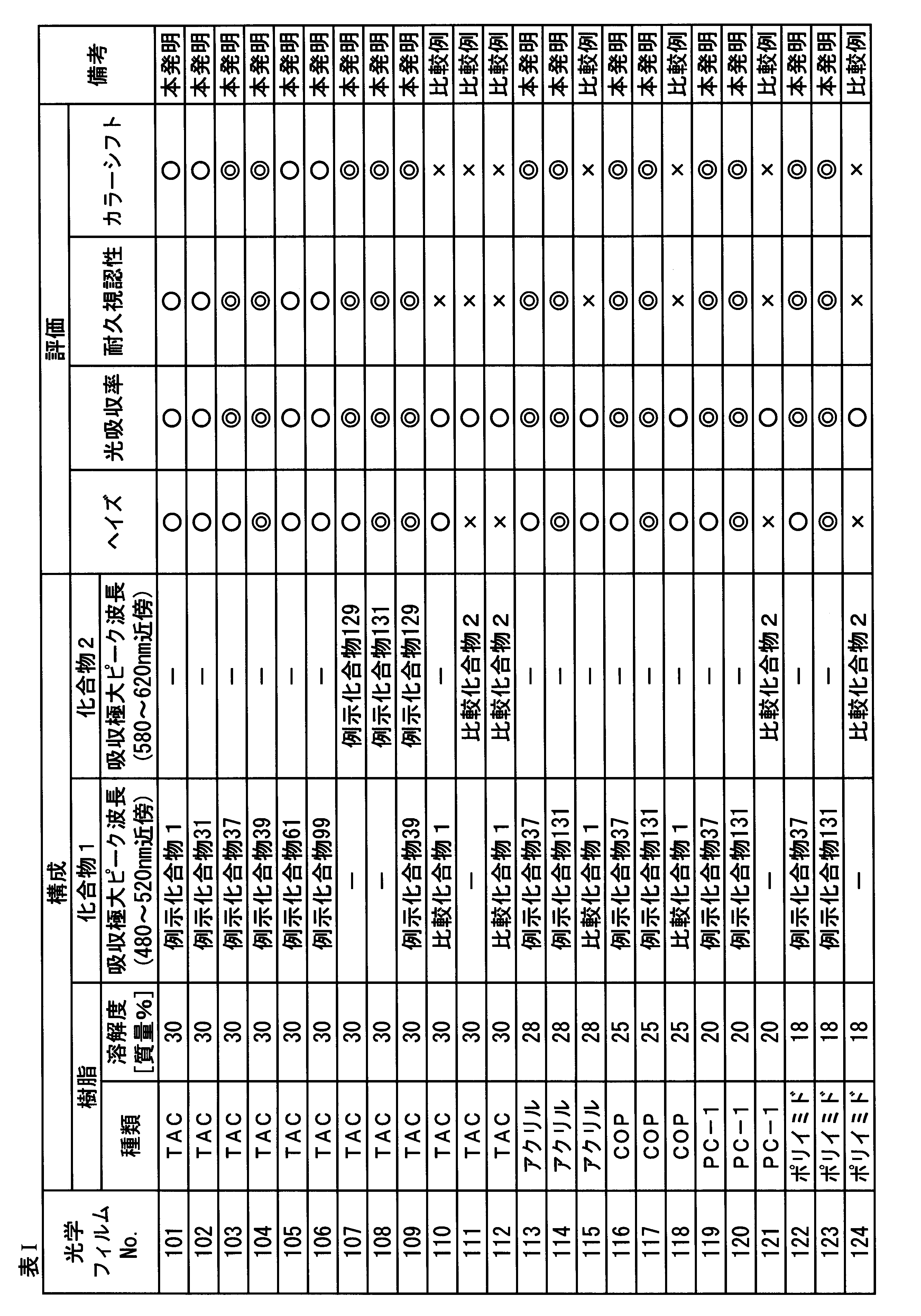
103、106、112、115 濾過器
104、113 ストック釜
102、105、111、114 送液ポンプ
108、116 導管
110 添加剤仕込釜
120 合流管
121 混合機
130 加圧ダイ
131 金属ベルト
132 ウェブ
133 剥離位置
134 第1乾燥装置
135 延伸装置
136 第2乾燥装置
138 巻取り装置
141 仕込釜
142 ストック釜
143 ポンプ
144 濾過器
Claims (11)
- 23℃でのジクロロメタンに対する溶解度が5~50質量%の範囲内である樹脂と、下記一般式(A)で表される構造を有する化合物とを含有することを特徴とする光学フィルム。

- 前記一般式(A)で表される構造を有する化合物が、下記一般式(1)~一般式(3)で表される構造を有する化合物であることを特徴とする請求項1に記載の光学フィルム。

A1は、下記構造式(A1-1)~(A1-10)から選択される。)
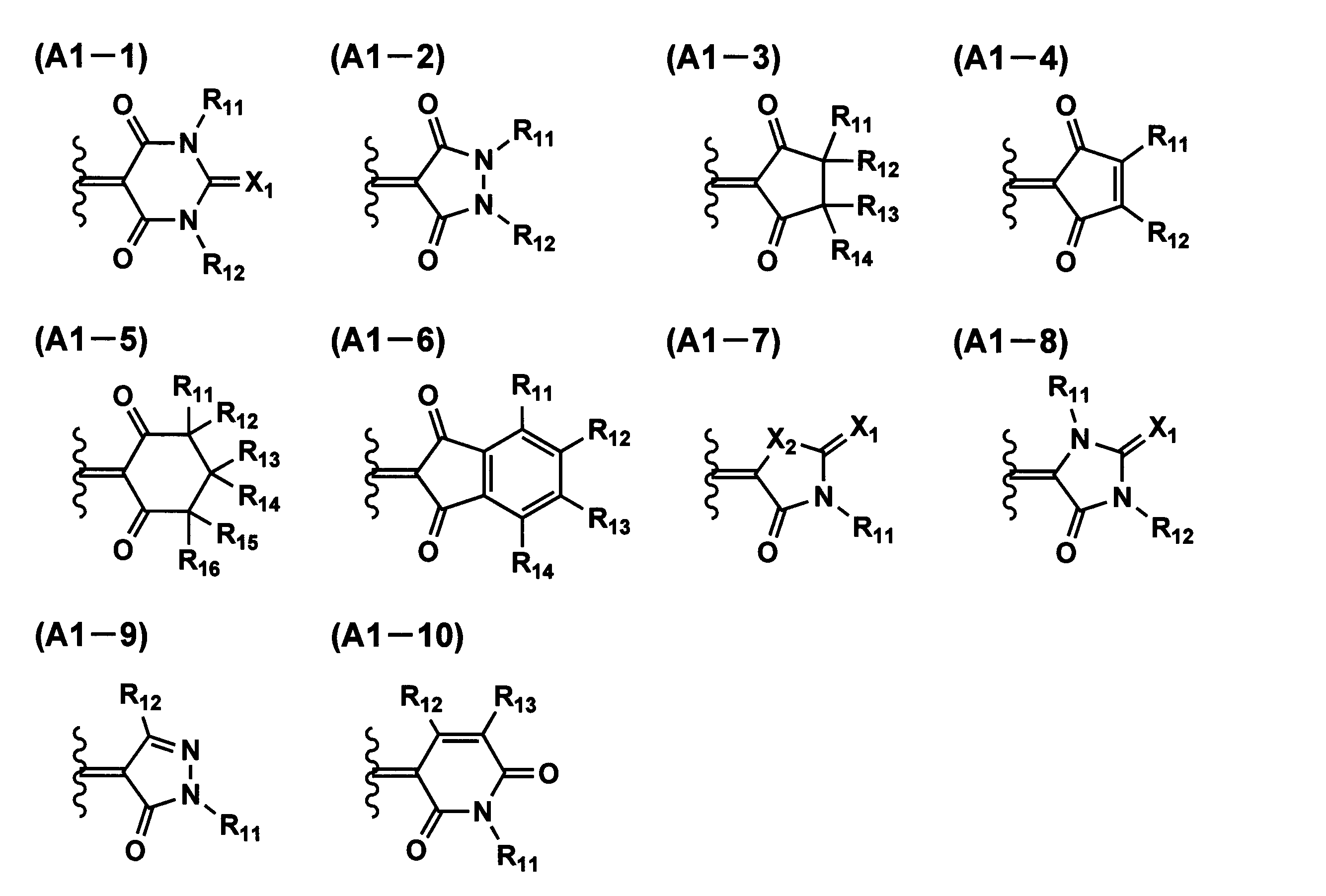
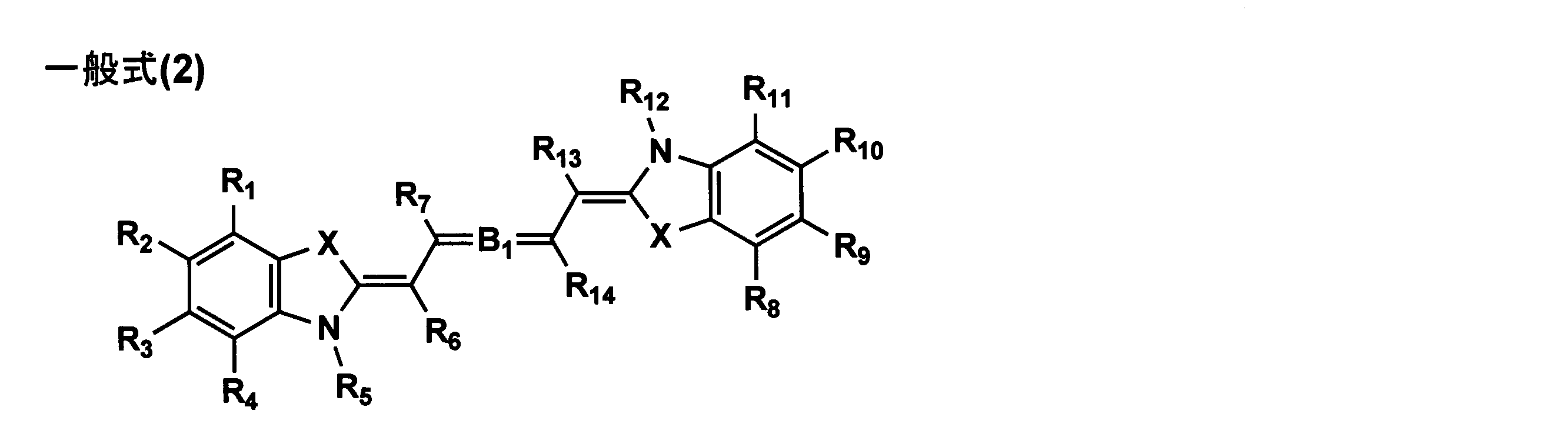
Xは、O、NR15、S、又はCR16R17を表す。R15~R17は、一般式(1)中のR8~R10と同義である。
B1は下記構造式(B1-1)~(B1-5)から選択される。)
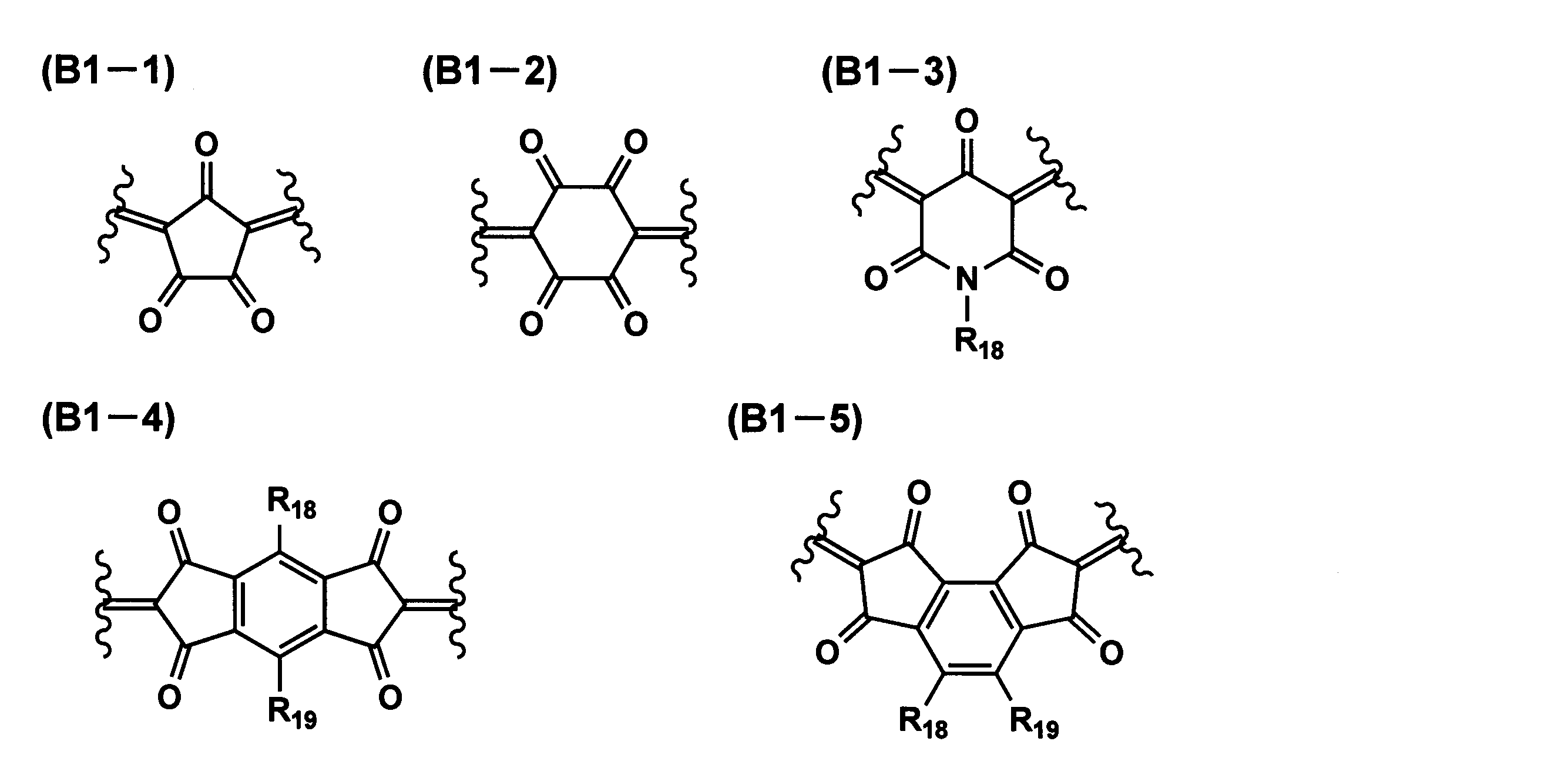
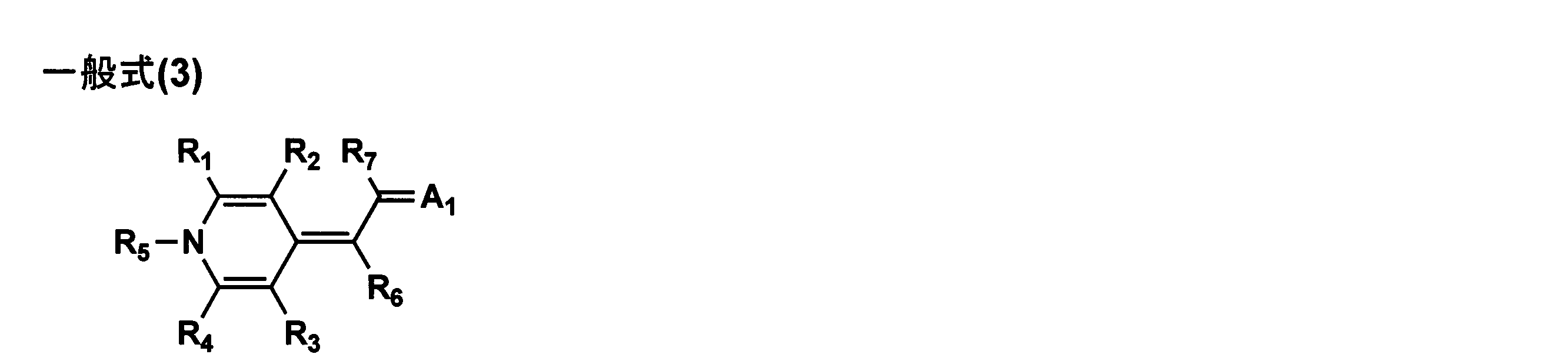
- 前記一般式(1)及び一般式(3)において、A1が式(A1-6)で表される構造を有することを特徴とする請求項1又は2に記載の光学フィルム。
- 前記一般式(2)において、B1が式(B1-4)で表される構造を有することを特徴とする請求項1又は2に記載の光学フィルム。
- 前記一般式(1)及び一般式(3)において、R5が炭素数4~16の分岐アルキル基を表すことを特徴とする請求項1から請求項3までのいずれか一項に記載の光学フィルム。
- 前記一般式(2)において、R5及びR12が炭素数4~16の分岐アルキル基を表すことを特徴とする請求項1、請求項2、又は請求項4のいずれか一項に記載の光学フィルム。
- 前記一般式(1)~一般式(3)で表される構造を有する化合物が、分光吸収スペクトルにおいて、波長480~520nmの範囲内、又は波長580~620nmの範囲内に吸収極大ピークを有することを特徴とする請求項1から請求項6までのいずれか一項に記載の光学フィルム。
- ヘイズが、0.05~1.50%の範囲内であることを特徴とする請求項1から請求項7までのいずれか一項に記載の光学フィルム。
- 請求項1から請求項8までのいずれか一項に記載の光学フィルムを製造する光学フィルムの製造方法であって、当該光学フィルムを溶液流延製膜法によって製造することを特徴とする光学フィルムの製造方法。
- 請求項1から請求項8までのいずれか一項に記載の光学フィルムを偏光板保護フィルムとして具備することを特徴とする偏光板。
- 請求項1から請求項8までのいずれか一項に記載の光学フィルムを具備することを特徴とする表示装置。
Priority Applications (2)
| Application Number | Priority Date | Filing Date | Title |
|---|---|---|---|
| KR1020197027228A KR102341707B1 (ko) | 2017-03-23 | 2018-02-21 | 광학 필름, 그의 제조 방법, 그것을 구비한 편광판 및 표시 장치 |
| JP2019507461A JP6927285B2 (ja) | 2017-03-23 | 2018-02-21 | 光学フィルム、その製造方法、それを具備した偏光板及び表示装置 |
Applications Claiming Priority (2)
| Application Number | Priority Date | Filing Date | Title |
|---|---|---|---|
| JP2017056983 | 2017-03-23 | ||
| JP2017-056983 | 2017-03-23 |
Publications (1)
| Publication Number | Publication Date |
|---|---|
| WO2018173601A1 true WO2018173601A1 (ja) | 2018-09-27 |
Family
ID=63585146
Family Applications (1)
| Application Number | Title | Priority Date | Filing Date |
|---|---|---|---|
| PCT/JP2018/006116 Ceased WO2018173601A1 (ja) | 2017-03-23 | 2018-02-21 | 光学フィルム、その製造方法、それを具備した偏光板及び表示装置 |
Country Status (3)
| Country | Link |
|---|---|
| JP (1) | JP6927285B2 (ja) |
| KR (1) | KR102341707B1 (ja) |
| WO (1) | WO2018173601A1 (ja) |
Cited By (3)
| Publication number | Priority date | Publication date | Assignee | Title |
|---|---|---|---|---|
| KR20210134694A (ko) * | 2019-03-28 | 2021-11-10 | 후지필름 가부시키가이샤 | 필름용 수지 조성물, 필름 제조 방법 및 필름 |
| WO2022004856A1 (ja) * | 2020-07-02 | 2022-01-06 | 住友化学株式会社 | 光学フィルム |
| CN117047953A (zh) * | 2022-05-12 | 2023-11-14 | 柯尼卡美能达株式会社 | 光学膜的制造方法、光学膜、偏振片和液晶显示装置 |
Citations (10)
| Publication number | Priority date | Publication date | Assignee | Title |
|---|---|---|---|---|
| US3140951A (en) * | 1963-06-10 | 1964-07-14 | Eastman Kodak Co | Desensitizing dyes and photographic processes and materials |
| JPS5334490B1 (ja) * | 1967-04-25 | 1978-09-21 | ||
| JPH0618712A (ja) * | 1992-04-23 | 1994-01-28 | Eastman Kodak Co | カラーフィルターアレイ素子用ベンズーc,d−インドールメロシアニンブルー染料 |
| JPH06174919A (ja) * | 1992-12-02 | 1994-06-24 | Fuji Photo Film Co Ltd | 旋光フイルムおよびそれを用いた液晶表示装置 |
| JPH06175553A (ja) * | 1992-12-03 | 1994-06-24 | Toyo Ink Mfg Co Ltd | ホログラム記録媒体及びそれを用いた体積位相型ホログラムの製造方法 |
| JPH06506241A (ja) * | 1991-04-06 | 1994-07-14 | ビーエーエスエフ アクチェンゲゼルシャフト | ポリケトメチン色素 |
| JP2006188052A (ja) * | 2004-12-09 | 2006-07-20 | Fuji Photo Film Co Ltd | 溶液製膜方法 |
| JP2008222991A (ja) * | 2007-03-16 | 2008-09-25 | Adeka Corp | メロシアニン化合物、該化合物を用いた光学フィルター及び光学記録材料 |
| JP2014130250A (ja) * | 2012-12-28 | 2014-07-10 | Yamada Chem Co Ltd | 色補正フィルタ、照明装置及びディスプレイ装置 |
| WO2016158639A1 (ja) * | 2015-03-27 | 2016-10-06 | 株式会社Adeka | メロシアニン化合物 |
Family Cites Families (3)
| Publication number | Priority date | Publication date | Assignee | Title |
|---|---|---|---|---|
| JPS5331369A (en) | 1976-09-04 | 1978-03-24 | Nippon Sekiyu Hanbai Kk | Method of cleaning utilizing temperature and fluidity of fluid |
| WO2012121179A1 (ja) * | 2011-03-04 | 2012-09-13 | 東洋インキScホールディングス株式会社 | β-ヒドロキシアルキルアミド及び樹脂組成物 |
| JP2015036796A (ja) | 2013-08-15 | 2015-02-23 | 富士フイルム株式会社 | 光学基材、及び表示装置 |
-
2018
- 2018-02-21 WO PCT/JP2018/006116 patent/WO2018173601A1/ja not_active Ceased
- 2018-02-21 KR KR1020197027228A patent/KR102341707B1/ko active Active
- 2018-02-21 JP JP2019507461A patent/JP6927285B2/ja active Active
Patent Citations (10)
| Publication number | Priority date | Publication date | Assignee | Title |
|---|---|---|---|---|
| US3140951A (en) * | 1963-06-10 | 1964-07-14 | Eastman Kodak Co | Desensitizing dyes and photographic processes and materials |
| JPS5334490B1 (ja) * | 1967-04-25 | 1978-09-21 | ||
| JPH06506241A (ja) * | 1991-04-06 | 1994-07-14 | ビーエーエスエフ アクチェンゲゼルシャフト | ポリケトメチン色素 |
| JPH0618712A (ja) * | 1992-04-23 | 1994-01-28 | Eastman Kodak Co | カラーフィルターアレイ素子用ベンズーc,d−インドールメロシアニンブルー染料 |
| JPH06174919A (ja) * | 1992-12-02 | 1994-06-24 | Fuji Photo Film Co Ltd | 旋光フイルムおよびそれを用いた液晶表示装置 |
| JPH06175553A (ja) * | 1992-12-03 | 1994-06-24 | Toyo Ink Mfg Co Ltd | ホログラム記録媒体及びそれを用いた体積位相型ホログラムの製造方法 |
| JP2006188052A (ja) * | 2004-12-09 | 2006-07-20 | Fuji Photo Film Co Ltd | 溶液製膜方法 |
| JP2008222991A (ja) * | 2007-03-16 | 2008-09-25 | Adeka Corp | メロシアニン化合物、該化合物を用いた光学フィルター及び光学記録材料 |
| JP2014130250A (ja) * | 2012-12-28 | 2014-07-10 | Yamada Chem Co Ltd | 色補正フィルタ、照明装置及びディスプレイ装置 |
| WO2016158639A1 (ja) * | 2015-03-27 | 2016-10-06 | 株式会社Adeka | メロシアニン化合物 |
Non-Patent Citations (1)
| Title |
|---|
| KUNKEL ET AL.: "Comparative studies on optical, redox, and photovoltaic properties of a series of D-A-D and analogous D-A chromophores", ADVANCED FUNCTIONAL MATERIALS, vol. 24, no. 29, 2 May 2014 (2014-05-02), Weinheim, pages 4645 - 4653, XP001591503 * |
Cited By (4)
| Publication number | Priority date | Publication date | Assignee | Title |
|---|---|---|---|---|
| KR20210134694A (ko) * | 2019-03-28 | 2021-11-10 | 후지필름 가부시키가이샤 | 필름용 수지 조성물, 필름 제조 방법 및 필름 |
| KR102567313B1 (ko) * | 2019-03-28 | 2023-08-16 | 후지필름 가부시키가이샤 | 필름용 수지 조성물, 필름 제조 방법 및 필름 |
| WO2022004856A1 (ja) * | 2020-07-02 | 2022-01-06 | 住友化学株式会社 | 光学フィルム |
| CN117047953A (zh) * | 2022-05-12 | 2023-11-14 | 柯尼卡美能达株式会社 | 光学膜的制造方法、光学膜、偏振片和液晶显示装置 |
Also Published As
| Publication number | Publication date |
|---|---|
| JP6927285B2 (ja) | 2021-08-25 |
| KR102341707B1 (ko) | 2021-12-20 |
| KR20190116457A (ko) | 2019-10-14 |
| JPWO2018173601A1 (ja) | 2020-01-23 |
Similar Documents
| Publication | Publication Date | Title |
|---|---|---|
| JP6003976B2 (ja) | 光学フィルム、円偏光板および画像表示装置 | |
| JP6024479B2 (ja) | 光学フィルム、円偏光板および画像表示装置 | |
| JP5217913B2 (ja) | 光学フィルム、それを用いた偏光板、および液晶表示装置 | |
| CN100347572C (zh) | 复合双折射部件 | |
| CN105849599B (zh) | 纤维素酯膜、其制造方法及偏振片 | |
| KR20160070810A (ko) | 편광판 및 이것을 사용한 액정 표시 장치 | |
| KR20170125098A (ko) | 터치 패널을 갖는 액정 표시 장치 및 그 제조 방법 | |
| JP2010243935A (ja) | 光学フィルム、光学フィルムの製造方法、それを用いた偏光板、及び液晶表示装置 | |
| KR20160060095A (ko) | 위상차 필름, 편광판 및 액정 표시 장치 | |
| JP5707811B2 (ja) | 長尺状λ/4板、円偏光板、偏光板、OLED表示装置、及び立体画像表示装置 | |
| WO2014184909A1 (ja) | 位相差フィルム、偏光板および液晶表示装置 | |
| JP6927285B2 (ja) | 光学フィルム、その製造方法、それを具備した偏光板及び表示装置 | |
| TWI637850B (zh) | 偏光板及液晶顯示裝置 | |
| KR101530797B1 (ko) | 수직 배향형 액정 표시 장치와 그의 제조 방법 | |
| JP6728665B2 (ja) | 光学フィルムの製造方法 | |
| JP6064590B2 (ja) | 光学フィルムの製造方法 | |
| WO2016111058A1 (ja) | 垂直配向型液晶表示装置 | |
| JP5626133B2 (ja) | Va型液晶表示装置 | |
| JP5626134B2 (ja) | Va型液晶表示装置 | |
| JP2011248042A (ja) | 液晶表示装置とその製造方法 | |
| JP6064516B2 (ja) | 光学フィルムの製造方法 | |
| WO2016129145A1 (ja) | 導電性フィルム、タッチパネル、および導電性フィルムの製造方法 | |
| WO2012114762A1 (ja) | 垂直配向型液晶表示装置とその製造方法 |
Legal Events
| Date | Code | Title | Description |
|---|---|---|---|
| 121 | Ep: the epo has been informed by wipo that ep was designated in this application |
Ref document number: 18771117 Country of ref document: EP Kind code of ref document: A1 |
|
| ENP | Entry into the national phase |
Ref document number: 2019507461 Country of ref document: JP Kind code of ref document: A |
|
| ENP | Entry into the national phase |
Ref document number: 20197027228 Country of ref document: KR Kind code of ref document: A |
|
| NENP | Non-entry into the national phase |
Ref country code: DE |
|
| 122 | Ep: pct application non-entry in european phase |
Ref document number: 18771117 Country of ref document: EP Kind code of ref document: A1 |