WO2018117244A1 - 加齢黄斑変性症治療用ペプチド - Google Patents
加齢黄斑変性症治療用ペプチド Download PDFInfo
- Publication number
- WO2018117244A1 WO2018117244A1 PCT/JP2017/046044 JP2017046044W WO2018117244A1 WO 2018117244 A1 WO2018117244 A1 WO 2018117244A1 JP 2017046044 W JP2017046044 W JP 2017046044W WO 2018117244 A1 WO2018117244 A1 WO 2018117244A1
- Authority
- WO
- WIPO (PCT)
- Prior art keywords
- htra1
- peptide
- amino acid
- seq
- acid sequence
- Prior art date
- Legal status (The legal status is an assumption and is not a legal conclusion. Google has not performed a legal analysis and makes no representation as to the accuracy of the status listed.)
- Ceased
Links
Images























































Classifications
-
- A—HUMAN NECESSITIES
- A61—MEDICAL OR VETERINARY SCIENCE; HYGIENE
- A61P—SPECIFIC THERAPEUTIC ACTIVITY OF CHEMICAL COMPOUNDS OR MEDICINAL PREPARATIONS
- A61P9/00—Drugs for disorders of the cardiovascular system
-
- A—HUMAN NECESSITIES
- A01—AGRICULTURE; FORESTRY; ANIMAL HUSBANDRY; HUNTING; TRAPPING; FISHING
- A01K—ANIMAL HUSBANDRY; AVICULTURE; APICULTURE; PISCICULTURE; FISHING; REARING OR BREEDING ANIMALS, NOT OTHERWISE PROVIDED FOR; NEW BREEDS OF ANIMALS
- A01K67/00—Rearing or breeding animals, not otherwise provided for; New or modified breeds of animals
- A01K67/027—New or modified breeds of vertebrates
-
- A—HUMAN NECESSITIES
- A61—MEDICAL OR VETERINARY SCIENCE; HYGIENE
- A61K—PREPARATIONS FOR MEDICAL, DENTAL OR TOILETRY PURPOSES
- A61K45/00—Medicinal preparations containing active ingredients not provided for in groups A61K31/00 - A61K41/00
- A61K45/06—Mixtures of active ingredients without chemical characterisation, e.g. antiphlogistics and cardiaca
-
- A—HUMAN NECESSITIES
- A61—MEDICAL OR VETERINARY SCIENCE; HYGIENE
- A61K—PREPARATIONS FOR MEDICAL, DENTAL OR TOILETRY PURPOSES
- A61K48/00—Medicinal preparations containing genetic material which is inserted into cells of the living body to treat genetic diseases; Gene therapy
- A61K48/005—Medicinal preparations containing genetic material which is inserted into cells of the living body to treat genetic diseases; Gene therapy characterised by an aspect of the 'active' part of the composition delivered, i.e. the nucleic acid delivered
-
- A—HUMAN NECESSITIES
- A61—MEDICAL OR VETERINARY SCIENCE; HYGIENE
- A61K—PREPARATIONS FOR MEDICAL, DENTAL OR TOILETRY PURPOSES
- A61K49/00—Preparations for testing in vivo
- A61K49/0004—Screening or testing of compounds for diagnosis of disorders, assessment of conditions, e.g. renal clearance, gastric emptying, testing for diabetes, allergy, rheuma, pancreas functions
- A61K49/0008—Screening agents using (non-human) animal models or transgenic animal models or chimeric hosts, e.g. Alzheimer disease animal model, transgenic model for heart failure
-
- A—HUMAN NECESSITIES
- A61—MEDICAL OR VETERINARY SCIENCE; HYGIENE
- A61P—SPECIFIC THERAPEUTIC ACTIVITY OF CHEMICAL COMPOUNDS OR MEDICINAL PREPARATIONS
- A61P19/00—Drugs for skeletal disorders
- A61P19/02—Drugs for skeletal disorders for joint disorders, e.g. arthritis, arthrosis
-
- A—HUMAN NECESSITIES
- A61—MEDICAL OR VETERINARY SCIENCE; HYGIENE
- A61P—SPECIFIC THERAPEUTIC ACTIVITY OF CHEMICAL COMPOUNDS OR MEDICINAL PREPARATIONS
- A61P27/00—Drugs for disorders of the senses
- A61P27/02—Ophthalmic agents
-
- A—HUMAN NECESSITIES
- A61—MEDICAL OR VETERINARY SCIENCE; HYGIENE
- A61P—SPECIFIC THERAPEUTIC ACTIVITY OF CHEMICAL COMPOUNDS OR MEDICINAL PREPARATIONS
- A61P29/00—Non-central analgesic, antipyretic or antiinflammatory agents, e.g. antirheumatic agents; Non-steroidal antiinflammatory drugs [NSAID]
-
- A—HUMAN NECESSITIES
- A61—MEDICAL OR VETERINARY SCIENCE; HYGIENE
- A61P—SPECIFIC THERAPEUTIC ACTIVITY OF CHEMICAL COMPOUNDS OR MEDICINAL PREPARATIONS
- A61P43/00—Drugs for specific purposes, not provided for in groups A61P1/00-A61P41/00
-
- C—CHEMISTRY; METALLURGY
- C07—ORGANIC CHEMISTRY
- C07K—PEPTIDES
- C07K14/00—Peptides having more than 20 amino acids; Gastrins; Somatostatins; Melanotropins; Derivatives thereof
- C07K14/81—Protease inhibitors
- C07K14/8107—Endopeptidase (E.C. 3.4.21-99) inhibitors
- C07K14/811—Serine protease (E.C. 3.4.21) inhibitors
- C07K14/8135—Kazal type inhibitors, e.g. pancreatic secretory inhibitor, ovomucoid
-
- C—CHEMISTRY; METALLURGY
- C07—ORGANIC CHEMISTRY
- C07K—PEPTIDES
- C07K16/00—Immunoglobulins [IG], e.g. monoclonal or polyclonal antibodies
- C07K16/38—Immunoglobulins [IG], e.g. monoclonal or polyclonal antibodies against protease inhibitors of peptide structure
-
- C—CHEMISTRY; METALLURGY
- C12—BIOCHEMISTRY; BEER; SPIRITS; WINE; VINEGAR; MICROBIOLOGY; ENZYMOLOGY; MUTATION OR GENETIC ENGINEERING
- C12N—MICROORGANISMS OR ENZYMES; COMPOSITIONS THEREOF; PROPAGATING, PRESERVING, OR MAINTAINING MICROORGANISMS; MUTATION OR GENETIC ENGINEERING; CULTURE MEDIA
- C12N15/00—Mutation or genetic engineering; DNA or RNA concerning genetic engineering, vectors, e.g. plasmids, or their isolation, preparation or purification; Use of hosts therefor
- C12N15/09—Recombinant DNA-technology
- C12N15/63—Introduction of foreign genetic material using vectors; Vectors; Use of hosts therefor; Regulation of expression
- C12N15/70—Vectors or expression systems specially adapted for E. coli
-
- C—CHEMISTRY; METALLURGY
- C12—BIOCHEMISTRY; BEER; SPIRITS; WINE; VINEGAR; MICROBIOLOGY; ENZYMOLOGY; MUTATION OR GENETIC ENGINEERING
- C12N—MICROORGANISMS OR ENZYMES; COMPOSITIONS THEREOF; PROPAGATING, PRESERVING, OR MAINTAINING MICROORGANISMS; MUTATION OR GENETIC ENGINEERING; CULTURE MEDIA
- C12N15/00—Mutation or genetic engineering; DNA or RNA concerning genetic engineering, vectors, e.g. plasmids, or their isolation, preparation or purification; Use of hosts therefor
- C12N15/09—Recombinant DNA-technology
- C12N15/63—Introduction of foreign genetic material using vectors; Vectors; Use of hosts therefor; Regulation of expression
- C12N15/79—Vectors or expression systems specially adapted for eukaryotic hosts
- C12N15/85—Vectors or expression systems specially adapted for eukaryotic hosts for animal cells
-
- C—CHEMISTRY; METALLURGY
- C12—BIOCHEMISTRY; BEER; SPIRITS; WINE; VINEGAR; MICROBIOLOGY; ENZYMOLOGY; MUTATION OR GENETIC ENGINEERING
- C12N—MICROORGANISMS OR ENZYMES; COMPOSITIONS THEREOF; PROPAGATING, PRESERVING, OR MAINTAINING MICROORGANISMS; MUTATION OR GENETIC ENGINEERING; CULTURE MEDIA
- C12N9/00—Enzymes; Proenzymes; Compositions thereof; Processes for preparing, activating, inhibiting, separating or purifying enzymes
- C12N9/14—Hydrolases (3)
- C12N9/48—Hydrolases (3) acting on peptide bonds (3.4)
- C12N9/50—Proteinases, e.g. Endopeptidases (3.4.21-3.4.25)
- C12N9/64—Proteinases, e.g. Endopeptidases (3.4.21-3.4.25) derived from animal tissue
- C12N9/6421—Proteinases, e.g. Endopeptidases (3.4.21-3.4.25) derived from animal tissue from mammals
- C12N9/6424—Serine endopeptidases (3.4.21)
-
- C—CHEMISTRY; METALLURGY
- C12—BIOCHEMISTRY; BEER; SPIRITS; WINE; VINEGAR; MICROBIOLOGY; ENZYMOLOGY; MUTATION OR GENETIC ENGINEERING
- C12Q—MEASURING OR TESTING PROCESSES INVOLVING ENZYMES, NUCLEIC ACIDS OR MICROORGANISMS; COMPOSITIONS OR TEST PAPERS THEREFOR; PROCESSES OF PREPARING SUCH COMPOSITIONS; CONDITION-RESPONSIVE CONTROL IN MICROBIOLOGICAL OR ENZYMOLOGICAL PROCESSES
- C12Q1/00—Measuring or testing processes involving enzymes, nucleic acids or microorganisms; Compositions therefor; Processes of preparing such compositions
- C12Q1/34—Measuring or testing processes involving enzymes, nucleic acids or microorganisms; Compositions therefor; Processes of preparing such compositions involving hydrolase
- C12Q1/37—Measuring or testing processes involving enzymes, nucleic acids or microorganisms; Compositions therefor; Processes of preparing such compositions involving hydrolase involving peptidase or proteinase
-
- C—CHEMISTRY; METALLURGY
- C12—BIOCHEMISTRY; BEER; SPIRITS; WINE; VINEGAR; MICROBIOLOGY; ENZYMOLOGY; MUTATION OR GENETIC ENGINEERING
- C12Y—ENZYMES
- C12Y304/00—Hydrolases acting on peptide bonds, i.e. peptidases (3.4)
- C12Y304/21—Serine endopeptidases (3.4.21)
-
- G—PHYSICS
- G01—MEASURING; TESTING
- G01N—INVESTIGATING OR ANALYSING MATERIALS BY DETERMINING THEIR CHEMICAL OR PHYSICAL PROPERTIES
- G01N33/00—Investigating or analysing materials by specific methods not covered by groups G01N1/00 - G01N31/00
- G01N33/48—Biological material, e.g. blood, urine; Haemocytometers
- G01N33/50—Chemical analysis of biological material, e.g. blood, urine; Testing involving biospecific ligand binding methods; Immunological testing
- G01N33/5005—Chemical analysis of biological material, e.g. blood, urine; Testing involving biospecific ligand binding methods; Immunological testing involving human or animal cells
- G01N33/5008—Chemical analysis of biological material, e.g. blood, urine; Testing involving biospecific ligand binding methods; Immunological testing involving human or animal cells for testing or evaluating the effect of chemical or biological compounds, e.g. drugs, cosmetics
- G01N33/5044—Chemical analysis of biological material, e.g. blood, urine; Testing involving biospecific ligand binding methods; Immunological testing involving human or animal cells for testing or evaluating the effect of chemical or biological compounds, e.g. drugs, cosmetics involving specific cell types
-
- G—PHYSICS
- G01—MEASURING; TESTING
- G01N—INVESTIGATING OR ANALYSING MATERIALS BY DETERMINING THEIR CHEMICAL OR PHYSICAL PROPERTIES
- G01N33/00—Investigating or analysing materials by specific methods not covered by groups G01N1/00 - G01N31/00
- G01N33/48—Biological material, e.g. blood, urine; Haemocytometers
- G01N33/50—Chemical analysis of biological material, e.g. blood, urine; Testing involving biospecific ligand binding methods; Immunological testing
- G01N33/53—Immunoassay; Biospecific binding assay; Materials therefor
- G01N33/573—Immunoassay; Biospecific binding assay; Materials therefor for enzymes or isoenzymes
-
- A—HUMAN NECESSITIES
- A01—AGRICULTURE; FORESTRY; ANIMAL HUSBANDRY; HUNTING; TRAPPING; FISHING
- A01K—ANIMAL HUSBANDRY; AVICULTURE; APICULTURE; PISCICULTURE; FISHING; REARING OR BREEDING ANIMALS, NOT OTHERWISE PROVIDED FOR; NEW BREEDS OF ANIMALS
- A01K2207/00—Modified animals
- A01K2207/25—Animals on a special diet
-
- A—HUMAN NECESSITIES
- A01—AGRICULTURE; FORESTRY; ANIMAL HUSBANDRY; HUNTING; TRAPPING; FISHING
- A01K—ANIMAL HUSBANDRY; AVICULTURE; APICULTURE; PISCICULTURE; FISHING; REARING OR BREEDING ANIMALS, NOT OTHERWISE PROVIDED FOR; NEW BREEDS OF ANIMALS
- A01K2207/00—Modified animals
- A01K2207/35—Animals modified by environmental factors, e.g. temperature, O2
-
- A—HUMAN NECESSITIES
- A01—AGRICULTURE; FORESTRY; ANIMAL HUSBANDRY; HUNTING; TRAPPING; FISHING
- A01K—ANIMAL HUSBANDRY; AVICULTURE; APICULTURE; PISCICULTURE; FISHING; REARING OR BREEDING ANIMALS, NOT OTHERWISE PROVIDED FOR; NEW BREEDS OF ANIMALS
- A01K2227/00—Animals characterised by species
- A01K2227/10—Mammal
- A01K2227/105—Murine
-
- A—HUMAN NECESSITIES
- A01—AGRICULTURE; FORESTRY; ANIMAL HUSBANDRY; HUNTING; TRAPPING; FISHING
- A01K—ANIMAL HUSBANDRY; AVICULTURE; APICULTURE; PISCICULTURE; FISHING; REARING OR BREEDING ANIMALS, NOT OTHERWISE PROVIDED FOR; NEW BREEDS OF ANIMALS
- A01K2227/00—Animals characterised by species
- A01K2227/10—Mammal
- A01K2227/107—Rabbit
-
- A—HUMAN NECESSITIES
- A01—AGRICULTURE; FORESTRY; ANIMAL HUSBANDRY; HUNTING; TRAPPING; FISHING
- A01K—ANIMAL HUSBANDRY; AVICULTURE; APICULTURE; PISCICULTURE; FISHING; REARING OR BREEDING ANIMALS, NOT OTHERWISE PROVIDED FOR; NEW BREEDS OF ANIMALS
- A01K2267/00—Animals characterised by purpose
- A01K2267/03—Animal model, e.g. for test or diseases
-
- A—HUMAN NECESSITIES
- A61—MEDICAL OR VETERINARY SCIENCE; HYGIENE
- A61K—PREPARATIONS FOR MEDICAL, DENTAL OR TOILETRY PURPOSES
- A61K38/00—Medicinal preparations containing peptides
-
- C—CHEMISTRY; METALLURGY
- C07—ORGANIC CHEMISTRY
- C07K—PEPTIDES
- C07K2317/00—Immunoglobulins specific features
- C07K2317/30—Immunoglobulins specific features characterized by aspects of specificity or valency
- C07K2317/34—Identification of a linear epitope shorter than 20 amino acid residues or of a conformational epitope defined by amino acid residues
-
- G—PHYSICS
- G01—MEASURING; TESTING
- G01N—INVESTIGATING OR ANALYSING MATERIALS BY DETERMINING THEIR CHEMICAL OR PHYSICAL PROPERTIES
- G01N2333/00—Assays involving biological materials from specific organisms or of a specific nature
- G01N2333/90—Enzymes; Proenzymes
- G01N2333/914—Hydrolases (3)
- G01N2333/948—Hydrolases (3) acting on peptide bonds (3.4)
- G01N2333/95—Proteinases, i.e. endopeptidases (3.4.21-3.4.99)
- G01N2333/964—Proteinases, i.e. endopeptidases (3.4.21-3.4.99) derived from animal tissue
- G01N2333/96425—Proteinases, i.e. endopeptidases (3.4.21-3.4.99) derived from animal tissue from mammals
- G01N2333/96427—Proteinases, i.e. endopeptidases (3.4.21-3.4.99) derived from animal tissue from mammals in general
- G01N2333/9643—Proteinases, i.e. endopeptidases (3.4.21-3.4.99) derived from animal tissue from mammals in general with EC number
- G01N2333/96433—Serine endopeptidases (3.4.21)
-
- G—PHYSICS
- G01—MEASURING; TESTING
- G01N—INVESTIGATING OR ANALYSING MATERIALS BY DETERMINING THEIR CHEMICAL OR PHYSICAL PROPERTIES
- G01N2500/00—Screening for compounds of potential therapeutic value
-
- G—PHYSICS
- G01—MEASURING; TESTING
- G01N—INVESTIGATING OR ANALYSING MATERIALS BY DETERMINING THEIR CHEMICAL OR PHYSICAL PROPERTIES
- G01N2500/00—Screening for compounds of potential therapeutic value
- G01N2500/02—Screening involving studying the effect of compounds C on the interaction between interacting molecules A and B (e.g. A = enzyme and B = substrate for A, or A = receptor and B = ligand for the receptor)
Definitions
- the present invention relates to peptides, polynucleotides, vectors, cells, methods for producing peptides, peptides obtained by such methods, compositions containing peptides, pharmaceutical compositions containing peptides, and treatment or prevention of various diseases containing peptides.
- the present invention relates to a pharmaceutical composition, use of a peptide for treating or preventing various diseases, a method for treating various diseases including a step of administering a peptide, and the like.
- HTRA1 is a trypsin-like serine protease (PRSS11; Clan PA, family S1), an N-terminal domain consisting of an IGFBP-like module and a Kazal-like module, a protease domain and a C-terminal PD Is done.
- HTRA1 belongs to the HTRA family including HTRA2, HTRA3, and HTRA4, and reversibly shows active and inactive structures like other HTRA molecules (Non-patent Documents 1 and 2). Its expression is ubiquitous in the human body, and relatively high expression is observed in cartilage, synovium, placenta and the like.
- HTRA1 is known to cleave many extracellular matrix components such as Amyloid precursor protein, Fibromodulin, Clusterin, ADAM9, and Vitronectin as substrates, and to be associated with diseases typified by arthritis and bone mineralization (non-patent literature) 3, 4, 5, 6). Furthermore, it is known that when the HTRA1 promoter region has a gene polymorphism (rs11200638), the amount of HTRA1 transcription increases, and the polymorphism and age-related macular degeneration (hereinafter referred to as AMD). ”) Is strongly correlated with genome-wide association analysis (Non-patent Documents 7 and 8). AMD is a chronic degenerative disease associated with aging and is characterized by decreased central vision. The number of patients with acquired blindness is No.
- Non-patent Document 12 HTRA11 is elevated in mRNA and protein levels in lymphocytes or retinal pigment epithelial cells of AMD patients (Non-patent Document 13). In addition, it has been reported that the expression of HTRA1 protein is elevated in drusen, which is a precursor lesion of AMD, degenerated retinal pigment epithelial cells, or neovascular membranes (Non-patent Documents 11 and 14 to 16).
- HTRA1 protein has been detected in vitreous humor such as retinal detachment, retinal vein occlusion, vitreous hemorrhage and macular hole, and there is a report that the value is linked to VEGF as an angiogenesis marker. (Non-patent document 17). Furthermore, in HTRA1 transgenic mice, degradation of proteins constituting the basement membrane such as Fibulin 5 and Tropoelastin and fragmentation of Bruch's membrane Elastic layer have been observed (Non-patent Document 9). However, there is no direct indication as to whether inhibition of protease activity of HTRA1 is effective for treating the above diseases as well as for protecting the retina.
- SPINK2 Serine Protease Inhibitor Kazal-type 2
- SPINK2 Serine Protease Inhibitor Kazal-type 2
- RPE cells retinal pigment epithelial cells
- HTRA1 serine peptidase 1
- the present invention is (1) A SPINK2 mutant peptide comprising the amino acid sequence shown by SEQ ID NO: 30 (FIG. 42) and inhibiting the protease activity of human HTRA1; (2)
- the first Xaa (X 1) is Asp, Glu, Ser, Gly, or Ile
- 2 th Xaa (X 2) is Ala, Gly, Leu, Ser or Thr
- 3-th Xaa (X 3) is Asp, His, Lys, Met or Gln
- 4th Xaa (X 4 ) is Asp, Phe, His, Ser or Tyr
- 5th Xaa (X 5 ) is Ala, Asp, Glu, Met or Asn
- 6th Xaa (X 6 ) is Met or Trp
- 7th Xaa (X 7 ) is Gln, Trp, Tyr or Val
- 8th Xaa (X 8 ) is Phe, Leu or Tyr
- the peptide according to (1) or (2) comprising the amino acid sequence shown in any one of FIG. 31, FIG. 33 and FIGS. (4)
- the peptide according to any one of (1) to (3) comprising an amino acid sequence in which 1 to 3 amino acids are peptide-bonded to the amino terminal side of the amino acid sequence represented by SEQ ID NO: 30 (FIG. 42).
- the peptide according to any one of (1) to (4) comprising an amino acid sequence in which one or two amino acids are peptide-bonded to the carboxyl terminal side of the amino acid sequence represented by SEQ ID NO: 30 (FIG. 42).
- peptide according to any one of (1) to (5) having a three-dimensional structure characterized by having three disulfide bonds and including a loop structure, an ⁇ helix, and a ⁇ sheet; (7) (1) A polynucleotide comprising a nucleotide sequence encoding an amino acid sequence contained in the peptide according to any one of (6), (8) (7) a vector comprising the polynucleotide according to claim, (9) A cell comprising the polynucleotide according to (7) or the vector according to (8) or producing the peptide according to any one of (1) to (6), (10) A method for producing a SPINK2 mutant peptide that inhibits the protease activity of HTRA1, comprising the following steps (i) and (ii): (I) a step of culturing the cell according to (9); (Ii) recovering the SPINK2 mutant peptide from the culture, (11) (10) SPINK2 mutant peptide obtained by the method described
- the pharmaceutical composition according to (16) for the treatment or prevention of an HTRA1-related disease (18) A group in which HTRA1-related diseases are wet age-related macular degeneration, atrophic age-related macular degeneration, map-like atrophy, diabetic retinopathy, retinopathy of prematurity, polypoidal choroidal vasculopathy, rheumatoid arthritis, and osteoarthritis
- a method for identifying a retinal protective agent comprising the following steps 1 to 3: [Step 1] Incubate the HTRA1 protease and the substrate in the presence or absence of the test substance; [Step 2] Detect HTRA1 protease activity in the presence and absence of the test substance; [Step 3] If the HTRA1 protease activity in the presence of the test substance is small compared to the HTRA1 protease activity in the absence of the test substance, the test substance is determined to be positive.
- a method for producing a retinal dysfunction model rabbit comprising a step of feeding a high fat diet containing hydroquinone for 3 to 6 months, wherein the retinal pigment epithelial cells of the model rabbit are enlarged compared to retinal pigment epithelial cells of a normal rabbit
- a method for identifying a therapeutic or prophylactic agent for age-related macular degeneration, or a retinal protective agent comprising the following steps (i) and (ii): (I) a step of measuring retinal pigment epithelial cell hypertrophy in the rabbit described in (25) with and without administration of a test substance; and (ii) retinal pigment epithelial cell hypertrophy under administration of the test substance.
- a step of determining that the test substance is positive when it is suppressed as compared with non-administration (27) The method according to (26), wherein the measurement in step (i) is a measurement of the average area of retinal pigment epithelial cells or the number of enlarged retinal pigment epithelial cells, (28) The pharmaceutical composition according to any one of (16) to (18), for the treatment or prevention of atrophic age-related macular degeneration, and (29) The pharmaceutical composition according to any one of (16) to (18), for treating or preventing wet age-related macular degeneration, Etc.
- the peptide provided by the present invention and a pharmaceutical composition containing the peptide have HTRA1 inhibitory activity and are useful for the treatment or prevention of age-related macular degeneration.
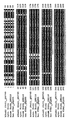
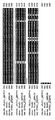
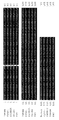
- the dashed line indicates the enzyme active domain (204Gly-364Leu). Comparison of human / mouse / rat / monkey HTRA1 sequence similarity (continued).
- index panel A thru
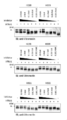
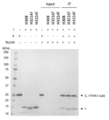
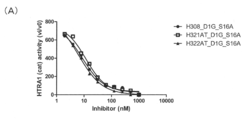
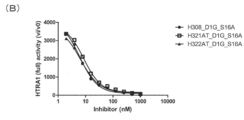
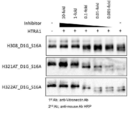
- the figure which evaluated the HTRA1 (cat) inhibitory activity of the HTRA1 inhibitory peptide using degradation of human Vitronectin as an index The analysis was performed by Western blot using Human Vitronectin Antibody (R & D Systems; MAB2349).
- the figure which evaluated the HTRA1 (cat) inhibitory activity of the HTRA1 inhibitory peptide using degradation of human Vitronectin as an index (continuation).
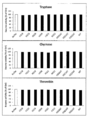
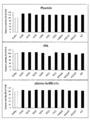
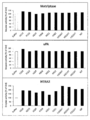
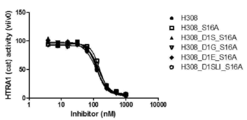
- index the 1). See Example 3 for the names and concentrations of each protease used, and the names and concentrations of the substrates.
- index (the 2).
- index (the 3).
- index the 4
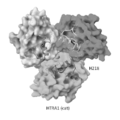
- HTRA1 trimer formed by HTRA1 (cat).
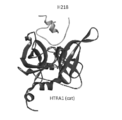
- the inhibitory peptide was bound to a region containing the HTRA1 (cat) active center.
- Amino acid sequence of H2-Opt SEQ ID NO: 54).
- N-terminal “Mca-I” is N- (4-methylcoumeric-7-amide) -isoleucine
- C-terminal “(Dnp) K” is N epsilon- (2,4-dinitrophenyl) -lysine, Each means.
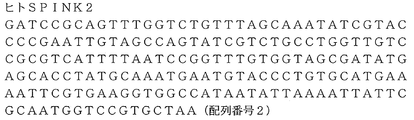
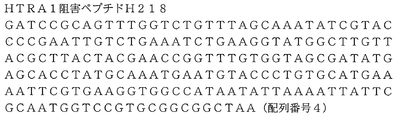
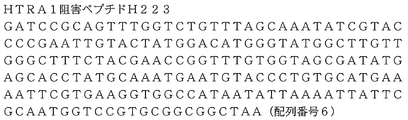
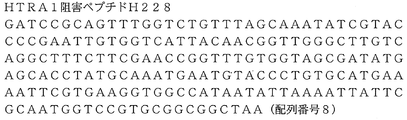
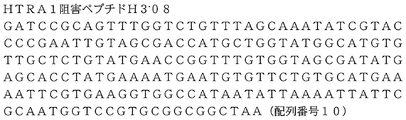
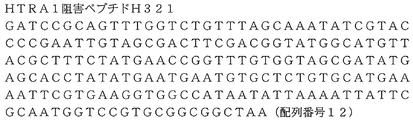
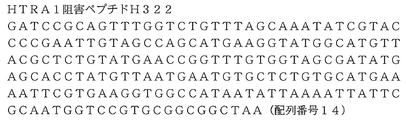
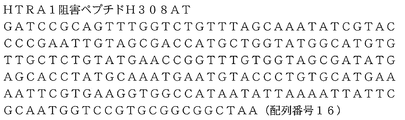
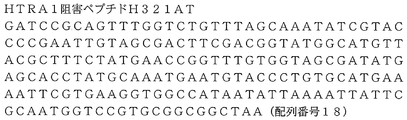
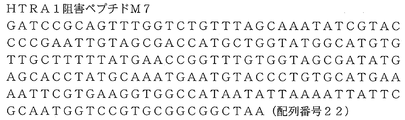
- Amino acid sequence of human SPINK2 (SEQ ID NO: 1) Nucleotide sequence encoding the amino acid sequence of human SPINK2 (SEQ ID NO: 2) Amino acid sequence of peptide H218 (SEQ ID NO: 3) Nucleotide sequence encoding the amino acid sequence of peptide H218 (SEQ ID NO: 4) Amino acid sequence of peptide H223 (SEQ ID NO: 5) Nucleotide sequence encoding the amino acid sequence of peptide H223 (SEQ ID NO: 6) Amino acid sequence of peptide H228 (SEQ ID NO: 7) Nucleotide sequence encoding the amino acid sequence of peptide H228 (SEQ ID NO: 8) Amino acid sequence of peptide H308 (SEQ ID NO: 9) Nucleotide sequence encoding the amino acid sequence of peptide H308 (SEQ ID NO: 10) Amino acid sequence of peptide H321 (SEQ ID NO:
- X 1 to X 11 represent any amino acid.
- Amino acid sequence consisting of S tag and linker (SEQ ID NO: 31) C-terminal 6-mer amino acid sequence (SEQ ID NO: 32) Nucleotide sequence of primer 1 (SEQ ID NO: 33) Nucleotide sequence of primer 2 (SEQ ID NO: 34) Nucleotide sequence of primer 3 (SEQ ID NO: 35) Nucleotide sequence of primer 4 (SEQ ID NO: 36) Nucleotide sequence of primer 5 (SEQ ID NO: 37) Nucleotide sequence of primer 6 (SEQ ID NO: 38) Nucleotide sequence of primer 7 (SEQ ID NO: 39) Nucleotide sequence of primer 8 (SEQ ID NO: 40) Nucleotide sequence of primer 9 (SEQ ID NO: 41) Nucleotide sequence of primer 10 (SEQ ID NO: 42) Nucleotide sequence of primer 11 (SEQ ID NO: 43) Nucleotide sequence of primer 12 (SEQ ID NO:
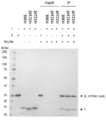
- index The figure which evaluated the HTRA1 (cat) inhibitory activity of the HTRA1 inhibitory peptide using degradation of human Vitronectin as an index. The analysis was performed by Western blot using Human Vitronectin Antibody (R & D Systems; MAB2349). The figure which evaluated the cross property of the HTRA1 inhibitory peptide with respect to each protease using decomposition
- index the 1).
- index (the 2).
- index (the 3).
- index the 4).
- index (the 5).
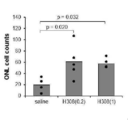
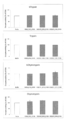
- the number of cases in each group was 6, and the HTRA1 inhibitory peptide H308_D1G_S16A dosage was 0.2 and 1 ⁇ g / eye.
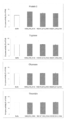
- the number of cases in each group was 6, and the HTRA1 inhibitory peptide H321AT_D1G_S16A dosage was 0.2 and 1 ⁇ g / eye.
- the number of cases in any group was 6, and the HTRA1 inhibitory peptide H322AT_D1G_S16A dosage was 0.2 and 1 ⁇ g / eye.
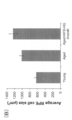
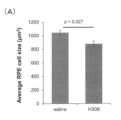
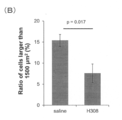
- the number of cases was 5, and the average area was used as an index.
- the number of cases was 5, and the number of RPE cells having a cell area of 1500 ⁇ m 2 or more was used as an index.
- the dashed line indicates the enzyme active domain (204Gly-364Leu).
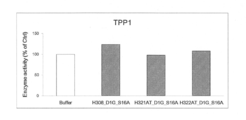
- HTRA1 inhibitory peptide showed an inhibitory effect FIG.
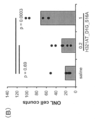
- FIG. The figure which showed the inhibitory effect of the HTRA1 inhibitory peptide with respect to the migration of the human umbilical vein endothelial cells (HUVEC) induced by serum.
- Nucleotide sequence of primer 21 Figure 66
- Nucleotide sequence of primer 22 FIG. 67
- “gene” means a nucleic acid molecule comprising a nucleotide sequence that encodes an amino acid sequence contained in a protein or a complementary strand thereof, consisting of a single strand, a double strand, a triple strand or more, and a DNA
- the term “gene” also includes an assembly of strands and RNA strands, a mixture of ribonucleotides and deoxyribonucleotides on one strand, and a double-stranded or triple-stranded nucleic acid molecule containing such a strand.
- nucleic acid molecule is synonymous, and are not limited at all depending on the number of ribonucleotides, deoxyribonucleotides, nucleotides, nucleosides, etc., which are their constituent units. RNA, mRNA, cDNA, cRNA, probes, oligonucleotides, primers and the like are also included in the scope. “Nucleic acid molecule” is sometimes referred to as “nucleic acid” for short.
- polypeptide In the present invention, “polypeptide”, “peptide” and “protein” are synonymous.
- a peptide that inhibits or suppresses one or more activities or functions of the target molecule X (hereinafter, the inhibition or suppression action is collectively referred to as “X inhibitory activity”) is referred to as “X inhibitory peptide”. be able to.
- SPINK2 means Serine Protease Inhibitor Kazal-type 2 and is a 7 kDa protein composed of a Kazal-like domain having three disulfide bonds.
- Preferred SPINK2 is human.
- human SPINK2 is simply referred to as “SPINK2” unless otherwise specified.
- HTRA1 means high temperature requirement A serine peptidase 1 and is a protein belonging to the HTRA family composed of an N-terminal domain, a protease domain, and a C-terminal PDZ domain consisting of an IGFBP-like module and a module for Kazal. Preferred HTRA1 is human. In the present invention, human HTRA1 may be simply referred to as “HTRA1” unless otherwise specified.
- HTRA1 inhibitory peptide means a peptide that inhibits or suppresses one or more activities or functions of HTRA1.
- the range of “HTRA1 inhibitory peptide” includes fragments of the peptide, adducts of other moieties (moiety), or conjugates that maintain HTRA1 inhibitory activity. That is, fragments, adducts, and modifications of the peptide that maintain HTRA1 inhibitory activity are also included in the “HTRA1 inhibitory peptide”.
- cells include various cells derived from individual animals, subculture cells, primary culture cells, cell lines, recombinant cells, yeast, microorganisms, and the like.
- the “site” to which the peptide binds that is, the “site” recognized by the peptide means a continuous or intermittent partial amino acid sequence or partial higher order structure on the target molecule to which the peptide binds or recognizes. .
- such a site can be referred to as an epitope or binding site on the target molecule.
- a “SPINK2 mutant” is an amino acid sequence possessed by wild-type SPINK2 in which one or more amino acids are replaced with amino acids different from the wild-type, and one or more wild-type amino acids are deleted. 1 or 2 or more amino acids not present in the wild type are inserted and / or amino acids not present in the wild type are added to the amino terminus (N terminus) and / or the carboxyl terminus (C terminus) of the wild type. (Hereinafter collectively referred to as “mutation”).
- mutation those having HTRA1 inhibitory activity are encompassed by HTRA1 inhibitory peptides.
- “insertion” can also be included in the range of “addition”.
- “several” in “1 to several” refers to 3 to 10.
- hybridize under stringent conditions means hybridization at 65 ° C. in a solution containing 5 ⁇ SSC, and then in an aqueous solution containing 2 ⁇ SSC-0.1% SDS. 20 minutes at 65 ° C. in an aqueous solution containing 0.5 ⁇ SSC-0.1% SDS for 20 minutes at 65 ° C. and 65 ° C. in an aqueous solution containing 0.2 ⁇ SSC-0.1% SDS Means to hybridize under the conditions of washing for 20 minutes or under equivalent conditions.
- SSC is an aqueous solution of 150 mM NaCl-15 mM sodium citrate, and nx SSC means n-fold concentration of SSC.
- an HTRA1-specific inhibitory peptide is synonymous with an HTRA1-selective inhibitory peptide.
- amino acid is an organic compound containing an amino group and a carboxyl group, and preferably means an ⁇ -amino acid contained as a structural unit in a protein, more preferably in a natural protein.
- more preferred amino acids are Ala, Arg, Asn, Asp, Cys, Gln, Glu, Gly, His, Ile, Leu, Lys, Met, Phe, Pro, Ser, Thr, Trp, Tyr and Val. Yes, unless otherwise specified, “amino acid” means a total of 20 amino acids. These 20 amino acids in total can be referred to as “natural amino acids”.
- the HTRA1 inhibitory peptides of the present invention preferably contain natural amino acids.
- amino acid residue may be abbreviated as “amino acid”.
- the amino acid is an L-amino acid, a D-amino acid, or a mixture thereof (DL-amino acid), and unless otherwise specified, means an L-amino acid.
- Natural amino acids can be divided, for example, into the following groups based on their common side chain properties.
- Hydrophobic amino acid group Met, Ala, Val, Leu, Ile
- Neutral hydrophilic amino acid group Cys, Ser, Thr, Asn, Gln
- Acidic amino acid group Asp, Glu
- Basic amino acid group His, Lys, Arg
- Amino acid groups that affect the direction of the main chain Gly, Pro
- Aromatic amino acid group Trp, Tyr, Phe
- the classification of natural amino acids is not limited to these.
- natural amino acids can undergo conservative amino acid substitutions.
- Constant amino acid substitution means a functionally equivalent or similar amino acid substitution.
- a conservative amino acid substitution in a peptide results in a static change in the amino acid sequence of the peptide.
- one or more amino acids with similar polarity act functionally equivalent, resulting in a static change in the amino acid sequence of such peptides.
- substitutions within a group can be considered conservative in structure and function.
- the role played by a particular amino acid residue can be determined in the context of the three-dimensional structure of the molecule containing that amino acid.
- cysteine residues can take the oxidized (disulfide) form, which is less polar compared to the reduced (thiol) form.
- the long aliphatic part of the arginine side chain can constitute structurally and functionally important features.
- side chains containing aromatic rings can contribute to ion-aromatic interactions or cation-pi interactions.
- substitution of amino acids having these side chains with amino acids belonging to acidic or non-polar groups can be structurally and functionally conservative.
- Residues such as proline, glycine, and cysteine (disulfide form) can directly affect the conformation of the main chain and often cannot be substituted without structural distortion.
- Nonpolar amino acid groups alanine (hereinafter “Ala” or simply “A”), valine (hereinafter “Val” or simply “V”), leucine (hereinafter “Leu” or simply “V”) L ”), isoleucine (hereinafter“ Ile ”or simply“ I ”), proline (hereinafter“ Pro ”or simply“ P ”), phenylalanine (“ Phe ”or simply“ F ”) ), Tryptophan (hereinafter referred to as “Trp” or simply “W”), methionine (hereinafter referred to as “Met” or simply “M”)
- Uncharged polar amino acid group glycine (hereinafter “Gly” or simply “G”), serine (hereinafter “Ser” or simply “S”), threonine (hereinafter “Thr” or simply “G”) "T”), cysteine (hereinafter “Cys” or simply “C”), tyrosine (hereinafter “Ty
- selenocysteine, N-formylmethionine, pyrrolidine, pyroglutamic acid, cystine, hydroxyproline, hydroxylysine, thyroxine, O-phosphoserine, desmosine, ⁇ -alanine, sarcosine, ornithine, creatine, ⁇ found in natural peptides and proteins Examples include aminobutyric acid, opain, theanine, tricolominic acid, kainic acid, domoic acid, acromelic acid, and the like. Protected amino acid, amino acid t-butyl ester, benzyl ester, cyclohexyl ester, fluorenyl ester, etc.
- amino acids other than the above-mentioned “natural amino acids” include, but are not limited to, the amino acids other than the above-mentioned “natural amino acids” in the present invention for convenience. Collectively referred to as “natural amino acids”.
- HTRA1 inhibitory peptide The HRTA1 inhibitory peptide of the present invention is a SPINK2 mutant in which the backbone of SPINK2 is at least partially maintained (hereinafter abbreviated as “SPINK2 mutant”), and retains HTRA1 or its enzyme activity. Protease activity of a fragment (hereinafter referred to as “functional fragment”) is inhibited or suppressed (hereinafter, such inhibition or suppression is collectively referred to as “HTRA1 inhibitory activity”).
- HTRA1 which is the target of the inhibitory peptides of the present invention, is preferably mammalian, more preferably primate, and even more preferably human HTRA1, full-length mature human HTRA1 (hereinafter “HTRA1 (full)”).
- HTRA1 (full) has the amino acid sequence shown by SEQ ID NO: 53 (FIG. 65).
- the amino acid sequence consists of numbers 23 to 480 and does not include a signal sequence consisting of numbers 1 to 22.
- the amino acid sequence of a functional fragment of human HTRA1 (hereinafter referred to as “HTRA1 (cat)”) is not particularly limited as long as the protease activity is retained, but the 158th Gly to 373th of SEQ ID NO: 53 (FIG. 65).
- HTRA1 and its functional fragments which are targets of the inhibitory peptides of the present invention, are also referred to as HTRA1 protease, preferably derived from vertebrates, more preferably mammals, even more preferably primates, optimally humans, It can be purified from those tissues and cells, or can be prepared by methods known to those skilled in the art as protein preparation methods such as gene recombination, in vitro translation, and peptide synthesis.
- a signal sequence, an immunoglobulin Fc region, a tag, a label, and the like may be linked to HTRA1 and functional fragments thereof.
- the HTRA1 inhibitory activity can be evaluated using the protease activity of HTRA1 as an index. For example, when HTRA1 or a functional fragment thereof, a substrate, and the inhibitory peptide of the present invention or a candidate thereof are present together, the protease activity of HTRA1 is higher than that in the presence of a control or in the absence of the inhibitor or the candidate. When it is 70% or less, 50% or less, 30% or less, 20% or less, 10% or less, 5% or less, 1% or less, or 0%, HTRA1 inhibition has occurred, and its inhibitory activity is 30% or more, It is 50% or more, 70% or more, 80% or more, 90% or more, 95% or more, 99% or more, or 100%.
- HTRA1 inhibitory activity may vary depending on the reaction conditions, the type and concentration of the substrate, and the like. Examples of the reaction conditions include those described in the examples, but are not limited thereto.
- the fluorescence of the substrate peptide is detected, or the substrate protein is detected by SDS-PAGE, Western blotting, liquid chromatography, etc.
- the enzyme activity can be evaluated.
- buffer solution examples include phosphate buffer saline (hereinafter referred to as “PBS”), borate buffer (50 mM boric acid, pH 7 to 9, for example, pH 8.5), Tris buffer (50 mM Tris, pH 6 to 9 (for example, pH 8.0) can be used, and surfactants such as NaCl (50 to 300 mM, for example 150 mM), CHAPS, and Octyl ⁇ -D-glucopyranoside can be added, but are not limited thereto.
- PBS phosphate buffer saline
- borate buffer 50 mM boric acid, pH 7 to 9, for example, pH 8.5
- Tris buffer 50 mM Tris, pH 6 to 9 (for example, pH 8.0)
- surfactants such as NaCl (50 to 300 mM, for example 150 mM), CHAPS, and Octyl ⁇ -D-glucopyranoside can be added, but are not limited thereto.
- the protease substrate of HTRA1 is not particularly limited, such as an endogenous substrate, an exogenous substrate, or a synthetic substrate.
- An example of a human endogenous substrate is vitronectin.
- the synthetic substrate is not particularly limited, and examples thereof include H2-Opt (Mca-IRRVSYSFK (Dnp) K), ⁇ -Casein, and other HTRA1 substrates.
- the HTRA1 inhibitory activity (IC 50 or K i ) of the peptide of the present invention is 1 ⁇ M or less, preferably 100 nM or less.
- the inhibitory peptide of this invention does not inhibit or suppress protease activities other than HTRA1, or the degree of inhibition or suppression with respect to them is relatively weak.
- the inhibitory peptide of the present invention preferably has high HTRA1 specificity.
- Suitable inhibitor peptides of the present invention include proteases such as trypsin, ⁇ -chymotrypsin, tryptase, plasmin, thrombin, matriptase, protein C, tissue plasminogen activator (tPA), urokinase (uPA), plasmin, plasma kallikrein and the like The activity is not inhibited or suppressed, or the degree of inhibition or suppression against them is relatively weak.
- HTRA1 which is the target of the peptides of the present invention, is derived from a vertebrate, preferably a mammal, more preferably a primate, and even more preferably a human, but a non-human animal such as a rat, It may be derived from rodents such as mice, primates such as cynomolgus monkeys, common marmosets, and rhesus monkeys.
- Peptides having inhibitory activity against non-human animal-derived HTRA1 can be used for diagnosis, examination, treatment or prevention of diseases related to HTRA1 in such non-human animals.
- a peptide also inhibits human HTRA1
- a medicinal pharmacology using such a non-human animal as an animal pathological model Tests pharmacokinetic tests, safety tests used as healthy animals, toxicity tests, etc. can be performed.
- the HTRA1 inhibitory peptide of the present invention has a small molecular weight compared to other biopolymers such as antibodies used in the art as pharmaceuticals and diagnostic agents, and its production (described later) is relatively easy. It has excellent physical properties such as penetration into the skin, storage stability, and heat stability, and has a wide range of choices for administration route, administration method, formulation, etc. when used as a pharmaceutical composition (described later). Has advantages.
- by increasing the molecular weight of the peptide of the present invention by applying a known method such as addition of a biopolymer or polymer the blood half-life when used as a pharmaceutical composition can be adjusted to be longer. it can.
- the molecular weight of such HTRA1 inhibitory peptides of the present invention is less than 10,000, preferably less than 8,000, more preferably about 7,000-7,200.
- the variable loop part consisting of 15th Cys to 31st Cys or the part consisting of 15th Cys to 63Cys (hereinafter referred to as “part containing 6 Cys”) of SEQ ID NO: 23 (FIG. 29) inhibition of HTRA1 Those having activity are also included in the HTRA1 inhibitory peptide of the present invention, the molecular weight of the variable loop portion is less than 2,500, preferably about 1,800 to 2,000, and the molecular weight of the portion containing 6 Cys is Less than 6,000, preferably about 5,300-5,500.
- SPINK2 mutants in which the backbone of SPINK2 included in the HTRA1 inhibitory peptide of the present invention is maintained at least partially may bind to HTRA1.
- HTRA1 Preferably mammalian, more preferably primate, and even more preferably human HTRA1.
- target binding activity a partial higher-order structure or the like
- the inhibitory peptides of the invention can bind to an immunogenic fragment of HTRA1.
- An immunogenic fragment of HTRA1 has one or more epitopes, mimotopes or other antigenic determinants so that it can elicit an immune response or an antibody against the fragment can be produced.
- the binding of SPINK2 mutant to HTRA1 or an immunogenic fragment thereof is performed by measuring a detectable binding affinity (ELISA method, surface plasmon resonance (hereinafter referred to as “SPR”) analysis method (“BIAcore”). ), Isothermal titration calorimetry (hereinafter referred to as “ITC” method, flow cytometry, immunoprecipitation method, etc.), etc., and evaluation, measurement or determination using methods known to those skilled in the art can do.
- ELISA method detectable binding affinity
- SPR surface plasmon resonance
- ITC Isothermal titration calorimetry
- flow cytometry flow cytometry
- immunoprecipitation method etc.
- Examples of the ELISA method include a method of detecting an HTRA1-inhibiting peptide that recognizes and binds to HTRA1 immobilized on a plate.
- an antibody for solid phase that recognizes a tag fused to HTRA1 can be used.
- a labeled detection antibody that recognizes a tag fused to the HTRA1 inhibitory peptide can be used for detection of the HTRA1 inhibitory peptide.
- methods that can be used for biochemical analysis such as HRP, alkaline phosphatase, and FITC can be used.
- TMB (3,3 ′, 5,5′-tetramethylbenzidine), BCIP (5-bromo-4-chloro-3-indolyl phosphate), p-NPP (p-nitrophenyl phosphate), OPD (o-Phenylenediamine), ABTS (3-Ethylbenzothiazoline-6-sulfonic acid), a chromogenic substrate and QuantaBlu (TM) such as SuperSignal ELISA Pico Chemiluminescent substrate (Thermo Fisher Scientific) Fluorogenic Peroxidase substrate (Thermo Fisher Cientific) fluorescent substrate, and the like, and can be used chemiluminescent substrate.
- an absorption plate reader, a fluorescence plate reader, a light emission plate reader, an RI liquid scintillation counter, or the like can be used.
- Devices used for SPR analysis include BIAcore (trademark) (GE Healthcare), ProteOn (trademark) (BioRad), SPR-Navi (trademark) (BioNavisOy), Spreeta (trademark) (Texas Instruments), and SPri-PlexII (trademark). (Horiba), Autolab SPR (trademark) (Metrohm), etc. can be illustrated.
- BIAcore trademark
- BioRad ProteOn
- SPR-Navi trademark
- BioNavisOy SPR-Navi
- Spreeta trademark
- Texas Instruments Texas Instruments
- SPri-PlexII trademark
- Examples of the immunoprecipitation method include a method of detecting HTRA1 recognized and bound by an HTRA1 inhibitory peptide immobilized on a bead. Magnetic beads, agarose beads, etc. can be used as the beads. In addition to biotin-streptavidin, an antibody that recognizes the peptide or a tag fused to the peptide, protein A, protein G, or the like can be used to immobilize the HTRA1-inhibiting peptide. The beads are separated by a magnet, centrifugation, etc., and HTRA1 precipitated together with the beads is detected by SDS-PAGE or Western blot method.
- a labeled detection antibody that recognizes a tag fused to HTRA1 can be used for detection of HTRA1.
- methods that can be used for biochemical analysis such as HRP, alkaline phosphatase, and FITC can be used.
- HRP alkaline phosphatase
- FITC FITC
- the same substrate as in the ELISA method can be used for detection using an enzyme label.
- ChemiDoc (trademark) (BioRad), LuminoGraph (ATTO), etc. can be utilized for the measurement of a detection signal.
- “specific recognition”, that is, “specific binding” means binding that is not non-specific adsorption.
- the binding activity EC 50 in the ELISA method can be mentioned.
- a dissociation constant hereinafter referred to as “K D ”.
- K D values for HTRA1 of HTRA1 inhibitory peptide of the present invention is 1 ⁇ 10 -4 M or less, 1 ⁇ 10 -5 M or less, 5 ⁇ 10 -6 M or less, 2 ⁇ 10 -6 M or less, or 1 ⁇ 10 -6 M or less, more preferably 5 ⁇ 10 ⁇ 7 M or less, 2 ⁇ 10 ⁇ 7 M or less, or 1 ⁇ 10 ⁇ 7 M or less, even more preferably 5 ⁇ 10 ⁇ 8 M or less, 2 ⁇ 10 ⁇ 8 M Or 1 ⁇ 10 ⁇ 8 M or less, and even more preferably 5 ⁇ 10 ⁇ 9 M or less, 2 ⁇ 10 ⁇ 9 M or less, or 1 ⁇ 10 ⁇ 9 M or less.
- an analysis result by an immunoprecipitation method can be given.
- a suitable HTRA1 inhibitory peptide in the present invention is immobilized on beads, each HTRA1 is added and then the beads are separated, and when HTRA1 precipitated together with the beads is detected, an HTRA1 signal is detected.
- the ability to bind to HTRA1 or an immunogenic fragment thereof is not essential for the SPINK2 mutant as the inhibitory peptide of the present invention as long as it has HTRA1 inhibitory activity.
- the inhibitory peptide of the present invention may be competitive in the binding of a protease substrate to HTRA1.
- the inhibitory peptide of the present invention has a retinal protective effect.
- the preferred inhibitor of the present invention can suppress a decrease in the number of nuclei contained in the outer granule layer due to light irradiation.
- a larger amount of HTRA1 protein was detected in the vitreous humor of the group irradiated with light compared to the non-irradiated group, and HTRA1 was involved in retinal damage, and HTRA1 inhibitory activity had a retinal protective effect.
- the present invention discloses.
- the SPINK2 mutant as the inhibitory peptide of the present invention may have the activity, properties, functions, features and the like as described above, while its full-length amino acid sequence has high sequence identity to the amino acid sequence of human wild-type SPINK2.
- the SPINK2 variant of the present invention has a human SPINK2 amino acid sequence (SEQ ID NO: 1 FIG. 13) and 60% or more, 70% or more, 75% or more, 80% or more, 85% or more, 90% or more, 95% or more, Has sequence identity of 98% or more or 99% or more.
- Identity means a property indicating the degree of similarity or relationship between two sequences. Amino acid sequence identity (%) is calculated by multiplying the numerical value obtained by dividing the number of identical amino acids or amino acid residues by the total number of amino acids or amino acid residues by 100.
- Gap means a gap in alignment between the sequences as a result of deletion and / or addition in at least one of the two or more sequences.
- the identity between two amino acid sequences having the completely identical amino acid sequence is 100%, but the substitution or deletion of one or more amino acids or amino acid residues compared to one amino acid sequence compared to the other. If there is a loss or addition, the identity of both is less than 100%.
- BLAST Altschul, et al. Nucleic Acids Res. 25, 3389-3402, 1997) using standard parameters is used as an algorithm or program for determining identity between two sequences in consideration of gaps.
- BLAST2 Altschul, et al. J. Mol. Biol. 215, 403-410, 1990
- Smith-Waterman Smith, et al. J. Mol. Biol. 147, 195-197) , 1981
- the like can be exemplified.
- mutated refers to a substitution of one or more nucleotides or nucleotide residues or amino acid or amino acid residues in a nucleotide sequence or amino acid sequence compared to a naturally occurring nucleic acid molecule or peptide. Means that a deletion or insertion has been made.
- amino acid sequence of the SPINK2 variant of the present invention one or more amino acids or amino acid residues are mutated as compared to the amino acid sequence of human SPINK2.
- the amino acid sequence of the SPINK2 variant is that of human SPINK2 (SEQ ID NO: 1 FIG. 13): One, two, three, four, five, six, or seven amino acids of No. 16 Ser to No. 22 Gly are substituted with other amino acids or amino acid residues; One, two, three, four or five amino acids from No. 24 Pro to No. 28 Asn are substituted with other amino acids or amino acid residues; Even if one or two amino acids of No. 39 Ala and No. 43 Thr are substituted with other amino acids or amino acid residues, or in the wild type, it is composed of amino acid residues such as Nos. 16-30.
- the two structures or amino acid residues are included in the ⁇ helix; 15th Cys, 23rd Cys, 31st Cys, 42nd Cys, 45th Cys and 63rd Cys are preferably Cys as well as the wild type in order to maintain the natural disulfide bond. In order to eliminate disulfide bonds or to generate unnatural disulfide bonds, one, two, three, four, five or six of them can be replaced with other amino acids. Also good.
- Cys is maintained at the same 6 positions as the natural type, and a disulfide bond is maintained.
- the 15th Cys-45Cys, 23rd Cys-42Cys, and 31Cys-63Cys each form a disulfide bond.
- a loop structure consisting of 16th Ser to 30th Val included in the amino acid sequence of wild-type SPINK2 a ⁇ structure consisting of 31Cys and 32Gly ⁇ sheet composed of strand (1) and ⁇ strand (2) consisting of 57 Ile to 59 Arg, ⁇ helix consisting of 41 Glu amino acid to 51 Gly, or similar to them
- the three-dimensional structure composed of a loop structure, a ⁇ sheet, an ⁇ helix, etc. corresponding at least partially to the position of (1) is maintained to such an extent that it can exhibit HTRA1 inhibitory activity.
- amino acid residue may be simply expressed as “amino acid”.
- the first to eleventh Xaa are arbitrary amino acids as long as they bind to HTRA1 and inhibit HTRA1 activity. If there is no particular limitation.
- preferred amino acids of X1 to X11 will be described, and these amino acids may contain the same amino acid as that in the amino acid sequence of the natural type, that is, wild type human SPINK2.
- # 1 X1 is preferably Asp, Glu, Gly, Ser or Ile, more preferably Asp or Gly, even more preferably Gly; 16 X2 is preferably Ala, Asp, Glu, Phe, Gly, His, Lys, Leu, Met, Gln, Arg, Ser, Thr or Tyr, more preferably Ala, Asp, Gly, His, Lys, Leu, Met, Gln, Arg, Ser or Thr, even more preferred Ala, Gly, Lys, Leu, Ser or Thr, even more preferred Ala, Gly, Leu, Ser or Thr, and even more Preferably Ala or Ser; No.
- 17 X3 is preferably Ala, Asp, Glu, Gly, His, Lys, Leu, Met, Asn, Gln, Arg, Ser, Thr or Tyr, more preferably Asp, Gly, His, Lys, Leu , Met, Asn, Gln, Arg, Ser, Thr or Tyr, even more preferably Asp, His, Lys, Met or Gln, even more preferably Asp or Gln; 18th X4 is preferably Ala, Asp, Glu, Phe, Gly, His, Ile, Leu, Lys, Met, Asn, Gln, Arg, Ser, Thr, Val, Trp or Tyr, more preferably Asp, Phe, His, Met, Asn, Gln, Ser or Tyr, even more preferably Asp, Phe, His, Ser or Tyr, even more preferably Asp, Phe, His, Ser or Tyr, even more preferably Phe or His; No.
- 19 X5 is preferably Ala, Asp, Glu, Gly, His, Ile, Lys, Met, Asn, Gln, Arg, Ser, Thr, Val or Tyr, more preferably Ala, Asp, Glu, Gly, His, Lys, Met, Asn, Gln, Arg, Ser or Val, even more preferably Ala, Asp, Glu, Met or Asn, even more preferably Ala, Asp or Glu; 21st X6 is preferably Ala, Glu, Phe, Gly, Ile, Leu, Met, Gln, Arg, Ser, Trp or Tyr, more preferably Glu, Phe, Ile, Leu, Met, Gln, Arg or Trp, more preferably Met or Trp, even more preferably Met; No.
- 24 X7 is preferably Ala, Asp, Glu, Phe, Gly, His, Lys, Leu, Met, Pro, Gln, Arg, Ser, Thr, Val, Trp or Tyr, more preferably Asp, Glu, His, Pro, Gln, Ser, Thr, Val, Trp or Tyr, even more preferably Gln, Trp, Tyr or Val, even more preferably Tyr or Val;
- 26th X8 is preferably Ala, Asp, Glu, Phe, His, Ile, Lys, Leu, Met, Asn, Gln, Arg, Ser, Val or Tyr, more preferably Ala, Phe, His, Ile, Leu, Met, Gln, Arg, Ser, Val or Tyr, even more preferably Phe, Leu or Tyr, even more preferably Phe or Leu;
- 27th X9 is preferably Glu, Phe, Leu, Ser, Thr or Tyr, more preferably Phe, Leu, Ser, Thr or Tyr, even more
- wild-type X1 to X11 are Asp, Ser, Gln, Tyr, Arg, Pro, Pro, His, Phe, Ala, and Thr, respectively. Also, No. 20 is Leu, No. 22 is Gly, No. 25 is Arg, and No. 28 is Asn.
- amino acids may be further added to the N-terminal side of the first amino acid.
- added amino acids include Ser-Leu, S An amino acid sequence comprising a tag and a linker (SEQ ID NO: 31: FIG. 43) and the like can be mentioned.
- 1 to several amino acids may be added to the 63rd Cys located at the C-terminus.
- an amino acid sequence having a Gly-Gly of C-terminal 64th Gly and the C-terminal 65th Gly is added.
- Some amino acid sequences can be mentioned. Examples of such added amino acids include Gly-Gly, C-terminal 6-mer (SEQ ID NO: 32: FIG. 44), and the like.
- amino acid sequences obtained by adding other amino acids to the N-terminal and / or C-terminal of the amino acid sequence shown in SEQ ID NO: 30 (FIG. 42) or the amino acid sequence derived from SEQ ID NO: 30, SEQ ID NOs: 3, 5, 7, 9, 11, 13, 15, 17, 19, 21, and 23 to 29 (FIGS. 15, 17, 19, 21, 23, 25, 27, 29, 31, 33, and 35 to 41) and SEQ ID NOs: 4, 6,
- SEQ ID NOs: 4, 6 The nucleotide sequence represented by any one of 8, 10, 12, 14, 16, 18, 20, and 22 (FIGS. 16, 18, 20, 22, 24, 26, 28, 30, 32, and 34) encodes Amino acid sequences are included in more preferred embodiments, and SEQ ID NOs: 24, 28, and 29 (FIGS. 36, 40, and 41) are included in even more preferred embodiments, respectively.
- one or two or more amino acids are substituted, added, and / or added to the SPINK2 mutant peptide or the N-terminal and / or C-terminal adduct of the SPINK2 mutant peptide (hereinafter referred to as “parent peptide”).
- the deleted peptide may be referred to as “parent peptide derivative” or “parent peptide derivative” (eg, Example 6).
- parent peptide derivative eg, Example 6
- Such “derivatives” are also included in the scope of the “peptide” of the present invention.
- a portion other than X1 to X11 that is, No. 2 Pro in the amino acid sequence of wild-type human SPINK2 (SEQ ID NO: 1 FIG. 13).
- Natural amino acids at positions 15 to Cys, 20 Pro, 22 Gly, 23 Cys, 25 Arg, 28 Asn to 38 Tyr, 41 Glu, 42 Cys and 44 Thr to 63 Cys Alternatively, it can contain mutated amino acids or amino acid sequences.
- a SPINK2 variant may be mutated at one or more positions as long as it does not at least partially prevent or interfere with HTRA1 inhibitory activity or folding.
- Such mutations can be made by using standard methods known to those skilled in the art.
- Typical mutations in the amino acid sequence can include substitutions, deletions or additions of one or more amino acids, and examples of substitutions include conservative substitutions.
- conservative substitution certain amino acid residues are replaced by amino acid residues that have similar chemical characteristics not only in bulk but also in terms of polarity. Examples of conservative substitutions are described elsewhere in this specification.
- moieties other than X1-X11 may tolerate non-conservative substitutions of one or more amino acids as long as they do not at least partially prevent or interfere with HTRA1 inhibitory activity or folding.
- the amino acid sequence possessed by the SPINK2 variant as the inhibitory peptide of the present invention is such that X1 to X11 are preferably SEQ ID NOs: 3, 5, 7, 9, 11, 13, 15, 17, 19, 21 and 23 to 29 (FIGS. 15, 17, 19, 21, 23, 25, 27, 29, 31, 33 and 35 to 41), more preferably of SEQ ID NOS: 24, 28 and 29 (FIGS. 36, 40 and 41).
- Each of the amino acids X1 to X11 in any one of them, and a portion other than X1 to X11 can have an amino acid or an amino acid sequence that does not at least partially prevent or interfere with HTRA1 inhibitory activity or folding.
- amino acid sequence of the SPINK2 mutant as the HTRA1 inhibitory peptide of the present invention can include the amino acid sequences described in any one of the following (a) to (e): (A) SEQ ID NOs: 3, 5, 7, 9, 11, 13, 15, 17, 19, 21, 23 to 29 (FIGS.
- the nucleic acid molecule encoding the HTRA1 inhibitory peptide is not limited to (a) to (e), and the amino acid sequence contained in the SPINK2 mutant having HTRA1 inhibitory activity, preferably SEQ ID NO: 30 (FIG. 42)
- a nucleic acid molecule comprising a nucleotide sequence that encodes the amino acid sequence represented by is ubiquitously encompassed within the scope of a nucleic acid molecule that encodes an HTRA1 inhibitory peptide.
- introducing a mutation into the inhibitory peptide of the present invention for the purpose of improving its folding stability, heat stability, storage stability, blood half-life, water solubility, biological activity, pharmacological activity, side effects, etc. Can do.
- new reactive groups such as Cys can be introduced by mutation to conjugate to other substances such as polyethylene glycol (PEG), hydroxyethyl starch (HES), biotin, peptides or proteins.
- PEG polyethylene glycol
- HES hydroxyethyl starch
- biotin peptides or proteins.
- the HTRA1 inhibitory peptide may be added, linked or bound to other moieties, and such conjugates are collectively referred to as “conjugates of HTRA1 inhibitory peptides”.
- the “conjugate” means a molecule obtained by adding, linking or binding other parts to the peptide of the present invention or a fragment thereof.
- the peptide of the present invention is formed through a chemical substance such as a cross-linking agent, an agent suitable for linking a certain moiety to the side chain of an amino acid, or the like.
- the N-terminal and / or C-terminal of the present invention includes a form linked or bound to the peptide of the present invention by a synthetic chemical method, a genetic engineering method, or the like.
- portions include polyalkylene glycol molecules such as polyethylene glycol (PEG), fatty acid molecules such as hydroxyethyl starch and palmitic acid, Fc region of immunoglobulin, immunoglobulin And CH3 domain of immunoglobulin, CH4 domain of immunoglobulin, albumin or a fragment thereof, albumin binding peptide, albumin binding protein such as streptococcal protein G, and transferrin.
- PEG polyethylene glycol
- fatty acid molecules such as hydroxyethyl starch and palmitic acid
- Fc region of immunoglobulin immunoglobulin And CH3 domain of immunoglobulin, CH4 domain of immunoglobulin, albumin or a fragment thereof
- albumin binding peptide such as streptococcal protein G
- transferrin transferrin.
- the peptide of the present invention can be linked to the “portion” via a linker such as a peptide linker.
- the HTRA1 inhibitory peptide of the present invention may be conjugated with other drugs in order to exert or enhance pharmacological activity.
- Techniques and embodiments known to those skilled in the art as antibody-drug conjugates (ADCs) in the antibody field become a part of the present invention by replacing antibodies with the peptides of the present invention.
- the HTRA1 inhibitory peptide of the present invention further comprises one or two or more moieties that exhibit binding affinity, inhibitory activity, antagonistic activity, agonistic activity, etc. to target molecules other than HTRA1, or are conjugated to such moieties May be.
- the “portion” include an antibody or a fragment thereof, a protein having a skeleton other than an antibody such as a SPINK2 mutant, or a fragment thereof.
- multispecific antibodies and bispecific antibodies are at least one of two or more “antibodies” included in the present invention. By substituting these peptides, some aspects of the conjugates of the present invention are obtained.
- the peptide of the present invention or a precursor thereof may contain a signal sequence.
- a signal sequence present at or added to the N-terminus of a polypeptide or its precursor is used to place the polypeptide in a specific compartment of the cell, for example, periplasm in the case of E. coli, or endoplasmic reticulum in the case of a eukaryotic cell.
- Many signal sequences are known to those skilled in the art and can be selected depending on the host cell.
- OmpA can be exemplified, and a form containing a signal sequence can also be included as a part of the embodiment of the conjugate of the present invention. .
- the peptide can be purified by affinity chromatography.
- the peptide of the present invention has, for example, a biotin, a Strep tag (trademark), a Strep tag II (trademark), an oligohistidine such as His6, a polyhistidine, an immunoglobulin domain, a maltose binding protein, a glutathione-S-transferase. (GST), calmodulin-binding peptide (CBP), haptens such as digoxigenin and dinitrophenol, epitope tags such as FLAG TM, myc tag, HA tag, etc.
- GST calmodulin-binding peptide
- CBP calmodulin-binding peptide
- haptens such as digoxigenin and dinitrophenol
- epitope tags such as FLAG TM, myc tag, HA tag, etc.
- the conjugate of the present invention may be a peptide (polypeptide) as a whole.
- the peptide of the present invention may contain a moiety for labeling, specifically, enzyme label, radioactive label, colored label, fluorescent label, chromogenic label, luminescent label, hapten, digoxigenin, biotin, metal complex, Labeling moieties such as metals, colloidal gold, etc. can be conjugated.
- a moiety for labeling can also be included as part of the embodiment of the conjugate of the invention.
- the inhibitory peptide of the present invention can contain both natural amino acids and non-natural amino acids in the peptide portion, and natural amino acids can contain both L-amino acids and D-amino acids.
- the amino acid sequence of the inhibitory peptide of the present invention can include both natural amino acids and unnatural amino acids, and natural amino acids can include both L-amino acids and D-amino acids.
- the inhibitory peptide of the present invention may exist as a monomer, dimer, trimer or higher oligomer or multimer.
- the dimer, trimer or higher oligomer and multimer may be either a homopolymer composed of a single monomer or a heteropolymer composed of two or more different monomers.
- the monomer may diffuse quickly and excel in tissue penetration.
- Dimers, oligomers and multimers have excellent aspects such as having high affinity or binding activity to the target molecule locally, having a slow dissociation rate, or exhibiting high HTRA1 inhibitory activity. Can do.
- intended dimerization, oligomerization, and multimerization may be performed by introducing a jun-fos domain, a leucine zipper, or the like into the inhibitory peptide of the present invention. Can be done.
- the inhibitory peptides of the present invention are monomers, dimers, trimers or oligomers or multimers that can bind to or inhibit the activity of one or more target molecules. .
- Possible forms of the inhibitory peptide of the present invention include isolated forms (lyophilized preparations, solutions, etc.), the above-mentioned conjugates, forms bound to other molecules (solid-phase forms, foreign molecules and And the like, and the like are not limited to these, and a form suitable for expression, purification, use, storage and the like can be arbitrarily selected.
- HTRA1 Inhibitory Peptide is an amino acid sequence of SPINK2 or an amino acid sequence of the HTRA1 inhibitory peptide of the present invention (for example, SEQ ID NOs: 3, 5, 7, 9, 11, 13, 15, 17, 19, 21 and 23 to 29, or an amino acid sequence selected from the group consisting of FIGS. 15, 17, 19, 21, 23, 25, 27, 29, 31, 33, and 35 to 41), and encodes the amino acid sequence
- a nucleotide sequence, a nucleic acid molecule containing the nucleotide sequence, or the like can be used as a starting material for identification by methods well known to those skilled in the art.
- HTRA1 inhibitory activity can be identified from a human SPINK2 mutant library as an index, and HTRA1 binding activity may also be combined as an index.
- the starting nucleic acid molecule can be subjected to mutagenesis and introduced into a suitable bacterial or eukaryotic host using recombinant DNA technology.
- the SPINK2 mutant library is known as a technique for identifying a target molecule binder or inhibitor.
- the disclosure in WO2012 / 105616 is also included in the disclosure of the present invention by referring to the entirety thereof.
- a clone in which a SPINK2 mutant having a desired property, activity, function, etc. is linked to the genetic trait is enriched from the library. / Or can be selected and identified.
- the bacterial display method (Francisco, JA, et al. (1993) Proc. Natl. Acad. Sci. USA 90, 10444-10448) Yeast display method (Boder, ET, et al. (1997) Nat. Biotechnol. 15, 553-557), mammalian cell display method (Ho M, et al. (2009) Methods Mol. Biol. 525: 337-52), phage display method (Smith, GP (1985) Science. 228, 1315-1317), ribosome display method ((Mattheakis LC, et al. (1994)). ) Proc Natl. Acad. Sci.
- nucleic acid display methods such as mRNA display (Nemoto N, et al. (1997) FEBS Lett. 414, 2) 405-408), colony screening method (Pini, A. et al. (2002) Comb. Chem. High Throughput Screen. 5, 503-510), etc.
- the amino acid sequence encoded by the nucleotide sequence is converted into the amino acid of the SPINK2 variant, ie, the HTRA1 inhibitory peptide contained in the clone. It can be determined as an array.
- the SPINK2 mutant of the present invention can be obtained, for example, by inducing mutation in natural type SPINK2.
- “Induction of mutagenesis” refers to substitution or deletion of one or more amino acids present at each position of a certain amino acid sequence with other amino acids, or amino acids that are not present in the amino acid sequence. It means to be able to add or insert. Such deletion or addition or insertion can change the sequence length.
- mutagenesis can preferably occur at one or more positions from X1 to X11 in the amino acid sequence shown in SEQ ID NO: 30 (FIG. 42).
- a natural amino acid that is, the same amino acid present at a specific position in the natural amino acid sequence
- a natural amino acid is present at that position, that is, at a specific position in the natural amino acid sequence.
- those in which the same amino acid is maintained are also included in the range of the mutant as long as at least one amino acid is mutated as a whole.
- Random mutagenesis means that for a particular position on a sequence, one or more different amino acids are introduced at that position with a certain probability by mutagenesis, but at least 2 The probability that two different amino acids are introduced may not all be the same. Further, in the present invention, it does not prevent at least two different amino acids from containing a natural amino acid (one kind), and such a case is also included in the range of “induction of random mutation”.
- Standard methods known to those skilled in the art can be used as a method for inducing random mutation at a specific position.
- a mutation can be induced at a specific position in the sequence by PCR (polymerase chain reaction) using a mixture of synthetic oligonucleotides containing a degenerate nucleotide composition.
- PCR polymerase chain reaction
- a mutation of a stop codon is introduced.
- Site-directed mutagenesis can also be performed using the structural information of a target including a higher-order structure and / or a peptide for the target or a wild-type peptide from which the peptide is derived.
- site-specific mutation is introduced using structural information including higher-order information of target HTRA1 and / or target SPINK2 mutant or wild type SPINK2 or a complex of both. be able to.
- a SPINK2 mutant having HTRA1 inhibitory activity is identified, then a crystal of a complex of HTRA1 and the SPINK2 mutant is obtained and X-ray crystal structure analysis is performed, and the SPINK2 mutant binds based on the analysis result
- it is possible to find a correlation between the structural information obtained through specifying the amino acid residue in the SPINK2 mutant involved in the interaction with the site on the HTRA1 molecule and the HTRA1 molecule, and the HTRA1 inhibitory activity Based on such structure-activity relationship, substitution with a specific amino acid at a specific position, insertion or deletion of an amino acid at a specific position, etc. can be designed to actually confirm HTRA1 activity.
- mutation can be induced using a nucleotide constituent unit in which the specificity of base pair such as inosine is modified.
- mutagenesis to random positions is possible by, for example, error-prone PCR method using a DNA polymerase having a high error rate, such as Taq DNA polymerase, which has a high error rate, and chemical mutagenesis.
- HTRA1 inhibitory peptides can be used by those skilled in the art suitable for each screening method such as phage library and colony library using bacterial display, yeast display, mammalian cell display, phage display, ribosome display, nucleic acid display, colony screening, etc. It can be enriched and / or selected from known libraries.
- phage libraries can be constructed by vectors and methods known to those skilled in the art suitable for each library, such as phagemids for phage libraries and cosmids for colony screening.
- Such vectors may be viruses or viral vectors that infect prokaryotic or eukaryotic cells.
- These recombinant vectors can be prepared by methods known to those skilled in the art, such as gene manipulation.
- Bacteria display is, for example, a technique in which a part of the outer membrane lipoprotein (Lpp) of E. coli and the outer membrane protein OmpA are fused with the desired protein to display the desired protein on the E. coli surface.
- Lpp outer membrane lipoprotein
- OmpA outer membrane protein
- a DNA group obtained by inducing random mutations in the nucleotide sequence encoding the amino acid sequence of a protein is introduced into a vector suitable for bacterial display, and bacterial cells are transformed with the vector, the surface of the transformed bacterial cell
- a library that presents a group of randomly mutagenized proteins can be obtained (Francisco, JA, et al. (1993) Proc. Natl. Acad. Sci. USA, 90 volumes. , 10444-10448).
- Yeast display is a technique in which a desired protein is fused to a protein such as ⁇ -agglutinin in the outer shell of the yeast cell surface and displayed on the yeast surface.
- ⁇ -Agglutinin includes a C-terminal hydrophobic region presumed to be a glycosylphosphatidylinositol (GPI) anchor attachment signal, a signal sequence, an active domain, a cell wall domain, and the like. Desired proteins can be displayed.
- GPI glycosylphosphatidylinositol
- a DNA group obtained by inducing random mutations in the nucleotide sequence encoding the amino acid sequence of a protein is introduced into a vector suitable for yeast display, and the yeast cell is transformed with the vector, the surface of the transformed yeast cell
- a library presenting a randomly mutagenized protein group can be obtained (Ueda, M. & Tanaka, A., Biotechnol. Adv., 18, 121-, 2000 edition: Ueda, M. & Tanaka, A., J. Biosci. Bioeng., 90, 125-, 2000, etc.).
- Animal cell display is performed on the surface of a mammalian cell such as HEK293 or Chinese hamster ovary (CHO) cell by fusing a transmembrane region of a membrane protein typified by platelet-derived growth factor receptor (PDGFR) with a desired protein.
- PDGFR platelet-derived growth factor receptor
- the surface of a transformed animal cell can be obtained by introducing a DNA group obtained by inducing random mutation into a nucleotide sequence encoding an amino acid sequence of a protein into a vector suitable for animal cell display and transforming the animal cell with the vector.
- a library presenting randomly mutagenized proteins can be obtained (Ho M, et al. (2009) Methods Mol Biol. 525: 337-52).
- Desired libraries displayed on cells such as yeast, bacteria, animal cells can be kept warm in the presence of the target molecule or brought into contact with the target molecule.
- a carrier such as magnetic beads is added, the cells are separated from the carrier, and then the carrier is washed, thereby nonspecific adsorption. And the cell group in which the peptide bound to the carrier (bound to HTRA1), the peptide aggregate, or the concentrated peptide aggregate is displayed can be recovered.
- a population of cells displaying aggregates or enriched peptide aggregates can be recovered.
- Non-specific adsorbate sites and / or binding sites can be, for example, blocked and a blocking step can be incorporated if appropriate.
- a vector expressing the peptide thus obtained, a collection of peptides or a concentrated peptide collection is recovered, the nucleotide sequence of the polynucleotide inserted into the vector is determined, and the nucleotide sequence encodes The amino acid sequence to be determined can be determined.
- the peptide aggregate that binds to the target molecule can be highly concentrated.
- a phagemid is a bacterial plasmid that contains a second origin of replication derived from a single-stranded bacteriophage in addition to a plasmid origin of replication.
- Cells carrying the phagemid can replicate the phagemid through a single-stranded replication mode in superinfection with M13 or similar helper bacteriophage. That is, single-stranded phagemid DNA is packaged in infectious particles coated with bacteriophage coating protein.
- phagemid DNA can be formed as a clone double-stranded DNA plasmid in the infected bacterium, and phagemid can be formed as bacteriophage-like particles from the culture supernatant of superinfected cells.
- the particles themselves can be reformed as plasmids by injecting the bacteriophage-like particles into the bacteria in order to infect the bacteria with F-fibrotic bacteria.
- a fusion gene comprising a polynucleotide having a nucleotide sequence encoding the amino acid sequence of the test peptide and a bacteriophage coat protein gene is inserted into the phagemid to infect bacteria, and the cells are cultured.
- such peptides are expressed or displayed (synonymous with display) on the bacteria or phage-like particles, or produced in the phage particles or in the culture supernatant of the bacteria as a fusion protein with the coating protein. be able to.
- a fusion gene comprising the polynucleotide and the bacteriophage coat protein gene gpIII is inserted into a phagemid and co-infected with E. coli with M13 or similar helper phage, the peptide and the coat protein are contained. Can be produced in the culture supernatant of the E. coli.
- phagemids When various circular or non-circular vectors such as viral vectors are used instead of phagemids, they have an amino acid sequence encoded by the nucleotide sequence of the polynucleotide inserted into the vector according to a method known to those skilled in the art. Peptides can be expressed or presented on cells or virus-like particles into which the vector has been introduced, or can be produced in the culture supernatant of the cells.
- the library expressing the peptide thus obtained can be kept warm in the presence of the target molecule or brought into contact with the target molecule.
- a carrier on which HTRA1 is immobilized is incubated for a certain period of time with a mobile phase containing a library, then the mobile phase is separated from the carrier, and then the carrier is washed to remove nonspecific adsorbate and bound substance.
- Peptides, peptide aggregates or concentrated peptide aggregates that have been removed and bound to the carrier (HTRA1 bound to) can be recovered by elution.
- Elution is carried out non-selectively in the presence of relatively high ionic strength, low pH, moderate denaturation conditions, the presence of chaotropic salts, etc., or soluble target molecules such as HTRA1, antibodies that bind to target molecules Alternatively, it can be carried out selectively by adding a natural ligand, a substrate or the like to compete with the immobilized target molecule.
- Non-specific adsorbate sites and / or binding sites can be subjected to blocking treatment, for example, and the blocking step can be incorporated if appropriate.
- the peptide aggregate that binds to the target molecule can be highly concentrated.
- Ribosome display uses, for example, mRNA encoding a desired protein having no stop codon and a cell-free protein synthesis system to synthesize a desired protein, its corresponding mRNA, and a ribosome-linked molecule in vitro.
- Technology A library in which random mutagenized proteins are presented on a ribosome by using a group of mRNAs obtained by inducing random mutations in the nucleotide sequence encoding the amino acid sequence of a protein and a cell-free protein synthesis system. (Mattheakis LC, et al. (1994) Proc. Natl. Acad. Sci. USA 91, 19: 9022-9029).
- Nucleic acid display is also called mRNA display.
- a linker such as puromycin having a similar structure at the 3 ′ end of tyrosyl-tRNA
- a desired protein mRNA encoding the molecule
- a molecule linked with ribosome are synthesized.
- Technology Since this technique uses a cell-free protein synthesis system rather than living cells, it can be synthesized in vitro.
- a linker such as puromycin, and a cell-free protein synthesis system, the randomly mutagenized protein group can be obtained.
- the library presented on the ribosome can be obtained (Nemoto N, et al. (1997) FEBS Lett. 414, 2, 405-408).
- a library expressing peptides obtained via a cell-free synthesis system such as ribosome display or nucleic acid display can be kept warm in the presence of the target molecule or brought into contact with the target molecule.
- a carrier on which HTRA1 is immobilized is incubated for a certain period of time with a mobile phase containing a library, then the mobile phase is separated from the carrier, and then the carrier is washed to remove nonspecific adsorbate and bound substance.
- Peptides, peptide aggregates or concentrated peptide aggregates that have been removed and bound to the carrier (HTRA1 bound to) can be recovered by elution.
- Elution is carried out non-selectively in the presence of relatively high ionic strength, low pH, moderate denaturation conditions, the presence of chaotropic salts, etc., or soluble target molecules such as HTRA1, antibodies that bind to target molecules Alternatively, it can be carried out selectively by adding a natural ligand, a substrate or the like to compete with the immobilized target molecule.
- Non-specific adsorbate sites and / or binding sites can be subjected to blocking treatment, for example, and the blocking step can be incorporated if appropriate.
- the nucleic acid expressing the peptide, the peptide aggregate or the concentrated peptide aggregate thus obtained is recovered, and in the case of mRNA, the nucleotide sequence is determined after reverse transcription reaction to cDNA.
- the encoding amino acid sequence can be determined.
- the peptide aggregate that binds to the target molecule can be concentrated to a higher degree by transcribing mRNA from the collected nucleic acid and repeating the above operation once or several times as a cycle.
- an affinity tag is conjugated in advance to a peptide, a collection of peptides, or a concentrated peptide collection, the peptide or a collection thereof can be efficiently purified.
- the peptide can be eluted by cleaving with the protease activity.
- the obtained clone or library is induced to further mutation, and the function (for example, HTRA1 inhibitory activity), physical properties (thermal stability) from the library into which the mutation has been introduced.
- the function for example, HTRA1 inhibitory activity
- physical properties for example, thermal stability
- the HTRA1 inhibitory peptide can be identified by determining whether or not the obtained peptide has HTRA1 inhibitory activity.
- the HTRA1 inhibitory peptide is preferably a loop structure consisting of 16th Ser to 30th Val included in the amino acid sequence of wild type SPINK2, a ⁇ strand (1) consisting of 31Cys and 32Gly, and 57th Ile.
- a ⁇ -sheet composed of ⁇ -strand (2) consisting of No. 59 to Arg, and an ⁇ -helix consisting of 41Glu amino acid to No. 51 Gly, or similar to them or at least partially Can be maintained to the extent that HTRA1 inhibitory activity can be exerted. It is also possible to identify a more suitable HTRA1 inhibitory peptide using such a three-dimensional structure (total structure or partial structure) as a part of the index.
- Nucleic acid molecule encoding HTRA1 inhibitory peptide, vector containing the same, cell containing them, and method for producing recombinant HTRA1 inhibitory peptide The present invention relates to a polynucleotide comprising a nucleotide sequence encoding an amino acid sequence contained in an HTRA1 inhibitory peptide (Hereinafter referred to as “nucleic acid molecule encoding HTRA1 inhibitory peptide”), a recombinant vector into which the gene has been inserted, a cell into which the gene or vector has been introduced (hereinafter referred to as “cell containing nucleic acid molecule encoding HTRA1 inhibitory peptide”) Or a cell that produces an HTRA1-inhibiting peptide (hereinafter referred to as an “HTRA1-inhibiting peptide-producing cell”).
- a polynucleotide comprising a nucleotide sequence encoding an amino acid sequence contained in an HTRA1 inhibitory
- the nucleotide sequence described in any one of the following (a) to (e) (hereinafter referred to as “the nucleotide sequence of the HTRA1 inhibitory peptide” Or consisting of an antibody gene sequence, or consisting of an antibody gene sequence: (A) SEQ ID NOs: 3, 5, 7, 9, 11, 13, 15, 17, 19, 21, 23 to 29 (FIGS. 15, 17, 19, 21, 23, 25, 25, 29, 31, 33, A nucleotide sequence encoding the amino acid sequence represented by any one of 35 to 41); (B) any one of SEQ ID NOs: 4, 6, 8, 10, 12, 14, 16, 18, 20, and 22 (FIGS.
- C a nucleotide sequence that hybridizes with a nucleotide sequence complementary to the nucleotide sequence described in (a) or (b) under a stringent condition and encodes an amino acid sequence contained in a peptide having HTRA1 inhibitory activity;
- D 1 to 20, 1 to 15, 1 to 10, 1 to 8, 1 to 6, 1 to 5, 1 to 4 in the nucleotide sequence described in (a) or (b) 1 to 3, 1 or 2, or 1 nucleotide or nucleotide residue is substituted, deleted, added and / or inserted, and encodes an amino acid sequence contained in a peptide having HTRA1 inhibitory activity
- E 60%, 70%, 80%, 85%, 90%, 92%, 94%, 96%, 97%, 98% or 99% or more identical to the nucleotide sequence described in (a) or (b) And a nucleotide sequence represented by one;
- E 60%, 70%, 80%, 85%,
- the nucleic acid molecule encoding the HTRA1 inhibitory peptide is not limited to (a) to (e), and the amino acid sequence contained in the SPINK2 mutant having HTRA1 inhibitory activity, preferably SEQ ID NO: 30 (FIG. 42)
- a nucleic acid molecule comprising a nucleotide sequence that encodes the amino acid sequence represented by is ubiquitously encompassed within the scope of a nucleic acid molecule that encodes an HTRA1 inhibitory peptide.
- nucleotide sequence encoding an amino acid sequence one or more codons corresponding to each amino acid can be used. Therefore, the base sequence encoding a single amino acid sequence possessed by a certain peptide can have a plurality of variations.
- a codon is appropriately selected according to the codon usage of the host cell for expression into which a polynucleotide containing the nucleotide sequence or a vector containing the polynucleotide is introduced, or a plurality of codons are selected. The frequency or rate of use of can be adjusted as appropriate. For example, when E. coli is used as a host cell, a nucleotide sequence may be designed using codons that are frequently used in E. coli.
- the nucleic acid molecule encoding the HTRA1 inhibitory peptide may be operably linked to one or more regulatory sequences.
- operably linked is meant that the linked nucleic acid molecule can be expressed or allows the expression of the nucleotide sequence contained in the molecule.
- Regulatory sequences include sequence elements that contain information regarding transcriptional regulation and / or translational regulation. Regulatory sequences vary from species to species, but generally include promoters and are exemplified by prokaryotic -35 / -10 boxes and Shine Dalgarno sequences, eukaryotic TATA boxes, CAAT sequences, and 5 'capping sequences, etc. 5 'non-coding sequences involved in transcription and translation initiation.
- sequences may include enhancer elements and / or repressor elements and signal sequences, leader sequences, etc. that can be translated to deliver native or mature peptides to specific compartments inside or outside the host cell.
- regulatory sequences may include 3 'non-coding sequences, such sequences may include elements involved in transcription termination or polyadenylation. However, if the sequence for termination of transcription does not function sufficiently in a particular host cell, it can be replaced with a sequence suitable for that cell.
- promoter sequences include tet promoter, lacUV5 promoter, T7 promoter and the like in prokaryotes, and SV40 promoter and CMV promoter in eukaryotic cells.
- Nucleic acid molecules encoding HTRA1 inhibitory peptides are contained in isolated form, vectors or other cloning vehicles (hereinafter simply referred to as “vectors”: plasmids, phagemids, phages, baculoviruses, cosmids, etc.) or in chromosomes. Although it may be a form, it is not limited to those forms.
- the vector also includes replication and control sequences suitable for the host cell used for expression, and expression capable of selecting a cell into which a nucleic acid molecule has been introduced by transformation or the like. It may contain a selection marker that gives the mold.
- a nucleic acid molecule encoding an HTRA1 inhibitory peptide and a vector containing the nucleotide sequence of the HTRA1 inhibitory peptide can be introduced into a host cell capable of expressing the peptide or nucleotide sequence by methods known to those skilled in the art such as transformation.
- Host cells into which the nucleic acid molecule or vector has been introduced can be cultured under conditions suitable for expression of the peptide or nucleotide sequence.
- the host cell may be either prokaryotic or eukaryotic.
- yeasts such as Saccharomyces cerevisiae and Pichia pastoris
- insect cells such as SF9 and High5, HeLa cells, CHO cells, and COS. Examples thereof include animal cells such as cells and NS0.
- post-translational modifications include addition of functional groups such as sugar chains, addition of peptides or proteins, conversion of chemical properties of amino acids, and the like. It is also possible to artificially apply desired modifications to the peptides of the present invention. Such modified peptides are also encompassed within the scope of the “peptide” of the present invention.
- the present invention also includes a method for producing an HTRA1 inhibitory peptide.
- a method for producing an HTRA1 inhibitory peptide in the method, in Step 1 and / or Step 1 of culturing a host cell into which a nucleic acid molecule encoding an HTRA1 inhibitory peptide or a vector containing a nucleotide sequence of an HTRA1 inhibitory peptide is introduced, or a cell that expresses an HTRA1 inhibitory peptide Step 2 of recovering the HTRA1 inhibitory peptide from the resulting culture is included.
- steps known to those skilled in the art such as fractionation, chromatography, and purification can be applied.
- affinity purification using the antibody of the present invention described later can be applied.
- the HTRA1 inhibitory peptide has an intramolecular disulfide bond. It may be preferable to deliver a peptide having an intramolecular disulfide bond to a cell section having an oxidizing redox environment using a signal sequence or the like.
- the oxidizing environment can be provided by the periplasm of Gram-negative bacteria such as E. coli, the extracellular environment of Gram-positive bacteria, the endoplasmic reticulum lumen of eukaryotic cells, etc. Under such circumstances, structural disulfide Bond formation can be promoted. It is also possible to produce a peptide having an intramolecular disulfide bond in the cytoplasm of a host cell such as E.
- the peptide in which case the peptide can be obtained directly in a soluble folded state or of inclusion bodies. It can be recovered in form and then reconstituted in vitro. Furthermore, a host cell having an oxidative intracellular environment can be selected to produce a peptide having an intramolecular disulfide bond in the cytoplasm. On the other hand, when the HTRA1 inhibitory peptide does not have an intramolecular disulfide bond, it can be produced in a cell section having a reducing redox environment, for example, in the cytoplasm of a gram-negative bacterium.
- the HTRA1 inhibitory peptide of the present invention utilizes Merrifield et al.'S solid phase peptide synthesis method, t-butoxycarbonyl (Boc), 9-fluorenylmethoxycarbonyl (9-Fluorenylmethoxycarbonyl: Fmoc), etc. It can also be produced by other methods known to those skilled in the art, such as chemical synthesis exemplified by organic synthetic chemical peptide synthesis methods, in vitro translation, and the like.
- the present invention provides, as some aspects thereof, an antibody that binds to a SPINK2 mutant peptide having HTRA1 inhibitory activity and a functional fragment thereof.
- the antibody may be either a polyclonal antibody or a monoclonal antibody, and the monoclonal antibody is not particularly limited as long as it is an immunoglobulin or derived from it.
- the functional fragment of the antibody is not limited as long as it has antigen-binding activity, that is, binding activity to the SPINK2 mutant peptide, and lacks heavy chain and / or light chain, or a fragment thereof, constant region and Fc region. And conjugates with other proteins and labeling substances.
- Such antibodies and functional fragments thereof can be prepared by methods known to those skilled in the art, and purification of the SPINK2 mutant peptide by affinity chromatography, a pharmaceutical composition containing the peptide or a clinical test related to its use, It is useful for detection of the peptide in diagnosis and the like, immunoassay and the like.
- the antibody of the present invention can be purified by affinity chromatography using the peptide of the present invention to which the antibody binds.
- composition comprising an HTRA1 inhibitory peptide or a conjugate thereof.
- HTRA1 inhibitory peptide of the present invention or the conjugate pharmaceutical composition thereof is induced or exacerbated by HTRA1, and inhibition or suppression of the expression or function of HTRA1 suppresses the induction or exacerbation, cure, symptoms It is useful for the treatment and / or prevention of various diseases (hereinafter referred to as “diseases associated with HTRA1” or “HTRA1-related diseases”) that can maintain or improve the disease, avoid secondary diseases, and the like.
- Diseases related to HTRA1 include various diseases that can be caused by retinal protective effects, such as suppression of induction or exacerbation, healing, maintenance or improvement of symptoms, avoidance of secondary diseases, and the like.
- HTRA1 inhibitory peptides have a retinal protective effect and are useful for the treatment and / or prevention of diseases associated with HTRA1.
- Examples of diseases associated with HTRA1 include age-related macular degeneration, retinopathy of prematurity, polypoidal choroidal vasculopathy, rheumatoid arthritis, or osteoarthritis.
- age-related macular degeneration exudation Examples include age-related macular degeneration, atrophic age-related macular degeneration, and map-like atrophy, but are not limited thereto.
- the pharmaceutical composition of the present invention can also be used as a photoreceptor protecting agent, retinal protecting agent, etc. (collectively referred to as “retinal protecting agent”).
- Age-related macular degeneration is divided into wet type and atrophic type.
- the exudative type is further classified into typical age-related macular degeneration (typical AMD), polypoidal choroidal vasculopathy (PCV), retinal hemangiomatous proliferation (RAP). Treatments such as anti-VEGF drugs and photodynamic therapy (PDT) exist for the exudative type, but they are not always sufficient.
- PDT photodynamic therapy
- AREDS Age-Released Eye Study Study
- the pharmaceutical composition of the present invention can be used for the treatment or prevention of age-related macular degeneration, for example, by administering the HTRA1 inhibitory peptide of the present invention before or after light irradiation in a rat light irradiation retinopathy model, respectively.
- the number of nuclei contained in the outer granule layer decreased in the control group, whereas the decrease in the number of nuclei contained in the outer granule layer was suppressed in the administration group (Examples 5, 10 and 14).
- the area of the retinal pigment epithelial cells (RPE cells) or a certain amount is administered in the control group by administering the HTRA1 inhibitory peptide of the present invention.
- the number of RPE cells having the above cell area increases, whereas this increase is suppressed in the administration group (Example 11).
- the rabbit retinopathy model is particularly excellent as a model for atrophic age-related macular degeneration because it incorporates risk factors for human atrophic age-related macular degeneration.
- VEGF mRNA induction test using retinal pigment epithelial cells (RPE) cells suppression of VEGF mRNA expression was observed when an HTRA1 inhibitory peptide was administered (Example 12).
- RPE retinal pigment epithelial cells
- VEGF induction from retinal pigment epithelial cells Klettner A. et al., (2009) Grafes Arch Clin Exp Ophthalmol.
- the pathological VEGF induction is also involved in the maintenance of the disease state, and the HTRA1 inhibitory peptide of the present invention is capable of atrophic age-related macular degeneration and exudative age-related macular degeneration. It is shown to be useful for the treatment and prevention.
- HTRA1-inhibitory peptide was administered (Example 13). Therefore, treatment for wet age-related macular degeneration characterized by angiogenesis And is useful for prevention. Wet age-related macular degeneration is progressive.
- HTRA1-inhibiting peptide of the present invention alone or in combination with an anti-VEGF drug has a therapeutic effect on these wet age-related macular degeneration (including polypoidal choroidal vasculopathy and intraretinal hemangiomatous proliferation). Can play.
- prophylactic administration of the peptide can prevent or delay the recurrence of the disease state, delay the start or resumption of treatment with an anti-VEGF drug, and the like.
- the peptide works to suppress atrophy formation in patients with exudative age-related macular degeneration, it can bring about long-term visual benefits.
- the HTRA1 inhibitory peptide of the present invention has excellent tissue permeability (Example 11), physical properties / stability, safety, post-administration kinetics, productivity, and the like. It can be made to contain suitably.
- the pharmaceutical composition of the present invention contains a therapeutically or prophylactically effective amount of an HTRA1 inhibitory peptide or conjugate thereof and a pharmaceutically acceptable diluent, carrier, solubilizer, emulsifier, preservative and / or adjuvant. It can be shown.
- “Therapeutically or prophylactically effective amount” means an amount that exhibits a therapeutic or prophylactic effect for a specific disease, administration form, and administration route, and is synonymous with “pharmacologically effective amount”.
- the pharmaceutical composition of the present invention includes pH, osmotic pressure, viscosity, transparency, color, isotonicity, sterility, stability of the composition or peptide of the present invention, conjugate thereof, solubility, It may contain substances that change, maintain, or maintain release, absorbability, permeability, dosage form, strength, properties, shape, etc. (hereinafter referred to as “substances for formulation”) it can.
- the substance for the preparation is not particularly limited as long as it is a pharmacologically acceptable substance. For example, non-toxicity or low toxicity is a property that a drug substance preferably has.
- Examples of the substance for formulation include, but are not limited to, the following: amino acids such as glycine, alanine, glutamine, asparagine, histidine, arginine or lysine, antibacterial agent, ascorbic acid Antioxidants such as sodium sulfate or sodium bisulfite, phosphoric acid, citric acid, boric acid buffer, sodium hydrogen carbonate, buffer such as tris-hydrochloric acid (Tris-Hcl) solution, filler such as mannitol and glycine, ethylenediamine Chelating agents such as tetraacetic acid (EDTA), caffeine, polyvinylpyrrolidine, complexing agents such as ⁇ -cyclodextrin and hydroxypropyl- ⁇ -cyclodextrin, bulking agents such as glucose, mannose or dextrin, monosaccharides, disaccharides, Glucose, mannose and dextrin Other carbohydrates, coloring agents, flavoring agents, diluents, hydrophil
- the amount of these substances for formulation is 0.001 to 1000 times, preferably 0.01 to 100 times, more preferably 0.1 to 10 times the weight of the HTRA1 inhibitory peptide.
- the pharmaceutical composition of the present invention also includes a pharmaceutical composition containing a modified product obtained by binding an HTRA1 inhibitory peptide or its conjugate in a liposome, or an HTRA1 inhibitory peptide or its conjugate and a liposome. .
- the excipient and carrier are usually liquid or solid, and are not particularly limited as long as they are water used for injection, physiological saline, artificial cerebrospinal fluid, and other substances used for oral or parenteral administration.
- physiological saline examples include neutral ones and those containing serum albumin.
- the buffer examples include Tris buffer prepared so that the final pH of the pharmaceutical composition is 7.0 to 8.5, acetate buffer prepared so as to be 4.0 to 5.5, and 5. Examples thereof include a citrate buffer prepared to be 0 to 8.0, a histidine buffer prepared to be 5.0 to 8.0, and the like.
- the pharmaceutical composition of the present invention is a solid, liquid, suspension or the like. Freeze-dried preparations can be mentioned. An excipient such as sucrose can be used to mold the lyophilized preparation.
- the administration route of the pharmaceutical composition of the present invention may be any of instillation, enteral administration, topical administration and parenteral administration.
- instillation on the conjunctiva intravitreal administration, intravenous administration, intraarterial administration, muscle
- examples thereof include internal administration, intradermal administration, subcutaneous administration, intraperitoneal administration, transdermal administration, intraosseous administration, and intraarticular administration.
- composition of such a pharmaceutical composition can be determined according to the administration method, the HTRA1 binding affinity of the HTRA1 inhibitory peptide, and the like.
- the dosage of the HTRA1 inhibitory peptide of the present invention or a conjugate thereof is not limited as long as it is a pharmacologically effective amount.
- the species of the individual, the type of disease, symptoms, sex, age, disease, HTRA1 protein of the peptide Although it can be appropriately determined depending on the binding affinity or its biological activity and other factors, it is usually 0.01 to 1000 mg / kg, preferably 0.1 to 100 mg / kg, 1 to 180 days. Can be administered once, or twice or more times a day.
- the form of the pharmaceutical composition includes injections (including lyophilized preparations and infusions), suppositories, nasal absorption preparations, transdermal absorption preparations, sublingual preparations, capsules, tablets, ointments, granules, aerosols. Examples thereof include pills, pills, powders, suspensions, emulsions, eye drops, and implantable preparations.
- a pharmaceutical composition containing an HTRA1 inhibitory peptide or a conjugate thereof as an active ingredient can be administered simultaneously with or separately from other drugs.
- a pharmaceutical composition containing an HTRA1 inhibitory peptide or a conjugate thereof as an active ingredient is administered after administration of another pharmaceutical agent, or another pharmaceutical agent is administered after such pharmaceutical composition is administered, or the pharmaceutical agent You may administer a composition and another pharmaceutical simultaneously.
- the HTRA1 inhibitory peptide or its conjugate and the other drug may be contained in either a single preparation or separate preparations (plural preparations).
- Examples of other medicaments used in combination with the pharmaceutical composition of the present invention include anti-VEGF agents, anti-inflammatory agents, inflammatory cytokine neutralizing agents, complement activation pathway inhibitors and the like.
- Anti-VEGF agents are classified into anti-VEGF antibodies, VEGF inhibitors, VEGF receptor antagonists, soluble VEGF receptors and the like, and include bevacizumab, ranibizumab, aflibercept, pegaptanib, brolucitumab and the like.
- the anti-inflammatory agent is not particularly limited as long as it can be locally administered to suppress intraocular or intra-articular inflammation.
- inflammatory cytokine neutralizing agents include anti-TNF ⁇ antibody, anti-interleukin-6 (hereinafter referred to as “IL-6”) antibody, anti-IL-6 receptor antibody, soluble TNF receptor, and the like.
- IL-6 anti-interleukin-6
- examples include infliximab, adalimumab, golimumab, certolizumab, tocilizumab, etanercept, and the like.
- the complement activation pathway inhibitor include lamparizumab. They are suitable for the treatment or prevention of diseases relating to HTRA1, but can also be combined with the pharmaceutical composition of the present invention in the treatment or prevention of diseases other than those relating to HTRA1.
- These other medications may be one, and two, three or more can be administered or received. These are collectively referred to as the pharmaceutical composition of the present invention and “combination with other pharmaceuticals” or “combination with other pharmaceuticals”, and in addition to the antibody of the present invention, a binding fragment thereof or a modified form thereof, other pharmaceuticals are used.
- Pharmaceutical compositions of the present invention that are included or used in combination with other therapies are also included in the present invention as embodiments of “combination with other medicaments” or “combination with other medicaments”.
- the present invention provides a method for treating or preventing a disease associated with HTRA1, such as age-related macular degeneration, and a pharmaceutical composition for treating or preventing the disease, comprising the step of administering an HTRA1-inhibiting peptide or a conjugate thereof.
- a disease associated with HTRA1 such as age-related macular degeneration
- a pharmaceutical composition for treating or preventing the disease comprising the step of administering an HTRA1-inhibiting peptide or a conjugate thereof.
- the use of the HTRA1 inhibitory peptide of the present invention or a conjugate thereof, and the use of the HTRA1 inhibitory peptide or a conjugate thereof for the treatment or prevention of the disease are also provided.
- a therapeutic or prophylactic kit containing the HTRA1 inhibitory peptide of the present invention or a conjugate thereof is also included in the present invention.
- the present invention includes a polynucleotide comprising a nucleotide sequence encoding an amino acid sequence of an HTRA1 peptide or conjugate thereof, a vector comprising the polynucleotide, or comprising the polynucleotide or the vector or inhibiting HTRA1 of the present invention
- pharmaceutical compositions comprising cells that express the peptide or conjugate thereof.
- such polynucleotides and vectors can be applied to gene therapy for diseases related to HTRA1, and such cells can be applied to cell therapy for diseases related to HTRA1, using known techniques.
- cells for cell therapy can be prepared by introducing such polynucleotides or vectors into autologous cells or allogeneic cells (allogeneic cells).
- polynucleotides and vectors are also encompassed by the present invention as compositions for preparing cell therapeutics.
- the embodiment of the pharmaceutical composition containing the polynucleotide, vector, cell, etc. of the present invention is not limited to the above.
- HTRA1 inhibitory peptide of the present invention or a conjugate thereof may have HTRA1 binding activity in addition to HTRA1 protease inhibitory activity.
- HTRA1 inhibitor search studies It can be used in various studies such as the use of HTRA1, detection of HTRA1, testing and diagnosis utilizing the detection, separation of HTRA1, reagents and other applications.
- detecting or separating HTRA1 at least one of the peptide of the present invention and HTRA1 can be immobilized.
- the present invention provides a test or diagnostic composition (hereinafter collectively referred to as “diagnostic composition”) comprising the peptide of the present invention or a conjugate thereof, which binds to HTRA1.
- the diagnostic composition of the present invention is useful for examination or diagnosis of diseases relating to HTRA1, expression of HTRA1 and the like.
- the examination or diagnosis in the present invention includes, for example, determination or measurement of morbidity risk, determination of the presence or absence of morbidity, measurement of the degree of progression or deterioration, and the effect of drug treatment with a pharmaceutical composition containing an HTRA1 inhibitory peptide or a conjugate thereof.
- the diagnostic composition of the present invention is useful for identifying an individual to which the peptide of the present invention or a conjugate thereof, a composition containing them, or a pharmaceutical composition containing them is administered.
- a diagnostic composition may contain a pH buffer, an osmotic pressure regulator, salts, a stabilizer, an antiseptic, a developer, a sensitizer, an aggregation inhibitor, and the like.
- the present invention relates to a method for testing or diagnosing a disease associated with HTRA1, use of the peptide of the present invention for preparing a diagnostic composition for the disease, the present invention binding to HTRA1 for testing or diagnosing the disease Of peptides or conjugates thereof are also provided.
- a test or diagnostic kit containing the peptide of the present invention or a conjugate thereof is also included in the present invention.
- a sandwich ELISA is preferable as a test or diagnostic method containing the peptide of the present invention that binds to HTRA1, but a normal ELISA method, RIA method, ELISPOT method, dot blot method, octalony method, CIE method, CLIA, flow cytometry, etc. Detection methods are available.
- the present invention also provides a method for detecting or measuring HTRA1 in a test sample.
- the diagnostic composition of the present invention can be used for these detection or measurement methods.
- HTRA1 in the sample is detected by contacting the HTRA1 inhibiting peptide or its conjugate with a test sample (step 1) and then measuring the amount or measurement of HTRA1 bound to the peptide (step 2). be able to.
- Step 1 for example, HTRA1 inhibitor peptide conjugated with Fc region of immunoglobulin is immobilized on magnetic beads via protein G, and a test sample is added thereto.
- HTRA1 is detected.
- a sample to which an artificial treatment such as a recombinant protein has been added can be provided.
- test samples derived from living organisms include blood, joint fluid, ascites, lymph fluid, cerebrospinal fluid, alveolar lavage fluid, saliva, sputum, tissue homogenate supernatant, tissue sections, and the like. It is not limited.
- the detection of HTRA1 can be performed not only in vitro but also in vivo.
- a pharmaceutically acceptable radionuclide or HTRA1 inhibitory peptide labeled with a luminescent material, or a conjugate thereof can be used.
- the subject is administered the labeled peptide or its conjugate.
- an image is taken using an imaging technique such as PET / CT, and the presence of HTRA1 is confirmed. Judgment or inspection can be given.
- the peptide or its conjugate contained in the diagnostic composition of the present invention binds to HTRA1, and preferably has HTRA1-specific binding activity.
- a method of identifying an individual to which a pharmaceutical composition of the present invention is administered is also encompassed by the present invention.
- HTRA1 in the sample derived from the individual is measured using the HTRA1 binding peptide of the present invention, and HTRA1 is detected in the sample, or HTRA1 detected in the sample derived from a healthy individual. If more HTRA1 is detected compared to the amount, the individual can be determined to be positive.
- the diagnostic composition of the present invention can be used.
- the individual suffers from or is at risk of an HTRA1-related disease.
- the pharmaceutical composition of the present invention can be administered to an individual who has been determined to be positive in such an identification method.
- HTRA1 can be specifically separated from a sample in which HTRA1 and other components are mixed, using the peptide of the present invention having a binding activity specific to HTRA1 or a conjugate thereof. Release of HTRA1 from peptides can be performed non-selectively under relatively high ionic strength, low pH, moderate denaturation conditions, the presence of chaotropic salts, etc., but does not reduce the protease activity of HTRA1 It is preferable to carry out with.
- the therapeutic or preventive agent for diseases related to HTRA1 preferably age-related macular degeneration, or the like, using HTRA1 inhibitory activity as an index
- a method for identifying candidates is provided.
- HTRA1 protease and substrate are incubated in the presence or absence of a test substance (or in the presence of a vehicle), step 1, HTRA1 protease activity in the presence and absence of the test substance is determined And / or when the HTRA1 protease activity in the presence of the test substance is small compared to the HTRA1 protease activity in the absence of the test substance, the test substance is treated with age-related macular degeneration.
- the step 3 which determines with a therapeutic agent or a preventive agent, or its candidate may be included.
- the test substance may be either peptidic or non-peptidic.
- Peptidic properties are not limited to SPINK2 mutants, but antibodies, peptides other than SPINK2 mutants having a protein backbone other than immunoglobulin, HTRA1 Substrate analogs and the like can be exemplified, and examples of non-peptide properties include, but are not limited to, synthetic low molecular weight compounds and nucleic acids.
- the above-described one or more steps can be suitably included in a method for identifying a substance having a retinal protective effect or a candidate thereof.
- the present invention also relates to a method for identifying a substance having a retinal protective effect or a candidate thereof.
- Rabbit retinopathy model The present invention uses a rabbit retinal disorder model due to a high fat diet (HGIh Fat Diet: hereinafter referred to as “HFD”) containing hydroquinone (hereinafter referred to as “HQ”), a method for producing the same, and the use of this model.
- HGIh Fat Diet hereinafter referred to as “HFD”
- HQ hydroquinone
- This model can be any white rabbit, such as NZW, JW, etc.
- HFD includes 0.1-2% (w / v) cholesterol, 1-10% (w / v) coconut oil, 1-10% (w / v) peanut oil, 1-10% (wv) soybean oil Add 10 to 20% (w / v) beef tallow, 10 to 50% (w / v) lard, 1 to 10% (w / v) corn oil in any amount However, it is not limited to these as long as it is suitable for the production of the model.
- the amount of HQ contained in HQ-HFD is 0 to 4% (w / v), preferably 0.5 to 3.5% (w / v), more preferably 1.0 to 3. It is 0% (w / v), more preferably 2.2 to 2.8% (w / v), and most preferably 2.4% (w / v).
- the feeding period of HQ-HFD is 3-6 months, preferably 3.5-5 months, more preferably 4 months. Continued feeding for more than 8 months should be avoided.
- the model of the present invention is preferable in terms of the size and function of the eyeball, as compared to a mouse model (Non-patent Documents 18 and 19).
- the rabbit model (Non-patent Document 20) required 8 months for its production, but the model of the present invention can be produced in a shorter period of time, and the RPE cells that were unclear in the conventional model Hypertrophy can be induced and is more preferable as a model of age-related macular degeneration.
- retinal pigment epithelial cells RPE cells
- RPE cells retinal pigment epithelial cells
- Such an identification method comprises (i) a step of measuring hypertrophy of retinal pigment epithelial cells in a rabbit of this model with and without administration of a test substance; and (ii) retinal pigment epithelial cells under administration of the test substance. A step of determining that the test substance is positive when hypertrophy is suppressed as compared to non-administration. For the measurement in step (i), the average area of retinal pigment epithelial cells and / or the number of enlarged retinal pigment epithelial cells is suitable.
- each operation relating to genetic manipulation is from “Molecular Cloning” (Sambrook, J., Fritsch, EF, and Maniatis, T., Cold Spring Harbor ab Press). Published in 1982 or published in 1989) and other methods described in experiments used by those skilled in the art, or in the case of using commercially available reagents and kits, according to the instructions for commercial products .
- Example 1 Preparation of HTRA1 Inhibitory Peptide (1-1) Construction of HTRA1 Inhibitory Peptide Expression Vector (1-1-1) Construction of pET 32a (modified) _HTRA1 Inhibitory Peptide
- an expression vector for HTRA1 inhibitory peptide with SPIK2 scaffold was used as a backbone .
- SEQ ID NOs: 4, 6, 8, 10, 12, 14, 16, 18, 20, and 22 an expression vector for HTRA1 inhibitory peptide with SPIK2 scaffold was used as a backbone .
- SEQ ID NOs: 4 the nucleotide sequence of each inhibitory peptide
- SPINK2 SEQ ID NO: 2
- the following primers and KOD-plus- Inhibitor fragments were amplified by PCR using (TOYOBO) ((94 ° C. 15 seconds, 60 ° C.
- Primer 1 5′-AAAAGAAATTCTGATCCGCAGTTTGGTCTGTTTAG-3 ′
- Primer 2 5'-AAAACTCGAGTTATGCGGCCGCAACGCGCCGCCACGGACC-3 '
- QIAGEN QIAquick Gel Extraction Kit
- Primer 3 5′-AAAAGGATCCCTGGACAAACGGTGATCCGCAGTTTGGTCTGTTTAG-3 ′
- Primer 4 5′-AAAACTCGAGTTTAGCCGCCGCACGGACATTTGCGAATAATTTTTA-3 ′
- pET 32a_HTRA1 inhibitory peptide_Kex2 was constructed by performing miniprep and sequence analysis. The operation was performed according to the method described in (1-1-1).
- (1-2) Expression Purification of HTRA1 Inhibitory Peptide The vector pET 32a (modified) _HTRA1 inhibitory peptide constructed in (1-1-1) was transformed into E. coli Origami B (DE3) (Novagen) and 0.1 mg / ml After culturing at 37 ° C. using 2YT medium containing ampicillin, IPTG (final concentration 1 mM) was added, and the cells were cultured at 16 ° C. overnight.
- lysate is prepared using BugBuster Master Mix (Novagen), and His tag fusion target protein is prepared using TALON Metal Affinity Resin (Clontech). Purified.
- thioredoxin tag and the desired protein were cleaved using a Thrombin Cleavage Capture Kit (Novagen) and purified using TALON.
- the HTRA1 inhibitory peptide was prepared by subjecting it to gel filtration chromatography (Superdex 75 10/300 GL) or reverse phase chromatography (YMC-Pack ODS-AM). A portion consisting of S tag and a linker (SEQ ID NO: 31: FIG. 43) at the N-terminus of the obtained peptide, a C-terminal 6-mer (SEQ ID NO: 32: FIG. 44) instead of Gly-Gly at the C-terminus, Each is conjugated.
- the vector pET 32a_HTRA1 inhibitory peptide_Kex2 constructed in (1-1-2) was transformed into E. coli Origami B (DE3) (Novagen) and used at 37 ° C. using 2YT medium containing 0.1 mg / ml ampicillin. After culturing, IPTG (final concentration 1 mM) was added and cultured overnight at 16 ° C. The next day, after collection by centrifugation (3,000 g, 20 minutes, 4 ° C.), a lysate is prepared using BugBuster Master Mix (Novagen), and a His tag fusion target protein is prepared using TALON Metal Affinity Resin (Clontech). Purified.
- thioredoxin tag and the desired protein were cleaved using Kex2 (Saccharomyces cerevisiae: Access CAA96143) and purified using TALON. Furthermore, the HTRA1 inhibitory peptide (tag, linker, etc. is conjugated to the N-terminus and C-terminus) by subjecting it to gel filtration chromatography (Superdex 75 10/300 GL) or reverse phase chromatography (YMC-Pack ODS-AM). Not) was prepared.
- Example 2 Evaluation of HTRA1 inhibitory activity of HTRA1 inhibitory peptide The sequence similarity of human / mouse / rat / monkey HTRA1 is shown in FIG.
- the primary sequences constituting the HTRA1 protease domain (204Gly-364Leu), which is an enzyme active domain, are completely identical in humans and monkeys.
- the human and mouse or rat HTRA1 protease domain sequences differ by one residue, it is speculated that the residue is located on the opposite side of the enzyme active center because of its structure. (FIG. 1). Therefore, since the HTRA1 protease domain has the same sequence regardless of human / mouse / rat / monkey species, the species is not clearly shown.
- HTRA1 protease domain HTRA1 (2-1-1) Construction of pET 21b_HTRA1 (cat) Protease donmain (158Gly-373Lys) excluding the N-terminal domain and PDZ domain of human HTRA1 (Q92743) HTRA1 (cat) expression vector was constructed using HTRA1 (cat). PCR method using human HTRA1 insertion plasmid (GeneCopoia; GC-M0558) as a template and the following primers and KOD-plus- (TOYOBO) (94 ° C. for 15 seconds, 60 ° C. for 30 seconds, 68 ° C. for 45 seconds) ⁇ 30 cycles) To amplify the desired DNA fragment.
- Primer 5 5'-AAACATATGGGGCAGGAAGATCCCAACAGTTTGC-3 ' Primer 6: 5′-AAACTCGAGTTTGGCCTGTCGGTCATGGGAACTC-3 ′
- QIAGEN QIAquick Gel Extraction Kit
- the prepared DNA fragment and pET 32a were treated with restriction enzymes NdeI (NEB) and XhoI (NEB) at 37 ° C. for 1 hour or longer, and after agarose gel electrophoresis, the desired DNA fragment was excised and QIAquick PCR Purified by Purification Kit (QIAGEN).
- ligation reaction was performed by reacting each purified fragment overnight at 16 ° C.
- Ligation solution was added to Escherichia coli JM109 (TOYOBO), allowed to stand on ice for 30 minutes, then heat-treated at 42 ° C. for 45 seconds, then allowed to stand on ice for 5 minutes, and placed on a 2YT plate containing 0.1 mg / ml ampicillin.
- E. coli was transformed by stationary culture at 37 ° C. overnight.
- pET 21b_HTRA1 (cat) was constructed by performing miniprep and sequence analysis. The operation was performed according to the method described in (1-1-1).
- HTRA1 (cat) The constructed pET 21b_HTRA1 (cat) was transformed into E. coli BL21 (DE3) (Novagen) at 37 ° C. using 2YT medium containing 0.1 mg / ml ampicillin. After culturing, IPTG (final concentration 1 mM) was added and cultured overnight at 28 ° C. After collection, the cells were suspended in a phosphate buffer (50 mM sodium phosphate, 300 mM NaCl) containing 1 mg / ml lysozyme, and lysate was prepared by ultrasonic disruption.
- phosphate buffer 50 mM sodium phosphate, 300 mM NaCl
- the desired His tag fusion protein was recovered using TALON (Clontech) and subjected to gel filtration chromatography (Superdex 200 10/300 GL) to purify HTRA1 (cat).
- TALON Click-ontech
- Superdex 200 10/300 GL gel filtration chromatography
- HTRA1 cat.
- 2 Preparation of full-length HTRA1 HTRA1 (full)
- 2-2-1 Construction of pcDNA3.1_HTRA1 (full) _His Using synthesized human HTRA1 (Q92743) DNA (GENEART) as a template, the following primers and KOD-plus
- the desired DNA fragment was amplified by PCR using (TOYOBO) ((94 ° C. 15 seconds, 60 ° C. 30 seconds, 68 ° C. 90 seconds) ⁇ 30 cycles).
- Primer 7 5'-AAAAGAAATTCGCCACCATGCAGATTCCTAGAGCCG-3 ' Primer 8: 5′-AAAAACTCGAGTCAGTGGTGATGGGTGGGTGGGCCGG-3 ′
- QIAGEN QIAquick Gel Extraction Kit
- the prepared DNA fragment and pcDNA3.1 are treated with restriction enzymes EcoRI (NEB) and XhoI (NEB) at 37 ° C. for 1 hour or longer.
- EcoRI EcoRI
- XhoI XhoI
- the prepared DNA fragment and pcDNA3.3 (vector using ThermoFisher Scientific) as a template were treated with restriction enzymes EcoRI (NEB) and XhoI (NEB) at 37 ° C. for 1 hour or longer, and after agarose gel electrophoresis, desired The DNA fragment was excised and purified by QIAquick PCR Purification Kit (QIAGEN). Using T4 DNA Ligase (NEB), ligation reaction was performed by reacting each purified fragment overnight at 16 ° C.
- Primer 21 5′-CCATCATCAACTACGGCAACGCCGGGCGGACCCCTCGTGAACC-3 ′ (SEQ ID NO: 55: FIG. 76)
- Primer 22 5'-GGTTCACGAGGGGTCCGCCCCGGTTGCCGTTAGTTGATGTGGG-3 '(SEQ ID NO: 56: FIG. 77)
- Escherichia coli JM109 TOYOBO
- pcDNA3.3_HTRA1 (S328A) _FLAG_His was constructed by performing miniprep and sequence analysis.
- HTRA1 inhibitory activity of HTRA1 inhibitory peptide (3-1) Evaluation of HTRA1 inhibitory activity of HTRA1 inhibitory peptide using peptide substrate Substrate peptide H2-Opt (Mca-IRRVSYSFK (Dnp) K) (Peptide Institute: SEQ ID NO: 54) 8) was dissolved in DMSO to a concentration of 10 mM, diluted with Assay buffer (50 mM forate, 150 mM NaCl, pH 8.5) and used at a final concentration of 10 ⁇ M.
- Assay buffer 50 mM forate, 150 mM NaCl, pH 8.5
- HTRA1 HTRA1 (cat) or HTRA1 (full)
- Assay buffer 50 ⁇ L
- HTRA1 inhibitory peptide 25 ⁇ L
- Assay buffer 50 ⁇ L
- HTRA1 inhibitory peptide 25 ⁇ L
- Assay buffer 50 ⁇ L
- HTRA1 inhibitory peptide 25 ⁇ L
- Assay buffer 50 ⁇ L
- Proteo Save registered trademark
- the substrate peptide degradation rate of HTRA1 inhibitory peptide at each concentration was calculated, and the HTRA1 (cat) and HTRA1 (full) inhibitory activity of each HTRA1 inhibitory peptide was evaluated with the degradation rate of the inhibitor concentration of 0 nM as 100% (FIG. 2 and 3).
- IC50 50% inhibitory concentration
- GraphPad Prism version 5.0; GraphPad Software Inc.
- Figs. 2A to C and Fig. 3 did not show HTRA1 inhibitory activity (FIG. 2D).
- HTRA1 inhibitory activity of HTRA1 inhibitory peptide was evaluated.
- HTRA1 cat
- Assay buffer 50 mM Tris, 150 mM NaCl, pH 8.0
- human Vitronectin BD Biosciences; 354238
- Assay buffer 50 mM Tris, 150 mM NaCl, pH 8.0
- human Vitronectin BD Biosciences; 354238
- Assay buffer 50 mM Tris, 150 mM NaCl, pH 8.0
- HTRA1 inhibitory peptide was 0 to 25 ⁇ M
- the final concentration of HTRA1 (cat) was 1 ⁇ M
- the final concentration of human Vitronectin was 1 ⁇ M.
- Western blot analysis Human Vibrin Antibody (R & D Systems; MAB2349) was used as the primary antibody, and Anti-Mouse IgG and HRP-Linked Whole Ab Sheep (GE Health 93) were used as the secondary antibody.
- HTRA1 inhibitory peptide strongly inhibited HTRA1 (cat) even when human vitronetin was used as a substrate (FIG. 4).
- (3-3) Specificity evaluation of HTRA1-inhibiting peptides was evaluated using the cleavage of the substrate peptide as an index. Similarly to the method described in (3-1), 25 ⁇ L each of protease diluted with Assay buffer and sample (final concentration: 1 ⁇ M) were mixed, reacted at 37 ° C. for 20 minutes, and then added with 50 ⁇ L of substrate diluted with Assay buffer. The fluorescence signal (excitation 380 nm / emission 460 nm) was measured with Enspire (PerkinElmer).
- Proteo Save (registered trademark) SS96F black plate (Sumitomo Bakelite Co., Ltd.) was used for the reaction and measurement.
- the combinations of protease and substrate used for the specificity evaluation are as follows.
- Bovine trypsin inhibitory activity evaluation of Bovine trypsin inhibitory activity; final concentration 5 nM trypsin (Pierce; 20233), final concentration 100 ⁇ M Substrate peptide Boc-VPR-AMC Fluorogenic Peptide Substrate (R & D Systems; ES011) Evaluation of Bovine ⁇ -chymotrypsin inhibitory activity; final concentration of 10 nM chymotrypsin (Worthington Biochemical Corporation; LS001434), final concentration of 100 ⁇ M substrate peptide Suc-Leu-Leu-Val-Tyr-MCA (Peptide Institute, Inc.) 3120 Human tryptase inhibitory activity evaluation; final concentration 1 nM tryptase (Sigma-Aldrich; T7063), final concentration 100 ⁇ M substrate peptide Boc-Phe-Ser-Arg-MCA (Peptide Institute, Inc .; 3107-v) Evaluation of human chymase inhibitory activity; final concentration 100
- each HTRA1 inhibitory peptide did not suppress protease activity against any protease, indicating that the HTRA1 inhibitory peptide has an inhibitory action specific to HTRA1 (FIG. 5).
- Example 4 Analysis of HTRA1 inhibitory peptide using X-ray crystal structure (4-1) Preparation of HTRA1 (cat) / HTRA1 inhibitory peptide complex According to the method described in (1-2) and (2-1), HTRA1 (cat) And an HTRA1 inhibitory peptide having the amino acid sequence shown in SEQ ID NO: 3 was prepared. Both were mixed under the conditions of 20 mM Tris-HCl, 150 mM NaCl, pH 7.6, and the complex was isolated and purified by gel filtration chromatography (Superdex 200 10/300 GL).
- the phase was determined by a molecular replacement method using Serine protein HTRA1 (PDB ID: 3NZI) as a template, and after structural refinement, a complex crystal of HTRA1 (cat) / the peptide was determined with a resolution of 2.6 A.
- the unit cell contained one molecule each of HTRA1 and SPINK2.
- SPINK2 molecule a partial molecular model including an interaction site with HTRA1 (cat) was constructed based on the sequence information and the observed electron density. It was confirmed that the HTRA1 inhibitory peptide was bound to a region containing the HTRA1 enzyme activity center (FIGS. 6 and 7).
- FIG. Retinal protection effect by HTRA1 inhibition in rat light irradiation retinal damage model (5-1) Preparation of rat light irradiation retinal damage model
- Rat light irradiation retinal damage model is a model that induces cell death of retinal photoreceptor cells by light irradiation, and retina It is widely used as a model animal for degeneration (Daniel T. Organisciak et al., (1996) Invest Ophthalmol Vis Sci. 37 (11): 2243-2257).
- Rats dark-adapted for 72 hours were instilled with 0.5% (W / V) tropicamide-0.5% phenylephrine hydrochloride ophthalmic solution under dark adaptation and then irradiated with 5500 Lux white light for 3 hours. After irradiation, dark adaptation was carried out again for about 24 hours, and after that, the condition was returned to normal breeding conditions and reared for 2 days. After euthanasia, the eyeball was removed and immersed in 3.7% (W / V) formaldehyde-0.5-1% (W / V) methanol-0.2% (W / V) picric acid fixative for 24 hours or more. Fixed. After embedding in paraffin, sliced sections were prepared.
- Sections were stained with hematoxylin-eosin, and retinal damage was evaluated by counting the number of nuclei contained in the outer granular layer of the retinal tomography. It was revealed that the number of nuclei contained in the outer granule layer was significantly reduced by light irradiation in the rat model of light irradiation retinopathy.
- (5-2) Confirmation of extracellular HTRA1 expression during retinal injury
- vitreous humor was collected from the model rat prepared in (5-1) and subjected to Western blot analysis. HTRA1 expression level was evaluated.
- the vitreous humor is subjected to SDS-PAGE under reducing conditions, using the primary antibody Human HTRA1 / PRSS11 Antibody (R & D Systems; AF2916) and the secondary antibody Sheep IgG Horsadish Peroxidase-ConjudationATR did.
- R & D Systems R & D Systems; AF2916
- Sheep IgG Horsadish Peroxidase-ConjudationATR did.
- an increase in the amount of HTRA1 in the vitreous humor was observed in the light-irradiated group. Therefore, in this model, it is considered that HTRA1 is involved in the process of retinal damage caused by light irradiation (Fig. 9).
- HTRA1 inhibitory peptide H308 Retinal protective effect of HTRA1 inhibitory peptide in rat light irradiation retinal injury model 5 ⁇ L of HTRA1 inhibitory peptide H308 at a concentration of 0.04 mg / mL or 0.2 mg / mL under anesthesia immediately before light irradiation to rats It was administered intravitreally.
- the number of cases in the physiological saline administration group was 4, and the number of cases in the other groups was 5.
- Example 6 Evaluation of HTRA1 Inhibitory Peptide Derivatives (6-1) Construction of pET 32a_HTRA1 Inhibitory Peptide H308_S16A_Kex2 Using HTRA1 Inhibitory Peptide H308 as a template, amino acid in which 16th Ser in the amino acid sequence shown in SEQ ID NO: 9 (FIG. 21) was substituted with Ala A derivative S16A having the sequence was prepared. Fragment C was amplified by the PCR method ((94 ° C. 15 seconds, 60 ° C. 30 seconds, 68 ° C. 15 seconds) ⁇ 30 cycles) using the following primers and KOD-plus- (TOYOBO).
- Fragment D was obtained by PCR ((94 ° C. 15 seconds, 60 ° C. 30 seconds, 68 ° C. 20 seconds) ⁇ 30 cycles) using the HTRA1 inhibitory peptide H308 as a template and the following primers and KOD-plus- (TOYOBO). was amplified.
- Primer 14 5′-GCGGACCATGCTGGTATGGCATGGTTGCTCTGTATGAAC-3 ′
- Primer 15 5′-AAAACTCGAGTAGTAGCCGCCGCACGGCACCTGGCGAATAA-3 ′
- the desired DNA fragment was amplified by PCR using fragments C and D, the following primers, and KOD-plus- (TOYOBO) (94 ° C. for 15 seconds, 60 ° C. for 30 seconds, 68 ° C. for 20 seconds) ⁇ 30 cycles).
- Primer 16 5′-AAAAGGATCCCTGGACAAACGTGATCCGCAGTTTGGTCTGTTTAG-3 ′ Primer 15
- the prepared DNA fragment and pET 32a (Novagen) were treated with restriction enzymes BamHI (NEB) and XhoI (NEB) at 37 ° C. for 1 hour or longer.
- BamHI NEB
- XhoI NEB
- the desired DNA fragment was excised, and QIAquick PCR Purified by Purification Kit (QIAGEN).
- ligation reaction was performed by reacting each purified fragment overnight at 16 ° C.
- Ligation solution was added to Escherichia coli JM109 (TOYOBO), allowed to stand on ice for 30 minutes, then heat-treated at 42 ° C. for 45 seconds, then allowed to stand on ice for 5 minutes, and placed on a 2YT plate containing 0.1 mg / ml ampicillin. After seeding, E. coli was transformed by stationary culture at 37 ° C. overnight. After culturing the transformed E. coli, “pET 32a_HTRA1 inhibitory peptide H308_S16A_Kex2” was constructed by performing miniprep and sequence analysis.
- Fragments C and D 4 types of target fragments were amplified by PCR using the following primers and KOD-plus- (TOYOBO) (94 ° C. 15 seconds, 60 ° C. 30 seconds, 68 ° C. 20 seconds) ⁇ 30 cycles) .
- TOYOBO KOD-plus-
- D1G production primer primer 17 5′-AAAAGGATCCCTGGACAAACGTGGCCCGCAGTTTGTCTGTTTAG-3 ′
- D1S production primer 18 5′-AAAAGGATCCCTGGACAAACGTAGCCCCCAGTTTGGTCTGTTTAG-3 ′
- Primer 15 D1E preparation primer 19 5′-AAAAGGATCCCTGGACAAACGGTGAACCGCAGTTTGGTCTGTTTTAG-3 ′
- Primer 15 D1SLI production primer primer 20 5′-AAAAGGATCCCTGGACAAACGTAGCCCTATTCCGCAGTTTGGTCTGTTTTAG-3 ′
- Primer 15 The four amplified fragments were subjected to agarose gel electrophoresis, and then the desired DNA fragment was excised and DNA was prepared by QIAquick Gel Extraction Kit (QIAGEN).
- the prepared DNA fragment and pET 32a were treated with restriction enzymes BamHI (NEB) and XhoI (NEB) at 37 ° C. for 1 hour or longer. After agarose gel electrophoresis, the desired DNA fragment was excised, and QIAquick PCR Purified by Purification Kit (QIAGEN). Using T4 DNA Ligase (NEB), ligation reaction was performed by reacting each purified fragment overnight at 16 ° C. Ligation solution was added to Escherichia coli JM109 (TOYOBO), allowed to stand on ice for 30 minutes, then heat-treated at 42 ° C.
- BamHI BamHI
- XhoI XhoI
- E. coli was transformed by stationary culture at 37 ° C. overnight. After culturing the transformed E. coli, miniprep and sequence analysis were performed, so that “pET 32a_HTRA1 inhibitory peptide H308_D1G_S16A_Kex2” “pET 32a_HTRA1 inhibitory peptide H308_D1S_S16A_Kex2” “pET 32a_HSL1E2A32 did. The operation was performed according to the method described in (1-1-1).
- HTRA1 inhibitory peptide derivatives were prepared by subjecting to gel filtration chromatography (Superdex 75 10/300 GL) or reverse phase chromatography (YMC-Pack ODS-AM). The amino acid sequences of the derivatives are described in SEQ ID NOs: 23 to 27 (FIGS. 35 to 39).
- 6-4 Evaluation of HTRA1 Inhibitory Peptide Derivatives According to the method described in (3-1), HTRA1 (cat) inhibitory activity was measured. As a result, all the derivatives were equivalent to H308 (FIG. 11).
- Example 7 Evaluation of binding property between HTRA1 inhibitory peptide and HTRA1 (cat) Using the three HTRA1 inhibitory peptides (H308, H321AT, H322AT) prepared in Example (1-2) and HTRA1 (cat) prepared in (2-1) The binding was evaluated by immunoprecipitation. After 2.5 ⁇ g of each HTRA1 inhibitory peptide and 10 ⁇ g of HTRA1 (cat) were reacted at room temperature for 30 minutes, 10 ⁇ L of TALON Metal Affinity Resin (Clontech) was added. Furthermore, Resin after 30 minutes of reaction was recovered as an immunoprecipitation (IP) fraction and subjected to SDS-PAGE to evaluate binding. PBS was used as a reaction buffer.
- IP immunoprecipitation
- Substrate peptide H2-Opt (Mca-IRRVSYSFK (Dnp) K) (Peptide Institute, Inc .: SEQ ID NO: 54, FIG.
- HTRA1 diluted with Assay buffer (HTRA1 (cat) or HTRA1 (full); Example 2) and HTRA1 inhibitory peptide were mixed at 37 ° C. for 20 minutes, and then 50 ⁇ L of substrate diluted with Assay buffer was added.
- the fluorescence signal (excitation 328 nm / emission 393 nm) was measured with Enspire (PerkinElmer).
- the final concentration of HTRA1 was 10 nM, the final concentration of HTRA1 inhibitory peptide was 1.875 to 1,000 nM, and Proteo Save (registered trademark) SS96F black plate (Sumitomo Bakelite Co., Ltd.) was used for the reaction and measurement.
- the substrate peptide degradation rate of HTRA1 inhibitory peptide at each concentration was calculated, and the HTRA1 (cat) and HTRA1 (full) inhibitory activity of each HTRA1 inhibitory peptide was evaluated with the degradation rate at an inhibitor concentration of 0 nM as 100%.
- IC50 50% inhibitory concentration
- GraphPad Prism version 5.0; GraphPad Software Inc.
- Proteo Save (registered trademark) SS96F black plate (Sumitomo Bakelite Co., Ltd.) was used for the reaction and measurement, and 25 ⁇ L each of the protease diluted with Assay buffer and the sample (final concentration 1 ⁇ M) were mixed and reacted at 37 ° C. for 20 minutes. After that, 50 ⁇ L of the substrate diluted with Assay buffer was added, and the fluorescence signal was measured with Enspire (PerkinElmer).
- Human chymotrypsin inhibitory activity evaluation final concentration 10 nM chymotrypsin (Sigma-Aldrich; C8946), final concentration 10 ⁇ M substrate peptide Suc-Leu-Leu-Val-Tyr-MCA (Peptide Institute, Inc .; 3120-v), fluorescence signal excitation 3 / Emission 460 nm.
- Human MMP-2 inhibitory activity evaluation final concentration 1 nM tryptase (Calbiochem; PF023), final concentration 100 ⁇ M substrate peptide MOCAx-KPLGL-A2pr (Dnp) -AR (Peptide Institute, Inc .; 3226-v), fluorescence signal excitation 328 nm / emission 393nm.
- TPP1 inhibitory activity evaluation final concentration 0.5 ⁇ g / mL TPP1 (Calbiochem; 2237-SE), final concentration 200 ⁇ M substrate peptide AAF-MCA (Peptide Institute, Inc .; 3201-v), fluorescence signal excitation 380 nm / emission 460 nm.
- the cross-reactivity to proteases other than HTRA1 was evaluated using the degradation of the peptide substrate as an index. For any protease, protease activity was not suppressed at a final concentration of 1 uM of each HTRA1 inhibitory peptide, indicating that the HTRA1 inhibitory peptide has an inhibitory action specific to HTRA1 (FIG. 68).
- Example 9 Evaluation of binding between HTRA1 inhibitory peptide and HTRA1 (cat) Immunoprecipitation using the three HTRA1 inhibitory peptides prepared in Example 6 and HTRA1 (cat) prepared in (2-1) according to the procedure of Example 7 The binding was evaluated by the method.
- TALON was reacted with each of the three types of HTRA1 inhibitory peptides or HTRA1 (cat)
- a band of only HTRA1 (cat) fused with His tag was detected in the input lane.
- bands of inhibitory peptides and enzymes were detected only in the IP lane in which each inhibitory peptide was reacted with HTRA1 (cat). Therefore, it was confirmed that each of the three HTRA1 inhibitory peptides binds to HTRA1 (cat) (FIG. 69).
- Example 10 Retinal protective effect by inhibition of HTRA1 in rat model of light irradiation retinal injury (Part 2) Using the rat light irradiation retinal injury model constructed in Example (5-1), the retinal protective effect of the three HTRA1 inhibitor peptides prepared in Example 6 was evaluated. The operation followed Example 5. In each group, the number of cases was 6. The results of retinal pathology evaluation are shown in FIG. The three HTRA1 inhibitory peptides showed a marked inhibitory effect on the decrease in the number of nuclei contained in the outer granule layer caused by light irradiation.
- Example 11 Protective effect of retinal pigment epithelial cells by HTRA1 inhibition in rabbit retinal injury model with hydroquinone-containing high fat diet load (11-1) Preparation of rabbit retinal injury model with hydroquinone-containing high fat diet load High fat diet (HFD) And hydroquinone (HQ) are retinal disorder models that induce oxidative stress by pro-oxidants and cause retinal disorders, and models have been reported only in mice (Diego G. Espinosa-Heidmann et al. (2006) Invest Ophthalmol Vis Sci. 47 (2): 729-737).
- HFD High fat diet
- HQ hydroquinone
- FIG. 71 shows stained images of RPE cells (FIG.
- FIG. 72 shows the result of evaluating RPE cell hypertrophy of the model animal 4 months after the start of feeding.
- the average area of RPE cells FIG. 72 (A)
- the number of enlarged RPE cells with a cell area of 1500 ⁇ m 2 or more FIG. 72
- HTRA1 inhibitor against RPE cell hypertrophy in any index The inhibitory effect was shown.
- FIG. 71 (E) an increase in HTRA1 was observed in the vitreous humor of the model, suggesting the involvement of HTRA1 in the RPE cell damage process by HFD-HQ.
- the HTRA1 inhibitory peptide is useful as an anti-aging macular degeneration agent, and this test has been shown to be particularly useful for the prevention of atrophic age-related macular degeneration.
- the presence of HTRA1 inhibitory peptide was observed in the normal rabbit retina administered with HTRA1 inhibitory peptide, indicating a high tissue permeability of HTRA1 inhibitory peptide.
- Example 12 Suppressive effect of HTRA1 inhibitory peptide in VEGF mRNA induction test using human retinal pigment epithelial cells
- ARPE-19 ARPE-19 cells were treated with 10% Fetal bovine serum (FBS), Pencillin-Streptomycin (DRM / French Scientific) -containing DMEM / FEM Using 12 medium (Wako Pure Chemical Industries, Ltd.), the cells were cultured at 37 ° C. and 5% CO 2 in 12 mm Transwell with 0.4 ⁇ m Pole Polymer Membrane Insert, Sterile (Corning) until confluent.
- FBS Fetal bovine serum
- DRM / French Scientific Pencillin-Streptomycin
- HTRA1 (Example 2-2), HTRA1 protease inactive mutant HTRA1 (S328A) (Example 2-3), or HTRA1 inhibitory peptide H308_D1G_S16A (Example 6) is each at a final concentration of 1 ⁇ M in the upper and lower layers of the chamber. Added as follows.
- HTRA1 inactive mutant HTRA1 S328A
- H 2 O 2 Normal Human Serum Complement and HTRA1 inactive mutant HTRA1
- H308_D1G_S16A HTRA1 inhibitory peptide H308_D1G_S16A
- VEGF induction from retinal pigment epithelial cells is considered to be important for the formation of wet age-related macular degeneration (Klettner A. et al., (2009) Grafes Arch Clin Exp Ophthalmol. 247: 1487-1492).
- pathological VEGF inductions are involved in the maintenance of the pathology, and administration of the peptide of the present invention such as HTRA1 inhibitor peptide H308_D1G_S16A is exudative age-related macular degeneration It is effective for prevention and treatment.
- HUVEC Human Umbilical Vein Endothelial Cell (HUVEC) Migration Inhibitory Effect by HTRA1 Inhibitory Peptide H308_DIG_S16A (13-1) HUVEC Migration Test HUVEC (Kurabo Industries) was added to 0.1% BSA-containing EBM TM- 2 basal medium (Lonza Walkersville) with serum and VEGF After culturing at 37 ° C. under 5% CO 2 for 18 hours in medium supplemented with EGM TM -2 SingleQuots TM addition factor set (serum-free EGM containing 0.1% BSA), 0.1% BSA contained Serum-free EGM was prepared to 4 ⁇ 10 5 cells / mL.
- Example 14 Retinal protective effect of HTRA1 inhibitory peptide in rabbit retinopathy model (2) Using the rabbit retinal injury model prepared and evaluated in Examples (11-1) to (11-3), the HTRA1 inhibitory peptide H308 prepared in Example 1 or the three HTRA1 inhibitory peptides prepared in Example 6 The therapeutic effect on one type of retinal disorder is evaluated. 50 ⁇ L of a 40 mg / mL inhibitory peptide solution is administered intravitreally to one eye of a model animal under anesthesia and reared for 2 months. A saline solution is administered intravitreally to the fellow eyes. In each group, the number of cases is 5.
- the HTRA1-inhibiting peptide is useful as an anti-aging macular degeneration agent, and particularly useful in the treatment of atrophic age-related macular degeneration in this Example.
- the peptide provided by the present invention and a pharmaceutical composition containing the peptide are useful for the treatment or prevention of age-related macular degeneration and the like.
- SEQ ID NO: 1 amino acid sequence of human SPINK2 (FIG. 13)
- SEQ ID NO: 2 nucleotide sequence encoding the amino acid sequence of human SPINK2 (FIG. 14)
- SEQ ID NO: 3 amino acid sequence of peptide H218 (FIG. 15)
- SEQ ID NO: 4 Nucleotide sequence encoding the amino acid sequence of peptide H218 (FIG. 16)
- SEQ ID NO: 6 nucleotide sequence encoding the amino acid sequence of peptide H223 (FIG. 18)
- SEQ ID NO: 7 amino acid sequence of peptide H228 (FIG.
- SEQ ID NO: 8 nucleotide sequence encoding the amino acid sequence of peptide H228 (FIG. 20)
- SEQ ID NO: 9 Amino acid sequence of peptide H308 (FIG. 21)
- SEQ ID NO: 10 nucleotide sequence encoding the amino acid sequence of peptide H308 (FIG. 22)
- SEQ ID NO: 11 amino acid sequence of peptide H321 (FIG. 23)
- SEQ ID NO: 12 nucleotide sequence encoding the amino acid sequence of peptide H321 (FIG. 24)
- SEQ ID NO: 14 nucleotide sequence encoding the amino acid sequence of peptide H322 (FIG. 26)
- SEQ ID NO: 15 amino acid sequence of peptide derivative H308AT (FIG. 27)
- SEQ ID NO: 16 nucleotide sequence encoding the amino acid sequence of peptide derivative H308AT (FIG. 28)
- SEQ ID NO: 17 Amino acid sequence of peptide derivative H321AT (FIG. 29)
- SEQ ID NO: 18 nucleotide sequence encoding the amino acid sequence of peptide derivative H321AT (FIG. 30)
- SEQ ID NO: 20 nucleotide sequence encoding the amino acid sequence of peptide derivative H322AT (FIG. 32)
- SEQ ID NO: 21 amino acid sequence of peptide M7 (FIG. 33)
- SEQ ID NO: 22 nucleotide sequence encoding the amino acid sequence of peptide M7 (FIG. 34)
- SEQ ID NO: 23 Amino acid sequence of peptide derivative H308_S16A (FIG. 35)
- SEQ ID NO: 24 Amino acid sequence of peptide derivative H308_D1G_S16A (FIG. 36)
- SEQ ID NO: 25 Amino acid sequence of peptide derivative H308_D1S_S16A (FIG.
- SEQ ID NO: 26 Amino acid sequence of peptide derivative H308_D1E_S16A (FIG. 38)
- SEQ ID NO: 27 Amino acid sequence of peptide derivative H308_D1SLI_S16A (FIG. 39)
- SEQ ID NO: 28 Amino acid sequence of peptide derivative H321AT_D1G_S16A (FIG. 40)
- SEQ ID NO: 29 Amino acid sequence of peptide derivative H322AT_D1G_S16A (FIG. 41)
- SEQ ID NO: 30 General formula of HTRA1 inhibitory peptide (FIG. 42)
- SEQ ID NO: 31 amino acid sequence consisting of S tag and linker (FIG.
- SEQ ID NO: 32 amino acid sequence of C-terminal 6-mer (FIG. 44)
- SEQ ID NO: 33 nucleotide sequence of primer 1 (FIG. 45)
- SEQ ID NO: 34 nucleotide sequence of primer 2 (FIG. 46)
- SEQ ID NO: 35 nucleotide sequence of primer 3 (FIG. 47)
- SEQ ID NO: 36 nucleotide sequence of primer 4 (FIG. 48)
- SEQ ID NO: 38 nucleotide sequence of primer 6 (FIG. 50)
- SEQ ID NO: 39 nucleotide sequence of primer 7 (FIG.
- SEQ ID NO: 40 nucleotide sequence of primer 8 (FIG. 52)
- SEQ ID NO: 41 nucleotide sequence of primer 9 (FIG. 53)
- SEQ ID NO: 42 nucleotide sequence of primer 10 (FIG. 54)
- SEQ ID NO: 43 nucleotide sequence of primer 11 (FIG. 55)
- SEQ ID NO: 44 nucleotide sequence of primer 12 (FIG. 56)
- SEQ ID NO: 47 nucleotide sequence of primer 15 (FIG.
- SEQ ID NO: 48 nucleotide sequence of primer 16 (FIG. 60)
- SEQ ID NO: 49 nucleotide sequence of primer 17 (FIG. 61)
- SEQ ID NO: 50 nucleotide sequence of primer 18 (FIG. 62)
- SEQ ID NO: 51 nucleotide sequence of primer 19 (FIG. 63)
- SEQ ID NO: 52 nucleotide sequence of primer 20 (FIG. 64)
- SEQ ID NO: 54 Amino acid sequence of H2-Opt (FIG. 8)
- SEQ ID NO: 56 nucleotide sequence of primer 22 (FIG. 77)
Landscapes
- Health & Medical Sciences (AREA)
- Life Sciences & Earth Sciences (AREA)
- Chemical & Material Sciences (AREA)
- Engineering & Computer Science (AREA)
- Organic Chemistry (AREA)
- General Health & Medical Sciences (AREA)
- Genetics & Genomics (AREA)
- Medicinal Chemistry (AREA)
- Bioinformatics & Cheminformatics (AREA)
- Molecular Biology (AREA)
- Zoology (AREA)
- Biochemistry (AREA)
- Biomedical Technology (AREA)
- Immunology (AREA)
- Wood Science & Technology (AREA)
- Animal Behavior & Ethology (AREA)
- Biotechnology (AREA)
- Public Health (AREA)
- Veterinary Medicine (AREA)
- Proteomics, Peptides & Aminoacids (AREA)
- Pharmacology & Pharmacy (AREA)
- Biophysics (AREA)
- General Engineering & Computer Science (AREA)
- Microbiology (AREA)
- Physics & Mathematics (AREA)
- Chemical Kinetics & Catalysis (AREA)
- General Chemical & Material Sciences (AREA)
- Nuclear Medicine, Radiotherapy & Molecular Imaging (AREA)
- Urology & Nephrology (AREA)
- Analytical Chemistry (AREA)
- Hematology (AREA)
- Epidemiology (AREA)
- Gastroenterology & Hepatology (AREA)
- Pathology (AREA)
- Rheumatology (AREA)
- Cell Biology (AREA)
- Ophthalmology & Optometry (AREA)
- Environmental Sciences (AREA)
- General Physics & Mathematics (AREA)
- Food Science & Technology (AREA)
Priority Applications (25)
| Application Number | Priority Date | Filing Date | Title |
|---|---|---|---|
| US16/470,951 US20200377573A1 (en) | 2016-12-22 | 2017-12-21 | Peptide for treating age-related macular degeneration |
| FIEP17884396.7T FI3561056T3 (fi) | 2016-12-22 | 2017-12-21 | Peptidi silmänpohjan ikärappeuman hoitamiseksi |
| RS20231250A RS65011B1 (sr) | 2016-12-22 | 2017-12-21 | Peptid za lečenje makularne degeneracije povezane sa starenjem |
| PL17884396.7T PL3561056T3 (pl) | 2016-12-22 | 2017-12-21 | Peptyd do leczenia zwyrodnienia plamki żółtej związanego z wiekiem |
| MYPI2019003618A MY204884A (en) | 2016-12-22 | 2017-12-21 | Peptide for treating age-related macular degeneration |
| MX2019007326A MX2019007326A (es) | 2016-12-22 | 2017-12-21 | Peptido para tratar degeneracion macular relacionada con la edad. |
| RU2019122837A RU2788083C2 (ru) | 2016-12-22 | 2017-12-21 | Пептид для лечения возрастной макулярной дегенерации |
| ES17884396T ES2966319T3 (es) | 2016-12-22 | 2017-12-21 | Péptido para el tratamiento de la degeneración macular asociada con la edad |
| HRP20231731TT HRP20231731T1 (hr) | 2016-12-22 | 2017-12-21 | Peptid za liječenje makularne degeneracije povezane sa starenjem |
| SI201731455T SI3561056T1 (sl) | 2016-12-22 | 2017-12-21 | Peptid za zdravljenje starostne degeneracije makule |
| AU2017384348A AU2017384348B2 (en) | 2016-12-22 | 2017-12-21 | Peptide for treating age-related macular degeneration |
| LTEPPCT/JP2017/046044T LT3561056T (lt) | 2016-12-22 | 2017-12-21 | Peptidas, skirtas gydyti su amžiumi susijusią geltonosios dėmės degeneraciją |
| KR1020197017429A KR102591737B1 (ko) | 2016-12-22 | 2017-12-21 | 가령 황반 변성증 치료용 펩티드 |
| CN201780079765.0A CN110234760B (zh) | 2016-12-22 | 2017-12-21 | 用于治疗年龄相关性黄斑变性的肽 |
| CA3047893A CA3047893C (en) | 2016-12-22 | 2017-12-21 | Spink2 peptide for preventing and/or treating age-related macular degeneration |
| SM20240018T SMT202400018T1 (it) | 2016-12-22 | 2017-12-21 | Peptide per il trattamento della degenerazione maculare correlata all'età |
| DK17884396.7T DK3561056T5 (da) | 2016-12-22 | 2017-12-21 | Peptid til behandling af aldersrelateret makuladegeneration |
| JP2018558083A JP7019600B2 (ja) | 2016-12-22 | 2017-12-21 | 加齢黄斑変性症治療用ペプチド |
| EP17884396.7A EP3561056B1 (en) | 2016-12-22 | 2017-12-21 | Peptide for treating age-related macular degeneration |
| BR112019012635-0A BR112019012635A2 (pt) | 2016-12-22 | 2017-12-21 | peptídeo mutante spink2, polinucleotídeo, vetor, célula, métodos para produzir um peptídeo mutante spink2, para identificar um fármaco terapêutico ou um fármaco profilático para degeneração macular relacionada à idade, dpara identificar um agente de proteção retinal e para preparar um coelho modelo e dano retinal, conjugado, anticorpo, composição, composição farmacê utica, e, coelho modelo de dano retinal. |
| IL267569A IL267569B2 (en) | 2016-12-22 | 2017-12-21 | Peptide for treating age-related macular degeneration, compositions comprising same and uses thereof |
| CONC2019/0006443A CO2019006443A2 (es) | 2016-12-22 | 2019-06-19 | Peptido para tratar degeneracion macular relacionada con la edad |
| ZA2019/04051A ZA201904051B (en) | 2016-12-22 | 2019-06-21 | Peptide for treating age-related macular degeneration |
| PH12019501459A PH12019501459A1 (en) | 2016-12-22 | 2019-06-21 | Peptide for treating age-related macular degeneration |
| US18/597,675 US20240294610A1 (en) | 2016-12-22 | 2024-03-06 | Peptide for treating age-related macular degeneration |
Applications Claiming Priority (2)
| Application Number | Priority Date | Filing Date | Title |
|---|---|---|---|
| JP2016-249020 | 2016-12-22 | ||
| JP2016249020 | 2016-12-22 |
Related Child Applications (2)
| Application Number | Title | Priority Date | Filing Date |
|---|---|---|---|
| US16/470,951 A-371-Of-International US20200377573A1 (en) | 2016-12-22 | 2017-12-21 | Peptide for treating age-related macular degeneration |
| US18/597,675 Continuation US20240294610A1 (en) | 2016-12-22 | 2024-03-06 | Peptide for treating age-related macular degeneration |
Publications (1)
| Publication Number | Publication Date |
|---|---|
| WO2018117244A1 true WO2018117244A1 (ja) | 2018-06-28 |
Family
ID=62626691
Family Applications (1)
| Application Number | Title | Priority Date | Filing Date |
|---|---|---|---|
| PCT/JP2017/046044 Ceased WO2018117244A1 (ja) | 2016-12-22 | 2017-12-21 | 加齢黄斑変性症治療用ペプチド |
Country Status (27)
| Country | Link |
|---|---|
| US (2) | US20200377573A1 (enExample) |
| EP (1) | EP3561056B1 (enExample) |
| JP (1) | JP7019600B2 (enExample) |
| KR (1) | KR102591737B1 (enExample) |
| CN (1) | CN110234760B (enExample) |
| AU (1) | AU2017384348B2 (enExample) |
| BR (1) | BR112019012635A2 (enExample) |
| CA (1) | CA3047893C (enExample) |
| CO (1) | CO2019006443A2 (enExample) |
| DK (1) | DK3561056T5 (enExample) |
| ES (1) | ES2966319T3 (enExample) |
| FI (1) | FI3561056T3 (enExample) |
| HR (1) | HRP20231731T1 (enExample) |
| HU (1) | HUE065322T2 (enExample) |
| IL (1) | IL267569B2 (enExample) |
| LT (1) | LT3561056T (enExample) |
| MX (1) | MX2019007326A (enExample) |
| MY (1) | MY204884A (enExample) |
| PH (1) | PH12019501459A1 (enExample) |
| PL (1) | PL3561056T3 (enExample) |
| PT (1) | PT3561056T (enExample) |
| RS (1) | RS65011B1 (enExample) |
| SI (1) | SI3561056T1 (enExample) |
| SM (1) | SMT202400018T1 (enExample) |
| TW (1) | TWI774717B (enExample) |
| WO (1) | WO2018117244A1 (enExample) |
| ZA (1) | ZA201904051B (enExample) |
Cited By (5)
| Publication number | Priority date | Publication date | Assignee | Title |
|---|---|---|---|---|
| WO2019049933A1 (ja) * | 2017-09-07 | 2019-03-14 | 第一三共株式会社 | Klk1、klk4、又は、klk4及びklk8を阻害するペプチド |
| WO2019245012A1 (ja) * | 2018-06-21 | 2019-12-26 | 第一三共株式会社 | 網膜色素変性症治療用ペプチド |
| WO2020095922A1 (ja) | 2018-11-07 | 2020-05-14 | 第一三共株式会社 | ペプチドの血中動態改善方法 |
| WO2020095921A1 (ja) * | 2018-11-07 | 2020-05-14 | 第一三共株式会社 | Klk5阻害ペプチド |
| RU2826422C2 (ru) * | 2018-11-07 | 2024-09-10 | Дайити Санкио Компани, Лимитед | Klk5-ингибирующий пептид |
Citations (8)
| Publication number | Priority date | Publication date | Assignee | Title |
|---|---|---|---|---|
| JP2006515836A (ja) * | 2002-11-17 | 2006-06-08 | イエダ リサーチ アンド デベロップメント カンパニー リミテッド | 水溶性陰イオン性バクテリオクロロフィル誘導体及びそれらの使用 |
| JP2009544317A (ja) * | 2006-07-26 | 2009-12-17 | イェール ユニバーシティー | 加齢性黄斑変性の診断および治療 |
| WO2012105616A1 (ja) | 2011-02-02 | 2012-08-09 | 第一三共株式会社 | ペプチド・ライブラリー |
| WO2014024914A1 (ja) * | 2012-08-08 | 2014-02-13 | 第一三共株式会社 | ペプチド・ライブラリー及びその利用 |
| JP2014515012A (ja) * | 2011-03-15 | 2014-06-26 | ユニヴァーシティー オブ ユタ リサーチ ファウンデーション | 血管関連黄斑症およびその症状の診断および治療方法 |
| JP2015501149A (ja) * | 2011-10-14 | 2015-01-15 | ジェネンテック, インコーポレイテッド | 抗HtrA1抗体及び使用方法 |
| JP2016513125A (ja) * | 2013-02-22 | 2016-05-12 | ユニヴァーシティー オブ サザン カリフォルニア | 眼の疾患および障害を治療するための方法 |
| JP2016513109A (ja) * | 2013-02-15 | 2016-05-12 | アラーガン、インコーポレイテッドAllergan,Incorporated | 持続型薬物送達インプラント |
Family Cites Families (4)
| Publication number | Priority date | Publication date | Assignee | Title |
|---|---|---|---|---|
| ATE526421T1 (de) * | 2005-02-14 | 2011-10-15 | Univ Iowa Res Found | Verfahren und reagenzien zur behandlung und diagnose von altersbedingter makuladegeneration |
| CN101173314B (zh) * | 2006-10-18 | 2010-12-01 | 四川省医学科学院(四川省人民医院) | 检测老年黄斑变性疾病的试剂盒 |
| WO2009046405A2 (en) | 2007-10-05 | 2009-04-09 | University Of Utah Research Foundation | Antibodies to htra1 and methods of using the same |
| CN101550451B (zh) * | 2008-03-04 | 2011-08-31 | 四川省医学科学院(四川省人民医院) | 检测老年黄斑变性疾病的试剂盒 |
-
2017
- 2017-12-21 SI SI201731455T patent/SI3561056T1/sl unknown
- 2017-12-21 BR BR112019012635-0A patent/BR112019012635A2/pt not_active Application Discontinuation
- 2017-12-21 US US16/470,951 patent/US20200377573A1/en not_active Abandoned
- 2017-12-21 MY MYPI2019003618A patent/MY204884A/en unknown
- 2017-12-21 SM SM20240018T patent/SMT202400018T1/it unknown
- 2017-12-21 CN CN201780079765.0A patent/CN110234760B/zh active Active
- 2017-12-21 JP JP2018558083A patent/JP7019600B2/ja active Active
- 2017-12-21 CA CA3047893A patent/CA3047893C/en active Active
- 2017-12-21 KR KR1020197017429A patent/KR102591737B1/ko active Active
- 2017-12-21 IL IL267569A patent/IL267569B2/en unknown
- 2017-12-21 PT PT178843967T patent/PT3561056T/pt unknown
- 2017-12-21 ES ES17884396T patent/ES2966319T3/es active Active
- 2017-12-21 LT LTEPPCT/JP2017/046044T patent/LT3561056T/lt unknown
- 2017-12-21 PL PL17884396.7T patent/PL3561056T3/pl unknown
- 2017-12-21 EP EP17884396.7A patent/EP3561056B1/en active Active
- 2017-12-21 DK DK17884396.7T patent/DK3561056T5/da active
- 2017-12-21 HU HUE17884396A patent/HUE065322T2/hu unknown
- 2017-12-21 RS RS20231250A patent/RS65011B1/sr unknown
- 2017-12-21 FI FIEP17884396.7T patent/FI3561056T3/fi active
- 2017-12-21 HR HRP20231731TT patent/HRP20231731T1/hr unknown
- 2017-12-21 MX MX2019007326A patent/MX2019007326A/es unknown
- 2017-12-21 WO PCT/JP2017/046044 patent/WO2018117244A1/ja not_active Ceased
- 2017-12-21 AU AU2017384348A patent/AU2017384348B2/en active Active
- 2017-12-22 TW TW106145219A patent/TWI774717B/zh active
-
2019
- 2019-06-19 CO CONC2019/0006443A patent/CO2019006443A2/es unknown
- 2019-06-21 ZA ZA2019/04051A patent/ZA201904051B/en unknown
- 2019-06-21 PH PH12019501459A patent/PH12019501459A1/en unknown
-
2024
- 2024-03-06 US US18/597,675 patent/US20240294610A1/en active Pending
Patent Citations (8)
| Publication number | Priority date | Publication date | Assignee | Title |
|---|---|---|---|---|
| JP2006515836A (ja) * | 2002-11-17 | 2006-06-08 | イエダ リサーチ アンド デベロップメント カンパニー リミテッド | 水溶性陰イオン性バクテリオクロロフィル誘導体及びそれらの使用 |
| JP2009544317A (ja) * | 2006-07-26 | 2009-12-17 | イェール ユニバーシティー | 加齢性黄斑変性の診断および治療 |
| WO2012105616A1 (ja) | 2011-02-02 | 2012-08-09 | 第一三共株式会社 | ペプチド・ライブラリー |
| JP2014515012A (ja) * | 2011-03-15 | 2014-06-26 | ユニヴァーシティー オブ ユタ リサーチ ファウンデーション | 血管関連黄斑症およびその症状の診断および治療方法 |
| JP2015501149A (ja) * | 2011-10-14 | 2015-01-15 | ジェネンテック, インコーポレイテッド | 抗HtrA1抗体及び使用方法 |
| WO2014024914A1 (ja) * | 2012-08-08 | 2014-02-13 | 第一三共株式会社 | ペプチド・ライブラリー及びその利用 |
| JP2016513109A (ja) * | 2013-02-15 | 2016-05-12 | アラーガン、インコーポレイテッドAllergan,Incorporated | 持続型薬物送達インプラント |
| JP2016513125A (ja) * | 2013-02-22 | 2016-05-12 | ユニヴァーシティー オブ サザン カリフォルニア | 眼の疾患および障害を治療するための方法 |
Non-Patent Citations (40)
| Title |
|---|
| ALTSCHUL ET AL., J. MOL. BIOL., vol. 215, 1990, pages 403 - 410 |
| ALTSCHUL ET AL., NUCLEIC ACIDS RES., vol. 25, 1997, pages 3389 - 3402 |
| AN E ET AL., INVEST OPHTHALMOL VIS SCI., vol. 51, no. 7, 2010, pages 3379 - 86 |
| BERG K ET AL., ACTA OPHTHALMOLOGICA, vol. 95, no. 8, 2017, pages 796 - 802 |
| BLACK JRCLARK SJ, GENET. MED., vol. 18, no. 4, 2016, pages 283 - 89 |
| BODER, E.T. ET AL., NAT. BIOTECHNOL., vol. 15, 1997, pages 553 - 557 |
| CAMERON DJ ET AL., CELL CYCLE, vol. 6, no. 9, 2007, pages 1122 - 25 |
| CHAN CC ET AL., TRANS. AM. SOC., vol. 105, 2007, pages 92 - 97 |
| CHEN T ET AL., PROTEINS, vol. 77, no. 1, 2009, pages 209 - 19 |
| DIEGO G. ESPINOSA-HEIDMANN ET AL., INVEST OPHTHALMOL VIS SCI., vol. 47, no. 2, 2006, pages 729 - 737 |
| DING JD ET AL., PROC NATL ACAD SCI U S A, vol. 108, 2011, pages 279 - 87 |
| EIGENBROT C ET AL., STRUCTURE, vol. 20, no. 6, 2012, pages 1040 - 50 |
| ESPINOSA-HAIDEMANN D.G ET AL., INVESTIGATIVE OPHTHALMOLOGY & VISUAL SCIENCE, vol. 47, no. 2, 2006, pages 729 - 37 |
| ESPINOSA-HEIDMANN, DIEGO G. ET AL.: "Cigarette Smoke-Related Oxidants and the Development of Sub-RPE Deposits in an Experimental Animal Model of Dry AMD", INVESTIGATIVE OPHTHALMOLOGY & VISUAL SCIENCE, vol. 47, no. 2, 1 February 2006 (2006-02-01), pages 729 - 737, XP055612342, ISSN: 1552-5783, DOI: 10.1167/iovs.05-0719 * |
| FRANCISCO, J.A. ET AL., PROC. NATL. ACAD. SCI. U.S.A., vol. 90, 1993, pages 10444 - 10448 |
| GRAU S ET AL., J BIOL CHEM., vol. 281, no. 10, 2006, pages 6124 - 29 |
| GRAU S ET AL., PROC NATL ACAD SCI U S A., vol. 102, no. 17, 2005, pages 6021 - 26 |
| HADFIELD KD ET AL., J BIOL CHEM., vol. 283, no. 9, 2008, pages 5928 - 38 |
| HO M ET AL., METHODS MOL BIOL., vol. 525, 2009, pages 337 - 52 |
| KIMIHIRO NAKAE ET AL.: "Annual report of the Research Committee on Chorioretinal Degenerations and Optic Atrophy, Research on Measures for Intractable Diseases, the Ministry of Health", LABOUR AND WELFARE OF JAPAN, 2007 |
| KLETTNER A. ET AL., GRAEFES ARCH CLIN EXP OPHTHALMOL., vol. 247, 2009, pages 1487 - 1492 |
| L. LEHNINGER: "Biochemistry", 1975, WORTH PUBLISHER, pages: 73 - 75 |
| MATTHEAKIS LC ET AL., PROC. NATL. ACAD. SCI. U.S.A., vol. 91, no. 19, 1994, pages 9022 - 9029 |
| NEMOTO N ET AL., FEBS LETT., vol. 414, no. 2, 1997, pages 405 - 408 |
| NG TK ET AL., INVEST. OPHTHALMOL. VIS. SCI, vol. 52, no. 6, 2011, pages 3706 - 12 |
| ORGANISCIAK ET AL., INVEST OPHTHALMOL VIS SCI., vol. 37, 1996, pages 2243 - 2257 |
| PINI, A. ET AL., COMB. CHEM. HIGH THROUGHPUT SCREEN., vol. 5, 2002, pages 503 - 510 |
| PONS M ET AL., AMERICAN JOURNAL OF PATHOLOGY, vol. 177, 2010, pages 1198 - 1213 |
| SAMBROOK, J.FRITSCH, E. F.MANIATIS, T: "Molecular Cloning", 1982, COLD SPRING HARBOR LABORATORY PRESS |
| SMITH ET AL., J. MOL. BIOL., vol. 147, 1981, pages 195 - 197 |
| SMITH, G.P., SCIENCE, vol. 228, 1985, pages 1315 - 1317 |
| TANG NP ET AL., ANN EPIDEMIOL., vol. 19, no. 10, 2009, pages 740 - 45 |
| TRIVINO A ET AL., EXPERIMENTAL EYE RESEARCH, vol. 83, 2006, pages 357 - 366 |
| TRUEBESTEIN L ET AL., NAT STRUCT MOL BIOL., vol. 18, no. 3, 2011, pages 386 - 8 |
| UEDA, M.TANAKA, A., BIOTECHNOL. ADV., vol. 18, 2000, pages 121 |
| UEDA, M.TANAKA, A., J. BIOSCI. BIOENG., vol. 90, 2000, pages 125 |
| VIERKOTTEN S ET AL., PLOS ONE, vol. 6, no. 8, 2011, pages e22959 |
| YAND S ET AL., DRUG DES DEVEL THER., vol. 2, no. 10, 2016, pages 1857 - 67 |
| YANG Z ET AL., SCIENCE, vol. 314, no. 5801, 2006, pages 992 - 93 |
| ZERNII E.Y ET AL., CNS & NEUROLOGICAL DISORDERS-DRUG TARGETS, vol. 15, 2016, pages 267 - 291 |
Cited By (28)
| Publication number | Priority date | Publication date | Assignee | Title |
|---|---|---|---|---|
| US11208467B2 (en) | 2017-09-07 | 2021-12-28 | Daiichi Sankyo Company, Limited | Peptides inhibiting KLK1, KLK4, or KLK4 and KLK8 |
| US11845786B2 (en) | 2017-09-07 | 2023-12-19 | Daiichi Sankyo Company, Limited | Peptides inhibiting KLK1, KLK4, or KLK4 and KLK8 |
| WO2019049933A1 (ja) * | 2017-09-07 | 2019-03-14 | 第一三共株式会社 | Klk1、klk4、又は、klk4及びklk8を阻害するペプチド |
| JP7303189B2 (ja) | 2018-06-21 | 2023-07-04 | 第一三共株式会社 | 網膜色素変性症治療用ペプチド |
| CN112423779A (zh) * | 2018-06-21 | 2021-02-26 | 第一三共株式会社 | 用于治疗色素性视网膜炎的肽 |
| US11866472B2 (en) | 2018-06-21 | 2024-01-09 | Daiichi Sankyo Company, Limited | Peptide for treating retinitis pigmentosa |
| WO2019245012A1 (ja) * | 2018-06-21 | 2019-12-26 | 第一三共株式会社 | 網膜色素変性症治療用ペプチド |
| JPWO2019245012A1 (ja) * | 2018-06-21 | 2021-07-08 | 第一三共株式会社 | 網膜色素変性症治療用ペプチド |
| WO2020095921A1 (ja) * | 2018-11-07 | 2020-05-14 | 第一三共株式会社 | Klk5阻害ペプチド |
| JPWO2020095921A1 (ja) * | 2018-11-07 | 2021-03-18 | 第一三共株式会社 | Klk5阻害ペプチド |
| CN113164566A (zh) * | 2018-11-07 | 2021-07-23 | 第一三共株式会社 | Klk5抑制性肽 |
| US11292828B2 (en) | 2018-11-07 | 2022-04-05 | Daiichi Sankyo Company, Limited | KLK5 inhibitory peptide |
| JP7096402B2 (ja) | 2018-11-07 | 2022-07-05 | 第一三共株式会社 | Klk5阻害剤及びその製造方法 |
| JP2022130540A (ja) * | 2018-11-07 | 2022-09-06 | 第一三共株式会社 | Klk5阻害剤及びその製造方法 |
| WO2020095922A1 (ja) | 2018-11-07 | 2020-05-14 | 第一三共株式会社 | ペプチドの血中動態改善方法 |
| JP7394181B2 (ja) | 2018-11-07 | 2023-12-07 | 第一三共株式会社 | Klk5阻害剤及びその製造方法 |
| CN112969477A (zh) * | 2018-11-07 | 2021-06-15 | 第一三共株式会社 | 改善肽的血液动力学的方法 |
| JP2021121616A (ja) * | 2018-11-07 | 2021-08-26 | 第一三共株式会社 | Klk5阻害剤及びその製造方法 |
| JP2024026172A (ja) * | 2018-11-07 | 2024-02-28 | 第一三共株式会社 | Klk5阻害剤及びその製造方法 |
| US12024547B2 (en) | 2018-11-07 | 2024-07-02 | Daiichi Sankyo Company, Limited | KLK5 inhibitory peptide |
| TWI848016B (zh) * | 2018-11-07 | 2024-07-11 | 日商第一三共股份有限公司 | 抑制klk5之胜肽、其製造及鑑定方法 |
| CN112969477B (zh) * | 2018-11-07 | 2024-08-16 | 第一三共株式会社 | 改善肽的血液动力学的方法 |
| RU2826422C2 (ru) * | 2018-11-07 | 2024-09-10 | Дайити Санкио Компани, Лимитед | Klk5-ингибирующий пептид |
| TWI857985B (zh) * | 2018-11-07 | 2024-10-11 | 日商第一三共股份有限公司 | 胜肽之結合物及其製造方法 |
| JP7695766B2 (ja) | 2018-11-07 | 2025-06-19 | 第一三共株式会社 | Klk5阻害剤及びその製造方法 |
| JP2025124851A (ja) * | 2018-11-07 | 2025-08-26 | 第一三共株式会社 | Klk5阻害剤及びその製造方法 |
| AU2019376968B2 (en) * | 2018-11-07 | 2026-03-26 | Daiichi Sankyo Company, Limited | KLK5 inhibitory peptide |
| US12668619B2 (en) | 2018-11-07 | 2026-06-30 | Dalichi Sankyo Company, Limited | Method of improving blood kinetics of peptide |
Also Published As
Similar Documents
| Publication | Publication Date | Title |
|---|---|---|
| US20240294610A1 (en) | Peptide for treating age-related macular degeneration | |
| JP7401608B2 (ja) | 活性型mmp-9結合ペプチド | |
| JP7695766B2 (ja) | Klk5阻害剤及びその製造方法 | |
| WO2019049933A1 (ja) | Klk1、klk4、又は、klk4及びklk8を阻害するペプチド | |
| JP7303189B2 (ja) | 網膜色素変性症治療用ペプチド | |
| CA3104280C (en) | Peptide for treating retinitis pigmentosa | |
| RU2788083C2 (ru) | Пептид для лечения возрастной макулярной дегенерации | |
| HK40041621A (en) | Peptide for treating retinitis pigmentosa | |
| HK40014718B (en) | Peptide for treating age-related macular degeneration | |
| HK40014718A (en) | Peptide for treating age-related macular degeneration |
Legal Events
| Date | Code | Title | Description |
|---|---|---|---|
| 121 | Ep: the epo has been informed by wipo that ep was designated in this application |
Ref document number: 17884396 Country of ref document: EP Kind code of ref document: A1 |
|
| ENP | Entry into the national phase |
Ref document number: 2018558083 Country of ref document: JP Kind code of ref document: A |
|
| ENP | Entry into the national phase |
Ref document number: 20197017429 Country of ref document: KR Kind code of ref document: A |
|
| WWE | Wipo information: entry into national phase |
Ref document number: NC2019/0006443 Country of ref document: CO |
|
| ENP | Entry into the national phase |
Ref document number: 3047893 Country of ref document: CA |
|
| NENP | Non-entry into the national phase |
Ref country code: DE |
|
| REG | Reference to national code |
Ref country code: BR Ref legal event code: B01A Ref document number: 112019012635 Country of ref document: BR |
|
| WWP | Wipo information: published in national office |
Ref document number: NC2019/0006443 Country of ref document: CO |
|
| ENP | Entry into the national phase |
Ref document number: 2017384348 Country of ref document: AU Date of ref document: 20171221 Kind code of ref document: A |
|
| ENP | Entry into the national phase |
Ref document number: 2017884396 Country of ref document: EP Effective date: 20190722 |
|
| ENP | Entry into the national phase |
Ref document number: 112019012635 Country of ref document: BR Kind code of ref document: A2 Effective date: 20190618 |
|
| WWG | Wipo information: grant in national office |
Ref document number: NC2019/0006443 Country of ref document: CO |
|
| WWE | Wipo information: entry into national phase |
Ref document number: P-2023/1250 Country of ref document: RS |
|
| WWW | Wipo information: withdrawn in national office |
Ref document number: 755109 Country of ref document: NZ |