WO2018092796A1 - ビスマス鉄酸化物の製造方法 - Google Patents
ビスマス鉄酸化物の製造方法 Download PDFInfo
- Publication number
- WO2018092796A1 WO2018092796A1 PCT/JP2017/041060 JP2017041060W WO2018092796A1 WO 2018092796 A1 WO2018092796 A1 WO 2018092796A1 JP 2017041060 W JP2017041060 W JP 2017041060W WO 2018092796 A1 WO2018092796 A1 WO 2018092796A1
- Authority
- WO
- WIPO (PCT)
- Prior art keywords
- bismuth
- raw material
- iron oxide
- iron
- powder
- Prior art date
- Legal status (The legal status is an assumption and is not a legal conclusion. Google has not performed a legal analysis and makes no representation as to the accuracy of the status listed.)
- Ceased
Links
Images





Classifications
-
- C—CHEMISTRY; METALLURGY
- C01—INORGANIC CHEMISTRY
- C01G—COMPOUNDS CONTAINING METALS NOT COVERED BY SUBCLASSES C01D OR C01F
- C01G49/00—Compounds of iron
- C01G49/0018—Mixed oxides or hydroxides
-
- C—CHEMISTRY; METALLURGY
- C01—INORGANIC CHEMISTRY
- C01G—COMPOUNDS CONTAINING METALS NOT COVERED BY SUBCLASSES C01D OR C01F
- C01G49/00—Compounds of iron
-
- C—CHEMISTRY; METALLURGY
- C01—INORGANIC CHEMISTRY
- C01G—COMPOUNDS CONTAINING METALS NOT COVERED BY SUBCLASSES C01D OR C01F
- C01G49/00—Compounds of iron
- C01G49/02—Oxides; Hydroxides
Definitions
- the present invention relates to a dielectric ceramic, a piezoelectric ceramic and a method for producing bismuth iron oxide useful as a raw material thereof.
- PZT Pb (Zr, Ti) O 3
- Patent Document 1 proposes a solid phase method in which bismuth oxide and iron oxide are dry-mixed and fired. Further, in Patent Document 2 below, ammonium bicarbonate and aqueous ammonia are added to a solution in which iron nitrate and bismuth nitrate are dissolved in an aqueous nitric acid solution to obtain a bismuth iron composite oxide, and then the bismuth iron composite oxide is converted into a non-ion.
- a method has been proposed in which agglomerates are obtained by aggregating with a functional polymer flocculant, and then the agglomerates are fired at 400 ° C. or higher and 650 ° C. or lower.
- BiFeO 3 has high volatility of Bi, Bi is volatilized during firing, the composition tends to shift and impurities are easily generated, and it is difficult to manufacture a high purity product with a small impurity content.
- Non-Patent Document 1 as a method for producing BiFeO 3 with less impurities, Bi 2 O 3 in excess of the stoichiometric composition is added and baked, and impurities and unreacted Bi 2 O 3 are mixed with nitric acid. A method of removing it by melting with is proposed.
- an object of the present invention is to provide a method for producing a bismuth iron oxide represented by BiFeO 3 having a low impurity content by an industrially advantageous method.
- the present inventors obtained a raw material pulverized mixed powder by wet pulverization and mixing of bismuth carbonate powder and iron compound powder in the presence of an aqueous dispersion medium and media.
- the pulverized raw material pulverized mixed powder was calcined at 450 to 700 ° C. to find that bismuth iron oxide represented by BiFeO 3 having a low impurity content was obtained by X-ray diffraction, and the present invention was completed. I let you.
- the present invention provides a method for producing a bismuth iron oxide represented by BiFeO 3, Wet pulverization carbonate powder and iron compound powder in the presence of an aqueous dispersion medium and media, wet pulverization and mixing, to obtain a raw material pulverized mixed powder;
- the manufacturing method of the bismuth iron oxide characterized by having this.
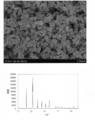
- FIG. 2 is an SEM photograph and an X-ray diffraction diagram of a fired product of Example 1.
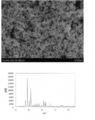
- FIG. 2 is an SEM photograph and X-ray diffraction diagram of a fired product of Example 2.
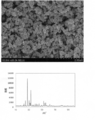
- FIG. 2 is an SEM photograph and X-ray diffraction diagram of a fired product of Example 3.
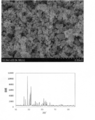
- FIG. It is the SEM photograph and X-ray diffraction diagram of the baked product of Example 4.
- FIG. 6 is an SEM photograph and an X-ray diffraction diagram of a fired product of Example 5.
- 2 is an SEM photograph and an X-ray diffraction diagram of a fired product of Comparative Example 1.
- FIG. 5 is an SEM photograph and an X-ray diffraction diagram of a fired product of Comparative Example 2.
- FIG. 6 is an SEM photograph and an X-ray diffraction diagram of a fired product of Comparative Example 3.
- FIG. 6 is an SEM photograph and an X-ray diffraction diagram of a fired product of Comparative Example 4.
- FIG. 6 is an SEM photograph and an X-ray diffraction diagram of a fired product of Comparative Example 5.
- FIG. It is a SEM photograph and X-ray diffraction pattern of the fired product of Comparative Example 6.
- It is a SEM photograph and X-ray diffraction pattern of the fired product of Comparative Example 7.
- FIG. 9 is an SEM photograph and an X-ray diffraction diagram of a fired product of Comparative Example 8.
- the method for producing bismuth iron oxide of the present invention is a method for producing bismuth iron oxide represented by BiFeO 3 , Wet pulverization carbonate powder and iron compound powder in the presence of an aqueous dispersion medium and media, wet pulverization and mixing, to obtain a raw material pulverized mixed powder;
- Method for producing a bismuth iron oxide of the present invention is a method for producing a bismuth iron oxide represented by BiFeO 3, it has a wet grinding step, and a baking step.
- the wet pulverization step according to the method for producing bismuth iron oxide of the present invention uses a media mill such as a bead mill or a ball mill to wet pulverize bismuth carbonate powder and iron compound powder in the presence of an aqueous dispersion medium and media. Then, these production raw materials are finely pulverized, and these production raw materials are uniformly mixed to obtain a raw material pulverized mixed powder in which bismuth carbonate and an iron compound are refined and uniformly mixed. is there.
- a media mill such as a bead mill or a ball mill to wet pulverize bismuth carbonate powder and iron compound powder in the presence of an aqueous dispersion medium and media.
- the raw materials to be wet pulverized and mixed in the wet pulverization step are bismuth carbonate powder and iron compound powder. Since the bismuth carbonate powder and iron compound powder used as raw materials for the wet pulverization process are both refined in the wet pulverization process, the particle size of the bismuth carbonate powder and iron compound powder used as raw materials for the wet pulverization process are particularly Not limited. Moreover, the purity of the bismuth subcarbonate powder and iron compound powder used as the raw material for the wet pulverization step is not particularly limited, but higher purity is more preferable.
- iron compound examples include iron (III) oxide hydroxide (FeOOH) or iron (III) oxide (Fe 2 O 3 ) from the viewpoints of good reactivity, ease of composition management, economy, safety, and the like. preferable.
- raw material bismuth carbonate powder and iron compound powder are mixed in an aqueous dispersion medium in a media mill, and the raw material bismuth carbonate powder and iron compound powder are dispersed in an aqueous dispersion medium.
- the raw material bismuth carbonate powder and the iron compound powder are mixed with the aqueous dispersion medium outside the media mill and stirred, and the raw material bismuth carbonate powder is prepared in advance.
- the raw material slurry in which the iron compound powder and the iron compound powder are dispersed in the aqueous dispersion medium is formed, and the obtained raw material slurry is put into a media mill, and wet pulverization and mixing are performed.
- the ratio of the amount of the raw material bismuth carbonate powder mixed with the aqueous dispersion medium and the amount of the iron compound powder is converted into an atomic conversion molar ratio, and the molar ratio of bismuth to iron (bismuth / iron) is 0.980.
- the ratio is ⁇ 1.020, preferably 0.990 to 1.010.
- the mixing ratio of the raw material secondary bismuth carbonate powder and the iron compound powder to the aqueous dispersion medium is such that the total content of the secondary bismuth carbonate powder and the iron compound powder in the raw material slurry is 5 to 70% by mass, preferably 10 to 50%. It is the amount that becomes mass%.
- the total content of the bismuth carbonate powder and the iron compound powder in the raw material slurry is in the above range, the production efficiency and the wet grinding efficiency are increased, which is preferable in terms of good handling.
- Dispersants include polymer-type polycarboxylic acid, naphthalene sulfonic acid formalin condensation, polyethylene glycol, polycarboxylic acid partial alkyl ester, polyether, polyalkylene polyamine, etc., surfactant type Alkyl sulfonic acid type, quaternary ammonium type, higher alcohol alkylene oxide type, polyhydric alcohol ester type, alkyl polyamine type dispersant, inorganic polyphosphate type dispersant, etc.
- agent examples include silicone-based oil types, solution types, oil compound types, emulsion types, self-emulsifying types, organic polyethers, higher alcohols, and the like.
- the additive component it is necessary for the additive component to these arbitrary raw material slurries not to contain a metal element in the structure.
- wet pulverization and mixing of the bismuth carbonate powder and the iron compound powder are performed using a media mill.
- the media mill include a bead mill and a ball mill.
- a bead mill is preferable in terms of high productivity and high selectivity of corresponding media.
- yttria-stabilized zirconia balls or beads are preferable because they have high impact resistance and less contamination.
- the diameter of the yttria-stabilized zirconia bead is preferably 0.05 to 1 mm ⁇ .
- the yttria-stabilized zirconia beads used in the wet pulverization step are not limited to one type, and the diameter of the beads may be changed during the wet pulverization.
- the operation method of the media mill may be a pass method, a circulation method, or a combination thereof.
- the specific surface area of the raw material grinding and mixing powder it is preferable to ground to a 10 m 2 / g or more, and particularly preferably ground to a 15 m 2 / g or more.
- the specific surface area of the raw material pulverized mixed powder is in the above range, it becomes a raw material pulverized mixed powder having high reactivity and homogeneity. Therefore, after the firing step, the high-purity BiFeO 3 has no foreign phase or very little foreign phase.
- the bismuth iron oxide represented is obtained.
- the wet pulverization and mixing are temporarily interrupted, and a part of the raw material pulverization mixed intermediate is collected.
- the collected material is analyzed by the fluorescent X-ray method to obtain the molar ratio (Bi / Fe) of bismuth and iron in the collected material, and from the obtained molar ratio of bismuth and iron, The amount of additional secondary bismuth carbonate or the amount of additional iron compound required to make the molar ratio of iron and iron 1.000 is calculated, and then the amount of additional secondary bismuth carbonate or the amount of iron compound powder of the additional iron compound.
- the raw material pulverized mixed powder obtained by performing the wet pulverization step is dried to obtain a calcination raw material in the calcination step.
- the method for drying the raw material pulverized mixed powder is not particularly limited. For example, a method in which the raw material slurry after the wet pulverization step is transferred to a vat and the like and dried at 100 to 150 ° C. in a drier for a whole amount, slurry And the like, and the filter cake is allowed to stand still at 100 to 150 ° C. in a dryer, and the slurry is continuously dried at 100 to 150 ° C. through a spray dryer.
- the firing step according to the method for producing bismuth iron oxide of the present invention is a step of obtaining a bismuth iron oxide represented by BiFeO 3 by firing the raw material pulverized mixed powder obtained by performing the wet pulverization step. .
- the firing temperature in the firing step is 450 to 700 ° C., preferably 500 to 650 ° C.
- a bismuth iron oxide represented by BiFeO 3 having high crystallinity and few impurity peaks such as Bi 2 Fe 4 O 9 and Bi 2 O 3 in X-ray diffraction is obtained. It is done.
- the calcination time is appropriately selected, but it is preferably 3 hours or more, particularly preferably 5 to 30 hours in that a bismuth iron oxide represented by BiFeO 3 having a uniform main phase ratio with a uniform particle size can be obtained. is there.
- the firing atmosphere is not particularly limited, and may be either an air atmosphere or an oxygen atmosphere.
- firing may be performed a plurality of times.
- the raw material pulverized mixed powder may be fired once, and then the fired product may be cooled and ground, and then the fired product may be fired again.
- the fired product is appropriately cooled and, if necessary, pulverized, crushed, classified, etc., to obtain a bismuth iron oxide represented by BiFeO 3 .
- the bismuth iron oxide obtained by carrying out the bismuth iron oxide production method of the present invention is a bismuth iron oxide represented by BiFeO 3 , and Bi 2 Fe 4 O 9 and Bi 25 FeO 40 are X-ray diffractometrically.
- One of the characteristics is that the material is not observed and has a high purity in terms of X-ray diffraction with less Bi 2 O 3 .
- the bismuth iron oxide represented by BiFeO 3 obtained by carrying out the method for producing bismuth iron oxide of the present invention is a piezoelectric ceramic raw material represented by the following general formula (1) as an alternative material for PZT not containing lead.
- General formula (1) xBiFeO 3- (1-x) ABO 3 (1) (In the formula, A and B are one or more metal ions, A represents a monovalent, divalent or trivalent metal ion, and B represents a trivalent, tetravalent or pentavalent metal ion.)
- ABO 3 is preferably a perovskite-type ceramic or a ceramic having a structure close thereto.
- Preferred examples of the perovskite-type ceramic include BaTiO 3 , SrTiO 3 , CaTiO 3 , BaZrO 3 , SrZrO 3 , and CaZrO.
- Example 1 A 700 mL nylon pot is charged with 1 mm ⁇ ZrO 2 balls, and 37.1 g of bismuth carbonate (manufactured by Nippon Kagaku Sangyo) and 13.1 g of iron oxide hydroxide (III) (titanium industry) are weighed and charged. Subsequently, 120 g of pure water, 2.0 g of a dispersant (San Nopco SN5468) and 0.4 g of an antifoaming agent (San Nopco SN deformer) were charged. Next, the nylon pot was sealed, and wet pulverization and mixing were performed at a rotational speed of 120 rpm for 96 hours.
- a dispersant San Nopco SN5468
- an antifoaming agent San Nopco SN deformer
- the obtained slurry was transferred to a vat and dried at 120 ° C. for 24 hours to obtain a raw material pulverized mixed powder.
- the specific surface area of the raw material pulverized mixed powder was 18.03 m 2 / g.
- the molar ratio of bismuth to iron (Bi / Fe) was 1.002.
- the raw material pulverized mixed powder was fired at 550 ° C. for 7 hours in an air atmosphere to obtain a fired product.
- the obtained fired product was observed by SEM.
- the SEM image is shown in FIG.
- the obtained baked product was analyzed.
- the analysis results are shown in Table 1. Further XRD analysis was performed. The characteristics are shown in Table 2.
- An X-ray diffraction diagram is shown in FIG.
- Example 2 The same method as in Example 1 was performed except that the firing temperature was 600 ° C. An SEM image of the obtained fired product is shown in FIG. Moreover, the obtained baked product was analyzed. The analysis results are shown in Table 1. Further XRD analysis was performed. The characteristics are shown in Table 2. An X-ray diffraction diagram is shown in FIG.
- Example 3 In a 700 mL nylon pot, a 1 mm ⁇ ZrO 2 ball is charged, and 37.0 g of bismuth carbonate (manufactured by Nippon Chemical Industry) and 11.5 g of iron (III) oxide (manufactured by Kanto Chemical) are weighed and then charged. 120 g of pure water, 2.0 g of a dispersant (San Nopco SN5468), and 0.4 g of an antifoaming agent (San Nopco SN deformer) were charged. Next, the nylon pot was sealed, and wet pulverization and mixing were performed at a rotational speed of 120 rpm for 96 hours.
- the obtained slurry was transferred to a vat and dried at 120 ° C. for 24 hours to obtain a raw material pulverized mixed powder.
- the specific surface area of the raw material pulverized mixed powder was 25.57 m 2 / g.
- the molar ratio (Bi / Fe) of bismuth and iron was 1.000.
- the raw material pulverized mixed powder was fired at 550 ° C. for 7 hours in an air atmosphere to obtain a fired product.
- the obtained fired product was observed by SEM.
- the SEM image is shown in FIG.
- the obtained baked product was analyzed.
- the analysis results are shown in Table 1. Further XRD analysis was performed. The characteristics are shown in Table 2.
- An X-ray diffraction diagram is shown in FIG.
- Example 4 The same method as in Example 3 was performed except that the firing temperature was 600 ° C. An SEM image of the obtained fired product is shown in FIG. Moreover, the obtained baked product was analyzed. The analysis results are shown in Table 1. Further XRD analysis was performed. The characteristics are shown in Table 2. An X-ray diffraction diagram is shown in FIG.
- Example 5 In a 20 L stainless steel container, 9500 g of pure water and a dispersant (San Nopco's SN5468) were charged, and 3511 g of bismuth carbonate (made by Nippon Chemical Industry Co., Ltd.) and iron oxide hydroxide (III) (made by Titanium Industry) while stirring with a stirrer. A slurry was prepared by charging 1225 g and stirred for 1 hour or longer.
- the obtained slurry was passed through a bead mill (LMZ-2 manufactured by Ashizawa Finetech Co., Ltd.) filled with 0.5 mm ⁇ zirconia beads at a volume ratio of 85% at a peripheral speed of 10 m / sec and a flow rate of 300 mL / min. (1 pass) was received in a 20 L stainless steel container. After sufficiently stirring this treated slurry (1 pass), a small amount was sampled to obtain a dry sample, subjected to intense heat treatment, and then the molar ratio of bismuth to iron (bismuth / iron) was determined by fluorescent X-ray method. 997. From this result, the amount of additional secondary bismuth carbonate powder was calculated to be 9.2 g.
- LMZ-2 manufactured by Ashizawa Finetech Co., Ltd.
- the mixture was again passed through the bead mill under the same conditions (2 passes).
- the treated slurry (2 passes) was received in a 20 L stainless steel container. Sampling was performed in the same manner as described above, and the molar ratio of bismuth to iron (bismuth / iron) was determined by the fluorescent X-ray method and found to be 1.000.
- the bead mill pass is further repeated three times to obtain a treated slurry (5 passes).
- the treated slurry (5 passes) is solid-liquid separated and dried, further crushed, and the raw material pulverized mixed powder (5 passes) Got.
- the specific surface area of the obtained raw material pulverized mixed powder (5 passes) was 17.86 m 2 / g.
- the raw material pulverized mixed powder (5 passes) was fired at 535 ° C. for 15 hours to obtain a fired product.
- the obtained fired product was observed by SEM.
- the SEM image is shown in FIG.
- the obtained baked product was analyzed.
- the analysis results are shown in Table 1. Further XRD analysis was performed. The characteristics are shown in Table 2.
- An X-ray diffraction diagram is shown in FIG.
- Comparative Examples 1 to 4 It carried out like Example 1 except having replaced with the raw material combination of the bismuth compound and iron compound which are shown in Table 3 instead of the bismuth carbonate powder as a raw material.
- the SEM images of the fired products obtained are shown in FIG. 6 for Comparative Example 1, FIG. 7 for Comparative Example 2, FIG. 8 for Comparative Example 3, and FIG.
- the analysis results are shown in Table 1. Further XRD analysis was performed. The characteristics are shown in Table 2.
- the X-ray diffraction pattern is shown in FIG. 6 for Comparative Example 1, FIG. 7 for Comparative Example 2, FIG. 8 for Comparative Example 3, and FIG. 9 for Comparative Example 4.
Landscapes
- Chemical & Material Sciences (AREA)
- Organic Chemistry (AREA)
- Inorganic Chemistry (AREA)
- Inorganic Compounds Of Heavy Metals (AREA)
- Compounds Of Iron (AREA)
- Catalysts (AREA)
Abstract
工業的に有利な方法で、不純物含有量が少ないBiFeO3で表されるビスマス鉄酸化物の製造方法であって、次炭酸ビスマス粉末及び鉄化合物粉末を、水分散媒及びメディアの存在下で、湿式粉砕及び混合して、原料粉砕混合粉末を得る湿式粉砕工程と、該原料粉砕混合粉末を焼成原料として、450~700℃で焼成することにより、BiFeO3で表されるビスマス鉄酸化物を得る焼成工程と、を有することを特徴とするビスマス鉄酸化物の製造方法。
Description
本発明は、誘電体セラミックス、圧電セラミックス及びその原料として有用なビスマス鉄酸化物の製造方法に関する。
Pb(Zr,Ti)O3(以下、「PZT」という)は、優れた圧電特性を示す材料として知られているが、地球環境問題の観点から強誘電体とする機能性材料では、鉛を含む材料の使用が厳しく制限されつつある。現在、鉛を含まないPZTの代替材料として、BiFeO3およびそれを用いた固溶体が注目されている。
BiFeO3の製造方法としては、例えば、下記特許文献1には、酸化ビスマス及び酸化鉄を乾式混合し、焼成する固相法が提案されている。また、下記特許文献2には硝酸鉄及び硝酸ビスマスを硝酸水溶液に溶解した溶液に、炭酸水素アンモニウムとアンモニア水を添加してビスマス鉄複合酸化物を得、次いで、ビスマス鉄複合酸化物を非イオン性高分子凝集剤で凝集させて凝集物を得、次いで、該凝集物を400℃以上650℃以下で焼成する方法が提案されている。
しかしながら、BiFeO3は、Biの揮発性が高いことから、焼成中にBiが揮発し、組成がずれて不純物が生成しやすく、不純物含有量の少ない高純なものを製造することが難しいことが知られている。
このため、例えば、非特許文献1には、不純物が少ないBiFeO3の製造方法として、化学両論組成よりも過剰のBi2O3を加えて焼成し、不純物と未反応のBi2O3を硝酸で溶かして取り除く方法が提案されている。
Journal of American Ceramic Society,Vol.50,p437(1967)
ところが、非特許文献1に開示されている製造方法では、工程が煩雑になり工業的に有利な方法とは言い難い。
従って、本発明の目的は、工業的に有利な方法で、不純物含有量が少ないBiFeO3で表されるビスマス鉄酸化物を製造する方法を提供することにある。
本発明者らは、上記実情に鑑み鋭意研究を重ねた結果、次炭酸ビスマス粉末及び鉄化合物粉末を、水分散媒及びメディアの存在下で、湿式粉砕及び混合して、原料粉砕混合粉末を得、得られる原料粉砕混合粉末を、450~700℃で焼成することにより、X線回折的に不純物含有量が少ないBiFeO3で表されるビスマス鉄酸化物が得られることを見出し、本発明を完成させた。
すなわち、本発明は、BiFeO3で表されるビスマス鉄酸化物の製造方法であって、
次炭酸ビスマス粉末及び鉄化合物粉末を、水分散媒及びメディアの存在下で、湿式粉砕及び混合して、原料粉砕混合粉末を得る湿式粉砕工程と、
該原料粉砕混合粉末を焼成原料として、450~700℃で焼成することにより、BiFeO3で表されるビスマス鉄酸化物を得る焼成工程と、
を有することを特徴とするビスマス鉄酸化物の製造方法を提供するものである。
次炭酸ビスマス粉末及び鉄化合物粉末を、水分散媒及びメディアの存在下で、湿式粉砕及び混合して、原料粉砕混合粉末を得る湿式粉砕工程と、
該原料粉砕混合粉末を焼成原料として、450~700℃で焼成することにより、BiFeO3で表されるビスマス鉄酸化物を得る焼成工程と、
を有することを特徴とするビスマス鉄酸化物の製造方法を提供するものである。
本発明によれば、工業的に有利な方法で、不純物含有量が少ないBiFeO3で表されるビスマス鉄酸化物を製造する方法を提供することができる。
本発明のビスマス鉄酸化物の製造方法は、BiFeO3で表されるビスマス鉄酸化物の製造方法であって、
次炭酸ビスマス粉末及び鉄化合物粉末を、水分散媒及びメディアの存在下で、湿式粉砕及び混合して、原料粉砕混合粉末を得る湿式粉砕工程と、
該原料粉砕混合粉末を焼成原料として、450~700℃で焼成することにより、BiFeO3で表されるビスマス鉄酸化物を得る焼成工程と、
を有することを特徴とするビスマス鉄酸化物の製造方法である。
次炭酸ビスマス粉末及び鉄化合物粉末を、水分散媒及びメディアの存在下で、湿式粉砕及び混合して、原料粉砕混合粉末を得る湿式粉砕工程と、
該原料粉砕混合粉末を焼成原料として、450~700℃で焼成することにより、BiFeO3で表されるビスマス鉄酸化物を得る焼成工程と、
を有することを特徴とするビスマス鉄酸化物の製造方法である。
本発明のビスマス鉄酸化物の製造方法は、BiFeO3で表されるビスマス鉄酸化物の製造方法であって、湿式粉砕工程と、焼成工程と、を有する。
本発明のビスマス鉄酸化物の製造方法に係る湿式粉砕工程は、ビーズミル、ボールミル等のメディアミルを用いて、水分散媒及びメディアの存在下で、次炭酸ビスマス粉末及び鉄化合物粉末を、湿式粉砕して、これらの製造原料を微細に粉砕すると共に、これらの製造原料を均一に混合して、次炭酸ビスマスと鉄化合物が微細化され且つ均一に混合されている原料粉砕混合粉末を得る工程である。
湿式粉砕工程において湿式粉砕及び混合される原料は、次炭酸ビスマス粉末及び鉄化合物粉末である。湿式粉砕工程の原料となる次炭酸ビスマス粉末及び鉄化合物粉末は、いずれも、湿式粉砕工程で微細化されるため、湿式粉砕工程の原料となる次炭酸ビスマス粉末及び鉄化合物粉末の粒径は特に制限されない。また、湿式粉砕工程の原料となる次炭酸ビスマス粉末及び鉄化合物粉末の純度は、特に制限されないが、高純度なものほど好ましい。
前記鉄化合物としては、良好な反応性、組成管理の容易性、経済性、安全性等の観点から、酸化水酸化鉄(III)(FeOOH)又は酸化鉄(III)(Fe2O3)が好ましい。
湿式粉砕工程では、メディアミル内で、原料の次炭酸ビスマス粉末及び鉄化合物粉末を、水分散媒に混合し、原料の次炭酸ビスマス粉末及び鉄化合物粉末が、水分散媒に分散された原料スラリーを形成させ、湿式粉砕及び混合を行うか、あるいは、メディアミル外で、原料の次炭酸ビスマス粉末及び鉄化合物粉末を、水分散媒に混合し、撹拌して、予め、原料の次炭酸ビスマス粉末及び鉄化合物粉末が、水分散媒に分散された原料スラリーを形成させておき、得られる原料スラリーを、メディアミル内に投入し、湿式粉砕及び混合を行う。
湿式粉砕工程において、水分散媒に混合する原料次炭酸ビスマス粉末と鉄化合物粉末の量の比は、原子換算のモル比換算で、鉄に対するビスマスのモル比(ビスマス/鉄)が、0.980~1.020、好ましくは0.990~1.010となる比である。
原料次炭酸ビスマス粉末及び鉄化合物粉末と、水分散媒の混合量の比は、原料スラリー中の次炭酸ビスマス粉末及び鉄化合物粉末の合計含有量が、5~70質量%、好ましくは10~50質量%となる量である。原料スラリー中の次炭酸ビスマス粉末及び鉄化合物粉末の合計含有量が上記範囲であることにより、製造効率及び湿式粉砕効率が高くなり、ハンドリングが良好な点で、好ましい。
原料スラリーには、原料スラリーの粘度、ハンドリング性等を調節するために、必要に応じて、分散剤、消泡剤等を添加することができる。分散剤としては、高分子型のポリカルボン酸系、ナフタレンスルホン酸ホルマリン縮合系、ポリエチレングリコール、ポリカルボン酸部分アルキルエステル系、ポリエーテル系、ポリアルキレンポリアミン系等の分散剤、界面活性剤型のアルキルスルホン酸系、四級アンモニウム系、高級アルコールアルキレンオキサイド系、多価アルコールエステル系、アルキルポリアミン系等の分散剤、無機型のポリリン酸塩系等の分散剤などが挙げられ、また、消泡剤としては、シリコーン系のオイル型、溶液型、オイルコンパウンド型、エマルジョン型、自己乳化型など、有機系のポリエーテル、高級アルコール等が挙げられる。なお、これらの任意の原料スラリーへの添加成分は、構造中に金属元素を含まないことが必要である。
湿式粉砕工程においては、次炭酸ビスマス粉末及び鉄化合物粉末の湿式粉砕及び混合を、メディアミルを用いて行う。メディアミルとしては、ビーズミル、ボールミル等が挙げられる。これらのうち、メディアミルとしては、生産性及び対応メディアの選択性が高い点で、ビーズミルが好ましい。メディアミルに用いられるメディアとしては、イットリア安定化ジルコニア性のボール又はビーズが、耐衝撃性が高く、コンタミが少なくなる点で、好ましい。イットリア安定化ジルコニア性のビーズの径は、好ましくは0.05~1mmφである。また、湿式粉砕工程において、使用するイットリア安定化ジルコニア製のビーズは、1種類に限定されるものでなく、湿式粉砕の状況に応じて、途中でビーズの径を切り替えてもよい。
湿式粉砕工程において、メディアミルの運転方法としては、パス方式であっても循環方式であってもよく、これらの組み合わせであってもよい。
湿式粉砕工程では、原料粉砕混合粉末の比表面積が、10m2/g以上となるまで粉砕することが好ましく、15m2/g以上となるまで粉砕することが特に好ましい。原料粉砕混合粉末の比表面積が上記範囲にあることにより、反応性、均質性が高い原料粉砕混合粉末となるので、焼成工程を経て、異相がない又は異相が非常に少ない高純度のBiFeO3で表されるビスマス鉄酸化物が得られる。
湿式粉砕工程の変形形態(以下、湿式粉砕工程の第一の変形形態とも記載する。)として、湿式粉砕工程において、湿式粉砕及び混合を途中で一旦中断し、原料粉砕混合中間物を一部採取し、採取物を蛍光X線法により分析して、該採取物中のビスマスと鉄のモル比(Bi/Fe)を求め、求めたビスマスと鉄のモル比から、原料粉砕混合中間物のビスマスと鉄のモル比を1.000にするために必要な追加次炭酸ビスマス量又は追加鉄化合物量を算出し、次いで、追加次炭酸ビスマス量の次炭酸ビスマス粉末又は追加鉄化合物量の鉄化合物粉末を、原料粉砕混合中間物に混合し、湿式粉砕及び混合を再開して、原料粉砕混合粉末を得る形態が挙げられる。反応スケールが大きくなるほど、原料の重量に対する水分などの不純成分の影響が大きくなるため、湿式粉砕工程を行い得られる原料粉砕混合粉末のビスマスと鉄のモル比がずれ易くなる。そのため、反応スケールが大きい場合に、湿式粉砕工程として、このような湿式粉砕工程の第一の変形形態を採用することが、焼成工程を経て、異相がない又は異相が非常に少ない高純度のBiFeO3で表されるビスマス鉄酸化物が得られる点で、好ましい。
湿式粉砕工程を行った後、湿式粉砕工程を行い得られる原料粉砕混合粉末を、乾燥して、焼成工程の焼成原料とする。原料粉砕混合粉末を乾燥する方法としては、特に制限されず、例えば、湿式粉砕工程後の原料スラリーを、バット等に移し、乾燥機中で、100~150℃で静置全量乾燥する方法、スラリーを固液分離し、濾過ケーキを乾燥機中で、100~150℃で静置乾燥する方法、スラリーをスプレードライヤーに通じて100~150℃で連続乾燥する方法等が挙げられる。
本発明のビスマス鉄酸化物の製造方法に係る焼成工程は、湿式粉砕工程を行い得られた原料粉砕混合粉末を、焼成することにより、BiFeO3で表されるビスマス鉄酸化物を得る工程である。
焼成工程における焼成温度は、450~700℃、好ましくは500~650℃である。焼成温度が上記範囲であることにより、結晶性が高く、X線回折的にBi2Fe4O9やBi2O3等の不純物のピークが少ないBiFeO3で表されるビスマス鉄酸化物が得られる。焼成時間は、適宜選択されるが、粒径の揃った主相率の高いBiFeO3で表されるビスマス鉄酸化物が得られる点で、好ましくは3時間以上、特に好ましくは5~30時間である。焼成雰囲気は、特に制限されず、大気雰囲気又は酸素雰囲気のいずれでもよい。
焼成工程では、焼成を複数回行ってもよい。例えば、1回原料粉砕混合粉末の焼成を行い、次いで、焼成物を冷却及び粉砕後、再び焼成物の粉砕物を焼成してもよい。
焼成工程を行った後、焼成物を適宜冷却し、必要に応じて、粉砕、解砕、分級等を行い、BiFeO3で表されるビスマス鉄酸化物を得る。
本発明のビスマス鉄酸化物の製造方法を行い得られるビスマス鉄酸化物は、BiFeO3で表されるビスマス鉄酸化物であり、Bi2Fe4O9及びBi25FeO40がX線回折的に観測されず、更にBi2O3が少ないX線回折的に高純度なものであることが特徴の一つである。
本発明のビスマス鉄酸化物の製造方法を行い得られるBiFeO3で表されるビスマス鉄酸化物は、鉛を含まないPZTの代替材料として、下記一般式(1)で表される圧電セラミックの原料として用いられる。
一般式(1):
xBiFeO3-(1-x)ABO3 (1)
(式中、A及びBは一種または複数の金属イオンで、Aは1価、2価または3価の金属イオン、Bは3価、4価または5価の金属イオンを表す。)
一般式(1):
xBiFeO3-(1-x)ABO3 (1)
(式中、A及びBは一種または複数の金属イオンで、Aは1価、2価または3価の金属イオン、Bは3価、4価または5価の金属イオンを表す。)
一般式(1)において、ABO3は、ペロブスカイト型、もしくはそれに近い構造のセラミックが好ましく、該ペロブスカイト型のセラミックの好ましいものとしては、BaTiO3、SrTiO3、CaTiO3、BaZrO3、SrZrO3、CaZrO3、KNbO3、NaNbO3、LiNbO3、KTaO3、NaTaO3、LiTaO3、AgNbO3、BiCrO3、BiMnO3、BiCoO3、BiNiO3、(Bi0.5Na0.5)TiO3、(Bi0.5K0.5)TiO3、Bi(Zn0.5Ti0.5)O3、Bi(Mg0.5Ti0.5)O3、Bi(Ni0.5Ti0.5)O3等が挙げられ、これらは2種以上の混合系であってもよい。
以下、本発明を実施例により説明するが、本発明はこれらの実施例に限定されるものではない。
(実施例1)
700mL容積のナイロン製ポットに、1mmφのZrO2製ボールを仕込み、次炭酸ビスマス(日本化学産業製)37.1g、酸化水酸化鉄(III)(チタン工業製)13.1gを秤量して仕込み、次いで、純水を120g、分散剤(サンノプコ製 SN5468)を2.0g、消泡剤(サンノプコ製 SNデフォーマー)を0.4g仕込んだ。次いで、ナイロン製ポットを密閉して、回転速度120rpmで96時間湿式粉砕及び混合を行った。次いで、得られたスラリーをバットに移し、120℃で24時間乾燥を行い、原料粉砕混合粉末を得た。原料粉砕混合粉末の比表面積は18.03m2/gであった。また、ビスマスと鉄のモル比(Bi/Fe)は、1.002であった。
次いで、原料粉砕混合粉末を550℃で7時間、大気雰囲気で焼成し、焼成物を得た。得られた焼成物をSEM観察した。そのSEM像を図1に示す。また、得られた焼成物を分析した。その分析結果を表1に示す。更にXRD分析を行った。その特徴を表2に示す。また、X線回折図を図1に示す。
700mL容積のナイロン製ポットに、1mmφのZrO2製ボールを仕込み、次炭酸ビスマス(日本化学産業製)37.1g、酸化水酸化鉄(III)(チタン工業製)13.1gを秤量して仕込み、次いで、純水を120g、分散剤(サンノプコ製 SN5468)を2.0g、消泡剤(サンノプコ製 SNデフォーマー)を0.4g仕込んだ。次いで、ナイロン製ポットを密閉して、回転速度120rpmで96時間湿式粉砕及び混合を行った。次いで、得られたスラリーをバットに移し、120℃で24時間乾燥を行い、原料粉砕混合粉末を得た。原料粉砕混合粉末の比表面積は18.03m2/gであった。また、ビスマスと鉄のモル比(Bi/Fe)は、1.002であった。
次いで、原料粉砕混合粉末を550℃で7時間、大気雰囲気で焼成し、焼成物を得た。得られた焼成物をSEM観察した。そのSEM像を図1に示す。また、得られた焼成物を分析した。その分析結果を表1に示す。更にXRD分析を行った。その特徴を表2に示す。また、X線回折図を図1に示す。
(実施例2)
焼成温度を600℃としたこと以外は実施例1と同じ方法で行った。得られた焼成物のSEM像を図2に示す。また、得られた焼成物を分析した。その分析結果を表1に示す。更にXRD分析を行った。その特徴を表2に示す。また、X線回折図を図2に示す。
焼成温度を600℃としたこと以外は実施例1と同じ方法で行った。得られた焼成物のSEM像を図2に示す。また、得られた焼成物を分析した。その分析結果を表1に示す。更にXRD分析を行った。その特徴を表2に示す。また、X線回折図を図2に示す。
(実施例3)
700mL容積のナイロン製ポットに、1mmφのZrO2製ボールを仕込み、次炭酸ビスマス(日本化学産業製)37.0g、酸化鉄(III)(関東化学製)11.5gを秤量して仕込み、次いで、純水を120g、分散剤(サンノプコ製 SN5468)を2.0g、消泡剤(サンノプコ製 SNデフォーマー)を0.4g仕込んだ。次いで、ナイロン製ポットを密閉して、回転速度120rpmで96時間湿式粉砕及び混合を行った。次いで、得られたスラリーをバットに移し、120℃で24時間乾燥を行い、原料粉砕混合粉末を得た。原料粉砕混合粉末の比表面積は25.57m2/gであった。また、ビスマスと鉄のモル比(Bi/Fe)は、1.000であった。
次いで、原料粉砕混合粉末を550℃で7時間、大気雰囲気で焼成し、焼成物を得た。得られた焼成物をSEM観察した。そのSEM像を図3に示す。また、得られた焼成物を分析した。その分析結果を表1に示す。更にXRD分析を行った。その特徴を表2に示す。また、X線回折図を図3に示す。
700mL容積のナイロン製ポットに、1mmφのZrO2製ボールを仕込み、次炭酸ビスマス(日本化学産業製)37.0g、酸化鉄(III)(関東化学製)11.5gを秤量して仕込み、次いで、純水を120g、分散剤(サンノプコ製 SN5468)を2.0g、消泡剤(サンノプコ製 SNデフォーマー)を0.4g仕込んだ。次いで、ナイロン製ポットを密閉して、回転速度120rpmで96時間湿式粉砕及び混合を行った。次いで、得られたスラリーをバットに移し、120℃で24時間乾燥を行い、原料粉砕混合粉末を得た。原料粉砕混合粉末の比表面積は25.57m2/gであった。また、ビスマスと鉄のモル比(Bi/Fe)は、1.000であった。
次いで、原料粉砕混合粉末を550℃で7時間、大気雰囲気で焼成し、焼成物を得た。得られた焼成物をSEM観察した。そのSEM像を図3に示す。また、得られた焼成物を分析した。その分析結果を表1に示す。更にXRD分析を行った。その特徴を表2に示す。また、X線回折図を図3に示す。
(実施例4)
焼成温度を600℃としたこと以外は実施例3と同じ方法で行った。得られた焼成物のSEM像を図4に示す。また、得られた焼成物を分析した。その分析結果を表1に示す。更にXRD分析を行った。その特徴を表2に示す。また、X線回折図を図4に示す。
焼成温度を600℃としたこと以外は実施例3と同じ方法で行った。得られた焼成物のSEM像を図4に示す。また、得られた焼成物を分析した。その分析結果を表1に示す。更にXRD分析を行った。その特徴を表2に示す。また、X線回折図を図4に示す。
(実施例5)
20Lのステンレス製容器に、純水9500g及び分散剤(サンノプコ製 SN5468)を仕込み、撹拌機で撹拌しながら次炭酸ビスマス(日本化学産業製)3511g、酸化水酸化鉄(III)(チタン工業製)1225gを仕込んでスラリーを調製し、1時間以上撹拌した。次いで、得られたスラリーを0.5mmφのジルコニアビーズを容積率で85%充填したビーズミル(アシザワファインテック製 LMZ-2)に、周速10m/秒、流量300mL/分で通過させて、処理スラリー(1パス)を、20Lのステンレス製容器に受けた。この処理スラリー(1パス)を十分に撹拌した後、少量をサンプリングして乾燥試料とし、強熱処理した後、蛍光X線法によりビスマスと鉄のモル比(ビスマス/鉄)を求めたところ0.997であった。この結果より、追加次炭酸ビスマス粉末量は、9.2gと算出された。
次いで、処理スラリー(1パス)に対して、最初の仕込みで用いた次炭酸ビスマス粉末を9.2g添加して更に十分撹拌した後、再度同条件のもとビーズミルを通過させ(2パス)、処理スラリー(2パス)を、20Lのステンレス製容器に受けた。前述と同様にサンプリングして、蛍光X線法によりビスマスと鉄のモル比(ビスマス/鉄)を求めたところ1.000であった。
次いで、更にビーズミルのパスを3回繰り返し、処理スラリー(5パス)を得、該処理スラリー(5パス)を、固液分離及び乾燥し、更に解砕を行い、原料粉砕混合粉末(5パス)を得た。得られた原料粉砕混合粉末(5パス)の比表面積は17.86m2/gであった。
次いで、原料粉砕混合粉末(5パス)を、535℃で15時間焼成して、焼成物を得た。得られた焼成物をSEM観察した。そのSEM像を図5に示す。また、得られた焼成物を分析した。その分析結果を表1に示す。更にXRD分析を行った。その特徴を表2に示す。また、X線回折図を図5に示す。
20Lのステンレス製容器に、純水9500g及び分散剤(サンノプコ製 SN5468)を仕込み、撹拌機で撹拌しながら次炭酸ビスマス(日本化学産業製)3511g、酸化水酸化鉄(III)(チタン工業製)1225gを仕込んでスラリーを調製し、1時間以上撹拌した。次いで、得られたスラリーを0.5mmφのジルコニアビーズを容積率で85%充填したビーズミル(アシザワファインテック製 LMZ-2)に、周速10m/秒、流量300mL/分で通過させて、処理スラリー(1パス)を、20Lのステンレス製容器に受けた。この処理スラリー(1パス)を十分に撹拌した後、少量をサンプリングして乾燥試料とし、強熱処理した後、蛍光X線法によりビスマスと鉄のモル比(ビスマス/鉄)を求めたところ0.997であった。この結果より、追加次炭酸ビスマス粉末量は、9.2gと算出された。
次いで、処理スラリー(1パス)に対して、最初の仕込みで用いた次炭酸ビスマス粉末を9.2g添加して更に十分撹拌した後、再度同条件のもとビーズミルを通過させ(2パス)、処理スラリー(2パス)を、20Lのステンレス製容器に受けた。前述と同様にサンプリングして、蛍光X線法によりビスマスと鉄のモル比(ビスマス/鉄)を求めたところ1.000であった。
次いで、更にビーズミルのパスを3回繰り返し、処理スラリー(5パス)を得、該処理スラリー(5パス)を、固液分離及び乾燥し、更に解砕を行い、原料粉砕混合粉末(5パス)を得た。得られた原料粉砕混合粉末(5パス)の比表面積は17.86m2/gであった。
次いで、原料粉砕混合粉末(5パス)を、535℃で15時間焼成して、焼成物を得た。得られた焼成物をSEM観察した。そのSEM像を図5に示す。また、得られた焼成物を分析した。その分析結果を表1に示す。更にXRD分析を行った。その特徴を表2に示す。また、X線回折図を図5に示す。
(比較例1~4)
原料として次炭酸ビスマス粉末に代えて、表3に示すビスマス化合物と鉄化合物の原料組み合わせにすること以外は、実施例1と同様に行った。得られた焼成物のSEM像を比較例1は図6に、比較例2は図7に、比較例3は図8に、比較例4は図9に示す。また、分析結果を表1に示す。更にXRD分析を行った。その特徴を表2に示す。また、X線回折図を比較例1は図6に、比較例2は図7に、比較例3は図8に、比較例4は図9に示す。
原料として次炭酸ビスマス粉末に代えて、表3に示すビスマス化合物と鉄化合物の原料組み合わせにすること以外は、実施例1と同様に行った。得られた焼成物のSEM像を比較例1は図6に、比較例2は図7に、比較例3は図8に、比較例4は図9に示す。また、分析結果を表1に示す。更にXRD分析を行った。その特徴を表2に示す。また、X線回折図を比較例1は図6に、比較例2は図7に、比較例3は図8に、比較例4は図9に示す。
(比較例5~8)
原料として次炭酸ビスマス粉末に代えて、表3に示すビスマス化合物と鉄化合物の原料組み合わせにすること以外は、実施例2と同様に行った。得られた焼成物のSEM像を比較例5は図10に、比較例6は図11に、比較例7は図12に、比較例8は図13に示す。また、分析結果を表1に示す。更にXRD分析を行った。その特徴を表2に示す。また、X線回折図を比較例5は図10に、比較例6は図11に、比較例7は図12に、比較例8は図13に示す。
原料として次炭酸ビスマス粉末に代えて、表3に示すビスマス化合物と鉄化合物の原料組み合わせにすること以外は、実施例2と同様に行った。得られた焼成物のSEM像を比較例5は図10に、比較例6は図11に、比較例7は図12に、比較例8は図13に示す。また、分析結果を表1に示す。更にXRD分析を行った。その特徴を表2に示す。また、X線回折図を比較例5は図10に、比較例6は図11に、比較例7は図12に、比較例8は図13に示す。

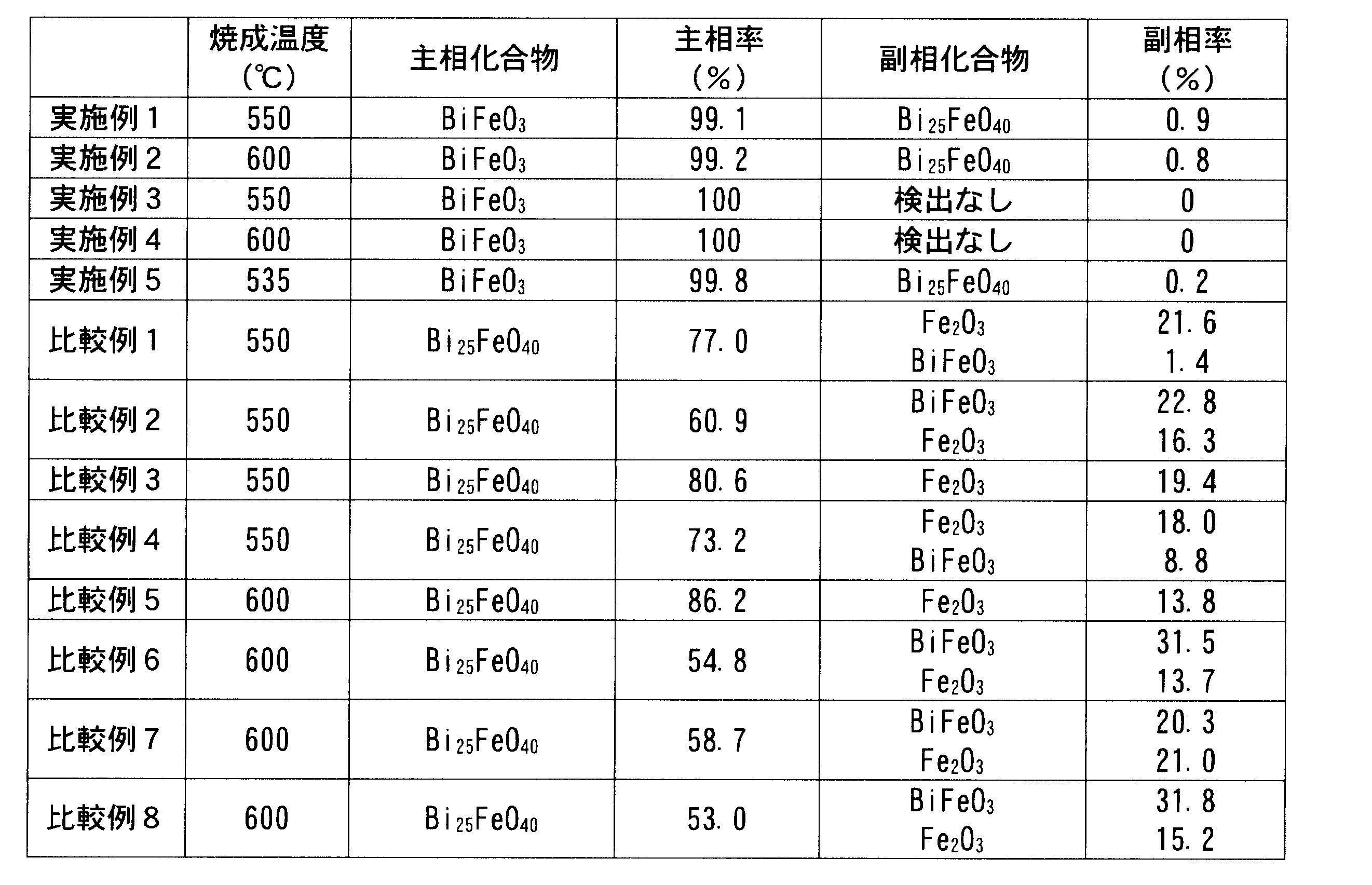

以上のように、本発明によれば、従来、難しいとされてきた固相法において、簡便且つ安定に不純物相が極めて少なく組成が制御されたビスマス鉄酸化物を製造することが可能である。
Claims (5)
- BiFeO3で表されるビスマス鉄酸化物の製造方法であって、
次炭酸ビスマス粉末及び鉄化合物粉末を、水分散媒及びメディアの存在下で、湿式粉砕及び混合して、原料粉砕混合粉末を得る湿式粉砕工程と、
該原料粉砕混合粉末を焼成原料として、450~700℃で焼成することにより、BiFeO3で表されるビスマス鉄酸化物を得る焼成工程と、
を有することを特徴とするビスマス鉄酸化物の製造方法。 - 前記鉄化合物が酸化水酸化鉄(III)又は酸化鉄(III)であることを特徴とする請求項1記載のビスマス鉄酸化物の製造方法。
- 前記湿式粉砕工程を行い得られる前記原料粉砕混合粉末の比表面積が、10m2/g以上であることを特徴とする請求項1又は2記載のビスマス鉄酸化物の製造方法。
- 前記湿式粉砕工程において、湿式粉砕及び混合を途中で一旦中断し、原料粉砕混合中間物を一部採取し、採取物を蛍光X線法により分析して、該採取物中のビスマスと鉄のモル比(Bi/Fe)を求め、求めたビスマスと鉄のモル比から、該原料粉砕混合中間物のビスマスと鉄のモル比を1.000にするために必要な追加次炭酸ビスマス量又は追加鉄化合物量を算出し、次いで、該追加次炭酸ビスマス量の次炭酸ビスマス粉末又は該追加鉄化合物量の鉄化合物粉末を、該原料粉砕混合中間物に混合し、湿式粉砕及び混合を再開して、前記原料粉砕混合粉末を得ることを特徴とする請求項1~3いずれか1項記載のビスマス鉄酸化物の製造方法。
- 前記湿式粉砕工程における湿式粉砕及び混合を、ビーズミル又はボールミルを用いて行うことを特徴とする請求項1~4いずれか1項記載のビスマス鉄酸化物の製造方法。
Priority Applications (2)
| Application Number | Priority Date | Filing Date | Title |
|---|---|---|---|
| KR1020197015068A KR102492961B1 (ko) | 2016-11-17 | 2017-11-15 | 비스무트 철 산화물의 제조 방법 |
| CN201780070274.XA CN109982972B (zh) | 2016-11-17 | 2017-11-15 | 铋铁氧化物的制造方法 |
Applications Claiming Priority (2)
| Application Number | Priority Date | Filing Date | Title |
|---|---|---|---|
| JP2016224147A JP6806538B2 (ja) | 2016-11-17 | 2016-11-17 | ビスマス鉄酸化物の製造方法 |
| JP2016-224147 | 2016-11-17 |
Publications (1)
| Publication Number | Publication Date |
|---|---|
| WO2018092796A1 true WO2018092796A1 (ja) | 2018-05-24 |
Family
ID=62146447
Family Applications (1)
| Application Number | Title | Priority Date | Filing Date |
|---|---|---|---|
| PCT/JP2017/041060 Ceased WO2018092796A1 (ja) | 2016-11-17 | 2017-11-15 | ビスマス鉄酸化物の製造方法 |
Country Status (4)
| Country | Link |
|---|---|
| JP (1) | JP6806538B2 (ja) |
| KR (1) | KR102492961B1 (ja) |
| CN (1) | CN109982972B (ja) |
| WO (1) | WO2018092796A1 (ja) |
Cited By (1)
| Publication number | Priority date | Publication date | Assignee | Title |
|---|---|---|---|---|
| CN111410237A (zh) * | 2020-05-09 | 2020-07-14 | 中南林业科技大学 | 一种废弃污染生物质资源化利用的方法 |
Citations (3)
| Publication number | Priority date | Publication date | Assignee | Title |
|---|---|---|---|---|
| JPH03257004A (ja) * | 1990-03-06 | 1991-11-15 | Nissan Motor Co Ltd | 部分クエン酸塩法による複合酸化物の合成方法 |
| CN104556238A (zh) * | 2014-12-19 | 2015-04-29 | 上海师范大学 | 一种纯相铁酸铋粉末和块体的制备方法 |
| CN105772051A (zh) * | 2016-04-18 | 2016-07-20 | 河南师范大学 | 一种Bi2O2CO3-BiFeO3复合光催化剂及其制备方法 |
Family Cites Families (9)
| Publication number | Priority date | Publication date | Assignee | Title |
|---|---|---|---|---|
| JPS62234549A (ja) * | 1986-03-24 | 1987-10-14 | Mitsubishi Petrochem Co Ltd | 複合酸化物触媒の製造法 |
| US4896333A (en) * | 1987-08-04 | 1990-01-23 | Signetics Corporation | Circuit for generating a trapezoidal current waveform with matched rise and fall times |
| JP5557572B2 (ja) | 2009-03-31 | 2014-07-23 | キヤノン株式会社 | セラミクス、圧電素子および圧電素子の製造方法 |
| CN101671173A (zh) * | 2009-09-27 | 2010-03-17 | 哈尔滨工业大学 | 一种提高BiFeO3陶瓷块体材料多铁性能的方法 |
| JP5885931B2 (ja) * | 2010-03-15 | 2016-03-16 | キヤノン株式会社 | ビスマス鉄酸化物粉体、その製造方法、誘電体セラミックス、圧電素子、液体吐出ヘッドおよび超音波モータ |
| CN102817067B (zh) * | 2012-08-30 | 2015-08-19 | 安徽理工大学 | 一种熔盐法制备斜方六面体单晶铁酸铋粉体的方法 |
| CN104108753A (zh) * | 2013-04-22 | 2014-10-22 | 海南师范大学 | 一种可见光响应的BiVO4催化剂的制备 |
| TW201613840A (en) * | 2014-10-01 | 2016-04-16 | Thintech Materials Technology Co Ltd | Manufacturing method for ceramic target of bismuth ferrite |
| CN104961162B (zh) * | 2015-06-30 | 2017-03-08 | 电子科技大学 | 一种基于离子补偿制备单一纯相铁酸铋材料的方法 |
-
2016
- 2016-11-17 JP JP2016224147A patent/JP6806538B2/ja active Active
-
2017
- 2017-11-15 KR KR1020197015068A patent/KR102492961B1/ko active Active
- 2017-11-15 WO PCT/JP2017/041060 patent/WO2018092796A1/ja not_active Ceased
- 2017-11-15 CN CN201780070274.XA patent/CN109982972B/zh active Active
Patent Citations (3)
| Publication number | Priority date | Publication date | Assignee | Title |
|---|---|---|---|---|
| JPH03257004A (ja) * | 1990-03-06 | 1991-11-15 | Nissan Motor Co Ltd | 部分クエン酸塩法による複合酸化物の合成方法 |
| CN104556238A (zh) * | 2014-12-19 | 2015-04-29 | 上海师范大学 | 一种纯相铁酸铋粉末和块体的制备方法 |
| CN105772051A (zh) * | 2016-04-18 | 2016-07-20 | 河南师范大学 | 一种Bi2O2CO3-BiFeO3复合光催化剂及其制备方法 |
Non-Patent Citations (2)
| Title |
|---|
| J. -H. XU ET AL.: "Low-temperature synthesis of BiFe03 nanopowders via a sol-gel method", JOURNAL OF ALLOYS AND COMPOUNDS, vol. 472, 2009, pages 473 - 477, XP026001655 * |
| M. C. NAVARRO ET AL.: "Synthesis, characterization and study of products of the thermal decomposition of Bi [FexCo1-x (CN) 6] · 4H20 (0?X?1", GLOBAL JOURNAL OF INORGANIC CHEMISTRY, vol. 1, 2010, pages 7 6 - 82, XP055488649 * |
Cited By (2)
| Publication number | Priority date | Publication date | Assignee | Title |
|---|---|---|---|---|
| CN111410237A (zh) * | 2020-05-09 | 2020-07-14 | 中南林业科技大学 | 一种废弃污染生物质资源化利用的方法 |
| CN111410237B (zh) * | 2020-05-09 | 2023-07-14 | 中南林业科技大学 | 一种废弃污染生物质资源化利用的方法 |
Also Published As
| Publication number | Publication date |
|---|---|
| CN109982972B (zh) | 2022-05-13 |
| JP6806538B2 (ja) | 2021-01-06 |
| KR20190082817A (ko) | 2019-07-10 |
| CN109982972A (zh) | 2019-07-05 |
| KR102492961B1 (ko) | 2023-01-30 |
| JP2018080089A (ja) | 2018-05-24 |
Similar Documents
| Publication | Publication Date | Title |
|---|---|---|
| KR102611412B1 (ko) | 인산텅스텐산지르코늄의 제조 방법 | |
| JP4401237B2 (ja) | チタン酸バリウムの製造方法 | |
| KR102020702B1 (ko) | 피복 티탄산바륨 미립자 및 그 제조 방법 | |
| CN101508564B (zh) | 电介质粉末的制造方法 | |
| JP6744193B2 (ja) | ガーネット型のリチウム−ランタン−ジルコニウム複合酸化物およびその製造方法 | |
| Kuhn et al. | A facile wet chemistry approach towards unilamellar tin sulfide nanosheets from Li 4x Sn 1− x S 2 solid solutions | |
| TWI750137B (zh) | 磷酸鎢酸鋯的製造方法 | |
| KR102802594B1 (ko) | 비정질 리튬 이온 전도 산화물 분말 및 그 제조 방법, 그리고, nasicon형 결정 구조를 갖는 리튬 이온 전도 산화물 분말의 제조 방법 | |
| KR20210118146A (ko) | 인산티타늄리튬의 제조 방법 | |
| WO2016017745A1 (ja) | チタン酸リチウム系複合生成物の前駆体及びその製造方法 | |
| KR101621831B1 (ko) | 초미립자 이산화티타늄 및 그 제조 방법 | |
| JP2011116645A (ja) | チタン酸カルシウムおよびその製造方法 | |
| JP3751304B2 (ja) | チタン酸バリウムおよびそれを用いた電子部品 | |
| JP4657621B2 (ja) | ペロブスカイト型チタン含有複合酸化物粒子、その製造方法及び用途 | |
| WO2021199702A1 (ja) | ペロブスカイト型化合物の製造方法およびペロブスカイト型化合物 | |
| JP6806538B2 (ja) | ビスマス鉄酸化物の製造方法 | |
| Wang et al. | Preparation and characterization of CaCu3Ti4O12 powders by non-hydrolytic sol–gel method | |
| JP2021075413A (ja) | ジルコン酸カルシウム系粉末及びその製造方法 | |
| JP2016150872A (ja) | チタン酸バリウム及びその製造方法 | |
| Srisombat et al. | Chemical synthesis of magnesium niobate powders | |
| JP4671618B2 (ja) | チタン酸カルシウムおよびその製造方法 | |
| Pribošič et al. | Chemical synthesis of KNbO3 and KNbO3–BaTiO3 ceramics | |
| JP6721490B2 (ja) | ビスマス鉄酸化物の製造方法 | |
| JPS6227328A (ja) | 易焼結性ペロプスカイトおよびその固溶体原料粉末の製造方法 | |
| JP7767917B2 (ja) | ジルコン酸化合物の製造方法並びにジルコン酸化合物及びその焼結体 |
Legal Events
| Date | Code | Title | Description |
|---|---|---|---|
| 121 | Ep: the epo has been informed by wipo that ep was designated in this application |
Ref document number: 17870661 Country of ref document: EP Kind code of ref document: A1 |
|
| NENP | Non-entry into the national phase |
Ref country code: DE |
|
| ENP | Entry into the national phase |
Ref document number: 20197015068 Country of ref document: KR Kind code of ref document: A |
|
| 122 | Ep: pct application non-entry in european phase |
Ref document number: 17870661 Country of ref document: EP Kind code of ref document: A1 |