WO2018079774A1 - 車両内装部材用水性塗料、車両内装部材および車両内装部材の製造方法 - Google Patents
車両内装部材用水性塗料、車両内装部材および車両内装部材の製造方法 Download PDFInfo
- Publication number
- WO2018079774A1 WO2018079774A1 PCT/JP2017/039113 JP2017039113W WO2018079774A1 WO 2018079774 A1 WO2018079774 A1 WO 2018079774A1 JP 2017039113 W JP2017039113 W JP 2017039113W WO 2018079774 A1 WO2018079774 A1 WO 2018079774A1
- Authority
- WO
- WIPO (PCT)
- Prior art keywords
- curing agent
- water
- vehicle interior
- group
- fluoropolymer
- Prior art date
- Legal status (The legal status is an assumption and is not a legal conclusion. Google has not performed a legal analysis and makes no representation as to the accuracy of the status listed.)
- Ceased
Links
Classifications
-
- B—PERFORMING OPERATIONS; TRANSPORTING
- B32—LAYERED PRODUCTS
- B32B—LAYERED PRODUCTS, i.e. PRODUCTS BUILT-UP OF STRATA OF FLAT OR NON-FLAT, e.g. CELLULAR OR HONEYCOMB, FORM
- B32B27/00—Layered products comprising a layer of synthetic resin
- B32B27/30—Layered products comprising a layer of synthetic resin comprising vinyl (co)polymers; comprising acrylic (co)polymers
-
- C—CHEMISTRY; METALLURGY
- C09—DYES; PAINTS; POLISHES; NATURAL RESINS; ADHESIVES; COMPOSITIONS NOT OTHERWISE PROVIDED FOR; APPLICATIONS OF MATERIALS NOT OTHERWISE PROVIDED FOR
- C09D—COATING COMPOSITIONS, e.g. PAINTS, VARNISHES OR LACQUERS; FILLING PASTES; CHEMICAL PAINT OR INK REMOVERS; INKS; CORRECTING FLUIDS; WOODSTAINS; PASTES OR SOLIDS FOR COLOURING OR PRINTING; USE OF MATERIALS THEREFOR
- C09D127/00—Coating compositions based on homopolymers or copolymers of compounds having one or more unsaturated aliphatic radicals, each having only one carbon-to-carbon double bond, and at least one being terminated by a halogen; Coating compositions based on derivatives of such polymers
- C09D127/02—Coating compositions based on homopolymers or copolymers of compounds having one or more unsaturated aliphatic radicals, each having only one carbon-to-carbon double bond, and at least one being terminated by a halogen; Coating compositions based on derivatives of such polymers not modified by chemical after-treatment
- C09D127/12—Coating compositions based on homopolymers or copolymers of compounds having one or more unsaturated aliphatic radicals, each having only one carbon-to-carbon double bond, and at least one being terminated by a halogen; Coating compositions based on derivatives of such polymers not modified by chemical after-treatment containing fluorine atoms
-
- C—CHEMISTRY; METALLURGY
- C09—DYES; PAINTS; POLISHES; NATURAL RESINS; ADHESIVES; COMPOSITIONS NOT OTHERWISE PROVIDED FOR; APPLICATIONS OF MATERIALS NOT OTHERWISE PROVIDED FOR
- C09D—COATING COMPOSITIONS, e.g. PAINTS, VARNISHES OR LACQUERS; FILLING PASTES; CHEMICAL PAINT OR INK REMOVERS; INKS; CORRECTING FLUIDS; WOODSTAINS; PASTES OR SOLIDS FOR COLOURING OR PRINTING; USE OF MATERIALS THEREFOR
- C09D5/00—Coating compositions, e.g. paints, varnishes or lacquers, characterised by their physical nature or the effects produced; Filling pastes
- C09D5/02—Emulsion paints including aerosols
Definitions
- the present invention relates to a water-based paint for vehicle interior members, a vehicle interior member, and a method for manufacturing a vehicle interior member.
- Vehicle interior components for example, dashboards (instrument panels), center consoles, door trims, center clusters, switch panels, shift knobs, etc.
- paint for the purpose of protecting their surfaces, decorating or improving the touch. May have a cured film.
- a paint is used by directly applying on a vehicle interior base material constituting the vehicle interior member or by applying it to a resin film used by being attached to the vehicle interior base material.
- Patent Document 1 discloses that a paint containing a fluorine-containing polymer having a hydroxy group, an isocyanate curing agent, and a flame retardant is used for an automobile interior member.
- Patent Document 2 discloses a curable resin composition containing an acrylic-modified polycarbonate resin, a polyisocyanate compound, and a urethane resin fine powder in order to improve the stain resistance of an automobile interior member against a sunscreen agent. Are disclosed as such paints.
- Patent Documents 1 and 2 disclose solvent-based paints containing an organic solvent as a main solvent. From the viewpoint of reducing volatilization of organic solvents in vehicles and in the environment, water-based paints containing water as the main solvent are disclosed. Needs are growing. Therefore, the present inventors prepared the paint described in Patent Document 1 as a water-based paint to suppress the occurrence of contamination due to the sunscreen, and evaluated the cured film. We found that there was room for improvement in terms of sex.
- the present invention has been made in view of the above problems, and is a water-based paint for vehicle interior members that is excellent in stain resistance against sunscreen agents, a vehicle interior member having a cured film formed using the same, and a production thereof. It is an object to provide a method.
- the present inventors have desired to use an aqueous paint containing a fluoropolymer having an acid value of 5 mgKOH / g or more and a specific curing agent capable of reacting with a carboxy group. As a result, the present invention has been found.
- the fluoropolymer further includes a unit based on a monomer having a hydroxy group, The water-based paint according to any one of [1] to [5], wherein the fluorine-containing polymer has a hydroxyl value of 20 mgKOH / g or more.
- the water-based paint according to [6] or [7] further comprising an isocyanate curing agent.
- the water-based paint according to [8], wherein the isocyanate curing agent is a water-dispersible isocyanate curing agent.
- a vehicle interior member having a vehicle interior base material and a cured film obtained using the water-based paint according to any one of [1] to [10] disposed on the vehicle interior base material.
- Unit is a general term for an atomic group derived from one monomer molecule formed directly by polymerization of a monomer and an atomic group obtained by chemical conversion of a part of the atomic group. is there.
- unit based on monomer is also simply referred to as “unit”.
- content (mol%) of each unit with respect to all the units which a polymer contains can be determined from the preparation amount of the component used in the case of manufacture of a polymer.
- the acid value and the hydroxyl value were each titrated with a KOH / ethanol solution using phenolphthalein as an indicator by dissolving a certain amount of resin in a tetrahydrofuran solution according to the method of JIS K 0070-3 (1992). The value to be measured.
- “Number average molecular weight” and “weight average molecular weight” are values measured by gel permeation chromatography using polystyrene as a standard substance. “Number average molecular weight” is also referred to as “Mn”, and “weight average molecular weight” is also referred to as “Mw”.
- Fluorine content means the ratio (% by mass) of fluorine atoms to the total mass of the fluoropolymer.
- the fluorine content can be determined by analyzing the fluoropolymer by nuclear magnetic resonance spectroscopy.
- the “solid content” is a portion obtained by removing the solvent or dispersion medium from the paint when the paint contains a solvent or dispersion medium.
- the water-based paint for vehicle interior members according to the present invention includes a fluoropolymer containing a unit based on a fluoroolefin and a unit based on a monomer having a carboxy group, and a carbodiimide-based curing. And at least one curing agent selected from the group consisting of an agent, an amine-based curing agent, an oxazoline-based curing agent and an epoxy-based curing agent (hereinafter also referred to as “specific curing agent”).
- a water-based paint having a combined acid value of 5 mgKOH / g or more.
- a specific cured agent and a carboxy group of the fluorinated polymer undergo a crosslinking reaction to obtain a cured film from the aqueous paint, and the cured film comprises a fluorinated polymer having a hydroxy group and an isocyanate-based curing agent.
- the adhesion or penetration of the sunscreen agent is improved. Can be suppressed. The reason is not necessarily clear, but is considered as follows.
- the cured film (hereinafter, also referred to as “main cured film”) obtained using the water-based paint is excellent in stain resistance against the sunscreen agent.
- excellent anti-stain properties against sunscreen means that after the sunscreen is adhered to the cured film, there is little change in the appearance of the cured film, and the durability of the cured film is excellent, Means.
- sunscreen agents include Copatone (registered trademark).
- stain resistance against sunscreen is simply abbreviated as “stain resistance”.
- the fluoropolymer in the present invention includes a unit based on a fluoroolefin (hereinafter also referred to as “unit A1”) and a unit having a carboxy group (hereinafter also referred to as “unit A2”).
- a fluoroolefin is an olefin in which one or more hydrogen atoms are substituted with fluorine atoms. In the fluoroolefin, one or more hydrogen atoms not substituted with fluorine atoms may be substituted with chlorine atoms.
- Two or more fluoroolefins may be used in combination.
- the content of the unit A1 is preferably 20 to 70 mol%, more preferably 30 to 70 mol%, more preferably 40 to 60 mol, based on the total unit contained in the fluoropolymer, from the viewpoint of the weather resistance of the cured film. % Is particularly preferred.
- a carboxy group of unit A2 and at least one curing agent selected from the group consisting of a carbodiimide curing agent, an amine curing agent, an oxazoline curing agent, and an epoxy curing agent, which will be described later, included in the aqueous coating material of the present invention. , Promotes the curing of the coating film through a crosslinking reaction.
- the carboxy group of unit A2 may be introduced into the fluorinated polymer by copolymerizing a monomer having a carboxy group (hereinafter also referred to as “monomer a2”) with a fluoroolefin or the like, After producing a fluoropolymer containing the unit A3 described later, it may be introduced by converting the hydroxy group in the unit A3 into a carboxy group-containing group.
- Specific examples of the method for converting the unit A3 to the unit A2 include a compound having a hydroxy group of the unit A3 and an acid anhydride group (for example, a polyvalent carboxylic acid anhydride such as succinic anhydride and phthalic anhydride), The method of making this react is mentioned.
- the unit A3 is preferably a unit based on hydroxyalkyl vinyl ether.
- the monomer a2 include unsaturated carboxylic acids (3-butenoic acid, 4-pentenoic acid, 2-hexenoic acid, 3-hexenoic acid, 5-hexenoic acid, 2-heptenoic acid, 3-heptenoic acid, 6-heptenoic acid, 3-octenoic acid, 7-octenoic acid, 2-nonenoic acid, 3-nonenoic acid, 8-nonenoic acid, 9-decenoic acid, 10-undecenoic acid, acrylic acid, methacrylic acid, vinylacetic acid, croton Acid, cinnamic acid, etc.), saturated carboxylic acid vinyl ether (vinyloxyvaleric acid, 3-vinyloxypropionic acid, 3- (2-vinyloxybutoxycarbonyl) propionic acid, 3- (2-vinyloxyethoxycarbonyl) propionic acid, etc.) , Saturated carboxylic acid allyl ether (allyloxyvaleric acid,
- an acid-modified product (monomer) obtained by reacting the monomer a3 described later with the compound having an acid anhydride group can also be used.
- Two or more monomers a2 may be used in combination.
- the content of the unit A2 is preferably 1 to 20 mol%, more preferably 3 to 15 mol% with respect to all units contained in the fluoropolymer from the viewpoint of stain resistance.
- the fluoropolymer preferably further includes a unit (hereinafter also referred to as “unit A3”) based on a monomer having a hydroxy group (hereinafter also referred to as “monomer a3”).
- unit A3 a unit based on a monomer having a hydroxy group
- monomer a3 a monomer having a hydroxy group
- the monomer a3 include hydroxyalkyl vinyl ether, hydroxycycloalkyl vinyl ether, hydroxyalkyl vinyl ester, hydroxycycloalkyl vinyl ester, hydroxyalkyl allyl ether, hydroxyalkyl allyl ester, hydroxyalkyl acrylate, hydroxyalkyl methacrylate. And more specifically, 2-hydroxyethyl vinyl ether, 4-hydroxymethylcyclohexyl vinyl ether, 4-hydroxybutyl vinyl ether, (4-hydroxymethylcyclohexylmethyl) vinyl ether, hydroxyethyl allyl ether, hydroxyethyl acrylate, And hydroxyethyl methacrylate.
- hydroxyalkyl vinyl ether is preferable from the viewpoints of excellent copolymerizability and more excellent weather resistance of the cured film.
- Two or more monomers a3 may be used in combination.
- the content of the unit A3 is preferably 1 to 25 mol%, particularly preferably 2 to 20 mol%, based on all units contained in the fluoropolymer, from the viewpoint of stain resistance.
- the fluorine-containing polymer further contains neither a fluorine atom nor a crosslinkable group, and has an alkyl group having 3 to 6 carbon atoms or a monovalent cyclic hydrocarbon group having 4 to 12 carbon atoms. It preferably contains a unit (hereinafter also referred to as “unit A4”) based on a monomer (hereinafter also referred to as “monomer a4”). Thereby, the weather resistance of this cured film improves.
- the “crosslinkable group” in the present specification includes “other crosslinkable groups” described later in addition to the above-described carboxy group and hydroxy group.
- the branched alkyl group is preferably an iso-propyl group, an iso-butyl group, a tert-butyl group, a 1-methyl-pentyl group, or a 1-ethyl-propyl group, and more preferably a tert-butyl group.
- the cyclic hydrocarbon group includes a monocyclic saturated hydrocarbon group such as a cyclobutyl group, a cycloheptyl group and a cyclohexyl group, a bicyclic saturated hydrocarbon group such as a 4-cyclohexylcyclohexyl group, a 1-decahydronaphthyl group, 2 A polycyclic saturated hydrocarbon group such as decahydronaphthyl group, a bridged cyclic saturated hydrocarbon group such as 1-norbornyl group and 1-adamantyl group, a spiro hydrocarbon group such as spiro [3.4] octyl group, phenyl And aromatic hydrocarbon groups such as a benzyl group.
- a monocyclic saturated hydrocarbon group such as a cyclobutyl group, a cycloheptyl group and a cyclohexyl group
- a bicyclic saturated hydrocarbon group such as a 4-cyclohe
- the monomer a4 are vinyl ether, allyl ether, alkyl vinyl ester, alkyl allyl ester, acrylic acid ester or methacrylic acid ester, which includes a tert-butyl group, a cyclohexyl group, a 1-adamantyl group or a phenyl group.
- Examples include monomers having a side chain, and more specific examples include cyclohexyl vinyl ether, tert-butyl vinyl ether, tert-butyl vinyl ester, and benzoic acid vinyl ester.
- Monomer a4 may use 2 or more types together.
- the content of the unit A4 is preferably 50 mol% or less with respect to all units contained in the fluoropolymer, from the viewpoint of further improving the weather resistance of the cured film. 3 to 45 mol% is particularly preferred.
- the fluorine-containing polymer further has a monomer (hereinafter also referred to as “monomer a5”) having a crosslinkable group other than a carboxy group and a hydroxy group (hereinafter also referred to as “other crosslinkable group”). May further include a unit based on (hereinafter also referred to as “unit A5”).
- monomer a5 having a crosslinkable group other than a carboxy group and a hydroxy group
- other crosslinkable group May further include a unit based on (hereinafter also referred to as “unit A5”).
- units A5 hereinafter also referred to as “unit A5”.
- examples of other crosslinkable groups include amino groups and hydrolyzable silyl groups (alkoxysilyl groups and the like).
- the monomer a5 include monomers having an amino group (aminovinyl ether, allylamine, aminomethylstyrene, vinylamine, acrylamide, methacrylamide, vinylacetamide, vinylformamide, etc.), monomers having an alkoxysilyl group. (Alkoxysilyl group-containing acrylic ester, alkoxysilyl group-containing methacrylate ester, vinyl silane, alkoxysilyl group-containing vinyl ether, etc.). Monomer a5 may use 2 or more types together. When the fluoropolymer contains the unit A5, the content of the unit A5 is preferably 50 mol% or less with respect to all units contained in the fluoropolymer.
- the fluoropolymer may further contain units other than the units A1 to A5.
- units include fluorine atoms, crosslinkable groups, alkyl groups having 3 to 6 carbon atoms, and monomers having no monovalent cyclic hydrocarbon group having 4 to 12 carbon atoms ( Hereinafter, a unit based on the monomer a6) (hereinafter also referred to as “unit A6”) may be used.
- examples include ethers, alkyl vinyl esters, alkyl allyl esters, olefins, acrylic acid esters, methacrylic acid esters, and more specifically, alkyl vinyl ethers (nonyl vinyl ether, 2-ethylhexyl vinyl ether, hexyl vinyl ether, ethyl vinyl ether, n-butyl).
- Monomer a6 may use 2 or more types together.
- the fluoropolymer contains the unit A6, the content of the unit A6 is preferably 50 mol% or less with respect to all units contained in the fluoropolymer.
- the content of unit A1, unit A2, unit A3, and other units (unit A4, unit A5 and unit A6) with respect to all units contained in the fluoropolymer is In order, it is preferably 20 to 70 mol%, 1 to 20 mol%, 1 to 25 mol%, and 0 to 50 mol%.
- the acid value of the fluoropolymer is 5 mgKOH / g or more, and preferably 10 mgKOH / g or more.
- the acid value of the fluoropolymer is preferably from 5 to 100 KOH / g, particularly preferably from 10 to 80 mg KOH / g.
- the hydroxyl value of the fluoropolymer is preferably 20 mgKOH / g or more, more preferably 40 mgKOH / g or more, and particularly preferably 80 mgKOH / g or more. Adhesiveness with a base material becomes favorable because a hydroxyl value is 20 mgKOH / g or more. Moreover, in the aspect which uses the isocyanate type hardening
- the upper limit of the hydroxyl value of the fluoropolymer is not particularly limited, but is preferably 300 mgKOH / g or less, and more preferably 250 mgKOH / g or less.
- the hydroxyl value of the fluoropolymer is preferably from 20 to 300 mgKOH / g, particularly preferably from 40 to 250 mgKOH / g.
- the Mn of the fluoropolymer is preferably from 5,000 to 200,000, more preferably from 6,000 to 180,000.
- the fluorine content of the fluoropolymer is preferably 10% by mass or more, more preferably 20% by mass or more.
- the fluorine content is preferably 70% by mass or less.
- the fluorine content of the fluoropolymer is 10% by mass or more, the weather resistance of the cured film is more excellent.
- the fluorine content of the fluoropolymer is 70% by mass or less, the surface smoothness of the cured film is excellent.
- the fluorine content of the fluoropolymer is preferably 10 to 70% by mass, particularly preferably 20 to 70% by mass.
- the content of the fluoropolymer in the aqueous paint is preferably 10 to 90% by mass, more preferably 20 to 85% by mass, based on the total solid content in the aqueous paint.
- the cured film is more excellent in stain resistance and weather resistance.
- the curing agent in the present invention is at least one curing agent selected from the group consisting of a carbodiimide curing agent, an amine curing agent, an oxazoline curing agent and an epoxy curing agent (hereinafter also referred to as “specific curing agent”).
- the curing agent is a functional group capable of reacting with the carboxy group of the fluoropolymer (carbodiimide group for a carbodiimide type curing agent, amino group for an amine type curing agent, oxazoline group for an oxazoline type curing agent, In the case of an epoxy curing agent, an epoxy group.) Is a compound having two or more in one molecule, and the curing agent and the crosslinkable group contained in the fluoropolymer react to cause the fluoropolymer to crosslink. And the coating is cured.
- the curing agent usually has 2 to 30 groups capable of reacting with the crosslinkable group.
- the specific curing agent is preferably a carbodiimide-based curing agent or an oxazoline-based curing agent from the viewpoint that a stronger and denser cured film is obtained and the stain resistance is more excellent.
- the content of the specific curing agent is preferably 0.1 to 50.0 parts by mass, more preferably 1.0 to 40.0 parts by mass with respect to 100 parts by mass of the fluoropolymer in the water-based paint. When the content of the specific curing agent is within the above range, crosslinking of the fluoropolymer proceeds well. Two or more specific curing agents may be used in combination.
- carbodiimide curing agent examples include dicarbodiimide (N, N′-diisopropylcarbodiimide, N, N′-dicyclohexylcarbodiimide, N, N′-di-2,6-diisopropylphenylcarbodiimide, etc.), polycarbodiimide (poly (1,6-hexamethylenecarbodiimide), poly (4,4′-methylenebiscyclohexylcarbodiimide), poly (1,3-cyclohexylenecarbodiimide), poly (1,4-cyclohexylenecarbodiimide), poly (4,4 '-Dicyclohexylmethanecarbodiimide), poly (4,4'-diphenylmethanecarbodiimide), poly (3,3'-dimethyl-4,4'-diphenylmethanecarbodiimide), poly (naphthalenecarbodiimide), poly (p-phenylenecar
- the carbodiimide-based curing agent is formed by, for example, forming an isocyanate-terminated polycarbodiimide by a condensation reaction involving decarbonization of an organic diisocyanate compound, and further adding a compound having a functional group having reactivity with the isocyanate group. It is preferable that it is the carbodiimide compound manufactured by this.
- the organic diisocyanate compound include aromatic diisocyanate compounds, aliphatic diisocyanate compounds, alicyclic diisocyanate compounds, and mixtures thereof. Especially, as an organic diisocyanate compound, an aliphatic diisocyanate compound, an alicyclic diisocyanate compound, and a mixture containing these are preferable.
- the carbodiimide-based curing agent is specifically preferably a compound represented by the following formula from the viewpoint of stain resistance of the cured film.
- R 1 and R 2 each independently represents a monovalent organic group
- p represents an integer of 2 to 30.
- the monovalent organic group representing R 1 and R 2 an alkyl group (preferably an alkyl group having 1 to 20 carbon atoms or an alkyl group containing an etheric oxygen atom having 2 to 20 carbon atoms), R 3 — ( OC m H 2m ) q- and R 3 -O- (C m H 2m O) q- .
- R 3 each independently represents a hydrogen atom or an alkyl group having 1 to 8 carbon atoms.
- m represents an integer of 1 to 3.
- q represents an integer of 1 to 40. When q is 2 or more, the values of m in — (C m H 2m O) q — may be the same or different.
- the carbodiimide equivalent (chemical formula amount per mole of carbodiimide group) in the carbodiimide-based curing agent is preferably 200 to 600, more preferably 250 to 500, from the viewpoints of reactivity with the fluorinated polymer and curability of the cured film. .
- amine curing agent examples include melamine resin, guanamine resin, sulfoamide resin, urea resin, aniline resin and the like.
- a melamine resin is preferred.
- Specific examples of the melamine resin include alkyl etherified melamine resins, and among them, a melamine resin substituted with at least one of a methoxy group and a butoxy group is preferable.
- oxazoline-based curing agent examples include addition-polymerizable oxazolines having a 2-oxazoline group, and polymers of this addition-polymerizable oxazoline.
- oxazoline-based curing agent such as EPOCROSS WS-500, WS-700, K-2010, K-2020, K-2030 (all are trade names) manufactured by Nippon Shokubai Co., Ltd. It is done.
- the oxazoline equivalent (chemical formula amount per mole of oxazoline group) in the oxazoline-based curing agent is preferably from 50 to 800, more preferably from 100 to 600, from the viewpoints of reactivity with the fluoropolymer and curability of the cured film. 200 to 300 are preferable, and particularly preferable.
- Epoxy curing agents include bisphenol type epoxy compounds (A type, F type, S type, etc.), diphenyl ether type epoxy compounds, hydroquinone type epoxy compounds, naphthalene type epoxy compounds, biphenyl type epoxy compounds, fluorene type epoxy compounds, hydrogenated Bisphenol A type epoxy compound, bisphenol A nucleated polyol type epoxy compound, polypropylene glycol type epoxy compound, glycidyl ester type epoxy compound, glycidyl amine type epoxy compound, glioxal type epoxy compound, alicyclic type epoxy compound, alicyclic polyfunctional epoxy Compounds, heterocyclic epoxy compounds (triglycidyl isocyanurate, etc.), specifically, a methylene group was introduced into the glycidyl group portion of triglycidyl isocyanurate.
- the aqueous paint of the present invention preferably further contains an isocyanate curing agent.
- the isocyanate curing agent include a curing agent having an isocyanate group and a curing agent having a blocked isocyanate group (a group that forms an isocyanate group by heating or the like) (hereinafter referred to as “blocked isocyanate curing agent”). ”)
- the isocyanate-based curing agent is preferably a blocked isocyanate-based curing agent or a water-dispersible isocyanate-based curing agent in order to suppress a reaction with water in the aqueous paint.
- a water-dispersible isocyanate-based curing agent is an isocyanate-based curing agent having a hydrophilic group, and when dispersed in water, forms dispersed particles whose surface is covered with the hydrophilic group, and thus has good water It is an isocyanate curing agent that protects the isocyanate groups inside the dispersed particles from contact with water while maintaining dispersibility.
- the water-dispersible isocyanate curing agent loses its particle shape as water is lost by drying, and the isocyanate group can come into contact with the hydroxy group and the like of the fluoropolymer, and reacts with the hydroxy group and the like.
- the blocked isocyanate curing agent is also preferably a water-dispersible blocked isocyanate curing agent.
- Polyisocyanate compounds that form isocyanate-based curing agents include alicyclic groups such as isophorone diisocyanate (IPDI), dicyclohexylmethane diisocyanate (HMDI), methylcyclohexane diisocyanate, and bis (isocyanate methyl) cyclohexane.
- Aliphatic polyisocyanates such as polyisocyanate, hexamethylene diisocyanate (HDI), dimer acid diisocyanate, and lysine diisocyanate, and modified products (biuret, isocyanurate, adduct, etc.) of these compounds ).
- An adduct is a compound having an isocyanate group obtained by reacting a polyisocyanate with a low molecular weight compound having active hydrogen.
- the low molecular weight compound having active hydrogen include water, polyhydric alcohol, polyamine, and alkanolamine. Specific examples include ethylene glycol, propylene glycol, trimethylolpropane, glycerin, sorbitol, ethylenediamine, ethanolamine, and diethanolamine.
- a polyhydric alcohol is particularly preferable.
- the blocked isocyanate curing agent can be produced by reacting a polyisocyanate compound with a blocking agent.
- a blocking agent examples include alcohols (methanol, ethanol, benzyl alcohol, etc.), phenols (phenol, crezone, etc.), lactams (caprolactam, butyrolactam, etc.), and oximes (cyclohexanone, oxime, methyl ethyl ketoxime, etc.).
- the content of the isocyanate curing agent in the water-based paint is preferably 0.1 to 50 parts by weight and more preferably 1 to 40 parts by weight with respect to 100 parts by weight of the fluoropolymer in the water-based paint. In this case, the cross-linking of the fluoropolymer proceeds well.
- the aqueous paint may contain a curing catalyst.
- the curing catalyst is a compound that promotes a crosslinking reaction when the above-described curing agent is used, and can be selected from known curing catalysts according to the type of the curing agent.
- the content of the curing catalyst is preferably 0.00001 to 0.01 parts by mass with respect to 100 parts by mass of the curing agent.
- This water-based paint contains only water or a mixture of water and a water-soluble organic solvent.
- the content of water in the water-based paint is not particularly limited, but is preferably 30 to 85% by weight and more preferably 35 to 75% by weight with respect to the total weight of the water-based paint.
- Specific examples of the water-soluble organic solvent include tert-butanol, propylene glycol, dipropylene glycol, dipropylene glycol monomethyl ether and tripropylene glycol.
- the content of the water-soluble organic solvent is preferably 1 to 40 parts by mass with respect to 100 parts by mass of water.
- the water-based paint may contain components other than those described above as necessary.
- Components other than the above include UV absorbers (various organic UV absorbers, inorganic UV absorbers, etc.), light stabilizers (hindered amine light stabilizers, etc.), matting agents (ultra fine powder synthetic silica, etc.), leveling agents. , Surface conditioner (improves surface smoothness of cured film), resin, surfactant, degassing agent, plasticizer, filler, heat stabilizer, thickener, dispersant, antistatic agent, rust prevention Agents, silane coupling agents, antifouling agents, low-contamination treatment agents, and the like.
- the method for producing this water-based paint is not particularly limited.
- the fluorine-containing aqueous dispersion may be obtained by polymerizing the above-described monomers in water.
- the method for producing a vehicle interior member of the present invention is a method in which a water-based paint is applied on a vehicle interior substrate, dried to form a coating film, and then the coating film is cured to form a cured film. Curing of the coating film may be performed in a timely manner by a curing treatment described later. Thereby, the vehicle interior member which has a vehicle interior base material and the main cured film arrange
- the application of the water-based paint may be performed directly on the vehicle interior base material, or may be performed on a resin film used by being attached to the vehicle interior base material. In the latter case, in the vehicle interior member manufacturing method of the present invention, a resin film on which a cured film is formed is further adhered to the vehicle interior substrate.
- Examples of the material constituting the vehicle interior base material include polycarbonate resin, acrylic resin, methacrylic resin, acrylonitrile-butadiene-styrene copolymer (ABS resin), polystyrene, polypropylene, and polyester resin (polyethylene terephthalate (PET), Polybutylene terephthalate (PBT)) and the like.
- ABS resin acrylonitrile-butadiene-styrene copolymer
- PET polyethylene terephthalate
- PBT Polybutylene terephthalate
- the material constituting the resin film examples include polycarbonate resin, acrylic resin, methacrylic resin, ABS resin, polyolefin resin (polyethylene, polypropylene, etc.), polyvinyl halide resin (polyvinyl chloride, polyvinylidene chloride, polyvinyl fluoride, Polyvinylidene fluoride, etc.), polyester resins (polyethylene terephthalate, polybutylene terephthalate, etc.), polyamide resins (nylon 6, nylon 66, MXD nylon (metaxylenediamine-adipic acid copolymer), etc.), weight of olefin having substituents Examples thereof include copolymers (polyvinyl acetate, polyvinyl alcohol, etc.), EVA (ethylene-vinyl alcohol copolymer), and copolymers such as ethylene-tetrafluoroethylene copolymer.
- a resin film may use 2 or more types of these materials together.
- Examples of the application method of the water-based paint include a sponge coating method, a spray coating method, a curtain coating (flow coating), a roll coating method, a casting method, a dip coating method, a spin coating method, a die coating method, an electrostatic coating method, a static coating method, and the like. Examples thereof include an electrospraying method, an electrostatic dipping method, and a fluid dipping method.
- Examples of the drying method include natural drying, vacuum drying, centrifugal drying, and heat drying. Among these, heat drying is preferable because it can also serve as a curing treatment described later.
- the heating temperature in the case of drying by heating is preferably from 15 to 45 ° C, more preferably from 20 to 40 ° C, from the viewpoint of sufficiently curing the coating film.
- the drying time for heat drying is preferably 15 minutes to 14 days, more preferably 30 minutes to 10 days.
- An example of the coating treatment method is a heat treatment.
- the heating temperature is preferably 40 ° C. to 200 ° C., more preferably 45 ° C. to 150 ° C., from the viewpoint that bubbles or the like hardly occur in the cured film.
- the heating time is preferably 1 minute to 3 hours, and more preferably 3 minutes to 2 hours.
- the water-based paint contains a water-dispersible isocyanate curing agent in addition to a specific curing agent, the reaction between the isocyanate group of the water-dispersible isocyanate curing agent and water is suppressed. From this point, it is preferable to sufficiently dry the coating film.
- the film thickness of the cured film is preferably 5 to 150 ⁇ m, particularly preferably 10 to 100 ⁇ m.
- the film thickness of the main cured film is 5 ⁇ m or more, the contamination resistance of the main cured film is excellent, and when it is 150 ⁇ m or less, the vehicle interior member can be reduced in weight.
- the vehicle interior member of the present invention includes the vehicle interior base material and a fully cured film disposed on the vehicle interior base material. Since the vehicle interior member of the present invention has the fully cured film, it is excellent in stain resistance.
- the vehicle interior member of the present invention can be manufactured, for example, by the above-described method for manufacturing a vehicle interior member.
- CTFE chlorotrifluoroethylene
- CHVE cyclohexyl vinyl ether
- EVE ethyl vinyl ether
- HBVE hydroxybutyl vinyl ether
- 2-EHVE 2-ethylhexyl vinyl ether
- CHMVE (4-hydroxymethylcyclohexylmethyl) vinyl ether
- CM-15EOOVE: CH 2 CHOCH 2 -cycloC 6 H 10 —CH 2 O (CH 2 CH 2 O) n H, n: 15, average molecular weight 830 (ethylene oxide adduct of the above CHMVE)
- PBPV perbutyl pivalate
- APS ammonium persulfate
- NL-100 polyoxyethylene alkyl ether (HLB: 13.8) (nonionic surfactant)
- N-2320 Polyoxyethylene alkyl ether (HLB: 16.5)
- SLS Sodium lauryl sulfate (anionic surfact
- E-05 Carbodiimide type curing agent (which is an embodiment of the carbodiimide shown in the above formula (B1)), trade name “Carbodilite E-05”, carbodiimide equivalent 300 (manufactured by Nisshinbo Chemical Co., Ltd.)
- V-10 Carbodiimide type curing agent (which is one embodiment of the carbodiimide shown in the above formula (B1)), trade name “Carbodilite V-10”, carbodiimide equivalent 410 (manufactured by Nisshinbo Chemical Co., Ltd.)
- SW-12G a carbodiimide-based curing agent (which is an embodiment of the carbodiimide shown in the above formula (B1)), trade name “carbodilite SW-12G”, carbodiimide equivalent 465 (manufactured by Nisshinbo Chemical Co., Ltd.)
- WS-700 Oxazoline-based curing agent, trade name “Epocross
- the obtained fluoropolymer was dissolved in methyl ethyl ketone to give a solid content of 60% by mass. Among these, 300% by mass was added to a 20% by mass acetone solution (16.1 parts by mass) of succinic anhydride, and triethylamine ( 0.072 parts by mass) was added and reacted at 70 ° C. for 6 hours for esterification.
- succinic anhydride 1850 cm ⁇ 1 , 1780 cm ⁇ 1
- carboxylic acid (1710 cm ⁇ 1 ) and Absorption of the ester (1735 cm ⁇ 1 ) was observed.
- the CTFE unit, the CHVE unit, the EVE unit, the HBVE unit, and the unit having a carboxy group derived from the HBVE unit are in this order 50 mol%, 15 mol%, 15 mol%, 17 mol.
- the acid value of the fluoropolymer A1 was 15 mgKOH / g, the hydroxyl value was 85 mgKOH / g, and the fluorine content was 25.6% by mass.
- the reactor was cooled to stop the reaction to obtain a fluorinated aqueous dispersion DA-2 (solid content 50% by mass) containing the fluorinated polymer A-2.
- the CTFE unit, the CHVE unit, the EVE unit, the CHMVE unit, and the CM-15EOVE unit are in this order 50 mol%, 17 mol%, 22.5 mol%, 10 mol%,.
- the hydroxyl value of the fluoropolymer A-2 was 55 mgKOH / g, and the fluorine content was 24.3 g.
- the fluoropolymer A-3 is composed of CTFE units, CHVE units, 2-EHVE units, CHMVE units, CM-15EOVE units in this order, 50 mol%, 33 mol%, 14.75 mol%, 2 mol%,
- the hydroxyl value of the fluoropolymer A-3 was 10 mgKOH / g, and the fluorine content was 22.2% by mass.
- a sunscreen (Tapa Pharmaceutical Co., Ltd. Copatone (registered trademark) UV cut milk III) was uniformly applied.
- the coating amount was 1.0 g / 100 cm 2 .
- coated the sunscreen agent was left to stand for 8 hours in the electric furnace (furnace temperature 80 degreeC). Thereafter, the surface of the cured film was sufficiently washed with a small amount of a neutral detergent to remove the sunscreen agent and dried at 23 ° C. to obtain a test piece.
- each test was conducted for the appearance and durability (cross-cut, pencil hardness) of the cured film of the test piece according to the following procedure, and these evaluations were made for evaluating the stain resistance of the cured film. It was.
- ⁇ Appearance> The appearance of the cured film of the test piece was visually confirmed, and the appearance of the cured film was evaluated according to the following criteria. ⁇ : No swelling or cracking is observed in the cured film, no cloudiness, and no evidence of chemical attack. ⁇ : No swelling or cracking is observed in the cured film, but there is evidence of cloudiness or chemical attack in less than 10% of the entire area of the cured film. X: Swelling and cracking were observed in the cured film, and more than 10% of the entire area of the cured film was traced by white turbidity and chemicals.
- ⁇ Durability (cross cut)> The cured film of the test piece was marked with an X mark (cross shape) with a cutter knife. Thereafter, a tape (Nichibansello tape (registered trademark)) was attached to the cross-shaped cut of the cured film, and then the tape was rapidly pulled in the vertical direction to peel off the tape from the cured film. The degree of peeling of the cured film at this time was evaluated according to the following criteria. ⁇ : No peeling was observed on the cured film. (Triangle
- ⁇ Durability (pencil hardness)> The hardness of the cured film of the test piece was evaluated by a test method according to JIS K 5600-5-4: scratch hardness (pencil method). The evaluation criteria are as follows. A: The pencil hardness of the cured film was not different from the pencil hardness (initial value) of the cured film before application of the sunscreen agent. (Triangle
- the cured films obtained using the water-based paints of Examples 1 to 4 were shown to have excellent stain resistance against sunscreen agents.
- the water-based paint of Example 5 does not contain a specific curing agent, it was shown that the obtained cured film has poor stain resistance (particularly, appearance).
- the water-based paint of Example 6 contains a fluorine-containing polymer that does not contain a unit having a carboxy group and does not contain a specific curing agent, so that the resulting cured film has poor stain resistance (particularly durability). .
- Example 7 contains a fluoropolymer that does not contain a unit having a carboxy group and does not contain a curing agent, so that the resulting cured film has poor stain resistance.
Landscapes
- Chemical & Material Sciences (AREA)
- Life Sciences & Earth Sciences (AREA)
- Engineering & Computer Science (AREA)
- Materials Engineering (AREA)
- Wood Science & Technology (AREA)
- Organic Chemistry (AREA)
- Dispersion Chemistry (AREA)
- Paints Or Removers (AREA)
- Addition Polymer Or Copolymer, Post-Treatments, Or Chemical Modifications (AREA)
Abstract
本発明の課題は、日焼け止め剤に対する耐汚染性に優れた車両内装部材用水性塗料、これを用いて形成された硬化膜を有する車両内装部材およびその製造方法の提供である。 本発明の車両内装部材用水性塗料は、フルオロオレフィンに基づく単位およびカルボキシ基を有する単位を含む含フッ素重合体と、カルボジイミド系硬化剤、アミン系硬化剤、オキサゾリン系硬化剤およびエポキシ系硬化剤からなる群より選択される少なくとも1種の硬化剤と、水と、を含み、上記含フッ素重合体の酸価が5mgKOH/g以上である。
Description
本発明は、車両内装部材用水性塗料、車両内装部材および車両内装部材の製造方法に関する。
車両内装部材(例えば、ダッシュボード(インストルメントパネル)、センターコンソール、ドアトリム、センタークラスター、スイッチパネル、シフトノブ等)は、その表面の保護、加飾または手触りの向上等を目的として、塗料を硬化させた硬化膜を有する場合がある。かかる塗料は、車両内装部材を構成する車両内装基材上に直接塗布したり、車両内装基材に貼付して使用される樹脂フィルムに塗布したりして用いられる。
特許文献1には、ヒドロキシ基を有する含フッ素重合体と、イソシアナート系硬化剤と、難燃剤と、を含む塗料を自動車内装部材に使用することが開示されている。また、特許文献2には、自動車内装部材の日焼け止め剤に対する耐汚染性を向上すべく、アクリル変性ポリカーボネート樹脂と、ポリイソシアナート化合物と、ウレタン樹脂微粉末と、を含む硬化性樹脂組成物が、かかる塗料として開示されている。
特許文献1には、ヒドロキシ基を有する含フッ素重合体と、イソシアナート系硬化剤と、難燃剤と、を含む塗料を自動車内装部材に使用することが開示されている。また、特許文献2には、自動車内装部材の日焼け止め剤に対する耐汚染性を向上すべく、アクリル変性ポリカーボネート樹脂と、ポリイソシアナート化合物と、ウレタン樹脂微粉末と、を含む硬化性樹脂組成物が、かかる塗料として開示されている。
特許文献1および2には、有機溶剤を主溶剤とする溶剤型塗料が開示されているが、車両内および環境中における有機溶剤の揮発を低減する観点から、水を主溶剤とする水性塗料のニーズが高まっている。
そこで、本発明者らは、日焼け止め剤による汚染の発生を抑制すべく、特許文献1に記載される塗料を水性塗料として調製して、その硬化膜を評価した結果、日焼け止め剤に対する耐汚染性について、改善の余地があることを知見した。
本発明は、上記課題に鑑みてなされたものであって、日焼け止め剤に対する耐汚染性に優れた車両内装部材用水性塗料、これを用いて形成された硬化膜を有する車両内装部材およびその製造方法の提供を課題とする。
そこで、本発明者らは、日焼け止め剤による汚染の発生を抑制すべく、特許文献1に記載される塗料を水性塗料として調製して、その硬化膜を評価した結果、日焼け止め剤に対する耐汚染性について、改善の余地があることを知見した。
本発明は、上記課題に鑑みてなされたものであって、日焼け止め剤に対する耐汚染性に優れた車両内装部材用水性塗料、これを用いて形成された硬化膜を有する車両内装部材およびその製造方法の提供を課題とする。
本発明者らは、上記課題について鋭意検討した結果、酸価が5mgKOH/g以上の含フッ素重合体と、カルボキシ基と反応しうる特定の硬化剤と、を含む水性塗料を用いることで、所望の効果が得られることを見出し、本発明に至った。
[1]フルオロオレフィンに基づく単位およびカルボキシ基を有する単位を含む含フッ素重合体と、カルボジイミド系硬化剤、アミン系硬化剤、オキサゾリン系硬化剤およびエポキシ系硬化剤からなる群より選択される少なくとも1種の硬化剤と、水と、を含み、前記含フッ素重合体の酸価が5mgKOH/g以上である、車両内装部材用の水性塗料。
[2]前記カルボキシ基を有する単位が、カルボキシ基を有する単量体に基づく単位である、[1]の水性塗料。
[3]前記カルボキシ基を有する単位が、ヒドロキシ基を有する単量体に基づく単位のヒドロキシ基がカルボキシ基を有する基に変換されてなる単位である、[1]の水性塗料。
[4]前記含フッ素重合体の酸価が5~100mgKOH/gである、[1]~[3]のいずれかの水性塗料。
[5]前記硬化剤が、カルボジイミド系硬化剤またはオキサゾリン系硬化剤である、[1]~[4]のいずれかの水性塗料。
[2]前記カルボキシ基を有する単位が、カルボキシ基を有する単量体に基づく単位である、[1]の水性塗料。
[3]前記カルボキシ基を有する単位が、ヒドロキシ基を有する単量体に基づく単位のヒドロキシ基がカルボキシ基を有する基に変換されてなる単位である、[1]の水性塗料。
[4]前記含フッ素重合体の酸価が5~100mgKOH/gである、[1]~[3]のいずれかの水性塗料。
[5]前記硬化剤が、カルボジイミド系硬化剤またはオキサゾリン系硬化剤である、[1]~[4]のいずれかの水性塗料。
[6]前記含フッ素重合体が、ヒドロキシ基を有する単量体に基づく単位をさらに含み、
前記含フッ素重合体の水酸基価が、20mgKOH/g以上である、[1]~[5]のいずれかの水性塗料。
[7]前記含フッ素重合体の水酸基価が、20~300mgKOH/gである、[6]の水性塗料。
[8]イソシアナート系硬化剤をさらに含む、[6]または[7]の水性塗料。
[9]前記イソシアナート系硬化剤が水分散性のイソシアナート系硬化剤である、[8]の水性塗料。
[10]前記含フッ素重合体のフッ素含有量が10~70質量%である、[1]~[9]のいずれかの水性塗料。
前記含フッ素重合体の水酸基価が、20mgKOH/g以上である、[1]~[5]のいずれかの水性塗料。
[7]前記含フッ素重合体の水酸基価が、20~300mgKOH/gである、[6]の水性塗料。
[8]イソシアナート系硬化剤をさらに含む、[6]または[7]の水性塗料。
[9]前記イソシアナート系硬化剤が水分散性のイソシアナート系硬化剤である、[8]の水性塗料。
[10]前記含フッ素重合体のフッ素含有量が10~70質量%である、[1]~[9]のいずれかの水性塗料。
[11]車両内装基材と、前記車両内装基材上に配置された[1]~[10]のいずれかの水性塗料を用いて得られる硬化膜と、を有する、車両内装部材。
[12]車両内装基材上に、[1]~[10]のいずれかの水性塗料を塗布し乾燥して塗膜を形成し、前記塗膜を硬化させて硬化膜を形成する、車両内装部材の製造方法。
[12]車両内装基材上に、[1]~[10]のいずれかの水性塗料を塗布し乾燥して塗膜を形成し、前記塗膜を硬化させて硬化膜を形成する、車両内装部材の製造方法。
以下に示すように、本発明によれば、日焼け止め剤に対する耐汚染性に優れた車両内装部材用水性塗料、これを用いて形成された硬化膜を有する車両内装部材およびその製造方法を提供できる。
本発明における用語の意味は以下の通りである。
「単位」とは、単量体が重合して直接形成された、上記単量体1分子に由来する原子団と、上記原子団の一部を化学変換して得られる原子団との総称である。「単量体に基づく単位」は、以下、単に「単位」ともいう。なお、重合体が含む全単位に対する、それぞれの単位の含有量(モル%)は、重合体の製造に際して使用する成分の仕込み量から決定できる。
酸価および水酸基価は、それぞれ、JIS K 0070-3(1992)の方法に準じて、テトラヒドロフラン溶液に、一定量の樹脂を溶解させ、フェノールフタレインを指示薬として、KOH/エタノール溶液にて滴定し、測定される値である。
「数平均分子量」および「重量平均分子量」は、ポリスチレンを標準物質としてゲルパーミエーションクロマトグラフィーで測定される値である。「数平均分子量」は「Mn」ともいい、「重量平均分子量」は「Mw」ともいう。
「フッ素含有量」とは、含フッ素重合体の全質量に対するフッ素原子の割合(質量%)を意味する。フッ素含有量は、含フッ素重合体を核磁気共鳴スペクトル法により分析して求められる。
「固形分」とは、塗料が溶媒や分散媒を含む場合に、塗料から溶媒や分散媒を除いた部分である。
「単位」とは、単量体が重合して直接形成された、上記単量体1分子に由来する原子団と、上記原子団の一部を化学変換して得られる原子団との総称である。「単量体に基づく単位」は、以下、単に「単位」ともいう。なお、重合体が含む全単位に対する、それぞれの単位の含有量(モル%)は、重合体の製造に際して使用する成分の仕込み量から決定できる。
酸価および水酸基価は、それぞれ、JIS K 0070-3(1992)の方法に準じて、テトラヒドロフラン溶液に、一定量の樹脂を溶解させ、フェノールフタレインを指示薬として、KOH/エタノール溶液にて滴定し、測定される値である。
「数平均分子量」および「重量平均分子量」は、ポリスチレンを標準物質としてゲルパーミエーションクロマトグラフィーで測定される値である。「数平均分子量」は「Mn」ともいい、「重量平均分子量」は「Mw」ともいう。
「フッ素含有量」とは、含フッ素重合体の全質量に対するフッ素原子の割合(質量%)を意味する。フッ素含有量は、含フッ素重合体を核磁気共鳴スペクトル法により分析して求められる。
「固形分」とは、塗料が溶媒や分散媒を含む場合に、塗料から溶媒や分散媒を除いた部分である。
本発明の車両内装部材用水性塗料(以下、「本水性塗料」ともいう。)は、フルオロオレフィンに基づく単位およびカルボキシ基を有する単量体に基づく単位を含む含フッ素重合体と、カルボジイミド系硬化剤、アミン系硬化剤、オキサゾリン系硬化剤およびエポキシ系硬化剤からなる群より選択される少なくとも1種の硬化剤(以下、「特定の硬化剤」ともいう。)と、を含み、含フッ素重合体の酸価が5mgKOH/g以上である、水性塗料である。
特定の硬化剤と、含フッ素重合体のカルボキシ基とが架橋反応することで、本水性塗料から硬化膜が得られ、その硬化膜は、ヒドロキシ基を有する含フッ素重合体とイソシアナート系硬化剤を含み、カルボキシ基を有する単量体に基づく単位を含む含フッ素重合体および特定の硬化剤を含まない従来の水性塗料から得られる硬化膜と比較して、日焼け止め剤の付着または浸透をより抑制できる。その理由は、必ずしも明確ではないが、以下のように考えられる。
従来の水性塗料においては、塗布乾燥後かつヒドロキシ基とイソシアナート基の架橋反応が進行する前に、残存した水とイソシアナート基の反応が進行してしまい、含フッ素重合体との架橋に必要なイソシアナート基が不足して、強固で緻密な硬化膜が得られない場合がある。また、副生する炭酸ガスによる発泡が膜欠陥の原因となる懸念がある。本発明における特定の硬化剤(特に、カルボジイミド系硬化剤およびオキサゾリン系硬化剤)は水との反応性に乏しいため、こうした懸念がなく、強固で緻密な硬化膜が得られる。よって、本水性塗料を用いて得られる硬化膜(以下、「本硬化膜」ともいう。)は、日焼け止め剤に対する耐汚染性に優れると推測される。
本発明において「日焼け止め剤に対する耐汚染性に優れる」とは、日焼け止め剤を硬化膜に付着させた後、硬化膜の外観の変化が少ないこと、および、硬化膜の耐久性に優れること、を意味する。なお、日焼け止め剤としては、コパトーン(登録商標)等が挙げられる。以下において、「日焼け止め剤に対する耐汚染性」のことを、単に「耐汚染性」と略記する。
特定の硬化剤と、含フッ素重合体のカルボキシ基とが架橋反応することで、本水性塗料から硬化膜が得られ、その硬化膜は、ヒドロキシ基を有する含フッ素重合体とイソシアナート系硬化剤を含み、カルボキシ基を有する単量体に基づく単位を含む含フッ素重合体および特定の硬化剤を含まない従来の水性塗料から得られる硬化膜と比較して、日焼け止め剤の付着または浸透をより抑制できる。その理由は、必ずしも明確ではないが、以下のように考えられる。
従来の水性塗料においては、塗布乾燥後かつヒドロキシ基とイソシアナート基の架橋反応が進行する前に、残存した水とイソシアナート基の反応が進行してしまい、含フッ素重合体との架橋に必要なイソシアナート基が不足して、強固で緻密な硬化膜が得られない場合がある。また、副生する炭酸ガスによる発泡が膜欠陥の原因となる懸念がある。本発明における特定の硬化剤(特に、カルボジイミド系硬化剤およびオキサゾリン系硬化剤)は水との反応性に乏しいため、こうした懸念がなく、強固で緻密な硬化膜が得られる。よって、本水性塗料を用いて得られる硬化膜(以下、「本硬化膜」ともいう。)は、日焼け止め剤に対する耐汚染性に優れると推測される。
本発明において「日焼け止め剤に対する耐汚染性に優れる」とは、日焼け止め剤を硬化膜に付着させた後、硬化膜の外観の変化が少ないこと、および、硬化膜の耐久性に優れること、を意味する。なお、日焼け止め剤としては、コパトーン(登録商標)等が挙げられる。以下において、「日焼け止め剤に対する耐汚染性」のことを、単に「耐汚染性」と略記する。
本発明における含フッ素重合体は、フルオロオレフィンに基づく単位(以下、「単位A1」ともいう。)およびカルボキシ基を有する単位(以下、「単位A2」ともいう。)を含む。
フルオロオレフィンは、水素原子の1個以上がフッ素原子で置換されたオレフィンである。
フルオロオレフィンにおいては、フッ素原子で置換されていない水素原子の1個以上が塩素原子で置換されていてもよい。
フルオロオレフィンとしては、CH2=CF2、CF2=CF2、CF2=CFCF3およびCHF=CHCF3が好ましく、本硬化膜の耐候性の点から、CF2=CF2およびCF2=CFClがより好ましい。
フルオロオレフィンは、2種以上を併用してもよい。
単位A1の含有量は、本硬化膜の耐候性の点から、含フッ素重合体が含む全単位に対して、20~70モル%が好ましく、30~70モル%がより好ましく、40~60モル%が特に好ましい。
フルオロオレフィンは、水素原子の1個以上がフッ素原子で置換されたオレフィンである。
フルオロオレフィンにおいては、フッ素原子で置換されていない水素原子の1個以上が塩素原子で置換されていてもよい。
フルオロオレフィンとしては、CH2=CF2、CF2=CF2、CF2=CFCF3およびCHF=CHCF3が好ましく、本硬化膜の耐候性の点から、CF2=CF2およびCF2=CFClがより好ましい。
フルオロオレフィンは、2種以上を併用してもよい。
単位A1の含有量は、本硬化膜の耐候性の点から、含フッ素重合体が含む全単位に対して、20~70モル%が好ましく、30~70モル%がより好ましく、40~60モル%が特に好ましい。
単位A2のカルボキシ基と、本発明の水性塗料に含まれる後述するカルボジイミド系硬化剤、アミン系硬化剤、オキサゾリン系硬化剤およびエポキシ系硬化剤からなる群より選択される少なくとも1種の硬化剤と、が架橋反応して、塗膜の硬化を促進する。
単位A2のカルボキシ基は、カルボキシ基を有する単量体(以下、「単量体a2」とも記す。)とフルオロオレフィン等とを共重合させて含フッ素重合体中に導入されてもよいし、後述する単位A3を含む含フッ素重合体を製造した後、単位A3中のヒドロキシ基をカルボキシ基含有基に変換することにより導入されてもよい。
単位A3を単位A2に変換する方法の具体例としては、単位A3のヒドロキシ基と、酸無水物基を有する化合物(例えば、無水コハク酸、無水フタル酸等の多価カルボン酸無水物)と、を反応させる方法が挙げられる。この場合、単位A3は、ヒドロキシアルキルビニルエーテルに基づく単位が好ましい。
単位A2のカルボキシ基は、カルボキシ基を有する単量体(以下、「単量体a2」とも記す。)とフルオロオレフィン等とを共重合させて含フッ素重合体中に導入されてもよいし、後述する単位A3を含む含フッ素重合体を製造した後、単位A3中のヒドロキシ基をカルボキシ基含有基に変換することにより導入されてもよい。
単位A3を単位A2に変換する方法の具体例としては、単位A3のヒドロキシ基と、酸無水物基を有する化合物(例えば、無水コハク酸、無水フタル酸等の多価カルボン酸無水物)と、を反応させる方法が挙げられる。この場合、単位A3は、ヒドロキシアルキルビニルエーテルに基づく単位が好ましい。
単量体a2の具体例としては、不飽和カルボン酸(3-ブテン酸、4-ペンテン酸、2-ヘキセン酸、3-ヘキセン酸、5-ヘキセン酸、2-ヘプテン酸、3-ヘプテン酸、6-ヘプテン酸、3-オクテン酸、7-オクテン酸、2-ノネン酸、3-ノネン酸、8-ノネン酸、9-デセン酸、10-ウンデセン酸、アクリル酸、メタクリル酸、ビニル酢酸、クロトン酸、桂皮酸等)、飽和カルボン酸ビニルエーテル(ビニルオキシ吉草酸、3-ビニルオキシプロピオン酸、3-(2-ビニルオキシブトキシカルボニル)プロピオン酸、3-(2-ビニルオキシエトキシカルボニル)プロピオン酸等)、飽和カルボン酸アリルエーテル(アリルオキシ吉草酸、3-アリルオキシプロピオン酸、3-(2-アリロキシブトキシカルボニル)プロピオン酸、3-(2-アリロキシエトキシカルボニル)プロピオン酸等)、飽和多価カルボン酸モノビニルエステル(アジピン酸モノビニル、コハク酸モノビニル、フタル酸ビニル、ピロメリット酸ビニル等)、不飽和ジカルボン酸(イタコン酸、マレイン酸、フマル酸等)、不飽和カルボン酸モノエステル(イタコン酸モノエステル、マレイン酸モノエステル、フマル酸モノエステル等)が挙げられる。
また、単量体a2としては、後述する単量体a3と、上記酸無水物基を有する化合物と、を反応させて得られる酸変性体(単量体)も使用できる。
単量体a2は、2種以上併用してもよい。
単位A2の含有量は、耐汚染性の点から、含フッ素重合体が含む全単位に対して、1~20モル%が好ましく、3~15モル%がより好ましい
また、単量体a2としては、後述する単量体a3と、上記酸無水物基を有する化合物と、を反応させて得られる酸変性体(単量体)も使用できる。
単量体a2は、2種以上併用してもよい。
単位A2の含有量は、耐汚染性の点から、含フッ素重合体が含む全単位に対して、1~20モル%が好ましく、3~15モル%がより好ましい
含フッ素重合体は、ヒドロキシ基を有する単量体(以下、「単量体a3」ともいう。)に基づく単位(以下、「単位A3」とも記す。)をさらに含むことが好ましい。これにより、本硬化膜の硬化性をより向上できるので、本硬化膜の耐汚染性をより向上できる。特に、硬化剤として後述するイソシアナート系硬化剤を含む場合には、本硬化膜の耐汚染性がより一層向上する。
単量体a3の具体例としては、ヒドロキシアルキルビニルエーテル、ヒドロキシシクロアルキルビニルエーテル、ヒドロキシアルキルビニルエステル、ヒドロキシシクロアルキルビニルエステル、ヒドロキシアルキルアリルエーテル、ヒドロキシアルキルアリルエステル、アクリル酸ヒドロキシアルキルエステル、メタクリル酸ヒドロキシアルキルエステルが挙げられ、より具体的には、2-ヒドロキシエチルビニルエーテル、4-ヒドロキシメチルシクロヘキシルビニルエーテル、4-ヒドロキシブチルビニルエーテル、(4-ヒドロキシメチルシクロヘキシルメチル)ビニルエーテル、ヒドロキシエチルアリルエーテル、アクリル酸ヒドロキシエチル、メタクリル酸ヒドロキシエチルが挙げられる。これらの中でも、共重合性に優れ、本硬化膜の耐候性がより優れる点から、ヒドロキシアルキルビニルエーテルが好ましい。
単量体a3は、2種以上を併用してもよい。
単位A3の含有量は、耐汚染性の観点から、含フッ素重合体が含む全単位に対して、1~25モル%が好ましく、2~20モル%が特に好ましい。
単量体a3は、2種以上を併用してもよい。
単位A3の含有量は、耐汚染性の観点から、含フッ素重合体が含む全単位に対して、1~25モル%が好ましく、2~20モル%が特に好ましい。
含フッ素重合体は、さらに、フッ素原子および架橋性基をいずれも含まず、炭素数3~6の分岐を有するアルキル基、または、炭素数4~12の1価の環式炭化水素基を有する単量体(以下、「単量体a4」ともいう。)に基づく単位(以下、「単位A4」ともいう。)を含むことが好ましい。これにより、本硬化膜の耐候性が向上する。
なお、本明細書における「架橋性基」には、上述したカルボキシ基およびヒドロキシ基の他に、後述する「他の架橋性基」も含まれる。
上記分岐を有するアルキル基は、iso-プロピル基、iso-ブチル基、tert-ブチル基、1-メチル-ペンチル基、または、1-エチル-プロピル基が好ましく、tert-ブチル基がより好ましい。
上記環式炭化水素基は、シクロブチル基、シクロヘプチル基、シクロヘキシル基等の単環式飽和炭化水素基、4-シクロヘキシルシクロヘキシル基等の複環式飽和炭化水素基、1-デカヒドロナフチル基、2-デカヒドロナフチル基等の多環式飽和炭化水素基、1-ノルボルニル基、1-アダマンチル基等の架橋環式飽和炭化水素基、スピロ[3.4]オクチル基等のスピロ炭化水素基、フェニル基、ベンジル基等の芳香族炭化水素基が挙げられる。
なお、本明細書における「架橋性基」には、上述したカルボキシ基およびヒドロキシ基の他に、後述する「他の架橋性基」も含まれる。
上記分岐を有するアルキル基は、iso-プロピル基、iso-ブチル基、tert-ブチル基、1-メチル-ペンチル基、または、1-エチル-プロピル基が好ましく、tert-ブチル基がより好ましい。
上記環式炭化水素基は、シクロブチル基、シクロヘプチル基、シクロヘキシル基等の単環式飽和炭化水素基、4-シクロヘキシルシクロヘキシル基等の複環式飽和炭化水素基、1-デカヒドロナフチル基、2-デカヒドロナフチル基等の多環式飽和炭化水素基、1-ノルボルニル基、1-アダマンチル基等の架橋環式飽和炭化水素基、スピロ[3.4]オクチル基等のスピロ炭化水素基、フェニル基、ベンジル基等の芳香族炭化水素基が挙げられる。
単量体a4の具体例としては、ビニルエーテル、アリルエーテル、アルキルビニルエステル、アルキルアリルエステル、アクリル酸エステルまたはメタクリル酸エステルであって、tert-ブチル基、シクロヘキシル基、1-アダマンチル基またはフェニル基を側鎖に有する単量体が挙げられ、より具体的には、シクロヘキシルビニルエーテル、tert-ブチルビニルエーテル、tert-ブチルビニルエステル、安息香酸ビニルエステル等が挙げられる。
単量体a4は、2種以上を併用してもよい。
含フッ素重合体が単位A4を含む場合、単位A4の含有量は、本硬化膜の耐候性がより向上する観点から、含フッ素重合体が含む全単位に対して、50モル%以下が好ましく、3~45モル%が特に好ましい。
単量体a4は、2種以上を併用してもよい。
含フッ素重合体が単位A4を含む場合、単位A4の含有量は、本硬化膜の耐候性がより向上する観点から、含フッ素重合体が含む全単位に対して、50モル%以下が好ましく、3~45モル%が特に好ましい。
含フッ素重合体は、さらに、カルボキシ基およびヒドロキシ基以外の架橋性基(以下、「他の架橋性基」ともいう。)を有する単量体(以下、「単量体a5」ともいう。)に基づく単位(以下、「単位A5」ともいう。)をさらに含んでもよい。
他の架橋性基としては、アミノ基、加水分解性シリル基(アルコキシシリル基等)等が挙げられる。
他の架橋性基としては、アミノ基、加水分解性シリル基(アルコキシシリル基等)等が挙げられる。
単量体a5の具体例としては、アミノ基を有する単量体(アミノビニルエーテル、アリルアミン、アミノメチルスチレン、ビニルアミン、アクリルアミド、メタクリルアミド、ビニルアセトアミド、ビニルホルムアミド等)、アルコキシシリル基を有する単量体(アルコキシシリル基含有アクリル酸エステル、アルコキシシリル基含有メタクリル酸エステル、ビニルシラン、アルコキシシリル基含有ビニルエーテル等)が挙げられる。
単量体a5は、2種以上を併用してもよい。
含フッ素重合体が単位A5を含む場合、単位A5の含有量は、含フッ素重合体が含む全単位に対して、50モル%以下が好ましい。
単量体a5は、2種以上を併用してもよい。
含フッ素重合体が単位A5を含む場合、単位A5の含有量は、含フッ素重合体が含む全単位に対して、50モル%以下が好ましい。
含フッ素重合体は、単位A1~単位A5以外の単位を、さらに含んでいてよい。このような単位としては、フッ素原子、架橋性基、炭素数3~6の分岐を有するアルキル基、および、炭素数4~12の1価の環式炭化水素基を有さない単量体(以下、単量体a6ともいう。)に基づく単位(以下、「単位A6」ともいう。)が挙げられる。
単量体a6としては、フッ素原子、架橋性基、炭素数3~6の分岐を有するアルキル基、および、炭素数4~12の1価の環式炭化水素基を有さない、ビニルエーテル、アリルエーテル、アルキルビニルエステル、アルキルアリルエステル、オレフィン、アクリル酸エステル、メタクリル酸エステル等が挙げられ、より具体的には、アルキルビニルエーテル(ノニルビニルエーテル、2-エチルヘキシルビニルエーテル、ヘキシルビニルエーテル、エチルビニルエーテル、n-ブチルビニルエーテル、tert-ブチルビニルエーテル等)、アルキルアリルエーテル(エチルアリルエーテル、ヘキシルアリルエーテル等)、カルボン酸(酢酸、酪酸、ピバリン酸、安息香酸、プロピオン酸等)のビニルエステル、カルボン酸(酢酸、酪酸、ピバリン酸、安息香酸、プロピオン酸等)のアリルエステル、エチレン、プロピレン、イソブチレン等が挙げられる。
単量体a6は、2種以上を併用してもよい。
含フッ素重合体が単位A6を含む場合、単位A6の含有量は、含フッ素重合体が含む全単位に対して、50モル%以下が好ましい。
単量体a6は、2種以上を併用してもよい。
含フッ素重合体が単位A6を含む場合、単位A6の含有量は、含フッ素重合体が含む全単位に対して、50モル%以下が好ましい。
本発明における含フッ素重合体は、含フッ素重合体が含む全単位に対して、単位A1、単位A2、単位A3、他の単位(単位A4、単位A5および単位A6)の含有量が、それぞれこの順に、20~70モル%、1~20モル%、1~25モル%、0~50モル%であるのが好ましい。
含フッ素重合体の酸価は、5mgKOH/g以上であり、10mgKOH/g以上が好ましい。酸価が5mgKOH/g以上であることで、含フッ素重合体と特定の硬化剤との反応性が良好となり、含フッ素重合体の架橋密度がより向上するので、本硬化膜の耐汚染性がより優れる。
含フッ素重合体の酸価の上限値は、特に限定されないが、100mgKOH/g以下が好ましく、80mgKOH/g以下がより好ましい。
含フッ素重合体の酸価は、5~100KOH/gであることが好ましく、10~80mgKOH/gであることが特に好ましい。
含フッ素重合体の酸価の上限値は、特に限定されないが、100mgKOH/g以下が好ましく、80mgKOH/g以下がより好ましい。
含フッ素重合体の酸価は、5~100KOH/gであることが好ましく、10~80mgKOH/gであることが特に好ましい。
含フッ素重合体が単位A3を含む場合、含フッ素重合体の水酸基価は、20mgKOH/g以上が好ましく、40mgKOH/g以上がより好ましく、80mgKOH/g以上が特に好ましい。水酸基価が20mgKOH/g以上であることで、基材との密着性が良好となる。また、後述するイソシアナート系硬化剤を併用する態様において、含フッ素重合体の架橋密度がより向上するので、本硬化膜の耐汚染性がより優れる。
含フッ素重合体の水酸基価の上限値は、特に限定されないが、300mgKOH/g以下が好ましく、250mgKOH/g以下がより好ましい。
含フッ素重合体の水酸基価は、20~300mgKOH/gであることが好ましく、40~250mgKOH/gであることが特に好ましい。
含フッ素重合体の水酸基価の上限値は、特に限定されないが、300mgKOH/g以下が好ましく、250mgKOH/g以下がより好ましい。
含フッ素重合体の水酸基価は、20~300mgKOH/gであることが好ましく、40~250mgKOH/gであることが特に好ましい。
含フッ素重合体のMnは、5000~200000が好ましく、6000~180000がより好ましい。
含フッ素重合体のフッ素含有量は、10質量%以上が好ましく、20質量%以上がさらに好ましい。また、フッ素含有量は、70質量%以下が好ましい。含フッ素重合体のフッ素含有量が10質量%以上であれば、本硬化膜の耐候性がより優れる。含フッ素重合体のフッ素含有量が70質量%以下であれば、本硬化膜の表面平滑性が優れる。
含フッ素重合体のフッ素含有量は、10~70質量%であることが好ましく、20~70質量%であることが特に好ましい。
含フッ素重合体のフッ素含有量は、10質量%以上が好ましく、20質量%以上がさらに好ましい。また、フッ素含有量は、70質量%以下が好ましい。含フッ素重合体のフッ素含有量が10質量%以上であれば、本硬化膜の耐候性がより優れる。含フッ素重合体のフッ素含有量が70質量%以下であれば、本硬化膜の表面平滑性が優れる。
含フッ素重合体のフッ素含有量は、10~70質量%であることが好ましく、20~70質量%であることが特に好ましい。
本水性塗料における含フッ素重合体の含有量は、本水性塗料中の全固形分に対して、10~90質量%が好ましく、20~85質量%がより好ましい。含フッ素重合体の含有量が上記範囲内にあることで、本硬化膜の耐汚染性および耐候性がより優れる。
本発明における硬化剤は、カルボジイミド系硬化剤、アミン系硬化剤、オキサゾリン系硬化剤およびエポキシ系硬化剤からなる群より選択される少なくとも1種の硬化剤(以下、「特定の硬化剤」ともいう。)である。なお、硬化剤は、含フッ素重合体のカルボキシ基と反応しうる官能基(カルボジイミド系硬化剤であればカルボジイミド基、アミン系硬化剤であればアミノ基、オキサゾリン系硬化剤であればオキサゾリン基、エポキシ系硬化剤であればエポキシ基。)を、1分子中に2以上有する化合物であり、硬化剤と、含フッ素重合体が含む架橋性基とが反応することで、含フッ素重合体が架橋し、塗膜が硬化する。硬化剤は、架橋性基と反応し得る基を、通常2~30有する。
特定の硬化剤は、より強固で緻密な硬化膜が得られ、耐汚染性がより優れる観点から、カルボジイミド系硬化剤およびオキサゾリン系硬化剤が好ましい。
特定の硬化剤の含有量は、水性塗料中の含フッ素重合体100質量部に対して、0.1~50.0質量部が好ましく、1.0~40.0質量部がより好ましい。特定硬化剤の含有量が上記範囲内であることで、含フッ素重合体の架橋が良好に進行する。
特定の硬化剤は、2種以上を併用してもよい。
特定の硬化剤の含有量は、水性塗料中の含フッ素重合体100質量部に対して、0.1~50.0質量部が好ましく、1.0~40.0質量部がより好ましい。特定硬化剤の含有量が上記範囲内であることで、含フッ素重合体の架橋が良好に進行する。
特定の硬化剤は、2種以上を併用してもよい。
カルボジイミド系硬化剤の具体例としては、ジカルボジイミド(N,N’-ジイソプロピルカルボジイミド、N,N’-ジシクロヘキシルカルボジイミド、N,N’-ジ-2,6-ジイソプロピルフェニルカルボジイミド等)、ポリカルボジイミド(ポリ(1,6-ヘキサメチレンカルボジイミド)、ポリ(4,4’-メチレンビスシクロヘキシルカルボジイミド)、ポリ(1,3-シクロヘキシレンカルボジイミド)、ポリ(1,4-シクロヘキシレンカルボジイミド)、ポリ(4,4’-ジシクロヘキシルメタンカルボジイミド)、ポリ(4,4’-ジフェニルメタンカルボジイミド)、ポリ(3,3’-ジメチル-4,4’-ジフェニルメタンカルボジイミド)、ポリ(ナフタレンカルボジイミド)、ポリ(p-フェニレンカルボジイミド)、ポリ(m-フェニレンカルボジイミド)、ポリ(トリルカルボジイミド)、ポリ(ジイソプロピルカルボジイミド)、ポリ(メチル-ジイソプロピルフェニレンカルボジイミド)、ポリ(1,3,5-トリイソプロピルベンゼン)ポリカルボジイミド、ポリ(1,3,5-トリイソプロピルベンゼン)ポリカルボジイミド、ポリ(1,5-ジイソプロピルベンゼン)ポリカルボジイミド、ポリ(トリエチルフェニレンカルボジイミド)、ポリ(トリイソプロピルフェニレンカルボジイミド)等)が挙げられる。
カルボジイミド系硬化剤は、例えば、有機ジイソシアナート化合物の脱二酸化炭素を伴う縮合反応によりイソシアナート末端ポリカルボジイミドを形成した後、さらにイソシアナート基との反応性を有する官能基を持つ化合物を付加して製造したカルボジイミド化合物であることが好ましい。
有機ジイソシアナート化合物としては、芳香族ジイソシアナート化合物、脂肪族ジイソシアナート化合物、脂環族ジイソシアナート化合物、および、これらの混合物等が挙げられる。中でも、有機ジイソシアナート化合物としては、脂肪族ジイソシアナート化合物、脂環族ジイソシアナート化合物およびこれらを含む混合物が好ましい。
カルボジイミド系硬化剤は、本硬化膜の耐汚染性の点から、具体的には下式で表される化合物が好ましい。
有機ジイソシアナート化合物としては、芳香族ジイソシアナート化合物、脂肪族ジイソシアナート化合物、脂環族ジイソシアナート化合物、および、これらの混合物等が挙げられる。中でも、有機ジイソシアナート化合物としては、脂肪族ジイソシアナート化合物、脂環族ジイソシアナート化合物およびこれらを含む混合物が好ましい。
カルボジイミド系硬化剤は、本硬化膜の耐汚染性の点から、具体的には下式で表される化合物が好ましい。

式(B1)中、R1およびR2はそれぞれ独立に、1価の有機基を表し、pは、2~30の整数を表す。
R1およびR2を表す1価の有機基としては、アルキル基(好ましくは、炭素数1~20のアルキル基または炭素数2~20のエーテル性酸素原子を含むアルキル基)、R3-(OCmH2m)q-、および、R3-O-(CmH2mO)q-が挙げられる。R3はそれぞれ独立に、水素原子または炭素数1~8のアルキル基を表す。mは、1~3の整数を表す。qは、1~40の整数を表す。なお、qが2以上の場合、-(CmH2mO)q-におけるmの値は、同一であっても異なっていてもよい。
R1およびR2を表す1価の有機基としては、アルキル基(好ましくは、炭素数1~20のアルキル基または炭素数2~20のエーテル性酸素原子を含むアルキル基)、R3-(OCmH2m)q-、および、R3-O-(CmH2mO)q-が挙げられる。R3はそれぞれ独立に、水素原子または炭素数1~8のアルキル基を表す。mは、1~3の整数を表す。qは、1~40の整数を表す。なお、qが2以上の場合、-(CmH2mO)q-におけるmの値は、同一であっても異なっていてもよい。
カルボジイミド系硬化剤における、カルボジイミド当量(カルボジイミド基1モル当たりの化学式量)は、含フッ素重合体との反応性と、硬化膜の硬化性の点から、200~600が好ましく、250~500が好ましい。
アミン系硬化剤としては、メラミン樹脂、グアナミン樹脂、スルホアミド樹脂、尿素樹脂、アニリン樹脂等が挙げられる。塗膜の硬化速度を上げる場合には、メラミン樹脂が好ましい。
メラミン樹脂としては、具体的には、アルキルエーテル化メラミン樹脂等が挙げられ、中でも、メトキシ基およびブトキシ基の少なくとも一方の基で置換されたメラミン樹脂が好ましい。
メラミン樹脂としては、具体的には、アルキルエーテル化メラミン樹脂等が挙げられ、中でも、メトキシ基およびブトキシ基の少なくとも一方の基で置換されたメラミン樹脂が好ましい。
オキサゾリン系硬化剤としては、2-オキサゾリン基を有する付加重合性オキサゾリン、この付加重合性オキサゾリンの重合体が挙げられ、具体的には、2,2’-ビス(2-オキサゾリン)、2,2’-メチレン-ビス(2-オキサゾリン)、2,2’-エチレン-ビス(2-オキサゾリン)、2,2’-トリメチレン-ビス(2-オキサゾリン)、2,2’-テトラメチレン-ビス(2-オキサゾリン)、2,2’-ヘキサメチレン-ビス(2-オキサゾリン)、2,2’-オクタメチレン-ビス(2-オキサゾリン)、2,2’-エチレン-ビス(4,4’-ジメチル-2-オキサゾリン)、2,2’-p-フェニレン-ビス(2-オキサゾリン)、2,2’-m-フェニレン-ビス(2-オキサゾリン)、2,2’-m-フェニレン-ビス(4,4’-ジメチル-2-オキサゾリン)、ビス(2-オキサゾリニルシクロヘキサン)スルフィド、ビス(2-オキサゾリニルノルボルナン)スルフィド、オキサゾリン環含有重合体が挙げられる。
オキサゾリン系硬化剤としては、市販品を用いてもよく、日本触媒社製のエポクロス WS-500、WS-700、K-2010、K-2020、K-2030(以上、全て商品名)等が挙げられる。
オキサゾリン系硬化剤としては、市販品を用いてもよく、日本触媒社製のエポクロス WS-500、WS-700、K-2010、K-2020、K-2030(以上、全て商品名)等が挙げられる。
オキサゾリン系硬化剤における、オキサゾリン当量(オキサゾリン基1モル当たりの化学式量)は、含フッ素重合体との反応性と、硬化膜の硬化性の点から、50~800が好ましく、100~600がより好ましく、200~300が特に好ましい。
エポキシ系硬化剤としては、ビスフェノール型エポキシ化合物(A型、F型、S型等)、ジフェニルエーテル型エポキシ化合物、ハイドロキノン型エポキシ化合物、ナフタレン型エポキシ化合物、ビフェニル型エポキシ化合物、フルオレン型エポキシ化合物、水添ビスフェノールA型エポキシ化合物、ビスフェノールA含核ポリオール型エポキシ化合物、ポリプロピレングリコール型エポキシ化合物、グリシジルエステル型エポキシ化合物、グリシジルアミン型エポキシ化合物、グリオキザール型エポキシ化合物、脂環型エポキシ化合物、脂環式多官能エポキシ化合物、複素環型エポキシ化合物(トリグリシジルイソシアヌレート等)が挙げられ、具体的には、トリグリシジルイソシアヌレートのグリシジル基部分にメチレン基を導入した「TM239」(日産化学社製)、トリメリット酸グリシジルエステルとテレフタル酸グリシジルエステルの混合物である「PT-910」(Ciba社製)等が挙げられる。
本水性塗料における含フッ素重合体が、単位A3をさらに含み、その水酸基価が20mgKOH/g以上である場合、含フッ素重合体の架橋反応をより促進しつつ、高弾性の硬化膜を得る観点から、本発明の水性塗料は、さらにイソシアナート系硬化剤を含むことが好ましい。
イソシアナート系硬化剤としては、イソシアナート基を有する硬化剤、および、ブロック化イソシアナート基(加熱等によりイソシアナート基を形成する基)を有する硬化剤(以下、「ブロック化イソシアナート系硬化剤」ともいう。)が挙げられる。
また、イソシアナート系硬化剤は、本水性塗料における水との反応を抑制するために、ブロック化イソシアナート系硬化剤や水分散性イソシアナート系硬化剤であることが好ましい。水分散性イソシアナート系硬化剤は、親水性基を有するイソシアナート系硬化剤であって、水に分散された場合に表面が親水性基によって覆われた分散粒子を形成して、良好な水分散性を維持しながら分散粒子内部のイソシアナート基を水との接触から保護した、イソシアナート系硬化剤である。水分散性イソシアナート系硬化剤は、乾燥により水が失われるに従って粒子形状が失われてイソシアナート基が含フッ素重合体のヒドロキシ基等と接触できるようになり、ヒドロキシ基等と反応する。ブロック化イソシアナート系硬化剤もまた水分散性のブロック化イソシアナート系硬化剤であることが好ましい。
イソシアナート系硬化剤としては、イソシアナート基を有する硬化剤、および、ブロック化イソシアナート基(加熱等によりイソシアナート基を形成する基)を有する硬化剤(以下、「ブロック化イソシアナート系硬化剤」ともいう。)が挙げられる。
また、イソシアナート系硬化剤は、本水性塗料における水との反応を抑制するために、ブロック化イソシアナート系硬化剤や水分散性イソシアナート系硬化剤であることが好ましい。水分散性イソシアナート系硬化剤は、親水性基を有するイソシアナート系硬化剤であって、水に分散された場合に表面が親水性基によって覆われた分散粒子を形成して、良好な水分散性を維持しながら分散粒子内部のイソシアナート基を水との接触から保護した、イソシアナート系硬化剤である。水分散性イソシアナート系硬化剤は、乾燥により水が失われるに従って粒子形状が失われてイソシアナート基が含フッ素重合体のヒドロキシ基等と接触できるようになり、ヒドロキシ基等と反応する。ブロック化イソシアナート系硬化剤もまた水分散性のブロック化イソシアナート系硬化剤であることが好ましい。
イソシアナート系硬化剤を形成するポリイソシアナート化合物としては、イソホロンジイソシアナート(IPDI)、ジシクロヘキシルメタンジイソシアナート(HMDI)、メチルシクロヘキサンジイソシアナート、ビス(イソシアナートメチル)シクロヘキサン等の脂環族ポリイソシアナート、ヘキサメチレンジイソシアナート(HDI)、ダイマー酸ジイソシアナート、リジンジイソシアナート等の脂肪族ポリイソシアナート、および、これらの化合物の変性体(ビウレット体、イソシアヌレート体、アダクト体等)が挙げられる。
アダクト体は、ポリイソシアナートと活性水素を有する低分子化合物とを反応させて得られる、イソシアナート基を有する化合物である。活性水素を有する低分子化合物としては、水、多価アルコール、ポリアミン、アルカノールアミン等が挙げられる。具体的には、エチレングリコール、プロピレングリコール、トリメチロールプロパン、グリセリン、ソルビトール、エチレンジアミン、エタノールアミン、ジエタノールアミン等が挙げられる。活性水素を有する低分子化合物としては、特に多価アルコールが好ましい。
アダクト体は、ポリイソシアナートと活性水素を有する低分子化合物とを反応させて得られる、イソシアナート基を有する化合物である。活性水素を有する低分子化合物としては、水、多価アルコール、ポリアミン、アルカノールアミン等が挙げられる。具体的には、エチレングリコール、プロピレングリコール、トリメチロールプロパン、グリセリン、ソルビトール、エチレンジアミン、エタノールアミン、ジエタノールアミン等が挙げられる。活性水素を有する低分子化合物としては、特に多価アルコールが好ましい。
ブロック化イソシアナート系硬化剤は、ポリイソシアナート化合物とブロック剤とを反応させて製造できる。
ブロック剤としては、アルコール類(メタノール、エタノール、ベンジルアルコール等)、フェノール類(フェノール、クレゾーン等)、ラクタム類(カプロラクタム、ブチロラクタム等)、オキシム類(シクロヘキサノン、オキシム、メチルエチルケトオキシム等)が挙げられる。
ブロック剤としては、アルコール類(メタノール、エタノール、ベンジルアルコール等)、フェノール類(フェノール、クレゾーン等)、ラクタム類(カプロラクタム、ブチロラクタム等)、オキシム類(シクロヘキサノン、オキシム、メチルエチルケトオキシム等)が挙げられる。
本水性塗料におけるイソシアナート系硬化剤の含有量は、本水性塗料中の含フッ素重合体100質量部に対して、0.1~50質量部が好ましく、1~40質量部がより好ましい。この場合、含フッ素重合体の架橋が良好に進行する。
本水性塗料は、硬化触媒を含んでもよい。
硬化触媒は、上述した硬化剤を用いた際の架橋反応を促進する化合物であり、硬化剤の種類に応じて、公知の硬化触媒から選択できる。通常、硬化触媒の含有量は、硬化剤の添加量100質量部に対して、0.00001~0.01質量部が好ましい。
硬化触媒は、上述した硬化剤を用いた際の架橋反応を促進する化合物であり、硬化剤の種類に応じて、公知の硬化触媒から選択できる。通常、硬化触媒の含有量は、硬化剤の添加量100質量部に対して、0.00001~0.01質量部が好ましい。
本水性塗料は、水のみか、水と水溶性有機溶剤の混合液を含む。本水性塗料中の水の含有量は、特に制限されないが、本水性塗料の全質量に対して、30~85質量%が好ましく、35~75質量%がより好ましい。
水溶性有機溶剤の具体例としては、tert-ブタノール、プロピレングリコール、ジプロピレングリコール、ジプロピレングリコールモノメチルエーテルおよびトリプロピレングリコールが挙げられる。
本水性塗料が水溶性有機溶剤を含む場合、水溶性有機溶剤の含有量は、水の100質量部に対して、1~40質量部が好ましい。
水溶性有機溶剤の具体例としては、tert-ブタノール、プロピレングリコール、ジプロピレングリコール、ジプロピレングリコールモノメチルエーテルおよびトリプロピレングリコールが挙げられる。
本水性塗料が水溶性有機溶剤を含む場合、水溶性有機溶剤の含有量は、水の100質量部に対して、1~40質量部が好ましい。
本水性塗料は、必要に応じて上記以外の成分を含有してもよい。上記以外の成分としては、紫外線吸収剤(各種の有機系紫外線吸収剤、無機系紫外線吸収剤等)、光安定剤(ヒンダードアミン光安定剤等)、つや消し剤(超微粉合成シリカ等)、レベリング剤、表面調整剤(硬化膜の表面平滑性を向上させる。)、樹脂、界面活性剤、脱ガス剤、可塑剤、充填剤、熱安定剤、増粘剤、分散剤、帯電防止剤、防錆剤、シランカップリング剤、防汚剤、低汚染化処理剤等が挙げられる。
本水性塗料の製造方法は、特に限定されず、例えば、有機溶剤を含む溶媒中で上述した単量体を重合させたのち、有機溶剤を減圧留去しながら水を添加して、含フッ素重合体が水中に粒子状に分散している含フッ素水性分散液を得て、得られた含フッ素水性分散液と、上述した各成分とを、ディスパー等の撹拌機を用いて混合して製造する方法が挙げられる。上記含フッ素水性分散液は、水中で上述した単量体を重合させて得てもよい。
本水性塗料の製造方法は、特に限定されず、例えば、有機溶剤を含む溶媒中で上述した単量体を重合させたのち、有機溶剤を減圧留去しながら水を添加して、含フッ素重合体が水中に粒子状に分散している含フッ素水性分散液を得て、得られた含フッ素水性分散液と、上述した各成分とを、ディスパー等の撹拌機を用いて混合して製造する方法が挙げられる。上記含フッ素水性分散液は、水中で上述した単量体を重合させて得てもよい。
本発明の車両内装部材の製造方法は、車両内装基材上に、本水性塗料を塗布し、乾燥して塗膜を形成し、次いで塗膜を硬化させて硬化膜を形成する方法である。塗膜の硬化は、後述の硬化処理によって適時実施されればよい。
これにより、車両内装基材と、車両内装基材上に配置された本硬化膜と、を有する車両内装部材が得られる。このようにして得られた車両内装部材は、上記水性塗料の硬化膜を有するため、耐汚染性に優れる。
車両内装部材としては、例えば、ダッシュボード(インストルメントパネル)、センターコンソール、ドアトリム、センタークラスター、スイッチパネル、シフトノブ等が挙げられる。
これにより、車両内装基材と、車両内装基材上に配置された本硬化膜と、を有する車両内装部材が得られる。このようにして得られた車両内装部材は、上記水性塗料の硬化膜を有するため、耐汚染性に優れる。
車両内装部材としては、例えば、ダッシュボード(インストルメントパネル)、センターコンソール、ドアトリム、センタークラスター、スイッチパネル、シフトノブ等が挙げられる。
本水性塗料の塗布は、上記車両内装基材に直接行ってもよいし、上記車両内装基材に貼付して使用される樹脂フィルムに行ってもよい。なお、後者の場合、本発明の車両内装部材の製造方法においては、さらに、硬化膜が形成された樹脂フィルムが上記車両内装基材に貼付される。
車両内装基材を構成する材料としては、例えば、ポリカーボネート樹脂、アクリル樹脂、メタクリル樹脂、アクリロニトリル-ブタジエン-スチレン共重合体(ABS樹脂)、ポリスチレン、ポリプロピレン、および、ポリエステル樹脂(ポリエチレンテレフタレート(PET)、ポリブチレンテレフタレート(PBT))等が挙げられる。
樹脂フィルムを構成する材料としては、例えば、ポリカーボネート樹脂、アクリル樹脂、メタクリル樹脂、ABS樹脂、ポリオレフィン樹脂(ポリエチレン、ポリプロピレン等)、ポリハロゲン化ビニル樹脂(ポリ塩化ビニル、ポリ塩化ビニリデン、ポリフッ化ビニル、ポリフッ化ビニリデン等)、ポリエステル樹脂(ポリエチレンテレフタレート、ポリブチレンテレフタレート等)、ポリアミド樹脂(ナイロン6、ナイロン66、MXDナイロン(メタキシレンジアミン-アジピン酸共重合体)等)、置換基を有するオレフィンの重合体(ポリ酢酸ビニル、ポリビニルアルコール等)、EVA(エチレン-ビニルアルコール共重合体)、エチレン-テトラフルオロエチレン共重合体等の共重合体が挙げられる。樹脂フィルムは、これらの材料を2種以上を併用してもよい。
樹脂フィルムを構成する材料としては、例えば、ポリカーボネート樹脂、アクリル樹脂、メタクリル樹脂、ABS樹脂、ポリオレフィン樹脂(ポリエチレン、ポリプロピレン等)、ポリハロゲン化ビニル樹脂(ポリ塩化ビニル、ポリ塩化ビニリデン、ポリフッ化ビニル、ポリフッ化ビニリデン等)、ポリエステル樹脂(ポリエチレンテレフタレート、ポリブチレンテレフタレート等)、ポリアミド樹脂(ナイロン6、ナイロン66、MXDナイロン(メタキシレンジアミン-アジピン酸共重合体)等)、置換基を有するオレフィンの重合体(ポリ酢酸ビニル、ポリビニルアルコール等)、EVA(エチレン-ビニルアルコール共重合体)、エチレン-テトラフルオロエチレン共重合体等の共重合体が挙げられる。樹脂フィルムは、これらの材料を2種以上を併用してもよい。
本水性塗料の塗布方法としては、例えば、スポンジコート法、スプレーコート法、カーテンコート(フローコート)、ロールコート法、キャスト法、ディップコート法、スピンコート法、ダイコート法、静電塗装法、静電吹付法、静電浸漬法、流動浸漬法、等が挙げられる。
乾燥方法としては、例えば、自然乾燥、真空乾燥、遠心乾燥、加熱乾燥等が挙げられる。中でも、後述の硬化処理を兼ねられる点から、加熱乾燥が好ましい。
加熱乾燥する場合の加熱温度は、塗膜を充分に硬化させる点から、15~45℃が好ましく、20~40℃がより好ましい。加熱乾燥する場合の乾燥時間は、15分~14日が好ましく、30分~10日がより好ましい。
塗膜の硬化処理方法としては、例えば加熱処理が挙げられる。この場合の加熱温度は、硬化膜に気泡等が発生しにくい点から、40℃~200℃が好ましく、45℃~150℃がより好ましい。加熱時間は、1分~3時間が好ましく、3分~2時間がより好ましい。
特に、本水性塗料が、特定の硬化剤に加えて、水分散性イソシアナート系硬化剤を含む場合、水分散性イソシアナート系硬化剤が有するイソシアナート基と、水と、の反応を抑制する点から、本塗膜を充分に乾燥するのが好ましい。
乾燥方法としては、例えば、自然乾燥、真空乾燥、遠心乾燥、加熱乾燥等が挙げられる。中でも、後述の硬化処理を兼ねられる点から、加熱乾燥が好ましい。
加熱乾燥する場合の加熱温度は、塗膜を充分に硬化させる点から、15~45℃が好ましく、20~40℃がより好ましい。加熱乾燥する場合の乾燥時間は、15分~14日が好ましく、30分~10日がより好ましい。
塗膜の硬化処理方法としては、例えば加熱処理が挙げられる。この場合の加熱温度は、硬化膜に気泡等が発生しにくい点から、40℃~200℃が好ましく、45℃~150℃がより好ましい。加熱時間は、1分~3時間が好ましく、3分~2時間がより好ましい。
特に、本水性塗料が、特定の硬化剤に加えて、水分散性イソシアナート系硬化剤を含む場合、水分散性イソシアナート系硬化剤が有するイソシアナート基と、水と、の反応を抑制する点から、本塗膜を充分に乾燥するのが好ましい。
本硬化膜の膜厚は、5~150μmが好ましく、10~100μmが特に好ましい。本硬化膜の膜厚が5μm以上であれば、本硬化膜の耐汚染性により優れ、150μm以下であれば、車両内装部材を軽量化できる。
本発明の車両内装部材は、上記車両内装基材と、上記車両内装基材上に配置された本硬化膜と、を有する。本発明の車両内装部材は、本硬化膜を有するため、耐汚染性に優れる。本発明の車両内装部材は、例えば、上述した車両内装部材の製造方法によって製造できる。
以下、例を挙げて本発明を詳細に説明する。ただし本発明はこれらの例に限定されない。なお、後述する表中における各成分の配合量は、質量基準を示す。
また、例1~例4は実施例であり、例5~例7は比較例である。
また、例1~例4は実施例であり、例5~例7は比較例である。
[水性分散液の製造に使用した材料]
CTFE:クロロトリフルオロエチレン
CHVE:シクロヘキシルビニルエーテル
EVE:エチルビニルエーテル
HBVE:ヒドロキシブチルビニルエーテル
2-EHVE:2-エチルヘキシルビニルエーテル
CHMVE:(4-ヒドロキシメチルシクロヘキシルメチル)ビニルエーテル
CM-15EOVE:CH2=CHOCH2-cycloC6H10-CH2O(CH2CH2O)nH、n:15、平均分子量830(上記CHMVEのエチレンオキシド付加物)
PBPV:パーブチルピバレート
APS:過硫酸アンモニウム
NL-100:ポリオキシエチレンアルキルエーテル(HLB:13.8)(ノニオン性界面活性剤)
N-2320:ポリオキシエチレンアルキルエーテル(HLB:16.5)(ノニオン性界面活性剤)
SLS:ラウリル硫酸ナトリウム(アニオン性界面活性剤)(日光ケミカルズ(株)社製)
CTFE:クロロトリフルオロエチレン
CHVE:シクロヘキシルビニルエーテル
EVE:エチルビニルエーテル
HBVE:ヒドロキシブチルビニルエーテル
2-EHVE:2-エチルヘキシルビニルエーテル
CHMVE:(4-ヒドロキシメチルシクロヘキシルメチル)ビニルエーテル
CM-15EOVE:CH2=CHOCH2-cycloC6H10-CH2O(CH2CH2O)nH、n:15、平均分子量830(上記CHMVEのエチレンオキシド付加物)
PBPV:パーブチルピバレート
APS:過硫酸アンモニウム
NL-100:ポリオキシエチレンアルキルエーテル(HLB:13.8)(ノニオン性界面活性剤)
N-2320:ポリオキシエチレンアルキルエーテル(HLB:16.5)(ノニオン性界面活性剤)
SLS:ラウリル硫酸ナトリウム(アニオン性界面活性剤)(日光ケミカルズ(株)社製)
[水性塗料の製造に使用した材料]
E-05:カルボジイミド系硬化剤(上記式(B1)に示すカルボジイミドの一態様である)、商品名「カルボジライト E-05」、カルボジイミド当量300(日清紡ケミカル社製)
V-10:カルボジイミド系硬化剤(上記式(B1)に示すカルボジイミドの一態様である)、商品名「カルボジライト V-10」、カルボジイミド当量410(日清紡ケミカル社製)
SW-12G:カルボジイミド系硬化剤(上記式(B1)に示すカルボジイミドの一態様である)、商品名「カルボジライト SW-12G」、カルボジイミド当量465(日清紡ケミカル社製)
WS-700:オキサゾリン系硬化剤、商品名「エポクロス WS-700」、オキサゾリン当量220(日本触媒社製)
Bayhydur3100:水分散性イソシアナート系硬化剤、商品名「Bayhydur3100」、NCO含有量17.4%(Bayer社製)
CS-12:造膜助剤、商品名「CS-12」(Eastman Chemical社製)
BYK348:消泡剤、商品名「BYK348」(BYK社製)
E-05:カルボジイミド系硬化剤(上記式(B1)に示すカルボジイミドの一態様である)、商品名「カルボジライト E-05」、カルボジイミド当量300(日清紡ケミカル社製)
V-10:カルボジイミド系硬化剤(上記式(B1)に示すカルボジイミドの一態様である)、商品名「カルボジライト V-10」、カルボジイミド当量410(日清紡ケミカル社製)
SW-12G:カルボジイミド系硬化剤(上記式(B1)に示すカルボジイミドの一態様である)、商品名「カルボジライト SW-12G」、カルボジイミド当量465(日清紡ケミカル社製)
WS-700:オキサゾリン系硬化剤、商品名「エポクロス WS-700」、オキサゾリン当量220(日本触媒社製)
Bayhydur3100:水分散性イソシアナート系硬化剤、商品名「Bayhydur3100」、NCO含有量17.4%(Bayer社製)
CS-12:造膜助剤、商品名「CS-12」(Eastman Chemical社製)
BYK348:消泡剤、商品名「BYK348」(BYK社製)
[製造例1](含フッ素重合体A-1の水性分散液DA-1の製造)
オートクレーブ中に、キシレン(623g)、エタノール(156g)、EVE(113g)、CHVE(193g)、HBVE(237g)、炭酸カリウム(11g)、PBPV(3.5g)、およびCTFE(628g)を導入して徐々に昇温し、温度65℃に維持しながら反応を続けた。10時間後、反応器を冷却して反応を停止し、キシレンとエタノールを減圧留去により除去し、含フッ素重合体を得た。
オートクレーブ中に、キシレン(623g)、エタノール(156g)、EVE(113g)、CHVE(193g)、HBVE(237g)、炭酸カリウム(11g)、PBPV(3.5g)、およびCTFE(628g)を導入して徐々に昇温し、温度65℃に維持しながら反応を続けた。10時間後、反応器を冷却して反応を停止し、キシレンとエタノールを減圧留去により除去し、含フッ素重合体を得た。
得られた含フッ素重合体を、メチルエチルケトンに溶解させて固形分60質量%とし、このうち300質量部に、無水コハク酸の20質量%アセトン溶液(16.1質量部)、および触媒としてトリエチルアミン(0.072質量部)を加え、70℃で6時間反応させて、エステル化した。反応液の赤外吸収スペクトルを測定したところ、反応前に観測された無水コハク酸の特性吸収(1850cm-1、1780cm-1)が反応後では消失しており、カルボン酸(1710cm-1)およびエステル(1735cm-1)の吸収が観測された。
次に、エステル化後の反応液に、トリエチルアミンの3.26質量部を加え、室温で20分撹拌してカルボキシ基の一部を中和し、次いでイオン交換水の180部を徐々に加えた。その後、アセトンおよびメチルエチルケトンを減圧留去した。さらに、イオン交換水の約90質量部を加えて、含フッ素重合体A-1を含む含フッ素水性分散液DA-1(固形分40質量%)を得た。
含フッ素重合体A-1は、CTFE単位、CHVE単位、EVE単位、HBVE単位、HBVE単位に由来するカルボキシ基を有する単位が、この順に、50モル%、15モル%、15モル%、17モル%、3モル%であり、含フッ素重合体A1の酸価は15mgKOH/gであり、水酸基価が85mgKOH/gであり、フッ素含有量が25.6質量%であった。
含フッ素重合体A-1は、CTFE単位、CHVE単位、EVE単位、HBVE単位、HBVE単位に由来するカルボキシ基を有する単位が、この順に、50モル%、15モル%、15モル%、17モル%、3モル%であり、含フッ素重合体A1の酸価は15mgKOH/gであり、水酸基価が85mgKOH/gであり、フッ素含有量が25.6質量%であった。
[製造例2](含フッ素重合体A-2の水性分散液DA-2の製造))
オートクレーブ中に、CHVE(203.9g)、EVE(154.2g)、CHMVE(161.8g)、CM-15EOVE(39.6g)、イオン交換水(969.1g)、N-2320(55.6g)、炭酸カリウム(K2CO3)(1.7g)、SLS(1.1g)、およびCTFE(553.3g)を仕込み、0.4重量%のAPS水溶液(50g)を連続添加し、温度50℃に維持しながら反応を続けた。24時間後、反応器を冷却して反応を停止して、含フッ素重合体A-2を含む含フッ素水性分散液DA-2(固形分50質量%)を得た。
含フッ素重合体A-2は、CTFE単位、CHVE単位、EVE単位、CHMVE単位、CM-15EOVE単位が、この順に、50モル%、17モル%、22.5モル%、10モル%、0.5モル%であり、含フッ素重合体A-2の水酸基価は55mgKOH/gであり、フッ素含有量は24.3gであった。
オートクレーブ中に、CHVE(203.9g)、EVE(154.2g)、CHMVE(161.8g)、CM-15EOVE(39.6g)、イオン交換水(969.1g)、N-2320(55.6g)、炭酸カリウム(K2CO3)(1.7g)、SLS(1.1g)、およびCTFE(553.3g)を仕込み、0.4重量%のAPS水溶液(50g)を連続添加し、温度50℃に維持しながら反応を続けた。24時間後、反応器を冷却して反応を停止して、含フッ素重合体A-2を含む含フッ素水性分散液DA-2(固形分50質量%)を得た。
含フッ素重合体A-2は、CTFE単位、CHVE単位、EVE単位、CHMVE単位、CM-15EOVE単位が、この順に、50モル%、17モル%、22.5モル%、10モル%、0.5モル%であり、含フッ素重合体A-2の水酸基価は55mgKOH/gであり、フッ素含有量は24.3gであった。
[製造例3](含フッ素重合体A-3の水性分散液DA-3の製造))
オートクレーブ中に、CHVE(338.2g)、2-EHVE(187.2g)、CHMVE(27.7g)、CM-15EOVE(16.9g)、イオン交換水(927.5g)、NL-100(52.2g)、炭酸カリウム(K2CO3)(2.6g)、SLS(1.0g)および、CTFE(473.0g)を仕込み、0.4重量%のAPS水溶液(50g)を連続添加し、50℃に維持しながら反応を続けた。24時間後、反応器を冷却して反応を停止して、含フッ素重合体A-3を含む含フッ素水性分散液DA-3(固形分50質量%)を得た。
含フッ素重合体A-3は、CTFE単位、CHVE単位、2-EHVE単位、CHMVE単位、CM-15EOVE単位が、この順に、50モル%、33モル%、14.75モル%、2モル%、0.25モル%であり、含フッ素重合体A-3の水酸基価は10mgKOH/gであり、フッ素含有量は22.2質量%であった。
オートクレーブ中に、CHVE(338.2g)、2-EHVE(187.2g)、CHMVE(27.7g)、CM-15EOVE(16.9g)、イオン交換水(927.5g)、NL-100(52.2g)、炭酸カリウム(K2CO3)(2.6g)、SLS(1.0g)および、CTFE(473.0g)を仕込み、0.4重量%のAPS水溶液(50g)を連続添加し、50℃に維持しながら反応を続けた。24時間後、反応器を冷却して反応を停止して、含フッ素重合体A-3を含む含フッ素水性分散液DA-3(固形分50質量%)を得た。
含フッ素重合体A-3は、CTFE単位、CHVE単位、2-EHVE単位、CHMVE単位、CM-15EOVE単位が、この順に、50モル%、33モル%、14.75モル%、2モル%、0.25モル%であり、含フッ素重合体A-3の水酸基価は10mgKOH/gであり、フッ素含有量は22.2質量%であった。
[水性塗料の製造]
後述する第1表に示す配合量(質量部)となるように、第1表に示す各成分を混合して、各例の水性塗料を得た。
後述する第1表に示す配合量(質量部)となるように、第1表に示す各成分を混合して、各例の水性塗料を得た。
[評価試験]
<試験片の作製>
各例で得られた水性塗料を、アルミニウム板(JIS H4000 A5052P、板厚0.8mm、アロジン#1000にて表面処理済み)にアプリケータ(バーコーター)で塗布した後、25℃にて30分乾燥して塗膜を得て、次いで80℃にて30分硬化処理して硬化膜を得て、アルミニウム板上に水性塗料の硬化膜(膜厚50μm)が形成された積層体を得た。なお、実施例4における水性塗料の塗膜の硬化処理条件は、160℃で10分間とした。
得られた積層体の硬化膜上に、日焼け止め剤(大正製薬株式会社発売 コパトーン(登録商標)UVカットミルクIII)を均一に塗布した。塗布量は1.0g/100cm2とした。そして、日焼け止め剤を塗布した積層体を、電気炉(炉内温度80℃)に8時間放置した。その後、少量の中性洗剤を用いて、硬化膜の表面を十分洗浄して日焼け止め剤を落とし、23℃で乾燥させて、試験片を得た。
得られた試験片を用いて、以下の手順で試験片の硬化膜の外観および耐久性(クロスカット、鉛筆硬度)について各試験を実施して、これらの評価を硬化膜の耐汚染性の評価とした。
<試験片の作製>
各例で得られた水性塗料を、アルミニウム板(JIS H4000 A5052P、板厚0.8mm、アロジン#1000にて表面処理済み)にアプリケータ(バーコーター)で塗布した後、25℃にて30分乾燥して塗膜を得て、次いで80℃にて30分硬化処理して硬化膜を得て、アルミニウム板上に水性塗料の硬化膜(膜厚50μm)が形成された積層体を得た。なお、実施例4における水性塗料の塗膜の硬化処理条件は、160℃で10分間とした。
得られた積層体の硬化膜上に、日焼け止め剤(大正製薬株式会社発売 コパトーン(登録商標)UVカットミルクIII)を均一に塗布した。塗布量は1.0g/100cm2とした。そして、日焼け止め剤を塗布した積層体を、電気炉(炉内温度80℃)に8時間放置した。その後、少量の中性洗剤を用いて、硬化膜の表面を十分洗浄して日焼け止め剤を落とし、23℃で乾燥させて、試験片を得た。
得られた試験片を用いて、以下の手順で試験片の硬化膜の外観および耐久性(クロスカット、鉛筆硬度)について各試験を実施して、これらの評価を硬化膜の耐汚染性の評価とした。
<外観>
試験片の硬化膜の外観を目視にて確認し、以下の基準にしたがって硬化膜の外観を評価した。
○:硬化膜に、フクレ、ワレが認められず、白濁なく、薬品に侵された形跡がみられない。
△:硬化膜に、フクレ、ワレは認められないが、硬化膜全体面積の10%未満に白濁や薬品に侵された形跡がある。
×:硬化膜に、フクレ、ワレが認められ、さらに、硬化膜全体面積の10%以上に白濁や薬品に侵された形跡がある。
試験片の硬化膜の外観を目視にて確認し、以下の基準にしたがって硬化膜の外観を評価した。
○:硬化膜に、フクレ、ワレが認められず、白濁なく、薬品に侵された形跡がみられない。
△:硬化膜に、フクレ、ワレは認められないが、硬化膜全体面積の10%未満に白濁や薬品に侵された形跡がある。
×:硬化膜に、フクレ、ワレが認められ、さらに、硬化膜全体面積の10%以上に白濁や薬品に侵された形跡がある。
<耐久性(クロスカット)>
試験片の硬化膜に、カッターナイフで×印状(クロス状)の切り跡をつけた。その後、硬化膜のクロス状の切り跡にテープ(ニチバンセロテープ(登録商標))を貼り付けた後、垂直方向にテープを急激に引っ張り、硬化膜からテープを引き剥がした。このときの硬化膜の剥がれ具合について、以下の基準にしたがって評価した。
○:硬化膜に剥がれが見られなかった。
△:テープの貼り付け部分の一部の箇所において、硬化膜の剥がれが見られた。
×:テープの貼り付け部分の全部において、硬化膜の剥がれが見られた。
試験片の硬化膜に、カッターナイフで×印状(クロス状)の切り跡をつけた。その後、硬化膜のクロス状の切り跡にテープ(ニチバンセロテープ(登録商標))を貼り付けた後、垂直方向にテープを急激に引っ張り、硬化膜からテープを引き剥がした。このときの硬化膜の剥がれ具合について、以下の基準にしたがって評価した。
○:硬化膜に剥がれが見られなかった。
△:テープの貼り付け部分の一部の箇所において、硬化膜の剥がれが見られた。
×:テープの貼り付け部分の全部において、硬化膜の剥がれが見られた。
<耐久性(鉛筆硬度)>
試験片の硬化膜の硬度を、JIS K 5600-5-4:引っかき硬度(鉛筆法)に準ずる試験方法で評価した。評価基準は以下の通りである。
○:硬化膜の鉛筆硬度が、日焼け止め剤の塗布前における硬化膜の鉛筆硬度(初期値)と比較して、差異がなかった。
△:硬化膜の鉛筆硬度が、日焼け止め剤の塗布前における硬化膜の鉛筆硬度(初期値)と比較して、1ランク低下した。
×:硬化膜の鉛筆硬度が、日焼け止め剤の塗布前における硬化膜の鉛筆硬度(初期値)と比較して、2ランク以上低下した。
試験片の硬化膜の硬度を、JIS K 5600-5-4:引っかき硬度(鉛筆法)に準ずる試験方法で評価した。評価基準は以下の通りである。
○:硬化膜の鉛筆硬度が、日焼け止め剤の塗布前における硬化膜の鉛筆硬度(初期値)と比較して、差異がなかった。
△:硬化膜の鉛筆硬度が、日焼け止め剤の塗布前における硬化膜の鉛筆硬度(初期値)と比較して、1ランク低下した。
×:硬化膜の鉛筆硬度が、日焼け止め剤の塗布前における硬化膜の鉛筆硬度(初期値)と比較して、2ランク以上低下した。
<評価結果>
以上の評価試験の結果を下記第1表に示す。なお、表中の数値は、質量部を表し、括弧内の数値は固形分質量を表す。
以上の評価試験の結果を下記第1表に示す。なお、表中の数値は、質量部を表し、括弧内の数値は固形分質量を表す。
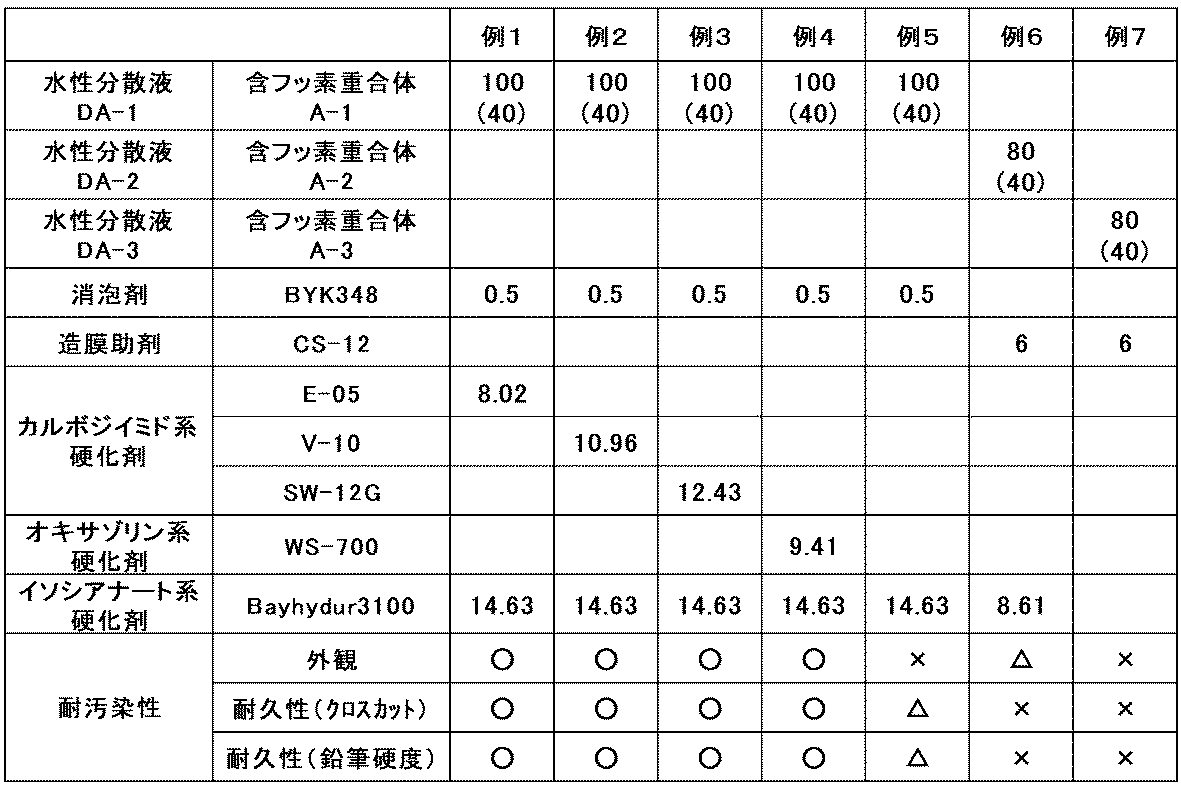
第1表に示すように、例1~4の水性塗料を用いて得られた硬化膜は、日焼け止め剤に対する耐汚染性に優れることが示された。
これに対して、例5の水性塗料は、特定硬化剤を含まないため、得られる硬化膜の耐汚染性(特に、外観)が劣ることが示された。
例6の水性塗料は、カルボキシ基を有する単位を含まない含フッ素重合体を含み、特定硬化剤を含まないため、得られる硬化膜の耐汚染性(特に耐久性)が劣ることが示された。
例7の水性塗料は、カルボキシ基を有する単位を含まない含フッ素重合体を含み、硬化剤を含まないため、得られる硬化膜の耐汚染性が劣ることが示された。
なお、2016年10月31日に出願された日本特許出願2016-213483号の明細書、特許請求の範囲および要約書の全内容をここに引用し、本発明の明細書の開示として、取り入れるものである。
これに対して、例5の水性塗料は、特定硬化剤を含まないため、得られる硬化膜の耐汚染性(特に、外観)が劣ることが示された。
例6の水性塗料は、カルボキシ基を有する単位を含まない含フッ素重合体を含み、特定硬化剤を含まないため、得られる硬化膜の耐汚染性(特に耐久性)が劣ることが示された。
例7の水性塗料は、カルボキシ基を有する単位を含まない含フッ素重合体を含み、硬化剤を含まないため、得られる硬化膜の耐汚染性が劣ることが示された。
なお、2016年10月31日に出願された日本特許出願2016-213483号の明細書、特許請求の範囲および要約書の全内容をここに引用し、本発明の明細書の開示として、取り入れるものである。
Claims (12)
- フルオロオレフィンに基づく単位およびカルボキシ基を有する単位を含む含フッ素重合体と、
カルボジイミド系硬化剤、アミン系硬化剤、オキサゾリン系硬化剤およびエポキシ系硬化剤からなる群より選択される少なくとも1種の硬化剤と、
水と、を含み、
前記含フッ素重合体の酸価が5mgKOH/g以上である、車両内装部材用の水性塗料。 - 前記カルボキシ基を有する単位が、カルボキシ基を有する単量体に基づく単位である、請求項1に記載の水性塗料。
- 前記カルボキシ基を有する単位が、ヒドロキシ基を有する単量体に基づく単位のヒドロキシ基がカルボキシ基を有する基に変換されてなる単位である、請求項1に記載の水性塗料。
- 前記含フッ素重合体の酸価が5~100mgKOH/gである、請求項1~3のいずれか1項に記載の水性塗料。
- 前記硬化剤が、カルボジイミド系硬化剤またはオキサゾリン系硬化剤である、請求項1~4のいずれか1項に記載の水性塗料。
- 前記含フッ素重合体が、ヒドロキシ基を有する単量体に基づく単位をさらに含み、
前記含フッ素重合体の水酸基価が、20mgKOH/g以上である、請求項1~5のいずれか1項に記載の水性塗料。 - 前記含フッ素重合体の水酸基価が、20~300mgKOH/gである、請求項6に記載の水性塗料。
- イソシアナート系硬化剤をさらに含む、請求項6または7に記載の水性塗料。
- 前記イソシアナート系硬化剤が水分散性のイソシアナート系硬化剤である、請求項8に記載の水性塗料。
- 前記含フッ素重合体のフッ素含有量が10~70質量%である、請求項1~9のいずれか1項に記載の水性塗料。
- 車両内装基材と、前記車両内装基材上に配置された請求項1~10のいずれか1項に記載の水性塗料を用いて得られる硬化膜と、を有する、車両内装部材。
- 車両内装基材上に、請求項1~10のいずれか1項に記載の水性塗料を塗布し乾燥して塗膜を形成し、前記塗膜を硬化させて硬化膜を形成する、車両内装部材の製造方法。
Priority Applications (1)
| Application Number | Priority Date | Filing Date | Title |
|---|---|---|---|
| JP2018547824A JPWO2018079774A1 (ja) | 2016-10-31 | 2017-10-30 | 車両内装部材用水性塗料、車両内装部材および車両内装部材の製造方法 |
Applications Claiming Priority (2)
| Application Number | Priority Date | Filing Date | Title |
|---|---|---|---|
| JP2016-213483 | 2016-10-31 | ||
| JP2016213483 | 2016-10-31 |
Publications (1)
| Publication Number | Publication Date |
|---|---|
| WO2018079774A1 true WO2018079774A1 (ja) | 2018-05-03 |
Family
ID=62025030
Family Applications (1)
| Application Number | Title | Priority Date | Filing Date |
|---|---|---|---|
| PCT/JP2017/039113 Ceased WO2018079774A1 (ja) | 2016-10-31 | 2017-10-30 | 車両内装部材用水性塗料、車両内装部材および車両内装部材の製造方法 |
Country Status (2)
| Country | Link |
|---|---|
| JP (1) | JPWO2018079774A1 (ja) |
| WO (1) | WO2018079774A1 (ja) |
Cited By (2)
| Publication number | Priority date | Publication date | Assignee | Title |
|---|---|---|---|---|
| WO2021099517A1 (en) * | 2019-11-21 | 2021-05-27 | L'oreal | Composition comprising a (poly)carbodiimide compound and a coloring agent |
| WO2021099515A1 (en) * | 2019-11-21 | 2021-05-27 | L'oreal | Process for treating keratin fibers, comprising a (poly)carbodiimide compound, an aqueous dispersion of particles of polymer(s)and a coloring agent |
Citations (3)
| Publication number | Priority date | Publication date | Assignee | Title |
|---|---|---|---|---|
| JP2001072819A (ja) * | 1999-09-06 | 2001-03-21 | Daikin Ind Ltd | 架橋性含フッ素樹脂水性分散液組成物 |
| JP2009520087A (ja) * | 2005-12-19 | 2009-05-21 | ランクセス ドイチュラント ゲゼルシャフト ミット ベシュレンクテル ハフツング | 硬化性含フッ素コポリマーおよび被覆および被覆方法 |
| JP2015232064A (ja) * | 2014-06-09 | 2015-12-24 | 旭硝子株式会社 | 含フッ素塗料組成物及び物品 |
Family Cites Families (2)
| Publication number | Priority date | Publication date | Assignee | Title |
|---|---|---|---|---|
| JPH0598207A (ja) * | 1991-10-08 | 1993-04-20 | Asahi Glass Co Ltd | 水性塗料組成物 |
| JP2016014106A (ja) * | 2014-07-02 | 2016-01-28 | 旭硝子株式会社 | 二液硬化型水性塗料キット及び二液硬化型水性塗料用主剤 |
-
2017
- 2017-10-30 JP JP2018547824A patent/JPWO2018079774A1/ja active Pending
- 2017-10-30 WO PCT/JP2017/039113 patent/WO2018079774A1/ja not_active Ceased
Patent Citations (3)
| Publication number | Priority date | Publication date | Assignee | Title |
|---|---|---|---|---|
| JP2001072819A (ja) * | 1999-09-06 | 2001-03-21 | Daikin Ind Ltd | 架橋性含フッ素樹脂水性分散液組成物 |
| JP2009520087A (ja) * | 2005-12-19 | 2009-05-21 | ランクセス ドイチュラント ゲゼルシャフト ミット ベシュレンクテル ハフツング | 硬化性含フッ素コポリマーおよび被覆および被覆方法 |
| JP2015232064A (ja) * | 2014-06-09 | 2015-12-24 | 旭硝子株式会社 | 含フッ素塗料組成物及び物品 |
Cited By (8)
| Publication number | Priority date | Publication date | Assignee | Title |
|---|---|---|---|---|
| WO2021099517A1 (en) * | 2019-11-21 | 2021-05-27 | L'oreal | Composition comprising a (poly)carbodiimide compound and a coloring agent |
| WO2021099515A1 (en) * | 2019-11-21 | 2021-05-27 | L'oreal | Process for treating keratin fibers, comprising a (poly)carbodiimide compound, an aqueous dispersion of particles of polymer(s)and a coloring agent |
| FR3103384A1 (fr) * | 2019-11-21 | 2021-05-28 | L'oreal | Procédé de traitement des fibres kératiniques comprenant un composé (poly)carbodiimide, une dispersion aqueuse de particules de polymère(s) et un agent colorant |
| FR3103385A1 (fr) * | 2019-11-21 | 2021-05-28 | L'oreal | Composition comprenant un composé (poly)carbodiimide et un agent colorant |
| KR20220097441A (ko) * | 2019-11-21 | 2022-07-07 | 로레알 | (폴리)카르보디이미드 화합물, 중합체(들)의 입자의 수성 분산액 및 착색제를 포함하는 케라틴 섬유의 처리 공정 |
| CN114727938A (zh) * | 2019-11-21 | 2022-07-08 | 莱雅公司 | 包含(聚)碳二亚胺化合物、聚合物颗粒的水性分散体和着色剂的用于处理角蛋白纤维的方法 |
| US12357557B2 (en) | 2019-11-21 | 2025-07-15 | L'oreal | Composition comprising a (poly)carbodiimide compound and a coloring agent |
| KR102876617B1 (ko) * | 2019-11-21 | 2025-10-24 | 로레알 | (폴리)카르보디이미드 화합물, 중합체(들)의 입자의 수성 분산액 및 착색제를 포함하는 케라틴 섬유의 처리 공정 |
Also Published As
| Publication number | Publication date |
|---|---|
| JPWO2018079774A1 (ja) | 2019-09-19 |
Similar Documents
| Publication | Publication Date | Title |
|---|---|---|
| JP5254121B2 (ja) | ポリイソシアヌレート組成物およびその製造方法、および、ポリウレタン樹脂 | |
| JP5225813B2 (ja) | ポリイソシアネート組成物、ポリウレタン樹脂およびポリイソシアネート組成物の製造方法 | |
| US8829080B2 (en) | Coating agent and method for production thereof | |
| WO2018079775A1 (ja) | 車両内装部材用塗料組成物、車両内装部材および車両内装部材の製造方法 | |
| EP3219769A1 (en) | Powder coating composition, powder coating and painted article | |
| JP2020143231A (ja) | ブロックポリイソシアネート組成物、水系塗料組成物及び塗膜 | |
| JP7031660B2 (ja) | 車両内装部材用塗料、車両内装部材および車両内装部材の製造方法 | |
| JPWO2018079774A1 (ja) | 車両内装部材用水性塗料、車両内装部材および車両内装部材の製造方法 | |
| JP2009249491A (ja) | 改修用プライマー組成物 | |
| JPH10101985A (ja) | 塗料組成物 | |
| JP2805825B2 (ja) | レザー | |
| JP3477755B2 (ja) | 塩化ビニル系樹脂組成物 | |
| JP2011102006A (ja) | 熱可塑性ポリオレフィン樹脂表皮材 | |
| JP2020176208A (ja) | 塗料及び車両外装部材 | |
| JP2016079265A (ja) | 航空機内装用の水性塗料用組成物および航空機内装材 | |
| JPWO2012039478A1 (ja) | 水性塗料用組成物および二液硬化型水性塗料キット | |
| JP2016113535A (ja) | 塗料用組成物および塗装物品 | |
| JP2021122824A (ja) | 被膜形成方法、及び積層体 | |
| JP2805826B2 (ja) | 床 材 | |
| JP2808663B2 (ja) | 壁 紙 | |
| JP3713733B2 (ja) | 硬化性樹脂組成物 | |
| JPH10130353A (ja) | 自己乳化型ポリイソシアネ−ト組成物並びにこれを用いた水系塗料組成物及び水系接着剤組成物 | |
| JP2011256257A (ja) | 含フッ素塗料組成物および二液塗料用キット | |
| JP2015147841A (ja) | 含フッ素塗料用組成物 | |
| JPH02299837A (ja) | 異型押出し品 |
Legal Events
| Date | Code | Title | Description |
|---|---|---|---|
| 121 | Ep: the epo has been informed by wipo that ep was designated in this application |
Ref document number: 17865662 Country of ref document: EP Kind code of ref document: A1 |
|
| ENP | Entry into the national phase |
Ref document number: 2018547824 Country of ref document: JP Kind code of ref document: A |
|
| NENP | Non-entry into the national phase |
Ref country code: DE |
|
| 122 | Ep: pct application non-entry in european phase |
Ref document number: 17865662 Country of ref document: EP Kind code of ref document: A1 |