WO2018079200A1 - 蓄電デバイス電極用バインダー - Google Patents
蓄電デバイス電極用バインダー Download PDFInfo
- Publication number
- WO2018079200A1 WO2018079200A1 PCT/JP2017/035823 JP2017035823W WO2018079200A1 WO 2018079200 A1 WO2018079200 A1 WO 2018079200A1 JP 2017035823 W JP2017035823 W JP 2017035823W WO 2018079200 A1 WO2018079200 A1 WO 2018079200A1
- Authority
- WO
- WIPO (PCT)
- Prior art keywords
- polyvinyl acetal
- storage device
- acetal resin
- binder
- group
- Prior art date
- Legal status (The legal status is an assumption and is not a legal conclusion. Google has not performed a legal analysis and makes no representation as to the accuracy of the status listed.)
- Ceased
Links
Classifications
-
- H—ELECTRICITY
- H01—ELECTRIC ELEMENTS
- H01M—PROCESSES OR MEANS, e.g. BATTERIES, FOR THE DIRECT CONVERSION OF CHEMICAL ENERGY INTO ELECTRICAL ENERGY
- H01M4/00—Electrodes
- H01M4/02—Electrodes composed of, or comprising, active material
- H01M4/62—Selection of inactive substances as ingredients for active masses, e.g. binders, fillers
- H01M4/621—Binders
- H01M4/622—Binders being polymers
-
- C—CHEMISTRY; METALLURGY
- C08—ORGANIC MACROMOLECULAR COMPOUNDS; THEIR PREPARATION OR CHEMICAL WORKING-UP; COMPOSITIONS BASED THEREON
- C08F—MACROMOLECULAR COMPOUNDS OBTAINED BY REACTIONS ONLY INVOLVING CARBON-TO-CARBON UNSATURATED BONDS
- C08F16/00—Homopolymers and copolymers of compounds having one or more unsaturated aliphatic radicals, each having only one carbon-to-carbon double bond, and at least one being terminated by an alcohol, ether, aldehydo, ketonic, acetal or ketal radical
- C08F16/38—Homopolymers and copolymers of compounds having one or more unsaturated aliphatic radicals, each having only one carbon-to-carbon double bond, and at least one being terminated by an alcohol, ether, aldehydo, ketonic, acetal or ketal radical by an acetal or ketal radical
-
- C—CHEMISTRY; METALLURGY
- C08—ORGANIC MACROMOLECULAR COMPOUNDS; THEIR PREPARATION OR CHEMICAL WORKING-UP; COMPOSITIONS BASED THEREON
- C08F—MACROMOLECULAR COMPOUNDS OBTAINED BY REACTIONS ONLY INVOLVING CARBON-TO-CARBON UNSATURATED BONDS
- C08F8/00—Chemical modification by after-treatment
- C08F8/28—Condensation with aldehydes or ketones
-
- C—CHEMISTRY; METALLURGY
- C08—ORGANIC MACROMOLECULAR COMPOUNDS; THEIR PREPARATION OR CHEMICAL WORKING-UP; COMPOSITIONS BASED THEREON
- C08K—Use of inorganic or non-macromolecular organic substances as compounding ingredients
- C08K5/00—Use of organic ingredients
- C08K5/0008—Organic ingredients according to more than one of the "one dot" groups of C08K5/01 - C08K5/59
- C08K5/0025—Crosslinking or vulcanising agents; including accelerators
-
- C—CHEMISTRY; METALLURGY
- C08—ORGANIC MACROMOLECULAR COMPOUNDS; THEIR PREPARATION OR CHEMICAL WORKING-UP; COMPOSITIONS BASED THEREON
- C08L—COMPOSITIONS OF MACROMOLECULAR COMPOUNDS
- C08L23/00—Compositions of homopolymers or copolymers of unsaturated aliphatic hydrocarbons having only one carbon-to-carbon double bond; Compositions of derivatives of such polymers
- C08L23/02—Compositions of homopolymers or copolymers of unsaturated aliphatic hydrocarbons having only one carbon-to-carbon double bond; Compositions of derivatives of such polymers not modified by chemical after-treatment
- C08L23/10—Homopolymers or copolymers of propene
- C08L23/14—Copolymers of propene
-
- H—ELECTRICITY
- H01—ELECTRIC ELEMENTS
- H01G—CAPACITORS; CAPACITORS, RECTIFIERS, DETECTORS, SWITCHING DEVICES, LIGHT-SENSITIVE OR TEMPERATURE-SENSITIVE DEVICES OF THE ELECTROLYTIC TYPE
- H01G11/00—Hybrid capacitors, i.e. capacitors having different positive and negative electrodes; Electric double-layer [EDL] capacitors; Processes for the manufacture thereof or of parts thereof
- H01G11/22—Electrodes
- H01G11/30—Electrodes characterised by their material
- H01G11/32—Carbon-based
- H01G11/38—Carbon pastes or blends; Binders or additives therein
-
- H—ELECTRICITY
- H01—ELECTRIC ELEMENTS
- H01M—PROCESSES OR MEANS, e.g. BATTERIES, FOR THE DIRECT CONVERSION OF CHEMICAL ENERGY INTO ELECTRICAL ENERGY
- H01M4/00—Electrodes
- H01M4/02—Electrodes composed of, or comprising, active material
- H01M4/13—Electrodes for accumulators with non-aqueous electrolyte, e.g. for lithium-accumulators; Processes of manufacture thereof
-
- H—ELECTRICITY
- H01—ELECTRIC ELEMENTS
- H01M—PROCESSES OR MEANS, e.g. BATTERIES, FOR THE DIRECT CONVERSION OF CHEMICAL ENERGY INTO ELECTRICAL ENERGY
- H01M4/00—Electrodes
- H01M4/02—Electrodes composed of, or comprising, active material
- H01M4/62—Selection of inactive substances as ingredients for active masses, e.g. binders, fillers
-
- C—CHEMISTRY; METALLURGY
- C08—ORGANIC MACROMOLECULAR COMPOUNDS; THEIR PREPARATION OR CHEMICAL WORKING-UP; COMPOSITIONS BASED THEREON
- C08F—MACROMOLECULAR COMPOUNDS OBTAINED BY REACTIONS ONLY INVOLVING CARBON-TO-CARBON UNSATURATED BONDS
- C08F2500/00—Characteristics or properties of obtained polyolefins; Use thereof
- C08F2500/24—Polymer with special particle form or size
-
- Y—GENERAL TAGGING OF NEW TECHNOLOGICAL DEVELOPMENTS; GENERAL TAGGING OF CROSS-SECTIONAL TECHNOLOGIES SPANNING OVER SEVERAL SECTIONS OF THE IPC; TECHNICAL SUBJECTS COVERED BY FORMER USPC CROSS-REFERENCE ART COLLECTIONS [XRACs] AND DIGESTS
- Y02—TECHNOLOGIES OR APPLICATIONS FOR MITIGATION OR ADAPTATION AGAINST CLIMATE CHANGE
- Y02E—REDUCTION OF GREENHOUSE GAS [GHG] EMISSIONS, RELATED TO ENERGY GENERATION, TRANSMISSION OR DISTRIBUTION
- Y02E60/00—Enabling technologies; Technologies with a potential or indirect contribution to GHG emissions mitigation
- Y02E60/10—Energy storage using batteries
Definitions
- the present invention relates to a binder for an electricity storage device electrode that can suppress aggregation of a binder resin when used as a binder used for an electrode of an electricity storage device.
- a binder for an electricity storage device electrode that can maintain an adhesion state of an interface and has excellent capacity retention.
- the present invention relates to a binder for an electricity storage device electrode that is excellent in adhesiveness, can improve the flexibility of the obtained electrode, has high durability against an electrolytic solution, and can produce a high-capacity lithium secondary battery.
- the present invention also relates to a composition for an electricity storage device electrode using the binder for an electricity storage device electrode, an electricity storage device electrode and an electricity storage device.
- An electrode of a lithium secondary battery is usually a thin film obtained by kneading an active material and a binder together with a solvent, dispersing the active material into a slurry, applying the slurry on a current collector by a doctor blade method or the like, and drying the slurry. It is formed by forming.
- PVDF polyvinylidene fluoride
- binders for electrodes negative electrodes
- PVDF polyvinylidene fluoride
- polyvinylidene fluoride has a problem that, when producing a slurry for an electrode, the solubility in a solvent is poor and the production efficiency is remarkably lowered.
- the binder swells due to the electrolytic solution, causing a problem that peeling occurs at the electrode interface in a long-term cycle and battery characteristics are deteriorated.
- N-methylpyrrolidone is generally used as a slurry solvent for dissolving polyvinylidene fluoride.
- N-methylpyrrolidone has a high boiling point, and thus requires a large amount of heat energy in the slurry drying process.
- N-methylpyrrolidone that has not been completely dried remains in the electrode, causing a problem in that the performance of the battery is degraded.
- An object of this invention is to provide the binder for electrical storage device electrodes which can suppress aggregation of binder resin, when used as a binder used for the electrode of an electrical storage device.
- An object of the present invention is to provide a binder for an electricity storage device electrode that can maintain the adhesion state of the interface and has excellent capacity retention.
- a binder for an electricity storage device electrode that has excellent adhesiveness, can improve the flexibility of the obtained electrode, has high durability against an electrolyte, and can produce a high-capacity lithium secondary battery.
- the purpose is to provide. Moreover, it aims at providing the composition for electrical storage device electrodes, electrical storage device electrode, and electrical storage device using the binder for electrical storage devices electrodes.
- the present invention is a binder used for an electrode of an electricity storage device, wherein the binder contains a polyvinyl acetal resin, the polyvinyl acetal resin has a hydroxyl group content of 30 to 60 mol%, and the polyvinyl acetal resin has a crosslinked structure. It is the binder for electrical storage device electrodes which has.
- the present invention is described in detail below.
- the present inventors have used a composition containing a polyvinyl acetal resin having a cross-linked structure and a hydroxyl group content within a predetermined range as a binder for an electricity storage device electrode. It was found that can be suppressed. In addition, the present inventors have found that an electricity storage device having excellent followability with respect to expansion and contraction of an active material due to repeated charge and discharge, maintaining adhesiveness between active materials and current collector interfaces, and excellent in capacity retention can be produced. The invention has been completed.
- the binder for an electricity storage device electrode of the present invention contains a polyvinyl acetal resin.
- a polyvinyl acetal resin as a resin component of the binder (binder)
- an attractive interaction acts on the polyvinyl acetal resin and the active material, and the active material can be fixed with a small amount of the binder.
- the polyvinyl acetal resin also has an attractive interaction with the conductive auxiliary agent, and can keep the distance between the active material and the conductive auxiliary agent within a certain range.
- the dispersibility of an active material is improved significantly by making the distance of an active material and a conductive support agent moderate.
- the adhesiveness with the current collector can be remarkably improved.
- the active material is excellent in dispersibility and adhesiveness, and a sufficient effect can be exhibited even when the amount of the binder added is small.
- the binder for electrical storage device electrodes of the present invention may be composed of a resin component, and may further contain a dispersion medium.
- the lower limit of the content of the structural unit having a hydroxyl group in the polyvinyl acetal resin (hereinafter also referred to as a hydroxyl group amount) is 30 mol%, and the upper limit is 60 mol%.
- the amount of the hydroxyl group is 30 mol% or more, it is possible to suppress the resin component from eluting into the electrolytic solution when the electrode is immersed in the electrolytic solution with sufficient resistance to the electrolytic solution.
- the amount of the hydroxyl group is 60 mol% or less, the stability of the polyvinyl acetal resin in the aqueous medium is improved, and the active material can be sufficiently dispersed by suppressing aggregation of the binder resin.
- a preferable lower limit of the hydroxyl group content is 35 mol%, a more preferable lower limit is 45 mol%, and a preferable upper limit is 55 mol%.
- the content of the structural unit having an acetal group of the polyvinyl acetal resin (hereinafter also referred to as an acetal group amount) is preferably 40 mol in terms of the total amount of acetal groups, regardless of whether a single aldehyde or a mixed aldehyde is used. %, And a preferable upper limit is 70 mol%.
- the amount of the acetal group is 40 mol% or more, the resin has good flexibility, and sufficient adhesive force to the current collector can be exhibited.
- the amount of the acetal group is 70 mol% or less, the resistance to the electrolytic solution is sufficient, and the elution of the resin component into the electrolytic solution when the electrode is immersed in the electrolytic solution can be suppressed.
- the amount of the acetal group is more preferably a lower limit of 45 mol% and a more preferable upper limit of 65 mol%.
- the content of the structural unit having an acetyl group in the polyvinyl acetal resin (hereinafter also referred to as acetyl group amount) has a preferable lower limit of 0.2 mol% and a preferable upper limit of 20 mol%.
- acetyl group amount When the acetyl group content is 0.2 mol% or more, the flexibility of the resin can be improved.
- the amount of the acetyl group is 20 mol% or less, the resistance to the electrolytic solution is sufficient, and elution of the resin component into the electrolytic solution when the electrode is immersed in the electrolytic solution can be suppressed.
- the more preferable lower limit of the acetyl group amount is 1 mol%
- the more preferable upper limit is 15 mol%
- the still more preferable upper limit is 5 mol%.
- the preferable lower limit of the degree of polymerization of the polyvinyl acetal resin is 250, and the preferable upper limit is 4000.
- the degree of polymerization is 250 or more, the resistance to the electrolytic solution is sufficient, and the elution of the electrode into the electrolytic solution can be suppressed.
- the degree of polymerization is 4000 or less, sufficient adhesive strength with the active material can be obtained, and a decrease in the discharge capacity of the lithium secondary battery can be suppressed.
- the minimum with said more preferable polymerization degree is 280, and a more preferable upper limit is 3500.
- the acetalization method is not particularly limited, and a conventionally known method can be used. Examples thereof include a method of adding various aldehydes to an aqueous solution of a polyvinyl alcohol resin in the presence of an acid catalyst such as hydrochloric acid. .
- the aldehyde used for the acetalization is not particularly limited.
- formaldehyde including paraformaldehyde
- acetaldehyde including paraacetaldehyde
- propionaldehyde butyraldehyde
- amylaldehyde hexylaldehyde
- heptylaldehyde 2-ethylhexylaldehyde
- Examples include cyclohexyl aldehyde, furfural, glyoxal, glutaraldehyde, benzaldehyde, 2-methylbenzaldehyde, 3-methylbenzaldehyde, 4-methylbenzaldehyde, p-hydroxybenzaldehyde, m-hydroxybenzaldehyde, phenylacetaldehyde, ⁇ -phenylpropionaldehyde and the like.
- acetaldehyde or butyraldehyde is preferable in terms of
- the polyvinyl alcohol resin may be a saponified copolymer of vinyl ester and ⁇ -olefin. Moreover, it is good also as a polyvinyl alcohol resin which copolymerizes an ethylenically unsaturated monomer and contains the component originating in an ethylenically unsaturated monomer. There is also a terminal polyvinyl alcohol resin obtained by copolymerizing a vinyl ester monomer such as vinyl acetate with an ⁇ -olefin in the presence of a thiol compound such as thiol acetic acid or mercaptopropionic acid, and saponifying it. Can be used.
- the ⁇ -olefin is not particularly limited, and examples thereof include methylene, ethylene, propylene, isopropylene, butylene, isobutylene, pentylene, hexylene, cyclohexylene, cyclohexylethylene, and cyclohexylpropylene.
- the polyvinyl acetal resin has a crosslinked structure.
- “having a crosslinked structure” means containing a polyvinyl acetal in which a polymer chain is crosslinked through a chemical bond (hereinafter also referred to as a crosslinked polyvinyl acetal).
- the said polyvinyl acetal resin may consist only of bridge
- the fall of battery capacity can be suppressed.
- it when it is set as an electrode, it can be set as polyvinyl acetal resin with few cross-linking nonuniformity, and also the intensity
- strength of an electrode surface can be made sufficient and the fall of battery capacity can be suppressed.
- the fact that the polyvinyl acetal resin has a crosslinked structure is confirmed, for example, by dissolving the uncrosslinked polyvinyl acetal, immersing the polyvinyl acetal resin in a solvent that does not dissolve the crosslinked polyvinyl acetal, and evaluating the presence or absence of undissolved components. be able to.
- a method for selecting a solvent that dissolves the uncrosslinked polyvinyl acetal and does not dissolve the crosslinked polyvinyl acetal is as follows. First, a polyvinyl acetal resin is dissolved in a solvent and centrifuged to separate into a supernatant and a precipitate. Thereafter, NMR measurement is performed on the supernatant, and a solvent in which the crosslinked polyvinyl acetal is not eluted is used as a solvent that dissolves the uncrosslinked polyvinyl acetal and does not dissolve the crosslinked polyvinyl acetal. In addition, it can confirm that it has a crosslinked structure by performing NMR measurement with respect to the obtained deposit. Examples of such a solvent include a single solvent such as isopropanol and methanol, or a mixed solvent thereof.
- the polyvinyl acetal resin preferably has a crosslinked structure derived from a crosslinking agent.
- the cross-linking structure derived from the cross-linking agent is not particularly limited because the structure varies depending on the type of cross-linking agent described later.
- the reactive functional group possessed by the cross-linking agent and the functionality possessed by the polyvinyl acetal resin or polyvinyl alcohol resin examples thereof include a residue of the crosslinking agent after the reaction with the group (hereinafter also referred to as a component derived from the crosslinking agent).
- crosslinking agent examples include polyfunctional aldehydes, polyfunctional epoxides, melamine resins, urethane resins, polyfunctional isocyanates, and phenol-formaldehyde resins.
- polyfunctional aldehyde examples include malondialdehyde, succinaldehyde, glutaraldehyde, terephthalaldehyde, isophthalaldehyde, orthophthalaldehyde and the like.
- polyfunctional epoxide examples include sorbitol polyglycidyl ether, polyglycerol polyglycidyl ether, diglycerol polyglycidyl ether, glycerol polyglycidyl ether, polyethylene glycol diglycidyl ether, and the like.
- polyfunctional isocyanate examples include toluene 2,4-diisocyanate, 1,6-diisocyanate hexane, isoformyl diisocyanate, diphenylmethane diisocyanate, and the like, from the viewpoint of high crosslinking reactivity with respect to the resin.
- Functional aldehydes are preferred and glutaraldehyde is particularly preferred.
- a preferable minimum is 0.01 mol% and a preferable upper limit is 10 mol%.
- the content of the component derived from the crosslinking agent is 0.01 mol% or more, the polyvinyl acetal resin is sufficiently crosslinked, and the dispersibility of the binder resin can be improved.
- flexibility of binder resin can fully be improved as content of the component originating in the said crosslinking agent is 10 mol% or less.
- a more preferable minimum is 0.015 mol%, a still more preferable minimum is 0.025 mol%, and a more preferable upper limit is 5 mol%.
- the content of the component derived from the crosslinking agent can be measured by, for example, NMR.
- the content of the cross-linked acetal group in the polyvinyl acetal resin (hereinafter also referred to as cross-linked acetal group amount) has a preferable lower limit of 0.01 mol% and a preferable upper limit of 10 mol%.
- the amount of the crosslinked acetal group is 0.01 mol% or more, the dispersibility of the binder resin can be further improved.
- flexibility of binder resin can be improved more as the said bridge
- a more preferable lower limit of the amount of the crosslinked acetal group is 0.015 mol%, a further preferable lower limit is 0.025 mol%, and a more preferable upper limit is 5 mol%.
- the ratio of the amount of crosslinked acetal groups in the total amount of acetal groups is preferably 0.01 mol%, more preferably 0.05 mol%, and still more preferably 0.1 mol%, more preferably the lower limit.
- the upper limit is 18 mol%, the more preferable upper limit is 15 mol%, and the more preferable upper limit is 10 mol%.
- the preferred lower limit is 0.001 and the preferred upper limit is 33.
- the ratio is 0.001 or more, the polyvinyl acetal resin is sufficiently crosslinked, and the dispersibility of the binder resin can be improved.
- the ratio is 33 or less, the flexibility of the binder resin can be sufficiently improved.
- the ratio between the content of the component derived from the crosslinking agent and the hydroxyl group content is more preferably 0.05, more preferably 15 and even more preferably 1.
- the degree of crosslinking of the polyvinyl acetal resin at 25 ° C. is preferably 5% by weight or more. When the crosslinking degree is 5% by weight or more, the polyvinyl acetal resin is sufficiently crosslinked, and the dispersibility of the binder resin can be improved.
- the degree of crosslinking is more preferably 10% by weight or more.
- the degree of crosslinking is preferably 75% by weight or less, and more preferably 70% by weight or less.
- the degree of crosslinking is the weight ratio (% by weight) of the insoluble component to the weight of the polyvinyl acetal resin (before immersion) when the polyvinyl acetal resin is immersed in a solvent that dissolves uncrosslinked polyvinyl acetal and does not dissolve the crosslinked polyvinyl acetal. ).
- the solvent include a single solvent such as isopropanol and methanol, or a mixed solvent thereof.
- the degree of crosslinking at 25 ° C. means the degree of crosslinking when immersed in a solvent at 25 ° C.
- Examples of the method for producing the polyvinyl acetal resin having a crosslinked structure include a method of acetalizing a polyvinyl alcohol resin with a polyfunctional aldehyde, and a method of adding a crosslinking agent to a polyvinyl acetal resin obtained by acetalizing a polyvinyl alcohol resin. Etc. Especially, since the polyvinyl acetal resin which has sufficient crosslinking degree is obtained, the method of adding a crosslinking agent to the polyvinyl acetal resin obtained by acetalizing polyvinyl alcohol resin is preferable.
- uncrosslinked polyvinyl acetal having a fine particle shape can be crosslinked, and a polyvinyl acetal resin in which the fine particles are crosslinked can be obtained.
- the degree of crosslinking of the obtained polyvinyl acetal resin becomes insufficient, and the aggregation suppressing effect may not be sufficiently exhibited.
- the resulting polyvinyl acetal resin forms a cross-linked structure with a polyfunctional aldehyde
- a structure in which polymer chains of the polyvinyl acetal resin are linked is easily formed, and the binder becomes highly viscous. It may not be possible.
- the polyvinyl acetal resin has a preferable lower limit of the elastic modulus (X) at 25 ° C. and 10 Hz of 1 ⁇ 10 9 Pa, and a preferable upper limit of 1 ⁇ 10 10 Pa.
- the elastic modulus (X) is 1 ⁇ 10 9 Pa or more, the binder resin does not become too soft, and during repeated charging and discharging, the deformation of the binder resin is reduced, and the active material is peeled off. Can be suppressed.
- the elastic modulus (X) is 1 ⁇ 10 10 Pa or less, the binder resin does not become too hard, and the adhesiveness between the active materials and the current collector interface can be improved.
- the elastic modulus (X) has a more preferable lower limit of 1.1 ⁇ 10 9 Pa, a further preferable lower limit of 1.5 ⁇ 10 9 Pa, a more preferable upper limit of 6.0 ⁇ 10 9 Pa, and a further preferable upper limit of 5. 5 ⁇ 10 9 Pa.
- the polyvinyl acetal resin has a preferable lower limit of the elastic modulus (Y) at 70 ° C. and 10 Hz of 1 ⁇ 10 8 Pa, and a preferable upper limit of 1 ⁇ 10 10 Pa.
- the elastic modulus (Y) is 1 ⁇ 10 8 Pa or more, the binder resin is difficult to be softened by heat, deformation of the binder resin due to heat generation during use can be reduced, and peeling of the active material can be suppressed.
- the elastic modulus (Y) is 1 ⁇ 10 10 Pa or less, the binder resin does not become too hard due to heat during use, and the adhesiveness between the active materials and the current collector interface can be improved.
- the elastic modulus (Y) has a more preferable lower limit of 4.5 ⁇ 10 8 Pa, a further preferable lower limit of 5.0 ⁇ 10 8 Pa, a more preferable upper limit of 4.5 ⁇ 10 9 Pa, and a further preferable upper limit of 2. 5 ⁇ 10 9 Pa.
- the elastic modulus at 25 ° C. and 70 ° C. can be measured by using a dynamic viscoelasticity measuring apparatus.
- the ratio of the elastic modulus (X) to the elastic modulus (Y) has a preferable lower limit of 1.0 and a preferable upper limit of 15.0.
- the ratio of elastic modulus (X / Y) is 1.0 or more, the binder resin is not easily softened by heat, and the deformation of the binder resin due to heat generation during use is reduced, and the peeling of the active material is suppressed. it can.
- the elastic modulus ratio (X / Y) is 15.0 or less, the binder resin does not become too hard due to heat during use, and the adhesion between the active materials and the current collector interface can be improved. it can.
- the elastic modulus ratio (X / Y) ratio has a more preferable lower limit of 1.1 and a more preferable upper limit of 12.0.
- the dielectric constant of the polyvinyl acetal resin is preferably 3.5 or more.
- the dielectric constant is 3.5 or more, the lithium ion conductivity can be sufficiently increased, and the internal resistance of the obtained electricity storage device can be sufficiently reduced.
- the lower limit of the dielectric constant is preferably 3.7.
- the upper limit of the dielectric constant is not particularly limited, but a preferable upper limit is 6.0.
- the dielectric constant can be measured using, for example, a dielectric measurement device.
- the polyvinyl acetal resin has a preferable lower limit of 100% and a preferable upper limit of 125% when immersed in an ethylene carbonate / diethylene carbonate mixed solvent or an ethylene carbonate / ethyl methyl carbonate mixed solvent at 25 ° C. for 3 days.
- the swelling ratio is 100% or more, the resistance to the electrolytic solution is sufficient, and peeling between active materials and the collector interface can be suppressed even when repeatedly charged and discharged, and the lithium secondary battery The decrease in the discharge capacity can be suppressed.
- the swelling ratio is 125% or less, the resistance to the electrolytic solution can be appropriately maintained, the conduction of lithium ions can pass through the intermolecular network of the binder resin without resistance, and the internal resistance is reduced.
- the lower limit of the swelling rate that can suppress the decrease in the discharge capacity of the lithium secondary battery is 101%, and the more preferable upper limit is 120%.
- the swelling ratio means the ratio of the total amount of the absorbed solvent and the weight of the resin component to the weight of the resin component that has absorbed the solvent when the polyvinyl acetal resin is immersed in a specific solvent. Specifically, the swelling rate is calculated by immersing a film made of polyvinyl acetal resin in a specific solvent and calculating the ratio of the weight of the film after absorbing the solvent and the weight of the film after removing the absorbed solvent. You can ask for it.
- the polyvinyl acetal resin has a preferable lower limit of 0.1% and a preferable upper limit of 15% when immersed in an ethylene carbonate / diethylene carbonate mixed solvent or an ethylene carbonate / ethyl methyl carbonate mixed solvent at 25 ° C. for 3 days. is there.
- the dissolution rate is 0.1% or more, sufficient resistance to the electrolytic solution can be obtained, and peeling between active materials and the current collector interface can be suppressed even when repeatedly charged and discharged. There exists an advantage which can suppress the fall of the discharge capacity of a secondary battery.
- the dissolution rate When the dissolution rate is 15% or less, the resistance to the electrolytic solution can be appropriately maintained, the conduction of lithium ions can pass through the intermolecular network of the binder resin without resistance, and the internal resistance is reduced.
- the lower limit of the dissolution rate that can suppress the decrease in the discharge capacity of the lithium secondary battery is more preferably 1%, and the more preferable upper limit is 5%.
- the dissolution rate means the ratio of the weight of the resin component dissolved in the solvent to the weight of the resin component before being immersed in the solvent when the polyvinyl acetal resin is immersed in a specific solvent.
- the dissolution rate is obtained by immersing a film made of polyvinyl acetal resin in a specific solvent, calculating the difference between the weight of the film before immersion and the weight of the film after removing the absorbed solvent. It can obtain
- the polyvinyl acetal resin preferably has an ionic functional group.
- the ionic functional group is at least one selected from the group consisting of a carboxyl group, a sulfonic acid group, a sulfinic acid group, a sulfenic acid group, a phosphoric acid group, a phosphonic acid group, an amino group, and a salt thereof.
- Functional groups are preferred. Of these, carboxyl groups, sulfonic acid groups, and salts thereof are more preferable, and sulfonic acid groups and salts thereof are particularly preferable.
- the dispersibility of the polyvinyl acetal resin is improved in the composition for a lithium secondary battery electrode, and the dispersibility of the active material and the conductive auxiliary agent is particularly excellent. can do.
- said salt sodium salt, potassium salt, etc. are mentioned.
- a preferable minimum is 0.01 mmol / g and a preferable upper limit is 1 mmol / g.
- the content of the ionic functional group is 0.01 mmol / g or more, the dispersibility of the polyvinyl acetal resin in the composition for a lithium secondary battery electrode, and the active material and conductive aid used as an electrode Can be sufficiently improved.
- the content of the ionic functional group is 1 mmol / g or less, the durability of the binder in the battery can be improved, and the discharge capacity of the lithium secondary battery can be improved.
- a more preferable minimum is 0.02 mmol / g and a more preferable upper limit is 0.5 mmol / g.
- the content of the ionic functional group can be measured by using NMR.
- the existence form of the ionic functional group may be directly present in the polyvinyl acetal resin structure, or may be present in the graft chain of the polyvinyl acetal resin containing a graft chain (hereinafter also simply referred to as a graft copolymer). May be. Especially, since it can make the dispersibility of the active material at the time of setting it as an electrode and an electrode, and an electroconductive auxiliary agent excellent, it is preferable to exist directly in a polyvinyl acetal resin structure.
- the ionic functional group When the ionic functional group is directly present in the polyvinyl acetal resin structure, it is a chain molecular structure in which the ionic functional group is bonded to carbon constituting the main chain of the polyvinyl acetal resin, or through an acetal bond. It is preferable that the molecular structure has an ionic functional group bonded thereto. Further, a molecular structure in which an ionic functional group is bonded through an acetal bond is particularly preferable.
- the presence of the ionic functional group in the above structure improves the dispersibility of the polyvinyl acetal resin in the composition for a lithium secondary battery electrode, and particularly improves the dispersibility of the active material and the conductive auxiliary agent when used as an electrode. While being able to make it excellent, since the deterioration of the binder at the time of setting it as a battery is suppressed, the fall of the discharge capacity of a lithium secondary battery can be suppressed.
- the method for producing the polyvinyl acetal resin having the ionic functional group directly in the polyvinyl acetal resin structure is not particularly limited.
- a method of reacting an aldehyde with the modified polyvinyl alcohol resin having an ionic functional group to acetalize, after producing a polyvinyl acetal resin, another functional group having reactivity to the functional group of the polyvinyl acetal resin examples include a method of reacting with a compound having an ionic functional group.
- the acetal bond and the ionic functional group are preferably connected by a chain or cyclic alkyl group or an aromatic ring.
- a chain or cyclic alkyl group or an aromatic ring it is preferably connected by an alkylene group having 1 or more carbon atoms, a cyclic alkylene group having 5 or more carbon atoms, an aryl group having 6 or more carbon atoms, or the like, and particularly by an alkylene group having 1 or more carbon atoms or an aromatic ring. It is preferable that they are connected.
- the resistance to the electrolytic solution and the dispersibility of the active material and the conductive additive when used as an electrode can be improved, and the deterioration of the binder when used as a battery is suppressed, so that the lithium secondary A decrease in the discharge capacity of the battery can be suppressed.
- the aromatic substituent include aromatic rings such as a benzene ring and a pyridine ring, and condensed polycyclic aromatic groups such as a naphthalene ring and an anthracene ring.
- the polyvinyl acetal resin has a structural unit having a hydroxyl group represented by the following formula (1), a structural unit having an acetyl group represented by the following formula (2), and an acetal group represented by the following formula (3). It is preferable to have a structural unit and a structural unit having an acetal group containing an ionic functional group represented by the following formula (4).
- the dispersibility of the polyvinyl acetal resin, the dispersibility of the active material and the conductive auxiliary agent can be made particularly excellent, and the adhesive strength to the current collector and the resistance to the electrolyte solution are also particularly excellent. Therefore, a reduction in the discharge capacity of the lithium secondary battery can be particularly suppressed.
- R 1 represents a hydrogen atom or an alkyl group having 1 to 20 carbon atoms
- R 2 represents an alkylene group or aromatic ring having 1 to 20 carbon atoms
- X is ionic Represents a functional group.
- the content of the structural unit having an acetal group containing an ionic functional group in the polyvinyl acetal resin (hereinafter also referred to as an ionic group-containing acetal group amount) is the content of the ionic functional group in the polyvinyl acetal resin. It is preferable to adjust so that it may become the said suitable range.
- the amount of the ionic group-containing acetal group has a preferable lower limit of 0.05 mol%, a more preferable lower limit of 0.1 mol%, a still more preferable lower limit of 0.5 mol%, a preferable upper limit of 15 mol%, and a more preferable upper limit. 10 mol%, and a more preferable upper limit is 5 mol%.
- the polyvinyl acetal resin has an ionic group-containing acetal group amount in the total acetal group amount.
- the preferred lower limit is 0.5 mol% and the preferred upper limit is 28 mol%.
- the ratio of the ionic group-containing acetal group amount in the total acetal group amount is more preferably a lower limit of 1 mol%, a still more preferable lower limit is 2 mol%, a more preferable upper limit is 20 mol%, and a still more preferable upper limit is 15 mol. %.
- the amount of ionic group-containing acetal group in the polyvinyl acetal resin within the above range the dispersibility of the polyvinyl acetal resin in the composition for a lithium secondary battery electrode is improved, and the resistance to the electrolytic solution and the electrode are obtained.
- the dispersibility of the active material and the conductive additive at the time can be made excellent. Furthermore, since the deterioration of the binder when the battery is made is suppressed, a decrease in the discharge capacity of the lithium secondary battery can be suppressed.
- the lower limit of the ratio of the amount of cross-linked acetal groups in the polyvinyl acetal resin to the amount of ionic group-containing acetal groups is preferably 0.02, and the more preferable lower limit is 0.00.
- a more preferred lower limit is 0.1
- a preferred upper limit is 100
- a more preferred upper limit is 10
- a still more preferred upper limit is 7.5
- a particularly preferred upper limit is 5.
- a method for producing a polyvinyl acetal resin having an ionic functional group through an acetal bond in the polyvinyl acetal resin structure is not particularly limited.
- the method of acetalizing after making the aldehyde which has the said ionic functional group react beforehand with polyvinyl alcohol resin is mentioned.
- the aldehyde raw material is mixed with the aldehyde which has the said ionic functional group, and the method of acetalizing is mentioned.
- the method of making the aldehyde which has the said ionic functional group react is mentioned.
- aldehyde having an ionic functional group examples include an aldehyde having a sulfonic acid group, an aldehyde having an amino group, an aldehyde having a phosphate group, and an aldehyde having a carboxyl group.
- aldehyde having a sulfonic acid group examples include disodium 4-formylbenzene-1,3-disulfonate, sodium 4-formylbenzenesulfonate, sodium 2-formylbenzenesulfonate, and the like.
- aldehyde having an amino group examples include 3-pyridinecarbaldehyde hydrochloride, 4-diethylaminobenzaldehyde hydrochloride, 4-dimethylaminobenzaldehyde hydrochloride, betaine aldehyde chloride and the like.
- aldehyde having a phosphate group examples include (2-hydroxy-3-oxopropoxy) phosphoric acid, 5-phosphate pyridoxal and the like.
- aldehyde having a carboxyl group examples include terephthalaldehyde acid and isophthalaldehyde acid.
- the polyvinyl acetal resin has an ionic functional group through an acetal bond, the ionic functional group is a sulfonic acid group or a salt thereof, and the acetal bond and the ionic functional group are connected by a benzene ring. It is particularly preferred. Since the polyvinyl acetal resin has such a molecular structure, the dispersibility of the polyvinyl acetal resin in the composition for a lithium secondary battery electrode, the dispersibility of the active material and the conductive assistant when used as an electrode, and the battery are obtained. The durability of the binder at that time can be made particularly excellent.
- the polyvinyl acetal resin When the polyvinyl acetal resin has a chain molecular structure in which an ionic functional group is bonded to carbon constituting the main chain of the polymer, it preferably has a structural unit represented by the following general formula (5). Since the polyvinyl acetal resin has a structural unit represented by the following general formula (5), the dispersibility of the polyvinyl acetal resin in the composition for a lithium secondary battery electrode and the durability of the binder when used as a battery are particularly excellent. Can be.
- C represents a carbon atom of the polymer main chain
- R 3 represents a hydrogen atom or a methyl group
- R 4 represents an alkylene group having 1 or more carbon atoms
- R 5 represents an ionic functional group.
- R 3 is particularly preferably a hydrogen atom.
- R 4 include a methylene group, an ethylene group, a propylene group, an isopropylene group, a butylene group, an isobutylene group, a sec-butylene group, and a tert-butylene group. Of these, R 4 is preferably a methylene group.
- R 5 may be a structure substituted with a substituent having a hetero atom. Examples of the substituent include an ester group, an ether group, a sulfide group, an amide group, an amine group, a sulfoxide group, a ketone group, and a hydroxyl group.
- the method for producing a polyvinyl acetal resin in which an ionic functional group is directly present in the polyvinyl acetal resin structure is not particularly limited.
- a method of reacting an aldehyde with the modified polyvinyl alcohol resin having an ionic functional group to acetalize, after producing a polyvinyl acetal resin, another functional group having reactivity to the functional group of the polyvinyl acetal resin and Examples include a method of reacting with a compound having an ionic functional group.
- the modified polyvinyl alcohol resin having the ionic functional group for example, after copolymerizing a vinyl ester monomer such as vinyl acetate and a monomer having a structure represented by the following general formula (6), The method of saponifying the ester site
- R 6 represents a hydrogen atom or a methyl group
- R 7 represents an alkylene group having 1 or more carbon atoms
- R 8 represents an ionic functional group.
- the monomer having the structure represented by the general formula (6) is not particularly limited, and examples thereof include a carboxyl group such as 3-butenoic acid, 4-pentenoic acid, 5-hexenoic acid, and 9-decenoic acid, and a polymerizable functional group. And the salts thereof.
- sulfonic acid groups such as allylsulfonic acid, 2-methyl-2-propene-1-sulfonic acid, 2-acrylamido-2-methylpropanesulfonic acid, 3- (methacryloyloxy) propanesulfonic acid, and polymerizable functional groups And the salts thereof.
- those having an amino group and a polymerizable functional group such as N, N-diethylallylamine, and salts thereof can be mentioned.
- allyl sulfonic acid and a salt thereof when allyl sulfonic acid and a salt thereof are used, the dispersibility of the polyvinyl acetal resin in the composition for lithium secondary battery electrodes is improved, and the resistance to the electrolytic solution and the active material and conductivity aid when used as an electrode are improved.
- the dispersibility of the agent can be made excellent.
- since deterioration of the binder in the case of a battery is suppressed it is preferable because a decrease in the discharge capacity of the lithium secondary battery can be suppressed.
- sodium allyl sulfonate These monomers may be used independently and may use 2 or more types together.
- R 6 is particularly preferably a hydrogen atom.
- R 7 include a methylene group, an ethylene group, a propylene group, an isopropylene group, a butylene group, an isobutylene group, a sec-butylene group, and a tert-butylene group. Of these, R 7 is preferably a methylene group.
- R 8 may be a structure substituted with a substituent having a hetero atom. Examples of the substituent include an ester group, an ether group, a sulfide group, an amide group, an amine group, a sulfoxide group, a ketone group, and a hydroxyl group.
- the content of the structural unit represented by the general formula (5) in the polyvinyl acetal resin is preferably adjusted so that the content of the ionic functional group in the polyvinyl acetal resin is within the appropriate range.
- the general formula 5
- the content of the structural unit shown in FIG. Further, when two ionic functional groups are introduced according to the general formula (5), the content of the structural unit represented by the general formula (5) should be about 0.025 to 2.5 mol%. Is preferred.
- the dispersibility of the polyvinyl acetal resin is improved in the composition for a lithium secondary battery electrode, and the resistance to the electrolytic solution and the electrode are obtained.
- the dispersibility of the active material and the conductive additive at the time can be made excellent. Furthermore, since the deterioration of the binder when the battery is made is suppressed, a decrease in the discharge capacity of the lithium secondary battery can be suppressed.
- the polyvinyl acetal resin preferably has a structural unit represented by the following formula (7).
- R 9 represents a hydrogen atom or an alkyl group having 1 to 20 carbon atoms.
- the alkyl group having 1 to 20 carbon atoms represented by R 9 is not particularly limited, and examples thereof include a methyl group, an ethyl group, a propyl group, a butyl group, a pentyl group, a hexyl group, and a heptyl group.
- the minimum with preferable content of the structural unit represented by the said Formula (7) in the said polyvinyl acetal resin is 0.3 mol%.
- the effect which improves the tolerance with respect to electrolyte solution can fully be exhibited as content of the structural unit represented by the said Formula (7) is 0.3 mol% or more.
- the flexibility of the resin becomes good, and the occurrence of cracks and cracks can be suppressed.
- the more preferable lower limit of the content of the structural unit represented by the formula (7) is 0.4 mol%, the more preferable lower limit is 0.5 mol%, the preferable upper limit is 5 mol%, and the more preferable upper limit is 3 mol%.
- a more preferred upper limit is 2 mol%.
- the content of the structural unit represented by the formula (7) in the polyvinyl acetal resin is preferably set high when the amount of hydroxyl group of the polyvinyl acetal resin is high.
- the binder is likely to be hardened by intermolecular hydrogen bonding, and cracks and cracks are likely to occur.
- the content of the structural unit represented by the above formula (7) is reduced. By increasing, the flexibility of the resin becomes good, and the occurrence of cracks and cracks can be suppressed.
- the content of the structural unit represented by the above formula (7) in the polyvinyl acetal resin is preferably set low.
- the amount of hydroxyl groups in the polyvinyl acetal resin is low, the flexibility of the resin is sufficiently exhibited even in the range where the content of the structural unit represented by the above formula (7) is low, and the occurrence of cracks and cracks is suppressed.
- the resistance to the electrolytic solution can be increased.
- Examples of a method for producing a polyvinyl acetal resin having a structural unit represented by the above formula (7) in the polyvinyl acetal resin include a modified polyvinyl alcohol resin having a structural unit represented by the above formula (7).
- the method of reacting an aldehyde and acetalizing is mentioned.
- the compound which has a reactivity with respect to the functional group of polyvinyl alcohol resin is made to act, and the method of having the structural unit represented by Formula (7) in a molecule
- numerator is mentioned. .
- a geminal diol compound having two hydroxyl groups at one carbon atom is subjected to dehydration condensation with respect to one hydroxyl group of the polyvinyl acetal resin.
- a method of adding an aldehyde compound to one hydroxyl group of the polyvinyl acetal resin is preferable because the productivity and the content of the structural unit represented by the formula (7) can be easily adjusted.
- an aldehyde compound for example, after dissolving the polyvinyl acetal resin in isopropyl alcohol adjusted to an acid, the aldehyde is added under a high temperature condition of about 70 to 80 ° C.
- the method of making it react is mentioned.
- the content of the structural unit represented by the above formula (7) in the polyvinyl acetal resin is set high, it is preferable to shorten the reaction time and to reduce the acid concentration.
- the preferred reaction time is 0.1 to 10 hours, and the preferred acid concentration is 0.5 mM to 0.3 M.
- the preferable upper limit of content of the structural unit which has a functional group containing an ethylenically unsaturated bond is 0.01 mol%.
- crosslinking proceeds even during storage, resulting in cross-linking unevenness, which causes a decrease in electrode strength and battery characteristics.
- the acetal bond which has a functional group which has an ethylenically unsaturated bond is mentioned, for example.
- the ethylenically unsaturated bond include a terminal vinyl structure and an internal alkene structure.
- the polyvinyl acetal resin is preferably in the form of fine particles.
- the polyvinyl acetal resin in the form of fine particles may have a structure in which uncrosslinked polyvinyl acetal resin fine particles in the form of fine particles formed from an uncrosslinked polyvinyl acetal resin may be cross-linked, and the uncrosslinked polyvinyl acetal resin is crosslinked.
- the polyvinyl acetal resin may be in the form of fine particles. Among them, the resin agglomeration can be suppressed, the dispersibility of the active material can be improved, and the decrease in discharge capacity can be suppressed. It is preferable to have.
- the polyvinyl acetal resin is in the form of fine particles, it is possible to partially adhere (point contact) without covering the entire surface of the active material and the conductive auxiliary agent. As a result, the contact between the electrolytic solution and the active material is improved, and even when a large current is applied when a lithium battery is used, the lithium ion conduction is sufficiently maintained, and the decrease in battery capacity can be suppressed. The advantage that it can be obtained.
- the volume average particle diameter of the uncrosslinked polyvinyl acetal resin fine particles is preferably 10 to 500 nm.
- the volume average particle diameter is 500 nm or less, the dispersibility of the active material and the conductive additive in the electrode can be improved, and the discharge capacity of the lithium secondary battery can be improved.
- the thickness is 10 nm or more, since the binder does not cover all surfaces of the active material and the conductive auxiliary agent and the contact property between the electrolytic solution and the active material can be improved, a lithium battery is used at a large current. In this case, the lithium ion is sufficiently conducted, and the battery capacity can be improved.
- a more preferable volume average particle diameter of the polyvinyl acetal resin in the form of fine particles is 15 to 300 nm, and a more preferable volume average particle diameter is 15 to 200 nm.
- the volume average particle size of the uncrosslinked polyvinyl acetal resin fine particles can be measured using a laser diffraction / scattering particle size distribution measuring device, a transmission electron microscope, a scanning electron microscope, or the like.
- the volume average particle diameter of the polyvinyl acetal resin having a crosslinked structure in the form of fine particles is preferably 10 to 500 nm.
- the volume average particle diameter is 500 nm or less, the dispersibility of the active material and the conductive additive in the electrode can be improved, and the discharge capacity of the lithium secondary battery can be improved.
- the thickness is 10 nm or more, since the binder does not cover all surfaces of the active material and the conductive auxiliary agent and the contact property between the electrolytic solution and the active material can be improved, a lithium battery is used at a large current. In this case, the lithium ion is sufficiently conducted, and the battery capacity can be improved.
- a more preferable volume average particle diameter of the polyvinyl acetal resin in the form of fine particles is 15 to 300 nm, and a more preferable volume average particle diameter is 15 to 200 nm.
- the volume average particle size of the polyvinyl acetal resin can be measured using a laser diffraction / scattering particle size distribution measuring device, a transmission electron microscope, a scanning electron microscope, or the like.
- the upper limit of the CV value of the volume average particle diameter of the polyvinyl acetal resin having the fine particle shape is preferably 40%.
- the CV value is 40% or less, there is no presence of fine particles having a large particle size, and the deterioration of the stability of the composition for a lithium secondary battery electrode due to sedimentation of the large particle size is suppressed. Can do.
- a more preferable upper limit of the CV value is 35%, a further preferable upper limit is 32%, and a particularly preferable upper limit is 30%.
- the CV value is a numerical value indicated by a percentage (%) of a value obtained by dividing the standard deviation by the volume average particle diameter.
- the binder for an electricity storage device electrode of the present invention preferably contains a dispersion containing the polyvinyl acetal resin and a dispersion medium.
- a dispersion medium an aqueous medium is preferably used.
- an aqueous medium may be only water and in addition to the said water, you may add solvents other than water.
- a solvent having solubility in water and high volatility is preferable, and examples thereof include alcohols such as isopropyl alcohol, normal propyl alcohol, ethanol, and methanol.
- the said solvent may be used independently and may use 2 or more types together.
- a preferable upper limit of the amount of the solvent other than water is 30 parts by weight with respect to 100 parts by weight of water, and a more preferable upper limit is 20 parts by weight.
- a preferable minimum is 2 weight% and a preferable upper limit is 60 weight%.
- the content of the polyvinyl acetal resin is 2% by weight or more, the amount of the polyvinyl acetal resin with respect to the active material when the binder is mixed with the active material to obtain a composition for an electricity storage device electrode is increased. Adhesive strength to the electric body can be improved.
- the content of the polyvinyl acetal resin is 60% by weight or less, the stability of the polyvinyl acetal resin in the dispersion medium is improved, the coalescence of the particles is suppressed, and the active material is sufficiently dispersed. It is possible to suppress a decrease in discharge capacity of an electricity storage device such as a lithium secondary battery.
- a more preferable minimum is 5 weight% and a more preferable upper limit is 50 weight%.
- the binder for an electricity storage device electrode of the present invention is a binder used for an electrode of an electricity storage device.
- the electricity storage device include a lithium secondary battery, an electric double layer capacitor, and a lithium ion capacitor. Especially, it can be used especially suitably for a lithium secondary battery and a lithium ion capacitor.
- the method for producing the electrical storage device electrode binder of the present invention is not particularly limited.
- the polyvinyl acetal resin is dissolved in an organic solvent, and then a poor solvent such as water is added little by little, and the organic solvent is removed by heating and / or decompressing to remove the unsolved solvent.
- a method of preparing crosslinked polyvinyl acetal resin fine particles by precipitating crosslinked polyvinyl acetal resin fine particles and further adding a crosslinking agent can be mentioned.
- a crosslinking agent is added to prepare a polyvinyl acetal resin having a crosslinked structure, and a poor solvent such as water is added little by little, followed by heating and / or decompression. And a method of producing fine particles by removing the organic solvent and precipitating a crosslinked polyvinyl acetal resin. Furthermore, after adding the solution in which the uncrosslinked polyvinyl acetal resin is dissolved in a large amount of water, a crosslinking agent is further added to prepare a polyvinyl acetal resin having a crosslinked structure, and the mixture is heated and / or decompressed as necessary.
- removing the organic solvent and precipitating a polyvinyl acetal resin having a crosslinked structure to produce fine particles while heating the uncrosslinked polyvinyl acetal resin at a temperature higher than the glass transition temperature of the polyvinyl acetal resin and kneading it with a kneader, etc., water is added little by little under heating and pressure, and a crosslinking agent is added.
- crosslinking etc. are mentioned.
- the organic solvent include tetrahydrofuran, acetone, toluene, methyl ethyl ketone, ethyl acetate, methanol, ethanol, butanol, isopropyl alcohol, and the like.
- the uncrosslinked polyvinyl acetal resin is dissolved in an organic solvent, and then the uncrosslinked polyvinyl acetal resin is obtained.
- a method of preparing fine particles of crosslinked polyvinyl acetal resin by depositing fine particles and further adding a crosslinking agent is preferable.
- the polyvinyl acetal resin may be prepared and dried, and then dispersed in an aqueous medium, or the solvent used in the preparation of the polyvinyl acetal resin may be used as it is as an aqueous medium.
- composition for electrical storage device electrodes can be set as the composition for electrical storage device electrodes by adding an active material to the binder for electrical storage device electrodes of this invention.
- a binder for an electricity storage device electrode of the present invention and a composition for an electricity storage device electrode containing an active material are also one aspect of the present invention.
- a preferable minimum is 0.1 weight part with respect to 100 weight part of active materials, and a preferable upper limit is 12 weight part. .
- content of the polyvinyl acetal resin is 0.1 parts by weight or more, the adhesive force to the current collector can be sufficiently exerted, and when the content is 12 parts by weight or less, the discharge capacity of the lithium secondary battery is reduced. The decrease can be suppressed.
- content of the said polyvinyl acetal resin a more preferable minimum is 0.3 weight part and a more preferable upper limit is 5 weight part.
- the composition for an electricity storage device electrode of the present invention contains an active material.
- the composition for an electricity storage device electrode of the present invention may be used for either a positive electrode or a negative electrode, or may be used for both a positive electrode and a negative electrode.
- the active material includes a positive electrode active material and a negative electrode active material.
- the positive electrode active material examples include lithium-containing cobalt oxide (LiCoO 2 ), lithium-containing nickel oxide (LiNiO 2 ), Co—Ni—Mn lithium composite oxide, and Ni—Mn—Al lithium composite oxide. Ni-Co-Al lithium composite oxide, lithium manganate (LiMn 2 O 4 ), and the like. Further, a lithium phosphate compound (Li X MPO 4 , wherein M is from Mn, Fe, Co, Ni, Cu, Mg, Zn, V, Ca, Sr, Ba, Ti, Al, Si, B, and Mo And at least one selected from 0 ⁇ X ⁇ 2)) and the like.
- Li X MPO 4 lithium phosphate compound
- An iron-based oxide having poor electrical conductivity may be used as an electrode active material covered with a carbon material by allowing a carbon source material to be present during reduction firing. These compounds may be partially element-substituted. In addition, these may be used independently and may use 2 or more types together.
- the material conventionally used as a negative electrode active material of a lithium secondary battery can be used, for example, natural graphite (graphite), artificial graphite, amorphous carbon, carbon black, silicon, Or what added the different element to these components is mentioned.
- graphite and silicon are preferable, and spherical natural graphite and silicon are particularly preferable.
- the composition for electrical storage device electrodes of this invention contains a conductive support agent.
- the conductive auxiliary agent is used to increase the output of the electricity storage device, and when used for the positive electrode, an appropriate one can be used depending on the use for the negative electrode.
- Examples of the conductive aid include graphite, acetylene black, carbon black, ketjen black, and vapor grown carbon fiber. Of these, acetylene black is preferable.
- the composition for an electricity storage device electrode of the present invention includes a flame retardant aid, a thickener, an antifoaming agent, and a leveling as necessary. You may add additives, such as an agent and an adhesive imparting agent. Especially, when coating the electrical storage device electrode composition on a current collector, it is preferable to add a thickener since the coating film can be made uniform.
- the method for producing the composition for an electricity storage device electrode of the present invention is not particularly limited.
- the active material, the conductive additive, the polyvinyl acetal resin, the aqueous medium, and various additives to be added as necessary are ball mill, The method of mixing using various mixers, such as a blender mill and 3 rolls, is mentioned.
- the composition for an electricity storage device electrode of the present invention is applied on a conductive substrate and dried to form an electricity storage device electrode.
- An electricity storage device electrode obtained using such a composition for an electricity storage device electrode and an electricity storage device containing the electricity storage device electrode are also one aspect of the present invention.
- an application method for applying the composition for an electricity storage device electrode of the present invention to a conductive substrate various application methods such as an extrusion coater, a reverse roller, a doctor blade, an applicator and the like can be employed.
- the binder for electrical storage device electrodes which can suppress aggregation of binder resin can be provided.
- the followability to expansion and contraction of the active material is high, even when the active material expands and contracts due to repeated charge and discharge, between the active materials and the current collector. It is possible to provide a binder for an electricity storage device electrode that can maintain the adhesion state of the interface and has excellent capacity retention.
- a binder for an electricity storage device electrode that has excellent adhesiveness, can improve the flexibility of the obtained electrode, has high durability against an electrolyte, and can produce a high-capacity lithium secondary battery. Can be provided. Moreover, the composition for electrical storage device electrodes, the electrical storage device electrode, and the electrical storage device using the electrical storage device electrode binder can be provided.
- a dispersion liquid (also referred to as acetal resin fine particles 1) in which the content of the polyvinyl acetal resin fine particles 1 was dispersed was prepared.
- the content of the structural unit represented by the formula (7) (R 9 is a propyl group in the formula (7)) was 1 mol%, and the butyral group amount was 51 mol. %, The amount of hydroxyl groups was 45 mol%, and the amount of acetyl groups was 0.2 mol%.
- the amount of the ionic functional group contained in the polyvinyl acetal resin is 0.2 mmol / g, a structural unit having an acetal group containing an ionic functional group (in formula (4), R 2 is a benzene ring, X is a sulfonic acid
- the content of sodium was 2.8 mol%. Furthermore, it was 90 nm when the volume average particle diameter of the obtained polyvinyl acetal resin fine particle 1 was measured with the transmission electron microscope.
- a dispersion (content of the polyvinyl acetal resin fine particles 2 content: 20% by weight) in which the acetal resin fine particles 2 are dispersed was prepared.
- the amount of butyral groups was 69.5 mol%
- the amount of hydroxyl groups was 26.2 mol%
- the amount of acetyl groups was 1.5 mol%.
- the amount of the ionic functional group contained in the polyvinyl acetal resin is 0.2 mmol / g
- a structural unit having an acetal group containing an ionic functional group in formula (4), R 2 is a benzene ring, X is a sulfonic acid
- the content of sodium was 2.8 mol%. Furthermore, it was 110 nm when the volume average particle diameter of the obtained polyvinyl acetal resin fine particle 2 was measured with the transmission electron microscope.
- a dispersion in which the acetal resin fine particles 3 are also dispersed (polyvinyl acetal resin fine particle 3 content: 20% by weight) was prepared.
- polyvinyl acetal resin fine particle 3 content 20% by weight
- the amount of the ionic functional group contained in the polyvinyl acetal resin is 0.2 mmol / g
- a structural unit having an acetal group containing an ionic functional group (in formula (4), R 2 is a benzene ring, X is a carboxyl group ) Content was 3 mol%.
- a dispersion (content of the polyvinyl acetal resin fine particles 4 content: 20% by weight) in which the acetal resin fine particles 4 are dispersed was prepared.
- the content of the structural unit represented by the formula (7) (R 9 is a propyl group in the formula (7)) was 1 mol%, and the butyral group content was 38. 5 mol%, the amount of hydroxyl groups was 45 mol%, and the amount of acetyl groups was 1.5 mol%.
- the amount of the ionic functional group contained in the polyvinyl acetal resin is 1.8 mmol / g, a structural unit having an acetal group containing an ionic functional group (in formula (4), R 2 is a benzene ring, X is a sulfonic acid
- the content of (sodium) was 14 mol%. Furthermore, it was 9 nm when the volume average particle diameter of the obtained polyvinyl acetal resin fine particle 4 was measured with the transmission electron microscope.
- a dispersion (content of the polyvinyl acetal resin fine particles 5: 20 wt%) in which the acetal resin fine particles 5 are dispersed was prepared.
- the content of the structural unit represented by the formula (7) (R 9 is a propyl group in the formula (7)) was 1 mol%, and the butyral group content was 51. 8 mol%, the amount of hydroxyl groups was 45 mol%, and the amount of acetyl groups was 1.5 mol%.
- the amount of the ionic functional group contained in the polyvinyl acetal resin is 0.05 mmol / g, a structural unit having an acetal group containing an ionic functional group (in formula (4), R 2 is a benzene ring, X is a sulfonic acid
- the content of (sodium) was 0.7 mol%. Furthermore, it was 700 nm when the volume average particle diameter of the obtained polyvinyl acetal resin fine particle 5 was measured with the transmission electron microscope.
- the amount of the ionic functional group contained in the polyvinyl acetal resin is 0.2 mmol / g, a structural unit having an acetal group containing an ionic functional group (in formula (4), R 2 is a benzene ring, X is a sulfonic acid
- the content of (sodium) was 3 mol%.
- the amount of butyral group was 47.8 mol%
- the amount of hydroxyl group was 51 mol%
- the amount of acetyl group was 1.2 mol%
- the ionic functional group contained in the polyvinyl acetal resin was 0 mmol / g
- the content of the structural unit having an acetal group containing an ionic functional group was 0 mol%.
- the content of the structural unit represented by the formula (7) was 1 mol%
- the butyral group amount was 50.2 mol%
- the hydroxyl group amount was 45.68 mol%
- the amount of acetyl groups was 0.2 mol%.
- the amount of the ionic functional group contained in the crosslinked polyvinyl acetal resin is 0.2 mmol / g
- the content of the structural unit having an acetal group containing an ionic functional group is 2.8 mol%
- the component derived from the crosslinking agent Content was 0.12 mol%.
- the amount of butyral groups, the amount of hydroxyl groups, the amount of acetyl groups, the amount of ionic functional groups contained in the polyvinyl acetal resin, the content of structural units having an acetal group containing an ionic functional group, and the crosslinking agent was measured by NMR. Moreover, it confirmed that it did not have a functional group which has an ethylenically unsaturated bond by NMR.
- a dispersion in which 10 (hereinafter also referred to as crosslinked polyvinyl acetal resin fine particles 10) was dispersed was prepared.
- the content of the derived component (cross-linked acetal group amount) was measured by NMR.
- the volume average particle diameter was measured with a transmission electron microscope. Furthermore, it confirmed that it did not have a functional group which has an ethylenically unsaturated bond by NMR.
- Example 1 to 9 Preparation of binder for electricity storage device electrode
- 18 parts by weight of water as a solvent was added to 2 parts by weight of the polyvinyl acetal resin shown in Table 3 to prepare a binder for an electricity storage device electrode.
- composition for positive electrode of lithium secondary battery With respect to 20 parts by weight of the obtained binder for an electricity storage device electrode, 50 parts by weight of lithium cobaltate (manufactured by Nippon Chemical Industry Co., Ltd., product name: Cellseed C-5) as the positive electrode active material, and acetylene black (Electrochemical Industry) as the conductive auxiliary agent 1 part by weight of Denka Black) was added. Furthermore, 1 part by weight of carboxymethylcellulose (manufactured by Aldrich) was added as a thickener and mixed to obtain a composition for a lithium secondary battery positive electrode.
- lithium cobaltate manufactured by Nippon Chemical Industry Co., Ltd., product name: Cellseed C-5
- acetylene black Electrochemical Industry
- Denka Black Denka Black
- composition for negative electrode of lithium secondary battery With respect to 20 parts by weight of the obtained binder for an electricity storage device electrode, 50 parts by weight of spherical natural graphite (manufactured by Nippon Graphite Industry Co., Ltd., CGB-20) as a negative electrode active material, and acetylene black (manufactured by Denki Kagaku Kogyo Co., Ltd.) 1 part by weight of Denka Black) was added. Furthermore, 1 part by weight of carboxymethylcellulose (manufactured by Aldrich) was added and mixed as a thickener to obtain a composition for a negative electrode of a lithium secondary battery.
- spherical natural graphite manufactured by Nippon Graphite Industry Co., Ltd., CGB-20
- acetylene black manufactured by Denki Kagaku Kogyo Co., Ltd.
- Denka Black Denka Black
- composition for negative electrode of lithium secondary battery 45 parts by weight of spherical natural graphite (manufactured by Nippon Graphite Industry Co., Ltd., CGB-20) and 5 parts by weight of silicon (SiO, manufactured by Osaka Titanium Technologies) are used as the negative electrode active material with respect to 20 parts by weight of the obtained binder for the electricity storage device electrode. 1 part by weight of acetylene black (manufactured by Denki Kagaku Kogyo Co., Ltd., Denka Black) was added as a conductive aid. Furthermore, 1 part by weight of carboxymethylcellulose (manufactured by Aldrich) was added and mixed as a thickener to obtain a composition for a negative electrode of a lithium secondary battery.
- acetylene black manufactured by Denki Kagaku Kogyo Co., Ltd., Denka Black
- Example 3 Except having used the polyvinyl acetal resin fine particle 1, it carried out similarly to Example 1, and obtained the binder for electrical storage device electrodes, and the composition for lithium secondary battery positive electrodes.
- Example 4 A lithium secondary battery positive electrode composition was obtained in the same manner as in Example 1 except that styrene-butadiene rubber (SBR) latex (volume average particle diameter 180 nm, solid content 50% by weight) was used as the binder resin.
- SBR styrene-butadiene rubber
- the reaction liquid obtained by performing the acetalization reaction was purified by a reprecipitation method and finally dried to prepare a polyvinyl acetal resin 8 having a crosslinking group.
- the obtained polyvinyl acetal resin 8 was measured by NMR, it was 21 mol% of butyral groups, and 75 mol% of hydroxyl groups.
- content of the structural unit which has a functional group which has an ethylenically unsaturated bond was 4 mol%.
- Comparative Example 8 Except having used the polyvinyl acetal resin fine particle 1, it carried out similarly to Example 10, and obtained the binder for electrical storage device electrodes, and the composition for lithium secondary battery negative electrodes.
- Comparative Example 9 A composition for a negative electrode of a lithium secondary battery was obtained in the same manner as in Example 10, except that styrene-butadiene rubber (SBR) latex (volume average particle diameter 180 nm, solid content 50% by weight) was used as the binder resin.
- SBR styrene-butadiene rubber
- Example 10 Except having used the polyvinyl acetal resin 8, it carried out similarly to Example 10, and obtained the binder for electrical storage device electrodes and the composition for lithium secondary battery negative electrodes.
- a lithium secondary battery negative electrode composition was obtained in the same manner as in Example 19 except that styrene-butadiene rubber (SBR) latex (volume average particle diameter 180 nm, solid content 50% by weight) was used as the binder resin.
- SBR styrene-butadiene rubber
- Crosslinking degree (% by weight) (y / x) ⁇ 100 Further, the degree of cross-linking of the polyvinyl acetal resin fine particles 1 and the styrene-butadiene rubber (SBR) latex (volume average particle diameter 180 nm, solid content 50% by weight) was measured in the same manner.
- SBR styrene-butadiene rubber
- the weight (a) of the film was measured by weighing the film obtained by drying the obtained test piece at 110 ° C. for 2 hours. Next, a mixed solution of ethylene carbonate and diethyl carbonate (volume ratio 1: 1) was used as the electrolytic solution, and the obtained film was immersed in the electrolytic solution at 25 ° C. for 3 days. Thereafter, the film was taken out and immediately the surface electrolyte solution was wiped off and then weighed to measure the weight (b). Thereafter, the film was immersed in 500 g of pure water for 2 days to completely remove the electrolyte inside the film, dried at 110 ° C. for 2 hours, and weighed to measure the weight (c). From each weight, the dissolution rate and swelling rate of the binder were calculated by the following equations.
- resin is easy to melt
- Dispersibility Particle dispersibility 5 g of the binder for an electricity storage device electrode used in Examples and Comparative Examples was weighed, and 1 mol / L hydrochloric acid was added so that the pH was 3. Subsequently, the binder for electrical storage device electrodes adjusted to pH 3 was left still for 24 hours, and the dispersibility was evaluated according to the following criteria. (Double-circle): There was no sediment and it was disperse
- Adhesiveness to aluminum foil A composition for a lithium secondary battery electrode is applied on an aluminum foil (thickness: 15 ⁇ m) so that the film thickness after drying is 40 ⁇ m, and dried. A test piece having an electrode formed in a sheet shape was obtained. This sample was cut into a length of 10 cm and a width of 5 cm, and the aluminum foil side was attached to an acrylic plate having a thickness of 2 mm with a double-sided tape. A tape with a width of 18 mm (trade name: Cellotape (registered trademark) No.
- This sample was cut into a length of 50 cm and a width of 2 cm, wound around a glass rod having a diameter of 2 mm and left for one day, and then the sample was unwound and the occurrence of cracks or cracks in the electrode was evaluated according to the following criteria. ⁇ : No cracks or cracks were observed. ⁇ : Slight cracks or cracks were confirmed, but no peeling of the active material was confirmed. ⁇ : Cracks or cracks were confirmed, partial peeling of the active material. ⁇ : Cracks and cracks were confirmed over the entire surface, and most of the active material was confirmed to be peeled off. (7-2) Flexibility using copper foil “(7-1) Using aluminum foil The flexibility was evaluated in exactly the same manner except that the aluminum foil was changed to a copper foil (thickness 15 ⁇ m).
- each battery was set to 0.3 It (600 mA) in a temperature environment of 25 ° C. using an electrochemical measuring device VersaSTAT4 potentio / galvanostat manufactured by Princeton Applied Research. ) Until the battery voltage reached 4.2V at a constant current of), and the battery voltage was charged at a constant voltage after reaching 4.2V. Next, the resistance between terminals of each battery was measured using a low resistance meter (AC four-terminal method set to a measurement frequency of 1 kHz), and the resistance value at this time was defined as the internal resistance of each battery.
- a low resistance meter AC four-terminal method set to a measurement frequency of 1 kHz
- the binder for electrical storage device electrodes which can suppress aggregation of binder resin can be provided.
- the followability to expansion and contraction of the active material is high, even when the active material expands and contracts due to repeated charge and discharge, between the active materials and the current collector. It is possible to provide a binder for an electricity storage device electrode that can maintain the adhesion state of the interface and has excellent capacity retention.
- a binder for an electricity storage device electrode that has excellent adhesiveness, can improve the flexibility of the obtained electrode, has high durability against an electrolyte, and can produce a high-capacity lithium secondary battery. Can be provided. Moreover, the composition for electrical storage device electrodes, the electrical storage device electrode, and the electrical storage device using the electrical storage device electrode binder can be provided.
Landscapes
- Chemical & Material Sciences (AREA)
- Chemical Kinetics & Catalysis (AREA)
- Engineering & Computer Science (AREA)
- General Chemical & Material Sciences (AREA)
- Polymers & Plastics (AREA)
- Medicinal Chemistry (AREA)
- Health & Medical Sciences (AREA)
- Organic Chemistry (AREA)
- Electrochemistry (AREA)
- Materials Engineering (AREA)
- Power Engineering (AREA)
- Microelectronics & Electronic Packaging (AREA)
- Battery Electrode And Active Subsutance (AREA)
- Addition Polymer Or Copolymer, Post-Treatments, Or Chemical Modifications (AREA)
- Electric Double-Layer Capacitors Or The Like (AREA)
Abstract
Description
このように、繰り返し充放電が可能な二次電池としては、従来、鉛電池、ニッケル-カドミウム電池等が主流となっている。しかしながら、これらの電池は、充放電特性は優れているが、電池重量やエネルギー密度の点では、携帯型電子機器の移動用電源として充分満足できる特性を有しているとはいえない。
リチウム二次電池の電極は、通常、活物質とバインダーを溶媒と共に混練し、活物質を分散させてスラリーとした後、このスラリーをドクターブレード法等によって集電体上に塗布し乾燥して薄膜化することにより形成されている。
しかしながら、ポリフッ化ビニリデンは電極用スラリーを製造する際、溶剤への溶解性が悪く、製造効率を著しく低下させてしまうという問題があった。
また、フッ素系樹脂をバインダーとして用いた場合、電解液によってバインダーが膨潤してしまい、長期サイクルにおいて電極界面で剥離が生じ、電池特性が低下してしまうという問題があった。
これに対して、ポリフッ化ビニリデンを溶解させるスラリー用の溶剤としてN-メチルピロリドンが一般的に用いられているが、N-メチルピロリドンは沸点が高いためスラリー乾燥工程で大量の熱エネルギーが必要となるばかりか、完全に乾燥されなかったN-メチルピロリドンが電極中に残留してしまい、電池の性能を低下させるという問題があった。
また、特許文献1では、負極活物質として黒鉛層間距離(d002)が0.345~0.370nmの低結晶炭素と、バインダーとしてスチレン-ブタジエン共重合体(SBR)、増粘剤としてカルボキシメチルセルロースを用いることで良好な負極が得られ、出力特性に優れた電池を得られることが示されている。
しかしながら、SBRは、低弾性であり、かつ、低反発であるため、活物質の膨張収縮に対する追従性が低く、特に活物質の収縮時にバインダーが剥離してしまうという問題があった。その結果、活物質間及び集電体界面で導通不良を起こしてしまい、繰り返しの充放電により、容量が低下してしまうという問題があった。
以下に本発明を詳述する。
本発明では、バインダー(結着剤)の樹脂成分としてポリビニルアセタール樹脂を用いることで、ポリビニルアセタール樹脂と活物質に引力的相互作用が働き、少量のバインダー量で活物質を固定化することができる。
また、該ポリビニルアセタール樹脂は導電助剤とも引力的相互作用を及ぼし、活物質、導電助剤間距離をある一定範囲にとどめることができる。このように活物質と導電助剤との距離を程よいものとすることで、活物質の分散性が大幅に改善される。
更に、PVDF等の樹脂を用いる場合と比較して、集電体との接着性を著しく向上させることができる。加えて、カルボキシメチルセルロースを用いる場合と比較して、活物質の分散性、接着性に優れ、バインダーの添加量が少ない場合でも充分な効果を発揮することができる。
なお、本発明の蓄電デバイス電極用バインダーは、樹脂成分からなるものであってもよく、更に分散媒を含むものであってもよい。
上記水酸基量の好ましい下限は35モル%、より好ましい下限が45モル%、好ましい上限は55モル%である。
なお、本明細書中、「架橋構造を有する」とは、ポリマー鎖が化学結合を介して架橋しているポリビニルアセタール(以下、架橋ポリビニルアセタールともいう)を含有することを意味する。また、上記ポリビニルアセタール樹脂は、架橋ポリビニルアセタールのみからなるものであってもよく、更に、未架橋ポリビニルアセタールを含有するものであってもよい。
ポリビニルアセタール樹脂が架橋構造を有することにより、バインダー樹脂の凝集を抑制することができるとともに、活物質間及び集電体界面を均一に接着して剥離を抑制することができ、その結果、充放電を繰り返しても電池容量の低下を抑制することができる。また、電極とした際にも、架橋ムラの少ないポリビニルアセタール樹脂とすることができ、更に、電極表面の強度を充分なものとして電池容量の低下を抑制することができる。
なお、ポリビニルアセタール樹脂が架橋構造を有することは、例えば、未架橋ポリビニルアセタールを溶解し、架橋ポリビニルアセタールを溶解しない溶媒にポリビニルアセタール樹脂を浸漬し、未溶解成分の有無を評価することにより確認することができる。
上記未架橋ポリビニルアセタールを溶解し、架橋ポリビニルアセタールを溶解しない溶媒を選定する方法は以下の通りである。まず、ポリビニルアセタール樹脂を溶媒に溶解させ、遠心分離を行うことにより、上澄みと沈殿に分離する。その後、上澄みに対し、NMR測定を行い、架橋ポリビニルアセタールが溶出していない溶媒を、未架橋ポリビニルアセタールを溶解し、架橋ポリビニルアセタールを溶解しない溶媒とする。なお、得られた沈殿物に対して、NMR測定を行い、架橋構造を有することを確認することができる。このような溶媒としては、例えば、イソプロパノール、メタノール等の単独溶媒、又は、これらの混合溶媒が挙げられる。
なお、上記架橋剤に由来する架橋構造とは、後述する架橋剤の種類によって構造が異なるため特に限定されないが、例えば、架橋剤が有する反応性官能基とポリビニルアセタール樹脂やポリビニルアルコール樹脂が有する官能基とが反応した後の架橋剤の残基(以下、架橋剤に由来する成分ともいう)が挙げられる。なかでも、多官能性アルデヒドによって形成されたアセタール結合(以下、架橋アセタール基ともいう)を有することが好ましい。
上記多官能性アルデヒドとしては、例えば、マロンジアルデヒド、スクシンアルデヒド、グルタルアルデヒド、テレフタルアルデヒド、イソフタルアルデヒド、オルトフタルアルデヒド等が挙げられる。
上記多官能性エポキシドとしては、例えば、ソルビトールポリグリシジルエーテル、ポリグリセロールポリグリシジルエーテル、ジグリセロールポリグリシジルエーテル、グリセロールポリグリシジルエーテル、ポリエチレングリコールジグリシジルエーテル等が挙げられる。
上記多官能性イソシアネートとしては、例えば、2,4-ジイソシアン酸トルエン、1,6-ジイソシアネートヘキサン、イソフォルニルジイソシアネート、ジフェニルメタンジイソシアネート等が挙げられる
なかでも、樹脂に対する高い架橋反応性という観点から、多官能性アルデヒドが好ましく、グルタルアルデヒドが特に好ましい。
上記架橋剤に由来する成分の含有量は、例えば、NMRにより測定することができる。
上記架橋アセタール基量は、より好ましい下限が0.015モル%、更に好ましい下限が0.025モル%、より好ましい上限が5モル%である。
上記架橋度が5重量%以上であることにより、ポリビニルアセタール樹脂が充分に架橋したものとなり、バインダー樹脂の分散性を向上させることができる。
上記架橋度は10重量%以上であることがより好ましい。また、上記架橋度は75重量%以下であることが好ましく、70重量%以下であることがより好ましい。
上記架橋度とは、未架橋ポリビニルアセタールを溶解し、架橋ポリビニルアセタールを溶解しない溶媒にポリビニルアセタール樹脂を浸漬した場合における、ポリビニルアセタール樹脂の重量(浸漬前)に対する不溶解成分の重量比(重量%)を意味する。上記溶媒としては、例えば、イソプロパノール、メタノール等の単独溶媒、又は、これらの混合溶媒等が挙げられる。
また、25℃時の架橋度とは、25℃の溶媒に浸漬した際の架橋度を意味する。
なかでも、充分な架橋度を有するポリビニルアセタール樹脂が得られることから、ポリビニルアルコール樹脂をアセタール化して得られたポリビニルアセタール樹脂に架橋剤を添加する方法が好ましい。また、ポリビニルアセタール樹脂に架橋剤を添加する方法を用いることにより、微粒子形状を有する未架橋のポリビニルアセタール同士を架橋することができ、微粒子が架橋したポリビニルアセタール樹脂とすることができる。
なお、ポリビニルアルコール樹脂を多官能アルデヒドによってアセタール化する方法では、得られるポリビニルアセタール樹脂の架橋度が不充分となり、凝集抑制効果が充分に発揮されないおそれがある。さらに、得られるポリビニルアセタール樹脂が多官能アルデヒドにより架橋構造を形成する際に、ポリビニルアセタール樹脂のポリマー鎖が連なった構造が形成されやすくなり、バインダーが高粘度化してしまうため、所定の物性を得られないことがある。
上記弾性率(X)が1×10⁹Pa以上であると、バインダー樹脂が柔らかくなりすぎることがなく、繰り返しの充放電の際にも、バインダー樹脂の変形を少なくして、活物質の剥離を抑制することができる。上記弾性率(X)が1×10¹⁰Pa以下であると、バインダー樹脂が硬くなりすぎることがなく、活物質間及び集電体界面の接着性を向上させることができる。
上記弾性率(X)は、より好ましい下限が1.1×10⁹Pa、更に好ましい下限が1.5×10⁹Pa、より好ましい上限が6.0×10⁹Pa、更に好ましい上限が5.5×10⁹Paである。
上記弾性率(Y)が1×10⁸Pa以上であると、バインダー樹脂が熱によって軟化しにくく、使用時の発熱によるバインダー樹脂の変形を少なくして、活物質の剥離を抑制することができる。上記弾性率(Y)が1×10¹⁰Pa以下であると、使用時の熱によってバインダー樹脂が硬くなりすぎることがなく、活物質間及び集電体界面の接着性を向上させることができる。
上記弾性率(Y)は、より好ましい下限が4.5×10⁸Pa、更に好ましい下限が5.0×10⁸Pa、より好ましい上限が4.5×10⁹Pa、更に好ましい上限が2.5×10⁹Paである。
なお、上記25℃及び70℃における弾性率は、動的粘弾性測定装置を用いることにより測定することができる。
上記弾性率の比率(X/Y)が1.0以上であると、バインダー樹脂が熱によって軟化しにくく、使用時の発熱によるバインダー樹脂の変形を少なくして、活物質の剥離を抑制するができる。上記弾性率の比率(X/Y)が15.0以下であると、使用時の熱によってバインダー樹脂が硬くなりすぎることがなく、活物質間及び集電体界面の接着性を向上させることができる。
上記弾性率の比率(X/Y)の比率は、より好ましい下限が1.1、より好ましい上限が12.0である。
上記誘電率が3.5以上であると、リチウムイオンの伝導率を充分に高めることができ、得られる蓄電デバイスの内部抵抗を充分に低減させることができる。上記誘電率は、好ましい下限が3.7である。
また、上記誘電率の上限は特に限定されないが、好ましい上限が6.0である。
上記誘電率は、例えば、誘電体測定装置を用いて測定可能である。
上記膨潤率が100%以上であると、電解液への耐性を充分なものとして、繰り返し充放電した際にも活物質間及び集電体界面の剥離を抑制することができ、リチウム二次電池の放電容量の低下を抑制することができる。上記膨潤率が125%以下であると、電解液への耐性を適度に保つことができ、リチウムイオンの伝導がバインダー樹脂の分子間網目を抵抗なく通過させることができ、内部抵抗を低減させることで、リチウム二次電池の放電容量の低下を抑制することができる
上記膨潤率はより好ましい下限が101%、より好ましい上限が120%である。
上記膨潤率は、特定の溶媒にポリビニルアセタール樹脂を浸漬した場合における、溶媒を吸収した樹脂成分の重量に対する吸収された溶媒と前記樹脂成分の重量との合計量の比率を意味する。具体的には、上記膨潤率は、ポリビニルアセタール樹脂からなるフィルムを特定の溶媒に浸漬し、溶媒を吸収した後のフィルムの重量と吸収した溶媒を除去した後のフィルムの重量との比率を算出することで求めることができる。
上記溶解率が0.1%以上であると、電解液への耐性を充分なものとして、繰り返し充放電した際にも活物質間及び集電体界面の剥離を抑制することができ、リチウム二次電池の放電容量の低下を抑制することができる利点がある。上記溶解率が15%以下であると、電解液への耐性を適度に保つことができ、リチウムイオンの伝導がバインダー樹脂の分子間網目を抵抗なく通過させることができ、内部抵抗を低減させることで、リチウム二次電池の放電容量の低下を抑制することができる
上記溶解率はより好ましい下限が1%、より好ましい上限が5%である。
上記溶解率は、特定の溶媒にポリビニルアセタール樹脂を浸漬した場合における、溶媒に浸漬する前の樹脂成分の重量に対する溶媒に溶解した樹脂成分の重量の比率を意味する。具体的には、上記溶解率は、ポリビニルアセタール樹脂からなるフィルムを特定の溶媒に浸漬し、浸漬前のフィルムの重量と吸収した溶媒を除去した後のフィルムの重量との差を算出し、得られたフィルムの重量の差と浸漬前のフィルムの重量との比率を算出することで求めることができる。
なお、上記塩としては、ナトリウム塩、カリウム塩等が挙げられる。
上記イオン性官能基がポリビニルアセタール樹脂構造中に直接存在している場合は、ポリビニルアセタール樹脂の主鎖を構成する炭素にイオン性官能基が結合した鎖状分子構造であるか、アセタール結合を介してイオン性官能基が結合した分子構造であることが好ましい。また、アセタール結合を介してイオン性官能基が結合した分子構造であることが特に好ましい。
イオン性官能基が上記の構造で存在することで、リチウム二次電池電極用組成物中においてポリビニルアセタール樹脂の分散性が向上し、電極とした際の活物質及び導電助剤の分散性を特に優れたものとすることができるとともに、電池とした際のバインダーの劣化が抑制されることからリチウム二次電池の放電容量の低下を抑制することができる。
これにより、電解液に対する耐性及び電極とした際の活物質及び導電助剤の分散性を優れたものとすることができるとともに、電池とした際のバインダーの劣化が抑制されることからリチウム二次電池の放電容量の低下を抑制することができる。
上記芳香族系置換基としては、ベンゼン環、ピリジン環等の芳香環や、ナフタレン環、アントラセン環等の縮合多環芳香族基等が挙げられる。
これにより、ポリビニルアセタール樹脂の分散性、活物質及び導電助剤の分散性を特に優れたものとすることができるとともに、集電体に対する接着力及び電解液に対する耐性も特に優れたものとすることができることから、リチウム二次電池の放電容量の低下を特に抑制することができる。
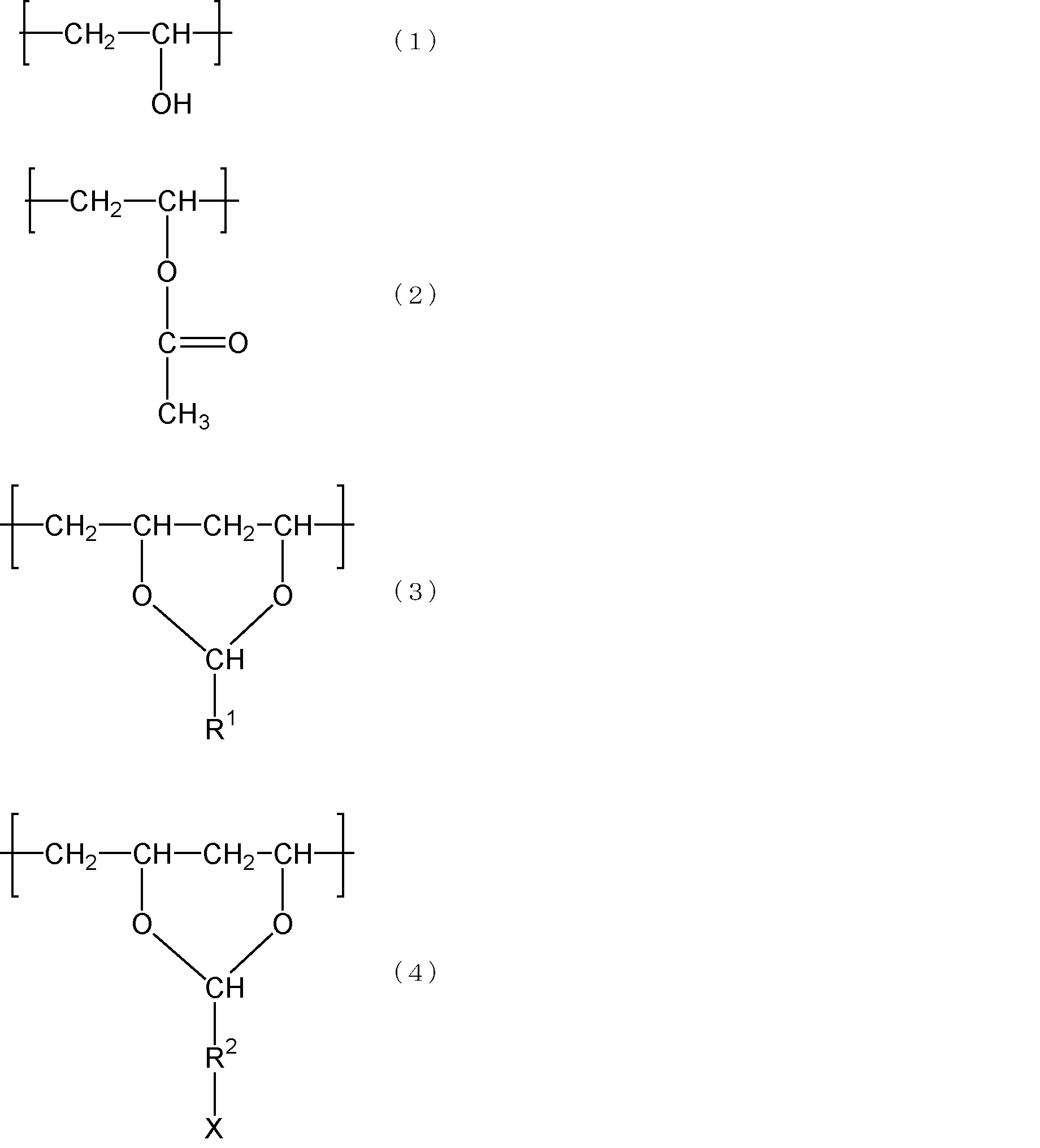
また、ポリビニルアセタール樹脂の分散性と、樹脂の柔軟性及び集電体に対する接着力を共に高いものとするために、上記ポリビニルアセタール樹脂において、全アセタール基量中のイオン性基含有アセタール基量の割合は、好ましい下限が0.5モル%、好ましい上限が28モル%である。また、上記全アセタール基量中のイオン性基含有アセタール基量の割合は、より好ましい下限が1モル%、更に好ましい下限が2モル%、より好ましい上限が20モル%、更に好ましい上限が15モル%である。
ポリビニルアセタール樹脂中のイオン性基含有アセタール基量を上記範囲内とすることで、リチウム二次電池電極用組成物中においてポリビニルアセタール樹脂の分散性が向上するとともに、電解液に対する耐性及び電極とした際の活物質及び導電助剤の分散性を優れたものとすることができる。更に、電池とした際のバインダーの劣化が抑制されることからリチウム二次電池の放電容量の低下を抑制することができる。
上記スルホン酸基を有するアルデヒドとしては、4-ホルミルベンゼン-1,3-ジスルホン酸二ナトリウム、4-ホルミルベンゼンスルホン酸ナトリウム、2-ホルミルベンゼンスルホン酸ナトリウム等が挙げられる。
上記アミノ基を有するアルデヒドとしては、3-ピリジンカルバルデヒド塩酸塩、4-ジエチルアミノベンズアルデヒド塩酸塩、4-ジメチルアミノベンズアルデヒド塩酸塩、ベタインアルデヒドクロリド等が挙げられる。
上記リン酸基を有するアルデヒドとしては、(2-ヒドロキシ-3-オキソプロポキシ)リン酸、5-リン酸ピリドキサール等が挙げられる。
上記カルボキシル基を有するアルデヒドとしては、テレフタルアルデヒド酸、イソフタルアルデヒド酸等が挙げられる。
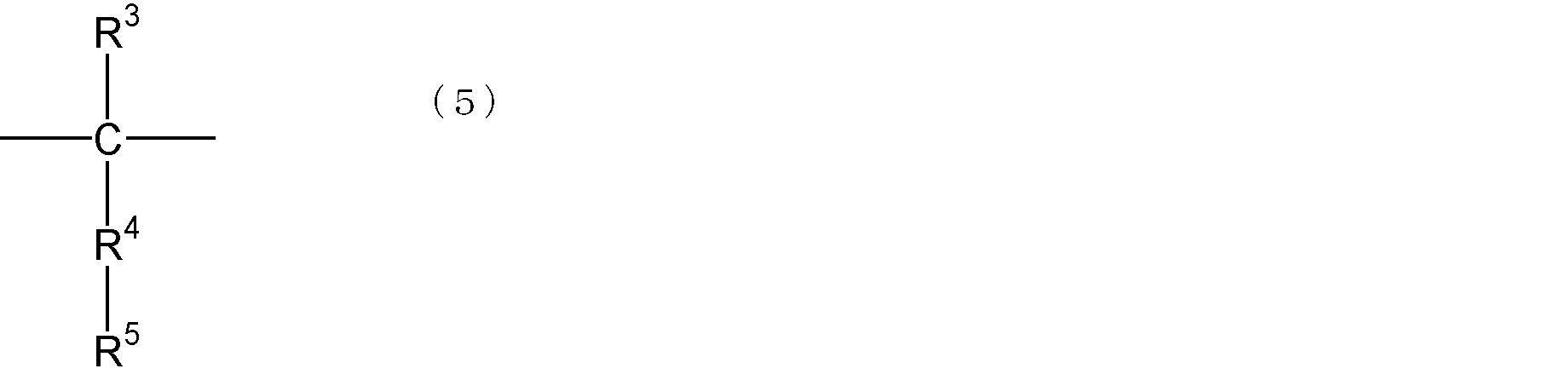
上記R4としては、例えば、メチレン基、エチレン基、プロピレン基、イソプロピレン基、ブチレン基、イソブチレン基、sec-ブチレン基、tert-ブチレン基等が挙げられる。なかでも、上記R4はメチレン基であることが好ましい。
上記R5は、ヘテロ原子を有する置換基によって置換された構造であってもよい。上記置換基としては、エステル基、エーテル基、スルフィド基、アミド基、アミン基、スルホキシド基、ケトン基、水酸基等が挙げられる。
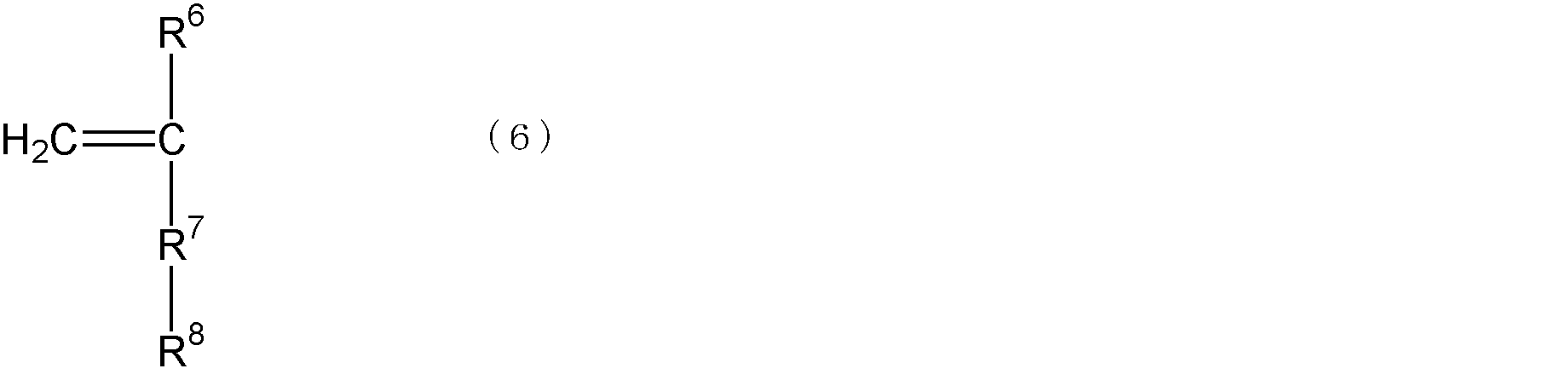
なかでも、アリルスルホン酸及びその塩を用いた場合、リチウム二次電池電極用組成物中においてポリビニルアセタール樹脂の分散性が向上するとともに、電解液に対する耐性及び電極とした際の活物質及び導電助剤の分散性を優れたものとすることができる。更に、電池とした際のバインダーの劣化が抑制されることからリチウム二次電池の放電容量の低下を抑制することができるため好適である。特に、アリルスルホン酸ナトリウムを用いることが好ましい。
これらのモノマーは、単独で用いてもよく、2種以上を併用してもよい。
上記R7としては、例えば、メチレン基、エチレン基、プロピレン基、イソプロピレン基、ブチレン基、イソブチレン基、sec-ブチレン基、tert-ブチレン基等が挙げられる。なかでも、上記R7はメチレン基であることが好ましい。
上記R8は、ヘテロ原子を有する置換基によって置換された構造であってもよい。上記置換基としては、エステル基、エーテル基、スルフィド基、アミド基、アミン基、スルホキシド基、ケトン基、水酸基等が挙げられる。
ポリビニルアセタール樹脂中のイオン性官能基の含有量を上記範囲内とすることで、リチウム二次電池電極用組成物中においてポリビニルアセタール樹脂の分散性が向上するとともに、電解液に対する耐性及び電極とした際の活物質及び導電助剤の分散性を優れたものとすることができる。更に、電池とした際のバインダーの劣化が抑制されることからリチウム二次電池の放電容量の低下を抑制することができる。
下記式(7)で表される構成単位を有することで、結着性に優れるとともに、電解液に対する耐性を良好なものとして、電解液によって樹脂成分が膨潤したり、樹脂成分が電解液中に溶出したりすることを抑制することができる。その結果、得られる電極の電極密度を向上させることができる。
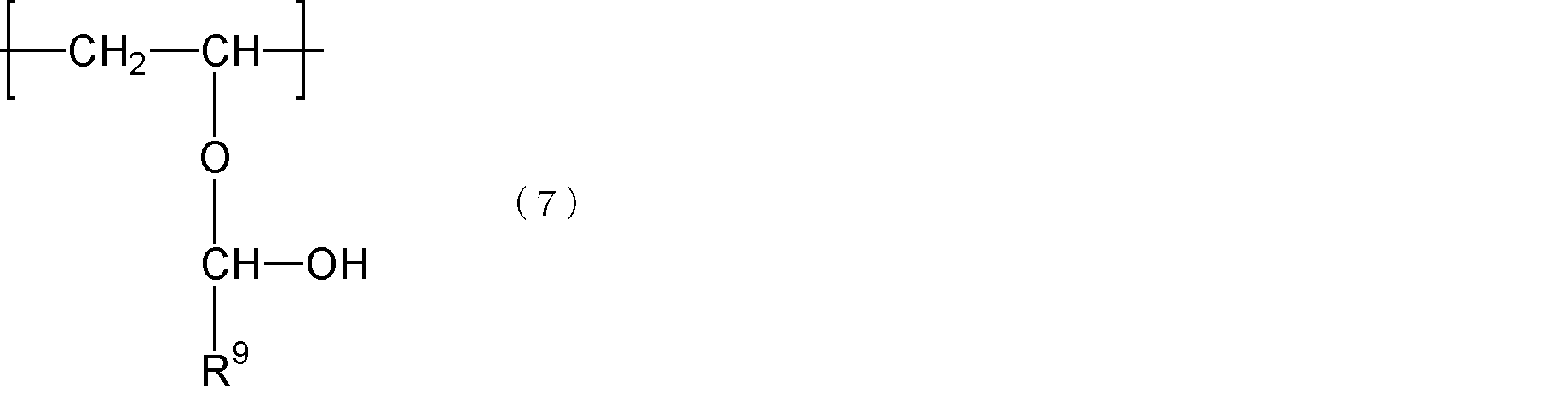
上記R9としては、活物質同士及び活物質と集電体との結着性をより優れたものとすることができるとともに、電解液に対する耐膨潤性をより高いものとすることができるという観点からプロピル基が好ましい。
上記式(7)で表される構成単位の含有量のより好ましい下限は0.4モル%、更に好ましい下限は0.5モル%、好ましい上限は5モル%、より好ましい上限は3モル%、更に好ましい上限は2モル%である。
具体的には、ポリビニルアセタール樹脂を重水素化ジメチルスルホキシドに濃度が1重量%となるように溶解させ、測定温度150℃でプロトンNMRを測定する。次いで、4.8ppm付近に現れるピーク(A)と、4.2ppm付近に現れるピーク(B)と、1.0~1.8ppm付近に現れるピーク(C)と、0.9ppm付近に現れるピーク(D)の積分値を用いて次式により算出する。
式(7)で表される構成単位の含有量(モル%)={(A-B/2)/[(C-4D/3)/2]}×100
一方、上記ポリビニルアセタール樹脂の水酸基量が低い場合には、ポリビニルアセタール樹脂中の上記式(7)で表される構成単位の含有量は、低く設定することが好ましい。
ポリビニルアセタール樹脂の水酸基量が低い場合には、上記式(7)で表される構成単位の含有量が低い範囲においても樹脂の柔軟性は充分に発揮され、クラックや割れの発生を抑制することができるとともに、電解液に対する耐性も高いものとすることができる。
なお、上記エチレン性不飽和結合を有する官能基を有する構成単位としては、例えば、エチレン性不飽和結合を有する官能基を有するアセタール結合が挙げられる。
また、エチレン性不飽和結合としては、末端ビニル構造、内部アルケン構造が挙げられる。
また、上記ポリビニルアセタール樹脂が微粒子形状であることによって、活物質及び導電助剤の表面を全て覆うことなく、部分的に接着(点接触)することが可能となる。その結果、電解液と活物質との接触が良好となり、リチウム電池を使用した場合に大電流が付可されても、リチウムイオンの電導が充分に保たれ、電池容量の低下を抑制することができるという利点が得られる。
なお、上記未架橋のポリビニルアセタール樹脂微粒子の体積平均粒子径は、レーザー回折/散乱式粒子径分布測定装置や透過型電子顕微鏡、走査型電子顕微鏡等を用いて測定することができる。
なお、上記ポリビニルアセタール樹脂の体積平均粒子径は、レーザー回折/散乱式粒子径分布測定装置や透過型電子顕微鏡、走査型電子顕微鏡等を用いて測定することができる。
上記CV値のより好ましい上限は35%、更に好ましい上限は32%、特に好ましい上限は30%である。なお、CV値は、標準偏差を体積平均粒子径で割った値の百分率(%)で示される数値である。
上記分散媒としては水性媒体が好ましく用いられる。
上記分散媒として水性媒体を用いることで、電極に残留する溶媒を限りなく減らすことができ、リチウム二次電池を作製することが可能となる。
なお、本発明の蓄電デバイス電極用バインダーでは、水性媒体は水のみであってもよく、上記水に加えて、水以外の溶媒を添加してもよい。
上記水以外の溶媒としては、水への溶解性を有しており、なおかつ揮発性の高いものがよく、例えば、イソプロピルアルコール、ノルマルプロピルアルコール、エタノール、メタノール等のアルコール類が挙げられる。上記溶媒は単独で用いてもよく、2種以上を併用してもよい。上記水以外の溶媒添加量の好ましい上限は水100重量部に対して30重量部であり、より好ましい上限は20重量部である。
上記蓄電デバイスとしては、リチウム二次電池、電気二重層キャパシタ、リチウムイオンキャパシタ等が挙げられる。なかでも、リチウム二次電池、リチウムイオンキャパシタに特に好適に使用することができる。
なかでも、得られるポリビニルアセタール樹脂微粒子の体積平均粒子径が小さく、粒子径分布が狭い微粒子を得ることができることから、上記未架橋のポリビニルアセタール樹脂を有機溶剤に溶解した後、未架橋ポリビニルアセタール樹脂微粒子を析出させ、更に架橋剤を添加して架橋ポリビニルアセタール樹脂微粒子を作製する方法が好ましい。
なお、上記製造方法では、ポリビニルアセタール樹脂を作製し、乾燥した後に水性媒体に分散させてもよく、ポリビニルアセタール樹脂の作製時に使用した溶媒をそのまま水性媒体として使用してもよい。
本発明の蓄電デバイス電極用組成物は、正極、負極のいずれの電極に使用してもよく、また、正極及び負極の両方に使用してもよい。従って、活物質としては、正極活物質、負極活物質がある。
なお、これらは単独で用いてもよく、2種以上を併用してもよい。
上記導電助剤は、蓄電デバイスを高出力化するために用いられるものであり、正極に使用する場合、負極に使用する場合に応じて適当なものを使用することができる。
上記導電助剤としては、例えば、黒鉛、アセチレンブラック、 カーボンブラック、ケッチェンブラック、気相成長炭素繊維等が挙げられる。なかでも、アセチレンブラックが好ましい。
本発明の蓄電デバイス電極用組成物を導電性基体に塗布する際の塗布方法としては、例えば、押出しコーター、リバースローラー、ドクターブレード、アプリケーターなどをはじめ、各種の塗布方法を採用することができる。
温度計、攪拌機、冷却管を備えた反応容器内に、ポリビニルアセタール樹脂(重合度1100、ブチラール基量52モル%、水酸基量47.8モル%、アセチル基量0.2モル%)20重量部をイソプロパノール80重量部に溶解させた。得られた溶解液に2-ホルミルベンゼンスルホン酸ナトリウムを1重量部、12Mの濃塩酸を0.05重量部加え、70℃にて4時間反応させた。次いで、ブチルアルデヒド0.2重量部と12Mの濃塩酸1重量部を添加し、82℃にて6時間反応を行った後、反応液を冷却し、再沈法にて樹脂の精製を行い、最後に乾燥させて樹脂を回収した。次に、得られた樹脂を再度イソプロパノール80重量部に溶解させ、水200重量部を滴下添加した。次いで液温を30℃に保ち、減圧しながら撹拌を行うことでイソプロパノール及び水を揮発させた後、固形分が20重量%となるまで濃縮して、ポリビニルアセタール樹脂からなる微粒子1(以下、ポリビニルアセタール樹脂微粒子1ともいう)が分散した分散液(ポリビニルアセタール樹脂微粒子1の含有量:20重量%)を作製した。
得られたポリビニルアセタール樹脂をNMRにより測定したところ、式(7)で表される構成単位(式(7)中、R9がプロピル基)の含有量は1モル%、ブチラール基量は51モル%、水酸基量は45モル%、アセチル基量は0.2モル%であった。また、ポリビニルアセタール樹脂に含まれるイオン性官能基の量は0.2mmol/g、イオン性官能基を含むアセタール基を有する構成単位(式(4)中、R2がベンゼン環、Xがスルホン酸ナトリウム)の含有量は2.8モル%であった。更に、得られたポリビニルアセタール樹脂微粒子1の体積平均粒子径を透過型電子顕微鏡により測定したところ、90nmであった。
温度計、攪拌機、冷却管を備えた反応容器内に、ポリビニルアセタール樹脂(重合度1100、ブチラール基量70モル%、水酸基量28.2モル%、アセチル基量1.8モル%)20重量部をイソプロパノール80重量部に溶解させた。得られた溶解液に2-ホルミルベンゼンスルホン酸ナトリウムを1重量部、12Mの濃塩酸を0.05重量部加え、70℃にて4時間反応させた。次いで、12Mの濃塩酸0.1重量部を添加し、72℃にて1時間反応を行った後、反応液を冷却し、再沈法にて樹脂の精製を行い、最後に乾燥させて樹脂を回収した。次に、得られた樹脂を再度イソプロパノール80重量部に溶解させ、水200重量部を滴下添加した。次いで液温を30℃に保ち、減圧しながら撹拌を行うことでイソプロパノール及び水を揮発させた後、固形分が20重量%となるまで濃縮して、ポリビニルアセタール樹脂からなる微粒子2(以下、ポリビニルアセタール樹脂微粒子2ともいう)が分散した分散体(ポリビニルアセタール樹脂微粒子2の含有量:20重量%)を作製した。
得られたポリビニルアセタール樹脂をNMRにより測定したところ、ブチラール基量は69.5モル%、水酸基量は26.2モル%、アセチル基量は1.5モル%であった。また、ポリビニルアセタール樹脂に含まれるイオン性官能基の量は0.2mmol/g、イオン性官能基を含むアセタール基を有する構成単位(式(4)中、R2がベンゼン環、Xがスルホン酸ナトリウム)の含有量は2.8モル%であった。更に、得られたポリビニルアセタール樹脂微粒子2の体積平均粒子径を透過型電子顕微鏡により測定したところ、110nmであった。
温度計、攪拌機、冷却管を備えた反応容器内に、ポリビニルアセタール樹脂(重合度1000、ブチラール基量35.5モル%、水酸基量63.3モル%、アセチル基量1.2モル%)20重量部をイソプロパノール80重量部に溶解させた。得られた溶解液にテレフタルアルデヒド酸を1重量部、12Mの濃塩酸を0.05重量部加え、70℃にて4時間反応させた。次いで、12Mの濃塩酸1重量部を添加し、73℃にて1時間反応を行った後、反応液を冷却し、再沈法にて樹脂の精製を行い、最後に乾燥させて樹脂を回収した。次に、得られた樹脂を再度イソプロパノール80重量部に溶解させ、水200重量部を滴下添加した。次いで液温を30℃に保ち、減圧しながら撹拌を行うことでイソプロパノール及び水を揮発させた後、固形分が20重量%となるまで濃縮して、ポリビニルアセタール樹脂からなる微粒子3(以下、ポリビニルアセタール樹脂微粒子3ともいう)が分散した分散体(ポリビニルアセタール樹脂微粒子3の含有量:20重量%)を作製した。
得られたポリビニルアセタール樹脂をNMRにより測定したところ、ブチラール基量は34モル%、水酸基量は62モル%、アセチル基量は1モル%であった。また、ポリビニルアセタール樹脂に含まれるイオン性官能基の量は0.2mmol/g、イオン性官能基を含むアセタール基を有する構成単位(式(4)中、R2がベンゼン環、Xがカルボキシル基)の含有量は3モル%であった。更に、得られたポリビニルアセタール樹脂微粒子3の体積平均粒子径を透過型電子顕微鏡により測定したところ、100nmであった。
温度計、攪拌機、冷却管を備えた反応容器内に、ポリビニルアセタール樹脂(重合度1700、ブチラール基量37.2モル%、水酸基量61モル%、アセチル基量1.8モル%)20重量部をイソプロパノール80重量部に溶解させた。得られた溶解液に4-ホルミルベンゼン-1,3-ジスルホン酸二ナトリウムを6重量部、12Mの濃塩酸を0.05重量部加え、70℃にて4時間反応させた。次いで、ブチルアルデヒド1重量部と12Mの濃塩酸0.5重量部を添加し、75℃にて4時間反応を行った後、反応液を冷却し、再沈法にて樹脂の精製を行い、最後に乾燥させて樹脂を回収した。次に、得られた樹脂を再度イソプロパノール80重量部に溶解させ、水200重量部を滴下添加した。次いで液温を30℃に保ち、減圧しながら撹拌を行うことでイソプロパノール及び水を揮発させた後、固形分が20重量%となるまで濃縮して、ポリビニルアセタール樹脂からなる微粒子4(以下、ポリビニルアセタール樹脂微粒子4ともいう)が分散した分散体(ポリビニルアセタール樹脂微粒子4の含有量:20重量%)を作製した。
得られたポリビニルアセタール樹脂をNMRにより測定したところ、式(7)で表される構成単位(式(7)中、R9がプロピル基)の含有量は1モル%、ブチラール基量は38.5モル%、水酸基量は45モル%、アセチル基量は1.5モル%であった。また、ポリビニルアセタール樹脂に含まれるイオン性官能基の量は1.8mmol/g、イオン性官能基を含むアセタール基を有する構成単位(式(4)中、R2がベンゼン環、Xがスルホン酸ナトリウム)の含有量は14モル%であった。更に、得られたポリビニルアセタール樹脂微粒子4の体積平均粒子径を透過型電子顕微鏡により測定したところ、9nmであった。
温度計、攪拌機、冷却管を備えた反応容器内に、ポリビニルアセタール樹脂(重合度800、ブチラール基量50.5モル%、水酸基量47.7モル%、アセチル基量1.8モル%)20重量部をイソプロパノール80重量部に溶解させた。得られた溶解液に2-ホルミルベンゼンスルホン酸ナトリウムを0.25重量部、12Mの濃塩酸を0.05重量部加え、70℃にて4時間反応させた。次いで、ブチルアルデヒド1重量部と12Mの濃塩酸0.5重量部を添加し、75℃にて4時間反応を行った後、反応液を冷却し、再沈法にて樹脂の精製を行い、最後に乾燥させて樹脂を回収した。次に、得られた樹脂を再度イソプロパノール80重量部に溶解させ、水200重量部を滴下添加した。次いで液温を30℃に保ち、減圧しながら撹拌を行うことでイソプロパノール及び水を揮発させた後、固形分が20重量%となるまで濃縮して、ポリビニルアセタール樹脂からなる微粒子5(以下、ポリビニルアセタール樹脂微粒子5ともいう)が分散した分散体(ポリビニルアセタール樹脂微粒子5の含有量:20重量%)を作製した。
得られたポリビニルアセタール樹脂をNMRにより測定したところ、式(7)で表される構成単位(式(7)中、R9がプロピル基)の含有量は1モル%、ブチラール基量は51.8モル%、水酸基量は45モル%、アセチル基量は1.5モル%であった。また、ポリビニルアセタール樹脂に含まれるイオン性官能基の量は0.05mmol/g、イオン性官能基を含むアセタール基を有する構成単位(式(4)中、R2がベンゼン環、Xがスルホン酸ナトリウム)の含有量は0.7モル%であった。更に、得られたポリビニルアセタール樹脂微粒子5の体積平均粒子径を透過型電子顕微鏡により測定したところ、700nmであった。
温度計、攪拌機、冷却管を備えた反応容器内に、ポリビニルアセタール樹脂(重合度1000、ブチラール基量47.8モル%、水酸基量51モル%、アセチル基量1.2モル%)20重量部をイソプロパノール80重量部に溶解させた。得られた溶解液に2-ホルミルベンゼンスルホン酸ナトリウムを1重量部、12Mの濃塩酸を0.05重量部加え、70℃にて4時間反応させた。次いで、12Mの濃塩酸0.3重量部を添加し、74℃にて3時間反応を行った後、反応液を冷却し、再沈法にて樹脂の精製を行い、最後に乾燥させてポリビニルアセタール樹脂6を作製した。
なお、得られたポリビニルアセタール樹脂をNMRにより測定したところ、ブチラール基量は47.4モル%、水酸基量は48.6モル%、アセチル基量は1モル%であった。また、ポリビニルアセタール樹脂に含まれるイオン性官能基の量は0.2mmol/g、イオン性官能基を含むアセタール基を有する構成単位(式(4)中、R2がベンゼン環、Xがスルホン酸ナトリウム)の含有量は3モル%であった。
温度計、攪拌機、冷却管を備えた反応容器内に、ポリビニルアセタール樹脂(重合度1000、ブチラール基量48モル%、水酸基量50.7モル%、アセチル基量1.3モル%)20重量部をイソプロパノール80重量部に溶解させた。得られた溶解液に12Mの濃塩酸0.1重量部を添加し、73℃にて1時間反応を行った後、反応液を冷却し、再沈法にて樹脂の精製を行い、最後に乾燥させてポリビニルアセタール樹脂7を作製した。
なお、得られたポリビニルアセタール樹脂をNMRにより測定したところ、ブチラール基量47.8モル%、水酸基量51モル%、アセチル基量1.2モル%、ポリビニルアセタール樹脂に含まれるイオン性官能基の量は0mmol/g、イオン性官能基を含むアセタール基を有する構成単位の含有量は0モル%であった。

(架橋ポリビニルアセタール樹脂微粒子1の調製)
得られたポリビニルアセタール樹脂微粒子1の分散液100重量部(ポリビニルアセタール樹脂微粒子1の含有量:20重量%)に、12Mの濃塩酸を0.05重量部、架橋剤として25%グルタルアルデヒド水溶液0.2重量部を添加した。その後、70℃にて4時間の条件で反応させて、単一の微粒子が架橋された構造を有するポリビニルアセタール樹脂1(以下、架橋ポリビニルアセタール樹脂微粒子1ともいう)を作製した。
得られたポリビニルアセタール樹脂をNMRにより測定したところ、式(7)で表される構成単位の含有量は1モル%、ブチラール基量は50.2モル%、水酸基量は45.68モル%、アセチル基量は0.2モル%であった。また、架橋ポリビニルアセタール樹脂に含まれるイオン性官能基の量は0.2mmol/g、イオン性官能基を含むアセタール基を有する構成単位の含有量は2.8モル%、架橋剤に由来する成分の含有量(架橋アセタール基量)は0.12モル%であった。更に、得られた架橋ポリビニルアセタール樹脂微粒子1の体積平均粒子径を透過型電子顕微鏡により測定したところ、90nmであった。
また、NMRによりエチレン性不飽和結合を有する官能基を有さないことを確認した。
(架橋ポリビニルアセタール樹脂微粒子2~8の調製)
表2に示すポリビニルアセタール樹脂微粒子の分散液を用いて、原料ポリビニルアセタール樹脂、架橋剤の添加量を変更した以外は製造例1と同様にして、ポリビニルアセタール樹脂を作製した。得られたポリビニルアセタール樹脂のブチラール基量、水酸基量、アセチル基量、ポリビニルアセタール樹脂に含まれるイオン性官能基の量及びイオン性官能基を含むアセタール基を有する構成単位の含有量、式(7)で表される構成単位の含有量、架橋剤に由来する成分の含有量(架橋アセタール基量)をNMRにより測定した。また、体積平均粒子径は透過型電子顕微鏡により測定した。更に、NMRによりエチレン性不飽和結合を有する官能基を有さないことを確認した。
(架橋ポリビニルアセタール樹脂9の調製)
ポリビニルアセタール樹脂6を16重量部秤量し、イソプロパノール80重量部に溶解させ、12Mの濃塩酸を0.05重量部、架橋剤として25%グルタルアルデヒド水溶液0.26重量部を添加し、70℃にて4時間の条件で反応させて、架橋構造を有するポリビニルアセタール樹脂9(以下、架橋ポリビニルアセタール樹脂9ともいう)を作製した。得られたポリビニルアセタール樹脂のブチラール基量、水酸基量、アセチル基量、ポリビニルアセタール樹脂に含まれるイオン性官能基の量及びイオン性官能基を含むアセタール基を有する構成単位の含有量、架橋剤に由来する成分の含有量(架橋アセタール基量)をNMRにより測定した。また、NMRによりエチレン性不飽和結合を有する官能基を有さないことを確認した。
(架橋ポリビニルアセタール樹脂微粒子10の調製)
製造例9で得られた架橋ポリビニルアセタール樹脂9のイソプロパノール溶液100重量部(架橋ポリビニルアセタール樹脂9の含有量:20重量%)に、水90重量部を滴下添加した。次いで液温を30℃に保ち、減圧しながら撹拌を行うことでイソプロパノール及び水を揮発させた後、固形分が20重量%となるまで濃縮して、微粒子形状であり架橋構造を有するポリビニルアセタール樹脂10(以下、架橋ポリビニルアセタール樹脂微粒子10ともいう)が分散した分散体を作製した。なお、得られたポリビニルアセタール樹脂のブチラール基量、水酸基量、アセチル基量、ポリビニルアセタール樹脂に含まれるイオン性官能基、イオン性官能基を含むアセタール基を有する構成単位の含有量、架橋剤に由来する成分の含有量(架橋アセタール基量)をNMRにより測定した。また、体積平均粒子径を透過型電子顕微鏡により測定した。更に、NMRによりエチレン性不飽和結合を有する官能基を有さないことを確認した。
(架橋ポリビニルアセタール樹脂11の調製)
ポリビニルアセタール樹脂7を用いた以外は、製造例9と同様にして、架橋構造を有するポリビニルアセタール樹脂11(以下、架橋ポリビニルアセタール樹脂11ともいう)を作製した。得られたポリビニルアセタール樹脂のブチラール基量、水酸基量、アセチル基量、ポリビニルアセタール樹脂に含まれるイオン性官能基の量及びイオン性官能基を含むアセタール基を有する構成単位の含有量、架橋剤に由来する成分の含有量(架橋アセタール基量)をNMRにより測定した。また、NMRによりエチレン性不飽和結合を有する官能基を有さないことを確認した。
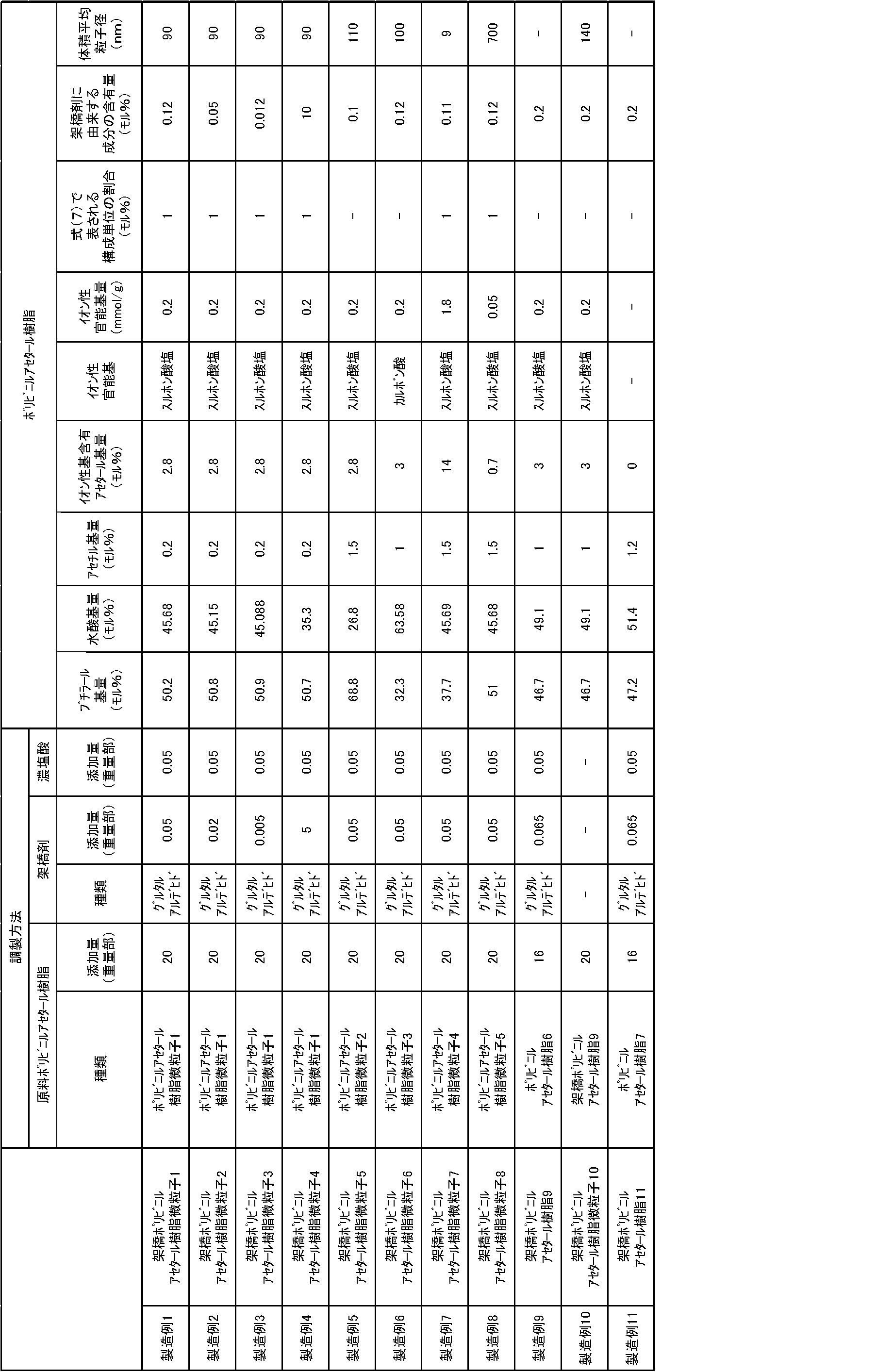
(蓄電デバイス電極用バインダーの調製)
表3に示すポリビニルアセタール樹脂2重量部に、溶媒として水18重量部を加えて、蓄電デバイス電極用バインダーを作製した。
得られた蓄電デバイス電極用バインダー20重量部に対して、正極活物質としてコバルト酸リチウム(日本化学工業社製、品名:セルシードC-5)50重量部、導電助剤としてアセチレンブラック(電気化学工業社製、デンカブラック)1重量部を添加した。更に、増粘剤としてカルボキシメチルセルロース(アルドリッチ社製)を1重量部加えて混合し、リチウム二次電池正極用組成物を得た。
(蓄電デバイス電極用バインダーの調製)
表3に示すポリビニルアセタール樹脂2重量部に、溶媒として水18重量部を加えて、蓄電デバイス電極用バインダーを作製した。
得られた蓄電デバイス電極用バインダー20重量部に対して、負極活物質として球状天然黒鉛(日本黒鉛工業社製、CGB-20)50重量部、導電助剤としてアセチレンブラック(電気化学工業社製、デンカブラック)1重量部を添加した。更に、増粘剤としてカルボキシメチルセルロース(アルドリッチ社製)を1重量部加えて混合し、リチウム二次電池負極用組成物を得た。
(蓄電デバイス電極用バインダーの調製)
表3に示すポリビニルアセタール樹脂2重量部に、溶媒として水18重量部を加えて、蓄電デバイス電極用バインダーを作製した。
得られた蓄電デバイス電極用バインダー20重量部に対して、負極活物質として球状天然黒鉛(日本黒鉛工業社製、CGB-20)45重量部及びシリコン(SiO、大阪チタニウムテクノロジーズ社製)5重量部、導電助剤としてアセチレンブラック(電気化学工業社製、デンカブラック)1重量部を添加した。更に、増粘剤としてカルボキシメチルセルロース(アルドリッチ社製)を1重量部加えて混合し、リチウム二次電池負極用組成物を得た。
表5に示すポリビニルアセタール樹脂を用いた以外は実施例1と同様にして蓄電デバイス電極用バインダー及びリチウム二次電池正極用組成物を得た。
ポリビニルアセタール樹脂微粒子1を用いた以外は実施例1と同様にして蓄電デバイス電極用バインダー及びリチウム二次電池正極用組成物を得た。
バインダー樹脂としてスチレン-ブタジエンゴム(SBR)ラテックス(体積平均粒子径180nm、固形分率50重量%)を用いた以外は実施例1と同様にして、リチウム二次電池正極用組成物を得た。
温度計、攪拌機、冷却管を備えた反応容器内に、ポリビニルアルコール樹脂(重合度1700、鹸化度99.5)の6重量%の水溶液を調製した。次いで、ポリビニルアルコール樹脂水溶液22.3重量部を液温10℃まで冷却し、12Mの濃塩酸0.14重量部を添加した。次いで、ブチルアルデヒド0.177重量部、シンナムアルデヒド(桂皮アルデヒド)0.08重量部を10分間で滴下し、25℃にて0.5時間反応を行った後、さらに60℃にて6時間でアセタール化反応を行った
得られた反応液を再沈法にて樹脂の精製を行い、最後に乾燥させることによって、架橋基を有するポリビニルアセタール樹脂8を作製した。
得られたポリビニルアセタール樹脂8をNMRにより測定したところ、ブチラール基量21モル%、水酸基量75モル%であった。また、エチレン性不飽和結合を有する官能基を有する構成単位の含有量は4モル%であった。
表5に示すポリビニルアセタール樹脂を用いた以外は実施例10と同様にして蓄電デバイス電極用バインダー及びリチウム二次電池負極用組成物を得た。
ポリビニルアセタール樹脂微粒子1を用いた以外は実施例10と同様にして蓄電デバイス電極用バインダー及びリチウム二次電池負極用組成物を得た。
バインダー樹脂としてスチレン-ブタジエンゴム(SBR)ラテックス(体積平均粒子径180nm、固形分率50重量%)を用いた以外は実施例10と同様にして、リチウム二次電池負極用組成物を得た。
ポリビニルアセタール樹脂8を用いた以外は実施例10と同様にして蓄電デバイス電極用バインダー及びリチウム二次電池負極用組成物を得た。
表5に示すポリビニルアセタール樹脂を用いた以外は実施例19と同様にして蓄電デバイス電極用バインダー及びリチウム二次電池負極用組成物を得た。
ポリビニルアセタール樹脂微粒子1を用いた以外は実施例19と同様にして蓄電デバイス電極用バインダー及びリチウム二次電池負極用組成物を得た。
バインダー樹脂としてスチレン-ブタジエンゴム(SBR)ラテックス(体積平均粒子径180nm、固形分率50重量%)を用いた以外は実施例19と同様にして、リチウム二次電池負極用組成物を得た。
ポリビニルアセタール樹脂8を用いた以外は実施例19と同様にして蓄電デバイス電極用バインダー及びリチウム二次電池負極用組成物を得た。
実施例及び比較例で用いたポリビニルアセタール樹脂及びSBRラテックス、実施例及び比較例で得られた蓄電デバイス電極用バインダー及びリチウム二次電池電極用組成物(正極用、負極用)について以下の評価を行った。結果を表3~6に示した。
製造例1~11で得られたポリビニルアセタール樹脂0.5g(x)を25℃の溶媒イソプロパノール/メタノール混合溶媒(1/1)20g中に浸漬して24時間放置した後、100メッシュの金網で濾過して金網上の不溶解分を採取し、不溶解分の重量(y)を測定した。得られた値から、下記式により架橋度(重量%)を算出した。
架橋度(重量%)=(y/x)×100
また、ポリビニルアセタール樹脂微粒子1及びスチレン-ブタジエンゴム(SBR)ラテックス(体積平均粒子径180nm、固形分率50重量%)の架橋度を同様にして測定した。
製造例1~11で得られたポリビニルアセタール樹脂について、DVA-200(アイティー計測制御社製)を用い、周波数10Hz、5℃/minの昇温速度で加熱して、25℃、10Hzにおける弾性率(X)及び70℃、10Hzにおける弾性率(Y)を測定した。また、ポリビニルアセタール樹脂微粒子1及びスチレン-ブタジエンゴム(SBR)ラテックス(体積平均粒子径180nm、固形分率50重量%)についても同様にして弾性率を測定した。
製造例1~11で得られたポリビニルアセタール樹脂について、誘電体測定装置(ソーラトロン社製、126096W型)を用いて、サンプルサイズ直径20mm、厚み100μm、印加電圧0.2MV/m、応答スピード8ms、測定スピード115回/秒の条件で、誘電率を測定した。また、ポリビニルアセタール樹脂微粒子1、ポリビニルアセタール樹脂8及びスチレン-ブタジエンゴム(SBR)ラテックス(体積平均粒子径180nm、固形分率50重量%)の誘電率を同様にして測定した。
(バインダー樹脂シートの作製)
離型処理されたポリエチレンテレフタレート(PET)フィルム上に、乾燥後の膜厚が50μmとなるように実施例及び比較例で得られた蓄電デバイス電極用バインダーを塗工、乾燥してバインダー樹脂シートを作製した。
得られたバインダー樹脂シートを30×50mmに切り出し、試験片を作製した。
次に、電解液としてエチレンカーボネートとジエチルカーボネートとの混合溶液(体積比1:1)を用い、得られたフィルムを電解液に25℃で3日間浸漬させた。その後、フィルムを取り出し、直ちに表面の電解液をふき取って除去した後、計量することにより、重量(b)を計測した。
その後、該フィルムを純水500gに2日間浸漬させてフィルム内部の電解液を完全に除去し、110℃で2時間乾燥させた後、計量することにより、重量(c)を計測した。
各重量から、バインダーの溶解率及び膨潤率を次式により算出した。
溶解率(%)=[(a-c)/a]×100
膨潤率(%)=(b/c)×100
なお、溶解率の値が高いほど電解液に樹脂が溶解しやすいことを意味し、膨潤率が高いほど樹脂が電解液によって膨潤しやすいことを意味する。
(5-1)粒子分散性
実施例及び比較例で用いられた蓄電デバイス電極用バインダーを5g秤量し、pH3になるように1mol/Lの塩酸を添加した。次いで、pH3に調整された蓄電デバイス電極用バインダーを24時間静置し、以下の基準で分散性を評価した。
◎:沈降物がなく、完全に分散していた。
○:僅かに沈降物が認められたが、概ね分散していた。
△:樹脂の凝集が生じ、沈降していた。
実施例及び比較例で得られたリチウム二次電池電極用組成物10重量部と水90重量部を混合、希釈した後、超音波分散機(エスエヌディ社製、「US-303」)にて10分間撹拌した。その後レーザー回折式粒度分布計(堀場製作所社製、LA-910)を用いて粒度分布測定を行い、平均分散径を測定した。
実施例1~9、比較例1~5で得られたリチウム二次電池正極用組成物については、アルミ箔に対する接着性を評価し、実施例10~27、比較例6~15で得られたリチウム二次電池負極用組成物については、銅箔に対する接着性を評価した。
アルミ箔(厚み15μm)の上に、乾燥後の膜厚が40μmとなるようにリチウム二次電池電極用組成物を塗工、乾燥し、アルミ箔上に電極がシート状に形成された試験片を得た。
このサンプルを縦10cm、横5cmに切り出し、アルミ箔側を厚み2mmのアクリル板に両面テープで貼り付けた。試験片の電極表面に幅18mmのテープ(商品名:セロテープ(登録商標)No.252(積水化学工業社製)(JIS Z1522規定))を貼り付け、90°方向に300mm/minの速度でテープを剥離したときの剥離力(N)をAUTOGRAPH(島津製作所社製、「AGS-J」)を用いて計測した。
上記「(6-1)アルミ箔に対する接着性」において、アルミ箔を銅箔(厚み15μm)に変更した以外は全く同じ方法にて剥離力を計測した。
実施例1~9、比較例1~5で得られたリチウム二次電池正極用組成物については、アルミ箔を用いて作製した電極の柔軟性を評価し、実施例10~27、比較例6~15で得られたリチウム二次電池負極用組成物については、銅箔を用いて作製した電極の柔軟性を評価した。
(7-1)アルミ箔を用いた柔軟性
アルミ箔(厚み15μm)の上に、乾燥後の膜厚が40μmとなるようにリチウム二次電池電極用組成物を塗工、乾燥し、アルミ箔上に電極がシート状に形成された試験片を得た。
このサンプルを縦50cm、横2cmに切り出し、直径2mmのガラス棒に巻き付けて1日放置した後、サンプルの巻き付けを解いて電極のクラックや割れの発生を以下の基準で評価した。
◎:クラックや割れは全く確認されなかった
○:クラックや割れが僅かに確認されたが、活物質の剥がれは全く確認されなかった
△:クラックや割れが確認され、部分的な活物質の剥がれも確認された
×:全面的にクラックや割れが確認され、大部分の活物質の剥がれも確認された
(7-2)銅箔を用いた柔軟性
上記「(7-1)アルミ箔を用いた柔軟性」において、アルミ箔を銅箔(厚み15μm)に変更した以外は全く同じ方法にて柔軟性を評価した。
(8-1)実施例1~9、比較例1~5
(a)二次電池の作製
実施例1~9、比較例1~5で得られたリチウム二次電池正極用組成物を厚さ15μmのアルミ箔に均一に塗布、乾燥し、これをφ16mmに打ち抜いて正極を得た。
電解液としてLiPF6(1M)を含有するエチレンカーボネートとジエチルカーボネートとの混合溶媒(体積比1:1)を用いた。
2極式コインセル(商品名:HSフラットセル(宝泉社製))に、正極を、電極層面が上向きになるように入れた。次いで、直径24mmに打ち抜いた厚さ25μmの多孔質ポリプロピレン製セパレータを置いた後、空気が入らないように電解液を注入した。その後、対極となるリチウム金属板を更に置き、上部蓋をネジで閉めて密閉することにより二次電池を得た。
得られた二次電池について、東洋システム社製、評価用充放電試験装置TOSCAT-3100を用いて放電容量評価、及び、充放電サイクル評価を行った。
この放電容量評価、充放電サイクル評価は電圧範囲2.8~4.2V、評価温度は25℃及び50℃で行った。なお、充放電サイクル評価は、初回の放電容量に対する50サイクル目の放電容量の割合より算出した。
得られた二次電池について、プリンストンアプライドリサーチ社製、電気化学測定装置VersaSTAT4 ポテンショ/ガルバノスタットを用いて、25℃の温度環境下において、各電池を0.3It(600mA)の定電流で電池電圧が4.2Vとなるまで充電し、電池電圧が4.2Vに達した後は定電圧で充電した。次に、低抵抗計(測定周波数1kHzに設定した交流4端子法)を用いて、各電池の端子間抵抗を測定し、このときの抵抗値を各電池の内部抵抗とした。
実施例10~27、比較例6~15で得られたリチウム二次電池負極用組成物を厚さ15μmの銅箔に均一に塗布、乾燥し、これをφ16mmに打ち抜いて負極を得た。
得られた負極を用いた以外は、(8-1)と同じ方法にて密閉型の二次電池を得た後、放電容量評価、充放電サイクル評価、及び、内部抵抗の測定を行った。なお、この放電容量評価、充放電サイクル評価は電圧範囲0.03~3.0V、評価温度は25℃及び50℃で行った。充放電サイクル評価は、初回の放電容量に対する50サイクル目の放電容量の割合より算出した。
実施例及び比較例で用いたバインダー樹脂を60℃、50%RHの条件で、1ヶ月間貯蔵した。貯蔵後のバインダーを用いた以外は実施例及び比較例と同様にして、リチウム二次電池電極用組成物を得た。
得られたリチウム二次電池電極用組成物を用いて、(8)電池性能評価と同様にして、放電容量評価、充放電サイクル評価、及び、内部抵抗の測定を行った。
製造例1~11で得られた架橋ポリビニルアセタール樹脂を乾燥後、粉末状に粉砕し、その2gを試験管に入れた。その状態で樹脂の粉末の色を目視にて観察した。次いで、150℃及び180℃にて60分間加熱した後に、樹脂の粉末の色を目視にて観察し、以下の基準で評価した。また、ポリビニルアセタール樹脂微粒子1、ポリビニルアセタール樹脂8及びスチレン-ブタジエンゴム(SBR)ラテックス(体積平均粒子径180nm、固形分率50重量%)についても同様にして熱安定性評価を行った。
○:着色(黄変)が認められなかった。
△:若干の着色(黄変)が認められた。
×:着色(黄変)が認められた。
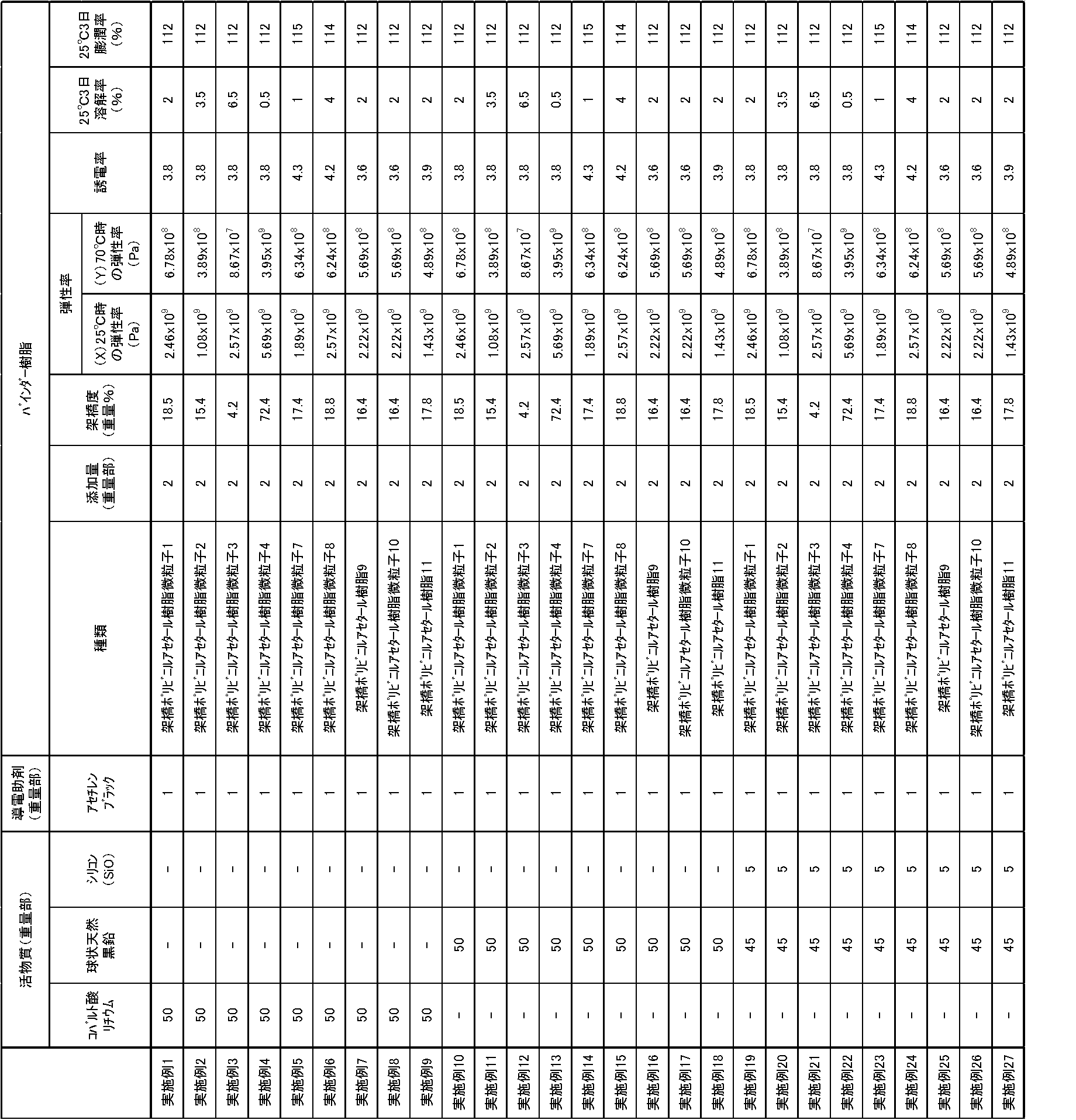
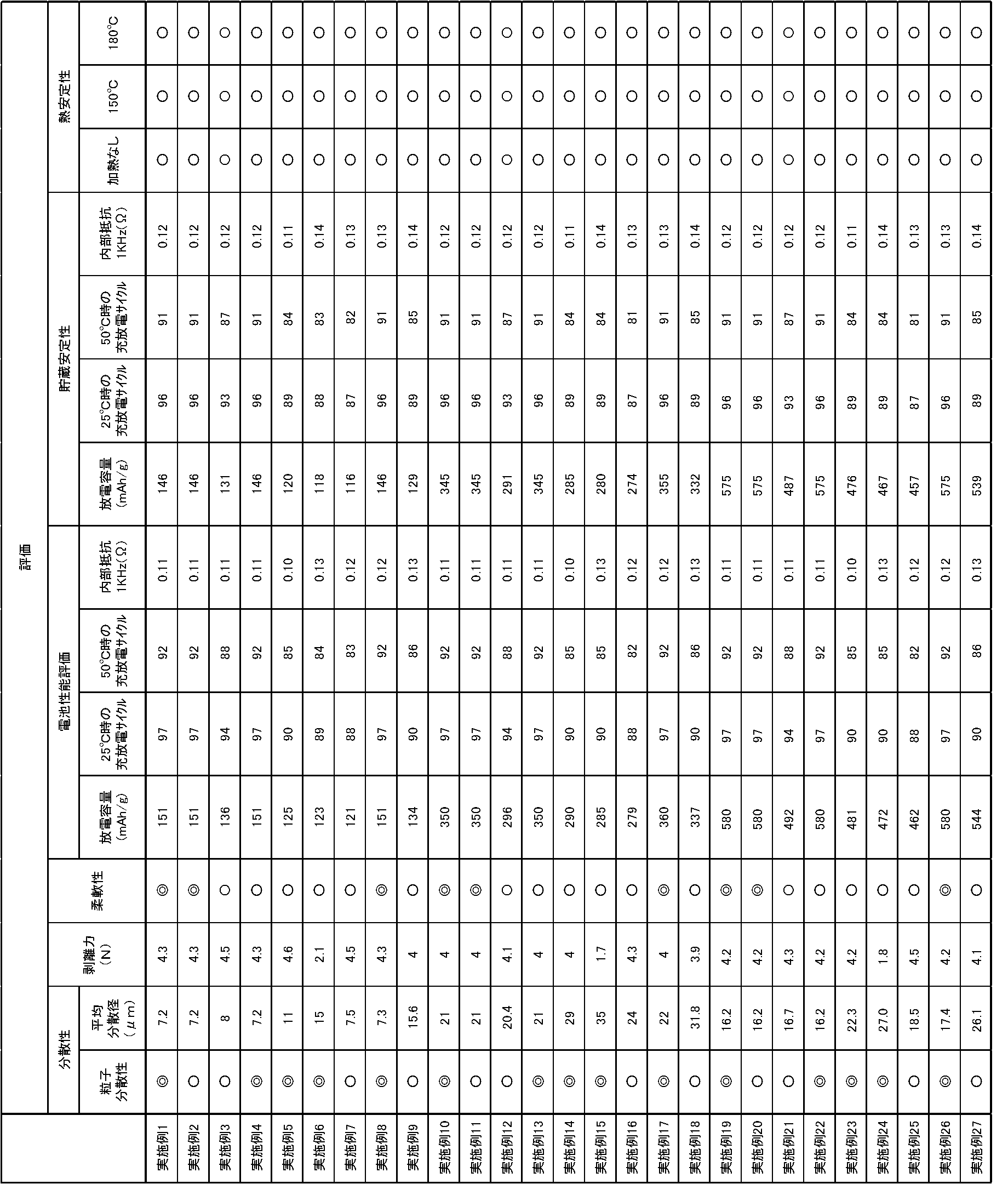


Claims (14)
- 蓄電デバイスの電極に用いられるバインダーであって、
前記バインダーはポリビニルアセタール樹脂を含有し、
前記ポリビニルアセタール樹脂は水酸基量が30~60モル%であり、
前記ポリビニルアセタール樹脂は架橋構造を有する
ことを特徴とする蓄電デバイス電極用バインダー。 - ポリビニルアセタール樹脂は、25℃時の架橋度が5重量%以上であることを特徴とする請求項1記載の蓄電デバイス電極用バインダー。
- ポリビニルアセタール樹脂は、25℃、10Hzにおける弾性率(X)が1×10⁹~1×10¹⁰Pa、かつ、70℃、10Hzにおける弾性率(Y)が1×10⁸~1×10¹⁰Paであることを特徴とする請求項1又は2記載の蓄電デバイス電極用バインダー。
- ポリビニルアセタール樹脂は、誘電率が3.5以上、かつ、エチレンカーボネート/ジエチレンカーボネート混合溶媒又はエチレンカーボネート/エチルメチルカーボネート混合溶媒に25℃で3日間浸漬させた際の膨潤率が100~125%であることを特徴とする請求項1、2又は3記載の蓄電デバイス電極用バインダー。
- ポリビニルアセタール樹脂は、多官能性アルデヒド、多官能性エポキシド、メラミン樹脂、ウレタン樹脂、多官能性イソシアネート及びフェノール-ホルムアルデヒド樹脂からなる群より選ばれる少なくとも1種の架橋剤に由来する成分を含有することを特徴とする請求項1、2、3又は4記載の蓄電デバイス電極用バインダー。
- ポリビニルアセタール樹脂は、架橋剤に由来する成分を0.015~10モル%含有することを特徴とする請求項5記載の蓄電デバイス電極用バインダー。
- ポリビニルアセタール樹脂は、イオン性官能基を有することを特徴とする請求項1、2、3、4、5又は6記載の蓄電デバイス電極用バインダー。
- ポリビニルアセタール樹脂は、下記式(1)で表される水酸基を有する構成単位、下記式(2)で表されるアセチル基を有する構成単位、下記式(3)で表されるアセタール基を有する構成単位、及び、下記式(4)で表されるイオン性官能基を含むアセタール基を有する構成単位を有することを特徴とする請求項7記載の蓄電デバイス電極用バインダー。
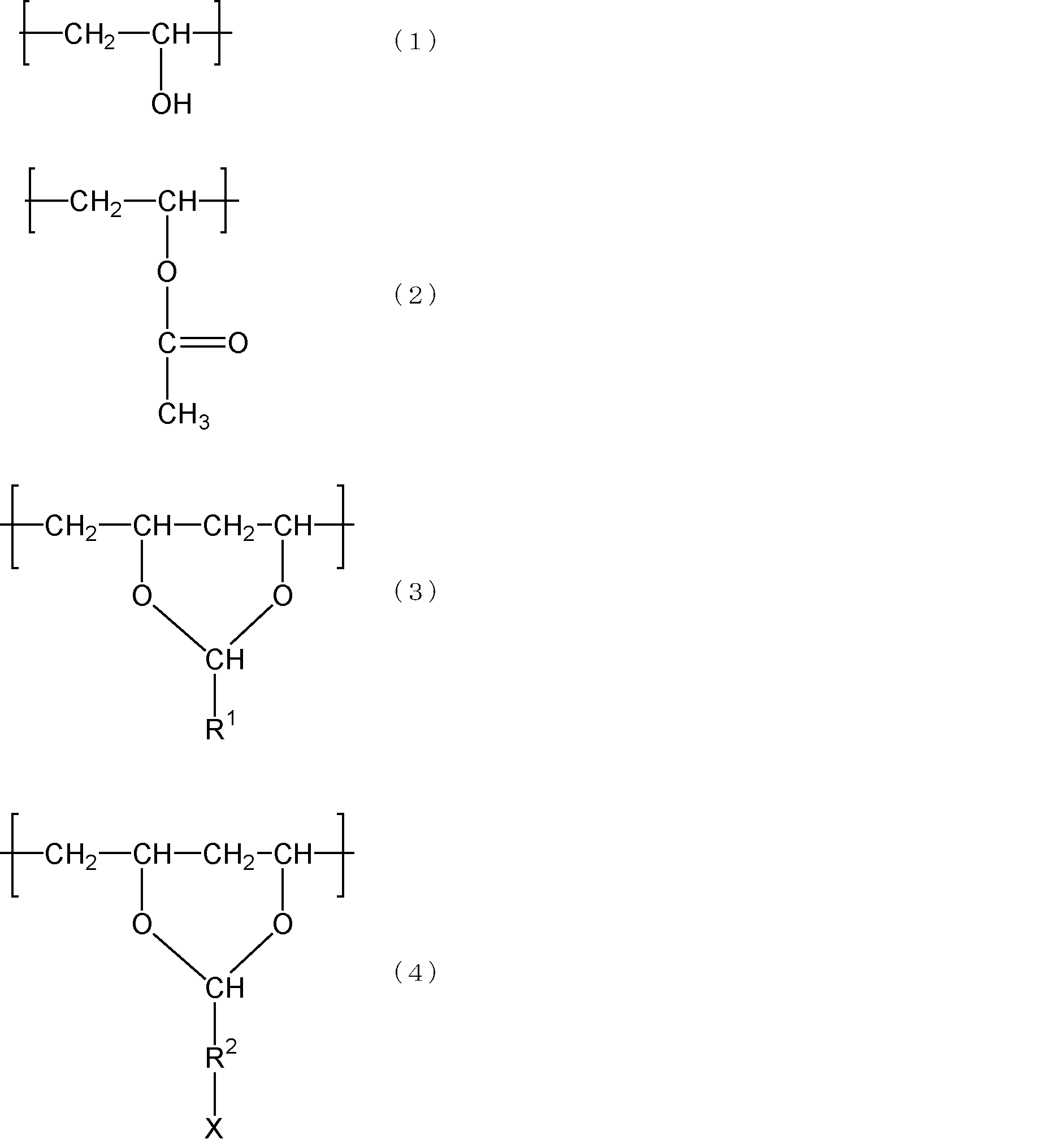
- ポリビニルアセタール樹脂と水性媒体とを含有することを特徴とする請求項1、2、3、4、5、6、7又は8記載の蓄電デバイス電極用バインダー。
- ポリビニルアセタール樹脂は、微粒子形状であることを特徴とする請求項1、2、3、4、5、6、7、8又は9記載の蓄電デバイス電極用バインダー。
- ポリビニルアセタール樹脂は、体積平均粒子径が10~500nmであることを特徴とする請求項10記載の蓄電デバイス電極用バインダー。
- 請求項1、2、3、4、5、6、7、8、9、10又は11記載の蓄電デバイス電極用バインダー、及び、活物質を含有する蓄電デバイス電極用組成物であって、前記活物質100重量部に対して、ポリビニルアセタール樹脂を0.1~12重量部含有することを特徴とする蓄電デバイス電極用組成物。
- 請求項12記載の蓄電デバイス電極用組成物を含有することを特徴とする蓄電デバイス電極。
- 請求項13記載の蓄電デバイス電極を含有することを特徴とする蓄電デバイス。
Priority Applications (3)
| Application Number | Priority Date | Filing Date | Title |
|---|---|---|---|
| KR1020187025101A KR20190075863A (ko) | 2016-10-27 | 2017-10-02 | 축전 디바이스 전극용 바인더 |
| JP2017553446A JP6345357B1 (ja) | 2016-10-27 | 2017-10-02 | 蓄電デバイス電極用バインダー |
| CN201780017597.2A CN108780895A (zh) | 2016-10-27 | 2017-10-02 | 蓄电装置电极用粘结剂 |
Applications Claiming Priority (6)
| Application Number | Priority Date | Filing Date | Title |
|---|---|---|---|
| JP2016-210903 | 2016-10-27 | ||
| JP2016-210902 | 2016-10-27 | ||
| JP2016210904 | 2016-10-27 | ||
| JP2016210902 | 2016-10-27 | ||
| JP2016210903 | 2016-10-27 | ||
| JP2016-210904 | 2016-10-27 |
Publications (1)
| Publication Number | Publication Date |
|---|---|
| WO2018079200A1 true WO2018079200A1 (ja) | 2018-05-03 |
Family
ID=62023374
Family Applications (1)
| Application Number | Title | Priority Date | Filing Date |
|---|---|---|---|
| PCT/JP2017/035823 Ceased WO2018079200A1 (ja) | 2016-10-27 | 2017-10-02 | 蓄電デバイス電極用バインダー |
Country Status (5)
| Country | Link |
|---|---|
| JP (1) | JP6345357B1 (ja) |
| KR (1) | KR20190075863A (ja) |
| CN (1) | CN108780895A (ja) |
| TW (1) | TW201822395A (ja) |
| WO (1) | WO2018079200A1 (ja) |
Cited By (3)
| Publication number | Priority date | Publication date | Assignee | Title |
|---|---|---|---|---|
| CN113272997A (zh) * | 2019-01-11 | 2021-08-17 | 株式会社可乐丽 | 非水电解质电池电极粘结剂、非水电解质电池电极粘结剂溶液、非水电解质电池电极浆料、非水电解质电池电极和非水电解质电池 |
| WO2022210177A1 (ja) * | 2021-03-29 | 2022-10-06 | 積水化学工業株式会社 | 樹脂組成物 |
| JP2022149954A (ja) * | 2021-03-25 | 2022-10-07 | 旭化成株式会社 | 非水系二次電池用重合体組成物、非水系二次電池用負極及び非水系二次電池 |
Families Citing this family (3)
| Publication number | Priority date | Publication date | Assignee | Title |
|---|---|---|---|---|
| CN110444765B (zh) * | 2019-08-12 | 2021-09-21 | 苏州大学 | 三聚氰胺交联聚乙烯醇水凝胶在锂电池硅负极材料中的应用 |
| CN115785849B (zh) * | 2022-12-18 | 2024-10-01 | 四川大学 | 一种聚合物微纳粘结剂及其制备和用途 |
| JP2025532547A (ja) * | 2023-02-17 | 2025-10-01 | 香港時代新能源科技有限公司 | アルデヒドケトンポリマー、極シート及びそれに関連する電池セル、電池及び電力消費装置 |
Citations (5)
| Publication number | Priority date | Publication date | Assignee | Title |
|---|---|---|---|---|
| JP2001085065A (ja) * | 1999-09-14 | 2001-03-30 | Toshiba Corp | 電気化学デバイス |
| WO2007122947A1 (ja) * | 2006-03-31 | 2007-11-01 | Zeon Corporation | リチウムイオン二次電池 |
| WO2015034064A1 (ja) * | 2013-09-06 | 2015-03-12 | 日本合成化学工業株式会社 | リチウムイオン二次電池電極用バインダー、リチウムイオン二次電池電極の製造方法、リチウムイオン二次電池電極、およびリチウムイオン二次電池 |
| WO2015146747A1 (ja) * | 2014-03-27 | 2015-10-01 | 積水化学工業株式会社 | 蓄電デバイス電極用バインダー |
| JP2016076311A (ja) * | 2014-10-02 | 2016-05-12 | デンカ株式会社 | 電極用バインダー組成物 |
Family Cites Families (2)
| Publication number | Priority date | Publication date | Assignee | Title |
|---|---|---|---|---|
| JP5401035B2 (ja) | 2007-12-25 | 2014-01-29 | 日立ビークルエナジー株式会社 | リチウムイオン二次電池 |
| EP2284235B1 (en) * | 2008-06-02 | 2016-08-31 | Dainichiseika Color & Chemicals Mfg. Co., Ltd. | Coating liquid, coating liquid for manufacturing electrode plate, undercoating agent, and use thereof |
-
2017
- 2017-10-02 WO PCT/JP2017/035823 patent/WO2018079200A1/ja not_active Ceased
- 2017-10-02 KR KR1020187025101A patent/KR20190075863A/ko not_active Withdrawn
- 2017-10-02 CN CN201780017597.2A patent/CN108780895A/zh active Pending
- 2017-10-02 JP JP2017553446A patent/JP6345357B1/ja active Active
- 2017-10-03 TW TW106134124A patent/TW201822395A/zh unknown
Patent Citations (5)
| Publication number | Priority date | Publication date | Assignee | Title |
|---|---|---|---|---|
| JP2001085065A (ja) * | 1999-09-14 | 2001-03-30 | Toshiba Corp | 電気化学デバイス |
| WO2007122947A1 (ja) * | 2006-03-31 | 2007-11-01 | Zeon Corporation | リチウムイオン二次電池 |
| WO2015034064A1 (ja) * | 2013-09-06 | 2015-03-12 | 日本合成化学工業株式会社 | リチウムイオン二次電池電極用バインダー、リチウムイオン二次電池電極の製造方法、リチウムイオン二次電池電極、およびリチウムイオン二次電池 |
| WO2015146747A1 (ja) * | 2014-03-27 | 2015-10-01 | 積水化学工業株式会社 | 蓄電デバイス電極用バインダー |
| JP2016076311A (ja) * | 2014-10-02 | 2016-05-12 | デンカ株式会社 | 電極用バインダー組成物 |
Cited By (6)
| Publication number | Priority date | Publication date | Assignee | Title |
|---|---|---|---|---|
| CN113272997A (zh) * | 2019-01-11 | 2021-08-17 | 株式会社可乐丽 | 非水电解质电池电极粘结剂、非水电解质电池电极粘结剂溶液、非水电解质电池电极浆料、非水电解质电池电极和非水电解质电池 |
| JP2022149954A (ja) * | 2021-03-25 | 2022-10-07 | 旭化成株式会社 | 非水系二次電池用重合体組成物、非水系二次電池用負極及び非水系二次電池 |
| JP7696738B2 (ja) | 2021-03-25 | 2025-06-23 | 旭化成株式会社 | 非水系二次電池用重合体組成物、非水系二次電池用負極及び非水系二次電池 |
| WO2022210177A1 (ja) * | 2021-03-29 | 2022-10-06 | 積水化学工業株式会社 | 樹脂組成物 |
| JPWO2022210177A1 (ja) * | 2021-03-29 | 2022-10-06 | ||
| JP7813700B2 (ja) | 2021-03-29 | 2026-02-13 | 積水化学工業株式会社 | 樹脂組成物 |
Also Published As
| Publication number | Publication date |
|---|---|
| JP6345357B1 (ja) | 2018-06-20 |
| JPWO2018079200A1 (ja) | 2018-10-25 |
| TW201822395A (zh) | 2018-06-16 |
| KR20190075863A (ko) | 2019-07-01 |
| CN108780895A (zh) | 2018-11-09 |
Similar Documents
| Publication | Publication Date | Title |
|---|---|---|
| JP6114821B2 (ja) | 蓄電デバイス電極用バインダー | |
| JP6345357B1 (ja) | 蓄電デバイス電極用バインダー | |
| JP6114891B1 (ja) | 蓄電デバイス電極用バインダー | |
| JP6126757B1 (ja) | 蓄電デバイス電極用バインダー | |
| JP6927756B2 (ja) | 蓄電デバイス電極用スラリー | |
| JP2018160400A (ja) | 蓄電デバイス電極用バインダー | |
| WO2018180073A1 (ja) | 蓄電デバイス電極用バインダー | |
| JP6935647B2 (ja) | 蓄電デバイス負極用バインダー | |
| JP2017183241A (ja) | 蓄電デバイス電極用バインダー | |
| JP6357603B1 (ja) | 蓄電デバイス電極用バインダー | |
| JP2018005989A (ja) | 蓄電デバイス電極用組成物 | |
| JP6876478B2 (ja) | 蓄電デバイス電極用バインダー |
Legal Events
| Date | Code | Title | Description |
|---|---|---|---|
| WWE | Wipo information: entry into national phase |
Ref document number: 2017553446 Country of ref document: JP |
|
| ENP | Entry into the national phase |
Ref document number: 20187025101 Country of ref document: KR Kind code of ref document: A |
|
| 121 | Ep: the epo has been informed by wipo that ep was designated in this application |
Ref document number: 17863653 Country of ref document: EP Kind code of ref document: A1 |
|
| NENP | Non-entry into the national phase |
Ref country code: DE |
|
| 122 | Ep: pct application non-entry in european phase |
Ref document number: 17863653 Country of ref document: EP Kind code of ref document: A1 |