WO2018062425A1 - 酸二無水物およびその利用 - Google Patents
酸二無水物およびその利用 Download PDFInfo
- Publication number
- WO2018062425A1 WO2018062425A1 PCT/JP2017/035325 JP2017035325W WO2018062425A1 WO 2018062425 A1 WO2018062425 A1 WO 2018062425A1 JP 2017035325 W JP2017035325 W JP 2017035325W WO 2018062425 A1 WO2018062425 A1 WO 2018062425A1
- Authority
- WO
- WIPO (PCT)
- Prior art keywords
- formula
- acid
- independently represent
- represented
- carbon atoms
- Prior art date
- Legal status (The legal status is an assumption and is not a legal conclusion. Google has not performed a legal analysis and makes no representation as to the accuracy of the status listed.)
- Ceased
Links
- 0 *c(cc1)c(C(F)(F)F)cc1Oc(cc1)ccc1Oc(cc1)cc(C(F)(F)F)c1I Chemical compound *c(cc1)c(C(F)(F)F)cc1Oc(cc1)ccc1Oc(cc1)cc(C(F)(F)F)c1I 0.000 description 4
- PLJALIGLMAMLMP-UHFFFAOYSA-N Cc(cc1)c(C(F)(F)F)cc1Oc1cc(C(F)(F)F)c(C)cc1 Chemical compound Cc(cc1)c(C(F)(F)F)cc1Oc1cc(C(F)(F)F)c(C)cc1 PLJALIGLMAMLMP-UHFFFAOYSA-N 0.000 description 1
- PBTLJGNBUNSMIZ-UHFFFAOYSA-N Cc(cc1)cc(C(F)(F)F)c1-c(cc1)ccc1-c1c(C(F)(F)F)cc(C)cc1 Chemical compound Cc(cc1)cc(C(F)(F)F)c1-c(cc1)ccc1-c1c(C(F)(F)F)cc(C)cc1 PBTLJGNBUNSMIZ-UHFFFAOYSA-N 0.000 description 1
- PDQICZMICDJDFZ-UHFFFAOYSA-N Cc(cc1)cc(C(F)(F)F)c1Oc(cc1)ccc1Oc(cc1)c(C(F)(F)F)cc1I Chemical compound Cc(cc1)cc(C(F)(F)F)c1Oc(cc1)ccc1Oc(cc1)c(C(F)(F)F)cc1I PDQICZMICDJDFZ-UHFFFAOYSA-N 0.000 description 1
- RKZNVIOTYNTDGQ-UHFFFAOYSA-N Cc(cc1)cc(C(F)(F)F)c1Oc1c(C(F)(F)F)cc(C)cc1 Chemical compound Cc(cc1)cc(C(F)(F)F)c1Oc1c(C(F)(F)F)cc(C)cc1 RKZNVIOTYNTDGQ-UHFFFAOYSA-N 0.000 description 1
- WTIWJFGNIILUQS-UHFFFAOYSA-N Cc(cc1)ccc1-c(cc1)c(C(F)(F)F)c(C(F)(F)F)c1-c1ccc(C)cc1 Chemical compound Cc(cc1)ccc1-c(cc1)c(C(F)(F)F)c(C(F)(F)F)c1-c1ccc(C)cc1 WTIWJFGNIILUQS-UHFFFAOYSA-N 0.000 description 1
- SPLLMSZRDWAHNC-UHFFFAOYSA-N Cc(cc1)ccc1C(Nc(cc1C(F)(F)F)ccc1-c(cc1)c(C(F)(F)F)cc1NC(c1ccc(C)cc1)=O)=O Chemical compound Cc(cc1)ccc1C(Nc(cc1C(F)(F)F)ccc1-c(cc1)c(C(F)(F)F)cc1NC(c1ccc(C)cc1)=O)=O SPLLMSZRDWAHNC-UHFFFAOYSA-N 0.000 description 1
- XTMFLTBGQOQTHQ-UHFFFAOYSA-N Cc(cc1)ccc1Oc(cc1)c(C(F)(F)F)cc1-c1cccc(-c(cc2)cc(C(F)(F)F)c2Oc(cc2)ccc2I)c1 Chemical compound Cc(cc1)ccc1Oc(cc1)c(C(F)(F)F)cc1-c1cccc(-c(cc2)cc(C(F)(F)F)c2Oc(cc2)ccc2I)c1 XTMFLTBGQOQTHQ-UHFFFAOYSA-N 0.000 description 1
- KCEPQMQUIATNFS-UHFFFAOYSA-N Cc(cc1)ccc1Oc(cc1)cc(C(F)(F)F)c1-c1cc(-c(cc2)c(C(F)(F)F)cc2Oc2ccc(C)cc2)ccc1 Chemical compound Cc(cc1)ccc1Oc(cc1)cc(C(F)(F)F)c1-c1cc(-c(cc2)c(C(F)(F)F)cc2Oc2ccc(C)cc2)ccc1 KCEPQMQUIATNFS-UHFFFAOYSA-N 0.000 description 1
- QGYQHGIANHIZJN-UHFFFAOYSA-N Cc1cc(C(C(F)(F)F)(C(F)(F)F)c(cc2C)ccc2O)ccc1O Chemical compound Cc1cc(C(C(F)(F)F)(C(F)(F)F)c(cc2C)ccc2O)ccc1O QGYQHGIANHIZJN-UHFFFAOYSA-N 0.000 description 1
- NKLCRNSHBMNDHE-UHFFFAOYSA-N Cc1ccc(-c(c(F)c2)ccc2I)c(F)c1 Chemical compound Cc1ccc(-c(c(F)c2)ccc2I)c(F)c1 NKLCRNSHBMNDHE-UHFFFAOYSA-N 0.000 description 1
- ORGYJEQCNSFUHP-UHFFFAOYSA-N Nc(cc1)cc(C(F)(F)F)c1OC1(c2ccccc2-c2c1cccc2)Oc(cc1)c(C(F)(F)F)cc1I Chemical compound Nc(cc1)cc(C(F)(F)F)c1OC1(c2ccccc2-c2c1cccc2)Oc(cc1)c(C(F)(F)F)cc1I ORGYJEQCNSFUHP-UHFFFAOYSA-N 0.000 description 1
Classifications
-
- C—CHEMISTRY; METALLURGY
- C07—ORGANIC CHEMISTRY
- C07D—HETEROCYCLIC COMPOUNDS
- C07D307/00—Heterocyclic compounds containing five-membered rings having one oxygen atom as the only ring hetero atom
- C07D307/77—Heterocyclic compounds containing five-membered rings having one oxygen atom as the only ring hetero atom ortho- or peri-condensed with carbocyclic rings or ring systems
- C07D307/87—Benzo [c] furans; Hydrogenated benzo [c] furans
- C07D307/89—Benzo [c] furans; Hydrogenated benzo [c] furans with two oxygen atoms directly attached in positions 1 and 3
-
- C—CHEMISTRY; METALLURGY
- C08—ORGANIC MACROMOLECULAR COMPOUNDS; THEIR PREPARATION OR CHEMICAL WORKING-UP; COMPOSITIONS BASED THEREON
- C08G—MACROMOLECULAR COMPOUNDS OBTAINED OTHERWISE THAN BY REACTIONS ONLY INVOLVING UNSATURATED CARBON-TO-CARBON BONDS
- C08G73/00—Macromolecular compounds obtained by reactions forming a linkage containing nitrogen with or without oxygen or carbon in the main chain of the macromolecule, not provided for in groups C08G12/00 - C08G71/00
- C08G73/06—Polycondensates having nitrogen-containing heterocyclic rings in the main chain of the macromolecule
- C08G73/10—Polyimides; Polyester-imides; Polyamide-imides; Polyamide acids or similar polyimide precursors
-
- C—CHEMISTRY; METALLURGY
- C08—ORGANIC MACROMOLECULAR COMPOUNDS; THEIR PREPARATION OR CHEMICAL WORKING-UP; COMPOSITIONS BASED THEREON
- C08J—WORKING-UP; GENERAL PROCESSES OF COMPOUNDING; AFTER-TREATMENT NOT COVERED BY SUBCLASSES C08B, C08C, C08F, C08G or C08H
- C08J5/00—Manufacture of articles or shaped materials containing macromolecular substances
- C08J5/18—Manufacture of films or sheets
-
- H—ELECTRICITY
- H05—ELECTRIC TECHNIQUES NOT OTHERWISE PROVIDED FOR
- H05B—ELECTRIC HEATING; ELECTRIC LIGHT SOURCES NOT OTHERWISE PROVIDED FOR; CIRCUIT ARRANGEMENTS FOR ELECTRIC LIGHT SOURCES, IN GENERAL
- H05B33/00—Electroluminescent light sources
- H05B33/02—Details
-
- H—ELECTRICITY
- H10—SEMICONDUCTOR DEVICES; ELECTRIC SOLID-STATE DEVICES NOT OTHERWISE PROVIDED FOR
- H10D—INORGANIC ELECTRIC SEMICONDUCTOR DEVICES
- H10D30/00—Field-effect transistors [FET]
- H10D30/60—Insulated-gate field-effect transistors [IGFET]
- H10D30/67—Thin-film transistors [TFT]
Definitions
- the present invention relates to a novel acid dianhydride and its use for polyamic acid.
- retardation is the product of birefringence (difference between two orthogonal refractive indexes) and film thickness, and this numerical value, particularly retardation in the thickness direction, is important because it affects viewing angle characteristics. Since it is a numerical value and a large retardation value may cause a decrease in display quality of the display (see, for example, Patent Document 3), these flexible display substrates have these in addition to high flexibility (flexibility). These characteristics are also required.
- the present invention has been made in view of such circumstances, and is not only excellent in heat resistance, flexibility and transparency, but also provides a polyamic acid and a polyamic acid that provide a polyimide film having the characteristics of low retardation It aims at providing the novel acid dianhydride used for manufacture of this.
- an acid dianhydride compound represented by the following formula (1-1) into an alicyclic tetrahydrate such as tetracyclobutanoic acid dianhydride.
- Copolymerization with an aromatic diamine such as 2,2′-di (trifluoromethyl) benzidine together with a carboxylic dianhydride can provide a polyamic acid exhibiting good solubility in an organic solvent, and the polyamic From the composition (solution) obtained by dissolving an acid in an organic solvent, it has been found that a polyimide film having not only excellent heat resistance, flexibility and transparency, but also low retardation can be obtained. Was completed.
- the present invention provides, as a first aspect, a polyamic acid obtained by reacting an acid dianhydride component with a diamine component,
- the polyamic acid is characterized in that the acid dianhydride component contains an acid dianhydride represented by the following formula (1-1).
- R 1 , R 2 , R 3 , R 4 and R 5 each independently represent a halogen atom, an alkyl group having 1 to 5 carbon atoms or an alkoxy group having 1 to 5 carbon atoms
- R 6 and R 7 each independently represent a hydrogen atom, a halogen atom, an alkyl group having 1 to 5 carbon atoms or an alkoxy group having 1 to 5 carbon atoms
- a and b each independently represent an integer of 0 to 4
- c and d each independently represent an integer of 0 to 3
- e represents an integer of 0 to 2.
- the said diamine component contains the diamine represented by a formula (A1), It is related with the polyamic acid as described in a 1st viewpoint.
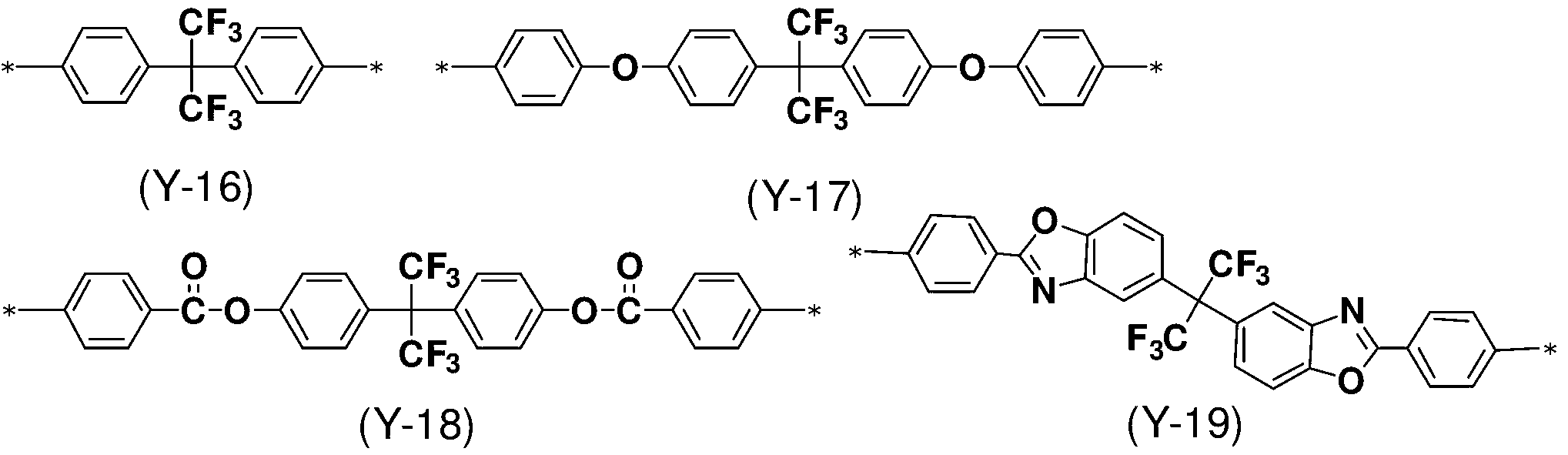
- B 2 represents any group selected from the group consisting of formulas (Y-1) to (Y-34)).
- * represents a bond.
- the acid dianhydride component further includes a tetracarboxylic dianhydride represented by the formula (C1), and relates to the polyamic acid according to the first aspect or the second aspect.
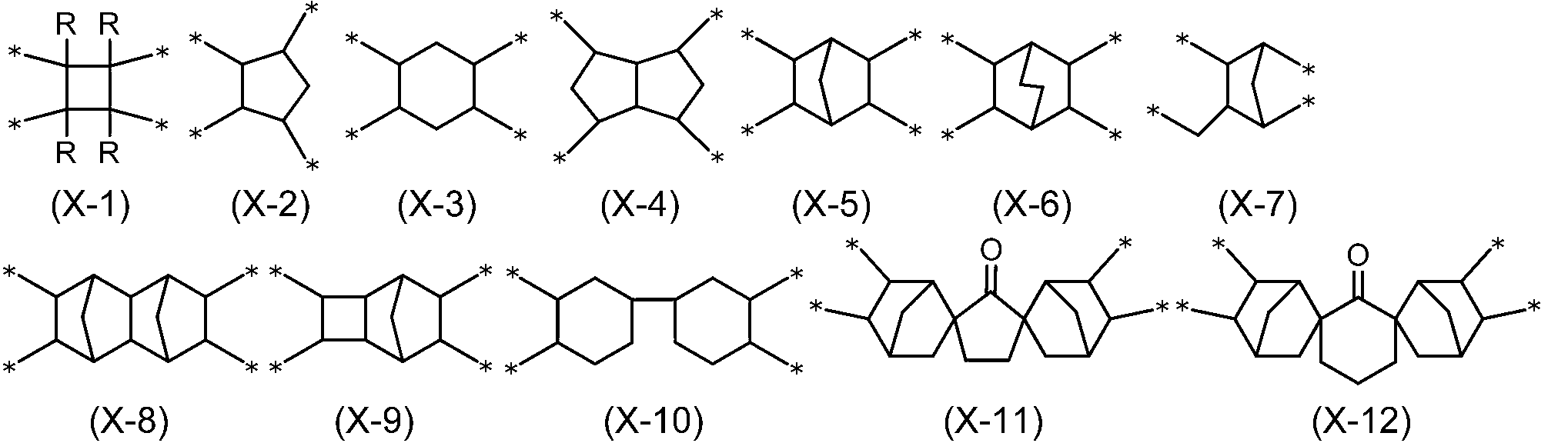
- B 1 represents any group selected from the group consisting of formula (X-1) to formula (X-12).
- a plurality of R's independently represent a hydrogen atom or a methyl group, and * represents a bond.
- a 4th viewpoint it is related with the composition for polyimide film formation containing the polyamic acid as described in any one of a 1st viewpoint thru
- a 5th viewpoint it is related with the polyimide film formed using the composition for polyimide film formation as described in a 4th viewpoint.
- a 6th viewpoint it is related with the board
- the present invention relates to an acid dianhydride characterized by being represented by the formula (1-1).
- R 1 , R 2 , R 3 , R 4 and R 5 each independently represent a halogen atom, an alkyl group having 1 to 5 carbon atoms or an alkoxy group having 1 to 5 carbon atoms
- R 6 and R 7 each independently represent a hydrogen atom, a halogen atom, an alkyl group having 1 to 5 carbon atoms or an alkoxy group having 1 to 5 carbon atoms
- a and b each independently represent an integer of 0 to 4
- c and d each independently represent an integer of 0 to 3
- e represents an integer of 0 to 2.
- the present invention relates to the acid dianhydride according to the seventh aspect, which is represented by the formula (1-2).
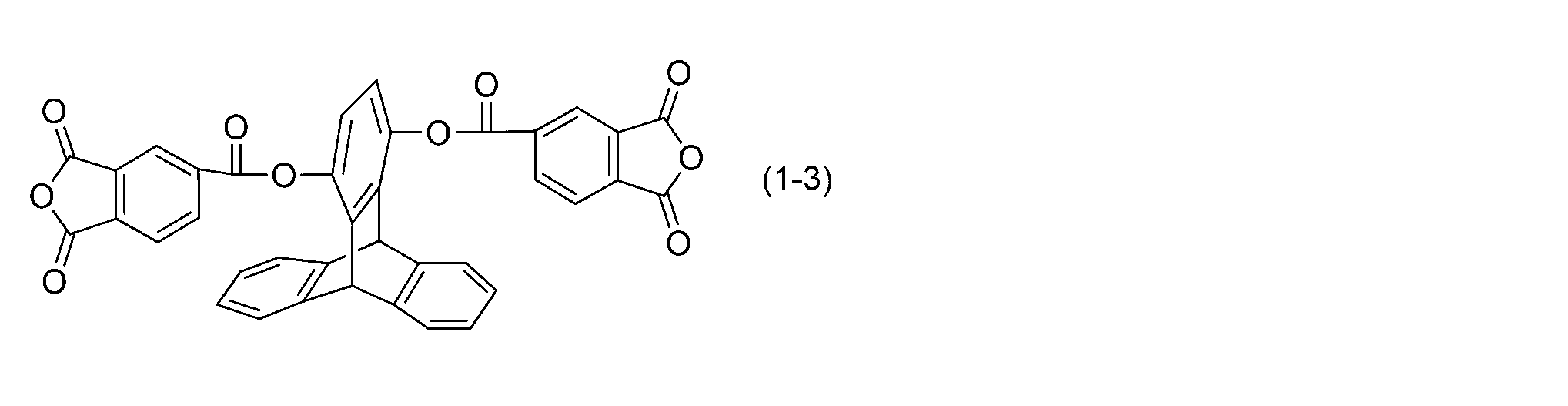
- the present invention relates to the acid dianhydride according to the eighth aspect, which is represented by the formula (1-3).
- the present invention relates to a tetracarboxylic acid characterized by being represented by the formula (2-1).
- R 1 , R 2 , R 3 , R 4 and R 5 each independently represent a halogen atom, an alkyl group having 1 to 5 carbon atoms or an alkoxy group having 1 to 5 carbon atoms
- R 6 and R 7 each independently represent a hydrogen atom, a halogen atom, an alkyl group having 1 to 5 carbon atoms or an alkoxy group having 1 to 5 carbon atoms
- a and b each independently represent an integer of 0 to 4
- c and d each independently represent an integer of 0 to 3
- e represents an integer of 0 to 2.
- the eleventh aspect relates to the tetracarboxylic acid described in the tenth aspect, which is represented by the formula (2-2).
- a twelfth aspect relates to the tetracarboxylic acid according to the eleventh aspect, which is represented by the formula (2-3).
- the polyamic acid of the present invention exhibits good solubility in an organic solvent, and the polyamic acid is excellent in heat resistance, flexibility and transparency, and can form a polyimide film (resin thin film) capable of realizing a lower retardation. Moreover, since the polyimide film of this invention shows high transparency (high light transmittance, low yellowness), heat resistance, and low retardation, it can be used suitably as a board
- the polyamic acid according to the present invention is obtained by polycondensation reaction between an acid dianhydride component containing an acid dianhydride represented by the following formula (1-1) and a diamine component, that is, the following formula (1) -1) is a reaction product of an acid dianhydride component containing an acid dianhydride and a diamine component.
- an acid dianhydride represented by the formula (1-2) is particularly preferable, and among them, excellent heat resistance, flexibility and transparency, and low retardation.
- an acid dianhydride represented by the formula (1-3) is preferable.
- R 1 , R 2 , R 3 , R 4 and R 5 each independently represent a halogen atom, an alkyl group having 1 to 5 carbon atoms or an alkoxy group having 1 to 5 carbon atoms
- R 6 and R 7 each independently represent a hydrogen atom, a halogen atom, an alkyl group having 1 to 5 carbon atoms or an alkoxy group having 1 to 5 carbon atoms
- a and b each independently represent an integer of 0 to 4
- c and d each independently represent an integer of 0 to 3
- e represents an integer of 0 to 2.
- halogen atom examples include a fluorine atom, a chlorine atom, and a bromine atom.
- alkyl group having 1 to 5 carbon atoms include methyl group, ethyl group, n-propyl group, isopropyl group, n-butyl group, isobutyl group, sec-butyl group, tert-butyl group, and n-pentyl group. , Isoamyl group, neopentyl group, tert-amyl group, sec-isoamyl group, cyclopentyl group and the like.
- alkoxy group having 1 to 5 carbon atoms examples include methoxy group, ethoxy group, n-propoxy group, isopropoxy group, n-butoxy group, isobutoxy group, sec-butoxy group, tert-butoxy group, and n-pentoxy group. , Isopentoxy group, neopentoxy group, tert-pentoxy group and the like.
- tetracarboxylic acids represented by the following formulas (2-1) to (2-3) are respectively used as dehydrating agents. Can be obtained by dehydration within the molecule.
- R 1 , R 2 , R 3 , R 4 , R 5 , R 6 , R 7 , a, b, c, d and e have the same meaning as described above.
- the acid dianhydride represented by the above formula (1-1) is 9,10- [1,2] benzenoanthracene-1 in an organic solvent as shown in the following scheme as an example.
- 4-diol compound hereinafter also referred to as a benzenoanthracenediol compound
- a benzenetricarboxylic acid halogenated anhydride in the presence of a base or an acid absorbent [Reaction Formula 1].
- the solvent can be removed and then purified using a known method such as recrystallization, distillation, silica gel column chromatography or the like to obtain the target acid dianhydride.
- the reaction product of [Reaction Formula 1] is hydrolyzed to produce an intermediate (9,10- [1,2] benzenoanthracene-1,4-diyl bis (benzenetricarboxylate) compound) (Formula (2-1 It can also be obtained by obtaining [Compound 2] and dehydrating this intermediate in a molecule with a dehydrating agent [Reaction Formula 3].
- the dianhydrides represented by the above formulas (1-1) to (1-3) and the intermediates thereof, the benzenetricarboxylic acid esters represented by the above formulas (2-1) to (2-3) ( Tetracarboxylic acid compounds) are also objects of the present invention.
- X represents a halogen atom
- R 1 , R 2 , R 3 , R 4 , R 5 , R 6 , R 7 , a, b, c, d and e have the same meaning as described above.
- the charging ratio of the benzenoanthracenediol compound to the benzenetricarboxylic acid halogenated anhydride is 2 to 4 mol of the benzenetricarboxylic acid halogenated anhydride with respect to 1 mol of the benzenoanthracenediol compound.
- the base include organic compounds such as trimethylamine, triethylamine, diisopropylamine, diisopropylethylamine, N-methylpiperidine, 2,2,6,6-tetramethyl-N-methylpiperidine, pyridine, 4-dimethylaminopyridine, N-methylmorpholine.
- Organic bases such as amines are preferably used.
- the amount of the base used is not particularly limited as long as it is 1 mol or more with respect to 1 mol of benzenetricarboxylic acid halide anhydride, but it is usually about 1 to 5 mol, preferably 1 to 3 mol. Degree.
- an acid absorbent may be used to neutralize an acid such as hydrochloric acid by-produced in the reaction. Examples of the acid absorbent include epoxides such as propylene oxide.
- the amount of the acid absorbent used is not particularly limited as long as it is 2 mol or more with respect to 1 mol of the benzenoanthracenediol compound, but it is usually about 2 to 10 mol, preferably about 2 to 4 mol. is there.
- the organic solvent is not particularly limited as long as it does not affect the reaction, but aromatic hydrocarbons such as benzene, toluene, xylene, etc .; N, N-dimethylformamide (hereinafter referred to as DMF) Amides such as N, N-dimethylacetamide (hereinafter referred to as DMAc) and N-methyl-2-pyrrolidone (hereinafter referred to as NMP); diethyl ether, tetrahydrofuran (hereinafter referred to as THF), 1,4-dioxane, 1 , 2-dimethoxyethane, ethers such as cyclopentylmethyl ether, ketones such as 2-butanone and 4-methyl-2-pentanone, nitriles such as acetonitrile, dimethyl sulfoxide (hereinafter referred to as DMSO), etc.
- DMF N-dimethylformamide
- NMP N-methyl-2-pyrrolidone
- the acid dianhydride (1-1), which is the target product is directly purified and taken out in [Reaction Formula 1] if the solvent contains a large amount of water, hydrolysis of the ester occurs. It is preferable to use a dehydrated solvent or after dehydrating.
- a dehydrated solvent may or may not be used.
- the reaction temperature can be about 0 to 200 ° C., preferably 20 to 150 ° C. After the reaction, the target acid dianhydride can be obtained by distilling off the solvent and purifying.
- This purification method is arbitrary and may be appropriately selected from known methods such as recrystallization, distillation, silica gel column chromatography and the like.
- purification will not be specifically limited if it is a solvent which does not react with a product at the time of refinement
- the reaction of [Reaction Formula 2] is not particularly limited as long as the acid dianhydride represented by Formula (1-1) and water are mixed.
- the reaction of [Reaction Formula 1] (1- 1) is hydrolyzed by adding water, optionally an organic solvent, an acid or an alkali, and heated to reflux to obtain a benzenetricarboxylic acid ester (tetracarboxylic acid compound) represented by the formula (2-1). It can also be obtained.
- Water is usually used in an amount of 2 to 100 times, preferably 2 to 40 times, more preferably 2 to 6 times the weight of the acid dianhydride represented by the formula (1-1).
- an organic solvent may be added.
- the organic solvent is not particularly limited as long as it does not affect the reaction, but aromatic hydrocarbons such as benzene, toluene, xylene, etc .; N, N-dimethylformamide (hereinafter referred to as DMF) Amides such as N, N-dimethylacetamide (hereinafter referred to as DMAc) and N-methyl-2-pyrrolidone (hereinafter referred to as NMP); diethyl ether, tetrahydrofuran (hereinafter referred to as THF), 1,4-dioxane, 1 , Ethers such as 2-dimethoxyethane and cyclopentylmethyl ether, ketones such as acetone, ethyl acetate, 2-butanone and 4-methyl-2-pentanone, nitriles such as acetonitrile, dimethyl sulfoxide (hereinafter referred to as DMSO), etc.
- DMF N-dimethylformamide
- a highly polar solvent is preferable, for example, DMF, DMAc, NMP, THF, 1,4-dioxane, diethyl ether, acetonitrile, acetone, ethyl acetate and the like are preferable.
- an acid may be added. The acid is not particularly limited.
- the acid examples include heteropolyacids such as phosphomolybdic acid and phosphotungstic acid; organic acids such as trimethylborate and triphenylphosphine; inorganic acids such as hydrochloric acid, sulfuric acid, and phosphoric acid; formic acid, And hydrocarbon acids such as acetic acid, propionic acid or p-toluenesulfonic acid; and halogenated hydrocarbon acids such as trifluoroacetic acid.
- hydrochloric acid, sulfuric acid, acetic acid or p-toluenesulfonic acid is used.
- the acid is generally used in an amount of 0 to 100 times mol, preferably 0.01 to 10 times mol, of the acid dianhydride represented by the formula (1-1).
- this reaction may be hydrolyzed using an alkaline aqueous solution.
- the alkali is not particularly limited, and examples of the alkali include alkali metals such as sodium hydroxide, potassium hydroxide, lithium hydroxide, sodium carbonate, potassium carbonate, and lithium carbonate; magnesium hydroxide, calcium hydroxide, and the like. Alkaline earth metals are mentioned. Of these, sodium hydroxide, potassium hydroxide, and lithium hydroxide are preferable.
- the amount of alkali used is usually 0 to 100 times mol, preferably 0.01 to 10 times mol, of the acid dianhydride represented by the formula (1-1).
- the reaction temperature is not particularly limited but is, for example, ⁇ 90 to 200 ° C., preferably 50 to 130 ° C.
- the reaction time is usually 0.1 to 200 hours, preferably 0.5 to 100 hours.
- reaction of [Reaction Formula 3] may be a known method and is not particularly limited.
- An acid dianhydride represented by the formula (1-1) can be obtained by mixing an ester (tetracarboxylic acid compound) and a dehydrating agent in a solvent.
- the dehydrating agent is not particularly limited as long as the dehydrating agent can come into contact with the benzenetricarboxylic acid ester (tetracarboxylic acid compound) represented by the formula (2-1). It should be carried out in the presence of a dehydrating agent such as an aliphatic carboxylic acid anhydride such as acetic acid, propionic anhydride, trifluoroacetic anhydride, 1,3-dicyclohexylcarbodiimide, 2-chloro-1,3-dimethylimidazolinium chloride. Can do.
- a dehydrating agent such as an aliphatic carboxylic acid anhydride such as acetic acid, propionic anhydride, trifluoroacetic anhydride, 1,3-dicyclohexylcarbodiimide, 2-chloro-1,3-dimethylimidazolinium chloride. Can do.
- a lower carboxylic acid anhydride having 1 to 3 carbon atoms is preferable, more preferably a lower carboxylic acid anhydride having 1 to 2 carbon atoms, and among them, it is easy to remove after dehydration and is economically advantageous.
- acetic anhydride is particularly preferable.
- the amount of the dehydrating agent to be used is not particularly limited, but it is preferably 2 to 50 equivalents, particularly preferably 4 to 20 equivalents, relative to the benzenetricarboxylic acid ester (tetracarboxylic acid compound) represented by the formula (2-1). is there. If it is 2 to 50 equivalents, the anhydride can be sufficiently obtained and the amount of the acid dianhydride represented by the formula (1-1) obtained does not increase too much, and the formula (1 The acid dianhydride represented by -1) can be precipitated.
- an organic solvent that does not directly participate in the reaction can be used.
- examples thereof include hydrocarbons such as toluene and xylene; halogenated hydrocarbons such as 1,2-dichloroethane and 1,2-dichloropropane; and 1,4-dioxane.
- the heating temperature in the reaction is preferably 30 to 200 ° C., more preferably 40 to 180 ° C.
- the reaction time may be appropriately set according to conditions such as the type of dehydrating agent to be used, temperature, etc., but is preferably 0.5 to 20 hours.
- a suspension in which the acid dianhydride represented by the formula (1-1) is suspended in the dehydrating agent used can be obtained.
- the resulting suspension can be filtered to recover the acid dianhydride powder represented by formula (1-1).
- the washing solvent is not particularly limited as long as the solvent does not react with the anhydride and the solubility of the target anhydride is low. For example, toluene, hexane, heptane, acetonitrile, acetone, chloroform, ethyl acetate, dimethyl carbonate, etc.
- the acid dianhydride represented by the formula (1-1) with high purity can be obtained by removing the dehydrating agent and the solvent by drying under reduced pressure or the like.
- the acid dianhydride which is a target object can also be obtained by refine
- the acid dianhydride represented by the formula (2-1) obtained in the present invention is a novel compound not described in any literature, and as described above, it can be easily represented by the formula (1-1). It can be used for various applications such as production of acid dianhydrides.
- the benzenoanthracene diol compound used in the present invention for example, as shown in the following scheme as an example, is a Diels-Alder reaction of an anthracene compound and a 1,4-benzoquinone compound in an organic solvent according to a known method.
- 9,10- [1,2] benzenoanthracene-13,16 (9H, 10H) -dione compound obtained by treatment under heating conditions in acetic acid solvent in the presence of 47% hydrogen bromide. it can.
- R 1 , R 2 , R 5 , R 6 , R 7 , a, b and e represent the same meaning as described above.
- the acid dianhydride component used in the production of the polyamic acid of the present invention from the viewpoint of obtaining a polyamic acid with good reproducibility that gives a polyimide film having not only excellent heat resistance, flexibility and transparency but also low retardation characteristics
- an acid dianhydride represented by the above formula (1-1) preferably an alicyclic tetracarboxylic dianhydride, more preferably an acid dianhydride represented by the following formula (C1): Including.
- B 1 represents a tetravalent group selected from the group consisting of formulas (X-1) to (X-12).
- a plurality of R's independently represent a hydrogen atom or a methyl group, and * represents a bond.
- B 1 in the formula is represented by the formulas (X-1), (X-2), (X-4), (X-5), (X -6), (X-7) , (X-8), (X-9), (X-11) and (preferably acid dianhydride represented by X-12), wherein B 1 is the formula Acid dianhydrides represented by (X-1), (X-2), (X-11) and (X-12) are particularly preferred.
- the acid dianhydride component includes an acid dianhydride represented by the above formula (1-1) and an acid dianhydride represented by the above formula (C1) as long as the effects of the present invention are not impaired. Other acid dianhydrides other than those may be used.
- the acid dianhydride component when the alicyclic tetracarboxylic dianhydride is used together with the acid dianhydride represented by the formula (1-1) of the present invention, the acid dianhydride component is represented by the formula (1-1).
- the diamine component used for the production of the polyamic acid of the present invention is preferably used from the viewpoint of obtaining a polyamic acid with good reproducibility that gives a polyimide film having not only excellent heat resistance, flexibility and transparency but also low retardation.
- B 2 represents a divalent group selected from the group consisting of formulas (Y-1) to (Y-34)).
- * represents a bond.
- B 2 in the formula is the formula (Y-12), (Y-13), (Y-14), (Y-15), (Y-18) Diamines represented by (Y-27), (Y-28), (Y-30) and (Y-33) are preferred, and the B 2 is represented by the formula (Y-12), (Y-13), Diamines represented by (Y-14), (Y-15) and (Y-33) are particularly preferred.
- the content of the aromatic diamine in the diamine component used for producing the polyamic acid of the present invention is preferably Is 50 mol% or more, more preferably 60 mol% or more, still more preferably 70 mol%, still more preferably 80 mol%, still more preferably 90 mol%, most preferably 100 mol%.
- the acid dianhydride represented by the above formula (1-1) and the acid dianhydride represented by the above (C1) are used as the above acid dianhydride component, and the above formula (A1) as the above diamine component.
- the diamine represented by the formula (1) the polyamic acid has a monomer unit represented by the following formula (4-1) and a monomer unit represented by the following formula (4-2).
- R 1 , R 2 , R 3 , R 4 , R 5 , R 6 , R 7 , a, b, c, d, e, B 1 and B 2 represent the same meaning as described above.
- the method for obtaining the polyamic acid of the present invention is not particularly limited, and the aforementioned acid dianhydride component and diamine component may be reacted and polymerized by a known method.
- Examples of the solvent used for the synthesis of polyamic acid include m-cresol, N-methyl-2-pyrrolidone (NMP), N, N-dimethylformamide (DMF), N, N-dimethylacetamide (DMAc), N- Examples thereof include methyl caprolactam, dimethyl sulfoxide (DMSO), tetramethyl urea, pyridine, dimethyl sulfone, hexamethyl phosphoramide, and ⁇ -butyrolactone. These may be used alone or in combination. Furthermore, even if it is a solvent which does not melt
- the temperature of the polycondensation reaction can be selected from -20 to 150 ° C, preferably -5 to 100 ° C.
- the above-mentioned polyamic acid-containing solution (also referred to as polyamic acid solution) obtained by the polymerization reaction for obtaining the polyamic acid can be used as it is, or after diluting or concentrating, as a composition for forming a polyimide film described later.
- a poor solvent such as methanol or ethanol is added to the polyamic acid-containing solution to precipitate and isolate the polyamic acid, and the isolated polyamic acid is redissolved in an appropriate solvent to obtain a polyamic acid-containing solution. It can also be used as a composition for forming a polyimide film.
- the solvent for diluting the polyamic acid-containing solution and the solvent for re-dissolving the isolated polyamic acid are not particularly limited as long as the obtained polyamic acid can be dissolved.
- m-cresol 2-pyrrolidone NMP, N-ethyl-2-pyrrolidone, N-vinyl-2-pyrrolidone, DMAc, DMF, ⁇ -butyrolactone, and the like.
- the solvent alone does not dissolve the polyamic acid, it can be used in addition to the above solvent as long as the polyamic acid does not precipitate.
- Specific examples thereof include ethyl cellosolve, butyl cellosolve, ethyl carbitol, butyl carbitol, ethyl carbitol acetate, ethylene glycol, 1-methoxy-2-propanol, 1-ethoxy-2-propanol, and 1-butoxy-2-propanol.
- the number average molecular weight of the polyamic acid is preferably 5,000 or more from the viewpoint of improving the flexibility of the resulting thin film, and preferably from the viewpoint of ensuring the solubility of the polyamic acid. Is 100,000 or less, more preferably 50,000 or less. In the present specification, the number average molecular weight is a value measured by a GPC (gel permeation chromatography) apparatus and calculated as a polystyrene equivalent value.
- the polyamic acid-containing solution prepared as described above can be suitably used as a polyimide film-forming composition as described above.
- the polyimide film of this invention can be obtained by heating the coating film obtained by apply
- solid content here means the total mass of components other than an organic solvent, and even if it is a liquid monomer etc., it shall be included in a weight as solid content.
- the blending amount of the solid content in the composition for forming a polyimide film is usually about 0.5 to 30% by mass, preferably about 5 to 25% by mass.
- the heating temperature is usually about 100 to 500 ° C., and may be heated stepwise, for example, in the range of 100 to 150 ° C., in the range of 180 to 350 ° C., or in the range of 380 to 450 ° C. .
- a known additive such as a coupling agent may be added to the polyimide film forming composition.
- the proportion of the polyamic acid in the solid content of the composition for forming a polyimide film of the present invention can be 70 to 100% by mass.
- the polyimide film-forming composition and a polyimide film formed using the composition are also objects of the present invention.
- R 1 , R 2 , R 3 , R 4 , R 5 , R 6 , R 7 , a, b, c, d, e, B 1 and B 2 represent the same meaning as described above.
- TH Triptycene hydroquinone (9,10-dihydro-9,10- [1,2] benzenoanthracene-1,4-diol)
- TH-TMLA Triptyselenhydroquinone Bis-trimellitic acid
- TH-TMA Triptycene hydroquinone
- THF Tetrahydrofuran CBDA: 1,2,3,4-cyclobutanetetracarboxylic dianhydride
- TFMB 2,2'-di (trifluoromethyl) benzidine
- HPLC analysis column Inertsil ODS-3, 5 ⁇ m, 4.6 mm ⁇ 250 mm Oven: 40 ° C
- Detection wavelength 211 nm
- Flow rate 1.0 mL / min
- Eluent: TH-TMLA: acetonitrile / 0.5% phosphoric acid aqueous solution 50/50
- Sample injection amount: 5 ⁇ L TH-TMA: Acetonitrile / 0.5% phosphoric acid aqueous solution 50/50
- Sample injection amount: 5 ⁇ L * * TH-TMA is diluted 1000 times with eluent, stirred for 4 hours at 70 ° C, and measured as TH-TMLA.
- Td 5% 5% weight loss temperature
- Td 5% [° C.] is measured by using TGA Q500 manufactured by TA Instruments Inc. and raising the temperature of about 5 to 10 mg of resin thin film to 50 to 800 ° C. at 10 ° C./min in nitrogen. I asked for it.
- T 550 nm Light transmittance (transparency)
- T 550 nm The light transmittance at a wavelength of 550 nm (T 550 nm [%]) was measured using a SA4000 spectrometer manufactured by Nippon Denshoku Industries Co., Ltd. at room temperature with air as the reference.
- TH 10 g was dissolved in THF (40 g), and triethylamine (11.6 g) was added and stirred.
- the solution was added dropwise over 30 minutes to a THF (100 g) solution of trimellitic chloride anhydride (22.1 g) cooled to ⁇ 3 ° C. and stirred for 1 hour.
- the reaction solution was warmed to 25 ° C., stirred for 3 hours, added with THF (60 g), and stirred under reflux conditions (66 ° C.) for 1 hour. Thereafter, the reaction solution was cooled to 30 ° C., and then the precipitate was filtered to obtain a TH-TMA crude product (73.6 g).
- this TH-TMA crude product was added to a mixed solution of ethyl acetate (200 g) and water (200 g), and this suspension solution was 30 minutes at 50 ° C. and 1 hour at 60 ° C. under reflux conditions (78 ° C.). For 2.5 hours to completely dissolve the crude product.
- the solution was cooled to 60 ° C., the aqueous layer was removed, water (200 g) was added to the organic layer, and the mixture was stirred at 60 ° C. for 30 minutes, and then the aqueous layer was removed.
- the obtained organic layer was concentrated and then dried under reduced pressure at 70 ° C.
- the heating temperature was lowered to 50 ° C., 0.617 g (3.2 mmol) of CBDA and 3.06 g of ⁇ -butyrolactone were added, and the reaction was carried out overnight under a nitrogen atmosphere.
- the resulting reaction mixture was allowed to cool, and ⁇ -butyrolactone was added thereto so that the polyamic acid concentration was 15% by mass to prepare a polyamic acid solution.
- the obtained polyamic acid solution was applied onto a glass substrate with a doctor blade, and the coating film was heated at 50 ° C. for 30 minutes, 140 ° C. for 30 minutes, and 200 ° C. for 60 minutes, and further in vacuum at 300 ° C. for 60 minutes. Heating was performed sequentially to produce a polyimide film.
- Example 3> (Molar ratio: TH-TMA10: CBDA90: TFMB100)
- 1.411 g (4.5 mmol) of TFMB and 2.268 g of ⁇ -butyrolactone were added and stirred.
- 0.2855 g (0.45 mmol) of TH-TMA and 1.85 g of ⁇ -butyrolactone were added, and the resulting mixture was stirred at 100 ° C. for 4 hours under a nitrogen atmosphere.
- the heating temperature was lowered to 50 ° C., 0.7942 g (4.1 mmol) of CBDA and 1.89 g of ⁇ -butyrolactone were added, and the reaction was performed overnight under a nitrogen atmosphere. The next day, the resulting reaction mixture was allowed to cool, and ⁇ -butyrolactone was added thereto so that the polyamic acid concentration was 15% by mass to prepare a polyamic acid solution.
- the obtained polyamic acid solution was applied onto a glass substrate with a doctor blade, and the coating film was heated at 50 ° C. for 30 minutes, 140 ° C. for 30 minutes, and 200 ° C. for 60 minutes, and further in vacuum at 300 ° C. for 60 minutes. Heating was performed sequentially to produce a polyimide film.
- the polyimide film obtained from the polyamic acid produced using the novel acid dianhydride of the present invention has excellent flexibility, high transmittance, and excellent heat resistance. became.
- the retardation R th in the thickness direction was the result of a very low value such less than the value of less than 500 nm, the in-plane retardation R 0 is 5.
- the polyimide film obtained from the polyamic acid produced using the novel acid dianhydride of the present invention has flexibility, high transparency (high light transmittance), heat resistance, and low retardation. It has characteristics, that is, it satisfies requirements necessary as a base film of a flexible display substrate, and can be expected to be used particularly suitably as a base film of a flexible display substrate.
Landscapes
- Chemical & Material Sciences (AREA)
- Organic Chemistry (AREA)
- Engineering & Computer Science (AREA)
- Medicinal Chemistry (AREA)
- Polymers & Plastics (AREA)
- Chemical Kinetics & Catalysis (AREA)
- Health & Medical Sciences (AREA)
- Manufacturing & Machinery (AREA)
- Materials Engineering (AREA)
- Macromolecular Compounds Obtained By Forming Nitrogen-Containing Linkages In General (AREA)
- Electroluminescent Light Sources (AREA)
- Furan Compounds (AREA)
- Manufacture Of Macromolecular Shaped Articles (AREA)
- Organic Low-Molecular-Weight Compounds And Preparation Thereof (AREA)
- Compositions Of Macromolecular Compounds (AREA)
Abstract
【課題】耐熱性、柔軟性及び透明性に優れるだけでなく、リタデーションが低いという特徴をも有するポリイミド膜を与えるポリアミック酸並びに該ポリアミック酸の製造に用いる新規な酸二無水物を提供すること。 【解決手段】酸二無水物成分と、ジアミン成分とを反応させて得られるポリアミック酸であって、前記酸二無水物成分が下記式(1-1)で表される酸二無水物を含むことを特徴とするポリアミック酸並びに該ポリアミック酸を含むポリイミド膜形成用組成物及びそれから得られるポリイミド膜。(式中、R1乃至R5は、互いに独立して、ハロゲン原子、アルキル基またはアルコキシ基を表し、R6及びR7は、互いに独立して、水素原子、ハロゲン原子、アルキル基又はアルコキシ基を表し、aおよびbは、互いに独立して、0~4の整数を表し、cおよびdは、互いに独立して、0~3の整数を表し、eは、0~2の整数を表す。)
Description
本発明は、新規な酸二無水物およびそのポリアミック酸への利用に関する。
近年、液晶ディスプレイや有機エレクトロルミネッセンスディスプレイ等のエレクトロニクスの急速な進歩に伴い、デバイスの薄型化や軽量化、更には、フレキシブル化が要求されるようになってきた。
これらのデバイスにおいては、ガラス基板上に様々な電子素子、例えば、薄膜トランジスタや透明電極等が形成されているが、このガラス材料を柔軟かつ軽量な樹脂材料に替えることで、デバイス自体の薄型化や軽量化、フレキシブル化が期待される。
そして、そのような樹脂材料の候補としてはポリイミドが注目を集めており、ポリイミドフィルムに関する種々の報告が従来よりなされている(例えば特許文献1,2参照)。
これらのデバイスにおいては、ガラス基板上に様々な電子素子、例えば、薄膜トランジスタや透明電極等が形成されているが、このガラス材料を柔軟かつ軽量な樹脂材料に替えることで、デバイス自体の薄型化や軽量化、フレキシブル化が期待される。
そして、そのような樹脂材料の候補としてはポリイミドが注目を集めており、ポリイミドフィルムに関する種々の報告が従来よりなされている(例えば特許文献1,2参照)。
ところで、ポリイミド樹脂材料をディスプレイの基板として用いるとき、その樹脂材料が透明性に優れるだけでなく、要求性能の一つとしてリタデーション(Retardation)が低い材料であることが望ましい。
すなわち、リタデーション(位相差)とは、複屈折(直交する2つの屈折率の差)と膜厚との積をいうが、この数値、特に厚さ方向のリタデーションは視野角特性に影響する重要な数値であり、大きなリタデーション値は、ディスプレイの表示品質の低下を招く原因となり得ることから(例えば特許文献3参照)、フレキシブルディスプレイ基板にあっても、高い柔軟性(可撓性)以外に、これらの特性も求められている。
すなわち、リタデーション(位相差)とは、複屈折(直交する2つの屈折率の差)と膜厚との積をいうが、この数値、特に厚さ方向のリタデーションは視野角特性に影響する重要な数値であり、大きなリタデーション値は、ディスプレイの表示品質の低下を招く原因となり得ることから(例えば特許文献3参照)、フレキシブルディスプレイ基板にあっても、高い柔軟性(可撓性)以外に、これらの特性も求められている。
本発明は、このような事情に鑑みてなされたものであって、耐熱性、柔軟性及び透明性に優れるだけでなく、リタデーションが低いという特徴をも有するポリイミド膜を与えるポリアミック酸並びに該ポリアミック酸の製造に用いる新規な酸二無水物を提供することを目的とする。
本発明者らは、上記課題を解決するために鋭意検討を重ねた結果、下記式(1-1)で表される酸二無水物化合物を、テトラシクロブタン酸二無水物等の脂環式テトラカルボン酸二無水物と共に、2,2’-ジ(トリフルオロメチル)ベンジジン等の芳香族ジアミンと共重合させることで、有機溶媒に良好な溶解性を示すポリアミック酸が得られること、及び当該ポリアミック酸を有機溶媒に溶解させて得られる組成物(溶液)から、耐熱性、柔軟性及び透明性に優れるだけでなく、リタデーションが低いという特徴をも有するポリイミド膜が得られることを見出し、本発明を完成させた。
すなわち、本発明は、第1観点として、酸二無水物成分と、ジアミン成分とを反応させて得られるポリアミック酸であって、
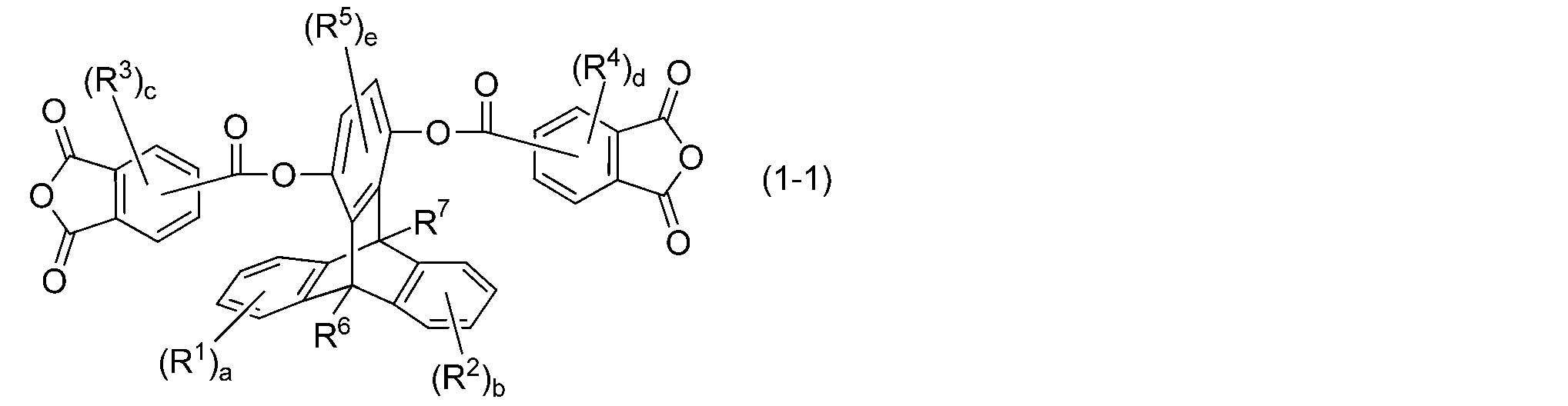
前記酸二無水物成分が下記式(1-1)で表される酸二無水物を含むことを特徴とする、ポリアミック酸に関する。

(式中、R1、R2、R3、R4及びR5は、互いに独立して、ハロゲン原子、炭素原子数1乃至5のアルキル基または炭素原子数1乃至5のアルコキシ基を表し、
R6及びR7は、互いに独立して、水素原子、ハロゲン原子、炭素原子数1乃至5のアルキル基又は炭素原子数1乃至5のアルコキシ基を表し、
aおよびbは、互いに独立して、0~4の整数を表し、
cおよびdは、互いに独立して、0~3の整数を表し、
eは、0~2の整数を表す。)
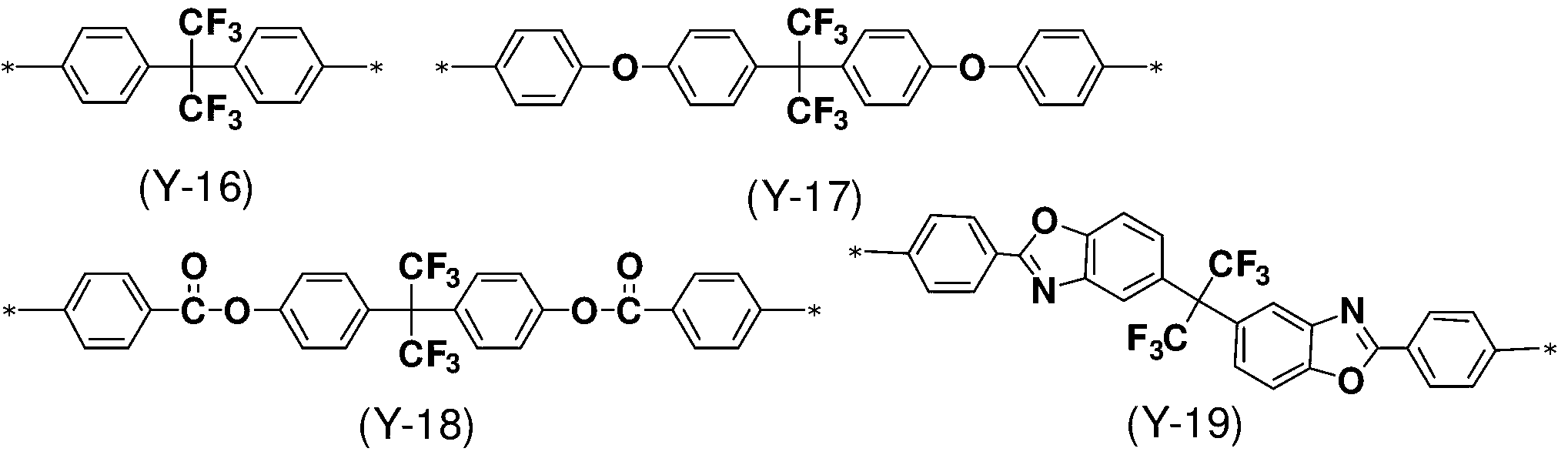
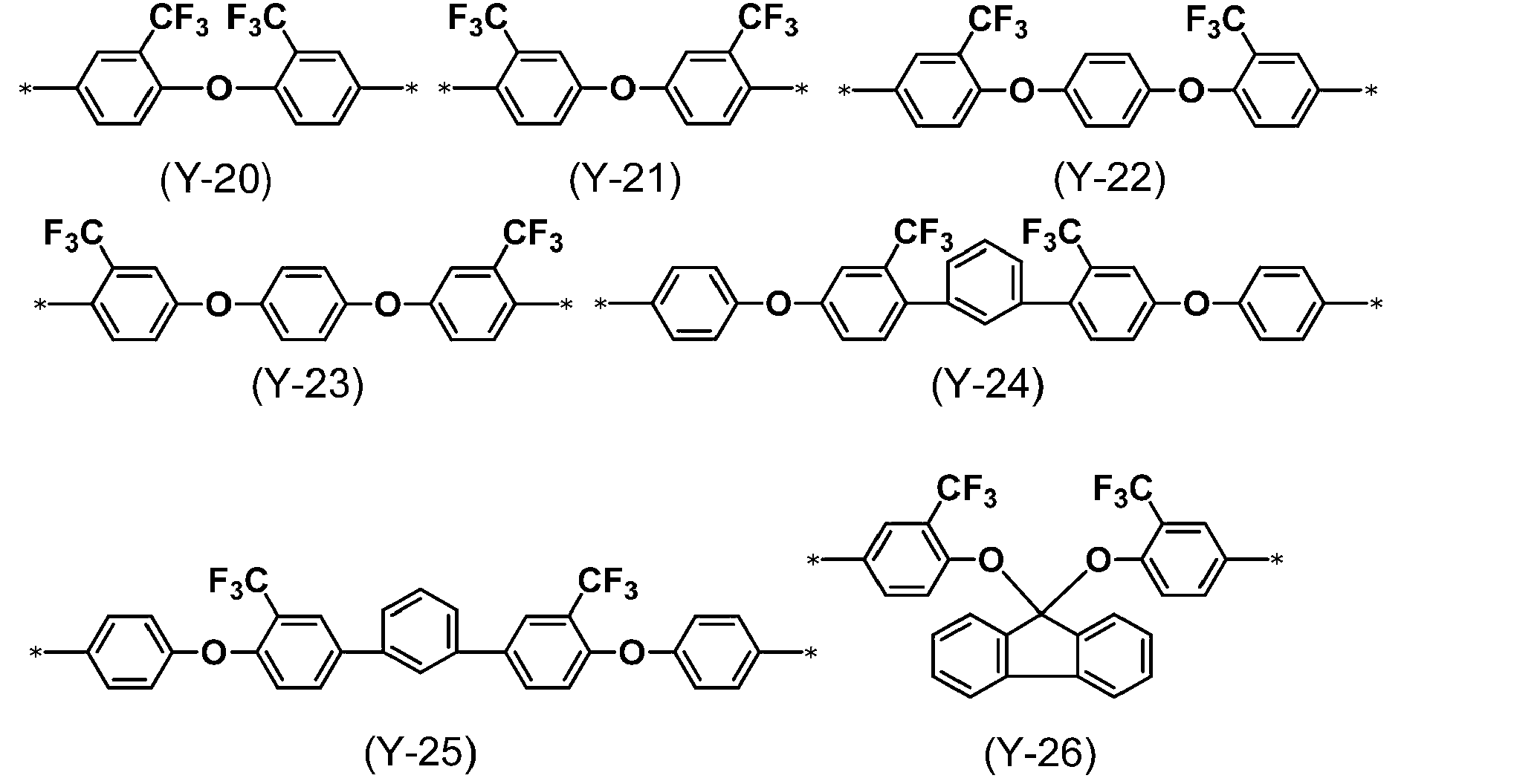
第2観点として、前記ジアミン成分が、式(A1)で表されるジアミンを含むことを特徴とする、第1観点に記載のポリアミック酸に関する。

(式中、B2は、式(Y-1)~式(Y-34)からなる群から選ばれるいずれかの基を表す。)




(式中、*は結合手を表す。)
第3観点として、前記酸二無水物成分が、更に式(C1)で表されるテトラカルボン酸二無水物を含むことを特徴とする、第1観点又は第2観点に記載のポリアミック酸に関する。

〔式中、B1は、式(X-1)~式(X-12)からなる群から選ばれるいずれかの基を表す。
(式中、複数のRは、互いに独立して、水素原子またはメチル基を表し、*は結合手を表す。)〕
第4観点として、第1観点乃至第3観点のうちいずれか一項に記載のポリアミック酸と、有機溶媒とを含むポリイミド膜形成用組成物に関する。
第5観点として、第4観点に記載のポリイミド膜形成用組成物を用いて形成されるポリイミド膜に関する。
第6観点として、第5観点に記載のポリイミド膜からなるフレキシブルデバイス用基板に関する。
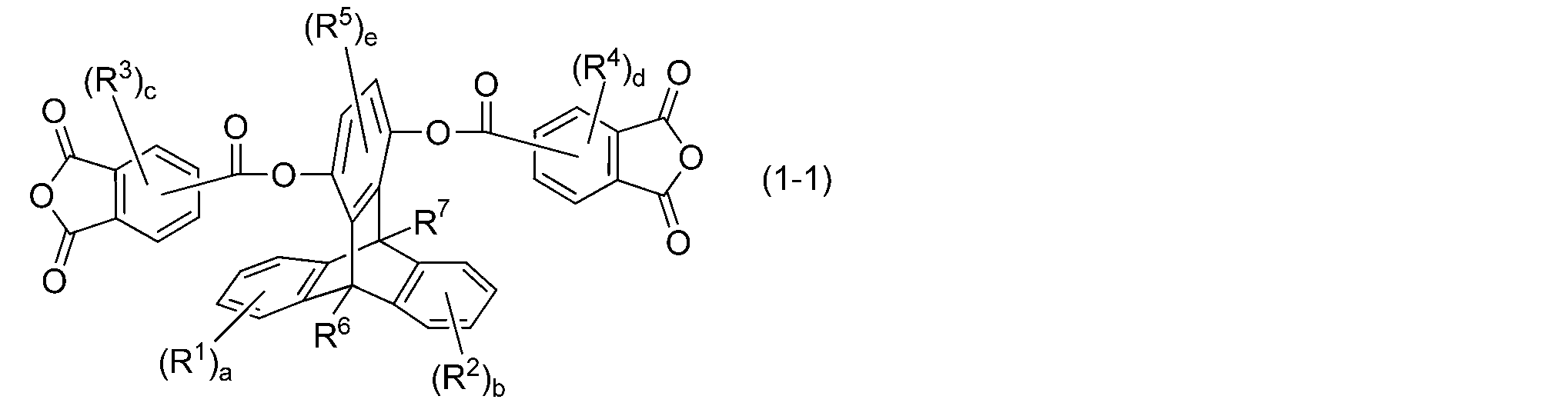
第7観点として、式(1-1)で表されることを特徴とする酸二無水物に関する。

(式中、R1、R2、R3、R4及びR5は、互いに独立して、ハロゲン原子、炭素原子数1乃至5のアルキル基または炭素原子数1乃至5のアルコキシ基を表し、
R6及びR7は、互いに独立して、水素原子、ハロゲン原子、炭素原子数1乃至5のアルキル基又は炭素原子数1乃至5のアルコキシ基を表し、
aおよびbは、互いに独立して、0~4の整数を表し、
cおよびdは、互いに独立して、0~3の整数を表し、
eは、0~2の整数を表す。)
第8観点として、式(1-2)で表されることを特徴とする、第7観点に記載の酸二無水物に関する。

(式中、R1、R2、R3、R4、R5、R6、R7、a、b、c、dおよびeは、前記と同じ意味を示す。)
第9観点として、式(1-3)で表されることを特徴とする、第8観点に記載の酸二無水物に関する。
第10観点として、式(2-1)で表されることを特徴とするテトラカルボン酸に関する。
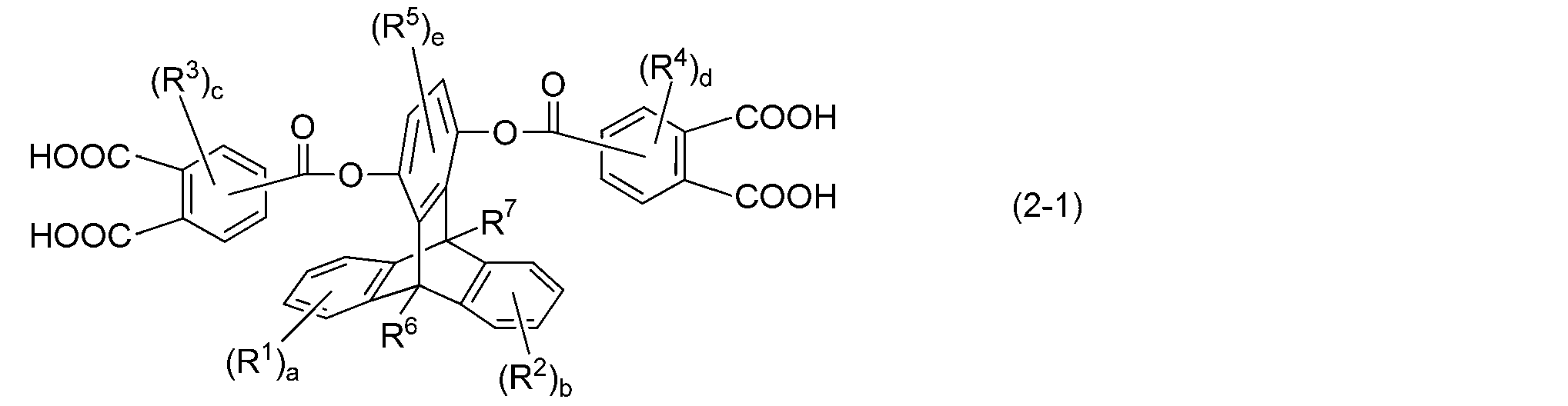
(式中、R1、R2、R3、R4及びR5は、互いに独立して、ハロゲン原子、炭素原子数1乃至5のアルキル基または炭素原子数1乃至5のアルコキシ基を表し、
R6及びR7は、互いに独立して、水素原子、ハロゲン原子、炭素原子数1乃至5のアルキル基又は炭素原子数1乃至5のアルコキシ基を表し、
aおよびbは、互いに独立して、0~4の整数を表し、
cおよびdは、互いに独立して、0~3の整数を表し、
eは、0~2の整数を表す。)
第11観点として、式(2-2)で表されることを特徴とする、第10観点に記載のテトラカルボン酸に関する。

(式中、R1、R2、R3、R4、R5、R6、R7、a、b、c、dおよびeは、前記と同じ意味を示す。)
第12観点として、式(2-3)で表されることを特徴とする、第11観点に記載のテトラカルボン酸に関する。

前記酸二無水物成分が下記式(1-1)で表される酸二無水物を含むことを特徴とする、ポリアミック酸に関する。
R6及びR7は、互いに独立して、水素原子、ハロゲン原子、炭素原子数1乃至5のアルキル基又は炭素原子数1乃至5のアルコキシ基を表し、
aおよびbは、互いに独立して、0~4の整数を表し、
cおよびdは、互いに独立して、0~3の整数を表し、
eは、0~2の整数を表す。)
第2観点として、前記ジアミン成分が、式(A1)で表されるジアミンを含むことを特徴とする、第1観点に記載のポリアミック酸に関する。
第3観点として、前記酸二無水物成分が、更に式(C1)で表されるテトラカルボン酸二無水物を含むことを特徴とする、第1観点又は第2観点に記載のポリアミック酸に関する。
第4観点として、第1観点乃至第3観点のうちいずれか一項に記載のポリアミック酸と、有機溶媒とを含むポリイミド膜形成用組成物に関する。
第5観点として、第4観点に記載のポリイミド膜形成用組成物を用いて形成されるポリイミド膜に関する。
第6観点として、第5観点に記載のポリイミド膜からなるフレキシブルデバイス用基板に関する。
第7観点として、式(1-1)で表されることを特徴とする酸二無水物に関する。
R6及びR7は、互いに独立して、水素原子、ハロゲン原子、炭素原子数1乃至5のアルキル基又は炭素原子数1乃至5のアルコキシ基を表し、
aおよびbは、互いに独立して、0~4の整数を表し、
cおよびdは、互いに独立して、0~3の整数を表し、
eは、0~2の整数を表す。)
第8観点として、式(1-2)で表されることを特徴とする、第7観点に記載の酸二無水物に関する。
第9観点として、式(1-3)で表されることを特徴とする、第8観点に記載の酸二無水物に関する。
R6及びR7は、互いに独立して、水素原子、ハロゲン原子、炭素原子数1乃至5のアルキル基又は炭素原子数1乃至5のアルコキシ基を表し、
aおよびbは、互いに独立して、0~4の整数を表し、
cおよびdは、互いに独立して、0~3の整数を表し、
eは、0~2の整数を表す。)
第11観点として、式(2-2)で表されることを特徴とする、第10観点に記載のテトラカルボン酸に関する。
第12観点として、式(2-3)で表されることを特徴とする、第11観点に記載のテトラカルボン酸に関する。
本発明のポリアミック酸は有機溶媒に良好な溶解性を示し、また該ポリアミック酸は、耐熱性、柔軟性及び透明性に優れ、さらに低いリタデーションを実現できるポリイミド膜(樹脂薄膜)を形成できる。
また、本発明のポリイミド膜は、高い透明性(高い光線透過率、低い黄色度)、耐熱性及び低いリタデーションを示すことから、フレキシブルデバイス、特にフレキシブルディスプレイの基板として好適に用いることができる。
また、本発明のポリイミド膜は、高い透明性(高い光線透過率、低い黄色度)、耐熱性及び低いリタデーションを示すことから、フレキシブルデバイス、特にフレキシブルディスプレイの基板として好適に用いることができる。
以下、本発明についてさらに詳しく説明する。
本発明に係るポリアミック酸は、下記式(1-1)で表される酸二無水物を含む酸二無水物成分と、ジアミン成分とを重縮合反応させて得られ、すなわち、下記式(1-1)で表される酸二無水物を含む酸二無水物成分とジアミン成分との反応生成物である。
本発明に係るポリアミック酸は、下記式(1-1)で表される酸二無水物を含む酸二無水物成分と、ジアミン成分とを重縮合反応させて得られ、すなわち、下記式(1-1)で表される酸二無水物を含む酸二無水物成分とジアミン成分との反応生成物である。
該式(1-1)で表される酸二無水物として、特に式(1-2)で表される酸二無水物が好ましく、中でも、耐熱性、柔軟性及び透明性に優れ、低リタデーションのポリイミド膜を再現性よく与えるポリアミック酸を得ることを考慮すると、好ましくは式(1-3)で表される酸二無水物である。
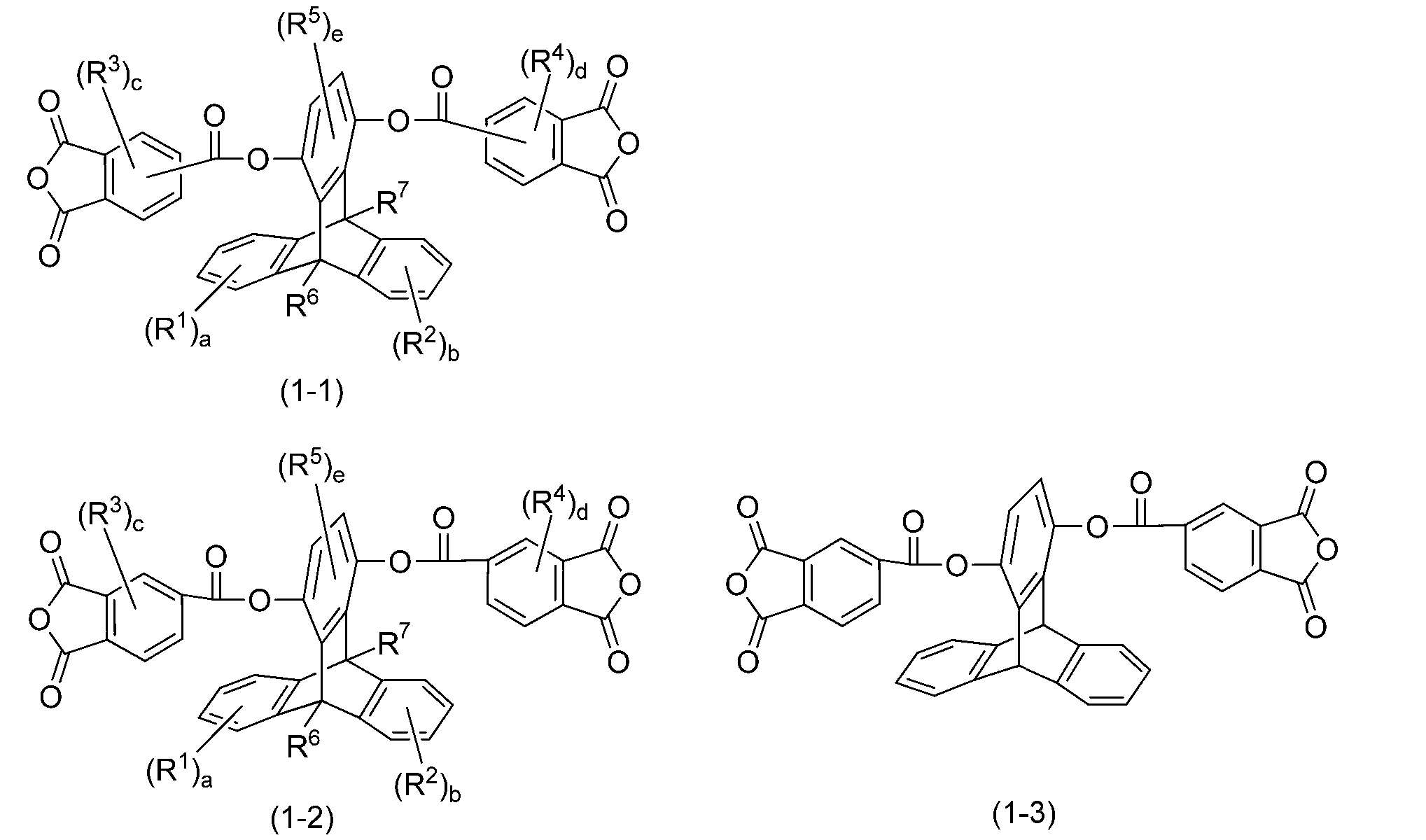
(式中、R1、R2、R3、R4及びR5は、互いに独立して、ハロゲン原子、炭素原子数1乃至5のアルキル基または炭素原子数1乃至5のアルコキシ基を表し、
R6及びR7は、互いに独立して、水素原子、ハロゲン原子、炭素原子数1乃至5のアルキル基又は炭素原子数1乃至5のアルコキシ基を表し、
aおよびbは、互いに独立して、0~4の整数を表し、
cおよびdは、互いに独立して、0~3の整数を表し、
eは、0~2の整数を表す。)
R6及びR7は、互いに独立して、水素原子、ハロゲン原子、炭素原子数1乃至5のアルキル基又は炭素原子数1乃至5のアルコキシ基を表し、
aおよびbは、互いに独立して、0~4の整数を表し、
cおよびdは、互いに独立して、0~3の整数を表し、
eは、0~2の整数を表す。)
上記ハロゲン原子としては、フッ素原子、塩素原子、臭素原子等が挙げられる。
上記炭素原子数1乃至5のアルキル基としては、例えばメチル基、エチル基、n-プロピル基、イソプロピル基、n-ブチル基、イソブチル基、sec-ブチル基、tert-ブチル基、n-ペンチル基、イソアミル基、ネオペンチル基、tert-アミル基、sec-イソアミル基、シクロペンチル基等が挙げられる。
また炭素原子数1乃至5のアルコキシ基としては、メトキシ基、エトキシ基、n-プロポキシ基、イソプロポキシ基、n-ブトキシ基、イソブトキシ基、sec-ブトキシ基、tert-ブトキシ基、n-ペントキシ基、イソペントキシ基、ネオペントキシ基、tert-ペントキシ基等が挙げられる。
上記炭素原子数1乃至5のアルキル基としては、例えばメチル基、エチル基、n-プロピル基、イソプロピル基、n-ブチル基、イソブチル基、sec-ブチル基、tert-ブチル基、n-ペンチル基、イソアミル基、ネオペンチル基、tert-アミル基、sec-イソアミル基、シクロペンチル基等が挙げられる。
また炭素原子数1乃至5のアルコキシ基としては、メトキシ基、エトキシ基、n-プロポキシ基、イソプロポキシ基、n-ブトキシ基、イソブトキシ基、sec-ブトキシ基、tert-ブトキシ基、n-ペントキシ基、イソペントキシ基、ネオペントキシ基、tert-ペントキシ基等が挙げられる。
本発明の上記式(1-1)~(1-3)で表される酸二無水物は、それぞれ下記式(2-1)~(2-3)で表されるテトラカルボン酸を脱水剤にて分子内で脱水させて得ることができる。

(式中、R1、R2、R3、R4、R5、R6、R7、a、b、c、d及びeは上記と同じ意味を表す。)
具体的には、上記式(1-1)で表される酸二無水物は、一例として下記スキームで示されるように、有機溶媒中、9,10-[1,2]ベンゼノアントラセン-1,4-ジオール化合物(以下、ベンゼノアントラセンジオール化合物ともいう。)と、ベンゼントリカルボン酸ハロゲン化無水物を塩基または酸吸収剤の存在下で反応させて得ることができる[反応式1]。また反応後は溶媒を除去後、再結晶、蒸留、シリカゲルカラムクロマトグラフィ等の公知の手法を用いて精製し、目的物の酸二無水物を得ることができる。
また[反応式1]の反応物を加水分解し、中間体(9,10-[1,2]ベンゼノアントラセン-1,4-ジイル ビス(ベンゼントリカルボン酸エステル)化合物)(式(2-1)で表される化合物)を得[反応式2]、この中間体を脱水剤にて分子内で脱水させる[反応式3]ことでも得ることができる。
なお上記式(1-1)~(1-3)で表される酸二無水物及びその中間体である上記式(2-1)~(2-3)で表されるベンゼントリカルボン酸エステル(テトラカルボン酸化合物)も本発明の対象である。
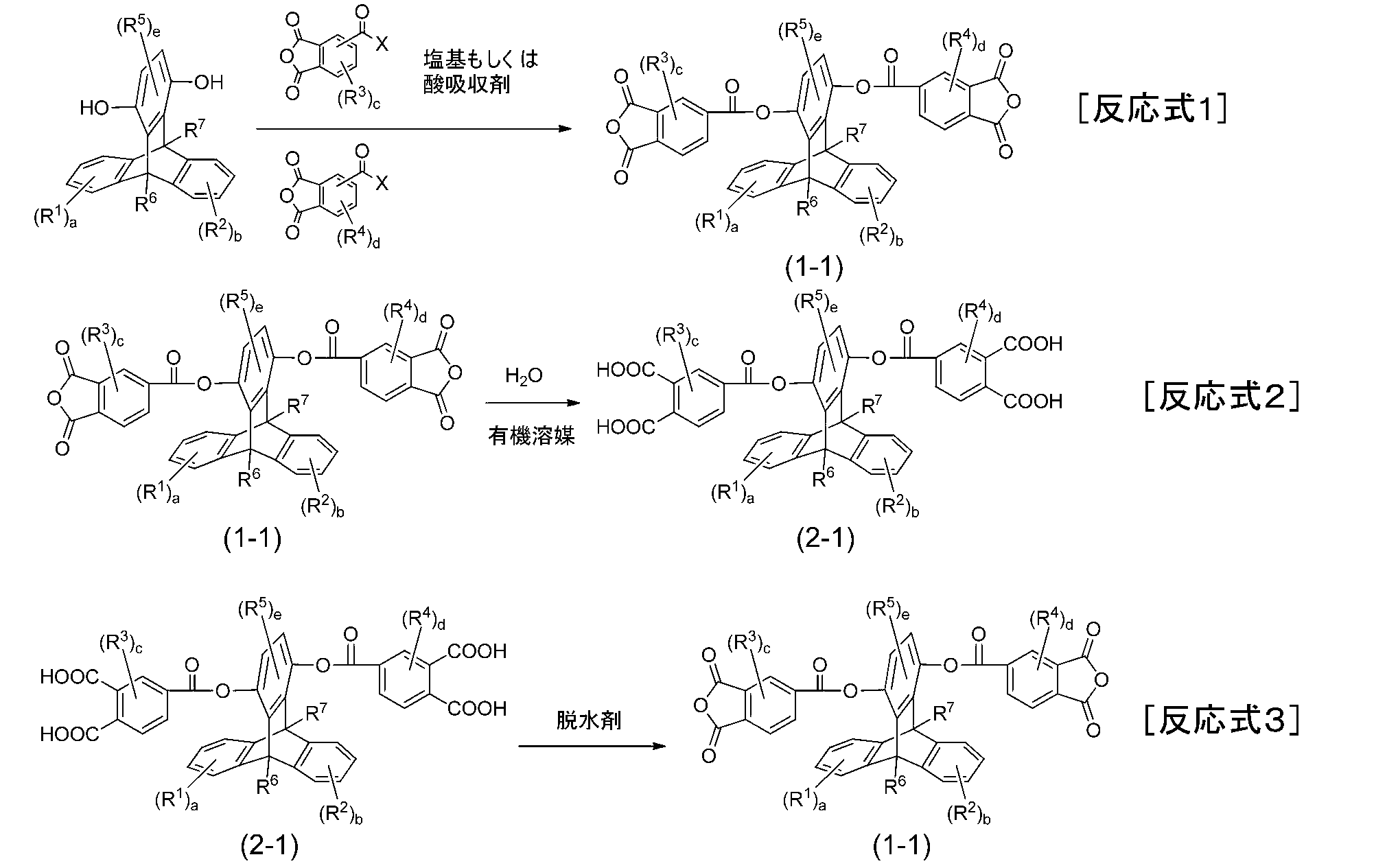
(上記スキーム中、Xはハロゲン原子を表し、R1、R2、R3、R4、R5、R6、R7、a、b、c、d及びeは上記と同じ意味を表す。)
また[反応式1]の反応物を加水分解し、中間体(9,10-[1,2]ベンゼノアントラセン-1,4-ジイル ビス(ベンゼントリカルボン酸エステル)化合物)(式(2-1)で表される化合物)を得[反応式2]、この中間体を脱水剤にて分子内で脱水させる[反応式3]ことでも得ることができる。
なお上記式(1-1)~(1-3)で表される酸二無水物及びその中間体である上記式(2-1)~(2-3)で表されるベンゼントリカルボン酸エステル(テトラカルボン酸化合物)も本発明の対象である。
上記[反応式1]の反応において、ベンゼノアントラセンジオール化合物とベンゼントリカルボン酸ハロゲン化無水物との仕込み比は、ベンゼノアントラセンジオール化合物1モルに対し、ベンゼントリカルボン酸ハロゲン化無水物2~4モルが好ましい。
塩基としては、トリメチルアミン、トリエチルアミン、ジイソプロピルアミン、ジイソプロピルエチルアミン、N-メチルピペリジン、2,2,6,6-テトラメチル-N-メチルピペリジン、ピリジン、4-ジメチルアミノピリジン、N-メチルモルホリン等の有機アミン類等の有機塩基が好適に用いられる。また、塩基の使用量は、ベンゼントリカルボン酸ハロゲン化無水物1モルに対して1モル以上であれば特に限定されるものではないが、通常1~5モル程度であり、好ましくは1~3モル程度である。
また、反応で副生する塩酸等の酸を中和するために、酸吸収剤を用いてもよい。酸吸収剤としては、プロピレンオキシド等のエポキシド類が挙げられる。酸吸収剤の使用量は、ベンゼノアントラセンジオール化合物1モルに対して2モル以上であれば特に限定されるものではないが、通常2~10モル程度であり、好ましくは2~4モル程度である。
有機溶媒としては、反応に影響を及ぼさない溶媒であれば特に限定されるものではないが、ベンゼン、トルエン、キシレン、等の芳香族炭化水素類;N,N-ジメチルホルムアミド(以下、DMFという)、N,N-ジメチルアセトアミド(以下、DMAcという)、N-メチル-2-ピロリドン(以下、NMPという)等のアミド類;ジエチルエーテル、テトラヒドロフラン(以下、THFという)、1,4-ジオキサン、1,2-ジメトキシエタン、シクロペンチルメチルエーテル等のエーテル類、2-ブタノン、4-メチル-2-ペンタノンなどのケトン類、アセトニトリル等のニトリル類、ジメチルスルホキシド(以下、DMSOという)などを用いることができる。これらの溶媒は、単独で用いても、2種以上を組み合わせて用いてもよい。なお、[反応式1]で直接目的物である酸二無水物(1-1)を精製し、取り出す場合は、溶媒中に水分が多く含まれると、エステルの加水分解が起こることから、溶媒は脱水溶媒を使用する、もしくは、脱水してから使用することが好ましい。また、[反応式2]、[反応式3]を経由して目的物である酸二無水物(1-1)を取り出す場合は、脱水溶媒を使用してもしなくてもよい。
反応温度は、0~200℃程度とすることができるが、20~150℃が好ましい。
反応後は、溶媒を留去し、精製することで目的物である酸二無水物を得られる。この精製法は任意であり、再結晶、蒸留、シリカゲルカラムクロマトグラフィ等公知の手法から適宜選択すればよい。また、精製時に使用する有機溶媒は、精製時に生成物と反応しない溶媒であれば特に限定されるものではなく、上記反応に使用する有機溶媒と同様である。
また、反応後の精製が難しい場合は、粗生成物のまま、加水分解し[反応式2]、テトラカルボン酸を得た後に脱水剤にて脱水環化させる[反応式3]ことで目的である酸二無水物を得ることもできる。
塩基としては、トリメチルアミン、トリエチルアミン、ジイソプロピルアミン、ジイソプロピルエチルアミン、N-メチルピペリジン、2,2,6,6-テトラメチル-N-メチルピペリジン、ピリジン、4-ジメチルアミノピリジン、N-メチルモルホリン等の有機アミン類等の有機塩基が好適に用いられる。また、塩基の使用量は、ベンゼントリカルボン酸ハロゲン化無水物1モルに対して1モル以上であれば特に限定されるものではないが、通常1~5モル程度であり、好ましくは1~3モル程度である。
また、反応で副生する塩酸等の酸を中和するために、酸吸収剤を用いてもよい。酸吸収剤としては、プロピレンオキシド等のエポキシド類が挙げられる。酸吸収剤の使用量は、ベンゼノアントラセンジオール化合物1モルに対して2モル以上であれば特に限定されるものではないが、通常2~10モル程度であり、好ましくは2~4モル程度である。
有機溶媒としては、反応に影響を及ぼさない溶媒であれば特に限定されるものではないが、ベンゼン、トルエン、キシレン、等の芳香族炭化水素類;N,N-ジメチルホルムアミド(以下、DMFという)、N,N-ジメチルアセトアミド(以下、DMAcという)、N-メチル-2-ピロリドン(以下、NMPという)等のアミド類;ジエチルエーテル、テトラヒドロフラン(以下、THFという)、1,4-ジオキサン、1,2-ジメトキシエタン、シクロペンチルメチルエーテル等のエーテル類、2-ブタノン、4-メチル-2-ペンタノンなどのケトン類、アセトニトリル等のニトリル類、ジメチルスルホキシド(以下、DMSOという)などを用いることができる。これらの溶媒は、単独で用いても、2種以上を組み合わせて用いてもよい。なお、[反応式1]で直接目的物である酸二無水物(1-1)を精製し、取り出す場合は、溶媒中に水分が多く含まれると、エステルの加水分解が起こることから、溶媒は脱水溶媒を使用する、もしくは、脱水してから使用することが好ましい。また、[反応式2]、[反応式3]を経由して目的物である酸二無水物(1-1)を取り出す場合は、脱水溶媒を使用してもしなくてもよい。
反応温度は、0~200℃程度とすることができるが、20~150℃が好ましい。
反応後は、溶媒を留去し、精製することで目的物である酸二無水物を得られる。この精製法は任意であり、再結晶、蒸留、シリカゲルカラムクロマトグラフィ等公知の手法から適宜選択すればよい。また、精製時に使用する有機溶媒は、精製時に生成物と反応しない溶媒であれば特に限定されるものではなく、上記反応に使用する有機溶媒と同様である。
また、反応後の精製が難しい場合は、粗生成物のまま、加水分解し[反応式2]、テトラカルボン酸を得た後に脱水剤にて脱水環化させる[反応式3]ことで目的である酸二無水物を得ることもできる。
一方、上記[反応式2]の反応は、式(1-1)で表される酸二無水物と水を混合すれば特に限定はないが、例えば[反応式1]で生成した(1-1)を、水、場合によっては有機溶媒、酸あるいはアルカリを添加し、加熱還流して加水分解することにより、式(2-1)で表されるベンゼントリカルボン酸エステル(テトラカルボン酸化合物)を得ることもできる。
水は、式(1-1)で表される酸二無水物に対して、通常2~100質量倍、好ましくは2~40質量倍、より好ましくは2~6質量倍使用される。
また、上記の反応は有機溶媒を添加しても良い。有機溶媒としては、反応に影響を及ぼさない溶媒であれば特に限定されるものではないが、ベンゼン、トルエン、キシレン、等の芳香族炭化水素類;N,N-ジメチルホルムアミド(以下、DMFという)、N,N-ジメチルアセトアミド(以下、DMAcという)、N-メチル-2-ピロリドン(以下、NMPという)等のアミド類;ジエチルエーテル、テトラヒドロフラン(以下、THFという)、1,4-ジオキサン、1,2-ジメトキシエタン、シクロペンチルメチルエーテル等のエーテル類、アセトン、酢酸エチル、2-ブタノン、4-メチル-2-ペンタノンなどのケトン類、アセトニトリル等のニトリル類、ジメチルスルホキシド(以下、DMSOという)などを用いることができる。これらの溶媒は、単独で用いても、2種以上を組み合わせて用いてもよい。なお、加水分解を効率よく進行させるためには、極性の高い溶媒が好ましく、例えばDMF、DMAc、NMP、THF、1,4-ジオキサン、ジエチルエーテル、アセトニトリル、アセトン、酢酸エチル等が好ましい。
また、上記の反応は酸を添加してもよい。酸は特に限定されるものではないが、酸としては、リンモリブデン酸、リンタングステン酸などのヘテロポリ酸;トリメチルボレート、トリフェニルホスフィンなどの有機酸;塩酸、硫酸または燐酸などの無機酸;蟻酸、酢酸、プロピオン酸またはp-トルエンスルホン酸などの炭化水素酸;並びにトリフルオロ酢酸などのハロゲン系炭化水素酸が挙げられる。好ましくは、塩酸、硫酸、酢酸またはp-トルエンスルホン酸が挙げられる。
酸は式(1-1)で表される酸二無水物に対して通常0~100倍モル、好ましくは0.01~10倍モル使用される。
また、本反応はアルカリ性水溶液を使用して加水分解をしてもよい。アルカリは特に限定されるものではないが、アルカリとしては、水酸化ナトリウム、水酸化カリウム、水酸化リチウム、炭酸ナトリウム、炭酸カリウム、炭酸リチウムなどのアルカリ金属類;水酸化マグネシウム、水酸化カルシウム等のアルカリ土類金属類が挙げられる。なかでも好ましくは、水酸化ナトリウム、水酸化カリウム、水酸化リチウムが挙げられる。
アルカリの使用量は式(1-1)で表される酸二無水物に対して通常0~100倍モル、好ましくは0.01~10倍モル使用される。
反応温度は特に限定されないが、例えば-90~200℃、好ましくは50~130℃である。
反応時間は、通常、0.1ないし200時間、好ましくは0.5ないし100時間である。
水は、式(1-1)で表される酸二無水物に対して、通常2~100質量倍、好ましくは2~40質量倍、より好ましくは2~6質量倍使用される。
また、上記の反応は有機溶媒を添加しても良い。有機溶媒としては、反応に影響を及ぼさない溶媒であれば特に限定されるものではないが、ベンゼン、トルエン、キシレン、等の芳香族炭化水素類;N,N-ジメチルホルムアミド(以下、DMFという)、N,N-ジメチルアセトアミド(以下、DMAcという)、N-メチル-2-ピロリドン(以下、NMPという)等のアミド類;ジエチルエーテル、テトラヒドロフラン(以下、THFという)、1,4-ジオキサン、1,2-ジメトキシエタン、シクロペンチルメチルエーテル等のエーテル類、アセトン、酢酸エチル、2-ブタノン、4-メチル-2-ペンタノンなどのケトン類、アセトニトリル等のニトリル類、ジメチルスルホキシド(以下、DMSOという)などを用いることができる。これらの溶媒は、単独で用いても、2種以上を組み合わせて用いてもよい。なお、加水分解を効率よく進行させるためには、極性の高い溶媒が好ましく、例えばDMF、DMAc、NMP、THF、1,4-ジオキサン、ジエチルエーテル、アセトニトリル、アセトン、酢酸エチル等が好ましい。
また、上記の反応は酸を添加してもよい。酸は特に限定されるものではないが、酸としては、リンモリブデン酸、リンタングステン酸などのヘテロポリ酸;トリメチルボレート、トリフェニルホスフィンなどの有機酸;塩酸、硫酸または燐酸などの無機酸;蟻酸、酢酸、プロピオン酸またはp-トルエンスルホン酸などの炭化水素酸;並びにトリフルオロ酢酸などのハロゲン系炭化水素酸が挙げられる。好ましくは、塩酸、硫酸、酢酸またはp-トルエンスルホン酸が挙げられる。
酸は式(1-1)で表される酸二無水物に対して通常0~100倍モル、好ましくは0.01~10倍モル使用される。
また、本反応はアルカリ性水溶液を使用して加水分解をしてもよい。アルカリは特に限定されるものではないが、アルカリとしては、水酸化ナトリウム、水酸化カリウム、水酸化リチウム、炭酸ナトリウム、炭酸カリウム、炭酸リチウムなどのアルカリ金属類;水酸化マグネシウム、水酸化カルシウム等のアルカリ土類金属類が挙げられる。なかでも好ましくは、水酸化ナトリウム、水酸化カリウム、水酸化リチウムが挙げられる。
アルカリの使用量は式(1-1)で表される酸二無水物に対して通常0~100倍モル、好ましくは0.01~10倍モル使用される。
反応温度は特に限定されないが、例えば-90~200℃、好ましくは50~130℃である。
反応時間は、通常、0.1ないし200時間、好ましくは0.5ないし100時間である。
また、上記[反応式3]の反応は、公知の方法を採用すればよく、特に制限はないが、例えば、[反応式2]で得た式(2-1)で表されるベンゼントリカルボン酸エステル(テトラカルボン酸化合物)と脱水剤を溶剤中で混合することにより式(1-1)で表される酸二無水物を得ることができる。
脱水剤としては、式(2-1)で表されるベンゼントリカルボン酸エステル(テトラカルボン酸化合物)に脱水剤が接触することができるものであれば特に限定はないが、例えば、脱水は、無水酢酸、無水プロピオン酸、無水トリフルオロ酢酸等の脂肪族カルボン酸無水物、1,3-ジシクロヘキシルカルボジイミド、2-クロロ-1,3-ジメチルイミダゾリニウムクロリド等の脱水剤の存在下で実施することができる。また、炭素原子数が1~3の低級カルボン酸無水物が好ましく、より好ましくは炭素原子数が1~2の低級カルボン酸無水物が好ましく、中でも無水化後の除去がしやすく経済的に有利な点で無水酢酸が特に好ましい。
脱水剤の使用量は特に限定されないが、式(2-1)で表されるベンゼントリカルボン酸エステル(テトラカルボン酸化合物)に対して、2~50当量が好ましく、特に好ましくは4~20当量である。2~50当量であれば、十分に無水物化が行われ、かつ得られる式(1-1)で表される酸二無水物の溶解量が増加しすぎることなく、高い収率で式(1-1)で表される酸二無水物を析出させることができる。
上記反応は、反応に直接関与しない有機溶媒を用いることもできる。例えば、トルエン、キシレン等の炭化水素類;1,2-ジクロロエタン、1,2-ジクロロプロパン等のハロゲン化炭化水素類;更に1,4-ジオキサン等が挙げられる。
なお、式(2-1)で表されるベンゼントリカルボン酸エステル(テトラカルボン酸化合物)を完全に溶解させて均一系で必ずしも無水物化反応させる必要はなく、不均一系で無水物化反応を実施してもよい。
反応における加熱の温度は、好ましくは30~200℃、より好ましくは40~180℃の範囲で行うとよく、反応温度が高いほど反応速度が向上する。このため使用溶媒の還流温度で実施するのが好ましい。
また、反応時間は、使用する脱水剤の種類、温度等の条件に応じて適宜設定すればよいが、0.5~20時間であることが好ましい。
上記の無水物化反応によって、使用した脱水剤に式(1-1)で表される酸二無水物が懸濁した懸濁液を得ることができる。無水物化反応の後は、得られた懸濁液をろ過することで式(1-1)で表される酸二無水物の粉末を回収できる。また、必要に応じて上記懸濁液を濃縮してもよい。
また、必要に応じて上記ろ取物を有機溶媒で洗浄してもよい。この洗浄溶媒は無水物と反応せず、目的の無水物の溶解度が低い溶媒であれば特に限定されないが、例えば、トルエン、ヘキサン、ヘプタン、アセトニトリル、アセトン、クロロホルム、酢酸エチル、炭酸ジメチル等やこれらの混合溶媒などが挙げられる。中でも酢酸エチル、炭酸ジメチルが好ましい。
さらに、減圧乾燥等により脱水剤や溶媒を除去することで、高純度の式(1-1)で表される酸二無水物を得ることができる。また、必要により再結晶、蒸留、シリカゲルカラムクロマトグラフィ等公知の手法を用いて精製することでも、目的物である酸二無水物を得られる。
また、必要に応じて上記ろ取物を有機溶媒で洗浄してもよい。この洗浄溶媒は無水物と反応せず、目的の無水物の溶解度が低い溶媒であれば特に限定されないが、例えば、トルエン、ヘキサン、ヘプタン、アセトニトリル、アセトン、クロロホルム、酢酸エチル、炭酸ジメチル等やこれらの混合溶媒などが挙げられる。中でも酢酸エチル、炭酸ジメチルが好ましい。
さらに、減圧乾燥等により脱水剤や溶媒を除去することで、高純度の式(1-1)で表される酸二無水物を得ることができる。また、必要により再結晶、蒸留、シリカゲルカラムクロマトグラフィ等公知の手法を用いて精製することでも、目的物である酸二無水物を得られる。
なお、本発明で得られる式(2-1)で表される酸二無水物は、文献未記載の新規化合物であり、上記のように、これから容易に式(1-1)で表される酸二無水物が製造できるなど種々の用途に使用できる。
また、本発明で用いるベンゼノアントラセンジオール化合物は、例えば、一例として下記スキームで示されるように、公知の方法に従い、有機溶媒中、アントラセン化合物と1,4-ベンゾキノン化合物とをDiels―Alder反応させて得られる9,10-[1,2]ベンゼノアントラセン-13,16(9H,10H)-ジオン化合物を酢酸溶媒中、47%臭化水素存在下、加熱条件で処理することで得ることができる。

(上記スキーム中、R1、R2、R5、R6、R7、a、b及びeは上記と同じ意味を表す。)
耐熱性、柔軟性及び透明性に優れるだけでなく、リタデーションが低いという特徴をも有するポリイミド膜を与えるポリアミック酸を再現性よく得る観点から、本発明のポリアミック酸の製造に用いる酸二無水物成分は、上記式(1-1)で表される酸二無水物に加え、好ましくは脂環式テトラカルボン酸二無水物を、より好ましくは下記式(C1)で表される酸二無水物を含む。

〔式中、B1は、式(X-1)~(X-12)からなる群から選ばれる4価の基を表す。

(式中、複数のRは、互いに独立して、水素原子またはメチル基を表し、*は結合手を表す。)〕
上記式(C1)で表される酸二無水物の中でも、式中のB1が前記式(X-1)、(X-2)、(X-4)、(X-5)、(X-6)、(X-7)、(X-8)、(X-9)、(X-11)および(X-12)で表される酸二無水物が好ましく、前記B1が前記式(X-1)、(X-2)、(X-11)および(X-12)で表される酸二無水物が特に好ましい。
また、本発明の効果を損なわない範囲において、前記酸二無水物成分には、上記式(1-1)で表される酸二無水物、上記式(C1)で表される酸二無水物以外の、その他の酸二無水物を用いてもよい。
また、本発明の効果を損なわない範囲において、前記酸二無水物成分には、上記式(1-1)で表される酸二無水物、上記式(C1)で表される酸二無水物以外の、その他の酸二無水物を用いてもよい。
上記酸二無水物成分において、本発明の上記式(1-1)で表される酸二無水物とともに脂環式テトラカルボン酸二無水物を用いる場合における、上記式(1-1)で表される酸二無水物と脂環式テトラカルボン酸二無水物との比率は、通常、上記式(1-1)で表される酸二無水物:脂環式テトラカルボン酸二無水物=1:0.5~1:4である。このような範囲とすることで、高耐熱性、高柔軟性、高透明性、低リタデーションのポリイミドを与えるポリアミック酸を再現性よく得ることができる。
耐熱性、柔軟性及び透明性に優れるだけでなく、リタデーションが低いという特徴をも有するポリイミド膜を与えるポリアミック酸を再現性よく得る観点から、本発明のポリアミック酸の製造に用いるジアミン成分は、好ましくは芳香族ジアミンを、より好ましくは下記式(A1)で表されるジアミンを含む。

(式中、B2は、式(Y-1)~式(Y-34)からなる群から選ばれる2価の基を表す。)


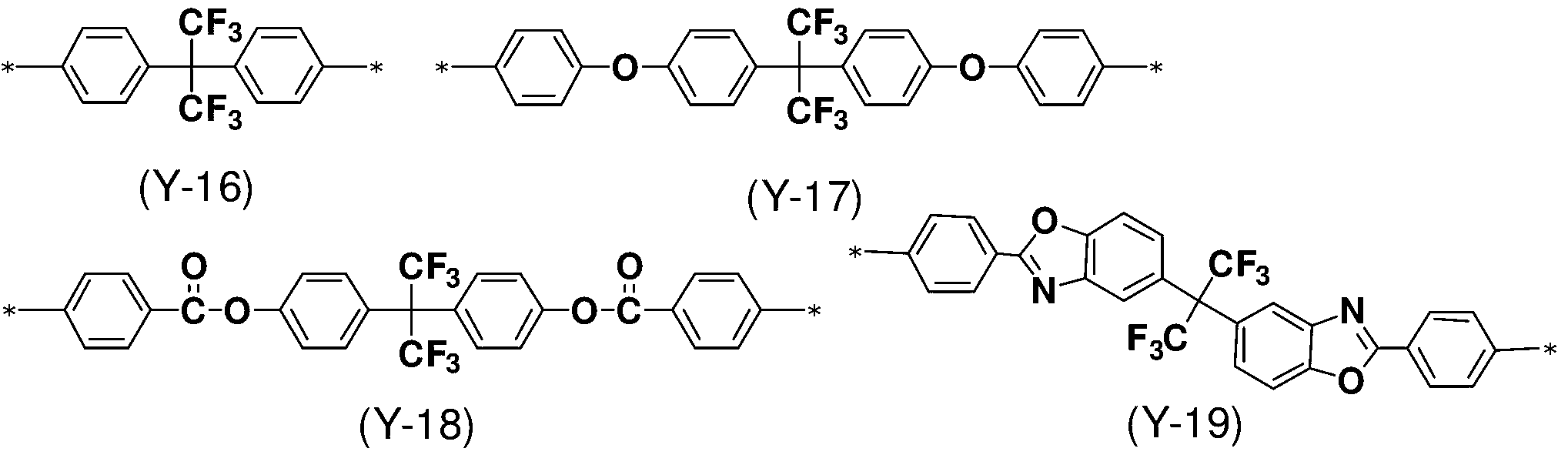
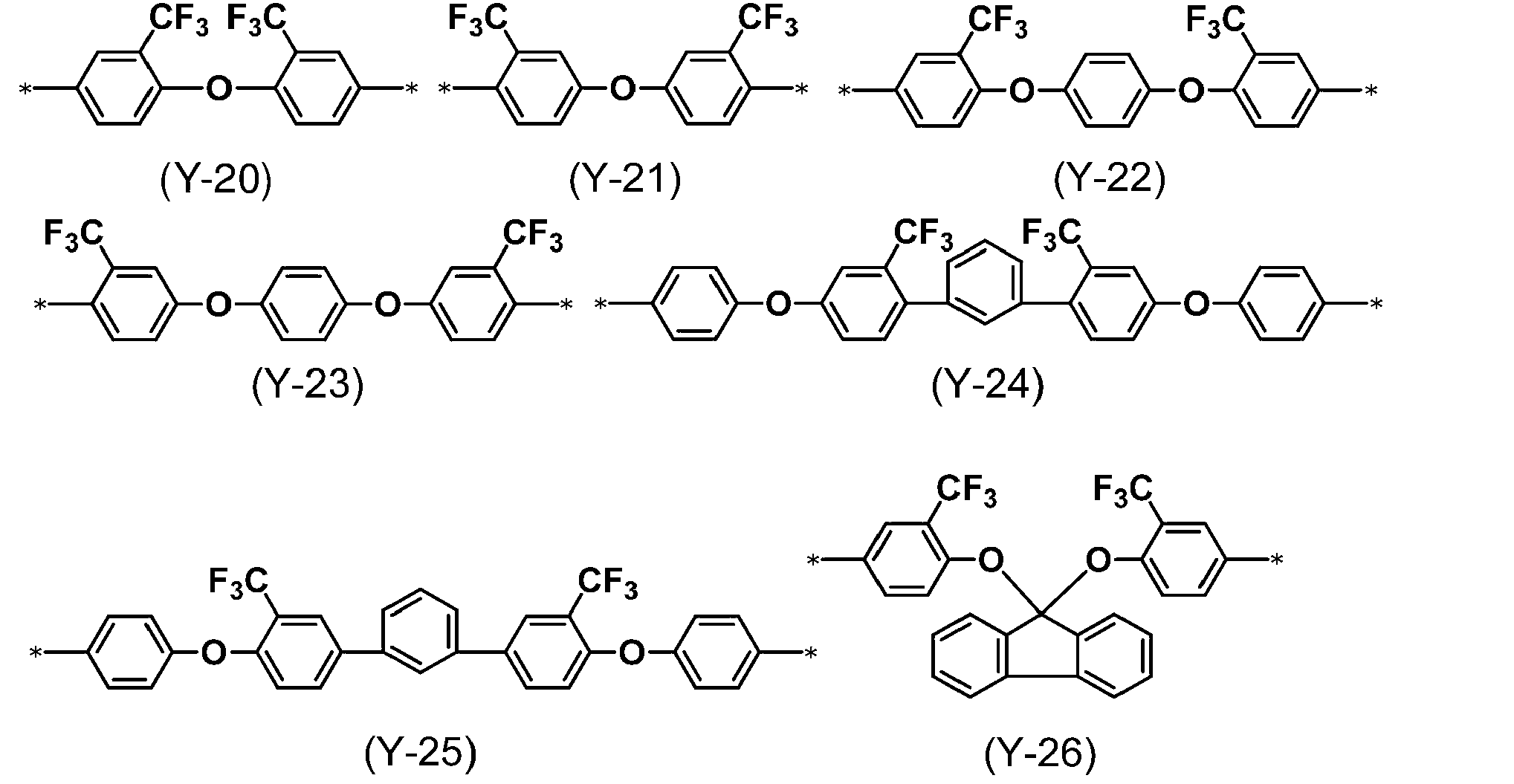
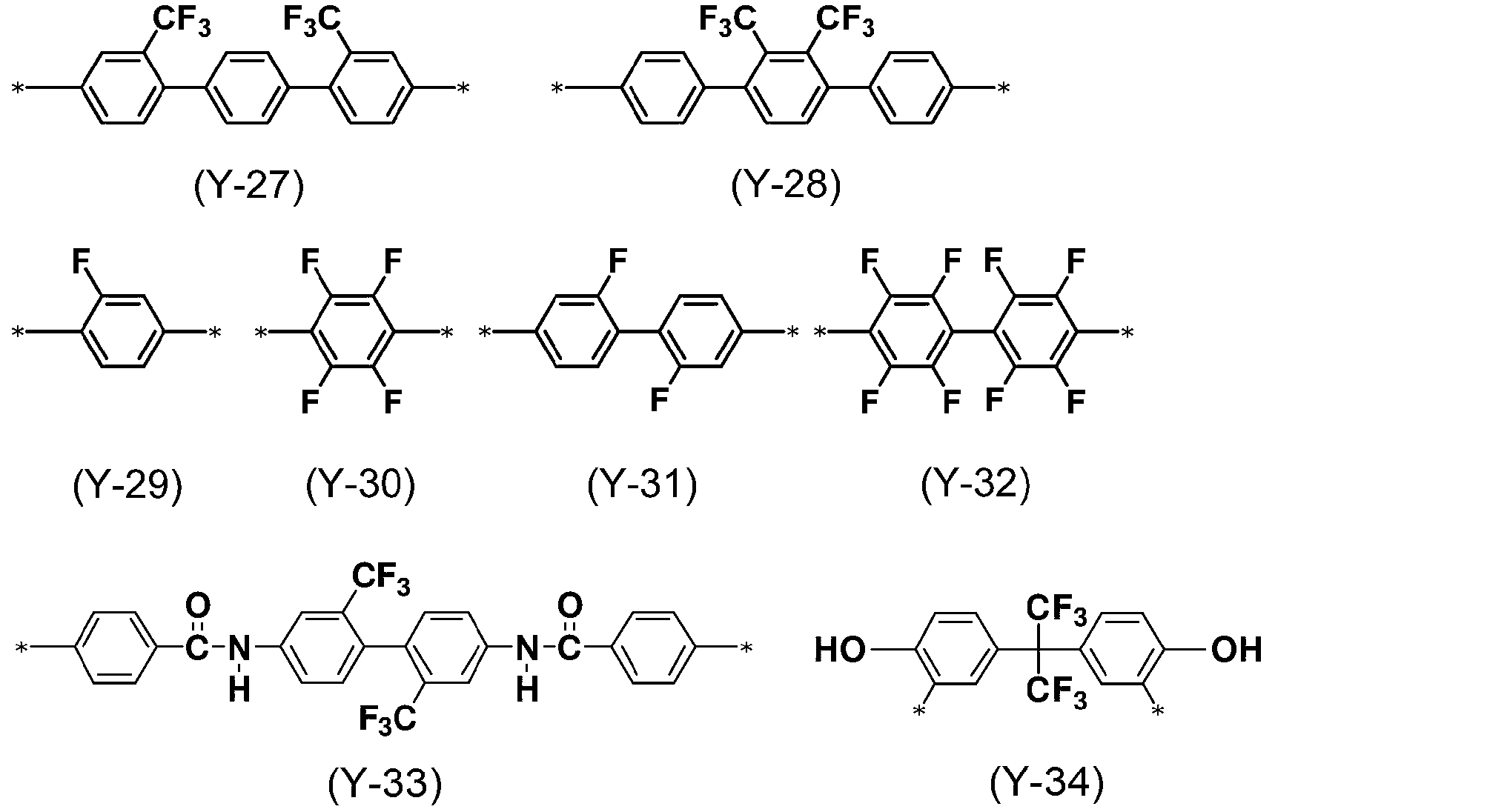
(式中、*は結合手を表す。)
上記式(A1)で表されるジアミンの中でも、式中のB2が前記式(Y-12)、(Y-13)、(Y-14)、(Y-15)、(Y-18)、(Y-27)、(Y-28)、(Y-30)および(Y-33)で表されるジアミンが好ましく、前記B2が前記式(Y-12)、(Y-13)、(Y-14)、(Y-15)および(Y-33)で表されるジアミンが特に好ましい。
また、本発明の効果を損なわない範囲において、前記ジアミン成分には、上記式(A1)で表されるジアミン以外の、その他のジアミン化合物を用いてもよい。
また、本発明の効果を損なわない範囲において、前記ジアミン成分には、上記式(A1)で表されるジアミン以外の、その他のジアミン化合物を用いてもよい。
高耐熱性、高柔軟性、高透明性、低リタデーションのポリイミド膜を与えるポリアミック酸を再現性よく得る観点から、本発明のポリアミック酸の製造に用いるジアミン成分中芳香族ジアミンの含有量は、好ましくは50mol%以上、より好ましくは60mol%以上、より一層好ましくは70モル%、さらに好ましくは80モル%、さらに一層好ましくは90モル%、最も好ましくは100モル%である。
なお、上記酸二無水物成分として上記式(1-1)で表される酸二無水物と上記(C1)で表される酸二無水物とを用い、上記ジアミン成分として上記式(A1)で表されるジアミンを用いた場合、ポリアミック酸は下記式(4-1)で表されるモノマー単位と、下記式(4-2)で表されるモノマー単位とを有するものとなる。

(式中、R1、R2、R3、R4、R5、R6、R7、a、b、c、d、e、B1及びB2は、上記と同じ意味を表す。)
本発明のポリアミック酸を得る方法は特に限定されるものではなく、前述の酸二無水物成分とジアミン成分とを公知の手法によって反応、重合させればよい。
ポリアミック酸を合成する際の酸二無水物成分のモル数とジアミン成分のモル数との比は、酸二無水物成分/ジアミン成分=0.8~1.2である。
ポリアミック酸を合成する際の酸二無水物成分のモル数とジアミン成分のモル数との比は、酸二無水物成分/ジアミン成分=0.8~1.2である。
ポリアミック酸の合成に用いられる溶媒としては、例えば、m-クレゾール、N-メチル-2-ピロリドン(NMP)、N,N-ジメチルホルムアミド(DMF)、N,N-ジメチルアセトアミド(DMAc)、N-メチルカプロラクタム、ジメチルスルホキシド(DMSO)、テトラメチル尿素、ピリジン、ジメチルスルホン、ヘキサメチルホスホルアミド、γ-ブチロラクトンなどが挙げられる。これらは、単独で使用しても、混合して使用してもよい。さらに、ポリアミック酸を溶解しない溶媒であっても、均一な溶液が得られる範囲内で上記溶媒に加えて使用してもよい。
重縮合反応の温度は、-20~150℃、好ましくは-5~100℃の任意の温度を選択することができる。
重縮合反応の温度は、-20~150℃、好ましくは-5~100℃の任意の温度を選択することができる。
上述したポリアミック酸を得るための重合反応により得られたポリアミック酸含有溶液(ポリアミック酸溶液とも称する)は、そのまま、あるいは希釈もしくは濃縮した後、後述するポリイミド膜形成用組成物として使用することができる。また該ポリアミック酸含有溶液に、メタノール、エタノールなどの貧溶媒を加えてポリアミック酸を沈殿させて単離し、その単離したポリアミック酸を適当な溶媒に再溶解させてポリアミック酸含有溶液とし、これをポリイミド膜形成用組成物として使用することもできる。
ポリアミック酸含有溶液の希釈用溶媒並びに単離したポリアミック酸の再溶解用溶媒は、得られたポリアミック酸を溶解させるものであれば特に限定されるものではなく、例えば、m-クレゾール、2-ピロリドン、NMP、N-エチル-2-ピロリドン、N-ビニル-2-ピロリドン、DMAc、DMF、γ-ブチロラクトンなどが挙げられる。
ポリアミック酸含有溶液の希釈用溶媒並びに単離したポリアミック酸の再溶解用溶媒は、得られたポリアミック酸を溶解させるものであれば特に限定されるものではなく、例えば、m-クレゾール、2-ピロリドン、NMP、N-エチル-2-ピロリドン、N-ビニル-2-ピロリドン、DMAc、DMF、γ-ブチロラクトンなどが挙げられる。
また、単独ではポリアミック酸を溶解しない溶媒であっても、ポリアミック酸が析出しない範囲であれば上記溶媒に加えて使用することができる。その具体例としては、エチルセロソルブ、ブチルセロソルブ、エチルカルビトール、ブチルカルビトール、エチルカルビトールアセテート、エチレングリコール、1-メトキシ-2-プロパノール、1-エトキシ-2-プロパノール、1-ブトキシ-2-プロパノール、1-フェノキシ-2-プロパノール、プロピレングリコールモノアセテート、プロピレングリコールジアセテート、プロピレングリコール-1-モノメチルエーテル-2-アセテート、プロピレングリコール-1-モノエチルエーテル-2-アセテート、ジプロピレングリコール、2-(2-エトキシプロポキシ)プロパノール、乳酸メチルエステル、乳酸エチルエステル、乳酸n-プロピルエステル、乳酸n-ブチルエステル、乳酸イソアミルエステルなどが挙げられる。
なお本発明において、ポリアミック酸の数平均分子量は、得られる薄膜の柔軟性等を向上させるという観点から、好ましくは5,000以上であり、またポリアミック酸の溶解性を確保するという観点から、好ましくは100,000以下、より好ましくは50,000以である。なお本明細書において、数平均分子量は、GPC(ゲル浸透クロマトグラフィー)装置によって測定し、ポリスチレン換算値として算出される値である。
以上のようにして調製したポリアミック酸含有溶液は、前述の通りポリイミド膜形成用組成物として好適に用いることができる。
そして、基板上に上記ポリイミド膜形成用組成物を塗布して得られた塗膜を加熱し、溶媒を蒸発させつつイミド化反応をさせることで、本発明のポリイミド膜を得ることができる。すなわち、本発明のポリイミド膜は、上記ポリイミド膜形成用組成物の固形分からなり、該固形分中のポリアミック酸のイミド化物を含むものである。なおここでいう固形分量とは、有機溶媒以外の成分の総質量を意味し、液状のモノマー等であっても固形分として重量に含めるものとする。上記ポリイミド膜形成用組成物における固形分量の配合量は、通常0.5~30質量%程度、好ましくは5~25質量%程度である。
ポリイミド膜を得る際、加熱温度は、通常100~500℃程度であり、例えば、100~150℃の範囲、180~350℃の範囲、380~450℃の範囲で段階的に加熱してもよい。
なお、ポリイミド膜と基板との密着性を更に向上させる目的で、ポリイミド膜形成用組成物に、カップリング剤等の公知の添加剤を加えてもよい。なおその他成分を含む場合も含め、本発明のポリイミド膜形成用組成物の固形分量において、上記ポリアミック酸の割合は70~100質量%とすることができる。
上記ポリイミド膜形成用組成物並びに該組成物を用いて形成されるポリイミド膜も本発明の対象である。
そして、基板上に上記ポリイミド膜形成用組成物を塗布して得られた塗膜を加熱し、溶媒を蒸発させつつイミド化反応をさせることで、本発明のポリイミド膜を得ることができる。すなわち、本発明のポリイミド膜は、上記ポリイミド膜形成用組成物の固形分からなり、該固形分中のポリアミック酸のイミド化物を含むものである。なおここでいう固形分量とは、有機溶媒以外の成分の総質量を意味し、液状のモノマー等であっても固形分として重量に含めるものとする。上記ポリイミド膜形成用組成物における固形分量の配合量は、通常0.5~30質量%程度、好ましくは5~25質量%程度である。
ポリイミド膜を得る際、加熱温度は、通常100~500℃程度であり、例えば、100~150℃の範囲、180~350℃の範囲、380~450℃の範囲で段階的に加熱してもよい。
なお、ポリイミド膜と基板との密着性を更に向上させる目的で、ポリイミド膜形成用組成物に、カップリング剤等の公知の添加剤を加えてもよい。なおその他成分を含む場合も含め、本発明のポリイミド膜形成用組成物の固形分量において、上記ポリアミック酸の割合は70~100質量%とすることができる。
上記ポリイミド膜形成用組成物並びに該組成物を用いて形成されるポリイミド膜も本発明の対象である。
なお、上記式(4-1)で表されるモノマー単位と上記式(4-2)で表されるモノマー単位とを有するポリアミック酸を含有する溶液より形成されるポリイミド膜において、当該ポリイミドは、下記式(5-1)で表されるモノマー単位と下記式(5-2)で表されるモノマー単位とを有するものである。
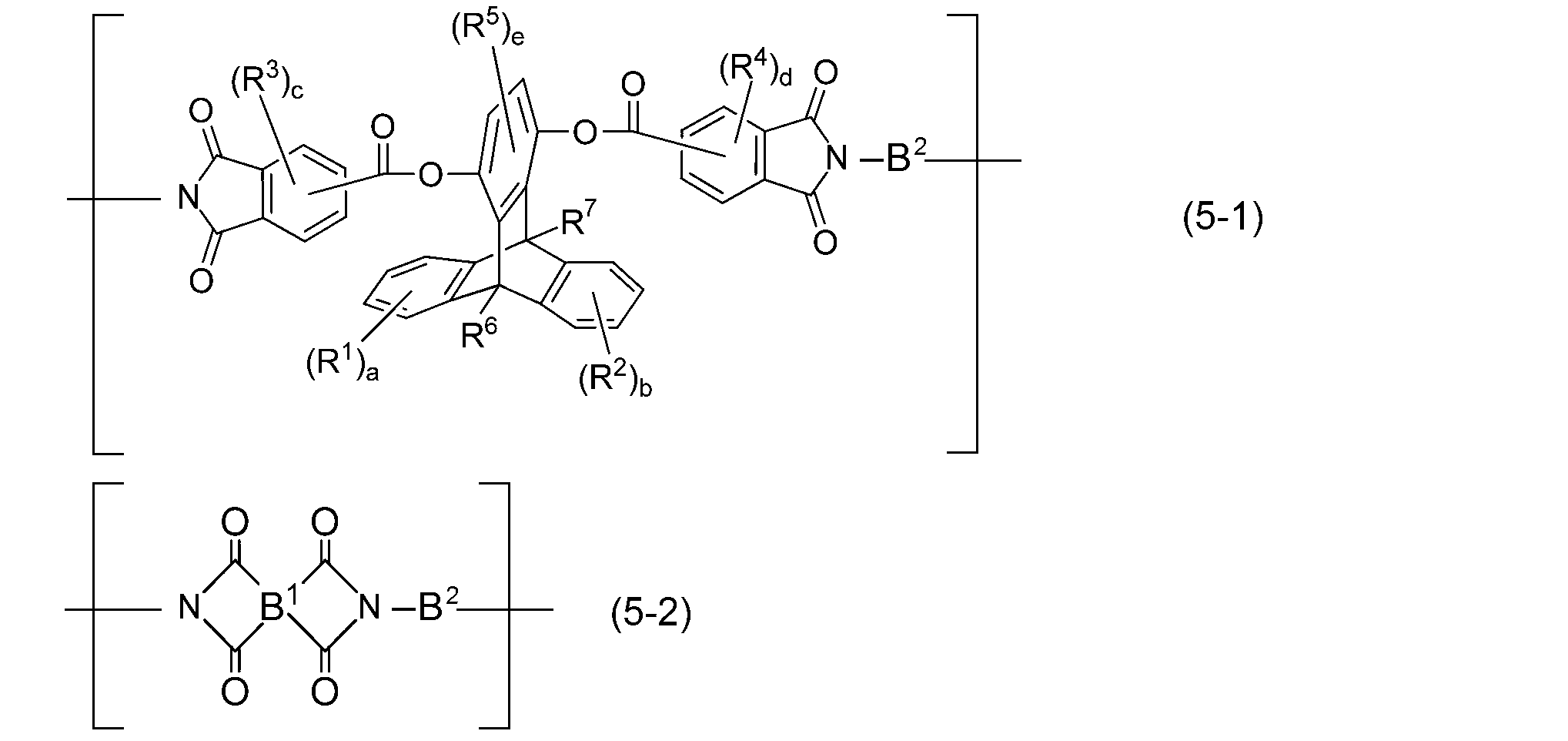
(式中、R1、R2、R3、R4、R5、R6、R7、a、b、c、d、e、B1及びB2は、上記と同じ意味を表す。)
以下に実施例を挙げ、本発明を更に詳しく説明するが、本発明はこれらに限定されるものではない。
なお、使用した試薬の略語は以下のとおりである
TH:トリプチセンヒドロキノン(9,10-ジヒドロ-9,10-[1,2]ベンゼノアントラセン-1,4-ジオール)
TH-TMLA:トリプチセレンヒドロキノン ビス-トリメリット酸
TH-TMA :トリプチセンヒドロキノン ビス-トリメリット酸二無水物
THF:テトラヒドロフラン
CBDA:1,2,3,4-シクロブタンテトラカルボン酸二無水物
TFMB:2,2’-ジ(トリフルオロメチル)ベンジジン
なお、使用した試薬の略語は以下のとおりである
TH:トリプチセンヒドロキノン(9,10-ジヒドロ-9,10-[1,2]ベンゼノアントラセン-1,4-ジオール)
TH-TMLA:トリプチセレンヒドロキノン ビス-トリメリット酸
TH-TMA :トリプチセンヒドロキノン ビス-トリメリット酸二無水物
THF:テトラヒドロフラン
CBDA:1,2,3,4-シクロブタンテトラカルボン酸二無水物
TFMB:2,2’-ジ(トリフルオロメチル)ベンジジン
また試料の調製及び物性の分析及び評価に用いた装置及びその条件は、以下の通りである。
1)HPLC分析
カラム:Inertsil ODS-3、5μm、4.6mm×250mm
オーブン:40℃
検出波長:211nm
流速:1.0mL/分
溶離液:
TH-TMLA:アセトニトリル/0.5%リン酸水溶液=50/50 サンプル注入量:5μL
TH-TMA :アセトニトリル/0.5%リン酸水溶液=50/50 サンプル注入量:5μL※
※TH-TMAを溶離液で1000倍に希釈し、70℃で4時間撹拌後、TH-TMLAとして測定
2)1HNMR,13CNMR分析
装置:フーリエ変換型超伝導核磁気共鳴装置(FT-NMR)(INOVA-400(Varian社)400MHz
溶媒:DMSO-d6
内標準物質:テトラメチルシラン(TMS)
1)HPLC分析
カラム:Inertsil ODS-3、5μm、4.6mm×250mm
オーブン:40℃
検出波長:211nm
流速:1.0mL/分
溶離液:
TH-TMLA:アセトニトリル/0.5%リン酸水溶液=50/50 サンプル注入量:5μL
TH-TMA :アセトニトリル/0.5%リン酸水溶液=50/50 サンプル注入量:5μL※
※TH-TMAを溶離液で1000倍に希釈し、70℃で4時間撹拌後、TH-TMLAとして測定
2)1HNMR,13CNMR分析
装置:フーリエ変換型超伝導核磁気共鳴装置(FT-NMR)(INOVA-400(Varian社)400MHz
溶媒:DMSO-d6
内標準物質:テトラメチルシラン(TMS)
1)数平均分子量及び重量平均分子量の測定
ポリアミック酸の数平均分子量(以下、Mnと略す)と重量平均分子量(以下、Mwと略す)は、装置:昭和電工(株)製、Showdex GPC-101、カラム:KD803およびKD805、カラム温度:50℃、溶出溶媒:DMF、流量:1.5ml/分、検量線:標準ポリスチレン、の条件にて測定した。
2)膜厚
得られた樹脂薄膜の膜厚は、(株)テクロック製 シックネスゲージにて測定した。
3)5%重量減少温度(Td5%)
5%重量減少温度(Td5%[℃])は、TAインスツルメンツ社製 TGA Q500を用い、窒素中、樹脂薄膜約5乃至10mgを50乃至800℃まで10℃/minで昇温して測定することで求めた。
4)光線透過率(透明性)(T550nm)
波長550nmの光線透過率(T550nm[%])は、日本電色工業(株)製 SA4000スペクトロメーターを用いて、室温にて、リファレンスを空気として、測定を行った。
5)リタデーション(Rth、R0)
厚さ方向リタデーション(Rth)及び面内リタデーション(R0)を、王子計測機器(株)製、KOBURA 2100ADHを用いて、室温にて測定した。
なお、厚さ方向リタデーション(Rth)及び面内リタデーション(R0)は以下の式にて算出される。
R0=(Nx-Ny)×d=ΔNxy×d
Rth=[(Nx+Ny)/2-Nz]×d=[(ΔNxz×d)+(ΔNyz×d)]/2
Nx、Ny:面内の直交する2つの屈折率(Nx>Ny、Nxを遅相軸、Nyを進相軸とも称する)
Nz:面に対して厚さ(垂直)方向の屈折率
d:膜厚
ΔNxy:面内の2つの屈折率の差(Nx-Ny)(複屈折)
ΔNxz:面内の屈折率Nxと厚さ方向の屈折率Nzの差(複屈折)
ΔNyz:面内の屈折率Nyと厚さ方向の屈折率Nzの差(複屈折)
6)面内複屈折(Δn)
前述の<5)リタデーション>により得られた厚さ方向リタデーション(Rth)の値を用い、以下の式にて算出した。
Δn=[Rth/d(フィルム膜厚)]/1000
ポリアミック酸の数平均分子量(以下、Mnと略す)と重量平均分子量(以下、Mwと略す)は、装置:昭和電工(株)製、Showdex GPC-101、カラム:KD803およびKD805、カラム温度:50℃、溶出溶媒:DMF、流量:1.5ml/分、検量線:標準ポリスチレン、の条件にて測定した。
2)膜厚
得られた樹脂薄膜の膜厚は、(株)テクロック製 シックネスゲージにて測定した。
3)5%重量減少温度(Td5%)
5%重量減少温度(Td5%[℃])は、TAインスツルメンツ社製 TGA Q500を用い、窒素中、樹脂薄膜約5乃至10mgを50乃至800℃まで10℃/minで昇温して測定することで求めた。
4)光線透過率(透明性)(T550nm)
波長550nmの光線透過率(T550nm[%])は、日本電色工業(株)製 SA4000スペクトロメーターを用いて、室温にて、リファレンスを空気として、測定を行った。
5)リタデーション(Rth、R0)
厚さ方向リタデーション(Rth)及び面内リタデーション(R0)を、王子計測機器(株)製、KOBURA 2100ADHを用いて、室温にて測定した。
なお、厚さ方向リタデーション(Rth)及び面内リタデーション(R0)は以下の式にて算出される。
R0=(Nx-Ny)×d=ΔNxy×d
Rth=[(Nx+Ny)/2-Nz]×d=[(ΔNxz×d)+(ΔNyz×d)]/2
Nx、Ny:面内の直交する2つの屈折率(Nx>Ny、Nxを遅相軸、Nyを進相軸とも称する)
Nz:面に対して厚さ(垂直)方向の屈折率
d:膜厚
ΔNxy:面内の2つの屈折率の差(Nx-Ny)(複屈折)
ΔNxz:面内の屈折率Nxと厚さ方向の屈折率Nzの差(複屈折)
ΔNyz:面内の屈折率Nyと厚さ方向の屈折率Nzの差(複屈折)
6)面内複屈折(Δn)
前述の<5)リタデーション>により得られた厚さ方向リタデーション(Rth)の値を用い、以下の式にて算出した。
Δn=[Rth/d(フィルム膜厚)]/1000
[1]化合物の合成
<実施例1-1>(TH-TMLAの合成)
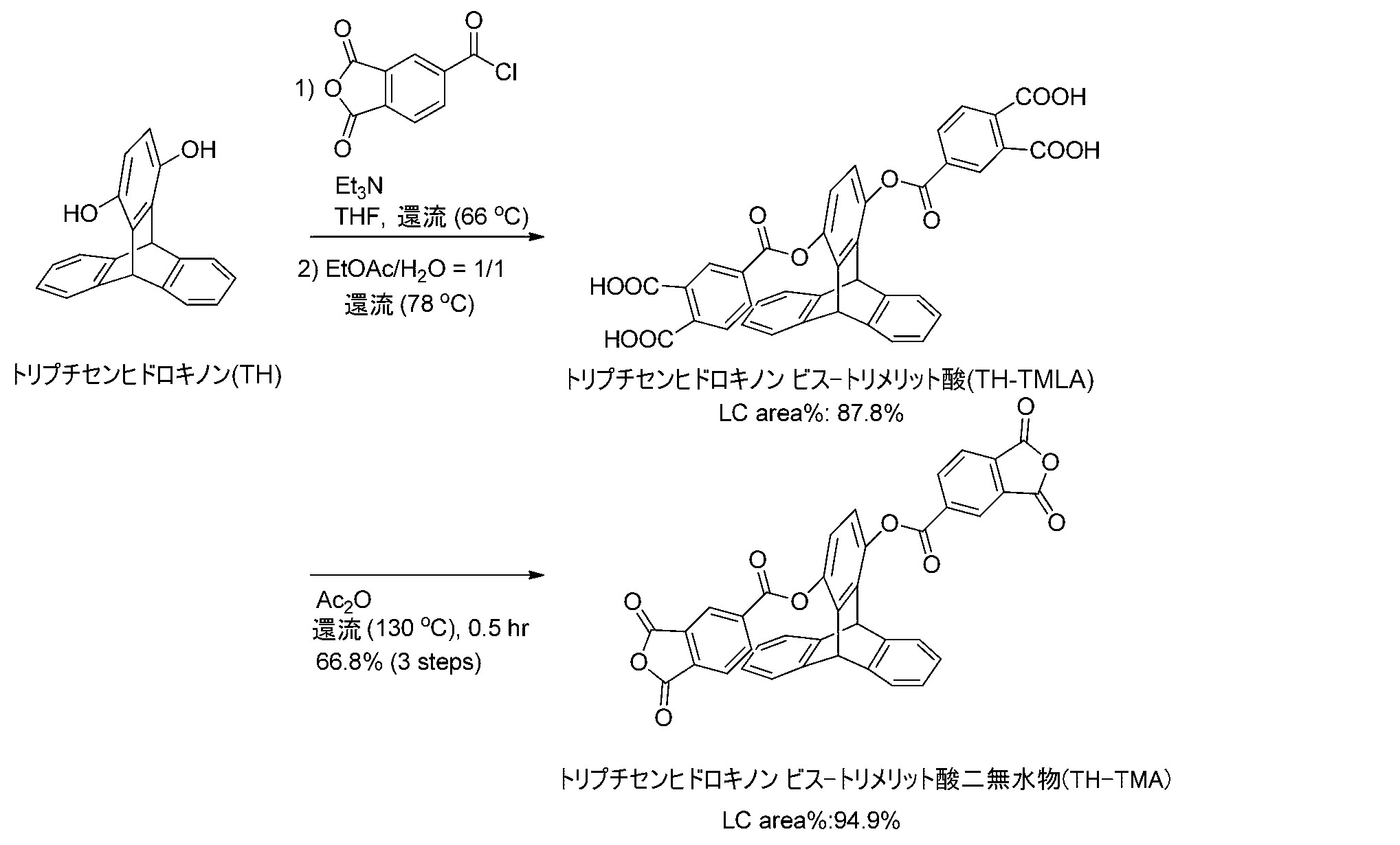
<実施例1-1>(TH-TMLAの合成)
窒素気流下、TH(10g)をTHF(40g)に溶解し、トリエチルアミン(11.6g)を添加し、撹拌した。その溶液を-3℃に冷却したトリメリット酸クロリド無水物(22.1g)のTHF(100g)溶液へ30分かけて滴下し、1時間攪拌した。反応液を25℃に昇温し、3時間攪拌後、THF(60g)を追加し、還流条件下(66℃)で1時間撹拌した。その後反応液を30℃まで冷却後、析出物をろ過し、TH-TMA粗物(73.6g)を得た。次にこのTH-TMA粗物を酢酸エチル(200g)及び、水(200g)の混合溶液に加え、この懸濁溶液を50℃で30分、60℃で1時間、還流条件下(78℃)で2.5時間撹拌し、該粗物を完全溶解させた。この溶液を60℃まで冷却後、水層を除去した後、有機層に水(200g)を加え、60℃で30分撹拌後水層を除去した。得られた有機層を濃縮後、70℃にて減圧乾燥し、TH-TMLA粗物を18.7g得た(HPLC面百(保持時間;9.0min);87.8%)。
この結晶は、1HNMR、13CNMR分析結果から、TH-TMLAであることを確認した。
1HNMR(DMSO-d6、δppm):13.6(s,4H)、8.6(m,2H )、8.5(dd,2H)、8.0(d,2H)、7.5(m,4H)、7.1(s,2H)7.0(m,4H)、5.8(s,2H).
13CNMR(DMSO-d6、δppm):168.9、167.8、163.9、144.7、143.6、139.8、139.0、133.2、132.8、130.9、130.7、129.4、125.8、124.7、120.6、47.7
この結晶は、1HNMR、13CNMR分析結果から、TH-TMLAであることを確認した。
1HNMR(DMSO-d6、δppm):13.6(s,4H)、8.6(m,2H )、8.5(dd,2H)、8.0(d,2H)、7.5(m,4H)、7.1(s,2H)7.0(m,4H)、5.8(s,2H).
13CNMR(DMSO-d6、δppm):168.9、167.8、163.9、144.7、143.6、139.8、139.0、133.2、132.8、130.9、130.7、129.4、125.8、124.7、120.6、47.7
<実施例1-2>(TH-TMAの合成)
TH-TMLA粗物(17.7g)を無水酢酸(88g)に加え、還流条件下(130℃)にて30分撹拌した。反応液を30℃に冷却し、析出物を窒素気流化でろ過後、ろ物を無水酢酸(20g)で2度洗浄後、酢酸エチル(20g)で洗浄した。得られた未乾燥のろ物にヘキサン(20g)を加え、130℃にて減圧下共沸乾燥しTH-TMAを14.8g得た。(収率;66.8%(3Steps)、HPLC面百(保持時間;9.0min);94.9%)。
この結晶は、1HNMR分析結果から、TH-TMAであることを確認した。
1HNMR(DMSO-d6、δppm):8.83(d,2H)、8.78(s,2H )、8.4(d,2H)、7.5(m,4H)、7.2(s,2H)、7.0(m,4H)、5.8(s,2H).
TH-TMLA粗物(17.7g)を無水酢酸(88g)に加え、還流条件下(130℃)にて30分撹拌した。反応液を30℃に冷却し、析出物を窒素気流化でろ過後、ろ物を無水酢酸(20g)で2度洗浄後、酢酸エチル(20g)で洗浄した。得られた未乾燥のろ物にヘキサン(20g)を加え、130℃にて減圧下共沸乾燥しTH-TMAを14.8g得た。(収率;66.8%(3Steps)、HPLC面百(保持時間;9.0min);94.9%)。
この結晶は、1HNMR分析結果から、TH-TMAであることを確認した。
1HNMR(DMSO-d6、δppm):8.83(d,2H)、8.78(s,2H )、8.4(d,2H)、7.5(m,4H)、7.2(s,2H)、7.0(m,4H)、5.8(s,2H).
[2]ポリアミック酸溶液の調製及びそれを用いたポリイミド膜の作製
<実施例2>(モル比:TH-TMA30:CBDA70:TFMB100)
マグネチックスターラーを備えた100mLの三口フラスコに、TFMB 1.411g(4.5mmol)およびγ-ブチロラクトン 2.628gを入れて撹拌した。TFMBが溶媒に完全に溶解した後、TH-TMA 0.856g(1.4mmol)及びγ-ブチロラクトン 3.06gを加え、得られた混合物を、窒素雰囲気下、100℃で4時間撹拌した。そして、加熱温度を50℃まで下げ、CBDA 0.617g(3.2mmol)およびγ-ブチロラクトン 3.06gを加え、窒素雰囲気下で一晩反応させた。
次の日、得られた反応混合物を放冷し、そこへポリアミック酸濃度が15質量%となるようにγ-ブチロラクトンを加えてポリアミック酸溶液を調製した。
得られたポリアミック酸溶液をガラス基板上にドクターブレードにより塗布し、塗膜を50℃で30分間、140℃で30分間、200℃で60分間加熱した後、さらに真空中で300℃で60分間順次加熱し、ポリイミド膜を作製した。
<実施例2>(モル比:TH-TMA30:CBDA70:TFMB100)
マグネチックスターラーを備えた100mLの三口フラスコに、TFMB 1.411g(4.5mmol)およびγ-ブチロラクトン 2.628gを入れて撹拌した。TFMBが溶媒に完全に溶解した後、TH-TMA 0.856g(1.4mmol)及びγ-ブチロラクトン 3.06gを加え、得られた混合物を、窒素雰囲気下、100℃で4時間撹拌した。そして、加熱温度を50℃まで下げ、CBDA 0.617g(3.2mmol)およびγ-ブチロラクトン 3.06gを加え、窒素雰囲気下で一晩反応させた。
次の日、得られた反応混合物を放冷し、そこへポリアミック酸濃度が15質量%となるようにγ-ブチロラクトンを加えてポリアミック酸溶液を調製した。
得られたポリアミック酸溶液をガラス基板上にドクターブレードにより塗布し、塗膜を50℃で30分間、140℃で30分間、200℃で60分間加熱した後、さらに真空中で300℃で60分間順次加熱し、ポリイミド膜を作製した。
<実施例3>(モル比:TH-TMA10:CBDA90:TFMB100)
マグネチックスターラーを備えた100mLの三口フラスコに、TFMB 1.411g(4.5mmol)およびγ-ブチロラクトン 2.268gを入れて撹拌した。TFMBが溶媒に完全に溶解した後、TH-TMA 0.2855g(0.45mmol)及びγ-ブチロラクトン 1.85gを加え、得られた混合物を、窒素雰囲気下、100℃で4時間撹拌した。そして、加熱温度を50℃まで下げ、CBDA 0.7942g(4.1mmol)およびγ-ブチロラクトン 1.89gを加え、窒素雰囲気下で一晩反応させた。
次の日、得られた反応混合物を放冷し、そこへポリアミック酸濃度が15質量%となるようにγ-ブチロラクトンを加えてポリアミック酸溶液を調製した。
得られたポリアミック酸溶液をガラス基板上にドクターブレードにより塗布し、塗膜を50℃で30分間、140℃で30分間、200℃で60分間加熱した後、さらに真空中で300℃で60分間順次加熱し、ポリイミド膜を作製した。
マグネチックスターラーを備えた100mLの三口フラスコに、TFMB 1.411g(4.5mmol)およびγ-ブチロラクトン 2.268gを入れて撹拌した。TFMBが溶媒に完全に溶解した後、TH-TMA 0.2855g(0.45mmol)及びγ-ブチロラクトン 1.85gを加え、得られた混合物を、窒素雰囲気下、100℃で4時間撹拌した。そして、加熱温度を50℃まで下げ、CBDA 0.7942g(4.1mmol)およびγ-ブチロラクトン 1.89gを加え、窒素雰囲気下で一晩反応させた。
次の日、得られた反応混合物を放冷し、そこへポリアミック酸濃度が15質量%となるようにγ-ブチロラクトンを加えてポリアミック酸溶液を調製した。
得られたポリアミック酸溶液をガラス基板上にドクターブレードにより塗布し、塗膜を50℃で30分間、140℃で30分間、200℃で60分間加熱した後、さらに真空中で300℃で60分間順次加熱し、ポリイミド膜を作製した。
上述の手順にて得られたポリイミド膜に四角形の切込みを入れて膜を剥がし、評価試料とした。
前述の手順に従い、各樹脂薄膜(評価試料)の耐熱性及び光学特性、すなわち、光線透過率(T550nm)、5%重量減少温度(Td5%)並びにリタデーション(Rth、R0)、複屈折Δnに関して、それぞれ評価した。なお、ポリアミック酸の数平均分子量Mn及び重量平均分子量Mwについてもそれぞれ測定を行った。また柔軟性は、樹脂薄膜を両手で持ち鋭角(30度程度)に曲げた場合においても割れることがないものについて“柔軟”であると評価した。
結果を表1に示す。
前述の手順に従い、各樹脂薄膜(評価試料)の耐熱性及び光学特性、すなわち、光線透過率(T550nm)、5%重量減少温度(Td5%)並びにリタデーション(Rth、R0)、複屈折Δnに関して、それぞれ評価した。なお、ポリアミック酸の数平均分子量Mn及び重量平均分子量Mwについてもそれぞれ測定を行った。また柔軟性は、樹脂薄膜を両手で持ち鋭角(30度程度)に曲げた場合においても割れることがないものについて“柔軟”であると評価した。
結果を表1に示す。
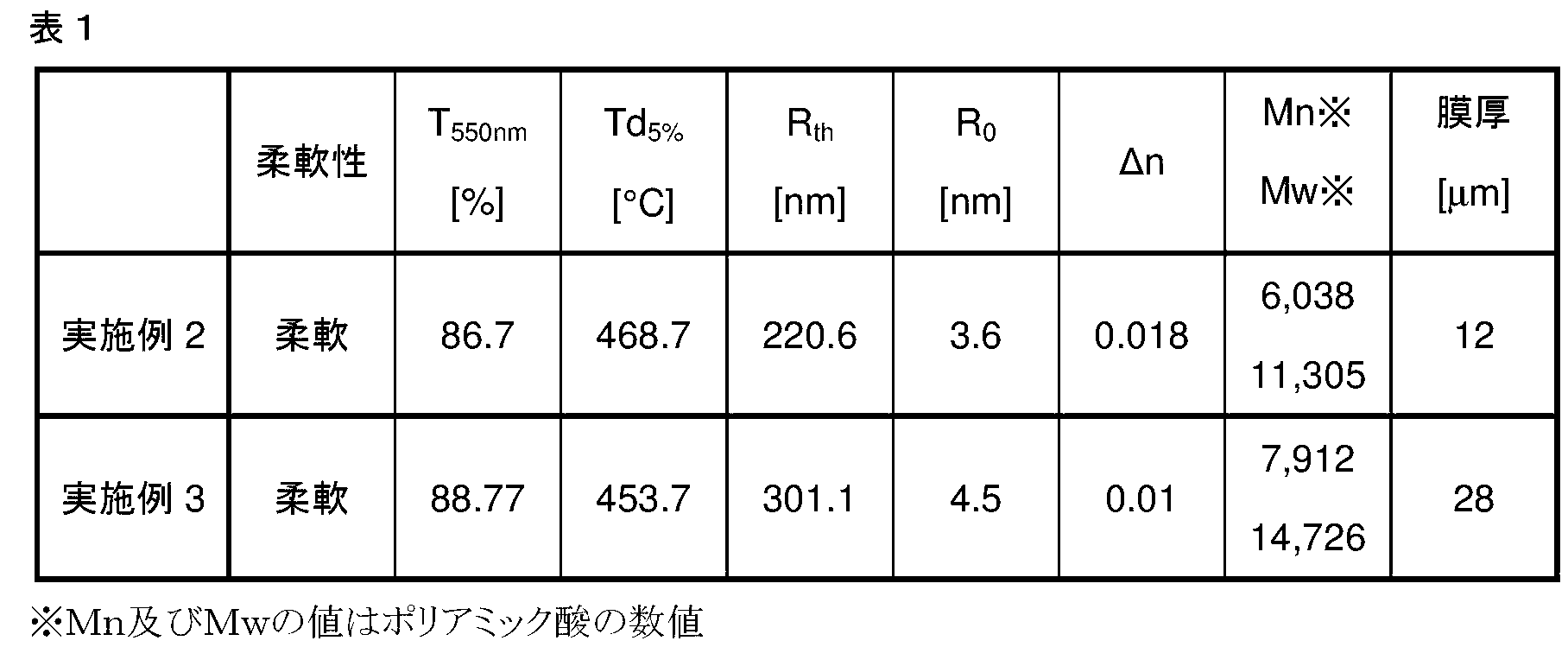
表1に示すように、本発明の新規な酸二無水物を用いて作製したポリアミック酸より得たポリイミド膜は、いずれも、柔軟性に優れ、透過率が高く、耐熱性に優れるという結果となった。また厚さ方向のリタデーションRthは500nm未満の値、面内リタデーションR0が5未満といった非常に低い値を有する結果となった。
このように、本発明の新規な酸二無水物を用いて製造したポリアミック酸より得られるポリイミド膜は、柔軟性を有し、高い透明性(高い光線透過率)及び耐熱性、そして低いリタデーションという特性を有し、すなわちフレキシブルディスプレイ基板のベースフィルムとして必要な要件を満たすものであり、フレキシブルディスプレイ基板のベースフィルムとして特に好適に用いることができることが期待できる。
このように、本発明の新規な酸二無水物を用いて製造したポリアミック酸より得られるポリイミド膜は、柔軟性を有し、高い透明性(高い光線透過率)及び耐熱性、そして低いリタデーションという特性を有し、すなわちフレキシブルディスプレイ基板のベースフィルムとして必要な要件を満たすものであり、フレキシブルディスプレイ基板のベースフィルムとして特に好適に用いることができることが期待できる。
Claims (12)
- 酸二無水物成分と、ジアミン成分とを反応させて得られるポリアミック酸であって、
前記酸二無水物成分が下記式(1-1)で表される酸二無水物を含むことを特徴とする、ポリアミック酸。
R6及びR7は、互いに独立して、水素原子、ハロゲン原子、炭素原子数1乃至5のアルキル基又は炭素原子数1乃至5のアルコキシ基を表し、
aおよびbは、互いに独立して、0~4の整数を表し、
cおよびdは、互いに独立して、0~3の整数を表し、
eは、0~2の整数を表す。) - 前記ジアミン成分が、式(A1)で表されるジアミンを含むことを特徴とする、請求項1に記載のポリアミック酸。



- 前記酸二無水物成分が、更に式(C1)で表されるテトラカルボン酸二無水物を含むことを特徴とする、請求項1又は請求項2に記載のポリアミック酸。


- 請求項1乃至請求項3のうちいずれか一項に記載のポリアミック酸と、有機溶媒とを含むポリイミド膜形成用組成物。
- 請求項4に記載のポリイミド膜形成用組成物を用いて形成されるポリイミド膜。
- 請求項5に記載のポリイミド膜からなるフレキシブルデバイス用基板。
- 式(1-1)で表されることを特徴とする酸二無水物。
R6及びR7は、互いに独立して、水素原子、ハロゲン原子、炭素原子数1乃至5のアルキル基又は炭素原子数1乃至5のアルコキシ基を表し、
aおよびbは、互いに独立して、0~4の整数を表し、
cおよびdは、互いに独立して、0~3の整数を表し、
eは、0~2の整数を表す。) - 式(1-2)で表されることを特徴とする、請求項7に記載の酸二無水物。

- 式(1-3)で表されることを特徴とする、請求項8に記載の酸二無水物。

- 式(2-1)で表されることを特徴とするテトラカルボン酸。

R6及びR7は、互いに独立して、水素原子、ハロゲン原子、炭素原子数1乃至5のアルキル基又は炭素原子数1乃至5のアルコキシ基を表し、
aおよびbは、互いに独立して、0~4の整数を表し、
cおよびdは、互いに独立して、0~3の整数を表し、
eは、0~2の整数を表す。) - 式(2-2)で表されることを特徴とする、請求項10に記載のテトラカルボン酸。

- 式(2-3)で表されることを特徴とする、請求項11に記載のテトラカルボン酸。

Priority Applications (1)
| Application Number | Priority Date | Filing Date | Title |
|---|---|---|---|
| JP2018542881A JP6966725B2 (ja) | 2016-09-28 | 2017-09-28 | 酸二無水物およびその利用 |
Applications Claiming Priority (2)
| Application Number | Priority Date | Filing Date | Title |
|---|---|---|---|
| JP2016190089 | 2016-09-28 | ||
| JP2016-190089 | 2016-09-28 |
Publications (1)
| Publication Number | Publication Date |
|---|---|
| WO2018062425A1 true WO2018062425A1 (ja) | 2018-04-05 |
Family
ID=61760430
Family Applications (1)
| Application Number | Title | Priority Date | Filing Date |
|---|---|---|---|
| PCT/JP2017/035325 Ceased WO2018062425A1 (ja) | 2016-09-28 | 2017-09-28 | 酸二無水物およびその利用 |
Country Status (3)
| Country | Link |
|---|---|
| JP (1) | JP6966725B2 (ja) |
| TW (1) | TWI747962B (ja) |
| WO (1) | WO2018062425A1 (ja) |
Cited By (2)
| Publication number | Priority date | Publication date | Assignee | Title |
|---|---|---|---|---|
| JP2020164442A (ja) * | 2019-03-29 | 2020-10-08 | セイカ株式会社 | 5つの芳香環を有するジアミノ又はジニトロベンゼン化合物、およびその製造方法、並びにポリイミド |
| US11964966B2 (en) | 2018-08-08 | 2024-04-23 | Dupont Electronics, Inc. | Polymers for use in electronic devices |
Citations (2)
| Publication number | Priority date | Publication date | Assignee | Title |
|---|---|---|---|---|
| JP2004182962A (ja) * | 2002-10-09 | 2004-07-02 | Hitachi Chem Co Ltd | トリプチセン骨格を有するポリイミド樹脂及び光部品 |
| WO2014207559A2 (en) * | 2013-06-06 | 2014-12-31 | King Abdullah University Of Science And Technlology | Triptycene-based dianhydrides, polyimides, methods of making each, and methods of use |
-
2017
- 2017-09-28 TW TW106133343A patent/TWI747962B/zh active
- 2017-09-28 WO PCT/JP2017/035325 patent/WO2018062425A1/ja not_active Ceased
- 2017-09-28 JP JP2018542881A patent/JP6966725B2/ja active Active
Patent Citations (2)
| Publication number | Priority date | Publication date | Assignee | Title |
|---|---|---|---|---|
| JP2004182962A (ja) * | 2002-10-09 | 2004-07-02 | Hitachi Chem Co Ltd | トリプチセン骨格を有するポリイミド樹脂及び光部品 |
| WO2014207559A2 (en) * | 2013-06-06 | 2014-12-31 | King Abdullah University Of Science And Technlology | Triptycene-based dianhydrides, polyimides, methods of making each, and methods of use |
Cited By (3)
| Publication number | Priority date | Publication date | Assignee | Title |
|---|---|---|---|---|
| US11964966B2 (en) | 2018-08-08 | 2024-04-23 | Dupont Electronics, Inc. | Polymers for use in electronic devices |
| JP2020164442A (ja) * | 2019-03-29 | 2020-10-08 | セイカ株式会社 | 5つの芳香環を有するジアミノ又はジニトロベンゼン化合物、およびその製造方法、並びにポリイミド |
| JP7345158B2 (ja) | 2019-03-29 | 2023-09-15 | セイカ株式会社 | 5つの芳香環を有するジアミノ又はジニトロベンゼン化合物、およびその製造方法、並びにポリイミド |
Also Published As
| Publication number | Publication date |
|---|---|
| TW201829546A (zh) | 2018-08-16 |
| JP6966725B2 (ja) | 2021-11-17 |
| TWI747962B (zh) | 2021-12-01 |
| JPWO2018062425A1 (ja) | 2019-08-29 |
Similar Documents
| Publication | Publication Date | Title |
|---|---|---|
| JP5190109B2 (ja) | 3,4−ジカルボキシ−1,2,3,4−テトラヒドロ−6−t−ブチル−1−ナフタレンコハク酸二無水物、およびと当該二無水物から調製されたポリイミド樹脂を含む液晶配列剤 | |
| KR102062939B1 (ko) | 폴리이미드 및 그의 성형체 | |
| KR102557784B1 (ko) | 디아민 및 그의 이용 | |
| US7795370B2 (en) | Tetracarboxylic acid compound, polyimide thereof, and production method thereof | |
| WO2018181683A1 (ja) | フルオレン骨格を有するポリイミド | |
| JP5320668B2 (ja) | テトラカルボン酸系化合物及びそのポリイミド、ならびにその製造方法 | |
| TWI705954B (zh) | 二胺及其利用 | |
| JP6966725B2 (ja) | 酸二無水物およびその利用 | |
| JP7037122B2 (ja) | ジアミンおよびその利用 | |
| JP6966726B2 (ja) | 酸二無水物およびその利用 | |
| KR102796771B1 (ko) | 폴리이미드계 수지의 제조 방법 | |
| JP2008163088A (ja) | エステル基含有脂環式テトラカルボン酸無水物及びその製造方法 | |
| JP6515921B2 (ja) | 酸二無水物およびその利用 | |
| JP7812238B2 (ja) | 低熱膨張特性および溶液加工性を併せ持つ透明耐熱プラスチック基板材料 | |
| TWI920265B (zh) | 聚醯亞胺樹脂組成物、聚醯亞胺前驅體組成物、清漆、及聚醯亞胺薄膜 | |
| KR20210123333A (ko) | 폴리이미드계 수지 분체의 제조 방법 | |
| JP5807741B2 (ja) | 側鎖置換エチレンジエステル型酸二無水物、その製造法及びポリイミド | |
| JP2013028571A (ja) | ビスフェノールジエステル型酸二無水物、その製造法及びポリイミド | |
| JP5754344B2 (ja) | テトラハイドロペンタレン型酸二無水物、その製造法及びポリイミド | |
| JP2013129689A (ja) | 4,4’−シクロヘキサンジフェニルエステル型酸二無水物、その製造法及びポリイミド |
Legal Events
| Date | Code | Title | Description |
|---|---|---|---|
| 121 | Ep: the epo has been informed by wipo that ep was designated in this application |
Ref document number: 17856374 Country of ref document: EP Kind code of ref document: A1 |
|
| ENP | Entry into the national phase |
Ref document number: 2018542881 Country of ref document: JP Kind code of ref document: A |
|
| NENP | Non-entry into the national phase |
Ref country code: DE |
|
| 122 | Ep: pct application non-entry in european phase |
Ref document number: 17856374 Country of ref document: EP Kind code of ref document: A1 |