WO2018061958A1 - 印刷版の現像方法および現像装置 - Google Patents
印刷版の現像方法および現像装置 Download PDFInfo
- Publication number
- WO2018061958A1 WO2018061958A1 PCT/JP2017/034023 JP2017034023W WO2018061958A1 WO 2018061958 A1 WO2018061958 A1 WO 2018061958A1 JP 2017034023 W JP2017034023 W JP 2017034023W WO 2018061958 A1 WO2018061958 A1 WO 2018061958A1
- Authority
- WO
- WIPO (PCT)
- Prior art keywords
- printing plate
- developer
- development
- water
- concentration
- Prior art date
- Legal status (The legal status is an assumption and is not a legal conclusion. Google has not performed a legal analysis and makes no representation as to the accuracy of the status listed.)
- Ceased
Links
Images

Classifications
-
- B—PERFORMING OPERATIONS; TRANSPORTING
- B01—PHYSICAL OR CHEMICAL PROCESSES OR APPARATUS IN GENERAL
- B01D—SEPARATION
- B01D71/00—Semi-permeable membranes for separation processes or apparatus characterised by the material; Manufacturing processes specially adapted therefor
- B01D71/02—Inorganic material
-
- B—PERFORMING OPERATIONS; TRANSPORTING
- B01—PHYSICAL OR CHEMICAL PROCESSES OR APPARATUS IN GENERAL
- B01D—SEPARATION
- B01D61/00—Processes of separation using semi-permeable membranes, e.g. dialysis, osmosis or ultrafiltration; Apparatus, accessories or auxiliary operations specially adapted therefor
- B01D61/14—Ultrafiltration; Microfiltration
-
- B—PERFORMING OPERATIONS; TRANSPORTING
- B01—PHYSICAL OR CHEMICAL PROCESSES OR APPARATUS IN GENERAL
- B01D—SEPARATION
- B01D65/00—Accessories or auxiliary operations, in general, for separation processes or apparatus using semi-permeable membranes
- B01D65/02—Membrane cleaning or sterilisation ; Membrane regeneration
-
- C—CHEMISTRY; METALLURGY
- C02—TREATMENT OF WATER, WASTE WATER, SEWAGE, OR SLUDGE
- C02F—TREATMENT OF WATER, WASTE WATER, SEWAGE, OR SLUDGE
- C02F1/00—Treatment of water, waste water, or sewage
- C02F1/44—Treatment of water, waste water, or sewage by dialysis, osmosis or reverse osmosis
-
- G—PHYSICS
- G03—PHOTOGRAPHY; CINEMATOGRAPHY; ANALOGOUS TECHNIQUES USING WAVES OTHER THAN OPTICAL WAVES; ELECTROGRAPHY; HOLOGRAPHY
- G03F—PHOTOMECHANICAL PRODUCTION OF TEXTURED OR PATTERNED SURFACES, e.g. FOR PRINTING, FOR PROCESSING OF SEMICONDUCTOR DEVICES; MATERIALS THEREFOR; ORIGINALS THEREFOR; APPARATUS SPECIALLY ADAPTED THEREFOR
- G03F7/00—Photomechanical, e.g. photolithographic, production of textured or patterned surfaces, e.g. printing surfaces; Materials therefor, e.g. comprising photoresists; Apparatus specially adapted therefor
- G03F7/26—Processing photosensitive materials; Apparatus therefor
- G03F7/30—Imagewise removal using liquid means
-
- G—PHYSICS
- G03—PHOTOGRAPHY; CINEMATOGRAPHY; ANALOGOUS TECHNIQUES USING WAVES OTHER THAN OPTICAL WAVES; ELECTROGRAPHY; HOLOGRAPHY
- G03F—PHOTOMECHANICAL PRODUCTION OF TEXTURED OR PATTERNED SURFACES, e.g. FOR PRINTING, FOR PROCESSING OF SEMICONDUCTOR DEVICES; MATERIALS THEREFOR; ORIGINALS THEREFOR; APPARATUS SPECIALLY ADAPTED THEREFOR
- G03F7/00—Photomechanical, e.g. photolithographic, production of textured or patterned surfaces, e.g. printing surfaces; Materials therefor, e.g. comprising photoresists; Apparatus specially adapted therefor
- G03F7/004—Photosensitive materials
- G03F7/027—Non-macromolecular photopolymerisable compounds having carbon-to-carbon double bonds, e.g. ethylenic compounds
- G03F7/032—Non-macromolecular photopolymerisable compounds having carbon-to-carbon double bonds, e.g. ethylenic compounds with binders
- G03F7/033—Non-macromolecular photopolymerisable compounds having carbon-to-carbon double bonds, e.g. ethylenic compounds with binders the binders being polymers obtained by reactions only involving carbon-to-carbon unsaturated bonds, e.g. vinyl polymers
Definitions
- the present invention relates to a developing method and a developing apparatus for a printing plate having a photosensitive resin layer containing a water-insoluble polymer. More specifically, the present invention relates to a printing plate having a photosensitive resin layer containing a water-insoluble polymer. The present invention relates to a developing method and a developing apparatus for developing using an aqueous developer as a main component.
- developing methods for printing plates For example, in a developing method in which development is performed using an aqueous developer containing water as a main component, the printing plate is immersed in an aqueous developer, and an aqueous solution is obtained with a brush. Development is performed by rubbing an uncured portion into the developer. Since the scraped polymer component is accumulated in the developing waste liquid and reused as it is as a developing liquid, a new printing plate is soiled. Therefore, it is necessary to frequently discard the developing waste liquid and make a new adjustment. However, since this generates a large amount of waste, there has been a demand for improvement from the environmental aspect.
- Patent Document 1 proposes a method of removing a polymer component aggregated by adding a flocculant to the development waste liquid from the development waste liquid.
- Patent Document 2 proposes a method of treating a developer waste solution by passing it through a packed bed filled with activated carbon and reusing it as a developer.
- the flocculant may remain in the development waste liquid after processing.
- the developing waste solution in which the coagulant remains is reused as a developing solution, the polymer component rubbed out during development aggregates and adheres to a printing plate, brush, or the like.
- the problem to be solved by the present invention is that the clogging of the filter is suppressed in the processing of the developing waste liquid, it can be operated for a long time, and the waste amount of the developing waste liquid is reduced by making the developing waste liquid reusable as the developer. It is another object of the present invention to provide a method for developing a printing plate that is excellent in cost.
- a printing plate developing method is to develop a printing plate material having a photosensitive resin layer containing a water-insoluble polymer using an aqueous developer containing water as a main component.
- a separation step of taking out a part or all of the developer waste liquid and separating it into a high-concentration developer having a high water-insoluble polymer concentration and a low-concentration developer having a low concentration using a ceramic filter is performed in the circulation path. Or prepare outside, The gist is to return the low concentration developer into the circulation path.
- the pore diameter of the ceramic filter is preferably in the range of 0.05 to 1.0 ⁇ m.
- the surface of the ceramic filter is preferably subjected to alumina treatment.
- the separation step is provided outside the circulation path.
- the separation step is preferably backwashable.
- the developing device for a printing plate forms a relief image by developing a printing plate material having a photosensitive resin layer containing a water-insoluble polymer using an aqueous developer containing water as a main component.
- a developing device for a printing plate A developing unit for developing the printing plate using an aqueous developer;
- a part or all of the developer waste liquid is installed inside or outside the circulation path, and a ceramic filter is used to make a high-concentration developer having a high water-insoluble polymer concentration and a low-concentration developer having a low concentration.
- the gist of the invention is to have a return portion for returning the low-density developer into the circulation path.
- the use of a ceramic filter can easily eliminate the clogging of the filter, so that a long-term operation is possible. Further, since the separation step is a step in which no flocculant is used, there is no possibility that the flocculant remains in the low-concentration developer after separation, and it can be reused as a developer.
- a low concentration developer having a low water-insoluble polymer concentration is reused as a developer.
- the printing plate developing method according to the present invention includes a developing step.
- the development step is not particularly limited as long as it is a method capable of washing out the photosensitive composition of the uncured portion of the printing plate material using an aqueous developer and forming a relief image. For example, there is a step of rubbing the photosensitive composition in the uncured portion with a brush or the like while spraying the developer from the developer supply portion in a shower shape.
- the development waste solution containing the waste polymer is collected and sent to the developer supply unit through a circulation path, and is used again for developing the printing plate material.
- a facility for temporarily storing the developer such as a developer tank or a filter tank may be provided.
- a part or all of the developing waste liquid in the circulation path is extracted and separated into a high concentration developer having a high water-insoluble polymer concentration and a low concentration developer having a low concentration.
- a separation step is provided.
- the low-concentration developer is returned to the circulation path and reused as the developer.
- the concentration of the water-insoluble polymer in the developer can be lowered while reducing the amount of the developer used.
- the high-concentration developer may be discarded immediately after separation, or may be disposed in the separation device and further discarded after containing a high-concentration water-insoluble polymer. The latter is preferable from the viewpoint of reducing the amount of waste developer waste.
- the separation step may be provided inside the circulation route or outside the route.
- “Preparing in the path” refers to, for example, a case where all of the developing waste solution after the washing step flows into the separation step, and the low-concentration developer after the separation step is sent to the developer supply unit and circulated.
- “Preparing outside the path” means, for example, extracting a part of the developer waste liquid from any place in the circulation path, for example, from the developer tank, and allowing the low concentration developer to flow into any place in the circulation path through the separation step. Point to.
- the present invention is provided with a separation step capable of maintaining a water-insoluble polymer concentration so as not to cause stains during development and capable of operating for a long time.
- the separation step by providing the separation step, an increase in the concentration of the water-insoluble polymer in the developer in the circulation path can be suppressed and maintained within a preferable range.
- the lower limit of the water-insoluble polymer concentration in the developer is preferably 0.001 g / L or more. By setting the water-insoluble polymer concentration to 0.001 g / L or more, the load of the separation process is reduced, and long-term operation is possible.
- the upper limit of the concentration of the water-insoluble polymer in the developer is preferably 15 g / L or less. More preferably, it is 10 g / L or less, More preferably, it is 5 g / L or less. Aggregation of a water-insoluble polymer can be suppressed as it is 15 g / L or less.
- the separation step is preferably a step of separating the development waste liquid into a high concentration developer having a high water-insoluble polymer concentration and a low concentration developer having a low concentration without using a flocculant. If a flocculant is used in the separation step, the flocculant may remain in the developer after separation. When the developer in which the flocculant remains is reused, the polymer component rubbed out during the development aggregates and adheres to the printing plate or brush.
- separation by a filter separation by precipitation
- separation by precipitation it takes a long time for separation, and a relatively large precipitation tank is used for standing the developing waste liquid. It is necessary to provide.
- separation by a filter is preferable.
- the filter to be used is preferably a ceramic filter from the viewpoints of separation ability and durability.
- the separation step is performed using a ceramic filter
- the water-insoluble polymer can be removed without using a flocculant, and a preferable concentration range can be obtained.
- the water-soluble surfactant and other cleaning components are not removed and remain in the developer, the low-concentration developer after separation should be used as a developer without adding a cleaning component. Can do.
- the ceramic filter preferably has a cross-section observed with an optical microscope and an average pore diameter measured within a range of 0.01 to 2.0 ⁇ m. More preferably, it is 0.05 to 1.0 ⁇ m, and still more preferably 0.05 to 0.5 ⁇ m. When it is 0.01 ⁇ m or more, the filter is not easily clogged, and long-term operation is possible. When the thickness is 2.0 ⁇ m or less, the water-insoluble polymer can be sufficiently removed, and contamination of the printing plate and brush can be reduced. In particular, when the average pore size is in the range of 0.05 ⁇ 1.0 .mu.m, a water-insoluble polymer concentration is kept constant in the range of about 1.5 ⁇ 2.5m 2 / 100L, it can be more prolonged operation It is.
- the ceramic filter is preferably surface-treated.
- the surface treatment include alumina treatment, titanium oxide treatment, and chromium oxide treatment. Of these, alumina treatment is preferred. When the surface treatment is performed, the water-insoluble polymer is difficult to adhere to the filter. The above effects are remarkable in the alumina treatment.
- the separation step preferably includes a backwashable mechanism.
- a backwashable mechanism When a filter or the like is clogged due to long-term operation or the like, the clogging can be easily eliminated by performing backwashing, and maintenance is easy.
- a backwashable mechanism is provided, and regular backwashing can be performed for longer operation.
- the backwashable mechanism includes, for example, a pump that backflows the low-concentration developer in the separation device, and removes the water-insoluble polymer deposited on the ceramic filter. Backwashing may be automated or performed manually.
- the printing plate material used in the present invention is a printing plate material that is developed using an aqueous developer containing water as a main component.
- Preferred printing plate materials are as follows.
- the printing plate material has a photosensitive layer.
- the photosensitive layer is formed on a substrate, for example.
- the substrate include a plastic film (plastic sheet) such as a PET film, a metal sheet such as stainless steel and aluminum, and a rubber sheet such as butadiene rubber.
- the photosensitive layer is formed by layering a photosensitive resin composition.
- the photosensitive resin composition includes a polymer component such as resin, rubber, and latex, a photopolymerizable monomer, and a photopolymerization initiator, and further includes an additive as necessary.
- the developing method according to the present invention is effective when the photosensitive layer contains a water-insoluble or hydrophobic polymer component.
- a water-soluble or hydrophilic polymer component may be included.
- polymer component resin examples include polyamide, polyvinyl alcohol, polyester, and polyurethane.
- rubber examples include butadiene rubber, chloroprene rubber, and acrylonitrile butadiene rubber.
- components washed out with the developer of the photosensitive resin composition include water-soluble or hydrophilic components, water-insoluble or hydrophobic components.
- the water-soluble polymer or hydrophilic polymer contained in the water-soluble component is a water-soluble or water-swellable polyamide in which a hydrophilic component is introduced into polyamide (dissolved or completely dispersed in water by immersion in water at 25 ° C./24 hours).
- Polyamide partially saponified polyvinyl acetate and derivatives thereof.
- Examples of the water-insoluble polymer or hydrophobic polymer contained in the water-insoluble component include various millable rubbers.
- butadiene rubber examples include butadiene rubber, chloroprene rubber, acrylonitrile butadiene rubber, acrylic rubber, epichlorohydrin rubber, urethane rubber, isoprene rubber, styrene isoprene rubber, styrene butadiene rubber, ethylene-propylene copolymer, and chlorinated polyethylene.
- the photosensitive resin composition containing a water-insoluble polymer since at least a part of the polymer component is dispersed without being dissolved, there is an advantage that the viscosity of the washing liquid is low and the waste liquid treatment can be easily performed.
- examples of the photosensitive resin composition for flexographic printing plate materials include those containing water-dispersed latex, millable rubber, photopolymerizable monomer, and photopolymerization initiator.
- Water-dispersed latex is a polymer particle dispersed in water as a dispersoid. A polymer is obtained by removing water from the water-dispersed latex. The water-dispersed latex can impart water developability to the photosensitive resin composition.
- water-dispersed latex examples include polybutadiene latex, natural rubber latex, styrene-butadiene copolymer latex, acrylonitrile-butadiene copolymer latex, polychloroprene latex, polyisoprene latex, polyurethane latex, and methyl methacrylate-butadiene copolymer.
- Water-dispersed latex polymers such as polymer latex, vinylpyridine polymer latex, butyl polymer latex, thiocol polymer latex, and acrylate polymer latex, and other components such as acrylic acid and methacrylic acid are copolymerized with these polymers The polymer obtained by doing this can be mentioned. These may be used alone or in combination of two or more.
- Millable rubber can increase the rubber elasticity of the photosensitive resin composition. Thereby, for example, it is possible to expect effects such as easy printing on various substrates.
- Specific examples of the millable rubber include butadiene rubber (BR), nitrile rubber (NBR), acrylic rubber, epichlorohydrin rubber, urethane rubber, isoprene rubber, styrene isoprene rubber, styrene butadiene rubber, ethylene-propylene copolymer, chlorination. Examples thereof include polyethylene. These may be used alone or in combination of two or more.
- butadiene rubber (BR) and nitrile rubber (NBR) are preferable from the viewpoint of improving the water developability, drying property, and image reproducibility of the photosensitive resin composition. Furthermore, the butadiene rubber (BR) is particularly easy to finely disperse in the photosensitive resin composition, thereby improving the reproducibility of the fine shape and further improving the image reproducibility. preferable.
- the photopolymerizable monomer can cure or crosslink the photosensitive resin composition.
- the photopolymerizable monomer include ethylenically unsaturated compounds.
- the ethylenically unsaturated compound include (meth) acrylic monomers, (meth) acrylic oligomers, and (meth) acrylic modified polymers.
- the (meth) acryl-modified polymer include (meth) acryl-modified butadiene rubber and (meth) acryl-modified nitrile rubber.
- the ethylenically unsaturated compound may be a compound having only one ethylenically unsaturated bond or a compound having two or more ethylenically unsaturated bonds.
- ethylenically unsaturated compound having only one ethylenically unsaturated bond examples include 2-hydroxyethyl (meth) acrylate, 2-hydroxypropyl (meth) acrylate, 2-hydroxybutyl (meth) acrylate, 3-chloro-2-hydroxypropyl (meth) acrylate, ⁇ -hydroxy- ⁇ '-(meth) acryloyloxyethyl phthalate and other hydroxyl group-containing (meth) acrylates, methyl (meth) acrylate, ethyl (meth) acrylate, propyl Alkyl (meth) acrylates such as (meth) acrylate, butyl (meth) acrylate, isoamyl (meth) acrylate, 2-ethylhexyl (meth) acrylate, lauryl (meth) acrylate, stearyl (meth) acrylate, cyclohexyl (meth) ) Cyclo
- ethylenically unsaturated compound having two or more ethylenically unsaturated bonds include alkyldiol di (meth) acrylates such as 1,9-nonanediol di (meth) acrylate, and diethylene glycol di (meth) acrylate.
- Polyethylene glycol di (meth) acrylate such as polypropylene glycol di (meth) acrylate such as dipropylene glycol di (meth) acrylate, trimethylolpropane tri (meth) acrylate, pentaerythritol tri (meth) acrylate, pentaerythritol tetra (meth) )
- Compounds with ethylenically unsaturated bonds and active hydrogen such as unsaturated carboxylic acids and unsaturated alcohols, to acrylate, glycerol tri (meth) acrylate, ethylene glycol diglycidyl ether
- Polyhydric (meth) acrylates obtained by addition reaction of unsaturated epoxy compounds such as polyvalent (meth) acrylates and glycidyl (meth) acrylates obtained by addition reaction with compounds having active hydrogen such as carboxylic acids and amines
- polyvalent (meth) acrylamides such as methylenebis (meth) acryl
- the photopolymerization initiator is not particularly limited as long as it initiates photopolymerization of the photopolymerizable monomer.
- alkylphenones, acetophenones, benzoin ethers, benzophenones, thioxanthones, anthraquinones, benzyls examples thereof include photopolymerization initiators such as biacetyls. Specific examples include benzyl dimethyl ketal, 2-hydroxy-2-methyl-1-phenyl-propan-1-one, methyl-O-benzoylbenzoate, 1-hydroxycyclohexyl phenyl ketone, and the like.
- the mixing ratio of the water-dispersed latex and the millable rubber in the photosensitive resin composition is preferably 20% or more in terms of the ratio of the weight of the water-dispersed latex to the total weight of the water-dispersed latex and the millable rubber. More preferably, it is 30% or more, More preferably, it is 50% or more. When this mass ratio is 20% or more, water development can be performed at high speed. This is presumably because the permeability of the aqueous developer to the photosensitive resin composition is increased.
- the photosensitive resin composition can contain a surfactant for the purpose of improving water developability.
- a surfactant for the purpose of improving water developability.
- the surfactant include a cationic surfactant, an anionic surfactant, and a nonionic surfactant.
- an anionic surfactant is particularly preferable.
- anionic surfactants include aliphatic carboxylates such as sodium laurate and sodium oleate, higher alcohol sulfates such as sodium lauryl sulfate, sodium cetyl sulfate, and sodium oleyl sulfate, Polyoxyethylene alkyl allyl ether sulfate such as sodium polyoxyethylene lauryl ether sulfate, polyoxyethylene alkyl allyl ether sulfate such as sodium polyoxyethylene octylphenyl ether sulfate and sodium polyoxyethylene nonylphenyl ether sulfate, Alkyl diphenyl ether disulfonates, alkyl sulfonates such as sodium dodecyl sulfonate, sodium dialkyl sulfosuccinate, Alkyl allyl sulfonates such as killed disulfonate, sodium dodecylbenzenesulfonate, sodium dibutyln
- sulfonic acid surfactants such as alkyl sulfonates and alkyl allyl sulfonates are preferred from the standpoint of excellent water developability of the photosensitive resin composition.
- the content of the surfactant in the photosensitive resin composition is preferably in the range of 0.1 to 20% as a ratio of the mass of the surfactant to the total mass of the water-dispersed latex, the millable rubber, and the surfactant. . More preferably, it is in the range of 0.1 to 15%, and still more preferably in the range of 0.1 to 10%.
- this mass ratio 0.1% or more, water development can be performed in a short time. This is presumably because the permeability of the aqueous developer to the photosensitive resin composition is increased. Moreover, drying property improves by making this mass ratio into 20% or less.
- a thermal polymerization inhibitor (stabilizer) can be added from the viewpoint of increasing the thermal stability during kneading and enhancing the storage stability.
- the thermal polymerization inhibitor include phenols, hydroquinones, and catechols.
- the content of the thermal polymerization inhibitor in the photosensitive resin composition is generally in the range of 0.001 to 5% by mass.
- photosensitive resin composition that can be used in the present invention, those containing various additives in addition to the above may be used.
- the developer used in the present invention is an aqueous developer containing water as a main component.
- Preferred aqueous developers are as follows.
- the aqueous developer may be a solution composed only of water or an aqueous solution to which a compound soluble in water is added.
- water-soluble compounds include surfactants, acids, bases, salts and the like. From the viewpoint of improving development efficiency, it is preferable to add a compound soluble in water.
- surfactant examples include a cationic surfactant, an anionic surfactant, and a nonionic surfactant. Specifically, the above-mentioned various surfactants can be mentioned.
- Examples of the acid include inorganic acids and organic acids such as sulfuric acid, nitric acid, phosphoric acid, formic acid, acetic acid, oxalic acid, succinic acid, citric acid, maleic acid, and paratoluenesulfonic acid.
- Examples of the base include lithium hydroxide, sodium hydroxide, potassium hydroxide, calcium hydroxide and the like.
- the aqueous developer may contain water-soluble organic solvent.
- organic solvent examples include methanol, ethanol, isopropyl alcohol, cellosolve, glycerin, polyethylene glycol, dimethylformamide, dimethylacetamide, and acetone.
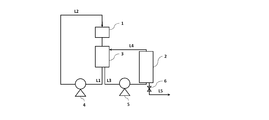
- the developing device for a printing plate includes a developing unit 1 that forms a relief image using an aqueous developer.
- the developer used in the developing unit 1 is returned to the developing unit 1 through a circulation path composed of the pipes L1 and L2.
- a developer tank 3 for temporarily storing the developer, a pump 4 for promoting circulation of the developer, and the like are installed.
- the developing device for a printing plate includes a separation unit 2 that separates a high-concentration developer having a high water-insoluble polymer concentration into a low-concentration developer having a low concentration.
- the separation unit 2 is a device that separates using a ceramic filter.
- the separation unit 2 may be installed in the circulation path and supplied with the development waste liquid from the pipe L ⁇ b> 1, and may be installed outside the circulation path as illustrated in FIG. 2. May be connected to another pipe L3 and supplied with a developing waste solution.
- the separation unit 2 when the separation unit 2 is installed in the circulation path, the low concentration developer is returned to the development unit 1 through the piping L2 of the circulation path.
- the separation unit 2 when the separation unit 2 is installed outside the circulation path, the separation unit 2 includes an L3 for supplying the developer waste liquid, a pipe L4 for returning the low-concentration developer to the circulation path, and a pump 5. .
- the pipes L3 and L4 are connected to arbitrary locations in the circulation path. In the example of FIG. 2, it is connected to the developer tank 3. Since the developing solution is stored in the developing solution tank 3, it is convenient as a connection point.
- the high-concentration developer separated in the separation unit 2 remains in the separation unit 2 and is concentrated to a high-concentration developer having a higher water-insoluble polymer concentration by repeatedly performing the separation step.
- the concentrated high-concentration developer can be discharged from the pipe L5 by opening the valve 6.
- a polymer obtained from water-dispersed latex (Nipol LX111NF, manufactured by Zeon Corporation).
- -BR [Nippon BR1220, manufactured by Nippon Zeon Co., Ltd.]
- -Acrylic modified liquid BR [Osaka Organic Chemical Co., Ltd., BAC-45] ⁇
- Acrylic monomer [1,9-nonanediol dimethacrylate, manufactured by NOF Corporation]
- -Photopolymerization initiator [Ciba Japan Co., Ltd., Irgacure 651]
- -Surfactant [manufactured by NOF Corporation, Newlex R]
- Plasticizer [Esso Oil Co., Ltd., Christol 70]
- Thermal polymerization inhibitor [Seiko Chemical Co., Ltd., MEHQ (hydroquinone monomethyl ether)]
- the photosensitive resin composition thus obtained was coated with an adhesive on one side of a 125 ⁇ m-thick PET film, and a protective film with an anti-blocking agent applied on one side of a 100 ⁇ m-thick PET film. And the adhesive layer, the photosensitive layer made of the photosensitive resin composition, on the substrate by pressing with a press machine heated to 120 ° C. so that the thickness of the photosensitive resin composition is 1 mm, A printing plate material in which an anti-sticking agent layer and a protective film were laminated in this order was produced.
- the base is formed by irradiating ultraviolet rays from the substrate side of the printing plate material, and then the protective film is peeled off, and a negative film for image reproducibility evaluation (
- the halftone dots “150 Lpi / 2%” and “independent point ⁇ 120 ⁇ m” were brought into close contact with each other in vacuum, and the negative film was exposed for 6 minutes from the distance of 15 cm (main exposure) with the above exposure apparatus. Thereafter, the negative film was removed, washed out with an aqueous developer containing a surfactant (1% by mass) for 10 minutes, and then sufficiently dried with hot air at 50 ° C.
- the printing plate was produced by the above.
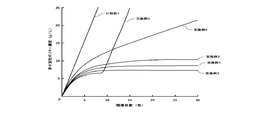
- Examples 1 to 5 The separator shown in FIG. 2 is used as a separator using the ceramic filter having the average pore diameter shown in Table 1, and each filter is used in the developer tank of the first to 30 sheets.
- the water-insoluble polymer concentration was measured. The test was performed in a cycle in which backwashing was performed for 5 seconds every minute.
- FIG. 3 shows each water-insoluble polymer concentration change.
- Print plate dirt Table 1 shows the number of developed images in which the surface of the printing plate was confirmed and the water-insoluble polymer aggregate was first confirmed on the printing plate in the above test.
- Comparative Example 1 was not provided with a separation device, the concentration of the water-insoluble polymer in the developer tank increased in proportion to the number of developments, and a water-insoluble polymer aggregate was confirmed in the fifth development.
- Examples 1 to 5 have a separation device using a ceramic filter, an increase in the concentration of the water-insoluble polymer can be suppressed as compared with the case where no separation device is provided, and 10 or more sheets are generated without occurrence of aggregates.
- Examples 1 to 3 were equipped with a filter having a pore diameter in a preferable range, and the concentration of the water-insoluble polymer was kept constant even after 30 developments, and no aggregate was confirmed.
Landscapes
- Chemical & Material Sciences (AREA)
- Chemical Kinetics & Catalysis (AREA)
- Engineering & Computer Science (AREA)
- Water Supply & Treatment (AREA)
- Inorganic Chemistry (AREA)
- Environmental & Geological Engineering (AREA)
- Hydrology & Water Resources (AREA)
- Life Sciences & Earth Sciences (AREA)
- Organic Chemistry (AREA)
- Physics & Mathematics (AREA)
- General Physics & Mathematics (AREA)
- Photosensitive Polymer And Photoresist Processing (AREA)
- Separation Using Semi-Permeable Membranes (AREA)
- Materials For Photolithography (AREA)
Applications Claiming Priority (2)
| Application Number | Priority Date | Filing Date | Title |
|---|---|---|---|
| JP2016192783A JP2018054969A (ja) | 2016-09-30 | 2016-09-30 | 印刷版の現像方法および現像装置 |
| JP2016-192783 | 2016-09-30 |
Publications (1)
| Publication Number | Publication Date |
|---|---|
| WO2018061958A1 true WO2018061958A1 (ja) | 2018-04-05 |
Family
ID=61759694
Family Applications (1)
| Application Number | Title | Priority Date | Filing Date |
|---|---|---|---|
| PCT/JP2017/034023 Ceased WO2018061958A1 (ja) | 2016-09-30 | 2017-09-21 | 印刷版の現像方法および現像装置 |
Country Status (2)
| Country | Link |
|---|---|
| JP (1) | JP2018054969A (enExample) |
| WO (1) | WO2018061958A1 (enExample) |
Cited By (3)
| Publication number | Priority date | Publication date | Assignee | Title |
|---|---|---|---|---|
| CN108840490A (zh) * | 2018-06-28 | 2018-11-20 | 福州海蓝环保科技有限公司 | 一种纯化水的制备方法 |
| WO2022196406A1 (ja) | 2021-03-19 | 2022-09-22 | 東洋紡株式会社 | 再生現像液を製造する方法、及びそれを使用したフレキソ印刷版の製造方法 |
| WO2024062680A1 (ja) | 2022-09-21 | 2024-03-28 | 東洋紡エムシー株式会社 | 再生現像液を製造する方法、及びその方法に好適な感光性樹脂組成物 |
Families Citing this family (1)
| Publication number | Priority date | Publication date | Assignee | Title |
|---|---|---|---|---|
| JP7681256B2 (ja) * | 2021-03-30 | 2025-05-22 | 東洋紡エムシー株式会社 | 現像液の処理方法 |
Citations (6)
| Publication number | Priority date | Publication date | Assignee | Title |
|---|---|---|---|---|
| JPH11212275A (ja) * | 1998-01-29 | 1999-08-06 | Toyobo Co Ltd | 感光性樹脂凸版用現像液の再生方法 |
| JPH11212274A (ja) * | 1998-01-29 | 1999-08-06 | Toyobo Co Ltd | 感光性樹脂版用現像液の処理方法および処理装置 |
| JP2007241077A (ja) * | 2006-03-10 | 2007-09-20 | Toppan Printing Co Ltd | カラーフィルタ製造における現像液濃度調整方法および現像装置 |
| WO2010146954A1 (ja) * | 2009-06-19 | 2010-12-23 | 大塚化学株式会社 | 触媒担持用セラミックフィルタ及びその製造方法 |
| JP2012013880A (ja) * | 2010-06-30 | 2012-01-19 | Sumitomo Chemical Co Ltd | レジスト組成物の製造方法 |
| WO2013147272A1 (ja) * | 2012-03-30 | 2013-10-03 | 日本碍子株式会社 | ハニカム形状セラミック多孔質体、その製造方法、及びハニカム形状セラミック分離膜構造体 |
Family Cites Families (4)
| Publication number | Priority date | Publication date | Assignee | Title |
|---|---|---|---|---|
| JPH0747099B2 (ja) * | 1986-08-20 | 1995-05-24 | 東芝セラミツクス株式会社 | セラミツクフイルタ |
| US5273659A (en) * | 1991-07-08 | 1993-12-28 | Millipore Corporation | Process of recovering a solid component from a solid composition by clarification and extraction |
| JPH1034147A (ja) * | 1996-07-29 | 1998-02-10 | Toyobo Co Ltd | 感光性樹脂版の洗い出し液の処理方法およびその処理装置 |
| JPWO2009004988A1 (ja) * | 2007-07-03 | 2010-08-26 | 東亞合成株式会社 | ナノろ過によるレジスト剥離液連続使用システム |
-
2016
- 2016-09-30 JP JP2016192783A patent/JP2018054969A/ja active Pending
-
2017
- 2017-09-21 WO PCT/JP2017/034023 patent/WO2018061958A1/ja not_active Ceased
Patent Citations (6)
| Publication number | Priority date | Publication date | Assignee | Title |
|---|---|---|---|---|
| JPH11212275A (ja) * | 1998-01-29 | 1999-08-06 | Toyobo Co Ltd | 感光性樹脂凸版用現像液の再生方法 |
| JPH11212274A (ja) * | 1998-01-29 | 1999-08-06 | Toyobo Co Ltd | 感光性樹脂版用現像液の処理方法および処理装置 |
| JP2007241077A (ja) * | 2006-03-10 | 2007-09-20 | Toppan Printing Co Ltd | カラーフィルタ製造における現像液濃度調整方法および現像装置 |
| WO2010146954A1 (ja) * | 2009-06-19 | 2010-12-23 | 大塚化学株式会社 | 触媒担持用セラミックフィルタ及びその製造方法 |
| JP2012013880A (ja) * | 2010-06-30 | 2012-01-19 | Sumitomo Chemical Co Ltd | レジスト組成物の製造方法 |
| WO2013147272A1 (ja) * | 2012-03-30 | 2013-10-03 | 日本碍子株式会社 | ハニカム形状セラミック多孔質体、その製造方法、及びハニカム形状セラミック分離膜構造体 |
Cited By (3)
| Publication number | Priority date | Publication date | Assignee | Title |
|---|---|---|---|---|
| CN108840490A (zh) * | 2018-06-28 | 2018-11-20 | 福州海蓝环保科技有限公司 | 一种纯化水的制备方法 |
| WO2022196406A1 (ja) | 2021-03-19 | 2022-09-22 | 東洋紡株式会社 | 再生現像液を製造する方法、及びそれを使用したフレキソ印刷版の製造方法 |
| WO2024062680A1 (ja) | 2022-09-21 | 2024-03-28 | 東洋紡エムシー株式会社 | 再生現像液を製造する方法、及びその方法に好適な感光性樹脂組成物 |
Also Published As
| Publication number | Publication date |
|---|---|
| JP2018054969A (ja) | 2018-04-05 |
Similar Documents
| Publication | Publication Date | Title |
|---|---|---|
| CN102272680B (zh) | 显影装置、显影液的处理方法、印刷版的制造方法以及过滤装置 | |
| JP2018054969A (ja) | 印刷版の現像方法および現像装置 | |
| JP7681256B2 (ja) | 現像液の処理方法 | |
| JP5688917B2 (ja) | 現像装置、現像液の処理方法、印刷版の製造装置、及びろ過装置 | |
| CN101568885A (zh) | 感光性平版印刷版显影处理装置的冲洗废水的处理方法、显影处理方法和显影处理装置 | |
| JP6099487B2 (ja) | 印刷版現像液の処理方法 | |
| CN104115069A (zh) | 制版处理废液的浓缩方法及再循环方法 | |
| US7208263B2 (en) | Method for manufacturing photosensitive resin printing plate, and developer treatment device | |
| JP4038702B2 (ja) | 感光性樹脂版用現像液の処理方法および処理装置 | |
| WO2018180252A1 (ja) | 処理方法および処理装置 | |
| JPH11212275A (ja) | 感光性樹脂凸版用現像液の再生方法 | |
| WO2019188899A1 (ja) | 印刷版の現像方法および現像装置 | |
| WO2022196406A1 (ja) | 再生現像液を製造する方法、及びそれを使用したフレキソ印刷版の製造方法 | |
| WO2019151006A1 (ja) | 処理システムおよび処理方法 | |
| EP4592754A1 (en) | Method for producing regenerated developing liquid and photosensitive resin composition suitable for same | |
| JPH07328620A (ja) | 感光性樹脂版の洗い出し液の処理方法およびその装置 | |
| JP2025155768A (ja) | 静置分離装置、及びそれを使用した再生現像液の製造方法 | |
| JPH0418563A (ja) | 感光性樹脂版の現像方法および現像装置 | |
| JP2001125281A (ja) | 現像液組成物 | |
| JPH1034147A (ja) | 感光性樹脂版の洗い出し液の処理方法およびその処理装置 | |
| JPH11212273A (ja) | 感光性樹脂版の現像方法および現像装置 | |
| JPH07333861A (ja) | 感光性樹脂版の洗い出し液の処理方法および処理装置 | |
| JPH08234443A (ja) | 顔料含有非銀塩感光性材料用現像液の処理方法、その処理装置及び自動現像装置 | |
| JP2005262123A (ja) | 廃液処理方法およびそれを利用した印刷版の製造方法 | |
| JP2013054158A (ja) | 感光性樹脂版の現像廃液処理装置 |
Legal Events
| Date | Code | Title | Description |
|---|---|---|---|
| DPE1 | Request for preliminary examination filed after expiration of 19th month from priority date (pct application filed from 20040101) | ||
| 121 | Ep: the epo has been informed by wipo that ep was designated in this application |
Ref document number: 17855913 Country of ref document: EP Kind code of ref document: A1 |
|
| NENP | Non-entry into the national phase |
Ref country code: DE |
|
| 122 | Ep: pct application non-entry in european phase |
Ref document number: 17855913 Country of ref document: EP Kind code of ref document: A1 |