WO2018052006A1 - 有機エレクトロルミネッセンス表示素子用封止剤 - Google Patents
有機エレクトロルミネッセンス表示素子用封止剤 Download PDFInfo
- Publication number
- WO2018052006A1 WO2018052006A1 PCT/JP2017/032993 JP2017032993W WO2018052006A1 WO 2018052006 A1 WO2018052006 A1 WO 2018052006A1 JP 2017032993 W JP2017032993 W JP 2017032993W WO 2018052006 A1 WO2018052006 A1 WO 2018052006A1
- Authority
- WO
- WIPO (PCT)
- Prior art keywords
- organic
- water
- sealing agent
- display elements
- absorbing filler
- Prior art date
- Legal status (The legal status is an assumption and is not a legal conclusion. Google has not performed a legal analysis and makes no representation as to the accuracy of the status listed.)
- Ceased
Links
Images


Classifications
-
- H—ELECTRICITY
- H10—SEMICONDUCTOR DEVICES; ELECTRIC SOLID-STATE DEVICES NOT OTHERWISE PROVIDED FOR
- H10K—ORGANIC ELECTRIC SOLID-STATE DEVICES
- H10K50/00—Organic light-emitting devices
- H10K50/80—Constructional details
- H10K50/84—Passivation; Containers; Encapsulations
- H10K50/842—Containers
- H10K50/8426—Peripheral sealing arrangements, e.g. adhesives, sealants
-
- H—ELECTRICITY
- H10—SEMICONDUCTOR DEVICES; ELECTRIC SOLID-STATE DEVICES NOT OTHERWISE PROVIDED FOR
- H10K—ORGANIC ELECTRIC SOLID-STATE DEVICES
- H10K59/00—Integrated devices, or assemblies of multiple devices, comprising at least one organic light-emitting element covered by group H10K50/00
- H10K59/80—Constructional details
- H10K59/87—Passivation; Containers; Encapsulations
- H10K59/871—Self-supporting sealing arrangements
- H10K59/8722—Peripheral sealing arrangements, e.g. adhesives, sealants
-
- C—CHEMISTRY; METALLURGY
- C08—ORGANIC MACROMOLECULAR COMPOUNDS; THEIR PREPARATION OR CHEMICAL WORKING-UP; COMPOSITIONS BASED THEREON
- C08K—Use of inorganic or non-macromolecular organic substances as compounding ingredients
- C08K3/00—Use of inorganic substances as compounding ingredients
- C08K3/18—Oxygen-containing compounds, e.g. metal carbonyls
- C08K3/20—Oxides; Hydroxides
- C08K3/22—Oxides; Hydroxides of metals
-
- G—PHYSICS
- G09—EDUCATION; CRYPTOGRAPHY; DISPLAY; ADVERTISING; SEALS
- G09F—DISPLAYING; ADVERTISING; SIGNS; LABELS OR NAME-PLATES; SEALS
- G09F9/00—Indicating arrangements for variable information in which the information is built-up on a support by selection or combination of individual elements
- G09F9/30—Indicating arrangements for variable information in which the information is built-up on a support by selection or combination of individual elements in which the desired character or characters are formed by combining individual elements
-
- H—ELECTRICITY
- H05—ELECTRIC TECHNIQUES NOT OTHERWISE PROVIDED FOR
- H05B—ELECTRIC HEATING; ELECTRIC LIGHT SOURCES NOT OTHERWISE PROVIDED FOR; CIRCUIT ARRANGEMENTS FOR ELECTRIC LIGHT SOURCES, IN GENERAL
- H05B33/00—Electroluminescent light sources
- H05B33/02—Details
- H05B33/04—Sealing arrangements, e.g. against humidity
-
- H—ELECTRICITY
- H10—SEMICONDUCTOR DEVICES; ELECTRIC SOLID-STATE DEVICES NOT OTHERWISE PROVIDED FOR
- H10K—ORGANIC ELECTRIC SOLID-STATE DEVICES
- H10K59/00—Integrated devices, or assemblies of multiple devices, comprising at least one organic light-emitting element covered by group H10K50/00
-
- H—ELECTRICITY
- H10—SEMICONDUCTOR DEVICES; ELECTRIC SOLID-STATE DEVICES NOT OTHERWISE PROVIDED FOR
- H10W—GENERIC PACKAGES, INTERCONNECTIONS, CONNECTORS OR OTHER CONSTRUCTIONAL DETAILS OF DEVICES COVERED BY CLASS H10
- H10W74/00—Encapsulations, e.g. protective coatings
- H10W74/10—Encapsulations, e.g. protective coatings characterised by their shape or disposition
-
- H—ELECTRICITY
- H10—SEMICONDUCTOR DEVICES; ELECTRIC SOLID-STATE DEVICES NOT OTHERWISE PROVIDED FOR
- H10W—GENERIC PACKAGES, INTERCONNECTIONS, CONNECTORS OR OTHER CONSTRUCTIONAL DETAILS OF DEVICES COVERED BY CLASS H10
- H10W74/00—Encapsulations, e.g. protective coatings
- H10W74/40—Encapsulations, e.g. protective coatings characterised by their materials
-
- C—CHEMISTRY; METALLURGY
- C08—ORGANIC MACROMOLECULAR COMPOUNDS; THEIR PREPARATION OR CHEMICAL WORKING-UP; COMPOSITIONS BASED THEREON
- C08K—Use of inorganic or non-macromolecular organic substances as compounding ingredients
- C08K2201/00—Specific properties of additives
- C08K2201/002—Physical properties
- C08K2201/005—Additives being defined by their particle size in general
-
- H—ELECTRICITY
- H10—SEMICONDUCTOR DEVICES; ELECTRIC SOLID-STATE DEVICES NOT OTHERWISE PROVIDED FOR
- H10K—ORGANIC ELECTRIC SOLID-STATE DEVICES
- H10K2102/00—Constructional details relating to the organic devices covered by this subclass
-
- H—ELECTRICITY
- H10—SEMICONDUCTOR DEVICES; ELECTRIC SOLID-STATE DEVICES NOT OTHERWISE PROVIDED FOR
- H10K—ORGANIC ELECTRIC SOLID-STATE DEVICES
- H10K59/00—Integrated devices, or assemblies of multiple devices, comprising at least one organic light-emitting element covered by group H10K50/00
- H10K59/80—Constructional details
- H10K59/87—Passivation; Containers; Encapsulations
- H10K59/873—Encapsulations
Definitions
- the present invention relates to a sealing agent for organic electroluminescence display elements that has excellent barrier properties and can suppress panel peeling.
- organic electroluminescence (hereinafter, also referred to as “organic EL”) display element has a laminated structure in which an organic light emitting material layer is sandwiched between a pair of electrodes facing each other, and the organic light emitting material layer is formed from one electrode on the organic light emitting material layer.
- organic EL organic electroluminescence
- the organic EL display element performs self-emission, it has better visibility than a liquid crystal display element that requires a backlight, can be reduced in thickness, and can be driven by a DC low voltage. Has the advantage.
- the organic light-emitting material layer and electrodes constituting the organic EL display element have a problem that the characteristics are easily deteriorated by moisture, oxygen, and the like. Therefore, in order to obtain a practical organic EL display element, it is necessary to extend the life by blocking the organic light emitting material layer and the electrode from the atmosphere.
- a sealant for example, Patent Document 1.
- an inorganic film called a passivation film is usually provided on a laminate having an organic light emitting material layer in order to sufficiently suppress the transmission of moisture, oxygen, and the like. A method of sealing the top with a sealant is used.
- a top emission type organic element that extracts light from the upper surface side of the organic light emitting layer is used.
- EL display elements have attracted attention. This method has an advantage that it has a high aperture ratio and is driven at a low voltage, which is advantageous for extending the life.
- a transparent moisture-proof substrate such as glass is interposed on the upper surface side of the light emitting element via a transparent sealing resin.
- An object of this invention is to provide the sealing agent for organic electroluminescent display elements which is excellent in barrier property and can suppress panel peeling.
- the present invention contains a curable resin, a polymerization initiator, and a water-absorbing filler, and the water-absorbing filler has an average primary particle diameter of 5 ⁇ m or less and a specific gravity of 3.3 g / cm 3 or less. It is a sealing agent for display elements.
- the present invention is described in detail below.
- a water-absorbing filler such as calcium oxide
- the barrier property can be improved, but because of its high expansion coefficient, it absorbs moisture and causes defects such as panel peeling.
- the present inventor has an excellent barrier property and can suppress panel peeling by using a water-absorbing filler whose average primary particle diameter and specific gravity are in specific ranges, respectively.
- the present inventors have found that a sealant can be obtained and have completed the present invention.
- the sealing agent for organic EL display elements of the present invention has a water absorbing filler having an average primary particle diameter of 5 ⁇ m or less and a specific gravity of 3.3 g / cm 3 or less (hereinafter referred to as “water absorbing filler according to the present invention”). Contain).
- water absorbing filler according to the present invention a water absorbing filler having an average primary particle diameter of 5 ⁇ m or less and a specific gravity of 3.3 g / cm 3 or less. Contain).
- the water-absorbent filler according to the present invention has the average primary particle diameter and specific gravity in the above-mentioned ranges, and has a small specific gravity and a high porosity compared to a general water-absorbent filler having the same average primary particle diameter. It is thought to have. Therefore, when water is absorbed, expansion of the outside is suppressed by filling the internal gap, and as a result, it is considered that panel peeling can be suppressed while exhibiting excellent barrier properties due to high water absorption performance.
- the upper limit of the average primary particle diameter of the water-absorbing filler according to the present invention is 5 ⁇ m.
- the preferable upper limit of the average primary particle diameter of the water-absorbing filler according to the present invention is 3.5 ⁇ m, and the more preferable upper limit is 3 ⁇ m.
- a substantial minimum is 0.05 micrometer and a thing more than 0.5 micrometer is easier to obtain.
- the “average primary particle size” can be measured by a dynamic light scattering type particle size measuring device (“ELSZ-1000S” manufactured by Otsuka Electronics Co., Ltd.) or the like.
- the upper limit of the specific gravity of the water-absorbing filler according to the present invention is 3.3 g / cm 3 .
- the specific gravity of the water-absorbing filler according to the present invention is 3.3 g / cm 3 or less, the obtained sealing agent for organic EL display elements is excellent in the effect of achieving both excellent barrier properties and suppression of panel peeling. It becomes.
- a preferable upper limit of the specific gravity of the water-absorbing filler according to the present invention is 3.0 g / cm 3 .
- a substantial minimum is 1.5 g / cm ⁇ 3 >.
- the “specific gravity” means a value measured by a method according to JIS Z8807.
- the minimum with a preferable average specific surface area of the water absorptive filler concerning this invention is 5 m ⁇ 2 > / g, and a preferable upper limit is 20 m ⁇ 2 > / g.
- the average specific surface area of the water-absorbing filler according to the present invention is within this range, the obtained sealing agent for organic EL display elements is excellent due to the effect of achieving both excellent barrier properties and suppression of panel peeling.
- the more preferable lower limit of the average specific surface area of the total surface area of the water-absorbing filler according to the present invention is 10 m 2 / g, and the more preferable upper limit is 18 m 2 / g.
- the “average specific surface area” can be measured by a BET method using nitrogen gas with a specific surface area measurement apparatus (for example, “ASAP-2000” manufactured by Shimadzu Corporation).
- the preferable lower limit of the water absorption rate of the water-absorbing filler according to the present invention is 10% by weight.
- the more preferable lower limit of the water absorption rate of the water-absorbing filler according to the present invention is 20% by weight.
- the “water absorption rate” means the rate of change in weight when a high temperature and high humidity test is performed for 24 hours in an atmosphere at a temperature of 85 ° C. and a humidity of 85%.
- Examples of the material constituting the water-absorbing filler according to the present invention include oxides of alkaline earth metals such as calcium oxide, strontium oxide, and barium oxide, magnesium oxide, and molecular sieve. Among these, from the viewpoint of water absorption, an alkaline earth metal oxide is preferable, and calcium oxide is more preferable.
- the content of the water-absorbing filler according to the present invention is preferably 5 parts by weight and preferably 60 parts by weight with respect to 100 parts by weight of the curable resin.
- the content of the water-absorbing filler according to the present invention is within this range, the obtained sealing agent for organic EL display elements is more excellent in the effect of achieving both improvement in barrier properties and suppression of panel peeling.
- the minimum with more preferable content of the water absorbing filler concerning this invention is 10 weight part, and a more preferable upper limit is 40 weight part.
- the sealing agent for organic EL display elements of the present invention contains other fillers in addition to the water-absorbing filler according to the present invention within the range not impairing the object of the present invention for the purpose of improving adhesiveness and the like. May be.
- the other fillers include inorganic fillers such as silica, talc, and alumina, and organic fillers such as polyester fine particles, polyurethane fine particles, vinyl polymer fine particles, and acrylic polymer fine particles. Of these, talc is preferable.
- the sealing agent for organic EL display elements of this invention contains curable resin.
- the curable resin include a cationic polymerizable compound having a cationic polymerizable group such as an epoxy group, an oxetanyl group, and a vinyl ether group, and a radical polymerizable compound having a radical polymerizable group such as a (meth) acryloyl group.
- a cationic polymerizable compound is preferable, and a cationic polymerizable compound having an epoxy group is more preferable.
- an epoxy resin having a bisphenol skeleton an epoxy resin having a novolac skeleton, an epoxy resin having a naphthalene skeleton, and an epoxy resin having a dicyclopentadiene skeleton
- at least one epoxy resin selected from the group consisting of: an epoxy resin having a bisphenol skeleton is more preferable, and a bisphenol F-type epoxy resin is still more preferable.
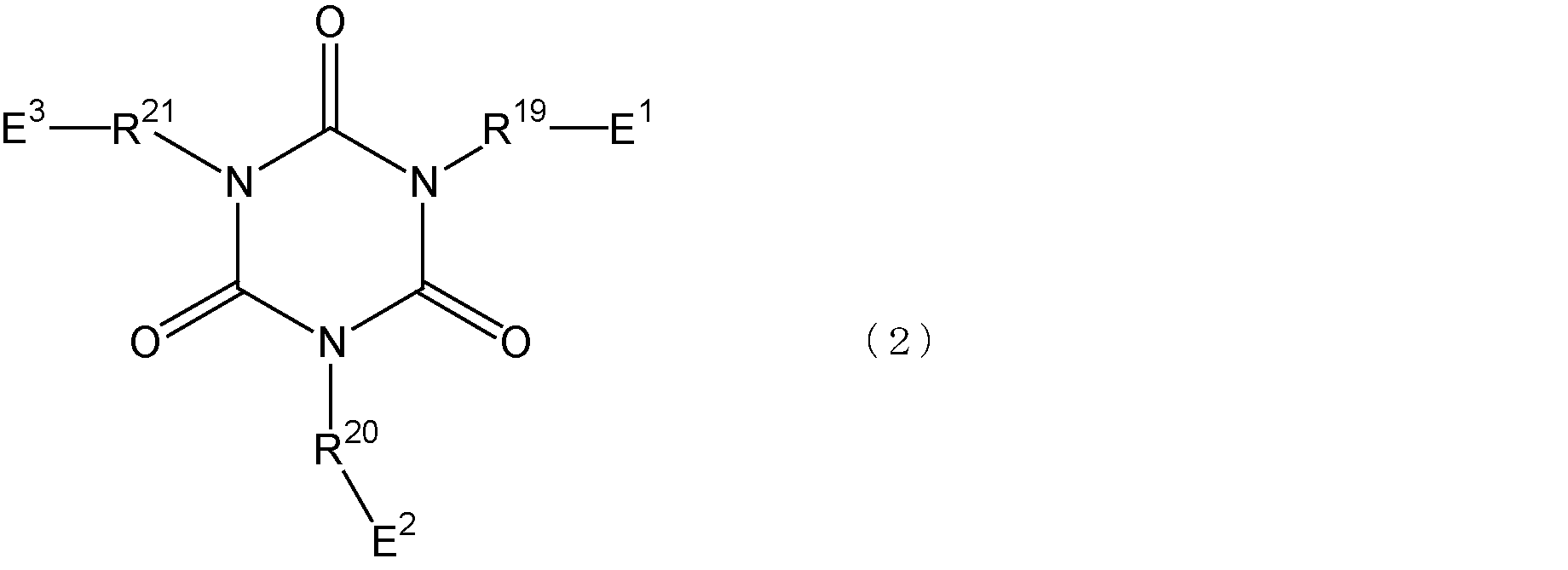
- the sealing agent for organic EL display elements of this invention is a compound represented by following formula (1) and / or following formula (2) as said cation polymeric compound from a viewpoint of suppressing generation
- R 1 to R 18 are a hydrogen atom, a halogen atom, or a hydrocarbon group that may contain an oxygen atom or a halogen atom, and may be the same or different. Also good.
- X is a bond, an oxygen atom, an alkylene group having 1 to 5 carbon atoms, an oxycarbonyl group, an alkyleneoxycarbonyl group having 2 to 5 carbon atoms, or a secondary amino group.
- R 19 to R 21 are linear or branched alkylene groups having 2 to 10 carbon atoms, which may be the same or different.
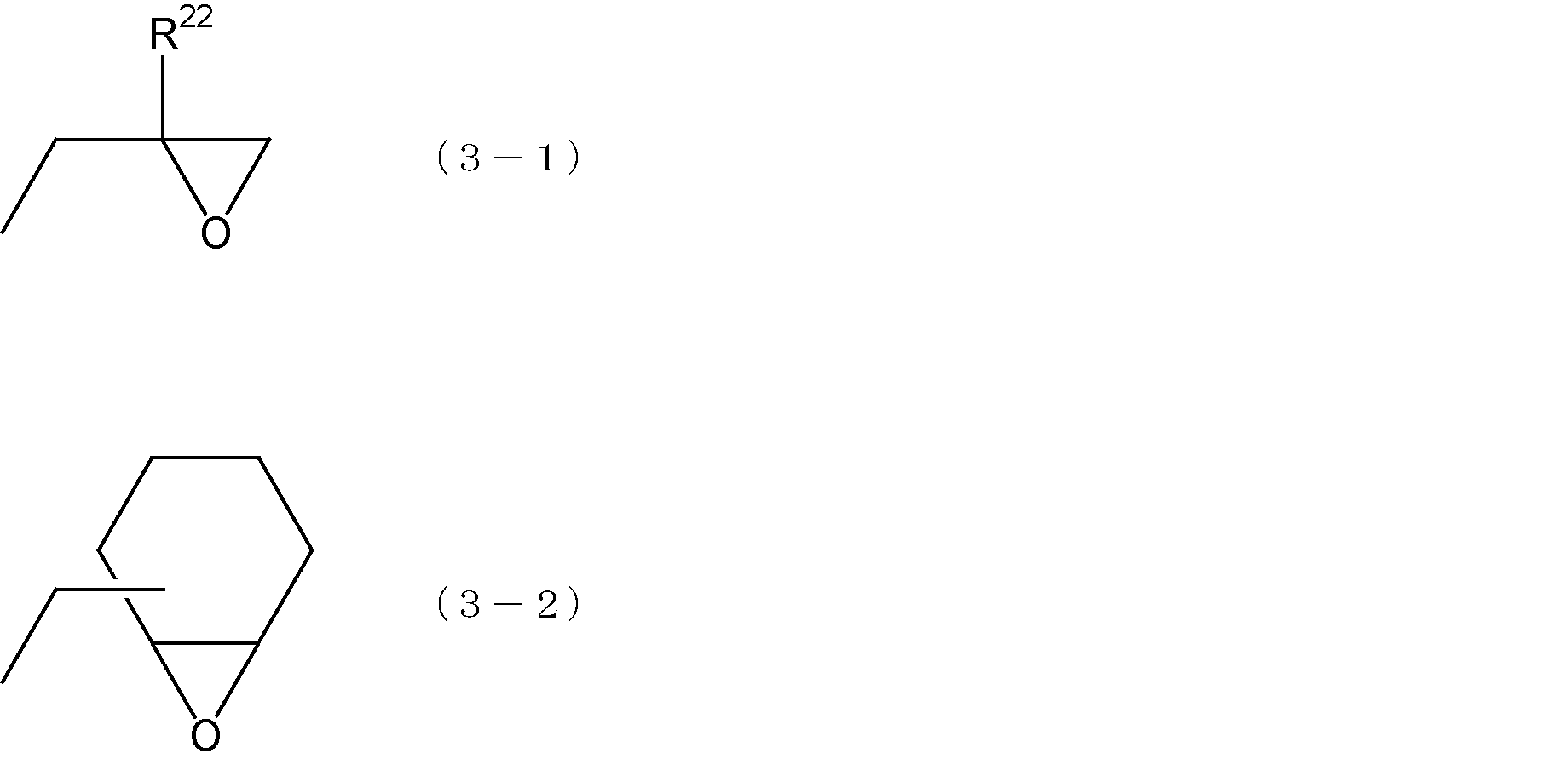
- E 1 to E 3 each independently represents an organic group represented by the following formula (3-1) or the following formula (3-2).
- R 22 represents a hydrogen atom or a methyl group.
- a compound represented by the following formula (4-1), a compound represented by the following formula (4-2), and a compound represented by the following formula (4-3) It is preferable to contain at least one selected from the group consisting of
- a (meth) acryl compound is preferably used as the radical polymerizable compound.
- the (meth) acrylic compound include epoxy (meth) acrylate obtained by reacting (meth) acrylic acid and an epoxy compound, and (meth) acrylic acid obtained by reacting a compound having a hydroxyl group.
- examples thereof include urethane (meth) acrylates obtained by reacting (meth) acrylic acid ester compounds and isocyanate compounds with (meth) acrylic acid derivatives having a hydroxyl group.
- epoxy (meth) acrylate is preferable.
- the “(meth) acryl” indicates acryl or methacryl
- the “(meth) acrylate” indicates acrylate or methacrylate
- the “epoxy (meth) acrylate” It represents a compound obtained by reacting all epoxy groups in the epoxy resin with (meth) acrylic acid.
- Examples of commercially available epoxy (meth) acrylates include, for example, EBECRYL860, EBECRYL3200, EBECRYL3201, EBECRYL3412, EBECRYL3600, EBECRYL3700, EBECRYL3701, EBECRYL3702, EBECRYL3703, EBECRY3603 EA-1010, EA-1020, EA-5323, EA-5520, EA-CHD, EMA-1020 (all manufactured by Shin-Nakamura Chemical Co., Ltd.), epoxy ester M-600A, epoxy ester 40EM, epoxy ester 70PA, epoxy Ester 200PA, epoxy ester 80MFA Epoxy ester 3002M, Epoxy ester 3002A, Epoxy ester 1600A, Epoxy ester 3000M, Epoxy ester 3000A, Epoxy ester 200EA, Epoxy ester 400EA (all manufactured by Kyoeisha Chemical Co., Ltd.), Denacol acrylate DA-141, Den
- the sealing agent for organic EL display elements of the present invention contains a polymerization initiator.
- the polymerization initiator include a photopolymerization initiator and a thermal polymerization initiator. Of these, a photopolymerization initiator is preferable.
- the photopolymerization initiator examples include a photocationic polymerization initiator that generates a protonic acid or a Lewis acid by light irradiation, a photoradical polymerization initiator that generates a radical by light irradiation, and the like. Of these, a photocationic polymerization initiator is preferred.
- the photocationic polymerization initiator is not particularly limited as long as it generates a protonic acid or a Lewis acid by light irradiation, and may be an ionic photoacid generating type or a nonionic photoacid generating type. May be.
- ionic photoacid generating types include, for example, that the anion moiety is BF 4 ⁇ , PF 6 ⁇ , SbF 6 ⁇ , or (BX 4 ) ⁇ (where X is at least An aromatic sulfonium salt, an aromatic iodonium salt, an aromatic diazonium salt, an aromatic ammonium salt, or (2,4, which represents a phenyl group substituted with two or more fluorine or trifluoromethyl groups) -Cyclopentadien-1-yl) ((1-methylethyl) benzene) -Fe salt and the like.
- aromatic sulfonium salt examples include bis (4- (diphenylsulfonio) phenyl) sulfide bishexafluorophosphate, bis (4- (diphenylsulfonio) phenyl) sulfide bishexafluoroantimonate, and bis (4- ( Diphenylsulfonio) phenyl) sulfide bistetrafluoroborate, bis (4- (diphenylsulfonio) phenyl) sulfide tetrakis (pentafluorophenyl) borate, diphenyl-4- (phenylthio) phenylsulfonium hexafluorophosphate, diphenyl-4- ( Phenylthio) phenylsulfonium hexafluoroantimonate, diphenyl-4- (phenylthio) phenylsulfonium tetraflu
- aromatic iodonium salt examples include diphenyliodonium hexafluorophosphate, diphenyliodonium hexafluoroantimonate, diphenyliodonium tetrafluoroborate, diphenyliodonium tetrakis (pentafluorophenyl) borate, bis (dodecylphenyl) iodonium hexafluorophosphate, bis (Dodecylphenyl) iodonium hexafluoroantimonate, bis (dodecylphenyl) iodonium tetrafluoroborate, bis (dodecylphenyl) iodonium tetrakis (pentafluorophenyl) borate, 4-methylphenyl-4- (1-methylethyl) phenyliodonium hexa Fluorophosphate, 4-methylphenyl-4- (1-methylethy
- aromatic diazonium salt examples include phenyldiazonium hexafluorophosphate, phenyldiazonium hexafluoroantimonate, phenyldiazonium tetrafluoroborate, and phenyldiazonium tetrakis (pentafluorophenyl) borate.
- aromatic ammonium salt examples include 1-benzyl-2-cyanopyridinium hexafluorophosphate, 1-benzyl-2-cyanopyridinium hexafluoroantimonate, 1-benzyl-2-cyanopyridinium tetrafluoroborate, 1-benzyl -2-Cyanopyridinium tetrakis (pentafluorophenyl) borate, 1- (naphthylmethyl) -2-cyanopyridinium hexafluorophosphate, 1- (naphthylmethyl) -2-cyanopyridinium hexafluoroantimonate, 1- (naphthylmethyl)
- Examples include -2-cyanopyridinium tetrafluoroborate and 1- (naphthylmethyl) -2-cyanopyridinium tetrakis (pentafluorophenyl) borate.
- Examples of the (2,4-cyclopentadien-1-yl) ((1-methylethyl) benzene) -Fe salt include (2,4-cyclopentadien-1-yl) ((1-methylethyl) benzene.
- nonionic photoacid generators include, for example, nitrobenzyl esters, sulfonic acid derivatives, phosphoric acid esters, phenolsulfonic acid esters, diazonaphthoquinone, N-hydroxyimide sulfonates, and the like. Can be mentioned.
- photocationic polymerization initiators examples include, for example, DTS-200 (manufactured by Midori Chemical Co., Ltd.), UVI6990, UVI6974 (all manufactured by Union Carbide), SP-150, SP-170 (all ADEKA), FC-508, FC-512 (all from 3M), IRGACURE290 (from BASF), PI 2074 (from Rhodia), and the like.
- photo radical polymerization initiator examples include benzophenone compounds, acetophenone compounds, acylphosphine oxide compounds, titanocene compounds, oxime ester compounds, benzoin ether compounds, benzyl, thioxanthone, and the like.
- Examples of commercially available photo radical polymerization initiators include IRGACURE 184, IRGACURE 369, IRGACURE 379, IRGACURE 651, IRGACURE 819, IRGACURE 907, IRGACURE 2959, IRGACURE OXE01, and Lucin TPO (both benzoin methyl ether, benzoin methyl ether) Examples include ethyl ether and benzoin isopropyl ether (both manufactured by Tokyo Chemical Industry Co., Ltd.).
- thermal polymerization initiator examples include a thermal cationic polymerization initiator that generates a protonic acid or a Lewis acid by heating, a thermal radical polymerization initiator that generates a radical by heating, and the like.
- thermal cationic polymerization initiator examples include BF 4 ⁇ , PF 6 ⁇ , SbF 6 ⁇ , or (BX 4 ) ⁇ (where X is phenyl substituted with at least two fluorine or trifluoromethyl groups.
- a sulfonium salt, a phosphonium salt, a quaternary ammonium salt, a diazonium salt, or an iodonium salt, and a sulfonium salt is more preferable.
- sulfonium salts include triphenylsulfonium boron tetrafluoride, triphenylsulfonium hexafluoride antimony, triphenylsulfonium hexafluoride arsenic, tri (4-methoxyphenyl) sulfonium hexafluoride arsenic, and diphenyl (4-phenylthiophenyl). ) Sulfonium arsenic hexafluoride and the like.
- the phosphonium salt include ethyltriphenylphosphonium antimony hexafluoride and tetrabutylphosphonium antimony hexafluoride.
- Examples of the quaternary ammonium salt include dimethylphenyl (4-methoxybenzyl) ammonium hexafluorophosphate, dimethylphenyl (4-methoxybenzyl) ammonium hexafluoroantimonate, dimethylphenyl (4-methoxybenzyl) ammonium tetrakis (penta).
- Fluorophenyl) borate dimethylphenyl (4-methylbenzyl) ammonium hexafluorophosphate, dimethylphenyl (4-methylbenzyl) ammonium hexafluoroantimonate, dimethylphenyl (4-methylbenzyl) ammonium hexafluorotetrakis (pentafluorophenyl) borate , Methylphenyldibenzylammonium, methylphenyldibenzylammonium hexafluoroantimony Hexafluorophosphate, methylphenyldibenzylammonium tetrakis (pentafluorophenyl) borate, phenyltribenzylammonium tetrakis (pentafluorophenyl) borate, dimethylphenyl (3,4-dimethylbenzyl) ammonium tetrakis (pentafluorophenyl) borate, N, N-
- thermal cationic polymerization initiators include, for example, Sun-Aid SI-60, Sun-Aid SI-80, Sun-Aid SI-B3, Sun-Aid SI-B3A, Sun-Aid SI-B4 (all of which are Sanshin Chemical Industry Co., Ltd.). CXC-1612, CXC-1738, CXC-1821 (all manufactured by King Industries), and the like.
- thermal radical polymerization initiator examples include peroxides and azo compounds.
- thermal radical polymerization initiator examples include peroxides and azo compounds.
- commercially available products include perbutyl O, perhexyl O, perbutyl PV (all manufactured by NOF Corporation), V-30, V-65, V-501, V-601, VPE-0201 (all manufactured by Wako Pure Chemical Industries, Ltd.) and the like.
- the content of the polymerization initiator is preferably 0.1 parts by weight and preferably 10 parts by weight with respect to 100 parts by weight of the curable resin. When the content of the polymerization initiator is within this range, the obtained sealing agent for organic EL display elements is more excellent in curability, storage stability, and barrier properties.
- the minimum with more preferable content of the said polymerization initiator is 0.5 weight part, and a more preferable upper limit is 5 weight part.
- the sealing agent for organic EL display elements of the present invention may contain a thermosetting agent.
- the thermosetting agent include hydrazide compounds, imidazole derivatives, acid anhydrides, dicyandiamides, guanidine derivatives, modified aliphatic polyamines, addition products of various amines and epoxy resins, and the like.
- the hydrazide compound include 1,3-bis (hydrazinocarbonoethyl) -5-isopropylhydantoin, sebacic acid dihydrazide, isophthalic acid dihydrazide, adipic acid dihydrazide, malonic acid dihydrazide, and the like.
- imidazole derivatives examples include 1-cyanoethyl-2-phenylimidazole, N- (2- (2-methyl-1-imidazolyl) ethyl) urea, 2,4-diamino-6- (2′-methylimidazolyl- (1 ′))-ethyl-s-triazine, N, N′-bis (2-methyl-1-imidazolylethyl) urea, N, N ′-(2-methyl-1-imidazolylethyl) -adipamide, 2- Examples include phenyl-4-methyl-5-hydroxymethylimidazole and 2-phenyl-4,5-dihydroxymethylimidazole.
- acid anhydride examples include tetrahydrophthalic anhydride, ethylene glycol bis (anhydro trimellitate), and the like.
- thermosetting agents examples include SDH (manufactured by Nippon Finechem Co., Ltd.), ADH (manufactured by Otsuka Chemical Co., Ltd.), Amicure VDH, Amicure VDH-J, Amicure UDH (all manufactured by Ajinomoto Fine Techno Co., Ltd.). ) And the like.
- the content of the thermosetting agent is preferably 0.5 parts by weight and preferably 30 parts by weight with respect to 100 parts by weight of the curable resin.
- the content of the thermosetting agent is 0.5 parts by weight or more, the obtained sealing agent for organic EL display elements is more excellent in thermosetting.
- the content of the thermosetting agent is 30 parts by weight or less, the obtained sealing agent for organic EL display elements is more excellent in storage stability and barrier properties.
- the minimum with more preferable content of the said thermosetting agent is 1 weight part, and a more preferable upper limit is 15 weight part.
- the sealing agent for organic EL display elements of the present invention may contain a sensitizer.
- the sensitizer has a role of further improving the polymerization initiation efficiency of the photopolymerization initiator and further promoting the curing reaction of the sealant for organic EL display elements of the present invention.
- the sensitizer examples include anthracene compounds such as 9,10-dibutoxyanthracene, thioxanthone compounds such as 2,4-diethylthioxanthone, 2,2-dimethoxy-1,2-diphenylethane-1, and the like.
- anthracene compounds such as 9,10-dibutoxyanthracene
- thioxanthone compounds such as 2,4-diethylthioxanthone, 2,2-dimethoxy-1,2-diphenylethane-1, and the like.
- -One benzophenone, 2,4-dichlorobenzophenone, methyl o-benzoylbenzoate, 4,4'-bis (dimethylamino) benzophenone, 4-benzoyl-4'methyldiphenyl sulfide, and the like.
- the content of the sensitizer is preferably 0.05 parts by weight and preferably 3 parts by weight with respect to 100 parts by weight of the curable resin.
- the content of the sensitizer is 0.05 parts by weight or more, the sensitizing effect is more exhibited.
- the content of the sensitizer is 3 parts by weight or less, light can be transmitted to a deep part without excessive absorption.
- the minimum with more preferable content of the said sensitizer is 0.1 weight part, and a more preferable upper limit is 1 weight part.
- the sealing agent for organic EL display elements of this invention contains a stabilizer. By containing the said stabilizer, the sealing agent for organic EL display elements of this invention becomes a thing excellent in storage stability more.
- the stabilizer examples include amine compounds such as benzylamine and aminophenol type epoxy resins.
- the preferable lower limit of the content of the stabilizer is 0.001 part by weight and the preferable upper limit is 2 parts by weight with respect to 100 parts by weight of the curable resin.
- the content of the stabilizer is within this range, the obtained sealing agent for organic EL display elements is more excellent in storage stability while maintaining excellent curability.
- the minimum with more preferable content of the said stabilizer is 0.005 weight part, and a more preferable upper limit is 1 weight part.
- the sealing agent for organic EL display elements of the present invention may contain a silane coupling agent.
- the said silane coupling agent has a role which improves the adhesiveness of the sealing agent for organic EL display elements of this invention, a board
- silane coupling agent examples include 3-aminopropyltrimethoxysilane, 3-mercaptopropyltrimethoxysilane, 3-glycidoxypropyltrimethoxysilane, 3-isocyanatopropyltrimethoxysilane, and the like. These silane coupling agents may be used independently and 2 or more types may be used together.
- the content of the silane coupling agent is preferably 0.1 parts by weight and preferably 10 parts by weight with respect to 100 parts by weight of the curable resin.
- the minimum with more preferable content of the said silane coupling agent is 0.5 weight part, and a more preferable upper limit is 5 weight part.
- the sealing agent for organic EL display elements of the present invention may contain a surface modifier as long as the object of the present invention is not impaired.
- a surface modifier By containing the surface modifier, the flatness of the coating film can be imparted to the organic EL display element sealant of the present invention.
- the surface modifier include surfactants and leveling agents.
- Examples of the surface modifier include silicone-based, acrylic-based, and fluorine-based ones.
- Examples of commercially available surface modifiers include BYK-300, BYK-302, BYK-331 (all manufactured by Big Chemie Japan), UVX-272 (manufactured by Enomoto Kasei), Surflon. S-611 (manufactured by AGC Seimi Chemical Co., Ltd.) and the like.
- the encapsulant for organic EL display elements of the present invention may contain an ion exchange resin in order to improve the durability of the element electrode as long as the object of the present invention is not impaired.
- any of a cation exchange type, an anion exchange type, and a both ion exchange type can be used, and in particular, a cation exchange type or a both ion exchange type capable of adsorbing chloride ions. Is preferred.
- the sealing agent for organic EL display elements of this invention does not contain a solvent from a viewpoint of suppressing generation
- the sealing agent for organic EL display elements of this invention is a range which does not inhibit the objective of this invention, and is a hardening retarder, a reinforcing agent, a softener, a plasticizer, a viscosity modifier, and an ultraviolet absorber as needed. Further, various known additives such as antioxidants may be contained.
- the sealing agent for organic EL display elements of the present invention for example, using a mixer such as a homodisper, homomixer, universal mixer, planetary mixer, kneader, three rolls, And a method of mixing a polymerization initiator, a water-absorbing filler according to the present invention, and an additive such as a silane coupling agent added as necessary.
- a mixer such as a homodisper, homomixer, universal mixer, planetary mixer, kneader, three rolls, and a method of mixing a polymerization initiator, a water-absorbing filler according to the present invention, and an additive such as a silane coupling agent added as necessary.
- the sealing agent for organic EL display elements of the present invention is preferably a paste having a viscosity of 100 to 500 Pa ⁇ s at 25 ° C. using an E-type viscometer.
- the viscosity is in this range, the organic EL display element sealant of the present invention is superior in both applicability and dispersibility of the water-absorbing filler.
- a more preferable lower limit of the viscosity is 150 Pa ⁇ s, and a more preferable upper limit is 450 Pa ⁇ s.
- a solvent is used to adjust the viscosity, it is difficult to suppress generation of outgas.
- the viscosity is, for example, a VISCOMETER TV-22 (manufactured by Toki Sangyo Co., Ltd.) as an E-type viscometer, and a rotational speed of 1 to 100 rpm as appropriate from the optimum torque number in each viscosity region using a CP1 cone plate. Can be measured by selecting.
- the shape of the sealing portion formed by the organic EL display element sealant of the present invention is not particularly limited as long as it is a shape that can protect the laminate having the organic light emitting material layer from the outside air, and the laminate is not limited.
- the shape may be completely covered, a closed pattern may be formed in the periphery of the laminate, or a pattern having a shape in which a part of the opening is provided in the periphery of the laminate is formed. May be.
- the sealing agent for organic EL display elements of this invention can be used suitably for sealing of the peripheral part of this laminated body.
- the sealing agent for organic electroluminescent display elements which is excellent in barrier property and can suppress panel peeling can be provided.
- (A) is a SEM image of the surface of the water-absorbing filler A according to the present invention
- (b) is a SEM image of a cross section of the water-absorbing filler A according to the present invention.
- (A) is a SEM image of the surface of a commercially available water-absorbing filler (Yoshizawa Lime Industry, “Quicklime J1P”)
- (b) is a commercially available water-absorbing filler (Yoshizawa Lime Industry, “Quicklime J1P”). It is a SEM image of a cross section of “)”.
- Examples 1 to 6, Comparative Example 1 In accordance with the blending ratio described in Table 1, each material was uniformly stirred and mixed at a stirring speed of 3000 rpm using a homodisper type stirring mixer (“Primix Corporation,“ Homodisper L type ”). To 6 and a sealing agent for organic EL display elements of Comparative Example 1 were prepared.
- the water-absorbing filler A according to the present invention has an average primary particle size of 3.5 ⁇ m measured using a dynamic light scattering particle size measuring device, and a specific gravity measured by a method according to JIS Z8807.
- Is 3.0 g / cm 3 calcium oxide having an average specific surface area of 11 m 2 / g and a water absorption of 25% by weight measured by the BET method using nitrogen gas with a specific surface area measuring device.
- ELSZ-1000S manufactured by Otsuka Electronics Co., Ltd.
- ASAP-2000 manufactured by Shimadzu Corporation
- the “water-absorbing filler B according to the present invention” in the table was measured in the same manner as the water-absorbing filler A, and the average primary particle diameter was 1.0 ⁇ m, the specific gravity was 2.8 g / cm 3 , and the average specific surface area was This is calcium oxide having a weight of 18 m 2 / g and a water absorption of 30% by weight. Furthermore, “quick lime J1P (manufactured by Yoshizawa Lime Industry Co., Ltd.)” in the table was measured in the same manner as the water-absorbing filler A, and the average primary particle size was 3.0 ⁇ m, the specific gravity was 3.4 g / cm 3 , and the average specific surface area.
- FIG. 1 The SEM image of the surface and the cross section of the water-absorbing filler A according to the present invention is shown in FIG. As shown in FIG. 1, it was confirmed that the water-absorbing filler A according to the present invention has a concavo-convex shape on the surface and a large number of voids inside. Moreover, the SEM image of the surface and cross section of the commercially available water absorbing filler (Yoshizawa lime industry company make, "quick lime J1P") used by the comparative example was shown in FIG. As shown in FIG. 2, it was confirmed that the commercially available water-absorbing filler used in the comparative example was flat in both surface and cross section.
- a sealing agent for each organic EL display element obtained in the examples and comparative examples is applied to the surface. Were pasted together. At this time, bonding was performed so that the deposited Ca exists at positions of 2 mm, 4 mm, and 6 mm from the end face of the glass substrate.
- the sealing agent was cured by irradiating an ultraviolet ray of 365 nm at 3000 mJ / cm 2 and further heating at 80 ° C. for 30 minutes, thereby producing a Ca-TEST substrate.
- the organic EL display element sealant obtained in Example 5 was cured by heating at 100 ° C. for 30 minutes to prepare a Ca-TEST substrate.
- the obtained Ca-TEST substrate was exposed to high-temperature and high-humidity conditions of 85 ° C. and 85% RH, and the moisture penetration distance per hour was observed from the disappearance of Ca. As a result, the moisture penetration distance reached 6 mm.
- the barrier property was evaluated as “ ⁇ ” when the time was 1000 hours or more, “ ⁇ ” when the time was 500 hours or more and less than 1000 hours, and “X” when the time was less than 500 hours.
- Adhesion state of the panel production of a substrate on which a laminate having an organic light emitting material layer is disposed
- a glass substrate (length 45 mm, width 45 mm, thickness 0.7 mm) on which an ITO electrode was formed to a thickness of 1000 mm was used as the substrate.
- the substrate was ultrasonically washed with acetone, an aqueous alkali solution, ion-exchanged water, and isopropyl alcohol for 15 minutes, respectively, then washed with boiled isopropyl alcohol for 10 minutes, and a UV-ozone cleaner (manufactured by Nippon Laser Electronics Co., Ltd.). The last treatment was performed with “NL-UV253”).
- this substrate is fixed to the substrate folder of the vacuum deposition apparatus, and 200 mg of N, N′-di (1-naphthyl) -N, N′-diphenylbenzidine ( ⁇ -NPD) is put into an unglazed crucible and other different types.
- 200 mg of tris (8-quinolinolato) aluminum (Alq 3 ) was put in an unglazed crucible, and the inside of the vacuum chamber was depressurized to 1 ⁇ 10 ⁇ 4 Pa. Thereafter, the crucible containing ⁇ -NPD was heated, and ⁇ -NPD was deposited on the substrate at a deposition rate of 15 s / s to form a 600 ⁇ ⁇ hole transport layer.
- the crucible containing Alq 3 was heated to form an organic light emitting material layer having a thickness of 600 ⁇ at a deposition rate of 15 ⁇ / s. Thereafter, the substrate on which the hole transport layer and the organic light emitting material layer are formed is transferred to another vacuum vapor deposition apparatus, and 200 mg of lithium fluoride is added to a tungsten resistance heating boat in the vacuum vapor deposition apparatus, and aluminum is added to another tungsten boat. 1.0 g of wire was added.
- the inside of the vapor deposition unit of the vacuum vapor deposition apparatus is depressurized to 2 ⁇ 10 ⁇ 4 Pa to form a lithium fluoride film with a thickness of 5 mm at a deposition rate of 0.2 kg / s, and then aluminum with a film thickness of 1000 mm at a rate of 20 kg / s. did.
- the inside of the vapor deposition unit was returned to normal pressure with nitrogen, and the substrate on which the laminate having the organic light emitting material layer of 10 mm ⁇ 10 mm was arranged was taken out.
- a mask having an opening of 13 mm ⁇ 13 mm was placed so as to cover the entire laminated body of the substrate on which the obtained laminated body was arranged, and an inorganic material film A was formed by a plasma CVD method.
- SiH 4 gas and nitrogen gas are used as source gases, the flow rates are 10 sccm and 200 sccm, RF power is 10 W (frequency: 2.45 GHz), chamber temperature is 100 ° C., and chamber pressure is 0.
- the test was performed at 9 Torr.
- the formed inorganic material film A had a thickness of about 1 ⁇ m.
- a mask having an opening of 12 mm ⁇ 12 mm is installed so as to cover the entire resin protective film, and the inorganic material film B is formed by plasma CVD to form an organic EL display element. Obtained.
- SiH 4 gas and nitrogen gas are used as source gases, the flow rates of each are SiH 4 gas 10 sccm, nitrogen gas 200 sccm, RF power 10 W (frequency 2.45 GHz), chamber temperature 100 ° C., chamber The test was performed under the condition that the internal pressure was 0.9 Torr.
- the formed inorganic material film B had a thickness of about 1 ⁇ m.
- the obtained organic EL display device was visually observed for the adhesion state of the panel after being exposed to an environment of 85 ° C. and 85% RH for 2000 hours.
- the panel adhesion state was evaluated as “ ⁇ ” when there was no panel peeling, “ ⁇ ” when panel peeling was partially confirmed, and “X” when panel peeling was confirmed from the majority.
- the sealing agent for organic electroluminescent display elements which is excellent in barrier property and can suppress panel peeling can be provided.
Landscapes
- Physics & Mathematics (AREA)
- General Physics & Mathematics (AREA)
- Engineering & Computer Science (AREA)
- Theoretical Computer Science (AREA)
- Chemical & Material Sciences (AREA)
- Optics & Photonics (AREA)
- Chemical Kinetics & Catalysis (AREA)
- Medicinal Chemistry (AREA)
- Polymers & Plastics (AREA)
- Organic Chemistry (AREA)
- Health & Medical Sciences (AREA)
- Electroluminescent Light Sources (AREA)
- Epoxy Resins (AREA)
- Devices For Indicating Variable Information By Combining Individual Elements (AREA)
Abstract
Description
しかしながら、このようなトップエミッション方式の有機EL表示素子では、光の取り出し方向を遮蔽してしまわないようにするために乾燥剤を配置するスペースがなく、充分な防湿効果が得られにくく寿命が短くなるという問題があった。
以下に本発明を詳述する。
そこで、本発明者は更に鋭意検討した結果、平均一次粒子径及び比重がそれぞれ特定の範囲である吸水性フィラーを用いることで、バリア性に優れ、かつ、パネル剥がれを抑制できる有機EL表示素子用封止剤を得ることができることを見出し、本発明を完成させるに至った。
即ち、本発明にかかる吸水性フィラーは、平均一次粒子径及び比重が上述した範囲であり、同程度の平均一次粒子径を有する一般的な吸水性フィラーに比べて比重が小さく、高い空隙率を有するものと考えられる。従って、吸水した際、内部の空隙が埋められることで外側への膨張が抑えられ、その結果、高い吸水性能による優れたバリア性を発揮しつつ、パネル剥がれを抑制できるものと考えられる。
また、本発明にかかる吸水性フィラーの平均一次粒子径の下限に特に制限はないが、実質的な下限は0.05μmであり、0.5μm以上のものが入手がより容易である。
なお、上記「平均一次粒子径」は、動的光散乱式粒子径測定装置(大塚電子社製、「ELSZ-1000S」)等により測定することができる。
また、本発明にかかる吸水性フィラーの比重の下限に特に制限はないが、実質的な下限は1.5g/cm3である。
なお、上記「比重」は、JIS Z8807に準じた方法により測定される値を意味する。
なお、上記「平均比表面積」は、比表面積測定装置(例えば、島津製作所社製、「ASAP-2000」等)で窒素ガスを用いたBET法により測定することができる。
また、本発明にかかる吸水性フィラーの吸水率の好ましい上限は特にないが、実質的な上限は50重量%である。
なお、上記「吸水率」は、温度85℃、湿度85%の雰囲気下で24時間放置する高温高湿試験を行った場合における重量の変化率を意味する。具体的には、高温高湿試験(85℃-85%、24時間)前の重量をW1、高温高湿試験後の重量をW2とした場合、下記式(I)により算出される。
吸水率(重量%)=((W2-W1)/W1)×100 (I)
上記その他のフィラーとしては、例えば、シリカ、タルク、アルミナ等の無機フィラーや、ポリエステル微粒子、ポリウレタン微粒子、ビニル重合体微粒子、アクリル重合体微粒子等の有機フィラー等が挙げられる。なかでも、タルクが好ましい。
上記硬化性樹脂としては、エポキシ基、オキセタニル基、ビニルエーテル基等のカチオン重合性基を有するカチオン重合性化合物や、(メタ)アクリロイル基等のラジカル重合性基を有するラジカル重合性化合物が挙げられる。なかでも、カチオン重合性化合物が好ましく、エポキシ基を有するカチオン重合性化合物がより好ましい。


上記(メタ)アクリル化合物としては、例えば、(メタ)アクリル酸とエポキシ化合物とを反応させることにより得られるエポキシ(メタ)アクリレート、(メタ)アクリル酸に水酸基を有する化合物を反応させることにより得られる(メタ)アクリル酸エステル化合物、イソシアネート化合物に水酸基を有する(メタ)アクリル酸誘導体を反応させることにより得られるウレタン(メタ)アクリレート等が挙げられる。なかでも、エポキシ(メタ)アクリレートが好ましい。
なお、本明細書において、上記「(メタ)アクリル」とは、アクリル又はメタクリルを示し、上記「(メタ)アクリレート」とは、アクリレート又はメタクリレートを示し、上記「エポキシ(メタ)アクリレート」とは、エポキシ樹脂中の全てのエポキシ基を(メタ)アクリル酸と反応させた化合物のことを表す。
上記重合開始剤としては、光重合開始剤や熱重合開始剤等が挙げられる。なかでも、光重合開始剤が好ましい。
上記ホスホニウム塩としては、エチルトリフェニルホスホニウム六フッ化アンチモン、テトラブチルホスホニウム六フッ化アンチモン等が挙げられる。
上記第4級アンモニウム塩としては、例えば、ジメチルフェニル(4-メトキシベンジル)アンモニウムヘキサフルオロホスフェート、ジメチルフェニル(4-メトキシベンジル)アンモニウムヘキサフルオロアンチモネート、ジメチルフェニル(4-メトキシベンジル)アンモニウムテトラキス(ペンタフルオロフェニル)ボレート、ジメチルフェニル(4-メチルベンジル)アンモニウムヘキサフルオロホスフェート、ジメチルフェニル(4-メチルベンジル)アンモニウムヘキサフルオロアンチモネート、ジメチルフェニル(4-メチルベンジル)アンモニウムヘキサフルオロテトラキス(ペンタフルオロフェニル)ボレート、メチルフェニルジベンジルアンモニウム、メチルフェニルジベンジルアンモニウムヘキサフルオロアンチモネートヘキサフルオロホスフェート、メチルフェニルジベンジルアンモニウムテトラキス(ペンタフルオロフェニル)ボレート、フェニルトリベンジルアンモニウムテトラキス(ペンタフルオロフェニル)ボレート、ジメチルフェニル(3,4-ジメチルベンジル)アンモニウムテトラキス(ペンタフルオロフェニル)ボレート、N,N-ジメチル-N-ベンジルアニリニウム六フッ化アンチモン、N,N-ジエチル-N-ベンジルアニリニウム四フッ化ホウ素、N,N-ジメチル-N-ベンジルピリジニウム六フッ化アンチモン、N,N-ジエチル-N-ベンジルピリジニウムトリフルオロメタンスルホン酸等が挙げられる。
上記ヒドラジド化合物としては、例えば、1,3-ビス(ヒドラジノカルボノエチル)-5-イソプロピルヒダントイン、セバシン酸ジヒドラジド、イソフタル酸ジヒドラジド、アジピン酸ジヒドラジド、マロン酸ジヒドラジド等が挙げられる。
上記イミダゾール誘導体としては、例えば、1-シアノエチル-2-フェニルイミダゾール、N-(2-(2-メチル-1-イミダゾリル)エチル)尿素、2,4-ジアミノ-6-(2’-メチルイミダゾリル-(1’))-エチル-s-トリアジン、N,N’-ビス(2-メチル-1-イミダゾリルエチル)尿素、N,N’-(2-メチル-1-イミダゾリルエチル)-アジポアミド、2-フェニル-4-メチル-5-ヒドロキシメチルイミダゾール、2-フェニル-4,5-ジヒドロキシメチルイミダゾール等が挙げられる。
上記酸無水物としては、例えば、テトラヒドロ無水フタル酸、エチレングリコールービス(アンヒドロトリメリテート)等が挙げられる。
上記表面改質剤としては、例えば、界面活性剤やレベリング剤等が挙げられる。
上記表面改質剤のうち市販されているものとしては、例えば、BYK-300、BYK-302、BYK-331(いずれも、ビックケミー・ジャパン社製)、UVX-272(楠本化成社製)、サーフロンS-611(AGCセイミケミカル社製)等が挙げられる。
なお、上記粘度は、例えば、E型粘度計としてVISCOMETER TV-22(東機産業社製)を用い、CP1のコーンプレートにて、各粘度領域における最適なトルク数から適宜1~100rpmの回転数を選択することにより測定することができる。
表1に記載された配合比に従い、各材料を、ホモディスパー型撹拌混合機(プライミクス社製、「ホモディスパーL型」)を用い、撹拌速度3000rpmで均一に撹拌混合することにより、実施例1~6、比較例1の有機EL表示素子用封止剤を作製した。
なお、表中における「本発明にかかる吸水性フィラーA」は、動的光散乱式粒子径測定装置を用いて測定した平均一次粒子径が3.5μm、JIS Z8807に準じた方法により測定した比重が3.0g/cm3、比表面積測定装置で窒素ガスを用いてBET法により測定した平均比表面積が11m2/g、吸水率が25重量%の酸化カルシウムである。上記動的光散乱式粒子径測定装置としてはELSZ-1000S(大塚電子社製)を用い、上記比表面積測定装置としてはASAP-2000(島津製作所社製)を用いた。
また、表中における「本発明にかかる吸水性フィラーB」は、吸水性フィラーAと同様にして測定した、平均一次粒子径が1.0μm、比重が2.8g/cm3、平均比表面積が18m2/g、吸水率が30重量%の酸化カルシウムである。
更に、表中における「生石灰J1P(吉沢石灰工業社製)」は、吸水性フィラーAと同様にして測定した、平均一次粒子径が3.0μm、比重が3.4g/cm3、平均比表面積が2.5m2/g、吸水率が30重量%の酸化カルシウムである。
本発明にかかる吸水性フィラーAの表面及び断面のSEM像を図1に示した。図1に示したように、本発明にかかる吸水性フィラーAは、表面に凹凸形状を有し、内部に多数の空隙を有することが確認された。また、比較例で用いた市販の吸水性フィラー(吉沢石灰工業社製、「生石灰J1P」)の表面及び断面のSEM像を図2に示した。図2に示したように、比較例で用いた市販の吸水性フィラーは、表面も断面も平坦なものであることが確認された。
実施例及び比較例で得られた各有機EL表示素子用封止剤について、以下の評価を行った。結果を表1に示した。
実施例及び比較例で得られた各有機EL表示素子用封止剤について、E型粘度計(東機産業社製、「VISCOMETER TV-22」)を用いて、25℃における粘度を測定した。
実施例及び比較例で得られた各有機EL表示素子用封止剤について、以下のCa-TESTを行った。
まず、30mm×30mmのガラス基板に2mm×2mmの開口部を複数有するマスクを被せ、Caを真空蒸着機により蒸着させた。蒸着の条件は、真空蒸着装置の蒸着器内を2×10⁻³Paまで減圧してCaを5.0Å/sの蒸着速度で2000Å成膜するものとした。Caを蒸着したガラス基板を露点(-60℃以上)に管理されたグローボックス内に移動させ、表面に実施例及び比較例で得られた各有機EL表示素子用封止剤を塗布したガラス基板を貼り合わせた。この時、ガラス基板端面から2mm、4mm、6mmの位置に蒸着したCaが存在するように貼り合わせた。次いで、365nmの紫外線を3000mJ/cm2照射し、更に、80℃で30分加熱することで封止剤を硬化させ、Ca-TEST基板を作製した。なお、実施例5で得られた有機EL表示素子用封止剤については、100℃にて30分加熱することにより硬化させ、Ca-TEST基板を作製した。
得られたCa-TEST基板を、85℃、85%RHの高温高湿条件に暴露し、時間毎の水分の浸入距離をCaの消失から観測した結果、水分の浸入距離が6mmに達するまでの時間が1000時間以上であった場合を「○」、500時間以上1000時間未満であった場合を「△」、500時間未満であった場合を「×」としてバリア性を評価した。
(有機発光材料層を有する積層体が配置された基板の作製)
ガラス基板(長さ45mm、幅45mm、厚さ0.7mm)にITO電極を1000Åの厚さで成膜したものを基板とした。上記基板をアセトン、アルカリ水溶液、イオン交換水、イソプロピルアルコールにてそれぞれ15分間超音波洗浄した後、煮沸させたイソプロピルアルコールにて10分間洗浄し、更に、UV-オゾンクリーナ(日本レーザー電子社製、「NL-UV253」)にて直前処理を行った。
次に、この基板を真空蒸着装置の基板フォルダに固定し、素焼きの坩堝にN,N’-ジ(1-ナフチル)-N,N’-ジフェニルベンジジン(α-NPD)を200mg、他の異なる素焼き坩堝にトリス(8-キノリノラト)アルミニウム(Alq3)を200mg入れ、真空チャンバー内を、1×10⁻⁴Paまで減圧した。その後、α-NPDの入った坩堝を加熱し、α-NPDを蒸着速度15Å/sで基板に堆積させ、膜厚600Åの正孔輸送層を成膜した。次いで、Alq3の入った坩堝を加熱し、15Å/sの蒸着速度で膜厚600Åの有機発光材料層を成膜した。その後、正孔輸送層及び有機発光材料層が形成された基板を別の真空蒸着装置に移し、この真空蒸着装置内のタングステン製抵抗加熱ボートにフッ化リチウム200mgを、別のタングステン製ボートにアルミニウム線1.0gを入れた。その後、真空蒸着装置の蒸着器内を2×10-4Paまで減圧してフッ化リチウムを0.2Å/sの蒸着速度で5Å成膜した後、アルミニウムを20Å/sの速度で1000Å成膜した。窒素により蒸着器内を常圧に戻し、10mm×10mmの有機発光材料層を有する積層体が配置された基板を取り出した。
得られた積層体が配置された基板の、該積層体全体を覆うように、13mm×13mmの開口部を有するマスクを設置し、プラズマCVD法にて無機材料膜Aを形成した。
プラズマCVD法は、原料ガスとしてSiH4ガス及び窒素ガスを用い、各々の流量を10sccm及び200sccmとし、RFパワーを10W(周波数2.45GHz)、チャンバー内温度を100℃、チャンバー内圧力を0.9Torrとする条件で行った。
形成された無機材料膜Aの厚さは、約1μmであった。
無機材料膜Aで被覆された基板に、実施例及び比較例で得られた各有機EL表示素子用封止剤を外周に線幅が6mmとなるよう塗布し、その内部に充填剤を入れた。その後高圧水銀灯を用いて波長365nmの紫外線を照射量が3000mJ/cm2となるように照射し、更に80℃で30分加熱することで有機EL表示素子用封止剤を硬化させて樹脂保護膜を形成した。なお、実施例5で得られた有機EL表示素子用封止剤については、紫外線の照射に代えて100℃にて30分加熱することにより硬化させて樹脂保護膜を形成した。
樹脂保護膜を形成した後、該樹脂保護膜の全体を覆うように、12mm×12mmの開口部を有するマスクを設置し、プラズマCVD法にて無機材料膜Bを形成して有機EL表示素子を得た。
プラズマCVD法は、原料ガスとしてSiH4ガス及び窒素ガスを用い、各々の流量をSiH4ガス10sccm、窒素ガス200sccmとし、RFパワーを10W(周波数2.45GHz)、チャンバー内温度を100℃、チャンバー内圧力を0.9Torrとする条件で行った。
形成された無機材料膜Bの厚さは、約1μmであった。
得られた有機EL表示素子を、85℃、85%RHの環境下に2000時間暴露した後のパネルの接着状態を目視にて観察した。パネル剥がれがなかった場合を「○」、パネル剥がれが一部確認された場合を「△」、パネル剥がれが大部分から確認された場合を「×」としてパネルの接着状態を評価した。
上記「(3)パネルの接着状態」と同様にして得られた有機EL表示素子を、85℃、85%RHの環境下に2000時間暴露した後、3Vの電圧を印加し、有機EL表示素子の発光状態(ダークスポット及び画素周辺消光の有無)を目視で観察した。ダークスポットや周辺消光が無く均一に発光した場合を「○」、僅かにダークスポットや周辺消光が認められた場合を「△」、非発光部が著しく拡大した場合を「×」として有機EL表示素子の信頼性を評価した。

Claims (6)
- 硬化性樹脂と重合開始剤と吸水性フィラーとを含有し、
前記吸水性フィラーは、平均一次粒子径が5μm以下であり、比重が3.3g/cm3以下である
ことを特徴とする有機エレクトロルミネッセンス表示素子用封止剤。 - 吸水性フィラーは、アルカリ土類金属の酸化物であることを特徴とする請求項1記載の有機エレクトロルミネッセンス表示素子用封止剤。
- 吸水性フィラーは、酸化カルシウムであることを特徴とする請求項2記載の有機エレクトロルミネッセンス表示素子用封止剤。
- 吸水性フィラーは、平均比表面積が5m2/g以上20m2/g以下であることを特徴とする請求項1、2又は3記載の有機エレクトロルミネッセンス表示素子用封止剤。
- 吸水性フィラーの含有量は、硬化性樹脂100重量部に対して、5重量部以上60重量部以下であることを特徴とする請求項1、2、3又は4記載の有機エレクトロルミネッセンス表示素子用封止剤。
- 重合開始剤は、光重合開始剤であることを特徴とする請求項1、2、3、4又は5記載の有機エレクトロルミネッセンス表示素子用封止剤。
Priority Applications (4)
| Application Number | Priority Date | Filing Date | Title |
|---|---|---|---|
| KR1020217040934A KR102497896B1 (ko) | 2016-09-16 | 2017-09-13 | 유기 일렉트로 루미네선스 표시 소자용 봉지제 |
| KR1020187022464A KR102340967B1 (ko) | 2016-09-16 | 2017-09-13 | 유기 일렉트로 루미네선스 표시 소자용 봉지제 |
| JP2017550263A JP6933580B2 (ja) | 2016-09-16 | 2017-09-13 | 有機エレクトロルミネッセンス表示素子用封止剤 |
| CN201780018770.0A CN108781491B (zh) | 2016-09-16 | 2017-09-13 | 有机电致发光显示元件用密封剂 |
Applications Claiming Priority (2)
| Application Number | Priority Date | Filing Date | Title |
|---|---|---|---|
| JP2016181692 | 2016-09-16 | ||
| JP2016-181692 | 2016-09-16 |
Publications (1)
| Publication Number | Publication Date |
|---|---|
| WO2018052006A1 true WO2018052006A1 (ja) | 2018-03-22 |
Family
ID=61618811
Family Applications (1)
| Application Number | Title | Priority Date | Filing Date |
|---|---|---|---|
| PCT/JP2017/032993 Ceased WO2018052006A1 (ja) | 2016-09-16 | 2017-09-13 | 有機エレクトロルミネッセンス表示素子用封止剤 |
Country Status (5)
| Country | Link |
|---|---|
| JP (1) | JP6933580B2 (ja) |
| KR (2) | KR102497896B1 (ja) |
| CN (1) | CN108781491B (ja) |
| TW (1) | TW201818782A (ja) |
| WO (1) | WO2018052006A1 (ja) |
Cited By (1)
| Publication number | Priority date | Publication date | Assignee | Title |
|---|---|---|---|---|
| CN111837457A (zh) * | 2018-04-20 | 2020-10-27 | 积水化学工业株式会社 | 有机el显示元件用密封剂 |
Families Citing this family (1)
| Publication number | Priority date | Publication date | Assignee | Title |
|---|---|---|---|---|
| JP7724207B2 (ja) * | 2020-04-01 | 2025-08-15 | デンカ株式会社 | 封止剤、硬化体、有機エレクトロルミネッセンス表示装置、及び、有機エレクトロルミネッセンス表示装置の製造方法 |
Citations (5)
| Publication number | Priority date | Publication date | Assignee | Title |
|---|---|---|---|---|
| JP2015129288A (ja) * | 2007-04-17 | 2015-07-16 | 株式会社カネカ | 多面体構造ポリシロキサン変性体および該変性体を用いた組成物 |
| WO2015147600A1 (ko) * | 2014-03-27 | 2015-10-01 | 주식회사 엘지화학 | 봉지 필름 및 이를 포함하는 유기전자장치 |
| WO2015152053A1 (ja) * | 2014-03-31 | 2015-10-08 | 古河電気工業株式会社 | 有機電子デバイス素子封止用樹脂組成物、有機電子デバイス素子封止用樹脂シート、有機エレクトロルミネッセンス素子、及び画像表示装置 |
| JP2015181135A (ja) * | 2001-02-01 | 2015-10-15 | 株式会社半導体エネルギー研究所 | 発光装置 |
| WO2016136715A1 (ja) * | 2015-02-24 | 2016-09-01 | 積水化学工業株式会社 | 有機エレクトロルミネッセンス表示素子用封止剤 |
Family Cites Families (13)
| Publication number | Priority date | Publication date | Assignee | Title |
|---|---|---|---|---|
| KR100685845B1 (ko) | 2005-10-21 | 2007-02-22 | 삼성에스디아이 주식회사 | 유기전계 발광표시장치 및 그 제조방법 |
| JP5044326B2 (ja) | 2007-08-28 | 2012-10-10 | パナソニック株式会社 | エポキシ樹脂組成物及び樹脂封止装置 |
| KR101220047B1 (ko) * | 2009-10-12 | 2013-01-08 | 금호석유화학 주식회사 | 액정 표시 소자용 실란트 조성물 |
| CN104882564B (zh) * | 2010-11-02 | 2019-07-12 | Lg化学株式会社 | 粘合膜和使用其包封有机电子装置的方法 |
| JP5252327B2 (ja) * | 2011-07-14 | 2013-07-31 | 宇部マテリアルズ株式会社 | 有機el素子用水分吸着剤及びその製造方法 |
| US10559777B2 (en) * | 2012-07-19 | 2020-02-11 | Basf Coatings Gmbh | Radiation curable composition for water scavenging layer, and method of manufacturing the same |
| KR20140026257A (ko) * | 2012-08-23 | 2014-03-05 | 가부시키가이샤 한도오따이 에네루기 켄큐쇼 | 표시 장치 |
| US9777207B2 (en) * | 2013-01-29 | 2017-10-03 | Halliburton Energy Services, Inc. | Wellbore fluids comprising mineral particles and methods relating thereto |
| JP6033451B2 (ja) * | 2013-09-10 | 2016-11-30 | 共同印刷株式会社 | 吸収フィルムを備えた吸収性積層体、及びそれを含む電子デバイス、並びにその製造方法 |
| KR102084586B1 (ko) * | 2013-11-29 | 2020-03-04 | 엘지디스플레이 주식회사 | 유기전계발광 표시장치 |
| JP6410066B2 (ja) * | 2014-03-27 | 2018-10-24 | エルジー・ケム・リミテッド | 封止フィルム及びこれを含む有機電子装置 |
| JP2016038509A (ja) * | 2014-08-08 | 2016-03-22 | 日本化薬株式会社 | 液晶シール剤及びそれを用いた液晶表示セル |
| KR101717035B1 (ko) * | 2015-02-13 | 2017-03-15 | 세키스이가가쿠 고교가부시키가이샤 | 유기 일렉트로루미네선스 표시 소자용 봉지제 |
-
2017
- 2017-09-13 CN CN201780018770.0A patent/CN108781491B/zh active Active
- 2017-09-13 KR KR1020217040934A patent/KR102497896B1/ko active Active
- 2017-09-13 KR KR1020187022464A patent/KR102340967B1/ko active Active
- 2017-09-13 JP JP2017550263A patent/JP6933580B2/ja active Active
- 2017-09-13 WO PCT/JP2017/032993 patent/WO2018052006A1/ja not_active Ceased
- 2017-09-15 TW TW106131672A patent/TW201818782A/zh unknown
Patent Citations (5)
| Publication number | Priority date | Publication date | Assignee | Title |
|---|---|---|---|---|
| JP2015181135A (ja) * | 2001-02-01 | 2015-10-15 | 株式会社半導体エネルギー研究所 | 発光装置 |
| JP2015129288A (ja) * | 2007-04-17 | 2015-07-16 | 株式会社カネカ | 多面体構造ポリシロキサン変性体および該変性体を用いた組成物 |
| WO2015147600A1 (ko) * | 2014-03-27 | 2015-10-01 | 주식회사 엘지화학 | 봉지 필름 및 이를 포함하는 유기전자장치 |
| WO2015152053A1 (ja) * | 2014-03-31 | 2015-10-08 | 古河電気工業株式会社 | 有機電子デバイス素子封止用樹脂組成物、有機電子デバイス素子封止用樹脂シート、有機エレクトロルミネッセンス素子、及び画像表示装置 |
| WO2016136715A1 (ja) * | 2015-02-24 | 2016-09-01 | 積水化学工業株式会社 | 有機エレクトロルミネッセンス表示素子用封止剤 |
Cited By (1)
| Publication number | Priority date | Publication date | Assignee | Title |
|---|---|---|---|---|
| CN111837457A (zh) * | 2018-04-20 | 2020-10-27 | 积水化学工业株式会社 | 有机el显示元件用密封剂 |
Also Published As
| Publication number | Publication date |
|---|---|
| TW201818782A (zh) | 2018-05-16 |
| JP6933580B2 (ja) | 2021-09-08 |
| KR20190049617A (ko) | 2019-05-09 |
| JPWO2018052006A1 (ja) | 2019-06-27 |
| KR102340967B1 (ko) | 2021-12-17 |
| KR20210155820A (ko) | 2021-12-23 |
| KR102497896B1 (ko) | 2023-02-08 |
| CN108781491B (zh) | 2021-12-14 |
| CN108781491A (zh) | 2018-11-09 |
Similar Documents
| Publication | Publication Date | Title |
|---|---|---|
| JP5966113B1 (ja) | 有機エレクトロルミネッセンス表示素子用封止剤 | |
| JP6609439B2 (ja) | 硬化性組成物及び有機エレクトロルミネッセンス表示素子用封止剤 | |
| JP7377295B2 (ja) | 有機エレクトロルミネッセンス表示素子用封止剤 | |
| JP6062107B1 (ja) | 有機エレクトロルミネッセンス表示素子用封止剤 | |
| JP6527390B2 (ja) | 有機エレクトロルミネッセンス表示素子用封止剤 | |
| JP2019147963A (ja) | 有機エレクトロルミネッセンス表示素子用封止剤 | |
| JP6933580B2 (ja) | 有機エレクトロルミネッセンス表示素子用封止剤 | |
| JPWO2020149359A1 (ja) | 有機el表示素子用封止剤セット及び有機el表示素子 | |
| JP6966454B2 (ja) | 有機el表示素子用面内封止剤及び有機el表示素子用封止剤セット | |
| WO2021002379A1 (ja) | 有機el表示素子用封止剤セット及び有機el表示素子 | |
| JPWO2020149360A1 (ja) | 硬化物及び有機el表示素子 | |
| WO2021002375A1 (ja) | 有機el表示素子用封止剤 | |
| JPWO2020149363A1 (ja) | 有機el表示素子封止用樹脂組成物、硬化物、及び、有機el表示素子 | |
| WO2021059420A1 (ja) | 電子デバイス用光硬化性樹脂組成物 |
Legal Events
| Date | Code | Title | Description |
|---|---|---|---|
| WWE | Wipo information: entry into national phase |
Ref document number: 2017550263 Country of ref document: JP |
|
| ENP | Entry into the national phase |
Ref document number: 20187022464 Country of ref document: KR Kind code of ref document: A |
|
| 121 | Ep: the epo has been informed by wipo that ep was designated in this application |
Ref document number: 17850907 Country of ref document: EP Kind code of ref document: A1 |
|
| NENP | Non-entry into the national phase |
Ref country code: DE |
|
| 122 | Ep: pct application non-entry in european phase |
Ref document number: 17850907 Country of ref document: EP Kind code of ref document: A1 |