WO2018047712A1 - 液体口腔用組成物 - Google Patents
液体口腔用組成物 Download PDFInfo
- Publication number
- WO2018047712A1 WO2018047712A1 PCT/JP2017/031442 JP2017031442W WO2018047712A1 WO 2018047712 A1 WO2018047712 A1 WO 2018047712A1 JP 2017031442 W JP2017031442 W JP 2017031442W WO 2018047712 A1 WO2018047712 A1 WO 2018047712A1
- Authority
- WO
- WIPO (PCT)
- Prior art keywords
- component
- liquid oral
- mass
- oral composition
- composition
- Prior art date
- Legal status (The legal status is an assumption and is not a legal conclusion. Google has not performed a legal analysis and makes no representation as to the accuracy of the status listed.)
- Ceased
Links
Classifications
-
- A—HUMAN NECESSITIES
- A61—MEDICAL OR VETERINARY SCIENCE; HYGIENE
- A61K—PREPARATIONS FOR MEDICAL, DENTAL OR TOILETRY PURPOSES
- A61K8/00—Cosmetics or similar toiletry preparations
- A61K8/18—Cosmetics or similar toiletry preparations characterised by the composition
- A61K8/30—Cosmetics or similar toiletry preparations characterised by the composition containing organic compounds
- A61K8/49—Cosmetics or similar toiletry preparations characterised by the composition containing organic compounds containing heterocyclic compounds
-
- A—HUMAN NECESSITIES
- A61—MEDICAL OR VETERINARY SCIENCE; HYGIENE
- A61K—PREPARATIONS FOR MEDICAL, DENTAL OR TOILETRY PURPOSES
- A61K31/00—Medicinal preparations containing organic active ingredients
- A61K31/33—Heterocyclic compounds
- A61K31/395—Heterocyclic compounds having nitrogen as a ring hetero atom, e.g. guanethidine or rifamycins
- A61K31/435—Heterocyclic compounds having nitrogen as a ring hetero atom, e.g. guanethidine or rifamycins having six-membered rings with one nitrogen as the only ring hetero atom
- A61K31/44—Non condensed pyridines; Hydrogenated derivatives thereof
- A61K31/4425—Pyridinium derivatives, e.g. pralidoxime, pyridostigmine
-
- A—HUMAN NECESSITIES
- A61—MEDICAL OR VETERINARY SCIENCE; HYGIENE
- A61K—PREPARATIONS FOR MEDICAL, DENTAL OR TOILETRY PURPOSES
- A61K47/00—Medicinal preparations characterised by the non-active ingredients used, e.g. carriers or inert additives; Targeting or modifying agents chemically bound to the active ingredient
- A61K47/06—Organic compounds, e.g. natural or synthetic hydrocarbons, polyolefins, mineral oil, petrolatum or ozokerite
- A61K47/22—Heterocyclic compounds, e.g. ascorbic acid, tocopherol or pyrrolidones
-
- A—HUMAN NECESSITIES
- A61—MEDICAL OR VETERINARY SCIENCE; HYGIENE
- A61K—PREPARATIONS FOR MEDICAL, DENTAL OR TOILETRY PURPOSES
- A61K9/00—Medicinal preparations characterised by special physical form
- A61K9/08—Solutions
-
- A—HUMAN NECESSITIES
- A61—MEDICAL OR VETERINARY SCIENCE; HYGIENE
- A61P—SPECIFIC THERAPEUTIC ACTIVITY OF CHEMICAL COMPOUNDS OR MEDICINAL PREPARATIONS
- A61P1/00—Drugs for disorders of the alimentary tract or the digestive system
- A61P1/02—Stomatological preparations, e.g. drugs for caries, aphtae, periodontitis
-
- A—HUMAN NECESSITIES
- A61—MEDICAL OR VETERINARY SCIENCE; HYGIENE
- A61Q—SPECIFIC USE OF COSMETICS OR SIMILAR TOILETRY PREPARATIONS
- A61Q11/00—Preparations for care of the teeth, of the oral cavity or of dentures; Dentifrices, e.g. toothpastes; Mouth rinses
Definitions
- the present invention relates to a liquid oral composition.
- Cationic fungicides such as cetylpyridinium chloride sterilize caries-causing bacteria, and are therefore blended in liquid oral compositions such as mouthwashes as a component that is excellent in caries prevention (Patent Document 1).
- the cationic bactericidal agent has a problem that it affects the fragrance compounded in the liquid oral composition and causes a deterioration in flavor. If the amount of the cationic bactericide is reduced in order to suppress flavor deterioration, there is a problem that a sufficient bactericidal effect cannot be obtained.
- the present applicant has proposed to suppress flavor deterioration of a liquid oral composition containing a cationic bactericide by blending a lactone compound (Patent Document 2).
- Patent Document 2 a liquid oral composition containing a cationic bactericide and a lactone has another problem that the preparation is easily colored. In particular, the problem is remarkable at a pH value of neutral or higher.
- An object of the present invention is to provide a liquid oral composition containing a cationic bactericidal agent, which suppresses flavor deterioration and is difficult to color a preparation.
- the present inventor has obtained a liquid property by blending a lactone having a specific carbon number, at least one of pyrrolidone carboxylic acid and a salt thereof together with a cationic fungicide.
- a lactone having a specific carbon number at least one of pyrrolidone carboxylic acid and a salt thereof.
- a cationic fungicide was found to be able to suppress the coloring of the preparation while suppressing the deterioration of the flavor caused by the cationic fungicide even when the pH value is 7 or more.
- the coloring inhibitory effect of a formulation improved by mix
- component (A) a cationic fungicide (hereinafter also referred to as “component (A)”), (B) a lactone having 4 to 13 carbon atoms (hereinafter also referred to as “component (B)”), and (C) A liquid oral composition containing at least one of pyrrolidonecarboxylic acid and a salt thereof (hereinafter also referred to as “component (C)”).
- component (C) A liquid oral composition containing at least one of pyrrolidonecarboxylic acid and a salt thereof.
- component (E) a caries-preventing active ingredient
- [8] The liquid oral composition according to any one of the above [1] to [7], wherein the pH value at 25 ° C. is 6.5 or more.
- component (F) orthophosphoric acid and a salt thereof
- liquid oral composition containing a cationic bactericidal agent, which suppresses flavor deterioration and is difficult to color the preparation.
- content of each component is a value on the basis of the preparation amount of each component at the time of preparing a composition.
- Liquid oral composition of the present invention obtains a liquid oral composition containing a cationic bactericidal agent, which suppresses flavor deterioration and is difficult to color, even in a neutral or higher liquidity where the problem that the preparation is easily colored is remarkable.
- a cationic bactericidal agent which suppresses flavor deterioration and is difficult to color, even in a neutral or higher liquidity where the problem that the preparation is easily colored is remarkable.
- the liquid oral composition containing a combination of at least one of a cationic fungicide, a lactone having 4 to 13 carbon atoms, and pyrrolidone carboxylic acid and a salt thereof contains a cationic fungicide, the flavor It was found that the preparation exerts an effect that the preparation is difficult to be colored while suppressing deterioration.
- an anionic surfactant was mix
- an anionic surfactant was
- a component is a cationic fungicide and has an effect of preventing caries.
- the cationic bactericides include quaternary ammonium compounds such as cetylpyridinium chloride, benzethonium chloride, benzalkonium chloride and decalinium chloride; biguanide compounds such as chlorhexidine gluconate and chlorhexidine hydrochloride; alkyldiaminoethylglycine hydrochloride and the like It is done.
- the component (A) is preferably a quaternary ammonium compound, particularly cetylpyridinium chloride.
- (A) component may be used individually by 1 type, and may be used in combination of 2 or more type.
- cetylpyridinium chloride the trade name “cetylpyridinium chloride” (manufactured by Wako Pure Chemical Industries, Ltd.), as benzethonium chloride, the trade name “HYAMINE1622” (manufactured by Lonza Japan), and as the trade name “10”, benzalkonium chloride.
- % Benzalkonium chloride solution (manufactured by Gansu Chemical Sangyo Co., Ltd.), “Arcade CB-50” (manufactured by Lion Akzo Co., Ltd.), and chlorhexidine gluconate, trade name “hibiten gluconate solution” (manufactured by Dainippon Sumitomo Pharma Co., Ltd.) ),
- chlorhexidine chloride the trade name “5% Hibiten solution” (manufactured by Dainippon Sumitomo Pharma Co., Ltd.), the trade name “chlorhexidine dihydrochloride” (manufactured by Wako Pure Chemical Industries, Ltd.), and the trade name “decalinium chloride” Decalinium "(manufactured by Wako Pure Chemical Industries, Ltd.).
- the content of the component (A) in the liquid oral cavity composition of the present invention is appropriately adjusted from the viewpoint of preventing dental caries and suppressing flavor deterioration.
- the minimum of content of a component is 0.01 mass% or more normally with respect to the whole quantity of the composition for liquid oral cavity, Preferably it is 0.02 mass% or more, More preferably, it is 0.03 mass% or more. is there. By being 0.01% by mass or more, a sufficient bactericidal effect can be obtained, and thus a caries prevention effect can be exhibited.
- the upper limit of the content of the component (A) is usually 0.2% by mass or less, preferably 0.1% by mass or less, more preferably 0.08% by mass or less.
- the content of the component (A) is usually in the range of 0.01 to 0.2% by mass with respect to the total amount of the liquid oral cavity composition.
- the range is preferably 0.02 to 0.1% by mass, and more preferably 0.03 to 0.08% by mass.
- the component (B) is a lactone having 4 to 13 carbon atoms, and has an effect of suppressing flavor deterioration caused by the cationic fungicide.
- the component (B) is preferably ⁇ -lactone or ⁇ -lactone having 6 to 16 carbon atoms.
- Examples of ⁇ -lactone or ⁇ -lactone having 6 to 16 carbon atoms include ⁇ -hexalactone or ⁇ -hexalactone, ⁇ -heptalactone or ⁇ -heptalactone, ⁇ -octalactone or ⁇ -octalactone, ⁇ - Nonalactone or ⁇ -nonalactone, ⁇ -decalactone or ⁇ -decalactone, ⁇ -undecalactone or ⁇ -undecalactone, and the like can be given.
- (B) component may be used individually by 1 type, and may be used in combination of 2 or more type.
- a commercially available product may be used as the lactone.
- Commercial products can be purchased from Wako Pure Chemical Industries, Ltd. or Tokyo Chemical Industry Co., Ltd.
- the content of the component (B) in the liquid oral cavity composition of the present invention is appropriately adjusted from the viewpoint of suppressing coloring of the preparation and suppressing deterioration of flavor.
- the lower limit of the content of the component (B) is usually 0.000005% by mass or more, preferably 0.00001% by mass or more, more preferably 0.00002% by mass or more with respect to the total amount of the liquid oral composition. is there.
- flavor deterioration due to high-temperature storage can be suppressed by a masking effect.
- a sufficient masking effect can be obtained, and flavor deterioration due to high-temperature storage can be sufficiently suppressed.
- the upper limit of the component (B) is usually 0.001% by mass or less, preferably 0.0005% by mass or less, more preferably 0.0001% by mass or less, and further preferably 0.00008% by mass or less. Especially preferably, it is 0.00005 mass% or less.
- coloring of the preparation can be suppressed by suppressing strong coloring.
- the content of the component (B) is usually in the range of 0.000005 to 0.001% by mass, preferably with respect to the total amount of the liquid oral composition.
- the range is preferably 0.00002 to 0.00005% by mass.
- Component (C) is at least one of pyrrolidone carboxylic acid and a salt thereof, and is an ingredient that exerts an effect of suppressing coloring of the preparation by the cationic bactericide and lactone.
- (C) component may be used individually by 1 type, and may be used in combination of 2 or more type.
- Pyrrolidone carboxylic acid is a compound represented by the following formula (1).
- the pyrrolidone carboxylate is a salt of the above formula (1), and examples thereof include acid addition salts, base addition salts, and amino acid salts. Specific examples thereof include inorganic acid salts such as hydrochloride, hydrobromide, sulfate, hydroiodide, nitrate and phosphate; citrate, oxalate, acetate, formate, propionic acid Organic salts such as salt, benzoate, trifluoroacetate, maleate, tartrate, methanesulfonate, benzenesulfonate, paratoluenesulfonate; sodium salt, potassium salt, calcium salt, magnesium salt
- Inorganic base salts such as copper salt, zinc salt, aluminum salt and ammonium salt; organic base salts such as triethylammonium salt, triethanolammonium salt, pyridinium salt and diisopropylammonium salt; lysine salt, arginine salt, histidine salt and aspartic
- the pyrrolidone carboxylate is preferably a water-soluble salt, more preferably an acid addition salt or a base addition salt, still more preferably an alkali metal salt, and most preferably a sodium salt or a potassium salt.
- the content of the component (C) in the liquid oral cavity composition of the present invention is appropriately adjusted from the viewpoint of suppressing flavor deterioration resulting in bitterness and off-taste and suppressing coloring of the preparation.
- the minimum of content of a component is 0.1 mass% or more normally with respect to the whole quantity of the composition for liquid oral cavity, Preferably it is 0.3 mass% or more, More preferably, it is 0.5 mass% or more. is there. When the content is 0.1% by mass or more, a sufficient coloring suppression effect is obtained, so that coloring of the preparation can be suppressed.
- the upper limit of the component (C) is usually 20% by mass or less, preferably 15% by mass or less, and more preferably 10% by mass or less.
- the bitterness and off-flavor originating in (C) component itself can be suppressed, and flavor deterioration can fully be suppressed.
- the content of the component (C) is usually in the range of 0.1 to 20% by mass with respect to the total amount of the liquid oral cavity composition, and 0.3 The range is preferably from 15 to 15% by mass, and more preferably from 0.5 to 10% by mass.
- the mass ratio ((B) / (C)) of the component (B) and the component (C) is appropriately adjusted from the viewpoint of suppressing the coloring of the preparation and the deterioration of flavor that causes bitterness and taste.
- the lower limit of the mass ratio ((B) / (C)) is usually 0.0000005 or more, preferably 0.000002 or more. By being 0.0000005 or more, a sufficient masking effect can be obtained, so that the bitterness and off-flavor derived from the component (C) itself can be suppressed, and flavor deterioration can be sufficiently suppressed.
- the upper limit of the mass ratio ((B) / (C)) is usually 0.001 or less, preferably 0.0002 or less.
- the mass ratio ((B) / (C)) of the component (B) to the component (C) is usually in the range of 0.0000005 to 0.001.
- the range of 0.000002 to 0.0002 is preferable.
- Component (D) is an anionic surfactant and is an optional component.
- blending component By mix
- the anionic surfactant include N-acyl amino acid salts, ⁇ -olefin sulfonates, N-acyl sulfonates, alkyl sulfates, and glycerol fatty acid ester sulfates. Of these, N-acylamino acid salts, ⁇ -olefin sulfonates, and alkyl sulfates are preferred as the anionic surfactant.
- anionic surfactant examples include alkyl sulfates having an alkyl group having 12 to 14 carbon atoms such as sodium lauryl sulfate and sodium myristyl sulfate; N-lauroyl-N-methylglycine salt, N-cocoyl glycine salt, N-lauroyl- ⁇ -alanine salt, N-myristyl- ⁇ -alanine salt, N-cocoyl- ⁇ -alanine salt, N-lauroyl-N-methyl- ⁇ -alanine salt, N-myristoyl-N-methyl- ⁇ - N-acyl amino acid salts such as alanine salt, N-lauroyl glutamate, N-myristoyl glutamate, N-lauroyl aspartate, N-cocoylmethyl taurate; acyl such as N-lauroyl sarcosine sodium and N-myristoyl sarcosine sodium Sarcosine sodium; Lauroyl
- content of (D) component in the composition for liquid oral cavity of this invention is suitably adjusted from a viewpoint of suppressing the coloring of a formulation, or a viewpoint of external appearance stability.
- the minimum of content of a component is 0.02 mass% or more normally with respect to the whole quantity of the composition for liquid oral cavity, Preferably it is 0.05 mass% or more. By being 0.02 mass% or more, an improvement in coloring suppression effect can be achieved.
- the upper limit of the component (D) is usually 0.3% by mass or less, preferably 0.2% by mass or less.
- the content of the component (D) is usually in the range of 0.02 to 0.3% by mass with respect to the total amount of the liquid oral cavity composition.
- the range is preferably from 0.05 to 0.2% by mass.
- a component is a caries prevention active ingredient and is an arbitrary ingredient.
- the caries preventive effective ingredient is not particularly limited, and conventionally known caries preventive active ingredients can be used.
- a fluorine compound is mentioned, for example.
- Specific examples of fluorine compounds include alkali fluorides such as sodium fluoride and potassium fluoride; soluble fluorine compounds such as monofluorophosphates such as sodium monofluorophosphate, ammonium monofluorophosphate, and potassium monofluorophosphate. ; Ammonium fluoride, stannous fluoride and the like.
- (E) component may be used individually by 1 type, and may be used in combination of 2 or more type.
- the content of the (E) component in the liquid oral cavity composition of the present invention is appropriately adjusted from the viewpoint of caries prevention effect and appearance stability.
- the fluorine in (E) component bears the caries prevention effect. Therefore, it is more useful to specify the content of the component (E) in terms of the fluorine atom content in the liquid oral composition. Therefore, in the following description, the content of the component (E) is indicated by replacing the fluorine content in the liquid oral composition.
- the minimum of content of a component is 50 ppm or more normally with respect to the whole quantity of the composition for liquid oral cavity, Preferably it is 90 ppm or more. By being 50 ppm or more, a sufficient caries prevention effect can be obtained.
- the upper limit of the component (E) is usually 1500 ppm or less, preferably 900 ppm or less, from the viewpoint of low-temperature stability of the liquid oral composition.
- the content of the component (E) is usually in the range of 50 to 1500 ppm and in the range of 90 to 900 ppm with respect to the total amount of the liquid oral composition. It is preferable.
- Component (F) is at least one of orthophosphoric acid and a salt thereof, and is an optional component.
- Orthophosphoric acid and its salts include, for example, normal salts such as sodium phosphate, potassium phosphate and ammonium phosphate; sodium dihydrogen phosphate, disodium hydrogen phosphate, potassium dihydrogen phosphate, dipotassium hydrogen phosphate, etc.
- (F) component may be used individually by 1 type, and may be used in combination of 2 or more type.
- the content of the component (F) in the liquid oral cavity composition of the present invention is appropriately adjusted from the viewpoint of appearance stability and the suppression of flavor deterioration.
- the minimum of content of a component is 0.01 mass% or more normally with respect to the whole quantity of the composition for liquid oral cavity, Preferably it is 0.03 mass% or more.
- the upper limit of the component (F) is usually 2% by mass or less, preferably 1% by mass or less. By being 2 mass% or less, flavor deterioration can be suppressed.
- the content of the component (F) is usually in the range of 0.01 to 2% by mass with respect to the total amount of the liquid oral composition, and is 0.03.
- the range is preferably from 1 to 1% by mass, and more preferably from 0.03 to 0.5% by mass.
- the liquid oral cavity composition of the present invention can be prepared and applied as a mouthwash, a liquid dentifrice, a mouth freshener, a concentrated mouthwash, or the like.
- the liquid oral composition of the present invention can be blended with other known components as required according to the dosage form. Examples of other components include medicinal components, fragrances, wetting agents, thickeners, thickeners, preservatives, sweeteners, surfactants other than the component (D), and pH adjusters.
- Medicinal components include, for example, bactericidal or antibacterial agents such as zinc gluconate, zinc citrate, triclosan, isopropylmethylphenol, thymol (except for those corresponding to component (A)); condensed phosphate, ethane hydroxy Anticalculus agent such as diphosphonate; anti-inflammatory agent such as tranexamic acid, glycyrrhizin dipotassium salt, ⁇ -aminocaproic acid, agate extract; coating agent such as hydroxyethylcellulose dimethyldiallylammonium chloride; allantoin, allantochlorohydroxyaluminum, vitamin C, lysozyme chloride, glycyrrhetinic acid and its salts, astringents such as sodium chloride; and hypersensitivity inhibitors such as strontium chloride, potassium nitrate, and aluminum lactate.
- bactericidal or antibacterial agents such as zinc gluconate, zinc citrate,
- the content thereof may be appropriately adjusted within a pharmaceutically acceptable range for each medicinal ingredient.
- Perfumes include peppermint oil, spearmint oil, eucalyptus oil, wintergreen oil, clove oil, thyme oil, sage oil, cardamom oil, rosemary oil, marjoram oil, lemon oil, orange oil, nutmeg oil, lavender oil, paracres oil
- menthol 1-carvone, cinnamic aldehyde, anethole, 1,8-cineole, methyl salicylate, eugenol, thymol, linalool, limonene, menthone, menthyl acetate, citral, camphor, borneol, pinene, spiranthol, etc.
- Perfume ingredients contained in the above natural essential oils ethyl acetate, ethyl butyrate, isoamyl acetate, hexanal, hexenal, methyl anthranilate, ethyl methyl phenyl glycidate, benzaldehyde Perfume ingredients such as vanillin, ethyl vanillin, furaneol, N-ethyl-p-menthane-3-carboxamide, menthyl lactate, ethylene glycol-1-menthyl carbonate; and a mint system comprising a combination of several perfume ingredients and natural essential oils, Various flavors such as fruits and herbs are listed.
- flavor may be used individually by 1 type and may be used in combination of 2 or more type.
- the content of the fragrance is usually 0.00001 to 3% by mass as a total amount with respect to the total amount of the liquid oral composition.
- flavor is calculated as content of (B) component of the liquid oral cavity composition of this invention.
- wetting agent examples include sugar alcohols such as sorbitol, maltitol, and lactitol; and polyhydric alcohols such as glycerin, ethylene glycol, polyethylene glycol, and propylene glycol.
- sugar alcohols such as sorbitol, maltitol, and lactitol
- polyhydric alcohols such as glycerin, ethylene glycol, polyethylene glycol, and propylene glycol.
- thickener examples include xanthan gum, carrageenan, hydroxyethyl cellulose, sodium alginate, polyvinyl alcohol, and carboxymethyl cellulose.
- xanthan gum carrageenan
- hydroxyethyl cellulose sodium alginate
- polyvinyl alcohol polyvinyl alcohol
- carboxymethyl cellulose examples of the thickener.
- the thickener examples include xylitol; alcohols such as ethanol and denatured ethanol; and sugar alcohol-reduced starch saccharified products.
- the content is usually 4 to 60% by mass with respect to the total amount of the liquid oral composition.
- preservative examples include parabens such as butyl paraben, methyl paraben, and ethyl paraben; paraoxybenzoic acid esters such as methyl paraoxybenzoate and ethyl paraoxybenzoate; and sodium benzoate.
- parabens such as butyl paraben, methyl paraben, and ethyl paraben
- paraoxybenzoic acid esters such as methyl paraoxybenzoate and ethyl paraoxybenzoate
- sodium benzoate sodium benzoate.
- sweetening agents include xylitol, maltitol, saccharin, saccharin sodium, stevioside, and aspartame.
- Examples of the surfactant other than the component (D) include amphoteric surfactants and nonionic surfactants.
- amphoteric surfactants include betaine acetate-type amphoteric surfactants such as alkyldimethylaminoacetic acid betaines and fatty acid amidopropyldimethylaminoacetic acid betaines; N-fatty acid acyl-N-carboxymethyl-N-hydroxyethylethylenediamine salts and the like.
- Examples include imidazoline type amphoteric surfactants.
- the content of the amphoteric surfactant is usually 0 to 5% by mass with respect to the total amount of the liquid oral composition.
- nonionic surfactant examples include polyoxyethylene alkyl ether, polyoxyethylene hydrogenated castor oil, alkylolamide, and sorbitan fatty acid ester.
- specific examples of the nonionic surfactant include polyoxyethylene alkyl ethers having an alkyl chain carbon chain length of 14 to 18 and an ethylene oxide average addition mole number of 15 to 30; an ethylene oxide average addition mole number of 20 100 to 100 polyoxyethylene hydrogenated castor oil; alkylol amide having 12 to 14 carbon atoms as carbon chain length of alkyl chain; sorbitan fatty acid ester having 12 to 18 carbon atoms of fatty acid; 16 to 18 carbon atoms of fatty acid And polyoxyethylene sorbitan fatty acid esters having an average added mole number of ethylene oxide of 10 to 40.
- the cationic surfactant include alkyl ammonium and alkyl benzyl ammonium salts.
- the content of the surfactant including the component (D) is usually 0.3 to 3% by mass relative to the total amount of the liquid oral composition. It is.
- the pH adjuster examples include phthalic acid, citric acid, succinic acid, acetic acid, fumaric acid, malic acid and carbonic acid, and potassium salts, sodium salts and ammonium salts thereof, ribonucleic acid and salts thereof, and sodium hydroxide. It is done.
- the liquid oral cavity composition of this invention does not contain water-insoluble powders, such as an abrasive
- PET polyethylene terephthalate
- glass polypropylene
- polyethylene polyethylene
- PET or glass it is preferable to use PET or glass as a storage container from the viewpoint of suppression of perfume adsorption.
- the pH value is a value measured immediately after preparation of the liquid oral composition using a pH meter (model number Hm-30S) manufactured by Toa Denpa Kogyo Co., Ltd. at 25 ° C. for 3 minutes.
- the lower limit of the pH value of the liquid oral composition of the present invention is preferably 6.5 or more, more preferably 6.7 or more, and particularly preferably 7.0 or more.
- the pH is less than 6.5, it takes time to return to 6.7 or more, which is a critical pH value that causes demineralization of dentin by the buffering action of saliva. Therefore, by adjusting the pH to 6.5 or more, it is possible to reduce the decalcification risk and caries risk of the user whose gingiva is retracted and the root surface (dentin) tends to be exposed.
- a liquid oral composition suitable for caries prevention can be obtained.
- the upper limit is preferably pH 8.0 or less, more preferably pH 7.6 or less. If the pH exceeds 8.0, a sufficient coloring suppression effect may not be obtained. You may adjust pH value with the pH adjuster used as needed.
- the liquid oral composition of the present invention is a mouthwash of a type that is used as it is, a mouthwash such as a mouthwash that is diluted with a concentrated type at the time of use; used by brushing with a toothbrush Can be prepared as a liquid dentifrice.
- the solvent used for the preparation of the liquid oral composition of the present invention is usually water.
- the blending amount of water is preferably 60% by mass or more based on the total amount of the liquid oral composition.
- the addition amount is usually 30% by mass or less, preferably 20% by mass or less.
- the method for using the liquid oral composition of the present invention is not particularly defined.
- the liquid oral composition of the present invention can be used by rinsing the mouth for 10 to 30 seconds, particularly about 20 seconds, containing an appropriate amount in the mouth.
- the present invention will be described in detail with reference to examples.
- the following examples are for explaining the present invention preferably and are not intended to limit the present invention.
- the measuring methods such as a physical-property value, are the measuring methods described above.
- Examples 1 to 26 and Comparative Examples 1 to 3 According to the blending amounts shown in Tables 1 to 6, the liquid oral composition (mouthwash) of the present invention was prepared by the following preparation method. The mouthwash thus obtained was evaluated by the following method. The results are also shown in Tables 1-6.
- the mouthwash was prepared by adding raw materials sequentially in purified water and stirring and dissolving uniformly according to the composition in the table.
- a three-one motor (BL1200, manufactured by HEIDON) was used for manufacturing.
- the pH value of the prepared mouthwash is the above [9. pH value]. Details of each component are described below. Note that the component (B) is not included in the mint flavors in Tables 1-6.
- ⁇ (A) component > Cetylpyridinium chloride (manufactured by Wako Pure Chemical Industries, Ltd.) Benzethonium chloride (Lonza Japan, trade name “Hiamine 1622”)
- PCA-Na sodium pyrrolidonecarboxylate, manufactured by Ajinomoto Co., Inc., trade name “PCA soda”.
- ⁇ (D) component> Lauroyl sarcosine sodium (made by Kawaken Fine Chemical Co., Ltd., trade name “Soipon SLP”) Lauroylmethyl taurine sodium (manufactured by Nikko Chemicals, trade name “NIKKOL LMT”)
- Each composition has the composition described in Tables 1 to 6 and 10 ml of each mouthwash that was allowed to stand at 50 ° C. for 4 weeks after preparation was prepared. After rinsing for 30 seconds, the flavor deterioration after mouthwash was judged by 5 judges as compared with the -5 ° C storage product (standard product). The average value of 5 persons was calculated
- Evaluation criteria for flavor deterioration after mouthwash 4 points: no flavor deterioration 3 points: little flavor deterioration 2 points: slight flavor deterioration 1 point: considerable flavor deterioration Rating criteria for flavor deterioration after mouthwash: A: Average point 3.5 points or more and 4.0 points or less B: Average point 3.0 points or more and less than 3.5 points C: Average point 2.0 points or more and less than 3.0 points D: Average point 2.0 points Less than
- the liquid oral composition of the present invention containing a combination of the component (A), the component (B), and the component (C) is a liquid having a pH value near neutrality.
- the coloring of the preparation can be suppressed while the flavor deterioration is suppressed (see Examples 1 to 5). It can be seen that when the content of the component (A) is increased, the appearance evaluation is changed from “A” to “B”, and slight coloring occurs (see Examples 1 to 3). On the other hand, it can be seen that by adding the component (D) to the composition of Example 3 whose appearance evaluation is “B”, the appearance evaluation becomes “A” and it is possible to suppress coloring of the preparation (Example 4, 5).
- the liquid oral composition of the present invention containing a combination of the component (A), the component (B), and the component (C) is a liquid having a pH value near neutrality.
- it is possible to suppress coloring of the preparation while suppressing flavor deterioration see Examples 6 to 10.
- the evaluation of the feeling of use is “ B "and it can be seen that flavor deterioration slightly occurs (see Example 6).
- the content of the component (B) was increased to 0.0001% with respect to the composition of Example 6, the evaluation of the feeling of use recovered to “A”, while the appearance evaluation became “B”.
- coloring occurs in (see Example 7).
- the appearance evaluation is “A”
- coloring of the preparation can be suppressed (see Examples 8 and 9).
- the usability evaluation becomes “A”
- the coloring of the preparation is suppressed while suppressing the deterioration of flavor. (See Example 10).
- the liquid oral composition of the present invention containing a combination of the component (A), the component (B), and the component (C) is a liquid having a pH value near neutrality.
- it is possible to suppress coloring of the preparation while suppressing flavor deterioration see Examples 11 to 15.
- the liquid oral composition of the present invention containing a combination of the component (A), the component (B), and the component (C) is a liquid having a pH value near neutrality. Furthermore, it is possible to suppress coloring of the preparation while suppressing flavor deterioration (see Examples 16 to 21). Hereinafter, it judges based on the composition of Example 11 in Table 3. Even when the pH value of the composition of Example 11 was reduced to 6.5 or increased to 7.5, the evaluation of the feeling of use and the appearance evaluation were both “A”, while suppressing flavor deterioration, The coloring of the preparation could be suppressed (see Examples 16 and 17).
- the liquid oral composition of the present invention containing a combination of the component (A), the component (B), and the component (C) is a liquid having a pH value near neutrality.
- it is possible to suppress coloring of the preparation while suppressing flavor deterioration see Examples 22 to 26.
Landscapes
- Health & Medical Sciences (AREA)
- Life Sciences & Earth Sciences (AREA)
- Veterinary Medicine (AREA)
- Animal Behavior & Ethology (AREA)
- General Health & Medical Sciences (AREA)
- Public Health (AREA)
- Chemical & Material Sciences (AREA)
- Pharmacology & Pharmacy (AREA)
- Epidemiology (AREA)
- Medicinal Chemistry (AREA)
- Chemical Kinetics & Catalysis (AREA)
- Engineering & Computer Science (AREA)
- General Chemical & Material Sciences (AREA)
- Birds (AREA)
- Bioinformatics & Cheminformatics (AREA)
- Nuclear Medicine, Radiotherapy & Molecular Imaging (AREA)
- Organic Chemistry (AREA)
- Oral & Maxillofacial Surgery (AREA)
- Oil, Petroleum & Natural Gas (AREA)
- Cosmetics (AREA)
- Pharmaceuticals Containing Other Organic And Inorganic Compounds (AREA)
- Acyclic And Carbocyclic Compounds In Medicinal Compositions (AREA)
- Medicinal Preparation (AREA)
Abstract
香味劣化を抑制しつつ、製剤が着色し難い、カチオン性殺菌剤を含有する液体口腔用組成物を提供することを目的とし、(A)カチオン性殺菌剤、(B)炭素数4~13のラクトン、並びに(C)ピロリドンカルボン酸及びその塩の少なくともいずれか、を含有する液体口腔用組成物である。
Description
本発明は、液体口腔用組成物に関する。
塩化セチルピリジニウム等のカチオン性殺菌剤は、う蝕原因菌を殺菌するので、う蝕予防効果に優れる成分として、洗口剤等の液体口腔用組成物に配合されている(特許文献1)。しかし、カチオン性殺菌剤は、液体口腔用組成物に配合される香料に影響を与え、香味の劣化を引き起こすという課題がある。香味の劣化を抑制するために、カチオン性殺菌剤の配合量を少なくすると、十分な殺菌効果が得られないという課題があった。
本出願人は、ラクトン化合物を配合することにより、カチオン性殺菌剤を含有する液体口腔用組成物の香味劣化を抑制することを提案している(特許文献2)。しかしながら、カチオン性殺菌剤とラクトンを含有する液体口腔用組成物は、製剤が着色し易いという別の課題を有する。特に、中性以上のpH値では、その課題は顕著である。
一方、近年、高齢者や歯肉炎患者、知覚過敏患者やその予備軍の人々等、歯肉が退縮して象牙質が露出する問題を有する人口が増加している。象牙質は、エナメル質よりも脱灰の臨界pH値が高い。そのため、歯肉退縮者の象牙質の脱灰を防止可能な製剤とするために、液体口腔用組成物、特に洗口剤のpH値を、現在主流である6付近から、中性付近以上の高pH値とすることが望まれている。
本発明は、香味劣化を抑制しつつ、製剤が着色し難い、カチオン性殺菌剤を含有する液体口腔用組成物を提供することを目的とする。特に、着色し易いという課題が顕著な中性以上の液性でも香味劣化を抑制しつつ、着色し難いという効果が得られる液体口腔用組成物を提供することを目的とする。
上記課題を解決するため研究を重ねた結果、本発明者は、カチオン性殺菌剤とともに、特定の炭素数を有するラクトンと、ピロリドンカルボン酸及びその塩の少なくともいずれかを配合することによって、液性が中性付近以上、例えばpH値が7以上であっても、カチオン性殺菌剤による香味劣化を抑制しつつ、製剤の着色を抑制できることを見出し、本発明を完成した。更に、アニオン性界面活性剤を配合することで、製剤の着色抑制効果が向上することを見出した。
即ち、本出願人は下記の〔1〕~〔10〕を提供する。
〔1〕(A)カチオン性殺菌剤(以下、「(A)成分」ともいう)、(B)炭素数4~13のラクトン(以下、「(B)成分」ともいう)、並びに(C)ピロリドンカルボン酸及びその塩の少なくともいずれか(以下、「(C)成分」ともいう)、を含有する液体口腔用組成物。
〔2〕前記(A)成分の含有量が、0.01~0.2質量%である上記〔1〕に記載の液体口腔用組成物。
〔3〕前記(B)成分の含有量が、0.000005~0.001質量%である上記〔1〕又は〔2〕に記載の液体口腔用組成物。
〔4〕前記(C)成分の含有量が、0.1~20質量%である上記〔1〕~〔3〕のいずれかに記載の液体口腔用組成物。
〔5〕前記(B)成分と前記(C)成分の質量比((B)/(C))が、0.0000005~0.001である上記〔1〕~〔4〕のいずれかに記載の液体口腔用組成物。
〔6〕(D)アニオン性界面活性剤(以下、「(D)成分」ともいう)を更に含有する上記〔1〕~〔5〕のいずれかに記載の液体口腔用組成物。
〔7〕(E)う蝕予防有効成分以下、「(E)成分」ともいう)を更に含有する上記〔1〕~〔6〕のいずれかに記載の液体口腔用組成物。
〔8〕25℃におけるpH値が、6.5以上である上記〔1〕~〔7〕のいずれかに記載の液体口腔用組成物。
〔9〕(F)オルトリン酸及びその塩の少なくともいずれか(以下、「(F)成分」ともいう)を更に含有する上記〔1〕~〔8〕のいずれかに記載の液体口腔用組成物。
〔10〕洗口剤である上記〔1〕~〔9〕のいずれかに記載の液体口腔用組成物。
〔1〕(A)カチオン性殺菌剤(以下、「(A)成分」ともいう)、(B)炭素数4~13のラクトン(以下、「(B)成分」ともいう)、並びに(C)ピロリドンカルボン酸及びその塩の少なくともいずれか(以下、「(C)成分」ともいう)、を含有する液体口腔用組成物。
〔2〕前記(A)成分の含有量が、0.01~0.2質量%である上記〔1〕に記載の液体口腔用組成物。
〔3〕前記(B)成分の含有量が、0.000005~0.001質量%である上記〔1〕又は〔2〕に記載の液体口腔用組成物。
〔4〕前記(C)成分の含有量が、0.1~20質量%である上記〔1〕~〔3〕のいずれかに記載の液体口腔用組成物。
〔5〕前記(B)成分と前記(C)成分の質量比((B)/(C))が、0.0000005~0.001である上記〔1〕~〔4〕のいずれかに記載の液体口腔用組成物。
〔6〕(D)アニオン性界面活性剤(以下、「(D)成分」ともいう)を更に含有する上記〔1〕~〔5〕のいずれかに記載の液体口腔用組成物。
〔7〕(E)う蝕予防有効成分以下、「(E)成分」ともいう)を更に含有する上記〔1〕~〔6〕のいずれかに記載の液体口腔用組成物。
〔8〕25℃におけるpH値が、6.5以上である上記〔1〕~〔7〕のいずれかに記載の液体口腔用組成物。
〔9〕(F)オルトリン酸及びその塩の少なくともいずれか(以下、「(F)成分」ともいう)を更に含有する上記〔1〕~〔8〕のいずれかに記載の液体口腔用組成物。
〔10〕洗口剤である上記〔1〕~〔9〕のいずれかに記載の液体口腔用組成物。
本発明によれば、香味劣化を抑制しつつ、製剤が着色し難い、カチオン性殺菌剤を含有する液体口腔用組成物を提供することができる。
以下、本発明をその好適な実施形態に即して詳細に説明する。なお、本明細書中、各成分の含有量は、組成物を調製する際の各成分の仕込み量を基準とする値である。
[1.本発明の液体口腔用組成物]
本発明者は、製剤が着色し易いという課題が顕著な中性以上の液性でも、香味劣化を抑制しつつ、製剤が着色し難い、カチオン性殺菌剤を含有する液体口腔用組成物を得るために鋭意検討を重ねた。その結果、カチオン性殺菌剤、炭素数4~13のラクトン、並びにピロリドンカルボン酸及びその塩の少なくともいずれかを組み合わせて含有する液体口腔用組成物が、カチオン性殺菌剤を含有しても、香味劣化を抑制しつつ、製剤が着色し難いという効果を奏することを見出した。更に、液体口腔用組成物にアニオン性界面活性剤を配合すると、製剤の着色抑制効果が向上することを見出した。
以下、各成分の詳細を説明する。
本発明者は、製剤が着色し易いという課題が顕著な中性以上の液性でも、香味劣化を抑制しつつ、製剤が着色し難い、カチオン性殺菌剤を含有する液体口腔用組成物を得るために鋭意検討を重ねた。その結果、カチオン性殺菌剤、炭素数4~13のラクトン、並びにピロリドンカルボン酸及びその塩の少なくともいずれかを組み合わせて含有する液体口腔用組成物が、カチオン性殺菌剤を含有しても、香味劣化を抑制しつつ、製剤が着色し難いという効果を奏することを見出した。更に、液体口腔用組成物にアニオン性界面活性剤を配合すると、製剤の着色抑制効果が向上することを見出した。
以下、各成分の詳細を説明する。
[2.(A)成分]
(A)成分は、カチオン性殺菌剤であり、う蝕を予防する効果を奏する。カチオン性殺菌剤としては、例えば、塩化セチルピリジニウム、塩化ベンゼトニウム、塩化ベンザルコニウム、塩化デカリニウム等の第4級アンモニウム化合物;グルコン酸クロルヘキシジン、塩酸クロルヘキシジン等のビグアニド化合物;塩酸アルキルジアミノエチルグリシン等が挙げられる。中でも、う蝕予防効果の観点から、(A)成分は、第4級アンモニウム化合物、特に塩化セチルピリジニウムが好ましい。
なお、(A)成分は、1種単独で用いてもよく、2種以上を組み合わせて用いてもよい。
(A)成分は、カチオン性殺菌剤であり、う蝕を予防する効果を奏する。カチオン性殺菌剤としては、例えば、塩化セチルピリジニウム、塩化ベンゼトニウム、塩化ベンザルコニウム、塩化デカリニウム等の第4級アンモニウム化合物;グルコン酸クロルヘキシジン、塩酸クロルヘキシジン等のビグアニド化合物;塩酸アルキルジアミノエチルグリシン等が挙げられる。中でも、う蝕予防効果の観点から、(A)成分は、第4級アンモニウム化合物、特に塩化セチルピリジニウムが好ましい。
なお、(A)成分は、1種単独で用いてもよく、2種以上を組み合わせて用いてもよい。
カチオン性殺菌剤は、市販品を使用することもできる。市販品としては、例えば、以下のものが挙げられる。塩化セチルピリジニウムとしては、商品名「塩化セチルピリジニウム」(和光純薬工業社製)、塩化ベンゼトニウムとしては、商品名「HYAMINE1622」(ロンザジャパン社製)、塩化ベンザルコニウムとしては、商品名「10%ベンザルコニウム塩化物液」(甘糟化学産業社製)、「アーカード CB-50」(ライオンアクゾ社製)、グルコン酸クロルヘキシジンとしては、商品名「ヒビテン・グルコネート液」(大日本住友製薬社製)、塩化クロルヘキシジンとしては、商品名「5%ヒビテン液」(大日本住友製薬社製)、商品名「クロルヘキシジン二塩酸塩」(和光純薬工業社製)、塩化デカリニウムとしては、商品名「塩化デカリニウム」(和光純薬工業社製)等である。
本発明の液体口腔用組成物における(A)成分の含有量は、う蝕を予防する観点や香味劣化を抑制する観点から適宣調整される。(A)成分の含有量の下限は、液体口腔用組成物の全量に対して、通常、0.01質量%以上、好ましくは0.02質量%以上、より好ましくは0.03質量%以上である。0.01質量%以上であることにより、十分な殺菌効果が得られるので、う蝕予防効果を発揮し得る。一方、(A)成分の含有量の上限は、通常、0.2質量%以下、好ましくは0.1質量%以下、より好ましくは0.08質量%以下である。0.2質量%以下であることにより、高温保存による香味劣化が抑制され得るとともに、製剤の着色を抑制し得る。
本発明の液体口腔用組成物の一実施形態として、(A)成分の含有量は、液体口腔用組成物の全量に対し、通常、0.01~0.2質量%の範囲であり、0.02~0.1質量%の範囲であることが好ましく、0.03~0.08質量%の範囲であることがより好ましい。
本発明の液体口腔用組成物の一実施形態として、(A)成分の含有量は、液体口腔用組成物の全量に対し、通常、0.01~0.2質量%の範囲であり、0.02~0.1質量%の範囲であることが好ましく、0.03~0.08質量%の範囲であることがより好ましい。
[3.(B)成分]
(B)成分は、炭素数4~13のラクトンであり、カチオン性殺菌剤が引き起こす香味劣化を抑制する効果を奏する。(B)成分は、炭素数6~16のγ-ラクトン又はδ-ラクトンであることが好ましい。炭素数6~16のγ-ラクトン又はδ-ラクトンとしては、例えば、γ-ヘキサラクトン又はδ-ヘキサラクトン、γ-ヘプタラクトン又はδ-ヘプタラクトン、γ-オクタラクトン又はδ-オクタラクトン、γ-ノナラクトン又はδ-ノナラクトン、γ-デカラクトン又はδ-デカラクトン、γ-ウンデカラクトン又はδ-ウンデカラクトン等が挙げられる。
なお、(B)成分は、1種単独で用いてもよく、2種以上を組み合わせて用いてもよい。
(B)成分は、炭素数4~13のラクトンであり、カチオン性殺菌剤が引き起こす香味劣化を抑制する効果を奏する。(B)成分は、炭素数6~16のγ-ラクトン又はδ-ラクトンであることが好ましい。炭素数6~16のγ-ラクトン又はδ-ラクトンとしては、例えば、γ-ヘキサラクトン又はδ-ヘキサラクトン、γ-ヘプタラクトン又はδ-ヘプタラクトン、γ-オクタラクトン又はδ-オクタラクトン、γ-ノナラクトン又はδ-ノナラクトン、γ-デカラクトン又はδ-デカラクトン、γ-ウンデカラクトン又はδ-ウンデカラクトン等が挙げられる。
なお、(B)成分は、1種単独で用いてもよく、2種以上を組み合わせて用いてもよい。
ラクトンは、市販品を用いてもよい。市販品としては、和光純薬工業社や東京化成工業社から購入することができる。
本発明の液体口腔用組成物における(B)成分の含有量は、製剤の着色を抑制する観点や香味劣化を抑制する観点から適宣調整される。(B)成分の含有量の下限は、液体口腔用組成物の全量に対して、通常、0.000005質量%以上、好ましくは0.00001質量%以上、より好ましくは0.00002質量%以上である。0.000005質量%以上であると、マスキング効果により、高温保存による香味劣化を抑制し得る。特に、0.00001質量%以上であると、十分なマスキング効果が得られ、高温保存による香味劣化を十分抑制し得る。一方、(B)成分の上限は、通常、0.001質量%以下、好ましくは0.0005質量%以下、より好ましくは0.0001質量%以下、さらに好ましくは0.00008質量%以下であり、特に好ましくは0.00005質量%以下である。0.001質量%以下であると、強い着色の抑制により、製剤の着色を抑制し得る。特に、0.0001質量%以下であることにより、強い着色が生じ難くなり、製剤の着色を十分抑制し得る。
本発明の液体口腔用組成物の一実施形態として、(B)成分の含有量は、液体口腔用組成物の全量に対し、通常、0.000005~0.001質量%の範囲であり、好ましくは0.00001~0.0005質量%の範囲であり、より好ましくは0.00002~0.0001質量%の範囲であり、さらに好ましくは0.00002~0.00008質量%の範囲であり、特に好ましくは0.00002~0.00005質量%の範囲である。
本発明の液体口腔用組成物の一実施形態として、(B)成分の含有量は、液体口腔用組成物の全量に対し、通常、0.000005~0.001質量%の範囲であり、好ましくは0.00001~0.0005質量%の範囲であり、より好ましくは0.00002~0.0001質量%の範囲であり、さらに好ましくは0.00002~0.00008質量%の範囲であり、特に好ましくは0.00002~0.00005質量%の範囲である。
[4.(C)成分]
(C)成分は、ピロリドンカルボン酸及びその塩の少なくともいずれかであり、カチオン性殺菌剤とラクトンによる製剤の着色を抑制する効果を奏する成分である。
なお、(C)成分は、1種単独で用いてもよく、2種以上を組み合わせて用いてもよい。
(C)成分は、ピロリドンカルボン酸及びその塩の少なくともいずれかであり、カチオン性殺菌剤とラクトンによる製剤の着色を抑制する効果を奏する成分である。
なお、(C)成分は、1種単独で用いてもよく、2種以上を組み合わせて用いてもよい。
ピロリドンカルボン酸は、下記式(1)で表される化合物である。

ピロリドンカルボン酸塩は、上記式(1)の塩であり、例えば、酸付加塩、塩基付加塩及びアミノ酸塩が挙げられる。その具体例として、塩酸塩、臭化水素酸塩、硫酸塩、ヨウ化水素酸塩、硝酸塩、リン酸塩等の無機酸塩;クエン酸塩、シュウ酸塩、酢酸塩、ギ酸塩、プロピオン酸塩、安息香酸塩、トリフルオロ酢酸塩、マレイン酸塩、酒石酸塩、メタンスルホン酸塩、ベンゼンスルホン酸塩、パラトルエンスルホン酸塩等の有機酸塩;ナトリウム塩、カリウム塩、カルシウム塩、マグネシウム塩、銅塩、亜鉛塩、アルミニウム塩、アンモニウム塩等の無機塩基塩;トリエチルアンモニウム塩、トリエタノールアンモニウム塩、ピリジニウム塩、ジイソプロピルアンモニウム塩等の有機塩基塩;リシン塩、アルギニン塩、ヒスチジン塩、アスパラギン酸塩、グルタミン酸塩等のアミノ酸塩が挙げられる。これらの塩の中でも、ピロリドンカルボン酸塩は、水溶性の塩が好ましく、酸付加塩、塩基付加塩がより好ましく、アルカリ金属塩が更に好ましく、ナトリウム塩やカリウム塩が最も好ましい。
本発明の液体口腔用組成物における(C)成分の含有量は、苦味や異味が生じる香味劣化を抑制する観点や製剤の着色を抑制する観点から適宣調整される。(C)成分の含有量の下限は、液体口腔用組成物の全量に対して、通常、0.1質量%以上、好ましくは0.3質量%以上、より好ましくは0.5質量%以上である。0.1質量%以上であることにより、十分な着色抑制効果を得るので、製剤の着色を抑制し得る。一方、(C)成分の上限は、通常、20質量%以下、好ましくは15質量%以下、より好ましくは10質量%以下である。20質量%以下であることにより、(C)成分自体に由来する苦味や異味が抑制され得、香味劣化が十分に抑制され得る。
本発明の液体口腔用組成物の一実施形態として、(C)成分の含有量は、液体口腔用組成物の全量に対し、通常、0.1~20質量%の範囲であり、0.3~15質量%の範囲であることが好ましく、0.5~10質量%の範囲であることがより好ましい。
本発明の液体口腔用組成物の一実施形態として、(C)成分の含有量は、液体口腔用組成物の全量に対し、通常、0.1~20質量%の範囲であり、0.3~15質量%の範囲であることが好ましく、0.5~10質量%の範囲であることがより好ましい。
また、(B)成分と(C)成分の質量比((B)/(C))は、製剤の着色を抑制する観点と苦味や異味が生じる香味劣化を抑制する観点から適宣調整される。質量比((B)/(C))の下限は、通常、0.0000005以上、好ましくは0.000002以上である。0.0000005以上であることにより、十分なマスキング効果が得られるので、(C)成分自体に由来する苦味や異味が抑制され得、香味劣化が十分に抑制され得る。一方、質量比((B)/(C))の上限は、通常、0.001以下、好ましくは0.0002以下である。0.001以下であることにより、強い着色が生じ難くなり、製剤の着色を抑制し得る。
本発明の液体口腔用組成物の一実施形態として、(B)成分と(C)成分の質量比((B)/(C))は、通常、0.0000005~0.001の範囲であり、0.000002~0.0002の範囲であることが好ましい。
本発明の液体口腔用組成物の一実施形態として、(B)成分と(C)成分の質量比((B)/(C))は、通常、0.0000005~0.001の範囲であり、0.000002~0.0002の範囲であることが好ましい。
[5.(D)成分]
(D)成分は、アニオン性界面活性剤であり、任意成分である。(D)成分を配合することにより、本発明の液体口腔用組成物は、製剤の着色抑制効果をより大きくすることができる。アニオン性界面活性剤としては、例えば、N-アシルアミノ酸塩、α-オレフィンスルホン酸塩、N-アシルスルホン酸塩、アルキル硫酸塩、グリセリン脂肪酸エステルの硫酸塩等が挙げられる。中でも、アニオン性界面活性剤は、N-アシルアミノ酸塩、α-オレフィンスルホン酸塩、アルキル硫酸塩が好ましい。
(D)成分は、アニオン性界面活性剤であり、任意成分である。(D)成分を配合することにより、本発明の液体口腔用組成物は、製剤の着色抑制効果をより大きくすることができる。アニオン性界面活性剤としては、例えば、N-アシルアミノ酸塩、α-オレフィンスルホン酸塩、N-アシルスルホン酸塩、アルキル硫酸塩、グリセリン脂肪酸エステルの硫酸塩等が挙げられる。中でも、アニオン性界面活性剤は、N-アシルアミノ酸塩、α-オレフィンスルホン酸塩、アルキル硫酸塩が好ましい。
アニオン性界面活性剤の具体例としては、ラウリル硫酸ナトリウム、ミリスチル硫酸ナトリウム等のアルキル基の炭素数が12~14のアルキル硫酸塩;N-ラウロイル-N-メチルグリシン塩、N-ココイルグリシン塩、N-ラウロイル-β-アラニン塩、N-ミリスチル-β-アラニン塩、N-ココイル-β-アラニン塩、N-ラウロイル-N-メチル-β-アラニン塩、N-ミリストイル-N-メチル-β-アラニン塩、N-ラウロイルグルタミン酸塩、N-ミリストイルグルタミン酸塩、N-ラウロイルアスパラギン酸塩、N-ココイルメチルタウリン塩等のN-アシルアミノ酸塩;N-ラウロイルサルコシンナトリウム、N-ミリストイルサルコシンナトリウム等のアシルサルコシンナトリウム;ラウロイルメチルタウリンナトリウム等のN-メチル-N-アシルタウリンナトリウム;N-メチル-N-アシルアラニンナトリウム、ドデシルベンゼンスルホン酸ナトリウム、水素添加ココナッツ脂肪酸モノグリセリドモノ硫酸ナトリウム、ラウリルスルホ酢酸ナトリウム、α-オレフィンスルホン酸ナトリウム、N-パルミトイルグルタルミン酸ナトリウム等が挙げられる。
なお、(D)成分は、1種単独で用いてもよく、2種以上を組み合わせて用いてもよい。
なお、(D)成分は、1種単独で用いてもよく、2種以上を組み合わせて用いてもよい。
(D)成分を配合する場合、本発明の液体口腔用組成物における(D)成分の含有量は、製剤の着色を抑制する観点や外観安定性の観点から適宣調整される。(D)成分の含有量の下限は、液体口腔用組成物の全量に対して、通常、0.02質量%以上、好ましくは0.05質量%以上である。0.02質量%以上であることにより、着色抑制効果の向上が達成され得る。一方、(D)成分の上限は、通常、0.3質量%以下、好ましくは0.2質量%以下である。0.3質量%以下であることにより、低温保存品においてオリ及び白濁が発生するのを防止でき、外観安定性に優れる傾向にある。
本発明の液体口腔用組成物の一実施形態として、(D)成分の含有量は、液体口腔用組成物の全量に対し、通常、0.02~0.3質量%の範囲であり、0.05~0.2質量%の範囲であることが好ましい。
本発明の液体口腔用組成物の一実施形態として、(D)成分の含有量は、液体口腔用組成物の全量に対し、通常、0.02~0.3質量%の範囲であり、0.05~0.2質量%の範囲であることが好ましい。
[6.(E)成分]
(E)成分は、う蝕予防有効成分であり、任意成分である。う蝕予防有効成分としては、特に限定されるものではなく、従来公知のう蝕予防有効成分を用いることができる。う蝕予防有効成分としては、例えば、フッ素化合物が挙げられる。フッ素化合物の具体例としては、フッ化ナトリウム、フッ化カリウム等のアルカリフッ化物;モノフルオロリン酸ナトリウム、モノフルオロリン酸アンモニウム、モノフルオロリン酸カリウム等のモノフルオロリン酸塩等の可溶性フッ素化合物;フッ化アンモニウム、フッ化第一スズ等が挙げられる。
なお、(E)成分は、1種単独で用いてもよく、2種以上を組み合わせて用いてもよい。
(E)成分は、う蝕予防有効成分であり、任意成分である。う蝕予防有効成分としては、特に限定されるものではなく、従来公知のう蝕予防有効成分を用いることができる。う蝕予防有効成分としては、例えば、フッ素化合物が挙げられる。フッ素化合物の具体例としては、フッ化ナトリウム、フッ化カリウム等のアルカリフッ化物;モノフルオロリン酸ナトリウム、モノフルオロリン酸アンモニウム、モノフルオロリン酸カリウム等のモノフルオロリン酸塩等の可溶性フッ素化合物;フッ化アンモニウム、フッ化第一スズ等が挙げられる。
なお、(E)成分は、1種単独で用いてもよく、2種以上を組み合わせて用いてもよい。
(E)成分を配合する場合、本発明の液体口腔用組成物における(E)成分の含有量は、う蝕予防効果の観点や外観安定性の観点から適宣調整される。(E)成分としてフッ素化合物を用いる場合、(E)成分中のフッ素がう蝕予防効果を担う。そのため、(E)成分の含有量は、液体口腔用組成物中のフッ素原子含有率に換算して規定する方が有用である。従って、以下の説明において、(E)成分の含有量は、液体口腔用組成物中のフッ素含有率で代替して示す。
(E)成分の含有量の下限は、液体口腔用組成物の全量に対して、通常、50ppm以上、好ましくは90ppm以上である。50ppm以上であることにより、十分なう蝕予防効果を得ることができる。一方、(E)成分の上限は、液体口腔用組成物の低温安定性の観点から、通常、1500ppm以下、好ましくは900ppm以下である。
本発明の液体口腔用組成物の一実施形態として、(E)成分の含有量は、液体口腔用組成物の全量に対し、通常、50~1500ppmの範囲であり、90~900ppmの範囲であることが好ましい。
本発明の液体口腔用組成物の一実施形態として、(E)成分の含有量は、液体口腔用組成物の全量に対し、通常、50~1500ppmの範囲であり、90~900ppmの範囲であることが好ましい。
[7.(F)成分]
(F)成分は、オルトリン酸及びその塩の少なくともいずれかであり、任意成分である。オルトリン酸やその塩としては、例えば、リン酸ナトリウム、リン酸カリウム、リン酸アンモニウム等の正塩;リン酸二水素ナトリウム、リン酸水素二ナトリウム、リン酸二水素カリウム、リン酸水素二カリウム等の水素塩;リン酸が挙げられる。
なお、(F)成分は、1種単独で用いてもよく、2種以上を組み合わせて用いてもよい。
(F)成分は、オルトリン酸及びその塩の少なくともいずれかであり、任意成分である。オルトリン酸やその塩としては、例えば、リン酸ナトリウム、リン酸カリウム、リン酸アンモニウム等の正塩;リン酸二水素ナトリウム、リン酸水素二ナトリウム、リン酸二水素カリウム、リン酸水素二カリウム等の水素塩;リン酸が挙げられる。
なお、(F)成分は、1種単独で用いてもよく、2種以上を組み合わせて用いてもよい。
(F)成分を配合する場合、本発明の液体口腔用組成物における(F)成分の含有量は、外観安定性の観点や香味劣化を抑制する観点から適宣調整される。(F)成分の含有量の下限は、液体口腔用組成物の全量に対して、通常、0.01質量%以上、好ましくは0.03質量%以上である。0.01質量%以上であることにより、低温保存品においてオリ及び白濁が発生するのを防止でき、外観安定性に優れる傾向にある。一方、(F)成分の上限は、通常、2質量%以下、好ましくは1質量%以下である。2質量%以下であることにより、香味劣化を抑制し得る。
本発明の液体口腔用組成物の一実施形態として、(F)成分の含有量は、液体口腔用組成物の全量に対し、通常、0.01~2質量%の範囲であり、0.03~1質量%の範囲であることが好ましく、0.03~0.5質量%の範囲であることがより好ましい。
本発明の液体口腔用組成物の一実施形態として、(F)成分の含有量は、液体口腔用組成物の全量に対し、通常、0.01~2質量%の範囲であり、0.03~1質量%の範囲であることが好ましく、0.03~0.5質量%の範囲であることがより好ましい。
[8.他の成分]
本発明の液体口腔用組成物は、洗口剤、液体歯磨剤、口中清涼剤、濃縮タイプ洗口剤等として調製、適用することができる。本発明の液体口腔用組成物は、その剤型に応じて、公知な他の成分を必要に応じて配合することができる。他の成分としては、例えば、薬用成分、香料、湿潤剤、増粘剤、粘稠剤、防腐剤、甘味剤、(D)成分以外の界面活性剤、pH調整剤が挙げられる。
本発明の液体口腔用組成物は、洗口剤、液体歯磨剤、口中清涼剤、濃縮タイプ洗口剤等として調製、適用することができる。本発明の液体口腔用組成物は、その剤型に応じて、公知な他の成分を必要に応じて配合することができる。他の成分としては、例えば、薬用成分、香料、湿潤剤、増粘剤、粘稠剤、防腐剤、甘味剤、(D)成分以外の界面活性剤、pH調整剤が挙げられる。
薬用成分としては、例えば、グルコン酸亜鉛、クエン酸亜鉛、トリクロサン、イソプロピルメチルフェノール、チモール等の殺菌又は抗菌剤(但し、(A)成分に該当するものを除く);縮合リン酸塩、エタンヒドロキシジホスフォネート等の歯石予防剤;トラネキサム酸、グリチルリチン2カリウム塩、ε-アミノカプロン酸、オウバクエキス等の抗炎症剤;ヒドロキシエチルセルロースジメチルジアリルアンモニウムクロリド等のコーティング剤;アラントイン、アラントインクロルヒドロキシアルミニウム、ビタミンC、塩化リゾチーム、グリチルレチン酸及びその塩類、塩化ナトリウム等の収斂剤;塩化ストロンチウム、硝酸カリウム、乳酸アルミニウム等の知覚過敏抑制剤を挙げることができる。
薬用成分を用いる場合、その含有量は、それぞれの薬用成分について薬剤学的に許容できる範囲で適宜調整すればよい。
香料としては、ペパーミント油、スペアミント油、ユーカリ油、ウィンターグリーン油、クローブ油、タイム油、セージ油、カルダモン油、ローズマリー油、マジョラム油、レモン油、オレンジ油、ナツメグ油、ラベンダー油、パラクレス油等の天然精油;メントール、1-カルボン、シンナミックアルデヒド、アネトール、1,8-シネオール、メチルサリシレート、オイゲノール、チモール、リナロール、リモネン、メントン、メンチルアセテート、シトラール、カンファー、ボルネオール、ピネン、スピラントール等の上記天然精油中に含まれる香料成分;エチルアセテート、エチルブチレート、イソアミルアセテート、ヘキサナール、ヘキセナール、メチルアンスラニレート、エチルメチルフェニルグリシデート、ベンツアルデヒド、バニリン、エチルバニリン、フラネオール、N-エチル-p-メンタン-3-カルボキサミド、メンチルラクテート、エチレングリコール-l-メンチルカーボネート等の香料成分;及びいくつかの香料成分や天然精油を組み合わせてなるミント系、フルーツ系、ハーブ系等の各種調合フレーバーが挙げられる。
なお、香料は、1種単独で用いてもよく、2種以上を組み合わせて用いてもよい。
なお、香料は、1種単独で用いてもよく、2種以上を組み合わせて用いてもよい。
香料の含有量は、液体口腔用組成物の全量に対して、通常、総量として0.00001~3質量%である。なお、香料中に(B)成分が含まれる場合は、香料中の(B)成分の含有量は、本願発明の液体口腔用組成物の(B)成分の含有量として計算する。
湿潤剤としては、例えば、ソルビトール、マルチトール、ラクチトール等の糖アルコール;グリセリン、エチレングリコール、ポリエチレングリコール、プロピレングリコール等の多価アルコールが挙げられる。湿潤剤を配合する場合、その含有量は、液体口腔用組成物の全量に対して、通常、2~20質量%である。
増粘剤としては、例えば、キサンタンガム、カラギーナン、ヒドロキシエチルセルロース、アルギン酸ナトリウム、ポリビニルアルコール、カルボキシメチルセルロースが挙げられる。増粘剤を配合する場合、その含有量は、液体口腔用組成物の全量に対して、通常、2~20質量%である。
粘稠剤としては、例えば、キシリトール;エタノール、変性エタノール等のアルコール;糖アルコール還元でんぷん糖化物が挙げられる。粘稠剤を配合する場合、その含有量は、液体口腔用組成物の全量に対して、通常、4~60質量%である。
防腐剤としては、例えば、ブチルパラベン、メチルパラベン、エチルパラベン等のパラベン類;パラオキシ安息香酸メチルやパラオキシ安息香酸エチル等のパラオキシ安息香酸エステル;安息香酸ナトリウムが挙げられる。
甘味剤としては、例えば、キシリトール、マルチトール、サッカリン、サッカリンナトリウム、ステビオサイド、アスパルテームが挙げられる。
(D)成分以外の界面活性剤としては、両性界面活性剤、ノニオン性界面活性剤が挙げられる。
両性界面活性剤としては、例えば、アルキルジメチルアミノ酢酸ベタイン、脂肪酸アミドプロピルジメチルアミノ酢酸ベタイン等の酢酸ベタイン型両性界面活性剤;N-脂肪酸アシル-N-カルボキシメチル-N-ヒドロキシエチルエチレンジアミン塩等のイミダゾリン型両性界面活性剤が挙げられる。両性界面活性剤の含有量は、液体口腔用組成物の全量に対して、通常、0~5質量%である。
両性界面活性剤としては、例えば、アルキルジメチルアミノ酢酸ベタイン、脂肪酸アミドプロピルジメチルアミノ酢酸ベタイン等の酢酸ベタイン型両性界面活性剤;N-脂肪酸アシル-N-カルボキシメチル-N-ヒドロキシエチルエチレンジアミン塩等のイミダゾリン型両性界面活性剤が挙げられる。両性界面活性剤の含有量は、液体口腔用組成物の全量に対して、通常、0~5質量%である。
ノニオン性界面活性剤としては、例えば、ポリオキシエチレンアルキルエーテル、ポリオキシエチレン硬化ヒマシ油、アルキロールアミド、ソルビタン脂肪酸エステルが挙げられる。ノニオン性界面活性剤の具体例としては、アルキル鎖の炭素鎖長として炭素数が14~18、エチレンオキサイド平均付加モル数が15~30のポリオキシエチレンアルキルエーテル;エチレンオキサイド平均付加モル数が20~100のポリオキシエチレン硬化ヒマシ油;アルキル鎖の炭素鎖長として炭素数が12~14のアルキロールアミド;脂肪酸の炭素数が12~18のソルビタン脂肪酸エステル;脂肪酸の炭素数が16~18で、エチレンオキサイド平均付加モル数が10~40のポリオキシエチレンソルビタン脂肪酸エステルが挙げられる。カチオン性界面活性剤としては、アルキルアンモニウム、アルキルベンジルアンモニウム塩等が挙げられる。
(D)成分以外の界面活性剤を配合する場合は、(D)成分を含めた界面活性剤の含有量は、液体口腔用組成物の全量に対して、通常、0.3~3質量%である。
pH調整剤としては、例えば、フタル酸、クエン酸、コハク酸、酢酸、フマル酸、リンゴ酸及び炭酸並びにそれらのカリウム塩、ナトリウム塩及びアンモニウム塩、リボ核酸及びその塩類、更に水酸化ナトリウムが挙げられる。
なお、本発明の液体口腔用組成物は、研磨剤等の水不溶性紛体を含まないことが好ましい。
なお、本発明の液体口腔用組成物は、研磨剤等の水不溶性紛体を含まないことが好ましい。
本発明の液体口腔用組成物の収容容器として、PET(ポリエチレンテレフタレート)、ガラス、ポリプロピレン、ポリエチレンを使用できる。但し、香料の吸着抑制の観点から、PET又はガラスを収容容器として使用することが好ましい。
[9.pH値]
pH値は、液体口腔用組成物を調製直後に東亜電波工業社製のpHメーター(型番Hm-30S)を用い、25℃、3分後に測定した値である。
pH値は、液体口腔用組成物を調製直後に東亜電波工業社製のpHメーター(型番Hm-30S)を用い、25℃、3分後に測定した値である。
本発明の液体口腔用組成物のpH値の下限は、6.5以上が好ましく、6.7以上がより好ましく、7.0以上が特に好ましい。pH6.5未満であると、唾液の緩衝作用により象牙質の脱灰を生じる臨界pH値である6.7以上に戻るまで時間を要する。そのため、pH6.5以上とすることによって、歯肉が退縮して根面(象牙質)が露出傾向にある使用者の脱灰リスク、う蝕リスクを低減することが可能であり、特に根面のう蝕予防に適切な液体口腔用組成物とすることができる。一方、上限は、好ましくはpH8.0以下、より好ましくはpH7.6以下である。pH8.0を超えると、十分な着色抑制効果が得られない場合がある。
pH値は、必要に応じて用いられるpH調整剤で調整してもよい。
pH値は、必要に応じて用いられるpH調整剤で調整してもよい。
本発明の液体口腔用組成物は、上述したように、原液のまま使用するタイプの洗口剤、濃縮タイプで使用時に希釈して用いる洗口剤等の洗口剤;歯ブラシでブラッシングして使用する液体歯磨剤等として調製することができる。
本発明の液体口腔用組成物の調製に使用される溶剤としては、通常、水である。水の配合量は、液体口腔用組成物の全量に対して、60質量%以上が好ましい。また、本発明の液体口腔用組成物には必要によりエタノール等の低級一価アルコールを添加してもよい。但し、その添加量は、通常30質量%以下、好ましくは20質量%以下である。
本発明の液体口腔用組成物の使用方法は特に規定されない。例えば、本発明の液体口腔用組成物を口に適量を含んで10~30秒間、特に20秒間程度、口をすすぐことによって使用することができる。なお、洗口後は、必要により歯をブラッシングしてもよい。
以下、本発明を実施例により詳細に説明する。以下の実施例は、本発明を好適に説明するためのものであって、本発明を限定するものではない。なお、物性値等の測定方法は、別途記載がない限り、上記に記載した測定方法である。
以下、本発明を実施例により詳細に説明する。以下の実施例は、本発明を好適に説明するためのものであって、本発明を限定するものではない。なお、「%」は別途明示のない限り、「質量%」を意味する。
(実施例1~26及び比較例1~3)
表1~6に示す配合量に従って、下記調製方法により本発明の液体口腔用組成物(洗口剤)を調製した。得られた洗口剤について、下記方法で評価した。結果を表1~6に併記する。
表1~6に示す配合量に従って、下記調製方法により本発明の液体口腔用組成物(洗口剤)を調製した。得られた洗口剤について、下記方法で評価した。結果を表1~6に併記する。
(1)洗口剤の調製方法
洗口剤は、表中の組成に応じ、精製水中に原料を順次加えて攪拌し、均一に溶解して調製した。なお、製造にはスリーワンモーター(BL1200、HEIDON社製)を用いた。調製した洗口剤のpH値は、上記[9.pH値]に記載した条件で測定した。
各成分の詳細を以下に記す。なお、表1~6中のミントフレーバーに(B)成分は含まれない。
洗口剤は、表中の組成に応じ、精製水中に原料を順次加えて攪拌し、均一に溶解して調製した。なお、製造にはスリーワンモーター(BL1200、HEIDON社製)を用いた。調製した洗口剤のpH値は、上記[9.pH値]に記載した条件で測定した。
各成分の詳細を以下に記す。なお、表1~6中のミントフレーバーに(B)成分は含まれない。
<(A)成分>
塩化セチルピリジニウム(和光純薬工業社製)
塩化ベンゼトニウム(ロンザジャパン社製、商品名「ハイアミン1622」)
塩化セチルピリジニウム(和光純薬工業社製)
塩化ベンゼトニウム(ロンザジャパン社製、商品名「ハイアミン1622」)
<(B)成分>
γ-ヘキサラクトン(曽田香料社製)
δ-ヘキサラクトン(曽田香料社製)
γ-ノナラクトン(曽田香料社製)
γ-ウンデカラクトン(曽田香料社製)
γ-ヘキサラクトン(曽田香料社製)
δ-ヘキサラクトン(曽田香料社製)
γ-ノナラクトン(曽田香料社製)
γ-ウンデカラクトン(曽田香料社製)
<(C)成分>
PCA-Na(ピロリドンカルボン酸ナトリウム、味の素株式会社製、商品名「PCAソーダ」)
PCA-Na(ピロリドンカルボン酸ナトリウム、味の素株式会社製、商品名「PCAソーダ」)
<(D)成分>
ラウロイルサルコシンナトリウム(川研ファインケミカル社製、商品名「ソイポンSLP」)
ラウロイルメチルタウリンナトリウム(日光ケミカルズ社製、商品名「NIKKOL LMT」)
ラウロイルサルコシンナトリウム(川研ファインケミカル社製、商品名「ソイポンSLP」)
ラウロイルメチルタウリンナトリウム(日光ケミカルズ社製、商品名「NIKKOL LMT」)
<(F)成分>
リン酸二水素ナトリウム(太平化学産業社製)
リン酸二水素ナトリウム(太平化学産業社製)
<比較品>
ゲラニオール(高砂香料社製)
エチルブチレート(井上香料社製)
ゲラニオール(高砂香料社製)
エチルブチレート(井上香料社製)
(2)外観の評価方法
表1~6に記載の各洗口剤を100mlのペットボトル中に80ml入れ、50℃恒温槽中に静置保存した。4週間後の外観を-5℃保存品(標準品)と比較して、下記基準に従い、目視判定した。5サンプルの平均値を求め、下記評点基準に従って評価した。結果を表中に併記する。
外観(着色)の評価基準
4点:着色が全くない
3点:ごく僅かに着色が認められるが、問題ないレベルである
2点:製剤全体に着色が認められる
1点:製剤全体が著しく着色している
外観(着色)の評点基準:
A:平均点3.5点以上4.0点以下
B:平均点3.0点以上3.5点未満
C:平均点2.0点以上3.0点未満
D:平均点2.0点未満
表1~6に記載の各洗口剤を100mlのペットボトル中に80ml入れ、50℃恒温槽中に静置保存した。4週間後の外観を-5℃保存品(標準品)と比較して、下記基準に従い、目視判定した。5サンプルの平均値を求め、下記評点基準に従って評価した。結果を表中に併記する。
外観(着色)の評価基準
4点:着色が全くない
3点:ごく僅かに着色が認められるが、問題ないレベルである
2点:製剤全体に着色が認められる
1点:製剤全体が著しく着色している
外観(着色)の評点基準:
A:平均点3.5点以上4.0点以下
B:平均点3.0点以上3.5点未満
C:平均点2.0点以上3.0点未満
D:平均点2.0点未満
(3)使用感(高温保存後の香味劣化のマスキング)の評価方法
表1~6に記載の組成を有し、調製後に50℃で4週間静置した各洗口剤10mlを口に含み、30秒間すすいだ後、洗口後の香味劣化について、-5℃保存品(標準品)と比較し、判定士5名が判定した。5名の平均値を求め、下記評点基準に従って評価した。結果を表中に併記する。
洗口後の香味劣化の評価基準:
4点:香味劣化がなかった
3点:香味劣化がほとんどなかった
2点:香味劣化がややあった
1点:香味劣化がかなりあった
洗口後の香味劣化の評点基準:
A:平均点3.5点以上4.0点以下
B:平均点3.0点以上3.5点未満
C:平均点2.0点以上3.0点未満
D:平均点2.0点未満
表1~6に記載の組成を有し、調製後に50℃で4週間静置した各洗口剤10mlを口に含み、30秒間すすいだ後、洗口後の香味劣化について、-5℃保存品(標準品)と比較し、判定士5名が判定した。5名の平均値を求め、下記評点基準に従って評価した。結果を表中に併記する。
洗口後の香味劣化の評価基準:
4点:香味劣化がなかった
3点:香味劣化がほとんどなかった
2点:香味劣化がややあった
1点:香味劣化がかなりあった
洗口後の香味劣化の評点基準:
A:平均点3.5点以上4.0点以下
B:平均点3.0点以上3.5点未満
C:平均点2.0点以上3.0点未満
D:平均点2.0点未満
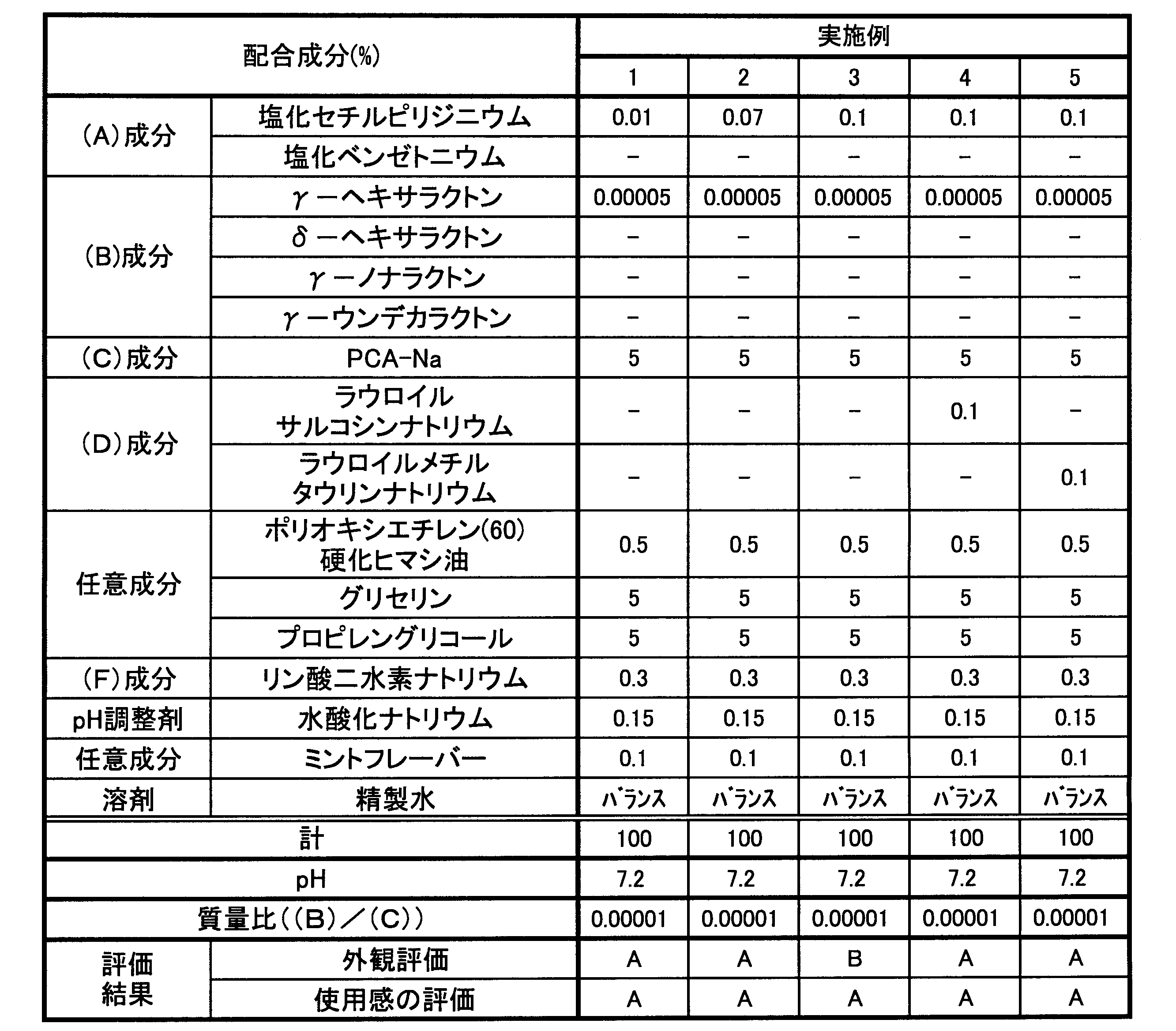
表1からわかるように、(A)成分、(B)成分、及び(C)成分を組み合わせて含有する本発明の液体口腔用組成物は、中性付近のpH値を有する液性であっても、香味劣化を抑制しつつ、製剤の着色を抑制し得るものである(実施例1~5参照)。(A)成分の含有量を増やすと、外観評価が「A」から「B」となり、僅かに着色が生じることがわかる(実施例1~3参照)。一方、外観評価が「B」である実施例3の組成物に(D)成分を配合することで、外観評価が「A」となり、製剤が着色することを抑制できることがわかる(実施例4、5参照)。
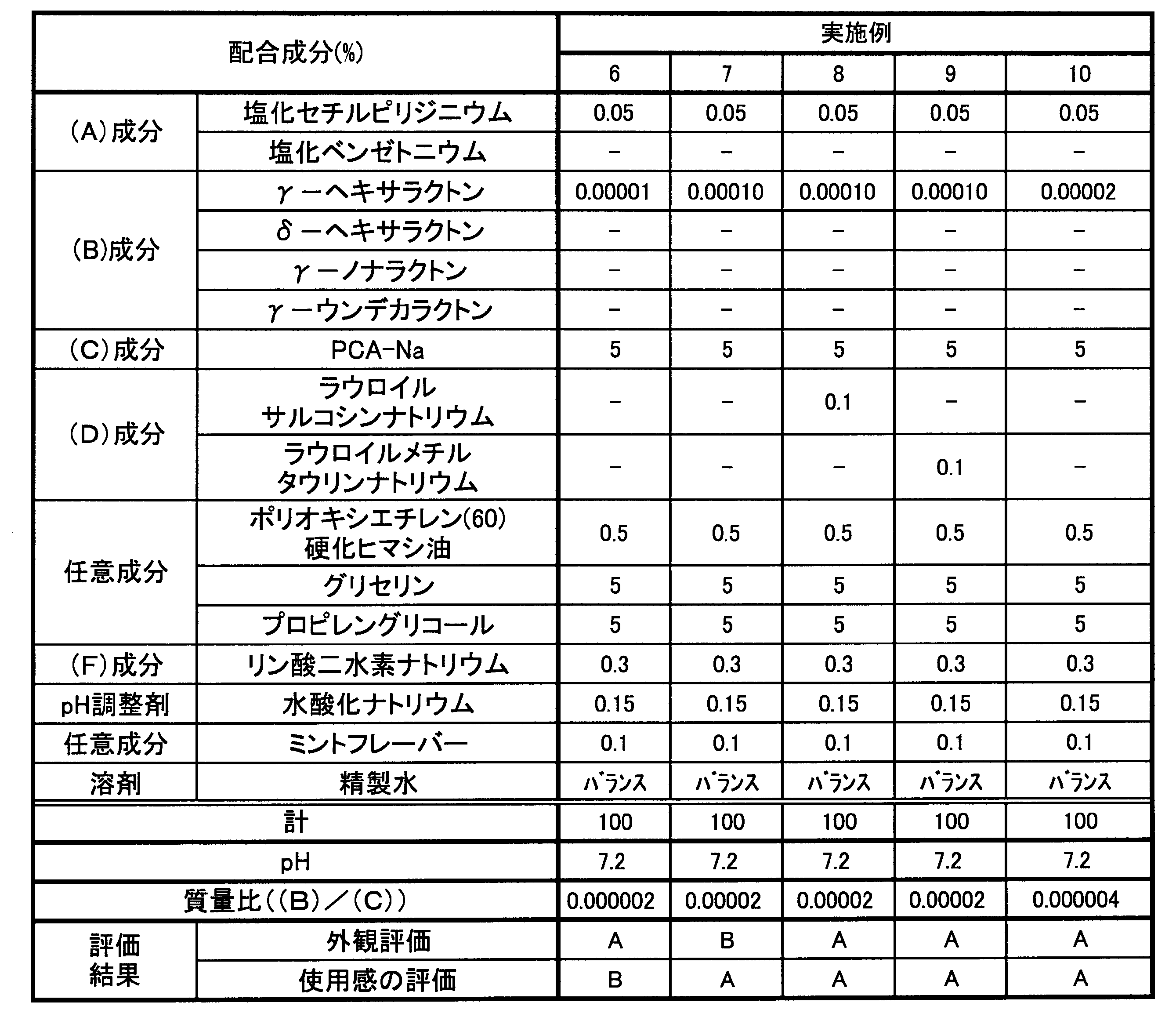
表2からわかるように、(A)成分、(B)成分、及び(C)成分を組み合わせて含有する本発明の液体口腔用組成物は、中性付近のpH値を有する液性であっても、香味劣化を抑制しつつ、製剤の着色を抑制し得るものである(実施例6~10参照)。表1中の実施例2の組成物に対し、(A)成分の含有量を0.05%に、(B)成分の含有量を0.00001%まで減らした場合、使用感の評価が「B」となり、僅かに香味劣化が生じることがわかる(実施例6参照)。この実施例6の組成物に対し、(B)成分の含有量を0.0001%まで増やした場合、使用感の評価が「A」に回復する一方で、外観評価が「B」となり、僅かに着色も生じることがわかる(実施例7参照)。一方、実施例7の組成物に(D)成分を配合することで、外観評価が「A」となり、製剤の着色を抑制し得ることがわかる(実施例8、9参照)。また、実施例6の組成物に対し、(B)成分の含有量を0.00002%まで増やすことで、使用感の評価が「A」となり、香味劣化を抑制しつつ、製剤の着色を抑制し得るものであった(実施例10参照)。

表3からわかるように、(A)成分、(B)成分、及び(C)成分を組み合わせて含有する本発明の液体口腔用組成物は、中性付近のpH値を有する液性であっても、香味劣化を抑制しつつ、製剤の着色を抑制し得るものである(実施例11~15参照)。以下、表2中の実施例10の組成物に対し、(B)成分の含有量を0.00005%まで増やした実施例11の組成物を基準として判断する。実施例11の組成物に対し、(C)成分の含有量を20%まで増やすと、使用感の評価が「B」となり、僅かに香味劣化を生じることがわかる(実施例15参照)。また、(C)成分の含有量を0.1%まで減らすと外観評価が「B」となり、僅かに着色を生じることがわかる(実施例12参照)。実施例11の組成物に対し、(C)成分の含有量が0.3~10%の範囲にある場合、外観評価及び使用感の評価に変化はなく、香味劣化の抑制や、製剤の着色を抑制し得るものであることがわかる(実施例13、14参照)。
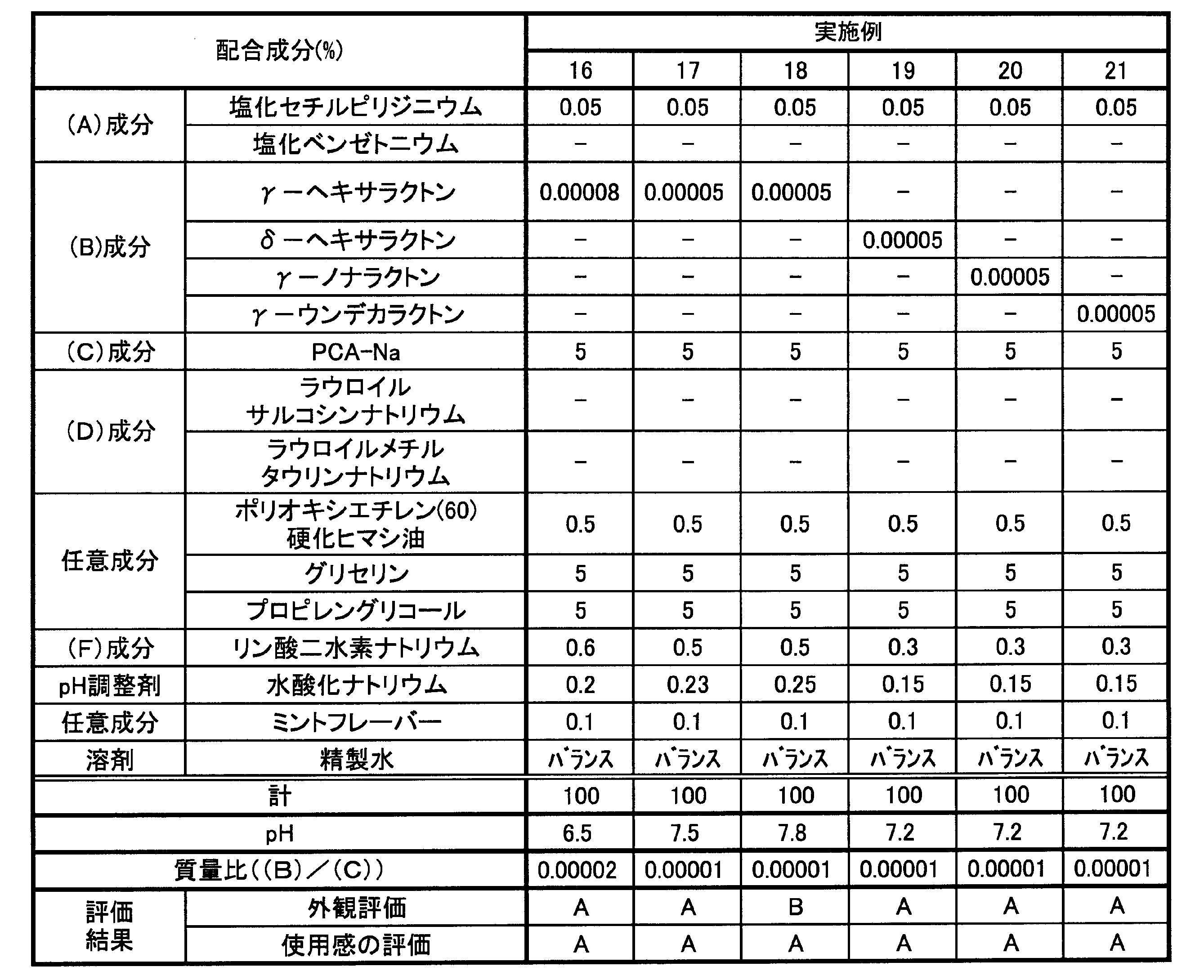
表4からわかるように、(A)成分、(B)成分、及び(C)成分を組み合わせて含有する本発明の液体口腔用組成物は、中性付近のpH値を有する液性であっても、香味劣化を抑制しつつ、製剤の着色を抑制し得るものである(実施例16~21参照)。以下、表3中の実施例11の組成物を基準として判断する。実施例11の組成物のpH値を6.5に低減又は7.5に増加した場合であっても、使用感の評価及び外観評価はともに「A」であり、香味劣化を抑制しつつ、製剤の着色を抑制し得るものであった(実施例16、17参照)。一方、実施例11の組成物のpH値を7.8に増加した場合、外観評価は「B」となり、僅かに着色が生じるものであった(実施例18参照)。更に、(B)成分の種類を変更した場合であっても、使用感の評価及び外観評価はともに「A」であり、香味劣化を抑制しつつ、製剤の着色を抑制し得るものであった(実施例19~21参照)。
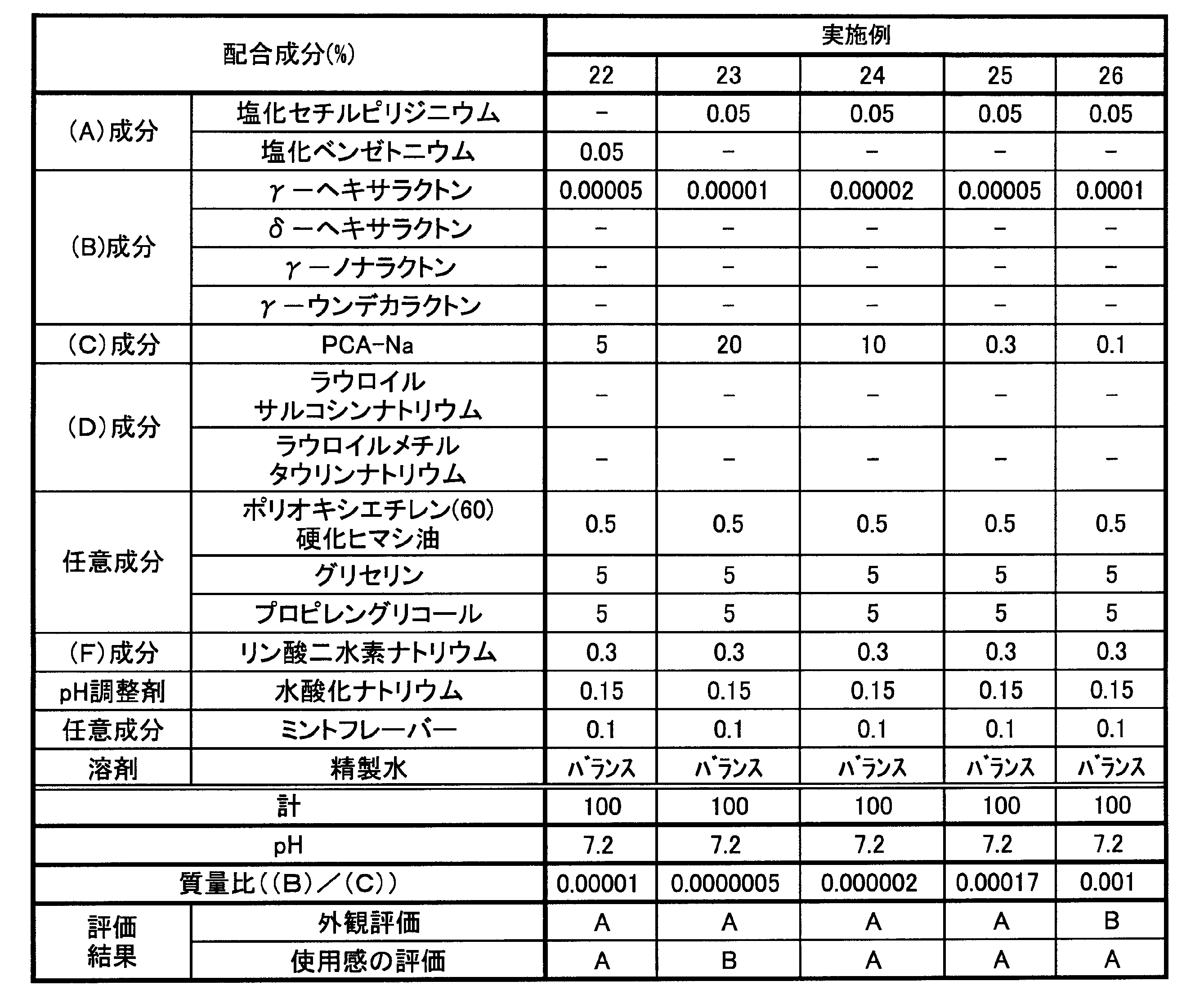
表5からわかるように、(A)成分、(B)成分、及び(C)成分を組み合わせて含有する本発明の液体口腔用組成物は、中性付近のpH値を有する液性であっても、香味劣化を抑制しつつ、製剤の着色を抑制し得るものである(実施例22~26参照)。以下、表3中の実施例11の組成物を基準として判断する。(A)成分の種類を変更した場合であっても、使用感の評価及び外観評価はともに「A」であり、香味劣化を抑制しつつ、製剤の着色を抑制し得るものであった(実施例22参照)。また、(B)成分と(C)成分の質量比((B)/(C))を0.0000005まで過度に小さくすることで、使用感の評価が「B」となり、僅かに香味劣化を生じることがわかる(実施例23参照)。一方、質量比((B)/(C))を0.001まで過度に大きくすることで、外観評価が「B」となり、僅かに着色を生じることがわかる(実施例26参照)。実施例11の組成物に対し、(B)成分と(C)成分の質量比((B)/(C))が0.000002~0.00017の範囲にある場合、外観評価及び使用感の評価に変化はなく、香味劣化の抑制や、製剤の着色を抑制し得るものであることがわかる(実施例24、25参照)。

表6からわかるように、(C)成分を配合しない従来の液体口腔用組成物では、外観評価が「D」であり、製剤が着色するものであった(比較例1参照)。また、ラクトン化合物ではない、ゲラニオールやエチルブチレートを(B)成分に用いた場合、使用感の評価が「D」であり、香味劣化するものであった(比較例2、3参照)。
下記に本発明の液体口腔用組成物の処方例を記す。
(処方例1;洗口剤1)
塩化セチルピリジニウム:0.05%
γ-ウンデカラクトン:0.00006%
ピロリドンカルボン酸ナトリウム:5%
ラウロイルメチルタウリンナトリウム:0.1%
グリセリン:5%
プロピレングリコール:5%
ポリオキシエチレン(100)硬化ヒマシ油:0.5%
キシリット:4%
サッカリンナトリウム:0.01%
リン酸二水素ナトリウム:0.3%
水酸化ナトリウム:0.13%
パラオキシ安息香酸メチル:0.1%
パラオキシ安息香酸エチル:0.05%
ハーブ系香料(B成分不含):0.2%
精製水:バランス
合計:100.0%
(処方例1;洗口剤1)
塩化セチルピリジニウム:0.05%
γ-ウンデカラクトン:0.00006%
ピロリドンカルボン酸ナトリウム:5%
ラウロイルメチルタウリンナトリウム:0.1%
グリセリン:5%
プロピレングリコール:5%
ポリオキシエチレン(100)硬化ヒマシ油:0.5%
キシリット:4%
サッカリンナトリウム:0.01%
リン酸二水素ナトリウム:0.3%
水酸化ナトリウム:0.13%
パラオキシ安息香酸メチル:0.1%
パラオキシ安息香酸エチル:0.05%
ハーブ系香料(B成分不含):0.2%
精製水:バランス
合計:100.0%
(処方例2;洗口剤2)
塩化セチルピリジニウム:0.01%
γ-デカラクトン:0.00003%
ピロリドンカルボン酸ナトリウム:2%
ラウリル硫酸ナトリウム:0.1%
グリセリン:5%
プロピレングリコール:5%
ポリオキシエチレン(100)硬化ヒマシ油:0.5%
キシリット:4%
サッカリンナトリウム:0.01%
リン酸二水素ナトリウム:0.3%
水酸化ナトリウム:0.13%
パラオキシ安息香酸メチル:0.1%
パラオキシ安息香酸エチル:0.05%
ミント系香料(B成分不含):0.2%
精製水:バランス
合計:100.0%
塩化セチルピリジニウム:0.01%
γ-デカラクトン:0.00003%
ピロリドンカルボン酸ナトリウム:2%
ラウリル硫酸ナトリウム:0.1%
グリセリン:5%
プロピレングリコール:5%
ポリオキシエチレン(100)硬化ヒマシ油:0.5%
キシリット:4%
サッカリンナトリウム:0.01%
リン酸二水素ナトリウム:0.3%
水酸化ナトリウム:0.13%
パラオキシ安息香酸メチル:0.1%
パラオキシ安息香酸エチル:0.05%
ミント系香料(B成分不含):0.2%
精製水:バランス
合計:100.0%
(処方例3;洗口剤3)
塩化セチルピリジニウム:0.01%
γ-ヘキサラクトン:0.00006%
ピロリドンカルボン酸ナトリウム:3%
フッ化ナトリウム:0.1%(フッ素含有率450ppm)
ラウロイルサルコシンナトリウム:0.1%
グリセリン:5%
プロピレングリコール:5%
ポリオキシエチレン(100)硬化ヒマシ油:0.5%
キシリット:4%
サッカリンナトリウム:0.01%
リン酸二水素ナトリウム:0.3%
水酸化ナトリウム:0.13%
パラオキシ安息香酸メチル:0.1%
パラオキシ安息香酸エチル:0.05%
ハーブ系香料(B成分不含):0.2%
精製水:バランス
合計:100.0%
塩化セチルピリジニウム:0.01%
γ-ヘキサラクトン:0.00006%
ピロリドンカルボン酸ナトリウム:3%
フッ化ナトリウム:0.1%(フッ素含有率450ppm)
ラウロイルサルコシンナトリウム:0.1%
グリセリン:5%
プロピレングリコール:5%
ポリオキシエチレン(100)硬化ヒマシ油:0.5%
キシリット:4%
サッカリンナトリウム:0.01%
リン酸二水素ナトリウム:0.3%
水酸化ナトリウム:0.13%
パラオキシ安息香酸メチル:0.1%
パラオキシ安息香酸エチル:0.05%
ハーブ系香料(B成分不含):0.2%
精製水:バランス
合計:100.0%
Claims (10)
- (A)カチオン性殺菌剤、
(B)炭素数4~13のラクトン、並びに
(C)ピロリドンカルボン酸及びその塩の少なくともいずれか、を含有する液体口腔用組成物。 - 前記(A)成分の含有量が、0.01~0.2質量%である請求項1に記載の液体口腔用組成物。
- 前記(B)成分の含有量が、0.000005~0.001質量%である請求項1又は2に記載の液体口腔用組成物。
- 前記(C)成分の含有量が、0.1~20質量%である請求項1~3のいずれか1項に記載の液体口腔用組成物。
- 前記(B)成分と前記(C)成分の質量比((B)/(C))が、0.0000005~0.001である請求項1~4のいずれか1項に記載の液体口腔用組成物。
- (D)アニオン性界面活性剤を更に含有する請求項1~5のいずれか1項に記載の液体口腔用組成物。
- (E)う蝕予防有効成分を更に含有する請求項1~6のいずれか1項に記載の液体口腔用組成物。
- 25℃におけるpH値が、6.5以上である請求項1~7のいずれか1項に記載の液体口腔用組成物。
- (F)オルトリン酸及びその塩の少なくともいずれかを更に含有する請求項1~8のいずれか1項に記載の液体口腔用組成物。
- 洗口剤である請求項1~9のいずれか1項に記載の液体口腔用組成物。
Priority Applications (1)
| Application Number | Priority Date | Filing Date | Title |
|---|---|---|---|
| JP2018538382A JP7058222B2 (ja) | 2016-09-08 | 2017-08-31 | 液体口腔用組成物 |
Applications Claiming Priority (2)
| Application Number | Priority Date | Filing Date | Title |
|---|---|---|---|
| JP2016-175953 | 2016-09-08 | ||
| JP2016175953 | 2016-09-08 |
Publications (1)
| Publication Number | Publication Date |
|---|---|
| WO2018047712A1 true WO2018047712A1 (ja) | 2018-03-15 |
Family
ID=61562322
Family Applications (1)
| Application Number | Title | Priority Date | Filing Date |
|---|---|---|---|
| PCT/JP2017/031442 Ceased WO2018047712A1 (ja) | 2016-09-08 | 2017-08-31 | 液体口腔用組成物 |
Country Status (2)
| Country | Link |
|---|---|
| JP (1) | JP7058222B2 (ja) |
| WO (1) | WO2018047712A1 (ja) |
Cited By (1)
| Publication number | Priority date | Publication date | Assignee | Title |
|---|---|---|---|---|
| JP2021138637A (ja) * | 2020-03-04 | 2021-09-16 | 花王株式会社 | 匂い感覚増強剤 |
Citations (5)
| Publication number | Priority date | Publication date | Assignee | Title |
|---|---|---|---|---|
| JPH08259444A (ja) * | 1995-03-24 | 1996-10-08 | Earth Chem Corp Ltd | 殺菌効力増強剤及びそれを配合した口腔用組成物 |
| JPH09169624A (ja) * | 1995-12-21 | 1997-06-30 | Lion Corp | 口腔用抗菌剤及び口腔用組成物 |
| JPH11255629A (ja) * | 1998-01-08 | 1999-09-21 | Sunstar Inc | 口腔用組成物 |
| JP2003300850A (ja) * | 2002-04-05 | 2003-10-21 | Sunstar Inc | 歯周病原菌の付着抑制剤及び歯周病原菌の付着抑制作用を有する口腔用組成物 |
| JP2014040408A (ja) * | 2012-07-26 | 2014-03-06 | Lion Corp | 口腔用組成物 |
Family Cites Families (3)
| Publication number | Priority date | Publication date | Assignee | Title |
|---|---|---|---|---|
| JP2005179231A (ja) * | 2003-12-18 | 2005-07-07 | Lion Corp | 液体口腔用組成物 |
| JP5718674B2 (ja) * | 2011-02-25 | 2015-05-13 | 高砂香料工業株式会社 | 非共役トリエン構造を有する大環状トリエンラクトン類、その製造方法、およびその合成中間体 |
| JP2013035792A (ja) * | 2011-08-09 | 2013-02-21 | Kao Corp | 口腔用組成物 |
-
2017
- 2017-08-31 JP JP2018538382A patent/JP7058222B2/ja active Active
- 2017-08-31 WO PCT/JP2017/031442 patent/WO2018047712A1/ja not_active Ceased
Patent Citations (5)
| Publication number | Priority date | Publication date | Assignee | Title |
|---|---|---|---|---|
| JPH08259444A (ja) * | 1995-03-24 | 1996-10-08 | Earth Chem Corp Ltd | 殺菌効力増強剤及びそれを配合した口腔用組成物 |
| JPH09169624A (ja) * | 1995-12-21 | 1997-06-30 | Lion Corp | 口腔用抗菌剤及び口腔用組成物 |
| JPH11255629A (ja) * | 1998-01-08 | 1999-09-21 | Sunstar Inc | 口腔用組成物 |
| JP2003300850A (ja) * | 2002-04-05 | 2003-10-21 | Sunstar Inc | 歯周病原菌の付着抑制剤及び歯周病原菌の付着抑制作用を有する口腔用組成物 |
| JP2014040408A (ja) * | 2012-07-26 | 2014-03-06 | Lion Corp | 口腔用組成物 |
Cited By (1)
| Publication number | Priority date | Publication date | Assignee | Title |
|---|---|---|---|---|
| JP2021138637A (ja) * | 2020-03-04 | 2021-09-16 | 花王株式会社 | 匂い感覚増強剤 |
Also Published As
| Publication number | Publication date |
|---|---|
| JP7058222B2 (ja) | 2022-04-21 |
| JPWO2018047712A1 (ja) | 2019-06-24 |
Similar Documents
| Publication | Publication Date | Title |
|---|---|---|
| CA2997310C (en) | Oral care compositions and methods of use | |
| JP5874383B2 (ja) | 口腔用組成物 | |
| CN111867554B (zh) | 口腔用组合物 | |
| WO2016052572A1 (ja) | 口腔用組成物 | |
| JP4985905B2 (ja) | 液体口腔用組成物及びl−メントールの析出防止方法 | |
| WO2016006647A1 (ja) | 口腔用組成物 | |
| JP2020011951A (ja) | 口腔用組成物 | |
| JP5729291B2 (ja) | 口腔用組成物 | |
| JP7558059B2 (ja) | 口腔用組成物 | |
| JP5825088B2 (ja) | 液体口腔用組成物 | |
| CN116546956A (zh) | 具有氟化胺的口腔护理组合物 | |
| JP6610208B2 (ja) | 口腔用組成物 | |
| JP7058222B2 (ja) | 液体口腔用組成物 | |
| JP2020070276A (ja) | 口腔用組成物 | |
| JP5845603B2 (ja) | 液体又は液状の口腔用組成物及び舌苔付着抑制剤 | |
| JP7625845B2 (ja) | 口腔用組成物 | |
| JP7790913B2 (ja) | 口腔用組成物、及び金属味と基剤臭とを抑制する方法 | |
| JP7625844B2 (ja) | 口腔用組成物 | |
| JP7779029B2 (ja) | 口腔用組成物 | |
| JP7743441B2 (ja) | 口腔用組成物 | |
| JP6349709B2 (ja) | 口腔用組成物 | |
| JP2020100589A (ja) | 口腔用組成物 | |
| JP6439425B2 (ja) | 液体口腔用組成物 | |
| JP2017218430A (ja) | 液体口腔用組成物 | |
| JP2025090465A (ja) | 液体口腔用組成物 |
Legal Events
| Date | Code | Title | Description |
|---|---|---|---|
| 121 | Ep: the epo has been informed by wipo that ep was designated in this application |
Ref document number: 17848652 Country of ref document: EP Kind code of ref document: A1 |
|
| ENP | Entry into the national phase |
Ref document number: 2018538382 Country of ref document: JP Kind code of ref document: A |
|
| NENP | Non-entry into the national phase |
Ref country code: DE |
|
| 122 | Ep: pct application non-entry in european phase |
Ref document number: 17848652 Country of ref document: EP Kind code of ref document: A1 |