WO2018038103A1 - 陰イオン交換体を触媒とする糖脂肪酸エステルの製造方法 - Google Patents
陰イオン交換体を触媒とする糖脂肪酸エステルの製造方法 Download PDFInfo
- Publication number
- WO2018038103A1 WO2018038103A1 PCT/JP2017/029937 JP2017029937W WO2018038103A1 WO 2018038103 A1 WO2018038103 A1 WO 2018038103A1 JP 2017029937 W JP2017029937 W JP 2017029937W WO 2018038103 A1 WO2018038103 A1 WO 2018038103A1
- Authority
- WO
- WIPO (PCT)
- Prior art keywords
- fatty acid
- acid ester
- anion exchanger
- saccharide
- sugar
- Prior art date
- Legal status (The legal status is an assumption and is not a legal conclusion. Google has not performed a legal analysis and makes no representation as to the accuracy of the status listed.)
- Ceased
Links
Images

Classifications
-
- C—CHEMISTRY; METALLURGY
- C07—ORGANIC CHEMISTRY
- C07H—SUGARS; DERIVATIVES THEREOF; NUCLEOSIDES; NUCLEOTIDES; NUCLEIC ACIDS
- C07H13/00—Compounds containing saccharide radicals esterified by carbonic acid or derivatives thereof, or by organic acids, e.g. phosphonic acids
- C07H13/02—Compounds containing saccharide radicals esterified by carbonic acid or derivatives thereof, or by organic acids, e.g. phosphonic acids by carboxylic acids
- C07H13/04—Compounds containing saccharide radicals esterified by carbonic acid or derivatives thereof, or by organic acids, e.g. phosphonic acids by carboxylic acids having the esterifying carboxyl radicals attached to acyclic carbon atoms
- C07H13/06—Fatty acids
-
- B—PERFORMING OPERATIONS; TRANSPORTING
- B01—PHYSICAL OR CHEMICAL PROCESSES OR APPARATUS IN GENERAL
- B01J—CHEMICAL OR PHYSICAL PROCESSES, e.g. CATALYSIS OR COLLOID CHEMISTRY; THEIR RELEVANT APPARATUS
- B01J41/00—Anion exchange; Use of material as anion exchangers; Treatment of material for improving the anion exchange properties
- B01J41/04—Processes using organic exchangers
- B01J41/05—Processes using organic exchangers in the strongly basic form
-
- C—CHEMISTRY; METALLURGY
- C07—ORGANIC CHEMISTRY
- C07H—SUGARS; DERIVATIVES THEREOF; NUCLEOSIDES; NUCLEOTIDES; NUCLEIC ACIDS
- C07H1/00—Processes for the preparation of sugar derivatives
-
- B—PERFORMING OPERATIONS; TRANSPORTING
- B01—PHYSICAL OR CHEMICAL PROCESSES OR APPARATUS IN GENERAL
- B01J—CHEMICAL OR PHYSICAL PROCESSES, e.g. CATALYSIS OR COLLOID CHEMISTRY; THEIR RELEVANT APPARATUS
- B01J2231/00—Catalytic reactions performed with catalysts classified in B01J31/00
- B01J2231/40—Substitution reactions at carbon centres, e.g. C-C or C-X, i.e. carbon-hetero atom, cross-coupling, C-H activation or ring-opening reactions
- B01J2231/49—Esterification or transesterification
-
- B—PERFORMING OPERATIONS; TRANSPORTING
- B01—PHYSICAL OR CHEMICAL PROCESSES OR APPARATUS IN GENERAL
- B01J—CHEMICAL OR PHYSICAL PROCESSES, e.g. CATALYSIS OR COLLOID CHEMISTRY; THEIR RELEVANT APPARATUS
- B01J31/00—Catalysts comprising hydrides, coordination complexes or organic compounds
- B01J31/02—Catalysts comprising hydrides, coordination complexes or organic compounds containing organic compounds or metal hydrides
- B01J31/06—Catalysts comprising hydrides, coordination complexes or organic compounds containing organic compounds or metal hydrides containing polymers
- B01J31/08—Ion-exchange resins
Definitions
- sucrose is said to have an annual production of about 180 million tons, and has the largest production scale as a single organic compound, and high-purity products can be obtained at low cost.
- Various uses have been proposed as chemical raw materials.
- sucrose fatty acid ester FASuc is one of sucrose derivatives produced industrially.
- FASuc is a nonionic surfactant in which a hydrophilic Suc and a lipophilic vegetable oil-derived fatty acid FA are ester-bonded. Since hydrophilicity and lipophilicity can be changed depending on the number of fatty acids bonded to the eight hydroxyl groups of sucrose, it has a wide range of hydrophilicity / lipophilic balance (HLB) values. In addition to the emulsifying action, FASuc has high functionality such as solubilization ability, dispersion ability, and lubrication ability.
- HLB hydrophilicity / lipophilic balance
- FASuc is a high-value-added biomass-derived chemical product produced from inexpensive sugar and vegetable oil, but it is known that hydrophilic Suc and fatty acid have low miscibility and are difficult to synthesize. .
- the industrial production method of FASuc uses an amphiphilic dimethyl sulfoxide (DMSO) as a solvent and a transesterification reaction between Suc and a fatty acid methyl ester (FAMe) using a homogenous alkali Na 2 CO 3 as a catalyst. It's being used.
- DMSO dimethyl sulfoxide
- FAMe fatty acid methyl ester
- Patent Documents 2 and 3 describe a technique in which a sugar fatty acid ester is added as an emulsifier to a sucrose aqueous solution and a fatty acid methyl ester, and an emulsion is formed by irradiating ultrasonic waves and microwaves to accelerate the reaction.
- the present inventors have used an anion exchanger as a catalyst in a method for producing a fatty acid ester by transesterification of fats and alcohols, and the molar ratio of fats and alcohols to 1/30 to 1/1. Is disclosed (Patent Document 4).
- sucrose fatty acid ester As a method for producing sucrose fatty acid ester, a method is disclosed in which sucrose and a lower alkanol ester or glyceride of fatty acid are subjected to an ester exchange reaction in the presence of a cation exchange resin ion-exchanged with an alkali metal.
- Patent Document 5 a method for producing sucrose fatty acid ester.
- satisfactory results cannot be obtained when the reaction is carried out using a basic anion exchange resin having a quaternary ammonium group as a functional group or a basic anion exchange resin having a tertiary amine as a functional group.
- the object of the present invention relates to a conventional method for producing a sugar fatty acid ester such as sucrose fatty acid ester (FASuc), which solves the various problems as described above, and does not produce soap as a by-product. It is an object of the present invention to provide a production method that has advantages such as being easy, and that enables efficient synthesis, preferably in a flow system, by a simple operation under mild conditions.
- a sugar fatty acid ester such as sucrose fatty acid ester (FASuc)
- the present inventor has found that the above problems can be solved by using an anion exchanger as a catalyst, and has completed the present invention.
- the anion exchanger is an anion exchanger to which saccharide has been substantially adsorbed in advance.
- the method according to aspect 2 comprising an adsorption step of adsorbing a saccharide on an anion exchanger, and then a synthesis step of synthesizing a sugar fatty acid ester using the anion exchanger on which the saccharide is adsorbed by the adsorption step.
- the method of the present invention solves the above-mentioned problems in the prior art, and a sugar fatty acid ester can be obtained in a high yield by a simple operation under mild conditions. Furthermore, regarding the sugar fatty acid ester obtained as a product, in the conventional production method, since a large amount of fatty acid ester is added, there is a problem that di- and tri-forms in which a plurality of fatty acids are added to one sugar are formed.
- the method of the present invention has an advantage that almost all of the sugar fatty acid ester to be produced is, for example, 80% by mass or more, preferably 95% by mass or more of the sugar fatty acid ester is a mono form.
- the present invention relates to a method for producing a sugar fatty acid ester using a transesterification reaction between a fatty acid ester and a saccharide, wherein the anion exchanger is used as a catalyst.
- anion exchanger examples include an anion exchange resin known to those skilled in the art, preferably a strong base which is an anion exchanger having a quaternary ammonium group formed by chemically bonding a tertiary amine to an insoluble carrier.
- Anionic exchange resin can be used.
- strongly basic anion exchange resins have, for example, a functional group pKa> 11, preferably pKa> 13.
- Examples of such strongly basic anion exchange resins include Diaion PA-306 (manufactured by Mitsubishi Chemical Corporation), Diaion PA-306S (same), Diaion PA-308 (same), and Diaion HPA-25. And Dowex 1-X2 (manufactured by Dow Chemical Co.).
- the strongly basic anion exchange resin since the strongly basic anion exchange resin is in a chloride form at the time of purchase, it is regenerated into a hydroxide form and used in the present invention.
- a sodium hydroxide solution of 0.5 to 2 mol / dm 3 is used as the regenerant, and the flow rate of the regenerant is preferably about 2 to 10 mL-NaOH / min per mL of anion exchange resin. The flow rate is 5 to 20 mL per 1 mL of anion exchange resin. After completion of the regeneration, it is sufficiently washed so that the regenerant does not remain, and finally swelled with a reaction solvent, and then used in the present invention.
- an anion exchange resin when classified according to the degree of crosslinking or porosity, a gel type, a porous type, a high porous type, and the like can be given.
- the strongly basic anion exchange resin functional group include a trimethylamine group, a dimethylethanolammonium group, an N-alkyl-N, N-dialkanolamine group, and a trialkanolamine group.
- a resin skeleton having various chemical structures can be used as an insoluble carrier.
- polystyrene crosslinked with divinylbenzene or the like synthetic polymers such as polyacrylic acid, crosslinked poly (meth) acrylic acid ester, phenol resin, and naturally produced polysaccharides such as cellulose. A crosslinked body etc. are mentioned. Of these, synthetic polymers are preferred, and crosslinked polystyrene is more preferred.
- degree (degree) of crosslinking depends on the amount of divinylbenzene used relative to the total amount of monomers, and is selected from the range of, for example, 1 to 10% by mass.
- the fatty acid esters and saccharides used as reactants (feed materials) in the method of the present invention are any compounds known to those skilled in the art depending on the type and purpose of use of the sugar fatty acid ester which is the target product of the method of the present invention. You can choose from. Furthermore, these compounds can be prepared by any method known to those skilled in the art, or various fatty acid esters and saccharides that are commercially available can also be used.
- a lower alcohol having a linear or branched hydrocarbon skeleton having 1 to 8 carbon atoms, preferably 1 to 5 carbon atoms, and for example, lauric acid, myristic acid, palmitic acid, stearic acid, oleic acid, Fatty acid esters composed of fatty acids having 1 to 30 carbon atoms such as henic acid and erucic acid can be used.
- saccharide one or more saccharides selected from monosaccharides, disaccharides such as sucrose, and polysaccharides can be used.
- fatty acid ester used in the method of the present invention include, for example, methyl oleate used in the following examples, and sucrose as a specific example of sugar.
- the lipophilic fatty acid ester and the hydrophilic saccharide have different polarities and are difficult to mix.
- dimethyl sulfoxide, dimethylformamide, ethyl methyl ketone, ethyl acetate It can be reacted with the anion exchanger in a solvent system known to those skilled in the art such as -propanol, propylene glycol, methanol, ethanol, and 2-methyl-1-propanol.
- Patent Document 4 Such a reaction did not occur at all in the continuous synthesis technique of fatty acid ester (Patent Document 4) using an anion exchanger developed by the inventors' original idea as a catalyst, and therefore cannot be predicted from the prior art. It was a difficult task.
- an anion exchanger in which saccharides are substantially adsorbed in advance.
- first step saccharide adsorption step: prior to transesterification of fatty acid ester and saccharide
- step of substantially adsorbing saccharide on anion exchanger step of substantially adsorbing saccharide on anion exchanger
- sugar fatty acid ester sugar fatty acid ester
- It is preferable to carry out by a two-step process comprising the step of performing a transesterification reaction between a fatty acid ester and a saccharide using the anion exchanger obtained in the first step.
- the contact method between the reactant and the anion exchanger may be carried out by any method known to those skilled in the art, such as a batch method (batch system) or a continuous method (distribution system). I can do it.
- the apparatus include a device provided with a treatment tank, and a device for transferring resin in a circulation system or a countercurrent system.
- the contact method include circulation (method of passing through a packed bed of ion exchange resin), stirring (method using a stirring tank), flow (fluidized bed reactor), shaking (shaking reactor), and the like. .
- a batch type can also be used.
- the reactant concentration decreases with the progress of the reaction, and therefore, if it is difficult to keep the saccharide concentration high, the reactant can be added as necessary.
- a continuous method (distribution system) using a reactor filled with a resin is preferable because the target sugar ester synthesis reaction can be preferentially advanced by continuing to maintain a high sugar concentration.
- a reaction liquid containing saccharides is supplied to the anion exchanger to carry out the saccharide adsorption step
- a reaction solution containing only a fatty acid ester or a fatty acid ester and a saccharide is supplied to the anion exchanger, and a sugar fatty acid ester synthesis step is performed by an ester exchange reaction between them.
- a reaction solution containing a fatty acid ester and a saccharide is supplied so that the saccharide in the anion exchanger as a catalyst is maintained at a high concentration, and the saccharide concentration in the reaction solution is adjusted. Higher is preferred.
- the saccharide concentration used in the second step (synthesis step) is, for example, preferably such that the molar concentration ratio of saccharide to fatty acid ester in the reaction solution is in the range of 1: 0.5 to 1: 5. A range of 5 to 1: 3 is more preferable.
- the saccharide concentration ratio is less than 0.5, as described above, the catalytic activity of the anion exchanger disappears, and even if the saccharide is incorporated into the anion exchanger, the ester is mixed with the fatty acid ester. The exchange reaction may not occur efficiently.
- the saccharide concentration ratio exceeds 5 the concentration of the reaction solution becomes too high, and the cost increases, which is not preferable in terms of productivity. Moreover, since operation which removes saccharides from a product will be needed when saccharides are added excessively, productivity will worsen.
- the above two-step operation may be combined with an arbitrary production process.
- it may further include a step of separating and purifying the sugar fatty acid ester as the target product from alcohol and other impurities as other products. That is, in the method for producing a sugar fatty acid ester using the anion exchanger of the present invention as a catalyst, the composition obtained after carrying out the transesterification reaction between the fatty acid ester and the sugar is a product sugar in the solvent.
- the extraction step and the water washing step are repeated a desired number of times, and the extraction solvent is distilled off from the extract and then dried to obtain a mixture containing the product containing no solvent.
- a high-purity sugar fatty acid ester can be obtained by incorporating any means / method known to those skilled in the art, for example, a distillation step, a membrane separation step, a preparative liquid chromatography separation step, and the like.
- the composition obtained by the production method of the present invention contains unreacted reactants in addition to the sugar fatty acid ester.
- the purity of the sugar fatty acid ester in the composition has a molar fraction of less than 100%, preferably in the range of 0.01 to 99%, and more preferably in the range of 0.1 to 90%. Alternatively, it may be in the range of 1 to 70%, and a known high-purity treatment can be performed in order to increase the purity to a desired level.
- the composition is 80% by mass or more, preferably 90 to 99.9% by mass of the sugar fatty acid ester contained therein. Each component in these compositions can be analyzed by a known analyzer such as liquid chromatography.
- the method of the present invention when carried out in a flow system, it can be repeatedly used for the same reaction by using an anion exchange resin as a packed bed, but it is preferable to regenerate the resin appropriately.
- reproduction processing is performed according to a known method. For example, after treating with an acid solution using a solvent miscible with free fatty acids to replace the functional group with an acid group, treating with an alkaline solution replaces the functional group with an OH group, and then swells with the reaction solvent. To do.
- the purpose of the regeneration treatment is to replace the functional group of the resin with a catalytically active (OH) group, but since the functional group of the resin may be in the fatty acid form, soap formation occurs when treated directly with an alkaline solution. Occurs and the replacement does not proceed well.
- Treatment with an acid solution is necessary for efficient substitution to OH groups, such as avoiding this soap formation.
- the acid organic acids such as formic acid, acetic acid and citric acid can be used.
- reaction time and the like can be appropriately selected from any known to those skilled in the art in consideration of the reactants to be used and the type of anion exchanger.
- the reaction time of each step can be appropriately set by those skilled in the art according to the reaction temperature, the amount of anion exchanger used, and the like.
- the reaction is usually carried out at 20 to 100 ° C., preferably 30 to 70 ° C.
- the reaction pressure is not particularly limited. Although it is easy to operate under normal pressure, it may be pressurized to about 1 to 10 atm or reduced to about 0.002 to 1 atm if necessary.
- the present invention provides an apparatus for carrying out the above-described method, for example, a reactant introduction port on one side of a container (reactor) filled with a predetermined anion exchanger, and a product recovery port on the other side. It also relates to a reaction device comprising one or more reactors.
- the said container may have independently, it may have the structure connected in multiple numbers in parallel and / or in series.
- the shape of the container is not particularly limited, but a column is usually used. When an anion exchange resin is packed in a column and used, an embodiment using an expanded bed column packed bed having a high porosity is preferable in order to prevent the resin from swelling and being damaged.
- an expanded bed column is used in a separation and purification method in which a target component dissolved in a fluid having a high viscosity or a solid content is adsorbed and recovered by adsorbent particles.
- This refers to those in which fluid is flowed upward, adsorbent particles having a large specific gravity are suspended in a stationary state, and column chromatography operation is performed while maintaining a large porosity.
- Chemical Engineering Papers Vol. 27, No. 2 (2001) pages 145-148 and the like can be used.
- the invention therefore also relates to an apparatus for carrying out such a method of the invention.
- the method of the present invention for example, when a solution having a density higher than 1 or a solution having a high viscosity is used as the reaction solution, it is preferable to use an upward flow in order to prevent the drift and efficiently advance the reaction.
- DMSO Dimethyl sulfoxide
- resin catalyst a commercially available porous strong base anion exchange resin, Diaion PA306S (manufactured by Mitsubishi Chemical Corporation) was used.
- the anion exchange resin is in a water-swollen state with a Cl type in which the functional group is inactive at the time of shipment from the factory. Therefore, an activation treatment is required to perform functional group substitution from an inactive Cl type to an active OH type and solvent swelling. This treatment was performed in accordance with a regeneration treatment method for repeated use of a resin already constructed by the present inventors.
- Example 1 Example 1 to condition 3 where the Suc of 0.1 ⁇ 0.3 mol / dm 3 previously adsorbed to the resin catalyst, Example 4 was the OAMe of 0.1 mol / dm 3 previously adsorbed to resin catalyst
- Conditions and Example 5 are conditions in which two reactants were simultaneously added to the resin catalyst (that is, the operation of adsorbing either Suc or OAMe to the resin catalyst first is not performed).
- an experiment (Comparative Example 1) in which 2.2% by mass of the conventional phase-homogeneous catalyst Na 2 CO 3 was added instead of the resin catalyst under the condition in which two reactants were added at the same time was also performed.
- Table 1 In each experiment, a small amount of the reaction solution was sampled every predetermined time, and the concentration of each product such as OASuc was measured using a liquid chromatography equipped with an evaporative light scattering detector.
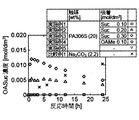
- FIG. 1 shows the experimental results of Examples 1 to 5 and Comparative Example 1.
- Table 1 shows the maximum OASuc concentration, the reaction time when the maximum OASuc concentration was reached, and the maximum OASuc yield at that time for the products in Examples 1 to 5 and Comparative Example 1.
- Example 4 in which OAMe was first adsorbed on a resin catalyst and Example 5 in which two reactants were simultaneously added without an adsorption operation, the product concentration was below the detection limit even after 24 hours of reaction, that is, hardly formed. It was.
- Examples 1 to 3 in which Suc was first adsorbed on the resin catalyst, the product was detected as compared with Examples 4 and 5, and the product was determined according to the Suc concentration that was first adsorbed on the resin catalyst.
- OASuc concentration increased.
- the product OASuc concentration reached the maximum after the reaction for 3 hours, and the OASuc yield at that time (maximum OASuc yield) was 12%.
- the yield was equal to or higher than the yield (10%).
- the OASuc concentration may decrease, and therefore the OASuc decomposition reaction may have progressed. Therefore, it is believed that there is an appropriate reaction time that maximizes the product OASuc concentration. Further, 95% by mass or more of the obtained OASuc was a mono form.
- the OASuc yield is defined as “(OASuc concentration / input OAMe concentration) ⁇ 100”.
- the experiment in the flow system was performed by a two-step process of sugar adsorption to the resin catalyst and ester synthesis.
- a DMSO solution of a predetermined concentration of suc is supplied by an upward flow from the bottom to the top of the resin catalyst packed column maintained at 60 ° C. using a pump until it breaks through the anion.
- Suc was adsorbed on the exchange resin.
- the concentration of Suc was set to 0.3 mol / dm 3 as in Example 3, and the supply rate was set to 1.0 cm 3 / min.
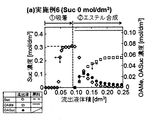
- Example 6 In Example 6 in which only OAMe was supplied in the synthesis step, the Suc concentration in the effluent gradually decreased from the saturated concentration, while the product OASuc concentration once increased to take a maximum value and then gradually decreased. .
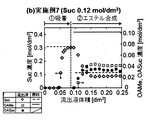
- Table 2 shows the maximum value of the obtained OASuc concentration and the yield based on the OASuc at that time.
- Examples 7 and 8 in which both OAMe and Suc were supplied in the synthesis step, the OASuc concentration in the effluent tended to increase gradually and became constant. Table 2 shows the steady concentrations obtained and the yields at that time.
- Example 8 when the OASuc concentration that is a product in the effluent becomes constant, the OASuc concentration is 0.051 mol / dm 3 , and the Suc concentration that is a reactant in the effluent is 0.8. Since it was 19 mol / dm 3 and the OAMe concentration was 0.031 mol / dm 3 , the OASuc concentration in the effluent was in the total moles of reactant and product (0.272 mol / dm 3 ), 18. It was 8% (molar fraction). This is a yield of 51% based on the OAMe concentration of 0.1 mol / dm 3 charged with the OASuc yield.
- the present invention provides a new possibility in the development of a method for synthesizing sugar fatty acid esters having various uses such as sucrose fatty acid esters.
Landscapes
- Chemical & Material Sciences (AREA)
- Organic Chemistry (AREA)
- Engineering & Computer Science (AREA)
- Health & Medical Sciences (AREA)
- Biochemistry (AREA)
- Biotechnology (AREA)
- General Health & Medical Sciences (AREA)
- Genetics & Genomics (AREA)
- Molecular Biology (AREA)
- Life Sciences & Earth Sciences (AREA)
- Chemical Kinetics & Catalysis (AREA)
- Saccharide Compounds (AREA)
- Low-Molecular Organic Synthesis Reactions Using Catalysts (AREA)
- Catalysts (AREA)
- Organic Low-Molecular-Weight Compounds And Preparation Thereof (AREA)
Abstract
Description
このような問題に対処するために、例えば、充填塔と複数個の凝縮器を直列に配置した反応器を用い、第1段凝縮器の凝縮液を充填塔の塔頂に還流する手法を提案している(特許文献1)。
[態様1]
脂肪酸エステルと糖類とのエステル交換反応を用いて糖脂肪酸エステルを製造する方法であって、触媒として陰イオン交換体を用いる前記方法。
[態様2]
前記陰イオン交換体が、実質的に予め糖類が吸着された陰イオン交換体である態様1に記載の方法。
[態様3]
糖類を陰イオン交換体へ吸着させる吸着工程、次いで、吸着工程により糖類が吸着した陰イオン交換体を用いて糖脂肪酸エステルを合成させる合成工程を含む、態様2に記載の方法。
[態様4]
前記吸着工程が、糖類を含む反応液を陰イオン交換体に供給することにより糖類を陰イオン交換体へ吸着させることを特徴とする態様3に記載の方法。
[態様5]
前記合成工程が、前記吸着工程により糖類が吸着した陰イオン交換体に脂肪酸エステルを含む反応液を供給させることにより糖脂肪酸エステルを合成させることを特徴とする態様3または4に記載の方法。
[態様6]
前記脂肪酸エステルを含む反応液は、更に糖類を含むことを特徴とする態様5に記載の方法。
[態様7]
前記合成工程で使用する反応液に於ける脂肪酸エステルと糖類のモル濃度比が1:0.5~1:5である、態様6記載の方法。
[態様8]
陰イオン交換体が、強塩基性陰イオン交換樹脂である態様1~7のいずれか一項に記載の方法。
[態様9]
脂肪酸エステルが、炭素数1~30の脂肪酸と炭素数1~8の低級アルコールから成るエステルである、態様1~8のいずれか一項に記載の方法。
[態様10]
糖類が、単糖類、二糖類、及び、多糖類からなる群から選ばれる少なくとも1種である、態様1~9のいずれか一項に記載の方法。
[態様11]
脂肪酸エステルがオレイン酸メチルであり、糖類がスクロースである、態様1~8のいずれか一項に記載の方法。
[態様12]
態様1~11のいずれか一項に記載の方法で製造された糖脂肪酸エステルを含む組成物。
[態様13]
糖脂肪酸エステルの80質量%以上がモノ体であることを特徴とする、態様12記載の組成物。
[実験方法と条件]
反応物には、脂肪酸エステルとしてオレイン酸メチル(OAMe)、及び、糖としてスクロース(Suc)を用いた。したがって、本実験では反応式(1)より、スクロースオレイン酸エステル(OASuc)が生成する。

尚、各実験では、所定時間毎に反応液を少量採取し、OASuc等の各生成物の濃度を、蒸発光散乱検出器を備えた液体クロマトグラフィを用いて測定した。
図1に、実施例1~5と比較例1の実験結果を示す。また、表1に、実施例1~5と比較例1に於ける生成物の、最大OASuc濃度、最大OASuc濃度に達した反応時間、およびその際の最大OASuc収率を示す。先にOAMeを樹脂触媒に吸着させた実施例4、及び、吸着操作なしに2つの反応物を同時に投入した実施例5では、24h反応後でも生成物濃度は検出限界以下、つまりほとんど生成しなかった。これに対し、先にSucを樹脂触媒に吸着させた実施例1乃至3では、実施例4および5に比して生成物が検出され、先に樹脂触媒に吸着させるSuc濃度に応じて生成物OASuc濃度が高くなった。特に実施例3では3h反応後に生成物OASuc濃度が最大となり、その時のOASuc収率(最大OASuc収率)は12%となり、従来の均相アルカリ触媒を用いた比較例1で24h反応後に得られた収率(10%)と同等以上となった。これより、高濃度のSucを先に樹脂触媒に入れた場合、OASucの高収率の生成が観察され、また、その生成速度は、均相触媒の場合よりも大きいことが分かった。ただし、反応後期では、OASucの濃度が減少していることからOASucの分解反応が進行している可能性がある。従って、生成物OASuc濃度を最大とする適切な反応時間が存在すると考えられる。また、得られたOASucは95質量%以上がモノ体であった。
ここで、OASuc収率は、「(OASuc濃度/投入OAMe濃度)×100」で定義される。

[実験方法と条件]
反応系を前述の回分系から流通系(連続式)に変えた以外は、反応物、溶媒、樹脂触媒の投入量は、実施例3と同様とした。但し、実験装置は、反応液タンクと送液ポンプ、恒温ジャケット付カラム型反応器、恒温槽からなる。供給溶液タンクは恒温槽中に設置し60℃に保持した。カラムには樹脂触媒22g(湿重量)を充填した。そして、回分系と同様の手順で樹脂触媒の活性化処理を行った。
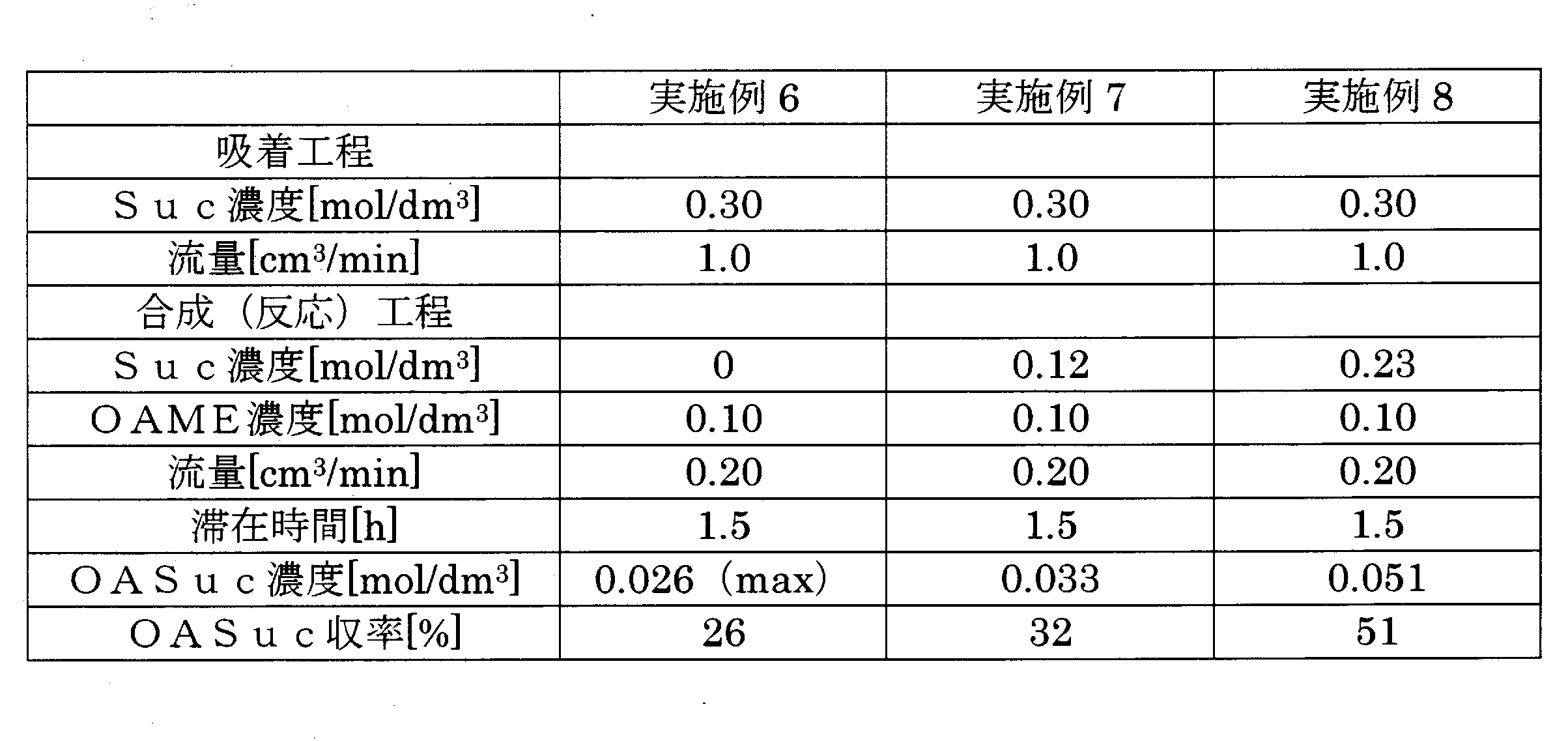
合成工程でOAMeのみを供給した実施例6では、流出液中のSuc濃度は飽和濃度から徐々に減少し、その一方で生成物OASuc濃度が一旦増加し最大値を取った後、徐々に低下した。得られたOASuc濃度の最大値とその際のOASuc基準の収率を表2に記載した。また、合成工程でOAMeとSucを共に供給した実施例7および8では、流出液中のOASuc濃度は徐々に増加して一定となる傾向を示した。得られた定常濃度とその際の収率を表2に示した。
Claims (13)
- 脂肪酸エステルと糖類とのエステル交換反応を用いて糖脂肪酸エステルを製造する方法であって、触媒として陰イオン交換体を用いる前記方法。
- 前記陰イオン交換体が、実質的に予め糖類が吸着された陰イオン交換体である請求項1に記載の方法。
- 糖類を陰イオン交換体へ吸着させる吸着工程、次いで、吸着工程により糖類が吸着した陰イオン交換体を用いて糖脂肪酸エステルを合成させる合成工程を含む、請求項2に記載の方法。
- 前記吸着工程が、糖類を含む反応液を陰イオン交換体に供給することにより糖類を陰イオン交換体へ吸着させることを特徴とする請求項3に記載の方法。
- 前記合成工程が、前記吸着工程により糖類が吸着した陰イオン交換体に脂肪酸エステルを含む反応液を供給させることにより糖脂肪酸エステルを合成させることを特徴とする請求項3または4に記載の方法。
- 前記脂肪酸エステルを含む反応液は、更に糖類を含むことを特徴とする請求項5に記載の方法。
- 前記合成工程で使用する反応液に於ける脂肪酸エステルと糖類のモル濃度比が1:0.5~1:5である、請求項6記載の方法。
- 陰イオン交換体が、強塩基性陰イオン交換樹脂である請求項1~7のいずれか一項に記載の方法。
- 脂肪酸エステルが、炭素数1~30の脂肪酸と炭素数1~8の低級アルコールから成るエステルである、請求項1~8のいずれか一項にの方法。
- 糖類が、単糖類、二糖類、及び、多糖類からなる群から選ばれる少なくとも1種である、請求項1~9のいずれか一項に記載の方法。
- 脂肪酸エステルがオレイン酸メチルであり、糖類がスクロースである、請求項1~8のいずれか一項に記載の方法。
- 請求項1~11のいずれか一項に記載の方法で製造された糖脂肪酸エステルを含む組成物。
- 糖脂肪酸エステルの80質量%以上がモノ体であることを特徴とする、請求項12記載の組成物。
Priority Applications (2)
| Application Number | Priority Date | Filing Date | Title |
|---|---|---|---|
| US16/327,009 US12275754B2 (en) | 2016-08-22 | 2017-01-16 | Process for producing sugar fatty acid ester using anion exchanger as catalyst |
| JP2018535696A JP7061798B2 (ja) | 2016-08-22 | 2017-08-22 | 陰イオン交換体を触媒とする糖脂肪酸エステルの製造方法 |
Applications Claiming Priority (2)
| Application Number | Priority Date | Filing Date | Title |
|---|---|---|---|
| JP2016162015 | 2016-08-22 | ||
| JP2016-162015 | 2016-08-22 |
Publications (1)
| Publication Number | Publication Date |
|---|---|
| WO2018038103A1 true WO2018038103A1 (ja) | 2018-03-01 |
Family
ID=61244962
Family Applications (1)
| Application Number | Title | Priority Date | Filing Date |
|---|---|---|---|
| PCT/JP2017/029937 Ceased WO2018038103A1 (ja) | 2016-08-22 | 2017-08-22 | 陰イオン交換体を触媒とする糖脂肪酸エステルの製造方法 |
Country Status (3)
| Country | Link |
|---|---|
| US (1) | US12275754B2 (ja) |
| JP (1) | JP7061798B2 (ja) |
| WO (1) | WO2018038103A1 (ja) |
Cited By (3)
| Publication number | Priority date | Publication date | Assignee | Title |
|---|---|---|---|---|
| CN109651456A (zh) * | 2018-12-31 | 2019-04-19 | 京山瑞生制药有限公司 | 一种高单酯含量的蔗糖油酸酯制备方法 |
| WO2020032272A1 (ja) * | 2018-08-10 | 2020-02-13 | 国立大学法人東北大学 | エステル交換反応による糖脂肪酸エステルの製造方法 |
| US12275754B2 (en) | 2016-08-22 | 2025-04-15 | Tohoku University | Process for producing sugar fatty acid ester using anion exchanger as catalyst |
Citations (1)
| Publication number | Priority date | Publication date | Assignee | Title |
|---|---|---|---|---|
| JPH05148285A (ja) * | 1991-10-02 | 1993-06-15 | Lion Corp | 糖類の脂肪酸エステルの製造方法 |
Family Cites Families (9)
| Publication number | Priority date | Publication date | Assignee | Title |
|---|---|---|---|---|
| FR1365067A (fr) | 1963-08-01 | 1964-06-26 | Procédé de préparation de monoesters du saccharose et d'acides gras et produits préparés selon ce procédé | |
| JPS63179884A (ja) | 1987-01-17 | 1988-07-23 | Mitsubishi Kasei Corp | シヨ糖脂肪酸エステルの製造方法 |
| DE69217099T2 (de) | 1991-04-05 | 1997-05-28 | Lion Corp | Verfahren zur Herstellung von Fettsäuresaccharidestern |
| JP2630182B2 (ja) | 1992-09-10 | 1997-07-16 | 三菱化学株式会社 | ショ糖脂肪酸エステルの製造方法 |
| JP4198663B2 (ja) | 2004-10-05 | 2008-12-17 | 株式会社 東北テクノアーチ | 脂肪酸エステルの製造方法 |
| JP5207219B2 (ja) | 2006-08-10 | 2013-06-12 | 三菱レイヨン株式会社 | モノエステルの製造方法 |
| JP2010037256A (ja) | 2008-08-04 | 2010-02-18 | Hironori Kataoka | ショ糖脂肪酸エステルの製造方法 |
| JP2015151400A (ja) | 2015-03-12 | 2015-08-24 | マイクロ波化学株式会社 | 有機化合物の製造方法、及びエステルの製造方法 |
| US12275754B2 (en) | 2016-08-22 | 2025-04-15 | Tohoku University | Process for producing sugar fatty acid ester using anion exchanger as catalyst |
-
2017
- 2017-01-16 US US16/327,009 patent/US12275754B2/en active Active
- 2017-08-22 WO PCT/JP2017/029937 patent/WO2018038103A1/ja not_active Ceased
- 2017-08-22 JP JP2018535696A patent/JP7061798B2/ja active Active
Patent Citations (1)
| Publication number | Priority date | Publication date | Assignee | Title |
|---|---|---|---|---|
| JPH05148285A (ja) * | 1991-10-02 | 1993-06-15 | Lion Corp | 糖類の脂肪酸エステルの製造方法 |
Non-Patent Citations (1)
| Title |
|---|
| SZEJA W. ET AL.: "OTRZYMYWANIE ESTROW SACHAROZY I KWASOW TLUSZCZOWYCH", ZESZYTY NAUKOWE POLITECHNIKI SLASKIEJ , CHEMIA, vol. 50, 1969, pages 105 - 6 * |
Cited By (5)
| Publication number | Priority date | Publication date | Assignee | Title |
|---|---|---|---|---|
| US12275754B2 (en) | 2016-08-22 | 2025-04-15 | Tohoku University | Process for producing sugar fatty acid ester using anion exchanger as catalyst |
| WO2020032272A1 (ja) * | 2018-08-10 | 2020-02-13 | 国立大学法人東北大学 | エステル交換反応による糖脂肪酸エステルの製造方法 |
| JPWO2020032272A1 (ja) * | 2018-08-10 | 2021-08-10 | 国立大学法人東北大学 | エステル交換反応による糖脂肪酸エステルの製造方法 |
| US11518778B2 (en) | 2018-08-10 | 2022-12-06 | Tohoku University | Method for producing sugar fatty acid ester by transesterification reaction |
| CN109651456A (zh) * | 2018-12-31 | 2019-04-19 | 京山瑞生制药有限公司 | 一种高单酯含量的蔗糖油酸酯制备方法 |
Also Published As
| Publication number | Publication date |
|---|---|
| JPWO2018038103A1 (ja) | 2019-06-24 |
| US12275754B2 (en) | 2025-04-15 |
| US20190185504A1 (en) | 2019-06-20 |
| JP7061798B2 (ja) | 2022-05-02 |
Similar Documents
| Publication | Publication Date | Title |
|---|---|---|
| US4698186A (en) | Process for the pre-esterification of free fatty acids in fats and oils | |
| TWI544963B (zh) | 醛吸附材、醛的除去方法、乙酸之製造方法及醛吸附材之再生方法 | |
| JPH05246947A (ja) | エステルの製造方法 | |
| JP7061798B2 (ja) | 陰イオン交換体を触媒とする糖脂肪酸エステルの製造方法 | |
| JP5700188B2 (ja) | 油脂からのトコトリエノールとバイオディーゼル燃料の同時生産方法 | |
| JP5595719B2 (ja) | グリセリンの製造方法 | |
| EP2956435B1 (en) | Method for manufacturing succinic acid esters | |
| JP7197172B2 (ja) | ケイ皮酸エステル化合物の製造方法 | |
| TWI642480B (zh) | 觸媒載體用乙烯吡啶樹脂、其製造方法及甲醇的羰基化反應用觸媒 | |
| CA3029993A1 (en) | Methods of refining a lignocellulosic hydrolysate | |
| US11518778B2 (en) | Method for producing sugar fatty acid ester by transesterification reaction | |
| JP7405433B2 (ja) | 多価アルコールエステル化合物の製造方法 | |
| JP2016059833A (ja) | 脂肪酸エステル連続製造用の陰イオン交換樹脂触媒の再生処理法 | |
| JP6256981B2 (ja) | 油からのビタミンe類の選択的な連続回収方法 | |
| JP5808674B2 (ja) | メタノールのカルボニル化反応速度の向上方法 | |
| CN112250867A (zh) | 一种甲基硅油的制备方法 | |
| JP2014234383A (ja) | カルボニル化合物の製造方法 | |
| KR20240161106A (ko) | 살리실산에스테르의 제조 방법 | |
| WO2021241756A1 (ja) | 脂肪族グリコシド化合物又は糖脂肪酸エステル化合物の製造方法 |
Legal Events
| Date | Code | Title | Description |
|---|---|---|---|
| 121 | Ep: the epo has been informed by wipo that ep was designated in this application |
Ref document number: 17843581 Country of ref document: EP Kind code of ref document: A1 |
|
| ENP | Entry into the national phase |
Ref document number: 2018535696 Country of ref document: JP Kind code of ref document: A |
|
| NENP | Non-entry into the national phase |
Ref country code: DE |
|
| 122 | Ep: pct application non-entry in european phase |
Ref document number: 17843581 Country of ref document: EP Kind code of ref document: A1 |
|
| WWG | Wipo information: grant in national office |
Ref document number: 16327009 Country of ref document: US |