WO2018012502A1 - 網状構造体 - Google Patents
網状構造体 Download PDFInfo
- Publication number
- WO2018012502A1 WO2018012502A1 PCT/JP2017/025290 JP2017025290W WO2018012502A1 WO 2018012502 A1 WO2018012502 A1 WO 2018012502A1 JP 2017025290 W JP2017025290 W JP 2017025290W WO 2018012502 A1 WO2018012502 A1 WO 2018012502A1
- Authority
- WO
- WIPO (PCT)
- Prior art keywords
- network structure
- mass
- polymer block
- triblock copolymer
- styrene polymer
- Prior art date
- Legal status (The legal status is an assumption and is not a legal conclusion. Google has not performed a legal analysis and makes no representation as to the accuracy of the status listed.)
- Ceased
Links
Images
Classifications
-
- A—HUMAN NECESSITIES
- A47—FURNITURE; DOMESTIC ARTICLES OR APPLIANCES; COFFEE MILLS; SPICE MILLS; SUCTION CLEANERS IN GENERAL
- A47C—CHAIRS; SOFAS; BEDS
- A47C27/00—Spring, stuffed or fluid mattresses or cushions specially adapted for chairs, beds or sofas
- A47C27/12—Spring, stuffed or fluid mattresses or cushions specially adapted for chairs, beds or sofas with fibrous inlays, e.g. made of wool, of cotton
-
- C—CHEMISTRY; METALLURGY
- C08—ORGANIC MACROMOLECULAR COMPOUNDS; THEIR PREPARATION OR CHEMICAL WORKING-UP; COMPOSITIONS BASED THEREON
- C08L—COMPOSITIONS OF MACROMOLECULAR COMPOUNDS
- C08L53/00—Compositions of block copolymers containing at least one sequence of a polymer obtained by reactions only involving carbon-to-carbon unsaturated bonds; Compositions of derivatives of such polymers
- C08L53/02—Compositions of block copolymers containing at least one sequence of a polymer obtained by reactions only involving carbon-to-carbon unsaturated bonds; Compositions of derivatives of such polymers of vinyl-aromatic monomers and conjugated dienes
-
- C—CHEMISTRY; METALLURGY
- C08—ORGANIC MACROMOLECULAR COMPOUNDS; THEIR PREPARATION OR CHEMICAL WORKING-UP; COMPOSITIONS BASED THEREON
- C08L—COMPOSITIONS OF MACROMOLECULAR COMPOUNDS
- C08L53/00—Compositions of block copolymers containing at least one sequence of a polymer obtained by reactions only involving carbon-to-carbon unsaturated bonds; Compositions of derivatives of such polymers
- C08L53/02—Compositions of block copolymers containing at least one sequence of a polymer obtained by reactions only involving carbon-to-carbon unsaturated bonds; Compositions of derivatives of such polymers of vinyl-aromatic monomers and conjugated dienes
- C08L53/025—Compositions of block copolymers containing at least one sequence of a polymer obtained by reactions only involving carbon-to-carbon unsaturated bonds; Compositions of derivatives of such polymers of vinyl-aromatic monomers and conjugated dienes modified
-
- D—TEXTILES; PAPER
- D04—BRAIDING; LACE-MAKING; KNITTING; TRIMMINGS; NON-WOVEN FABRICS
- D04H—MAKING TEXTILE FABRICS, e.g. FROM FIBRES OR FILAMENTARY MATERIAL; FABRICS MADE BY SUCH PROCESSES OR APPARATUS, e.g. FELTS, NON-WOVEN FABRICS; COTTON-WOOL; WADDING ; NON-WOVEN FABRICS FROM STAPLE FIBRES, FILAMENTS OR YARNS, BONDED WITH AT LEAST ONE WEB-LIKE MATERIAL DURING THEIR CONSOLIDATION
- D04H3/00—Non-woven fabrics formed wholly or mainly of yarns or like filamentary material of substantial length
- D04H3/005—Synthetic yarns or filaments
- D04H3/007—Addition polymers
-
- D—TEXTILES; PAPER
- D04—BRAIDING; LACE-MAKING; KNITTING; TRIMMINGS; NON-WOVEN FABRICS
- D04H—MAKING TEXTILE FABRICS, e.g. FROM FIBRES OR FILAMENTARY MATERIAL; FABRICS MADE BY SUCH PROCESSES OR APPARATUS, e.g. FELTS, NON-WOVEN FABRICS; COTTON-WOOL; WADDING ; NON-WOVEN FABRICS FROM STAPLE FIBRES, FILAMENTS OR YARNS, BONDED WITH AT LEAST ONE WEB-LIKE MATERIAL DURING THEIR CONSOLIDATION
- D04H3/00—Non-woven fabrics formed wholly or mainly of yarns or like filamentary material of substantial length
- D04H3/016—Non-woven fabrics formed wholly or mainly of yarns or like filamentary material of substantial length characterised by the fineness
-
- D—TEXTILES; PAPER
- D04—BRAIDING; LACE-MAKING; KNITTING; TRIMMINGS; NON-WOVEN FABRICS
- D04H—MAKING TEXTILE FABRICS, e.g. FROM FIBRES OR FILAMENTARY MATERIAL; FABRICS MADE BY SUCH PROCESSES OR APPARATUS, e.g. FELTS, NON-WOVEN FABRICS; COTTON-WOOL; WADDING ; NON-WOVEN FABRICS FROM STAPLE FIBRES, FILAMENTS OR YARNS, BONDED WITH AT LEAST ONE WEB-LIKE MATERIAL DURING THEIR CONSOLIDATION
- D04H3/00—Non-woven fabrics formed wholly or mainly of yarns or like filamentary material of substantial length
- D04H3/02—Non-woven fabrics formed wholly or mainly of yarns or like filamentary material of substantial length characterised by the method of forming fleeces or layers, e.g. reorientation of yarns or filaments
- D04H3/03—Non-woven fabrics formed wholly or mainly of yarns or like filamentary material of substantial length characterised by the method of forming fleeces or layers, e.g. reorientation of yarns or filaments at random
-
- D—TEXTILES; PAPER
- D04—BRAIDING; LACE-MAKING; KNITTING; TRIMMINGS; NON-WOVEN FABRICS
- D04H—MAKING TEXTILE FABRICS, e.g. FROM FIBRES OR FILAMENTARY MATERIAL; FABRICS MADE BY SUCH PROCESSES OR APPARATUS, e.g. FELTS, NON-WOVEN FABRICS; COTTON-WOOL; WADDING ; NON-WOVEN FABRICS FROM STAPLE FIBRES, FILAMENTS OR YARNS, BONDED WITH AT LEAST ONE WEB-LIKE MATERIAL DURING THEIR CONSOLIDATION
- D04H3/00—Non-woven fabrics formed wholly or mainly of yarns or like filamentary material of substantial length
- D04H3/08—Non-woven fabrics formed wholly or mainly of yarns or like filamentary material of substantial length characterised by the method of strengthening or consolidating
- D04H3/16—Non-woven fabrics formed wholly or mainly of yarns or like filamentary material of substantial length characterised by the method of strengthening or consolidating with bonds between thermoplastic filaments produced in association with filament formation, e.g. immediately following extrusion
Definitions
- the present invention relates to cushions used in office chairs, furniture, sofas, beddings such as beds, cushioning materials used for vehicle seats such as trains, automobiles, two-wheeled vehicles, strollers, child seats, sleeping bags, mats, etc.
- the present invention relates to a net-like structure that is excellent in low resilience and durability and has no feeling of bottoming, and can be suitably used for a shock absorbing mat such as a member, a floor mat, a collision, and a pinching prevention member.
- a net-like structure is increasing as a cushioning material used for furniture, bedding such as beds, and seats for vehicles such as trains, automobiles, and motorcycles.
- Patent Document 1 a continuous linear body of 100 to 100000 decitex is twisted to form a random loop, and the respective loops are brought into contact with each other in a molten state.
- the network structure comprised by the resin composition containing a mass part is disclosed.
- Patent Document 2 discloses a cushion body made of an assembly of a plurality of strands in which a plurality of strands made of a thermoplastic elastomer are randomly bent and their contact portions are fused together.
- the thermoplastic elastomer comprises the following 100 parts by weight thermoplastic polyester elastomer, 10 to 900 parts by weight olefinic and / or styrenic thermoplastic elastomer, and 0 to 100 parts by weight of epoxy in the molecule.
- a cushion body comprising a composition of a modified polymer having a group or a derivative group thereof and having a Shore A hardness of 50 or more and 90 or less.
- Patent Document 1 Japanese Patent Application Laid-Open No. 2013-076201
- Patent Document 1 has low resilience, but has a problem of low hardness and a feeling of bottoming, and has a large amount of hard components. Therefore, there is a problem that the compressive residual stress becomes large and the durability is inferior.
- Patent Document 2 Japanese Patent Application Laid-Open No. 2003-012905
- an object of the present invention is to solve the above-mentioned problems and to provide a network structure having low resilience, excellent durability, and no bottoming.
- the polystyrene-based thermoplastic elastomer includes a first triblock copolymer composed of a styrene polymer block-isoprene polymer block-styrene polymer block, and a styrene polymer block-butadiene polymer block-styrene polymer.
- a network structure which is a mixture of a block and a second triblock copolymer composed of at least one of a styrene polymer block, a copolymer block of butadiene and isoprene, and a styrene polymer block.
- the resin is the network structure according to any one of the above [1] to [7], wherein tan ⁇ at 25 ° C. measured using a dynamic viscoelasticity measuring apparatus is 0.3 or more.
- a network structure according to an embodiment of the present invention is a network structure having a three-dimensional random loop junction structure made of a continuous linear body, and the continuous linear body is polystyrene as a main component of 45% by mass or more.
- a thermoplastic thermoplastic elastomer comprising a first triblock copolymer comprising a styrene polymer block, an isoprene polymer block and a styrene polymer block, and a styrene polymer.
- the continuous linear body forming the three-dimensional random loop joint structure is made of a resin containing a polystyrene-based thermoplastic elastomer as a main component of 45% by mass or more, and the polystyrene-based thermoplastic elastomer is the first one.
- bottom feeling means, for example, a rigid surface such as a floor surface that is compressed and touches the lower surface of the network structure when a load is applied by hand from the upper surface of the network structure. , Meaning that the hand is directly touching. A feeling of bottoming is perceived when the rigidity and repulsive force of the network structure are insufficient.
- the network structure of the present embodiment has a three-dimensional random loop junction structure composed of a continuous linear body.
- a random loop is formed by winding a continuous linear body, and the three-dimensional random loop bonding is performed by bringing the loops into contact with each other in a molten state.
- the “continuous linear body” means an object formed continuously in a linear shape, a curved shape, a broken line shape or other linear shapes.
- the “three-dimensional random loop junction structure” means that one or a plurality of continuous linear bodies are twisted to form a plurality of arbitrary shapes such as loops with irregular sizes or orientations, It refers to a three-dimensional structure in which at least a part is joined by contacting a plurality of linear bodies having a shape in a molten state.
- the continuous linear body is a fiber made of a resin containing a polystyrene-based thermoplastic elastomer as a main component of 45% by mass or more, preferably 55% by mass or more, more preferably 65% by mass or more.
- the main component refers to a component contained in the resin in the largest amount.
- the presence of the polystyrene-based thermoplastic elastomer contained in the continuous linear body is confirmed by the polystyrene peak of the infrared absorption spectrum, and the content is measured by GPC (gel permeation chromatography). Moreover, 75 mass% or less may be sufficient as the upper limit of the content rate of the polystyrene-type thermoplastic elastomer contained in a continuous linear body.
- the content of styrene is preferably 5% by mass or more and 45% by mass or less from the viewpoint of securing the excellent durability of the network structure and low resilience. More preferably, they are 7 mass% or more and 40 mass% or less, More preferably, they are 7 mass% or more and 40 mass% or less, More preferably, they are 7 mass% or more and 37 mass% or less, Especially preferably, they are 10 mass% or more and 35 mass% or less.
- the styrene content is measured by 1 H-NMR.
- the “styrene content” refers to the content (% by mass) of repeating units derived from the styrene monomer in the polystyrene-based thermoplastic elastomer based on the mass of the network structure.
- the polystyrene-based thermoplastic elastomer includes a first triblock copolymer composed of styrene polymer block-isoprene polymer block-styrene polymer block, styrene polymer block-butadiene polymer block-styrene polymer block, and styrene. It is a mixture with a second triblock copolymer composed of at least one of a polymer block, a copolymer block of butadiene and isoprene, and a styrene polymer block.
- thermoplastic elastomer of this embodiment is a mixture of the first triblock copolymer and the second triblock copolymer, the polystyrene-based thermoplastic elastomer has low resilience, excellent durability, and a feeling of bottoming. It has the characteristic of not being.
- the first triblock copolymer is a triblock copolymer composed of three blocks of styrene polymer block-isoprene polymer block-styrene polymer block.
- the first triblock copolymer includes a isoprene polymer block, thereby forming a low-rebound network structure.
- the presence of the first triblock copolymer and its content are measured by 1 H-NMR.
- a 1st triblock copolymer It can manufacture by a well-known method. For example, it may be produced by any one of an ionic polymerization method such as anionic polymerization or cationic polymerization, a single site polymerization method, or a radical polymerization method.
- an ionic polymerization method such as anionic polymerization or cationic polymerization, a single site polymerization method, or a radical polymerization method.
- anionic polymerization method for example, the following methods (i) to (iii) can be mentioned.
- (Ii) A method in which an aromatic vinyl compound and isoprene are successively polymerized using an alkyl lithium compound as a polymerization initiator, and then a coupling agent is added to perform coupling.
- (Iii) A method of sequentially polymerizing isoprene and then an aromatic vinyl compound using a dilithium compound as a polymerization initiator.
- the anionic polymerization is preferably performed in the presence of a solvent.
- the solvent is not particularly limited as long as it is inert to the polymerization initiator and does not adversely affect the polymerization reaction.
- saturated aliphatic hydrocarbons or aromatic hydrocarbons such as hexane, cyclohexane, peptane, octane, decane, toluene, benzene, and xylene.
- the polymerization reaction is usually performed at a temperature of 0 to 80 ° C., preferably 10 to 70 ° C., more preferably 10 to 60 ° C., in any of the methods (i) to (iii) described above.
- the reaction can be performed for 0.5 to 50 hours, preferably 1 to 30 hours.
- the second triblock copolymer includes a triblock copolymer composed of three blocks of styrene polymer block-butadiene polymer block-styrene polymer block, and styrene polymer block-copolymer block of butadiene and isoprene.
- the second triblock copolymer includes a butadiene polymer block or a copolymer block of butadiene and isoprene, thereby forming a network structure having excellent durability.
- the presence and content of the second triblock copolymer is measured by 1 H-NMR.
- Styrene polymer block-butadiene and isoprene copolymer block-butadiene and isoprene copolymer block in a triblock copolymer composed of styrene polymer block, the repeating unit derived from butadiene monomer is at least 50% by mass It is preferable that it is contained above.
- the method for producing the second triblock copolymer is the same as that for the first triblock copolymer, except that isoprene is changed to butadiene (for example, 1,3-butadiene monomer) or butadiene and isoprene. Can do.
- isoprene is changed to butadiene (for example, 1,3-butadiene monomer) or butadiene and isoprene. Can do.
- the mass ratio of the second triblock copolymer to the first triblock copolymer is preferably 0.25 or more and 2.20 or less from the viewpoint of ensuring low repulsion as well as excellent durability of the network structure. 30 to 2.10 is more preferable, and 0.35 to 2.00 is more preferable.
- the resin that forms the continuous linear body of the network structure according to this embodiment is a polyolefin (for example, polypropylene), a paraffin-based process, from the viewpoint of eliminating the feeling of bottoming (increasing rigidity) in addition to the polystyrene-based thermoplastic elastomer. Oils, hydrogenated terpene resins and the like can be included.
- the 40 ° C. compressive residual strain of the network structure of the present embodiment is preferably 40% or less, more preferably 35% or less, and even more preferably 30% or less.
- the lower limit value of the 40 ° C. compression residual strain is not particularly defined, but is 1% or more in the network structure of the present embodiment.
- the thickness of the sample before compression and the thickness after compression can be measured, for example, by the method described in the column of “(4) 40 ° C. compression residual strain” in Examples described later.
- the hysteresis loss due to compression is preferably 35% or more, more preferably 38% or more, and further preferably 40% or more, from the viewpoint of ensuring low resilience.
- the hysteresis loss due to compression is preferably 98% or less, and more preferably 95% or less.
- the hysteresis loss due to compression is calculated by (WC ⁇ WC ′) / WC ⁇ 100 from the compression energy WC indicated by the stress curve during compression and the compression energy WC ′ indicated by the stress curve during decompression.
- the compression energy WC and the compression energy WC ′ can be obtained, for example, by the method described in the column “(5) Hysteresis loss” in Examples described later.
- the compression deflection coefficient is preferably 10 or less, more preferably 9.9 or less, and even more preferably 9.8 or less, from the viewpoint of preventing the feeling of bottoming.
- the lower limit value of the compression deflection coefficient is not particularly defined, but is 1.0 or more in the network structure of the present embodiment.
- the compression deflection coefficient is calculated by H 65 / H 25 from 25% compression hardness H 25 and 65% compression hardness H 65 .
- the compression deflection coefficient can be obtained by the method described in the column “(6) Compression deflection coefficient” in the examples described later.
- the fiber diameter of the continuous linear body is preferably 0.1 mm or more and 3.0 mm or less, and preferably 0.2 mm or more, from the viewpoint of obtaining cushioning properties while obtaining the necessary hardness as the network structure. 2.5 mm or less is more preferable, and 0.3 mm or more and 2.0 mm or less is more preferable.
- the fiber diameter of a continuous linear body can be calculated
- the thickness of the network structure is preferably 5 mm or more and 300 mm or less, more preferably 7 mm or more and 280 mm or less, and further preferably 10 mm or more and 250 mm or less.
- the thickness of the network structure can be determined by, for example, the method described in the “(8) Thickness” column in the examples described later.
- the network structure of the present embodiment has a tan ⁇ at 25 ° C. measured by using a dynamic viscoelasticity measuring device for resin forming a continuous linear body of 0.3 or more.
- a dynamic viscoelasticity measuring device for resin forming a continuous linear body Preferably, 0.4 or more is more preferable, 0.5 or more is more preferable, and 0.6 or more is particularly preferable.
- the tan ⁇ is preferably 2.0 or less, and more preferably 1.8 or less.
- the tan ⁇ can be obtained, for example, by the method described in the column “(9) tan ⁇ ” in the examples described later.
- the Shore A hardness of the resin forming the continuous linear body is preferably 40 or more, more preferably 50 or more, and still more preferably 60 or more. Further, from the viewpoint of ensuring low resilience, the Shore A hardness is preferably 80 or less, and more preferably 70 or less.
- the Shore A hardness can be determined, for example, by a method based on the durometer A hardness measurement method defined in JIS K6253-3: 2012.
- the network structure of the present embodiment can be formed in various shapes without any particular limitation, and examples thereof include a rectangular parallelepiped shape and a sheet shape.
- the use of the network structure of the present embodiment is preferably a cushion material, an impact absorbing material, or a cushioning material. That is, the network structure of the present embodiment may be a cushion material, an impact absorbing material, or a cushioning material.
- the network structure of this embodiment is obtained as follows, for example.
- the network structure is obtained based on a known method described in JP-A-7-68061. For example, first, a polystyrene-based thermoplastic elastomer composed of a mixture of a first triblock copolymer and a second triblock copolymer is distributed from a multi-row nozzle having a plurality of orifices to the nozzle orifices. Thereafter, the nozzle is discharged downward from the nozzle at a spinning temperature that is 20 ° C. or more and less than 200 ° C.
- the drying process of the network structure may be an annealing process.
- the annealing treatment can be performed using a device such as a hot air drying furnace or a hot air circulating furnace. It is preferable to set the annealing temperature and the annealing time within a predetermined range.
- the annealing temperature is room temperature or higher, preferably 50 ° C. or higher, more preferably 60 ° C. or higher, and further preferably 70 ° C. or higher. Although the upper limit of the annealing temperature is not particularly defined, it is preferably 10 ° C. or more lower than the melting point or the glass transition temperature of the hard segment.
- the annealing treatment is preferably performed in a nitrogen atmosphere.
- the annealing time is preferably 1 minute or longer, more preferably 5 minutes or longer, further preferably 10 minutes or longer, and particularly preferably 20 minutes or longer.
- the present invention will be specifically described with reference to examples, but the present invention is not limited thereto.
- the measurement and evaluation of the characteristic values in the examples were performed as follows.
- size of a sample makes the standard the magnitude
- the peak area ratio of the polystyrene-based thermoplastic elastomer dissolved in tetrahydrofuran and other components is determined, and the ratio of the polystyrene-based thermoplastic elastomer in the tetrahydrofuran-soluble component is defined as Awt%.
- Presence and content of styrene The presence and content of styrene in the network structure were determined by 1 H-NMR measurement at a resonance frequency of 500 MHz to determine the content of styrene.
- a BRUKER AVANCE 500 was used as a measuring device, and deuterated tetrachloroethane added with dimethyl isophthalate as a mass reference material was used as a solvent.
- a sample was dissolved in the solvent at 135 ° C. and measured at 120 ° C. Repetitive time was sufficient. Measurement was performed according to the above method, and the styrene content was calculated by the following method.
- each peak component was assigned to the first triblock copolymer and the second triblock copolymer.
- the second triblock copolymer weight relative to the first triblock copolymer is determined by the area ratio of each peak component attributed to each of the first triblock copolymer and the second triblock copolymer. The mass ratio of coalescence was calculated.
- Hysteresis loss A sample is cut into a size of 10 cm ⁇ 10 cm ⁇ sample thickness, left in an environment of 23 ° C. ⁇ 2 ° C. with no load for 24 hours, and then all-purpose in an environment of 23 ° C. ⁇ 2 ° C. Place the sample so that the sample is centered on a pressure plate with a diameter of 50 mm and a thickness of 3 mm using a testing machine (Instron Universal Testing Machine manufactured by Instron Japan Company Limited), and compress the center of the sample at a speed of 10 mm / min. The thickness was measured when the load was detected as 0.3N ⁇ 0.05N with a universal testing machine, and the thickness was determined as the hardness meter thickness.
- the position of the pressure plate at this time was set to the zero point, the pressure plate was compressed to 75% of the hardness meter thickness at a speed of 100 mm / min, the pressure plate was returned to the zero point at the same speed without a hold time, and held in that state for 4 minutes. (First stress strain curve). After holding at the zero point for 4 minutes, it was compressed to 75% of the hardness meter thickness at a speed of 100 mm / min, and returned to the zero point at the same speed without a hold time (second stress strain curve).
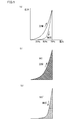
- the hysteresis loss can be simply calculated by data analysis using a personal computer, for example, when a stress strain curve as shown in FIG. 1 is obtained.
- Fiber diameter A sample was cut into a size of 10 cm in the width direction, 10 cm in the length direction, and the thickness of the sample, and 10 linear bodies were collected at a length of about 5 mm at random from the cut cross section in the thickness direction. .
- the collected linear body was focused on a fiber diameter measurement location (location where the fiber diameter was measured) with an optical microscope at an appropriate magnification, and the thickness of the fiber viewed from the fiber side surface (fiber side surface) was measured. Note that the surface of the network structure may be flattened to obtain smoothness, and the fiber cross section (fiber cross section) may be deformed. Therefore, the sample is not collected from a region within 2 mm from the surface of the network structure (the surface of the network structure).
- Thickness Four samples were cut into a size of width 10 cm ⁇ length 10 cm ⁇ sample thickness, and left unloaded for 24 hours. Then, using a circular measuring probe with an area of 15 cm 2 with a polymer instrument FD-80N thickness gauge with the solid cross-section fiber surface side (fiber surface side of the solid cross-section) facing up, one sample for each sample The height of was measured, and the average value of 4 samples was obtained to obtain the thickness.
- polystyrene-based thermoplastic elastomer (S-1) containing isoprene An equivalent amount of methanol was added to the living polymer solution, deactivated, and precipitated in a large amount of methanol to recover a polystyrene-based thermoplastic elastomer (S-1) containing isoprene.
- the polystyrene-based thermoplastic elastomer (S-1) containing isoprene had a styrene content of 30% by mass and a weight average molecular weight of 170,000.
- the “polystyrene-based thermoplastic elastomer (S-1) containing isoprene” means the first triblock copolymer.
- polystyrene-based thermoplastic elastomer (S-2) containing butadiene An equivalent amount of methanol was added to the living polymer solution to deactivate it, and further precipitated in a large amount of methanol, thereby recovering a polystyrene-based thermoplastic elastomer (S-2) containing butadiene.
- the polystyrene-based thermoplastic elastomer (S-2) containing butadiene had a styrene content of 30% by mass and a weight average molecular weight of 270,000.
- the “polystyrene-based thermoplastic elastomer (S-2) containing butadiene” means the second triblock copolymer.
- the shape of the orifice is a solid-formed orifice with an outer diameter of 0.5 mm.
- a nozzle having a staggered arrangement with a pitch of 5.2 mm was used. That is, as for the shape of the nozzle effective surface, the length in the width direction was 100 cm and the length in the thickness direction was 62.4 mm.
- the orifices were solid formed orifices having an outer diameter of 0.5 mm, and the orifices were arranged in a staggered arrangement with a pitch between holes in the width direction of 6 mm and a pitch between holes in the thickness direction of 5.2 mm.
- the obtained mixture of raw materials was discharged in a molten state below the nozzle at a spinning temperature (melting temperature) of 200 ° C. and a single hole discharge rate of 1.5 g / min.
- the configuration below the nozzle was as follows. Cooling water is arranged 21 cm below the nozzle surface, and a 50 mm long thermal insulation tube is provided directly between the nozzle and the cooling water, and a 300 mm wide stainless steel endless net is connected in parallel at intervals of 50 mm opening width.
- the take-up conveyor was arranged so as to partially come out on the water surface. Under the above-described configuration, a three-dimensional network structure was formed while forming a loop by twisting the discharge line shape in the molten state and fusing the contact portion.
- Example 2 Except for weighing 50.0% by mass of the polystyrene-based thermoplastic elastomer (S-1) containing isoprene and 15.0% by mass of the polystyrene-based thermoplastic elastomer (S-2) containing butadiene, A network structure was obtained in the same manner as in Example 1. Each physical property value was obtained in the same manner as in Example 1 for the obtained network structure. The results are summarized in Table 1.
- Example 3 Except that the polystyrene-based thermoplastic elastomer (S-1) containing isoprene was weighed to 38.2% by mass and the polystyrene-based thermoplastic elastomer (S-2) containing butadiene to be 26.8% by mass, A network structure was obtained in the same manner as in Example 1. Each physical property value was obtained in the same manner as in Example 1 for the obtained network structure. The results are summarized in Table 1.
- Example 4 Except for weighing 21.7% by mass of the polystyrene-based thermoplastic elastomer (S-1) containing isoprene and 43.3% by mass of the polystyrene-based thermoplastic elastomer (S-2) containing butadiene, A network structure was obtained in the same manner as in Example 1. Each physical property value was obtained in the same manner as in Example 1 for the obtained network structure. The results are summarized in Table 1.
- Example 1 A network structure was obtained in the same manner as in Example 1 except that the polystyrene-based thermoplastic elastomer (S-1) containing isoprene was weighed to 100 mass%. Each physical property value was obtained in the same manner as in Example 1 for the obtained network structure. The results are summarized in Table 1.
- Example 2 A network structure was obtained in the same manner as in Example 1, except that the polystyrene-based thermoplastic elastomer (S-2) containing butadiene was weighed to 100 mass%. Each physical property value was obtained in the same manner as in Example 1 for the obtained network structure. The results are summarized in Table 1.
- Example 6 15% by mass of a polystyrene-based thermoplastic elastomer (S-2) containing butadiene, soft polypropylene (hardness (measured at 23 ° C. according to ASTM D2240): 61A, MFR (melt mass flow rate) (JIS K7210-1) : Measured at 190 ° C. in accordance with 2014): Example 1 except that 17 g / 10 min) was measured to be 80% by mass and paraffinic process oil (weight average molecular weight: 750) to be 5% by mass. In the same manner, a network structure was obtained. Each physical property value was obtained in the same manner as in Example 1 for the obtained network structure. The results are summarized in Table 1.
- the network structures of Examples 1 to 4 contain 45% by mass or more of polystyrene-based thermoplastic elastomer, the content of styrene is 5% by mass to 40% by mass, The ratio of the second triblock copolymer to the polymer was in the range of 0.25 to 0.75.
- the network structures of Examples 1 to 4 had low resilience because the hysteresis loss was 35% or more, tan ⁇ was 0.3 or more, and the Shore A hardness was 80 or less. Further, the network structures of Examples 1 to 4 have excellent durability because the 40 ° C.
Landscapes
- Textile Engineering (AREA)
- Engineering & Computer Science (AREA)
- Chemical & Material Sciences (AREA)
- Polymers & Plastics (AREA)
- Chemical Kinetics & Catalysis (AREA)
- Medicinal Chemistry (AREA)
- Health & Medical Sciences (AREA)
- Organic Chemistry (AREA)
- Compositions Of Macromolecular Compounds (AREA)
- Nonwoven Fabrics (AREA)
- Artificial Filaments (AREA)
- Mattresses And Other Support Structures For Chairs And Beds (AREA)
- Laminated Bodies (AREA)
Abstract
本発明は、連続線状体からなる三次元ランダムループ接合構造を持つ網状構造体であって、連続線状体は、その45質量%以上の主成分としてポリスチレン系熱可塑性エラストマーを含む樹脂からなる繊維であり、ポリスチレン系熱可塑性エラストマーは、スチレン重合体ブロック-イソプレン重合体ブロック-スチレン重合体ブロックで構成される第1トリブロック共重合体と、スチレン重合体ブロック-ブタジエン重合体ブロック-スチレン重合体ブロック並びにスチレン重合体ブロック-ブタジエンおよびイソプレンの共重合体ブロック-スチレン重合体ブロックの少なくともいずれかで構成される第2トリブロック共重合体との混合物である網状構造体を提供する。
Description
本発明は、オフィスチェア、家具、ソファー、ベッド等の寝具、電車・自動車・二輪車・ベビーカー・チャイルドシート等の車両用座席等に用いられるクッション材、寝袋、敷きマットなどの持ち運びされる機会の多いクッション材、フロアーマット、衝突、挟まれ防止部材等の衝撃吸収用のマット等に好適に使用可能な低反発性、耐久性に優れ、底付き感のない網状構造体に関するものである。
現在、家具、ベッド等の寝具、電車・自動車・二輪車等の車両用座席に用いられるクッション材として、網状構造体が増えつつある。
たとえば、特開2013-076201号公報(特許文献1)は、100~100000デシテックスの連続線状体を曲がりくねらせランダムループを形成し、夫々のループを互いに溶融状態で接触せしめて、接触部の大部分を融着させてなる三次元ランダムループ接合構造体からなる網状構造体であって、該連続線状体がポリエステル系熱可塑性エラストマー10~90質量部、及びポリスチレン系熱可塑性エラストマー90~10質量部を含む樹脂組成物で構成されている網状構造体を開示する。
また、特開2003-012905号公報(特許文献2)は、熱可塑性エラストマーからなる複数のストランドがランダムに曲がりくねり、かつ、互いの接触部を融着させた複数のストランドの集合体からなるクッション体であって、該熱可塑性エラストマーが、次の、100重量部の熱可塑性ポリエステルエラストマー、10~900重量部のオレフィン系および/またはスチレン系熱可塑性エラストマー、および0~100重量部の分子内にエポキシ基またはその誘導体基を有する変性ポリマーの成分からなり、ショアA硬度が50以上90以下の組成物からなるクッション体を開示する。
特開2013-076201号公報(特許文献1)に開示された網状構造体は、低反発性が得られるが、硬度が低く底付き感があるという問題点があり、また、ハード成分量が多いため、圧縮残留応力が大きくなり、耐久性に劣るという問題点がある。
特開2003-012905号公報(特許文献2)に開示されたクッション体は、圧縮残留歪みは小さいが、反発力が高いため、低反発性が得られないという問題点がある。
そこで、本発明は、上記問題点を解決して、低反発性で、耐久性に優れ、底付き感のない網状構造体を提供することを目的とする。
[1]連続線状体からなる三次元ランダムループ接合構造を持つ網状構造体であって、連続線状体は、その45質量%以上の主成分としてポリスチレン系熱可塑性エラストマーを含む樹脂からなる繊維であり、ポリスチレン系熱可塑性エラストマーは、スチレン重合体ブロック-イソプレン重合体ブロック-スチレン重合体ブロックで構成される第1トリブロック共重合体と、スチレン重合体ブロック-ブタジエン重合体ブロック-スチレン重合体ブロック並びにスチレン重合体ブロック-ブタジエンおよびイソプレンの共重合体ブロック-スチレン重合体ブロックの少なくともいずれかで構成される第2トリブロック共重合体との混合物である網状構造体。
[2]スチレンの含有率が5質量%以上45質量%以下である上記[1]に記載の網状構造体。
[3]第1トリブロック共重合体に対する第2トリブロック共重合体の質量比率は、0.25以上2.20以下である上記[1]または[2]に記載の網状構造体。
[4]40℃圧縮残留歪みが40%以下である上記[1]~[3]のいずれかに記載の網状構造体。
[5]圧縮によるヒステリシスロスが35%以上である上記[1]~[4]のいずれかに記載の網状構造体。
[6]圧縮たわみ係数が10以下である上記[1]~[5]のいずれかに記載の網状構造体。
[7]連続線状体の繊維径が0.1mm以上3.0mm以下であり、網状構造体の厚さが5mm以上300mm以下である上記[1]~[6]のいずれかに記載の網状構造体。
[8]樹脂は、動的粘弾性測定装置を用いて測定した25℃でのtanδが0.3以上である上記[1]~[7]のいずれかに記載の網状構造体。
[9]樹脂は、ショアA硬度が40以上である上記[1]~[8]のいずれかに記載の網状構造体。
[10]網状構造体の用途がクッション材、衝撃吸収材、または緩衝材である上記[1]~[9]のいずれかに記載の網状構造体。
[11]クッション材、衝撃吸収材、または緩衝材である上記[1]~[9]のいずれかに記載の網状構造体。
本発明によれば、低反発性で、耐久性に優れ、底付き感のない網状構造体を提供することができる。
本発明のある実施形態にかかる網状構造体は、連続線状体からなる三次元ランダムループ接合構造を持つ網状構造体であって、連続線状体は、その45質量%以上の主成分としてポリスチレン系熱可塑性エラストマーを含む樹脂からなる繊維であり、ポリスチレン系熱可塑性エラストマーは、スチレン重合体ブロック-イソプレン重合体ブロック-スチレン重合体ブロックで構成される第1トリブロック共重合体と、スチレン重合体ブロック-ブタジエン重合体ブロック-スチレン重合体ブロック並びにスチレン重合体ブロック-ブタジエンおよびイソプレンの共重合体ブロック-スチレン重合体ブロックの少なくともいずれかで構成される第2トリブロック共重合体との混合物である。本実施形態の網状構造体は、三次元ランダムループ接合構造を形成する連続線状体が、45質量%以上の主成分としてポリスチレン系熱可塑性エラストマーを含む樹脂からなり、ポリスチレン系熱可塑性エラストマーが第1トリブロック共重合体と第2トリブロック共重合体との混合物であるため、低反発性で、耐久性に優れ、底付き感がない。ここで、「底付き感」とは、例えば、網状構造体の上面から手で負荷をかけたとき、網状構造体が圧縮されて網状構造体の下面に接している床面等の剛性面に、直接手が接しているような感触を意味する。底付き感は、網状構造体の剛性及び反発力が不足している場合等に知覚される。
本実施形態の網状構造体は、連続線状体からなる三次元ランダムループ接合構造を有する。詳しくは、本実施形態の網状構造体は、連続線状体を曲がりくねらせてランダムループが形成されており、夫々のループが互いに溶融状態で接触されることにより接合された三次元ランダムループ接合構造を有する。すなわち、「連続線状体」は、直線状、曲線状、折れ線状その他の線状に連なって形成された物体を意味する。また、「三次元ランダムループ接合構造」とは、1又は複数の連続線状体を曲がりくねらせて、大きさ又は向きが不規則なループ状等の任意の形状を複数形成すると共に、任意の形状を形成した複数の線状体同士が溶融状態で接触することによって少なくとも一部が接合している立体構造をいう。
{連続線状体}
連続線状体は、その45質量%以上、好ましくは55質量%以上、より好ましくは65質量%以上の主成分としてポリスチレン系熱可塑性エラストマーを含む樹脂からなる繊維である。ここで、主成分とは、その樹脂に最も多量に含まれている成分をいう。連続線状体に含まれるポリスチレン系熱可塑性エラストマーの存在は赤外線吸収スペクトルのポリスチレンピークによって確認され、その含有率はGPC(ゲルパーミエーションクロマトグラフィー)により測定する。また、連続線状体に含まれるポリスチレン系熱可塑性エラストマーの含有率の上限は、75質量%以下であってもよい。
連続線状体は、その45質量%以上、好ましくは55質量%以上、より好ましくは65質量%以上の主成分としてポリスチレン系熱可塑性エラストマーを含む樹脂からなる繊維である。ここで、主成分とは、その樹脂に最も多量に含まれている成分をいう。連続線状体に含まれるポリスチレン系熱可塑性エラストマーの存在は赤外線吸収スペクトルのポリスチレンピークによって確認され、その含有率はGPC(ゲルパーミエーションクロマトグラフィー)により測定する。また、連続線状体に含まれるポリスチレン系熱可塑性エラストマーの含有率の上限は、75質量%以下であってもよい。
本実施形態の網状構造体の連続線状体において、スチレンの含有率は、網状構造体の優れた耐久性とともに低反発性を確保する観点から、5質量%以上45質量%以下が好ましく、5質量%以上40質量%以下がより好ましく、7質量%以上40質量%以下が更に好ましく、7質量%以上37質量%以下が更により好ましく、10質量%以上35質量%以下が特により好ましい。スチレンの含有率は、1H-NMRにより測定する。ここで、「スチレンの含有率」とは、網状構造体の質量を基準として、ポリスチレン系熱可塑性エラストマーにおけるスチレンモノマーに由来する繰返し単位の含有割合(質量%)をいう。
{ポリスチレン系熱可塑性エラストマー}
ポリスチレン系熱可塑性エラストマーは、スチレン重合体ブロック-イソプレン重合体ブロック-スチレン重合体ブロックで構成される第1トリブロック共重合体と、スチレン重合体ブロック-ブタジエン重合体ブロック-スチレン重合体ブロック並びにスチレン重合体ブロック-ブタジエンおよびイソプレンの共重合体ブロック-スチレン重合体ブロックの少なくともいずれかで構成される第2トリブロック共重合体との混合物である。本実施形態の熱可塑性エラストマーは、ポリスチレン系熱可塑性エラストマーが第1トリブロック共重合体と第2トリブロック共重合体の混合物であるため、低反発性で、耐久性に優れ、底付き感がないという特性を兼ね備える。
ポリスチレン系熱可塑性エラストマーは、スチレン重合体ブロック-イソプレン重合体ブロック-スチレン重合体ブロックで構成される第1トリブロック共重合体と、スチレン重合体ブロック-ブタジエン重合体ブロック-スチレン重合体ブロック並びにスチレン重合体ブロック-ブタジエンおよびイソプレンの共重合体ブロック-スチレン重合体ブロックの少なくともいずれかで構成される第2トリブロック共重合体との混合物である。本実施形態の熱可塑性エラストマーは、ポリスチレン系熱可塑性エラストマーが第1トリブロック共重合体と第2トリブロック共重合体の混合物であるため、低反発性で、耐久性に優れ、底付き感がないという特性を兼ね備える。
(第1トリブロック共重合体)
第1トリブロック共重合体は、スチレン重合体ブロック-イソプレン重合体ブロック-スチレン重合体ブロックの3つのブロックで構成されるトリブロック共重合体である。第1トリブロック共重合体は、イソプレン重合体ブロックを含んでいることにより、低反発性の網状構造体を形成する。第1トリブロック共重合体の存在およびその含有率は、1H-NMRにより測定される。
第1トリブロック共重合体は、スチレン重合体ブロック-イソプレン重合体ブロック-スチレン重合体ブロックの3つのブロックで構成されるトリブロック共重合体である。第1トリブロック共重合体は、イソプレン重合体ブロックを含んでいることにより、低反発性の網状構造体を形成する。第1トリブロック共重合体の存在およびその含有率は、1H-NMRにより測定される。
第1トリブロック共重合体の製造方法は、特に制限はなく、公知の方法で製造することができる。たとえば、アニオン重合またはカチオン重合などのイオン重合法、シングルサイト重合法、ラジカル重合法のいずれで製造してもよい。アニオン重合法よる場合は、例えば、下記(i)~(iii)の方法が挙げられる。
(i)アルキルリチウム化合物(例えば、n-ブチルリチウム)を重合開始剤として、芳香族ビニル化合物(例えば、スチレンモノマー)、イソプレン、芳香族化合物を逐次重合させる方法。
(ii)アルキルリチウム化合物を重合開始剤として、芳香族ビニル化合物、イソプレンを逐次重合させ、次いでカップリング剤を加えてカップリングする方法。
(iii)ジリチウム化合物を重合開始剤として、イソプレン、次いで芳香族ビニル化合物を逐次重合させる方法。
ここで、上記アニオン重合は、溶媒の存在下で行うのが好ましい。溶媒としては、重合開始剤に対して不活性で、重合反応に悪影響を及ぼさないものであれば特に制限はしない。例えば、ヘキサン、シクロヘキサン、ペプタン、オクタン、デカン、トルエン、ベンゼン、キシレンなどの飽和脂肪族炭化水素又は芳香族炭化水素が挙げられる。
(i)アルキルリチウム化合物(例えば、n-ブチルリチウム)を重合開始剤として、芳香族ビニル化合物(例えば、スチレンモノマー)、イソプレン、芳香族化合物を逐次重合させる方法。
(ii)アルキルリチウム化合物を重合開始剤として、芳香族ビニル化合物、イソプレンを逐次重合させ、次いでカップリング剤を加えてカップリングする方法。
(iii)ジリチウム化合物を重合開始剤として、イソプレン、次いで芳香族ビニル化合物を逐次重合させる方法。
ここで、上記アニオン重合は、溶媒の存在下で行うのが好ましい。溶媒としては、重合開始剤に対して不活性で、重合反応に悪影響を及ぼさないものであれば特に制限はしない。例えば、ヘキサン、シクロヘキサン、ペプタン、オクタン、デカン、トルエン、ベンゼン、キシレンなどの飽和脂肪族炭化水素又は芳香族炭化水素が挙げられる。
また、重合反応は、上記した(i)~(iii)のいずれの方法による場合も、通常0~80℃、好ましくは10~70℃の温度で、より好ましくは10~60℃の温度で、0.5~50時間、好ましくは1~30時間行うことができる。
(第2トリブロック共重合体)
第2トリブロック共重合体は、スチレン重合体ブロック-ブタジエン重合体ブロック-スチレン重合体ブロックの3つのブロックで構成されるトリブロック共重合体並びにスチレン重合体ブロック-ブタジエンおよびイソプレンの共重合体ブロック-スチレン重合体ブロックの3つのブロックで構成されるトリブロック共重合体の少なくともいずれかで構成されるトリブロック共重合体である。第2トリブロック共重合体は、ブタジエン重合体ブロックまたはブタジエンおよびイソプレンの共重合体ブロックを含んでいることにより、耐久性に優れた網状構造体を形成する。第2トリブロック共重合体の存在およびその含有率は、1H-NMRにより測定される。スチレン重合体ブロック-ブタジエンおよびイソプレンの共重合体ブロック-スチレン重合体ブロックで構成されるトリブロック共重合体におけるブタジエンおよびイソプレンの共重合体ブロックにおいて、ブタジエンモノマーに由来する繰返し単位は少なくとも50質量%以上含まれていることが好ましい。なお、スチレン重合体ブロック-ブタジエンおよびイソプレンの共重合体ブロック-スチレン重合体ブロックで構成されるトリブロック共重合体におけるブタジエンおよびイソプレンの共重合体ブロックにおいて、ブタジエンとイソプレンは、夫々ブロックとなって共重合していてもよく、お互いにランダムに共重合していてもよい。
第2トリブロック共重合体は、スチレン重合体ブロック-ブタジエン重合体ブロック-スチレン重合体ブロックの3つのブロックで構成されるトリブロック共重合体並びにスチレン重合体ブロック-ブタジエンおよびイソプレンの共重合体ブロック-スチレン重合体ブロックの3つのブロックで構成されるトリブロック共重合体の少なくともいずれかで構成されるトリブロック共重合体である。第2トリブロック共重合体は、ブタジエン重合体ブロックまたはブタジエンおよびイソプレンの共重合体ブロックを含んでいることにより、耐久性に優れた網状構造体を形成する。第2トリブロック共重合体の存在およびその含有率は、1H-NMRにより測定される。スチレン重合体ブロック-ブタジエンおよびイソプレンの共重合体ブロック-スチレン重合体ブロックで構成されるトリブロック共重合体におけるブタジエンおよびイソプレンの共重合体ブロックにおいて、ブタジエンモノマーに由来する繰返し単位は少なくとも50質量%以上含まれていることが好ましい。なお、スチレン重合体ブロック-ブタジエンおよびイソプレンの共重合体ブロック-スチレン重合体ブロックで構成されるトリブロック共重合体におけるブタジエンおよびイソプレンの共重合体ブロックにおいて、ブタジエンとイソプレンは、夫々ブロックとなって共重合していてもよく、お互いにランダムに共重合していてもよい。
第2トリブロック共重合体の製造方法も、第1トリブロック共重合体と同様の方法で、イソプレンをブタジエン(例えば、1,3-ブタジエンモノマー)あるいはブタジエンおよびイソプレンに変更することで製造することができる。
第1トリブロック共重合体に対する第2トリブロック共重合体の質量比率は、網状構造体の優れた耐久性とともに低反発性を確保する観点から、0.25以上2.20以下が好ましく、0.30以上2.10以下がより好ましく、0.35以上2.00以下がさらに好ましい。
{その他の成分}
本実施形態の網状構造体の連続線状体を形成する樹脂は、ポリスチレン系熱可塑性エラストマーの他に、底付き感をなくす(剛性を上げる)観点から、ポリオレフィン(例えば、ポリプロピレン)、パラフィン系プロセスオイル、水添テルペン樹脂などを含むことができる。
本実施形態の網状構造体の連続線状体を形成する樹脂は、ポリスチレン系熱可塑性エラストマーの他に、底付き感をなくす(剛性を上げる)観点から、ポリオレフィン(例えば、ポリプロピレン)、パラフィン系プロセスオイル、水添テルペン樹脂などを含むことができる。
本実施形態の網状構造体は、優れた耐久性を確保する観点から、その40℃圧縮残留歪みは、40%以下が好ましく、35%以下がより好ましく、30%以下がさらに好ましい。40℃圧縮残留歪みの下限値は特に規定しないが、本実施形態の網状構造体においては、1%以上である。ここで、40℃圧縮残留歪みは、40℃の雰囲気温度中で試料を22時間50%圧縮したときの圧縮前の厚さtbと圧縮後の厚さtaから、(tb-ta)/tb×100により算出する。試料の圧縮前の厚さ及び圧縮後の厚さは、例えば、後述の実施例における「(4)40℃圧縮残留歪み」の欄に記載の方法によって測定することができる。
本実施形態の網状構造体は、低反発性を確保する観点から、圧縮によるヒステリシスロスは、35%以上が好ましく、38%以上がより好ましく、40%以上がさらに好ましい。なお、網状構造体として十分な形状回復速度を有する観点から、圧縮によるヒステリシスロスは、98%以下が好ましく、95%以下がより好ましい。ここで、圧縮によるヒステリシスロスは、圧縮時の応力曲線が示す圧縮エネルギーWCと除圧時の応力曲線が示す圧縮エネルギーWC’から、(WC-WC’)/WC×100により算出する。圧縮エネルギーWC及び圧縮エネルギーWC’は、例えば、後述の実施例における「(5)ヒステリシスロス」の欄に記載の方法によって求めることができる。
本実施形態の網状構造体は、底付き感を感じないようにする観点から、圧縮たわみ係数は、10以下が好ましく、9.9以下がより好ましく、9.8以下がさらに好ましい。圧縮たわみ係数の下限値は、特に規定しないが、本実施形態の網状構造体においては、1.0以上である。ここで、圧縮たわみ係数は、25%圧縮時硬度H25と65%圧縮時硬度H65から、H65/H25により算出する。圧縮たわみ係数は、後述の実施例における「(6)圧縮たわみ係数」の欄に記載の方法によって求めることができる。
本実施形態の網状構造体は、網状構造体として必要な硬度を得るとともにクッション性を得る観点から、連続線状体の繊維径は、0.1mm以上3.0mm以下が好ましく、0.2mm以上2.5mm以下がより好ましく、0.3mm以上2.0mm以下がさらに好ましい。連続線状体の繊維径は、例えば、後述の実施例における「(7)繊維径」の欄に記載の方法によって求めることができる。また、底付き感をなくすとともに製造装置の上限の観点から、網状構造体の厚さは、5mm以上300mm以下が好ましく、7mm以上280mm以下がより好ましく、10mm以上250mm以下がさらに好ましい。網状構造体の厚さは、例えば、後述の実施例における「(8)厚さ」の欄に記載の方法によって求めることができる。
本実施形態の網状構造体は、低反発性を確保する観点から、連続線状体を形成する樹脂の動的粘弾性測定装置を用いて測定した25℃でのtanδが、0.3以上が好ましく、0.4以上がより好ましく、0.5以上がさらに好ましく、0.6以上が特に好ましい。また、網状構造体として十分な形状回復速度を有する観点から、上記tanδが、2.0以下が好ましく、1.8以下がより好ましい。tanδは、例えば、後述の実施例における「(9)tanδ」の欄に記載の方法によって求めることができる。
本実施形態の網状構造体は、底付き感をなくす観点から、連続線状体を形成する樹脂のショアA硬度は、40以上が好ましく、50以上がより好ましく、60以上がさらに好ましい。また、低反発性を確保する観点から、上記ショアA硬度は、80以下が好ましく、70以下がより好ましい。ショアA硬度は、例えば、JIS K6253-3:2012に規定するデュロメーターA硬さの測定法に準拠した方法で求めることができる。
本実施形態の網状構造体は、特に制限なく、様々な形状で成形することが可能であり、例えば、直方体状、シート状の形状が挙げられる。
本実施形態の網状構造体の用途は、クッション材、衝撃吸収材、または緩衝材であることが好ましい。すなわち、本実施形態の網状構造体は、クッション材、衝撃吸収材、または緩衝材であってもよい。
本実施形態の網状構造体は、例えば次のようにして得られる。網状構造体は特開平7-68061号公報等に記載された公知の方法に基づき得られる。例えば、まず複数のオリフィスを持つ多列ノズルから第1トリブロック共重合体と第2トリブロック共重合体との混合物からなるポリスチレン系熱可塑性エラストマーをノズルオリフィスに分配する。その後、該ポリスチレン系熱可塑性エラストマーの融点またはハードセグメントのガラス転移温度より20℃以上200℃未満高い紡糸温度で、該ノズルから下方に向け吐出させ、溶融状態で互いに連続線状体を接触させて融着させ三次元構造を形成する。得られた連続線状体の三次元構造物を引取りコンベアネットで挟み込み、冷却槽中の冷却水で冷却せしめた後、引出し、水切り後または乾燥して、両面または片面が平滑化した網状構造体を得る。片面のみを平滑化させる場合は、傾斜を持つ引取ネット上に吐出させて、溶融状態で互いに接触させて融着させ三次元構造を形成しつつ引取ネット面のみ形態を緩和させつつ冷却するとよい。その後、得られた網状構造体を乾燥処理することもできる。なお、網状構造体の乾燥処理をアニーリング処理としてもよい。
アニーリング処理は、熱風乾燥炉、熱風循環炉などの装置を用いることが出来る。アニーリング温度とアニーリング時間とを所定の範囲にすることが好ましい。アニーリング温度は室温以上であり、50℃以上が好ましく、60℃以上がより好ましく、70℃以上がさらに好ましい。アニーリング温度の上限値は特に規定しないが、融点またはハードセグメントのガラス転移温度よりも10℃以上低いことが好ましい。また、アニーリング処理は、窒素雰囲気下で行うことが好ましい。アニーリング時間は1分以上が好ましく、5分以上がより好ましく、10分以上がさらに好ましく、20分以上が特に好ましい。
以下に、実施例を例示し、本発明を具体的に説明するが、本発明はこれらによって限定されるものではない。実施例中における特性値の測定および評価は下記のように行った。なお、試料の大きさは以下に記載の大きさを標準とするが、試料が不足する場合は可能な大きさの試料サイズを用いて測定を行った。
(1)ポリスチレン系熱可塑性エラストマーの存在およびその含有率
ポリスチレン系熱可塑性エラストマーの存在は赤外線吸収スペクトルにより行ない、その含有率はGPC測定により行なった。測定装置には日立製作所製ゲルパーミエーションクロマトグラフ「L-7000シリーズ」、カラムにはTSKgel G4000HXL×2本(東ソー株式会社製)を用い、溶媒にはテトラヒドロフランを使用した。流量:1ml/分、濃度:20mg/10ml(試料/テトロヒドロフラン)、カラム温度:40℃の条件で測定を行なった。テトラヒドロフランに溶解したポリスチレン系熱可塑性エラストマーとその他成分のピーク面積比を求め、テトラヒドロフラン溶解成分中のポリスチレン系熱可塑性エラストマーの比率をAwt%とする。テトラヒドロフラン不溶成分をBmgとし、含有率=A(1-B/20)より算出した。
ポリスチレン系熱可塑性エラストマーの存在は赤外線吸収スペクトルにより行ない、その含有率はGPC測定により行なった。測定装置には日立製作所製ゲルパーミエーションクロマトグラフ「L-7000シリーズ」、カラムにはTSKgel G4000HXL×2本(東ソー株式会社製)を用い、溶媒にはテトラヒドロフランを使用した。流量:1ml/分、濃度:20mg/10ml(試料/テトロヒドロフラン)、カラム温度:40℃の条件で測定を行なった。テトラヒドロフランに溶解したポリスチレン系熱可塑性エラストマーとその他成分のピーク面積比を求め、テトラヒドロフラン溶解成分中のポリスチレン系熱可塑性エラストマーの比率をAwt%とする。テトラヒドロフラン不溶成分をBmgとし、含有率=A(1-B/20)より算出した。
(2)スチレンの存在およびその含有率
網状構造体中のスチレンの存在およびその含有率の測定は、スチレンの含有率の決定は共鳴周波数500MHzの1H-NMR測定により行なった。測定装置にはBRUKER製AVANCE500を用い、溶媒には、質量の基準物質としてイソフタル酸ジメチルを添加した重テトラクロロエタンを使用した。その溶媒に試料を135℃で溶解し、120℃で測定を行った。繰り返し時間は十分にとった。上記の方法に従い測定を実施し、以下の方法でスチレンの含有率を算出した。
網状構造体中のスチレンの存在およびその含有率の測定は、スチレンの含有率の決定は共鳴周波数500MHzの1H-NMR測定により行なった。測定装置にはBRUKER製AVANCE500を用い、溶媒には、質量の基準物質としてイソフタル酸ジメチルを添加した重テトラクロロエタンを使用した。その溶媒に試料を135℃で溶解し、120℃で測定を行った。繰り返し時間は十分にとった。上記の方法に従い測定を実施し、以下の方法でスチレンの含有率を算出した。
得られた1H-NMRスペクトルにおいて、テトラクロロエタンを6ppmとした際に6.4~7.3ppmのピークがスチレンに対応するピークであった。解析にはそのピーク積分値(=Aとした)を用いた。一方、イソフタル酸ジメチルは8.7(1H)、8.35(2H)、7.6(1H)、4.0ppm(6H)付近にピークが観測されたが、その内、試料構成成分と重ならないピークの積分値を用いた。仮に7.6ppmのピーク積分値(=Bとした)を使用して、以下の式
(20.8×A×Y×100)/(194×B×X) (試料に対する質量%)
(ここで、試料量をX(mg)、測定溶液中に含まれるイソフタル酸ジメチルの質量をY(mg))により、スチレンの含有率を算出した。
(20.8×A×Y×100)/(194×B×X) (試料に対する質量%)
(ここで、試料量をX(mg)、測定溶液中に含まれるイソフタル酸ジメチルの質量をY(mg))により、スチレンの含有率を算出した。
(3)第1トリブロック共重合体に対する第2トリブロック共重合体の質量比率
上記のGPC測定において得られたピークの成分分取を行ない、各ピーク成分について1H-NMRスペクトルを測定した。イソプレンまたはイソプレンとブタジエンの混合物由来の3,4-結合(4.8ppm)および1,2-結合(5.8ppm)のピークと1,4-結合(5.3ppm)のピークとの比から、3,4-結合および1,2-結合の含有量(含有比率)を算出した。この3,4-結合および1,2-結合の含有量(含有比率)が、第1トリブロック共重合体では45%以上であり、第2トリブロック共重合体では45%未満であることから、各ピーク成分を第1トリブロック共重合体と第2トリブロック共重合体とに帰属させた。得られたGPCチャートにおいて、第1トリブロック共重合体および第2トリブロック共重合体のそれぞれに帰属された各ピーク成分の面積比により、第1トリブロック共重合体に対する第2トリブロック共重合体の質量比率を算出した。
上記のGPC測定において得られたピークの成分分取を行ない、各ピーク成分について1H-NMRスペクトルを測定した。イソプレンまたはイソプレンとブタジエンの混合物由来の3,4-結合(4.8ppm)および1,2-結合(5.8ppm)のピークと1,4-結合(5.3ppm)のピークとの比から、3,4-結合および1,2-結合の含有量(含有比率)を算出した。この3,4-結合および1,2-結合の含有量(含有比率)が、第1トリブロック共重合体では45%以上であり、第2トリブロック共重合体では45%未満であることから、各ピーク成分を第1トリブロック共重合体と第2トリブロック共重合体とに帰属させた。得られたGPCチャートにおいて、第1トリブロック共重合体および第2トリブロック共重合体のそれぞれに帰属された各ピーク成分の面積比により、第1トリブロック共重合体に対する第2トリブロック共重合体の質量比率を算出した。
(4)40℃圧縮残留歪み
試料を10cm×10cm×試料厚さの大きさに切断し、圧縮前厚さtbを測定したサンプルを50%圧縮状態に保持できる冶具に挟み、40±2℃に設定した乾燥機に入れ、22時間放置した。その後サンプルを取り出し、圧縮歪みを除き、室温(25℃)で冷却して30分放置後の圧縮後厚さtaを求め、式(tb-ta)/tb×100より40℃圧縮残留歪みを算出した:単位%(n=3の平均値)。ここで、圧縮前厚さtbおよび圧縮後厚さtaは、圧縮前および圧縮後の各サンプル1か所の高さを測定しその平均値を厚さとした。
試料を10cm×10cm×試料厚さの大きさに切断し、圧縮前厚さtbを測定したサンプルを50%圧縮状態に保持できる冶具に挟み、40±2℃に設定した乾燥機に入れ、22時間放置した。その後サンプルを取り出し、圧縮歪みを除き、室温(25℃)で冷却して30分放置後の圧縮後厚さtaを求め、式(tb-ta)/tb×100より40℃圧縮残留歪みを算出した:単位%(n=3の平均値)。ここで、圧縮前厚さtbおよび圧縮後厚さtaは、圧縮前および圧縮後の各サンプル1か所の高さを測定しその平均値を厚さとした。
(5)ヒステリシスロス
試料を10cm×10cm×試料厚さの大きさに切断し、23℃±2℃の環境下に無荷重で24時間放置した後、23℃±2℃の環境下にある万能試験機(インストロンジャパンカンパニーリミテッド製インストロン万能試験機)にてφ50mm、厚み3mmの加圧板をサンプルが中心になるようにサンプルを配置させ、試料の中心部を10mm/minの速度で圧縮を開始し、万能試験機で荷重が0.3N±0.05Nと検出された時の厚みを計測し、硬度計厚さとした。この時の加圧板の位置をゼロ点として、速度100mm/minで硬度計厚みの75%まで圧縮し、ホールドタイム無しで同一速度にて加圧板をゼロ点まで戻し、その状態で4分間保持した(1回目の応力歪み曲線)。4分間ゼロ点で保持した後、速度100mm/minで硬度計厚さの75%まで圧縮し、ホールドタイム無しで同一速度にてゼロ点まで戻した(2回目の応力歪み曲線)。
試料を10cm×10cm×試料厚さの大きさに切断し、23℃±2℃の環境下に無荷重で24時間放置した後、23℃±2℃の環境下にある万能試験機(インストロンジャパンカンパニーリミテッド製インストロン万能試験機)にてφ50mm、厚み3mmの加圧板をサンプルが中心になるようにサンプルを配置させ、試料の中心部を10mm/minの速度で圧縮を開始し、万能試験機で荷重が0.3N±0.05Nと検出された時の厚みを計測し、硬度計厚さとした。この時の加圧板の位置をゼロ点として、速度100mm/minで硬度計厚みの75%まで圧縮し、ホールドタイム無しで同一速度にて加圧板をゼロ点まで戻し、その状態で4分間保持した(1回目の応力歪み曲線)。4分間ゼロ点で保持した後、速度100mm/minで硬度計厚さの75%まで圧縮し、ホールドタイム無しで同一速度にてゼロ点まで戻した(2回目の応力歪み曲線)。
図1を参照して、図1(a)の2回目の応力歪み曲線において、図1(b)の2回目の圧縮時応力歪み曲線の示す圧縮エネルギー(WC)、図1(c)の2回目の除圧時応力歪み曲線の示す圧縮エネルギー(WC’)とし、下記式
ヒステリシスロス(%)=(WC-WC’)/WC×100:単位%
WC=∫PdT(0%から75%まで圧縮したときの仕事量)
WC’=∫PdT(75%から0%まで除圧したときの仕事量)
に従ってヒステリシスロスを求めた。
ヒステリシスロス(%)=(WC-WC’)/WC×100:単位%
WC=∫PdT(0%から75%まで圧縮したときの仕事量)
WC’=∫PdT(75%から0%まで除圧したときの仕事量)
に従ってヒステリシスロスを求めた。
上記ヒステリシスロスは、簡易的には、例えば図1のような応力歪み曲線が得られたら、パソコンによるデータ解析によって算出することができる。また、斜線部分の面積をWCとし、網掛け部分の面積をWC’として、その面積の差を切り抜いた部分の重さから求めることもできる(n=3の平均値)。
(6)圧縮たわみ係数
試料を10cm×10cm×試料厚さの大きさに切断し、23℃±2℃の環境下に無荷重で24時間放置した後、23℃±2℃の環境下にある万能試験機(インストロンジャパンカンパニーリミテッド製インストロン万能試験機)にてφ50mm、厚み3mmの加圧板をサンプル中心になるようにサンプルを配置させ、試料の中心部を10mm/minの速度で圧縮を開始し、万能試験機で荷重が0.3N±0.05Nと検出された時の厚みを計測し、硬度計厚さとした。この時の加圧板の位置をゼロ点として、速度100mm/minで硬度計厚みの75%まで圧縮した後、速度100mm/minにて加圧板をゼロ点まで戻し、その状態で4分間保持する。4分経過後、引き続き速度100mm/minで硬度計厚みの25%および65%まで圧縮し、その際の荷重を測定し、各々25%圧縮時硬度H25、65%圧縮時硬度H65とした:単位N/φ50(n=3の平均値)。こうして得られた25%圧縮時硬度H25および65%圧縮時硬度H65を用いて、圧縮たわみ係数を、以下式
(圧縮たわみ係数)=H65/H25:(n=3の平均値)
により算出した。
試料を10cm×10cm×試料厚さの大きさに切断し、23℃±2℃の環境下に無荷重で24時間放置した後、23℃±2℃の環境下にある万能試験機(インストロンジャパンカンパニーリミテッド製インストロン万能試験機)にてφ50mm、厚み3mmの加圧板をサンプル中心になるようにサンプルを配置させ、試料の中心部を10mm/minの速度で圧縮を開始し、万能試験機で荷重が0.3N±0.05Nと検出された時の厚みを計測し、硬度計厚さとした。この時の加圧板の位置をゼロ点として、速度100mm/minで硬度計厚みの75%まで圧縮した後、速度100mm/minにて加圧板をゼロ点まで戻し、その状態で4分間保持する。4分経過後、引き続き速度100mm/minで硬度計厚みの25%および65%まで圧縮し、その際の荷重を測定し、各々25%圧縮時硬度H25、65%圧縮時硬度H65とした:単位N/φ50(n=3の平均値)。こうして得られた25%圧縮時硬度H25および65%圧縮時硬度H65を用いて、圧縮たわみ係数を、以下式
(圧縮たわみ係数)=H65/H25:(n=3の平均値)
により算出した。
(7)繊維径
試料を幅方向10cm×長さ方向10cm×試料厚さの大きさに切断し、切断断面から厚さ方向にランダムに10本の線状体を約5mmの長さで採集した。採集した線状体を、光学顕微鏡を適切な倍率で繊維径測定箇所(繊維径を測定する箇所)にピントを合わせて繊維側面(繊維の側面)から見た繊維の太さを測定した。なお、網状構造体の表面は平滑性を得るためにフラット化されていて、繊維断面(繊維の断面)が変形している場合がある。そのため、網状構造体表面(網状構造体の表面)から2mm以内の領域から試料は採取しないこととした。
試料を幅方向10cm×長さ方向10cm×試料厚さの大きさに切断し、切断断面から厚さ方向にランダムに10本の線状体を約5mmの長さで採集した。採集した線状体を、光学顕微鏡を適切な倍率で繊維径測定箇所(繊維径を測定する箇所)にピントを合わせて繊維側面(繊維の側面)から見た繊維の太さを測定した。なお、網状構造体の表面は平滑性を得るためにフラット化されていて、繊維断面(繊維の断面)が変形している場合がある。そのため、網状構造体表面(網状構造体の表面)から2mm以内の領域から試料は採取しないこととした。
(8)厚さ
試料を幅方向10cm×長さ方向10cm×試料厚さの大きさに4サンプル切り出し、無荷重で24時間放置した。その後、中実断面繊維面側(中実断面の繊維面側)を上にして高分子計器製FD-80N型測厚器にて面積15cm2の円形測定子を使用し、各サンプル1か所の高さを測定して4サンプルの平均値を求め厚さとした。
試料を幅方向10cm×長さ方向10cm×試料厚さの大きさに4サンプル切り出し、無荷重で24時間放置した。その後、中実断面繊維面側(中実断面の繊維面側)を上にして高分子計器製FD-80N型測厚器にて面積15cm2の円形測定子を使用し、各サンプル1か所の高さを測定して4サンプルの平均値を求め厚さとした。
(9)tanδ
試料を設定温度230℃にヒートプレスによって厚さ300μmのシート試料に成形し、シート試料を長さ23mm×幅5mmに切り出した。動的粘弾性測定装置(UBM社製Rheogel-E-4000)を用い、切り出したシート試料の長辺の両端各4mm部分を引張治具で固定し、30Hz、昇温速度2℃/minで測定して23℃におけるtanδ(貯蔵弾性率E’に対する損失弾性率E’’の比E’’/E’)値を得た。
試料を設定温度230℃にヒートプレスによって厚さ300μmのシート試料に成形し、シート試料を長さ23mm×幅5mmに切り出した。動的粘弾性測定装置(UBM社製Rheogel-E-4000)を用い、切り出したシート試料の長辺の両端各4mm部分を引張治具で固定し、30Hz、昇温速度2℃/minで測定して23℃におけるtanδ(貯蔵弾性率E’に対する損失弾性率E’’の比E’’/E’)値を得た。
(10)ショアA硬度
JIS K6253-3:2012に規定するデュロメーターA硬さの測定法に準拠して硬度を測定した。
JIS K6253-3:2012に規定するデュロメーターA硬さの測定法に準拠して硬度を測定した。
(合成例1)
5リットルのオートクレーブ中にシクロヘキサン1800g、スチレンモノマー30gとn-ブチルリチウム0.32gとを加え、60℃で1時間重合し、次いでイソプレンモノマーを162g加えて、60℃で1時間重合した。最後にスチレンモノマー30gを添加し、60℃で1時間重合した。このリビング重合体溶液に等量のメタノールを添加し、失活させ、さらに多量のメタノール中に析出させることにより、イソプレンを含むポリスチレン系熱可塑性エラストマー(S-1)を回収した。得られたイソプレンを含むポリスチレン系熱可塑性エラストマー(S-1)のスチレンの含有量は30質量%で、重量平均分子量は170,000であった。ここで、「イソプレンを含むポリスチレン系熱可塑性エラストマー(S-1)」とは、第1トリブロック共重合体のことを意味する。
5リットルのオートクレーブ中にシクロヘキサン1800g、スチレンモノマー30gとn-ブチルリチウム0.32gとを加え、60℃で1時間重合し、次いでイソプレンモノマーを162g加えて、60℃で1時間重合した。最後にスチレンモノマー30gを添加し、60℃で1時間重合した。このリビング重合体溶液に等量のメタノールを添加し、失活させ、さらに多量のメタノール中に析出させることにより、イソプレンを含むポリスチレン系熱可塑性エラストマー(S-1)を回収した。得られたイソプレンを含むポリスチレン系熱可塑性エラストマー(S-1)のスチレンの含有量は30質量%で、重量平均分子量は170,000であった。ここで、「イソプレンを含むポリスチレン系熱可塑性エラストマー(S-1)」とは、第1トリブロック共重合体のことを意味する。
(合成例2)
5リットルのオートクレーブ中にシクロヘキサン1800g、スチレンモノマー67.5gとn-ブチルリチウム0.5gを加え、60℃で1時間重合し、次いで1.3-ブタジエンモノマーを315g加えて60℃で1時間重合した。最後にスチレンモノマー67.5gを添加し、60℃で1時間重合した。このリビング重合体溶液に等量のメタノールを添加し、失活させ、さらに多量のメタノール中に析出させることにより、ブタジエンを含むポリスチレン系熱可塑性エラストマー(S-2)を回収した。得られたブタジエンを含むポリスチレン系熱可塑性エラストマー(S-2)のスチレンの含有量は30質量%で、重量平均分子量は270,000であった。ここで、「ブタジエンを含むポリスチレン系熱可塑性エラストマー(S-2)」とは、第2トリブロック共重合体のことを意味する。
5リットルのオートクレーブ中にシクロヘキサン1800g、スチレンモノマー67.5gとn-ブチルリチウム0.5gを加え、60℃で1時間重合し、次いで1.3-ブタジエンモノマーを315g加えて60℃で1時間重合した。最後にスチレンモノマー67.5gを添加し、60℃で1時間重合した。このリビング重合体溶液に等量のメタノールを添加し、失活させ、さらに多量のメタノール中に析出させることにより、ブタジエンを含むポリスチレン系熱可塑性エラストマー(S-2)を回収した。得られたブタジエンを含むポリスチレン系熱可塑性エラストマー(S-2)のスチレンの含有量は30質量%で、重量平均分子量は270,000であった。ここで、「ブタジエンを含むポリスチレン系熱可塑性エラストマー(S-2)」とは、第2トリブロック共重合体のことを意味する。
(実施例1)
幅方向の長さ100cm、厚さ方向の長さ62.4mmのノズル有効面にオリフィスの形状は、外径0.5mmの中実形成オリフィスを幅方向孔間ピッチ6mm、厚さ方向の孔間ピッチ5.2mmの千鳥配列としたノズルを用いた。すなわち、ノズル有効面の形状は、幅方向の長さが100cmであり厚さ方向の長さが62.4mmであった。また、オリフィスは外径0.5mmの中実形成オリフィスであり、オリフィスの配列は幅方向の孔間ピッチが6mmであり厚さ方向の孔間ピッチが5.2mmである千鳥配列であった。イソプレンを含むポリスチレン系熱可塑性エラストマー(S-1)を43.3質量%と、ブタジエンを含むポリスチレン系熱可塑性エラストマー(S-2)を21.7質量%と、パラフィン系プロセスオイル(重量平均分子量:750)を20質量%と、水添テルペン樹脂(軟化点:150℃)を5質量%と、ポリプロピレン(引張弾性率:2000MPa、MFR(メルトマスフローレイト)(JIS K7210-1:2014に準拠して230℃で測定):45g/10min)を10質量%となるように計量し、ペレット状態でよく混合して原料として用いた。得られた原料の混合物を溶融状態で、紡糸温度(溶融温度)200℃、単孔吐出量1.5g/minの速度でノズル下方に吐出させた。ここで、ノズル下方の構成は以下の通りであった。ノズル面21cm下に冷却水を配し、ノズルと冷却水の間でノズル直下に50mmの長さの保温筒を有し、幅300mmのステンレス製エンドレスネットを平行に開口幅50mm間隔で一対の引取りコンベアを水面上に一部出るように配していた。上述の構成のもとで、該溶融状態の吐出線状を曲がりくねらせル-プを形成して接触部分を融着させつつ3次元網状構造を形成した。得られた該溶融状態の網状構造体の両面を引取りコンベアで挟み込みつつ毎分1.0mの速度で冷却水中へ引込み固化させ両面をフラット化した。その後、所定の大きさに切断して70℃熱風にて30分間アニーリング処理して、網状構造体を得た。得られた網状構造体について、上記(1)~(10)に従ってそれぞれの物性値を得た。結果を表1にまとめた。
幅方向の長さ100cm、厚さ方向の長さ62.4mmのノズル有効面にオリフィスの形状は、外径0.5mmの中実形成オリフィスを幅方向孔間ピッチ6mm、厚さ方向の孔間ピッチ5.2mmの千鳥配列としたノズルを用いた。すなわち、ノズル有効面の形状は、幅方向の長さが100cmであり厚さ方向の長さが62.4mmであった。また、オリフィスは外径0.5mmの中実形成オリフィスであり、オリフィスの配列は幅方向の孔間ピッチが6mmであり厚さ方向の孔間ピッチが5.2mmである千鳥配列であった。イソプレンを含むポリスチレン系熱可塑性エラストマー(S-1)を43.3質量%と、ブタジエンを含むポリスチレン系熱可塑性エラストマー(S-2)を21.7質量%と、パラフィン系プロセスオイル(重量平均分子量:750)を20質量%と、水添テルペン樹脂(軟化点:150℃)を5質量%と、ポリプロピレン(引張弾性率:2000MPa、MFR(メルトマスフローレイト)(JIS K7210-1:2014に準拠して230℃で測定):45g/10min)を10質量%となるように計量し、ペレット状態でよく混合して原料として用いた。得られた原料の混合物を溶融状態で、紡糸温度(溶融温度)200℃、単孔吐出量1.5g/minの速度でノズル下方に吐出させた。ここで、ノズル下方の構成は以下の通りであった。ノズル面21cm下に冷却水を配し、ノズルと冷却水の間でノズル直下に50mmの長さの保温筒を有し、幅300mmのステンレス製エンドレスネットを平行に開口幅50mm間隔で一対の引取りコンベアを水面上に一部出るように配していた。上述の構成のもとで、該溶融状態の吐出線状を曲がりくねらせル-プを形成して接触部分を融着させつつ3次元網状構造を形成した。得られた該溶融状態の網状構造体の両面を引取りコンベアで挟み込みつつ毎分1.0mの速度で冷却水中へ引込み固化させ両面をフラット化した。その後、所定の大きさに切断して70℃熱風にて30分間アニーリング処理して、網状構造体を得た。得られた網状構造体について、上記(1)~(10)に従ってそれぞれの物性値を得た。結果を表1にまとめた。
(実施例2)
イソプレンを含むポリスチレン系熱可塑性エラストマー(S-1)を50.0質量%と、ブタジエンを含むポリスチレン系熱可塑性エラストマー(S-2)を15.0質量%となるように計量したこと以外は、実施例1と同じようにして、網状構造体を得た。得られた網状構造体について、実施例1と同じようにして各物性値を得た。結果を表1にまとめた。
イソプレンを含むポリスチレン系熱可塑性エラストマー(S-1)を50.0質量%と、ブタジエンを含むポリスチレン系熱可塑性エラストマー(S-2)を15.0質量%となるように計量したこと以外は、実施例1と同じようにして、網状構造体を得た。得られた網状構造体について、実施例1と同じようにして各物性値を得た。結果を表1にまとめた。
(実施例3)
イソプレンを含むポリスチレン系熱可塑性エラストマー(S-1)を38.2質量%と、ブタジエンを含むポリスチレン系熱可塑性エラストマー(S-2)を26.8質量%となるように計量したこと以外は、実施例1と同じようにして、網状構造体を得た。得られた網状構造体について、実施例1と同じようにして各物性値を得た。結果を表1にまとめた。
イソプレンを含むポリスチレン系熱可塑性エラストマー(S-1)を38.2質量%と、ブタジエンを含むポリスチレン系熱可塑性エラストマー(S-2)を26.8質量%となるように計量したこと以外は、実施例1と同じようにして、網状構造体を得た。得られた網状構造体について、実施例1と同じようにして各物性値を得た。結果を表1にまとめた。
(実施例4)
イソプレンを含むポリスチレン系熱可塑性エラストマー(S-1)を21.7質量%と、ブタジエンを含むポリスチレン系熱可塑性エラストマー(S-2)を43.3質量%となるように計量したこと以外は、実施例1と同じようにして、網状構造体を得た。得られた網状構造体について、実施例1と同じようにして各物性値を得た。結果を表1にまとめた。
イソプレンを含むポリスチレン系熱可塑性エラストマー(S-1)を21.7質量%と、ブタジエンを含むポリスチレン系熱可塑性エラストマー(S-2)を43.3質量%となるように計量したこと以外は、実施例1と同じようにして、網状構造体を得た。得られた網状構造体について、実施例1と同じようにして各物性値を得た。結果を表1にまとめた。
(比較例1)
イソプレンを含むポリスチレン系熱可塑性エラストマー(S-1)を100質量%となるように計量したこと以外は、実施例1と同じようにして、網状構造体を得た。得られた網状構造体について、実施例1と同じようにして各物性値を得た。結果を表1にまとめた。
イソプレンを含むポリスチレン系熱可塑性エラストマー(S-1)を100質量%となるように計量したこと以外は、実施例1と同じようにして、網状構造体を得た。得られた網状構造体について、実施例1と同じようにして各物性値を得た。結果を表1にまとめた。
(比較例2)
ブタジエンを含むポリスチレン系熱可塑性エラストマー(S-2)を100質量%となるように計量したこと以外は、実施例1と同じようにして、網状構造体を得た。得られた網状構造体について、実施例1と同じようにして各物性値を得た。結果を表1にまとめた。
ブタジエンを含むポリスチレン系熱可塑性エラストマー(S-2)を100質量%となるように計量したこと以外は、実施例1と同じようにして、網状構造体を得た。得られた網状構造体について、実施例1と同じようにして各物性値を得た。結果を表1にまとめた。
(比較例3)
ブタジエンを含むポリスチレン系熱可塑性エラストマー(S-2)を20質量%、軟質ポリプロピレン(硬さ(ASTM D2240に準拠して、23℃で測定):61A、MFR(メルトマスフローレイト)(JIS K7210-1:2014に準拠して190℃で測定):17g/10min)を80質量%となるように計量したこと以外は、実施例1と同じようにして、網状構造体を得た。得られた網状構造体について、実施例1と同じようにして各物性値を得た。結果を表1にまとめた。
ブタジエンを含むポリスチレン系熱可塑性エラストマー(S-2)を20質量%、軟質ポリプロピレン(硬さ(ASTM D2240に準拠して、23℃で測定):61A、MFR(メルトマスフローレイト)(JIS K7210-1:2014に準拠して190℃で測定):17g/10min)を80質量%となるように計量したこと以外は、実施例1と同じようにして、網状構造体を得た。得られた網状構造体について、実施例1と同じようにして各物性値を得た。結果を表1にまとめた。
(比較例4)
イソプレンを含むポリスチレン系熱可塑性エラストマー(S-1)を65質量%と、パラフィン系プロセスオイル(重量平均分子量:750)を20質量%と、水添テルペン樹脂(軟化点:150℃)を5質量%と、ポリプロピレン(引張弾性率:2000MPa、MFR(メルトマスフローレイト)(JIS K7210-1:2014に準拠して230℃で測定):45g/10min)を10質量%となるように計量したこと以外は、実施例1と同じようにして、網状構造体を得た。得られた網状構造体について、実施例1と同じようにして各物性値を得た。結果を表1にまとめた。
イソプレンを含むポリスチレン系熱可塑性エラストマー(S-1)を65質量%と、パラフィン系プロセスオイル(重量平均分子量:750)を20質量%と、水添テルペン樹脂(軟化点:150℃)を5質量%と、ポリプロピレン(引張弾性率:2000MPa、MFR(メルトマスフローレイト)(JIS K7210-1:2014に準拠して230℃で測定):45g/10min)を10質量%となるように計量したこと以外は、実施例1と同じようにして、網状構造体を得た。得られた網状構造体について、実施例1と同じようにして各物性値を得た。結果を表1にまとめた。
(比較例5)
ブタジエンを含むポリスチレン系熱可塑性エラストマー(S-2)を75質量%と、パラフィン系プロセスオイル(重量平均分子量:750)を10質量%と、水添テルペン樹脂(軟化点:150℃)を5質量%と、ポリプロピレン(引張弾性率:2000MPa、MFR(メルトマスフローレイト)(JIS K7210-1:2014に準拠して230℃で測定):45g/10min)を10質量%となるように計量したこと以外は、実施例1と同じようにして、網状構造体を得た。得られた網状構造体について、実施例1と同じようにして各物性値を得た。結果を表1にまとめた。
ブタジエンを含むポリスチレン系熱可塑性エラストマー(S-2)を75質量%と、パラフィン系プロセスオイル(重量平均分子量:750)を10質量%と、水添テルペン樹脂(軟化点:150℃)を5質量%と、ポリプロピレン(引張弾性率:2000MPa、MFR(メルトマスフローレイト)(JIS K7210-1:2014に準拠して230℃で測定):45g/10min)を10質量%となるように計量したこと以外は、実施例1と同じようにして、網状構造体を得た。得られた網状構造体について、実施例1と同じようにして各物性値を得た。結果を表1にまとめた。
(比較例6)
ブタジエンを含むポリスチレン系熱可塑性エラストマー(S-2)を15質量%、軟質ポリプロピレン(硬さ(ASTM D2240に準拠して、23℃で測定):61A、MFR(メルトマスフローレイト)(JIS K7210-1:2014に準拠して190℃で測定):17g/10min)を80質量%と、パラフィン系プロセスオイル(重量平均分子量:750)を5質量%となるように計量したこと以外は、実施例1と同じようにして、網状構造体を得た。得られた網状構造体について、実施例1と同じようにして各物性値を得た。結果を表1にまとめた。
ブタジエンを含むポリスチレン系熱可塑性エラストマー(S-2)を15質量%、軟質ポリプロピレン(硬さ(ASTM D2240に準拠して、23℃で測定):61A、MFR(メルトマスフローレイト)(JIS K7210-1:2014に準拠して190℃で測定):17g/10min)を80質量%と、パラフィン系プロセスオイル(重量平均分子量:750)を5質量%となるように計量したこと以外は、実施例1と同じようにして、網状構造体を得た。得られた網状構造体について、実施例1と同じようにして各物性値を得た。結果を表1にまとめた。
(比較例7)
イソプレンを含むポリスチレン系熱可塑性エラストマー(S-1)を66.7質量%と、ブタジエンを含むポリスチレン系熱可塑性エラストマー(S-2)を13.3質量%と、パラフィン系プロセスオイル(重量平均分子量:750)を10質量%と、水添テルペン樹脂(軟化点:150℃)を5質量%と、ポリプロピレン(引張弾性率:2000MPa、MFR(メルトマスフローレイト)(JIS K7210-1:2014に準拠して230℃で測定):45g/10min)を5質量%となるように計量したこと以外は、実施例1と同じようにして、網状構造体を得た。得られた網状構造体について、実施例1と同じようにして各物性値を得た。結果を表1にまとめた。
イソプレンを含むポリスチレン系熱可塑性エラストマー(S-1)を66.7質量%と、ブタジエンを含むポリスチレン系熱可塑性エラストマー(S-2)を13.3質量%と、パラフィン系プロセスオイル(重量平均分子量:750)を10質量%と、水添テルペン樹脂(軟化点:150℃)を5質量%と、ポリプロピレン(引張弾性率:2000MPa、MFR(メルトマスフローレイト)(JIS K7210-1:2014に準拠して230℃で測定):45g/10min)を5質量%となるように計量したこと以外は、実施例1と同じようにして、網状構造体を得た。得られた網状構造体について、実施例1と同じようにして各物性値を得た。結果を表1にまとめた。
(比較例8)
イソプレンを含むポリスチレン系熱可塑性エラストマー(S-1)を22.9質量%と、ブタジエンを含むポリスチレン系熱可塑性エラストマー(S-2)を57.1質量%と、パラフィン系プロセスオイル(重量平均分子量:750)を10質量%と、水添テルペン樹脂(軟化点:150℃)を5質量%と、ポリプロピレン(引張弾性率:2000MPa、MFR(メルトマスフローレイト)(JIS K7210-1:2014に準拠して230℃で測定):45g/10min)を5質量%となるように計量したこと以外は、実施例1と同じようにして、網状構造体を得た。得られた網状構造体について、実施例1と同じようにして各物性値を得た。結果を表1にまとめた。
イソプレンを含むポリスチレン系熱可塑性エラストマー(S-1)を22.9質量%と、ブタジエンを含むポリスチレン系熱可塑性エラストマー(S-2)を57.1質量%と、パラフィン系プロセスオイル(重量平均分子量:750)を10質量%と、水添テルペン樹脂(軟化点:150℃)を5質量%と、ポリプロピレン(引張弾性率:2000MPa、MFR(メルトマスフローレイト)(JIS K7210-1:2014に準拠して230℃で測定):45g/10min)を5質量%となるように計量したこと以外は、実施例1と同じようにして、網状構造体を得た。得られた網状構造体について、実施例1と同じようにして各物性値を得た。結果を表1にまとめた。

表1を参照すると、実施例1~4の網状構造体においては、ポリスチレン系熱可塑性エラストマーを45質量%以上含有し、スチレンの含有率が5質量%以上40質量%以下、第1トリブロック共重合体に対する第2トリブロック共重合体の比率が0.25以上0.75以下の範囲内であった。このような構成を有することにより、実施例1~4の網状構造体はヒステリシスロスが35%以上、tanδが0.3以上およびショアA硬度が80以下であるため低反発性であった。また、実施例1~4の網状構造体は40℃圧縮残留歪みが40%以下であるため耐久性に優れ、圧縮たわみ係数が10以下、厚さが5mm以上およびショアA硬度が40以上であるため底付き感がなかった。比較例1の網状構造体においては、第2トリブロック共重合体が含まれていないことから、ショアA硬度が80より大きいため低反発性とは言えず、40℃圧縮残留歪みが40より大きいため耐久性に劣っていた。比較例2の網状構造体においては、第1トリブロック共重合体が含まれていないことから、ヒステリシスロスが35%より小さくかつtanδが0.3より小さいため低反発性ではなく、圧縮たわみ係数が10より大きいため底付き感があった。比較例3の網状構造体においては、スチレンの含有率が5質量%未満かつ第1トリブロック共重合体が含まれていないことから、tanδが0.3より小さくかつショアA硬度が80より大きいため低反発性ではなく、40℃圧縮残留歪みが40より大きいため耐久性に劣っていた。
今回開示された実施の形態および実施例はすべての点で例示であって制限的なものではないと考えられるべきである。本発明の範囲は上記した説明ではなくて請求の範囲によって示され、請求の範囲と均等の意味および範囲内でのすべての変更が含まれることが意図される。
Claims (10)
- 連続線状体からなる三次元ランダムループ接合構造を持つ網状構造体であって、
前記連続線状体は、その45質量%以上の主成分としてポリスチレン系熱可塑性エラストマーを含む樹脂からなる繊維であり、
前記ポリスチレン系熱可塑性エラストマーは、スチレン重合体ブロック-イソプレン重合体ブロック-スチレン重合体ブロックで構成される第1トリブロック共重合体と、スチレン重合体ブロック-ブタジエン重合体ブロック-スチレン重合体ブロック並びにスチレン重合体ブロック-ブタジエンおよびイソプレンの共重合体ブロック-スチレン重合体ブロックの少なくともいずれかで構成される第2トリブロック共重合体との混合物である網状構造体。 - スチレンの含有率が5質量%以上45質量%以下である請求項1に記載の網状構造体。
- 前記第1トリブロック共重合体に対する前記第2トリブロック共重合体の質量比率は、0.25以上2.20以下である請求項1または2に記載の網状構造体。
- 40℃圧縮残留歪みが40%以下である請求項1~3のいずれか1項に記載の網状構造体。
- 圧縮によるヒステリシスロスが35%以上である請求項1~4のいずれか1項に記載の網状構造体。
- 圧縮たわみ係数が10以下である請求項1~5のいずれか1項に記載の網状構造体。
- 前記連続線状体の繊維径が0.1mm以上3.0mm以下であり、前記網状構造体の厚さが5mm以上300mm以下である請求項1~6のいずれか1項に記載の網状構造体。
- 前記樹脂は、動的粘弾性測定装置を用いて測定した25℃でのtanδが0.3以上である請求項1~7のいずれか1項に記載の網状構造体。
- 前記樹脂は、ショアA硬度が40以上である請求項1~8のいずれか1項に記載の網状構造体。
- 前記網状構造体の用途がクッション材、衝撃吸収材、または緩衝材である請求項1~9のいずれか1項に記載の網状構造体。
Priority Applications (4)
| Application Number | Priority Date | Filing Date | Title |
|---|---|---|---|
| MYPI2019000273A MY186706A (en) | 2016-07-13 | 2017-07-11 | Net-like structure |
| DE112017003545.7T DE112017003545T5 (de) | 2016-07-13 | 2017-07-11 | Netzartige Struktur |
| CN201780042798.8A CN109477268B (zh) | 2016-07-13 | 2017-07-11 | 网状结构体 |
| KR1020197003399A KR102288664B1 (ko) | 2016-07-13 | 2017-07-11 | 망상 구조체 |
Applications Claiming Priority (2)
| Application Number | Priority Date | Filing Date | Title |
|---|---|---|---|
| JP2016138427 | 2016-07-13 | ||
| JP2016-138427 | 2016-07-13 |
Publications (1)
| Publication Number | Publication Date |
|---|---|
| WO2018012502A1 true WO2018012502A1 (ja) | 2018-01-18 |
Family
ID=60952973
Family Applications (1)
| Application Number | Title | Priority Date | Filing Date |
|---|---|---|---|
| PCT/JP2017/025290 Ceased WO2018012502A1 (ja) | 2016-07-13 | 2017-07-11 | 網状構造体 |
Country Status (7)
| Country | Link |
|---|---|
| JP (1) | JP6718848B2 (ja) |
| KR (1) | KR102288664B1 (ja) |
| CN (1) | CN109477268B (ja) |
| DE (1) | DE112017003545T5 (ja) |
| MY (1) | MY186706A (ja) |
| TW (1) | TWI720225B (ja) |
| WO (1) | WO2018012502A1 (ja) |
Cited By (2)
| Publication number | Priority date | Publication date | Assignee | Title |
|---|---|---|---|---|
| TWI720710B (zh) * | 2018-11-29 | 2021-03-01 | 日商東洋紡股份有限公司 | 網狀結構體 |
| WO2025220586A1 (ja) * | 2024-04-19 | 2025-10-23 | 株式会社クラレ | シートおよび防音材 |
Families Citing this family (3)
| Publication number | Priority date | Publication date | Assignee | Title |
|---|---|---|---|---|
| US11359087B2 (en) | 2017-03-30 | 2022-06-14 | Kuraray Plastics Co., Ltd. | Structure comprising low-resilience elastic member and high-resilience elastic member |
| JP7259469B2 (ja) * | 2019-03-26 | 2023-04-18 | 東洋紡株式会社 | ゲル中に3次元構造を含む複合体 |
| JP7499642B2 (ja) * | 2020-08-25 | 2024-06-14 | 東レ・モノフィラメント株式会社 | ラケット用ストリング |
Citations (6)
| Publication number | Priority date | Publication date | Assignee | Title |
|---|---|---|---|---|
| JP2003012905A (ja) * | 2001-07-03 | 2003-01-15 | Asahi Kasei Corp | クッション体 |
| JP2011074272A (ja) * | 2009-09-30 | 2011-04-14 | Nippon Zeon Co Ltd | 弾性フィラメント用組成物、弾性フィラメントおよび伸縮性シート |
| JP2013076199A (ja) * | 2011-09-16 | 2013-04-25 | Toyobo Co Ltd | 静粛性と硬さに優れた弾性網状構造体 |
| JP2014506282A (ja) * | 2010-12-30 | 2014-03-13 | クレイトン・ポリマーズ・ユー・エス・エル・エル・シー | 弾性フィルム/ファイバ配合物 |
| JP2016141915A (ja) * | 2015-02-04 | 2016-08-08 | 東洋紡株式会社 | 低反発性に優れた網状構造体 |
| WO2016125766A1 (ja) * | 2015-02-04 | 2016-08-11 | 東洋紡株式会社 | 低反発性に優れた網状構造体 |
Family Cites Families (14)
| Publication number | Priority date | Publication date | Assignee | Title |
|---|---|---|---|---|
| JPH0579175A (ja) * | 1991-09-13 | 1993-03-30 | Nippon Steel Chem Co Ltd | 固形物を内包する不織布 |
| JP2921638B2 (ja) | 1993-02-26 | 1999-07-19 | 東洋紡績株式会社 | クッション用網状構造体及び製法 |
| JP3430446B2 (ja) * | 1994-02-25 | 2003-07-28 | 東洋紡績株式会社 | 複合弾性網状体とその製法及びそれを用いた製品 |
| US5741380A (en) * | 1996-02-13 | 1998-04-21 | Cumulus Fibres, Inc. | Multi-density batt |
| JP3604117B2 (ja) * | 1997-03-06 | 2004-12-22 | 株式会社クラレ | 熱可塑性重合体組成物 |
| US6203889B1 (en) * | 1998-07-30 | 2001-03-20 | Kimberly-Clark Worldwide, Inc. | Nonwoven webs having zoned migration of internal additives |
| US6362389B1 (en) * | 1998-11-20 | 2002-03-26 | Kimberly-Clark Worldwide, Inc. | Elastic absorbent structures |
| US8551355B2 (en) * | 2008-08-02 | 2013-10-08 | Georgia-Pacific Chemicals Llc | Dedusting agents for fiberglass products and methods for making and using same |
| CN102146590B (zh) * | 2010-02-04 | 2013-08-07 | 三芳化学工业股份有限公司 | 含弹性体的复合纤维及其制法、含该纤维的基材及其制法 |
| EP2444536A1 (de) * | 2010-08-30 | 2012-04-25 | Wirth Fulda GmbH | Vliesstofflaminat |
| JP5978674B2 (ja) | 2011-09-16 | 2016-08-24 | 東洋紡株式会社 | 振動吸収性の高い弾性網状構造体 |
| US20130225020A1 (en) * | 2012-02-24 | 2013-08-29 | Kraton Polymers Us Llc | High flow, hydrogenated styrene-butadiene-styrene block copolymer and applications |
| TWI597232B (zh) * | 2012-05-07 | 2017-09-01 | 東洋紡股份有限公司 | 消音性與硬度優異之彈性網狀構造體 |
| JP5459436B1 (ja) * | 2013-04-26 | 2014-04-02 | 東洋紡株式会社 | 熱寸法安定性に優れた網状構造体 |
-
2017
- 2017-07-11 WO PCT/JP2017/025290 patent/WO2018012502A1/ja not_active Ceased
- 2017-07-11 DE DE112017003545.7T patent/DE112017003545T5/de active Pending
- 2017-07-11 KR KR1020197003399A patent/KR102288664B1/ko active Active
- 2017-07-11 CN CN201780042798.8A patent/CN109477268B/zh active Active
- 2017-07-11 MY MYPI2019000273A patent/MY186706A/en unknown
- 2017-07-12 TW TW106123356A patent/TWI720225B/zh active
- 2017-07-13 JP JP2017137084A patent/JP6718848B2/ja active Active
Patent Citations (6)
| Publication number | Priority date | Publication date | Assignee | Title |
|---|---|---|---|---|
| JP2003012905A (ja) * | 2001-07-03 | 2003-01-15 | Asahi Kasei Corp | クッション体 |
| JP2011074272A (ja) * | 2009-09-30 | 2011-04-14 | Nippon Zeon Co Ltd | 弾性フィラメント用組成物、弾性フィラメントおよび伸縮性シート |
| JP2014506282A (ja) * | 2010-12-30 | 2014-03-13 | クレイトン・ポリマーズ・ユー・エス・エル・エル・シー | 弾性フィルム/ファイバ配合物 |
| JP2013076199A (ja) * | 2011-09-16 | 2013-04-25 | Toyobo Co Ltd | 静粛性と硬さに優れた弾性網状構造体 |
| JP2016141915A (ja) * | 2015-02-04 | 2016-08-08 | 東洋紡株式会社 | 低反発性に優れた網状構造体 |
| WO2016125766A1 (ja) * | 2015-02-04 | 2016-08-11 | 東洋紡株式会社 | 低反発性に優れた網状構造体 |
Cited By (3)
| Publication number | Priority date | Publication date | Assignee | Title |
|---|---|---|---|---|
| TWI720710B (zh) * | 2018-11-29 | 2021-03-01 | 日商東洋紡股份有限公司 | 網狀結構體 |
| US12054864B2 (en) | 2018-11-29 | 2024-08-06 | Toyobo Mc Corporation | Network structure |
| WO2025220586A1 (ja) * | 2024-04-19 | 2025-10-23 | 株式会社クラレ | シートおよび防音材 |
Also Published As
| Publication number | Publication date |
|---|---|
| JP2018016932A (ja) | 2018-02-01 |
| DE112017003545T5 (de) | 2019-04-11 |
| TW201821662A (zh) | 2018-06-16 |
| TWI720225B (zh) | 2021-03-01 |
| MY186706A (en) | 2021-08-11 |
| CN109477268A (zh) | 2019-03-15 |
| JP6718848B2 (ja) | 2020-07-08 |
| KR20190028459A (ko) | 2019-03-18 |
| CN109477268B (zh) | 2021-12-28 |
| KR102288664B1 (ko) | 2021-08-11 |
Similar Documents
| Publication | Publication Date | Title |
|---|---|---|
| JP6718848B2 (ja) | 網状構造体 | |
| KR102468540B1 (ko) | 저반발성이 우수한 망상 구조체 | |
| KR102615358B1 (ko) | 수소 첨가 블록 공중합체 | |
| CA2875448C (en) | Hydrogenated block copolymer and method for producing same | |
| JP6311918B2 (ja) | 圧縮耐久性に優れた網状構造体 | |
| CN113166995A (zh) | 网状结构体 | |
| JP6311919B2 (ja) | 圧縮耐久性に優れた網状構造体 | |
| JP6318643B2 (ja) | 圧縮耐久性に優れた網状構造体 | |
| KR20160075534A (ko) | 압축 내구성이 우수한 망상 구조체 | |
| WO2015064557A1 (ja) | 圧縮耐久性に優れた網状構造体 | |
| WO2016175293A9 (ja) | 網状構造体 | |
| WO2016093334A1 (ja) | 耐熱耐久性に優れた網状構造体 | |
| JP6153378B2 (ja) | 熱可塑性エラストマー不織布 | |
| JP3475225B2 (ja) | バインダー用芯鞘型複合繊維 | |
| JP6911344B2 (ja) | 熱可塑性エラストマー樹脂組成物 | |
| JP6350578B2 (ja) | 網状構造体 | |
| JP2017078238A (ja) | 立体網状構造体および繊維製品 |
Legal Events
| Date | Code | Title | Description |
|---|---|---|---|
| 121 | Ep: the epo has been informed by wipo that ep was designated in this application |
Ref document number: 17827629 Country of ref document: EP Kind code of ref document: A1 |
|
| ENP | Entry into the national phase |
Ref document number: 20197003399 Country of ref document: KR Kind code of ref document: A |
|
| 122 | Ep: pct application non-entry in european phase |
Ref document number: 17827629 Country of ref document: EP Kind code of ref document: A1 |