WO2018003973A1 - 油性固形化粧料または外用剤用のプレミックス剤、油性固形化粧料または外用剤、およびその製造方法 - Google Patents
油性固形化粧料または外用剤用のプレミックス剤、油性固形化粧料または外用剤、およびその製造方法 Download PDFInfo
- Publication number
- WO2018003973A1 WO2018003973A1 PCT/JP2017/024145 JP2017024145W WO2018003973A1 WO 2018003973 A1 WO2018003973 A1 WO 2018003973A1 JP 2017024145 W JP2017024145 W JP 2017024145W WO 2018003973 A1 WO2018003973 A1 WO 2018003973A1
- Authority
- WO
- WIPO (PCT)
- Prior art keywords
- oily solid
- solid cosmetic
- external preparation
- premix
- iob
- Prior art date
- Legal status (The legal status is an assumption and is not a legal conclusion. Google has not performed a legal analysis and makes no representation as to the accuracy of the status listed.)
- Ceased
Links
Classifications
-
- A—HUMAN NECESSITIES
- A61—MEDICAL OR VETERINARY SCIENCE; HYGIENE
- A61K—PREPARATIONS FOR MEDICAL, DENTAL OR TOILETRY PURPOSES
- A61K8/00—Cosmetics or similar toiletry preparations
- A61K8/18—Cosmetics or similar toiletry preparations characterised by the composition
- A61K8/30—Cosmetics or similar toiletry preparations characterised by the composition containing organic compounds
- A61K8/33—Cosmetics or similar toiletry preparations characterised by the composition containing organic compounds containing oxygen
- A61K8/34—Alcohols
-
- A—HUMAN NECESSITIES
- A61—MEDICAL OR VETERINARY SCIENCE; HYGIENE
- A61K—PREPARATIONS FOR MEDICAL, DENTAL OR TOILETRY PURPOSES
- A61K8/00—Cosmetics or similar toiletry preparations
- A61K8/18—Cosmetics or similar toiletry preparations characterised by the composition
- A61K8/30—Cosmetics or similar toiletry preparations characterised by the composition containing organic compounds
- A61K8/33—Cosmetics or similar toiletry preparations characterised by the composition containing organic compounds containing oxygen
- A61K8/37—Esters of carboxylic acids
-
- A—HUMAN NECESSITIES
- A61—MEDICAL OR VETERINARY SCIENCE; HYGIENE
- A61K—PREPARATIONS FOR MEDICAL, DENTAL OR TOILETRY PURPOSES
- A61K8/00—Cosmetics or similar toiletry preparations
- A61K8/18—Cosmetics or similar toiletry preparations characterised by the composition
- A61K8/30—Cosmetics or similar toiletry preparations characterised by the composition containing organic compounds
- A61K8/40—Cosmetics or similar toiletry preparations characterised by the composition containing organic compounds containing nitrogen
- A61K8/44—Aminocarboxylic acids or derivatives thereof, e.g. aminocarboxylic acids containing sulfur; Salts; Esters or N-acylated derivatives thereof
-
- A—HUMAN NECESSITIES
- A61—MEDICAL OR VETERINARY SCIENCE; HYGIENE
- A61Q—SPECIFIC USE OF COSMETICS OR SIMILAR TOILETRY PREPARATIONS
- A61Q1/00—Make-up preparations; Body powders; Preparations for removing make-up
- A61Q1/12—Face or body powders for grooming, adorning or absorbing
-
- A—HUMAN NECESSITIES
- A61—MEDICAL OR VETERINARY SCIENCE; HYGIENE
- A61Q—SPECIFIC USE OF COSMETICS OR SIMILAR TOILETRY PREPARATIONS
- A61Q1/00—Make-up preparations; Body powders; Preparations for removing make-up
- A61Q1/14—Preparations for removing make-up
-
- A—HUMAN NECESSITIES
- A61—MEDICAL OR VETERINARY SCIENCE; HYGIENE
- A61Q—SPECIFIC USE OF COSMETICS OR SIMILAR TOILETRY PREPARATIONS
- A61Q17/00—Barrier preparations; Preparations brought into direct contact with the skin for affording protection against external influences, e.g. sunlight, X-rays or other harmful rays, corrosive materials, bacteria or insect stings
- A61Q17/04—Topical preparations for affording protection against sunlight or other radiation; Topical sun tanning preparations
-
- A—HUMAN NECESSITIES
- A61—MEDICAL OR VETERINARY SCIENCE; HYGIENE
- A61Q—SPECIFIC USE OF COSMETICS OR SIMILAR TOILETRY PREPARATIONS
- A61Q5/00—Preparations for care of the hair
- A61Q5/06—Preparations for styling the hair, e.g. by temporary shaping or colouring
Definitions
- the present invention relates to a premix agent for an oily solid cosmetic or an external preparation, an oily solid cosmetic or an external preparation, and a method for producing the same.
- oil-based solid cosmetics or oil-based solid external preparations are waxes such as microcrystalline wax, paraffin wax, ceresin wax, candelilla wax, polyethylene wax, jojoba oil and the like.
- solid hydrocarbons, or mixtures thereof, or polyamide resins condensates of aromatic aldehydes such as 12-hydroxystearic acid and polyhydric alcohols, dextrin fatty acid esters, N-2-ethylhexanoyl-L-glutamic acid It is prepared by gelling a liquid oily base with an oil gelling agent such as dibutylamide.
- oily solid cosmetics or external preparations prepared with these oil gelling agents that do not dissolve in water have a problem that a so-called “sweat phenomenon” occurs in which the gelled oily base oozes from the surface of the gel due to aging. Had.
- the sweating phenomenon of lip cosmetics can be achieved by including two or more ester oils having a viscosity at 25 ° C. of 60 mPaS or less, such as cetyl 2-ethylhexanoate and glyceryl tri-2-ethylhexanoate.
- ester oils having a viscosity at 25 ° C. of 60 mPaS or less
- cetyl 2-ethylhexanoate and glyceryl tri-2-ethylhexanoate.
- Non-animal plant waxes and non-hydrocarbon oil gelling agents can be used by combining one or more of N-2-ethylhexanoyl-L-glutamic acid dibutylamide and N-lauroyl-L-glutamic acid dibutylamide. Although it has been reported that high gel strength and transparency can be realized (see, for example, Patent Document 3), there is still room for improvement with respect to suppression of the sweating phenomenon.
- amino acid derivatives such as N-2-ethylhexanoyl-L-glutamic acid dibutylamide have a high dissolution temperature in a general oily base of 150 to 180 ° C., and this is used as an oil gelling agent for oily solid cosmetics. Or, when trying to mix evenly into an external preparation, it was necessary to dissolve by heating under a very high temperature condition of 150 ° C. or higher. For this reason, the problem in use that other compounding components deteriorate or inactivate due to the influence of heat has also occurred.
- amino acid derivatives represented by N-2-ethylhexanoyl-L-glutamic acid dibutylamide can be dissolved at 95 ° C. by using a specific type of organic solvent such as behenyl alcohol, octyldodecanol, etc.
- organic solvent such as behenyl alcohol, octyldodecanol, etc.
- a two-stage production method for homogenization by dissolving in an organic solvent and then mixing with another base has been reported.
- the object of the present invention is to gel an oily base using an amino acid derivative typified by N-2-ethylhexanoyl-L-glutamic acid dibutylamide without heating and dissolving under a high temperature condition of 95 ° C. or higher. It is an object of the present invention to provide a premix agent for oily solid cosmetics or external preparations that can suppress the occurrence of sweating when used as oily solid cosmetics or external preparations.
- an object of the present invention is to provide an oily solid cosmetic or an external preparation in which deterioration or inactivation of the compounding components is suppressed and occurrence of a sweating phenomenon is suppressed, and a method for producing the same.
- the present invention provides (a) the following formula (1): (1) (Wherein R 1 and R 2 each independently represent a hydrocarbon group having 1 to 26 carbon atoms, R 3 represents a hydrocarbon group having 3 to 15 carbon atoms, and n represents 1 or 2) At least one amino acid derivative represented by: (D) a nonionic surfactant having an IOB of 0.3 to 1.0, and (e) a polyhydric alcohol, Is a premix agent for oily solid cosmetics or external preparations.
- the (a) amino acid derivative is at least one selected from N-2-ethyl-hexanoylglutamic acid dibutylamide and N-lauroylglutamic acid dibutylamide. Is preferred.
- the nonionic surfactant of (d) IOB 0.3 to 1.0 is glyceryl monoisostearate, sorbitan isostearate, propylene glycol monolaurate and monoisostearic acid It is preferably at least one selected from propylene glycol.
- the (e) polyhydric alcohol is at least one selected from propylene glycol and butylene glycol.
- the oily solid cosmetic or the premix agent for external use can be dissolved at less than 95 ° C.
- the present invention also provides: (a) the following formula (1) (1) (Wherein R 1 and R 2 each independently represent a hydrocarbon group having 1 to 26 carbon atoms, R 3 represents a hydrocarbon group having 3 to 15 carbon atoms, and n represents 1 or 2) At least one amino acid derivative represented by: (D) a nonionic surfactant having an IOB of 0.3 to 1.0, (E) a polyhydric alcohol, (B) a nonionic surfactant having an IOB of 0.7 to 1.7, and (c) water, Is an oily solid cosmetic or an external preparation.
- formula (1) wherein R 1 and R 2 each independently represent a hydrocarbon group having 1 to 26 carbon atoms, R 3 represents a hydrocarbon group having 3 to 15 carbon atoms, and n represents 1 or 2) At least one amino acid derivative represented by: (D) a nonionic surfactant having an IOB of 0.3 to 1.0, (E) a polyhydric alcohol, (B) a nonionic surfactant having an IOB of
- the nonionic surfactant of (b) IOB 0.7 to 1.7 is PEG-30 glyceryl triisostearate, polyglyceryl-10 diisostearate, monoglyceryl fatty acid polyglyceryl-10 and It is preferably at least one selected from mono coconut oil fatty acid polyglyceryl-3.
- the oily solid cosmetic or the external preparation can be dissolved at less than 95 ° C.
- the present invention provides (a) the following formula (1): (1) (Wherein R 1 and R 2 each independently represent a hydrocarbon group having 1 to 26 carbon atoms, R 3 represents a hydrocarbon group having 3 to 15 carbon atoms, and n represents 1 or 2) At least one amino acid derivative represented by: (D) a nonionic surfactant having an IOB of 0.3 to 1.0, and (e) a polyhydric alcohol, It is a manufacturing method of oily solid cosmetics or an external preparation including the premix process which mixes in advance and obtains a premix agent.
- the method for producing the oily solid cosmetic or the external preparation preferably includes a mixing step of mixing the premix agent, (b) a nonionic surfactant having an IOB of 0.7 to 1.7, and (c) water.
- At least the premix agent, (b) a nonionic surfactant of IOB 0.7 to 1.7, and (c) water are mixed. It is preferable to dissolve at less than 95 ° C.
- amino acid derivatives represented by N-2-ethylhexanoyl-L-glutamic acid dibutylamide are nonionic surfactants having a IOB of 0.3 to 1.0 and polyhydric alcohols.
- the oily base can be gelled under a relatively mild temperature condition to obtain an oily solid cosmetic or an external preparation, which suppresses the occurrence of sweating and suppresses the deterioration or inactivation of the blended components.
- a premix agent obtained by previously dissolving an amino acid derivative represented by N-2-ethylhexanoyl-L-glutamic acid dibutylamide with a nonionic surfactant of IOB 0.3 to 1.0 and a polyhydric alcohol was used.
- the pre-mixing agent for oily solid cosmetics or external preparations according to the embodiment of the present invention, (A) The following formula (1): (1) (Wherein R 1 and R 2 each independently represent a hydrocarbon group having 1 to 26 carbon atoms, R 3 represents a hydrocarbon group having 3 to 15 carbon atoms, and n represents 1 or 2) At least one amino acid derivative represented by: (D) a nonionic surfactant having an IOB of 0.3 to 1.0, and (e) a polyhydric alcohol, It contains.
- (f) water is further contained in the premix agent of this oily solid cosmetic or external preparation. Furthermore, the premix temperature at the time of obtaining a premix agent can be lowered
- the oily solid cosmetic or the external preparation according to the embodiment of the present invention, (A) The following formula (1): (1) (Wherein R 1 and R 2 each independently represent a hydrocarbon group having 1 to 26 carbon atoms, R 3 represents a hydrocarbon group having 3 to 15 carbon atoms, and n represents 1 or 2) At least one amino acid derivative represented by: (D) a nonionic surfactant having an IOB of 0.3 to 1.0, and (e) a polyhydric alcohol, A premix containing (B) a nonionic surfactant having an IOB of 0.7 to 1.7, and (c) water, It contains.
- the method for producing an oily solid cosmetic or an external preparation according to an embodiment of the present invention, (A) The following formula (1): (1) (Wherein R 1 and R 2 each independently represent a hydrocarbon group having 1 to 26 carbon atoms, R 3 represents a hydrocarbon group having 3 to 15 carbon atoms, and n represents 1 or 2) At least one amino acid derivative represented by: (D) a nonionic surfactant having an IOB of 0.3 to 1.0, and (e) a polyhydric alcohol, A premix step of premixing to obtain a premix agent, the premix agent obtained in the premix step, (b) a nonionic surfactant having an IOB of 0.7 to 1.7, and (c) It is preferable to include a mixing step of mixing water.
- the premix step in the method for producing the oily solid cosmetic or the external preparation (a) an amino acid derivative, (d) a nonionic surfactant having an IOB of 0.3 to 1.0, (e) a polyhydric alcohol and ( f) It is preferable to obtain a premix agent by mixing water.
- the premix temperature in the premix agent step can be further lowered by further mixing (f) water.
- amino acid derivative represented by the above formula (1) Before mixing the amino acid derivative represented by the above formula (1) with the components (b) and (c), (d) a nonionic surfactant of IOB 0.3 to 1.0 and (e )
- a nonionic surfactant of IOB 0.3 to 1.0 By dissolving polyhydric alcohol in advance (premix), amino acid derivatives typified by N-2-ethylhexanoyl-L-glutamic acid dibutylamide are not dissolved by heating under high temperature conditions such as 95 ° C. or higher.
- the oily base is gelled at about 90 ° C. and can be mixed almost uniformly into the oily solid cosmetic or the external preparation.
- an oily solid cosmetic containing a gelling agent of an oily base containing a specific amino acid derivative typified by N-2-ethylhexanoyl-L-glutamic acid dibutylamide is used.
- the production method of the preparation or external preparation can be simplified, and an oily solid cosmetic or external preparation that achieves both high gel strength and transparency and suppression of sweating can be obtained.
- R 1 and R 2 each independently represents a hydrocarbon group having 1 to 26 carbon atoms.
- the hydrocarbon group represented by R 1 and R 2 may be linear, branched, cyclic, or a combination thereof.
- a hydrocarbon group containing an unsaturated bond can be used, but an alkyl group which is a saturated hydrocarbon group is more preferably used.
- a linear or branched alkyl group having 1 to 10 carbon atoms, more preferably 2 to 6 carbon atoms can be used, and a linear or branched group having 3 to 5 carbon atoms is more preferable.
- a branched alkyl group Most preferably, an n-butyl group can be used.
- R 3 represents a hydrocarbon group having 3 to 15 carbon atoms.
- the hydrocarbon group represented by R 3 may be linear, branched, cyclic, or a combination thereof.
- a hydrocarbon group containing an unsaturated bond can be used, but an alkyl group which is a saturated hydrocarbon group is more preferably used.
- the alkyl group is preferably a linear or branched alkyl group. More preferably, R 3 represents a linear or branched alkyl group having 7 to 11 carbon atoms.
- examples of the group represented by R 3 —CO— include, for example, an n-octanoyl group, an n-nonanoyl group, an n-decanoyl group, an n-undecanoyl group, Examples thereof include n-lauroyl group and 2-ethylhexanoyl group.
- octanoyl group, decanoyl group, lauroyl group and 2-ethylhexanoyl group are preferable, and high gelation with respect to various oily bases.
- a lauroyl group and a 2-ethylhexanoyl group are most preferable from the viewpoint of performance.
- n is preferably 2.
- the acidic amino acid residue in the molecule is an L-aspartic acid residue when n is 1, and an L-glutamic acid residue when n is 2 Indicates.
- the compound represented by the above formula (1) may have one or more asymmetric carbons depending on at least one kind of R 1 , R 2 and R 3. Stereoisomers such as isomers or diastereomers, mixtures of arbitrary stereoisomers, and racemates may be used. Further, when at least one of R 1 , R 2 and R 3 has an olefinic double bond, the arrangement thereof may be Z or E, and may be a geometric isomer or a mixture of arbitrary geometric isomers. There may be. Furthermore, any hydrate of the amino acid derivative represented by the above formula (1) and crystals in any form may be used. As the amino acid derivative represented by the above formula (1), any substance such as the isomer described above, a mixture thereof, or a hydrate can be used.
- amino acid derivative represented by the above formula (1) include N-octanoyl-L-glutamic acid dibutylamide, N-decanoyl-glutamic acid dibutylamide, and N-lauroyl-L-glutamic acid dibutylamide.
- N-lauroyl-L-glutamic acid dibutylamide and N-2-ethyl-hexanoyl-L-glutamic acid dibutylamide can be preferably used.
- the amino acid derivative represented by the above formula (1) can be obtained by reacting, for example, a long-chain fatty acid halide with L-glutamic acid or L-aspartic acid in a Schotten-Baumann reaction under a basic catalyst. -Acylated glutamic acid or N-acylated aspartic acid can be produced, and then an amine derivative such as alkylamine can be produced by heating in the presence or absence of an acid catalyst.
- glutamic acid or aspartic acid is reacted with an amine derivative such as alkylamine in the presence or absence of an acid catalyst, and the resulting glutamic acid amide or aspartic acid amide is further reacted with an acylating agent such as a fatty acid halide. It can be produced by N-acylation with an amine derivative such as alkylamine in the presence or absence of an acid catalyst, and the resulting glutamic acid amide or aspartic acid amide is further reacted with an acylating agent such as a fatty acid halide. It can be produced by N-acylation with an amine derivative such as alkylamine in the presence or absence of an acid catalyst, and the resulting glutamic acid amide or aspartic acid amide is further reacted with an acylating agent such as a fatty acid halide. It can be produced by N-acylation with an amine derivative such as alkylamine in the presence or absence of an acid catalyst, and the resulting glutamic acid amide
- the oily solid cosmetic or external preparation according to this embodiment may be blended with (a) one or more selected from amino acid derivatives represented by the above formula (1).
- (A) The amount of the amino acid derivative is not particularly limited as long as the oily base can be gelled, and is usually 0.1 to 30 parts by mass with respect to 100 parts by mass of the oily solid cosmetic or the external preparation. The amount is preferably about 1 to 25 parts by mass.
- N-2-ethyl-hexanoyl-L-glutamic acid dibutylamide and N-lauroyl-L-glutamic acid dibutylamide can be produced by the above-mentioned method, and commercially available products from Ajinomoto Co., Inc. Names “EB-21” and “GP-1”).
- a gelling agent of one or more oily bases other than the amino acid derivative represented by the above formula (1) may be used in combination.
- oily base gelling agent examples include polyamide resin, 12-hydroxystearic acid, sodium stearate, dibenzylidene-D-sorbitol, dextrin fatty acid ester and the like.
- the blending amount of the gelling agent of the oily base used together is, for example, about 0.1 to 10 parts by mass with respect to 100 parts by mass of the oily solid cosmetic or the external preparation.
- the oily solid cosmetic or external preparation according to the present embodiment preferably contains (b) a nonionic surfactant having an IOB of 0.7 to 1.7 and is in the range of IOB 1 to 1.6.
- a nonionic surfactant examples include polyglyceryl diisostearate-10, monococonut oil fatty acid glyceryl-3, monococonut oil fatty acid glyceryl-10, and polyglyceryl-10 dioleate.
- ethylene oxide addition type nonionic surfactants such as PEG-30 hydrogenated castor oil and isostearic acid, and one or two or more of them can be used in combination.
- the amount of the nonionic surfactant of (b) IOB 0.7 to 1.7 contained in the oily solid cosmetic or external preparation according to this embodiment exhibits the function of the oily solid cosmetic or external preparation.
- the amount is not particularly limited and is 1 to 50 parts by weight, preferably 1 to 40 parts by weight, based on 100 parts by weight of the oily solid cosmetic or the external preparation.
- the IOB Inorganic Organic Balance
- IOB Organic Organic Balance
- the amount of (c) water is not particularly limited as long as it is an amount that can suppress the transparency and sweating phenomenon of the oily solid cosmetic or external preparation.
- the amount that can ensure transparency is usually about 0.1 to 20 parts by mass, preferably about 1 to 10 parts by mass with respect to 100 parts by mass of the oily solid cosmetic or the external preparation.
- an amino acid derivative represented by the above formula (1) is converted into (d) a nonionic surfactant having an IOB of 0.3 to 1.0 and (e ) Premixed with polyhydric alcohol in advance.
- a nonionic surfactant having an IOB of 0.3 to 1.0 and (e ) Premixed with polyhydric alcohol in advance.
- the IOB 0.3 to 1.0 nonionic surfactant has not only the action of dissolving the amino acid derivative (a) but also the ability to suppress sweating of oily solid cosmetics or external preparations.
- Nonionic surfactants include glyceryl monoisostearate, sorbitan isostearate, sorbitan oleate, propylene glycol monolaurate, propylene glycol monoisostearate, polyglyceryl-2 isostearate, diisostearic acid
- Polyglyceryl-2 or the like is preferably in a liquid state at 25 ° C.
- glycols such as ethylene glycol, propylene glycol, butylene glycol, pentylene glycol, hexylene glycol and dipropylene glycol are preferred, and from the viewpoint of versatility, propylene glycol and butylene glycol are more preferred.
- the temperature of the premix step of premixing (a) an amino acid derivative, (d) a nonionic surfactant having an IOB of 0.3 to 1.0, and (e) a polyhydric alcohol is, for example, less than 95 ° C., preferably 90 ° C. Below, more preferably 85 ° C. or less.
- the temperature of the mixing step in which the premix agent thus obtained, (b) the nonionic surfactant of IOB 0.7 to 1.7 and (c) water is mixed is, for example, less than 95 ° C., preferably 90 It can be set to 85 ° C. or lower, more preferably 85 ° C. or lower.
- the temperature of the premix step for premixing (a) an amino acid derivative, (d) a nonionic surfactant having an IOB of 0.3 to 1.0, (e) a polyhydric alcohol, and (f) water is, for example, 95 It is less than 0C, preferably 90C or less, more preferably 85C or less.
- the temperature of the mixing step in which the premix agent thus obtained, (b) the nonionic surfactant of IOB 0.7 to 1.7 and (c) water is mixed is, for example, less than 95 ° C., preferably 90 It can be set to 85 ° C. or lower, more preferably 85 ° C. or lower.
- the oily solid cosmetic according to this embodiment when used for the production of cosmetics and cosmetics, it is not necessary to perform a very high temperature treatment as in the prior art, and cosmetics and the like can be easily produced.
- the manufacturing process for cosmetics and the like can be greatly simplified.
- the amount of the nonionic surfactant of (d) IOB 0.3 to 1.0 for simplifying the method for producing the oily solid cosmetic or the external preparation according to this embodiment inhibits the dissolution of the amino acid derivative (a)
- the amount is not particularly limited, and is 20 to 70 parts by mass, preferably 25 to 65 parts by mass with respect to 100 parts by mass of the premix agent.
- the amount of the (e) polyhydric alcohol is not particularly limited as long as it can dissolve the (a) amino acid derivative, and is 5 to 70 parts by weight, preferably 10 to 10 parts by weight with respect to 100 parts by weight of the premix agent. 50 parts by mass.
- the amount of water is not particularly limited as long as it is capable of dissolving (a) the amino acid derivative, but is 0.1 to 20 parts by mass, preferably 0.1 to 100 parts by mass of the premix agent. 5 to 10 parts by mass.
- the oily solid cosmetic or external preparation includes, as an oily base, hydrocarbon oil, volatile hydrocarbon oil, branched higher alcohols, higher Fatty acids, branched higher fatty acids, fatty acid esters, N-acylated amino acid esters, animal and vegetable oils, silicone oils, volatile silicone oils and the like may be included.
- the gel composition containing the components (a) to (f) may be used as it is, but as long as the effects of the present embodiment are not impaired, Various components usually used in the production of general cosmetics, specifically, surfactants, various additives, various powders, and the like can be appropriately blended depending on the purpose.
- the use of the oily solid cosmetic or the external preparation according to the present embodiment is not particularly limited.
- makeup cosmetics such as sunscreen cosmetics, skin care cosmetics, foundations, lipsticks, lip glosses, mascaras, hair waxes, bedclothes
- solid cosmetics such as hair cosmetics such as cleansing agents and cleansing and other external preparations.
- the oily solid cosmetic or the external preparation according to this embodiment can be prepared as a uniform composition by adding and mixing one or more of the additives described above as necessary.
- the production process is not particularly limited, and general-purpose means such as mixing, stirring, and kneading that can be used by those skilled in the art can be appropriately used.
- the cleansing sticks of Examples 11 to 21 can be prepared at a temperature condition of 85 ° C., have excellent transparency, and are stored at room temperature and 45 ° C. environment. However, excellent stability without causing sweating could be confirmed.
- Comparative Example 10 (d) a cleansing stick using the premixed agent of Comparative Example 3 that does not contain a nonionic surfactant having an IOB of 0.3 to 1.0 is stored in a 45 ° C. environment. It has been confirmed that sweating occurs.
- N-2-ethylhexanoyl-L-glutamic acid dibutylamide and N-lauroyl-L-glutamic acid dibutylamide could not be prepared at 90 ° C. unless premixed.
- an oily base can be gelled using an amino acid derivative typified by N-2-ethylhexanoyl-L-glutamic acid dibutylamide without being heated and dissolved under a high temperature condition of 95 ° C. or higher.
- an oily solid cosmetic or an external preparation in which deterioration or inactivation of the compounding components was suppressed and occurrence of sweating was suppressed was obtained.
- Example 25 (sunscreen gel)> A sunscreen gel having the composition shown in Table 5 below was prepared as follows. That is, after component 1 was heated to 85 ° C. and dissolved so as to be substantially uniform, water and the premixing agent of Example 9 were mixed. This sunscreen gel is excellent in gel strength and transparency, and can be packed in stick containers and jar containers, so that it can be applied to cosmetics and external preparations for various uses.
- Example 26 (stick foundation)> A sunscreen gel having the composition shown in Table 6 below was prepared as follows. That is, after component 1 was heated to 85 ° C. and dissolved so as to be substantially uniform, water and the premixing agent of Example 9 were mixed. This stick foundation does not have a sticky feeling, exhibits a good sensation of extension, and since it has a stick shape, it is possible to apply a pigment to a target location, thereby expressing a delicate nuance.
- Example 27 A hair stick having the composition shown in Table 7 below was prepared as follows. That is, after component 1 was heated to 85 ° C. and dissolved so as to be substantially uniform, water and the premixing agent of Example 9 were mixed. This hair stick does not feel sticky, exhibits a good sensation of extension, and since it is stick-like, it can be applied to the hair at the target location, making hair styling and care easy even when you are away from home .
Landscapes
- Health & Medical Sciences (AREA)
- Life Sciences & Earth Sciences (AREA)
- Animal Behavior & Ethology (AREA)
- General Health & Medical Sciences (AREA)
- Public Health (AREA)
- Veterinary Medicine (AREA)
- Birds (AREA)
- Epidemiology (AREA)
- Emergency Medicine (AREA)
- Dermatology (AREA)
- Cosmetics (AREA)
Abstract
N-2-エチルヘキサノイル-L-グルタミン酸ジブチルアミドに代表されるアミノ酸誘導体を用いて95℃以上といった高い温度条件下で加熱溶解しなくても、油性基剤をゲル化することが可能であり、油性固形化粧料または外用剤とした場合に発汗現象の発生を抑制することができる油性固形化粧料または外用剤用のプレミックス剤を提供する。(a)下記式(1): (式中、R1およびR2は、それぞれ独立に炭素数1~26の炭化水素基、R3は、炭素数3~15の炭化水素基、nは、1または2を表す。)で表されるアミノ酸誘導体の少なくとも1種、(d)IOB0.3~1.0の非イオン界面活性剤、および(e)多価アルコール、を含有する、油性固形化粧料または外用剤用のプレミックス剤である。
Description
本発明は、油性固形化粧料または外用剤用のプレミックス剤、油性固形化粧料または外用剤、およびその製造方法に関する。
従来、油性固形化粧料または油性固形外用剤(以下、「油性固形化粧料または外用剤」と呼ぶ)は、マイクロクリスタリンワックス、パラフィンワックス、セレシンワックス、キャンデリラロウ、ポリエチレンワックス、ホホバ油等のロウ類もしくは固形炭化水素、もしくはこれらの混合物、または、ポリアミド樹脂、12-ヒドロキシステアリン酸等の芳香族アルデヒドと多価アルコールとの縮合物、デキストリン脂肪酸エステル、N-2-エチルヘキサノイル-L-グルタミン酸ジブチルアミド等の油ゲル化剤により液状の油性基剤をゲル化することで調製されている。
しかしながら、これらの水に溶解しない油ゲル化剤によって調製された油性固形化粧料または外用剤は、ゲル化した油性基剤が経時変化によりゲルの表面からにじみ出るいわゆる「発汗現象」が生じるといった問題を有していた。
この問題の解決策として、2-エチルヘキサン酸セチルやトリ-2-エチルヘキサン酸グリセリルといった25℃における粘度が60mPaS以下のエステル油を2種以上含有させることで、口唇用化粧料の発汗現象が抑制できること(例えば、特許文献1参照)、カルナウバワックスと常温で液状の炭化水素油およびエステル油によってスティック状化粧料の発汗現象が抑制できること(例えば、特許文献2参照)が報告されているが、これらは油ゲル化剤としてロウ類や固形炭化水素を用いたゲル化についての検討しかなされていない。
非動植物ロウや非炭化水素系の油ゲル化剤としては、N-2-エチルヘキサノイル-L-グルタミン酸ジブチルアミド類とN-ラウロイル-L-グルタミン酸ジブチルアミドの一種または二種以上を組み合わせることで高いゲル強度と透明性を実現できること(例えば、特許文献3参照)も報告されているが、発汗現象の抑制については、依然、改善の余地を有していた。
また、N-2-エチルヘキサノイル-L-グルタミン酸ジブチルアミド等のアミノ酸誘導体は、一般的な油性基剤への溶解温度が150~180℃と高く、これを油ゲル化剤として油性固形化粧料または外用剤へ均一に混合しようとした場合には、150℃以上という非常に高い温度条件下で加熱溶解する必要性があった。このため、熱の影響によって他の配合成分が劣化または不活化してしまうといった使用上の問題も生じていた。
この問題を解消するため、ベヘニルアルコール、オクチルドデカノール等の特定の種類の有機溶媒を用いることにより、N-2-エチルヘキサノイル-L-グルタミン酸ジブチルアミドに代表されるアミノ酸誘導体を95℃で溶解可能であること(例えば、特許文献4参照)、これら有機溶剤へ溶解させた後、他の基剤と混合することで均一化を図る二段階製法が報告されているが、この温度域(95℃)では依然として実使用上で他の配合成分の劣化あるいは不活化の問題に改善の余地を有していた。
本発明の目的は、N-2-エチルヘキサノイル-L-グルタミン酸ジブチルアミドに代表されるアミノ酸誘導体を用いて95℃以上といった高い温度条件下で加熱溶解しなくても、油性基剤をゲル化することが可能であり、油性固形化粧料または外用剤とした場合に発汗現象の発生を抑制することができる油性固形化粧料または外用剤用のプレミックス剤を提供することにある。
また、本発明の目的は、配合成分の劣化または不活化が抑制され、発汗現象の発生が抑制される油性固形化粧料または外用剤、およびその製造方法を提供することにある。
本発明は、(a)下記式(1):

(1)
(式中、R1およびR2は、それぞれ独立に炭素数1~26の炭化水素基、R3は、炭素数3~15の炭化水素基、nは、1または2を表す。)
で表されるアミノ酸誘導体の少なくとも1種、
(d)IOB0.3~1.0の非イオン界面活性剤、および
(e)多価アルコール、
を含有する、油性固形化粧料または外用剤用のプレミックス剤である。
(式中、R1およびR2は、それぞれ独立に炭素数1~26の炭化水素基、R3は、炭素数3~15の炭化水素基、nは、1または2を表す。)
で表されるアミノ酸誘導体の少なくとも1種、
(d)IOB0.3~1.0の非イオン界面活性剤、および
(e)多価アルコール、
を含有する、油性固形化粧料または外用剤用のプレミックス剤である。
前記油性固形化粧料または外用剤のプレミックス剤において、さらに、(f)水を含有することが好ましい。
前記油性固形化粧料または外用剤のプレミックス剤において、前記(a)アミノ酸誘導体が、N-2-エチル-ヘキサノイルグルタミン酸ジブチルアミドおよびN-ラウロイルグルタミン酸ジブチルアミドから選択される少なくとも1種であることが好ましい。
前記油性固形化粧料または外用剤のプレミックス剤において、前記(d)IOB0.3~1.0の非イオン界面活性剤が、モノイソステアリン酸グリセリン、イソステアリン酸ソルビタン、モノラウリン酸プロピレングリコールおよびモノイソステアリン酸プロピレングリコールから選択される少なくとも1種であることが好ましい。
前記油性固形化粧料または外用剤のプレミックス剤において、前記(e)多価アルコールが、プロピレングリコールおよびブチレングリコールから選択される少なくとも1種であることが好ましい。
好ましくは、前記油性固形化粧料または外用剤のプレミックス剤は、95℃未満での溶解が可能である。
また、本発明は、(a)下記式(1)

(1)
(式中、R1およびR2は、それぞれ独立に炭素数1~26の炭化水素基、R3は、炭素数3~15の炭化水素基、nは、1または2を表す。)
で表されるアミノ酸誘導体の少なくとも1種、
(d)IOB0.3~1.0の非イオン界面活性剤、
(e)多価アルコール、
(b)IOB0.7~1.7の非イオン界面活性剤、および
(c)水、
を含有する、油性固形化粧料または外用剤である。
(式中、R1およびR2は、それぞれ独立に炭素数1~26の炭化水素基、R3は、炭素数3~15の炭化水素基、nは、1または2を表す。)
で表されるアミノ酸誘導体の少なくとも1種、
(d)IOB0.3~1.0の非イオン界面活性剤、
(e)多価アルコール、
(b)IOB0.7~1.7の非イオン界面活性剤、および
(c)水、
を含有する、油性固形化粧料または外用剤である。
前記油性固形化粧料または外用剤において、前記(b)IOB0.7~1.7の非イオン界面活性剤が、トリイソステアリン酸PEG-30グリセリル、ジイソステアリン酸ポリグリセリル-10、モノヤシ油脂肪酸ポリグリセリル-10およびモノヤシ油脂肪酸ポリグリセリル-3から選択される少なくとも1種であることが好ましい。
好ましくは、前記油性固形化粧料または外用剤は、95℃未満での溶解が可能である。
また、本発明は、(a)下記式(1):

(1)
(式中、R1およびR2は、それぞれ独立に炭素数1~26の炭化水素基、R3は、炭素数3~15の炭化水素基、nは、1または2を表す。)
で表されるアミノ酸誘導体の少なくとも1種、
(d)IOB0.3~1.0の非イオン界面活性剤、および
(e)多価アルコール、
を事前に混合してプレミックス剤を得るプレミックス工程を含む、油性固形化粧料または外用剤の製造方法である。
(式中、R1およびR2は、それぞれ独立に炭素数1~26の炭化水素基、R3は、炭素数3~15の炭化水素基、nは、1または2を表す。)
で表されるアミノ酸誘導体の少なくとも1種、
(d)IOB0.3~1.0の非イオン界面活性剤、および
(e)多価アルコール、
を事前に混合してプレミックス剤を得るプレミックス工程を含む、油性固形化粧料または外用剤の製造方法である。
前記油性固形化粧料または外用剤の製造方法における前記プレミックス工程において、前記(a)アミノ酸誘導体、前記(d)IOB0.3~1.0の非イオン界面活性剤、前記(e)多価アルコールおよび(f)水を混合してプレミックス剤を得ることが好ましい。
前記油性固形化粧料または外用剤の製造方法において、前記プレミックス剤、(b)IOB0.7~1.7の非イオン界面活性剤および(c)水を混合するミックス工程を含むことが好ましい。
前記油性固形化粧料または外用剤の製造方法における前記ミックス工程において、少なくとも前記プレミックス剤、前記(b)IOB0.7~1.7の非イオン界面活性剤、および前記(c)水を混合し、95℃未満で溶解することが好ましい。
前記油性固形化粧料または外用剤の製造方法における前記プレミックス工程において、少なくとも前記(a)アミノ酸誘導体、前記(d)IOB0.3~1.0の非イオン界面活性剤、および前記(e)多価アルコールを混合し、95℃未満で溶解してプレミックス剤を得ることが好ましい。
本発明の実施の形態について以下説明する。本実施形態は本発明を実施する一例であって、本発明は本実施形態に限定されるものではない。
本発明者らは、鋭意研究を重ねた結果、N-2-エチルヘキサノイル-L-グルタミン酸ジブチルアミドに代表されるアミノ酸誘導体をIOB0.3~1.0の非イオン界面活性剤および多価アルコールと先に溶解させたプレミックス剤を用いることで、95℃以上といった高い温度条件下で加熱溶解しなくても、油性基剤をゲル化することが可能であり、油性固形化粧料または外用剤とした場合に発汗現象の発生を抑制することができることを見出した。比較的温和な温度条件で油性基剤をゲル化して油性固形化粧料または外用剤とすることができ、発汗現象の発生を抑制するとともに、配合成分の劣化または不活化が抑制される。また、N-2-エチルヘキサノイル-L-グルタミン酸ジブチルアミドに代表されるアミノ酸誘導体をIOB0.3~1.0の非イオン界面活性剤および多価アルコールと先に溶解させたプレミックス剤を用いて油性基剤をゲル化させた油性固形化粧料または外用剤にIOB0.7~1.7の非イオン界面活性剤と水とを含有させることで、配合成分の劣化または不活化が抑制され、透明性と発汗現象の発生の抑制とが両立された油性固形化粧料または外用剤が得られることを見出した。
本発明の実施形態に係る油性固形化粧料または外用剤用のプレミックス剤は、
(a)下記式(1):

(1)
(式中、R1およびR2は、それぞれ独立に炭素数1~26の炭化水素基、R3は、炭素数3~15の炭化水素基、nは、1または2を表す。)
で表されるアミノ酸誘導体の少なくとも1種、
(d)IOB0.3~1.0の非イオン界面活性剤、および
(e)多価アルコール、
を含有するものである。
(a)下記式(1):
(式中、R1およびR2は、それぞれ独立に炭素数1~26の炭化水素基、R3は、炭素数3~15の炭化水素基、nは、1または2を表す。)
で表されるアミノ酸誘導体の少なくとも1種、
(d)IOB0.3~1.0の非イオン界面活性剤、および
(e)多価アルコール、
を含有するものである。
また、この油性固形化粧料または外用剤のプレミックス剤において、さらに、(f)水を含有することが好ましい。さらに(f)水を含有することによって、プレミックス剤を得る際のプレミックス温度をより低下することができる。
本発明の実施形態に係る油性固形化粧料または外用剤は、
(a)下記式(1):

(1)
(式中、R1およびR2は、それぞれ独立に炭素数1~26の炭化水素基、R3は、炭素数3~15の炭化水素基、nは、1または2を表す。)
で表されるアミノ酸誘導体の少なくとも1種、
(d)IOB0.3~1.0の非イオン界面活性剤、および
(e)多価アルコール、
を含有するプレミックス剤と、
(b)IOB0.7~1.7の非イオン界面活性剤と、および
(c)水と、
を含有するものである。
(a)下記式(1):
(式中、R1およびR2は、それぞれ独立に炭素数1~26の炭化水素基、R3は、炭素数3~15の炭化水素基、nは、1または2を表す。)
で表されるアミノ酸誘導体の少なくとも1種、
(d)IOB0.3~1.0の非イオン界面活性剤、および
(e)多価アルコール、
を含有するプレミックス剤と、
(b)IOB0.7~1.7の非イオン界面活性剤と、および
(c)水と、
を含有するものである。
本発明の実施形態に係る油性固形化粧料または外用剤の製造方法は、
(a)下記式(1):

(1)
(式中、R1およびR2は、それぞれ独立に炭素数1~26の炭化水素基、R3は、炭素数3~15の炭化水素基、nは、1または2を表す。)
で表されるアミノ酸誘導体の少なくとも1種、
(d)IOB0.3~1.0の非イオン界面活性剤、および
(e)多価アルコール、
を事前に混合してプレミックス剤を得るプレミックス工程を含み、さらに、プレミックス工程で得られたプレミックス剤、(b)IOB0.7~1.7の非イオン界面活性剤および(c)水を混合するミックス工程を含むことが好ましい。
(a)下記式(1):
(式中、R1およびR2は、それぞれ独立に炭素数1~26の炭化水素基、R3は、炭素数3~15の炭化水素基、nは、1または2を表す。)
で表されるアミノ酸誘導体の少なくとも1種、
(d)IOB0.3~1.0の非イオン界面活性剤、および
(e)多価アルコール、
を事前に混合してプレミックス剤を得るプレミックス工程を含み、さらに、プレミックス工程で得られたプレミックス剤、(b)IOB0.7~1.7の非イオン界面活性剤および(c)水を混合するミックス工程を含むことが好ましい。
また、この油性固形化粧料または外用剤の製造方法におけるプレミックス工程において、(a)アミノ酸誘導体、(d)IOB0.3~1.0の非イオン界面活性剤、(e)多価アルコールおよび(f)水を混合してプレミックス剤を得ることが好ましい。プレミックス工程において、さらに(f)水を混合することにより、プレミックス剤工程におけるプレミックス温度をより低下することができる。
(a)上記式(1)で表されるアミノ酸誘導体を、(b),(c)の成分と混合する前に、(d)IOB0.3~1.0の非イオン界面活性剤および(e)多価アルコールとを先に溶解させる(プレミックス)ことにより、N-2-エチルヘキサノイル-L-グルタミン酸ジブチルアミドに代表されるアミノ酸誘導体を95℃以上といった高い温度条件下で加熱溶解しなくても、例えば90℃程度にて油性基剤をゲル化して油性固形化粧料または外用剤へ略均一に混合することが可能となる。
さらに、(a)上記式(1)で表されるアミノ酸誘導体を、(b),(c)の成分と混合する前に、(d)IOB0.3~1.0の非イオン界面活性剤、(e)多価アルコールおよび(f)水とを先に溶解させることにより、N-2-エチルヘキサノイル-L-グルタミン酸ジブチルアミドに代表されるアミノ酸誘導体を95℃以上といった高い温度条件下で加熱溶解しなくても、例えば85℃程度にて油性基剤をゲル化して油性固形化粧料または外用剤へ略均一に混合することが可能となる。
このように、上記プレミックス剤を用いることにより、N-2-エチルヘキサノイル-L-グルタミン酸ジブチルアミドに代表される特定のアミノ酸誘導体を含有する油性基剤のゲル化剤を配合する油性固形化粧料または外用剤の製造方法を簡略化することができ、高いゲル強度や透明性と発汗抑制を両立させた油性固形化粧料または外用剤が得られる。
(a)上記式(1)で表されるアミノ酸誘導体において、R1およびR2は、それぞれ独立に炭素原子数1~26の炭化水素基を示す。R1およびR2が示す炭化水素基は、直鎖状、分枝鎖状、環状、またはそれらの組み合わせのいずれであってもよい。炭化水素基としては不飽和結合を含む炭化水素基を用いることもできるが、飽和炭化水素基であるアルキル基を用いることがより好ましい。好ましくは炭素原子数1~10、より好ましくは炭素原子数2~6の直鎖状または分枝鎖状のアルキル基を用いることができ、さらに好ましくは炭素原子数3~5の直鎖状または分枝鎖状のアルキル基である。最も好ましくはn-ブチル基を用いることができる。
R3は炭素原子数3~15の炭化水素基を示す。R3が示す炭化水素基は、直鎖状、分枝鎖状、環状、またはそれらの組み合わせのいずれであってもよい。炭化水素基としては不飽和結合を含む炭化水素基を用いることもできるが、飽和炭化水素基であるアルキル基を用いることがより好ましい。アルキル基としては直鎖状または分枝鎖状のアルキル基が好ましい。より好ましくはR3が炭素原子数7~11の直鎖状または分枝鎖状のアルキル基を示す。上記式(1)で表されるアミノ酸誘導体において、R3-CO-で表される基の例としては、例えば、n-オクタノイル基、n-ノナノイル基、n-デカノイル基、n-ウンデカノイル基、n-ラウロイル基、2-エチルヘキサノイル基等を挙げることができ、これらのうちオクタノイル基、デカノイル基、ラウロイル基、2-エチルヘキサノイル基が好ましく、様々な油性基剤に対して高いゲル化能を示すという観点でラウロイル基、2-エチルヘキサノイル基がもっとも好ましい。R3-CO-で表される基が2-エチルヘキサノイル基の場合、原料である2-エチルヘキサノイルクロライドの入手のし易さの観点から、2-(R,S)-エチルヘキサノイル基を用いることが好ましい。また、(a)一般式(1)で表されるアミノ酸誘導体において、nが2であることが好ましい。
(a)上記式(1)で表されるアミノ酸誘導体において、分子中の酸性アミノ酸残基はnが1の場合にはL-アスパラギン酸残基、nが2の場合にはL-グルタミン酸残基を示す。上記式(1)で表される化合物は、R1、R2およびR3のうちの少なくとも1つの種類によって1以上の不斉炭素を有する場合があるが、このような不斉炭素に基づく光学異性体またはジアステレオマーなどの立体異性体、任意の立体異性体の混合物、ラセミ体のいずれでもよい。また、R1、R2およびR3のうちの少なくとも1つがオレフィン性二重結合を有する場合には、その配置はZまたはEのいずれでもよく、幾何異性体または任意の幾何異性体の混合物であってもよい。さらに、上記式(1)で表されるアミノ酸誘導体の任意の水和物、および任意の形態の結晶であってもよい。上記式(1)で表されるアミノ酸誘導体としては、上記に説明した異性体またはそれらの混合物、あるいは水和物などの任意の物質を用いることができる。
(a)上記式(1)で表されるアミノ酸誘導体としては、具体的には、例えば、N-オクタノイル-L-グルタミン酸ジブチルアミド、N-デカノイル-グルタミン酸ジブチルアミド、N-ラウロイル-L-グルタミン酸ジブチルアミド、N-2-エチル-ヘキサノイル-L-グルタミン酸ジブチルアミド等を挙げることができる。また、この中でも、特にN-ラウロイル-L-グルタミン酸ジブチルアミド、N-2-エチル-ヘキサノイル-L-グルタミン酸ジブチルアミドを好適に用いることができる。
(a)上記式(1)で表されるアミノ酸誘導体は、例えば、塩基性触媒下において、長鎖脂肪酸ハライドとL-グルタミン酸またはL-アスパラギン酸とをショッテン・バウマン反応で反応させることによって、N-アシル化グルタミン酸またはN-アシル化アスパラギン酸を製造し、つづいて、アルキルアミンなどのアミン誘導体を酸触媒存在下または無触媒下で加熱反応することによって製造することができる。あるいは、例えば、酸触媒の存在下または無触媒下において、グルタミン酸またはアスパラギン酸とアルキルアミンなどのアミン誘導体とを反応させ、得られたグルタミン酸アミドまたはアスパラギン酸アミドを、さらに脂肪酸ハライド等のアシル化剤でN-アシル化することにより製造することができる。
本実施形態に係る油性固形化粧料または外用剤には、(a)上記式(1)で表されるアミノ酸誘導体から選択される1種または2種以上のものを組み合わせて配合してもよい。(a)アミノ酸誘導体の配合量は油性基剤をゲル化し得る量であればよく、特に制限はないが、通常、油性固形化粧料または外用剤100質量部に対して0.1~30質量部、好ましくは1~25質量部程度である。なお、N-2-エチル-ヘキサノイル-L-グルタミン酸ジブチルアミドおよびN-ラウロイル-L-グルタミン酸ジブチルアミドは、上記の方法によって製造できるほか、味の素株式会社から市販のものを入手することができる(商品名「EB-21」および「GP-1」)。
本実施形態に係る油性固形化粧料または外用剤には、(a)上記式(1)で表されるアミノ酸誘導体以外の1種または2種以上の油性基剤のゲル化剤を併用することができる。このような油性基剤のゲル化剤としては、例えば、ポリアミド樹脂、12-ヒドロキシステアリン酸、ステアリン酸ナトリウム、ジベンジリデン-D-ソルビトール、デキストリン脂肪酸エステル等が挙げられる。併用する油性基剤のゲル化剤の配合量は、例えば、油性固形化粧料または外用剤100質量部に対して0.1~10質量部程度である。
本実施形態に係る油性固形化粧料または外用剤は、(b)IOB0.7~1.7の非イオン界面活性剤を含有し、IOB1~1.6の範囲であることが好ましい。非イオン界面活性剤は、ジイソステアリン酸ポリグリセリル-10やモノヤシ油脂肪酸グリセリル-3、モノヤシ油脂肪酸グリセリル-10、ジオレイン酸ポリグリセリル-10等のポリグリセリン型非イオン界面活性剤やトリイソステアリン酸PEG-30グリセリルやイソステアリン酸PEG-30水添ヒマシ油等のエチレンオキサイド付加型非イオン界面活性剤が挙げられ、1種または2種以上のものを組み合わせて配合することができる。
本実施形態に係る油性固形化粧料または外用剤に含有される(b)IOB0.7~1.7の非イオン界面活性剤の配合量は、油性固形化粧料または外用剤の機能が発揮される量であればよく、特に制限はないが、油性固形化粧料または外用剤100質量部に対して1~50質量部、好ましくは1~40質量部である。
IOB(Inorganic Organic Balance)とは、有機概念図について基づいて求められる有機性値(OV)に対する無機性値(IV)の比であり、すなわち「無機性値(IV)/有機性値(OV)=IOB」となる。これは、「有機概念図-基礎と応用-」(甲田善生著、三共出版、1984)等で説明されている。
また、本実施形態に係る油性固形化粧料または外用剤において、(c)水の配合量は、油性固形化粧料または外用剤の透明度および発汗現象が抑制できる量であればよく、特に制限はないが、通常、透明度を確保できる量として、油性固形化粧料または外用剤100質量部に対して0.1~20質量部、好ましくは1~10質量部程度である。
油性固形化粧料または外用剤の製造方法を簡略化するため、(a)上記式(1)で表されるアミノ酸誘導体を(d)IOB0.3~1.0の非イオン界面活性剤および(e)多価アルコールと予めプレミックス化する。(d)IOB0.3~1.0非イオン界面活性剤は、(a)アミノ酸誘導体の溶解作用だけでなく、油性固形化粧料または外用剤の発汗抑制能を有している。
(d)IOB0.3~1.0非イオン界面活性剤としては、モノイソステアリン酸グリセリン、イソステアリン酸ソルビタン、オレイン酸ソルビタン、モノラウリン酸プロピレングリコール、モノイソステアリン酸プロピレングリコール、イソステアリン酸ポリグリセリル-2、ジイソステアリン酸ポリグリセリル-2等の25℃における状態が液状であるものが好ましい。
(e)多価アルコールについては、エチレングリコール、プロピレングリコール、ブチレングリコール、ペンチレングリコール、ヘキシレングリコール、ジプロピレングリコール等のグリコールが好ましく、汎用性の観点から、プロピレングリコール、ブチレングリコールがより好ましく、これらを複合することで、油性固形化粧料または外用剤の製造のときの混合加熱条件を90℃程度または90℃以下にすることが可能となる。
(a)アミノ酸誘導体、(d)IOB0.3~1.0の非イオン界面活性剤、および(e)多価アルコールをプレミックスするプレミックス工程の温度は、例えば95℃未満、好ましくは90℃以下、より好ましくは85℃以下である。そして、このようにして得たプレミックス剤、(b)IOB0.7~1.7の非イオン界面活性剤および(c)水を混合するミックス工程の温度は、例えば95℃未満、好ましくは90℃以下、より好ましくは85℃以下とすることができる。
また、(a)アミノ酸誘導体、(d)IOB0.3~1.0の非イオン界面活性剤、(e)多価アルコール、および(f)水をプレミックスするプレミックス工程の温度は、例えば95℃未満、好ましくは90℃以下、より好ましくは85℃以下である。そして、このようにして得たプレミックス剤、(b)IOB0.7~1.7の非イオン界面活性剤および(c)水を混合するミックス工程の温度は、例えば95℃未満、好ましくは90℃以下、より好ましくは85℃以下とすることができる。
したがって化粧品や香粧品の製造に本実施形態に係る油性固形化粧料を使用する際には、従来のように非常に高い温度処理を施さなくてもよく、化粧品等を容易に製造することができ、化粧品等の製造工程を大幅に簡素化できる。
本実施形態に係る油性固形化粧料または外用剤の製造方法を簡略化するための(d)IOB0.3~1.0の非イオン界面活性剤の量は、(a)アミノ酸誘導体の溶解を阻害しない量であればよく、特に制限はないが、プレミックス剤100質量部に対して20~70質量部、好ましくは、25~65質量部である。
(e)多価アルコールの量は、(a)アミノ酸誘導体を溶解できる量であればよく、特に制限はないが、プレミックス剤100質量部に対して5~70質量部、好ましくは、10~50質量部である。
(f)水の量は、(a)アミノ酸誘導体を溶解できる量であればよく、特に制限はないが、プレミックス剤100質量部に対して0.1~20質量部、好ましくは、0.5~10質量部である。
本実施形態に係る油性固形化粧料または外用剤は、上記(a)~(f)の各成分の他に、油性基剤として、炭化水素油、揮発性炭化水素油、分岐高級アルコール類、高級脂肪酸類、分岐高級脂肪酸類、脂肪酸エステル類、N-アシル化アミノ酸エステル類、動植物油、シリコーン油、揮発性シリコーン油等を含んでもよい。
本実施形態に係る油性固形化粧料または外用剤は、上記(a)~(f)の各成分を含むゲル状組成物をそのまま用いてもよいが、本実施形態の効果を阻害しない範囲で、一般的な化粧料の製造に通常用いられる各種成分、具体的には、界面活性剤、各種添加剤、各種粉体等を目的に応じて適宜配合することができる。
本実施形態に係る油性固形化粧料または外用剤の用途は特に限定されないが、例えば、日焼け止め化粧料、スキンケア化粧料、ファンデーション、口紅、リップグロス、マスカラ等のメーキャップ化粧料、ヘアワックス、寝癖直し等の毛髪化粧料、クレンジング等の洗浄料等の固形型化粧料または外用剤として使用することができる。本実施形態に係る油性固形化粧料または外用剤は、必要に応じて上記に説明した添加剤の1種または2種以上を添加・混合して均一の組成物として調製することができる。その製造工程は特に限定されず、当業者が利用可能な混合、撹拌、練合等の汎用の手段を適宜用いることができる。
以下、実施例および比較例を挙げ、本発明をより具体的に詳細に説明するが、本発明は、以下の実施例に限定されるものではない。なお、実施例中において特に断りのない限り、「部」は「質量部」を、「%」は、「質量%」を表す。
<実施例1~12、比較例1~5>
[プレミックス剤の調製]
まず、(a)アミノ酸誘導体として、N-2-エチルヘキサノイル-L-グルタミン酸ジブチルアミドおよびN-ラウロイル-L-グルタミン酸ジブチルアミドを(d)IOB0.3~1.0の非イオン界面活性剤および(e)多価アルコール、(f)水と混合させ、油性固形化粧料または外用剤へ90℃以下で配合できることを評価した。
[プレミックス剤の調製]
まず、(a)アミノ酸誘導体として、N-2-エチルヘキサノイル-L-グルタミン酸ジブチルアミドおよびN-ラウロイル-L-グルタミン酸ジブチルアミドを(d)IOB0.3~1.0の非イオン界面活性剤および(e)多価アルコール、(f)水と混合させ、油性固形化粧料または外用剤へ90℃以下で配合できることを評価した。
(評価方法)
表1,2に示す配合量で、N-2-エチルヘキサノイル-L-グルタミン酸ジブチルアミドおよびN-ラウロイル-L-グルタミン酸ジブチルアミドを各種の(d)IOB0.3~1.0の非イオン界面活性剤および(e)多価アルコール中に添加し、これを水浴で90℃に加熱して、2時間経過後の溶解状態を目視にて以下の基準に従って評価した。さらに、(f)水を添加した実施例11,12では同様の評価を85℃にて実施した。結果を表1,2に示す。
◎:85℃で完全に溶解する
○:90℃で完全に溶解する
△:一部溶解しない
×:溶解しない
表1,2に示す配合量で、N-2-エチルヘキサノイル-L-グルタミン酸ジブチルアミドおよびN-ラウロイル-L-グルタミン酸ジブチルアミドを各種の(d)IOB0.3~1.0の非イオン界面活性剤および(e)多価アルコール中に添加し、これを水浴で90℃に加熱して、2時間経過後の溶解状態を目視にて以下の基準に従って評価した。さらに、(f)水を添加した実施例11,12では同様の評価を85℃にて実施した。結果を表1,2に示す。
◎:85℃で完全に溶解する
○:90℃で完全に溶解する
△:一部溶解しない
×:溶解しない

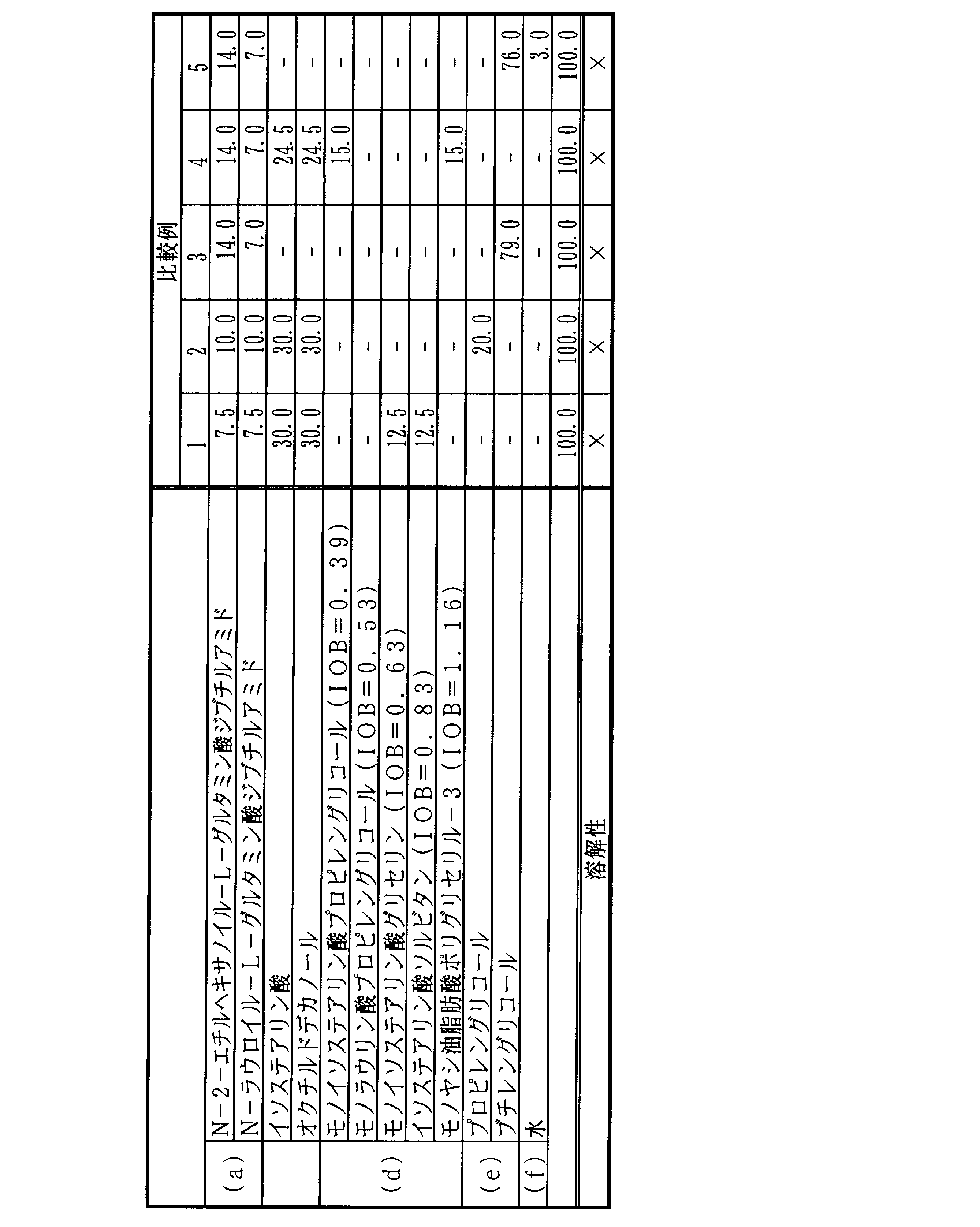
上記表1、2に示されるように、(d)IOB0.3~1.0の非イオン界面活性剤および(e)多価アルコールを組み合わせた実施例1~10では、N-2-エチルヘキサノイル-L-グルタミン酸ジブチルアミドおよびN-ラウロイル-L-グルタミン酸ジブチルアミドを90℃で略均一に溶解することができた。一方で、比較例1~4のように、(d)IOB0.3~1.0の非イオン界面活性剤または(e)多価アルコールの配合がない場合には、90℃の温度条件下で、N-2-エチルヘキサノイル-L-グルタミン酸ジブチルアミドおよびN-ラウロイル-L-グルタミン酸ジブチルアミドを溶解できないことが確認できた。さらに、(f)水を配合した実施例11,12では、N-2-エチルヘキサノイル-L-グルタミン酸ジブチルアミドおよびN-ラウロイル-L-グルタミン酸ジブチルアミドを80℃で略均一に溶解することができた。一方で、(f)水を配合したが、(d)IOB0.3~1.2の非イオン界面活性剤の配合のない比較例5は、90℃の温度条件下で、N-2-エチルヘキサノイル-L-グルタミン酸ジブチルアミドおよびN-ラウロイル-L-グルタミン酸ジブチルアミドを溶解できないことが確認できた。
<実施例13~24、比較例6~12>
[油性固形化粧料の調製]
続いて、表3,4に示す配合量で、先に調製した実施例9もしくは実施例12のプレミックス剤、プレミックスされていないN-2-エチルヘキサノイル-L-グルタミン酸ジブチルアミドおよびN-ラウロイル-L-グルタミン酸ジブチルアミド、または(d)IOB0.3~1.0の非イオン界面活性剤を含有しない比較例3のプレミックス剤をそれぞれクレンジングスティック処方に配合したときの溶解性、発汗現象の発生有無、および透明性について評価した。結果を表3,4に示す。
[油性固形化粧料の調製]
続いて、表3,4に示す配合量で、先に調製した実施例9もしくは実施例12のプレミックス剤、プレミックスされていないN-2-エチルヘキサノイル-L-グルタミン酸ジブチルアミドおよびN-ラウロイル-L-グルタミン酸ジブチルアミド、または(d)IOB0.3~1.0の非イオン界面活性剤を含有しない比較例3のプレミックス剤をそれぞれクレンジングスティック処方に配合したときの溶解性、発汗現象の発生有無、および透明性について評価した。結果を表3,4に示す。
(評価方法)
(1)溶解性
表3,4に示す配合量で各成分を混合し、これを水浴で90℃に加熱して、1時間経過後の溶解状態を目視にて以下の基準に従って評価した。
○:完全に溶解する
△:一部溶解しない
×:溶解しない
(1)溶解性
表3,4に示す配合量で各成分を混合し、これを水浴で90℃に加熱して、1時間経過後の溶解状態を目視にて以下の基準に従って評価した。
○:完全に溶解する
△:一部溶解しない
×:溶解しない
(2)発汗現象
続いて、調製したクレンジングスティック100質量部をガラス容器に入れ、室温(20℃~25℃)および45℃雰囲気下で保存し、1ヶ月経過後の発汗現象の有無を目視にて以下の評価基準に従って評価した。
○:発汗しない
△:僅かに発汗する
×:発汗する
続いて、調製したクレンジングスティック100質量部をガラス容器に入れ、室温(20℃~25℃)および45℃雰囲気下で保存し、1ヶ月経過後の発汗現象の有無を目視にて以下の評価基準に従って評価した。
○:発汗しない
△:僅かに発汗する
×:発汗する
(3)透明性
最後に、調製したクレンジングスティック100質量部をガラス容器に入れ、25℃環境下で24時間保存した状態を目視にて以下の評価基準に従って評価した。
〇:略均一な一層状である
△:懸濁のある一層状である
×:不溶解物が存在または二層状である
最後に、調製したクレンジングスティック100質量部をガラス容器に入れ、25℃環境下で24時間保存した状態を目視にて以下の評価基準に従って評価した。
〇:略均一な一層状である
△:懸濁のある一層状である
×:不溶解物が存在または二層状である

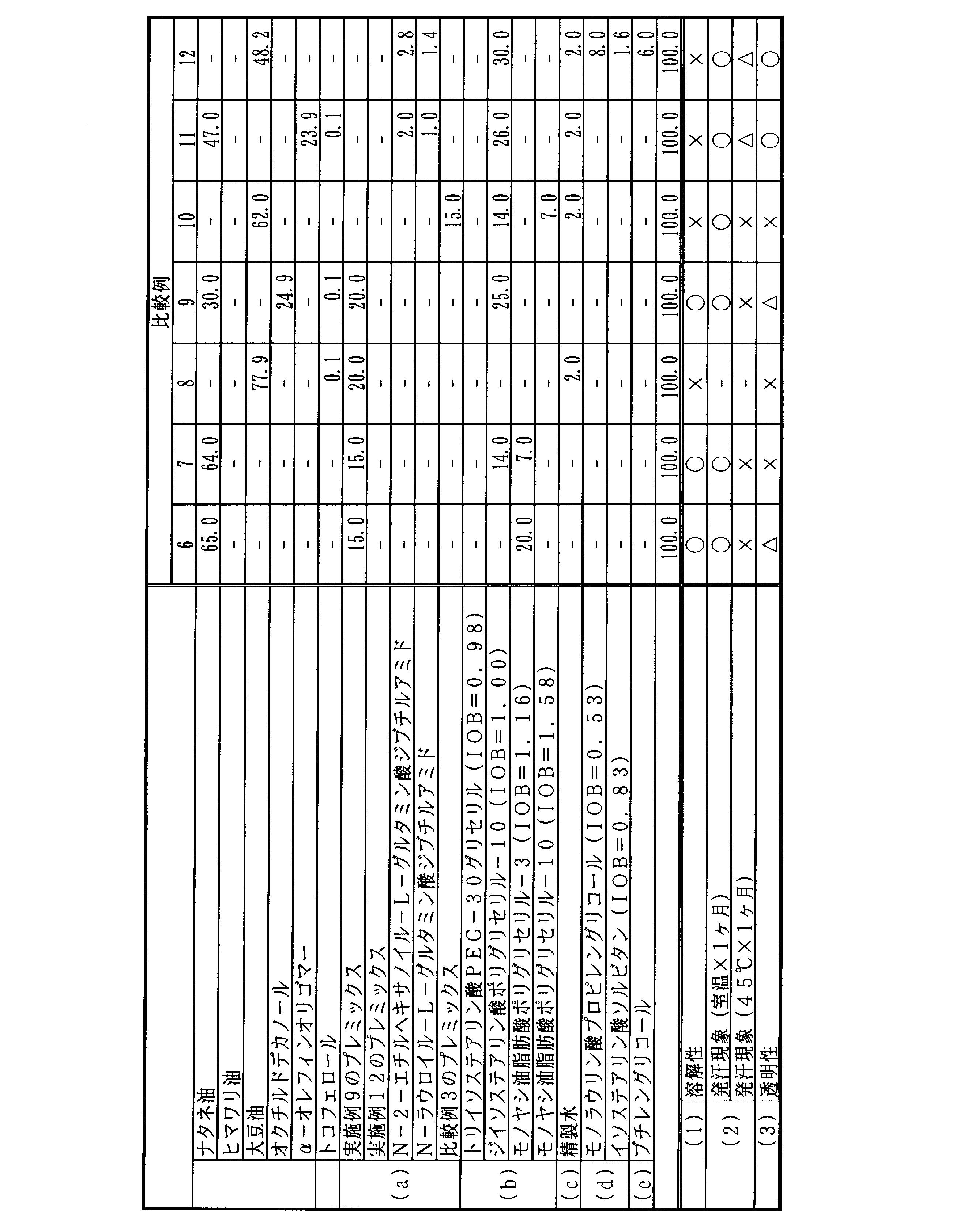
上記表3,4に示されるように、実施例11~21のクレンジングスティックは、85℃の温度条件で調製することが可能で、透明性に優れ、また、室温および45℃環境下で保存しても発汗現象を起こさない優れた安定性を確認することができた。また、比較例10のように、(d)IOB0.3~1.0の非イオン界面活性剤を含有しない比較例3のプレミックス剤を用いたクレンジングスティックは、45℃環境下の保存において、発汗現象を起こすことが確認された。一方で、N-2-エチルヘキサノイル-L-グルタミン酸ジブチルアミドおよびN-ラウロイル-L-グルタミン酸ジブチルアミドはプレミックス化しないと、90℃でクレンジングスティックを調製できないことが確認できた。
このように、N-2-エチルヘキサノイル-L-グルタミン酸ジブチルアミドに代表されるアミノ酸誘導体を用いて95℃以上といった高い温度条件下で加熱溶解しなくても、油性基剤をゲル化することが可能であり、油性固形化粧料または外用剤とした場合に発汗現象の発生を抑制することができた。また、配合成分の劣化または不活化が抑制され、発汗現象の発生が抑制される油性固形化粧料または外用剤が得られた。
以下、油性固形化粧料または外用剤の処方例を示す。
<実施例25(サンスクリーンゲル)>
下記表5に示す組成のサンスクリーンゲルを次のようにして調製した。すなわち、成分1を85℃まで加温し、略均一になるように溶解させた後、水および実施例9のプレミックス剤を混合した。このサンスクリーンゲルは、ゲル強度、透明性に優れ、また、スティック容器、ジャー容器に詰めることが可能なことから、様々な用途の化粧料および外用剤へ応用することが出来る。
下記表5に示す組成のサンスクリーンゲルを次のようにして調製した。すなわち、成分1を85℃まで加温し、略均一になるように溶解させた後、水および実施例9のプレミックス剤を混合した。このサンスクリーンゲルは、ゲル強度、透明性に優れ、また、スティック容器、ジャー容器に詰めることが可能なことから、様々な用途の化粧料および外用剤へ応用することが出来る。

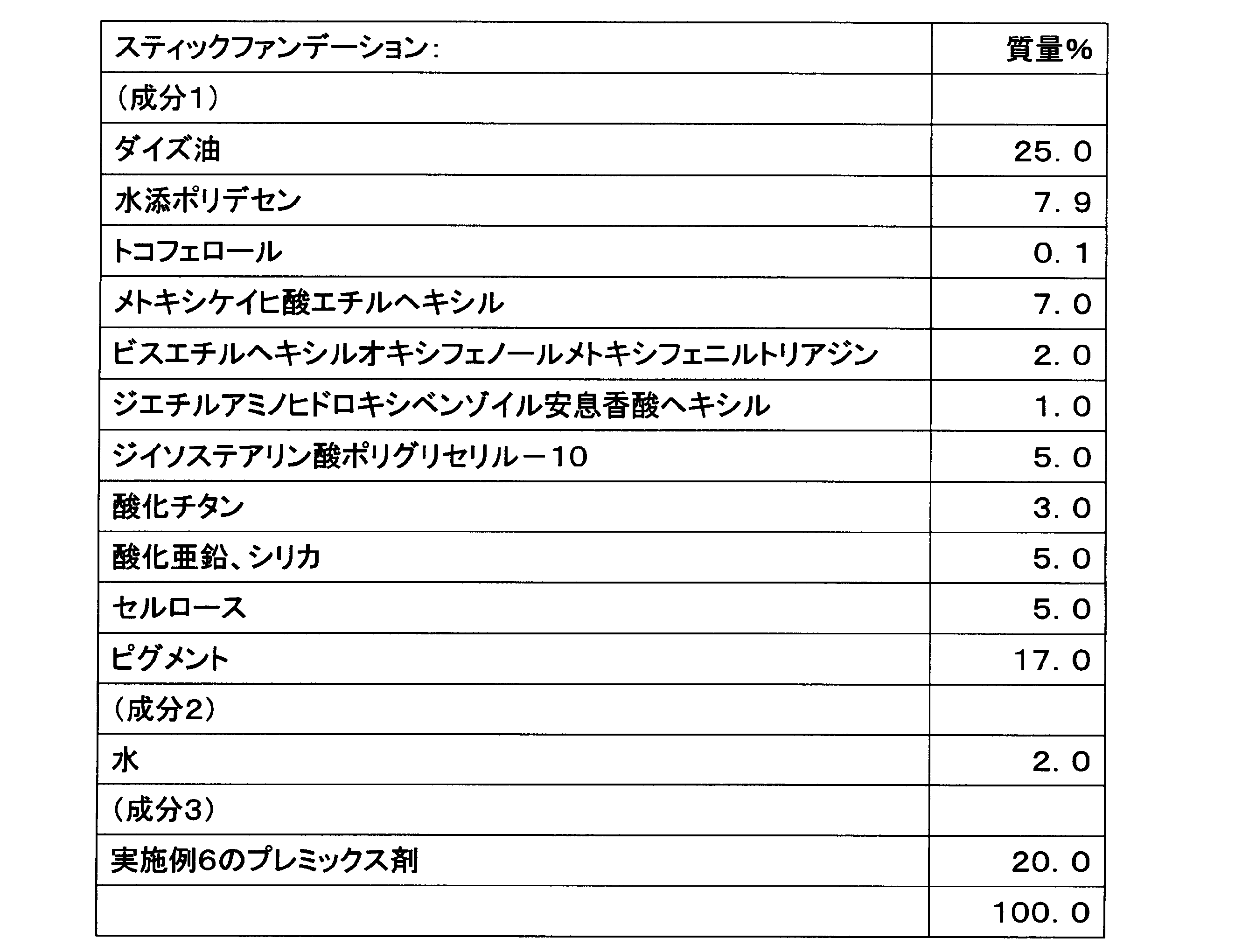
<実施例26(スティックファンデーション)>
下記表6に示す組成のサンスクリーンゲルを次のようにして調製した。すなわち、成分1を85℃まで加温し、略均一になるように溶解させた後、水および実施例9のプレミックス剤を混合した。このスティックファンデーションは、ベタつき感がなく、延びのよい官能を示し、また、スティック状であることから狙った箇所に顔料を塗布することが可能となり、微妙なニュアンスを表現することができる。
下記表6に示す組成のサンスクリーンゲルを次のようにして調製した。すなわち、成分1を85℃まで加温し、略均一になるように溶解させた後、水および実施例9のプレミックス剤を混合した。このスティックファンデーションは、ベタつき感がなく、延びのよい官能を示し、また、スティック状であることから狙った箇所に顔料を塗布することが可能となり、微妙なニュアンスを表現することができる。
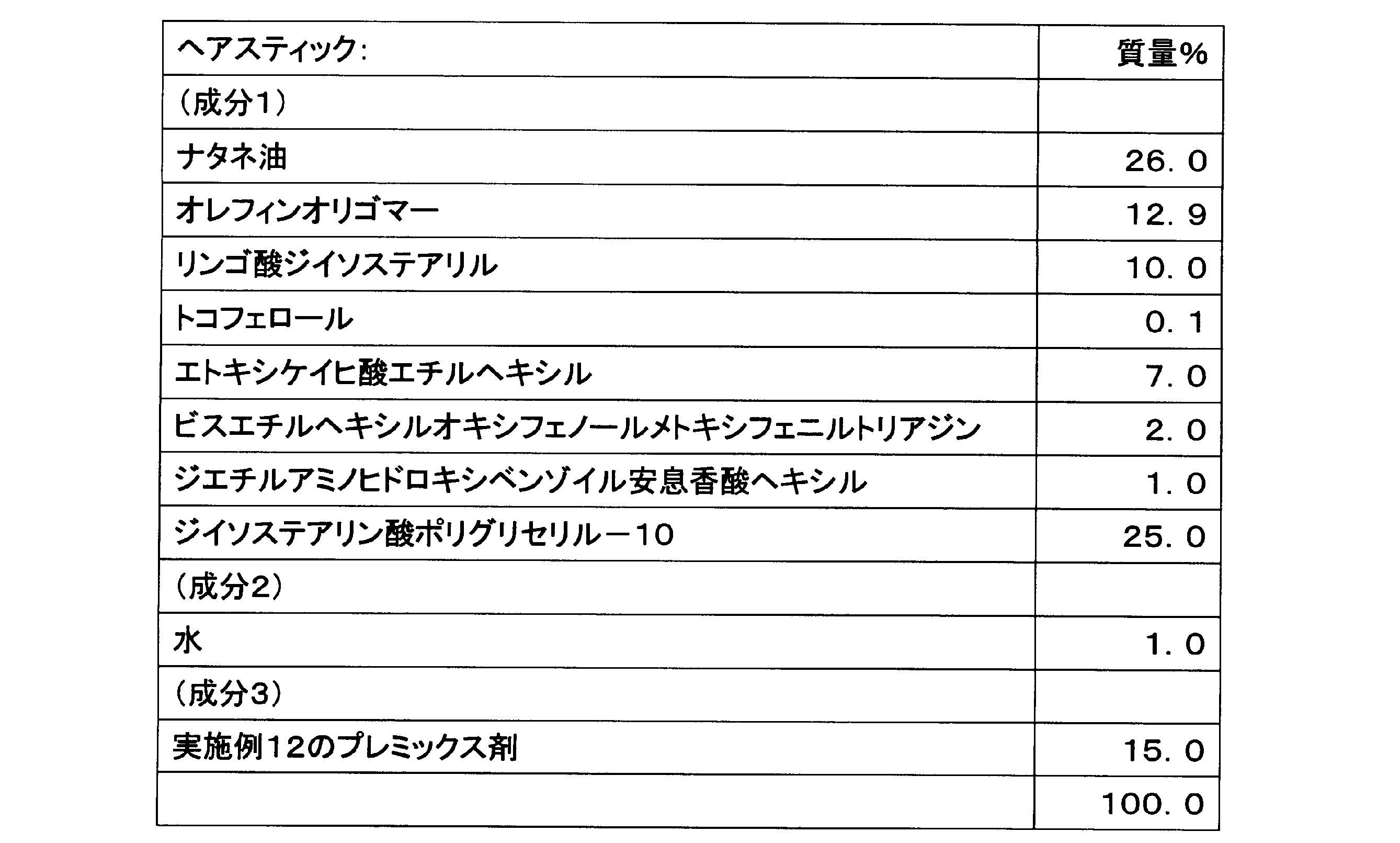
<実施例27(ヘアスティック)>
下記表7に示す組成のヘアスティックを次のようにして調製した。すなわち、成分1を85℃まで加温し、略均一になるように溶解させた後、水および実施例9のプレミックス剤を混合した。このヘアスティックは、ベタつき感がなく、延びのよい官能を示し、また、スティック状であることから狙った箇所の毛髪へ塗布することが可能で、外出先でも気軽に毛髪のスタイリングおよびケアができる。
下記表7に示す組成のヘアスティックを次のようにして調製した。すなわち、成分1を85℃まで加温し、略均一になるように溶解させた後、水および実施例9のプレミックス剤を混合した。このヘアスティックは、ベタつき感がなく、延びのよい官能を示し、また、スティック状であることから狙った箇所の毛髪へ塗布することが可能で、外出先でも気軽に毛髪のスタイリングおよびケアができる。
Claims (14)
- (a)下記式(1):

(式中、R1およびR2は、それぞれ独立に炭素数1~26の炭化水素基、R3は、炭素数3~15の炭化水素基、nは、1または2を表す。)
で表されるアミノ酸誘導体の少なくとも1種、
(d)IOB0.3~1.0の非イオン界面活性剤、および
(e)多価アルコール、
を含有することを特徴とする油性固形化粧料または外用剤用のプレミックス剤。 - 請求項1に記載の油性固形化粧料または外用剤のプレミックス剤であって、
さらに、(f)水を含有することを特徴とする油性固形化粧料または外用剤のプレミックス剤。 - 請求項1または2に記載の油性固形化粧料または外用剤のプレミックス剤であって、
前記(a)アミノ酸誘導体が、N-2-エチル-ヘキサノイルグルタミン酸ジブチルアミドおよびN-ラウロイルグルタミン酸ジブチルアミドから選択される少なくとも1種であることを特徴とする油性固形化粧料または外用剤のプレミックス剤。 - 請求項1~3のいずれか1項に記載の油性固形化粧料または外用剤のプレミックス剤であって、
前記(d)IOB0.3~1.0の非イオン界面活性剤が、モノイソステアリン酸グリセリン、イソステアリン酸ソルビタン、モノラウリン酸プロピレングリコールおよびモノイソステアリン酸プロピレングリコールから選択される少なくとも1種であることを特徴とする油性固形化粧料または外用剤のプレミックス剤。 - 請求項1~4のいずれか1項に記載の油性固形化粧料または外用剤のプレミックス剤であって、
前記(e)多価アルコールが、プロピレングリコールおよびブチレングリコールから選択される少なくとも1種であることを特徴とする油性固形化粧料または外用剤のプレミックス剤。 - 請求項1~5のいずれか1項に記載の油性固形化粧料または外用剤のプレミックス剤であって、
95℃未満での溶解が可能であることを特徴とする油性固形化粧料または外用剤のプレミックス剤。 - (a)下記式(1)

(式中、R1およびR2は、それぞれ独立に炭素数1~26の炭化水素基、R3は、炭素数3~15の炭化水素基、nは、1または2を表す。)
で表されるアミノ酸誘導体の少なくとも1種、
(d)IOB0.3~1.0の非イオン界面活性剤、
(e)多価アルコール、
(b)IOB0.7~1.7の非イオン界面活性剤、および
(c)水、
を含有することを特徴とする油性固形化粧料または外用剤。 - 請求項7に記載の油性固形化粧料または外用剤であって、
前記(b)IOB0.7~1.7の非イオン界面活性剤が、トリイソステアリン酸PEG-30グリセリル、ジイソステアリン酸ポリグリセリル-10、モノヤシ油脂肪酸ポリグリセリル-10およびモノヤシ油脂肪酸ポリグリセリル-3から選択される少なくとも1種であることを特徴とする油性固形化粧料または外用剤。 - 請求項7または8に記載の油性固形化粧料または外用剤であって、
95℃未満での溶解が可能であることを特徴とする油性固形化粧料または外用剤。 - (a)下記式(1):

(式中、R1およびR2は、それぞれ独立に炭素数1~26の炭化水素基、R3は、炭素数3~15の炭化水素基、nは、1または2を表す。)
で表されるアミノ酸誘導体の少なくとも1種、
(d)IOB0.3~1.0の非イオン界面活性剤、および
(e)多価アルコール、
を事前に混合してプレミックス剤を得るプレミックス工程を含むことを特徴とする油性固形化粧料または外用剤の製造方法。 - 請求項10に記載の油性固形化粧料または外用剤の製造方法であって、
前記プレミックス工程において、前記(a)アミノ酸誘導体、前記(d)IOB0.3~1.0の非イオン界面活性剤、前記(e)多価アルコールおよび(f)水を混合してプレミックス剤を得ることを特徴とする油性固形化粧料または外用剤の製造方法。 - 請求項10または11に記載の油性固形化粧料または外用剤の製造方法であって、
前記プレミックス剤、(b)IOB0.7~1.7の非イオン界面活性剤および(c)水を混合するミックス工程を含むことを特徴とする油性固形化粧料または外用剤の製造方法。 - 請求項12に記載の油性固形化粧料または外用剤の製造方法であって、
前記ミックス工程において、少なくとも前記プレミックス剤、前記(b)IOB0.7~1.7の非イオン界面活性剤、および前記(c)水を混合し、95℃未満で溶解することを特徴とする油性固形化粧料または外用剤の製造方法。 - 請求項10~13のいずれか1項に記載の油性固形化粧料または外用剤の製造方法であって、
前記プレミックス工程において、少なくとも前記(a)アミノ酸誘導体、前記(d)IOB0.3~1.0の非イオン界面活性剤、および前記(e)多価アルコールを混合し、95℃未満で溶解してプレミックス剤を得ることを特徴とする油性固形化粧料または外用剤の製造方法。
Priority Applications (1)
| Application Number | Priority Date | Filing Date | Title |
|---|---|---|---|
| JP2018525292A JPWO2018003973A1 (ja) | 2016-07-01 | 2017-06-30 | 油性固形化粧料または外用剤用のプレミックス剤、油性固形化粧料または外用剤、およびその製造方法 |
Applications Claiming Priority (2)
| Application Number | Priority Date | Filing Date | Title |
|---|---|---|---|
| JP2016-131875 | 2016-07-01 | ||
| JP2016131875 | 2016-07-01 |
Publications (1)
| Publication Number | Publication Date |
|---|---|
| WO2018003973A1 true WO2018003973A1 (ja) | 2018-01-04 |
Family
ID=60786902
Family Applications (1)
| Application Number | Title | Priority Date | Filing Date |
|---|---|---|---|
| PCT/JP2017/024145 Ceased WO2018003973A1 (ja) | 2016-07-01 | 2017-06-30 | 油性固形化粧料または外用剤用のプレミックス剤、油性固形化粧料または外用剤、およびその製造方法 |
Country Status (2)
| Country | Link |
|---|---|
| JP (1) | JPWO2018003973A1 (ja) |
| WO (1) | WO2018003973A1 (ja) |
Cited By (3)
| Publication number | Priority date | Publication date | Assignee | Title |
|---|---|---|---|---|
| JP2020029408A (ja) * | 2018-08-20 | 2020-02-27 | 日本エマルジョン株式会社 | 水性固形化粧料または外用剤、およびその製造方法 |
| JP2022100296A (ja) * | 2020-12-23 | 2022-07-05 | コスメッカ コリア カンパニー リミテッド | 高温安定性と使用感が向上した固形状化粧料組成物及びその製造方法 |
| EP3530711B1 (en) * | 2016-10-24 | 2022-08-17 | Ajinomoto Co., Inc. | Gel composition |
Citations (6)
| Publication number | Priority date | Publication date | Assignee | Title |
|---|---|---|---|---|
| JP2005298387A (ja) * | 2004-04-09 | 2005-10-27 | Shiseido Co Ltd | 透明固型クレンジング料 |
| JP2005298388A (ja) * | 2004-04-09 | 2005-10-27 | Shiseido Co Ltd | ゲル状組成物及びその製造方法 |
| WO2009139094A1 (ja) * | 2008-05-12 | 2009-11-19 | 高級アルコール工業株式会社 | 使用感と保存安定性に優れた化粧料およびその製法 |
| JP2010235507A (ja) * | 2009-03-31 | 2010-10-21 | Kose Corp | 洗浄剤組成物 |
| JP2012214410A (ja) * | 2011-03-31 | 2012-11-08 | Naris Cosmetics Co Ltd | 油性化粧料基剤および油性化粧料 |
| JP2015124181A (ja) * | 2013-12-26 | 2015-07-06 | 株式会社コーセー | 油性固形化粧料 |
-
2017
- 2017-06-30 JP JP2018525292A patent/JPWO2018003973A1/ja active Pending
- 2017-06-30 WO PCT/JP2017/024145 patent/WO2018003973A1/ja not_active Ceased
Patent Citations (6)
| Publication number | Priority date | Publication date | Assignee | Title |
|---|---|---|---|---|
| JP2005298387A (ja) * | 2004-04-09 | 2005-10-27 | Shiseido Co Ltd | 透明固型クレンジング料 |
| JP2005298388A (ja) * | 2004-04-09 | 2005-10-27 | Shiseido Co Ltd | ゲル状組成物及びその製造方法 |
| WO2009139094A1 (ja) * | 2008-05-12 | 2009-11-19 | 高級アルコール工業株式会社 | 使用感と保存安定性に優れた化粧料およびその製法 |
| JP2010235507A (ja) * | 2009-03-31 | 2010-10-21 | Kose Corp | 洗浄剤組成物 |
| JP2012214410A (ja) * | 2011-03-31 | 2012-11-08 | Naris Cosmetics Co Ltd | 油性化粧料基剤および油性化粧料 |
| JP2015124181A (ja) * | 2013-12-26 | 2015-07-06 | 株式会社コーセー | 油性固形化粧料 |
Cited By (6)
| Publication number | Priority date | Publication date | Assignee | Title |
|---|---|---|---|---|
| EP3530711B1 (en) * | 2016-10-24 | 2022-08-17 | Ajinomoto Co., Inc. | Gel composition |
| US11446224B2 (en) | 2016-10-24 | 2022-09-20 | Ajinomoto Co., Inc. | Gel composition |
| JP2020029408A (ja) * | 2018-08-20 | 2020-02-27 | 日本エマルジョン株式会社 | 水性固形化粧料または外用剤、およびその製造方法 |
| JP7066181B2 (ja) | 2018-08-20 | 2022-05-13 | 日本エマルジョン株式会社 | 固形化粧料、およびその製造方法 |
| JP2022100296A (ja) * | 2020-12-23 | 2022-07-05 | コスメッカ コリア カンパニー リミテッド | 高温安定性と使用感が向上した固形状化粧料組成物及びその製造方法 |
| JP7500534B2 (ja) | 2020-12-23 | 2024-06-17 | コスメッカ コリア カンパニー リミテッド | 高温安定性と使用感が向上した固形状化粧料組成物及びその製造方法 |
Also Published As
| Publication number | Publication date |
|---|---|
| JPWO2018003973A1 (ja) | 2019-04-18 |
Similar Documents
| Publication | Publication Date | Title |
|---|---|---|
| JP2005298635A (ja) | ゲル状組成物及びその製造方法 | |
| IE910920A1 (en) | Clear stick anti-perspirant | |
| JP2011503192A (ja) | 風合いおよび揮発性を付与するシリコンフリーな炭化水素類 | |
| JP2005298388A (ja) | ゲル状組成物及びその製造方法 | |
| EP4267083A1 (en) | Biorenewable elastomer gel and uses thereof | |
| JPWO2020166674A1 (ja) | 有機アンモニウム塩を含む組成物 | |
| JPWO2018003973A1 (ja) | 油性固形化粧料または外用剤用のプレミックス剤、油性固形化粧料または外用剤、およびその製造方法 | |
| CN116634983A (zh) | 来自环氧化植物油的弹性体凝胶及其用途 | |
| JPH10237034A (ja) | ビス(アシルアミノ)シクロヘキサン誘導体を含有する組成物 | |
| JP4893381B2 (ja) | 増粘剤 | |
| JP2016210711A (ja) | 透明な油性液状増粘剤、透明な増粘性組成物及び化粧料 | |
| KR20040047576A (ko) | 수계 유화제 왁스 겔 | |
| KR100811465B1 (ko) | 열감에 의한 모공 확대와 피지 제거를 동시에 해주는화장료 조성물 | |
| JP7066181B2 (ja) | 固形化粧料、およびその製造方法 | |
| EP3533438B1 (en) | Gelatinous composition | |
| KR101606776B1 (ko) | 유성 고체형태 화장료 | |
| JP2005298387A (ja) | 透明固型クレンジング料 | |
| JPH02178208A (ja) | 油性固形化粧料 | |
| JP2003119107A (ja) | 油中水型乳化組成物及びその製造方法 | |
| WO2020170646A1 (ja) | 乳化組成物の製造方法 | |
| JP2022129609A (ja) | 組成物および毛髪処理方法 | |
| KR102848131B1 (ko) | 세라마이드를 포함하는 소프트 텍스쳐 화장료 조성물 | |
| KR101651423B1 (ko) | 비가열식 샴푸 제조방법 및 그 샴푸 | |
| JP7817822B2 (ja) | 固形状油性クレンジング化粧料 | |
| JP2020521800A (ja) | 高含量の植物性バターを含む化粧品フォーム組成物 |
Legal Events
| Date | Code | Title | Description |
|---|---|---|---|
| 121 | Ep: the epo has been informed by wipo that ep was designated in this application |
Ref document number: 17820327 Country of ref document: EP Kind code of ref document: A1 |
|
| ENP | Entry into the national phase |
Ref document number: 2018525292 Country of ref document: JP Kind code of ref document: A |
|
| NENP | Non-entry into the national phase |
Ref country code: DE |
|
| 122 | Ep: pct application non-entry in european phase |
Ref document number: 17820327 Country of ref document: EP Kind code of ref document: A1 |