WO2018003698A1 - 電極材料 - Google Patents
電極材料 Download PDFInfo
- Publication number
- WO2018003698A1 WO2018003698A1 PCT/JP2017/023228 JP2017023228W WO2018003698A1 WO 2018003698 A1 WO2018003698 A1 WO 2018003698A1 JP 2017023228 W JP2017023228 W JP 2017023228W WO 2018003698 A1 WO2018003698 A1 WO 2018003698A1
- Authority
- WO
- WIPO (PCT)
- Prior art keywords
- silica
- electrode material
- silver chloride
- silver
- porous carrier
- Prior art date
- Legal status (The legal status is an assumption and is not a legal conclusion. Google has not performed a legal analysis and makes no representation as to the accuracy of the status listed.)
- Ceased
Links
Images

Classifications
-
- H—ELECTRICITY
- H01—ELECTRIC ELEMENTS
- H01M—PROCESSES OR MEANS, e.g. BATTERIES, FOR THE DIRECT CONVERSION OF CHEMICAL ENERGY INTO ELECTRICAL ENERGY
- H01M4/00—Electrodes
- H01M4/02—Electrodes composed of, or comprising, active material
- H01M4/36—Selection of substances as active materials, active masses, active liquids
- H01M4/58—Selection of substances as active materials, active masses, active liquids of inorganic compounds other than oxides or hydroxides, e.g. sulfides, selenides, tellurides, halogenides or LiCoFy; of polyanionic structures, e.g. phosphates, silicates or borates
- H01M4/582—Halogenides
-
- C—CHEMISTRY; METALLURGY
- C01—INORGANIC CHEMISTRY
- C01B—NON-METALLIC ELEMENTS; COMPOUNDS THEREOF; METALLOIDS OR COMPOUNDS THEREOF NOT COVERED BY SUBCLASS C01C
- C01B33/00—Silicon; Compounds thereof
- C01B33/113—Silicon oxides; Hydrates thereof
- C01B33/12—Silica; Hydrates thereof, e.g. lepidoic silicic acid
-
- C—CHEMISTRY; METALLURGY
- C01—INORGANIC CHEMISTRY
- C01G—COMPOUNDS CONTAINING METALS NOT COVERED BY SUBCLASSES C01D OR C01F
- C01G5/00—Compounds of silver
- C01G5/02—Halides
-
- C—CHEMISTRY; METALLURGY
- C01—INORGANIC CHEMISTRY
- C01P—INDEXING SCHEME RELATING TO STRUCTURAL AND PHYSICAL ASPECTS OF SOLID INORGANIC COMPOUNDS
- C01P2004/00—Particle morphology
- C01P2004/80—Particles consisting of a mixture of two or more inorganic phases
- C01P2004/82—Particles consisting of a mixture of two or more inorganic phases two phases having the same anion, e.g. both oxidic phases
-
- H—ELECTRICITY
- H01—ELECTRIC ELEMENTS
- H01M—PROCESSES OR MEANS, e.g. BATTERIES, FOR THE DIRECT CONVERSION OF CHEMICAL ENERGY INTO ELECTRICAL ENERGY
- H01M4/00—Electrodes
- H01M4/02—Electrodes composed of, or comprising, active material
- H01M4/64—Carriers or collectors
- H01M4/70—Carriers or collectors characterised by shape or form
- H01M4/80—Porous plates, e.g. sintered carriers
-
- Y—GENERAL TAGGING OF NEW TECHNOLOGICAL DEVELOPMENTS; GENERAL TAGGING OF CROSS-SECTIONAL TECHNOLOGIES SPANNING OVER SEVERAL SECTIONS OF THE IPC; TECHNICAL SUBJECTS COVERED BY FORMER USPC CROSS-REFERENCE ART COLLECTIONS [XRACs] AND DIGESTS
- Y02—TECHNOLOGIES OR APPLICATIONS FOR MITIGATION OR ADAPTATION AGAINST CLIMATE CHANGE
- Y02E—REDUCTION OF GREENHOUSE GAS [GHG] EMISSIONS, RELATED TO ENERGY GENERATION, TRANSMISSION OR DISTRIBUTION
- Y02E60/00—Enabling technologies; Technologies with a potential or indirect contribution to GHG emissions mitigation
- Y02E60/10—Energy storage using batteries
Definitions
- This invention relates to an electrode material.
- Patent Document 1 discloses a biological electrode provided with an unpolarized electrode film containing silver and silver chloride. Thus, it is known that silver, silver chloride or the like is used as an electrode material.
- An object of the present invention is to provide an electrode material capable of improving light resistance as compared with an electrode material made of silver chloride.
- the invention according to the first aspect of the invention for achieving the above object is an electrode material comprising a porous carrier and silver chloride supported on the porous carrier.
- the light resistance can be improved as compared with the electrode material made of silver chloride powder.
- FIG. 1 is a schematic diagram showing an example of a schematic particle structure of silica made of gelled silica.
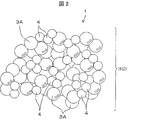
- FIG. 2 is a schematic diagram schematically showing an example of a particle structure of an electrode material in which silver chloride is supported on silica made of gelled silica.
- An electrode material according to an embodiment of the present invention includes a porous carrier and silver chloride (AgCl) supported on the porous carrier.
- the electrode material according to the present embodiment has the following advantages. -In the electrode material which concerns on this embodiment, light is hard to inject into silver chloride currently carry
- the electrode material according to the present embodiment has a surface area of silver chloride as compared with the electrode material made of silver chloride. It can be increased.
- silver chloride is supported on the surface of the porous carrier.
- the electrode material according to the present embodiment has silver chloride compared to the electrode material made of silver chloride. It becomes possible to reduce the amount of (or silver) and to reduce the cost.
- the porous carrier is, for example, silica (silicon dioxide). Silver chloride tends to aggregate (low dispersibility), whereas silica has a property that it hardly aggregates (high dispersibility). For this reason, when silica is used as the porous carrier, an electrode material with high dispersibility can be obtained.
- the silica may be precipitation method silica or wet method silica such as gelation method silica (gel method silica), or may be dry method silica.
- the silica is preferably gelled silica. In this embodiment, the silica is gelled silica.
- FIG. 1 is a schematic diagram showing an example of a schematic particle structure of silica made of gelled silica.
- the silica 2 made of gelled silica has a particle structure in which, for example, a plurality of primary particles (skeleton particles) 3A are gathered in a bunch of grapes to form secondary particles 3.
- the specific surface area of silica refers to the surface area per unit mass.
- the surface area of silica is the sum of the external area and internal area of silica (the area of the pore inner surface of silica).
- the pore volume of silica refers to the volume of silica pores per unit mass.
- the average pore diameter of silica refers to the average diameter of silica pores (voids).
- the average particle diameter of silica refers to the average of the diameters D (see FIG. 1) of secondary particles.
- the specific surface area of silica is preferably 20 m 2 / g or more and 1000 m 2 / g or less, and particularly preferably 100 m 2 / g or more and 700 m 2 / g or less.
- the pore volume of silica is preferably 0.2 ml / g or more and 2.0 ml / g or less, and particularly preferably 0.3 ml / g or more and 1.2 ml / g or less.
- the average pore diameter of silica is preferably 2 nm or more and 100 nm or less, and particularly preferably 2 nm or more and 30 nm or less.
- the average particle diameter of silica is preferably 1 ⁇ m or more and 50 ⁇ m or less, and particularly preferably 2 ⁇ m or more and 30 ⁇ m or less.
- FIG. 2 is a schematic diagram schematically showing an example of a particle structure of an electrode material in which silver chloride is supported on silica made of gelled silica.
- An electrode material 1 shown in FIG. 2 includes silica 2 and silver chloride 4 supported on the surface of silica 2 (including the content surface of the pores).
- the electrode material according to the above-described embodiment is manufactured by, for example, the following manufacturing method. This manufacturing method includes dissolving a silver compound in a solution to form a silver compound solution, and using the silver compound solution to support the silver compound on a porous carrier (including the inner surface of the pore). including. As the silver compound, silver nitrate or silver chloride is used.
- silver nitrate when silver nitrate is used as the silver compound, first, a silver nitrate solution is generated by dissolving silver nitrate powder in an aqueous solvent. Next, silver nitrate is supported on the porous carrier using a silver nitrate solution. Examples of the method for supporting silver nitrate on the porous carrier include precipitation method, gelation method, impregnation method, ion exchange method and the like. Thereafter, silver chloride is supported on the porous carrier by reacting silver nitrate supported on the porous carrier with a compound containing chloride ions such as hydrochloric acid or sodium chloride.
- a compound containing chloride ions such as hydrochloric acid or sodium chloride.
- silver chloride when silver chloride is used as the silver compound, first, silver chloride powder is dissolved in an aqueous solution such as ammonia water, concentrated hydrochloric acid solution, alkaline cyanide aqueous solution, thiosulfate aqueous solution, or ammonium carbonate aqueous solution. To produce a silver chloride solution. Next, silver chloride is supported on the porous carrier using a silver chloride solution. Examples of the method for supporting silver chloride on the porous carrier include a precipitation method, a gelation method, an impregnation method, and an ion exchange method.
- Example 1 includes silica (silicia 710 (trade name) manufactured by Fuji Silysia Chemical Ltd.) and silver chloride (AgCl) supported on the silica, which is a gelled silica.
- silica silicon 710 (trade name) manufactured by Fuji Silysia Chemical Ltd.
- silver chloride AgCl supported on the silica, which is a gelled silica.
- the content of silica silicon dioxide
- the silver chloride content is 39% by weight.
- the specific surface area of silica is 397 m 2 / g, and the average particle diameter of silica is 2.9 ⁇ m.
- Example 1 A method for producing Example 1 will be described. First, a silver nitrate solution was prepared by dissolving 40 g of silver nitrate powder with 50 ml of ion-exchanged water. Next, 20 g of silica (Silicia 710 (trade name), manufactured by Fuji Silysia Chemical Ltd.) was added to the silver nitrate solution and stirred for 4 hours. Next, the solid content was recovered from the stirred solution using 5 types A filter paper, and the recovered solid content was dried with a shelf dryer at 120 ° C. for 16 hours. As a result, silver nitrate-supporting silica in which silver nitrate was supported on a silica carrier was obtained.
- silica Silicia 710 (trade name), manufactured by Fuji Silysia Chemical Ltd.
- silica silver nitrate-supporting silica was added to 200 ml of 1M hydrochloric acid and stirred for 4 hours.
- the solid content was recovered from the stirred solution using 5 types A filter paper, and the recovered solid content was washed with 200 ml of ion-exchanged water.
- the solid content after washing was dried with a shelf dryer at 120 ° C. for 16 hours and then pulverized.
- silica silica (silver chloride-supported silica) in which silver chloride was supported on a silica support was obtained.
- a method for producing an electrode material comprising a porous carrier carrying silver chloride, the first step of producing a silver nitrate solution by dissolving silver nitrate in an aqueous solvent, and the porous carrier using the silver nitrate solution. The second step of supporting silver nitrate (including the inner surface of the pores) and the silver nitrate supported on the porous support by reacting the compound containing chloride ions with the silver support. And a third step of producing the electrode material.
- A2 The method for producing an electrode material according to A1, wherein the compound containing chloride ions is hydrochloric acid or sodium chloride.
- A3. A method for producing an electrode material comprising a porous carrier on which silver chloride is supported, wherein a first step of producing a silver chloride solution by solubilizing silver chloride and using the silver chloride solution, And a second step of supporting silver chloride on a support (including the inner surface of the pores).
- A4 The method for producing an electrode material according to A3, further comprising a third step of supporting silver chloride on the pre-porous support by adding an organic solvent to the silver chloride supported on the porous support.
- A5. The method for producing an electrode material according to A4, wherein the organic solvent is an organic solvent that dissolves in an aqueous solvent.
- A6 The method for producing an electrode material according to A5, wherein the organic solvent is one arbitrarily selected from methanol, ethanol, isopropyl alcohol, methyl cellosolve, butyl cellosolve, and the like.
- A7 The method for producing an electrode material according to any one of A3 to A6, wherein the aqueous solution is one arbitrarily selected from aqueous ammonia, concentrated hydrochloric acid solution, alkaline cyanide aqueous solution, thiosulfate aqueous solution, and ammonium carbonate aqueous solution. .
- the porous carrier is made of silica.
- the supported amount of silver chloride is 1 wt% or more and 80 wt% or less.
- Electrode Material 2 Silica 3 Secondary Particle 3A Primary Particle 4 Silver Chloride
Landscapes
- Chemical & Material Sciences (AREA)
- Organic Chemistry (AREA)
- Inorganic Chemistry (AREA)
- Chemical Kinetics & Catalysis (AREA)
- Electrochemistry (AREA)
- General Chemical & Material Sciences (AREA)
- Silicon Compounds (AREA)
- Battery Electrode And Active Subsutance (AREA)
- Measurement And Recording Of Electrical Phenomena And Electrical Characteristics Of The Living Body (AREA)
Abstract
電極材料(1)は、多孔質担体(2)と、多孔質担体(2)に担持された塩化銀(4)とを含む。多孔質担体(2)は、例えば、シリカである。シリカとしては、沈殿法シリカ、ゲル化法シリカ等の湿式法シリカ、乾式法シリカ等が用いられる。
Description
この発明は、電極材料に関する。
特許文献1には、銀と塩化銀とを含む不分極電極膜を備えた生体用電極が開示されている。このように、銀、又は塩化銀等は、電極材料として用いられることが知られている。
塩化銀は、感光性を有している。このため、塩化銀は、光によって容易に分解し、銀に還元される過程で紫色を経て黒色に変色する。したがって、塩化銀からなる電極材料は、その性質が変化しやすいという問題がある。
この発明は、塩化銀からなる電極材料に比べて、耐光性の向上化が図れる、電極材料を提供することを目的とする。
この発明は、塩化銀からなる電極材料に比べて、耐光性の向上化が図れる、電極材料を提供することを目的とする。
上記目的を達成するための発明の態様1に係る発明は、多孔質担体と、前記多孔質担体に担持された塩化銀とを含む、電極材料である。
この構成では、多孔質担体の細孔(空隙)の内面に担持されている塩化銀には、光が入射されにくいので、塩化銀粉末からなる電極材料に比べて耐光性の向上化が図れる。
この構成では、多孔質担体の細孔(空隙)の内面に担持されている塩化銀には、光が入射されにくいので、塩化銀粉末からなる電極材料に比べて耐光性の向上化が図れる。
本発明の実施形態に係る電極材料は、多孔質担体と、当該多孔質担体に担持された塩化銀(AgCl)とを含む。
本実施形態に係る電極材料は、次のような利点を有している。
・本実施形態に係る電極材料では、多孔質担体の細孔(空隙)内に担持されている塩化銀には光が入射されにくい。したがって、本実施形態に係る電極材料は、従来の微粒子塩化銀からなる電極材料に比べて耐光性の向上化が図れる。
・本実施形態に係る電極材料は、多孔質担体の表面(細孔の内面を含む)に塩化銀が担持されている。これにより、電極材料中の塩化銀の総量が所定量である電極材料を得ようとした場合に、本実施形態に係る電極材料では、塩化銀からなる電極材料に比べて、塩化銀の表面積を増加させることが可能となる。
・本実施形態に係る電極材料は、多孔質担体の表面に塩化銀が担持されている。これにより、電極材料中の塩化銀の露出面積の総量が所定量である電極材料を得ようとした場合に、本実施形態に係る電極材料では、塩化銀からなる電極材料に比べて、塩化銀(または銀)の量を低減させることが可能となり、低廉化が図れる。
本実施形態に係る電極材料は、次のような利点を有している。
・本実施形態に係る電極材料では、多孔質担体の細孔(空隙)内に担持されている塩化銀には光が入射されにくい。したがって、本実施形態に係る電極材料は、従来の微粒子塩化銀からなる電極材料に比べて耐光性の向上化が図れる。
・本実施形態に係る電極材料は、多孔質担体の表面(細孔の内面を含む)に塩化銀が担持されている。これにより、電極材料中の塩化銀の総量が所定量である電極材料を得ようとした場合に、本実施形態に係る電極材料では、塩化銀からなる電極材料に比べて、塩化銀の表面積を増加させることが可能となる。
・本実施形態に係る電極材料は、多孔質担体の表面に塩化銀が担持されている。これにより、電極材料中の塩化銀の露出面積の総量が所定量である電極材料を得ようとした場合に、本実施形態に係る電極材料では、塩化銀からなる電極材料に比べて、塩化銀(または銀)の量を低減させることが可能となり、低廉化が図れる。
多孔質担体は、例えば、シリカ(二酸化ケイ素)である。塩化銀は凝集しやすい(分散性が低い)のに対して、シリカは凝集しにくい(分散性が高い)という性質を有している。このため、多孔質担体としてシリカが用いられた場合には、分散性の高い電極材料が得られる。シリカは、沈殿法シリカ、又はゲル化法シリカ(ゲル法シリカ)等の湿式法シリカであってもよく、乾式法シリカであってもよい。シリカは、ゲル化法シリカであることが好ましい。この実施形態では、シリカは、ゲル化法シリカである。
図1は、ゲル化法シリカからなるシリカの図解的な粒子構造の一例を示す模式図である。ゲル化法シリカからなるシリカ2は、例えば、複数の一次粒子(骨格粒子)3Aが、ブドウの房状に集まって二次粒子3を構成したような粒子構造を有している。
以下において、シリカの比表面積とは、単位質量当たりの表面積をいう。シリカの表面積は、シリカの外部面積と内部面積(シリカの細孔内面の面積)との和である。シリカの細孔容積とは、単位質量当たりのシリカの細孔の容積をいう。シリカの平均細孔径とは、シリカの細孔(空隙)の直径の平均をいう。シリカの平均粒子径とは、二次粒子の直径D(図1参照)の平均をいう。
以下において、シリカの比表面積とは、単位質量当たりの表面積をいう。シリカの表面積は、シリカの外部面積と内部面積(シリカの細孔内面の面積)との和である。シリカの細孔容積とは、単位質量当たりのシリカの細孔の容積をいう。シリカの平均細孔径とは、シリカの細孔(空隙)の直径の平均をいう。シリカの平均粒子径とは、二次粒子の直径D(図1参照)の平均をいう。
シリカの比表面積は、20m2/g以上1000m2/g以下であることが好ましく、100m2/g以上700m2/g以下であることが特に好ましい。また、シリカの細孔容積は、0.2ml/g以上2.0ml/g以下であることが好ましく、0.3ml/g以上1.2ml/g以下であることが特に好ましい。また、シリカの平均細孔径は、2nm以上100nm以下であることが好ましく、2nm以上30nm以下であることが特に好ましい。また、シリカの平均粒子径は、1μm以上50μm以下であることが好ましく、2μm以上30μm以下であることが特に好ましい。
図2は、ゲル化法シリカからなるシリカに塩化銀が担持されてなる電極材料の粒子構造の一例を図解的に示す模式図である。図2に示される電極材料1は、シリカ2と、シリカ2の表面(細孔の内容面を含む)に担持された塩化銀4とからなる。
前述の本実施形態に係る電極材料は、例えば、次のような製造方法によって製造される。この製造方法は、銀化合物を溶液に溶解させることにより、銀化合物溶液を生成するステップと、銀化合物溶液を用いて、多孔質担体(細孔の内面を含む)に銀化合物を担持させるステップとを含む。銀化合物としては、硝酸銀、又は塩化銀等が用いられる。
前述の本実施形態に係る電極材料は、例えば、次のような製造方法によって製造される。この製造方法は、銀化合物を溶液に溶解させることにより、銀化合物溶液を生成するステップと、銀化合物溶液を用いて、多孔質担体(細孔の内面を含む)に銀化合物を担持させるステップとを含む。銀化合物としては、硝酸銀、又は塩化銀等が用いられる。
銀化合物として、例えば硝酸銀が用いられる場合には、まず、硝酸銀粉末を水系溶媒に溶解させることにより、硝酸銀溶液を生成する。次に、硝酸銀溶液を用いて、多孔質担体に硝酸銀を担持させる。多孔質担体に硝酸銀を担持させる方法としては、沈殿法、ゲル化法、含侵法、又はイオン交換法等が挙げられる。この後、多孔質担体に担持された硝酸銀に、塩酸、又は塩化ナトリウム等、塩化物イオンを含む化合物を反応させることにより、多孔質担体に塩化銀を担持させる。
銀化合物として、例えば塩化銀が用いられる場合には、まず、アンモニア水、濃塩酸溶液、アルカリ性シアン化物水溶液、チオ硫酸塩水溶液、又は炭酸アンモニウム水溶液等の水溶液に、塩化銀粉末を溶解させることにより、塩化銀溶液を生成する。次に、塩化銀溶液を用いて、多孔質担体に塩化銀を担持させる。多孔質担体に塩化銀を担持させる方法としては、沈殿法、ゲル化法、含侵法、又はイオン交換法等が挙げられる。この後、メタノール、エタノール、イソプロピルアルコール、メチルセロソルブ、又はブチルセロソルブなどの水系溶媒に溶解する有機溶媒を、多孔質担体に担持された塩化銀に添加することにより、多孔質担体に塩化銀を担持する。
[電極材料の実施例1]
実施例1は、ゲル化法シリカであるシリカ(サイリシア710(商品名) 富士シリシア化学株式会社製)と当該シリカに担持された塩化銀(AgCl)とを含む。実施例1では、シリカ(二酸化ケイ素)の含有量は61重量%であり、塩化銀含有量は39重量%である。また、実施例1では、シリカの比表面積は397m2/gであり、シリカの平均粒子径は2.9μmである。
[電極材料の実施例1]
実施例1は、ゲル化法シリカであるシリカ(サイリシア710(商品名) 富士シリシア化学株式会社製)と当該シリカに担持された塩化銀(AgCl)とを含む。実施例1では、シリカ(二酸化ケイ素)の含有量は61重量%であり、塩化銀含有量は39重量%である。また、実施例1では、シリカの比表面積は397m2/gであり、シリカの平均粒子径は2.9μmである。
実施例1を製造する方法について説明する。まず、硝酸銀粉末40gをイオン交換水50mlで溶解することにより、硝酸銀溶液を調整した。次に、シリカ(サイリシア710(商品名) 富士シリシア化学株式会社製)20gを硝酸銀溶液に添加し、4時間攪拌した。次に、攪拌後の溶液から、5種Aのろ紙を用いて固形分を回収し、回収した固形分を120℃の棚式乾燥機で16時間乾燥した。これにより、シリカ担体に硝酸銀が担持された硝酸銀担持シリカを得た。
次に、硝酸銀担持シリカの約34gを1Mの塩酸200mlに添加して4時間攪拌した。次に、攪拌後の溶液から、5種Aのろ紙を用いて固形分を回収し、回収した固形分を200mlのイオン交換水で洗浄した。次に、洗浄後の固形分を、120℃の棚式乾燥機で16時間乾燥した後、粉砕した。これにより、シリカ担体に塩化銀が担持されたシリカ(塩化銀担持シリカ)が、約30g得られた。
本実施形態に係る発明は、特許請求の範囲に記載された事項の範囲で種々の設計変更を施すことが可能である。
この明細書からはさらに以下のような特徴が抽出され得る。
A1.塩化銀が担持された多孔質担体からなる電極材料の製造方法であって、硝酸銀を水系溶媒に溶解させることにより、硝酸銀溶液を生成する第1ステップと、前記硝酸銀溶液を用いて、多孔質担体(細孔の内面を含む)に硝酸銀を担持させる第2ステップと、前記多孔質担体に担持された硝酸銀に、塩化物イオンを含む化合物を反応させることにより、前記多孔質担体に塩化銀を担持させる第3ステップとを含む、電極材料の製造方法。
この明細書からはさらに以下のような特徴が抽出され得る。
A1.塩化銀が担持された多孔質担体からなる電極材料の製造方法であって、硝酸銀を水系溶媒に溶解させることにより、硝酸銀溶液を生成する第1ステップと、前記硝酸銀溶液を用いて、多孔質担体(細孔の内面を含む)に硝酸銀を担持させる第2ステップと、前記多孔質担体に担持された硝酸銀に、塩化物イオンを含む化合物を反応させることにより、前記多孔質担体に塩化銀を担持させる第3ステップとを含む、電極材料の製造方法。
A2.前記塩化物イオンを含む化合物は、塩酸または塩化ナトリウムである、前記A1に記載の電極材料の製造方法。
A3.塩化銀が担持された多孔質担体からなる電極材料の製造方法であって、塩化銀を可溶化させることにより、塩化銀溶液を生成する第1ステップと、前記塩化銀溶液を用いて、多孔質担体(細孔の内面を含む)に塩化銀を担持させる第2ステップとを含む、電極材料の製造方法。
A3.塩化銀が担持された多孔質担体からなる電極材料の製造方法であって、塩化銀を可溶化させることにより、塩化銀溶液を生成する第1ステップと、前記塩化銀溶液を用いて、多孔質担体(細孔の内面を含む)に塩化銀を担持させる第2ステップとを含む、電極材料の製造方法。
A4.前記多孔質担体に担持された塩化銀に有機溶媒を添加することにより、前多孔質担体に塩化銀を担持させる第3ステップをさらに含む、前記A3に記載の電極材料の製造方法。
A5.前記有機溶媒は、水系溶媒に溶解する有機溶媒である、前記A4に記載の電極材料の製造方法。
A5.前記有機溶媒は、水系溶媒に溶解する有機溶媒である、前記A4に記載の電極材料の製造方法。
A6.前記有機溶媒は、メタノール、エタノール、イソプロピルアルコール、メチルセロソルブおよびブチルセロソルブ等のうちから任意に選択された1つである、前記A5に記載の電極材料の製造方法。
A7.前記水溶液は、アンモニア水、濃塩酸溶液、アルカリ性シアン化物水溶液、チオ硫酸塩水溶液および炭酸アンモニウム水溶液から任意に選択された1つである、前記A3~A6のいずれかに記載の電極材料の製造方法。
A7.前記水溶液は、アンモニア水、濃塩酸溶液、アルカリ性シアン化物水溶液、チオ硫酸塩水溶液および炭酸アンモニウム水溶液から任意に選択された1つである、前記A3~A6のいずれかに記載の電極材料の製造方法。
A8.前記多孔質担体はシリカである、前記A1~A7のいずれかに記載の電極材料の製造方法。
A9.前記多孔質担体は、ゲル化法シリカである、前記A8に記載の電極材料の製造方法。
〔まとめ〕
発明の態様2に係る電極材料は、上記の態様1において、前記多孔質担体はシリカからなる。
A9.前記多孔質担体は、ゲル化法シリカである、前記A8に記載の電極材料の製造方法。
〔まとめ〕
発明の態様2に係る電極材料は、上記の態様1において、前記多孔質担体はシリカからなる。
塩化銀は凝集しやすい(分散性が低い)のに対して、シリカは凝集しにくい(分散性が高い)という性質を有している。この構成では、分散性の高い電極材料が得られる。
発明の態様3に係る電極材料は、上記の態様1または2において、前記塩化銀の担持量は、1重量%以上80重量%以下である。
本発明は上述した各実施形態に限定されるものではなく、請求項に示した範囲で種々の変更が可能であり、異なる実施形態にそれぞれ開示された技術的手段を適宜組み合わせて得られる実施形態についても本発明の技術的範囲に含まれる。
発明の態様3に係る電極材料は、上記の態様1または2において、前記塩化銀の担持量は、1重量%以上80重量%以下である。
本発明は上述した各実施形態に限定されるものではなく、請求項に示した範囲で種々の変更が可能であり、異なる実施形態にそれぞれ開示された技術的手段を適宜組み合わせて得られる実施形態についても本発明の技術的範囲に含まれる。
1 電極材料
2 シリカ
3 二次粒子
3A 一次粒子
4 塩化銀
2 シリカ
3 二次粒子
3A 一次粒子
4 塩化銀
Claims (3)
- 多孔質担体と、前記多孔質担体に担持された塩化銀とを含む、電極材料。
- 前記多孔質担体はシリカからなる、請求項1に記載の電極材料。
- 前記塩化銀の担持量は、1重量%以上80重量%以下である、請求項1または2に記載
の電極材料。
Priority Applications (3)
| Application Number | Priority Date | Filing Date | Title |
|---|---|---|---|
| CN201780038612.1A CN109310355B (zh) | 2016-06-30 | 2017-06-23 | 电极材料 |
| JP2018525135A JP6653843B2 (ja) | 2016-06-30 | 2017-06-23 | 電極材料 |
| US16/311,444 US10873081B2 (en) | 2016-06-30 | 2017-06-23 | Electrode material |
Applications Claiming Priority (2)
| Application Number | Priority Date | Filing Date | Title |
|---|---|---|---|
| JP2016130496 | 2016-06-30 | ||
| JP2016-130496 | 2016-06-30 |
Publications (1)
| Publication Number | Publication Date |
|---|---|
| WO2018003698A1 true WO2018003698A1 (ja) | 2018-01-04 |
Family
ID=60786385
Family Applications (1)
| Application Number | Title | Priority Date | Filing Date |
|---|---|---|---|
| PCT/JP2017/023228 Ceased WO2018003698A1 (ja) | 2016-06-30 | 2017-06-23 | 電極材料 |
Country Status (4)
| Country | Link |
|---|---|
| US (1) | US10873081B2 (ja) |
| JP (1) | JP6653843B2 (ja) |
| CN (1) | CN109310355B (ja) |
| WO (1) | WO2018003698A1 (ja) |
Cited By (1)
| Publication number | Priority date | Publication date | Assignee | Title |
|---|---|---|---|---|
| JPWO2018003697A1 (ja) * | 2016-06-30 | 2019-04-18 | タツタ電線株式会社 | 生体用電極、及び生体用電極の形成方法 |
Families Citing this family (1)
| Publication number | Priority date | Publication date | Assignee | Title |
|---|---|---|---|---|
| CN115219573A (zh) * | 2022-07-15 | 2022-10-21 | 宁夏隆基宁光仪表股份有限公司 | 一种多孔电极及其制备方法 |
Citations (2)
| Publication number | Priority date | Publication date | Assignee | Title |
|---|---|---|---|---|
| JPS5721302U (ja) * | 1980-07-09 | 1982-02-03 | ||
| JPH05176904A (ja) * | 1991-12-27 | 1993-07-20 | Tokuriki Honten Co Ltd | 銀−塩化銀電極およびその製造方法 |
Family Cites Families (35)
| Publication number | Priority date | Publication date | Assignee | Title |
|---|---|---|---|---|
| JPS5126789A (en) | 1974-08-29 | 1976-03-05 | Richaado Sato Takuya | Gin enkagindenkyoku |
| JPS5319870A (en) | 1976-08-06 | 1978-02-23 | Seiko Epson Corp | Structure of digital watch |
| DE2940529A1 (de) | 1978-10-06 | 1980-04-17 | Tdk Electronics Co Ltd | Silber-silberchlorid-elektrode |
| JPS587227A (ja) | 1981-07-02 | 1983-01-17 | ティーディーケイ株式会社 | 生体用電極の製造方法 |
| JPS59190649A (ja) | 1983-04-14 | 1984-10-29 | Terumo Corp | 基準電極 |
| JPS6410164A (en) | 1987-07-03 | 1989-01-13 | Terumo Corp | Reference electrode |
| JPH0595922A (ja) | 1991-10-08 | 1993-04-20 | Nippon Achison Kk | 生体用電極およびその製造方法 |
| JPH05182513A (ja) | 1991-12-27 | 1993-07-23 | Tokuriki Honten Co Ltd | 厚膜形成用ペーストおよび厚膜の形成方法 |
| US5565143A (en) | 1995-05-05 | 1996-10-15 | E. I. Du Pont De Nemours And Company | Water-based silver-silver chloride compositions |
| US5851438A (en) | 1997-08-29 | 1998-12-22 | E. I. Du Pont De Nemours And Company | Thick film compositions for making medical electrodes |
| WO2001004614A1 (fr) | 1999-07-13 | 2001-01-18 | Wakunaga Pharmaceutical Co., Ltd. | Biocapteur electrochimique avec electrode d'argent-chlorure d'argent et matrice de chromatographie |
| JP3887796B2 (ja) | 2000-04-13 | 2007-02-28 | 日本光電工業株式会社 | 生体用電極 |
| CN100405051C (zh) * | 2001-05-30 | 2008-07-23 | 爱-森斯株式会社 | 生物传感器 |
| US6702968B2 (en) | 2001-09-17 | 2004-03-09 | Michael J. Stevenson | Printed circuit techniques for polyethylene surfaces |
| CN1228395C (zh) * | 2002-05-20 | 2005-11-23 | 中国科学院理化技术研究所 | 微介孔二氧化硅异质复合体及其制备方法和用途 |
| CN1286923C (zh) * | 2004-03-03 | 2006-11-29 | 中国科学院理化技术研究所 | 释放负离子的抗菌纳米负载材料及其制备方法和用途 |
| JP2007085763A (ja) | 2005-09-20 | 2007-04-05 | Citizen Watch Co Ltd | 濃度測定装置 |
| KR20090008276A (ko) | 2006-03-29 | 2009-01-21 | 티티아이 엘뷰 가부시키가이샤 | 이온토포레시스 장치 |
| US20080177166A1 (en) * | 2007-01-18 | 2008-07-24 | Provex Technologies, Llc | Ultrasensitive amperometric saliva glucose sensor strip |
| CN100515986C (zh) * | 2007-09-06 | 2009-07-22 | 哈尔滨工业大学 | 一种抑菌陶粒及其制备方法 |
| WO2009152239A1 (en) * | 2008-06-10 | 2009-12-17 | Nanotune Technologies Corp. | Nanoporous electrodes and related devices and methods |
| CN102198929B (zh) * | 2010-03-22 | 2013-05-01 | 中国科学院理化技术研究所 | 具有纳米级贵金属和二氧化硅内核的中空二氧化硅亚微米球及其制备方法 |
| JP2012091358A (ja) | 2010-10-26 | 2012-05-17 | Sumitomo Chemical Co Ltd | 押出成形機とこれを用いる成形体の製造方法 |
| CN103607945B (zh) | 2011-05-23 | 2016-08-17 | Shl远程医药国际有限公司 | 心电图监测系统及方法 |
| CN105073260B (zh) | 2013-02-21 | 2018-04-06 | 新日铁住金化学株式会社 | 催化剂载体用碳材料 |
| CN103149258B (zh) * | 2013-02-26 | 2015-09-23 | 山东大学 | 一种基于纳米多孔金-导电聚合物的生物电极的制备方法 |
| CN103783081A (zh) * | 2014-01-17 | 2014-05-14 | 浙江理工大学 | 一种银-氧化铜共掺杂的介孔二氧化锆抗菌剂的制备方法 |
| CN103798289A (zh) * | 2014-02-14 | 2014-05-21 | 浙江理工大学 | 一种载银介孔二氧化硅抗菌剂的制备方法 |
| CN103861657B (zh) * | 2014-02-24 | 2015-07-08 | 浙江大学 | 纳米银负载多孔二氧化硅的制备方法 |
| JP6429228B2 (ja) | 2014-04-24 | 2018-11-28 | タツタ電線株式会社 | 金属被覆樹脂粒子及びそれを用いた導電性接着剤 |
| CN204306820U (zh) * | 2014-11-10 | 2015-05-06 | 青岛柏恩鸿泰电子科技有限公司 | 一种银/氯化银粉末电极 |
| US10323157B2 (en) | 2015-08-20 | 2019-06-18 | Parker-Hannifin Corporation | Silver-silver chloride compositions and electrical devices containing the same |
| CN105581793A (zh) * | 2016-01-29 | 2016-05-18 | 上海傲意信息科技有限公司 | 一种人体生物电监测服装 |
| US10629325B2 (en) * | 2016-06-30 | 2020-04-21 | Tatsuta Electric Wire & Cable Co., Ltd. | Silver chloride paste |
| JP6654164B2 (ja) | 2017-03-30 | 2020-02-26 | タツタ電線株式会社 | 塩化銀被覆粒子 |
-
2017
- 2017-06-23 CN CN201780038612.1A patent/CN109310355B/zh active Active
- 2017-06-23 US US16/311,444 patent/US10873081B2/en active Active
- 2017-06-23 JP JP2018525135A patent/JP6653843B2/ja active Active
- 2017-06-23 WO PCT/JP2017/023228 patent/WO2018003698A1/ja not_active Ceased
Patent Citations (2)
| Publication number | Priority date | Publication date | Assignee | Title |
|---|---|---|---|---|
| JPS5721302U (ja) * | 1980-07-09 | 1982-02-03 | ||
| JPH05176904A (ja) * | 1991-12-27 | 1993-07-20 | Tokuriki Honten Co Ltd | 銀−塩化銀電極およびその製造方法 |
Cited By (1)
| Publication number | Priority date | Publication date | Assignee | Title |
|---|---|---|---|---|
| JPWO2018003697A1 (ja) * | 2016-06-30 | 2019-04-18 | タツタ電線株式会社 | 生体用電極、及び生体用電極の形成方法 |
Also Published As
| Publication number | Publication date |
|---|---|
| CN109310355B (zh) | 2022-03-22 |
| US20190312275A1 (en) | 2019-10-10 |
| CN109310355A (zh) | 2019-02-05 |
| JPWO2018003698A1 (ja) | 2019-04-18 |
| JP6653843B2 (ja) | 2020-02-26 |
| US10873081B2 (en) | 2020-12-22 |
Similar Documents
| Publication | Publication Date | Title |
|---|---|---|
| Li et al. | Mesoporous TiO2 yolk-shell microspheres for dye-sensitized solar cells with a high efficiency exceeding 11% | |
| Xiao et al. | Microwave‐assisted one‐step green synthesis of amino‐functionalized fluorescent carbon nitride dots from chitosan | |
| JP6612984B2 (ja) | 塩化銀ペースト | |
| CN104259477B (zh) | 一种液相制备手性银纳米链的方法 | |
| CN111718427A (zh) | 高醛基含量的双醛纤维素及其制备方法和应用 | |
| CN106345426A (zh) | 一种从天然落叶制备高效吸附重金属离子的纳米纤维素的方法 | |
| CN111318261A (zh) | 改性活性炭及其制备方法以及去除水中溴酸盐的方法 | |
| WO2018003698A1 (ja) | 電極材料 | |
| CN105602557A (zh) | 一种含氮、硼官能团双功能化的碳点及其制备方法 | |
| CN104014813B (zh) | 一种基于琼脂糖凝胶的纳米金溶液的制备方法 | |
| CN105214734B (zh) | 伊利石介孔复合材料和负载型催化剂及其制备方法和应用以及环己酮甘油缩酮的制备方法 | |
| Lu et al. | Carbon dots crosslinked chitosan/cellulose sponge capture of methyl blue by an adsorption process | |
| Green et al. | The synthesis of silica nanospheres doped with polyoxometalates | |
| CN102211756A (zh) | 一种无机半导体纳米材料及其制备方法 | |
| KR101514276B1 (ko) | 탄소나노튜브와 그래핀산화물이 혼합된 나노카본 기반 일체형 전도성 촉매전극의 제조방법 및 이에 의해 제조된 촉매전극 | |
| KR101753452B1 (ko) | 폐섬유 흡착제의 제조방법 및 이의 의한 흡착제 | |
| CN107867720B (zh) | 单分散空心结构紫色TiO2材料及制备方法 | |
| Peng et al. | A facile method to prepare monodispersed CdS/SiO2 composite microspheres and investigation on their photocatalytic properties | |
| CN114247896A (zh) | 一种金粉的简易制备方法及其应用 | |
| CN102765726A (zh) | 一种以稻壳灰为原料制备二氧化硅气凝胶的方法 | |
| Ferrari et al. | Optimizing Single‐Walled‐Carbon‐Nanotube‐Based Saturable Absorbers for Ultrafast Lasers | |
| JP6218482B2 (ja) | ガリウムフタロシアニンの溶解液の調製方法、ガリウムフタロシアニンの結晶の製造方法、ガリウムフタロシアニンを含む組成物の精製方法、ならびに、電子写真感光体の製造方法 | |
| WO2015118831A1 (ja) | ナノコロイド粒子担持体の製造方法及びその担持体 | |
| CN107867718B (zh) | 单分散空心结构蓝色TiO2材料及制备方法 | |
| Gao et al. | Self-Healing Conjugated Microporous Polyanilines for Effective and Continuous Catalytic Detoxification of 4-Nitrophenol to 4-Aminophenol |
Legal Events
| Date | Code | Title | Description |
|---|---|---|---|
| 121 | Ep: the epo has been informed by wipo that ep was designated in this application |
Ref document number: 17820055 Country of ref document: EP Kind code of ref document: A1 |
|
| ENP | Entry into the national phase |
Ref document number: 2018525135 Country of ref document: JP Kind code of ref document: A |
|
| NENP | Non-entry into the national phase |
Ref country code: DE |
|
| 122 | Ep: pct application non-entry in european phase |
Ref document number: 17820055 Country of ref document: EP Kind code of ref document: A1 |