WO2017221685A1 - クリンカー骨材、それを用いたセメントコンクリート - Google Patents
クリンカー骨材、それを用いたセメントコンクリート Download PDFInfo
- Publication number
- WO2017221685A1 WO2017221685A1 PCT/JP2017/020884 JP2017020884W WO2017221685A1 WO 2017221685 A1 WO2017221685 A1 WO 2017221685A1 JP 2017020884 W JP2017020884 W JP 2017020884W WO 2017221685 A1 WO2017221685 A1 WO 2017221685A1
- Authority
- WO
- WIPO (PCT)
- Prior art keywords
- aggregate
- clinker
- less
- clinker aggregate
- cement
- Prior art date
- Legal status (The legal status is an assumption and is not a legal conclusion. Google has not performed a legal analysis and makes no representation as to the accuracy of the status listed.)
- Ceased
Links
Classifications
-
- C—CHEMISTRY; METALLURGY
- C04—CEMENTS; CONCRETE; ARTIFICIAL STONE; CERAMICS; REFRACTORIES
- C04B—LIME, MAGNESIA; SLAG; CEMENTS; COMPOSITIONS THEREOF, e.g. MORTARS, CONCRETE OR LIKE BUILDING MATERIALS; ARTIFICIAL STONE; CERAMICS; REFRACTORIES; TREATMENT OF NATURAL STONE
- C04B20/00—Use of materials as fillers for mortars, concrete or artificial stone according to more than one of groups C04B14/00 - C04B18/00 and characterised by shape or grain distribution; Treatment of materials according to more than one of the groups C04B14/00 - C04B18/00 specially adapted to enhance their filling properties in mortars, concrete or artificial stone; Expanding or defibrillating materials
-
- C—CHEMISTRY; METALLURGY
- C04—CEMENTS; CONCRETE; ARTIFICIAL STONE; CERAMICS; REFRACTORIES
- C04B—LIME, MAGNESIA; SLAG; CEMENTS; COMPOSITIONS THEREOF, e.g. MORTARS, CONCRETE OR LIKE BUILDING MATERIALS; ARTIFICIAL STONE; CERAMICS; REFRACTORIES; TREATMENT OF NATURAL STONE
- C04B22/00—Use of inorganic materials as active ingredients for mortars, concrete or artificial stone, e.g. accelerators or shrinkage compensating agents
- C04B22/08—Acids or salts thereof
Definitions
- the present invention relates to an aggregate used for cement concrete.
- the present invention provides a clinker aggregate and a cement concrete using the same, in which the fluidity of cement concrete is good, the bending strength is high, and the penetration of chloride ions can be suppressed.
- the coarse particle ratio is 2.0 to 3.5
- the fine particle content of 0.15 mm or less is 10% or less
- the CaO component is 15 to 40% by mass
- the Al 2 O 3 component is 50 to 75.
- it is cement concrete which uses said clinker aggregate.
- the cement concrete using the clinker aggregate of the present invention has the effects that the fluidity is good, the bending strength is high, and the penetration of chloride ions can be suppressed.
- the cement concrete referred to in the present invention includes mortar and concrete.
- the CaO component is preferably in the range of 15.0 to 40.0%, the Al 2 O 3 component is preferably in the range of 50.0 to 75.0%, and the CaO component is preferably in the range of 15.0 to 40%. More preferably, the content of the 0.02% Al 2 O 3 component is in the range of 55.0-75.0%, the CaO is 20.0-35.0%, and the Al 2 O 3 is 60.0-70.0%. % Is more preferable. Outside this range, the fluidity and strength development may be reduced, or the salt damage suppression effect may be small.
- the main compounds of clinker aggregate of the present invention and calcium aluminate such as 12CaO ⁇ 7Al 2 O 3, CaO ⁇ Al 2 O 3, CaO ⁇ 2Al 2 O 3, CaO ⁇ 6Al 2 O 3, MgAl 2 O 4 is mentioned.
- Examples of the raw material for producing the clinker aggregate of the present invention include limestone, slaked lime, and calcium metal as calcium raw materials.
- Examples of the aluminum raw material include bauxite, aluminum residual ash, and metal aluminum.
- General industrial raw materials contain impurities such as Fe 2 O 3 , TiO 2 , K 2 O, and Na 2 O. These impurities may be present within a range of 12% or less (preferably 11.5% or less).
- clinker aggregate is mainly used as fine aggregate.
- the coarse particle ratio serving as an index of the particle size distribution of the fine aggregate is preferably 2.0 to 3.5, more preferably 2.0 to 3.0.
- the fine particle size of 0.15 mm or less is preferably 10% or less, more preferably 6% or less, and further preferably 3% or less. Outside the above range, the flowability of mortar and concrete may decrease, and the improvement of bending strength and the effect of inhibiting the penetration of chloride ions may not be obtained.
- the porosity of the clinker aggregate of the present invention is preferably 10% by volume or less, more preferably 6% by volume or less, and further preferably 3% by volume or less.
- the porosity can be measured by the Archimedes method. That is, after measuring the total volume and mass of the aggregate that has absorbed water, the aggregate is dried at 100 ° C. until the mass becomes constant, and the mass before and after drying is calculated as a void.
- the porosity of the clinker aggregate exceeds 10% by volume, the fluidity of the concrete is lowered, and the bending strength is not improved and the chloride ion permeation suppressing effect may not be obtained.
- the method for producing the aggregate of the present invention is not particularly limited, but the calcium raw material and the aluminum raw material are mixed, heated and further melted and cooled, the fired product is pulverized, and adjusted to an arbitrary size. It is preferable to do.
- the clinker aggregate of the present invention can be prepared to an arbitrary size by pulverizing a clinker mainly composed of calcium aluminate produced as a by-product during various metal refining.
- the cement used in the present invention includes various portland cements such as normal, early strength, ultra-early strength, low heat, and moderate heat, various mixed cements in which blast furnace slag, fly ash and silica are mixed with these portland cements, municipal waste Waste-use cement (eco-cement) produced using incineration ash, sewage sludge incineration ash, etc., various filler cements mixed with limestone fine powder, blast furnace slow-cooled slag fine powder, etc., 1 of these Species or two or more can be used.
- portland cements such as normal, early strength, ultra-early strength, low heat, and moderate heat
- various mixed cements in which blast furnace slag, fly ash and silica are mixed with these portland cements e.cement
- eco-cement municipal waste Waste-use cement
- various filler cements mixed with limestone fine powder, blast furnace slow-cooled slag fine powder, etc., 1 of these Species or two or more can be used.
- additives such as anion exchangers, known additives used in ordinary cement materials, fine aggregates, coarse aggregates, etc. are substantially inhibited. It can be used in combination as long as it is not.
- Example 1 Using limestone and bauxite as raw materials, raw materials were prepared so as to have chemical components shown in Table 1, and melted at 1600 ° C. using an electric furnace to synthesize calcium aluminate clinker. Some of them were synthesized at a firing temperature of 1400 ° C. or calcium aluminate by-produced in the process of metal refining. The particle size of these clinker was adjusted by a pulverizer, the coarse particle ratio was 2.25, and the fine particle amount of 0.15 mm or less was 5%. Commercial limestone and quartzite aggregates were used for comparison. Mortar was prepared using these aggregates as fine aggregates. The blending was performed by blending 225 parts of fine aggregate and 50 parts of water with respect to 100 parts of cement. After molding into a mold, the bending strength of the test specimen and the penetration depth of chloride ions when immersed in salt water were measured.
- Cement Ordinary Portland cement, commercially available, Blaine value 3,200 cm 2 / g, density 3.15 g / cm 3
- Water tap water
- Coarse grain ratio Measured according to JIS A1102. Aggregate fine particles: Measured according to JIS A1103. Chemical composition of aggregate: Measured according to JIS R 5202. Aggregate porosity: measured by Archimedes method. Mortar flow: Measured according to JIS R 5201. Bending strength: According to JIS R 5201, the flow value of the specimen subjected to water curing at 20 ° C. until the age of 28 days is measured. Penetration depth of chloride ion: Water curing at 20 ° C.
- the clinker aggregate of the present invention has a small influence on fluidity, shows a higher bending strength, and has a smaller chloride ion penetration depth than the case of using a normal aggregate. I understand that.
- Example 2 The test was conducted in the same manner as in Experimental Example 1 except that the aggregate of Experiment No. 1-5 was used and the coarse particle ratio of the aggregate and the amount of fine particles of 0.15 mm or less were changed.
- the clinker aggregate of the present invention has a small influence on the fluidity, shows a higher bending strength, and has a smaller chloride ion penetration depth than when a normal aggregate is used. I understand that.
- the cement concrete using the clinker aggregate of the present invention is suitably used in the field of civil engineering and construction because it has good fluidity, high bending strength, and can suppress the penetration of chloride ions.
Landscapes
- Chemical & Material Sciences (AREA)
- Engineering & Computer Science (AREA)
- Ceramic Engineering (AREA)
- Materials Engineering (AREA)
- Structural Engineering (AREA)
- Organic Chemistry (AREA)
- Inorganic Chemistry (AREA)
- Curing Cements, Concrete, And Artificial Stone (AREA)
Abstract
粗粒率が2.0~3.5、0.15mm以下の微粒分が10%以下であり、CaO成分が15~40質量%、Al2O3成分が50~75質量%であるクリンカー骨材であり、好ましくは、空隙率が10体積%以下であるクリンカー骨材、及び、上記のクリンカー骨材を用いてなるセメントコンクリートである。
Description
本発明は、セメントコンクリートに使用される骨材に関する。
近年、コンクリートの耐久性に関して、大きな関心が寄せられている。コンクリート構造物の劣化要因のひとつとして、塩化物イオンの存在によって鉄筋腐食が顕在化する塩害が挙げられる。
塩害を抑制するための方法として、コンクリート構造物に塩化物イオン浸透抵抗性を与える種々の手法が知られている。例えば、コンクリート硬化体の水/セメント比を小さくする方法が知られている(非特許文献1参照)。
一方、セメント混和材を用いて塩化物イオン浸透抵抗性を向上させる方法が提案されている(特許文献1参照)。また、クリンカーを骨材として用いてコンクリートの耐久性を向上させる技術も知られている(特許文献2参照)。
しかしながら、水/セメント比を小さくする方法では、施工性が損なわれるだけでなく、抜本的な対策とはならないという課題があった。また、塩害抵抗性だけでなく、ひび割れ抵抗性にも優れたモルタルやコンクリートが求められていた。
塩害を抑制するための方法として、コンクリート構造物に塩化物イオン浸透抵抗性を与える種々の手法が知られている。例えば、コンクリート硬化体の水/セメント比を小さくする方法が知られている(非特許文献1参照)。
一方、セメント混和材を用いて塩化物イオン浸透抵抗性を向上させる方法が提案されている(特許文献1参照)。また、クリンカーを骨材として用いてコンクリートの耐久性を向上させる技術も知られている(特許文献2参照)。
しかしながら、水/セメント比を小さくする方法では、施工性が損なわれるだけでなく、抜本的な対策とはならないという課題があった。また、塩害抵抗性だけでなく、ひび割れ抵抗性にも優れたモルタルやコンクリートが求められていた。
岸谷孝一、西澤紀昭他編、コンクリートの耐久性シリーズ、塩害(I)、技報堂出版、pp.49-54、1986年5月
本発明は、セメントコンクリートの流動性が良好で、曲げ強度が高く、かつ塩化物イオンの浸透を抑制できる、クリンカー骨材、それを用いたセメントコンクリートを提供する。
すなわち、本発明は、粗粒率が2.0~3.5、0.15mm以下の微粒分が10%以下であり、CaO成分が15~40質量%、Al2O3成分が50~75質量%であるクリンカー骨材であり、好ましくは、空隙率が10体積%以下であるクリンカー骨材である。また、上記のクリンカー骨材を用いてなるセメントコンクリートである。
本発明のクリンカー骨材を用いたセメントコンクリートは、流動性が良好で、曲げ強度が高く、かつ塩化物イオンの浸透を抑制できるという効果を奏する。
以下、本発明を詳細に説明する。
なお、本発明で云う“部”や“%”は、特に規定のない限り質量基準である。
また、本発明で云うセメントコンクリートとは、モルタル、コンクリートを含むものである。
なお、本発明で云う“部”や“%”は、特に規定のない限り質量基準である。
また、本発明で云うセメントコンクリートとは、モルタル、コンクリートを含むものである。
本発明のクリンカー骨材は、CaO成分が15.0~40.0%、Al2O3成分が50.0~75.0%の範囲にあることが好ましく、CaO成分が15.0~40.0%、Al2O3成分が55.0~75.0%の範囲にあることがより好ましく、CaOが20.0~35.0%、Al2O3が60.0~70.0%であることがさらに好ましい。この範囲外では、流動性や強度発現性の低下をまねいたり、塩害の抑制効果が小さかったりする場合がある。本発明のクリンカー骨材の主要な化合物としては、12CaO・7Al2O3、CaO・Al2O3、CaO・2Al2O3、CaO・6Al2O3などのカルシウムアルミネートや、MgAl2O4が挙げられる。
本発明のクリンカー骨材の製造原料は、カルシウム原料としては、石灰石や消石灰、金属カルシウムなどが挙げられる。アルミニウム原料としては、ボーキサイトやアルミ残灰、金属アルミニウムなどが挙げられる。一般の工業原料には、Fe2O3、TiO2、K2O、Na2O等の不純物が含まれている。これらの不純物は、12%以下(好ましくは11.5%以下)の範囲であれば存在しても差支えない。
本発明ではクリンカー骨材を主に細骨材として利用する。細骨材の粒度分布の指標となる粗粒率は2.0~3.5が好ましく、2.0~3.0がより好ましい。また、0.15mm以下の微粒分が10%以下が好ましく、6%以下がより好ましく、3%以下がさらに好ましい。前記範囲外では、モルタルやコンクリートの流動性が低下し、曲げ強度の向上や塩化物イオンの浸透抑制効果が得られない場合がある。
本発明のクリンカー骨材の空隙率は、10体積%以下であることが好ましく、6体積%以下であることより好ましく、3体積%以下であることさらに好ましい。空隙率はアルキメデス法によって測定することが可能である。つまり、水を吸水させた骨材の全体積と質量を測定した後、100℃で質量が一定となるまで乾燥させ、乾燥前後の質量分を空隙として算出するものである。
クリンカー骨材の空隙率が10体積%を超えると、コンクリートの流動性が低下し、曲げ強度の向上や塩化物イオンの浸透抑制効果が得られない場合がある。空隙率を小さくするには、クリンカー骨材を合成する際に溶融させ、密実な組織を形成させることが重要となる。
クリンカー骨材の空隙率が10体積%を超えると、コンクリートの流動性が低下し、曲げ強度の向上や塩化物イオンの浸透抑制効果が得られない場合がある。空隙率を小さくするには、クリンカー骨材を合成する際に溶融させ、密実な組織を形成させることが重要となる。
本発明の骨材の製造方法は、特に限定されるものではないが、カルシウム原料、アルミニウム原料を混合し、加熱さらには溶融して冷却し、焼成品を粉砕して、任意の大きさに調整することが好ましい。
なお、本発明のクリンカー骨材は、各種金属精錬の際に副生するカルシウムアルミネートを主成分とするクリンカーを粉砕して、任意の大きさに調製することが出来る。
なお、本発明のクリンカー骨材は、各種金属精錬の際に副生するカルシウムアルミネートを主成分とするクリンカーを粉砕して、任意の大きさに調製することが出来る。
本発明で使用するセメントとしては、普通、早強、超早強、低熱、及び中庸熱等の各種ポルトランドセメントや、これらポルトランドセメントに高炉スラグやフライアッシュやシリカを混合した各種混合セメント、都市ゴミ焼却灰や下水汚泥焼却灰等を原料として製造された廃棄物利用セメント(エコセメント)、石灰石微粉末や高炉徐冷スラグ微粉末等を混合した各種フィラーセメント等が挙げられ、これらのうちの1種又は2種以上が使用可能である。
本発明では、高炉水砕スラグ微粉末や石灰石微粉末やフライアッシュやシリカフューム等の混和材料、凝結調整剤、膨張材、急硬材、減水剤、AE減水剤、高性能減水剤、高性能AE減水剤、消泡剤、増粘剤、防錆剤、防凍剤、収縮低減剤、ポリマー、スチールファイバーやビニロンファイバーや炭素繊維等の繊維質物質、ベントナイト等の粘土鉱物、及びハイドロタルサイト等のアニオン交換体等の添加剤、通常のセメント材料に用いられる公知の添加剤、細骨材、並びに粗骨材等からなる群の1種又は2種以上を、本発明の目的を実質的に阻害しない範囲で併用することができる。
「実験例1」
石灰石、ボーキサイトを原料に用いて、表1に示す化学成分となるように原料を調合し、電気炉を用いて1600℃で溶融して、カルシウムアルミネートクリンカーを合成した。一部、焼成温度を1400℃で合成したものや、金属精錬の過程で副生するカルシウムアルミネートを用いた。これらクリンカーを粉砕機で粒度調製し、粗粒率2.25とし、0.15mm以下の微粒分量を5%とした。市販の石灰石系、ケイ石系の骨材を比較とした。
これら骨材を細骨材としてモルタルを調製した。配合は、セメント100部に対して、細骨材225部、水50部を配合して練混ぜた。型枠に成型後、試験体の曲げ強度、塩水に浸漬した際の塩化物イオンの浸透深さを測定した。
石灰石、ボーキサイトを原料に用いて、表1に示す化学成分となるように原料を調合し、電気炉を用いて1600℃で溶融して、カルシウムアルミネートクリンカーを合成した。一部、焼成温度を1400℃で合成したものや、金属精錬の過程で副生するカルシウムアルミネートを用いた。これらクリンカーを粉砕機で粒度調製し、粗粒率2.25とし、0.15mm以下の微粒分量を5%とした。市販の石灰石系、ケイ石系の骨材を比較とした。
これら骨材を細骨材としてモルタルを調製した。配合は、セメント100部に対して、細骨材225部、水50部を配合して練混ぜた。型枠に成型後、試験体の曲げ強度、塩水に浸漬した際の塩化物イオンの浸透深さを測定した。
<使用材料>
石灰石:CaO:51.4%、Al2O3:0.9%、Fe2O3:0.8%、SiO2:2.7%、MgO:2.1%、強熱減量41.4%
ボーキサイト:CaO:1.7%、Al2O3:76.5%、Fe2O3:1.7%、SiO2:6.8%、MgO:0.9%、強熱減量12.0%
スラグ:バナジウム精錬過程で発生。CaO:31.3%、Al2O3:57.6%、MgO:3.94%、SiO2:4.4%、その他:2.76%。
セメント:普通ポルトランドセメント、市販品、ブレーン値3,200cm2/g、密度3.15g/cm3
骨材(1):珪砂、粗粒率2.83、密度2.67g/cm3
骨材(2):石灰砂、粗粒率2.25、密度2.70g/cm3
水:水道水
石灰石:CaO:51.4%、Al2O3:0.9%、Fe2O3:0.8%、SiO2:2.7%、MgO:2.1%、強熱減量41.4%
ボーキサイト:CaO:1.7%、Al2O3:76.5%、Fe2O3:1.7%、SiO2:6.8%、MgO:0.9%、強熱減量12.0%
スラグ:バナジウム精錬過程で発生。CaO:31.3%、Al2O3:57.6%、MgO:3.94%、SiO2:4.4%、その他:2.76%。
セメント:普通ポルトランドセメント、市販品、ブレーン値3,200cm2/g、密度3.15g/cm3
骨材(1):珪砂、粗粒率2.83、密度2.67g/cm3
骨材(2):石灰砂、粗粒率2.25、密度2.70g/cm3
水:水道水
<試験方法>
骨材の粗粒率:JIS A 1102 に準じて測定した。
骨材の微粒分:JIS A 1103 に準じて測定した。
骨材の化学成分:JIS R 5202 に準じて測定した。
骨材の空隙率:アルキメデス法で測定した。
モルタルフロー:JIS R 5201に準じて測定した。
曲げ強さ:JIS R 5201に準じて、材齢28日まで20℃の水中養生を行った供試体のフロー値を測定塩化物イオンの浸透深さ:材齢28日まで20℃の水中養生を行った後、疑似海水(ダイゴ人工海水/日本製薬社製)に供試体を13週間浸漬し、塩化物イオンの浸透深さを硝酸銀-フルオロセイン法にて確認した。
骨材の粗粒率:JIS A 1102 に準じて測定した。
骨材の微粒分:JIS A 1103 に準じて測定した。
骨材の化学成分:JIS R 5202 に準じて測定した。
骨材の空隙率:アルキメデス法で測定した。
モルタルフロー:JIS R 5201に準じて測定した。
曲げ強さ:JIS R 5201に準じて、材齢28日まで20℃の水中養生を行った供試体のフロー値を測定塩化物イオンの浸透深さ:材齢28日まで20℃の水中養生を行った後、疑似海水(ダイゴ人工海水/日本製薬社製)に供試体を13週間浸漬し、塩化物イオンの浸透深さを硝酸銀-フルオロセイン法にて確認した。

表1より、本発明のクリンカー骨材は、流動性への影響が小さく、通常の骨材を使用した場合に比べて、曲げ強度が高い値を示し、かつ塩化物イオン浸透深さが小さくなることが分かる。
「実験例2」
実験No.1-5の骨材を用いて、骨材の粗粒率と0.15mm以下の微粒分量を変えたこと以外は、実験例1と同様に試験を行った。
実験No.1-5の骨材を用いて、骨材の粗粒率と0.15mm以下の微粒分量を変えたこと以外は、実験例1と同様に試験を行った。
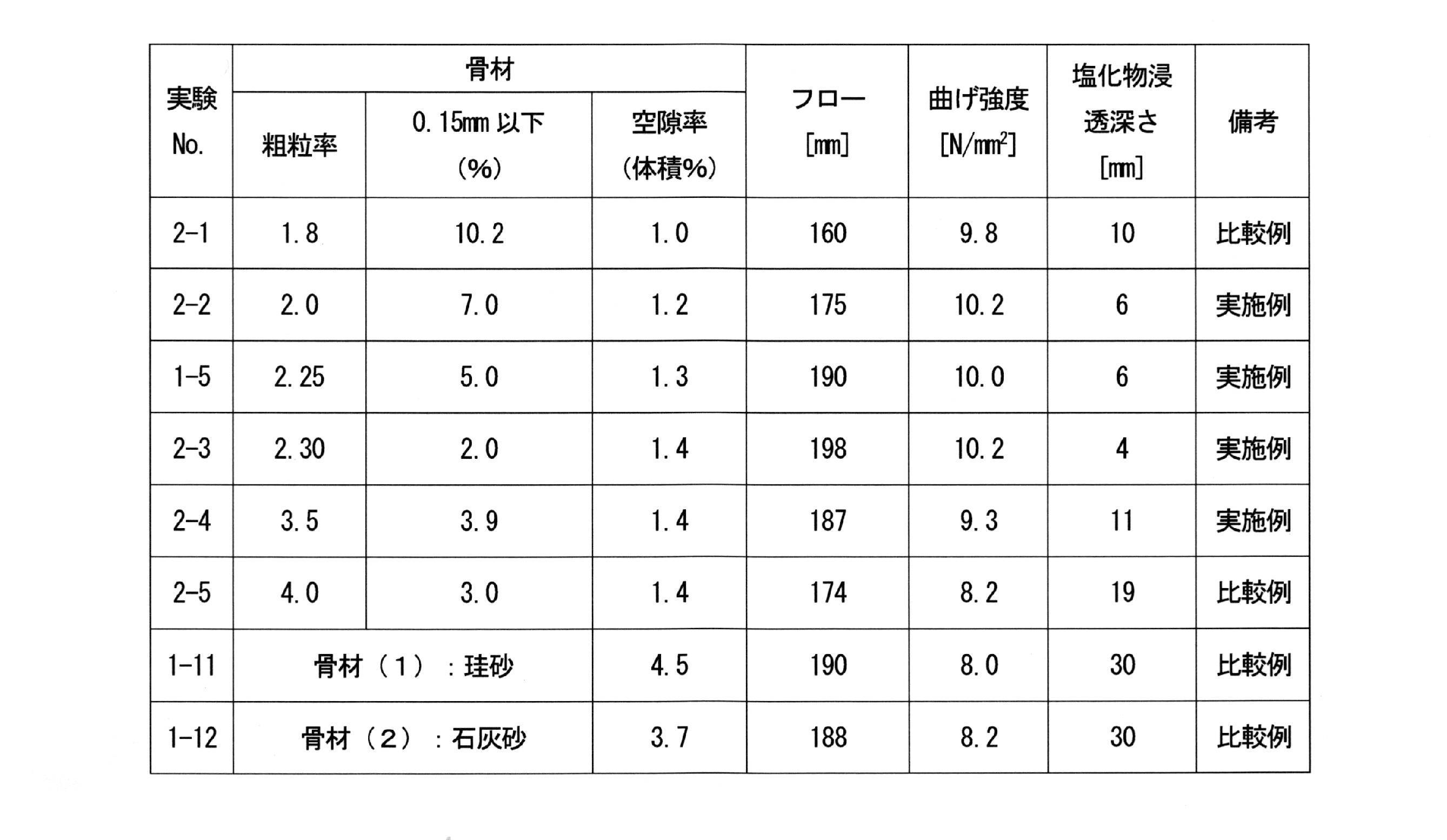
表2より、本発明のクリンカー骨材は、流動性への影響が小さく、通常の骨材を使用した場合に比べて、曲げ強度が高い値を示し、かつ塩化物イオン浸透深さが小さくなることが分かる。
本発明のクリンカー骨材を用いたセメントコンクリートは、流動性が良好で、曲げ強度が高く、かつ塩化物イオンの浸透を抑制できるという効果を奏するため、土木建築分野で好適に用いられる。
Claims (3)
- 粗粒率が2.0~3.5、0.15mm以下の微粒分が10%以下であり、CaO成分が15~40質量%、Al2O3成分が50~75質量%であるクリンカー骨材。
- 空隙率が10体積%以下である請求項1記載のクリンカー骨材。
- 請求項1または2記載のクリンカー骨材を用いてなるセメントコンクリート。
Applications Claiming Priority (2)
| Application Number | Priority Date | Filing Date | Title |
|---|---|---|---|
| JP2016123532A JP6148376B1 (ja) | 2016-06-22 | 2016-06-22 | クリンカー骨材、それを用いたセメントコンクリート |
| JP2016-123532 | 2016-06-22 |
Publications (1)
| Publication Number | Publication Date |
|---|---|
| WO2017221685A1 true WO2017221685A1 (ja) | 2017-12-28 |
Family
ID=59061264
Family Applications (1)
| Application Number | Title | Priority Date | Filing Date |
|---|---|---|---|
| PCT/JP2017/020884 Ceased WO2017221685A1 (ja) | 2016-06-22 | 2017-06-05 | クリンカー骨材、それを用いたセメントコンクリート |
Country Status (2)
| Country | Link |
|---|---|
| JP (1) | JP6148376B1 (ja) |
| WO (1) | WO2017221685A1 (ja) |
Families Citing this family (1)
| Publication number | Priority date | Publication date | Assignee | Title |
|---|---|---|---|---|
| JP7822130B2 (ja) * | 2021-03-05 | 2026-03-02 | デンカ株式会社 | セメント混和材及びセメント組成物 |
Citations (7)
| Publication number | Priority date | Publication date | Assignee | Title |
|---|---|---|---|---|
| JPH10130045A (ja) * | 1996-10-24 | 1998-05-19 | Mitsubishi Materials Corp | 再生可能なコンクリート材及び該コンクリート材から作られたコンクリート廃材の再利用方法 |
| JPH11217251A (ja) * | 1998-01-30 | 1999-08-10 | Ohbayashi Corp | コンクリートひび割れの修復方法 |
| JP2003261372A (ja) * | 2002-03-12 | 2003-09-16 | Ube Ind Ltd | 腐食環境施設用モルタル組成物及びコンクリート構造物腐食防止工法 |
| JP2004123397A (ja) * | 2002-08-02 | 2004-04-22 | Kao Corp | 水硬性組成物 |
| JP2004262714A (ja) * | 2003-02-28 | 2004-09-24 | Mitsubishi Materials Corp | 高強度モルタル |
| JP2008266114A (ja) * | 2007-03-22 | 2008-11-06 | Ube Ind Ltd | 水硬性組成物 |
| JP2013170435A (ja) * | 2012-02-22 | 2013-09-02 | Ube Ind Ltd | コンクリート構造物の補修方法 |
-
2016
- 2016-06-22 JP JP2016123532A patent/JP6148376B1/ja active Active
-
2017
- 2017-06-05 WO PCT/JP2017/020884 patent/WO2017221685A1/ja not_active Ceased
Patent Citations (7)
| Publication number | Priority date | Publication date | Assignee | Title |
|---|---|---|---|---|
| JPH10130045A (ja) * | 1996-10-24 | 1998-05-19 | Mitsubishi Materials Corp | 再生可能なコンクリート材及び該コンクリート材から作られたコンクリート廃材の再利用方法 |
| JPH11217251A (ja) * | 1998-01-30 | 1999-08-10 | Ohbayashi Corp | コンクリートひび割れの修復方法 |
| JP2003261372A (ja) * | 2002-03-12 | 2003-09-16 | Ube Ind Ltd | 腐食環境施設用モルタル組成物及びコンクリート構造物腐食防止工法 |
| JP2004123397A (ja) * | 2002-08-02 | 2004-04-22 | Kao Corp | 水硬性組成物 |
| JP2004262714A (ja) * | 2003-02-28 | 2004-09-24 | Mitsubishi Materials Corp | 高強度モルタル |
| JP2008266114A (ja) * | 2007-03-22 | 2008-11-06 | Ube Ind Ltd | 水硬性組成物 |
| JP2013170435A (ja) * | 2012-02-22 | 2013-09-02 | Ube Ind Ltd | コンクリート構造物の補修方法 |
Also Published As
| Publication number | Publication date |
|---|---|
| JP6148376B1 (ja) | 2017-06-14 |
| JP2017226572A (ja) | 2017-12-28 |
Similar Documents
| Publication | Publication Date | Title |
|---|---|---|
| JP5113496B2 (ja) | 超速硬セメント組成物、超速硬モルタル又はコンクリート組成物、及び超速硬グラウトモルタル | |
| WO2011108065A1 (ja) | セメント混和材及びセメント組成物 | |
| KR20140043493A (ko) | 중성화 억제형 조강 시멘트 조성물 | |
| JP4382614B2 (ja) | セメント混和材およびそれを用いたセメント組成物 | |
| WO2013054604A1 (ja) | 早期脱型材およびコンクリート製品の製造方法 | |
| JP7542130B2 (ja) | セメント混和材、セメント組成物、及びコンクリート製品の製造方法 | |
| JP6238579B2 (ja) | 炭酸化建材用の結合材およびその製造方法。 | |
| JP6753687B2 (ja) | コンクリート製品およびコンクリート製品の製造方法 | |
| EP3875444B1 (en) | Cement admixture, expansion material, and cement composition | |
| JP6568291B1 (ja) | セメント混和材、膨張材、及びセメント組成物 | |
| JP4201265B2 (ja) | 超速硬・高流動モルタル組成物および超速硬・高流動モルタル | |
| JP5345821B2 (ja) | セメント混和材及びセメント組成物 | |
| JP5832599B2 (ja) | セメント組成物 | |
| JP6383417B2 (ja) | 炭酸化建材用の結合材の製造方法 | |
| JP7005719B1 (ja) | 補修モルタル材料、補修モルタル組成物及び硬化体 | |
| JP6148376B1 (ja) | クリンカー骨材、それを用いたセメントコンクリート | |
| JP4809278B2 (ja) | 膨張材、セメント組成物、及びそれを用いてなるセメント硬化体 | |
| JP6195460B2 (ja) | コンクリート用ブリーディング防止剤の製造方法及びそのコンクリート用ブリーディング防止剤を配合したセメント組成物の製造方法 | |
| JP2007153714A (ja) | セメント混和材及びセメント組成物 | |
| JP7822130B2 (ja) | セメント混和材及びセメント組成物 | |
| JP6641057B1 (ja) | セメント混和材、膨張材、及びセメント組成物 | |
| JP5634683B2 (ja) | セメント混和材及びセメント組成物の調整方法 | |
| JP5345820B2 (ja) | セメント混和材及びセメント組成物 | |
| JP4953568B2 (ja) | セメント用凝結促進剤及びセメント組成物 | |
| JP6003900B2 (ja) | セメント混和材の製造方法 |
Legal Events
| Date | Code | Title | Description |
|---|---|---|---|
| 121 | Ep: the epo has been informed by wipo that ep was designated in this application |
Ref document number: 17815154 Country of ref document: EP Kind code of ref document: A1 |
|
| NENP | Non-entry into the national phase |
Ref country code: DE |
|
| 122 | Ep: pct application non-entry in european phase |
Ref document number: 17815154 Country of ref document: EP Kind code of ref document: A1 |