WO2017209093A1 - プリント配線板用樹脂組成物及びそれを用いたプリント配線板用樹脂シート - Google Patents
プリント配線板用樹脂組成物及びそれを用いたプリント配線板用樹脂シート Download PDFInfo
- Publication number
- WO2017209093A1 WO2017209093A1 PCT/JP2017/020007 JP2017020007W WO2017209093A1 WO 2017209093 A1 WO2017209093 A1 WO 2017209093A1 JP 2017020007 W JP2017020007 W JP 2017020007W WO 2017209093 A1 WO2017209093 A1 WO 2017209093A1
- Authority
- WO
- WIPO (PCT)
- Prior art keywords
- resin
- printed wiring
- mass
- parts
- resin composition
- Prior art date
- Legal status (The legal status is an assumption and is not a legal conclusion. Google has not performed a legal analysis and makes no representation as to the accuracy of the status listed.)
- Ceased
Links
Classifications
-
- C—CHEMISTRY; METALLURGY
- C08—ORGANIC MACROMOLECULAR COMPOUNDS; THEIR PREPARATION OR CHEMICAL WORKING-UP; COMPOSITIONS BASED THEREON
- C08G—MACROMOLECULAR COMPOUNDS OBTAINED OTHERWISE THAN BY REACTIONS ONLY INVOLVING UNSATURATED CARBON-TO-CARBON BONDS
- C08G59/00—Polycondensates containing more than one epoxy group per molecule; Macromolecules obtained by polymerising compounds containing more than one epoxy group per molecule using curing agents or catalysts which react with the epoxy groups
- C08G59/18—Macromolecules obtained by polymerising compounds containing more than one epoxy group per molecule using curing agents or catalysts which react with the epoxy groups ; e.g. general methods of curing
- C08G59/40—Macromolecules obtained by polymerising compounds containing more than one epoxy group per molecule using curing agents or catalysts which react with the epoxy groups ; e.g. general methods of curing characterised by the curing agents used
- C08G59/4007—Curing agents not provided for by the groups C08G59/42 - C08G59/66
- C08G59/4014—Nitrogen containing compounds
- C08G59/4042—Imines; Imides
-
- B—PERFORMING OPERATIONS; TRANSPORTING
- B32—LAYERED PRODUCTS
- B32B—LAYERED PRODUCTS, i.e. PRODUCTS BUILT-UP OF STRATA OF FLAT OR NON-FLAT, e.g. CELLULAR OR HONEYCOMB, FORM
- B32B27/00—Layered products comprising a layer of synthetic resin
- B32B27/30—Layered products comprising a layer of synthetic resin comprising vinyl (co)polymers; comprising acrylic (co)polymers
-
- C—CHEMISTRY; METALLURGY
- C08—ORGANIC MACROMOLECULAR COMPOUNDS; THEIR PREPARATION OR CHEMICAL WORKING-UP; COMPOSITIONS BASED THEREON
- C08J—WORKING-UP; GENERAL PROCESSES OF COMPOUNDING; AFTER-TREATMENT NOT COVERED BY SUBCLASSES C08B, C08C, C08F, C08G or C08H
- C08J5/00—Manufacture of articles or shaped materials containing macromolecular substances
- C08J5/04—Reinforcing macromolecular compounds with loose or coherent fibrous material
-
- C—CHEMISTRY; METALLURGY
- C08—ORGANIC MACROMOLECULAR COMPOUNDS; THEIR PREPARATION OR CHEMICAL WORKING-UP; COMPOSITIONS BASED THEREON
- C08J—WORKING-UP; GENERAL PROCESSES OF COMPOUNDING; AFTER-TREATMENT NOT COVERED BY SUBCLASSES C08B, C08C, C08F, C08G or C08H
- C08J5/00—Manufacture of articles or shaped materials containing macromolecular substances
- C08J5/24—Impregnating materials with prepolymers which can be polymerised in situ, e.g. manufacture of prepregs
-
- C—CHEMISTRY; METALLURGY
- C08—ORGANIC MACROMOLECULAR COMPOUNDS; THEIR PREPARATION OR CHEMICAL WORKING-UP; COMPOSITIONS BASED THEREON
- C08K—Use of inorganic or non-macromolecular organic substances as compounding ingredients
- C08K3/00—Use of inorganic substances as compounding ingredients
-
- C—CHEMISTRY; METALLURGY
- C08—ORGANIC MACROMOLECULAR COMPOUNDS; THEIR PREPARATION OR CHEMICAL WORKING-UP; COMPOSITIONS BASED THEREON
- C08K—Use of inorganic or non-macromolecular organic substances as compounding ingredients
- C08K3/00—Use of inorganic substances as compounding ingredients
- C08K3/01—Use of inorganic substances as compounding ingredients characterized by their specific function
- C08K3/013—Fillers, pigments or reinforcing additives
-
- C—CHEMISTRY; METALLURGY
- C08—ORGANIC MACROMOLECULAR COMPOUNDS; THEIR PREPARATION OR CHEMICAL WORKING-UP; COMPOSITIONS BASED THEREON
- C08K—Use of inorganic or non-macromolecular organic substances as compounding ingredients
- C08K5/00—Use of organic ingredients
- C08K5/16—Nitrogen-containing compounds
- C08K5/34—Heterocyclic compounds having nitrogen in the ring
- C08K5/3412—Heterocyclic compounds having nitrogen in the ring having one nitrogen atom in the ring
- C08K5/3415—Five-membered rings
-
- C—CHEMISTRY; METALLURGY
- C08—ORGANIC MACROMOLECULAR COMPOUNDS; THEIR PREPARATION OR CHEMICAL WORKING-UP; COMPOSITIONS BASED THEREON
- C08L—COMPOSITIONS OF MACROMOLECULAR COMPOUNDS
- C08L33/00—Compositions of homopolymers or copolymers of compounds having one or more unsaturated aliphatic radicals, each having only one carbon-to-carbon double bond, and only one being terminated by only one carboxyl radical, or of salts, anhydrides, esters, amides, imides or nitriles thereof; Compositions of derivatives of such polymers
- C08L33/04—Homopolymers or copolymers of esters
-
- C—CHEMISTRY; METALLURGY
- C08—ORGANIC MACROMOLECULAR COMPOUNDS; THEIR PREPARATION OR CHEMICAL WORKING-UP; COMPOSITIONS BASED THEREON
- C08L—COMPOSITIONS OF MACROMOLECULAR COMPOUNDS
- C08L33/00—Compositions of homopolymers or copolymers of compounds having one or more unsaturated aliphatic radicals, each having only one carbon-to-carbon double bond, and only one being terminated by only one carboxyl radical, or of salts, anhydrides, esters, amides, imides or nitriles thereof; Compositions of derivatives of such polymers
- C08L33/04—Homopolymers or copolymers of esters
- C08L33/06—Homopolymers or copolymers of esters of esters containing only carbon, hydrogen and oxygen, which oxygen atoms are present only as part of the carboxyl radical
- C08L33/062—Copolymers with monomers not covered by C08L33/06
- C08L33/068—Copolymers with monomers not covered by C08L33/06 containing glycidyl groups
-
- C—CHEMISTRY; METALLURGY
- C08—ORGANIC MACROMOLECULAR COMPOUNDS; THEIR PREPARATION OR CHEMICAL WORKING-UP; COMPOSITIONS BASED THEREON
- C08L—COMPOSITIONS OF MACROMOLECULAR COMPOUNDS
- C08L63/00—Compositions of epoxy resins; Compositions of derivatives of epoxy resins
-
- H—ELECTRICITY
- H05—ELECTRIC TECHNIQUES NOT OTHERWISE PROVIDED FOR
- H05K—PRINTED CIRCUITS; CASINGS OR CONSTRUCTIONAL DETAILS OF ELECTRIC APPARATUS; MANUFACTURE OF ASSEMBLAGES OF ELECTRICAL COMPONENTS
- H05K1/00—Printed circuits
- H05K1/02—Details
- H05K1/03—Use of materials for the substrate
-
- H—ELECTRICITY
- H05—ELECTRIC TECHNIQUES NOT OTHERWISE PROVIDED FOR
- H05K—PRINTED CIRCUITS; CASINGS OR CONSTRUCTIONAL DETAILS OF ELECTRIC APPARATUS; MANUFACTURE OF ASSEMBLAGES OF ELECTRICAL COMPONENTS
- H05K1/00—Printed circuits
- H05K1/02—Details
- H05K1/03—Use of materials for the substrate
- H05K1/0313—Organic insulating material
- H05K1/0353—Organic insulating material consisting of two or more materials, e.g. two or more polymers, polymer + filler, + reinforcement
- H05K1/0366—Organic insulating material consisting of two or more materials, e.g. two or more polymers, polymer + filler, + reinforcement reinforced, e.g. by fibres, fabrics
-
- H—ELECTRICITY
- H05—ELECTRIC TECHNIQUES NOT OTHERWISE PROVIDED FOR
- H05K—PRINTED CIRCUITS; CASINGS OR CONSTRUCTIONAL DETAILS OF ELECTRIC APPARATUS; MANUFACTURE OF ASSEMBLAGES OF ELECTRICAL COMPONENTS
- H05K1/00—Printed circuits
- H05K1/02—Details
- H05K1/03—Use of materials for the substrate
- H05K1/0313—Organic insulating material
- H05K1/0353—Organic insulating material consisting of two or more materials, e.g. two or more polymers, polymer + filler, + reinforcement
- H05K1/0373—Organic insulating material consisting of two or more materials, e.g. two or more polymers, polymer + filler, + reinforcement containing additives, e.g. fillers
Definitions
- the present invention relates to a resin composition used for manufacturing a printed wiring board and a resin sheet for a printed wiring board using the same.
- the characteristics required for printed wiring boards equipped with electrical and electronic components are becoming more advanced as their fields of use expand. For example, as information processing devices such as personal computers and portable communication devices are further reduced in size, there has been a demand for three-dimensionalization by means of package thickness reduction, modularization, and PoP (Package on Package) structure. As a result, the demand for dimensional stability at the time of mounting a semiconductor element or the like on a printed wiring board is further increased. In order to achieve such a requirement, the insulating layer constituting the printed wiring board is required to have higher dimensional stability against heat and lower warpage than ever before, as well as higher heat resistance of the insulating resin itself. Is done.
- Patent Document 1 discloses a resin composition for printed wiring boards containing a thermosetting resin containing an epoxy resin, a curing agent, an inorganic filler, and an acrylic resin.
- a polyfunctional maleimide resin may be contained as the thermosetting resin in addition to the epoxy resin.
- the acrylic resin may have an epoxy group.
- a resin composition for a printed wiring board containing a maleimide resin is also described in Patent Document 2.
- the resin composition described in the document contains a maleimide resin and a compound capable of undergoing a crosslinking reaction with the maleimide resin.
- the compound capable of crosslinking with the maleimide resin include compounds having an amino group, a cyanate group, a phenolic hydroxyl group, an alcoholic hydroxyl group, an allyl group, an acryl group, a methacryl group, a vinyl group, or a conjugated diene group.
- the resin composition for a printed wiring board described in each of the above-mentioned documents is not sufficiently flexible in the state of the B stage, and cracks are generated when an external force is applied, or is generated due to that. Sometimes broken pieces were dropped. Moreover, when trying to improve flexibility, the fluidity of the resin composition often decreases. In order to improve the flexibility, it is known to add a polymer such as a polyvinyl acetal resin. However, in that case, the thermal expansion of the cured product is increased and the dimensional stability is sometimes lost.
- an object of the present invention is to provide a resin composition for a printed wiring board that can eliminate the various drawbacks of the above-described conventional technology.
- a maleimide compound A (meth) acrylic resin having a weight average molecular weight of 50,000 or more; A curing accelerator; An inorganic filler, For a total of 100 parts by mass of the maleimide compound, the (meth) acrylic resin, and the curing accelerator, The maleimide compound is contained in an amount of 25 parts by weight to 93 parts by weight, The (meth) acrylic resin is contained in an amount of 7 to 70 parts by mass,
- the said subject is solved by providing the resin composition for printed wiring boards in which the said inorganic filler is contained 100 mass parts or more and 400 mass parts or less.
- the resin composition of this invention is used for manufacture of a printed wiring board. That is, the present invention relates to a resin composition for printed wiring boards.
- the resin composition of the present invention contains a maleimide compound, a (meth) acrylic resin, a curing accelerator, and an inorganic filler as its constituent components.
- these components will be described in detail.
- a maleimide compound is a compound having at least one maleimide moiety.
- a maleimide compound having two maleimide moieties so-called bismaleimide compound
- a polymaleimide compound having three or more maleimide moieties increases the reduction in warpage of the resin composition and improves the heat resistance.
- bismaleimide compound so-called bismaleimide compound
- a polymaleimide compound having three or more maleimide moieties increases the reduction in warpage of the resin composition and improves the heat resistance.
- Examples of the molecular skeleton constituting the maleimide compound include a biphenyl skeleton, a 4,4′-diphenylmethane skeleton, a phenylmethane skeleton, a phenylene skeleton, a diphenyl ether skeleton, and combinations thereof.
- the use of a maleimide compound having a biphenyl skeleton, a 4,4′-diphenylmethane skeleton or a phenylmethane skeleton retains sufficient heat resistance, further enhances the flexibility of the resin composition, and improves fluidity. It is preferable from the viewpoint of further enhancement.
- These maleimide compounds can be used singly or in combination of two or more. Among these, a maleimide compound having a biphenyl skeleton is most preferable from the viewpoint of higher heat resistance and crack resistance in the B stage.
- the maleimide compound preferably has a maleimide equivalent of 100 to 1000, more preferably 150 to 800, and still more preferably 200 to 400. By setting the maleimide equivalent within this range, sufficient heat resistance can be maintained, the flexibility of the resin composition is further enhanced, and the fluidity is further enhanced.
- the maleimide compound is preferably contained in an amount of 25 parts by mass to 93 parts by mass with respect to 100 parts by mass in total of the maleimide compound, the (meth) acrylic resin, and the curing accelerator. More preferably, it is contained in an amount of 28 parts by mass or more and 70 parts by mass or less, and more preferably 30 parts by mass or more and 50 parts by mass or less.
- (Meth) acrylic resin contained in the resin composition of the present invention is blended mainly for the purpose of enhancing the flexibility of the resin composition. Moreover, it mix
- (Meth) acrylic resin is a general term for acrylic resin and methacrylic resin.
- the (meth) acrylic resin is a resin polymerized using acrylic acid or a derivative thereof as one of the polymerizable monomers, or a resin polymerized using methacrylic acid or a derivative thereof as one of the polymerizable monomers. Or a resin polymerized using acrylic acid or a derivative thereof and methacrylic acid or a derivative thereof as a polymerizable monomer.
- the acrylic acid and methacrylic acid derivatives include esters of these acids, epoxy-modified products thereof, hydroxyl-modified products, carboxyl-modified products, amino-modified products, and amide-modified products.
- the arrangement of the repeating units in the copolymer may be random, block, graft. Also good.
- the copolymer contains a repeating unit other than (meth) acrylic acid or a derivative thereof as a copolymerization component, the repeating unit includes, for example, a repeating unit derived from acrylonitrile, a repeating unit derived from butadiene, And repeating units derived from styrene.
- (Meth) acrylic resin may have various functional groups at the terminal, side chain or main chain of the polymer chain.
- a functional group include a group reactive with at least one of an epoxy resin and a curing agent.
- Specific examples include an epoxy group, a hydroxyl group, a carboxyl group, an amino group, and an amide group.
- an epoxy group is particularly preferable.
- a plurality of functional groups may be contained per molecule of (meth) acrylic resin.
- the (meth) acrylic resin has a weight average molecular weight (hereinafter also referred to as “MW”) of preferably 50,000 or more, more preferably 70,000 or more, and even more preferably 100,000 or more.
- the upper limit of the weight average molecular weight is preferably 1 million or less, more preferably 900,000 or less, and still more preferably 700,000 or less.
- the (meth) acrylic resin is contained in an amount of 7 parts by mass or more and 70 parts by mass or less with respect to 100 parts by mass in total of the maleimide compound, the (meth) acrylic resin, and the curing accelerator. Is more preferably 10 parts by mass or more and 60 parts by mass or less, and further preferably 15 parts by mass or more and 50 parts by mass or less.
- the curing accelerator contained in the resin composition of the present invention is used for promoting the curing of the maleimide compound contained in the resin composition.
- the curing accelerator is preferably a compound that also promotes a polymerization reaction (crosslinking reaction) of an epoxy group which is a kind of a polymerizable reactive group.
- Examples of such curing accelerators include amine compounds and phosphorus compounds. These curing accelerators can be used singly or in combination of two or more.
- the curing accelerator is preferably a heterocyclic aromatic amine containing a nitrogen atom in the heterocyclic ring.
- the curing accelerator is particularly preferably an imidazole compound from the viewpoint of the heat resistance and insulation reliability of the cured product.
- imidazole compounds include 2-methylimidazole, 2-ethyl-4-methylimidazole, 2-phenylimidazole, 2-phenyl-4-methylimidazole, 1-benzyl-2-methylimidazole, 1-benzyl-2 -Phenylimidazole, 1,2-dimethylimidazole and the like.
- the curing accelerator is contained in an amount of 0.01 parts by mass or more and 10 parts by mass or less with respect to a total of 100 parts by mass of the maleimide compound, the (meth) acrylic resin, and the curing accelerator. It is more preferable that it is contained in an amount of 0.10 parts by mass or more and 5 parts by mass or less, and more preferably 0.15 parts by mass or more and 3 parts by mass or less.
- the resin composition of the present invention contains an inorganic filler in addition to the components described above.
- the inorganic filler is blended for the purpose of imparting dimensional stability to heat to the cured product produced from the resin composition of the present invention. Or it mix
- the type of inorganic filler is not particularly limited.
- silica, barium sulfate, calcined talc, zinc molybdate-treated talc, barium titanate, titanium oxide, clay, alumina, mica, boehmite, zinc borate, zinc stannate examples thereof include aluminum hydroxide, calcium carbonate, magnesium hydroxide, magnesium silicate, short glass fiber, aluminum borate whisker, and silicon carbonate whisker. These inorganic fillers may be used alone or in combination of two or more.
- the inorganic filler is silica from the viewpoint of imparting dimensional stability to heat to the cured body resulting from the resin composition, and also imparting easy availability, heat resistance of the cured body, insulation reliability, and the like. It is preferable.
- silica such as amorphous silica, fused silica, crystalline silica, synthetic silica, and hollow silica is known. It can be added to the resin composition with high filling, and the heat of the B-stage resin sheet is added. From the viewpoint of good flowability (resin flow), a spherical shape is particularly preferable.
- an inorganic filler there is no restriction
- the shape for example, a spherical shape, a polyhedral shape, a needle shape, a spindle shape, an indeterminate shape, or the like can be adopted. A combination of two or more of these shapes may be used.
- the average particle size is preferably 0.001 ⁇ m or more and 20 ⁇ m or less, more preferably 0.01 ⁇ m or more and 10 ⁇ m or less, and further preferably 0.05 ⁇ m or more and 5 ⁇ m or less. Two or more inorganic fillers having different average particle diameters may be used in combination, and a plurality of peaks may be observed in the particle size distribution.
- the average particle diameter is measured by a median diameter (D 50 ) obtained from a particle size distribution curve using a laser diffraction / scattering particle size distribution measuring apparatus.
- the aspect ratio that is the ratio of the major axis to the minor axis of the particle is not particularly limited. However, in the production of the product of the present invention, the aspect ratio is preferably 1.0 or more and 10 or less, and preferably 1.0 or more and 5.0 or less, from the viewpoint of resin flow and ease of control when imparting flexibility. Is more preferable, and 1.0 to 2.0 is most preferable.
- the surface of the inorganic filler is preferably subjected to a surface treatment with a silane coupling agent from the viewpoint of improving the adhesion between the resin component and the inorganic filler, and improving the moisture absorption resistance of the resin composition.
- silane coupling agents include amino functional silane coupling agents, acrylic functional silane coupling agents, methacryl functional silane coupling agents, epoxy functional silane coupling agents, olefin functional silane coupling agents, and mercapto functionalities.
- a functional silane coupling agent and a vinyl functional silane coupling agent are more preferable.
- the inorganic filler is preferably included in an amount of 100 parts by mass or more and 400 parts by mass or less with respect to 100 parts by mass in total of the maleimide compound, the (meth) acrylic resin, and the curing accelerator. More preferably, it is contained in an amount of 100 parts by mass or more and 350 parts by mass or less, and more preferably 150 parts by mass or more and 300 parts by mass or less.
- the resin composition of the present invention may contain other components as necessary in addition to the components described so far.
- Other components include, for example, epoxy resins, flame retardants, flame retardant aids, coupling agents, adhesion promoters, colorants, laser processability improvers, antioxidants, UV degradation inhibitors, mold release agents, and PH adjustment Agents, ion scavengers, antifoaming agents, leveling agents, antiblocking agents, thickeners, thixotropic agents, and other resins other than those mentioned above.
- the resin composition of the present invention contains an epoxy resin, the heat resistance of the cured body is improved, the dimensional stability against heat is further improved, and the moisture absorption resistance is further improved.
- epoxy resin those used so far in the technical field can be used without particular limitation.
- the epoxy resin is preferably a naphthalene type epoxy resin and / or a biphenyl aralkyl type epoxy resin.
- the heat resistance of the cured product is further improved, the dimensional stability against heat is further improved, and the moisture absorption resistance is further improved. From the viewpoint of making this effect even more remarkable, it is preferable to use a naphthalene type epoxy resin as the epoxy resin.
- the above-mentioned epoxy resins including naphthalene type epoxy resins and biphenyl aralkyl type epoxy resins include a maleimide compound, a (meth) acrylic resin, a curing accelerator, and the epoxy resin in the resin composition of the present invention. It is preferably contained in an amount of 10 to 40 parts by mass, more preferably 10 to 30 parts by mass, and more preferably 15 to 25 parts by mass with respect to a total of 100 parts by mass. preferable.
- the resin composition contains a curing agent that is reactive with an epoxy group in terms of making the crosslinking reaction of the epoxy resin more precise and improving the heat resistance of the cured body.
- curing agents include diamine-based curing agents such as primary amines and secondary amines, bifunctional or higher phenol compounds, acid anhydride-based curing agents, and dicyandiamide. These hardening
- curing agents can be used individually by 1 type or in combination of 2 or more types. These curing agents may function as a curing accelerator for the maleimide compound described above. In such a case, the curing agent is positioned as a curing accelerator.
- a curing agent based on a phenol compound or an acid anhydride curing agent alone or in combination thereof is more preferable because it can easily control the overall thermosetting reaction rate in the resin composition of the present invention.
- the reason is that these compounds contribute only to the curing reaction with the epoxy resin and do not contribute to the curing reaction of the maleimide compound, so that the overall thermosetting reaction rate can be prevented from proceeding rapidly. is there. As a result, abnormal aggregation of the maleimide cured product and the epoxy resin cured product in the obtained insulating layer can be prevented, so that the uniformity in the system can be maintained.
- the resin composition of the present invention can be obtained by mixing and stirring the above-described components in an organic solvent.
- an organic solvent the thing similar to what was conventionally used for preparation of this kind of resin composition can be used.
- organic solvents include methanol, ethanol, methyl ethyl ketone, toluene, propylene glycol monomethyl ether, dimethylformamide, dimethylacetamide, cyclohexanone, cyclopentanone, ethyl cellosolve, 1,3-dioxolane and the like.
- the resin composition thus obtained is used for manufacturing a printed wiring board as described above.
- the resin composition of the present invention can be formed into a sheet shape and heated and dried until it becomes a B-stage semi-cured state, whereby a resin sheet for a printed wiring board containing the resin composition can be obtained. By laminating this resin sheet, a printed wiring board can be manufactured.
- a resin layer obtained by curing a resin sheet can be used alone as an insulating layer.
- the thickness of the resin layer is preferably in the range of 0.5 ⁇ m to 200 ⁇ m, and more preferably in the range of 0.5 ⁇ m to 150 ⁇ m. By setting the thickness of the resin layer within this range, it is possible to ensure a sufficient thickness for insulation, and to impart high flexibility to the resin sheet of the B stage.
- the resin composition of the present invention is impregnated into a fiber base material (cloth) such as a woven fabric, and the impregnated body obtained thereby is heated and dried until it becomes a B-stage semi-cured state, whereby the resin composition is It can be set as the prepreg for printed wiring boards to contain. By laminating this prepreg, a printed wiring board can be manufactured.
- the fiber base material is not particularly limited, and a base material woven so that warp and weft yarns are almost orthogonal, such as plain weave, can be used.
- a woven fabric of inorganic fibers such as glass cloth can be used.
- a woven fabric of organic fibers such as aramid cloth and polyester cloth can be used.
- limiting in particular in the thickness of a fiber base material For example, Preferably it can be 10 micrometers or more and 200 micrometers or less.
- the resin composition of the present invention can be used as a resin sheet for a printed wiring board with a support, in addition to the above-described sheet and prepreg.
- This resin sheet preferably has a support and a layer of the resin composition of the present invention disposed on one surface of the support.
- the support various films or foils can be used.
- a resin film can be used as the support.
- a metal foil can be used as the support.
- the thickness of the support is preferably from 5.0 ⁇ m to 100 ⁇ m from the viewpoint of ease of handling.
- the resin film examples include a resin film such as a polyethylene terephthalate (PET) film, a polyethylene naphthalate (PEN) film, an aramid film, a polyimide film, a nylon film, and a liquid crystal polymer. You may use the metal coat resin film provided with a metal layer coat layer on these resin films.
- the metal foil include a copper foil, an aluminum foil, a stainless steel foil, a nickel foil, a titanium foil, or a foil in which any one of these is laminated.
- the support is preferably a metal foil, and more preferably a copper foil, from the viewpoint of coexistence with the etching processability of the metal foil.
- the support may be provided in the form of a metal foil with a carrier by providing a so-called release layer and carrier on the other surface of the metal foil.
- carriers include metal foils such as copper foil, nickel foil, stainless steel foil, and aluminum foil, as well as PET film, PEN film, aramid film, polyimide film, nylon film, liquid crystal polymer resin film, etc.
- a metal coat resin film etc. provided with a metal layer coat layer are mentioned, it is typically a copper foil.
- Examples of the release layer include an organic release layer and an inorganic release layer.
- Examples of organic components used in the organic release layer include nitrogen-containing organic compounds, sulfur-containing organic compounds, carboxylic acids and the like.
- examples of inorganic components used in the inorganic release layer include Ni, Mo, Co, Cr, Fe, Ti, W, P, Zn, and a chromate-treated film.
- the adhesive surface of the metal foil to the resin composition layer preferably has a surface roughness (Rzjis) according to JIS B0610-1994 of 4.0 ⁇ m or less, more preferably 3.5 ⁇ m or less, and even more preferably 3 0.0 ⁇ m or less.
- a surface roughness (Rzjis) according to JIS B0610-1994 of 4.0 ⁇ m or less, more preferably 3.5 ⁇ m or less, and even more preferably 3 0.0 ⁇ m or less.
- the surface roughness (Rzjis) of the metal foil is preferably 0.005 ⁇ m or more, more preferably 0.01 ⁇ m or more, and still more preferably 0.05 ⁇ m. That's it.
- a surface treatment layer may be formed on the surface of the metal foil by a rust preventive film treatment or the like.
- the rust preventive film include an inorganic rust preventive film using zinc, nickel, cobalt, and the like, a chromate film using chromate, and an organic rust preventive film using an organic agent such as benzotriazole and imidazole.
- a silane layer may be formed on the surface of the surface treatment layer.
- the adhesion between the surface of the metal foil and the resin layer can be improved.
- the material constituting the silane layer include tetraalkoxysilane and a silane coupling agent.
- the printed wiring board laminate is formed by, for example, stacking a B-stage sheet-like material obtained from the resin composition of the present invention on the support. These can be obtained by heating and pressing them together. A vacuum pressing method or a vacuum laminating method can be employed for heating and pressurization. Or it can obtain by applying the resin composition of this invention to at least one surface of a support body, and heat-drying the obtained coating film until it becomes the semi-hardened state of B stage.
- the thickness of the resin sheet for a printed wiring board with a support is preferably 0.4 ⁇ m or more and 15 ⁇ m or less, and more preferably 0.5 ⁇ m or more and 10 ⁇ m or less. By setting it within this range, it is possible to secure a thickness for sufficiently improving interlayer adhesion, and to make the thickness suitable for fine processing in via processing (for example, laser processing) of a printed wiring board. it can.
- a primer layer made of another resin composition may be formed between the support and the resin composition layer, if necessary, for the purpose of increasing the bonding strength between them.
- the thickness of the laminated body obtained is 10 micrometers or more and 150 micrometers or less, for example.
- the printed wiring board resin sheet, prepreg, and laminate thus obtained are formed using the resin composition of the present invention, so that the dimensional stability against heat is high and when an external force is applied. Thus, the occurrence of cracks is suppressed. Therefore, these resin sheets, prepregs, and laminates for printed wiring boards are particularly suitable as raw materials for producing high-performance printed wiring boards.
- a printed wiring board construction method for example, an MSAP method, an SAP method, a subtractive method, or the like is preferably used.
- the printed wiring board manufactured using these resin sheets for printed wiring boards, a prepreg, and a laminated body has the high dimensional stability with respect to a heat
- Example 1 The components shown in Table 2 below were weighed so as to have a solid content of 60 parts by mass using methylethylketone as the mixing ratio shown in the same table, placed in a flask, heated to 60 ° C., and stirred for 1 hour with a propeller. The mixture was stirred with an apparatus to obtain a resin composition (resin varnish). Using an edge coater, this resin composition was applied to the roughened surface of the copper foil with carrier so that the thickness after drying would be 100 ⁇ m, and dried under heating conditions at 120 ° C. for 6 minutes. Was diffused to obtain a copper foil with a resin layer in which a semi-cured resin of a B stage was laminated.
- a resin composition resin varnish
- the copper foil with a carrier had a surface roughness (Rzjis) of 1.7 ⁇ m and a thickness of 2 ⁇ m.
- the copper foil with a carrier is intended Nickel 21 mg / m 2, zinc 8 mg / m 2, and rust chrome 3 mg / m 2 is applied, also the surface treatment of the amino-based silane coupling agent It was something that was given.
- Example 2 In Example 1, the resin layer was formed so that the thickness after drying was 40 ⁇ m. Other than that was carried out similarly to Example 1, and obtained the copper foil with a resin layer.
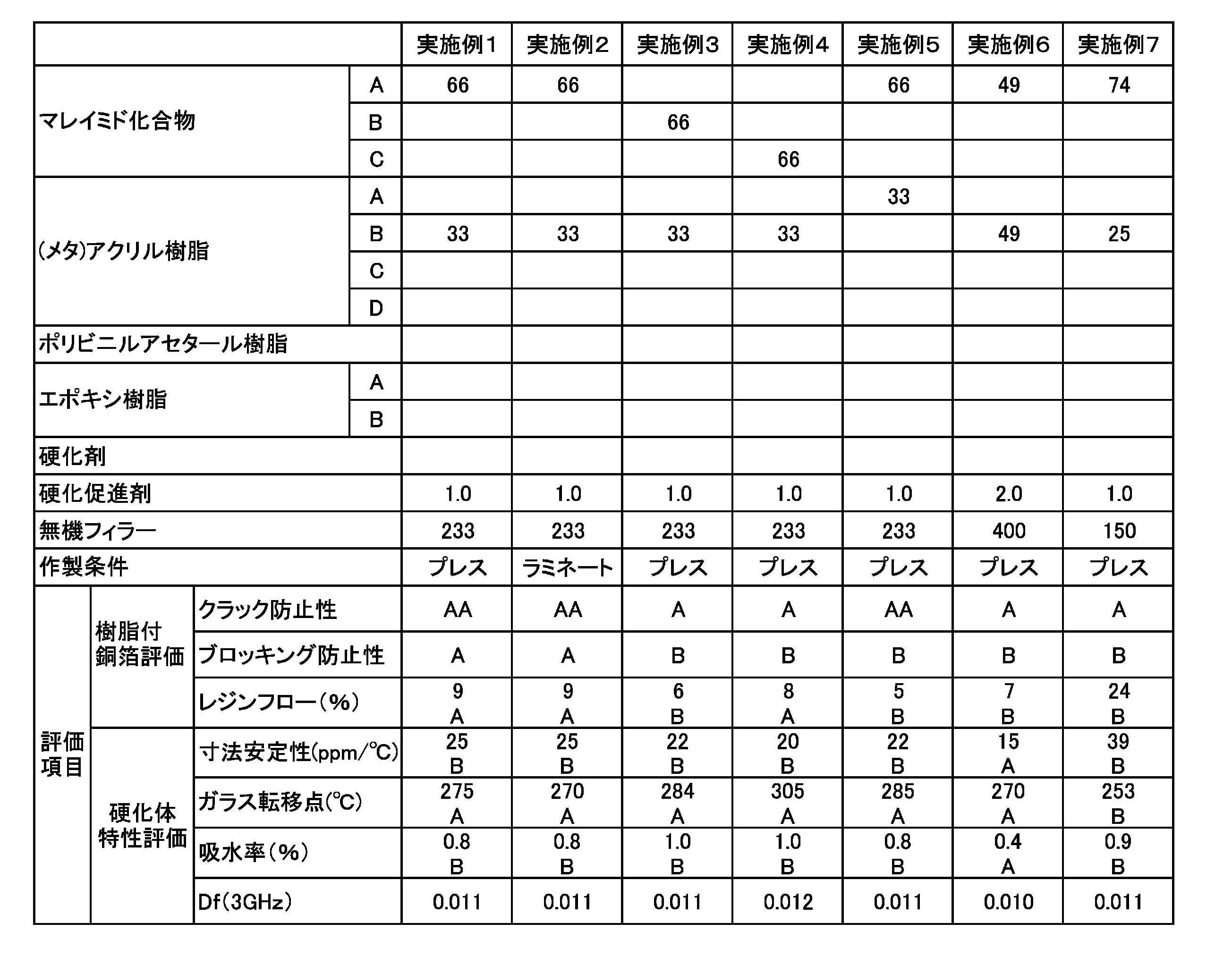
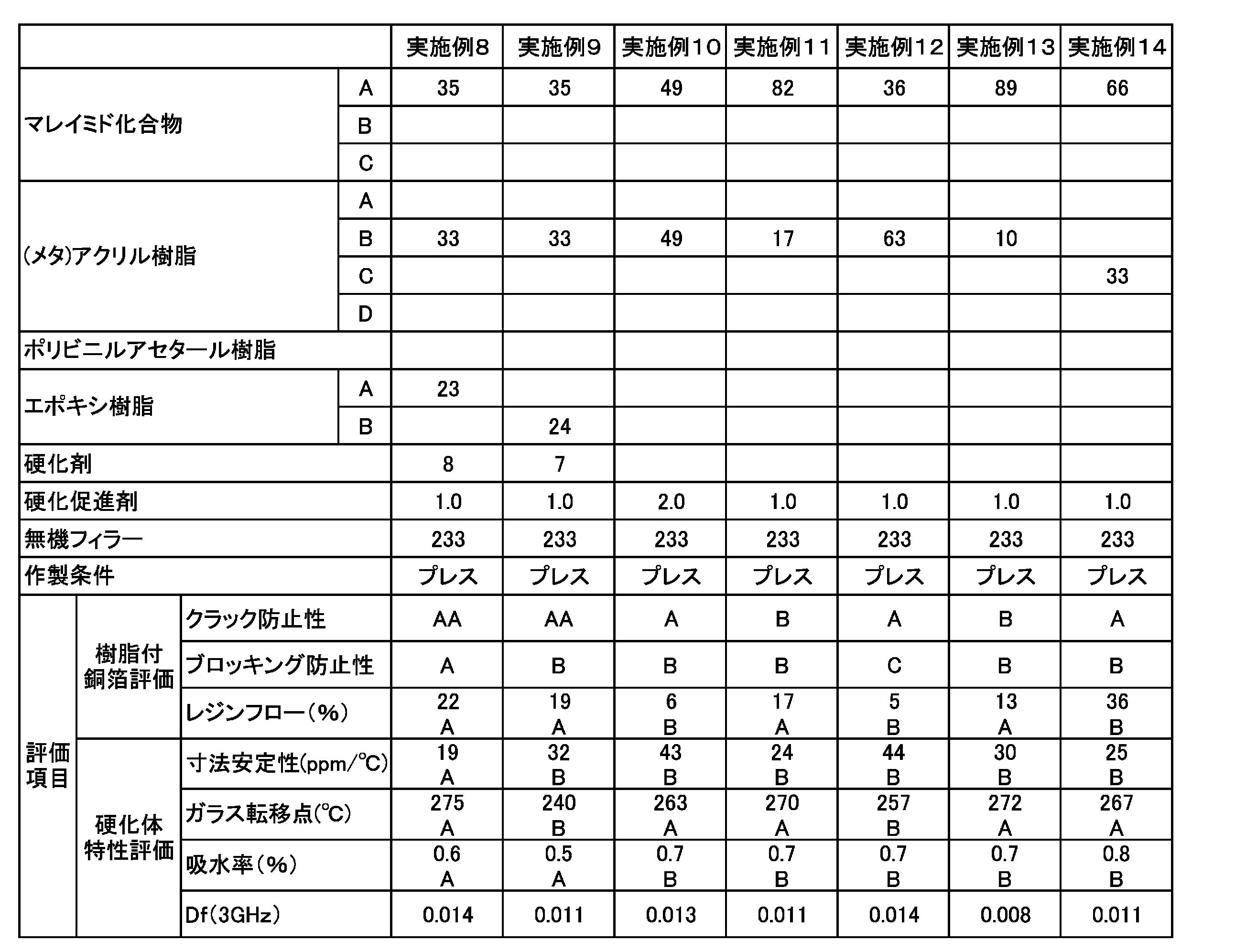
- Examples 3 to 14 A copper foil with a resin layer was obtained in the same manner as in Example 1 except that the composition of the resin composition was as shown in Tables 2 and 3.
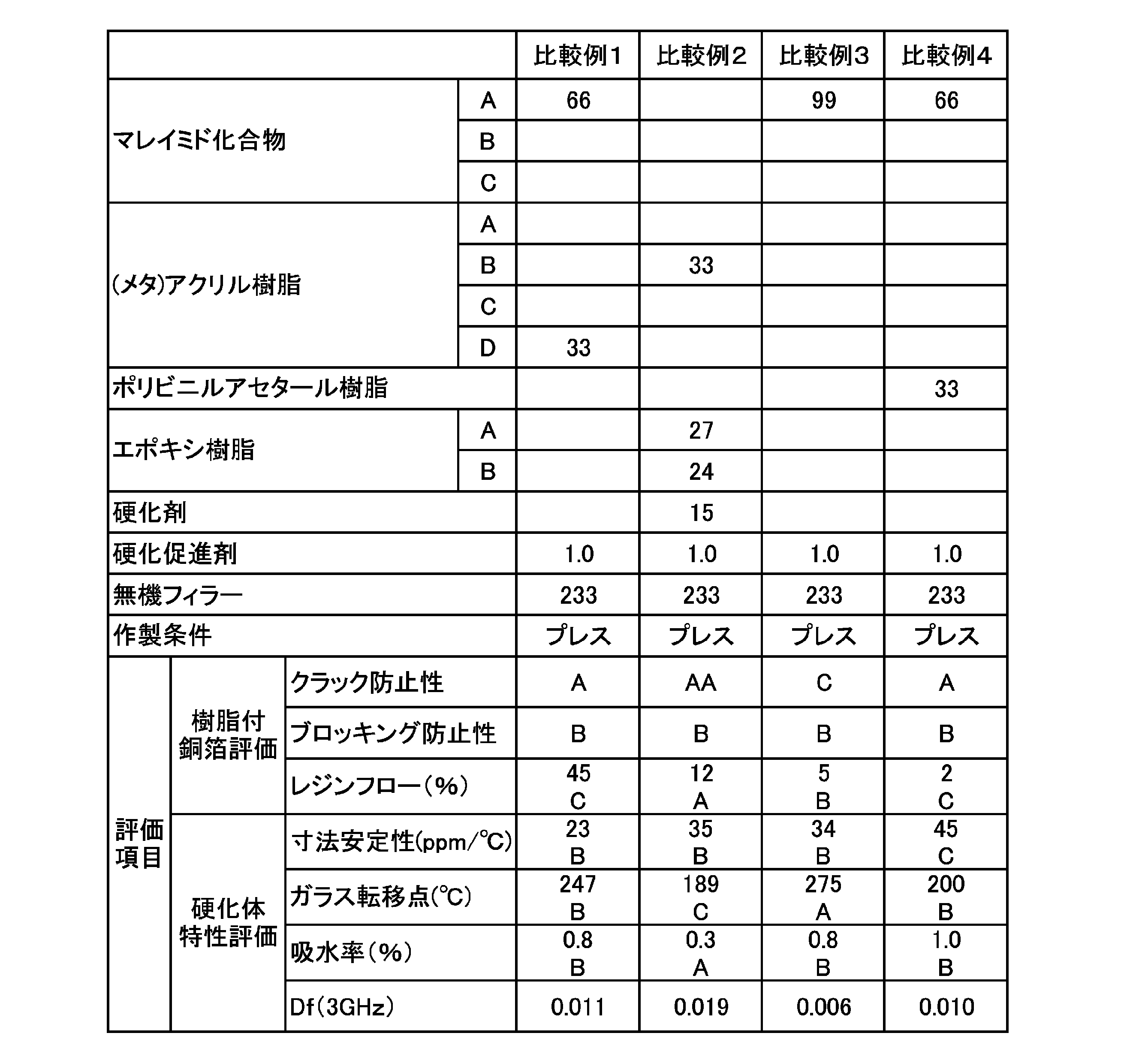
- Comparative Example 1 In this comparative example, as shown in Table 4, a (meth) acrylic resin having a low weight average molecular weight was used. Other than that was carried out similarly to Example 1, and obtained the copper foil with a resin layer.
- Comparative Example 2 In this comparative example, no maleimide compound was used.
- the resin composition was as shown in Table 4. Other than that was carried out similarly to Example 1, and obtained the copper foil with a resin layer.
- Comparative Example 4 In this comparative example, a (meth) acrylic resin was not used, and a polyvinyl acetal resin was used instead. Other than that was carried out similarly to Example 1, and obtained the copper foil with a resin layer.
- Polyvinyl acetal resin is a substance that has been used as a plasticizer in the art.
- the copper foil with a resin layer was cut into a size of 10 cm ⁇ 10 cm to obtain a sample piece.
- This sample piece is placed on a desk so that the resin layer side is on the lower surface side, and a cylinder having a diameter of 10 mm is arranged at the center of the upper surface of the copper foil surface so that its outer peripheral surface is in contact with the copper foil surface.
- the sample piece was bent upward along the cylinder. At this time, the minimum bending angle at which a crack occurred in the resin layer was measured. The following criteria were evaluated according to this angle.
- a copper foil with a resin layer of the same size is stacked on the glossy surface of a 20 ⁇ m thick copper foil with a carrier cut into 10 cm ⁇ 10 cm so that the resin layer surface is in contact with it, and a load of 500 g is applied, temperature 30 ° C., humidity It was stored in a constant temperature and humidity oven of 40% RH for 48 hours. Then, it was taken out, and the degree of adhesion between the resin layer surface and the copper foil glossy surface was evaluated according to the following criteria.
- C Adhesion (bad)
- the resin flow is based on MIL-P-13949G in the MIL standard.
- Four 10 cm square samples were sampled from a copper foil with a resin layer with a resin layer thickness of 40 ⁇ m, and these four samples were stacked. It is a value calculated based on the following formula from the result of measuring the outflow mass of the resin at the time (laminated body) with a press temperature of 171 ° C., a press pressure of 1.4 MPa, and a press time of 10 minutes. The following criteria were evaluated according to this value.
- Resin flow (%) outflow resin mass / (copper foil mass with resin layer ⁇ copper foil mass) ⁇ 100 A: 8% to less than 23% (good) B: 5% to less than 8%, or 23% to less than 40% (Possible) C: less than 5% or 40% or more (defect)
- the post-cured sample copper foil was removed by etching.
- a resin film having a thickness of about 200 ⁇ m was produced.
- the thermal expansion coefficient measured based on JISC6481 was measured, and it was set as the scale of dimensional stability. The following criteria were evaluated according to this value. A: Less than 20 ppm / ° C. (good)
- C 45 ppm / ° C. or more (bad)
- Glass transition point Using the resin film obtained in the section of dimensional stability, this was cut into 40 mm ⁇ 5 mm. Using this as a measurement sample, the glass transition point was measured using a dynamic viscoelasticity measuring device (DMA) (measurement conditions: tensile mode, frequency 1 Hz, temperature increase rate: 5 ° C./min). The following criteria were evaluated according to this value. A: 260 ° C. or higher (good) B: 200 ° C. or higher and lower than 260 ° C. (possible) C: Less than 200 ° C. (defect)
- DMA dynamic viscoelasticity measuring device
- a resin composition for a printed wiring board having high flexibility in a B stage state and having a cured body having high dimensional stability against heat.
Landscapes
- Chemical & Material Sciences (AREA)
- Health & Medical Sciences (AREA)
- Chemical Kinetics & Catalysis (AREA)
- Medicinal Chemistry (AREA)
- Polymers & Plastics (AREA)
- Organic Chemistry (AREA)
- Engineering & Computer Science (AREA)
- Materials Engineering (AREA)
- Microelectronics & Electronic Packaging (AREA)
- Manufacturing & Machinery (AREA)
- Compositions Of Macromolecular Compounds (AREA)
- Laminated Bodies (AREA)
Abstract
Description
本発明は前記の知見に基づきなされたものであり、
マレイミド化合物と、
重量平均分子量が5万以上の(メタ)アクリル樹脂と、
硬化促進剤と、
無機フィラーと、を含有し、
前記マレイミド化合物と、前記(メタ)アクリル樹脂と、前記硬化促進剤との合計100質量部に対して、
前記マレイミド化合物が25質量部以上93質量部以下含まれ、
前記(メタ)アクリル樹脂が7質量部以上70質量部以下含まれ、
前記無機フィラーが100質量部以上400質量部以下含まれる、プリント配線板用樹脂組成物を提供することによって前記の課題を解決したものである。
以下の実施例及び比較例で用いた各成分は以下の表1に示すとおりである。また、以下の表2ないし表4中の各成分の配合量は、質量部で表したものである。

以下の表2に示す成分を、同表に示す配合比で、溶剤をメチルエチルケトンとして、固形分が60質量部となるように秤量し、フラスコに入れ温度60℃に昇温させ1時間プロペラ式撹拌装置で撹拌させて樹脂組成物(樹脂ワニス)を得た。この樹脂組成物を、エッジコーターを用いて、キャリア付銅箔の粗化処理面に、乾燥後の厚さが100μmとなるように塗布し、120℃、6分間の加熱条件で乾燥させ、溶剤を気散して、Bステージの半硬化状態の樹脂が積層された樹脂層付銅箔を得た。キャリア付銅箔は、表面粗さ(Rzjis)が1.7μmであり、厚さが2μmのものであった。このキャリア付銅箔は、ニッケル21mg/m2、亜鉛8mg/m2、及びクロム3mg/m2の防錆処理が施されているものであり、また、アミノ系シランカップリング剤の表面処理が施されているものであった。
実施例1において、乾燥後の厚さが40μmとなるように樹脂層を形成した。それ以外は実施例1と同様にして、樹脂層付銅箔を得た。
樹脂組成物の配合を表2及び表3に示すとおりとした以外は実施例1と同様にして樹脂層付銅箔を得た。
本比較例では、表4に示すとおり、(メタ)アクリル樹脂として重量平均分子量が低いものを用いた。それ以外は実施例1と同様にして樹脂層付銅箔を得た。
本比較例ではマレイミド化合物を用いなかった。また、樹脂組成物の配合を表4に示すとおりとした。それ以外は実施例1と同様にして樹脂層付銅箔を得た。
本比較例では(メタ)アクリル樹脂を用いなかった。また、樹脂組成物の配合を表4に示すとおりとした。それ以外は実施例1と同様にして樹脂層付銅箔を得た。
本比較例では(メタ)アクリル樹脂を用いず、それに代えてポリビニルアセタール樹脂を用いた。それ以外は実施例1と同様にして樹脂層付銅箔を得た。ポリビニルアセタール樹脂は、当該技術分野において可塑剤として用いられてきた物質である。
実施例及び比較例で得られた樹脂層付銅箔について、巻き取り時のクラック防止性、ブロッキング防止性、及びレジンフローを以下の方法で評価した。
また、実施例及び比較例で得られた樹脂層付銅箔を硬化させた後の、寸法安定性、ガラス転移点、吸水率及び誘電特性(Df)を以下の方法で測定した。それらの結果を以下の表2ないし4に示す。
樹脂層付銅箔を、10cm×10cmの寸法に切断して試料片を得た。この試料片を、樹脂層側が下面側となるように机上に載置し、上面の銅箔表面の中央部に直径10mmの円柱をその外周面が銅箔表面に接触するように配置し、この円柱に沿って試料片を上方に向けて折り曲げた。このとき樹脂層に割れ(クラック)が発生する最低折り曲げ角度を測定した。この角度に応じて以下の基準で評価した。AA:135度以上で割れなし(最良)A:90度以上135度未満で割れ発生(良)B:45度以上90度未満で割れ発生(可)C:45度未満で割れ発生(不良)
10cm×10cmに切断した20μm厚のキャリア付銅箔の光沢面に、同じ大きさの樹脂層付銅箔を、その樹脂層面が接するように重ねて、500gの荷重を乗せ、温度30℃、湿度40%RHの恒温恒湿オーブンに48時間保存した。その後取り出して、樹脂層面と銅箔光沢面との付着の程度を以下の基準で評価した。A:付着なし(良好)B:ほぼ付着なし(可)C:付着あり(不良)
レジンフローとは、MIL規格におけるMIL-P-13949Gに準拠して、樹脂層の厚さを40μmとした樹脂層付銅箔から10cm角試料を4枚サンプリングし、この4枚の試料を重ねた状態(積層体)でプレス温度171℃、プレス圧1.4MPa、プレス時間10分の条件で張り合わせ、そのときの樹脂の流出質量を測定した結果から以下の式に基づいて算出した値である。この値に応じて以下の基準で評価した。レジンフロー(%)=流出樹脂質量/(樹脂層付銅箔質量-銅箔質量)×100A:8%以上23%未満(良好)B:5%以上8%未満、又は23%以上40%未満(可)C:5%未満、又は40%以上(不良)
2枚の樹脂層付銅箔を、樹脂層どうしを向かい合わせて張り合わせ、真空プレス機にてプレスした。プレス条件は220℃×90分、1MPaとした。更に、プレスしたサンプルから銅箔をエッチングによって除去した。これによって厚さ約190μmの樹脂フィルムを作製した。
ただし実施例2については以下の方法で樹脂フィルムを作製した。
2枚の樹脂層付銅箔を、樹脂層どうしを向かい合わせて張り合わせ、真空ラミネート機にてプレスした。プレス条件は120℃×30秒、0.7MPaとした。更に、プレスしたサンプルを、オーブンを用いて200℃×120分の条件で後硬化させた。後硬化を行ったサンプルの銅箔をエッチングによって除去した。これによって厚さ約200μmの樹脂フィルムを作製した。
以上の樹脂フィルムについて、JIS C 6481に準拠して測定した熱膨張係数を測定し寸法安定性の尺度とした。この値に応じて以下の基準で評価した。A:20ppm/℃未満(良)B:20ppm/℃以上45ppm/℃未満(可)C:45ppm/℃以上(不良)
寸法安定性の項で得た樹脂フィルムを用い、これを40mm×5mmに切り出した。これを測定試料とし、動的粘弾性測定装置(DMA)を用いてガラス転移点測定した(測定条件:引張モード、周波数1Hz、昇温速度:5℃/min)。この値に応じて以下の基準で評価した。A:260℃以上(良)B:200℃以上260℃未満(可)C:200℃未満(不良)
JIS C6481に基づき測定した。寸法安定性の項で得た樹脂フィルムを用い、これを50mm×50mmに切り出し質量を測定した。煮沸している水中に測定試料を1時間浸漬させた。その後、水中から引き上げ、測定試料の表面に付着した水をふき取った後、その質量を測定し、浸漬前後の差から吸水量を算出した。この値に応じて以下の基準で評価した。A:0.7%未満(良)B:0.7%以上1.2%未満(可)C:1.2%以上(不良)
前記の〔寸法安定性〕の項で得た樹脂フィルムを用い、ネットワークアナライザー(キーサイト社製、PNA-l N5234A)を用いてSPDR誘電体共振器法により、3GHzにおける誘電正接を測定した。この測定はASTMD2520(JIS C2565)に準拠して行い、測定結果を誘電正接(Df)の値とした。
Claims (10)
- マレイミド化合物と、
重量平均分子量が5万以上の(メタ)アクリル樹脂と、
硬化促進剤と、
無機フィラーと、を含有し、
前記マレイミド化合物と、前記(メタ)アクリル樹脂と、前記硬化促進剤との合計100質量部に対して、
前記マレイミド化合物が25質量部以上93質量部以下含まれ、
前記(メタ)アクリル樹脂が7質量部以上70質量部以下含まれ、
前記無機フィラーが100質量部以上400質量部以下含まれる、プリント配線板用樹脂組成物。 - 更にエポキシ樹脂を含有する請求項1に記載のプリント配線板用樹脂組成物。
- 前記エポキシ樹脂が、ナフタレン型エポキシ樹脂であり、前記マレイミド化合物と、前記(メタ)アクリル樹脂と、前記硬化促進剤と、前記エポキシ樹脂との合計100質量部に対して10質量部以上40質量部以下含まれる請求項2に記載のプリント配線板用樹脂組成物。
- 前記マレイミド化合物が、ビフェニル骨格、4,4’-ジフェニルメタン骨格又はフェニルメタン骨格を有するビスマレイミド化合物である請求項1ないし3のいずれか一項に記載のプリント配線板用樹脂組成物。
- 前記(メタ)アクリル樹脂がエポキシ基を有する請求項1ないし4のいずれか一項に記載のプリント配線板用樹脂組成物。
- 請求項1ないし5のいずれか一項に記載のプリント配線板用樹脂組成物を含むプリント配線板用樹脂シート。
- 前記プリント配線板用樹脂組成物がクロスに含浸されてなるプリプレグである請求項6に記載のプリント配線板用樹脂シート。
- 支持体と、該支持体の一面に配置された、請求項1ないし5のいずれか一項に記載のプリント配線板用樹脂組成物の層とを有する、支持体付プリント配線板用樹脂シート。
- 前記支持体が樹脂フィルムである請求項8に記載の支持体付プリント配線板用樹脂シート。
- 前記支持体が金属箔である請求項8に記載の支持体付プリント配線板用樹脂シート。
Priority Applications (2)
| Application Number | Priority Date | Filing Date | Title |
|---|---|---|---|
| JP2018520909A JP6890123B2 (ja) | 2016-06-02 | 2017-05-30 | プリント配線板用樹脂組成物及びそれを用いたプリント配線板用樹脂シート |
| KR1020187030082A KR102370912B1 (ko) | 2016-06-02 | 2017-05-30 | 프린트 배선판용 수지 조성물 및 그것을 이용한 프린트 배선판용 수지 시트 |
Applications Claiming Priority (2)
| Application Number | Priority Date | Filing Date | Title |
|---|---|---|---|
| JP2016111333 | 2016-06-02 | ||
| JP2016-111333 | 2016-06-02 |
Publications (1)
| Publication Number | Publication Date |
|---|---|
| WO2017209093A1 true WO2017209093A1 (ja) | 2017-12-07 |
Family
ID=60477826
Family Applications (1)
| Application Number | Title | Priority Date | Filing Date |
|---|---|---|---|
| PCT/JP2017/020007 Ceased WO2017209093A1 (ja) | 2016-06-02 | 2017-05-30 | プリント配線板用樹脂組成物及びそれを用いたプリント配線板用樹脂シート |
Country Status (4)
| Country | Link |
|---|---|
| JP (1) | JP6890123B2 (ja) |
| KR (1) | KR102370912B1 (ja) |
| TW (1) | TWI764902B (ja) |
| WO (1) | WO2017209093A1 (ja) |
Cited By (3)
| Publication number | Priority date | Publication date | Assignee | Title |
|---|---|---|---|---|
| WO2018105691A1 (ja) * | 2016-12-09 | 2018-06-14 | パナソニックIpマネジメント株式会社 | プリプレグ、金属張積層板及びプリント配線板 |
| CN111201277A (zh) * | 2017-10-10 | 2020-05-26 | 三井金属矿业株式会社 | 印刷电路板用树脂组合物、带树脂的铜箔、覆铜层叠板、以及印刷电路板 |
| JP2022146808A (ja) * | 2021-03-22 | 2022-10-05 | 味の素株式会社 | 樹脂シート |
Families Citing this family (1)
| Publication number | Priority date | Publication date | Assignee | Title |
|---|---|---|---|---|
| JP7052927B2 (ja) * | 2019-12-24 | 2022-04-12 | Dic株式会社 | 積層体、プリント配線板、フレキシブルプリント配線板、電磁波シールド及び成形品 |
Citations (10)
| Publication number | Priority date | Publication date | Assignee | Title |
|---|---|---|---|---|
| JPH04275345A (ja) * | 1990-12-14 | 1992-09-30 | Dsm Nv | 熱硬化性単量体を有する組成物、連続的製品の製造法および連続的製品 |
| JPH05315742A (ja) * | 1992-05-08 | 1993-11-26 | Furukawa Electric Co Ltd:The | 耐熱性接着剤 |
| JPH11124488A (ja) * | 1997-10-23 | 1999-05-11 | Mitsubishi Gas Chem Co Inc | 硬化性樹脂組成物 |
| JP2008223028A (ja) * | 2006-07-25 | 2008-09-25 | Hitachi Chem Co Ltd | 光学材料用樹脂組成物、光学材料用樹脂フィルム及び光導波路 |
| JP2009173745A (ja) * | 2008-01-23 | 2009-08-06 | Unimatec Co Ltd | 樹脂組成物 |
| JP2010150505A (ja) * | 2008-12-23 | 2010-07-08 | Samsung Electronics Co Ltd | 熱硬化性オリゴマーまたはポリマー、これを含む熱硬化性樹脂組成物およびこれを用いたプリント配線板 |
| JP2014193994A (ja) * | 2013-02-28 | 2014-10-09 | Panasonic Corp | プリント配線板用樹脂組成物、プリプレグ、金属張積層板 |
| JP2015063040A (ja) * | 2013-09-24 | 2015-04-09 | 住友ベークライト株式会社 | 金属張積層板、プリント配線基板、および半導体装置 |
| JP2015193725A (ja) * | 2014-03-31 | 2015-11-05 | 株式会社タムラ製作所 | 異方性導電性接着剤およびそれを用いたプリント配線基板 |
| JP2016196557A (ja) * | 2015-04-03 | 2016-11-24 | 住友ベークライト株式会社 | プリント配線基板用樹脂組成物、プリプレグ、樹脂基板、金属張積層板、プリント配線基板、および半導体装置 |
Family Cites Families (1)
| Publication number | Priority date | Publication date | Assignee | Title |
|---|---|---|---|---|
| JP5030297B2 (ja) | 2007-05-18 | 2012-09-19 | 日本化薬株式会社 | 積層板用樹脂組成物、プリプレグ及び積層板 |
-
2017
- 2017-05-30 KR KR1020187030082A patent/KR102370912B1/ko active Active
- 2017-05-30 WO PCT/JP2017/020007 patent/WO2017209093A1/ja not_active Ceased
- 2017-05-30 JP JP2018520909A patent/JP6890123B2/ja active Active
- 2017-06-01 TW TW106118045A patent/TWI764902B/zh active
Patent Citations (10)
| Publication number | Priority date | Publication date | Assignee | Title |
|---|---|---|---|---|
| JPH04275345A (ja) * | 1990-12-14 | 1992-09-30 | Dsm Nv | 熱硬化性単量体を有する組成物、連続的製品の製造法および連続的製品 |
| JPH05315742A (ja) * | 1992-05-08 | 1993-11-26 | Furukawa Electric Co Ltd:The | 耐熱性接着剤 |
| JPH11124488A (ja) * | 1997-10-23 | 1999-05-11 | Mitsubishi Gas Chem Co Inc | 硬化性樹脂組成物 |
| JP2008223028A (ja) * | 2006-07-25 | 2008-09-25 | Hitachi Chem Co Ltd | 光学材料用樹脂組成物、光学材料用樹脂フィルム及び光導波路 |
| JP2009173745A (ja) * | 2008-01-23 | 2009-08-06 | Unimatec Co Ltd | 樹脂組成物 |
| JP2010150505A (ja) * | 2008-12-23 | 2010-07-08 | Samsung Electronics Co Ltd | 熱硬化性オリゴマーまたはポリマー、これを含む熱硬化性樹脂組成物およびこれを用いたプリント配線板 |
| JP2014193994A (ja) * | 2013-02-28 | 2014-10-09 | Panasonic Corp | プリント配線板用樹脂組成物、プリプレグ、金属張積層板 |
| JP2015063040A (ja) * | 2013-09-24 | 2015-04-09 | 住友ベークライト株式会社 | 金属張積層板、プリント配線基板、および半導体装置 |
| JP2015193725A (ja) * | 2014-03-31 | 2015-11-05 | 株式会社タムラ製作所 | 異方性導電性接着剤およびそれを用いたプリント配線基板 |
| JP2016196557A (ja) * | 2015-04-03 | 2016-11-24 | 住友ベークライト株式会社 | プリント配線基板用樹脂組成物、プリプレグ、樹脂基板、金属張積層板、プリント配線基板、および半導体装置 |
Cited By (5)
| Publication number | Priority date | Publication date | Assignee | Title |
|---|---|---|---|---|
| WO2018105691A1 (ja) * | 2016-12-09 | 2018-06-14 | パナソニックIpマネジメント株式会社 | プリプレグ、金属張積層板及びプリント配線板 |
| US11407869B2 (en) | 2016-12-09 | 2022-08-09 | Panasonic Intellectual Property Management Co., Ltd. | Prepreg, metal-clad laminate and printed wiring board |
| CN111201277A (zh) * | 2017-10-10 | 2020-05-26 | 三井金属矿业株式会社 | 印刷电路板用树脂组合物、带树脂的铜箔、覆铜层叠板、以及印刷电路板 |
| JP2022146808A (ja) * | 2021-03-22 | 2022-10-05 | 味の素株式会社 | 樹脂シート |
| JP7666047B2 (ja) | 2021-03-22 | 2025-04-22 | 味の素株式会社 | 樹脂シート |
Also Published As
| Publication number | Publication date |
|---|---|
| KR20190013710A (ko) | 2019-02-11 |
| TW201802170A (zh) | 2018-01-16 |
| TWI764902B (zh) | 2022-05-21 |
| JP6890123B2 (ja) | 2021-06-18 |
| JPWO2017209093A1 (ja) | 2019-03-28 |
| KR102370912B1 (ko) | 2022-03-07 |
Similar Documents
| Publication | Publication Date | Title |
|---|---|---|
| KR102438820B1 (ko) | 수지 조성물 | |
| CN105008425B (zh) | 用于印刷线路板的树脂组合物、预浸料和覆金属层压板 | |
| CN101605653B (zh) | 层叠体、包含该层叠体的电路板、半导体封装件及制造层叠体的方法 | |
| TWI707915B (zh) | 附有樹脂層之金屬箔、金屬貼合積層板、及印刷布線板之製造方法 | |
| JP6658721B2 (ja) | プリプレグ及びこれを用いた積層板並びにプリント配線板 | |
| CN109153837B (zh) | 树脂组合物、预浸渍体、带树脂的金属箔、层叠板、印刷配线板以及树脂组合物的制造方法 | |
| TW201625722A (zh) | 預浸體及貼覆金屬之積層板、印刷配線板 | |
| KR20090014173A (ko) | 수지 조성물, 프리프레그, 적층판 및 배선판 | |
| KR20170132680A (ko) | 수지 조성물 | |
| TWI737851B (zh) | 印刷線路板及半導體封裝體 | |
| TWI688644B (zh) | 用於半導體封裝的熱固性樹脂組成物、預浸料以及覆金屬層壓板 | |
| JP7769955B2 (ja) | 樹脂組成物、並びに、それを用いた樹脂フィルム、樹脂付金属箔、金属張積層板、及び配線基板 | |
| KR101044114B1 (ko) | 인쇄회로기판용 수지 조성물 및 이를 이용한 인쇄회로기판 | |
| JP6890123B2 (ja) | プリント配線板用樹脂組成物及びそれを用いたプリント配線板用樹脂シート | |
| KR20220091448A (ko) | 수지 조성물 | |
| JPWO2017195344A1 (ja) | プリプレグ、金属箔付きプリプレグ、積層板、金属張積層板及びプリント回路基板 | |
| JP7735666B2 (ja) | 樹脂組成物、プリプレグ、樹脂付き金属箔、積層板、プリント配線板及び半導体パッケージ | |
| JP7070074B2 (ja) | 樹脂組成物、プリプレグ、樹脂付き金属箔、積層板及びプリント配線板 | |
| JP2019192343A (ja) | 層間絶縁層用樹脂フィルム、積層体、プリント配線板、半導体装置及び積層体の製造方法 | |
| KR20200055795A (ko) | 에폭시 수지 조성물, 프리프레그, 적층판 및 인쇄회로기판 | |
| TWI777919B (zh) | 預浸體、附有金屬箔之預浸體、積層板、覆金屬積層板及印刷電路基板 | |
| TWI778410B (zh) | 預浸體、附有金屬箔之預浸體、積層板、覆金屬積層板及印刷電路基板 | |
| CN121127532A (zh) | 树脂组合物、带有树脂的金属箔、层叠板、印刷线路板及半导体封装体 | |
| CN120248555A (zh) | 一种树脂组合物、覆金属箔层压板及其应用 | |
| CN112679912A (zh) | 一种树脂组合物及使用其制备的预浸料、层压板以及印刷线路板 |
Legal Events
| Date | Code | Title | Description |
|---|---|---|---|
| ENP | Entry into the national phase |
Ref document number: 2018520909 Country of ref document: JP Kind code of ref document: A |
|
| ENP | Entry into the national phase |
Ref document number: 20187030082 Country of ref document: KR Kind code of ref document: A |
|
| 121 | Ep: the epo has been informed by wipo that ep was designated in this application |
Ref document number: 17806647 Country of ref document: EP Kind code of ref document: A1 |
|
| NENP | Non-entry into the national phase |
Ref country code: DE |
|
| 122 | Ep: pct application non-entry in european phase |
Ref document number: 17806647 Country of ref document: EP Kind code of ref document: A1 |