WO2017204286A1 - 熱間金型用Ni基合金及びそれを用いた熱間鍛造用金型、鍛造製品の製造方法 - Google Patents
熱間金型用Ni基合金及びそれを用いた熱間鍛造用金型、鍛造製品の製造方法 Download PDFInfo
- Publication number
- WO2017204286A1 WO2017204286A1 PCT/JP2017/019488 JP2017019488W WO2017204286A1 WO 2017204286 A1 WO2017204286 A1 WO 2017204286A1 JP 2017019488 W JP2017019488 W JP 2017019488W WO 2017204286 A1 WO2017204286 A1 WO 2017204286A1
- Authority
- WO
- WIPO (PCT)
- Prior art keywords
- hot
- die
- based alloy
- forging
- alloy
- Prior art date
- Legal status (The legal status is an assumption and is not a legal conclusion. Google has not performed a legal analysis and makes no representation as to the accuracy of the status listed.)
- Ceased
Links
Images


Classifications
-
- B—PERFORMING OPERATIONS; TRANSPORTING
- B21—MECHANICAL METAL-WORKING WITHOUT ESSENTIALLY REMOVING MATERIAL; PUNCHING METAL
- B21J—FORGING; HAMMERING; PRESSING METAL; RIVETING; FORGE FURNACES
- B21J13/00—Details of machines for forging, pressing, or hammering
- B21J13/02—Dies or mountings therefor
-
- B—PERFORMING OPERATIONS; TRANSPORTING
- B21—MECHANICAL METAL-WORKING WITHOUT ESSENTIALLY REMOVING MATERIAL; PUNCHING METAL
- B21J—FORGING; HAMMERING; PRESSING METAL; RIVETING; FORGE FURNACES
- B21J1/00—Preparing metal stock or similar ancillary operations prior, during or post forging, e.g. heating or cooling
- B21J1/06—Heating or cooling methods or arrangements specially adapted for performing forging or pressing operations
-
- B—PERFORMING OPERATIONS; TRANSPORTING
- B21—MECHANICAL METAL-WORKING WITHOUT ESSENTIALLY REMOVING MATERIAL; PUNCHING METAL
- B21J—FORGING; HAMMERING; PRESSING METAL; RIVETING; FORGE FURNACES
- B21J3/00—Lubricating during forging or pressing
-
- B—PERFORMING OPERATIONS; TRANSPORTING
- B21—MECHANICAL METAL-WORKING WITHOUT ESSENTIALLY REMOVING MATERIAL; PUNCHING METAL
- B21J—FORGING; HAMMERING; PRESSING METAL; RIVETING; FORGE FURNACES
- B21J5/00—Methods for forging, hammering, or pressing; Special equipment or accessories therefor
- B21J5/02—Die forging; Trimming by making use of special dies ; Punching during forging
- B21J5/025—Closed die forging
-
- C—CHEMISTRY; METALLURGY
- C22—METALLURGY; FERROUS OR NON-FERROUS ALLOYS; TREATMENT OF ALLOYS OR NON-FERROUS METALS
- C22C—ALLOYS
- C22C19/00—Alloys based on nickel or cobalt
- C22C19/03—Alloys based on nickel or cobalt based on nickel
- C22C19/05—Alloys based on nickel or cobalt based on nickel with chromium
-
- C—CHEMISTRY; METALLURGY
- C22—METALLURGY; FERROUS OR NON-FERROUS ALLOYS; TREATMENT OF ALLOYS OR NON-FERROUS METALS
- C22C—ALLOYS
- C22C19/00—Alloys based on nickel or cobalt
- C22C19/03—Alloys based on nickel or cobalt based on nickel
- C22C19/05—Alloys based on nickel or cobalt based on nickel with chromium
- C22C19/051—Alloys based on nickel or cobalt based on nickel with chromium and Mo or W
- C22C19/057—Alloys based on nickel or cobalt based on nickel with chromium and Mo or W with the maximum Cr content being less 10%
-
- C—CHEMISTRY; METALLURGY
- C22—METALLURGY; FERROUS OR NON-FERROUS ALLOYS; TREATMENT OF ALLOYS OR NON-FERROUS METALS
- C22F—CHANGING THE PHYSICAL STRUCTURE OF NON-FERROUS METALS AND NON-FERROUS ALLOYS
- C22F1/00—Changing the physical structure of non-ferrous metals or alloys by heat treatment or by hot or cold working
-
- C—CHEMISTRY; METALLURGY
- C22—METALLURGY; FERROUS OR NON-FERROUS ALLOYS; TREATMENT OF ALLOYS OR NON-FERROUS METALS
- C22F—CHANGING THE PHYSICAL STRUCTURE OF NON-FERROUS METALS AND NON-FERROUS ALLOYS
- C22F1/00—Changing the physical structure of non-ferrous metals or alloys by heat treatment or by hot or cold working
- C22F1/10—Changing the physical structure of non-ferrous metals or alloys by heat treatment or by hot or cold working of nickel or cobalt or alloys based thereon
Definitions
- the present invention relates to a Ni-based alloy for hot dies, a hot forging die using the same, and a method for producing a forged product.
- the forging material is heated to a predetermined temperature in order to reduce deformation resistance. Since a heat-resistant alloy has high strength even at high temperatures, a hot forging die used for forging requires high mechanical strength at high temperatures. Further, in hot forging, when the temperature of the hot forging die is lower than that of the forging material, the workability of the forging material is reduced due to heat removal. For example, a product made of a difficult-to-work material such as Alloy 718 or Ti alloy Forging is performed by heating a hot forging die together with the material. Accordingly, the hot forging die must have a high mechanical strength at a temperature equal to or close to the temperature at which the forging material is heated.
- the hot forging referred to in the present invention includes hot die forging in which the temperature of the hot forging die is brought close to the temperature of the forging material and constant temperature forging in which the temperature is the same as that of the forging material.
- the Ni-based superalloy described above is advantageous in that it has a high high temperature compressive strength, but in terms of oxidation resistance, a fine scale of nickel oxide scatters from the mold surface during cooling after heating in the atmosphere. Therefore, there is a risk of work environment deterioration and shape deterioration.
- the problem of oxidation of the mold surface and the accompanying scattering of the scale is a big problem in maximizing the effect that it can be used in the atmosphere.
- An object of the present invention is a Ni-based alloy for hot dies having high high temperature compressive strength and good oxidation resistance, and capable of suppressing deterioration of working environment and shape deterioration, and hot forging die using the same And a method for producing a forged product using the hot forging die.
- the present inventor has studied the deterioration of the working environment and shape deterioration due to oxidation of the mold surface and the accompanying scale scattering, and has found a composition having high high temperature compressive strength and good oxidation resistance, and has reached the present invention. That is, the present invention is W: 7.0-12.0%, Mo: 4.0-11.0%, Al: 5.0-7.5%, Cr: 0.5-7.5%, the balance Is a Ni-based alloy for hot molds made of Ni and inevitable impurities. In the present invention, in addition to the above composition, 0.5 to 7.0% Ta can be further contained.
- the present invention in addition to the above composition, Zr: 0.001 to 0.5%, Hf: 0.001 to 0.5%, rare earth element: 0.001 to 0.2%, Y: 0.0.
- One or more elements selected from elements of 001 to 0.2% and Mg: 0.001 to 0.03% can be contained.
- the 0.2% compressive strength at a test temperature of 1000 ° C. and a strain rate of 10 ⁇ 3 / sec is preferably 500 MPa or more. More preferably, the 0.2% compressive strength at a test temperature of 1100 ° C. and a strain rate of 10 ⁇ 3 / sec is 350 MPa or more.
- the present invention is also a hot forging die using the Ni-based alloy for hot die.
- an antioxidant coating layer is provided on at least one of the molding surface and the side surface of the hot forging die.
- the present invention also includes a first step of heating the forging material and a second step of hot forging the forging material heated in the first step using the hot forging die.
- This is a method for producing a forged product. More preferably, in the method for producing a forged product, the second step is performed by heating the hot forging die to 1000 ° C. or higher.
- Ni-based alloy for hot dies having high high temperature compressive strength and good oxidation resistance By using the Ni-based alloy for hot dies having high high temperature compressive strength and good oxidation resistance according to the present invention, it is possible to suppress deterioration of the working environment and shape deterioration in hot forging.
- the unit of chemical composition is mass%.
- ⁇ W: 7.0 to 12.0%> W forms a solid solution in the austenite matrix and also forms a solid solution in the gamma prime phase ( ⁇ ′ phase) based on Ni 3 Al, which is a precipitation strengthening phase, to increase the high temperature strength of the alloy.
- ⁇ ′ phase gamma prime phase
- W crystallizes a body-centered cubic ⁇ - (Mo, W) phase consisting of a solid solution of W and Mo at the grain boundary to increase the grain boundary strength of the alloy and at the same time enhance the machinability of the alloy.
- Mo, W body-centered cubic ⁇ - (Mo, W) phase consisting of a solid solution of W and Mo at the grain boundary to increase the grain boundary strength of the alloy and at the same time enhance the machinability of the alloy.
- W has an action of reducing oxidation resistance.
- the W content in the Ni-based alloy in the present invention is set to 7.0 to 12.0%.
- a preferable lower limit for obtaining the effect of W more reliably is 10.0%, and a preferable upper limit of W is 11.0%.
- Mo dissolves in the austenite matrix and also dissolves in the gamma prime phase based on Ni 3 Al, which is a precipitation strengthening phase, to increase the high temperature strength of the alloy.
- Mo has the effect
- the Mo content in the Ni-base superalloy according to the present invention is set to 4.0 to 11.0%.
- the preferable lower limit of Mo when Ta is not added is preferably 7.0%, and more preferably 9.5%.
- the upper limit of preferable Mo is 10.5, More preferably, it is 10.2%.
- Al binds to Ni to precipitate a gamma prime phase composed of Ni 3 Al, increases the high temperature strength of the alloy, generates an alumina film on the surface of the alloy, and has an effect of imparting oxidation resistance to the alloy.
- the Al content in the Ni-base superalloy according to the present invention is set to 5.0 to 7.5%.
- a preferable lower limit for obtaining the effect of Al more surely is 5.5%, and more preferably 6.1%.
- the upper limit of preferable Al is 6.7%, More preferably, it is 6.5%.
- ⁇ Cr: 0.5-7.5%> Cr has the effect of promoting the formation of a continuous layer of alumina on or in the alloy surface and improving the oxidation resistance of the alloy. Therefore, it is necessary to add 0.5% or more of Cr.
- Cr is added together with Al, W, and Mo, 3.0 to 7.5% of Cr achieves high compressive strength at 1000 ° C. as shown in Table 4 and FIG.
- the Cr content is 3.0% or less, high compressive strength can be obtained even at 1000 to 1100 ° C.
- the addition of Cr in a range exceeding 7.5% must be avoided because the compressive strength at 1000 ° C. or higher is lowered.
- the addition of Cr is not necessarily disadvantageous for the high temperature strength.
- 0.5 to 7.5% Cr is added together with Al, W, and Mo, the high temperature strength is rather increased, while maintaining the high temperature strength.
- the fact that the oxidation resistance can be improved has been clarified by the present invention.
- a preferable lower limit for obtaining the effect of Cr more reliably is 1.3%, and a preferable upper limit of Cr is 3.0%.
- the Ni-base superalloy according to the present invention can contain Ta.
- Ta is a solid solution in which Al sites are replaced with a gamma prime phase composed of Ni 3 Al to increase the high temperature strength of the alloy, and to improve the adhesion and oxidation resistance of the oxide film formed on the alloy surface, Has the effect of improving the oxidation resistance of the alloy.
- the content of Ta is too large, there is also an effect of easily precipitating a harmful phase such as a TCP (Topologically Closed Packed) phase.
- the Ta content when containing Ta in the present invention is 0.5 to 7.0%.
- a preferable lower limit for obtaining the effect of Ta more reliably is 2.5%
- a preferable upper limit of Ta is 6.5%.
- the Ni-base superalloy according to the present invention can contain one or more elements selected from Zr, Hf, rare earth elements, Y and Mg. Zr, Hf, rare earth elements, and Y suppress diffusion of metal ions and oxygen at the grain boundary due to segregation at the grain boundary of the oxide film.
- the suppression of the grain boundary diffusion reduces the growth rate of the oxide film, and improves the adhesion between the film and the alloy by changing the growth mechanism that promotes the peeling of the oxide film. That is, these elements have the effect of improving the oxidation resistance of the alloy by reducing the growth rate and improving the film adhesion described above.
- Mg also forms S and sulfides that reduce the adhesion of the coating by segregating at the interface between the oxide coating and the alloy and inhibiting their chemical bonds, and improves adhesion by preventing S segregation. And has the effect of improving the oxidation resistance of the alloy.
- La is preferably used. This is because La has a great effect of improving oxidation resistance.
- La has an effect of preventing segregation of S in addition to the above-described suppression of diffusion, and since these effects are excellent, La is preferably selected from rare earth elements.
- Y has the same effect as La, so addition of Y is also preferable, and it is particularly preferable to use two or more kinds including La and Y.
- Hf or Zr is preferably used, and Hf is particularly preferably used.
- Hf has a small effect of preventing segregation of S. Therefore, when Mg is added simultaneously with Hf, oxidation resistance is further improved. For this reason, it is more preferable to use two or more elements including Hf and Mg when the mechanical properties as well as the oxidation resistance are reduced.
- the upper limit of each content of Zr and Hf in the present invention is 0.5%.
- the upper limit with preferable content of each of Zr and Hf is 0.2%, More preferably, it is 0.1%. Since the rare earth element, Y has a higher effect of lowering the toughness than Zr and Hf, the upper limit of the content of each of these elements in the present invention is 0.2%, and the preferable upper limit is 0.1%.
- the lower limit in the case of containing Zr, Hf, rare earth element, and Y is 0.001%.
- Zr, Hf, rare earth elements, and the preferable lower limit to sufficiently exhibit the effect of Y is 0.005%, more preferably 0.01% or more.
- Mg needs only to be contained in an amount necessary for forming the impurities S and sulfides contained in the alloy, the Mg content is set to 0.001 to 0.03%.
- a preferable upper limit of Mg is 0.01%.
- the lower limit is preferably 0.005%.
- Ni is a main element constituting a gamma phase and constitutes a gamma prime phase together with Al, Ta, Mo, and W.
- S is particularly preferably 0.003% or less.
- At least one of the molding surface and the side surface of the hot forging die having the above alloy composition can be a surface having an antioxidant coating layer.
- the antioxidant described above is preferably an inorganic material composed of one or more of nitride, oxide, and carbide. This is because a dense oxygen barrier film is formed by a nitride, oxide, or carbide coating layer to prevent oxidation of the mold base material.
- the coating layer may be a single layer of any one of nitride, oxide, and carbide, or may have a laminated structure in which any two or more of nitride, oxide, and carbide are combined. Furthermore, the coating layer may be a mixture of two or more of nitride, oxide, and carbide.
- the hot forging die using the Ni-based alloy for hot die of the present invention described above has high high temperature compressive strength and good oxidation resistance, and oxygen and die in the atmosphere at high temperature. Oxidation of the mold surface due to the contact of the base material and scale scattering associated therewith can be prevented, and deterioration of the working environment and shape deterioration can be more reliably prevented.
- ⁇ Method for manufacturing forged products> A typical process in the case of producing a forged product using a hot forging die using the Ni-based alloy for hot die of the present invention will be described.
- the forging material is heated to a predetermined forging temperature. Since the forging temperature varies depending on the material, the temperature is adjusted appropriately.
- the hot forging die using the Ni-based alloy for hot die of the present invention has the characteristics that can be subjected to constant temperature forging or hot die forging even in the atmosphere at high temperature. It is suitable for hot forging of Ni-base super heat-resistant alloys and Ti alloys.
- a typical forging temperature is in the range of 1000 to 1150 ° C.
- the forging material heated in the first step is hot forged (second step) using the hot forging die.
- the hot forging in the second step is preferably die forging.
- the Ni-based alloy for hot dies according to the present invention can be hot forged in the atmosphere at a high temperature of 1000 ° C. or higher by using a component with particularly adjusted Cr content.
- Ingots of Ni-based alloys for hot molds shown in Table 1 were produced by vacuum melting. The unit is mass%. Note that P, S, N, and O contained in the following ingots are each 0.003% or less, and C, Si, Mn, Co, Ti, Nb, and Fe are each 0.03% or less.
- a 10 mm square cube was cut out from each of the above ingots, and the surface was polished to the equivalent of No. 1000 to produce an oxidation resistance test piece, and the oxidation resistance was evaluated.
- the oxidation resistance test two types of tests were conducted: a test simulating long-time use and a test simulating repeated use when used in the atmosphere as a die for hot forging.
- test pieces of Examples 1 to 10 and Comparative Examples 1 and 2 were used, and the test pieces were placed in a ceramic crucible made of SiO 2 and Al 2 O 3. Put it in a furnace heated to 1100 ° C. and hold it at 1100 ° C. for a predetermined time, then remove the crucible containing the test piece from the furnace and immediately put it into the crucible after removal to prevent the scale from peeling off the crucible.
- a heating test was performed in which air-cooling was performed with the same material covered. In the heating test, in order to evaluate the oxidation resistance with respect to long-term use, each test piece was tested with a holding time of 3 hours and 8 hours, respectively.
- the surface area of the test piece and the mass of the crucible containing the test piece were measured before the heating test, and after cooling to room temperature after the heating test, the mass of the crucible containing the test piece was measured.
- Table 2 shows the mass change per unit surface area of the test piece calculated in the heating test for each holding time.
- the unit of mass change is mg / cm 2 . From Table 2, in Examples 1 to 10 of the present invention to which Cr was added, the amount of scale generation was suppressed compared to Comparative Examples 1 and 2 to which Cr was not added, and the weight change after 8 hours was less than half. It can be seen that it has good oxidation resistance against long-term use due to the addition of Cr.
- the test pieces of Examples 1, 4 to 10 and Comparative Example 1 were used and placed on a ceramic container made of SiO 2 and Al 2 O 3 .
- a heating test was performed in which the sample was put into a furnace heated to 1100 ° C., held at 1100 ° C. for 3 hours, and then taken out of the furnace and air-cooled.
- the heating test was repeated 5 times by cooling and re-charging. For each test piece, the surface area and mass of the test piece were measured before the first heating test, and after cooling to room temperature after the first to fifth heating tests, the surface scale was removed with a blower. The mass was measured.
- Mass change (mass after test ⁇ mass before first test) / surface area before first test
- Table 3 shows the mass change per unit surface area of the test piece calculated after each heating test.
- the unit of mass change is mg / cm 2 .
- FIG. 1 shows the relationship between the number of heating tests and the mass change.
- scale generation scattering
- the absolute value of mass change is smaller than that of the alloy of Comparative Example 1. It can be seen that it has good oxidation resistance to repeated use.
- Example 1 in which Y and Zr were added in addition to Cr
- Example 5 in which Ta was added in addition to Cr
- scattering of scale was suppressed as compared with Example 4 in which only Cr was added.
- the oxidation resistance to repeated use is particularly excellent.
- Examples 6 to 10 in which Hf, La, and Mg are added in addition to Cr and Ta are more excellent in oxidation resistance against repeated use than Examples 1 and 5 described above. I understand.
- a specimen collection material having a diameter of 8 mm and a height of 12 mm was cut out from each of the ingots of Examples 1 to 10 and Comparative Examples 1 and 2 in Table 1, and the surface was polished to the equivalent of No. 1000 to produce a compression specimen. did.
- a compression test was performed at 900 ° C., 1000 ° C., and 1100 ° C. under conditions of a strain rate of 10 ⁇ 3 / sec and a compression rate of 10%.
- a 0.2% compressive strength was derived from the stress-strain curve obtained by the compression test, and the high temperature compressive strength was evaluated.
- This compression test is a test for checking whether or not the mold for hot forging has a sufficient compressive strength even at a high temperature, and if it is 300 MPa or more, it can be said to have a sufficient strength. Preferably it is 350 MPa or more.
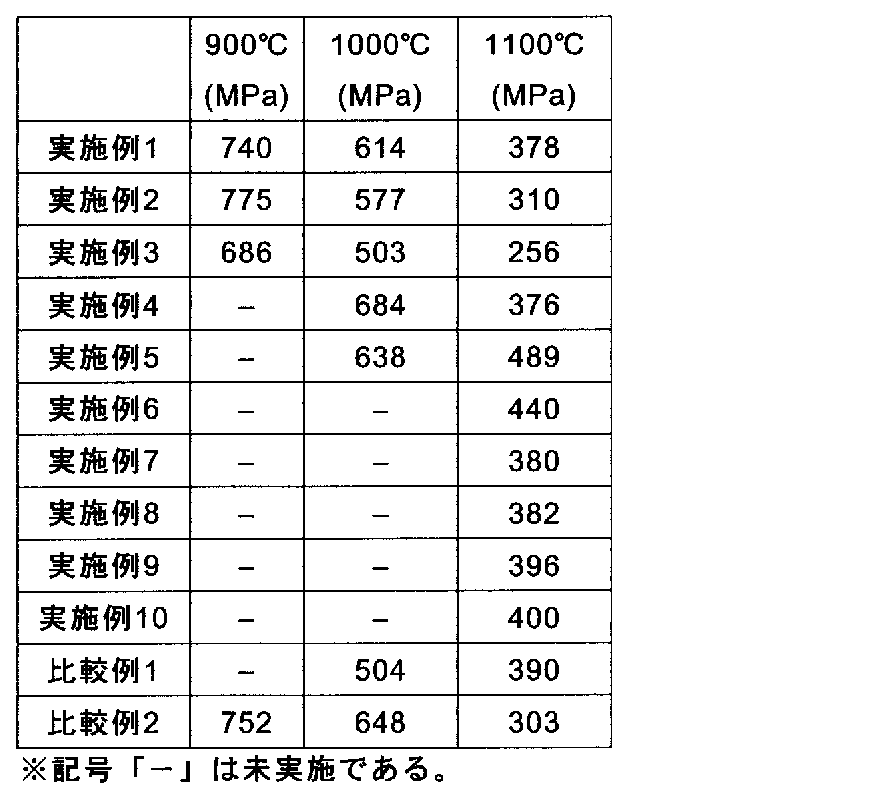
- Table 4 shows the 0.2% compressive strength at each test temperature of the test pieces of Examples 1 to 10 and Comparative Examples 1 and 2.
- FIG. 2 illustrates the relationship between the test temperatures of Examples 1 to 5 and Comparative Example 1 and 0.2% compressive strength. From Table 4, it can be seen that the compressive strength at a strain rate of 10 ⁇ 3 / sec at 1000 ° C. in Examples 1 to 5 is 500 MPa or more. It can be seen that in Examples 1, 4 to 10 having preferable Cr amounts, the compressive strength at a strain rate of 10 ⁇ 3 / sec at 1100 ° C. is 350 MPa or more. Further, from FIG. 2, the compressive strength at 1000 ° C.
- FIG. 3 shows a photograph of the appearance of the surface of the mold for hot dies after heating the mold for hot dies coated with an antioxidant at 1000 ° C. or higher in the atmosphere. As can be seen from FIG. 3, it can be seen that there is no peeling of the antioxidant applied to the surface of the hot mold. Also, no scattering of scale was confirmed. From this, it is understood that the oxidation of the mold and the scattering of the scale are prevented by the antioxidant.
- the Ni-based alloy for hot dies of the present invention has both sufficient oxidation resistance and high compressive strength at high temperatures even when used for hot forging in the atmosphere. .
- scale peeling can be remarkably reduced, so that deterioration of work environment and shape deterioration can be suppressed.
- a hot forging die is produced using the Ni-based alloy for hot die of the present invention, and an application layer of an antioxidant is formed on at least one of the molding surface or the side surface, the work is further improved.
- shape degradation can also be prevented. Therefore, it can be seen that the hot forging die made of the Ni-based alloy for hot die of the present invention is suitable for hot die forging and isothermal forging in the atmosphere.
Landscapes
- Chemical & Material Sciences (AREA)
- Engineering & Computer Science (AREA)
- Mechanical Engineering (AREA)
- Materials Engineering (AREA)
- Metallurgy (AREA)
- Organic Chemistry (AREA)
- Physics & Mathematics (AREA)
- Thermal Sciences (AREA)
- Crystallography & Structural Chemistry (AREA)
- Forging (AREA)
Abstract
高い高温圧縮強度と良好な耐酸化性を有し、作業環境の劣化及び形状劣化が抑制可能な熱間金型用Ni基合金を提供する。 W:7.0~12.0%、Mo:4.0~11.0%、Al:5.0~7.5%、Cr:0.5~7.5%、残部はNi及び不可避的不純物でなる熱間金型用Ni基合金であり、上記組成に加えて、更に、Taを0.5~7.0%含有することができ、更に、Zr:0.001~0.5%、Hf:0.001~0.5%、希土類元素:0.001~0.2%、Y:0.001~0.2%、Mg:0.001~0.03%の元素から選択される1種または2種以上を含有することができる。また、本発明の熱間金型用Ni基合金は、試験温度:1000℃、歪速度:10-3/secでの0.2%圧縮強度が500MPa以上とすることができる。
Description
本発明は、熱間金型用Ni基合金およびそれを用いた熱間鍛造用金型、鍛造製品の製造方法に関するものである。
耐熱合金からなる製品の鍛造において、鍛造素材は変形抵抗を低くするため所定の温度に加熱される。耐熱合金は高温でも高い強度を有するため、その鍛造に用いる熱間鍛造用金型には高温での高い機械的強度が必要とされる。また、熱間鍛造において熱間鍛造用金型の温度が鍛造素材に比べて低い場合、抜熱により鍛造素材の加工性が低下するため、例えばAlloy718やTi合金等の難加工性材からなる製品の鍛造は、素材とともに熱間鍛造用金型を加熱して行われる。従って、熱間鍛造用金型は、鍛造素材が加熱される温度と同じかもしくはそれに近い高温で、高い機械的強度を有したものでなければならない。この要求を満たす熱間鍛造用金型として、大気中での金型温度1000℃以上の熱間鍛造に使用できるNi基超耐熱合金が提案されている(例えば、特許文献1~3参照)。
なお、本発明で言う熱間鍛造とは、熱間鍛造用金型の温度を鍛造素材の温度まで近づけるホットダイ鍛造と鍛造素材と同じ温度にする恒温鍛造を含むものである。
なお、本発明で言う熱間鍛造とは、熱間鍛造用金型の温度を鍛造素材の温度まで近づけるホットダイ鍛造と鍛造素材と同じ温度にする恒温鍛造を含むものである。
上述したNi基超耐熱合金は、高温圧縮強度が高いという点では有利であるものの、耐酸化性の点では大気中で加熱した後の冷却時に金型表面から酸化ニッケルの細かなスケールが飛散するため作業環境の劣化及び形状劣化のおそれがある。金型表面の酸化とそれに伴うスケールの飛散の問題は、大気中で使用できるという効果を最大限に生かす上で大きな問題となる。
本発明の目的は、高い高温圧縮強度と良好な耐酸化性を有し、作業環境の劣化及び形状劣化が抑制可能な熱間金型用Ni基合金およびそれを用いた熱間鍛造用金型と前記熱間鍛造用金型を用いた鍛造製品の製造方法を提供することである。
本発明の目的は、高い高温圧縮強度と良好な耐酸化性を有し、作業環境の劣化及び形状劣化が抑制可能な熱間金型用Ni基合金およびそれを用いた熱間鍛造用金型と前記熱間鍛造用金型を用いた鍛造製品の製造方法を提供することである。
本発明者は、金型表面の酸化とそれに伴うスケール飛散による作業環境の劣化及び形状劣化問題を検討し、高い高温圧縮強度と良好な耐酸化性を有する組成を見出し本発明に到達した。
すなわち本発明は、W:7.0~12.0%、Mo:4.0~11.0%、Al:5.0~7.5%、Cr:0.5~7.5%、残部はNi及び不可避的不純物でなる熱間金型用Ni基合金である。
本発明では、上記組成に加えて、更に、Taを0.5~7.0%含有することができる。
本発明では、上記組成に加えて、更に、Zr:0.001~0.5%、Hf:0.001~0.5%、希土類元素:0.001~0.2%、Y:0.001~0.2%、Mg:0.001~0.03%の元素から選択される1種または2種以上を含有することができる。
また、本発明においては、試験温度:1000℃、歪速度:10-3/secでの0.2%圧縮強度が500MPa以上であることが好ましい。
更に好ましくは、試験温度:1100℃、歪速度:10-3/secでの0.2%圧縮強度が350MPa以上である。
また、本発明は、前記熱間金型用Ni基合金を用いた熱間鍛造用金型である。
更に好ましくは、前記熱間金型用Ni基合金を用いた熱間鍛造用金型において、前記熱間鍛造用金型の成形面、または側面の少なくとも一方に酸化防止剤の塗布層を有する。
また、本発明は、鍛造素材を加熱する第一の工程と、前記第一の工程で加熱された鍛造素材を前記熱間鍛造用金型を用いて熱間鍛造する第二の工程とを有する、鍛造製品の製造方法である。
更に好ましくは、鍛造製品の製造方法において、前記熱間鍛造用金型を1000℃以上に加熱して第二の工程を行う。
すなわち本発明は、W:7.0~12.0%、Mo:4.0~11.0%、Al:5.0~7.5%、Cr:0.5~7.5%、残部はNi及び不可避的不純物でなる熱間金型用Ni基合金である。
本発明では、上記組成に加えて、更に、Taを0.5~7.0%含有することができる。
本発明では、上記組成に加えて、更に、Zr:0.001~0.5%、Hf:0.001~0.5%、希土類元素:0.001~0.2%、Y:0.001~0.2%、Mg:0.001~0.03%の元素から選択される1種または2種以上を含有することができる。
また、本発明においては、試験温度:1000℃、歪速度:10-3/secでの0.2%圧縮強度が500MPa以上であることが好ましい。
更に好ましくは、試験温度:1100℃、歪速度:10-3/secでの0.2%圧縮強度が350MPa以上である。
また、本発明は、前記熱間金型用Ni基合金を用いた熱間鍛造用金型である。
更に好ましくは、前記熱間金型用Ni基合金を用いた熱間鍛造用金型において、前記熱間鍛造用金型の成形面、または側面の少なくとも一方に酸化防止剤の塗布層を有する。
また、本発明は、鍛造素材を加熱する第一の工程と、前記第一の工程で加熱された鍛造素材を前記熱間鍛造用金型を用いて熱間鍛造する第二の工程とを有する、鍛造製品の製造方法である。
更に好ましくは、鍛造製品の製造方法において、前記熱間鍛造用金型を1000℃以上に加熱して第二の工程を行う。
本発明に係る、高い高温圧縮強度と良好な耐酸化性を有する熱間金型用Ni基合金を用いることで、熱間鍛造における作業環境の劣化及び形状劣化を抑制することができる。
以下、本発明の熱間金型用Ni基合金について詳細に説明する。化学組成の単位は質量%である。
<W:7.0~12.0%>
Wは、オーステナイトマトリックスに固溶するとともに、析出強化相であるNi3Alを基本型とするガンマプライム相(γ’相)にも固溶して合金の高温強度を高める。また、Wは、粒界にWとMoの固溶体からなる体心立方晶のα-(Mo、W)相を晶出し、合金の粒界強度を高めると同時に、合金の被削性を高める作用がある。一方、Wは、耐酸化性を低下させる作用を有する。高温強度を高め、且つ、耐酸化性の低下をより抑制する観点から、本発明におけるNi基合金中のWの含有量は7.0~12.0%とする。Wの効果をより確実に得るための好ましい下限は10.0%であり、好ましいWの上限は11.0%である。
<Mo:4.0~11.0%>
Moは、オーステナイトマトリックスに固溶するとともに、析出強化相であるNi3Alを基本型とするガンマプライム相にも固溶して合金の高温強度を高める。一方、Moは、耐酸化性を低下させる作用を有する。高温強度を高め、且つ、耐酸化性の低下をより抑制する観点から、本発明におけるNi基超耐熱合金中のMoの含有量は4.0~11.0%とする。なお、後述するTa含有量との兼ね合いで好ましいMoの下限を設定するのが好ましく、Taを含有する場合のMoの効果をより確実に得るための好ましい下限は4.5%である。一方、Taを添加しない場合のMoの好ましい下限は7.0%とすると良く、更に好ましくは9.5%である。また、好ましいMoの上限は10.5であり、更に好ましくは、10.2%である。
<W:7.0~12.0%>
Wは、オーステナイトマトリックスに固溶するとともに、析出強化相であるNi3Alを基本型とするガンマプライム相(γ’相)にも固溶して合金の高温強度を高める。また、Wは、粒界にWとMoの固溶体からなる体心立方晶のα-(Mo、W)相を晶出し、合金の粒界強度を高めると同時に、合金の被削性を高める作用がある。一方、Wは、耐酸化性を低下させる作用を有する。高温強度を高め、且つ、耐酸化性の低下をより抑制する観点から、本発明におけるNi基合金中のWの含有量は7.0~12.0%とする。Wの効果をより確実に得るための好ましい下限は10.0%であり、好ましいWの上限は11.0%である。
<Mo:4.0~11.0%>
Moは、オーステナイトマトリックスに固溶するとともに、析出強化相であるNi3Alを基本型とするガンマプライム相にも固溶して合金の高温強度を高める。一方、Moは、耐酸化性を低下させる作用を有する。高温強度を高め、且つ、耐酸化性の低下をより抑制する観点から、本発明におけるNi基超耐熱合金中のMoの含有量は4.0~11.0%とする。なお、後述するTa含有量との兼ね合いで好ましいMoの下限を設定するのが好ましく、Taを含有する場合のMoの効果をより確実に得るための好ましい下限は4.5%である。一方、Taを添加しない場合のMoの好ましい下限は7.0%とすると良く、更に好ましくは9.5%である。また、好ましいMoの上限は10.5であり、更に好ましくは、10.2%である。
<Al:5.0~7.5%>
Alは、Niと結合してNi3Alからなるガンマプライム相を析出し、合金の高温強度を高め、合金の表面にアルミナの被膜を生成し、合金に耐酸化性を付与する作用を有する。一方、Alの含有量が多過ぎると、共晶ガンマプライム相を過度に生成し、合金の高温強度を低める作用もある。耐酸化性及び高温強度を高める観点から、本発明におけるNi基超耐熱合金中のAlの含有量は5.0~7.5%とする。Alの効果をより確実に得るための好ましい下限は5.5%であり、更に好ましくは6.1%である。また、好ましいAlの上限は6.7%であり、更に好ましくは6.5%である。
<Cr:0.5~7.5%>
Crは、合金表面もしくは内部におけるアルミナの連続層の形成を促進し、合金の耐酸化性を向上させる作用を有する。そのため、0.5%以上のCrの添加が必要になる。また、Al、W、MoとともにCrを添加した場合、後述する表4、図2等に示されているように、3.0~7.5%のCrは1000℃において高い圧縮強度が達成される。さらに、3.0%以下のCr含有量では、1000~1100℃においても高い圧縮強度が得られる。但し、7.5%を超える範囲のCrの添加は、1000℃以上における圧縮強度を低下させるため避けなければならない。Crの添加は必ずしも高温強度に不利なものではなく、Al、W、Moとともに0.5~7.5%Crを添加した場合には、むしろ高温度強度が高まり、高い高温強度を維持しながら、耐酸化性が向上できる点が本発明によって明らかとなったのである。Crの効果をより確実に得るための好ましい下限は1.3%であり、好ましいCrの上限は3.0%である。
Alは、Niと結合してNi3Alからなるガンマプライム相を析出し、合金の高温強度を高め、合金の表面にアルミナの被膜を生成し、合金に耐酸化性を付与する作用を有する。一方、Alの含有量が多過ぎると、共晶ガンマプライム相を過度に生成し、合金の高温強度を低める作用もある。耐酸化性及び高温強度を高める観点から、本発明におけるNi基超耐熱合金中のAlの含有量は5.0~7.5%とする。Alの効果をより確実に得るための好ましい下限は5.5%であり、更に好ましくは6.1%である。また、好ましいAlの上限は6.7%であり、更に好ましくは6.5%である。
<Cr:0.5~7.5%>
Crは、合金表面もしくは内部におけるアルミナの連続層の形成を促進し、合金の耐酸化性を向上させる作用を有する。そのため、0.5%以上のCrの添加が必要になる。また、Al、W、MoとともにCrを添加した場合、後述する表4、図2等に示されているように、3.0~7.5%のCrは1000℃において高い圧縮強度が達成される。さらに、3.0%以下のCr含有量では、1000~1100℃においても高い圧縮強度が得られる。但し、7.5%を超える範囲のCrの添加は、1000℃以上における圧縮強度を低下させるため避けなければならない。Crの添加は必ずしも高温強度に不利なものではなく、Al、W、Moとともに0.5~7.5%Crを添加した場合には、むしろ高温度強度が高まり、高い高温強度を維持しながら、耐酸化性が向上できる点が本発明によって明らかとなったのである。Crの効果をより確実に得るための好ましい下限は1.3%であり、好ましいCrの上限は3.0%である。
<Ta:0.5~7.0%>
本発明におけるNi基超耐熱合金は、Taを含有することができる。Taは、Ni3Alからなるガンマプライム相にAlサイトを置換する形で固溶して合金の高温強度を高めるとともに、合金表面に形成された酸化物皮膜の密着性と耐酸化性を高め、合金の耐酸化性を向上させる作用を有する。一方、Taの含有量が多すぎると、TCP(Topologically Close Packed)相等の有害相を析出しやすくする作用もある。耐酸化性及び高温強度を高め、且つ、有害相の析出を抑制する観点から、本発明においてTaを含有する場合のTaの含有量は0.5~7.0%とする。Taの効果をより確実に得るための好ましい下限は2.5%であり、好ましいTaの上限は6.5%である。
本発明におけるNi基超耐熱合金は、Taを含有することができる。Taは、Ni3Alからなるガンマプライム相にAlサイトを置換する形で固溶して合金の高温強度を高めるとともに、合金表面に形成された酸化物皮膜の密着性と耐酸化性を高め、合金の耐酸化性を向上させる作用を有する。一方、Taの含有量が多すぎると、TCP(Topologically Close Packed)相等の有害相を析出しやすくする作用もある。耐酸化性及び高温強度を高め、且つ、有害相の析出を抑制する観点から、本発明においてTaを含有する場合のTaの含有量は0.5~7.0%とする。Taの効果をより確実に得るための好ましい下限は2.5%であり、好ましいTaの上限は6.5%である。
<その他の任意の添加元素>
本発明におけるNi基超耐熱合金は、Zr、Hf、希土類元素、Y及びMgから選択される1種または2種以上の元素を含有することができる。Zr、Hf、希土類元素、Yは、酸化物被膜の結晶粒界への偏析によりその粒界での金属イオンと酸素の拡散を抑制する。この粒界拡散の抑制は、酸化物被膜の成長速度を低下させ、また、酸化物被膜の剥離を促進する様な成長機構を変化させることで被膜と合金の密着性を向上させる。すなわち、これらの元素は、前述した成長速度の低下と被膜密着性の向上によって合金の耐酸化性を向上させる作用を有する。また、Mgは、酸化物被膜と合金の界面への偏析とそれらの化学結合の阻害により被膜の密着性を低下させるSと硫化物を形成し、Sの偏析を防止することで密着性を向上させ、合金の耐酸化性を向上させる作用を有する。
なお、前記希土類元素のなかでもLaを用いるのが好ましい。Laは耐酸化性の向上の効果が大きいためである。Laは前述した拡散の抑制に加えてSの偏析を防止する作用も有し、且つ、それらの作用が優れているため、希土類元素のなかではLaを選択するのが良い。また、YにおいてもLaと同じ作用効果を奏するためYの添加も好ましく、LaとYを含む2種以上を用いるのが特に好ましい。
耐酸化性に加えて優れた機械的特性も必要な場合は、HfまたはZrを用いるのが好ましく、Hfを用いるのが特に好ましい。また、Hfを添加する場合は、HfはSの偏析を防止する作用が小さいため、Hfに加えてMgを同時に添加すると耐酸化性がより向上する。そのため、耐酸化性とともに機械的特性がもめられる場合は、HfとMgを含む2種以上の元素を用いるのが更に好ましい。
本発明におけるNi基超耐熱合金は、Zr、Hf、希土類元素、Y及びMgから選択される1種または2種以上の元素を含有することができる。Zr、Hf、希土類元素、Yは、酸化物被膜の結晶粒界への偏析によりその粒界での金属イオンと酸素の拡散を抑制する。この粒界拡散の抑制は、酸化物被膜の成長速度を低下させ、また、酸化物被膜の剥離を促進する様な成長機構を変化させることで被膜と合金の密着性を向上させる。すなわち、これらの元素は、前述した成長速度の低下と被膜密着性の向上によって合金の耐酸化性を向上させる作用を有する。また、Mgは、酸化物被膜と合金の界面への偏析とそれらの化学結合の阻害により被膜の密着性を低下させるSと硫化物を形成し、Sの偏析を防止することで密着性を向上させ、合金の耐酸化性を向上させる作用を有する。
なお、前記希土類元素のなかでもLaを用いるのが好ましい。Laは耐酸化性の向上の効果が大きいためである。Laは前述した拡散の抑制に加えてSの偏析を防止する作用も有し、且つ、それらの作用が優れているため、希土類元素のなかではLaを選択するのが良い。また、YにおいてもLaと同じ作用効果を奏するためYの添加も好ましく、LaとYを含む2種以上を用いるのが特に好ましい。
耐酸化性に加えて優れた機械的特性も必要な場合は、HfまたはZrを用いるのが好ましく、Hfを用いるのが特に好ましい。また、Hfを添加する場合は、HfはSの偏析を防止する作用が小さいため、Hfに加えてMgを同時に添加すると耐酸化性がより向上する。そのため、耐酸化性とともに機械的特性がもめられる場合は、HfとMgを含む2種以上の元素を用いるのが更に好ましい。
前述した任意の元素の添加量が多すぎると、Ni等との金属間化合物を過度に生成して合金の靱性を低下させるため、これらの任意の添加元素は好適な含有量とすることが好ましい。
耐酸化性を高め、且つ、靱性の低下を抑制する観点から、本発明におけるZr、Hfのそれぞれの含有量の上限は0.5%である。Zr、Hfのそれぞれの含有量の好ましい上限は0.2%であり、さらに好ましくは0.1%である。希土類元素、YはZr、Hfよりも靱性を低める作用が高いため、本発明におけるこれらの元素のそれぞれの含有量の上限は0.2%であり、好ましい上限は0.1%であり、更に好ましくは0.05%である。Zr、Hf、希土類元素、Yを含有させる場合の下限は0.001%である。、Zr、Hf、希土類元素、Yの含有の効果を十分に発揮する好ましい下限は0.005%であり、更に好ましくは0.01%以上含有するのがよい。
また、Mgについては合金に含有される不純物Sと硫化物を形成させるために必要な量のみ含有すればよいため、Mgの含有量は0.001~0.03%とする。好ましいMgの上限は0.01%である。一方、Mg添加による効果をより確実に発揮させるには0.005%を下限とするのがよい。
以上説明する添加元素以外はNi及び不可避的不純物である。本発明におけるNi基超耐熱合金においてNiはガンマ相を構成する主要元素であるとともに、Al、Ta、Mo、Wとともにガンマプライム相を構成する。なお、前記不可避的不純物元素のうち、特にSについては0.003%以下とするのが好ましい。
耐酸化性を高め、且つ、靱性の低下を抑制する観点から、本発明におけるZr、Hfのそれぞれの含有量の上限は0.5%である。Zr、Hfのそれぞれの含有量の好ましい上限は0.2%であり、さらに好ましくは0.1%である。希土類元素、YはZr、Hfよりも靱性を低める作用が高いため、本発明におけるこれらの元素のそれぞれの含有量の上限は0.2%であり、好ましい上限は0.1%であり、更に好ましくは0.05%である。Zr、Hf、希土類元素、Yを含有させる場合の下限は0.001%である。、Zr、Hf、希土類元素、Yの含有の効果を十分に発揮する好ましい下限は0.005%であり、更に好ましくは0.01%以上含有するのがよい。
また、Mgについては合金に含有される不純物Sと硫化物を形成させるために必要な量のみ含有すればよいため、Mgの含有量は0.001~0.03%とする。好ましいMgの上限は0.01%である。一方、Mg添加による効果をより確実に発揮させるには0.005%を下限とするのがよい。
以上説明する添加元素以外はNi及び不可避的不純物である。本発明におけるNi基超耐熱合金においてNiはガンマ相を構成する主要元素であるとともに、Al、Ta、Mo、Wとともにガンマプライム相を構成する。なお、前記不可避的不純物元素のうち、特にSについては0.003%以下とするのが好ましい。
<熱間鍛造用金型>
本発明では、上記の合金組成を有する熱間鍛造用金型の成形面または側面の少なくとも一方の面を、酸化防止剤の塗布層を有する面とすることができる。これにより、高温での大気中の酸素と金型の母材の接触による金型表面の酸化とそれに伴うスケール飛散を防止し、作業環境の劣化及び形状劣化をより確実に防止できる。前述した酸化防止剤は、窒化物、酸化物、炭化物の何れか1種類以上でなる無機材料であることが好ましい。これは、窒化物や酸化物や炭化物の塗布層により緻密な酸素遮断膜を形成し、金型母材の酸化を防ぐためである。なお、塗布層は窒化物、酸化物、炭化物の何れかの単層でも良いし、窒化物、酸化物、炭化物の何れか2種以上の組合わせの積層構造であっても良い。更に、塗布層は窒化物、酸化物、炭化物の何れか2種以上からなる混合物であっても良い。
以上、説明する本発明の熱間金型用Ni基合金を用いた熱間鍛造用金型は、高い高温圧縮強度と良好な耐酸化性を有し、高温での大気中の酸素と金型の母材の接触による金型表面の酸化とそれに伴うスケール飛散を防止し、作業環境の劣化及び形状劣化をより確実に防止できる。
本発明では、上記の合金組成を有する熱間鍛造用金型の成形面または側面の少なくとも一方の面を、酸化防止剤の塗布層を有する面とすることができる。これにより、高温での大気中の酸素と金型の母材の接触による金型表面の酸化とそれに伴うスケール飛散を防止し、作業環境の劣化及び形状劣化をより確実に防止できる。前述した酸化防止剤は、窒化物、酸化物、炭化物の何れか1種類以上でなる無機材料であることが好ましい。これは、窒化物や酸化物や炭化物の塗布層により緻密な酸素遮断膜を形成し、金型母材の酸化を防ぐためである。なお、塗布層は窒化物、酸化物、炭化物の何れかの単層でも良いし、窒化物、酸化物、炭化物の何れか2種以上の組合わせの積層構造であっても良い。更に、塗布層は窒化物、酸化物、炭化物の何れか2種以上からなる混合物であっても良い。
以上、説明する本発明の熱間金型用Ni基合金を用いた熱間鍛造用金型は、高い高温圧縮強度と良好な耐酸化性を有し、高温での大気中の酸素と金型の母材の接触による金型表面の酸化とそれに伴うスケール飛散を防止し、作業環境の劣化及び形状劣化をより確実に防止できる。
<鍛造製品の製造方法>
本発明の熱間金型用Ni基合金を用いた熱間鍛造用金型を用いて鍛造製品を製造する場合の代表的な工程について説明する。
先ず、第一の工程として鍛造素材を所定の鍛造温度に加熱する。鍛造温度は材質に応じて異なるため、適宜温度を調整する。本発明の熱間金型用Ni基合金を用いた熱間鍛造用金型は、高温での大気中の雰囲気においても恒温鍛造やホットダイ鍛造が可能な特性を有するため、難加工性材料と知られるNi基超耐熱合金やTi合金等の熱間鍛造に好適である。代表的な鍛造温度としては1000~1150℃の範囲である。
そして、前記第一の工程で加熱された鍛造素材を前記熱間鍛造用金型を用いて熱間鍛造(第二の工程)する。前記のホットダイ鍛造や恒温鍛造の場合、第二工程の熱間鍛造は、型鍛造であることが好ましい。また、本発明の熱間金型用Ni基合金は前述したように、特にCr含有量を調整した成分とすることにより1000℃以上の高温で大気中の熱間鍛造が可能である。
本発明の熱間金型用Ni基合金を用いた熱間鍛造用金型を用いて鍛造製品を製造する場合の代表的な工程について説明する。
先ず、第一の工程として鍛造素材を所定の鍛造温度に加熱する。鍛造温度は材質に応じて異なるため、適宜温度を調整する。本発明の熱間金型用Ni基合金を用いた熱間鍛造用金型は、高温での大気中の雰囲気においても恒温鍛造やホットダイ鍛造が可能な特性を有するため、難加工性材料と知られるNi基超耐熱合金やTi合金等の熱間鍛造に好適である。代表的な鍛造温度としては1000~1150℃の範囲である。
そして、前記第一の工程で加熱された鍛造素材を前記熱間鍛造用金型を用いて熱間鍛造(第二の工程)する。前記のホットダイ鍛造や恒温鍛造の場合、第二工程の熱間鍛造は、型鍛造であることが好ましい。また、本発明の熱間金型用Ni基合金は前述したように、特にCr含有量を調整した成分とすることにより1000℃以上の高温で大気中の熱間鍛造が可能である。
以下の実施例で本発明をさらに詳しく説明する。真空溶解にて表1に示す熱間金型用Ni基合金のインゴットを製造した。単位は質量%である。なお、下記インゴットに含有されているP、S、N、Oはそれぞれ0.003%以下であり、C、Si、Mn、Co、Ti、Nb、Feはそれぞれ0.03%以下である。
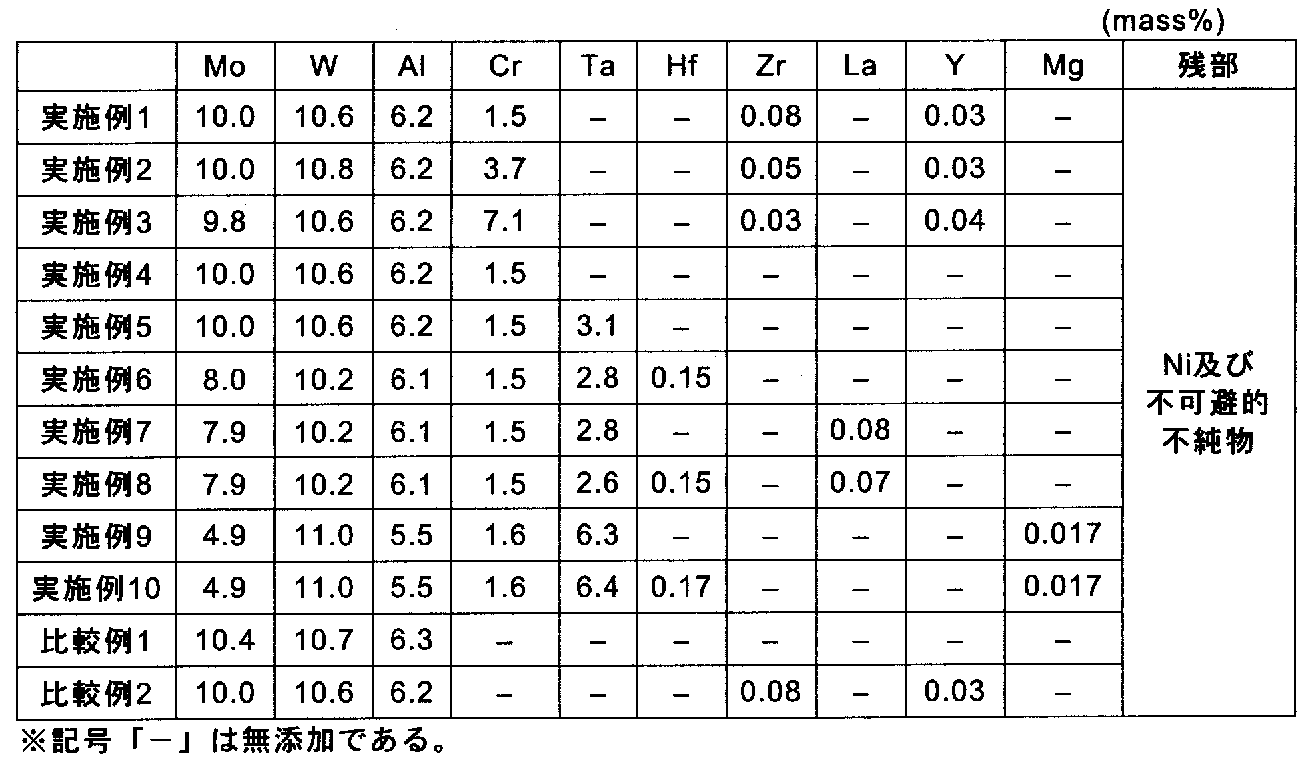
上記の各インゴットから10mm角の立方体を切出し、表面を1000番相当に研磨して耐酸化性試験片を作製し、耐酸化性の評価を行った。耐酸化性試験では、熱間鍛造用の金型として大気中で用いるときに、長時間使用することを模擬した試験と、繰り返し使用することを模擬した試験の2種類の試験を実施した。
長時間の使用を模擬した耐酸化試験として、実施例1乃至10および比較例1、2の試験片を用いて、試験片をSiO2とAl2O3からなるセラミックス製のるつぼの中に入れた状態で1100℃に加熱された炉に投入し、1100℃にて所定時間保持した後に炉から試験片の入ったるつぼを取り出し、スケールのるつぼ外への剥離を防ぐため取り出し後すぐにるつぼに同材質の蓋を被せた状態で空冷させる加熱試験を行った。加熱試験は、長時間の使用に対する耐酸化性を評価するため、各試験片に対し保持時間3時間と8時間の試験をそれぞれ行った。
各試験片に対し、加熱試験前に試験片の表面積と試験片を入れたるつぼの質量の測定を行い、また、加熱試験後に室温まで冷却した後試験片の入ったるつぼの質量を測定した。各試験後に測定した質量から試験前に測定した質量を差し引き、その値を試験前に測定した表面積にて割ることで、各試験後における試験片の単位表面積あたりの質量変化を算出した。質量変化の値が大きいほど単位面積当たりのスケール生成量が大きいということである。質量変化は以下のように計算した。
質量変化=(試験後質量-試験前質量)/試験前表面積
各試験片に対し、加熱試験前に試験片の表面積と試験片を入れたるつぼの質量の測定を行い、また、加熱試験後に室温まで冷却した後試験片の入ったるつぼの質量を測定した。各試験後に測定した質量から試験前に測定した質量を差し引き、その値を試験前に測定した表面積にて割ることで、各試験後における試験片の単位表面積あたりの質量変化を算出した。質量変化の値が大きいほど単位面積当たりのスケール生成量が大きいということである。質量変化は以下のように計算した。
質量変化=(試験後質量-試験前質量)/試験前表面積
表2に各保持時間の加熱試験での算出した試験片の単位表面積あたりの質量変化を示す。質量変化の単位はmg/cm2である。
表2より、Crを添加した本発明の実施例1乃至10は、Crを添加していない比較例1、2に対してスケールの生成量が抑制され8時間後の重量変化が半分以下となっており、Crの添加による長時間の使用に対する良好な耐酸化性を有することが分かる。
表2より、Crを添加した本発明の実施例1乃至10は、Crを添加していない比較例1、2に対してスケールの生成量が抑制され8時間後の重量変化が半分以下となっており、Crの添加による長時間の使用に対する良好な耐酸化性を有することが分かる。

繰り返しの使用を模擬した耐酸化試験として、実施例1、4乃至10および比較例1の試験片を用いて、試験片をSiO2とAl2O3からなるセラミックス製の容器の上に置いた状態で1100℃に加熱された炉に投入し、1100℃にて3時間保持した後に炉から取り出して空冷させる加熱試験を行った。加熱試験は、繰り返しの使用に対する耐酸化性を評価するため、冷却した後再投入することで5回繰り返し行った。
各試験片に対し、1回目の加熱試験前に試験片の表面積と質量の測定を行い、また、1乃至5回目の加熱試験後に室温まで冷却した後表面のスケールをブロワーにて除去した試験片質量を測定した。各試験後に測定した質量から1回目の試験前に測定した質量を引き、その値を1回目の試験前に測定した表面積にて割ることで、各試験後における試験片の単位表面積あたりの質量変化を算出した。質量変化の値の絶対値が大きいほど単位面積当たりのスケール飛散量が大きいということである。各繰り返し回数後における質量変化は以下のように計算した。
質量変化=(試験後質量-1回目試験前質量)/1回目試験前表面積
各試験片に対し、1回目の加熱試験前に試験片の表面積と質量の測定を行い、また、1乃至5回目の加熱試験後に室温まで冷却した後表面のスケールをブロワーにて除去した試験片質量を測定した。各試験後に測定した質量から1回目の試験前に測定した質量を引き、その値を1回目の試験前に測定した表面積にて割ることで、各試験後における試験片の単位表面積あたりの質量変化を算出した。質量変化の値の絶対値が大きいほど単位面積当たりのスケール飛散量が大きいということである。各繰り返し回数後における質量変化は以下のように計算した。
質量変化=(試験後質量-1回目試験前質量)/1回目試験前表面積
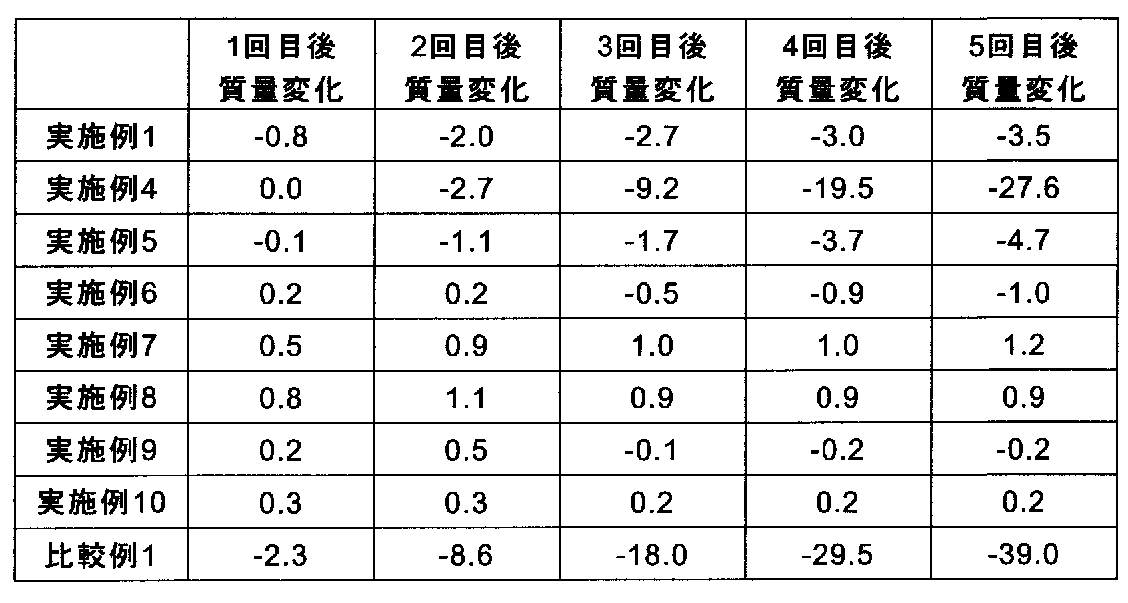
表3に各加熱試験後に算出した試験片の単位表面積あたりの質量変化を示す。質量変化の単位はmg/cm2である。また、図1に加熱試験の回数と質量変化の関係を示す。
表3及び図1に示すように、本発明の実施例1、4乃至10は比較例1の合金よりもスケールの生成(飛散)が抑制され質量変化の値の絶対値が小さくなっており、繰り返しの使用に対する良好な耐酸化性を有することが分かる。なかでも特に、Crに加えてYとZrを添加した実施例1、Crに加えてTaを添加した実施例5は、Crのみを添加した実施例4と比較してスケールの飛散が抑制されており、繰り返しの使用に対する耐酸化性が特に優れていることが分かる。また、CrとTaに加えてHfやLaやMgを添加した実施例6乃至10は、前述した実施例1と実施例5と比較して、繰り返しの使用に対する耐酸化性が更に優れていることがわかる。
表3及び図1に示すように、本発明の実施例1、4乃至10は比較例1の合金よりもスケールの生成(飛散)が抑制され質量変化の値の絶対値が小さくなっており、繰り返しの使用に対する良好な耐酸化性を有することが分かる。なかでも特に、Crに加えてYとZrを添加した実施例1、Crに加えてTaを添加した実施例5は、Crのみを添加した実施例4と比較してスケールの飛散が抑制されており、繰り返しの使用に対する耐酸化性が特に優れていることが分かる。また、CrとTaに加えてHfやLaやMgを添加した実施例6乃至10は、前述した実施例1と実施例5と比較して、繰り返しの使用に対する耐酸化性が更に優れていることがわかる。
次に、表1の実施例1乃至10と比較例1、2の各インゴットから直径8mm、高さ12mmの試験片採取用素材を切出し、表面を1000番相当に研磨して圧縮試験片を作製した。この圧縮試験片を用い、900℃、1000℃、1100℃の各温度にて、歪速度10-3/sec、圧縮率10%の条件で圧縮試験を行った。圧縮試験により得られた応力―歪曲線より0.2%圧縮強度を導出し、高温圧縮強度の評価を行った。この圧縮試験は、熱間鍛造用の金型として、高温下においても十分な圧縮強度を有しているかを試験するものであり、300MPa以上あれば十分な強度を有すると言える。好ましくは350MPa以上である。
表4に実施例1乃至10と比較例1、2の試験片の各試験温度における0.2%圧縮強度を示す。また、図2に実施例1乃至5と比較例1の各試験温度と0.2%圧縮強度の関係を図示する。
表4より、実施例1乃至5の1000℃での歪速度10-3/secでの圧縮強度は500MPa以上であることがわかる。好ましいCr量の実施例1、4乃至10については、1100℃での歪速度10-3/secでの圧縮強度が350MPa以上であることが分かる。また、図2より、Cr添加量が上限の7.5%以下である実施例1乃至5の1000℃における圧縮強度はCrを含有しない比較例1と比べて同等以上であることと、Cr添加量が3.0%以下である実施例4、5の1000~1100℃における圧縮強度は比較例1と比べて同等以上であることが明らかである。以上から、何れの本発明合金においても高い高温圧縮強度を有することがわかる。
表4より、実施例1乃至5の1000℃での歪速度10-3/secでの圧縮強度は500MPa以上であることがわかる。好ましいCr量の実施例1、4乃至10については、1100℃での歪速度10-3/secでの圧縮強度が350MPa以上であることが分かる。また、図2より、Cr添加量が上限の7.5%以下である実施例1乃至5の1000℃における圧縮強度はCrを含有しない比較例1と比べて同等以上であることと、Cr添加量が3.0%以下である実施例4、5の1000~1100℃における圧縮強度は比較例1と比べて同等以上であることが明らかである。以上から、何れの本発明合金においても高い高温圧縮強度を有することがわかる。
次に、表5に示すように本発明の熱間金型用Ni基合金の組成を満足し、且つ、表6に示す酸化物からなる酸化防止剤を表面に塗布した金型を用いて、酸化防止剤による熱間金型用金型の酸化及びスケール飛散の防止効果の評価を行った。
図3に、酸化防止剤塗布した熱間金型用金型を大気中で1000℃以上の加熱を行った後の熱間金型用金型表面の外観写真を示す。図3から分かるように、熱間金型用金型表面に塗布した酸化防止剤の剥離がないことがわかる。また、スケールの飛散も確認されなかった。このことから、酸化防止剤により金型の酸化及びスケールの飛散が防止されることがわかる。
図3に、酸化防止剤塗布した熱間金型用金型を大気中で1000℃以上の加熱を行った後の熱間金型用金型表面の外観写真を示す。図3から分かるように、熱間金型用金型表面に塗布した酸化防止剤の剥離がないことがわかる。また、スケールの飛散も確認されなかった。このことから、酸化防止剤により金型の酸化及びスケールの飛散が防止されることがわかる。


以上の結果から、本発明の熱間金型用Ni基合金は、大気中での熱間鍛造に用いても十分な耐酸化性と高温での高い圧縮強度とを兼備していることがわかる。特に、スケールの剥離を著しく低減できたため、作業環境の劣化及び形状劣化を抑制することができる。
特に、本発明の熱間金型用Ni基合金を用いて熱間鍛造用金型を作製し、その成形面、または側面の少なくとも一方に酸化防止剤の塗布層を形成すると、より一層、作業環境の劣化を防止するとともに、形状劣化も防止することができる。そのため、本発明の熱間金型用Ni基合金製の熱間鍛造用金型は、大気中でのホットダイ鍛造や恒温鍛造に好適であることがわかる。
特に、本発明の熱間金型用Ni基合金を用いて熱間鍛造用金型を作製し、その成形面、または側面の少なくとも一方に酸化防止剤の塗布層を形成すると、より一層、作業環境の劣化を防止するとともに、形状劣化も防止することができる。そのため、本発明の熱間金型用Ni基合金製の熱間鍛造用金型は、大気中でのホットダイ鍛造や恒温鍛造に好適であることがわかる。
Claims (9)
- 質量%で、W:7.0~12.0%、Mo:4.0~11.0%、Al:5.0~7.5%、Cr:0.5~7.5%、残部はNi及び不可避的不純物でなる熱間金型用Ni基合金。
- 0.5~7.0質量%のTaを更に含有する請求項1に記載の熱間金型用Ni基合金。
- 質量%で、Zr:0.001~0.5%、Hf:0.001~0.5%、希土類元素:0.001~0.2%、Y:0.001~0.2%、Mg:0.001~0.03%の元素から選択される1種または2種以上を更に含有する請求項1または2に記載の熱間金型用Ni基合金。
- 試験温度:1000℃、歪速度:10-3/secでの0.2%圧縮強度が500MPa以上である請求項1乃至3の何れかに記載の熱間金型用Ni基合金。
- 試験温度:1100℃、歪速度:10-3/secでの0.2%圧縮強度が350MPa以上である請求項1乃至3の何れかに記載の熱間金型用Ni基合金。
- 請求項1乃至5の何れかに記載の熱間金型用Ni基合金を用いた熱間鍛造用金型。
- 請求項6に記載の熱間鍛造用金型であって、前記熱間鍛造用金型の成形面、または側面の少なくとも一方に酸化防止剤の塗布層を有することを特徴とする熱間鍛造用金型。
- 鍛造素材を加熱する第一の工程と、
前記第一の工程で加熱された鍛造素材を請求項6または7に記載の熱間鍛造用金型を用いて熱間鍛造する第二の工程とを有する、鍛造製品の製造方法。 - 前記熱間鍛造用金型を1000℃以上に加熱して第二の工程を行う、請求項8に記載の鍛造製品の製造方法。
Priority Applications (2)
| Application Number | Priority Date | Filing Date | Title |
|---|---|---|---|
| JP2018519601A JPWO2017204286A1 (ja) | 2016-05-26 | 2017-05-25 | 熱間金型用Ni基合金及びそれを用いた熱間鍛造用金型、鍛造製品の製造方法 |
| US16/304,075 US20200340081A1 (en) | 2016-05-26 | 2017-05-25 | Nickel-based alloy for hot forging die, hot forging die using same, and method for manufacturing forged product |
Applications Claiming Priority (4)
| Application Number | Priority Date | Filing Date | Title |
|---|---|---|---|
| JP2016104956 | 2016-05-26 | ||
| JP2016-104956 | 2016-05-26 | ||
| JP2017-059698 | 2017-03-24 | ||
| JP2017059698 | 2017-03-24 |
Publications (1)
| Publication Number | Publication Date |
|---|---|
| WO2017204286A1 true WO2017204286A1 (ja) | 2017-11-30 |
Family
ID=60411999
Family Applications (1)
| Application Number | Title | Priority Date | Filing Date |
|---|---|---|---|
| PCT/JP2017/019488 Ceased WO2017204286A1 (ja) | 2016-05-26 | 2017-05-25 | 熱間金型用Ni基合金及びそれを用いた熱間鍛造用金型、鍛造製品の製造方法 |
Country Status (3)
| Country | Link |
|---|---|
| US (1) | US20200340081A1 (ja) |
| JP (1) | JPWO2017204286A1 (ja) |
| WO (1) | WO2017204286A1 (ja) |
Cited By (4)
| Publication number | Priority date | Publication date | Assignee | Title |
|---|---|---|---|---|
| WO2019107502A1 (ja) * | 2017-11-29 | 2019-06-06 | 日立金属株式会社 | 熱間金型用Ni基合金及びそれを用いた熱間鍛造用金型、鍛造製品の製造方法 |
| WO2019106922A1 (ja) * | 2017-11-29 | 2019-06-06 | 日立金属株式会社 | 熱間金型用Ni基合金及びそれを用いた熱間鍛造用金型 |
| WO2020059846A1 (ja) * | 2018-09-21 | 2020-03-26 | 日立金属株式会社 | 熱間金型用Ni基合金及びそれを用いた熱間鍛造用金型 |
| WO2021241585A1 (ja) | 2020-05-26 | 2021-12-02 | 日立金属株式会社 | 熱間金型用Ni基合金およびそれを用いた熱間鍛造用金型 |
Families Citing this family (2)
| Publication number | Priority date | Publication date | Assignee | Title |
|---|---|---|---|---|
| CN115245996B (zh) * | 2022-03-09 | 2023-09-19 | 江西宝顺昌特种合金制造有限公司 | 一种uns n06030耐蚀合金锻件及其制备方法 |
| CN114669701B (zh) * | 2022-03-30 | 2023-10-03 | 江西宝顺昌特种合金制造有限公司 | 一种gh4080a高温合金锻件及其制备方法 |
Citations (7)
| Publication number | Priority date | Publication date | Assignee | Title |
|---|---|---|---|---|
| JPS62116748A (ja) * | 1985-11-18 | 1987-05-28 | Hitachi Metals Ltd | 単結晶Ni基超耐熱合金 |
| JPS62234634A (ja) * | 1986-04-02 | 1987-10-14 | San Alloy Kogyo Kk | 接合型熱間圧縮加工用ダイ |
| JPH11152583A (ja) * | 1997-11-17 | 1999-06-08 | Sumitomo Electric Ind Ltd | 被覆金型 |
| JP2016069702A (ja) * | 2014-09-30 | 2016-05-09 | 日立金属株式会社 | ニッケル基鋳造合金の製造方法 |
| JP2016069703A (ja) * | 2014-09-30 | 2016-05-09 | 日立金属株式会社 | ニッケル基鋳造合金及び熱間鍛造金型 |
| WO2017057453A1 (ja) * | 2015-09-29 | 2017-04-06 | 日立金属株式会社 | 熱間鍛造用金型及びそれを用いた鍛造製品の製造方法並びに熱間鍛造用金型の製造方法 |
| JP2017064741A (ja) * | 2015-09-29 | 2017-04-06 | 日立金属株式会社 | 熱間鍛造用金型 |
-
2017
- 2017-05-25 WO PCT/JP2017/019488 patent/WO2017204286A1/ja not_active Ceased
- 2017-05-25 JP JP2018519601A patent/JPWO2017204286A1/ja active Pending
- 2017-05-25 US US16/304,075 patent/US20200340081A1/en not_active Abandoned
Patent Citations (7)
| Publication number | Priority date | Publication date | Assignee | Title |
|---|---|---|---|---|
| JPS62116748A (ja) * | 1985-11-18 | 1987-05-28 | Hitachi Metals Ltd | 単結晶Ni基超耐熱合金 |
| JPS62234634A (ja) * | 1986-04-02 | 1987-10-14 | San Alloy Kogyo Kk | 接合型熱間圧縮加工用ダイ |
| JPH11152583A (ja) * | 1997-11-17 | 1999-06-08 | Sumitomo Electric Ind Ltd | 被覆金型 |
| JP2016069702A (ja) * | 2014-09-30 | 2016-05-09 | 日立金属株式会社 | ニッケル基鋳造合金の製造方法 |
| JP2016069703A (ja) * | 2014-09-30 | 2016-05-09 | 日立金属株式会社 | ニッケル基鋳造合金及び熱間鍛造金型 |
| WO2017057453A1 (ja) * | 2015-09-29 | 2017-04-06 | 日立金属株式会社 | 熱間鍛造用金型及びそれを用いた鍛造製品の製造方法並びに熱間鍛造用金型の製造方法 |
| JP2017064741A (ja) * | 2015-09-29 | 2017-04-06 | 日立金属株式会社 | 熱間鍛造用金型 |
Cited By (15)
| Publication number | Priority date | Publication date | Assignee | Title |
|---|---|---|---|---|
| CN111433378A (zh) * | 2017-11-29 | 2020-07-17 | 日立金属株式会社 | 热作模具用Ni基合金以及使用其的热锻用模具、锻造制品的制造方法 |
| US11326231B2 (en) | 2017-11-29 | 2022-05-10 | Hitachi Metals, Ltd. | Ni-based alloy for hot-working die, and hot-forging die using same |
| JPWO2019107502A1 (ja) * | 2017-11-29 | 2019-12-12 | 日立金属株式会社 | 熱間鍛造用金型、鍛造製品の製造方法 |
| JPWO2019106922A1 (ja) * | 2017-11-29 | 2019-12-12 | 日立金属株式会社 | 熱間金型用Ni基合金及びそれを用いた熱間鍛造用金型 |
| CN111417736A (zh) * | 2017-11-29 | 2020-07-14 | 日立金属株式会社 | 热作模具用Ni基合金以及使用其的热锻用模具 |
| WO2019106922A1 (ja) * | 2017-11-29 | 2019-06-06 | 日立金属株式会社 | 熱間金型用Ni基合金及びそれを用いた熱間鍛造用金型 |
| US11692246B2 (en) | 2017-11-29 | 2023-07-04 | Proterial, Ltd. | Ni-based alloy for hot-working die, and hot-forging die using same |
| WO2019107502A1 (ja) * | 2017-11-29 | 2019-06-06 | 日立金属株式会社 | 熱間金型用Ni基合金及びそれを用いた熱間鍛造用金型、鍛造製品の製造方法 |
| WO2020059846A1 (ja) * | 2018-09-21 | 2020-03-26 | 日立金属株式会社 | 熱間金型用Ni基合金及びそれを用いた熱間鍛造用金型 |
| JP7211561B2 (ja) | 2020-05-26 | 2023-01-24 | 日立金属株式会社 | 熱間金型用Ni基合金およびそれを用いた熱間鍛造用金型 |
| WO2021241585A1 (ja) | 2020-05-26 | 2021-12-02 | 日立金属株式会社 | 熱間金型用Ni基合金およびそれを用いた熱間鍛造用金型 |
| CN115698350A (zh) * | 2020-05-26 | 2023-02-03 | 日立金属株式会社 | 热模具用Ni基合金和使用其的热锻用模具 |
| JPWO2021241585A1 (ja) * | 2020-05-26 | 2021-12-02 | ||
| CN115698350B (zh) * | 2020-05-26 | 2024-02-13 | 株式会社博迈立铖 | 热模具用Ni基合金和使用其的热锻用模具 |
| US12503749B2 (en) | 2020-05-26 | 2025-12-23 | Proterial, Ltd. | Ni-based alloy for hot die, and hot forging die using same |
Also Published As
| Publication number | Publication date |
|---|---|
| JPWO2017204286A1 (ja) | 2019-04-25 |
| US20200340081A1 (en) | 2020-10-29 |
Similar Documents
| Publication | Publication Date | Title |
|---|---|---|
| JP5582532B2 (ja) | Co基合金 | |
| WO2017204286A1 (ja) | 熱間金型用Ni基合金及びそれを用いた熱間鍛造用金型、鍛造製品の製造方法 | |
| EP2826877B1 (en) | Hot-forgeable Nickel-based superalloy excellent in high temperature strength | |
| JP5652730B1 (ja) | Ni基超耐熱合金及びその製造方法 | |
| US11692246B2 (en) | Ni-based alloy for hot-working die, and hot-forging die using same | |
| JP6646885B2 (ja) | 熱間鍛造用金型、鍛造製品の製造方法 | |
| WO2016152982A1 (ja) | Ni基超耐熱合金の製造方法 | |
| JP6476704B2 (ja) | ニッケル基鋳造合金及び熱間鍛造金型 | |
| WO2018061317A1 (ja) | Ni基超耐熱合金押出材の製造方法およびNi基超耐熱合金押出材 | |
| CN108136482B (zh) | 热锻造用模具、使用该热锻造模具的锻造制品的制造方法以及热锻造用模具的制造方法 | |
| JP6566255B2 (ja) | 熱間鍛造用金型 | |
| JP2020196951A (ja) | 熱間金型用Ni基合金及びそれを用いた熱間鍛造用金型及びそれを用いた鍛造製品の製造方法 | |
| WO2020059846A1 (ja) | 熱間金型用Ni基合金及びそれを用いた熱間鍛造用金型 | |
| JP7211561B2 (ja) | 熱間金型用Ni基合金およびそれを用いた熱間鍛造用金型 | |
| JP2022506542A (ja) | 2xxxアルミニウムリチウム合金 | |
| JP2020196047A (ja) | 鍛造製品の製造方法 | |
| JP6425274B2 (ja) | Ni基耐熱合金 | |
| EP4582578A1 (en) | Method for producing ni-based alloy | |
| JP2012167347A (ja) | 高強度銅合金鍛造材 | |
| JP6784954B2 (ja) | 熱間鍛造用金型及びそれを用いた鍛造製品の製造方法 | |
| WO2024058101A1 (ja) | 熱間鍛造用金型およびその製造方法 |
Legal Events
| Date | Code | Title | Description |
|---|---|---|---|
| ENP | Entry into the national phase |
Ref document number: 2018519601 Country of ref document: JP Kind code of ref document: A |
|
| NENP | Non-entry into the national phase |
Ref country code: DE |
|
| 121 | Ep: the epo has been informed by wipo that ep was designated in this application |
Ref document number: 17802872 Country of ref document: EP Kind code of ref document: A1 |
|
| 122 | Ep: pct application non-entry in european phase |
Ref document number: 17802872 Country of ref document: EP Kind code of ref document: A1 |