WO2017195438A1 - 発泡成形体の製造方法 - Google Patents
発泡成形体の製造方法 Download PDFInfo
- Publication number
- WO2017195438A1 WO2017195438A1 PCT/JP2017/007855 JP2017007855W WO2017195438A1 WO 2017195438 A1 WO2017195438 A1 WO 2017195438A1 JP 2017007855 W JP2017007855 W JP 2017007855W WO 2017195438 A1 WO2017195438 A1 WO 2017195438A1
- Authority
- WO
- WIPO (PCT)
- Prior art keywords
- temperature
- foaming
- microsphere
- heat
- foamable composition
- Prior art date
- Legal status (The legal status is an assumption and is not a legal conclusion. Google has not performed a legal analysis and makes no representation as to the accuracy of the status listed.)
- Ceased
Links
Images

Classifications
-
- B—PERFORMING OPERATIONS; TRANSPORTING
- B29—WORKING OF PLASTICS; WORKING OF SUBSTANCES IN A PLASTIC STATE IN GENERAL
- B29C—SHAPING OR JOINING OF PLASTICS; SHAPING OF MATERIAL IN A PLASTIC STATE, NOT OTHERWISE PROVIDED FOR; AFTER-TREATMENT OF THE SHAPED PRODUCTS, e.g. REPAIRING
- B29C44/00—Shaping by internal pressure generated in the material, e.g. swelling or foaming ; Producing porous or cellular expanded plastics articles
-
- B—PERFORMING OPERATIONS; TRANSPORTING
- B29—WORKING OF PLASTICS; WORKING OF SUBSTANCES IN A PLASTIC STATE IN GENERAL
- B29C—SHAPING OR JOINING OF PLASTICS; SHAPING OF MATERIAL IN A PLASTIC STATE, NOT OTHERWISE PROVIDED FOR; AFTER-TREATMENT OF THE SHAPED PRODUCTS, e.g. REPAIRING
- B29C44/00—Shaping by internal pressure generated in the material, e.g. swelling or foaming ; Producing porous or cellular expanded plastics articles
- B29C44/34—Auxiliary operations
-
- C—CHEMISTRY; METALLURGY
- C08—ORGANIC MACROMOLECULAR COMPOUNDS; THEIR PREPARATION OR CHEMICAL WORKING-UP; COMPOSITIONS BASED THEREON
- C08J—WORKING-UP; GENERAL PROCESSES OF COMPOUNDING; AFTER-TREATMENT NOT COVERED BY SUBCLASSES C08B, C08C, C08F, C08G or C08H
- C08J9/00—Working-up of macromolecular substances to porous or cellular articles or materials; After-treatment thereof
- C08J9/04—Working-up of macromolecular substances to porous or cellular articles or materials; After-treatment thereof using blowing gases generated by a previously added blowing agent
- C08J9/12—Working-up of macromolecular substances to porous or cellular articles or materials; After-treatment thereof using blowing gases generated by a previously added blowing agent by a physical blowing agent
- C08J9/14—Working-up of macromolecular substances to porous or cellular articles or materials; After-treatment thereof using blowing gases generated by a previously added blowing agent by a physical blowing agent organic
-
- C—CHEMISTRY; METALLURGY
- C08—ORGANIC MACROMOLECULAR COMPOUNDS; THEIR PREPARATION OR CHEMICAL WORKING-UP; COMPOSITIONS BASED THEREON
- C08J—WORKING-UP; GENERAL PROCESSES OF COMPOUNDING; AFTER-TREATMENT NOT COVERED BY SUBCLASSES C08B, C08C, C08F, C08G or C08H
- C08J9/00—Working-up of macromolecular substances to porous or cellular articles or materials; After-treatment thereof
- C08J9/32—Working-up of macromolecular substances to porous or cellular articles or materials; After-treatment thereof from compositions containing microballoons, e.g. syntactic foams
Definitions
- the present invention relates to a method for producing a foam molded article.
- Microspheres also called heat-expandable microcapsules, are obtained by microcapsulating a volatile foaming agent with an outer shell made of a polymer, and usually have heat-foaming properties (“heat-foaming microcapsules”). Fair ").
- heat-foaming microcapsules generally, when suspension polymerization of a polymerizable monomer and a polymerizable mixture containing a foaming agent is allowed to proceed in an aqueous dispersion medium, the outer shell ( Shell) is formed.
- thermoplastic resin having a good gas barrier property is generally used for the polymer forming the outer shell.
- the polymer forming the outer shell is softened by heating.
- the blowing agent generally, a low-boiling compound such as a hydrocarbon that becomes gaseous at a temperature below the softening point of the polymer forming the outer shell is used.
- the foaming agent When microspheres are heated, the foaming agent vaporizes and expands, acting on the outer shell. At the same time, the elastic modulus of the polymer that forms the outer shell decreases sharply, so that it suddenly decreases at a certain temperature. Expansion occurs. This temperature is called the “foaming start temperature”. When heated above the foaming start temperature, foam particles (closed cells) are formed due to the expansion phenomenon, and when further heated, the foaming agent permeates the thinned outer shell and the internal pressure decreases, Foam particles shrink (sag phenomenon). The temperature at which the volume increase due to the expansion phenomenon is maximized is called “maximum foaming temperature”.
- Microspheres are used in a wide range of fields such as designability-imparting agents, functionality-imparting agents, and lightening agents by utilizing the above-described properties of forming foam particles.
- it is used by being added to polymer materials such as synthetic resins (thermoplastic resins and thermosetting resins) and rubber, paints, inks and the like.
- polymer materials such as synthetic resins (thermoplastic resins and thermosetting resins) and rubber, paints, inks and the like.
- the required level for microspheres also increases, and for example, improvement in processing characteristics such as heat resistance is required.
- the monomer as the main component is acrylonitrile (I), a monomer (II) containing a carboxyl group, Proposing a microsphere that uses a copolymer obtained by polymerizing a monomer (III) having a group that reacts with a carboxyl group as an outer shell and encloses a liquid having a boiling point lower than the softening temperature of the copolymer. (Patent Document 1).
- foaming start temperature is high, it is difficult to foam the microsphere unless a large amount of heat is input.
- foaming can be performed most efficiently by foaming near the maximum foaming temperature, but if the maximum foaming temperature is high, it is still required to input a large amount of heat.
- the foaming start temperature and the maximum foaming temperature are high, a large amount of heat is required to produce a foamed molded article by heating and foaming the microsphere, and it is difficult to achieve energy saving and productivity improvement. .
- the present invention has been made in view of the above-described problems, and provides a method for producing a foamed molded product that can produce a foamed molded product using microspheres while saving energy and improving productivity. For the purpose.
- the present inventors can solve the above problems by using microspheres in which the foaming start temperature and the maximum foaming temperature are lowered within a predetermined range by heat treatment at a predetermined temperature lower than the foaming start temperature. As a result, the present invention has been completed.
- An aspect of the present invention is a method for producing a foam molded article, The method includes a step (A) of obtaining an unfoamed molded article comprising a thermally foamable composition, and a step (B) of heating and foaming the unfoamed molded body at a temperature T2 (° C.).
- the thermally foamable composition contains microspheres and at least one substrate selected from the group consisting of thermoplastic resins, thermosetting resins, and fibers
- the microsphere includes an outer shell containing a polymer, and a foaming agent enclosed in the outer shell
- Step (A) includes a step (a) of heat-treating the thermally foamable composition at a temperature T1 (° C.)
- the foaming start temperature of the microsphere after the heat treatment in the step (a) is 10 ° C. or more lower than the foaming start temperature of the microsphere before the heat treatment in the step (a)
- the maximum foaming temperature of the microsphere after the heat treatment in the step (a) is 5 ° C.
- the temperatures T1 and T2 are methods that satisfy the following formulas (1) and (2), respectively. 105 ⁇ T1 ⁇ Ts (° C.) (1) Ts-40 ⁇ T2 ⁇ Tmax-3 (° C.) (2) (In the formula, Ts (° C.) represents the foaming start temperature of the microsphere before heat treatment in step (a), and Tmax (° C.) represents the maximum foaming of the microsphere before heat treatment in step (a). Represents temperature.)
- step (A) it is preferable to obtain the unfoamed molded body by molding the thermally foamable composition heat-treated in step (a).
- step (A) after molding the thermal foamable composition before heat treatment in step (a), the molded thermal foamable composition is heat treated in step (a), thereby It is preferable to obtain a foamed molded product.
- the polymer preferably contains a copolymer containing a structural unit derived from (meth) acrylonitrile and a structural unit derived from (meth) acrylic acid ester.
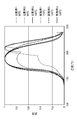
- FIG. 1 is a graph showing the foaming behavior of microspheres in Examples or Comparative Examples.
- FIG. 2 is another graph showing the foaming behavior of the microspheres in the examples.
- the method for producing a foamed molded product according to the present invention includes a step (A) of obtaining an unfoamed molded product comprising a thermally foamable composition, and a step of heating and foaming the unfoamed molded product at a temperature T2 (° C.) (B ) And.
- the thermally foamable composition contains microspheres and at least one substrate selected from the group consisting of thermoplastic resins, thermosetting resins, and fibers.
- the substrate is at least one selected from the group consisting of a thermoplastic resin, a thermosetting resin, and fibers.
- a thermoplastic resin a thermosetting resin, and a fiber can be used individually or in combination of 2 or more types.
- the thermoplastic resin is not particularly limited.
- the thermosetting resin include ethylene-propylene-diene rubber (EPDM), silicone rubber, and epoxy resin.
- the fiber is not particularly limited, and examples thereof include glass fiber, carbon fiber, metal fiber, pulp fiber, and synthetic fiber.
- the microspheres used in the present invention include an outer shell containing a polymer and a foaming agent enclosed in the outer shell, and usually have thermal foaming properties (“thermal foaming microspheres”).
- Microspheres having such a structure can generally be produced by suspension polymerization of at least one polymerizable monomer in the presence of a foaming agent in an aqueous dispersion medium containing a dispersion stabilizer. it can.
- the content of microspheres is preferably 1 to 120 parts by weight, more preferably 1 to 70 parts by weight, and still more preferably 1 to 60 parts by weight with respect to 100 parts by weight of the substrate. Parts, even more preferably 1 to 50 parts by weight.
- the content of the microsphere is within the above range, it is easy to obtain a foamed molded article having a good foamed state.
- Vinyl monomer examples include a polymer containing a structural unit derived from a vinyl monomer, and foaming starts by heat treatment at a temperature lower than the foaming start temperature.
- a copolymer containing a structural unit derived from (meth) acrylonitrile and a structural unit derived from (meth) acrylic acid ester hereinafter referred to as “(meth) acrylonitrile” because it is easy to obtain a microsphere having a reduced temperature and maximum foaming temperature.
- (meth) acrylonitrile a structural unit derived from (meth) acrylic acid ester
- -It is also preferable to contain (meth) acrylic acid ester copolymer ".
- (meth) acrylonitrile means acrylonitrile and / or methacrylonitrile, in other words, at least one nitrile monomer selected from the group consisting of acrylonitrile and methacrylonitrile.
- (meth) acrylic acid ester means acrylic acid ester and / or methacrylic acid ester, in other words, at least one selected from the group consisting of acrylic acid ester and methacrylic acid ester. Of unsaturated acid ester monomers.
- Examples of the acrylate ester include, but are not limited to, methyl acrylate, ethyl acrylate, butyl acrylate, and dicyclopentenyl acrylate.
- Examples of the methacrylic acid ester include, but are not limited to, methyl methacrylate, ethyl methacrylate, butyl methacrylate, and isobornyl methacrylate.
- the (meth) acrylonitrile / (meth) acrylic acid ester copolymer contains structural units derived from other vinyl monomers from the viewpoints of foamability, gas barrier properties, heat resistance, and / or solvent resistance. Also good.
- other vinyl monomers include nitrile monomers other than (meth) acrylonitrile, such as ⁇ -chloroacrylonitrile, ⁇ -ethoxyacrylonitrile, and fumaronitrile; vinyl chloride; vinylidene chloride; vinyl acetate; chloroprene, isoprene, butadiene Conjugated dienes such as: N-phenylmaleimide, N-naphthylmaleimide, N-cyclohexylmaleimide, methylmaleimide and other N-substituted maleimides; acrylic acid, methacrylic acid, crotonic acid, maleic anhydride and other unsaturated acids; styrene, ⁇ -Vinyl aromatic compounds such as
- the content is preferably 50 to 99% by weight, more preferably 55 to 99% by weight, even more preferably 60 to 99% by weight, and the content of the structural unit derived from (meth) acrylic acid ester is preferably It is 1 to 50% by weight, more preferably 1 to 45% by weight, and still more preferably 1 to 40% by weight.
- the structural unit derived from (meth) acrylonitrile is a main component, and thus the foaming start temperature of the formed microsphere can be increased.
- the total content of the structural unit derived from (meth) acrylonitrile and the structural unit derived from (meth) acrylic ester with respect to the whole structural unit derived from the body is preferably 90 to 100% by weight, more preferably 92 to 99%.
- the content of structural units derived from other vinyl monomers is preferably from 0 to 10% by weight, more preferably from 1 to 8% by weight, and still more preferably from 95% to 98% by weight. Is 2 to 5% by weight.
- the polymer forming the outer shell preferably does not contain a structural unit derived from an unsaturated acid such as acrylic acid, methacrylic acid, crotonic acid or maleic anhydride.
- crosslinkable monomer In the present invention, a vinyl monomer and a crosslinkable monomer as described above can be used in combination as the polymerizable monomer. By using a crosslinkable monomer in combination, processability, foaming characteristics, heat resistance, solvent resistance and the like can be improved.
- a crosslinkable monomer a polyfunctional compound having two or more polymerizable carbon-carbon double bonds (—C ⁇ C—) is used. Examples of the polymerizable carbon-carbon double bond include a vinyl group, a methacryl group, an acrylic group, and an allyl group. Two or more polymerizable carbon-carbon double bonds may be the same or different from each other.
- crosslinkable monomer examples include aromatic divinyl compounds such as divinylbenzene, divinylnaphthalene, and derivatives thereof; diethylenically unsaturated carboxylic acids such as ethylene glycol diacrylate, diethylene glycol diacrylate, ethylene glycol dimethacrylate, and diethylene glycol dimethacrylate.
- Bifunctional crosslinkability such as acid esters; acrylates or methacrylates derived from aliphatic terminal alcohols such as 1,4-butanediol and 1,9-nonanediol; divinyl compounds such as N, N-divinylaniline and divinyl ether; Monomer.
- crosslinkable monomers examples include trifunctional or higher polyfunctional crosslinkable monomers such as trimethylolpropane triacrylate, trimethylolpropane trimethacrylate, pentaerythritol triacrylate, pentaerythritol trimethacrylate, and triacryl formal. A monomer is mentioned.
- a bifunctional crosslinkable monomer having two polymerizable carbon-carbon double bonds is preferable in terms of easily balancing the foamability and processability.
- the bifunctional crosslinkable monomer may be directly or indirectly via a flexible chain derived from a diol compound selected from the group consisting of polyethylene glycol, polypropylene glycol, alkyl diol, alkyl ether diol, and alkyl ester diol.
- the compound is preferably a compound having a structure in which two polymerizable carbon-carbon double bonds are linked.
- Examples of the bifunctional crosslinkable monomer having a structure in which two polymerizable carbon-carbon double bonds are linked via the above-described flexible chain include polyethylene glycol diacrylate, polyethylene glycol dimethacrylate, and polypropylene glycol diester. Acrylate, polypropylene glycol dimethacrylate, alkyl diol diacrylate, alkyl diol dimethacrylate, alkyl ether diol diacrylate, alkyl ether diol dimethacrylate, alkyl ester diol diacrylate, alkyl ester diol dimethacrylate, and mixtures of two or more thereof Can be mentioned.
- a bifunctional crosslinkable monomer having such a flexible chain is used as the crosslinkable monomer, the temperature dependence of the elastic modulus of the outer shell polymer is reduced while maintaining a high expansion ratio.
- a shearing force in a kneading process, a calendar process, an extrusion process, an injection molding process, or the like a microsphere can be obtained which is less likely to break the outer shell or dissipate the encapsulated gas.
- the use ratio of the crosslinkable monomer is preferably 5 parts by weight or less (that is, 0 to 5 parts by weight), more preferably 0.01 to 5 parts by weight, and still more based on 100 parts by weight of the vinyl monomer.
- the amount is preferably 0.05 to 4 parts by weight, particularly preferably 0.1 to 3 parts by weight. It is preferable that the use ratio of the crosslinkable monomer is within the above range from the viewpoint that the processability is hardly lowered and the thermoplasticity of the polymer forming the outer shell is hardly lowered and the foaming is hardly difficult.
- the foaming agent is a substance that becomes a gas when heated.
- hydrocarbons having a boiling point corresponding to the foaming start temperature can be used.
- Hydrocarbons such as neopentane, n-hexane, isohexane, n-heptane, isoheptane, n-octane, isooctane, n-nonane, isononane, n-decane, isodecane, n-dodecane, isododecane, petroleum ether, isoparaffin mixture, and the like isomeric mixtures thereof; CCl 3 F, CCl 2 F 2, CClF 3, chlorofluorocarbons such as CClF 2 -CClF 2; tetramethylsilane, trimethylethyl silane, trimethyl isopropyl silane, tetra alkyl such as trimethyl -n- propyl silane Run, and the like.
- a foaming agent can be used individually or in combination of 2 or more types.
- isobutane, n-butane, n-pentane, isopentane, n-hexane, isooctane, isododecane, and isomer mixtures thereof, petroleum ether, and a mixture of two or more of these are preferable.
- a compound that is thermally decomposed by heating to become a gas may be used.
- the ratio of the foaming agent encapsulated in the microsphere is preferably 5 to 50% by weight, more preferably 7 to 40% by weight, based on the total amount. Therefore, it is desirable to adjust the use ratio of the polymerizable monomer and the foaming agent such that the outer shell polymer and the foaming agent have the above ratio after the polymerization.
- the microsphere used in the present invention is a method of suspension polymerization of at least one polymerizable monomer in the presence of a foaming agent in an aqueous dispersion medium containing a dispersion stabilizer. Can be manufactured. A more specific production method is not particularly limited, and a known method can be used.
- Microsphere used in the present invention has a structure in which a foaming agent is enclosed in an outer shell formed from a polymer.
- the polymer forming the outer shell is formed by polymerization of a polymerizable monomer (mainly vinyl monomer). By using a vinyl monomer and a crosslinkable monomer together, the outer shell polymer is formed. The temperature dependence of the elastic modulus can be reduced.
- a polymer containing a structural unit derived from a vinyl monomer, preferably a (meth) acrylonitrile / (meth) acrylate copolymer is used for heat treatment at a temperature lower than the foaming start temperature. By doing so, it is easy to obtain microspheres in which the foaming start temperature and the maximum foaming temperature are lowered.
- the average particle size of the microspheres used in the present invention is not particularly limited, and is preferably 1 to 200 ⁇ m, more preferably 3 to 150 ⁇ m, and particularly preferably 5 to 100 ⁇ m.
- the foamability tends to be sufficient; in the field where a beautiful appearance is required, the smoothness of the surface is not easily impaired; and the shearing force during processing This is preferable in that the resistance is unlikely to be insufficient.
- the content of the foaming agent in the microspheres used in the present invention is preferably 5 to 50% by weight, more preferably 7 to 40% by weight, based on the total weight.
- the content of the foaming agent is within the above range, the expansion ratio is difficult to be insufficient, and the thickness of the outer shell does not become too thin. It is easy to be suppressed from causing rupture.
- the foaming start temperature of the microsphere used in the present invention is 10 ° C. or more, preferably 20 to 60 ° C., more preferably 30 to 50 ° C. by heat-treating the thermally foamable composition at a temperature T1 (° C.). Even more preferably, the temperature falls by 35 to 45 ° C.
- the maximum foaming temperature of the microspheres used in the present invention is 5 ° C. or more, preferably 10 to 40 ° C., more preferably 12 to 30 ° C. by heat-treating the thermally foamable composition at a temperature T1 (° C.). Even more preferably, the temperature falls by 15 to 25 ° C.
- Step (A) In the step (A), an unfoamed molded body made of a thermally foamable composition is obtained.
- the thermally foamable composition contains microspheres and at least one substrate selected from the group consisting of thermoplastic resins, thermosetting resins, and fibers.
- Step (A) includes a step (a) of heat-treating the thermally foamable composition at a temperature T1 (° C.).
- the timing for heat-treating the thermally foamable composition at a temperature T1 (° C.) is not particularly limited, and may be before molding the thermally foamable composition or after molding the thermally foamable composition. Specifically, it is as follows.
- the unfoamed molded body is obtained by molding the thermally foamable composition heat-treated in the step (a).
- the molded heat-foamable composition is heat-treated in the step (a).
- the unfoamed molded body is obtained.
- the thermally foamable composition is heat treated at a temperature T1 (° C.), and at the same time, the unheated microspheres are heat treated at a temperature T1 (° C.). Thereby, the foaming start temperature and maximum foaming temperature of a microsphere can be reduced.
- T1 (° C.) satisfies the following formula (1).
- Ts (° C.) represents the foaming start temperature of the microsphere before heat treatment in the step (a).
- the thermally foamable composition is heat treated at a temperature T1 (° C.), and as a result, the unheated microsphere is heat treated at a temperature T1 (° C.).
- T1 temperature
- examples include extrusion, hot pressing, and drying.
- extrusion include a method in which the microspheres that have not been heat-treated are blended with the base material, particularly a thermoplastic resin, and pellets are produced by extrusion under conditions in which the microspheres do not substantially foam. It is done.
- the thermally foamable composition is heat-treated at a temperature T1 (° C.), and the untreated microspheres are heated at a temperature T1 (° C.). It can be heat treated.
- the hot press there is a method in which the microspheres that have not been heat-treated are mixed with a thermoplastic resin, and the microspheres are pressed using a hot press machine under conditions where the microspheres are not substantially foamed. By setting the press temperature to T1, the thermally foamable composition can be heat treated at a temperature T1 (° C.), and the untreated microspheres can be heat treated at a temperature T1 (° C.).
- the thermally foamable composition can be heat-treated at temperature T1 (° C.), and the untreated microspheres can be heat-treated at temperature T1 (° C.). .
- the mixture of the thermoplastic resin and the unheated microspheres is heated to a temperature T1 (° C.) using an oven or the like under a condition in which the microspheres are not substantially foamed.
- the thermally foamable composition may be heat-treated at (° C.), and the unheated microspheres may be heat-treated at a temperature T1 (° C.).
- Step (B) In the step (B), the unfoamed molded body is heated and foamed at a temperature T2 (° C.). Thereby, the target foaming molding can be obtained.
- the foamed molded article is obtained by foaming the microspheres in the pellets and the nonwoven fabric-like deposit in the description of the specific method of the step (A) at a temperature T2 (° C.). Can do.
- T2 (° C.) satisfies the following formula (2).
- Ts-40 T2 ⁇ Tmax-3 (° C.) (2)
- Ts is as described above, and Tmax (° C.) represents the maximum foaming temperature of the untreated microsphere.
- the microspheres are foamed in a state where energy costs are suppressed by heating and foaming at a temperature of 40 ° C. lower than Ts and lower than 3 ° C. lower than Tmax.
- the temperature T2 (° C.) specifically satisfies the following formula (2-1), and more specifically satisfies the following formula (2-2).
- the foamed microspheres can be foamed by heating and foaming at a temperature of 150 ° C. or more and less than 3 ° C. lower than Tmax, while suppressing the energy cost. it can.
- the microspheres can be foamed by heating and foaming at 150 ° C. or more and less than 205 ° C. while suppressing the energy cost to obtain a foam molded article.
- the foaming start temperature can be measured by a thermomechanical analyzer (hereinafter referred to as “TMA”). Specifically, in the present invention, the foaming start temperature refers to a microsphere alone or a 1: 1 (weight ratio) mixture of microspheres and EMMA as a sample, and a temperature rising rate of 5 ° C. using TMA. The temperature at the time when the displacement of the height starts when the height displacement of the portion occupied by the sample is continuously measured.
- TMA thermomechanical analyzer
- the maximum foaming temperature can be measured by TMA.
- the foaming start temperature refers to a microsphere alone or a 1: 1 (weight ratio) mixture of microspheres and EMMA as a sample, and a temperature rising rate of 5 ° C. using TMA.
- the foamed molded product obtained by the production method according to the present invention is reduced in weight by foam molding using the microspheres, and is given design as necessary.
- the shape of the foamed molded product is not particularly limited, and may be any of a sheet shape, a rod shape, a pipe shape, a block shape, and other arbitrary shapes.
- the foamed molded product can be suitably used as a resin molded product for automobiles because it is reduced in weight by foam molding and is excellent in soundproofing effect and heat insulating effect.
- the foaming start temperature and the maximum foaming temperature of the microspheres in Examples or Comparative Examples were measured. Specifically, 1 mg of a sample is put in a container, and the temperature is increased at a heating rate of 5 ° C./min using a thermomechanical analyzer (model number “TMA / SDTA840”, manufactured by METTLER TRADE Co., Ltd.). The displacement of the occupied portion was measured continuously. The temperature at the time when the height displacement started was defined as the unheated foaming start temperature (Ts), and the temperature at the time when the height displacement was the largest was defined as the maximum foaming temperature (Tmax). At that time, the homogeneity of the foaming behavior was determined according to the following evaluation criteria.
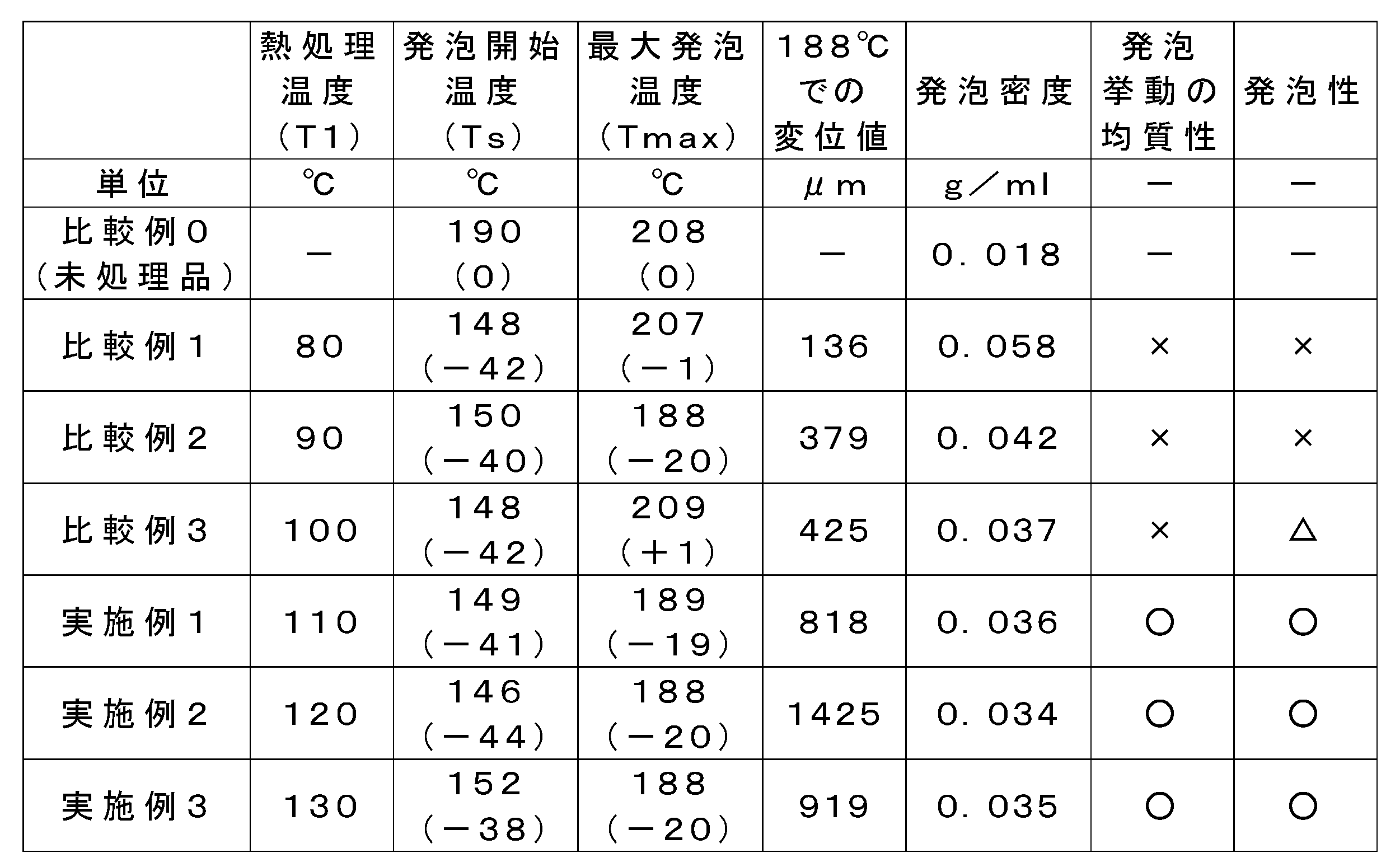
- Comparative Examples 0 to 3 and Examples 1 to 3 are shown in Table 1, and the results of Comparative Example 0 and Examples 4 to 9 are shown in Table 2.
- the height displacement graph is shown in FIG. 1 for Comparative Examples 1 to 3 and Examples 1 to 3, and in FIG. 2 for Examples 4 to 9.
- ⁇ When the peak (including the shoulder peak) is present alone in the height displacement graph, it is determined that the homogeneity of the foaming behavior is good.
- X In the graph of the displacement of the height, when there are a plurality of peaks (including shoulder peaks), it is determined that the homogeneity of the foaming behavior is poor.
- Example 1 Using an extruder (manufactured by Technobel, KZW-15), EMMA (MFR 0.25 g / 10 min, melting temperature 67 ° C.) and microsphere (H1100) were mixed, and the blend ratio was 1: 1 (weight ratio). Extrusion was performed at a screw speed of 100 R / min. The screw temperature at that time was set at 70 ° C. to 90 ° C., and the temperature of the dice ( ⁇ 2.5 ⁇ 2 holes) (heat treatment temperature: T1) was set to 110 ° C. to obtain a sample. The obtained samples were evaluated as described above.
- Example 2 Samples were prepared and evaluated in the same manner as in Example 1 except that the heat treatment temperature (T1) was 120 ° C.
- Example 3 Samples were prepared and evaluated in the same manner as in Example 1 except that the heat treatment temperature (T1) was 130 ° C.
- Example 4 A 2.0 g sample of Comparative Example 1 was heat-treated in an oven at 130 ° C. for 5 minutes to produce a heat-treated sample, and this heat-treated sample was evaluated in the same manner as in Example 1.
- Example 5 A 2.0 g sample of Comparative Example 2 was heat-treated in an oven at 130 ° C. for 5 minutes to produce a heat-treated sample, and this heat-treated sample was evaluated in the same manner as in Example 1.
- Example 6 A 2.0 g sample of Comparative Example 3 was heat-treated in an oven at 130 ° C. for 5 minutes to produce a heat-treated sample, and this heat-treated sample was evaluated in the same manner as in Example 1.
- Example 7 A 2.0 g sample of Example 1 was heat-treated in an oven at 130 ° C. for 5 minutes to produce a heat-treated sample. The heat-treated sample was evaluated in the same manner as in Example 1.
- Example 8 A heat treatment sample was prepared by heating 2.0 g of the sample of Example 2 in an oven at 130 ° C. for 5 minutes, and this heat treatment sample was evaluated in the same manner as in Example 1.
- Example 9 A 2.0 g sample of Example 3 was heat-treated in an oven at 130 ° C. for 5 minutes to produce a heat-treated sample. The heat-treated sample was evaluated in the same manner as in Example 1.
- the foaming start temperature and the maximum foaming temperature are reduced, and the temperature at the time of heating and foaming can be lowered, thereby suppressing the energy cost. It has excellent energy-saving properties and excellent uniformity of foaming behavior, so that the microspheres are uniformly foamed and the foamed state is good, so it has excellent overall productivity. I understand.
Landscapes
- Chemical & Material Sciences (AREA)
- Engineering & Computer Science (AREA)
- Materials Engineering (AREA)
- Health & Medical Sciences (AREA)
- Chemical Kinetics & Catalysis (AREA)
- Medicinal Chemistry (AREA)
- Polymers & Plastics (AREA)
- Organic Chemistry (AREA)
- Manufacture Of Porous Articles, And Recovery And Treatment Of Waste Products (AREA)
Abstract
省エネルギー化及び生産性向上を図りつつ、マイクロスフェアー(以下、MS)を用いて発泡成形体を製造することができる発泡成形体の製造方法を提供する。本発明に係る、発泡成形体の製造方法は、熱発泡性組成物からなる未発泡成形体を得る工程Aと、該未発泡成形体をT2(℃)で加熱発泡させる工程と、を含み、該熱発泡性組成物は、MSと、熱可塑性樹脂、熱硬化性樹脂、及び/又は繊維からなる基材と、を含有し、該MSは、重合体を含む外殻と、該外殻内に封入された発泡剤と、を含み、工程Aは、T1(℃)で該熱発泡性組成物を熱処理する工程を含み、該熱処理後のMSの発泡開始温度及び最大発泡温度は、該熱処理前の水準より、それぞれ、10℃以上及び5℃以上低く、T1は105℃以上該熱処理前のMSの発泡開始温度Ts未満であり、T2はTs-40℃以上かつ該熱処理前のMSの最大発泡温度-3℃未満である方法。
Description
本発明は、発泡成形体の製造方法に関する。
熱膨張性マイクロカプセルとも呼ばれる「マイクロスフェアー」は、揮発性の発泡剤を重合体からなる外殻でマイクロカプセル化したものであって、通常、熱発泡性を有する(「熱発泡性マイクロスフェアー」)。マイクロスフェアーの製造において、一般には、水系分散媒体中で、重合性単量体と発泡剤を含有する重合性混合物との懸濁重合を進行させると、発泡剤を内包するように外殻(シェル)が形成される。
この外殻を形成する重合体には、一般に、ガスバリア性が良好な熱可塑性樹脂が用いられる。外殻を形成する重合体は、加熱により軟化する。発泡剤としては、一般に、外殻を形成する重合体の軟化点以下の温度でガス状になる炭化水素等の低沸点化合物が用いられる。
マイクロスフェアーを加熱すると、発泡剤が気化して膨張する力が外殻に働くが、同時に、外殻を形成する重合体の弾性率が急激に減少するため、ある温度を境にして急激な膨張が起きる。この温度は、「発泡開始温度」と呼ばれる。この発泡開始温度以上に加熱されると、前記膨張現象により発泡体粒子(独立気泡体)が形成され、更に加熱されると、発泡剤が薄くなった外殻を透過して内圧が低下し、発泡体粒子が収縮してしまう(ヘタリ現象)。なお、前記膨張現象による体積増加が最大となる温度は、「最大発泡温度」と呼ばれる。
マイクロスフェアーは、その発泡体粒子を形成する前記特性を利用して、意匠性付与剤、機能性付与剤、軽量化剤等の広範な分野で用いられている。例えば、合成樹脂(熱可塑性樹脂及び熱硬化性樹脂)やゴム等のポリマー材料、塗料、インク等に添加して用いられる。それぞれの用途分野で高性能化が要求されるようになると、マイクロスフェアーに対する要求水準も高くなり、例えば、耐熱性等の加工特性の改善が求められる。
耐熱性を有し、高温でも使用可能なマイクロスフェアーとして、例えば、主成分となる単量体がアクリロニトリル(I)であり、カルボキシル基を含有する単量体(II)、この単量体のカルボキシル基と反応する基を持つ単量体(III)を重合して得られた共重合体を外殻とし、該共重合体の軟化温度以下の沸点を有する液体を内包するマイクロスフェアーが提案されている(特許文献1)。
ところで、発泡開始温度が高いと、多くの熱量を投入しないと、マイクロスフェアーを発泡させることが難しい。また、最大発泡温度付近で発泡を行うことで、最も効率的に成形を行うことができるものの、最大発泡温度が高いと、やはり多くの熱量を投入することが求められる。このように、発泡開始温度及び最大発泡温度が高いと、マイクロスフェアーを加熱発泡させて発泡成形体を製造する際に多大な熱量が必要とされ、省エネルギー化及び生産性向上を図ることが難しい。
本発明は、上記の課題に鑑みなされたものであって、省エネルギー化及び生産性向上を図りつつ、マイクロスフェアーを用いて発泡成形体を製造することができる発泡成形体の製造方法を提供することを目的とする。
本発明者らは、発泡開始温度よりも低い所定の温度で熱処理することで発泡開始温度及び最大発泡温度が所定の範囲で低下するマイクロスフェアーを用いることにより、上記の課題が解決されることを見出し、本発明を完成するに至った。
本発明の態様は、発泡成形体の製造方法であって、
前記方法は、熱発泡性組成物からなる未発泡成形体を得る工程(A)と、前記未発泡成形体を温度T2(℃)で加熱発泡させる工程(B)と、を含み、
前記熱発泡性組成物は、マイクロスフェアーと、熱可塑性樹脂、熱硬化性樹脂、及び繊維からなる群より選択される少なくとも1種の基材と、を含有し、
前記マイクロスフェアーは、重合体を含む外殻と、前記外殻内に封入された発泡剤と、を含み、
工程(A)は、温度T1(℃)で前記熱発泡性組成物を熱処理する工程(a)を含み、
工程(a)で熱処理した後のマイクロスフェアーの発泡開始温度は、工程(a)で熱処理する前のマイクロスフェアーの発泡開始温度より、10℃以上低く、
工程(a)で熱処理した後のマイクロスフェアーの最大発泡温度は、工程(a)で熱処理する前のマイクロスフェアーの最大発泡温度より、5℃以上低く、
温度T1及びT2は、それぞれ下記式(1)及び(2)を満たす方法である。
105≦T1<Ts(℃) (1)
Ts-40≦T2<Tmax-3(℃) (2)
(式中、Ts(℃)は、工程(a)で熱処理する前のマイクロスフェアーの発泡開始温度を表し、Tmax(℃)は、工程(a)で熱処理する前のマイクロスフェアーの最大発泡温度を表す。)
前記方法は、熱発泡性組成物からなる未発泡成形体を得る工程(A)と、前記未発泡成形体を温度T2(℃)で加熱発泡させる工程(B)と、を含み、
前記熱発泡性組成物は、マイクロスフェアーと、熱可塑性樹脂、熱硬化性樹脂、及び繊維からなる群より選択される少なくとも1種の基材と、を含有し、
前記マイクロスフェアーは、重合体を含む外殻と、前記外殻内に封入された発泡剤と、を含み、
工程(A)は、温度T1(℃)で前記熱発泡性組成物を熱処理する工程(a)を含み、
工程(a)で熱処理した後のマイクロスフェアーの発泡開始温度は、工程(a)で熱処理する前のマイクロスフェアーの発泡開始温度より、10℃以上低く、
工程(a)で熱処理した後のマイクロスフェアーの最大発泡温度は、工程(a)で熱処理する前のマイクロスフェアーの最大発泡温度より、5℃以上低く、
温度T1及びT2は、それぞれ下記式(1)及び(2)を満たす方法である。
105≦T1<Ts(℃) (1)
Ts-40≦T2<Tmax-3(℃) (2)
(式中、Ts(℃)は、工程(a)で熱処理する前のマイクロスフェアーの発泡開始温度を表し、Tmax(℃)は、工程(a)で熱処理する前のマイクロスフェアーの最大発泡温度を表す。)
工程(A)において、工程(a)で熱処理した前記熱発泡性組成物を成形することにより、前記未発泡成形体を得ることが好ましい。あるいは、工程(A)において、工程(a)で熱処理する前の前記熱発泡性組成物を成形した後、成形された前記熱発泡性組成物を工程(a)で熱処理することにより、前記未発泡成形体を得ることが好ましい。
前記重合体は、(メタ)アクリロニトリル由来の構造単位と(メタ)アクリル酸エステル由来の構造単位とを含む共重合体を含有することが好ましい。
本発明によれば、省エネルギー化及び生産性向上を図りつつ、マイクロスフェアーを用いて発泡成形体を製造することができる発泡成形体の製造方法を提供することができる。
<発泡成形体の製造方法>
本発明に係る、発泡成形体の製造方法は、熱発泡性組成物からなる未発泡成形体を得る工程(A)と、前記未発泡成形体を温度T2(℃)で加熱発泡させる工程(B)と、を含む。前記熱発泡性組成物は、マイクロスフェアーと、熱可塑性樹脂、熱硬化性樹脂、及び繊維からなる群より選択される少なくとも1種の基材と、を含有する。
本発明に係る、発泡成形体の製造方法は、熱発泡性組成物からなる未発泡成形体を得る工程(A)と、前記未発泡成形体を温度T2(℃)で加熱発泡させる工程(B)と、を含む。前記熱発泡性組成物は、マイクロスフェアーと、熱可塑性樹脂、熱硬化性樹脂、及び繊維からなる群より選択される少なくとも1種の基材と、を含有する。
[基材]
基材は、熱可塑性樹脂、熱硬化性樹脂、及び繊維からなる群より選択される少なくとも1種である。熱可塑性樹脂、熱硬化性樹脂、及び繊維の各々は、単独で、又は2種以上を組み合わせて使用することができる。熱可塑性樹脂としては、特に限定されず、例えば、ポリ塩化ビニル(PVC)、ポリプロピレン(PP)、エチレン酢酸ビニル共重合体(EVA)、熱可塑性エラストマー(TPE)、エチレン・メタクリル酸メチル共重合物(以下、「EMMA」ともいう。)等が挙げられる。熱硬化性樹脂としては、エチレン-プロピレン-ジエンゴム(EPDM)、シリコーンゴム、エポキシ樹脂等が挙げられる。繊維としては、特に限定されず、例えば、ガラス繊維、炭素繊維、金属繊維、パルプ繊維、合成繊維等が挙げられる。
基材は、熱可塑性樹脂、熱硬化性樹脂、及び繊維からなる群より選択される少なくとも1種である。熱可塑性樹脂、熱硬化性樹脂、及び繊維の各々は、単独で、又は2種以上を組み合わせて使用することができる。熱可塑性樹脂としては、特に限定されず、例えば、ポリ塩化ビニル(PVC)、ポリプロピレン(PP)、エチレン酢酸ビニル共重合体(EVA)、熱可塑性エラストマー(TPE)、エチレン・メタクリル酸メチル共重合物(以下、「EMMA」ともいう。)等が挙げられる。熱硬化性樹脂としては、エチレン-プロピレン-ジエンゴム(EPDM)、シリコーンゴム、エポキシ樹脂等が挙げられる。繊維としては、特に限定されず、例えば、ガラス繊維、炭素繊維、金属繊維、パルプ繊維、合成繊維等が挙げられる。
[マイクロスフェアー]
本発明で用いるマイクロスフェアーは、重合体を含む外殻と、前記外殻内に封入された発泡剤と、を含み、通常、熱発泡性を有する(「熱発泡性マイクロスフェアー」)。このような構造を有するマイクロスフェアーは、一般に、分散安定剤を含有する水系分散媒体中で、少なくとも一種の重合性単量体を発泡剤の存在下に懸濁重合することにより製造することができる。前記熱発泡性組成物において、マイクロスフェアーの含有量は、前記基材100重量部に対し、好ましくは1~120重量部、より好ましくは1~70重量部、更により好ましくは1~60重量部、一層更により好ましくは1~50重量部である。マイクロスフェアーの含有量が上記範囲内であると、良好な発泡状態を有する発泡成形体を得やすい。
本発明で用いるマイクロスフェアーは、重合体を含む外殻と、前記外殻内に封入された発泡剤と、を含み、通常、熱発泡性を有する(「熱発泡性マイクロスフェアー」)。このような構造を有するマイクロスフェアーは、一般に、分散安定剤を含有する水系分散媒体中で、少なくとも一種の重合性単量体を発泡剤の存在下に懸濁重合することにより製造することができる。前記熱発泡性組成物において、マイクロスフェアーの含有量は、前記基材100重量部に対し、好ましくは1~120重量部、より好ましくは1~70重量部、更により好ましくは1~60重量部、一層更により好ましくは1~50重量部である。マイクロスフェアーの含有量が上記範囲内であると、良好な発泡状態を有する発泡成形体を得やすい。
(1)ビニル単量体
外殻を形成する重合体としては、例えば、ビニル単量体に由来する構造単位を含む重合体が挙げられ、発泡開始温度よりも低い温度で熱処理することで発泡開始温度及び最大発泡温度が低下するマイクロスフェアーを得やすいことから、(メタ)アクリロニトリル由来の構造単位と(メタ)アクリル酸エステル由来の構造単位とを含む共重合体(以下、「(メタ)アクリロニトリル・(メタ)アクリル酸エステル共重合体」ともいう。)を含有することが好ましい。なお、本明細書において、「(メタ)アクリロニトリル」とは、アクリロニトリル及び/又はメタクリロニトリルを意味し、換言すれば、アクリロニトリル及びメタクリロニトリルからなる群より選ばれる少なくとも一種のニトリル単量体を意味する。また、本明細書において、「(メタ)アクリル酸エステル」とは、アクリル酸エステル及び/又はメタクリル酸エステルを意味し、換言すれば、アクリル酸エステル及びメタクリル酸エステルからなる群より選ばれる少なくとも一種の不飽和酸エステル単量体を意味する。
外殻を形成する重合体としては、例えば、ビニル単量体に由来する構造単位を含む重合体が挙げられ、発泡開始温度よりも低い温度で熱処理することで発泡開始温度及び最大発泡温度が低下するマイクロスフェアーを得やすいことから、(メタ)アクリロニトリル由来の構造単位と(メタ)アクリル酸エステル由来の構造単位とを含む共重合体(以下、「(メタ)アクリロニトリル・(メタ)アクリル酸エステル共重合体」ともいう。)を含有することが好ましい。なお、本明細書において、「(メタ)アクリロニトリル」とは、アクリロニトリル及び/又はメタクリロニトリルを意味し、換言すれば、アクリロニトリル及びメタクリロニトリルからなる群より選ばれる少なくとも一種のニトリル単量体を意味する。また、本明細書において、「(メタ)アクリル酸エステル」とは、アクリル酸エステル及び/又はメタクリル酸エステルを意味し、換言すれば、アクリル酸エステル及びメタクリル酸エステルからなる群より選ばれる少なくとも一種の不飽和酸エステル単量体を意味する。
アクリル酸エステルとしては、例えば、アクリル酸メチル、アクリル酸エチル、アクリル酸ブチル、ジシクロペンテニルアクリレートが挙げられ、これらに限定されない。メタクリル酸エステルとしては、例えば、メタクリル酸メチル、メタクリル酸エチル、メタクリル酸ブチル、イソボルニルメタクリレートが挙げられ、これらに限定されない。
(メタ)アクリロニトリル・(メタ)アクリル酸エステル共重合体は、発泡性、ガスバリア性、耐熱性、及び/又は耐溶剤性等の観点から、その他のビニル単量体由来の構造単位を含んでいてもよい。その他のビニル単量体としては、例えば、α-クロロアクリロニトリル、α-エトキシアクリロニトリル、フマロニトリル等の、(メタ)アクリロニトリル以外のニトリル単量体;塩化ビニル;塩化ビニリデン;酢酸ビニル;クロロプレン、イソプレン、ブタジエン等の共役ジエン;N-フェニルマレイミド、N-ナフチルマレイミド、N-シクロヘキシルマレイミド、メチルマレイミド等のN-置換マレイミド;アクリル酸、メタクリル酸、クロトン酸、無水マレイン酸等の不飽和酸;スチレン、α-メチルスチレン、ハロゲン化スチレン等のビニル芳香族化合物が挙げられる。
(メタ)アクリロニトリル・(メタ)アクリル酸エステル共重合体において、(メタ)アクリロニトリル由来の構造単位と(メタ)アクリル酸エステル由来の構造単位との合計に対し、(メタ)アクリロニトリル由来の構造単位の含有量は、好ましくは50~99重量%、より好ましくは55~99重量%、更により好ましくは60~99重量%であり、(メタ)アクリル酸エステル由来の構造単位の含有量は、好ましくは1~50重量%、より好ましくは1~45重量%、更により好ましくは1~40重量%である。上記含有量が上記範囲内であると、(メタ)アクリロニトリル由来の構造単位が主成分となるため、形成されるマイクロスフェアーの発泡開始温度を高めることができる。
(メタ)アクリロニトリル・(メタ)アクリル酸エステル共重合体において、本発明の目的を損なうことなく、発泡性、ガスバリア性、耐熱性、及び/又は耐溶剤性等を向上させる観点から、ビニル単量体由来の構造単位全体に対し、(メタ)アクリロニトリル由来の構造単位と(メタ)アクリル酸エステル由来の構造単位との合計の含有量は、好ましくは90~100重量%、より好ましくは92~99重量%、更により好ましくは95~98重量%であり、その他のビニル単量体由来の構造単位の含有量は、好ましくは0~10重量%、より好ましくは1~8重量%、更により好ましくは2~5重量%である。
なお、耐湿性等の観点から、外殻を形成する重合体は、アクリル酸、メタクリル酸、クロトン酸、無水マレイン酸等の不飽和酸由来の構造単位を含まないことが好ましい。
(2)架橋性単量体
本発明では、重合性単量体として、前記の如きビニル単量体と架橋性単量体とを併用することができる。架橋性単量体を併用することにより、加工性、発泡特性、耐熱性、耐溶剤性等を改良することができる。架橋性単量体としては、2つ以上の重合性炭素-炭素二重結合(-C=C-)を有する多官能性化合物が用いられる。重合性炭素-炭素二重結合としては、例えば、ビニル基、メタクリル基、アクリル基、及びアリル基が挙げられる。2つ以上の重合性炭素-炭素二重結合は、それぞれ同一又は相異なっていてもよい。
本発明では、重合性単量体として、前記の如きビニル単量体と架橋性単量体とを併用することができる。架橋性単量体を併用することにより、加工性、発泡特性、耐熱性、耐溶剤性等を改良することができる。架橋性単量体としては、2つ以上の重合性炭素-炭素二重結合(-C=C-)を有する多官能性化合物が用いられる。重合性炭素-炭素二重結合としては、例えば、ビニル基、メタクリル基、アクリル基、及びアリル基が挙げられる。2つ以上の重合性炭素-炭素二重結合は、それぞれ同一又は相異なっていてもよい。
架橋性単量体としては、例えば、ジビニルベンゼン、ジビニルナフタレン、これらの誘導体等の芳香族ジビニル化合物;エチレングリコールジアクリレート、ジエチレングリコールジアクリレート、エチレングリコールジメタクリレート、ジエチレングリコールジメタクリレート等のジエチレン性不飽和カルボン酸エステル;1,4-ブタンジオール、1,9-ノナンジオール等の脂肪族両末端アルコール由来のアクリレート又はメタクリレート;N,N-ジビニルアニリン、ジビニルエーテル等のジビニル化合物;等の二官能の架橋性単量体が挙げられる。
他の架橋性単量体としては、例えば、トリアクリル酸トリメチロールプロパン、トリメタクリル酸トリメチロールプロパン、ペンタエリスリトールトリアクリレート、ペンタエリスリトールトリメタクリレート、トリアクリルホルマール等の三官能以上の多官能架橋性単量体が挙げられる。
架橋性単量体の中でも、発泡性と加工性とのバランスを取りやすい点で、重合性炭素-炭素二重結合を2個有する二官能架橋性単量体が好ましい。二官能架橋性単量体としては、ポリエチレングリコール、ポリプロピレングリコール、アルキルジオール、アルキルエーテルジオール、及びアルキルエステルジオールからなる群より選ばれるジオール化合物から誘導された屈曲性連鎖を介して、直接的又は間接的に、2個の重合性炭素-炭素二重結合が連結された構造の化合物であることが好ましい。
上記の屈曲性連鎖を介して2個の重合性炭素-炭素二重結合が連結された構造の二官能架橋性単量体としては、例えば、ポリエチレングリコールジアクリレート、ポリエチレングリコールジメタクリレート、ポリプロピレングリコールジアクリレート、ポリプロピレングリコールジメタクリレート、アルキルジオールジアクリレート、アルキルジオールジメタクリレート、アルキルエーテルジオールジアクリレート、アルキルエーテルジオールジメタクリレート、アルキルエステルジオールジアクリレート、アルキルエステルジオールジメタクリレート、及びこれらの2種以上の混合物が挙げられる。
架橋性単量体として、このような屈曲性連鎖を持つ二官能架橋性単量体を用いると、発泡倍率を高度に保持しながら、外殻の重合体の弾性率の温度依存性を小さくすることができ、しかも混練加工、カレンダー加工、押出加工、射出成形等の加工工程で、剪断力を受けても、外殻の破壊や内包ガスの散逸が起こり難いマイクロスフェアーを得ることができる。
架橋性単量体の使用割合は、ビニル単量体100重量部に対して、好ましくは5重量部以下(即ち、0~5重量部)、より好ましくは0.01~5重量部、更により好ましくは0.05~4重量部、特に好ましくは0.1~3重量部である。架橋性単量体の使用割合が上記範囲内であると、加工性が低下しにくい点、及び、外殻を形成する重合体の熱可塑性が低下しにくく発泡が困難になりにくい点で好ましい。
(3)発泡剤
発泡剤は、加熱により気体となる物質である。発泡剤としては、発泡開始温度に応じた沸点を有する炭化水素等を用いることができ、例えば、メタン、エタン、エチレン、プロパン、プロペン、n-ブタン、イソブタン、ブテン、イソブテン、n-ペンタン、イソペンタン、ネオペンタン、n-ヘキサン、イソヘキサン、n-ヘプタン、イソヘプタン、n-オクタン、イソオクタン、n-ノナン、イソノナン、n-デカン、イソデカン、n-ドデカン、イソドデカン、石油エーテル、イソパラフィン混合物等の炭化水素、及びその異性体混合物;CCl3F、CCl2F2、CClF3、CClF2-CClF2等のクロロフルオロカーボン;テトラメチルシラン、トリメチルエチルシラン、トリメチルイソプロピルシラン、トリメチル-n-プロピルシラン等のテトラアルキルシラン等が挙げられる。発泡剤は、単独で、又は2種以上を組み合わせて使用することができる。これらの中でも、イソブタン、n-ブタン、n-ペンタン、イソペンタン、n-ヘキサン、イソオクタン、イソドデカン、及びそれらの異性体混合物、石油エーテル、並びにこれらの2種以上の混合物が好ましい。また、所望により、加熱により熱分解して気体となる化合物を使用してもよい。
発泡剤は、加熱により気体となる物質である。発泡剤としては、発泡開始温度に応じた沸点を有する炭化水素等を用いることができ、例えば、メタン、エタン、エチレン、プロパン、プロペン、n-ブタン、イソブタン、ブテン、イソブテン、n-ペンタン、イソペンタン、ネオペンタン、n-ヘキサン、イソヘキサン、n-ヘプタン、イソヘプタン、n-オクタン、イソオクタン、n-ノナン、イソノナン、n-デカン、イソデカン、n-ドデカン、イソドデカン、石油エーテル、イソパラフィン混合物等の炭化水素、及びその異性体混合物;CCl3F、CCl2F2、CClF3、CClF2-CClF2等のクロロフルオロカーボン;テトラメチルシラン、トリメチルエチルシラン、トリメチルイソプロピルシラン、トリメチル-n-プロピルシラン等のテトラアルキルシラン等が挙げられる。発泡剤は、単独で、又は2種以上を組み合わせて使用することができる。これらの中でも、イソブタン、n-ブタン、n-ペンタン、イソペンタン、n-ヘキサン、イソオクタン、イソドデカン、及びそれらの異性体混合物、石油エーテル、並びにこれらの2種以上の混合物が好ましい。また、所望により、加熱により熱分解して気体となる化合物を使用してもよい。
マイクロスフェアー中に封入される発泡剤の割合は、全量基準で、好ましくは5~50重量%、より好ましくは7~40重量%である。したがって、重合性単量体と発泡剤の使用割合は、重合後に外殻重合体と発泡剤とが上記割合となるように調節することが望ましい。
(4)マイクロスフェアーの製造方法
本発明で用いるマイクロスフェアーは、分散安定剤を含有する水系分散媒体中で、少なくとも一種の重合性単量体を発泡剤の存在下に懸濁重合する方法により製造することができる。より具体的な製造方法としては、特に限定されず、公知の方法を用いることができる。
本発明で用いるマイクロスフェアーは、分散安定剤を含有する水系分散媒体中で、少なくとも一種の重合性単量体を発泡剤の存在下に懸濁重合する方法により製造することができる。より具体的な製造方法としては、特に限定されず、公知の方法を用いることができる。
(5)マイクロスフェアー
本発明で用いるマイクロスフェアーは、重合体から形成された外殻内に発泡剤が封入された構造を有している。外殻を形成する重合体は、重合性単量体(主としてビニル単量体)の重合より形成されるが、ビニル単量体と架橋性単量体とを併用することにより、外殻重合体の弾性率の温度依存性を小さくすることができる。
本発明で用いるマイクロスフェアーは、重合体から形成された外殻内に発泡剤が封入された構造を有している。外殻を形成する重合体は、重合性単量体(主としてビニル単量体)の重合より形成されるが、ビニル単量体と架橋性単量体とを併用することにより、外殻重合体の弾性率の温度依存性を小さくすることができる。
重合体として、例えば、ビニル単量体に由来する構造単位を含む重合体、好ましくは(メタ)アクリロニトリル・(メタ)アクリル酸エステル共重合体を用いることにより、発泡開始温度よりも低い温度で熱処理することで発泡開始温度及び最大発泡温度が低下するマイクロスフェアーを得やすい。
本発明で用いるマイクロスフェアーの平均粒径は、特に限定されず、好ましくは1~200μm、より好ましくは3~150μm、特に好ましくは5~100μmである。マイクロスフェアーの平均粒径が上記範囲内であると、発泡性が十分となりやすい点;美麗な外観が要求される分野では、表面の平滑性が損なわれにくい点;及び加工時の剪断力に対する抵抗性が不十分となりにくい点で好ましい。
本発明で用いるマイクロスフェアーにおける発泡剤の含有量は、全重量基準で、好ましくは5~50重量%、より好ましくは7~40重量%である。発泡剤の含有量が上記範囲内であると、発泡倍率が不十分となりにくい点、及び、外殻の厚みが薄くなりすぎず、加工時に加熱下での剪断力を受けて早期発泡や外殻の破裂を起こすことが抑制されやすい。
本発明で用いるマイクロスフェアーの発泡開始温度は、温度T1(℃)で前記熱発泡性組成物を熱処理することにより、10℃以上、好ましくは20~60℃、より好ましくは30~50℃、更により好ましくは35~45℃低下する。
本発明で用いるマイクロスフェアーの最大発泡温度は、温度T1(℃)で前記熱発泡性組成物を熱処理することにより、5℃以上、好ましくは10~40℃、より好ましくは12~30℃、更により好ましくは15~25℃低下する。
[工程(A)]
工程(A)では、熱発泡性組成物からなる未発泡成形体を得る。上述の通り、前記熱発泡性組成物は、マイクロスフェアーと、熱可塑性樹脂、熱硬化性樹脂、及び繊維からなる群より選択される少なくとも1種の基材と、を含有する。工程(A)は、温度T1(℃)で前記熱発泡性組成物を熱処理する工程(a)を含む。温度T1(℃)で前記熱発泡性組成物を熱処理するタイミングは特に限定されず、前記熱発泡性組成物を成形する前でも、前記熱発泡性組成物を成形した後であってもよい。具体的には、以下の通りである。即ち、一実施形態では、工程(A)において、工程(a)で熱処理した前記熱発泡性組成物を成形することにより、前記未発泡成形体を得る。別の実施形態では、工程(A)において、工程(a)で熱処理する前の前記熱発泡性組成物を成形した後、成形された前記熱発泡性組成物を工程(a)で熱処理することにより、前記未発泡成形体を得る。いずれの場合も、工程(A)では、温度T1(℃)で前記熱発泡性組成物を熱処理することにより、同時に、未熱処理の前記マイクロスフェアーが温度T1(℃)で熱処理される。これにより、マイクロスフェアーの発泡開始温度及び最大発泡温度を低下させることができる。
工程(A)では、熱発泡性組成物からなる未発泡成形体を得る。上述の通り、前記熱発泡性組成物は、マイクロスフェアーと、熱可塑性樹脂、熱硬化性樹脂、及び繊維からなる群より選択される少なくとも1種の基材と、を含有する。工程(A)は、温度T1(℃)で前記熱発泡性組成物を熱処理する工程(a)を含む。温度T1(℃)で前記熱発泡性組成物を熱処理するタイミングは特に限定されず、前記熱発泡性組成物を成形する前でも、前記熱発泡性組成物を成形した後であってもよい。具体的には、以下の通りである。即ち、一実施形態では、工程(A)において、工程(a)で熱処理した前記熱発泡性組成物を成形することにより、前記未発泡成形体を得る。別の実施形態では、工程(A)において、工程(a)で熱処理する前の前記熱発泡性組成物を成形した後、成形された前記熱発泡性組成物を工程(a)で熱処理することにより、前記未発泡成形体を得る。いずれの場合も、工程(A)では、温度T1(℃)で前記熱発泡性組成物を熱処理することにより、同時に、未熱処理の前記マイクロスフェアーが温度T1(℃)で熱処理される。これにより、マイクロスフェアーの発泡開始温度及び最大発泡温度を低下させることができる。
温度T1(℃)は、下記式(1)を満たす。
105≦T1<Ts(℃) (1)
(式中、Ts(℃)は、工程(a)で熱処理する前のマイクロスフェアーの発泡開始温度を表す。)
105≦T1<Ts(℃) (1)
(式中、Ts(℃)は、工程(a)で熱処理する前のマイクロスフェアーの発泡開始温度を表す。)
工程(A)中の工程(a)において、温度T1(℃)で前記熱発泡性組成物を熱処理し、その結果、未熱処理の前記マイクロスフェアーを温度T1(℃)で熱処理する方法としては、特に限定されず、例えば、押出し、熱プレス、乾燥等が挙げられる。押出しの具体例としては、前記基材、特に熱可塑性樹脂に未熱処理の前記マイクロスフェアーを配合し、このマイクロスフェアーが実質的に発泡しない条件下で押出加工によりペレットを作成する方法が挙げられる。その際、押出加工に用いるダイスの温度をT1に設定することにより、温度T1(℃)で前記熱発泡性組成物を熱処理し、また、未熱処理の前記マイクロスフェアーを温度T1(℃)で熱処理することができる。熱プレスの具体例としては、熱可塑性樹脂に未熱処理の前記マイクロスフェアーを混合し、このマイクロスフェアーが実質的に発泡しない条件下で熱プレス機を用いてプレスする方法が挙げられる。上記プレス温度をT1に設定することにより、温度T1(℃)で前記熱発泡性組成物を熱処理し、また、未熱処理の前記マイクロスフェアーを温度T1(℃)で熱処理することができる。乾燥の具体例としては、水に前記基材とともに未熱処理の前記マイクロスフェアーを分散させ、この分散液を抄造する、即ち、分散液を抄紙スクリーン上に注ぎ、不織布状の堆積物を得、これを、前記マイクロスフェアーが実質的に発泡しない条件下で乾燥させる方法が挙げられる。上記乾燥時の温度をT1に設定することにより、温度T1(℃)で前記熱発泡性組成物を熱処理し、また、未熱処理の前記マイクロスフェアーを温度T1(℃)で熱処理することができる。また、熱可塑性樹脂と未熱処理の前記マイクロスフェアーとの混合物を、このマイクロスフェアーが実質的に発泡しない条件下でオーブン等を用いて、温度T1(℃)に加熱することにより、温度T1(℃)で前記熱発泡性組成物を熱処理し、また、未熱処理の前記マイクロスフェアーを温度T1(℃)で熱処理してもよい。
[工程(B)]
工程(B)では、前記未発泡成形体を温度T2(℃)で加熱発泡させる。これにより、目的とする発泡成形体を得ることができる。具体的には、例えば、工程(A)の具体的な方法の説明におけるペレット、不織布状の堆積物中のマイクロスフェアーを温度T2(℃)で発泡させることにより、前記発泡成形体を得ることができる。
工程(B)では、前記未発泡成形体を温度T2(℃)で加熱発泡させる。これにより、目的とする発泡成形体を得ることができる。具体的には、例えば、工程(A)の具体的な方法の説明におけるペレット、不織布状の堆積物中のマイクロスフェアーを温度T2(℃)で発泡させることにより、前記発泡成形体を得ることができる。
温度T2(℃)は、下記式(2)を満たす。
Ts-40≦T2<Tmax-3(℃) (2)
(式中、Tsは前記の通りであり、Tmax(℃)は、未熱処理の前記マイクロスフェアーの最大発泡温度を表す。)
Ts-40≦T2<Tmax-3(℃) (2)
(式中、Tsは前記の通りであり、Tmax(℃)は、未熱処理の前記マイクロスフェアーの最大発泡温度を表す。)
式(2)から明らかな通り、Tsより40℃低い温度以上かつTmaxより3℃低い温度未満での加熱発泡により、エネルギーコストを抑制した状態で、前記マイクロスフェアーを発泡させ、発泡成形体を得ることができる。
温度T2(℃)は、具体的には下記式(2-1)を満たし、より具体的には下記式(2-2)を満たす。
150≦T2<Tmax-3(℃) (2-1)
150≦T2<205 (2-2)
温度T2(℃)は、具体的には下記式(2-1)を満たし、より具体的には下記式(2-2)を満たす。
150≦T2<Tmax-3(℃) (2-1)
150≦T2<205 (2-2)
式(2-1)を満たす場合、150℃以上かつTmaxより3℃低い温度未満での加熱発泡により、エネルギーコストを抑制した状態で、前記マイクロスフェアーを発泡させ、発泡成形体を得ることができる。
式(2-2)を満たす場合、150℃以上かつ205℃未満での加熱発泡により、エネルギーコストを抑制した状態で、前記マイクロスフェアーを発泡させ、発泡成形体を得ることができる。
[発泡開始温度]
発泡開始温度は熱機械分析装置(以下、「TMA」という。)によって測定することができる。具体的には、本発明において、発泡開始温度とは、マイクロスフェアー単独又はマイクロスフェアーとEMMAとの1:1(重量比)の混合物をサンプルとして、TMAを用いて、昇温速度5℃/分で昇温し、サンプルが占める部分の高さの変位を連続的に測定した場合に、前記高さの変位が始まった時点の温度をいう。
発泡開始温度は熱機械分析装置(以下、「TMA」という。)によって測定することができる。具体的には、本発明において、発泡開始温度とは、マイクロスフェアー単独又はマイクロスフェアーとEMMAとの1:1(重量比)の混合物をサンプルとして、TMAを用いて、昇温速度5℃/分で昇温し、サンプルが占める部分の高さの変位を連続的に測定した場合に、前記高さの変位が始まった時点の温度をいう。
[最大発泡温度]
最大発泡温度はTMAによって測定することができる。具体的には、本発明において、発泡開始温度とは、マイクロスフェアー単独又はマイクロスフェアーとEMMAとの1:1(重量比)の混合物をサンプルとして、TMAを用いて、昇温速度5℃/分で昇温し、サンプルが占める部分の高さの変位を連続的に測定した場合に、前記高さの変位が最も大きかった時点の温度をいう。
最大発泡温度はTMAによって測定することができる。具体的には、本発明において、発泡開始温度とは、マイクロスフェアー単独又はマイクロスフェアーとEMMAとの1:1(重量比)の混合物をサンプルとして、TMAを用いて、昇温速度5℃/分で昇温し、サンプルが占める部分の高さの変位を連続的に測定した場合に、前記高さの変位が最も大きかった時点の温度をいう。
[発泡成形体]
本発明に係る製造方法で得られる発泡成形体は、前記マイクロスフェアーを用いた発泡成形により、軽量化が図られ、必要に応じ意匠性が施されている。発泡成形体の形状は、特に限定されず、シート状、棒状、パイプ状、ブロック状、及びその他の任意の形状のいずれであってもよい。上記発泡成形体は、発泡成形による軽量化が図られるとともに防音効果や断熱効果に優れるので、自動車用樹脂成形品として好適に使用することができる。
本発明に係る製造方法で得られる発泡成形体は、前記マイクロスフェアーを用いた発泡成形により、軽量化が図られ、必要に応じ意匠性が施されている。発泡成形体の形状は、特に限定されず、シート状、棒状、パイプ状、ブロック状、及びその他の任意の形状のいずれであってもよい。上記発泡成形体は、発泡成形による軽量化が図られるとともに防音効果や断熱効果に優れるので、自動車用樹脂成形品として好適に使用することができる。
以下、実施例を示して本発明を更に具体的に説明するが、本発明の範囲は、これらの実施例に限定されるものではない。
[発泡挙動の測定]
実施例又は比較例におけるマイクロスフェアーの発泡開始温度及び最大発泡温度を測定した。具体的には、容器にサンプル1mgを入れて、熱機械分析装置(型番「TMA/SDTA840」、メトラー・トレイド株式会社製)を用いて、昇温速度5℃/分で昇温し、サンプルが占める部分の高さの変位を連続的に測定した。そして、前記高さの変位が始まった時点の温度を未熱処理の発泡開始温度(Ts)とし、前記高さの変位が最も大きかった時点の温度を最大発泡温度(Tmax)とした。その際、発泡挙動の均質性を以下の評価基準で判定した。比較例0~3及び実施例1~3の結果を表1に、比較例0及び実施例4~9の結果を表2に示す。前記高さの変位のグラフを、比較例1~3及び実施例1~3については図1に、実施例4~9については図2に示す。
○:前記高さの変位のグラフにおいて、ピーク(肩ピークを含む。)が単独で存在する場合、発泡挙動の均質性が良好であると判定する。
×:前記高さの変位のグラフにおいて、ピーク(肩ピークを含む。)が複数存在する場合、発泡挙動の均質性が不良であると判定する。
実施例又は比較例におけるマイクロスフェアーの発泡開始温度及び最大発泡温度を測定した。具体的には、容器にサンプル1mgを入れて、熱機械分析装置(型番「TMA/SDTA840」、メトラー・トレイド株式会社製)を用いて、昇温速度5℃/分で昇温し、サンプルが占める部分の高さの変位を連続的に測定した。そして、前記高さの変位が始まった時点の温度を未熱処理の発泡開始温度(Ts)とし、前記高さの変位が最も大きかった時点の温度を最大発泡温度(Tmax)とした。その際、発泡挙動の均質性を以下の評価基準で判定した。比較例0~3及び実施例1~3の結果を表1に、比較例0及び実施例4~9の結果を表2に示す。前記高さの変位のグラフを、比較例1~3及び実施例1~3については図1に、実施例4~9については図2に示す。
○:前記高さの変位のグラフにおいて、ピーク(肩ピークを含む。)が単独で存在する場合、発泡挙動の均質性が良好であると判定する。
×:前記高さの変位のグラフにおいて、ピーク(肩ピークを含む。)が複数存在する場合、発泡挙動の均質性が不良であると判定する。
[発泡性の測定]
上記発泡挙動の測定の際に188℃での変位値を読み取った。また、実施例又は比較例におけるマイクロスフェアーを発泡させて、発泡密度を測定した。具体的には、サンプル0.5gをアルミカップに秤り取り、180℃で5分間オーブンで加熱発泡させた後に、得られた発泡体を取り出し、50mlのメスフラスコに入れ、イソプロパノールでメスアップしてサンプル重量を測定し、メスアップ後の重量から発泡体の密度(発泡密度)を求めた。これらの結果から、発泡性を以下の評価基準で判定した。比較例0~3及び実施例1~3の結果を表1に、比較例0及び実施例4~9の結果を表2に示す。
○:188℃での変位値:500μm以上、かつ、発泡密度: 0.040g/ml以下
△:188℃での変位値:500μm以上、かつ、発泡密度: 0.040g/ml超
×:188℃での変位値:500μm未満、かつ、発泡密度: 0.040g/ml超
上記発泡挙動の測定の際に188℃での変位値を読み取った。また、実施例又は比較例におけるマイクロスフェアーを発泡させて、発泡密度を測定した。具体的には、サンプル0.5gをアルミカップに秤り取り、180℃で5分間オーブンで加熱発泡させた後に、得られた発泡体を取り出し、50mlのメスフラスコに入れ、イソプロパノールでメスアップしてサンプル重量を測定し、メスアップ後の重量から発泡体の密度(発泡密度)を求めた。これらの結果から、発泡性を以下の評価基準で判定した。比較例0~3及び実施例1~3の結果を表1に、比較例0及び実施例4~9の結果を表2に示す。
○:188℃での変位値:500μm以上、かつ、発泡密度: 0.040g/ml以下
△:188℃での変位値:500μm以上、かつ、発泡密度: 0.040g/ml超
×:188℃での変位値:500μm未満、かつ、発泡密度: 0.040g/ml超
[比較例0:未熱処理品]
マイクロスフェアー(株式会社クレハ社製マイクロスフェアー、H1100)を未熱処理品として用い、発泡開始温度Ts及び最大発泡温度TmaxをTMAで評価すると、それぞれ190℃及び208℃であった。
マイクロスフェアー(株式会社クレハ社製マイクロスフェアー、H1100)を未熱処理品として用い、発泡開始温度Ts及び最大発泡温度TmaxをTMAで評価すると、それぞれ190℃及び208℃であった。
[実施例1]
押出機(株式会社テクノベル製、KZW-15)を用いて、EMMA(MFR0.25g/10min、融解温度67℃)とマイクロスフェアー(H1100)とを混合し、ブレンド比1:1(重量比)になるように、スクリュー回転数100R/minで押出した。その時のスクリュー温度は70℃から90℃で設定し、ダイス(φ2.5×2ホール)の温度(熱処理温度:T1)を110℃として、サンプルを得た。得られたサンプルを上述の通り評価した。
押出機(株式会社テクノベル製、KZW-15)を用いて、EMMA(MFR0.25g/10min、融解温度67℃)とマイクロスフェアー(H1100)とを混合し、ブレンド比1:1(重量比)になるように、スクリュー回転数100R/minで押出した。その時のスクリュー温度は70℃から90℃で設定し、ダイス(φ2.5×2ホール)の温度(熱処理温度:T1)を110℃として、サンプルを得た。得られたサンプルを上述の通り評価した。
[実施例2]
熱処理温度(T1)を120℃とした以外は実施例1と同様にしてサンプルを作製、評価した。
熱処理温度(T1)を120℃とした以外は実施例1と同様にしてサンプルを作製、評価した。
[実施例3]
熱処理温度(T1)を130℃とした以外は実施例1と同様にしてサンプルを作製、評価した。
熱処理温度(T1)を130℃とした以外は実施例1と同様にしてサンプルを作製、評価した。
[比較例1]
熱処理温度(T1)を80℃とした以外は実施例1と同様にしてサンプルを作製、評価した。
熱処理温度(T1)を80℃とした以外は実施例1と同様にしてサンプルを作製、評価した。
[比較例2]
熱処理温度(T1)を90℃とした以外は実施例1と同様にしてサンプルを作製、評価した。
熱処理温度(T1)を90℃とした以外は実施例1と同様にしてサンプルを作製、評価した。
[比較例3]
熱処理温度(T1)を100℃とした以外は実施例1と同様にしてサンプルを作製、評価した。
熱処理温度(T1)を100℃とした以外は実施例1と同様にしてサンプルを作製、評価した。
[実施例4]
比較例1のサンプル2.0gを130℃で5分間オーブンで加熱処理して、熱処理サンプルを作製し、実施例1と同様にしてこの熱処理サンプルを評価した。
比較例1のサンプル2.0gを130℃で5分間オーブンで加熱処理して、熱処理サンプルを作製し、実施例1と同様にしてこの熱処理サンプルを評価した。
[実施例5]
比較例2のサンプル2.0gを130℃で5分間オーブンで加熱処理して、熱処理サンプルを作製し、実施例1と同様にしてこの熱処理サンプルを評価した。
比較例2のサンプル2.0gを130℃で5分間オーブンで加熱処理して、熱処理サンプルを作製し、実施例1と同様にしてこの熱処理サンプルを評価した。
[実施例6]
比較例3のサンプル2.0gを130℃で5分間オーブンで加熱処理して、熱処理サンプルを作製し、実施例1と同様にしてこの熱処理サンプルを評価した。
比較例3のサンプル2.0gを130℃で5分間オーブンで加熱処理して、熱処理サンプルを作製し、実施例1と同様にしてこの熱処理サンプルを評価した。
[実施例7]
実施例1のサンプル2.0gを130℃で5分間オーブンで加熱処理して、熱処理サンプルを作製し、実施例1と同様にしてこの熱処理サンプルを評価した。
実施例1のサンプル2.0gを130℃で5分間オーブンで加熱処理して、熱処理サンプルを作製し、実施例1と同様にしてこの熱処理サンプルを評価した。
[実施例8]
実施例2のサンプル2.0gを130℃で5分間オーブンで加熱処理して、熱処理サンプルを作製し、実施例1と同様にしてこの熱処理サンプルを評価した。
実施例2のサンプル2.0gを130℃で5分間オーブンで加熱処理して、熱処理サンプルを作製し、実施例1と同様にしてこの熱処理サンプルを評価した。
[実施例9]
実施例3のサンプル2.0gを130℃で5分間オーブンで加熱処理して、熱処理サンプルを作製し、実施例1と同様にしてこの熱処理サンプルを評価した。
実施例3のサンプル2.0gを130℃で5分間オーブンで加熱処理して、熱処理サンプルを作製し、実施例1と同様にしてこの熱処理サンプルを評価した。
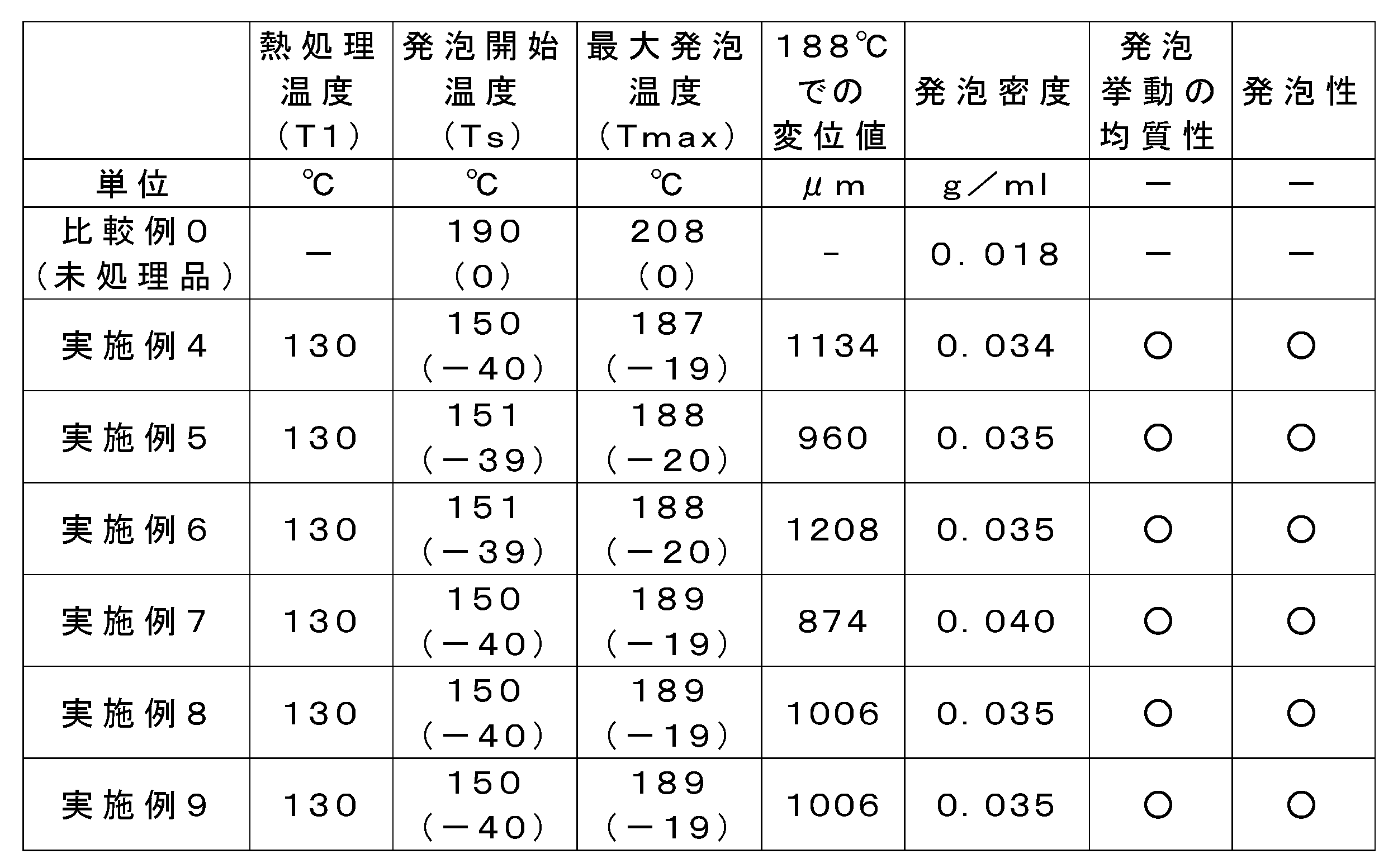
表1及び2並びに図1及び2から明らかな通り、本発明の製造方法によれば、発泡開始温度と最大発泡温度が低下し、加熱発泡時の温度を下げることができるため、エネルギーコストを抑えることができ、省エネルギー性に優れるとともに、発泡挙動の均質性に優れるため、マイクロスフェアーが一様に発泡しており、発泡状態が良好であることから、総合的に生産性に優れていることが分かる。
Claims (4)
- 発泡成形体の製造方法であって、
前記方法は、熱発泡性組成物からなる未発泡成形体を得る工程(A)と、前記未発泡成形体を温度T2(℃)で加熱発泡させる工程(B)と、を含み、
前記熱発泡性組成物は、マイクロスフェアーと、熱可塑性樹脂、熱硬化性樹脂、及び繊維からなる群より選択される少なくとも1種の基材と、を含有し、
前記マイクロスフェアーは、重合体を含む外殻と、前記外殻内に封入された発泡剤と、を含み、
工程(A)は、温度T1(℃)で前記熱発泡性組成物を熱処理する工程(a)を含み、
工程(a)で熱処理した後のマイクロスフェアーの発泡開始温度は、工程(a)で熱処理する前のマイクロスフェアーの発泡開始温度より、10℃以上低く、
工程(a)で熱処理した後のマイクロスフェアーの最大発泡温度は、工程(a)で熱処理する前のマイクロスフェアーの最大発泡温度より、5℃以上低く、
温度T1及びT2は、それぞれ下記式(1)及び(2)を満たすことを特徴とする方法。
105≦T1<Ts(℃) (1)
Ts-40≦T2<Tmax-3(℃) (2)
(式中、Ts(℃)は、工程(a)で熱処理する前のマイクロスフェアーの発泡開始温度を表し、Tmax(℃)は、工程(a)で熱処理する前のマイクロスフェアーの最大発泡温度を表す。) - 工程(A)において、工程(a)で熱処理した前記熱発泡性組成物を成形することにより、前記未発泡成形体を得る請求項1に記載の方法。
- 工程(A)において、工程(a)で熱処理する前の前記熱発泡性組成物を成形した後、成形された前記熱発泡性組成物を工程(a)で熱処理することにより、前記未発泡成形体を得る請求項1に記載の方法。
- 前記重合体は、(メタ)アクリロニトリル由来の構造単位と(メタ)アクリル酸エステル由来の構造単位とを含む共重合体を含有する請求項1から3のいずれか1項に記載の方法。
Applications Claiming Priority (2)
| Application Number | Priority Date | Filing Date | Title |
|---|---|---|---|
| JP2016095480 | 2016-05-11 | ||
| JP2016-095480 | 2016-05-11 |
Publications (1)
| Publication Number | Publication Date |
|---|---|
| WO2017195438A1 true WO2017195438A1 (ja) | 2017-11-16 |
Family
ID=60267127
Family Applications (1)
| Application Number | Title | Priority Date | Filing Date |
|---|---|---|---|
| PCT/JP2017/007855 Ceased WO2017195438A1 (ja) | 2016-05-11 | 2017-02-28 | 発泡成形体の製造方法 |
Country Status (1)
| Country | Link |
|---|---|
| WO (1) | WO2017195438A1 (ja) |
Citations (5)
| Publication number | Priority date | Publication date | Assignee | Title |
|---|---|---|---|---|
| WO2006030946A1 (ja) * | 2004-09-13 | 2006-03-23 | Kureha Corporation | 熱発泡性マイクロスフェアー、その製造方法、その使用、それを含む組成物、及び物品 |
| WO2007072769A1 (ja) * | 2005-12-19 | 2007-06-28 | Kureha Corporation | 熱発泡性マイクロスフェアー、並びにその製造方法と用途 |
| JP2012122025A (ja) * | 2010-11-19 | 2012-06-28 | Matsumoto Yushi Seiyaku Co Ltd | 熱膨張性微小球およびその用途 |
| JP2012136695A (ja) * | 2010-12-03 | 2012-07-19 | Matsumoto Yushi Seiyaku Co Ltd | 熱膨張性微小球およびその用途 |
| JP2017057296A (ja) * | 2015-09-17 | 2017-03-23 | 松本油脂製薬株式会社 | 発泡成形体の製造方法 |
-
2017
- 2017-02-28 WO PCT/JP2017/007855 patent/WO2017195438A1/ja not_active Ceased
Patent Citations (5)
| Publication number | Priority date | Publication date | Assignee | Title |
|---|---|---|---|---|
| WO2006030946A1 (ja) * | 2004-09-13 | 2006-03-23 | Kureha Corporation | 熱発泡性マイクロスフェアー、その製造方法、その使用、それを含む組成物、及び物品 |
| WO2007072769A1 (ja) * | 2005-12-19 | 2007-06-28 | Kureha Corporation | 熱発泡性マイクロスフェアー、並びにその製造方法と用途 |
| JP2012122025A (ja) * | 2010-11-19 | 2012-06-28 | Matsumoto Yushi Seiyaku Co Ltd | 熱膨張性微小球およびその用途 |
| JP2012136695A (ja) * | 2010-12-03 | 2012-07-19 | Matsumoto Yushi Seiyaku Co Ltd | 熱膨張性微小球およびその用途 |
| JP2017057296A (ja) * | 2015-09-17 | 2017-03-23 | 松本油脂製薬株式会社 | 発泡成形体の製造方法 |
Similar Documents
| Publication | Publication Date | Title |
|---|---|---|
| CN100566811C (zh) | 热发泡性微球及其制造方法、其用途、含有其的组合物、和物品 | |
| JP4542908B2 (ja) | 熱膨張性マイクロカプセル、発泡成形物の製造方法及び発泡成形物 | |
| JP5805607B2 (ja) | 熱膨張性マイクロカプセルおよびその利用 | |
| US10093782B2 (en) | Thermally foamable microsphere, method of producing the same, and use thereof | |
| CN104334268B (zh) | 微球 | |
| CN103665419B (zh) | 中低温热膨胀微球的合成方法及其应用方法 | |
| KR101322260B1 (ko) | 열팽창한 미소구 및 그 제조방법 | |
| WO2014036681A1 (zh) | 热膨胀性微球及其制备和应用 | |
| JP3670980B2 (ja) | 熱発泡性マイクロスフェアー及びその製造方法 | |
| CN101891901B (zh) | 一种含有二元或多元发泡剂的聚合物微球的低压发泡方法 | |
| CN108097182B (zh) | 一种超细环保热膨胀微胶囊及其制备方法 | |
| KR102040211B1 (ko) | 열팽창성 마이크로 캡슐 및 이를 이용한 고분자 수지의 처리방법 | |
| JPH0919635A (ja) | 耐熱性と耐溶剤性に優れた熱膨張性マイクロカプセル | |
| KR20130018799A (ko) | 열팽창성 마이크로 캡슐 및 열팽창성 마이크로 캡슐의 제조 방법 | |
| JP2011016884A (ja) | 熱膨張性マイクロスフェアー及びその製造方法、添加剤並びに成形体 | |
| CN107915799A (zh) | 一种新型高效热膨胀微球及其制备方法 | |
| CN110698721A (zh) | 一种聚甲基丙烯酰亚胺热膨胀微球及其制备方法 | |
| CN108884376B (zh) | 微球体、热发泡性树脂组合物、以及发泡成型体及其制造方法 | |
| CN105924667A (zh) | 一种环保微胶囊发泡剂及其制备方法 | |
| CN108912383A (zh) | 超高温可膨胀热塑性微球及其应用 | |
| US20180282503A1 (en) | Thermally-expandable microspheres, and composition and molded article containing same | |
| CN1586708A (zh) | 耐溶剂型物理发泡微胶囊的制备方法 | |
| CN115368695A (zh) | 一种功能化热膨胀型发泡微胶囊及其制备方法和应用 |
Legal Events
| Date | Code | Title | Description |
|---|---|---|---|
| NENP | Non-entry into the national phase |
Ref country code: DE |
|
| 121 | Ep: the epo has been informed by wipo that ep was designated in this application |
Ref document number: 17795799 Country of ref document: EP Kind code of ref document: A1 |
|
| 122 | Ep: pct application non-entry in european phase |
Ref document number: 17795799 Country of ref document: EP Kind code of ref document: A1 |
|
| NENP | Non-entry into the national phase |
Ref country code: JP |