WO2017195268A1 - miRNAをマーカーとする歯周炎検査キット、及び検査方法 - Google Patents
miRNAをマーカーとする歯周炎検査キット、及び検査方法 Download PDFInfo
- Publication number
- WO2017195268A1 WO2017195268A1 PCT/JP2016/063846 JP2016063846W WO2017195268A1 WO 2017195268 A1 WO2017195268 A1 WO 2017195268A1 JP 2016063846 W JP2016063846 W JP 2016063846W WO 2017195268 A1 WO2017195268 A1 WO 2017195268A1
- Authority
- WO
- WIPO (PCT)
- Prior art keywords
- hsa
- mir
- periodontitis
- mirna
- expression
- Prior art date
- Legal status (The legal status is an assumption and is not a legal conclusion. Google has not performed a legal analysis and makes no representation as to the accuracy of the status listed.)
- Ceased
Links
Images


Classifications
-
- C—CHEMISTRY; METALLURGY
- C12—BIOCHEMISTRY; BEER; SPIRITS; WINE; VINEGAR; MICROBIOLOGY; ENZYMOLOGY; MUTATION OR GENETIC ENGINEERING
- C12N—MICROORGANISMS OR ENZYMES; COMPOSITIONS THEREOF; PROPAGATING, PRESERVING, OR MAINTAINING MICROORGANISMS; MUTATION OR GENETIC ENGINEERING; CULTURE MEDIA
- C12N15/00—Mutation or genetic engineering; DNA or RNA concerning genetic engineering, vectors, e.g. plasmids, or their isolation, preparation or purification; Use of hosts therefor
- C12N15/09—Recombinant DNA-technology
-
- C—CHEMISTRY; METALLURGY
- C12—BIOCHEMISTRY; BEER; SPIRITS; WINE; VINEGAR; MICROBIOLOGY; ENZYMOLOGY; MUTATION OR GENETIC ENGINEERING
- C12Q—MEASURING OR TESTING PROCESSES INVOLVING ENZYMES, NUCLEIC ACIDS OR MICROORGANISMS; COMPOSITIONS OR TEST PAPERS THEREFOR; PROCESSES OF PREPARING SUCH COMPOSITIONS; CONDITION-RESPONSIVE CONTROL IN MICROBIOLOGICAL OR ENZYMOLOGICAL PROCESSES
- C12Q1/00—Measuring or testing processes involving enzymes, nucleic acids or microorganisms; Compositions therefor; Processes of preparing such compositions
- C12Q1/68—Measuring or testing processes involving enzymes, nucleic acids or microorganisms; Compositions therefor; Processes of preparing such compositions involving nucleic acids
-
- G—PHYSICS
- G01—MEASURING; TESTING
- G01N—INVESTIGATING OR ANALYSING MATERIALS BY DETERMINING THEIR CHEMICAL OR PHYSICAL PROPERTIES
- G01N33/00—Investigating or analysing materials by specific methods not covered by groups G01N1/00 - G01N31/00
- G01N33/48—Biological material, e.g. blood, urine; Haemocytometers
- G01N33/50—Chemical analysis of biological material, e.g. blood, urine; Testing involving biospecific ligand binding methods; Immunological testing
- G01N33/53—Immunoassay; Biospecific binding assay; Materials therefor
Definitions
- the present invention relates to a periodontitis test kit and a test method using a novel molecular marker.
- the present invention relates to a test kit and a test method in which miRNA is extracted from a gingival crevicular fluid (Gingival Crystal Fluid, hereinafter sometimes referred to as GCF) and miRNA is used as a marker.
- GCF gingival crevicular fluid
- Periodontal disease is two major diseases of teeth along with dental caries. Periodontal disease is divided into gingivitis and periodontitis, but it is periodontitis called so-called alveolar pyorrhea that ultimately leads to tooth loss. Periodontal disease is said to be one of the most common diseases in the world, and it is said that about half of adults are affected (Non-patent Document 1).
- Periodontitis is a chronic inflammatory disease that affects the periodontal ligament tissue between the root and alveolar bone.
- the periodontal pocket which is the gap between the teeth and gingiva, becomes deep, the periodontal ligament fibers and the alveolar bone that are supporting the teeth are destroyed, and the teeth become wobbled, Eventually the teeth will fall out.
- Periodontitis is associated with systemic diseases such as metabolic syndrome, coronary artery disease, and diabetes (Non-Patent Documents 2 to 4), and treatment and prevention of periodontitis is limited to the dental field. Rather, it is also a general health problem. Therefore, early detection of periodontitis is important in maintaining the general health of the whole body.
- periodontitis is inspected by probing, X-ray photography, gingivitis index, plaque adhesion, and mobility. These examinations are non-quantitative examinations that are easily intruded by the dentist's subjectivity, and are largely based on dentist experience. Therefore, regarding the treatment of periodontitis, it has become uniform with a focus on plaque control. Therefore, a method capable of more objectively grasping the periodontal tissue condition and examining periodontitis has been required.
- Patent Document 1 describes a method of diagnosing periodontal disease by proteomic analysis of protein biomarkers in gingival crevicular fluid and / or saliva samples.
- Patent Document 2 discloses a method for examining invasive periodontitis by detecting a gene polymorphism.
- Patent Documents 3 to 5 disclose methods for examining periodontal disease by immunologically detecting proteins in gingival crevicular fluid and saliva.
- the miRNA is a short RNA having a chain length of 21 to 25 nt, and has a function of regulating gene expression by binding to the 3′-UTR of the target mRNA.
- miRNA regulates biological processes such as cell differentiation or pathological processes such as canceration.
- methods have been disclosed in which diagnosis is performed by extracting and detecting miRNA from body fluids such as blood and urine and miRNA is used for treatment (for example, Patent Documents 6 and 7). Examination and diagnosis methods using miRNA have also been disclosed for periodontal diseases (Non-Patent Documents 7 to 9).
- Patent Documents 1 to 5 None of the methods described in Patent Documents 1 to 5 has been clinically put into practical use. Although the method described in Patent Document 1 is considered to be able to perform an accurate diagnosis, since it is necessary to perform a proteome analysis, a large-scale machine and a complicated analysis method are required. Since the method described in Patent Document 2 is SNP analysis, it does not grasp the current state of periodontitis.
- the methods described in Patent Documents 3 to 5 are methods that can be performed in a dental clinic because they use test papers, but are more accurate than conventional diagnostic methods such as probing. The current situation is that it is not so popular, and it is not so popular.
- the methods disclosed in Non-Patent Documents 7 to 9 need to be performed using a patient's periodontal tissue, and thus have not spread as a general examination for periodontitis.
- the object of the present invention is not only to obtain objective data on periodontitis, but also to provide a non-invasive examination method and examination kit using gingival exudate (GCF).
- GCF gingival exudate
- the present invention relates to the following test methods, biomarkers, and test kits.
- miRNA is extracted from the gingival crevicular fluid collected for each tooth, hsa-miR-223-3p, hsa-miR-101-3p, hsa-miR-374a-5p, hsa-miR-582-5p Hsa-miR-145-5p, hsa-miR-20a-3p, hsa-miR-194-5p, hsa-miR-26b-5p, hsa-miR-301a-3p, hsa-miR-140-5p, hsa -MiR-590-5p, hsa-miR-30e-5p, hsa-miR-19a-3p, hsa-miR-338-3p, hsa-miR-126-5p, hsa-miR-144-5p, hsa-miR -144-3p, hsa-miR-30e-3p, h
- the periodontitis biomarker according to (4) comprising at least hsa-miR-223-3p and hsa-miR-200c-3p.
- (6) hsa-miR-223-3p, hsa-miR-101-3p, hsa-miR-374a-5p, hsa-miR-582-5p, hsa-miR-145-5p, hsa-miR-20a-3p Hsa-miR-194-5p, hsa-miR-26b-5p, hsa-miR-301a-3p, hsa-miR-140-5p, hsa-miR-590-5p, hsa-miR-30e-5p, hsa -MiR-19a-3p, hsa-miR-338-3p, hsa-miR-126-5p, hsa-miR-144-5p,
- hsa-miR-324-5p at least one of hsa-miR-324-5p, hsa-miR-29c-5p, hsa-miR-107, hsa-miR-324-3p, hsa-miR-30d-5p
- Periodontitis biomarker according to any one of (4) to (6), characterized in that (8) hsa-miR-223-3p, hsa-miR-101-3p, hsa-miR-374a-5p, hsa-miR-582-5p, hsa-miR-145-5p, hsa-miR-20a-3p Hsa-miR-194-5p, hsa-miR-26b-5p, hsa-miR-301a-3p, hsa-miR-140-5p, hsa-miR-590-5p, hsa-mi
- FIG. 3A is a diagram showing the results of 2D hierarchical clustering analysis of miRNA expression in healthy subjects and patients with periodontitis.
- FIG. 3B shows a Volcano plot.
- FIG. 3C shows the expression level of each RNA as a Box plot.
- FIG. 3 shows a comparison of two different sample sets.
- FIG. 4A is a diagram showing a correlation between sample set # 1 and set # 2 of the expression ratio ( ⁇ Cq value) of 40 miRNAs.
- FIG. 4B shows the expression level of 40 miRNAs in a Box plot.
- the present invention is characterized in that RNA is isolated from GCF and miRNA is analyzed.
- the examination of periodontitis by miRNA so far has been performed using gingival tissue.
- the test method of the present invention is a non-invasive test in which miRNA is isolated and tested from GCF, and the burden on the patient is small.
- GCF can be collected for each tooth suspected of periodontitis, the tooth affected by periodontitis, which could not be performed by the saliva test, was identified and the tooth It became possible to objectively judge the condition of peritonitis.
- miRNAs whose expression changes are specifically observed in periodontitis patients are disclosed, and in particular, it is disclosed that accurate examination can be performed by using 40 miRNAs as a panel.
- the amount of miRNA used as a reference and the amount of miRNA in which change was observed in periodontitis are 1 One or more may be selected and measured.
- quantification of miRNA was performed here by quantitative PCR, but any method may be used as long as the amount of miRNA can be quantified.
- miRNAs used as a panel shown below may be used by selecting some of them, or may be used for examination by replacing with other miRNAs disclosed in the present invention.
- the present invention will be described in detail with reference to analysis results.
- ⁇ Target audience ⁇ The samples whose data are shown below were obtained from patients and healthy volunteers after obtaining informed consent based on a study approved by the Ethics Committee of Tokyo Medical and Dental University. Periodontitis was diagnosed by the periodontal pocket depth and bleeding during probing. GCF collection is performed prior to diagnosis. In addition, no one patient with periodontitis was associated with systemic disease except that one patient had mild diabetes. Diabetes mellitus patients who had comorbid diabetes also had mild diabetes and had not received any medication.
- the subjects analyzed were those obtained from healthy subjects and periodontitis patients shown in Tables 1 and 2 below.
- the eight subjects shown in Table 1 are 5 healthy subjects and 3 periodontitis patients, and the average ages are 38 and 53, respectively.
- the 12 subjects shown in Table 2 were 6 healthy subjects and 6 periodontitis patients, and the average ages were 28 and 65, respectively.
- H1 to H11 in the data shown below indicate samples of healthy persons shown in the above table, and P1 to P9 are also samples of periodontitis patients shown in the above table. Indicates that
- GCF Collecting gingival crevicular fluid
- Trizol LS reagent manufactured by Life Technologies
- the total RNA amount was measured with an Agilent 2100 BioAnalyzer (manufactured by Agilent Technologies) using an eukaryotic total RNA nano assay.
- the electropherogram showed a clean peak for all samples.
- An example is shown in FIG.
- the left panel of FIG. 1 shows an electrophoretic diagram of an RNA sample obtained from a healthy person, and the right panel from a periodontitis patient. In both samples, a peak of small RNA of 25 to 200 nt is observed.
- ⁇ MiRNA expression analysis The miRNA expression analysis was analyzed using miRCURY LNA (registered trademark) Universal RT microRNA PCR System (manufactured by Exiqon). Single-stranded cDNA was synthesized from 8 ⁇ l of RNA using universal cDNA Synthesis kit II (Exiqon). The synthesized cDNA is diluted, mixed with ExiLET SYBR (registered trademark) Green master mix, and dispensed into Human miRNome microRNA PCR panel (manufactured by Exiqon), and quantitative PCR is performed by LightCycler 480 Real-Time PCR system It was performed using.
- miRCURY LNA registered trademark
- Universal RT microRNA PCR System manufactured by Exiqon
- Single-stranded cDNA was synthesized from 8 ⁇ l of RNA using universal cDNA Synthesis kit II (Exiqon). The synthesized cDNA is diluted, mixed with ExiLET SYBR (registered trademark) Green master
- hsa-miR-324-5p, hsa-miR-29c-5p, hsa-miR-107, hsa-miR-324-3p, hsa-miR-30d-5p whose expression was stable in GCF were used. Used for normalization. The normalized value is expressed as ⁇ Cq.
- GCF miRNA (sample set # 1) collected from 5 healthy subjects and 3 periodontitis patients shown in Table 1 were analyzed.
- periodontitis patients had a periodontal pocket depth greater than 3 mm (most periodontal pocket depths were 4-8 mm), and bleeding due to probing was observed in many patients.
- the miRNA expression pattern by principal component analysis was clearly divided into two for healthy subjects and periodontitis patients (FIG. 2A).
- the analysis results of RNA samples obtained from 5 healthy subjects (H1 to H5) and 3 periodontitis patients (P1 to P3) shown in Table 1 indicate that the expression patterns of the two are different.
- the X axis represents PCA Component 1 (PC1: 46.9% variation), and the Y axis represents PCA Component 2 (PC2: 15.7% variation).
- 619 miRNA expression data could be obtained from at least one of each group of healthy subjects and periodontitis patients. Among them, increased expression of 332 miRNA was observed in periodontitis patients, and decreased expression of 287 miRNA was observed (FIG. 2B).
- the X-axis shows the relative expression ratio expressed by - ⁇ Cq value, and the Y-axis shows -log 10 (p-value) obtained from t-test between two groups.
- the black circles ( ⁇ ) indicate miRNAs having a p value of ⁇ 0.05, ⁇ Cq> 1.0, or ⁇ Cq ⁇ 1.0 (indicated by a line as a cut-off in FIG. 2B). It shows that expression is significantly increased or decreased in patients with periodontitis.
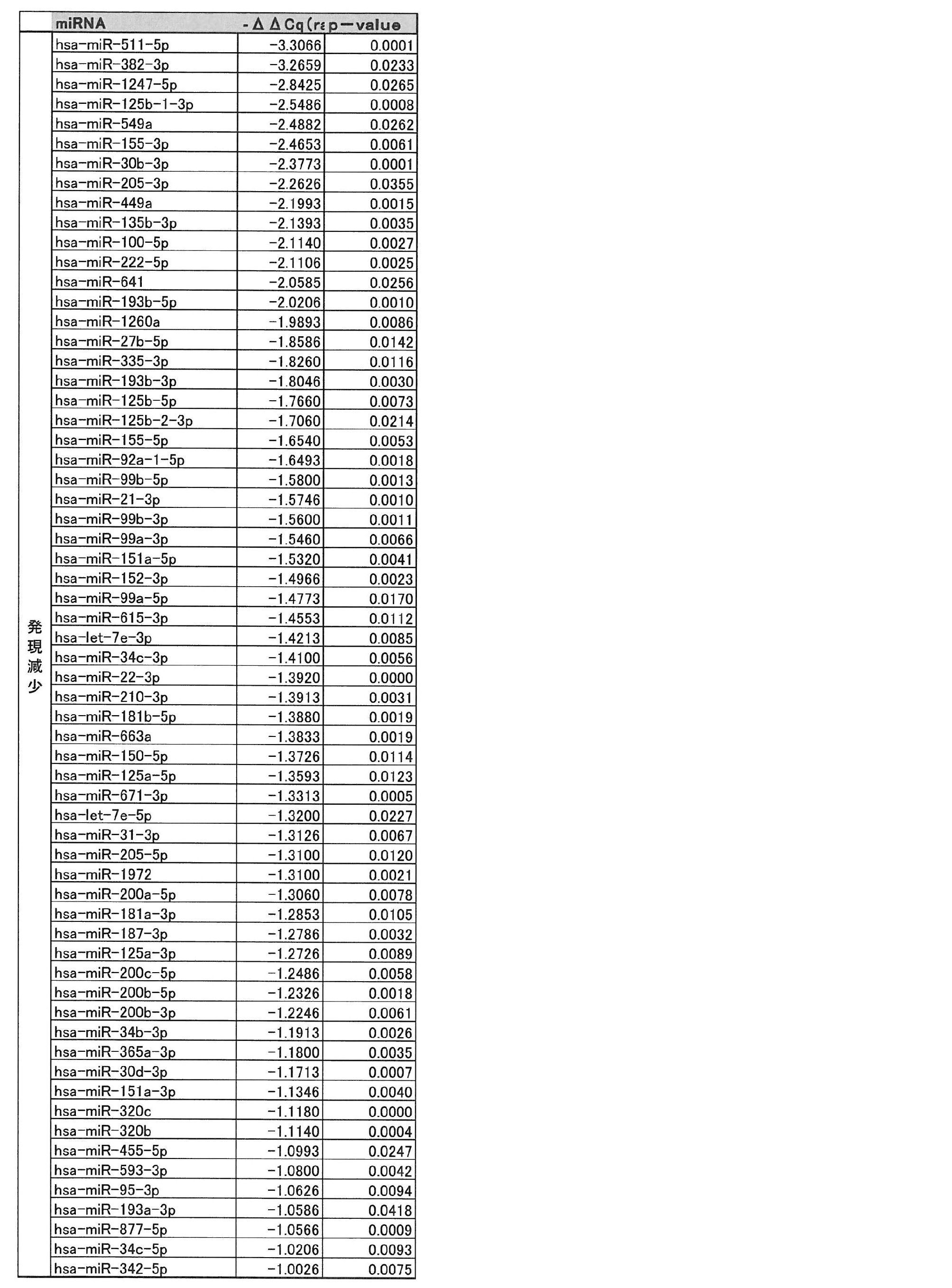
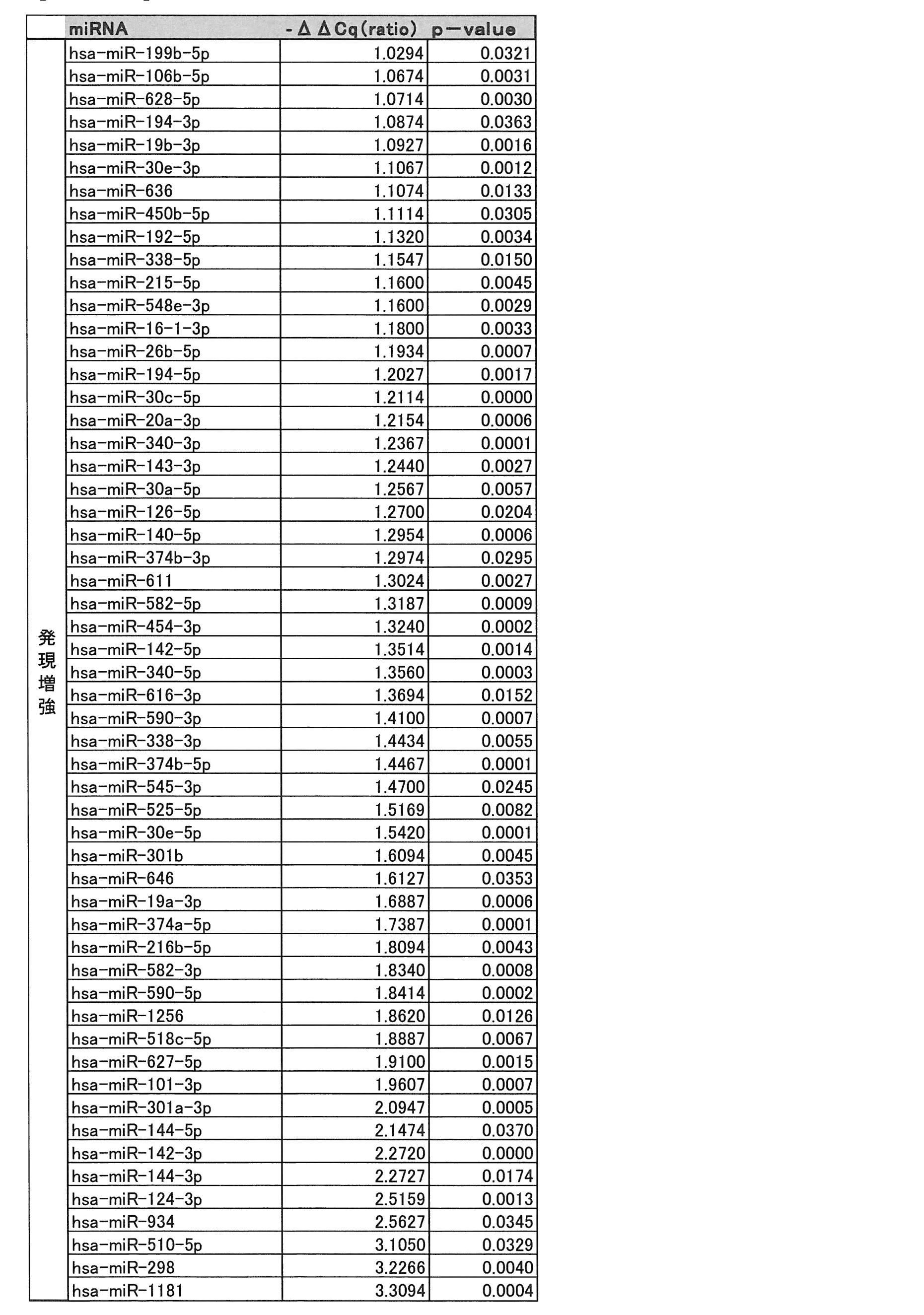
- miRNAs There were 63 (Table 3) and 55 (Table 4) miRNAs in which expression reduction or expression enhancement was significantly observed in periodontitis patients. Since these miRNAs are miRNAs in which a significant difference was found in the expression between periodontitis patients and healthy subjects, these miRNAs may be used alone or in combination in some cases. In order to make an accurate diagnosis, it is preferable to use a combination of a plurality of miRNAs for the test.
- miRNA satisfying the criteria of ⁇ Cq ⁇ 2.5, p-value ⁇ 0.05, ⁇ Cq> 0.7, or ⁇ Cq ⁇ 0.7 is extracted from the analysis result of gingival crevicular fluid sample set # 1 (Table 5). Therefore, miRNA shown in Table 5 can be preferably used as a diagnostic marker for periodontitis alone or in combination.
- hsa-miR-223-3p, hsa-miR-200c-3p, hsa-miR-205-5p, and hsa-miR-16-5p are preferably used as markers because of their good sensitivity and reproducibility. it can.
- miRNAs with enhanced expression in 19 periodontitis patients shown in Table 6 and miRNAs with decreased expression of 21 were extracted.
- the five miRNAs hsa-miR-324-5p, hsa-miR-29c-5p, hsa-miR-107, hsa-miR-324-3p, and hsa-miR-30d-5p are Since it was stably expressed in all samples, it was included in the subsequent experimental analysis and used for normalization as a reference miRNA (reference miRNA).
- hsa-miR-101-3p hsa-miR-145-5p, hsa-miR-374a-5p, hsa-miR-582-5p, highlighted in the table, hsa-miR-181b-5p, hsa-miR-187-3p, hsa-miR-200c-3p, hsa-miR-200c-5p, hsa-miR-203a, hsa-miR-31-3p It is a molecule with no known association with periodontitis or periodontal disease.
- the expression levels of the 40 selected miRNAs are shown in a Volcano plot (FIG. 3B). Similar to FIG. 2B, the X-axis shows the relative expression ratio expressed in ⁇ Cq values, and the Y-axis shows ⁇ log 10 (p-value) obtained from the t-test between the two groups. .
- a black circle ( ⁇ ) indicates a miRNA having a p value of ⁇ 0.05 and
- each miRNA was represented by a Box plot (FIG. 3C). Open squares indicate the results of healthy subjects, and gray squares indicate the results of periodontitis patients. The horizontal bar indicates each median value. The upper panel shows the results of analysis of miRNAs whose expression was enhanced in 19 periodontitis patients, and the lower panel shows the results of miRNAs whose expression was decreased. Judging from the ⁇ Cq value, it was revealed that hsa-miR-223-3p, hsa-miR-203a, and hsa-miR-205-5p have high expression levels in GCF. Therefore, it is possible to measure with high sensitivity by detecting at least one of these miRNAs.
- FIG. 4A is a scatter diagram showing values between samples. Spearman's correlation coefficient ( ⁇ ) was 0.95, indicating a strong correlation between the two.
- hsa-miR-16-5p, hsa-miR-19b-3p, hsa-miR-15a-5p, hsa-miR-142-5p, hsa-miR-143-3p, hsa-miR-106b-5p, hsa-let-7b-5p, hsa-miR-193b-3p, hsa-miR-221-3p, hsa-miR-365a-3p, and hsa-miR-22-3p can be detected with good sensitivity. It can be preferably used for examination of periodontitis.
Landscapes
- Life Sciences & Earth Sciences (AREA)
- Health & Medical Sciences (AREA)
- Chemical & Material Sciences (AREA)
- Engineering & Computer Science (AREA)
- Organic Chemistry (AREA)
- Biomedical Technology (AREA)
- Genetics & Genomics (AREA)
- Zoology (AREA)
- Biotechnology (AREA)
- Immunology (AREA)
- Wood Science & Technology (AREA)
- Molecular Biology (AREA)
- Bioinformatics & Cheminformatics (AREA)
- Biochemistry (AREA)
- Physics & Mathematics (AREA)
- General Engineering & Computer Science (AREA)
- General Health & Medical Sciences (AREA)
- Microbiology (AREA)
- Hematology (AREA)
- Proteomics, Peptides & Aminoacids (AREA)
- Biophysics (AREA)
- Analytical Chemistry (AREA)
- Urology & Nephrology (AREA)
- Plant Pathology (AREA)
- Cell Biology (AREA)
- Food Science & Technology (AREA)
- Medicinal Chemistry (AREA)
- General Physics & Mathematics (AREA)
- Pathology (AREA)
- Measuring Or Testing Involving Enzymes Or Micro-Organisms (AREA)
- Investigating Or Analysing Biological Materials (AREA)
- Apparatus Associated With Microorganisms And Enzymes (AREA)
Abstract
本発明の歯周炎の診断マーカーとなるmiRNAは、歯周炎に特異的に変化が見られるものである、正確に歯周炎の診断を行うことができる。
Description
本発明は、新規の分子マーカーを用いた歯周炎検査キット、及び検査方法に関する。特に、歯肉溝滲出液(Gingival Crevicular Fluid、以下GCFと記載することもある。)からmiRNAを抽出し、miRNAをマーカーとする検査キット、及び検査方法に関する。
歯周病はう蝕とともに、歯の二大疾患である。歯周病は歯肉炎と歯周炎とに分けられるが、最終的な歯の喪失に至るのは、いわゆる歯槽膿漏といわれる歯周炎である。歯周病は世界で最も多い疾患の一つであるともいわれ、成人の約半数が罹患していると言われている(非特許文献1)。
歯周炎は、歯根と歯槽骨間の歯根膜組織に影響を及ぼす慢性炎症性疾患である。進行した歯周炎では、歯と歯肉間の隙間である歯周ポケットが深くなり、歯を支持している結合組織である歯根膜線維や歯槽骨の破壊が生じ、歯がぐらつくようになり、最終的には歯が抜けてしまう。
高齢者では、生活の質を損なうような重度の歯周炎に罹患する傾向がある。歯周炎は、メタボリック・シンドローム、冠動脈疾患、糖尿病のような全身性疾患と関連性があることも指摘されており(非特許文献2~4)、歯周炎の治療と予防は歯科分野だけではなく、一般的な健康状態に関わる問題ともなる。したがって、歯周炎の早期発見は、全身の健康状態を維持するうえでも重要である。
現在のところ、歯周炎の検査は、プロービング、X線写真、歯肉炎指数、プラークの付着状態、動揺度の検査などによって行われている。これらの検査は、歯科医の主観が入り込みやすい非定量的な検査であり、歯科医の経験による部分が大きかった。そのため、歯周炎の治療法に関しても、プラークコントロールを中心とした画一的なものとなっていた。したがって、より客観的に歯周組織の状態を捉え、歯周炎の検査を行うことのできる方法が必要とされていた。
従来から歯周炎を含む歯周病に関して客観的なデータを得ることができる検査方法として様々な方法が提案されている。特許文献1には、歯肉溝滲出液及び/又は唾液サンプル中のタンパク質バイオマーカーをプロテオーム分析により歯周疾患の状態を診断する方法が記載されている。特許文献2には、遺伝子多型を検出することにより侵襲性歯周炎を検査する方法が開示されている。特許文献3~5には、歯肉溝滲出液や唾液中のタンパク質を免疫学的に検出することにより歯周病を検査する方法が開示されている。
また、近年、様々な疾患においてmiRNAによって診断や治療を行う方法が開示されている。miRNAは、鎖長21~25ntの短いRNAであり、標的mRNAの3´-UTRに結合して遺伝子の発現を調節する機能を担っている。最近の研究によって、miRNAは、細胞の分化のような生物学的過程、あるいは癌化のような病理学的過程を調節することが明らかとなってきている(非特許文献5、6)。特に血液や尿などの体液からmiRNAを抽出し、検出することにより診断を行ったり、miRNAを治療に用いる方法が開示されている(例えば、特許文献6、7)。歯周疾患でもmiRNAを用いた検査、診断方法が開示されている(非特許文献7~9)。
Eke, P.I. et al., 2015, J Periodontol.Vol.86(5), pp.611-622.
Kaye, E.K. et al., 2016, J Dent Res.,. pii:0022034516641053.
Ryden, L., et al., 2016, Circulation. Vol.133(6),pp.576-583.
Gurav, A. & Jadhav, V. 2011, J.Diabetes. Vol.3(1), pp.21-28.
Gregory, P.A. et al., 2008, Nat. Cell Biol.Vol.10(5), pp.593-601.
Johnson, S.M. et al., 2005, Cell.Vol.120(5), pp.635-647.
Stoecklin-Wasmer C.et al., 2012, J. Dent. Res. Vol.91(10), pp.934-940.
Xie Y.F. et al., 2011, Int. J. Oral. Sci. Vol.3(3), pp.125-134.
Ogata Y. et al., 2014, J. Oral Sci. Vol.56(4), pp.253-260.
しかしながら、特許文献1~5に記載のいずれの方法も、臨床的に実用化されていない。特許文献1に記載の方法は、正確な診断を行えると考えられるが、プロテオーム解析を行う必要があるため、大掛かりな機械と複雑な解析方法が必要である。特許文献2に記載の方法は、SNPs解析であることから、現在の歯周炎の状態を把握するものではない。特許文献3~5に記載の方法は、試験紙を用いる方法であることから歯科クリニックでも行うことが可能な方法ではあるが、従来から行われているプロービング等の診断方法に比べて、より正確に診断を行うことができるというわけではなく、さほど普及していないのが現状である。また、非特許文献7~9に開示されている方法は、患者の歯周組織を用いて行う必要があるため、一般的な歯周炎の検査として普及するにはいたっていない。
本発明は、歯周炎の客観的なデータが得られるだけではなく、歯肉滲出液(GCF)を用いた非侵襲的検査方法、及び検査キットを提供することを課題とする。
本発明は、以下の検査方法、バイオマーカー、及び検査キットに関する。
(1)歯毎に採取された歯肉溝滲出液からmiRNAを抽出し、得られた試料中のhsa-miR-223-3p、及びhsa-miR-200c-3pのmiRNA量と、hsa-miR-101-3p、hsa-miR-374a-5p、hsa-miR-582-5p、hsa-miR-145-5p、hsa-miR-20a-3p、hsa-miR-194-5p、hsa-miR-26b-5p、hsa-miR-301a-3p、hsa-miR-140-5p、hsa-miR-590-5p、hsa-miR-30e-5p、hsa-miR-19a-3p、hsa-miR-338-3p、hsa-miR-126-5p、hsa-miR-144-5p、hsa-miR-144-3p、hsa-miR-30e-3p、hsa-miR-20a-5p、hsa-miR-16-5p、hsa-miR-19b-3p、hsa-miR-15a-5p、hsa-miR-142-5p、hsa-miR-143-3p、hsa-miR-106b-5pからなる群から選択される少なくとも1つ、及びhsa-miR-31-3p、hsa-miR-181b-5p、hsa-miR-203a、hsa-miR-200c-5p、hsa-miR-187-3p、hsa-miR-200b-5p、hsa-miR-99a-5p、hsa-miR-320a、hsa-miR-210-3p、hsa-miR-125a-5p、hsa-let-7i-5p、hsa-miR-100-5p、hsa-miR-155-5p、hsa-miR-21-3p、hsa-miR-200a-5p、hsa-miR-200b-3p、hsa-let-7e-5p、hsa-miR-222-3p、hsa-miR-125b-5p、hsa-miR-205-5p、hsa-let-7b-5p、hsa-miR-193b-3p、hsa-miR-221-3p、hsa-miR-365a-3p、hsa-miR-22-3pからなる群から選択される少なくとも1つのmiRNA量を検出し、参照標準に対して比較解析することを特徴とする歯周炎の検査方法。
(2)歯毎に採取された歯肉溝滲出液からmiRNAを抽出し、hsa-miR-223-3p、hsa-miR-101-3p、hsa-miR-374a-5p、hsa-miR-582-5p、hsa-miR-145-5p、hsa-miR-20a-3p、hsa-miR-194-5p、hsa-miR-26b-5p、hsa-miR-301a-3p、hsa-miR-140-5p、hsa-miR-590-5p、hsa-miR-30e-5p、hsa-miR-19a-3p、hsa-miR-338-3p、hsa-miR-126-5p、hsa-miR-144-5p、hsa-miR-144-3p、hsa-miR-30e-3p、hsa-miR-20a-5p、hsa-miR-200c-3p、hsa-miR-31-3p、hsa-miR-181b-5p、hsa-miR-203a、hsa-miR-200c-5p、hsa-miR-187-3p、hsa-miR-200b-5p、hsa-miR-99a-5p、hsa-miR-320a、hsa-miR-210-3p、hsa-miR-125a-5p、hsa-let-7i-5p、hsa-miR-100-5p、hsa-miR-155-5p、hsa-miR-21-3p、hsa-miR-200a-5p、hsa-miR-200b-3p、hsa-let-7e-5p、hsa-miR-222-3p、hsa-miR-125b-5p、hsa-miR-205-5pからなるmiRNA量を検出し、参照標準に対して比較解析することを特徴とする歯周炎の検査方法。
(3)前記参照標準として、hsa-miR-324-5p、hsa-miR-29c-5p、hsa-miR-107、hsa-miR-324-3p、hsa-miR-30d-5pの少なくとも1つ以上を用いることを特徴とする(1)又は(2)に記載の検査方法。
(4)hsa-miR-223-3p、hsa-miR-101-3p、hsa-miR-374a-5p、hsa-miR-582-5p、hsa-miR-145-5p、hsa-miR-20a-3p、hsa-miR-194-5p、hsa-miR-26b-5p、hsa-miR-301a-3p、hsa-miR-140-5p、hsa-miR-590-5p、hsa-miR-30e-5p、hsa-miR-19a-3p、hsa-miR-338-3p、hsa-miR-126-5p、hsa-miR-144-5p、hsa-miR-144-3p、hsa-miR-30e-3p、hsa-miR-20a-5p、hsa-miR-16-5p、hsa-miR-19b-3p、hsa-miR-15a-5p、hsa-miR-142-5p、hsa-miR-143-3p、hsa-miR-106b-5pからなる群から選択される少なくとも1つ、及びhsa-miR-200c-3p、hsa-miR-31-3p、hsa-miR-181b-5p、hsa-miR-203a、hsa-miR-200c-5p、hsa-miR-187-3p、hsa-miR-200b-5p、hsa-miR-99a-5p、hsa-miR-320a、hsa-miR-210-3p、hsa-miR-125a-5p、hsa-let-7i-5p、hsa-miR-100-5p、hsa-miR-155-5p、hsa-miR-21-3p、hsa-miR-200a-5p、hsa-miR-200b-3p、hsa-let-7e-5p、hsa-miR-222-3p、hsa-miR-125b-5p、hsa-miR-205-5p、hsa-let-7b-5p、hsa-miR-193b-3p、hsa-miR-221-3p、hsa-miR-365a-3p、hsa-miR-22-3pからなる群から選択される少なくとも1つのmiRNAを含む歯周炎バイオマーカー。
(5)少なくともhsa-miR-223-3p、及びhsa-miR-200c-3pを含むことを特徴とする(4)記載の歯周炎バイオマーカー。
(6)hsa-miR-223-3p、hsa-miR-101-3p、hsa-miR-374a-5p、hsa-miR-582-5p、hsa-miR-145-5p、hsa-miR-20a-3p、hsa-miR-194-5p、hsa-miR-26b-5p、hsa-miR-301a-3p、hsa-miR-140-5p、hsa-miR-590-5p、hsa-miR-30e-5p、hsa-miR-19a-3p、hsa-miR-338-3p、hsa-miR-126-5p、hsa-miR-144-5p、hsa-miR-144-3p、hsa-miR-30e-3p、hsa-miR-20a-5p、hsa-miR-200c-3p、hsa-miR-31-3p、hsa-miR-181b-5p、hsa-miR-203a、hsa-miR-200c-5p、hsa-miR-187-3p、hsa-miR-200b-5p、hsa-miR-99a-5p、hsa-miR-320a、hsa-miR-210-3p、hsa-miR-125a-5p、hsa-let-7i-5p、hsa-miR-100-5p、hsa-miR-155-5p、hsa-miR-21-3p、hsa-miR-200a-5p、hsa-miR-200b-3p、hsa-let-7e-5p、hsa-miR-222-3p、hsa-miR-125b-5p、hsa-miR-205-5pからなるmiRNAであることを特徴とする(4)又は(5)記載の歯周炎バイオマーカー。
(7)参照標準として、hsa-miR-324-5p、hsa-miR-29c-5p、hsa-miR-107、hsa-miR-324-3p、hsa-miR-30d-5pの少なくとも1つ以上を含むことを特徴とする(4)~(6)のいずれか1つ記載の歯周炎バイオマーカー。
(8)hsa-miR-223-3p、hsa-miR-101-3p、hsa-miR-374a-5p、hsa-miR-582-5p、hsa-miR-145-5p、hsa-miR-20a-3p、hsa-miR-194-5p、hsa-miR-26b-5p、hsa-miR-301a-3p、hsa-miR-140-5p、hsa-miR-590-5p、hsa-miR-30e-5p、hsa-miR-19a-3p、hsa-miR-338-3p、hsa-miR-126-5p、hsa-miR-144-5p、hsa-miR-144-3p、hsa-miR-30e-3p、hsa-miR-20a-5p、hsa-miR-16-5p、hsa-miR-19b-3p、hsa-miR-15a-5p、hsa-miR-142-5p、hsa-miR-143-3p、hsa-miR-106b-5pからなる群から選択される少なくとも1つ、及びhsa-miR-200c-3p、hsa-miR-31-3p、hsa-miR-181b-5p、hsa-miR-203a、hsa-miR-200c-5p、hsa-miR-187-3p、hsa-miR-200b-5p、hsa-miR-99a-5p、hsa-miR-320a、hsa-miR-210-3p、hsa-miR-125a-5p、hsa-let-7i-5p、hsa-miR-100-5p、hsa-miR-155-5p、hsa-miR-21-3p、hsa-miR-200a-5p、hsa-miR-200b-3p、hsa-let-7e-5p、hsa-miR-222-3p、hsa-miR-125b-5p、hsa-miR-205-5p、hsa-let-7b-5p、hsa-miR-193b-3p、hsa-miR-221-3p、hsa-miR-365a-3p、hsa-miR-22-3pからなる群から選択される少なくとも1つのmiRNAの発現量を検出するための配列を有する核酸を固定したアレイを含む歯周炎検査キット。
(9)前記アレイが少なくともhsa-miR-223-3p、及びhsa-miR-200c-3pの発現量を検出するための配列を有する核酸を固定したものであることを特徴とする(8)記載の歯周炎検査キット。
(10)前記アレイが、少なくともhsa-miR-223-3p、hsa-miR-101-3p、hsa-miR-374a-5p、hsa-miR-582-5p、hsa-miR-145-5p、hsa-miR-20a-3p、hsa-miR-194-5p、hsa-miR-26b-5p、hsa-miR-301a-3p、hsa-miR-140-5p、hsa-miR-590-5p、hsa-miR-30e-5p、hsa-miR-19a-3p、hsa-miR-338-3p、hsa-miR-126-5p、hsa-miR-144-5p、hsa-miR-144-3p、hsa-miR-30e-3p、hsa-miR-20a-5p、hsa-miR-200c-3p、hsa-miR-31-3p、hsa-miR-181b-5p、hsa-miR-203a、hsa-miR-200c-5p、hsa-miR-187-3p、hsa-miR-200b-5p、hsa-miR-99a-5p、hsa-miR-320a、hsa-miR-210-3p、hsa-miR-125a-5p、hsa-let-7i-5p、hsa-miR-100-5p、hsa-miR-155-5p、hsa-miR-21-3p、hsa-miR-200a-5p、hsa-miR-200b-3p、hsa-let-7e-5p、hsa-miR-222-3p、hsa-miR-125b-5p、hsa-miR-205-5pの発現量を検出するための配列を有する核酸を固定したアレイであることを特徴とする(8)又は(9)記載の歯周炎検査キット。
(11)参照標準として、hsa-miR-324-5p、hsa-miR-29c-5p、hsa-miR-107、hsa-miR-324-3p、hsa-miR-30d-5pの少なくとも1つ以上をアレイに含むことを特徴とする(8)~(10)のいずれか1つ記載の歯周炎検査キット。
(12)歯肉溝滲出液採取用ペーパーストリップ、miRNA抽出試薬、miRNA検出試薬を含むことを特徴とする(8)~(11)いずれか1項記載の歯周炎検査キット。
(13)歯毎に採取された歯肉溝滲出液からmiRNAを抽出し、表3~表6に記載されるmiRNAの群から選択される少なくとも1つ以上のmiRNA量を検出することを特徴とする歯周炎の検査方法。
(1)歯毎に採取された歯肉溝滲出液からmiRNAを抽出し、得られた試料中のhsa-miR-223-3p、及びhsa-miR-200c-3pのmiRNA量と、hsa-miR-101-3p、hsa-miR-374a-5p、hsa-miR-582-5p、hsa-miR-145-5p、hsa-miR-20a-3p、hsa-miR-194-5p、hsa-miR-26b-5p、hsa-miR-301a-3p、hsa-miR-140-5p、hsa-miR-590-5p、hsa-miR-30e-5p、hsa-miR-19a-3p、hsa-miR-338-3p、hsa-miR-126-5p、hsa-miR-144-5p、hsa-miR-144-3p、hsa-miR-30e-3p、hsa-miR-20a-5p、hsa-miR-16-5p、hsa-miR-19b-3p、hsa-miR-15a-5p、hsa-miR-142-5p、hsa-miR-143-3p、hsa-miR-106b-5pからなる群から選択される少なくとも1つ、及びhsa-miR-31-3p、hsa-miR-181b-5p、hsa-miR-203a、hsa-miR-200c-5p、hsa-miR-187-3p、hsa-miR-200b-5p、hsa-miR-99a-5p、hsa-miR-320a、hsa-miR-210-3p、hsa-miR-125a-5p、hsa-let-7i-5p、hsa-miR-100-5p、hsa-miR-155-5p、hsa-miR-21-3p、hsa-miR-200a-5p、hsa-miR-200b-3p、hsa-let-7e-5p、hsa-miR-222-3p、hsa-miR-125b-5p、hsa-miR-205-5p、hsa-let-7b-5p、hsa-miR-193b-3p、hsa-miR-221-3p、hsa-miR-365a-3p、hsa-miR-22-3pからなる群から選択される少なくとも1つのmiRNA量を検出し、参照標準に対して比較解析することを特徴とする歯周炎の検査方法。
(2)歯毎に採取された歯肉溝滲出液からmiRNAを抽出し、hsa-miR-223-3p、hsa-miR-101-3p、hsa-miR-374a-5p、hsa-miR-582-5p、hsa-miR-145-5p、hsa-miR-20a-3p、hsa-miR-194-5p、hsa-miR-26b-5p、hsa-miR-301a-3p、hsa-miR-140-5p、hsa-miR-590-5p、hsa-miR-30e-5p、hsa-miR-19a-3p、hsa-miR-338-3p、hsa-miR-126-5p、hsa-miR-144-5p、hsa-miR-144-3p、hsa-miR-30e-3p、hsa-miR-20a-5p、hsa-miR-200c-3p、hsa-miR-31-3p、hsa-miR-181b-5p、hsa-miR-203a、hsa-miR-200c-5p、hsa-miR-187-3p、hsa-miR-200b-5p、hsa-miR-99a-5p、hsa-miR-320a、hsa-miR-210-3p、hsa-miR-125a-5p、hsa-let-7i-5p、hsa-miR-100-5p、hsa-miR-155-5p、hsa-miR-21-3p、hsa-miR-200a-5p、hsa-miR-200b-3p、hsa-let-7e-5p、hsa-miR-222-3p、hsa-miR-125b-5p、hsa-miR-205-5pからなるmiRNA量を検出し、参照標準に対して比較解析することを特徴とする歯周炎の検査方法。
(3)前記参照標準として、hsa-miR-324-5p、hsa-miR-29c-5p、hsa-miR-107、hsa-miR-324-3p、hsa-miR-30d-5pの少なくとも1つ以上を用いることを特徴とする(1)又は(2)に記載の検査方法。
(4)hsa-miR-223-3p、hsa-miR-101-3p、hsa-miR-374a-5p、hsa-miR-582-5p、hsa-miR-145-5p、hsa-miR-20a-3p、hsa-miR-194-5p、hsa-miR-26b-5p、hsa-miR-301a-3p、hsa-miR-140-5p、hsa-miR-590-5p、hsa-miR-30e-5p、hsa-miR-19a-3p、hsa-miR-338-3p、hsa-miR-126-5p、hsa-miR-144-5p、hsa-miR-144-3p、hsa-miR-30e-3p、hsa-miR-20a-5p、hsa-miR-16-5p、hsa-miR-19b-3p、hsa-miR-15a-5p、hsa-miR-142-5p、hsa-miR-143-3p、hsa-miR-106b-5pからなる群から選択される少なくとも1つ、及びhsa-miR-200c-3p、hsa-miR-31-3p、hsa-miR-181b-5p、hsa-miR-203a、hsa-miR-200c-5p、hsa-miR-187-3p、hsa-miR-200b-5p、hsa-miR-99a-5p、hsa-miR-320a、hsa-miR-210-3p、hsa-miR-125a-5p、hsa-let-7i-5p、hsa-miR-100-5p、hsa-miR-155-5p、hsa-miR-21-3p、hsa-miR-200a-5p、hsa-miR-200b-3p、hsa-let-7e-5p、hsa-miR-222-3p、hsa-miR-125b-5p、hsa-miR-205-5p、hsa-let-7b-5p、hsa-miR-193b-3p、hsa-miR-221-3p、hsa-miR-365a-3p、hsa-miR-22-3pからなる群から選択される少なくとも1つのmiRNAを含む歯周炎バイオマーカー。
(5)少なくともhsa-miR-223-3p、及びhsa-miR-200c-3pを含むことを特徴とする(4)記載の歯周炎バイオマーカー。
(6)hsa-miR-223-3p、hsa-miR-101-3p、hsa-miR-374a-5p、hsa-miR-582-5p、hsa-miR-145-5p、hsa-miR-20a-3p、hsa-miR-194-5p、hsa-miR-26b-5p、hsa-miR-301a-3p、hsa-miR-140-5p、hsa-miR-590-5p、hsa-miR-30e-5p、hsa-miR-19a-3p、hsa-miR-338-3p、hsa-miR-126-5p、hsa-miR-144-5p、hsa-miR-144-3p、hsa-miR-30e-3p、hsa-miR-20a-5p、hsa-miR-200c-3p、hsa-miR-31-3p、hsa-miR-181b-5p、hsa-miR-203a、hsa-miR-200c-5p、hsa-miR-187-3p、hsa-miR-200b-5p、hsa-miR-99a-5p、hsa-miR-320a、hsa-miR-210-3p、hsa-miR-125a-5p、hsa-let-7i-5p、hsa-miR-100-5p、hsa-miR-155-5p、hsa-miR-21-3p、hsa-miR-200a-5p、hsa-miR-200b-3p、hsa-let-7e-5p、hsa-miR-222-3p、hsa-miR-125b-5p、hsa-miR-205-5pからなるmiRNAであることを特徴とする(4)又は(5)記載の歯周炎バイオマーカー。
(7)参照標準として、hsa-miR-324-5p、hsa-miR-29c-5p、hsa-miR-107、hsa-miR-324-3p、hsa-miR-30d-5pの少なくとも1つ以上を含むことを特徴とする(4)~(6)のいずれか1つ記載の歯周炎バイオマーカー。
(8)hsa-miR-223-3p、hsa-miR-101-3p、hsa-miR-374a-5p、hsa-miR-582-5p、hsa-miR-145-5p、hsa-miR-20a-3p、hsa-miR-194-5p、hsa-miR-26b-5p、hsa-miR-301a-3p、hsa-miR-140-5p、hsa-miR-590-5p、hsa-miR-30e-5p、hsa-miR-19a-3p、hsa-miR-338-3p、hsa-miR-126-5p、hsa-miR-144-5p、hsa-miR-144-3p、hsa-miR-30e-3p、hsa-miR-20a-5p、hsa-miR-16-5p、hsa-miR-19b-3p、hsa-miR-15a-5p、hsa-miR-142-5p、hsa-miR-143-3p、hsa-miR-106b-5pからなる群から選択される少なくとも1つ、及びhsa-miR-200c-3p、hsa-miR-31-3p、hsa-miR-181b-5p、hsa-miR-203a、hsa-miR-200c-5p、hsa-miR-187-3p、hsa-miR-200b-5p、hsa-miR-99a-5p、hsa-miR-320a、hsa-miR-210-3p、hsa-miR-125a-5p、hsa-let-7i-5p、hsa-miR-100-5p、hsa-miR-155-5p、hsa-miR-21-3p、hsa-miR-200a-5p、hsa-miR-200b-3p、hsa-let-7e-5p、hsa-miR-222-3p、hsa-miR-125b-5p、hsa-miR-205-5p、hsa-let-7b-5p、hsa-miR-193b-3p、hsa-miR-221-3p、hsa-miR-365a-3p、hsa-miR-22-3pからなる群から選択される少なくとも1つのmiRNAの発現量を検出するための配列を有する核酸を固定したアレイを含む歯周炎検査キット。
(9)前記アレイが少なくともhsa-miR-223-3p、及びhsa-miR-200c-3pの発現量を検出するための配列を有する核酸を固定したものであることを特徴とする(8)記載の歯周炎検査キット。
(10)前記アレイが、少なくともhsa-miR-223-3p、hsa-miR-101-3p、hsa-miR-374a-5p、hsa-miR-582-5p、hsa-miR-145-5p、hsa-miR-20a-3p、hsa-miR-194-5p、hsa-miR-26b-5p、hsa-miR-301a-3p、hsa-miR-140-5p、hsa-miR-590-5p、hsa-miR-30e-5p、hsa-miR-19a-3p、hsa-miR-338-3p、hsa-miR-126-5p、hsa-miR-144-5p、hsa-miR-144-3p、hsa-miR-30e-3p、hsa-miR-20a-5p、hsa-miR-200c-3p、hsa-miR-31-3p、hsa-miR-181b-5p、hsa-miR-203a、hsa-miR-200c-5p、hsa-miR-187-3p、hsa-miR-200b-5p、hsa-miR-99a-5p、hsa-miR-320a、hsa-miR-210-3p、hsa-miR-125a-5p、hsa-let-7i-5p、hsa-miR-100-5p、hsa-miR-155-5p、hsa-miR-21-3p、hsa-miR-200a-5p、hsa-miR-200b-3p、hsa-let-7e-5p、hsa-miR-222-3p、hsa-miR-125b-5p、hsa-miR-205-5pの発現量を検出するための配列を有する核酸を固定したアレイであることを特徴とする(8)又は(9)記載の歯周炎検査キット。
(11)参照標準として、hsa-miR-324-5p、hsa-miR-29c-5p、hsa-miR-107、hsa-miR-324-3p、hsa-miR-30d-5pの少なくとも1つ以上をアレイに含むことを特徴とする(8)~(10)のいずれか1つ記載の歯周炎検査キット。
(12)歯肉溝滲出液採取用ペーパーストリップ、miRNA抽出試薬、miRNA検出試薬を含むことを特徴とする(8)~(11)いずれか1項記載の歯周炎検査キット。
(13)歯毎に採取された歯肉溝滲出液からmiRNAを抽出し、表3~表6に記載されるmiRNAの群から選択される少なくとも1つ以上のmiRNA量を検出することを特徴とする歯周炎の検査方法。
GCFを用い、正確に歯周炎の診断を行うことのできる検査方法、及び検査キットを提供することができる。
本発明はGCFからRNAを単離して、miRNAを解析することを特徴としている。これまでのmiRNAによる歯周炎の検査は、歯肉組織を用いて行われていた。本発明の検査方法はGCFからmiRNAを単離して検査する非侵襲的な検査であり、患者の負担が少ない。また、歯周炎が疑われる歯ごとにGCFを採取することができるため、唾液を用いた検査では行うことができなかった、歯周炎に罹患している歯を特定し、歯毎に歯周炎の状態を客観的に判断することが可能となった。
本発明では歯周炎患者で特異的に発現の変化が見られるmiRNAを開示し、特に40のmiRNAをパネルとして用いることにより、正確な検査が行えることを開示している。ただし、簡便な検査では、ここで示した歯周炎に特異的なmiRNAの発現量を求めることができればいいので、参照となるmiRNA量と、歯周炎で変化が見られたmiRNA量を1つ以上選択して測定すればよい。また、歯周炎患者で発現増強が確認されたmiRNAと、減少が確認されたmiRNAを組み合わせて検査に用いれば、より正確に診断を行うことができることから好ましい。
また、miRNAの定量はここでは定量的PCR法によって行ったが、miRNA量を定量することができれば、どのような方法を用いてもよい。
また、以下で示すパネルとして用いる40のmiRNAは、そのうちのいくつかを選択して用いてもよいし、本発明で開示している他のmiRNAと入れ替えて検査に用いてもよい。以下、解析結果を挙げながら本発明を詳細に説明する。
≪対象者≫
以下にデータを示す試料は、東京医科歯科大学の倫理委員会で承認された研究に基づき、インフォームドコンセントを得たうえで患者、及び健常者のボランティアから得られたものである。歯周炎の診断は、歯周ポケットの深さ、プロービングの際の出血によって行った。なお、GCFの採取は、診断に先立って行っている。また、歯周炎患者の一人が、軽度の糖尿病を併発していた他は、全身性疾患を伴っていたものはいない。なお、糖尿病を併発していた歯周炎患者の糖尿病も軽度であり投薬治療は受けてはいない。
以下にデータを示す試料は、東京医科歯科大学の倫理委員会で承認された研究に基づき、インフォームドコンセントを得たうえで患者、及び健常者のボランティアから得られたものである。歯周炎の診断は、歯周ポケットの深さ、プロービングの際の出血によって行った。なお、GCFの採取は、診断に先立って行っている。また、歯周炎患者の一人が、軽度の糖尿病を併発していた他は、全身性疾患を伴っていたものはいない。なお、糖尿病を併発していた歯周炎患者の糖尿病も軽度であり投薬治療は受けてはいない。
解析を行った対象は、以下の表1、表2に示す健常者、歯周炎患者から得たものである。表1で示す8名の対象は、健常者5名、歯周炎患者3名であり、平均年齢は夫々38歳、53歳である。また、表2で示す12名の対象者は、健常者6名、歯周炎患者6名であり、平均年齢は夫々28歳、65歳であった。

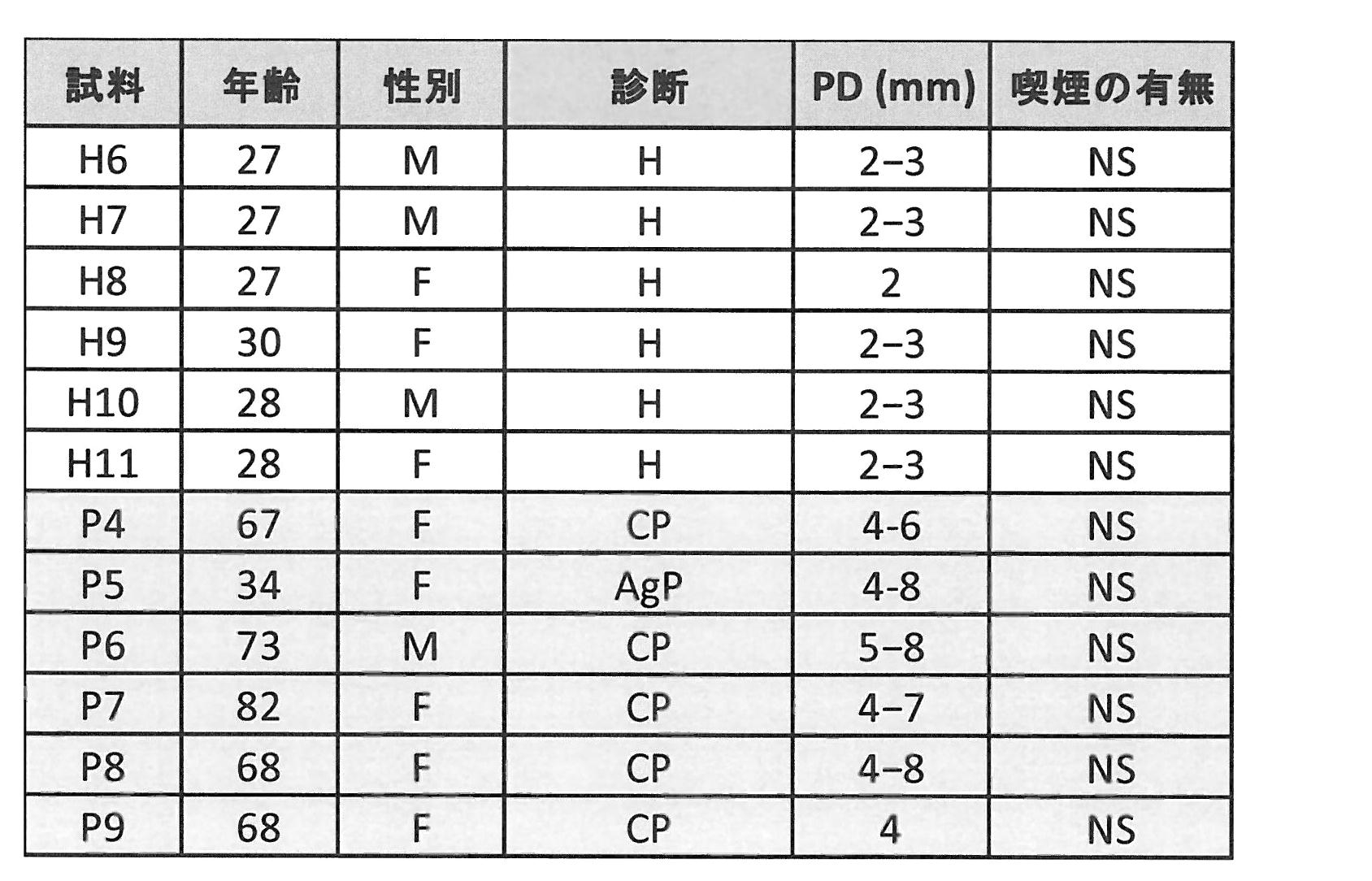
表中の符号は以下のとおりである。M:男性、F:女性、H:健常者、CP:慢性歯周炎(chronic periodontitis)、AgP:侵襲性歯周炎(aggressive periodontitis)、PD:歯周ポケット深さ(probing pocket depth)、NS:非喫煙者、S:喫煙者なお、以下に示すデータのH1~H11は上記表に示す健常者のサンプルであることを示し、P1~P9は同様に上記表に示す歯周炎患者のサンプルであることを示す。
≪歯肉溝滲出液(GCF)の採取≫
GCFを採取する前に、歯肉縁上の歯垢、及び歯の周辺の唾液は綿球で除去し、エアードライヤーによって、GCFを採取する歯の周辺を乾燥させた。コットンロールによって、周辺から隔離した後に、濾紙片(Oralflow社製)を歯周ポケットに穏やか挿入し、GCFを採取した。血液が付着している濾紙片は解析には用いなかった。
複数の濾紙片により、各対象者から約4.8μlのGCFを採取して解析に用いた。濾紙は60μlのリン酸緩衝液を含むチューブに集め、急速凍結し、RNAを単離するまで保存した。
GCFを採取する前に、歯肉縁上の歯垢、及び歯の周辺の唾液は綿球で除去し、エアードライヤーによって、GCFを採取する歯の周辺を乾燥させた。コットンロールによって、周辺から隔離した後に、濾紙片(Oralflow社製)を歯周ポケットに穏やか挿入し、GCFを採取した。血液が付着している濾紙片は解析には用いなかった。
複数の濾紙片により、各対象者から約4.8μlのGCFを採取して解析に用いた。濾紙は60μlのリン酸緩衝液を含むチューブに集め、急速凍結し、RNAを単離するまで保存した。
≪RNAの単離≫
以下のようにして、GCFからTrizol LS試薬(ライフテクノロジーズ社製)を用いてRNAを抽出した。GCFは、750μlのTrizol LS試薬に溶解し、RNase-free精製水により1mlになるように調整した。次に、0.2mlのクロロホルムを加え、水相を集め、イソプロパノールを加えた。遠心して沈殿を集め、乾燥してエタノールで洗浄後、50μlのnuclease-free精製水に溶解した。RNAの精製度と濃度はNanoDrop(サーモフィッシャーサイエンティフィック社製)を用いて測定した。A260/230の比が0.9~1.6、A260/280の比が1.6~1.8の試料をmiRNA解析に用いた。
以下のようにして、GCFからTrizol LS試薬(ライフテクノロジーズ社製)を用いてRNAを抽出した。GCFは、750μlのTrizol LS試薬に溶解し、RNase-free精製水により1mlになるように調整した。次に、0.2mlのクロロホルムを加え、水相を集め、イソプロパノールを加えた。遠心して沈殿を集め、乾燥してエタノールで洗浄後、50μlのnuclease-free精製水に溶解した。RNAの精製度と濃度はNanoDrop(サーモフィッシャーサイエンティフィック社製)を用いて測定した。A260/230の比が0.9~1.6、A260/280の比が1.6~1.8の試料をmiRNA解析に用いた。
total RNA量は、eukaryotic total RNA nano assayを用い、Agilent 2100 BioAnalyzer(アジレント・テクノロジー社製)によって測定した。電気泳動図はいずれの試料もきれいなピークを示した。一例を図1に示す。図1の左パネルは健常者、右パネルは歯周炎患者から得られたRNA試料の電気泳動図を示している。どちらの試料も25~200ntのsmall RNAのピークが観察される。
≪miRNAの発現解析≫
miRNA発現解析は、miRCURY LNA(登録商標) Universal RT microRNA PCR System(Exiqon社製)を用いて解析した。一本鎖cDNAは8μlのRNAからuniversal cDNA Synthesis kit II(Exiqon社製)を用いて合成した。合成したcDNAは希釈し、ExiLET SYBR(登録商標)Green master mixと混合しHuman miRNome microRNA PCR panel(Exiqon社製)に分注し、定量的PCRをLightCycler 480 Real-Time PCR system(ロシュ社製)を用いて行った。
miRNA発現解析は、miRCURY LNA(登録商標) Universal RT microRNA PCR System(Exiqon社製)を用いて解析した。一本鎖cDNAは8μlのRNAからuniversal cDNA Synthesis kit II(Exiqon社製)を用いて合成した。合成したcDNAは希釈し、ExiLET SYBR(登録商標)Green master mixと混合しHuman miRNome microRNA PCR panel(Exiqon社製)に分注し、定量的PCRをLightCycler 480 Real-Time PCR system(ロシュ社製)を用いて行った。
参照プローブとして、GCFで発現が安定していたhsa-miR-324-5p、hsa-miR-29c-5p、hsa-miR-107、hsa-miR-324-3p、hsa-miR-30d-5pを正規化に用いた。正規化した値はΔCqと表している。
≪解析結果≫
表1に示す5名の健常者、3名の歯周炎患者から採取したGCFのmiRNA(試料セット#1)を解析した。健常者のGCFを採取した部位は、歯周ポケット深さが3mm以下であり、プロービングによる出血は見られなかった。一方、歯周炎患者は歯周ポケット深さが3mmより大きく(ほとんどの歯周ポケット深さは4~8mm)、多くの患者でプロービングによる出血が観察された。
表1に示す5名の健常者、3名の歯周炎患者から採取したGCFのmiRNA(試料セット#1)を解析した。健常者のGCFを採取した部位は、歯周ポケット深さが3mm以下であり、プロービングによる出血は見られなかった。一方、歯周炎患者は歯周ポケット深さが3mmより大きく(ほとんどの歯周ポケット深さは4~8mm)、多くの患者でプロービングによる出血が観察された。
主成分解析(PCA)によるmiRNA発現パターンは健常者、歯周炎患者ではっきりと2つに分かれて分布していた(図2A)。表1に示す5名の健常者(H1~H5)、3名の歯周炎患者(P1~P3)から得られたRNA試料を解析した結果は、両者の発現パターンが異なることを示している。X軸は、PCA Component 1(PC1:46.9% variance)、Y軸はPCA Component 2(PC2:15.7% variance)を示す。
751のヒトmiRNAのプライマーセットのうち、健常者、歯周炎患者の各群の夫々少なくとも一人から619のmiRNAの発現データを得ることができた。それらのうち、歯周炎患者において332のmiRNAは発現増強が認められ、287のmiRNAは発現減少が認められた(図2B)。X軸は、-ΔΔCq値で表す相対的な発現比を示し、Y軸は2群間でのt-テストから得られた-log10(p-value)を表している。
黒丸(●)で示したのは、p値が<0.05、ΔΔCq>1.0、又はΔΔCq<-1.0(図2Bにカットオフとして線で示している。)のmiRNAであり、歯周炎患者で有意に発現増強、又は減少が見られるものを示す。
歯周炎患者で、有意に発現減少、又は発現増強が観察されたmiRNAは、夫々63(表3)、55個(表4)あった。これらのmiRNAは歯周炎患者と健常者との間で発現に有意な差が見られたmiRNAであることから、単独で用いても、いくつかを組み合わせて検査に用いてもよい。また、正確な診断を行うためには、複数のmiRNAを組み合わせて検査に用いるのが好ましい。
さらに、上記の結果において、ΔCq値が低いほどmiRNAの発現量が多く、検出感度が比較的良いと想定される。したがってΔCq<-2.5、p値が<0.05、ΔΔCq>0.7、又はΔΔCq<-0.7、との基準を満たすmiRNAを歯肉溝滲出液試料セット#1の解析結果から抽出した(表5)。したがって、表5に示すmiRNAは単独、あるいはいくつかを組み合わせて歯周炎の診断マーカーとして好ましく用いることができる。特に、hsa-miR-223-3p、hsa-miR-200c-3p、hsa-miR-205-5p、hsa-miR-16-5pは、感度も再現性も良いことから、マーカーとして好ましく用いることができる。

また、各miRNAの機能により着目して、次の5つの基準に基づいて発現量に変化が見られたmiRNAから40個のmiRNAを抽出した。
(1)健常者、歯周炎患者で有意に差が認められるもの(できればp値が0.05より小さいもの)
(2)初期の発現レベルが高いと考えられるΔCq値が比較的小さいもの
(3)ΔCq値の差(ΔΔCq)が大きいもの
(4)標的遺伝子が機能的に重要であると示唆されているもの、又はこれまでの研究成果により確認されているもの
(5)歯周炎との関連が今までの研究により報告されているもの
(1)健常者、歯周炎患者で有意に差が認められるもの(できればp値が0.05より小さいもの)
(2)初期の発現レベルが高いと考えられるΔCq値が比較的小さいもの
(3)ΔCq値の差(ΔΔCq)が大きいもの
(4)標的遺伝子が機能的に重要であると示唆されているもの、又はこれまでの研究成果により確認されているもの
(5)歯周炎との関連が今までの研究により報告されているもの
各miRNAについて上記5つの基準で評価し、表6に示す19の歯周炎患者で発現増強が認められるmiRNA、21の発現減少が認められるmiRNAを抽出した。また、上述のように、hsa-miR-324-5p、hsa-miR-29c-5p、hsa-miR-107、hsa-miR-324-3p、hsa-miR-30d-5pの5つのmiRNAは、すべての試料で安定して発現していたことから、参照miRNA(reference miRNA)として、以後の実験解析に含め、正規化に用いた。なお、表6の分子のうち、表中ハイライトの付してあるhsa-miR-101-3p、hsa-miR-145-5p、hsa-miR-374a-5p、hsa-miR-582-5p、hsa-miR-181b-5p、hsa-miR-187-3p、hsa-miR-200c-3p、hsa-miR-200c-5p、hsa-miR-203a、hsa-miR-31-3pは、今までに歯周炎、歯周病との関連が全く知られていない分子である。

表1の試料を用いて得られた結果を評価するために、次に表2で示した対象から得られた試料を用いて上記で選択した40のmiRNAの発現を測定した。健常者6名、歯周炎患者6名から得られた結果は、両者ではっきりとした差があることが示された(図3A)。なお、hsa-miR-20a-5pはP7の試料で増幅することができなかったため、図3Aでは、これを除いて表示している。
選択した40のmiRNAの発現レベルをVolcanoプロットで示す(図3B)。図2Bと同様に、X軸は、-ΔΔCq値で表す相対的な発現比を示し、Y軸は2群間でのt-テストから得られた-log10(p-value)を表している。黒丸(●)で示したのは、p値が<0.05、|ΔΔCq|>1.0のmiRNAを示す。34のmiRNAは発現レベルのp値<0.005であり、17のmiRNAはΔΔCq>1.0、又は<-1.0と有意差があった。
さらに、各miRNAの発現レベルをBoxプロットで表した(図3C)。白抜きの四角は、健常者、灰色の四角は歯周炎患者の結果を示す。横棒は各中央値を示している。上段のパネルは19の歯周炎患者で発現増強の見られたmiRNA、下段は発現減少の見られたmiRNAの解析結果である。ΔCq値から判断すると、hsa-miR-223-3p、hsa-miR-203a、hsa-miR-205-5pがGCFでの発現レベルが高いことが明らかとなった。したがって、これらのmiRNAの少なくともいずれかを検出することにより、感度良く測定を行うことができる。
次に、表1、表2で示した試料間で、40のmiRNAの発現の比(-ΔΔCq値)に相関があるか解析を行った。図4Aは試料間の値を散布図で示したものである。Spearmanの相関係数(ρ)は0.95であり両者に強い相関があることが示された。
さらに、各対象において、歯周炎患者において発現増強が認められた19のmiRNA、発現減少が認められた21のmiRNAに関して、表1、表2の各対象において、ΔCq値の分布を比較した(図4B)。表1、表2、どちらの試料であっても発現増強、発現減少を示すmiRNAの特徴的なパターンは同様であった。これらの結果は選択した40のmiRNAの発現が歯周炎患者の特徴を表す、再現性の良いものであることを示している。
以上の結果から、歯周炎の診断を行う検査には、上記表6に選択した40のmiRNAをパネルとして用いれば正確な診断を行うことができる。しかし、これら40のmiRNAをすべて使用する必要はなく、必要に応じて選択して用いることもできる。また、表6の40のmiRNA以外にも、表3~5に示したmiRNAは歯周炎の患者で特異的に変化が見られることから好ましく用いることができる。特に、hsa-miR-16-5p、hsa-miR-19b-3p、hsa-miR-15a-5p、hsa-miR-142-5p、hsa-miR-143-3p、hsa-miR-106b-5p、hsa-let-7b-5p、hsa-miR-193b-3p、hsa-miR-221-3p、hsa-miR-365a-3p、hsa-miR-22-3pは感度も良く検出を行うことができるので、歯周炎の検査に好ましく用いることができる。
Claims (13)
- 歯毎に採取された歯肉溝滲出液からmiRNAを抽出し、
得られた試料中のhsa-miR-223-3p、及びhsa-miR-200c-3pのmiRNA量と、
hsa-miR-101-3p、hsa-miR-374a-5p、hsa-miR-582-5p、hsa-miR-145-5p、hsa-miR-20a-3p、hsa-miR-194-5p、hsa-miR-26b-5p、hsa-miR-301a-3p、hsa-miR-140-5p、hsa-miR-590-5p、hsa-miR-30e-5p、hsa-miR-19a-3p、hsa-miR-338-3p、hsa-miR-126-5p、hsa-miR-144-5p、hsa-miR-144-3p、hsa-miR-30e-3p、hsa-miR-20a-5p、hsa-miR-16-5p、hsa-miR-19b-3p、hsa-miR-15a-5p、hsa-miR-142-5p、hsa-miR-143-3p、hsa-miR-106b-5pからなる群から選択される少なくとも1つ、
及びhsa-miR-31-3p、hsa-miR-181b-5p、hsa-miR-203a、hsa-miR-200c-5p、hsa-miR-187-3p、hsa-miR-200b-5p、hsa-miR-99a-5p、hsa-miR-320a、hsa-miR-210-3p、hsa-miR-125a-5p、hsa-let-7i-5p、hsa-miR-100-5p、hsa-miR-155-5p、hsa-miR-21-3p、hsa-miR-200a-5p、hsa-miR-200b-3p、hsa-let-7e-5p、hsa-miR-222-3p、hsa-miR-125b-5p、hsa-miR-205-5p、hsa-let-7b-5p、hsa-miR-193b-3p、hsa-miR-221-3p、hsa-miR-365a-3p、hsa-miR-22-3pからなる群から選択される少なくとも1つのmiRNA量を検出し、
参照標準に対して比較解析することを特徴とする歯周炎の検査方法。 - 歯毎に採取された歯肉溝滲出液からmiRNAを抽出し、
hsa-miR-223-3p、hsa-miR-101-3p、hsa-miR-374a-5p、hsa-miR-582-5p、hsa-miR-145-5p、hsa-miR-20a-3p、hsa-miR-194-5p、hsa-miR-26b-5p、hsa-miR-301a-3p、hsa-miR-140-5p、hsa-miR-590-5p、hsa-miR-30e-5p、hsa-miR-19a-3p、hsa-miR-338-3p、hsa-miR-126-5p、hsa-miR-144-5p、hsa-miR-144-3p、hsa-miR-30e-3p、hsa-miR-20a-5p、hsa-miR-200c-3p、hsa-miR-31-3p、hsa-miR-181b-5p、hsa-miR-203a、hsa-miR-200c-5p、hsa-miR-187-3p、hsa-miR-200b-5p、hsa-miR-99a-5p、hsa-miR-320a、hsa-miR-210-3p、hsa-miR-125a-5p、hsa-let-7i-5p、hsa-miR-100-5p、hsa-miR-155-5p、hsa-miR-21-3p、hsa-miR-200a-5p、hsa-miR-200b-3p、hsa-let-7e-5p、hsa-miR-222-3p、hsa-miR-125b-5p、hsa-miR-205-5pからなるmiRNA量を検出し、
参照標準に対して比較解析することを特徴とする歯周炎の検査方法。 - 前記参照標準として、hsa-miR-324-5p、hsa-miR-29c-5p、hsa-miR-107、hsa-miR-324-3p、hsa-miR-30d-5pの少なくとも1つ以上を用いることを特徴とする請求項1又は2に記載の検査方法。
- hsa-miR-223-3p、hsa-miR-101-3p、hsa-miR-374a-5p、hsa-miR-582-5p、hsa-miR-145-5p、hsa-miR-20a-3p、hsa-miR-194-5p、hsa-miR-26b-5p、hsa-miR-301a-3p、hsa-miR-140-5p、hsa-miR-590-5p、hsa-miR-30e-5p、hsa-miR-19a-3p、hsa-miR-338-3p、hsa-miR-126-5p、hsa-miR-144-5p、hsa-miR-144-3p、hsa-miR-30e-3p、hsa-miR-20a-5p、hsa-miR-16-5p、hsa-miR-19b-3p、hsa-miR-15a-5p、hsa-miR-142-5p、hsa-miR-143-3p、hsa-miR-106b-5pからなる群から選択される少なくとも1つ、
及びhsa-miR-200c-3p、hsa-miR-31-3p、hsa-miR-181b-5p、hsa-miR-203a、hsa-miR-200c-5p、hsa-miR-187-3p、hsa-miR-200b-5p、hsa-miR-99a-5p、hsa-miR-320a、hsa-miR-210-3p、hsa-miR-125a-5p、hsa-let-7i-5p、hsa-miR-100-5p、hsa-miR-155-5p、hsa-miR-21-3p、hsa-miR-200a-5p、hsa-miR-200b-3p、hsa-let-7e-5p、hsa-miR-222-3p、hsa-miR-125b-5p、hsa-miR-205-5p、hsa-let-7b-5p、hsa-miR-193b-3p、hsa-miR-221-3p、hsa-miR-365a-3p、hsa-miR-22-3pからなる群から選択される少なくとも1つのmiRNAを含む歯周炎バイオマーカー。 - 少なくともhsa-miR-223-3p、及びhsa-miR-200c-3pを含むことを特徴とする請求項4記載の歯周炎バイオマーカー。
- hsa-miR-223-3p、hsa-miR-101-3p、hsa-miR-374a-5p、hsa-miR-582-5p、hsa-miR-145-5p、hsa-miR-20a-3p、hsa-miR-194-5p、hsa-miR-26b-5p、hsa-miR-301a-3p、hsa-miR-140-5p、hsa-miR-590-5p、hsa-miR-30e-5p、hsa-miR-19a-3p、hsa-miR-338-3p、hsa-miR-126-5p、hsa-miR-144-5p、hsa-miR-144-3p、hsa-miR-30e-3p、hsa-miR-20a-5p、hsa-miR-200c-3p、hsa-miR-31-3p、hsa-miR-181b-5p、hsa-miR-203a、hsa-miR-200c-5p、hsa-miR-187-3p、hsa-miR-200b-5p、hsa-miR-99a-5p、hsa-miR-320a、hsa-miR-210-3p、hsa-miR-125a-5p、hsa-let-7i-5p、hsa-miR-100-5p、hsa-miR-155-5p、hsa-miR-21-3p、hsa-miR-200a-5p、hsa-miR-200b-3p、hsa-let-7e-5p、hsa-miR-222-3p、hsa-miR-125b-5p、hsa-miR-205-5pからなるmiRNAであることを特徴とする請求項4又は5記載の歯周炎バイオマーカー。
- 参照標準として、hsa-miR-324-5p、hsa-miR-29c-5p、hsa-miR-107、hsa-miR-324-3p、hsa-miR-30d-5pの少なくとも1つ以上を含むことを特徴とする請求項4~6のいずれか1項記載の歯周炎バイオマーカー。
- hsa-miR-223-3p、hsa-miR-101-3p、hsa-miR-374a-5p、hsa-miR-582-5p、hsa-miR-145-5p、hsa-miR-20a-3p、hsa-miR-194-5p、hsa-miR-26b-5p、hsa-miR-301a-3p、hsa-miR-140-5p、hsa-miR-590-5p、hsa-miR-30e-5p、hsa-miR-19a-3p、hsa-miR-338-3p、hsa-miR-126-5p、hsa-miR-144-5p、hsa-miR-144-3p、hsa-miR-30e-3p、hsa-miR-20a-5p、hsa-miR-16-5p、hsa-miR-19b-3p、hsa-miR-15a-5p、hsa-miR-142-5p、hsa-miR-143-3p、hsa-miR-106b-5pからなる群から選択される少なくとも1つ、
及びhsa-miR-200c-3p、hsa-miR-31-3p、hsa-miR-181b-5p、hsa-miR-203a、hsa-miR-200c-5p、hsa-miR-187-3p、hsa-miR-200b-5p、hsa-miR-99a-5p、hsa-miR-320a、hsa-miR-210-3p、hsa-miR-125a-5p、hsa-let-7i-5p、hsa-miR-100-5p、hsa-miR-155-5p、hsa-miR-21-3p、hsa-miR-200a-5p、hsa-miR-200b-3p、hsa-let-7e-5p、hsa-miR-222-3p、hsa-miR-125b-5p、hsa-miR-205-5p、hsa-let-7b-5p、hsa-miR-193b-3p、hsa-miR-221-3p、hsa-miR-365a-3p、hsa-miR-22-3pからなる群から選択される少なくとも1つのmiRNAの発現量を検出するための配列を有する核酸を固定したアレイを含む歯周炎検査キット。 - 前記アレイが少なくともhsa-miR-223-3p、及びhsa-miR-200c-3pの発現量を検出するための配列を有する核酸を固定したものであることを特徴とする請求項8記載の歯周炎検査キット。
- 前記アレイが、
少なくともhsa-miR-223-3p、hsa-miR-101-3p、hsa-miR-374a-5p、hsa-miR-582-5p、hsa-miR-145-5p、hsa-miR-20a-3p、hsa-miR-194-5p、hsa-miR-26b-5p、hsa-miR-301a-3p、hsa-miR-140-5p、hsa-miR-590-5p、hsa-miR-30e-5p、hsa-miR-19a-3p、hsa-miR-338-3p、hsa-miR-126-5p、hsa-miR-144-5p、hsa-miR-144-3p、hsa-miR-30e-3p、hsa-miR-20a-5p、hsa-miR-200c-3p、hsa-miR-31-3p、hsa-miR-181b-5p、hsa-miR-203a、hsa-miR-200c-5p、hsa-miR-187-3p、hsa-miR-200b-5p、hsa-miR-99a-5p、hsa-miR-320a、hsa-miR-210-3p、hsa-miR-125a-5p、hsa-let-7i-5p、hsa-miR-100-5p、hsa-miR-155-5p、hsa-miR-21-3p、hsa-miR-200a-5p、hsa-miR-200b-3p、hsa-let-7e-5p、hsa-miR-222-3p、hsa-miR-125b-5p、hsa-miR-205-5pの発現量を検出するための配列を有する核酸を固定したアレイであることを特徴とする請求項8又は9記載の歯周炎検査キット。 - 参照標準として、hsa-miR-324-5p、hsa-miR-29c-5p、hsa-miR-107、hsa-miR-324-3p、hsa-miR-30d-5pの少なくとも1つ以上をアレイに含むことを特徴とする請求項8~10のいずれか1項記載の歯周炎検査キット。
- 歯肉溝滲出液採取用ペーパーストリップ、
miRNA抽出試薬、
miRNA検出試薬を含むことを特徴とする請求項8~11いずれか1項記載の歯周炎検査キット。 - 歯毎に採取された歯肉溝滲出液からmiRNAを抽出し、
hsa-miR-223-3p、hsa-miR-200c-3p、hsa-miR-101-3p、hsa-miR-374a-5p、hsa-miR-582-5p、hsa-miR-145-5p、hsa-miR-20a-3p、hsa-miR-194-5p、hsa-miR-26b-5p、hsa-miR-301a-3p、hsa-miR-140-5p、hsa-miR-590-5p、hsa-miR-30e-5p、hsa-miR-19a-3p、hsa-miR-338-3p、hsa-miR-126-5p、hsa-miR-144-5p、hsa-miR-144-3p、hsa-miR-30e-3p、hsa-miR-20a-5p、hsa-miR-16-5p、hsa-miR-19b-3p、hsa-miR-15a-5p、hsa-miR-142-5p、hsa-miR-143-3p、hsa-miR-106b-5p、hsa-miR-199b-5p、hsa-miR-628-5p、hsa-miR-194-3p、hsa-miR-636、hsa-miR-450b-5p、hsa-miR-192-5p、hsa-miR-338-5p、hsa-miR-215-5p、hsa-miR-548e-3p、hsa-miR-16-1-3p、hsa-miR-30c-5p、hsa-miR-340-3p、hsa-miR-30a-5p、hsa-miR-374b-3p、hsa-miR-611、hsa-miR-454-3p、hsa-miR-340-5p、hsa-miR-616-3p、hsa-miR-590-3p、hsa-miR-374b-5p、hsa-miR-545-3phsa-miR-525-5p、hsa-miR-301b、hsa-miR-646、hsa-miR-216b-5p、hsa-miR-582-3p、hsa-miR-1256、hsa-miR-518c-5p、hsa-miR-627-5p、hsa-miR-142-3p、hsa-miR-124-3p、hsa-miR-934、hsa-miR-510-5p、hsa-miR-298、hsa-miR-1181、hsa-miR-31-3p、hsa-miR-181b-5p、hsa-miR-203a、hsa-miR-200c-5p、hsa-miR-187-3p、hsa-miR-200b-5p、hsa-miR-99a-5p、hsa-miR-320a、hsa-miR-210-3p、hsa-miR-125a-5p、hsa-let-7i-5p、hsa-miR-100-5p、hsa-miR-155-5p、hsa-miR-21-3p、hsa-miR-200a-5p、hsa-miR-200b-3p、hsa-let-7e-5p、hsa-miR-222-3p、hsa-miR-125b-5p、hsa-miR-205-5p、hsa-let-7b-5p、hsa-miR-193b-3p、hsa-miR-221-3p、hsa-miR-365a-3p、hsa-miR-22-3p、hsa-miR-511-5p、hsa-miR-382-3phsa-miR-1247-5p、hsa-miR-125b-1-3p、hsa-miR-549a、hsa-miR-155-3p、hsa-miR-30b-3p、hsa-miR-205-3p、hsa-miR-449a、hsa-miR-135-3p、hsa-miR-222-5p、hsa-miR-641、hsa-miR-193b-5p、hsa-miR-1260a、hsa-miR-27b-5p、hsa-miR-335-3p、hsa-miR-125-2-3p、hsa-miR-92a-1-5p、hsa-miR-99b-5p、hsa-miR-99b-3p、hsa-miR-99a-3p、hsa-miR-151a-5p、hsa-miR-152-3p、hsa-miR-615-3p、hsa-let-7e-3p、hsa-miR-34c-3p、hsa-miR-663a、hsa-miR-150-5p、hsa-miR-671-3p、hsa-miR-1972、hsa-miR-181a-3p、hsa-miR-34b-3p、hsa-miR-30d-3p、hsa-miR-151a-3p、hsa-miR-320c、hsa-miR-320b、hsa-miR-455-5p、hsa-miR-593-3p、hsa-miR-95-3p、hsa-miR-193a-3p、hsa-miR-877-5p、hsa-miR-34c-5p、hsa-miR-342-5p、hsa-miR-26a-5p、hsa-miR-424-5pからなる群から選択される少なくとも1つ以上のmiRNA量を検出することを特徴とする歯周炎の検査方法。
Priority Applications (2)
| Application Number | Priority Date | Filing Date | Title |
|---|---|---|---|
| JP2018516243A JP6800470B2 (ja) | 2016-05-10 | 2016-05-10 | miRNAをマーカーとする歯周炎検査キット、及び検査方法 |
| PCT/JP2016/063846 WO2017195268A1 (ja) | 2016-05-10 | 2016-05-10 | miRNAをマーカーとする歯周炎検査キット、及び検査方法 |
Applications Claiming Priority (1)
| Application Number | Priority Date | Filing Date | Title |
|---|---|---|---|
| PCT/JP2016/063846 WO2017195268A1 (ja) | 2016-05-10 | 2016-05-10 | miRNAをマーカーとする歯周炎検査キット、及び検査方法 |
Publications (1)
| Publication Number | Publication Date |
|---|---|
| WO2017195268A1 true WO2017195268A1 (ja) | 2017-11-16 |
Family
ID=60267718
Family Applications (1)
| Application Number | Title | Priority Date | Filing Date |
|---|---|---|---|
| PCT/JP2016/063846 Ceased WO2017195268A1 (ja) | 2016-05-10 | 2016-05-10 | miRNAをマーカーとする歯周炎検査キット、及び検査方法 |
Country Status (2)
| Country | Link |
|---|---|
| JP (1) | JP6800470B2 (ja) |
| WO (1) | WO2017195268A1 (ja) |
Cited By (2)
| Publication number | Priority date | Publication date | Assignee | Title |
|---|---|---|---|---|
| WO2020071517A1 (ja) * | 2018-10-04 | 2020-04-09 | 学校法人自治医科大学 | 糖尿病性腎臓病特異的バイオマーカー、糖尿病性腎臓病の診断方法、糖尿病性腎臓病の検査用キット、動物治療方法、及び糖尿病性腎臓病用医薬 |
| EP4043587A1 (en) * | 2021-02-11 | 2022-08-17 | Vilnius University Hospital Zalgiris Clinic | Diagnostic micro-rna kit for the evaluation of the inflammatory activity of periodontitis in patients with rheumatoid arthritis |
Families Citing this family (2)
| Publication number | Priority date | Publication date | Assignee | Title |
|---|---|---|---|---|
| KR102571131B1 (ko) * | 2021-06-01 | 2023-08-24 | 부산대학교 산학협력단 | 치주염 감별용 바이오마커 조성물, 치주염 중증도 감별용 바이오마커 조성물, 및 이를 이용한 진단 키트 |
| CN118973591A (zh) | 2022-03-28 | 2024-11-15 | 合同会社博子科技 | 包含miR-140的药物组合物及其制备方法 |
Citations (3)
| Publication number | Priority date | Publication date | Assignee | Title |
|---|---|---|---|---|
| JP2004129584A (ja) * | 2002-10-11 | 2004-04-30 | Applied Cell Biotechnologies Inc | 歯周病の検査方法及び検査診断薬 |
| JP2008206483A (ja) * | 2007-02-27 | 2008-09-11 | Hiroshima Univ | 侵襲性歯周炎の早期診断のための診断マーカーおよび侵襲性歯周炎の治療遺伝子 |
| JP2010256190A (ja) * | 2009-04-24 | 2010-11-11 | Kao Corp | 歯周病マーカー |
-
2016
- 2016-05-10 WO PCT/JP2016/063846 patent/WO2017195268A1/ja not_active Ceased
- 2016-05-10 JP JP2018516243A patent/JP6800470B2/ja not_active Expired - Fee Related
Patent Citations (3)
| Publication number | Priority date | Publication date | Assignee | Title |
|---|---|---|---|---|
| JP2004129584A (ja) * | 2002-10-11 | 2004-04-30 | Applied Cell Biotechnologies Inc | 歯周病の検査方法及び検査診断薬 |
| JP2008206483A (ja) * | 2007-02-27 | 2008-09-11 | Hiroshima Univ | 侵襲性歯周炎の早期診断のための診断マーカーおよび侵襲性歯周炎の治療遺伝子 |
| JP2010256190A (ja) * | 2009-04-24 | 2010-11-11 | Kao Corp | 歯周病マーカー |
Non-Patent Citations (4)
| Title |
|---|
| OGATA, Y. ET AL.: "MicroRNA expression in inflamed and noninflamed gingival tissues from Japanese patients", J. ORAL SCI., vol. 56, no. 4, December 2014 (2014-12-01), pages 253 - 260, XP055600293, ISSN: 1343-4934, DOI: 10.2334/josnusd.56.253 * |
| PERRI, R. ET AL.: "MicroRNA modulation in obesity and periodontitis", J. DENT. RES., vol. 91, no. 1, January 2012 (2012-01-01), pages 33 - 38, XP055484845, ISSN: 0022-0345, DOI: doi:10.1177/0022034511425045 * |
| STOECKLIN-WASMER, C. ET AL.: "MicroRNAs and their target genes in gingival tissues", J. DENT. RES., vol. 91, no. 10, October 2012 (2012-10-01), pages 934 - 940, XP055532400, ISSN: 0022-0345, DOI: doi:10.1177/0022034512456551 * |
| XIE, Y.F. ET AL.: "Comparison of microRNA profiles of human periodontal diseased and healthy gingival tissues", INT. J. ORAL SCI., vol. 3, no. 3, July 2011 (2011-07-01), pages 125 - 134, XP055600295, ISSN: 1674-2818, DOI: 10.4248/IJOS11046 * |
Cited By (4)
| Publication number | Priority date | Publication date | Assignee | Title |
|---|---|---|---|---|
| WO2020071517A1 (ja) * | 2018-10-04 | 2020-04-09 | 学校法人自治医科大学 | 糖尿病性腎臓病特異的バイオマーカー、糖尿病性腎臓病の診断方法、糖尿病性腎臓病の検査用キット、動物治療方法、及び糖尿病性腎臓病用医薬 |
| JPWO2020071517A1 (ja) * | 2018-10-04 | 2021-12-02 | 学校法人自治医科大学 | 糖尿病性腎臓病特異的バイオマーカー、糖尿病性腎臓病の診断方法、糖尿病性腎臓病の検査用キット、動物治療方法、及び糖尿病性腎臓病用医薬 |
| JP7120663B2 (ja) | 2018-10-04 | 2022-08-17 | 学校法人自治医科大学 | 糖尿病性腎臓病の診断することを補助する方法、糖尿病性腎臓病の検査用キット、動物治療方法、及び糖尿病性腎臓病用医薬 |
| EP4043587A1 (en) * | 2021-02-11 | 2022-08-17 | Vilnius University Hospital Zalgiris Clinic | Diagnostic micro-rna kit for the evaluation of the inflammatory activity of periodontitis in patients with rheumatoid arthritis |
Also Published As
| Publication number | Publication date |
|---|---|
| JPWO2017195268A1 (ja) | 2019-03-14 |
| JP6800470B2 (ja) | 2020-12-16 |
Similar Documents
| Publication | Publication Date | Title |
|---|---|---|
| BR112013033488B1 (pt) | Métodos para facilitar o diagnóstico do comprometimento cognitivo devido a doença de alzheimer ou comprometimento cognitivo leve (mci)e kit | |
| CN110564852A (zh) | 与人类多发性骨髓瘤相关的miRNAs表达图谱模型、构建方法及应用 | |
| JP6800470B2 (ja) | miRNAをマーカーとする歯周炎検査キット、及び検査方法 | |
| JP2023113877A (ja) | 膵がんの検出を補助する方法 | |
| KR20200061893A (ko) | 당뇨병성 신증 진단을 위한 마이크로RNA let-7 또는 마이크로RNA-150 바이오마커 및 이의 용도 | |
| CN102732633B (zh) | 人idh基因突变的检测引物和试剂盒 | |
| CN108841949B (zh) | 帕金森病早期检测和诊断试剂盒及装置 | |
| Bizjak et al. | Pro-inflammatory and (Epi-) genetic markers in saliva for disease risk in childhood obesity | |
| CN107142316B (zh) | 青光眼诊断分子标记物lncRNAsT267384、试剂盒及应用 | |
| CN111733227B (zh) | 特发性视神经炎诊断分子标记物circRNA、试剂盒及应用 | |
| KR102329555B1 (ko) | 비용종을 갖는 비부비동염의 진단을 위한 정보 제공 방법 | |
| WO2019117257A1 (ja) | 乳がんの検出を補助する方法 | |
| KR102139315B1 (ko) | Tnfrsf19 유전자의 dna 메틸레이션 변화를 이용한 알츠하이머병 치매 조기진단 마커 | |
| JP2022087075A (ja) | アトピー性皮膚炎の症度変化の検出方法 | |
| CN101298630A (zh) | 一种Solexa技术鉴定结肠癌病人血清中微小核糖核酸的方法 | |
| KR102525144B1 (ko) | 당뇨 전단계 진단 또는 당뇨 합병증 발병 예측용 바이오마커 및 이의 용도 | |
| ES2899788T3 (es) | Detección de infección bacteriana | |
| CN108998530A (zh) | 肺癌上调长链非编码rna标志物及其应用 | |
| KR102139313B1 (ko) | 알츠하이머병 치매 조기 진단을 위한 후성 유전학적 진단 키트 개발 | |
| JP7394441B2 (ja) | 脳腫瘍を検査する方法 | |
| JP2020182435A (ja) | アトピー性皮膚炎の診断方法 | |
| RU2855794C1 (ru) | Способ диагностики уролитиаза | |
| JP4792585B2 (ja) | 口腔細菌の迅速検出方法 | |
| JP2022025456A (ja) | 多発性硬化症を検査する方法 | |
| ES2940157B2 (es) | Metodos y usos diagnosticos/pronosticos de la enfermedad de wilson basados en la determinacion de los niveles de mir-192 y/o mir-885 |
Legal Events
| Date | Code | Title | Description |
|---|---|---|---|
| DPE2 | Request for preliminary examination filed before expiration of 19th month from priority date (pct application filed from 20040101) | ||
| WWE | Wipo information: entry into national phase |
Ref document number: 2018516243 Country of ref document: JP |
|
| NENP | Non-entry into the national phase |
Ref country code: DE |
|
| 121 | Ep: the epo has been informed by wipo that ep was designated in this application |
Ref document number: 16901617 Country of ref document: EP Kind code of ref document: A1 |
|
| 122 | Ep: pct application non-entry in european phase |
Ref document number: 16901617 Country of ref document: EP Kind code of ref document: A1 |