WO2017188366A1 - 液晶配向剤、液晶配向膜、液晶表示素子及び新規モノマー - Google Patents
液晶配向剤、液晶配向膜、液晶表示素子及び新規モノマー Download PDFInfo
- Publication number
- WO2017188366A1 WO2017188366A1 PCT/JP2017/016692 JP2017016692W WO2017188366A1 WO 2017188366 A1 WO2017188366 A1 WO 2017188366A1 JP 2017016692 W JP2017016692 W JP 2017016692W WO 2017188366 A1 WO2017188366 A1 WO 2017188366A1
- Authority
- WO
- WIPO (PCT)
- Prior art keywords
- group
- carbon atoms
- liquid crystal
- linear
- ring
- Prior art date
- Legal status (The legal status is an assumption and is not a legal conclusion. Google has not performed a legal analysis and makes no representation as to the accuracy of the status listed.)
- Ceased
Links
- 0 *c(cc1)ccc1-c(cc1)cc2c1cc(*)cc2 Chemical compound *c(cc1)ccc1-c(cc1)cc2c1cc(*)cc2 0.000 description 6
Classifications
-
- C—CHEMISTRY; METALLURGY
- C08—ORGANIC MACROMOLECULAR COMPOUNDS; THEIR PREPARATION OR CHEMICAL WORKING-UP; COMPOSITIONS BASED THEREON
- C08F—MACROMOLECULAR COMPOUNDS OBTAINED BY REACTIONS ONLY INVOLVING CARBON-TO-CARBON UNSATURATED BONDS
- C08F12/00—Homopolymers and copolymers of compounds having one or more unsaturated aliphatic radicals, each having only one carbon-to-carbon double bond, and at least one being terminated by an aromatic carbocyclic ring
- C08F12/02—Monomers containing only one unsaturated aliphatic radical
- C08F12/04—Monomers containing only one unsaturated aliphatic radical containing one ring
- C08F12/06—Hydrocarbons
- C08F12/12—Monomers containing a branched unsaturated aliphatic radical or a ring substituted by an alkyl radical
-
- C—CHEMISTRY; METALLURGY
- C08—ORGANIC MACROMOLECULAR COMPOUNDS; THEIR PREPARATION OR CHEMICAL WORKING-UP; COMPOSITIONS BASED THEREON
- C08F—MACROMOLECULAR COMPOUNDS OBTAINED BY REACTIONS ONLY INVOLVING CARBON-TO-CARBON UNSATURATED BONDS
- C08F16/00—Homopolymers and copolymers of compounds having one or more unsaturated aliphatic radicals, each having only one carbon-to-carbon double bond, and at least one being terminated by an alcohol, ether, aldehydo, ketonic, acetal or ketal radical
- C08F16/38—Homopolymers and copolymers of compounds having one or more unsaturated aliphatic radicals, each having only one carbon-to-carbon double bond, and at least one being terminated by an alcohol, ether, aldehydo, ketonic, acetal or ketal radical by an acetal or ketal radical
-
- C—CHEMISTRY; METALLURGY
- C08—ORGANIC MACROMOLECULAR COMPOUNDS; THEIR PREPARATION OR CHEMICAL WORKING-UP; COMPOSITIONS BASED THEREON
- C08F—MACROMOLECULAR COMPOUNDS OBTAINED BY REACTIONS ONLY INVOLVING CARBON-TO-CARBON UNSATURATED BONDS
- C08F18/00—Homopolymers and copolymers of compounds having one or more unsaturated aliphatic radicals, each having only one carbon-to-carbon double bond, and at least one being terminated by an acyloxy radical of a saturated carboxylic acid, of carbonic acid or of a haloformic acid
-
- C—CHEMISTRY; METALLURGY
- C08—ORGANIC MACROMOLECULAR COMPOUNDS; THEIR PREPARATION OR CHEMICAL WORKING-UP; COMPOSITIONS BASED THEREON
- C08F—MACROMOLECULAR COMPOUNDS OBTAINED BY REACTIONS ONLY INVOLVING CARBON-TO-CARBON UNSATURATED BONDS
- C08F20/00—Homopolymers and copolymers of compounds having one or more unsaturated aliphatic radicals, each having only one carbon-to-carbon double bond, and only one being terminated by only one carboxyl radical or a salt, anhydride, ester, amide, imide or nitrile thereof
- C08F20/02—Monocarboxylic acids having less than ten carbon atoms, Derivatives thereof
- C08F20/10—Esters
-
- C—CHEMISTRY; METALLURGY
- C08—ORGANIC MACROMOLECULAR COMPOUNDS; THEIR PREPARATION OR CHEMICAL WORKING-UP; COMPOSITIONS BASED THEREON
- C08F—MACROMOLECULAR COMPOUNDS OBTAINED BY REACTIONS ONLY INVOLVING CARBON-TO-CARBON UNSATURATED BONDS
- C08F34/00—Homopolymers and copolymers of cyclic compounds having no unsaturated aliphatic radicals in a side chain and having one or more carbon-to-carbon double bonds in a heterocyclic ring
-
- C—CHEMISTRY; METALLURGY
- C08—ORGANIC MACROMOLECULAR COMPOUNDS; THEIR PREPARATION OR CHEMICAL WORKING-UP; COMPOSITIONS BASED THEREON
- C08L—COMPOSITIONS OF MACROMOLECULAR COMPOUNDS
- C08L101/00—Compositions of unspecified macromolecular compounds
- C08L101/02—Compositions of unspecified macromolecular compounds characterised by the presence of specified groups, e.g. terminal or pendant functional groups
-
- G—PHYSICS
- G02—OPTICS
- G02F—OPTICAL DEVICES OR ARRANGEMENTS FOR THE CONTROL OF LIGHT BY MODIFICATION OF THE OPTICAL PROPERTIES OF THE MEDIA OF THE ELEMENTS INVOLVED THEREIN; NON-LINEAR OPTICS; FREQUENCY-CHANGING OF LIGHT; OPTICAL LOGIC ELEMENTS; OPTICAL ANALOGUE/DIGITAL CONVERTERS
- G02F1/00—Devices or arrangements for the control of the intensity, colour, phase, polarisation or direction of light arriving from an independent light source, e.g. switching, gating or modulating; Non-linear optics
- G02F1/01—Devices or arrangements for the control of the intensity, colour, phase, polarisation or direction of light arriving from an independent light source, e.g. switching, gating or modulating; Non-linear optics for the control of the intensity, phase, polarisation or colour
- G02F1/13—Devices or arrangements for the control of the intensity, colour, phase, polarisation or direction of light arriving from an independent light source, e.g. switching, gating or modulating; Non-linear optics for the control of the intensity, phase, polarisation or colour based on liquid crystals, e.g. single liquid crystal display cells
- G02F1/133—Constructional arrangements; Operation of liquid crystal cells; Circuit arrangements
- G02F1/1333—Constructional arrangements; Manufacturing methods
- G02F1/1337—Surface-induced orientation of the liquid crystal molecules, e.g. by alignment layers
Definitions
- the present invention relates to a novel polymer having a specific structural unit, a composition (liquid crystal alignment agent) containing the same, a liquid crystal alignment film for a lateral electric field drive type liquid crystal display device using the same, and a substrate having the alignment film It relates to the manufacturing method.
- the liquid crystal display element is known as a light, thin, and low power consumption display device and has been remarkably developed in recent years.
- the liquid crystal display element is configured, for example, by sandwiching a liquid crystal layer between a pair of transparent substrates provided with electrodes.
- an organic film made of an organic material is used as the liquid crystal alignment film so that the liquid crystal is in a desired alignment state between the substrates.
- the liquid crystal alignment film is a component of the liquid crystal display element, and is formed on the surface of the substrate that holds the liquid crystal in contact with the liquid crystal, and plays a role of aligning the liquid crystal in a certain direction between the substrates.
- the liquid crystal alignment film may be required to play a role of controlling the pretilt angle of the liquid crystal in addition to the role of aligning the liquid crystal in a certain direction such as a direction parallel to the substrate.
- alignment control ability is given by performing an alignment treatment on the organic film constituting the liquid crystal alignment film.
- the rubbing method is a method of rubbing (rubbing) the surface of an organic film such as polyvinyl alcohol, polyamide or polyimide on a substrate with a cloth such as cotton, nylon or polyester in the rubbing direction (rubbing direction).
- This is a method of aligning liquid crystals. Since this rubbing method can easily realize a relatively stable alignment state of liquid crystals, it has been used in the manufacturing process of conventional liquid crystal display elements.
- an organic film used for the liquid crystal alignment film a polyimide-based organic film excellent in reliability such as heat resistance and electrical characteristics has been mainly selected.
- Anisotropy is formed in the organic film constituting the liquid crystal alignment film by linearly polarized light or collimated light, and the liquid crystal is aligned according to the anisotropy.
- a decomposition type photo-alignment method is known as a main photo-alignment method.
- a polyimide film is irradiated with polarized ultraviolet rays, and anisotropic decomposition is caused by utilizing the polarization direction dependency of ultraviolet absorption of the molecular structure. Then, the liquid crystal is aligned by the polyimide remaining without being decomposed (see, for example, Patent Document 1).
- photo-crosslinking type and photoisomerization type photo-alignment methods are also known.
- the photo-crosslinking type photo-alignment method for example, polyvinyl cinnamate is used and irradiated with polarized ultraviolet rays to cause a dimerization reaction (cross-linking reaction) at double bond portions of two side chains parallel to the polarized light. Then, the liquid crystal is aligned in a direction orthogonal to the polarization direction (see, for example, Non-Patent Document 1).
- the liquid crystal alignment film alignment treatment method by the photo alignment method does not require rubbing, and there is no fear of generation of dust or static electricity.
- An alignment process can be performed even on a substrate of a liquid crystal display element having an uneven surface, which is a method for aligning a liquid crystal alignment film suitable for an industrial production process.
- liquid crystal aligning agent using a photoreactive polymer that exhibits liquid crystallinity in a predetermined temperature range has been proposed as a photoalignable polymer.
- the solubility may decrease depending on the structure of the polymer, which may not be practical. Accordingly, there is a need for polymers with high solubility while introducing a wide variety of structures.
- an object of the present invention is to provide a photoreactive polymer into which a specific structural unit capable of improving the solubility of the polymer is introduced, and a liquid crystal aligning agent containing the photoreactive polymer.
- transducing the said specific structural unit is also provided.
- the resin as the component (A) is: A polymer composition comprising a side chain represented by formula (a).
- a polymer composition for producing a liquid crystal alignment film for a lateral electric field drive type liquid crystal display element is:
- L is a linear or branched alkylene having 1 to 16 carbon atoms.
- X represents CH 2 —CH 2 , CH ⁇ CH or C ⁇ C.
- Y 1 each independently represents a halogen group, a linear or branched alkyl group having 1 to 10 carbon atoms, a linear or branched alkoxy group having 1 to 10 carbon atoms, a hydroxyl group, a cyano group, or a dialkylamino group.
- the alkyl groups are each independently a linear or branched alkyl group having 1 to 10 carbon atoms), a linear or branched ester group having 1 to 10 carbon atoms, a linear chain having 1 to 10 carbon atoms Or the following formulas Y 1 -1 to Y 1 -6 which may be substituted with a substituent selected from a branched chain acyl group, carboxyl group, aldehyde group and nitro group (** represents the position of bonding with X) *** represents a bonding position with Y 2 ).
- Y 2 represents —COOH, —CR 3 ⁇ CR 4 —COOH, —CR 5 ⁇ CR 6 —CO—O—Y 3 or —O—CO—CR 5 ⁇ CR 6 —Y 3 .
- R 3 and R 4 each independently represents a hydrogen atom or a methyl group.
- R 5 and R 6 each independently represents a hydrogen atom or a methyl group.
- Y 3 each independently represents a halogen group, a linear or branched alkyl group having 1 to 10 carbon atoms, a linear or branched alkoxy group having 1 to 10 carbon atoms, a hydroxyl group, a cyano group, or a dialkylamino group.
- the alkyl groups are each independently a linear or branched alkyl group having 1 to 10 carbon atoms), a linear or branched ester group having 1 to 10 carbon atoms, a linear chain having 1 to 10 carbon atoms
- a phenyl group, a biphenyl group, a naphthyl group, an alicyclic hydrocarbon having 5 to 8 carbon atoms, phenyl- which may be substituted with a substituent selected from a branched acyl group, a carboxyl group, an aldehyde group, and a nitro group Represents a cyclohexyl group or a cyclohexyl-phenyl group.
- the component (A) preferably has a photosensitive side chain that causes photocrosslinking, photoisomerization, or photofleece transition.
- the component (A) preferably has any one photosensitive side chain selected from the group consisting of the following formulas (1) to (6).
- A, B, and D are each independently a single bond, —O—, —CH 2 —, —COO—, —OCO—, —CONH—, —NH—CO—, —CH ⁇ CH—CO—.
- S is an alkylene group having 1 to 12 carbon atoms, and the hydrogen atom bonded thereto may be replaced by a halogen group;
- T is a single bond or an alkylene group having 1 to 12 carbon atoms, and a hydrogen atom bonded thereto may be replaced with a halogen group;
- Y 1 represents a ring selected from a monovalent benzene ring, naphthalene ring, biphenyl ring, furan ring, pyrrole ring and alicyclic hydrocarbon having 5 to 8 carbon atoms, or the same or selected from those substituents.
- R 0 is a hydrogen atom or a carbon number of 1 to 5 represents an alkyl group
- R 0 is a hydrogen atom or a carbon number of 1 to 5 represents an alkyl group
- Y 2 is a group selected from the group consisting of a divalent benzene ring, naphthalene ring, biphenyl ring, furan ring, pyrrole ring, alicyclic hydrocarbon having 5 to 8 carbon atoms, and combinations thereof
- the hydrogen atom bonded to each independently represents —NO 2 , —CN, —CH ⁇ C (CN) 2 , —CH ⁇ CH—CN, a
- R May be substituted with an alkyloxy group of R represents a hydroxy group, an alkoxy group having 1 to 6 carbon atoms, or the same definition as Y 1 ;
- X is a single bond, —COO—, —OCO—, —N ⁇ N—, —CH ⁇ CH—, —C ⁇ C—, —CH ⁇ CH—CO—O—, or —O—CO—CH ⁇ .
- X may be the same or different;
- Cou represents a coumarin-6-yl group or a coumarin-7-yl group, and the hydrogen atoms bonded thereto are independently —NO 2 , —CN, —CH ⁇ C (CN) 2 , —CH ⁇ CH— May be substituted with CN, a halogen group, an alkyl group having 1 to 5 carbon atoms, or an alkyloxy group having 1 to 5 carbon atoms; one of q1 and q2 is 1 and the other is 0; q3 is 0 or 1; P and Q are each independently selected from the group consisting of a divalent benzene ring, naphthalene ring, biphenyl ring, furan ring, pyrrole ring, alicyclic hydrocarbon having 5 to 8 carbon atoms, and combinations thereof.
- P or Q on the side to which —CH ⁇ CH— is bonded is an aromatic ring;
- the Ps may be the same or different, and when the number of Q is 2 or more, the Qs may be the same or different;
- l1 is 0 or 1;
- l2 is an integer from 0 to 2; when l1 and l2 are both 0,
- A represents a single bond when T is a single bond; when l1 is 1, B represents a single bond when T is a single bond;
- H and I are each independently a group selected from a divalent benzene ring, naphthalene ring, biphenyl ring, furan ring, pyrrole ring, and combinations thereof.
- the component (A) has any one liquid crystalline side chain selected from the group consisting of the following formulas (21) to (31): Good.
- a and B have the same definition as above;
- Y 3 is a group selected from the group consisting of a monovalent benzene ring, naphthalene ring, biphenyl ring, furan ring, nitrogen-containing heterocycle, alicyclic hydrocarbon having 5 to 8 carbon atoms, and combinations thereof.
- each hydrogen atom bonded thereto may be independently substituted with —NO 2 , —CN, a halogen group, an alkyl group having 1 to 5 carbon atoms, or an alkyloxy group having 1 to 5 carbon atoms;
- R 3 is a hydrogen atom, —NO 2 , —CN, —CH ⁇ C (CN) 2 , —CH ⁇ CH—CN, halogen group, monovalent benzene ring, naphthalene ring, biphenyl ring, furan ring, nitrogen-containing Represents a heterocyclic ring, an alicyclic hydrocarbon having 5 to 8 carbon atoms, an alkyl group having 1 to 12 carbon atoms, or an alkoxy group having 1 to 12 carbon atoms; one of q1 and q2 is 1 and the other is 0; l represents an integer of 1 to 12, m represents an integer of 0 to 2, provided that in formulas (23) to (24), the sum of all m is 2 or more,
- ⁇ 5> A step of applying a composition according to any one of the above ⁇ 1> to ⁇ 4> onto a substrate having a conductive film for driving a lateral electric field to form a coating film; [II] a step of irradiating the coating film obtained in [I] with polarized ultraviolet rays; and [III] a step of heating the coating film obtained in [II];
- substrate which has the said liquid crystal aligning film which obtains the liquid crystal aligning film for horizontal electric field drive type liquid crystal display elements by which orientation control ability was provided by having.
- substrate which has the said liquid crystal aligning film which obtains the liquid crystal aligning film for horizontal electric field drive type liquid crystal display elements by which orientation control ability was provided by having.
- substrate which has the said liquid crystal aligning film which obtains the liquid crystal aligning film for horizontal electric field drive type liquid crystal display elements by which orientation control ability was provided by having.
- ⁇ 6> A substrate having a liquid crystal alignment film for a lateral electric field drive type liquid crystal display device produced by
- ⁇ 8> Step of preparing the substrate (first substrate) of ⁇ 6>above; [I ′] A step of applying the polymer composition of any one of ⁇ 1> to ⁇ 17> above onto a second substrate to form a coating film; [II ′] a step of irradiating the coating film obtained in [I ′] with polarized ultraviolet rays; and [III ′] a step of heating the coating film obtained in [II ′]; Obtaining a liquid crystal alignment film imparted with alignment control ability by having a second substrate having the liquid crystal alignment film; and [IV] liquid crystal alignment films of the first and second substrates via liquid crystal
- the liquid crystal display element is obtained by disposing the first and second substrates so as to face each other; A method for producing a liquid crystal display element, comprising obtaining a lateral electric field drive type liquid crystal display element.
- PL is a polymerizable group and represents a polymerizable group selected from the group consisting of the following formulas PL-1 to PL-5.
- R 1 and R 2 , R 3 are each a hydrogen atom, a linear or branched alkyl group having 1 to 10 carbon atoms, or a 1 to 10 carbon atoms substituted with halogen.
- a linear or branched alkyl group is represented (* represents a bonding position with L).
- L is a linear or branched alkylene having 1 to 16 carbon atoms.
- X represents CH 2 —CH 2 , CH ⁇ CH or C ⁇ C.
- Y 1 each independently represents a halogen group, a linear or branched alkyl group having 1 to 10 carbon atoms, a linear or branched alkoxy group having 1 to 10 carbon atoms, a hydroxyl group, a cyano group, or a dialkylamino group.
- the alkyl groups are each independently a linear or branched alkyl group having 1 to 10 carbon atoms), a linear or branched ester group having 1 to 10 carbon atoms, a linear chain having 1 to 10 carbon atoms Or the following formulas Y 1 -1 to Y 1 -6 which may be substituted with a substituent selected from a branched chain acyl group, carboxyl group, aldehyde group and nitro group (** represents the position of bonding with X) *** represents a bonding position with Y 2 ).
- Y 2 represents —COOH, —CR 3 ⁇ CR 4 —COOH, —CR 5 ⁇ CR 6 —CO—O—Y 3 or —O—CO—CR 5 ⁇ CR 6 —Y 3 .
- R 3 and R 4 each independently represents a hydrogen atom or a methyl group.
- R 5 and R 6 each independently represents a hydrogen atom or a methyl group.
- Y 3 each independently represents a halogen group, a linear or branched alkyl group having 1 to 10 carbon atoms, a linear or branched alkoxy group having 1 to 10 carbon atoms, a hydroxyl group, a cyano group, or a dialkylamino group.
- the alkyl groups are each independently a linear or branched alkyl group having 1 to 10 carbon atoms), a linear or branched ester group having 1 to 10 carbon atoms, a linear chain having 1 to 10 carbon atoms
- a phenyl group, a biphenyl group, a naphthyl group, an alicyclic hydrocarbon having 5 to 8 carbon atoms, phenyl- which may be substituted with a substituent selected from a branched acyl group, a carboxyl group, an aldehyde group, and a nitro group Represents a cyclohexyl group or a cyclohexyl-phenyl group.
- a polymer having a specific structural unit can be obtained, and the obtained polymer has improved solubility as compared with a conventional polymer.
- the structural unit can be introduced without worrying about the decrease in the solubility of the polymer.
- it is possible to provide a substrate having a liquid crystal alignment film for a horizontal electric field drive type liquid crystal display element, which has high efficiency and orientation control ability, and has excellent image sticking characteristics, and a horizontal electric field drive type liquid crystal display element having the substrate. it can.
- the polymer composition of the present invention has a photosensitive side chain polymer (hereinafter also simply referred to as a side chain polymer) that can exhibit liquid crystallinity, and is obtained using the polymer composition.
- the obtained coating film is a film having a photosensitive side chain polymer that can exhibit liquid crystallinity.
- This coating film is subjected to orientation treatment by irradiation with polarized light without being rubbed. And after polarized light irradiation, it will become the coating film (henceforth a liquid crystal aligning film) to which the orientation control ability was provided through the process of heating the side chain type polymer film.
- the slight anisotropy developed by the irradiation of polarized light becomes a driving force, and the liquid crystalline side chain polymer itself is efficiently reoriented by self-organization.
- a highly efficient alignment process can be realized as the liquid crystal alignment film, and a liquid crystal alignment film with high alignment control ability can be obtained.
- the side chain type polymer as the component (A) contains a side chain represented by the above formula (a).
- the solubility to the organic solvent of a polymer composition becomes favorable.
- This phenomenon is because the polymer represented by the above formula (a) has a weaker interaction with the polymer due to the effect of the linking group than the similar structure polymer having a different linking group, and dramatically increases the desired effect. I thought. These include the inventor's view on the mechanism of the present invention, and do not restrict the present invention.
- a tetracarboxylic acid derivative and a diamine compound are used as the component (C).
- Polyamic acid produced by polymerization reaction, or polyimide produced by imidizing polyamic acid, polyurea produced by polymerizing diisocyanate compound and diamine compound, diisocyanate compound and tetracarboxylic acid derivative, Polyurea polyamic acid produced by polymerizing a diamine compound and polyurea polyimide produced by imidizing polyurea polyamic acid can also be contained.
- embodiments of the present invention will be described in detail.
- a polymer composition is applied on a substrate having a conductive film for driving a lateral electric field, particularly on the conductive film.
- the polymer composition used in the production method of the present invention is: In the polymer composition containing (A) a photosensitive side chain polymer that exhibits liquid crystallinity within a predetermined temperature range and (B) an organic solvent, the resin as the component (A) is represented by the following formula (a): It is characterized by containing the side chain represented by these.
- the component (A) is a photosensitive side chain polymer that exhibits liquid crystallinity within a predetermined temperature range.
- the (A) side chain polymer preferably reacts with light in the wavelength range of 250 nm to 400 nm and exhibits liquid crystallinity in the temperature range of 100 ° C. to 300 ° C.
- the (A) side chain polymer preferably has a photosensitive side chain that reacts with light in the wavelength range of 250 nm to 400 nm.
- the (A) side chain polymer preferably has a mesogenic group in order to exhibit liquid crystallinity in the temperature range of 100 ° C to 300 ° C.
- the side chain type polymer has a photosensitive side chain bonded to the main chain, and can cause a crosslinking reaction, an isomerization reaction, or a light fleece rearrangement in response to light.
- the structure of the side chain having photosensitivity is not particularly limited, but a structure that undergoes a crosslinking reaction or photofleece rearrangement in response to light is desirable, and a structure that causes a crosslinking reaction is more desirable. In this case, even if exposed to external stress such as heat, the achieved orientation control ability can be stably maintained for a long period of time.
- the structure of the photosensitive side chain polymer capable of exhibiting liquid crystallinity is not particularly limited as long as it satisfies such characteristics, but it is preferable to have a rigid mesogenic component in the side chain structure. In this case, stable liquid crystal alignment can be obtained when the side chain polymer is used as a liquid crystal alignment film.
- the polymer structure has, for example, a main chain and a side chain bonded to the main chain, and the side chain includes a mesogenic component such as a biphenyl group, a terphenyl group, a phenylcyclohexyl group, a phenylbenzoate group, and an azobenzene group, and a tip.
- a mesogenic component such as a biphenyl group, a terphenyl group, a phenylcyclohexyl group, a phenylbenzoate group, and an azobenzene group, and a tip.
- the structure of the photosensitive side chain polymer capable of exhibiting liquid crystallinity include (meth) acrylate, itaconate, fumarate, maleate, ⁇ -methylene- ⁇ -butyrolactone, styrene, vinyl, maleimide, It has a structure having a main chain composed of at least one selected from the group consisting of radical polymerizable groups such as norbornene and siloxane, and a side chain composed of at least one of the following formulas (1) to (6). Is preferred.
- A, B, and D are each independently a single bond, —O—, —CH 2 —, —COO—, —OCO—, —CONH—, —NH—CO—, —CH ⁇ CH—CO—.
- S is an alkylene group having 1 to 12 carbon atoms, and the hydrogen atom bonded thereto may be replaced by a halogen group;
- T is a single bond or an alkylene group having 1 to 12 carbon atoms, and a hydrogen atom bonded thereto may be replaced with a halogen group;
- Y 1 represents a ring selected from a monovalent benzene ring, naphthalene ring, biphenyl ring, furan ring, pyrrole ring and alicyclic hydrocarbon having 5 to 8 carbon atoms, or the same or selected from those substituents.
- R 0 is a hydrogen atom or a carbon number of 1 to 5 represents an alkyl group
- R 0 is a hydrogen atom or a carbon number of 1 to 5 represents an alkyl group
- Y 2 is a group selected from the group consisting of a divalent benzene ring, naphthalene ring, biphenyl ring, furan ring, pyrrole ring, alicyclic hydrocarbon having 5 to 8 carbon atoms, and combinations thereof
- the hydrogen atom bonded to each independently represents —NO 2 , —CN, —CH ⁇ C (CN) 2 , —CH ⁇ CH—CN, a
- R May be substituted with an alkyloxy group of R represents a hydroxy group, an alkoxy group having 1 to 6 carbon atoms, or the same definition as Y 1 ;
- X is a single bond, —COO—, —OCO—, —N ⁇ N—, —CH ⁇ CH—, —C ⁇ C—, —CH ⁇ CH—CO—O—, or —O—CO—CH ⁇ .
- X may be the same or different;
- Cou represents a coumarin-6-yl group or a coumarin-7-yl group, and the hydrogen atoms bonded thereto are independently —NO 2 , —CN, —CH ⁇ C (CN) 2 , —CH ⁇ CH— May be substituted with CN, a halogen group, an alkyl group having 1 to 5 carbon atoms, or an alkyloxy group having 1 to 5 carbon atoms; one of q1 and q2 is 1 and the other is 0; q3 is 0 or 1; P and Q are each independently selected from the group consisting of a divalent benzene ring, naphthalene ring, biphenyl ring, furan ring, pyrrole ring, alicyclic hydrocarbon having 5 to 8 carbon atoms, and combinations thereof.
- P or Q on the side to which —CH ⁇ CH— is bonded is an aromatic ring;
- the Ps may be the same or different, and when the number of Q is 2 or more, the Qs may be the same or different;
- l1 is 0 or 1;
- l2 is an integer from 0 to 2; when l1 and l2 are both 0,
- A represents a single bond when T is a single bond; when l1 is 1, B represents a single bond when T is a single bond;
- H and I are each independently a group selected from a divalent benzene ring, naphthalene ring, biphenyl ring, furan ring, pyrrole ring, and combinations thereof.
- the side chain may be any one type of photosensitive side chain selected from the group consisting of the following formulas (7) to (10).
- the side chain may be any one type of photosensitive side chain selected from the group consisting of the following formulas (11) to (13).
- A, X, l, m, m1 and R have the same definition as above.
- the side chain may be a photosensitive side chain represented by the following formula (14) or (15).
- A, Y 1 , l, m1 and m2 have the same definition as above.
- the side chain may be a photosensitive side chain represented by the following formula (16) or (17).
- A, X, l and m have the same definition as above.
- the side chain is preferably a photosensitive side chain represented by the following formula (18) or (19).
- A, B, Y1, q1, q2, m1, and m2 have the same definition as above.
- R 1 represents a hydrogen atom, —NO 2 , —CN, —CH ⁇ C (CN) 2 , —CH ⁇ CH—CN, a halogen group, an alkyl group having 1 to 5 carbon atoms, or an alkyl group having 1 to 5 carbon atoms. Represents an oxy group.
- the side chain is preferably a photosensitive side chain represented by the following formula (20).
- A, Y 1 , X, l and m have the same definition as above.
- (A) side chain type polymer contains the side chain represented by following formula (a).
- L is a linear or branched alkylene having 1 to 16 carbon atoms.
- X represents CH 2 —CH 2 , CH ⁇ CH or C ⁇ C.
- Y 1 each independently represents a halogen group, a linear or branched alkyl group having 1 to 10 carbon atoms, a linear or branched alkoxy group having 1 to 10 carbon atoms, a hydroxyl group, a cyano group, or a dialkylamino group.
- the alkyl groups are each independently a linear or branched alkyl group having 1 to 10 carbon atoms), a linear or branched ester group having 1 to 10 carbon atoms, a linear chain having 1 to 10 carbon atoms Or the following formulas Y 1 -1 to Y 1 -6 which may be substituted with a substituent selected from a branched chain acyl group, carboxyl group, aldehyde group and nitro group (** represents the position of bonding with X) *** represents a bonding position with Y 2 ).
- Y 2 represents —COOH, —CR 3 ⁇ CR 4 —COOH, —CR 5 ⁇ CR 6 —CO—O—Y 3 or —O—CO—CR 5 ⁇ CR 6 —Y 3 .
- R 3 and R 4 each independently represents a hydrogen atom or a methyl group.
- R 5 and R 6 each independently represents a hydrogen atom or a methyl group.
- Y 3 each independently represents a halogen group, a linear or branched alkyl group having 1 to 10 carbon atoms, a linear or branched alkoxy group having 1 to 10 carbon atoms, a hydroxyl group, a cyano group, or a dialkylamino group.
- the alkyl groups are each independently a linear or branched alkyl group having 1 to 10 carbon atoms), a linear or branched ester group having 1 to 10 carbon atoms, a linear chain having 1 to 10 carbon atoms
- a phenyl group, a biphenyl group, a naphthyl group, an alicyclic hydrocarbon having 5 to 8 carbon atoms, phenyl- which may be substituted with a substituent selected from a branched acyl group, a carboxyl group, an aldehyde group, and a nitro group Represents a cyclohexyl group or a cyclohexyl-phenyl group.
- the (A) side chain polymer preferably has any one liquid crystalline side chain selected from the group consisting of the following formulas (21) to (31).
- A, B, q1 and q2 have the same definition as above;
- Y 3 is a group selected from the group consisting of a monovalent benzene ring, naphthalene ring, biphenyl ring, furan ring, nitrogen-containing heterocycle, alicyclic hydrocarbon having 5 to 8 carbon atoms, and combinations thereof.
- each hydrogen atom bonded thereto may be independently substituted with —NO 2 , —CN, a halogen group, an alkyl group having 1 to 5 carbon atoms, or an alkyloxy group having 1 to 5 carbon atoms;
- R 3 is a hydrogen atom, —NO 2 , —CN, —CH ⁇ C (CN) 2 , —CH ⁇ CH—CN, halogen group, monovalent benzene ring, naphthalene ring, biphenyl ring, furan ring, nitrogen-containing Represents a heterocyclic ring, an alicyclic hydrocarbon having 5 to 8 carbon atoms, an alkyl group having 1 to 12 carbon atoms, or an alkoxy group having 1 to 12 carbon atoms; l represents an integer of 1 to 12, m represents an integer of 0 to 2, provided that in formulas (23) to (24), the sum of all m is 2 or more, and formulas (25) to (26 ), The sum of all m is 1
- the photosensitive side chain polymer capable of exhibiting the above liquid crystallinity can be obtained by polymerizing the photoreactive side chain monomer having the above photosensitive side chain and the liquid crystalline side chain monomer.
- the photoreactive side chain monomer is a monomer capable of forming a polymer having a photosensitive side chain at the side chain portion of the polymer when the polymer is formed.
- the photoreactive group possessed by the side chain the following structures and derivatives thereof are preferred.
- photoreactive side chain monomers include (meth) acrylate, itaconate, fumarate, maleate, ⁇ -methylene- ⁇ -butyrolactone, radical polymerizable groups such as styrene, vinyl, maleimide, norbornene, and siloxane.
- Examples of the monomer having the structural unit represented by the formula (a) include a compound represented by the following formula (am1).
- PL is a polymerizable group and represents a polymerizable group selected from the group consisting of the following formulas PL-1 to PL-5.
- R 1 and R 2 , R 3 are each a hydrogen atom, a linear or branched alkyl group having 1 to 10 carbon atoms, or a 1 to 10 carbon atoms substituted with halogen.
- a linear or branched alkyl group is represented (* represents a bonding position with L).
- L is a linear or branched alkylene having 1 to 16 carbon atoms.
- X represents CH 2 —CH 2 , CH ⁇ CH or C ⁇ C.
- Y 1 each independently represents a halogen group, a linear or branched alkyl group having 1 to 10 carbon atoms, a linear or branched alkoxy group having 1 to 10 carbon atoms, a hydroxyl group, a cyano group, or a dialkylamino group.
- the alkyl groups are each independently a linear or branched alkyl group having 1 to 10 carbon atoms), a linear or branched ester group having 1 to 10 carbon atoms, a linear chain having 1 to 10 carbon atoms Or the following formulas Y 1 -1 to Y 1 -6 which may be substituted with a substituent selected from a branched chain acyl group, carboxyl group, aldehyde group and nitro group (** represents the position of bonding with X) *** represents a bonding position with Y 2 ).
- Y 2 represents —COOH, —CR 3 ⁇ CR 4 —COOH, —CR 5 ⁇ CR 6 —CO—O—Y 3 or —O—CO—CR 5 ⁇ CR 6 —Y 3 .
- R 3 and R 4 each independently represents a hydrogen atom or a methyl group.
- R 5 and R 6 each independently represents a hydrogen atom or a methyl group.
- Y 3 each independently represents a halogen group, a linear or branched alkyl group having 1 to 10 carbon atoms, a linear or branched alkoxy group having 1 to 10 carbon atoms, a hydroxyl group, a cyano group, or a dialkylamino group.
- the alkyl groups are each independently a linear or branched alkyl group having 1 to 10 carbon atoms), a linear or branched ester group having 1 to 10 carbon atoms, a linear chain having 1 to 10 carbon atoms
- a phenyl group, a biphenyl group, a naphthyl group, an alicyclic hydrocarbon having 5 to 8 carbon atoms, phenyl- which may be substituted with a substituent selected from a branched acyl group, a carboxyl group, an aldehyde group, and a nitro group Represents a cyclohexyl group or a cyclohexyl-phenyl group.
- Q 1 is a linear alkylene group having 1 to 16 carbon atoms.
- R 1 represents hydrogen or a methyl group.
- Q 1 is a linear alkylene group having 1 to 16 carbon atoms.
- R 1 represents hydrogen or a methyl group.
- Ar represents (Y 1 -1) to (Y 1 -6) in the formula (am1).
- Hal is a substituent capable of leaving, for example, halogen of F, Cl, Br, I; p-toluenesulfonic acid ester group (—OSO 2 C 6 H 4 -p-CH 3 ), methanesulfonic acid A sulfonic acid ester group such as an ester group (—OSO 2 CH 3 ) or a trifluoromethanesulfonic acid ester group (—OSO 2 CF 3 ) is used.
- R is an alkylene group, preferably a methyl group or an ethyl group.
- compound am1-1 examples include (am1-1-1) to (am1-1-6).
- (Am1-1-1) to (am1-1-3) can be purchased from a reagent company.
- (Am1-1-4) can be synthesized by referring to the patent document (WO 2010071335).
- (Am1-1-5) can be synthesized from the literature (Bioorganic & Medicinal Chemistry Letters, 18 (15), 4339-4343; 2008) and (am1-1-5a) is reacted with trifluoromethanesulfonic anhydride. Can be obtained.
- (Am1-1-6) can be obtained by reacting (am1-1-6a), which can be synthesized from a patent document (PCT Int. Appl., 2014113485), with trifluoromethanesulfonic acid anhydride.
- a metal complex catalyst is formed using an appropriate metal complex and a ligand and used.
- a palladium complex or a nickel complex is used as the metal complex, and depending on the reaction, it is preferable that a copper catalyst coexists as a co-catalyst.
- the metal complex catalyst those having various structures can be used, but it is preferable to use a so-called low-valent palladium complex or nickel complex, particularly zero having tertiary phosphine or tertiary phosphite as a ligand.
- a valent metal complex catalyst is preferred.
- an appropriate precursor that can be easily converted into a zero-valent metal complex catalyst in the reaction system can be used.
- a metal complex that does not contain tertiary phosphine or tertiary phosphite as a ligand and a tertiary phosphine or tertiary phosphite that is a ligand are mixed to produce tertiary phosphine or tertiary phosphite.
- a low-valent metal complex catalyst having phosphite as a ligand can also be produced.
- tertiary phosphine or tertiary phosphite as a ligand examples include triphenylphosphine, tri-o-tolylphosphine, diphenylmethylphosphine, phenyldimethylphosphine, 1,2-bis (diphenylphosphino) ethane, 1 , 3-bis (diphenylphosphino) propane, 1,4-bis (diphenylphosphino) butane, 1,1'-bis (diphenylphosphino) ferrocene, trimethyl phosphite, triethyl phosphite, triphenyl phosphite, etc. Can be mentioned.
- a metal complex catalyst containing a mixture of two or more of these ligands is also preferably used.
- a palladium complex not containing tertiary phosphine or tertiary phosphite in combination with a metal complex containing tertiary phosphine or tertiary phosphite as the metal complex catalyst.
- the above ligands may be further combined.
- Examples of palladium complexes that do not contain tertiary phosphine or tertiary phosphite include bis (benzylideneacetone) palladium, tris (benzylideneacetone) dipalladium, bis (acetonitrile) dichloropalladium, bis (benzonitrile) dichloropalladium, palladium acetate, and chloride. Palladium, palladium-activated carbon and the like can be mentioned.
- Examples of the palladium complex containing tertiary phosphine or tertiary phosphite as a ligand include (ethylene) bis (triphenylphosphine) palladium, tetrakis (triphenylphosphine) palladium, and bis (triphenylphosphine) dichloropalladium. Can be mentioned.
- the amount of the palladium complex used may be a so-called catalytic amount, preferably 20 mol% or less, particularly preferably 10 mol% or less, relative to the compound am1-1.
- the copper catalyst used as a co-catalyst at the same time is preferably a monovalent one, and examples thereof include copper (I) chloride, copper (I) bromide, copper (I) iodide, and copper (I) acetate.
- Bases include inorganic bases such as sodium hydroxide, potassium hydroxide, lithium hydroxide, sodium hydrogen carbonate, potassium hydrogen carbonate, potassium phosphate, sodium carbonate, potassium carbonate, lithium carbonate, cesium carbonate; methylamine, dimethylamine, trimethylamine , Ethylamine, diethylamine, triethylamine, propylamine, dipropylamine, tripropylamine, isopropylamine, diisopropylamine, triisopropylamine, butylamine, dibutylamine, tributylamine, diisopropylethylamine, pyridine, imidazole, quinoline, collidine, pyrrolidine, piperidine Amines such as morpholine and N-methylmorpholine; sodium acetate, potassium acetate, lithium acetate and the like can be used.
- inorganic bases such as sodium hydroxide, potassium hydroxide, lithium hydroxide, sodium hydrogen carbonate, potassium hydrogen carbonate, potassium phosphat
- reaction solvents include water, alcohols, amines, aprotic polar organic solvents (DMF (dimethylformamide), DMSO (dimethylsulfoxide), DMAc (dimethylacetamide), NMP (N-methylpyrrolidone), etc.), ethers ( Et 2 O, i-Pr 2 O, TBME, CPME, THF, dioxane, etc.), aliphatic hydrocarbons (pentane, hexane, heptane, petroleum ether, etc.), aromatic hydrocarbons (benzene, toluene, xylene, Mesitylene, chlorobenzene, dichlorobenzene, nitrobenzene, tetralin, etc.), halogenated hydrocarbons (chloroform, dichloromethane, carbon tetrachloride, dichloroethane
- DMF dimethylformamide
- DMSO dimethylsulfoxide
- DMAc dimethylacetamide
- solvents can be appropriately selected in consideration of the ease of reaction and the like, and can be used alone or in combination of two or more. Moreover, depending on the case, the said solvent can also be used as a solvent which does not contain water using a suitable dehydrating agent and a desiccant.
- the reaction temperature can be selected from a temperature range of preferably ⁇ 100 ° C. or higher to the boiling point of the reaction solvent used, more preferably ⁇ 50 to 200 ° C., particularly preferably 20 to 150 ° C. .
- the reaction time is 0.1 to 1000 hours, more preferably 0.5 to 100 hours.
- the compound am1-3 obtained by the above reaction is preferably purified by distillation, recrystallization or column chromatography such as silica gel. Note that recrystallization is preferably performed at as low a temperature as possible.
- ester (am1-3) is hydrolyzed and converted to a carboxylic acid (am1-4) by a known method.
- a base such as triethylamine
- (I-1) to (I-6) can be obtained by hydrolysis in a mixed solution of acetonitrile and hydrochloric acid.
- terminal carboxylic acid type monomer having a single bond Specific examples of the terminal carboxylic acid type monomer (am1) having a single bond include the following formulas (II-1) to (II-6).
- Q 1 is a linear alkylene group having 1 to 16 carbon atoms.
- R 1 represents hydrogen or a methyl group.
- Q 1 is a linear alkylene group having 1 to 16 carbon atoms.
- R 1 represents hydrogen or a methyl group.
- Ar represents (Y 1 -1) to (Y 1 -6) in the formula (am1).
- Compound am1-4 may be reduced by hydrogenation using palladium-activated carbon or platinum-activated carbon as a catalyst, a reduction reaction carried out in the presence of Fe, Sn, Zn or a salt thereof and a proton, and formic acid.
- a reduction reaction using a hydrogen source and a reaction using hydrazine as a hydrogen source. These reactions can also be carried out in combination.
- the reduction reactions exemplified above in view of the structure of the compound am1-4 as a substrate and the reactivity of the reduction reaction, it is preferable to use a hydrogenation reaction.
- the catalyst to be used include commercially available activated carbon-supported metals such as palladium-activated carbon, platinum-activated carbon, and rhodium-activated carbon.
- the catalyst may not necessarily be an activated carbon-supported metal catalyst such as palladium hydroxide, platinum oxide, or Raney nickel. Good results are also obtained with the use of palladium-activated carbon, which is generally used widely.
- reaction solvent can be used as long as it is stable under the reaction conditions, is inert, and does not interfere with the intended reaction.
- aprotic polar organic solvents such as dimethylformamide, dimethyl sulfoxide, dimethyl acetate, N-methylpyrrolidone; ethers such as diethyl ether, isopropyl ether, THF, TBME, CPME, dioxane; pentane, hexane, heptane, petroleum ether
- Aliphatic hydrocarbons such as benzene, toluene, xylene, mesitylene, chlorobenzene, dichlorobenzene, nitrobenzene, tetralin and other aromatic hydrocarbons, chloroform, dichloromethane, carbon tetrachloride, dichloroethane and other halogenated hydrocarbons; methyl acetate, acetic acid Lower fatty acid esters such as ethyl, butyl a
- solvents can be appropriately selected in consideration of the ease of reaction and the like, and can be used singly or in combination of two or more. Moreover, depending on the case, the said solvent can also be used as a solvent which does not contain water using a suitable dehydrating agent and a desiccant.
- the reaction can be carried out in the presence of activated carbon.
- the amount of the activated carbon used in this case is not particularly limited, but is 1 to 20% by weight, more preferably 1 to 10% by weight with respect to the compound am1-4.
- the reaction can be carried out under pressure.
- the reaction in order to avoid the reduction of the benzene nucleus, the reaction is preferably carried out in a pressure range of about 20 atm (kgf), more preferably in a range up to 10 atm.
- the reaction temperature can be selected from a temperature range of preferably ⁇ 100 ° C.
- the reaction time is 0.1 to 1000 hours, more preferably 1 to 200 hours.
- the compound am1-5 obtained by the above reduction reaction is preferably purified by distillation, recrystallization or column chromatography such as silica gel.
- Q 1 is a linear alkylene group having 1 to 16 carbon atoms.
- R 1 represents hydrogen or a methyl group.
- Q 1 is a linear alkylene group having 1 to 16 carbon atoms.
- R 1 represents hydrogen or a methyl group.
- Ar represents (Y 1 -1) to (Y 1 -6) in the formula (am1).
- Hal1 and Hal2 are detachable substituents such as halogens of F, Cl, Br, I; p-toluenesulfonic acid ester group (—OSO 2 C 6 H 4 -p-CH 3 ), methane A sulfonic acid ester group such as a sulfonic acid ester group (—OSO 2 CH 3 ) or a trifluoromethanesulfonic acid ester group (—OSO 2 CF 3 ) is used.
- Br, I, or a trifluoromethanesulfonic acid ester group is preferable from the viewpoint of reactivity.
- Specific examples of the compound am1-6 include (am1-6-1) to (am1-6-5).
- (Am1-6-1) to (am1-6-3) can be purchased from a reagent company.
- (Am1-6-4) can be obtained by reacting (am1-6-4a), which can be synthesized from a patent document (Japanese Patent Laid-Open No. 2015-078153), with trifluoromethanesulfonic anhydride.
- (Am1-6-5) can be obtained by reacting (am1-6-5a), which can be synthesized from a patent document (Japanese Patent Laid-Open No. 2015-078153), with trifluoromethanesulfonic anhydride.
- Am1-7 can be produced by the same method as the am1-3 synthesis method using am1-6 as a raw material.
- a metal complex catalyst is formed using an appropriate metal complex and a ligand and used.
- a palladium complex or a nickel complex is used as the metal complex.
- the metal complex catalyst those having various structures can be used, but it is preferable to use a so-called low-valent palladium complex or nickel complex, particularly zero having tertiary phosphine or tertiary phosphite as a ligand.
- a valent metal complex catalyst is preferred.
- an appropriate precursor that can be easily converted into a zero-valent metal complex catalyst in the reaction system can be used.
- a metal complex that does not contain tertiary phosphine or tertiary phosphite as a ligand and a tertiary phosphine or tertiary phosphite that is a ligand are mixed to produce tertiary phosphine or tertiary phosphite.
- a low-valent metal complex catalyst having phosphite as a ligand can also be produced.
- tertiary phosphine or tertiary phosphite as a ligand examples include triphenylphosphine, tri-o-tolylphosphine, diphenylmethylphosphine, phenyldimethylphosphine, 1,2-bis (diphenylphosphino) ethane, 1 , 3-bis (diphenylphosphino) propane, 1,4-bis (diphenylphosphino) butane, 1,1'-bis (diphenylphosphino) ferrocene, trimethyl phosphite, triethyl phosphite, triphenyl phosphite, etc. Can be mentioned.
- a metal complex catalyst containing a mixture of two or more of these ligands is also preferably used.
- a palladium complex not containing tertiary phosphine or tertiary phosphite in combination with a metal complex containing tertiary phosphine or tertiary phosphite as the metal complex catalyst.
- the above ligands may be further combined.
- Examples of palladium complexes that do not contain tertiary phosphine or tertiary phosphite include bis (benzylideneacetone) palladium, tris (benzylideneacetone) dipalladium, bis (acetonitrile) dichloropalladium, bis (benzonitrile) dichloropalladium, palladium acetate, and chloride. Palladium, palladium-activated carbon and the like can be mentioned.
- Examples of the palladium complex containing tertiary phosphine or tertiary phosphite as a ligand include (ethylene) bis (triphenylphosphine) palladium, tetrakis (triphenylphosphine) palladium, and bis (triphenylphosphine) dichloropalladium. Can be mentioned.
- the amount of the palladium complex used may be a so-called catalytic amount, preferably 20 mol% or less, particularly preferably 10 mol% or less, relative to the compound am1-1.
- Bases include inorganic bases such as sodium hydroxide, potassium hydroxide, lithium hydroxide, sodium hydrogen carbonate, potassium hydrogen carbonate, potassium phosphate, sodium carbonate, potassium carbonate, lithium carbonate, cesium carbonate; methylamine, dimethylamine, trimethylamine , Ethylamine, diethylamine, triethylamine, propylamine, dipropylamine, tripropylamine, isopropylamine, diisopropylamine, triisopropylamine, butylamine, dibutylamine, tributylamine, diisopropylethylamine, pyridine, imidazole, quinoline, collidine, pyrrolidine, piperidine Amines such as morpholine and N-methylmorpholine; sodium acetate, potassium acetate, lithium acetate and the like can be used.
- inorganic bases such as sodium hydroxide, potassium hydroxide, lithium hydroxide, sodium hydrogen carbonate, potassium hydrogen carbonate, potassium phosphat
- reaction solvents include water, alcohols, amines, aprotic polar organic solvents (DMF (dimethylformamide), DMSO (dimethylsulfoxide), DMAc (dimethylacetamide), NMP (N-methylpyrrolidone), etc.), ethers ( Et 2 O, i-Pr 2 O, TBME, CPME, THF, dioxane, etc.), aliphatic hydrocarbons (pentane, hexane, heptane, petroleum ether, etc.), aromatic hydrocarbons (benzene, toluene, xylene, Mesitylene, chlorobenzene, dichlorobenzene, nitrobenzene, tetralin, etc.), halogenated hydrocarbons (chloroform, dichloromethane, carbon tetrachloride, dichloroethane
- DMF dimethylformamide
- DMSO dimethylsulfoxide
- DMAc dimethylacetamide
- solvents can be appropriately selected in consideration of the ease of reaction and the like, and can be used alone or in combination of two or more. Moreover, depending on the case, the said solvent can also be used as a solvent which does not contain water using a suitable dehydrating agent and a desiccant.
- the reaction temperature can be selected from a temperature range of preferably ⁇ 100 ° C. or higher to the boiling point of the reaction solvent used, more preferably ⁇ 50 to 200 ° C., particularly preferably 20 to 150 ° C. .
- the reaction time is 0.1 to 1000 hours, more preferably 0.5 to 100 hours.
- the compound am1-9 obtained by the above reaction is preferably purified by distillation, recrystallization, or column chromatography such as silica gel. Note that recrystallization is preferably performed at as low a temperature as possible.
- am1-9 is reacted with acrylic chloride or methacrylic chloride in the presence of a base such as triethylamine, and then subjected to acid hydrolysis with formic acid to obtain (III-1) to (III-5). Can do.
- cinnamic acid / cinnamic ester monomers having a single bond Specific examples of the cinnamic acid / cinnamic acid ester type monomer (am1) having a single bond include the following formulas (IV-1) to (IV-7).
- Q 1 is a linear alkylene group having 1 to 16 carbon atoms.
- R 1 represents hydrogen or a methyl group.
- am1-11 is produced by reducing the compound am1-7.
- the resulting am1-11 is subjected to a Heck reaction with am1-8 to produce am-1-12.
- (IV-5) can be produced from the compound (IV-1) which can be reacted with acrylic chloride or methacrylic chloride and then hydrolyzed with formic acid.
- Q 1 is a linear alkylene group having 1 to 16 carbon atoms.
- R 1 represents hydrogen or a methyl group.
- Ar represents (Y 1 -1) to (Y 1 -6) in the formula (am1).
- am1-11 can be produced by the same method as the synthesis method of am1-5.
- am1-12 can be produced by the same method as the synthesis method of am1-9.
- am1-12 is reacted with acrylic chloride or methacrylic chloride in the presence of a base such as triethylamine, and then subjected to acid hydrolysis with formic acid to obtain (IV-1) to (IV-5).
- a base such as triethylamine
- non-carboxylic acid type monomer having triple bond Specific examples of the non-carboxylic acid monomer (am1) having a triple bond include the following formulas (V-1) to (V-6).
- Q 1 is a linear alkylene group having 1 to 16 carbon atoms.
- R 1 represents hydrogen or a methyl group.
- a suitable aryl halide derivative am1-15 and an alcohol protector am1-14 having a triple bond at the terminal are subjected to a coupling reaction such as Sonogashira reaction in the presence of a metal complex, a ligand and a base.
- a coupling reaction such as Sonogashira reaction in the presence of a metal complex, a ligand and a base.
- Am1-16 can also be produced by combining the Sonogashira reaction and the Suzuki-Miyaura reaction.
- am1-18 is produced by reacting the obtained am1-16 with cinnamic acid derivative (am1-17) in the presence of a condensing agent and a base.
- the protecting group of am1-18 can be deprotected and reacted with acrylic chloride or methacrylic chloride in the presence of basic to produce (V-6) from monomer (V-1) having a triple bond. it can.
- Q 1 is a linear alkylene group having 1 to 16 carbon atoms.
- R 1 represents hydrogen or a methyl group.
- Ar represents (Y 1 -1) to (Y 1 -6) in the formula (am1).
- Ar 1 represents a divalent organic group having an aromatic ring.
- Hal, Hal 1 and Hal 2 are detachable substituents such as halogens of F, Cl, Br, I; p-toluenesulfonate group (—OSO 2 C 6 H 4 -p-CH 3 ), sulfonic acid ester groups such as methanesulfonic acid ester group (—OSO 2 CH 3 ), trifluoromethanesulfonic acid ester group (—OSO 2 CF 3 ), and the like are used.
- M represents B (OH) 2 or 4,4,5,5-tetramethyl-1,3,2-dioxaborolan-2-yl.
- PG represents a protecting group.
- Am1-14 can be obtained by protecting the terminal alcohol of am1-2 with an appropriate protecting group (PG).
- protecting groups include GREENE'SREPROTECTIVE GROUPS IN ORGANIG SYNTHESIS ((Fourth Edition), PETER G. M. WUTS, THEODORA W. GREENE, A John Wiley & Sons, Inc. Preferred protecting groups are preferred. In particular, protection with 3,4-dihydro-2H-pyran is preferred.
- am1-15 examples include (am1-15-1) to (am1-15-4), (am1-6-4a), and (am1-6-5a).
- am1-15-1) to (am1-15-4) can be purchased from a reagent company.
- am1-16 can be produced by the same method as the am1-3 synthesis method using am1-15 as a raw material.
- Am1-16 is obtained by reacting am1-6 and am1-14 by the same method as the synthesis method of am1-3, followed by Suzuki-Miyaura reaction using an organometallic reagent (am1-16b) and a metal catalyst. Can be obtained.
- Ar 1 represents a divalent organic group having an aromatic ring.
- Hal is a substituent capable of leaving, for example, halogen of F, Cl, Br, I; p-toluenesulfonic acid ester group (—OSO 2 C 6 H 4 -p-CH 3 ), methanesulfonic acid A sulfonic acid ester group such as an ester group (—OSO 2 CH 3 ) or a trifluoromethanesulfonic acid ester group (—OSO 2 CF 3 ) is used. Of these, Br, I, or a trifluoromethanesulfonic acid ester group is preferable from the viewpoint of reactivity.
- M represents B (OH) 2 or 4,4,5,5-tetramethyl-1,3,2-dioxaborolan-2-yl.
- PG represents a protecting group.
- the above coupling reaction uses an appropriate metal complex and a ligand as a catalyst. In some cases, the reaction proceeds without a ligand. Usually, a palladium complex or a nickel complex is used. As the catalyst, those having various structures can be used, but it is preferable to use a so-called low-valent palladium complex or nickel complex, particularly a zero-valent complex having a tertiary phosphine or tertiary phosphite as a ligand. Is preferred. In addition, an appropriate precursor that can be easily converted into a zero-valent complex in the reaction system can also be used.
- a complex containing no tertiary phosphine or tertiary phosphite as a ligand is mixed with a tertiary phosphine or tertiary phosphite, and the tertiary phosphine or tertiary phosphite is converted into a ligand. It is also possible to generate a low valence complex.
- tertiary phosphine or tertiary phosphite as a ligand examples include triphenylphosphine, tri-o-tolylphosphine, diphenylmethylphosphine, phenyldimethylphosphine, 1,2-bis (diphenylphosphino) ethane, 1 , 3-bis (diphenylphosphino) propane, 1,4-bis (diphenylphosphino) butane, 1,1'-bis (diphenylphosphino) ferrocene, trimethyl phosphite, triethyl phosphite, triphenyl phosphite, etc.
- Complexes containing a mixture of two or more of these ligands are also preferably used. It is also preferable to use a combination of a palladium complex not containing tertiary phosphine or tertiary phosphite, a complex containing tertiary phosphine or tertiary phosphite, and the above-mentioned ligand as a catalyst.
- Complexes containing no tertiary phosphine or tertiary phosphite used in combination with the above ligands include bis (benzylideneacetone) palladium, tris (benzylideneacetone) dipalladium, bis (acetonitrile) dichloropalladium, bis (benzo Nitrile) dichloropalladium, palladium acetate, palladium chloride, palladium chloride-acetonitrile complex, palladium-activated carbon, nickel chloride, nickel iodide and the like, and as a complex already containing tertiary phosphine or tertiary phosphite as a ligand Are dimethylbis (triphenylphosphine) palladium, dimethylbis (diphenylmethylphosphine) palladium, (ethylene) bis (triphenylphosphine) palladium, tetrakis (triphenylphosphine) pal
- Bases include inorganic bases such as sodium hydroxide, potassium hydroxide, lithium hydroxide, sodium hydrogen carbonate, potassium hydrogen carbonate, sodium phosphate, potassium phosphate, sodium carbonate, potassium carbonate, lithium carbonate, cesium carbonate, methylamine, dimethyl Amine, trimethylamine, ethylamine, diethylamine, triethylamine, propylamine, dipropylamine, tripropylamine, isopropylamine, diisopropylamine, triisopropylamine, butylamine, dibutylamine, tributylamine, diisopropylethylamine, pyridine, imidazole, quinoline, collidine, etc.
- sodium acetate, potassium acetate, lithium acetate and the like can also be used.
- the solvent is stable under the reaction conditions and is inert and does not interfere with the reaction.
- the reaction temperature is not particularly limited, but is usually ⁇ 90 to 200 ° C., preferably ⁇ 50 to 150 ° C., more preferably 20 to 120 ° C.
- the reaction time is usually 0.05 to 100 hours, preferably 0.5 to 40 hours, more preferably 0.5 to 24 hours.
- Am1-16 obtained as described above can be highly purified by purifying by slurry washing, recrystallization, silica gel column chromatography and the like after the reaction.
- an appropriate condensing agent and base are used.
- the condensing agent include N, N′-dicyclohexylcarbodiimide, N, N′-diisopropylcarbodiimide, 1-ethyl-3- (3-dimethylaminopropyl) carbodiimide hydrochloride, N- [3- (dimethylamino) propyl ] -N'-ethylcarbodiimide, N- [3- (dimethylamino) propyl] -N'-ethylcarbodiimide methiodide, N-tert-butyl-N'-ethylcarbodiimide, N-cyclohexyl-N '-(2- Morpholinoethyl) carbodiimide, meth-p-toluenesulfonate, N, N′-di
- triazine-based condensing agents acid chlorides, acid anhydrides and other condensing agents may be mentioned.
- the base for example, primary amines, secondary amines, tertiary amines or aromatic amines and amine salts can be used. From the viewpoint of yield, tertiary amines or aromatic amines and the amines can be used. A salt is more preferred.
- reaction solvent may be used as long as it is stable under the reaction conditions, is inert, and does not interfere with the reaction.
- aprotic polar organic solvents such as dimethylformamide, dimethyl sulfoxide, dimethyl acetate, N-methylpyrrolidone; ethers such as diethyl ether, isopropyl ether, THF, TBME, CPME, dioxane; pentane, hexane, heptane, petroleum ether
- Aliphatic hydrocarbons such as benzene, toluene, xylene, mesitylene, chlorobenzene, dichlorobenzene, nitrobenzene, tetralin and other aromatic hydrocarbons, chloroform, dichloromethane, carbon tetrachloride, dichloroethane and other halogenated hydrocarbons; methyl acetate, acetic acid Lower fatty acid esters such as ethyl, butyl acetate
- solvents can be appropriately selected in consideration of the ease of reaction and the like, and can be used singly or in combination of two or more. Moreover, depending on the case, the said solvent can also be used as a solvent which does not contain water using a suitable dehydrating agent and a desiccant.
- the reaction temperature can be selected from a temperature range of preferably ⁇ 100 ° C. or higher to the boiling point of the reaction solvent used, more preferably ⁇ 50 to 200 ° C., particularly preferably 20 to 150 ° C. .
- the reaction time is 0.1 to 1000 hours, more preferably 0.5 to 100 hours.
- the compound am1-18 obtained by the above reaction is preferably purified by distillation, recrystallization, or column chromatography such as silica gel.
- the deprotection conditions for the am1-18 protecting group are as follows: GREENE'S PROTECTIVE GROUPS IN ORGANIG SYNTHESIS ((Fourth Edition), PETER G. M. WUTS, THEODORA W.
- the reaction conditions listed are preferred.
- a method of deprotecting with a catalytic amount of pyridinium p-toluenesulfonate in ethanol is preferable.
- (V-6) can be obtained from (V-1) by reacting with acrylic chloride or methacrylic chloride in the presence of a base such as triethylamine.
- non-carboxylic acid type monomer having a single bond Specific examples of the non-carboxylic acid type monomer (am1) having a single bond include the following formulas (VI-1) to (VI-6).
- Q 1 is a linear alkylene group having 1 to 16 carbon atoms.
- R 1 represents hydrogen or a methyl group.
- am1-20 is produced by reducing compound am1-16, followed by a condensation reaction with a cinnamic acid derivative using a condensing agent.
- (VI-6) can be produced from (VI-1) by reacting with deprotection reaction, acrylic chloride or methacrylic chloride.
- Q 1 is a linear alkylene group having 1 to 16 carbon atoms.
- R 1 represents hydrogen or a methyl group.
- Ar represents (Y 1 -1) to (Y 1 -6) in the formula (am1).
- am1-20 can be produced by the same production method as the am1-5 synthesis method.
- am1-21 can be produced by the same production method as the am1-18 synthesis method.
- am1-22 can be produced by the same production method as the am1-19 synthesis method.
- (VI-6) can be obtained from (VI-1) by reacting am1-22 with acrylic chloride or methacrylic chloride in the presence of a base such as triethylamine.
- ⁇ -methylene- ⁇ -butyrolactone-type monomer [Production of ⁇ -methylene- ⁇ -butyrolactone-type monomer]
- Specific examples of the ⁇ -methylene- ⁇ -butyrolactone type monomer (am1) include the following formulas (VII-1) to (VII-6).
- Q1 is a linear alkylene having 1 to 16 carbon atoms.
- Q 2 is a linear alkylene group having 1 to 4 carbon atoms.
- R represents a methyl group or an ethyl group.
- R includes a hydrogen atom or a C1-4 alkyl group.
- Ar represents (Y 1 -1) to (Y 1 -6) in the formula (am1).
- the ⁇ -methylene- ⁇ -butyrolactone compound (PL-2) can be synthesized by combining techniques in organic synthetic chemistry, and the synthesis method is not particularly limited. Instead of am1-2 or am1-14, an alkyl halide (am1-23) is introduced into am1-1, am1-6, am1-15 by Sonogashira reaction, and then a known synthesis as shown in the following formula: (VII-1), (VII-2), (VII-5) by converting the acetal or ketal derivative into acetal or ketal derivative using a method and then reacting the metal reagent and acrylic acid derivative (am1-24) under acidic conditions. (VII-6) can be synthesized (reference: P. Talaga, M. Schaeffer, C.
- (VII-3) and (VII-4) can be synthesized by derivatizing into an ⁇ -methylene- ⁇ -butyrolactone compound, followed by acid hydrolysis with formic acid.
- Q 2 is a linear alkylene group having 1 to 4 carbon atoms.
- R represents a methyl group or an ethyl group.
- R includes a hydrogen atom or a C1-4 alkyl group.
- Ar represents (Y 1 -1) to (Y 1 -6) in the formula (am1).
- Hal, Hal 1 and Hal 2 are detachable substituents such as halogens of F, Cl, Br and I; p-toluenesulfonic acid ester group (—OSO 2 C 6 H 4 -p-CH 3 ), Sulfonic acid ester groups (—OSO 2 CH 3 ), trifluoromethanesulfonic acid ester groups (—OSO 2 CF 3 ), and the like.
- Y is Cl or Br.
- acrylic acid derivative (am1-24) represented by the synthesis of the ⁇ -methylene- ⁇ -butyrolactone compound
- 2- (chloromethyl) acrylic acid, 2- (chloromethyl) methyl acrylate, 2- (chloromethyl) Ethyl acrylate, 2- (bromomethyl) acrylic acid, methyl 2- (bromomethyl) acrylate, ethyl 2- (bromomethyl) acrylate, and the like can be used.
- tin compounds such as tin powder, anhydrous tin chloride, tin chloride dihydrate, tin chloride pentahydrate, indium powder, zinc powder and the like can be used.
- an inorganic acid aqueous solution such as hydrochloric acid, sulfuric acid, phosphoric acid and ammonium chloride, an acidic resin such as Amberlyst®15, and an organic acid such as p-toluenesulfonic acid, acetic acid and formic acid can be used.
- the solvent is stable under the reaction conditions and is inert and does not interfere with the reaction.
- the reaction temperature is not particularly limited, but is usually ⁇ 90 to 200 ° C., preferably 20 to 100 ° C.
- the reaction time is usually 0.05 to 200 hours, preferably 0.5 to 60 hours.
- the ⁇ -methylene- ⁇ -butyrolactone compound obtained as described above can be highly purified by purifying by slurry washing, recrystallization, silica gel column chromatography and the like after the reaction.
- the solvent used for washing is not particularly limited.
- hydrocarbons such as hexane, heptane or toluene, halogenated hydrocarbons such as chloroform, 1,2-dichloroethane or chlorobenzene, diethyl ether, tetrahydrofuran or 1,4 -Ethers such as dioxane, esters such as ethyl acetate, ketones such as acetone or methyl ethyl ketone, nitriles such as acetonitrile or propionitrile, alcohols such as methanol or ethanol, 2-propanol, and mixtures thereof.
- alcohols such as methanol or ethanol and 2-propanol are used.
- the solvent used for recrystallization is not particularly limited as long as the ⁇ -methylene- ⁇ -butyrolactone compound dissolves upon heating and precipitates upon cooling.
- hydrocarbons such as hexane, heptane or toluene, chloroform, 1,2- Halogenated hydrocarbons such as dichloroethane or chlorobenzene, ethers such as diethyl ether, tetrahydrofuran or 1,4-dioxane, esters such as ethyl acetate, ketones such as acetone or methyl ethyl ketone, nitriles such as acetonitrile or propionitrile , Alcohols such as methanol or ethanol, 2-propanol, and mixtures thereof, preferably ethyl acetate, tetrahydrofuran, toluene, methanol or ethanol, alcohols such as 2-propanol, hex Sun or a mixture of these.
- the liquid crystalline side chain monomer is a monomer in which a polymer derived from the monomer exhibits liquid crystallinity and the polymer can form a mesogenic group at a side chain site.
- the mesogenic group having a side chain may be a group having a mesogen structure alone, such as biphenyl or phenylbenzoate, or a group having a mesogen structure by hydrogen bonding between side chains such as benzoic acid. Good.
- the mesogenic group having a side chain the following structure is preferable.
- liquid crystalline side chain monomers include hydrocarbon, (meth) acrylate, itaconate, fumarate, maleate, ⁇ -methylene- ⁇ -butyrolactone, styrene, vinyl, maleimide, norbornene and other radical polymerizable groups
- a structure having a polymerizable group composed of at least one selected from the group consisting of siloxanes and a side chain composed of at least one of the above formulas (21) to (31) is preferable.
- the side chain polymer can be obtained by the polymerization reaction of the above-described photoreactive side chain monomer that exhibits liquid crystallinity. Further, it can be obtained by copolymerization of a photoreactive side chain monomer that does not exhibit liquid crystallinity and a liquid crystalline side chain monomer, or by copolymerization of a photoreactive side chain monomer that exhibits liquid crystallinity and a liquid crystalline side chain monomer. it can. Furthermore, it can be copolymerized with other monomers as long as the liquid crystallinity is not impaired.
- Examples of other monomers include industrially available monomers capable of radical polymerization reaction. Specific examples of the other monomer include unsaturated carboxylic acid, acrylic ester compound, methacrylic ester compound, maleimide compound, acrylonitrile, maleic anhydride, styrene compound and vinyl compound.
- the unsaturated carboxylic acid include acrylic acid, methacrylic acid, itaconic acid, maleic acid, fumaric acid and the like.
- the acrylic ester compound include methyl acrylate, ethyl acrylate, isopropyl acrylate, benzyl acrylate, naphthyl acrylate, anthryl acrylate, anthryl methyl acrylate, phenyl acrylate, 2,2,2-trifluoroethyl acrylate, tert-butyl.
- methacrylic acid ester compound examples include methyl methacrylate, ethyl methacrylate, isopropyl methacrylate, benzyl methacrylate, naphthyl methacrylate, anthryl methacrylate, anthryl methyl methacrylate, phenyl methacrylate, 2,2,2-trifluoroethyl methacrylate, tert-butyl.
- (Meth) acrylate compounds having a cyclic ether group such as glycidyl (meth) acrylate, (3-methyl-3-oxetanyl) methyl (meth) acrylate, and (3-ethyl-3-oxetanyl) methyl (meth) acrylate are also used. be able to.
- Examples of the vinyl compound include vinyl ether, methyl vinyl ether, benzyl vinyl ether, 2-hydroxyethyl vinyl ether, phenyl vinyl ether, and propyl vinyl ether.
- Examples of the styrene compound include styrene, methylstyrene, chlorostyrene, bromostyrene, and the like.
- Examples of maleimide compounds include maleimide, N-methylmaleimide, N-phenylmaleimide, and N-cyclohexylmaleimide.
- the content of the side chain represented by the formula (a) in the side chain polymer of the present invention is preferably 5 mol% to 100 mol%, more preferably 10 mol% to 90 mol%, and more preferably 15 mol% to 85 mol%. More preferred is mol%.
- the content of the photoreactive side chain in the side chain polymer of the present invention is preferably 10 mol% to 90 mol%, more preferably 15 mol% to 85 mol%, and more preferably 20 mol% from the viewpoint of liquid crystal alignment. More preferred is ⁇ 80 mol%.
- the content of the liquid crystalline side chain in the side chain polymer of the present invention is preferably 5 mol% to 95 mol%, more preferably 10 mol% to 90 mol%, more preferably 15 mol% to 85 mol% is more preferable.
- the side chain polymer of the present invention may contain other side chains other than the side chain represented by the above formula (a), the photoreactive side chain, and the liquid crystalline side chain. The content is the remaining portion when the total content of the side chain, photoreactive side chain and liquid crystalline side chain represented by the above formula (a) is less than 100 mol%.
- the method for producing the side chain polymer of the present embodiment is not particularly limited, and a general-purpose method that is handled industrially can be used. Specifically, it can be produced by cationic polymerization, radical polymerization, or anionic polymerization using a vinyl group of a liquid crystalline side chain monomer or photoreactive side chain monomer. Among these, radical polymerization is particularly preferable from the viewpoint of ease of reaction control.
- a polymerization initiator for radical polymerization a known compound such as a radical polymerization initiator or a reversible addition-cleavage chain transfer (RAFT) polymerization reagent can be used.
- RAFT reversible addition-cleavage chain transfer
- a radical thermal polymerization initiator is a compound that generates radicals when heated to a decomposition temperature or higher.
- radical thermal polymerization initiators include ketone peroxides (methyl ethyl ketone peroxide, cyclohexanone peroxide, etc.), diacyl peroxides (acetyl peroxide, benzoyl peroxide, etc.), hydroperoxides (peroxidation).
- the radical photopolymerization initiator is not particularly limited as long as it is a compound that initiates radical polymerization by light irradiation.
- examples of such radical photopolymerization initiators include benzophenone, Michler's ketone, 4,4′-bis (diethylamino) benzophenone, xanthone, thioxanthone, isopropylxanthone, 2,4-diethylthioxanthone, 2-ethylanthraquinone, acetophenone, 2-hydroxy -2-methylpropiophenone, 2-hydroxy-2-methyl-4'-isopropylpropiophenone, 1-hydroxycyclohexyl phenyl ketone, isopropyl benzoin ether, isobutyl benzoin ether, 2,2-diethoxyacetophenone, 2,2 -Dimethoxy-2-phenylacetophenone, camphorquinone, benzanthrone, 2-methyl-1- [4- (
- the radical polymerization method is not particularly limited, and an emulsion polymerization method, suspension polymerization method, dispersion polymerization method, precipitation polymerization method, bulk polymerization method, solution polymerization method and the like can be used.
- the organic solvent used for the polymerization reaction of the photosensitive side chain polymer capable of exhibiting liquid crystallinity is not particularly limited as long as the generated polymer is soluble. Specific examples are given below.
- organic solvents may be used alone or in combination. Furthermore, even if it is a solvent which does not dissolve the polymer
- the polymerization temperature at the time of radical polymerization can be selected from any temperature of 30 ° C. to 150 ° C., but is preferably in the range of 50 ° C. to 100 ° C.
- the reaction can be carried out at any concentration, but if the concentration is too low, it is difficult to obtain a high molecular weight polymer, and if the concentration is too high, the viscosity of the reaction solution becomes too high and uniform stirring is difficult. Therefore, the monomer concentration is preferably 1% by mass to 50% by mass, more preferably 5% by mass to 30% by mass.
- the initial stage of the reaction is carried out at a high concentration, and then an organic solvent can be added.
- the molecular weight of the obtained polymer is decreased when the ratio of the radical polymerization initiator is large relative to the monomer, and the molecular weight of the obtained polymer is increased when the ratio is small, the ratio of the radical initiator is
- the content is preferably 0.1 mol% to 10 mol% with respect to the monomer to be polymerized. Further, various monomer components, solvents, initiators and the like can be added during the polymerization.
- the polymer deposited in a poor solvent and precipitated can be recovered by filtration and then dried at normal temperature or under reduced pressure at room temperature or by heating.
- impurities in the polymer can be reduced.
- the poor solvent at this time include alcohols, ketones, hydrocarbons and the like, and it is preferable to use three or more kinds of poor solvents selected from these because purification efficiency is further improved.
- the molecular weight of the (A) side chain polymer of the present invention is measured by a GPC (Gel Permeation Chromatography) method in consideration of the strength of the resulting coating film, workability during coating film formation, and coating film uniformity.
- the weight average molecular weight is preferably 2,000 to 2,000,000, more preferably 5,000 to 150,000.
- the weight average molecular weight is preferably 2000 to 1000000, more preferably 5000 to 200000.
- the content of the side chain represented by the formula (a) is preferably 5 to 95 mol%, more preferably 10 to 90 mol%, and more preferably 20 to 80 mol% is more preferable.
- Organic solvent used for the polymer composition used in the present invention is not particularly limited as long as it is an organic solvent that dissolves the resin component. Specific examples are given below. N, N-dimethylformamide, N, N-dimethylacetamide, N-methyl-2-pyrrolidone, N-methylcaprolactam, 2-pyrrolidone, N-ethylpyrrolidone, N-vinylpyrrolidone, dimethylsulfoxide, tetramethylurea, pyridine, Dimethylsulfone, hexamethylsulfoxide, ⁇ -butyrolactone, 3-methoxy-N, N-dimethylpropanamide, 3-ethoxy-N, N-dimethylpropanamide, 3-butoxy-N, N-dimethylpropanamide, 1,3 -Dimethyl-imidazolidinone, ethyl amyl ketone, methyl nonyl ketone, methyl ethyl ketone
- the polymer composition used in the present invention may contain components other than the above components (A), (B) and (C). Examples thereof include solvents and compounds that improve the film thickness uniformity and surface smoothness when the polymer composition is applied, and compounds that improve the adhesion between the liquid crystal alignment film and the substrate.
- the present invention is not limited to this.
- solvent poor solvent which improves the uniformity of film thickness and surface smoothness.
- solvents may be used alone or in combination.
- it is preferably 5% by mass to 80% by mass of the total solvent, more preferably so as not to significantly reduce the solubility of the entire solvent contained in the polymer composition. Is 20% by mass to 60% by mass.
- Examples of the compound that improves film thickness uniformity and surface smoothness include fluorine-based surfactants, silicone-based surfactants, and nonionic surfactants. More specifically, for example, Ftop (registered trademark) 301, EF303, EF352 (manufactured by Tochem Products), MegaFac (registered trademark) F171, F173, R-30 (manufactured by DIC), Florard FC430, FC431 (Manufactured by Sumitomo 3M), Asahi Guard (registered trademark) AG710 (manufactured by Asahi Glass), Surflon (registered trademark) S-382, SC101, SC102, SC103, SC104, SC105, SC106 (manufactured by AGC Seimi Chemical) It is done.
- the use ratio of these surfactants is preferably 0.01 to 2 parts by mass, more preferably 0.01 to 1 part by mass with respect to 100 parts by mass of the resin component contained in the polymer composition. Part by mass.
- the compound that improves the adhesion between the liquid crystal alignment film and the substrate include the following functional silane-containing compounds.
- phenoplasts and epoxy group-containing compounds for the purpose of preventing the deterioration of electrical characteristics due to the backlight when the liquid crystal display element is constructed
- An agent may be contained in the polymer composition. Specific phenoplast additives are shown below, but are not limited to this structure.
- Specific epoxy group-containing compounds include ethylene glycol diglycidyl ether, polyethylene glycol diglycidyl ether, propylene glycol diglycidyl ether, tripropylene glycol diglycidyl ether, polypropylene glycol diglycidyl ether, neopentyl glycol diglycidyl ether, 1, 6-hexanediol diglycidyl ether, glycerin diglycidyl ether, 2,2-dibromoneopentyl glycol diglycidyl ether, 1,3,5,6-tetraglycidyl-2,4-hexanediol, N, N, N ′, N ′,-tetraglycidyl-m-xylenediamine, 1,3-bis (N, N-diglycidylaminomethyl) cyclohexane, N, N, N ′, N ′,-tetraglycidyl- , 4'-diaminodip
- the amount used is preferably 0.1 to 30 parts by mass with respect to 100 parts by mass of the resin component contained in the polymer composition. More preferably, it is 1 to 20 parts by mass. If the amount used is less than 0.1 parts by mass, the effect of improving the adhesion cannot be expected, and if it exceeds 30 parts by mass, the orientation of the liquid crystal may deteriorate.
- a photosensitizer can also be used as an additive. Colorless and triplet sensitizers are preferred.
- photosensitizers aromatic nitro compounds, coumarins (7-diethylamino-4-methylcoumarin, 7-hydroxy4-methylcoumarin), ketocoumarins, carbonyl biscoumarins, aromatic 2-hydroxyketones, and amino-substituted Aromatic 2-hydroxyketones (2-hydroxybenzophenone, mono- or di-p- (dimethylamino) -2-hydroxybenzophenone), acetophenone, anthraquinone, xanthone, thioxanthone, benzanthrone, thiazoline (2-benzoylmethylene-3 -Methyl- ⁇ -naphthothiazoline, 2- ( ⁇ -naphthoylmethylene) -3-methylbenzothiazoline, 2- ( ⁇ -naphthoylmethylene) -3-methylbenzothiazoline, 2- (4-b
- Aromatic 2-hydroxy ketone (benzophenone), coumarin, ketocoumarin, carbonyl biscoumarin, acetophenone, anthraquinone, xanthone, thioxanthone, and acetophenone ketal are preferred.
- a dielectric, a conductive substance, or the like for the purpose of changing the electrical properties such as the dielectric constant and conductivity of the liquid crystal alignment film, as long as the effects of the present invention are not impaired.
- a crosslinkable compound may be added for the purpose of increasing the hardness and density of the liquid crystal alignment film.
- the polymer composition used in the present invention is preferably prepared as a coating solution so as to be suitable for forming a liquid crystal alignment film. That is, the polymer composition used in the present invention includes the above-described component (A) and the above-described solvent and compound that improve the film thickness uniformity and surface smoothness, and the compound that improves the adhesion between the liquid crystal alignment film and the substrate. Etc. are preferably prepared as a solution in an organic solvent.
- the content of the component (A) is preferably 1% by mass to 20% by mass, more preferably 3% by mass to 15% by mass, and particularly preferably 3% by mass to 10% by mass.
- the content of the other polymer in the resin component is 0.5 to 80% by mass, preferably 1 to 50% by mass.
- examples of such other polymers include polymers that are made of poly (meth) acrylate, polyamic acid, polyimide, and the like and are not a photosensitive side chain polymer that can exhibit liquid crystallinity.
- a polymer composition comprising (A) a photosensitive side-chain polymer that exhibits liquid crystallinity in a predetermined temperature range, and (B) an organic solvent.
- a method for producing a substrate having the liquid crystal alignment film of the present invention comprises: [I] A polymer composition containing (A) a photosensitive side chain polymer that exhibits liquid crystallinity in a predetermined temperature range, and (B) an organic solvent.
- a lateral electric field drive type liquid crystal display element can be obtained.
- the second substrate instead of using a substrate having no lateral electric field driving conductive film instead of a substrate having a lateral electric field driving conductive film, the above steps [I] to [III] (for lateral electric field driving) Since a substrate having no conductive film is used, for the sake of convenience, in this application, the steps [I ′] to [III ′] may be abbreviated as steps), thereby providing a first liquid crystal alignment film having alignment controllability. Two substrates can be obtained.
- the manufacturing method of the horizontal electric field drive type liquid crystal display element is: [IV] A step of obtaining a liquid crystal display element by arranging the first and second substrates obtained above so that the liquid crystal alignment films of the first and second substrates face each other with liquid crystal interposed therebetween; Have Thereby, a horizontal electric field drive type liquid crystal display element can be obtained.
- step [I] a polymer composition containing a photosensitive side chain polymer that exhibits liquid crystallinity in a predetermined temperature range and an organic solvent is applied onto a substrate having a conductive film for driving a lateral electric field. To form a coating film.
- ⁇ Board> Although it does not specifically limit about a board
- the substrate has a conductive film for driving a lateral electric field.
- the conductive film include, but are not limited to, ITO (Indium Tin Oxide) and IZO (Indium Zinc Oxide) when the liquid crystal display element is a transmission type.
- examples of the conductive film include a material that reflects light such as aluminum, but are not limited thereto.
- a method for forming a conductive film on a substrate a conventionally known method can be used.
- the method for applying the polymer composition described above onto a substrate having a conductive film for driving a lateral electric field is not particularly limited.
- the application method is generally performed by screen printing, offset printing, flexographic printing, an inkjet method, or the like.
- Other coating methods include a dipping method, a roll coater method, a slit coater method, a spinner method (rotary coating method), or a spray method, and these may be used depending on the purpose.
- the polymer composition After the polymer composition is applied on a substrate having a conductive film for driving a horizontal electric field, it is 50 to 200 ° C., preferably 50 to 200 ° C. by a heating means such as a hot plate, a heat circulation oven or an IR (infrared) oven.
- the solvent can be evaporated at 150 ° C. to obtain a coating film.
- the drying temperature at this time is preferably lower than the liquid crystal phase expression temperature of the side chain polymer. If the thickness of the coating film is too thick, it will be disadvantageous in terms of power consumption of the liquid crystal display element, and if it is too thin, the reliability of the liquid crystal display element may be lowered.
- it is preferably 5 nm to 300 nm, more preferably 10 nm to 150 nm. It is. In addition, it is also possible to provide the process of cooling the board
- step [II] the coating film obtained in step [I] is irradiated with polarized ultraviolet rays.
- the substrate is irradiated with polarized ultraviolet rays through a polarizing plate from a certain direction.
- the ultraviolet rays to be used ultraviolet rays having a wavelength of 100 nm to 400 nm can be used.
- the optimum wavelength is selected through a filter or the like depending on the type of coating film used.
- ultraviolet light having a wavelength in the range of 290 nm to 400 nm can be selected and used so that the photocrosslinking reaction can be selectively induced.
- the ultraviolet light for example, light emitted from a high-pressure mercury lamp can be used.
- the irradiation amount of polarized ultraviolet rays depends on the coating film used.
- the amount of irradiation is polarized ultraviolet light that realizes the maximum value of ⁇ A (hereinafter also referred to as ⁇ Amax), which is the difference between the ultraviolet light absorbance in a direction parallel to the polarization direction of polarized ultraviolet light and the ultraviolet light absorbance in a direction perpendicular to the polarization direction of the polarized ultraviolet light.
- the amount is preferably in the range of 1% to 70%, more preferably in the range of 1% to 50%.
- step [III] the ultraviolet-irradiated coating film polarized in step [II] is heated.
- An orientation control ability can be imparted to the coating film by heating.
- a heating means such as a hot plate, a heat circulation type oven, or an IR (infrared) type oven can be used.
- the heating temperature can be determined in consideration of the temperature at which the liquid crystallinity of the coating film used is developed.
- the heating temperature is preferably within a temperature range of a temperature at which the side chain polymer exhibits liquid crystallinity (hereinafter referred to as liquid crystallinity expression temperature).
- the liquid crystallinity expression temperature of the coating film surface may be lower than the liquid crystallinity expression temperature when a photosensitive side chain polymer capable of expressing liquid crystallinity is observed in bulk. is expected.
- the heating temperature is more preferably within the temperature range of the liquid crystallinity expression temperature on the coating film surface. That is, the temperature range of the heating temperature after irradiation with polarized ultraviolet rays is 10 ° C.
- the temperature is in a range where the temperature is the upper limit. If the heating temperature is lower than the above temperature range, the anisotropic amplification effect due to heat in the coating film tends to be insufficient, and if the heating temperature is too higher than the above temperature range, the state of the coating film Tends to be close to an isotropic liquid state (isotropic phase), and in this case, self-organization may make it difficult to reorient in one direction.
- the liquid crystallinity temperature is equal to or higher than the glass transition temperature (Tg) at which the side chain polymer or coating film surface undergoes a phase transition from the solid phase to the liquid crystal phase, and from the liquid crystal phase to the isotropic phase (isotropic phase). Refers to a temperature below the isotropic phase transition temperature (Tiso) that causes a phase transition.
- Tg glass transition temperature
- the production method of the present invention can realize highly efficient introduction of anisotropy into the coating film. And a board
- the step [IV] is performed in the same manner as in the above [I ′] to [III ′], similarly to the substrate (first substrate) obtained in [III] and having the liquid crystal alignment film on the conductive film for lateral electric field driving.
- the obtained liquid crystal alignment film-attached substrate (second substrate) having no conductive film is placed oppositely so that both liquid crystal alignment films face each other through liquid crystal, and a liquid crystal cell is formed by a known method.
- This is a step of manufacturing a lateral electric field drive type liquid crystal display element.
- a substrate having no lateral electric field driving conductive film was used in place of the substrate having the lateral electric field driving conductive film in the step [I].
- steps [I] to [III] It can be carried out in the same manner as in steps [I] to [III]. Since the difference between the steps [I] to [III] and the steps [I ′] to [III ′] is only the presence or absence of the conductive film, the description of the steps [I ′] to [III ′] is omitted. To do.
- the first and second substrates described above are prepared, spacers are dispersed on the liquid crystal alignment film of one substrate, and the liquid crystal alignment film surface is on the inside.
- the other substrate is bonded and the liquid crystal is injected under reduced pressure, or the liquid crystal is dropped on the liquid crystal alignment film surface on which the spacers are dispersed, and then the substrate is bonded and sealed.
- Etc. can be illustrated.
- the diameter of the spacer at this time is preferably 1 ⁇ m to 30 ⁇ m, more preferably 2 ⁇ m to 10 ⁇ m. This spacer diameter determines the distance between the pair of substrates that sandwich the liquid crystal layer, that is, the thickness of the liquid crystal layer.
- substrate with a coating film of this invention irradiates the polarized ultraviolet-ray, after apply
- the coating film used in the present invention realizes the introduction of highly efficient anisotropy into the coating film by utilizing the principle of molecular reorientation induced by the side chain photoreaction and liquid crystallinity. .
- the coating film used in the method of the present invention is a liquid crystal alignment film having anisotropy introduced with high efficiency and excellent alignment control ability by sequentially performing irradiation of polarized ultraviolet rays on the coating film and heat treatment. can do.
- the irradiation amount of polarized ultraviolet rays to the coating film and the heating temperature in the heat treatment are optimized. Thereby, introduction of anisotropy into the coating film with high efficiency can be realized.
- the optimum irradiation amount of polarized ultraviolet rays for introducing highly efficient anisotropy into the coating film used in the present invention is such that the photosensitive group undergoes photocrosslinking reaction, photoisomerization reaction, or photofries rearrangement reaction in the coating film.
- the photo-crosslinking reaction, photoisomerization reaction, or photo-fleece rearrangement reaction has few photosensitive groups in the side chain, the amount of photoreaction will not be sufficient. . In that case, sufficient self-organization does not proceed even after heating.
- the crosslinking reaction between the side chains is caused when the photosensitive group of the side chain undergoing the crosslinking reaction becomes excessive. Too much progress. In that case, the resulting film may become rigid and hinder the progress of self-assembly by subsequent heating.
- the coating film used in the present invention is irradiated with polarized ultraviolet rays to the structure having the light Fleece rearrangement group, if the photosensitive group of the side chain that undergoes the light Fleece rearrangement reaction becomes excessive, the liquid crystallinity of the coating film Will drop too much.
- the liquid crystallinity of the obtained film is also lowered, which may hinder the progress of self-assembly by subsequent heating. Furthermore, when irradiating polarized ultraviolet light to a structure having a photo-fleece rearrangement group, if the amount of ultraviolet light irradiation is too large, the side-chain polymer is photodegraded, preventing the subsequent self-organization by heating. It may become.
- the optimum amount of the photopolymerization reaction, photoisomerization reaction, or photofleece rearrangement reaction of the side chain photosensitive group by irradiation with polarized ultraviolet rays is the side chain polymer film. It is preferably 0.1 to 40 mol%, more preferably 0.1 to 20 mol% of the photosensitive group possessed by.
- the coating film used in the method of the present invention by optimizing the irradiation amount of polarized ultraviolet rays, photocrosslinking reaction or photoisomerization reaction of photosensitive groups or photofleece rearrangement reaction in the side chain of the side chain polymer film Optimize the amount of. Then, in combination with the subsequent heat treatment, highly efficient introduction of anisotropy into the coating film used in the present invention is realized. In that case, a suitable amount of polarized ultraviolet rays can be determined based on the evaluation of ultraviolet absorption of the coating film used in the present invention.
- the ultraviolet absorption in the direction parallel to the polarization direction of the polarized ultraviolet ray and the ultraviolet absorption in the vertical direction after the irradiation with the polarized ultraviolet ray are measured.
- ⁇ A which is the difference between the ultraviolet absorbance in the direction parallel to the polarization direction of polarized ultraviolet rays and the ultraviolet absorbance in the direction perpendicular to the polarization direction of the polarized ultraviolet rays.
- the maximum value of ⁇ A ( ⁇ Amax) realized in the coating film used in the present invention and the irradiation amount of polarized ultraviolet light that realizes it are obtained.
- a preferable amount of polarized ultraviolet rays to be irradiated in the production of the liquid crystal alignment film can be determined on the basis of the amount of polarized ultraviolet rays to realize this ⁇ Amax.
- the amount of irradiation of polarized ultraviolet rays onto the coating film used in the present invention is preferably in the range of 1% to 70% of the amount of polarized ultraviolet rays that realizes ⁇ Amax. More preferably, it is within the range of 50%.
- the irradiation amount of polarized ultraviolet light within the range of 1% to 50% of the amount of polarized ultraviolet light that realizes ⁇ Amax is 0. 0% of the entire photosensitive group of the side chain polymer film. 1 mol% to 20 mol% corresponds to the amount of polarized ultraviolet light that undergoes a photocrosslinking reaction.
- a suitable heating temperature as described above is set based on the liquid crystal temperature range of the side chain polymer. It is good to decide. Therefore, for example, when the liquid crystal temperature range of the side chain polymer used in the present invention is 100 ° C. to 200 ° C., the heating temperature after irradiation with polarized ultraviolet light is desirably 90 ° C. to 190 ° C. By doing so, greater anisotropy is imparted to the coating film used in the present invention.
- the liquid crystal display element provided by the present invention exhibits high reliability against external stresses such as light and heat.
- the lateral electric field drive type liquid crystal display element substrate manufactured by the method of the present invention or the lateral electric field drive type liquid crystal display element having the substrate has excellent reliability, large screen and high definition. It can be suitably used for LCD TVs.
- MA-1 was synthesized by a synthesis method described in a patent document (WO2011-084546).
- MA-2 was synthesized by the synthesis method described in the patent document (Japanese Patent Laid-Open No. 9-118717).
- MA-3 was synthesized by the same synthesis method as MA-2.
- MA-4 to MA-8 are unpublished new compounds such as literatures, and the synthesis method will be described in detail below.
- MA-9 was synthesized by a synthesis method described in a patent document (Japanese Patent Laid-Open No. 2006-308878).
- activated carbon brand: special white birch dry product manufactured by Nippon Enviro Chemical
- activated carbon was removed by filtration.
- the tetrahydrofuran was removed by concentration under reduced pressure, diluted with ethyl acetate and washed three times with pure water.
- activated carbon brand: special white birch dry product manufactured by Nippon Enviro Chemical
- MA-4A (50.4 g) obtained above is dissolved in methanol (151.2 g) and pure water (100.8 g), and potassium hydroxide (17.2 g) is added thereto for 2 hours at room temperature. Reacted. After completion of the reaction, ethyl acetate and a 3.0 M hydrochloric acid aqueous solution were added to make the aqueous phase acidic, and then the aqueous hydrochloric acid phase was removed.
- the organic phase was washed twice with pure water, and then 2.5 g of activated carbon (brand: special white birch dry product manufactured by Nippon Enviro Chemical) was added to the organic phase and stirred for 1 hour at room temperature, and then the activated carbon was removed by filtration. Then, light brown crystals were obtained by concentration under reduced pressure. Isopropyl alcohol was added to the obtained crystals to obtain a homogeneous solution by heating to 60 ° C., then acetonitrile as a poor solvent was added for recrystallization, filtration and drying to obtain 25.5 g of MA-4B ( Two-stage yield: 70%, properties: light gray crystals).
- activated carbon brand: special white birch dry product manufactured by Nippon Enviro Chemical
- the oily compound was diluted with acetonitrile (78.3 g) and 1.0 M aqueous hydrochloric acid (48.8 g), and reacted at 50 ° C. for 2 days.
- the reaction solution was diluted with ethyl acetate, the aqueous hydrochloric acid phase was removed, and then washed three times with pure water.
- the recovered organic phase was added with 1.3 g of activated carbon (brand: special white birch dry product manufactured by Nippon Enviro Chemical), stirred at room temperature for 1 hour, filtered and concentrated under reduced pressure to obtain a brown oily compound.
- activated carbon brand: special white birch dry product manufactured by Nippon Enviro Chemical
- MA-5A (49.3 g) obtained above is dissolved in methanol (98.6 g) and pure water (98.6 g), and potassium hydroxide (15.0 g) is added for 2 hours at room temperature. Reacted. After completion of the reaction, ethyl acetate and a 3.0 M hydrochloric acid aqueous solution were added to make the aqueous phase acidic, and then the aqueous hydrochloric acid phase was removed.
- the organic phase was washed twice with pure water, and then the organic phase was added with 4.9 g of activated carbon (brand name: special white birch dry product manufactured by Nippon Enviro Chemical) and stirred at room temperature for 1 hour, and then the activated carbon was removed by filtration. Then, light brown crystals were obtained by concentration under reduced pressure. Isopropyl alcohol was added to the obtained crystals to obtain a homogeneous solution by heating to 60 ° C., then acetonitrile as a poor solvent was added for recrystallization, filtration and drying to obtain 25.1 g of MA-5B ( Two-stage yield: 72%, properties: pale yellow crystals).
- activated carbon brand name: special white birch dry product manufactured by Nippon Enviro Chemical
- the oily compound was diluted with acetonitrile (76.0 g) and a 1.0 M aqueous hydrochloric acid solution (50.0 g), and reacted at 50 ° C. for 2 days.
- the reaction solution was diluted with ethyl acetate, the aqueous hydrochloric acid phase was removed, and then washed three times with pure water.
- the recovered organic phase was added with 1.3 g of activated carbon (brand: special white birch dry product manufactured by Nippon Enviro Chemical), stirred at room temperature for 1 hour, filtered and concentrated under reduced pressure to obtain a brown oily compound.
- activated carbon brand: special white birch dry product manufactured by Nippon Enviro Chemical
- MA-4A (47.1 g) was dissolved in methanol (94.2 g) and pure water (93.1 g), potassium hydroxide (17.6 g) was added, and the mixture was reacted at room temperature for 2 hours. After completion of the reaction, ethyl acetate and a 3.0 M aqueous hydrochloric acid solution were added to make the aqueous phase acidic, and then the aqueous hydrochloric acid phase was removed.
- activated carbon brand name: special white birch dry product manufactured by Nippon Enviro Chemical
- the organic phase was stirred at room temperature for 1 hour, and then the activated carbon was removed by filtration. And concentrated under reduced pressure to obtain a crude product.
- the obtained crude product was dissolved in ethyl acetate by heating at 60 ° C., and ice-cooled to precipitate crystals, which were filtered and dried to obtain 24.9 g of MA-4B.
- the obtained oily compound was diluted with acetonitrile (60.0 g) and 1.0 M hydrochloric acid aqueous solution (40.0 g), and reacted at 50 ° C. for 4 days.
- the reaction mixture was diluted with ethyl acetate, the aqueous hydrochloric acid phase was removed, and the organic phase was washed three times with pure water.
- 1.0 g of activated carbon brand: special white birch dry product manufactured by Nippon Enviro Chemical
- the obtained oily compound was diluted with acetonitrile (72.4 g) and a 1.0 M aqueous hydrochloric acid solution (52.0 g), and reacted at 50 ° C. for 4 days.
- the reaction mixture was diluted with ethyl acetate, the aqueous hydrochloric acid phase was removed, and then the organic phase was washed 3 times with pure water.
- the recovered organic phase was added with 1.3 g of activated carbon (brand: special white birch dry product manufactured by Nippon Enviro Chemical), stirred at room temperature for 1 hour, filtered and concentrated under reduced pressure to obtain a brown oily compound.
- the obtained crude product was redissolved in tetrahydrofuran, 2.5 g of activated carbon (brand: special white birch dry product, manufactured by Nippon Enviro Chemical) was added, and the mixture was stirred for 1 hour at room temperature and filtered. Subsequently, the obtained solution was concentrated under reduced pressure to adjust the total internal weight to 151.4 g, and then methanol was added to precipitate crystals. The obtained crystals were slurry washed with ethyl acetate, filtered and dried to obtain 15.2 g of MA-8 (yield: 51%, property: light yellow crystals).
- activated carbon brand: special white birch dry product, manufactured by Nippon Enviro Chemical
- the molecular weight of the (meth) acrylic polymer in the examples is as follows using a room temperature gel permeation chromatography (GPC) apparatus (GPC-101) manufactured by Shodex Co., Ltd. and columns (KD-803, KD-805) manufactured by Shodex. The measurement was performed as described above.
- GPC room temperature gel permeation chromatography
- This precipitate was washed with methanol and dried under reduced pressure in an oven at 50 ° C. to obtain 2.1 g (P2) of methacrylate polymer powder.
- the number average molecular weight of this polymer was 54,000, and the weight average molecular weight was 100,000.
- This precipitate was washed with methanol and dried under reduced pressure in an oven at 50 ° C. to obtain 2.1 g of methacrylate polymer powder.
- the number average molecular weight of this polymer was 50,000, and the weight average molecular weight was 100,000.
- This precipitate was washed with methanol and dried under reduced pressure in an oven at 50 ° C. to obtain 2.0 g (P4) of methacrylate polymer powder.
- the number average molecular weight of this polymer was 49000, and the weight average molecular weight was 100,000.
- This precipitate was washed with methanol and dried under reduced pressure in an oven at 50 ° C. to obtain 1.4 g (P5) of methacrylate polymer powder.
- the number average molecular weight of this polymer was 38000, and the weight average molecular weight was 90000.
- polymers obtained by homopolymerization and copolymerization of polymerizable compounds (MA-4 to MA-8) in which the linking group of the present invention has a single bond or a triple bond are conventional ether bonds. It was confirmed that the solubility in BC and PGME was improved from polymers obtained by homopolymerization and copolymerization of the polymerizable compounds (MA-1 to MA-3, MA-9) of the type. Therefore, it was suggested that the solvent selectivity can be expanded by using a polymer obtained by homopolymerization or copolymerization of an acrylic monomer having a single bond or triple bond as a bonding group.
- NMP (7.6 g) was added to 0.4 g of the obtained tacrylate polymer powder (P3), and the mixture was dissolved by stirring at room temperature for 3 hours.
- BC (2.0 g) was added to this solution and stirred to obtain a liquid crystal aligning agent (A-2).
- NMP (7.6 g) was added to 0.4 g of the obtained tacrylate polymer powder (P4) and dissolved by stirring at room temperature for 3 hours.
- BC (2.0 g) was added to this solution and stirred to obtain a liquid crystal aligning agent (A-3).
- NMP (7.6 g) was added to 0.4 g of the obtained tacrylate polymer powder (P5), and the mixture was dissolved by stirring at room temperature for 3 hours.
- BC (2.0 g) was added to this solution and stirred to obtain a liquid crystal aligning agent (A-4).
- Example 12 Chloroform (9.8 g) was added to 0.2 g of the obtained tacrylate polymer powder (P9), and the mixture was stirred and dissolved at room temperature for 3 hours to obtain a liquid crystal aligning agent (A-5).
- Example 13 Using the liquid crystal aligning agent (A-1) obtained in Example 8, a substrate for order parameter measurement was prepared according to the following procedure. As the substrate, a quartz substrate having a size of 40 mm ⁇ 40 mm and a thickness of 1.0 mm was used. The liquid crystal aligning agent (A-1) obtained in Example 8 was filtered through a 1.0 ⁇ m filter, spin-coated on a quartz substrate, dried on a hot plate at 70 ° C. for 90 seconds, and a film thickness of 100 nm was obtained. A liquid crystal alignment film was formed.
- the coating film surface was irradiated with 5 to 50 mJ / cm 2 of 313 nm ultraviolet rays via a polarizing plate and then heated on a hot plate at 140 to 160 ° C. for 10 minutes to obtain a substrate with a liquid crystal alignment film.
- Example 17 Using the liquid crystal aligning agent (A-5) obtained in Example 12, a substrate for order parameter measurement was prepared according to the following procedure. As the substrate, a quartz substrate having a size of 40 mm ⁇ 40 mm and a thickness of 1.0 mm was used. The liquid crystal aligning agent (A-5) obtained in Example 12 was filtered through a 1.0 ⁇ m filter, spin-coated on a quartz substrate, dried on a hot plate at 70 ° C. for 90 seconds, and then 200 nm thick. A liquid crystal alignment film was formed.
- the surface of the coating film was irradiated with 50 to 1000 mJ / cm 2 of 313 nm ultraviolet rays via a polarizing plate and then heated on a hot plate at 170 to 230 ° C. for 10 minutes to obtain a substrate with a liquid crystal alignment film.
- a para represents the absorbance in the direction parallel to the irradiated polarized UV direction
- a per represents the absorbance in the direction perpendicular to the irradiated polarized UV direction.
- a large represents the absorbance having a larger value by comparing the absorbance in the parallel direction and the vertical direction
- a small represents the absorbance having a smaller value by comparing the absorbance in the parallel direction and the vertical direction.
- the absolute value [S] of the in-plane orientation degree is closer to 1, it indicates that the orientation is more uniform.
- the order parameter indicates that the closer to 1 or -1, the more uniform the alignment state is.
- the absolute values [S] of the calculated order parameters are shown in Tables 4 and 5. The absolute value of the order parameter is shown by the following criteria.
- ⁇ 0.5 or more ⁇ ⁇ : 0.4 or more to less than 0.5 ⁇ : 0.3 or more to less than 0.4 ⁇ : less than 0.3
- UV visible from Shimadzu Corporation A near infrared analytical photometer U-3100PC was used.
Landscapes
- Chemical & Material Sciences (AREA)
- Chemical Kinetics & Catalysis (AREA)
- Polymers & Plastics (AREA)
- Organic Chemistry (AREA)
- Medicinal Chemistry (AREA)
- Health & Medical Sciences (AREA)
- Physics & Mathematics (AREA)
- Nonlinear Science (AREA)
- General Physics & Mathematics (AREA)
- Optics & Photonics (AREA)
- Crystallography & Structural Chemistry (AREA)
- Mathematical Physics (AREA)
- Spectroscopy & Molecular Physics (AREA)
- Liquid Crystal (AREA)
- Addition Polymer Or Copolymer, Post-Treatments, Or Chemical Modifications (AREA)
Abstract
Description
(B)有機溶媒
を含有する重合体組成物において、(A)成分である樹脂が、下記式(a)で表される側鎖を含有することを特徴とする重合体組成物。特に横電界駆動型液晶表示素子用液晶配向膜製造用重合体組成物。
式(a)中、Lは炭素数1から16の直鎖又は分岐鎖のアルキレンである。
XはCH2-CH2、CH=CHまたはC≡Cを表す。
Y1は、各々独立に、ハロゲン基、炭素数1~10の直鎖又は分岐鎖のアルキル基、炭素数1~10の直鎖又は分岐鎖のアルコキシ基、ヒドロキシル基、シアノ基、ジアルキルアミノ基(アルキル基は、各々独立に、炭素数1~10の直鎖又は分岐鎖のアルキル基である)、炭素数1~10の直鎖又は分岐鎖のエステル基、炭素数1~10の直鎖又は分岐鎖のアシル基、カルボキシル基、アルデヒド基及びニトロ基から選ばれる置換基で置換されてもよい下記式Y1-1からY1-6を表す(**はXとの結合位置を表し、***はY2との結合位置を表す)。
Y2は-COOH、-CR3=CR4-COOH、-CR5=CR6-CO-O-Y3または-O-CO-CR5=CR6-Y3を表す。
R3及びR4は、それぞれ独立に水素原子又はメチル基を表す。
R5及びR6は、それぞれ独立に水素原子又はメチル基を表す。
Y3は、各々独立に、ハロゲン基、炭素数1~10の直鎖又は分岐鎖のアルキル基、炭素数1~10の直鎖又は分岐鎖のアルコキシ基、ヒドロキシル基、シアノ基、ジアルキルアミノ基(アルキル基は、各々独立に、炭素数1~10の直鎖又は分岐鎖のアルキル基である)、炭素数1~10の直鎖又は分岐鎖のエステル基、炭素数1~10の直鎖又は分岐鎖のアシル基、カルボキシル基、アルデヒド基、及びニトロ基から選ばれる置換基で置換されてもよいフェニル基、ビフェニル基、ナフチル基、炭素数5~8の脂環式炭化水素、フェニル‐シクロヘキシル基又はシクロヘキシル-フェニル基を表す。

<3> 上記<1>または<2>において、(A)成分が、下記式(1)~(6)からなる群から選ばれるいずれか1種の感光性側鎖を有するのがよい。

Sは、炭素数1~12のアルキレン基であり、それらに結合する水素原子はハロゲン基に置き換えられていてもよい;
Tは、単結合または炭素数1~12のアルキレン基であり、それらに結合する水素原子はハロゲン基に置き換えられていてもよい;
Y1は、1価のベンゼン環、ナフタレン環、ビフェニル環、フラン環、ピロール環および炭素数5~8の脂環式炭化水素から選ばれる環を表すか、それらの置換基から選ばれる同一又は相異なった2~6の環が結合基Bを介して結合してなる基であり、それらに結合する水素原子はそれぞれ独立に-COOR0(式中、R0は水素原子又は炭素数1~5のアルキル基を表す)、-NO2、-CN、-CH=C(CN)2、-CH=CH-CN、ハロゲン基、炭素数1~5のアルキル基、又は炭素数1~5のアルキルオキシ基で置換されても良い;
Y2は、2価のベンゼン環、ナフタレン環、ビフェニル環、フラン環、ピロール環、炭素数5~8の脂環式炭化水素、および、それらの組み合わせからなる群から選ばれる基であり、それらに結合する水素原子はそれぞれ独立に-NO2、-CN、-CH=C(CN)2、-CH=CH-CN、ハロゲン基、炭素数1~5のアルキル基、又は炭素数1~5のアルキルオキシ基で置換されても良い;
Rは、ヒドロキシ基、炭素数1~6のアルコキシ基を表すか、又はY1と同じ定義を表す;
Xは、単結合、-COO-、-OCO-、-N=N-、-CH=CH-、-C≡C-、-CH=CH-CO-O-、又は-O-CO-CH=CH-を表し、Xの数が2となるときは、X同士は同一でも異なっていてもよい;
Couは、クマリン-6-イル基またはクマリン-7-イル基を表し、それらに結合する水素原子はそれぞれ独立に-NO2、-CN、-CH=C(CN)2、-CH=CH-CN、ハロゲン基、炭素数1~5のアルキル基、又は炭素数1~5のアルキルオキシ基で置換されても良い;
q1とq2は、一方が1で他方が0である;
q3は0または1である;
P及びQは、各々独立に、2価のベンゼン環、ナフタレン環、ビフェニル環、フラン環、ピロール環、炭素数5~8の脂環式炭化水素、および、それらの組み合わせからなる群から選ばれる基である;ただし、Xが-CH=CH-CO-O-、-O-CO-CH=CH-である場合、-CH=CH-が結合する側のP又はQは芳香環であり、Pの数が2以上となるときは、P同士は同一でも異なっていてもよく、Qの数が2以上となるときは、Q同士は同一でも異なっていてもよい;
l1は0または1である;
l2は0~2の整数である;
l1とl2がともに0であるときは、Tが単結合であるときはAも単結合を表す;
l1が1であるときは、Tが単結合であるときはBも単結合を表す;
H及びIは、各々独立に、2価のベンゼン環、ナフタレン環、ビフェニル環、フラン環、ピロール環、およびそれらの組み合わせから選ばれる基である。
式中、A及びBは上記と同じ定義を有する;
Y3は、1価のベンゼン環、ナフタレン環、ビフェニル環、フラン環、窒素含有複素環、及び炭素数5~8の脂環式炭化水素、および、それらの組み合わせからなる群から選ばれる基であり、それらに結合する水素原子はそれぞれ独立に-NO2、-CN、ハロゲン基、炭素数1~5のアルキル基、又は炭素数1~5のアルキルオキシ基で置換されても良い;
R3は、水素原子、-NO2、-CN、-CH=C(CN)2、-CH=CH-CN、ハロゲン基、1価のベンゼン環、ナフタレン環、ビフェニル環、フラン環、窒素含有複素環、炭素数5~8の脂環式炭化水素、炭素数1~12のアルキル基、又は炭素数1~12のアルコキシ基を表す;
q1とq2は、一方が1で他方が0である;
lは1~12の整数を表し、mは0から2の整数を表し、但し、式(23)~(24)において、全てのmの合計は2以上であり、式(25)~(26)において、全てのmの合計は1以上であり、m1、m2およびm3は、それぞれ独立に1~3の整数を表す;
R2は、水素原子、-NO2、-CN、ハロゲン基、1価のベンゼン環、ナフタレン環、ビフェニル環、フラン環、窒素含有複素環、炭素数5~8の脂環式炭化水素、アルキル基又はアルキルオキシ基を表す;
Z1、Z2は単結合、-CO-、-CH2O-、-CH=N-、-CF2-を表す。

[II] [I]で得られた塗膜に偏光した紫外線を照射する工程;及び
[III] [II]で得られた塗膜を加熱する工程;
を有することによって配向制御能が付与された横電界駆動型液晶表示素子用液晶配向膜を得る、前記液晶配向膜を有する基板の製造方法。
<6> 上記<5>の方法により製造された横電界駆動型液晶表示素子用液晶配向膜を有する基板。
<7> 上記<6>の基板を有する横電界駆動型液晶表示素子。
[I’] 第2の基板上に上記<1>~<17>のいずれかの重合体組成物を、塗布して塗膜を形成する工程;
[II’] [I’]で得られた塗膜に偏光した紫外線を照射する工程;及び
[III’] [II’]で得られた塗膜を加熱する工程;
を有することによって配向制御能が付与された液晶配向膜を得る、該液晶配向膜を有する第2の基板を得る工程;及び
[IV] 液晶を介して第1及び第2の基板の液晶配向膜が相対するように、第1及び第2の基板を対向配置して液晶表示素子を得る工程;
を有することにより、横電界駆動型液晶表示素子を得る、該液晶表示素子の製造方法。
<9> 上記<8>により製造された横電界駆動型液晶表示素子。
式(am1)中、PLは重合可能な基であり、下記式PL-1~PL-5からなる群から選ばれる重合性基を表す。式PL-1~PL-5中、R1及びR2、R3は、水素原子、炭素数1~10の直鎖又は分岐鎖のアルキル基、又はハロゲンで置換された炭素数1~10の直鎖又は分岐鎖のアルキル基を表す(*は、Lとの結合位置を表す)。
Lは炭素数1から16の直鎖又は分岐鎖のアルキレンである。
XはCH2-CH2、CH=CHまたはC≡Cを表す。
Y1は、各々独立に、ハロゲン基、炭素数1~10の直鎖又は分岐鎖のアルキル基、炭素数1~10の直鎖又は分岐鎖のアルコキシ基、ヒドロキシル基、シアノ基、ジアルキルアミノ基(アルキル基は、各々独立に、炭素数1~10の直鎖又は分岐鎖のアルキル基である)、炭素数1~10の直鎖又は分岐鎖のエステル基、炭素数1~10の直鎖又は分岐鎖のアシル基、カルボキシル基、アルデヒド基及びニトロ基から選ばれる置換基で置換されてもよい下記式Y1-1からY1-6を表す(**はXとの結合位置を表し、***はY2との結合位置を表す。)。
Y2は-COOH、-CR3=CR4-COOH、-CR5=CR6-CO-O-Y3または-O-CO-CR5=CR6-Y3を表す。
R3及びR4は、それぞれ独立に水素原子又はメチル基を表す。
R5及びR6は、それぞれ独立に水素原子又はメチル基を表す。
Y3は、各々独立に、ハロゲン基、炭素数1~10の直鎖又は分岐鎖のアルキル基、炭素数1~10の直鎖又は分岐鎖のアルコキシ基、ヒドロキシル基、シアノ基、ジアルキルアミノ基(アルキル基は、各々独立に、炭素数1~10の直鎖又は分岐鎖のアルキル基である)、炭素数1~10の直鎖又は分岐鎖のエステル基、炭素数1~10の直鎖又は分岐鎖のアシル基、カルボキシル基、アルデヒド基、及びニトロ基から選ばれる置換基で置換されてもよいフェニル基、ビフェニル基、ナフチル基、炭素数5~8の脂環式炭化水素、フェニル‐シクロヘキシル基又はシクロヘキシル-フェニル基を表す。
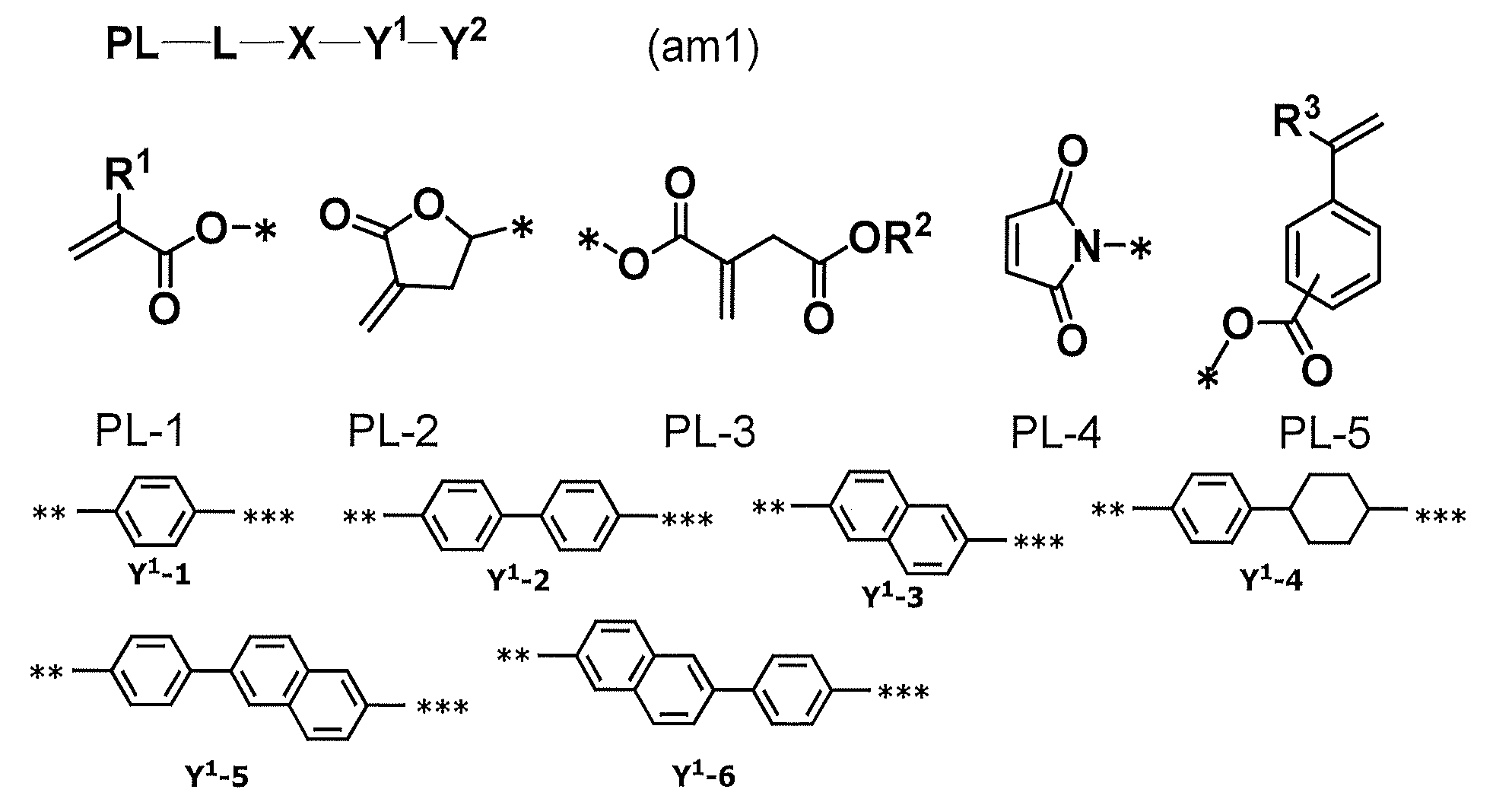
本発明の重合体組成物は、液晶性を発現し得る感光性の側鎖型高分子(以下、単に側鎖型高分子とも呼ぶ)を有しており、前記重合体組成物を用いて得られる塗膜は、液晶性を発現し得る感光性の側鎖型高分子を有する膜である。この塗膜にはラビング処理を行うこと無く、偏光照射によって配向処理を行う。そして、偏光照射の後、その側鎖型高分子膜を加熱する工程を経て、配向制御能が付与された塗膜(以下、液晶配向膜とも称する)となる。このとき、偏光照射によって発現した僅かな異方性がドライビングフォースとなり、液晶性の側鎖型高分子自体が自己組織化により効率的に再配向する。その結果、液晶配向膜として高効率な配向処理が実現し、高い配向制御能が付与された液晶配向膜を得ることができる。
以下、本発明の実施形態について詳しく説明する。
横電界駆動用の導電膜を有する基板上、特に導電膜上に、重合体組成物を塗布する。
本発明の製造方法に用いられる、該重合体組成物は、
(A)所定の温度範囲で液晶性を発現する感光性の側鎖型高分子、(B)有機溶媒を含有する重合体組成物において、(A)成分である樹脂が、下記式(a)で表される側鎖を含有することを特徴とする。
(A)成分は、所定の温度範囲で液晶性を発現する感光性の側鎖型高分子である。
(A)側鎖型高分子は、250nm~400nmの波長範囲の光で反応し、かつ100℃~300℃の温度範囲で液晶性を示すのがよい。
(A)側鎖型高分子は、250nm~400nmの波長範囲の光に反応する感光性側鎖を有することが好ましい。
(A)側鎖型高分子は、100℃~300℃の温度範囲で液晶性を示すためメソゲン基を有することが好ましい。
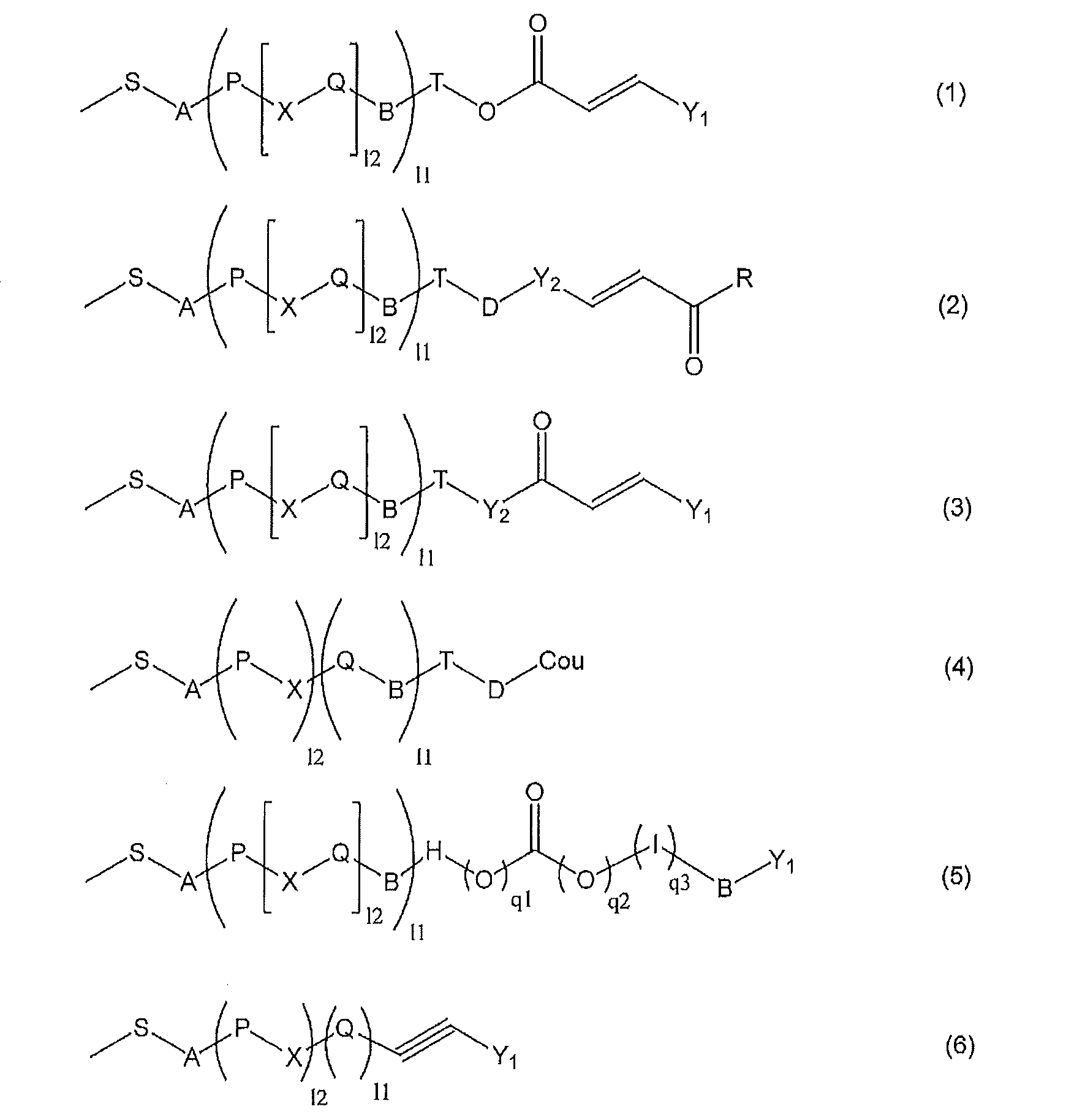
Sは、炭素数1~12のアルキレン基であり、それらに結合する水素原子はハロゲン基に置き換えられていてもよい;
Tは、単結合または炭素数1~12のアルキレン基であり、それらに結合する水素原子はハロゲン基に置き換えられていてもよい;
Y1は、1価のベンゼン環、ナフタレン環、ビフェニル環、フラン環、ピロール環および炭素数5~8の脂環式炭化水素から選ばれる環を表すか、それらの置換基から選ばれる同一又は相異なった2~6の環が結合基Bを介して結合してなる基であり、それらに結合する水素原子はそれぞれ独立に-COOR0(式中、R0は水素原子又は炭素数1~5のアルキル基を表す)、-NO2、-CN、-CH=C(CN)2、-CH=CH-CN、ハロゲン基、炭素数1~5のアルキル基、又は炭素数1~5のアルキルオキシ基で置換されても良い;
Y2は、2価のベンゼン環、ナフタレン環、ビフェニル環、フラン環、ピロール環、炭素数5~8の脂環式炭化水素、および、それらの組み合わせからなる群から選ばれる基であり、それらに結合する水素原子はそれぞれ独立に-NO2、-CN、-CH=C(CN)2、-CH=CH-CN、ハロゲン基、炭素数1~5のアルキル基、又は炭素数1~5のアルキルオキシ基で置換されても良い;
Rは、ヒドロキシ基、炭素数1~6のアルコキシ基を表すか、又はY1と同じ定義を表す;
Xは、単結合、-COO-、-OCO-、-N=N-、-CH=CH-、-C≡C-、-CH=CH-CO-O-、又は-O-CO-CH=CH-を表し、Xの数が2となるときは、X同士は同一でも異なっていてもよい;
Couは、クマリン-6-イル基またはクマリン-7-イル基を表し、それらに結合する水素原子はそれぞれ独立に-NO2、-CN、-CH=C(CN)2、-CH=CH-CN、ハロゲン基、炭素数1~5のアルキル基、又は炭素数1~5のアルキルオキシ基で置換されても良い;
q1とq2は、一方が1で他方が0である;
q3は0または1である;
P及びQは、各々独立に、2価のベンゼン環、ナフタレン環、ビフェニル環、フラン環、ピロール環、炭素数5~8の脂環式炭化水素、および、それらの組み合わせからなる群から選ばれる基である;ただし、Xが-CH=CH-CO-O-、-O-CO-CH=CH-である場合、-CH=CH-が結合する側のP又はQは芳香環であり、Pの数が2以上となるときは、P同士は同一でも異なっていてもよく、Qの数が2以上となるときは、Q同士は同一でも異なっていてもよい;
l1は0または1である;
l2は0~2の整数である;
l1とl2がともに0であるときは、Tが単結合であるときはAも単結合を表す;
l1が1であるときは、Tが単結合であるときはBも単結合を表す;
H及びIは、各々独立に、2価のベンゼン環、ナフタレン環、ビフェニル環、フラン環、ピロール環、およびそれらの組み合わせから選ばれる基である。
式中、A、B、D、Y1、X、Y2、及びRは、上記と同じ定義を有する;
lは1~12の整数を表す;
mは、0~2の整数を表し、m1、m2は1~3の整数を表す;
nは0~12の整数(ただしn=0のときBは単結合である)を表す。
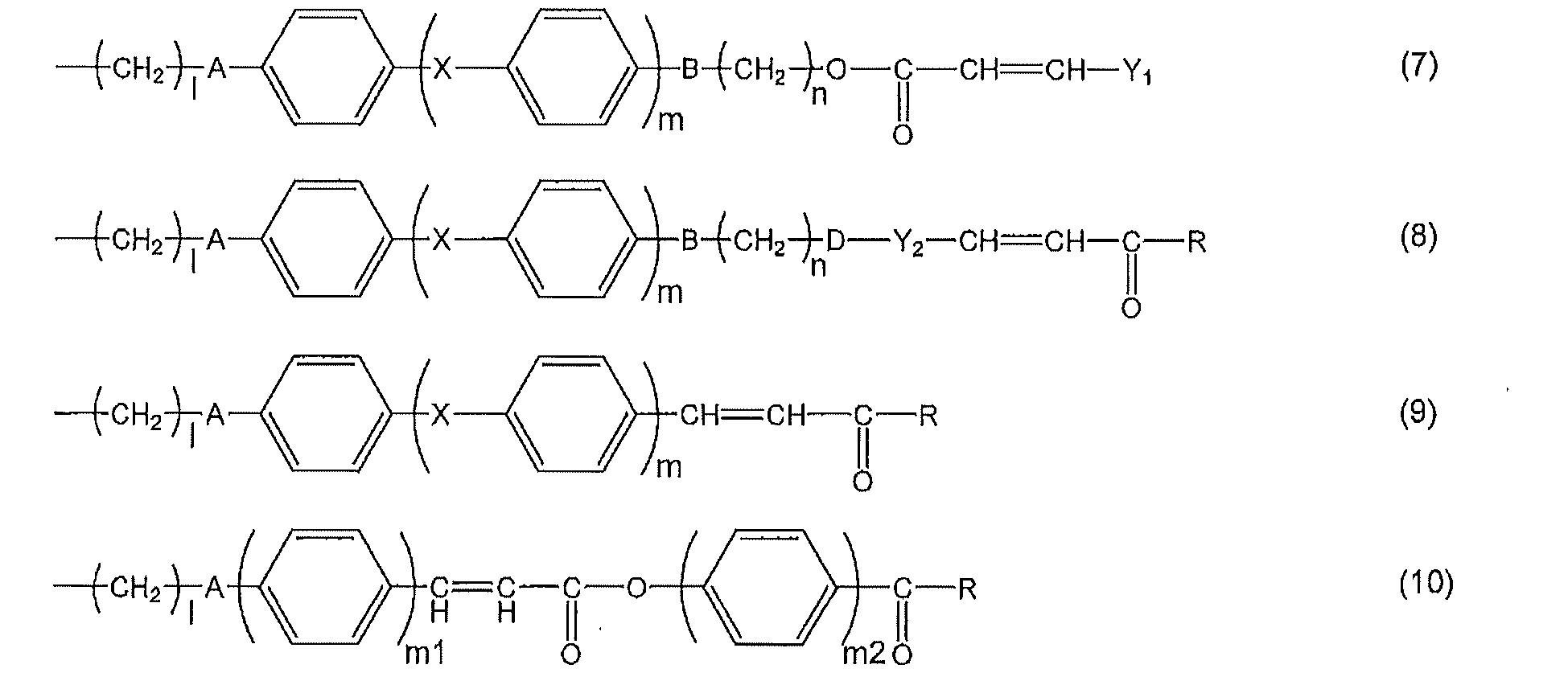
式中、A、X、l、m、m1及びRは、上記と同じ定義を有する。
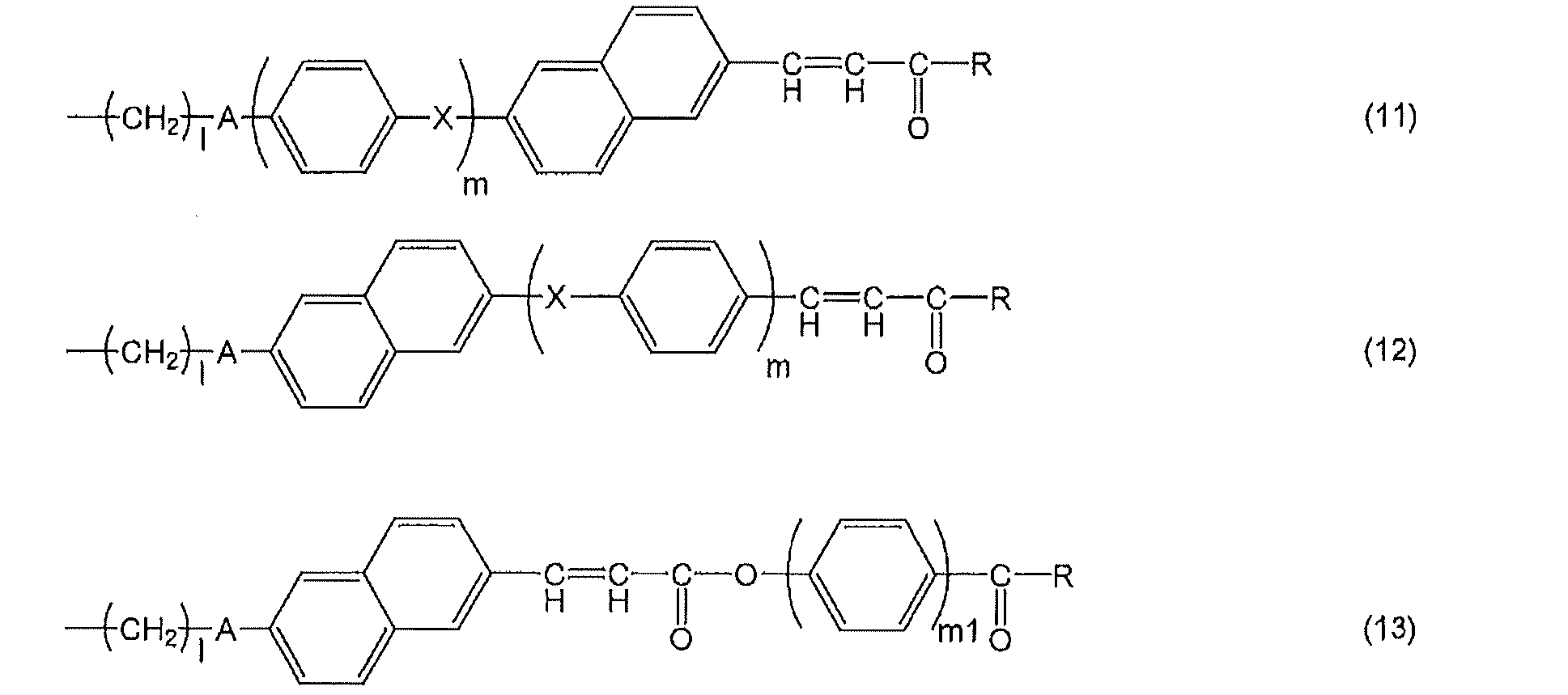
式中、A、Y1、l、m1及びm2は上記と同じ定義を有する。
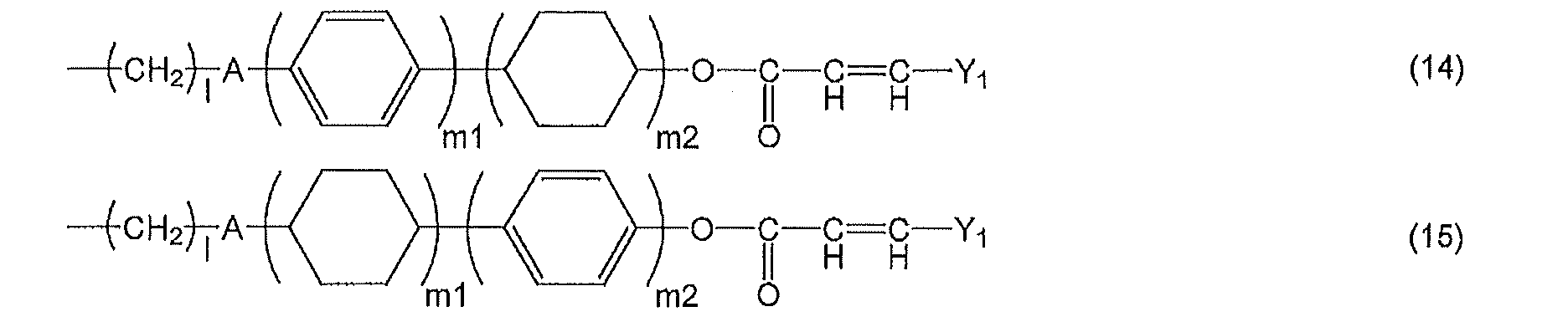
式中、A、X、l及びmは、上記と同じ定義を有する。
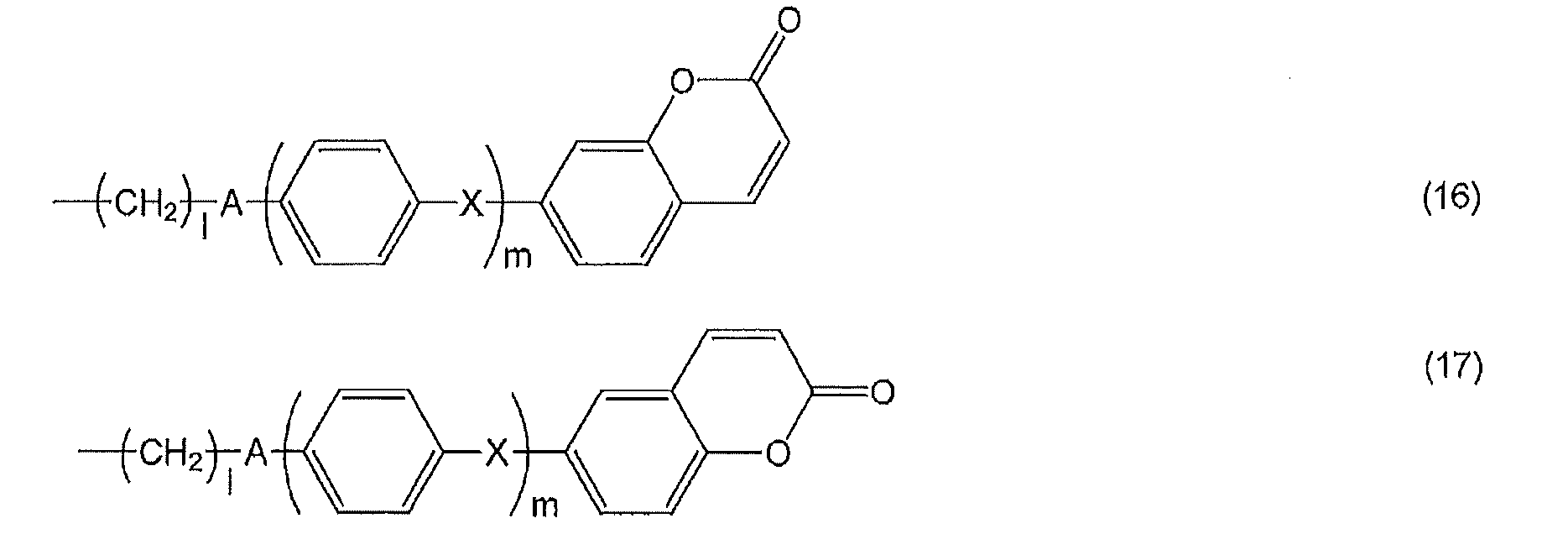
式中、A、B、Y1、q1、q2、m1、及びm2は、上記と同じ定義を有する。
R1は、水素原子、-NO2、-CN、-CH=C(CN)2、-CH=CH-CN、ハロゲン基、炭素数1~5のアルキル基、又は炭素数1~5のアルキルオキシ基を表す。

式中、A、Y1、X、l及びmは上記と同じ定義を有する。

式(a)中、Lは炭素数1から16の直鎖又は分岐鎖のアルキレンである。
XはCH2-CH2、CH=CHまたはC≡Cを表す。
Y1は、各々独立に、ハロゲン基、炭素数1~10の直鎖又は分岐鎖のアルキル基、炭素数1~10の直鎖又は分岐鎖のアルコキシ基、ヒドロキシル基、シアノ基、ジアルキルアミノ基(アルキル基は、各々独立に、炭素数1~10の直鎖又は分岐鎖のアルキル基である)、炭素数1~10の直鎖又は分岐鎖のエステル基、炭素数1~10の直鎖又は分岐鎖のアシル基、カルボキシル基、アルデヒド基及びニトロ基から選ばれる置換基で置換されてもよい下記式Y1-1からY1-6を表す(**はXとの結合位置を表し、***はY2との結合位置を表す。)。
R3及びR4は、それぞれ独立に水素原子又はメチル基を表す。
R5及びR6は、それぞれ独立に水素原子又はメチル基を表す。
Y3は、各々独立に、ハロゲン基、炭素数1~10の直鎖又は分岐鎖のアルキル基、炭素数1~10の直鎖又は分岐鎖のアルコキシ基、ヒドロキシル基、シアノ基、ジアルキルアミノ基(アルキル基は、各々独立に、炭素数1~10の直鎖又は分岐鎖のアルキル基である)、炭素数1~10の直鎖又は分岐鎖のエステル基、炭素数1~10の直鎖又は分岐鎖のアシル基、カルボキシル基、アルデヒド基、及びニトロ基から選ばれる置換基で置換されてもよいフェニル基、ビフェニル基、ナフチル基、炭素数5~8の脂環式炭化水素、フェニル‐シクロヘキシル基又はシクロヘキシル-フェニル基を表す。
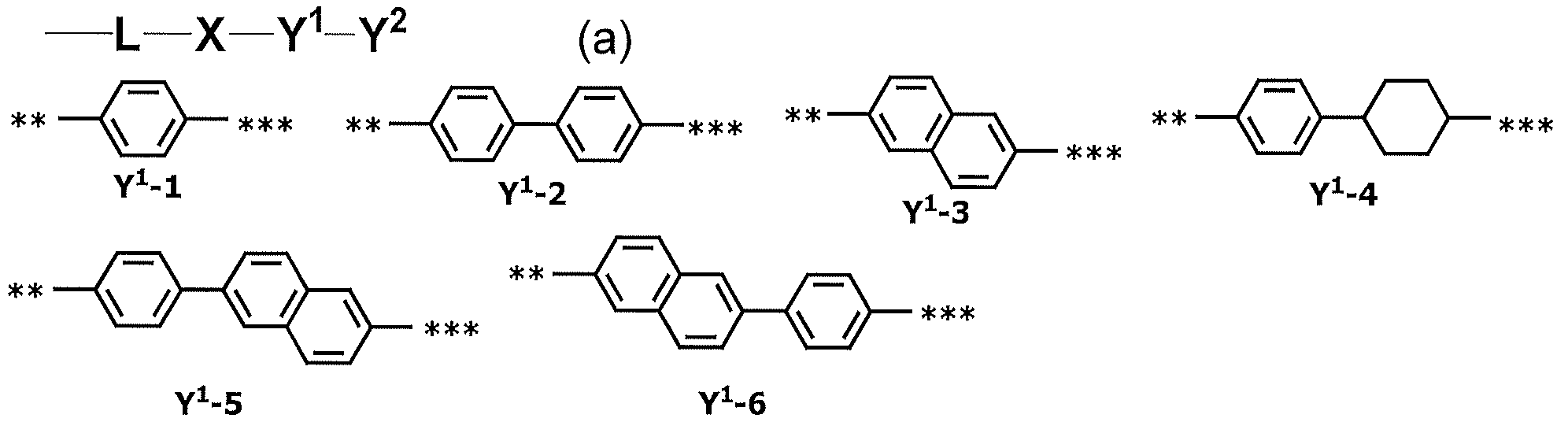
式中、A、B、q1及びq2は上記と同じ定義を有する;
Y3は、1価のベンゼン環、ナフタレン環、ビフェニル環、フラン環、窒素含有複素環、及び炭素数5~8の脂環式炭化水素、および、それらの組み合わせからなる群から選ばれる基であり、それらに結合する水素原子はそれぞれ独立に-NO2、-CN、ハロゲン基、炭素数1~5のアルキル基、又は炭素数1~5のアルキルオキシ基で置換されても良い;
R3は、水素原子、-NO2、-CN、-CH=C(CN)2、-CH=CH-CN、ハロゲン基、1価のベンゼン環、ナフタレン環、ビフェニル環、フラン環、窒素含有複素環、炭素数5~8の脂環式炭化水素、炭素数1~12のアルキル基、又は炭素数1~12のアルコキシ基を表す;
lは1~12の整数を表し、mは0から2の整数を表し、但し、式(23)~(24)において、全てのmの合計は2以上であり、式(25)~(26)において、全てのmの合計は1以上であり、m1、m2およびm3は、それぞれ独立に1~3の整数を表す;
R2は、水素原子、-NO2、-CN、ハロゲン基、1価のベンゼン環、ナフタレン環、ビフェニル環、フラン環、窒素含有複素環、炭素数5~8の脂環式炭化水素、アルキル基、又はアルキルオキシ基を表す;
Z1、Z2は単結合、-CO-、-CH2O-、-CH=N-、-CF2-を表す。
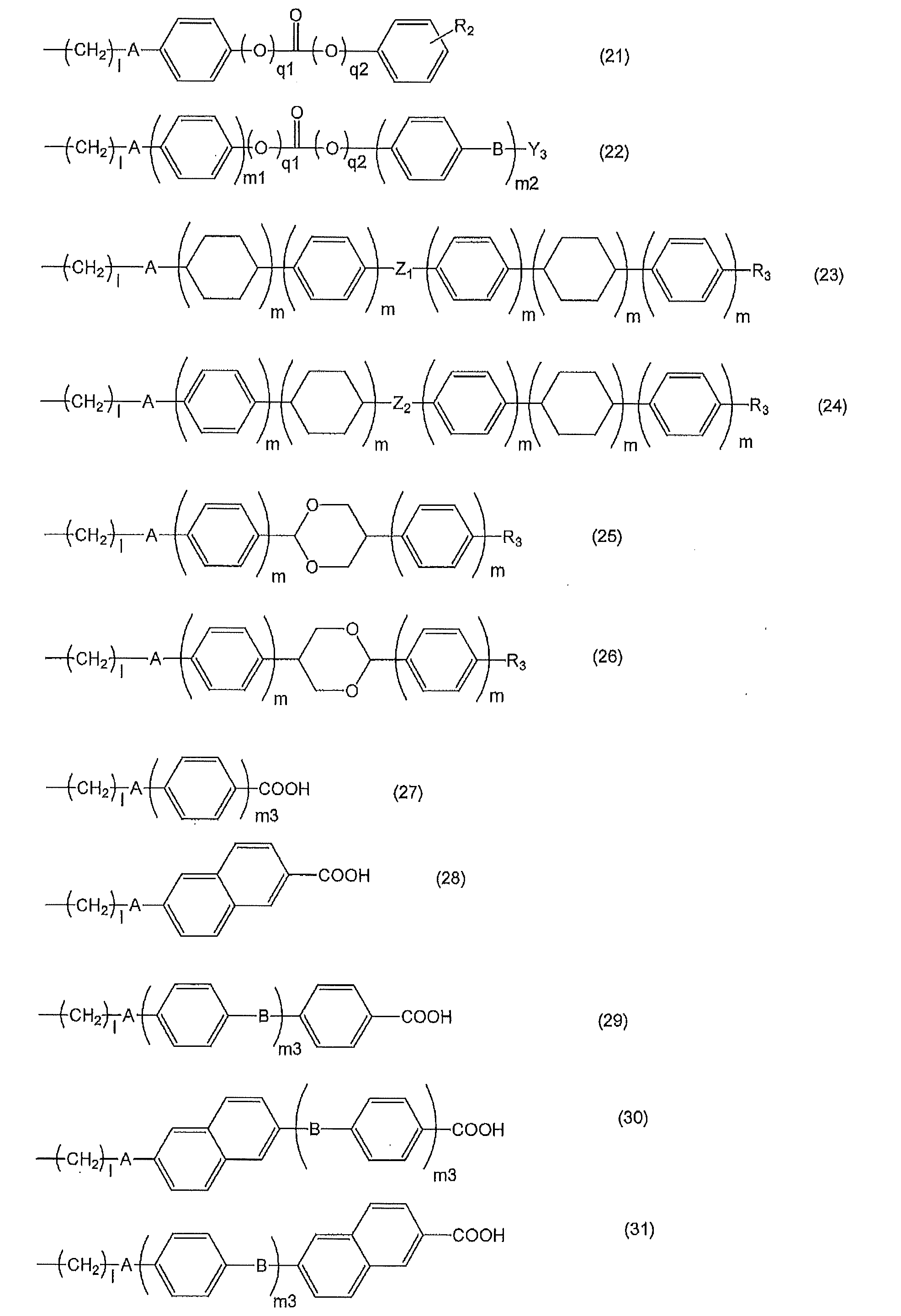
上記の液晶性を発現し得る感光性の側鎖型高分子は、上記の感光性側鎖を有する光反応性側鎖モノマーおよび液晶性側鎖モノマーを重合することによって得ることができる。
光反応性側鎖モノマーとは、高分子を形成した場合に、高分子の側鎖部位に感光性側鎖を有する高分子を形成することができるモノマーのことである。
側鎖の有する光反応性基としては下記の構造およびその誘導体が好ましい。

式(a)で表される構造単位を有するモノマーとしては、下記式(am1)で表される化合物が挙げられる。
式(am1)中、PLは重合可能な基であり、下記式PL-1~PL-5からなる群から選ばれる重合性基を表す。式PL-1~PL-5中、R1及びR2、R3は、水素原子、炭素数1~10の直鎖又は分岐鎖のアルキル基、又はハロゲンで置換された炭素数1~10の直鎖又は分岐鎖のアルキル基を表す(*は、Lとの結合位置を表す)。

XはCH2-CH2、CH=CHまたはC≡Cを表す。
Y1は、各々独立に、ハロゲン基、炭素数1~10の直鎖又は分岐鎖のアルキル基、炭素数1~10の直鎖又は分岐鎖のアルコキシ基、ヒドロキシル基、シアノ基、ジアルキルアミノ基(アルキル基は、各々独立に、炭素数1~10の直鎖又は分岐鎖のアルキル基である)、炭素数1~10の直鎖又は分岐鎖のエステル基、炭素数1~10の直鎖又は分岐鎖のアシル基、カルボキシル基、アルデヒド基及びニトロ基から選ばれる置換基で置換されてもよい下記式Y1-1からY1-6を表す(**はXとの結合位置を表し、***はY2との結合位置を表す。)。

R3及びR4は、それぞれ独立に水素原子又はメチル基を表す。
R5及びR6は、それぞれ独立に水素原子又はメチル基を表す。
Y3は、各々独立に、ハロゲン基、炭素数1~10の直鎖又は分岐鎖のアルキル基、炭素数1~10の直鎖又は分岐鎖のアルコキシ基、ヒドロキシル基、シアノ基、ジアルキルアミノ基(アルキル基は、各々独立に、炭素数1~10の直鎖又は分岐鎖のアルキル基である)、炭素数1~10の直鎖又は分岐鎖のエステル基、炭素数1~10の直鎖又は分岐鎖のアシル基、カルボキシル基、アルデヒド基、及びニトロ基から選ばれる置換基で置換されてもよいフェニル基、ビフェニル基、ナフチル基、炭素数5~8の脂環式炭化水素、フェニル‐シクロヘキシル基又はシクロヘキシル-フェニル基を表す。
[三重結合を有する末端カルボン酸モノマーの製造]
三重結合を有する末端カルボン酸型モノマー(am1)の具体例としては、下記式(I-1)から(I-6)が挙げられる。
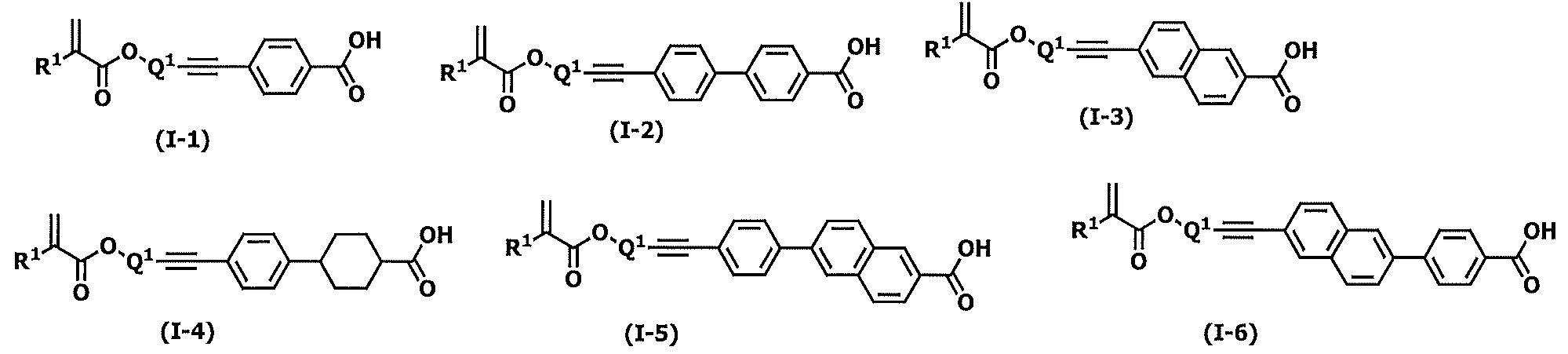
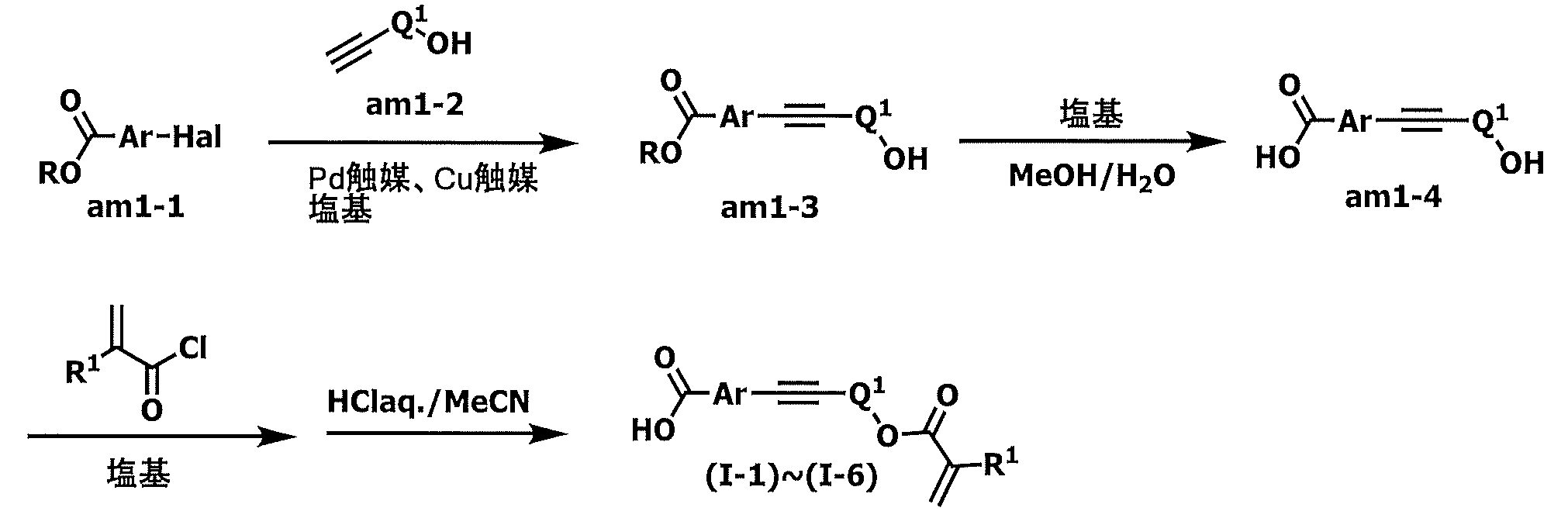

(am1-1-4)は、特許文献(WO 2010071335)を参考にすることで合成できる。
(am1-1-5)は、文献(Bioorganic & Medicinal Chemistry Letters, 18(15),4339-4343; 2008)から合成することができる(am1-1-5a)とトリフルオロメタンスルホン酸無水物を反応させることにより得ることができる。


金属錯体触媒としては、種々の構造のものを用いることができるが、いわゆる低原子価のパラジウム錯体又はニッケル錯体を用いることが好ましく、特に3級ホスフィンや3級ホスファイトを配位子とするゼロ価金属錯体触媒が好ましい。また、反応系中で容易にゼロ価金属錯体触媒に変換される適当な前駆体を用いることもできる。さらに、反応系中で、3級ホスフィンや3級ホスファイトを配位子として含まない金属錯体と、配位子である3級ホスフィンや3級ホスファイトとを混合し、3級ホスフィンや3級ホスファイトを配位子とする低原子価金属錯体触媒を生成させることもできる。
これらパラジウム錯体の使用量は、いわゆる触媒量で良く、好ましくは、化合物am1-1に対して20モル%以下であり、特に好ましくは10モル%以下である。同時に助触媒として使用される銅触媒は1価のものが好ましく、例えば、塩化銅(I)、臭化銅(I)、ヨウ化銅(I)、酢酸銅(I)などが挙げられる。
上記反応により得られた化合物am1-3は、蒸留、再結晶、又はシリカゲルなどのカラムクロマトグラフィーなどで精製するのが好ましい。なお、再結晶はできるだけ低温で行うのが好ましい。
単結合を有する末端カルボン酸型モノマー(am1)の具体例としては、下記式(II-1)から(II-6)が挙げられる。
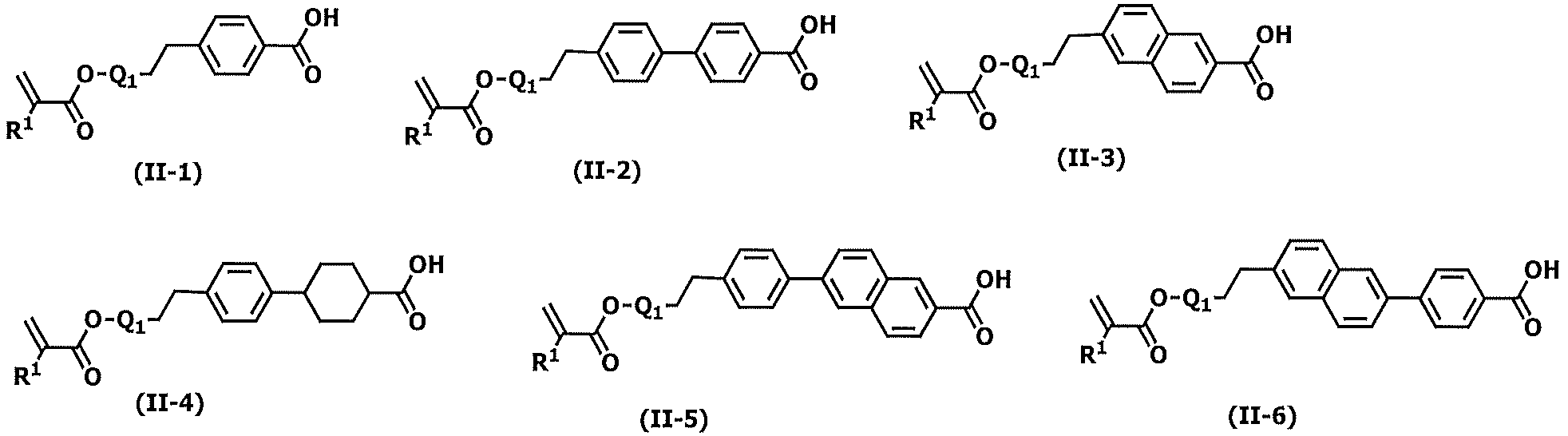
式(am1)中、Xが-CH2-CH2-である化合物am1を製造する際には、化合物am1-4を還元してから、塩化アクリル又は塩化メタクリルと反応させた後に酸加水分解すればよい。

上記に例示の還元反応のうち、基質である化合物am1-4の構造と還元反応の反応性を考慮すると、水素添加反応の使用が好ましい。
使用する触媒としては、市販品として入手できる活性炭担持金属、例えば、パラジウム-活性炭、白金-活性炭、ロジウム-活性炭などがある。また、水酸化パラジウム、酸化白金、ラネーニッケルなど必ずしも活性炭担持型の金属触媒でなくてもよい。一般的に広く使用されているパラジウム-活性炭の使用でも良好な結果が得られる。
これらの溶媒は、反応の起こり易さなどを考慮して適宜選択することができ、1種単独で又は2種以上混合して用いることができる。また場合によっては、上記溶媒は、適当な脱水剤や乾燥剤を用いて水を含有しない溶媒として用いることもできる。
さらに、反応をより効果的に進行させるため、加圧下で反応を実施することもできる。この場合、ベンゼン核の還元を避けるため、好ましくは20気圧(kgf)程度の加圧範囲、より好ましくは10気圧までの範囲で反応を実施する。
反応温度は、好ましくは、-100 ℃以上から使用する反応溶媒の沸点の温度までの温度範囲を選ぶことができるが、より好ましくは、-50~150 ℃、特に好ましくは0~80℃である。反応時間は、0.1~1000時間、より好ましくは1~200時間である。
上記還元反応により得られた化合物am1-5は、蒸留、再結晶、又はシリカゲルなどのカラムクロマトグラフィーなどで精製するのが好ましい。
三重結合を有する桂皮酸・桂皮酸エステル型モノマー(am1)の具体例としては、下記式(III-1)から(III-7)が挙げられる。
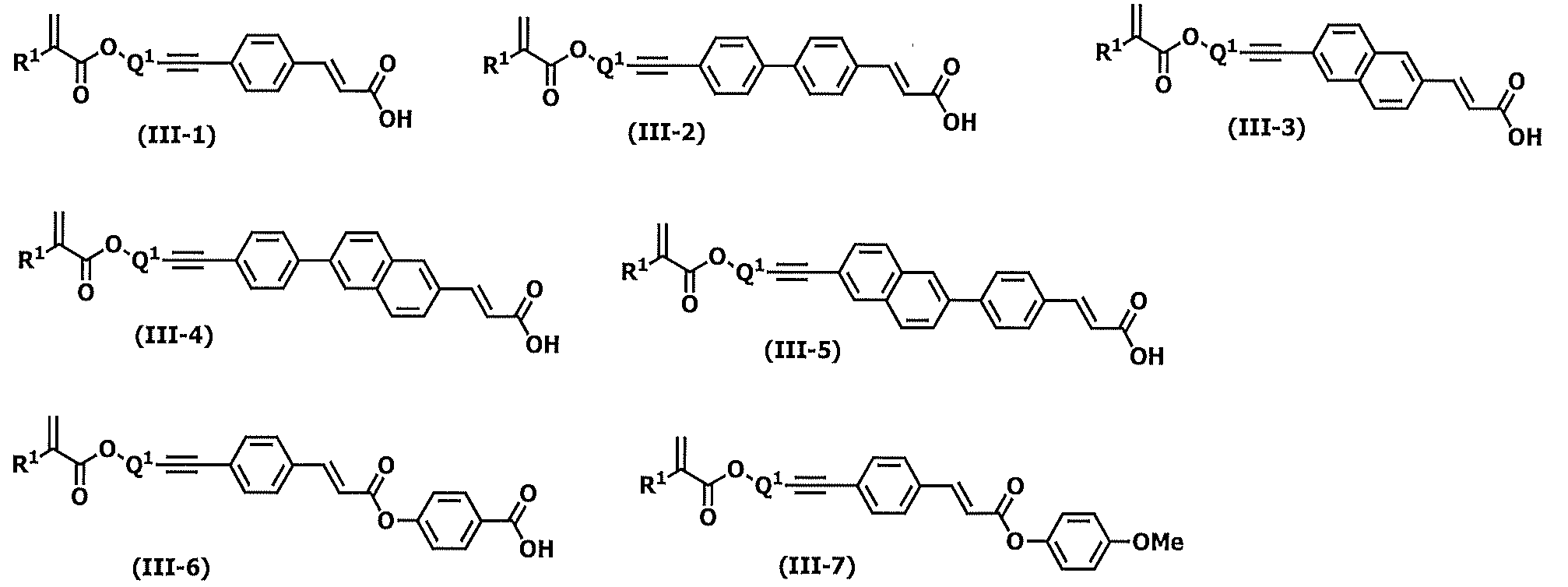
次に、得られたam1-7とアクリル酸 tert-ブチル(am1-8)を、金属錯体、配位子、及び塩基の共存下に、Heck反応などのカップリング反応を行うことにより、am1-9が製造される。
最後に、得られたam1-9を、塩化アクリルまたは塩化メタクリルと反応させ、酸加水分解することにより、三重結合を有するモノマー(III-1)から(III-5)を製造することができる。
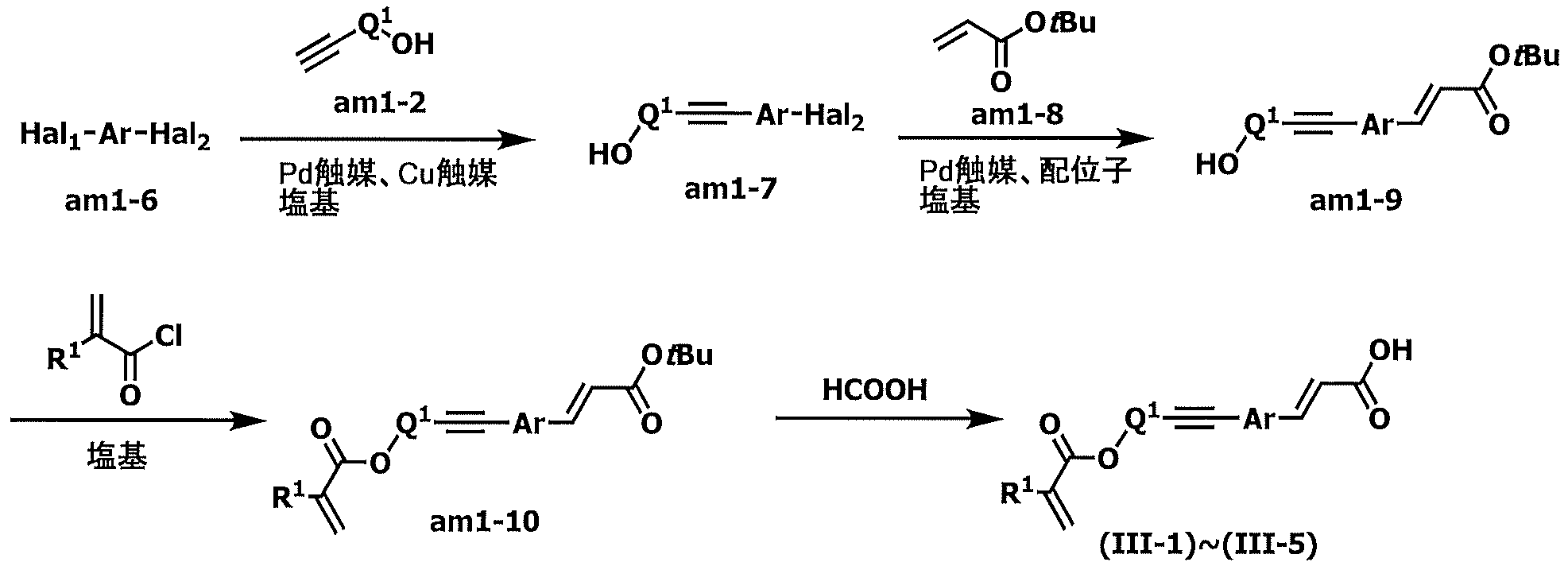

(am1-6-4)は、特許文献(特開2015-078153)から合成することができる(am1-6-4a)とトリフルオロメタンスルホン酸無水物を反応させることにより得ることができる。


金属錯体触媒としては、種々の構造のものを用いることができるが、いわゆる低原子価のパラジウム錯体又はニッケル錯体を用いることが好ましく、特に3級ホスフィンや3級ホスファイトを配位子とするゼロ価金属錯体触媒が好ましい。また、反応系中で容易にゼロ価金属錯体触媒に変換される適当な前駆体を用いることもできる。さらに、反応系中で、3級ホスフィンや3級ホスファイトを配位子として含まない金属錯体と、配位子である3級ホスフィンや3級ホスファイトとを混合し、3級ホスフィンや3級ホスファイトを配位子とする低原子価金属錯体触媒を生成させることもできる。
これらパラジウム錯体の使用量は、いわゆる触媒量で良く、好ましくは、化合物am1-1に対して20モル%以下であり、特に好ましくは10モル%以下である。
上記反応により得られた化合物am1-9は、蒸留、再結晶、又はシリカゲルなどのカラムクロマトグラフィーなどで精製するのが好ましい。なお、再結晶はできるだけ低温で行うのが好ましい。
単結合を有する桂皮酸・桂皮酸エステル型モノマー(am1)の具体例としては、下記式(IV-1)から(IV-7)が挙げられる。

得られたam1-11をam1-8とHeck反応することでam-1-12を製造する。続いて、塩化アクリル又は塩化メタクリルと反応させた後にギ酸により加水分解すればよい化合物(IV-1)から(IV-5)を製造する事ができる。
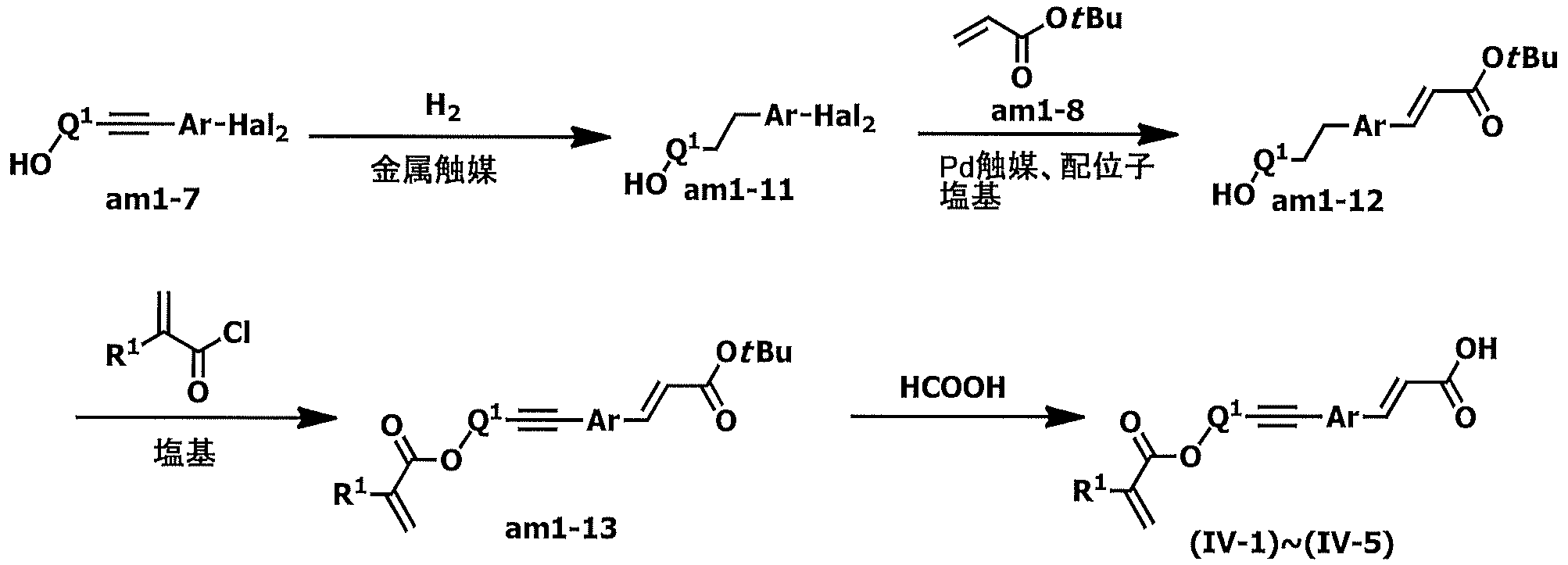
am1-12は、am1-9の合成法と同じ方法で製造することができる。
三重結合を有す非カルボン酸型モノマー(am1)の具体例としては、下記式(V-1)から(V-6)が挙げられる。
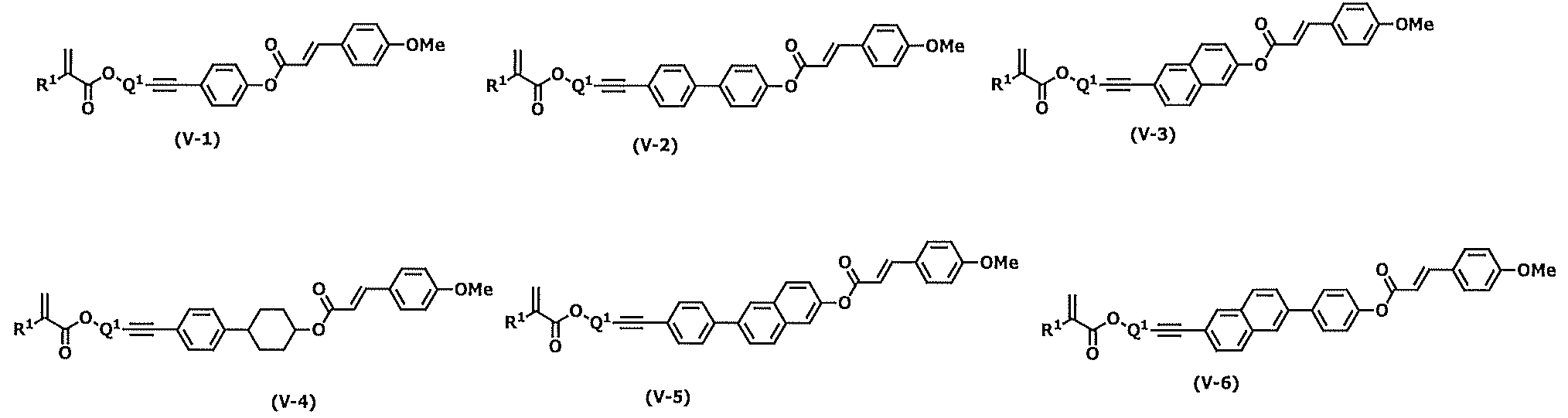
次に、縮合剤及び塩基存在下、得られたam1-16と桂皮酸誘導体(am1-17)を反応させることによりam1-18を製造する。


am1-16は、am1-15を原料として、am1-3合成法と同じ方法により製造することができる。
am1-16は、am1-6とam1-14を、am1-3合成法と同じ手法でam1-16aを得た後に、有機金属試薬(am1-16b)、金属触媒を用いる鈴木-宮浦反応させることにより得ることができる。

反応時間は、通常、0.05~100時間、好ましくは0.5~40時間、より好ましくは0.5~24時間である。
上記のようにして得られたam1-16は、反応後にスラリー洗浄、再結晶、シリカゲルカラムクロマトグラフィーなどで精製することにより高純度化することができる。
これらの溶媒は、反応の起こり易さなどを考慮して適宜選択することができ、1種単独で又は2種以上混合して用いることができる。また場合によっては、上記溶媒は、適当な脱水剤や乾燥剤を用いて水を含有しない溶媒として用いることもできる。
上記反応により得られた化合物am1-18は、蒸留、再結晶、又はシリカゲルなどのカラムクロマトグラフィーなどで精製するのが好ましい。
単結合を有す非カルボン酸型モノマー(am1)の具体例としては、下記式(VI-1)から(VI-6)が挙げられる。

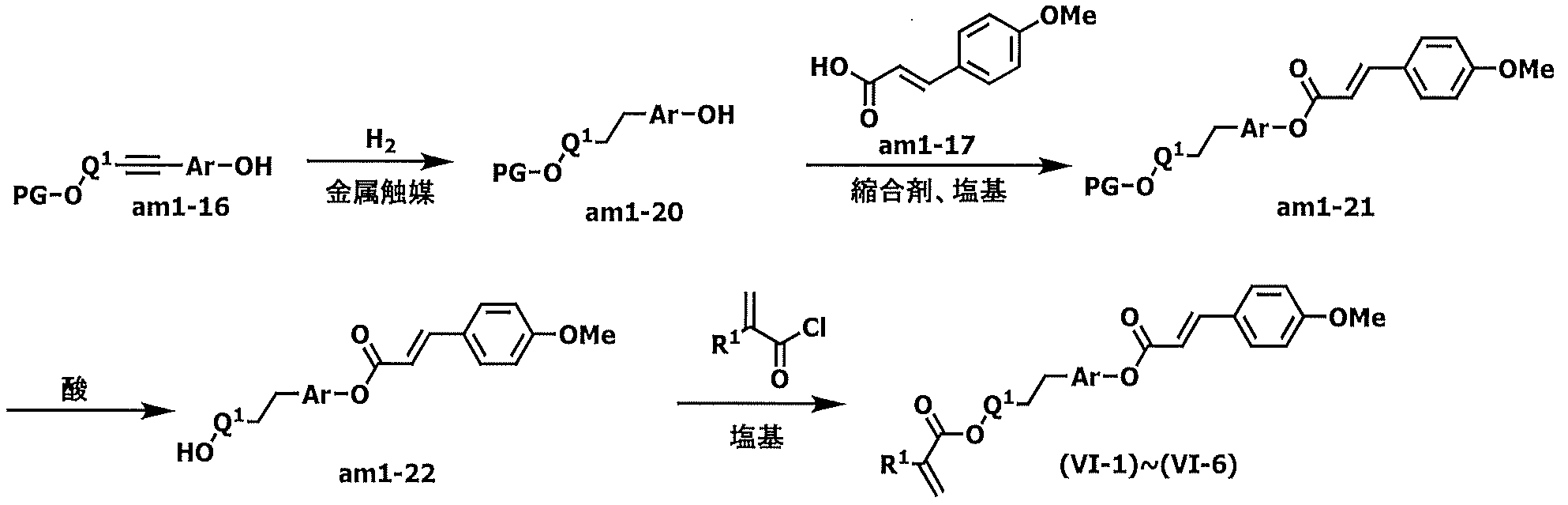
am1-21は、am1-18合成法と同じ製造方法で製造することができる。
am1-22は、am1-19合成法と同じ製造方法で製造することができる。
am1-22をトリエチルアミンなどの塩基存在下、塩化アクリルまたは塩化メタクリルと反応させることで(VI-1)から(VI-6)を得ることができる。
α-メチレン-γ-ブチロラクトン型モノマー(am1)の具体例としては、下記式(VII-1)から(VII-6)が挙げられる。式中、Q1は炭素数1から16の直鎖のアルキレンである。式中、Q2は炭素数1から4の直鎖のアルキレン基である。Rはメチル基、エチル基を表す。Rとしては水素原子又はC1-4アルキル基が挙げられる。Arは式(am1)の(Y1-1)~(Y1-6)を表す。
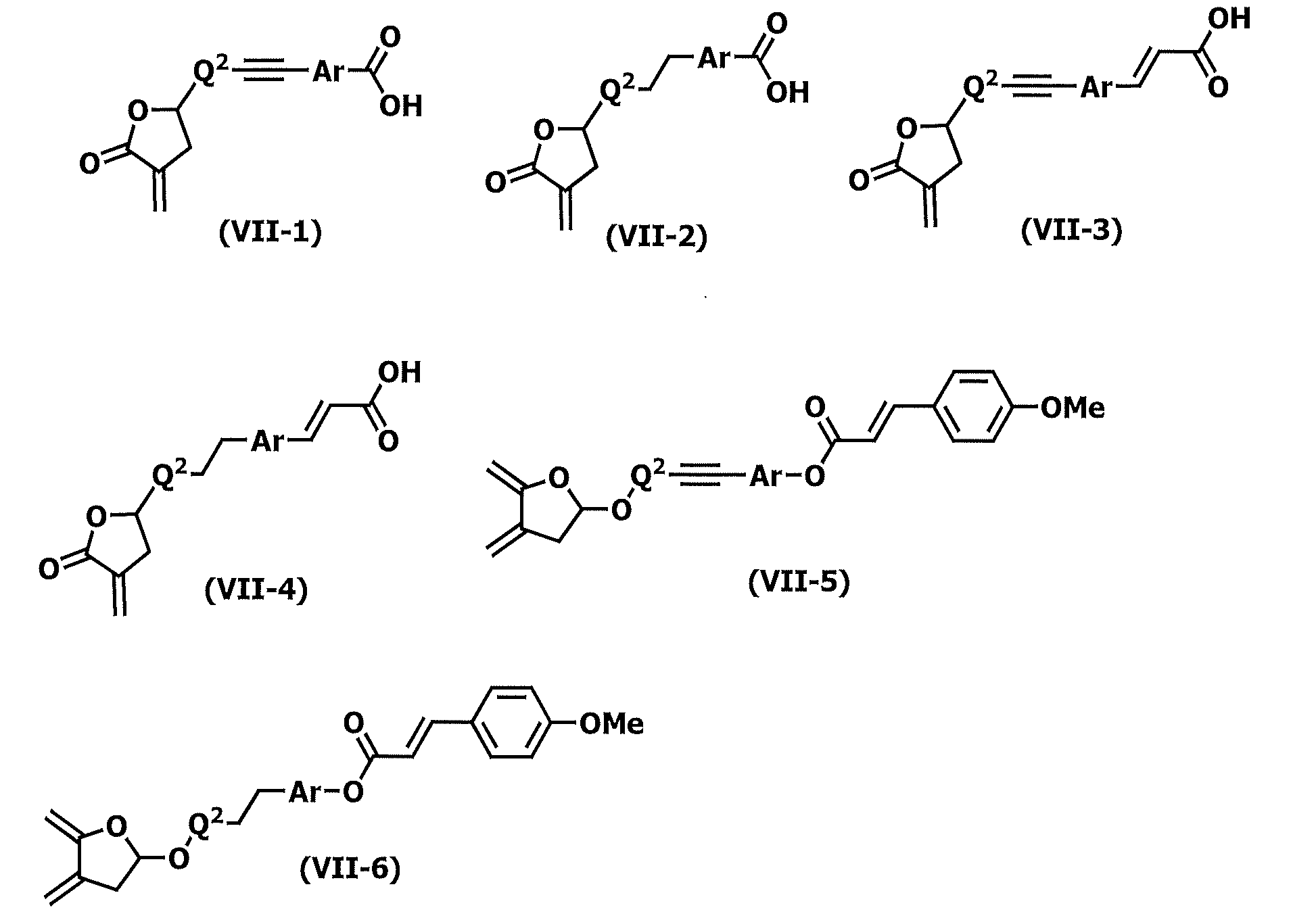

反応時間は、通常、0.05~200時間、好ましくは0.5~60時間である。
液晶性側鎖モノマーとは、該モノマー由来の高分子が液晶性を発現し、該高分子が側鎖部位にメソゲン基を形成することができるモノマーのことである。
側鎖を有するメソゲン基として、ビフェニルやフェニルベンゾエートなどの単独でメソゲン構造となる基であっても、安息香酸などのように側鎖同士が水素結合することでメソゲン構造となる基であってもよい。側鎖を有するメソゲン基としては下記の構造が好ましい。
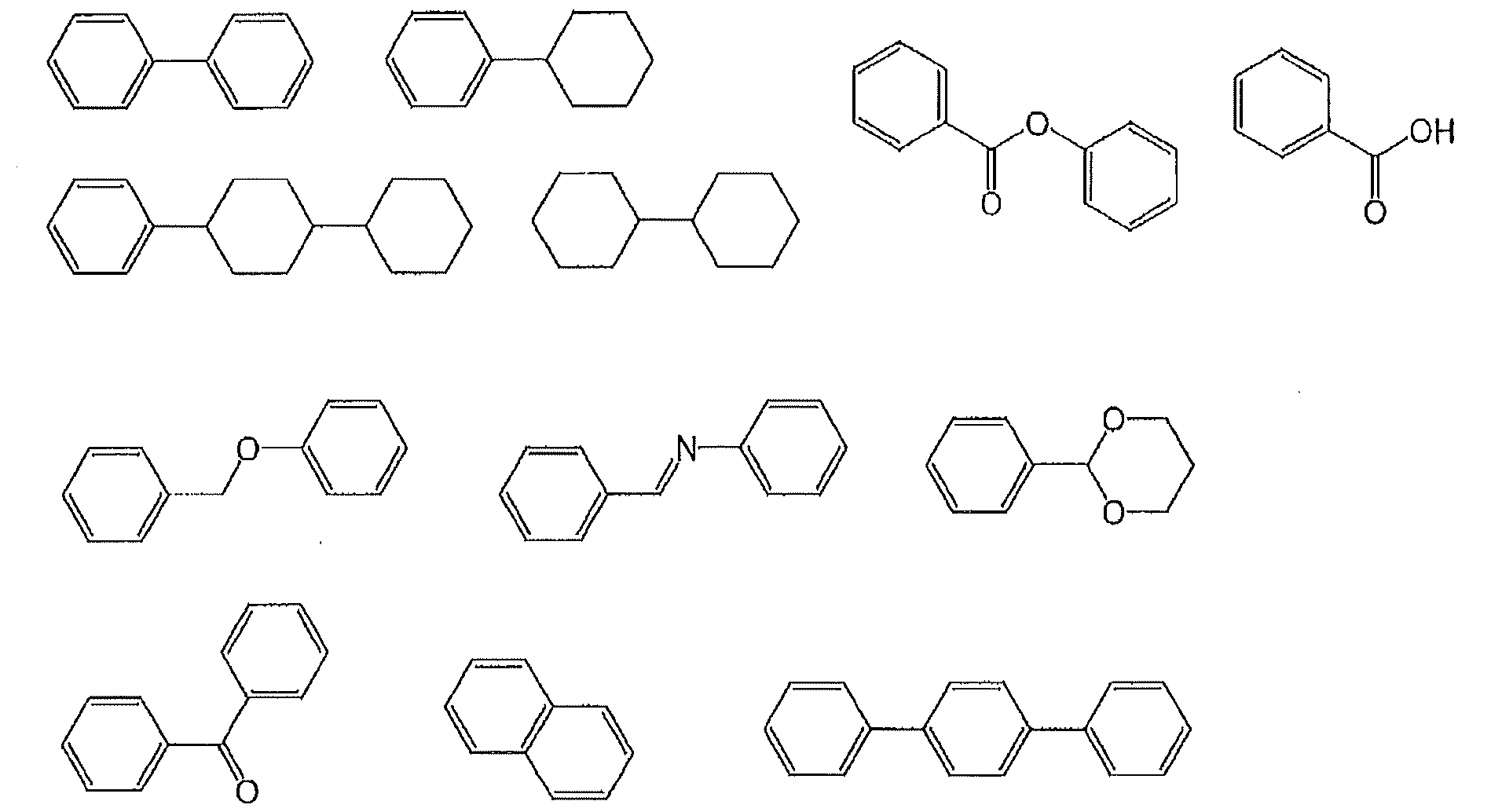
その他のモノマーの具体例としては、不飽和カルボン酸、アクリル酸エステル化合物、メタクリル酸エステル化合物、マレイミド化合物、アクリロニトリル、マレイン酸無水物、スチレン化合物及びビニル化合物等が挙げられる。
アクリル酸エステル化合物としては、例えば、メチルアクリレート、エチルアクリレート、イソプロピルアクリレート、ベンジルアクリレート、ナフチルアクリレート、アントリルアクリレート、アントリルメチルアクリレート、フェニルアクリレート、2,2,2-トリフルオロエチルアクリレート、tert-ブチルアクリレート、シクロヘキシルアクリレート、イソボルニルアクリレート、2-メトキシエチルアクリレート、メトキシトリエチレングリコールアクリレート、2-エトキシエチルアクリレート、テトラヒドロフルフリルアクリレート、3-メトキシブチルアクリレート、2-メチル-2-アダマンチルアクリレート、2-プロピル-2-アダマンチルアクリレート、8-メチル-8-トリシクロデシルアクリレート、及び、8-エチル-8-トリシクロデシルアクリレート等が挙げられる。
スチレン化合物としては、例えば、スチレン、メチルスチレン、クロロスチレン、ブロモスチレン等が挙げられる。
マレイミド化合物としては、例えば、マレイミド、N-メチルマレイミド、N-フェニルマレイミド、及びN-シクロヘキシルマレイミド等が挙げられる。
本発明の側鎖型高分子における光反応性側鎖の含有量は、液晶配向性といった点から、10モル%~90モル%が好ましく、15モル%~85モル%がより好ましく、20モル%~80モル%が更に好ましい。
本発明の側鎖型高分子における液晶性側鎖の含有量は、液晶配向性といった点から、5モル%~95モル%が好ましく、10モル%~90モル%がより好ましく、15モル%~85モル%が更に好ましい。
本発明の側鎖型高分子は、上記式(a)で表される側鎖、光反応性側鎖及び液晶性側鎖以外のその他側鎖を含有していてもよい。その含有量は、上記式(a)で表される側鎖、光反応性側鎖及び液晶性側鎖の含有量の合計が100モル%に満たない場合に、その残りの部分である。
ラジカル重合の重合開始剤としては、ラジカル重合開始剤や、可逆的付加-開裂型連鎖移動(RAFT)重合試薬等の公知の化合物を使用することができる。
また、ラジカル重合において有機溶媒中の酸素は重合反応を阻害する原因となるので、有機溶媒は可能な程度に脱気されたものを用いることが好ましい。
上述の反応により得られた、液晶性を発現し得る感光性の側鎖型高分子の反応溶液から、生成した高分子を回収する場合には、反応溶液を貧溶媒に投入して、それら重合体を沈殿させれば良い。沈殿に用いる貧溶媒としては、メタノール、アセトン、ヘキサン、ヘプタン、ブチルセルソルブ、ヘプタン、メチルエチルケトン、メチルイソブチルケトン、エタノール、トルエン、ベンゼン、ジエチルエーテル、メチルエチルエーテル、水等を挙げることができる。貧溶媒に投入して沈殿させた重合体は、濾過して回収した後、常圧あるいは減圧下で、常温あるいは加熱して乾燥することができる。また、沈殿回収した重合体を、有機溶媒に再溶解させ、再沈殿回収する操作を2回~10回繰り返すと、重合体中の不純物を少なくすることができる。この際の貧溶媒として、例えば、アルコール類、ケトン類、炭化水素等が挙げられ、これらの中から選ばれる3種類以上の貧溶媒を用いると、より一層精製の効率が上がるので好ましい。
本発明の(A)成分である側鎖型高分子において、式(a)で表される側鎖の含有量は、5~95モル%が好ましく、10~90モル%がより好ましく、20~80モル%が更に好ましい。
本発明に用いられる重合体組成物に用いる有機溶媒は、樹脂成分を溶解させる有機溶媒であれば特に限定されない。その具体例を以下に挙げる。
N,N-ジメチルホルムアミド、N,N-ジメチルアセトアミド、N-メチル-2-ピロリドン、N-メチルカプロラクタム、2-ピロリドン、N-エチルピロリドン、N-ビニルピロリドン、ジメチルスルホキシド、テトラメチル尿素、ピリジン、ジメチルスルホン、ヘキサメチルスルホキシド、γ-ブチロラクトン、3-メトキシ-N,N-ジメチルプロパンアミド、3-エトキシ-N,N-ジメチルプロパンアミド、3-ブトキシ-N,N-ジメチルプロパンアミド、1,3-ジメチル-イミダゾリジノン、エチルアミルケトン、メチルノニルケトン、メチルエチルケトン、メチルイソアミルケトン、メチルイソプロピルケトン、シクロヘキサノン、エチレンカーボネート、プロピレンカーボネート、ジグライム、4-ヒドロキシ-4-メチル-2-ペンタノン、プロピレングリコールモノアセテート、プロピレングリコールモノメチルエーテル、プロピレングリコール-tert-ブチルエーテル、ジプロピレングリコールモノメチルエーテル、ジエチレングリコール、ジエチレングリコールモノアセテート、ジエチレングリコールジメチルエーテル、ジプロピレングリコールモノアセテートモノメチルエーテル、ジプロピレングリコールモノメチルエーテル、ジプロピレングリコールモノエチルエーテル、ジプロピレングリコールモノアセテートモノエチルエーテル、ジプロピレングリコールモノプロピルエーテル、ジプロピレングリコールモノアセテートモノプロピルエーテル、3-メチル-3-メトキシブチルアセテート、トリプロピレングリコールメチルエーテル等が挙げられる。これらは単独で使用しても、混合して使用してもよい。
例えば、イソプロピルアルコール、メトキシメチルペンタノール、メチルセロソルブ、エチルセロソルブ、ブチルセロソルブ、メチルセロソルブアセテート、エチルセロソルブアセテート、ブチルカルビトール、エチルカルビトール、エチルカルビトールアセテート、エチレングリコール、エチレングリコールモノアセテート、エチレングリコールモノイソプロピルエーテル、エチレングリコールモノブチルエーテル、プロピレングリコール、プロピレングリコールモノアセテート、プロピレングリコールモノメチルエーテル、プロピレングリコール-tert-ブチルエーテル、ジプロピレングリコールモノメチルエーテル、ジエチレングリコール、ジエチレングリコールモノアセテート、ジエチレングリコールジメチルエーテル、ジプロピレングリコールモノアセテートモノメチルエーテル、ジプロピレングリコールモノメチルエーテル、ジプロピレングリコールモノエチルエーテル、ジプロピレングリコールモノアセテートモノエチルエーテル、ジプロピレングリコールモノプロピルエーテル、ジプロピレングリコールモノアセテートモノプロピルエーテル、3-メチル-3-メトキシブチルアセテート、トリプロピレングリコールメチルエーテル、3-メチル-3-メトキシブタノール、ジイソプロピルエーテル、エチルイソブチルエーテル、ジイソブチレン、アミルアセテート、ブチルブチレート、ブチルエーテル、ジイソブチルケトン、メチルシクロへキセン、プロピルエーテル、ジヘキシルエーテル、1-ヘキサノール、n-へキサン、n-ペンタン、n-オクタン、ジエチルエーテル、乳酸メチル、乳酸エチル、酢酸メチル、酢酸エチル、酢酸n-ブチル、酢酸プロピレングリコールモノエチルエーテル、ピルビン酸メチル、ピルビン酸エチル、3-メトキシプロピオン酸メチル、3-エトキシプロピオン酸メチルエチル、3-メトキシプロピオン酸エチル、3-エトキシプロピオン酸、3-メトキシプロピオン酸、3-メトキシプロピオン酸プロピル、3-メトキシプロピオン酸ブチル、1-メトキシ-2-プロパノール、1-エトキシ-2-プロパノール、1-ブトキシ-2-プロパノール、1-フェノキシ-2-プロパノール、プロピレングリコールモノアセテート、プロピレングリコールジアセテート、プロピレングリコール-1-モノメチルエーテル-2-アセテート、プロピレングリコール-1-モノエチルエーテル-2-アセテート、ジプロピレングリコール、2-(2-エトキシプロポキシ)プロパノール、乳酸メチルエステル、乳酸エチルエステル、乳酸n-プロピルエステル、乳酸n-ブチルエステル、乳酸イソアミルエステル等の低表面張力を有する溶媒等が挙げられる。
より具体的には、例えば、エフトップ(登録商標)301、EF303、EF352(トーケムプロダクツ社製)、メガファック(登録商標)F171、F173、R-30(DIC社製)、フロラードFC430、FC431(住友スリーエム社製)、アサヒガード(登録商標)AG710(旭硝子社製)、サーフロン(登録商標)S-382、SC101、SC102、SC103、SC104、SC105、SC106(AGCセイミケミカル社製)等が挙げられる。これらの界面活性剤の使用割合は、重合体組成物に含有される樹脂成分の100質量部に対して、好ましくは0.01質量部~2質量部、より好ましくは0.01質量部~1質量部である。
例えば、3-アミノプロピルトリメトキシシラン、3-アミノプロピルトリエトキシシラン、2-アミノプロピルトリメトキシシラン、2-アミノプロピルトリエトキシシラン、N-(2-アミノエチル)-3-アミノプロピルトリメトキシシラン、N-(2-アミノエチル)-3-アミノプロピルメチルジメトキシシラン、3-ウレイドプロピルトリメトキシシラン、3-ウレイドプロピルトリエトキシシラン、N-エトキシカルボニル-3-アミノプロピルトリメトキシシラン、N-エトキシカルボニル-3-アミノプロピルトリエトキシシラン、N-トリエトキシシリルプロピルトリエチレントリアミン、N-トリメトキシシリルプロピルトリエチレントリアミン、10-トリメトキシシリル-1,4,7-トリアザデカン、10-トリエトキシシリル-1,4,7-トリアザデカン、9-トリメトキシシリル-3,6-ジアザノニルアセテート、9-トリエトキシシリル-3,6-ジアザノニルアセテート、N-ベンジル-3-アミノプロピルトリメトキシシラン、N-ベンジル-3-アミノプロピルトリエトキシシラン、N-フェニル-3-アミノプロピルトリメトキシシラン、N-フェニル-3-アミノプロピルトリエトキシシラン、N-ビス(オキシエチレン)-3-アミノプロピルトリメトキシシラン、N-ビス(オキシエチレン)-3-アミノプロピルトリエトキシシラン等が挙げられる。
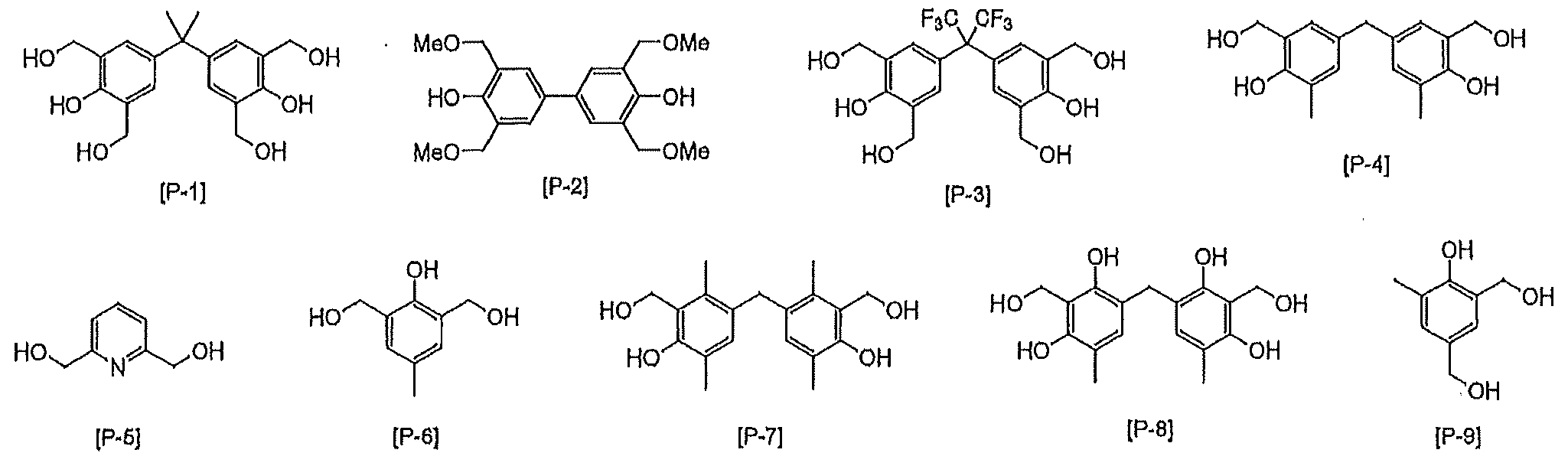
光増感剤としては、芳香族ニトロ化合物、クマリン(7-ジエチルアミノ-4-メチルクマリン、7-ヒドロキシ4-メチルクマリン)、ケトクマリン、カルボニルビスクマリン、芳香族2-ヒドロキシケトン、およびアミノ置換された、芳香族2-ヒドロキシケトン(2-ヒドロキシベンゾフェノン、モノ-もしくはジ-p-(ジメチルアミノ)-2-ヒドロキシベンゾフェノン)、アセトフェノン、アントラキノン、キサントン、チオキサントン、ベンズアントロン、チアゾリン(2-ベンゾイルメチレン-3-メチル-β-ナフトチアゾリン、2-(β-ナフトイルメチレン)-3-メチルベンゾチアゾリン、2-(α-ナフトイルメチレン)-3-メチルベンゾチアゾリン、2-(4-ビフェノイルメチレン)-3-メチルベンゾチアゾリン、2-(β-ナフトイルメチレン)-3-メチル-β-ナフトチアゾリン、2-(4-ビフェノイルメチレン)-3-メチル-β-ナフトチアゾリン、2-(p-フルオロベンゾイルメチレン)-3-メチル-β-ナフトチアゾリン)、オキサゾリン(2-ベンゾイルメチレン-3-メチル-β-ナフトオキサゾリン、2-(β-ナフトイルメチレン)-3-メチルベンゾオキサゾリン、2-(α-ナフトイルメチレン)-3-メチルベンゾオキサゾリン、2-(4-ビフェノイルメチレン)-3-メチルベンゾオキサゾリン、2-(β-ナフトイルメチレン)-3-メチル-β-ナフトオキサゾリン、2-(4-ビフェノイルメチレン)-3-メチル-β-ナフトオキサゾリン、2-(p-フルオロベンゾイルメチレン)-3-メチル-β-ナフトオキサゾリン)、ベンゾチアゾール、ニトロアニリン(m-もしくはp-ニトロアニリン、2,4,6-トリニトロアニリン)またはニトロアセナフテン(5-ニトロアセナフテン)、(2-[(m-ヒドロキシ-p-メトキシ)スチリル]ベンゾチアゾール、ベンゾインアルキルエーテル、N-アルキル化フタロン、アセトフェノンケタール(2,2-ジメトキシフェニルエタノン)、ナフタレン、アントラセン(2-ナフタレンメタノール、2-ナフタレンカルボン酸、9-アントラセンメタノール、および9-アントラセンカルボン酸)、ベンゾピラン、アゾインドリジン、メチルクマリン等がある。
好ましくは、芳香族2-ヒドロキシケトン(ベンゾフェノン)、クマリン、ケトクマリン、カルボニルビスクマリン、アセトフェノン、アントラキノン、キサントン、チオキサントン、およびアセトフェノンケタールである。
本発明に用いられる重合体組成物は、液晶配向膜の形成に好適となるように塗布液として調製されることが好ましい。すなわち、本発明に用いられる重合体組成物は、上述の(A)成分及び上述の膜厚均一性や表面平滑性を向上させる溶媒や化合物、液晶配向膜と基板との密着性を向上させる化合物等が有機溶媒に溶解した溶液として調製されることが好ましい。ここで、(A)成分の含有量は、1質量%~20質量%が好ましく、より好ましくは3質量%~15質量%、特に好ましくは3質量%~10質量%である。
そのような他の重合体は、例えば、ポリ(メタ)アクリレートやポリアミック酸やポリイミド等からなり、液晶性を発現し得る感光性の側鎖型高分子ではない重合体等が挙げられる。
本発明の液晶配向膜を有する基板の製造方法は、
[I] (A)所定の温度範囲で液晶性を発現する感光性の側鎖型高分子、及び
(B)有機溶媒
を含有することを特徴とする重合体組成物を、横電界駆動用の導電膜を有する基板上に塗布して塗膜を形成する工程;
[II] [I]で得られた塗膜に偏光した紫外線を照射する工程;及び
[III] [II]で得られた塗膜を加熱する工程;
を有する。
上記工程により、配向制御能が付与された横電界駆動型液晶表示素子用液晶配向膜を得ることができ、該液晶配向膜を有する基板を得ることができる。
[I] (A)所定の温度範囲で液晶性を発現する感光性の側鎖型高分子、及び
(B) 有機溶媒
を含有することを特徴とする重合体組成物を、横電界駆動用の導電膜を有する基板上に塗布して塗膜を形成する工程;
[II] [I]で得られた塗膜に偏光した紫外線を照射する工程;及び
[III] [II]で得られた塗膜を加熱する工程;
を有する。
上記工程により、配向制御能が付与された横電界駆動型液晶表示素子用液晶配向膜を得ることができ、該液晶配向膜を有する基板を得ることができる。
第2の基板は、横電界駆動用の導電膜を有する基板に代わって、横電界駆動用の導電膜を有しない基板を用いる以外、上記工程[I]~[III](横電界駆動用の導電膜を有しない基板を用いるため、便宜上、本願において、工程[I’]~[III’]と略記する場合がある)を用いることにより、配向制御能が付与された液晶配向膜を有する第2の基板を得ることができる。
[IV] 上記で得られた第1及び第2の基板を、液晶を介して第1及び第2の基板の液晶配向膜が相対するように、対向配置して液晶表示素子を得る工程;
を有する。これにより横電界駆動型液晶表示素子を得ることができる。
<工程[I]>
工程[I]では、横電界駆動用の導電膜を有する基板上に、所定の温度範囲で液晶性を発現する感光性の側鎖型高分子、及び有機溶媒を含有する重合体組成物を塗布して塗膜を形成する。
基板については、特に限定はされないが、製造される液晶表示素子が透過型である場合、透明性の高い基板が用いられることが好ましい。その場合、特に限定はされず、ガラス基板、またはアクリル基板やポリカーボネート基板等のプラスチック基板等を用いることができる。
また、反射型の液晶表示素子への適用を考慮し、シリコンウェハなどの不透明な基板も使用できる。
基板は、横電界駆動用の導電膜を有する。
該導電膜として、液晶表示素子が透過型である場合、ITO(Indium Tin Oxide:酸化インジウムスズ)、IZO(Indium Zinc Oxide:酸化インジウム亜鉛)などを挙げることができるが、これらに限定されない。
また、反射型の液晶表示素子の場合、導電膜として、アルミなどの光を反射する材料などを挙げることができるがこれらに限定されない。
基板に導電膜を形成する方法は、従来公知の手法を用いることができる。
塗布方法は、工業的には、スクリーン印刷、オフセット印刷、フレキソ印刷またはインクジェット法などで行う方法が一般的である。その他の塗布方法としては、ディップ法、ロールコータ法、スリットコータ法、スピンナ法(回転塗布法)またはスプレー法などがあり、目的に応じてこれらを用いてもよい。
塗膜の厚みは、厚すぎると液晶表示素子の消費電力の面で不利となり、薄すぎると液晶表示素子の信頼性が低下する場合があるので、好ましくは5nm~300nm、より好ましくは10nm~150nmである。
尚、[I]工程の後、続く[II]工程の前に塗膜の形成された基板を室温にまで冷却する工程を設けることも可能である。
工程[II]では、工程[I]で得られた塗膜に偏光した紫外線を照射する。塗膜の膜面に偏光した紫外線を照射する場合、基板に対して一定の方向から偏光板を介して偏光された紫外線を照射する。使用する紫外線としては、波長100nm~400nmの範囲の紫外線を使用することができる。好ましくは、使用する塗膜の種類によりフィルター等を介して最適な波長を選択する。そして、例えば、選択的に光架橋反応を誘起できるように、波長290nm~400nmの範囲の紫外線を選択して使用することができる。紫外線としては、例えば、高圧水銀灯から放射される光を用いることができる。
工程[III]では、工程[II]で偏光した紫外線の照射された塗膜を加熱する。加熱により、塗膜に配向制御能を付与することができる。
加熱は、ホットプレート、熱循環型オーブンまたはIR(赤外線)型オーブンなどの加熱手段を用いることができる。加熱温度は、使用する塗膜の液晶性を発現させる温度を考慮して決めることができる。
なお、液晶性発現温度は、側鎖型高分子または塗膜表面が固体相から液晶相に相転移がおきるガラス転移温度(Tg)以上であって、液晶相からアイソトロピック相(等方相)に相転移を起こすアイソトロピック相転移温度(Tiso)以下の温度をいう。
[IV]工程は、[III]で得られた、横電界駆動用の導電膜上に液晶配向膜を有する基板(第1の基板)と、同様に上記[I’]~[III’]で得られた、導電膜を有しない液晶配向膜付基板(第2の基板)とを、液晶を介して、双方の液晶配向膜が相対するように対向配置して、公知の方法で液晶セルを作製し、横電界駆動型液晶表示素子を作製する工程である。なお、工程[I’]~[III’]は、工程[I]において、横電界駆動用の導電膜を有する基板の代わりに、該横電界駆動用導電膜を有しない基板を用いた以外、工程[I]~[III]と同様に行うことができる。工程[I]~[III]と工程[I’]~[III’]との相違点は、上述した導電膜の有無だけであるため、工程[I’]~[III’]の説明を省略する。
本発明に用いる塗膜では、側鎖の光反応と液晶性に基づく自己組織化によって誘起される分子再配向の原理を利用して、塗膜への高効率な異方性の導入を実現する。本発明の製造方法では、側鎖型高分子に光反応性基として光架橋性基を有する構造の場合、側鎖型高分子を用いて基板上に塗膜を形成した後、偏光した紫外線を照射し、次いで、加熱を行った後、液晶表示素子を作成する。
以下、実施例を用いて本発明を説明するが、本発明は、該実施例に限定されるものではない。
実施例において使用した(メタ)アクリレート化合物の構造を以下に示す。
<重合性化合物>
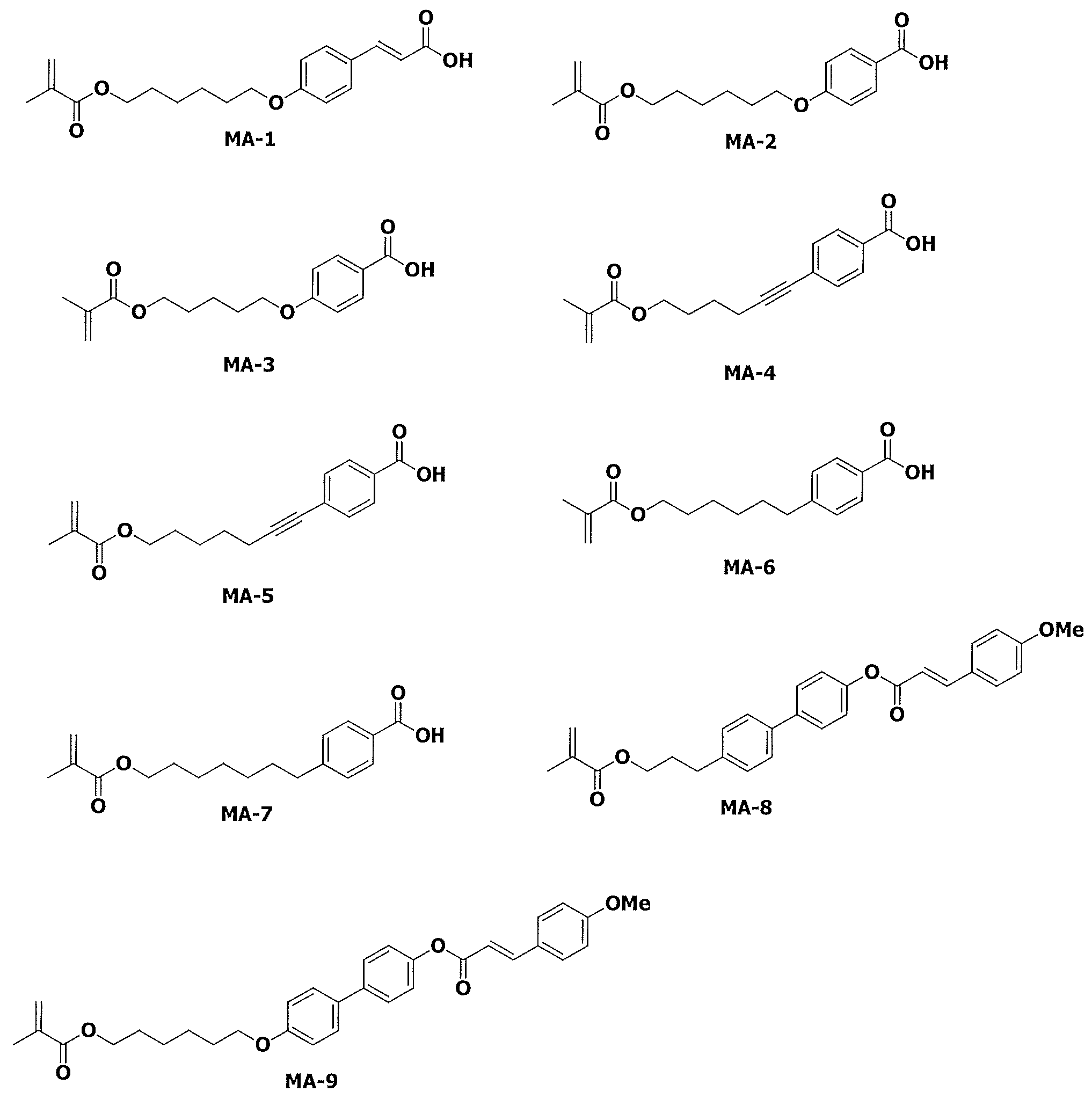
MA-2は特許文献(特開平9-118717)に記載の合成法にて合成した。
MA-3はMA-2と同様の合成法にて合成した。
MA-4からMA-8は文献等未公開の新規化合物であり、以下に合成法を詳述する。
MA-9は特許文献(特開2006-308878)に記載の合成法にて合成した。
装置:Varian NMR System 400 NB (400 MHz)
測定溶媒:CDCl3、DMSO-d6
基準物質:テトラメチルシラン(TMS)(δ0.0 ppm for 1H)
<合成例1 MA-4の合成>

テトラヒドロフラン(393.5g)中、4-ブロモ安息香酸エチル(78.7g、 344mmol)とジエチルアミン(125.8g)、5-ヘキシン-1-オール(43.8g)、ヨウ化銅(2.6g)を仕込み、窒素雰囲気とした後にビス(トリフェニルホスフィン)パラジウム(II)ジクロリド(4.8g)を加えて60℃で7時間反応させた。反応終了後、活性炭(銘柄:特製白鷺乾燥品 日本エンバイロケミカル製)3.9gを加えて室温条件下で1時間撹拌後に、ろ過により活性炭を除去した。続いて、減圧濃縮によりテトラヒドロフランを除去し、酢酸エチルで希釈後に純水で3回洗浄した。得られた有機相に活性炭(銘柄:特製白鷺乾燥品 日本エンバイロケミカル製)3.9gを加えて室温条件下で1時間撹拌し、ろ過、減圧濃縮することでMA-4A 103gを得た(粗収率:122%、 性状:褐色オイル状化合物)。
メタノール(151.2g)及び純水(100.8g)中、上記で得られたMA-4A(50.4g)を溶解させ、水酸化カリウム(17.2g)を加えて室温条件下で2時間反応させた。反応終了後、酢酸エチル及び3.0M塩酸水溶液投入して水相側を酸性とした後、塩酸水溶液相を除去した。続いて、有機相を純水で2度洗浄後、有機相を活性炭(銘柄:特製白鷺乾燥品 日本エンバイロケミカル製)2.5gを加えて室温条件下で1時間撹拌後に、ろ過により活性炭を除去し、減圧濃縮することで薄褐色結晶を得た。得られた結晶にイソプロピルアルコールを加え60℃とすることで均一溶液とした後、貧溶媒であるアセトニトリルを加えて再結晶を行い、ろ過、乾燥することでMA-4B 25.5gを得た(2段階収率:70%、性状:薄灰色結晶)。
テトラヒドロフラン(146.4g)中、上記で得られたMA-4B(24.4g、112mmol)とトリエチルアミン(28.5g)を仕込み、窒素雰囲気氷冷条件下にて塩化メタクリロイル(25.9g)を滴下した。滴下終了後、室温条件下にて17時間反応させた。反応終了後、酢酸エチルにて反応溶液を希釈後、純水にて3回洗浄し、有機相を減圧濃縮することで黄色オイル状化合物を得た。続いて、オイル状化合物をアセトニトリル(78.3g)及び1.0M塩酸水溶液(48.8g)で希釈し、50℃で2日間反応させた。反応終了後、酢酸エチルで反応液を希釈後、塩酸水溶液相を除去し、続いて純水で3回洗浄した。回収した有機相を活性炭(銘柄:特製白鷺乾燥品 日本エンバイロケミカル製)1.3gを加えて室温条件下で1時間撹拌後に、ろ過、減圧濃縮することで褐色オイル状化合物を得た。続いて、アセトニトリルを加えて50℃に加熱することで均一溶液とし、氷冷することで結晶を析出させ、ろ過することで粗物を得た。続いて、得られた粗物をアセトニトリルとテトラヒドロフラン混合溶液でスラリー洗浄を実施し、ろ過、乾燥することでMA-4 12.4gを得た(収率:39%、性状:白色結晶)
1H-NMR(400MHz) in DMSO-d6: 1.61-1.63 ppm(m, 2H), 1.64-1.78ppm(m,2H), 1.89ppm(s, 3H), 2.51-2.54ppm(m,2H), 4.16ppm(t,2H), 5.67-5.69ppm(m,1H), 6.04-6.05ppm(m,1H), 7.48-7.51ppm(m,2 H), 7.88-7.91ppm(m,2H), 13.1ppm(s,1H).
<合成例2 MA-5の合成>
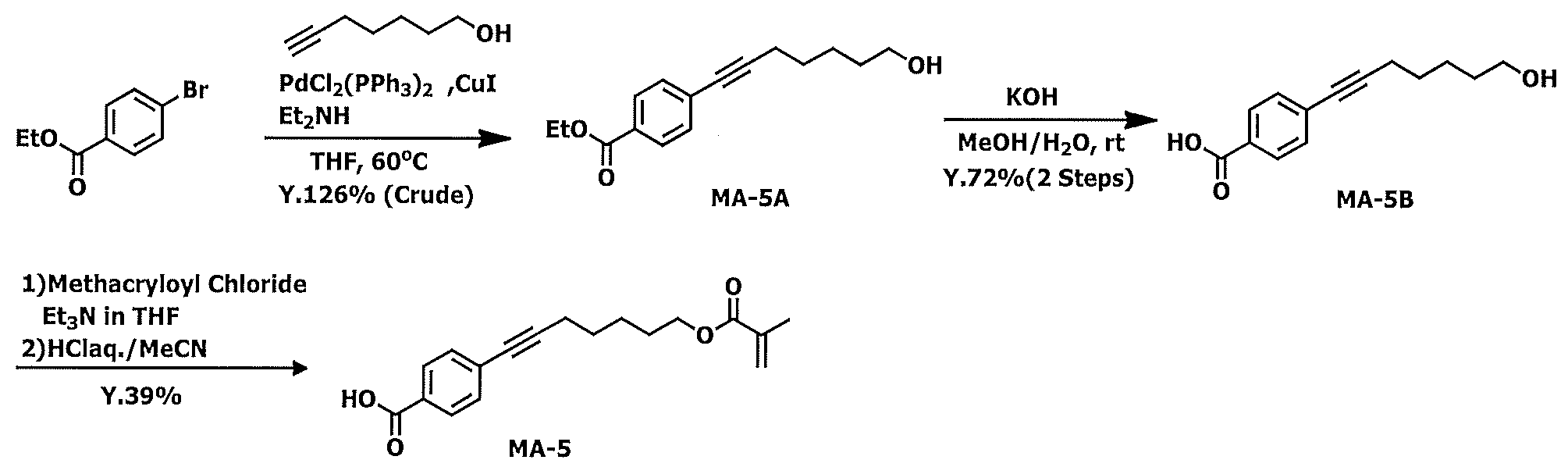
テトラヒドロフラン(343.5g)中、4-ブロモ安息香酸エチル(68.7g、 300mmol)とジエチルアミン(109.7g)、6-ヘプチン-1-オール(43.7g)、ヨウ化銅(2.3g)を仕込み、窒素雰囲気とした後にビス(トリフェニルホスフィン)パラジウム(II)ジクロリド(4.2g)を加えて60℃で23時間反応させた。反応終了後、活性炭(銘柄:特製白鷺乾燥品 日本エンバイロケミカル製)6.8gを加えて室温条件下で1時間撹拌後に、ろ過により活性炭を除去した。続いて、減圧濃縮によりテトラヒドロフランを除去し、酢酸エチルで希釈後に純水で3回洗浄した。得られた有機相に活性炭(銘柄:特製白鷺乾燥品 日本エンバイロケミカル製)6.8gを加えて室温条件下で1時間撹拌し、ろ過、減圧濃縮することでMA-5A 98.3gを得た(粗収率:126%、 性状:褐色オイル状化合物)。
メタノール(98.6g)及び純水(98.6g)中、上記で得られたMA-5A(49.3g)を溶解させ、水酸化カリウム(15.0g)を加えて室温条件下で2時間反応させた。反応終了後、酢酸エチル及び3.0M塩酸水溶液投入して水相側を酸性とした後、塩酸水溶液相を除去した。続いて、有機相を純水で2度洗浄後、有機相を活性炭(銘柄:特製白鷺乾燥品 日本エンバイロケミカル製)4.9gを加えて室温条件下で1時間撹拌後に、ろ過により活性炭を除去し、減圧濃縮することで薄褐色結晶を得た。得られた結晶にイソプロピルアルコールを加え60℃とすることで均一溶液とした後、貧溶媒であるアセトニトリルを加えて再結晶を行い、ろ過、乾燥することでMA-5B 25.1gを得た(2段階収率:72%、性状:薄黄色結晶)。
テトラヒドロフラン(125.2g)、上記で得られたMA-5B(25.1g、108mmol)とトリエチルアミン(30.4g)を仕込み、窒素雰囲気氷冷条件下にて塩化メタクリロイル(24.9g)を滴下した。滴下終了後、室温条件下にて4時間反応させた。反応終了後、酢酸エチルにて反応溶液を希釈後、純水にて3回洗浄し、有機相を減圧濃縮することで黄色オイル状化合物を得た。続いて、オイル状化合物をアセトニトリル(76.0g)及び1.0M塩酸水溶液(50.0g)で希釈し、50℃で2日間反応させた。反応終了後、酢酸エチルで反応液を希釈後、塩酸水溶液相を除去し、続いて純水で3回洗浄した。回収した有機相を活性炭(銘柄:特製白鷺乾燥品 日本エンバイロケミカル製)1.3gを加えて室温条件下で1時間撹拌後に、ろ過、減圧濃縮することで褐色オイル状化合物を得た。続いて、アセトニトリルを加えて50 ℃に加熱することで均一溶液とし、氷冷することで結晶を析出させ、ろ過することで粗物を得た。得られた粗物をアセトニトリルとテトラヒドロフラン混合溶液で再結晶を実施し、ろ過、乾燥することでMA-5 12.6gを得た(収率:39%、性状:白色結晶)
1H-NMR(400MHz) in DMSO-d6: 1.44-1.71 ppm(m, 6H), 1.87ppm(s,3H), 2.46-2.52ppm(m,2H), 4.12ppm(t,2H), 5.65-5.66ppm(m,1H), 6.01-6.02ppm(m,1H), 7.46-7.50ppm(m,2H), 7.89-7.91ppm(m,2H), 13.1ppm(s,1H)
<合成例3 MA-6の合成>
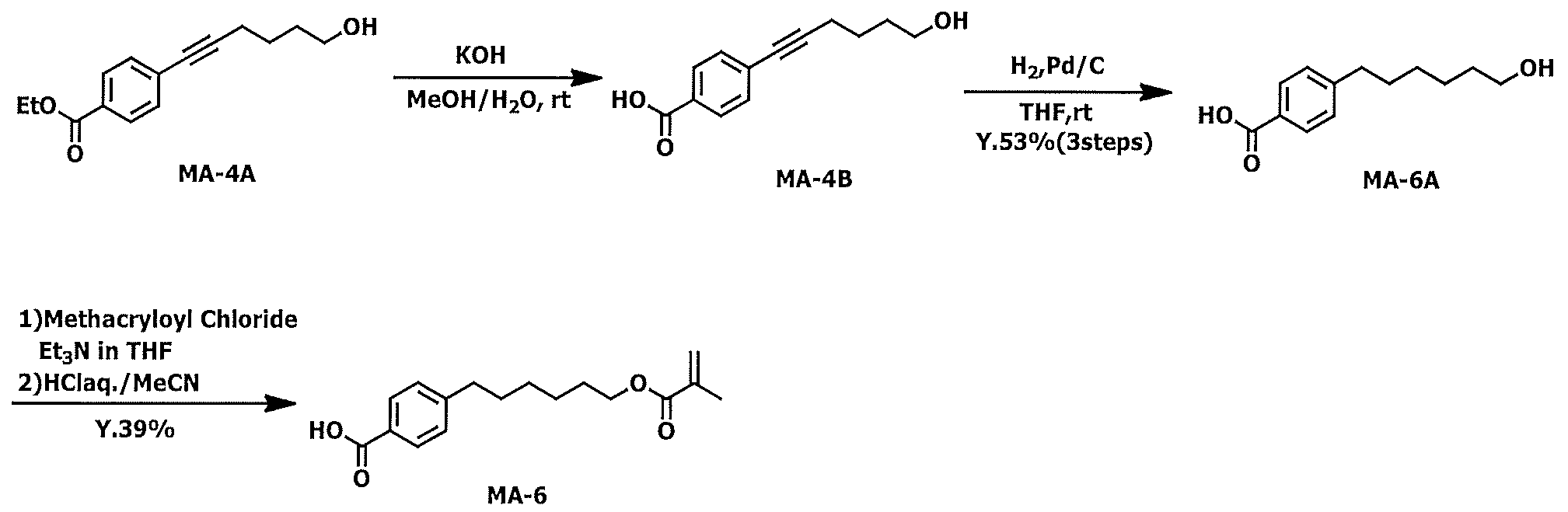
メタノール(94.2g)と純水(93.1g)中、MA-4A(47.1g)を溶解させ、水酸化カリウム(17.6g)を加えて室温条件下で2時間反応させた。反応終了後、酢酸エチル及び3.0M塩酸水溶液を投入して水相側を酸性とした後、塩酸水溶液相を除去した。続いて、有機相を純水で3回洗浄後、有機相を活性炭(銘柄:特製白鷺乾燥品 日本エンバイロケミカル製)4.7gを加えて室温条件下で1時間撹拌後に、ろ過により活性炭を除去し、減圧濃縮することで粗物を得た。続いて、得られた粗物を酢酸エチルに60℃加熱溶解させ、氷冷する事で結晶を析出させ、ろ過、乾燥することでMA-4B 24.9gを得た。
テトラヒドロフラン(124.5g)、上記で得られたMA-4B(24.9g)と5%パラジウムカーボン粉末(含水品)STDタイプ(銘柄:エヌ・イーケムキャット社、2.5g)を仕込み、0.5MPa水素圧条件にて17時間反応させた。反応終了後、ろ過、アセトニトリルによるスラリー洗浄を実施することで、MA-6A 20.7gを得た(3段階収率:53%、性状:薄黄色結晶)。
テトラヒドロフラン(124.2g)中、MA-6A(20.7g)とトリエチルアミン(23.6g)、N,N-ジメチル-4-アミノピリジン(0.53g)を仕込み、窒素雰囲気氷冷条件下にて塩化メタクリロイル(22.4g)滴下し、室温条件下にて2時間反応させた。反応終了後、酢酸エチルにて希釈後、1.0M塩酸水溶液にて1回洗浄し、有機相を減圧濃縮することで黄色オイル状化合物を得た。続いて、得られたオイル状化合物をアセトニトリル(60.0g)と1.0M塩酸水溶液(40.0g)で希釈し、50℃で4日間反応させた。反応終了後、酢酸エチルで希釈し、塩酸水溶液相を除去し、続いて有機相を純水で3回洗浄した。回収した有機相を活性炭(銘柄:特製白鷺乾燥品 日本エンバイロケミカル製)1.0gを加えて室温条件下で1時間撹拌後に、ろ過、減圧濃縮することで褐色オイル状化合物を得た。続いて、アセトニトリルを加えて50℃加熱することで均一溶液とし、氷冷することで結晶を析出させ、ろ過することで粗物を得た。粗物をアセトニトリル及びテトラヒドロフランで再結晶することでMA-6 10.1gを得た( 収率:37%、性状:白色結晶)。
1H-NMR(400MHz) in DMSO-d6: 1.30-1.38 ppm(m, 4H), 1.57-1.87ppm(m,4H), 1.88ppm(s,3H), 2.64ppm(t,2H), 4.07ppm(t,2H), 5.65-5.67ppm(m,1H), 6.00-6.01ppm(m,1H), 7.30-7.32ppm(m,2H), 7.84-7.86ppm(m,2H), 12.8ppm(s,1H)
<合成例4 MA-7の合成>
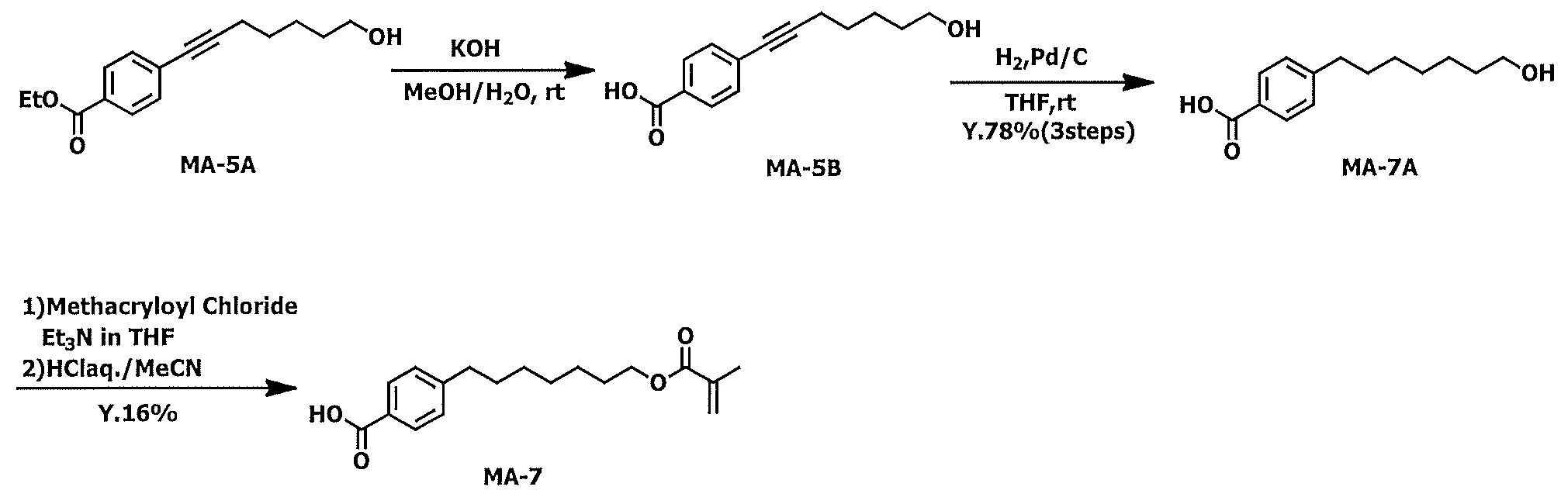
メタノール(98.8g)と純水(100.6g)中、MA-5A(49.0g)を溶解させ、水酸化カリウム(14.8g)を加えて室温条件下で2時間反応させた。反応終了後、酢酸エチル及び3.0M塩酸水溶液を投入して水相側を酸性とした後、塩酸水溶液相を除去した。続いて、有機相を純水で3回洗浄後、有機相を活性炭(銘柄:特製白鷺乾燥品 日本エンバイロケミカル製)4.9gを加えて室温条件下で1時間撹拌後に、ろ過により活性炭を除去し、減圧濃縮することでMA-5B粗物を得た。続いて、得られた粗物をテトラヒドロフラン(119.1g)に溶解させ、5%パラジウムカーボン粉末(含水品)STDタイプ(銘柄:エヌ・イーケムキャット社、4.7g)を仕込み、0.5MPa水素圧条件にて19時間反応させた。反応終了後、ろ過、アセトニトリルによるスラリー洗浄を実施することで、MA-7A 27.7gを得た(3段階収率:78%、性状:薄黄色結晶)。
テトラヒドロフラン(166.7g)中、MA-7A(26.1g)とトリエチルアミン(30.3g)、N,N-ジメチル-4-アミノピリジン(0.71g)を仕込み、窒素雰囲気氷冷条件下にて塩化メタクリロイル(28.3g)滴下し、室温条件下にて2時間反応させた。反応終了後、酢酸エチルにて希釈後、1.0M塩酸水溶液にて1回、純水で1回洗浄し、有機相を減圧濃縮することで黄色オイル状化合物を得た。続いて、得られたオイル状化合物をアセトニトリル(72.4g)と1.0M塩酸水溶液(52.0g)で希釈し、50℃で4日間反応させた。反応終了後、酢酸エチルで希釈し、塩酸水溶液相を除去し、続いて有機相を純水で3回洗浄した。回収した有機相を活性炭(銘柄:特製白鷺乾燥品 日本エンバイロケミカル製)1.3gを加えて室温条件下で1時間撹拌後に、ろ過、減圧濃縮することで褐色オイル状化合物を得た。続いて、アセトニトリルを加えて50℃加熱することで均一溶液とし、氷冷することで結晶を析出させ、ろ過することで粗物を得た。粗物をアセトニトリル及びテトラヒドロフランで再結晶することでMA-7 5.3gを得た(収率:16%、性状:白色結晶)。
1H-NMR(400MHz) in DMSO-d6: 1.27-1.31 ppm(m, 6H), 1.54-1.62ppm(m,4H), 1.88ppm(s,3H), 2.63ppm(t,2H), 4.08ppm(t,2H), 5.65-5.67ppm(m,1H), 6.00-6.01ppm(m,1H), 7.30-7.32ppm(m,2H), 7.84-7.87ppm(m,2H), 12.8ppm(s,1H)
<合成例5 MA-8の合成>
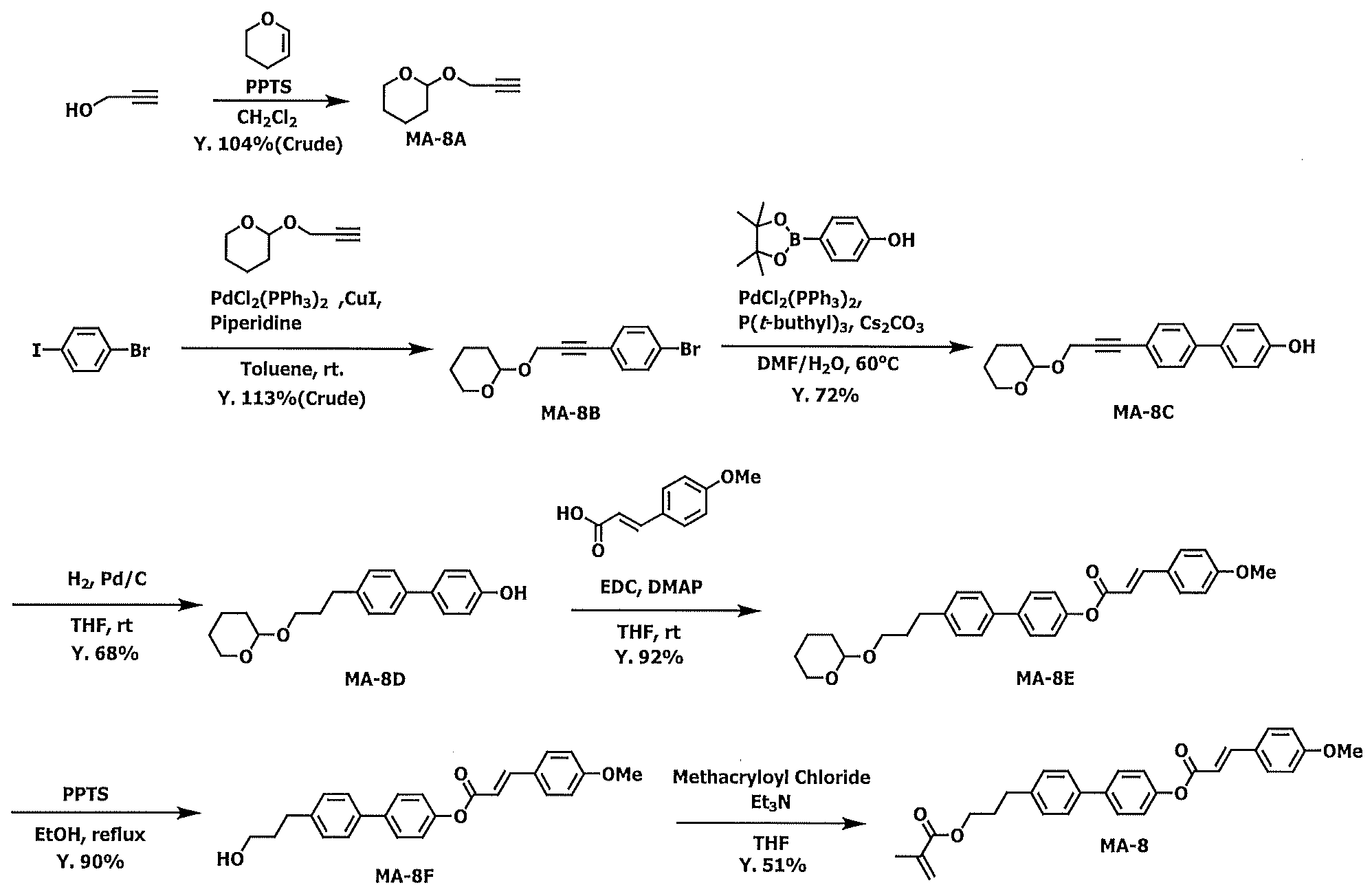
塩化メチレン(802.0g)中、プロパルギルアルコール(200.5g)とp-トルエンスルホン酸ピリジニウム(44.9g)を仕込み、窒素雰囲気氷冷条件にて、3,4-ジヒドロ-2H-ピラン(361.7g)を滴下した。滴下後、反応温度を室温として5時間反応させた。反応終了後、純水で3回有機相を洗浄し、硫酸マグネシウム脱水処理後、減圧濃縮する事で、MA-8Aの粗物522gを得た(粗収率:104%、性状:薄黄色オイル状化合物)。
トルエン(500.0g)中、1-ブロモ-4-ヨードベンゼン(100.0g)とピペリジン(60.1g)、ヨウ化銅(4.04g)、ビス(トリフェニルホスフィン)パラジウム(II)ジクロリド(7.44g)を仕込み、窒素雰囲気下で2分撹拌した。続いて、MA-8A(69.4g)を30分かけて滴下した。滴下中、反応温度が急激に上昇したため、水冷して23℃ぐらいになるように滴下操作を実施した。滴下終了後、撹拌不良となったためトルエン(500.0g)追加して1時間反応させた。反応終了後、有機相を純水で1回、1.0M塩酸水溶液で1回、再度純水で4回洗浄し、有機相を回収した。続いて、回収した有機相に活性炭(銘柄:特製白鷺乾燥品 日本エンバイロケミカル製)10.0gを加えて1時間撹拌し、ろ過、減圧濃縮することでMA-8Bの粗物118.2gを得た(粗収率:113%、性状:黒褐色オイル状化合物)。
N,N-ジメチルホルムアミド(300.5g)及び純水(120.2g)中、4-ヒドロキシフェニルボロン酸ピナコールエステル(60.1g)とMA-8B(92.6g)、炭酸セシウム(179.8g)を仕込み、窒素雰囲気にてトリ-ter-ブチルホスフィン(3.70g)とビス(トリフェニルホスフィン)パラジウム(II)ジクロリド(5.75g)を加えて60℃で7時間反応させた。反応終了後、酢酸エチルで希釈し、1.0M塩酸水溶液で1回、純水で3回洗浄した。回収した有機相に活性炭(銘柄:特製白鷺乾燥品 日本エンバイロケミカル製)6.0gを加えて1時間撹拌し、ろ過、減圧濃縮すること粗物を得た。得られた粗物をシリカゲルカラム精製(ヘキサン:酢酸エチル=6:1体積比)することで、MA-8C 60.2gを得た(収率:72%、性状:薄オレンジ色結晶)。
テトラヒドロフラン(120.3g)中、MA-8C(42.0g)と5%パラジウムカーボン粉末(含水品)STDタイプ(銘柄:エヌ・イーケムキャット社、3.36g)を仕込み、0.4MPa水素圧条件にて28時間反応させた。反応終了後、ろ過、減圧濃縮した。得られた粗物をシリカゲルカラム精製(ヘキサン:酢酸エチル=6:1体積比)することで、MA-8D 29.0gを得た(収率:68%、性状:薄黄色オイル状化合物)。
テトラヒドロフラン(124.8g)中、MA-8D(25.0g)と4-メトキシキシ桂皮酸(15.0g)、N,N-ジメチル-4-アミノピリジン(1.00g)、1-エチル-3-(3-ジメチルアミノプロピル)カルボジイミド塩酸塩(18.4g)を仕込み、窒素雰囲気室温条件下にて18時間反応させた。反応終了後、純水中に反応液を注ぎ込み、反応物の粗物を得た。得られた粗物を2-プロパノールでスラリー洗浄することで、MA-8E 34.8gを得た(収率:92%、性状:白色結晶)。
エタノール(278.0g)中、MA-8E(34.8g)とp-トルエンスルホン酸ピリジニウム(3.70g)を仕込み、70℃にて21時間反応させた。反応終了後、純水中に反応液を注ぎ込み、反応物の粗物を得た。続いて、得られた粗物をメタノールでスラリー洗浄を行い、テトラヒドロフラン及びメタノールで再結晶を行うことによりMA-8F 25.7gを得た(収率:90%、性状:白色結晶)。
テトラヒドロフラン(278.4g)中、MA-8F(25.1g)とトリエチルアミン(8.52g)を仕込み、窒素雰囲気氷冷条件下にて塩化メタクリロイル(8.30g)滴下した。滴下終了、反応温度を室温として20時間反応させた。反応終了後、45℃条件下にて反応液を酢酸エチルで希釈し、純水で3回洗浄した後、減圧濃縮することで粗物を得た。得られた粗物をテトラヒドロフランに再溶解させ、活性炭(銘柄:特製白鷺乾燥品 日本エンバイロケミカル製)2.5gを加えて室温条件下で1時間撹拌後にろ過した。続いて、得られた溶液を減圧濃縮し、内部総重量を151.4gとした後に、メタノールを加えて結晶を析出させた。得られた結晶を酢酸エチルでスラリー洗浄し、ろ過、乾燥することでMA-8 15.2gを得た(収率:51%、性状:薄黄色結晶)。
1H-NMR(400MHz) in CDCl3: 1.95 ppm(s,3H), 2.03-2.08ppm(m,2H), 2.78ppm(t,2H), 3.84ppm(s,3H), 4.20ppm(t,2H), 5.56ppm(s,1H), 6.11ppm(s,1H), 6.52ppm(d,1H), 6.92-6.96ppm(m,2H), 7.21-7,27ppm(m,4H), 7.49-7.61ppm(m,6H), 7.85ppm(d,1H).
NMP: N-メチル-2-ピロリドン
BC: エチレングリコールモノブチルエーテル
THF: テトラヒドロフラン
PGME:1-メトキシ-2-プロパノール
実施例における(メタ)アクリルポリマーの分子量は、(株)Shodex社製常温ゲル浸透クロマトグラフィー(GPC)装置(GPC-101)、Shodex社製カラム(KD-803、KD-805)を用い以下のようにして測定した。
カラム温度:50℃
溶離液:DMF(添加剤として、臭化リチウム-水和物(LiBr・H2O)が30mmol/L、リン酸・無水結晶(o-リン酸)が30mmol/L、THFが10mL/L)
流速:1.0mL/分
検量線作成用標準サンプル:東ソー社製 TSK 標準ポリエチレンオキサイド(分子量 約900,000、150,000、100,000、30,000)、及び、ポリマーラボラトリー社製 ポリエチレングリコール(分子量 約12,000、4,000、1,000)。
MA-1(13.3g、40.0mmol)とMA-2(18.4g、60.0mmo
l)をTHF(182.3g)中に溶解し、ダイアフラムポンプで脱気を行った後、2
,2’-アゾビスイソブチロニトリル(0.82g、5.0mmol)を加え、再び脱気
を行った。この後50℃で30時間反応させメタクリレートのポリマー溶液を得た。このポリマー溶液をジエチルエーテル(1500ml)に滴下し、得られた沈殿物をろ過した。この沈澱物をジエチルエーテルで洗浄し、40℃のオーブン中で減圧乾燥しメタクリレートポリマー粉末(P1)を得た。このポリマーの数平均分子量は35000、重量平均分子量は126000であった。
MA-1(1.19g、3.6mmol)、MA-2(0.83g、2.7mmol)、MA-4(0.77g、2.7mmol)をTHF(11.4g)中に溶解し、ダイアフラムポンプで脱気を行った後、2,2’-アゾビスイソブチロニトリルを(0.044g、0.27mmol)を加え再び脱気を行った。この後60℃で13時間反応させメタクリレートのポリマー溶液を得た。このポリマー溶液をメタノール:純水(1:1)142gに滴下し、得られた沈殿物をろ過した。この沈澱物をメタノールで洗浄し、50℃のオーブン中で減圧乾燥しメタクリレートポリマー粉末2.1g(P2)を得た。このポリマーの数平均分子量は54000、重量平均分子量は100000であった。
MA-1(1.20g、3.6mmol)、MA-2(0.83g、2.7mmol)、MA-5(0.81g、2.7mmol)をTHF(11.5g)中に溶解し、ダイアフラムポンプで脱気を行った後、2,2’-アゾビスイソブチロニトリルを(0.044g、0.27mmol)を加え再び脱気を行った。この後60℃で13時間反応させメタクリレートのポリマー溶液を得た。このポリマー溶液をメタノール:純水(1:1)144gに滴下し、得られた沈殿物をろ過した。この沈澱物をメタノールで洗浄し、50℃のオーブン中で減圧乾燥しメタクリレートポリマー粉末2.1gを得た。このポリマーの数平均分子量は50000、重量平均分子量は100000であった。
MA-1(1.20g、3.6mmol)、MA-2(0.83g、2.7mmol)、MA-6(0.78g、2.7mmol)をTHF(11.4g)中に溶解し、ダイアフラムポンプで脱気を行った後、2,2’-アゾビスイソブチロニトリルを(0.044g、0.27mmol)を加え再び脱気を行った。この後60℃で13時間反応させメタクリレートのポリマー溶液を得た。このポリマー溶液をメタノール:純水(1:1)143gに滴下し、得られた沈殿物をろ過した。この沈澱物をメタノールで洗浄し、50℃のオーブン中で減圧乾燥しメタクリレートポリマー粉末2.0g(P4)を得た。このポリマーの数平均分子量は49000、重量平均分子量は100000であった。
MA-1(0.80g、2.4mmol)、MA-2(0.55g、1.8mmol)、MA-7(0.54g、1.8mmol)をTHF(7.7g)中に溶解し、ダイアフラムポンプで脱気を行った後、2,2’-アゾビスイソブチロニトリルを(0.030g、0.18mmol)を加え再び脱気を行った。この後60℃で13時間反応させメタクリレートのポリマー溶液を得た。このポリマー溶液をメタノール:純水(1:1)96gに滴下し、得られた沈殿物をろ過した。この沈澱物をメタノールで洗浄し、50℃のオーブン中で減圧乾燥しメタクリレートポリマー粉末1.4g(P5)を得た。このポリマーの数平均分子量は38000、重量平均分子量は90000であった。
MA-3(2.0g、6.9mmol)をTHF(11.7g)中に溶解し、ダイアフラムポンプで脱気を行った後、2,2’-アゾビスイソブチロニトリルを(0.035g、0.21mmol)を加え再び脱気を行った。この後60℃で13時間反応させメタクリレートのポリマー溶液を得た。このポリマー溶液をメタノール:純水(1:1)103gに滴下し、得られた沈殿物をろ過した。この沈澱物をメタノールで洗浄し、50℃のオーブン中で減圧乾燥しメタクリレートポリマー粉末1.4g(P6)を得た。このポリマーの数平均分子量は35000、重量平均分子量は65000であった。
MA-4(1.0g、3.5mmol)をTHF(4.1g)中に溶解し、ダイアフラムポンプで脱気を行った後、2,2’-アゾビスイソブチロニトリルを(0.017g、0.10mmol)を加え再び脱気を行った。この後60℃で13時間反応させメタクリレートのポリマー溶液を得た。このポリマー溶液をアセトニトリル51gに滴下し、得られた沈殿物をろ過した。この沈澱物をアセトニトリルで洗浄し、50℃のオーブン中で減圧乾燥しメタクリレートポリマー粉末0.5g(P7)を得た。このポリマーの数平均分子量は35000、重量平均分子量は68000であった。
MA-6(0.99g、3.4mmol)をTHF(4.0g)中に溶解し、ダイアフラムポンプで脱気を行った後、2,2’-アゾビスイソブチロニトリルを(0.017g、0.10mmol)を加え再び脱気を行った。この後60℃で13時間反応させメタクリレートのポリマー溶液を得た。このポリマー溶液をアセトニトリル50gに滴下し、得られた沈殿物をろ過した。この沈澱物をアセトニトリルで洗浄し、50℃のオーブン中で減圧乾燥しメタクリレートポリマー粉末0.6g(P8)を得た。このポリマーの数平均分子量は38000、重量平均分子量は74000であった。
MA-8(2.05g、4.5mmol)をTHF(18.7g)中に溶解し、ダイアフラムポンプで脱気を行った後、2,2’-アゾビスイソブチロニトリルを(0.022g、0.13mmol)を加え再び脱気を行った。この後60℃で14時間反応させメタクリレートのポリマー溶液を得た。このポリマー溶液をメタノール208gに滴下し、得られた沈殿物をろ過した。この沈澱物をメタノールで洗浄し、50℃のオーブン中で減圧乾燥しメタクリレートポリマー粉末1.4g(P9)を得た。このポリマーの数平均分子量は33000、重量平均分子量は48000であった。
MA-9のメタクリレートポリマー(P10)は特許文献(特開2006-308878)に記載の合成法にて合成した。
<実施例1>
得られたメタクリレートポリマー粉末(P2)0.2gにNMP(0.47g)を加え、室温にて12時間撹拌して溶解させた。この溶液にBC(7.0g)を加えてポリマー溶解性を確認した。
<実施例2~4、比較例1>
実施例1と同様の方法を用いて実施例2~4のポリマー溶解性を確認した。また、比較例1も同様の方法でポリマー溶解性を確認した。その結果を表1に示す。

<実施例5>
得られたメタクリレートポリマー粉末(P7)0.05gにPGME(0.45g)を加え、室温にて12時間撹拌し、ポリマー溶解性を確認した。
<実施例6>
得られたメタクリレートポリマー粉末(P8)0.05gにPGME(0.45g)を加え、室温にて12時間撹拌し、ポリマー溶解性を確認した。
<比較例2>
得られたメタクリレートポリマー粉末(P6)0.05gにPGME(0.45g)を加え、室温にて12時間撹拌し、ポリマー溶解性を確認した。
実施例5,6、比較例2の溶解性試験結果を表2に示す。

<実施例7>
得られたメタクリレートポリマー粉末(P9)0.05gにNMP(0.96g)を加え、室温にて12時間撹拌して溶解させた。この溶液にBC(0.24g)を加えてポリマー溶解性を確認した。
得られたメタクリレートポリマー粉末(P10)0.05gにNMP(0.96g)を加え、室温にて12時間撹拌して溶解させた。この溶液にBC(0.24g)を加えてポリマー溶解性を確認した。
実施例7、比較例3の溶解性試験結果を表3に示す。

<実施例8>
得られたタクリレートポリマー粉末(P2)0.4gにNMP(7.6g)を加え、室温で3時間攪拌して溶解させた。この溶液にBC(2.0g)を加え攪拌することにより液晶配向剤(A-1)を得た。
得られたタクリレートポリマー粉末(P3)0.4gにNMP(7.6g)を加え、室温で3時間攪拌して溶解させた。この溶液にBC(2.0g)を加え攪拌することにより液晶配向剤(A-2)を得た。
得られたタクリレートポリマー粉末(P4)0.4gにNMP(7.6g)を加え、室温で3時間攪拌して溶解させた。この溶液にBC(2.0g)を加え攪拌することにより液晶配向剤(A-3)を得た。
得られたタクリレートポリマー粉末(P5)0.4gにNMP(7.6g)を加え、室温で3時間攪拌して溶解させた。この溶液にBC(2.0g)を加え攪拌することにより液晶配向剤(A-4)を得た。
得られたタクリレートポリマー粉末(P9)0.2gにクロロホルム(9.8g)を加え、室温で3時間攪拌して溶解させることにより液晶配向剤(A-5)を得た。
<実施例13>
実施例8で得られた液晶配向剤(A-1)を用いて下記に示すような手順でオーダーパラメータ測定用基板の作製を行った。基板は、40mm×40mmの大きさで、厚さが1.0mmの石英基板を用いた。
実施例8で得られた液晶配向剤(A-1)を1.0μmのフィルターで濾過した後、石英基板上にスピンコートし、70℃のホットプレート上で90秒間乾燥後、膜厚100nmの液晶配向膜を形成した。次いで、塗膜面に偏光板を介して313nmの紫外線を5~50mJ/cm2照射した後に140℃~160℃のホットプレートで10分間加熱し、液晶配向膜付き基板を得た。
実施例9~11で得られた液晶配向剤(A-2~A-4)に関しても、A-1と同様の方法を用いてオーダーパラメータ測定用基板を作成した。
実施例12で得られた液晶配向剤(A-5)を用いて下記に示すような手順でオーダーパラメータ測定用基板の作製を行った。基板は、40mm×40mmの大きさで、厚さが1.0mmの石英基板を用いた。
実施例12で得られた液晶配向剤(A-5)を1.0μmのフィルターで濾過した後、石英基板上にスピンコートし、70℃のホットプレート上で90秒間乾燥後、膜厚200nmの液晶配向膜を形成した。次いで、塗膜面に偏光板を介して313nmの紫外線を50~1000mJ/cm2照射した後に170℃~230℃のホットプレートで10分間加熱し、液晶配向膜付き基板を得た。
上記で作製した液晶配向膜付き基板を用い、液晶配向膜の光学的異方性を測定するために、偏光の吸光度からオーダーパラメータであるSを下式より算出した。

算出したオーダーパラメータの絶対値[S]は、表4と表5に示した。なお、オーダーパラメータの絶対値を下記の基準で示す。
○:0.5以上
○△:0.4以上~0.5未満
△:0.3以上~0.4未満
×:0.3未満
また、吸光度の測定には、島津製作所社製の紫外線可視近赤外分析光度計U-3100PCを使用した。
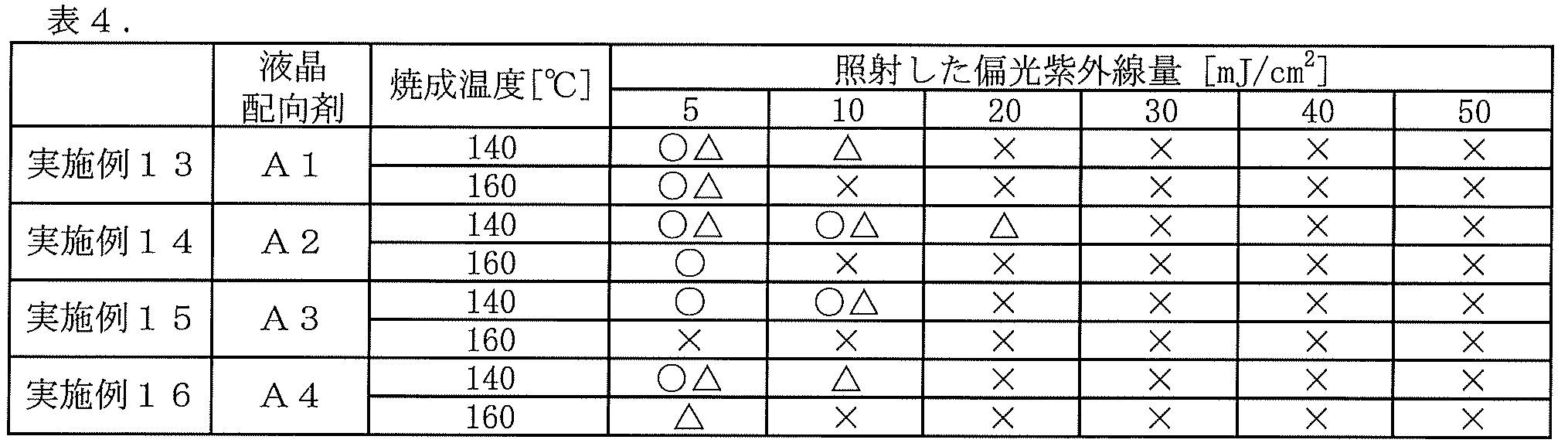

Claims (10)
- (A)所定の温度範囲で液晶性を発現する感光性の側鎖型高分子、及び
(B)有機溶媒
を含有する重合体組成物において、(A)成分である樹脂が、下記式(a)
(式(a)中、Lは炭素数1から16の直鎖又は分岐鎖のアルキレンである。
XはCH2-CH2、CH=CHまたはC≡Cを表す。
Y1は、各々独立に、ハロゲン基、炭素数1~10の直鎖又は分岐鎖のアルキル基、炭素数1~10の直鎖又は分岐鎖のアルコキシ基、ヒドロキシル基、シアノ基、ジアルキルアミノ基(アルキル基は、各々独立に、炭素数1~10の直鎖又は分岐鎖のアルキル基である)、炭素数1~10の直鎖又は分岐鎖のエステル基、炭素数1~10の直鎖又は分岐鎖のアシル基、カルボキシル基、アルデヒド基及びニトロ基から選ばれる置換基で置換されてもよい下記式Y1-1からY1-6を表す(**はXとの結合位置を表し、***はY2との結合位置を表す)。
Y2は-COOH、-CR3=CR4-COOH、-CR5=CR6-CO-O-Y3または-O-CO-CR5=CR6-Y3を表す。
R3及びR4は、それぞれ独立に水素原子又はメチル基を表す。
R5及びR6は、それぞれ独立に水素原子又はメチル基を表す。
Y3は、各々独立に、ハロゲン基、炭素数1~10の直鎖又は分岐鎖のアルキル基、炭素数1~10の直鎖又は分岐鎖のアルコキシ基、ヒドロキシル基、シアノ基、ジアルキルアミノ基(アルキル基は、各々独立に、炭素数1~10の直鎖又は分岐鎖のアルキル基である)、炭素数1~10の直鎖又は分岐鎖のエステル基、炭素数1~10の直鎖又は分岐鎖のアシル基、カルボキシル基、アルデヒド基、及びニトロ基から選ばれる置換基で置換されてもよいフェニル基、ビフェニル基、ナフチル基、炭素数5~8の脂環式炭化水素、フェニル‐シクロヘキシル基又はシクロヘキシル-フェニル基を表す。)
で表される側鎖を含有することを特徴とする重合体組成物。

- (A)成分が、光架橋、光異性化、または光フリース転移を起こす感光性側鎖を有する、請求項1に記載の組成物。
- (A)成分が、下記式(1)~(6)
(式中、A、B、Dはそれぞれ独立に、単結合、-O-、-CH2-、-COO-、-OCO-、-CONH-、-NH-CO-、-CH=CH-CO-O-、又は-O-CO-CH=CH-を表す;
Sは、炭素数1~12のアルキレン基であり、それらに結合する水素原子はハロゲン基に置き換えられていてもよい;
Tは、単結合または炭素数1~12のアルキレン基であり、それらに結合する水素原子はハロゲン基に置き換えられていてもよい;
Y1は、1価のベンゼン環、ナフタレン環、ビフェニル環、フラン環、ピロール環および炭素数5~8の脂環式炭化水素から選ばれる環を表すか、それらの置換基から選ばれる同一又は相異なった2~6の環が結合基Bを介して結合してなる基であり、それらに結合する水素原子はそれぞれ独立に-COOR0(式中、R0は水素原子又は炭素数1~5のアルキル基を表す)、-NO2、-CN、-CH=C(CN)2、-CH=CH-CN、ハロゲン基、炭素数1~5のアルキル基、又は炭素数1~5のアルキルオキシ基で置換されても良い;
Y2は、2価のベンゼン環、ナフタレン環、ビフェニル環、フラン環、ピロール環、炭素数5~8の脂環式炭化水素、および、それらの組み合わせからなる群から選ばれる基であり、それらに結合する水素原子はそれぞれ独立に-NO2、-CN、-CH=C(CN)2、-CH=CH-CN、ハロゲン基、炭素数1~5のアルキル基、又は炭素数1~5のアルキルオキシ基で置換されても良い;
Rは、ヒドロキシ基、炭素数1~6のアルコキシ基を表すか、又はY1と同じ定義を表す;
Xは、単結合、-COO-、-OCO-、-N=N-、-CH=CH-、-C≡C-、-CH=CH-CO-O-、又は-O-CO-CH=CH-を表し、Xの数が2となるときは、X同士は同一でも異なっていてもよい;
Couは、クマリン-6-イル基またはクマリン-7-イル基を表し、それらに結合する水素原子はそれぞれ独立に-NO2、-CN、-CH=C(CN)2、-CH=CH-CN、ハロゲン基、炭素数1~5のアルキル基、又は炭素数1~5のアルキルオキシ基で置換されても良い;
q1とq2は、一方が1で他方が0である;
q3は0または1である;
P及びQは、各々独立に、2価のベンゼン環、ナフタレン環、ビフェニル環、フラン環、ピロール環、炭素数5~8の脂環式炭化水素、および、それらの組み合わせからなる群から選ばれる基である;ただし、Xが-CH=CH-CO-O-、-O-CO-CH=CH-である場合、-CH=CH-が結合する側のP又はQは芳香環であり、Pの数が2以上となるときは、P同士は同一でも異なっていてもよく、Qの数が2以上となるときは、Q同士は同一でも異なっていてもよい;
l1は0または1である;
l2は0~2の整数である;
l1とl2がともに0であるときは、Tが単結合であるときはAも単結合を表す;
l1が1であるときは、Tが単結合であるときはBも単結合を表す;
H及びIは、各々独立に、2価のベンゼン環、ナフタレン環、ビフェニル環、フラン環、ピロール環、およびそれらの組み合わせから選ばれる基である。)
からなる群から選ばれるいずれか1種の感光性側鎖を有する、請求項1または2に記載の組成物。

- (A)成分が、下記式(21)~(31)
(式中、A及びBは上記と同じ定義を有する;
Y3は、1価のベンゼン環、ナフタレン環、ビフェニル環、フラン環、窒素含有複素環、及び炭素数5~8の脂環式炭化水素、および、それらの組み合わせからなる群から選ばれる基であり、それらに結合する水素原子はそれぞれ独立に-NO2、-CN、ハロゲン基、炭素数1~5のアルキル基、又は炭素数1~5のアルキルオキシ基で置換されても良い;
R3は、水素原子、-NO2、-CN、-CH=C(CN)2、-CH=CH-CN、ハロゲン基、1価のベンゼン環、ナフタレン環、ビフェニル環、フラン環、窒素含有複素環、炭素数5~8の脂環式炭化水素、炭素数1~12のアルキル基、又は炭素数1~12のアルコキシ基を表す;
q1とq2は、一方が1で他方が0である;
lは1~12の整数を表し、mは0から2の整数を表し、但し、式(23)~(24)において、全てのmの合計は2以上であり、式(25)~(26)において、全てのmの合計は1以上であり、m1、m2およびm3は、それぞれ独立に1~3の整数を表す;
R2は、水素原子、-NO2、-CN、ハロゲン基、1価のベンゼン環、ナフタレン環、ビフェニル環、フラン環、窒素含有複素環、及び炭素数5~8の脂環式炭化水素、および、アルキル基、又はアルキルオキシ基を表す;
Z1、Z2は単結合、-CO-、-CH2O-、-CH=N-、-CF2-を表す)
からなる群から選ばれるいずれか1種の液晶性側鎖を有する請求項1~3のいずれか一項に記載の組成物。

- [I] 請求項1~4のいずれか一項に記載の組成物を、横電界駆動用の導電膜を有する基板上に塗布して塗膜を形成する工程;
[II] [I]で得られた塗膜に偏光した紫外線を照射する工程;及び
[III] [II]で得られた塗膜を加熱する工程;
を有することによって配向制御能が付与された横電界駆動型液晶表示素子用液晶配向膜を得る、前記液晶配向膜を有する基板の製造方法。 - 請求項5に記載の方法により製造された横電界駆動型液晶表示素子用液晶配向膜を有する基板。
- 請求項6記載の基板を有する横電界駆動型液晶表示素子。
- 請求項6記載の基板(第1の基板)を準備する工程;
[I’] 第2の基板上に請求項1~17のいずれか一項に記載の重合体組成物を、塗布して塗膜を形成する工程;
[II’] [I’]で得られた塗膜に偏光した紫外線を照射する工程;及び
[III’] [II’]で得られた塗膜を加熱する工程;
を有することによって配向制御能が付与された液晶配向膜を得る、前記液晶配向膜を有する第2の基板を得る工程;及び
[IV] 液晶を介して前記第1及び第2の基板の液晶配向膜が相対するように、前記第1及び第2の基板を対向配置して液晶表示素子を得る工程;
を有することにより、横電界駆動型液晶表示素子を得る、該液晶表示素子の製造方法。 - 請求項8記載の方法により製造された横電界駆動型液晶表示素子。
- 下記式(am1)
(式(am1)中、PLは重合可能な基であり、下記式PL-1~PL-5からなる群から選ばれる重合性基を表す。式PL-1~PL-5中、R1及びR2、R3は、水素原子、炭素数1~10の直鎖又は分岐鎖のアルキル基、又はハロゲンで置換された炭素数1~10の直鎖又は分岐鎖のアルキル基を表す(*は、Lとの結合位置を表す)。
Lは炭素数1から16の直鎖又は分岐鎖のアルキレンである。
XはCH2-CH2、CH=CHまたはC≡Cを表す。
Y1は、各々独立に、ハロゲン基、炭素数1~10の直鎖又は分岐鎖のアルキル基、炭素数1~10の直鎖又は分岐鎖のアルコキシ基、ヒドロキシル基、シアノ基、ジアルキルアミノ基(アルキル基は、各々独立に、炭素数1~10の直鎖又は分岐鎖のアルキル基である)、炭素数1~10の直鎖又は分岐鎖のエステル基、炭素数1~10の直鎖又は分岐鎖のアシル基、カルボキシル基、アルデヒド基及びニトロ基から選ばれる置換基で置換されてもよい下記式Y1-1からY1-6を表す( **はXとの結合位置を表し、***はY2との結合位置を表す。)。
Y2は-COOH、-CR3=CR4-COOH、-CR5=CR6-CO-O-Y3または-O-CO-CR5=CR6-Y3を表す。
R3及びR4は、それぞれ独立に水素原子又はメチル基を表す。
R5及びR6は、それぞれ独立に水素原子又はメチル基を表す。
Y3は、各々独立に、ハロゲン基、炭素数1~10の直鎖又は分岐鎖のアルキル基、炭素数1~10の直鎖又は分岐鎖のアルコキシ基、ヒドロキシル基、シアノ基、ジアルキルアミノ基(アルキル基は、各々独立に、炭素数1~10の直鎖又は分岐鎖のアルキル基である)、炭素数1~10の直鎖又は分岐鎖のエステル基、炭素数1~10の直鎖又は分岐鎖のアシル基、カルボキシル基、アルデヒド基、及びニトロ基から選ばれる置換基で置換されてもよいフェニル基、ビフェニル基、ナフチル基、炭素数5~8の脂環式炭化水素、フェニル‐シクロヘキシル基又はシクロヘキシル-フェニル基を表す。)
で表される化合物。

Priority Applications (3)
| Application Number | Priority Date | Filing Date | Title |
|---|---|---|---|
| JP2018514693A JP6932335B2 (ja) | 2016-04-28 | 2017-04-27 | 液晶配向剤、液晶配向膜、液晶表示素子及び新規モノマー |
| CN201780040254.8A CN109416485B (zh) | 2016-04-28 | 2017-04-27 | 液晶取向剂、液晶取向膜、液晶表示元件和新型单体 |
| KR1020187032350A KR102372695B1 (ko) | 2016-04-28 | 2017-04-27 | 액정 배향제, 액정 배향막, 액정 표시 소자 및 신규 모노머 |
Applications Claiming Priority (2)
| Application Number | Priority Date | Filing Date | Title |
|---|---|---|---|
| JP2016-091793 | 2016-04-28 | ||
| JP2016091793 | 2016-04-28 |
Publications (1)
| Publication Number | Publication Date |
|---|---|
| WO2017188366A1 true WO2017188366A1 (ja) | 2017-11-02 |
Family
ID=60159787
Family Applications (1)
| Application Number | Title | Priority Date | Filing Date |
|---|---|---|---|
| PCT/JP2017/016692 Ceased WO2017188366A1 (ja) | 2016-04-28 | 2017-04-27 | 液晶配向剤、液晶配向膜、液晶表示素子及び新規モノマー |
Country Status (5)
| Country | Link |
|---|---|
| JP (1) | JP6932335B2 (ja) |
| KR (1) | KR102372695B1 (ja) |
| CN (1) | CN109416485B (ja) |
| TW (1) | TWI744318B (ja) |
| WO (1) | WO2017188366A1 (ja) |
Families Citing this family (4)
| Publication number | Priority date | Publication date | Assignee | Title |
|---|---|---|---|---|
| JP7517327B2 (ja) * | 2019-03-29 | 2024-07-17 | 日産化学株式会社 | 重合体組成物及び単層位相差材 |
| JP7517328B2 (ja) * | 2019-03-29 | 2024-07-17 | 日産化学株式会社 | 重合体組成物及び単層位相差材 |
| TWI897979B (zh) * | 2020-06-15 | 2025-09-21 | 日商大阪有機化學工業股份有限公司 | 新穎聚合物和使用此之光配向膜及相位差膜 |
| US20220298420A1 (en) * | 2021-03-19 | 2022-09-22 | Facebook Technologies, Llc | Multifunctional liquid crystalline photoreactive polymers for polarization holography |
Citations (4)
| Publication number | Priority date | Publication date | Assignee | Title |
|---|---|---|---|---|
| JP2005015473A (ja) * | 2003-06-03 | 2005-01-20 | Chisso Corp | 不飽和結合を有する重合性液晶性化合物およびその重合体 |
| JP2010537955A (ja) * | 2007-09-03 | 2010-12-09 | メルク パテント ゲゼルシャフト ミット ベシュレンクテル ハフツング | フルオレン誘導体 |
| JP2014029471A (ja) * | 2012-07-03 | 2014-02-13 | Jsr Corp | 液晶配向剤、液晶配向膜、液晶表示素子及び液晶表示素子の製造方法 |
| WO2015016301A1 (ja) * | 2013-07-31 | 2015-02-05 | 日産化学工業株式会社 | 重合体組成物および横電界駆動型液晶表示素子用液晶配向膜 |
Family Cites Families (19)
| Publication number | Priority date | Publication date | Assignee | Title |
|---|---|---|---|---|
| JP3893659B2 (ja) | 1996-03-05 | 2007-03-14 | 日産化学工業株式会社 | 液晶配向処理方法 |
| JP4136036B2 (ja) * | 1997-09-19 | 2008-08-20 | 花王株式会社 | 歯のコーティング剤組成物 |
| KR101333869B1 (ko) * | 2005-09-30 | 2013-11-27 | 메르크 파텐트 게엠베하 | 키랄 화합물 |
| JP5678824B2 (ja) * | 2011-01-05 | 2015-03-04 | Jsr株式会社 | 液晶配向剤、液晶配向膜、位相差フィルムの製造方法、位相差フィルム及び液晶表示素子 |
| KR20130133903A (ko) * | 2011-04-04 | 2013-12-09 | 고쿠리츠다이가쿠호우징 카가와다이가쿠 | 페릴렌테트라카르복실산 비스이미드 유도체, n-형 반도체, n-형 반도체의 제조 방법, 및 전자 장치 |
| BR112014002488A2 (pt) * | 2011-08-02 | 2017-02-21 | Rolic Ag | material de foto alinhamento |
| TWI636973B (zh) * | 2012-10-05 | 2018-10-01 | 日商日產化學工業股份有限公司 | 具有橫向電場驅動型液晶顯示元件用液晶配向膜之基板的製造方法 |
| WO2014061756A1 (ja) * | 2012-10-19 | 2014-04-24 | シャープ株式会社 | モノマー、液晶組成物、液晶表示装置及び液晶表示装置の製造方法 |
| JP5719445B2 (ja) * | 2013-03-01 | 2015-05-20 | Dic株式会社 | 液晶組成物及びこれを用いた液晶表示素子 |
| JP6387957B2 (ja) * | 2013-03-12 | 2018-09-12 | 日産化学株式会社 | 光反応性基を有する架橋性化合物を含有する液晶配向剤 |
| JP5905419B2 (ja) * | 2013-03-13 | 2016-04-20 | 富士フイルム株式会社 | 重合性液晶化合物、液晶組成物、高分子材料とその製造方法、フィルム、偏光板および液晶表示装置 |
| KR102214302B1 (ko) * | 2013-05-13 | 2021-02-08 | 닛산 가가쿠 가부시키가이샤 | 횡전계 구동형 액정 표시 소자용 액정 배향막을 갖는 기판의 제조 방법 |
| WO2014208609A1 (ja) * | 2013-06-25 | 2014-12-31 | 日産化学工業株式会社 | 液晶配向剤、液晶配向膜、液晶表示素子 |
| TWI701283B (zh) * | 2013-07-04 | 2020-08-11 | 日商日產化學工業股份有限公司 | 偏光紫外線異向性材料、偏光紫外線異向性材料用組成物、偏光紫外線異向性材料之製造方法及偏光紫外線異向性材料製造用組成物 |
| CN105518521B (zh) * | 2013-07-05 | 2020-04-10 | 日产化学工业株式会社 | 聚合物组合物和横向电场驱动型液晶表示元件用液晶取向膜 |
| TWI525130B (zh) * | 2013-12-23 | 2016-03-11 | 奇美實業股份有限公司 | 液晶配向劑、液晶配向膜及液晶顯示元件 |
| JP6447209B2 (ja) * | 2014-05-12 | 2019-01-09 | Jsr株式会社 | 重合体組成物、液晶配向剤、液晶配向膜、液晶表示素子及び液晶表示素子の製造方法 |
| JP6701635B2 (ja) * | 2014-10-08 | 2020-05-27 | Jsr株式会社 | 液晶配向剤、液晶配向膜及び液晶表示素子 |
| KR20160047029A (ko) * | 2014-10-21 | 2016-05-02 | 삼성디스플레이 주식회사 | 배향막 및 이를 포함하는 액정 표시 장치 |
-
2017
- 2017-04-27 WO PCT/JP2017/016692 patent/WO2017188366A1/ja not_active Ceased
- 2017-04-27 JP JP2018514693A patent/JP6932335B2/ja active Active
- 2017-04-27 KR KR1020187032350A patent/KR102372695B1/ko active Active
- 2017-04-27 TW TW106114124A patent/TWI744318B/zh active
- 2017-04-27 CN CN201780040254.8A patent/CN109416485B/zh active Active
Patent Citations (4)
| Publication number | Priority date | Publication date | Assignee | Title |
|---|---|---|---|---|
| JP2005015473A (ja) * | 2003-06-03 | 2005-01-20 | Chisso Corp | 不飽和結合を有する重合性液晶性化合物およびその重合体 |
| JP2010537955A (ja) * | 2007-09-03 | 2010-12-09 | メルク パテント ゲゼルシャフト ミット ベシュレンクテル ハフツング | フルオレン誘導体 |
| JP2014029471A (ja) * | 2012-07-03 | 2014-02-13 | Jsr Corp | 液晶配向剤、液晶配向膜、液晶表示素子及び液晶表示素子の製造方法 |
| WO2015016301A1 (ja) * | 2013-07-31 | 2015-02-05 | 日産化学工業株式会社 | 重合体組成物および横電界駆動型液晶表示素子用液晶配向膜 |
Also Published As
| Publication number | Publication date |
|---|---|
| CN109416485B (zh) | 2021-11-02 |
| CN109416485A (zh) | 2019-03-01 |
| JP6932335B2 (ja) | 2021-09-08 |
| KR102372695B1 (ko) | 2022-03-08 |
| KR20190004713A (ko) | 2019-01-14 |
| JPWO2017188366A1 (ja) | 2019-02-28 |
| TW201811838A (zh) | 2018-04-01 |
| TWI744318B (zh) | 2021-11-01 |
Similar Documents
| Publication | Publication Date | Title |
|---|---|---|
| JP6710196B2 (ja) | 側鎖型高分子用モノマー化合物 | |
| JP6784593B2 (ja) | 液晶配向剤、液晶配向膜及び液晶表示素子 | |
| JP6858350B2 (ja) | 液晶配向剤、液晶配向膜及び液晶表示素子 | |
| WO2017199986A1 (ja) | 液晶配向剤、液晶配向膜及び液晶表示素子 | |
| JP6523169B2 (ja) | 重合体、重合体組成物および横電界駆動型液晶表示素子用液晶配向膜 | |
| JP6823458B2 (ja) | 横電界駆動型液晶表示素子用液晶配向膜製造用組成物、該組成物を用いた液晶配向膜及びその製造方法、並びに液晶配向膜を有する液晶表示素子及びその製造方法 | |
| JP2022036952A (ja) | 液晶配向剤、液晶配向膜及び液晶表示素子 | |
| WO2015002292A1 (ja) | 偏光紫外線異方性化材料 | |
| JP6932335B2 (ja) | 液晶配向剤、液晶配向膜、液晶表示素子及び新規モノマー | |
| KR102165624B1 (ko) | 횡전계 구동형 액정 표시 소자용 액정 배향막을 갖는 기판의 제조 방법 | |
| JP2021140186A (ja) | 液晶配向剤、液晶配向膜および液晶表示素子 | |
| KR20170105059A (ko) | 비광반응성의 수소 결합성 고분자 액정을 사용한 액정 배향제, 및 액정 배향막 | |
| JP6744717B2 (ja) | 横電界駆動型液晶表示素子用液晶配向膜を有する基板の製造方法 | |
| JP6872315B2 (ja) | 重合体組成物および横電界駆動型液晶表示素子用液晶配向膜 | |
| CN107636081B (zh) | 使用了光反应性氢键性高分子液晶的液晶取向剂和液晶取向膜 | |
| JP6794257B2 (ja) | 液晶配向剤、液晶配向膜および液晶表示素子 | |
| KR102254609B1 (ko) | 횡전계 구동형 액정 표시 소자용 액정 배향막을 갖는 기판의 제조 방법 | |
| JP6864251B2 (ja) | 液晶配向剤、液晶配向膜及び液晶表示素子 | |
| WO2023171757A1 (ja) | 重合体組成物、単層位相差材及び液晶配向剤 |
Legal Events
| Date | Code | Title | Description |
|---|---|---|---|
| WWE | Wipo information: entry into national phase |
Ref document number: 2018514693 Country of ref document: JP |
|
| NENP | Non-entry into the national phase |
Ref country code: DE |
|
| ENP | Entry into the national phase |
Ref document number: 20187032350 Country of ref document: KR Kind code of ref document: A |
|
| 121 | Ep: the epo has been informed by wipo that ep was designated in this application |
Ref document number: 17789648 Country of ref document: EP Kind code of ref document: A1 |
|
| 122 | Ep: pct application non-entry in european phase |
Ref document number: 17789648 Country of ref document: EP Kind code of ref document: A1 |