WO2017188016A1 - 結晶性l-カルノシン亜鉛錯体の保存容器、及び保存方法 - Google Patents
結晶性l-カルノシン亜鉛錯体の保存容器、及び保存方法 Download PDFInfo
- Publication number
- WO2017188016A1 WO2017188016A1 PCT/JP2017/015206 JP2017015206W WO2017188016A1 WO 2017188016 A1 WO2017188016 A1 WO 2017188016A1 JP 2017015206 W JP2017015206 W JP 2017015206W WO 2017188016 A1 WO2017188016 A1 WO 2017188016A1
- Authority
- WO
- WIPO (PCT)
- Prior art keywords
- crystalline
- zinc complex
- carnosine zinc
- storage container
- resin
- Prior art date
- Legal status (The legal status is an assumption and is not a legal conclusion. Google has not performed a legal analysis and makes no representation as to the accuracy of the status listed.)
- Ceased
Links
Classifications
-
- B—PERFORMING OPERATIONS; TRANSPORTING
- B65—CONVEYING; PACKING; STORING; HANDLING THIN OR FILAMENTARY MATERIAL
- B65D—CONTAINERS FOR STORAGE OR TRANSPORT OF ARTICLES OR MATERIALS, e.g. BAGS, BARRELS, BOTTLES, BOXES, CANS, CARTONS, CRATES, DRUMS, JARS, TANKS, HOPPERS, FORWARDING CONTAINERS; ACCESSORIES, CLOSURES, OR FITTINGS THEREFOR; PACKAGING ELEMENTS; PACKAGES
- B65D81/00—Containers, packaging elements, or packages, for contents presenting particular transport or storage problems, or adapted to be used for non-packaging purposes after removal of contents
- B65D81/24—Adaptations for preventing deterioration or decay of contents; Applications to the container or packaging material of food preservatives, fungicides, pesticides or animal repellants
-
- A—HUMAN NECESSITIES
- A61—MEDICAL OR VETERINARY SCIENCE; HYGIENE
- A61K—PREPARATIONS FOR MEDICAL, DENTAL OR TOILETRY PURPOSES
- A61K31/00—Medicinal preparations containing organic active ingredients
- A61K31/33—Heterocyclic compounds
- A61K31/395—Heterocyclic compounds having nitrogen as a ring hetero atom, e.g. guanethidine or rifamycins
- A61K31/41—Heterocyclic compounds having nitrogen as a ring hetero atom, e.g. guanethidine or rifamycins having five-membered rings with two or more ring hetero atoms, at least one of which being nitrogen, e.g. tetrazole
- A61K31/4164—1,3-Diazoles
- A61K31/4172—Imidazole-alkanecarboxylic acids, e.g. histidine
-
- B—PERFORMING OPERATIONS; TRANSPORTING
- B65—CONVEYING; PACKING; STORING; HANDLING THIN OR FILAMENTARY MATERIAL
- B65D—CONTAINERS FOR STORAGE OR TRANSPORT OF ARTICLES OR MATERIALS, e.g. BAGS, BARRELS, BOTTLES, BOXES, CANS, CARTONS, CRATES, DRUMS, JARS, TANKS, HOPPERS, FORWARDING CONTAINERS; ACCESSORIES, CLOSURES, OR FITTINGS THEREFOR; PACKAGING ELEMENTS; PACKAGES
- B65D85/00—Containers, packaging elements or packages, specially adapted for particular articles or materials
-
- C—CHEMISTRY; METALLURGY
- C07—ORGANIC CHEMISTRY
- C07D—HETEROCYCLIC COMPOUNDS
- C07D233/00—Heterocyclic compounds containing 1,3-diazole or hydrogenated 1,3-diazole rings, not condensed with other rings
- C07D233/54—Heterocyclic compounds containing 1,3-diazole or hydrogenated 1,3-diazole rings, not condensed with other rings having two double bonds between ring members or between ring members and non-ring members
- C07D233/64—Heterocyclic compounds containing 1,3-diazole or hydrogenated 1,3-diazole rings, not condensed with other rings having two double bonds between ring members or between ring members and non-ring members with substituted hydrocarbon radicals attached to ring carbon atoms, e.g. histidine
Definitions
- the present invention relates to a novel storage container for storing a crystalline L-carnosine zinc complex, and a novel storage method for the crystalline L-carnosine zinc complex using the storage container. More specifically, the present invention relates to a novel storage container for storing a crystalline L-carnosine zinc complex, which is a drug substance, without additives such as excipients, and a novel storage method using the storage container.
- glass, pottery, stainless steel, resin, paper, etc. are used as packaging materials, not limited to pharmaceutical products.
- active pharmaceutical ingredients it is common to use a polyolefin represented by polyethylene as a primary container.
- this olefin the thing which reduced additives, such as antioxidant and a chlorine supplement agent as much as possible from the problem of contamination, or the high purity olefin which does not contain the said additive is used.
- polyolefins low-carbon substances (low molecular weight polymers) in polyolefins may be mixed as impurities for some reason in pharmaceuticals, and as a method to prevent them as much as possible, especially as packaging polyolefins for antibiotics, Polyolefins have been developed in which substances having a low carbon number are reduced as much as possible (see Patent Document 1). Polyolefins are generally used as storage containers for active pharmaceutical ingredients, and therefore, those having a very low content of low molecular weight polymers compared to other resins are being investigated.
- a crystalline L-carnosine zinc complex (generic name: polaprezinc, hereinafter sometimes simply referred to as “polaprazinc”), which is an active pharmaceutical ingredient, Following formula (1)
- n is an integer indicating a repeating unit.
- the solution of the crystalline L-carnosine zinc complex after storage may become cloudy.
- the crystalline L-carnosine zinc complex after storage is diluted with dilute hydrochloric acid. It has been found that a turbid component that cannot be seen before storage is generated when dissolved in (this turbid component is sometimes simply referred to as “turbidity problem”). Such a phenomenon is the same as that observed when antibiotics are stored in ordinary polyethylene and polypropylene containers as described in Patent Document 1, and this cloudy product is a low molecular weight polymer. Assumed.
- the present inventors examined the use of a storage container made of polyolefin having a low content of a low molecular weight polymer, which is assumed to be a causative substance of the turbidity problem.
- the turbidity problem cannot be solved even by the method described in Patent Document 1 when the storage object is a crystalline L-carnosine zinc complex.
- the polyolefin described in Patent Document 1 has a very low content of low molecular weight polymer, which is a causative substance of turbidity, compared to other resins, and it is difficult to further reduce the content of low molecular weight polymer. It was thought that there was.
- an object of the present invention is to provide a storage container that can stably and easily store a crystalline L-carnosine zinc complex that is useful as an active pharmaceutical ingredient without any change.
- the present inventor has conducted intensive research to solve the above problems.
- the crystalline L-carnosine zinc complex is a high molecular weight substance having a large molecular weight as compared with, for example, cefazolin sodium salt exemplified in Patent Document 1.
- the crystalline L-carnosine zinc complex differs in the behavior of the resin that makes up the storage container compared to other active pharmaceutical ingredients, and the material of the storage container is selected based on the same criteria as other active pharmaceutical ingredients. I can't do it. That is, when a low molecular weight polymer with very high mobility moves to the container surface, the crystalline L-carnosine zinc complex, which is a high molecular weight substance, actively takes in this low molecular weight polymer. Even a storage container having a sufficiently small amount is presumed to affect the storage of the crystalline L-carnosine zinc complex.
- the present invention is a container for storing a crystalline L-carnosine zinc complex, wherein the portion in contact with the crystalline L-carnosine zinc complex is at least one polarity selected from the group consisting of a cyano group, a hydroxyl group, and an ester group
- a storage container for crystalline L-carnosine zinc complex characterized in that it is formed of a resin having a group in the molecule.
- the resin is preferably polyacrylonitrile, polyethylene terephthalate, or ethylene-vinyl alcohol copolymer.
- the method for preserving the crystalline L-carnosine zinc complex of the present invention includes at least one selected from the group consisting of a cyano group, a hydroxyl group, and an ester group without bringing the crystalline L-carnosine zinc complex into contact with the polyolefin.
- the crystalline L-carnosine zinc complex is preserved by contacting with a resin having a polar group in the molecule.
- the crystalline L-carnosine zinc complex which is a high molecular weight substance
- its form is not changed and the problem of turbidity does not occur. Therefore, since the crystalline L-carnosine zinc complex useful as a drug substance can be stored for a long period of time, the industrial utility value is high.
- the present invention relates to a storage container for storing a crystalline L-carnosine zinc complex.
- the storage of the crystalline L-carnosine zinc complex means that after the crystalline L-carnosine zinc complex is produced, the crystalline L-carnosine zinc complex taken out from the container used for production or purification is preserved.
- the storage container of the present invention is a container for storing the crystalline L-carnosine zinc complex for at least several minutes to several months. In the following examples and comparative examples, in order to make the difference in effect more prominent, those stored for 1 month in an atmosphere of 45 ° C. and 75% RH were evaluated.
- the storage container of the present invention is not limited to the expiration date of one month (it can be used for one month or more, and can be used for less than one month).
- the crystalline L-carnosine zinc complex to be stored is the product itself, that is, the drug substance. According to the study by the present inventor, the reason is not clear, but only when the crystalline L-carnosine zinc complex, which is an active ingredient containing no excipient, is stored in a container made of polyolefin or the like, the problem of turbidity occurs. I found it to happen. Therefore, a tablet or granular preparation in which the crystalline L-carnosine zinc complex is mixed with an excipient is not an object to be stored in the storage container of the present invention. However, tablets and granular preparations can also be stored in the storage container of the present invention.
- the crystalline L-carnosine zinc complex to be preserved does not contain an excipient as described above, but the impurities present in the production of the crystalline L-carnosine zinc complex are It may be included.
- the object of the present invention is that the purity of the crystalline L-carnosine zinc complex is 99.50% by mass or more, preferably 99.70% by mass or more, and more preferably 99.85% by mass or more.
- a substance having a purity of 100% by mass is also an object of the present invention.
- Such a crystalline L-carnosine zinc complex can be produced by a known method. Specifically, it can be produced by the method described in Japanese Patent Publication No. 7-116160.
- the material of the portion in contact with the crystalline L-carnosine zinc complex uses a specific resin.
- the resin in contact with the crystalline L-carnosine zinc complex must be a resin having in the molecule at least one polar group selected from the group consisting of a cyano group, a hydroxyl group, and an ester group.
- a resin having a polar group a low-molecular-weight polymer that is easy to move (although it is estimated that this low-molecular-weight polymer also has a polar group) becomes difficult to move to the surface of the container. It is estimated that it will be easy to stay.
- a resin having a polar group has a relatively high glass transition point and low molecular mobility. Therefore, it is considered that the movement of the low molecular weight polymer is small, and even if it comes into contact with the crystalline L-carnosine zinc complex, which is a high molecular weight substance, the low molecular weight polymer is not easily incorporated into the crystalline L-carnosine zinc complex. It is thought that there is not.
- the resin in contact with the crystalline L-carnosine zinc complex is polyacrylonitrile, polyethylene terephthalate, or ethylene-vinyl alcohol copolymer.
- this bag-like product can be composed of a commercially available film.
- Hytron BX film polyacrylonitrile film
- Hytron PG film polyethylene terephthalate film
- PET / ⁇ -1230 film polyethylene terephthalate film manufactured by Fujimori Kogyo Co., Ltd.
- PET / ⁇ -1230 film ethylene-vinyl alcohol copolymer film manufactured by Fujimori Kogyo Co., Ltd.
- a laminated film made of a plurality of resins may be used as long as the material in contact with the crystalline L-carnosine zinc complex uses the specific resin.
- Such a laminated film is preferable because the advantages of each resin can be imparted to the storage container.
- the method for storing the crystalline L-carnosine zinc complex in the storage container is not particularly limited.
- crystalline L-carnosine zinc complex may be placed in the bag-shaped storage container and the opening may be closed by means such as heat sealing or insulation locking.
- the crystalline L-carnosine zinc complex may be put in a bag-like storage container made of the above resin and further stored in a hard storage container made of another material. That is, only the material of the portion in direct contact with the crystalline L-carnosine zinc complex needs to be composed of the above material.
- the crystalline L-carnosine zinc complex may be stored under an inert gas such as nitrogen gas or argon gas, or may be stored under reduced pressure so that no gas is present. You can also
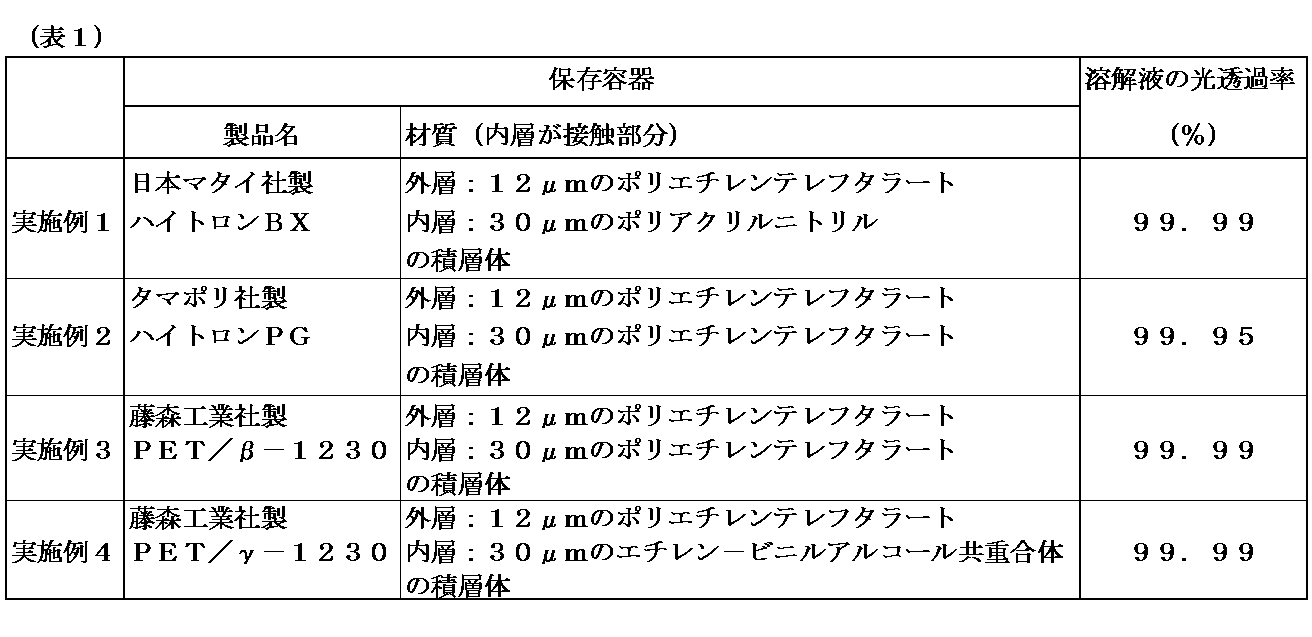
- Example 1 10 g of crystalline L-carnosine zinc complex was stored in a commercially available polyacrylonitrile film bag having a contact area of 400 cm 2 and stored at 45 ° C. and 75% RH for 1 month.
- This bag in which the resin in contact with the crystalline L-carnosine zinc complex is polyacrylonitrile, is made of Nihon Matai's film “Hytron BX” (polyethylene terephthalate with an outer layer of 12 ⁇ m thickness and polyacrylonitrile with an inner layer of 30 ⁇ m thickness).
- a laminated body is processed into a bag shape.
- 1 g of crystalline L-carnosine zinc complex after storage was dissolved in 10 ml of diluted hydrochloric acid and storage stability was evaluated, it was a colorless and clear liquid. The light transmittance of this solution was 99.99%.
- Example 2 The same evaluation as in Example 1 was performed except that a polyethylene terephthalate film was used in place of the polyacrylonitrile film of Example 1.
- This bag in which the resin in contact with the crystalline L-carnosine zinc complex is polyethylene terephthalate, is made of Tamapoly's film “Hitron PG”; the outer layer is made of polyethylene terephthalate with a thickness of 12 ⁇ m, and the inner layer is made of polyethylene terephthalate with a thickness of 30 ⁇ m.
- This laminate is processed into a bag shape.
- the evaluation result of storage stability was a colorless and clear liquid.
- the portion of the storage container in contact with the crystalline L-carnosine zinc complex had a light transmittance of 99.95%.
- Example 3 In Example 2, the same operation as in Example 2 was carried out except that polyethylene terephthalate, which is a resin in contact with the crystalline L-carnosine zinc complex, was changed to a polyethylene terephthalate film made by another company. The transmittance was evaluated. The results are shown in Table 1.
- Example 4 In Example 2, the same operation as in Example 2 was performed except that polyethylene terephthalate, which is a resin in contact with the crystalline L-carnosine zinc complex, was changed to an ethylene-vinyl alcohol copolymer (inner layer resin). The light transmittance of the solution was evaluated. The results are shown in Table 1.
- Example 3 (Comparative Examples 1 to 3)
- various polyolefins having different contents of low molecular weight substances having 12 to 26 carbon atoms were used in place of the polyacrylonitrile bags.
- Table 2 shows the content of low molecular weight compounds having 12 to 26 carbon atoms in the polyolefin in the portion in contact with the crystalline L-carnosine zinc complex.
- Table 2 shows the results of the transmittance of the solution after storage.
- polyolefins have a small amount of low molecular weight in the n-hexane extract, but there are many eluates into polaprezinc and the light transmittance is lowered. That is, even if the amount of the low molecular weight material is reduced, the problem of turbidity cannot be solved.
Landscapes
- Engineering & Computer Science (AREA)
- Chemical & Material Sciences (AREA)
- Mechanical Engineering (AREA)
- Organic Chemistry (AREA)
- Health & Medical Sciences (AREA)
- Food Science & Technology (AREA)
- Epidemiology (AREA)
- Pharmacology & Pharmacy (AREA)
- Medicinal Chemistry (AREA)
- Life Sciences & Earth Sciences (AREA)
- Animal Behavior & Ethology (AREA)
- General Health & Medical Sciences (AREA)
- Public Health (AREA)
- Veterinary Medicine (AREA)
- Packages (AREA)
- Medical Preparation Storing Or Oral Administration Devices (AREA)
- Packaging Of Annular Or Rod-Shaped Articles, Wearing Apparel, Cassettes, Or The Like (AREA)
- Pharmaceuticals Containing Other Organic And Inorganic Compounds (AREA)
Abstract
本発明により、結晶性L-カルノシン亜鉛錯体を保存する容器であって、該結晶性L-カルノシン亜鉛錯体と接する部分が、シアノ基、水酸基、及びエステル基からなる群より選ばれる少なくとも1種の極性基を分子内に有する樹脂で形成されていることを特徴とする結晶性L-カルノシン亜鉛錯体の保存容器が提供される。
Description
本発明は、結晶性L-カルノシン亜鉛錯体を保存する新規な保存容器、及び該保存容器を使用した結晶性L-カルノシン亜鉛錯体の新規な保存方法に関する。詳しくは、賦形剤等の添加物を含まない、原薬である結晶性L-カルノシン亜鉛錯体を保存する新規な保存容器、及び該保存容器を使用した新規な保存方法に関する。
一般的に、医薬品に限らず、包装用の材料として、ガラス、陶器、ステンレス、樹脂、紙等が使用されている。中でも、医薬品原薬の場合には、ポリエチレンに代表されるポリオレフィンを一次容器として使用することが一般的である。そして、このオレフィンとしては、コンタミネーションの問題から、酸化防止剤、塩素補足剤等の添加剤を極力低減したもの、または前記添加剤を含まない高純度のオレフィンが使用されている。加えて、医薬品の中にはポリオレフィン中の低炭素数の物質(低分子量ポリマー)が何らかの原因で不純物として混在することがあり、それらを極力防ぐ方法として、特に抗生物質に対する包装用ポリオレフィンとして、該低炭素数の物質を極力低減したポリオレフィンが開発されている(特許文献1参照)。ポリオレフィンは医薬品原薬の保存容器として一般的に使用されているため、他の樹脂と比較して低分子量ポリマーの含有量が極めて低いものが検討されている。
一方、医薬品原薬である結晶性L-カルノシン亜鉛錯体(一般名ポラプレジンク、以下単に「ポラプラジンク」とする場合もある)は、
下記式(1)
下記式(1)

(式中、nは、繰り返し単位を示す整数である。)
で示される化合物であり、副作用の少ない消化性潰瘍治療薬(特許文献2)として優れ、また、味覚障害治療薬(特許文献3)にも優れていることが知られている。このポラプレジンクは、賦形剤と混合され、顆粒状物の製剤としても市販されている。
で示される化合物であり、副作用の少ない消化性潰瘍治療薬(特許文献2)として優れ、また、味覚障害治療薬(特許文献3)にも優れていることが知られている。このポラプレジンクは、賦形剤と混合され、顆粒状物の製剤としても市販されている。
医薬原薬である結晶性L-カルノシン亜鉛錯体を保存する場合においても、コンタミネーションの問題等から添加剤、及び低炭素数の物質等が極力低減されたポリオレフィンからなる保存容器を使用することが好ましいと考えられる。
しかしながら、本発明者等の検討によれば、ポリオレフィンからなる保存容器に結晶性L-カルノシン亜鉛錯体を保存すると、保存後の結晶性L-カルノシン亜鉛錯体の溶解液が白濁する場合があることが分かった。即ち、ポリオレフィン製の保存容器に、結晶性L-カルノシン亜鉛錯体(賦形剤を含まない結晶性L-カルノシン亜鉛錯体)を入れて保存した後、保存後の結晶性L-カルノシン亜鉛錯体を希塩酸に溶解すると、保存前には見られない濁り成分が発生することが判明した(以下、この濁り成分が発生することを、単に「濁りの問題」とする場合もある。)。このような現象は、特許文献1に記載されているように、通常のポリエチレン及びポリプロピレン容器に抗生物質を保存した場合に見られるものと同じであり、この白濁物は、低分子量ポリマーであると想定された。
そこで、本発明者らは、濁りの問題の原因物資であると想定される低分子量ポリマーの含有量が低いポリオレフィンからなる保存容器を用いることを検討した。しかしながら、本発明者等の検討によると、保存対象物が結晶性L-カルノシン亜鉛錯体である場合については、特許文献1に記載の方法によっても、濁りの問題を解消できないことが分かった。また、特許文献1に記載のポリオレフィンは、濁りの問題の原因物質である低分子量ポリマーの含有量が他の樹脂と比較して極めて低く、低分子量ポリマーの含有量をさらに低下させることは困難であると考えられた。即ち、結晶性L-カルノシン亜鉛錯体を保存する場合においては、通常用いる課題解決アプローチによって低分子量ポリマーの含有量が十分に低い保存容器を用いても、濁りの問題を解決できないことが分かった。
したがって、本発明の目的は、医薬品原薬として有用である結晶性L-カルノシン亜鉛錯体を、何ら変化させることなく、安定して簡便に保存することができる保存容器を提供することにある。
本発明者は、上記課題を解決するため鋭意研究を行った。先ず、ポリオレフィン類を用いた場合に生じる濁りの問題の原因について考察した。ポリオレフィン類は、不活性ではあるが非晶質部分の運動性は非常に高く、低分量ポリマーが動き易い(移動し易い)のではないかと考えた。一方、結晶性L-カルノシン亜鉛錯体は、例えば、特許文献1で例示されているセファゾリンナトリウム塩等と比較して、分子量の大きい高分子量物である。したがって、結晶性L-カルノシン亜鉛錯体は、他の医薬品原薬と比較して、保存容器を構成する樹脂に対する挙動が異なっており、他の医薬品原薬と同様の基準で保存容器の材質を選定することはできない。即ち、非常に運動性の高い低分子量ポリマーが容器表面に移動してきた際に、高分子量物である結晶性L-カルノシン亜鉛錯体がこの低分子量ポリマーを積極的に取り込むため、低分子量ポリマーの含有量を十分に小さくした保存容器であっても、結晶性L-カルノシン亜鉛錯体の保存に影響を与えるものと推定される。
この推定に基づいた結果、保存容器の表面を構成する樹脂として、分子の運動性が低いものを使用すれば、上記課題を解決できるのではないかと考えた。そして、様々な樹脂を用いて検討を行ったところ、分子運動性が低い樹脂の中でも、特定の極性基を有する樹脂、即ち、シアノ基、水酸基、及びエステル基からなる群より選ばれる少なくとも1種の極性基を分子内に有する樹脂を使用することで、上記課題を解決できることを見出し、本発明を完成するに至った。
本発明は、結晶性L-カルノシン亜鉛錯体を保存する容器であって、該結晶性L-カルノシン亜鉛錯体と接する部分が、シアノ基、水酸基、及びエステル基からなる群より選ばれる少なくとも1つの極性基を分子内に有する樹脂で形成されていることを特徴とする結晶性L-カルノシン亜鉛錯体の保存容器である。
本発明においては、保存容器の加工性等を考慮すると、前記樹脂が、ポリアクリロニトリル、ポリエチレンテレフタラート、またはエチレン-ビニルアルコール共重合体であることが好ましい。
また、本発明の結晶性L-カルノシン亜鉛錯体の保存方法は、結晶性L-カルノシン亜鉛錯体を、ポリオレフィンに接触させることなく、シアノ基、水酸基、及びエステル基からなる群より選ばれる少なくとも1つの極性基を分子内に有する樹脂に接触させて、結晶性L-カルノシン亜鉛錯体を保存する方法である。
本発明によれば、高分子量物である結晶性L-カルノシン亜鉛錯体を保存しても、その態様を変化させることがなく、濁りの問題を生じない。したがって、医薬品原薬として有用である結晶性L-カルノシン亜鉛錯体を、長期間保存することができるため、工業的利用価値は高い。
本発明は、結晶性L-カルノシン亜鉛錯体を保存する保存容器に関するものである。なお、本発明において、上記結晶性L-カルノシン亜鉛錯体を保存するとは、該結晶性L-カルノシン亜鉛錯体を製造後、製造または精製に使用した容器から取り出した結晶性L-カルノシン亜鉛錯体を保存することを指す。また、本発明の保存容器とは、少なくとも数分から数ヶ月間、該結晶性L-カルノシン亜鉛錯体を入れておくための容器である。下記の実施例、比較例においては、効果の差をより顕著にするため、45℃、75%RH雰囲気下で1ヶ月保存したものを評価した。ただし、本発明の保存容器は、使用期限1ヶ月に限定されるものではない(1ヶ月以上の使用も可能であるし、1ヶ月未満の使用も可能である。)。
(保存の対象物;結晶性L-カルノシン亜鉛錯体)
本発明において、保存の対象となる結晶性L-カルノシン亜鉛錯体は、製造されたそのもの、つまり原薬である。本発明者の検討によれば、理由は明らかではないが、賦形剤を含まない原薬である結晶性L-カルノシン亜鉛錯体をポリオレフィン製等の容器に保存した場合にのみ、濁りの問題が生じることが分かった。そのため、該結晶性L-カルノシン亜鉛錯体と賦形剤とが混合された錠剤や顆粒状物の製剤は、本発明の保存容器に保存する対象物とはならない。ただし、錠剤、及び顆粒状の製剤を本発明の保存容器に保存することもできる。
本発明において、保存の対象となる結晶性L-カルノシン亜鉛錯体は、製造されたそのもの、つまり原薬である。本発明者の検討によれば、理由は明らかではないが、賦形剤を含まない原薬である結晶性L-カルノシン亜鉛錯体をポリオレフィン製等の容器に保存した場合にのみ、濁りの問題が生じることが分かった。そのため、該結晶性L-カルノシン亜鉛錯体と賦形剤とが混合された錠剤や顆粒状物の製剤は、本発明の保存容器に保存する対象物とはならない。ただし、錠剤、及び顆粒状の製剤を本発明の保存容器に保存することもできる。
本発明において、保存の対象となる結晶性L-カルノシン亜鉛錯体は、上記の通り、賦形剤を含まないものであるが、該結晶性L-カルノシン亜鉛錯体を製造する際に存在する不純物を含むものであってもよい。結晶性L-カルノシン亜鉛錯体の純度が99.50質量%以上、好ましくは99.70質量%以上、さらに好ましくは99.85質量%以上のものが本発明の対象となる。なお、当然のことながら、純度が100質量%のものも本発明の対象となる。
このような結晶性L-カルノシン亜鉛錯体は、公知の方法により製造することができる。具体的には、特公平7-116160号公報に記載された方法で製造することができる。
(保存容器)
本発明は、上記結晶性L-カルノシン亜鉛錯体を保存する容器において、該結晶性L-カルノシン亜鉛錯体と接する部分の材質が、特定の樹脂を使用したものである。
本発明は、上記結晶性L-カルノシン亜鉛錯体を保存する容器において、該結晶性L-カルノシン亜鉛錯体と接する部分の材質が、特定の樹脂を使用したものである。
本発明においては、結晶性L-カルノシン亜鉛錯体と接する部分の樹脂としては、シアノ基、水酸基、及びエステル基からなる群より選ばれる少なくとも1つの極性基を分子内に有する樹脂でなければならない。このような樹脂を使用することの効果は明らかではないが、以下のように推定している。すなわち、極性基を有する樹脂を使用することにより、移動し易い低分子量ポリマー(推定ではあるがこの低分子量ポリマーも極性基を有するものと考えられる)が、容器表面に移動し難くなり、樹脂中に留まり易くなるのではないかと推定している。
また、極性基を有する樹脂は、比較的ガラス転位点が高く、分子の運動性が低い。そのため、低分子量ポリマーの移動も少ないと考えられ、高分子量物である結晶性L-カルノシン亜鉛錯体と接触したとしても、該低分子量ポリマーが結晶性L-カルノシン亜鉛錯体に取り込まれ難くなるのではないかと考えられる。
以上のことから、結晶性L-カルノシン亜鉛錯体と接する部分の樹脂は、ポリアクリロニトリル、ポリエチレンテレフタラート、エチレン-ビニルアルコール共重合体であることが好ましい。
また、保存容器は袋状のものを使用することが好ましいが、この袋状物は、市販のフィルムから構成することができる。具体的には、日本マタイ社製ハイトロンBXフィルム(ポリアクリロニトリル製フィルム)、タマポリ社製ハイトロンPGフィルム(ポリエチレンテレフタラート製フィルム)、藤森工業社製PET/β-1230フィルム(ポリエチレンテレフタラート製フィルム)、藤森工業社製PET/γ-1230フィルム(エチレン-ビニルアルコール共重合体製フィルム)を挙げることができる。
なお、本発明の保存容器は、結晶性L-カルノシン亜鉛錯体と接する部分の材質が、上記特定の樹脂を使用したものであれば、複数の樹脂から成る積層フィルムを用いても良い。このような積層フィルムは、各樹脂の長所を保存容器に付与できるため好ましい。
(保存方法)
本発明においては、上記構成の保存容器を使用すれば、結晶性L-カルノシン亜鉛錯体を保存容器内で保存する方法は、特に制限されるものではない。例えば、樹脂からなる袋状の保存容器を使用する場合には、袋状の保存容器内に結晶性L-カルノシン亜鉛錯体を入れ、ヒートシール、インシュロック等の手段により開口口を閉じてやればよい。また、上記樹脂から成る袋状の保存容器に結晶性L-カルノシン亜鉛錯体を入れ、さらに他の材料からなる硬質の保存容器に収容してもよい。即ち、結晶性L-カルノシン亜鉛錯体と直接接触する部分の材質のみが上記材質で構成されていればよい。この際、結晶性L-カルノシン亜鉛錯体は、窒素ガス、アルゴンガスのような不活性ガス下で保存されるようにすることもできるし、気体が存在しないような減圧下で保存されるようにすることもできる。
本発明においては、上記構成の保存容器を使用すれば、結晶性L-カルノシン亜鉛錯体を保存容器内で保存する方法は、特に制限されるものではない。例えば、樹脂からなる袋状の保存容器を使用する場合には、袋状の保存容器内に結晶性L-カルノシン亜鉛錯体を入れ、ヒートシール、インシュロック等の手段により開口口を閉じてやればよい。また、上記樹脂から成る袋状の保存容器に結晶性L-カルノシン亜鉛錯体を入れ、さらに他の材料からなる硬質の保存容器に収容してもよい。即ち、結晶性L-カルノシン亜鉛錯体と直接接触する部分の材質のみが上記材質で構成されていればよい。この際、結晶性L-カルノシン亜鉛錯体は、窒素ガス、アルゴンガスのような不活性ガス下で保存されるようにすることもできるし、気体が存在しないような減圧下で保存されるようにすることもできる。
以下、実施例を挙げて本発明を詳細に説明するが、本発明はこれらの実施例によって何等制限されることはない。
(保存安定性の評価)
製造した結晶性L-カルノシン亜鉛錯体を実施例、比較例に示す保存容器に入れ、45℃、75%RH雰囲気下で1ヶ月保存した後、保存後の結晶性L-カルノシン亜鉛錯体1gを希塩酸10mlに溶解させて、溶解液の光透過率(700nm)の測定により濁りを確認した。
製造した結晶性L-カルノシン亜鉛錯体を実施例、比較例に示す保存容器に入れ、45℃、75%RH雰囲気下で1ヶ月保存した後、保存後の結晶性L-カルノシン亜鉛錯体1gを希塩酸10mlに溶解させて、溶解液の光透過率(700nm)の測定により濁りを確認した。
(実施例1)
結晶性L-カルノシン亜鉛錯体10gを、接触面積400cm2の市販のポリアクリルニトリルフィルム袋に保存し、45℃、75%RHで1ヶ月保存した。結晶性L-カルノシン亜鉛錯体と接する部分の樹脂がポリアクリルニトリルであるこの袋は、日本マタイ社製のフィルム「ハイトロンBX」(外層が厚み12μmのポリエチレンテレフタラート、内層が厚み30μmのポリアクリルニトリルからなる積層体)を袋状に加工したものである。保存後の結晶性L-カルノシン亜鉛錯体1gを希塩酸10mlに溶解し保存安定性の評価をしたところ、無色澄明の液体であった。この溶解液の光透過率は99.99%であった。
結晶性L-カルノシン亜鉛錯体10gを、接触面積400cm2の市販のポリアクリルニトリルフィルム袋に保存し、45℃、75%RHで1ヶ月保存した。結晶性L-カルノシン亜鉛錯体と接する部分の樹脂がポリアクリルニトリルであるこの袋は、日本マタイ社製のフィルム「ハイトロンBX」(外層が厚み12μmのポリエチレンテレフタラート、内層が厚み30μmのポリアクリルニトリルからなる積層体)を袋状に加工したものである。保存後の結晶性L-カルノシン亜鉛錯体1gを希塩酸10mlに溶解し保存安定性の評価をしたところ、無色澄明の液体であった。この溶解液の光透過率は99.99%であった。
(実施例2)
実施例1のポリアクリルニトリルフィルムに代えて、ポリエチレンテレフタラートフィルムを使用した以外は、実施例1と同様の評価を行った。結晶性L-カルノシン亜鉛錯体と接する部分の樹脂がポリエチレンテレフタラートであるこの袋は、タマポリ社製のフィルム「ハイトロンPG」;外層が厚み12μmのポリエチレンテレフタラート、内層が厚み30μmのポリエチレンテレフタラートからなる積層体を袋状に加工したものである。保存安定性の評価結果は、無色澄明の液体であった。この保存容器の結晶性L-カルノシン亜鉛錯体と接する部分は、この溶解液の光透過率は99.95%であった。
実施例1のポリアクリルニトリルフィルムに代えて、ポリエチレンテレフタラートフィルムを使用した以外は、実施例1と同様の評価を行った。結晶性L-カルノシン亜鉛錯体と接する部分の樹脂がポリエチレンテレフタラートであるこの袋は、タマポリ社製のフィルム「ハイトロンPG」;外層が厚み12μmのポリエチレンテレフタラート、内層が厚み30μmのポリエチレンテレフタラートからなる積層体を袋状に加工したものである。保存安定性の評価結果は、無色澄明の液体であった。この保存容器の結晶性L-カルノシン亜鉛錯体と接する部分は、この溶解液の光透過率は99.95%であった。
(実施例3)
実施例2において、結晶性L-カルノシン亜鉛錯体と接する部分の樹脂であるポリエチレンテレフタラートを、他社製のポリエチレンテレフタラートフィルムとした以外は、実施例2と同様の操作を行い、溶解液の光透過率を評価した。結果を表1に示した。
実施例2において、結晶性L-カルノシン亜鉛錯体と接する部分の樹脂であるポリエチレンテレフタラートを、他社製のポリエチレンテレフタラートフィルムとした以外は、実施例2と同様の操作を行い、溶解液の光透過率を評価した。結果を表1に示した。
(実施例4)
実施例2において、結晶性L-カルノシン亜鉛錯体と接する部分の樹脂であるポリエチレンテレフタラートを、エチレン-ビニルアルコール共重合体(内層の樹脂)とした以外は、実施例2と同様の操作を行い、溶解液の光透過率を評価した。結果を表1に示した。
実施例2において、結晶性L-カルノシン亜鉛錯体と接する部分の樹脂であるポリエチレンテレフタラートを、エチレン-ビニルアルコール共重合体(内層の樹脂)とした以外は、実施例2と同様の操作を行い、溶解液の光透過率を評価した。結果を表1に示した。
(比較例1~3)
実施例1において、ポリアクリルニトリル袋に代えて、炭素数12~26の低分子量物の含量(n-ヘキサン抽出分に含まれる量)が違う種々のポリオレフィンを使用した。結晶性L-カルノシン亜鉛錯体と接する部分のポリオレフィンにおける、炭素数12~26の低分子量物の含量を表2に示した。また、保存後の溶解液の透過率の結果を表2に示した。
実施例1において、ポリアクリルニトリル袋に代えて、炭素数12~26の低分子量物の含量(n-ヘキサン抽出分に含まれる量)が違う種々のポリオレフィンを使用した。結晶性L-カルノシン亜鉛錯体と接する部分のポリオレフィンにおける、炭素数12~26の低分子量物の含量を表2に示した。また、保存後の溶解液の透過率の結果を表2に示した。

これらポリオレフィンは、n-ヘキサン抽出物中の低分子量物の量は少ないものであるが、ポラプレジンクへの溶出物は多く、光透過率が低下した。即ち、低分子量物の量が少なくなっても、濁りの問題を解決できなかった。
Claims (6)
- 結晶性L-カルノシン亜鉛錯体を保存する容器であって、該結晶性L-カルノシン亜鉛錯体と接する部分が、シアノ基、水酸基、及びエステル基からなる群より選ばれる少なくとも1種の極性基を分子内に有する樹脂で形成されていることを特徴とする結晶性L-カルノシン亜鉛錯体の保存容器。
- 前記樹脂が、ポリアクリロニトリル、ポリエチレンテレフタラート、またはエチレン-ビニルアルコール共重合体であることを特徴とする請求項1に記載の結晶性L-カルノシン亜鉛錯体の保存容器。
- 前記樹脂が、袋状に形成されたフィルムである請求項1に記載の結晶性L-カルノシン亜鉛錯体の保存容器。
- 前記フィルムが、積層フィルムである請求項3に記載の結晶性L-カルノシン亜鉛錯体の保存容器。
- 結晶性L-カルノシン亜鉛錯体と、
シアノ基、水酸基、及びエステル基からなる群より選ばれる少なくとも1種の極性基を分子内に有する樹脂と、
を接触させることを特徴とする結晶性L-カルノシン亜鉛錯体の保存方法。 - 請求項1乃至4の何れか1項に記載の保存容器を使用する結晶性L-カルノシン亜鉛錯体の保存方法。
Priority Applications (2)
| Application Number | Priority Date | Filing Date | Title |
|---|---|---|---|
| CN201780022717.8A CN109071093B (zh) | 2016-04-27 | 2017-04-13 | 结晶性l-肌肽锌络合物的保存容器及保存方法 |
| KR1020187028481A KR102415182B1 (ko) | 2016-04-27 | 2017-04-13 | 결정성 l-카르노신 아연 착체의 보존 용기 및 보존 방법 |
Applications Claiming Priority (2)
| Application Number | Priority Date | Filing Date | Title |
|---|---|---|---|
| JP2016088805A JP6659442B2 (ja) | 2016-04-27 | 2016-04-27 | 結晶性l−カルノシン亜鉛錯体の保存容器 |
| JP2016-088805 | 2016-04-27 |
Publications (1)
| Publication Number | Publication Date |
|---|---|
| WO2017188016A1 true WO2017188016A1 (ja) | 2017-11-02 |
Family
ID=60160367
Family Applications (1)
| Application Number | Title | Priority Date | Filing Date |
|---|---|---|---|
| PCT/JP2017/015206 Ceased WO2017188016A1 (ja) | 2016-04-27 | 2017-04-13 | 結晶性l-カルノシン亜鉛錯体の保存容器、及び保存方法 |
Country Status (5)
| Country | Link |
|---|---|
| JP (1) | JP6659442B2 (ja) |
| KR (1) | KR102415182B1 (ja) |
| CN (1) | CN109071093B (ja) |
| TW (1) | TW201803542A (ja) |
| WO (1) | WO2017188016A1 (ja) |
Citations (3)
| Publication number | Priority date | Publication date | Assignee | Title |
|---|---|---|---|---|
| JP2007314467A (ja) * | 2006-05-25 | 2007-12-06 | Takahashi Gakuen | 脳血管性認知症の予防または治療用飲食物、その包装または容器ならびに脳血管性認知症の予防または治療薬 |
| JP2011001324A (ja) * | 2009-06-22 | 2011-01-06 | Sawai Pharmaceutical Co Ltd | ポラプレジンク含有口腔内崩壊錠 |
| US20160101048A1 (en) * | 2014-10-09 | 2016-04-14 | Richard J. Di Rocco | +l-carnosine zinc formulations and methods of use |
Family Cites Families (7)
| Publication number | Priority date | Publication date | Assignee | Title |
|---|---|---|---|---|
| JP3294920B2 (ja) | 1993-10-27 | 2002-06-24 | アロカ株式会社 | 超音波画像記録再生装置 |
| JP2002068981A (ja) | 2000-08-22 | 2002-03-08 | Hamari Chemicals Ltd | 末期ガン患者の食欲不振および味覚異常を改善する医薬 |
| JP2004267384A (ja) * | 2003-03-07 | 2004-09-30 | Niccon Kohsan Co Ltd | 医療用容器の製造方法および医療用容器 |
| WO2006134645A1 (ja) * | 2005-06-15 | 2006-12-21 | Fujimori Kogyo Co., Ltd. | 複室包装体 |
| US9428692B2 (en) * | 2011-09-01 | 2016-08-30 | Mitsubishi Gas Chemical Company, Inc. | Oxygen absorbent composition and oxygen absorbent package using the same |
| WO2013137340A1 (ja) | 2012-03-14 | 2013-09-19 | 株式会社ブリヂストン | タイヤ |
| US11649348B2 (en) * | 2012-12-05 | 2023-05-16 | Zeon Corporation | Resin composition and medical drug container using same |
-
2016
- 2016-04-27 JP JP2016088805A patent/JP6659442B2/ja active Active
-
2017
- 2017-04-13 WO PCT/JP2017/015206 patent/WO2017188016A1/ja not_active Ceased
- 2017-04-13 CN CN201780022717.8A patent/CN109071093B/zh active Active
- 2017-04-13 KR KR1020187028481A patent/KR102415182B1/ko not_active Expired - Fee Related
- 2017-04-25 TW TW106113799A patent/TW201803542A/zh unknown
Patent Citations (3)
| Publication number | Priority date | Publication date | Assignee | Title |
|---|---|---|---|---|
| JP2007314467A (ja) * | 2006-05-25 | 2007-12-06 | Takahashi Gakuen | 脳血管性認知症の予防または治療用飲食物、その包装または容器ならびに脳血管性認知症の予防または治療薬 |
| JP2011001324A (ja) * | 2009-06-22 | 2011-01-06 | Sawai Pharmaceutical Co Ltd | ポラプレジンク含有口腔内崩壊錠 |
| US20160101048A1 (en) * | 2014-10-09 | 2016-04-14 | Richard J. Di Rocco | +l-carnosine zinc formulations and methods of use |
Also Published As
| Publication number | Publication date |
|---|---|
| KR20180134874A (ko) | 2018-12-19 |
| KR102415182B1 (ko) | 2022-07-01 |
| TW201803542A (zh) | 2018-02-01 |
| JP2017197215A (ja) | 2017-11-02 |
| JP6659442B2 (ja) | 2020-03-04 |
| CN109071093B (zh) | 2020-06-23 |
| CN109071093A (zh) | 2018-12-21 |
Similar Documents
| Publication | Publication Date | Title |
|---|---|---|
| CN101478945B (zh) | 液体收纳容器 | |
| FR2853547A1 (fr) | Compositions pharmaceutiques injectables contenant de la piperacilline et du tazobactame, et procede pour leur production | |
| CN107106409A (zh) | 用于容纳蛋白质溶液制剂的医疗用容器 | |
| US20210128562A1 (en) | Intravenous infusion dosage form | |
| JP2013543843A5 (ja) | ||
| WO2013179310A1 (en) | Stable aqueous compositions of pemetrexed | |
| EP2983642A1 (en) | Process of manufacturing a stable, ready to use infusion bag for an oxidation sensitive formulation | |
| CN106038538A (zh) | 一种右美托咪定的预混合制剂 | |
| CA3013413C (en) | Process of manufacturing a stable, ready to use infusion bag for an oxidation sensitive formulation | |
| WO2007087214A1 (en) | Container for compositions containing cefdinir | |
| JP6659442B2 (ja) | 結晶性l−カルノシン亜鉛錯体の保存容器 | |
| WO2021131314A1 (ja) | ダプトマイシンを含有する安定した凍結乾燥製剤 | |
| JP2016022092A (ja) | エダラボン含有プラスチック容器 | |
| WO2015145911A1 (ja) | 注射液製剤及びその製造方法 | |
| US9089558B2 (en) | Packaged product of solid preparation containing 5-hydroxy-1H-imidazole-4-carboxamide or salt thereof, or hydrate thereof | |
| Ali et al. | Pharmaceutical development of suspension dosage form | |
| WO2025015011A1 (en) | Bupivacaine compositions and methods | |
| KR0169505B1 (ko) | 약제 포장용 폴리올레핀 포장재, 그의 제조방법 및 약제 포장용 용기 | |
| JP2009285318A (ja) | ガスバリア容器の包装形態 | |
| CN102406543A (zh) | 一种双腔袋包装的头孢他啶注射液及其制备方法 | |
| JP6478203B2 (ja) | 化粧料包装物 | |
| TWI771506B (zh) | 培美曲塞靜脈注射劑型 | |
| US10493091B2 (en) | Method for storing P1, P4-bis(5′-uridyl)teraphosphate crystals | |
| JP2006212148A (ja) | 薬剤包装用基材、薬剤包装用容器およびこれらを使用した製剤 | |
| JP2006213800A (ja) | 薬剤包装用基材、薬剤包装用容器およびこれらを用いた製剤 |
Legal Events
| Date | Code | Title | Description |
|---|---|---|---|
| ENP | Entry into the national phase |
Ref document number: 20187028481 Country of ref document: KR Kind code of ref document: A |
|
| NENP | Non-entry into the national phase |
Ref country code: DE |
|
| 121 | Ep: the epo has been informed by wipo that ep was designated in this application |
Ref document number: 17789302 Country of ref document: EP Kind code of ref document: A1 |
|
| 122 | Ep: pct application non-entry in european phase |
Ref document number: 17789302 Country of ref document: EP Kind code of ref document: A1 |