WO2017183936A1 - Rgen rnp를 이용한 미세조류의 교정 방법 - Google Patents
Rgen rnp를 이용한 미세조류의 교정 방법 Download PDFInfo
- Publication number
- WO2017183936A1 WO2017183936A1 PCT/KR2017/004268 KR2017004268W WO2017183936A1 WO 2017183936 A1 WO2017183936 A1 WO 2017183936A1 KR 2017004268 W KR2017004268 W KR 2017004268W WO 2017183936 A1 WO2017183936 A1 WO 2017183936A1
- Authority
- WO
- WIPO (PCT)
- Prior art keywords
- chlamydomonas
- gene
- microalgae
- zep
- mutant
- Prior art date
- Legal status (The legal status is an assumption and is not a legal conclusion. Google has not performed a legal analysis and makes no representation as to the accuracy of the status listed.)
- Ceased
Links
Images














Classifications
-
- C—CHEMISTRY; METALLURGY
- C12—BIOCHEMISTRY; BEER; SPIRITS; WINE; VINEGAR; MICROBIOLOGY; ENZYMOLOGY; MUTATION OR GENETIC ENGINEERING
- C12N—MICROORGANISMS OR ENZYMES; COMPOSITIONS THEREOF; PROPAGATING, PRESERVING, OR MAINTAINING MICROORGANISMS; MUTATION OR GENETIC ENGINEERING; CULTURE MEDIA
- C12N9/00—Enzymes; Proenzymes; Compositions thereof; Processes for preparing, activating, inhibiting, separating or purifying enzymes
- C12N9/14—Hydrolases (3)
- C12N9/16—Hydrolases (3) acting on ester bonds (3.1)
- C12N9/22—Ribonucleases [RNase]; Deoxyribonucleases [DNase]
-
- C—CHEMISTRY; METALLURGY
- C12—BIOCHEMISTRY; BEER; SPIRITS; WINE; VINEGAR; MICROBIOLOGY; ENZYMOLOGY; MUTATION OR GENETIC ENGINEERING
- C12N—MICROORGANISMS OR ENZYMES; COMPOSITIONS THEREOF; PROPAGATING, PRESERVING, OR MAINTAINING MICROORGANISMS; MUTATION OR GENETIC ENGINEERING; CULTURE MEDIA
- C12N1/00—Microorganisms; Compositions thereof; Processes of propagating, maintaining or preserving microorganisms or compositions thereof; Processes of preparing or isolating a composition containing a microorganism; Culture media therefor
- C12N1/12—Unicellular algae; Culture media therefor
- C12N1/125—Unicellular algae isolates
-
- C—CHEMISTRY; METALLURGY
- C12—BIOCHEMISTRY; BEER; SPIRITS; WINE; VINEGAR; MICROBIOLOGY; ENZYMOLOGY; MUTATION OR GENETIC ENGINEERING
- C12N—MICROORGANISMS OR ENZYMES; COMPOSITIONS THEREOF; PROPAGATING, PRESERVING, OR MAINTAINING MICROORGANISMS; MUTATION OR GENETIC ENGINEERING; CULTURE MEDIA
- C12N15/00—Mutation or genetic engineering; DNA or RNA concerning genetic engineering, vectors, e.g. plasmids, or their isolation, preparation or purification; Use of hosts therefor
- C12N15/09—Recombinant DNA-technology
- C12N15/11—DNA or RNA fragments; Modified forms thereof; Non-coding nucleic acids having a biological activity
- C12N15/113—Non-coding nucleic acids modulating the expression of genes, e.g. antisense oligonucleotides; Antisense DNA or RNA; Triplex- forming oligonucleotides; Catalytic nucleic acids, e.g. ribozymes; Nucleic acids used in co-suppression or gene silencing
-
- C—CHEMISTRY; METALLURGY
- C12—BIOCHEMISTRY; BEER; SPIRITS; WINE; VINEGAR; MICROBIOLOGY; ENZYMOLOGY; MUTATION OR GENETIC ENGINEERING
- C12N—MICROORGANISMS OR ENZYMES; COMPOSITIONS THEREOF; PROPAGATING, PRESERVING, OR MAINTAINING MICROORGANISMS; MUTATION OR GENETIC ENGINEERING; CULTURE MEDIA
- C12N15/00—Mutation or genetic engineering; DNA or RNA concerning genetic engineering, vectors, e.g. plasmids, or their isolation, preparation or purification; Use of hosts therefor
- C12N15/09—Recombinant DNA-technology
- C12N15/63—Introduction of foreign genetic material using vectors; Vectors; Use of hosts therefor; Regulation of expression
-
- C—CHEMISTRY; METALLURGY
- C12—BIOCHEMISTRY; BEER; SPIRITS; WINE; VINEGAR; MICROBIOLOGY; ENZYMOLOGY; MUTATION OR GENETIC ENGINEERING
- C12R—INDEXING SCHEME ASSOCIATED WITH SUBCLASSES C12C - C12Q, RELATING TO MICROORGANISMS
- C12R2001/00—Microorganisms ; Processes using microorganisms
- C12R2001/89—Algae ; Processes using algae
Definitions
- the present invention relates to a method for calibrating microalgae using RGEN RNP.
- the present invention relates to an algae having a dye producing ability developed using RGEN RNP, a pigment composition comprising the algae and a method of producing the dye.
- Microalgae are single-celled organisms that synthesize photosynthesis with carbon dioxide and water, and have a shorter cycle of cell division and growth than higher plants (approximately 5-8 hours) .Health supplements, anti-aging ingredients, DHA, cosmetic ingredients, etc. It is a biological resource with high economic potential, which is used as a useful high value-added industrial material. Among them, Chlamydomonas reinhardtii has been the most studied as a model species in microalgae research, and the genome project has been completed and is easy to study and manipulate genes. In addition to academic research, various researches for use in industrial fields are underway.
- RNA-guided engineered nuclease RGEN
- RGEN RNA-guided engineered nuclease
- Macular degeneration is a disease that causes visual acuity disorder due to degeneration of the macular tissue, which is located in the center of the inner retina of the eye, and most of the cells are collected in the macula and the image of the object is also the center of the macula. Is in charge of. The most common causes of macular degeneration are age-related macular degeneration and are known to be associated with family history, race, and smoking. Because the macula is responsible for central vision, degeneration occurs in this area, such as decreased vision, central dark spots, and schizophrenia. Macular degeneration is largely divided into non-exudative (dry) and exudative (wet).
- macular degeneration does not significantly affect visual acuity.
- the exudative phase which is visible, subretinal hemorrhage, subretinal fluid, or pigmented epithelial detachment, visual acuity develops initially when the location of the lesion is directly under or under the macula.
- Exudative macular degeneration accounts for about 10-20% of the total macular degeneration, but if left untreated without exudative macular degeneration, visual acuity quickly deteriorates, leading to blindness within two years after diagnosis.
- Macular pigment is a carotenoid-based oxycarotenoid pigment produced by oxygenation of carotenoids.
- Xanthophyll examples include lutein or zeaxanthin.
- Lutein acts as an antioxidant that protects the interior of the eye, which is damaged by the oxygen free radicals that are naturally produced in the body, and kills cancer cells by reducing the growth of blood vessels that supply cancer tumors, breast, colon, and lungs. It is known to have some effects on the prevention of ovarian cancer and skin cancer.
- Exemplary marigold flowers are typical sources of zeaxanthin and lutein, and other extracts from higher plants have been studied.
- the bacteria genetically alter the mechanism of pigment synthesis to produce zeaxanthin and lutein.
- Research into obtaining these pigments from microalgae has also been conducted.
- Marigold flower of the conventional raw materials has a disadvantage that it takes a long time to breed the flowers for production, there is a problem that the production cost is high because the production amount is not large compared to the land area for production.
- the conventional microalgae is a wild type that has not been improved, but the lutein content is constant, but the zeaxanthin content is very low depending on the amount of light.
- An object of the present invention is a method of correcting a gene of a microalga without introducing foreign DNA using an RNA guided endonuclease (RNG) ribonucleoprotein (RNP) complex of a guide RNA and a Cas protein specific for a target gene; And to provide a microalgal variant with a genetically corrected.
- RNG RNA guided endonuclease
- RNP ribonucleoprotein
- another object of the present invention is to provide a raw material that can replace the xanthophyll used as a raw material of the conventional food or a method that can replace the conventional raw material production method, specifically, xanthophyl production ability, in particular lutein And it provides a microorganism having excellent zeaxanthin production capacity, a composition comprising the same and a method for producing xanthophyll using the same.
- the present inventors have developed an algae that can solve the insufficient productivity of wild type or existing microalgae by using a variant other than the genetic recombination method which may be a problem in the food industry.
- the present invention was completed by developing a method for correcting a microalgae gene without introducing DNA.
- the present inventors applied DNA-free RGEN RNP to microalgae, cell number and guide RNA when RGEN RNP complex is applied to microalgae weakened due to mutation or chemical treatment of cell wall among microalgae through many trials and errors.
- Optimal conditions of concentration and Cas9 protein concentration were established to develop a suitable microalgae genetic correction method.
- the present invention provides a microorganism comprising directly introducing a RNA guided endonuclease (RNG) ribonucleoprotein (RNP) complex of a guide RNA and a Cas protein specific for a target gene into a microalga that is weakened by altering or chemically treating a cell wall.
- RNG RNA guided endonuclease
- RNP ribonucleoprotein
- the present invention also provides a microalgal variant prepared by the above calibration method.
- the present inventors can solve the insufficient productivity of wild type or existing microalgae by using a variant other than genetic recombination method which may be a problem in the food industry.
- a variant other than genetic recombination method which may be a problem in the food industry.
- the present invention has a ZEP gene mutation in which the base sequence represented by SEQ ID NO: 2 is inserted between the 816th base and the 817th base in the ZEP gene sequence of Chlamydomonas reinhardtia cw15 WT represented by SEQ ID NO: 1, and , Provides Chlamydomonas reinhardtia mutants with xanthophyll production capacity.
- the present invention has a ZEP gene mutation in which the base sequence represented by SEQ ID NO: 4 is inserted between the 816th base and the 817th base in the ZEP gene sequence of Chlamydomonas reinhardtia cw15 WT represented by SEQ ID NO: 1, It provides a Chlamydomonas Reinhardtia mutant having a xanthophyll-producing ability.
- the present invention has a ZEP gene mutation in which the base A is inserted between the 816th base and the 817th base in the ZEP gene sequence of Chlamydomonas reinhardtia cw15 WT represented by SEQ ID NO: 1, and has a xanthophyll-producing ability. Chlamydomonas reinhardtia provides a variant.
- the three Chlamydomonas Reinhardtia mutants may each have a xanthophyll production capacity.
- Chlamydomonas Reinhardtia mutants are lutein (lutein) and zeaxanthin (zeaxanthin), respectively; And chlorophyll b (chlorophyll b), chlorophyll a (chlorophyll a) and beta-carotene ( ⁇ -carotene) may have the ability to produce one or more pigments selected from the group.
- the present invention also provides a culture of the Chlamydomonas Reinhardtia mutant strain.
- the present invention provides a pigment composition comprising at least one selected from the group consisting of the culture of the mutant strain, dried product thereof and extract thereof.
- the present invention provides a composition for oral administration comprising at least one selected from the group consisting of the culture of the mutant strain, dried product thereof and extract thereof.
- the present invention provides a feed or feed additive composition comprising at least one selected from the group consisting of the culture of the mutant strains, dried products thereof and extracts thereof.
- the present invention provides a composition for food or food additives comprising at least one selected from the group consisting of the culture of the mutant strain, dried product thereof and extract thereof.
- the present invention also provides a pigment production method using the mutant strain.
- the present invention provides a food or feed material production method comprising the step of culturing the mutant strain.
- the present invention is a novel transformation method for selectively knocking out a desired gene using a crisper gene shear in a microalga Chlamydomonas reinhardtii without introducing DNA.
- a method of transferring it into a guide RNA and a protein complex (ribonucleoprotein, RNP) without introducing and expressing it in a DNA form is used.
- the method for correcting a gene according to the present invention has the advantage that it is possible to accurately and selectively correct a desired gene without introducing external DNA.
- the calibration method can be effectively applied to the development of Chlamydomonas strains required for various industrial applications, such as carbon dioxide reduction, biodiesel or antioxidant production and efficiency in terms of industrial use of microalgae.
- the method is unlikely to insert DNA fragments into the target or off-target sequences, microalgal variants produced by this method are expected to not be regulated by GMO, which may have a significant economic impact on the industrial side. It is expected to be.
- the present invention knocked out ZEP genes using RGEN RNPs in the microalga Chlamydomonas reinhardtia, and produced three kinds of pigment-producing mutants.
- the process of producing the mutant strain is not expected to be regulated by GMO because there is no possibility that the DNA fragment is inserted into the target or off-target sequence, the industrial aspect of producing lutein and zeaxanthin using microalgae It is expected to have a great economic effect in the world.
- FIG. 1 is a schematic diagram summarizing a step-by-step experimental procedure applied to an embodiment of the present invention.
- FIG. 2 summarizes four target sequences designed to target the Chlamydomonas Reinhardtia CC-4349 CpFTSY gene [Cas-Designer (www.rgenome.net/cas-designer/), using the entire genome Four sgRNAs were carefully designed within half of the coding sequence region of the CpFTSY gene, which differs from any other target sites by 3 nucleotides (nt) in and has an out-of-frame score higher than 66. 'CDS (coding sequence) position' means the relative position of a cleavage point in an RNA transcript.
- Direction of + is the same direction as the target sequence, that is, the same sequence is a sequence of RGEN,-means a reverse complementary sequence of the target sequence and the reverse direction, that is, the sequence combined with the target sequence.
- the 'out-frame score' refers to the possibility of frameshift-induced deletions that occur when broken double-stranded DNA is repaired by the microhomology-mediated end joining (MMEJ) pathway.
- MMEJ microhomology-mediated end joining
- '# Of target-off sites' means the number of mismatched sequences throughout the entire genome.].
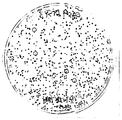
- Figure 4 is produced by the CpFTSY RGEN RNPs A picture of a mutant of gene knockout.
- FIG. 7 summarizes five target sequences designed to target the Chlamydomonas reinhardtia CC-4349 ZEP gene [Cas-Designer (www.rgenome.net/cas-designer/), using the entire genome
- Five target sequences were carefully designed within half of the coding sequence region of the ZEP gene, which differs from any other target sites by 3 nucleotides (nt) in and has an out-of-frame score higher than 66.
- 'CDS (coding sequence) position' means the relative position of a cleavage point in an RNA transcript.
- Direction of + is the same direction as the target sequence, that is, the same sequence is a sequence of RGEN,-means a reverse complementary sequence of the target sequence and the reverse direction, that is, the sequence combined with the target sequence.
- the 'out-frame score' refers to the possibility of frameshift-induced deletions that occur when broken double-stranded DNA is repaired by the microhomology-mediated end joining (MMEJ) pathway.
- MMEJ microhomology-mediated end joining
- '# Of target-off sites' means the number of mismatched sequences throughout the entire genome.].
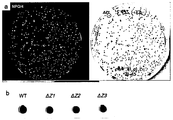
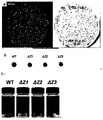
- Chl fluorescence for hundreds of colonies to study ZEP gene knockout is measured [a: ZEP specific knockout mutants were generated using RGEN RNP without DNA, and then all cells in Petri dishes. Chl fluorescence was measured and several putative ZEP knockout cell lines were selected. Red circles indicate putative ZEP knockout mutants grown on TAP agar medium under low light (50 ⁇ mol photons / m 2 s) conditions. NPQ / 4 images were measured as described in the method. b: Single cell colonies of wild type (WT) and ⁇ ZEP mutant strains were grown on minimal agar medium under low light (50 ⁇ mol photons / m 2 s) conditions. The colonies showed similar colors that are difficult to distinguish with the naked eye.
- Figure 11a is a wild-type (in blue) and ⁇ Z1 (Red), ⁇ Z2 (Magenta) and ⁇ Z3 (Purple) shows the HPLC profile of the total pigment from the acetone extract [in contrast to the wild type, zeaxanthin was significantly increased in all ⁇ ZEP mutants even under low light growth conditions.
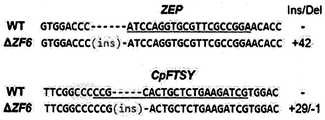
- FIG. 11B shows ZEP gene knockout via RGEN RNP delivery without foreign DNA introduction
- a Schematic of reversible xanthophyll cycle in green algae
- b Wild-type (WT) and mutant DNA sequence at ZEP locus.
- the 20-bp target sequence is underlined and the PAM sequence is shown in red.
- the right column shows the inserted (+) number
- c Quantification of pigment content and Chl a to Chl b ratio of wild type (WT) and ⁇ ZEP mutant strains.
- Cells were grown in TAP medium under low light (50 ⁇ mol photons / m 2 s) conditions. Vio, violaxanthin; An, anteraxanthin; Zea, zeaxanthin. Data is mean ⁇ standard deviation from three replicates].
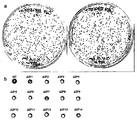
- ⁇ ZEP Mutant 1 in a photograph showing the results of the investigation of visual colored for hundreds colonies for inducing CpFTSY gene knockout [a: by RGEN RNPs ⁇ ZEP CpFTSY by RGEN RNPs in Mutants
- a continuous picture of the double mutation of a gene, a red circle indicates the ZEP ⁇ / ⁇ CpFTSY mutant putative grown on TAP agar medium under low light (50 ⁇ mol photons / m 2 s) conditions.
- FIG. 15 shows the results of HPLC pigmentation analysis of ⁇ ZEP mutants, ⁇ ZEP / ⁇ CpFTSY double mutants by WT, RGEN RNPs, the amount of total chlorophyll, the ratio of chlorophyll a and b [cells are low light (70 ⁇ mol photons) / m 2 s) was grown in TAP medium under the conditions. Data is mean ⁇ standard deviation from 4 replicates].
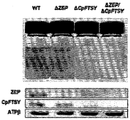
- Figure 17 shows sequential CpFTSY and ZEP 2-gene knockout mutants by transfection of RGEN-RNP [a: induced by RGEN RNP in ZEP and CpFTSY genes in wild type and ZEP / ⁇ CpFTSY double mutants the targeting of indel mutations, b: wild type, ZEP ⁇ , ⁇ ⁇ CpFTSY and ZEP / ⁇ CpFTSY phenotype of the mutant.
- Cells were grown light autotrophically under high light (500 ⁇ mol photons / m 2 s) conditions. Cell density was 10 ⁇ 10 6 cells / mL.
- ATP ⁇ Chlamydomonas ATP synthase
- Figure 19 shows targeted indel mutations ( ⁇ ZEP , ⁇ CpFTSY , ⁇ ZEP / ⁇ CpFTSY of ZEP and / or CpFTSY genes induced by RGEN RNPs. Double mutants).
- FIG. 20 shows HPLC profiles of total pigments from acetone extracts of wild type (blue), ⁇ ZEP (red), ⁇ CpFTSY (green) and ⁇ ZEP / ⁇ CpFTSY double mutant (yellow) (loroxanthin; Neo, neoxanthin; Vio, violaxanthin; An, antheraxanthin; Lut, Lutein; Zea, zeaxanthin; Chl b , chlorophyll b ; Chl a, chlorophyll a; ⁇ -Car, ⁇ -carotene; ⁇ -Car, ⁇ -carotene].
- FIG. 21 shows light-saturation curves of photosynthesis of photosynthesis in wild-type (blue) and ⁇ ZEP (red), ⁇ CpFTSY (green) and ⁇ ZEP / ⁇ CpFTSY (yellow), each Chl
- the rate of oxygen evolution per reference was measured as a function of incident light intensity.
- FIG. 22 shows growth curves of wild type and mutants cultured in HS medium with air containing 5% CO 2 under high light (700 ⁇ mol photons / m 2 s) at 25 ° C.
- Figure 23 shows the results of quantification of photosynthetic activity and pigment content of wild type and ⁇ ZEP , ⁇ CpFTSY and ⁇ ZEP / ⁇ CpFTSY mutants under low light (50 ⁇ mol photons / m 2 s) conditions [Vio, violaxanthin; An, anteraxanthin; Zea, zeaxanthin. Data is mean ⁇ standard deviation from three replicates].
- sgRNA 24 is Cas9 protein and shows the mutation frequency at different incubation times and different concentrations of the sgRNA
- a RGEN RNP (200 ⁇ g of Cas9 and 140 ⁇ g of sgRNA) is in Chlamydomonas of 50 x 10 4 cells transfected After specification it was incubated and harvested for different times. No significant difference was found between different incubation times of 12 and 24 hours
- b Mutations (insertion and deletion; indel) using target sequences (5′-CGATCTTCAGAGCAGTGCGG-3 ′) of Cas9 protein and sgRNA at various concentration conditions Frequency was measured by targeted deep sequencing after incubation for 12 hours.
- Figure 25 shows the Cas9 protein sequence used in the genetic correction method of the present invention.
- Figure 26 shows an overall summary of the techniques and methods applied in the present invention.
- FIG. 27 shows information about Zeaxanthin epoxidase (ZEP) gene of Chlamydomonas reinhardtia cw15 wild type.
- ZEP Zeaxanthin epoxidase
- FIG. 28 summarizes five target sequences designed to target the Chlamydomonas Reinhardtia ZEP gene [3 nucleotides in the entire genome, using Cas-Designer (www.rgenome.net/cas-designer/)
- Five sgRNAs were carefully designed within half of the coding sequence region of the ZEP gene, which differed from any other target sites by (nt) and had an out-of-frame score higher than 66.
- 'CDS (coding sequence) position' means the relative position of a cleavage point in an RNA transcript.
- Direction of + is the same direction as the target sequence, that is, the same sequence is a sequence of RGEN,-means a reverse complementary sequence of the target sequence and the reverse direction, that is, the sequence combined with the target sequence.
- the 'out-frame score' refers to the possibility of frameshift-induced deletions that occur when broken double-stranded DNA is repaired by the microhomology-mediated end joining (MMEJ) pathway.
- MMEJ microhomology-mediated end joining
- '# Of target-off sites' refers to the number of mismatched sequences throughout the entire genome.
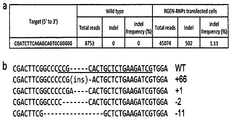
- FIG. 29 shows mutations in ZEP genes induced by DNA-free RGEN RNPs
- a Deep sequencing with targeted frequency of mutation (insertion and deletion; indel) of RGEN-transfected cells and wild type for each sgRNA (Targeted deep sequencing). Indel frequency was measured to about 0.46%.
- b Representative mutant DNA sequence (RGEN3), ie TCCGGCGAACGCACCTGGATGGG, obtained from the third most efficient sgRNA observed in the targeted deep sequencing assay of a.
- Targeted deep sequencing analysis revealed various indel patterns identified in the target sequence, 3nt upstream of the PAM sequence. 20-bp target sequences are underlined and PAM sequences are shown in bold.
- Figure 31 shows the target DNA sequence changes of the actual ZEP gene position in three ZEP mutants generated by DNA-free RGEN RNPs [a: wildtype, b: ZEP mutant 1 ( ⁇ Z1), c: ZEP mutant 2 ( ⁇ Z2) d. ZEP mutant 3 ( ⁇ Z3)].
- Figure 32b shows the information for the ZEP gene of Chlamydomonas Reinhardtia variant strain ⁇ Z2.
- Figure 32c shows the information for the ZEP gene of Chlamydomonas Reinhardtia mutant ⁇ Z3.
- FIG. 35 is a HPLC analysis graph showing the pigment profiles of Chlamydomonas reinhardtia cw15 wild type, Chlamydomonas reinhardtia mutants ⁇ Z1, ⁇ Z2, ⁇ Z3 [neo + lor: neoxanthin + roxanthin ( loroxanthin, vio: violaxanthin, an: antheraxanthin, lut: lutein, zea: zeaxanthin, chl a: chlorophyll a, chl b: chlorophyll b (chlorophyll b), ⁇ -car: alpha-carotene, ⁇ -car beta-carotene.
- 36 is a graph showing the growth curve (number of cells per volume, cells / ml) with Chlamydomonas reinhardtia cw15 wild type, Chlamydomonas reinhardtia mutant strains ⁇ Z1, ⁇ Z2, ⁇ Z3 of the present invention.
- FIG. 37 is a graph comparing lutein and zeaxanthin pigment production over time of Chlamydomonas reinhardtia cw15 wild type (WT) and ZEP knockout mutants ⁇ Z1, ⁇ Z2, ⁇ Z3 [a: lutein production (mg over time) / L), b: production of zeaxanthin over time (mg / L), c: sum of production of lutein and zeaxanthin over time (mg / L)].
- FIG. 38 shows zeaxanthin and lutein of higher plants known to be high in xanthine and lutein and chlamydomonas reinhardtia cw15 wild type (WT), chlamidomonas reinhardtia ZEP knockout mutants ⁇ Z1, ⁇ Z2, and ⁇ Z3. The content of is compared.
- the present invention provides a microalgae genetic correction method or a gene knockout method comprising introducing a RNA guided endonuclease (RNG) ribonucleoprotein (RNP) complex of a guide RNA and a Cas protein specific for a guide target gene into a microalgae. It is about.
- RNG RNA guided endonuclease
- RNP ribonucleoprotein
- Genetic modification or knockout herein refers to any genetic manipulation that removes the target site of the target gene and / or inserts specific nucleotides to induce frameshift mutations, preventing the gene from producing a protein that functions normally. Means.
- the microalgae may be one or more selected from the group consisting of all single-celled organisms that photosynthesize with carbon dioxide and water.
- the microalgae may be, but not limited to, Chlamydomonas microalgae.
- the microalgae of the genus Chlamydomonas may be Chlamydomonas reinhardtii, but is not limited thereto.
- the microalgae is preferably 1 X 10 4 to 1 X 10 7 or 1 X 10 5 to 1 X 10 6 for the reason for improving transformation efficiency.
- the genetic correction method of the present invention is characterized by delivering RNA guided endonuclease (RNG) ribonucleoprotein (RNP) complexes of guide RNA and Cas protein directly into microalgal cells without passing through DNA carriers such as plasmids. Delivery of the complex may be by means of direct intracellular delivery of conventional proteins, and in the case of microalgae used in the present invention, electroporation may be performed, but is not limited thereto.
- RNG RNA guided endonuclease
- RNP ribonucleoprotein
- the voltage of the electroporation method is preferably 400 to 800V. If the voltage is too high, there is a problem that all the cells die, if the voltage is too low, there is a problem that the transformation efficiency is low.
- RNA guide endonuclease refers to an endonuclease that forms a complex with single-stranded RNA or double-stranded RNA and performs genetic correction by cutting a gene target region targeting sequence included in the RNA.
- endonucleases accompanying the type II CRISPR / Cas system such as Cas9 protein (CRISPR associated protein 9).
- Cas9 protein was identified as Streptococcus sp. ( Streptococcus sp.) Such as, but not limited to, Streptococcus pyogenes (SwissProt Accession number Q99ZW2).
- the Cas9 protein may be isolated from a microorganism or non-naturally occurring by recombinant or synthetic methods.
- the Cas9 protein may further include, but is not limited to, elements commonly used for nuclear transfer of eukaryotic cells (eg, nuclear localization signal (NLS), etc.).
- NLS nuclear localization signal
- the guide sequence is any polynucleotide sequence that has complementarity with the target polynucleotide sequence sufficient to hybridize with the target sequence and induce sequence-specific binding of the CRISPR complex to the target sequence.
- the degree of complementarity between the guide sequence and its corresponding target sequence is about 50%, 60%, 75%, 80%, 85%, 90%, 95 when optimally aligned using an appropriate alignment algorithm. %, 97.5%, 99% or more.
- Optimal alignment can be determined by the use of any algorithm suitable for aligning sequences, non-limiting examples of which include Smith-Waterman algorithm, Needleman-Wunsch algorithm, Burroughs- Algorithms based on the Wheelers-Wheeler Transform (e.g.
- Burrows Wheeler Aligner ClustalW, Clustal X, BLAT, Novoalign (Novocraft Technologies) , ELAND (Illumina, San Diego, Calif.), SOAP (available at soap.genomics.org.cn), and Maq (available at maq.sourceforge.net).
- guide sequences Is about 5, 10, 11, 12, 13, 14, 15, 16, 17, 18, 19, 20, 21, 22, 23, 24, 25, 26, 27, 28, 29, 30, 35, 40, 45, 50, 75 or more nucleotides in length In some embodiments, the guide sequence is about 75, 50, 45, 40, 35, 30, 25, 20, 15, 12
- the following nucleotide lengths The ability of the guide sequence to induce sequence-specific binding of the CRISPR complex to the target sequence can be assessed by any suitable assay, eg, the CRISPR complex comprising the guide sequence being tested. Components of the CRISPR system sufficient to form a target are for example targeted by an assay using, eg, a next generation sequencing technique as described herein after transfection with a vector encoding the components of the CRISPR sequence.
- cleavage of the target polynucleotide sequence is a control different from the target sequence, the guide sequence tested and the test guide sequence.
- Providing components of the CRISPR complex comprising a guide sequence and testing and control guides in the target sequence. It can be assessed in vitro by comparing the rate of binding or cleavage between sequence reactions. Other assays are possible and will occur to those skilled in the art.
- the guide sequence can be selected to target any target sequence.
- the target sequence is a sequence in the genome of a cell. Exemplary target sequences include those unique in the target genome.
- the guide RNA may be appropriately selected depending on the target sequence or depending on the type of endonuclease and / or the microorganism derived therefrom.
- the guide RNA may be at least one selected from the group consisting of CRISPR RNA (crRNA), trans- activating crRNA (tracrRNA), and single-stranded guide RNA (sgRNA), and depending on the endonucleide type, CRISPR RNA (crRNA) And a double stranded complex of trans -activating crRNA (tracrRNA), or a single stranded guide RNA (sgRNA).
- the sgRNA may comprise portions of crRNA and tracrRNA.
- a complex comprising a Cas9 protein can be used to produce two guide RNAs, ie CRISPR RNA (crRNA) having a nucleotide sequence hybridizable with a target site of a gene, and an additional trans- activating crRNA (tracrRNA) for the desired genetic correction.
- crRNA CRISPR RNA
- tracrRNA additional trans- activating crRNA
- the specific sequence of the guide RNA can be appropriately selected according to the type of Cas9 protein (derived microorganism), which is easily understood by those skilled in the art.
- the crRNA used in the Cas9 system including the Cas9 protein from Streptococcus pyogenes , can be represented by the following general formula:
- N cas9 is a targeting sequence site including a nucleotide sequence capable of hybridizing with a gene target site, and is a site determined according to a target site of a target gene, and l represents the number of nucleotides contained in the targeting sequence site. For example 20;
- the site comprising 12 consecutive nucleotides (GUUUUAGAGCUA) located adjacent to the 3 'direction of the targeting sequence site is an essential part of the crRNA.
- X cas9 is a site comprising m nucleotides located on the 3 'side of the crRNA (ie, located adjacent to the 3' direction of an essential part of the crRNA), where m is an integer from 0 to 12, such as 0 days Can be.
- a nucleotide sequence that is hybridizable with a gene target site is at least 50%, at least 60%, at least 70%, at least 80%, at least 90%, at least 95%, at least 99%, or 100 with the nucleotide sequence of the gene target site.
- a nucleotide sequence with% sequence complementarity is used (hereinafter, used interchangeably unless otherwise specified).
- the X cas9 may include UGCUGUUUUG, may be omitted, but is not limited thereto.
- tracrRNA used in the Cas9 system including the Cas9 protein from Streptococcus pyogenes , can be represented by the following general formula (2):
- the site containing 60 nucleotides is an integral part of the tracrRNA,
- Y cas9 is a site containing p nucleotides located adjacent to the 5 'end of the essential portion of the tracrRNA, may be omitted. That is, p may be an integer of 0 to 20, such as an integer of 0 to 5, the p nucleotides may be the same or different from each other, and may be independently selected from the group consisting of A, U, C and G.
- the sgRNA used in the Cas9 system including the Cas9 protein derived from Streptococcus pyogenes include a nucleotide linker. It may be to form a hairpin structure through. More specifically, the sgRNA is a 3 'end of the crRNA site and tracrRNA in a double-stranded RNA molecule in which the crRNA site including the targeting sequence site and the essential site of the crRNA and the tracrRNA site including the essential site of the Cas9 are bound to each other. The 5 'end of the site may be one having a hairpin structure linked through a nucleotide linker.
- the targeting sequence site and the essential site of the crRNA and the essential site of the tracrRNA are as described above.
- the nucleotide linker included in the sgRNA refers to a loop portion on the crRNA and tracrRNA, and may include 3 to 5, for example, 4 nucleotides, and the nucleotides may be the same or different from each other, A, U, C and Each independently selected from the group consisting of G.
- the crRNA eg, represented by Formula 1 or sgRNA may further comprise 1-3 guanine (G) at the 5 'end (ie, the 5' end of the targeting sequence site of the crRNA).
- G 1-3 guanine
- the tracrRNA or sgRNA may further comprise a termination region comprising 5 to 7 uracils (U) at the 3 'end of the essential portion (60nt) of the tracrRNA.
- the guide RNA may be prepared by referring to the contents described in "Kim, H. & Kim, J.-S. Nat. Rev. Genet. 15 , 321-334 (2014)".
- Another example provides guide RNAs for the correction (insertion and / or removal) of certain genes of microalgae.
- the target gene may be an endogenous gene.
- the target gene may be Chloroplast SRP receptor (FTSY), Zeaxanthin epoxidase (ZEP), or a combination thereof, but is not limited thereto.
- FTSY gene is Chlamydomonas may be derived from reinhardtii and may be, for example, a gene encoding Locus Name Cre05.g241450 or a gene of Transcript Name Cre05.g241450.t1.2 in Phytozome v12.0 (https://phytozome.jgi.doe.gov). However, it is not limited thereto.
- the ZEP gene is Chlamydomonas may be derived from reinhardtii , and may be, for example, a gene encoding Cre02.g082550 or a gene of Transcript Name Cre02.g082550.t1.2 in Phytozome v12.0 (https://phytozome.jgi.doe.gov). It is not limited.
- the guide RNA may be a double-stranded complex or sgRNA of crRNA and tracrRNA as described above, and the crRNA included in the double-stranded complex or sgRNA is intended to correct (remove and / or insert) the FTSY gene and / or the ZEP gene. It may include a targeting sequence site that can hybridize with the site.
- the targeting sequence region is exemplified in, for example, FIGS. 2, 3 (or more related to the FTSY gene), FIG. 7, and 8 (or more related to the ZEP gene), but is not limited thereto.
- the present invention is 20 ⁇ 200 ⁇ g (more preferably 100 ⁇ 180 ⁇ g) and Cas protein 30 ⁇ 300 ⁇ g (150 ⁇ 250 ⁇ g) guide RNA when introduced into 1 X 10 4 to 1 X 10 7 microalgae It is more preferable to use RGEN RNP complex.
- the present invention also provides a genetically modified microalgae variants produced by the genetic correction method.
- genetic correction means that a mutation is caused by the removal and / or insertion of any nucleotide in all or a specific region of a gene.
- the microalgae variant may be one in which a specific region of the FTSY gene is corrected (specific gene sequence inserted after removal or removal).
- the specific site and the variation to be corrected are illustrated in FIGS. 3, 5, and 6, but are not limited thereto.
- the microalgae variant comprising the corrected FTSY gene has the advantage that the intracellular pigment is lightened to increase transparency and light transmittance is improved to facilitate mass production in a predetermined space.
- the microalgae variant may be one in which a specific region of the ZEP gene is corrected (specific gene sequence inserted after removal or removal).
- the specific site and the variation to be corrected are illustrated in FIGS. 8 and 10, but are not limited thereto.
- Microalgae variants comprising the corrected ZEP gene have the advantage of increased Zeaxanthin content.
- the microalgal variant may be one in which a specific region of the FTSY gene and a specific region of the ZEP gene are corrected (specific gene sequence inserted after removal or removal).
- the method for preparing microalgae variants may include delivering RNA guided endonuclease (RNG) ribonucleoprotein (RNP) complexes of the guide RNA and the Cas protein to the microalgae, including a target sequence region hybridizable with the gene region to be corrected.
- RNG RNA guided endonuclease
- RNP ribonucleoprotein
- the complex of the guide RNA and the RNA guide endonuclease is characterized in that it is directly introduced into the cell by a method such as an electric shock, without the use of a DNA carrier such as a plasmid.
- RNA guided endonuclease (RNG) ribonucleoprotein (RNP) complexes of the guide RNA and the Cas protein specific for the target gene are as described above.
- the DNA carrier is not used, so there is no risk of genetically modified organisms.
- the desired genetic variants were obtained at a success rate of about 0.1% or more, about 0.5% or more, about 0.7% or more, or about 1% or more ( 50 ⁇ 10 4 cells when using the sgRNA of about 200 ⁇ g Cas9 protein and about 140 of the ⁇ g (Chlamydomonas)).
- the success rate can be said to be a remarkably improved value considering that there were no successful cases of obtaining transformants using Cas9 protein in existing microalgae.
- the present invention relates to Chlamydomonas reinhardtii mutant strains.
- Chlamydomonas Reinhard tiai is a single cell green algae (Chlorophyta), a eukaryotes distributed in various environments, such as fresh water and the ocean, and has a doubling time of 6 to 8 hours. It is also one of the most popular microalgal model systems, which can be produced in bioreactors.
- the mutant strain was produced by knocking out Zeaxanthin epoxidase (ZEP) gene using RGNE RNPs, which is not a general mutation treatment, that is, using a Christopher gene shear technique without the introduction of external DNA.
- ZFP Zeaxanthin epoxidase
- the mutant ZEP inserting the nucleotide sequence represented by SEQ ID NO: 14 between the 816th base and the 817th base in the ZEP gene sequence of Chlamydomonas reinhardtia cw15 WT represented by SEQ ID NO: 13 (ZaA) It is a mutant strain having a genetic variation (hereinafter referred to as ⁇ Z1). That is, it is a mutant strain having a ZEP gene mutation represented by SEQ ID NO: 15.
- the mutant is inserted into the base sequence (tagctctaaa acatccaggt gcgttcgccg gactatagtg agta) between the 816th base and 817th base in the ZEP gene sequence of Chlamydomonas reinhardtia cw15 WT represented by SEQ ID NO: 13
- ⁇ Z2 mutant strain with one ZEP gene mutation
- mutant strain having a ZEP gene mutation in which the base A is inserted between the 816th base and the 817th base in the ZEP gene sequence of Chlamydomonas reinhardtia cw15 WT represented by SEQ ID NO: 13 (hereinafter, referred to as ⁇ Z3).
- ⁇ Z3 Chlamydomonas reinhardtia cw15 WT represented by SEQ ID NO: 13
- Chlamydomonas reinhardtia mutants of the present invention each have a pigment producing ability, specifically, xanthophyll producing ability. Specifically, it may have a lutein (lutein) and zeaxanthin (zeaxanthin) production capacity. More specifically, lutein and zeaxanthin; And chlorophyll b (chlorophyll b), chlorophyll a (chlorophyll a) and beta-carotene ( ⁇ -carotene) may have the ability to produce one or more pigments selected from the group.
- mutant strains were markedly higher in production of zeaxanthin per cell than conventional wild-type Chlamydomonas reinhardtia cw15 wild type, and more than 12 times higher than those of higher plants known to be high in lutein and zeaxanthin (see Figure 36). ], There is an advantage that can be effectively used as algae for the production of xanthophyll.
- the mutant strain of the present invention was found to significantly increase the production of zeaxanthin over time compared to the Chlamydomonas reinhardtia cw15 wild type (Fig. 37b), the mutant strain of the present invention It can be seen that the production ability of the topil, in particular, the zeazin has a very good bacteriological properties, it can be effectively used as a source of xanthophyll pigment by using this.
- the mutant strains of the present invention are viable in dim light and specifically can be cultured under luminous conditions in the range of 10 to 2,000 ⁇ mol photons / m 2 s. Photosynthesis is not possible in complete darkness where the mutant strain is below weak light conditions, and cells may be damaged by light stress in too high light conditions.
- culturing the mutant strain of the present invention under the above conditions there is an advantage of having an excellent growth rate while increasing the xanthophyll content in the mutant strain.
- the mutant strain can be appropriately grown in the growth environment (brightness condition, temperature condition, medium, and the like) of a conventional Chlamydomonas reinhardtia bird.
- it has an excellent ability to accumulate zeaxanthin even at low brightness (FIG. 37), and can be used industrially effectively as a xanthophyll pigment-producing microorganism due to this excellent xanthophyll production ability, compared to other algae with different densities in the community even under high brightness. Therefore, it is relatively low, and the pigment
- the Chlamydomonas Reinhard Tia wild type produced almost no zeaxanthin, but the mutant strain of the present invention is about 50 times higher in content of zeaxanthin than the wild type.
- the mutant strain may be cultured in an environment in which general Chlamydomonas reinhardtia algae can be cultured, and specifically, a culture medium capable of cultivating algae under weak luminous conditions may be used.
- a culture medium capable of cultivating algae under weak luminous conditions.
- the medium may also be referred to as an incubator or a culture medium, and includes a natural medium, a synthetic medium, or a selective medium.
- the Chlamydomonas Reinhardtia mutants can be cultured according to a conventional culture method.
- the mutant strain of the present invention can be cultured in a photosynthesis medium, HS medium or TAP medium, and a carbon source can be added.
- a carbon source can be added in the culture composition composition of Table 4 in the embodiment of the present invention.
- the pH of the culture medium is not particularly limited as long as the Chlamydomonas reinhardti can survive and grow, for example, pH 6 or more, specifically pH 6 to pH 9, and may be pH 7.0 or more to less than pH 8.0 It can have an optimal growth rate.
- the mutant strain can be produced by directly introducing the RGEN RNPs into the target sequence in the ZEP gene using the Christopher Genetic Scissor technology without the introduction of foreign DNA into the wild-type strain that is not a recombinant variant through the foreign gene insertion or by treating the existing mutation causing material. have.
- Chlamydomonas Reinhardtia mutant of the present invention can accumulate pigments, particularly xanthophyll pigments, in the cells in a high content, and may contain a higher content of zeaxanthin, thereby culturing the algae, food, It can be effectively used as a raw material for feed and pharmaceuticals.
- the present invention relates to a culture of the Chlamydomonas Reinhardtia variant strain.
- culture means a medium in which a specific microorganism is cultured, that is, a culture medium, and the culture includes the Chlamydomonas Reinhardtia mutants.
- the culture is meant to include both the concentrate of the culture or the dried product of the culture in which the culture medium, such as concentrated and dried after the culture.
- the culture may include by-products thereof, and the formulation is not limited, and may be, for example, liquid or solid.
- the medium may contain a nutritional substance required by the microorganism to be cultured, that is, the culture medium in order to cultivate the specific microorganism, and may be mixed with an additional material for a special purpose.
- the medium may also be referred to as an incubator or a culture medium, and is a concept that includes all natural, synthetic, or selective media.
- the pH of the medium may be in the range in which the Chlamydomonas reinhardtia mutants can be grown, for example pH 6 or more, preferably pH 6 to pH 9.
- the present invention also relates to a composition
- a composition comprising one or more selected from the group consisting of Chlamydomonas Reinhardtia mutants, the culture of the algae, dried products thereof and extracts thereof.
- composition can be used for the purpose of promoting the health of humans and animals.
- the variant strain of the present invention has a property of generating and accumulating xanthophyll pigments including zeaxanthin and lutein in the body.
- the composition may be a pigment composition or a xanthophyll pigment composition.
- the pigment composition may be one containing 5 to 15 parts by weight of zeaxanthin based on 100 parts by weight of the total pigment contained in the composition.
- the result of measuring the content of zeaxanthin in the total pigment per cell of Chlamydomonas Reinhardthiae wild-type algae, Chlamydomonas Reinhardtia mutant It was also confirmed that the content of zeaxanthin in the pigment was significantly higher than that in (Fig. 37c).
- the pigment composition may be used as a raw material for food or feed, and may be used as a preparation for oral administration.
- the pigment composition or the xanthophyll pigment composition comprising the composition or extract may be a composition for oral administration in that it can be supplied orally in food, medicine or feed.
- compositions for oral administration include powders, granules, tablets, pills, dragees, capsules, solutions, gels, syrups, slurries, suspensions, and the like, oral formulations formulated using methods known in the art. Can be.
- oral formulations can obtain tablets or tablets of sugars by combining the active ingredients with solid excipients and then grinding them, adding suitable auxiliaries and then processing them into granule mixtures.
- excipients examples include sugars including lactose, dextrose, sucrose, sorbitol, mannitol, xylitol, erythritol and maltitol and starch, cellulose, including starch, corn starch, wheat starch, rice starch and potato starch, etc. Fillers such as cellulose, gelatin, polyvinylpyrrolidone, and the like, including methyl cellulose, sodium carboxymethylcellulose, hydroxypropylmethyl-cellulose, and the like. In addition, crosslinked polyvinylpyrrolidone, agar, alginic acid or sodium alginate and the like may optionally be added as a disintegrant.
- the composition may be added to food or feed to achieve a particular purpose use, in this aspect may be a food composition, a composition for food additives, a feed composition or a composition for feed additives.
- the body may be maintained or strengthened by the xanthophyll pigments produced by Chlamydomonas reinhardtia mutants and accumulated in the cells, in particular zeaxanthin and lutein.
- the zeaxanthin and lutein may be used as a macular pigment to prevent or improve degeneration of the macula, and is effective in preventing or improving eye diseases associated with macular degeneration.
- the zeaxanthin and lutein may be used to enhance or maintain eye health; Macular degeneration prevention or improvement; Preventing or improving deterioration of the eye; Improving or preventing damage to the retina; Anti-aging; Maintaining retinal health; Reduced risk of developing macular degeneration; Or since there is an effect of preventing or improving macular degeneration, the feed or food composition may be used for the prevention or improvement of the symptoms, or for the purpose of the effect.
- additives is included if all the ingredients are added to the food or feed in addition to the main ingredients, for example, food and pharmaceutical safety is added to the coloring, preservation, etc. in the active active material or processed foods having functionality in the food or feed It may be a food additive as defined by the department.
- the food may be a health functional food. More specifically, it may be a health functional food for eye health.
- the food, food additives, feed or feed additive composition may further comprise other active ingredients in a range that does not impair the activity of Chlamydomonas rainhard tia mutants of the present invention, the culture of the mutants, dried products and extracts thereof. have.
- additional components such as a carrier may be further included.
- Feed composition in the present invention may be prepared in the form of fermented feed, compound feed, pellet form and silage (silage) and the like.
- the fermented feed comprises Chlamydomonas Reinhardtia mutant strain of the present invention, the dry strain of the mutant strain, the culture of the mutant strain and extracts thereof, and may be prepared by additionally including various microorganisms or enzymes.
- the combination feed may be prepared by mixing, including various kinds of general feed and the mutant strain of the present invention, the dry cells of the mutant strain, the culture of the algae and extracts thereof.
- Pellet feed may be prepared by formulating the fermented feed or blended feed into a pellet machine.
- Silage can be prepared by mixing a cultivated feed and Chlamydomonas Reinhardtia mutants, dry strains of the mutants, cultures of the mutants and / or extracts thereof, but the use of the composition of the present invention is not limited thereto. .
- the composition may be mixed with carriers and flavorings commonly used in the food or pharmaceutical field to form tablets, troches, capsules, elixir, syrups, powders. It may be prepared and administered in the form of a suspension or granules.
- binders, suspending agents, disintegrating agents, excipients, solubilizers, dispersants, stabilizers, suspending agents and the like can be used.
- the mode of administration may be oral, parenteral or application, but preferably oral administration.
- the dosage may be appropriately selected depending on the absorbency, inactivation rate and excretion rate of the active ingredient in the body, age, sex, condition, etc. of the recipient.
- the pH of the composition can be easily changed according to the manufacturing conditions, such as a drug, food, etc. in which the composition is used.
- the composition is 0.001 to 99.99% by weight, preferably 0.1 to 99% by weight of any one selected from the group consisting of Chlamydomonas Reinhardtia mutants, cultures of the mutants, dried products thereof and extracts thereof, based on the total weight of the composition. It may include, it can be appropriately adjusted the content of the active ingredient according to the method of use and purpose of use of the composition.
- the Chlamydomonas Reinhardtia mutant may be included in the composition in its own or dried form, and the culture of the algae may be included in the composition in concentrated or dried form.
- the dried means the dried form of the algae or its culture, it may be in the form of powder prepared by lyophilization and the like.
- the extract refers to an extract obtained by extracting from Chlamydomonas Reinhardtia mutant strain of the present invention, its culture solution or dried product thereof, an extract using a solvent, etc., crushed Chlamydomonas Reinhardtia mutant strain of the present invention It includes what was obtained by.
- the pigment accumulated in the cells of Chlamydomonas reinhardtia variant of the present invention may be extracted and separated by physical or chemical methods.
- the extraction process may be performed by a conventional method, for example, by adding an extraction solvent and homogenizing, pulverizing the cells can be extracted the target pigment.
- the algae crushed material is removed by centrifugation, and the extraction solvent can be removed by distillation under reduced pressure. It may also further comprise a conventional purification process. Since the pigment has a property of being insoluble in water, it can be more easily extracted from the algae of the present invention.
- Chlamydomonas Reinhardtia mutant of the present invention has excellent production capacity of xanthophyll, in particular, zeaxanthin at low light intensity
- the composition comprising the mutant and its by-products is effective in improving physical activity, maintaining body function and preventing degradation
- the composition of the present invention is for maintaining physical health, and in particular, maintaining and preventing deterioration of body function in which the xanthophyll pigment is involved. Or it can be used as a raw material contained in food, health food, medicine or feed for the purpose of improvement.
- Another object of the present invention is to provide a method for producing a pigment using the Chlamydomonas rain hard tia mutant of the present invention.
- another object of the present invention is to provide a food or feed material production method comprising the step of culturing the Chlamydomonas Reinhardtia mutants of the present invention.
- Chlamydomonas Reinhardtia mutant of the present invention can increase the accumulation amount of xanthophyll in the algae cultured, it is possible to efficiently supply the raw materials used industrially.
- the production method may comprise the step of culturing the Chlamydomonas Reinhardtia mutants of the present invention.
- the production method after the culturing step, separating the Chlamydomonas Reinhardtia mutants of the present invention from the culture; may further include.
- the separated algae may be further subjected to processing steps including drying.
- the production method may further comprise the step of extracting a pigment from Chlamydomonas Reinhardtia mutant strain of the present invention, the culture of the mutant strain, the concentrate of the culture or the dried product of the culture.
- the culture may be performed in a medium of pH 6.0 to 8.0 conditions. It may also be carried out under light conditions, in particular light conditions in the range of 10 to 2,000 ⁇ mol photons / m 2 s.
- it is excellent in pigment production ability even at low brightness, and thus can increase the content of xanthophyll in the body, and thus it is possible to achieve excellent xanthophyll accumulation without administering high-brightness energy. Can be effectively used.
- the extraction may be performed by a conventional method for extracting a pigment from a microorganism, and examples thereof include an enzyme method, an ultrasonic extraction method, a mechanical extraction method, and the like.
- the production method may further include a concentration step of increasing the content of algae after the cultivation, and a drying step of drying by further reducing the moisture of the algae after the concentration step.
- concentration step or the drying step is not necessarily required, and in general, it may be performed using a concentration and drying method or machine commonly used in the field to which the present invention belongs.
- the production method may be carried out by further comprising a purification step after the extraction step, which may be performed by a conventional purification method in the art.
- Xanthophyll prepared through the concentration or drying step may be used as a raw material for food, health functional food, cosmetics or drugs.
- the xanthophyll production method may be performed by employing another method within a range that does not impair the effects of the present invention.
- mutant strains and compositions may be mutatis mutandis also for the production method of the present invention.
- the Chlamydomonas reindeer T. wild type used in the present invention is the Chlamydomonas reindeer T. cw15 mt- wild type (CC-4349), and the Chlamydomonas reindeer T. cw15 mt- wild type (CC-4349) is a Chlamydomonas Resource Center. (www.chlamycollection.org) [http://www.chlamycollection.org/product/cc-4349-cw15-mt-goodenough-330a/].
- Chlamydomonas reinhardtia cw15 mt- wild type (CC-4349) and mutant strains were cultured and maintained as follows. Briefly, cells were kept at low light (50 ⁇ mol photons / m 2 s) under continuous white light at 25 ° C. Cells were subjected to optical tagatology in tris-acetate phosphate (TAP) medium or photoautotrophically in high salt (HS) medium, under continuous low and high irradiance (50 and 700 ⁇ mol photons / m 2 s, respectively). Incubated. Data for all experiments are mean and standard deviation (SE) from at least three biological replicates.
- TAP tris-acetate phosphate
- HS high salt
- acetic acid was added in a TAP medium.
- a medium having the composition as shown in Table 2 was prepared by autoclave and then began to grow to the concentration of 10 6 cells / mL in the culture medium using the cells in the active growth stage.
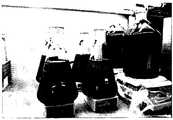
- the culture vessel was incubated in a large volume using a glass flask or bottle as shown in FIG. 15 and stirred using a magnetic bar.
- the light of 70uE was given by using a fluorescent lamp.
- RNA was purified by phenol: chloroform extraction, chloroform extraction and ethanol precipitation. Purified RNA was quantified by spectroscopic analysis.
- Cells were transformed using the Biorad Gene Pulser Xcell TM shock system, following the recommended protocol from the GeneArt Chlamydomonas engineering kit. After transformation, cells were incubated for 12 hours and harvested for genomic DNA extraction, or immediately diluted to 2000 cell numbers and plated on TAP medium containing 1.5% agar to obtain single colonies for later study ( Figure 24).
- Genomic DNA segments containing nuclease target sites were amplified using Phusion polymerase (New England Biolabs). Equal amounts of PCR amplicons were sequenced by reading paired ends using Illimina MiSeq. Only one rare sequence reading was excluded to eliminate errors related to sequencing reactions and amplification. Indels located around the RGEN cleavage site (3 bp upstream of the PAM) were considered to be mutations induced by RGEN. In NCBI Sequence Read Archive (www.ncbi.nlm.nih.gov/sra) can take advantage of the deep sequencing data under approval number PRJNA327012.
- Cas-OFFinder [Bae, S., Park, J. & Kim, J.-S. to list potential target-off sites that differ by up to two nucleotides or differ by up to two nucleotides.
- Cas-OFFinder a fast and versatile algorithm that searches for potential off-target sites of Cas9 RNAguided endonucleases. Bioinformatics 30, 1473.1475 (2014). As a result, 17 potential target-off sites were obtained and the authors performed targeted deep sequencing in independent clones.
- Genomic DNA was extracted from cells harvested after transformation, respectively, or from individual colonized mutants selected from TAP agar plates for targeted deep sequencing and Sanger sequencing.
- To isolate genomic DNA cells were harvested, 2.5 ⁇ extract buffer (0.35 M sorbitol, 0.1 M Tris / HCl pH 7.5 and 5 mM EDTA), 2.5 ⁇ nuclear lysis buffer (0.2 M Tris / HCl pH 7.5, 0.05 M Resuspended in microprep buffer containing EDTA, 2 M NaCl and 2% (w / v) CTAB) and 1 ⁇ 5% N-lauroylsarcosine and then incubated at 65 ° C. for 2 hours.
- Genomic DNA was extracted with 24: 1 chloroform: isoamyl alcohol (v / v) and precipitated with isopropanol.
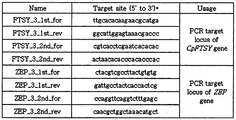
- target regions were PCR amplified using specific primers (FIG. 18). PCR products were identified by agarose gel electrophoresis, eluted from the gel and sequenced using Sanger method (Macrogen, South Korea).
- Chl fluorescence was measured by Walz Image-PAM system M-series Chl fluorescence system equipped with a CCD camera as described [Niyogi, KK, Bjorkman , O. & Grossman, AR Chlamydomonas xanthophyll cycle mutants identified by video imaging of chlorophyll fluorescence quenching. Plant Cell 9, 1369-1380 (1997).].
- the equipment was used to measure the NPQ (non-photochemical extinction) values of the initially screened transformants to select individuals whose changes were changed (FIG. 9 a).
- HPLC analysis was performed with a Shimadzu Prominance HPLC model LC-20AD equipped with a Waters Spherisorb 5.0 ⁇ m ODS1 4.6 ⁇ 250 mm cartridge column.
- the pigment was extracted in 90% (v / v) acetone and analyzed by HPLC on the supernatant of the sample.
- the pigment was separated using a solvent mixture of 0.1 M Tris-HCl pH 8.0, acetonitrile, methanol and ethyl acetate. During operation, the solvent concentration was 14% 0.1 M Tris-HCl, 84% acetonitrile and 2% methanol at 0-15 minutes. At 15-19 minutes the solvent mixture consisted of 68% methanol and 32% acetonitrile.
- Post-operation was performed with the initial solvent mixture for 6 minutes.
- the flow rate was constant at 1.2 mL per minute.
- Pigments were detected at 445 nm and 670 nm.
- Individual pigment concentrations were determined from HPLC profiles calibrated with standard pigments of Chl and carotenoids (14C Centralen; DHI, H ⁇ rsholm, Denmark).
- Photosynthetic activity was measured with a Hansatech Clark-type oxygen electrode illuminated with a halogen lamp at 25 ° C.
- a 1 mL cell suspension aliquot containing 2 ⁇ Chl was delivered to the oxygen electrode chamber.
- 50 ⁇ l of 0.5 M NaHCO 3 , pH 7.4 was added to the suspension before measurement. Oxygen evolution was measured at increasing light intensity from 0 to 1,200 ⁇ mol photons / m 2 s and each step was recorded for 2 minutes.
- SDS-PAGE gels were stained with 0.1% (w / v) Coomachi Brilliant Blue R for visualization, or blotted through a semi-dry delivery system on an ATTO P PVDF membrane.
- Membranes were probed from specific polyclonal antibodies raised against Zeaxanthin epoxidase (ZEP), cpFTSY and ⁇ subunits of ATP synthesis (ATP ⁇ ) from C. Reinhardti. Signals were visualized using Abfroniter West Save-Up ECL reagent and exposed to X-ray film for signal detection.
- ZEP Zeaxanthin epoxidase
- cpFTSY cpFTSY
- ATP ⁇ subunits of ATP synthesis
- FIG. 1 is a schematic diagram showing a process for preparing a gene knockout mutant using RGEN RNPs in Chlamydomonas Reinhardti cw15 mt-wild type (CC-4349) according to the present invention.
- CpFTSY plays a role in delivering light-harvesting complexes into the chloroplasts.
- null mutations in CpFTSY of C. reinhardtii resulted in dramatically lower levels of light-harvesting Chl-binding protein, lower than in wild-type.
- the smaller antenna size prevents excessive absorption of sunlight and helps penetrate larger amounts of sunlight deeper into dense cultures, thereby Advantages are known that can contribute to greater productivity of mass culture.
- Chlamydomonas reinhardtia cw15 mt- wild-type (CC-4349) cells were incubated in a 50 ml flask at 25 degrees using TAP medium [see Table 2], shaken at 90 rpm with a fluorescent light at a light intensity of 70 uE. .
- the concentration of cells was measured using a spectrophotometer, and cells at the time of active culture of about 0.3 to 0.5 at OD750 were used.
- 200 ⁇ g of Cas9 protein [FIG. 25] was mixed with 140 ⁇ g of sgRNA [FIG. 2] in nuclease-free water and incubated at room temperature for 10 minutes.
- the bound RNPs complex was synthesized using Biorad Gene Pulser Xcell TM Electroporation Systems in a 4 mm Electroporation cuvette with 50 ⁇ 10 4 Chlamydomonas Reinhardtia cw15 mt-wild type (CC-4349) cells (Voltage 600V, Capacity 50uF). After incubation for 12 hours after dark incubation, gDNA extraction and deep sequencing were used. Some were diluted to 2000 cells and plated on TAP agar plate to obtain single colony. Figure 3 shows the results confirmed by targeted deep sequencing analysis of the mutation of the CpFTSY gene induced by RGEN RNPs.
- FIG. 3B is a plate photograph of a mutant of CpFTSY gene knockout caused by RGEN RNPs. From each isolated colony, pale green colored individuals were isolated and each identified a mutation in the target gene.
- 5 shows the results of characterization of the ⁇ CpFTSY mutant by RGEN RNPs.
- 5a shows the phenotypes of wild type and ⁇ CpFTSY mutants.
- Six ⁇ CpFTSY mutants were identified by measuring larger Chl a to Chl b ratios compared to wild type Chl a to Chl b ratios (FIG.
- the next step was to target the Chlamydomonas Reinhardtia cw15 mt-wild type (CC-4349) ZEP gene.
- Zeaxanthin epoxidase enzymes derived from the ZEP gene produce violaxanthin by epoxidizing zeaxanthin (Zea), so epoxidation from zeaxanthin to violaxanthin when knockout mutations are made using RGEN RNPs Blocking the step may lead to the accumulation of zeaxanthin (FIG. 11B).
- Zeaxanthin is a macular pigment in the retina that can prevent the progression of chronic diseases such as age-related macular degeneration by filtering out harmful blue light and UV.
- Chlamydomonas Reinhard T. cw15 mt- wild-type (CC-4349) cells were incubated in a 50ml flask at 25 degrees using TAP medium [see Table 2], shaken at 90 rpm with a fluorescent light at a light intensity of 70 uE. The concentration of cells was measured using a spectrophotometer, and cells at the time of active culture of about 0.3 to 0.5 at OD750 were used.
- 200 ⁇ g of Cas9 protein [FIG. 25] was mixed with 140 ⁇ g of sgRNA [FIG.
- B of FIG. 8 is the data of the targeted deep sequencing, when all the cells are collected after the transformation experiment using RNP and the gDNA is extracted and analyzed for all the mutations occurring in the DNA strands of the target site.
- the b of Fig. 8 is a pattern of mutations actually detected at the target site through targeted deep sequencing, but large size changes such as insertion of 42 bp or more can be found using the principle of targeted deep sequencing. Difficulty, which may differ from the actual single colony obtained).
- Example 3 From Chlamydomonas RGEN RNPs Used continuous ⁇ ZEP / ⁇ CpFTSY Double mutation manufacturing
- Example 2 Based on the gene knockout mutants, an attempt was made to produce a continuous ⁇ ZEP / ⁇ CpFTSY double mutant using RGEN RNPs targeting the CpFTSY gene prepared in Example 1 herein.
- Example 2 a ZEP gene knockout mutant of one of Chlamydomonas lane hard tiahyi ⁇ Z1 cell TAP medium obtained from [Table 2] using put in 50ml flask at 25 ° C using a fluorescent lamp as the 70uE brightness gives the light 90 The culture was shaken at rpm. The concentration of cells was measured using a spectrophotometer, and cells at the time of active culture of about 0.3 to 0.5 at OD750 were used.
- RNPs complexes 200 ⁇ g of Cas9 protein [FIG. 25] was mixed with 140 ⁇ g of sgRNA [FIG. 2] in nuclease-free water and incubated at room temperature for 10 minutes. Bound RNPs complexes were transformed with 50 ⁇ 10 4 Chlamydomonas Reinhardtia ⁇ Z1 cells using Biorad Gene Pulser Xcell TM Electroporation Systems (Voltage 600V, Capacity 50uF) in a 4mm Electroporation cuvette (dark 600V, dark for 12 hours). After incubation, gDNA extraction and deep sequencing were used. Some were diluted to 2000 cells and plated on a TAP agar plate to obtain a single colony.
- 13A is a plate photograph of the ⁇ ZEP / ⁇ CpFTSY double mutants induced by CpFTSY gene knockout caused by RGEN RNPs. From each isolated colony, pale green colored individuals were isolated and each identified a mutation in the target gene. 13 b shows the wild type and phenotype of ⁇ ZEP / ⁇ CpFTSY double mutant.
- Figure 17 is a photograph comparing the phenotype of the ⁇ ZEP, ⁇ FTSY mutation, ⁇ ZEP / ⁇ CpFTSY double mutants by wild type and RGEN RNPs.
- Cells were compared at a concentration of 10 7 cells / ml under high brightness (500 ⁇ mol photons / m 2 s) under photoautotrophic culture conditions.
- Western-blot analysis of ZEP and FTSY proteins from wild type and respective mutants confirmed that the mutants were once again.
- Specific polyclonal antibodies capable of Immuno-detection of ZEP and FTSY proteins were identified as probes.
- ZEP mutation showed no increase of violaxanthin and antheraxanthin and increased zeaxanthin.
- ⁇ CpFTSY mutant the decrease of total pigment and the large decrease of chlorophyll b were confirmed.
- ⁇ ZEP / ⁇ CpFTSY double mutant it was confirmed that all the traits of each mutant were shown.
- 21 is an experimental result comparing the photosynthetic efficiency by measuring the oxygen generation amount according to the light intensity in mutants and wild type using Oxygraph equipment to draw a photo saturation curve. Antenna size in photosynthetic systems is well known to affect the photosynthesis rate of mutants and wild type. The reduced antenna size of the antenna mutants shows higher photosynthesis rate per chlorophyll in high light (HL) conditions.
- Example 1 a glass bead method was used instead of the electroporation method. Chlamydomonas reinhardtia cw15 mt- wild-type (CC-4349) cells were incubated to 10 7 cells / mL, and the cells were recovered by cell down at 3000 rpm for 2 minutes. Transfer it to a 10 ml glass tube, mix 100 ⁇ l of 20% PEG-8000 (Sigma, USA) with 0.3 g of glass beads (425-600 ⁇ m, Sigma, USA) and RNP complexes that target the FTSY gene. Vortexer The physical shock was given for 25 seconds at the maximum speed using Baek, Kwangryul, et al., Biotechnology journal 11.3 (2016): 384-392.
- FIG. 24B shows the results of experiments with different concentrations to find the appropriate cas9 protein and sgRNA concentrations at the beginning of RNP experiments in Chlamydomonas reinhardtia cw15 mt-wild type (CC-4349).
- Cas9 protein [Fig. 25] was increased from 10 ⁇ g to 500 ⁇ g under different conditions and the sgRNA concentration was increased from 7 ⁇ g to 350 ⁇ g.
- transformation experiments were conducted as in Example 1, and after 12 hours, cells were harvested and the frequency of mutation (insertion and deletion; indel) was confirmed by targeted deep sequencing. As a result, the highest mutation frequency was observed when the Cas9 protein was 200 ⁇ g and the sgRNA was 140 ⁇ g.
- 24A shows that the cells were harvested after 12 hours and 24 hours after the transformation experiment as in Example 1, and the frequency of mutation (insertion and deletion; indel) was confirmed through targeted deep sequencing of gDNA. No significant difference was found between different incubation times of time. That is, 12 hours was enough time to sufficiently derivery RNPs to operate in the cell, and in the above example, the mutation frequency was confirmed through targeted deep sequencing after 12 hours.
- Chlamydomonas cells were incubated in a 50ml flask at 25 degrees using TAP medium [see Table 2] and cultivated by shaking at 90 rpm using a fluorescent lamp at a light intensity of 70 uE. Cell concentration was measured using a spectrophotometer, and the cells in the active culture period of 0.3 to 0.5 at OD 750 were used.
- 200 ug of Cas9 protein (FIG. 25, SEQ ID NO: 21) was mixed with 140 ug of sgRNA (SEQ ID NO: 20) in nuclease-free water and incubated at room temperature for 10 minutes.
- the bound RNPs complex was synthesized using Biorad Gene Pulser Xcell TM Electroporation Systems in a 4 mm Electroporation cuvette with 50 ⁇ 10 4 Chlamydomonas Reinhardtia cw15 mt-wild type (CC-4349) cells (Voltage 600V, Capacity 50uF). After transformation by electric shock, after 12 hours of dark incubation, gDNA extraction and targeted deep sequencing were performed. Some were diluted to 2000 cells and plated on TAP agar plate to obtain single colony. 29 shows the results of confirming the mutation of the ZEP gene induced by RGEN-RNPs by targeted deep sequencing.
- B of FIG. 29 is the data of the targeted deep sequencing.
- b of FIG. 29 is a pattern of mutations actually identified at the target site through targeted deep sequencing, but large size changes such as insertion of 42 bp or more are found by the principle of targeted deep sequencing. Difficulty, may differ from the actual single colony obtained
- mutant Z1 was named Chlamydomonas reinhardtii ZEP mutant 1 (Z1)], and the mutant Z1 was assigned to the Korea Institute of Bioscience and Biotechnology (KCTC) in 2017. Deposited March 22, assigned accession number KCTC 13230BP.
- acetic acid was added in TAP medium.
- a medium having the composition as shown in Table 4 and then prepared by autoclave and then began to grow to make the concentration of 10 6 cell / mL in the culture medium using the cells in the active growth stage.
- the culture vessel was incubated in a large volume using a glass flask or bottle as shown in Figure 34 and stirred using a magnetic bar.
- the light of 70uE was given by using a fluorescent lamp.
- Example 5 After separation into single colonies as in Example 5, the culture was continued, and the dye analysis was performed using HPLC for each colony.
- isolated single colonies were incubated for 3 days at 70 ⁇ mol photons / m 2 s conditions in TAP medium, specific culture conditions were carried out as in the culture conditions of 2) of Example 6.
- the harvested algae were extracted using 80% acetone, the centrifuged supernatant was filtered again using a nylon filter, and then analyzed by injection into HPLC.
- the total flow rate of the solvent was 1.2 mL / min, and uniformly decreased Tris of pH 8.0 to 14%, acetonitrile to 84% to 0%, respectively, from 0 minutes to 15 minutes, Methanol and ethyl acetate started at 2% and increased by 68% and 32%, respectively, by the 15th minute.
- the solvent ratio is then maintained for 3 minutes (15-18 minutes), then for 1 minute (18-18 minutes), return to the rate at which each solvent was started and then for the remaining 6 minutes. It was kept postrun.
- Shimadzu LC-20A Prominence pump was used, the column was Watera Spherisorb TMS5 (DS1 4.6 x 250 mm, 5 ⁇ m Cartridge Column, USA), the column temperature was maintained at 40 °C.
- the detector analyzed the data using a photodiode array detector (SPD-M20A, Shimadzu).
- SPD-M20A photodiode array detector
- the carotenoid pigments such as zeaxanthin were detected at 445 nm and chlorophyll a at 670 nm. , Denmark) was used as a standard to determine the concentration of carotenoids and chlorophyll a, b purchased from Denmark.
- FIG. 35 shows an HPLC analysis graph showing a pigment profile of each alga, and a graph of quantitative analysis of zeaxanthin and lutein content of each algae grown under 200 ⁇ mol photons / m 2 s using HPLC is shown in FIG. 37.
- mutants ⁇ Z1, ⁇ Z2, ⁇ Z3, 5% CO 2 bubble was supplied in HS medium [see Table 3], the minimum photosynthetic medium. Incubated at luminous intensity of 200 ⁇ mol photons / m 2 s. The initial inoculated cell number was 1 ⁇ 10 6 cells / ml and the growth curve was drawn by measuring the cell number at 12 hour intervals for 60 hours. 12 is a comparative experiment of cell growth rate through photosynthesis using carbon dioxide in wild-type (WT) and ZEP knockout mutants. As shown in Figure 12, the mutant strains ⁇ Z1, ⁇ Z2, ⁇ Z3 confirmed the growth rate similar to the wild type as the culture period elapsed.
- Table 5 and FIG. 38 compare the contents of zeaxanthin and lutein with higher plants known to be high in zeaxanthin and lutein, and chlamydomonas reinhardtia cw15 wild type (WT) and ZEP knockout mutants.
- Chlamydomonas was calculated by dividing the amount of lutein and zeaxanthin pigment amount to the dry weight of the cells at 36 hours of Figure 36 ( ⁇ g / 100g).
- the pigment content of the remaining higher plants ( ⁇ g / 100g) which are known to be high in content of zeaxanthin and lutein, were compared by citing the USDA National Nutrient Database for Standard Reference, Release 23 (2010).
- the Chlamydomonas wild type showed at least 6 times higher than Nasturtium
- the mutant of ZEP gene knockout showed 12 times higher than Nasturtium.
- the mutant of the ZEP gene knockout showed a higher content of at least 120 times higher than that of Orange Pepper.
Landscapes
- Life Sciences & Earth Sciences (AREA)
- Health & Medical Sciences (AREA)
- Engineering & Computer Science (AREA)
- Genetics & Genomics (AREA)
- Chemical & Material Sciences (AREA)
- Biotechnology (AREA)
- Zoology (AREA)
- Bioinformatics & Cheminformatics (AREA)
- Organic Chemistry (AREA)
- Wood Science & Technology (AREA)
- Biomedical Technology (AREA)
- General Engineering & Computer Science (AREA)
- Molecular Biology (AREA)
- General Health & Medical Sciences (AREA)
- Microbiology (AREA)
- Biochemistry (AREA)
- Biophysics (AREA)
- Cell Biology (AREA)
- Medicinal Chemistry (AREA)
- Physics & Mathematics (AREA)
- Plant Pathology (AREA)
- Tropical Medicine & Parasitology (AREA)
- Virology (AREA)
- Botany (AREA)
- Preparation Of Compounds By Using Micro-Organisms (AREA)
- Micro-Organisms Or Cultivation Processes Thereof (AREA)
Abstract
본 발명은 RGNE (RNA-guided engineered nuclease) RNP의 복합체를 이용하여 DNA 도입 없이 미세조류의 유전자를 교정하는 방법, 및 유전자가 교정된 미세조류 변이체를 제공한다. 본 발명에 따른 유전자 교정 방법은 DNA 도입 없이 원하는 유전자를 정확하게 선택적으로 교정할 수 있다는 이점을 갖는다. 또한, 본 발명은 색소 향상된 색소 생산능을 갖는 새로운 조류에 관한 것으로, 본 발명의 변이주를 이용하면 적은 에너지를 소모하여, 카로티노이드계 색소, 구체적으로 잔토필을 생산하는 것이 가능하므로 산업 수준에서 효율적으로 색소를 생산할 수 있다. 또한, 색소가 포함되는 식품, 건강기능식품 및 의약품의 원료로 적용이 가능하다. 특히, 상기 변이주가 제작되는 과정은 DNA 조각이 표적 염기서열 또는 표적외 염기서열 내에 삽입될 가능성이 없기 때문에 GMO로 규제되지 않을 것으로 예상되므로 미세조류를 이용하여 루테인과 지아잔틴을 생산하는 산업적인 측면에서 큰 경제 효과를 낼 수 있을 것으로 기대된다.
Description
본 발명은 RGEN RNP를 이용한 미세조류의 교정 방법에 관한 것이다.
또한, 본 발명은 RGEN RNP를 이용하여 개발된 색소 생산능을 갖는 조류, 상기 조류를 포함하는 색소 조성물 그리고 상기 색소를 생산하는 방법에 관한 것이다.
미세조류(microalgae)는 이산화탄소와 물을 원료로 광합성을 하는 단세포 생물로서 고등식물보다 세포분열 및 성장의 주기가 매우 짧아(약 5-8시간) 건강보조식품, 항노화 성분, DHA, 화장품 원료 등의 유용한 고부가가치 산업용 소재로 이용되는 경제적 잠재력이 높은 생물자원이다. 그 중에서 클라미도모나스(Chlamydomonas reinhardtii)는 미세조류 연구에서 모델종으로서 가장 많이 연구가 되어 왔으며 genome project가 완성되어 유전자 연구 및 조작에 용이하다. 학술적 연구뿐만 아니라 산업분야에서 활용하기 위한 다양한 연구가 진행 중이다.
한편, 크리스퍼 유전자 가위(RNA-guided engineered nuclease; RGEN)는 2013년 처음 개발된 이래, 지난 2년 여간 비약적으로 발전하여 인간세포는 물론, 가축, 곤충, 벼, 밀과 같은 식물세포, 병원균 등 다양한 종에 대하여 폭넓게 이용되고 있다. 이 방법은 박테리아가 외부 DNA의 침입을 막고자 형성한 크리스퍼 면역시스템을 유전자가위로 차용한 것이다. 즉, 특정 유전자의 염기서열을 찾아가는 염기서열 조각(크리스퍼 부분)을 제작해 절단 효소인 카스9(Cas9)와 짝을 이루게 하면, 짝을 이룬 크리스퍼 시스템은 표적이 되는 DNA 염기서열에 달라붙어 절단한다. 크리스퍼 유전자 가위는 현재까지 개발된 가위 중에 가장 제작이 용이하고 저렴할 뿐 아니라 정확성과 효율성도 높은 것으로 확인되었다.
최근 크리스퍼 유전자 가위를 세포에 도입하는데 있어 외부 DNA 삽입 없는(DNA-free) 가이드 RNA와 단백질 복합체(ribonucleoprotein, RNP)로 전달하는 방법이 개발되었다. 이를 이용한 미세조류를 형질전환 시키는 방법은 매우 획기적인 기술적 도약으로 미세조류 이용 산업 분야의 패러다임을 바꿀 수 있을 것으로 기대된다.
기존의 징크핑거뉴클레아제(zinc finger nuclease; ZFN), 탈렌(transcription activator-like effector nuclease; TALEN), 크리스퍼 유전자 가위(RGEN)와 같은 유전자 가위를 DNA 플라스미드를 통하여 도입하여 형질 전환시키는 경우, 형질전환체를 만드는 과정에서 외부 DNA를 삽입하였기 때문에, GMO(Genetically Modified Organism)로 분류될 가능성이 높아 식품 및 기타 산업적 활용에 제약이 있으리라 예상된다. 따라서, non-GMO 미세조류의 기술적 돌파구가 요구되는 실정이다.
황반변성이란 눈의 안쪽 망막의 중심부에 위치한 신경조직인 황반에 변성이 일어나 시력장애를 일으키는 질환으로, 시세포의 대부분이 황반에 모여있고 물체의 상이 맺히는 곳도 황반의 중심이므로 황반은 시력에 대단히 중요한 역할을 담당하고 있다. 황반변성을 일으키는 가장 많은 원인은 연령증가(연령관련 황반변성)를 들 수 있고, 가족력, 인종, 흡연과 관련이 있다고 알려져 있다. 황반부는 중심 시력을 담당하는 곳이므로, 이 이곳에 변성이 생기면 시력감소, 중심암점, 사물이 찌그러져 보이는 증상인 변시증 등이 나타난다. 황반변성은 크게 비삼출성(건성)과 삼출성(습성)으로 구분하게 되는데 비삼출성인 경우 망막 및 맥락막 위축이 나타나는 후기를 제외하고는 대부분 시력에 큰 영향을 주지 않고, 망막 하에 드루젠이라는 노란 침착물이 보이는 단계이나, 망막 하 출혈이나 망막 하액, 색소상피박리 등이 나타나는 삼출성의 경우에는 이러한 병변의 위치가 황반 아래 또는 황반에 바로 연하여 있는 경우에는 초기부터 시력저하가 나타난다. 삼출성 황반변성의 경우 전체 황반변성의 10~20% 정도를 차지하지만, 만일 삼출성 황반변성을 치료하지 않고 그대로 방치해두면, 시력이 빠르게 저하되어 많은 환자들이 진단 후 2년 내에 실명에 이르게 된다. 황반변성을 예방하기 위해서는 정기적인 안저 검사를 통해 황반부의 이상을 초기에 발견과 비만, 흡연, 고혈압 등의 조절 가능한 인자를 줄이도록 애쓰는 것이 중요하다. 흡연은 맥락막 순환에 손상을 주어 혈중 항산화 인자를 떨어뜨리고, 맥락막 혈관수축을 야기하여 저산화 손상을 야기하므로, 황반변성의 위험성이 있는 환자는 반드시 금연이 필요하다. 또한, 황반색소(lutein, zeaxanthin)는 노화에 의한 손상을 감소시켜 망막을 건강하게 유지하는 역할을 하므로, 야채와 과일을 통해 충분히 섭취하거나, 상용화된 비타민제를 복용함으로써 황반변성의 예방에 도움을 줄 수 있다.
황반색소는 망막의 중앙부분에서 기인한 노인성 시력감퇴를 줄여주고, 밝은 광선에 의한 망막조직의 손상을 막아주는 역할을 하는 것으로 대표적인 예로 카로티노이드의 산소화에 의해 생산되는 카로티노이드계의 옥시카로티노이드 색소로 잔토필(크산토필, xanthophyll)가 있다. 잔토필류에 속하는 색소로는 루테인(lutein) 또는 지아잔틴(zeaxanthin) 등이 있다. 루테인은 몸속에서 자연적으로 생성되는 산소 자유라디칼(free radical)에 의해서 손상되는 눈의 내부를 보호하는 항산화제로서 활동하며, 암종양을 공급하는 혈관의 성장을 줄여 암세포를 죽이고, 유방, 결장, 폐, 난소암, 피부암 예방에 약간의 효과가 있는 것으로 알려져 있다.
동물은 잔토필을 생성할 수 없고, 음식의 섭취를 통해서만 얻을 수 있는데, 이러한 잔토필은 식물의 잎사귀, 꽃, 과실 등의 녹색부에 엽록소, 카로틴과 같이 존재한다. 최근 잔토필류를 포함하는 눈 건강을 위한 건강기능식품 등이 각광받고 있다.
지아잔틴과 루테인의 원료로는 기존의 마리골드 꽃이 대표적이며, 다른 고등식물에서 추출하는 것도 연구되어 있다. 그뿐만 아니라, 박테리아에서 색소 합성 기작을 유전적으로 변이시켜 지아잔틴과 루테인을 생산하기도 한다. 미세조류로부터 이들 색소를 얻는 연구도 진행된 바 있다. 이러한 종래의 원료물질 중 마리골드 꽃은 생산을 위해 화초를 육종하기까지 시간이 오래 걸리는 단점이 있고, 생산을 위한 토지 면적에 비해서 생산량이 많지 않아 생산 단가가 높은 문제가 있다.
이러한 문제점을 해결하기 위하여, 고등식물 시스템을 대체하기 위한 박테리아 시스템을 이용해 색소 합성 기작을 삽입한 지아잔틴과 루테인 생산 조류 개발이 이루어졌지만, 박테리아에서 얻어지는 색소는 궁극적으로 식품첨가물로 이용되기에는 부적합하다는 문제점이 있다. 또한, 유전자 삽입 기술 등을 이용한 유전자 재조합 식품(GMO; genetically modified organism)은 국내에서 선호되고 있지 않기 때문에 소비자들의 인식이 중요한 식품첨가물 시장에는 치명적 단점으로 작용하며, 고등식물 시스템과 마찬가지로 박테리아 배양액이나 바이오 리액터 등을 유지하는 비용이 많이 요구될 수 있는 문제가 있다.
미세조류로부터 이들 색소를 얻는 방법의 경우, 종래의 미세조류는 개량이 되지 않은 야생형으로 루테인의 함량은 일정량 있지만 지아잔틴의 함량이 광량에 따라 매우 낮기 때문에 최적의 생산 조류로 이용하기에는 한계가 있었다.
[선행기술문헌]
[특허문헌]
국내 특허 출원 제2014-7007656호
국제 공개 특허 제2015-086795호
본 발명의 목적은 표적 유전자에 특이적인 가이드 RNA 및 Cas 단백질의 RGEN(RNA guided endonuclease) RNP(ribonucleoprotein) 복합체를 이용하여 외부 DNA 도입 없이 미세조류의 유전자를 교정하는 방법; 및 유전자가 교정된 미세조류 변이체를 제공하는 것이다.
또한, 본 발명의 또 다른 목적은 종래 식품의 원료로 사용되는 잔토필을 대체할 수 있는 원료 또는 종래의 원료 생산방법을 대체할 수 있는 방법을 제공하는 것으로, 구체적으로 잔토필 생산능, 특히 루테인 및 지아잔틴 생산능이 우수한 미생물, 이를 포함하는 조성물 및 이를 이용한 잔토필(xanthophyll)의 생산방법을 제공하는 것이다.
상기와 같은 목적을 달성하기 위해서, 본 발명자들은 식품 산업에서 문제가 될 가능성이 있는 유전적 재조합 방법이 아닌 다른 변이를 이용하여 야생형 또는 종래 존재하던 미세조류의 부족한 생산성을 해결할 수 있는 조류를 개발하기 위해 노력한 결과, DNA 도입 없이 미세조류의 유전자를 교정하는 방법을 개발함으로써 본 발명을 완성하였다. 특히, 본 발명자들은 DNA-free RGEN RNP를 미세조류에 적용함에 있어, 많은 시행착오를 거치면서 미세조류 중에서도 세포벽이 변이 또는 화학 처리되어 약화된 미세조류에 대하여 RGEN RNP 복합체 적용 시 세포 수, 가이드 RNA 농도, Cas9 단백질 농도의 최적 조건을 확립하여 적합한 미세조류의 유전자 교정방법을 개발하게 되었다.
이러한 측면에서 본 발명은 표적 유전자에 특이적인 가이드 RNA 및 Cas 단백질의 RGEN(RNA guided endonuclease) RNP(ribonucleoprotein) 복합체를 세포벽을 변이시키거나 화학 처리하여 약화시킨 미세조류에 직접 도입하는 단계를 포함하는 미세조류의 유전자 교정방법을 제공한다.
또한, 본 발명은 상기 교정 방법에 의해 제조된 미세조류 변이체를 제공한다.
게다가, 상기와 같은 또 다른 목적을 달성하기 위해서, 본 발명자들은 식품 산업에서 문제가 될 가능성이 있는 유전적 재조합 방법이 아닌 다른 변이를 이용하여 야생형 또는 종래 존재하던 미세조류의 부족한 생산성을 해결할 수 있는 조류를 개발하기 위해 노력한 결과, 종래의 클라미도모나스 레인하드티아이 조류보다 황반색소 생산량이 높은 변이주를 개발, 이를 이용한 최적의 색소 생산 방법을 확인하여 본 발명을 완성하였다.
이러한 측면에서 본 발명은 서열번호 1로 표시되는 클라미도모나스 레인하드티아이 cw15 WT의 ZEP 유전자 서열에서 816번째 염기와 817번째 염기 사이에 서열번호 2로 표시되는 염기서열을 삽입한 ZEP 유전자 변이를 가지며, 잔토필 생산능을 갖는 클라미도모나스 레인하드티아이 변이주를 제공한다.
또한, 본 발명은 서열번호 1로 표시되는 클라미도모나스 레인하드티아이 cw15 WT의 ZEP 유전자 서열에서 816번째 염기와 817번째 염기 사이에 서열번호 4로 표시되는 염기서열을 삽입한 ZEP 유전자 변이를 가지며, 잔토필 생산능을 갖는 클라미도모나스 레인하드티아이 변이주를 제공한다.
또한, 본 발명은 서열번호 1로 표시되는 클라미도모나스 레인하드티아이 cw15 WT의 ZEP 유전자 서열에서 816번째 염기와 817번째 염기 사이에 염기 A를 삽입한 ZEP 유전자 변이를 가지며, 잔토필 생산능을 갖는 클라미도모나스 레인하드티아이 변이주를 제공한다.
상기 클라미도모나스 레인하드티아이 변이주 3종은 각각 잔토필 생산능을 가질 수 있다.
상기 클라미도모나스 레인하드티아이 변이주 3종은 각각 루테인(lutein)과 지아잔틴(zeaxanthin); 그리고 엽록소 b(chlorophyll b), 엽록소 a(chlorophyll a) 및 베타-카로틴(β-carotene)으로 이루어진 군에서 선택된 하나 이상의 색소의 생산능을 가질 수 있다.
또한, 본 발명은 상기 클라미도모나스 레인하드티아이 변이주의 배양물을 제공한다.
또한, 본 발명은 상기 변이주의 배양물, 이의 건조물 및 이의 추출물로 이루어진 군에서 선택된 하나 이상을 포함하는 색소 조성물을 제공한다.
또한, 본 발명은 상기 변이주의 배양물, 이의 건조물 및 이의 추출물로 이루어진 군에서 선택된 하나 이상을 포함하는 경구 투여용 조성물을 제공한다.
또한, 본 발명은 상기 변이주의 배양물, 이의 건조물 및 이의 추출물로 이루어진 군에서 선택된 하나 이상을 포함하는 사료 또는 사료첨가제용 조성물을 제공한다.
또한, 본 발명은 상기 변이주의 배양물, 이의 건조물 및 이의 추출물로 이루어진 군에서 선택된 하나 이상을 포함하는 식품 또는 식품첨가제용 조성물을 제공한다.
또한, 본 발명은 상기 변이주를 이용한 색소 생산방법을 제공한다.
또한, 본 발명은 상기 변이주를 배양하는 단계를 포함하는 식품 또는 사료 원료 생산방법을 제공한다.
본 발명은 미세조류 클라미도모나스 레인하드티아이(Chlamydomonas reinhardtii)에서 DNA 도입이 없이 크리스퍼 유전자 가위를 이용하여 원하는 유전자를 선택적으로 녹아웃 하는 신규한 형질 전환 방법이다. 크리스퍼 유전자가위를 세포에 도입하는데 있어 DNA 형태로 도입하여 발현시키지 않고 가이드 RNA와 단백질 복합체(ribonucleoprotein, RNP)로 전달하는 방법을 이용한다. 본 발명에 따른 유전자의 교정방법은 외부 DNA 도입 없이 원하는 유전자를 정확하게 선택적으로 교정할 수 있다는 이점을 갖는다.
이 방법을 적용하여 클라미도모나스의 CpFTSY와 ZEP 유전자를 타켓으로 각각의 유전자가 녹아웃된 돌연변이체를 제조하였으며 두 유전자가 모두 녹아웃된 ΔZEP/ΔCpFTSY 이중 돌연변이체도 연속적인 돌연변이를 통해 제조할 수 있었다.
기존 야생형과 개발된 ΔZEP/ΔCpFTSY
이중 돌연변이체의 세포적 특성 비교하였을 때 산업적으로 유용한 색소인 지아잔틴(Zeaxanthin)의 양이 크게 증가하였으며 광합성 효율과 고광도에서의 성장 또한 크게 증가하였음을 확인할 수 있었다.
상기 교정 방법은 미세조류의 산업적 이용 측면에서 이산화탄소의 저감, 바이오 디젤이나 항산화 물질의 생산 및 효율 향상 등 다양한 산업적 응용분야에서 요구되는 클라미도모나스 균주를 개발하는데 효과적으로 적용될 수 있다. 또한, 상기 방법은 DNA 조각이 표적 염기서열 또는 표적외 염기서열 내에 삽입될 가능성이 없기 때문에 이 방법으로 생산된 미세조류 변이체는 GMO로 규제되지 않을 것으로 예상되므로 산업적인 측면에서 큰 경제 효과를 낼 수 있을 것으로 기대된다.
특히, 본 발명을 통해 미세조류 클라미도모나스 레인하드티아이에서 외부 DNA의 도입이 없는 크리스퍼 유전자 가위 기술(RGEN RNPs)을 이용하여 ZEP 유전자를 녹아웃 시켜 색소 생산 돌연변이체 3종을 제작하였고 기존 야생형과 본 발명의 변이주 3종의 세포적 특성 비교하였을 때 산업적으로 유용한 색소인 지아잔틴의 양이 크게 증가한 것을 확인할 수 있었다. 특히, 상기 변이주가 제작되는 과정은 DNA 조각이 표적 염기서열 또는 표적외 염기서열 내에 삽입될 가능성이 없기 때문에 GMO로 규제되지 않을 것으로 예상되므로 미세조류를 이용하여 루테인과 지아잔틴을 생산하는 산업적인 측면에서 큰 경제 효과를 낼 수 있을 것으로 기대된다.
도 1은 본 발명의 일 실시예에 적용된 단계별 실험 과정을 요약하여 보여주는 개략도이다.
도 2는 클라미도모나스 레인하드티아이 CC-4349 CpFTSY 유전자를 표적하기 위해 디자인된 네 개의 타겟 서열을 정리한 것이다[Cas-디자이너 (www.rgenome.net/cas-designer/)를 사용하여, 전체 게놈에서 3 뉴클레오타이드 (nt)만큼 어떠한 다른 표적 부위들과 상이하고 66보다 더 높은 프레임-외 스코어를 가진 CpFTSY 유전자의 코딩 서열 영역의 절반 내에서 4개의 sgRNA를 신중하게 디자인하였다. 'CDS (코딩 서열) 위치'는 RNA 전사물에서 절단 지점의 상대적인 위치를 의미한다. Direction의 +는 타겟 서열과 동일한 방향, 즉 같은 시퀀스가 RGEN의 시퀀스이며, -는 타겟 서열과 역 방향, 즉 target sequence와 결합되어 있는 서열인 서로 reverse complement한 관계의 시퀀스를 의미한다. '프레임-외 스코어'는 깨진 이중-가닥 DNA가 미세 상동성-매개된 단부 연결(MMEJ) 경로에 의해 수선될 때 발생하는 프레임쉬프트-유도 결실의 가능성을 가리킨다. '표적-오프 부위의 #'은 전체 게놈을 통틀어 미스매치된 서열의 수를 의미한다.].
도 3은 RGEN RNPs에 의해 유도된 CpFTSY
유전자의 돌연변이의 구체적 사항을 나타낸 것이다[a: 표적화된 심층 서열화(Targeted deep sequencing)에 의해 측정된 네 개의 sgRNA에 대한 야생형 CC-4349 및 RGEN-트랜스펙션된 세포의 돌연변이 (삽입 및 결실; indel) 빈도, 별표 기호 (*)가 붙어 있는 타겟 서열에 대해 PCR 증폭 중에 비-특이적 생성물로 인해 표적화된 심층 서열화 분석으로부터 배제되었다. b: a에서 가장 효과적인 타겟 서열를 이용한 두 번째 시도의 결과, c: 두 번째 시도로 얻어진 돌연변이체에서 발생한 DNA 서열 돌연변이를 보여준다. 다양한 indel 패턴이 예상된 위치, PAM 서열의 3nt 상류에서 나타났다. 20-bp 표적 서열은 밑줄로 표시되고 PAM 서열은 적색으로 나타낸다].
도 4는 RGEN RNPs에 의해 발생한 CpFTSY
유전자 녹아웃의 돌연변이체의 사진이다.
도 5는 RGEN RNPs에 의한 CpFTSY
돌연변이체의 특성 분석한 결과를 나타낸 것이다[a: 저광 (50 μmol photons/m2s) 조건 하에서 최소 아가 배지 상에서 성장한 야생형 (WT) 및 RGEN-유도된 △CpFTSY 돌연변이주의 단일-세포 콜로니의 사진이고, b: 야생형 (WT) 및 △CpFTSY 돌연변이주의 클로로필 (Chl) a 대 Chl b 비율 및 총 Chl 함량. 세포들은 저광(50 μmol photons/m2s) 조건 하에서 광 독립영양학적으로 성장되었다. 데이터는 3개의 생물학적 복제물로부터의 평균 및 표준편차(SE)이다, c:
CpFTSY 유전자좌에서의 야생형 (WT) 및 돌연변이주 DNA 서열의 배열. 20-bp 표적 서열은 밑줄로 표시하고 PAM 서열은 적색으로 나타낸다. 우측 열은 삽입 (+) 또는 결실된 (-) 염기의 수를 나타낸다.]
도 6은 RGEN RNPs에 의한 Δ
CpFTSY
돌연변이체의 CpFTSY 유전자 위치에서 Sanger sequencing에 의한 Chromatogram 결과를 보여준다[도 5의 a에 도시된 6개의 돌연변이주의 CpFTSY 유전자 녹아웃은 Sanger 서열화를 수행함으로써 확인되었다. 다양한 indel 패턴이 표적 부위에서 관찰되었다].
도 7은 클라미도모나스 레인하드티아이 CC-4349 ZEP 유전자를 표적하기 위해 디자인된 다섯 개의 타겟 서열을 정리한 것이다[Cas-디자이너 (www.rgenome.net/cas-designer/)를 사용하여, 전체 게놈에서 3 뉴클레오타이드 (nt)만큼 어떠한 다른 표적 부위들과 상이하고 66보다 더 높은 프레임-외 스코어를 가진 ZEP 유전자의 코딩 서열 영역의 절반 내에서 5개의 타겟 서열을 신중하게 디자인하였다. 'CDS (코딩 서열) 위치'는 RNA 전사물에서 절단 지점의 상대적인 위치를 의미한다. Direction의 +는 타겟 서열과 동일한 방향, 즉 같은 시퀀스가 RGEN의 시퀀스이며, -는 타겟 서열과 역 방향, 즉 target sequence와 결합되어 있는 서열인 서로 reverse complement한 관계의 시퀀스를 의미한다. '프레임-외 스코어'는 깨진 이중-가닥 DNA가 미세 상동성-매개된 단부 연결 (MMEJ) 경로에 의해 수선될 때 발생하는 프레임쉬프트-유도 결실의 가능성을 가리킨다. '표적-오프 부위의 #'은 전체 게놈을 통틀어 미스매치된 서열의 수를 의미한다.].
도 8은 RGEN RNPs에 의해 유도된 ZEP
유전자의 돌연변이의 구체적 사항을 나타낸 것이다[a: 표적화된 심층 서열화(Targeted deep sequencing)에 의해 측정된 다섯 개의 sgRNA에 대한 야생형 CC-4349 및 RGEN-트랜스펙션된 세포의 돌연변이 (삽입 및 결실; indel) 빈도, b: 가장 효율이 높은 세 번째 타겟(RGEN3)에 의해 돌연변이체에서 발생한 DNA 서열 돌연변이를 보여준다. 다양한 indel 패턴이 예상된 위치, PAM 서열의 3nt 상류에서 나타났다. 20-bp 표적 서열은 밑줄로 표시되고 PAM 서열은 적색으로 나타낸다].
도 9
ZEP 유전자 녹아웃을 연구하기 위한 수백 개의 콜로니들에 대한 클로로필(Chl) 형광을 측정한 사진이다[a: ZEP 특이적 녹아웃 돌연변이체를 DNA 없는 RGEN RNP를 사용하여 생성한 후에, 페트리 디쉬에서 모든 세포에 대해 Chl 형광을 측정하였고 여러 개의 추정되는 ZEP 녹아웃 세포주를 선택하였다. 적색 원형은 저광(50 μmol photons/m2s) 조건 하에서 TAP 아가 배지 상에서 성장한 추정되는 ZEP 녹아웃 돌연변이체를 가리킨다. NPQ/4 영상은 방법에서 기술한 대로 측정되었다. b: 야생형 (WT) 및 ΔZEP 돌연변이주의 단일 세포 콜로니들이 저광(50 μmol photons/m2s) 조건 하에서 최소 아가 배지 상에서 성장하였다. 콜로니들은 육안으로 구별하기 어려울 정도로 유사한 색을 보여줬다].
도 10은 RGEN RNPs에 의한 Δ
ZEP
돌연변이체의 ZEP 유전자 위치에서 Sanger sequencing에 의한 Chromatogram 결과를 보여준다[도 9에 도시된 3개의 돌연변이주의 ZEP 유전자 녹아웃은 Sanger 서열화를 수행함으로써 확인되었다. 다양한 삽입 패턴이 표적 부위에서 관찰되었다].
도 11a는 야생형 (파란색) 및 ΔZ1
(적색), ΔZ2
(자홍색) 및 ΔZ3
(보라색)에서 아세톤 추출물로부터의 총 색소의 HPLC 프로파일을 나타낸 것이다[야생형과 대조적으로, 지아잔틴은 저광 성장 조건 하에서도 모든 ΔZEP 돌연변이체에서 유의미하게 증가되었다. Lor, 로로잔틴(loroxanthin); Neo, 네오잔틴(neoxanthin); Vio, 비올라잔틴(violaxanthin); An, 안테라잔틴(antheraxanthin); Lut, 루테인; Zea, 지아잔틴; Chl b, 엽록소 b; Chl a, 엽록소 a; α-Car, α-카로틴; β-Car, β-카로틴].
도 11b는 외래 DNA 도입 없이 RGEN RNP 전달을 통한 ZEP 유전자 녹아웃을 나타낸 것이다[a: 녹조류에서의 가역적 xanthophyll cycle의 모식도, b: ZEP 유전자좌에서의 야생형(WT) 및 돌연변이주 DNA 서열의 배열. 20-bp 표적 서열은 밑줄로 표시하고 PAM 서열은 적색으로 나타낸다. 우측 열은 삽입된 (+) 수를 나타낸다, c: 야생형 (WT) 및 △ZEP 돌연변이주의 색소 함량의 정량 및 Chl a 대 Chl b 비율. 세포들은 저광(50 μmol photons/m2s) 조건 하에서 TAP 배지에서 성장되었다. Vio, 비올라잔틴; An, 안테라잔틴; Zea, 지아잔틴. 데이터는 3개의 복제물로부터의 평균± 표준편차이다].
도 12는 RGEN RNPs에 의한 ΔZEP
돌연변이체 1(ΔZ1
)을 대상으로 RGEN RNPs에 의한 CpFTSY
유전자의 연속적인 이중 돌연변이와 관련된 사항을 보여준 것이다[a: 표적화된 심층 서열화(Targeted deep sequencing)에 의해 측정된 sgRNA에 대한 야생형 CC-4349 및 RGEN-트랜스펙션된 세포의 돌연변이 (삽입 및 결실; indel) 빈도, b: 타겟에 의해 돌연변이체에서 발생한 DNA 서열 돌연변이를 보여준다. 다양한 indel 패턴이 예상된 위치, PAM 서열의 3nt 상류에서 나타났다. 20-bp 표적 서열은 밑줄로 표시되고 PAM 서열은 적색으로 나타낸다].
도 13은 ΔZEP 돌연변이체 1(ΔZ1)에서 CpFTSY 유전자 녹아웃을 유도하기 위한 수백 개의 콜로니에 대한 육안 착색 조사한 결과를 나타낸 사진이다[a: RGEN RNPs에 의한 ΔZEP
돌연변이체를 대상으로 RGEN RNPs에 의한 CpFTSY
유전자의 연속적인 이중 돌연변이의 사진이고, 적색 원형은 저광(50μmol photons/m2s) 조건 하에서 TAP 아가 배지상에서 성장한 추정되는 ΔZEP/ΔCpFTSY 돌연변이체를 가리킨다. b: 야생형 (WT) 및 RGEN-유도된 ΔZEP/ΔCpFTSY
돌연변이주(ΔZF1 ~ 14)의 단일 세포 콜로니들은 저광(50 μmol photons/m2s) 조건 하에서 최소 아가 배지 상에서 성장하였다].
도 14a 및 14b는 RGEN RNPs에 의한 ΔZEP
돌연변이체를 대상으로 RGEN RNPs에 의한 CpFTSY
유전자의 연속적인 이중 돌연변이체의 FTSY
유전자 위치에서 Sanger sequencing에 의한 Chromatogram 결과이다.
도 15는 WT, RGEN RNPs에 의한 ΔZEP 돌연변이체, ΔZEP/ΔCpFTSY
이중 돌연변이체의 HPLC 색소 분석, 전체 엽록소의 양, 엽록소 a와 b의 비율 분석 결과를 보여준다[세포는 저광(70 μmol photons/m2s) 조건 하에서 TAP 배지에서 성장하였다. 데이터는 4개의 복제물로부터의 평균± 표준편차이다].
도 16은 RGEN RNPs에 의한 ΔZEP/ΔCpFTSY
이중 돌연변이체에서의 표적-오프 효과(off-target effects) 분석 결과를 보여준다[ZEP 및 CpFTSY 유전자-특이적 sgRNA의 표적-온 및 잠재적인 표적-오프 부위에서의 돌연변이 빈도가 표적화된 심층 서열화에 의해 측정되었다. indel 비율을 계산하기 위해 부위당 약 ~20,000쌍의 단부 판독값을 얻었다.].
도 17은 RGEN-RNP의 트랜스펙션에 의한 순차적인 CpFTSY 및 ZEP 2-유전자 녹아웃 돌연변이체를 나타낸 것이다[a: 야생형과 ZEP/△CpFTSY 이중 돌연변이체에서 ZEP 및 CpFTSY 유전자에서의 RGEN RNP에 의해 유도된 표적화된 indel 돌연변이, b: 야생형, △ZEP, △CpFTSY 및 △ZEP/△CpFTSY 돌연변이체의 표현형. 세포들은 고광 (500 μmol photons/m2s) 조건 하에서 광 독립영양학적으로 성장되었다. 세포 밀도는 10 × 106 세포/mL였다. 야생형 (WT) 및 RGEN-유도된 형질도입주에서 ZEP 및 FTSY 단백질의 웨스턴-블롯 분석. 샘플의 로딩 대조군으로 클라미도모나스의 ATP 합성효소의 β-하위 유닛 (ATPβ)을 사용한 단백질의 면역-검출.].
도 18은 실시예에 사용된 프라이머를 정리하여 보여준다.
도 19는 RGEN RNPs에 의하여 유도된 ZEP 및/또는 CpFTSY 유전자의 targeted indel mutations (ΔZEP
,
ΔCpFTSY
,
ΔZEP
/
ΔCpFTSY
이중 돌연변이체) 관련 사항을 보여준다.
도 20은 야생형 (파란색), ΔZEP (적색), ΔCpFTSY (녹색) 및 ΔZEP/△CpFTSY 이중 돌연변이체 (노란색)의 아세톤 추출물로부터의 총 색소의 HPLC 프로파일을 나타낸 것이다[로로잔틴(loroxanthin); Neo, 네오잔틴(neoxanthin); Vio, 비올라잔틴(violaxanthin); An, 안테라잔틴(antheraxanthin); Lut, 루테인; Zea, 지아잔틴; Chl b, 엽록소 b; Chl a, 엽록소 a; α-Car, α-카로틴; β-Car, β-카로틴].
도 21은 야생형 (파란색) 및 ΔZEP (적색), ΔCpFTSY (녹색) 및 ΔZEP/ΔCpFTSY (노란색)에서의 광합성의 광-포화 곡선 광포화 곡선(Light-saturation curves of photosynthesis)을 나타낸 것으로, 각각의 Chl 기준당 산소 발생 속도는 입사광 세기의 함수로서 측정되었다.
도 22는 25℃에서 고광(700 μmol photons/m2s) 하에서 5% CO2를 함유하는 공기가 있는 HS 배지에서 배양된 야생형 및 돌연변이체의 성장 곡선을 나타낸 것이다.
도 23은 저광(50 μmol photons/m2s) 조건 하에서 야생형과 △ZEP, △CpFTSY 및 △ZEP/△CpFTSY 돌연변이체의 광합성 활성 및 색소 함량의 정량 결과를 보여준다[Vio, 비올라잔틴; An, 안테라잔틴; Zea, 지아잔틴. 데이터는 3개의 복제물로부터의 평균± 표준편차이다].
도 24는 Cas9 단백질 및 sgRNA의 상이한 인큐베이션 시간 및 다양한 농도 조건에서의 돌연변이 빈도를 나타낸 것이다[a: RGEN RNP (200 ㎍의 Cas9 및 140 ㎍의 sgRNA)가 50 x 104 세포의 클라미도모나스 안으로 트랜스펙션된 후 상이한 시간 동안 인큐베이션되고 수확되었다. 12시간과 24시간의 상이한 인큐베이션 시간 사이에 유의미한 차이를 발견하지 못하였다, b: 다양한 농도 조건의 Cas9 단백질 및 sgRNA의 타겟 서열(5'- CGATCTTCAGAGCAGTGCGG-3')를 사용한 돌연변이 (삽입 및 결실; indel) 빈도가 12시간 동안 인큐베이션된 후 표적화된 심층 서열화에 의해 측정되었다].
도 25는 본 발명의 유전자 교정방법에 사용된 Cas9 단백질 서열을 나타낸 것이다.
도 26은 본 발명에서 적용된 기술과 방법에 대한 전반적인 요약을 나타낸 것이다.
도 27은 클라미도모나스 레인하드티아이 cw15 야생형의 ZEP(Zeaxanthin epoxidase) 유전자에 대한 정보를 나타낸 것이다.
도 28은 클라미도모나스 레인하드티아이 ZEP 유전자를 표적하기 위해 디자인된 다섯 개의 타겟 서열을 정리한 것이다[Cas-디자이너(www.rgenome.net/cas-designer/)를 사용하여, 전체 게놈에서 3 뉴클레오타이드(nt)만큼 어떠한 다른 표적 부위들과 상이하고 66보다 더 높은 프레임-외 스코어를 가진 ZEP 유전자의 코딩 서열 영역의 절반 내에서 5개의 sgRNA를 신중하게 디자인하였다. 'CDS (코딩 서열) 위치'는 RNA 전사물에서 절단 지점의 상대적인 위치를 의미한다. Direction의 +는 타겟 서열과 동일한 방향, 즉 같은 시퀀스가 RGEN의 시퀀스이며, -는 타겟 서열과 역 방향, 즉 target sequence와 결합되어 있는 서열인 서로 reverse complement한 관계의 시퀀스를 의미한다. '프레임-외 스코어'는 깨진 이중-가닥 DNA가 미세 상동성-매개된 단부 연결 (MMEJ) 경로에 의해 수선될 때 발생하는 프레임쉬프트-유도 결실의 가능성을 가리킨다. '표적-오프 부위의 #'은 전체 게놈을 통틀어 미스매치된 서열의 수를 의미한다. 타겟서열에 나머지 sgRNA 서열 (Gttttagagctagaaatagcaagttaaaataaggctagtccgttatcaacttgaaaaagtggcaccgagtcggtgc) 연결하면 전체 sgRNA임].
도 29는 DNA-free RGEN RNPs에 의해 유도된 ZEP 유전자의 돌연변이를 나타낸 것이다[a: 각 sgRNA에 대한 RGEN-트랜스펙션된 세포 및 야생형의 돌연변이 (삽입 및 결실; indel) 빈도가 표적화된 심층 서열화(Targeted deep sequencing)에 의해 측정되었다. Indel 빈도는 약 0.46%까지 측정되었다. b: a의 Targeted deep sequencing 분석 결과에서 관찰된 가장 효율이 높은 세 번째 sgRNA로부터 얻어진 대표적인 돌연변이체 DNA 서열(RGEN3), 즉 TCCGGCGAACGCACCTGGATGGG. Targeted deep sequencing 분석 결과에 의해 타겟 서열에서 확인된 다양한 indel 패턴, PAM 서열의 3nt 상류에서 나타났다. 20-bp 표적 서열은 밑줄로 표시되고 PAM 서열은 굵게 표시하였다.]
도 30은 클라미도모나스 레인하드티아이 cw15 야생형 조류, 클라미도모나스 레인하드티아이 변이주 ΔZ1, ΔZ2, ΔZ3의 형태적인 특성을 나타내는 사진이다[a: ZEP 유전자 녹아웃을 연구하기 위한 수백 개의 콜로니들에 대한 클로로필(Chl) 형광의 측정, b: 한천이 들어간 고체 TAP 배지에서 Colony 상태로 배양된 사진, c: HS 배지에서 액체 배양한 후 동일한 농도(OD 750 = 1)로 맞췄을 때의 상태를 보여주는 사진].
도 31은 DNA-free RGEN RNPs에 의해 발생된 세 개의 ZEP 돌연변이체에서 실제적인 ZEP 유전자 위치의 표적 DNA 서열 변화를 확인한 것이다[a: wildtype, b: ZEP mutant 1(ΔZ1), c: ZEP mutant 2(ΔZ2) d. ZEP mutant 3 (ΔZ3)].
도 32a는 클라미도모나스 레인하드티아이 변이주 ΔZ1의 ZEP 유전자에 대한 정보를 나타낸 것이다.
도 32b는 클라미도모나스 레인하드티아이 변이주 ΔZ2의 ZEP 유전자에 대한 정보를 나타낸 것이다.
도 32c는 클라미도모나스 레인하드티아이 변이주 ΔZ3의 ZEP 유전자에 대한 정보를 나타낸 것이다.
도 33은 독립영양 배양 용기를 나타낸 것이다.
도 34는 혼합영양 배양 용기를 나타낸 것이다.
도 35는 클라미도모나스 레인하드티아이 cw15 야생형, 클라미도모나스 레인하드티아이 변이주 △Z1, △Z2, △Z3의 색소 프로파일을 나타내는 HPLC 분석 그래프이다[neo+lor: 네오잔틴(neoxanthin) + 로로잔틴(loroxanthin), vio: 비올라잔틴(violaxanthin), an: 안테라잔틴(antheraxanthin), lut: 루테인(lutein), zea: 지아잔틴(zeaxanthin), chl a: 엽록소 a(chlorophyll a), chl b: 엽록소 b(chlorophyll b), α-car: 알파-카로틴(α-carotene), β-car: 베타-카로틴(β-carotene)].
도 36은 클라미도모나스 레인하드티아이 cw15 야생형, 본 발명의 클라미도모나스 레인하드티아이 변이주 ΔZ1, ΔZ2, ΔZ3의 시간에 따른 성장곡선(부피당 세포 수, cells/ml)을 나타내는 그래프이다.
도 37은 클라미도모나스 레인하드티아이 cw15 야생형(WT)과 ZEP 녹아웃 돌연변이체 ΔZ1, ΔZ2, ΔZ3의 시간에 따른 루테인과 지아잔틴 색소 생산량을 비교한 그래프이다[a: 시간에 따른 루테인의 생산량(mg/L), b: 시간에 따른 지아잔틴의 생산량(mg/L), c: 시간에 따른 루테인과 지아잔틴의 생산량의 합(mg/L)].
도 38은 지아잔틴과 루테인의 함량이 높은 것으로 알려져 있는 고등식물들과 클라미도모나스 레인하드티아이 cw15 야생형(WT), 클라미도모나스 레인하드티아이 ZEP 녹아웃 돌연변이체 ΔZ1, ΔZ2, ΔZ3와의 지아잔틴과 루테인의 함량 비교한 것이다.
다만, 본 발명은 다양한 변경을 가할 수 있고 여러 가지 형태를 가질 수 있는 바, 이하에서 기술하는 특정 실시예 및 설명은 본 발명의 이해를 돕기 위한 것일 뿐, 본 발명을 특정한 개시 형태에 대해 한정하려는 것이 아니다. 본 발명의 범위는 본 발명의 사상 및 기술 범위에 포함되는 모든 변경, 균등물 내지 대체물을 포함하는 것으로 이해되어야 한다.
이하, 본 발명에 대하여 보다 상세히 설명한다.
본 발명은 가이드 표적 유전자에 특이적인 가이드 RNA 및 Cas 단백질의 RGEN(RNA guided endonuclease) RNP(ribonucleoprotein) 복합체를 미세조류에 도입하는 단계를 포함하는 미세조류의 유전자 교정 방법 또는 유전자 녹아웃(knock out) 방법에 관한 것이다.
본 명세서에서 유전자 교정 또는 유전자 녹아웃(knock out)은 타겟 유전자의 타겟 부위를 제거하거나 및/또는 특정 뉴클레오타이드를 삽입하여, frameshift mutation을 유도하여 유전자가 정상적 기능을 하는 단백질을 생산하지 못하도록 하는 모든 유전자 조작을 의미한다.
상기 미세조류는 이산화탄소와 물을 원료로 광합성을 하는 모든 단세포 생물로 이루어진 군에서 선택된 1종 이상일 수 있다. 본 발명의 일 구현예에서, 상기 미세조류는 클라미도모나스속 미세조류일 수 있으나, 이에 제한되는 것은 아니다.
상기 클라미도모나스 속 미세조류는 클라미도모나스 레인하드티아이(Chlamydomonas reinhardtii)일 수 있으나, 이에 제한되지 않는다. 특히, 본 발명에서는 세포벽을 변이시키거나 화학 처리하여 약화시킨 미세조류를 사용하는 것이 바람직하다. 또한 상기 미세조류는 1 X 10⁴ 개 내지 1 X 10⁷ 개 또는 1 X 10⁵ 개 내지 1 X 10⁶ 개를 사용하는 것이 형질전환 효율을 높이기 위한 이유로 바람직하다.
본 발명의 유전자 교정 방법은 가이드 RNA 및 Cas 단백질의 RGEN(RNA guided endonuclease) RNP(ribonucleoprotein) 복합체를 플라스미드 등의 DNA 운반체를 통하지 않고 직접 미세조류 세포 내에 전달하는 것을 특징으로 한다. 상기 복합체의 전달은 통상적인 단백질의 세포 내 직접 전달 수단에 의할 수 있으며, 본 발명에서 사용된 미세조류의 경우에는 전기천공법(Electroporation) 등을 수행될 수 있으나 이에 제한되는 것은 아니다.
상기 전기천공법의 전압(voltage)은 400 내지 800 V인 것이 바람직하다. 전압이 너무 높은 경우에는 세포가 모두 죽는 문제가 있고, 전압이 너무 낮은 경우에는 형질전환 효율이 떨어지는 문제가 있다.
상기 RNA 가이드 엔도뉴클레아제(RGEN)는 단일가닥 RNA 또는 이중가닥 RNA와 복합체를 형성하며 RNA에 포함된 유전자 표적부위 타겟팅 서열을 절단하여 유전자 교정 작용을 하는 엔도뉴클레아제를 의미하는 것으로, 대표적으로 Cas9 단백질 (CRISPR associated protein 9) 등과 같은 타입 Ⅱ의 CRISPR/Cas 시스템에 수반되는 엔도뉴클레아제일 수 있다.
Cas9 단백질은 스트렙토코커스 sp. (Streptococcus sp.), 예컨대, 스트렙토코커스 피요게네스 (Streptococcus
pyogenes) 유래의 것(SwissProt Accession number Q99ZW2)일 수 있으나, 이에 제한되는 것은 아니다.
상기 Cas9 단백질은 미생물에서 분리된 것 또는 재조합적 방법 또는 합성적 방법으로 비자연적 생산된 것(non-naturally occurring)일 수 있다. 상기 Cas9 단백질은 진핵세포의 핵 내 전달을 위하여 통상적으로 사용되는 요소 (예컨대, 핵위치신호(nuclear localization signal; NLS) 등)를 추가로 포함하는 것일 수 있으나, 이에 제한되는 것은 아니다.
일반적으로, 가이드 서열은 표적 서열과 혼성화하고, 표적 서열로의 CRISPR 복합체의 서열-특이적 결합을 유도하기에 충분한, 표적 폴리뉴클레오티드 서열과의 상보성을 갖는 임의의 폴리뉴클레오티드 서열이다. 일부 구현예에서, 가이드 서열과 그의 상응하는 표적 서열 간의 상보성의 정도는 적절한 정렬 알고리즘을 사용하여 최적으로 정렬되는 경우, 약 50%, 60%, 75%, 80%, 85%, 90%, 95%, 97.5%, 99% 이상이다. 최적의 정렬은 서열을 정렬하기에 적절한 임의의 알고리즘의 사용으로 결정될 수 있으며, 그의 비제한적인 예는 스미스-워터만(Smith-Waterman) 알고리즘, 니들만-분쉬(Needleman-Wunsch) 알고리즘, 버로우즈-휠러 트랜스폼(Burrows-Wheeler Transform)에 기초한 알고리즘(예를 들어, 버로우즈 휠러 얼라이너(Burrows Wheeler Aligner)), ClustalW, Clustal X, BLAT, 노보얼라인(Novoalign)(노보크라프트 테크놀로지즈(Novocraft Technologies), ELAND(일루미나(Illumina), 미국 캘리포니아주 샌디에고), SOAP(soap.genomics.org.cn에서 이용 가능) 및 Maq(maq.sourceforge.net에서 이용가능)를 포함한다. 일부 구현예에서, 가이드 서열은 약 5, 10, 11, 12, 13, 14, 15, 16, 17, 18, 19, 20, 21, 22, 23, 24, 25, 26, 27, 28, 29, 30, 35, 40, 45, 50, 75개 이상의 뉴클레오티드 길이이다. 일부 구현예에서, 가이드 서열은 약 75, 50, 45, 40, 35, 30, 25, 20, 15, 12개 이하의 뉴클레오티드 길이이다. 표적 서열로의 CRISPR 복합체의 서열-특이적 결합을 유도하는 가이드 서열의 능력은 임의의 적절한 검정에 의해 평가될 수 있다. 예를 들어, 시험되는 가이드 서열을 포함하는 CRISPR 복합체를 형성하기에 충분한 CRISPR 시스템의 성분은 예를 들어, CRISPR 서열의 성분을 인코딩하는 벡터로의 트랜스펙션 후에, 예를 들어, 본원에 기술된 바와 같은 차세대염기서열 분석 기술을 이용한 검정에 의한 표적 서열 내의 우선적인 절단의 평가에 의해서와 같이, 상응하는 표적 서열을 갖는 숙주 세포로 제공될 수 있다. 유사하게, 표적 폴리뉴클레오티드 서열의 절단은 표적 서열, 시험되는 가이드 서열 및 시험 가이드 서열과 상이한 대조군 가이드 서열을 포함하는 CRISPR 복합체의 성분을 제공하고, 표적 서열에서 시험 및 대조군 가이드 서열 반응 간의 결합 또는 절단 비율을 비교함으로써 시험관에서 평가될 수 있다. 다른 검정이 가능하며, 당업자에게 떠오를 것이다. 가이드 서열은 임의의 표적 서열을 표적화하도록 선택될 수 있다. 일부 구현예에서, 표적 서열은 세포의 게놈 내의 서열이다. 예시적인 표적 서열은 표적 게놈에서 독특한 것들을 포함한다.
즉, 상기 가이드 RNA는 표적 서열에 따라 또는 복합체를 형성할 엔도뉴클레아제의 종류 및/또는 그 유래 미생물에 따라서 적절히 선택될 수 있다. 예컨대, 상기 가이드 RNA는 CRISPR RNA (crRNA), trans-activating crRNA (tracrRNA), 및 단일 가닥 가이드 RNA (sgRNA)로 이루어진 군에서 선택된 1종 이상일 수 있으며, 엔도뉴클레오타이드 종류에 따라서, CRISPR RNA (crRNA) 및 trans-activating crRNA (tracrRNA)의 이중가닥 복합체, 또는 단일 가닥 가이드 RNA (sgRNA)일 수 있다. 상기 sgRNA는 crRNA 및 tracrRNA의 부분을 포함할 수 있다.
예컨대, Cas9 단백질을 포함하는 복합체 (Cas9 시스템)은 목적하는 유전자 교정을 위하여 두 개의 가이드 RNA, 즉, 유전자의 표적 부위와 혼성화 가능한 뉴클레오타이드 서열을 갖는 CRISPR RNA (crRNA)와 추가적인 trans-activating crRNA (tracrRNA)를 필요로 하며, 이들 crRNA와 tracrRNA는 서로 결합된 이중 가닥 crRNA:tracrRNA 복합체 형태, 또는 링커를 통하여 연결되어 단일 가닥 가이드 RNA (single-stranded guide RNA; sgRNA) 형태로 사용된다.
상기 가이드 RNA의 구체적 서열은 Cas9 단백질의 종류 (유래 미생물)에 따라서 적절히 선택할 수 있으며, 이는 이 발명이 속하는 기술 분야의 통상의 지식을 가진 자가 용이하게 알 수 있는 사항이다.
일 예에서, Streptococcus
pyogenes 유래의 Cas9 단백질을 포함한 Cas9 시스템에 사용되는 crRNA는 다음의 일반식 1로 표현될 수 있다:
5'-(Ncas9)l-GUUUUAGAGCUA-(Xcas9)m-3' (일반식 1)
상기 일반식 1에서,
Ncas9는 유전자 표적 부위와 혼성화 가능한 뉴클레오타이드 서열을 포함하는 타겟팅 서열 부위로서 표적 유전자의 표적 부위에 따라서 결정되는 부위이며, l은 상기 타겟팅 서열 부위에 포함된 뉴클레오타이드 수를 나타내는 것으로 18 내지 22의 정수, 예컨대 20일 수 있고;
상기 타겟팅 서열 부위의 3' 방향으로 인접하여 위치하는 연속하는 12개의 뉴클레오타이드(GUUUUAGAGCUA)를 포함하는 부위는 crRNA의 필수적 부분이다.
또한, Xcas9는 crRNA의 3' 쪽에 위치하는 (즉, 상기 crRNA의 필수적 부분의 3' 방향으로 인접하여 위치하는) m개의 뉴클레오타이드를 포함하는 부위로, m은 0 내지 12의 정수, 예컨대 0일 수 있다.
본 명세서에서, 유전자 표적 부위와 혼성화 가능한 뉴클레오타이드 서열은 유전자 표적 부위의 뉴클레오타이드 서열과 50% 이상, 60% 이상, 70% 이상, 80% 이상, 90% 이상, 95% 이상, 99% 이상, 또는 100%의 서열 상보성을 갖는 뉴클레오타이드 서열을 의미한다 (이하, 특별한 언급이 없는 한 동일한 의미로 사용된다).
일 예에서, 상기 Xcas9는 UGCUGUUUUG를 포함할 수 있으며, 생략될 수 있으나 이에 제한되지 않는다.
또한, Streptococcus
pyogenes 유래의 Cas9 단백질을 포함한 Cas9 시스템에 사용되는 tracrRNA는 다음의 일반식 2로 표현될 수 있다:
5'-(Ycas9)p-UAGCAAGUUAAAAUAAGGCUAGUCCGUUAUCAACUUGAAAAAGUGGCACCGAGUCGGUGC-3' (일반식 2)
상기 일반식 2에서,
60개의 뉴클레오타이드 (UAGCAAGUUAAAAUAAGGCUAGUCCGUUAUCAACUUGAAAAAGUGGCACCGAGUCGGUGC)를 포함하는 부위는 tracrRNA의 필수적 부분이고,
Ycas9는 상기 tracrRNA의 필수적 부분의 5' 말단에 인접하여 위치하는 p개의 뉴클레오타이드를 포함하는 부위로, 생략될 수 있다. 즉, p는 0 내지 20의 정수, 예컨대 0 내지 5의 정수일 수 있으며, 상기 p개의 뉴클레오타이드들은 서로 같거나 다를 수 있고, A, U, C 및 G로 이루어진 군에서 각각 독립적으로 선택될 수 있다.
또한, Streptococcus
pyogenes 유래의 Cas9 단백질을 포함한 Cas9 시스템에 사용되는 sgRNA는 상기 Cas9의 crRNA의 타겟팅 서열 부위와 필수적 부위를 포함하는 crRNA 부위와 상기 Cas9의 tracrRNA의 필수적 부위를 포함하는 tracrRNA 부위가 뉴클레오타이드 링커를 통하여 헤어핀 구조를 형성하는 것일 수 있다. 보다 구체적으로, 상기 sgRNA는 crRNA의 타겟팅 서열 부위와 필수적 부위를 포함하는 crRNA 부위와 상기 Cas9의 tracrRNA의 필수적 부위를 포함하는 tracrRNA 부위가 서로 결합된 이중 가닥 RNA 분자에서 crRNA 부위의 3' 말단과 tracrRNA 부위의 5' 말단이 뉴클레오타이드 링커를 통하여 연결된 헤어핀 구조를 갖는 것일 수 있다.
crRNA의 타겟팅 서열 부위와 필수적 부위 및 tracrRNA의 필수적 부위는 앞서 설명한 바와 같다. 상기 sgRNA에 포함되는 뉴클레오타이드 링커는 crRNA과 tracrRNA 상의 loop 부분을 의미하며, 3 내지 5개, 예컨대 4개의 뉴클레오타이드를 포함하는 것일 수 있으며, 상기 뉴클레오타이드들은 서로 같거나 다를 수 있고, A, U, C 및 G로 이루어진 군에서 각각 독립적으로 선택될 수 있다.
상기 crRNA (예컨대, 일반식 1로 표현됨) 또는 sgRNA는 5' 말단 (즉, crRNA의 타겟팅 서열 부위의 5' 말단)에 1 내지 3개의 구아닌(G)을 추가로 포함할 수 있다.
상기 tracrRNA 또는 sgRNA는 tracrRNA의 필수적 부분(60nt)의 3' 말단에 5개 내지 7개의 우라실 (U)을 포함하는 종결부위를 추가로 포함할 수 있다.
일 예에서 상기 가이드 RNA는 "Kim, H. & Kim, J.-S. Nat. Rev. Genet. 15, 321-334 (2014)"에 기재된 내용을 참조하여 준비할 수 있다.
다른 예는 미세조류의 특정 유전자의 교정 (삽입 및/또는 제거)을 위한 가이드 RNA를 제공한다.
본 발명에서 표적 유전자는 내재적 유전자일 수 있다. 본 발명의 일 구현예에서 상기 표적 유전자는 FTSY (Chloroplast SRP receptor), ZEP (Zeaxanthin epoxidase), 또는 이들의 조합일 수 있으나, 이에 제한되지 않는다. 상기 FTSY 유전자는 Chlamydomonas
reinhardtii 유래의 것일 수 있으며, 예컨대, Phytozome v12.0 (https://phytozome.jgi.doe.gov)에서 Locus Name Cre05.g241450을 암호화하는 유전자 또는 Transcript Name Cre05.g241450.t1.2의 유전자일 수 있으나 이에 제한되는 것은 아니다. 상기 ZEP 유전자는 Chlamydomonas
reinhardtii 유래의 것일 수 있으며, 예컨대, Phytozome v12.0 (https://phytozome.jgi.doe.gov)에서 Cre02.g082550을 암호화하는 유전자 또는 Transcript Name Cre02.g082550.t1.2 의 유전자일 수 있으나 이에 제한되는 것은 아니다.
상기 가이드 RNA는 앞서 설명한 바와 같은 crRNA와 tracrRNA의 이중가닥 복합체 또는 sgRNA일 수 있으며, 상기 이중가닥 복합체 또는 sgRNA에 포함된 crRNA는 FTSY 유전자 및/또는 ZEP 유전자의 교정(제거 및/또는 삽입)하고자 하는 부위와 혼성화 가능한 타겟팅 서열부위를 포함하는 것일 수 있다. 상기 타겟팅 서열 부위는 예컨대 도 2, 도 3 (이상 FTSY 유전자 관련), 도 7, 도 8 (이상 ZEP 유전자 관련)에 예시되어 있으나, 이에 제한되는 것은 아니다.
또한, 본 발명은 1 X 10⁴ 개 내지 1 X 10⁷ 개의 미세조류에 도입 시 가이드 RNA 20 ~ 200 ㎍(더욱 바람직하기로는 100 ~ 180 ㎍) 및 Cas 단백질 30 ~ 300 ㎍(150 ~ 250 ㎍)의 RGEN RNP 복합체를 사용하는 것이 보다 바람직하다.
또한, 본 발명은 상기 유전자 교정방법에 의해 제작된 유전자 교정 미세조류 변이체를 제공한다.
상기 용어 "유전자 교정"은 유전자의 전부 또는 특정 부위가 제거 및/또는 임의의 뉴클레오타이드의 삽입에 의하여 변이가 유발된 것을 의미한다.
일 구현예에서, 상기 미세조류 변이체는 FTSY 유전자의 특정 부위가 교정 (제거 또는 제거된 후 특정 유전자 서열이 삽입)된 것일 수 있다. 상기 교정되는 특정 부위와 변이 내용은 도 3, 도 5, 도 6에 예시되어 있으나 이에 제한되는 것은 아니다. 상기 교정된 FTSY 유전자를 포함하는 미세조류 변이체는 세포 내 색소가 옅어져 투명도가 높아져서 빛의 투과도가 개선되어 정해진 공간에서 대량 생산이 용이하다는 이점을 갖는다.
일 구현예에서, 상기 미세조류 변이체는 ZEP 유전자의 특정 부위가 교정 (제거 또는 제거된 후 특정 유전자 서열이 삽입)된 것일 수 있다. 상기 교정되는 특정 부위와 변이 내용은 도 8, 도 10에 예시되어 있으나, 이에 제한되는 것은 아니다. 상기 교정된 ZEP 유전자를 포함하는 미세조류 변이체는 Zeaxanthin 함량이 증가된 이점을 갖는다.
일 구현예에서, 미세조류 변이체는 FTSY 유전자의 특정 부위와 ZEP 유전자의 특정 부위가 모두 교정 (제거 또는 제거된 후 특정 유전자 서열이 삽입)된 것일 수 있다.
다른 예는 미세조류 변이체 제조 방법을 제공한다. 상기 미세조류 변이체 제조 방법은 교정하고자 하는 유전자 부위와 혼성화 가능한 타겟팅 서열 부위를 포함하는 가이드 RNA와 Cas 단백질의 RGEN(RNA guided endonuclease) RNP(ribonucleoprotein) 복합체를 미세조류에 전달하는 단계를 포함할 수 있다. 상기 가이드 RNA와 RNA 가이드 엔도뉴클레아제의 복합체는 플라스미드 등의 DNA 운반체를 매개로 하지 않고, 전기충격 등의 방법으로 직접적으로 세포 내에 투입되는 것을 특징으로 한다.
상기 표적 유전자에 특이적인 가이드 RNA 및 Cas 단백질의 RGEN(RNA guided endonuclease) RNP(ribonucleoprotein) 복합체는 앞서 설명한 바와 같다.
상기 미세조류 변이체 제조 방법에 의하여 미세조류 변이체를 제조하는 경우, DNA 운반체를 사용하지 않으므로, 유전자 변형 유기체의 위험성이 없다는 이점이 있다.
본 발명의 미세조류 변이체의 제조방법에 의하여 미세조류 변이체를 제조하는 경우 약 0.1% 이상, 약 0.5% 이상, 약 0.7% 이상, 또는 약 1% 이상의 성공률로 원하는 유전자 변이체를 얻을 수 있는 것으로 나타났다 (50×104 cells (Chlamydomonas)에 약 200 ㎍의 Cas9 단백질 및 약 140 ㎍의 sgRNA 사용 시). 상기 성공률은, 기존의 미세조류에서 Cas9 단백질을 이용해 성공적으로 형질전환체를 얻은 사례가 없었던 것을 고려할 때, 현저하게 개선된 수치라고 할 수 있다.
본 발명은 클라미도모나스 레인하드티아이(Chlamydomonas reinhardtii) 변이주에 관한 것이다.
상기 클라미도모나스 레인하드티아이는 단세포 녹조류(Chlorophyta)로서 민물, 해양 등의 다양한 환경에 분포하는 진핵생물이며, 6 ~ 8시간의 doubling time을 가지고 있다. 또한, 가장 널리 보급되어 있는 미세조류 모델 시스템들 중 하나로, 바이오리액터에서 생산이 가능하다.
상기 변이주는 일반적인 돌연변이 처리가 아닌 RGNE RNPs를 이용하여 즉, 외부 DNA의 도입이 없는 크리스퍼 유전자 가위 기술을 이용하여 ZEP(Zeaxanthin epoxidase) 유전자를 녹아웃시켜 제작되었다.
상기 변이주는 서열번호 13으로 표시되는 클라미도모나스 레인하드티아이 cw15 WT의 ZEP 유전자 서열에서 816번째 염기와 817번째 염기 사이에 서열번호 14로 표시되는 염기서열(gaaattaata agactcatta tattccggcg aacgcacctg ga)을 삽입한 ZEP 유전자 변이를 가지는 변이주(이하, ΔZ1로 명명함)이다. 즉, 서열번호 15로 표시되는 ZEP 유전자 변이를 가지는 변이주이다.
또한, 상기 변이주는 서열번호 13으로 표시되는 클라미도모나스 레인하드티아이 cw15 WT의 ZEP 유전자 서열에서 816번째 염기와 817번째 염기 사이에 서열번호 16으로 표시되는 염기서열(tagctctaaa acatccaggt gcgttcgccg gactatagtg agta)을 삽입한 ZEP 유전자 변이를 가지는 변이주(이하, ΔZ2로 명명함)이다. 즉, 서열번호 17로 표시되는 ZEP 유전자 변이를 가지는 변이주이다.
또한, 상기 변이주는 서열번호 13으로 표시되는 클라미도모나스 레인하드티아이 cw15 WT의 ZEP 유전자 서열에서 816번째 염기와 817번째 염기 사이에 염기 A를 삽입한 ZEP 유전자 변이를 가지는 변이주(이하, ΔZ3으로 명명함)이다. 즉, 서열번호 18로 표시되는 ZEP 유전자 변이를 가지는 변이주이다.
본 발명의 클라미도모나스 레인하드티아이 변이주 3종은 각각 색소 생산능, 구체적으로 잔토필 생산능을 갖는다. 구체적으로, 루테인(lutein)과 지아잔틴(zeaxanthin) 생산능을 가질 수 있다. 더욱 구체적으로, 루테인(lutein)과 지아잔틴(zeaxanthin); 그리고 엽록소 b(chlorophyll b), 엽록소 a(chlorophyll a) 및 베타-카로틴(β-carotene)으로 이루어진 군에서 선택된 하나 이상의 색소의 생산능을 가질 수 있다.
상기 변이주는 세포당 지아잔틴의 생산능이 종래 클라미도모나스 레인하드티아이 cw15 야생형과 비교해서 현저하게 높고, 루테인과 지아잔틴 함량이 높은 것으로 알려져 있는 고등식물들과 비교해도 12배 이상 많아[도 36 참조], 잔토필 생산을 위한 조류로 효과적으로 사용될 수 있는 장점이 있다.
구체적인 일 실시예에서, 본 발명의 변이주가 클라미도모나스 레인하드티아이 cw15 야생형과 비교해서, 시간에 따른 지아잔틴의 생산량이 크게 증가한 것으로 확인되었는 바(도 37의 b), 본 발명의 변이주는 잔토필, 특히 지아자틴의 생산능이 매우 우수한 균학적 성질을 가짐을 알 수 있고, 이를 활용하여 잔토필 색소의 생산원으로 효과적으로 활용될 수 있음을 확인하였다.
본 발명의 변이주는 약광(dim light)에서 생존 가능하고, 구체적으로 10 내지 2,000 μmol photons/m2s 범위의 광도 조건 하에서 배양될 수 있다. 상기 변이주가 약광 조건 이하인 완전한 어둠에서는 광합성을 할 수 없고, 너무 높은 광 조건에서는 광 스트레스에 의해 세포가 데미지를 입을 수 있다. 상기 조건에서 본 발명의 변이주를 배양하는 경우, 변이주 내 잔토필 함량을 높이면서도, 우수한 생장률을 갖는 장점이 있다.
상기 변이주는 통상의 클라미도모나스 레인하드티아이 조류의 생장환경(광도 조건, 온도 조건, 배지 등) 내에서 적절한 성장을 할 수 있다. 또한, 낮은 광도에서도 우수한 지아잔틴의 축적능을 갖는 바(도 37), 이런 우수한 잔토필 생상능에 의하여 잔토필 색소 생산 미생물로 산업적으로 효과적으로 사용될 수 있고, 고광도 하에서도 군집 내의 밀도가 다른 조류와 비교해서 상대적으로 낮아, 단일 세포 내 광합성에 의한 색소 생산 효율이 우수한 효과를 갖는다. 구체적으로 클라미도모나스 레인하드티아이 야생형은 지아잔틴을 거의 생산하지 못하였으나, 본 발명의 변이주는 야생형 보다 지아잔틴 함유량이 약 50 배 이상 더 높다.
상기 변이주는 일반적인 클라미도모나스 레인하드티아이 조류를 배양할 수 있는 환경에서 배양할 수 있으며, 구체적으로 약한 광도 조건에서 조류를 배양할 수 있는 배양 배지를 사용할 수 있다. 특정 미생물을 배양하기 위하여 배양대상 즉 배양체가 되는 미생물이 필요로 하는 영양물질을 포함하는 것으로 특수한 목적을 위한 물질이 추가로 첨가되어 혼합된 것일 수 있다. 상기 배지는 배양기 또는 배양액이라고도 하며, 천연 배지, 합성 배지 또는 선택 배지를 모두 포함하는 개념이다. 상기 클라미도모나스 레인하드티아이 변이주는 통상의 배양방법에 따라 배양할 수 있다. 예를 들면, 광합성 배지인 HS 배지 또는 TAP 배지로 배양할 수 있으며, 탄소원을 추가할 수 있다. 일 구현예에 있어서, 본 발명의 실시예 내 표 4의 배양액 조성환경에서, 본 발명의 변이주가 우수한 지아잔틴 생산능을 가짐을 확인하였다.
상기 배양 배지의 pH는 클라미도모나스 레인하드티아이가 생존 및 성장 가능한 범위라면 특별히 제한되지 않고, 일 예로 pH 6 이상, 구체적으로 pH 6 내지 pH 9에서 생존 가능하며, pH 7.0 이상 내지 pH 8.0 미만에서 최적의 성장률을 가질 수 있다.
상기 변이주는 기존의 변이 유발 물질을 처리하거나 외래 유전자 삽입을 통한 유전자 재조합 변이체가 아닌 야생형 균주에 외래 DNA 도입 없이 크리스퍼 유전자 가위 기술을 이용하여 ZEP 유전자 내 타겟 서열에 직접 RGEN RNPs로 도입함으로써 제작할 수 있다.
본 발명의 클라미도모나스 레인하드티아이 변이주는 세포 내에 색소, 특히 잔토필계 색소를 고함량으로 축적할 수 있고, 그 중 지아잔틴의 함량을 더욱 높게 포함할 수 있어, 상기 조류를 배양하여 식품, 사료, 의약품 등의 원료로 효과적으로 사용될 수 있다.
이러한 측면에서, 본 발명은 상기 클라미도모나스 레인하드티아이 변이주의 배양물에 관한 것이다.
본 발명에서 "배양물"이란 특정 미생물이 배양된 배지, 즉 배양 후 배지를 의미하는 것으로, 상기 배양물은 상기 클라미도모나스 레인하드티아이 변이주를 포함하는 것을 의미한다. 또한, 상기 배양물은 배양 후 배양배지를 농축, 건조 등의 가공을 한 상기 배양물의 농축물 또는 상기 배양물의 건조물을 모두 포함하는 의미이다. 상기 배양물은 그의 부산물을 포함할 수 있고, 그 제형이 한정되지 아니하며, 일 예로 액체 또는 고체일 수 있다.
상기 배지는 특성 미생물을 배양하기 위하여 배양대상 즉 배양체가 되는 미생물이 필요로 하는 영양물질을 포함하는 것으로 특수한 목적을 위한 물질이 추가로 첨가되어 혼합된 것일 수 있다. 상기 배지는 배양기 또는 배양액이라고도 하며, 천연배지, 합성배지 또는 선택배지를 모두 포함하는 개념이다. 상기 배지의 pH는 클라미도모나스 레인하드티아이 변이주가 생장 가능한 범위일 수 있고, 일 예로 pH 6 이상, 바람직하게는 pH 6 내지 pH 9일 수 있다.
또한, 본 발명의 클라미도모나스 레인하드티아이 변이주, 상기 조류의 배양물, 이의 건조물 및 이의 추출물로 이루어진 군에서 선택된 하나 이상을 포함하는 조성물에 관한 것이다.
상기 조성물은 인간 및 동물의 건강 증진을 위한 용도로 사용될 수 있다.
본 발명의 변이주는 지아잔틴 및 루테인을 포함하는 잔토필계 색소를 생성하여 체내 축적하는 특성을 가지는 바, 이러한 측면에서 상기 조성물은 색소 조성물 또는 잔토필 색소 조성물일 수 있다.
상기 색소 조성물은 조성물에 포함된 총 색소 100 중량부에 대하여 지아잔틴이 5 내지 15 중량부로 포함된 것일 수 있다. 본 발명의 일 실시예에 따라, 클라미도모나스 레인하드티아이 야생형 조류, 클라미도모나스 레인하드티아이 변이주 각 세포당 총 색소 내 지아잔틴의 함량을 측정한 결과, 클라미도모나스 레인하드티아이 변이주의 경우 야생형과 비교해서도 색소 중 지아잔틴의 함량이 현저하게 높은 것을 확인할 수 있었다(도 37의 c).
상기 색소 조성물은 식품 또는 사료의 원료로 사용될 수 있고, 경구 투여를 위한 제제로 사용될 수 있다.
따라서, 상기 조성물 또는 추출물을 포함하는 색소 조성물 또는 잔토필 색소 조성물은 식품, 의약품 또는 사료 등에 포함되는 경구로 공급될 수 있다는 점에서 경구 투여용 조성물일 수 있다.
경구 투여용 조성물의 경우, 분말, 과립, 정제, 환제, 당의정제, 캡슐제, 액제, 겔제, 시럽제, 슬러리제, 현탁액 등으로 당업계에 공지된 방법을 이용하여 제형화된 경구용 제제에 포함될 수 있다. 예를 들어, 경구용 제제는 활성성분을 고체 부형제와 배합한 다음 이를 분쇄하고 적합한 보조제를 첨가한 후 과립 혼합물로 가공함으로써 정제 또는 당의 정제물을 수득할 수 있다. 적합한 부형제의 예로는 락토즈, 덱스트로즈, 수크로즈, 솔비톨, 만니톨, 자일리톨, 에리스리톨 및 말티톨 등을 포함하는 당류와 옥수수 전분, 밀 전분, 쌀 전분 및 감자 전분 등을 포함하는 전분류, 셀룰로즈, 메틸 셀룰로즈, 나트륨 카르복시메틸셀룰로오즈 및 하이드록시프로필메틸-셀룰로즈 등을 포함하는 셀룰로즈류, 젤라틴, 폴리비닐피롤리돈 등과 같은 충전제가 포함될 수 있다. 또한, 경우에 따라 가교결합 폴리비닐피롤리돈, 한천, 알긴산 또는 나트륨 알기네이트 등을 붕해제로 첨가할 수 있다.
또한, 상기 조성물은 식품 또는 사료에 특별한 목적 용도를 달성하기 위하여 첨가될 수 있으므로, 이러한 측면에서 식품 조성물, 식품첨가제용 조성물, 사료 조성물 또는 사료첨가제용 조성물일 수 있다. 상기 조성물이 사료 또는 식품에 사용되는 경우, 클라미도모나스 레인하드티아이 변이주에 의해 생산되고 세포에 축적된 잔토필 색소, 특히 지아잔틴 및 루테인에 의하여 체내 건강을 유지 또는 강화할 수 있다. 구체적으로, 상기 지아잔틴 및 루테인은 황반 색소로서 황반의 변성 등을 예방 또는 개선할 수 있어, 황반 변성과 관련된 눈 질환의 예방 또는 개선에 효과적이다. 더욱 구체적으로 상기 지아잔틴 및 루테인은 눈 건강 강화 또는 유지; 황반변성 예방 또는 개선; 눈의 기능 저하 예방 또는 개선; 망막의 손상 개선 또는 예방; 노화 억제; 망막 건강 유지; 황반변성 발병 위험 감소; 또는 시력감퇴 예방 또는 개선 효과가 있으므로, 상기 사료 또는 식품 조성물은 상기 증상의 예방 또는 개선, 또는 상기 효과를 위한 용도로 사용될 수 있다.
본 발명에서 "첨가제용"은 식품 또는 사료에 주원료가 외에 첨가되는 구성이라면 모두 포함되며, 구체적인 예로 식품 또는 사료에서 기능성을 갖는 유효 활성물질 또는 가공식품에서 착색, 보존 등을 위해 첨가되는 식품 의약품 안전처에서 정의하고 있는 식품첨가물일 수 있다.
상기 식품은 건강 기능성 식품일 수 있다. 보다 구체적으로, 눈 건강을 위한 건강 기능성 식품일 수 있다.
상기 식품, 식품첨가제, 사료 또는 사료첨가제용 조성물은 본 발명의 클라미도모나스 레인하드티아이 변이주, 상기 변이주의 배양물, 이의 건조물 및 이의 추출물의 활성을 해치지 않는 범위에서 다른 유효성분을 더 포함할 수 있다. 또한, 담체 등의 부가 성분을 더 포함할 수 있다.
본 발명에서 사료용 조성물은 발효사료, 배합사료, 펠렛형태 및 사일레지(silage) 등의 형태로 제조될 수 있다. 상기 발효사료는 본 발명의 클라미도모나스 레인하드티아이 변이주, 상기 변이주의 건조 균체, 상기 변이주의 배양물 및 이의 추출물을 포함하고, 추가적으로 여러 가지 미생물 균 또는 효소들을 포함하여 제조할 수 있다. 상기 배합사료는 여러 종류의 일반 사료와 본 발명의 변이주, 상기 변이주의 건조 균체, 상기 조류의 배양물 및 이의 추출물을 포함하여, 혼합하여 제조될 수 있다. 펠렛 형태의 사료는 상기 발효사료 또는 배합사료를 펠렛기로 제형화하여 제조될 수 있다. 사일레지는 청예사료와 클라미도모나스 레인하드티아이 변이주, 상기 변이주의 건조 균체, 상기 변이주의 배양물 및/또는 이의 추출물을 혼합하여 제조될 수 있으나, 본 발명의 조성물의 사용이 이에 제한되는 것은 아니다.
상기 조성물은 식품 또는 약제학적 분야에서 통상적으로 사용하는 담체 및 향료와 혼합하여 정제 (tablet), 트로키(troche), 캡슐(capsule), 엘릭실(elixir), 시럽(syrup), 산제 (powder), 현탁제(suspension) 또는 과립제(granule) 등의 형태로 제조 및 투여될 수 있다. 담체로는 결합제, 활탁제, 붕해제, 부형제, 가용화제, 분산제, 안정화제, 현탁화제 등을 사용할 수 있다. 투여방식은 경구, 비경구 또는 도포법을 사용할 수 있으나, 바람직하게는 경구 투여하는 것이 바람직하다. 또한, 투여용량은 체내에서 활성성분의 흡수도, 불활성율 및 배설속도, 피투여자의 연령, 성별, 상태 등에 따라 적절히 선택할 수 있다. 상기 조성물의 pH는 조성물이 사용되는 약제, 식품 등의 제조조건 등에 따라서 용이하게 변경 가능하다.
상기 조성물은 조성물 총 중량에 대하여 클라미도모나스 레인하드티아이 변이주, 상기 변이주의 배양물, 이의 건조물 및 이의 추출물로 이루어진 군에서 선택된 어느 하나를 0.001 내지 99.99 중량%, 바람직하게는 0.1 내지 99 중량%로 포함할 수 있고, 상기 조성물의 사용방법 및 사용목적에 따라 유효성분의 함량을 적절히 조절할 수 있다.
상기 클라미도모나스 레인하드티아이 변이주는 그 자체 또는 건조된 형태로 조성물에 포함될 수 있고, 상기 조류의 배양물은 농축 또는 건조된 형태로 조성물에 포함될 수 있다. 또한, 상기 건조물은 상기 조류 또는 그 배양물의 건조된 형태를 의미하는 것으로, 동결건조 등에 의해 제조된 분말 형태일 수 있다.
또한, 상기 추출물은 본 발명의 클라미도모나스 레인하드티아이 변이주, 이의 배양액 또는 이의 건조물로부터 추출하여 얻어진 것을 추출물을 의미하는 것으로, 용매 등을 이용한 추출물, 본 발명의 클라미도모나스 레인하드티아이 변이주를 파쇄하여 얻어진 것을 포함한다. 구체적으로 본 발명의 클라미도모나스 레인하드티아이 변이주의 세포 내에 축적된 색소를 물리적 또는 화학적 방법으로 추출 및 분리한 것일 수 있다.
상기 추출과정은 통상의 방법에 의하여 수행될 수 있고, 일 예로 추출용매를 가하고 균질화한 후, 균체를 파쇄하여 목적 색소를 추출할 수 있다. 추출 후에는 원심분리하여 조류의 파쇄물을 제거하고, 추출용매는 감압증류 등의 방법으로 제거할 수 있다. 또한 통상의 정제공정을 더 포함할 수 있다. 상기 색소의 경우 물에 녹지않는 성질을 가지므로, 본 발명의 조류로부터 더욱 용이하게 추출될 수 있다.
본 발명의 클라미도모나스 레인하드티아이 변이주는 낮은 광도에서 잔토필, 특히 지아잔틴의 우수한 생산능을 가지므로, 상기 변이주 및 이의 부산물을 포함하는 조성물은 신체 활성 향상, 체기능성 유지 및 저하 예방 효과를 가진다. 구체적으로, 상기 잔토필 색소는 황반변성 억제 효과, 항산화, 항암 효과 등이 있는 것으로 알려져 있으므로, 본 발명의 조성물은 신체건강 유지용, 구체적으로 상기 잔토필 색소가 관여하는 신체 기능의 유지, 저하 예방 또는 향상을 용도로 식품, 건강 기능식품, 의약품 또는 사료 등에 포함되는 원료로 이용될 수 있다.
또한, 본 발명의 다른 목적은 본 발명의 클라미도모나스 레인하드티아이 변이주를 이용한 색소 생산방법을 제공하는 것이다.
또한, 본 발명의 또 다른 목적은 본 발명의 클라미도모나스 레인하드티아이 변이주를 배양하는 단계를 포함하는 식품 또는 사료 원료 생산방법을 제공하는 것이다.
본 발명의 클라미도모나스 레인하드티아이 변이주를 이용하는 경우 배양되는 상기 조류 내의 잔토필 축적량을 높일 수 있어, 산업적으로 사용되는 원료의 공급 등을 효율적으로 수행할 수 있다.
상기 생산방법은 본 발명의 클라미도모나스 레인하드티아이 변이주를 배양하는 단계를 포함할 수 있다.
또한, 상기 생산방법은 상기 배양 단계 이후에, 배양물로부터 본 발명의 클라미도모나스 레인하드티아이 변이주를 분리하는 단계;를 더 포함할 수 있다. 상기 분리된 조류는 건조를 포함한 가공 단계를 더 거칠 수 있다.
또한, 상기 생산방법은 본 발명의 클라미도모나스 레인하드티아이 변이주, 상기 변이주의 배양물, 상기 배양물의 농축물 또는 상기 배양물의 건조물로부터 색소를 추출하는 단계;를 더 포함할 수 있다.
상기 배양은 pH 6.0 내지 8.0 조건의 배지에서 수행될 수 있다. 또한, 약광 조건, 구체적으로 10 내지 2,000 μmol photons/m2s 범위의 광도 조건 하에서 수행될 수 있다. 본 발명의 클라미도모나스 레인하드티아이 변이주의 경우 낮은 광도에서도 색소 생산능이 우수하여, 체내 잔토필 함량을 높일 수 있는 바, 고광도의 에너지를 투여하지 않고도 우수한 잔토필 축적을 달성할 수 있어, 산업적으로 효과적으로 이용될 수 있다.
상기 이러한 추출은 미생물로부터 색소를 추출하는 방법에 대한 통상적인 방법으로 수행할 수 있고, 일 예로 효소법, 초음파 추출법, 기계 추출법 등이 있으며 이에 한정되지 않는다.
상기 생산방법은 배양 단계 외에, 배양 후 조류의 함량을 높이는 농축 단계, 농축 단계를 거친 조류의 수분을 더욱 감소시킴으로써 건조시키는 건조 단계를 더 포함할 수 있다. 그러나 농축단계 또는 건조 단계가 반드시 필요한 것이 아니며, 일반적으로 본 발명이 속하는 분야에서 통상적으로 사용되는 농축 및 건조 방법, 기계를 사용하여 수행할 수 있다.
상기 생산방법은 상기 추출 단계 이후 정제단계를 더 포함하여 수행할 수 있고, 이는 본 발명이 속하는 기술분야에서 통상의 정제방법에 의하여 수행될 수 있다.
상기 농축 또는 건조 단계를 거쳐 제조된 잔토필은 식품, 건강기능성 식품, 화장품 또는 약제 등의 원료로 사용될 수 있다.
상기 잔토필 생산방법은 본 발명의 효과를 해치지 않는 범위 내에서 다른 방법을 채용하여 수행될 수 있다.
상기 변이주 및 조성물에 대한 내용은 본 발명의 생산방법에도 준용될 수 있다.
이하, 본 발명의 실시예를 통해 상세히 설명한다. 하기 실시예는 본 발명을 예시하는 것일 뿐 본 발명의 범위가 하기 실시예에 한정되는 것은 아니다. 본 실시예들은 본 발명의 개시가 완전하도록 하고, 본 발명이 속하는 기술 분야에서 통상의 지식이 가진 자에게 발명의 범주를 완전하게 알려주기 위해 제공되는 것이며, 본 발명은 청구항의 범주에 의해 정의될 뿐이다.
[실시예]
참조예: 실험방법
1. 균주 확보
본 발명에서 사용된 클라미도모나스 레인하드티아이 야생형은 클라미도모나스 레인하드티아이 cw15 mt- 야생형 (CC-4349)이며, 상기 클라미도모나스 레인하드티아이 cw15 mt- 야생형 (CC-4349)은 Chlamydomonas Resource Center(www.chlamycollection.org)를 통해 확보하였다[http://www.chlamycollection.org/product/cc-4349-cw15-mt-goodenough-330a/].
2. 세포 배양
클라미도모나스 레인하드티아이 cw15 mt- 야생형 (CC-4349) 및 돌연변이체 균주를 다음과 같이 배양하고 유지하였다. 간단히 설명하면, 세포들을 25℃에서 연속적인 백색 광 하에서 저광(50 μmol photons/m2s)에서 유지시켰다. 세포들을 트리스-아세테이트 포스페이트(TAP) 배지에서 광 타가영양학적으로, 또는 고염(HS) 배지에서 광 독립영양학적으로, 연속적인 저 및 고 복사조도 (각각 50 및 700 μmol photons/m2s) 하에서 배양하였다. 모든 실험에서 데이터는 적어도 3개의 생물학적 복제물로부터의 평균 및 표준편차(SE)이다.
1) Autotrophic culture media 조성
광합성만을 이용하여 외부의 탄소원 공급이 없는 상태로 배양하는 Autotrophic culture를 하는 경우 최소 배지인 HS 배지에서 5% CO2를 공급하여 배양하였다. 하기 표 1과 같은 조성을 가진 배지를 만든 뒤 Autoclave하여 준비한 다음, 활발한 growth stage에 있는 cell을 이용하여 배양액에 106 cell/mL의 농도가 되도록 만들어 growth를 시작하였다. 배양용기는 도 14과 같이 유리로 된 컬럼을 사용하여 아래에서 Bubble을 공급하고 양옆에서 200uE의 광도로 형광등을 이용해 빛을 주었다.

2) Mixotrophic culture media 조성
광합성과 탄소원을 같이 공급하여 배양하는 Mixotrophic culture를 하는 경우 TAP 배지에서 아세트산을 첨가하여 배양하였다. 하기 표 2와 같은 조성을 가진 배지를 만든 뒤 Autoclave하여 준비한 다음 활발한 growth stage에 있는 cell을 이용하여 배양액에 106cell/mL의 농도가 되도록 만들어 growth를 시작하였다. 배양용기는 도 15와 같이 유리로 된 flask나 bottle를 사용하여 큰 volume으로 배양하였으며 magnetic bar를 이용하여 stirring 해주었다. 70uE의 광도로 형광등을 이용해 빛을 함께 주었다.

3. RNA 제조
정제된 재조합 Cas9 단백질을 ToolGen, Inc.로부터 구매하였다. 가이드 RNA를 시험관 내에서 Kim, S., Kim, D., Cho, S. W., Kim, J. & Kim, J.-S. Highly efficient RNA-guided genome editing in human cells via delivery of purified Cas9 ribonucleoproteins. Genome Res.
24, 1012-1019 (2014)에 기술된 것과 같이 MEGA쇼트스크립트 T7 키트 (Ambion)를 사용하여 전사하였다. 전사된 RNA를 페놀:클로로포름 추출, 클로로포름 추출 및 에탄올 침전에 의해 정제하였다. 정제된 RNA를 분광 분석에 의해 정량하였다.
4. 클라미도모나스 형질전환
클라미도모나스 레인하드티아이 cw15 mt- 야생형 (CC-4349)에서 RNP 복합체를 사용하여 표적-특이적 녹아웃 돌연변이체를 제조하기 위하여, 50 × 104 세포를 시험관 내에서 전사된 sgRNA (140 μg)와 사전 혼합되어 있는 Cas9 단백질 (200 μg)로 형질전환시켰다. 저장 완충액 (20 mM HEPES pH 7.5, 150 mM KCl, 1 mM DTT 및 10% 글리세롤) 중의 Cas9 단백질을 뉴클레아제-없는 물에 녹인 sgRNA와 혼합하고 실온에서 10분 동안 인큐베이션하였다. 세포들을 Biorad Gene Pulser XcellTM 전기충격 시스템을 사용하여, GeneArt 클라미도모나스 엔지니어링 키트로부터의 권장된 프로토콜을 따라 형질전환시켰다. 형질전환 후에, 세포들을 12시간 동안 인큐베이션하고 게놈 DNA 추출을 위해 수확하거나, 또는 2000의 세포 수로 즉시 희석하고 1.5% 아가를 함유하는 TAP 배지 상에 플레이팅하여 나중의 연구를 위해 단일 콜로니를 얻었다 (도 24).
5. 표적화된 심층 서열화
뉴클레아제 표적 부위를 포함하는 게놈 DNA 세그먼트를 Phusion 중합효소 (New England Biolabs)를 사용하여 증폭시켰다. 동일한 양의 PCR 암플리콘을 Illimina MiSeq를 사용하여 쌍을 이룬 단부를 판독하여 서열화하였다. 단 한 번 발생하는 희귀 서열 판독을 배제하여 서열화 반응 및 증폭과 관련된 오차를 제거하였다. RGEN 절단 부위 (PAM의 3 bp 상류) 주변에 위치한 indel을 RGEN에 의해 유도된 돌연변이로 간주하였다. NCBI Sequence Read Archive (www.ncbi.nlm.nih.gov/sra)에서 승인 번호 PRJNA327012 하에 심층 서열화 데이터를 활용할 수 있다.
6. 잠재적인 표적-오프 부위의 조사
각 게놈 서열에서 잠재적인 수천 개의 표적-오프 부위 중 수백 개의 부위에 뉴클레아제-유도된 indel이 있었는지를 조사하기 위하여, 본 저자들은 표적-온 부위와, 길이에서 DNA 또는 RNA 벌지가 있는 4개까지의 뉴클레오타이드가 상이하거나 2개까지의 뉴클레오타이드가 상이한 잠재적인 표적-오프 부위를 열거하기 위하여 Cas-OFFinder[Bae, S., Park, J. & Kim, J.-S. Cas-OFFinder: a fast and versatile algorithm that searches for potential off-target sites of Cas9 RNAguided endonucleases. Bioinformatics
30, 1473.1475 (2014)]을 사용하였다. 그 결과로서, 17개의 잠재적인 표적-오프 부위를 얻었고 본 저자들은 독립적인 클론에서 표적화된 심층 서열화를 수행하였다.
7. 유전자형 특성화
게놈 DNA를 표적화된 심층 서열화 및 Sanger 서열화를 위해 각각 형질전환 후에 수확한 세포들로부터, 또는 TAP 아가 플레이트로부터 선택한 개별적인 콜로니화된 돌연변이체들로부터 추출하였다. 게놈 DNA를 분리하기 위하여, 세포들을 수확하고, 2.5× 추출 완충액 (0.35 M 소르비톨, 0.1 M 트리스/HCl pH 7.5 및 5 mM EDTA), 2.5× 핵 용해 완충액 (0.2 M 트리스/HCl pH 7.5, 0.05 M EDTA, 2 M NaCl 및 2% (w/v) CTAB) 및 1× 5% N-라우로일사르코신을 함유하는 마이크로프렙 완충액에 재현탁한 후, 65℃에서 2시간 동안 인큐베이션하였다. 게놈 DNA를 24:1의 클로로포름:아이소아밀알코올(v/v)로 추출하고 아이소프로판올로 침전시켰다. Sanger 서열화를 위해, 표적 영역을 특이적 프라이머를 사용하여 PCR 증폭시켰다 (도 18). PCR 생성물을 아가로오스 겔 전기영동에 의해 확인하고, 겔로부터 용출한 후 Sanger 방법을 사용하여 서열화하였다 (Macrogen, South Korea).
8. 돌연변이체 선택
표적화된 녹아웃 돌연변이체들을 세포의 착색을 기준으로 선택하고 클로로필 (Chl) 형광을 기술된 바와 같이 CCD 카메라가 장착된 Walz 이미지-PAM 시스템 M-시리즈 Chl 형광 시스템에 의해 측정하였다[Niyogi, K. K., Bjorkman, O. & Grossman, A. R. Chlamydomonas
xanthophyll cycle mutants identified by video imaging of chlorophyll fluorescence quenching. Plant Cell
9, 1369-1380 (1997).]. 장비를 이용하여 초기에 스크리닝한 형질전환체들의 NPQ(비광화학적 소멸) 값을 측정하여 그것들이 변화된 개체들을 선발하였다(도 9의 a).
9. 색소 및 광합성 활성 측정
색소 측정을 위해 세포들을 저광 50 μmol photons/m2s 조건 하에서 성장시켰다. 세포의 Chl 함량을 기술된 바와 같이 80% (v/v) 아세톤 추출물 중에서 분광측광학적으로 측정하였다[Arnon, D. I. Copper enzymes in isolated chloroplasts. Polyphenoloxidase in Beta
vulgaris. Plant
Physiol
24, 1 (1949); Melis, A., Spangfort, M. & Andersson, B. Light-absorption and electron-transport balance between photosystem II and photosystem I in spinach chloroplasts. Photochem
Photobiol
45, 129-136 (1987)]. HPLC 분석을 Waters Spherisorb 5.0 μm ODS1 4.6 × 250 mm 카트리지 칼럼이 장착되어 있는 Shimadzu Prominance HPLC 모델 LC-20AD로 수행하였다. 색소를 90%(v/v) 아세톤에서 추출하였고 샘플의 상층액에 대해 HPLC로 분석하였다. 색소를 0.1 M 트리스-HCl pH 8.0, 아세토니트릴, 메탄올 및 에틸아세테이트의 용매 혼합물을 사용하여 분리하였다. 작동 중에, 용매 농도는 0 내지 15분에 14% 0.1 M 트리스-HCl, 84% 아세토니트릴 및 2% 메탄올이었다. 15 내지 19분에는 용매 혼합물은 68% 메탄올과 32% 아세토니트릴로 구성되었다. 후-작동은 6분 동안 초기 용매 혼합물로 수행하였다. 유속은 분당 1.2 mL로 일정하였다. 색소는 445 nm 및 670 nm에서 검출되었다. 개별적인 색소의 농도를 Chl 및 카로티노이드의 표준 색소로 보정된 HPLC 프로파일로부터 측정하였다 (14C Centralen; DHI, HØrsholm, Denmark). 광합성 활성을 25℃에서 할로겐램프로 조명된 Hansatech Clark-형 산소 전극으로 측정하였다. 2 μM Chl을 함유하는 1 mL의 세포 현탁액 부분표본을 산소 전극 챔버로 전달하였다. 산소 발생이 세포에 대해 활용할 수 있는 탄소 공급에 의해 제한받지 않는 것을 보장하기 위하여, 50 ㎕의 0.5 M NaHCO3, pH 7.4를 측정 전의 현탁액에 첨가하였다. 산소 발생을 0에서 1,200 μmol photons/m2s까지, 증가하는 광 세기에서 측정하였고, 각 단계를 2분 동안 기록하였다.
10. SDS-PAGE 및 웨스턴-블롯 분석
단백질 분석을 위하여, 70 μmol photons/m2s 하에서 TAP에서 성장한 세포들을 수확하고, 용해 완충액 (20 mM HEPES-KOH pH 7.5, 5 mM MgCl2, 5 mM β-머캅토에탄올 및 1 mM PMSF) 중에 재현탁한 후 음파처리에 의해 파괴하였다. 총 단백질 샘플을 기술된 것과 같이[Arnon, D. I. Copper enzymes in isolated chloroplasts. Polyphenoloxidase in Beta
vulgaris. Plant
Physiol
24, 1 (1949).], SDS-PAGE 겔 상에 로딩하고 분리하였다. SDS-PAGE 겔을 가시화를 위해 0.1 % (w/v) 쿠마찌 브릴리언트 블루 R로 염색하거나, 또는 ATTO P PVDF 막 위에 반건조 전달 시스템을 통해 블롯팅하였다. 막을 C. 레인하르드티이로부터 ATP 합성(ATP β)의 지아잔틴 에폭시다제(ZEP), cpFTSY 및 β 하위유닛에 대해 발생된 특이적 다중클론성 항체들로 프로브하였다. 신호들을 Abfroniter 웨스트 세이브업 ECL 시약을 사용하여 가시화하였고 신호 검출을 위해 X-선 필름에 노출시켰다.
11. 성장 분석
클라미도모나스 세포들을 연속적인 고광 (700 μmol photons/m2s)으로 25℃에서 조명된 버블 칼럼 광생물반응기 (40 mm 직경 및 500 mm 높이)에서 200 mL의 HS 배지에서 광 독립영양학적으로 성장시켰다. 각 배양을 5% CO2로 40 mL/분의 공급 속도로 공기가 통하게 하였다. 각 배양에 대한 초기 세포 농도는 100×104 세포/mL이었다.
실시예
1:
클라미도모나스에서
RGEN
RNPs를
이용한
CpFTSY
유전자 녹아웃 돌연변이체 제조
도 1은 본 발명에 따른 클라미도모나스 레인하드티아이 cw15 mt- 야생형 (CC-4349)에서 RGEN RNPs를 이용하여 유전자 녹아웃 돌연변이체를 제조하는 과정을 나타낸 개략도이다. CpFTSY는 광수확 복합체를 엽록체 내로 전달하는데 역할을 하며 이전에는, 클라미도모나스 레인하르드티이(C. reinhardtii)의 CpFTSY의 null 돌연변이가 야생형에서 보다 극적으로 낮은 수준의 광-수확 Chl 결합 단백질, 더 낮은 Chl 함량 및 더 높은 Chl a 대 Chl b 비율을 유발한 결과로 더 작은 안테나 크기가 햇빛의 지나치게 많은 흡수를 방지하고, 고밀도 배양 안으로 더 깊숙이 햇빛의 더 많은 양의 침투를 도와주며, 이로서 밝은 햇빛 하에서 대량 배양의 더 큰 생산성에 기여할 수 있는 장점이 알려져 있다.
CpFTSY 유전자[phytozome: Cre05.g241450 또는 NCBI: XM_001697700.1)[https://phytozome.jgi.doe.gov/pz/portal.html#!gene?search=1&detail=1&method=4614&searchText=transcriptid:30783185, chromosome 5번 중 3459480..3466791의 위치에 존재; Kirst, Henning, et al. "Assembly of the light-harvesting chlorophyll antenna in the green alga Chlamydomonas reinhardtii requires expression of the TLA2-CpFTSY gene." Plant
physiology 158.2 (2012): 930-945]를 표적하기 위해 sgRNA는 Cas-Designer (www.rgenome.net)을 이용하여 microhomology-driven frameshift 돌연변이를 유도하도록 하는 가장 높은 스코어를 기록한 네 개의 target site를 디자인하였다 (Kim, H. & Kim, J.-S. Nat. Rev. Genet. 15, 321-334 (2014) 참조). 이를 바탕으로 네 개의 sgRNA를 invitro transcription을 통해 합성하였다. 도 2는 CpFTSY 유전자를 표적하기 위해 제작된 네 개의 sgRNA에 대한 서술이다. 클라미도모나스 레인하드티아이 cw15 mt- 야생형 (CC-4349) 세포는 TAP 배지[표 2 참조]를 이용해 25도에서 50ml flask에 담아 70uE의 광도로 형광등을 이용해 빛을 주며 90 rpm으로 shaking하며 배양하였다. 세포의 농도는 spectrophotometer를 이용하여 측정하며 OD750에서 0.3 ~ 0.5 정도의 활발히 배양 중인 시기의 세포를 사용하였다. RNPs 복합체를 만들기 위해 200 ㎍의 Cas9 단백질[도 25]은 140 ㎍의 sgRNA[도 2]와 nuclease-free water에서 섞고 10분간 상온에서 인큐베이션하였다. 결합된 RNPs 복합체는 50×104개의 클라미도모나스 레인하드티아이 cw15 mt- 야생형 (CC-4349)의 세포와 함께 4mm Electroporation cuvette에서 Biorad Gene Pulser Xcell™ Electroporation Systems을 이용하여 (Voltage 600V, Capacity 50uF) 형질전환시킨 뒤 12시간 동안 dark incubation 후에 gDNA extraction 하여 deep sequencing하여 분석하였으며 일부는 2000개의 cell로 dilution하여 TAP agar plate에 도말하여 single colony를 얻었다. 도 3은 RGEN RNPs에 의해 유도된 CpFTSY 유전자의 돌연변이를 targeted deep sequencing 분석을 통해 확인한 결과이다. 그 결과로서, 표적화된 심층 서열화에 의해 검출된, 작은 삽입 및 결실(indel)이 최대 0.56%까지의 빈도로 확인되었다(도 3의 b). 도 4는 RGEN RNPs에 의해 발생한 CpFTSY 유전자 녹아웃의 돌연변이체의 plate 사진이다. 각각의 분리된 colony로부터, pale green의 색깔을 보이는 개체들을 분리하였으며 각각은 target gene에서의 돌연변이를 확인하였다. 도 5는 RGEN RNPs에 의한 ΔCpFTSY 돌연변이체의 특성 분석한 결과이다. 도 5의 a는 야생형과 ΔCpFTSY 돌연변이체의 표현형을 보여준다. 야생형의 Chl a 대 Chl b 비율과 비교하여 더 큰 Chl a 대 Chl b 비율을 측정하고(도 5의 b) Sanger 서열화를 수행함으로써 (도 5의 c 및 도 6) 6개의 ΔCpFTSY 돌연변이체를 확인하였다. 모든 ΔCpFTSY 돌연변이체의 Total chlorophyll은 야생형의 총 양보다 3배 더 낮았지만 Chl a 대 Chl b 비율은 야생형의 Chl a 대 Chl b 비율보다 2 또는 3배 더 높았다 (도 5의 b). 도 6은 RGEN RNPs에 의한 ΔCpFTSY 돌연변이체의 CpFTSY 유전자 위치에서 Sanger sequencing에 의한 Chromatogram 결과이다.
실시예
2:
클라미도모나스
레인하드티아이에서
RGEN
RNPs를
이용한
ZEP
유전자 녹아웃 돌연변이체 제조
다음 단계로 클라미도모나스 레인하드티아이 cw15 mt- 야생형 (CC-4349) ZEP 유전자를 타겟으로 정하였다. ZEP 유전자로부터 유래된 지아잔틴 에폭시다제 효소는 지아잔틴(Zea)을 에폭시화시켜 비올라잔틴(Vio) 생성하기 때문에 이 ZEP 유전자를 RGEN RNPs 이용하여 녹아웃 돌연변이를 만든다면 지아잔틴으로부터 비올라잔틴으로의 에폭시드화 단계를 차단함으로써 지아잔틴의 축적을 유발할 수 있다 (도 11b). 지아잔틴은 망막의 황반 색소로, 유해한 청색광 및 UV를 여과함으로써 노화 관련 황반 변성과 같은 만성 질환의 진행을 방지할 수 있다.
ZEP 유전자[phytozome: Cre02.g082550 또는 NCBI: AY211267.1)[https://phytozome.jgi.doe.gov/pz/portal.html#!gene?search=1&detail=1&method=4614&searchText=transcriptid:30785220, Chromosome 2번 중 1244277-1250969의 위치에 존재]를 표적하기 위해 sgRNA는 Cas-Designer (www.rgenome.net)을 이용하여 microhomology-driven frameshift 돌연변이를 유도하도록 하는 가장 높은 스코어를 기록한 다섯 개의 target site를 디자인하였다 (Kim, H. & Kim, J.-S. Nat. Rev. Genet. 15, 321-334 (2014) 참조). 이를 바탕으로 다섯 개의 sgRNA를 invitro transcription을 통해 합성하였다. 도 7은 ZEP 유전자를 표적하기 위해 제작된 다섯 개의 sgRNA에 대한 서술이다. 클라미도모나스 레인하드티아이 cw15 mt- 야생형 (CC-4349) 세포는 TAP 배지[표 2 참조]를 이용해 25도에서 50ml flask에 담아 70uE의 광도로 형광등을 이용해 빛을 주며 90rpm으로 shaking하며 배양하였다. 세포의 농도는 spectrophotometer를 이용하여 측정하며 OD750에서 0.3 ~ 0.5 정도의 활발히 배양 중인 시기의 세포를 사용하였다. RNPs 복합체를 만들기 위해 200 ㎍의 Cas9 단백질[도 25]은 140 ㎍의 sgRNA[도 7]와 nuclease-free water에서 섞고 10분간 상온에서 인큐베이션하였다. 결합된 RNPs 복합체는 50×104개의 클라미도모나스 레인하드티아이 cw15 mt- 야생형 (CC-4349)의 세포와 함께 4mm Electroporation cuvette에서 Biorad Gene Pulser Xcell™ Electroporation Systems을 이용하여 (Voltage 600V, Capacity 50uF) 형질전환시킨 뒤 12시간 동안 dark incubation 후에 gDNA extraction 하여 deep sequencing하여 분석하였으며 일부는 2000개의 cell로 dilution하여 TAP agar plate에 도말하여 single colony를 얻었다. 도 8은 Targeted deep sequencing에 의해 RGEN-RNPs에 의해 유도된 ZEP 유전자의 돌연변이를 확인한 결과이다. 가장 형질전환 효율이 높은 세 번째 sgRNA (0.456%)에 의해 유도된 single colony를 분리하여 target gene의 돌연변이를 확인하였다. (도 8의 b는 targeted deep sequencing의 data로, RNP를 이용한 형질전환 실험 후 전체 세포를 모으고 gDNA를 뽑아서 분석했을 때 전체 세포를 대상으로 target 부위의 DNA 가닥에서 일어나는 모든 변이를 분석하여 그 패턴과 frequency를 알 수 있는 실험임. 즉, 도 8의 b는 targeted deep sequencing을 통해 target 부위에서 실제로 확인된 변이의 패턴들이지만, 42 bp 이상의 insertion 같은 큰 사이즈 변화는 targeted deep sequencing의 원리로는 찾아내기 어려움, 실제로 얻어진 single colony와 차이가 있을 수 있음). 이렇게 ZEP 특이적 녹아웃 돌연변이체를 DNA 없는 RGEN RNP를 사용하여 생성한 후에, 페트리디쉬에서 모든 세포에 대해 Chl 형광을 측정하였고 여러 개의 추정되는 ZEP 녹아웃 세포주를 선별하였다. 도 9의 a의 적색 원형은 저광(50 μmol photons/m2s) 조건 하에서 TAP 아가 배지 상에서 성장한 추정되는 ZEP 녹아웃 돌연변이체를 가리킨다. NPQ/4 영상은 Imaging PAM(Walz)으로 측정되었다. 이렇게 확인된 콜로니 중 황반색소 함량이 증가된 변이주 3개(ΔZ1, ΔZ2, ΔZ3)를 선별하였으며(도 9의 b), RGEN RNPs에 의해 발생된 세 개의 ΔZEP 돌연변이체에서 실제적인 ZEP 유전자 위치의 표적 DNA 서열 변화를 Sanger sequencing을 통해 확인하였다(도 10). 도 11a는 HPLC을 이용해 야생형과 세 개의 ZEP 돌연변이체의 색소를 정성, 정량적 분석한 결과이며 이를 통해 ZEP 돌연변이체에서는 지아잔틴의 양이 10배 이상 유의미하게 증가하였음을(도 11b) 확인할 수 있었다.
실시예
3:
클라미도모나스에서
RGEN
RNPs를
이용한 연속적인
△
ZEP
/△
CpFTSY
이중 돌연변이 제조
실시예 2를 통해 얻은 ZEP
유전자 녹아웃 돌연변이체를 바탕으로 여기에 실시예 1에서 제작하였던 CpFTSY 유전자를 표적하는 RGEN RNPs를 이용하여 연속적인 ΔZEP/△CpFTSY 이중 돌연변이를 제조하고자 시도하였다. 실시예 2를 통해 얻은 ZEP 유전자 녹아웃 돌연변이체 중 하나인 클라미도모나스 레인하드티아이 ΔZ1 세포를 TAP 배지[표 2 참조]를 이용해 25도에서 50ml flask에 담아 70uE의 광도로 형광등을 이용해 빛을 주며 90 rpm으로 shaking하며 배양하였다. 세포의 농도는 spectrophotometer를 이용하여 측정하며 OD750에서 0.3 ~ 0.5 정도의 활발히 배양 중인 시기의 세포를 사용하였다. RNPs 복합체를 만들기 위해 200 ㎍의 Cas9 단백질[도 25]은 140 ㎍의 sgRNA[도 2]와 nuclease-free water에서 섞고 10분간 상온에서 인큐베이션하였다. 결합된 RNPs 복합체는 50×104개의 클라미도모나스 레인하드티아이 ΔZ1의 세포와 함께 4mm Electroporation cuvette에서 Biorad Gene Pulser Xcell™ Electroporation Systems을 이용하여 (Voltage 600V, Capacity 50uF) 형질전환시킨 뒤 12시간 동안 dark incubation 후에 gDNA extraction하여 deep sequencing하여 분석하였으며 일부는 2000개의 cell로 dilution하여 TAP agar plate에 도말하여 single colony를 얻었다. 도 12는 RGEN RNPs에 의해 유도된 CpFTSY 유전자의 돌연변이를 targeted deep sequencing 분석을 통해 확인한 결과이다. 그 결과로서, 표적화된 심층 서열화에 의해 검출된, 작은 삽입 및 결실 (indel)이 최대 1.11%까지의 빈도로 확인되었다. 도 13의 a는 RGEN RNPs에 의해 발생한 CpFTSY 유전자 녹아웃으로 유도된 ΔZEP/ΔCpFTSY 이중 돌연변이체의 plate 사진이다. 각각의 분리된 콜로니로부터, pale green의 색깔을 보이는 개체들을 분리하였으며 각각은 target gene에서의 돌연변이를 확인하였다. 도 13의 b는 야생형과 ΔZEP/ΔCpFTSY 이중 돌연변이체의 표현형을 보여준다. 도 14는 RGEN RNPs에 의한 ΔZEP/ΔCpFTSY
이중 돌연변이체의 CpFTSY 유전자 위치에서 Sanger sequencing에 의한 Chromatogram 결과이다. 도 15는 HPLC을 이용해 야생형과 14개의 ΔZEP/ΔCpFTSY 이중 돌연변이체의 색소를 정성, 정량적 분석한 결과이며 이를 통해 ΔZEP/ΔCpFTSY 이중 돌연변이체는 야생형보다 지아잔틴의 양이 10배 이상 유의미하게 증가함과 동시에 Total chlorophyll이 야생형보다 3배 더 낮고 Chl a 대 Chl b 비율은 야생형 보다 2 또는 3배 더 높았음을 확인할 수 있었다. △ZEP/△CpFTSY 이중 돌연변이체 세포에서의 표현형이 표적-오프 효과에 의해 유발되지 않았음을 확인하기 위하여, CpFTSY 및 ZEP-표적화된 RGEN이 표적-오프 돌연변이를 유발하였는지의 여부를 조사하였다. Cas-OFFinder (www.rgenome.net/cas-offinder)을 사용하여 벌지(bulge) 없는 네 개의 뉴클레오타이드 만큼 또는 하나의 DNA 또는 RNA 벌지가 있는 두 개의 뉴클레오타이드 만큼 표적-온 부위와 상이한 잠재적인 표적-오프 부위들을 확인하였다. 이들 부위에서 서열화 오차율을 초과하는 indel은 발견되지 않았고, 이것을 통해 ΔZEP/ΔCpFTSY 이중 돌연변이체에서 RGEN에 의한 표적-오프 효과가 없으며 표적 특이적으로 작동하였음을 확인하였다 (도 16).
실시예
4:
RGEN
-
RNPs에
의해 유도된 유전자 녹아웃 돌연변이체들과 야생형의
세포적
특성 비교 분석
도 17을 통해 야생형과 RGEN RNPs에 의한 ΔZEP, ΔFTSY 돌연변이, ΔZEP/ΔCpFTSY 이중 돌연변이체의 표현형을 비교한 사진이다. 세포는 photoautotrophic culture 조건에서 고광도(500 μmol photons/m2s) 아래서 농도는 107 cell/ml로 맞추고 비교하였다. 또한, 야생형과 각각의 돌연변이체들로부터 ZEP와 FTSY proteins의 Western-blot 분석 통해 돌연변이체임을 다시 한번 확인하였다. ZEP와 FTSY proteins을 Immuno-detection할 수 있는 특이적 다중클론성 항체들을 프로브로 사용하여 확인한 결과 각각의 ΔZEP, ΔCpFTSY 돌연변이체와 ΔZEP/ΔCpFTSY 이중 돌연변이체에서는 해당하는 단백질의 밴드가 검출되지 않았다. ATP synthase의 β-subunit(ATPβ)은 실험 샘플의 loading control로서 사용되었다. 돌연변이체들과 야생형의 세포적 특성 비교하기 위해 다양한 분석을 수행하였다. 도 20, 21, 22 및 23은 야생형과 RGEN RNPs에 의해 유도된 ΔZEP, ΔCpFTSY 돌연변이체, ΔZEP/ΔCpFTSY 이중 돌연변이체의 광포화 곡선, 성장곡선, HPLC 프로파일 및 색소 분석의 결과이다. 도 20은 아세톤 추출법을 이용하여 색소를 추출하고 이를 HPLC를 이용하여 분석한 결과이다. 실험결과 ZEP 돌연변이에서는 violaxanthin, antheraxanthin이 없고 zeaxanthin 증가한 결과가 확인되었으며 ΔCpFTSY 돌연변이체에서는 전체 색소의 감소과 Chlorophyll b의 큰 폭의 감소가 확인되었다. ΔZEP/ΔCpFTSY 이중 돌연변이체에서는 각각의 돌연변이체에서 보이는 특성이 모두 나타남을 확인할 수 있었다. 도 21은 Oxygraph 장비를 이용하여 돌연변이체들과 야생형에서 광도에 따른 산소발생량을 측정하여 광포화 곡선을 그려서 광합성 효율을 비교한 실험 결과이다. 광합성 시스템의 안테나 크기는 돌연변이체와 야생형의 광합성율에 영향을 미치는 것으로 잘 알려져 있다. 안테나 돌연변이체의 줄어든 안테나 크기는, 고광(HL) 조건에서 엽록소 당 더 높은 광합성율을 보여준다. 실험 결과 ΔCpFTSY 돌연변이체는 야생형과 비교할 때 엽록소 당 광합성율이 크게 증가하였으며 ΔZEP/ΔCpFTSY 이중 돌연변이체는 ΔZEP 돌연변이체와 비교할 때 광합성율이 증가하였으며 그 수준은 ΔCpFTSY 돌연변이체와 ΔZEP 돌연변이체의 중간 수준을 보여주었다. 도 22는 HS 배지, 25 ℃, 고광도 조건에서(700 μmol photons/m2s) 5% CO2 air를 공급하면서 돌연변이체는 야생형의 성장곡선을 관찰한 결과이다. 고광도 조건하에서 ΔCpFTSY 돌연변이체와 ΔZEP/ΔCpFTSY 이중 돌연변이체의 성장은 야생형 및 ΔZEP 돌연변이체의 성장보다 극적으로 더 좋았다 (도 22). 그러므로, ΔZEP/ΔCpFTSY 이중 돌연변이체는 ΔZEP 돌연변이체보다 더 큰 광합성 효율 및 세포 성장율을 나타냈고, 그것은 이중 돌연변이체가 고광도 성장 조건 하에서 더 큰 바이오매스 축적을 유도할 수 있을 것임을 보여준다. 야생형, ΔZEP, ΔCpFTSY 및 ΔZEP/ΔCpFTSY 이중 돌연변이체의 광합성 활성을 도 23에 요약하였다.
결론적으로, 본 발명자들은 Chlamydomonas
reinhardtii 에서 DNA-없는 표적화된 유전자 편집을 달성하였다. 이 간단한 RGEN RNP 방법은 시간-소모적인 클로닝 단계를 필요로 하지 않으면서 다른 미세조류에도 적용될 수 있다. 더욱이, 결과적인 형질전환체들은 GMO 조절로부터 제외될 수 있을 것이고, 그것은 약학, 영양학, 식품 및 동물 사료에 대한 및 특이 질환의 의학적 치료에 미세조류의 적용을 가능하게 할 것이다.
실험예 1: 다른 형질주입법을 사용하여 변이체 제조 확인
상기 실시예 1에서 전기천공법 대신 글라스 비드법(glass bead method)을 사용하였다. 클라미도모나스 레인하드티아이 cw15 mt- 야생형 (CC-4349) 세포를 107 cells/mL까지 배양한 다음 3000 rpm에서 2분간 cell down하여 세포를 회수하였다. 이를 10 ml glass tube로 옮긴 뒤 100 ㎕의 20% PEG-8000 (Sigma, USA)와 0.3 g의 glass beads (425-600 ㎛, Sigma, USA), FTSY 유전자를 target하는 RNP 복합체와 함께 섞은 뒤 Vortexer를 이용하여 maximum speed에서 25초간 물리적인 충격을 주었다(Baek, Kwangryul, et al., Biotechnology journal 11.3 (2016): 384-392. 참고). 형질전환시킨 뒤 일부를 2000개의 cell로 dilution하여 TAP agar plate에 도말하여 single colony를 얻었다. 실험결과로부터 확보된 colony를 Chlorophyll A와 B의 비율을 확인하여 스크리닝하였으나 어떠한 돌연변이도 얻지 못하였다. 이 실험 결과를 바탕으로 물리적인 충격은 RNP 복합체에 부정적인 영향을 줄 것이라고 판단하여 이 방법 대신에 전기천공법을 상기 실시예에서는 형질전환 방법으로 이용하였다.
실험예
2:
Cas9
단백질 및
sgRNA의
상이한
인큐베이션
시간 및 다양한 농도 조건에서 변이체 제조 확인
도 24의 b는 최초에 클라미도모나스 레인하드티아이 cw15 mt- 야생형 (CC-4349)에서 RNP 실험을 시작할 때 적정 cas9 protein과 sgRNA의 농도를 찾기 위해서 각각의 농도를 달리해서 실험한 결과이다. Cas9 단백질[도 25]은 10 ㎍부터 500 ㎍까지 높여가며 조건을 달리했고 sgRNA 농도도 7 ㎍에서 350 ㎍까지 높여갔다. 그 외 조건은 실시예 1과 같이 형질전환 실험을 진행하였으며 12시간 후 세포를 수확하여 targeted deep sequencing을 통해 돌연변이 (삽입 및 결실; indel) 빈도를 확인하였다. 그 결과 Cas9 단백질이 200 ㎍, sgRNA가 140 ㎍일 때 가장 높은 돌연변이 빈도가 관찰되어 상기 실시예에서는 이 조건으로 고정하여 진행하였다. 도 24의 a는 실시예 1과 같이 형질전환 실험한 후 각각 12시간 후와 24시간 후에 세포를 수확하고 gDNA를 targeted deep sequencing을 통해 돌연변이 (삽입 및 결실; indel) 빈도를 확인한 결과 12시간과 24시간의 상이한 인큐베이션 시간 사이에 유의미한 차이를 발견하지 못하였다. 즉, 12시간이면 충분히 derivery된 RNP가 세포에서 작동하기에 충분한 시간으로 판단하였고 상기 실시예에서도 12시간 후에 targeted deep sequencing을 통해 돌연변이 빈도를 확인하였다.
실시예
5:
ZEP
유전자 녹아웃 돌연변이체 제작
클라미도모나스 레인하드티아이의 ZEP 유전자(phytozome: Cre02.g082550 또는 NCBI: AY211267.1)[https://phytozome.jgi.doe.gov/pz/portal.html#!gene?search=1&detail=1&method=4614&searchText=transcriptid:30785220, Chromosome 2번 중 1244277-1250969의 위치에 존재]를 표적하기 위해 sgRNA는 Cas-Designer (www.rgenome.net)을 이용하여 microhomology-driven frameshift 돌연변이를 유도하도록 하는 다섯 개의 sgRNA을 디자인하였으며 이를 In vitro transcription 방법을 통해 합성하였다. 도 28은 ZEP 유전자를 표적하기 위해 제작된 다섯 개의 sgRNA의 타켓 서열에 대한 서술이다. Cas9 단백질 경우 E.coli를 이용하여 recombinant Cas9 protein을 발현시켜 정제를 거쳐 준비하였다. 실험에 사용된 클라미도모나스 레인하드티아이 cw15 mt- 야생형 (CC-4349)은 Chlamydomonas Resource Center(www.chlamycollection.org)를 통해 확보하였다[http://www.chlamycollection.org/product/cc-4349-cw15-mt-goodenough-330a/]. 클라미도모나스 세포는 TAP 배지[표 2 참조]를 이용해 25도에서 50ml flask에 담아 70uE의 광도로 형광등을 이용해 빛을 주며 90 rpm으로 shaking하며 배양하였다. 세포의 농도는 spectrophotometer를 이용하여 측정하며 OD750에서 0.3 ~ 0.5 정도의 활발히 배양 중인 시기의 세포를 사용하였다. RNPs 복합체를 만들기 위해 200ug의 Cas9 단백질(도 25, 서열번호 21)은 140ug의 sgRNA(서열번호 20)와 nuclease-free water에서 섞고 10분간 상온에서 incubation하였다. 결합된 RNPs 복합체는 50×104개의 클라미도모나스 레인하드티아이 cw15 mt- 야생형 (CC-4349)의 세포와 함께 4mm Electroporation cuvette에서 Biorad Gene Pulser Xcell™ Electroporation Systems을 이용하여 (Voltage 600V, Capacity 50uF) 전기충격을 통해 형질전환시킨 뒤 12시간 동안 dark incubation 후에 gDNA extraction 하여 Targeted deep sequencing하여 분석하였으며, 일부는 2000개의 cell로 dilution하여 TAP agar plate에 도말하여 single colony를 얻었다. 도 29는 Targeted deep sequencing에 의해 RGEN-RNPs에 의해 유도된 ZEP 유전자의 돌연변이를 확인한 결과이다. 가장 형질전환 효율이 높은 세 번째 sgRNA (0.456%)에 의해 유도된 single colony를 분리하여 target gene의 돌연변이를 확인하였다. (도 29의 b는 targeted deep sequencing의 data로, RNP를 이용한 형질전환 실험 후 전체 세포를 모으고 gDNA를 뽑아서 분석했을 때 전체 세포를 대상으로 target 부위의 DNA 가닥에서 일어나는 모든 변이를 분석하여 그 패턴과 frequency를 알 수 있는 실험임. 즉, 도 29의 b는 targeted deep sequencing을 통해 target 부위에서 실제로 확인된 변이의 패턴들이지만, 42 bp 이상의 insertion 같은 큰 사이즈 변화는 targeted deep sequencing의 원리로는 찾아내기 어려움, 실제로 얻어진 single colony와 차이가 있을 수 있음)
이렇게 ZEP 특이적 녹아웃 돌연변이체를 DNA 없는 RGEN RNP를 사용하여 생성한 후에, 페트리 디쉬에서 모든 세포에 대해 Chl 형광을 측정하였고 여러 개의 추정되는 ZEP 녹아웃 세포주를 선별하였다. 적색 원형은 약광(50 μmol photons/m2s) 조건 하에서 TAP 아가 배지 상에서 성장한 추정되는 ZEP 녹아웃 돌연변이체를 가리킨다. NPQ/4 영상은 Imaging PAM(Walz)으로 측정되었다. 야생형 (WT) 및 ΔZEP 돌연변이주의 단일 세포 콜로니들이 약광(50 μmol photons/m2s) 조건 하에서 최소 아가 배지 상에서 성장하였다[도 30의 a, b]. 이렇게 확인된 콜로니 중 황반색소 함량이 증가된 변이주 3개(△Z1, △Z2, △Z3)를 선별하였으며, RGEN RNPs에 의해 발생된 세 개의 ZEP 돌연변이체에서 실제적인 ZEP 유전자 위치의 표적 DNA 서열 변화를 Sanger sequencing을 통해 확인하였다[도 31].
도 30의 b에 나타낸 바와 같이, 동일한 조건의 광도 하에서 TAP agar plate에서 클라미도모나스 레인하드티아이 cw15 야생형, 그리고 변이주 ΔZ1, ΔZ2, ΔZ3의 colony가 서로 유사한 형태와 크기로 자란 것을 확인할 수 있었다. 또한, HS 배지에서 광합성을 통해 액체 배양된 세포들 경우, 같은 세포수의 농도에서 클라미도모나스 레인하드티아이 야생형은 녹색을 띄는 것에 비해 변이주 ΔZ1, ΔZ2, ΔZ3은 풀색 톤의 유사한 녹색을 띠는 것을 확인할 수 있다[도 30의 c].
선발된 변이주 중 변이주 Z1는 클라미도모나스 레인하드티아이 ZEP 변이주 1(Z1)[Chlamydomonas reinhardtii ZEP mutant 1(△Z1)]로 명명하였으며, 상기 변이주는 한국생명공학연구원 생명자원센터(KCTC)에 2017년 3월 22일자로 기탁되어, 수탁번호 KCTC 13230BP를 부여받았다.
실시예
6: 변이주 배양
1) 독립영양 배양
광합성만을 이용하여 외부의 탄소원 공급이 없는 상태로 배양하는 Autotrophic culture를 하는 경우 최소 배지인 HS 배지에서 5% CO2를 공급하여 배양하였다. 하기 표 3과 같은 조성을 가진 배지를 만든 뒤 Autoclave하여 준비한 다음 활발한 growth stage에 있는 cell을 이용하여 배양액에 106cell/mL의 농도가 되도록 만들어 growth를 시작하였다. 배양용기는 도 33과 같이 유리로 된 column을 사용하여 아래에서 Bubble을 공급하고 양 옆에서 200uE의 광도로 형광등을 이용해 빛을 주었다.

2) 혼합영양 배양
광합성과 탄소원을 같이 공급하여 배양하는 Mixotrophic culture를 하는 경우 TAP 배지에서 아세트산(acetic acid)을 첨가하여 배양하였다. 하기 표 4와 같은 조성을 가진 배지를 만든 뒤 Autoclave하여 준비한 다음 활발한 growth stage에 있는 cell을 이용하여 배양액에 106cell/mL의 농도가 되도록 만들어 growth를 시작하였다. 배양용기는 도 34과 같이 유리로 된 flask나 bottle를 사용하여 큰 volume으로 배양하였으며 magnetic bar를 이용하여 stirring 해주었다. 70uE의 광도로 형광등을 이용해 빛을 함께 주었다.

실시예
7: 변이주의 색소 분석 및 성장 특성 확인
1) 변이주의 색소 분석
실시예 5와 같이 단일 콜로니로 분리 후, 계속 배양하고, 각 콜로니에 대한 HPLC를 이용해 색소 분석을 수행하였다.
구체적으로, 분리된 단일 콜로니들을 TAP 배지에서 70 μmol photons/m2s 조건으로 3일 동안 배양하였고, 구체적인 배양 조건은 실시예 6의 2)의 배양 조건과 같이 수행하였다. 수확된 조류들을 80% 아세톤을 사용하여 색소를 추출하고 원심분리한 상층액을 다시 나일론 필터를 이용하여 여과한 후 HPLC에 주입하여 분석하였다.
구체적으로, 색소를 분리하기 위해 용매의 총 유속은 분당 1.2mL로 하였고, 제0분 내지 제15분까지 pH 8.0의 Tris는 14%, 아세토니트릴은 84%로부터 0%까지 각각 균일하게 감소시키고, 메탄올과 에틸아세테이트는 2%로 시작하여 제15분까지 각각 68%, 32%까지 증가시켰다. 이후 3분 동안(제15분 내지 18분) 이 용매 비율을 그대로 유지시킨 다음, 1분 동안(제18분 내지 제19분) 각 용매의 비율을 시작할 때의 비율로 되돌린 다음 나머지 6분간 그대로 유지하며 포스트-런(postrun)을 하였다. 펌프는 Shimadzu사의 LC-20A Prominence를, 컬럼은 Watera Spherisorb TMS5(DS1 4.6 x 250 mm, 5μm Cartridge Column, USA)을 사용하였고, 컬럼의 온도는 40 ℃로 유지하였다. 검출기는 포토다이오드 어레이 검출기(photodiode array detector: SPD-M20A, Shimadzu)를 사용하여 데이터를 분석하였고, 지아잔틴을 비롯한 카로티노이드 색소들은 445nm에서, 엽록소 a는 670nm에서 검출된 결과를 DHL(Agern Alle, Horsholm, Denmark)에서 구입한 카로티노이드와 엽록소 a, b를 정량한 표준곡선을 스탠다드로 사용하여 농도를 구하였다.
도 35에 각 조류에 색소 프로파일을 나타내는 HPLC 분석 그래프를 나타내었고, HPLC를 이용해 200 μmol photons/m2s 하에서 자란 각 조류들의 지아잔틴 및 루테인 함량을 정량적으로 분석한 그래프를 도 37에 나타내었다.
2) 성장 속도 확인
야생형 클라미도모나스 레인하드티아이 조류, 변이주 △Z1, △Z2, △Z3의 세포 증식 속도 및 최종 생장량을 비교하기 위해 최소 광합성 배지인 HS 배지 [표 3 참조]에서 5% CO2 bubble을 공급한 상태로 200 μmol photons/m2s의 광도 조건에서 배양하였다. 초기 접종 세포 수는 1 x 10⁶cells/ml로서 60시간 동안 12시간 간격으로 세포수를 측정하여 성장 곡선을 그렸다. 도 12는 야생형(WT)과 ZEP 녹아웃 돌연변이체에서 이산화탄소를 이용하는 광합성을 통한 세포 성장률의 비교 실험 결과이다. 도 12에 나타낸 바와 같이, 변이주 △Z1, △Z2, △Z3는 배양기간이 경과함에 따라 야생형과 비슷한 수준의 성장률을 확인하였다.
실시예
8: 색소 생산 확인
도 36의 실험을 수행하면서 동시에 12시간 간격으로 세포의 루테인과 지아잔틴의 색소 함량을 HPLC를 이용하여 정량적으로 분석하였다. 이를 도 37을 통해 클라미도모나스 레인하드티아이 cw15 야생형(WT)과 ZEP 녹아웃 돌연변이체의 시간에 따른 루테인과 지아잔틴 색소 생산량을 비교하였다. 야생형과 비교 시 ZEP 녹아웃 돌연변이체는 루테인 생산량은 비슷한 수준이나 야생형에는 미비하게 존재하는 지아잔틴의 양이 최소 50배 이상 크게 증가한 것을 확인할 수 있었다.
하기 표 5 및 도 38은 지아잔틴과 루테인의 함량이 높은 것으로 알려져 있는 고등식물들과 클라미도모나스 레인하드티아이 cw15 야생형(WT), ZEP 녹아웃 돌연변이체와의 지아잔틴과 루테인의 함량 비교한 것이다. 클라미도모나스는 도 36의 36 시간일 때 세포의 건조 중량 대비 루테인과 지아잔틴 색소량 나눠 함량(㎍/100g) 을 계산하였다. 지아잔틴과 루테인의 함량이 높은 것으로 알려져 있는 나머지 고등식물의 색소 함량(㎍/100g)은 USDA National Nutrient Database for Standard Reference, Release 23 (2010)을 인용하여 비교하였다. 고등식물과 루테인과 지아잔틴의 함량을 비교 시 클라미도모나스 야생형은 최소 6배 (Nasturtium 대비) 이상의 함량을 보여주며 ZEP 유전자 녹아웃의 돌연변이체는 12배 이상 (Nasturtium 대비)의 높은 함량을 보여주었다. 특히, 고등식물과 지아잔틴 함량을 비교 시 ZEP 유전자 녹아웃의 돌연변이체는 최소 120배 이상 (Orange Pepper 대비)의 높은 함량을 보여주었다.
도 37과 도 38을 통해 높은 생산성과 함량을 확인하였으며 이를 통해 루테인과 지아잔틴 색소 산업의 원료 시장에서 높은 경쟁력을 가지고 있음을 확인할 수 있었다.


Claims (28)
- 표적 유전자에 특이적인 가이드 RNA 및 Cas 단백질의 RGEN(RNA guided endonuclease) RNP(ribonucleoprotein) 복합체를 세포벽을 변이시키거나 화학 처리하여 약화시킨 미세조류에 직접 도입하는 단계를 포함하는 미세조류의 유전자 교정방법.
- 제 1 항에 있어서,상기 표적 유전자는 내재적 표적 유전자인 미세조류의 유전자 교정방법.
- 제 1 항에 있어서,가이드 RNA 20 ~ 200 ㎍ 및 Cas 단백질 30 ~ 300 ㎍의 RGEN RNP 복합체를 1 X 10⁴ 개 내지 1 X 10⁷ 개의 미세조류에 도입하는 단계를 포함하는 미세조류의 유전자 교정방법.
- 제 1 항에 있어서,상기 가이드 RNA는 crRNA 및 tracrRNA을 포함하는 이중 가닥 RNA 형태인 미세조류의 유전자 교정방법.
- 제 1 항에 있어서,상기 가이드 RNA는 단일 가닥 가이드 RNA(single-stranded guide RNA; sgRNA)인 미세조류의 유전자 교정방법.
- 제 1 항에 있어서,상기 Cas 단백질은 Cas9 단백질인 미세조류의 유전자 교정방법.
- 제 1 항에 있어서,상기 도입은 전기천공법(Electroporation)으로 형질주입하는 미세조류의 유전자 교정방법.
- 제 7 항에 있어서,상기 전기천공법의 전압(voltage)은 400 내지 800 V인 미세조류의 유전자 교정방법.
- 제 1 항에 있어서,상기 미세조류는 클라미도모나스 속인 미세조류의 유전자 교정방법.
- 제 1 항에 있어서,상기 RNP 복합체는 외부 DNA 형태로 도입되지 않는 교정방법.
- 제 10 항의 방법에 의해 제조된 미세조류 변이체.
- 서열번호 13으로 표시되는 클라미도모나스 레인하드티아이(Chlamydomonas reinhardtii)의 ZEP 유전자 서열에서 816번째 염기와 817번째 염기 사이에 서열번호 14로 표시되는 염기서열을 삽입한 ZEP 유전자 변이를 가지며, 잔토필 생산능을 갖는 클라미도모나스 레인하드티아이 변이주.
- 제 12 항에 있어서,서열번호 15로 표시되는 ZEP 유전자 변이를 가지는 클라미도모나스 레인하드티아이 변이주.
- 서열번호 13으로 표시되는 클라미도모나스 레인하드티아이(Chlamydomonas reinhardtii)의 ZEP 유전자 서열에서 816번째 염기와 817번째 염기 사이에 서열번호 16으로 표시되는 염기서열을 삽입한 ZEP 유전자 변이를 가지며, 잔토필 생산능을 갖는 클라미도모나스 레인하드티아이 변이주.
- 제 14 항에 있어서,서열번호 17로 표시되는 ZEP 유전자 변이를 가지는 클라미도모나스 레인하드티아이 변이주.
- 서열번호 13으로 표시되는 클라미도모나스 레인하드티아이(Chlamydomonas reinhardtii)의 ZEP 유전자 서열에서 816번째 염기와 817번째 염기 사이에 염기 A를 삽입한 ZEP 유전자 변이를 가지며, 잔토필 생산능을 갖는 클라미도모나스 레인하드티아이 변이주.
- 제 16 항에 있어서,서열번호 18로 표시되는 ZEP 유전자 변이를 가지는 클라미도모나스 레인하드티아이 변이주.
- 제 12 항, 제 14 항 및 제 16 항 중 어느 한 항에 있어서,상기 변이주는 루테인(lutein)과 지아잔틴(zeaxanthin); 그리고 엽록소 b(chlorophyll b), 엽록소 a(chlorophyll a) 및 베타-카로틴(β-carotene)으로 이루어진 군에서 선택된 하나 이상의 색소의 생산능을 갖는 클라미도모나스 레인하드티아이 변이주.
- 제 12 항, 제 14 항 및 제 16 항 중 어느 한 항에 대한 변이주의 배양물.
- 제 12 항, 제 14 항 및 제 16 항 중 어느 한 항에 대한 변이주의 배양물, 이의 건조물 및 이의 추출물로 이루어진 군에서 선택된 하나 이상을 포함하는 색소 조성물.
- 제 20 항에 있어서,상기 색소 조성물은 총 색소 100 중량부에 대하여 지아잔틴을 5 내지 15 중량부로 포함하는 것인, 색소 조성물.
- 제 12 항, 제 14 항 및 제 16 항 중 어느 한 항에 대한 변이주의 배양물, 이의 건조물 및 이의 추출물로 이루어진 군에서 선택된 하나 이상을 포함하는 경구 투여용 조성물.
- 제 12 항, 제 14 항 및 제 16 항 중 어느 한 항에 대한 변이주의 배양물, 이의 건조물 및 이의 추출물로 이루어진 군에서 선택된 하나 이상을 포함하는 식품 또는 식품첨가제용 조성물.
- 제 12 항, 제 14 항 및 제 16 항 중 어느 한 항에 대한 변이주의 배양물, 이의 건조물 및 이의 추출물로 이루어진 군에서 선택된 하나 이상을 포함하는 눈 건강 강화 또는 유지; 황반변성 예방 또는 개선; 눈의 기능 저하 예방 또는 개선; 망막의 손상 개선 또는 예방; 노화 억제; 망막 건강 유지; 황반변성 발병 위험 감소; 또는 시력감퇴 예방 또는 개선을 위한 건강기능식품.
- 제 12 항, 제 14 항 및 제 16 항 중 어느 한 항의 변이주를 이용한 색소 생산방법.
- 제 25 항에 있어서,상기 변이주, 상기 변이주의 배양물, 상기 배양물의 농축물 또는 상기 배양물의 건조물로부터 색소를 추출하는 단계;를 포함하는 색소 생산방법.
- 제 25 항에 있어서,상기 색소는 잔토필 색소인, 색소 생산방법.
- 제 12 항, 제 14 항 및 제 16 항 중 어느 한 항의 변이주를 배양하는 단계를 포함하는 식품 또는 사료 원료 생산방법.
Priority Applications (3)
| Application Number | Priority Date | Filing Date | Title |
|---|---|---|---|
| US16/050,012 US10709152B2 (en) | 2016-04-22 | 2018-07-31 | Chlamydomonas mutants produced using RGEN RNP and method for preparing pigment using the same |
| US16/846,541 US10980252B2 (en) | 2016-04-22 | 2020-04-13 | Chlamydomonas mutants produced using RGEN RNP and method for preparing pigment using the same |
| US16/893,080 US10973246B2 (en) | 2016-04-22 | 2020-06-04 | Chlamydomonas mutants produced using RGEN RNP and method for preparing pigment using the same |
Applications Claiming Priority (6)
| Application Number | Priority Date | Filing Date | Title |
|---|---|---|---|
| KR20160049439 | 2016-04-22 | ||
| KR10-2016-0049439 | 2016-04-22 | ||
| KR1020170041762A KR101896243B1 (ko) | 2016-04-22 | 2017-03-31 | Rgen rnp를 이용하여 개발된 클라미도모나스 변이주 및 이를 이용한 색소 생산방법 |
| KR1020170041761A KR101929239B1 (ko) | 2016-04-22 | 2017-03-31 | Rgen rnp를 이용한 미세조류의 교정 방법 |
| KR10-2017-0041762 | 2017-03-31 | ||
| KR10-2017-0041761 | 2017-03-31 |
Related Child Applications (3)
| Application Number | Title | Priority Date | Filing Date |
|---|---|---|---|
| US16050012 A-371-Of-International | 2017-04-21 | ||
| US16/050,012 Continuation-In-Part US10709152B2 (en) | 2016-04-22 | 2018-07-31 | Chlamydomonas mutants produced using RGEN RNP and method for preparing pigment using the same |
| US16/893,080 Division US10973246B2 (en) | 2016-04-22 | 2020-06-04 | Chlamydomonas mutants produced using RGEN RNP and method for preparing pigment using the same |
Publications (1)
| Publication Number | Publication Date |
|---|---|
| WO2017183936A1 true WO2017183936A1 (ko) | 2017-10-26 |
Family
ID=60117049
Family Applications (1)
| Application Number | Title | Priority Date | Filing Date |
|---|---|---|---|
| PCT/KR2017/004268 Ceased WO2017183936A1 (ko) | 2016-04-22 | 2017-04-21 | Rgen rnp를 이용한 미세조류의 교정 방법 |
Country Status (1)
| Country | Link |
|---|---|
| WO (1) | WO2017183936A1 (ko) |
Citations (1)
| Publication number | Priority date | Publication date | Assignee | Title |
|---|---|---|---|---|
| WO2015086795A1 (en) * | 2013-12-13 | 2015-06-18 | Cellectis | Cas9 nuclease platform for microalgae genome engineering |
-
2017
- 2017-04-21 WO PCT/KR2017/004268 patent/WO2017183936A1/ko not_active Ceased
Patent Citations (1)
| Publication number | Priority date | Publication date | Assignee | Title |
|---|---|---|---|---|
| WO2015086795A1 (en) * | 2013-12-13 | 2015-06-18 | Cellectis | Cas9 nuclease platform for microalgae genome engineering |
Non-Patent Citations (5)
| Title |
|---|
| BAEK ET AL.: "DNA-free Two- gene Knockout in Chlamydomonas Reinhardtii via CRISPR-Cas9 Ribonucleoproteins", SCIENTIFIC REPORTS, vol. 6, 28 July 2016 (2016-07-28), XP055435475 * |
| COUSO ET AL.: "Efficient Heterologous Transformation of Chlamydomonas Reinhardtii Npq2 Mutant with the Zeaxanthin Epoxidase Gene Isolated and Characterized from Chlorella Zofingiensis", MARINE DRUGS, vol. 10, 12 September 2012 (2012-09-12), pages 1955 - 1976, XP055435472 * |
| JIANG ET AL.: "Successful Transient Expression of Cas9 and Single Guide RNA Genes in Chlamydomonas Reinhardtii", EUKARYOTIC CELL, vol. 13, no. 11, 19 September 2014 (2014-09-19), pages 1465 - 1469, XP055435460 * |
| JINKERSON ET AL.: "Molecular Techniques to Interrogate and Edit the Chlamydomonas Nuclear Genome", THE PLANT JOURNAL, vol. 82, 19 February 2015 (2015-02-19), pages 393 - 412, XP055435474 * |
| KIM ET AL.: "Highly Efficient RNA-guided Genome Editing in Human Cells via Delivery of Purified Cas9 Ribonucleoproteins", GENOME RESEARCH, vol. 24, 2 April 2014 (2014-04-02), pages 1012 - 1019, XP055277723 * |
Similar Documents
| Publication | Publication Date | Title |
|---|---|---|
| Perozeni et al. | Turning a green alga red: engineering astaxanthin biosynthesis by intragenic pseudogene revival in Chlamydomonas reinhardtii | |
| US10973246B2 (en) | Chlamydomonas mutants produced using RGEN RNP and method for preparing pigment using the same | |
| Sunnadeniya et al. | Tyrosine hydroxylation in betalain pigment biosynthesis is performed by cytochrome P450 enzymes in beets (Beta vulgaris) | |
| KR100443843B1 (ko) | 형질전환된 미세조류를 이용한 외래 단백질의 생합성 | |
| KR102445369B1 (ko) | 미세조류로부터 기능성 오일을 추출하는 방법 및 기능성 오일을 포함하는 유화액 | |
| WO2017213469A2 (ko) | 남조류 스피룰리나 추출물을 함유하는 세포 배양액, 이의 제조방법, 및 이를 이용한 세포의 배양방법 | |
| WO2017209510A1 (ko) | 두나리엘라 변이주 및 이를 이용한 색소 생산 방법 | |
| Chen et al. | Astaxanthin biosynthesis in transgenic Dunaliella salina (Chlorophyceae) enhanced tolerance to high irradiation stress | |
| WO2019235907A1 (ko) | Crispr/cas9 시스템을 이용하여 플라보노이드 생합성 유전체를 편집하기 위한 조성물 및 이의 이용 | |
| WO2020045765A1 (ko) | 클라미도모나스 변이주 및 이의 제조방법 | |
| WO2020145685A1 (ko) | 클라미도모나스 변이주 및 이의 용도 | |
| Tolias et al. | The chorion genes of the medfly, Ceratitis capitata: II. Characterization of three novel cDNA clones obtained by differential screening of an ovarian library | |
| WO2011071207A1 (ko) | 미량 원소 함량이 증가된 벼 품종 및 그의 용도 | |
| WO2017183936A1 (ko) | Rgen rnp를 이용한 미세조류의 교정 방법 | |
| WO2022250389A1 (ko) | 신규 두나리엘라 살리나 및 이의 용도 | |
| WO2014098438A1 (ko) | 레스베라트롤 생합성 벼 및 이의 용도 | |
| US20230233621A1 (en) | Novel probiotic bacteria and methods to control pathogens in aquatic animals | |
| WO2019083308A1 (ko) | 식물체 내 폴리시스트로닉 발현 유도 운반체 | |
| WO2020166943A1 (ko) | 유전자 총법을 이용한 미세조류의 교정 방법 | |
| CA3224453A1 (en) | A strain of chlorella sorokiniana | |
| WO2021100980A1 (ko) | 클로렐라 불가리스 유래의 염 유도성 프로모터 및 이의 용도 | |
| Ishiyama et al. | DNA-based transposable elements with nucleotide sequence similar to Tol2 from medaka fish are prevalent in cyprinid fishes | |
| WO2023167563A1 (ko) | N-카바밀-l-글루탐산을 포함하는 염증성 질환의 치료용 조성물 | |
| WO2024039163A1 (ko) | 고함량의 단백질, 항산화 색소 및 오메가-3 지방산을 포함하는 바이오매스를생산하는 신규한 스키조키트리움 속 균주 및 이의 용도 | |
| WO2018147630A1 (ko) | 어류 바이러스의 생산 방법 |
Legal Events
| Date | Code | Title | Description |
|---|---|---|---|
| NENP | Non-entry into the national phase |
Ref country code: DE |
|
| 121 | Ep: the epo has been informed by wipo that ep was designated in this application |
Ref document number: 17786204 Country of ref document: EP Kind code of ref document: A1 |
|
| 122 | Ep: pct application non-entry in european phase |
Ref document number: 17786204 Country of ref document: EP Kind code of ref document: A1 |