WO2017169459A1 - 複合樹脂の製造方法 - Google Patents
複合樹脂の製造方法 Download PDFInfo
- Publication number
- WO2017169459A1 WO2017169459A1 PCT/JP2017/007762 JP2017007762W WO2017169459A1 WO 2017169459 A1 WO2017169459 A1 WO 2017169459A1 JP 2017007762 W JP2017007762 W JP 2017007762W WO 2017169459 A1 WO2017169459 A1 WO 2017169459A1
- Authority
- WO
- WIPO (PCT)
- Prior art keywords
- composite resin
- acrylic silicon
- weight
- organopolysiloxane
- producing
- Prior art date
- Legal status (The legal status is an assumption and is not a legal conclusion. Google has not performed a legal analysis and makes no representation as to the accuracy of the status listed.)
- Ceased
Links
Classifications
-
- C—CHEMISTRY; METALLURGY
- C09—DYES; PAINTS; POLISHES; NATURAL RESINS; ADHESIVES; COMPOSITIONS NOT OTHERWISE PROVIDED FOR; APPLICATIONS OF MATERIALS NOT OTHERWISE PROVIDED FOR
- C09D—COATING COMPOSITIONS, e.g. PAINTS, VARNISHES OR LACQUERS; FILLING PASTES; CHEMICAL PAINT OR INK REMOVERS; INKS; CORRECTING FLUIDS; WOODSTAINS; PASTES OR SOLIDS FOR COLOURING OR PRINTING; USE OF MATERIALS THEREFOR
- C09D183/00—Coating compositions based on macromolecular compounds obtained by reactions forming in the main chain of the macromolecule a linkage containing silicon, with or without sulfur, nitrogen, oxygen, or carbon only; Coating compositions based on derivatives of such polymers
- C09D183/10—Block or graft copolymers containing polysiloxane sequences
-
- C—CHEMISTRY; METALLURGY
- C09—DYES; PAINTS; POLISHES; NATURAL RESINS; ADHESIVES; COMPOSITIONS NOT OTHERWISE PROVIDED FOR; APPLICATIONS OF MATERIALS NOT OTHERWISE PROVIDED FOR
- C09D—COATING COMPOSITIONS, e.g. PAINTS, VARNISHES OR LACQUERS; FILLING PASTES; CHEMICAL PAINT OR INK REMOVERS; INKS; CORRECTING FLUIDS; WOODSTAINS; PASTES OR SOLIDS FOR COLOURING OR PRINTING; USE OF MATERIALS THEREFOR
- C09D183/00—Coating compositions based on macromolecular compounds obtained by reactions forming in the main chain of the macromolecule a linkage containing silicon, with or without sulfur, nitrogen, oxygen, or carbon only; Coating compositions based on derivatives of such polymers
- C09D183/04—Polysiloxanes
-
- C—CHEMISTRY; METALLURGY
- C08—ORGANIC MACROMOLECULAR COMPOUNDS; THEIR PREPARATION OR CHEMICAL WORKING-UP; COMPOSITIONS BASED THEREON
- C08G—MACROMOLECULAR COMPOUNDS OBTAINED OTHERWISE THAN BY REACTIONS ONLY INVOLVING UNSATURATED CARBON-TO-CARBON BONDS
- C08G77/00—Macromolecular compounds obtained by reactions forming a linkage containing silicon with or without sulfur, nitrogen, oxygen or carbon in the main chain of the macromolecule
- C08G77/42—Block-or graft-polymers containing polysiloxane sequences
- C08G77/442—Block-or graft-polymers containing polysiloxane sequences containing vinyl polymer sequences
-
- C—CHEMISTRY; METALLURGY
- C08—ORGANIC MACROMOLECULAR COMPOUNDS; THEIR PREPARATION OR CHEMICAL WORKING-UP; COMPOSITIONS BASED THEREON
- C08G—MACROMOLECULAR COMPOUNDS OBTAINED OTHERWISE THAN BY REACTIONS ONLY INVOLVING UNSATURATED CARBON-TO-CARBON BONDS
- C08G81/00—Macromolecular compounds obtained by interreacting polymers in the absence of monomers, e.g. block polymers
- C08G81/02—Macromolecular compounds obtained by interreacting polymers in the absence of monomers, e.g. block polymers at least one of the polymers being obtained by reactions involving only carbon-to-carbon unsaturated bonds
-
- C—CHEMISTRY; METALLURGY
- C08—ORGANIC MACROMOLECULAR COMPOUNDS; THEIR PREPARATION OR CHEMICAL WORKING-UP; COMPOSITIONS BASED THEREON
- C08G—MACROMOLECULAR COMPOUNDS OBTAINED OTHERWISE THAN BY REACTIONS ONLY INVOLVING UNSATURATED CARBON-TO-CARBON BONDS
- C08G2150/00—Compositions for coatings
-
- C—CHEMISTRY; METALLURGY
- C08—ORGANIC MACROMOLECULAR COMPOUNDS; THEIR PREPARATION OR CHEMICAL WORKING-UP; COMPOSITIONS BASED THEREON
- C08G—MACROMOLECULAR COMPOUNDS OBTAINED OTHERWISE THAN BY REACTIONS ONLY INVOLVING UNSATURATED CARBON-TO-CARBON BONDS
- C08G77/00—Macromolecular compounds obtained by reactions forming a linkage containing silicon with or without sulfur, nitrogen, oxygen or carbon in the main chain of the macromolecule
- C08G77/04—Polysiloxanes
- C08G77/20—Polysiloxanes containing silicon bound to unsaturated aliphatic groups
Definitions
- the present invention relates to a method for producing a composite resin. More specifically, the present invention relates to a method for producing a composite resin in which an organopolysiloxane and acrylic silicon are subjected to a composite reaction.
- Polysiloxane coatings have been studied for a long time for the purpose of extending the life of the coating film, particularly high weather resistance and high heat resistance (Patent Documents 1 to 3). This is because the siloxane bond forming the polysiloxane is energetically strong and is not easily decomposed by heat or ultraviolet rays.
- Polysiloxane is difficult to increase in molecular weight in a straight chain, and it is necessary to increase the molecular weight three-dimensionally using a polyfunctional monomer in order to obtain the minimum durability required as a coating film. For this reason, the obtained coating film becomes fragile, and may be cracked by a thermal cycle test or the like.
- the resulting coating film is condensed during the formation of the coating film, the shrinkage stress is strongly applied to the coating film, and the three-dimensionally grown polymer is poor in compatibility. And low adhesion. Furthermore, there is a problem that the growth of the three-dimensional polymer may progress with time and gel. Therefore, the spread of polysiloxane paint has not progressed much.
- An object of the present invention is to provide a method for producing a composite resin having an organopolysiloxane segment that has high heat resistance, thermal cycle resistance, adhesion to a substrate, and alkali resistance, and that has good storage stability. is there.
- the present inventors have found out the following solutions as a result of studies to solve the above-mentioned conventional drawbacks.
- the present invention is shown below.
- Composite resin (A) obtained by reacting organopolysiloxane (a1) obtained by hydrolysis and condensation of organotrialkoxysilane whose organic group is a hydrocarbon group and acrylic silicon (a2) Using a water-soluble organic solvent having 4 or more carbon atoms, and the organopolysiloxane (a1) and acrylic silicon (a2) in the presence of an acid catalyst at a solid content of 30 to 55% by weight.
- the organopolysiloxane (a1) is 40 to 90% by weight and the acrylic silicon (a2) is 10 to 60% by weight, and the acrylic silicon (a2) has a number average molecular weight of 1000 to 9000.
- the vinyl monomer constituting the acrylic silicon (a2) is selected from the group consisting of 3- (meth) acryloyloxypropyltrimethoxysilane, 3-methacryloyloxypropylmethyldimethoxysilane, and 3-methacryloyloxypropyltriethoxysilane
- [8] A method for producing a cured product, comprising curing the composite resin (A) produced by the production method according to any one of [1] to [7].
- a process comprising: applying a composite resin (A) produced by the production method according to any one of [1] to [7] to a substrate; and forming a cured film.
- a method for manufacturing a laminate comprising: applying a composite resin (A) produced by the production method according to any one of [1] to [7] to a substrate; and forming a cured film.
- ADVANTAGE OF THE INVENTION providing the manufacturing method of the composite resin with favorable storage stability containing the organopolysiloxane segment which has high heat resistance, thermal cycle tolerance, adhesiveness to a base material, and alkali resistance together. it can.
- the present invention relates to a composite resin (A) obtained by reacting an organopolysiloxane (a1) obtained by hydrolysis and condensation of an organotrialkoxysilane whose organic group is a hydrocarbon group and acrylic silicon (a2). ) Using a water-soluble organic solvent having 4 or more carbon atoms, and the presence of an acid catalyst for the organopolysiloxane (a1) and acrylic silicon (a2) at a solid content of 30 to 55% by weight.
- the organopolysiloxane (a1) is 40 to 90% by weight and the acrylic silicon (a2) is 10 to 60% by weight.
- the acrylic silicon (a2) has a number average molecular weight of 1000 to 9000. It is a manufacturing method of a certain composite resin (A).
- organotrialkoxysilane that constitutes the organopolysiloxane and whose organic group is a hydrocarbon group
- organotrialkoxysilane that constitutes the organopolysiloxane and whose organic group is a hydrocarbon group
- organotrialkoxysilane that constitutes the organopolysiloxane and whose organic group is a hydrocarbon group
- organotrialkoxysilane that constitutes the organopolysiloxane and whose organic group is a hydrocarbon group
- organotrialkoxysilane that constitutes the organopolysiloxane and whose organic group is a hydrocarbon group
- methyltrimethoxysilane methyltriethoxysilane
- methyltriethoxysilane methyltriisopropoxysilane
- ethyltrimethoxysilane ethyltrimethoxysilane
- ethyltriethoxysilane
- Ethyltriisopropoxysilane propyltrimethoxysilane, propyltriethoxysilane, propyltriisopropoxysilane, butyltrimethoxysilane, butyltriethoxysilane, butyltriisopropoxysilane, hexyltrimethoxysilane, hexyltriethoxysilane, hexyl Examples include triisopropoxysilane, octyltrimethoxysilane, octyltriethoxysilane, octyltriisopropoxysilane, and the like.
- the alkoxy group preferably has 1 or 2 carbon atoms, and most preferably 1. Further, from the viewpoint of the reactivity between the alkoxysilyl group at the time of curing or a silanol group hydrolyzed with the organopolysiloxane and the organopolysiloxane, the carbon number of the organic group of the organotrialkoxysilane is important. The number of carbon atoms in the organic group of the organotrialkoxysilane is preferably 1 or 2, and more preferably 1, because it is better that the steric repulsion is less. In view of availability and cost, the organotrialkoxysilane is most preferably methyltrimethoxysilane.
- the amount of water added to hydrolyze and condense the organotrialkoxysilane is preferably 0.6 mol to 4.0 mol with respect to 1 mol of the alkoxysilyl group.
- the amount of water is less than 0.6 mol, the organotrialkoxysilane reaction is not completed, and a part of it remains without increasing its molecular weight. For this reason, the organotrialkoxysilane is volatilized in a vacuum distillation step, which is a step of removing alcohol generated in the reaction process, and a loss occurs.
- silanol groups generated by hydrolyzing alkoxysilyl groups cause dehydration condensation with silanol groups and dealcoholization condensation with alkoxysilyl groups, and thus reduce the storage stability of organopolysiloxane.
- silanol groups solvate with a hydrophilic solvent such as alcohol, a certain amount or more of silanol groups also has an effect of improving the storage stability of the organopolysiloxane.
- the organopolysiloxane since the organopolysiloxane is easily gelled when concentrated in the vacuum distillation step, it may not be concentrated to a high concentration.
- the amount of water to be added is more preferably 0.8 mol or more.
- the amount of water to be added is not particularly limited as long as it is large, but it is preferably suppressed to 4.0 mol or less because the production cost increases as the solid content concentration decreases during production. Based on these viewpoints, the amount of water to be added is more preferably 0.8 mol to 2.0 mol, and particularly preferably 0.8 mol to 1.5 mol with respect to 1 mol of the alkoxysilyl group.
- the catalyst for hydrolysis and condensation of the alkoxysilyl group is roughly classified into a base catalyst and an acid catalyst, and an acid catalyst is more preferable.
- the base catalyst often exhibits an effect of particularly speeding up the condensation in the hydrolysis and condensation of the alkoxysilyl group.
- the organopolysiloxane obtained using a base catalyst has a low silanol group content, the storage stability tends to be low for the reasons described above.
- the acid catalyst often shows an effect of particularly speeding up the hydrolysis rather than the condensation. For this reason, the organopolysiloxane obtained using an acid catalyst contains many silanol groups and exhibits good storage stability in a solvent that can be solvated with the silanol groups.
- an organic acid is preferable in view of compatibility with the organopolysiloxane and the diluting solvent, and a phosphate ester or a carboxylic acid can be suitably used.
- organic acids include ethyl acid phosphate, butyl acid phosphate, dibutyl pyrophosphate, butoxyethyl acid phosphate, 2-ethylhexyl acid phosphate, isotridecyl acid phosphate, dibutyl phosphate, bis (2-ethylhexyl) phosphate, formic acid, Examples include acetic acid, butyric acid, and isobutyric acid.
- the amount of the catalyst added is preferably 50 ppm to 3% by weight, more preferably 100 ppm to 1% by weight, particularly preferably 100 ppm to 0.5% by weight, and most preferably 100 ppm to 1000 ppm relative to the organotrialkoxysilane.
- the addition amount of the catalyst is less than 50 ppm, it hardly acts as a catalyst.
- a large amount of catalyst can shorten the reaction time, it is often not easy to separate and remove from the organopolysiloxane after completion of the reaction. Since the remaining catalyst may reduce the water resistance of the organopolysiloxane (a1) and the composite resin (A), there is a tradeoff with the production time.
- a diluting solvent may be used during production. Since the organotrialkoxysilane is hydrophobic and uses water during the reaction, the diluent solvent is preferably water-soluble. Although there is no restriction
- alcohol methanol, ethanol, propanol
- the reaction is preferably carried out in a compatible system using a diluting solvent.
- a diluting solvent a hydrophilic solvent having 4 or more carbon atoms is preferable.
- carbon number is 3 or less, the solubility with respect to organopolysiloxane (a1) may become inadequate as mentioned above.
- the dilution solvent include diethylene glycol monomethyl ether, triethylene glycol monomethyl ether, polyethylene glycol monomethyl ether, ethylene glycol monoethyl ether, ethylene glycol monoisopropyl ether, diethylene glycol monoisopropyl ether, ethylene glycol monobutyl ether, diethylene glycol monobutyl ether, triethylene glycol Ethylene glycol monobutyl ether, ethylene glycol monoisobutyl ether, diethylene glycol monoisobutyl ether, propylene glycol monomethyl ether, propylene glycol dimethyl ether, dipropylene glycol monomethyl ether, tripropylene glycol monomethyl ether, propylene glycol Monoethyl ether, propylene glycol monopropyl ether, ethylene glycol dimethyl ether, diethylene glycol dimethyl ether, triethylene glycol dimethyl ether, diethylene glycol methyl ethyl ether, diethylene glycol diethy
- a diluent having a boiling point of 150 ° C. or lower under atmospheric pressure is preferable, and ethylene glycol monoethyl ether, ethylene glycol Particularly preferred are monoisopropyl ether, propylene glycol monomethyl ether, propylene glycol monopropyl ether, propylene glycol monoethyl ether, and propylene glycol dimethyl ether.
- acrylic silicon (a2) refers to a (meth) acrylic resin having an alkoxysilyl group in the side chain.
- a method for introducing an alkoxysilyl group into a (meth) acrylic resin a method using (meth) acryloyloxyalkylalkoxysilane is preferable, and 3- (meth) acryloyloxypropyltrimethoxysilane, 3- (meth) acryloyloxypropyl is preferred.
- a method using one or more silane monomers selected from the group consisting of methyldimethoxysilane and 3- (meth) acryloyloxypropyltriethoxysilane is particularly preferable.
- 3- (Meth) acryloyloxypropyltrimethoxysilane, 3-methacryloyloxypropylmethyldimethoxysilane, and 3-methacryloyloxypropyltriethoxysilane are commercially available products and are more preferably used because of their availability. it can.
- a method for introducing an alkoxysilyl group into the side chain a method of adding aminoalkylalkoxysilane or mercaptoalkylalkoxysilane to glycidyl (meth) acrylate, and a method of adding 3-glycidoxypropyltrimethyl to (meth) acrylic acid.
- alkoxysilane There is a method of adding alkoxysilane.
- the amino group itself is basic, and the method of adding a mercapto group or a carboxyl group to the epoxy group is not preferable in the present invention because the catalyst used is basic.
- the acrylic silicon (a2) is obtained by copolymerizing the (meth) acrylic monomer having an alkoxysilyl group and a general-purpose (meth) acrylic monomer.
- the general-purpose (meth) acrylic monomer is not particularly limited, and a vinyl monomer can be copolymerized instead of the general-purpose (meth) acrylic monomer.
- Examples of the general-purpose (meth) acrylic monomer and vinyl monomer include methyl (meth) acrylate, ethyl (meth) acrylate, n-propyl (meth) acrylate, n-butyl (meth) acrylate, isobutyl (meth) acrylate, alkyl (meth) acrylates having an alkyl group having 1 to 22 carbon atoms, such as tert-butyl (meth) acrylate, 2-ethylhexyl (meth) acrylate, lauryl (meth) acrylate; benzyl (meth) acrylate, 2- Aralkyl (meth) acrylates such as phenylethyl (meth) acrylate; Cycloalkyl (meth) acrylates such as cyclohexyl (meth) acrylate and isobornyl (meth) acrylate; 2-methoxyethyl (meth) acrylate, 4-methyl
- Crotonic acid alkyl esters Crotonic acid alkyl esters; Unsaturated dibasic acid dialkyl esters such as dimethyl malate, di-n-butyl malate, dimethyl fumarate, dimethyl itaconate; ⁇ -olefins such as ethylene and propylene; Vinylidene fluoride , Fluoroolefins such as tetrafluoroethylene, hexafluoropropylene and chlorotrifluoroethylene; alkyl vinyl ethers such as ethyl vinyl ether and n-butyl vinyl ether; cyclopentyl vinyl ether, cyclohexyl vinyl Cycloalkyl vinyl ethers such as ether; tertiary amide group-containing monomers such as N, N-dimethyl (meth) acrylamide, N- (meth) acryloylmorpholine, N- (meth) acryloylpyrrolidine, N-vinylpyrrolidon
- the vinyl monomer constituting the acrylic silicon (a2) preferably contains 65% by weight or more of methacrylic acid ester. It is further preferable to contain 70% by weight or more of acid ester, particularly preferably 80% by weight or more of methacrylic acid ester, and most preferably 90% by weight or more of methacrylic acid ester.
- the methacrylic acid ester is less than 65% by weight, the heat resistance of the resulting composite resin (A) and the adhesion to the substrate tend to decrease as the content decreases.
- the vinyl monomer constituting the acrylic silicon (a2) contains 50% by weight or more of methyl methacrylate.
- the compatibility between the organopolysiloxane (a1) and the acrylic silicon (a2) is important. Therefore, it is preferable that the vinyl monomer constituting the acrylic silicon (a2) has higher hydrophilicity.
- methyl methacrylate is most preferable as the vinyl monomer.
- the content of methyl methacrylate is more preferably 60% by weight or more, and particularly preferably 70% by weight or more.
- the monomer unit containing a hydrolyzable silyl group is preferably 3 to 11% by weight, and more preferably 3 to 8% by weight. 4 to 8% by weight is particularly preferable.
- the content of the silane monomer exceeds 11% by weight, after the composite resin (A) is synthesized, the composite resin (A) tends to increase in viscosity and gel with time.
- the content of the silane monomer is less than 3% by weight, the complexing reaction with the organopolysiloxane (a1) is not sufficiently performed, and the resulting composite resin (A) tends to become cloudy.
- the hydrophilicity of the general-purpose (meth) acrylate monomer described above is an important factor.
- the polymerization method, solvent, or polymerization initiator for copolymerizing the monomers is not particularly limited, and acrylic silicon (a2) can be obtained by using a known polymerization method, solvent, or polymerization initiator.
- various polymerization methods such as a bulk radical polymerization method, a solution radical polymerization method, and a non-aqueous dispersion radical polymerization method are adopted, and 2,2′-azobis (isobutyronitrile), 2,2′-azobis (2, 4-dimethylvaleronitrile), 2,2′-azobis (2-methylbutyronitrile), tert-butyl peroxypivalate, tert-butyl peroxybenzoate, tert-butyl peroxy-2-ethylhexanoate, Acrylic silicon (a2) can be obtained using a general-purpose polymerization initiator such as di-tert-butyl peroxide, cumene hydroperoxide, diisopropyl peroxycarbonate and the like.
- the average molecular weight of the acrylic silicon (a2) is in the range of 1000 to 9000 in terms of number average molecular weight (Mn).
- Mn number average molecular weight
- the number average molecular weight of the acrylic silicon (a2) is within the above range, white turbidity, precipitation and gelation can be prevented when the composite resin (A) is produced, and the composite resin (A) is durable. Excellent. Since the composite resin (A) can be produced at a high concentration without gelation, the number average molecular weight is more preferably in the range of 1000 to 8000, and still more preferably in the range of 1000 to 7000.
- Acrylic silicon (a2) having a number average molecular weight of less than 1000 cannot be substantially synthesized by the radical polymerization method using the general-purpose polymerization initiator described above, and complicated processes such as a controlled living radical polymerization method are required. In addition, it is not preferable because the manufacturing cost is significantly increased.
- Acrylic silicon (a2) having a number average molecular weight exceeding 9000 has a concern that the composite resin (A) obtained by complexing with organopolysiloxane (a1) is too high in molecular weight and gelled. As the acrylic silicon (a2) has a higher molecular weight, the compatibility with the organopolysiloxane (a1) decreases.
- the complexing reaction between the organopolysiloxane (a1) and the acrylic silicon (a2) is promoted, so that the composite resin (A) has a higher molecular weight. Therefore, both the number average molecular weight of acrylic silicon (a2) and the solid content concentration during the complexing reaction are factors that determine the structure of the composite resin (A). Since the composite resin (A) gels when the molecular weight is too high, it is necessary to appropriately adjust the number average molecular weight and solid content concentration according to the purpose.
- the alkoxysilyl group of the acrylic silicon (a2) is hydrolyzed into a silanol group during the production of the composite resin (A) and becomes a siloxane bond through a condensation process.
- the acrylic resin in the composite resin (A) that is the final product is used. Almost no silicon segment. However, there is no problem even if alkoxysilyl groups and silanol groups remain in the acrylic silicon segment, and hydrolysis and condensation proceed when the composite resin (A) is cured. And a cured product having excellent heat resistance and chemical resistance can be formed.
- the composite resin (A) is a resin obtained by combining the organopolysiloxane (a1) and the acrylic silicon (a2) with an alkoxysilyl group and a silanol group which are reactive functional groups of the respective resins.
- Organopolysiloxane (a1) is preferably synthesized in the absence of acrylic silicon (a2). Conventionally, after synthesizing acrylic silicon (a2), an organoalkoxysilane compound, water, and a catalyst for hydrolysis and condensation are added to the acrylic silicon (a2) solution to synthesize organopolysiloxane (a1). Many techniques have been proposed for simultaneously proceeding with the complexing reaction.
- organopolysiloxane (a1) and the acrylic silicon (a2) are high molecular weight compounds during the complexing reaction, gelation of the entire reaction system can be suppressed due to steric hindrance, and a uniform coating film can be formed. Only the minimum amount of conjugation reaction necessary to obtain can occur.
- the composite ratio of the organopolysiloxane (a1) and the acrylic silicon (a2) during the composite reaction is (a1) 40 to 90% by weight, (a2) 10 to 60% by weight (provided that (a1) and (a2) ) Is 100% by weight).
- the complexing ratio of the organopolysiloxane (a1) decreases, the heat resistance of the composite resin (A) tends to decrease, and when too large, the flexibility of the composite resin (A) and the adhesion to the substrate tend to be poor. It is in.
- the complexing ratio of the organopolysiloxane (a1) is more preferably 50 to 90% by weight, particularly preferably 50 to 80% by weight, and most preferably 50 to 70% by weight.
- an acid catalyst can be preferably used.
- the acid catalyst a phosphoric acid ester, a carboxylic acid, or the like as an acid catalyst used when producing the organopolysiloxane (a1) can be suitably used.
- the amount of catalyst added at the time of the complexing reaction is 0.1 to 5.0% by weight based on the composite resin (A) when combined with the amount of catalyst used when producing the organopolysiloxane (a1).
- 0.1 to 2.0% by weight is more preferable, 0.1 to 1.5% by weight is particularly preferable, and 0.1 to 1.0% by weight is most preferable.
- the composite resin (A) Since a catalyst is used in the production of the organopolysiloxane (a1), it is possible to produce the composite resin (A) without adding a catalyst during the complexing reaction with the acrylic silicon (a2). is there. However, when the combined amount of the catalyst is less than 0.1% by weight, the complexing reaction may not proceed sufficiently. Although the reaction time can be shortened when the amount of the catalyst is large, the reaction may further progress over time even at room temperature after completion of the heating and reaction step, and the composite resin (A) may gel.
- the addition amount of the catalyst needs to be adjusted as appropriate depending on the molecular weight and composition of the acrylic silicon (a2), but the compounding reaction proceeds in the heating and reacting process, but is small enough that the compounding reaction does not proceed at room temperature. It is preferable.
- the reaction solution is preferably heated to 50 to 150 ° C.
- the addition amount of the catalyst is appropriately adjusted according to the reaction temperature. Therefore, when the reaction is performed at less than 50 ° C., there is a concern that the reaction cannot be suppressed even if the reaction solution is cooled to room temperature. On the other hand, even when the reaction solution is heated to exceed 150 ° C., the alcohol and water generated in the process of the complexing reaction between the organopolysiloxane (a1) and the acrylic silicon (a2) are refluxed, and the temperature of the reaction solution Is not preferable from the viewpoint of energy loss.
- the reaction temperature is preferably around the boiling point of the reaction solution (a temperature slightly lower than the boiling point).
- the organopolysiloxane (a1) is produced from an organotrialkoxysilane and is often accompanied by generation of methanol, ethanol, propanol, or 2-propanol.
- Alcohols having 3 or less carbon atoms generally have poor solubility in acrylic silicon (a2), and when organopolysiloxane (a1) and acrylic silicon (a2) are mixed, or during the complexing reaction, It tends to cause precipitation or gelation.
- the organopolysiloxane (a1) and acrylic silicon (a2) used for the complexing reaction are polymer solutions each containing a diluting solvent, and the solutions obtained by mixing these polymer solutions are the resins and composite resins (A). If it is a composition which can melt
- the alcohol generated during the production of the organopolysiloxane (a1) in advance during the complexing reaction, and more preferably 80% by weight or more is removed. It is particularly preferable to remove 90% by weight or more, and it is most preferable to remove substantially all.
- the substantial upper limit of the removal is, for example, 98% by weight although it depends on the reaction conditions.
- the solid content concentration in the reaction solution after mixing the organopolysiloxane (a1) and the acrylic silicon (a2) is 30 to 55% by weight.
- the organopolysiloxane (a1) and the acrylic silicon (a2) are resins, respectively, so that the proximity of the reactive functional groups, alkoxysilyl group and silanol group, is sterically hindered.
- the reactivity can be increased by increasing the solid content concentration and spatially limiting the diffusion of the resin in the solution.
- the solid content concentration is more preferably 40 to 55% by weight, and particularly preferably 45 to 55% by weight.
- a hydrophilic solvent having 4 or more carbon atoms is suitable.
- the hydrophilic solvent include diethylene glycol monomethyl ether, triethylene glycol monomethyl ether, polyethylene glycol monomethyl ether, ethylene glycol monoethyl ether, ethylene glycol monoisopropyl ether, diethylene glycol monoisopropyl ether, ethylene glycol monobutyl ether, diethylene glycol monobutyl ether.
- the hydrophilic solvent has a boiling point of 150 ° C. or lower under atmospheric pressure, such as ethylene glycol monoethyl ether, ethylene glycol monoisopropyl ether, propylene glycol monomethyl.
- Ether, propylene glycol monopropyl ether, propylene glycol monoethyl ether, and propylene glycol dimethyl ether are particularly preferred.
- a hydrophilic solvent having 3 or less carbon atoms is not appropriate because it has insufficient solubility in acrylic silicon (a2) and composite resin (A).
- the hydrophobic solvent is not suitable because it has poor solubility in water remaining after use during the production of the organopolysiloxane (a1) and in the generated silanol groups.
- a hydrophilic solvent having 3 or less carbon atoms or a hydrophobic solvent can be used as a part of the dilution solvent.
- curing agent There is no restriction
- an organic tin compound, a titanium chelate compound, an aluminum chelate compound, and an organic amine compound are preferable because the curability of the composite resin (A) and the overall physical properties of the resulting coating film are excellent.
- organic tin compound examples include dioctyltin bis (2-ethylhexyl malate), dioctyltin oxide or a condensate of dibutyltin oxide and silicate, dibutyltin dioctoate, dibutyltin dilaurate, dibutyltin distearate, dibutyltin diacetyl Acetonate, dibutyltin bis (ethylmalate), dibutyltin bis (butylmalate), dibutyltin bis (2-ethylhexylmalate), dibutyltin bis (oleylmalate), stannous octoate, tin stearate, di-n- A butyl tin laurate oxide is mentioned.
- organotin compounds having S atoms in the molecule include dibutyltin bisisononyl-3-mercaptopropionate, dioctyltin bisisononyl-3-mercaptopropionate, and octylbutyltin bisisononyl-3-mercaptopropionate.
- titanium chelate compound examples include titanium acetylacetonate, titanium tetraacetylacetonate, titanium ethyl acetoacetate, titanium phosphate compound, titanium octylene glycolate, titanium ethyl acetoacetate and the like.
- the aluminum chelate compound examples include ethyl acetoacetate aluminum diisopropylate, aluminum tris (acetyl acetate), aluminum tris (ethyl acetoacetate), aluminum monoacetylacetonate bis (ethyl acetoacetate), alkyl acetylacetate aluminum diisopropylate. Rate and the like.
- organic amine compound examples include triethylamine, triethylenediamine, trimethylamine, tetramethylenediamine, N-methylmorpholine, N-ethylmorpholine, N, N′-diethyl-2-methylpiperazine, laurylamine, dimethyllaurylamine and the like. Can be mentioned.
- curing agents (B) can be used in combination of two or more as required.
- curing agent (B) should just adjust suitably according to hardening temperature and hardening time, it is 0.01 weight part or more and 20 weight part or less with respect to 100 weight part of composite resins (A). It is particularly preferably 0.1 to 5 parts by weight.
- the amount of the curing agent (B) used is less than 0.01 parts by weight, the curing performance may not be sufficiently exhibited.
- the amount exceeds 20 parts by weight the usable time of the composite resin (A) is short. The workability tends to be inferior.
- a laminated body can be manufactured using the composite resin (A) and the base material according to an embodiment of the present invention.
- the laminate according to an embodiment of the present invention is obtained by a production method including a step of applying the composite resin (A) to a substrate and a step of forming a cured film.
- the step of forming the cured coating includes the step of drying the diluted solvent contained in the coating formed by applying to the substrate. In the step of drying, drying of the diluted solvent can be promoted using a heat source.
- the substrate in the present invention is not particularly limited, and various substrates such as glass, polycarbonate (PC), acrylic, acrylic silicon, acrylonitrile / butadiene / styrene (ABS), ABS / PC, polyethylene terephthalate (PET), etc. are used. can do.
- PC polycarbonate
- ABS acrylic
- PC polycarbonate
- PET polyethylene terephthalate
- the composite resin (A) exhibits good adhesion to an acrylic silicon coating film and a coating film composed of acrylic silicon and an alkyl silicate.
- the laminated body which concerns on one Embodiment of this invention is the process of apply
- the coating liquid containing acrylic silicon (a2) is preferably a coating liquid containing alkyl silicate.
- the thickness of the coating film is preferably 1 ⁇ m to 100 ⁇ m.
- the thickness of the coating film is less than 1 ⁇ m, the moisture resistance and water resistance tend to be insufficient, and the substrate may be attacked. If the thickness of the coating film exceeds 100 ⁇ m, the coating film may be cracked due to curing shrinkage during the formation of the coating film.
- Organotrialkoxysilane MTMS (A-1630; Momentive Performance Materials Japan GK, methyltrimethoxysilane, molecular weight: 136.2) ETMS (Nacalai Tesque, ethyltrimethoxysilane, molecular weight: 150.3) HTMS (KBM-3063; manufactured by Shin-Etsu Chemical Co., Ltd., hexyltrimethoxysilane, molecular weight: 206.4).
- Acrylic silicon MMA (Mitsubishi Gas Chemical Co., Ltd., methyl methacrylate, molecular weight: 100.1) BMA (Mitsubishi Gas Chemical Co., Ltd., butyl methacrylate, molecular weight: 142.2) BA (Nippon Shokubai Co., Ltd., butyl acrylate, molecular weight: 128.2) AA (Nippon Shokubai Co., Ltd., acrylic acid, molecular weight: 72.1) HEMA (Nippon Shokubai Co., Ltd., 2-hydroxyethyl methacrylate, molecular weight: 130.1) A-174 (Momentive Performance Materials Japan GK, 3-methacryloyloxypropyltrimethoxysilane, molecular weight: 248.4) Z-6033 (Toray Dow Corning Co., Ltd., 3-methacryloyloxypropylmethyldimethoxysilane, molecular weight: 232.4) Y-9936 (Momentive Performance Materials Japan GK,
- Polymerization initiator V59 (manufactured by Wako Pure Chemical Industries, Ltd., 2,2′-azobis (2-methylbutyronitrile), molecular weight: 192.3).
- Acid catalyst JP-508 (manufactured by Johoku Chemical Industry Co., Ltd., 2-ethylhexyl acid phosphate) Acetic acid (manufactured by Tokyo Chemical Industry Co., Ltd.).
- the number average molecular weight was measured by GPC. That is, using Tosoh Corporation: HLC-8320GPC as a liquid feeding system, using Tosoh Corporation: TSK-GEL H type as a column, using THF as a solvent, it was calculated in terms of polystyrene.
- organopolysiloxane (a1)> A blend obtained by blending organotrialkoxysilane, an acid catalyst, and water in the composition and blending amounts shown in Table 1 was charged into a reactor equipped with a stirrer, a thermometer, and a reflux condenser. The mixture was stirred at room temperature for 1 hour, then heated to 50 ° C. and stirred for 12 hours to obtain a condensate. After measuring the solid content before distillation of the obtained condensate, it distilled under reduced pressure using the evaporator, and concentrated so that solid content might be 80 weight%.
- the organopolysiloxane solution and the acrylic silicon solution described in Tables 3 and 4 have a solid content of 50% by weight, so the polysiloxane ratio (composite ratio of organopolysiloxane (a1)) is The formula “(Amount of organopolysiloxane solution) ⁇ (Amount of organopolysiloxane solution + Amount of acrylic silicon solution) ⁇ 100” was calculated.
- the composite concentration was calculated by the formula “(Amount of organopolysiloxane solution ⁇ 0.5 + Amount of acrylic silicon solution ⁇ 0.5) ⁇ Total amount of formulation ⁇ 100”.
- the composite resin gelled during the above-mentioned composite reaction was not used for the preparation of the next coating solution. That is, in Preparation Example 14, an organopolysiloxane solution, an acrylic silicon solution, and the like were charged into the reactor, and the temperature was raised to 80 ° C. and stirred for 10 minutes. 3), and then the resultant mixture was stirred at 80 ° C. for 6 hours to cause a composite reaction, whereby the composite resin was gelled. In Preparation Examples 17 and 18, the composite resin gelled during the composite reaction by stirring at 80 ° C. for 6 hours. Therefore, the composite resins prepared in Preparation Examples 14, 17, and 18 were not used for the preparation of the next coating solution.
- the coating solution 1 prepared in Preparation Example 1 was prepared by using polycarbonate (PC-1600, thickness: 2.0 mm) manufactured by Takiron Co., Ltd. as a base material, and an acrylic sheet (Sumipex, thickness: manufactured by Sumitomo Chemical Co., Ltd.). 2.0 mm), flow glass (thickness: 2.0 mm), and each surface of the acrylic silicon substrate were coated using a bar coater # 20 so that the film thickness after drying was about 6 ⁇ m.
- thermo curing the removal of the diluted solvent and the curing reaction of the applied coating liquid 1 are completed at the same time (hereinafter referred to as “thermal curing”), Obtained.
- Table 7 shows the measurement results.
- polycarbonate is described as “PC”
- acrylic sheet as “acrylic”
- flow glass as “glass”
- acrylic silicon base material as “acrylic silicon”.
- the acrylic silicon substrate is made of Takiron's polycarbonate (PC-1600, thickness: 2.0 mm) surface, acrylic silicon (TSMA (3-methacryloyloxypropyltrimethoxysilane) 10 parts by weight and MMA.
- TSMA acrylic silicon
- MMA MMA
- TSMA acrylic silicon
- MMA MMA
- TSMA methyl silicate 51
- Colcoat Co., Ltd. were blended so that the weight ratio of the solid content was 80:20.
- It is a laminate produced by applying a coating solution adjusted to a solid content of 20% by weight with PGME using a bar coater # 20 so that the film thickness after drying is about 6 ⁇ m.
- Example 2 A test piece was obtained by performing thermosetting in the same manner as in Example 1 except that the coating liquid 2 was used instead of the coating liquid 1. Table 7 shows the measurement results of various physical properties of the obtained test pieces.
- Example 3 A test piece was obtained by performing thermosetting in the same manner as in Example 1 except that the coating liquid 3 was used instead of the coating liquid 1. Table 7 shows the measurement results of various physical properties of the obtained test pieces.
- Example 4 A test piece was obtained by performing thermosetting in the same manner as in Example 1 except that the coating liquid 4 was used instead of the coating liquid 1. Table 7 shows the measurement results of various physical properties of the obtained test pieces.
- Example 5 A test piece was obtained by performing thermosetting in the same manner as in Example 1 except that the coating liquid 5 was used instead of the coating liquid 1. Table 7 shows the measurement results of various physical properties of the obtained test pieces.
- Example 6 A test piece was obtained by performing thermosetting in the same manner as in Example 1 except that the coating liquid 6 was used instead of the coating liquid 1. Table 7 shows the measurement results of various physical properties of the obtained test pieces.
- Example 7 A test piece was obtained by performing thermosetting in the same manner as in Example 1 except that the coating liquid 12 was used instead of the coating liquid 1. Table 7 shows the measurement results of various physical properties of the obtained test pieces.
- Example 8 A test piece was obtained by performing thermosetting in the same manner as in Example 1 except that the coating liquid 13 was used instead of the coating liquid 1. Table 7 shows the measurement results of various physical properties of the obtained test pieces.
- Example 9 A test piece was obtained by carrying out thermosetting in the same manner as in Example 1 except that the coating liquid 14 was used instead of the coating liquid 1. Table 7 shows the measurement results of various physical properties of the obtained test pieces.
- Example 10 A test piece was obtained by performing thermosetting in the same manner as in Example 1 except that the coating liquid 16 was used instead of the coating liquid 1. Table 7 shows the measurement results of various physical properties of the obtained test pieces.
- Example 11 A test piece was obtained by performing thermosetting in the same manner as in Example 1 except that the coating liquid 17 was used instead of the coating liquid 1. Table 7 shows the measurement results of various physical properties of the obtained test pieces.
- Example 12 A test piece was obtained by performing thermosetting in the same manner as in Example 1 except that the coating liquid 18 was used in place of the coating liquid 1. Table 7 shows the measurement results of various physical properties of the obtained test pieces.
- Example 13 A test piece was obtained by performing thermosetting in the same manner as in Example 1 except that the coating liquid 19 was used instead of the coating liquid 1. Table 7 shows the measurement results of various physical properties of the obtained test pieces.
- Example 14 A test piece was obtained by performing thermosetting in the same manner as in Example 1 except that the coating liquid 20 was used instead of the coating liquid 1. Table 7 shows the measurement results of various physical properties of the obtained test pieces.
- Example 15 A test piece was obtained by performing thermosetting in the same manner as in Example 1 except that the coating liquid 22 was used in place of the coating liquid 1. Table 7 shows the measurement results of various physical properties of the obtained test pieces.
- Example 16 A test piece was obtained by carrying out thermosetting in the same manner as in Example 1 except that the coating liquid 23 was used instead of the coating liquid 1. Table 8 shows the measurement results of various physical properties of the obtained test pieces.
- Example 17 A test piece was obtained by carrying out thermosetting in the same manner as in Example 1 except that the coating liquid 24 was used instead of the coating liquid 1. Table 8 shows the measurement results of various physical properties of the obtained test pieces.
- Example 18 A test piece was obtained by carrying out thermosetting in the same manner as in Example 1 except that the coating liquid 25 was used instead of the coating liquid 1. Table 8 shows the measurement results of various physical properties of the obtained test pieces.
- Example 19 A test piece was obtained by carrying out thermosetting in the same manner as in Example 1 except that the coating liquid 26 was used instead of the coating liquid 1. Table 8 shows the measurement results of various physical properties of the obtained test pieces.
- Example 20 A test piece was obtained by performing thermosetting in the same manner as in Example 1 except that the coating liquid 27 was used in place of the coating liquid 1. Table 8 shows the measurement results of various physical properties of the obtained test pieces.
- Example 21 A test piece was obtained by performing thermosetting in the same manner as in Example 1 except that the coating liquid 28 was used in place of the coating liquid 1. Table 8 shows the measurement results of various physical properties of the obtained test pieces.
- Example 22 A test piece was obtained by performing thermosetting in the same manner as in Example 1 except that the coating liquid 29 was used instead of the coating liquid 1. Table 8 shows the measurement results of various physical properties of the obtained test pieces.
- Example 23 A test piece was obtained by performing thermosetting in the same manner as in Example 1 except that the coating liquid 30 was used instead of the coating liquid 1. Table 8 shows the measurement results of various physical properties of the obtained test pieces.
- Example 24 A test piece was obtained by performing thermosetting in the same manner as in Example 1 except that the coating liquid 31 was used instead of the coating liquid 1. Table 8 shows the measurement results of various physical properties of the obtained test pieces.
- Example 25 A test piece was obtained by performing thermosetting in the same manner as in Example 1 except that the coating liquid 32 was used instead of the coating liquid 1. Table 8 shows the measurement results of various physical properties of the obtained test pieces.
- Example 26 A test piece was obtained by carrying out thermosetting in the same manner as in Example 1 except that the coating liquid 33 was used instead of the coating liquid 1. Table 8 shows the measurement results of various physical properties of the obtained test pieces.
- Example 27 A test piece was obtained by carrying out thermosetting in the same manner as in Example 1 except that the coating liquid 34 was used instead of the coating liquid 1. Table 8 shows the measurement results of various physical properties of the obtained test pieces.
- Example 28 A test piece was obtained by performing thermosetting in the same manner as in Example 1 except that the coating liquid 35 was used instead of the coating liquid 1. Table 8 shows the measurement results of various physical properties of the obtained test pieces.
- Example 29 A test piece was obtained by carrying out thermosetting in the same manner as in Example 1 except that the coating liquid 36 was used instead of the coating liquid 1. Table 8 shows the measurement results of various physical properties of the obtained test pieces.
- Example 30 A test piece was obtained by performing thermosetting in the same manner as in Example 1 except that the coating liquid 37 was used in place of the coating liquid 1. Table 8 shows the measurement results of various physical properties of the obtained test pieces.
- Example 31 A test piece was obtained by performing thermosetting in the same manner as in Example 1 except that the coating liquid 38 was used in place of the coating liquid 1. Table 8 shows the measurement results of various physical properties of the obtained test pieces.
- Example 1 A test piece was obtained by performing thermosetting in the same manner as in Example 1 except that the coating liquid 7 was used instead of the coating liquid 1. Table 9 shows the measurement results of various physical properties of the obtained test pieces.
- Example 2 A test piece was obtained by carrying out thermosetting in the same manner as in Example 1 except that the coating liquid 8 was used instead of the coating liquid 1. Table 9 shows the measurement results of various physical properties of the obtained test pieces.
- Example 3 A test piece was obtained by performing thermosetting in the same manner as in Example 1 except that the coating liquid 9 was used in place of the coating liquid 1. Table 9 shows the measurement results of various physical properties of the obtained test pieces.
- Example 4 A test piece was obtained by performing thermosetting in the same manner as in Example 1 except that the coating liquid 10 was used instead of the coating liquid 1. Table 9 shows the measurement results of various physical properties of the obtained test pieces.
- Example 5 A test piece was obtained by performing thermosetting in the same manner as in Example 1 except that the coating liquid 11 was used instead of the coating liquid 1. Table 9 shows the measurement results of various physical properties of the obtained test pieces.
- Example 9 A test piece was obtained by performing thermosetting in the same manner as in Example 1 except that the coating liquid 15 was used instead of the coating liquid 1. Table 9 shows the measurement results of various physical properties of the obtained test pieces.
- Example 10 A test piece was obtained by carrying out thermosetting in the same manner as in Example 1 except that the coating liquid 21 was used instead of the coating liquid 1. Table 9 shows the measurement results of various physical properties of the obtained test pieces.
- Comparative Examples 1 to 4 although coating films having good physical properties were obtained, the acrylic resin (a2) used for the complexing reaction had a large number average molecular weight, and therefore, after synthesizing the composite resin (A), 23 ° C. The solution gelled with time.
- Comparative Example 5 since the solid content concentration when synthesizing the composite resin (A) was low and the complexing reaction did not proceed sufficiently, a coating film with poor water resistance was obtained.
- Comparative Example 6 the solid content concentration when synthesizing the composite resin (A) was too high and gelled during the synthesis of the composite resin (A).
- Example 5 among the monomer units constituting acrylic silicon (a2), the monomer units containing hydrolyzable silyl groups are slightly higher at 12 wt% and 10 wt%, respectively. In the test (boiling water 1Hr adhesion, boiling water 2Hr adhesion), a decrease in the adhesion of the coating film to the substrate was confirmed. In Example 7, the composite concentration when synthesizing the composite resin (A) is 30% by weight, which is higher than that of Comparative Example 5, and the composite resin (A) has excellent performance, but is still insufficient and the composite reaction is complete.
- the organopolysiloxane (a1) is too high at 80% by weight and 90% by weight, respectively. Therefore, although the heat resistance of the composite resin (A) is very excellent, the curing shrinkage is large, and depending on the substrate to be selected.
- the secondary adhesion of the coating to the substrate (boiling water 1Hr adhesion, boiling water 2Hr adhesion) was insufficient.
- the adhesion of the coating film to the substrate coated with the coating liquid containing acrylic silicon (a2) is excellent even after being immersed in boiling water, and it is excellent if an object to be deposited (substrate) is selected. A laminate can be obtained.
- the organic groups of the organotrialkoxysilane are ethyl groups and hexyl groups, respectively, which are bulkier than the methyl groups, so that the crosslinking reaction does not proceed sufficiently during the formation of the coating film, and depending on the substrate to be selected Produced a coating film with insufficient adhesion after immersion in boiling water.
- the methacrylic acid ester unit is 65% by weight or less and has a level of no practical problem. However, depending on the substrate to be selected, The adhesion of the coating film decreased.
- Example 25 among the monomer units constituting the acrylic silicon (a2), the monomer unit containing a hydrolyzable silyl group is as low as 2% by weight, the coating film becomes cloudy, and the acrylic silicon (a2) is applied. Part of the peeling was observed in the adhesion of the coating film immersed in boiling water to the substrate.
- these disadvantages can be improved by coating the coating film thinner or by using a catalyst that promotes the reaction of the hydrolyzable silyl group during the formation of the coating film.
- Example 28 the amount of water used for synthesizing the organopolysiloxane (a1) is as small as 0.6 mol per mol of alkoxysilyl groups, and an organopolysiloxane containing a large amount of alkoxysilyl groups and silanol groups is obtained. For this reason, although the level was not problematic in practice, depending on the substrate to be selected, a decrease in the adhesion of the coating film after immersion in boiling water was observed.
Landscapes
- Chemical & Material Sciences (AREA)
- Chemical Kinetics & Catalysis (AREA)
- Organic Chemistry (AREA)
- Life Sciences & Earth Sciences (AREA)
- Engineering & Computer Science (AREA)
- Materials Engineering (AREA)
- Wood Science & Technology (AREA)
- Medicinal Chemistry (AREA)
- Health & Medical Sciences (AREA)
- Polymers & Plastics (AREA)
- Silicon Polymers (AREA)
- Application Of Or Painting With Fluid Materials (AREA)
- Laminated Bodies (AREA)
- Other Resins Obtained By Reactions Not Involving Carbon-To-Carbon Unsaturated Bonds (AREA)
- Paints Or Removers (AREA)
- Macromonomer-Based Addition Polymer (AREA)
Abstract
高耐熱性、冷熱サイクル耐性、基材への密着性、耐アルカリ性を併有し、かつ貯蔵安定性が良好なオルガノポリシロキサンセグメントを含有する複合樹脂を製造する。有機基が炭化水素基であるオルガノトリアルコキシシランを加水分解および縮合して得られるオルガノポリシロキサン(a1)と、アクリルシリコン(a2)とを反応させることにより得られる複合樹脂(A)の製造方法であって、炭素数が4以上の水溶性有機溶媒を使用し、固形分濃度30~55重量%で(a1)と(a2)とを酸触媒の存在下で反応させる工程を含み、(a1)40~90重量%と(a2)10~60重量%とからなり、(a2)の数平均分子量が1000~9000である。
Description
本発明は、複合樹脂の製造方法に関する。さらに詳しくは、本発明は、オルガノポリシロキサンとアクリルシリコンとを複合化反応する複合樹脂の製造方法に関する。
塗膜の長寿命化、とりわけ高耐候性、高耐熱性を目的に、ポリシロキサン塗料の検討が古くから行われている(特許文献1~3)。これはポリシロキサンを形成しているシロキサン結合がエネルギー的に強固であることから、熱や紫外線によって分解し難いことに起因する。
ポリシロキサンは、直鎖状に高分子量化することが難しく、塗膜として最低限必要である耐久性を得るために、多官能モノマーを用いて三次元的に高分子量化する必要がある。このため、得られる塗膜は脆くなり、冷熱サイクル試験等によってクラックを生じることがある。また、得られる塗膜は、塗膜の形成時に縮合を伴うことから、収縮応力が塗膜に強く掛かることに加え、三次元的に成長したポリマーは相溶性に乏しいため、各種基材に対して密着性が低い。さらに、三次元的なポリマーの成長が経時で進行してゲル化することがあるという問題がある。それゆえ、ポリシロキサン塗料の普及はあまり進んできていない。これらの問題点を改善すべく、ポリシロキサンにアクリルシリコンを複合化反応することが検討されている。しかしながら、アクリルシリコンの組成、分子量が、複合樹脂の貯蔵安定性や、得られる塗膜の諸物性に与える影響に対しては、十分な検討が行われていない。例えば、特許文献1の実施例においては、アクリルシリコンの数平均分子量が約10000と高分子量であり、ポリシロキサンを高濃度に複合化反応したときには経時でゲル化する懸念がある。このため、反応に用いる水、触媒の量を少なくし、かつ反応時における固形分濃度を低くする等の工夫が必要である。しかし、これでは複合化反応が十分に進行せず、耐アルカリ性に優れる塗膜が得られない懸念がある。
本発明の課題は、高耐熱性、冷熱サイクル耐性、基材への密着性、耐アルカリ性を併有する、オルガノポリシロキサンセグメントを含有する貯蔵安定性が良好な複合樹脂の製造方法を提供することである。
本発明者らは、上記従来の欠点を解決すべく検討した結果、以下に示す解決法を見出した。以下に、本発明を示す。
[1]有機基が炭化水素基であるオルガノトリアルコキシシランを加水分解および縮合して得られるオルガノポリシロキサン(a1)と、アクリルシリコン(a2)とを反応させることにより得られる複合樹脂(A)の製造方法であって、炭素数が4以上の水溶性有機溶媒を使用し、固形分濃度30~55重量%で上記オルガノポリシロキサン(a1)とアクリルシリコン(a2)とを酸触媒の存在下で反応させる工程を含み、上記オルガノポリシロキサン(a1)40~90重量%とアクリルシリコン(a2)10~60重量%とからなり、上記アクリルシリコン(a2)の数平均分子量が1000~9000であることを特徴とする複合樹脂(A)の製造方法。
[2]アクリルシリコン(a2)を構成するモノマーユニットのうち、加水分解性シリル基を含有するモノマーユニットが3~11重量%であることを特徴とする[1]に記載の複合樹脂(A)の製造方法。
[3]有機基が炭化水素基であるオルガノトリアルコキシシランが、メチルトリメトキシシランであることを特徴とする[1]または[2]に記載の複合樹脂(A)の製造方法。
[4]アクリルシリコン(a2)を構成するビニルモノマーが、3-(メタ)アクリロイルオキシプロピルトリメトキシシラン、3-メタクリロイルオキシプロピルメチルジメトキシシラン、および3-メタクリロイルオキシプロピルトリエトキシシランからなる群より選ばれる1種以上のシランモノマーを含有することを特徴とする[1]~[3]の何れか1項に記載の複合樹脂(A)の製造方法。
[5]アクリルシリコン(a2)を構成するビニルモノマーが、メタクリル酸エステルを65重量%以上含有することを特徴とする[1]~[4]の何れか1項に記載の複合樹脂(A)の製造方法。
[6]アクリルシリコン(a2)を構成するビニルモノマーが、メタクリル酸メチルを50重量%以上含有することを特徴とする[1]~[5]の何れか1項に記載の複合樹脂(A)の製造方法。
[7]有機基が炭化水素基であるオルガノトリアルコキシシランを加水分解および縮合する工程で、アルコキシシリル基1モルに対して、0.6モル~4.0モルの水を添加することを特徴とする[1]~[6]の何れか1項に記載の複合樹脂(A)の製造方法。
[8][1]~[7]の何れか1項に記載の製造方法で製造した複合樹脂(A)を硬化させることを特徴とする硬化物の製造方法。
[9][1]~[7]の何れか1項に記載の製造方法で製造した複合樹脂(A)を基材に塗布する工程と、硬化被膜を形成する工程とを含むことを特徴とする積層体の製造方法。
[10]アクリルシリコン(a2)を含む塗工液が塗布された基材に、[1]~[7]の何れか1項に記載の製造方法で製造した複合樹脂(A)を塗布する工程と、硬化被膜を形成する工程とを含むことを特徴とする積層体の製造方法。
[11]アクリルシリコン(a2)の塗工液が、アルキルシリケートを含むことを特徴とする[10]に記載の積層体の製造方法。
本発明によれば、高耐熱性、冷熱サイクル耐性、基材への密着性、耐アルカリ性を併有する、オルガノポリシロキサンセグメントを含有する貯蔵安定性が良好な複合樹脂の製造方法を提供することができる。
本発明は、有機基が炭化水素基であるオルガノトリアルコキシシランを加水分解および縮合して得られるオルガノポリシロキサン(a1)と、アクリルシリコン(a2)とを反応させることにより得られる複合樹脂(A)の製造方法であって、炭素数が4以上の水溶性有機溶媒を使用し、固形分濃度30~55重量%で上記オルガノポリシロキサン(a1)とアクリルシリコン(a2)とを酸触媒の存在下で反応させる工程を含み、上記オルガノポリシロキサン(a1)40~90重量%とアクリルシリコン(a2)10~60重量%とからなり、上記アクリルシリコン(a2)の数平均分子量が1000~9000である複合樹脂(A)の製造方法である。
なお、明細書においては、特記しない限り、数値範囲を表す「A~B」は「A以上、B以下」を意味する。
<オルガノポリシロキサン(a1)>
オルガノポリシロキサンを構成する、有機基が炭化水素基であるオルガノトリアルコキシシランの具体例としては、メチルトリメトキシシラン、メチルトリエトキシシラン、メチルトリイソプロポキシシラン、エチルトリメトキシシラン、エチルトリエトキシシラン、エチルトリイソプロポキシシラン、プロピルトリメトキシシラン、プロピルトリエトキシシラン、プロピルトリイソプロポキシシラン、ブチルトリメトキシシラン、ブチルトリエトキシシラン、ブチルトリイソプロポキシシラン、ヘキシルトリメトキシシラン、ヘキシルトリエトキシシラン、ヘキシルトリイソプロポキシシラン、オクチルトリメトキシシラン、オクチルトリエトキシシラン、オクチルトリイソプロポキシシラン等が挙げられる。
オルガノポリシロキサンを構成する、有機基が炭化水素基であるオルガノトリアルコキシシランの具体例としては、メチルトリメトキシシラン、メチルトリエトキシシラン、メチルトリイソプロポキシシラン、エチルトリメトキシシラン、エチルトリエトキシシラン、エチルトリイソプロポキシシラン、プロピルトリメトキシシラン、プロピルトリエトキシシラン、プロピルトリイソプロポキシシラン、ブチルトリメトキシシラン、ブチルトリエトキシシラン、ブチルトリイソプロポキシシラン、ヘキシルトリメトキシシラン、ヘキシルトリエトキシシラン、ヘキシルトリイソプロポキシシラン、オクチルトリメトキシシラン、オクチルトリエトキシシラン、オクチルトリイソプロポキシシラン等が挙げられる。
アルコキシシリル基を加水分解および縮合させ易いという観点から、アルコキシ基の炭素数は1または2が好ましく、1が最も好ましい。また、硬化時におけるアルコキシシリル基或いはそれが加水分解されたシラノール基と、オルガノポリシロキサンとの反応性という観点から、オルガノトリアルコキシシランの有機基の炭素数は重要である。オルガノトリアルコキシシランの有機基の炭素数は、立体的反発が少ない方がよいため、その炭素数は1または2が好ましく、1が最も好ましい。さらに入手し易さ、コストを考慮すれば、オルガノトリアルコキシシランは、メチルトリメトキシシランが最も好ましい。
オルガノトリアルコキシシランを加水分解および縮合させるために添加する水の量は、アルコキシシリル基1モルに対して0.6モル~4.0モルが好ましい。水の量が0.6モルよりも少ない場合には、オルガノトリアルコキシシランの反応が完結せず、一部が高分子量化せずに残存する。このため、反応過程で発生したアルコールの除去工程である減圧蒸留工程においてオルガノトリアルコキシシランが揮発し、ロスを生じる。また、アルコキシシリル基を加水分解して生じるシラノール基は、シラノール基との脱水縮合やアルコキシシリル基との脱アルコール縮合を生じるために、オルガノポリシロキサンの貯蔵安定性を下げる要因となる。一方、シラノール基はアルコール等の親水性溶媒と溶媒和するため、一定量以上のシラノール基は、オルガノポリシロキサンの貯蔵安定性を向上させる効果もある。さらには減圧蒸留工程において濃縮されたときにオルガノポリシロキサンはゲル化し易いため、高濃度まで濃縮することができないおそれがある。この観点から、添加する水の量は0.8モル以上がより好ましい。
添加する水の量は、多い分には特に制限は無いが、製造するときの固形分濃度が下がることで製造コストが上昇するため、4.0モル以下に抑えることが好ましい。これらの観点を踏まえ、添加する水の量は、アルコキシシリル基1モルに対して0.8モル~2.0モルがさらに好ましく、0.8モル~1.5モルが特に好ましい。
オルガノトリアルコキシシランを加水分解および縮合させるときには、反応速度を向上させる目的で触媒を添加することが好ましい。アルコキシシリル基の加水分解および縮合の触媒としては、大別して塩基触媒と酸触媒とがあるが、酸触媒がより好ましい。塩基触媒は、アルコキシシリル基の加水分解および縮合において、縮合を特に速める効果を示すことが多い。このため、塩基触媒を用いて得られるオルガノポリシロキサンは、シラノール基の含有率が低くなるため、上述した理由によって貯蔵安定性が低くなり易い。一方、酸触媒は、縮合よりも加水分解を特に速める効果を示すことが多い。このため、酸触媒を用いて得られるオルガノポリシロキサンは、シラノール基を多く含有し、シラノール基と溶媒和することができる溶媒中において良好な貯蔵安定性を示す。
酸触媒としては、オルガノポリシロキサンや希釈溶剤との相溶性から、有機酸が好ましく、リン酸エステルやカルボン酸を好適に用いることができる。有機酸の具体例としては、エチルアシッドホスフェート、ブチルアシッドホスフェート、ジブチルピロホスフェート、ブトキシエチルアシッドホスフェート、2-エチルヘキシルアシッドホスフェート、イソトリデシルアシッドホスフェート、ジブチルホスフェート、ビス(2-エチルヘキシル)ホスフェート、ギ酸、酢酸、酪酸、イソ酪酸等が挙げられる。触媒の添加量は、オルガノトリアルコキシシランに対して50ppm~3重量%が好ましく、100ppm~1重量%がより好ましく、100ppm~0.5重量%が特に好ましく、100ppm~1000ppmが最も好ましい。触媒の添加量が50ppm未満である場合には、触媒として殆ど作用しない。触媒は、多いと反応時間を短縮することができるものの、反応終了後にオルガノポリシロキサンから分離除去することが容易ではないことが多い。残存した触媒はオルガノポリシロキサン(a1)、複合樹脂(A)の耐水性を低下させることがあるため、製造時間との兼ね合いもあるが、実用面を考えると少ない程、好適である。
また、製造時に希釈溶剤を用いてもよい。オルガノトリアルコキシシランは疎水性であり、反応時に水を使用することから、希釈溶剤は水溶性であることが好ましい。希釈溶剤の使用量に制限は無いが、多くなると得られるオルガノポリシロキサン(a1)の濃度が低くなるため、生産コストの面から好ましくない。オルガノトリアルコキシシランの有機基の炭素数が3以上である場合には、得られるオルガノポリシロキサン(a1)が、製造時に発生するアルコール(メタノール、エタノール、プロパノール)に相溶しないことが多いため、希釈溶剤を用いて相溶系で反応させることが好ましい。この観点から、希釈溶剤としては、炭素数が4以上である親水性溶剤が好適である。炭素数が3以下である場合には、上述したようにオルガノポリシロキサン(a1)に対する溶解性が不十分になることがある。希釈溶剤の具体例としては、ジエチレングリコールモノメチルエーテル、トリエチレングリコールモノメチルエーテル、ポリエチレングリコールモノメチルエーテル、エチレングリコールモノエチルエーテル、エチレングリコールモノイソプロピルエーテル、ジエチレングリコールモノイソプロピルエーテル、エチレングリコールモノブチルエーテル、ジエチレングリコールモノブチルエーテル、トリエチレングリコールモノブチルエーテル、エチレングリコールモノイソブチルエーテル、ジエチレングリコールモノイソブチルエーテル、プロピレングリコールモノメチルエーテル、プロピレングリコールジメチルエーテル、ジプロピレングリコールモノメチルエーテル、トリプロピレングリコールモノメチルエーテル、プロピレングリコールモノエチルエーテル、プロピレングリコールモノプロピルエーテル、エチレングリコールジメチルエーテル、ジエチレングリコールジメチルエーテル、トリエチレングリコールジメチルエーテル、ジエチレングリコールメチルエチルエーテル、ジエチレングリコールジエチルエーテル、エチレングリコールジエチルエーテル等が挙げられる。これらの中でも、複合樹脂(A)の製造後や塗膜の形成時に揮発させる必要性を考慮すると、大気圧下における沸点が150℃以下である希釈溶剤が好ましく、エチレングリコールモノエチルエーテル、エチレングリコールモノイソプロピルエーテル、プロピレングリコールモノメチルエーテル、プロピレングリコールモノプロピルエーテル、プロピレングリコールモノエチルエーテル、プロピレングリコールジメチルエーテルが特に好ましい。
<アクリルシリコン(a2)>
本発明において、アクリルシリコン(a2)とは、アルコキシシリル基を側鎖に有する(メタ)アクリル樹脂のことを指す。(メタ)アクリル樹脂にアルコキシシリル基を導入する方法としては、(メタ)アクリロイルオキシアルキルアルコキシシランを用いる方法が好ましく、3-(メタ)アクリロイルオキシプロピルトリメトキシシラン、3-(メタ)アクリロイルオキシプロピルメチルジメトキシシラン、および3-(メタ)アクリロイルオキシプロピルトリエトキシシランからなる群より選ばれる1種以上のシランモノマーを用いる方法が特に好ましい。3-(メタ)アクリロイルオキシプロピルトリメトキシシラン、3-メタクリロイルオキシプロピルメチルジメトキシシラン、3-メタクリロイルオキシプロピルトリエトキシシランは市販品が流通しており、入手のし易さからより好適に用いることができる。
本発明において、アクリルシリコン(a2)とは、アルコキシシリル基を側鎖に有する(メタ)アクリル樹脂のことを指す。(メタ)アクリル樹脂にアルコキシシリル基を導入する方法としては、(メタ)アクリロイルオキシアルキルアルコキシシランを用いる方法が好ましく、3-(メタ)アクリロイルオキシプロピルトリメトキシシラン、3-(メタ)アクリロイルオキシプロピルメチルジメトキシシラン、および3-(メタ)アクリロイルオキシプロピルトリエトキシシランからなる群より選ばれる1種以上のシランモノマーを用いる方法が特に好ましい。3-(メタ)アクリロイルオキシプロピルトリメトキシシラン、3-メタクリロイルオキシプロピルメチルジメトキシシラン、3-メタクリロイルオキシプロピルトリエトキシシランは市販品が流通しており、入手のし易さからより好適に用いることができる。
尚、側鎖にアルコキシシリル基を導入する方法として、(メタ)アクリル酸グリシジルにアミノアルキルアルコキシシランやメルカプトアルキルアルコキシシランを付加する方法、および、(メタ)アクリル酸に3-グリシドキシプロピルトリアルコキシシランを付加する方法がある。しかしながら、アミノ基はそれ自身が塩基性を示し、またエポキシ基にメルカプト基やカルボキシル基を付加させる方法は用いる触媒が塩基性を示すため、本発明においては好ましくない。
アクリルシリコン(a2)は、上記アルコキシシリル基を有する(メタ)アクリルモノマーと、汎用の(メタ)アクリルモノマーとを共重合させて得られる。汎用の(メタ)アクリルモノマーは特に限定はなく、また汎用の(メタ)アクリルモノマーの代わりにビニルモノマーを共重合させることも可能である。上記汎用の(メタ)アクリルモノマーおよびビニルモノマーとしては、例えば、メチル(メタ)アクリレート、エチル(メタ)アクリレート、n-プロピル(メタ)アクリレート、n-ブチル(メタ)アクリレート、イソブチル(メタ)アクリレート、tert-ブチル(メタ)アクリレート、2-エチルヘキシル(メタ)アクリレート、ラウリル(メタ)アクリレート等の、炭素数が1~22のアルキル基を有するアルキル(メタ)アクリレート類;ベンジル(メタ)アクリレート、2-フェニルエチル(メタ)アクリレート等の、アラルキル(メタ)アクリレート類;シクロヘキシル(メタ)アクリレート、イソボルニル(メタ)アクリレート等の、シクロアルキル(メタ)アクリレート類;2-メトキシエチル(メタ)アクリレート、4-メトキシブチル(メタ)アクリレート等の、ω-アルコキシアルキル(メタ)アクリレート類;酢酸ビニル、プロピオン酸ビニル、ピバリン酸ビニル、安息香酸ビニル等の、カルボン酸ビニルエステル類;クロトン酸メチル、クロトン酸エチル等の、クロトン酸アルキルエステル類;ジメチルマレート、ジ-n-ブチルマレート、ジメチルフマレート、ジメチルイタコネート等の、不飽和二塩基酸ジアルキルエステル類;エチレン、プロピレン等の、α-オレフィン類;フッ化ビニリデン、テトラフルオロエチレン、ヘキサフルオロプロピレン、クロロトリフルオロエチレン等の、フルオロオレフィン類;エチルビニルエーテル、n-ブチルビニルエーテル等の、アルキルビニルエーテル類;シクロペンチルビニルエーテル、シクロヘキシルビニルエーテル等の、シクロアルキルビニルエーテル類;N,N-ジメチル(メタ)アクリルアミド、N-(メタ)アクリロイルモルホリン、N-(メタ)アクリロイルピロリジン、N-ビニルピロリドン等の、3級アミド基含有モノマー類;等が挙げられる。
得られる複合樹脂(A)の耐熱性、基材への密着性を向上させるには、アクリルシリコン(a2)を構成するビニルモノマーが、メタクリル酸エステルを65重量%以上含有することが好ましく、メタクリル酸エステルを70重量%以上含有することがさらに好ましく、メタクリル酸エステルを80重量%以上含有することが特に好ましく、メタクリル酸エステルを90重量%以上含有することが最も好ましい。メタクリル酸エステルが65重量%未満である場合には、含有量が少なくなる程、得られる複合樹脂(A)の耐熱性、基材への密着性が低下する傾向にある。
さらに、アクリルシリコン(a2)を構成するビニルモノマーが、メタクリル酸メチルを50重量%以上含有することが好ましい。複合樹脂(A)を製造するときには、オルガノポリシロキサン(a1)とアクリルシリコン(a2)との相溶性が重要である。それゆえ、アクリルシリコン(a2)を構成するビニルモノマーは、親水性が高い方が好適である。一方、カルボキシル基やヒドロキシ基を有するビニルモノマーは、多量に含まれると複合樹脂(A)の耐水性を低下させる懸念がある。それゆえ、ビニルモノマーとしては、メタクリル酸メチルが最も好ましい。メタクリル酸メチルの含有量は、60重量%以上であることがさらに好ましく、70重量%以上であることが特に好ましい。
アクリルシリコン(a2)を構成するモノマーユニットのうち、加水分解性シリル基を含有するモノマーユニット(シランモノマー)は、3~11重量%であることが好ましく、3~8重量%であることがさらに好ましく、4~8重量%であることが特に好ましい。シランモノマーの含有量が11重量%を超える場合には、複合樹脂(A)を合成した後に、当該複合樹脂(A)が経時で増粘、ゲル化する傾向にある。一方、シランモノマーの含有量が3重量%未満である場合には、オルガノポリシロキサン(a1)との複合化反応が十分に行われず、得られる複合樹脂(A)が白濁する傾向にある。透明な複合樹脂(A)を得るには、シランモノマーの含有量に加え、上述した汎用の(メタ)アクリレートモノマーの親水性が重要な因子となる。汎用の(メタ)アクリレートモノマーの親水性が高い程、オルガノポリシロキサン(a1)とアクリルシリコン(a2)との相溶性、反応性が良好となる傾向にあるので、透明な複合樹脂(A)を得易くなる。
上記モノマーを共重合させるときの重合方法、溶剤、或いは重合開始剤は、特に限定はなく、公知の重合方法、溶剤、或いは重合開始剤を用いることによりアクリルシリコン(a2)を得ることができる。例えば、塊状ラジカル重合法、溶液ラジカル重合法、非水分散ラジカル重合法等の種々の重合方法を採用し、2,2’-アゾビス(イソブチロニトリル)、2,2’-アゾビス(2,4-ジメチルバレロニトリル)、2,2’-アゾビス(2-メチルブチロニトリル)、tert-ブチルパーオキシピバレート、tert-ブチルパーオキシベンゾエート、tert-ブチルパーオキシ-2-エチルヘキサノエート、ジ-tert-ブチルパーオキサイド、クメンハイドロパーオキサイド、ジイソプロピルパーオキシカーボネート等の汎用の重合開始剤を使用して、アクリルシリコン(a2)を得ることができる。上記アクリルシリコン(a2)の平均分子量は、数平均分子量(Mn)に換算して1000~9000の範囲内である。アクリルシリコン(a2)の数平均分子量が上記範囲内であれば、複合樹脂(A)を製造するときの白濁および沈殿やゲル化を防止することができ、かつ複合樹脂(A)が耐久性に優れる。複合樹脂(A)をゲル化させることなく、かつ高濃度で製造することができるため、数平均分子量は、1000~8000の範囲内がより好ましく、1000~7000の範囲内がさらに好ましい。数平均分子量が1000未満であるアクリルシリコン(a2)は、上述した汎用の重合開始剤を用いたラジカル重合法では実質的に合成することができず、制御リビングラジカル重合法等の煩雑な工程を必要とする上に、製造コストも大幅に高くなるため好ましくない。数平均分子量が9000を超えるアクリルシリコン(a2)は、オルガノポリシロキサン(a1)と複合化反応して得られる複合樹脂(A)が高分子量化し過ぎてゲル化する懸念がある。アクリルシリコン(a2)が高分子量体になる程、オルガノポリシロキサン(a1)との相溶性が低下するため、複合化反応するには加水分解性シリル基を有するモノマーを多く共重合させることや、触媒を増量すること等の処置を講じる必要がある。一方、上記処置は複合樹脂(A)を高分子量化させることになるので、ゲル化する可能性が高くなる。
固形分を高濃度にして製造する程、オルガノポリシロキサン(a1)とアクリルシリコン(a2)との複合化反応は促進されるので、複合樹脂(A)は高分子量化する。従って、アクリルシリコン(a2)の数平均分子量、および複合化反応時の固形分濃度の両方が、複合樹脂(A)の構造を決定する因子である。複合樹脂(A)が高分子量化し過ぎるとゲル化するため、上記数平均分子量および固形分濃度を目的に応じて適宜調整する必要がある。アクリルシリコン(a2)が有するアルコキシシリル基は、複合樹脂(A)の製造時にシラノール基へと加水分解し、縮合過程を経てシロキサン結合となるため、最終生成物である複合樹脂(A)におけるアクリルシリコンセグメントには殆ど存在しない。しかしながら、アクリルシリコンセグメントにアルコキシシリル基およびシラノール基が残存していても何ら問題はなく、複合樹脂(A)を硬化させるときに、加水分解および縮合が進行するので、得られる硬化物の架橋密度が高まり、耐熱性および耐薬品性に優れた硬化物を形成することができる。
<複合樹脂(A)>
複合樹脂(A)は、上記オルガノポリシロキサン(a1)とアクリルシリコン(a2)とを、それぞれの樹脂が有する反応性官能基であるアルコキシシリル基およびシラノール基で反応させて複合化した樹脂である。オルガノポリシロキサン(a1)は、アクリルシリコン(a2)の非存在下で合成することが好ましい。従来、アクリルシリコン(a2)を合成した後、当該アクリルシリコン(a2)の溶液にオルガノアルコキシシラン化合物、水、並びに、加水分解および縮合の触媒を添加して、オルガノポリシロキサン(a1)の合成と複合化反応とを同時に進行させる手法が数多く提案されている。しかしながら、この手法では、未反応のアルコキシシリル基およびシラノール基が残存し易く、複合樹脂(A)の塗膜の性能を低下させる懸念がある。また、上記反応を十分に進行させるために、反応温度を高くしたり、触媒を利用したりする方法もあるものの、オルガノアルコキシシランが、アクリルシリコン(a2)に対する架橋剤となってゲル化し易くなる。これに対して、オルガノポリシロキサン(a1)を予め合成しておくと、未反応のアルコキシシリル基およびシラノール基の量を少なくすることができる。また、複合化反応時においても、オルガノポリシロキサン(a1)およびアクリルシリコン(a2)が高分子量体であるので、立体障害によって反応系全体のゲル化を抑制することができ、均一な塗膜を得るために必要最低限の量の複合化反応だけを生じさせることができる。
複合樹脂(A)は、上記オルガノポリシロキサン(a1)とアクリルシリコン(a2)とを、それぞれの樹脂が有する反応性官能基であるアルコキシシリル基およびシラノール基で反応させて複合化した樹脂である。オルガノポリシロキサン(a1)は、アクリルシリコン(a2)の非存在下で合成することが好ましい。従来、アクリルシリコン(a2)を合成した後、当該アクリルシリコン(a2)の溶液にオルガノアルコキシシラン化合物、水、並びに、加水分解および縮合の触媒を添加して、オルガノポリシロキサン(a1)の合成と複合化反応とを同時に進行させる手法が数多く提案されている。しかしながら、この手法では、未反応のアルコキシシリル基およびシラノール基が残存し易く、複合樹脂(A)の塗膜の性能を低下させる懸念がある。また、上記反応を十分に進行させるために、反応温度を高くしたり、触媒を利用したりする方法もあるものの、オルガノアルコキシシランが、アクリルシリコン(a2)に対する架橋剤となってゲル化し易くなる。これに対して、オルガノポリシロキサン(a1)を予め合成しておくと、未反応のアルコキシシリル基およびシラノール基の量を少なくすることができる。また、複合化反応時においても、オルガノポリシロキサン(a1)およびアクリルシリコン(a2)が高分子量体であるので、立体障害によって反応系全体のゲル化を抑制することができ、均一な塗膜を得るために必要最低限の量の複合化反応だけを生じさせることができる。
複合化反応時におけるオルガノポリシロキサン(a1)とアクリルシリコン(a2)との複合化比率は、(a1)40~90重量%,(a2)10~60重量%(但し、(a1)および(a2)の合計は100重量%)である。オルガノポリシロキサン(a1)の複合化比率が少なくなると複合樹脂(A)の耐熱性が低下する傾向にあり、多過ぎると複合樹脂(A)の柔軟性、基材への密着性が乏しくなる傾向にある。この観点から、オルガノポリシロキサン(a1)の複合化比率は、50~90重量%がさらに好ましく、50~80重量%であることが特に好ましく、50~70重量%であることが最も好ましい。オルガノポリシロキサン(a1)の複合化比率は、「オルガノポリシロキサン(a1)の配合量÷(オルガノポリシロキサン(a1)の配合量+アクリルシリコン(a2)の配合量)×100」で算出することができる。例えば、オルガノポリシロキサン(a1)30gに対してアクリルシリコン(a2)70gを複合化反応するときは、「30÷(30+70)×100=30重量%」となる。
複合化反応するときには、酸触媒を好適に用いることができる。当該酸触媒としては、上記オルガノポリシロキサン(a1)を製造するときに用いる酸触媒としてのリン酸エステルやカルボン酸等を好適に用いることができる。複合化反応時に添加する触媒の量は、オルガノポリシロキサン(a1)を製造するときに使用した触媒の量と合算して、複合樹脂(A)に対して0.1~5.0重量%が好ましく、0.1~2.0重量%がより好ましく、0.1~1.5重量%が特に好ましく、0.1~1.0重量%が最も好ましい。オルガノポリシロキサン(a1)の製造時に触媒を使用しているので、アクリルシリコン(a2)との複合化反応のときに触媒を追加しなくても、複合樹脂(A)を製造することは可能である。しかしながら、合算した触媒の量が0.1重量%未満である場合には、複合化反応が十分に進行しないことがある。触媒の量が多いと反応時間を短縮することができるものの、加熱して反応させる工程を終了した後、室温でも経時で反応がさらに進行して複合樹脂(A)がゲル化することがある。触媒の添加量は、アクリルシリコン(a2)の分子量、組成によって適宜調整が必要であるものの、加熱して反応させる工程で複合化反応が進行する一方、室温で複合化反応が進行しない程度に少ないことが好ましい。
複合化反応時には、反応溶液を50~150℃に加熱することが好ましい。上述した通り、触媒の添加量は反応温度に応じて適宜調整するため、50℃未満で反応させた場合には、反応溶液を室温に冷却しても反応を抑制することができない懸念がある。一方、150℃を超えるように反応溶液を加熱しても、オルガノポリシロキサン(a1)とアクリルシリコン(a2)との複合化反応の過程で発生するアルコールや水が還流して、反応溶液の温度が150℃を超えないことが多いため、エネルギーロスの観点から好ましくない。また、反応溶液が激しく沸騰する温度で反応させた場合には、気泡が破泡したときに当該気泡の周辺に存在する樹脂が局所的に濃縮されてゲル化、沈殿することがある。それゆえ、反応温度は、反応溶液の沸点付近(沸点よりも若干低い温度)であることが好ましい。
複合化反応時には、オルガノポリシロキサン(a1)の製造時に発生したアルコールを、予め除去しておくことが好ましい。その理由は、オルガノポリシロキサン(a1)がオルガノトリアルコキシシランから製造されるので、メタノール、エタノール、プロパノール、2-プロパノールの何れかの発生を伴うことが多いためである。炭素数が3以下であるアルコール類は、一般的にアクリルシリコン(a2)に対する溶解性が乏しく、オルガノポリシロキサン(a1)とアクリルシリコン(a2)とを混合したときに、或いは複合化反応時に、沈殿を生じたり、ゲル化を引き起こしたりし易くなる。複合化反応に用いるオルガノポリシロキサン(a1)およびアクリルシリコン(a2)は、それぞれが希釈溶剤を含有したポリマー溶液であり、これらポリマー溶液を混合した溶液は、それぞれの樹脂、および複合樹脂(A)を溶解することができる組成であれば特に限定されない。しかしながら、オルガノポリシロキサン(a1)が、炭素数が3以下のアルコールを多く含む場合には、当該アルコールがアクリルシリコン(a2)と接触し、上記ポリマー溶液が完全に混合される前に沈殿を生じて、一部がゲル化する懸念がある。そのため、複合化反応時には予め、オルガノポリシロキサン(a1)の製造時に発生するアルコールのうちの70重量%以上を除去しておくことが好ましく、80重量%以上を除去しておくことがさらに好ましく、90重量%以上を除去しておくことが特に好ましく、実質的に全て除去しておくことが最も好ましい。除去の実質的な上限値は、反応条件にもよるが、例えば98重量%である。
複合化反応時において、オルガノポリシロキサン(a1)とアクリルシリコン(a2)とを混合した後の反応溶液における固形分濃度は、30~55重量%である。固形分濃度が低い程、反応性が低下する傾向にある。その理由は、オルガノポリシロキサン(a1)およびアクリルシリコン(a2)がそれぞれ樹脂であるために、反応性官能基であるアルコキシシリル基およびシラノール基の接近が立体的に妨げられることに起因する。固形分濃度を高くして、樹脂の溶液中での拡散を空間的に制限することで、反応性を高めることができる。一方、固形分濃度を高くし過ぎると反応性が高まり過ぎ、複合樹脂(A)が希釈溶剤の溶解性を超える程に高分子量化して、不溶化、ゲル化することがある。これらを考慮して、固形分濃度は40~55重量%であることがさらに好ましく、45~55重量%であることが特に好ましい。
複合化反応時に用いる希釈溶剤としては、炭素数が4以上である親水性溶剤が好適である。上記親水性溶剤の具体例としては、ジエチレングリコールモノメチルエーテル、トリエチレングリコールモノメチルエーテル、ポリエチレングリコールモノメチルエーテル、エチレングリコールモノエチルエーテル、エチレングリコールモノイソプロピルエーテル、ジエチレングリコールモノイソプロピルエーテル、エチレングリコールモノブチルエーテル、ジエチレングリコールモノブチルエーテル、トリエチレングリコールモノブチルエーテル、エチレングリコールモノイソブチルエーテル、ジエチレングリコールモノイソブチルエーテル、プロピレングリコールモノメチルエーテル、プロピレングリコールジメチルエーテル、ジプロピレングリコールモノメチルエーテル、トリプロピレングリコールモノメチルエーテル、プロピレングリコールモノエチルエーテル、プロピレングリコールモノプロピルエーテル、エチレングリコールジメチルエーテル、ジエチレングリコールジメチルエーテル、トリエチレングリコールジメチルエーテル、ジエチレングリコールメチルエチルエーテル、ジエチレングリコールジエチルエーテル、エチレングリコールジエチルエーテル等が挙げられる。これらの中でも、使用後に揮発させる必要性を考慮すると、親水性溶剤は、大気圧下における沸点が150℃以下であることがより好ましく、エチレングリコールモノエチルエーテル、エチレングリコールモノイソプロピルエーテル、プロピレングリコールモノメチルエーテル、プロピレングリコールモノプロピルエーテル、プロピレングリコールモノエチルエーテル、プロピレングリコールジメチルエーテルが特に好ましい。
炭素数が3以下である親水性溶剤は、上述したように、アクリルシリコン(a2)、複合樹脂(A)に対する溶解性が不十分であるので適切ではない。また、疎水性溶剤は、オルガノポリシロキサン(a1)の製造時に使用した後に残存している水や、発生して残存しているシラノール基に対する溶解性が乏しいので適切ではない。但し、複合樹脂(A)を沈殿させない程度であれば、炭素数が3以下である親水性溶剤や、疎水性溶剤を、希釈溶剤の一部として用いることは可能である。
<複合樹脂(A)を硬化させる硬化剤(B)>
本発明の一実施形態に係る複合樹脂(A)は、硬化剤を添加することで硬化が促進されるので、硬化物である塗膜の形成時の作業時間を短縮することができる。上記硬化剤としては、特に制限はなく、一般的にアルコキシシリル基用の硬化剤として知られている硬化剤を全て使用することができる。硬化剤の中でも、有機錫化合物、チタンキレート化合物、アルミニウムキレート化合物、有機アミン化合物が、複合樹脂(A)の硬化性や得られる塗膜の総合的な物性が優れるので好ましい。
本発明の一実施形態に係る複合樹脂(A)は、硬化剤を添加することで硬化が促進されるので、硬化物である塗膜の形成時の作業時間を短縮することができる。上記硬化剤としては、特に制限はなく、一般的にアルコキシシリル基用の硬化剤として知られている硬化剤を全て使用することができる。硬化剤の中でも、有機錫化合物、チタンキレート化合物、アルミニウムキレート化合物、有機アミン化合物が、複合樹脂(A)の硬化性や得られる塗膜の総合的な物性が優れるので好ましい。
上記有機錫化合物の具体例としては、ジオクチル錫ビス(2-エチルヘキシルマレート)、ジオクチル錫オキサイドまたはジブチル錫オキサイドとシリケートとの縮合物、ジブチル錫ジオクトエート、ジブチル錫ジラウレート、ジブチル錫ジステアレート、ジブチル錫ジアセチルアセトナート、ジブチル錫ビス(エチルマレート)、ジブチル錫ビス(ブチルマレート)、ジブチル錫ビス(2-エチルヘキシルマレート)、ジブチル錫ビス(オレイルマレート)、スタナスオクトエート、ステアリン酸錫、ジ-n-ブチル錫ラウレートオキサイドが挙げられる。また、分子内にS原子を有する有機錫化合物の具体例としては、ジブチル錫ビスイソノニル-3-メルカプトプロピオネート、ジオクチル錫ビスイソノニル-3-メルカプトプロピオネート、オクチルブチル錫ビスイソノニル-3-メルカプトプロピオネート、ジブチル錫ビスイソオクチルチオグルコレート、ジオクチル錫ビスイソオクチルチオグルコレート、オクチルブチル錫ビスイソオクチルチオグルコレート等が挙げられる。
チタンキレート化合物の具体例としては、チタンアセチルアセトネート、チタンテトラアセチルアセトネート、チタンエチルアセトアセテート、リン酸チタン化合物、チタンオクチレングリコレート、チタンエチルアセトアセテート等が挙げられる。
アルミニウムキレート化合物の具体例としては、エチルアセトアセテートアルミニウムジイソプロピレート、アルミニウムトリス(アセチルアセテート)、アルミニウムトリス(エチルアセトアセテート)、アルミニウムモノアセチルアセトネートビス(エチルアセトアセテート)、アルキルアセチルアセテートアルミニウムジイソプロピレート等が挙げられる。
有機アミン化合物の具体例としては、トリエチルアミン、トリエチレンジアミン、トリメチルアミン、テトラメチレンジアミン、N-メチルモルホリン、N-エチルモルホリン、N,N’-ジエチル-2-メチルピペラジン、ラウリルアミン、ジメチルラウリルアミン等が挙げられる。
これら硬化剤(B)は、必要に応じて2種類以上を併用することができる。硬化剤(B)の使用量は、硬化温度と硬化時間とに応じて適宜調整すればよいが、複合樹脂(A)100重量部に対して0.01重量部以上、20重量部以下であることが好ましく、0.1重量部以上、5重量部以下であることが特に好ましい。硬化剤(B)の使用量が0.01重量部未満である場合には、硬化性能が十分に発現しないことがあり、20重量部を超えると、複合樹脂(A)の可使時間が短くなり作業性が劣る傾向にある。
<積層体>
本発明の一実施形態に係る複合樹脂(A)と基材とを用いて、積層体を製造することができる。
本発明の一実施形態に係る複合樹脂(A)と基材とを用いて、積層体を製造することができる。
本発明の一実施形態に係る積層体は、上記複合樹脂(A)を基材に塗布する工程、および硬化被膜を形成する工程を含む製造方法によって得られる。硬化被膜を形成する工程は、基材に塗布してなる塗膜に含まれる希釈溶剤を乾燥させる工程を含む。乾燥させる工程においては熱源を用いて希釈溶剤の乾燥を促進させることができる。
本発明における基材としては、特に限定されず、ガラス、ポリカーボネート(PC)、アクリル、アクリルシリコン、アクリロニトリル・ブタジエン・スチレン(ABS)、ABS/PC、ポリエチレンテレフタレート(PET)等の各種基材を使用することができる。
複合樹脂(A)は、アクリルシリコン塗膜、およびアクリルシリコンとアルキルシリケートとからなる塗膜に対して良好な密着性を示す。このため、本発明の一実施形態に係る積層体は、アクリルシリコン(a2)を含む塗工液が塗布された基材に、複合樹脂(A)を塗布する工程、および硬化被膜を形成する工程を含む製造方法によっても得られる。上記アクリルシリコン(a2)を含む塗工液は、アルキルシリケートを含む塗工液であることが好ましい。
塗膜の厚さは、1μm~100μmであることが好ましい。塗膜の厚さが1μm未満である場合には、耐湿性および耐水性が不十分になる傾向があり、基材が侵されることがある。塗膜の厚さが100μmを超えると、塗膜の形成時における硬化収縮によって塗膜にクラックを生じることがある。
本発明は上述した各実施形態に限定されるものではなく、請求項に示した範囲で種々の変更が可能であり、異なる実施形態にそれぞれ開示された技術的手段を適宜組み合わせて得られる実施形態についても本発明の技術的範囲に含まれる。さらに、各実施形態にそれぞれ開示された技術的手段を組み合わせることにより、新しい技術的特徴を形成することができる。
以下に、本発明を実施例および比較例に基づいて説明するが、本発明はこれによって限定されるものではない。
実施例および比較例で用いた各種物質は、以下の通りである。
・オルガノトリアルコキシシラン
MTMS(A-1630;モメンティブ・パフォーマンス・マテリアルズ・ジャパン合同会社製、メチルトリメトキシシラン、分子量:136.2)
ETMS(ナカライテスク製、エチルトリメトキシシラン、分子量:150.3)
HTMS(KBM-3063;信越化学工業株式会社製、ヘキシルトリメトキシシラン、分子量:206.4)。
MTMS(A-1630;モメンティブ・パフォーマンス・マテリアルズ・ジャパン合同会社製、メチルトリメトキシシラン、分子量:136.2)
ETMS(ナカライテスク製、エチルトリメトキシシラン、分子量:150.3)
HTMS(KBM-3063;信越化学工業株式会社製、ヘキシルトリメトキシシラン、分子量:206.4)。
・アクリルシリコン
MMA(三菱ガス化学株式会社製、メタクリル酸メチル、分子量:100.1)
BMA(三菱ガス化学株式会社製、メタクリル酸ブチル、分子量:142.2)
BA(株式会社日本触媒製、アクリル酸ブチル、分子量:128.2)
AA(株式会社日本触媒製、アクリル酸、分子量:72.1)
HEMA(株式会社日本触媒製、メタクリル酸2-ヒドロキシエチル、分子量:130.1)
A-174(モメンティブ・パフォーマンス・マテリアルズ・ジャパン合同会社製、3-メタクリロイルオキシプロピルトリメトキシシラン、分子量:248.4)
Z-6033(東レダウコーニング株式会社製、3-メタクリロイルオキシプロピルメチルジメトキシシラン、分子量:232.4)
Y-9936(モメンティブ・パフォーマンス・マテリアルズ・ジャパン合同会社製、3-メタクリロイルオキシプロピルトリエトキシシラン、分子量:290.4)。
MMA(三菱ガス化学株式会社製、メタクリル酸メチル、分子量:100.1)
BMA(三菱ガス化学株式会社製、メタクリル酸ブチル、分子量:142.2)
BA(株式会社日本触媒製、アクリル酸ブチル、分子量:128.2)
AA(株式会社日本触媒製、アクリル酸、分子量:72.1)
HEMA(株式会社日本触媒製、メタクリル酸2-ヒドロキシエチル、分子量:130.1)
A-174(モメンティブ・パフォーマンス・マテリアルズ・ジャパン合同会社製、3-メタクリロイルオキシプロピルトリメトキシシラン、分子量:248.4)
Z-6033(東レダウコーニング株式会社製、3-メタクリロイルオキシプロピルメチルジメトキシシラン、分子量:232.4)
Y-9936(モメンティブ・パフォーマンス・マテリアルズ・ジャパン合同会社製、3-メタクリロイルオキシプロピルトリエトキシシラン、分子量:290.4)。
・重合開始剤
V59(和光純薬工業株式会社製、2,2’-アゾビス(2-メチルブチロニトリル)、分子量:192.3)。
V59(和光純薬工業株式会社製、2,2’-アゾビス(2-メチルブチロニトリル)、分子量:192.3)。
・酸触媒
JP-508(城北化学工業株式会社製、2-エチルヘキシルアシッドホスフェート)
酢酸(東京化成工業株式会社製)。
JP-508(城北化学工業株式会社製、2-エチルヘキシルアシッドホスフェート)
酢酸(東京化成工業株式会社製)。
・希釈溶剤
PGME(日本乳化剤製、プロピレングリコールモノメチルエーテル、分子量:90.1)
EGiPE(日本乳化剤製、エチレングリコールモノイソプロピルエーテル、分子量:104.1)
BuAc(キシダ化学株式会社製、酢酸ブチル、分子量:116.2)
MIBK(三菱化学株式会社製、メチルイソブチルケトン、分子量:100.2)。
PGME(日本乳化剤製、プロピレングリコールモノメチルエーテル、分子量:90.1)
EGiPE(日本乳化剤製、エチレングリコールモノイソプロピルエーテル、分子量:104.1)
BuAc(キシダ化学株式会社製、酢酸ブチル、分子量:116.2)
MIBK(三菱化学株式会社製、メチルイソブチルケトン、分子量:100.2)。
実施例および比較例で行った、各種物性の測定方法は、以下の通りである。
(固形分の測定)
アルミニウムカップに、合成したオルガノポリシロキサンの溶液或いはアクリルシリコンの溶液を約0.2g量り入れ、次いでアセトンを約2g量り入れて混合し、均一溶液にした。上記アルミニウムカップを、105℃に設定した熱風乾燥機に1時間入れて、アセトンおよび希釈溶剤を揮発させた。その後、アルミニウムカップを取り出して室温に冷却されるまで静置して、その重量を計測した。そして、式「(乾燥後の重量-アルミニウムカップの重量)÷(オルガノポリシロキサンの溶液或いはアクリルシリコンの溶液の重量-アルミニウムカップの重量)×100」によって、固形分(重量%)を算出した。
アルミニウムカップに、合成したオルガノポリシロキサンの溶液或いはアクリルシリコンの溶液を約0.2g量り入れ、次いでアセトンを約2g量り入れて混合し、均一溶液にした。上記アルミニウムカップを、105℃に設定した熱風乾燥機に1時間入れて、アセトンおよび希釈溶剤を揮発させた。その後、アルミニウムカップを取り出して室温に冷却されるまで静置して、その重量を計測した。そして、式「(乾燥後の重量-アルミニウムカップの重量)÷(オルガノポリシロキサンの溶液或いはアクリルシリコンの溶液の重量-アルミニウムカップの重量)×100」によって、固形分(重量%)を算出した。
(数平均分子量の測定)
数平均分子量は、GPCで測定した。即ち、送液システムとして東ソー株式会社製:HLC-8320GPCを用い、カラムとして東ソー株式会社製:TSK-GEL Hタイプを用い、溶媒としてTHFを用いて測定し、ポリスチレン換算で算出した。
数平均分子量は、GPCで測定した。即ち、送液システムとして東ソー株式会社製:HLC-8320GPCを用い、カラムとして東ソー株式会社製:TSK-GEL Hタイプを用い、溶媒としてTHFを用いて測定し、ポリスチレン換算で算出した。
(23℃貯蔵ゲル化時間)
複合樹脂を合成後、当該複合樹脂を23℃に設定した恒温室に静置して、ゲル化するまでの時間を計測した。
複合樹脂を合成後、当該複合樹脂を23℃に設定した恒温室に静置して、ゲル化するまでの時間を計測した。
(80℃貯蔵ゲル化時間)
複合樹脂を合成後、当該複合樹脂を80℃に設定した恒温室に静置して、ゲル化するまでの時間を計測した。
複合樹脂を合成後、当該複合樹脂を80℃に設定した恒温室に静置して、ゲル化するまでの時間を計測した。
(塗膜の透明性)
複合樹脂の硬化塗膜が透明であるか白濁しているかを、目視して確認した。
複合樹脂の硬化塗膜が透明であるか白濁しているかを、目視して確認した。
(初期密着)
複合樹脂の硬化塗膜を基材に形成してから1時間以内に、硬化塗膜上に1mm四方のクロスカットが100マス(10行×10列)形成されるようにカッターナイフで切り込みをいれた。次いで、切り込みを入れた硬化塗膜の上にニチバン製セロハンテープ(登録商標)を貼り付けた後、当該セロハンテープを硬化塗膜に対して90°上方に勢い良く剥離し、基材から硬化塗膜が剥がれるかどうかを目視にて観察した。そして、完全に密着している(全て剥がれていない)場合を100点、全て剥がれた場合を0点とし、1マス当り1点として点数評価した。
複合樹脂の硬化塗膜を基材に形成してから1時間以内に、硬化塗膜上に1mm四方のクロスカットが100マス(10行×10列)形成されるようにカッターナイフで切り込みをいれた。次いで、切り込みを入れた硬化塗膜の上にニチバン製セロハンテープ(登録商標)を貼り付けた後、当該セロハンテープを硬化塗膜に対して90°上方に勢い良く剥離し、基材から硬化塗膜が剥がれるかどうかを目視にて観察した。そして、完全に密着している(全て剥がれていない)場合を100点、全て剥がれた場合を0点とし、1マス当り1点として点数評価した。
(沸水1Hr密着)
複合樹脂の硬化塗膜が形成された積層体を沸水(沸騰水)に1時間浸漬した後、取り出して直ぐに軽く水気を拭き取り、上記初期密着と同様の観察を行い、評価した。
複合樹脂の硬化塗膜が形成された積層体を沸水(沸騰水)に1時間浸漬した後、取り出して直ぐに軽く水気を拭き取り、上記初期密着と同様の観察を行い、評価した。
(沸水1Hrクラック)
複合樹脂の硬化塗膜が形成された積層体を沸水に1時間浸漬した後、取り出して硬化塗膜にクラックが入っているかどうかを目視にて観察した。そして、硬化塗膜にクラックが入っていない場合を「○」、入っている場合を「×」と評価した。
複合樹脂の硬化塗膜が形成された積層体を沸水に1時間浸漬した後、取り出して硬化塗膜にクラックが入っているかどうかを目視にて観察した。そして、硬化塗膜にクラックが入っていない場合を「○」、入っている場合を「×」と評価した。
(沸水2Hr密着)
複合樹脂の硬化塗膜が形成された積層体を沸水に2時間浸漬した後、取り出して直ぐに軽く水気を拭き取り、上記初期密着と同様の観察を行い、評価した。
複合樹脂の硬化塗膜が形成された積層体を沸水に2時間浸漬した後、取り出して直ぐに軽く水気を拭き取り、上記初期密着と同様の観察を行い、評価した。
(沸水2Hrクラック)
複合樹脂の硬化塗膜が形成された積層体を沸水に2時間浸漬した後、取り出して硬化塗膜にクラックが入っているかどうかを目視にて観察した。そして、硬化塗膜にクラックが入っていない場合を「○」、入っている場合を「×」と評価した。
複合樹脂の硬化塗膜が形成された積層体を沸水に2時間浸漬した後、取り出して硬化塗膜にクラックが入っているかどうかを目視にて観察した。そして、硬化塗膜にクラックが入っていない場合を「○」、入っている場合を「×」と評価した。
(耐アルカリ性)
複合樹脂の硬化塗膜上に0.1Nの水酸化ナトリウム水溶液0.5mLをスポット(滴下)し、水分が揮発しないようにキャップした。次いで、硬化塗膜を55℃で4時間加熱した後、水酸化ナトリウム水溶液を拭き取り、硬化塗膜が侵されているかどうかを目視にて観察した。そして、スポット痕が薄く付いているものの表面が荒らされていない場合を「○」、表面が荒らされている場合を「×」と評価した。
複合樹脂の硬化塗膜上に0.1Nの水酸化ナトリウム水溶液0.5mLをスポット(滴下)し、水分が揮発しないようにキャップした。次いで、硬化塗膜を55℃で4時間加熱した後、水酸化ナトリウム水溶液を拭き取り、硬化塗膜が侵されているかどうかを目視にて観察した。そして、スポット痕が薄く付いているものの表面が荒らされていない場合を「○」、表面が荒らされている場合を「×」と評価した。
(耐爪疵性)
複合樹脂の硬化塗膜上に爪を角度約90°で押し当て、凡そ500gの加重を掛けて左右に数往復動かして、疵が入るかどうかを目視にて観察した。そして、疵が入らない場合を「○」、入る場合を「×」と評価した。
複合樹脂の硬化塗膜上に爪を角度約90°で押し当て、凡そ500gの加重を掛けて左右に数往復動かして、疵が入るかどうかを目視にて観察した。そして、疵が入らない場合を「○」、入る場合を「×」と評価した。
(200℃ 1Hrクラック)
複合樹脂の硬化塗膜を、200℃に設定した熱風乾燥機に1時間入れて加熱した後、直ぐに取り出して、取り出した直後にクラックが入っているかどうかを目視にて観察した。そして、硬化塗膜にクラックが入っていない場合を「○」、入っている場合を「×」と評価した。
複合樹脂の硬化塗膜を、200℃に設定した熱風乾燥機に1時間入れて加熱した後、直ぐに取り出して、取り出した直後にクラックが入っているかどうかを目視にて観察した。そして、硬化塗膜にクラックが入っていない場合を「○」、入っている場合を「×」と評価した。
(200℃→5℃冷却クラック)
複合樹脂の硬化塗膜を、200℃に設定した熱風乾燥機に1時間入れて加熱した後、直ぐに取り出して、5℃に設定した恒温機に10分間入れて冷却した。その後、直ぐに取り出して、取り出した直後にクラックが入っているかどうかを目視にて観察した。そして、硬化塗膜にクラックが入っていない場合を「○」、入っている場合を「×」と評価した。
複合樹脂の硬化塗膜を、200℃に設定した熱風乾燥機に1時間入れて加熱した後、直ぐに取り出して、5℃に設定した恒温機に10分間入れて冷却した。その後、直ぐに取り出して、取り出した直後にクラックが入っているかどうかを目視にて観察した。そして、硬化塗膜にクラックが入っていない場合を「○」、入っている場合を「×」と評価した。
(300℃ 30minクラック)
複合樹脂の硬化塗膜を、300℃に設定した熱風乾燥機に30分間入れて加熱した後、直ぐに取り出して、取り出した直後にクラックが入っているかどうかを目視にて観察した。そして、硬化塗膜にクラックが入っていない場合を「○」、入っている場合を「×」と評価した。
複合樹脂の硬化塗膜を、300℃に設定した熱風乾燥機に30分間入れて加熱した後、直ぐに取り出して、取り出した直後にクラックが入っているかどうかを目視にて観察した。そして、硬化塗膜にクラックが入っていない場合を「○」、入っている場合を「×」と評価した。
<オルガノポリシロキサン(a1)の製造例1~11>
表1に記載した組成および配合量でオルガノトリアルコキシシラン、酸触媒、および水を配合してなる配合物を、攪拌機、温度計、還流冷却器を備えた反応器に仕込んだ。そして、配合物を室温で1時間攪拌した後、50℃に昇温して12時間攪拌して縮合物を得た。得られた縮合物の蒸留前の固形分を測定した後、エバポレータを用いて減圧蒸留し、固形分が80重量%となるように濃縮した。次いで、濃縮物に、調整後の固形分が50重量%となるように、表1に記載した組成および配合量の希釈溶剤を添加して、オルガノポリシロキサンの溶液を得た。合成したオルガノポリシロキサン(a1)の数平均分子量を測定した。各製造例1~11の結果を表1に示す。
表1に記載した組成および配合量でオルガノトリアルコキシシラン、酸触媒、および水を配合してなる配合物を、攪拌機、温度計、還流冷却器を備えた反応器に仕込んだ。そして、配合物を室温で1時間攪拌した後、50℃に昇温して12時間攪拌して縮合物を得た。得られた縮合物の蒸留前の固形分を測定した後、エバポレータを用いて減圧蒸留し、固形分が80重量%となるように濃縮した。次いで、濃縮物に、調整後の固形分が50重量%となるように、表1に記載した組成および配合量の希釈溶剤を添加して、オルガノポリシロキサンの溶液を得た。合成したオルガノポリシロキサン(a1)の数平均分子量を測定した。各製造例1~11の結果を表1に示す。

表2に記載した組成および配合量の(ア)成分を、攪拌機、温度計、還流冷却器、窒素ガス導入管および滴下ロートを備えた反応器に仕込んだ。そして、窒素ガスを導入しながら、(ア)成分を110℃に昇温した。その後、(ア)成分に、表2に記載した組成および配合量の(イ)成分を、滴下ロートから5時間かけて等速滴下した。次に、得られた反応溶液に、表2に記載した組成および配合量の(ウ)成分を、滴下ロートから1時間かけて等速滴下した。滴下後、引き続き110℃で2時間攪拌してアクリルシリコンの溶液を得た。合成したアクリルシリコン(a2)の数平均分子量を測定した。各合成例1~23の結果を表2に示す。尚、アクリルシリコンの溶液は、固形分が50重量%となるように希釈溶剤で希釈した。
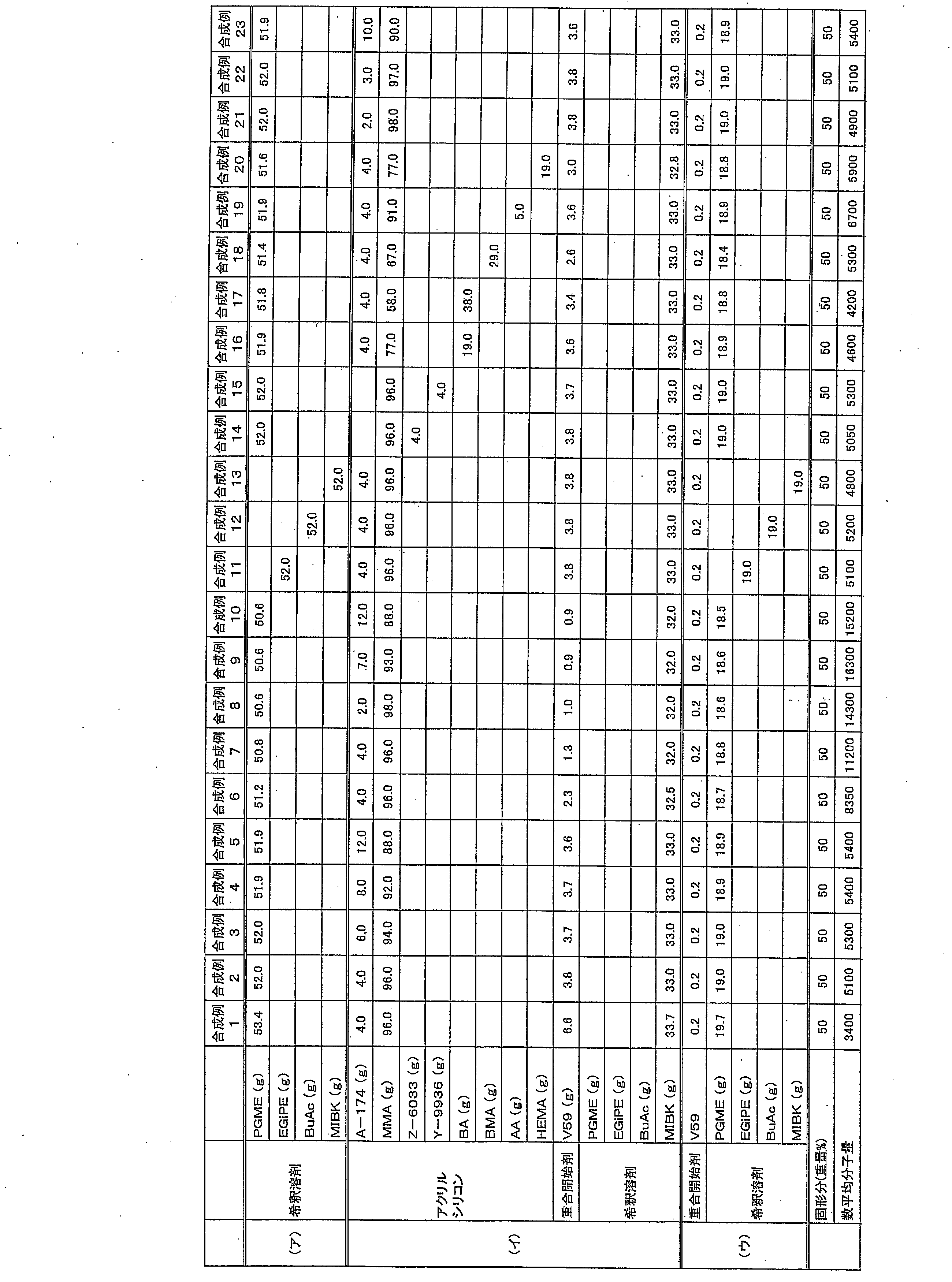
上記製造例で得たオルガノポリシロキサンの溶液、上記合成例で得たアクリルシリコンの溶液、酸触媒、並びに希釈溶剤を、表3,表4に記載した組成および配合量で、攪拌機、温度計、還流冷却器を備えた反応器に仕込んだ。そして、得られた配合物を、80℃で6時間攪拌して複合化反応させて、複合樹脂(A)を、表3,表4に記載の複合化濃度(複合化反応の固形分濃度)で得た。得られた複合樹脂(A)の各種物性を測定した。各作成例1~41の結果を表3,表4に示す。
尚、表3,表4に記載したオルガノポリシロキサンの溶液およびアクリルシリコンの溶液は、固形分が何れも50重量%であるため、ポリシロキサン比率(オルガノポリシロキサン(a1)の複合化比率)は、式「(オルガノポリシロキサンの溶液の配合量)÷(オルガノポリシロキサンの溶液の配合量+アクリルシリコンの溶液の配合量)×100」で算出した。
同様に、複合化濃度は、式「(オルガノポリシロキサンの溶液の配合量×0.5+アクリルシリコンの溶液の配合量×0.5)÷配合物の全量×100」で算出した。
複合樹脂(A)の作成において、上記複合化反応時にゲル化した複合樹脂は、次の塗工液の調製には使用しなかった。即ち、作成例14では、オルガノポリシロキサンの溶液、アクリルシリコンの溶液等を上記反応器に仕込み、先ず、80℃に昇温して10分間攪拌した後、希釈溶剤が16.6g揮発する(表3参照)まで減圧蒸留し、次いで、得られた配合物を、80℃で6時間攪拌して複合化反応させたところ、複合樹脂がゲル化した。作成例17,18では、80℃で6時間攪拌して複合化反応している間に、複合樹脂がゲル化した。それゆえ、作成例14,17,18で作成された複合樹脂は、次の塗工液の調製には使用しなかった。
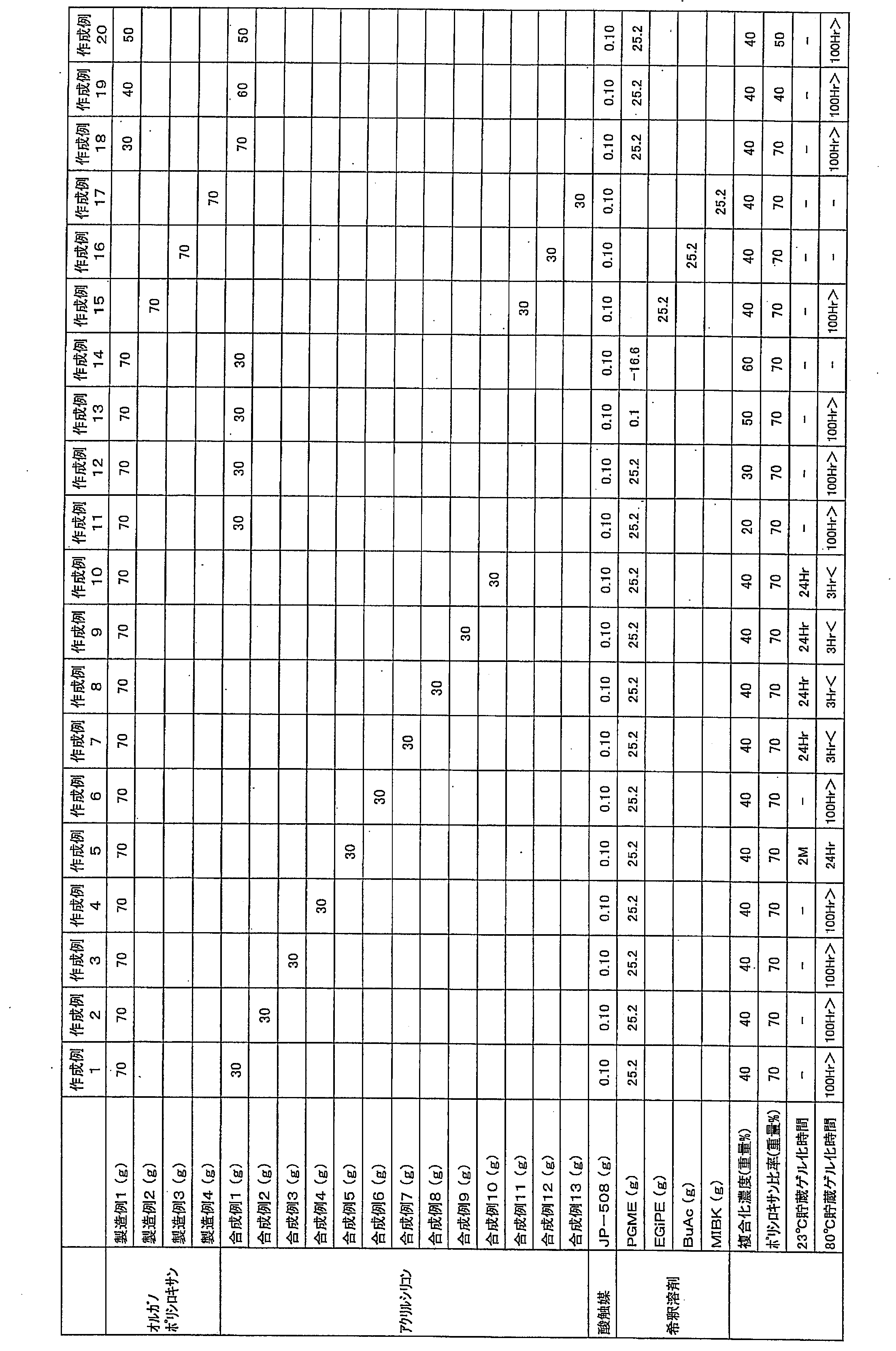

上記作成例1~13,15,16,19~41で得た複合樹脂(A)と、希釈溶剤とを、表5,表6に記載した組成および配合量で配合してなる配合物をサンプル瓶に仕込み、マグネチックスターラーを用いて5分間攪拌して塗工液1~38を調製した。

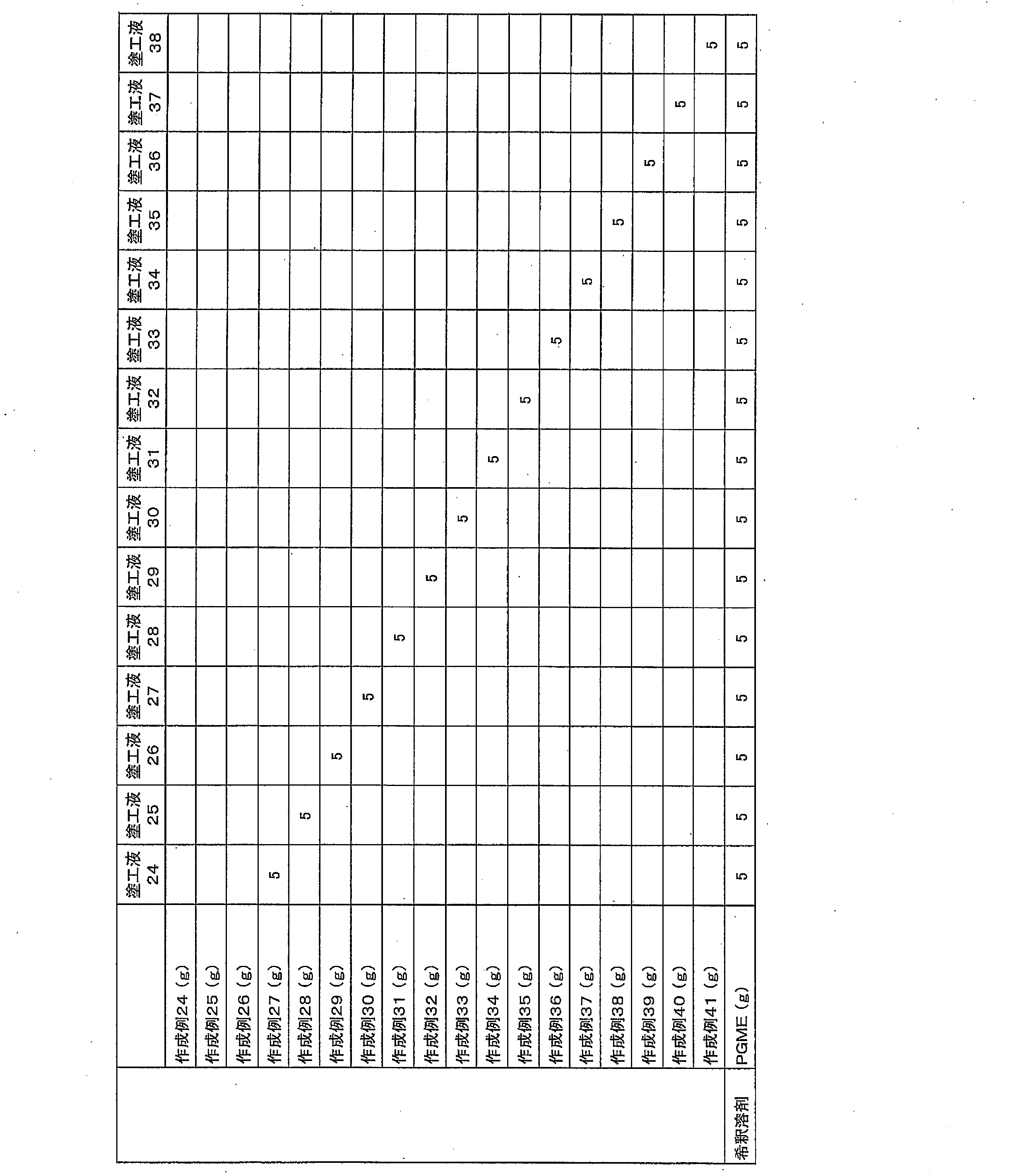
[積層体の作製]
上記調製例1で調製した塗工液1を、基材であるタキロン株式会社製のポリカーボネート(PC-1600、厚さ:2.0mm)、住友化学株式会社製のアクリルシート(スミペックス、厚さ:2.0mm)、フローガラス(厚さ:2.0mm)、およびアクリルシリコン基材の各表面に、それぞれバーコータ#20を用いて、乾燥後の膜厚が約6μmとなるように塗布した。
次いで、熱風乾燥機を用いて80℃で10分間掛けて、塗布した塗工液1の希釈溶剤の除去と硬化反応とを同時に完了させて(以下、「熱硬化」と称する)、試験片を得た。
得られた試験片の各種物性を測定した。測定結果を表7に示す。表7では、ポリカーボネートを「PC」、アクリルシートを「アクリル」、フローガラスを「ガラス」、アクリルシリコン基材を「アクリルシリコン」と記載している。
尚、上記アクリルシリコン基材は、タキロン株式会社製のポリカーボネート(PC-1600、厚さ:2.0mm)の表面に、アクリルシリコン(TSMA(3-メタクリロイルオキシプロピルトリメトキシシラン)10重量部およびMMA(メチルメタアクリレート)90重量部からなる組成物、数平均分子量:15000)とコルコート株式会社製のメチルシリケート51(商品名)とを固形分の重量比が80:20となるように配合し、PGMEで固形分20重量%となるように調整した塗工液を、バーコータ#20を用いて、乾燥後の膜厚が約6μmとなるように塗布することによって作製した積層体である。
<実施例2>
塗工液1の代わりに塗工液2を用いたこと以外は、実施例1と同様に熱硬化を実施して試験片を得た。得られた試験片の各種物性の測定結果を表7に示す。
塗工液1の代わりに塗工液2を用いたこと以外は、実施例1と同様に熱硬化を実施して試験片を得た。得られた試験片の各種物性の測定結果を表7に示す。
<実施例3>
塗工液1の代わりに塗工液3を用いたこと以外は、実施例1と同様に熱硬化を実施して試験片を得た。得られた試験片の各種物性の測定結果を表7に示す。
塗工液1の代わりに塗工液3を用いたこと以外は、実施例1と同様に熱硬化を実施して試験片を得た。得られた試験片の各種物性の測定結果を表7に示す。
<実施例4>
塗工液1の代わりに塗工液4を用いたこと以外は、実施例1と同様に熱硬化を実施して試験片を得た。得られた試験片の各種物性の測定結果を表7に示す。
塗工液1の代わりに塗工液4を用いたこと以外は、実施例1と同様に熱硬化を実施して試験片を得た。得られた試験片の各種物性の測定結果を表7に示す。
<実施例5>
塗工液1の代わりに塗工液5を用いたこと以外は、実施例1と同様に熱硬化を実施して試験片を得た。得られた試験片の各種物性の測定結果を表7に示す。
塗工液1の代わりに塗工液5を用いたこと以外は、実施例1と同様に熱硬化を実施して試験片を得た。得られた試験片の各種物性の測定結果を表7に示す。
<実施例6>
塗工液1の代わりに塗工液6を用いたこと以外は、実施例1と同様に熱硬化を実施して試験片を得た。得られた試験片の各種物性の測定結果を表7に示す。
塗工液1の代わりに塗工液6を用いたこと以外は、実施例1と同様に熱硬化を実施して試験片を得た。得られた試験片の各種物性の測定結果を表7に示す。
<実施例7>
塗工液1の代わりに塗工液12を用いたこと以外は、実施例1と同様に熱硬化を実施して試験片を得た。得られた試験片の各種物性の測定結果を表7に示す。
塗工液1の代わりに塗工液12を用いたこと以外は、実施例1と同様に熱硬化を実施して試験片を得た。得られた試験片の各種物性の測定結果を表7に示す。
<実施例8>
塗工液1の代わりに塗工液13を用いたこと以外は、実施例1と同様に熱硬化を実施して試験片を得た。得られた試験片の各種物性の測定結果を表7に示す。
塗工液1の代わりに塗工液13を用いたこと以外は、実施例1と同様に熱硬化を実施して試験片を得た。得られた試験片の各種物性の測定結果を表7に示す。
<実施例9>
塗工液1の代わりに塗工液14を用いたこと以外は、実施例1と同様に熱硬化を実施して試験片を得た。得られた試験片の各種物性の測定結果を表7に示す。
塗工液1の代わりに塗工液14を用いたこと以外は、実施例1と同様に熱硬化を実施して試験片を得た。得られた試験片の各種物性の測定結果を表7に示す。
<実施例10>
塗工液1の代わりに塗工液16を用いたこと以外は、実施例1と同様に熱硬化を実施して試験片を得た。得られた試験片の各種物性の測定結果を表7に示す。
塗工液1の代わりに塗工液16を用いたこと以外は、実施例1と同様に熱硬化を実施して試験片を得た。得られた試験片の各種物性の測定結果を表7に示す。
<実施例11>
塗工液1の代わりに塗工液17を用いたこと以外は、実施例1と同様に熱硬化を実施して試験片を得た。得られた試験片の各種物性の測定結果を表7に示す。
塗工液1の代わりに塗工液17を用いたこと以外は、実施例1と同様に熱硬化を実施して試験片を得た。得られた試験片の各種物性の測定結果を表7に示す。
<実施例12>
塗工液1の代わりに塗工液18を用いたこと以外は、実施例1と同様に熱硬化を実施して試験片を得た。得られた試験片の各種物性の測定結果を表7に示す。
塗工液1の代わりに塗工液18を用いたこと以外は、実施例1と同様に熱硬化を実施して試験片を得た。得られた試験片の各種物性の測定結果を表7に示す。
<実施例13>
塗工液1の代わりに塗工液19を用いたこと以外は、実施例1と同様に熱硬化を実施して試験片を得た。得られた試験片の各種物性の測定結果を表7に示す。
塗工液1の代わりに塗工液19を用いたこと以外は、実施例1と同様に熱硬化を実施して試験片を得た。得られた試験片の各種物性の測定結果を表7に示す。
<実施例14>
塗工液1の代わりに塗工液20を用いたこと以外は、実施例1と同様に熱硬化を実施して試験片を得た。得られた試験片の各種物性の測定結果を表7に示す。
塗工液1の代わりに塗工液20を用いたこと以外は、実施例1と同様に熱硬化を実施して試験片を得た。得られた試験片の各種物性の測定結果を表7に示す。
<実施例15>
塗工液1の代わりに塗工液22を用いたこと以外は、実施例1と同様に熱硬化を実施して試験片を得た。得られた試験片の各種物性の測定結果を表7に示す。
塗工液1の代わりに塗工液22を用いたこと以外は、実施例1と同様に熱硬化を実施して試験片を得た。得られた試験片の各種物性の測定結果を表7に示す。
<実施例16>
塗工液1の代わりに塗工液23を用いたこと以外は、実施例1と同様に熱硬化を実施して試験片を得た。得られた試験片の各種物性の測定結果を表8に示す。
塗工液1の代わりに塗工液23を用いたこと以外は、実施例1と同様に熱硬化を実施して試験片を得た。得られた試験片の各種物性の測定結果を表8に示す。
<実施例17>
塗工液1の代わりに塗工液24を用いたこと以外は、実施例1と同様に熱硬化を実施して試験片を得た。得られた試験片の各種物性の測定結果を表8に示す。
塗工液1の代わりに塗工液24を用いたこと以外は、実施例1と同様に熱硬化を実施して試験片を得た。得られた試験片の各種物性の測定結果を表8に示す。
<実施例18>
塗工液1の代わりに塗工液25を用いたこと以外は、実施例1と同様に熱硬化を実施して試験片を得た。得られた試験片の各種物性の測定結果を表8に示す。
塗工液1の代わりに塗工液25を用いたこと以外は、実施例1と同様に熱硬化を実施して試験片を得た。得られた試験片の各種物性の測定結果を表8に示す。
<実施例19>
塗工液1の代わりに塗工液26を用いたこと以外は、実施例1と同様に熱硬化を実施して試験片を得た。得られた試験片の各種物性の測定結果を表8に示す。
塗工液1の代わりに塗工液26を用いたこと以外は、実施例1と同様に熱硬化を実施して試験片を得た。得られた試験片の各種物性の測定結果を表8に示す。
<実施例20>
塗工液1の代わりに塗工液27を用いたこと以外は、実施例1と同様に熱硬化を実施して試験片を得た。得られた試験片の各種物性の測定結果を表8に示す。
塗工液1の代わりに塗工液27を用いたこと以外は、実施例1と同様に熱硬化を実施して試験片を得た。得られた試験片の各種物性の測定結果を表8に示す。
<実施例21>
塗工液1の代わりに塗工液28を用いたこと以外は、実施例1と同様に熱硬化を実施して試験片を得た。得られた試験片の各種物性の測定結果を表8に示す。
塗工液1の代わりに塗工液28を用いたこと以外は、実施例1と同様に熱硬化を実施して試験片を得た。得られた試験片の各種物性の測定結果を表8に示す。
<実施例22>
塗工液1の代わりに塗工液29を用いたこと以外は、実施例1と同様に熱硬化を実施して試験片を得た。得られた試験片の各種物性の測定結果を表8に示す。
塗工液1の代わりに塗工液29を用いたこと以外は、実施例1と同様に熱硬化を実施して試験片を得た。得られた試験片の各種物性の測定結果を表8に示す。
<実施例23>
塗工液1の代わりに塗工液30を用いたこと以外は、実施例1と同様に熱硬化を実施して試験片を得た。得られた試験片の各種物性の測定結果を表8に示す。
塗工液1の代わりに塗工液30を用いたこと以外は、実施例1と同様に熱硬化を実施して試験片を得た。得られた試験片の各種物性の測定結果を表8に示す。
<実施例24>
塗工液1の代わりに塗工液31を用いたこと以外は、実施例1と同様に熱硬化を実施して試験片を得た。得られた試験片の各種物性の測定結果を表8に示す。
塗工液1の代わりに塗工液31を用いたこと以外は、実施例1と同様に熱硬化を実施して試験片を得た。得られた試験片の各種物性の測定結果を表8に示す。
<実施例25>
塗工液1の代わりに塗工液32を用いたこと以外は、実施例1と同様に熱硬化を実施して試験片を得た。得られた試験片の各種物性の測定結果を表8に示す。
塗工液1の代わりに塗工液32を用いたこと以外は、実施例1と同様に熱硬化を実施して試験片を得た。得られた試験片の各種物性の測定結果を表8に示す。
<実施例26>
塗工液1の代わりに塗工液33を用いたこと以外は、実施例1と同様に熱硬化を実施して試験片を得た。得られた試験片の各種物性の測定結果を表8に示す。
塗工液1の代わりに塗工液33を用いたこと以外は、実施例1と同様に熱硬化を実施して試験片を得た。得られた試験片の各種物性の測定結果を表8に示す。
<実施例27>
塗工液1の代わりに塗工液34を用いたこと以外は、実施例1と同様に熱硬化を実施して試験片を得た。得られた試験片の各種物性の測定結果を表8に示す。
塗工液1の代わりに塗工液34を用いたこと以外は、実施例1と同様に熱硬化を実施して試験片を得た。得られた試験片の各種物性の測定結果を表8に示す。
<実施例28>
塗工液1の代わりに塗工液35を用いたこと以外は、実施例1と同様に熱硬化を実施して試験片を得た。得られた試験片の各種物性の測定結果を表8に示す。
塗工液1の代わりに塗工液35を用いたこと以外は、実施例1と同様に熱硬化を実施して試験片を得た。得られた試験片の各種物性の測定結果を表8に示す。
<実施例29>
塗工液1の代わりに塗工液36を用いたこと以外は、実施例1と同様に熱硬化を実施して試験片を得た。得られた試験片の各種物性の測定結果を表8に示す。
塗工液1の代わりに塗工液36を用いたこと以外は、実施例1と同様に熱硬化を実施して試験片を得た。得られた試験片の各種物性の測定結果を表8に示す。
<実施例30>
塗工液1の代わりに塗工液37を用いたこと以外は、実施例1と同様に熱硬化を実施して試験片を得た。得られた試験片の各種物性の測定結果を表8に示す。
塗工液1の代わりに塗工液37を用いたこと以外は、実施例1と同様に熱硬化を実施して試験片を得た。得られた試験片の各種物性の測定結果を表8に示す。
<実施例31>
塗工液1の代わりに塗工液38を用いたこと以外は、実施例1と同様に熱硬化を実施して試験片を得た。得られた試験片の各種物性の測定結果を表8に示す。

塗工液1の代わりに塗工液38を用いたこと以外は、実施例1と同様に熱硬化を実施して試験片を得た。得られた試験片の各種物性の測定結果を表8に示す。

塗工液1の代わりに塗工液7を用いたこと以外は、実施例1と同様に熱硬化を実施して試験片を得た。得られた試験片の各種物性の測定結果を表9に示す。
<比較例2>
塗工液1の代わりに塗工液8を用いたこと以外は、実施例1と同様に熱硬化を実施して試験片を得た。得られた試験片の各種物性の測定結果を表9に示す。
塗工液1の代わりに塗工液8を用いたこと以外は、実施例1と同様に熱硬化を実施して試験片を得た。得られた試験片の各種物性の測定結果を表9に示す。
<比較例3>
塗工液1の代わりに塗工液9を用いたこと以外は、実施例1と同様に熱硬化を実施して試験片を得た。得られた試験片の各種物性の測定結果を表9に示す。
塗工液1の代わりに塗工液9を用いたこと以外は、実施例1と同様に熱硬化を実施して試験片を得た。得られた試験片の各種物性の測定結果を表9に示す。
<比較例4>
塗工液1の代わりに塗工液10を用いたこと以外は、実施例1と同様に熱硬化を実施して試験片を得た。得られた試験片の各種物性の測定結果を表9に示す。
塗工液1の代わりに塗工液10を用いたこと以外は、実施例1と同様に熱硬化を実施して試験片を得た。得られた試験片の各種物性の測定結果を表9に示す。
<比較例5>
塗工液1の代わりに塗工液11を用いたこと以外は、実施例1と同様に熱硬化を実施して試験片を得た。得られた試験片の各種物性の測定結果を表9に示す。
塗工液1の代わりに塗工液11を用いたこと以外は、実施例1と同様に熱硬化を実施して試験片を得た。得られた試験片の各種物性の測定結果を表9に示す。
<比較例6>
表3の作成例14に記載の通り、製造例1で得たオルガノポリシロキサンの溶液と、合成例2で得たアクリルシリコンの溶液とを用いて得られた配合物を、80℃で6時間攪拌して、固形分が60重量%である複合樹脂(A)を作成しようとしたところ、反応溶液が増粘してゲル化した。
表3の作成例14に記載の通り、製造例1で得たオルガノポリシロキサンの溶液と、合成例2で得たアクリルシリコンの溶液とを用いて得られた配合物を、80℃で6時間攪拌して、固形分が60重量%である複合樹脂(A)を作成しようとしたところ、反応溶液が増粘してゲル化した。
<比較例7>
表3の作成例16に記載の通り、製造例3で得たオルガノポリシロキサンの溶液と、合成例12で得たアクリルシリコンの溶液とを用いて得られた配合物を、80℃で6時間攪拌して、固形分が40重量%である複合樹脂(A)を作成しようとしたところ、反応溶液が増粘してゲル化した。
表3の作成例16に記載の通り、製造例3で得たオルガノポリシロキサンの溶液と、合成例12で得たアクリルシリコンの溶液とを用いて得られた配合物を、80℃で6時間攪拌して、固形分が40重量%である複合樹脂(A)を作成しようとしたところ、反応溶液が増粘してゲル化した。
<比較例8>
表3の作成例17に記載の通り、製造例4で得たオルガノポリシロキサンの溶液と、合成例13で得たアクリルシリコンの溶液とを用いて得られた配合物を、80℃で6時間攪拌して、固形分が40重量%である複合樹脂(A)を作成しようとしたところ、反応溶液が増粘してゲル化した。
表3の作成例17に記載の通り、製造例4で得たオルガノポリシロキサンの溶液と、合成例13で得たアクリルシリコンの溶液とを用いて得られた配合物を、80℃で6時間攪拌して、固形分が40重量%である複合樹脂(A)を作成しようとしたところ、反応溶液が増粘してゲル化した。
<比較例9>
塗工液1の代わりに塗工液15を用いたこと以外は、実施例1と同様に熱硬化を実施して試験片を得た。得られた試験片の各種物性の測定結果を表9に示す。
塗工液1の代わりに塗工液15を用いたこと以外は、実施例1と同様に熱硬化を実施して試験片を得た。得られた試験片の各種物性の測定結果を表9に示す。
<比較例10>
塗工液1の代わりに塗工液21を用いたこと以外は、実施例1と同様に熱硬化を実施して試験片を得た。得られた試験片の各種物性の測定結果を表9に示す。
塗工液1の代わりに塗工液21を用いたこと以外は、実施例1と同様に熱硬化を実施して試験片を得た。得られた試験片の各種物性の測定結果を表9に示す。
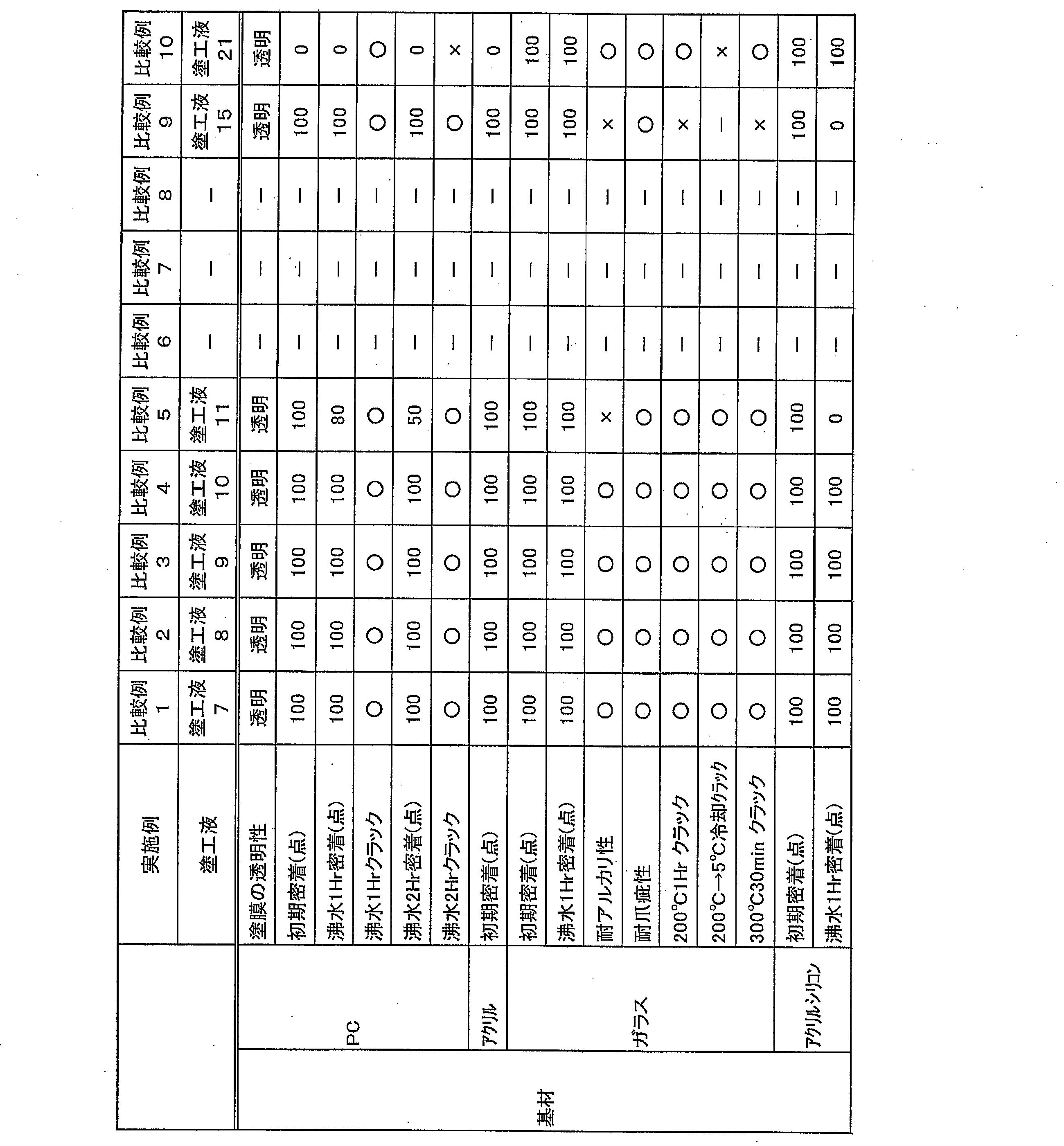
実施例5,27ではアクリルシリコン(a2)を構成するモノマーユニットのうち、加水分解性シリル基を含有するモノマーユニットがそれぞれ12重量%,10重量%と若干高いため、選択する基板によっては、沸水試験(沸水1Hr密着、沸水2Hr密着)において基材への塗膜の密着性の低下が確認された。実施例7では複合樹脂(A)を合成するときの複合化濃度が30重量%と比較例5よりは高く、複合樹脂(A)の性能も優れるものの、未だ不十分であり複合化反応が完全には進行しておらず、選択する基板によっては、沸水試験(沸水1Hr密着、沸水2Hr密着)において基材への塗膜の密着性の低下が確認された。実施例10,11ではオルガノポリシロキサン(a1)がそれぞれ40重量%,50重量%の割合で複合した複合樹脂(A)が得られ、比較例9よりは高く、複合樹脂(A)の性能も優れるものの、未だ不十分であり、選択する基板によっては、300℃耐熱試験(300℃ 30minクラック)においてクラックを生じた。実施例13,14ではオルガノポリシロキサン(a1)がそれぞれ80重量%,90重量%と高過ぎるため、複合樹脂(A)の耐熱性は非常に優れるものの、硬化収縮が大きく、選択する基板によっては、基材への塗膜の2次密着性(沸水1Hr密着、沸水2Hr密着)が不十分であった。しかし、アクリルシリコン(a2)を含む塗工液が塗布された基材に対する塗膜の密着性は、沸水に浸漬後においても優れており、被着対象物(基材)を選択すれば優れた積層体を得ることができる。実施例16,17ではオルガノトリアルコキシシランの有機基がそれぞれエチル基、ヘキシル基でありメチル基よりも嵩高いことから、塗膜の形成時における架橋反応が十分に進行せず、選択する基板によっては、沸水に浸漬後の密着性が不十分な塗膜が得られた。実施例21ではアクリルシリコン(a2)を構成するモノマーユニットのうち、メタクリル酸エステルユニットは65重量%以下であって実用上問題が無いレベルであるものの、選択する基板によっては、沸水に浸漬後の塗膜の密着性が低下した。実施例25ではアクリルシリコン(a2)を構成するモノマーユニットのうち、加水分解性シリル基を含有するモノマーユニットは2重量%と低く、塗膜が白濁し、また、アクリルシリコン(a2)が塗布された基材に対する、沸水に浸漬後の塗膜の密着性において剥離が一部観察された。但し、これら不都合は、塗膜をより薄くコーティングすることや、塗膜の形成時に加水分解性シリル基の反応を促進する触媒を用いることで改善することができる。実施例28ではオルガノポリシロキサン(a1)を合成するときに用いる水の量がアルコキシシリル基1モルに対して0.6モルと少なく、アルコキシシリル基やシラノール基を多く含むオルガノポリシロキサンが得られたため、実用上問題が無いレベルであるものの、選択する基板によっては、沸水に浸漬後における塗膜の密着性の低下が観察された。
その他の実施例においては、高耐熱性、冷熱サイクル耐性、基材への密着性を併有し、かつ貯蔵安定性の高いポリシロキサンセグメントを含有する複合樹脂を製造することができた。
本発明に係る複合樹脂の製造方法によれば、高耐熱性、冷熱サイクル耐性、基材への密着性を併有し、かつ貯蔵安定性の高いポリシロキサンセグメントを含有する複合樹脂を製造することができる。
Claims (11)
- 有機基が炭化水素基であるオルガノトリアルコキシシランを加水分解および縮合して得られるオルガノポリシロキサン(a1)と、アクリルシリコン(a2)とを反応させることにより得られる複合樹脂(A)の製造方法であって、
炭素数が4以上の水溶性有機溶媒を使用し、固形分濃度30~55重量%で上記オルガノポリシロキサン(a1)とアクリルシリコン(a2)とを酸触媒の存在下で反応させる工程を含み、上記オルガノポリシロキサン(a1)40~90重量%とアクリルシリコン(a2)10~60重量%とからなり、上記アクリルシリコン(a2)の数平均分子量が1000~9000であることを特徴とする複合樹脂(A)の製造方法。 - アクリルシリコン(a2)を構成するモノマーユニットのうち、加水分解性シリル基を含有するモノマーユニットが3~11重量%であることを特徴とする請求項1に記載の複合樹脂(A)の製造方法。
- 有機基が炭化水素基であるオルガノトリアルコキシシランが、メチルトリメトキシシランであることを特徴とする請求項1または2に記載の複合樹脂(A)の製造方法。
- アクリルシリコン(a2)を構成するビニルモノマーが、3-(メタ)アクリロイルオキシプロピルトリメトキシシラン、3-メタクリロイルオキシプロピルメチルジメトキシシラン、および3-メタクリロイルオキシプロピルトリエトキシシランからなる群より選ばれる1種以上のシランモノマーを含有することを特徴とする請求項1~3の何れか1項に記載の複合樹脂(A)の製造方法。
- アクリルシリコン(a2)を構成するビニルモノマーが、メタクリル酸エステルを65重量%以上含有することを特徴とする請求項1~4の何れか1項に記載の複合樹脂(A)の製造方法。
- アクリルシリコン(a2)を構成するビニルモノマーが、メタクリル酸メチルを50重量%以上含有することを特徴とする請求項1~5の何れか1項に記載の複合樹脂(A)の製造方法。
- 有機基が炭化水素基であるオルガノトリアルコキシシランを加水分解および縮合する工程で、アルコキシシリル基1モルに対して、0.6モル~4.0モルの水を添加することを特徴とする請求項1~6の何れか1項に記載の複合樹脂(A)の製造方法。
- 請求項1~7の何れか1項に記載の製造方法で製造した複合樹脂(A)を硬化させることを特徴とする硬化物の製造方法。
- 請求項1~7の何れか1項に記載の製造方法で製造した複合樹脂(A)を基材に塗布する工程と、硬化被膜を形成する工程とを含むことを特徴とする積層体の製造方法。
- アクリルシリコン(a2)を含む塗工液が塗布された基材に、請求項1~7の何れか1項に記載の製造方法で製造した複合樹脂(A)を塗布する工程と、硬化被膜を形成する工程とを含むことを特徴とする積層体の製造方法。
- アクリルシリコン(a2)の塗工液が、アルキルシリケートを含むことを特徴とする請求項10に記載の積層体の製造方法。
Priority Applications (2)
| Application Number | Priority Date | Filing Date | Title |
|---|---|---|---|
| JP2018508820A JP6841816B2 (ja) | 2016-04-01 | 2017-02-28 | 複合樹脂の製造方法 |
| US16/144,591 US20190023943A1 (en) | 2016-04-01 | 2018-09-27 | Method for producing composite resin |
Applications Claiming Priority (2)
| Application Number | Priority Date | Filing Date | Title |
|---|---|---|---|
| JP2016-074480 | 2016-04-01 | ||
| JP2016074480 | 2016-04-01 |
Related Child Applications (1)
| Application Number | Title | Priority Date | Filing Date |
|---|---|---|---|
| US16/144,591 Continuation US20190023943A1 (en) | 2016-04-01 | 2018-09-27 | Method for producing composite resin |
Publications (1)
| Publication Number | Publication Date |
|---|---|
| WO2017169459A1 true WO2017169459A1 (ja) | 2017-10-05 |
Family
ID=59963988
Family Applications (1)
| Application Number | Title | Priority Date | Filing Date |
|---|---|---|---|
| PCT/JP2017/007762 Ceased WO2017169459A1 (ja) | 2016-04-01 | 2017-02-28 | 複合樹脂の製造方法 |
Country Status (3)
| Country | Link |
|---|---|
| US (1) | US20190023943A1 (ja) |
| JP (1) | JP6841816B2 (ja) |
| WO (1) | WO2017169459A1 (ja) |
Cited By (1)
| Publication number | Priority date | Publication date | Assignee | Title |
|---|---|---|---|---|
| WO2019151469A1 (ja) * | 2018-02-02 | 2019-08-08 | 株式会社カネカ | 硬化性樹脂組成物、及びその製造方法 |
Citations (6)
| Publication number | Priority date | Publication date | Assignee | Title |
|---|---|---|---|---|
| JPH09241538A (ja) * | 1996-03-06 | 1997-09-16 | Shin Etsu Chem Co Ltd | 粉体塗料 |
| JP2001072869A (ja) * | 1999-09-06 | 2001-03-21 | Chugoku Marine Paints Ltd | ポリシロキサン−アクリル樹脂ブロック共重合体組成物、防汚剤組成物、防汚塗膜、防汚処理基材、並びに基材の防汚処理方法 |
| JP2001354773A (ja) * | 2000-06-16 | 2001-12-25 | Dow Corning Toray Silicone Co Ltd | オルガノシロキサン結合ビニル系重合体の製造方法 |
| WO2014112470A1 (ja) * | 2013-01-16 | 2014-07-24 | 日東電工株式会社 | 形状記憶性シート及びその製造方法 |
| WO2014112610A1 (ja) * | 2013-01-16 | 2014-07-24 | 日東電工株式会社 | 無機酸化物粒子含有シリコーン-アクリルハイブリッド樹脂組成物及びシート |
| WO2015137438A1 (ja) * | 2014-03-14 | 2015-09-17 | Dic株式会社 | 酸素プラズマエッチング用レジスト材料、レジスト膜、及びそれを用いた積層体 |
-
2017
- 2017-02-28 JP JP2018508820A patent/JP6841816B2/ja active Active
- 2017-02-28 WO PCT/JP2017/007762 patent/WO2017169459A1/ja not_active Ceased
-
2018
- 2018-09-27 US US16/144,591 patent/US20190023943A1/en not_active Abandoned
Patent Citations (6)
| Publication number | Priority date | Publication date | Assignee | Title |
|---|---|---|---|---|
| JPH09241538A (ja) * | 1996-03-06 | 1997-09-16 | Shin Etsu Chem Co Ltd | 粉体塗料 |
| JP2001072869A (ja) * | 1999-09-06 | 2001-03-21 | Chugoku Marine Paints Ltd | ポリシロキサン−アクリル樹脂ブロック共重合体組成物、防汚剤組成物、防汚塗膜、防汚処理基材、並びに基材の防汚処理方法 |
| JP2001354773A (ja) * | 2000-06-16 | 2001-12-25 | Dow Corning Toray Silicone Co Ltd | オルガノシロキサン結合ビニル系重合体の製造方法 |
| WO2014112470A1 (ja) * | 2013-01-16 | 2014-07-24 | 日東電工株式会社 | 形状記憶性シート及びその製造方法 |
| WO2014112610A1 (ja) * | 2013-01-16 | 2014-07-24 | 日東電工株式会社 | 無機酸化物粒子含有シリコーン-アクリルハイブリッド樹脂組成物及びシート |
| WO2015137438A1 (ja) * | 2014-03-14 | 2015-09-17 | Dic株式会社 | 酸素プラズマエッチング用レジスト材料、レジスト膜、及びそれを用いた積層体 |
Cited By (1)
| Publication number | Priority date | Publication date | Assignee | Title |
|---|---|---|---|---|
| WO2019151469A1 (ja) * | 2018-02-02 | 2019-08-08 | 株式会社カネカ | 硬化性樹脂組成物、及びその製造方法 |
Also Published As
| Publication number | Publication date |
|---|---|
| US20190023943A1 (en) | 2019-01-24 |
| JP6841816B2 (ja) | 2021-03-10 |
| JPWO2017169459A1 (ja) | 2019-02-07 |
Similar Documents
| Publication | Publication Date | Title |
|---|---|---|
| CN113825636B (zh) | 放射线硬化性有机聚硅氧烷组合物、硬化物以及剥离片 | |
| CN101490121B (zh) | 可交联的反应性的硅氧烷有机共聚物及其制备方法和用途 | |
| JP5311744B2 (ja) | 紫外線硬化性樹脂組成物、当該硬化物、およびこれらから誘導される各種物品 | |
| US9303180B2 (en) | Low-temperature cureable coating composition and article having cured coating thereof | |
| US6051665A (en) | Coating composition | |
| JP6403676B2 (ja) | 有機ケイ素化合物含有熱硬化性組成物及びその硬化物 | |
| TW201641540A (zh) | 聚有機矽氧烷及包含彼之可濕氣及輻射固化之黏著劑組合物 | |
| US20140323677A1 (en) | Thermal-shock-resistant cured product and method for producing same | |
| CN1637098A (zh) | 有机硅化合物固化组合物和硅氧烷基涂料组合物 | |
| KR20140058520A (ko) | 실란 측쇄가 있는 비닐 알코올 중합체 | |
| JP6841816B2 (ja) | 複合樹脂の製造方法 | |
| WO2019151469A1 (ja) | 硬化性樹脂組成物、及びその製造方法 | |
| CN113631601B (zh) | 有机无机复合树脂及其制造方法 | |
| TWI688620B (zh) | 塗覆用樹脂組成物及包括其硬化物作為塗覆層的塗覆膜 | |
| JP2020164583A (ja) | ポリオルガノシロキサン及びその製造方法、並びに塗料用組成物 | |
| CN115335484B (zh) | 聚有机硅氧烷混合压敏粘合剂及其制备和使用方法 | |
| TW202536111A (zh) | 熱硬化性矽樹脂組成物、積層體 | |
| CN115667371B (zh) | 有机聚硅氧烷及其制造方法、硬化性组合物、硬化物、涂布剂、具有被覆层的物品 | |
| JP6666827B2 (ja) | シリコーン樹脂含有エマルジョン組成物及び硬化被膜形成基材 | |
| WO2023214526A1 (ja) | メルカプト基およびアルコキシシリル基含有オルガノポリシロキサン、ならびにそれを含む組成物 | |
| JP5924536B2 (ja) | 金属用表面処理剤及び該表面処理剤で処理された金属材 | |
| JPH10147749A (ja) | 被膜形成用組成物 | |
| JP2001310919A (ja) | コーティング用樹脂組成物 | |
| JP4802731B2 (ja) | マレイミド系共重合体、その製造方法、重合体組成物および成形体 | |
| KR101613732B1 (ko) | β-케토에스테르기 함유 오르가노폴리실록산 화합물 |
Legal Events
| Date | Code | Title | Description |
|---|---|---|---|
| WWE | Wipo information: entry into national phase |
Ref document number: 2018508820 Country of ref document: JP |
|
| NENP | Non-entry into the national phase |
Ref country code: DE |
|
| 121 | Ep: the epo has been informed by wipo that ep was designated in this application |
Ref document number: 17774004 Country of ref document: EP Kind code of ref document: A1 |
|
| 122 | Ep: pct application non-entry in european phase |
Ref document number: 17774004 Country of ref document: EP Kind code of ref document: A1 |