WO2017163482A1 - 回転機械のケーシング支持部の冷却装置及び回転機械、並びに回転機械のケーシング支持部の冷却方法 - Google Patents
回転機械のケーシング支持部の冷却装置及び回転機械、並びに回転機械のケーシング支持部の冷却方法 Download PDFInfo
- Publication number
- WO2017163482A1 WO2017163482A1 PCT/JP2016/083772 JP2016083772W WO2017163482A1 WO 2017163482 A1 WO2017163482 A1 WO 2017163482A1 JP 2016083772 W JP2016083772 W JP 2016083772W WO 2017163482 A1 WO2017163482 A1 WO 2017163482A1
- Authority
- WO
- WIPO (PCT)
- Prior art keywords
- casing
- support
- cooling device
- rotary machine
- rotating
- Prior art date
- Legal status (The legal status is an assumption and is not a legal conclusion. Google has not performed a legal analysis and makes no representation as to the accuracy of the status listed.)
- Ceased
Links
Images

Classifications
-
- F—MECHANICAL ENGINEERING; LIGHTING; HEATING; WEAPONS; BLASTING
- F01—MACHINES OR ENGINES IN GENERAL; ENGINE PLANTS IN GENERAL; STEAM ENGINES
- F01D—NON-POSITIVE DISPLACEMENT MACHINES OR ENGINES, e.g. STEAM TURBINES
- F01D25/00—Component parts, details, or accessories, not provided for in, or of interest apart from, other groups
- F01D25/08—Cooling; Heating; Heat-insulation
- F01D25/12—Cooling
-
- F—MECHANICAL ENGINEERING; LIGHTING; HEATING; WEAPONS; BLASTING
- F01—MACHINES OR ENGINES IN GENERAL; ENGINE PLANTS IN GENERAL; STEAM ENGINES
- F01D—NON-POSITIVE DISPLACEMENT MACHINES OR ENGINES, e.g. STEAM TURBINES
- F01D25/00—Component parts, details, or accessories, not provided for in, or of interest apart from, other groups
- F01D25/08—Cooling; Heating; Heat-insulation
- F01D25/12—Cooling
- F01D25/125—Cooling of bearings
-
- F—MECHANICAL ENGINEERING; LIGHTING; HEATING; WEAPONS; BLASTING
- F01—MACHINES OR ENGINES IN GENERAL; ENGINE PLANTS IN GENERAL; STEAM ENGINES
- F01D—NON-POSITIVE DISPLACEMENT MACHINES OR ENGINES, e.g. STEAM TURBINES
- F01D25/00—Component parts, details, or accessories, not provided for in, or of interest apart from, other groups
- F01D25/08—Cooling; Heating; Heat-insulation
-
- F—MECHANICAL ENGINEERING; LIGHTING; HEATING; WEAPONS; BLASTING
- F01—MACHINES OR ENGINES IN GENERAL; ENGINE PLANTS IN GENERAL; STEAM ENGINES
- F01D—NON-POSITIVE DISPLACEMENT MACHINES OR ENGINES, e.g. STEAM TURBINES
- F01D25/00—Component parts, details, or accessories, not provided for in, or of interest apart from, other groups
- F01D25/08—Cooling; Heating; Heat-insulation
- F01D25/14—Casings modified therefor
-
- F—MECHANICAL ENGINEERING; LIGHTING; HEATING; WEAPONS; BLASTING
- F01—MACHINES OR ENGINES IN GENERAL; ENGINE PLANTS IN GENERAL; STEAM ENGINES
- F01D—NON-POSITIVE DISPLACEMENT MACHINES OR ENGINES, e.g. STEAM TURBINES
- F01D25/00—Component parts, details, or accessories, not provided for in, or of interest apart from, other groups
- F01D25/24—Casings; Casing parts, e.g. diaphragms, casing fastenings
-
- F—MECHANICAL ENGINEERING; LIGHTING; HEATING; WEAPONS; BLASTING
- F01—MACHINES OR ENGINES IN GENERAL; ENGINE PLANTS IN GENERAL; STEAM ENGINES
- F01D—NON-POSITIVE DISPLACEMENT MACHINES OR ENGINES, e.g. STEAM TURBINES
- F01D25/00—Component parts, details, or accessories, not provided for in, or of interest apart from, other groups
- F01D25/28—Supporting or mounting arrangements, e.g. for turbine casing
-
- F—MECHANICAL ENGINEERING; LIGHTING; HEATING; WEAPONS; BLASTING
- F02—COMBUSTION ENGINES; HOT-GAS OR COMBUSTION-PRODUCT ENGINE PLANTS
- F02C—GAS-TURBINE PLANTS; AIR INTAKES FOR JET-PROPULSION PLANTS; CONTROLLING FUEL SUPPLY IN AIR-BREATHING JET-PROPULSION PLANTS
- F02C7/00—Features, components parts, details or accessories, not provided for in, or of interest apart form groups F02C1/00 - F02C6/00; Air intakes for jet-propulsion plants
-
- F—MECHANICAL ENGINEERING; LIGHTING; HEATING; WEAPONS; BLASTING
- F02—COMBUSTION ENGINES; HOT-GAS OR COMBUSTION-PRODUCT ENGINE PLANTS
- F02C—GAS-TURBINE PLANTS; AIR INTAKES FOR JET-PROPULSION PLANTS; CONTROLLING FUEL SUPPLY IN AIR-BREATHING JET-PROPULSION PLANTS
- F02C7/00—Features, components parts, details or accessories, not provided for in, or of interest apart form groups F02C1/00 - F02C6/00; Air intakes for jet-propulsion plants
- F02C7/06—Arrangements of bearings; Lubricating
-
- F—MECHANICAL ENGINEERING; LIGHTING; HEATING; WEAPONS; BLASTING
- F02—COMBUSTION ENGINES; HOT-GAS OR COMBUSTION-PRODUCT ENGINE PLANTS
- F02C—GAS-TURBINE PLANTS; AIR INTAKES FOR JET-PROPULSION PLANTS; CONTROLLING FUEL SUPPLY IN AIR-BREATHING JET-PROPULSION PLANTS
- F02C7/00—Features, components parts, details or accessories, not provided for in, or of interest apart form groups F02C1/00 - F02C6/00; Air intakes for jet-propulsion plants
- F02C7/20—Mounting or supporting of plant; Accommodating heat expansion or creep
-
- F—MECHANICAL ENGINEERING; LIGHTING; HEATING; WEAPONS; BLASTING
- F02—COMBUSTION ENGINES; HOT-GAS OR COMBUSTION-PRODUCT ENGINE PLANTS
- F02C—GAS-TURBINE PLANTS; AIR INTAKES FOR JET-PROPULSION PLANTS; CONTROLLING FUEL SUPPLY IN AIR-BREATHING JET-PROPULSION PLANTS
- F02C7/00—Features, components parts, details or accessories, not provided for in, or of interest apart form groups F02C1/00 - F02C6/00; Air intakes for jet-propulsion plants
- F02C7/22—Fuel supply systems
-
- F—MECHANICAL ENGINEERING; LIGHTING; HEATING; WEAPONS; BLASTING
- F16—ENGINEERING ELEMENTS AND UNITS; GENERAL MEASURES FOR PRODUCING AND MAINTAINING EFFECTIVE FUNCTIONING OF MACHINES OR INSTALLATIONS; THERMAL INSULATION IN GENERAL
- F16C—SHAFTS; FLEXIBLE SHAFTS; ELEMENTS OR CRANKSHAFT MECHANISMS; ROTARY BODIES OTHER THAN GEARING ELEMENTS; BEARINGS
- F16C37/00—Cooling of bearings
- F16C37/007—Cooling of bearings of rolling bearings
-
- H—ELECTRICITY
- H02—GENERATION; CONVERSION OR DISTRIBUTION OF ELECTRIC POWER
- H02K—DYNAMO-ELECTRIC MACHINES
- H02K5/00—Casings; Enclosures; Supports
- H02K5/04—Casings or enclosures characterised by the shape, form or construction thereof
- H02K5/20—Casings or enclosures characterised by the shape, form or construction thereof with channels or ducts for flow of cooling medium
- H02K5/203—Casings or enclosures characterised by the shape, form or construction thereof with channels or ducts for flow of cooling medium specially adapted for liquids, e.g. cooling jackets
-
- H—ELECTRICITY
- H02—GENERATION; CONVERSION OR DISTRIBUTION OF ELECTRIC POWER
- H02K—DYNAMO-ELECTRIC MACHINES
- H02K9/00—Arrangements for cooling or ventilating
- H02K9/19—Arrangements for cooling or ventilating for machines with closed casing and closed-circuit cooling using a liquid cooling medium, e.g. oil
-
- F—MECHANICAL ENGINEERING; LIGHTING; HEATING; WEAPONS; BLASTING
- F05—INDEXING SCHEMES RELATING TO ENGINES OR PUMPS IN VARIOUS SUBCLASSES OF CLASSES F01-F04
- F05D—INDEXING SCHEME FOR ASPECTS RELATING TO NON-POSITIVE-DISPLACEMENT MACHINES OR ENGINES, GAS-TURBINES OR JET-PROPULSION PLANTS
- F05D2220/00—Application
- F05D2220/30—Application in turbines
-
- F—MECHANICAL ENGINEERING; LIGHTING; HEATING; WEAPONS; BLASTING
- F05—INDEXING SCHEMES RELATING TO ENGINES OR PUMPS IN VARIOUS SUBCLASSES OF CLASSES F01-F04
- F05D—INDEXING SCHEME FOR ASPECTS RELATING TO NON-POSITIVE-DISPLACEMENT MACHINES OR ENGINES, GAS-TURBINES OR JET-PROPULSION PLANTS
- F05D2240/00—Components
- F05D2240/50—Bearings
-
- F—MECHANICAL ENGINEERING; LIGHTING; HEATING; WEAPONS; BLASTING
- F05—INDEXING SCHEMES RELATING TO ENGINES OR PUMPS IN VARIOUS SUBCLASSES OF CLASSES F01-F04
- F05D—INDEXING SCHEME FOR ASPECTS RELATING TO NON-POSITIVE-DISPLACEMENT MACHINES OR ENGINES, GAS-TURBINES OR JET-PROPULSION PLANTS
- F05D2260/00—Function
- F05D2260/20—Heat transfer, e.g. cooling
-
- F—MECHANICAL ENGINEERING; LIGHTING; HEATING; WEAPONS; BLASTING
- F05—INDEXING SCHEMES RELATING TO ENGINES OR PUMPS IN VARIOUS SUBCLASSES OF CLASSES F01-F04
- F05D—INDEXING SCHEME FOR ASPECTS RELATING TO NON-POSITIVE-DISPLACEMENT MACHINES OR ENGINES, GAS-TURBINES OR JET-PROPULSION PLANTS
- F05D2260/00—Function
- F05D2260/98—Lubrication
Definitions
- the present invention relates to a cooling device for a casing support part of a rotary machine, a rotary machine using the same, and a cooling method for the casing support part of the rotary machine.
- the casing of the steam turbine or gas turbine is provided with a projecting portion called a cat paws, and the casing is supported via the cat paws.
- a support stand is erected on the ground, and a cat leg is placed on the support stand to support the passenger compartment.
- the claw legs and the support base are heated at high temperatures, and the heat extension in the thickness direction (vertically upward) of the claw legs and the support base displaces the passenger compartment vertically upward as a whole.
- the cat paws are subject to thermal deformation that is convex upward or tapered due to the difference in thermal elongation. Displace the chamber vertically upwards as a whole.
- the temperature distribution of the rotor during operation of the turbine is symmetric with respect to the rotor rotation axis. For this reason, even if the rotor is thermally expanded, the height of the rotor rotation shaft does not greatly change.
- the casing moves upward relative to the rotor, and the gap between the casing and the rotor widens at the top and narrows at the bottom.
- the thermal deformation of the passenger compartment is large, the passenger compartment and the rotor come into contact with each other at the lower portion, and vibration is generated.
- the thermal deformation is extremely large, the casing and the rotor may come into strong contact with each other, and the casing and the rotor may be damaged, thereby disturbing the operation of the turbine.
- Patent Document 1 discloses a technique that suppresses the upward upward displacement of the passenger compartment due to such thermal elongation.
- the technique disclosed in Patent Document 1 will be described. Reference numerals used in Patent Document 1 are shown in parentheses for reference.
- a passage (13) is formed inside a column (6) corresponding to the support base, and this passage (13 ), A support fluid (6) is cooled by circulating a cooling fluid such as air or water.
- a cooling fluid such as air or water.
- the present invention uses a cooling device for a casing support portion of a rotating machine that can cool a support portion and suppress thermal expansion and thermal deformation of the support portion while suppressing an increase in running cost and equipment cost, and the same.
- An object of the present invention is to provide a rotating machine and a method for cooling a casing support of the rotating machine.
- a cooling device for a casing support portion of a rotary machine has a rotating body main body and a pair of rotating shaft ends fixed to both outer sides in the axial direction of the rotating body main body.
- a rotating body a casing that accommodates the rotating body main body and through which each rotating shaft end penetrates, a bearing portion that rotatably supports the rotating shaft end and is supplied with lubricating fluid from a lubrication line to the bearing surface;
- the rotary machine provided with the support part which supports a casing, it is a cooling device of the casing support part of a rotary machine which cools the support part, Comprising: The lubricating fluid and the support part are heat-exchanged in the lubrication line And a heat exchanging part for cooling the support part.
- the support portion includes a protruding portion protruding from the casing main body and a support base on which the protruding portion is placed, and the outer surface of the casing main body and the outer surface of the protruding portion. It is preferable that a heat insulating layer is provided.
- the support part has a protrusion part protruding from the casing body and a support base on which the protrusion part is placed, and the heat exchange part is built in the support base.
- the support portion includes a protrusion protruding from the casing main body and a support base on which the protrusion is placed, and the heat exchange portion is aligned along the protrusion direction of the protrusion.
- the plurality of branch pipes are adjusted so that a larger amount of the lubricating fluid is supplied closer to the casing body.
- the lubrication line includes a bypass line that supplies the lubricating fluid to the bearing surface by bypassing the heat exchange unit, and the flow rate of the lubricating fluid that bypasses the heat exchange unit and the heat exchange Distribution adjusting means for adjusting distribution with the flow rate of the lubricating fluid supplied to the part, temperature detection means for detecting the temperature of the support part, and the higher the temperature detected by the temperature detection means, the higher the heat exchange. And a controller for controlling the operation of the distribution adjusting means so as to increase the flow rate of the lubricating fluid supplied to the section.
- a rotating machine according to the present invention is characterized by including the cooling device for a casing support portion of the rotating machine according to any one of (1) to (5).
- a method for cooling a casing support portion of a rotating machine has a rotating body main body and a pair of rotating shaft ends fixed to both outer sides in the axial direction of the rotating body main body.
- a rotating body a casing that accommodates the rotating body main body and through which each rotating shaft end penetrates, a bearing portion that rotatably supports the rotating shaft end and is supplied with lubricating fluid from a lubrication line to the bearing surface;
- a rotating machine comprising a support part for supporting a casing, wherein the support part is cooled, wherein the lubricating fluid and the support part are subjected to heat exchange to exchange heat between the lubricating fluid and the support part. It is characterized by cooling.
- the support portion can be cooled using the lubricating oil supplied to the bearing surface, there is no need to separately prepare a cooling medium for cooling the support portion, and the support portion is cooled. Therefore, almost no new equipment is required. Therefore, it is possible to suppress the thermal elongation and thermal deformation of the support portion while suppressing an increase in running cost and equipment cost.
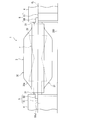
- FIG. 1 is a schematic side view showing an overall configuration of a turbine according to each embodiment of the present invention.
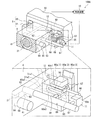
- FIG. 2 is a schematic perspective view showing the configuration of the cooling device for the passenger compartment support portion according to the first embodiment of the present invention, together with an enlarged view of a main portion.
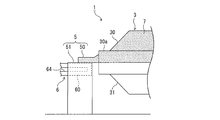
- FIG. 3 is a schematic side view of the main part showing the configuration of a modification of the first embodiment of the present invention.
- FIG. 4 is a schematic perspective view showing the configuration of the cooling device for the passenger compartment support portion according to the second embodiment of the present invention, together with an enlarged view of a main portion and a control block diagram.
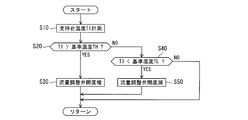
- FIG. 5 is a flowchart for explaining the control according to the second embodiment of the present invention.
- FIG. 1 is a schematic side view showing an overall configuration of a turbine.
- a turbine (rotary machine) 1 includes a rotor (rotary body) 2, a casing (casing) 3 that accommodates the rotor 2, a bearing box (bearing portion) 4 that rotatably supports the rotor 2, and a ground 200.
- a vehicle compartment support portion (hereinafter also referred to as “support portion”) 5 that supports the vehicle compartment 3 is provided.
- the rotor 2 is housed in the passenger compartment 3 in a posture in which the rotation center line (hereinafter also referred to as “rotor rotation center line”) CL is horizontal.
- the rotor 2 is integrally formed by arranging a rotor body (rotating body body) 20 and a pair of rotor shaft ends (rotating shaft ends) 21 provided on both outer sides in the axial direction of the rotor body 20 on the rotor rotation center line CL.
- the rotor main body 20 is accommodated in the passenger compartment 3.
- Each rotor shaft end 21 passes through the casing 3, and the tip end side of each rotor shaft end 21 is exposed to the outside of the casing 3 and supported by the bearing box 4.
- the rotor body 20 is driven by a working fluid (for example, superheated steam or combustion gas) flowing inside the passenger compartment 3 to be given a rotational force, and a generator or a compressor connected via the rotor shaft end 21 by this rotational force. (Both not shown) are driven.
- a working fluid for example, superheated steam or combustion gas
- the vehicle compartment 3 is divided into upper and lower parts, and includes an upper vehicle compartment 30 and a lower vehicle compartment 31.
- the rotor shaft end 21 is drawn out from the passenger compartment 3 on the mating surface of the upper casing 30 and the lower casing 31.
- the support portion 5 is formed from the vicinity of the four corners of the main body of the upper casing 30 or the main body of the lower casing 31, in this embodiment, the main body of the upper casing 30 (hereinafter also referred to as “upper casing main body”) 30 a.
- a projecting portion 50 projecting in the axial direction and a box-shaped support base 51 erected on the ground 200 are provided, and the projecting portion 50 is placed on the upper surface (outer surface of the ceiling wall) 51a1 of the support base 51.
- the protruding portion 50 is called a claw foot because of its shape, and hereinafter, the protruding portion 50 is also referred to as a claw foot 50.
- FIG. 2 is a schematic perspective view showing a configuration of the cooling device 100 for the passenger compartment support portion according to the first embodiment of the present invention, together with an enlarged view of a main portion.
- a bearing surface (sliding contact surface on which the rotor shaft end 21 is slidably contacted) 41 that supports the rotor shaft end 21 of the bearing housing 4 is provided with lubricating oil 6 (not shown in FIG. 1) at a low temperature (for example, about the outside air temperature). (Lubricating fluid) is sequentially supplied.
- the support base 51 has a hollow box shape having a hollow portion 51A, and the lubricating line 6 is supplied to the bearing surface 41 via the hollow portion 51A.
- the lubrication line 6 includes a heat exchanging unit 60 built in the support base 51, an oil supply pipe 61, an oil supply hole 62 drilled in the bearing box 4, and a minute space between the rotor shaft end 21 and the bearing surface 41.
- a clearance 63, an oil drain hole 64 drilled in the bearing box 4, and an oil drain pipe 65 are formed in this order from the upstream side and connected to each other.
- Lubricating oil is supplied to the heat exchanging unit 60 from a lubricating oil supply device (not shown) including a tank, a pump, piping, and the like.
- Lubricating oil has a low temperature, and the cat legs 50 and the supporting base 51 are caused by the lubricating oil flowing through the heat exchanging section 60 by incorporating the heat exchanging section 60 in the supporting base 51 (by passing the lubricating line 6 through the supporting base 51). Can be cooled. That is, the cooling device 100 of the present embodiment is configured by incorporating the heat exchanging unit 60 that forms part of the lubrication line 6 in the bearing box 4. In FIG. 2, for the sake of convenience, the clearance 63 is shown large, and the lubrication line 6 and the cooling device 100 for the support base 5 on the left side in the drawing are omitted.
- the heat exchanging unit 60 includes a plurality of (three in this embodiment) branch pipes 60a (1), 60a (2), 60a (3), and these branch pipes 60a (1), 60a (2), 60a ( 3) includes a set header 60b.
- branch pipes 60a (1), 60a (2), and 60a (3) are not distinguished, they are represented as branch pipes 60a.
- the plurality of branch pipes 60a are arranged in the horizontal direction.
- Each branch pipe 60a has one end (right end in FIG. 2) on the front surface 51b of the support base 51, and an upper end on the horizontal pipe 60a1 connected to the lubricating oil supply device and the other end (left end in FIG. 2) of the horizontal pipe 60a1.
- a horizontal pipe 60a3 having one end (left end in FIG. 2) connected to the lower end of the vertical pipe 60a2. That is, each branch pipe 60 a has a U-turn shape that turns back the hollow portion 51 ⁇ / b> A of the support base 51.
- each branch pipe 60a is disposed at a position close to the upper portion of the ceiling wall inner surface 51a of the support base 51, and is disposed so as to cover substantially the entire lower surface 50a of the claw foot 50 facing upward with the ceiling wall 51a interposed therebetween.
- the horizontal pipe 60a1 and the cat leg 50 exchange heat through the ceiling wall 51a, and the cat leg 50 is entirely cooled from the lower surface 50a by the lubricating oil flowing through the horizontal pipe 60a1.
- the support base 51 is cooled by each branch pipe 60a via the hollow portion 51A or directly.
- each branch pipe 60a into a U-turn shape that is folded back in the hollow portion 51A of the support base 51, the pipe length (flow path length) of each branch pipe 60a can be increased and the heat exchange area can be increased.
- the support base 51 is effectively cooled to suppress thermal expansion, and thermal deformation is suppressed by cooling the support base 51 in a wide range to obtain a uniform temperature distribution.
- each branch pipe 60a3 of each branch pipe 60a is connected to the collective header 60b, and the lubricating oil supplied from each branch pipe 60a to the collective header 60b flows out from the support base 51. And flows to the oil supply pipe 61.
- the other end (the left end in FIG. 2) of the oil supply pipe 61 is connected to an inlet of an oil supply hole 62 drilled in the bearing housing 4, and an outlet of the oil supply hole 62 is between the rotor shaft end 21 and the bearing surface 41. It is connected to the clearance 63. Further, the clearance 63 is connected to an inlet of an oil drain hole 64 drilled in the bearing housing 4, and an outlet of the oil drain hole 64 is connected to an oil drain pipe 65.
- the lubricating oil supplied from the oil supply pipe 61 to the bearing surface 41 through the oil supply hole 62 is discharged from the oil discharge hole 64 through the oil discharge pipe 65.
- a part of the lubrication line 6 for supplying and discharging the lubricating oil to and from the bearing surface 41 is built in the support base 51 as the heat exchange unit 60, thereby circulating the heat exchange unit 60.
- the support part 5 (the cat leg 50 and the support stand 51) can be cooled by the lubricating oil. Therefore, the thermal elongation of the support portion 5 can be suppressed, and the vertical upward displacement of the passenger compartment 3 can be suppressed particularly by suppressing the thermal elongation in the thickness direction.
- the lubricating oil is also used as a cooling medium, it is not necessary to separately prepare a cooling medium for cooling the support base 51 and the claw leg 50, and almost no dedicated equipment for cooling the support portion 5 is required. Therefore, while suppressing an increase in running cost and equipment cost, the support base 51 and the claw leg 50 can be cooled to suppress the thermal elongation and thermal deformation of the support base 51 and the claw leg 50. Moreover, since lubricating oil is supplied to the heat exchanger 60 from the upper part near the cat leg 50 which becomes higher temperature than the support stand 51, the cat leg 50 which becomes high temperature is efficiently cooled by the lowest temperature lubricating oil. Can do.
- the flow rate may be set to increase in this order (flow rate F (1) ⁇ flow rate F (2) ⁇ flow rate F (3)).
- the specific method of setting the flow rate is not limited at all.
- the pipe size may be set so that the inner diameter becomes larger in the order of the branch pipes 60a (1), 60a (2), and 60a (3).
- an orifice may be installed in the branch pipes 60a (1), 60a (2), 60a (3) to adjust the flow rate, or the branch pipes 60a (1), 60a (2), 60a ( An adjustment valve that adjusts each flow rate to 3) may be provided to adjust the flow rate.
- lubricating oil as a cooling medium is flowed relatively large on the high temperature side (root side) and relatively low on the low temperature side (tip side) with respect to the claw paws 50, so that the temperature depends on the temperature.
- the cat paws 50 can be efficiently cooled at a high flow rate, and the temperature of the cat paws 50 can be made uniform and uniform. Thereby, the thermal deformation of the claw leg 50 can be more effectively suppressed.
- FIG. 3 is a schematic side view showing the configuration of this modification (the bearing housing 4 and the rotor shaft end 21 are omitted).
- the heat retaining layer 7 having excellent heat resistance may be provided on the outer peripheral surface exposed to the outside in the upper compartment main body 30 a and the claw foot 50, that is, in a location indicated by a halftone dot in FIG. 3.
- the claw foot 50 has a temperature gradient that becomes lower toward the distal end side, and this temperature gradient can be relaxed by providing the heat retaining layer 7. That is, the temperature distribution from the base of the claw foot 50 to the tip can be flattened.
- the temperature of the support portion 5 is lowered as a whole, the temperature distribution of the support portion 5 is flattened, and the amount of thermal elongation of the support portion 5 itself is reduced, so that the difference in thermal elongation is alleviated. . Also by this, the thermal deformation resulting from the difference in thermal elongation, such as the thermal deformation that is convex on the cat leg 50 or the thermal deformation that is tapered, can be suppressed.
- the provision of the heat retaining layer 7 causes the cat paws 50 to have a high temperature as a whole, and accordingly, the amount of heat transfer from the cat paws 50 to the support base 51 increases, but the support base 51 is cooled by the heat exchanging unit 60.
- the thermal elongation and thermal deformation of the support base 51 can be suppressed.
- the heat exchanging unit 60 is built in the support base 51 and the heat insulating layer 7 is provided on the outer peripheral surface of the upper casing body 30a and the cat leg 50, thereby synergistically increasing the heat extension of the cat leg 50 and the support base 51. Thermal deformation can be suppressed.
- FIG. 4 is a schematic perspective view showing a configuration of a cooling device 100A for a passenger compartment support portion according to a second embodiment of the present invention, together with an enlarged view of a main portion and a control block diagram.
- the clearance 63 is shown large, and the lubrication line 6 and the cooling device 100A for the support base 5 on the left side of the drawing are omitted.
- the cooling device 100A for the vehicle compartment support portion of the present embodiment is that the amount of lubricating oil supplied to the support base 51 (heat exchange portion 60) can be adjusted, the cooling device for the vehicle compartment support portion of the first embodiment. 100 (see FIG. 2).
- the lubricating oil supply device (not shown) is connected to the oil supply pipe 61 ′, and the lubricating oil is first supplied from the lubricating oil supply device to the oil supply pipe 61 ′.
- a branch pipe 66 branched from the oil supply pipe 61 ′ is connected to the center of the distribution header 67 in the extending direction.
- the distribution header 67 extends in the arrangement direction (here, the horizontal direction) of the branch pipes 60a (1), 60a (2), 60a (3), and these branch pipes 60a (1 ), 60a (2), 60a (3) are connected in parallel.
- the outlets of the branch pipes 60a (1), 60a (2), and 60a (3) are connected to the peripheral surface of the collective header 60b, and the outlet of the collective header 60b is connected to the inlet of the merge pipe 68.
- the lubricating oil supplied to the oil supply pipe 61 ′ flows to the branch pipe 66, and then flows to the bearing surface 41 through the heat exchange unit 60, the junction pipe 68, and the oil supply pipe 61 ′ in this order. And what is supplied to the bearing surface 41 by bypassing the heat exchanging section 60 without flowing into the branch pipe 66. That is, in the oil supply pipe 61 ′, a portion between the connection portion of the branch pipe 66 and the connection portion of the junction pipe 68 functions as a bypass flow path (bypass line) 69 that bypasses the heat exchange section 60.
- the branch pipe 66 is provided with a flow rate adjustment valve (distribution adjustment means) 11.
- a flow rate adjustment valve distributed adjustment means
- the opening degree of the flow rate adjusting valve 11 By controlling the opening degree of the flow rate adjusting valve 11, the amount of lubricating oil that flows into the branch pipe 66 and is supplied to the heat exchange unit 60, and lubrication that flows into the bypass channel 69 and bypasses the heat exchange unit 60.
- the distribution ratio with the oil amount is controlled.
- a temperature sensor (temperature detection means) 12 for detecting the temperature of the support base 51 (hereinafter referred to as “support base temperature”) T1 is provided, and the temperature of the support base temperature T1 detected by the temperature sensor 12 is
- a control device 10 is provided that controls the operation of the flow rate adjustment valve 11 to increase the opening degree of the flow rate adjustment valve 11 as the height increases.
- the control device 10 compares the support base temperature T1 detected by the temperature sensor 12 with the reference temperature TH, and if the support base temperature T1 is higher than the reference temperature TH, the flow control valve 11 is opened by a predetermined opening, the amount of lubricating oil supplied to the heat exchanging unit 60 is increased, and the cooling amount of the support base 51 is increased.
- the controller 10 reduces the amount of lubricating oil supplied to the heat exchanging unit 60 by reducing the opening of the flow rate adjustment valve 11 by a predetermined opening. The cooling amount of the support base 51 is reduced.
- the number of times of control for increasing the opening degree of the flow rate adjustment valve 11 until the reference temperature TH is reached increases. Is greatly controlled.
- the opening change amount per one time of the flow rate adjusting valve 11 may be set larger.
- the reference temperature TL is set to a temperature that is lower than the reference temperature TH by ⁇ T [> 0 (zero)], thereby preventing control hunting. Since other configurations are the same as those of the first embodiment, description thereof is omitted.
- step S10 the support table temperature T1 is detected by the temperature sensor 12.
- step S20 the support base temperature T1 is compared with the reference temperature TH. If the support base temperature T1 is higher than the reference temperature TH (T1> TH), the process proceeds to step S30 and the flow rate adjusting valve is reached. While the opening of 11 is increased by a predetermined opening, if the support base temperature T1 is equal to or lower than the reference temperature TH (T1 ⁇ TH), the process proceeds to step S40. In step S40, the support base temperature T1 is compared with the reference temperature TL.
- the process proceeds to step S50 and the flow rate adjustment valve 11 is opened.
- the process returns without changing the opening degree of the flow control valve 11.
- the opening degree of the flow rate adjustment valve 11 increases as the temperature of the support base temperature T1 increases, and the opening degree of the flow rate adjustment valve 11 decreases as the temperature of the support base temperature T1 decreases. Therefore, the amount of the lubricating oil supplied to the claw foot 50 and the support base 51 can be optimized in accordance with the support base temperature T1.
- the heat exchanging unit 60 through which the lubricating oil flows is incorporated in the support base 51 to cool the support base 51, but the present invention is not limited to this aspect.
- a heat exchange part by making a part of pipe
Landscapes
- Engineering & Computer Science (AREA)
- General Engineering & Computer Science (AREA)
- Mechanical Engineering (AREA)
- Chemical & Material Sciences (AREA)
- Combustion & Propulsion (AREA)
- Power Engineering (AREA)
- Mounting Of Bearings Or Others (AREA)
- Motor Or Generator Cooling System (AREA)
- Control Of Turbines (AREA)
Priority Applications (4)
| Application Number | Priority Date | Filing Date | Title |
|---|---|---|---|
| KR1020187026960A KR102133733B1 (ko) | 2016-03-25 | 2016-11-15 | 회전 기계의 케이싱 지지부의 냉각 장치 및 회전 기계, 그리고 회전 기계의 케이싱 지지부의 냉각 방법 |
| CN201680083801.6A CN109072718B (zh) | 2016-03-25 | 2016-11-15 | 旋转机械的壳体支承部的冷却装置及冷却方法、旋转机械 |
| US16/086,754 US11111817B2 (en) | 2016-03-25 | 2016-11-15 | Cooling device for casing support part of rotary machine, rotary machine, and cooling method for casing support part of rotary machine |
| DE112016006655.4T DE112016006655T5 (de) | 2016-03-25 | 2016-11-15 | Kühlvorrichtung für Gehäusestützelement einer Rotationsmaschine, eine Rotationsmaschine und ein Kühlverfahren für ein Gehäusestützelement einer Rotationsmaschine |
Applications Claiming Priority (2)
| Application Number | Priority Date | Filing Date | Title |
|---|---|---|---|
| JP2016061918A JP6649147B2 (ja) | 2016-03-25 | 2016-03-25 | 回転機械のケーシング支持部の冷却装置及び回転機械、並びに回転機械のケーシング支持部の冷却方法 |
| JP2016-061918 | 2016-03-25 |
Publications (1)
| Publication Number | Publication Date |
|---|---|
| WO2017163482A1 true WO2017163482A1 (ja) | 2017-09-28 |
Family
ID=59901024
Family Applications (1)
| Application Number | Title | Priority Date | Filing Date |
|---|---|---|---|
| PCT/JP2016/083772 Ceased WO2017163482A1 (ja) | 2016-03-25 | 2016-11-15 | 回転機械のケーシング支持部の冷却装置及び回転機械、並びに回転機械のケーシング支持部の冷却方法 |
Country Status (6)
| Country | Link |
|---|---|
| US (1) | US11111817B2 (https=) |
| JP (1) | JP6649147B2 (https=) |
| KR (1) | KR102133733B1 (https=) |
| CN (1) | CN109072718B (https=) |
| DE (1) | DE112016006655T5 (https=) |
| WO (1) | WO2017163482A1 (https=) |
Families Citing this family (3)
| Publication number | Priority date | Publication date | Assignee | Title |
|---|---|---|---|---|
| JP7300944B2 (ja) * | 2019-09-11 | 2023-06-30 | 三菱重工業株式会社 | 蒸気タービン |
| US11976855B2 (en) * | 2019-11-13 | 2024-05-07 | Samsung Electronics Co., Ltd. | Heat exchanger and air conditioner having the same |
| JP7390963B2 (ja) * | 2020-04-20 | 2023-12-04 | 三菱重工コンプレッサ株式会社 | 吊り具、支持治具、回転機械の分解方法、及び回転機械の組立方法 |
Citations (3)
| Publication number | Priority date | Publication date | Assignee | Title |
|---|---|---|---|---|
| JP2007009731A (ja) * | 2005-06-28 | 2007-01-18 | Mitsubishi Heavy Ind Ltd | タービン |
| JP2011033002A (ja) * | 2009-08-05 | 2011-02-17 | Mitsubishi Heavy Ind Ltd | 軸受箱 |
| JP2012159051A (ja) * | 2011-02-02 | 2012-08-23 | Mitsubishi Heavy Ind Ltd | ターボ回転機械の車室支持構造 |
Family Cites Families (15)
| Publication number | Priority date | Publication date | Assignee | Title |
|---|---|---|---|---|
| GB1014015A (en) * | 1964-04-02 | 1965-12-22 | Rolls Royce | Improvements in or relating to bearing lubricating means |
| US7387189B2 (en) * | 2003-08-14 | 2008-06-17 | United Technologies Corp. | Emergency lubrication system |
| JP4410651B2 (ja) | 2004-10-06 | 2010-02-03 | 三菱重工業株式会社 | タービン及びタービン製造方法 |
| JP2007051574A (ja) * | 2005-08-17 | 2007-03-01 | Hitachi Ltd | タービン軸受装置 |
| CN100472042C (zh) * | 2005-10-08 | 2009-03-25 | 张志远 | 双轮正圆转子发动机 |
| TWI303289B (en) * | 2006-03-31 | 2008-11-21 | Delta Electronics Inc | Fan, bearing structure and sleeve bearing thereof |
| US8152446B2 (en) | 2007-08-23 | 2012-04-10 | General Electric Company | Apparatus and method for reducing eccentricity and out-of-roundness in turbines |
| JP5159702B2 (ja) | 2009-05-20 | 2013-03-13 | 株式会社東芝 | 蒸気タービン |
| US20120195750A1 (en) * | 2011-01-31 | 2012-08-02 | General Electric Company | Turbomachine supports having thermal control system |
| JP5570544B2 (ja) * | 2012-02-29 | 2014-08-13 | 株式会社日立製作所 | すべり軸受装置 |
| FR2992703B1 (fr) * | 2012-06-27 | 2015-01-30 | Snecma | Palier a moyen de lubrification et systeme pour changer le pas des pales d'une helice de turbopropulseur d'aeronef, equipe dudit palier |
| US9376934B2 (en) * | 2012-08-24 | 2016-06-28 | General Electric Company | Cooling circuit for reducing thermal growth differential of turbine rotor and shell supports |
| CN104065236B (zh) * | 2013-03-22 | 2017-05-03 | 林英楠 | 可无级调节磁场强度的永磁调速、制动或负载装置 |
| JP2015175246A (ja) | 2014-03-13 | 2015-10-05 | 三菱日立パワーシステムズ株式会社 | 車室支持構造、車室、タービン |
| US9695705B2 (en) * | 2014-10-29 | 2017-07-04 | General Electric Company | Systems and methods for controlling rotor to stator clearances in a steam turbine |
-
2016
- 2016-03-25 JP JP2016061918A patent/JP6649147B2/ja not_active Expired - Fee Related
- 2016-11-15 WO PCT/JP2016/083772 patent/WO2017163482A1/ja not_active Ceased
- 2016-11-15 DE DE112016006655.4T patent/DE112016006655T5/de active Pending
- 2016-11-15 US US16/086,754 patent/US11111817B2/en active Active
- 2016-11-15 CN CN201680083801.6A patent/CN109072718B/zh not_active Expired - Fee Related
- 2016-11-15 KR KR1020187026960A patent/KR102133733B1/ko active Active
Patent Citations (3)
| Publication number | Priority date | Publication date | Assignee | Title |
|---|---|---|---|---|
| JP2007009731A (ja) * | 2005-06-28 | 2007-01-18 | Mitsubishi Heavy Ind Ltd | タービン |
| JP2011033002A (ja) * | 2009-08-05 | 2011-02-17 | Mitsubishi Heavy Ind Ltd | 軸受箱 |
| JP2012159051A (ja) * | 2011-02-02 | 2012-08-23 | Mitsubishi Heavy Ind Ltd | ターボ回転機械の車室支持構造 |
Also Published As
| Publication number | Publication date |
|---|---|
| KR102133733B1 (ko) | 2020-07-14 |
| DE112016006655T5 (de) | 2018-12-13 |
| CN109072718A (zh) | 2018-12-21 |
| US20190048741A1 (en) | 2019-02-14 |
| CN109072718B (zh) | 2021-04-20 |
| JP6649147B2 (ja) | 2020-02-19 |
| JP2017172549A (ja) | 2017-09-28 |
| KR20180112040A (ko) | 2018-10-11 |
| US11111817B2 (en) | 2021-09-07 |
Similar Documents
| Publication | Publication Date | Title |
|---|---|---|
| KR101928791B1 (ko) | 열 조절 시스템을 갖는 직접 구동 풍력 터빈 | |
| JP4950367B1 (ja) | 再生エネルギー型発電装置 | |
| CN106050425B (zh) | 用于燃气涡轮发动机的传热装置和设备 | |
| RU2351766C2 (ru) | Паровая турбина и способ работы паровой турбины | |
| JP5511982B2 (ja) | 冷却システムを有する直接駆動型風車および直接駆動型風車を制御する方法 | |
| JP2017198204A (ja) | ヒートパイプを使用してオイルリザーバ及び出口ガイドベーンを熱的に統合するためのシステム及び方法 | |
| AU2015271163B2 (en) | Pod propulsion device and a method for cooling such | |
| JP6649147B2 (ja) | 回転機械のケーシング支持部の冷却装置及び回転機械、並びに回転機械のケーシング支持部の冷却方法 | |
| JP2009250214A (ja) | 風力発電装置用ファン装置および風力発電装置 | |
| JP2006112499A (ja) | ティルティングパッド型軸受 | |
| JP2014177937A (ja) | 冷却ユニットを有するタービン・エンジン用ケーシング | |
| JP2012244659A (ja) | 回転電機のステータ構造 | |
| JP2018066362A (ja) | 蒸気タービン及び温度制御方法 | |
| US8878403B2 (en) | Air-cooled motor-generator and method for operating a motor-generator | |
| JP5518687B2 (ja) | 回転電機のスラスト軸受装置 | |
| JP5973483B2 (ja) | 閉鎖循環冷媒の冷却装置 | |
| CN106460562B (zh) | 燃气轮机排气系统 | |
| JP2017025901A (ja) | 熱エネルギー回収装置及びその起動方法 | |
| CN106679242A (zh) | 冷凝器的制冷剂出口装置 | |
| US4237854A (en) | Damper construction and a method of cooling a damper | |
| JP2000170638A (ja) | 回転機械の閉鎖循環式冷却装置 | |
| KR20200012302A (ko) | 냉매 안정화 시스템 및 그 제어방법 | |
| JP2023008563A (ja) | 廃熱発電システム | |
| JP2012193715A (ja) | 発電装置 | |
| JP2022044146A (ja) | 熱音響装置 |
Legal Events
| Date | Code | Title | Description |
|---|---|---|---|
| ENP | Entry into the national phase |
Ref document number: 20187026960 Country of ref document: KR Kind code of ref document: A |
|
| WWE | Wipo information: entry into national phase |
Ref document number: 1020187026960 Country of ref document: KR |
|
| 121 | Ep: the epo has been informed by wipo that ep was designated in this application |
Ref document number: 16895505 Country of ref document: EP Kind code of ref document: A1 |
|
| 122 | Ep: pct application non-entry in european phase |
Ref document number: 16895505 Country of ref document: EP Kind code of ref document: A1 |