WO2017159647A1 - フィーカリバクテリウム属細菌増殖剤 - Google Patents
フィーカリバクテリウム属細菌増殖剤 Download PDFInfo
- Publication number
- WO2017159647A1 WO2017159647A1 PCT/JP2017/010070 JP2017010070W WO2017159647A1 WO 2017159647 A1 WO2017159647 A1 WO 2017159647A1 JP 2017010070 W JP2017010070 W JP 2017010070W WO 2017159647 A1 WO2017159647 A1 WO 2017159647A1
- Authority
- WO
- WIPO (PCT)
- Prior art keywords
- kestose
- bacteria
- genus faecalibacterium
- genus
- hours
- Prior art date
- Legal status (The legal status is an assumption and is not a legal conclusion. Google has not performed a legal analysis and makes no representation as to the accuracy of the status listed.)
- Ceased
Links
Images


Classifications
-
- A—HUMAN NECESSITIES
- A61—MEDICAL OR VETERINARY SCIENCE; HYGIENE
- A61K—PREPARATIONS FOR MEDICAL, DENTAL OR TOILETRY PURPOSES
- A61K31/00—Medicinal preparations containing organic active ingredients
- A61K31/70—Carbohydrates; Sugars; Derivatives thereof
- A61K31/702—Oligosaccharides, i.e. having three to five saccharide radicals attached to each other by glycosidic linkages
-
- A—HUMAN NECESSITIES
- A23—FOODS OR FOODSTUFFS; TREATMENT THEREOF, NOT COVERED BY OTHER CLASSES
- A23L—FOODS, FOODSTUFFS OR NON-ALCOHOLIC BEVERAGES, NOT OTHERWISE PROVIDED FOR; PREPARATION OR TREATMENT THEREOF
- A23L33/00—Modifying nutritive qualities of foods; Dietetic products; Preparation or treatment thereof
- A23L33/10—Modifying nutritive qualities of foods; Dietetic products; Preparation or treatment thereof using additives
-
- A—HUMAN NECESSITIES
- A23—FOODS OR FOODSTUFFS; TREATMENT THEREOF, NOT COVERED BY OTHER CLASSES
- A23L—FOODS, FOODSTUFFS OR NON-ALCOHOLIC BEVERAGES, NOT OTHERWISE PROVIDED FOR; PREPARATION OR TREATMENT THEREOF
- A23L33/00—Modifying nutritive qualities of foods; Dietetic products; Preparation or treatment thereof
- A23L33/10—Modifying nutritive qualities of foods; Dietetic products; Preparation or treatment thereof using additives
- A23L33/125—Modifying nutritive qualities of foods; Dietetic products; Preparation or treatment thereof using additives containing carbohydrate syrups; containing sugars; containing sugar alcohols; containing starch hydrolysates
-
- A—HUMAN NECESSITIES
- A23—FOODS OR FOODSTUFFS; TREATMENT THEREOF, NOT COVERED BY OTHER CLASSES
- A23L—FOODS, FOODSTUFFS OR NON-ALCOHOLIC BEVERAGES, NOT OTHERWISE PROVIDED FOR; PREPARATION OR TREATMENT THEREOF
- A23L33/00—Modifying nutritive qualities of foods; Dietetic products; Preparation or treatment thereof
- A23L33/10—Modifying nutritive qualities of foods; Dietetic products; Preparation or treatment thereof using additives
- A23L33/135—Bacteria or derivatives thereof, e.g. probiotics
-
- A—HUMAN NECESSITIES
- A61—MEDICAL OR VETERINARY SCIENCE; HYGIENE
- A61P—SPECIFIC THERAPEUTIC ACTIVITY OF CHEMICAL COMPOUNDS OR MEDICINAL PREPARATIONS
- A61P1/00—Drugs for disorders of the alimentary tract or the digestive system
-
- A—HUMAN NECESSITIES
- A61—MEDICAL OR VETERINARY SCIENCE; HYGIENE
- A61P—SPECIFIC THERAPEUTIC ACTIVITY OF CHEMICAL COMPOUNDS OR MEDICINAL PREPARATIONS
- A61P1/00—Drugs for disorders of the alimentary tract or the digestive system
- A61P1/04—Drugs for disorders of the alimentary tract or the digestive system for ulcers, gastritis or reflux esophagitis, e.g. antacids, inhibitors of acid secretion, mucosal protectants
-
- A—HUMAN NECESSITIES
- A61—MEDICAL OR VETERINARY SCIENCE; HYGIENE
- A61P—SPECIFIC THERAPEUTIC ACTIVITY OF CHEMICAL COMPOUNDS OR MEDICINAL PREPARATIONS
- A61P29/00—Non-central analgesic, antipyretic or antiinflammatory agents, e.g. antirheumatic agents; Non-steroidal antiinflammatory drugs [NSAID]
-
- C—CHEMISTRY; METALLURGY
- C12—BIOCHEMISTRY; BEER; SPIRITS; WINE; VINEGAR; MICROBIOLOGY; ENZYMOLOGY; MUTATION OR GENETIC ENGINEERING
- C12N—MICROORGANISMS OR ENZYMES; COMPOSITIONS THEREOF; PROPAGATING, PRESERVING, OR MAINTAINING MICROORGANISMS; MUTATION OR GENETIC ENGINEERING; CULTURE MEDIA
- C12N1/00—Microorganisms; Compositions thereof; Processes of propagating, maintaining or preserving microorganisms or compositions thereof; Processes of preparing or isolating a composition containing a microorganism; Culture media therefor
- C12N1/20—Bacteria; Culture media therefor
-
- A—HUMAN NECESSITIES
- A23—FOODS OR FOODSTUFFS; TREATMENT THEREOF, NOT COVERED BY OTHER CLASSES
- A23V—INDEXING SCHEME RELATING TO FOODS, FOODSTUFFS OR NON-ALCOHOLIC BEVERAGES AND LACTIC OR PROPIONIC ACID BACTERIA USED IN FOODSTUFFS OR FOOD PREPARATION
- A23V2002/00—Food compositions, function of food ingredients or processes for food or foodstuffs
-
- A—HUMAN NECESSITIES
- A23—FOODS OR FOODSTUFFS; TREATMENT THEREOF, NOT COVERED BY OTHER CLASSES
- A23V—INDEXING SCHEME RELATING TO FOODS, FOODSTUFFS OR NON-ALCOHOLIC BEVERAGES AND LACTIC OR PROPIONIC ACID BACTERIA USED IN FOODSTUFFS OR FOOD PREPARATION
- A23V2200/00—Function of food ingredients
- A23V2200/30—Foods, ingredients or supplements having a functional effect on health
- A23V2200/32—Foods, ingredients or supplements having a functional effect on health having an effect on the health of the digestive tract
Definitions
- the present invention relates to a Felicaribacterium spp. Proliferating agent containing 1-kestose as an active ingredient, a food composition for proliferating Ficaribacterium spp., A method for proliferating Ficaribacterium spp., Treatment or prevention of intestinal inflammation Methods and use of 1-kestose for the manufacture of a medicament for the treatment or prevention of intestinal inflammation.
- Non-Patent Document 1 Physicobacteria are obligate anaerobic bacilli that are resident in the mucus layer in the intestine, and have a high retention rate and number in humans, and are the main constituent species of the intestinal flora.
- Felicaribacterium spp. Have favorable physiological functions such as supplying energy to cells in the intestine, maintaining good intestinal environment, and strong anti-inflammatory effects.
- Non-Patent Document 1 Furthermore, with regard to the anti-inflammatory action, it has been reported that the inflammatory state can be prevented or ameliorated by administering the Felicalibacterium spp. Or its culture supernatant to an enteritis model animal or cultured cells.
- a method of administering a genus Phykaribacterium itself as described in Non-Patent Documents 1 and 2 to a living body includes the following (i) to (iv) ).
- Felicaribacterium spp. Have no history of eating, so there is a concern in terms of safety.
- Patent Document 1 discloses polydextrose or water-soluble bacteria. Disclosed is a method for increasing Phykaribacterium spp. By ingesting a composition comprising sex corn fiber.
- the present invention has been made in order to solve the problem, and is capable of effectively proliferating bacteria of the genus Phericobacteria, thereby contributing to the prevention and treatment of diseases such as intestinal inflammation. And to provide a method.
- the Felicaribacterium spp. Growth agent according to the present invention contains 1-kestose as an active ingredient.
- the Felicaribacterium spp. Growth agent according to the present invention can be used for prevention or treatment of intestinal inflammation.
- the Felicaribacterium spp. Proliferating agent according to the present invention can be suitably used for the prevention or treatment of inflammatory bowel disease among intestinal inflammations.
- the Felicaribacterium spp. Growth agent according to the present invention can be suitably used for prevention or treatment of Crohn's disease or ulcerative colitis among inflammatory bowel diseases.
- the food composition for the growth of Phykaribacterium spp. According to the present invention contains 1-kestose as an active ingredient.
- the number of bacteria belonging to the genus Phecalibacterium genus in the human or animal body is obtained by ingesting 1-kestose to the human or animal.
- a step of increasing the number of bacteria belonging to the genus Phecalibacterium genus in the human or animal body is obtained by ingesting 1-kestose to the human or animal.
- the second aspect of the method for growing Phericabacterium according to the present invention includes the step of culturing by adding 1-kestose to a medium containing the Felicabacterium.
- the method for treating or preventing enteric inflammation according to the present invention is a method in which a human or animal suffering from or possibly suffering from enteric inflammation is allowed to ingest 1-kestose. Or it has the process of increasing the number of the bacteria of the genus Phykaribacterium in the animal body.
- the use of 1-kestose according to the present invention is the use of 1-kestose for producing a medicament for treating or preventing enteric inflammation.
- 1-kestose is a kind of oligosaccharide contained in vegetables and grains such as onion, garlic, barley, rye, etc., and is a substance with a long history of eating, mutagenicity tests, acute Since no toxicity was observed in any of the toxicity test, subchronic toxicity test and chronic toxicity test, it can be said that the safety is extremely high (Food and Development, Vol. 49, No. 12, page 9, 2014). ).
- 1-kestose is highly water-soluble and has a good sweetness similar to sugar. Therefore, it can be easily consumed on a daily basis as it is or as a seasoning such as a sweetener. And can be easily blended into pharmaceuticals.
- the present invention it is possible to easily and effectively increase the number of bacteria belonging to the genus Phericobacteria in the body of humans and animals with little concern about side effects and safety.
- intestinal inflammation can be prevented or treated by increasing the number of bacteria belonging to the genus Fecalibacterium in the body of a human or animal.
- a Felicaribacterium spp. Proliferating agent a food composition for proliferating Ficaribacterium spp.
- a method for proliferating Ficaribacterium spp, a method for treating or preventing intestinal inflammation, and an intestine The use of 1-kestose for the manufacture of a medicament for the treatment or prevention of inflammation is described in detail.
- the “genus Felicalibacterium” refers to a microorganism belonging to the genus Faecalibacterium.
- microorganisms belonging to the genus Fekaribacteria include Faecalibacterium prausnitzi.
- 1-kestose is a trisaccharide oligosaccharide composed of one molecule of glucose and two molecules of fructose.
- 1-kestose can be produced by performing an enzyme reaction with an enzyme as disclosed in JP-A-58-201980 using sucrose as a substrate. Specifically, first, ⁇ -fructofuranosidase is added to a sucrose solution, and allowed to stand at 37 ° C. to 50 ° C. for about 20 hours to perform an enzyme reaction to obtain a 1-kestose-containing reaction solution.
- 1-kestose-containing reaction solution By subjecting this 1-kestose-containing reaction solution to a chromatographic separation method as disclosed in JP-A-2000-232878, 1-kestose and other sugars (dextrose, fructose, sucrose, tetrasaccharide or more) Oligosaccharide) is separated and purified to obtain a high purity 1-kestose solution. Subsequently, the high-purity 1-kestose solution is concentrated and then crystallized by a crystallization method as disclosed in Japanese Patent Publication No. 6-70075, whereby 1-kestose can be obtained as crystals.
- 1-kestose is contained in commercially available fructooligosaccharides, it may be used as it is, or 1-kestose may be separated and purified from fructooligosaccharides by the method described above. That is, a 1-kestose-containing composition such as an oligosaccharide containing 1-kestose may be used as the 1-kestose of the present invention.
- a 1-kestose-containing composition such as an oligosaccharide containing 1-kestose may be used as the 1-kestose of the present invention.
- the purity of 1-kestose is preferably 80% by mass or more, more preferably 85% by mass or more, and further preferably 90% by mass or more.
- the “purity” of a specific oligosaccharide refers to the mass% of the oligosaccharide when the total amount of sugar is 100%.
- 1-Kestose is used by ingestion by humans and animals.
- the intake (dose) of 1-kestose is, for example, 0.01 to 0.34 g / kg body weight, preferably 0.01 to 0.30 g / kg body weight, more preferably 0.01 to 0.24 g / kg. Examples include kg body weight.
- Such intake is not limited to once a day, and may be divided into a plurality of times.
- 1-kestose has the function of increasing the number of bacteria belonging to the genus Fecalbacterium in vivo as shown in Example 2 described later. For this reason, as a method for ingestion by humans and animals, any method may be used as long as it reaches the intestine where Haemophila bacteria live. As such a method, specifically, there can be mentioned a method in which 1-kestose is orally ingested by humans or animals as it is or in the form of food or drink or medicine. In addition, 1-kestose is administered directly from the anus or via a tube inserted, and 1-kestose is added to enteral nutrients, and this is passed through a tube inserted into the digestive tract such as the stomach or small intestine. And a method of administration by enteral nutrition.
- 1-kestose can also be used to increase the number of phycobacteria in vitro, as shown in Example 1 described later.
- a method in which 1-kestose is added to a medium containing a genus Phecalibacterium and left to stand at 37 ° C. for a predetermined time in an anaerobic environment can be mentioned.
- Non-Patent Document 2 discloses that entericitis is administered to a mouse model of enteritis induced by 2,4,6-trinitrobenzenesulfonic acid (TNBS) by administering Fecalbacterium spp.Plasnitsii strain A2-165 or its culture supernatant. It is described that can be suppressed. Further, Non-Patent Document 3 discloses that IL-10, TGF- ⁇ 1 and IL- are added by adding Phykaribacterium sp.
- TNBS 2,4,6-trinitrobenzenesulfonic acid
- Non-Patent Document 3 discloses that anti-inflammatory cytokine production promotion and regulatory T can be achieved by orally administering Phykaribacterium spp. Prausnitsi (ATCC27766) and its culture supernatant to TNBS-induced enteritis model rats. In addition to promoting cell differentiation, it has also been shown to promote healing of inflamed tissues found on the intestinal mucosa.
- intestinal inflammation can be prevented or treated by ingesting 1-kestose into humans or animals to increase the number of bacteria belonging to the genus Fecalbacterium in the body or intestine.
- 1-kestose can also be used to produce a medicament for the treatment or prevention of intestinal inflammation.
- intestinal inflammation refers to a state where inflammation occurs in the intestinal tract, and includes a state leading to a disease.
- examples of the disease resulting from intestinal inflammation include inflammatory bowel disease.
- Inflammatory bowel disease refers to ulcerative colitis and Crohn's disease in a broad sense, and in a broad sense as any inflammatory disease of the intestinal tract (Latest University of Medicine ⁇ Progress 8>, digestive system diseases, pp 320, 1997, Nakayama Shoten).
- the term “inflammatory bowel disease” means any of the latter inflammatory diseases in the intestinal tract.
- the present invention can be suitably used for the prevention or treatment of intestinal inflammation, particularly those excluding allergies.
- Felicaribacterium spp. Growth agent of the present invention include health foods such as pharmaceuticals, quasi drugs, food additives, and supplements.
- the dosage form of a pharmaceutical, quasi-drug or supplement containing 1-kestose is not particularly limited, and a dosage form suitable for the administration method can be appropriately selected.
- a dosage form suitable for the administration method can be appropriately selected.
- it can be made into solid or liquid dosage forms such as powders, tablets, dragees, capsules, granules, dry syrups, liquids, syrups, drops, drinks and the like.
- the pharmaceuticals, quasi drugs, and supplements of the above dosage forms can be produced by methods known to those skilled in the art.
- a powder 800 g of 1-kestose and 200 g of lactose are mixed well, and then 300 mL of 90% ethanol is added and moistened. Subsequently, after the wet powder is granulated, it is dried by ventilation at 60 ° C. for 16 hours, and then sized to obtain 1000 g of powder with an appropriate fineness (1-kestose content of 800 mg / 1 g).
- the granules were sized using a sieve of 850 ⁇ m, and then 50 g of sucrose fatty acid ester was added to and mixed with 470 g of granules, followed by punching using a rotary tableting machine (6B-2, manufactured by Kikusui Seisakusho). It is possible to obtain 5000 tablets with a diameter of 8 mm and a weight of 200 mg (1-kestose content: 60 mg / 1 tablet).
- Specific embodiments of the food composition for growing bacteria of the genus Feccalibacterium of the present invention include, for example, beverages, dairy products, edible granules, pastes, seasonings, retort foods, baby foods, fermented foods, and preserved foods.
- Processed foods such as processed fishery products, processed meat products, processed cereal products, food additives, health foods, animal feeds and the like.
- 1-kestose can be added and used in the normal production process of various foods, food additives, and animal feeds.
- the sweetness of 1-kestose is 30, and its taste, physical properties and processability are close to those of sucrose, so in the production process of various foods and drinks, part or all of the sugar is replaced with 1-kestose.
- Various foods and drinks, food additives, and animal feeds can be produced in the same manner as sugar.
- Example 1 Examination of phytobacterium bacterium growth action in vitro A liquid medium having the following composition was prepared aseptically.
- oligosaccharides 1-kestose (purity 99% by mass; product food science company), nystose (purity 98% by mass; Wako Pure Chemical Industries, Ltd.), xylooligosaccharide (purity 98% by mass; product food science company), raffinose ( Purity 98% by mass; Meiji Food Materia Co., Ltd.) or lactosucrose (purity 89% by mass; Shimizu Minato Sugar Co., Ltd.) was used.
- a liquid medium containing no oligosaccharide was prepared in the same manner as described below.
- ⁇ Composition of liquid medium / per liter >> (final pH: pH 7.0)
- the pre-cultured Felicaribacterium Plaus Nitzy ATCC27768 strain was inoculated into the prepared liquid medium so that the turbidity at 660 nm was 0.05 to 0.06 OD (Optical Density) value.
- This was statically cultured at 37 ° C. in an anaerobic environment, and turbidity (OD value) at 660 nm was measured using a spectrophotometer after 24 hours, 48 hours and 72 hours.
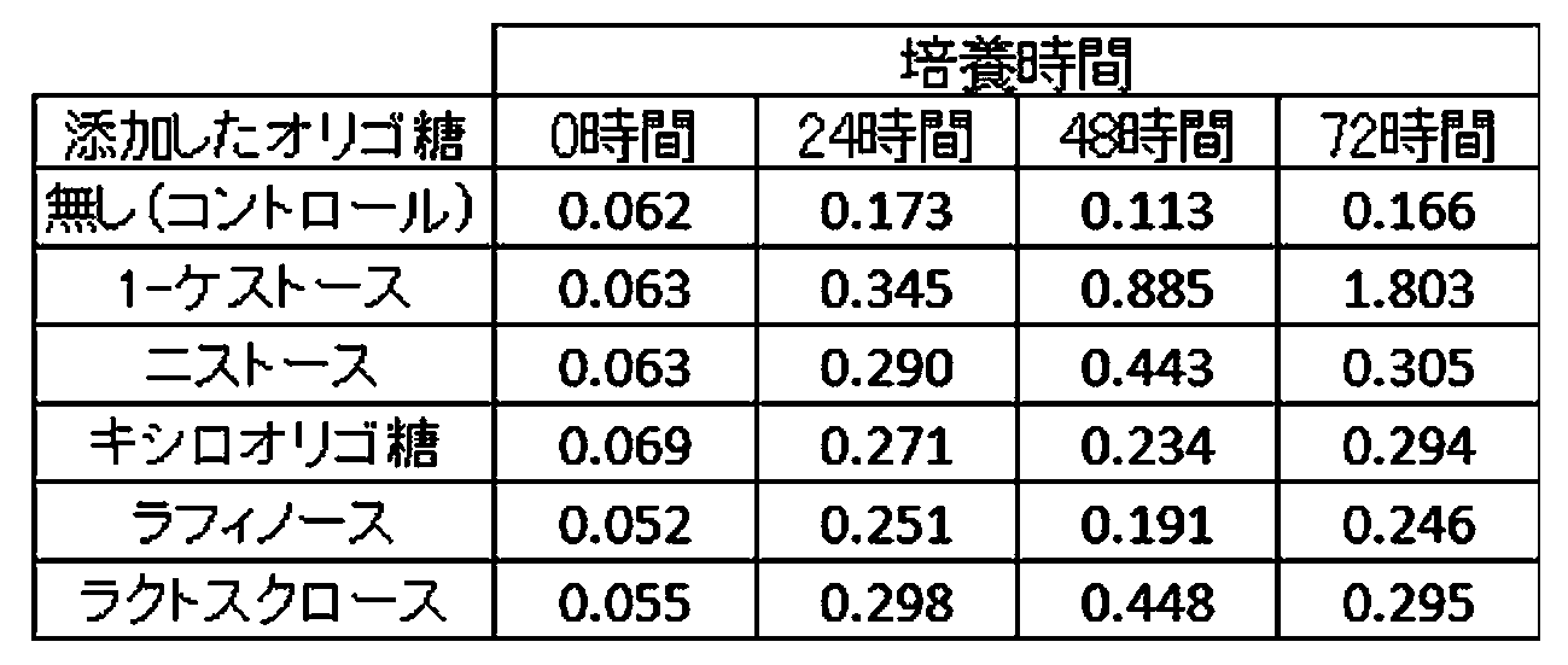
- the results are shown in Table 1.
- the relationship between the OD value and the culture time is shown in the line graph of FIG.
- the OD value at a culture time of 72 hours is shown in the bar graph of FIG.
- the OD values were 0.062 at 0 hours, 0.173 at 24 hours, 0.113 at 48 hours, 0.166 at 72 hours in the control liquid medium. Met. In contrast, in the liquid medium supplemented with 1-kestose, it was 0.063 at 0 hours, 0.345 at 24 hours, 0.885 at 48 hours, and 1.803 at 72 hours. On the other hand, in the liquid medium added with nystose, it was 0.063 at 0 hours, 0.290 at 24 hours, 0.443 at 48 hours, and 0.305 at 72 hours.
- liquid culture medium which added xylooligosaccharide it was 0.069 in 0 hours, 0.271 in 24 hours, 0.234 in 48 hours, and 0.294 in 72 hours.
- liquid culture medium which added raffinose it was 0.052 in 0 hours, 0.251 in 24 hours, 0.191 in 48 hours, and 0.246 in 72 hours.
- lactosucrose it was 0.055 in 0 hours, 0.298 in 24 hours, 0.448 in 48 hours, and 0.295 in 72 hours.
- the liquid medium supplemented with 1-kestose is compared with the liquid medium not added with oligosaccharide (control liquid medium) and the liquid medium added with other oligosaccharides (nystose, xylo-oligosaccharide, raffinose and lactosucrose).
- the OD value was remarkably large at any of the culture times of 24 hours, 48 hours and 72 hours.
- the medium turbidity (OD value) reflects the number of microorganisms. Therefore, from the above results, the number of strains of Fecalbacterium Plaus Nitzy ATCC27768 in the liquid medium supplemented with 1-kestose was added to the oligosaccharide at any culture time of 24 hours, 48 hours and 72 hours. It was revealed that the number of bacteria in the liquid medium not added and the liquid medium added with other oligosaccharides was remarkably large. From this result, it has been clarified that 1-kestose has a remarkably large effect of growing the genus Felicalibacterium in vitro.
- Example 2 Examination of Phykaribacterium spp. Growth in vivo 58 infants aged 6 months to 6 years were divided into 2 groups of 29 infants, 1-kestose group and maltose group.
- the 1-kestose group contains 1-kestose (purity 98% by mass or more; product food science company), and the maltose group contains maltose (purity 92% by mass or more; “San malt-S” powder product; Sanwa Starch Co., Ltd.). Ingested daily during the study period. The test period was 12 weeks.
- the daily intake of 1-kestose or maltose is 1 g for younger than 1 year (reference intake; 0.121 g / kg body weight / day), and 2 g for 1 to 3 years (reference intake; 0.169 g / kg body weight) / Day) 4 to 6 years old was 3 g (reference intake: 0.170 g / kg body weight / day). Feces were collected at the start of the test period (0 weeks), 6 weeks (6 weeks), and 12 weeks (12 weeks).
- the above-mentioned reference intake was calculated based on the age-specific weight data published in the “Ministry of Health, Labor and Welfare 2010 Infant Physical Growth Survey”. That is, from the minimum and maximum values of the weight data corresponding to the age (months) of the test participants of Example 2, the median was determined for each gender, and the median average was calculated. Subsequently, an average value of men and women was calculated for the average value of the median value, and this was used as a standard weight. The estimated body weight was 8.26 kg for those under 1 year old, 11.85 kg for 1 to 3 years old, and 17.62 kg for 4 to 6 years old. The value obtained by dividing the daily intake of 1-kestose or maltose by this standard body weight was taken as the standard intake.
- the number of bacteria of the genus Phecalibacterium in the collected feces was quantified by a real-time PCR method. Specifically, first, genomic DNA was extracted from feces using a reagent for genome extraction “Ultra Clean DNA Isolation Kit” (Mo Bio Laboratories) and “High Pure PCR Template Preparation Kit” (Roche). .
- the average number of bacteria was calculated for each group.
- a significant difference test was performed on the average value of the number of bacteria at 0 week by Wilcoxon's sign rank test to obtain a p value. The results are shown in Table 2.
- the number of bacteria in the 1-kestose group was 3.7 ⁇ 10 6 cells / g stool at 0 weeks, whereas 1.4 ⁇ 10 7 cells / g stool at 6 weeks. In 12 weeks, it was 3.5 ⁇ 10 7 pieces / feces 1 g. That is, the number of bacteria compared with week 0 increased to 3.5 times or more at 6 weeks, although there was no significant difference, and increased significantly to 9 times or more at 12 weeks.
- the number of bacteria in the maltose group was 7.6 ⁇ 10 6 cells / g stool at 0 weeks, whereas 5.8 ⁇ 10 6 cells / g stool at 6 weeks and 1.3 g at 12 weeks. ⁇ 10 7 pieces / feces 1 g. That is, the number of bacteria compared with week 0 decreased slightly at 6 weeks and increased slightly at 12 weeks, but there was no significant difference.
Landscapes
- Health & Medical Sciences (AREA)
- Life Sciences & Earth Sciences (AREA)
- Chemical & Material Sciences (AREA)
- Engineering & Computer Science (AREA)
- Medicinal Chemistry (AREA)
- General Health & Medical Sciences (AREA)
- Organic Chemistry (AREA)
- Animal Behavior & Ethology (AREA)
- Pharmacology & Pharmacy (AREA)
- Veterinary Medicine (AREA)
- Public Health (AREA)
- Bioinformatics & Cheminformatics (AREA)
- Molecular Biology (AREA)
- Wood Science & Technology (AREA)
- Nutrition Science (AREA)
- Mycology (AREA)
- Zoology (AREA)
- Food Science & Technology (AREA)
- Genetics & Genomics (AREA)
- Polymers & Plastics (AREA)
- Chemical Kinetics & Catalysis (AREA)
- General Chemical & Material Sciences (AREA)
- Nuclear Medicine, Radiotherapy & Molecular Imaging (AREA)
- Biotechnology (AREA)
- Epidemiology (AREA)
- Biomedical Technology (AREA)
- Rheumatology (AREA)
- Pain & Pain Management (AREA)
- General Engineering & Computer Science (AREA)
- Biochemistry (AREA)
- Microbiology (AREA)
- Virology (AREA)
- Tropical Medicine & Parasitology (AREA)
- Pharmaceuticals Containing Other Organic And Inorganic Compounds (AREA)
- Medicines Containing Material From Animals Or Micro-Organisms (AREA)
- Coloring Foods And Improving Nutritive Qualities (AREA)
- Micro-Organisms Or Cultivation Processes Thereof (AREA)
Abstract
Description
下記の組成の液体培地を無菌的に調製した。各種オリゴ糖としては、1-ケストース(純度99質量%;物産フードサイエンス社)、ニストース(純度98質量%;和光純薬社)、キシロオリゴ糖(純度98質量%;物産フードサイエンス社)、ラフィノース(純度98質量%;明治フードマテリア社)またはラクトスクロース(純度89質量%;塩水港精糖社)を用いた。また、コントロールとして、下記の組成のうちオリゴ糖を含まない液体培地を同様に調製した。
《液体培地の組成/1Lあたり》(最終pH:pH7.0)
カゼイン分解物15.0g、酵母抽出物5.0g、L-シスチン0.5g、塩化ナトリウム2.5g、チオグリコール酸0.5g、トリプトファン25mg、ヘミン(Hemin)適量、ビタミンK1適量、各種オリゴ糖5.0g。

すなわち、1-ケストースを添加した液体培地では、オリゴ糖を添加していない液体培地(コントロールの液体培地)ならびに他のオリゴ糖(ニストース、キシロオリゴ糖、ラフィノースおよびラクトスクロース)を添加した液体培地と比較して、24時間、48時間および72時間のいずれの培養時間においてもOD値が顕著に大きかった。
6か月~6歳の乳幼児58名を29名ずつ2つの群に分け、1-ケストース群およびマルトース群とした。1-ケストース群には1-ケストース(純度98質量%以上;物産フードサイエンス社)を、マルトース群にはマルトース(純度92質量%以上;「サンマルト-S」粉末品;三和澱粉工業社)を、試験期間中、毎日経口摂取させた。試験期間は12週間とした。1-ケストースまたはマルトースの1日の摂取量は、1歳未満が1g(目安摂取量;0.121g/kg体重/日)、1?3歳が2g(目安摂取量;0.169g/kg体重/日)、4?6歳が3g(目安摂取量;0.170g/kg体重/日)とした。試験期間の開始時(0週)、6週間経過時(6週)および12週間経過時(12週)に糞便を回収した。
《フィーカリバクテリウム属細菌に特異的なプライマーの配列》
フォワードプライマー;CCATGAATTGCCTTCAAAACTGTT(配列番号1)
リバースプライマー;GAGCCTCAGCGTCAGTTGGT(配列番号2)
一方、マルトース群の菌数は、0週で7.6×10⁶個/糞便1gであったのに対して、6週では5.8×106個/糞便1g、12週では1.3×107個/糞便1gであった。すなわち、0週と比較した菌数は、6週ではわずかに減少し、12週ではやや増加したものの、有意差は無かった。
Claims (9)
- 1-ケストースを有効成分とするフィーカリバクテリウム(Faecalibacterium)属細菌増殖剤。
- 腸内炎症の予防または治療に用いられることを特徴とする、請求項1に記載のフィーカリバクテリウム(Faecalibacterium)属細菌増殖剤。
- 腸内炎症が炎症性腸疾患である、請求項2に記載のフィーカリバクテリウム(Faecalibacterium)属細菌増殖剤。
- 炎症性腸疾患がクローン病または潰瘍性大腸炎である、請求項3に記載のフィーカリバクテリウム(Faecalibacterium)属細菌増殖剤。
- 1-ケストースを有効成分とするフィーカリバクテリウム(Faecalibacterium)属細菌増殖用食品組成物。
- ヒトまたは動物に1-ケストースを摂取させることにより前記ヒトまたは動物の腸内におけるフィーカリバクテリウム(Faecalibacterium)属細菌の数を増加させる工程を有する、フィーカリバクテリウム(Faecalibacterium)属細菌の増殖方法。
- フィーカリバクテリウム(Faecalibacterium)属細菌を含む培地に1-ケストースを添加して培養する工程を有する、フィーカリバクテリウム(Faecalibacterium)属細菌の増殖方法。
- 腸内炎症を罹患している、または、罹患する可能性があるヒトもしくは動物に、1-ケストースを摂取させることにより、前記ヒトもしくは動物の腸内におけるフィーカリバクテリウム(Faecalibacterium)属細菌の数を増加させる工程を有する、腸内炎症の治療または予防方法。
- 腸内炎症の治療または予防用医薬品を製造するための1-ケストースの使用。
Priority Applications (7)
| Application Number | Priority Date | Filing Date | Title |
|---|---|---|---|
| JP2017549363A JP6301024B2 (ja) | 2016-03-14 | 2017-03-14 | フィーカリバクテリウム属細菌増殖剤 |
| CN201780017016.5A CN109069521A (zh) | 2016-03-14 | 2017-03-14 | 粪杆菌属细菌增殖剂 |
| US16/084,380 US20190070204A1 (en) | 2016-03-14 | 2017-03-14 | Proliferative agent for faecalibacterium |
| SG11201807616RA SG11201807616RA (en) | 2016-03-14 | 2017-03-14 | Proliferative agent for faecalibacterium |
| EP17766646.8A EP3431090A4 (en) | 2016-03-14 | 2017-03-14 | PROLIFERATIVE AGENT FOR FAECALIBACTERIUM BACTERIA |
| KR1020187028413A KR20180122380A (ko) | 2016-03-14 | 2017-03-14 | 피칼리박테리움속 세균증식제 |
| PH12018501989A PH12018501989A1 (en) | 2016-03-14 | 2018-09-14 | Proliferative agent for faecalibacterium |
Applications Claiming Priority (2)
| Application Number | Priority Date | Filing Date | Title |
|---|---|---|---|
| JP2016049586 | 2016-03-14 | ||
| JP2016-049586 | 2016-03-14 |
Publications (1)
| Publication Number | Publication Date |
|---|---|
| WO2017159647A1 true WO2017159647A1 (ja) | 2017-09-21 |
Family
ID=59851477
Family Applications (1)
| Application Number | Title | Priority Date | Filing Date |
|---|---|---|---|
| PCT/JP2017/010070 Ceased WO2017159647A1 (ja) | 2016-03-14 | 2017-03-14 | フィーカリバクテリウム属細菌増殖剤 |
Country Status (8)
| Country | Link |
|---|---|
| US (1) | US20190070204A1 (ja) |
| EP (1) | EP3431090A4 (ja) |
| JP (1) | JP6301024B2 (ja) |
| KR (1) | KR20180122380A (ja) |
| CN (1) | CN109069521A (ja) |
| PH (1) | PH12018501989A1 (ja) |
| SG (1) | SG11201807616RA (ja) |
| WO (1) | WO2017159647A1 (ja) |
Cited By (5)
| Publication number | Priority date | Publication date | Assignee | Title |
|---|---|---|---|---|
| WO2020179871A1 (ja) * | 2019-03-07 | 2020-09-10 | 株式会社メタジェン | エガセラ属細菌の菌数抑制剤 |
| US10874680B2 (en) | 2017-09-25 | 2020-12-29 | Tata Chemicals Limited | Method of increasing relative abundance of oscillospira |
| JP2021168651A (ja) * | 2020-04-16 | 2021-10-28 | サンスター株式会社 | フィーカリバクテリウム属細菌増殖用組成物、酪酸産生増加用組成物、及び腸内環境改善用組成物 |
| JPWO2022124295A1 (ja) * | 2020-12-07 | 2022-06-16 | ||
| WO2022124324A1 (ja) | 2020-12-09 | 2022-06-16 | 株式会社明治 | アシディプロピオニバクテリウム属菌またはその処理物を含んでなる組成物 |
Citations (5)
| Publication number | Priority date | Publication date | Assignee | Title |
|---|---|---|---|---|
| JP2004049093A (ja) * | 2002-07-18 | 2004-02-19 | Meiji Milk Prod Co Ltd | 腸内酪酸上昇食品組成物および医薬品 |
| JP2005306781A (ja) * | 2004-04-21 | 2005-11-04 | Hokuren Federation Of Agricult Coop:The | ビフィズス菌増殖用オリゴ糖 |
| JP2006321786A (ja) * | 2005-04-21 | 2006-11-30 | Hokuren Federation Of Agricult Coop:The | アレルギー抑制組成物、アレルギー抑制食品、およびアレルギー抑制剤 |
| JP2007512840A (ja) * | 2003-12-01 | 2007-05-24 | ザ・アイムス・カンパニー | 短鎖オリゴフラクトースを含むコンパニオンアニマル用組成物 |
| JP2013147469A (ja) * | 2012-01-20 | 2013-08-01 | Calpis Co Ltd | 腸内酪酸産生菌増加剤 |
Family Cites Families (5)
| Publication number | Priority date | Publication date | Assignee | Title |
|---|---|---|---|---|
| ATE232389T1 (de) * | 1995-04-05 | 2003-02-15 | Abbott Lab | Inhibierung von c. difficile-infektionen mit unverdaulichen oligosacchariden |
| US20050119222A1 (en) * | 2003-12-01 | 2005-06-02 | The Iams Company | Compositions comprising fermentable fiber which are adapted for use by a companion animal and kits and methods of their use |
| CN101304751A (zh) * | 2005-10-13 | 2008-11-12 | 明治制果株式会社 | 肠内菌群改善用组合物 |
| JP2012176907A (ja) * | 2011-02-25 | 2012-09-13 | Glico Dairy Products Co Ltd | フラクトオリゴ糖を有効成分とするミオシン軽鎖脱リン酸化促進剤、疾患の予防又は治療剤、及び飲食品 |
| AU2012332491A1 (en) * | 2011-11-04 | 2014-05-29 | General Mills, Inc. | Methods and compositions for modulating gastrointestinal bacteria to promote health |
-
2017
- 2017-03-14 US US16/084,380 patent/US20190070204A1/en not_active Abandoned
- 2017-03-14 EP EP17766646.8A patent/EP3431090A4/en not_active Withdrawn
- 2017-03-14 JP JP2017549363A patent/JP6301024B2/ja active Active
- 2017-03-14 SG SG11201807616RA patent/SG11201807616RA/en unknown
- 2017-03-14 CN CN201780017016.5A patent/CN109069521A/zh active Pending
- 2017-03-14 KR KR1020187028413A patent/KR20180122380A/ko not_active Ceased
- 2017-03-14 WO PCT/JP2017/010070 patent/WO2017159647A1/ja not_active Ceased
-
2018
- 2018-09-14 PH PH12018501989A patent/PH12018501989A1/en unknown
Patent Citations (5)
| Publication number | Priority date | Publication date | Assignee | Title |
|---|---|---|---|---|
| JP2004049093A (ja) * | 2002-07-18 | 2004-02-19 | Meiji Milk Prod Co Ltd | 腸内酪酸上昇食品組成物および医薬品 |
| JP2007512840A (ja) * | 2003-12-01 | 2007-05-24 | ザ・アイムス・カンパニー | 短鎖オリゴフラクトースを含むコンパニオンアニマル用組成物 |
| JP2005306781A (ja) * | 2004-04-21 | 2005-11-04 | Hokuren Federation Of Agricult Coop:The | ビフィズス菌増殖用オリゴ糖 |
| JP2006321786A (ja) * | 2005-04-21 | 2006-11-30 | Hokuren Federation Of Agricult Coop:The | アレルギー抑制組成物、アレルギー抑制食品、およびアレルギー抑制剤 |
| JP2013147469A (ja) * | 2012-01-20 | 2013-08-01 | Calpis Co Ltd | 腸内酪酸産生菌増加剤 |
Non-Patent Citations (7)
| Title |
|---|
| BUYUKTORTOP, ASUMAN SAHIN ET AL.: "Determination and Comparison of Interaction Between Fructo- oligosaccharide Components and Lactobacillus acidophilus", SDU JOURNAL OF SCIENCE (E-JOURNAL), vol. 7, no. 1, 2012, pages 15 - 22, XP055577987, ISSN: 1306-7575 * |
| KIHARA, MINORU ET AL.: "Production of short- chain fatty acids and gas from various oligosaccharides by gut microbes of carp (Cyprinus carpio L.) in micro-scale batch culture", COMPARATIVE BIOCHEMISTRY AND PHYSIOLOGY, vol. 132, no. 2, 2002, pages 333 - 340, XP055121442, ISSN: 1095-6433 * |
| KILIAN, STEPHANUS ET AL.: "The effects of the novel bifidogenic trisaccharide, neokestose, on the human colonic microbiota", SPRINGER FOR RESEARCH & DEVELOPMENT, vol. 18, no. 7, 1 October 2002 (2002-10-01), pages 637 - 644, XP055422858, ISSN: 1573-0972 * |
| MURAI, KENJI ET AL.: "Effect of Oral Administration to Rats of Various Undigestible Saccharides on Fecal pH, Water Contents and Enzyme Activities", BIFIDOBACTERIA AND MICROFLORA, vol. 13, no. 2, 1994, pages 91 - 98, XP055421280 * |
| See also references of EP3431090A4 * |
| SUZUKI, NOBUYUKI ET AL.: "Superiority of 1- kestose, the Smallest Fructo-oligosaccharide, to a Synthetic Mixture of Fructo- oligosaccharides in the Selective Stimulating Activity on Bifidobacteria", BIOSCIENCE AND MICROFLORA, vol. 25, no. 3, 2006, pages 109 - 116, XP055421270, ISSN: 1349-8355 * |
| YASUNORI FUKUMORI ET AL.: "1-Kestose no Kinosei ni Tsuite (The effects of 1-Kestose on Physiological Funtions)", PROCEEDINGS OF THE RESEARCH SOCIETY OF JAPAN SUGAR REFINERIES' TECHNOLOGISTS, vol. 52, 1 January 2004 (2004-01-01), pages 13 - 18, XP003021026, ISSN: 0370-9841 * |
Cited By (8)
| Publication number | Priority date | Publication date | Assignee | Title |
|---|---|---|---|---|
| US10874680B2 (en) | 2017-09-25 | 2020-12-29 | Tata Chemicals Limited | Method of increasing relative abundance of oscillospira |
| WO2020179871A1 (ja) * | 2019-03-07 | 2020-09-10 | 株式会社メタジェン | エガセラ属細菌の菌数抑制剤 |
| JP2020143020A (ja) * | 2019-03-07 | 2020-09-10 | 物産フードサイエンス株式会社 | エガセラ属細菌の菌数抑制剤 |
| JP2021168651A (ja) * | 2020-04-16 | 2021-10-28 | サンスター株式会社 | フィーカリバクテリウム属細菌増殖用組成物、酪酸産生増加用組成物、及び腸内環境改善用組成物 |
| JP7824034B2 (ja) | 2020-04-16 | 2026-03-04 | サンスター株式会社 | フィーカリバクテリウム属細菌増殖用組成物、酪酸産生増加用組成物、及び腸内環境改善用組成物 |
| JPWO2022124295A1 (ja) * | 2020-12-07 | 2022-06-16 | ||
| JP7592750B2 (ja) | 2020-12-07 | 2024-12-02 | 森永乳業株式会社 | 酪酸菌用プレバイオティクス組成物 |
| WO2022124324A1 (ja) | 2020-12-09 | 2022-06-16 | 株式会社明治 | アシディプロピオニバクテリウム属菌またはその処理物を含んでなる組成物 |
Also Published As
| Publication number | Publication date |
|---|---|
| KR20180122380A (ko) | 2018-11-12 |
| JP6301024B2 (ja) | 2018-03-28 |
| PH12018501989A1 (en) | 2019-06-24 |
| JPWO2017159647A1 (ja) | 2018-03-22 |
| EP3431090A4 (en) | 2020-04-15 |
| US20190070204A1 (en) | 2019-03-07 |
| SG11201807616RA (en) | 2018-10-30 |
| EP3431090A1 (en) | 2019-01-23 |
| CN109069521A (zh) | 2018-12-21 |
Similar Documents
| Publication | Publication Date | Title |
|---|---|---|
| JP6275931B1 (ja) | 腸内酪酸増加剤および酪酸産生菌増殖剤 | |
| JP2021112218A (ja) | 腸内細菌叢調整用組成物 | |
| JP6301024B2 (ja) | フィーカリバクテリウム属細菌増殖剤 | |
| WO2019112054A1 (ja) | 新規ビフィドバクテリウム属細菌及び当該細菌を含む組成物 | |
| CN115074274B (zh) | 含乳酸菌的组合物及其用途 | |
| KR20160132050A (ko) | 신규한 락토바실러스 파라카세이 균주 | |
| CN102618452B (zh) | 唾液乳杆菌及其代谢物的制备方法和组合物以及应用 | |
| JP2019528763A (ja) | 新規なラクトバチルス・サケイ及びそれを含む組成物 | |
| JP2021519763A (ja) | 炎症性腸疾患を治療するための組成物及び方法 | |
| TWI719549B (zh) | 促進嗜黏蛋白艾克曼菌生長之益生質組合物 | |
| JP7262391B2 (ja) | フソバクテリウム属細菌および/またはステレラ属細菌の菌数抑制剤 | |
| WO2020179871A1 (ja) | エガセラ属細菌の菌数抑制剤 | |
| CN111479927B (zh) | 丝氨酸蛋白酶抑制剂生产 | |
| JP6998193B2 (ja) | 新規ビフィドバクテリウム属細菌及び当該細菌を含む組成物 | |
| JP5967527B2 (ja) | 食欲増進かつ体重増加抑制剤 | |
| CN112806577B (zh) | 产丁酸的益生元益生菌增效组合 | |
| JP2005247780A (ja) | ウイルス性肝炎治療剤 | |
| JP2015198638A (ja) | ビフィズス菌醗酵方法及び増殖方法 | |
| JP7710155B2 (ja) | 血中アンモニア濃度を低下させるための剤および方法 | |
| US20260000719A1 (en) | Method of increasing glucagon-like peptide-1 by synbiotic composition | |
| JP2024152695A (ja) | ビフィズス菌の増殖用組成物および増殖方法ならびに乳酸および/またはピルビン酸の増加用組成物および増加方法 | |
| AU2024355472A1 (en) | Probiotic bacillus subtilis bacteria for use in the prevention and treatment of chronic low-grade inflammation | |
| JP6145351B2 (ja) | 納豆菌を用いたマコンブ発酵物の糖尿病態改善剤 | |
| CN117771280A (zh) | 一种用于缓解高尿酸血症的组合物及其应用 | |
| WO2024126577A1 (en) | Synthetic composition comprising a human milk oligosaccharide for microbiota modulation |
Legal Events
| Date | Code | Title | Description |
|---|---|---|---|
| ENP | Entry into the national phase |
Ref document number: 2017549363 Country of ref document: JP Kind code of ref document: A |
|
| WWE | Wipo information: entry into national phase |
Ref document number: 11201807616R Country of ref document: SG |
|
| NENP | Non-entry into the national phase |
Ref country code: DE |
|
| ENP | Entry into the national phase |
Ref document number: 20187028413 Country of ref document: KR Kind code of ref document: A |
|
| WWE | Wipo information: entry into national phase |
Ref document number: 2017766646 Country of ref document: EP |
|
| ENP | Entry into the national phase |
Ref document number: 2017766646 Country of ref document: EP Effective date: 20181015 |
|
| 121 | Ep: the epo has been informed by wipo that ep was designated in this application |
Ref document number: 17766646 Country of ref document: EP Kind code of ref document: A1 |