WO2017150663A1 - 活性エネルギー線硬化型被覆材組成物及び積層体 - Google Patents
活性エネルギー線硬化型被覆材組成物及び積層体 Download PDFInfo
- Publication number
- WO2017150663A1 WO2017150663A1 PCT/JP2017/008271 JP2017008271W WO2017150663A1 WO 2017150663 A1 WO2017150663 A1 WO 2017150663A1 JP 2017008271 W JP2017008271 W JP 2017008271W WO 2017150663 A1 WO2017150663 A1 WO 2017150663A1
- Authority
- WO
- WIPO (PCT)
- Prior art keywords
- meth
- acrylate
- mass
- active energy
- curable coating
- Prior art date
- Legal status (The legal status is an assumption and is not a legal conclusion. Google has not performed a legal analysis and makes no representation as to the accuracy of the status listed.)
- Ceased
Links
Classifications
-
- C—CHEMISTRY; METALLURGY
- C23—COATING METALLIC MATERIAL; COATING MATERIAL WITH METALLIC MATERIAL; CHEMICAL SURFACE TREATMENT; DIFFUSION TREATMENT OF METALLIC MATERIAL; COATING BY VACUUM EVAPORATION, BY SPUTTERING, BY ION IMPLANTATION OR BY CHEMICAL VAPOUR DEPOSITION, IN GENERAL; INHIBITING CORROSION OF METALLIC MATERIAL OR INCRUSTATION IN GENERAL
- C23C—COATING METALLIC MATERIAL; COATING MATERIAL WITH METALLIC MATERIAL; SURFACE TREATMENT OF METALLIC MATERIAL BY DIFFUSION INTO THE SURFACE, BY CHEMICAL CONVERSION OR SUBSTITUTION; COATING BY VACUUM EVAPORATION, BY SPUTTERING, BY ION IMPLANTATION OR BY CHEMICAL VAPOUR DEPOSITION, IN GENERAL
- C23C14/00—Coating by vacuum evaporation, by sputtering or by ion implantation of the coating forming material
- C23C14/02—Pretreatment of the material to be coated
- C23C14/024—Deposition of sublayers, e.g. to promote adhesion of the coating
-
- B—PERFORMING OPERATIONS; TRANSPORTING
- B32—LAYERED PRODUCTS
- B32B—LAYERED PRODUCTS, i.e. PRODUCTS BUILT-UP OF STRATA OF FLAT OR NON-FLAT, e.g. CELLULAR OR HONEYCOMB, FORM
- B32B15/00—Layered products comprising a layer of metal
- B32B15/04—Layered products comprising a layer of metal comprising metal as the main or only constituent of a layer, which is next to another layer of the same or of a different material
- B32B15/08—Layered products comprising a layer of metal comprising metal as the main or only constituent of a layer, which is next to another layer of the same or of a different material of synthetic resin
-
- B—PERFORMING OPERATIONS; TRANSPORTING
- B32—LAYERED PRODUCTS
- B32B—LAYERED PRODUCTS, i.e. PRODUCTS BUILT-UP OF STRATA OF FLAT OR NON-FLAT, e.g. CELLULAR OR HONEYCOMB, FORM
- B32B27/00—Layered products comprising a layer of synthetic resin
- B32B27/16—Layered products comprising a layer of synthetic resin specially treated, e.g. irradiated
-
- C—CHEMISTRY; METALLURGY
- C08—ORGANIC MACROMOLECULAR COMPOUNDS; THEIR PREPARATION OR CHEMICAL WORKING-UP; COMPOSITIONS BASED THEREON
- C08F—MACROMOLECULAR COMPOUNDS OBTAINED BY REACTIONS ONLY INVOLVING CARBON-TO-CARBON UNSATURATED BONDS
- C08F2/00—Processes of polymerisation
- C08F2/46—Polymerisation initiated by wave energy or particle radiation
- C08F2/48—Polymerisation initiated by wave energy or particle radiation by ultraviolet or visible light
-
- C—CHEMISTRY; METALLURGY
- C08—ORGANIC MACROMOLECULAR COMPOUNDS; THEIR PREPARATION OR CHEMICAL WORKING-UP; COMPOSITIONS BASED THEREON
- C08F—MACROMOLECULAR COMPOUNDS OBTAINED BY REACTIONS ONLY INVOLVING CARBON-TO-CARBON UNSATURATED BONDS
- C08F2/00—Processes of polymerisation
- C08F2/46—Polymerisation initiated by wave energy or particle radiation
- C08F2/48—Polymerisation initiated by wave energy or particle radiation by ultraviolet or visible light
- C08F2/50—Polymerisation initiated by wave energy or particle radiation by ultraviolet or visible light with sensitising agents
-
- C—CHEMISTRY; METALLURGY
- C08—ORGANIC MACROMOLECULAR COMPOUNDS; THEIR PREPARATION OR CHEMICAL WORKING-UP; COMPOSITIONS BASED THEREON
- C08F—MACROMOLECULAR COMPOUNDS OBTAINED BY REACTIONS ONLY INVOLVING CARBON-TO-CARBON UNSATURATED BONDS
- C08F212/00—Copolymers of compounds having one or more unsaturated aliphatic radicals, each having only one carbon-to-carbon double bond, and at least one being terminated by an aromatic carbocyclic ring
- C08F212/02—Monomers containing only one unsaturated aliphatic radical
- C08F212/04—Monomers containing only one unsaturated aliphatic radical containing one ring
- C08F212/06—Hydrocarbons
- C08F212/08—Styrene
-
- C—CHEMISTRY; METALLURGY
- C08—ORGANIC MACROMOLECULAR COMPOUNDS; THEIR PREPARATION OR CHEMICAL WORKING-UP; COMPOSITIONS BASED THEREON
- C08F—MACROMOLECULAR COMPOUNDS OBTAINED BY REACTIONS ONLY INVOLVING CARBON-TO-CARBON UNSATURATED BONDS
- C08F257/00—Macromolecular compounds obtained by polymerising monomers on to polymers of aromatic monomers as defined in group C08F12/00
- C08F257/02—Macromolecular compounds obtained by polymerising monomers on to polymers of aromatic monomers as defined in group C08F12/00 on to polymers of styrene or alkyl-substituted styrenes
-
- C—CHEMISTRY; METALLURGY
- C08—ORGANIC MACROMOLECULAR COMPOUNDS; THEIR PREPARATION OR CHEMICAL WORKING-UP; COMPOSITIONS BASED THEREON
- C08F—MACROMOLECULAR COMPOUNDS OBTAINED BY REACTIONS ONLY INVOLVING CARBON-TO-CARBON UNSATURATED BONDS
- C08F265/00—Macromolecular compounds obtained by polymerising monomers on to polymers of unsaturated monocarboxylic acids or derivatives thereof as defined in group C08F20/00
- C08F265/04—Macromolecular compounds obtained by polymerising monomers on to polymers of unsaturated monocarboxylic acids or derivatives thereof as defined in group C08F20/00 on to polymers of esters
- C08F265/06—Polymerisation of acrylate or methacrylate esters on to polymers thereof
-
- C—CHEMISTRY; METALLURGY
- C09—DYES; PAINTS; POLISHES; NATURAL RESINS; ADHESIVES; COMPOSITIONS NOT OTHERWISE PROVIDED FOR; APPLICATIONS OF MATERIALS NOT OTHERWISE PROVIDED FOR
- C09D—COATING COMPOSITIONS, e.g. PAINTS, VARNISHES OR LACQUERS; FILLING PASTES; CHEMICAL PAINT OR INK REMOVERS; INKS; CORRECTING FLUIDS; WOODSTAINS; PASTES OR SOLIDS FOR COLOURING OR PRINTING; USE OF MATERIALS THEREFOR
- C09D125/00—Coating compositions based on homopolymers or copolymers of compounds having one or more unsaturated aliphatic radicals, each having only one carbon-to-carbon double bond, and at least one being terminated by an aromatic carbocyclic ring; Coating compositions based on derivatives of such polymers
- C09D125/02—Homopolymers or copolymers of hydrocarbons
- C09D125/04—Homopolymers or copolymers of styrene
- C09D125/08—Copolymers of styrene
- C09D125/14—Copolymers of styrene with unsaturated esters
-
- C—CHEMISTRY; METALLURGY
- C09—DYES; PAINTS; POLISHES; NATURAL RESINS; ADHESIVES; COMPOSITIONS NOT OTHERWISE PROVIDED FOR; APPLICATIONS OF MATERIALS NOT OTHERWISE PROVIDED FOR
- C09D—COATING COMPOSITIONS, e.g. PAINTS, VARNISHES OR LACQUERS; FILLING PASTES; CHEMICAL PAINT OR INK REMOVERS; INKS; CORRECTING FLUIDS; WOODSTAINS; PASTES OR SOLIDS FOR COLOURING OR PRINTING; USE OF MATERIALS THEREFOR
- C09D151/00—Coating compositions based on graft polymers in which the grafted component is obtained by reactions only involving carbon-to-carbon unsaturated bonds; Coating compositions based on derivatives of such polymers
- C09D151/003—Coating compositions based on graft polymers in which the grafted component is obtained by reactions only involving carbon-to-carbon unsaturated bonds; Coating compositions based on derivatives of such polymers grafted on to macromolecular compounds obtained by reactions only involving unsaturated carbon-to-carbon bonds
-
- C—CHEMISTRY; METALLURGY
- C09—DYES; PAINTS; POLISHES; NATURAL RESINS; ADHESIVES; COMPOSITIONS NOT OTHERWISE PROVIDED FOR; APPLICATIONS OF MATERIALS NOT OTHERWISE PROVIDED FOR
- C09D—COATING COMPOSITIONS, e.g. PAINTS, VARNISHES OR LACQUERS; FILLING PASTES; CHEMICAL PAINT OR INK REMOVERS; INKS; CORRECTING FLUIDS; WOODSTAINS; PASTES OR SOLIDS FOR COLOURING OR PRINTING; USE OF MATERIALS THEREFOR
- C09D201/00—Coating compositions based on unspecified macromolecular compounds
- C09D201/02—Coating compositions based on unspecified macromolecular compounds characterised by the presence of specified groups, e.g. terminal or pendant functional groups
- C09D201/06—Coating compositions based on unspecified macromolecular compounds characterised by the presence of specified groups, e.g. terminal or pendant functional groups containing oxygen atoms
-
- C—CHEMISTRY; METALLURGY
- C09—DYES; PAINTS; POLISHES; NATURAL RESINS; ADHESIVES; COMPOSITIONS NOT OTHERWISE PROVIDED FOR; APPLICATIONS OF MATERIALS NOT OTHERWISE PROVIDED FOR
- C09D—COATING COMPOSITIONS, e.g. PAINTS, VARNISHES OR LACQUERS; FILLING PASTES; CHEMICAL PAINT OR INK REMOVERS; INKS; CORRECTING FLUIDS; WOODSTAINS; PASTES OR SOLIDS FOR COLOURING OR PRINTING; USE OF MATERIALS THEREFOR
- C09D4/00—Coating compositions, e.g. paints, varnishes or lacquers, based on organic non-macromolecular compounds having at least one polymerisable carbon-to-carbon unsaturated bond ; Coating compositions, based on monomers of macromolecular compounds of groups C09D183/00 - C09D183/16
- C09D4/06—Organic non-macromolecular compounds having at least one polymerisable carbon-to-carbon unsaturated bond in combination with a macromolecular compound other than an unsaturated polymer of groups C09D159/00 - C09D187/00
-
- C—CHEMISTRY; METALLURGY
- C09—DYES; PAINTS; POLISHES; NATURAL RESINS; ADHESIVES; COMPOSITIONS NOT OTHERWISE PROVIDED FOR; APPLICATIONS OF MATERIALS NOT OTHERWISE PROVIDED FOR
- C09D—COATING COMPOSITIONS, e.g. PAINTS, VARNISHES OR LACQUERS; FILLING PASTES; CHEMICAL PAINT OR INK REMOVERS; INKS; CORRECTING FLUIDS; WOODSTAINS; PASTES OR SOLIDS FOR COLOURING OR PRINTING; USE OF MATERIALS THEREFOR
- C09D5/00—Coating compositions, e.g. paints, varnishes or lacquers, characterised by their physical nature or the effects produced; Filling pastes
- C09D5/002—Priming paints
-
- C—CHEMISTRY; METALLURGY
- C09—DYES; PAINTS; POLISHES; NATURAL RESINS; ADHESIVES; COMPOSITIONS NOT OTHERWISE PROVIDED FOR; APPLICATIONS OF MATERIALS NOT OTHERWISE PROVIDED FOR
- C09D—COATING COMPOSITIONS, e.g. PAINTS, VARNISHES OR LACQUERS; FILLING PASTES; CHEMICAL PAINT OR INK REMOVERS; INKS; CORRECTING FLUIDS; WOODSTAINS; PASTES OR SOLIDS FOR COLOURING OR PRINTING; USE OF MATERIALS THEREFOR
- C09D7/00—Features of coating compositions, not provided for in group C09D5/00; Processes for incorporating ingredients in coating compositions
- C09D7/40—Additives
- C09D7/60—Additives non-macromolecular
- C09D7/63—Additives non-macromolecular organic
-
- C—CHEMISTRY; METALLURGY
- C23—COATING METALLIC MATERIAL; COATING MATERIAL WITH METALLIC MATERIAL; CHEMICAL SURFACE TREATMENT; DIFFUSION TREATMENT OF METALLIC MATERIAL; COATING BY VACUUM EVAPORATION, BY SPUTTERING, BY ION IMPLANTATION OR BY CHEMICAL VAPOUR DEPOSITION, IN GENERAL; INHIBITING CORROSION OF METALLIC MATERIAL OR INCRUSTATION IN GENERAL
- C23C—COATING METALLIC MATERIAL; COATING MATERIAL WITH METALLIC MATERIAL; SURFACE TREATMENT OF METALLIC MATERIAL BY DIFFUSION INTO THE SURFACE, BY CHEMICAL CONVERSION OR SUBSTITUTION; COATING BY VACUUM EVAPORATION, BY SPUTTERING, BY ION IMPLANTATION OR BY CHEMICAL VAPOUR DEPOSITION, IN GENERAL
- C23C14/00—Coating by vacuum evaporation, by sputtering or by ion implantation of the coating forming material
- C23C14/06—Coating by vacuum evaporation, by sputtering or by ion implantation of the coating forming material characterised by the coating material
- C23C14/14—Metallic material, boron or silicon
- C23C14/20—Metallic material, boron or silicon on organic substrates
Definitions
- the present invention relates to a coating material composition, and more particularly to a coating material composition suitable for forming an undercoat layer for metal vapor deposition having excellent adhesion and appearance to various substrates by irradiation with active energy rays.
- Resin has advantages such as productivity, moldability, and weight reduction.
- This resin molded product is used as a base material, an undercoat layer (primer layer) is formed on the surface, and metallization treatment is performed on it by ionization vapor deposition, sputtering, etc. It is widely used as a product component.
- base materials used for automobile parts in addition to resin base materials such as ABS (acrylonitrile butadiene styrene), PC (polycarbonate), high heat PC, acrylic, etc., BMC (bulk molding compound; unsaturated polyester resin, filler) And hard-to-adhere resin base materials such as PPS (polyphenylene sulfide), ALD (aluminum die cast), PBT (polybutylene terephthalate) / PET (polyethylene terephthalate) alloy, etc. Yes.
- resin base materials such as ABS (acrylonitrile butadiene styrene), PC (polycarbonate), high heat PC, acrylic, etc.
- BMC bulk molding compound; unsaturated polyester resin, filler
- hard-to-adhere resin base materials such as PPS (polyphenylene sulfide), ALD (aluminum die cast), PBT (polybutylene terephthalate) / PET (polyethylene terephthal
- Automobile lamp reflectors are often used in combination with multiple resin substrates.
- a base material excellent in heat resistance is used in a portion close to the lamp light source, and a base material excellent in workability is used in a portion far from the lamp light source so as to correspond to a complicated shape.
- the composition for forming an undercoat layer used for a resin base material such as ABS or PC has poor adhesion when applied to a hard-to-adhere resin base material such as BMC or PPS. There were problems such as difficulty in formation. Moreover, since BMC, PPS, etc. have high heat-resistant temperature, there existed a problem that a rainbow generate
- Patent Document 1 discloses a metal vapor deposition containing a homopolymer or a copolymer of a specific amide group-containing (meth) acrylamide monomer as an undercoat composition for metal vapor deposition that can be applied to a hardly adherent resin substrate. Undercoat compositions have been proposed.
- the undercoat composition for metal vapor deposition described in Patent Document 1 has a problem that the adhesion and appearance of the coating film after the heat resistance test are poor depending on the base material.
- the objective of this invention is providing the coating material composition which can form the undercoat layer for metal vapor deposition excellent in adhesiveness and external appearance with respect to various base materials.
- the objective of this invention is providing the laminated body which has the undercoat layer and metal vapor deposition layer which harden
- the present inventors have formulated a specific polymer and a specific additive in a specific amount so that the metal has excellent adhesion and appearance to various resins.
- the present inventors have found a coating material composition capable of forming an undercoat layer for vapor deposition, and have reached the present invention.
- the resin A is a polymer A1 and / or an alkyd resin A2 having a hydroxyl group having a hydroxyl value of 20 to 200 mgKOH / g,
- the resin A is 20 to 60% by mass
- the (meth) acrylate B is 40 to 80% by mass
- An active energy ray-curable coating composition in which the silane coupling agent C is 0.3 to 15 parts by mass with respect to 100 parts by mass of the total amount of the resin A and the (meth) acrylate B.
- the resin A in the total amount of the resin A and the (meth) acrylate B of 100% by mass, the resin A is 30 to 60% by mass and the (meth) acrylate B is 40 to 70% by mass.
- R 1 and R 2 are each independently H or CH 3 .
- R 3 and R 4 are each independently H or C n H 2n + 1 , and n is 1 to 10.
- the (meth) acrylate B is tricyclodecane dimethanol di (meth) acrylate, bis (2-acryloyloxyethyl) -2-hydroxyethyl isocyanurate, pentaerythritol tri (meth) acrylate, trimethylolpropane tri
- the active energy ray-curable coating material composition according to [8] including at least one (meth) acrylate selected from:
- the silane coupling agent C is N- (2-aminoethyl) 3-aminopropylmethyldimethoxysilane, N- (2-aminoethyl) 3-aminopropyltrimethoxysilane, 3-glycidoxypropyltri
- the present invention it is possible to provide a coating composition suitable for forming an undercoat layer for metal vapor deposition that is excellent in adhesion and appearance to various substrates.
- the coating material composition of the present invention can be cured in a short time by irradiating with active energy rays.
- the coating material composition of this invention can form the undercoat layer for metal vapor deposition also to aluminum, glass, etc. other than a hard-to-adhere base material or a plastic base material.
- covering material composition, and a metal vapor deposition layer can be provided.
- (meth) acrylate means “acrylate” and / or “methacrylate”
- (meth) acryl means “acryl” and / or “methacryl”
- (meth) acryloyl means “acrylonitrile” and / or “methacrylonitrile”.
- resin A is “component A”
- polymer A1 is “A1 component”
- alkyd resin A2 is “A2 component”
- (meth) acrylate B is “B component”
- silane coupling agent C is “C component”
- Photopolymerization initiator D is also referred to as “D component”.
- the active energy ray-curable coating material composition is also referred to as “coating material composition”.
- the resin A blended in the coating material composition of the present invention is a polymer A1 and / or alkyd resin A2 having a hydroxyl group having a hydroxyl value of 20 to 200 mgKOH / g. This A component provides adhesion to the cured coating film of the coating material composition.
- the polymer A1 is a homopolymer or copolymer having a hydroxyl group having a hydroxyl value of 20 to 200 mgKOH / g, and can be obtained by polymerizing a monomer having a hydroxyl group.
- This polymer A1 can have “another monomer unit” as necessary.
- Examples of the monomer having a hydroxyl group include the following hydroxyl group-containing vinyl monomers.
- Hydroxyalkyl (meth) acrylates such as 2-hydroxyethyl (meth) acrylate, 2-hydroxypropyl (meth) acrylate, 3-hydroxypropyl (meth) acrylate, 4-hydroxybutyl (meth) acrylate; ) Ethylene oxide adduct of acrylate; propylene oxide adduct of 2-hydroxyethyl (meth) acrylate; ⁇ -caprolactone adduct of 2-hydroxyethyl (meth) acrylate; organic lactone adduct of 2-hydroxyethyl (meth) acrylate etc.
- hydroxyalkyl (meth) acrylate is preferable from the viewpoint of adhesion between the cured film obtained from the coating material composition and the substrate, and 2-hydroxyethyl (meth) acrylate and 2-hydroxypropyl (meth) are preferred.
- Acrylate, 3-hydroxypropyl (meth) acrylate, and 4-hydroxybutyl (meth) acrylate are more preferable.
- the monomer which has a hydroxyl group can be used individually by 1 type or in combination of 2 or more types.
- the monomer that is a raw material for constituting the “other monomer unit” is a monomer copolymerizable with a monomer having a hydroxyl group, and examples thereof include the following monomers.
- a monomer represented by the following formula (1) is preferable from the viewpoint of adhesion.
- R 1 and R 2 are each independently H or CH 3 .
- R 3 and R 4 are each independently H or C n H 2n + 1 , and n is 1 to 10.
- n is preferably 1 to 8, more preferably 2 to 6, and still more preferably 2 to 4.
- Examples of the monomer represented by the formula (1) include diethyl maleate, dibutyl maleate, diethyl fumarate, dibutyl fumarate and the like.
- One kind of monomer as a raw material for constituting these “other monomer units” may be used, or two or more kinds may be used in combination.
- the mass average molecular weight of the polymer A1 is preferably 10,000 to 80,000, more preferably 15,000 to 70,000, and even more preferably 20,000 to 50,000.
- a coating film excellent in smoothness can be obtained when the coating material composition is coated on the surface of the substrate, and the sagging of the coating film is suppressed. can do.
- the hydroxyl value of the polymer A1 is 20 to 200 mgKOH / g, preferably 40 to 180 mgKOH / g, more preferably 60 to 160 mgKOH / g, and still more preferably 80 to 140 mgKOH / g.
- the mass average molecular weight is obtained by polystyrene conversion by GPC measurement.
- the hydroxyl value is determined by the amount of free hydroxyl group contained in 1 g of the vinyl polymer from the composition ratio of the monomers used in the polymerization, and the water required to neutralize acetic acid necessary for acetylation. It is obtained by calculating the amount of potassium oxide (unit: mg).
- the content of the monomer unit having a hydroxyl group in the polymer A1 is preferably an amount such that the hydroxyl value of the polymer A1 is 20 to 200 mgKOH / g.
- the polymerization method for obtaining the polymer A1 is not particularly limited, and can be obtained by a polymerization method such as a solution polymerization method, a bulk polymerization method, and an emulsion polymerization method in the presence of a conventionally known radical polymerization initiator.
- the alkyd resin A2 can be synthesized from, for example, a polyhydric alcohol, a polybasic acid or an acid anhydride thereof, an oil or fat, or a fatty acid thereof.
- the polyhydric alcohol is not particularly limited, and examples thereof include glycerin and trimethylolpropane.
- examples of the polybasic acid or its acid anhydride include phthalic acid, phthalic anhydride, maleic anhydride, and the like.
- the fat or oil fatty acid is not particularly limited, and non-drying oil, semi-drying oil, drying oil, or these fatty acids can be used.
- modified alkyd resins such as phenol-modified and vinyl-modified can also be used.
- the alkyd resin A2 is preferably an oil-modified alkyd resin from the viewpoint of appearance.
- Oil modified alkyd resins include coconut oil modified alkyd resin, soybean oil modified alkyd resin, castor oil modified alkyd resin, tall oil modified alkyd resin, flaxseed oil modified alkyd resin, drill oil modified alkyd resin, safflower oil modified alkyd resin, etc. Can be mentioned.
- the oil length (mass ratio of oil to resin) of the alkyd resin A2 is preferably 20 to 50%, more preferably 30 to 50%, from the viewpoint of improving the appearance of the cured coating film and compatibility with other components.
- the alkyd resin A2 for example, the following commercially available products can be used.
- Beckosol 1323-60-EL manufactured by DIC, oil length 32%) as palm oil-modified alkyd resin; Beckosol ET-3061-60 (manufactured by DIC, oil length 30%) as tall oil-modified alkyd resin; soybean oil-modified alkyd As resins, Beccosol ES-4020-55 (DIC, oil length 40%), Beccosol 0D-E-198-50 (DIC, oil length 28%), Beccosol 1307-60-EL (DIC, oil length 41) Beccosol EL-4501-50 (manufactured by DIC, oil length 45%), beccosol EQV-987 (manufactured by DIC, oil length 50%); beccosol 1341 (DIC) as phenol-modified alkyd resin Manufactured, oil length 28%), beccosol J608 (made by DIC, oil length 43%); As Rukido resin, Becko
- the blending ratio of the component A is 20 to 60% by mass, preferably 30 to 60% by mass, more preferably 35 to 55% by mass, in 100% by mass of the total amount of the A component and the B component.
- the amount is preferably 40 to 50% by mass.
- Each lower limit of the range of the blending ratio of the component A is set from the viewpoint of improving the adhesion with the metal vapor deposition film, and each upper limit is set from the viewpoint of improving the smoothness of the cured coating film. .
- B component What is necessary is just to select B component which is (meth) acrylate suitably according to the performance requirement of a cured coating film.
- the monomer having one (meth) acryloyl group that can be used as the component B include, for example, the following monomers.
- Hydroxyl group-containing hydrocarbons such as 2-hydroxyethyl (meth) acrylate, 2-hydroxypropyl (meth) acrylate, 4-hydroxybutyl (meth) acrylate; 2-ethyl-hexyl (meth) acrylate, lauryl (meth) acrylate, Hydrocarbons such as 2-isobutyl-2-methyl acrylate; tetrahydrofurfuryl (meth) acrylate, 2-ethyl-2-methyl-1,3-dioxolan-4-yl-methyl (meth) acrylate, isobornyl (meth) Acrylate, norbornyl (meth) acrylate, adamantyl (meth) acrylate, benzyl (meth) acrylate, phenyl (meth) acrylate, dicyclopentenyl (me
- the monomer having two (meth) acryloyl groups that can be used as the component B include the following monomers.
- Ring skeletons such as tricyclodecane dimethanol di (meth) acrylate, cyclohexanedimethanol di (meth) acrylate, hydrogenated bisphenol A di (meth) acrylate, bisphenoxyfluoreneethanol di (meth) acrylate; bis (2-acryloyl) Isocyanurates such as oxyethyl) -2-hydroxyethyl isocyanurate; trimethylolpropanes such as neopentyl glycol-modified trimethylolpropane di (meth) acrylate; 1,4-butanediol di (meth) acrylate, 1,5 -Pentanediol di (meth) acrylate, neopentyl glycol di (meth) acrylate, 3-methyl-1,5-pentanediol di (meth
- the monomer having three (meth) acryloyl groups that can be used as the component B include the following monomers.
- Pentaerythritols such as pentaerythritol tri (meth) acrylate and ethoxylated pentaerythritol tri (meth) acrylate; trimethylolpropane such as trimethylolpropane tri (meth) acrylate and trisethoxylated trimethylolpropane tri (meth) acrylate
- Isocyanurates such as tris (2-acryloyloxyethyl) isocyanurate.
- the monomer having 4 or more (meth) acryloyl groups that can be used as the component B include, for example, the following monomers. Dipentaerythritol penta (meth) acrylate, dipentaerythritol hexa (meth) acrylate, caprolactone-modified dipentaerythritol penta (meth) acrylate, caprolactone-modified dipentaerythritol hexa (meth) acrylate, pentaerythritol tetra (meth) acrylate, ethoxylate Pentaerythritols such as ted pentaerythritol tetra (meth) acrylate; trimethylolpropanes such as ditrimethylolpropane tetra (meth) acrylate;
- epoxy poly (meth) acrylate that can be used as the component B include bisphenol type epoxy di (meth) acrylate and novolak type epoxy di (meth) acrylate.
- polyester (meth) acrylate that can be used as the component B include polybasic acids such as phthalic acid, succinic acid, hexahydrophthalic acid, tetrahydrophthalic acid, terephthalic acid, azelaic acid, and adipic acid, ethylene glycol, and hexane.
- polybasic acids such as phthalic acid, succinic acid, hexahydrophthalic acid, tetrahydrophthalic acid, terephthalic acid, azelaic acid, and adipic acid
- ethylene glycol and hexane.
- polyhydric alcohols such as diol, polyethylene glycol, polytetramethylene glycol, and (meth) acrylic acid or its derivative (s) is mentioned.
- urethane (meth) acrylates that can be used as the B component include hydroxy isocyanate-containing (meth) acrylates having one (meth) acryloyloxy group and one hydroxy group in an organic isocyanate compound, as necessary.
- examples include those obtained by reacting diols such as alkane diol, polyether diol, polybutadiene diol, polyester diol, polycarbonate diol, and amide diol.
- the component B preferably contains a polyfunctional (meth) acrylate having 2 to 6 (meth) acryloyloxy groups.
- the polyfunctional (meth) acrylate include tricyclodecane dimethanol di (meth) acrylate, bis (2-acryloyloxyethyl) -2-hydroxyethyl isocyanurate, pentaerythritol tri (meth) acrylate, trimethylolpropane tri ( Preferred are (meth) acrylate, tris (2-acryloyloxyethyl) isocyanurate, pentaerythritol tetra (meth) acrylate, dipentaerythritol penta (meth) acrylate, dipentaerythritol hexa (meth) acrylate, and polyester (meth) acrylate. These monomers can be used alone or in combination of two or more.
- the proportion of component B used is 40 to 80% by mass, preferably 40 to 70% by mass, more preferably 45 to 65% by mass, and 50 to 60% by mass in 100% by mass of the total amount of component A and component B. Further preferred.
- Each lower limit of the range of the blending ratio of component B is set from the viewpoint of improving the curability of the coating film, and each upper limit value is set from the viewpoint of improving the adhesion of the coating film to the metal vapor deposition film.
- [C component] C component which is a silane coupling agent is a component which provides adhesiveness to the cured coating film of a coating material composition.
- Examples of the silane coupling agent that can be used as the component C include, for example, the following compounds.
- silane coupling agent having an amino group or a glycidyl group is preferable because of its excellent adhesion to both hard-to-adhere substrates and metal vapor deposited films, and N- (2-aminoethyl) 3-aminopropylmethyldimethoxy is preferable.
- Silane, amino group-containing alkylalkoxysilanes such as N- (2-aminoethyl) 3-aminopropyltrimethoxysilane, glycidyl groups such as 3-glycidoxypropyltrimethoxysilane and 3-glycidoxypropylmethyldimethoxysilane Containing alkylalkoxysilanes are more preferred.
- the blending ratio of component C is 0.3 to 15 parts by mass, preferably 0.5 to 10 parts by mass, more preferably 0.5 to 100 parts by mass of the total amount of component A and component B. -7 parts by mass, more preferably 0.5-5 parts by mass.
- Each lower limit of the range of the blending ratio of component C is set from the viewpoint of improving the adhesion of the obtained cured coating film to an object to be coated, and each upper limit value is the coverage of the cured coating film after the heat resistance test. It sets from a viewpoint of making the adhesiveness with respect to a coating material favorable.
- D component which is a photoinitiator is an arbitrary component, and is a component which hardens a coating material composition by active energy irradiation.
- D component include benzophenone type, anthraquinone type, alkylphenone type, acylphosphine oxide type, thioxanthone type, and phenylglyoxylate type photopolymerization initiators, and specific examples thereof include the following compounds. .
- Benzophenone type such as benzophenone, 4-methylbenzophenone, 2,4,6-trimethylbenzophenone, methylorthobenzoylbenzoate and 4-phenylbenzophenone; anthraquinone type such as t-butylanthraquinone and 2-ethylanthraquinone; 2-hydroxy-2 -Methyl-1-phenylpropan-1-one, oligo ⁇ 2-hydroxy-2-methyl-1- [4- (1-methylvinyl) phenyl] propanone ⁇ , benzyl dimethyl ketal, 1-hydroxycyclohexyl phenyl ketone, benzoin Methyl ether, 2-methyl- [4- (methylthio) phenyl] -2-morpholino-1-propanone and 2-hydroxy-1- [4- [4- (2-hydroxy-2-methylpropionyl) benzyl] phenyl] -2- Alkylphenone type such as tilpropan-1-one
- benzophenone, 2-ethylanthraquinone, and 2,4,6-trimethylbenzoyldiphenylphosphine oxide are preferable from the viewpoint of dryness to touch of the coating material composition.
- the blending amount of the D component is preferably 0.1 to 20 parts by weight, more preferably 0.5 to 15 parts by weight with respect to 100 parts by weight of the total amount of the A and B components. 1 to 10 parts by mass is more preferable.
- Each lower limit of the range of the blending ratio of component D is set from the viewpoint of curability in the air atmosphere of the coating composition, and each upper limit is determined by the photopolymerization initiator remaining in the resulting cured coating film. It is set from the viewpoint of reducing the amount.
- the coating material composition of the present invention includes, as necessary, methyl 4-dimethylaminobenzoate, ethyl 4-dimethylaminobenzoate, amyl 4-dimethylaminobenzoate, 4-methylaminobenzoate as long as performance is not impaired.
- a known photosensitizer such as dimethylaminoacetophenone can also be added. These can be used individually by 1 type or in combination of 2 or more types.
- Organic solvent can be blended with the coating material composition of the present invention as necessary to adjust the viscosity to a desired value.
- the organic solvent include the following compounds. Ketone compounds such as acetone, methyl ethyl ketone, methyl isobutyl ketone, cyclohexanone; ester compounds such as methyl acetate, ethyl acetate, butyl acetate, ethyl lactate, methoxyethyl acetate; diethyl ether, ethylene glycol dimethyl ether, diethylene glycol monoethyl ether, diethylene glycol mono Ether compounds such as butyl ether and dioxane; aromatic compounds such as toluene and xylene; aliphatic compounds such as pentane, hexane and petroleum naphtha; alcohol compounds such as isopropyl alcohol, isobutanol and n-butanol; 1-methoxypropanol;
- the coating composition of the present invention includes a leveling agent, an antifoaming agent, an anti-settling agent, a lubricant, an abrasive, an antirust agent, an antistatic agent, a light stabilizer, an ultraviolet absorber, a polymerization inhibitor and the like.
- Additives may be added.
- an acrylic polymer other than the A1 component may be added to improve adhesion, as long as the effects of the present invention are not impaired.
- thermosetting resin such as BMC, super engineering plastic such as PPS, metal such as ALD, PBT / PET alloy resin, ABS Resin, AES (acrylonitrile / ethylene propylene diene / styrene) resin, PC resin, high heat PC resin, acrylic resin, polystyrene resin, etc., polyolefin resin such as polypropylene, polyethylene, polyester resin such as PET resin, PBT resin, etc.
- Various molded products containing the difficult adhesion substrate are mentioned.
- the coating layer of the coating composition of the present invention is formed on these molded articles by applying the coating composition of the present invention to the surface of a resin molded article (resin substrate) and irradiating with active energy rays. Achieved.
- the thickness of the undercoat layer is preferably in the range of 3 to 40 ⁇ m in terms of the thickness of the cured coating.
- the coating method of the coating composition methods such as brush coating, spray coating, dip coating, spin coating, and flow coating are used. From the viewpoint of coating workability, coating smoothness, and uniformity, the spray coating method is used.
- the flow coat method is preferred.
- the coating material composition when the organic solvent described above is blended in the coating material composition, the solvent is preferably volatilized before the coating film of the coating material composition is cured. In that case, it is preferable that the coating film is heated with an IR heater and / or warm air to volatilize the organic solvent under the conditions of a temperature of 30 to 70 ° C. and a heating time of 2 to 8 minutes.
- Examples of active energy rays used for curing the coating composition of the present invention include ultraviolet rays and electron beams.
- Examples of the ultraviolet ray source include a high-pressure mercury lamp.
- the amount of ultraviolet energy irradiated to cure the coating material composition is preferably about 300 to 4000 mJ / cm 2 .
- the coating material composition of the present invention is suitable as an undercoat material for metal vapor deposition when a metal vapor deposition film is formed on a resin molded product. Formation of the metal vapor deposition film on the resin molded article provided with the undercoat layer of the coating material composition of the present invention is performed by a known method for vapor deposition of metal. Thereby, the laminated body by which the coating layer and metal vapor deposition film of the coating material composition of this invention are laminated
- a thermosetting topcoat layer, an ultraviolet curable topcoat layer, or a plasma polymerization film can be formed on the surface of the formed metal vapor deposition film for the purpose of preventing corrosion of the metal vapor deposition film. .
- the coating layer and metal deposition of the coating composition of the present invention A laminate in which films are laminated in this order is suitably used for applications requiring heat resistance, such as automotive lamp members such as automotive lamp reflectors.
- copolymer A-1 had a weight average molecular weight of 2.5 ⁇ 10 4 in terms of polystyrene as measured by GPC, and a hydroxyl value of 108 mgKOH / g.
- Example 1 Preparation of Coating Material Composition 100 parts by mass of copolymer A-1 synthesized in Production Example 1 as the A1 component (50 parts by mass in terms of solid content), DPHA: dipentaerythritol hexaacrylate (manufactured by Nippon Kayaku Co., Ltd.) 25 parts by mass of KAYARAD DPHA) and 25 parts by mass of M-8030: polyester acrylate (trade name Aronix M-8030, manufactured by Toagosei Co., Ltd.) 1 part by mass of KBM-403: 3-glycidoxypropylmethyldimethoxysilane (C component) Product name KBM-403) manufactured by Shin-Etsu Chemical Co., Ltd., 5 parts by weight of benzophenone and 1.5 parts by weight of 2-ethylanthraquinone as component D, 5 parts by weight of toluene as organic solvent, 70 parts by weight of 1-methoxypropanol, 30 parts by weight of but
- the coating composition prepared in 1 above was cured on the surface of the base material using a rectangular flat BMC test piece having a length of 9 cm, a width of 5 cm, and a thickness of 3 mm as a base material. Spray coating was performed so that the film thickness of the coating film was about 20 ⁇ m.
- the organic solvent was volatilized by heat treatment in an oven at a temperature of 60 ° C. for 3 minutes.
- the coating film was cured by irradiating ultraviolet light with an integrated light quantity of 2000 mJ / cm 2 from above the coated surface in air using a high-pressure mercury lamp.
- the UV integrated energy amount with a wavelength of 340 nm to 380 nm was measured using a product name: UV-351 (SN type) manufactured by Oak Seisakusho as a light meter.
- Evaluation method 3-1 Appearance of Coating Film
- E EXCELLENT
- G G (GOOD): Slightly dirty skin is seen on the surface of the metal vapor deposition film, and it is not smooth.
- B BAD: Yuzu skin is seen in the metal vapor-deposited film, and it is not smooth, and whitening, spider and rainbow phenomenon are observed.
- B The entire surface of the coating film is whitened, spoiled, crumpled or blistered.
- -Adhesion E EXCELLENT
- G G
- G Not peeled in the third peel test, but the cross cut groove is slightly chipped.
- P Peeled in the second and third peel tests.
- Examples 2 to 20, Comparative Examples 1 to 9 A coating composition was prepared in the same manner as in Example 1 except that the composition and composition shown in the composition column of Table 2, Table 4 or Table 7 were used, and a laminate for evaluation was prepared and evaluated. The evaluation results are shown in Table 3, Table 5 or Table 8.
- Table 2 and Table 4 shows the material of Table 6, and the symbol in Table 7 shows the material of Table 9.
- the unit of the numerical value in Table 2, Table 4, and Table 7 is a mass part altogether.
- the active energy ray-curable coating material composition of the present invention provides an undercoat layer for metal vapor deposition that is excellent in adhesion to various substrates, adhesion to metal vapor deposition films, appearance, and heat resistance. You can see that it can be provided.
- Comparative Example 1 since the component C was not used, the adhesion of the coating film to BMC was insufficient.
- Comparative Example 2 since the amount of component C used was large, the adhesion of the coating film to PPS after the heat resistance test was insufficient.
- Comparative Example 3 since the amount of component A used was large, the initial appearance of the coating film and the appearance after the heat resistance test were insufficient.
- Comparative Example 4 since the amount of component A used was small, the adhesion of the coating film was insufficient. In Comparative Example 5, the component A was not used, so the appearance of the coating film was insufficient. In Comparative Example 6, since the component A was not used, the appearance of the coating film with respect to PPS and PBT / PET alloy was insufficient. In Comparative Example 7, since the component C was not used, the adhesion of the coating film to the PPS substrate and the PBT / PET substrate was insufficient. In Comparative Example 8, since the amount of component A used was large, the initial appearance of the coating film and the appearance after the heat resistance test were insufficient. In Comparative Example 9, since the amount of component A used was small, the adhesion of the coating film to the BMC substrate was insufficient.
Landscapes
- Chemical & Material Sciences (AREA)
- Organic Chemistry (AREA)
- Chemical Kinetics & Catalysis (AREA)
- Materials Engineering (AREA)
- Engineering & Computer Science (AREA)
- Polymers & Plastics (AREA)
- Health & Medical Sciences (AREA)
- Medicinal Chemistry (AREA)
- Life Sciences & Earth Sciences (AREA)
- Wood Science & Technology (AREA)
- Mechanical Engineering (AREA)
- Metallurgy (AREA)
- Paints Or Removers (AREA)
- Laminated Bodies (AREA)
- Application Of Or Painting With Fluid Materials (AREA)
- Macromonomer-Based Addition Polymer (AREA)
Abstract
種々の基材に対して付着性及び外観に優れた金属蒸着用アンダーコート層を形成できる被覆材組成物を提供する。本発明に係る活性エネルギー線硬化型被覆材組成物は、樹脂A、(メタ)アクリレートB及びシランカップリング剤Cを含み、前記樹脂Aが、水酸基価が20~200mgKOH/gの水酸基を有する重合体A1及び/又はアルキド樹脂A2であり、前記樹脂Aと前記(メタ)アクリレートBの合計量100質量%中、前記樹脂Aが20~60質量%、前記(メタ)アクリレートBが40~80質量%であり、前記樹脂Aと前記(メタ)アクリレートBの合計量100質量部に対して、前記シランカップリング剤Cが0.3~15質量部である。
Description
本発明は、被覆材組成物に関し、特に、活性エネルギー線照射により種々の基材に対する付着性、外観に優れた金属蒸着用アンダーコート層の形成に適した被覆材組成物に関する。
樹脂は、生産性、成型性、軽量化等の利点を有する。この樹脂の成型品を基材として、その表面上にアンダーコート層(プライマー層)を形成し、その上にイオン化蒸着、スパッタリング等による金属化処理を施したものは、自動車部品、装飾品、家電製品の部材などとして極めて広汎に利用されている。
近年、自動車部品に用いられる基材としては、ABS(アクリロニトリルブタジエンスチレン)、PC(ポリカーボネート)、ハイヒートPC、アクリル等の樹脂基材の他に、BMC(バルクモールディングコンパウンド;不飽和ポリエステル樹脂、充填材及び繊維状物等の混合物からなる成形材料)、PPS(ポリフェニレンサルファイド)、ALD(アルミダイキャスト)、PBT(ポリブチレンテレフタレート)/PET(ポリエチレンテレフタレート)アロイ等の難密着樹脂基材が知られている。これらの難密着樹脂基材は軽量で、耐衝撃性及び耐熱性に優れており、これらの基材にアンダーコート層を形成し、その上に金属化処理を施したものは、例えば自動車用ランプの反射鏡として好適である。
自動車用ランプの反射鏡は、複数の樹脂基材を組み合わせて使用されることが多い。例えば、ランプ光源に近い部位には耐熱性に優れる基材が使用され、ランプ光源から遠い部位は複雑な形状に対応できるよう加工性に優れる基材が使用される。ABSやPC等の樹脂基材に用いられるアンダーコート層形成用の組成物は、BMCやPPS等の難密着樹脂基材に適用すると付着性が不良であったり、金属化処理によるメタリック塗膜の形成が困難であったりする等の問題を有していた。また、BMCやPPS等は耐熱温度が高いため、金属化処理後の耐熱性試験により塗膜に虹が発生するという問題があった。そのため、アンダーコート層を形成する際は、基材の種類に応じて適したアンダーコート層形成用の組成物に切り替えて使用する必要があった。
例えば特許文献1には、難密着樹脂基材に適用できる金属蒸着用アンダーコート組成物として、特定のアミド基含有(メタ)アクリルアミド系単量体の単独重合体、又は共重合体を含む金属蒸着用アンダーコート組成物が提案されている。
しかし、特許文献1に記載の金属蒸着用アンダーコート組成物は、基材によって耐熱性試験後の塗膜の付着性及び外観が不良になるという問題があった。本発明の目的は、種々の基材に対して付着性及び外観に優れた金属蒸着用アンダーコート層を形成できる被覆材組成物を提供することにある。また本発明の目的は、この被覆材組成物を硬化してなるアンダーコート層と金属蒸着層とを有する積層体を提供することにある。
本発明者らは、上記の課題を解決するために鋭意検討した結果、特定の重合体と特定の添加剤を特定量配合することにより、種々の樹脂に対して付着性及び外観に優れた金属蒸着用アンダーコート層を形成可能な被覆材組成物を見出し本発明に至った。
前記課題は、以下の本発明[1]~[16]のいずれかによって解決される。
[1]樹脂A、(メタ)アクリレートB及びシランカップリング剤Cを含み、
前記樹脂Aが、水酸基価が20~200mgKOH/gの水酸基を有する重合体A1及び/又はアルキド樹脂A2であり、
前記樹脂Aと前記(メタ)アクリレートBの合計量100質量%中、前記樹脂Aが20~60質量%、前記(メタ)アクリレートBが40~80質量%であり、
前記樹脂Aと前記(メタ)アクリレートBの合計量100質量部に対して、前記シランカップリング剤Cが0.3~15質量部である活性エネルギー線硬化型被覆材組成物。
前記樹脂Aが、水酸基価が20~200mgKOH/gの水酸基を有する重合体A1及び/又はアルキド樹脂A2であり、
前記樹脂Aと前記(メタ)アクリレートBの合計量100質量%中、前記樹脂Aが20~60質量%、前記(メタ)アクリレートBが40~80質量%であり、
前記樹脂Aと前記(メタ)アクリレートBの合計量100質量部に対して、前記シランカップリング剤Cが0.3~15質量部である活性エネルギー線硬化型被覆材組成物。
[2]前記樹脂Aと前記(メタ)アクリレートBの合計量100質量%中、前記樹脂Aが30~60質量%、前記(メタ)アクリレートBが40~70質量%である前記[1]に記載の活性エネルギー線硬化型被覆材組成物。
[3]前記重合体A1の質量平均分子量が10,000~80,000である前記[1]に記載の活性エネルギー線硬化型被覆材組成物。
[4]前記重合体A1の水酸基価が40~180mgKOH/gで前記[1]に記載の活性エネルギー線硬化型被覆材組成物。
[5]前記重合体A1が、ヒドロキシアルキル(メタ)アクリレートに由来する構成単位を含む前記[1]に記載の活性エネルギー線硬化型被覆材組成物。
[6]前記重合体A1が、下記式(1)で表される単量体に由来する構成単位を含む前記[1]に記載の活性エネルギー線硬化型被覆材組成物。
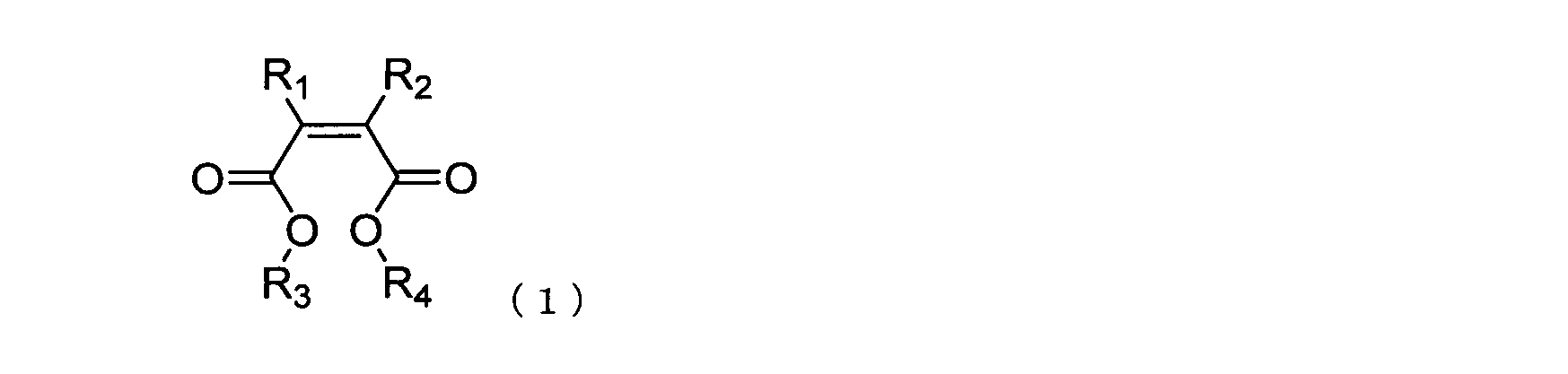
式(1)において、R1及びR2はそれぞれ独立してH又はCH3である。R3及びR4はそれぞれ独立してH又はCnH2n+1であり、nは1から10である。
[7]前記アルキド樹脂A2が、油変性アルキド樹脂である前記[1]に記載の活性エネルギー線硬化型被覆材組成物。
[8]前記(メタ)アクリレートBが、(メタ)アクリロイルオキシ基を2~6個有する多官能(メタ)アクリレートを含む前記[1]に記載の活性エネルギー線硬化型被覆材組成物。
[9]前記(メタ)アクリレートBが、トリシクロデカンジメタノールジ(メタ)アクリレート、ビス(2-アクリロイルオキシエチル)-2-ヒドロキシエチルイソシアヌレート、ペンタエリスリトールトリ(メタ)アクリレート、トリメチロールプロパントリ(メタ)アクリレート、トリス(2-アクリロイルオキシエチル)イソシアヌレート、ペンタエリスリトールテトラ(メタ)アクリレート、ジペンタエリスリトールペンタ(メタ)アクリレート、ジペンタエリスリトールヘキサ(メタ)アクリレート及びポリエステル(メタ)アクリレートからなる群から選ばれる少なくとも1種の(メタ)アクリレートを含む前記[8]に記載の活性エネルギー線硬化型被覆材組成物。
[10]前記シランカップリング剤Cが、アミノ基又はグリシジル基を有する前記[1]に記載の活性エネルギー線硬化型被覆材組成物。
[11]前記シランカップリング剤Cが、N-(2-アミノエチル)3-アミノプロピルメチルジメトキシシラン、N-(2-アミノエチル)3-アミノプロピルトリメトキシシラン、3-グリシドキシプロピルトリメトキシシラン、3-グリシドキシプロピルメチルジメトキシシランからなる群から選ばれる少なくとも1種のシランカップリング剤を含む前記[10]に記載の活性エネルギー線硬化型被覆材組成物。
[12]さらに光重合開始剤Dを含む前記[1]に記載の活性エネルギー線硬化型被覆材組成物。
[13]前記樹脂Aと前記(メタ)アクリレートBの合計量100質量部に対して、前記光重合開始剤Dが0.1~20質量部である前記[12]に記載の活性エネルギー線硬化型被覆材組成物。
[14]前記活性エネルギー線硬化型被覆材組成物が、金属蒸着用アンダーコート材に使用される前記[1]に記載の活性エネルギー線硬化型被覆材組成物。
[15]樹脂基材の表面に、前記[14]に記載の活性エネルギー線硬化型被覆材組成物のコーティング層及び金属蒸着層がこの順に積層されてなる積層体。
[16]前記積層体が自動車ランプ用部材である前記[15]に記載の積層体。
本発明によれば、種々の基材に対する付着性及び外観に優れた金属蒸着用アンダーコート層の形成に好適な被覆材組成物を提供することができる。本発明の被覆材組成物は、活性エネルギー線を照射することにより短時間で硬化させることができる。また本発明の被覆材組成物は、難密着基材やプラスチック基材以外のアルミニウムやガラス等にも金属蒸着用アンダーコート層を形成することが出来る。また本発明によれば、この被覆材組成物の硬化層からなるアンダーコート層と金属蒸着層とを有する積層体を提供することができる。
〔被覆材組成物〕
以下、本発明について詳細に説明する。本明細書において「(メタ)アクリレート」とは「アクリレート」及び/又は「メタクリレート」を、「(メタ)アクリル」とは「アクリル」及び/又は「メタクリル」を、「(メタ)アクリロイル」とは「アクリロイル」及び/又は「メタクリロイル」を、「(メタ)アクリロニトリル」とは「アクリロニトリル」及び/又は「メタクリロニトリル」を意味する。また、樹脂Aを「A成分」、重合体A1を「A1成分」、アルキド樹脂A2を「A2成分」、(メタ)アクリレートBを「B成分」、シランカップリング剤Cを「C成分」、光重合開始剤Dを「D成分」とも示す。また、活性エネルギー線硬化型被覆材組成物を「被覆材組成物」とも示す。
以下、本発明について詳細に説明する。本明細書において「(メタ)アクリレート」とは「アクリレート」及び/又は「メタクリレート」を、「(メタ)アクリル」とは「アクリル」及び/又は「メタクリル」を、「(メタ)アクリロイル」とは「アクリロイル」及び/又は「メタクリロイル」を、「(メタ)アクリロニトリル」とは「アクリロニトリル」及び/又は「メタクリロニトリル」を意味する。また、樹脂Aを「A成分」、重合体A1を「A1成分」、アルキド樹脂A2を「A2成分」、(メタ)アクリレートBを「B成分」、シランカップリング剤Cを「C成分」、光重合開始剤Dを「D成分」とも示す。また、活性エネルギー線硬化型被覆材組成物を「被覆材組成物」とも示す。
[A成分]
本発明の被覆材組成物に配合される樹脂Aは、水酸基価が20~200mgKOH/gの水酸基を有する重合体A1及び/又はアルキド樹脂A2である。このA成分は、被覆材組成物の硬化塗膜に付着性を付与する。
本発明の被覆材組成物に配合される樹脂Aは、水酸基価が20~200mgKOH/gの水酸基を有する重合体A1及び/又はアルキド樹脂A2である。このA成分は、被覆材組成物の硬化塗膜に付着性を付与する。
[A1成分]
前記重合体A1は、水酸基価が20~200mgKOH/gの水酸基を有する単独重合体又は共重合体であって、水酸基を有する単量体を重合することによって得ることができる。この重合体A1は、必要に応じて「他の単量体単位」を有することができる。
前記重合体A1は、水酸基価が20~200mgKOH/gの水酸基を有する単独重合体又は共重合体であって、水酸基を有する単量体を重合することによって得ることができる。この重合体A1は、必要に応じて「他の単量体単位」を有することができる。
水酸基を有する単量体としては、例えば以下の水酸基含有ビニル単量体が挙げられる。2-ヒドロキシエチル(メタ)アクリレート、2-ヒドロキシプロピル(メタ)アクリレート、3-ヒドロキシプロピル(メタ)アクリレート、4-ヒドロキシブチル(メタ)アクリレート等のヒドロキシアルキル(メタ)アクリレート;2-ヒドロキシエチル(メタ)アクリレートのエチレンオキシド付加物;2-ヒドロキシエチル(メタ)アクリレートのプロピレンオキシド付加物;2-ヒドロキシエチル(メタ)アクリレートのε-カプロラクトン付加物;2-ヒドロキシエチル(メタ)アクリレートの有機ラクトン類付加物等。これらの中では、被覆材組成物から得られる硬化膜と基材との付着性の観点から、ヒドロキシアルキル(メタ)アクリレートが好ましく、2-ヒドロキシエチル(メタ)アクリレート、2-ヒドロキシプロピル(メタ)アクリレート、3-ヒドロキシプロピル(メタ)アクリレート、4-ヒドロキシブチル(メタ)アクリレートがより好ましい。水酸基を有する単量体は1種を単独で又は2種以上を組み合わせて使用することができる。
前記「他の単量体単位」を構成するための原料となる単量体としては、水酸基を有する単量体と共重合可能な単量体であり、例えば以下の単量体が挙げられる。メチル(メタ)アクリレート、エチル(メタ)アクリレート、プロピル(メタ)アクリレート、n-ブチル(メタ)アクリレート、t-ブチル(メタ)アクリレート、イソブチル(メタ)アクリレート、2-エチルヘキシル(メタ)アクリレート、n-ノニル(メタ)アクリレート、シクロヘキシル(メタ)アクリレート、ベンジル(メタ)アクリレート、ジシクロペンタニル(メタ)アクリレート、ジシクロペンテニル(メタ)アクリレート、2-ジシクロペンテノキシエチル(メタ)アクリレート、イソボルニル(メタ)アクリレート、メトキシエチル(メタ)アクリレート、エトキシエチル(メタ)アクリレート、ブトキシエチル(メタ)アクリレート、メトキシエトキシエチル(メタ)アクリレート、エトキシエトキシエチル(メタ)アクリレート、テトラヒドロフルフリル(メタ)アクリレート等のアクリル酸エステル類;スチレン、α-メチルスチレン、p-t-ブチルスチレン、ビニルトルエン等のスチレン又はスチレン誘導体;N,N-ジメチル(メタ)アクリルアミド、N,N-ジエチル(メタ)アクリルアミド等のアクリルアミド化合物;(メタ)アクリル酸、イタコン酸、マレイン酸、フマル酸等の不飽和カルボン酸類;(メタ)アクリロニトリル等の重合性不飽和ニトリル類;マレイン酸ジエチル、マレイン酸ジブチル、イタコン酸ジエチル、イタコン酸ジブチル、フマル酸ジエチル、フマル酸ジブチル等の不飽和カルボン酸エステル類;酢酸ビニル、プロピオン酸ビニル等のビニルエステル類。
前記「他の単量体単位」を構成するための原料となる単量体としては、下記式(1)で表される単量体が、付着性の観点から好ましい。
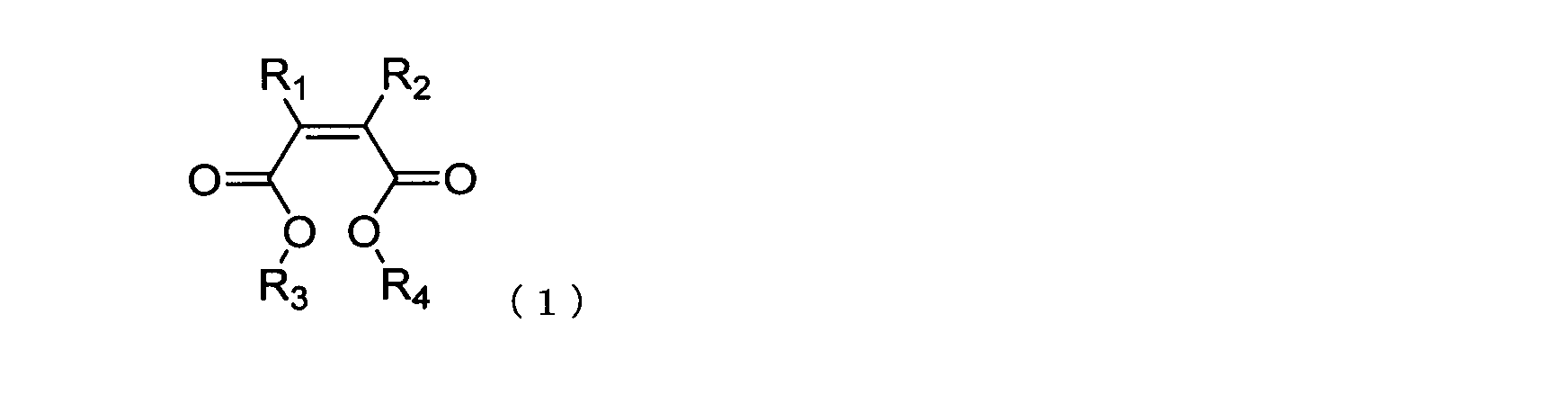
式(1)において、R1及びR2はそれぞれ独立してH又はCH3である。R3及びR4はそれぞれ独立してH又はCnH2n+1であり、nは1から10である。nは1から8が好ましく、2から6がより好ましく、2から4がさらに好ましい。前記式(1)で表される単量体としては、例えばマレイン酸ジエチル、マレイン酸ジブチル、フマル酸ジエチル、フマル酸ジブチル等が挙げられる。これらの「他の単量体単位」を構成するための原料となる単量体は一種を用いてもよく、二種以上を併用しても良い。
重合体A1の質量平均分子量は10,000~80,000が好ましく、15,000~70,000がより好ましく、20,000~50,000がさらに好ましい。重合体A1の質量平均分子量を10,000~80,000とすることにより、被覆材組成物を基材の表面に塗装した時に平滑性に優れた塗膜が得られ、塗膜のタレを抑制することができる。
重合体A1の水酸基価は20~200mgKOH/gであり、40~180mgKOH/gが好ましく、60~160mgKOH/gがより好ましく、80~140mgKOH/gがさらに好ましい。重合体A1の水酸基価を20~200mgKOH/gとすることにより、被覆材組成物から得られる硬化膜と基材との付着性を良好とすることができる。
尚、本発明において、質量平均分子量はGPC測定によるポリスチレン換算により得られる。また、水酸基価は、重合に用いた単量体の組成比からビニル系重合体1gに含まれる遊離の水酸基量を求め、これをアセチル化するために必要な酢酸を中和するのに要する水酸化カリウム量(単位mg)を計算することにより求められる。
重合体A1中の水酸基を有する単量体単位の含有量としては、重合体A1の水酸基価が20~200mgKOH/gとなる量であることが好ましい。
重合体A1を得るための重合法は、特に限定されず、従来から知られるラジカル重合開始剤の存在下での溶液重合法、塊状重合法、乳化重合法等の重合方法により得ることができる。
[A2成分]
前記アルキド樹脂A2は、例えば、多価アルコール、多塩基酸またはその酸無水物、および油脂またはこれらの脂肪酸から合成できる。多価アルコールは、特に限定されず、例えば、グリセリン、トリメチロールプロパン等が挙げられる。多塩基酸またはその酸無水物としては、例えば、フタル酸、無水フタル酸、無水マレイン酸等が挙げられる。油脂または油脂脂肪酸は、特に限定されず、不乾性油、半乾性油、乾性油、あるいはこれらの脂肪酸が使用可能であり、例えば、ヤシ油、大豆油、ヒマシ油、トール油、アマニ油、キリ油、サフラワ油、これらの脂肪酸等が挙げられる。さらに、フェノール変性、ビニル変性等の変性アルキド樹脂も使用できる。前記アルキド樹脂A2は、外観の観点から、油変性アルキド樹脂であることが好ましい。油変性アルキド樹脂としては、ヤシ油変性アルキド樹脂、大豆油変性アルキド樹脂、ヒマシ油変性アルキド樹脂、トール油変性アルキド樹脂、アマニ油変性アルキド樹脂、キリ油変性アルキド樹脂、サフラワ油変性アルキド樹脂などが挙げられる。
前記アルキド樹脂A2は、例えば、多価アルコール、多塩基酸またはその酸無水物、および油脂またはこれらの脂肪酸から合成できる。多価アルコールは、特に限定されず、例えば、グリセリン、トリメチロールプロパン等が挙げられる。多塩基酸またはその酸無水物としては、例えば、フタル酸、無水フタル酸、無水マレイン酸等が挙げられる。油脂または油脂脂肪酸は、特に限定されず、不乾性油、半乾性油、乾性油、あるいはこれらの脂肪酸が使用可能であり、例えば、ヤシ油、大豆油、ヒマシ油、トール油、アマニ油、キリ油、サフラワ油、これらの脂肪酸等が挙げられる。さらに、フェノール変性、ビニル変性等の変性アルキド樹脂も使用できる。前記アルキド樹脂A2は、外観の観点から、油変性アルキド樹脂であることが好ましい。油変性アルキド樹脂としては、ヤシ油変性アルキド樹脂、大豆油変性アルキド樹脂、ヒマシ油変性アルキド樹脂、トール油変性アルキド樹脂、アマニ油変性アルキド樹脂、キリ油変性アルキド樹脂、サフラワ油変性アルキド樹脂などが挙げられる。
アルキド樹脂A2の油長(樹脂分に対する油の質量比率)は、硬化塗膜の外観向上や他成分との相溶性の観点から、20~50%が好ましく、30~50%がより好ましい。
アルキド樹脂A2として、例えば以下の市販品を使用することができる。ヤシ油変性アルキド樹脂として、ベッコゾール1323-60-EL(DIC製、油長32%);トール油変性アルキド樹脂として、ベッコゾールET-3061-60(DIC製、油長30%);大豆油変性アルキド樹脂として、ベッコゾールES-4020-55(DIC製、油長40%)、ベッコゾール0D-E-198-50(DIC製、油長28%)、ベッコゾール1307-60-EL(DIC製、油長41%);アマニ油変性アルキド樹脂として、ベッコゾールEL-4501-50(DIC製、油長45%)、ベッコゾールEQV-987(DIC製、油長50%);フェノール変性アルキド樹脂として、ベッコゾール1341(DIC製、油長28%)、ベッコゾールJ608(DIC製、油長43%);サフラワ油変性アルキド樹脂として、ベッコゾールENV-241(DIC製、油長50)、ベッコゾールENV-243(DIC製、油長50)等。これらは1種を単独で、または2種以上を組み合わせて使用できる。
A成分の配合割合は、A成分、B成分の合計量100質量%中、20~60質量%であり、好ましくは30~60質量%であり、より好ましくは35~55質量%であり、さらに好ましくは40~50質量%である。A成分の配合割合の範囲の各下限値は、金属蒸着膜との付着性を良好にする観点から設定され、また各上限値は、硬化塗膜の平滑性を良好にする観点から設定される。
[B成分]
(メタ)アクリレートであるB成分は、硬化塗膜の要求性能に応じて適宜選択すれば良い。
(メタ)アクリレートであるB成分は、硬化塗膜の要求性能に応じて適宜選択すれば良い。
B成分として使用できる1個の(メタ)アクリロイル基を有する単量体の具体例としては、例えば以下の単量体が挙げられる。2-ヒドロキシエチル(メタ)アクリレート、2-ヒドロキシプロピル(メタ)アクリレート、4-ヒドロキシブチル(メタ)アクリレート等の水酸基含有炭化水素類;2-エチル-ヘキシル(メタ)アクリレート、ラウリル(メタ)アクリレート、2-イソブチル-2-メチルアクリレート等の炭化水素類;テトラヒドロフルフリル(メタ)アクリレート、2-エチル-2-メチル-1,3-ジオキソラン-4-イル-メチル(メタ)アクリレート、イソボルニル(メタ)アクリレート、ノルボルニル(メタ)アクリレート、アダマンチル(メタ)アクリレート、ベンジル(メタ)アクリレート、フェニル(メタ)アクリレート、ジシクロペンテニル(メタ)アクリレート、ジシクロペンタニル(メタ)アクリレート、フェニルオキシエチル(メタ)アクリレート、フェニルオキシジエチレングリコール(メタ)アクリレート、エチレンオキサイド変性クレゾール(メタ)アクリレート、ノニルフェニルオキシエチル(メタ)アクリレート、パラクミルフェニルオキシエチル(メタ)アクリレート、ジシクロペンタニルオキシエチル(メタ)アクリレート、ジシクロペンテニルオキシエチル(メタ)アクリレート、シクロヘキシルオキシエチル(メタ)アクリレート、t-ブチルシクロヘキシルオキシエチル(メタ)アクリレート、ベンジルオキシエチル(メタ)アクリレート、イソボルニルオキシエチル(メタ)アクリレート、ノルボルニルオキシエチル(メタ)アクリレート、アダマンチルオキシエチル(メタ)アクリレート等の環骨格類;2-メトキシエチル(メタ)アクリレート、3-メトキシブチル(メタ)アクリレート、メトキシジエチレングリコール(メタ)アクリレート、メトキシトリエチレングリコール(メタ)アクリレート、メトキシジプロピレングリコール(メタ)アクリレート、メトキシトリプロピレングリコール(メタ)アクリレート、メトキシジブチレングリコール(メタ)アクリレート、メトキシトリブチレングリコール(メタ)アクリレート、エトキシジエチレングリコール(メタ)アクリレート、エトキシトリエチレングリコール(メタ)アクリレート、エトキシジプロピレングリコール(メタ)アクリレート、エトキシトリプロピレングリコール(メタ)アクリレート、エトキシジブチレングリコール(メタ)アクリレート、エトキシトリブチレングリコール(メタ)アクリレート、ブトキシエチル(メタ)アクリレート等のアルコキシアクリレート類;ジメチルアクリルアミド等のアミン類;アクリロイルモルフォリン等の複素環類等。
B成分として使用できる2個の(メタ)アクリロイル基を有する単量体の具体例としては、例えば以下の単量体が挙げられる。トリシクロデカンジメタノールジ(メタ)アクリレート、シクロヘキサンジメタノールジ(メタ)アクリレート、水添ビスフェノールAジ(メタ)アクリレート、ビスフェノキシフルオレンエタノールジ(メタ)アクリレート等の環骨格類;ビス(2-アクリロイルオキシエチル)-2-ヒドロキシエチルイソシアヌレート等のイソシアヌレート類;ネオペンチルグリコール変性トリメチロールプロパンジ(メタ)アクリレート等のトリメチロールプロパン類;1,4-ブタンジオールジ(メタ)アクリレート、1,5-ペンタンジオールジ(メタ)アクリレート、ネオペンチルグリコールジ(メタ)アクリレート、3-メチル-1,5-ペンタンジオールジ(メタ)アクリレート、2,4-ジエチル-1,5-ペンタンジオールジ(メタ)アクリレート、1,6-ヘキサンジオールジ(メタ)アクリレート、1,7-ヘプタンジオールジ(メタ)アクリレート、1,8-オクタンジオールジ(メタ)アクリレート、1,9-ノナンジオールジ(メタ)アクリレート、2-メチル-1,8-オクタンジオールジ(メタ)アクリレート、1,10-デカンジオールジ(メタ)アクリレート、1,11-ウンデカンジオールジ(メタ)アクリレート、1,12-ドデカンジオールジ(メタ)アクリレート、1,13-トリデカンジオールジ(メタ)アクリレートおよび1,14-テトラデカンジオールジ(メタ)アクリレート等の炭化水素類;トリプロピレングリコールジ(メタ)アクリレート、ポリブチレングリコールジ(メタ)アクリレート等。
B成分として使用できる3個の(メタ)アクリロイル基を有する単量体の具体例としては、例えば以下の単量体が挙げられる。ペンタエリスリトールトリ(メタ)アクリレート、エトキシレーテッドペンタエリスリトールトリ(メタ)アクリレート等のペンタエリスリトール類;トリメチロールプロパントリ(メタ)アクリレート、トリスエトキシレーテッドトリメチロールプロパントリ(メタ)アクリレート等のトリメチロールプロパン類;トリス(2-アクリロイルオキシエチル)イソシアヌレート等のイソシアヌレート類等。
B成分として使用できる4個以上の(メタ)アクリロイル基を有するモノマーの具体例としては、例えば以下の単量体が挙げられる。ジペンタエリスリトールペンタ(メタ)アクリレート、ジペンタエリスリトールヘキサ(メタ)アクリレート、カプロラクトン変性ジペンタエリスリトールペンタ(メタ)アクリレート、カプロラクトン変性ジペンタエリスリトールヘキサ(メタ)アクリレート、ペンタエリスリトールテトラ(メタ)アクリレート、エトキシレーテッドペンタエリスリトールテトラ(メタ)アクリレート等のペンタエリスリトール類;ジトリメチロールプロパンテトラ(メタ)アクリレート等のトリメチロールプロパン類等。
B成分として使用できるエポキシポリ(メタ)アクリレートの具体例としては、ビスフェノール型エポキシジ(メタ)アクリレート、ノボラック型エポキシジ(メタ)アクリレートが挙げられる。
B成分として使用できるポリエステル(メタ)アクリレートの具体例としては、フタル酸、コハク酸、ヘキサヒドロフタル酸、テトラヒドロフタル酸、テレフタル酸、アゼライン酸、アジピン酸等の多塩基酸と、エチレングリコール、ヘキサンジオール、ポリエチレングリコール、ポリテトラメチレングリコール等の多価アルコールと、(メタ)アクリル酸またはその誘導体との反応で得られる化合物が挙げられる。
B成分として使用できるウレタン(メタ)アクリレートの具体例としては、有機イソシアネート化合物に、1個の(メタ)アクリロイルオキシ基と1個のヒドロキシ基を有するヒドロキシ基含有(メタ)アクリレート、必要に応じてアルカンジオール、ポリエーテルジオール、ポリブタジエンジオール、ポリエステルジオール、ポリカーボネートジオール及びアミドジオール等のジオール類を反応させたものが挙げられる。
これらの中でも、塗膜の硬化性と耐熱性の観点から、B成分は(メタ)アクリロイルオキシ基を2~6個有する多官能(メタ)アクリレートを含むことが好ましい。該多官能(メタ)アクリレートとしては、トリシクロデカンジメタノールジ(メタ)アクリレート、ビス(2-アクリロイルオキシエチル)-2-ヒドロキシエチルイソシアヌレート、ペンタエリスリトールトリ(メタ)アクリレート、トリメチロールプロパントリ(メタ)アクリレート、トリス(2-アクリロイルオキシエチル)イソシアヌレート、ペンタエリスリトールテトラ(メタ)アクリレート、ジペンタエリスリトールペンタ(メタ)アクリレート、ジペンタエリスリトールヘキサ(メタ)アクリレート、ポリエステル(メタ)アクリレートが好ましい。これらの単量体は1種を単独でまたは2種以上を組み合わせて使用できる。
B成分の使用割合は、A成分、B成分の合計量100質量%中40~80質量%であり、40~70質量%が好ましく、45~65質量%がより好ましく、50~60質量%がさらに好ましい。B成分の配合割合の範囲の各下限値は、塗膜の硬化性を向上する観点から設定され、また各上限値は、塗膜の金属蒸着膜との付着性を良好にする観点から設定される。
[C成分]
シランカップリング剤であるC成分は、被覆材組成物の硬化塗膜に付着性を付与する成分である。C成分として使用できるシランカップリング剤の例としては、例えば以下の化合物が挙げられる。
シランカップリング剤であるC成分は、被覆材組成物の硬化塗膜に付着性を付与する成分である。C成分として使用できるシランカップリング剤の例としては、例えば以下の化合物が挙げられる。
ビニルトリメトキシシラン、ビニルトリエトキシシラン、ビニル-トリス(2-メトキシエトキシ)シラン、N-(2-アミノエチル)3-アミノプロピルメチルジメトキシシラン、N-(2-アミノエチル)3-アミノプロピルトリメトキシシラン、3-ウレイドプロピルトリエトキシシラン、3-グリシドキシプロピルトリメトキシシラン、3-グリシドキシプロピルメチルジメトキシシラン、2-(3,4-エポキシシクロヘキシル)エチルトリメトキシシラン、3-クロロプロピルメチルジメトキシシラン、3-クロロプロピルトリメトキシシラン、3-メタクリロキシプロピルトリメトキシシラン、3-メルカプトプロピルトリメトキシシラン、N-(1,3-ジメチルブチリデン)-3-(トリエトキシシリル)-1-プロパンアミン、N-[2-(ビニルベンジルアミノ)エチル]-3-アミノプロピルトリメトキシシラン・塩酸塩、N,N-ビス[3-(トリメトキシシリル)プロピル]エチレンジアミン等。これらは1種を単独で又は2種以上を組み合わせて使用することができる。
これらの中でも、難密着基材及び金属蒸着膜の双方に対する付着性に優れることから、アミノ基又はグリシジル基を有するシランカップリング剤が好ましく、N-(2-アミノエチル)3-アミノプロピルメチルジメトキシシラン、N-(2-アミノエチル)3-アミノプロピルトリメトキシシラン等のアミノ基含有アルキルアルコキシシラン類、3-グリシドキシプロピルトリメトキシシラン、3-グリシドキシプロピルメチルジメトキシシラン等のグリシジル基含有アルキルアルコキシシラン類がより好ましい。
C成分の配合割合は、A成分、B成分の合計量100質量部に対して、0.3~15質量部であり、好ましくは0.5~10質量部であり、より好ましくは0.5~7質量部であり、さらに好ましくは0.5~5質量部である。C成分の配合割合の範囲の各下限値は、得られる硬化塗膜の被塗物に対する付着性を良好にする観点から設定され、また各上限値は、耐熱性試験後の硬化塗膜の被塗物に対する付着性を良好にする観点から設定される。
[D成分]
光重合開始剤であるD成分は、任意成分であり、被覆材組成物を活性エネルギー照射により硬化させる成分である。D成分としては、ベンゾフェノン型、アントラキノン型、アルキルフェノン型、アシルフォスフィンオキサイド型、チオキサントン型、フェニルグリオキシレート型の光重合開始剤などが挙げられ、具体的には例えば以下の化合物が挙げられる。
光重合開始剤であるD成分は、任意成分であり、被覆材組成物を活性エネルギー照射により硬化させる成分である。D成分としては、ベンゾフェノン型、アントラキノン型、アルキルフェノン型、アシルフォスフィンオキサイド型、チオキサントン型、フェニルグリオキシレート型の光重合開始剤などが挙げられ、具体的には例えば以下の化合物が挙げられる。
ベンゾフェノン、4-メチルベンゾフェノン、2,4,6-トリメチルベンゾフェノン、メチルオルトベンゾイルベンゾエイト及び4-フェニルベンゾフェノン等のベンゾフェノン型;t-ブチルアントラキノン及び2-エチルアントラキノン等のアントラキノン型;2-ヒドロキシ-2-メチル-1-フェニルプロパン-1-オン、オリゴ{2-ヒドロキシ-2-メチル-1-[4-(1-メチルビニル)フェニル]プロパノン}、ベンジルジメチルケタール、1-ヒドロキシシクロヘキシルフェニルケトン、ベンゾインメチルエーテル、2-メチル-[4-(メチルチオ)フェニル]-2-モルホリノ-1-プロパノン及び2-ヒドロキシ-1-[4-[4-(2-ヒドロキシ-2-メチルプロピオニル)ベンジル]フェニル]-2-メチルプロパン-1-オン等のアルキルフェノン型;2-ベンジル-2-ジメチルアミノ-1-(4-モルホリノフェニル)-ブタノン-1、ジエチルチオキサントン及びイソプロピルチオキサントン等のチオキサントン型;2,4,6-トリメチルベンゾイルジフェニルホスフィンオキサイド、ビス(2,6-ジメトキシベンゾイル)-2,4,4-トリメチルペンチルホスフィンオキサイド及びビス(2,4,6-トリメチルベンゾイル)-フェニルホスフィンオキサイド等のアシルフォスフィンオキサイド型;フェニルグリオキシリックアシッドメチルエステル等のフェニルグリオキシレート型等。これらは1種を単独でまたは2種以上を組み合わせて使用できる。
これらの中でも、被覆材組成物の指触乾燥性の点から、ベンゾフェノン、2-エチルアントラキノン、2,4,6-トリメチルベンゾイルジフェニルホスフィンオキサイドが好ましい。
D成分を配合する場合、D成分の配合量は、A成分、B成分の合計量100質量部に対して、0.1~20質量部が好ましく、0.5~15質量部がより好ましく、1~10質量部がさらに好ましい。D成分の配合割合の範囲の各下限値は、被覆材組成物の空気雰囲気中での硬化性の観点から設定され、また各上限値は、得られる硬化塗膜に残存する光重合開始剤の量を少なくする観点から設定される。
[光増感剤]
更に、本発明の被覆材組成物には、必要に応じて、性能を損なわない範囲で、4-ジメチルアミノ安息香酸メチル、4-ジメチルアミノ安息香酸エチル、4-ジメチルアミノ安息香酸アミル、4-ジメチルアミノアセトフェノン等の公知の光増感剤を添加することもできる。これらは1種を単独でまたは2種以上を組み合わせて使用できる。
更に、本発明の被覆材組成物には、必要に応じて、性能を損なわない範囲で、4-ジメチルアミノ安息香酸メチル、4-ジメチルアミノ安息香酸エチル、4-ジメチルアミノ安息香酸アミル、4-ジメチルアミノアセトフェノン等の公知の光増感剤を添加することもできる。これらは1種を単独でまたは2種以上を組み合わせて使用できる。
[有機溶剤]
本発明の被覆材組成物には、必要に応じて望ましい粘度に調整するために有機溶剤を配合することができる。有機溶剤の例として、例えば以下の化合物が挙げられる。アセトン、メチルエチルケトン、メチルイソブチルケトン、シクロヘキサノン等のケトン系化合物;酢酸メチル、酢酸エチル、酢酸ブチル、乳酸エチル、酢酸メトキシエチル等のエステル系化合物;ジエチルエーテル、エチレングリコールジメチルエーテル、ジエチレングリコールモノエチルエーテル、ジエチレングリコールモノブチルエーテル、ジオキサン等のエーテル系化合物;トルエン、キシレン等の芳香族化合物;ペンタン、ヘキサン、石油ナフサ等の脂肪族化合物;イソプロピルアルコール、イソブタノール、n-ブタノール等のアルコール系化合物;1-メトキシプロパノール、1-メトキシプロパノールアセテート等のプロピレングリコール系化合物等。これらは1種を単独でまたは2種以上を組み合わせて使用できる。
本発明の被覆材組成物には、必要に応じて望ましい粘度に調整するために有機溶剤を配合することができる。有機溶剤の例として、例えば以下の化合物が挙げられる。アセトン、メチルエチルケトン、メチルイソブチルケトン、シクロヘキサノン等のケトン系化合物;酢酸メチル、酢酸エチル、酢酸ブチル、乳酸エチル、酢酸メトキシエチル等のエステル系化合物;ジエチルエーテル、エチレングリコールジメチルエーテル、ジエチレングリコールモノエチルエーテル、ジエチレングリコールモノブチルエーテル、ジオキサン等のエーテル系化合物;トルエン、キシレン等の芳香族化合物;ペンタン、ヘキサン、石油ナフサ等の脂肪族化合物;イソプロピルアルコール、イソブタノール、n-ブタノール等のアルコール系化合物;1-メトキシプロパノール、1-メトキシプロパノールアセテート等のプロピレングリコール系化合物等。これらは1種を単独でまたは2種以上を組み合わせて使用できる。
[他の成分(添加剤)]
また、本発明の被覆材組成物には、レベリング剤、消泡剤、沈降防止剤、潤滑剤、研磨剤、防錆剤、帯電防止剤、光安定剤、紫外線吸収剤、重合禁止剤などの添加剤を加えてもよい。更に、本発明の効果を妨げない範囲内であれば、付着性向上のためにA1成分以外のアクリルポリマーを加えてもよい。
また、本発明の被覆材組成物には、レベリング剤、消泡剤、沈降防止剤、潤滑剤、研磨剤、防錆剤、帯電防止剤、光安定剤、紫外線吸収剤、重合禁止剤などの添加剤を加えてもよい。更に、本発明の効果を妨げない範囲内であれば、付着性向上のためにA1成分以外のアクリルポリマーを加えてもよい。
〔成型品、積層体〕
本発明の被覆材組成物が塗布される成型品としては、特に限定されず、例えば、BMC等の熱硬化性樹脂、PPS等のスーパーエンジニアリングプラスチック、ALD等の金属、PBT/PETアロイ樹脂、ABS樹脂、AES(アクリロニトリル・エチレンプロピレンジエン・スチレン)樹脂、PC樹脂、ハイヒートPC樹脂、アクリル樹脂、ポリスチレン樹脂等の樹脂の他、ポリプロピレン、ポリエチレン等のポリオレフィン樹脂、PET樹脂、PBT樹脂等のポリエステル樹脂などの難密着基材を含む各種の成型品が挙げられる。これら成型品への本発明の被覆材組成物のコーティング層の形成は、本発明の被覆材組成物を樹脂成型品(樹脂基材)の表面に塗付し、活性エネルギー線を照射することにより達成される。アンダーコート層の膜厚は、硬化被膜の厚さで3~40μmの範囲であることが好ましい。
本発明の被覆材組成物が塗布される成型品としては、特に限定されず、例えば、BMC等の熱硬化性樹脂、PPS等のスーパーエンジニアリングプラスチック、ALD等の金属、PBT/PETアロイ樹脂、ABS樹脂、AES(アクリロニトリル・エチレンプロピレンジエン・スチレン)樹脂、PC樹脂、ハイヒートPC樹脂、アクリル樹脂、ポリスチレン樹脂等の樹脂の他、ポリプロピレン、ポリエチレン等のポリオレフィン樹脂、PET樹脂、PBT樹脂等のポリエステル樹脂などの難密着基材を含む各種の成型品が挙げられる。これら成型品への本発明の被覆材組成物のコーティング層の形成は、本発明の被覆材組成物を樹脂成型品(樹脂基材)の表面に塗付し、活性エネルギー線を照射することにより達成される。アンダーコート層の膜厚は、硬化被膜の厚さで3~40μmの範囲であることが好ましい。
被覆材組成物の塗布方法としては、ハケ塗り、スプレーコート、ディップコート、スピンコート、フローコート等の方法が用いられるが、塗布作業性、被膜の平滑性、均一性の点から、スプレーコート法、フローコート法が好ましい。被覆材組成物を塗布する際に、前述した有機溶剤を被覆材組成物中に配合した場合には、被覆材組成物の塗膜を硬化させる前に溶剤を揮発させることが好ましい。その際には、IRヒーターおよび/又は温風で塗膜を加温し、温度30~70℃、加熱時間2~8分間の条件下で有機溶剤を揮発させることが好ましい。
また、本発明の被覆材組成物を硬化するために用いられる活性エネルギー線としては、紫外線、電子線等が挙げられる。紫外線源としては、例えば高圧水銀灯が挙げられる。被覆材組成物を硬化するために照射される紫外線エネルギー量は、300~4000mJ/cm2程度であることが好ましい。
本発明の被覆材組成物は、樹脂成形品に金属蒸着膜を形成させる際の金属蒸着用アンダーコート材として好適である。本発明の被覆材組成物のアンダーコート層を設けた樹脂成型品への金属蒸着膜の形成は、金属を蒸着する公知の方法により行われる。これにより樹脂基材の表面に、本発明の被覆材組成物のコーティング層及び金属蒸着膜がこの順に積層されてなる積層体を得ることができる。この積層体には、更に金属蒸着膜の腐食防止などを目的として、形成された金属蒸着膜の表面に熱硬化型トップコート層、紫外線硬化型トップコート層またはプラズマ重合膜を形成することができる。
本発明の被覆材組成物により形成される金属蒸着用アンダーコート層は、種々のプラスチック基材への付着性及び耐熱性に優れているので、本発明の被覆材組成物のコーティング層及び金属蒸着膜がこの順に積層されてなる積層体は、例えば、自動車ランプの反射鏡等の自動車ランプ用部材等、耐熱性が要求される用途に好適に用いられる。
以下、製造例及び実施例により、本発明をより具体的に説明する。
[製造例1]共重合体A-1の製造
容量2Lの4つ口フラスコ内に表1の成分1の欄に示す材料を仕込み、フラスコ内の液温が110℃になるように加温した。次いでフラスコ内の液を攪拌しながら内温を110℃に保ち、フラスコ内に表1の成分2の欄に示す材料からなる単量体含有混合物を4時間かけて等速滴下した後に、表1の成分3の欄に示す材料を投入した。その後、フラスコ内に1時間おきに毎回1gのアゾビスイソブチルニトリルを合計4回(合計4g)追加投入し、更に2時間攪拌して、共重合体A-1を得た。共重合体A-1のGPC測定によるポリスチレン換算による質量平均分子量は2.5×10⁴、水酸基価は108mgKOH/gであった。
容量2Lの4つ口フラスコ内に表1の成分1の欄に示す材料を仕込み、フラスコ内の液温が110℃になるように加温した。次いでフラスコ内の液を攪拌しながら内温を110℃に保ち、フラスコ内に表1の成分2の欄に示す材料からなる単量体含有混合物を4時間かけて等速滴下した後に、表1の成分3の欄に示す材料を投入した。その後、フラスコ内に1時間おきに毎回1gのアゾビスイソブチルニトリルを合計4回(合計4g)追加投入し、更に2時間攪拌して、共重合体A-1を得た。共重合体A-1のGPC測定によるポリスチレン換算による質量平均分子量は2.5×10⁴、水酸基価は108mgKOH/gであった。
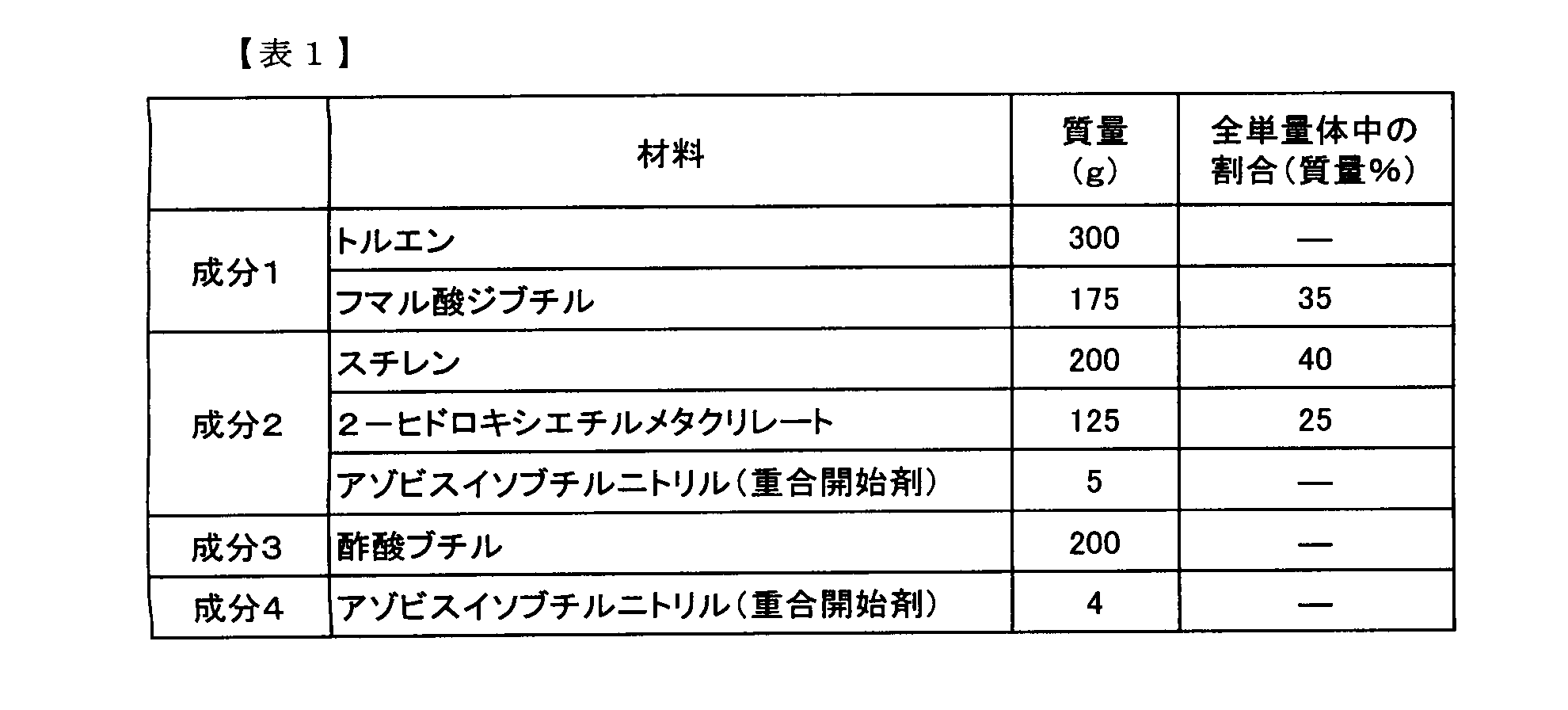
[製造例2]共重合体A-2の製造
成分2として使用する重合開始剤としてパーブチルO(登録商標、日油製)3.8g、成分4として使用する重合開始剤としてパーブチルO 10gを用いること以外は、製造例1と同様にして、質量平均分子量4.3×10⁴、水酸基価108mgKOH/gの共重合体A-2を得た。
成分2として使用する重合開始剤としてパーブチルO(登録商標、日油製)3.8g、成分4として使用する重合開始剤としてパーブチルO 10gを用いること以外は、製造例1と同様にして、質量平均分子量4.3×10⁴、水酸基価108mgKOH/gの共重合体A-2を得た。
[製造例3]共重合体A-3の製造
成分2として使用する単量体を、スチレン150g(全単量体の30質量%)、2-ヒドロキシエチルメタクリレート175g(全単量体の35質量%)としたこと以外は、製造例1と同様にして、質量平均分子量2.2×10⁴、水酸基価129mgKOH/gの共重合体A-3を得た。
成分2として使用する単量体を、スチレン150g(全単量体の30質量%)、2-ヒドロキシエチルメタクリレート175g(全単量体の35質量%)としたこと以外は、製造例1と同様にして、質量平均分子量2.2×10⁴、水酸基価129mgKOH/gの共重合体A-3を得た。
[製造例4]共重合体A-4の製造
成分2として使用する単量体2-ヒドロキシエチルメタクリレート125g(全単量体の25質量%)に代えて、2-ヒドロキシエチルメタクリレート62.5g(全単量体の12.5質量%)、メチルメタクリレート62.5g(全単量体の12.5質量%)としたこと以外は、製造例1と同様にして、質量平均分子量2.3×10⁴、水酸基価53mgKOH/gの共重合体A-4を得た。
成分2として使用する単量体2-ヒドロキシエチルメタクリレート125g(全単量体の25質量%)に代えて、2-ヒドロキシエチルメタクリレート62.5g(全単量体の12.5質量%)、メチルメタクリレート62.5g(全単量体の12.5質量%)としたこと以外は、製造例1と同様にして、質量平均分子量2.3×10⁴、水酸基価53mgKOH/gの共重合体A-4を得た。
[製造例5]共重合体A-5の製造
成分2として使用する重合開始剤としてアゾビスイソブチルニトリル1.4g、パーブチルZ(登録商標、日油製)2.4gを用い、液温を100℃にしたこと以外は、製造例1と同様にして、質量平均分子量6.2×10⁴、水酸基価108mgKOH/gの共重合体A-5を得た。
成分2として使用する重合開始剤としてアゾビスイソブチルニトリル1.4g、パーブチルZ(登録商標、日油製)2.4gを用い、液温を100℃にしたこと以外は、製造例1と同様にして、質量平均分子量6.2×10⁴、水酸基価108mgKOH/gの共重合体A-5を得た。
[製造例6]共重合体PA-1の製造
成分2として使用する単量体を、スチレン75g(全単量体の15質量%)、2-ヒドロキシエチルメタクリレート250g(全単量体の50質量%)としたこと以外は、製造例1と同様にして、質量平均分子量2.0×10⁴、水酸基価215mgKOH/gの共重合体PA-1を得た。
成分2として使用する単量体を、スチレン75g(全単量体の15質量%)、2-ヒドロキシエチルメタクリレート250g(全単量体の50質量%)としたこと以外は、製造例1と同様にして、質量平均分子量2.0×10⁴、水酸基価215mgKOH/gの共重合体PA-1を得た。
[製造例7]共重合体PA-2の製造
2-ヒドロキシエチルメタクリレート125g(全単量体の25質量%)の代わりにメチルメタクリレート125g(全単量体の25質量%)を用いること以外は、製造例1と同様にして、質量平均分子量2.0×10⁴、水酸基価0mgKOH/gの共重合体PA-2を得た。
2-ヒドロキシエチルメタクリレート125g(全単量体の25質量%)の代わりにメチルメタクリレート125g(全単量体の25質量%)を用いること以外は、製造例1と同様にして、質量平均分子量2.0×10⁴、水酸基価0mgKOH/gの共重合体PA-2を得た。
[実施例1]
1.被覆材組成物の調製
A1成分として製造例1で合成した共重合体A-1 100質量部(固形分換算では50質量部)、B成分としてDPHA:ジペンタエリスリトールヘキサアクリレート(日本化薬製 商品名KAYARAD DPHA)25質量部、及びM-8030:ポリエステルアクリレート(東亞合成製 商品名アロニックスM-8030)25質量部、C成分としてKBM-403:3-グリシドキシプロピルメチルジメトキシシラン1質量部(信越化学製 商品名KBM-403)、D成分としてベンゾフェノン5質量部、及び2-エチルアントラキノン1.5質量部、有機溶剤としてトルエン5質量部、1-メトキシプロパノール70質量部、酢酸ブチル30質量部、及び酢酸エチル15質量部を、混合溶解し、被覆材組成物を得た。
1.被覆材組成物の調製
A1成分として製造例1で合成した共重合体A-1 100質量部(固形分換算では50質量部)、B成分としてDPHA:ジペンタエリスリトールヘキサアクリレート(日本化薬製 商品名KAYARAD DPHA)25質量部、及びM-8030:ポリエステルアクリレート(東亞合成製 商品名アロニックスM-8030)25質量部、C成分としてKBM-403:3-グリシドキシプロピルメチルジメトキシシラン1質量部(信越化学製 商品名KBM-403)、D成分としてベンゾフェノン5質量部、及び2-エチルアントラキノン1.5質量部、有機溶剤としてトルエン5質量部、1-メトキシプロパノール70質量部、酢酸ブチル30質量部、及び酢酸エチル15質量部を、混合溶解し、被覆材組成物を得た。
2.評価用積層体の作製
上記1で調製した被覆材組成物を、縦9cm、横5cm、厚さ3mmの長方形の平板状のBMC製テストピースを基材として、該基材の表面に硬化後の塗膜の膜厚が約20μmになるようにスプレー塗装した。
上記1で調製した被覆材組成物を、縦9cm、横5cm、厚さ3mmの長方形の平板状のBMC製テストピースを基材として、該基材の表面に硬化後の塗膜の膜厚が約20μmになるようにスプレー塗装した。
次いで、オーブン中において温度60℃で3分間加熱処理することにより有機溶剤分を揮発させた。その後、空気中で、塗布面の上方より、高圧水銀灯を用いて、積算光量2000mJ/cm2の紫外線を照射して塗膜を硬化させた。光量の測定では、光量計としてオーク製作所製、商品名:UV-351(SN型)を用いて波長340nm~380nmの紫外線積算エネルギー量を計測した。引き続きこの硬化膜(アンダーコート層)の上に真空蒸着装置(アルバック社製、商品名:EBA-800)を用いてアルミニウムを真空蒸着法により膜厚が約20nmとなるように蒸着させて、アルミニウム蒸着膜を形成した。更にこのアルミニウム蒸着膜の腐食防止等を目的としてアクリルメラミン硬化系クリアー塗料(三菱レイヨン製、商品名ダイヤビームUT-047A)を硬化後の膜厚が5μmとなるようにアルミニウム蒸着膜上にスプレー塗装し、その後温度120℃、10分間の条件にて加熱処理して硬化させて、トップコート層を形成した。このようにして、基材の表面に3つの被覆層が形成された評価用積層体を作製した。
同様の方法でPPS、PBT/PETアロイ、PC、ハイヒートPC製のテストピースを用いて、合計5種類の評価用積層体を作製した。
3.評価方法
3-1.塗膜の外観
アンダーコート層の外観を評価するために各評価用積層体の金属蒸着膜の外観を目視評価した。目視評価の判定は以下の基準で表示した。
E(EXCELLENT):金属蒸着膜の表面にユズ肌が見られず、平滑である。
G(GOOD):金属蒸着膜の表面にややユズ肌が見られ、平滑ではない。
B(BAD):金属蒸着膜にユズ肌が見られ、平滑でなく、白化、クモリ、ニジ現象が観察される。
3-1.塗膜の外観
アンダーコート層の外観を評価するために各評価用積層体の金属蒸着膜の外観を目視評価した。目視評価の判定は以下の基準で表示した。
E(EXCELLENT):金属蒸着膜の表面にユズ肌が見られず、平滑である。
G(GOOD):金属蒸着膜の表面にややユズ肌が見られ、平滑ではない。
B(BAD):金属蒸着膜にユズ肌が見られ、平滑でなく、白化、クモリ、ニジ現象が観察される。
3-2.塗膜の付着性
評価用積層体の表面に形成された金属蒸着膜及びアンダーコート層に対して、カッターナイフを用いて基材に達するまで十字の切り込みを入れた。次いで、その表面にセロテープ(登録商標、ニチバン社製)を貼りつけ急激にはがす操作(剥離試験)を最大3回繰り返し、アンダーコート層と基材との間の層間剥離を観察し、その結果を以下の基準で表示した。尚、アンダーコート層と金属蒸着膜との間の層間剥離は見られなかった。
E(EXCELLENT):3回目の剥離試験で剥離しない。
G(GOOD):3回目の剥離試験で剥離しないが、十字の切り込みの切り溝がやや欠ける。
P(POOR):2~3回目の剥離試験で剥離する。
B(BAD):1回目の剥離試験で剥離する。
評価用積層体の表面に形成された金属蒸着膜及びアンダーコート層に対して、カッターナイフを用いて基材に達するまで十字の切り込みを入れた。次いで、その表面にセロテープ(登録商標、ニチバン社製)を貼りつけ急激にはがす操作(剥離試験)を最大3回繰り返し、アンダーコート層と基材との間の層間剥離を観察し、その結果を以下の基準で表示した。尚、アンダーコート層と金属蒸着膜との間の層間剥離は見られなかった。
E(EXCELLENT):3回目の剥離試験で剥離しない。
G(GOOD):3回目の剥離試験で剥離しないが、十字の切り込みの切り溝がやや欠ける。
P(POOR):2~3回目の剥離試験で剥離する。
B(BAD):1回目の剥離試験で剥離する。
3-3.耐熱性試験前後の性能
塗膜が形成された各評価用積層体について、塗膜の外観と基材との付着性を評価した(初期)。また、塗膜が形成された各評価用積層体を、表3中に記載の雰囲気中に24時間放置後取り出し、熱処理後の、塗膜の外観と基材との付着性を評価した(耐熱性試験後)。評価結果の判定は以下の基準で表示した。
・塗膜の外観
E(EXCELLENT):塗膜全面に白化、クモリ、ニジ、フクレ現象のいずれもない。
G(GOOD):塗膜の一部に白化、クモリ、ニジ、フクレ現象のいずれかがある。
B(BAD):塗膜全面に白化、クモリ、ニジ、フクレ現象のいずれかがある。
・塗膜の付着性
E(EXCELLENT):3回目の剥離試験で剥離しない。
G(GOOD):3回目の剥離試験で剥離しないが、十字の切り込みの切り溝がやや欠ける。
P(POOR):2~3回目の剥離試験で剥離する。
B(BAD):1回目の剥離試験で剥離する。
塗膜が形成された各評価用積層体について、塗膜の外観と基材との付着性を評価した(初期)。また、塗膜が形成された各評価用積層体を、表3中に記載の雰囲気中に24時間放置後取り出し、熱処理後の、塗膜の外観と基材との付着性を評価した(耐熱性試験後)。評価結果の判定は以下の基準で表示した。
・塗膜の外観
E(EXCELLENT):塗膜全面に白化、クモリ、ニジ、フクレ現象のいずれもない。
G(GOOD):塗膜の一部に白化、クモリ、ニジ、フクレ現象のいずれかがある。
B(BAD):塗膜全面に白化、クモリ、ニジ、フクレ現象のいずれかがある。
・塗膜の付着性
E(EXCELLENT):3回目の剥離試験で剥離しない。
G(GOOD):3回目の剥離試験で剥離しないが、十字の切り込みの切り溝がやや欠ける。
P(POOR):2~3回目の剥離試験で剥離する。
B(BAD):1回目の剥離試験で剥離する。
[実施例2~20、比較例1~9]
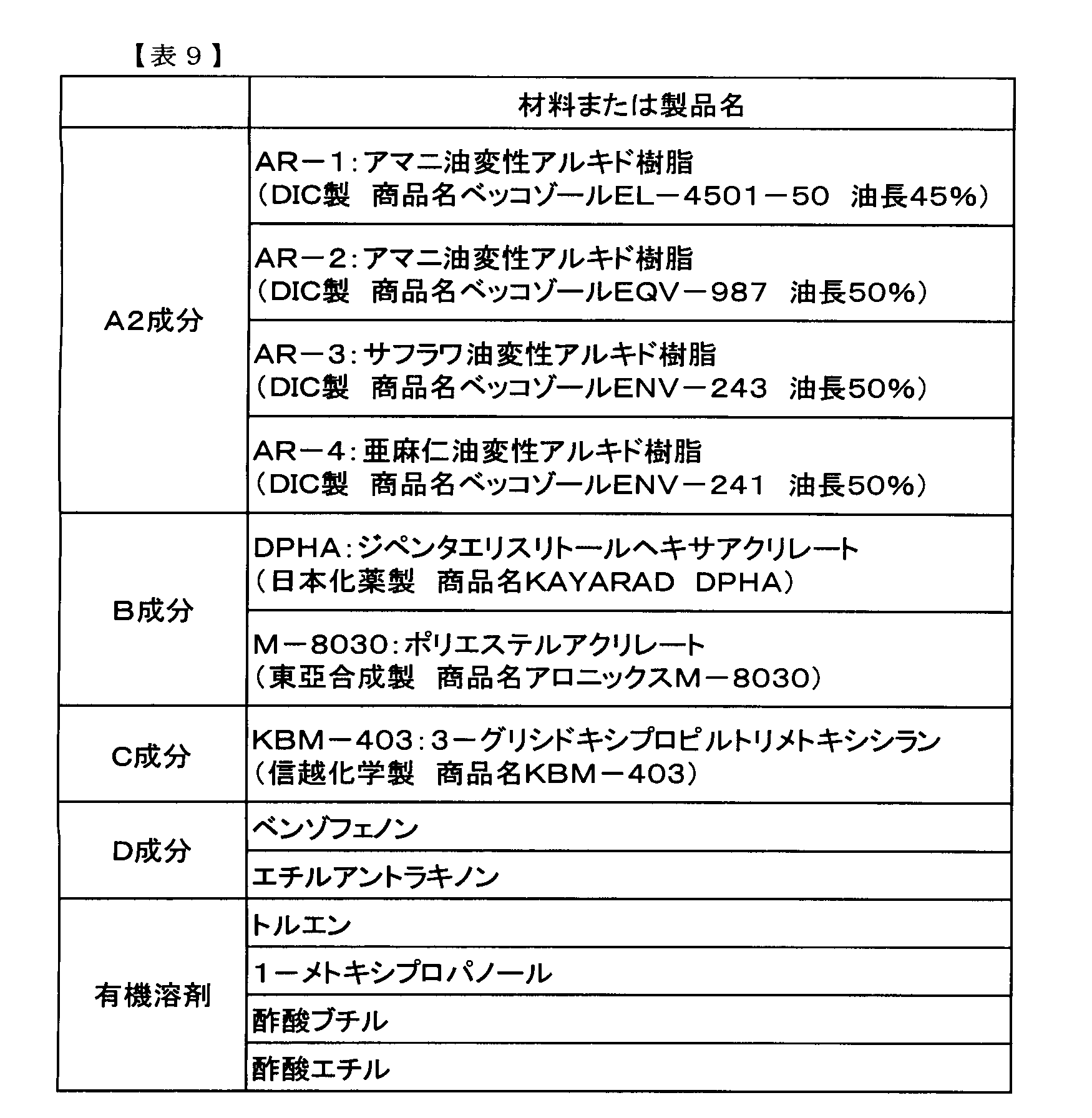
表2、表4または表7の組成欄に示す配合及び組成とする以外は、実施例1と同様にして被覆材組成物を調製し、評価用積層体を作製し、評価した。評価結果を表3、表5または表8に示す。尚、表2および表4中の略号は、表6の材料を示し、表7中の略号は表9の材料を示す。また、表2、表4及び表7中の数値の単位は全て質量部である。
表2、表4または表7の組成欄に示す配合及び組成とする以外は、実施例1と同様にして被覆材組成物を調製し、評価用積層体を作製し、評価した。評価結果を表3、表5または表8に示す。尚、表2および表4中の略号は、表6の材料を示し、表7中の略号は表9の材料を示す。また、表2、表4及び表7中の数値の単位は全て質量部である。
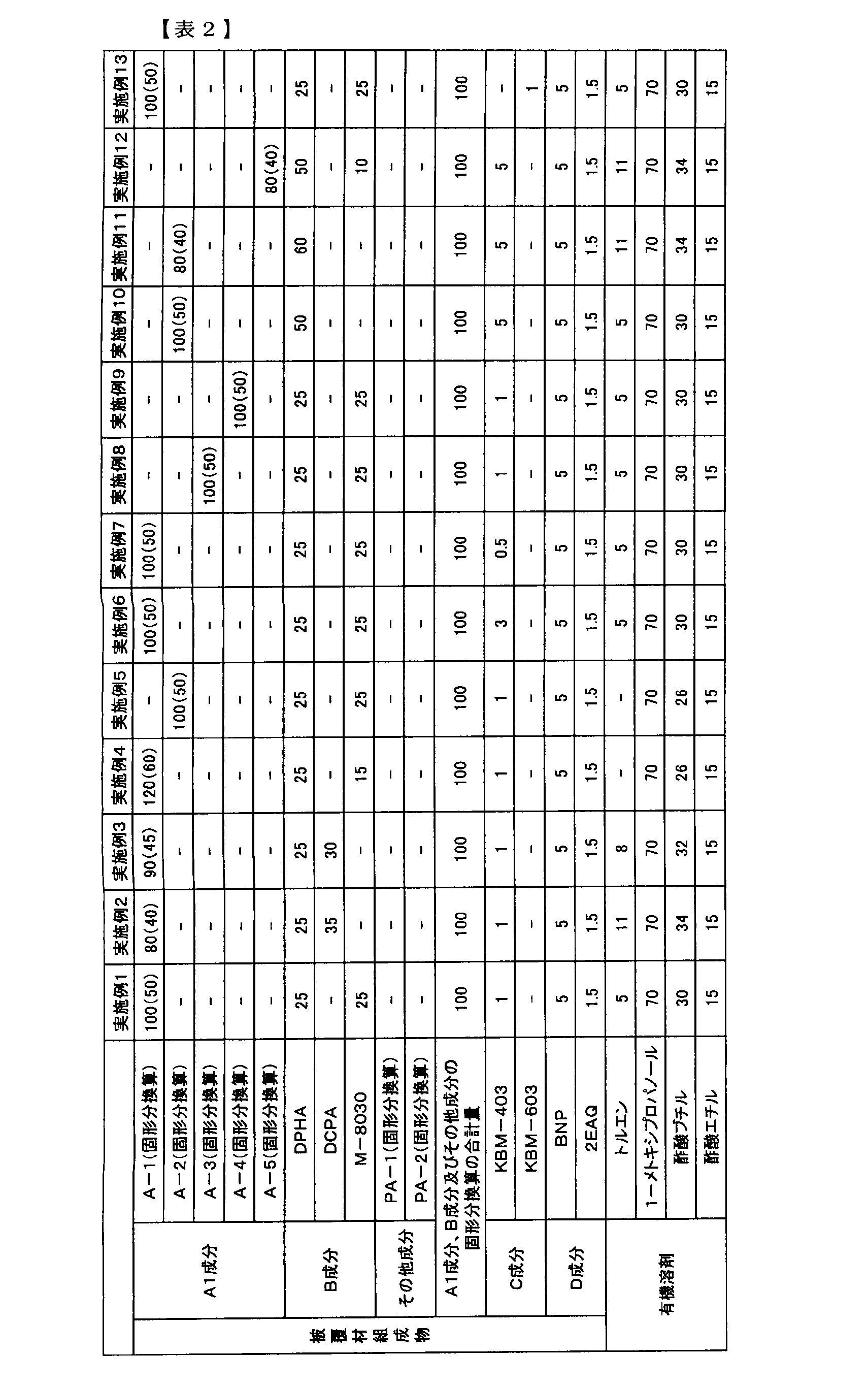
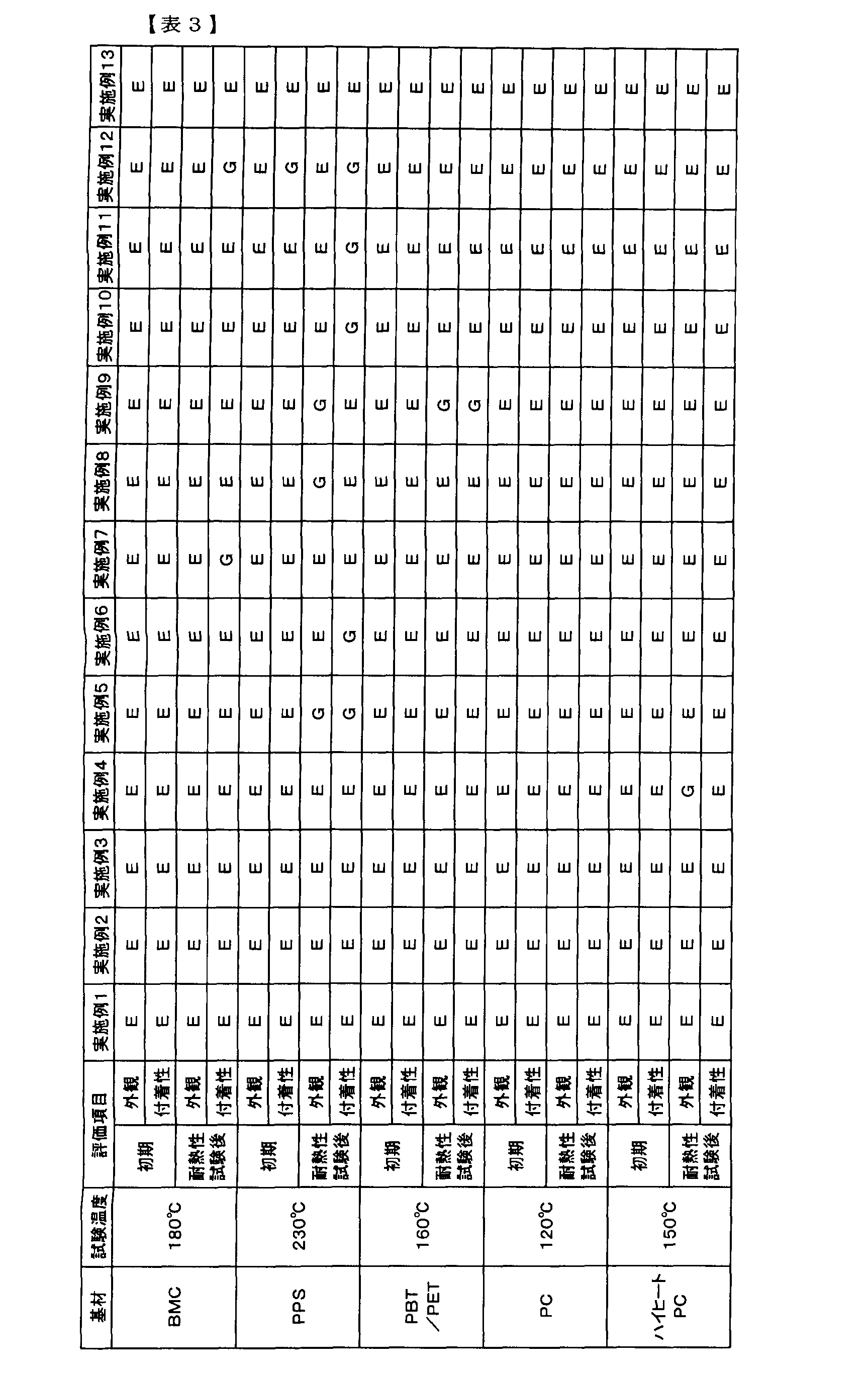
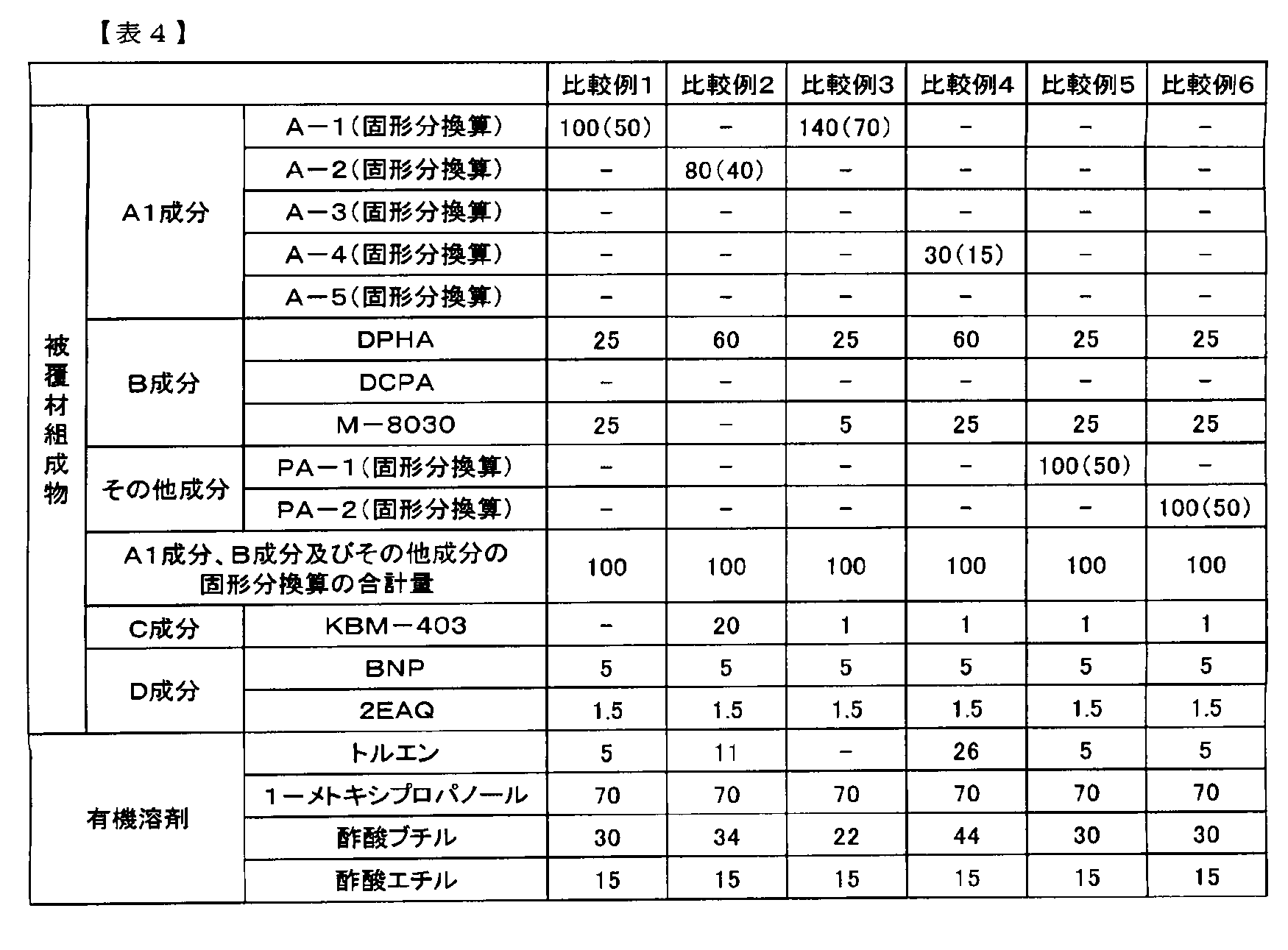
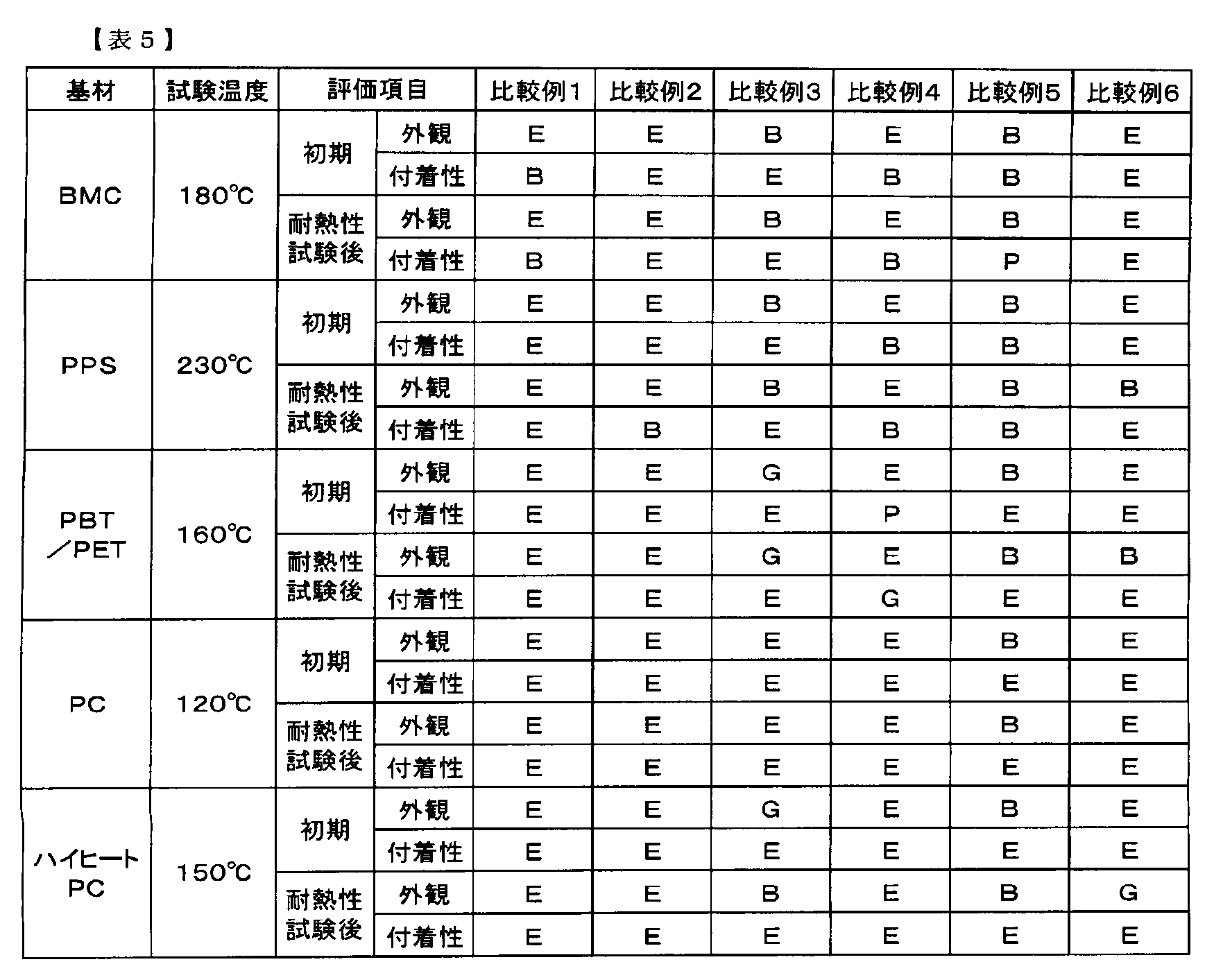


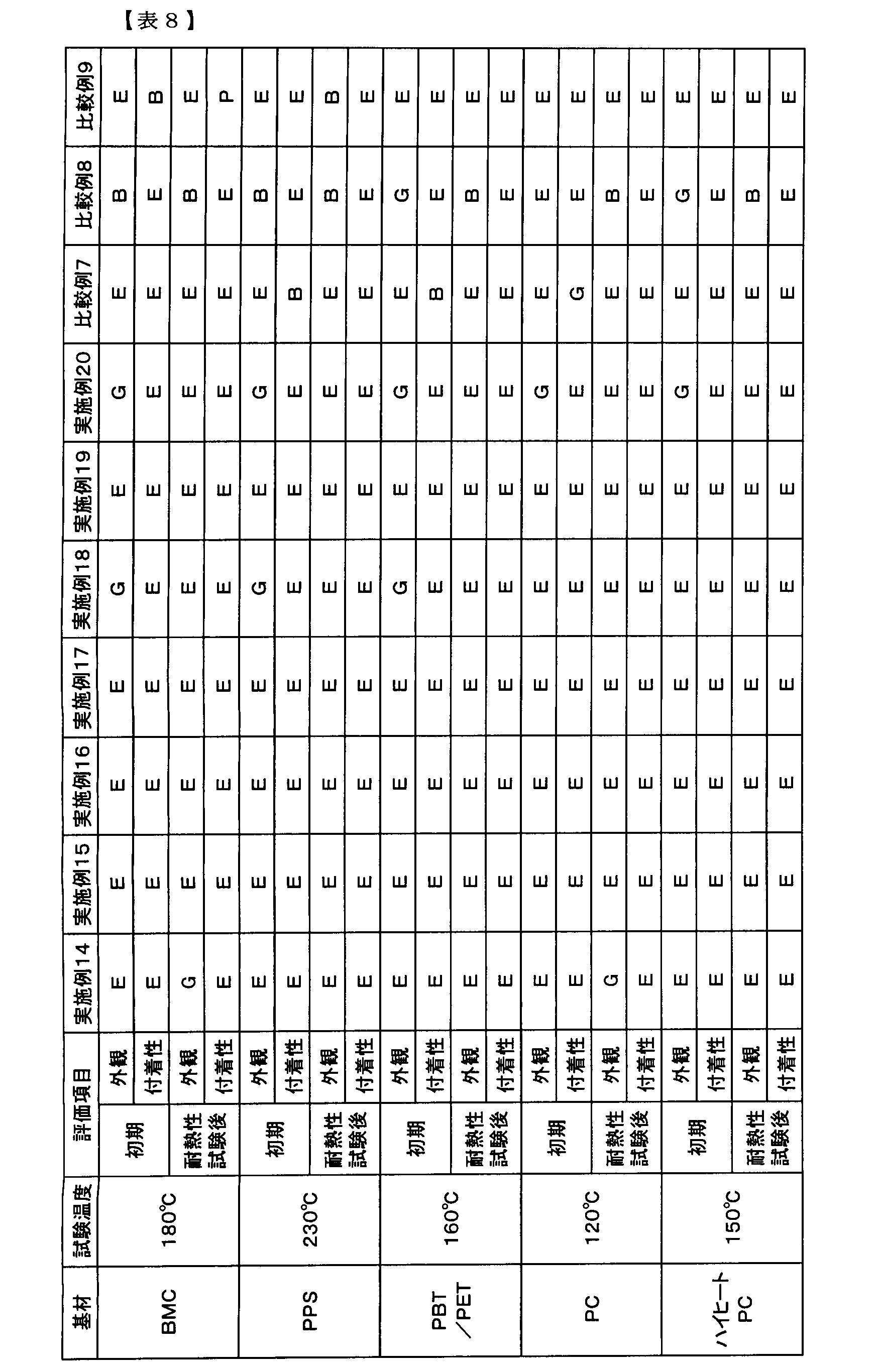
以上の実施例から、本発明の活性エネルギー線硬化型被覆材組成物により、種々の基材に対する付着性、及び金属蒸着膜に対する付着性、外観、耐熱性に優れた金属蒸着用アンダーコート層を提供できることが分かる。比較例1においてはC成分を使用しなかったので、BMCに対する塗膜の付着性が不十分であった。比較例2においてはC成分の使用量が多いので、PPSに対する塗膜の耐熱性試験後の付着性が不十分であった。比較例3においてはA成分の使用量が多いので、塗膜の初期外観、耐熱性試験後の外観が不十分であった。比較例4においてはA成分の使用量が少ないので、塗膜の付着性が不十分であった。比較例5においてはA成分を使用しなかったので、塗膜の外観が不十分であった。比較例6においてはA成分を使用しなかったので、PPS、PBT/PETアロイに対する塗膜の外観が不十分であった。比較例7においてはC成分を使用しなかったので、PPS基材、PBT/PET基材に対する塗膜の付着性が不十分であった。比較例8においてはA成分の使用量が多いので、塗膜の初期外観、耐熱性試験後の外観が不十分であった。比較例9においてはA成分の使用量が少ないので、BMC基材に対する塗膜の付着性が不十分であった。
この出願は、2016年3月4日に出願された日本出願特願2016-42408及び2016年5月30日に出願された日本出願特願2016-107456を基礎とする優先権を主張し、その開示の全てをここに取り込む。
以上、実施形態及び実施例を参照して本願発明を説明したが、本願発明は上記実施形態及び実施例に限定されるものではない。本願発明の構成や詳細には、本願発明のスコープ内で当業者が理解し得る様々な変更をすることができる。
Claims (16)
- 樹脂A、(メタ)アクリレートB及びシランカップリング剤Cを含み、
前記樹脂Aが、水酸基価が20~200mgKOH/gの水酸基を有する重合体A1及び/又はアルキド樹脂A2であり、
前記樹脂Aと前記(メタ)アクリレートBの合計量100質量%中、前記樹脂Aが20~60質量%、前記(メタ)アクリレートBが40~80質量%であり、
前記樹脂Aと前記(メタ)アクリレートBの合計量100質量部に対して、前記シランカップリング剤Cが0.3~15質量部である活性エネルギー線硬化型被覆材組成物。 - 前記樹脂Aと前記(メタ)アクリレートBの合計量100質量%中、前記樹脂Aが30~60質量%、前記(メタ)アクリレートBが40~70質量%である請求項1に記載の活性エネルギー線硬化型被覆材組成物。
- 前記重合体A1の質量平均分子量が10,000~80,000である請求項1に記載の活性エネルギー線硬化型被覆材組成物。
- 前記重合体A1の水酸基価が40~180mgKOH/gである請求項1に記載の活性エネルギー線硬化型被覆材組成物。
- 前記重合体A1が、ヒドロキシアルキル(メタ)アクリレートに由来する構成単位を含む請求項1に記載の活性エネルギー線硬化型被覆材組成物。
- 前記重合体A1が、下記式(1)で表される単量体に由来する構成単位を含む請求項1に記載の活性エネルギー線硬化型被覆材組成物。

- 前記アルキド樹脂A2が、油変性アルキド樹脂である請求項1に記載の活性エネルギー線硬化型被覆材組成物。
- 前記(メタ)アクリレートBが、(メタ)アクリロイルオキシ基を2~6個有する多官能(メタ)アクリレートを含む請求項1に記載の活性エネルギー線硬化型被覆材組成物。
- 前記(メタ)アクリレートBが、トリシクロデカンジメタノールジ(メタ)アクリレート、ビス(2-アクリロイルオキシエチル)-2-ヒドロキシエチルイソシアヌレート、ペンタエリスリトールトリ(メタ)アクリレート、トリメチロールプロパントリ(メタ)アクリレート、トリス(2-アクリロイルオキシエチル)イソシアヌレート、ペンタエリスリトールテトラ(メタ)アクリレート、ジペンタエリスリトールペンタ(メタ)アクリレート、ジペンタエリスリトールヘキサ(メタ)アクリレート及びポリエステル(メタ)アクリレートからなる群から選ばれる少なくとも1種の(メタ)アクリレートを含む請求項8に記載の活性エネルギー線硬化型被覆材組成物。
- 前記シランカップリング剤Cが、アミノ基又はグリシジル基を有する請求項1に記載の活性エネルギー線硬化型被覆材組成物。
- 前記シランカップリング剤Cが、N-(2-アミノエチル)3-アミノプロピルメチルジメトキシシラン、N-(2-アミノエチル)3-アミノプロピルトリメトキシシラン、3-グリシドキシプロピルトリメトキシシラン、3-グリシドキシプロピルメチルジメトキシシランからなる群から選ばれる少なくとも1種のシランカップリング剤を含む請求項10に記載の活性エネルギー線硬化型被覆材組成物。
- さらに光重合開始剤Dを含む請求項1に記載の活性エネルギー線硬化型被覆材組成物。
- 前記樹脂Aと前記(メタ)アクリレートBの合計量100質量部に対して、前記光重合開始剤Dが0.1~20質量部である請求項12に記載の活性エネルギー線硬化型被覆材組成物。
- 前記活性エネルギー線硬化型被覆材組成物が、金属蒸着用アンダーコート材に使用される請求項1に記載の活性エネルギー線硬化型被覆材組成物。
- 樹脂基材の表面に、請求項14に記載の活性エネルギー線硬化型被覆材組成物のコーティング層及び金属蒸着膜がこの順に積層されてなる積層体。
- 前記積層体が自動車ランプ用部材である請求項15に記載の積層体。
Priority Applications (3)
| Application Number | Priority Date | Filing Date | Title |
|---|---|---|---|
| CN201780008440.3A CN108603048B (zh) | 2016-03-04 | 2017-03-02 | 活化能射线固化性组合物及层积体 |
| JP2017514578A JP7081151B2 (ja) | 2016-03-04 | 2017-03-02 | 活性エネルギー線硬化型被覆材組成物及び積層体 |
| US16/121,028 US11072849B2 (en) | 2016-03-04 | 2018-09-04 | Actinic-ray-curable coating material composition and layered product |
Applications Claiming Priority (4)
| Application Number | Priority Date | Filing Date | Title |
|---|---|---|---|
| JP2016-042408 | 2016-03-04 | ||
| JP2016042408 | 2016-03-04 | ||
| JP2016107456 | 2016-05-30 | ||
| JP2016-107456 | 2016-05-30 |
Related Child Applications (1)
| Application Number | Title | Priority Date | Filing Date |
|---|---|---|---|
| US16/121,028 Continuation US11072849B2 (en) | 2016-03-04 | 2018-09-04 | Actinic-ray-curable coating material composition and layered product |
Publications (1)
| Publication Number | Publication Date |
|---|---|
| WO2017150663A1 true WO2017150663A1 (ja) | 2017-09-08 |
Family
ID=59743958
Family Applications (1)
| Application Number | Title | Priority Date | Filing Date |
|---|---|---|---|
| PCT/JP2017/008271 Ceased WO2017150663A1 (ja) | 2016-03-04 | 2017-03-02 | 活性エネルギー線硬化型被覆材組成物及び積層体 |
Country Status (4)
| Country | Link |
|---|---|
| US (1) | US11072849B2 (ja) |
| JP (4) | JP7081151B2 (ja) |
| CN (1) | CN108603048B (ja) |
| WO (1) | WO2017150663A1 (ja) |
Families Citing this family (3)
| Publication number | Priority date | Publication date | Assignee | Title |
|---|---|---|---|---|
| US12540247B2 (en) | 2019-11-27 | 2026-02-03 | Threebond Co., Ltd. | Primer composition |
| JP7811164B2 (ja) * | 2022-08-26 | 2026-02-04 | 三菱ケミカル株式会社 | パターン基板の製造方法および半導体デバイスの製造方法 |
| CN117384540A (zh) * | 2023-11-30 | 2024-01-12 | 湖南聚贤新材料科技有限公司 | 一种醇酸底漆 |
Citations (3)
| Publication number | Priority date | Publication date | Assignee | Title |
|---|---|---|---|---|
| JP2004107653A (ja) * | 2002-08-27 | 2004-04-08 | Mitsubishi Rayon Co Ltd | 被覆材組成物、およびこの組成物を用いて得られる物品 |
| JP2004131653A (ja) * | 2002-10-11 | 2004-04-30 | Mitsubishi Rayon Co Ltd | 金属蒸着用アンダーコーティング材組成物 |
| JP2011246515A (ja) * | 2010-05-24 | 2011-12-08 | Mitsubishi Rayon Co Ltd | 活性エネルギー線硬化型被覆材組成物及び成形物 |
Family Cites Families (9)
| Publication number | Priority date | Publication date | Assignee | Title |
|---|---|---|---|---|
| JPH08239595A (ja) * | 1995-03-01 | 1996-09-17 | Kansai Paint Co Ltd | 紫外線硬化型塗料組成物 |
| US5985952A (en) * | 1998-03-23 | 1999-11-16 | Alvin C. Levy & Associates, Inc. | Radiation curable primary coating composition for an optical fiber |
| US6638616B2 (en) * | 1999-10-15 | 2003-10-28 | Dsm N.V. | Radiation-curable compositions comprising oligomers having an alkyd backbone |
| US8728618B2 (en) | 2007-06-26 | 2014-05-20 | Fujikura Kasei Co., Ltd. | Coating composition for metal thin film and photoluminescent coating film formed from same |
| JP2011252078A (ja) * | 2010-06-02 | 2011-12-15 | Asia Kogyo Kk | 紫外線硬化型塗料組成物 |
| JP5921986B2 (ja) * | 2012-08-10 | 2016-05-24 | ハリマ化成株式会社 | 二液硬化型被覆剤 |
| KR101751372B1 (ko) * | 2013-09-25 | 2017-07-03 | 하리마 카세이 가부시키가이샤 | 광경화성 수지 조성물 및 그 경화막 |
| KR20150113912A (ko) * | 2014-03-31 | 2015-10-08 | 아라까와 가가꾸 고교 가부시끼가이샤 | 구리 박막 적층 기재용 언더코트제, 구리 박막 적층 기재 및 이의 제조방법 및 전도성 필름 및 전극 필름 |
| JP6011895B2 (ja) * | 2014-09-30 | 2016-10-25 | 荒川化学工業株式会社 | 銅薄膜付基材用アンダーコート剤、銅薄膜付基材及び銅薄膜付基材の製造方法、並びに導電性フィルム |
-
2017
- 2017-03-02 WO PCT/JP2017/008271 patent/WO2017150663A1/ja not_active Ceased
- 2017-03-02 CN CN201780008440.3A patent/CN108603048B/zh active Active
- 2017-03-02 JP JP2017514578A patent/JP7081151B2/ja active Active
-
2018
- 2018-09-04 US US16/121,028 patent/US11072849B2/en active Active
-
2021
- 2021-06-30 JP JP2021109512A patent/JP2021181567A/ja active Pending
-
2023
- 2023-06-07 JP JP2023094315A patent/JP2023116624A/ja active Pending
-
2025
- 2025-07-18 JP JP2025121470A patent/JP2025142222A/ja active Pending
Patent Citations (3)
| Publication number | Priority date | Publication date | Assignee | Title |
|---|---|---|---|---|
| JP2004107653A (ja) * | 2002-08-27 | 2004-04-08 | Mitsubishi Rayon Co Ltd | 被覆材組成物、およびこの組成物を用いて得られる物品 |
| JP2004131653A (ja) * | 2002-10-11 | 2004-04-30 | Mitsubishi Rayon Co Ltd | 金属蒸着用アンダーコーティング材組成物 |
| JP2011246515A (ja) * | 2010-05-24 | 2011-12-08 | Mitsubishi Rayon Co Ltd | 活性エネルギー線硬化型被覆材組成物及び成形物 |
Also Published As
| Publication number | Publication date |
|---|---|
| CN108603048B (zh) | 2020-06-16 |
| JP2023116624A (ja) | 2023-08-22 |
| JPWO2017150663A1 (ja) | 2018-12-27 |
| JP2025142222A (ja) | 2025-09-30 |
| JP2021181567A (ja) | 2021-11-25 |
| JP7081151B2 (ja) | 2022-06-07 |
| US20190003032A1 (en) | 2019-01-03 |
| CN108603048A (zh) | 2018-09-28 |
| US11072849B2 (en) | 2021-07-27 |
Similar Documents
| Publication | Publication Date | Title |
|---|---|---|
| JP2025142222A (ja) | 活性エネルギー線硬化型被覆材組成物及び積層体 | |
| JP6624310B2 (ja) | (メタ)アクリロイル基含有アクリル変性アルキド樹脂及び無機材料薄膜用アンダーコート剤 | |
| JP6589435B2 (ja) | 金属化処理用アンダーコート層形成用被覆材組成物及び樹脂成型物 | |
| WO2018123795A1 (ja) | 水性樹脂組成物、それを用いた積層体、光学フィルム及び画像表示装置 | |
| JP2010024268A (ja) | インキ組成物 | |
| TW201815856A (zh) | 活性能量線硬化型樹脂組成物及金屬薄膜用底塗劑 | |
| JP2009149735A (ja) | 被覆材組成物及びその硬化物が被覆された成型品 | |
| JP6487715B2 (ja) | 塗装体 | |
| JP2008179693A (ja) | 活性エネルギー線硬化型被覆材組成物及びこの組成物により被覆された成型物 | |
| JP5283305B2 (ja) | 金属化処理用アンダーコート層形成用被覆組成物 | |
| JP4480970B2 (ja) | 被覆材組成物、およびこの組成物を用いて得られる物品 | |
| JP2012116993A (ja) | 活性エネルギー線硬化性艶消し被覆材液状組成物及び被覆物 | |
| JP6624309B2 (ja) | 活性エネルギー線硬化型水性樹脂組成物及び無機材料薄膜用アンダーコート剤 | |
| JP2004107653A6 (ja) | 被覆材組成物、およびこの組成物を用いて得られる物品 | |
| JP7670456B2 (ja) | 活性エネルギー線硬化性組成物及び金属成形物 | |
| JP5930261B2 (ja) | 金属表面用被覆材組成物及び積層成型品 | |
| JP7760830B2 (ja) | 硬化性組成物、硬化物、積層体 | |
| JP6221657B2 (ja) | 活性エネルギー線硬化性組成物 | |
| JP7615538B2 (ja) | 活性エネルギー線硬化型樹脂組成物、その硬化物及び積層体 | |
| WO2004011246A1 (ja) | アルミニウム積層体の作成方法およびアルミニウム積層体 | |
| JP2004131653A (ja) | 金属蒸着用アンダーコーティング材組成物 | |
| JP2011246515A (ja) | 活性エネルギー線硬化型被覆材組成物及び成形物 | |
| JP2011168753A (ja) | 活性エネルギー線硬化性塗料及び成型品 | |
| JP2024126781A (ja) | 金属薄膜用トップコート塗料組成物 | |
| JP2025147281A (ja) | 光硬化性樹脂組成物、成形用ハードコートフィルム及びそれを用いた成形品 |
Legal Events
| Date | Code | Title | Description |
|---|---|---|---|
| ENP | Entry into the national phase |
Ref document number: 2017514578 Country of ref document: JP Kind code of ref document: A |
|
| NENP | Non-entry into the national phase |
Ref country code: DE |
|
| 121 | Ep: the epo has been informed by wipo that ep was designated in this application |
Ref document number: 17760126 Country of ref document: EP Kind code of ref document: A1 |
|
| 122 | Ep: pct application non-entry in european phase |
Ref document number: 17760126 Country of ref document: EP Kind code of ref document: A1 |