WO2017141707A1 - フルオロポリエーテル基含有ポリマー変性シラン、表面処理剤及び物品 - Google Patents
フルオロポリエーテル基含有ポリマー変性シラン、表面処理剤及び物品 Download PDFInfo
- Publication number
- WO2017141707A1 WO2017141707A1 PCT/JP2017/003613 JP2017003613W WO2017141707A1 WO 2017141707 A1 WO2017141707 A1 WO 2017141707A1 JP 2017003613 W JP2017003613 W JP 2017003613W WO 2017141707 A1 WO2017141707 A1 WO 2017141707A1
- Authority
- WO
- WIPO (PCT)
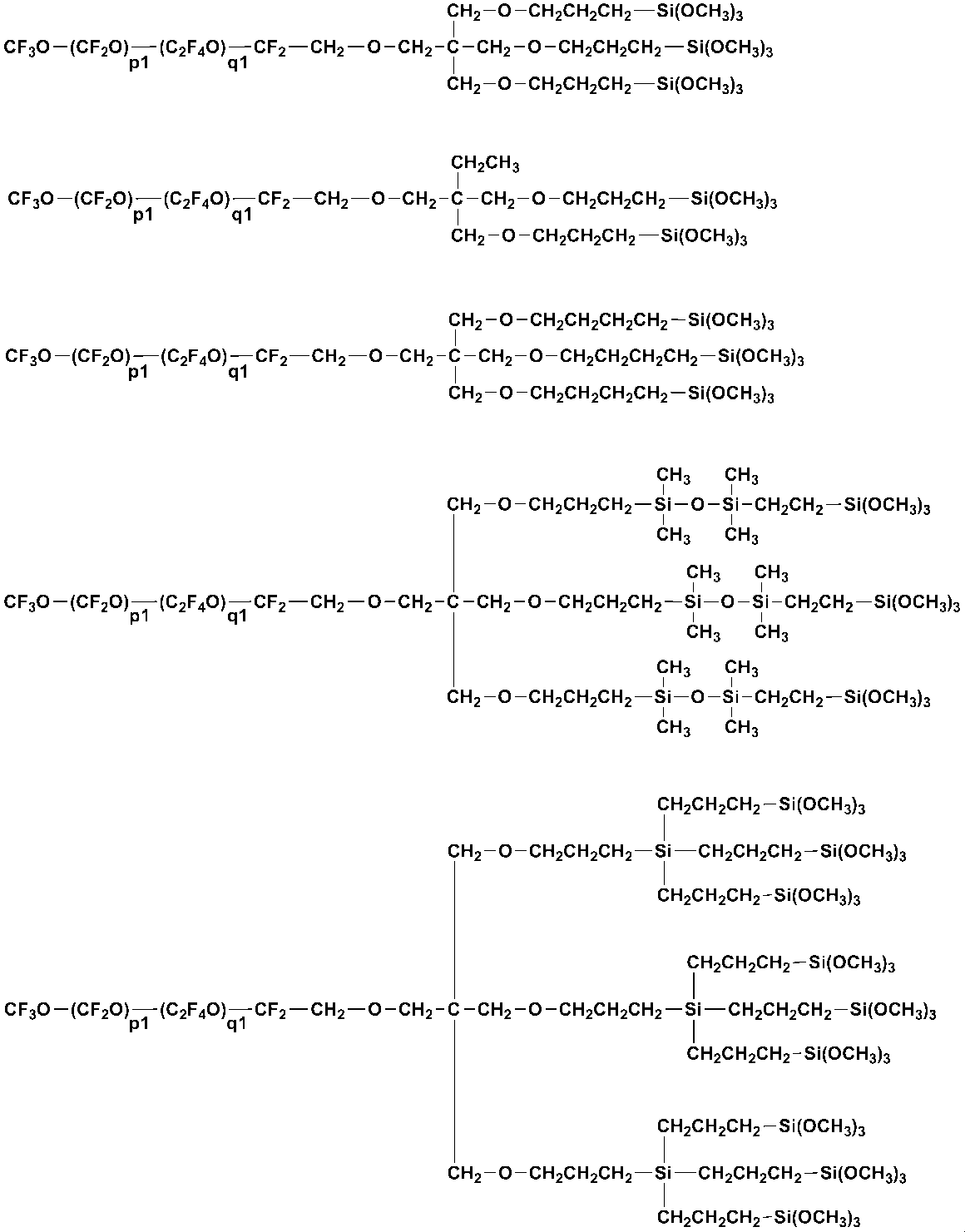
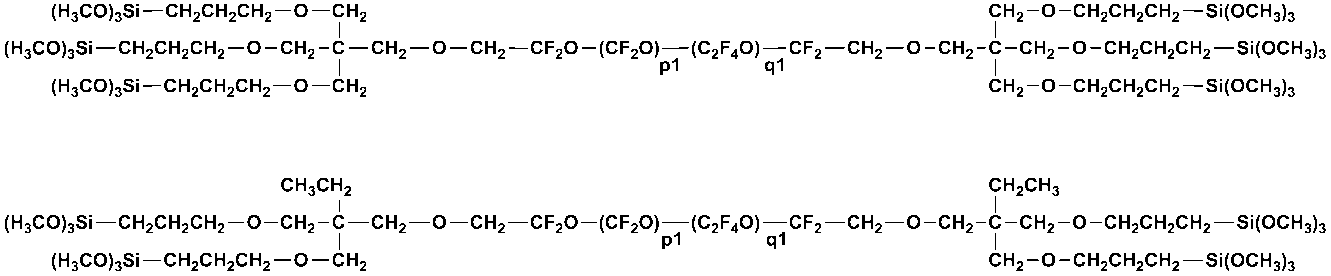
- Prior art keywords
- group
- containing polymer
- integer
- carbon atoms
- formula
- Prior art date
- Legal status (The legal status is an assumption and is not a legal conclusion. Google has not performed a legal analysis and makes no representation as to the accuracy of the status listed.)
- Ceased
Links
Classifications
-
- C—CHEMISTRY; METALLURGY
- C08—ORGANIC MACROMOLECULAR COMPOUNDS; THEIR PREPARATION OR CHEMICAL WORKING-UP; COMPOSITIONS BASED THEREON
- C08G—MACROMOLECULAR COMPOUNDS OBTAINED OTHERWISE THAN BY REACTIONS ONLY INVOLVING UNSATURATED CARBON-TO-CARBON BONDS
- C08G65/00—Macromolecular compounds obtained by reactions forming an ether link in the main chain of the macromolecule
- C08G65/02—Macromolecular compounds obtained by reactions forming an ether link in the main chain of the macromolecule from cyclic ethers by opening of the heterocyclic ring
- C08G65/32—Polymers modified by chemical after-treatment
- C08G65/329—Polymers modified by chemical after-treatment with organic compounds
- C08G65/336—Polymers modified by chemical after-treatment with organic compounds containing silicon
-
- B—PERFORMING OPERATIONS; TRANSPORTING
- B32—LAYERED PRODUCTS
- B32B—LAYERED PRODUCTS, i.e. PRODUCTS BUILT-UP OF STRATA OF FLAT OR NON-FLAT, e.g. CELLULAR OR HONEYCOMB, FORM
- B32B27/00—Layered products comprising a layer of synthetic resin
-
- B—PERFORMING OPERATIONS; TRANSPORTING
- B32—LAYERED PRODUCTS
- B32B—LAYERED PRODUCTS, i.e. PRODUCTS BUILT-UP OF STRATA OF FLAT OR NON-FLAT, e.g. CELLULAR OR HONEYCOMB, FORM
- B32B27/00—Layered products comprising a layer of synthetic resin
- B32B27/30—Layered products comprising a layer of synthetic resin comprising vinyl (co)polymers; comprising acrylic (co)polymers
-
- C—CHEMISTRY; METALLURGY
- C08—ORGANIC MACROMOLECULAR COMPOUNDS; THEIR PREPARATION OR CHEMICAL WORKING-UP; COMPOSITIONS BASED THEREON
- C08G—MACROMOLECULAR COMPOUNDS OBTAINED OTHERWISE THAN BY REACTIONS ONLY INVOLVING UNSATURATED CARBON-TO-CARBON BONDS
- C08G65/00—Macromolecular compounds obtained by reactions forming an ether link in the main chain of the macromolecule
- C08G65/002—Macromolecular compounds obtained by reactions forming an ether link in the main chain of the macromolecule from unsaturated compounds
- C08G65/005—Macromolecular compounds obtained by reactions forming an ether link in the main chain of the macromolecule from unsaturated compounds containing halogens
- C08G65/007—Macromolecular compounds obtained by reactions forming an ether link in the main chain of the macromolecule from unsaturated compounds containing halogens containing fluorine
-
- C—CHEMISTRY; METALLURGY
- C08—ORGANIC MACROMOLECULAR COMPOUNDS; THEIR PREPARATION OR CHEMICAL WORKING-UP; COMPOSITIONS BASED THEREON
- C08G—MACROMOLECULAR COMPOUNDS OBTAINED OTHERWISE THAN BY REACTIONS ONLY INVOLVING UNSATURATED CARBON-TO-CARBON BONDS
- C08G77/00—Macromolecular compounds obtained by reactions forming a linkage containing silicon with or without sulfur, nitrogen, oxygen or carbon in the main chain of the macromolecule
- C08G77/42—Block-or graft-polymers containing polysiloxane sequences
- C08G77/46—Block-or graft-polymers containing polysiloxane sequences containing polyether sequences
-
- C—CHEMISTRY; METALLURGY
- C09—DYES; PAINTS; POLISHES; NATURAL RESINS; ADHESIVES; COMPOSITIONS NOT OTHERWISE PROVIDED FOR; APPLICATIONS OF MATERIALS NOT OTHERWISE PROVIDED FOR
- C09D—COATING COMPOSITIONS, e.g. PAINTS, VARNISHES OR LACQUERS; FILLING PASTES; CHEMICAL PAINT OR INK REMOVERS; INKS; CORRECTING FLUIDS; WOODSTAINS; PASTES OR SOLIDS FOR COLOURING OR PRINTING; USE OF MATERIALS THEREFOR
- C09D171/00—Coating compositions based on polyethers obtained by reactions forming an ether link in the main chain; Coating compositions based on derivatives of such polymers
-
- C—CHEMISTRY; METALLURGY
- C09—DYES; PAINTS; POLISHES; NATURAL RESINS; ADHESIVES; COMPOSITIONS NOT OTHERWISE PROVIDED FOR; APPLICATIONS OF MATERIALS NOT OTHERWISE PROVIDED FOR
- C09K—MATERIALS FOR MISCELLANEOUS APPLICATIONS, NOT PROVIDED FOR ELSEWHERE
- C09K3/00—Materials not provided for elsewhere
- C09K3/18—Materials not provided for elsewhere for application to surfaces to minimize adherence of ice, mist or water thereto; Thawing or antifreeze materials for application to surfaces
Definitions
- the present invention relates to a fluoropolyether group-containing polymer-modified silane, and more specifically, a fluoropolyether group-containing polymer-modified silane that forms a film excellent in water and oil repellency and abrasion resistance, and the silane and / or part thereof.
- the present invention relates to a surface treatment agent containing a (hydrolysis) condensate and an article surface-treated with the surface treatment agent (that is, having a cured film of the surface treatment agent on the surface).
- a fluoropolyether group-containing compound has water and oil repellency, chemical resistance, lubricity, releasability, antifouling property and the like because its surface free energy is very small. Utilizing its properties, it is widely used industrially for water and oil repellent and antifouling agents such as paper and fiber, lubricants for magnetic recording media, oil repellents for precision equipment, mold release agents, cosmetics, and protective films. ing. However, the property means that it is non-adhesive and non-adhesive to other substrates at the same time, and even if it can be applied to the surface of the substrate, it was difficult to make the film adhere to it. .
- a silane coupling agent is well known as a material for bonding a substrate surface such as glass or cloth and an organic compound, and is widely used as a coating agent for various substrate surfaces.
- the silane coupling agent has an organic functional group and a reactive silyl group (generally a hydrolyzable silyl group such as an alkoxysilyl group) in one molecule.
- the hydrolyzable silyl group causes a self-condensation reaction with moisture in the air to form a film.
- the coating becomes a strong coating having durability by chemically and physically bonding the hydrolyzable silyl group to the surface of glass or metal.
- Cured coatings such as lenses and antireflective coatings that have been surface treated with a composition containing a fluoropolyether group-containing polymer-modified silane in which a hydrolyzable silyl group has been introduced into the fluoropolyether group-containing compound are slippery and releasable.
- a composition containing a fluoropolyether group-containing polymer-modified silane in which a hydrolyzable silyl group has been introduced into the fluoropolyether group-containing compound are slippery and releasable.
- the present invention has been made in view of the above circumstances, and is a fluoropolyether group-containing polymer-modified silane capable of forming a cured film excellent in water and oil repellency and abrasion resistance, and the silane and / or part thereof ( It is an object of the present invention to provide a surface treatment agent containing a hydrolyzate condensate and an article surface-treated with the surface treatment agent (having a cured film of the surface treatment agent on the surface).
- the present inventors use a fluoropolyether group-containing polymer-modified silane represented by the following general formula (1) in the fluoropolyether group-containing polymer-modified silane.
- the surface treatment agent containing the silane and / or its partial (hydrolyzed) condensate can form a cured film excellent in water and oil repellency, abrasion resistance, and visibility. It came to.
- the present invention provides the following fluoropolyether group-containing polymer-modified silane, surface treatment agent and article.
- the following general formula (1) (Wherein Rf is a monovalent or divalent fluorooxyalkylene group-containing polymer residue, Q is a divalent hydrocarbon group having 2 to 6 carbon atoms which may contain an ether bond, and Y is A silicon atom, a silylene group and / or a divalent to hexavalent hydrocarbon group optionally having a siloxane bond, R is independently an alkyl group having 1 to 4 carbon atoms, and X is independently a hydroxyl group or hydrolyzed N is an integer of 1 to 3, ⁇ is an integer of 1 to 5, m is an integer of 1 to 5, R ′ is an alkyl group of 1 to 4 carbon atoms, ⁇ Is an integer from 1 to 3, and ⁇ is 1 or 2.)
- a fluoropolyether group-containing polymer-modified silane represented by: [2] ⁇
- Y represents an alkylene group having 3 to 10 carbon atoms, an alkylene group containing an arylene group having 6 to 8 carbon atoms, an alkylene group having a silicon atom, a silylene group, a silalkylene structure, or a silarylene structure.
- Q is —CH 2 OCH 2 — The fluoropolyether group-containing polymer-modified silane according to any one of [1] to [4].
- each X is a hydroxyl group, an alkoxy group having 1 to 10 carbon atoms, an alkoxyalkoxy group having 2 to 10 carbon atoms, an acyloxy group having 2 to 10 carbon atoms, or an alkenyloxy group having 2 to 10 carbon atoms.
- a surface treating agent comprising the fluoropolyether group-containing polymer-modified silane and / or a partial (hydrolyzed) condensate thereof according to any one of [1] to [7].
- the fluoropolyether group-containing polymer-modified silane of the present invention has a large number of reactive functional groups and ether linking groups, adhesion to a substrate and wettability are improved, whereby the silane and / or part thereof ( Articles surface-treated with a surface treatment agent containing a (hydrolysis) condensate are excellent in water and oil repellency, wear resistance and visibility.
- the fluoropolyether group-containing polymer-modified silane of the present invention is represented by the following general formula (1).
- Rf is a monovalent or divalent fluorooxyalkylene group-containing polymer residue
- Q is a divalent hydrocarbon group having 2 to 6 carbon atoms which may contain an ether bond
- Y is A silicon atom, a silylene group and / or a divalent to hexavalent hydrocarbon group optionally having a siloxane bond
- R is independently an alkyl group having 1 to 4 carbon atoms
- X is independently a hydroxyl group or hydrolyzed
- N is an integer of 1 to 3
- ⁇ is an integer of 1 to 5
- m is an integer of 1 to 5
- R ′ is an alkyl group of 1 to 4 carbon atoms
- ⁇ Is an integer from 1 to 3
- ⁇ is 1 or 2.
- the fluoropolyether group-containing polymer-modified silane of the present invention comprises a monovalent or divalent fluorooxyalkylene group-containing polymer residue (Rf), a hydrolyzable silyl group such as an alkoxysilyl group, or a hydroxyl group-containing silyl group (—Si (R) 3-n (X) n ) may have a hydrocarbon chain (Q) and an ether group and a silicon atom, a silylene group and / or a siloxane bond, a divalent to hexavalent hydrocarbon group (Y) It has a structure bonded via, preferably has 3 or more reactive functional groups (X) in the polymer, and has a plurality of ether linking groups to improve the adhesion to the substrate, wear resistance, visual recognition It is characterized by excellent properties.
- Rf monovalent or divalent fluorooxyalkylene group-containing polymer residue
- a hydrolyzable silyl group such as an alkoxysily
- a monovalent fluorooxyalkylene group-containing polymer residue represented by the following general formula (2) (hereinafter sometimes referred to as a monovalent fluorooxyalkyl group) is preferable.
- a divalent fluorooxyalkylene group-containing polymer residue represented by the following general formula (3) (hereinafter sometimes referred to as a divalent fluorooxyalkylene group) is preferable.
- d is an integer of 1 to 3, preferably 1 or 2, and the units (—C d F 2d —) are each independently linear or branched. There may be.
- Rf include the following. (Wherein p ′, q ′, r ′ and s ′ are each an integer of 1 or more, and the upper limit thereof is the same as the upper limit of p, q, r and s. U is an integer of 1 to 24, v is an integer of 1 to 24. Each repeating unit may be bonded at random.)
- Y is a divalent to hexavalent, preferably divalent to tetravalent, more preferably divalent hydrocarbon group, which may have a silicon atom, a silylene group and / or a siloxane bond,
- a coating film having excellent wear resistance can be provided.
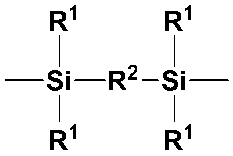
- Y examples include a propylene group (trimethylene group, methylethylene group), a butylene group (tetramethylene group, methylpropylene group), a C3-C10 alkylene group such as a hexamethylene group, and a carbon such as a phenylene group.
- An alkylene group containing an arylene group of 6 to 8 (for example, an alkylene / arylene group of 8 to 16 carbon atoms) and an alkylene group are bonded to each other via a silicon atom, a silylene group, a silalkylene structure, or a silarylene structure.
- Divalent group 2 to 10 silicon atoms, preferably 2 to 5 linear, branched or cyclic divalent to hexavalent organopolysiloxane residues, or the number of carbon atoms in the bond of silicon atoms
- Examples thereof include divalent to hexavalent groups to which an alkylene group having 2 to 10 is bonded, and preferably an alkylene group having 3 to 10 carbon atoms and an phenylene group.
- R 1 is an alkyl group having 1 to 4 carbon atoms such as a methyl group, an ethyl group, a propyl group or a butyl group, or an aryl group having 6 to 10 carbon atoms such as a phenyl group
- R 2 is an alkylene group having 1 to 4 carbon atoms such as a methylene group, ethylene group, propylene group (trimethylene group or methylethylene group), or an arylene group having 6 to 10 carbon atoms such as a phenylene group.
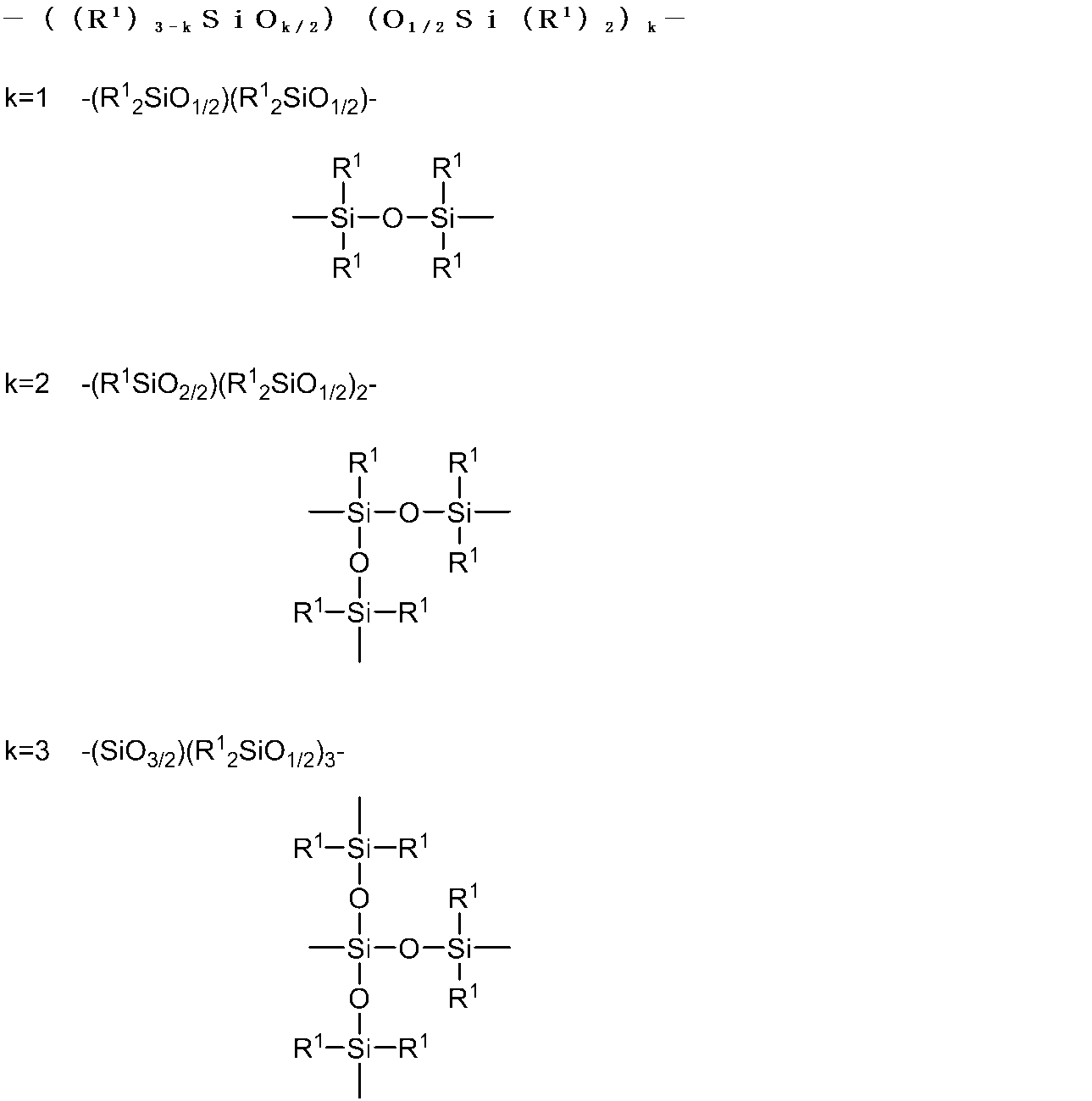
- linear, branched or cyclic divalent to hexavalent organopolysiloxane residues having 2 to 10, preferably 2 to 5 silicon atoms include the following.
- R 1 is the same as above, g is an integer of 1 to 9, preferably 1 to 4, h is an integer of 2 to 6, preferably 2 to 4, and j is 0)
- h + j is an integer of 3 to 10, preferably an integer of 3 to 5
- k is an integer of 1 to 3, preferably 2 or 3.
- Y include the following groups.
- Q is a divalent hydrocarbon group having 2 to 6 carbon atoms which may contain an ether bond.
- Q include an ethylene group, a propylene group (trimethylene group, a methylethylene group), a butylene group (tetramethylene group, a methylpropylene group), a hexamethylene group and other alkylene groups having 2 to 6 carbon atoms, an ether bond Alkylene group having 2 to 6 carbon atoms such as ethylene group, propylene group (trimethylene group, methylethylene group), butylene group (tetramethylene group, methylpropylene group), hexamethylene group, and the like, preferably ether bond Is an alkylene group having 2 or 3 carbon atoms in between.
- Q include the following groups.
- X is a hydroxyl group or a hydrolyzable group which may be different from each other.
- examples of such X include hydroxyl groups, methoxy groups, ethoxy groups, propoxy groups, isopropoxy groups, butoxy groups and the like, alkoxy groups having 1 to 10 carbon atoms, methoxymethoxy groups, methoxyethoxy groups and the like having 2 to 10 carbon atoms.
- Examples include an alkoxy-substituted alkoxy group, an acyloxy group having 2 to 10 carbon atoms such as an acetoxy group, an alkenyloxy group having 2 to 10 carbon atoms such as an isopropenoxy group, a halogen atom such as a chloro atom, a bromo atom, and an iodo atom.
- a methoxy group, an ethoxy group, an isopropenoxy group, and a chloro atom are preferable.
- R is an alkyl group having 1 to 4 carbon atoms such as a methyl group, an ethyl group, a propyl group, a butyl group, and among them, a methyl group and an ethyl group are preferable.
- n is an integer of 1 to 3, preferably 2 or 3, and 3 is more preferable from the viewpoint of reactivity and adhesion to a substrate.
- m is an integer of 1 to 5, and 1 or 2 is preferable from the viewpoint of obtaining raw materials.
- ⁇ is an integer of 1 to 5, and is preferably an integer of 1 to 3 from the viewpoint of easiness of synthesis, stability of the product, and the like.
- R ′ is an alkyl group having 1 to 4 carbon atoms such as a methyl group, an ethyl group, a propyl group, or a butyl group. Among them, a methyl group or an ethyl group is preferable.
- ⁇ is an integer of 1 to 3, and 2 or 3 is preferable from the viewpoint of reactivity and adhesion to a substrate.
- Examples of the fluoropolyether group-containing polymer-modified silane represented by the above formula (1) include those represented by the following formula.
- the number of repeating units (or the degree of polymerization) constituting the fluorooxyalkyl group or fluorooxyalkylene group can take any number satisfying the above formulas (2) and (3). It is.
- Examples of the method for preparing the fluoropolyether group-containing polymer-modified silane represented by the above formula (1) and ⁇ being 1 include the following methods.
- a fluorooxyalkyl group-containing polymer having preferably two or more (particularly two or three) olefin moieties at one end of the molecular chain is used as a solvent, for example, a fluorine-based polymer such as 1,3-bis (trifluoromethyl) benzene.
- An organic silicon compound dissolved in a solvent and having a SiH group and a hydrolyzable terminal group (alkoxy group such as methoxy group) in a molecule such as trimethoxysilane, and a hydrosilylation reaction catalyst such as a chloroplatinic acid / vinylsiloxane complex In the presence of a toluene solution at a temperature of 40 to 120 ° C., preferably 60 to 100 ° C., more preferably about 80 ° C. for 1 to 48 hours, preferably 2 to 10 hours, more preferably about 5 hours, Hydrosilylation addition reaction and aging.
- a fluorooxyalkyl group-containing polymer having preferably two or more (particularly two or three) olefin moieties at one end of the molecular chain is used as a solvent, for example, a fluorine-based polymer such as 1,3-bis (trifluoromethyl) benzene.
- An organosilicon compound having a SiH group and a hydrolyzable end group in a molecule such as trichlorosilane is dissolved in a solvent and a hydrosilylation reaction catalyst such as a chloroplatinic acid / vinylsiloxane complex in a toluene solution is present at 40 to 120 ° C.
- a hydrosilylation reaction catalyst such as a chloroplatinic acid / vinylsiloxane complex in a toluene solution is present at 40 to 120 ° C.
- a hydrosilylation addition reaction and aging at a temperature of preferably 60 to 100 ° C., more preferably about 80 ° C. for 1 to 48 hours, preferably 2 to 10 hours, more preferably about 5 hours.
- a hydrolyzable group such as an alkoxy group such as a methoxy group with a substituent (such as a chlorine atom bonded to a silicon atom) on a silyl group To convert.
- a SiH group-containing organosilicon compound having no hydrolyzable end group can also be used.
- an organosilicon compound having no hydrolyzable end groups in the molecule and having two or more SiH groups preferably a fluorooxyalkyl group-containing polymer having two or more (particularly two or three) olefin moieties at one end of the molecular chain and a hydrolyzable end group in the molecule.
- a reaction product having 2 or more (especially 2 or 3) residual SiH groups at the end of one molecular chain by hydrosilylation addition reaction with an organosilicon compound having 2 or more SiH groups After the (intermediate) is produced, a residual SiH group at the polymer end of the reaction product (intermediate) and an organosilicon compound having an olefin moiety and a hydrolyzable end group in the molecule such as allyltrimethoxysilane Hydrosilation reaction catalyst, for example, in the presence of a toluene solution of chloroplatinic acid / vinylsiloxane complex, at a temperature of 40 to 120 ° C., preferably 60 to 100 ° C., more preferably about 80 ° C. 1 to 48 hours, preferably 2 to 10 hours, more preferably under conditions of about 5 hours, is aged together to hydrosilylation addition reaction again.
- fluorooxyalkyl group-containing polymer having an olefin moiety at one end of the molecular chain a fluorooxyalkyl group-containing polymer represented by the following general formula (4) can be exemplified.
- Rf, R ′, Q, m, and ⁇ are the same as above.
- Z is a divalent hydrocarbon group.
- Z is a divalent hydrocarbon group, preferably a divalent hydrocarbon group having 1 to 8 carbon atoms, particularly 1 to 4 carbon atoms.
- a methylene group, an ethylene group, C1-C8 alkylene group such as propylene group (trimethylene group, methylethylene group), butylene group (tetramethylene group, methylpropylene group), hexamethylene group, octamethylene group, etc.
- C6-C8 such as phenylene group
- an alkylene group containing an arylene group for example, an alkylene / arylene group having 7 to 8 carbon atoms.
- Z is preferably a linear alkylene group having 1 to 4 carbon atoms.
- Preferred examples of the fluorooxyalkyl group-containing polymer represented by the formula (4) include those shown below.
- the number of repeats (or the degree of polymerization) of each repeating unit constituting the fluorooxyalkyl group can be any number satisfying the formula (2) in Rf.
- Examples of the method for preparing the fluorooxyalkyl group-containing polymer represented by the above formula (4) include, for example, a fluorooxyalkyl group-containing polymer having a hydroxyl group at one end of a molecular chain and an olefin introducing agent in the presence of a base. Aging is carried out at 0 to 90 ° C., preferably 50 to 80 ° C., more preferably about 60 ° C. for 1 to 40 hours, preferably 10 to 30 hours, more preferably about 20 hours, if necessary using additives and solvents. To do.
- Examples of the fluorooxyalkyl group-containing polymer having a hydroxyl group at one end of the molecular chain used for the preparation of the fluorooxyalkyl group-containing polymer represented by formula (4) include the following.
- u1 is an integer of 1 to 24, and r1, p1, q1, and p1 + q1 are the same as above.
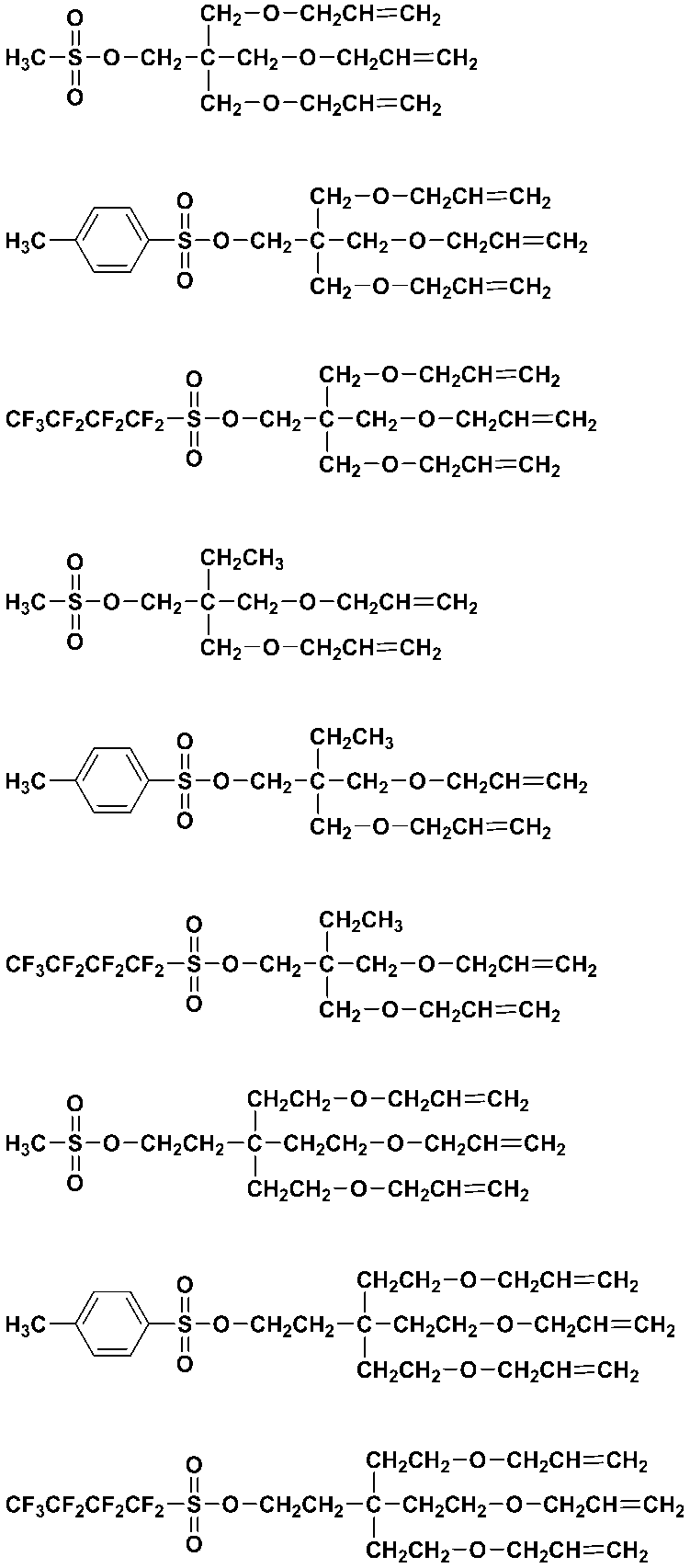
- the olefin introducing agent can be prepared by a known method.
- the amount of the olefin introducing agent used is preferably 1 to 5 equivalents as a sulfonic acid ester residue with respect to 1 equivalent of the reactive terminal group (terminal hydroxyl group) of the fluorooxyalkyl group-containing polymer having a hydroxyl group at one end of the molecular chain.
- amines and alkali metal bases can be used as a base used for the preparation of the fluorooxyalkyl group-containing polymer represented by the formula (4).
- amines and alkali metal bases can be used.
- examples include diisopropylethylamine, pyridine, DBU, and imidazole.
- alkali metal bases sodium hydroxide, potassium hydroxide, sodium hydride, potassium hydride, alkyllithium, t-butoxypotassium, lithium diisopropylamide, lithium bis (trimethylsilyl) amide, sodium bis (trimethylsilyl) amide, potassium bis And (trimethylsilyl) amide.
- the amount of the base used is 1 to 20 equivalents, more preferably 5 to 15 equivalents, and still more preferably about 9 equivalents with respect to 1 equivalent of the reactive terminal group of the polymer having a hydroxyl group at one end of the molecular chain. Can be used.
- tetrabutylammonium halide for the preparation of the fluorooxyalkyl group-containing polymer represented by the formula (4), tetrabutylammonium halide, alkali metal halide or the like may be used as an additive for improving reactivity or as a phase transfer catalyst.
- the additive include tetrabutylammonium chloride, tetrabutylammonium bromide, tetrabutylammonium iodide, tetrabutylammonium hydrogen sulfate, sodium iodide, potassium iodide, cesium iodide, crown ether and the like.
- additives improve the reactivity by catalytically exchanging halogens with the olefin introducing agent in the reaction system, and the crown ether coordinates with the metal to improve the reactivity.
- the additive is used in an amount of 0.005 to 0.2 equivalent, more preferably 0.01 to 0.00, per 1 equivalent of the reactive end group of the fluorooxyalkyl group-containing polymer having a hydroxyl group at one end of the molecular chain. 15 equivalents, more preferably about 0.1 equivalents can be used.
- a solvent may be used for the preparation of the fluorooxyalkyl group-containing polymer represented by the formula (4).
- fluorine-containing aromatic hydrocarbon solvents such as 1,3-bis (trifluoromethyl) benzene and trifluoromethylbenzene, 1,1,1,2,3,4, Hydrofluoroether (HFE) solvents such as 4,5,5,5-decafluoro-3-methoxy-2- (trifluoromethyl) pentane (manufactured by 3M, trade name: Novec series), fully fluorinated A perfluoro solvent composed of a compound (trade name: Fluorinert series, manufactured by 3M Co.) may be used.
- HFE Hydrofluoroether
- dimethylformamide, dimethylacetamide, dimethyl sulfoxide, acetonitrile, THF, or the like can be used as the organic solvent.
- water may be used.
- the amount of solvent used is 10 to 300 parts by weight, preferably 30 to 150 parts by weight, more preferably about 50 parts by weight, based on 100 parts by weight of the fluorooxyalkyl group-containing polymer having a hydroxyl group at one end of the molecular chain. Can be used.
- the solvent used is preferably a fluorinated solvent
- the fluorinated solvent is 1,3-bis ( Trifluoromethyl) benzene, trifluoromethylbenzene, methyl nonafluorobutyl ether, methyl nonafluoroisobutyl ether, ethyl nonafluorobutyl ether, ethyl nonafluoroisobutyl ether, 1,1,1,2,3,4,4,5,5 , 5-decafluoro-3-methoxy-2- (trifluoromethyl) pentane and other hydrofluoroether (HFE) solvents (trade name: Novec series, manufactured by 3M), composed of fully fluorinated compounds Perfluoro solvent (made by 3M, trade name: Florinato Siri ), And the like.
- HFE hydrofluoroether
- the solvent is used in an amount of 10 to 300 parts by weight, preferably 50 to 150 parts by weight, more preferably about 100 parts by weight with respect to 100 parts by weight of the fluorooxyalkyl group-containing polymer having an olefin moiety at one end of the molecular chain. be able to.
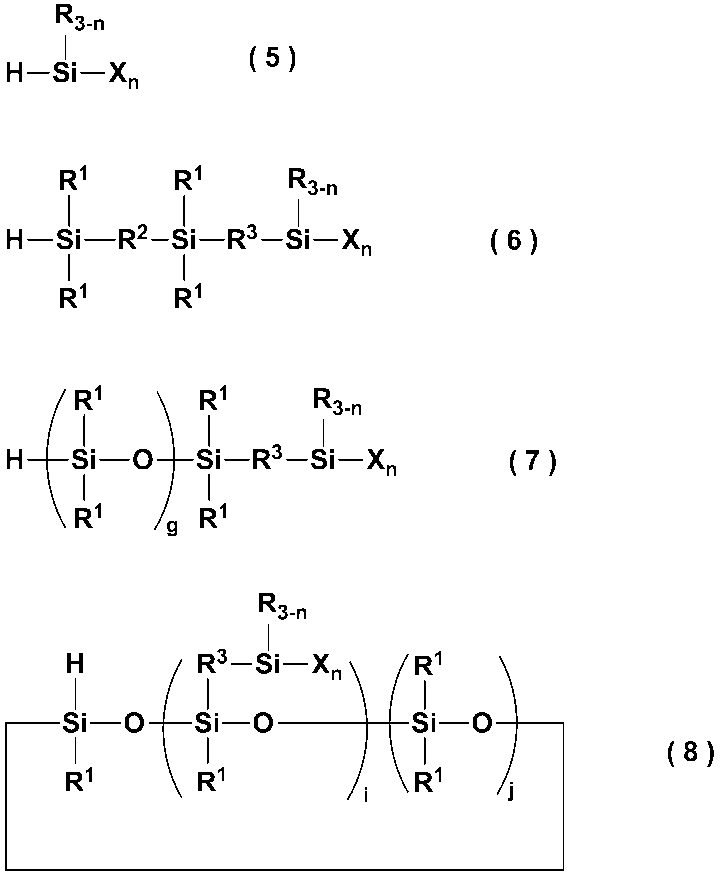
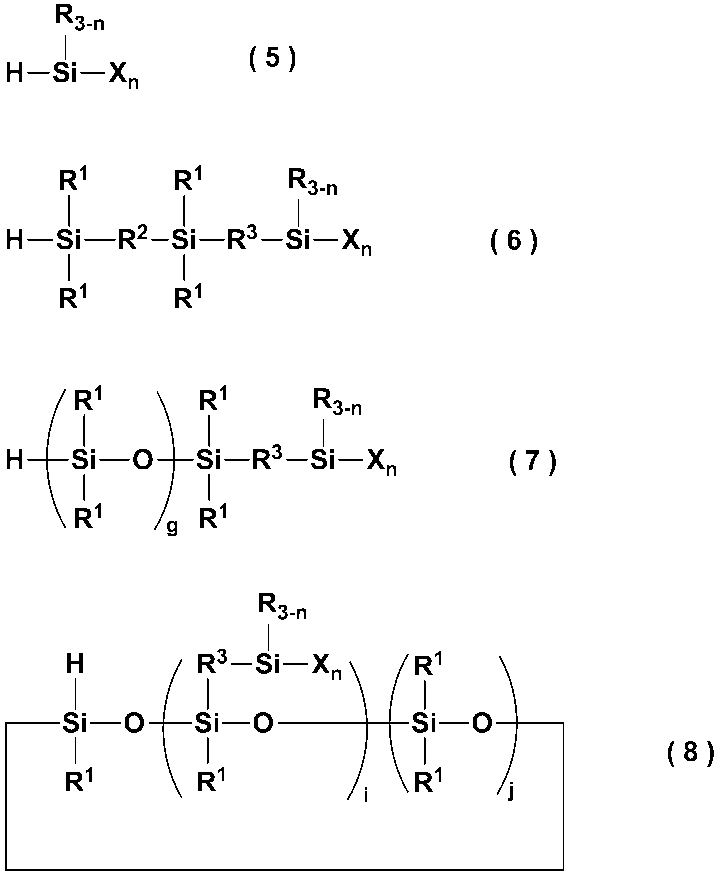
- an organosilicon compound having a SiH group and a hydrolyzable end group in the molecule includes the following general formula: Compounds represented by (5) to (8) are preferred. Wherein R, X, n, R 1 , R 2 , g and j are the same as above. R 3 is a divalent hydrocarbon group having 2 to 8 carbon atoms. I is an integer of 1 to 5 (It is preferably an integer of 1 to 3, and i + j is an integer of 2 to 9, preferably an integer of 2 to 4.)
- the divalent hydrocarbon group having 2 to 8 carbon atoms, preferably 2 to 3 carbon atoms of R 3 includes ethylene group, propylene group (trimethylene group, methylethylene group), butylene group (tetramethylene group, methylpropylene group). ), An alkylene group such as a hexamethylene group and an octamethylene group, an arylene group such as a phenylene group, or a combination of two or more of these groups (an alkylene / arylene group, etc.). Among these, an ethylene group and trimethylene Groups are preferred.
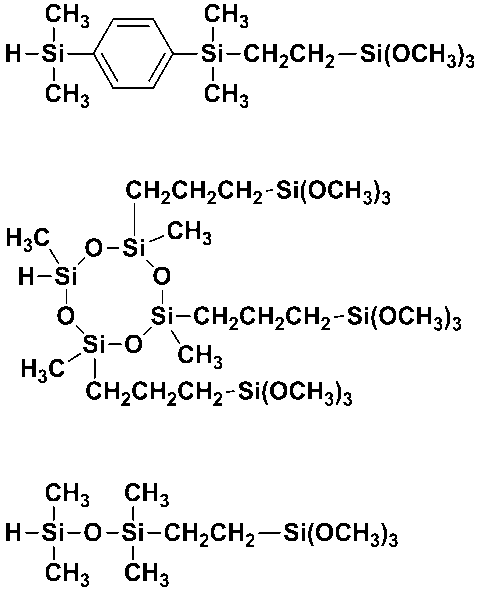
- organosilicon compound having a SiH group and a hydrolyzable terminal group in the molecule examples include trimethoxysilane, triethoxysilane, tripropoxysilane, triisopropoxysilane, tributoxysilane, and triisopropenoxysilane. , Triacetoxysilane, trichlorosilane, tribromosilane, triiodosilane, and the following silanes.
- ⁇ 1, a fluorooxyalkyl group-containing polymer having an olefin moiety at one end of a molecular chain and a SiH group and hydrolysis in the molecule
- the amount of the organosilicon compound having a SiH group and a hydrolyzable end group in the molecule when reacting with the organosilicon compound having a functional end group is a fluorooxyalkyl group-containing polymer having an olefin moiety at one end of the molecular chain. 1 to 3 equivalents, more preferably 1.5 to 2.5 equivalents, and still more preferably about 2 equivalents to 1 equivalent of the reactive end group.
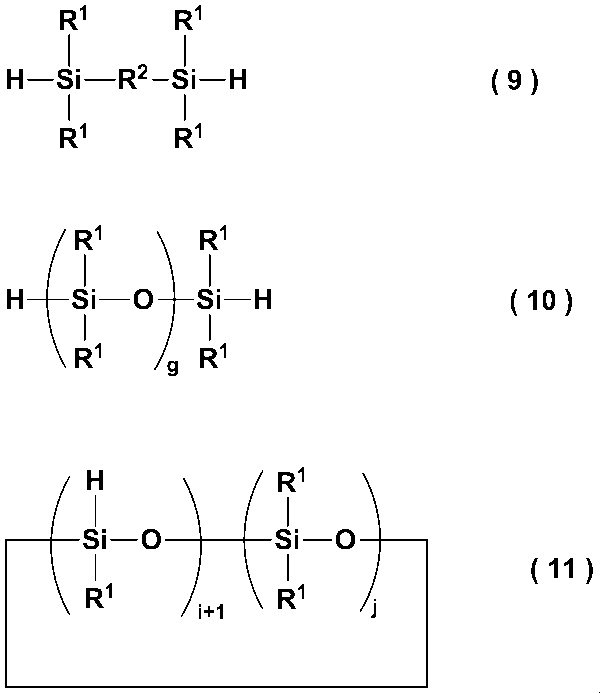
- organosilicon having no hydrolyzable end group in the molecule and having two or more SiH groups As the compound, compounds represented by the following general formulas (9) to (11) are preferable. (In the formula, R 1 , R 2 , g, j, i, i + j are the same as above.)
- organosilicon compound having no hydrolyzable end group in the molecule and having two or more SiH groups examples include those shown below.
- a fluorooxyalkyl group-containing polymer having an olefin moiety at one end of the molecular chain and a hydrolyzable end group in the molecule The amount of the organosilicon compound having no hydrolyzable end group and having two or more SiH groups in the molecule when reacting with the organosilicon compound having two or more SiH groups is 7 to 30 equivalents, more preferably 10 to 20 equivalents, and still more preferably about 15 equivalents can be used per 1 equivalent of reactive end group of the fluorooxyalkyl group-containing polymer having an olefin moiety at the chain end.
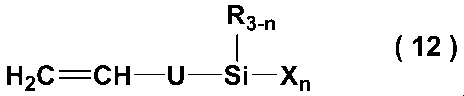
- an organosilicon compound having an olefin moiety and a hydrolyzable end group in the molecule includes the following general formula:
- the compound represented by (12) is preferred.
- R, X and n are the same as described above.
- U is a single bond or a divalent hydrocarbon group having 1 to 6 carbon atoms.
- U is a single bond or a divalent hydrocarbon group having 1 to 6 carbon atoms.
- the divalent hydrocarbon group having 1 to 6 carbon atoms include a methylene group and an ethylene group.
- a propylene group (trimethylene group, methylethylene group), a butylene group (tetramethylene group, methylpropylene group), an alkylene group such as a hexamethylene group, and a phenylene group.
- U is preferably a single bond or a methylene group.
- a fluoropolyether group-containing polymer-modified silane represented by the formula (1) and ⁇ 1, a fluorooxyalkyl group-containing polymer having an olefin moiety at one end of the molecular chain and a hydrolyzable end group in the molecule
- the amount of the organosilicon compound having a decomposable end group is such that the polymer chain has a fluorooxyalkyl group-containing polymer having an olefin moiety at one end of the molecular chain and has no hydrolyzable end groups in the molecule and has at least two SiH groups.
- 3 to 9 equivalents, more preferably 5 to 7 equivalents, and even more preferably about 6 equivalents are used per 1 equivalent of the reactive end group of the reaction product with the organosili
- hydrosilylation reaction catalysts include platinum black, chloroplatinic acid, alcohol-modified chloroplatinic acid, platinum chloride
- examples include complexes of acids with olefins, aldehydes, vinyl siloxanes, acetylene alcohols, and the like, and platinum group metal catalysts such as tetrakis (triphenylphosphine) palladium and chlorotris (triphenylphosphine) rhodium.
- platinum compounds such as vinylsiloxane coordination compounds.
- the amount of hydrosilylation reaction catalyst used is a fluorooxyalkyl group-containing polymer having an olefin moiety at one end of the molecular chain, or an organic compound having no hydrolyzable end groups in the polymer and molecule and having two or more SiH groups. It is used in an amount of 0.1 to 100 ppm, more preferably 1 to 50 ppm in terms of transition metal (mass) with respect to the mass of the reaction product with the silicon compound.
- the target compound can be obtained by depressurizingly distilling a solvent and an unreacted substance.
- a fluorooxyalkyl group-containing polymer having an olefin moiety at one end of a molecular chain a compound represented by the following formula
- trimethoxysilane is used as the organosilicon compound having a SiH group and a hydrolyzable end group in the molecule, a compound represented by the following formula is obtained.
- Examples of the preparation method of the fluoropolyether group-containing polymer-modified silane represented by the above formula (1) and ⁇ being 2 include the following methods.
- An organic silicon compound having a SiH group and a hydrolyzable end group in a molecule such as trimethoxysilane is dissolved in a system solvent, and a hydrosilylation reaction catalyst such as chloroplatinic acid / vinylsiloxane complex in the presence of a toluene solution Hydrosilylation addition reaction and aging at 120 ° C., preferably 60 to 100 ° C., more preferably about 80 ° C. for 1 to 48 hours, preferably 2 to 10 hours, more preferably about 5 hours. .
- a fluorooxyalkylene group-containing polymer having two or more (particularly two or three) olefin moieties at both ends of the molecular chain is used as a solvent, for example, fluorine such as 1,3-bis (trifluoromethyl) benzene.
- An organic silicon compound having a SiH group and a hydrolyzable end group in a molecule such as trichlorosilane is dissolved in a system solvent and a hydrosilylation reaction catalyst such as a chloroplatinic acid / vinylsiloxane complex in a toluene solution is present in an amount of 40 to 120.
- Hydrosilylation addition reaction and aging at a temperature of 1 ° C., preferably 60 to 100 ° C., more preferably about 80 ° C. for 1 to 48 hours, preferably 2 to 10 hours, more preferably about 5 hours. Thereafter, the substituent on the silyl group is converted to, for example, a methoxy group.
- a SiH group-containing organosilicon compound having no hydrolyzable end group can also be used.
- an organosilicon compound having no hydrolyzable end groups in the molecule and having two or more SiH groups As an organosilicon compound having no hydrolyzable end groups in the molecule and having two or more SiH groups.
- the product (intermediate) is formed, preferably two or more (particularly two or three) of SiH groups and allyltrimethoxysilane molecules remaining at the polymer ends of the reactant (intermediate), respectively
- a hydrosilylation reaction catalyst such as a chloroplatinic acid / vinylsiloxane complex in a toluene solution
- an organic silicon compound having an olefin moiety and a hydrolyzable end group in the presence of 40 to 40
- the hydrosilylation addition reaction is carried out again at a temperature of 20 ° C., preferably 60 to 100 ° C., more preferably about 80 ° C. for 1 to 48 hours, preferably 2 to 10 hours, and more preferably about 5 hours.
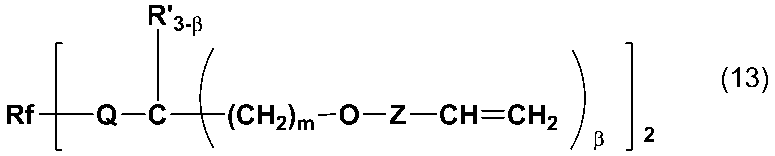
- the fluorooxyalkylene group-containing polymer having an olefin moiety at both ends of the molecular chain can be exemplified by a fluorooxyalkylene group-containing polymer represented by the following general formula (13).
- Rf, R ′, Q, m, Z, and ⁇ are the same as above.
- Preferred examples of the fluorooxyalkylene group-containing polymer represented by the formula (13) include those shown below.
- the number of repeating units (or the degree of polymerization) constituting the fluorooxyalkylene group can be any number satisfying the formula (3) in Rf. (Wherein p1, q1, and p1 + q1 are the same as above)
- a fluorooxyalkylene group-containing polymer represented by the above formula (13) for example, a fluorooxyalkylene group-containing polymer having a hydroxyl group at both ends of a molecular chain and an olefin introducing agent in the presence of a base, Aging is carried out at 0 to 90 ° C., preferably 50 to 80 ° C., more preferably about 60 ° C. for 1 to 40 hours, preferably 10 to 30 hours, more preferably about 20 hours, if necessary using additives and solvents. To do.
- Examples of the fluorooxyalkylene group-containing polymer having a hydroxyl group at both ends of the molecular chain used for the preparation of the fluorooxyalkylene group-containing polymer represented by the formula (13) include the following.
- v1 is an integer of 1 to 24, and u1, p1, q1, and p1 + q1 are the same as above.
- the olefin introducing agent can be prepared by a known method.
- the amount of the olefin introducing agent used is preferably 1 to 5 equivalents as a sulfonic acid ester residue with respect to 1 equivalent of the reactive end group (terminal hydroxyl group) of the fluorooxyalkylene group-containing polymer having hydroxyl groups at both ends of the molecular chain.
- Examples of the base used for the preparation of the fluorooxyalkylene group-containing polymer represented by the formula (13) include amines and alkali metal bases.
- Specific examples of amines include triethylamine, Examples include diisopropylethylamine, pyridine, DBU, and imidazole.
- alkali metal bases sodium hydroxide, potassium hydroxide, sodium hydride, potassium hydride, alkyllithium, t-butoxypotassium, lithium diisopropylamide, lithium bis (trimethylsilyl) amide, sodium bis (trimethylsilyl) amide, potassium bis And (trimethylsilyl) amide.
- the amount of the base used is 1 to 20 equivalents, more preferably 5 to 15 equivalents, and even more preferably about 9 equivalents with respect to 1 equivalent of the reactive end group of the fluorooxyalkylene group-containing polymer having hydroxyl groups at both ends of the molecular chain. Can be used.
- tetrabutylammonium halide for the preparation of the fluorooxyalkylene group-containing polymer represented by the formula (13), tetrabutylammonium halide, alkali metal halide or the like may be used as an additive for improving reactivity or as a phase transfer catalyst.
- the additive include tetrabutylammonium chloride, tetrabutylammonium bromide, tetrabutylammonium iodide, tetrabutylammonium hydrogen sulfate, sodium iodide, potassium iodide, cesium iodide, crown ether and the like.
- additives improve the reactivity by catalytically exchanging halogens with the olefin introducing agent in the reaction system, and the crown ether coordinates with the metal to improve the reactivity.
- the additive is used in an amount of 0.005 to 0.2 equivalent, more preferably 0.01 to 0.000, based on 1 equivalent of the reactive end group of the fluorooxyalkylene group-containing polymer having hydroxyl groups at both ends of the molecular chain. 15 equivalents, more preferably about 0.1 equivalents can be used.
- a solvent may be used for the preparation of the fluorooxyalkylene group-containing polymer represented by the formula (13).
- the solvent used include fluorine-containing aromatic hydrocarbon solvents such as 1,3-bis (trifluoromethyl) benzene and trifluoromethylbenzene, , 1,2,3,4,4,5,5,5-decafluoro-3-methoxy-2- (trifluoromethyl) pentane and other hydrofluoroether (HFE) solvents (manufactured by 3M, trade name: Novec series), perfluoro solvents (made by 3M, trade name: Fluorinert series) composed of fully fluorinated compounds.
- HFE hydrofluoroether
- dimethylformamide, dimethylacetamide, dimethyl sulfoxide, acetonitrile, THF, or the like can be used as the organic solvent.
- water may be used.
- the amount of the solvent used is 10 to 300 parts by weight, preferably 30 to 150 parts by weight, more preferably about 50 parts by weight with respect to 100 parts by weight of the fluorooxyalkylene group-containing polymer having hydroxyl groups at both ends of the molecular chain. Can be used.
- the solvent used is preferably a fluorinated solvent
- the fluorinated solvent is 1,3-bis ( Trifluoromethyl) benzene, trifluoromethylbenzene, methyl nonafluorobutyl ether, methyl nonafluoroisobutyl ether, ethyl nonafluorobutyl ether, ethyl nonafluoroisobutyl ether, 1,1,1,2,3,4,4,5,5 , 5-decafluoro-3-methoxy-2- (trifluoromethyl) pentane and other hydrofluoroether (HFE) solvents (trade name: Novec series, manufactured by 3M), composed of fully fluorinated compounds Perfluoro solvent (made by 3M, trade name: Florinato Siri ), And the like.
- HFE hydrofluoroether
- the solvent is used in an amount of 10 to 300 parts by weight, preferably 50 to 150 parts by weight, more preferably about 100 parts by weight, based on 100 parts by weight of the fluorooxyalkylene group-containing polymer having olefin moieties at both ends of the molecular chain. Can be used.
- an organosilicon compound having a SiH group and a hydrolyzable end group in the molecule includes the following general formula: Compounds represented by (5) to (8) are preferred.
- organosilicon compound having a SiH group and a hydrolyzable terminal group in the molecule examples include trimethoxysilane, triethoxysilane, tripropoxysilane, triisopropoxysilane, tributoxysilane, and triisopropenoxysilane. , Triacetoxysilane, trichlorosilane, tribromosilane, triiodosilane, and the following silanes.
- the amount of the organosilicon compound having a SiH group and a hydrolyzable end group in the molecule when reacting with the organosilicon compound having a decomposable end group is a fluorooxyalkylene group having an olefin moiety at both ends of the molecular chain. 1 to 3 equivalents, more preferably 1.5 to 2.5 equivalents, and still more preferably about 2 equivalents can be used per 1 equivalent of reactive end groups of the containing polymer.
- organosilicon having no hydrolyzable end groups in the molecule and having two or more SiH groups As the compound, compounds represented by the following general formulas (9) to (11) are preferable.
- R 1 , R 2 , g, j, i, i + j are the same as above.
- organosilicon compound having no hydrolyzable end group in the molecule and having two or more SiH groups examples include those shown below.
- a fluorooxyalkylene group-containing polymer having an olefin moiety at both ends of the molecular chain and a hydrolyzable end in the molecule The amount of the organosilicon compound having no hydrolyzable end group in the molecule and having two or more SiH groups in the molecule when reacting with an organosilicon compound having two or more SiH groups without having a group is: It can be used in an amount of 7 to 30 equivalents, more preferably 10 to 20 equivalents, and even more preferably about 15 equivalents per 1 equivalent of the reactive end group of the fluorooxyalkylene group-containing polymer having olefin moieties at both ends of the molecular chain. .
- the organosilicon compound having an olefin moiety and a hydrolyzable end group in the molecule includes the following general formula:
- the compound represented by (12) is preferred. (In the formula, R, X, U and n are the same as above.)
- a fluoropolyether group-containing polymer-modified silane represented by the formula (1) and ⁇ is 2, a fluorooxyalkylene group-containing polymer having an olefin moiety at both ends of the molecular chain and a hydrolyzable end in the molecule
- An olefin moiety in the molecule when reacting a reaction product of an organosilicon compound having two or more SiH groups with no olefin group and an organosilicon compound having an olefin moiety and a hydrolyzable end group in the molecule;
- the amount of the organosilicon compound having a hydrolyzable end group is a fluorooxyalkylene group-containing polymer having an olefin moiety at both ends of the molecular chain and two SiH groups without hydrolyzable end groups in the molecule.
- the hydrosilylation reaction catalyst may be platinum black, chloroplatinic acid, alcohol-modified chloroplatinic acid, platinum chloride
- examples include complexes of acids with olefins, aldehydes, vinyl siloxanes, acetylene alcohols, and the like, and platinum group metal catalysts such as tetrakis (triphenylphosphine) palladium and chlorotris (triphenylphosphine) rhodium.
- platinum compounds such as vinylsiloxane coordination compounds.
- the amount of the hydrosilylation catalyst used is a fluorooxyalkylene group-containing polymer having olefin moieties at both ends of the molecular chain, or this polymer and the molecule do not have hydrolyzable end groups and have at least two SiH groups. It is used in an amount of 0.1 to 100 ppm, more preferably 1 to 50 ppm in terms of transition metal (mass) with respect to the mass of the reaction product with the organosilicon compound.
- the target compound can be obtained by depressurizingly distilling a solvent and an unreacted substance.
- a fluorooxyalkylene group-containing polymer having an olefin moiety at both ends of the molecular chain a compound represented by the following formula
- trimethoxysilane is used as the organosilicon compound having a SiH group and a hydrolyzable end group in the molecule, a compound represented by the following formula is obtained.
- the present invention further provides a surface treatment agent containing the fluoropolyether group-containing polymer-modified silane.
- the surface treatment agent condenses a hydroxyl group of the fluoropolyether group-containing polymer-modified silane or a hydroxyl group obtained by partially hydrolyzing a terminal hydrolyzable group of the fluoropolyether group-containing polymer-modified silane in advance by a known method. It may contain a partial (hydrolysis) condensate obtained in this way.
- the surface treatment agent may be a hydrolysis-condensation catalyst such as an organic tin compound (dibutyltin dimethoxide, dibutyltin dilaurate, etc.), an organic titanium compound (tetran-butyl titanate, etc.), an organic acid (acetic acid, Methanesulfonic acid, fluorine-modified carboxylic acid, etc.) and inorganic acid (hydrochloric acid, sulfuric acid, etc.) may be added.
- an organic tin compound dibutyltin dimethoxide, dibutyltin dilaurate, etc.
- an organic titanium compound tetran-butyl titanate, etc.
- an organic acid acetic acid, Methanesulfonic acid, fluorine-modified carboxylic acid, etc.
- inorganic acid hydroochloric acid, sulfuric acid, etc.
- the addition amount of the hydrolysis-condensation catalyst is a catalytic amount, and is usually 0.01 to 5 parts by mass, particularly 0, relative to 100 parts by mass of the fluoropolyether group-containing polymer-modified silane and / or its partial (hydrolysis) condensate. .1 to 1 part by mass.
- the surface treatment agent may contain a suitable solvent.
- suitable solvents include fluorine-modified aliphatic hydrocarbon solvents (such as perfluoroheptane and perfluorooctane), fluorine-modified aromatic hydrocarbon solvents (such as 1,3-bis (trifluoromethyl) benzene), fluorine Modified ether solvents (methyl perfluorobutyl ether, ethyl perfluorobutyl ether, perfluoro (2-butyltetrahydrofuran), etc.), fluorine-modified alkylamine solvents (perfluorotributylamine, perfluorotripentylamine, etc.), hydrocarbon solvents (Petroleum benzine, toluene, xylene, etc.), ketone solvents (acetone, methyl ethyl ketone, methyl isobutyl ketone, etc.) can be exemplified.
- fluorine-modified solvents are desirable in terms of solubility, wettability, and the like, and in particular, 1,3-bis (trifluoromethyl) benzene, perfluoro (2-butyltetrahydrofuran), perfluorotrimethyl. Butylamine and ethyl perfluorobutyl ether are preferred.
- the optimal concentration of the fluoropolyether group-containing polymer-modified silane to be dissolved in the solvent and its partial (hydrolyzed) condensate varies depending on the treatment method, and may be an amount that can be easily weighed.
- the amount is preferably 0.01 to 10 parts by weight, particularly 0.05 to 5 parts by weight, based on 100 parts by weight in total of the solvent and the fluoropolyether group-containing polymer-modified silane (and its part (hydrolyzed) condensate).
- the surface treatment agent of the present invention can be applied to a substrate by a known method such as brushing, dipping, spraying, or vapor deposition.
- the heating method during the vapor deposition process may be either a resistance heating method or an electron beam heating method, and is not particularly limited.
- the curing temperature varies depending on the curing method. For example, in the case of direct coating (brush coating, dipping, spraying, etc.), 25 to 200 ° C., particularly 25 to 80 ° C., 30 minutes to 36 hours, especially 1 It is preferably set to ⁇ 24 hours. Further, when it is applied by vapor deposition, it is preferably in the range of 20 to 200 ° C. Moreover, you may make it harden
- the thickness of the cured coating is appropriately selected depending on the type of substrate, but is usually 0.1 to 100 nm, particularly 1 to 20 nm. Further, for example, in spray coating, if the coating is diluted with a fluorine-based solvent to which moisture has been added in advance to generate hydrolysis, that is, Si—OH, and then spray coating is performed, curing after coating is fast.
- a fluorine-based solvent to which moisture has been added in advance to generate hydrolysis that is, Si—OH
- the substrate to be treated with the surface treating agent of the present invention is not particularly limited, and may be made of various materials such as paper, cloth, metal and oxide thereof, glass, plastic, ceramic, quartz and the like.
- the surface treating agent of the present invention can impart water and oil repellency to the substrate. In particular, it can be suitably used as a surface treatment agent for SiO 2 -treated glass or film.
- Articles to be treated with the surface treatment agent of the present invention include car navigation, mobile phones, digital cameras, digital video cameras, PDAs, portable audio players, car audio, game equipment, spectacle lenses, camera lenses, lens filters, sunglasses, Optical articles such as medical devices such as gastric cameras, copiers, PCs, liquid crystal displays, organic EL displays, plasma displays, touch panel displays, protective films, and antireflection films. Since the surface treatment agent of the present invention can prevent fingerprints and sebum from adhering to the article and can further provide scratch resistance, it is particularly useful as a water / oil repellent layer for touch panel displays, antireflection films and the like. is there.
- the surface treatment agent of the present invention is an antifouling coating for sanitary products such as bathtubs and washstands, window glass or tempered glass for automobiles, trains, airplanes, etc., antifouling coating for headlamp covers, etc.
- Example 1 In the reaction vessel, the following formula (A) 100 g (2.9 ⁇ 10 ⁇ 2 mol) of the compound represented by the formula (B) 37 g (4.3 ⁇ 10 ⁇ 2 mol) represented by the following formula was mixed with 0.89 g (2.6 ⁇ 10 ⁇ 3 mol) of tetrabutylammonium hydrogen sulfate. Subsequently, 35 g (2.6 ⁇ 10 ⁇ 1 mol) of a 30% by mass aqueous sodium hydroxide solution was added, followed by heating at 60 ° C. for 20 hours. After completion of heating, the mixture was cooled to room temperature, and an aqueous hydrochloric acid solution was added dropwise.
- A 100 g (2.9 ⁇ 10 ⁇ 2 mol) of the compound represented by the formula (B) 37 g (4.3 ⁇ 10 ⁇ 2 mol) represented by the following formula was mixed with 0.89 g (2.6 ⁇ 10 ⁇ 3 mol) of tetrabutylammonium hydrogen sulf
- Comparative Example 1 As Comparative Example 1, the following polymer was used.
- Comparative Example 2 As Comparative Example 2, the following polymer was used.
- the compounds of Examples 1 and 2 had a plurality of ether linking groups which are polar groups in the molecule, thereby improving the wettability with the substrate.
- the cured film of the surface treatment agent using the compounds No. 1 and No. 2 was confirmed to have an improved visibility with a haze value of 0.3 or less as compared with the comparative example.
Landscapes
- Chemical & Material Sciences (AREA)
- Organic Chemistry (AREA)
- Chemical Kinetics & Catalysis (AREA)
- Engineering & Computer Science (AREA)
- Materials Engineering (AREA)
- Health & Medical Sciences (AREA)
- Medicinal Chemistry (AREA)
- Polymers & Plastics (AREA)
- Combustion & Propulsion (AREA)
- General Chemical & Material Sciences (AREA)
- Life Sciences & Earth Sciences (AREA)
- Wood Science & Technology (AREA)
- Polyethers (AREA)
- Paints Or Removers (AREA)
- Silicon Polymers (AREA)
- Compositions Of Macromolecular Compounds (AREA)
- Materials Applied To Surfaces To Minimize Adherence Of Mist Or Water (AREA)
Abstract
Description
〔1〕
下記一般式(1)

(式中、Rfは1価又は2価のフルオロオキシアルキレン基含有ポリマー残基であり、Qはエーテル結合を含んでいてもよい炭素数2~6の2価の炭化水素基であり、Yはケイ素原子、シリレン基及び/又はシロキサン結合を有してもよい2~6価の炭化水素基であり、Rは独立に炭素数1~4のアルキル基であり、Xは独立に水酸基又は加水分解性基であり、nは1~3の整数であり、γは1~5の整数であり、mは1~5の整数であり、R’は炭素数1~4のアルキル基であり、βは1~3の整数であり、αは1又は2である。)
で表されるフルオロポリエーテル基含有ポリマー変性シラン。
〔2〕
前記式(1)のαが1であり、Rf基が下記一般式(2)で表される1価のフルオロオキシアルキレン基含有ポリマー残基であることを特徴とする〔1〕記載のフルオロポリエーテル基含有ポリマー変性シラン。

〔3〕
前記式(1)のαが2であり、Rf基が下記一般式(3)で表される2価のフルオロオキシアルキレン基含有ポリマー残基であることを特徴とする〔1〕記載のフルオロポリエーテル基含有ポリマー変性シラン。

〔4〕
前記式(1)において、Yが、炭素数3~10のアルキレン基、炭素数6~8のアリーレン基を含むアルキレン基、アルキレン基相互がケイ素原子、シリレン基、シルアルキレン構造又はシルアリーレン構造を介して結合している2価の基、及びケイ素原子数2~10個の直鎖状又はケイ素原子数3~10個の分岐状もしくは環状の2~4価のオルガノポリシロキサン残基、又はケイ素原子の結合手に炭素数2~10のアルキレン基が結合している2~4価の基からなる群より選ばれる少なくとも1種の基である〔1〕~〔3〕のいずれかに記載のフルオロポリエーテル基含有ポリマー変性シラン。
〔5〕
前記式(1)において、Qが、
-CH2OCH2-
である〔1〕~〔4〕のいずれかに記載のフルオロポリエーテル基含有ポリマー変性シラン。
〔6〕
前記式(1)において、Xがそれぞれ、水酸基、炭素数1~10のアルコキシ基、炭素数2~10のアルコキシアルコキシ基、炭素数2~10のアシロキシ基、炭素数2~10のアルケニルオキシ基及びハロゲン基からなる群より選ばれる少なくとも1種である〔1〕~〔5〕のいずれかに記載のフルオロポリエーテル基含有ポリマー変性シラン。
〔7〕
式(1)で表されるポリマー変性シランが、下記式のいずれかで表されるものである〔1〕~〔6〕のいずれかに記載のフルオロポリエーテル基含有ポリマー変性シラン。
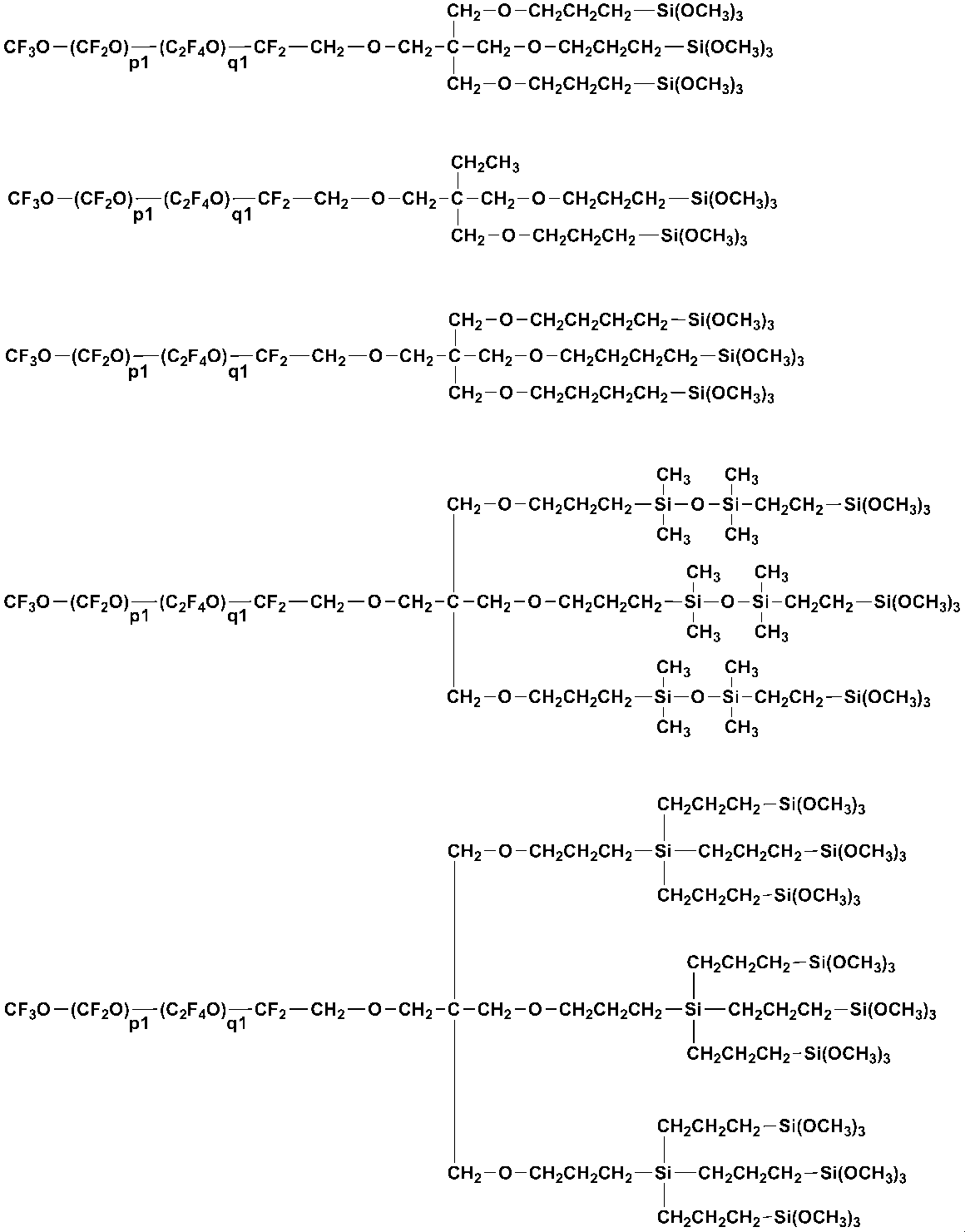
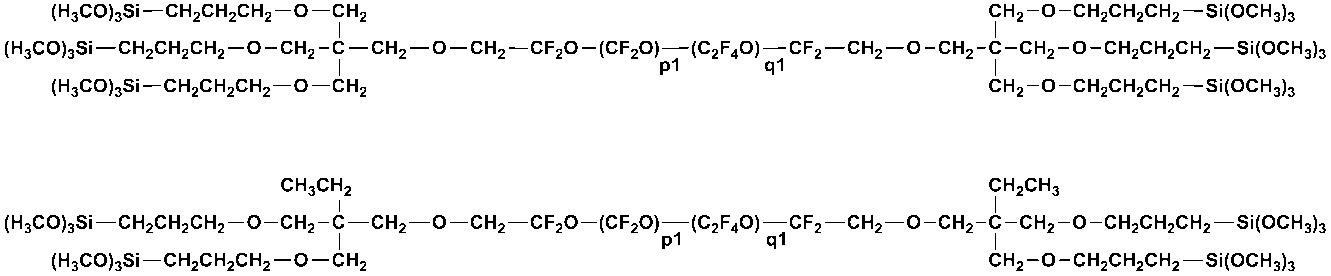
〔8〕
〔1〕~〔7〕のいずれかに記載のフルオロポリエーテル基含有ポリマー変性シラン及び/又はその部分(加水分解)縮合物を含む表面処理剤。
〔9〕
〔8〕記載の表面処理剤の硬化被膜を表面に有する物品。

(式中、Rfは1価又は2価のフルオロオキシアルキレン基含有ポリマー残基であり、Qはエーテル結合を含んでいてもよい炭素数2~6の2価の炭化水素基であり、Yはケイ素原子、シリレン基及び/又はシロキサン結合を有してもよい2~6価の炭化水素基であり、Rは独立に炭素数1~4のアルキル基であり、Xは独立に水酸基又は加水分解性基であり、nは1~3の整数であり、γは1~5の整数であり、mは1~5の整数であり、R’は炭素数1~4のアルキル基であり、βは1~3の整数であり、αは1又は2である。)


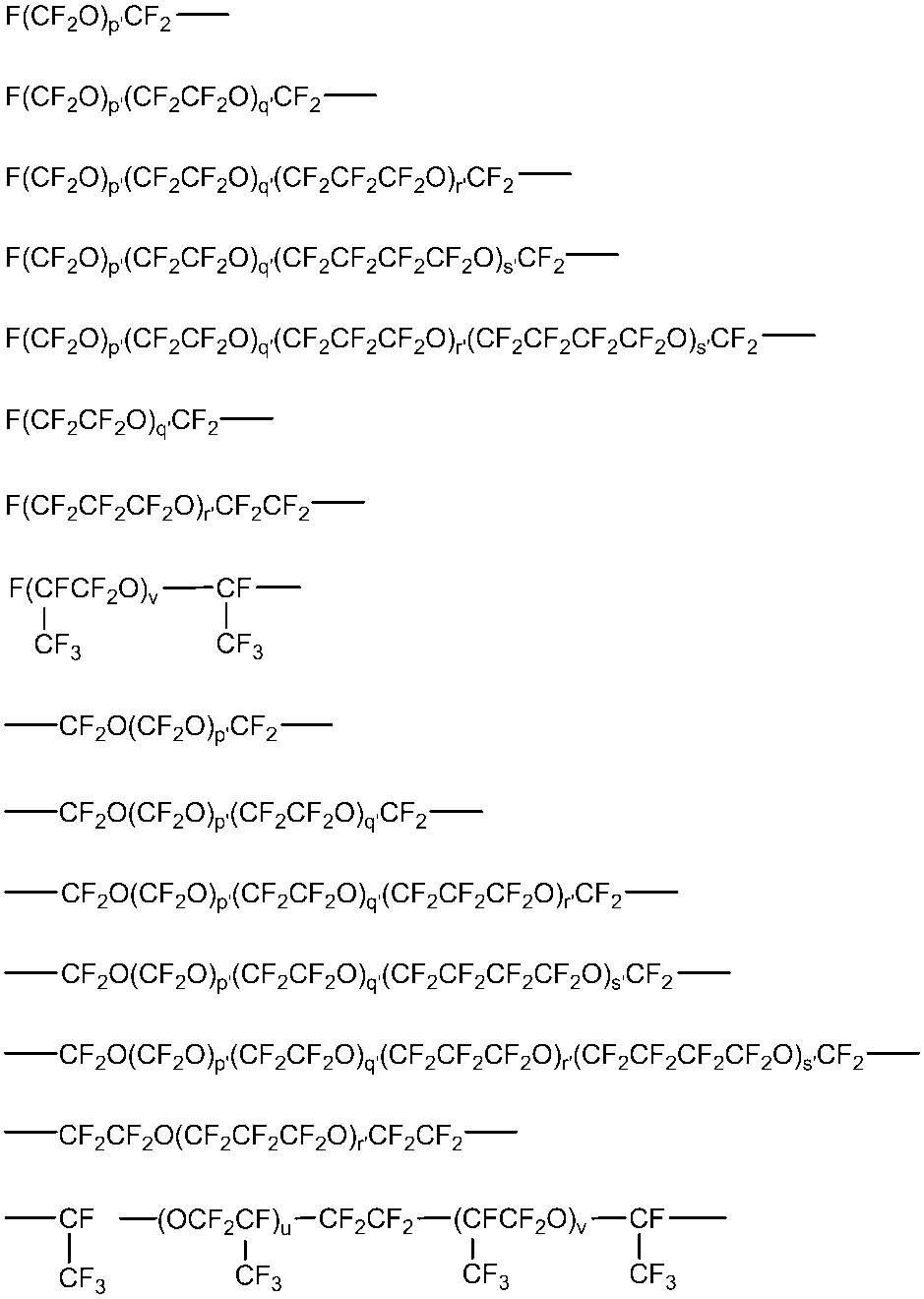



分子鎖片末端にオレフィン部位を好ましくは2個以上(特には、2個又は3個)有するフルオロオキシアルキル基含有ポリマーを、溶剤、例えば1,3-ビス(トリフルオロメチル)ベンゼンなどのフッ素系溶剤に溶解させ、トリメトキシシラン等の分子中にSiH基及び加水分解性末端基(メトキシ基等のアルコキシ基など)を有する有機ケイ素化合物と、ヒドロシリル化反応触媒、例えば塩化白金酸/ビニルシロキサン錯体のトルエン溶液存在下、40~120℃、好ましくは60~100℃、より好ましくは約80℃の温度で、1~48時間、好ましくは2~10時間、より好ましくは約5時間の条件で、ヒドロシリル化付加反応させると共に熟成させる。
分子鎖片末端にオレフィン部位を好ましくは2個以上(特には、2個又は3個)有するフルオロオキシアルキル基含有ポリマーを、溶剤、例えば1,3-ビス(トリフルオロメチル)ベンゼンなどのフッ素系溶剤に溶解させ、トリクロロシラン等の分子中にSiH基及び加水分解性末端基を有する有機ケイ素化合物を、ヒドロシリル化反応触媒、例えば塩化白金酸/ビニルシロキサン錯体のトルエン溶液存在下、40~120℃、好ましくは60~100℃、より好ましくは約80℃の温度で、1~48時間、好ましくは2~10時間、より好ましくは約5時間の条件で、ヒドロシリル化付加反応させると共に熟成させた後、シリル基上の置換基(ケイ素原子に結合した塩素原子等)を例えばメトキシ基等のアルコキシ基などの加水分解性基に変換する。


オレフィン導入剤の使用量は、分子鎖片末端に水酸基を有するフルオロオキシアルキル基含有ポリマーの反応性末端基(末端水酸基)1当量に対して、スルホン酸エステル残基として1~5当量、より好ましくは1~3当量、更に好ましくは約1.5当量用いることができる。
塩基の使用量は、分子鎖片末端に水酸基を有するフルオロオキシアルキル基含有ポリマーの反応性末端基1当量に対して、1~20当量、より好ましくは5~15当量、更に好ましくは約9当量用いることができる。
添加剤の使用量は、分子鎖片末端に水酸基を有するフルオロオキシアルキル基含有ポリマーの反応性末端基1当量に対して、0.005~0.2当量、より好ましくは0.01~0.15当量、更に好ましくは約0.1当量用いることができる。
溶剤を用いる場合の使用量は、分子鎖片末端に水酸基を有するフルオロオキシアルキル基含有ポリマー100質量部に対して、10~300質量部、好ましくは30~150質量部、更に好ましくは約50質量部用いることができる。
溶剤の使用量は、分子鎖片末端にオレフィン部位を有するフルオロオキシアルキル基含有ポリマー100質量部に対して、10~300質量部、好ましくは50~150質量部、更に好ましくは約100質量部用いることができる。

ヒドロシリル化反応触媒の使用量は、分子鎖片末端にオレフィン部位を有するフルオロオキシアルキル基含有ポリマー、又はこのポリマーと分子中に加水分解性末端基を有さず、SiH基を2個以上有する有機ケイ素化合物との反応物の質量に対して、遷移金属換算(質量)で0.1~100ppm、より好ましくは1~50ppmとなる量で使用する。
例えば、分子鎖片末端にオレフィン部位を有するフルオロオキシアルキル基含有ポリマーとして、下記式で表される化合物

を使用し、分子中にSiH基及び加水分解性末端基を有する有機ケイ素化合物として、トリメトキシシランを使用した場合には、下記式で表される化合物が得られる。

分子鎖両末端にオレフィン部位を好ましくはそれぞれ2個以上(特には、2個又は3個)有するフルオロオキシアルキレン基含有ポリマーと、溶剤、例えば1,3-ビス(トリフルオロメチル)ベンゼンなどのフッ素系溶剤に溶解させ、トリメトキシシラン等の分子中にSiH基及び加水分解性末端基を有する有機ケイ素化合物を、ヒドロシリル化反応触媒、例えば塩化白金酸/ビニルシロキサン錯体のトルエン溶液存在下、40~120℃、好ましくは60~100℃、より好ましくは約80℃の温度で、1~48時間、好ましくは2~10時間、より好ましくは約5時間の条件で、ヒドロシリル化付加反応させると共に熟成させる。
分子鎖両末端にオレフィン部位を好ましくはそれぞれ2個以上(特には、2個又は3個)有するフルオロオキシアルキレン基含有ポリマーを、溶剤、例えば1,3-ビス(トリフルオロメチル)ベンゼンなどのフッ素系溶剤に溶解させ、トリクロロシラン等の分子中にSiH基及び加水分解性末端基を有する有機ケイ素化合物を、ヒドロシリル化反応触媒、例えば塩化白金酸/ビニルシロキサン錯体のトルエン溶液存在下、40~120℃、好ましくは60~100℃、より好ましくは約80℃の温度で、1~48時間、好ましくは2~10時間、より好ましくは約5時間の条件で、ヒドロシリル化付加反応させると共に熟成させた後、シリル基上の置換基を例えばメトキシ基などに変換する。


オレフィン導入剤の使用量は、分子鎖両末端に水酸基を有するフルオロオキシアルキレン基含有ポリマーの反応性末端基(末端水酸基)1当量に対して、スルホン酸エステル残基として1~5当量、より好ましくは1~3当量、更に好ましくは約1.5当量用いることができる。
塩基の使用量は、分子鎖両末端に水酸基を有するフルオロオキシアルキレン基含有ポリマーの反応性末端基1当量に対して、1~20当量、より好ましくは5~15当量、更に好ましくは約9当量用いることができる。
添加剤の使用量は、分子鎖両末端に水酸基を有するフルオロオキシアルキレン基含有ポリマーの反応性末端基1当量に対して、0.005~0.2当量、より好ましくは0.01~0.15当量、更に好ましくは約0.1当量用いることができる。
溶剤を用いる場合の使用量は、分子鎖両末端に水酸基を有するフルオロオキシアルキレン基含有ポリマー100質量部に対して、10~300質量部、好ましくは30~150質量部、更に好ましくは約50質量部用いることができる。
溶剤の使用量は、分子鎖両末端にオレフィン部位をそれぞれ有するフルオロオキシアルキレン基含有ポリマー100質量部に対して、10~300質量部、好ましくは50~150質量部、更に好ましくは約100質量部用いることができる。


ヒドロシリル化反応触媒の使用量は、分子鎖両末端にオレフィン部位をそれぞれ有するフルオロオキシアルキレン基含有ポリマー、又はこのポリマーと分子中に加水分解性末端基を有さず、SiH基を2個以上有する有機ケイ素化合物との反応物の質量に対して、遷移金属換算(質量)で0.1~100ppm、より好ましくは1~50ppmとなる量で使用する。
例えば、分子鎖両末端にオレフィン部位をそれぞれ有するフルオロオキシアルキレン基含有ポリマーとして、下記式で表される化合物


加水分解縮合触媒の添加量は触媒量であり、通常、フルオロポリエーテル基含有ポリマー変性シラン及び/又はその部分(加水分解)縮合物100質量部に対して0.01~5質量部、特に0.1~1質量部である。
反応容器に、下記式(A)

で表される化合物100g(2.9×10⁻²mol)、下記式(B)


なお、式(C)で表されるフルオロポリエーテル基含有ポリマーのNMRによる分子構造の解析結果は次の通りである。
δ3.4-3.5(C-CH 2 -O-CH2CH=CH2)6H
δ3.6-3.7(-CF2-CH2-O-CH 2 -C)2H
δ3.7-3.8(-CF2-CH 2 -O-CH 2 -C)2H
δ3.8-3.9(C-CH2-O-CH 2 CH=CH2)6H
δ5.0-5.2(C-CH2-O-CH2CH=CH 2 )6H
δ5.7-5.9(C-CH2-O-CH2CH=CH2)3H


δ0.4-0.6(-CH2CH2CH 2 -Si)6H
δ1.4-1.6(-CH2CH 2 CH2-Si)6H
δ3.1-3.7(-Si(OCH 3 )3、-CH 2 CH2CH2-Si、C-CH 2 -O-CH2CH2CH2-Si、-CF2-CH2-O-CH 2 -C、-CF2-CH 2 -O-CH2-C)43H
反応容器に、下記式(A)



なお、式(F)で表されるフルオロポリエーテル基含有ポリマーのNMRによる分子構造の解析結果は次の通りである。
δ0.7-0.9(-CH2CH 3 )3H
δ1.3-1.5(-CH 2 CH3)2H
δ3.2-3.2(C-CH 2 -O-CH2CH=CH2)4H
δ3.4-3.5(-CF2-CH2-O-CH 2 -C)2H
δ3.6-3.7(-CF2-CH 2 -O-CH 2 -C)2H
δ3.8-3.9(C-CH2-O-CH 2 CH=CH2)4H
δ4.9-5.2(C-CH2-O-CH2CH=CH 2 )4H
δ5.7-5.8(C-CH2-O-CH2CH=CH2)2H


δ0.4-0.6(-CH2CH2CH 2 -Si)4H
δ0.6-0.8(-CH2CH 3 )3H
δ1.2-1.4(-CH 2 CH3)2H
δ1.5-1.7(-CH2CH 2 CH2-Si)4H
δ3.1-3.7(-Si(OCH 3 )3、-CH 2 CH2CH2-Si、C-CH 2 -O-CH2CH2CH2-Si、-CF2-CH2-O-CH 2 -C、-CF2-CH 2 -O-CH2-C)30H
反応容器に、下記式(H)



なお、式(I)で表されるフルオロポリエーテル基含有ポリマーのNMRによる分子構造の解析結果は次の通りである。
δ3.4-3.5(C-CH 2 -O-CH2CH=CH2)12H
δ3.6-3.7(-CF2-CH2-O-CH 2 -C)4H
δ3.7-3.8(-CF2-CH 2 -O-CH 2 -C)4H
δ3.8-3.9(C-CH2-O-CH 2 CH=CH2)12H
δ4.9-5.1(C-CH2-O-CH2CH=CH 2 )12H
δ5.7-5.9(C-CH2-O-CH2CH=CH2)6H


δ0.4-0.7(-CH2CH2CH 2 -Si)12H
δ1.4-1.7(-CH2CH 2 CH2-Si)12H
δ3.1-3.8(-Si(OCH 3 )3、-CH 2 CH2CH2-Si、C-CH 2 -O-CH2CH2CH2-Si、-CF2-CH2-O-CH 2 -C、-CF2-CH 2 -O-CH2-C)86H
比較例1として、以下のポリマーを使用した。

比較例2として、以下のポリマーを使用した。

実施例1~3で得られたフルオロポリエーテル基含有ポリマー変性シランのうち、実施例1,2で得られたフルオロポリエーテル基含有ポリマー変性シランを用いて、表面処理剤として以下の評価に供した。即ち、実施例1,2で得られたフルオロポリエーテル基含有ポリマー変性シラン及び比較例1,2のポリマーを、濃度20質量%になるようにNovec 7200(3M社製、エチルパーフルオロブチルエーテル)に溶解させて表面処理剤を調製した。
最表面にSiO2を10nm処理したガラス(コーニング社製 Gorilla)に、各表面処理剤6mgを真空蒸着し(処理条件は、圧力:2.0×10⁻²Pa、加熱温度:700℃)、25℃、湿度40%の雰囲気下で12時間硬化させて膜厚7nmの硬化被膜を形成した。
最表面にSiO2を10nm処理したガラス(コーニング社製 Gorilla)に、各表面処理剤10mgを真空蒸着し(処理条件は、圧力:2.0×10⁻²Pa、加熱温度:700℃)、25℃、湿度40%の雰囲気下で12時間硬化させて膜厚14nmの硬化被膜を形成した。
[初期撥水性の評価]
上記にて薄膜塗工により硬化被膜を形成したガラスについて、接触角計Drop Master(協和界面科学社製)を用いて、硬化被膜の水に対する接触角(撥水性)を測定した(液滴:2μl、温度:25℃、湿度:40%)。結果(初期水接触角)を表1に示す。
初期においては、実施例、比較例共に良好な撥水性を示した。
上記にて薄膜塗工により硬化被膜を形成したガラス(耐摩耗性評価用)について、ラビングテスター(新東科学社製)を用いて、下記条件で10,000回擦った後の硬化被膜の水に対する接触角(撥水性)を上記と同様にして測定し、耐摩耗性の評価とした。試験環境条件は25℃、湿度40%である。結果(摩耗後水接触角)を表1に示す。
耐スチールウール摩耗性
スチールウール:BONSTAR#0000(日本スチールウール株式会社製)
接触面積:10mmφ
移動距離(片道)30mm
移動速度1,800mm/分
荷重:1kg/cm2
実施例1,2の化合物は、分子内にエーテル連結基を複数有することで、基材との密着性が向上したため、実施例1,2の化合物を用いた表面処理剤の硬化被膜は比較例に比べ、接触角100°以上と良好な耐摩耗性を発揮した。
上記にて薄膜塗工及び厚膜塗工により硬化被膜を形成したガラス(ヘーズ値評価用)について、JIS K 7136:2000に従いヘーズメーター(NDH-5000)(日本電色工業株式会社製)を用いてヘーズ値を測定した。結果(ヘーズ値)を表1、2に示す。ヘーズ値は0.3以上から目視で曇りが確認される。薄膜(7nm)塗工時は、実施例、比較例いずれもヘーズ値は0.3以下と低い値であった。一方、厚膜(14nm)塗工時においては、実施例1,2の化合物は、分子内に極性基であるエーテル連結基を複数有することで基材との濡れ性が向上したため、実施例1,2の化合物を用いた表面処理剤の硬化被膜は比較例に比べヘーズ値が0.3以下と視認性の向上を確認できた。


Claims (9)
- 下記一般式(1)

で表されるフルオロポリエーテル基含有ポリマー変性シラン。 - 前記式(1)のαが1であり、Rf基が下記一般式(2)で表される1価のフルオロオキシアルキレン基含有ポリマー残基であることを特徴とする請求項1記載のフルオロポリエーテル基含有ポリマー変性シラン。

- 前記式(1)のαが2であり、Rf基が下記一般式(3)で表される2価のフルオロオキシアルキレン基含有ポリマー残基であることを特徴とする請求項1記載のフルオロポリエーテル基含有ポリマー変性シラン。

- 前記式(1)において、Yが、炭素数3~10のアルキレン基、炭素数6~8のアリーレン基を含むアルキレン基、アルキレン基相互がケイ素原子、シリレン基、シルアルキレン構造又はシルアリーレン構造を介して結合している2価の基、及びケイ素原子数2~10個の直鎖状又はケイ素原子数3~10個の分岐状もしくは環状の2~4価のオルガノポリシロキサン残基、又はケイ素原子の結合手に炭素数2~10のアルキレン基が結合している2~4価の基からなる群より選ばれる少なくとも1種の基である請求項1~3のいずれか1項に記載のフルオロポリエーテル基含有ポリマー変性シラン。
- 前記式(1)において、Qが、
-CH2OCH2-
である請求項1~4のいずれか1項に記載のフルオロポリエーテル基含有ポリマー変性シラン。 - 前記式(1)において、Xがそれぞれ、水酸基、炭素数1~10のアルコキシ基、炭素数2~10のアルコキシアルコキシ基、炭素数2~10のアシロキシ基、炭素数2~10のアルケニルオキシ基及びハロゲン基からなる群より選ばれる少なくとも1種である請求項1~5のいずれか1項に記載のフルオロポリエーテル基含有ポリマー変性シラン。
- 式(1)で表されるポリマー変性シランが、下記式のいずれかで表されるものである請求項1~6のいずれか1項に記載のフルオロポリエーテル基含有ポリマー変性シラン。
- 請求項1~7のいずれか1項に記載のフルオロポリエーテル基含有ポリマー変性シラン及び/又はその部分(加水分解)縮合物を含む表面処理剤。
- 請求項8に記載の表面処理剤の硬化被膜を表面に有する物品。
Priority Applications (3)
| Application Number | Priority Date | Filing Date | Title |
|---|---|---|---|
| KR1020187026245A KR102713622B1 (ko) | 2016-02-17 | 2017-02-01 | 플루오로폴리에터기 함유 폴리머 변성 실레인, 표면처리제 및 물품 |
| JP2018500027A JP6680350B2 (ja) | 2016-02-17 | 2017-02-01 | フルオロポリエーテル基含有ポリマー変性シラン、表面処理剤及び物品 |
| CN201780011917.3A CN108699237B (zh) | 2016-02-17 | 2017-02-01 | 含有氟聚醚基的聚合物改性硅烷、表面处理剂和物品 |
Applications Claiming Priority (2)
| Application Number | Priority Date | Filing Date | Title |
|---|---|---|---|
| JP2016-027894 | 2016-02-17 | ||
| JP2016027894 | 2016-02-17 |
Publications (1)
| Publication Number | Publication Date |
|---|---|
| WO2017141707A1 true WO2017141707A1 (ja) | 2017-08-24 |
Family
ID=59625917
Family Applications (1)
| Application Number | Title | Priority Date | Filing Date |
|---|---|---|---|
| PCT/JP2017/003613 Ceased WO2017141707A1 (ja) | 2016-02-17 | 2017-02-01 | フルオロポリエーテル基含有ポリマー変性シラン、表面処理剤及び物品 |
Country Status (5)
| Country | Link |
|---|---|
| JP (1) | JP6680350B2 (ja) |
| KR (1) | KR102713622B1 (ja) |
| CN (1) | CN108699237B (ja) |
| TW (1) | TWI780042B (ja) |
| WO (1) | WO2017141707A1 (ja) |
Cited By (9)
| Publication number | Priority date | Publication date | Assignee | Title |
|---|---|---|---|---|
| WO2018143433A1 (ja) * | 2017-02-03 | 2018-08-09 | ダイキン工業株式会社 | パーフルオロ(ポリ)エーテル基含有化合物、これを含む表面処理剤、および物品 |
| WO2019102832A1 (ja) * | 2017-11-21 | 2019-05-31 | 信越化学工業株式会社 | フルオロポリエーテル基含有ポリマー、表面処理剤及び物品 |
| CN111630123A (zh) * | 2018-01-22 | 2020-09-04 | 信越化学工业株式会社 | 涂布剂组合物、包含该组合物的表面处理剂和用该表面处理剂表面处理过的物品 |
| WO2021111992A1 (ja) * | 2019-12-03 | 2021-06-10 | 信越化学工業株式会社 | フルオロポリエーテル基含有ポリマー、表面処理剤及び物品 |
| CN114276741A (zh) * | 2020-10-01 | 2022-04-05 | 信越化学工业株式会社 | 含有氟聚醚基的聚合物的组合物、涂布剂和物品 |
| JPWO2022230642A1 (ja) * | 2021-04-28 | 2022-11-03 | ||
| CN115397932A (zh) * | 2020-04-14 | 2022-11-25 | 信越化学工业株式会社 | 包含含有氟聚醚基的聚合物和/或其部分(水解)缩合物的表面处理剂及物品 |
| EP3950778A4 (en) * | 2019-03-29 | 2022-12-21 | Daikin Industries, Ltd. | FLUOROPOLYETHER GROUP CONTAINING COMPOUND |
| CN117794741A (zh) * | 2021-08-05 | 2024-03-29 | 信越化学工业株式会社 | 具有拒水拒油表面层的物品 |
Families Citing this family (1)
| Publication number | Priority date | Publication date | Assignee | Title |
|---|---|---|---|---|
| CN114799031B (zh) * | 2022-04-20 | 2023-05-26 | 无锡神意环件法兰有限公司 | 轮胎模具用锻件的生产工艺及其用途 |
Citations (4)
| Publication number | Priority date | Publication date | Assignee | Title |
|---|---|---|---|---|
| WO2009008380A1 (ja) * | 2007-07-06 | 2009-01-15 | Asahi Glass Company, Limited | 表面処理剤、物品、および新規含フッ素エーテル化合物 |
| JP2011020099A (ja) * | 2009-07-17 | 2011-02-03 | Shin-Etsu Chemical Co Ltd | 消泡剤 |
| JP2012072272A (ja) * | 2010-09-28 | 2012-04-12 | Shin-Etsu Chemical Co Ltd | フルオロオキシアルキレン基含有ポリマー組成物および該組成物を含む表面処理剤並びに該表面処理剤で表面処理された物品 |
| JP2013136833A (ja) * | 2011-11-30 | 2013-07-11 | Shin-Etsu Chemical Co Ltd | 蒸着用フッ素系表面処理剤及び該表面処理剤で蒸着処理された物品 |
Family Cites Families (6)
| Publication number | Priority date | Publication date | Assignee | Title |
|---|---|---|---|---|
| JP5074927B2 (ja) | 2005-04-01 | 2012-11-14 | ダイキン工業株式会社 | 表面改質剤およびその用途 |
| JP5274839B2 (ja) | 2005-04-01 | 2013-08-28 | ダイキン工業株式会社 | 表面改質剤 |
| US8304571B2 (en) * | 2009-07-17 | 2012-11-06 | Shin-Etsu Chemical Co., Ltd. | Perfluoropolyether-modified polysiloxane, a method for preparing the same and a defoaming agent comprising the same |
| JP2012157856A (ja) | 2011-01-13 | 2012-08-23 | Central Glass Co Ltd | 防汚性物品及びその製造方法 |
| EP3333172B1 (en) * | 2015-07-31 | 2020-10-21 | Daikin Industries, Ltd. | Silane compound containing perfluoro(poly)ether group |
| CN111732721B (zh) * | 2015-09-01 | 2024-01-02 | Agc株式会社 | 含氟醚化合物、表面处理剂、涂布液和物品 |
-
2017
- 2017-02-01 WO PCT/JP2017/003613 patent/WO2017141707A1/ja not_active Ceased
- 2017-02-01 JP JP2018500027A patent/JP6680350B2/ja active Active
- 2017-02-01 KR KR1020187026245A patent/KR102713622B1/ko active Active
- 2017-02-01 CN CN201780011917.3A patent/CN108699237B/zh active Active
- 2017-02-14 TW TW106104778A patent/TWI780042B/zh active
Patent Citations (4)
| Publication number | Priority date | Publication date | Assignee | Title |
|---|---|---|---|---|
| WO2009008380A1 (ja) * | 2007-07-06 | 2009-01-15 | Asahi Glass Company, Limited | 表面処理剤、物品、および新規含フッ素エーテル化合物 |
| JP2011020099A (ja) * | 2009-07-17 | 2011-02-03 | Shin-Etsu Chemical Co Ltd | 消泡剤 |
| JP2012072272A (ja) * | 2010-09-28 | 2012-04-12 | Shin-Etsu Chemical Co Ltd | フルオロオキシアルキレン基含有ポリマー組成物および該組成物を含む表面処理剤並びに該表面処理剤で表面処理された物品 |
| JP2013136833A (ja) * | 2011-11-30 | 2013-07-11 | Shin-Etsu Chemical Co Ltd | 蒸着用フッ素系表面処理剤及び該表面処理剤で蒸着処理された物品 |
Cited By (18)
| Publication number | Priority date | Publication date | Assignee | Title |
|---|---|---|---|---|
| JP2019070098A (ja) * | 2017-02-03 | 2019-05-09 | ダイキン工業株式会社 | パーフルオロ(ポリ)エーテル基含有化合物、これを含む表面処理剤、および物品 |
| KR20190099513A (ko) * | 2017-02-03 | 2019-08-27 | 다이킨 고교 가부시키가이샤 | 퍼플루오로(폴리)에테르기 함유 화합물, 이것을 포함하는 표면 처리제, 및 물품 |
| KR102245007B1 (ko) | 2017-02-03 | 2021-04-27 | 다이킨 고교 가부시키가이샤 | 퍼플루오로(폴리)에테르기 함유 화합물, 이것을 포함하는 표면 처리제, 및 물품 |
| WO2018143433A1 (ja) * | 2017-02-03 | 2018-08-09 | ダイキン工業株式会社 | パーフルオロ(ポリ)エーテル基含有化合物、これを含む表面処理剤、および物品 |
| JP7070587B2 (ja) | 2017-11-21 | 2022-05-18 | 信越化学工業株式会社 | フルオロポリエーテル基含有ポリマー、表面処理剤及び物品 |
| WO2019102832A1 (ja) * | 2017-11-21 | 2019-05-31 | 信越化学工業株式会社 | フルオロポリエーテル基含有ポリマー、表面処理剤及び物品 |
| JPWO2019102832A1 (ja) * | 2017-11-21 | 2020-12-03 | 信越化学工業株式会社 | フルオロポリエーテル基含有ポリマー、表面処理剤及び物品 |
| CN111630123A (zh) * | 2018-01-22 | 2020-09-04 | 信越化学工业株式会社 | 涂布剂组合物、包含该组合物的表面处理剂和用该表面处理剂表面处理过的物品 |
| CN111630123B (zh) * | 2018-01-22 | 2023-02-17 | 信越化学工业株式会社 | 涂布剂组合物、包含该组合物的表面处理剂和用该表面处理剂表面处理过的物品 |
| EP3950778A4 (en) * | 2019-03-29 | 2022-12-21 | Daikin Industries, Ltd. | FLUOROPOLYETHER GROUP CONTAINING COMPOUND |
| JPWO2021111992A1 (ja) * | 2019-12-03 | 2021-06-10 | ||
| WO2021111992A1 (ja) * | 2019-12-03 | 2021-06-10 | 信越化学工業株式会社 | フルオロポリエーテル基含有ポリマー、表面処理剤及び物品 |
| JP7318735B2 (ja) | 2019-12-03 | 2023-08-01 | 信越化学工業株式会社 | フルオロポリエーテル基含有ポリマー、表面処理剤及び物品 |
| CN115397932A (zh) * | 2020-04-14 | 2022-11-25 | 信越化学工业株式会社 | 包含含有氟聚醚基的聚合物和/或其部分(水解)缩合物的表面处理剂及物品 |
| CN114276741A (zh) * | 2020-10-01 | 2022-04-05 | 信越化学工业株式会社 | 含有氟聚醚基的聚合物的组合物、涂布剂和物品 |
| JPWO2022230642A1 (ja) * | 2021-04-28 | 2022-11-03 | ||
| WO2022230642A1 (ja) * | 2021-04-28 | 2022-11-03 | 信越化学工業株式会社 | フルオロポリエーテル基含有ポリマー、表面処理剤及び物品 |
| CN117794741A (zh) * | 2021-08-05 | 2024-03-29 | 信越化学工业株式会社 | 具有拒水拒油表面层的物品 |
Also Published As
| Publication number | Publication date |
|---|---|
| TWI780042B (zh) | 2022-10-11 |
| JPWO2017141707A1 (ja) | 2018-10-04 |
| KR102713622B1 (ko) | 2024-10-08 |
| CN108699237B (zh) | 2021-09-24 |
| KR20180110105A (ko) | 2018-10-08 |
| CN108699237A (zh) | 2018-10-23 |
| JP6680350B2 (ja) | 2020-04-15 |
| TW201803915A (zh) | 2018-02-01 |
Similar Documents
| Publication | Publication Date | Title |
|---|---|---|
| JP6524955B2 (ja) | フルオロポリエーテル基含有ポリマー変性シラン、表面処理剤及び物品 | |
| JP6260579B2 (ja) | フルオロポリエーテル基含有ポリマー変性シラン、表面処理剤及び物品 | |
| JP7456499B2 (ja) | フルオロポリエーテル基含有ポリマー及び/又はその部分(加水分解)縮合物を含む表面処理剤及び物品 | |
| JP6828744B2 (ja) | フルオロポリエーテル基含有ポリマー、表面処理剤及び物品 | |
| JP6680350B2 (ja) | フルオロポリエーテル基含有ポリマー変性シラン、表面処理剤及び物品 | |
| JP7276464B2 (ja) | フルオロポリエーテル基含有ポリマー、表面処理剤及び物品 | |
| JP5935748B2 (ja) | フルオロオキシアルキレン基含有ポリマー変性シラン及び該シランを含む表面処理剤並びに該表面処理剤で表面処理された物品 | |
| JP7070587B2 (ja) | フルオロポリエーテル基含有ポリマー、表面処理剤及び物品 | |
| JP5747699B2 (ja) | フルオロオキシアルキレン基含有ポリマー変性シラン及び該シランを含む表面処理剤並びに該表面処理剤で表面処理された物品 | |
| JP6642589B2 (ja) | フルオロポリエーテル基含有ポリマー変性シラン、表面処理剤及び物品 | |
| JP7318735B2 (ja) | フルオロポリエーテル基含有ポリマー、表面処理剤及び物品 | |
| JP5556822B2 (ja) | フルオロオキシアルキレン基含有ポリマー変性シラン及び該シランを含む表面処理剤並びに該表面処理剤で表面処理された物品 | |
| WO2018216404A1 (ja) | 含フッ素コーティング剤組成物及び該組成物を含有する表面処理剤並びに物品 | |
| WO2023199768A1 (ja) | フルオロポリエーテル基含有ポリマー、表面処理剤及び物品 | |
| TW202424046A (zh) | 含氟組成物、表面處理劑及物品 | |
| TW202440827A (zh) | 含氟聚醚基之聚合物、表面處理劑及物品 |
Legal Events
| Date | Code | Title | Description |
|---|---|---|---|
| 121 | Ep: the epo has been informed by wipo that ep was designated in this application |
Ref document number: 17752970 Country of ref document: EP Kind code of ref document: A1 |
|
| ENP | Entry into the national phase |
Ref document number: 2018500027 Country of ref document: JP Kind code of ref document: A |
|
| NENP | Non-entry into the national phase |
Ref country code: DE |
|
| ENP | Entry into the national phase |
Ref document number: 20187026245 Country of ref document: KR Kind code of ref document: A |
|
| WWE | Wipo information: entry into national phase |
Ref document number: 1020187026245 Country of ref document: KR |
|
| 122 | Ep: pct application non-entry in european phase |
Ref document number: 17752970 Country of ref document: EP Kind code of ref document: A1 |