WO2017138334A1 - 超音波受信装置 - Google Patents
超音波受信装置 Download PDFInfo
- Publication number
- WO2017138334A1 WO2017138334A1 PCT/JP2017/002000 JP2017002000W WO2017138334A1 WO 2017138334 A1 WO2017138334 A1 WO 2017138334A1 JP 2017002000 W JP2017002000 W JP 2017002000W WO 2017138334 A1 WO2017138334 A1 WO 2017138334A1
- Authority
- WO
- WIPO (PCT)
- Prior art keywords
- wave
- value
- frequency
- received wave
- noise
- Prior art date
- Legal status (The legal status is an assumption and is not a legal conclusion. Google has not performed a legal analysis and makes no representation as to the accuracy of the status listed.)
- Ceased
Links
Images

Classifications
-
- G—PHYSICS
- G01—MEASURING; TESTING
- G01S—RADIO DIRECTION-FINDING; RADIO NAVIGATION; DETERMINING DISTANCE OR VELOCITY BY USE OF RADIO WAVES; LOCATING OR PRESENCE-DETECTING BY USE OF THE REFLECTION OR RERADIATION OF RADIO WAVES; ANALOGOUS ARRANGEMENTS USING OTHER WAVES
- G01S7/00—Details of systems according to groups G01S13/00, G01S15/00, G01S17/00
- G01S7/52—Details of systems according to groups G01S13/00, G01S15/00, G01S17/00 of systems according to group G01S15/00
- G01S7/523—Details of pulse systems
- G01S7/526—Receivers
- G01S7/527—Extracting wanted echo signals
Definitions
- the present disclosure relates to an ultrasonic receiver that is applied to an object detection system that transmits an exploration wave that is an ultrasonic wave and acquires a received wave including a reflected wave reflected by a surrounding object.
- an object detection system for transmitting an ultrasonic wave as an exploration wave, receiving a reflected wave reflected by the object, and detecting a distance from the object has been realized.
- Patent Document 1 there is an object detection system described in Patent Document 1.
- the object detection system described in Patent Literature 1 includes an ultrasonic sensor, detects the frequency of a received wave, and when the frequency is a reference frequency and the signal level is greater than a threshold value, The frequency is changed from the reference frequency to the shift frequency.
- sampling may be disturbed due to the influence of other received waves, resulting in erroneous measurement of the frequency.
- determining whether a received wave is a reflected wave or noise while waiting for a reflected wave to be received if an erroneous measurement of the frequency occurs, even if the received wave is a reflected wave to be detected, the noise Even if the received wave is noise, it is erroneously determined that it is a reflected wave to be detected.
- the present disclosure has been made to solve the above-described problem, and a main object thereof is to provide an ultrasonic receiving apparatus capable of accurately detecting the frequency of a received wave.
- the present disclosure is an ultrasonic receiving apparatus that is applied to an object detection system that transmits a survey wave that is an ultrasonic wave and acquires a received wave including a reflected wave reflected by a surrounding object, and receives the received wave
- a receiving unit that measures the frequency of the received wave, acquires the value as a measured value
- an amplitude measuring unit that measures the amplitude value of the received wave
- the amplitude value of the received wave A frequency determining unit that determines the frequency of the received wave as a calculated value based on the measured value acquired from the rising edge until the amplitude value reaches the peak value.
- a reflected wave based on the reverberation of the probe wave is received while the amplitude value of the received wave is attenuated.
- the reception of different received waves is started and interference between reflected waves is performed. Therefore, the phase of the received wave changes or the frequency changes, which may cause erroneous measurement of the frequency.
- the frequency from the rise of the amplitude value of the received wave to the peak value is measured, and the frequency of the received wave is determined based on the frequency.
- FIG. 1 is a configuration diagram of an object detection system including an ultrasonic sensor
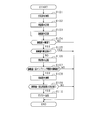
- FIG. 2 is a flowchart showing processing executed by the ultrasonic sensor
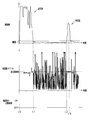
- FIG. 3 is a time chart when the received wave is a reflected wave.
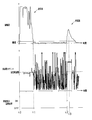
- FIG. 4 is a time chart when the received wave is noise.
- the object detection system is mounted on a moving body such as a vehicle.
- the object detection system includes an ultrasonic sensor, transmits an ultrasonic wave at a predetermined control period, receives a reflected wave reflected by an object existing around the moving body, and measures a time from transmission to reception. Thus, the distance between the moving body and the object is obtained.
- FIG. 1 is a configuration diagram of an object detection system according to the present embodiment.
- the ultrasonic sensor 10 is communicably connected to the ECU 20 that controls each function of the vehicle, performs control based on a control command from the ECU 20, and transmits a detection result to the ECU 20.
- the ultrasonic sensor 10 functions as an ultrasonic receiving device when receiving ultrasonic waves as received waves and performing various processes.
- the control unit 11 communicates with the ECU 20 and performs control to transmit an exploration wave that is an ultrasonic wave based on a command from the ECU 20 and transmits a reception result of the received wave including the reflected wave to the ECU 20.
- the ECU 20 instructs the control unit 11 on the frequency of the exploration wave, and the control unit 11 drives the wave transmitting / receiving unit 12 so that the ultrasonic wave of that frequency is transmitted.
- the wave transmitting / receiving unit 12 is a well-known device including a piezoelectric element and a driving circuit that supplies driving power to the piezoelectric element, and driving power is supplied from the driving circuit to the piezoelectric element by a control signal from the control unit 11. Transmits exploration waves that are ultrasonic.
- the wave transmitting / receiving unit 12 receives a reflected wave obtained by reflecting the exploration wave by a surrounding object and other ultrasonic waves as a received wave.
- the received wave received by the transmitting / receiving unit 12 is input to the received wave processing unit 13 as a voltage.
- the reception wave processing unit 13 amplifies the voltage acquired based on the received reception wave and inputs the amplified voltage to the frequency measurement unit 14 and the amplitude measurement unit 15.
- the frequency measuring unit 14 measures the frequency of the acquired received wave. Specifically, the point at which the voltage changes from a positive value to a negative value is defined as a zero cross point, the time between the zero cross points is measured, and the reciprocal thereof is defined as the frequency. Note that the time between the point at which the voltage changes from a positive value to a negative value and the point at which the voltage changes from a negative value to a positive value may be measured. Alternatively, the phase rotation amount per predetermined time may be obtained, and the frequency value may be obtained based on the reciprocal thereof. The frequency value thus measured is input to the storage unit 17 as a measured value.
- the amplitude measurement unit 15 measures the amplitude value of the acquired received wave. Specifically, the amplitude value is acquired by converting the voltage value acquired based on the received wave into an amplitude value. The amplitude value thus measured is input to the peak determination unit 16 and the storage unit 17.
- the peak determination unit 16 determines whether or not the amplitude value acquired from the amplitude measurement unit 15 is a peak value. Specifically, when the acquired amplitude value of the received wave is smaller than the amplitude value of the previous sampling period, it is determined that the previous sampling period is the peak value of the amplitude value of the received wave. In addition, in order to improve the accuracy of the determination of whether or not it is a peak value, when the amplitude value has decreased over a predetermined period, the start of the predetermined period may be set as the peak value of the amplitude value.
- the storage unit 17 starts storing the measurement value acquired from the frequency measurement unit 14 in the temporary memory on condition that the amplitude value acquired from the amplitude measurement unit 15 is equal to or greater than the threshold value. On the other hand, when the peak determination unit 16 determines that the amplitude value of the received wave is the peak value, the storage of the frequency in the temporary memory is terminated.
- the frequency determination unit 18 performs a process of determining the frequency of the received wave on condition that the peak determination unit 16 has detected the peak value of the amplitude value. Specifically, the measured value of the frequency stored in the temporary memory is acquired, and the average value of the measured value is calculated. Then, the average value is used as a frequency calculation value. As described above, the frequency is stored in the temporary memory in a period from when the amplitude value exceeds the threshold value until the peak value is reached. For this reason, the average value of the acquired frequency becomes an average value of the frequency acquired in the period from when the amplitude value exceeds the threshold value to the peak value. In addition, when calculating
- the calculated value of the frequency obtained by the frequency determination unit 18 is input to the determination unit 19.
- the determination unit 19 determines whether or not the calculated value of the frequency is the frequency of the transmission wave. At this time, in consideration of an error in detecting the received wave, when the difference between the calculated value of the frequency and the frequency of the transmitted wave is within a predetermined value, the calculated value of the received wave is equal to the frequency of the transmitted wave. judge.
- the determination result of the determination unit 19 is input to the control unit 11.
- the amplitude value acquired by the amplitude measuring unit 15 is also input to the control unit 11.
- the control unit 11 transmits the time when the amplitude value exceeds the threshold value to the ECU 20 as a detection result.
- the ECU20 calculates the distance with the object which reflected the exploration wave based on the time when the amplitude value exceeded the threshold value. At this time, the ECU 20 functions as a distance calculation unit. And according to the distance, a warning is issued to the driver of the vehicle, or the braking device of the vehicle is operated.
- the ultrasonic reception process executed by the ultrasonic sensor 10 configured as described above will be described with reference to the flowchart of FIG. Note that the processing according to the flowchart of FIG. 2 is executed every predetermined sampling period after transmitting the exploration wave.
- a received wave is acquired (S101), the frequency of the received wave is measured (S102), and the amplitude value of the received wave is measured (S103). Subsequently, it is determined whether or not the measured amplitude value is greater than or equal to a threshold value (S104). If the measured amplitude value is not greater than or equal to the threshold value (S104: NO), the received wave is a minute noise and is not used for calculating the distance to the object, and thus the series of processing ends.
- the series of processing ends. Note that the determination flag indicating whether or not the calculated value of the frequency has already been calculated is reset on condition that the amplitude value is smaller than the threshold value.
- the frequency measured in the process of S102 is stored in the memory (S106). Subsequently, it is determined whether or not the amplitude value acquired in the process of S103 is smaller than the amplitude value acquired in the previous sampling cycle (S107). If the amplitude value is greater than or equal to the value acquired in the previous sampling cycle (S107: NO), the received wave amplitude value is in the middle of rising, and thus the series of processing ends.
- the calculated value is calculated using the stored measurement value of the frequency to indicate that the received wave has exceeded the peak value (S108). Subsequently, the calculated value of the frequency is compared with the frequency of the exploration wave, and it is determined whether the difference is equal to or less than a predetermined value (S109).
- the difference between the calculated value of the frequency and the frequency of the exploration wave is not less than or equal to the predetermined value (S109: NO)
- the predetermined value S109: NO
- the difference between the calculated value of the frequency and the frequency of the exploration wave is not less than or equal to a predetermined value (S109: NO)
- the received wave is likely to be a reflected wave of the exploration wave. Therefore, the detection result of the received wave is transmitted to the ECU 20 (S110), and the series of processes is terminated.
- the frequency count value indicates the number of times of measurement of the reference wave between the zero cross points of the received wave. That is, the larger the frequency count value, the longer the time between the zero cross points, which means that the frequency becomes smaller.
- the number of zero-crosses in a predetermined period may be counted.
- FIG. 3 is a time chart when a reflected wave is received as a received wave.
- the control unit 11 starts driving the transmission / reception unit 12 to transmit a search wave. Transmission of this exploration wave is continued until time t1.
- noise is received by the transmission / reception unit 12, but since the amplitude value is less than the threshold value, the frequency is not stored in the temporary memory.
- reception of the reflected wave is started and the amplitude value becomes equal to or larger than the threshold value at time t2, storage of the frequency in the temporary memory is started.
- noise detected from time t1 to time t2 is also acquired simultaneously with the reflected wave, but the amplitude value of the noise is sufficiently smaller than the amplitude value of the reflected wave.
- the measurement value of the frequency is dominant based on the frequency of the reflected wave, and a minute noise frequency is not acquired as the measurement value.
- the frequency is temporarily stored in the memory until time t3 when the amplitude value reaches the peak value. If the amplitude value reaches a peak value at time t3, the frequency determination unit 18 obtains a calculated value of the frequency.
- the received wave is a reflected wave
- the measured value of the frequency during the period in which the frequency is stored in the temporary memory is close to the transmission frequency that is the frequency of the exploration wave. Therefore, the calculated value of the frequency obtained based on the measured value of the frequency is also a value close to the transmission frequency, and the determination unit 19 determines that the received wave is a reflected wave.
- FIG. 4 is a time chart when noise is received as a received wave.
- FIG. 4 shows an example in which the frequency of noise received as a received wave is smaller than the transmission frequency.
- the control unit 11 starts driving the wave transmitting / receiving unit 12 at time t0 and continues until time t1.
- the amplitude value becomes equal to or larger than the threshold value at time t2
- storage of the frequency in the temporary memory is started.
- the frequency is temporarily stored in the memory until time t3 when the amplitude value reaches the peak value. If the amplitude value reaches a peak value at time t3, the frequency determination unit 18 obtains a calculated value of the frequency.
- the determination unit 19 determines that the received wave is not a reflected wave.
- the ultrasonic sensor 10 has the following effects.
- the frequency of the reflected wave is equal to the frequency of the exploration wave.
- the determination unit 19 compares the calculated value of the frequency of the received wave with the frequency of the exploration wave, it can be determined whether the received wave is the exploration wave.
- the received wave is not a reflected wave, that is, when the received wave is noise, if the distance from the object is calculated using the received wave, the distance from the object is erroneously calculated.
- the detection result of the received wave is not transmitted to the ECU 20, and the received wave is excluded from the calculation of the distance to the object. Can be prevented.
- the frequency is disturbed by the influence of noise other than the received wave, and accurate frequency measurement is difficult.
- the calculation value of the frequency is calculated on condition that the amplitude value of the received wave is equal to or greater than the threshold value, the calculation accuracy can be improved when calculating the calculation value of the frequency.
- the determination unit 19 acquires the peak value of the amplitude value and determines whether or not the peak value is equal to or greater than a predetermined value.
- a predetermined value used for this determination for example, a value about twice the threshold for determining the start of frequency storage is used.
- the determination unit 19 transmits the calculated value of the frequency to the control unit 11 if the peak value of the amplitude value is equal to or greater than a predetermined value. On the other hand, if the peak value of the amplitude value is smaller than the predetermined value, the frequency calculation is not performed, and information indicating that the frequency calculation has not been performed is transmitted to the control unit 11.
- control part 11 acquires the calculated value of a frequency, it will match with the reception time of a received wave similarly to 1st Embodiment, and will transmit a detection result to ECU20. On the other hand, if information indicating that the frequency calculation has not been performed is acquired, the information is associated with the reception time of the received wave, and the detection result is transmitted to the ECU 20.
- the ECU 20 If information indicating that frequency calculation has not been performed is added to the reception time of the received wave, the ECU 20 is unlikely to have an object at a distance based on the reception time. Without determining the position, the position of the object is determined based on a plurality of detection results. If the frequency calculation is not performed, the reception time of the received wave may not be transmitted to the ECU 20 as in the case where the received wave is not a reflected wave in the first embodiment.
- the ultrasonic sensor 10 according to the present embodiment has the following effects in addition to the effects exhibited by the ultrasonic sensor 10 according to the first embodiment.
- the exploration wave transmitted at the previous transmission opportunity may be reflected by a distant object and receive the reflected wave.
- the frequency is equal to the frequency of the exploration wave.
- the reception is performed. It can suppress that a result is used for calculation of the position of an object.
- the amplitude is generally smaller than the amplitude of the reflected wave.
- the frequency calculation is not performed when the peak value of the received wave is smaller than the predetermined value, the received wave having a high possibility of noise may be excluded from the frequency calculation process in advance. And the processing can be simplified.
- the process which the determination part 19 of the ultrasonic sensor 10 performs differs from 1st Embodiment.
- the noise frequency is stored in advance.
- the frequency stored in the memory in advance for example, a frequency that is easily recognized as the frequency of the exploration wave is cited.
- the processing according to the first embodiment is performed and a frequency different from the frequency of the exploration wave is calculated as a calculated value, the frequency is stored as a noise frequency.
- the determination unit 19 compares the calculated value of the received wave frequency determined by the frequency determining unit 18 with the noise frequency, and determines whether or not the received wave frequency is the noise frequency.
- the control unit 11 determines whether the noise is noise generated at regular intervals. To do. If noise is generated at regular intervals, the search wave transmission period is changed to suppress the influence of the noise so that the noise is not received while waiting for reception of the reflected wave. Since the influence of noise can be excluded by changing the search wave transmission cycle, the process of changing the search wave transmission cycle can be referred to as noise exclusion processing. Note that the ECU 20 may perform the process of changing the search wave transmission cycle.
- the ultrasonic sensor 10 has the following effects.
- the frequency of the noise that is easily misrecognized as the reflected wave is stored in advance, and the received wave and the noise frequency are compared to distinguish the noise from the reflected wave. Accuracy can be improved.
- the storage of the frequency is started on the condition that the amplitude value is equal to or larger than the threshold value, and the storage of the frequency is terminated on the condition that the amplitude value becomes the peak value.
- the frequency of the received wave may be determined using the frequency of a certain period until the amplitude value reaches the peak value.
- the measured frequency is stored for a certain period, and when the amplitude value reaches the peak value, the stored frequency is read to obtain the average value or the median value.
- the data amount of the frequency stored in the temporary memory can be made constant, so that the capacity of the temporary memory can be optimized. Further, by omitting the process of comparing the amplitude value and the threshold value, the process can be simplified.
- the average value or the median value it is possible to use a frequency within a certain period before the peak value and when the amplitude value is equal to or greater than a threshold value. By doing so, the average value or median value of the frequencies can be accurately calculated even when the time from when the amplitude value of the received wave rises to the peak value is shorter than a certain period.
- the calculated value of the frequency is obtained using the measured value of the frequency from when the amplitude value becomes equal to or greater than the threshold value until the peak value is reached.
- the frequency calculation value may be obtained using the frequency measurement value up to a predetermined time before the time when the amplitude value becomes the peak value.
- the frequency measurement value used for obtaining the calculated value of the frequency only needs to be measured in an arbitrary period within the period in which the amplitude value is not less than the threshold value and not more than the peak value.
- the time when the received wave is received is not transmitted to the ECU 20, but a determination result that the received wave is not a reflected wave is associated and transmitted to the ECU 20. It is good.
- processing for changing the transmission period of the exploration wave is adopted as noise exclusion processing.
- noise removal processing when noise is detected as a received wave, a process for increasing the threshold for acquiring the reception time of the received wave and a plurality of detection results of the received wave are used to detect the position of the object. Processing may be employed.
- the amplitude value is generally smaller than the amplitude value of the reflected wave.
- the threshold value used for obtaining the reception time is increased as the noise removal process. Therefore, if the received wave is noise, the amplitude value is difficult to exceed the predetermined value. Therefore, it is possible to suppress the calculation of the distance from an object that does not actually exist based on the received wave that is noise.
- the above-described noise exclusion process may be started on the condition that the received wave is determined to be noise a plurality of times.
- noise exclusion processing can suppress the situation where noise reception results are used for object position detection, at the same time, it is difficult to determine whether or not a received wave, which is a reflected wave, has been received. Will be. Therefore, for an object whose position is difficult to detect, such as an object with a low ultrasonic reflectance, the position may be more difficult to detect. If the noise exclusion process is performed when it is determined that the received wave is noise a plurality of times and the influence of the noise is large, the noise exclusion process can be performed while improving the detection accuracy of an object whose position is difficult to detect.
- the received wave detection result is not transmitted to the ECU 20, but the received wave detection result is determined that the received wave is not a reflected wave. It is good also as what adds a result and transmits to ECU20.
- the distance to the object is obtained based on the reception time of the received wave. However, it may be determined whether or not the object exists within a predetermined range.
- a plurality of ultrasonic sensors 10 are mounted and the position of the object is calculated using the detection results of the plurality of ultrasonic sensors 10. Specifically, one of the ultrasonic sensors 10 transmits an exploration wave, and the ultrasonic sensor 10 receives the reflected wave as a direct wave. The other ultrasonic sensors 10 also receive the reflected wave as an indirect wave. Then, the position of the object is calculated based on the positions of the plurality of ultrasonic sensors 10 and the distance calculated based on the direct wave and the indirect wave. In such a case, you may apply the said embodiment with respect to the ultrasonic sensor 10 which receives an indirect wave.
- the frequency of the exploration wave transmitted by the other ultrasonic sensor 10 is acquired from the ECU 20, and if the frequency of the received wave is equal to the frequency of the exploration wave, it may be determined that the received wave is a reflected wave. In addition, it is good also as what is previously memorize
- the object detection system including the ultrasonic sensor 10 is provided on a moving body such as a vehicle.
- the object detection system is not limited to this, and is mounted on a stationary object such as a road structure. It may be.
Landscapes
- Engineering & Computer Science (AREA)
- Computer Networks & Wireless Communication (AREA)
- Physics & Mathematics (AREA)
- General Physics & Mathematics (AREA)
- Radar, Positioning & Navigation (AREA)
- Remote Sensing (AREA)
- Measurement Of Velocity Or Position Using Acoustic Or Ultrasonic Waves (AREA)
Abstract
超音波である探査波を送信し、周囲の物体により反射された反射波を含む受信波を取得する物体検知システムに適用される超音波受信装置10であって、受信波を受信する受波部12と、受信波の周波数を計測し、その値を計測値として取得する周波数計測部14と、受信波の振幅値を計測する振幅計測部15と、受信波の振幅値の立ち上がりから、振幅値がピーク値に達するまでの期間に取得された計測値に基づいて、受信波の周波数を演算値として決定する周波数決定部18と、を備える。
Description
本出願は、2016年2月10日に出願された日本出願番号2016-023719号に基づくもので、ここにその記載内容を援用する。
本開示は、超音波である探査波を送信し、周囲の物体により反射された反射波を含む受信波を取得する物体検知システムに適用される超音波受信装置に関する。
従来、超音波を探査波として送信し、物体により反射された反射波を受信してその物体との距離を検知する物体検知システムが実現されている。
このような物体検知システムとして、特許文献1に記載の物体検知システムがある。特許文献1に記載の物体検知システムは超音波センサを含んで構成されており、受信波の周波数を検出し、その周波数が基準周波数であり、且つ信号レベルが閾値よりも大きい場合、探査波の周波数を基準周波数からシフト周波数へと変更している。
特許文献1のごとく受信波の周波数を検出する場合、他の受信波の影響を受けたりしてサンプリングが乱れ、周波数の誤計測が生じる場合がある。特に、反射波の受信待機中に受信波が反射波であるかノイズであるかを判定する場合、周波数の誤計測が生ずれば、受信波が検知対象である反射波であったとしてもノイズであると誤判定したり、受信波がノイズであったとしても、検知対象である反射波であると誤判定したりする。
本開示は、上記課題を解決するためになされたものであり、その主たる目的は、受信波の周波数を精度よく検出することができる超音波受信装置を提供することにある。
本開示は、超音波である探査波を送信し、周囲の物体により反射された反射波を含む受信波を取得する物体検知システムに適用される超音波受信装置であって、前記受信波を受信する受波部と、前記受信波の周波数を計測し、その値を計測値として取得する周波数計測部と、前記受信波の振幅値を計測する振幅計測部と、前記受信波の前記振幅値の立ち上がりから、前記振幅値がピーク値に達するまでの期間に取得された前記計測値に基づいて、前記受信波の周波数を演算値として決定する周波数決定部と、を備える。
探査波を送信し、物体により反射された反射波を含む受信波を取得する場合、受信波の振幅値の減衰中は、探査波の残響に基づく反射波を受信したり、その受信波とは異なる受信波の受信を開始して反射波間での干渉が行われたりする。したがって、受信波の位相の変化が生じたり、周波数が変化したりするため、周波数の誤計測のおそれが生ずる。本実施形態では、受信波の振幅値の立ち上がりからピーク値までの周波数を計測し、その周波数に基づいて受信波の周波数を決定している。これにより、周波数を計測するうえで残響の影響や他の受信波の干渉の影響を除くことができ、より精度よく受信波の周波数を計測することができる。
本開示についての上記目的およびその他の目的、特徴や利点は、添付の図面を参照しながら下記の詳細な記述により、より明確になる。その図面は、
図1は、超音波センサを含む物体検知システムの構成図であり、
図2は、超音波センサが実行する処理を示すフローチャートであり、
図3は、受信波が反射波である場合のタイムチャートであり、
図4は、受信波がノイズである場合のタイムチャートである。
<第1実施形態>
本実施形態に係る物体検知システムは、車両等の移動体に搭載されるものである。物体検知システムは超音波センサを含み、所定の制御周期ごとに超音波を送信し、移動体の周囲に存在する物体により反射された反射波を受信し、送信から受信までの時間を測定することにより、移動体と物体との距離を求める。
本実施形態に係る物体検知システムは、車両等の移動体に搭載されるものである。物体検知システムは超音波センサを含み、所定の制御周期ごとに超音波を送信し、移動体の周囲に存在する物体により反射された反射波を受信し、送信から受信までの時間を測定することにより、移動体と物体との距離を求める。
図1は、本実施形態に係る物体検知システムの構成図である。超音波センサ10は、車両が備える各機能を制御するECU20と通信可能に接続されており、ECU20からの制御指令に基づいて制御を行い、検知結果をECU20へと送信する。なお、超音波センサ10は、超音波を受信波として受信して各種処理を行ううえで、超音波受信装置として機能する。
制御部11は、ECU20と通信し、ECU20からの指令に基づいて超音波である探査波を送信する制御を行うとともに、反射波を含む受信波の受信結果をECU20へと送信する。このとき、ECU20は、制御部11に対して、探査波の周波数を指示し、制御部11はその周波数の超音波が送信されるように、送受波部12を駆動する。
送受波部12は、圧電素子、及びその圧電素子へ駆動電力を供給する駆動回路を備える周知のものであり、制御部11からの制御信号により駆動回路から圧電素子へと駆動電力が供給され、超音波である探査波を送信する。
送受波部12は、加えて、探査波が周囲の物体により反射された反射波や、その他の超音波を受信波として受信する。送受波部12が受信した受信波は、電圧として受信波処理部13へ入力される。受信波処理部13は、受信した受信波に基づいて取得された電圧を増幅し、周波数計測部14及び振幅計測部15へ入力する。
周波数計測部14は、取得した受信波の周波数を計測する。具体的には、電圧が正の値から負の値へと変化する点をゼロクロス点とし、そのゼロクロス点間の時間を計測し、その逆数を周波数とする。なお、電圧が正の値から負の値へと変化する点と、負の値から正の値へと変化する点との間の時間を計測するものとしてもよい。また、所定時間当たりの位相回転量を求め、その逆数に基づいて周波数の値を求めるものとしてもよい。このようにして計測された周波数の値は、計測値として記憶部17へ入力される。
振幅計測部15は、取得した受信波の振幅値を計測する。具体的には、受信波に基づいて取得された電圧の値を振幅値に変換することにより、振幅値を取得する。このようにして計測された振幅値は、ピーク判定部16及び記憶部17へ入力される。
ピーク判定部16は、振幅計測部15から取得した振幅値がピーク値となったか否かを判定する。具体的には、取得した受信波の振幅値が、前サンプリング周期の振幅値よりも小さい場合に、前サンプリング周期が受信波の振幅値のピーク値であると判定する。なお、ピーク値であるか否かの判定の精度を高めるべく、所定期間に亘って振幅値が減少している場合に、その所定期間の始期を振幅値のピーク値としてもよい。
記憶部17は、振幅計測部15から取得した振幅値が閾値以上となったことを条件として、周波数計測部14から取得した計測値の、一時メモリへの記憶を開始する。一方、ピーク判定部16が、受信波の振幅値がピーク値であると判定した場合、周波数の一時メモリへの記憶を終了する。
周波数決定部18は、ピーク判定部16が振幅値のピーク値を検出したことを条件として、受信波の周波数を決定する処理を行う。具体的には、一時メモリに記憶された周波数の計測値を取得し、その計測値の平均値を算出する。そして、その平均値を周波数の演算値とする。上述した通り、一時メモリへの周波数の記憶は、振幅値が閾値を超えてからピーク値となるまでの期間に行われる。このため、取得した周波数の平均値は、振幅値が閾値を超えてからピーク値となるまでの期間において取得された周波数の平均値となる。なお、周波数の演算値を求めるうえで、平均値の代わりに中央値を採用してもよい。
周波数決定部18が求めた周波数の演算値は、判定部19へと入力される。判定部19は、周波数の演算値が、送信波の周波数であるか否かを判定する。このとき、受信波を検出するうえでの誤差を勘案し、周波数の演算値と送信波の周波数との差が所定値以内である場合に、受信波の演算値が送信波の周波数と等しいと判定する。
判定部19の判定結果は、制御部11へ入力される。制御部11へは、振幅計測部15が取得した振幅値も入力される。制御部11は、判定部19の判定結果が肯定的ものであった場合、すなわち、受信波が反射波であった場合、振幅値が閾値を超えた時刻を検知結果としてECU20へ送信する。
ECU20は、振幅値が閾値を超えた時刻に基づいて、探査波を反射した物体との距離を算出する。このとき、ECU20は距離算出部として機能する。そして、その距離に応じて、車両の運転者に対して警告を発したり、車両の制動装置を作動させたりする。
このように構成される超音波センサ10が実行する超音波の受信処理について、図2のフローチャートを用いて説明する。なお、図2のフローチャートに係る処理は、探査波の送信後、所定のサンプリング周期ごとに実行される。
まず、受信波を取得し(S101)、その受信波の周波数の計測(S102)、及び、受信波の振幅値の計測を行う(S103)。続いて、計測した振幅値が閾値以上であるか否かを判定する(S104)。計測した振幅値が閾値以上でなければ(S104:NO)、その受信波は微小なノイズであり、物体との距離の算出に用いられることが無いため、そのまま一連の処理を終了する。
計測した振幅値が閾値以上であれば(S104:YES)、振幅値が閾値以上となった受信波について、既に周波数の演算値を算出しているかを判定する(S105)。周波数の演算値を算出していれば(S105:YES)、そのまま一連の処理を終了する。なお、既に周波数の演算値を算出しているか否かの判定フラグは、振幅値が閾値よりも小さくなることを条件としてリセットされる。
周波数の演算値が算出されていなければ(S105:NO)、S102の処理で計測した周波数をメモリに記憶させる(S106)。続いて、S103の処理で取得した振幅値が、前回のサンプリング周期で取得した振幅値よりも小さいか否かを判定する(S107)。振幅値が前回のサンプリング周期で取得した値以上であれば(S107:NO)、受信波の振幅値は立ち上がりの途中であるため、そのまま一連の処理を終了する。
振幅値が前回のサンプリング周期よりも小さければ(S107:YES)、受信波がピーク値を超えたことを示すため、記憶された周波数の計測値を用いて演算値を算出する(S108)。続いて、周波数の演算値と探査波の周波数とを比較し、その差が所定値以下であるかを判定する(S109)。
周波数の演算値と探査波の周波数との差が所定値以下でなければ(S109:NO)、取得した受信波は探査波の反射波ではなく、ノイズである可能性が高い。そのため、受信波の検知結果をECU20へと送信せず、一連の処理を終了する。周波数の演算値と探査波の周波数との差が所定値以下でなければ(S109:NO)、受信波は探査波の反射波である可能性が高い。そのため、受信波の検知結果をECU20へと送信し(S110)、一連の処理を終了する。
続いて、本実施形態に係る超音波センサ10が実行する処理を、図3及び図4のタイムチャートを用いて説明する。図3及び図4において、周波数カウントの値は、受信波のゼロクロス点間における基準波の測定回数を示すものである。すなわち、周波数カウントの値が大きくなるほど、ゼロクロス点間の時間が長くなり、周波数がより小さくなることを意味している。なお、受信波のゼロクロス点間における基準波の測定回数を求める代わりに、所定期間におけるゼロクロス回数を計数するものとしてもよい。
図3は、受信波として反射波を受信した場合のタイムチャートである。まず時刻t0で制御部11により送受波部12の駆動が開始され、探査波の送信が行われる。この探査波の送信は、時刻t1まで継続される。時刻t1以降は、送受波部12により、ノイズの受信が行われるものの、その振幅値は閾値未満であるため、周波数の一時メモリへの記憶は行われない。反射波の受信が開始され、時刻t2で振幅値が閾値以上となれば、周波数の一時メモリへの記憶が開始される。このとき、時刻t1から時刻t2までに検出されるノイズも反射波と同時に取得されるが、ノイズの振幅値は反射波の振幅値と比較して十分に小さい。そのため、周波数の計測値は、反射波の周波数に基づくものが支配的となり、微小なノイズの周波数が計測値として取得されなくなる。周波数の一時メモリへの記憶は、振幅値がピーク値となる時刻t3まで行われる。時刻t3で振幅値がピーク値となれば、周波数決定部18により周波数の演算値が求められる。
図3は受信波が反射波であるため、周波数の一時メモリへの記憶を行う期間での周波数の計測値は、探査波の周波数である送信周波数に近いものとなる。そのため、周波数の計測値に基づいて求められる周波数の演算値も送信周波数に近い値となり、判定部19は、受信波が反射波であると判定することとなる。
図4は、受信波としてノイズを受信した場合のタイムチャートである。図4では、受信波として受信したノイズの周波数が送信周波数よりも小さい例を示している。図3の場合と同様に、時刻t0で制御部11により送受波部12の駆動が開始され、時刻t1まで継続される。ノイズである受信波の受信が開始され、時刻t2で振幅値が閾値以上となれば、周波数の一時メモリへの記憶が開始される。周波数の一時メモリへの記憶は、振幅値がピーク値となる時刻t3まで行われる。時刻t3で振幅値がピーク値となれば、周波数決定部18により周波数の演算値が求められる。
図4は受信波がノイズであるため、周波数の一時メモリへの記憶を行う期間での周波数の計測値は、探査波の周波数である送信周波数と乖離したものとなる。そのため、周波数の計測値に基づいて求められる周波数の演算値も送信周波数と乖離した値となり、判定部19は、受信波が反射波でないと判定することとなる。
上記構成により、本実施形態に係る超音波センサ10は、以下の効果を奏する。
・探査波を送信し、物体により反射された反射波を含む受信波を取得する場合、受信波の振幅値の減衰中は、探査波の残響に基づく反射波を受信したり、他の物体により反射された反射波の受信を開始して反射波間での干渉が行われたりする。したがって、受信波の位相の変化が生じたり、周波数が変化したりするため、周波数の誤計測のおそれが生ずる。本実施形態では、受信波の振幅値の立ち上がりからピーク値までの周波数を計測し、その周波数に基づいて受信波の周波数を決定している。これにより、周波数を計測するうえで残響の影響や、他の物体により反射された反射波の干渉の影響を除くことができ、より精度よく受信波の周波数を計測することができる。
・本実施形態では、受信待機中に取得した受信波が反射波であるかノイズであるかを判定することができるため、ノイズを検出するための期間を別途設ける必要がなく、探査波の送信間隔を短縮することができる。
・探査波が物体により反射された場合、反射波の周波数は探査波の周波数と等しくなる。本実施形態では、判定部19により受信波の周波数の演算値と探査波の周波数とを比較しているため、受信波が探査波であるか否かの判定を行うことができる。
・受信波が反射波でない場合、すなわち、受信波がノイズである場合、その受信波を用いて物体との距離を演算すれば、物体との距離を誤算出することとなる。本実施形態では、受信波が反射波でない場合、受信波の検知結果をECU20へと送信せず、その受信波を物体との距離の演算から除外しているため、物体との距離の誤算出を防ぐことができる。
・受信波の振幅値が閾値以上となることを条件として周波数の演算値の算出を行うため、微小なノイズを予め周波数の演算値の演算から除外することができる。
・受信波の立ち上がりの開始時は振幅が小さいため、その受信波以外のノイズの影響により周波数が乱れ、正確な周波数の計測が困難である。本実施形態では、受信波の振幅値が閾値以上となることを条件として周波数の演算値の算出を行うため、周波数の演算値を算出するうえで、算出の精度を向上させることができる。
<第2実施形態>
本実施形態に係る超音波センサ10は、全体構成は第1実施形態と同等であり、処理の一部が異なっている。
本実施形態に係る超音波センサ10は、全体構成は第1実施形態と同等であり、処理の一部が異なっている。
本実施形態では、判定部19が振幅値のピーク値を取得し、ピーク値が所定値以上であるか否かも判定する。この判定に用いられる所定値は、例えば、周波数の記憶開始を判定するための閾値の2倍程度の値が用いられる。
判定部19は、振幅値のピーク値が所定値以上であれば、周波数の演算値を制御部11へ送信する。一方、振幅値のピーク値が所定値よりも小さければ周波数の演算を行わず、周波数の演算が行われなかった旨を示す情報を制御部11へ送信する。
制御部11は、周波数の演算値を取得すれば、第1実施形態と同様に受信波の受信時刻との対応付けを行い、ECU20へと検知結果を送信する。一方、周波数の演算が行われなかった旨を示す情報を取得すれば、受信波の受信時刻に対してその情報が対応付けられ、ECU20へと検知結果を送信する。
ECU20は、受信波の受信時刻に対して周波数の演算が行われなかった旨を示す情報が付加されていれば、その受信時刻に基づく距離に物体が存在する可能性が低いため、ただちに物体の位置を求めず、複数回の検知結果に基づいて物体の位置を求める。なお、周波数の演算を行わなかった場合には、第1実施形態において受信波が反射波でなかった場合の処理と同様に、受信波の受信時刻をECU20へ送信しないものとしてもよい。
上記構成により、本実施形態に係る超音波センサ10は、第1実施形態に係る超音波センサ10が奏する効果に加えて、以下の効果を奏する。
・探査波を送信し、周囲の物体により反射された反射波を取得する場合、前回の送信機会に送信した探査波がより遠方の物体により反射され、その反射波を受信する場合がある。このとき、ピーク値はより小さいものとなるものの、その周波数は、探査波の周波数と等しいものとなる。このような反射波を用いて物体との距離を検知する場合、物体との実際の距離よりも小さい距離が算出されることとなる。本実施形態では、受信波のピーク値が所定値よりも小さい場合に周波数を算出しないものとしているため、前回の送信機会に送信した探査波の反射波を受信波として取得した場合に、その受信結果が物体の位置の算出に用いられることを抑制することができる。
・受信波がノイズである場合、一般的に、その振幅は反射波の振幅よりも小さくなる。本実施形態では、受信波のピーク値が所定値よりも小さい場合に周波数の演算を行わないものとしているため、ノイズの可能性が高い受信波については、予め周波数の演算処理から除外することができ、処理を簡略化することができる。
<第3実施形態>
本実施形態では、超音波センサ10の判定部19が行う処理が第1実施形態と異なっている。
本実施形態では、超音波センサ10の判定部19が行う処理が第1実施形態と異なっている。
超音波センサ10が備えるメモリには、ノイズの周波数が予め記憶されている。予めメモリに記憶しておく周波数としては、例えば、探査波の周波数であると誤認識しやすい周波数が挙げられる。若しくは、第1実施形態に係る処理を行ったうえで、探査波の周波数とは異なる周波数が演算値として算出された場合に、その周波数をノイズの周波数として記憶しておく。そして、判定部19は、周波数決定部18が決定した受信波の周波数の演算値と、ノイズの周波数とを比較し、受信波の周波数がノイズの周波数であるか否かを判定する。
判定部19がノイズの周波数であると判定し、その判定結果を制御部11が取得すれば、制御部11は、そのノイズが、一定時間ごとに発生しているノイズであるか否かを判定する。ノイズが一定時間ごとに発生しているものであれば、そのノイズの影響を抑制すべく、探査波の送信周期を変化させ、反射波の受信待機中にノイズを受信しないようにする。なお、探査波の送信周期を変化させることにより、ノイズの影響を除外することができるため、探査波の送信周期を変化させる処理をノイズ除外処理と称することができる。なお、探査波の送信周期を変化させる処理を、ECU20が行うものとしてもよい。
上記構成により、本実施形態に係る超音波センサ10は、以下の効果を奏する。
・ノイズである受信波を所定周期毎に受信する場合、そのノイズと反射波とが混信し、反射波に基づく物体の位置の検出が正確に行われなかったり、反射波をノイズと誤判定したりするおそれがある。本構成では、ノイズを所定周期毎に受信する場合に探査波を送信する周期を変更しているため、反射波とノイズとの混信を抑制でき、物体の検知精度を向上させることができる。
・探査波と周波数が近い等、反射波と誤認識しやすいノイズの周波数を予め記憶させておき、受信波の周波数とそのノイズの周波数とを比較することにより、そのノイズと反射波とを区別する精度を向上させることができる。
・頻繁に検出される可能性が高いノイズの周波数を予め記憶させておく、若しくは、以前に検出されたノイズの周波数を記憶させることにより、特定の周波数のノイズを頻繁に受信する環境下で、受信波がノイズであるとの判定精度を向上させることができる。
<変形例>
・実施形態では、振幅値が閾値以上となることを条件として周波数の記憶を開始し、振幅値がピーク値となることを条件に、周波数の記憶を終了するものとしている。この点、振幅値がピーク値となるまでの一定期間の周波数を用いて、受信波の周波数を決定するものとしてもよい。この場合には、計測した周波数を一定期間記憶しておき、振幅値がピーク値となったら、記憶しておいた周波数を読み出して平均値又は中央値を求めるものとすればよい。こうすることで、一時メモリに記憶させる周波数のデータ量を一定とすることができるため、一時メモリの容量を最適化することができる。また、振幅値と閾値とを比較する処理を除くことにより、処理の簡略化が可能となる。
・実施形態では、振幅値が閾値以上となることを条件として周波数の記憶を開始し、振幅値がピーク値となることを条件に、周波数の記憶を終了するものとしている。この点、振幅値がピーク値となるまでの一定期間の周波数を用いて、受信波の周波数を決定するものとしてもよい。この場合には、計測した周波数を一定期間記憶しておき、振幅値がピーク値となったら、記憶しておいた周波数を読み出して平均値又は中央値を求めるものとすればよい。こうすることで、一時メモリに記憶させる周波数のデータ量を一定とすることができるため、一時メモリの容量を最適化することができる。また、振幅値と閾値とを比較する処理を除くことにより、処理の簡略化が可能となる。
・平均値又は中央値を求める際に、ピーク値以前の一定期間内であり、且つ、振幅値が閾値以上である場合の周波数を用いるものとしてもよい。こうすることにより、受信波の振幅値の立ちあがりからピーク値に到達するまでの時間が一定期間よりも短い場合でも、精度よく周波数の平均値又は中央値を算出することができる。
・実施形態では、振幅値が閾値以上となってからピーク値となるまでの周波数の計測値を用いて、周波数の演算値を求めるものとしている。この点、振幅値がピーク値となった時間の所定時間前までの周波数の計測値を用いて、周波数の演算値を求めるものとしてもよい。すなわち、周波数の演算値を求めるうえで用いる周波数の計測値は、振幅値が閾値以上であり且つピーク値以下の期間内の任意の期間に計測されたものであればよい。
・第1実施形態において、受信波が反射波でない場合、受信波を受信した時刻をECU20へ送信しないものとしたが、受信波が反射波でないという判定結果を対応付けてECU20へと送信するものとしてもよい。
・第3実施形態において、ノイズ除外処理として探査波の送信周期を変化させる処理を採用している。この点、受信波としてノイズを検知した場合のノイズ除外処理として、受信波の受信時刻を取得するための閾値を大きくする処理や、物体の位置を検出するうえで受信波の検知結果を複数用いる処理を採用してもよい。受信波がノイズである場合、一般的に、その振幅値は反射波の振幅値よりも小さい。前者の処理では、ノイズ除外処理として受信時刻の取得に用いる閾値を大きくしているため、受信波がノイズであれば振幅値がその所定値以上となりづらくなる。したがって、ノイズである受信波に基づいて実際には存在しない物体との距離が算出されることを抑制することができる。また、後者の処理では、ノイズである受信波を取得したとしても、そのノイズを定期的に受信しない限りは、反射波である受信波を取得しなければ、物体が物体との距離が算出される可能性が低くなる。したがって、ノイズを受信した場合の物体との距離の算出精度を向上させることができる。
・上述したノイズ除外処理について、受信波がノイズであるとの判定を複数回行ったことを条件として開始するものとしてもよい。ノイズ除外処理を行えば、ノイズの受信結果が物体の位置検出に用いられる事態を抑制することができるものの、同時に、反射波である受信波に対しても、受信したか否かの判定を厳しくすることとなる。したがって、超音波の反射率の小さい物体等、位置を検知しづらい物体については、その位置をより検知しづらくなるおそれがある。受信波がノイズであるとの判定が複数回行われノイズの影響が大きい場合にノイズ除外処理を行えば、位置を検知しづらい物体の検知精度を高めつつ、ノイズ除外処理を行うことができる。
・第1実施形態において、受信波が反射波でないと判定した場合に、受信波の検知結果をECU20に送信しないものとしたが、受信波の検知結果に、その受信波が反射波でないという判定結果を付加してECU20へ送信するものとしてもよい。
・実施形態では、受信波の受信時刻に基づいて物体との距離を求めるものとしたが、周囲の所定範囲内に物体が存在するか否かの存在判定を行うものとしてもよい。
・車両に超音波センサ10を搭載するうえで、複数の超音波センサ10を搭載して、複数の超音波センサ10の検知結果を用いて物体の位置を算出することが行われている。具体的には、いずれかの超音波センサ10が探査波を送信し、その超音波センサ10が反射波を直接波として受信する。そして、他の超音波センサ10も、反射波を間接波として受信する。そして、複数の超音波センサ10の位置、及び、直接波及び間接波に基づいて算出される距離に基づいて、物体の位置を算出している。このような場合に、間接波を受信する超音波センサ10に対して上記実施形態を適用してもよい。具体的には、他の超音波センサ10が送信する探査波の周波数をECU20から取得し、受信波の周波数が探査波の周波数と等しければその受信波が反射波であると判定すればよい。なお、他の超音波センサ10が送信する探査波の周波数について、予め超音波センサ10が備えるメモリに記憶しておくものとしてもよい。
・実施形態では、超音波センサ10を備える物体検知システムが車両等の移動体に設けられるものとしたが、物体検知システムの搭載対象はこれに限られず、道路構造物などの静止物に搭載されていてもよい。
本開示は、実施例に準拠して記述されたが、本開示は当該実施例や構造に限定されるものではないと理解される。本開示は、様々な変形例や均等範囲内の変形をも包含する。加えて、様々な組み合わせや形態、さらには、それらに一要素のみ、それ以上、あるいはそれ以下、を含む他の組み合わせや形態をも、本開示の範疇や思想範囲に入るものである。
Claims (13)
- 超音波である探査波を送信し、周囲の物体により反射された反射波を含む受信波を取得する物体検知システムに適用される超音波受信装置であって、
前記受信波を受信する受波部(12)と、
前記受信波の周波数を計測し、その値を計測値として取得する周波数計測部(14)と、
前記受信波の振幅値を計測する振幅計測部(15)と、
前記受信波の前記振幅値の立ち上がりから、前記振幅値がピーク値に達するまでの期間に取得された前記計測値に基づいて、前記受信波の周波数を演算値として決定する周波数決定部(18)と、を備える超音波受信装置。 - 前記周波数決定部は、前記振幅値が予め定められた閾値を超えてから前記ピーク値となるまでの期間に取得された前記計測値に基づいて、前記演算値を決定する、請求項1に記載の超音波受信装置。
- 前記周波数決定部は、前記振幅値が前記ピーク値となるまでにおいて予め定められた期間に取得された前記計測値に基づいて、前記演算値を決定する、請求項1に記載の超音波受信装置。
- 前記周波数決定部は、前記振幅値の前記ピーク値をさらに取得し、前記ピーク値が所定値よりも大きい場合に前記演算値を決定する、請求項1~3のいずれか1項に記載の超音波受信装置。
- 前記演算値と、前記探査波の周波数とを比較し、前記受信波が前記反射波であるか否かを判定する判定部(19)をさらに備える、請求項1~4のいずれか1項に記載の超音波受信装置。
- 前記受信波に基づいて、所定制御を実行する制御部(11)をさらに備え、
前記判定部が前記受信波が前記反射波でないと判定した場合に、前記制御部が前記受信波を前記所定制御から除外する、請求項5に記載の超音波受信装置。 - 前記判定部が前記受信波が前記反射波でないと判定した場合、その受信波がノイズであると判定する、請求項5又は6に記載の超音波受信装置。
- 前記探査波の周波数と異なるノイズの周波数を取得し、前記演算値と前記ノイズの周波数とを比較し、前記受信波が前記ノイズであるか否かを判定する判定部(19)をさらに備える、請求項1~4のいずれか1項に記載の超音波受信装置。
- 前記受信波に基づいて、所定制御を実行する制御部(11)をさらに備え、
前記判定部が前記受信波が前記ノイズであると判定した場合に、前記制御部がその受信波を前記所定制御から除外する、請求項8に記載の超音波受信装置。 - 前記受信波の前記振幅値が所定値を超えた時刻を受信時刻とし、その受信時刻に基づいて、前記物体との距離を算出する距離算出部をさらに備え、
前記判定部が前記受信波がノイズであると判定した場合、前記距離算出部は、複数の前記受信時刻に基づいて前記物体との距離を算出するノイズ除外処理を行う、請求項7~9のいずれか1項に記載の超音波受信装置。 - 前記受信波の前記振幅値が所定値を超えた時刻を受信時刻とし、その受信時刻に基づいて、前記物体との距離を算出する距離算出部をさらに備え、
前記判定部が前記受信波がノイズであると判定した場合、前記所定値をより大きくするノイズ除外処理を行う、請求項7~9のいずれか1項に記載の超音波受信装置。 - 前記探査波は、所定の制御周期ごとに送信されるものであり、
前記判定部が前記受信波がノイズであると判定し、且つ、そのノイズを所定周期毎に受信する場合、前記探査波を送信する周期を変化させるノイズ除外処理を行う、請求項7~9のいずれか1項に記載の超音波受信装置。 - 前記判定部による前記受信波がノイズであるとの判定が複数回行われた場合に、前記ノイズ除外処理を行う請求項10~12のいずれか1項に記載の超音波受信装置。
Applications Claiming Priority (2)
| Application Number | Priority Date | Filing Date | Title |
|---|---|---|---|
| JP2016023719A JP6404844B2 (ja) | 2016-02-10 | 2016-02-10 | 超音波受信装置 |
| JP2016-023719 | 2016-10-31 |
Publications (1)
| Publication Number | Publication Date |
|---|---|
| WO2017138334A1 true WO2017138334A1 (ja) | 2017-08-17 |
Family
ID=59563811
Family Applications (1)
| Application Number | Title | Priority Date | Filing Date |
|---|---|---|---|
| PCT/JP2017/002000 Ceased WO2017138334A1 (ja) | 2016-02-10 | 2017-01-20 | 超音波受信装置 |
Country Status (2)
| Country | Link |
|---|---|
| JP (1) | JP6404844B2 (ja) |
| WO (1) | WO2017138334A1 (ja) |
Cited By (1)
| Publication number | Priority date | Publication date | Assignee | Title |
|---|---|---|---|---|
| CN112805589A (zh) * | 2018-10-03 | 2021-05-14 | 株式会社电装 | 物体检测装置 |
Families Citing this family (2)
| Publication number | Priority date | Publication date | Assignee | Title |
|---|---|---|---|---|
| JP6943792B2 (ja) * | 2018-03-07 | 2021-10-06 | 株式会社光電製作所 | 超音波探査装置 |
| CN111007517A (zh) * | 2019-12-24 | 2020-04-14 | 芜湖美的厨卫电器制造有限公司 | 用于检测超声波的方法、装置、距离检测设备和饮水机 |
Citations (7)
| Publication number | Priority date | Publication date | Assignee | Title |
|---|---|---|---|---|
| JPS5831095Y2 (ja) * | 1978-11-01 | 1983-07-09 | 古野電気株式会社 | 干渉除去装置を有する水中探知装置 |
| US5157639A (en) * | 1990-09-04 | 1992-10-20 | Magnetrol International | Ultrasonic detector |
| JP2002277545A (ja) * | 2001-03-16 | 2002-09-25 | Matsushita Electric Ind Co Ltd | 超音波式車両感知器とその計測方法 |
| JP2003121544A (ja) * | 2001-10-17 | 2003-04-23 | Furuno Electric Co Ltd | ドップラシフト周波数測定装置およびその利用装置 |
| US6556511B1 (en) * | 2001-11-01 | 2003-04-29 | Techno Research | Method of locking onto and tracking a target |
| JP2005351695A (ja) * | 2004-06-09 | 2005-12-22 | Ricoh Elemex Corp | 超音波流量計 |
| JP2010230427A (ja) * | 2009-03-26 | 2010-10-14 | Denso Corp | 障害物検出装置 |
-
2016
- 2016-02-10 JP JP2016023719A patent/JP6404844B2/ja active Active
-
2017
- 2017-01-20 WO PCT/JP2017/002000 patent/WO2017138334A1/ja not_active Ceased
Patent Citations (7)
| Publication number | Priority date | Publication date | Assignee | Title |
|---|---|---|---|---|
| JPS5831095Y2 (ja) * | 1978-11-01 | 1983-07-09 | 古野電気株式会社 | 干渉除去装置を有する水中探知装置 |
| US5157639A (en) * | 1990-09-04 | 1992-10-20 | Magnetrol International | Ultrasonic detector |
| JP2002277545A (ja) * | 2001-03-16 | 2002-09-25 | Matsushita Electric Ind Co Ltd | 超音波式車両感知器とその計測方法 |
| JP2003121544A (ja) * | 2001-10-17 | 2003-04-23 | Furuno Electric Co Ltd | ドップラシフト周波数測定装置およびその利用装置 |
| US6556511B1 (en) * | 2001-11-01 | 2003-04-29 | Techno Research | Method of locking onto and tracking a target |
| JP2005351695A (ja) * | 2004-06-09 | 2005-12-22 | Ricoh Elemex Corp | 超音波流量計 |
| JP2010230427A (ja) * | 2009-03-26 | 2010-10-14 | Denso Corp | 障害物検出装置 |
Cited By (1)
| Publication number | Priority date | Publication date | Assignee | Title |
|---|---|---|---|---|
| CN112805589A (zh) * | 2018-10-03 | 2021-05-14 | 株式会社电装 | 物体检测装置 |
Also Published As
| Publication number | Publication date |
|---|---|
| JP2017142172A (ja) | 2017-08-17 |
| JP6404844B2 (ja) | 2018-10-17 |
Similar Documents
| Publication | Publication Date | Title |
|---|---|---|
| JP6032211B2 (ja) | 位置測定装置 | |
| JP6462308B2 (ja) | 物体検知装置 | |
| US11209541B1 (en) | Estimating a location of an object in close proximity to an ultrasonic transducer | |
| JP2016080646A (ja) | 物体検知装置 | |
| JP2016080644A (ja) | 物体検知装置 | |
| KR20130096702A (ko) | 차량의 주변 환경 모니터링 방법 및 장치 | |
| CN111413699A (zh) | 用于低频调制(lfm)啁啾信号的声学距离测量电路和方法 | |
| US20180106893A1 (en) | Ultrasonic sensor device and sensing method of ultrasonic sensor device | |
| CN110850416B (zh) | 测距方法、超声波测距装置、电器和计算机可读存储介质 | |
| JP6701069B2 (ja) | 物体検知装置 | |
| JP6404844B2 (ja) | 超音波受信装置 | |
| JP6767862B2 (ja) | 物体検知装置 | |
| CN105899968A (zh) | 用于检测车辆周围环境的方法 | |
| CN115729370A (zh) | 经由超声波传感器实现的稳健的触摸感测 | |
| JP2018204968A5 (ja) | 電子制御装置 | |
| JP6748569B2 (ja) | 物体検知装置 | |
| CN110325875A (zh) | 用于提供超声信号信息的方法和设备 | |
| CN107576964B (zh) | 线性变频信号的回波时间测量方法 | |
| CN111722229B (zh) | 物体检测装置 | |
| JP2020118618A5 (ja) | ||
| KR102263722B1 (ko) | 차량 초음파센서의 노이즈 감지장치 및 이의 노이즈 감지방법 | |
| RU2612201C1 (ru) | Способ определения дистанции гидролокатором | |
| CN112074754A (zh) | 用于处理由超声波传感器记录的超声波信号的方法和设备 | |
| CN104272066B (zh) | 用于测量液体的液位的方法 | |
| JP4533551B2 (ja) | 超音波式車両感知器とその計測方法 |
Legal Events
| Date | Code | Title | Description |
|---|---|---|---|
| 121 | Ep: the epo has been informed by wipo that ep was designated in this application |
Ref document number: 17750059 Country of ref document: EP Kind code of ref document: A1 |
|
| NENP | Non-entry into the national phase |
Ref country code: DE |
|
| 122 | Ep: pct application non-entry in european phase |
Ref document number: 17750059 Country of ref document: EP Kind code of ref document: A1 |