WO2017129125A1 - 甾体类衍生物fxr激动剂 - Google Patents
甾体类衍生物fxr激动剂 Download PDFInfo
- Publication number
- WO2017129125A1 WO2017129125A1 PCT/CN2017/072567 CN2017072567W WO2017129125A1 WO 2017129125 A1 WO2017129125 A1 WO 2017129125A1 CN 2017072567 W CN2017072567 W CN 2017072567W WO 2017129125 A1 WO2017129125 A1 WO 2017129125A1
- Authority
- WO
- WIPO (PCT)
- Prior art keywords
- group
- pharmaceutically acceptable
- alkyl
- acceptable salt
- ring
- Prior art date
- Legal status (The legal status is an assumption and is not a legal conclusion. Google has not performed a legal analysis and makes no representation as to the accuracy of the status listed.)
- Ceased
Links
- HBABVKLJKPMGPZ-QWGWXHFRSA-N CC[C@H]([C@H](C[C@@H](CC1)O)[C@@]1(C)[C@@H](CC1)[C@@H]2[C@H](CC3)[C@@]1(C)[C@H]3[C@H](C)CCOc(cc1)ncc1C(O)=O)[C@H]2O Chemical compound CC[C@H]([C@H](C[C@@H](CC1)O)[C@@]1(C)[C@@H](CC1)[C@@H]2[C@H](CC3)[C@@]1(C)[C@H]3[C@H](C)CCOc(cc1)ncc1C(O)=O)[C@H]2O HBABVKLJKPMGPZ-QWGWXHFRSA-N 0.000 description 2
- BBUOKYWJXRADNU-IDBXQEFKSA-N CCC(C1)([C@]1(C[C@@H](CC1)O)[C@@]1(C)[C@@H](CC1)[C@@H]2[C@H](CC3)[C@@]1(C)[C@H]3[C@H](C)CC(O)=O)C2=O Chemical compound CCC(C1)([C@]1(C[C@@H](CC1)O)[C@@]1(C)[C@@H](CC1)[C@@H]2[C@H](CC3)[C@@]1(C)[C@H]3[C@H](C)CC(O)=O)C2=O BBUOKYWJXRADNU-IDBXQEFKSA-N 0.000 description 1
- RALYTUHRSQCNON-IEPWHLCLSA-N CC[C@H]([C@@H](C[C@@H](CC1)[C@@H](CC2)[C@]3(C)[C@H](CC4)[C@@]2(C)[C@H]4[C@H](C)CC#N)C[C@@H]1O)C3=O Chemical compound CC[C@H]([C@@H](C[C@@H](CC1)[C@@H](CC2)[C@]3(C)[C@H](CC4)[C@@]2(C)[C@H]4[C@H](C)CC#N)C[C@@H]1O)C3=O RALYTUHRSQCNON-IEPWHLCLSA-N 0.000 description 1
- YYFXBFKCPBYYBP-TWPJQBFCSA-N CC[C@H]([C@H](C[C@@H](CC1)O)[C@@]1(C)[C@@H](CC1)[C@@H]2[C@H](CC3)[C@@]1(C)[C@H]3[C@H](C)CC(O)=O)[C@H]2O Chemical compound CC[C@H]([C@H](C[C@@H](CC1)O)[C@@]1(C)[C@@H](CC1)[C@@H]2[C@H](CC3)[C@@]1(C)[C@H]3[C@H](C)CC(O)=O)[C@H]2O YYFXBFKCPBYYBP-TWPJQBFCSA-N 0.000 description 1
- KQNHZBXVPFKTOH-APIYUPOTSA-N CC[C@H]([C@H](C[C@@H](CC1)O)[C@@]1(C)[C@@H](CC1)[C@@H]2[C@H](CC3)[C@@]1(C)[C@H]3[C@H](C)CC=O)[C@H]2O Chemical compound CC[C@H]([C@H](C[C@@H](CC1)O)[C@@]1(C)[C@@H](CC1)[C@@H]2[C@H](CC3)[C@@]1(C)[C@H]3[C@H](C)CC=O)[C@H]2O KQNHZBXVPFKTOH-APIYUPOTSA-N 0.000 description 1
- LHSZAKRHUYJKIU-CNFLPKCYSA-N CC[C@H]([C@H](C[C@@H](CC1)O)[C@@]1(C)[C@@H](CC1)[C@@H]2[C@H](CC3)[C@@]1(C)[C@H]3[C@H](C)CCC(O)=O)C2=O Chemical compound CC[C@H]([C@H](C[C@@H](CC1)O)[C@@]1(C)[C@@H](CC1)[C@@H]2[C@H](CC3)[C@@]1(C)[C@H]3[C@H](C)CCC(O)=O)C2=O LHSZAKRHUYJKIU-CNFLPKCYSA-N 0.000 description 1
- SRXBOFIWLPKVPF-AVRVGFKLSA-N CC[C@H]([C@H](C[C@@H](CC1)O)[C@@]1(C)[C@@H](CC1)[C@@H]2[C@H](CC3)[C@@]1(C)[C@H]3[C@H](C)CCNc1cc(C(O)=O)cnc1)[C@H]2O Chemical compound CC[C@H]([C@H](C[C@@H](CC1)O)[C@@]1(C)[C@@H](CC1)[C@@H]2[C@H](CC3)[C@@]1(C)[C@H]3[C@H](C)CCNc1cc(C(O)=O)cnc1)[C@H]2O SRXBOFIWLPKVPF-AVRVGFKLSA-N 0.000 description 1
- OWBSEMTUVZEPCW-MSGFSLMOSA-N CC[C@H]([C@H](C[C@@H](CC1)O)[C@@]1(C)[C@@H](CC1)[C@@H]2[C@H](CC3)[C@@]1(C)[C@H]3[C@H](C)CCNc1cc(C(OC)=O)cnc1)[C@H]2O Chemical compound CC[C@H]([C@H](C[C@@H](CC1)O)[C@@]1(C)[C@@H](CC1)[C@@H]2[C@H](CC3)[C@@]1(C)[C@H]3[C@H](C)CCNc1cc(C(OC)=O)cnc1)[C@H]2O OWBSEMTUVZEPCW-MSGFSLMOSA-N 0.000 description 1
- BNNCLJDZHULAIW-YGYPOKJOSA-N CC[C@H]([C@H](C[C@@H](CC1)O)[C@@]1(C)[C@@H](CC1)[C@@H]2[C@H](CC3)[C@@]1(C)[C@H]3[C@H](C)CCOOCNCC(OC)=O)[C@H]2O Chemical compound CC[C@H]([C@H](C[C@@H](CC1)O)[C@@]1(C)[C@@H](CC1)[C@@H]2[C@H](CC3)[C@@]1(C)[C@H]3[C@H](C)CCOOCNCC(OC)=O)[C@H]2O BNNCLJDZHULAIW-YGYPOKJOSA-N 0.000 description 1
- RWFJKNSBRZGUFY-MEIXETRKSA-N CC[C@H]([C@H](C[C@@H](CC1)O)[C@@]1(C)[C@@H](CC1)[C@@H]2[C@H](CC3)[C@@]1(C)[C@H]3[C@H](C)CCOc(cc1)ncc1C(NCC(O)=O)=O)[C@H]2O Chemical compound CC[C@H]([C@H](C[C@@H](CC1)O)[C@@]1(C)[C@@H](CC1)[C@@H]2[C@H](CC3)[C@@]1(C)[C@H]3[C@H](C)CCOc(cc1)ncc1C(NCC(O)=O)=O)[C@H]2O RWFJKNSBRZGUFY-MEIXETRKSA-N 0.000 description 1
- HIWJJDASVRMQSP-ROVMDVNTSA-N CC[C@H]([C@H](C[C@@H](CC1)O)[C@@]1(C)[C@@H](CC1)[C@@H]2[C@H](CC3)[C@@]1(C)[C@H]3[IH]C1=CCC(C(O)=O)=CC=C1)[C@H]2O Chemical compound CC[C@H]([C@H](C[C@@H](CC1)O)[C@@]1(C)[C@@H](CC1)[C@@H]2[C@H](CC3)[C@@]1(C)[C@H]3[IH]C1=CCC(C(O)=O)=CC=C1)[C@H]2O HIWJJDASVRMQSP-ROVMDVNTSA-N 0.000 description 1
- 0 CC[C@]([C@](C[C@](*)CC1)[C@@]1(C)[C@@](CC1)[C@]2[C@@](CC3)[C@@]1(C)[C@]3[C@](C)CCC(O)=O)C2=O Chemical compound CC[C@]([C@](C[C@](*)CC1)[C@@]1(C)[C@@](CC1)[C@]2[C@@](CC3)[C@@]1(C)[C@]3[C@](C)CCC(O)=O)C2=O 0.000 description 1
- MBGSRKHDEJNWED-UHFFFAOYSA-N COC(c1cc(N)cnc1)=O Chemical compound COC(c1cc(N)cnc1)=O MBGSRKHDEJNWED-UHFFFAOYSA-N 0.000 description 1
Classifications
-
- C—CHEMISTRY; METALLURGY
- C07—ORGANIC CHEMISTRY
- C07J—STEROIDS
- C07J43/00—Normal steroids having a nitrogen-containing hetero ring spiro-condensed or not condensed with the cyclopenta(a)hydrophenanthrene skeleton
- C07J43/003—Normal steroids having a nitrogen-containing hetero ring spiro-condensed or not condensed with the cyclopenta(a)hydrophenanthrene skeleton not condensed
-
- A—HUMAN NECESSITIES
- A61—MEDICAL OR VETERINARY SCIENCE; HYGIENE
- A61K—PREPARATIONS FOR MEDICAL, DENTAL OR TOILETRY PURPOSES
- A61K31/00—Medicinal preparations containing organic active ingredients
- A61K31/56—Compounds containing cyclopenta[a]hydrophenanthrene ring systems; Derivatives thereof, e.g. steroids
- A61K31/575—Compounds containing cyclopenta[a]hydrophenanthrene ring systems; Derivatives thereof, e.g. steroids substituted in position 17 beta by a chain of three or more carbon atoms, e.g. cholane, cholestane, ergosterol, sitosterol
-
- A—HUMAN NECESSITIES
- A61—MEDICAL OR VETERINARY SCIENCE; HYGIENE
- A61K—PREPARATIONS FOR MEDICAL, DENTAL OR TOILETRY PURPOSES
- A61K31/00—Medicinal preparations containing organic active ingredients
- A61K31/56—Compounds containing cyclopenta[a]hydrophenanthrene ring systems; Derivatives thereof, e.g. steroids
- A61K31/58—Compounds containing cyclopenta[a]hydrophenanthrene ring systems; Derivatives thereof, e.g. steroids containing heterocyclic rings, e.g. danazol, stanozolol, pancuronium or digitogenin
-
- A—HUMAN NECESSITIES
- A61—MEDICAL OR VETERINARY SCIENCE; HYGIENE
- A61P—SPECIFIC THERAPEUTIC ACTIVITY OF CHEMICAL COMPOUNDS OR MEDICINAL PREPARATIONS
- A61P1/00—Drugs for disorders of the alimentary tract or the digestive system
- A61P1/16—Drugs for disorders of the alimentary tract or the digestive system for liver or gallbladder disorders, e.g. hepatoprotective agents, cholagogues, litholytics
-
- A—HUMAN NECESSITIES
- A61—MEDICAL OR VETERINARY SCIENCE; HYGIENE
- A61P—SPECIFIC THERAPEUTIC ACTIVITY OF CHEMICAL COMPOUNDS OR MEDICINAL PREPARATIONS
- A61P13/00—Drugs for disorders of the urinary system
- A61P13/02—Drugs for disorders of the urinary system of urine or of the urinary tract, e.g. urine acidifiers
-
- A—HUMAN NECESSITIES
- A61—MEDICAL OR VETERINARY SCIENCE; HYGIENE
- A61P—SPECIFIC THERAPEUTIC ACTIVITY OF CHEMICAL COMPOUNDS OR MEDICINAL PREPARATIONS
- A61P13/00—Drugs for disorders of the urinary system
- A61P13/08—Drugs for disorders of the urinary system of the prostate
-
- A—HUMAN NECESSITIES
- A61—MEDICAL OR VETERINARY SCIENCE; HYGIENE
- A61P—SPECIFIC THERAPEUTIC ACTIVITY OF CHEMICAL COMPOUNDS OR MEDICINAL PREPARATIONS
- A61P3/00—Drugs for disorders of the metabolism
-
- A—HUMAN NECESSITIES
- A61—MEDICAL OR VETERINARY SCIENCE; HYGIENE
- A61P—SPECIFIC THERAPEUTIC ACTIVITY OF CHEMICAL COMPOUNDS OR MEDICINAL PREPARATIONS
- A61P3/00—Drugs for disorders of the metabolism
- A61P3/04—Anorexiants; Antiobesity agents
-
- A—HUMAN NECESSITIES
- A61—MEDICAL OR VETERINARY SCIENCE; HYGIENE
- A61P—SPECIFIC THERAPEUTIC ACTIVITY OF CHEMICAL COMPOUNDS OR MEDICINAL PREPARATIONS
- A61P3/00—Drugs for disorders of the metabolism
- A61P3/06—Antihyperlipidemics
-
- A—HUMAN NECESSITIES
- A61—MEDICAL OR VETERINARY SCIENCE; HYGIENE
- A61P—SPECIFIC THERAPEUTIC ACTIVITY OF CHEMICAL COMPOUNDS OR MEDICINAL PREPARATIONS
- A61P3/00—Drugs for disorders of the metabolism
- A61P3/08—Drugs for disorders of the metabolism for glucose homeostasis
- A61P3/10—Drugs for disorders of the metabolism for glucose homeostasis for hyperglycaemia, e.g. antidiabetics
-
- A—HUMAN NECESSITIES
- A61—MEDICAL OR VETERINARY SCIENCE; HYGIENE
- A61P—SPECIFIC THERAPEUTIC ACTIVITY OF CHEMICAL COMPOUNDS OR MEDICINAL PREPARATIONS
- A61P31/00—Antiinfectives, i.e. antibiotics, antiseptics, chemotherapeutics
- A61P31/12—Antivirals
- A61P31/14—Antivirals for RNA viruses
-
- A—HUMAN NECESSITIES
- A61—MEDICAL OR VETERINARY SCIENCE; HYGIENE
- A61P—SPECIFIC THERAPEUTIC ACTIVITY OF CHEMICAL COMPOUNDS OR MEDICINAL PREPARATIONS
- A61P9/00—Drugs for disorders of the cardiovascular system
- A61P9/10—Drugs for disorders of the cardiovascular system for treating ischaemic or atherosclerotic diseases, e.g. antianginal drugs, coronary vasodilators, drugs for myocardial infarction, retinopathy, cerebrovascula insufficiency, renal arteriosclerosis
-
- C—CHEMISTRY; METALLURGY
- C07—ORGANIC CHEMISTRY
- C07J—STEROIDS
- C07J31/00—Normal steroids containing one or more sulfur atoms not belonging to a hetero ring
-
- C—CHEMISTRY; METALLURGY
- C07—ORGANIC CHEMISTRY
- C07J—STEROIDS
- C07J33/00—Normal steroids having a sulfur-containing hetero ring spiro-condensed or not condensed with the cyclopenta(a)hydrophenanthrene skeleton
-
- C—CHEMISTRY; METALLURGY
- C07—ORGANIC CHEMISTRY
- C07J—STEROIDS
- C07J33/00—Normal steroids having a sulfur-containing hetero ring spiro-condensed or not condensed with the cyclopenta(a)hydrophenanthrene skeleton
- C07J33/002—Normal steroids having a sulfur-containing hetero ring spiro-condensed or not condensed with the cyclopenta(a)hydrophenanthrene skeleton not condensed
-
- C—CHEMISTRY; METALLURGY
- C07—ORGANIC CHEMISTRY
- C07J—STEROIDS
- C07J43/00—Normal steroids having a nitrogen-containing hetero ring spiro-condensed or not condensed with the cyclopenta(a)hydrophenanthrene skeleton
-
- C—CHEMISTRY; METALLURGY
- C07—ORGANIC CHEMISTRY
- C07J—STEROIDS
- C07J9/00—Normal steroids containing carbon, hydrogen, halogen or oxygen substituted in position 17 beta by a chain of more than two carbon atoms, e.g. cholane, cholestane, coprostane
-
- C—CHEMISTRY; METALLURGY
- C07—ORGANIC CHEMISTRY
- C07J—STEROIDS
- C07J9/00—Normal steroids containing carbon, hydrogen, halogen or oxygen substituted in position 17 beta by a chain of more than two carbon atoms, e.g. cholane, cholestane, coprostane
- C07J9/005—Normal steroids containing carbon, hydrogen, halogen or oxygen substituted in position 17 beta by a chain of more than two carbon atoms, e.g. cholane, cholestane, coprostane containing a carboxylic function directly attached or attached by a chain containing only carbon atoms to the cyclopenta[a]hydrophenanthrene skeleton
-
- C—CHEMISTRY; METALLURGY
- C07—ORGANIC CHEMISTRY
- C07J—STEROIDS
- C07J17/00—Normal steroids containing carbon, hydrogen, halogen or oxygen, having an oxygen-containing hetero ring not condensed with the cyclopenta(a)hydrophenanthrene skeleton
-
- C—CHEMISTRY; METALLURGY
- C07—ORGANIC CHEMISTRY
- C07J—STEROIDS
- C07J41/00—Normal steroids containing one or more nitrogen atoms not belonging to a hetero ring
- C07J41/0033—Normal steroids containing one or more nitrogen atoms not belonging to a hetero ring not covered by C07J41/0005
- C07J41/0055—Normal steroids containing one or more nitrogen atoms not belonging to a hetero ring not covered by C07J41/0005 the 17-beta position being substituted by an uninterrupted chain of at least three carbon atoms which may or may not be branched, e.g. cholane or cholestane derivatives, optionally cyclised, e.g. 17-beta-phenyl or 17-beta-furyl derivatives
- C07J41/0061—Normal steroids containing one or more nitrogen atoms not belonging to a hetero ring not covered by C07J41/0005 the 17-beta position being substituted by an uninterrupted chain of at least three carbon atoms which may or may not be branched, e.g. cholane or cholestane derivatives, optionally cyclised, e.g. 17-beta-phenyl or 17-beta-furyl derivatives one of the carbon atoms being part of an amide group
-
- C—CHEMISTRY; METALLURGY
- C07—ORGANIC CHEMISTRY
- C07J—STEROIDS
- C07J41/00—Normal steroids containing one or more nitrogen atoms not belonging to a hetero ring
- C07J41/0033—Normal steroids containing one or more nitrogen atoms not belonging to a hetero ring not covered by C07J41/0005
- C07J41/0094—Normal steroids containing one or more nitrogen atoms not belonging to a hetero ring not covered by C07J41/0005 containing nitrile radicals, including thiocyanide radicals
Definitions
- the present invention relates to a compound of the formula (I), a tautomer thereof or a pharmaceutically acceptable salt thereof, and to its use in the preparation of a medicament for treating an FXR-related disease.
- Farnesyl X receptor is an orphan nuclear receptor originally identified from rat liver cDNA libraries (BM. Forman, et al., Cell 81:687-693 (1995)), which is associated with insect molting. Hormone receptors are closely related. FXR is a member of the family of ligand-activated transcription factor nuclear receptors including steroids, retinoids, and thyroid hormone receptors (DJ. Mangelsdorf, et al., Cell 83:841-850 (1995)). Northern and in situ analysis revealed extensive expression of FXR in the liver, intestine, kidney, and adrenal gland (BM. Formanet al., Cell 81:687-693 (1995) and W. Seolet al., Mol.
- FXR Farnesyl X receptor
- FXR forms a heterodimer with the 9-cis retinoic acid receptor (RXR) to bind to DNA.
- RXR 9-cis retinoic acid receptor
- the FXR/RXR heterodimer preferentially binds to a component consisting of a binuclear receptor half site of the consensus AG(G/T)TCA, which forms an inverted repeat and is separated by a single nucleoside (IR-1 motif) ( BM. Forman, et al., Cell 81: 687-693 (1995)).
- IR-1 motif single nucleoside
- the cholic acid as the FXR ligand includes chenodeoxycholic acid (CDCA), deoxycholic acid (DCA), lithocholic acid (LCA), and taurine and glycine conjugates of these cholic acids.
- WO-2005082925 discloses the use of INT747 in the preparation of a medicament for the treatment of FXR.
- Ring A is selected from the group consisting of a 5- to 12-membered aryl group, a 5- to 12-membered heteroaryl group having 1 to 2 hetero atoms, a 5- to 6-membered non-aromatic heterocyclic group having 1 to 2 hetero atoms, or a 5- to 6-membered ring.
- Alkyl said ring A is optionally substituted by 1, 2 or 3 R a or optionally 1, 2 or 3 oxo, said hetero atom being selected from N, O or S;
- L is selected from C 1-8 alkyl, C 1-8 heteroalkyl or C 2-8 alkenyl, said L being optionally substituted by 1, 2 or 3 R b or optionally occurring 1, 2 or 3 Oxygen generation
- R 1 is selected from H, C 1-6 alkyl, C 1-6 heteroalkyl, 5- to 6-membered aryl, 4 to 6-membered heteroaryl, C 3-6 cycloalkyl or 3- to 6-membered heterocyclic ring.
- the base is optionally substituted with 1, 2 or 3 R c or optionally 1, 2 or 3 oxo;
- R' is selected from the group consisting of F, Cl, Br, I, OH, NH 2 , NO 2 , CN, COOH, Me, Et, CH 2 F, CHF 2 , CF 3 , CH 3 O, CH 3 S, NH (CH 3 ) or N(CH 3 ) 2 .
- the above ring A is selected from the group consisting of phenyl, pyridyl, pyridine-2(1H)-keto, pyrimidinyl, pyrazole Base, imidazolyl, oxazolyl, thiazolyl, thienyl, pyrrolidinyl, piperidinyl, morpholinyl, piperazinyl, isoxazolyl, isothiazolyl, bicyclo[1.1.1]pentanyl, Benzooxazolyl, benzo[d]isoxazolyl, oxazolyl, indolyl, quinolyl, isoquinolinyl, quinazolinyl, 1H-pyrrolo[2,3-B]pyridine a group, a mesoindolyl group, a benzothiazolyl group or a benzothienyl
- the above ring A is selected from the group consisting of Said ring A is optionally substituted with 1, 2 or 3 R a.
- the above ring A is selected from the group consisting of
- the above L is selected from the group consisting of The L is optionally substituted by 1, 2 or 3 R b .
- the above L is selected from the group consisting of
- the above L is selected from the group consisting of
- R 1 is selected from the group consisting of H, C 1-3 alkyl, C 3-6 cycloalkyl, phenyl, pyridine , pyridazinyl, pyrazinyl, imidazolyl, pyrazolyl, thiazolyl, isothiazolyl, oxazolyl, isoxazolyl or thienyl, said C 1-3 alkyl, C 3-6 ring Alkyl, phenyl, pyridyl, pyridazinyl, pyrazinyl, imidazolyl, pyrazolyl, thiazolyl, isothiazolyl, oxazolyl, isoxazolyl or thienyl are optionally 1, 2 or 3 R c is substituted, and R c is as defined above.
- R 1 is selected from the group consisting of H, Me,
- a preferred mode of the compound of the formula (I) or a pharmaceutically acceptable salt thereof is selected from the compound of the following formula (II) or a pharmaceutically acceptable salt thereof:
- L 2 is selected from C 1-6 alkyl, C 1-6 heteroalkyl or C 2-6 alkenyl
- Ring B is selected from a benzene ring, or a 5- to 6-membered heteroaryl ring containing 1 to 2 heteroatoms selected from N, O or S;
- the ring B is optionally substituted with 1, 2 or 3 R 2 or optionally 1 oxo;
- R 1 is selected from H, C 1-6 alkyl, C 1-6 heteroalkyl, 5- to 6-membered aryl, 4 to 6-membered heteroaryl, C 3-6 cycloalkyl or 3- to 6-membered heterocyclic ring.
- the ring B is selected from the group consisting of a benzene ring and a 5-membered heteroaryl ring containing 1 to 2 atoms selected from N, O or S atoms. Or containing 1 to 2 6-membered heteroaryl rings selected from N atoms, said ring B being optionally substituted by 1, 2 or 3 R 2 or optionally 1 oxo, said R 2 being as defined above .
- the ring B is selected from the group consisting of a benzene ring, a pyrazole, an imidazole, an oxazole, an isoxazole, a thiazole, an isothiazole, a pyridine, Pyridazine, pyrimidine or pyrazine, said ring B being optionally substituted by 1, 2 or 3 R 2 or optionally 1 oxo, said R 2 being as defined above.
- the position of the R 2 substitution or oxo is on the ring B relative to the ortho position ( ⁇ position) of L 2 .
- the R 1 is selected from the group consisting of H, C 1-3 alkyl, C 3-6 cycloalkyl, phenyl, Pyridyl, pyridazinyl, pyrazinyl, imidazolyl, pyrazolyl, thiazolyl, isothiazolyl, oxazolyl, isoxazolyl or thienyl, said C 1-3 alkyl, C 3-6 A cycloalkyl, phenyl, pyridyl, pyridazinyl, pyrazinyl, imidazolyl, pyrazolyl, thiazolyl, isothiazolyl, oxazolyl, isoxazolyl or thienyl group is optionally 1, 2 or Three R c substitutions, the R c being as defined above.
- the R 1 is selected from the group consisting of H, Me,
- the structural fragment L 1 -R 1 is selected from the group consisting of -OH, -NHSO 2 CH 3 , -NHSO 2 C(CH 3 ) 3 , -NHCH 2 CH 2 SO 2 OH, -NHCH 2 COOH, -NHSO 2 CH(CH 3 ) 2 , -NHCH 3 , -OCH 3 or
- the compound of formula (II) or a pharmaceutically acceptable salt thereof, structural fragment Selected from The L 2 and R 2 are as defined above.
- the present invention also provides a compound of the formula (III) or a pharmaceutically acceptable salt thereof:
- Ring A is a 5- to 12-membered aryl group optionally substituted by 1, 2 or 3 R, a 5- to 12-membered heteroaryl group, or a 5- to 6-membered non-aromatic heterocyclic group, and a 5- to 6-membered cycloalkyl group;
- L is a C 1-6 alkyl group, a C 1-6 heteroalkyl group, a C 2-6 alkenyl group optionally substituted by 1, 2 or 3 R;
- R is F, Cl, Br, I, OH, CN, NO 2 , NH 2 or R is selected from C 1-3 alkylamino, N, N-di optionally substituted by 1, 2 or 3 R' (C 1-3 alkyl)amino, C 1-3 alkyl, C 1-3 alkyloxy, C 1-3 alkylthio;
- R' is selected from the group consisting of F, Cl, Br, I, OH, NH 2 , NO 2 , CN, COOH, Me, Et, CH 2 F, CHF 2 , CF 3 , CH 3 O, CH 3 S, NH (CH 3 ), N(CH 3 ) 2 ;
- the number of heteroatoms or heteroatoms is independently selected from 1, 2 or 3.
- the above R is selected from the group consisting of F, Cl, Br, I, Me, CF 3 , CHF 2 , CH 2 F, Et, OMe, NH(CH 3 ), N(CH 3 ) 2 .
- the above ring A is phenyl, pyridyl or pyridine-2 optionally substituted by 1, 2 or 3 R ( 1H)-keto, pyrimidinyl, pyrazolyl, imidazolyl, oxazolyl, thiazolyl, thienyl, Pyrrolidinyl, piperidinyl, morpholinyl, piperazinyl, isoxazolyl, isothiazolyl, bicyclo[1.1.1]pentanyl, benzoxazolyl, benzo[d]isoxazolyl , carbazolyl, fluorenyl, quinolyl, isoquinolinyl, quinazolinyl, 1H-pyrrolo[2,3-B]pyridyl, indolizinyl, benzothiazolyl, benzothiophene base,.
- the above ring A is selected from the group consisting of optionally substituted by 1, 2 or 3 R.
- the above ring A is selected from the group consisting of
- the above L is selected from the group consisting of optionally substituted by 1, 2 or 3 R.
- the above L is selected from the group consisting of
- the above L is selected from the group consisting of
- the invention also provides a pharmaceutical composition
- a pharmaceutical composition comprising a therapeutically effective amount of a compound described above, or a pharmaceutically acceptable salt thereof, and a pharmaceutically acceptable carrier.
- the present invention also provides the above compound or a pharmaceutically acceptable salt thereof or the above pharmaceutical composition for preparing various diseases related to the treatment of farnesoid X receptor, cholestasis liver disease, fibrotic disease, high cholesterol disease, high glycerin
- the use of drugs for triester diseases and cardiovascular diseases are also provided.
- the present invention also provides the above compound or a pharmaceutically acceptable salt thereof or the above pharmaceutical composition for the preparation of nonalcoholic fatty liver disease (NAFLD), nonalcoholic steatohepatitis (NASH), primary biliary cirrhosis (PBC), cholestasis liver disease, chronic liver disease, hepatitis C infection, alcoholic liver disease, liver fibrosis, primary sclerosing cholangitis (PSC), gallstones, bile duct atresia, lower urinary tract symptoms and benign prostatic hyperplasia (BPH), ureteral calculi, obesity, type 2 diabetes, atherosclerosis, atherosclerosis, hypercholesterolemia, and drugs for liver damage caused by hyperlipidemia.
- NAFLD nonalcoholic fatty liver disease
- NASH nonalcoholic steatohepatitis
- PBC primary biliary cirrhosis
- cholestasis liver disease chronic liver disease
- hepatitis C infection alcoholic liver disease
- the compounds of the invention are FXR agonists.
- the compounds of the present invention are useful as a method of preventing or treating a disorder of dyslipidemia or a disorder associated with dyslipidemia, which method comprises administering to a patient in need of such treatment a therapeutically effective amount of a compound of the present invention.
- the compounds of the invention are useful for lowering total cholesterol levels, lowering LDL cholesterol levels, lowering VLDL cholesterol levels, increasing HDL cholesterol levels, and/or lowering triglyceride levels.
- Lowering triglyceride levels as described herein refers to lowering triglycerides in a subject in need of treatment to below the initial triglyceride levels of the prophylactic or therapeutic subject prior to administration of the compound of the present application.
- the compounds of the invention may reduce triglyceride production in the liver or reduce triglyceride secretion in the liver by reducing fat absorption.
- the compounds of the invention also reduce serum triglycerides and hepatic triglycerides.
- the compounds of the invention may be used to prevent or treat cardiovascular diseases associated with hypertriglyceridemia and/or hypercholesterolemia in a subject, such as a mammal, particularly a human, such as, but not limited to, atherosclerosis, Atherosclerosis, hypercholesterolemia, hyperlipidemia, thrombosis, coronary artery disease, stroke or hypertension.
- the compounds of the present invention can be used for preventing or treating liver/biliary diseases of a subject (e.g., a mammal, particularly a human), for example, but not limited to, cholestatic liver disease, high cholesterol disease, high triglyceride disease or fibrotic disease, specifically but not limited to non-alcoholic steatohepatitis (NASH), primary biliary cirrhosis (PBC), Primary sclerosing cholangitis (PSC), gallstones, nonalcoholic cirrhosis, bile duct atresia, cholestatic liver disease, chronic liver disease, hepatitis infection (type B or C), alcoholic liver disease or liver fibrosis.
- a subject e.g., a mammal, particularly a human
- cholestatic liver disease e.g., high cholesterol disease, high triglyceride disease or fibrotic disease
- NASH non-alcoholic steatohepatitis
- PBC primary bil
- the compounds of the invention may be used to prevent or treat obesity in a subject, such as a mammal, particularly a human.
- the compounds of the present invention are useful for preventing or treating diabetes in a subject (e.g., a mammal, particularly a human), or a disease associated with insulin resistance, glucose intolerance.
- the compounds of the present invention are useful for preventing or treating lower urinary tract symptoms (near areas) and benign prostatic hyperplasia (BPH) or ureteral stones in a subject (e.g., a mammal, particularly a human).
- a subject e.g., a mammal, particularly a human.
- Another aspect of the invention provides a compound, a pharmaceutically acceptable salt thereof, or a pharmaceutical composition thereof, of formula I, formula II or formula III, for use in the manufacture of a medicament for the prophylaxis or treatment of a disease that benefits from FXR agonism, FXR-stimulated diseases, including cardiovascular disease, liver/biliary system disease, obesity, diabetes, lower urinary tract symptoms (near areas) and benign prostatic hyperplasia (BPH) or ureteral stones.
- FXR agonism FXR-stimulated diseases
- cardiovascular disease including cardiovascular disease, liver/biliary system disease, obesity, diabetes, lower urinary tract symptoms (near areas) and benign prostatic hyperplasia (BPH) or ureteral stones.
- BPH benign prostatic hyperplasia
- Another aspect of the invention provides a method for preventing or treating a disease that benefits from FXR agonism comprising administering to a patient a therapeutically effective amount of a pharmaceutically acceptable salt of Formula I, Formula II or Formula III, or a pharmaceutical composition thereof
- the disease benefiting from FXR stimuli including cardiovascular disease, liver/biliary system disease, obesity, diabetes, lower urinary tract symptoms (near area) and benign prostatic hyperplasia (BPH) or ureteral calculi.
- the cardiovascular disease includes cardiovascular diseases associated with high triglyceride blood and/or hypercholesterolemia.
- the cardiovascular disease further includes atherosclerosis, arteriosclerosis, hypercholesterolemia, hyperlipidemia, thrombosis, coronary artery disease, stroke or hypertension.
- the liver/biliary system diseases include cholestatic liver diseases, high cholesterol diseases, high triglyceride diseases, or fibrotic diseases.
- the liver/biliary system diseases further include nonalcoholic steatohepatitis (NASH), primary biliary cirrhosis (PBC), primary sclerosing cholangitis (PSC), gallstones, nonalcoholic cirrhosis, Bile duct atresia, cholestatic liver disease, chronic liver disease, hepatitis infection (type B or C), alcoholic liver disease or liver fibrosis.
- NASH nonalcoholic steatohepatitis
- PBC primary biliary cirrhosis
- PSC primary sclerosing cholangitis
- gallstones nonalcoholic cirrhosis
- Bile duct atresia cholestatic liver disease
- chronic liver disease chronic liver disease
- hepatitis infection type B or C
- alcoholic liver disease or liver fibrosis alcoholic liver disease or liver fibrosis.
- substituted means that any one or more hydrogen atoms on a particular atom are replaced by a substituent as long as the valence of the particular atom is normal and the substituted compound is stable.
- the ring after oxo may remain aromatic and may lose aromaticity, and it is understood that the group after oxo generation is stable.
- the benzene ring is oxo, it can be selected from
- pyridine is oxo, it can be selected from
- an ethyl group “optionally” substituted with halo refers to an ethyl group may be unsubstituted (CH 2 CH 3), monosubstituted (e.g., CH 2 CH 2 F), polysubstituted (e.g.
- the ring B is substituted by 1, 2 or 3 R 2 or 1 oxo generation” means ring B Substituted by 1, 2 or 3 R 2 or 1 oxo, or ring B is not substituted by R 2 or oxo is not produced. It will be understood by those skilled in the art that for any group containing one or more substituents, no substitution or substitution pattern that is sterically impossible to exist and/or which cannot be synthesized is introduced.
- C mn herein is that the moiety has an integer number of carbon atoms in a given range.
- C1-6 means that the group may have 1 carbon atom, 2 carbon atoms, 3 carbon atoms, 4 carbon atoms, 5 carbon atoms or 6 carbon atoms.
- C 1-3 alkyl means that the group may be selected from C 1 , C 2 and C 3 alkyl
- C 3-10 cycloalkyl means that the group may be selected from C 3 , C 4 ,
- 5- to 6-membered cycloalkyl means that the group may be selected from a 5-membered and 6-membered heterocycloalkyl group.
- any variable eg, R
- its definition in each case is independent.
- the group may optionally be substituted with at most two R, and each case has an independent option.
- combinations of substituents and/or variants thereof are permissible only if such combinations result in stable compounds.
- substitution or oxo are independent of each other, including only the substitution anaerobic, only oxo unsubstituted or substituted or oxo.
- ring A is optionally substituted with 1, 2 or 3 R a or 1 , 2 or 3 oxo, 1) has no substituent on ring A and no oxo, 2) is only on ring A 1, 2 or 3 R a substitutions, 3) only 1, 2 or 3 oxo groups occur on ring A, 4) ring A has both R a substitution and oxo.
- a portion of the segment structure may be joined to other structures at the left end and at the same time to other structures at the right end.
- a dotted line or a solid line indicates a connection key, it will be understood by those skilled in the art by reading the present application, which indicates the connection state of the segment structure with other structures in a directional manner.
- ring A is selected from The left-handed dotted line indicates that the N atom is bonded to the L group of the compound of the formula (I), and the right-handed dotted line indicates that the C atom is bonded to the carbonyl moiety of the compound of the formula (I); for example, if the ring A is selected from The left-handed dotted line indicates that the C atom is bonded to the L group of the compound of the formula (I), and the right-handed dotted line indicates that the N atom is bonded to the carbonyl moiety of the compound of the formula (I).
- the left-handed dashed line or solid line refers to the left-hand, left-, or left-down direction from the segment structure itself; the right-ward dotted line or solid line refers to the segment structure itself, to the upper right, right, or bottom right direction. Extend.
- halo or halogen refers to fluoro, chloro, bromo and iodo.
- hydroxy refers to an -OH group.
- cyano refers to a -CN group.
- mercapto refers to a -SH group.
- amino means -NH 2 group.
- nitro refers to a -NO 2 group.
- alkoxy refers to -O-alkyl
- alkylamino refers to -NH-alkyl
- dialkylamino refers to -N(alkyl) 2 .
- alkyl sulfonyl refers to -SO 2 - group.
- alkylthio refers to -S-alkyl.
- alkyl refers to a hydrocarbon group of the formula C n H 2n +.
- the alkyl group can be straight or branched.
- C1-6 alkyl refers to an alkyl group containing from 1 to 6 carbon atoms (eg, methyl, ethyl, n-propyl, isopropyl, n-butyl, isobutyl, sec-butyl, Tert-butyl, n-pentyl, 1-methylbutyl, 2-methylbutyl, 3-methylbutyl, neopentyl, hexyl, 2-methylpentyl, etc.).
- alkyl moiety i.e., alkyl
- an alkoxy group an alkylamino group, a dialkylamino group, an alkylsulfonyl group, and an alkylthio group
- alkyl i.e., alkyl
- heteroalkyl refers to an alkyl structure containing a hetero atom. Unless otherwise indicated, the heteroalkyl group is typically an alkyl group containing from 1 to 3 heteroatoms (preferably 1 or 2 heteroatoms) independently selected from sulfur, oxygen and/or nitrogen.
- alkenyl refers to a straight or branched unsaturated aliphatic hydrocarbon group having at least one double bond consisting of a carbon atom and a hydrogen atom.
- alkenyl groups include, but are not limited to, ethenyl, 1-propenyl, 2-propenyl, 1-butenyl, isobutenyl, 1,3-butadienyl, and the like.
- alkenyl refers to a straight-chain alkenyl group.
- aryl refers to an all-carbon monocyclic or fused polycyclic aromatic ring group having a conjugated ⁇ -electron system.
- an aryl group can have 6-20 carbon atoms, 6-14 carbon atoms or 6-12 carbon atoms.
- Non-limiting examples of aryl groups include, but are not limited to, phenyl, naphthyl, anthracenyl, 1,2,3,4-tetrahydronaphthalene, and the like.
- heteroaryl refers to a monocyclic or fused polycyclic ring system containing at least one ring atom selected from N, O, S, the remaining ring atoms being C, and having at least one aromatic ring.
- Preferred heteroaryl groups have a single 4 to 8 membered ring, especially a 5 to 8 membered ring, or a plurality of fused rings containing from 6 to 14, especially from 6 to 10 ring atoms.
- heteroaryl groups include, but are not limited to, pyrrolyl, furyl, thienyl, imidazolyl, oxazolyl, pyrazolyl, pyridyl, pyrimidinyl, pyrazinyl, quinolinyl, isoquinolinyl , tetrazolyl, triazolyl, triazinyl, benzofuranyl, benzothienyl, fluorenyl, isodecyl and the like.
- cycloalkyl refers to a carbocyclic ring that is fully saturated and can exist as a single ring, bridged ring or spiro ring. Unless otherwise indicated, the carbocyclic ring is typically a 3 to 10 membered ring.
- Non-limiting examples of cycloalkyl groups include, but are not limited to, cyclopropyl, cyclobutyl, cyclopentyl, cyclohexyl, norbornyl (bicyclo[2.2.1]heptyl), bicyclo[2.2.2]octyl, diamond Alkyl and the like.
- non-aromatic heterocyclic group refers to a non-aromatic ring which is fully saturated or partially unsaturated (but not fully unsaturated heteroaromatic) and which may exist as a monocyclic, bicyclic or spiro ring.
- the heterocyclic ring is typically a 3 to 6 membered ring containing from 1 to 3 heteroatoms (preferably 1 or 2 heteroatoms) independently selected from sulfur, oxygen and/or nitrogen.
- heterocyclic groups include, but are not limited to, oxiranyl, tetrahydrofuranyl, dihydrofuranyl, pyrrolidinyl, N-methylpyrrolidinyl, dihydropyrrolyl, piperidinyl, piperazinyl. , pyrazolidinyl, 4H-pyranyl, morpholinyl, thiomorpholinyl, tetrahydrothiophenyl, and the like.
- pharmaceutically acceptable as used herein is intended to mean that those compounds, materials, compositions and/or dosage forms are within the scope of sound medical judgment and are suitable for use in contact with human and animal tissues. Without excessive toxicity, irritation, allergic reactions or other problems or complications, commensurate with a reasonable benefit/risk ratio.
- pharmaceutically acceptable salt refers to a salt of a compound of the invention prepared from a compound having a particular substituent found in the present invention and a relatively non-toxic acid or base.
- a relatively acidic functional group is contained in the compound of the present invention
- a base addition salt can be obtained by contacting a neutral amount of such a compound with a sufficient amount of a base in a neat solution or a suitable inert solvent.
- an acid addition salt can be obtained by contacting a neutral form of such a compound with a sufficient amount of an acid in a neat solution or a suitable inert solvent.
- the pharmaceutically acceptable salt may, for example, be a metal salt, an ammonium salt, a salt with an organic base, a salt with an inorganic acid, a salt with an organic acid, a salt with a basic or acidic amino acid, or the like.
- the salt is contacted with a base or acid in a conventional manner, and the parent compound is separated, thereby regenerating the neutral form of the compound.
- the parent form of the compound differs from the form of its various salts by certain physical properties, such as differences in solubility in polar solvents.
- Certain compounds of the invention may have asymmetric carbon atoms (optical centers) or double bonds. Racemates, diastereomers, geometric isomers and individual isomers are included within the scope of the invention.
- the compounds of the invention may exist in specific geometric or stereoisomeric forms.
- the present invention contemplates all such compounds, including the cis and trans isomers, the (-)- and (+)-p-enantiomers, the (R)- and (S)-enantiomers, and the diastereomeric a conformation, a (D)-isomer, a (L)-isomer, and a racemic mixture thereof, and other mixtures, such as enantiomerically or diastereomeric enriched mixtures, all of which belong to It is within the scope of the invention.
- Additional asymmetric carbon atoms may be present in the substituents such as alkyl groups. All such isomers, as well as mixtures thereof, are included within the scope of the invention.
- Optically active (R)- and (S)-isomers as well as D and L isoforms can be prepared by chiral synthesis or chiral reagents or other conventional techniques. Structure. If an enantiomer of a compound of the invention is desired, it can be prepared by asymmetric synthesis or by derivatization with a chiral auxiliary wherein the resulting mixture of diastereomers is separated and the auxiliary group cleaved to provide pure The desired enantiomer.
- a diastereomeric salt is formed with a suitable optically active acid or base, followed by conventional methods well known in the art.
- the diastereomers are resolved and the pure enantiomer is recovered.
- the separation of enantiomers and diastereomers is generally accomplished by the use of chromatography using a chiral stationary phase, optionally in combination with chemical derivatization (eg, formation of an amino group from an amine). Formate).
- the compounds of the present invention may contain unnatural proportions of atomic isotopes on one or more of the atoms that make up the compound.
- radiolabeled compounds can be used, such as tritium (3 H), iodine -125 (125 I) or C-14 (14 C). Alterations of all isotopic compositions of the compounds of the invention, whether radioactive or not, are included within the scope of the invention.
- pharmaceutically acceptable carrier refers to any formulation or carrier medium that is capable of delivering an effective amount of an active substance of the present invention, does not interfere with the biological activity of the active substance, and has no toxic side effects to the host or patient, including water, oil, Vegetables and minerals, cream bases, lotion bases, ointment bases, etc. These bases include suspending agents, tackifiers, transdermal enhancers and the like. Their formulations are well known to those skilled in the cosmetic or topical pharmaceutical arts. For additional information on the vector, reference is made to Remington: The Science and Practice of Pharmacy, 21st Ed., Lippincott, Williams & Wilkins (2005), the disclosure of which is incorporated herein by reference.
- excipient generally refers to the carrier, diluent and/or vehicle required to formulate an effective pharmaceutical composition.
- an "effective amount” or “therapeutically effective amount” with respect to a pharmaceutical or pharmacologically active agent refers to a sufficient amount of a drug or agent that is non-toxic but that achieves the desired effect.
- an "effective amount” of an active substance in a composition refers to the amount required to achieve the desired effect when used in combination with another active substance in the composition. The determination of the effective amount will vary from person to person, depending on the age and general condition of the recipient, and also on the particular active substance, and a suitable effective amount in a case can be determined by one skilled in the art based on routine experimentation.
- active ingredient refers to a chemical entity that is effective in treating a target disorder, disease or condition.
- linking group When the number of one linking group is 0, such as -(CRR) 0 -, it indicates that the linking group is a single bond.
- substituent When a substituent is vacant, it means that the substituent is absent. For example, when X is vacant in AX, the structure is actually A. When a bond of a substituent can be cross-linked to two atoms on a ring, the substituent can be bonded to any atom on the ring. When the recited substituents do not indicate which atom is attached to a compound included in the chemical structural formula including but not specifically mentioned, such a substituent may be bonded through any atomic phase thereof. Combinations of substituents and/or variants thereof are permissible only if such combinations result in stable compounds. For example, a structural unit It is indicated that it can be substituted at any position on the cyclohexyl or cyclohexadiene.
- halo or halogen
- haloalkyl is intended to include both monohaloalkyl and polyhaloalkyl.
- halo(C 1 -C 4 )alkyl is intended to include, but is not limited to, trifluoromethyl, 2,2,2-trifluoroethyl, 4-chlorobutyl, 3-bromopropyl, and the like. Wait.
- haloalkyl groups include, but are not limited to, trifluoromethyl, trichloromethyl, pentafluoroethyl, and pentachloroethyl.
- Alkoxy represents the above alkyl group having a specified number of carbon atoms attached through an oxygen bridge.
- the C 1-6 alkoxy group includes a C 1 , C 2 , C 3 , C 4 , C 5 and C 6 alkoxy groups.
- alkoxy groups include, but are not limited to, methoxy, ethoxy, n-propoxy, isopropoxy, n-butoxy, sec-butoxy, tert-butoxy, n-pentyloxy and S- Pentyloxy.
- Cycloalkyl includes saturated cyclic groups such as cyclopropyl, cyclobutyl or cyclopentyl.
- the 3-7 cycloalkyl group includes C 3 , C 4 , C 5 , C 6 and C 7 cycloalkyl groups.
- Alkenyl includes hydrocarbon chains in a straight or branched configuration wherein one or more carbon-carbon double bonds, such as vinyl and propylene groups, are present at any stable site on the chain.
- protecting group includes, but is not limited to, "amino protecting group", “hydroxy protecting group” or “thiol protecting group”.
- amino protecting group refers to a protecting group suitable for preventing side reactions at the amino nitrogen position.
- Representative amino protecting groups include, but are not limited to, formyl; acyl, such as alkanoyl (e.g., acetyl, trichloroacetyl or trifluoroacetyl); alkoxycarbonyl, e.g., tert-butoxycarbonyl (Boc) Arylmethoxycarbonyl, such as benzyloxycarbonyl (Cbz) and 9-fluorenylmethoxycarbonyl (Fmoc); arylmethyl, such as benzyl (Bn), trityl (Tr), 1, 1-di -(4'-methoxyphenyl)methyl; silyl groups such as trimethylsilyl (TMS) and tert-
- hydroxy protecting group refers to a protecting group suitable for use in preventing hydroxy side reactions.
- Representative hydroxy protecting groups include, but are not limited to, alkyl groups such as methyl, ethyl and t-butyl groups; acyl groups such as alkanoyl groups (e.g., acetyl); arylmethyl groups such as benzyl (Bn), Oxybenzyl (PMB), 9-fluorenylmethyl (Fm) and diphenylmethyl (diphenylmethyl, DPM); silyl groups such as trimethylsilyl (TMS) and tert-butyl Dimethylsilyl (TBS) and the like.
- alkyl groups such as methyl, ethyl and t-butyl groups
- acyl groups such as alkanoyl groups (e.g., acetyl)
- arylmethyl groups such as benzyl (Bn), Oxybenzyl (PMB), 9-fluoreny
- the compounds of the present invention can be prepared by a variety of synthetic methods well known to those skilled in the art, including the specific embodiments set forth below, combinations thereof with other chemical synthetic methods, and those well known to those skilled in the art. Equivalent alternatives, preferred embodiments include, but are not limited to, embodiments of the invention.
- the solvent used in the present invention is commercially available.
- the present invention employs the following abbreviations: aq for water; HATU for O-(7-azabenzotriazol-1-yl)-N,N,N',N'-tetramethyluronium hexafluorophosphate ; EDC stands for N-(3-dimethylaminopropyl)-N'-ethylcarbodiimide hydrochloride; m-CPBA stands for 3-chloroperoxybenzoic acid; eq stands for equivalent, equivalent; CDI stands for Carbonyldiimidazole; DCM stands for dichloromethane; PE stands for petroleum ether; DIAD stands for diisopropyl azodicarboxylate; DMF stands for N,N-dimethylformamide; DMSO stands for dimethyl sulfoxide; EtOAc stands for acetic acid Esters; EtOH for ethanol; MeOH for methanol; CBz for benzyl
- Example Compound 2-16 The operation of Example Compound 2-16 was carried out as in Example 1, as follows:
- Triethylamine (153.0 mg, 1.5 mmol) and ethyl chloroformate (167.0 mg, 1.5 mmol) were added to a solution of Example 1A (500.0 mg, 1 mmol) in THF (5 mL). The reaction was carried out for 2 hours at a temperature of Celsius. The system was cooled to 0 ° C. A solution of sodium borohydride (210.0 mg, 5.6 mmol) in methanol (5 mL) was slowly added to the reaction mixture. The reaction was carried out at 0 ° C for 15 minutes and at 25 ° C for 15 minutes. The reaction was quenched with EtOAc EtOAc (EtOAc)EtOAc.
- EtOAc EtOAc
- Example 2A (250.0 mg, 70%).
- 1 H NMR (400MHz, CHLOROFORM- d) ⁇ 8.15 (s, 1H), 8.04 (s, 1H), 5.19 (br.s., 1H), 4.77-4.66 (m, 1H), 3.66-3.57 (m , 2H), 2.06-1.77 (m, 7H), 1.45-1.06 (m, 21H), 0.97-0.88 (m, 9H), 0.66 (s, 3H).
- Example 2A 280.0 mg, 605 ⁇ mol
- triphenylphosphine 476.0 mg, 1.8 mmol
- imidazole 124.0 mg, 1.8 mmol
- Iodine 461.0 mg, 1.8 mmol
- Example 2B 250.0 mg, 70%).
- Example 2A To a solution of Example 2A (500.0 mg, 1.1 mmol), copper acetate (99.0 mg, 0.6 mmol) and lead acetate (2.4 g, 11.0 mmol) in toluene (5 ml), pyridine (980.0 mg, 12.4 mmol) The reaction system was reacted at 110 ° C for 12 hours.
- Example 3A (100.0 mg, 0.2 mmol), sodium carbonate (74.0 mg, 0.7 mmol) and tetrabutylammonium bromide (66.0 mg, 0.2 mmol) of N,N-dimethylformamide 2 ml) of the solution was added with palladium acetate (5.0 mg, 23.0 ⁇ mol) and methyl 2-iodobenzoate (60.8 mg, 0.2 mmol), and the reaction was carried out at 85 ° C for 12 hours.
- Example 3C 90.0 mg, 90.0%).
- 1 H NMR 400MHz, CHLOROFORM- d
- ⁇ 8.18-8.11 m, 1H
- 8.06-8.00 m, 1H
- 7.85-7.81 m, 2H
- 7.35-7.31 m, 2H
- 5.18 Br.s.,1H
- 4.76-4.51 m,1H
- 2.77-2.64 m,1H
- Example 5B (1.0 g, 2.4 mmol) was dissolved in 1,4-dioxane (20.0 mL), 1,4-dihydropyran (2.0 g, 23.9 mmol, 2.2 mL) and p-toluene The sulfonic acid (90.9 mg, 478.0 ⁇ mol) was stirred at thirty degrees Celsius for thirty-six hours. The solvent was evaporated, and water (5 ml) was evaporated.
- Example 5C (170.0 mg, 296.8 micromoles, dissolved in anhydrous ethanol) Stir for half an hour at zero degrees Celsius. Then diethyl oxalate (65.0 mg, 445.1 ⁇ mol, 60.8 ⁇ l, dissolved in 1 ml of absolute ethanol) was added dropwise. The reaction was stirred at 0 ° C for half an hour and then warmed to 25 ° C and stirring was continued for thirty-five. hour. Ethyl alcohol (6 ml) was added to the reaction mixture, and the solvent was evaporated, evaporated, ethyl ether (40 ml).
- Example 5D (90.0 mg, 131.0 ⁇ mol) was dissolved in ethanol (3.0 ml), hydroxylamine hydrochloride (27.3 mg, 393.0 ⁇ mol) was added, and the reaction mixture was stirred at 80 ° C for five hours. The solvent was evaporated, and water (5 ml) was evaporated. The organic layer was washed with water (10 ml) dried over anhydrous sodium sulfate. The crude product was obtained without purification to give Example 5E (86.0 mg, crude, yellow oil).
- Example 6A To a solution of Example 6A (800 mg, 1.4 mmol) in methanol (10 mL), 10% sodium hydroxide (methanol to water 1:1) (600 mg, 15 mmol, 6 ml) The reaction system was reacted at 70 ° C for 2 hours. The solvent was evaporated to dryness. EtOAc (EtOAc m.
- Example 22 To a solution of Example 22 (100.0 mg, 194.7 ⁇ mol), DCC (60.3 mg, 292 ⁇ mol) and DMAP (23.8 mg, 194.7. 389.3 micromolar). The reaction system was reacted at 25 ° C for 12 hours. Water (5 ml) was added to the mixture. EtOAc (EtOAc m. The residue was purified by preparative EtOAc EtOAc EtOAc.
- Example 12A 25 mg, 43.9%.
- Example 14A (41 g, 100% yield) was obtained without purification and was used directly in the next step.
- Example 14A The solution of Example 14A (41 g, 95.1 mmol) was dissolved in anhydrous tetrahydrofuran (300 ml), and the mixture was warmed to 50 ° under nitrogen atmosphere, and a solution of methylmagnesium bromide (800 ml, 1 M) in tetrahydrofuran was slowly added dropwise. After the completion of the dropwise addition, the reaction solution was cooled to room temperature and stirred overnight. After the reaction was completed, cyclohexane (25 ml) was added and filtered, and the residue was dissolved in a mixture of 3N aqueous hydrochloric acid (800 ml) and dichloromethane (200 ml). In the solution, stirring was continued for 30 minutes.
- Example 14B (51 g, 100% yield) was obtained without purification and was used directly in the next step.
- Example 14B Acetic anhydride (9.9 ml, 105.1 mmol), pyridine (1.6 ml, 19.8 mmol) and 4-dimethylaminopyridine (0.8 g, 6.6 mmol) were added to Example 14B (51 g, 95.1 mmol)
- anhydrous tetrahydrofuran 300 ml
- the reaction mixture was stirred at room temperature overnight.
- the aqueous phase was extracted with dichloromethane (3 ⁇ 150 ml) Wash with water (100 ml), dry over anhydrous sodium
- Example 14C 55 g, 100% yield was obtained without purification and was used directly in the next step.
- Example 16D To a solution of Example 16D (100.0 mg, 245.9 ⁇ mol) and 5-aminopyridine-3-carboxylic acid (50.0 mg, 295 ⁇ mol) in DMF (5 mL), 1,3-dicyclohexylcarbodiimide ( 101.5 mg, 492 micromoles) and 4-dimethylaminopyridine (1.5 mg, 12.3 micromoles). The reaction system was reacted at 30 ° C for 16 hours. A solution of lithium hydroxide (10.3 mg, 246 micromoles) in water (2.0 mL) was added to the system. The reaction system was reacted at 30 ° C for 2 hours.
- Reference Example 1F (10.0 g, 23.9 mmol) was dissolved in tetrahydrofuran (60.0 mL), and perchloric acid (240.0 mg, 2.4 mmol, 144.6 ⁇ l) (about 10 drops) was added at 30 ° C for half an hour.
- Formic acid (40.3 g, 874.7 mmol, 33.0 ml) was added dropwise, and the reaction mixture was stirred at 50 ° C for eleven and five hours. The solvent was concentrated, and water (35.0 ml) was evaporated.
- Example 16B (3.5 g, 8.5 mmol) was dissolved in methanol (100.0 ml), aqueous potassium hydroxide (70.0 g, 1.3 mol, dissolved in water, 100.0 ml) was added, and the reaction mixture was stirred at 100 ° C for twelve hours. Part of the solvent was removed by concentration and extracted with dichloromethane (30 mL ⁇ 3). The aqueous phase was acidified with EtOAc (EtOAc)EtOAc.
- Example 16C (3.2 g, 7.9 mmol, 93.5% yield, yellow oil) was obtained without purification.
- Example 16C a solution of sodium hydroxide (949.2 mg, 23.7 mmol, 10.00 ml of water) was added to Example 16C (3.2 g, 7.9 mmol), and the reaction mixture was heated to 80 ° C, and sodium borohydride (1.8 g, 47.5 mmol), the reaction solution was stirred at one hundred degrees Celsius for twelve hours.
- Triethylamine 49.8 mg, 491.9 mmol, 68.2 ⁇ L
- N,O-dimethylhydroxylamine hydrochloride were added to a solution of EtOAc (2 mL, EtOAc) Salt (24.0 mg, 245.9 micromolar).
- EtOAc 2 mL, EtOAc
- O-benzotriazole-N,N,N',N'-tetramethyluronium tetrafluoroborate 98.7 mg, 307.4 ⁇ mol
- the reaction mixture was poured into cold water (30 ml), EtOAc (EtOAc m. 90 mg, 91.4% yield, white solid).
- Protein glutathione-S-transferase-labeled FXR human protein (Invitrogen)
- Coactivator biotinylated steroid receptor coactivator (Anaspec)
- Detection reagent homogeneous proximity luminescence amplification test (alphascreen) detection kit (PerkinElmer)
- test compound was prepared as a 40 ⁇ M DMSO solution, and then the compound was diluted 3-fold to 10 concentration points.
- the reference compound was prepared as a 400 ⁇ M DMSO solution, followed by dilution at 1.5 fold to 10 concentration points.
- the diluted DMSO solution was added to the wells of a 384-well plate at a volume of 150 nL per well.
- the wells of the 384-well plate were added in a volume of 15 ⁇ L per well. Incubate for 1 hour at room temperature.
- the receptor pellet mixture in the homogeneous proximity luminescence amplification assay (alphascreen) assay kit was diluted 125-fold and added to the wells of a 384-well plate at a volume of 7.5 ⁇ L per well. The experiment process is protected from light. Incubate for 1 hour at room temperature.
- the donor pellet mixture in the homogeneous proximity luminescence amplification assay (alphascreen) assay kit was diluted 125-fold and added to the wells of a 384-well plate at a volume of 7.5 ⁇ L per well. The experiment process is protected from light. Incubate for 1 hour at room temperature.
- Analytical data Data were analyzed using Prism 5.0 to calculate the EC50 value of the activation of the compound. The highest signal value of the compound is then compared to the highest signal value of the reference compound to determine the percent activation efficacy of the compound (Efficacy).
- Cell culture medium 10% serum and Penicillin/Streptomycin (1 ⁇ ) were added to DMEM medium.
- test compound was prepared as a 100 ⁇ M DMSO solution, and then the compound was diluted 3-fold to 10 concentration points.
- the reference compound was prepared as a 100 ⁇ M DMSO solution, followed by dilution at 1.3 fold to 10 concentration points.
- the diluted DMSO solution was added to the wells of a 384-well plate at a volume of 200 nL per well.
- FXR HEK 293T DA cells were resuspended, resuspended in medium, diluted to a density of 5 ⁇ 10 5 /mL, and added to the wells of a 384-well plate at a volume of 40 ul per well.
- the 384 microplate was incubated for 16 hours at 37 ° C under 5% CO 2 .
- the mixed solution B C 1mM LiveBLAzer 6 ⁇ L of TM -FRET B / G (CCF4- AM) and the substrate with 60 ⁇ L 934 ⁇ L of volume per well was added 8 ⁇ L micropores 384 well plate.
- Analytical data Data were analyzed using Prism 5.0 to calculate the EC50 value of the activation of the compound. The highest signal value of the test compound is then compared to the highest signal value of the reference compound (chenodeoxycholic acid, CDCA) to determine the percent activation efficacy of the compound (Efficacy).
- CDCA chenodeoxycholic acid
- mice Twelve C57BL/6J male mice were randomly divided into two groups, 6 in each group.
- the first group was intravenous group.
- the solvent is 10% HPbCD aqueous solution, when the drug solubility is not ideal, the help solvent will be added
- the second group is oral group, irrigation
- the stomach was administered at 10 mg/kg and 10 mL/kg (the vehicle was a 0.5% HPMC aqueous solution).
- Plasma (K 2 -EDTA is anticoagulated) samples were taken at 0.083, 0.25, 0.5, 1, 2, 4, 6 , 8 and 24 hours after intravenous administration; 0.25, 0.5, 1, 2, 4 after oral administration Plasma samples were taken at 6, 8 and 24 hours.
- mice Six C57BL/6J male mice were grouped into the oral group.
- the preparation contained 5 kinds of research and development drugs, and 2 mg/kg/compound was administered by intragastric administration (the solvent was 0.5% HPMC aqueous solution).
- the five compounds were first dissolved in a solvent, respectively, and formed into a 1 mg/mL solution (clear solution or suspension) by sonication or cyclone, and then the five compound solutions were mixed in equal volumes (1:1:1:1:1, v). :v:v:v:v:v) in a glass bottle.
- 3 animals were collected for plasma and liver tissue samples 0.5 hours after administration; the other 3 animals were collected corresponding samples 3 hours after administration.
- Plasma and liver tissue samples were analyzed using a five-in-one LC-MS/MS analysis method developed in advance. Plasma concentrations and liver tissue homogenate concentrations were obtained and the ratio of liver tissue to plasma concentration was calculated using Excel.
- ND means not detected.
- Example 22 in the drug liver was higher in 0.5 hours and 3 hours than in the control compound, and the liver/blood concentration ratio was also high in 0.5 hours and 3 hours.
- the concentration of Example 26 in the 0.5 hour drug liver was higher than that of the control compound, and the liver/blood concentration ratio was higher than the control compound at 0.5 hour and 3 hours.
Landscapes
- Health & Medical Sciences (AREA)
- Chemical & Material Sciences (AREA)
- Organic Chemistry (AREA)
- General Health & Medical Sciences (AREA)
- Life Sciences & Earth Sciences (AREA)
- Pharmacology & Pharmacy (AREA)
- Veterinary Medicine (AREA)
- Public Health (AREA)
- Animal Behavior & Ethology (AREA)
- Medicinal Chemistry (AREA)
- Engineering & Computer Science (AREA)
- Bioinformatics & Cheminformatics (AREA)
- General Chemical & Material Sciences (AREA)
- Chemical Kinetics & Catalysis (AREA)
- Nuclear Medicine, Radiotherapy & Molecular Imaging (AREA)
- Diabetes (AREA)
- Urology & Nephrology (AREA)
- Obesity (AREA)
- Hematology (AREA)
- Epidemiology (AREA)
- Vascular Medicine (AREA)
- Cardiology (AREA)
- Heart & Thoracic Surgery (AREA)
- Gastroenterology & Hepatology (AREA)
- Virology (AREA)
- Endocrinology (AREA)
- Communicable Diseases (AREA)
- Oncology (AREA)
- Child & Adolescent Psychology (AREA)
- Molecular Biology (AREA)
- Emergency Medicine (AREA)
- Pharmaceuticals Containing Other Organic And Inorganic Compounds (AREA)
- Steroid Compounds (AREA)
- Acyclic And Carbocyclic Compounds In Medicinal Compositions (AREA)
- Organic Low-Molecular-Weight Compounds And Preparation Thereof (AREA)
Abstract
Description


Claims (16)
- 式(Ⅰ)所示化合物或其药学上可接受的盐,
 其中,环A选自5~12元芳基、含有1~2个杂原子的5~12元杂芳基、含有1~2个杂原子的5~6元非芳香杂环基或5~6元环烷基,所述环A任选被1、2或3个Ra取代或发生1、2或3个氧代,所述杂原子选自N、O或S;L选自C1-8烷基、C1-8杂烷基或C2-8链烯基,所述L任选被1、2或3个Rb取代或任选发生1、2或3个氧代;L1选自O、N(Rd)、N(Rd)S(=O)2或N(Rd)S(=O);R1选自H、C1-6烷基、C1-6杂烷基、5~6元芳基、4~6元杂芳基、C3-6环烷基或3~6元杂环烷基,所述C1-6烷基、C1-6杂烷基、5~6元芳基、4~6元杂芳基、C3-6环烷基或3~6元杂环烷基任选被1、2或3个Rc取代或任选发生1、2或3个氧代;Ra、Rb、Rc和Rd各自独立地选自H、F、Cl、Br、I、OH、CN、NO2、NH2、COOH、S(=O)2OH、C1-3烷基氨基、N,N-二(C1-3烷基)氨基、C1-3烷基、C1-3烷基氧基或C1-3烷基硫基,所述C1-3烷基氨基、N,N-二(C1-3烷基)氨基、C1-3烷基、C1-3烷基氧基或C1-3烷基硫基任选被1、2或3个R’取代;R’选自F、Cl、Br、I、OH、NH2、NO2、CN、COOH、Me、Et、CH2F、CHF2、CF3、CH3O、CH3S、NH(CH3)或N(CH3)2;
 - 根据权利要求1所述化合或其药学上可接受的盐,其中,Ra、Rb、Rc和Rd各自独立地选自H、F、Cl、Br、I、COOH、S(=O)2OH、Me、CF3、CHF2、CH2F、Et、OMe、NH(CH3)或N(CH3)2。
- 根据权利要求1或2所述化合物或其药学上可接受的盐,其中,环A选自苯基、吡啶基、吡啶-2(1H)-酮基、嘧啶基、吡唑基、咪唑基、噁唑基、噻唑基、噻吩基、吡咯烷基、哌啶基、吗啉基、哌嗪基、异噁唑基、异噻唑基、双环[1.1.1]戊烷基、苯并噁唑基、苯并[d]异噁唑基、吲唑基、吲哚基、喹啉基、异喹啉基、喹唑啉基、1H-吡咯并[2,3-B]吡啶基、中氮茚基、苯并噻唑基或苯并噻吩基,所述环A任选被1、2或3个Ra取代。
- 根据权利要求3所述化合物或其药学上可接受的盐,其中,环A选自

 所述环A任选被1、2或3个Ra取代。
- 根据权利要求4所述化合物或其药学上可接受的盐,其中,环A选自

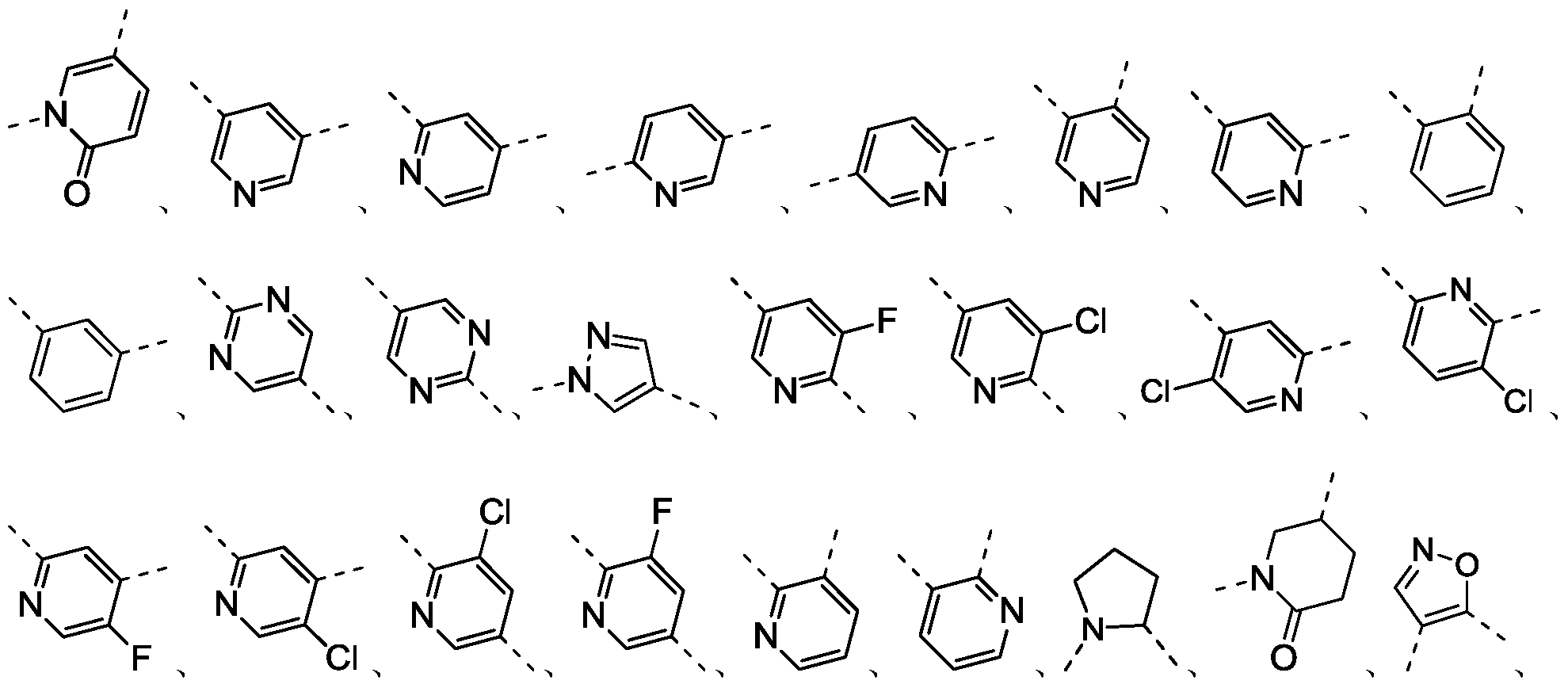

- 根据权利要求1或2所述化合物或其药学上可接受的盐,其中,L选自C1-4烷基、C1-4烷氧基、C1-4烷硫基、C1-4烷氨基、C1-4烷基-C(=O)NH-、C2-4烷烯基或C1-3烷基-O-C1-3烷基,所述L任选被1、2或3个Rb取代。
- 根据权利要求6所述化合物或其药学上可接受的盐,其中,L选自
 所述L任选被1、2或3个Rb取代。
- 根据权利要求7所述化合物或其药学上可接受的盐,其中,L选自


- 根据权利要求8所述化合物或其药学上可接受的盐,其中,L选自


- 根据权利要求1或9所述化合物或其药学上可接受的盐,其中,L1选自O、NH、NHS(=O)2和NHS(=O)。
- 根据权利要求1或2所述化合物或其药学上可接受的盐,其中,R1选自H、C1-3烷基、C3-6环烷基、苯基、吡啶基、哒嗪基、吡嗪基、咪唑基、吡唑基、噻唑基、异噻唑基、噁唑基、异噁唑基或噻吩基,所述C1-3烷基、C3-6环烷基、苯基、吡啶基、哒嗪基、吡嗪基、咪唑基、吡唑基、噻唑基、异噻唑基、噁唑基、异噁唑基或噻吩基任选被1、2或3个Rc取代,所述Rc如前所定义。
- 根据权利要求11所述化合物或其药学上可接受的盐,其中,R1选自H、Me、


- 根据权利要求1所述化合物,其选自:


- 一种药物组合物,其含有治疗有效量的根据权利要求1~13任意一项所述的化合物或其药学上可接受的盐和药学上可接受的载体。
- 根据权利要求1~13任意一项所述的化合物或其药学上可接受的盐或根据权利要求14所述的药物组合物在制备治疗法尼酯X受体相关各种病症、胆汁淤积性肝疾病、纤维变性疾病、高胆固醇疾病、高甘油三酯疾病及心血管疾病的药物中的应用。
- 根据权利要求1~13任意一项所述的化合物或其药学上可接受的盐或根据权利要求14所述的药物组合物在制备治疗非酒精性脂肪性肝病(NAFLD)、非酒精性脂肪性肝炎(NASH)、原发性胆汁性肝硬化(PBC)、胆汁淤积性肝病、慢性肝病、C型肝炎感染、酒精性肝病、肝纤维变性、原发性硬化性胆管炎(PSC)、胆结石、胆管闭锁、下尿路症状与良性前列腺增生(BPH)、输尿管结石、肥胖、二型糖尿病、动脉粥样硬化、动脉硬化症、高胆固醇血症和高血脂症导致的肝功能损害的药物中的应用。
Priority Applications (18)
| Application Number | Priority Date | Filing Date | Title |
|---|---|---|---|
| JP2018539427A JP6924765B2 (ja) | 2016-01-28 | 2017-01-25 | ステロイド誘導体fxr作動薬 |
| BR112018015474-1A BR112018015474B1 (pt) | 2016-01-28 | 2017-01-25 | Compostos agonistas de fxr derivados de esteroide, composição farmacêutica que compreende os mesmos e usos terapêuticos dos ditos compostos |
| MYPI2018702594A MY196292A (en) | 2016-01-28 | 2017-01-25 | Steroid Derivative Fxr Agonist |
| SG11201806348PA SG11201806348PA (en) | 2016-01-28 | 2017-01-25 | Steroid derivative fxr agonist |
| US16/072,839 US10875888B2 (en) | 2016-01-28 | 2017-01-25 | Steroid derivative FXR agonist |
| AU2017213032A AU2017213032B2 (en) | 2016-01-28 | 2017-01-25 | Steroid derivative FXR agonist |
| PH1/2018/550120A PH12018550120B1 (en) | 2016-01-28 | 2017-01-25 | Steroid derivative fxr agonist |
| CN201780007715.1A CN109071593B (zh) | 2016-01-28 | 2017-01-25 | 甾体类衍生物fxr激动剂 |
| MX2018009175A MX391812B (es) | 2016-01-28 | 2017-01-25 | Agonista fxr derivado de esteroides. |
| EP17743740.7A EP3409684B1 (en) | 2016-01-28 | 2017-01-25 | Steroid derivative fxr agonist |
| KR1020187024701A KR102788843B1 (ko) | 2016-01-28 | 2017-01-25 | 스테로이드 유도체 fxr 작용체 |
| NZ745250A NZ745250B2 (en) | 2017-01-25 | Steroid derivative fxr agonist | |
| CA3012396A CA3012396C (en) | 2016-01-28 | 2017-01-25 | Steroid derivative fxr agonist |
| EA201891690A EA038580B9 (ru) | 2016-05-18 | 2017-01-25 | Агонист fxr, представляющий собой производное стероидов |
| IL260795A IL260795B (en) | 2016-01-28 | 2018-07-26 | A steroidal derivative of an fxr receptor agonist |
| ZA2018/05231A ZA201805231B (en) | 2016-01-28 | 2018-08-03 | Steroid derivative fxr agonist |
| US17/069,691 US11667667B2 (en) | 2016-01-28 | 2020-10-13 | Steroid derivative FXR agonist |
| AU2021202018A AU2021202018B2 (en) | 2016-01-28 | 2021-03-31 | Steroid derivative fxr agonist |
Applications Claiming Priority (4)
| Application Number | Priority Date | Filing Date | Title |
|---|---|---|---|
| CN201610061293.3 | 2016-01-28 | ||
| CN201610061293 | 2016-01-28 | ||
| CN201610331759 | 2016-05-18 | ||
| CN201610331759.7 | 2016-05-18 |
Related Child Applications (2)
| Application Number | Title | Priority Date | Filing Date |
|---|---|---|---|
| US16/072,839 A-371-Of-International US10875888B2 (en) | 2016-01-28 | 2017-01-25 | Steroid derivative FXR agonist |
| US17/069,691 Continuation US11667667B2 (en) | 2016-01-28 | 2020-10-13 | Steroid derivative FXR agonist |
Publications (1)
| Publication Number | Publication Date |
|---|---|
| WO2017129125A1 true WO2017129125A1 (zh) | 2017-08-03 |
Family
ID=59397430
Family Applications (1)
| Application Number | Title | Priority Date | Filing Date |
|---|---|---|---|
| PCT/CN2017/072567 Ceased WO2017129125A1 (zh) | 2016-01-28 | 2017-01-25 | 甾体类衍生物fxr激动剂 |
Country Status (15)
| Country | Link |
|---|---|
| US (2) | US10875888B2 (zh) |
| EP (1) | EP3409684B1 (zh) |
| JP (1) | JP6924765B2 (zh) |
| KR (1) | KR102788843B1 (zh) |
| CN (1) | CN109071593B (zh) |
| AU (2) | AU2017213032B2 (zh) |
| CA (1) | CA3012396C (zh) |
| CL (1) | CL2018002009A1 (zh) |
| IL (1) | IL260795B (zh) |
| MX (1) | MX391812B (zh) |
| MY (1) | MY196292A (zh) |
| PH (1) | PH12018550120B1 (zh) |
| SG (2) | SG11201806348PA (zh) |
| WO (1) | WO2017129125A1 (zh) |
| ZA (1) | ZA201805231B (zh) |
Cited By (27)
| Publication number | Priority date | Publication date | Assignee | Title |
|---|---|---|---|---|
| CN107383139A (zh) * | 2017-08-09 | 2017-11-24 | 杭州和泽医药科技有限公司 | 一种3α‑羟基‑7‑氧代‑5β‑胆烷酸新衍生物制备奥贝胆酸的方法 |
| CN107722000A (zh) * | 2017-11-03 | 2018-02-23 | 中国药科大学 | 9位-取代的小檗碱衍生物的制备及其医药用途 |
| CN107987116A (zh) * | 2018-01-17 | 2018-05-04 | 中国药科大学 | 一类鹅去氧胆酸衍生物、其制备方法和医药用途 |
| WO2019020067A1 (zh) * | 2017-07-26 | 2019-01-31 | 正大天晴药业集团股份有限公司 | 甾体类衍生物fxr激动剂的制备方法 |
| WO2019020068A1 (zh) * | 2017-07-26 | 2019-01-31 | 正大天晴药业集团股份有限公司 | 甾体类衍生物fxr激动剂的结晶或无定型物、其制备方法和用途 |
| US10208081B2 (en) | 2014-11-26 | 2019-02-19 | Enanta Pharmaceuticals, Inc. | Bile acid derivatives as FXR/TGR5 agonists and methods of use thereof |
| US10246483B2 (en) | 2015-02-11 | 2019-04-02 | Enanta Pharmaceuticals, Inc. | Bile acid analogs as FXR/TGR5 agonists and methods of use thereof |
| US10266560B2 (en) | 2014-11-06 | 2019-04-23 | Enanta Pharmaceuticals, Inc. | Bile acid analogs as FXR/TGR5 agonists and methods of use thereof |
| US10323061B2 (en) | 2016-02-23 | 2019-06-18 | Enanta Pharmaceuticals, Inc. | Heteroaryl containing bile acid analogs as FXR/TGR5 agonists and methods of use thereof |
| US10323060B2 (en) | 2016-02-23 | 2019-06-18 | Enanta Pharmaceuticals, Inc. | Benzoic acid derivatives of bile acid as FXR/TGR5 agonists and methods of use thereof |
| US10364267B2 (en) | 2016-02-23 | 2019-07-30 | Enanta Pharmaceuticals, Inc. | Deuterated bile acid derivatives as FXR/TGR5 agonists and methods of use thereof |
| US10457703B2 (en) | 2015-03-31 | 2019-10-29 | Enanta Pharmaceuticals, Inc. | Bile acid derivatives as FXR/TGR5 agonists and methods of use thereof |
| US10472386B2 (en) | 2017-02-14 | 2019-11-12 | Enanta Pharmaceuticals, Inc. | Bile acid derivatives as FXR agonists and methods of use thereof |
| US10519191B2 (en) | 2014-11-26 | 2019-12-31 | Enanta Pharmaceuticals, Inc. | Bile acid analogs as FXR/TGR5 agonists and methods of use thereof |
| US10584145B2 (en) | 2016-11-29 | 2020-03-10 | Enanta Pharmaceuticals, Inc. | Process for preparation of sulfonylurea bile acid derivatives |
| CN110878113A (zh) * | 2019-11-07 | 2020-03-13 | 成都贝诺科成生物科技有限公司 | 一种具有抗菌活性的胆酸衍生物及其药用组合物 |
| US10676500B2 (en) | 2017-04-07 | 2020-06-09 | Enanta Pharmaceuticals, Inc. | Process for preparation of sulfonyl carbamate bile acid derivatives |
| WO2021009332A1 (en) | 2019-07-18 | 2021-01-21 | Enyo Pharma | Method for decreasing adverse-effects of interferon |
| WO2021144330A1 (en) | 2020-01-15 | 2021-07-22 | INSERM (Institut National de la Santé et de la Recherche Médicale) | Use of fxr agonists for treating an infection by hepatitis d virus |
| EP3705487A4 (en) * | 2017-11-02 | 2021-08-04 | Chia Tai Tianqing Pharmaceutical Group Co., Ltd. | METHOD FOR PREPARING A CHOLIC ACID COMPOUND |
| CN113861258A (zh) * | 2021-09-05 | 2021-12-31 | 中国海洋大学 | 一种马尾藻甾醇的合成方法 |
| WO2022152770A1 (en) | 2021-01-14 | 2022-07-21 | Enyo Pharma | Synergistic effect of a fxr agonist and ifn for the treatment of hbv infection |
| WO2022229302A1 (en) | 2021-04-28 | 2022-11-03 | Enyo Pharma | Strong potentiation of tlr3 agonists effects using fxr agonists as a combined treatment |
| US11578097B2 (en) | 2014-11-26 | 2023-02-14 | Enanta Pharmaceuticals, Inc. | Tetrazole derivatives of bile acids as FXR/TGR5 agonists and methods of use thereof |
| CN115785183A (zh) * | 2020-04-23 | 2023-03-14 | 江西青峰药业有限公司 | 一种3α,7α-二羟基-6α-乙基-5β-胆烷-24-醛的制备方法及其应用 |
| CN116178473A (zh) * | 2018-12-10 | 2023-05-30 | 江西青峰药业有限公司 | 一种奥贝胆酸的制备方法 |
| RU2800751C2 (ru) * | 2017-07-26 | 2023-07-27 | Чиа Тай Тяньцин Фармасьютикал Груп Ко., Лтд. | Кристаллическая или аморфная форма агонистов fxr, представляющих собой производные стероидов, способ их получения и их применение |
Families Citing this family (7)
| Publication number | Priority date | Publication date | Assignee | Title |
|---|---|---|---|---|
| EP3409684B1 (en) * | 2016-01-28 | 2024-01-03 | Chia Tai Tianqing Pharmaceutical Group Co., Ltd. | Steroid derivative fxr agonist |
| CN109134572A (zh) * | 2017-06-19 | 2019-01-04 | 中国科学院上海药物研究所 | 胆酸衍生物及其制备方法和用途 |
| WO2023048528A1 (ko) * | 2021-09-24 | 2023-03-30 | (주)샤페론 | 염증복합체 억제제를 유효성분으로 하는 아토피 피부염 예방, 개선 또는 치료용 약학 조성물 |
| WO2023048526A1 (ko) * | 2021-09-24 | 2023-03-30 | (주)샤페론 | 염증복합체 억제제를 유효성분으로 함유하는, 비알코올성 지방간염, 간 섬유화의 예방, 개선 또는 치료용 약학적 조성물 |
| CN118660883A (zh) | 2021-11-15 | 2024-09-17 | 海湃泰克(北京)生物医药科技有限公司 | 多环化合物及其方法 |
| IT202200011705A1 (it) * | 2022-06-01 | 2023-12-01 | Prec Bio Therapeutics S R L | Derivati del colesterolo e loro usi |
| CN116497082B (zh) * | 2023-06-27 | 2023-09-29 | 华南理工大学 | 一种化学-酶法合成3α,7α,24R-三羟基胆甾醇的方法 |
Citations (8)
| Publication number | Priority date | Publication date | Assignee | Title |
|---|---|---|---|---|
| WO2000037077A1 (en) | 1998-12-23 | 2000-06-29 | Glaxo Group Limited | Assays for ligands for nuclear receptors |
| WO2002072598A1 (en) * | 2001-03-12 | 2002-09-19 | Roberto Pellicciari | Steroids as agonists for fxr |
| WO2005082925A2 (en) | 2004-02-26 | 2005-09-09 | Intercept Pharmaceuticals Inc. | Novel steroid agonist for fxr |
| WO2016086218A1 (en) * | 2014-11-26 | 2016-06-02 | Enanta Pharmaceuticals, Inc. | Bile acid derivatives as fxr/tgr5 agonists and methods of use thereof |
| WO2016086134A1 (en) * | 2014-11-26 | 2016-06-02 | Enanta Pharmaceuticals, Inc. | Bile acid derivatives as fxr/tgr5 agonists and methods of use thereof |
| WO2016161003A1 (en) * | 2015-03-31 | 2016-10-06 | Enanta Phamraceuticals, Inc. | Bile acid derivatives as fxr/tgr5 agonists and methods of use thereof |
| WO2016173397A1 (zh) * | 2015-04-28 | 2016-11-03 | 上海翰森生物医药科技有限公司 | 胆酸衍生物及其制备方法和医药用途 |
| CN106083978A (zh) * | 2015-04-28 | 2016-11-09 | 上海迪诺医药科技有限公司 | 磺酰基氨基羰基衍生物、其药物组合物及应用 |
Family Cites Families (7)
| Publication number | Priority date | Publication date | Assignee | Title |
|---|---|---|---|---|
| KR20150004894A (ko) * | 2012-05-01 | 2015-01-13 | 카타베이시스 파마슈티칼즈, 인코포레이티드 | 스타틴 및 fxr 작용제의 지방산 컨쥬게이트들; 조성물 및 이용 방법 |
| CA2912139C (en) * | 2013-05-14 | 2021-04-20 | Roberto Pellicciari | 11-hydroxyl-derivatives of bile acids and amino acid conjugates thereof as farnesoid x receptor modulators |
| CA2957332A1 (en) * | 2014-08-20 | 2016-02-25 | F. Hoffmann-La Roche Ag | In vitro method and apparatus for analysing the behaviour of substances in simulated physiological environment |
| HK1244708A1 (zh) * | 2014-11-26 | 2018-08-17 | 英安塔制药有限公司 | 作爲fxr/tgr5激动剂的胆汁酸类似物及其使用方法 |
| EP3409684B1 (en) * | 2016-01-28 | 2024-01-03 | Chia Tai Tianqing Pharmaceutical Group Co., Ltd. | Steroid derivative fxr agonist |
| WO2017147137A1 (en) * | 2016-02-23 | 2017-08-31 | Enanta Pharmaceuticals, Inc. | Benzoic acid derivatives of bile acid as fxr/tgr5 agonists and methods of use thereof |
| EP3436316A4 (en) * | 2016-03-31 | 2020-03-04 | B/E Aerospace, Inc. | SYSTEM AND METHODS FOR PROTECTING A PASSENGER IN AN OBLIQUE MOUNTED AIRPLANE SEAT |
-
2017
- 2017-01-25 EP EP17743740.7A patent/EP3409684B1/en active Active
- 2017-01-25 CN CN201780007715.1A patent/CN109071593B/zh active Active
- 2017-01-25 MX MX2018009175A patent/MX391812B/es unknown
- 2017-01-25 PH PH1/2018/550120A patent/PH12018550120B1/en unknown
- 2017-01-25 KR KR1020187024701A patent/KR102788843B1/ko active Active
- 2017-01-25 AU AU2017213032A patent/AU2017213032B2/en active Active
- 2017-01-25 WO PCT/CN2017/072567 patent/WO2017129125A1/zh not_active Ceased
- 2017-01-25 JP JP2018539427A patent/JP6924765B2/ja active Active
- 2017-01-25 SG SG11201806348PA patent/SG11201806348PA/en unknown
- 2017-01-25 MY MYPI2018702594A patent/MY196292A/en unknown
- 2017-01-25 CA CA3012396A patent/CA3012396C/en active Active
- 2017-01-25 SG SG10201913768TA patent/SG10201913768TA/en unknown
- 2017-01-25 US US16/072,839 patent/US10875888B2/en active Active
-
2018
- 2018-07-24 CL CL2018002009A patent/CL2018002009A1/es unknown
- 2018-07-26 IL IL260795A patent/IL260795B/en active IP Right Grant
- 2018-08-03 ZA ZA2018/05231A patent/ZA201805231B/en unknown
-
2020
- 2020-10-13 US US17/069,691 patent/US11667667B2/en active Active
-
2021
- 2021-03-31 AU AU2021202018A patent/AU2021202018B2/en active Active
Patent Citations (8)
| Publication number | Priority date | Publication date | Assignee | Title |
|---|---|---|---|---|
| WO2000037077A1 (en) | 1998-12-23 | 2000-06-29 | Glaxo Group Limited | Assays for ligands for nuclear receptors |
| WO2002072598A1 (en) * | 2001-03-12 | 2002-09-19 | Roberto Pellicciari | Steroids as agonists for fxr |
| WO2005082925A2 (en) | 2004-02-26 | 2005-09-09 | Intercept Pharmaceuticals Inc. | Novel steroid agonist for fxr |
| WO2016086218A1 (en) * | 2014-11-26 | 2016-06-02 | Enanta Pharmaceuticals, Inc. | Bile acid derivatives as fxr/tgr5 agonists and methods of use thereof |
| WO2016086134A1 (en) * | 2014-11-26 | 2016-06-02 | Enanta Pharmaceuticals, Inc. | Bile acid derivatives as fxr/tgr5 agonists and methods of use thereof |
| WO2016161003A1 (en) * | 2015-03-31 | 2016-10-06 | Enanta Phamraceuticals, Inc. | Bile acid derivatives as fxr/tgr5 agonists and methods of use thereof |
| WO2016173397A1 (zh) * | 2015-04-28 | 2016-11-03 | 上海翰森生物医药科技有限公司 | 胆酸衍生物及其制备方法和医药用途 |
| CN106083978A (zh) * | 2015-04-28 | 2016-11-09 | 上海迪诺医药科技有限公司 | 磺酰基氨基羰基衍生物、其药物组合物及应用 |
Non-Patent Citations (7)
| Title |
|---|
| "Protective Groups In Organic Synthesis", 1991, WILEY AND SONS |
| "Remington: The Science and Practice of Pharmacy", 2005, LIPPINCOTT, WILLIAMS & WILKINS |
| BM. FORMAN ET AL., CELL, vol. 81, 1995, pages 687 - 693 |
| BM. FORMAN, CELL, vol. 81, 1995, pages 687 - 693 |
| DJ. MANGELSDORF ET AL., CELL, vol. 83, 1995, pages 841 - 850 |
| MAEHR, J. CHEM. ED., vol. 62, 1985, pages 114 - 120 |
| W. SEOL ET AL., MOL. ENDOCRINNOL., vol. 9, 1995, pages 72 - 85 |
Cited By (48)
| Publication number | Priority date | Publication date | Assignee | Title |
|---|---|---|---|---|
| US10266560B2 (en) | 2014-11-06 | 2019-04-23 | Enanta Pharmaceuticals, Inc. | Bile acid analogs as FXR/TGR5 agonists and methods of use thereof |
| US10696713B2 (en) | 2014-11-26 | 2020-06-30 | Enanta Pharmaceuticals, Inc. | Bile acid derivatives as FXR/TGR5 agonists and methods of use thereof |
| US12281140B2 (en) | 2014-11-26 | 2025-04-22 | Enanta Pharmaceuticals, Inc. | Bile acid derivatives as FXR/TGR5 agonists and methods of use thereof |
| US10968249B2 (en) | 2014-11-26 | 2021-04-06 | Enanta Pharmaceuticals, Inc. | Bile acid derivatives as FXR/TGR5 agonists and methods of use thereof |
| US11718641B2 (en) | 2014-11-26 | 2023-08-08 | Enanta Pharmaceuticals, Inc. | Bile acid derivatives as FXR/TGR5 agonists and methods of use thereof |
| US11578097B2 (en) | 2014-11-26 | 2023-02-14 | Enanta Pharmaceuticals, Inc. | Tetrazole derivatives of bile acids as FXR/TGR5 agonists and methods of use thereof |
| US10208081B2 (en) | 2014-11-26 | 2019-02-19 | Enanta Pharmaceuticals, Inc. | Bile acid derivatives as FXR/TGR5 agonists and methods of use thereof |
| US10519191B2 (en) | 2014-11-26 | 2019-12-31 | Enanta Pharmaceuticals, Inc. | Bile acid analogs as FXR/TGR5 agonists and methods of use thereof |
| US10246483B2 (en) | 2015-02-11 | 2019-04-02 | Enanta Pharmaceuticals, Inc. | Bile acid analogs as FXR/TGR5 agonists and methods of use thereof |
| US11040998B2 (en) | 2015-03-31 | 2021-06-22 | Enanta Pharmaceuticals, Inc. | Bile acid derivatives as FXR/TGR5 agonists and methods of use thereof |
| US10457703B2 (en) | 2015-03-31 | 2019-10-29 | Enanta Pharmaceuticals, Inc. | Bile acid derivatives as FXR/TGR5 agonists and methods of use thereof |
| US11958879B2 (en) | 2015-03-31 | 2024-04-16 | Enanta Pharmaceuticals, Inc. | Bile acid derivatives as FXR/TGR5 agonists and methods of use thereof |
| US10364267B2 (en) | 2016-02-23 | 2019-07-30 | Enanta Pharmaceuticals, Inc. | Deuterated bile acid derivatives as FXR/TGR5 agonists and methods of use thereof |
| US10323060B2 (en) | 2016-02-23 | 2019-06-18 | Enanta Pharmaceuticals, Inc. | Benzoic acid derivatives of bile acid as FXR/TGR5 agonists and methods of use thereof |
| US10323061B2 (en) | 2016-02-23 | 2019-06-18 | Enanta Pharmaceuticals, Inc. | Heteroaryl containing bile acid analogs as FXR/TGR5 agonists and methods of use thereof |
| US10584145B2 (en) | 2016-11-29 | 2020-03-10 | Enanta Pharmaceuticals, Inc. | Process for preparation of sulfonylurea bile acid derivatives |
| US10947264B2 (en) | 2016-11-29 | 2021-03-16 | Enanta Pharmaceuticals, Inc. | Process for preparation of sulfonylurea bile acid derivatives |
| US10472386B2 (en) | 2017-02-14 | 2019-11-12 | Enanta Pharmaceuticals, Inc. | Bile acid derivatives as FXR agonists and methods of use thereof |
| US10961272B2 (en) | 2017-04-07 | 2021-03-30 | Enanta Pharmaceuticals, Inc. | Process for preparation of sulfonyl carbamate bile acid derivatives |
| US10676500B2 (en) | 2017-04-07 | 2020-06-09 | Enanta Pharmaceuticals, Inc. | Process for preparation of sulfonyl carbamate bile acid derivatives |
| WO2019020068A1 (zh) * | 2017-07-26 | 2019-01-31 | 正大天晴药业集团股份有限公司 | 甾体类衍生物fxr激动剂的结晶或无定型物、其制备方法和用途 |
| JP7308811B2 (ja) | 2017-07-26 | 2023-07-14 | チア タイ ティエンチン ファーマシューティカル グループ カンパニー リミテッド | ステロイド系誘導体fxrアゴニストの製造方法 |
| WO2019020067A1 (zh) * | 2017-07-26 | 2019-01-31 | 正大天晴药业集团股份有限公司 | 甾体类衍生物fxr激动剂的制备方法 |
| RU2800751C2 (ru) * | 2017-07-26 | 2023-07-27 | Чиа Тай Тяньцин Фармасьютикал Груп Ко., Лтд. | Кристаллическая или аморфная форма агонистов fxr, представляющих собой производные стероидов, способ их получения и их применение |
| CN110869381B (zh) * | 2017-07-26 | 2021-11-19 | 正大天晴药业集团股份有限公司 | 甾体类衍生物fxr激动剂的制备方法 |
| JP2020528067A (ja) * | 2017-07-26 | 2020-09-17 | チア タイ ティエンチン ファーマシューティカル グループ カンパニー リミテッドChia Tai Tianqing Pharmaceutical Group Co., Ltd. | ステロイド系誘導体fxrアゴニストの結晶又は非晶質、その製造方法及び使用 |
| EP3660031A4 (en) * | 2017-07-26 | 2021-03-31 | Chia Tai Tianqing Pharmaceutical Group Co., Ltd. | CRYSTALLINE OR AMORPHIC FORM OF STEROID DERIVATIVE FXR AGONIST, METHOD OF MANUFACTURING THEREOF AND USE THEREOF |
| CN110869381A (zh) * | 2017-07-26 | 2020-03-06 | 正大天晴药业集团股份有限公司 | 甾体类衍生物fxr激动剂的制备方法 |
| EP3660030A4 (en) * | 2017-07-26 | 2021-04-21 | Chia Tai Tianqing Pharmaceutical Group Co., Ltd. | METHOD OF MANUFACTURING STEROID-DERIVATIVE FXR AGONISTS |
| JP7244487B2 (ja) | 2017-07-26 | 2023-03-22 | チア タイ ティエンチン ファーマシューティカル グループ カンパニー リミテッド | ステロイド系誘導体fxrアゴニストの結晶又は非晶質、その製造方法及び使用 |
| US11059853B2 (en) | 2017-07-26 | 2021-07-13 | Chia Tai Tianqing Pharmaceutical Group Co., Ltd. | Crystalline or amorphous form of steroid derivative FXR agonist, preparation method therefor and use thereof |
| US11059854B2 (en) | 2017-07-26 | 2021-07-13 | Chia Tai Tianqing Pharmaceutical Group Co., Ltd. | Method for preparing steroid derivative FXR agonist |
| JP2020528068A (ja) * | 2017-07-26 | 2020-09-17 | チア タイ ティエンチン ファーマシューティカル グループ カンパニー リミテッドChia Tai Tianqing Pharmaceutical Group Co., Ltd. | ステロイド系誘導体fxrアゴニストの製造方法 |
| AU2018305612B2 (en) * | 2017-07-26 | 2022-04-14 | Chia Tai Tianqing Pharmaceutical Group Co., Ltd. | Crystalline or amorphous form of steroid derivative FXR agonist, preparation method therefor and use thereof |
| CN107383139A (zh) * | 2017-08-09 | 2017-11-24 | 杭州和泽医药科技有限公司 | 一种3α‑羟基‑7‑氧代‑5β‑胆烷酸新衍生物制备奥贝胆酸的方法 |
| EP3705487A4 (en) * | 2017-11-02 | 2021-08-04 | Chia Tai Tianqing Pharmaceutical Group Co., Ltd. | METHOD FOR PREPARING A CHOLIC ACID COMPOUND |
| CN107722000A (zh) * | 2017-11-03 | 2018-02-23 | 中国药科大学 | 9位-取代的小檗碱衍生物的制备及其医药用途 |
| CN107987116A (zh) * | 2018-01-17 | 2018-05-04 | 中国药科大学 | 一类鹅去氧胆酸衍生物、其制备方法和医药用途 |
| CN107987116B (zh) * | 2018-01-17 | 2021-01-05 | 中国药科大学 | 一类鹅去氧胆酸衍生物、其制备方法和医药用途 |
| CN116178473A (zh) * | 2018-12-10 | 2023-05-30 | 江西青峰药业有限公司 | 一种奥贝胆酸的制备方法 |
| WO2021009332A1 (en) | 2019-07-18 | 2021-01-21 | Enyo Pharma | Method for decreasing adverse-effects of interferon |
| CN110878113B (zh) * | 2019-11-07 | 2021-02-02 | 成都贝诺科成生物科技有限公司 | 一种具有抗菌活性的胆酸衍生物及其药用组合物 |
| CN110878113A (zh) * | 2019-11-07 | 2020-03-13 | 成都贝诺科成生物科技有限公司 | 一种具有抗菌活性的胆酸衍生物及其药用组合物 |
| WO2021144330A1 (en) | 2020-01-15 | 2021-07-22 | INSERM (Institut National de la Santé et de la Recherche Médicale) | Use of fxr agonists for treating an infection by hepatitis d virus |
| CN115785183A (zh) * | 2020-04-23 | 2023-03-14 | 江西青峰药业有限公司 | 一种3α,7α-二羟基-6α-乙基-5β-胆烷-24-醛的制备方法及其应用 |
| WO2022152770A1 (en) | 2021-01-14 | 2022-07-21 | Enyo Pharma | Synergistic effect of a fxr agonist and ifn for the treatment of hbv infection |
| WO2022229302A1 (en) | 2021-04-28 | 2022-11-03 | Enyo Pharma | Strong potentiation of tlr3 agonists effects using fxr agonists as a combined treatment |
| CN113861258A (zh) * | 2021-09-05 | 2021-12-31 | 中国海洋大学 | 一种马尾藻甾醇的合成方法 |
Also Published As
| Publication number | Publication date |
|---|---|
| CA3012396C (en) | 2024-03-26 |
| CN109071593B (zh) | 2021-01-15 |
| JP6924765B2 (ja) | 2021-08-25 |
| US11667667B2 (en) | 2023-06-06 |
| CN109071593A (zh) | 2018-12-21 |
| KR20180100703A (ko) | 2018-09-11 |
| AU2017213032B2 (en) | 2021-01-07 |
| MX391812B (es) | 2025-03-21 |
| PH12018550120A1 (en) | 2019-03-18 |
| BR112018015474A2 (zh) | 2018-12-18 |
| SG10201913768TA (en) | 2020-03-30 |
| AU2017213032A1 (en) | 2018-08-30 |
| NZ745250A (en) | 2024-08-30 |
| SG11201806348PA (en) | 2018-08-30 |
| ZA201805231B (en) | 2022-03-30 |
| EP3409684A4 (en) | 2019-10-09 |
| JP2019503392A (ja) | 2019-02-07 |
| KR102788843B1 (ko) | 2025-03-28 |
| MY196292A (en) | 2023-03-24 |
| AU2021202018B2 (en) | 2022-04-07 |
| CL2018002009A1 (es) | 2018-11-05 |
| MX2018009175A (es) | 2018-11-29 |
| US20190382437A1 (en) | 2019-12-19 |
| IL260795B (en) | 2021-04-29 |
| US20210040140A1 (en) | 2021-02-11 |
| CA3012396A1 (en) | 2017-08-03 |
| PH12018550120B1 (en) | 2023-03-15 |
| EP3409684B1 (en) | 2024-01-03 |
| US10875888B2 (en) | 2020-12-29 |
| AU2021202018A1 (en) | 2021-04-29 |
| EP3409684A1 (en) | 2018-12-05 |
Similar Documents
| Publication | Publication Date | Title |
|---|---|---|
| CN109071593B (zh) | 甾体类衍生物fxr激动剂 | |
| CN107531743B (zh) | 鹅去氧胆酸衍生物 | |
| JP6857124B2 (ja) | Fxr/tgr5アゴニストとしての胆汁酸誘導体およびその使用方法 | |
| CN106518946A (zh) | 磺酰脲衍生物、其药物组合物及应用 | |
| CN106999551A (zh) | 作为fxr/tgr5激动剂的胆汁酸类似物和其使用方法 | |
| TW202134248A (zh) | Sstr5拮抗劑 | |
| WO2015135449A1 (zh) | 五环三萜类化合物及其制备方法、药物组合物和用途 | |
| WO2023198172A1 (zh) | 噁二唑化合物、包含其的药物组合物及其用途 | |
| TWI893404B (zh) | 雙官能基化合物及包含該雙官能基化合物之醫藥組成物,及其用於製備治療雄激素受體相關疾病之藥物的用途 | |
| JP7244487B2 (ja) | ステロイド系誘導体fxrアゴニストの結晶又は非晶質、その製造方法及び使用 | |
| HK1259152A1 (zh) | 甾体类衍生物fxr激动剂 | |
| HK1259152B (zh) | 甾体类衍生物fxr激动剂 | |
| EA038580B1 (ru) | Агонист fxr, представляющий собой производное стероидов | |
| BR112018015474B1 (pt) | Compostos agonistas de fxr derivados de esteroide, composição farmacêutica que compreende os mesmos e usos terapêuticos dos ditos compostos | |
| CN116789636B (zh) | 双功能化合物及其制备方法、药物组合物和用途 | |
| CA3080091A1 (en) | Amorphous pyrrolidine derivative as ppar agonist and preparation method thereof | |
| RU2800751C2 (ru) | Кристаллическая или аморфная форма агонистов fxr, представляющих собой производные стероидов, способ их получения и их применение | |
| JP2025537627A (ja) | セレン含有複素環式化合物およびその使用 | |
| WO2025180517A1 (zh) | 含sf5类喹啉衍生物及其作为p2x7拮抗剂的用途 | |
| CN114315815A (zh) | 用于调节fxr活性的化合物及其应用 | |
| HK40029010A (zh) | 含有羧酸基团的苯并氮杂环类化合物及其制备方法和用途 |
Legal Events
| Date | Code | Title | Description |
|---|---|---|---|
| 121 | Ep: the epo has been informed by wipo that ep was designated in this application |
Ref document number: 17743740 Country of ref document: EP Kind code of ref document: A1 |
|
| WWE | Wipo information: entry into national phase |
Ref document number: 3012396 Country of ref document: CA |
|
| WWE | Wipo information: entry into national phase |
Ref document number: 11201806348P Country of ref document: SG Ref document number: 12018550120 Country of ref document: PH |
|
| WWE | Wipo information: entry into national phase |
Ref document number: MX/A/2018/009175 Country of ref document: MX Ref document number: 260795 Country of ref document: IL |
|
| ENP | Entry into the national phase |
Ref document number: 2018539427 Country of ref document: JP Kind code of ref document: A |
|
| NENP | Non-entry into the national phase |
Ref country code: DE |
|
| REG | Reference to national code |
Ref country code: BR Ref legal event code: B01A Ref document number: 112018015474 Country of ref document: BR |
|
| WWE | Wipo information: entry into national phase |
Ref document number: 201891690 Country of ref document: EA |
|
| ENP | Entry into the national phase |
Ref document number: 20187024701 Country of ref document: KR Kind code of ref document: A |
|
| WWE | Wipo information: entry into national phase |
Ref document number: 2017743740 Country of ref document: EP |
|
| ENP | Entry into the national phase |
Ref document number: 2017213032 Country of ref document: AU Date of ref document: 20170125 Kind code of ref document: A |
|
| ENP | Entry into the national phase |
Ref document number: 2017743740 Country of ref document: EP Effective date: 20180828 |
|
| ENP | Entry into the national phase |
Ref document number: 112018015474 Country of ref document: BR Kind code of ref document: A2 Effective date: 20180727 |