WO2017115541A1 - 長繊維を含むウェブを有する吸収体を含む吸収性物品 - Google Patents
長繊維を含むウェブを有する吸収体を含む吸収性物品 Download PDFInfo
- Publication number
- WO2017115541A1 WO2017115541A1 PCT/JP2016/081182 JP2016081182W WO2017115541A1 WO 2017115541 A1 WO2017115541 A1 WO 2017115541A1 JP 2016081182 W JP2016081182 W JP 2016081182W WO 2017115541 A1 WO2017115541 A1 WO 2017115541A1
- Authority
- WO
- WIPO (PCT)
- Prior art keywords
- absorbent
- layer
- core layer
- shock absorber
- absorbent article
- Prior art date
- Legal status (The legal status is an assumption and is not a legal conclusion. Google has not performed a legal analysis and makes no representation as to the accuracy of the status listed.)
- Ceased
Links
Images


Classifications
-
- A—HUMAN NECESSITIES
- A61—MEDICAL OR VETERINARY SCIENCE; HYGIENE
- A61F—FILTERS IMPLANTABLE INTO BLOOD VESSELS; PROSTHESES; DEVICES PROVIDING PATENCY TO, OR PREVENTING COLLAPSING OF, TUBULAR STRUCTURES OF THE BODY, e.g. STENTS; ORTHOPAEDIC, NURSING OR CONTRACEPTIVE DEVICES; FOMENTATION; TREATMENT OR PROTECTION OF EYES OR EARS; BANDAGES, DRESSINGS OR ABSORBENT PADS; FIRST-AID KITS
- A61F13/00—Bandages or dressings; Absorbent pads
- A61F13/15—Absorbent pads, e.g. sanitary towels, swabs or tampons for external or internal application to the body; Supporting or fastening means therefor; Tampon applicators
- A61F13/45—Absorbent pads, e.g. sanitary towels, swabs or tampons for external or internal application to the body; Supporting or fastening means therefor; Tampon applicators characterised by the shape
- A61F13/49—Absorbent pads, e.g. sanitary towels, swabs or tampons for external or internal application to the body; Supporting or fastening means therefor; Tampon applicators characterised by the shape specially adapted to be worn around the waist, e.g. diapers, nappies
-
- A—HUMAN NECESSITIES
- A61—MEDICAL OR VETERINARY SCIENCE; HYGIENE
- A61F—FILTERS IMPLANTABLE INTO BLOOD VESSELS; PROSTHESES; DEVICES PROVIDING PATENCY TO, OR PREVENTING COLLAPSING OF, TUBULAR STRUCTURES OF THE BODY, e.g. STENTS; ORTHOPAEDIC, NURSING OR CONTRACEPTIVE DEVICES; FOMENTATION; TREATMENT OR PROTECTION OF EYES OR EARS; BANDAGES, DRESSINGS OR ABSORBENT PADS; FIRST-AID KITS
- A61F13/00—Bandages or dressings; Absorbent pads
- A61F13/15—Absorbent pads, e.g. sanitary towels, swabs or tampons for external or internal application to the body; Supporting or fastening means therefor; Tampon applicators
- A61F13/53—Absorbent pads, e.g. sanitary towels, swabs or tampons for external or internal application to the body; Supporting or fastening means therefor; Tampon applicators characterised by the absorbing medium
-
- A—HUMAN NECESSITIES
- A61—MEDICAL OR VETERINARY SCIENCE; HYGIENE
- A61F—FILTERS IMPLANTABLE INTO BLOOD VESSELS; PROSTHESES; DEVICES PROVIDING PATENCY TO, OR PREVENTING COLLAPSING OF, TUBULAR STRUCTURES OF THE BODY, e.g. STENTS; ORTHOPAEDIC, NURSING OR CONTRACEPTIVE DEVICES; FOMENTATION; TREATMENT OR PROTECTION OF EYES OR EARS; BANDAGES, DRESSINGS OR ABSORBENT PADS; FIRST-AID KITS
- A61F13/00—Bandages or dressings; Absorbent pads
- A61F13/15—Absorbent pads, e.g. sanitary towels, swabs or tampons for external or internal application to the body; Supporting or fastening means therefor; Tampon applicators
- A61F13/53—Absorbent pads, e.g. sanitary towels, swabs or tampons for external or internal application to the body; Supporting or fastening means therefor; Tampon applicators characterised by the absorbing medium
- A61F13/534—Absorbent pads, e.g. sanitary towels, swabs or tampons for external or internal application to the body; Supporting or fastening means therefor; Tampon applicators characterised by the absorbing medium having an inhomogeneous composition through the thickness of the pad
-
- A—HUMAN NECESSITIES
- A61—MEDICAL OR VETERINARY SCIENCE; HYGIENE
- A61F—FILTERS IMPLANTABLE INTO BLOOD VESSELS; PROSTHESES; DEVICES PROVIDING PATENCY TO, OR PREVENTING COLLAPSING OF, TUBULAR STRUCTURES OF THE BODY, e.g. STENTS; ORTHOPAEDIC, NURSING OR CONTRACEPTIVE DEVICES; FOMENTATION; TREATMENT OR PROTECTION OF EYES OR EARS; BANDAGES, DRESSINGS OR ABSORBENT PADS; FIRST-AID KITS
- A61F13/00—Bandages or dressings; Absorbent pads
- A61F13/15—Absorbent pads, e.g. sanitary towels, swabs or tampons for external or internal application to the body; Supporting or fastening means therefor; Tampon applicators
- A61F13/53—Absorbent pads, e.g. sanitary towels, swabs or tampons for external or internal application to the body; Supporting or fastening means therefor; Tampon applicators characterised by the absorbing medium
- A61F13/534—Absorbent pads, e.g. sanitary towels, swabs or tampons for external or internal application to the body; Supporting or fastening means therefor; Tampon applicators characterised by the absorbing medium having an inhomogeneous composition through the thickness of the pad
- A61F13/535—Absorbent pads, e.g. sanitary towels, swabs or tampons for external or internal application to the body; Supporting or fastening means therefor; Tampon applicators characterised by the absorbing medium having an inhomogeneous composition through the thickness of the pad inhomogeneous in the plane of the pad, e.g. core absorbent layers being of different sizes
Definitions
- the present disclosure relates to an absorbent article including an absorbent body having a web including long fibers.
- an absorbent article having bulky members at both end portions of an absorbent body that is easily affected by movement of the wearer's crotch is known.
- An absorbent material is also known in which the absorbent core is configured to include continuous filaments and a superabsorbent polymer.
- Patent Document 1 discloses an absorbent article provided in a bodily fluid absorber between a top sheet and a back sheet, the top sheet and the back sheet positioned outward from an edge of the bodily fluid absorber.
- An absorbent article is disclosed in which a bulky member is interposed between the two and the bulky member is formed of a fiber assembly made of tow.
- Patent Document 2 discloses an absorbent core for use in an absorbent article, wherein the core includes a plurality of filaments that are substantially continuous and have the same spread, At least some of the filaments have a layer disposed on the surface thereof, the layer comprising a superabsorbent material formed from a liquid superabsorbent polymer at a predetermined location on the surface.
- An absorbent core for use in an absorbent article is disclosed.
- the bulky member having the above-described configuration once absorbs high-humidity air, and further crushed by receiving pressure from the wearer, the high-humidity air is exhausted through the top sheet. Therefore, a wearer's discomfort can be reduced.
- the configuration disclosed in Patent Document 1 there is no means for holding the liquid that flows out from the edge of the body fluid absorber, and the absorbent article may leak sideways. Therefore, as disclosed in Patent Document 2, it is proposed that the long fibers (tow) constituting the bulky member have a layer containing a superabsorbent material formed from a liquid superabsorbent polymer. .
- the liquid superabsorbent polymer takes a relatively long time to absorb water, and even if this configuration is adopted, the absorbent article may still leak sideways.
- the technical problem of the present invention is to provide an absorbent article that includes an absorbent body having a web containing long fibers and has a reduced risk of side leakage.
- the absorbent article of the present invention is: An absorbent article comprising an absorbent body having a longitudinal direction, a width direction, and a thickness direction, The absorbent body is divided into a central portion and a pair of both side portions on both sides thereof, both extending in the longitudinal direction in the width direction, The absorber is In the central portion, having a central absorbent core layer, In each of the pair of both side portions, a web containing a long fiber having an average fiber length of 70 mm or more and a shock absorber layer containing a superabsorbent polymer, and the shock absorber layer and the absorber overlap in the thickness direction.
- a side absorbent core layer In each of the pair of both side portions, a web containing a long fiber having an average fiber length of 70 mm or more and a shock absorber layer containing a superabsorbent polymer, and the shock absorber layer and the absorber overlap in the thickness direction.
- the absorbent article of the present invention it is possible to reduce the risk of side leakage while including an absorbent body having a web containing long fibers.
- FIG. 1 is an exploded view of a disposable diaper according to an embodiment of the present invention.
- FIG. 2 is a plan view of the absorber.
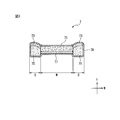
- FIG. 3 is a schematic view of a section taken along line III-III ′ shown in FIG.
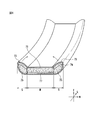
- FIG. 4 is a schematic view showing a state in which the absorber 7 is induced to be deformed.
- An absorbent article comprising an absorbent body having a longitudinal direction, a width direction, and a thickness direction, The absorbent body is divided into a central portion and a pair of both side portions on both sides thereof, both extending in the longitudinal direction in the width direction, The absorber is In the central portion, having a central absorbent core layer, In each of the pair of both side portions, a shock absorber layer including a web containing a long fiber having an average fiber length of 70 mm or more and a superabsorbent polymer, and the shock absorber layer overlaps in the thickness direction of the absorber.
- An absorbent article comprising a side absorbent core layer.
- the absorbent body has the shock absorbing material layer including the web containing the long fiber and the superabsorbent polymer on both sides thereof, thereby increasing the flexibility of the both sides and more closely contacting the wearer. Since it becomes easy to do, fit property and water absorption and water retention are improved.
- the absorbent body When stress is applied from both sides to the center, the boundary portion becomes a starting point, and the absorbent body is bent along the boundary portion, and deformed into a shape suitable for receiving the excrement of the wearer.
- the absorbent body Since it is easy, the opportunity for excrement etc. to contact a wearer's skin can be reduced, and it can control that the absorption core layer of a central part with relatively little rigidity difference and thickness difference deforms and collapses. Furthermore, since the absorbent body has an absorbent core layer that overlaps in the thickness direction of the absorbent body on both sides of the absorbent body, the water absorption force on both sides in the width direction of the absorbent article is reinforced, In addition to reducing rewetting, if the absorbent body is bent along the boundary, the absorbent core layers on both sides of the absorbent body are also bent in conjunction with each other, so that side leakage of liquid and rash at the time of mounting can be suppressed.
- each of the pair of both side portions has the side part absorption core layer on a skin surface side of the shock absorber layer.
- the absorbent body has the absorbent core layer on the skin surface side of the shock absorbing material layer in each of the pair of both side portions, whereby both widthwise side portions on the skin surface side of the absorbent article. Since the water absorption force is reinforced, the rewetting on the skin surface side of the absorbent article can be reduced, and the rash at the time of wearing can be further suppressed.
- the absorber further includes an auxiliary shock absorber layer in the central portion,
- the absorbent article according to any one of aspects 1 to 3, wherein the auxiliary impact absorbing material layer includes a web including long fibers having an average fiber length of 70 mm or more.
- the auxiliary shock absorber layer absorbs stress not only in the shock absorber layer present on both sides of the absorber, but also in the central portion, the stress is absorbed in the central portion of the absorber as compared to the case where there is no auxiliary shock absorber layer. It is possible to suppress the collapse of the absorption core layer caused by spreading to the absorption core layer existing in the substrate. Therefore, the absorption amount of the absorbent body can be ensured and the wearing feeling of the absorbent article can be further improved.
- auxiliary shock absorber layer is made of a continuous filament of tow that has been opened, liquid such as body fluid that has reached a part of the auxiliary shock absorber layer is easily diffused along the direction in which the continuous filament is oriented, Since it can transfer to an absorption core layer over a wider range, the liquid absorption amount of an absorber can be increased.
- the basis weight of the web in the center part smaller than the basis weight of each of the webs on both sides of the absorbent body, compared to the case where there is no difference in basis weight between the web in the center part and the webs on both sides
- the shock absorber layer is composed of continuous tow filaments that have been opened, fluids such as body fluids that have reached the shock absorber layer move along the direction in which the filaments are oriented, and a wider range in the shock absorber layer. Since the opportunity to come into contact with the superabsorbent polymer existing over the entire area increases, the liquid absorption amount of the absorber can be increased.
- an object placed on a horizontal plane in an unfolded state for example, an absorbent article, an absorbent body, etc.
- an upper direction in a direction perpendicular to the horizontal plane for example, an absorbent article, an absorbent body, etc.
- Viewing in the thickness direction of the object is simply referred to as “plan view”.
- longitudinal direction L refers to “longitudinal direction of the object in plan view”
- width direction W refers to “width direction (short direction) of the object in plan view”.
- Thiickness direction T refers to "the thickness direction of the object placed on the horizontal surface in the unfolded state”
- longitudinal direction L, the width direction W, and the thickness direction T are orthogonal to each other.
- the longitudinal central axis extending in the width direction W in the longitudinal direction L of the longitudinal object is referred to as a longitudinal central axis CW .
- the surface relatively closer to the skin surface of the wearer is referred to as “skin side surface”
- the surface relatively far from the wearer's skin surface is referred to as“ clothing side surface ”.
- FIG. 1 is a development view of a tape-type disposable diaper according to an embodiment of the present invention.
- Drawing 2 is a top view of an absorber with which a disposable diaper is provided according to an embodiment of the present invention.
- 3 is a schematic cross-sectional view taken along the line III-III ′ shown in FIG.
- the disposable diaper 1 has a longitudinal direction L, a width direction W, and a thickness direction T in the developed view shown in FIG.
- the disposable diaper 1 has a liquid-permeable top sheet 3 on the front side of the paper surface of FIG. 1 and a liquid-impermeable back sheet 5 that cannot be seen in FIG. 1 on the back side of the paper surface of FIG.
- the absorbent body 7 is disposed between the top sheet 3 and the back sheet 5.
- the disposable diaper 1 has side sheets 9 and 9 having hydrophobicity and water repellency.
- the side seats 9 and 9 are joined to a leg gather elastic member 13 and a three-dimensional gather elastic member 14 extending in the longitudinal direction of the diaper, respectively, and a pair of leg gathers and a pair of three-dimensional gathers 10 when worn.
- a tape fastener 11 is provided on the back side of the disposable diaper 1, and the diaper 1 is worn by the user using the tape fastener 11 when worn.
- This disposable diaper 1 is said to be a tape-type disposable diaper.
- the absorbent article according to the present invention is not limited to the above-described tape-type disposable diaper, and may be a so-called pant-type disposable diaper having a pant-type shape before wearing.
- top sheet and back sheet The top sheet 3 quickly absorbs or permeates liquid excrement such as urine from the user and moves it toward the absorber 7, and is disposed on the surface of the absorber 7 facing the user's skin. Has been.
- the top sheet 3 is formed in a long shape in a direction along the length direction L of the disposable diaper 1.
- the top sheet 3 is formed of, for example, a nonwoven fabric, a woven fabric, a synthetic resin film in which liquid permeation holes are formed, a net-like sheet having a mesh, etc., among which a nonwoven fabric is preferable.
- the back sheet 5 is provided on the outer side of the disposable diaper 1, and prevents the discharged excrement from permeating to prevent it from leaking outside.
- the back sheet 5 is joined to the top sheet 3 with the absorber 7 interposed therebetween.
- a joining means for example, any means such as adhesion by a hot melt adhesive, joining by heat embossing treatment, joining by ultrasonic embossing treatment, or the like can be used.
- a back sheet for example, a waterproof nonwoven fabric, a synthetic resin film such as polyethylene or polypropylene, a composite sheet of a nonwoven fabric and a synthetic resin film (for example, a synthetic resin film that is breathable to a nonwoven fabric such as spunbond, spunlace, etc.
- a spunbond / meltblown / spunbond (SMS) non-woven fabric in which a melt-blown non-woven fabric having high water resistance is sandwiched between strong spunbond non-woven fabrics.
- the absorbent body 7 has a long shape in a direction along the length direction L of the disposable diaper 1, and in this embodiment, has a rectangular shape, but as a whole, as shown in FIG. 1, than the back side of the disposable diaper 1. It is arranged in a state of being biased toward the ventral side.
- the absorbent body 7 is partitioned in the width direction W into a central portion M and a pair of side portions S, S on both sides thereof.
- the pair of both side portions S, S are sections extending in the longitudinal direction L.
- the absorber 7 has dimensions of, for example, 370 mm in the longitudinal direction L and 70 mm in the center portion M and 25 mm in each of the side portions S and S in the width direction W.
- the dimensions of the absorbent body included in the absorbent article can be appropriately changed as long as the performance as the absorbent body can be exhibited.
- the absorbent body 7 of the disposable diaper 1 includes a central absorption core layer 71 in the central portion M.
- the auxiliary shock absorption is further performed in the central portion M.
- a material layer 77 is provided.
- the central absorbent core layer 71 and the auxiliary shock absorber layer 77 exist over the entire longitudinal direction of the central part M in plan view.
- the central portion M has a two-layer structure of a central absorbent core layer 71 and an auxiliary shock absorber layer 77 in a cross-sectional view. It is disposed on the skin surface side of the shock absorbing material layer 77 and adjacent to the auxiliary shock absorbing material layer 77.
- the absorbent body 7 of the disposable diaper 1 includes a shock absorbing material layer 75 and a side absorbent core layer 73 in each of the pair of both side portions S, S in the present embodiment. .
- each of the side portions S, S in a cross-sectional view has a two-layer structure of a shock absorbing material layer 75 and a side absorbing core layer 73, and the side absorbing core layer 73. Is disposed on the skin surface side of the shock absorber layer 75 and adjacent to the shock absorber layer 75.
- a shock absorption layer and the side Either one of the partial absorbent core layers may be longer than the other.
- the central portion M (the central absorbent core layer 71 and the auxiliary shock absorber layer 77) and the side portions S and S (the side absorbent core layer 73 and the shock absorber layer 75) of the absorber 7 are:
- the outer peripheral surface is covered with a core wrap 79.
- the center part M and both side parts S and S are integrally wrapped with the core wrap 79, the center part absorption core layer 71 which exists at least in the center part, and the shock absorber layer which exists in both side parts 75 and the side absorption core layer 73 become an absorption element as one lump, and it is difficult to divide between a center part and both sides, and absorption performance is hard to be inhibited.
- the core wrap is not particularly limited as long as it has liquid permeability and absorber retention, but is preferably formed of an SMS nonwoven fabric or tissue.
- the central part M of the absorbent body has a central absorbent core layer 71 as the main body of the absorbent body.
- the length, width, and thickness of the central absorbent core layer can be basically the same as those of conventional absorbers that do not have a shock absorber layer.
- the width of the central absorbent core layer may be somewhat reduced in consideration of that amount.
- assistant impact-absorbing material layer you may make the thickness of a center part absorption core layer somewhat small in consideration of the part.
- the length, width, and thickness of the central absorbent core layer are not limited to these, and it is not excluded that the central absorbent core layer is made larger than the conventional one.
- the central absorbent core layer 71 includes a water-absorbing fiber that absorbs and retains liquid excreta and an absorbent polymer.
- any fiber having a hydrophilic surface can be used without particular limitation.
- hydrophilic fibers include wood cellulose such as kraft pulp, natural cellulose fibers such as non-wood pulp such as cotton pulp, and straw pulp; regenerated cellulose fibers such as rayon; hydrophilic synthetic fibers such as polyvinyl alcohol fiber and polyacrylonitrile fiber.
- a synthetic fiber such as polyethylene terephthalate fiber, polyethylene fiber, polypropylene fiber, or polyester fiber that has been subjected to a hydrophilic treatment with a surfactant.
- One of these hydrophilic fibers can be used alone or in admixture of two or more.
- absorbent polymer various conventionally used polymers can be used.
- poly (sodium acrylate), (acrylic acid-vinyl alcohol) copolymer, cross-linked poly (sodium acrylate), (starch-acrylic acid) graft polymer, (isobutylene-maleic anhydride) copolymer and saponified product thereof examples include potassium polyacrylate and cesium polyacrylate.
- One of these absorptive polymers can be used alone or in admixture of two or more.
- the basis weight (average value) of the central absorbent core layer is preferably 100 to 800 g / m 2 , particularly 200 to 600 g / m 2 , but is not limited thereto. If the basis weight of the central absorbent core layer is small, the water absorption and water retention will be insufficient, and even if the basis weight of the absorption core layer is too large, the water absorption and water retention will only be excessive, resulting in high costs. Also, the rigidity becomes high and the feeling of wearing becomes inferior.
- the density (average value) of the central absorbent core layer is preferably 0.01 to 0.2 g / cm 3 , more preferably 0.05 to 0.15 g / cm 3 , but is not limited thereto. It is preferable from a viewpoint suitable for holding and fixing the excrement sufficiently.
- the density of the central absorbent core layer can be obtained by measuring the volume and mass of the central absorbent core layer. However, since the central absorbent core layer is relatively uniform, a part of the central absorbent core layer is cut out. The volume and mass may be measured.
- the thickness of the central absorbent core layer is preferably 1 to 10 mm, more preferably 2 to 4 mm.
- the measuring method of the thickness of the absorber which comprises an absorber or an absorber shall be as follows.
- a thickness measuring device (FS-60DS, manufactured by Daiei Kagaku Seiki Seisakusho Co., Ltd.) under standard conditions (temperature 23 ⁇ 2 ° C., relative humidity 50 ⁇ 5%), measuring surface 18 mm (diameter), measuring pressure 2.5 g
- FS-60DS thickness measuring device manufactured by Daiei Kagaku Seiki Seisakusho Co., Ltd.
- measuring surface 18 mm measuring pressure 2.5 g
- five different parts of the member are pressurized, the thickness after 10 seconds of pressure at each part is measured, and the average value of the five measured values is taken as the thickness of the member.
- the calculation method of the density of the members (absorbing core layer, shock absorber layer described later, etc.) constituting the absorber is as follows.
- the thickness is calculated according to the thickness measurement method, and five samples having a size of 20 mm ⁇ 20 mm are prepared in plan view at five different portions that are pressurized. The volume is calculated for each part. Subsequently, the mass of each sample is measured, divided by its volume, and the average of the five calculated values is taken as the density of the member.
- the pair of both side portions S, S of the absorber has a shock absorber layer 75 adjacent to the absorption core layer 71 of the central portion M of the absorber.
- the shock absorber layer 75 includes a web containing long fibers having an average fiber length of 70 mm or more and a superabsorbent polymer (SAP).
- SAP superabsorbent polymer
- the average fiber length of long fibers shall be measured according to the C method prescribed in JIS L 1015.
- the impact absorbing material layer includes a web containing long fibers having an average fiber length of 70 mm or more
- the web containing the long fibers is flexible and has the ability to absorb stress. It is suitable for use, and the impact absorbing material layer and thus the flexibility and fit of the absorber are increased, and the comfort when the absorbent article is mounted is improved.
- the long fiber may be a fiber having an average fiber length of 70 mm or more, and is preferably 80 mm or more and 100 mm or more. It is preferable to be a tow in which a bundle of continuous filaments is oriented in one direction, and further tow continuous filaments obtained by opening the tow.
- the continuous filament is preferably present over the entire length in the longitudinal direction L of the absorber (impact absorber layer).
- the shock absorber layer is made of continuous tow filaments that have been opened, the web entangled with the long continuous filaments is excellent in flexibility and has a high ability to absorb stress. This increases the comfort when wearing disposable diapers.
- the continuous filament of tow with the shock absorber layer opened is excellent as a material that absorbs shock because it has a high ability to recover from deformation when stress is removed. Moreover, even if the disposable diaper is packed in a package in a compressed state, there is an effect that the bulk of the shock absorbing material layer is easily and instantaneously restored when taken out from the package.
- the shock absorbing material layer is made of a continuous tow filament
- the fluid such as bodily fluid that has reached the shock absorbing material layer moves along the direction in which the filament is oriented (longitudinal direction L) and absorbs the shock. Since the opportunity to contact the superabsorbent polymer existing over a wider range in the material layer 75 increases, the liquid absorption amount of the absorber 7 can be increased.
- the continuous filament of tow means a continuous filament constituting a tow (fiber bundle).
- tow continuous filament those having hydrophilicity or those having no hydrophilicity are preferably treated with hydrophilicity, for example, polysaccharides or derivatives thereof (cellulose, cellulose ester, chitin, chitosan, etc.), Synthetic polymers (polyethylene, polypropylene, polyamide, polyester, polylactamamide, polyvinyl acetate, etc.) can be used, and cellulose esters and cellulose are particularly preferable.
- cellulose plant-derived cellulose such as cotton, linter, and wood pulp, bacterial cellulose, and the like can be used.
- Regenerated cellulose such as rayon may be used, and the regenerated cellulose may be a spun fiber.
- the shape and size of cellulose is a continuous fiber that can be regarded as a virtually infinite length and has a long diameter of several millimeters to several centimeters (for example, 1 mm to 5 cm), and a particle diameter of about several microns (for example, 1 to 100 ⁇ m).
- Cellulose may be fibrillated, such as beaten pulp.
- cellulose ester examples include organic acid esters such as cellulose acetate, cellulose butyrate, and cellulose propionate; mixed acid esters such as cellulose acetate propionate, cellulose acetate butyrate, cellulose acetate phthalate, and cellulose nitrate acetate; polycaprolactone graft Cellulose ester derivatives such as hydrogenated cellulose ester can be used. These cellulose esters can be used alone or in admixture of two or more.
- the viscosity average degree of polymerization of the cellulose ester is, for example, about 50 to 900, preferably about 200 to 800.
- the average degree of substitution of the cellulose ester is, for example, about 1.5 to 3.0 (for example, 2 to 3).
- the average degree of polymerization of the cellulose ester can be, for example, 10 to 1000, preferably 50 to 900, more preferably about 200 to 800, and the average degree of substitution of the cellulose ester is, for example, about 1 to 3, preferably 1 to It can be about 2.15, more preferably about 1.1 to 2.0.
- the average degree of substitution of the cellulose ester can be selected from the viewpoint of enhancing biodegradability.
- an organic acid ester for example, an ester with an organic acid having about 2 to 4 carbon atoms
- cellulose acetate is suitable. This is because cellulose acetate can increase the porosity and is suitable for reducing the density of the region where tow exists.
- a temporary water storage space can be formed, it contributes to the improvement of the absorption speed of the absorber 7, and the increase in the amount of absorption.
- acetylation degree of cellulose acetate is often about 43 to 62%, but about 30 to 50% is particularly preferable because it is excellent in biodegradability.
- the fineness of the tow continuous filament can be, for example, 1 to 16 denier, preferably 1 to 10 denier, and more preferably about 2 to 8 denier.
- the continuous filaments of tow may be non-crimped fibers, but are preferably crimped fibers.
- the crimped degree of the crimped fiber can be, for example, 5 to 75, preferably 10 to 50, and more preferably 15 to 50 per inch (2.54 cm). Further, a crimped fiber that is uniformly crimped is often used. When crimped fibers are used, a bulky and light absorbent material can be manufactured, and a tow with high integrity can be easily manufactured by entanglement between the fibers.
- the cross-sectional shape of the tow constituting fiber is not particularly limited, and may be any one of, for example, a circular shape, an oval shape, an irregular shape (for example, a Y shape, an X shape, an I shape, an R shape) or a hollow shape. Also good.
- the tow continuous filament is used in the form of a tow (fiber bundle) formed by bundling, for example, about 3,000 to 1,000,000, preferably about 10,000 to 100,000 single fibers. be able to.
- the continuous filament of tow can be obtained by opening the tow as a raw material by a known method, and at that time, it can be opened in a strip shape so as to have a desired size and bulk.
- the opening width of the tow is arbitrary, and can be, for example, about 100 to 2000 mm, preferably about 150 to 1500 mm. It is preferable to open the tow because the superabsorbent polymer can be moved more easily.
- the porosity of the shock absorber layer can be adjusted by adjusting the degree of tow opening.
- Tow opening methods include, for example, a method in which tow is spread over a plurality of opening rolls, and the tow width is gradually expanded as the tow progresses, and tow tension (elongation) and relaxation (contraction) And the like, and a method of widening and opening using compressed air can be used.
- the shock absorber layer 75 includes a super absorbent polymer (SAP). Since the shock-absorbing material layer 75 includes the superabsorbent polymer (SAP), the shock-absorbing material layer 75 also has water absorption, and therefore, the water absorption performance can be improved as compared with the case of the long fiber web alone.
- SAP super absorbent polymer
- the superabsorbent polymer (SAP) can be the same as that described for the central absorbent core layer.
- the range of the basis weight (average value) of the superabsorbent polymer (SAP) in the shock absorber layer is preferably 50 to 200 g / m 2 , more preferably 80 to 150 g / m 2 .
- the lower limit value of the basis weight of the superabsorbent polymer (SAP) is selected from the viewpoint of water absorption, and the upper limit value is selected from the viewpoint of maintaining the impact absorption performance of the long fiber web.
- the basis weight of the superabsorbent polymer in the shock absorber layer can be easily set at the time of manufacture. However, when measuring in a product absorber, the shock absorber layer should be measured after measuring the dimensions of the shock absorber layer. It can be calculated by carefully removing only the superabsorbent polymer from the layer and measuring the mass of the superabsorbent polymer removed.
- the density (average value) of the shock absorber layer can be obtained by measuring the volume and mass of the shock absorber layer. However, since the shock absorber layer is relatively uniform, a part of the shock absorber layer is cut out. The volume and mass may be measured.
- the rate of change of the following compression deformation test can be used, and the shock absorbing material layer has a rate of change of 10% or more according to the compressive deformation test. Is preferably 15% or more, or 20% or more. This is a preferred value from the viewpoint of the rate of change suitable for having shock absorption with respect to the absorbent core layer.
- the rate of change in the compression deformation test of the central absorbent core layer is, for example, about 8%.
- the thickness measuring device (FS-60DS, manufactured by Daiei Kagaku Seisakusho Co., Ltd.) is used for the absorber or the target member (impact absorber layer, absorbent core layer, etc.) in the absorber, in the same manner as the thickness measuring method described above.
- FS-60DS manufactured by Daiei Kagaku Seisakusho Co., Ltd.
- the thickness measuring device is used for the absorber or the target member (impact absorber layer, absorbent core layer, etc.) in the absorber, in the same manner as the thickness measuring method described above.
- a standard condition temperature 23 ⁇ 2 ° C., relative humidity 50 ⁇ 5%
- the basis weight (average value) of the shock absorber layer (including the long fibers and the superabsorbent polymer) is preferably 100 to 400 g / m 2 , more preferably 160 to 300 g / m 2 .
- the basis weight (average value) of the web containing long fibers excluding the superabsorbent polymer from the shock absorber layer is preferably 50 to 200 g / m 2 , more preferably 80 to 150 g / m 2. .
- the lower limit of these numerical ranges is from the viewpoint of ensuring the shock absorbing performance of the shock absorber layer, and the upper limit is from the viewpoint of not being too bulky when applied to an absorbent article and impairing the wearing feeling. , Respectively.
- the width of the shock absorber layer is preferably 30:70 to 90:10 in a ratio of (width of the central absorbent core layer) :( total width of the shock absorber layers on both sides), and 50:50 It is more preferable that it is ⁇ 70: 30, but it is not limited to this because it varies depending on the configuration of the central absorbent core layer, the shock absorbing material layer, the side absorbent core layer, and the like. It is determined in consideration of the balance between the absorption performance of the entire absorber and the fit by the shock absorber layer.
- each of the pair of both side portions S, S of the absorber has a side absorbent core layer 73 that overlaps the shock absorber layer 75 in the thickness direction on the skin surface side of the shock absorber layer 75.
- the side absorbent core layer 73 includes water-absorbing fibers that absorb and retain liquid excrement and an absorbent polymer, like the central absorbent core layer 71.
- the water absorbent fibers and the absorbent polymer in the side absorbent core layer 73 can be the same as those described in the central absorbent core layer 71.
- the basis weight (average value) of the side absorbent core layer 73 is preferably 30 to 400 g / m 2 , particularly 50 to 200 g / m 2 , but is not limited thereto. If the basis weight of the side absorbent core layer 73 is small, water absorption and water retention will be insufficient, and even if the basis weight of the side absorption core layer is too large, water absorption and water retention will only be excessive, resulting in high costs. In addition, the rigidity becomes high and the feeling of wearing becomes inferior.
- the density (average value) of the side absorption core layer is preferably 0.01 to 0.2 g / cm 3 , more preferably 0.05 to 0.15 g / cm 3 , but is not limited thereto. It is preferable from a viewpoint suitable for holding and fixing the excrement sufficiently.
- the thickness (average value) of the side absorbent core layer 73 is preferably 0.5 to 5 mm, more preferably 0.5 to 2 mm.
- the basis weight of the side absorbent core layer 73 is preferably smaller than the basis weight of the central absorbent core layer 71.
- the absorbent performance of the absorber is mainly borne by the central absorbent core layer 71, and it is important that the impact absorbent material layer exhibits the impact absorbent performance on both sides, so the side absorbent core layer 73 is impacted. This is because the purpose is to reinforce the water absorption performance of the shock absorbing material layer and reduce the rewetting of the absorbent article within a range not impairing the shock absorbing performance of the absorbent material layer.
- the difference between the basis weight of the side absorbent core layer 73 and the basis weight of the central absorbent core layer 71 is preferably 10 g / m 2 or more, particularly 30 g / m 2 or more, but the present invention is not limited thereto. .
- the central absorbent core layer 71 and the side absorbent core layer 73 are continuously present in the width direction W of the absorbent body 7.
- the central portion M of the absorber has a two-layer structure of the absorbent core layer 73 and the auxiliary shock absorber layer 77, and the auxiliary shock absorber layer 77 is It is provided on the non-skin surface side of the central absorbent core layer 71 and is joined to the central absorbent core layer 71.
- auxiliary shock absorber layer 77 When such an auxiliary shock absorber layer 77 is present, when stress is applied from both sides of the absorber toward the center, not only the shock absorber layer existing on both sides of the absorber but also the center Since the shock absorbing material layer absorbs stress, it is possible to suppress the collapse of the absorbing core layer caused by the stress spreading to the absorbing core layer existing in the central portion of the absorber, compared to the case where there is no auxiliary shock absorbing material layer.
- the auxiliary shock absorbing material layer includes a long fiber web and has an excellent integral shape retention capability, when the auxiliary shock absorbing material layer is bonded to the absorbing core layer, the absorbing core layer is liquid. Even after absorption and swelling, the auxiliary shock absorber layer can support the absorbent body and suppress its collapse, so that the wearing feeling of the absorbent article can be improved.
- the density (average value) range of the auxiliary impact absorber layer (not including the superabsorbent polymer) is 0.01 to 0.2 g / m 3 , more preferably 0.05 to 0.1 g / m 3 . Preferably there is.
- the density of the auxiliary shock absorbing material layer and the web constituting the auxiliary shock absorbing material layer is selected so that the shock absorbing power becomes a suitable value as compared with the absorbing core layer.
- the density of the auxiliary shock absorber layer can be measured by the same method as that for measuring the density of the shock absorber layer.
- the range of the basis weight (average value) of the auxiliary impact absorber layer is preferably 5 to 50 g / m 2 , more preferably 20 to 40 g / m 2 .
- the basis weight (average value) of the auxiliary shock absorber layer is 10 to 100 g / m 2 , more preferably 30 to 70 g / m 2. Is preferred.
- the lower limit of these numerical ranges is from the viewpoint of securing the impact absorbing performance of the auxiliary shock absorber layer, and the upper limit is not too high when applied to an absorbent article, so as not to impair the feeling of wearing. Respectively.
- the basis weight of the web including the long fibers obtained by removing the superabsorbent polymer from the shock absorber layer may be larger than the basis weight of the web including the long fibers of the auxiliary shock absorber layer (not including the superabsorbent polymer). preferable. Since the absorption performance of the absorber is mainly borne by the central absorption core layer 71, and it is important that the shock absorption layer exhibits the shock absorption performance on both sides, the shock absorption layer has the shock absorption performance.
- the auxiliary shock absorber layer reinforces the shock absorption performance of the shock absorber layer within the range that does not impair the absorption performance of the central absorbent core layer, and the shock absorber as a whole of the absorber. This is because the performance is improved.
- the difference is preferably 20 g / m 2 or more, more preferably 30 g / m 2 or more.
- the basis weight (average value) of the shock absorber layer (including long fibers and the superabsorbent polymer) and the basis weight of the auxiliary shock absorber layer when the auxiliary shock absorber layer includes the superabsorbent polymer The difference is preferably 50 g / m 2 or more, more preferably 80 g / m 2 or more.
- the thickness of each side of the absorber is greater than the thickness of the center.
- the boundary part becomes a starting point, and the absorbent body is easily deformed along the boundary part into a substantially boat shape, that is, a shape suitable for receiving the excrement etc. of the wearer. It is possible to further suppress the opportunity to come into contact with.
- the difference between the thickness of each side portion of the absorbent body and the thickness of the central portion is preferably 0.5 mm or more, more preferably 1 mm or more.
- the thickness of the both side parts and center part of an absorber can be measured according to the measuring method of the said thickness.
- the thickness of the central portion of the absorber is relatively uniform, and the thickness can be easily measured.
- the average thickness can be used to represent the thickness of the central portion. Since it is not uniform, it is appropriate to measure the maximum thickness in the width direction W and to represent the thickness of both sides of the absorbent body with the average value of the maximum thickness in the longitudinal direction.
- the density of each of the two side portions of the absorber is smaller than the density of the central portion (absorbing core layer + auxiliary shock absorbing material layer). This is because both sides of the absorber need to have flexibility in order to have shock absorption, and it is desirable that the density be smaller than that of the center.
- the difference between the densities of the respective density and the central portion of the side portions of the absorbent body 0.03 g / cm 3 or more, and more preferably from 0.05 g / cm 3 or more ranges.
- the density (average value) of both side portions and the central portion of the absorbent body may be obtained from the respective volumes and masses by regarding the both side portions and the central portion as one body, and the shock absorber layer and the absorbent core on both side portions.
- the density of each layer is determined and the density of both sides is obtained by the weighted average (average value), and the density of each of the absorbent core layer and the auxiliary shock absorber layer in the center is determined and the density of the center is determined by the weighted average ( (Average value).
- FIG. 4 is a schematic diagram showing a state in which the absorber 7 is deformed and guided at the boundary portion between both side portions and the central portion.
- the absorbent body 7 is in a state of being bent from the abdominal side to the back side across the crotch portion in the use state, but the absorbent body 7 of the present embodiment further includes both side portions S and S. It can fold along the boundary part between the center part M and a substantially boat-shaped shape.
- the disposable diaper 1 is more worn by the wearer 7 by being folded along the boundary portion between the side portions S, S and the central portion M and having a substantially boat-shaped shape in the use state. Since the fit is improved, the widthwise central portion M of the absorbent body 7 has a shape suitable for receiving a large amount of the excrement etc. of the wearer. The opportunity to contact can be further suppressed, and the wearing feeling of the disposable diaper 1 is improved.
- the absorber 7 includes the central absorption core layer 71 and the auxiliary shock absorber layer 77 in the central part M, and the central part M in the sectional view is
- the central absorption core layer 71 and the auxiliary shock absorber layer 77 have a two-layer structure.
- the central absorption core layer 71 is on the skin surface side of the auxiliary shock absorber layer 77 and the auxiliary shock absorber.
- the layer 77 is disposed adjacent to the layer 77.
- the absorbent body 7 includes a side absorbent core layer 73 and a shock absorber layer 75 in each of the pair of both side portions S and S, and each of the side portions S and S is a side portion in a sectional view.
- the absorbent core layer 73 and the shock absorber layer 75 have a two-layer structure, and the side absorbent core layer 73 is on the skin surface side of the shock absorber layer 75 and adjacent to the shock absorber layer 75. It is arranged.
- the absorber with which the absorbent article which concerns on this invention is provided is not limited to the structure disclosed by the above-mentioned embodiment.
- the absorber has a two-layer structure of a central absorbent core layer and an auxiliary shock absorber layer in the central portion M, and the central absorbent core layer is closer to the clothing surface than the auxiliary shock absorber layer. You may arrange
- the absorber has a three-layer structure including a central absorbent core layer and two auxiliary shock absorber layers in the central portion M, and the central absorbent core layer is on the skin side of the auxiliary shock absorber layer. And it may be arrange
- the absorbent body has a two-layer structure of a side absorbent core layer and a shock absorbing material layer on each of the side portions S, S, and the side absorbent core layer is on the clothing surface side of the shock absorbing material layer, And it may be arrange
- the absorbent body has a three-layer structure of a side absorbent core layer and a shock absorber layer on each of the side portions S, S, and the side absorbent core layer is closer to the skin surface than the shock absorber layer. You may arrange
- the absorber does not need to have the same structure in each of the side portions S and S.
- one of the side portions S, S has a two-layer structure of a side absorbent core layer and a shock absorber layer, and the side absorbent core layer is on the clothing surface side with respect to the shock absorber layer and the impact.
- the other of the side portions S, S has a three-layer structure of a side absorbent core layer and a shock absorbent layer, and the side absorbent core layer absorbs shock. You may arrange
- the side absorbent core layer and the shock absorber layer are both of their dimensions (size, thickness, etc.) and composition (types of long fibers and superabsorbent polymer). And ratio), basis weight, etc. are not the same on both sides, and may be different.
- the absorbent article of the present invention can be applied to other absorbent articles such as sanitary napkins and incontinence pads in addition to tape-type and pants-type disposable diapers.
- Example 1 The absorber of the embodiment described above with reference to FIGS. 2 to 3, the absorbent core layer and the auxiliary shock absorber layer at the central portion M, the absorbent core layer and the shock absorber layer at the side portions S and S, respectively.
- Central absorption core layer 150 gsm pulp + 170 gsm SAP
- a continuous filament 30 gsm opened in the center auxiliary shock absorber layer (: acetate tow (2.4Y-24000 manufactured by Daicel Corporation) Both sides shock absorber layer: continuous filament 80gsm + SAP120gsm opened with acetate tow
- Side absorption core layer pulp 80gsm + SAP80gsm
- Central absorption core layer / auxiliary shock absorber layer hot melt adhesive 5 gsm (spiral)
- Core wrap sheet SMS nonwoven fabric 10gsm
- Example 1 As in Example 1, the absorbent core layer and the auxiliary shock absorber layer are provided in the central portion M of the absorber, and the shock absorber layers are provided on both side portions S and S, respectively. Absorber without a layer.
- Central absorption core layer pulp 150 gsm + SAP 170 gsm
- Auxiliary shock absorber layer continuous filament 30 gsm opened with acetate tow (2.4Y-24000 manufactured by Daicel Corporation)
- Shock absorber layer Continuous filament 150 gsm + SAP 170 gsm opened with acetate tow
- Central absorption core layer / auxiliary shock absorber layer hot melt adhesive 5 gsm (spiral)
- Core wrap sheet SMS 10gsm
- a cylindrical weight (2 kg, diameter 60 mm, height 100 mm) is dropped from above onto a portion of the absorber sample that is not supported by the absorber support and has an interval of 10 cm. Thereby, the central part of the absorber sample is crushed in the vertical direction (width direction of the absorber). Since the absorber sample is not firmly clamped, it can be deformed following the deformation of the central portion of the absorber sample.
- the weight is removed, the deformation of the absorber sample is returned to the state (2) by hand, and the operations (2) and (3) are repeated a total of 10 times.
- the absorber in Example 1 has higher deformation resistance of the absorber than at least Comparative Example 2, and maintains the absorption performance even after liquid absorption. It can be said that there is an effect easy to do.
Landscapes
- Health & Medical Sciences (AREA)
- Epidemiology (AREA)
- Engineering & Computer Science (AREA)
- Biomedical Technology (AREA)
- Heart & Thoracic Surgery (AREA)
- Vascular Medicine (AREA)
- Life Sciences & Earth Sciences (AREA)
- Animal Behavior & Ethology (AREA)
- General Health & Medical Sciences (AREA)
- Public Health (AREA)
- Veterinary Medicine (AREA)
- Absorbent Articles And Supports Therefor (AREA)
Abstract
本発明は、長繊維を含むウェブを有する吸収体を備えつつも、横漏れする虞が低減された吸収性物品を提供する。 本発明の吸収性物品は、長手方向、幅方向、及び厚み方向を有する吸収体(7)を備える吸収性物品(1)であって、前記吸収体(7)は、前記幅方向において、いずれも前記長手方向に延在する、中央部とその両側の一対の両側部とに区画され、前記吸収体(7)は、前記中央部において、中央部吸収コア層(71)を有し、前記一対の両側部のそれぞれにおいて、70mm以上の平均繊維長を有する長繊維及び高吸収性ポリマーを含むウェブを含む衝撃吸収材層(75)と、前記衝撃吸収材層(75)と前記吸収体(7)の厚み方向に重複する側部吸収コア層(73)とを有することを特徴とする。
Description
本開示は、長繊維を含むウェブを有する吸収体を含む吸収性物品に関する。
近年、着用者の股間の動きによる影響を受けやすい吸収体の両側端部に嵩高部材を備える吸収性物品が知られている。また、吸収性コアを連続フィラメントと高吸収性ポリマーとを含むように構成した吸収性材料も知られている。
例えば、特許文献1には、表面シートと裏面シートとの間に体液吸収体が備えた吸収性物品であって、前記体液吸収体の端縁より外方に位置する前記表面シートと前記裏面シートとの間に嵩高な部材が介在され、この嵩高部材がトウからなる繊維集合体で形成されていることを特徴とする吸収性物品が開示されている。
また、特許文献2には、吸収性物品に使用するための吸収性コアであって、該コアが、実質的に連続的な且つ同一の広がりを有する複数のフィラメントを含み、該フィラメントのうちの少なくもいくつかのフィラメントが、その表面上に配置された層であって、該表面上の所定の場所で液状高吸収性ポリマーから形成された高吸収性材料を含む層を有することを特徴とする、吸収性物品に使用するための吸収性コアが開示されている。
特許文献1に開示される吸収性物品において、上記構成の嵩高部材は、高湿度空気をいったん吸収し、さらに着用者から圧力を受けるなどして潰れると、該高湿度空気が表面シートを通して排気されるので、着用者の不快感を低減できる。しかしながら、特許文献1に開示される構成では、体液吸収体の端縁より外方に流出した液体を保持する手段がなく、該吸収性物品は横漏れする虞がある。
そこで、特許文献2に開示されるように、嵩高部材を構成する長繊維(トウ)を、液状高吸収性ポリマーから形成された高吸収性材料を含む層を有する構成とすることが提案される。しかしながら、液状高吸収性ポリマーは吸水するのに比較的時間を要し、該構成を採用しても、依然として吸収性物品は横漏れする虞がある。
そこで、特許文献2に開示されるように、嵩高部材を構成する長繊維(トウ)を、液状高吸収性ポリマーから形成された高吸収性材料を含む層を有する構成とすることが提案される。しかしながら、液状高吸収性ポリマーは吸水するのに比較的時間を要し、該構成を採用しても、依然として吸収性物品は横漏れする虞がある。
したがって、本発明の技術的課題は、長繊維を含むウェブを有する吸収体を備えつつも、横漏れする虞が低減された吸収性物品を提供することである。
前記課題を解決するため、本発明の吸収性物品は、
長手方向、幅方向、及び厚み方向を有する吸収体を備える吸収性物品であって、
前記吸収体は、前記幅方向において、いずれも前記長手方向に延在する、中央部とその両側の一対の両側部とに区画され、
前記吸収体は、
前記中央部において、中央部吸収コア層を有し、
前記一対の両側部のそれぞれにおいて、70mm以上の平均繊維長を有する長繊維を含むウェブ及び高吸収性ポリマーを含む衝撃吸収材層と、前記衝撃吸収材層と前記吸収体の厚み方向に重複する側部吸収コア層とを有する、ことを特徴とする。
長手方向、幅方向、及び厚み方向を有する吸収体を備える吸収性物品であって、
前記吸収体は、前記幅方向において、いずれも前記長手方向に延在する、中央部とその両側の一対の両側部とに区画され、
前記吸収体は、
前記中央部において、中央部吸収コア層を有し、
前記一対の両側部のそれぞれにおいて、70mm以上の平均繊維長を有する長繊維を含むウェブ及び高吸収性ポリマーを含む衝撃吸収材層と、前記衝撃吸収材層と前記吸収体の厚み方向に重複する側部吸収コア層とを有する、ことを特徴とする。
本発明の吸収性物品によれば、長繊維を含むウェブを有する吸収体を備えつつも、横漏れする虞が低減される。
本発明は、以下の態様に関する。
(態様1)
長手方向、幅方向、及び厚み方向を有する吸収体を備える吸収性物品であって、
前記吸収体は、前記幅方向において、いずれも前記長手方向に延在する、中央部とその両側の一対の両側部とに区画され、
前記吸収体は、
前記中央部において、中央部吸収コア層を有し、
前記一対の両側部のそれぞれにおいて、70mm以上の平均繊維長を有する長繊維及び高吸収性ポリマーを含むウェブを含む衝撃吸収材層と、前記衝撃吸収材層と前記吸収体の厚み方向に重複する側部吸収コア層とを有する、ことを特徴とする吸収性物品。
態様1によれば、吸収体が、その両側部において、長繊維及び高吸収性ポリマーを含むウェブを含む衝撃吸収材層を有することにより、前記両側部の柔軟性を高め、より着用者に密着し易くなるので、フィット性および吸水・保水性が高まる。また、吸収体の中央部の吸収コア層と両側部の衝撃吸収材層との境界部分において、剛性差や厚み差ができ易く、着用者が吸収性物品を着用している際に、吸収体の両側部から中央部に向かう応力を受けた場合、前記境界部分が折れ起点となり、吸収体が境界部分に沿う形で折れて、着用者の排泄物等を受容するのに適する形状に変形し易いので、排泄物等が着用者の肌に接触する機会を低減できると共に、剛性差や厚み差が相対的に少ない中央部の吸収コア層が変形して崩壊することを抑制できる。さらに、吸収体が、その両側部において、衝撃吸収材層と吸収体の厚み方向に重複する吸収コア層を有するので、吸収性物品の幅方向両側部における吸水力を補強し、吸収性物品のリウェットを減少させると共に、吸収体が前記境界部分に沿う形で折れ曲がると、吸収体の両側部の吸収コア層も連動して折れ曲がるので、液体の横漏れや装着時のかぶれを抑制できる。
(態様1)
長手方向、幅方向、及び厚み方向を有する吸収体を備える吸収性物品であって、
前記吸収体は、前記幅方向において、いずれも前記長手方向に延在する、中央部とその両側の一対の両側部とに区画され、
前記吸収体は、
前記中央部において、中央部吸収コア層を有し、
前記一対の両側部のそれぞれにおいて、70mm以上の平均繊維長を有する長繊維及び高吸収性ポリマーを含むウェブを含む衝撃吸収材層と、前記衝撃吸収材層と前記吸収体の厚み方向に重複する側部吸収コア層とを有する、ことを特徴とする吸収性物品。
態様1によれば、吸収体が、その両側部において、長繊維及び高吸収性ポリマーを含むウェブを含む衝撃吸収材層を有することにより、前記両側部の柔軟性を高め、より着用者に密着し易くなるので、フィット性および吸水・保水性が高まる。また、吸収体の中央部の吸収コア層と両側部の衝撃吸収材層との境界部分において、剛性差や厚み差ができ易く、着用者が吸収性物品を着用している際に、吸収体の両側部から中央部に向かう応力を受けた場合、前記境界部分が折れ起点となり、吸収体が境界部分に沿う形で折れて、着用者の排泄物等を受容するのに適する形状に変形し易いので、排泄物等が着用者の肌に接触する機会を低減できると共に、剛性差や厚み差が相対的に少ない中央部の吸収コア層が変形して崩壊することを抑制できる。さらに、吸収体が、その両側部において、衝撃吸収材層と吸収体の厚み方向に重複する吸収コア層を有するので、吸収性物品の幅方向両側部における吸水力を補強し、吸収性物品のリウェットを減少させると共に、吸収体が前記境界部分に沿う形で折れ曲がると、吸収体の両側部の吸収コア層も連動して折れ曲がるので、液体の横漏れや装着時のかぶれを抑制できる。
(態様2)
前記吸収体は、前記一対の両側部のそれぞれにおいて、前記衝撃吸収材層よりも肌面側の部分に前記側部吸収コア層を有する、態様1に記載の吸収性物品。
態様2によれば、吸収体が、一対の両側部のそれぞれにおいて、衝撃吸収材層よりも肌面側の部分に吸収コア層を有することにより、吸収性物品の肌面側の幅方向両側部における吸水力を補強するので、吸収性物品の肌面側のリウェットを減少させ、装着時のかぶれをさらに抑制できる。また、衝撃吸収材層に含まれる高吸収性ポリマーが肌面側に流出することを抑制できるので、吸収性物品の肌面において高吸収性ポリマーの凹凸感を着用者が感取する不快感を軽減させることができる。
前記吸収体は、前記一対の両側部のそれぞれにおいて、前記衝撃吸収材層よりも肌面側の部分に前記側部吸収コア層を有する、態様1に記載の吸収性物品。
態様2によれば、吸収体が、一対の両側部のそれぞれにおいて、衝撃吸収材層よりも肌面側の部分に吸収コア層を有することにより、吸収性物品の肌面側の幅方向両側部における吸水力を補強するので、吸収性物品の肌面側のリウェットを減少させ、装着時のかぶれをさらに抑制できる。また、衝撃吸収材層に含まれる高吸収性ポリマーが肌面側に流出することを抑制できるので、吸収性物品の肌面において高吸収性ポリマーの凹凸感を着用者が感取する不快感を軽減させることができる。
(態様3)
前記中央部吸収コア層と、前記側部吸収コア層とが、前記幅方向に連続的に存在している、態様1又は2に記載の吸収性物品。
態様3によれば、前記中央部における吸収コア層と、前記一対の両側部のそれぞれにおける吸収コア層とが、前記吸収体の幅方向において、連続的に存在しているので、着用者が吸収性物品を着用している際に、吸収体の両側部から中央部に向かう応力を受けた場合、該両側部と中央部との境界部分が折れ起点となり、吸収体が、境界部分に沿って変形されても、一対の両側部のそれぞれにおける吸収コア層は、中央部における吸収コア層と一体的な形状を保ちつつ変形し、液体の横漏れや装着時のかぶれを抑制できる。
前記中央部吸収コア層と、前記側部吸収コア層とが、前記幅方向に連続的に存在している、態様1又は2に記載の吸収性物品。
態様3によれば、前記中央部における吸収コア層と、前記一対の両側部のそれぞれにおける吸収コア層とが、前記吸収体の幅方向において、連続的に存在しているので、着用者が吸収性物品を着用している際に、吸収体の両側部から中央部に向かう応力を受けた場合、該両側部と中央部との境界部分が折れ起点となり、吸収体が、境界部分に沿って変形されても、一対の両側部のそれぞれにおける吸収コア層は、中央部における吸収コア層と一体的な形状を保ちつつ変形し、液体の横漏れや装着時のかぶれを抑制できる。
(態様4)
前記吸収体は、前記中央部において、補助衝撃吸収材層をさらに有し、
前記補助衝撃吸収材層は、70mm以上の平均繊維長を有する長繊維を含むウェブを含む、態様1~3のいずれか1項に記載の吸収性物品。
態様4によれば、吸収性物品が、吸収体の中央部に補助衝撃吸収材層を備えるので、吸収性物品を着用する際に、吸収体の両側部から中央部に向かう応力を受けたとき、吸収体の両側部に存在する衝撃吸収材層だけでなく、中央部においても補助衝撃吸収材層が応力を吸収するので、補助衝撃吸収材層がない場合よりも、応力が吸収体中央部分に存在する吸収コア層に波及して生ずる吸収コア層の崩壊を抑制できる。したがって、吸収体の吸収量を確保し、また吸収性物品の装着感をより一層向上させることができる。
前記吸収体は、前記中央部において、補助衝撃吸収材層をさらに有し、
前記補助衝撃吸収材層は、70mm以上の平均繊維長を有する長繊維を含むウェブを含む、態様1~3のいずれか1項に記載の吸収性物品。
態様4によれば、吸収性物品が、吸収体の中央部に補助衝撃吸収材層を備えるので、吸収性物品を着用する際に、吸収体の両側部から中央部に向かう応力を受けたとき、吸収体の両側部に存在する衝撃吸収材層だけでなく、中央部においても補助衝撃吸収材層が応力を吸収するので、補助衝撃吸収材層がない場合よりも、応力が吸収体中央部分に存在する吸収コア層に波及して生ずる吸収コア層の崩壊を抑制できる。したがって、吸収体の吸収量を確保し、また吸収性物品の装着感をより一層向上させることができる。
(態様5)
前記補助衝撃吸収材層が、前記中央部吸収コア層に接着されている、態様4に記載の吸収性物品。
態様5によれば、長繊維ウェブを含み、一体的な形状の保持能力に優れている補助衝撃吸収材層が、吸収コア層に接着されているので、吸収コア層が液体を吸収して膨潤した後においても、補助衝撃吸収材層が吸収体を支持してその崩壊を抑制できるので、吸収性物品の装着感を向上させることができる。
前記補助衝撃吸収材層が、前記中央部吸収コア層に接着されている、態様4に記載の吸収性物品。
態様5によれば、長繊維ウェブを含み、一体的な形状の保持能力に優れている補助衝撃吸収材層が、吸収コア層に接着されているので、吸収コア層が液体を吸収して膨潤した後においても、補助衝撃吸収材層が吸収体を支持してその崩壊を抑制できるので、吸収性物品の装着感を向上させることができる。
(態様6)
前記補助衝撃吸収材層の前記長繊維が、開繊されたトウの連続フィラメントからなる、態様4又は5に記載の吸収性物品。
態様6によれば、補助衝撃吸収材層の長繊維が開繊されたトウの連続フィラメントからなることにより、その長いフィラメントが絡んだウェブは柔軟であり、且つ、応力がなくなると変形から回復する能力が高いので、衝撃を吸収する材料として優れている。また、吸収性物品が圧縮された状態でパッケージに包装されても、パッケージから取り出した際に補助衝撃吸収材層の嵩が容易且つ瞬時に回復する効果がある。また、補助衝撃吸収材層が開繊されたトウの連続フィラメントからなると、補助衝撃吸収材層の一部に到達した体液等の液体が、連続フィラメントの配向する方向に沿って容易に拡散し、より広範囲に亘って吸収コア層に移行することができるので、吸収体の液体吸収量を増加させることができる。
前記補助衝撃吸収材層の前記長繊維が、開繊されたトウの連続フィラメントからなる、態様4又は5に記載の吸収性物品。
態様6によれば、補助衝撃吸収材層の長繊維が開繊されたトウの連続フィラメントからなることにより、その長いフィラメントが絡んだウェブは柔軟であり、且つ、応力がなくなると変形から回復する能力が高いので、衝撃を吸収する材料として優れている。また、吸収性物品が圧縮された状態でパッケージに包装されても、パッケージから取り出した際に補助衝撃吸収材層の嵩が容易且つ瞬時に回復する効果がある。また、補助衝撃吸収材層が開繊されたトウの連続フィラメントからなると、補助衝撃吸収材層の一部に到達した体液等の液体が、連続フィラメントの配向する方向に沿って容易に拡散し、より広範囲に亘って吸収コア層に移行することができるので、吸収体の液体吸収量を増加させることができる。
(態様7)
前記衝撃吸収材層の前記ウェブの坪量が、前記補助衝撃吸収材層の前記ウェブの坪量よりも多い、態様4~6のいずれか一項に記載の吸収性物品。
態様7によれば、吸収体の両側部のウェブのそれぞれの坪量を、中央部のウェブの坪量よりも多くすることにより、中央部の補助衝撃吸収材層のウェブの坪量が少なくても、両側部の衝撃吸収材層と中央部の補助衝撃吸収材層とが協働して、吸収体の幅方向における衝撃吸収機能を発揮できる。また、中央部のウェブの坪量を、吸収体の両側部のウェブのそれぞれの坪量よりも少なくすることで、中央部のウェブと両側部のウェブとで坪量に差がない場合と比べて、吸収体の両側部よりも吸収体の中央部の厚み方向の薄型化を実現し易く、吸収性物品の装着感を向上させることができる。
前記衝撃吸収材層の前記ウェブの坪量が、前記補助衝撃吸収材層の前記ウェブの坪量よりも多い、態様4~6のいずれか一項に記載の吸収性物品。
態様7によれば、吸収体の両側部のウェブのそれぞれの坪量を、中央部のウェブの坪量よりも多くすることにより、中央部の補助衝撃吸収材層のウェブの坪量が少なくても、両側部の衝撃吸収材層と中央部の補助衝撃吸収材層とが協働して、吸収体の幅方向における衝撃吸収機能を発揮できる。また、中央部のウェブの坪量を、吸収体の両側部のウェブのそれぞれの坪量よりも少なくすることで、中央部のウェブと両側部のウェブとで坪量に差がない場合と比べて、吸収体の両側部よりも吸収体の中央部の厚み方向の薄型化を実現し易く、吸収性物品の装着感を向上させることができる。
(態様8)
前記側部吸収コア層の坪量が、前記中央部吸収コア層の坪量よりも少ない、態様1~7のいずれか一項に記載の吸収性物品。
態様8によれば、吸収体の両側部の吸収コア層のそれぞれの坪量が、中央部の吸収コア層の坪量よりも少ないことにより、吸収体の両側部から中央部に向かう応力を受けたとき、両側部の吸収コア層と中央部の吸収コア層とで坪量に差がない場合と比べて、吸収体の両側部に存在する衝撃吸収材層の変形を阻害しにくいので、吸収体の両側部に存在する衝撃吸収材層による応力を吸収する機能を確保し易い。
前記側部吸収コア層の坪量が、前記中央部吸収コア層の坪量よりも少ない、態様1~7のいずれか一項に記載の吸収性物品。
態様8によれば、吸収体の両側部の吸収コア層のそれぞれの坪量が、中央部の吸収コア層の坪量よりも少ないことにより、吸収体の両側部から中央部に向かう応力を受けたとき、両側部の吸収コア層と中央部の吸収コア層とで坪量に差がない場合と比べて、吸収体の両側部に存在する衝撃吸収材層の変形を阻害しにくいので、吸収体の両側部に存在する衝撃吸収材層による応力を吸収する機能を確保し易い。
(態様9)
前記吸収体において、前記両側部の厚みが前記中央部の厚みよりも厚い、態様1~8のいずれか一項に記載の吸収性物品。
態様9によれば、吸収体の両側部と中央部との境界部分において厚み差があると、着用者が吸収性物品を着用している際に、吸収体の両側部から中央部に向かう応力を受けた場合、当該境界部分が折れ起点となり、吸収体が、境界部分に沿って、略舟型、すなわち、着用者の排泄物等を受容するのに適する形状に変形し易いので、排泄物等が着用者の肌に接触する機会をより一層抑制できる。
前記吸収体において、前記両側部の厚みが前記中央部の厚みよりも厚い、態様1~8のいずれか一項に記載の吸収性物品。
態様9によれば、吸収体の両側部と中央部との境界部分において厚み差があると、着用者が吸収性物品を着用している際に、吸収体の両側部から中央部に向かう応力を受けた場合、当該境界部分が折れ起点となり、吸収体が、境界部分に沿って、略舟型、すなわち、着用者の排泄物等を受容するのに適する形状に変形し易いので、排泄物等が着用者の肌に接触する機会をより一層抑制できる。
(態様10)
前記衝撃吸収材層の前記長繊維が、開繊されたトウの連続フィラメントからなる、態様1~9のいずれか一項に記載の吸収性物品。
態様10によれば、衝撃吸収材層の長繊維が開繊されたトウの連続フィラメントからなることにより、その長いフィラメントが絡んだウェブは柔軟であり、且つ、応力を吸収する能力が高いため、柔軟性とフィット性とが高まり、吸収性物品の装着時の快適性が向上する。また、衝撃吸収材層の開繊されたトウの連続フィラメントが、応力がなくなると変形から回復する能力が高いので、衝撃を吸収する材料として優れている。また、吸収性物品が圧縮された状態でパッケージに包装されても、パッケージから取り出した際に衝撃吸収材層の嵩が容易且つ瞬時に回復する効果がある。また、衝撃吸収材層が開繊されたトウの連続フィラメントからなるので、衝撃吸収材層に到達した体液等の液体が、フィラメントの配向する方向に沿って移動し、衝撃吸収材層においてより広範囲に亘って存在する高吸収性ポリマーと接触する機会が増えるので、吸収体の液体吸収量を増加させることができる。
前記衝撃吸収材層の前記長繊維が、開繊されたトウの連続フィラメントからなる、態様1~9のいずれか一項に記載の吸収性物品。
態様10によれば、衝撃吸収材層の長繊維が開繊されたトウの連続フィラメントからなることにより、その長いフィラメントが絡んだウェブは柔軟であり、且つ、応力を吸収する能力が高いため、柔軟性とフィット性とが高まり、吸収性物品の装着時の快適性が向上する。また、衝撃吸収材層の開繊されたトウの連続フィラメントが、応力がなくなると変形から回復する能力が高いので、衝撃を吸収する材料として優れている。また、吸収性物品が圧縮された状態でパッケージに包装されても、パッケージから取り出した際に衝撃吸収材層の嵩が容易且つ瞬時に回復する効果がある。また、衝撃吸収材層が開繊されたトウの連続フィラメントからなるので、衝撃吸収材層に到達した体液等の液体が、フィラメントの配向する方向に沿って移動し、衝撃吸収材層においてより広範囲に亘って存在する高吸収性ポリマーと接触する機会が増えるので、吸収体の液体吸収量を増加させることができる。
(態様11)
前記吸収体が、使用状態で、前記両側部と前記中央部との間の境界部分に沿って折れて、略舟型形状を有する、態様1~10のいずれか一項に記載の吸収性物品。
態様11によれば、吸収体が、使用状態で、両側部と中央部との間の境界部分に沿って折れて、略舟型形状を有することにより、吸収性物品がより着用者に密着し易くなるので、フィット性が高まると共に、吸収体の幅方向中央部が着用者の排泄物等を多量に受容するのに適する形状であるので、排泄物等が着用者の肌に接触する機会をより一層抑制でき、吸収性物品の着用感が向上する。
前記吸収体が、使用状態で、前記両側部と前記中央部との間の境界部分に沿って折れて、略舟型形状を有する、態様1~10のいずれか一項に記載の吸収性物品。
態様11によれば、吸収体が、使用状態で、両側部と中央部との間の境界部分に沿って折れて、略舟型形状を有することにより、吸収性物品がより着用者に密着し易くなるので、フィット性が高まると共に、吸収体の幅方向中央部が着用者の排泄物等を多量に受容するのに適する形状であるので、排泄物等が着用者の肌に接触する機会をより一層抑制でき、吸収性物品の着用感が向上する。
(態様12)
前記吸収体における中央部と両側部とは、一体としてコアラップに包まれている、態様1~11のいずれか一項に記載の吸収性物品。
態様12によれば、吸収体の中央部と両側部とが、一体としてコアラップに包まれているので、少なくとも中央部に存在する中央部吸収コア層と、両側部に存在する衝撃吸収材層及び側部吸収コア層とが一つの塊として吸収要素となり、中央部と両側部との間が分断し難く、吸収性能が阻害されにくい。
前記吸収体における中央部と両側部とは、一体としてコアラップに包まれている、態様1~11のいずれか一項に記載の吸収性物品。
態様12によれば、吸収体の中央部と両側部とが、一体としてコアラップに包まれているので、少なくとも中央部に存在する中央部吸収コア層と、両側部に存在する衝撃吸収材層及び側部吸収コア層とが一つの塊として吸収要素となり、中央部と両側部との間が分断し難く、吸収性能が阻害されにくい。
以下、本発明の実施態様の吸収性物品を、図面を参照して詳細に説明する。
なお、本明細書においては、特に断りのない限り、「展開した状態で水平面上に置いた対象物(例えば、吸収性物品、吸収体等)を、その水平面に対して垂直な方向の上方側から対象物の厚み方向に見ること」を、単に「平面視」という。
そして、本明細書において、「長手方向L」は、「平面視における対象物の長手方向」を指し、「幅方向W」は、「平面視における対象物の幅方向(短手方向)」を指し、「厚み方向T」は、「展開した状態で水平面上に置いた対象物の厚み方向」を指し、これらの長手方向L、幅方向W及び厚み方向Tは、それぞれ互いに直交する関係にある。
さらに、本明細書では、「縦長の対象物(例えば、吸収性物品等)の幅方向Wにおいて、長手方向Lに延びる幅方向中央軸線CLに相対的に近い側」を「幅方向における内方側」といい、「前記縦長の対象物の幅方向Wにおいて、前記幅方向中央軸線CLから相対的に遠い側」を「幅方向における外方側」という。また、前記縦長の対象物の長手方向Lにおいて、幅方向Wに延びる長手方向中央軸線を、長手方向中央軸線CWという。
また、本明細書では、「吸収性物品の厚み方向Tにおいて、同一シートの対向する2つの面において、着用者の肌面に相対的に近い側の面」を「肌側面」といい、「吸収性物品の厚み方向Tにおいて、同一シートの対向する2つの面において、着用者の肌面に相対的に遠い側の面」を「着衣側面」という。
(実施形態)
図1は、本発明の実施形態に従うテープ型使い捨ておむつの展開図である。図2は、本発明の実施形態に従う、使い捨ておむつが備える吸収体の平面図である。図3は、図2に示したIII-III’線で切断した概略横断面図である。
図1は、本発明の実施形態に従うテープ型使い捨ておむつの展開図である。図2は、本発明の実施形態に従う、使い捨ておむつが備える吸収体の平面図である。図3は、図2に示したIII-III’線で切断した概略横断面図である。
本発明の実施形態に従う使い捨ておむつ1は、図1に示す展開図において、長手方向L、幅方向W及び厚み方向Tを有している。
使い捨ておむつ1は、図1の紙面の表面側に液透過性のトップシート3を有し、図1の紙面の裏面に図1では見えないが液不透過性のバックシート5を有し、これらのトップシート3及びバックシート5との間に配設された吸収体7を有する。
さらに、使い捨ておむつ1は、疎水性や撥水性を有するサイドシート9、9を有している。サイドシート9、9は、それぞれにおむつの長手方向に延在するレッグギャザー用弾性部材13と立体ギャザー用弾性部材14が接合されて、着用時に一対のレッグギャザーと、一対の立体ギャザー10とを形成する。
図1において、図の下方の長さ方向Lの一端側が使用者の腹を覆う腹側、図の上方の長さ方向Lの他端側が使用者の背中(臀部)を覆う背側である。この使い捨ておむつ1の背側にはテープファスナ11が設けられており、おむつ1は着用時にテープファスナ11を用いて使用者に装着される。この使い捨ておむつ1はテープタイプの使い捨ておむつと言われる。
しかし、本発明にかかる吸収性物品は、上記テープタイプの使い捨ておむつに限られず、着用前からパンツ型の形状を有する、いわゆるパンツタイプの使い捨ておむつであってもよい。
(トップシート及びバックシート)
トップシート3は、使用者からの尿等の液状の排泄物を素早く吸収あるいは透過させて吸収体7に向けて移行させるもので、吸収体7における使用者の肌と対向する面側に配設されている。
トップシート3は、使用者からの尿等の液状の排泄物を素早く吸収あるいは透過させて吸収体7に向けて移行させるもので、吸収体7における使用者の肌と対向する面側に配設されている。
この実施の形態においては、前記トップシート3は、使い捨ておむつ1の長さ方向Lに沿う方向に長尺状に形成されている。
トップシート3は、例えば不織布、織布、液透過孔が形成された合成樹脂フィルム、網目を有するネット状シート等により形成されるが、このうち、不織布が好ましい。
バックシート5は、使い捨ておむつ1の外方側に設けられていて、排出された排泄物の透過を防止して外部に漏れ出るのを防止するものである。
このバックシート5は、吸収体7を間に挟んだ状態でトップシート3に接合されている。接合手段としては例えばホットメルト型接着剤による接着、ヒートエンボス処理による接合、超音波エンボス処理による接合等、任意の手段を用いることができる。
このバックシート5は、吸収体7を間に挟んだ状態でトップシート3に接合されている。接合手段としては例えばホットメルト型接着剤による接着、ヒートエンボス処理による接合、超音波エンボス処理による接合等、任意の手段を用いることができる。
なお、バックシートとして、例えば、防水処理を施した不織布、ポリエチレンやポリプロピレン等の合成樹脂フィルム、不織布と合成樹脂フィルムとの複合シート(例えばスパンボンド、スパンレース等の不織布に通気性の合成樹脂フィルムが接合された複合フィルム)、耐水性の高いメルトブローン不織布を強度の強いスパンボンド不織布で挟んだスパンボンド/メルトブローン/スパンボンド(SMS)不織布等を用いることができる。
(吸収体)
吸収体7は、使い捨ておむつ1の長さ方向Lに沿う方向に長尺状の形状、この実施形態では矩形を有するが、図1に示すように、全体として、使い捨ておむつ1の背側よりも腹側の方に偏寄した状態で配設されている。
吸収体7は、使い捨ておむつ1の長さ方向Lに沿う方向に長尺状の形状、この実施形態では矩形を有するが、図1に示すように、全体として、使い捨ておむつ1の背側よりも腹側の方に偏寄した状態で配設されている。
図2の平面図及び図3の横断面図に示すように、吸収体7は、幅方向Wにおいて、中央部Mとその両側の一対の両側部S、Sとに区画され、中央部Mと一対の両側部S、Sはいずれも長手方向Lに延在する区画である。
本実施形態において、吸収体7は、たとえば、長手方向Lにおいて370mm、また幅方向Wにおいて、中央部Mは70mm、両側部S、Sはそれぞれ25mmずつの寸法を有するが、本発明に係る吸収性物品が備える吸収体の寸法は、吸収体としての性能を発揮できる限り適宜変更可能である。
図3に示すように、使い捨ておむつ1の吸収体7は、中央部Mにおいて中央部吸収コア層71を備えるが、本実施形態では、本発明の好ましい態様として、中央部Mにおいてさらに補助衝撃吸収材層77を備える。
中央部吸収コア層71及び補助衝撃吸収材層77は、図2に示すように、平面視にて中央部Mの長手方向全域に亘って存在する。
中央部吸収コア層71及び補助衝撃吸収材層77は、図2に示すように、平面視にて中央部Mの長手方向全域に亘って存在する。
また、図3に示すように、断面視にて中央部Mは、中央部吸収コア層71と補助衝撃吸収材層77との2層構造となっており、中央部吸収コア層71は、補助衝撃吸収材層77よりも肌面側にあり、且つ、補助衝撃吸収材層77と隣接するように配設されている。
また、図3に示すように、使い捨ておむつ1の吸収体7は、本実施形態において、一対の両側部S、Sのそれぞれにおいて、衝撃吸収材層75と、側部吸収コア層73とを備える。
衝撃吸収材層75は、図2に示すように、平面視にて両側部S、Sの吸収体の長手方向の全域に亘って存在する。また、図3に示すように、断面視にて両側部S、Sのそれぞれは、衝撃吸収材層75と側部吸収コア層73との2層構造となっており、側部吸収コア層73は、衝撃吸収材層75よりも肌面側に、且つ、衝撃吸収材層75と隣接するように配設されている。
なお、本実施形態において、幅方向Wにおける衝撃吸収材層75と側部吸収コア層73の長さは同一であるが、本発明にかかる吸収性物品が備える吸収体では、衝撃吸収層と側部吸収コア層の何れか一方が、他方よりも長くてもよい。
本実施形態において、吸収体7の中央部M(中央部吸収コア層71及び補助衝撃吸収材層77)と両側部S、S(側部吸収コア層73及び衝撃吸収材層75)とは、コアラップ79によりその外周面を被覆されている。このように、中央部Mと両側部S、Sとが、一体としてコアラップ79に包まれているので、少なくとも中央部に存在する中央部吸収コア層71と、両側部に存在する衝撃吸収材層75及び側部吸収コア層73とが一つの塊として吸収要素となり、中央部と両側部との間が分断し難く、吸収性能が阻害されにくい。
コアラップは、液透過性及び吸収体保持性を有する限り特に限定されないが、SMS不織布、ティッシュ等で形成されることが好ましい。
(中央部吸収コア層)
本実施形態において、吸収体の中央部Mには、吸収体の本体として中央部吸収コア層71を有する。中央部吸収コア層の長さ、幅、及び厚みは、衝撃吸収材層を有していない従来の吸収体と基本的に同様であることができる。しかし、吸収体に衝撃吸収材層を有しているので、その分を考慮して中央部吸収コア層の幅をいくらか小さくしてもよい。また、補助衝撃吸収材層を有しているので、その分を考慮して中央部吸収コア層の厚みをいくらか小さくしてもよい。しかし、中央部吸収コア層の長さ、幅、及び厚みは、これらに限定されるものではなく、従来より大きくすることを排除するものではない。
本実施形態において、吸収体の中央部Mには、吸収体の本体として中央部吸収コア層71を有する。中央部吸収コア層の長さ、幅、及び厚みは、衝撃吸収材層を有していない従来の吸収体と基本的に同様であることができる。しかし、吸収体に衝撃吸収材層を有しているので、その分を考慮して中央部吸収コア層の幅をいくらか小さくしてもよい。また、補助衝撃吸収材層を有しているので、その分を考慮して中央部吸収コア層の厚みをいくらか小さくしてもよい。しかし、中央部吸収コア層の長さ、幅、及び厚みは、これらに限定されるものではなく、従来より大きくすることを排除するものではない。
本実施形態において、中央部吸収コア層71は、液状の排泄物を吸収、保持する吸水性繊維と、吸収性ポリマーとを含んでいる。
吸収コア層を形成する吸水性繊維としては、親水性表面を有する繊維であれば、特に制限なく用いることができる。親水性繊維としては、たとえば、クラフトパルプ等の木材パルプや木綿パルプ、ワラパルプ等の非木材パルプ等の天然セルロース繊維;レーヨン等の再生セルロース繊維;ポリビニルアルコール繊維、ポリアクリロニトリル繊維等の親水性合成繊維;ポリエチレンテレフタレート繊維、ポリエチレン繊維、ポリプロピレン繊維、ポリエステル繊維等の合成繊維を界面活性剤により親水化処理したもの等が挙げられる。これらの親水性繊維の1種を単独で又は2種以上を混合して用いることができる。
また、吸収性ポリマーとしては、従来用いられている各種のものを用いることができる。例えば、ポリアクリル酸ソーダ、(アクリル酸-ビニルアルコール)共重合体、ポリアクリル酸ソーダ架橋体、(デンプン-アクリル酸)グラフト重合体、(イソブチレン-無水マレイン酸)共重合体及びそのケン化物、ポリアクリル酸カリウム、並びにポリアクリル酸セシウム等が挙げられる。これらの吸収性ポリマーの1種を単独で又は2種以上を混合して用いることができる。
吸収性コア層における親水性繊維と吸水性ポリマーとの含有質量比は、親水性繊維:吸水性ポリマー=1/9~9/1が好ましく、3/7~7/3が更に好ましい。
中央部吸収コア層の坪量(平均値)は、100~800g/m2、特に200~600g/m2であることが好ましいが、これに限定されない。中央部吸収コア層の坪量が少ないと吸水性、保水性が不十分となり、吸収コア層の坪量が多すぎても吸水性、保水性は過剰になるだけであり、コスト高になり、また剛性が高くなり装着感が劣るようになる。
中央部吸収コア層の密度(平均値)は、好ましくは0.01~0.2g/cm3、更に好ましくは0.05~0.15g/cm3であるが、これに限定されない。排泄物を十分に保持固定するのに適している観点から好ましい。中央部吸収コア層の密度は、中央部吸収コア層の体積と質量を測定して求められるが、中央部吸収コア層は比較的に均一であるので、中央部吸収コア層の一部を切り出して、その体積と質量を測定して求めてもよい。
中央部吸収コア層の厚みは、好ましくは1~10mm、更に好ましくは2~4mmである。
中央部吸収コア層の厚みは、好ましくは1~10mm、更に好ましくは2~4mmである。
なお、本明細書において、吸収体、又は吸収体を構成する部材(吸収コア層、後述する衝撃吸収材層等)の厚みの測定方法は、以下の通りとする。
厚み測定装置(株式会社大栄科学精器製作所製 FS-60DS)を用い、標準状態(温度23±2℃、相対湿度50±5%)の下、測定面18mm(直径)、測定圧2.5g/cm2の条件で、該部材の異なる5つの部位を加圧し、各部位における加圧10秒後の厚みを測定し、5つの測定値の平均値を該部材の厚みとする。
厚み測定装置(株式会社大栄科学精器製作所製 FS-60DS)を用い、標準状態(温度23±2℃、相対湿度50±5%)の下、測定面18mm(直径)、測定圧2.5g/cm2の条件で、該部材の異なる5つの部位を加圧し、各部位における加圧10秒後の厚みを測定し、5つの測定値の平均値を該部材の厚みとする。
また、本明細書において、吸収体を構成する部材(吸収コア層、後述する衝撃吸収材層等)の密度の算出方法は、以下の通りとする。
対象部材について、上記厚みの測定方法に従って厚みを算出し、加圧した5つの異なる部位において、平面視にて20mm×20mmの大きさのサンプルを5つ準備する。各部位について、それぞれ体積を算出する。続いて、各サンプルの質量を測定し、その体積で割り、5つの算出値の平均値を該部材の密度とする。
対象部材について、上記厚みの測定方法に従って厚みを算出し、加圧した5つの異なる部位において、平面視にて20mm×20mmの大きさのサンプルを5つ準備する。各部位について、それぞれ体積を算出する。続いて、各サンプルの質量を測定し、その体積で割り、5つの算出値の平均値を該部材の密度とする。
(衝撃吸収材層)
本実施形態において、吸収体の一対の両側部S,Sには、吸収体の中央部Mの吸収コア層71と隣接して衝撃吸収材層75を有する。
本実施形態において、吸収体の一対の両側部S,Sには、吸収体の中央部Mの吸収コア層71と隣接して衝撃吸収材層75を有する。
衝撃吸収材層75は、70mm以上の平均繊維長を有する長繊維と高吸収性ポリマー(SAP)を含むウェブを含む。
なお、長繊維の平均繊維長は、JIS L 1015に規定のC法に従って測定するものとする。
衝撃吸収材層が、70mm以上の平均繊維長を有する長繊維を含むウェブを含むと、その長い繊維を含むウェブは柔軟性があり、且つ、応力を吸収する能力があるため、衝撃吸収材として使用するのに適しており、衝撃吸収材層ひいては吸収体の柔軟性とフィット性とが高まり、吸収性物品の装着時の快適性が向上する。
ここで、本明細書において、長繊維とは、平均繊維長が70mm以上の繊維であればよく、80mm以上、100mm以上であることが好ましい。連続フィラメントの束が一方向に配向したトウ、さらにはトウを開繊して得られるトウの連続フィラメントであることが好ましい。連続フィラメントは吸収体(衝撃吸収材層)の長手方向Lの全長にわたって存在することが好ましい。
衝撃吸収材層が開繊されたトウの連続フィラメントからなることにより、その長い連続フィラメントが絡んだウェブは柔軟性に優れており、且つ、応力を吸収する能力が高いため、柔軟性とフィット性とが高まり、使い捨ておむつの装着時の快適性が向上する。また、衝撃吸収材層の開繊されたトウの連続フィラメントは、応力がなくなると変形から回復する能力が高いので、衝撃を吸収する材料として優れている。また、使い捨ておむつが圧縮された状態でパッケージに包装されても、パッケージから取り出した際に衝撃吸収材層の嵩が容易且つ瞬時に回復する効果がある。また、衝撃吸収材層が開繊されたトウの連続フィラメントからなるので、衝撃吸収材層に到達した体液等の液体が、フィラメントの配向する方向(長手方向L)に沿って移動し、衝撃吸収材層75においてより広範囲に亘って存在する高吸収性ポリマーと接触する機会が増えるので、吸収体7の液体吸収量を増加させることができる。
トウの連続フィラメントとは、トウ(繊維束)を構成している連続フィラメントをいう。トウの連続フィラメントとしては、親水性を有するもの、あるいは親水性を有さないものは親水性処理をしたものが好ましく、例えば、多糖類又はその誘導体(セルロース、セルロースエステル、キチン、キトサンなど)、合成高分子(ポリエチレン、ポリプロピレン、ポリアミド、ポリエステル、ポリラクタアミド、ポリビニルアセテートなど)などを用いることができるが、特に、セルロースエステル及びセルロースが好ましい。
セルロースとしては、綿、リンター、木材パルプなど植物体由来のセルロースやバクテリアセルロースなどが使用でき、レーヨンなどの再生セルロースであってもよく、再生セルロースは紡糸された繊維であってもよい。セルロースの形状と大きさは、実質的に無限長とみなし得る連続繊維から長径が数ミリ~数センチ(例えば、1mm~5cm)程度のもの、粒径が数ミクロン(例えば、1~100μm)程度の微粉末状のものまで、様々な大きさから選択できる。セルロースは、叩解パルプなどのように、フィブリル化していてもよい。
セルロースエステルとしては、例えば、セルロースアセテート、セルロースブチレート、セルロースプロピオネートなどの有機酸エステル;セルロースアセテートプロピオネート、セルロースアセテートブチレート、セルロースアセテートフタレート、硝酸酢酸セルロースなどの混酸エステル;ポリカプロラクトングラフト化セルロースエステルなどのセルロースエステル誘導体などを用いることができる。これらのセルロースエステルは、単独で、又は二種類以上混合して使用することができる。セルロースエステルの粘度平均重合度は、例えば、50~900、好ましくは200~800程度である。セルロースエステルの平均置換度は、例えば、1.5~3.0(例えば、2~3)程度である。
セルロースエステルの平均重合度は、例えば10~1000、好ましくは50~900、さらに好ましくは200~800程度とすることができ、セルロースエステルの平均置換度は、例えば1~3程度、好ましくは1~2.15、さらに好ましくは1.1~2.0程度とすることができる。セルロースエステルの平均置換度は、生分解性を高める等の観点から選択することができる。
セルロースエステルとしては、有機酸エステル(例えば、炭素数2~4程度の有機酸とのエステル)、特にセルロースアセテートが好適である。セルロールアセテートは、空隙率を高くすることができ、トウが存在する領域を低密度にすることに適するためである。
このように、衝撃吸収材層75におけるトウが存在する領域を低密度にすることにより、一時的な貯水空間が形成できるため、吸収体7の吸収速度の向上と吸収量の増大に資する。
このように、衝撃吸収材層75におけるトウが存在する領域を低密度にすることにより、一時的な貯水空間が形成できるため、吸収体7の吸収速度の向上と吸収量の増大に資する。
また、セルロースアセテートの酢化度は、43~62%程度である場合が多いが、特に30~50%程度であると生分解性にも優れるため好ましい。
トウの連続フィラメントの繊度は、例えば、1~16デニール、好ましくは1~10デニール、さらに好ましくは2~8デニール程度とすることができる。トウの連続フィラメントは、非捲縮繊維であってもよいが、捲縮繊維であるのが好ましい。捲縮繊維の捲縮度は、例えば、1インチ(2.54cm)当たり5~75個、好ましくは10~50個、さらに好ましくは15~50個とすることができる。また、均一に捲縮した捲縮繊維を用いる場合が多い。捲縮繊維を用いると、嵩高で軽量な吸収材を製造することができるとともに、繊維間の絡み合いにより一体性の高いトウを容易に製造できる。トウ構成繊維の断面形状は、特に限定されず、例えば、円形、楕円形、異形(例えば、Y字状、X字状、I字状、R字状など)や中空状などのいずれであってもよい。トウの連続フィラメントは、例えば、3,000~1,000,000本、好ましくは10,000~100,000本程度の単繊維を束ねることにより形成されたトウ(繊維束)の形で使用することができる。
トウの連続フィラメントは、トウを原材料として、公知の方法により開繊して得ることができ、その際、必要に応じて、所望のサイズ、嵩となるように帯状に開繊することができる。トウの開繊幅は任意であり、例えば、幅100~2000mm、好ましくは150~1500mm程度とすることができる。トウを開繊すると、高吸収性ポリマーの移動がより容易になるため好ましい。また、トウの開繊度合いを調整することにより、衝撃吸収材層の空隙率を調整することができる。
トウの開繊方法としては、例えば、トウを複数の開繊ロールに掛渡し、トウの進行にともなって次第にトウの幅を拡大して開繊する方法、トウの緊張(伸長)と弛緩(収縮)とを繰返して開繊する方法、圧縮エアーを用いて拡幅・開繊する方法などを用いることができる。
本実施形態において、衝撃吸収材層75は高吸収性ポリマー(SAP)を含む。衝撃吸収材層75が高吸収性ポリマー(SAP)を含むことで、衝撃吸収材層75も吸水性を有するので、長繊維ウェブだけの場合と比べて、吸水性能を向上することができる。
高吸収性ポリマー(SAP)については、中央部吸収コア層について記載したものと同様であることができる。
衝撃吸収材層における長繊維と吸水性ポリマーとの含有質量比は、長繊維:吸水性ポリマー=1/9~9/1が好ましく、3/7~7/3が更に好ましい。
衝撃吸収材層における高吸収性ポリマー(SAP)の坪量(平均値)の範囲は、50~200g/m2であることが好ましく、より好ましくは、80~150g/m2である。高吸収性ポリマー(SAP)の坪量の下限値は吸水性の観点から、上限値は長繊維ウェブの衝撃吸収性能を保持する観点から選択される。
衝撃吸収材層における高吸収性ポリマーの坪量は、製造時には容易に設定できるが、製品になった吸収体において測定する場合には、衝撃吸収材層の寸法を測定してから、衝撃吸収材層から高吸収性ポリマーだけを注意深く取出し、取り出した高吸収性ポリマーの質量を測定することで、計算できる。
衝撃吸収材層における高吸収性ポリマーの坪量は、製造時には容易に設定できるが、製品になった吸収体において測定する場合には、衝撃吸収材層の寸法を測定してから、衝撃吸収材層から高吸収性ポリマーだけを注意深く取出し、取り出した高吸収性ポリマーの質量を測定することで、計算できる。
衝撃吸収材層の密度(平均値)は、衝撃吸収材層の体積と質量を測定して求めることができるが、衝撃吸収材層は比較的均一であるから、衝撃吸収材層の一部分を切り出して、その体積と質量を測定して求めてもよい。
衝撃吸収材層の衝撃吸収材性の指標としては、下記の圧縮変形試験の変化率を用いることができ、衝撃吸収材層は、該圧縮変形試験に従った変化率が、10%以上、さらには15%以上、又は20%以上であることが好ましい。吸収コア層に対して衝撃吸収性を有する上で適した変化率の観点から好ましい値である。なお、中央部吸収コア層の圧縮変形試験における変化率はたとえば8%程度である。
ここで、圧縮変形試験は以下の方法で行う。
(1)吸収体又は吸収体における対象部材(衝撃吸収材層、吸収コア層、等)について、前述の厚みの測定方法と同様、厚み測定装置(株式会社大栄科学精器製作所製 FS-60DS)を用いて、標準状態(温度23±2℃、相対湿度50±5%)の下、測定面18mm(直径)、測定圧2.5g/cm2の条件で、該部材の異なる5つの部位を加圧し、各部位における加圧10秒後の厚みを測定する。そして、5つの測定値の平均値を該部材の低荷重厚みWLとする。
(2)測定装置にバネを装着し、測定圧が10g/cm2となるように調整し、前記異なる5つの部位について、同様に厚みを測定する。そして、5つの測定値の平均値を該部材の高荷重厚みWHとする。
(3)低荷重及び高荷重のそれぞれにおける厚みの変化率を下記の計算式(1)により算出する。
(WH-WL)/WL×100 (1)
(1)吸収体又は吸収体における対象部材(衝撃吸収材層、吸収コア層、等)について、前述の厚みの測定方法と同様、厚み測定装置(株式会社大栄科学精器製作所製 FS-60DS)を用いて、標準状態(温度23±2℃、相対湿度50±5%)の下、測定面18mm(直径)、測定圧2.5g/cm2の条件で、該部材の異なる5つの部位を加圧し、各部位における加圧10秒後の厚みを測定する。そして、5つの測定値の平均値を該部材の低荷重厚みWLとする。
(2)測定装置にバネを装着し、測定圧が10g/cm2となるように調整し、前記異なる5つの部位について、同様に厚みを測定する。そして、5つの測定値の平均値を該部材の高荷重厚みWHとする。
(3)低荷重及び高荷重のそれぞれにおける厚みの変化率を下記の計算式(1)により算出する。
(WH-WL)/WL×100 (1)
衝撃吸収材層(長繊維と高吸収性ポリマーを含む)の坪量(平均値)の範囲は、100~400g/m2、より好ましくは、160~300g/m2、であることが好ましい。衝撃吸収材層から高吸収性ポリマーを除いた長繊維を含むウェブの坪量(平均値)の範囲は、50~200g/m2、より好ましくは、80~150g/m2であることが好ましい。これらの数値範囲の下限値は、衝撃吸収材層の衝撃吸収性能を確保する観点から、上限値は吸収性物品に適用される際に嵩高になり過ぎて装着感を損ねないようにする観点から、それぞれ決定される。
衝撃吸収材層の幅は、(中央部吸収コア層の幅):(両側部の衝撃吸収材層の合計幅)の比で、30:70~90:10であることが好ましく、50:50~70:30であることがより好ましいが、中央部吸収コア層、衝撃吸収材層、側部吸収コア層などの構成によっても変化するので、これに限定されない。吸収体全体の吸収性能と衝撃吸収材層によるフィット性などのバランスを考慮して決められる。
(側部吸収コア層)
本実施形態において、吸収体の一対の両側部S,Sのそれぞれには、衝撃吸収材層75の肌面側に、衝撃吸収材層75と厚み方向で重なる側部吸収コア層73を有する。
本実施形態において、吸収体の一対の両側部S,Sのそれぞれには、衝撃吸収材層75の肌面側に、衝撃吸収材層75と厚み方向で重なる側部吸収コア層73を有する。
本実施形態において、側部吸収コア層73は、中央部吸収コア層71と同様に、液状の排泄物を吸収、保持する吸水性繊維と、吸収性ポリマーとを含んでいる。
側部吸収コア層73における吸水性繊維と吸収性ポリマーについては、中央部吸収コア層71において記載したのと同様であることができる。
側部吸収コア層73の坪(平均値)量は、30~400g/m2、特に50~200g/m2であることが好ましいが、これに限定されない。側部吸収コア層73の坪量が少ないと吸水性、保水性が不十分となり、側部吸収コア層の坪量が多すぎても吸水性、保水性は過剰になるだけであり、コスト高になり、また剛性が高くなり装着感が劣るようになる。
側部吸収コア層の密度(平均値)は、好ましくは0.01~0.2g/cm3、更に好ましくは0.05~0.15g/cm3であるが、これに限定されない。排泄物を十分に保持固定するのに適している観点から好ましい。
側部吸収コア層73の厚み(平均値)は、好ましくは0.5~5mm、更に好ましくは0.5~2mmである。
側部吸収コア層73の坪量は、中央部吸収コア層71の坪量よりも少ないことが好ましい。吸収体の吸収性能は主に中央部吸収コア層71によって担われるものであり、両側部は衝撃吸収材層が衝撃吸収性能を発揮することが重要であるから、側部吸収コア層73は衝撃吸収材層の衝撃吸収性能を損なわない範囲で、衝撃吸収材層の吸水性能を補強し、吸収性物品のリウェットを減少させることが目的であるからである。
側部吸収コア層73の坪量と中央部吸収コア層71の坪量との差は、10g/m2以上、特に30g/m2以上であることが好ましいが、本発明はこれに限定されない。
本実施形態において、中央部吸収コア層71と、側部吸収コア層73とは、吸収体7の幅方向Wにおいて、連続的に存在している。このような構成により、着用者が使い捨ておむつ1を着用している際に、吸収体7の両側部S、Sから中央部Mに向かう応力を受けた場合、両側部S、Sと中央部Mとの境界部分が折れ起点となり、吸収体7が、境界部分に沿って変形されても、側部吸収コア層73は、中央部吸収コア層71と一体的な形状を保ちつつ変形し、使い捨ておむつ1の液体の横漏れや装着時のかぶれを抑制できる。
(補助衝撃吸収材層)
上述したように、本実施形態では、図3に示すように、吸収体の中央部Mは吸収コア層73と補助衝撃吸収材層77の2層構造であり、補助衝撃吸収材層77は、中央部吸収コア層71の非肌面側に設けられ、中央部吸収コア層71に接合されている。
上述したように、本実施形態では、図3に示すように、吸収体の中央部Mは吸収コア層73と補助衝撃吸収材層77の2層構造であり、補助衝撃吸収材層77は、中央部吸収コア層71の非肌面側に設けられ、中央部吸収コア層71に接合されている。
このような補助衝撃吸収材層77が存在すると、吸収体の両側部から中央部に向かう応力を受けたとき、吸収体の両側部に存在する衝撃吸収材層だけでなく、中央部においても補助衝撃吸収材層が応力を吸収するので、補助衝撃吸収材層がない場合よりも、応力が吸収体中央部分に存在する吸収コア層に波及して生ずる吸収コア層の崩壊を抑制できる。また、補助衝撃吸収材層は、長繊維ウェブを含み、一体的な形状の保持能力に優れているので、補助衝撃吸収材層が吸収コア層に接着されていると、吸収コア層が液体を吸収して膨潤した後においても、補助衝撃吸収材層が吸収体を支持してその崩壊を抑制できるので、吸収性物品の装着感を向上させることができる。
補助衝撃吸収材層(高吸収性ポリマーを含まない)の密度(平均値)の範囲は、0.01~0.2g/m3、より好ましくは、0.05~0.1g/m3であることが好ましい。補助衝撃吸収材層やそれを構成するウェブの密度は、吸収コア層と比べて衝撃吸収力が適した値になるように選択される。
補助衝撃吸収材層の密度の測定は、衝撃吸収材層の密度の測定と同じ方法によって測定可能である。
補助衝撃吸収材層の密度の測定は、衝撃吸収材層の密度の測定と同じ方法によって測定可能である。
補助衝撃吸収材層(高吸収性ポリマーを含まない)の坪量(平均値)の範囲は、5~50g/m2、より好ましくは、20~40g/m2であることが好ましい。補助衝撃吸収材層が高吸収性ポリマーを含むとき、補助衝撃吸収材層の坪量(平均値)の範囲は、10~100g/m2、より好ましくは、30~70g/m2であることが好ましい。これらの数値範囲の下限値は、補助衝撃吸収材層の衝撃吸収性能を確保する観点から、上限値は吸収性物品に適用される際に嵩高になり過ぎて装着感を損ねないようにする観点から、それぞれ決定される。
(中央部と両側部の相対関係)
衝撃吸収材層から高吸収性ポリマーを除いた長繊維を含むウェブの坪量は、補助衝撃吸収材層(高吸収性ポリマーを含まない)の長繊維を含むウェブの坪量よりも多いことが好ましい。吸収体の吸収性能は主に中央部吸収コア層71によって担われるものであり、両側部は衝撃吸収材層が衝撃吸収性能を発揮することが重要であるから、衝撃吸収材層は衝撃吸収性能を担うに十分な坪量とする一方、補助衝撃吸収材層は中央部吸収コア層の吸収性能を損なわない範囲で衝撃吸収材層の衝撃吸収性能を補強し、吸収体の全体としての衝撃吸収性能を向上させるものであるからである。
衝撃吸収材層から高吸収性ポリマーを除いた長繊維を含むウェブの坪量は、補助衝撃吸収材層(高吸収性ポリマーを含まない)の長繊維を含むウェブの坪量よりも多いことが好ましい。吸収体の吸収性能は主に中央部吸収コア層71によって担われるものであり、両側部は衝撃吸収材層が衝撃吸収性能を発揮することが重要であるから、衝撃吸収材層は衝撃吸収性能を担うに十分な坪量とする一方、補助衝撃吸収材層は中央部吸収コア層の吸収性能を損なわない範囲で衝撃吸収材層の衝撃吸収性能を補強し、吸収体の全体としての衝撃吸収性能を向上させるものであるからである。
衝撃吸収材層から高吸収性ポリマーを除いた長繊維を含むウェブの坪量(平均値)と、補助衝撃吸収材層(高吸収性ポリマーを含まない)の長繊維を含むウェブの坪量の差は、20g/m2以上、より好ましくは、30g/m2以上であることが好ましい。また、衝撃吸収材層(長繊維と高吸収性ポリマーを含む)の坪量(平均値)と、補助衝撃吸収材層が高吸収性ポリマーを含むときの補助衝撃吸収材層との坪量の差は、50g/m2以上、より好ましくは、80g/m2以上であることが好ましい。これらの数値範囲は、本発明の吸収体の衝撃吸収性能と吸水性能を確保する観点から選択される。
限定されるわけではないが、吸収体の両側部のそれぞれの厚みが中央部の厚みよりも厚いことが好ましい。吸収体の両側部と中央部との境界部分において厚み差があると、着用者が吸収性物品を着用している際に、吸収体の両側部から中央部に向かう応力を受けた場合、当該境界部分が折れ起点となり、吸収体が、境界部分に沿って、略舟型、すなわち、着用者の排泄物等を受容するのに適する形状に変形し易いので、排泄物等が着用者の肌に接触する機会をより一層抑制できる。
吸収体の両側部のそれぞれの厚みと中央部の厚みとの差は、0.5mm以上、さらには1mm以上であることが好ましい。ここで、吸収体の両側部及び中央部の厚みは、前記厚みの測定方法に従って測定できる。吸収体の中央部の厚みは比較的均一であり、厚みの測定は容易であり、その平均値をもって中央部の厚みを代表させることができるが、吸収体の両側部の厚みは幅方向Wにおいて均一ではないので、幅方向Wにおいて最大の厚みを測定し、その最大厚みの長手方向の平均値をもって吸収体の両側部の厚みを代表させることが適当である。
限定されるわけではないが、吸収体の両側部のそれぞれ(衝撃吸収材層+吸収コア層)の密度が中央部(吸収コア層+補助衝撃吸収材層)の密度よりも小さいことが好ましい。吸収体の両側部が衝撃吸収性を有するためには、柔軟性を有する必要があり、中央部より密度が小さいことが望ましいからである。
吸収体の両側部のそれぞれの密度と中央部の密度との差は、0.03g/cm3以上、さらには0.05g/cm3以上の範囲であることが好ましい。吸収体の両側部及び中央部の密度(平均値)は、両側部及び中央部をそれぞれ一体物とみなしてそれぞれの体積及び質量から求めてもよいし、両側部の衝撃吸収材層及び吸収コア層のそれぞれの密度を求めてその加重平均によって両側部の密度(平均値)とし、中央部の吸収コア層及び補助衝撃吸収材層のそれぞれの密度を求めてその加重平均によって中央部の密度(平均値)としてもよい。
図4に、吸収体7が両側部と中央部との境界部分において変形誘導されている状態を模式図として。図4に示すように、吸収体7は、使用状態において、股間部を跨いで腹側から背側に湾曲した状態にされるが、本実施形態の吸収体7は、さらに両側部S、Sと中央部Mとの間の境界部分に沿って折れて、略舟型形状を有することができる。
このように、吸収体7が、使用状態で、両側部S、Sと中央部Mとの間の境界部分に沿って折れて、略舟型形状を有することにより、使い捨ておむつ1がより着用者に密着し易くなるので、フィット性が高まると共に、吸収体7の幅方向中央部Mが着用者の排泄物等を多量に受容するのに適する形状であるので、排泄物等が着用者の肌に接触する機会をより一層抑制でき、使い捨ておむつ1の着用感が向上する。
(実施形態の変形例)
上述の実施形態においては、図3等に示すように、吸収体7は、中央部Mにおいて中央部吸収コア層71と、補助衝撃吸収材層77とを備え、断面視にて中央部Mは、中央部吸収コア層71と補助衝撃吸収材層77との2層構造となっており、中央部吸収コア層71は、補助衝撃吸収材層77よりも肌面側、且つ、補助衝撃吸収材層77と隣接するように配設されている。また、吸収体7は、一対の両側部S、Sのそれぞれにおいて、側部吸収コア層73と、衝撃吸収材層75とを備え、断面視にて両側部S、Sのそれぞれは、側部吸収コア層73と衝撃吸収材層75との2層構造となっており、側部吸収コア層73は、衝撃吸収材層75よりも肌面側、且つ、衝撃吸収材層75と隣接するように配設されている。しかし、本発明に係る吸収性物品が備える吸収体は、上述の実施形態に開示される構造に限定されない。
上述の実施形態においては、図3等に示すように、吸収体7は、中央部Mにおいて中央部吸収コア層71と、補助衝撃吸収材層77とを備え、断面視にて中央部Mは、中央部吸収コア層71と補助衝撃吸収材層77との2層構造となっており、中央部吸収コア層71は、補助衝撃吸収材層77よりも肌面側、且つ、補助衝撃吸収材層77と隣接するように配設されている。また、吸収体7は、一対の両側部S、Sのそれぞれにおいて、側部吸収コア層73と、衝撃吸収材層75とを備え、断面視にて両側部S、Sのそれぞれは、側部吸収コア層73と衝撃吸収材層75との2層構造となっており、側部吸収コア層73は、衝撃吸収材層75よりも肌面側、且つ、衝撃吸収材層75と隣接するように配設されている。しかし、本発明に係る吸収性物品が備える吸収体は、上述の実施形態に開示される構造に限定されない。
例えば、吸収体は、中央部Mにおいて、中央部吸収コ層アと補助衝撃吸収材層との2層構造をとり、中央部吸収コア層は、補助衝撃吸収材層よりも着衣面側に且つ補助衝撃吸収材層と隣接するように配設されていてもよい。
また、吸収体は、中央部Mにおいて、中央部吸収コア層と2層の補助衝撃吸収材層との3層構造をとり、中央部吸収コア層は、補助衝撃吸収材層よりも肌面側及び着衣面側に、且つ補助衝撃吸収材層に挟持されるように配設されていてもよい。
また、吸収体は、中央部Mにおいて、中央部吸収コア層のみの1層構造をとり、補助衝撃吸収材層を備えていなくてもよい。
また、吸収体は、中央部Mにおいて、中央部吸収コア層のみの1層構造をとり、補助衝撃吸収材層を備えていなくてもよい。
さらに、吸収体は、両側部S、Sのそれぞれにおいて、側部吸収コア層と衝撃吸収材層との2層構造をとり、側部吸収コア層は、衝撃吸収材層よりも着衣面側、且つ衝撃吸収材層と隣接するように配設されていてもよい。
また、吸収体は、両側部S、Sのそれぞれにおいて、側部吸収コア層と衝撃吸収材層との3層構造をとり、側部吸収コア層は、衝撃吸収材層よりも肌面側及び着衣面側、且つ衝撃吸収材層に挟持されるように配設されていてもよい。
また、吸収体は、両側部S、Sのそれぞれにおいて、同一の構造を有していなくてもよい。例えば、両側部S、Sのうち一方においては、側部吸収コア層と衝撃吸収材層との2層構造をとり、側部吸収コア層は、衝撃吸収材層よりも着衣面側、且つ衝撃吸収材層と隣接するように配設され、両側部S、Sのうち他方においては、側部吸収コア層と衝撃吸収材層との3層構造をとり、側部吸収コア層は、衝撃吸収材層よりも肌面側及び着衣面側、且つ衝撃吸収材層に挟持されるように配設されていてもよい。
また、吸収体は、両側部S、Sにおいて、側部吸収コア層と衝撃吸収材層は、いずれも、それらの寸法(大きさ、厚みなど)、組成(長繊維と高吸水性ポリマーの種類や割合など)、坪量などが、両側で同一でなく、異なっていてもよい。
本発明の吸収性物品は、テープ型やパンツ型の使い捨ておむつ以外に、衛生ナプキン、失禁パッドなどのその他の吸収性物品にも適用できる。
(吸収性評価試験及び吸収体変形評価試験)
(A)サンプル
以下の吸収体のサンプルを用いた。
いずれのサンプルも、吸収体のサイズは長手方向に330mm、幅方向に115mmとした。実施例1および比較例1において、中央部の幅を45mm、両側部のそれぞれの幅を35mmとした。
また、衝撃吸収材層は、市販のトウを開繊して連続フィラメントを製造する過程においてSAPを開繊された連続フィラメント中に投入してから、そのSAPを含む連続フィラメントをウェブにすることで製造した。
(A)サンプル
以下の吸収体のサンプルを用いた。
いずれのサンプルも、吸収体のサイズは長手方向に330mm、幅方向に115mmとした。実施例1および比較例1において、中央部の幅を45mm、両側部のそれぞれの幅を35mmとした。
また、衝撃吸収材層は、市販のトウを開繊して連続フィラメントを製造する過程においてSAPを開繊された連続フィラメント中に投入してから、そのSAPを含む連続フィラメントをウェブにすることで製造した。
(実施例1)
図2~3を参照して上記において説明した実施形態の吸収体であり、中央部Mに吸収コア層及び補助衝撃吸収材層、両側部S、Sにそれぞれ吸収コア層と衝撃吸収材層とを備え、コアラップシートで覆った吸収体。
中央部吸収コア層(:パルプ150gsm+SAP170gsm
中央部補助衝撃吸収材層(:アセテートトウ((株)ダイセル製2.4Y-24000)を開繊した連続フィラメント30gsm
両側部衝撃吸収材層:アセテートトウを開繊した連続フィラメント80gsm+SAP120gsm
側部吸収コア層:パルプ80gsm+SAP80gsm
中央部吸収コア層/補助衝撃吸収材層間:ホットメルト接着剤5gsm(スパイラル状)
コアラップシート:SMS不織布10gsm
図2~3を参照して上記において説明した実施形態の吸収体であり、中央部Mに吸収コア層及び補助衝撃吸収材層、両側部S、Sにそれぞれ吸収コア層と衝撃吸収材層とを備え、コアラップシートで覆った吸収体。
中央部吸収コア層(:パルプ150gsm+SAP170gsm
中央部補助衝撃吸収材層(:アセテートトウ((株)ダイセル製2.4Y-24000)を開繊した連続フィラメント30gsm
両側部衝撃吸収材層:アセテートトウを開繊した連続フィラメント80gsm+SAP120gsm
側部吸収コア層:パルプ80gsm+SAP80gsm
中央部吸収コア層/補助衝撃吸収材層間:ホットメルト接着剤5gsm(スパイラル状)
コアラップシート:SMS不織布10gsm
(比較例1)
実施例1と同様に、吸収体の中央部Mに吸収コア層及び補助衝撃吸収材層、両側部S、Sにそれぞれ衝撃吸収材層を備えるが、両側部S、Sにはいずれも吸収コア層を具備していない吸収体。
中央部吸収コア層:パルプ150gsm+SAP170gsm
補助衝撃吸収材層:アセテートトウ((株)ダイセル製2.4Y-24000)を開繊した連続フィラメント30gsm
衝撃吸収材層:アセテートトウを開繊した連続フィラメント150gsm+SAP170gsm
中央部吸収コア層/補助衝撃吸収材層間:ホットメルト接着剤5gsm(スパイラル状)
コアラップシート:SMS10gsm
実施例1と同様に、吸収体の中央部Mに吸収コア層及び補助衝撃吸収材層、両側部S、Sにそれぞれ衝撃吸収材層を備えるが、両側部S、Sにはいずれも吸収コア層を具備していない吸収体。
中央部吸収コア層:パルプ150gsm+SAP170gsm
補助衝撃吸収材層:アセテートトウ((株)ダイセル製2.4Y-24000)を開繊した連続フィラメント30gsm
衝撃吸収材層:アセテートトウを開繊した連続フィラメント150gsm+SAP170gsm
中央部吸収コア層/補助衝撃吸収材層間:ホットメルト接着剤5gsm(スパイラル状)
コアラップシート:SMS10gsm
(比較例2)
吸収体を吸収コア層のみで構成する。吸収コア層はパルプ/SAP=250gsm/200gsmの坪量であった。
吸収体を吸収コア層のみで構成する。吸収コア層はパルプ/SAP=250gsm/200gsmの坪量であった。
(B)吸収性評価試験
人工尿:尿素2.0wt%、塩化ナトリウム 0.8wt%、硫酸マグネシウム7水和物 0.08wt%、塩化カルシウム2水和物 0.03wt%、イオン交換水 97.09wt%
(1)吸収時間については、各サンプルともに、人工尿を1回あたり80ml適用し、10分間隔で、合計3回適用し、各回における吸収時間を測定した。
(2)リウェット量については、各サンプルともに、人工尿を1回あたり80ml適用し、10分間隔で、合計3回適用し、各回において、人工尿が吸収された後、3.5kgの錘を各サンプル上に載置し、液戻り量を測定した。
人工尿:尿素2.0wt%、塩化ナトリウム 0.8wt%、硫酸マグネシウム7水和物 0.08wt%、塩化カルシウム2水和物 0.03wt%、イオン交換水 97.09wt%
(1)吸収時間については、各サンプルともに、人工尿を1回あたり80ml適用し、10分間隔で、合計3回適用し、各回における吸収時間を測定した。
(2)リウェット量については、各サンプルともに、人工尿を1回あたり80ml適用し、10分間隔で、合計3回適用し、各回において、人工尿が吸収された後、3.5kgの錘を各サンプル上に載置し、液戻り量を測定した。
(C)吸収体変形評価試験
(1)各吸収体サンプルを、人工尿を注入したバット内に広げ、5分間放置して、人口尿を吸収体全体に吸収させる。
人工尿は、(B)の吸収性評価試験で用いたものと同様の組成とする。
(2)吸収体サンプルを吸収体支持体に保持する。このとき、吸収体サンプルの幅方向を垂直方向(重力方向)として、吸収体サンプルの長手方向中央部分(股間部付近)10cmは支持体で保持することなく、その両側で支持体の間に吸収体サンプルを挟んで吸収体サンプルを保持する。この吸収体サンプルを両側で保持するとき、吸収体サンプルを締め付けないで、軽く保持する。
(3)吸収体サンプルの、吸収体支持体に支持されていない、10cmの間隔を有する部分に、上方から円柱形錘(2kg、直径60mm、高さ100mm)を落下させる。これにより吸収体サンプルの中央部分は垂直方向(吸収体の幅方向)に押しつぶされる。吸収体サンプルはしっかり締め付けられていないので、吸収体サンプルの中央部分の変形に追随して変形できる。
(4)錘を取り除き、吸収体サンプルの変形を手で上記(2)の状態に戻し、上記(2)及び(3)の操作を合計10回繰り返す。
(5)10回目に錘を落下させた後、錘を取り除き、コアラップをハサミで開いて、吸収体サンプルの幅方向における変形度合いを目視で観察し、吸収体の形状維持状態を1(良い)~5(悪い)で評価した。
(D)試験結果
(1)各吸収体サンプルを、人工尿を注入したバット内に広げ、5分間放置して、人口尿を吸収体全体に吸収させる。
人工尿は、(B)の吸収性評価試験で用いたものと同様の組成とする。
(2)吸収体サンプルを吸収体支持体に保持する。このとき、吸収体サンプルの幅方向を垂直方向(重力方向)として、吸収体サンプルの長手方向中央部分(股間部付近)10cmは支持体で保持することなく、その両側で支持体の間に吸収体サンプルを挟んで吸収体サンプルを保持する。この吸収体サンプルを両側で保持するとき、吸収体サンプルを締め付けないで、軽く保持する。
(3)吸収体サンプルの、吸収体支持体に支持されていない、10cmの間隔を有する部分に、上方から円柱形錘(2kg、直径60mm、高さ100mm)を落下させる。これにより吸収体サンプルの中央部分は垂直方向(吸収体の幅方向)に押しつぶされる。吸収体サンプルはしっかり締め付けられていないので、吸収体サンプルの中央部分の変形に追随して変形できる。
(4)錘を取り除き、吸収体サンプルの変形を手で上記(2)の状態に戻し、上記(2)及び(3)の操作を合計10回繰り返す。
(5)10回目に錘を落下させた後、錘を取り除き、コアラップをハサミで開いて、吸収体サンプルの幅方向における変形度合いを目視で観察し、吸収体の形状維持状態を1(良い)~5(悪い)で評価した。
(D)試験結果

表1の吸収性試験結果に示すように、実施例1における吸収体は、比較例1及び2に比べて、繰り返し吸収時間が短いことがわかった。また、実施例1における吸収体は、比較例1及び2に比べて、リウェット量も少ない。これらの結果より、実施例1における吸収体は、比較例と比べて、濡れた感じが少なく、カブレ等を低減する効果があるといえる。
また、表1の吸収体変形評価試験結果に示すように、実施例1における吸収体は、少なくとも比較例2と比べて、吸収体の耐変形性が高く、液体吸収後においても吸収性能を維持しやすい効果があるといえる。
1 使い捨ておむつ
7 吸収体
71 中央部吸収コア
73 側部吸収コア
75 衝撃吸収材層
77 補助衝撃吸収材層
7 吸収体
71 中央部吸収コア
73 側部吸収コア
75 衝撃吸収材層
77 補助衝撃吸収材層
Claims (12)
- 長手方向、幅方向、及び厚み方向を有する吸収体を備える吸収性物品であって、
前記吸収体は、前記幅方向において、いずれも前記長手方向に延在する、中央部とその両側の一対の両側部とに区画され、
前記吸収体は、
前記中央部において、中央部吸収コア層を有し、
前記一対の両側部のそれぞれにおいて、70mm以上の平均繊維長を有する長繊維及び高吸収性ポリマーを含むウェブを含む衝撃吸収材層と、前記衝撃吸収材層と前記吸収体の厚み方向に重複する側部吸収コア層とを有する、ことを特徴とする吸収性物品。 - 前記吸収体は、前記一対の両側部のそれぞれにおいて、前記衝撃吸収材層よりも肌面側の部分に前記側部吸収コア層を有する、請求項1に記載の吸収性物品。
- 前記中央部吸収コア層と、前記側部吸収コア層とが、前記幅方向に連続的に存在している、請求項1又は2に記載の吸収性物品。
- 前記吸収体は、前記中央部において、補助衝撃吸収材層をさらに有し、
前記補助衝撃吸収材層は、70mm以上の平均繊維長を有する長繊維を含むウェブを含む、請求項1~3のいずれか1項に記載の吸収性物品。 - 前記補助衝撃吸収材層が、前記中央部吸収コア層に接着されている、請求項4に記載の吸収性物品。
- 前記補助衝撃吸収材層の前記長繊維が、開繊されたトウの連続フィラメントからなる、請求項4又は5に記載の吸収性物品。
- 前記衝撃吸収材層の前記ウェブの坪量が、前記補助衝撃吸収材層の前記ウェブの坪量よりも多い、請求項4~6のいずれか一項に記載の吸収性物品。
- 前記側部吸収コア層の坪量が、前記中央部吸収コア層の坪量よりも少ない、請求項1~7のいずれか一項に記載の吸収性物品。
- 前記吸収体において、前記両側部の厚みが前記中央部の厚みよりも厚い、請求項1~8のいずれか一項に記載の吸収性物品。
- 前記衝撃吸収材層の前記長繊維が、開繊されたトウの連続フィラメントからなる、請求項1~9のいずれか一項に記載の吸収性物品。
- 前記吸収体が、使用状態で、前記両側部と前記中央部との間の境界部分に沿って折れて、略舟型形状を有する、請求項1~10のいずれか一項に記載の吸収性物品。
- 前記吸収体における中央部と両側部とは、一体としてコアラップに包まれている、請求項1~11のいずれか一項に記載の吸収性物品。
Priority Applications (1)
| Application Number | Priority Date | Filing Date | Title |
|---|---|---|---|
| CN201680077385.9A CN108472184B (zh) | 2015-12-29 | 2016-10-20 | 包含具有有长纤维的织片的吸收体在内的吸收性物品 |
Applications Claiming Priority (2)
| Application Number | Priority Date | Filing Date | Title |
|---|---|---|---|
| JP2015257693A JP6433421B2 (ja) | 2015-12-29 | 2015-12-29 | 長繊維を含むウェブを有する吸収体を含む吸収性物品 |
| JP2015-257693 | 2015-12-29 |
Publications (1)
| Publication Number | Publication Date |
|---|---|
| WO2017115541A1 true WO2017115541A1 (ja) | 2017-07-06 |
Family
ID=59225686
Family Applications (1)
| Application Number | Title | Priority Date | Filing Date |
|---|---|---|---|
| PCT/JP2016/081182 Ceased WO2017115541A1 (ja) | 2015-12-29 | 2016-10-20 | 長繊維を含むウェブを有する吸収体を含む吸収性物品 |
Country Status (3)
| Country | Link |
|---|---|
| JP (1) | JP6433421B2 (ja) |
| CN (1) | CN108472184B (ja) |
| WO (1) | WO2017115541A1 (ja) |
Citations (4)
| Publication number | Priority date | Publication date | Assignee | Title |
|---|---|---|---|---|
| JP2004329664A (ja) * | 2003-05-09 | 2004-11-25 | Livedo Corporation | 使い捨て吸収性物品 |
| JP2006014885A (ja) * | 2004-06-30 | 2006-01-19 | Daio Paper Corp | 吸収性物品 |
| JP2007029188A (ja) * | 2005-07-22 | 2007-02-08 | Kao Corp | パンツ型使い捨ておむつ |
| JP2007283086A (ja) * | 2006-03-23 | 2007-11-01 | Kao Corp | 吸収体及びその製造方法 |
Family Cites Families (6)
| Publication number | Priority date | Publication date | Assignee | Title |
|---|---|---|---|---|
| GR1002064B (en) * | 1993-01-22 | 1995-11-29 | Mcneil Ppc Inc | Prebent anatomically shaped self-aligning sanitary napkin. |
| US5358500A (en) * | 1993-06-03 | 1994-10-25 | The Procter & Gamble Company | Absorbent articles providing sustained dynamic fit |
| JP3544091B2 (ja) * | 1997-02-06 | 2004-07-21 | 花王株式会社 | 吸収性物品 |
| JP4495405B2 (ja) * | 2002-06-14 | 2010-07-07 | ユニ・チャーム株式会社 | 吸収性物品 |
| WO2006109524A1 (ja) * | 2005-04-01 | 2006-10-19 | Kao Corporation | 吸収性物品 |
| CN101484107B (zh) * | 2006-07-05 | 2013-03-27 | 尤妮佳股份有限公司 | 辅助衬垫和带辅助衬垫的吸收性物品 |
-
2015
- 2015-12-29 JP JP2015257693A patent/JP6433421B2/ja not_active Expired - Fee Related
-
2016
- 2016-10-20 WO PCT/JP2016/081182 patent/WO2017115541A1/ja not_active Ceased
- 2016-10-20 CN CN201680077385.9A patent/CN108472184B/zh not_active Expired - Fee Related
Patent Citations (4)
| Publication number | Priority date | Publication date | Assignee | Title |
|---|---|---|---|---|
| JP2004329664A (ja) * | 2003-05-09 | 2004-11-25 | Livedo Corporation | 使い捨て吸収性物品 |
| JP2006014885A (ja) * | 2004-06-30 | 2006-01-19 | Daio Paper Corp | 吸収性物品 |
| JP2007029188A (ja) * | 2005-07-22 | 2007-02-08 | Kao Corp | パンツ型使い捨ておむつ |
| JP2007283086A (ja) * | 2006-03-23 | 2007-11-01 | Kao Corp | 吸収体及びその製造方法 |
Also Published As
| Publication number | Publication date |
|---|---|
| CN108472184B (zh) | 2021-03-02 |
| JP2017119054A (ja) | 2017-07-06 |
| JP6433421B2 (ja) | 2018-12-05 |
| CN108472184A (zh) | 2018-08-31 |
Similar Documents
| Publication | Publication Date | Title |
|---|---|---|
| JP7149771B2 (ja) | 吸収体 | |
| JP2013027600A (ja) | 吸収性物品及びその製造方法 | |
| JP5302612B2 (ja) | 吸収性物品 | |
| JP5765900B2 (ja) | 失禁用ライナー | |
| JP4694798B2 (ja) | 紙おむつ | |
| JP4208821B2 (ja) | 吸収性物品 | |
| JP6878755B2 (ja) | 吸収性補助パッド | |
| CA2856052C (en) | Absorbent article having fluid flow control member | |
| JP6756427B2 (ja) | 吸収性物品 | |
| JP6381515B2 (ja) | 長繊維を含むウェブを有する吸収体を含む吸収性物品 | |
| JP3807834B2 (ja) | 吸収体 | |
| JP2006014879A5 (ja) | ||
| JPH09276391A (ja) | 吸収性物品 | |
| JP6433421B2 (ja) | 長繊維を含むウェブを有する吸収体を含む吸収性物品 | |
| JP2021083694A (ja) | パンツ型吸収性物品 | |
| JP5513105B2 (ja) | 吸収性物品 | |
| JP2020137685A (ja) | 吸収性物品 | |
| JP5848084B2 (ja) | 吸収性物品 | |
| JP7087239B2 (ja) | 軟便漏れ防止用吸収性パッド | |
| JP6944575B2 (ja) | 吸収性物品 | |
| WO2020195096A1 (ja) | 吸湿シート、使い捨て着用物品及びその製造方法 | |
| JP7424928B2 (ja) | 吸収性物品 | |
| JP7282614B2 (ja) | 吸収性物品 | |
| JP4530938B2 (ja) | パンツ型使い捨ておむつ | |
| TW387807B (en) | The method of manufacturing absorbent articles and absorbent materials |
Legal Events
| Date | Code | Title | Description |
|---|---|---|---|
| 121 | Ep: the epo has been informed by wipo that ep was designated in this application |
Ref document number: 16881521 Country of ref document: EP Kind code of ref document: A1 |
|
| NENP | Non-entry into the national phase |
Ref country code: DE |
|
| 122 | Ep: pct application non-entry in european phase |
Ref document number: 16881521 Country of ref document: EP Kind code of ref document: A1 |