WO2017056913A1 - 硬化性シリコーン樹脂組成物およびその硬化物、並びにこれらを用いた光半導体装置 - Google Patents
硬化性シリコーン樹脂組成物およびその硬化物、並びにこれらを用いた光半導体装置 Download PDFInfo
- Publication number
- WO2017056913A1 WO2017056913A1 PCT/JP2016/076543 JP2016076543W WO2017056913A1 WO 2017056913 A1 WO2017056913 A1 WO 2017056913A1 JP 2016076543 W JP2016076543 W JP 2016076543W WO 2017056913 A1 WO2017056913 A1 WO 2017056913A1
- Authority
- WO
- WIPO (PCT)
- Prior art keywords
- general formula
- carbon atoms
- group
- component
- silicone resin
- Prior art date
- Legal status (The legal status is an assumption and is not a legal conclusion. Google has not performed a legal analysis and makes no representation as to the accuracy of the status listed.)
- Ceased
Links
Images

Classifications
-
- C—CHEMISTRY; METALLURGY
- C08—ORGANIC MACROMOLECULAR COMPOUNDS; THEIR PREPARATION OR CHEMICAL WORKING-UP; COMPOSITIONS BASED THEREON
- C08G—MACROMOLECULAR COMPOUNDS OBTAINED OTHERWISE THAN BY REACTIONS ONLY INVOLVING UNSATURATED CARBON-TO-CARBON BONDS
- C08G77/00—Macromolecular compounds obtained by reactions forming a linkage containing silicon with or without sulfur, nitrogen, oxygen or carbon in the main chain of the macromolecule
- C08G77/04—Polysiloxanes
- C08G77/20—Polysiloxanes containing silicon bound to unsaturated aliphatic groups
-
- H—ELECTRICITY
- H10—SEMICONDUCTOR DEVICES; ELECTRIC SOLID-STATE DEVICES NOT OTHERWISE PROVIDED FOR
- H10W—GENERIC PACKAGES, INTERCONNECTIONS, CONNECTORS OR OTHER CONSTRUCTIONAL DETAILS OF DEVICES COVERED BY CLASS H10
- H10W74/00—Encapsulations, e.g. protective coatings
- H10W74/10—Encapsulations, e.g. protective coatings characterised by their shape or disposition
-
- H—ELECTRICITY
- H10—SEMICONDUCTOR DEVICES; ELECTRIC SOLID-STATE DEVICES NOT OTHERWISE PROVIDED FOR
- H10W—GENERIC PACKAGES, INTERCONNECTIONS, CONNECTORS OR OTHER CONSTRUCTIONAL DETAILS OF DEVICES COVERED BY CLASS H10
- H10W74/00—Encapsulations, e.g. protective coatings
- H10W74/40—Encapsulations, e.g. protective coatings characterised by their materials
Definitions
- the present invention relates to a curable silicone resin composition that can be suitably used as a sealing material for an optical semiconductor element or a raw material for an adhesive, a cured product thereof, and an optical semiconductor device using the same.
- a cured product such as an epoxy resin composition or a silicone resin composition is used as a sealing material of a light emitting device using an optical semiconductor element such as a light emitting diode (abbreviation: LED).
- LED light emitting diode
- the epoxy resin composition has excellent handling properties because of the high hardness of the cured product.
- the required durability can be obtained. Many are used.
- the cured products of conventional transparent epoxy resin compositions have power semiconductors and high-intensity light emitting elements (for example, the backlights of automobile headlights and LCD TVs). It is known that heat resistance is insufficient for use as a sealing material for short-wavelength semiconductor lasers such as high-intensity LEDs for light or blue lasers, and current leakage or yellowing due to high-temperature deterioration occurs. .
- Patent Document 1 reports an addition-curable silicone resin composition that uses an addition reaction (hydrosilylation reaction) between a Si—H group and an alkenyl group as a material for protecting and sealing an optical device or a semiconductor device. ing.
- the silicone resin is inferior to the epoxy resin in mechanical properties and adhesiveness, only a sealing form in a gel state can be selected. Therefore, the problem that surface tack (stickiness) and deformation occur after sealing has been pointed out in the market.
- the present invention has been made in view of the above circumstances, and is an addition-curable curable silicone resin composition that provides an encapsulant for optical semiconductor devices that does not contain bubbles and has no tackiness, and a cured product thereof, and It is an object to provide an optical semiconductor device using these.
- the present inventors have intensively studied to achieve the above-mentioned problems. As a result, it has been found that the above-mentioned problems can be achieved by using a curable silicone resin composition containing at least a predetermined component, and has excellent defoaming properties and excellent surface tack suppression. It came to complete the addition-curable curable silicone resin composition which gives.
- the present invention includes the following inventions.
- a curable silicone resin composition comprising at least the following component (A), component (B) and component (C).
- R 3 represents an aromatic hydrocarbon group having an aliphatic hydrocarbon group or a C 6-10 having 1 to 6 carbon atoms
- R 4 represents an alkyl group having 1 to 3 carbon atoms
- R 5 represents an alkyl group having 1 to 3 carbon atoms.
- the molar ratio of the trialkoxysilane represented by the general formula [1] and the dialkoxysilane represented by the general formula [2] is 85:15 to 15:85,
- the curable silicone resin according to the invention 1 or 2 wherein the compounding amount of the vinyltrialkoxysilane represented by [3] is 1 to 40 mol with respect to 100 mol of the total amount of the trialkoxysilane and the dialkoxysilane. Composition.
- invention 4 The curable silicone resin according to any one of inventions 1 to 3, wherein the hydrolytic polycondensation of the first alkoxysilane composition is performed in the presence of a basic organic compound having a pKa (20 ° C, in water) of 9 or more. Composition.
- composition according to any one of claims 1 to 5, wherein the component (B) is the following component (B-1).
- Component (B-1) hydrolysis polycondensation of a second alkoxysilane composition containing at least a trialkoxysilane represented by the following general formula [5] and a dialkoxysilane represented by the general formula [6] And a hydrolysis polycondensation product having a HO—Si group obtained by the following formula and a silane compound represented by the following general formula [8-1], [8-2], [8-3] or [8-4]
- a silicone resin having a Si—H group obtained by reacting at least one kind.
- R 7 represents an aliphatic hydrocarbon group having 1 to 6 carbon atoms or an aromatic hydrocarbon group having 6 to 10 carbon atoms
- R 8 represents an alkyl group having 1 to 3 carbon atoms
- R 9 represents an aliphatic hydrocarbon group having 1 to 6 carbon atoms or an aromatic hydrocarbon group having 6 to 10 carbon atoms
- R 10 represents an alkyl group having 1 to 3 carbon atoms.
- R 12 represents an alkyl group having 1 to 3 carbon atoms
- R 13 represents an alkyl group having 1 to 3 carbon atoms.
- the molar ratio of the trialkoxysilane represented by the general formula [5] and the dialkoxysilane represented by the general formula [6] is 85:15 to 15:85
- [Invention 10] The curable silicone resin composition according to any one of Inventions 1 to 5, wherein the component (B) is the following component (B-3).
- R 14 represents an aliphatic hydrocarbon group having 1 to 6 carbon atoms or an aromatic hydrocarbon group having 6 to 10 carbon atoms, and two R 14 are the same or different from each other.
- R 15 represents an alkyl group having 1 to 3 carbon atoms, and two R 15 may be the same or different from each other.
- R 16 represents a fatty acid having 1 to 6 carbon atoms.
- R 17 represents an alkyl group having 1 to 3 carbon atoms, and two R 17 may be the same or different from each other.
- invention 11 Curing retarder, adhesion promoter, antioxidant, light stabilizer, phosphor, inorganic particles, mold release agent, resin modifier, colorant, diluent, antibacterial agent, antifungal agent, leveling agent and anti-sagging agent
- curable silicone resin composition according to any one of inventions 1 to 10, further comprising at least one selected from the group consisting of:
- An optical semiconductor device comprising at least an optical semiconductor element and the cured product according to the twelfth aspect of the invention provided to seal the optical semiconductor element.
- a first alkoxysilane composition comprising at least a trialkoxysilane represented by the following general formula [1], a dialkoxysilane represented by the general formula [2], and a vinyltrialkoxysilane represented by the general formula [3]
- R 3 represents an aromatic hydrocarbon group having an aliphatic hydrocarbon group or a C 6-10 having 1 to 6 carbon atoms
- R 4 represents an alkyl group having 1 to 3 carbon atoms
- R 5 represents an alkyl group having 1 to 3 carbon atoms.
- a first alkoxysilane composition comprising at least a trialkoxysilane represented by the following general formula [1], a dialkoxysilane represented by the general formula [2], and a vinyltrialkoxysilane represented by the general formula [3]
- a method for producing a first silicone resin having a mass average molecular weight of 3,800 to 20,000 by hydrolytic polycondensation In the general formula [1], R 1 represents an aliphatic hydrocarbon group having 1 to 6 carbon atoms or an aromatic hydrocarbon group having 6 to 10 carbon atoms, and R 2 represents an alkyl group having 1 to 3 carbon atoms.
- R 3 represents an aromatic hydrocarbon group having an aliphatic hydrocarbon group or a C 6-10 having 1 to 6 carbon atoms
- R 4 represents an alkyl group having 1 to 3 carbon atoms
- R 5 represents an alkyl group having 1 to 3 carbon atoms.
- the molar ratio of the trialkoxysilane represented by the general formula [1] and the dialkoxysilane represented by the general formula [2] is 85:15 to 15:85,
- the method according to invention 16 or 17, wherein the compounding amount of the vinyltrialkoxysilane represented by [3] is 1 to 40 mol with respect to 100 mol of the total amount of the trialkoxysilane and dialkoxysilane.
- [Invention 21] A method for producing a curable silicone resin composition by blending at least the following component (A), component (B) and component (C).
- a first silicone resin having a mass average molecular weight of 3,800 to 20,000 obtained by hydrolytic polycondensation of the alkoxysilane composition of (In the general formula [1], R 1 represents an aliphatic hydrocarbon group having 1 to 6 carbon atoms or an aromatic hydrocarbon group having 6 to 10 carbon atoms, and R 2 represents an alkyl group having 1 to 3 carbon atoms.
- R 3 represents an aromatic hydrocarbon group having an aliphatic hydrocarbon group or a C 6-10 having 1 to 6 carbon atoms
- R 4 represents an alkyl group having 1 to 3 carbon atoms
- R 5 represents an alkyl group having 1 to 3 carbon atoms.
- [Invention 22] A method for producing a curable silicone resin composition by blending at least the following component (A), component (B) and component (C).
- Component (A) a first containing at least a trialkoxysilane represented by the following general formula [1], a dialkoxysilane represented by the general formula [2], and a vinyltrialkoxysilane represented by the general formula [3] 1,8-diazabicyclo [5.4.0] -7-undecene, 1,5-diazabicyclo [4.3.0] -5-nonene, guanidine, tetramethylguanidine, 7-methyl -1,5,7-triazabicyclo [4.4.0] -5-decene and at least one selected from the group consisting of 1,5,7-triazabicyclo [4.4.0] -5-decene
- a first silicone resin having a mass average molecular weight of 3,800 to 20,000, obtained by hydrolytic polycondensation in the presence of a basic organic
- R 1 represents an aliphatic hydrocarbon group having 1 to 6 carbon atoms or an aromatic hydrocarbon group having 6 to 10 carbon atoms
- R 2 represents an alkyl group having 1 to 3 carbon atoms
- R 3 represents an aromatic hydrocarbon group having an aliphatic hydrocarbon group or a C 6-10 having 1 to 6 carbon atoms
- R 4 represents an alkyl group having 1 to 3 carbon atoms
- R 5 represents an alkyl group having 1 to 3 carbon atoms.
- pKa means the logarithmic value of the reciprocal of the acid dissociation constant at 20 ° C. in water.
- pKa is a value determined by a known titration method (a method for measuring an acid dissociation constant based on the Bronsted definition).
- aliphatic hydrocarbon group having 1 to 6 carbon atoms examples include methyl group, ethyl group, n-propyl group, isopropyl group, n-butyl group, t-butyl group, isobutyl group, n- A pentyl group, a cyclopentyl group, an n-hexyl group, a cyclohexyl group and the like can be mentioned.
- the aromatic hydrocarbon group having 6 to 10 carbon atoms may be substituted or unsubstituted, and part or all of the hydrogen atoms are fluorine atoms, alkyl groups having 1 to 3 carbon atoms, or carbon atoms. It may be substituted with 1 to 3 fluoroalkyl groups. Specific examples include phenyl group, naphthyl group, xylyl group, 3-trifluoromethylphenyl group, 4-trifluoromethylphenyl group, 3,5-ditrifluoromethylphenyl group, and the like.
- alkyl group having 1 to 3 carbon atoms examples include a methyl group, an ethyl group, a propyl group, and an isopropyl group.
- fluoroalkyl group having 1 to 3 carbon atoms include monofluoromethyl group, difluoromethyl group, trifluoromethyl group, pentafluoroethyl group, perfluoropropyl group, 1,1,1,3 , 3,3-hexafluoroisopropyl group and the like.
- a methyl group may be represented as Me
- a phenyl group may be represented as Ph
- a vinyl group (—CH ⁇ CH 2 group) may be represented as Vi.
- the trialkoxysilane represented by the general formula [1] may be represented as “trialkoxysilane [1]”.
- dialkoxysilane represented by the general formula [2], etc. May also be represented as “dialkoxysilane [2]” or the like.
- the silane compound represented by the general formula [8-1] may be represented as “silane compound [8-1]”, and may be represented by the silane compound represented by [8-2] to [8-4].
- the silane compounds represented may be represented as “silane compound [8-2]” to “silane compound [8-4]”, respectively. Compound [8] ".
- component (B) items common to the component (B-1), the component (B-2), and the component (B-3) may be collectively referred to as “component (B)”.
- an addition-curable curable silicone resin composition that does not contain bubbles and has no tackiness, and a cured product thereof, and an optical semiconductor device using them. Can be provided.
- the curable silicone resin composition of the present invention (sometimes referred to simply as “the composition of the present invention” in the present specification) is a first silicone resin as component (A) and a second as component (B). And at least a hydrosilylation catalyst as component (C).
- the composition of the present invention is suitably used for producing the optical semiconductor device of the present invention.
- the composition of the present invention may further contain other components.
- the component (A) includes at least a trialkoxysilane represented by the following general formula [1], a dialkoxysilane represented by the general formula [2], and a vinyltrialkoxysilane represented by the general formula [3].
- 1 is a silicone resin (first silicone resin) having a mass average molecular weight of 3,800 to 20,000 obtained by hydrolytic polycondensation of one alkoxysilane composition.
- R 1 represents an aliphatic hydrocarbon group having 1 to 6 carbon atoms or an aromatic hydrocarbon group having 6 to 10 carbon atoms.
- R 2 represents an alkyl group having 1 to 3 carbon atoms, and the three R 2 may be the same or different from each other.
- R 1 is a methyl group, an ethyl group, a phenyl group, 3-trifluoromethylphenyl group, 4-trifluoromethylphenyl group, 3,5-di (trifluoromethylphenyl) group are preferable, and particularly preferably a phenyl group.
- R 2 is preferably a methyl group or an ethyl group.
- R 3 represents an aliphatic hydrocarbon group having 1 to 6 carbon atoms or an aromatic hydrocarbon group having 6 to 10 carbon atoms, and the two R 3 may be the same or different from each other.
- R 4 represents an alkyl group having 1 to 3 carbon atoms, two R 4 may be the same or different types from each other.
- R 3 is preferably a methyl group, an ethyl group, a phenyl group, a 3-trifluoromethylphenyl group, a 4-trifluoromethylphenyl group, or a 3,5-di (trifluoromethylphenyl) group, and particularly preferably a methyl group.
- R 4 is preferably a methyl group or an ethyl group.
- R 5 represents an alkyl group having 1 to 3 carbon atoms, the three R 5 may be the same or different types from each other.
- R 5 is preferably a methyl group or an ethyl group.
- trialkoxysilane [1] include, but are not limited to, the following compounds: methyltrimethoxysilane, methyltriethoxysilane, methyltripropoxysilane, methyltriisopropoxysilane, ethyltrimethoxysilane , Ethyltriethoxysilane, ethyltripropoxysilane, ethyltriisopropoxysilane, n-propyltrimethoxysilane, n-propyltriethoxysilane, n-propyltripropoxysilane, n-propyltriisopropoxysilane, isopropyltrimethoxysilane , Isopropyltriethoxysilane, isopropyltripropoxysilane, isopropyltriisopropoxysilane, n-butyltrimethoxysilane, n-butyltriethoxysilane,
- preferred compounds include methyltrimethoxysilane, methyltriethoxysilane, ethyltrimethoxysilane, ethyltriethoxysilane, phenyltrimethoxysilane, phenyltriethoxysilane, 3- (trifluoromethyl) phenyltrimethoxysilane, 3 -(Trifluoromethyl) phenyltriethoxysilane, 4- (trifluoromethyl) phenyltrimethoxysilane, 4- (trifluoromethyl) phenyltriethoxysilane 3,5- (ditrifluoromethyl) phenyltrimethoxysilane, 3, 5- (ditrifluoromethyl) phenyltriethoxysilane can be mentioned, and particularly preferred compounds include phenyltrimethoxysilane and phenyltriethoxysilane.
- dialkoxysilane [2] include, but are not limited to, the following compounds: dimethyldimethoxysilane, dimethyldiethoxysilane, dimethyldipropoxysilane, dimethyldiisopropoxysilane, diethyldimethoxysilane, diethyl Diethoxysilane, diethyldipropoxysilane, diethyldiisopropoxysilane, di (n-propyl) dimethoxysilane, di (n-propyl) diethoxysilane, di (n-propyl) dipropoxysilane, di (n-propyl) Diisopropoxysilane, diisopropyldimethoxysilane, diisopropyldiethoxysilane, diisopropyldipropoxysilane, diisopropyldiisopropoxysilane, di (n-butyl) dimethoxysilane, di (n-butyl
- preferred compounds include dimethyldimethoxysilane, dimethyldiethoxysilane, diethyldimethoxysilane, diethyldiethoxysilane, diphenyldimethoxysilane, diphenyldiethoxysilane, di (3-trifluoromethylphenyl) dimethoxysilane, di (3- Trifluoromethylphenyl) diethoxysilane, di (4-trifluoromethylphenyl) dimethoxysilane, di (4-trifluoromethylphenyl) diethoxysilane, di (3,5-di (trifluoromethyl) phenyl) dimethoxysilane , Di (3,5-di (trifluoromethyl) phenyl) diethoxysilane, phenylmethyldimethoxysilane, phenylmethyldiethoxysilane, and particularly preferred compound is dimethyldimethoxysilane. Dimethyl diethoxy silane.
- vinyltrialkoxysilane [3] include, but are not limited to, the following compounds: vinyltrimethoxysilane, vinyltriethoxysilane, vinyltripropoxysilane, and vinyltriisopropoxysilane.
- preferable compounds include vinyltrimethoxysilane and vinyltriethoxysilane.
- trialkoxysilane [1], dialkoxysilane [2] and vinyltrialkoxysilane [3] is not particularly limited.
- Trialkoxysilane [1], dialkoxysilane [2] and vinyltrialkoxysilane [3] may be used alone or in combination of two or more.
- Trialkoxysilane [1] is methyltrimethoxysilane, methyltriethoxysilane, ethyltrimethoxysilane, ethyltriethoxysilane, phenyltrimethoxysilane, phenyltriethoxysilane, 3- (trifluoromethyl) phenyltrimethoxysilane, 3- (trifluoromethyl) phenyltriethoxysilane, 4- (trifluoromethyl) phenyltrimethoxysilane, 4- (trifluoromethyl) phenyltriethoxysilane 3,5- (ditrifluoromethyl) phenyltrimethoxysilane and 3 , 5- (ditrifluoromethyl) phenyltriethoxysilane is selected from the group consisting of Dialkoxysilane [2] includes dimethyldimethoxysilane, dimethyldiethoxysilane, diethyldimeth
- At least one trialkoxysilane [1] is selected from the group consisting of phenyltrimethoxysilane and phenyltriethoxysilane
- One or more dialkoxysilane [2] is selected from the group consisting of dimethyldimethoxysilane and dimethyldiethoxysilane
- One or more vinyltrialkoxysilanes [3] are selected from the group consisting of vinyltrimethoxysilane and vinyltriethoxysilane.
- the first alkoxysilane composition according to the present invention may further contain a tetraalkoxysilane represented by the following general formula [4]. Including tetraalkoxysilane [4] is preferable in that the mechanical strength of the cured product of the present invention is improved.
- R 6 represents an alkyl group having 1 to 3 carbon atoms.
- R 6 is preferably a methyl group or an ethyl group.
- tetraalkoxysilane [4] include, but are not limited to, the following compounds: tetramethoxysilane, tetraethoxysilane, tetrapropoxysilane, and tetraisopropoxysilane.
- preferred compounds include tetramethoxysilane and tetraethoxysilane.
- trialkoxysilane [1], dialkoxysilane [2], vinyltrialkoxysilane [3] and tetraalkoxysilane [4] is not particularly limited.
- the trialkoxysilane [1], dialkoxysilane [2], vinyltrialkoxysilane [3] and tetraalkoxysilane [4] may be used alone or in combination of two or more. .
- Trialkoxysilane [1] is methyltrimethoxysilane, methyltriethoxysilane, ethyltrimethoxysilane, ethyltriethoxysilane, phenyltrimethoxysilane, phenyltriethoxysilane, 3- (trifluoromethyl) phenyltrimethoxysilane, 3- (trifluoromethyl) phenyltriethoxysilane, 4- (trifluoromethyl) phenyltrimethoxysilane, 4- (trifluoromethyl) phenyltriethoxysilane 3,5- (ditrifluoromethyl) phenyltrimethoxysilane and 3 , 5- (ditrifluoromethyl) phenyltriethoxysilane is selected from the group consisting of Dialkoxysilane [2] includes dimethyldimethoxysilane, dimethyldiethoxysilane, diethyldimeth
- At least one trialkoxysilane [1] is selected from the group consisting of phenyltrimethoxysilane and phenyltriethoxysilane
- One or more dialkoxysilane [2] is selected from the group consisting of dimethyldimethoxysilane and dimethyldiethoxysilane
- At least one vinyltrialkoxysilane [3] is selected from the group consisting of vinyltrimethoxysilane and vinyltriethoxysilane
- At least one tetraalkoxysilane [4] is selected from the group consisting of tetramethoxysilane and tetraethoxysilane.
- the mixing ratio of trialkoxysilane [1], dialkoxysilane [2] and vinyltrialkoxysilane [3] is not particularly limited.
- the trialkoxysilane [1] and dialkoxysilane [2] are preferably blended at a molar ratio of 85:15 to 15:85, and particularly preferably 85:15 to 30:70. If it exists in this range, a hydrolysis polycondensation reaction will advance easily and the hydrolysis polycondensate of a desired average molecular weight can be obtained.
- the amount of vinyltrialkoxysilane [3] is preferably 1 to 40 mol, preferably 3 to 20 mol, per 100 mol of the total amount of trialkoxysilane [1] and dialkoxysilane [2]. Is particularly preferred. If it exists in this range, the composition of this invention will show favorable hardening reactivity, and can obtain the hardened
- the first alkoxysilane composition according to the present invention further contains tetraalkoxysilane [4], trialkoxysilane [1], dialkoxysilane [2], vinyltrialkoxysilane [3] and tetraalkoxysilane [4].
- the amount of tetraalkoxysilane [4] is preferably 1 to 30 moles per 100 moles of the total amount of trialkoxysilane [1], dialkoxysilane [2] and vinyltrialkoxysilane [3]. Particularly preferred is 20 moles. If it exists in this range, the composition of this invention will show favorable hardening reactivity, and can obtain the hardened
- the lower limit of the mass average molecular weight of the first silicone resin according to the present invention may be 3,800 or more, preferably 4,000 or more, particularly preferably 5,000 or more, and the upper limit is 20,000 or less. It is preferably 15,000 or less, and particularly preferably 10,000 or less.
- the mass average molecular weight of the first silicone resin according to the present invention may be 3,800 to 20,000, and within this range, the composition of the present invention is suppressed from foaming, cracks and tack.
- the composition of the present invention has an appropriate viscosity that is easy to handle. 4,000 to 15,000 are preferred, and among these, 5,000 to 10,000 are particularly preferred because a cured product having excellent mechanical strength can be obtained.
- the mass average molecular weight is a value obtained by measuring by a gel permeation chromatography (GPC) method and converting by a standard polystyrene calibration curve.
- the viscosity of the first silicone resin according to the present invention is not particularly limited.
- the viscosity at 25 ° C. is preferably 0.001 to 1,000,000 cP (centipoise), and more preferably 0.001 to 50,000 cP. If the viscosity exceeds 1,000,000 cP, the moldability may be inferior, but it is also possible to take a treatment to reduce the viscosity by heating.
- the viscosity can be measured by a rotational viscometer or the like.
- the content of CH 2 ⁇ CH—Si group in the first silicone resin according to the present invention is not particularly limited. 0.1 to 5.0 mmol / g is preferable, and 0.5 to 3.0 mmol / g is particularly preferable. Within this range, the curing reaction of the composition of the present invention is likely to proceed, and the cured product of the present invention exhibits good light transmittance at wavelengths of 365 nm, 405 nm, or both.
- the content of CH 2 ⁇ CH—Si group is calculated by measuring the 1 H-NMR spectrum of the first silicone resin according to the present invention by adding an internal standard using a nuclear magnetic resonance apparatus. Can do.
- the content of the HO—Si group in the first silicone resin according to the present invention is not particularly limited.
- the HO—Si group content was determined by measuring the 29 Si-NMR spectrum and 1 H-NMR spectrum of the first silicone resin according to the present invention using a nuclear magnetic resonance apparatus, and combining these in a complementary manner. Can be used to calculate.
- the manufacturing method of the 1st silicone resin which concerns on this invention is a method of carrying out the hydrolysis polycondensation of the 1st alkoxysilane composition which concerns on this invention.
- a catalyst can also be used in order to allow the reaction to proceed efficiently.
- the type of catalyst used may be an acidic catalyst or a basic catalyst.
- the kind of acidic catalyst is not particularly limited, and examples thereof include acetic acid, hydrochloric acid, nitric acid, sulfuric acid, hydrofluoric acid, trifluoromethanesulfonic acid, tosylic acid, trifluoroacetic acid and the like.
- the type of the basic catalyst is not particularly limited. For example, sodium hydroxide, potassium hydroxide, lithium hydroxide, magnesium hydroxide, sodium carbonate, potassium carbonate, cesium carbonate, triethylamine, pyridine, pKa (20 ° C. described later) And basic organic compounds having 9 or more in water).
- a basic organic compound having a pKa (20 ° C. in water) of 9 or more is preferable because the molecular weight of the first alkoxysilane composition can be easily controlled.
- the kind of the basic organic compound having a pKa of 9 or more is not particularly limited as long as it is an organic compound having a pKa of 9 or more.
- Specific examples of the basic organic compound having a pKa of 9 or more used in the present invention include the following compounds: 1,8-diazabicyclo [5.4.0] -7-undecene (hereinafter referred to as “diazabicycloun”).
- Decene ”or“ DBU ”) 1,5-diazabicyclo [4.3.0] -5-nonene (hereinafter sometimes referred to as“ diazabicyclononene ”or“ DBN ”) , Guanidine, tetramethylguanidine, 7-methyl-1,5,7-triazabicyclo [4.4.0] -5-decene, 1,5,7-triazabicyclo [4.4.0] -5 -Decene.
- diazabicycloundecene and guanidine are preferable, and diazabicycloundecene is more preferable.
- the amount of the catalyst used is not particularly limited.
- the total molar amount of alkoxy groups in the system that is, 0.05 to 1.0 mol% is preferably used with respect to the total molar amount of alkoxy groups contained in the first alkoxysilane composition.
- 0.1 to 0.5 mol% is preferable, and 0.2 to 0.4 mol% is particularly preferable.
- the molecular weight of the resulting hydrolysis condensate can be easily controlled, and a hydrolysis condensate having a desired molecular weight can be obtained.
- the total molar amount of alkoxy groups of the alkoxysilane contained in the first alkoxysilane composition that is, trialkoxy.
- the total molar amount of alkoxy groups contained in silane [1], dialkoxysilane [2], vinyltrialkoxysilane [3], and tetraalkoxysilane (4). Is preferred. If it is in this range, hydrolysis of the alkoxysilane proceeds sufficiently, and the yield per unit volume of the reactor is good.
- a reaction solvent may be used, and it is preferably used from the viewpoint of molecular weight control.
- the type of the reaction solvent is not particularly limited as long as it does not inhibit the reaction for producing the first silicone resin.
- examples include lipophilic organic solvents and hydrophilic organic solvents. These may be used singly or in combination of two or more. From the viewpoint of keeping the reaction system uniform, It is preferable to use a hydrophilic organic solvent in combination.
- the solvent ratio in the case of using together is not specifically limited, As for the kind of solvent, it is preferable that a lipophilic organic solvent is an aromatic hydrocarbon and a hydrophilic organic solvent is alcohol.
- lipophilic organic solvent examples include, but are not limited to, aromatic hydrocarbons such as toluene and xylene.
- hydrophilic organic solvent examples include, but are not limited to, alcohols such as methanol, ethanol, n-propanol, isopropanol, and n-butanol.
- the amount used in the case of using a reaction solvent is not particularly limited.
- Total amount of alkoxysilane contained in the first alkoxysilane composition that is, alkoxy groups contained in trialkoxysilane [1], dialkoxysilane [2], vinyltrialkoxysilane [3], tetraalkoxysilane (4) Is preferably from 0.1 to 1000% by weight, particularly preferably from 1 to 300% by weight, based on the total amount.
- reaction time is not particularly limited, but may be 1 hour or longer, or 48 hours or shorter.
- reaction temperature is not specifically limited, 20 degreeC or more may be sufficient, 30 degreeC or more is preferable, 120 degreeC or less may be sufficient, and 70 degreeC or less is preferable. Of these, 20 to 120 ° C. is preferable, and 30 to 70 ° C. is particularly preferable.
- trialkoxysilane [1], dialkoxysilane [2] and vinyltrialkoxysilane [3], and optionally tetraalkoxysilane [4] are allowed to reach room temperature (especially an ambient temperature not heated or cooled, usually 15 to 30 ° C. The same applies hereinafter.)
- a catalyst is further added, and water and a reaction solvent are added to obtain a blended solution.
- the order of input at this time is not limited to this, and can be input in an arbitrary order.
- a hydrolysis polycondensate can be obtained by advancing the reaction at a predetermined temperature for a predetermined time while stirring the blended solution.
- the reaction vessel may be equipped with a reflux device. It is preferable to do.
- the separation method includes an extraction method. Specifically, after the temperature of the reaction solution after the reaction described above is lowered to room temperature, the first silicone resin according to the present invention present in the reaction system is extracted by contacting with an extraction solvent. When a catalyst is contained in the solution after extraction, the removal is performed.
- the removal method is not particularly limited. For example, when a basic organic compound having a pKa of 9 or more is used as the catalyst, the catalyst can be removed by washing the solution after extraction with an acid such as dilute hydrochloric acid. Next, the first silicone resin according to the present invention can be separated with high purity by passing through the extraction solvent under reduced pressure.
- a non-aqueous organic solvent can be used as the extraction solvent, and specific examples include aromatic hydrocarbons and ethers. More specifically, examples include toluene, diethyl ether, isopropyl ether, dibutyl ether, and the like, but are not limited thereto.
- the component (B) is a silicone resin having a H—Si group (second silicone resin).
- the component (B) is not particularly limited as long as it is a silicone resin having an H—Si group.
- the following “(B-1) component”, “(B-2) component” or “(B-3) component” may be used, and the component (B-1) is easy to mix with the component (A). Is preferred. These may be used alone or in combination of two or more.
- (B-1) component The component (B-1) hydrolytically polycondenses a second alkoxysilane composition containing at least a trialkoxysilane represented by the following general formula [5] and a dialkoxysilane represented by the general formula [6].
- a hydrolyzed polycondensate having a Si—OH group and a silane compound represented by the following general formula [8-1], [8-2], [8-3] or [8-4] A silicone resin having a Si—H group obtained by reacting at least one of the above.
- hydrolyzed polycondensate having a Si—OH group obtained by hydrolytic condensation of the second alkoxysilane composition is referred to as “hydrolyzed polycondensate [B-1-I]”. May be expressed.
- R 7 represents an aliphatic hydrocarbon group having 1 to 6 carbon atoms or an aromatic hydrocarbon group having 6 to 10 carbon atoms.
- R 8 represents an alkyl group having 1 to 3 carbon atoms, and the three R 8 may be the same or different from each other.
- R 7 is preferably a methyl group, an ethyl group, a phenyl group, a 3-trifluoromethylphenyl group, a 4-trifluoromethylphenyl group, or a 3,5-di (trifluoromethylphenyl) group, and particularly preferably a phenyl group.
- R 8 is preferably a methyl group or an ethyl group.
- R 9 represents an aliphatic hydrocarbon group having 1 to 6 carbon atoms or an aromatic hydrocarbon group having 6 to 10 carbon atoms, and two R 9 may be the same or different from each other.
- R 10 represents an alkyl group having 1 to 3 carbon atoms, and two R 10 may be the same or different from each other.
- R 9 is preferably a methyl group, an ethyl group, a phenyl group, a 3-trifluoromethylphenyl group, a 4-trifluoromethylphenyl group, or a 3,5-di (trifluoromethylphenyl) group, and particularly preferably a methyl group.
- R 10 is preferably a methyl group or an ethyl group.
- R 12 represents an alkyl group having 1 to 3 carbon atoms, and two R 12 in each formula may be the same or different from each other.
- R 13 represents an alkyl group having 1 to 3 carbon atoms.
- trialkoxysilane [5] include, but are not limited to, the following compounds: methyltrimethoxysilane, methyltriethoxysilane, methyltripropoxysilane, methyltriisopropoxysilane, ethyltrimethoxysilane , Ethyltriethoxysilane, ethyltripropoxysilane, ethyltriisopropoxysilane, n-propyltrimethoxysilane, n-propyltriethoxysilane, n-propyltripropoxysilane, n-propyltriisopropoxysilane, isopropyltrimethoxysilane , Isopropyltriethoxysilane, isopropyltripropoxysilane, isopropyltriisopropoxysilane, n-butyltrimethoxysilane, n-butyltriethoxysilane,
- preferred compounds include methyltrimethoxysilane, methyltriethoxysilane, ethyltrimethoxysilane, ethyltriethoxysilane, phenyltrimethoxysilane, phenyltriethoxysilane, 3- (trifluoromethyl) phenyltrimethoxysilane, 3 -(Trifluoromethyl) phenyltriethoxysilane, 4- (trifluoromethyl) phenyltrimethoxysilane, 4- (trifluoromethyl) phenyltriethoxysilane 3,5- (ditrifluoromethyl) phenyltrimethoxysilane, 3, 5- (ditrifluoromethyl) phenyltriethoxysilane can be mentioned, and particularly preferred compounds include phenyltrimethoxysilane and phenyltriethoxysilane.
- dialkoxysilane [6] include, but are not limited to, the following compounds: dimethyldimethoxysilane, dimethyldiethoxysilane, dimethyldipropoxysilane, dimethyldiisopropoxysilane, diethyldimethoxysilane, diethyl Diethoxysilane, diethyldipropoxysilane, diethyldiisopropoxysilane, di (n-propyl) dimethoxysilane, di (n-propyl) diethoxysilane, di (n-propyl) dipropoxysilane, di (n-propyl) Diisopropoxysilane, diisopropyldimethoxysilane, diisopropyldiethoxysilane, diisopropyldipropoxysilane, diisopropyldiisopropoxysilane, di (n-butyl) dimethoxysilane, di (n-butyl
- preferred compounds include dimethyldimethoxysilane, dimethyldiethoxysilane, diethyldimethoxysilane, diethyldiethoxysilane, diphenyldimethoxysilane, diphenyldiethoxysilane, di (3-trifluoromethylphenyl) dimethoxysilane, di (3- Trifluoromethylphenyl) diethoxysilane, di (4-trifluoromethylphenyl) dimethoxysilane, di (4-trifluoromethylphenyl) diethoxysilane, di (3,5-di (trifluoromethyl) phenyl) dimethoxysilane , Di (3,5-di (trifluoromethyl) phenyl) diethoxysilane, phenylmethyldimethoxysilane, phenylmethyldiethoxysilane, and particularly preferred compound is dimethyldimethoxysilane. Dimethyl diethoxy silane.
- trialkoxysilane [5] and dialkoxysilane [6] are not particularly limited. Trialkoxysilane [5] and dialkoxysilane [6] may be used alone or in combination of two or more.
- Trialkoxysilane [5] is methyltrimethoxysilane, methyltriethoxysilane, ethyltrimethoxysilane, ethyltriethoxysilane, phenyltrimethoxysilane, phenyltriethoxysilane, 3- (trifluoromethyl) phenyltrimethoxysilane, 3- (trifluoromethyl) phenyltriethoxysilane, 4- (trifluoromethyl) phenyltrimethoxysilane, 4- (trifluoromethyl) phenyltriethoxysilane 3,5- (ditrifluoromethyl) phenyltrimethoxysilane and 3 , 5- (ditrifluoromethyl) phenyltriethoxysilane is selected from the group consisting of Dialkoxysilane [6] includes dimethyldimethoxysilane, dimethyldiethoxysilane, diethyldimeth
- At least one trialkoxysilane [5] is selected from the group consisting of phenyltrimethoxysilane and phenyltriethoxysilane
- One or more dialkoxysilanes [6] are selected from the group consisting of dimethyldimethoxysilane and dimethyldiethoxysilane.
- the second alkoxysilane composition according to the present invention may further contain a tetraalkoxysilane represented by the following general formula [7]. Including tetraalkoxysilane [7] is preferable because the mechanical strength of the cured product of the present invention is improved.
- R 11 represents an alkyl group having 1 to 3 carbon atoms.
- R 11 is preferably a methyl group or an ethyl group.
- tetraalkoxysilane [7] include, but are not limited to, the following compounds: tetramethoxysilane, tetraethoxysilane, tetrapropoxysilane, and tetraisopropoxysilane.
- preferred compounds include tetramethoxysilane and tetraethoxysilane.
- the combination of trialkoxysilane [5], dialkoxysilane [6] and tetraalkoxysilane [7] is not particularly limited.
- the trialkoxysilane [5], dialkoxysilane [6], and tetraalkoxysilane [7] may be used alone or in combination.
- Trialkoxysilane [5] is methyltrimethoxysilane, methyltriethoxysilane, ethyltrimethoxysilane, ethyltriethoxysilane, phenyltrimethoxysilane, phenyltriethoxysilane, 3- (trifluoromethyl) phenyltrimethoxysilane, 3- (trifluoromethyl) phenyltriethoxysilane, 4- (trifluoromethyl) phenyltrimethoxysilane, 4- (trifluoromethyl) phenyltriethoxysilane 3,5- (ditrifluoromethyl) phenyltrimethoxysilane and 3 , 5- (ditrifluoromethyl) phenyltriethoxysilane is selected from the group consisting of Dialkoxysilane [6] includes dimethyldimethoxysilane, dimethyldiethoxysilane, diethyldimeth
- At least one trialkoxysilane [5] is selected from the group consisting of phenyltrimethoxysilane and phenyltriethoxysilane
- One or more dialkoxysilane [6] is selected from the group consisting of dimethyldimethoxysilane and dimethyldiethoxysilane
- One or more tetraalkoxysilanes [7] are selected from the group consisting of tetramethoxysilane and tetraethoxysilane.
- the mixing ratio of trialkoxysilane [5] and dialkoxysilane [6] is not particularly limited.
- the trialkoxysilane [5] and dialkoxysilane [6] are preferably blended at a molar ratio of 85:15 to 15:85, particularly preferably 85:15 to 30:70. Within this range, the hydrolysis polycondensation reaction tends to proceed, and a hydrolysis polycondensation product [B-1-I] having a desired average molecular weight can be obtained.
- the compounding ratio of trialkoxysilane [5], dialkoxysilane [6] and tetraalkoxysilane [7] is particularly limited. Not.
- the amount of tetraalkoxysilane [7] is preferably 1 to 60 mol, particularly preferably 1 to 30 mol, per 100 mol of the total amount of trialkoxysilane [5] and dialkoxysilane [6]. . If it exists in this range, the composition of this invention will show favorable hardening reactivity, and can obtain the hardened
- silane compound [8-1] include, but are not limited to, the following compounds: dimethylchlorosilane, diethylchlorosilane, di (n-propyl) chlorosilane, diisopropylchlorosilane.
- preferred compounds include dimethylchlorosilane and diethylchlorosilane.
- silane compound [8-2] include, but are not limited to, the following compounds: dimethylsilanol, diethylsilanol, di (n-propyl) silanol, diisopropylsilanol.
- preferred compounds include dimethylsilanol and diethylsilanol.
- silane compound [8-3] include, but are not limited to, the following compounds: dimethylmethoxysilane, dimethylethoxysilane, dimethylpropoxysilane, dimethylisopropoxysilane, diethylmethoxysilane, diethylethoxysilane , Diethylpropoxysilane, diethylisopropoxysilane, di (n-propyl) methoxysilane, di (n-propyl) ethoxysilane, di (n-propyl) propoxysilane, di (n-propyl) isopropoxysilane, diisopropylmethoxysilane , Diisopropylethoxysilane, diisopropylpropoxysilane, diisopropylisopropoxysilane.
- preferred compounds include dimethylmethoxysilane and dimethylmethoxysilane.
- silane compound [8-4] include, but are not limited to, the following compounds: tetramethyldisiloxane, tetraethyldisiloxane, tetra (n-propyl) disiloxane, and tetraisopropyldisiloxane.
- preferred compounds include dimethyldisiloxane and diethyldisiloxane.
- the hydrolysis polycondensation product [B-1-I] can be obtained by hydrolytic condensation of the second alkoxysilane composition.
- the method for producing the hydrolyzed polycondensate [B-1-I] is to hydrolyze and condense the second alkoxysilane composition, and other conditions are not particularly limited.
- the hydrolyzed polycondensate [B-1-I] water may be used.
- the total molar amount of alkoxy groups of the alkoxysilane contained in the second alkoxysilane composition that is, It is preferable to use 0.5 to 5 times the total molar amount of alkoxy groups contained in trialkoxysilane [5], dialkoxysilane [6] and tetraalkoxysilane (7). If it is in this range, hydrolysis of the alkoxysilane proceeds sufficiently, and the yield per unit volume of the reactor is good.
- a reaction solvent may be used, and it is preferably used from the viewpoint of molecular weight control.
- the type of the reaction solvent is not particularly limited as long as the reaction for producing the hydrolysis polycondensate [B-1-I] is not inhibited.
- Examples include lipophilic organic solvents and hydrophilic organic solvents. These may be used singly or in combination of two or more. From the viewpoint of keeping the reaction system uniform, It is preferable to use a hydrophilic organic solvent in combination.
- the solvent ratio in the case of using together is not specifically limited, As for the kind of solvent, it is preferable that a lipophilic organic solvent is aromatic hydrocarbons and a hydrophilic organic solvent is alcohol.
- lipophilic organic solvent examples include, but are not limited to, aromatic hydrocarbons such as toluene and xylene.
- hydrophilic organic solvent examples include, but are not limited to, alcohols such as methanol, ethanol, n-propanol, isopropanol, and n-butanol.
- the amount used in the case of using a reaction solvent is not particularly limited. 10 to the total amount of alkoxysilanes contained in the second alkoxysilane composition, that is, the total amount of alkoxy groups contained in trialkoxysilane [5], dialkoxysilane [6] and tetraalkoxysilane (7). It is preferably ⁇ 1000 mass%, particularly preferably 30 to 300 mass%.
- reaction time is not particularly limited, but may be 2 hours or more, or 48 hours or less.
- reaction temperature is not specifically limited, 60 degreeC or more may be sufficient, 80 degreeC or more is preferable, 120 degreeC or less may be sufficient, and 100 degreeC or less is preferable.
- 60 to 120 ° C. is preferable, and 80 to 100 ° C. is particularly preferable.
- a catalyst can also be used in order to allow the reaction to proceed efficiently.
- the type of catalyst used may be an acidic catalyst or a basic catalyst.
- the use of an acidic catalyst is preferred because the molecular weight of the hydrolyzed polycondensate [B-1-I] can be easily controlled.
- the kind of acidic catalyst is not particularly limited. For example, acetic acid, hydrochloric acid, nitric acid, sulfuric acid, hydrofluoric acid, trifluoromethanesulfonic acid, tosylic acid, trifluoroacetic acid and the like can be mentioned.
- acetic acid hydrochloric acid, nitric acid, sulfuric acid, and hydrofluoric acid are preferable, and acetic acid is more preferable because the removal of the acid catalyst after the reaction is easy.
- the kind of basic catalyst is not specifically limited. Examples thereof include sodium hydroxide, potassium hydroxide, lithium hydroxide, magnesium hydroxide, sodium carbonate, potassium carbonate, cesium carbonate, triethylamine, pyridine and the like.
- the amount used when using a catalyst is not particularly limited.
- the amount is preferably 0.001 to 5% by mass, particularly preferably 0.005 to 1% by mass, based on the total amount of the second alkoxysilane composition, the reaction solvent and water.
- trialkoxysilane [5] and dialkoxysilane [6], and optionally tetraalkoxysilane [7] are added to the reaction vessel at room temperature, water is further added, a catalyst is optionally added, and a reaction solvent is optionally added. In addition, a mixed solution is obtained.
- the order of input at this time is not limited to this, and can be input in an arbitrary order.
- the hydrolysis polycondensate [B-1-I] can be obtained by advancing the reaction at a predetermined temperature for a predetermined time while stirring the blended solution.
- the reaction vessel may be equipped with a reflux device. It is preferable to do.
- the hydrolyzed polycondensate [B-1-I] may be separated and purified from the reaction system.
- This separation method is not particularly limited.
- the separation method include an extraction method. Specifically, the reaction solution after the above reaction is cooled to room temperature, and then contacted with an extraction solvent to extract the hydrolyzed polycondensate [B-1-I] present in the reaction system.
- a catalyst is contained in the solution after extraction, the removal is performed.
- the removal method is not particularly limited. For example, if the used catalyst (for example, acetic acid) is water-soluble, the catalyst can be removed by washing the solution after extraction with water.
- the water dissolved in the system may be removed by a drying treatment such as adding a desiccant if desired.
- a drying treatment such as adding a desiccant if desired.
- the hydrolysis polycondensate [B-1-I] can be separated with high purity by removing the extraction solvent under reduced pressure.
- a non-aqueous organic solvent can be used as the extraction solvent, and specific examples include aromatic hydrocarbons and ethers. More specifically, examples include toluene, diethyl ether, isopropyl ether, dibutyl ether, and the like, but are not limited thereto.
- the separated and purified hydrolyzed polycondensate [B-1-I] may be further subjected to a condensation reaction by heating in a solvent under reflux or heating and stirring without solvent. As a result, the molecular weight of the hydrolyzed polycondensate [B-1-I] can be increased.
- the hydrolysis polycondensate [B-1-I] and the solvent are put into a reaction vessel capable of heating and refluxing to obtain a solution.
- the solution is heated to reflux and azeotroped with water generated in the system as the condensation proceeds.
- tosylic acid, p-toluenesulfonic acid or the like may be added to the solution and heated to reflux.
- the type of the solvent to be used is not particularly limited as long as it can dissolve the hydrolysis polycondensate [B-1-I] and can be heated to reflux.
- Specific examples include aromatic hydrocarbons such as toluene, xylene, and benzene, ethers such as diethyl ether and diisopropyl ether, and esters such as ethyl acetate.
- the hydrolysis polycondensate [B-1-I] is charged into a reaction vessel capable of being heated and stirred, heated at 100 to 150 ° C., and stirred for 6 to 18 hours.
- the reaction vessel is preferably provided with a reflux device. After heating and stirring, the content liquid is cooled to room temperature.
- the method for producing the component (B-1) is not particularly limited except for the reaction of the hydrolysis polycondensate [B-1-I] with the silane compound [8].
- the first method is to react a hydrolysis polycondensate [B-1-I] with a chlorosilane compound [8-1], which is a kind of silane compound [8], in a water-insoluble organic solvent.
- (B-1) refers to a method for producing the component.
- the second method is a hydrolysis polycondensate [B-1-I] and a silanol compound [8-2], a monoalkoxysilane compound [8-3] or disiloxane which is a kind of silane compound [8].
- This refers to a method for producing the component (B-1) by reacting the compound [8-4] in the presence of an acid in a mixed solvent of a water-insoluble organic solvent and an alcoholic solvent.
- “First method” In the first method, first, a hydrolysis polycondensate [B-1-I] and a nonaqueous organic solvent are put in a predetermined amount in a reaction vessel, and the hydrolysis polycondensation product [B-1-I] is added. Dissolve. Next, a predetermined amount of the chlorosilane compound [8-1] is added to the solution while stirring at about 0 to about 10 ° C. The addition method is not particularly limited, but dropping is preferable. After completion of the addition, the reaction is allowed to proceed by stirring for 0.5 to 18 hours while maintaining 0 ° C. to room temperature. Thereafter, by terminating the reaction, the component (B-1) can be obtained.
- the amount of hydrolysis polycondensation product [B-1-I] and chlorosilane compound [8-1] used is not particularly limited. From the viewpoint of the physical properties of the component (B-1), it is preferable to use 0.2 to 10 mmol of the chlorosilane compound [8-1] with respect to 1 g of the hydrolyzed polycondensate [B-1-I].
- the type of the water-insoluble organic solvent to be used is not particularly limited as long as it is water-insoluble and does not inhibit the reaction for producing the component (B-1).
- aromatic hydrocarbons and ethers are preferable. Specific examples include toluene, diethyl ether, tetrahydrofuran, diisopropyl ether, and the like, but are not limited thereto.
- the amount of the water-insoluble organic solvent used is preferably 50 to 1000% by mass, particularly preferably 300 to 700% by mass, with respect to 1 g of the hydrolyzed polycondensate [B-1-I].
- the method for terminating the reaction is not particularly limited.
- the reaction is terminated by dropping water (preferably ion-exchanged water) into the reaction system.
- water preferably ion-exchanged water
- This separation and purification method is not particularly limited.
- a method of extracting can be mentioned. Specifically, the organic layer is separated from the reaction solution after the above reaction, and then the organic layer is washed with an acid and further washed with water. Next, a desiccant is added to the washed organic layer to remove water dissolved in the system.
- the component (B-1) can be separated with high purity by removing the desiccant and removing the non-aqueous organic solvent under reduced pressure. At this time, water may be simultaneously removed under reduced pressure in the process of removing the non-aqueous organic solvent under reduced pressure without using a desiccant.
- the component (B-1) after separation is preferably further freed of water contained in the component (B-1) by heating and stirring under reduced pressure without a solvent. The heating temperature at this time is not particularly limited, but is usually 100 to 130 ° C.
- a hydrolysis polycondensation product [B-1-I], a non-aqueous organic solvent, and optionally an alcoholic solvent are put in a predetermined amount in a reaction vessel, and the hydrolysis polycondensation product is added.
- [B-1-I] is dissolved.
- a predetermined amount of silanol compound [8-2], monoalkoxysilane compound [9-3] or disiloxane compound [9-4] is added to the solution.
- a catalyst for proceeding the hydrolysis and dehydration condensation reaction is added to the reaction system, and the reaction system is stirred for 1 to 48 hours at room temperature to proceed the reaction. Then, (A) component can be obtained by terminating reaction.
- the amount of the hydrolyzed polycondensate (I) and the silanol compound [8-2], monoalkoxysilane compound [8-3] or disiloxane compound [8-4] used is not particularly limited. .
- silanol compound [8-2], monoalkoxysilane compound [8-3] or disiloxane is used per 1 g of hydrolyzed polycondensate [B-1-I].
- the compound [8-4] is preferably used in a range where the total content of Si—H groups is 0.2 to 10 mmol.
- the type of the water-insoluble organic solvent to be used is not particularly limited as long as the reaction for producing the component (B-1) is not inhibited.
- aromatic hydrocarbons and ethers are preferable. Specific examples include toluene, diethyl ether, tetrahydrofuran, diisopropyl ether, and the like, but are not limited thereto.
- the amount of the water-insoluble organic solvent to be used is preferably 50 to 1000% by mass, particularly preferably 100 to 500% by mass, with respect to 1 g of the hydrolyzed polycondensate [B-1-I].
- the type of alcohol solvent to be used is not particularly limited as long as the reaction for producing the component (B-1) is not inhibited.
- alcohols having 1 to 4 carbon atoms are preferred. Specific examples include methanol, ethanol, 1-propanol, 2-propanol, butanol and the like, but are not limited thereto.
- the amount of the alcohol solvent used is preferably 10 to 500% by mass, particularly preferably 50 to 300% by mass, based on 1 g of the hydrolyzed polycondensate (I).
- the second method it is preferable to use a mixed solvent of a water-insoluble organic solvent and an alcohol solvent according to the type of catalyst used.
- a proton acid catalyst is used, the reactivity can be improved by using this mixed solvent.
- the type of catalyst to be used is not particularly limited as long as it has an effect of promoting the reaction for producing the component (B-1).
- inorganic acids are preferred. Specific examples include nitric acid, hydrochloric acid, sulfuric acid and the like, but are not limited thereto.
- the amount of the catalyst used is preferably from 0.0001 to 10 mmol%, particularly preferably from 0.005 to 5 mmol%, based on 1 g of the hydrolyzed polycondensate [B-1-I].
- the method for terminating the reaction is not particularly limited.
- the reaction is terminated by adding water (preferably ion-exchanged water) to the reaction system and stirring.
- water preferably ion-exchanged water
- purify the component (B-1) by separating it from the reaction system from the viewpoint of handling the component (B-1).
- This separation and purification method is not particularly limited.
- a method of extracting can be mentioned. Specifically, the organic layer is separated from the solution after the above reaction. Next, the organic layer is washed with water (preferably ion-exchanged water), and further a desiccant is added to remove water dissolved in the system.
- the desiccant is removed from the organic layer, and the water-insoluble organic solvent is removed under reduced pressure, whereby the component (B-1) can be separated with high purity.
- water may be simultaneously removed under reduced pressure in the process of removing the non-aqueous organic solvent under reduced pressure without using a desiccant.
- the component (B-1) after separation is preferably further freed of water contained in the component (B-1) by heating and stirring under reduced pressure without a solvent.
- the heating temperature at this time is not particularly limited, but is usually 100 to 130 ° C.
- (B-2) component The component (B-2) is a cyclic siloxane having a Si—H group.
- the component (B-2) is not particularly limited as long as it is a cyclic siloxane having a Si—H group, and specific examples include the following compounds: 2,4,6-trimethylcyclotrisiloxane, 2,4, 6,8, -tetramethylcyclotetrasiloxane, 2,4,6,8,10-pentamethylcyclopentasiloxane, 2,4,6,8,10,12-hexamethylcyclohexasiloxane, 2,4,6 , 8,10,12,14-heptamethylcycloheptasiloxane.
- 2,4,6-trimethylcyclotrisiloxane, 2,4,6,8, -tetramethylcyclotetrasiloxane and 2,4,6,8,10-pentamethylcyclopentasiloxane are preferable.
- (B-3) component The component (B-3) is obtained by hydrolyzing and condensing a third alkoxysilane composition containing at least a dialkoxysilane represented by the following general formula [9] and a dialkoxyhydrosilane represented by the general formula [10].
- This is a silicone resin having a Si—H group.
- R 14 represents an aliphatic hydrocarbon group having 1 to 6 carbon atoms or an aromatic hydrocarbon group having 6 to 10 carbon atoms, and two R 14 may be the same or different from each other.
- R 15 represents an alkyl group having 1 to 3 carbon atoms, and the two R 15 may be the same or different from each other.
- R 14 is preferably a methyl group, an ethyl group, a phenyl group, a 3-trifluoromethylphenyl group, a 4-trifluoromethylphenyl group, or a 3,5-di (trifluoromethylphenyl) group, and the methyl group and the phenyl group are Particularly preferred.
- R 15 is preferably a methyl group or an ethyl group.
- R 16 represents an aliphatic hydrocarbon group having 1 to 6 carbon atoms or an aromatic hydrocarbon group having 6 to 10 carbon atoms.
- R 17 represents an alkyl group having 1 to 3 carbon atoms, and the two R 17 may be the same or different from each other.
- R 16 is preferably a methyl group, an ethyl group, a phenyl group, a 3-trifluoromethylphenyl group, a 4-trifluoromethylphenyl group, or a 3,5-di (trifluoromethylphenyl) group, and the methyl group and the phenyl group are Particularly preferred.
- R 17 is preferably a methyl group or an ethyl group.
- dialkoxysilane [9] include, but are not limited to, the following compounds: dimethyldimethoxysilane, dimethyldiethoxysilane, dimethyldipropoxysilane, dimethyldiisopropoxysilane, diethyldimethoxysilane, diethyl Diethoxysilane, diethyldipropoxysilane, diethyldiisopropoxysilane, di (n-propyl) dimethoxysilane, di (n-propyl) diethoxysilane, di (n-propyl) dipropoxysilane, di (n-propyl) Diisopropoxysilane, diisopropyldimethoxysilane, diisopropyldiethoxysilane, diisopropyldipropoxysilane, diisopropyldiisopropoxysilane, di (n-butyl) dimethoxysilane, di (n-butyl
- preferred compounds include dimethyldimethoxysilane, dimethyldiethoxysilane, diethyldimethoxysilane, diethyldiethoxysilane, diphenyldimethoxysilane, diphenyldiethoxysilane, di (3-trifluoromethylphenyl) dimethoxysilane, di (3- Trifluoromethylphenyl) diethoxysilane, di (4-trifluoromethylphenyl) dimethoxysilane, di (4-trifluoromethylphenyl) diethoxysilane, di (3,5-di (trifluoromethyl) phenyl) dimethoxysilane , Di (3,5-di (trifluoromethyl) phenyl) diethoxysilane, phenylmethyldimethoxysilane, phenylmethyldiethoxysilane, and particularly preferred compound is dimethyldimethoxysilane. Dimethyl diethoxy silane, diphenyldime
- dialkoxyhydrosilane [10] examples include, but are not limited to, the following compounds: methyldimethoxyhydrosilane, methyldiethoxyhydrosilane, methyldipropoxyhydrosilane, methyldiisopropoxyhydrosilane, ethyldimethoxyhydrosilane, ethyl Diethoxyhydrosilane, ethyldipropoxyhydrosilane, ethyldiisopropoxyhydrosilane, n-propyldimethoxyhydrosilane, n-propyldiethoxyhydrosilane, n-propyldipropoxyhydrosilane, n-propyldiisopropoxyhydrosilane, isopropyldimethoxyhydrosilane, isopropyldiethoxy Hydrosilane, isopropyldipropoxyhydrosilane, isopropyldiisopropoxyhydr
- preferred compounds include methyldimethoxyhydrosilane, methyldiethoxyhydrosilane, ethyldimethoxyhydrosilane, ethyldiethoxyhydrosilane, phenyldimethoxyhydrosilane, phenyldiethoxyhydrosilane, 3-trifluoromethylphenyldimethoxyhydrosilane, 3-trifluoromethylphenyldisilane.
- Particularly preferred compounds include methyldimethoxyhydrosilane, methyldiethoxyhydrosilane, Dimethoxy hydrosilane, phenyl diethoxy hydrosilane.
- dialkoxysilane [9] and dialkoxyhydrosilane [10] are not particularly limited. Dialkoxysilane [9] and dialkoxyhydrosilane [10] may be used alone or in combination of two or more.
- Dialkoxysilane [9] is dimethyldimethoxysilane, dimethyldiethoxysilane, diethyldimethoxysilane, diethyldiethoxysilane, diphenyldimethoxysilane, diphenyldiethoxysilane, di (3-trifluoromethylphenyl) dimethoxysilane, di (3 -Trifluoromethylphenyl) diethoxysilane, di (4-trifluoromethylphenyl) dimethoxysilane, di (4-trifluoromethylphenyl) diethoxysilane, di (3,5-di (trifluoromethyl) phenyl) dimethoxy One or more selected from the group consisting of silane, di (3,5-di (trifluoromethyl) phenyl) diethoxysilane, phenylmethyldimethoxysilane and phenylmethyldiethoxysilane, Dialkoxyhydrosilane
- One or more are selected from the group consisting of hydrosilanes.
- Dialkoxysilane [9] is selected from the group consisting of dimethyldimethoxysilane, dimethyldiethoxysilane, diphenyldimethoxysilane, diphenyldiethoxysilane, phenylmethyldimethoxysilane and phenylmethyldiethoxysilane
- the dialkoxyhydrosilane [10] is selected from the group consisting of methyldimethoxyhydrosilane, methyldiethoxyhydrosilane, phenyldimethoxyhydrosilane, and phenyldiethoxyhydrosilane.
- the blending ratio of dialkoxysilane [9] and dialkoxyhydrosilane [10] is not particularly limited.
- the dialkoxysilane [9] and the dialkoxyhydrosilane [10] are preferably blended at a molar ratio of 95: 5 to 5:95, particularly preferably 80:20 to 20:80. If it exists in this range, the composition of this invention will show favorable hardening reactivity, and can obtain the hardened
- the method for producing the component is hydrolytic condensation of the third alkoxysilane composition, and other conditions are not particularly limited.
- the component (B-3) can be produced according to the method for producing the hydrolysis polycondensate [B-1-I] described above. That is, in the above-described method for producing the hydrolysis polycondensate [B-1-I] according to the present invention, “trialkoxysilane [5], dialkoxysilane [6] and tetraalkoxysilane [7]” are converted to “dialkoxysilane”.
- the alkoxysilane [9] and dialkoxyhydrosilane [10] are replaced, the “second alkoxysilane composition” is replaced with the “third alkoxysilane composition”, and the “hydrolysis polycondensate [B-1-I” is replaced. ] ”Can be replaced with“ component (B-3) ”to describe an example of a method for producing the component (B-3).
- the component (B) may be the following commercially available silicone resin: Methylhydrosiloxane-dimethylsiloxane copolymer, trimethylsiloxy-terminated (manufactured by Gelest): HMS-013, HMS-031, HMS-064, HMS-071, HMS-082, HMS-151, HMS-301, HMS-501 , Methylhydrosiloxane-dimethylsiloxane copolymer, hydride terminal (manufactured by Gelest): HMS-H271, Polymethylhydrosiloxane, trimethylsiloxy end (manufactured by Gelest): HMS-991, HMS-992, HMS-993, Polyethylhydrosiloxane, triethylsiloxy end (manufactured by Gelest): HES-992, Polyphenyl- (di)
- the mass average molecular weight of the component (B) is not particularly limited, but is preferably 600 to 20,000, particularly preferably 900 to 10,000. Within this range, the cured product of the present invention has good mechanical strength.
- the viscosity of a component is not specifically limited. From the viewpoint of handling workability, the viscosity at 25 ° C. is preferably 0.001 to 1,000,000 cP (centipoise), more preferably 0.001 to 50,000 cP. If the viscosity exceeds 1,000,000 cP, the moldability may be inferior, but it is also possible to take a treatment to reduce the viscosity by heating.
- the component (B) always has an H—Si group, and its content is not particularly limited. 0.1 to 5.0 mmol / g is preferable, and 0.5 to 3.0 mmol / g is particularly preferable. Within this range, the composition of the present invention has good moldability.
- the content of the H—Si group can be calculated by measuring the 1 H-NMR spectrum of the component (B) using a nuclear magnetic resonance apparatus and using an internal standard apparatus.
- the content of the HO—Si group in the component (B) is not particularly limited. 0.5 to 5.0 mmol / g is preferable, and 1.0 to 3.5 mmol / g is particularly preferable. Within this range, bubbles are unlikely to occur in the cured product of the present invention.
- the content of the HO—Si group is calculated by measuring the 29 Si-NMR spectrum and the 1 H-NMR spectrum of the component (B) using a nuclear magnetic resonance apparatus, and using these in a complementary combination. be able to.
- Component (C) is a hydrosilylation catalyst, and promotes an addition curing reaction (hydrosilylation reaction) between the CH 2 ⁇ CH—Si group in component (A) and the H—Si group in component (B). Is blended into.
- various catalysts that promote the hydrosilylation reaction can be used.
- the component (C) one type may be used alone, or two or more types may be used in combination.
- Examples of the component (C) include platinum-based catalysts, rhodium-based catalysts, and palladium-based catalysts. Among these, a platinum-based catalyst is preferable because the transparency of the sealing material can be increased.
- platinum catalyst examples include platinum powder, chloroplatinic acid, complexes of chloroplatinic acid and alcohols, aldehydes, ketones, platinum-olefin complexes, platinum-alkenylsiloxane complexes, platinum-carbonyl complexes, and the like.
- platinum-carbonylvinylmethyl complex platinum-divinyltetramethyldisiloxane complex (cursed catalyst), platinum-cyclovinylmethylsiloxane complex, platinum-octylaldehyde complex, platinum-phosphine complex, dicarbonyldichloroplatinum and the like.
- platinum-divinyltetramethyldisiloxane complex cursed catalyst
- platinum-cyclovinylmethylsiloxane complex platinum-cyclovinylmethylsiloxane complex, and the like are preferable.
- the compounding ratio of the component (A) and the component (B) in the composition of the present invention is not particularly limited. It is preferable to blend based on the molar ratio of CH 2 ⁇ CH—Si group in component (A) to H—Si group in component (B). Specifically, the ratio of the number of moles of CH 2 ⁇ CH—Si groups in component (A) to the number of moles of H—Si groups in component (B) is within the range of 1: 4 to 1: 1. Preferably there is. Within this range, the composition of the present invention exhibits good moldability and good heat-resistant transparency.
- the amount of component (C) in the composition of the present invention is not particularly limited. Based on the total mass of component (A), component (B), and component (C), platinum, rhodium, or palladium metal atoms in component (C) are 0.003 to 10. 0 ppm is preferable, and 0.003 to 5.0 ppm is particularly preferable. Within this range, the composition of the present invention exhibits good curing reactivity, and the cured product of the present invention exhibits good heat-resistant transparency. Even within this range, the smaller the amount of component (C), the better the heat-resistant transparency, so the smaller the amount of component (C), the better.
- the composition of the present invention is intended to improve the storage stability and handling workability of the composition and to adjust the hydrosilylation reactivity in the curing process.
- a curing retarder may be blended. Since the composition of the present invention can be made into a cured product at a relatively low temperature, it can be suitably used for application / sealing to a heat-sensitive optical semiconductor member. On the other hand, depending on the coating / sealing work environment, it may be preferable to blend a curing retarder in order to adjust the curing rate from the viewpoint of storage stability over time and handling workability of the composition.
- the kind of the curing retarder is not particularly limited as long as it is a compound having a curing retardation effect with respect to the component (C), and conventionally known ones can also be used.
- a compound containing an aliphatic unsaturated bond, an organic phosphorus compound, a nitrogen-containing compound, an organic sulfur compound, an organic peroxide, and the like can be given. These compounds may be used alone or in combination.
- the compound containing an aliphatic unsaturated bond examples include 2-methyl-3-butyn-2-ol, 2-phenyl-3-butyn-2-ol, 3,5-dimethyl-1-hexyne- Examples include propargyl alcohols such as 3-ol and 1-ethynyl-1-cyclohexanol, ene-yne compounds, maleic esters such as maleic anhydride and dimethyl maleate, and the like.
- organic phosphorus compound examples include triorganophosphines, diorganophosphines, organophosphines, and triorganophosphites.
- nitrogen-containing compounds include N, N, N ′, N′-tetrasubstituted ethylene compounds such as N, N, N ′, N′-tetramethylethylenediamine and N, N, N ′, N′-tetraethylethylenediamine.
- Alkylene diamines N, N-dimethylethylenediamine, N, N-diethylethylenediamine, N, N-dibutylethylenediamine, N, N-dibutyl-1,3-propanediamine, N, N-dimethyl-1,3-propanediamine N, N-dibutyl-1,4-butanediamine, and the like, trisubstituted amines such as tributylamine, benzotriazole, and 2,2′-bipyridine.
- organic sulfur compound examples include organomercaptans, diorganosulfides, hydrogen sulfide, benzothiazole, thiazole, benzothiazole disulfide, and the like.
- organic peroxide examples include di-tert-butyl peroxide, dicumyl peroxide, benzoyl peroxide, and tert-butyl perbenzoate.
- curing retardants compounds containing aliphatic unsaturated bonds and nitrogen-containing compounds are preferred, and maleic esters, propargyl alcohols, N, N, N ′, N′-tetrasubstituted alkylenediamines are preferred.
- maleic esters, propargyl alcohols, N, N, N ′, N′-tetrasubstituted alkylenediamines are preferred.
- Preferred are dimethyl maleate, 2-methyl-3-butyn-2-ol, 1-ethynyl-1-cyclohexanol, and N, N, N ′, N′-tetramethylethylenediamine.
- the blending amount of these curing retarders is not particularly limited. You may mix
- the degree of the retarding effect of the retarder varies depending on the chemical structure of the retarder. Therefore, it is preferable to adjust the blending amount to an optimal amount depending on the type of the curing retarder used. By adding an optimum amount of the retarder, the composition has excellent long-term storage stability at room temperature and heat curability.
- an adhesion-imparting agent may be further blended for the purpose of improving the adhesion.
- the adhesion-imparting agent include silane coupling agents and hydrolysis condensates thereof.
- silane coupling agents include epoxy group-containing silane coupling agents such as ⁇ -glycidoxypropyltrimethoxysilane, (meth) acryl group-containing silane coupling agents, isocyanate group-containing silane coupling agents, and isocyanurate group-containing silanes.
- Examples include known coupling agents, amino group-containing silane coupling agents, mercapto group-containing silane coupling agents, and the like.
- the amount of the adhesion-imparting agent is not particularly limited. It may be 1 to 20% by mass, preferably 5 to 15% by mass, based on the total mass of the composition of the present invention.
- An antioxidant may be further added to the composition of the present invention in order to suppress the occurrence of coloring and oxidative degradation of the cured product.
- antioxidants include phenolic antioxidants, phosphorus antioxidants, and amine antioxidants. More specifically, 2,6-di-tert-butyl-4-methylphenol, 2,5-di-tert-amylhydroquinone, 2,5-di-tert-butylhydroquinone, 4,4′-butylidenebis ( 3-methyl-6-tert-butylphenol), 2,2′-methylenebis (4-methyl-6-tert-butylphenol), 2,2′-methylenebis (4-ethyl-6-tert-butylphenol), etc. . These may be used individually by 1 type and may use 2 or more types together.
- the blending amount of the antioxidant is not particularly limited as long as it is within the range that does not impair the characteristics such as transparency of the cured product of the present invention and is an effective amount as an antioxidant.
- the total mass of the composition of the present invention may be 0.1 to 1,000 ppm, and preferably 10 to 500 ppm. Within this range, the ability to prevent oxidation is sufficiently exhibited, and a cured product having excellent engineering characteristics can be obtained without occurrence of coloring, white turbidity, oxidative degradation, and the like.
- a light stabilizer may be further added to the composition of the present invention.
- a hindered amine stabilizer that captures radicals generated by photooxidation degradation is preferably used, and the antioxidant effect can be further improved by using it together with the above-mentioned antioxidant.
- Specific examples of the light stabilizer include bis (2,2,6,6-tetramethyl-4-piperidyl) sebacate, 4-benzoyl-2,2,6,6-tetramethylpiperidine, ADK STAB LA-77Y ( And ADEKA STAB LA-52 (manufactured by ADEKA Corporation).
- the blending amount of the light stabilizer is not particularly limited as long as it is in an amount that does not impair the characteristics such as transparency of the cured product of the present invention and is an effective amount as a light stabilizer. It may be 0.01 to 5.0% by mass, preferably 0.05 to 0.5% by mass, based on the total mass of the composition of the present invention.
- Fluorescent material may be further blended into the composition of the present invention.
- the type of the phosphor is not particularly limited. For example, yellow, which is widely used for light emitting diodes (LEDs), such as oxide phosphors, oxynitride phosphors, nitride phosphors, sulfide phosphors, oxysulfide phosphors, Examples include red, green, and blue light emitting phosphors.
- oxide phosphors include yttrium, aluminum, and garnet-based YAG green to yellow light-emitting phosphors that include cerium ions, terbium, aluminum, and garnet-based TAG-based yellow light-emitting phosphors that include cerium ions, cerium, Examples include silicate green to yellow light emitting phosphors containing europium ions.
- Examples of the oxynitride phosphor include silicon, aluminum, oxygen, and nitrogen-based sialon-based red to green light-emitting phosphors containing europium ions.
- nitride-based phosphors examples include calcium, strontium, aluminum, silicon, nitrogen-based casoon-based red light-emitting phosphors including europium ions.
- Examples of sulfide-based phosphors include ZnS-based green color phosphors including copper ions and aluminum ions.
- Examples of the oxysulfide phosphor include Y 2 O 2 S red light-emitting phosphor containing europium ions.
- These phosphors may be used alone or in combination of two or more.
- the amount of the phosphor is not particularly limited. It may be 10 to 70% by mass, preferably 20 to 50% by mass, based on the total mass of the composition of the present invention.
- composition of the present invention may further contain inorganic particles for the purpose of improving the optical properties, workability, mechanical properties, and physicochemical properties of the cured product.
- the kind of inorganic particles to be blended may be selected according to the purpose, or a single kind may be blended or a plurality of kinds may be blended in combination.
- the inorganic particles may be surface-treated with a surface treatment agent such as a silane coupling agent.
- inorganic oxide particles such as silica, barium titanate, titanium oxide, zirconium oxide, niobium oxide, aluminum oxide, cerium oxide, yttrium oxide, silicon nitride, boron nitride, silicon carbide, nitride
- inorganic oxide particles such as silica, barium titanate, titanium oxide, zirconium oxide, niobium oxide, aluminum oxide, cerium oxide, yttrium oxide, silicon nitride, boron nitride, silicon carbide, nitride
- nitride particles such as aluminum, carbon compound particles, and diamond particles, but other materials can be selected according to the purpose, and the present invention is not limited thereto.
- the form of the inorganic particles to be blended may be any form such as powder or slurry depending on the purpose.
- the average particle size of the inorganic particles to be blended is not particularly limited, and those having an average particle size according to the purpose are used. Usually, it is about 1/10 or less of the particle
- the particle diameter is a value obtained by measuring the minor axis and major axis of the particle by SEM (scanning electron microscope) observation and calculating (minor axis + major axis) / 2. This operation is performed on the particles in a fixed section in the SEM image, and the arithmetic average value of the obtained particle diameters is taken as the average particle diameter of the inorganic particles.
- the blending amount of the inorganic particles is arbitrary as long as the characteristics such as heat-resistant transparency of the cured product of the present invention are not impaired. If the blended amount of inorganic particles is too small, the desired effect may not be obtained, and if it is too large, it may adversely affect various properties such as heat-resistant transparency, adhesion, transparency, moldability, and hardness of the cured product. is there. It may be 1 to 50% by mass, preferably 5 to 35% by mass, based on the total mass of the composition of the present invention.
- composition of the present invention includes a mold release agent, a resin modifier, a colorant, a diluent, an antibacterial agent, an antifungal agent, and the like within a range that does not impair characteristics such as transparency of the cured product You may mix
- the composition of this invention can be prepared by mix
- the mixing method is not particularly limited. For example, a mixing method such as a universal kneader or a kneader can be employed. Moreover, you may mix (C) component with (A) component or (B) component previously.
- (A) component and (C) component are preserve
- the second composition containing the remainder of component (B) and component (A) may be stored in separate containers and mixed immediately before use to form the composition of the present invention.
- the composition of the present invention thus prepared may be used as it is, or may be used after degassing under reduced pressure.
- the cured product of the present invention is obtained by curing the composition of the present invention.
- the cured product of the present invention can be used as a sealing material for semiconductor devices, and is particularly suitable as a sealing material for optical semiconductor devices and power semiconductor devices.
- a sealing material for optical semiconductor devices it can be suitably used as a sealing material for LED optical members, a sealing material for optical members for semiconductor lasers, etc., among others, as a sealing material for LED optical members. Particularly preferred.
- optical semiconductor devices have their light extraction efficiency enhanced by various technologies.
- the transparency of the sealing material of the optical semiconductor element is low, the sealing material absorbs light.
- the light extraction efficiency of the optical semiconductor device used decreases. As a result, it tends to be difficult to obtain a high-brightness optical semiconductor device product.
- the energy corresponding to the decrease in light extraction efficiency is changed to heat, which causes thermal deterioration of the optical semiconductor device, which is not preferable.
- the cured product of the present invention is excellent in transparency. Specifically, the cured product of the present invention has a good light transmittance at a wavelength in the range of usually 300 nm or more, preferably 350 nm or more, and usually 900 nm or less, preferably 500 nm or less. Therefore, it is preferable to use the cured product of the present invention as the sealing material in an optical semiconductor device having an emission wavelength in this region because a high-luminance optical semiconductor device can be obtained. In addition, this does not prevent using the hardened
- the light transmittance can be measured by measuring transmittance with an ultraviolet / visible spectrophotometer.
- the cured product of the present invention is excellent in heat-resistant transparency. That is, the cured product of the present invention has a property that the transmittance with respect to light having a predetermined wavelength does not easily fluctuate even when left for a long time under high temperature conditions. Specifically, the cured product of the present invention has a transmittance for light having a wavelength in the region of usually 300 nm or more, preferably 350 nm or more, and usually 900 nm or less, preferably 500 nm or less before and after being left to stand at 200 ° C. for 100 hours. Has a good retention rate.
- the cured product of the present invention as an encapsulant for an optical semiconductor device having an emission wavelength in this region because a high-intensity optical semiconductor device can be obtained and heat deterioration hardly occurs.
- this does not prevent using the hardened
- the variation ratio of the transmittance can be measured by measuring the transmittance with an ultraviolet / visible spectrophotometer.
- the method for producing the cured product of the present invention is to cure the composition of the present invention, and other conditions are not particularly limited.
- This curing may be performed by heating the composition of the present invention, may be heated at 45 to 300 ° C, and is preferably heated at 60 to 200 ° C. Within this range, it is practical that adhesiveness and foaming are hardly observed in the resulting cured product.
- the heating time is not particularly limited, but may be about 0.5 to 12 hours, and preferably about 1 to 10 hours. If the heating time is 0.5 hours or longer, curing proceeds sufficiently, but if accuracy is required, such as for LED sealing, it is preferable to lengthen the curing time.
- the cured product of the present invention may be a cured product obtained by molding the composition of the present invention.
- This molding method is not particularly limited.
- the composition of the present invention is combined with an object to be sealed such as an LED by a method such as injection, dripping, casting, casting, extrusion from a container, or integral molding by transfer molding or injection molding at a desired site. By heating, the composition can be cured to obtain a cured product, and the object to be sealed can be sealed.
- the cured product of the present invention can be used as a sealing material for semiconductor devices, and is particularly suitable as a sealing material for optical semiconductor devices and power semiconductor devices.
- the sealing material made of the cured product of the present invention is excellent in heat-resistant transparency as described above. Moreover, it is excellent in heat resistance, cold resistance, and electrical insulation similarly to the cured
- the optical semiconductor device of the present invention is an optical semiconductor device including at least an optical semiconductor element, and the optical semiconductor element is sealed at least by the cured product of the present invention.
- Other configurations of the optical semiconductor device of the present invention are not particularly limited, and members other than the optical semiconductor element may be provided. Examples of such members include a base substrate, lead-out wiring, wire wiring, control element, insulating substrate, reflecting material, heat sink, conductive member, die bonding material, bonding pad, and the like. Further, in addition to the optical semiconductor element, a part or all of the members may be sealed with the cured product of the present invention.
- optical semiconductor device of the present invention include, but are not limited to, a light emitting diode (LED) device, a semiconductor laser device, and a photocoupler.
- the optical semiconductor device of the present invention includes, for example, a backlight such as a liquid crystal display, a light source such as illumination, various sensors, a printer and a copier, a measurement light source for a vehicle, a signal light, a display light, a display device, and a light source for a planar light emitter. It is suitably used for displays, decorations, various lights and switching elements.
- the optical semiconductor device 10 includes at least a sealing material 1, an optical semiconductor element 2, and a bonding wire 3 on an optical semiconductor substrate 6.
- the optical semiconductor substrate 6 has a recess composed of a bottom surface made of the lead frame 5 and an inner peripheral side surface made of the reflector 4.
- the optical semiconductor element 2 is connected to the lead frame 5 using a die bond material (not shown).
- a bonding pad (not shown) provided in the optical semiconductor element 2 and the lead frame 5 are electrically connected by a bonding wire 3.
- the reflective material 4 has a function of reflecting light from the optical semiconductor element 2 in a predetermined direction.
- a sealing material 1 is filled in the region of the concave portion of the optical semiconductor substrate 6 so as to at least seal the optical semiconductor element 2. At this time, the sealing material 1 may be filled so as to also seal the bonding wire 3.
- the sealing material 1 consists of the hardened
- the phosphor (not shown) may be included in the sealing material 1.
- the sealing material 1 can protect the optical semiconductor element 2 from moisture, dust, and the like, and can maintain reliability over a long period of time. Furthermore, since the sealing material 1 also seals the bonding wire 3, it is possible to prevent electrical problems caused by the bonding wire 3 being disconnected, cut, or short-circuited at the same time.
- the cured product of the present invention can be used as an adhesive for semiconductors as described later. Therefore, it can also be employed as the above-described die bond material.
- the optical semiconductor element 2 sealed with the sealing material 1 made of the cured product of the present invention for example, an LED, a semiconductor laser, a photodiode, a phototransistor, a solar cell, a CCD (charge coupled device). Etc.
- the structure shown in FIG. 1 is only an example of the optical semiconductor device of the present invention, and the structure of the reflector, the structure of the lead frame, the mounting structure of the optical semiconductor element, and the like can be modified as appropriate.
- the method for manufacturing the optical semiconductor device 10 shown in FIG. 1 is not particularly limited.
- the optical semiconductor element 2 is die-bonded to a lead frame 5 provided with a reflective material 4, the optical semiconductor element 2 and the lead frame 5 are wire-bonded by a bonding wire 3, and then provided around the optical semiconductor element.
- An example is a method in which the composition of the present invention is filled on the inner side of the reflecting material (the recess made of the lead frame and the reflecting material), and then cured by heating at 50 to 250 ° C. to obtain the sealing material 1.
- the composition of the present invention Since the composition of the present invention has good adhesion, it can be used as an adhesive for semiconductor devices. Specifically, for example, when bonding a semiconductor element and a package, when bonding a semiconductor element and a submount, when bonding package components, when bonding a semiconductor device and an external optical member, etc.
- the composition of the invention can be used by coating, printing, potting and the like. Since the composition of the present invention is excellent in heat resistance, it provides a highly reliable optical semiconductor device that can withstand long-term use when used as an adhesive for high-power optical semiconductor devices exposed to high temperatures and ultraviolet light for a long time. can do.
- the sample was measured by 1 H-NMR, and the ratio of the proton of dimethyl sulfoxide and the proton of the functional group (H—Si group or CH 2 ⁇ CH—Si group) was calculated, and the functional group in the measurement sample The number of moles was determined.
- a nuclear magnetic resonance apparatus manufactured by JEOL Ltd., model number: ECA-400 having a resonance frequency of 400 MHz was used.
- the mass average molecular weight (Mw) of the synthesized silicone resin was calculated by creating a calibration curve using polystyrene as a reference substance by the gel permeation chromatography (abbreviation: GPC) method under the following conditions: Apparatus: HLC-8320GPC (trade name; manufactured by Tosoh Corporation), Column: TSK gel Super HZ 2000x4, 3000x2 (trade name; manufactured by Tosoh Corporation), Eluent: tetrahydrofuran.
- GPC gel permeation chromatography
- the viscosity of the synthesized silicone resin is measured using a rotational viscometer (Brookfield Engineering Laboratories Inc., product name: DV-II + PRO) and a temperature control unit (Brookfield Engineering Laboratories Inc., product name: THERMOSEL). , Measured at 25 ° C. The viscosity of silicone resins 1-3 and 1-5 described later was measured at 50 ° C.
- silicone resin (1-1) When toluene was distilled off from the organic layer under reduced pressure using an evaporator, 192 g of silicone resin (1-1) was obtained as a colorless viscous liquid.
- the silicone resin (1-1) has a mass average molecular weight (Mw) of 7,100, a refractive index of 1.5115, a viscosity of 520,000 cP, and a CH 2 ⁇ CH—Si group content of 0.
- the content of HO—Si group was 1.4 mmol / g.
- the silicone resin (1-2) has a mass average molecular weight (Mw) of 860, a refractive index of 1.5019, a viscosity of 2,900 cP, and a CH 2 ⁇ CH—Si group content of 0.73 mmol. / G, and the HO—Si group content was 7.8 mmol / g.
- reaction was carried out by stirring for 4 hours at 40 ° C. Thereafter, the reaction solution was returned to room temperature and transferred to a 1 L separatory funnel. After adding 300 g of 3% by mass hydrochloric acid to the separatory funnel and stirring, the upper organic layer of the reaction solution separated into two layers was recovered. The same operation was repeated three times and then washed with 300 mL of water. When toluene was distilled off from the organic layer under reduced pressure using an evaporator, 61.52 g of silicone resin (1-5) was obtained as a colorless viscous liquid.
- the silicone resin (1-5) has a mass average molecular weight (Mw) of 4,000, a refractive index of 1.5104, a viscosity of 310,000 cP, and a CH 2 ⁇ CH—Si group content of 0.
- the HO—Si group content was 1.1 mmol / g.
- reaction solution was returned to room temperature, transferred to a 2 L separatory funnel, 400 mL of toluene and 400 mL of water were added, and after performing a liquid separation operation, the aqueous layer was removed.
- the organic layer was washed twice with 400 mL of water. Thereafter, the organic layer was recovered, and toluene was distilled off under reduced pressure using an evaporator to obtain 160.8 g of a silicone resin (2-1) as a colorless viscous liquid.
- the mass average molecular weight (Mw) of the silicone resin (2-1) is 1,200, the composition ratio is (Me 2 SiO 2/2 ) 0.49 (PhSiO 3/2 ) 0.51 , and the content of HO—Si group was 6.1 mmol / g (9.0 mass%).
- Synthesis Example 2-2 1,000 g of a silicone resin prepared by repeating the same operation as in Synthesis Example 2-1 was collected in a 2 L-4 neck flask equipped with a fluororesin stirring blade, Dean Stark, and Dimroth type reflux condenser. Next, 250 g of toluene was added, and the inside of the flask was continuously heated at 130 ° C. for 24 hours to conduct hydrolysis and condensation reactions. Thereafter, the reaction solution was returned to room temperature to prepare a silicone resin (2-2) containing toluene.
- the mass average molecular weight (Mw) of the silicone resin (2-2) is 3,400, the composition ratio is (Me 2 SiO 2/2 ) 0.49 (PhSiO 3/2 ) 0.51 , and the content of HO—Si group was 4.9 mmol / g (7.5 mass%), and the toluene content was 11.4 mass%.
- silicone resin (2-3) has a mass average molecular weight (Mw) of 4,000, a viscosity of 1,700 cP, and a composition ratio of (Me 2 SiO 2/2 ) 0.36 (PhSiO 3/2 ) 0.46 (H (Me) 2 SiO 1/2 ) 0.18 , the H—Si group content is 1.58 mmol / g, and the HO—Si group content is 2.4 mmol / g (4.0% by mass). there were.
- Mw mass average molecular weight
- Respective physical property values (content of H—Si group or CH 2 ⁇ CH—Si group, HO— in silicone resins (1-1) to (1-5) and silicone resins (2-1) to (2-3)
- Table 2 shows the Si group content, mass average molecular weight, refractive index, and viscosity.
- the Vi—Si group represents a CH 2 ⁇ CH—Si group, and “—” represents that it has not been measured.
- Examples 1-2 and Comparative Examples 1-3 The synthesized silicone resins (1-1) to (1-5) and the silicone resin (2-3) are blended so that the molar ratio of CH 2 ⁇ CH—Si groups to H—Si groups is 1: 2. Then, a platinum catalyst was mixed as a hydrosilylation catalyst to prepare curable compositions (Compositions 1-2 and Comparative compositions 1-3), respectively.
- the platinum catalyst is platinum (0) -1,3-divinyl-1,1,3,3 so that the content of platinum atoms is 1 ppm by mass with respect to the total amount of the curable composition. -Tetramethyldisiloxane complex was used. Table 3 summarizes the prepared curable compositions.
- a mixture of the prepared curable composition and zirconia balls having a diameter of 50 ⁇ m is potted on a glass substrate (50 mm ⁇ 50 mm ⁇ 3.0 mm) or an alumina substrate (50 mm ⁇ 50 mm ⁇ 2.0 mm), and glass A chip (5.0 mm ⁇ 5.0 mm ⁇ 1.1 mm) is placed on the potted composition, heated in air at 90 ° C. for 1 hour in a sandwiched state, and further heated at 150 ° C. for 4 hours to effect the curing.
- the specimen was prepared by curing the adhesive composition. Similarly, a total of 10 specimens were produced.
- the adhesive strength (adhesive strength) of each specimen was measured with a bond tester (manufactured by Daisy Japan Co., Ltd., model: Dage4000Plus), and the average value of the adhesive strength of 10 specimens was calculated.
- Example 1 As shown in Table 3, foaming and cracking of the cured product were not confirmed in all of Examples 1 and 2 and Comparative Examples 1 to 3, but tackiness of the cured product was observed in Comparative Examples 1 to 3. It was. The cured product of Example 1 was particularly good without tackiness.
- Example 1 obtained the highest values.
- Comparative Examples 1 and 3 the cured product was very fragile, and the elastic modulus, stress at break, and strain at break could not be measured.
- Shore hardness in Examples 1-2 and Comparative Examples 1-3, the hardest cured product in Example 1 was obtained.
- Example 1 From the above, the cured product obtained in Example 1 showed no foaming or cracking, no tackiness, and excellent mechanical strength.
Landscapes
- Chemical & Material Sciences (AREA)
- Health & Medical Sciences (AREA)
- Chemical Kinetics & Catalysis (AREA)
- Medicinal Chemistry (AREA)
- Polymers & Plastics (AREA)
- Organic Chemistry (AREA)
- Silicon Polymers (AREA)
Abstract
本発明の硬化性シリコーン樹脂組成物は、第1のアルコキシシラン組成物を加水分解重縮合して得られる、質量平均分子量が3,800~20,000である、第1のシリコーン樹脂と、Si-H基を有する第2のシリコーン樹脂、およびヒドロシリル化触媒、を少なくとも含む。第1のアルコキシシラン組成物は、一般式[1]~[3]で表される種々のあるオキシシラン化合物を少なくとも含む。該硬化性シリコーン樹脂組成物は、気泡を含まず、かつ、タック性のない光半導体装置用封止材を与えることができる。R1Si(OR2)3 [1] R3
2Si(OR4)2 [2] CH2=CH-Si(OR5)3 [3]
Description
本発明は、光半導体素子の封止材または接着剤の原料として好適に用いることができる硬化性シリコーン樹脂組成物およびその硬化物、並びにこれらを用いた光半導体装置に関する。
発光ダイオード(略称:LED)などの光半導体素子を利用した発光装置の封止材には、エポキシ樹脂組成物やシリコーン樹脂組成物などの硬化物が用いられる。これらの封止材には、長期間高温度で曝されても透明性を維持することができる、すなわち、「耐熱透明性」に優れることが要求される。
一般的にエポキシ樹脂組成物は、硬化物の硬度が高いため、ハンドリング性に優れており、例えば低出力の白色LED用封止用途では、必要な耐久性が得られることから、低出力用途において多く用いられている。
しかし、近年LEDがますます高輝度化、高出力化するのに伴い、従来の透明エポキシ樹脂組成物の硬化物では、パワー半導体、高輝度発光素子(例えば、自動車のヘッドライトや液晶テレビのバックライト用高輝度LED)または青色レーザー等の短波長半導体レーザーの封止材に用いるには耐熱性が不充分であり、高温劣化による電流のリーク、または黄変等が生じることが知られている。
最近では、これらの問題を解決するためにエポキシ樹脂に替わって、耐熱性に優れるシリコーン樹脂をベースにした樹脂組成物の硬化物がLEDの封止材に使用されるようになってきた。例えば、特許文献1では、光デバイス又は半導体デバイスを保護封止する材料として、Si-H基とアルケニル基との付加反応(ヒドロシリル化反応)を利用する付加硬化型シリコーン樹脂組成物の報告がなされている。
従来の付加硬化型シリコーン樹脂を用いた光半導体装置用の封止材では、封止材の作製時に、脱泡性が低いという問題点がある。さらに、この封止材により半導体素子を封止したときにも、脱泡性が低く、硬化した封止材中に発泡が観測される(気泡が含まれる)ことがある。硬化した封止材中に気泡が含まれると、得られた光半導体装置から取り出される光の明るさが低下する。
さらに、シリコーン樹脂は、エポキシ樹脂に比べ機械特性、接着性が劣ることからゲルという状態での封止形態しか選択できなかった。そのため封止後に表面のタック(ベタつき)や変形が発生するという課題が市場で指摘されていた。
このように、シリコーン樹脂を用いた封止材の作製時における、脱泡性の低さ、表面のタックの発生などの課題を解決して、歩留まり、生産性を向上させることが求められている。
本発明は、上記事情に鑑みてなされたもので、気泡を含まず、かつ、タック性のない光半導体装置用封止材を与える付加硬化型の硬化性シリコーン樹脂組成物およびその硬化物、並びにこれらを用いた光半導体装置を提供することを課題とする。
本発明者らは、上記課題を達成するために鋭意検討を行った。その結果、所定の成分を少なくとも含む硬化性シリコーン樹脂組成物を使用することにより、上記課題を達成できることを見出し、脱泡性に優れ、かつ、表面タックの抑制に優れる光半導体装置用封止材を与える付加硬化型の硬化性シリコーン樹脂組成物を完成させるに至った。
すなわち、本発明は、以下の各発明を含む。
[発明1]
下記(A)成分、(B)成分および(C)成分を少なくとも含む、硬化性シリコーン樹脂組成物。
(A)成分:下記一般式[1]で表されるトリアルコキシシラン、一般式[2]で表されるジアルコキシシランおよび一般式[3]で表されるビニルトリアルコキシシランを少なくとも含む第1のアルコキシシラン組成物を加水分解重縮合することで得られる、質量平均分子量が3,800~20,000である、第1のシリコーン樹脂。
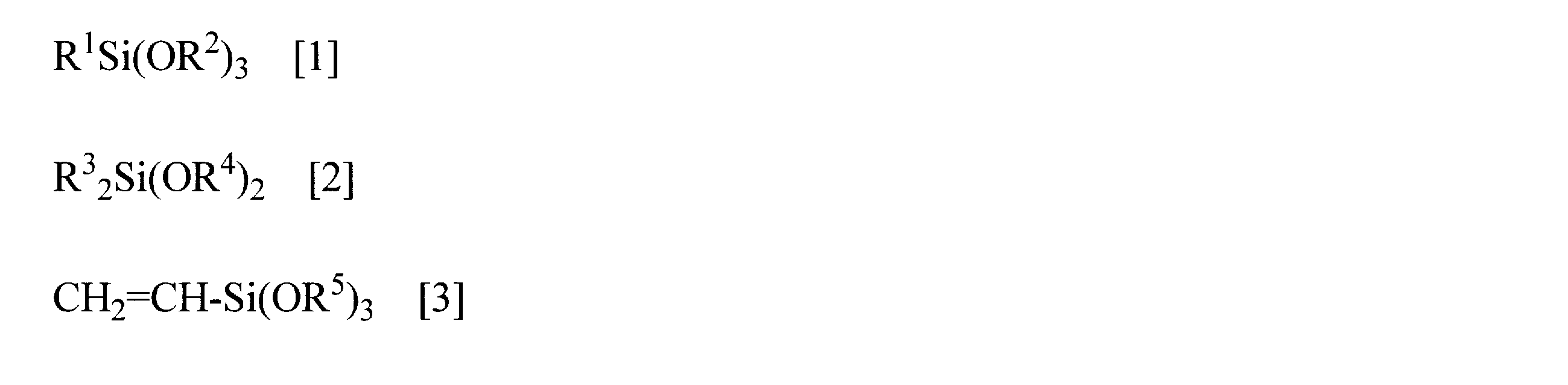
(一般式[1]中、R1は炭素数1~6の脂肪族炭化水素基または炭素数6~10の芳香族炭化水素基を表し、R2は炭素数1~3のアルキル基を表し、一般式[2]中、R3は炭素数1~6の脂肪族炭化水素基または炭素数6~10の芳香族炭化水素基を表し、R4は炭素数1~3のアルキル基を表し、一般式[3]中、R5は炭素数1~3のアルキル基を表す。)
(B)成分:H-Si基を有する第2のシリコーン樹脂。
(C)成分:ヒドロシリル化触媒。
下記(A)成分、(B)成分および(C)成分を少なくとも含む、硬化性シリコーン樹脂組成物。
(A)成分:下記一般式[1]で表されるトリアルコキシシラン、一般式[2]で表されるジアルコキシシランおよび一般式[3]で表されるビニルトリアルコキシシランを少なくとも含む第1のアルコキシシラン組成物を加水分解重縮合することで得られる、質量平均分子量が3,800~20,000である、第1のシリコーン樹脂。
(B)成分:H-Si基を有する第2のシリコーン樹脂。
(C)成分:ヒドロシリル化触媒。
[発明2]
第1のアルコキシシラン組成物が、下記一般式[4]で表されるテトラアルコキシシランをさらに含む、発明1に記載の硬化性シリコーン樹脂組成物。

(一般式[4]中、R6は炭素数1~3のアルキル基を表す。)
第1のアルコキシシラン組成物が、下記一般式[4]で表されるテトラアルコキシシランをさらに含む、発明1に記載の硬化性シリコーン樹脂組成物。
[発明3]
第1のアルコキシシラン組成物において、一般式[1]で表されるトリアルコキシシランおよび一般式[2]で表されるジアルコキシシランのモル比が85:15~15:85であり、一般式[3]で表されるビニルトリアルコキシシランの配合量が、該トリアルコキシシランおよび該ジアルコキシシランの総量100モルに対し、1~40モルである、発明1または2に記載の硬化性シリコーン樹脂組成物。
第1のアルコキシシラン組成物において、一般式[1]で表されるトリアルコキシシランおよび一般式[2]で表されるジアルコキシシランのモル比が85:15~15:85であり、一般式[3]で表されるビニルトリアルコキシシランの配合量が、該トリアルコキシシランおよび該ジアルコキシシランの総量100モルに対し、1~40モルである、発明1または2に記載の硬化性シリコーン樹脂組成物。
[発明4]
第1のアルコキシシラン組成物の加水分解重縮合を、pKa(20℃、水中)が9以上である塩基性有機化合物の存在下で行う、発明1~3の何れかに記載の硬化性シリコーン樹脂組成物。
第1のアルコキシシラン組成物の加水分解重縮合を、pKa(20℃、水中)が9以上である塩基性有機化合物の存在下で行う、発明1~3の何れかに記載の硬化性シリコーン樹脂組成物。
[発明5]
塩基性有機化合物が、1,8-ジアザビシクロ[5.4.0]-7-ウンデセン、1,5-ジアザビシクロ[4.3.0]-5-ノネン、グアニジン、テトラメチルグアニジン、7-メチル-1,5,7-トリアザビシクロ[4.4.0]-5-デセンおよび1,5,7-トリアザビシクロ[4.4.0]-5-デセンからなる群より選ばれる少なくとも一種である、発明4に記載の硬化性シリコーン樹脂組成物。
塩基性有機化合物が、1,8-ジアザビシクロ[5.4.0]-7-ウンデセン、1,5-ジアザビシクロ[4.3.0]-5-ノネン、グアニジン、テトラメチルグアニジン、7-メチル-1,5,7-トリアザビシクロ[4.4.0]-5-デセンおよび1,5,7-トリアザビシクロ[4.4.0]-5-デセンからなる群より選ばれる少なくとも一種である、発明4に記載の硬化性シリコーン樹脂組成物。
[発明6]
(B)成分が、下記(B-1)成分である、請求項1~5のいずれかに記載の硬化性シリコーン樹脂組成物。
(B-1)成分:下記一般式[5]で表されるトリアルコキシシランおよび一般式[6]で表されるジアルコキシシランを少なくとも含む第2のアルコキシシラン組成物を加水分解重縮合することで得られる、HO-Si基を有する加水分解重縮合物と、下記一般式[8-1]、[8-2]、[8-3]または[8-4]で表されるシラン化合物の少なくとも一種とを反応させて得られる、Si-H基を有するシリコーン樹脂。

(一般式[5]中、R7は炭素数1~6の脂肪族炭化水素基または炭素数6~10の芳香族炭化水素基を表し、R8は炭素数1~3のアルキル基を表し、一般式[6]中、R9は炭素数1~6の脂肪族炭化水素基または炭素数6~10の芳香族炭化水素基を表し、R10は炭素数1~3のアルキル基を表す。)

(一般式[8-1]~[8-4]中、R12は炭素数1~3のアルキル基を表し、R13は炭素数1~3のアルキル基を表す。)
(B)成分が、下記(B-1)成分である、請求項1~5のいずれかに記載の硬化性シリコーン樹脂組成物。
(B-1)成分:下記一般式[5]で表されるトリアルコキシシランおよび一般式[6]で表されるジアルコキシシランを少なくとも含む第2のアルコキシシラン組成物を加水分解重縮合することで得られる、HO-Si基を有する加水分解重縮合物と、下記一般式[8-1]、[8-2]、[8-3]または[8-4]で表されるシラン化合物の少なくとも一種とを反応させて得られる、Si-H基を有するシリコーン樹脂。
[発明7]
第2のアルコキシシラン組成物が、下記一般式[7]で表されるテトラアルコキシシランをさらに含む、発明6に記載の硬化性シリコーン樹脂組成物。

(一般式[7]中、R11は炭素数1~3のアルキル基である。)
第2のアルコキシシラン組成物が、下記一般式[7]で表されるテトラアルコキシシランをさらに含む、発明6に記載の硬化性シリコーン樹脂組成物。
[発明8]
第2のアルコキシシラン組成物において、一般式[5]で表されるトリアルコキシシランおよび一般式[6]で表されるジアルコキシシランのモル比が、85:15~15:85である、発明6または7に記載の硬化性シリコーン樹脂組成物。
第2のアルコキシシラン組成物において、一般式[5]で表されるトリアルコキシシランおよび一般式[6]で表されるジアルコキシシランのモル比が、85:15~15:85である、発明6または7に記載の硬化性シリコーン樹脂組成物。
[発明9]
(B)成分が、下記(B-2)成分である、発明1~5のいずれかに記載の硬化性シリコーン樹脂組成物。
(B-2)成分:H-Si基を有する環状シロキサン。
(B)成分が、下記(B-2)成分である、発明1~5のいずれかに記載の硬化性シリコーン樹脂組成物。
(B-2)成分:H-Si基を有する環状シロキサン。
[発明10]
(B)成分が、下記(B-3)成分である、発明1~5のいずれかに記載の硬化性シリコーン樹脂組成物。
(B-3)成分:下記一般式[9]で表されるジアルコキシシランおよび一般式[10]で表されるジアルコキシヒドロシランを少なくとも含む第3のアルコキシシラン組成物を加水分解縮合させて得られる、Si-H基を有するシリコーン樹脂。

(一般式[9]中、R14は炭素数1~6の脂肪族炭化水素基または炭素数6~10の芳香族炭化水素基を表し、2つのR14は互いに同じまたは異なる種類であってもよく、R15は炭素数1~3のアルキル基を表し、2つのR15は互いに同じまたは異なる種類であってもよく、一般式[10]中、R16は炭素数1~6の脂肪族炭化水素基または炭素数6~10の芳香族炭化水素基を表し、R17は炭素数1~3のアルキル基を表し、2つのR17は互いに同じまたは異なる種類であってもよい。)
(B)成分が、下記(B-3)成分である、発明1~5のいずれかに記載の硬化性シリコーン樹脂組成物。
(B-3)成分:下記一般式[9]で表されるジアルコキシシランおよび一般式[10]で表されるジアルコキシヒドロシランを少なくとも含む第3のアルコキシシラン組成物を加水分解縮合させて得られる、Si-H基を有するシリコーン樹脂。
[発明11]
硬化遅延剤、接着付与剤、酸化防止剤、光安定剤、蛍光体、無機粒子、離型剤、樹脂改質剤、着色剤、希釈剤、抗菌剤、防黴剤、レベリング剤およびタレ防止剤からなる群より選ばれる少なくとも一種をさらに含む、発明1~10の何れかに記載の硬化性シリコーン樹脂組成物。
硬化遅延剤、接着付与剤、酸化防止剤、光安定剤、蛍光体、無機粒子、離型剤、樹脂改質剤、着色剤、希釈剤、抗菌剤、防黴剤、レベリング剤およびタレ防止剤からなる群より選ばれる少なくとも一種をさらに含む、発明1~10の何れかに記載の硬化性シリコーン樹脂組成物。
[発明12]
発明1~11の何れかに記載の硬化性シリコーン樹脂組成物を硬化してなる、硬化物。
発明1~11の何れかに記載の硬化性シリコーン樹脂組成物を硬化してなる、硬化物。
[発明13]
光半導体素子と、該光半導体素子を封止するように設けられた発明12に記載の硬化物とを少なくとも備える、光半導体装置。
光半導体素子と、該光半導体素子を封止するように設けられた発明12に記載の硬化物とを少なくとも備える、光半導体装置。
[発明14]
下記一般式[1]で表されるトリアルコキシシラン、一般式[2]で表されるジアルコキシシランおよび一般式[3]で表されるビニルトリアルコキシシランを少なくとも含む第1のアルコキシシラン組成物を加水分解重縮合することで得られる、質量平均分子量が3,800~20,000である、第1のシリコーン樹脂。
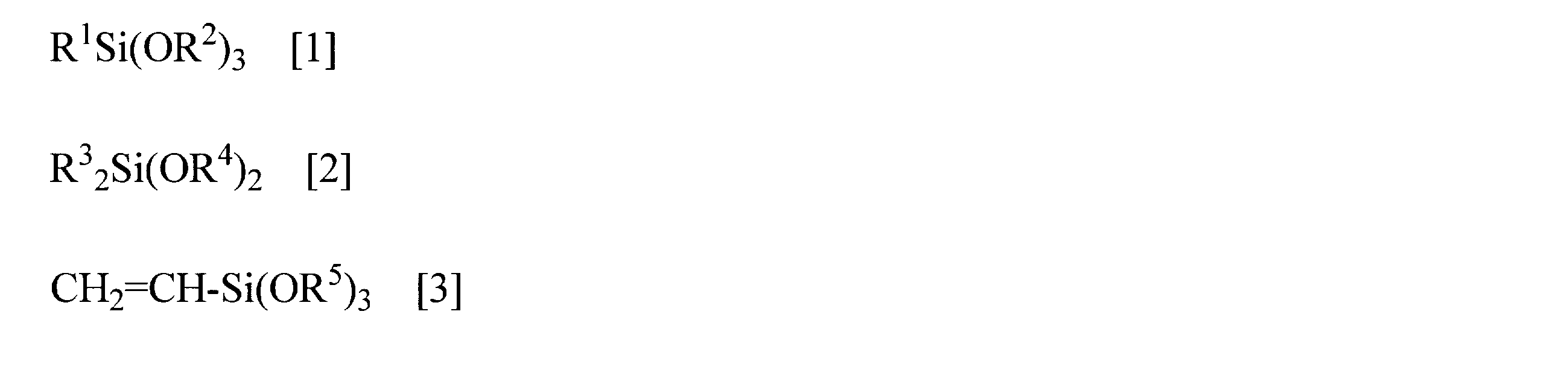
(一般式[1]中、R1は炭素数1~6の脂肪族炭化水素基または炭素数6~10の芳香族炭化水素基を表し、R2は炭素数1~3のアルキル基を表し、一般式[2]中、R3は炭素数1~6の脂肪族炭化水素基または炭素数6~10の芳香族炭化水素基を表し、R4は炭素数1~3のアルキル基を表し、一般式[3]中、R5は炭素数1~3のアルキル基を表す。)
下記一般式[1]で表されるトリアルコキシシラン、一般式[2]で表されるジアルコキシシランおよび一般式[3]で表されるビニルトリアルコキシシランを少なくとも含む第1のアルコキシシラン組成物を加水分解重縮合することで得られる、質量平均分子量が3,800~20,000である、第1のシリコーン樹脂。
[発明15]
第1のアルコキシシラン組成物の加水分解重縮合を、pKa(20℃、水中)が9以上である塩基性有機化合物の存在下で行う、発明14に記載の第1のシリコーン樹脂。
第1のアルコキシシラン組成物の加水分解重縮合を、pKa(20℃、水中)が9以上である塩基性有機化合物の存在下で行う、発明14に記載の第1のシリコーン樹脂。
[発明16]
下記一般式[1]で表されるトリアルコキシシラン、一般式[2]で表されるジアルコキシシランおよび一般式[3]で表されるビニルトリアルコキシシランを少なくとも含む第1のアルコキシシラン組成物を加水分解重縮合して、質量平均分子量が3,800~20,000である、第1のシリコーン樹脂を製造する方法。
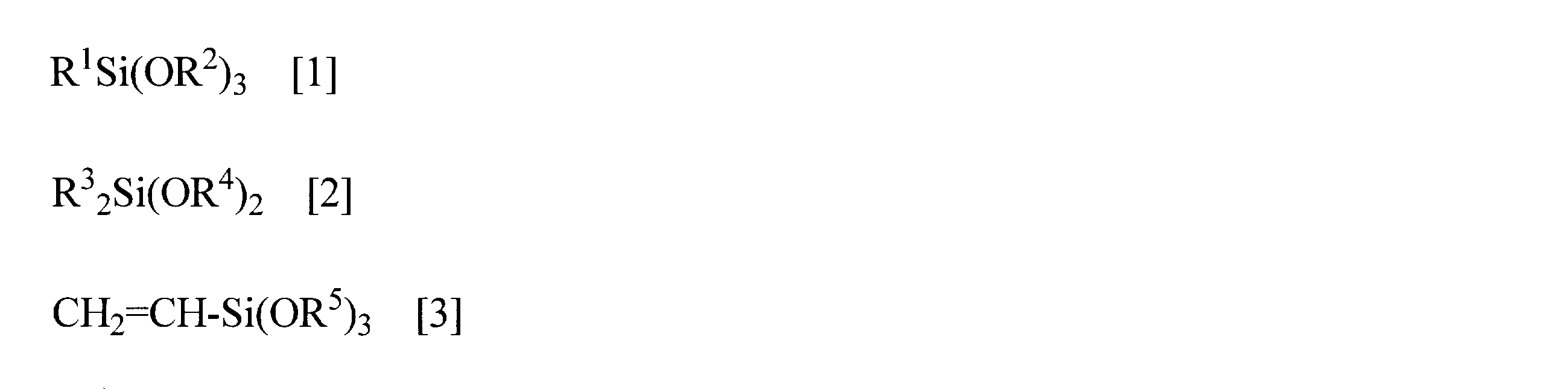
(一般式[1]中、R1は炭素数1~6の脂肪族炭化水素基または炭素数6~10の芳香族炭化水素基を表し、R2は炭素数1~3のアルキル基を表し、一般式[2]中、R3は炭素数1~6の脂肪族炭化水素基または炭素数6~10の芳香族炭化水素基を表し、R4は炭素数1~3のアルキル基を表し、一般式[3]中、R5は炭素数1~3のアルキル基を表す。)
下記一般式[1]で表されるトリアルコキシシラン、一般式[2]で表されるジアルコキシシランおよび一般式[3]で表されるビニルトリアルコキシシランを少なくとも含む第1のアルコキシシラン組成物を加水分解重縮合して、質量平均分子量が3,800~20,000である、第1のシリコーン樹脂を製造する方法。
[発明17]
第1のアルコキシシラン組成物が、下記一般式[4]で表されるテトラアルコキシシランをさらに含む、発明16に記載の方法。

(一般式[4]中、R6は炭素数1~3のアルキル基を表す。)
第1のアルコキシシラン組成物が、下記一般式[4]で表されるテトラアルコキシシランをさらに含む、発明16に記載の方法。
[発明18]
第1のアルコキシシラン組成物において、一般式[1]で表されるトリアルコキシシランおよび一般式[2]で表されるジアルコキシシランのモル比が85:15~15:85であり、一般式[3]で表されるビニルトリアルコキシシランの配合量が、該トリアルコキシシランおよび該ジアルコキシシランの総量100モルに対し、1~40モルである、発明16または17に記載の方法。
第1のアルコキシシラン組成物において、一般式[1]で表されるトリアルコキシシランおよび一般式[2]で表されるジアルコキシシランのモル比が85:15~15:85であり、一般式[3]で表されるビニルトリアルコキシシランの配合量が、該トリアルコキシシランおよび該ジアルコキシシランの総量100モルに対し、1~40モルである、発明16または17に記載の方法。
[発明19]
第1のアルコキシシラン組成物の加水分解重縮合を、pKa(20℃、水中)が9以上である塩基性有機化合物の存在下で行う、発明16~18の何れかに記載の方法。
第1のアルコキシシラン組成物の加水分解重縮合を、pKa(20℃、水中)が9以上である塩基性有機化合物の存在下で行う、発明16~18の何れかに記載の方法。
[発明20]
塩基性有機化合物が、1,8-ジアザビシクロ[5.4.0]-7-ウンデセン、1,5-ジアザビシクロ[4.3.0]-5-ノネン、グアニジン、テトラメチルグアニジン、7-メチル-1,5,7-トリアザビシクロ[4.4.0]-5-デセンおよび1,5,7-トリアザビシクロ[4.4.0]-5-デセンからなる群より選ばれる少なくとも一種である、発明19に記載の方法。
塩基性有機化合物が、1,8-ジアザビシクロ[5.4.0]-7-ウンデセン、1,5-ジアザビシクロ[4.3.0]-5-ノネン、グアニジン、テトラメチルグアニジン、7-メチル-1,5,7-トリアザビシクロ[4.4.0]-5-デセンおよび1,5,7-トリアザビシクロ[4.4.0]-5-デセンからなる群より選ばれる少なくとも一種である、発明19に記載の方法。
[発明21]
下記(A)成分、(B)成分および(C)成分を少なくとも配合して、硬化性シリコーン樹脂組成物を製造する方法。
(A)成分:下記一般式[1]で表されるトリアルコキシシラン、一般式[2]で表されるジアルコキシシランおよび一般式[3]で表されるビニルトリアルコキシシランを少なくとも含む第1のアルコキシシラン組成物を加水分解重縮合することで得られる、質量平均分子量が3,800~20,000である、第1のシリコーン樹脂。

(一般式[1]中、R1は炭素数1~6の脂肪族炭化水素基または炭素数6~10の芳香族炭化水素基を表し、R2は炭素数1~3のアルキル基を表し、一般式[2]中、R3は炭素数1~6の脂肪族炭化水素基または炭素数6~10の芳香族炭化水素基を表し、R4は炭素数1~3のアルキル基を表し、一般式[3]中、R5は炭素数1~3のアルキル基を表す。)
(B)成分:H-Si基を有する第2のシリコーン樹脂。
(C)成分:ヒドロシリル化触媒。
下記(A)成分、(B)成分および(C)成分を少なくとも配合して、硬化性シリコーン樹脂組成物を製造する方法。
(A)成分:下記一般式[1]で表されるトリアルコキシシラン、一般式[2]で表されるジアルコキシシランおよび一般式[3]で表されるビニルトリアルコキシシランを少なくとも含む第1のアルコキシシラン組成物を加水分解重縮合することで得られる、質量平均分子量が3,800~20,000である、第1のシリコーン樹脂。
(B)成分:H-Si基を有する第2のシリコーン樹脂。
(C)成分:ヒドロシリル化触媒。
[発明22]
下記(A)成分、(B)成分および(C)成分を少なくとも配合して、硬化性シリコーン樹脂組成物を製造する方法。
(A)成分:下記一般式[1]で表されるトリアルコキシシラン、一般式[2]で表されるジアルコキシシランおよび一般式[3]で表されるビニルトリアルコキシシランを少なくとも含む第1のアルコキシシラン組成物を、1,8-ジアザビシクロ[5.4.0]-7-ウンデセン、1,5-ジアザビシクロ[4.3.0]-5-ノネン、グアニジン、テトラメチルグアニジン、7-メチル-1,5,7-トリアザビシクロ[4.4.0]-5-デセンおよび1,5,7-トリアザビシクロ[4.4.0]-5-デセンからなる群より選ばれる少なくとも一種である、塩基性有機化合物の存在下で、加水分解重縮合することで得られる、質量平均分子量が3,800~20,000である、第1のシリコーン樹脂。

(一般式[1]中、R1は炭素数1~6の脂肪族炭化水素基または炭素数6~10の芳香族炭化水素基を表し、R2は炭素数1~3のアルキル基を表し、一般式[2]中、R3は炭素数1~6の脂肪族炭化水素基または炭素数6~10の芳香族炭化水素基を表し、R4は炭素数1~3のアルキル基を表し、一般式[3]中、R5は炭素数1~3のアルキル基を表す。)
(B)成分:H-Si基を有する第2のシリコーン樹脂。
(C)成分:ヒドロシリル化触媒。
下記(A)成分、(B)成分および(C)成分を少なくとも配合して、硬化性シリコーン樹脂組成物を製造する方法。
(A)成分:下記一般式[1]で表されるトリアルコキシシラン、一般式[2]で表されるジアルコキシシランおよび一般式[3]で表されるビニルトリアルコキシシランを少なくとも含む第1のアルコキシシラン組成物を、1,8-ジアザビシクロ[5.4.0]-7-ウンデセン、1,5-ジアザビシクロ[4.3.0]-5-ノネン、グアニジン、テトラメチルグアニジン、7-メチル-1,5,7-トリアザビシクロ[4.4.0]-5-デセンおよび1,5,7-トリアザビシクロ[4.4.0]-5-デセンからなる群より選ばれる少なくとも一種である、塩基性有機化合物の存在下で、加水分解重縮合することで得られる、質量平均分子量が3,800~20,000である、第1のシリコーン樹脂。
(B)成分:H-Si基を有する第2のシリコーン樹脂。
(C)成分:ヒドロシリル化触媒。
[用語の説明、略称、総称など]
本明細書において、pKaは、水中20℃における酸解離定数の逆数の対数値を意味する。pKaは、公知の滴定法(ブレンステッドの定義に基づく酸解離定数の測定方法)によって求められる値である。
本明細書において、pKaは、水中20℃における酸解離定数の逆数の対数値を意味する。pKaは、公知の滴定法(ブレンステッドの定義に基づく酸解離定数の測定方法)によって求められる値である。
本明細書において、炭素数1~6の脂肪族炭化水素基の具体例として、メチル基、エチル基、n-プロピル基、イソプロピル基、n-ブチル基、t-ブチル基、イソブチル基、n-ペンチル基、シクロペンチル基、n-ヘキシル基、シクロヘキシル基などが挙げられる。
本明細書において、炭素数6~10の芳香族炭化水素基は、置換または非置換であってもよく、水素原子の一部または全部がフッ素原子、炭素数1~3のアルキル基または炭素数1~3のフルオロアルキル基に置換されていてもよい。具体例として、フェニル基、ナフチル基、キシリル基、3-トリフルオロメチルフェニル基、4-トリフルオロメチルフェニル基、3,5-ジトリフルオロメチルフェニル基などが挙げられる。
本明細書において、炭素数1~3のアルキル基の具体例として、メチル基、エチル基、プロピル基、イソプロピル基が挙げられる。
本明細書において、炭素数1~3のフルオロアルキル基の具体例として、モノフルオロメチル基、ジフルオロメチル基、トリフルオロメチル基、ペンタフルオロエチル基、パーフルオロプロピル基、1,1,1,3,3,3-ヘキサフルオロイソプロピル基などが挙げられる。
本明細書において、メチル基をMeと表すことがあり、フェニル基をPhと表すことがあり、ビニル基(-CH=CH2基)をViと表すことがある。
本明細書において、一般式[1]で表されるトリアルコキシシランを、「トリアルコキシシラン[1]」と表すことがあり、以下同様に、一般式[2]で表されるジアルコキシシランなどについても、「ジアルコキシシラン[2]」などとそれぞれ表すことがある。また、一般式[8-1]で表されるシラン化合物を、「シラン化合物[8-1]」と表すことがあり、[8-2]で表されるシラン化合物乃至[8-4]で表されるシラン化合物についても同様に、「シラン化合物[8-2]」乃至「シラン化合物[8-4]」とそれぞれ表すことがあり、これらを区別せずに総称する際には、「シラン化合物[8]」と表すことがある。
本明細書において、(B-1)成分、(B-2)成分および(B-3)成分に関して共通する項目については「(B)成分」と総称して説明することがある。
本発明によれば、気泡を含まず、かつ、タック性のない光半導体装置用封止材を与える付加硬化型の硬化性シリコーン樹脂組成物およびその硬化物、並びにこれらを用いた光半導体装置を提供することができる。
以下、本発明についてさらに詳しく説明するが、本発明は、以下に示す実施の形態および実施例の記載内容に限定して解釈されるものではない。
[硬化性シリコーン樹脂組成物]
本発明の硬化性シリコーン樹脂組成物(本明細書において、単に「本発明の組成物」と称することがある。)は、(A)成分として第1のシリコーン樹脂、(B)成分として第2のシリコーン樹脂、(C)成分としてヒドロシリル化触媒とを少なくとも含む。本発明の組成物は、本発明の光半導体装置を製造するのに好適に使用される。また、本発明の組成物は、その他の成分をさらに含んでいてもよい。
本発明の硬化性シリコーン樹脂組成物(本明細書において、単に「本発明の組成物」と称することがある。)は、(A)成分として第1のシリコーン樹脂、(B)成分として第2のシリコーン樹脂、(C)成分としてヒドロシリル化触媒とを少なくとも含む。本発明の組成物は、本発明の光半導体装置を製造するのに好適に使用される。また、本発明の組成物は、その他の成分をさらに含んでいてもよい。
以下、本発明の組成物に含まれる(A)~(C)成分について説明する。
<(A)成分:第1のシリコーン樹脂>
(A)成分は、下記一般式[1]で表されるトリアルコキシシラン、一般式[2]で表されるジアルコキシシランおよび一般式[3]で表されるビニルトリアルコキシシランを少なくとも含む第1のアルコキシシラン組成物を加水分解重縮合することで得られる、質量平均分子量が3,800~20,000である、シリコーン樹脂(第1のシリコーン樹脂)である。

(A)成分は、下記一般式[1]で表されるトリアルコキシシラン、一般式[2]で表されるジアルコキシシランおよび一般式[3]で表されるビニルトリアルコキシシランを少なくとも含む第1のアルコキシシラン組成物を加水分解重縮合することで得られる、質量平均分子量が3,800~20,000である、シリコーン樹脂(第1のシリコーン樹脂)である。
一般式[1]中、R1は炭素数1~6の脂肪族炭化水素基または炭素数6~10の芳香族炭化水素基を表す。R2は炭素数1~3のアルキル基を表し、3つのR2は互いに同じまたは異なる種類であってもよい。
R1は、メチル基、エチル基、フェニル基、3-トリフルオロメチルフェニル基、4-トリフルオロメチルフェニル基、3,5-ジ(トリフルオロメチルフェニル)基が好ましく、フェニル基が特に好ましい。
R2は、メチル基、エチル基が好ましい。
一般式[2]中、R3は炭素数1~6の脂肪族炭化水素基または炭素数6~10の芳香族炭化水素基を表し、2つのR3は互いに同じまたは異なる種類であってもよい。R4は炭素数1~3のアルキル基を表し、2つのR4は互いに同じまたは異なる種類であってもよい。
R3は、メチル基、エチル基、フェニル基、3-トリフルオロメチルフェニル基、4-トリフルオロメチルフェニル基、3,5-ジ(トリフルオロメチルフェニル)基が好ましく、メチル基が特に好ましい。
R4は、メチル基、エチル基が好ましい。
一般式[3]中、R5は炭素数1~3のアルキル基を表し、3つのR5は互いに同じまたは異なる種類であってもよい。
R5は、メチル基、エチル基が好ましい。
トリアルコキシシラン[1]は、具体的には以下の化合物が挙げられるが、これらに限定されない:メチルトリメトキシシラン、メチルトリエトキシシラン、メチルトリプロポキシシラン、メチルトリイソプロポキシシラン、エチルトリメトキシシラン、エチルトリエトキシシラン、エチルトリプロポキシシラン、エチルトリイソプロポキシシラン、n-プロピルトリメトキシシラン、n-プロピルトリエトキシシラン、n-プロピルトリプロポキシシラン、n-プロピルトリイソプロポキシシラン、イソプロピルトリメトキシシラン、イソプロピルトリエトキシシラン、イソプロピルトリプロポキシシラン、イソプロピルトリイソプロポキシシラン、n-ブチルトリメトキシシラン、n-ブチルトリエトキシシラン、n-ブチルトリプロポキシシラン、n-ブチルトリイソプロポキシシラン、t-ブチルトリメトキシシラン、t-ブチルトリエトキシシラン、t-ブチルトリプロポキシシラン、t-ブチルトリイソプロポキシシラン、イソブチルトリメトキシシラン、イソブチルトリエトキシシラン、イソブチルトリプロポキシシラン、イソブチルトリイソプロポキシシラン、n-ペンチルトリメトキシシラン、n-ペンチルトリエトキシシラン、n-ペンチルトリプロポキシシラン、n-ペンチルトリイソプロポキシシラン、シクロペンチルトリメトキシシラン、シクロペンチルトリエトキシシラン、シクロペンチルトリプロポキシシラン、シクロペンチルトリイソプロポキシシラン、n-ヘキシルトリメトキシシラン、n-ヘキシルトリエトキシシラン、n-ヘキシルトリプロポキシシラン、n-ヘキシルトリイソプロポキシシラン、シクロヘキシルトリメトキシシラン、シクロヘキシルトリエトキシシラン、シクロヘキシルトリプロポキシシラン、シクロヘキシルトリイソプロポキシシラン、フェニルトリメトキシシラン、フェニルトリエトキシシラン、フェニルトリプロポキシシラン、フェニルトリイソプロポキシシラン、ナフチルトリメトキシシラン、ナフチルトリエトキシシラン、ナフチルトリプロポキシシラン、ナフチルトリイソプロポキシシラン、トリルトリメトキシシラン、トリルトリエトキシシラン、トリルトリプロポキシシラン、トリルトリイソプロポキシシラン、キシリルトリメトキシシラン、キシリルトリエトキシシラン、キシリルトリプロポキシシラン、キシリルトリイソプロポキシシラン、3-トリフルオロメチルフェニルトリメトキシシラン、3-トリフルオロメチルフェニルトリエトキシシラン、3-トリフルオロメチルフェニルトリプロポキシシラン、3-トリフルオロメチルフェニルトリイソプロポキシシラン、4-トリフルオロメチルフェニルトリメトキシシラン、4-トリフルオロメチルフェニルトリエトキシシラン、4-トリフルオロメチルフェニルトリプロポキシシラン、4-トリフルオロメチルフェニルトリイソプロポキシシラン、3,5-ジ(トリフルオロメチル)フェニルトリメトキシシラン、3,5-ジ(トリフルオロメチル)フェニルトリエトキシシラン、3,5-ジ(トリフルオロメチル)フェニルトリプロポキシシラン、3,5-ジ(トリフルオロメチル)フェニルトリイソプロポキシシラン。
これらの中でも好ましい化合物として、メチルトリメトキシシラン、メチルトリエトキシシラン、エチルトリメトキシシラン、エチルトリエトキシシラン、フェニルトリメトキシシラン、フェニルトリエトキシシラン、3-(トリフルオロメチル)フェニルトリメトキシシラン、3-(トリフルオロメチル)フェニルトリエトキシシラン、4-(トリフルオロメチル)フェニルトリメトキシシラン、4-(トリフルオロメチル)フェニルトリエトキシシラン3,5-(ジトリフルオロメチル)フェニルトリメトキシシラン、3,5-(ジトリフルオロメチル)フェニルトリエトキシシランが挙げられ、特に好ましい化合物として、フェニルトリメトキシシラン、フェニルトリエトキシシランが挙げられる。
ジアルコキシシラン[2]は、具体的には以下の化合物が挙げられるが、これらに限定されない:ジメチルジメトキシシラン、ジメチルジエトキシシラン、ジメチルジプロポキシシラン、ジメチルジイソプロポキシシラン、ジエチルジメトキシシラン、ジエチルジエトキシシラン、ジエチルジプロポキシシラン、ジエチルジイソプロポキシシラン、ジ(n-プロピル)ジメトキシシラン、ジ(n-プロピル)ジエトキシシラン、ジ(n-プロピル)ジプロポキシシラン、ジ(n-プロピル)ジイソプロポキシシラン、ジイソプロピルジメトキシシラン、ジイソプロピルジエトキシシラン、ジイソプロピルジプロポキシシラン、ジイソプロピルジイソプロポキシシラン、ジ(n-ブチル)ジメトキシシラン、ジ(n-ブチル)ジエトキシシラン、ジ(n-ブチル)ジプロポキシシラン、ジ(n-ブチル)ジイソプロポキシシラン、ジ(t-ブチル)ジメトキシシラン、ジ(t-ブチル)ジエトキシシラン、ジ(t-ブチル)ジプロポキシシラン、ジ(t-ブチル)ジイソプロポキシシラン、ジ(イソブチル)ジメトキシシラン、ジ(イソブチル)ジエトキシシラン、ジ(イソブチル)ジプロポキシシラン、ジ(イソブチル)ジイソプロポキシシラン、ジ(n-ペンチル)ジメトキシシラン、ジ(n-ペンチル)ジエトキシシラン、ジ(n-ペンチル)ジプロポキシシラン、ジ(n-ペンチル)ジイソプロポキシシラン、ジシクロペンチルジメトキシシラン、ジシクロペンチルジエトキシシラン、ジシクロペンチルジプロポキシシラン、ジシクロペンチルジイソプロポキシシラン、ジ(n-ヘキシル)ジメトキシシラン、ジ(n-ヘキシル)ジエトキシシラン、ジ(n-ヘキシル)ジプロポキシシラン、ジ(n-ヘキシル)ジイソプロポキシシラン、ジシクロヘキシルジメトキシシラン、ジシクロヘキシルジエトキシシラン、ジシクロヘキシルジプロポキシシラン、ジシクロヘキシルジイソプロポキシシラン、ジフェニルジメトキシシラン、ジフェニルジエトキシシラン、ジフェニルジプロポキシシラン、ジフェニルジイソプロポキシシラン、フェニルメチルジメトキシシラン、フェニルメチルジエトキシシラン、フェニルメチルジプロポキシシラン、フェニルメチルジイソプロポキシシラン、ジナフチルジメトキシシラン、ジナフチルジエトキシシラン、ジナフチルジプロポキシシラン、ジナフチルジイソプロポキシシラン、ジトリルジメトキシシラン、ジトリルジエトキシシラン、ジトリルジプロポキシシラン、ジトリルジイソプロポキシシラン、ジキシリルジメトキシシラン、ジキシリルジエトキシシラン、ジキシリルジプロポキシシラン、ジキシリルジイソプロポキシシラン、ジ(3-トリフルオロメチルフェニル)ジメトキシシラン、ジ(3-トリフルオロメチルフェニル)ジエトキシシラン、ジ(3-トリフルオロメチルフェニル)ジプロポキシシラン、ジ(3-トリフルオロメチルフェニル)ジイソプロポキシシラン、ジ(4-トリフルオロメチルフェニル)ジメトキシシラン、ジ(4-トリフルオロメチルフェニル)ジエトキシシラン、ジ(4-トリフルオロメチルフェニル)ジプロポキシシラン、ジ(4-トリフルオロメチルフェニル)ジイソプロポキシシラン、ジ(3,5-ジ(トリフルオロメチル)フェニル)ジメトキシシラン、ジ(3,5-ジ(トリフルオロメチル)フェニル)ジエトキシシラン、ジ(3,5-ジ(トリフルオロメチル)フェニル)ジプロポキシシラン、ジ(3,5-ジ(トリフルオロメチル)フェニル)ジイソプロポキシシラン。
これらの中でも好ましい化合物として、ジメチルジメトキシシラン、ジメチルジエトキシシラン、ジエチルジメトキシシラン、ジエチルジエトキシシラン、ジフェニルジメトキシシラン、ジフェニルジエトキシシラン、ジ(3-トリフルオロメチルフェニル)ジメトキシシラン、ジ(3-トリフルオロメチルフェニル)ジエトキシシラン、ジ(4-トリフルオロメチルフェニル)ジメトキシシラン、ジ(4-トリフルオロメチルフェニル)ジエトキシシラン、ジ(3,5-ジ(トリフルオロメチル)フェニル)ジメトキシシラン、ジ(3,5-ジ(トリフルオロメチル)フェニル)ジエトキシシラン、フェニルメチルジメトキシシラン、フェニルメチルジエトキシシランが挙げられ、特に好ましい化合物として、ジメチルジメトキシシラン、ジメチルジエトキシシランが挙げられる。
ビニルトリアルコキシシラン[3]は、具体的には以下の化合物が挙げられるが、これらに限定されない:ビニルトリメトキシシラン、ビニルトリエトキシシラン、ビニルトリプロポキシシラン、ビニルトリイソプロポキシシラン。
これらの中でも好ましい化合物として、ビニルトリメトキシシラン、ビニルトリエトキシシランが挙げられる。
本発明に係る第1のアルコキシシラン組成物において、トリアルコキシシラン[1]、ジアルコキシシラン[2]およびビニルトリアルコキシシラン[3]の組み合わせは特に限定されない。トリアルコキシシラン[1]、ジアルコキシシラン[2]およびビニルトリアルコキシシラン[3]はそれぞれ一種類を単独で用いてもよいし、二種類以上を併用してもよい。好ましい組み合わせとしては、
トリアルコキシシラン[1]は、メチルトリメトキシシラン、メチルトリエトキシシラン、エチルトリメトキシシラン、エチルトリエトキシシラン、フェニルトリメトキシシラン、フェニルトリエトキシシラン、3-(トリフルオロメチル)フェニルトリメトキシシラン、3-(トリフルオロメチル)フェニルトリエトキシシラン、4-(トリフルオロメチル)フェニルトリメトキシシラン、4-(トリフルオロメチル)フェニルトリエトキシシラン3,5-(ジトリフルオロメチル)フェニルトリメトキシシランおよび3,5-(ジトリフルオロメチル)フェニルトリエトキシシランからなる群より一種以上が選択され、
ジアルコキシシラン[2]は、ジメチルジメトキシシラン、ジメチルジエトキシシラン、ジエチルジメトキシシラン、ジエチルジエトキシシラン、ジフェニルジメトキシシラン、ジフェニルジエトキシシラン、ジ(3-トリフルオロメチルフェニル)ジメトキシシラン、ジ(3-トリフルオロメチルフェニル)ジエトキシシラン、ジ(4-トリフルオロメチルフェニル)ジメトキシシラン、ジ(4-トリフルオロメチルフェニル)ジエトキシシラン、ジ(3,5-ジ(トリフルオロメチル)フェニル)ジメトキシシラン、ジ(3,5-ジ(トリフルオロメチル)フェニル)ジエトキシシラン、フェニルメチルジメトキシシランおよびフェニルメチルジエトキシシランからなる群より一種以上が選択され、
ビニルトリアルコキシシラン[3]は、ビニルトリメトキシシランおよびビニルトリエトキシシランからなる群より一種以上が選択される。
トリアルコキシシラン[1]は、メチルトリメトキシシラン、メチルトリエトキシシラン、エチルトリメトキシシラン、エチルトリエトキシシラン、フェニルトリメトキシシラン、フェニルトリエトキシシラン、3-(トリフルオロメチル)フェニルトリメトキシシラン、3-(トリフルオロメチル)フェニルトリエトキシシラン、4-(トリフルオロメチル)フェニルトリメトキシシラン、4-(トリフルオロメチル)フェニルトリエトキシシラン3,5-(ジトリフルオロメチル)フェニルトリメトキシシランおよび3,5-(ジトリフルオロメチル)フェニルトリエトキシシランからなる群より一種以上が選択され、
ジアルコキシシラン[2]は、ジメチルジメトキシシラン、ジメチルジエトキシシラン、ジエチルジメトキシシラン、ジエチルジエトキシシラン、ジフェニルジメトキシシラン、ジフェニルジエトキシシラン、ジ(3-トリフルオロメチルフェニル)ジメトキシシラン、ジ(3-トリフルオロメチルフェニル)ジエトキシシラン、ジ(4-トリフルオロメチルフェニル)ジメトキシシラン、ジ(4-トリフルオロメチルフェニル)ジエトキシシラン、ジ(3,5-ジ(トリフルオロメチル)フェニル)ジメトキシシラン、ジ(3,5-ジ(トリフルオロメチル)フェニル)ジエトキシシラン、フェニルメチルジメトキシシランおよびフェニルメチルジエトキシシランからなる群より一種以上が選択され、
ビニルトリアルコキシシラン[3]は、ビニルトリメトキシシランおよびビニルトリエトキシシランからなる群より一種以上が選択される。
これらの中でも、特に好ましい組み合わせとしては、
トリアルコキシシラン[1]は、フェニルトリメトキシシランおよびフェニルトリエトキシシランからなる群より一種以上が選択され、
ジアルコキシシラン[2]は、ジメチルジメトキシシランおよびジメチルジエトキシシランからなる群より一種以上が選択され、
ビニルトリアルコキシシラン[3]は、ビニルトリメトキシシランおよびビニルトリエトキシシランからなる群より一種以上が選択される。
トリアルコキシシラン[1]は、フェニルトリメトキシシランおよびフェニルトリエトキシシランからなる群より一種以上が選択され、
ジアルコキシシラン[2]は、ジメチルジメトキシシランおよびジメチルジエトキシシランからなる群より一種以上が選択され、
ビニルトリアルコキシシラン[3]は、ビニルトリメトキシシランおよびビニルトリエトキシシランからなる群より一種以上が選択される。
本発明に係る第1のアルコキシシラン組成物は、下記一般式[4]で表されるテトラアルコキシシランをさらに含んでいてもよい。テトラアルコキシシラン[4]を含むことで、本発明の硬化物の機械的強度が良くなる点で好ましい。

一般式[4]中、R6は炭素数1~3のアルキル基を表す。
R6は、メチル基、エチル基が好ましい。
テトラアルコキシシラン[4]は、具体的には以下の化合物が挙げられるが、これらに限定されない:テトラメトキシシラン、テトラエトキシシラン、テトラプロポキシシラン、テトライソプロポキシシラン。
これらの中でも好ましい化合物として、テトラメトキシシラン、テトラエトキシシランが挙げられる。
本発明に係る第1のアルコキシシラン組成物において、トリアルコキシシラン[1]、ジアルコキシシラン[2]、ビニルトリアルコキシシラン[3]およびテトラアルコキシシラン[4]の組み合わせは特に限定されない。トリアルコキシシラン[1]、ジアルコキシシラン[2]、ビニルトリアルコキシシラン[3]およびテトラアルコキシシラン[4]はそれぞれ一種類を単独で用いてもよいし、二種類以上を併用してもよい。好ましい組み合わせとしては、
トリアルコキシシラン[1]は、メチルトリメトキシシラン、メチルトリエトキシシラン、エチルトリメトキシシラン、エチルトリエトキシシラン、フェニルトリメトキシシラン、フェニルトリエトキシシラン、3-(トリフルオロメチル)フェニルトリメトキシシラン、3-(トリフルオロメチル)フェニルトリエトキシシラン、4-(トリフルオロメチル)フェニルトリメトキシシラン、4-(トリフルオロメチル)フェニルトリエトキシシラン3,5-(ジトリフルオロメチル)フェニルトリメトキシシランおよび3,5-(ジトリフルオロメチル)フェニルトリエトキシシランからなる群より一種以上が選択され、
ジアルコキシシラン[2]は、ジメチルジメトキシシラン、ジメチルジエトキシシラン、ジエチルジメトキシシラン、ジエチルジエトキシシラン、ジフェニルジメトキシシラン、ジフェニルジエトキシシラン、ジ(3-トリフルオロメチルフェニル)ジメトキシシラン、ジ(3-トリフルオロメチルフェニル)ジエトキシシラン、ジ(4-トリフルオロメチルフェニル)ジメトキシシラン、ジ(4-トリフルオロメチルフェニル)ジエトキシシラン、ジ(3,5-ジ(トリフルオロメチル)フェニル)ジメトキシシラン、ジ(3,5-ジ(トリフルオロメチル)フェニル)ジエトキシシラン、フェニルメチルジメトキシシランおよびフェニルメチルジエトキシシランからなる群より一種以上が選択され、
ビニルトリアルコキシシラン[3]は、ビニルトリメトキシシランおよびビニルトリエトキシシランからなる群より一種以上が選択され、
テトラアルコキシシラン[4]は、テトラメトキシシランおよびテトラエトキシシランからなる群より一種以上が選択される。
トリアルコキシシラン[1]は、メチルトリメトキシシラン、メチルトリエトキシシラン、エチルトリメトキシシラン、エチルトリエトキシシラン、フェニルトリメトキシシラン、フェニルトリエトキシシラン、3-(トリフルオロメチル)フェニルトリメトキシシラン、3-(トリフルオロメチル)フェニルトリエトキシシラン、4-(トリフルオロメチル)フェニルトリメトキシシラン、4-(トリフルオロメチル)フェニルトリエトキシシラン3,5-(ジトリフルオロメチル)フェニルトリメトキシシランおよび3,5-(ジトリフルオロメチル)フェニルトリエトキシシランからなる群より一種以上が選択され、
ジアルコキシシラン[2]は、ジメチルジメトキシシラン、ジメチルジエトキシシラン、ジエチルジメトキシシラン、ジエチルジエトキシシラン、ジフェニルジメトキシシラン、ジフェニルジエトキシシラン、ジ(3-トリフルオロメチルフェニル)ジメトキシシラン、ジ(3-トリフルオロメチルフェニル)ジエトキシシラン、ジ(4-トリフルオロメチルフェニル)ジメトキシシラン、ジ(4-トリフルオロメチルフェニル)ジエトキシシラン、ジ(3,5-ジ(トリフルオロメチル)フェニル)ジメトキシシラン、ジ(3,5-ジ(トリフルオロメチル)フェニル)ジエトキシシラン、フェニルメチルジメトキシシランおよびフェニルメチルジエトキシシランからなる群より一種以上が選択され、
ビニルトリアルコキシシラン[3]は、ビニルトリメトキシシランおよびビニルトリエトキシシランからなる群より一種以上が選択され、
テトラアルコキシシラン[4]は、テトラメトキシシランおよびテトラエトキシシランからなる群より一種以上が選択される。
これらの中でも、特に好ましい組み合わせとしては、
トリアルコキシシラン[1]は、フェニルトリメトキシシランおよびフェニルトリエトキシシランからなる群より一種以上が選択され、
ジアルコキシシラン[2]は、ジメチルジメトキシシランおよびジメチルジエトキシシランからなる群より一種以上が選択され、
ビニルトリアルコキシシラン[3]は、ビニルトリメトキシシランおよびビニルトリエトキシシランからなる群より一種以上が選択され、
テトラアルコキシシラン[4]は、テトラメトキシシランおよびテトラエトキシシランからなる群より一種以上が選択される。
トリアルコキシシラン[1]は、フェニルトリメトキシシランおよびフェニルトリエトキシシランからなる群より一種以上が選択され、
ジアルコキシシラン[2]は、ジメチルジメトキシシランおよびジメチルジエトキシシランからなる群より一種以上が選択され、
ビニルトリアルコキシシラン[3]は、ビニルトリメトキシシランおよびビニルトリエトキシシランからなる群より一種以上が選択され、
テトラアルコキシシラン[4]は、テトラメトキシシランおよびテトラエトキシシランからなる群より一種以上が選択される。
本発明に係る第1のアルコキシシラン組成物において、トリアルコキシシラン[1]、ジアルコキシシラン[2]およびビニルトリアルコキシシラン[3]の配合比は、特に限定されない。トリアルコキシシラン[1]およびジアルコキシシラン[2]をモル比で85:15~15:85で配合することが好ましく、85:15~30:70で配合することが特に好ましい。この範囲内であれば、加水分解重縮合反応が進行しやすく、所望の平均分子量の加水分解重縮合物を得ることができる。また、トリアルコキシシラン[1]およびジアルコキシシラン[2]の総量100モルに対し、ビニルトリアルコキシシラン[3]の配合量が1~40モルであることが好ましく、3~20モルであることが特に好ましい。この範囲内であれば、本発明の組成物は良好な硬化反応性を示し、良好な耐熱性を示す硬化物を得ることができる。
本発明に係る第1のアルコキシシラン組成物がテトラアルコキシシラン[4]をさらに含む場合、トリアルコキシシラン[1]、ジアルコキシシラン[2]、ビニルトリアルコキシシラン[3]およびテトラアルコキシシラン[4]の配合比は、特に限定されない。トリアルコキシシラン[1]、ジアルコキシシラン[2]およびビニルトリアルコキシシラン[3]の総量100モルに対し、テトラアルコキシシラン[4]の配合量が1~30モルであることが好ましく、5~20モルであることが特に好ましい。この範囲内であれば、本発明の組成物は良好な硬化反応性を示し、良好な耐熱性を示す硬化物を得ることができる。
本発明に係る第1のシリコーン樹脂の質量平均分子量は、下限は3,800以上であればよく、4,000以上が好ましく、5,000以上が特に好ましく、上限は20,000以下であればよく、15,000以下が好ましく、10,000以下が特に好ましい。本発明に係る第1のシリコーン樹脂の質量平均分子量は、3,800~20,000であってもよく、この範囲内であれば、本発明の組成物は、発泡、クラック、タックが抑制された良好な硬化物を与えることができ、また、本発明の組成物は取扱が容易な適度な粘度を有する。4,000~15,000が好ましく、中でも、機械的強度に優れた硬化物を与えることができることから、5,000~10,000が特に好ましい。ここで、質量平均分子量は、ゲルパーミエーションクロマトグラフィー(GPC)法により測定し、標準ポリスチレン検量線により換算して得られる値である。
本発明に係る第1のシリコーン樹脂の粘度は特に限定されない。取扱作業上、25℃における粘度が0.001~1,000,000cP(センチポイズ)であることが好ましく、さらに好ましくは、0.001~50,000cPである。粘度が1,000,000cP超だと成形性に劣ることがあるが、加温して粘度を下げる処置をすることもできる。ここで、粘度は回転粘度計などにより測定することができる。
本発明に係る第1のシリコーン樹脂におけるCH2=CH-Si基の含有量は、特に限定されない。0.1~5.0mmol/gが好ましく、0.5~3.0mmol/gが特に好ましい。この範囲内であれば、本発明の組成物の硬化反応を進行させやすく、また、本発明の硬化物は、波長365nm、405nmまたはその両方において良好な光透過率を示す。ここで、CH2=CH-Si基の含有量は、核磁気共鳴装置を用いて本発明に係る第1のシリコーン樹脂の1H-NMRスペクトルを、内部標準を加えて測定し、算出することができる。本発明に係る第1のシリコーン樹脂におけるHO-Si基の含有量は、特に限定されない。0.5~5.0mmol/gが好ましく、1.0~3.5mmol/gが特に好ましい。この範囲内であれば、本発明の硬化物中に気泡が生じ難い。ここで、HO-Si基の含有量は、核磁気共鳴装置を用いて本発明に係る第1のシリコーン樹脂の29Si-NMRスペクトルと1H-NMRスペクトルを測定し、これらを相補的に組み合わせて用いて算出することができる。
((A)成分の製造方法)
本発明に係る第1のシリコーン樹脂の製造方法は、本発明に係る第1のアルコキシシラン組成物を、加水分解重縮合する方法である。
本発明に係る第1のシリコーン樹脂の製造方法は、本発明に係る第1のアルコキシシラン組成物を、加水分解重縮合する方法である。
第1のアルコキシシラン組成物の加水分解重縮合において、反応を効率的に進行させるために、触媒を用いることもできる。使用する触媒の種類としては、酸性触媒であってもよく、塩基性触媒であってもよい。酸性触媒の種類は特に限定されず、例えば、酢酸、塩酸、硝酸、硫酸、フッ化水素酸、トリフルオロメタンスルホン酸、トシル酸、トリフルオロ酢酸などが挙げられる。また、塩基性触媒の種類は特に限定されず、例えば、水酸化ナトリウム、水酸化カリウム、水酸化リチウム、水酸化マグネシウム、炭酸ナトリウム、炭酸カリウム、炭酸セシウム、トリエチルアミン、ピリジン、後述のpKa(20℃、水中)が9以上である塩基性有機化合物などが挙げられる。
上述の触媒としては、第1のアルコキシシラン組成物の分子量制御が容易なことから、pKa(20℃、水中)が9以上である塩基性有機化合物が好ましい。pKaが9以上である塩基性有機化合物の種類は、pKaが9以上を示す有機化合物であれば、特に限定されない。本発明で使用するpKa9以上の塩基性有機化合物は、具体的には、以下の化合物が挙げられる:1,8-ジアザビシクロ[5.4.0]-7-ウンデセン(以下、「ジアザビシクロウンデセン」または「DBU」と称することがある。)、1,5-ジアザビシクロ[4.3.0]-5-ノネン(以下、「ジアザビシクロノネン」または「DBN」と称することがある。)、グアニジン、テトラメチルグアニジン、7-メチル-1,5,7-トリアザビシクロ[4.4.0]-5-デセン、1,5,7-トリアザビシクロ[4.4.0]-5-デセン。
これらの中でも好ましくはジアザビシクロウンデセン、グアニジンが挙げられ、さらに好ましくはジアザビシクロウンデセンが挙げられる。
本発明に係る第1のシリコーン樹脂の製造において、触媒の使用量は、特に限定されない。系中のアルコキシ基の総モル量、すなわち、第1のアルコキシシラン組成物に含まれるアルコキシ基の総モル量に対して0.05~1.0モル%使用することが好ましい。中でも、0.1~0.5モル%が好ましく、0.2~0.4モル%が特に好ましい。この範囲内であれば、得られる加水分解縮合物の分子量を制御しやすく、所望の分子量の加水分解縮合物を得ることができる。
本発明に係る第1のシリコーン樹脂の製造において、水を用いてもよく、反応効率の観点から、第1のアルコキシシラン組成物に含まれるアルコキシシランのアルコキシ基の総モル量、すなわち、トリアルコキシシラン[1]、ジアルコキシシラン[2]、ビニルトリアルコキシシラン[3]、テトラアルコキシシラン(4)に含まれるアルコキシ基の合計モル量に対して、0.5~5倍の量を用いることが好ましい。この範囲内であれば、アルコキシシランの加水分解が十分に進行し、また、反応器の単位容積あたりの収率が良好である。
本発明に係る第1のシリコーン樹脂の製造において、反応溶媒を用いてもよく、分子量制御の観点から用いることが好ましい。この反応溶媒の種類は、第1のシリコーン樹脂を製造するための反応を阻害しなければ特に限定されない。親油性有機溶媒、親水性有機溶媒などが挙げられ、これらは一種類を単独で用いてもよいし、二種類以上を併用してもよく、反応系を均一に保つ観点から新油性有機溶媒と親水性有機溶媒を併用することが好ましい。併用する場合の溶媒比率は特に限定されず、溶媒の種類は親油性有機溶媒が芳香族炭化水素であり、親水性有機溶媒がアルコール類であることが好ましい。
親油性有機溶媒は、具体的にはトルエン、キシレンなどの芳香族炭化水素類が挙げられるが、これらに限定されない。
親水性有機溶媒は、具体的にはメタノール、エタノール、n-プロパノール、イソプロパノール、n-ブタノールなどのアルコール類が挙げられるが、これらに限定されない。
反応溶媒を用いる場合の使用量は特に限定されない。第1のアルコキシシラン組成物に含まれるアルコキシシランの総量、すなわち、トリアルコキシシラン[1]、ジアルコキシシラン[2]、ビニルトリアルコキシシラン[3]、テトラアルコキシシラン(4)に含まれるアルコキシ基の合計量に対して、0.1~1000質量%が好ましく、1~300質量%が特に好ましい。
本発明に係る第1のシリコーン樹脂の製造において、反応時間は特に限定されないが、1時間以上であってもよく、48時間以下であってもよい。また、反応温度は特に限定されないが、20℃以上であってもよく、30℃以上が好ましく、120℃以下であってもよく、70℃以下が好ましい。中でも、20~120℃が好ましく、30~70℃が特に好ましい。
本発明に係る第1のシリコーン樹脂の製造方法について、好ましい態様の一例を以下に示す。
まず、トリアルコキシシラン[1]、ジアルコキシシラン[2]およびビニルトリアルコキシシラン[3]、所望によりテトラアルコキシシラン[4]を、室温(特に加熱または冷却しない雰囲気温度を言い、通常、15~30℃である。以下同じ。)にて反応容器内に加え、さらに、触媒を加え、水、反応溶媒を加えて、配合溶液とする。このときの投入順序はこれに限定されず、任意の順序で投入することができる。次いで、この配合溶液を攪拌しながら、所定時間、所定温度で反応を進行させることで、加水分解重縮合物を得ることができる。この際、反応系中の未反応原料のアルコキシシラン化合物、水、反応溶媒、触媒などが、反応系外へ留去されることを防ぐため、反応容器に還流装置を具備させてもよく、そうすることが好ましい。
本発明に係る第1のシリコーン樹脂のハンドリングの観点から、反応後は、反応系内から該シリコーン樹脂を分離して精製することが好ましい。この分離方法は特に限定されない。分離方法としては、例えば抽出する方法が挙げられる。具体的には、前述の反応後の反応溶液を室温まで降温させた後、抽出溶媒と接触させることで反応系中に存在する本発明に係る第1のシリコーン樹脂を抽出する。抽出後の溶液に触媒が含まれる場合、その除去を行う。その除去方法は特に限定されないが、例えば、触媒としてpKaが9以上である塩基性有機化合物を用いる場合には、抽出後の溶液を、希塩酸などの酸で洗浄することで該触媒を除去できる。次いで、抽出溶媒の減圧除去を経ることで、本発明に係る第1のシリコーン樹脂を高純度で分離することができる。
ここで、抽出溶媒としては、非水性有機溶媒を用いることができ、具体的には、芳香族炭化水素類、エーテル類などが挙げられる。より具体的には、トルエン、ジエチルエーテル、イソプロピルエーテル、ジブチルエーテルなどが挙げられるが、これらに限定されない。
<(B)成分>
(B)成分は、H-Si基を有するシリコーン樹脂(第2のシリコーン樹脂)である。(B)成分はH-Si基を有するシリコーン樹脂であれば、特に限定されない。以下の「(B-1)成分」、「(B-2)成分」または「(B-3)成分」であってもよく、(A)成分と混和しやすい点で(B-1)成分が好ましい。これらは、一種類を単独で用いてもよく、二種類以上を併用してもよい。
(B)成分は、H-Si基を有するシリコーン樹脂(第2のシリコーン樹脂)である。(B)成分はH-Si基を有するシリコーン樹脂であれば、特に限定されない。以下の「(B-1)成分」、「(B-2)成分」または「(B-3)成分」であってもよく、(A)成分と混和しやすい点で(B-1)成分が好ましい。これらは、一種類を単独で用いてもよく、二種類以上を併用してもよい。
「(B-1)成分」
(B-1)成分は、下記一般式[5]で表されるトリアルコキシシランおよび一般式[6]で表されるジアルコキシシランを少なくとも含む第2のアルコキシシラン組成物を加水分解重縮合することで得られる、Si-OH基を有する加水分解重縮合物と、下記一般式[8-1]、[8-2]、[8-3]または[8-4]で表されるシラン化合物の少なくとも一種とを反応させて得られる、Si-H基を有するシリコーン樹脂である。本明細書において、「第2のアルコキシシラン組成物を加水分解縮合することで得られる、Si-OH基を有する加水分解重縮合物」を「加水分解重縮合物[B-1-I]」と表すことがある。


(B-1)成分は、下記一般式[5]で表されるトリアルコキシシランおよび一般式[6]で表されるジアルコキシシランを少なくとも含む第2のアルコキシシラン組成物を加水分解重縮合することで得られる、Si-OH基を有する加水分解重縮合物と、下記一般式[8-1]、[8-2]、[8-3]または[8-4]で表されるシラン化合物の少なくとも一種とを反応させて得られる、Si-H基を有するシリコーン樹脂である。本明細書において、「第2のアルコキシシラン組成物を加水分解縮合することで得られる、Si-OH基を有する加水分解重縮合物」を「加水分解重縮合物[B-1-I]」と表すことがある。
一般式[5]、R7は炭素数1~6の脂肪族炭化水素基または炭素数6~10の芳香族炭化水素基を表す。R8は炭素数1~3のアルキル基を表し、3つのR8は互いに同じまたは異なる種類であってもよい。
R7は、メチル基、エチル基、フェニル基、3-トリフルオロメチルフェニル基、4-トリフルオロメチルフェニル基、3,5-ジ(トリフルオロメチルフェニル)基が好ましく、フェニル基が特に好ましい。
R8は、メチル基、エチル基が好ましい。
一般式[6]中、R9は炭素数1~6の脂肪族炭化水素基または炭素数6~10の芳香族炭化水素基を表し、2つのR9は互いに同じまたは異なる種類であってもよい。R10は炭素数1~3のアルキル基を表し、2つのR10は互いに同じまたは異なる種類であってもよい。
R9は、メチル基、エチル基、フェニル基、3-トリフルオロメチルフェニル基、4-トリフルオロメチルフェニル基、3,5-ジ(トリフルオロメチルフェニル)基が好ましく、メチル基が特に好ましい。
R10は、メチル基、エチル基が好ましい。
一般式[8-1]~[8-4]中、R12は炭素数1~3のアルキル基を表し、各式中の2つのR12は互いに同じまたは異なる種類であってもよい。R13は炭素数1~3のアルキル基を表す。
トリアルコキシシラン[5]は、具体的には以下の化合物が挙げられるが、これらに限定されない:メチルトリメトキシシラン、メチルトリエトキシシラン、メチルトリプロポキシシラン、メチルトリイソプロポキシシラン、エチルトリメトキシシラン、エチルトリエトキシシラン、エチルトリプロポキシシラン、エチルトリイソプロポキシシラン、n-プロピルトリメトキシシラン、n-プロピルトリエトキシシラン、n-プロピルトリプロポキシシラン、n-プロピルトリイソプロポキシシラン、イソプロピルトリメトキシシラン、イソプロピルトリエトキシシラン、イソプロピルトリプロポキシシラン、イソプロピルトリイソプロポキシシラン、n-ブチルトリメトキシシラン、n-ブチルトリエトキシシラン、n-ブチルトリプロポキシシラン、n-ブチルトリイソプロポキシシラン、t-ブチルトリメトキシシラン、t-ブチルトリエトキシシラン、t-ブチルトリプロポキシシラン、t-ブチルトリイソプロポキシシラン、イソブチルトリメトキシシラン、イソブチルトリエトキシシラン、イソブチルトリプロポキシシラン、イソブチルトリイソプロポキシシラン、n-ペンチルトリメトキシシラン、n-ペンチルトリエトキシシラン、n-ペンチルトリプロポキシシラン、n-ペンチルトリイソプロポキシシラン、シクロペンチルトリメトキシシラン、シクロペンチルトリエトキシシラン、シクロペンチルトリプロポキシシラン、シクロペンチルトリイソプロポキシシラン、n-ヘキシルトリメトキシシラン、n-ヘキシルトリエトキシシラン、n-ヘキシルトリプロポキシシラン、n-ヘキシルトリイソプロポキシシラン、シクロヘキシルトリメトキシシラン、シクロヘキシルトリエトキシシラン、シクロヘキシルトリプロポキシシラン、シクロヘキシルトリイソプロポキシシラン、フェニルトリメトキシシラン、フェニルトリエトキシシラン、フェニルトリプロポキシシラン、フェニルトリイソプロポキシシラン、ナフチルトリメトキシシラン、ナフチルトリエトキシシラン、ナフチルトリプロポキシシラン、ナフチルトリイソプロポキシシラン、トリルトリメトキシシラン、トリルトリエトキシシラン、トリルトリプロポキシシラン、トリルトリイソプロポキシシラン、キシリルトリメトキシシラン、キシリルトリエトキシシラン、キシリルトリプロポキシシラン、キシリルトリイソプロポキシシラン、3-トリフルオロメチルフェニルトリメトキシシラン、3-トリフルオロメチルフェニルトリエトキシシラン、3-トリフルオロメチルフェニルトリプロポキシシラン、3-トリフルオロメチルフェニルトリイソプロポキシシラン、4-トリフルオロメチルフェニルトリメトキシシラン、4-トリフルオロメチルフェニルトリエトキシシラン、4-トリフルオロメチルフェニルトリプロポキシシラン、4-トリフルオロメチルフェニルトリイソプロポキシシラン、3,5-ジ(トリフルオロメチル)フェニルトリメトキシシラン、3,5-ジ(トリフルオロメチル)フェニルトリエトキシシラン、3,5-ジ(トリフルオロメチル)フェニルトリプロポキシシラン、3,5-ジ(トリフルオロメチル)フェニルトリイソプロポキシシラン。
これらの中でも好ましい化合物として、メチルトリメトキシシラン、メチルトリエトキシシラン、エチルトリメトキシシラン、エチルトリエトキシシラン、フェニルトリメトキシシラン、フェニルトリエトキシシラン、3-(トリフルオロメチル)フェニルトリメトキシシラン、3-(トリフルオロメチル)フェニルトリエトキシシラン、4-(トリフルオロメチル)フェニルトリメトキシシラン、4-(トリフルオロメチル)フェニルトリエトキシシラン3,5-(ジトリフルオロメチル)フェニルトリメトキシシラン、3,5-(ジトリフルオロメチル)フェニルトリエトキシシランが挙げられ、特に好ましい化合物として、フェニルトリメトキシシラン、フェニルトリエトキシシランが挙げられる。
ジアルコキシシラン[6]は、具体的には以下の化合物が挙げられるが、これらに限定されない:ジメチルジメトキシシラン、ジメチルジエトキシシラン、ジメチルジプロポキシシラン、ジメチルジイソプロポキシシラン、ジエチルジメトキシシラン、ジエチルジエトキシシラン、ジエチルジプロポキシシラン、ジエチルジイソプロポキシシラン、ジ(n-プロピル)ジメトキシシラン、ジ(n-プロピル)ジエトキシシラン、ジ(n-プロピル)ジプロポキシシラン、ジ(n-プロピル)ジイソプロポキシシラン、ジイソプロピルジメトキシシラン、ジイソプロピルジエトキシシラン、ジイソプロピルジプロポキシシラン、ジイソプロピルジイソプロポキシシラン、ジ(n-ブチル)ジメトキシシラン、ジ(n-ブチル)ジエトキシシラン、ジ(n-ブチル)ジプロポキシシラン、ジ(n-ブチル)ジイソプロポキシシラン、ジ(t-ブチル)ジメトキシシラン、ジ(t-ブチル)ジエトキシシラン、ジ(t-ブチル)ジプロポキシシラン、ジ(t-ブチル)ジイソプロポキシシラン、ジ(イソブチル)ジメトキシシラン、ジ(イソブチル)ジエトキシシラン、ジ(イソブチル)ジプロポキシシラン、ジ(イソブチル)ジイソプロポキシシラン、ジ(n-ペンチル)ジメトキシシラン、ジ(n-ペンチル)ジエトキシシラン、ジ(n-ペンチル)ジプロポキシシラン、ジ(n-ペンチル)ジイソプロポキシシラン、ジシクロペンチルジメトキシシラン、ジシクロペンチルジエトキシシラン、ジシクロペンチルジプロポキシシラン、ジシクロペンチルジイソプロポキシシラン、ジ(n-ヘキシル)ジメトキシシラン、ジ(n-ヘキシル)ジエトキシシラン、ジ(n-ヘキシル)ジプロポキシシラン、ジ(n-ヘキシル)ジイソプロポキシシラン、ジシクロヘキシルジメトキシシラン、ジシクロヘキシルジエトキシシラン、ジシクロヘキシルジプロポキシシラン、ジシクロヘキシルジイソプロポキシシラン、ジフェニルジメトキシシラン、ジフェニルジエトキシシラン、ジフェニルジプロポキシシラン、ジフェニルジイソプロポキシシラン、フェニルメチルジメトキシシラン、フェニルメチルジエトキシシラン、フェニルメチルジプロポキシシラン、フェニルメチルジイソプロポキシシラン、ジナフチルジメトキシシラン、ジナフチルジエトキシシラン、ジナフチルジプロポキシシラン、ジナフチルジイソプロポキシシラン、ジトリルジメトキシシラン、ジトリルジエトキシシラン、ジトリルジプロポキシシラン、ジトリルジイソプロポキシシラン、ジキシリルジメトキシシラン、ジキシリルジエトキシシラン、ジキシリルジプロポキシシラン、ジキシリルジイソプロポキシシラン、ジ(3-トリフルオロメチルフェニル)ジメトキシシラン、ジ(3-トリフルオロメチルフェニル)ジエトキシシラン、ジ(3-トリフルオロメチルフェニル)ジプロポキシシラン、ジ(3-トリフルオロメチルフェニル)ジイソプロポキシシラン、ジ(4-トリフルオロメチルフェニル)ジメトキシシラン、ジ(4-トリフルオロメチルフェニル)ジエトキシシラン、ジ(4-トリフルオロメチルフェニル)ジプロポキシシラン、ジ(4-トリフルオロメチルフェニル)ジイソプロポキシシラン、ジ(3,5-ジ(トリフルオロメチル)フェニル)ジメトキシシラン、ジ(3,5-ジ(トリフルオロメチル)フェニル)ジエトキシシラン、ジ(3,5-ジ(トリフルオロメチル)フェニル)ジプロポキシシラン、ジ(3,5-ジ(トリフルオロメチル)フェニル)ジイソプロポキシシラン。
これらの中でも好ましい化合物として、ジメチルジメトキシシラン、ジメチルジエトキシシラン、ジエチルジメトキシシラン、ジエチルジエトキシシラン、ジフェニルジメトキシシラン、ジフェニルジエトキシシラン、ジ(3-トリフルオロメチルフェニル)ジメトキシシラン、ジ(3-トリフルオロメチルフェニル)ジエトキシシラン、ジ(4-トリフルオロメチルフェニル)ジメトキシシラン、ジ(4-トリフルオロメチルフェニル)ジエトキシシラン、ジ(3,5-ジ(トリフルオロメチル)フェニル)ジメトキシシラン、ジ(3,5-ジ(トリフルオロメチル)フェニル)ジエトキシシラン、フェニルメチルジメトキシシラン、フェニルメチルジエトキシシランが挙げられ、特に好ましい化合物として、ジメチルジメトキシシラン、ジメチルジエトキシシランが挙げられる。
本発明に係る第2のアルコキシシラン組成物において、トリアルコキシシラン[5]およびジアルコキシシラン[6]の組み合わせは特に限定されない。トリアルコキシシラン[5]およびジアルコキシシラン[6]はそれぞれ一種を単独で用いてもよいし、二種以上を併用してもよい。好ましい組み合わせとしては、
トリアルコキシシラン[5]は、メチルトリメトキシシラン、メチルトリエトキシシラン、エチルトリメトキシシラン、エチルトリエトキシシラン、フェニルトリメトキシシラン、フェニルトリエトキシシラン、3-(トリフルオロメチル)フェニルトリメトキシシラン、3-(トリフルオロメチル)フェニルトリエトキシシラン、4-(トリフルオロメチル)フェニルトリメトキシシラン、4-(トリフルオロメチル)フェニルトリエトキシシラン3,5-(ジトリフルオロメチル)フェニルトリメトキシシランおよび3,5-(ジトリフルオロメチル)フェニルトリエトキシシランからなる群より一種以上が選択され、
ジアルコキシシラン[6]は、ジメチルジメトキシシラン、ジメチルジエトキシシラン、ジエチルジメトキシシラン、ジエチルジエトキシシラン、ジフェニルジメトキシシラン、ジフェニルジエトキシシラン、ジ(3-トリフルオロメチルフェニル)ジメトキシシラン、ジ(3-トリフルオロメチルフェニル)ジエトキシシラン、ジ(4-トリフルオロメチルフェニル)ジメトキシシラン、ジ(4-トリフルオロメチルフェニル)ジエトキシシラン、ジ(3,5-ジ(トリフルオロメチル)フェニル)ジメトキシシラン、ジ(3,5-ジ(トリフルオロメチル)フェニル)ジエトキシシラン、フェニルメチルジメトキシシランおよびフェニルメチルジエトキシシランからなる群より一種以上が選択される。
トリアルコキシシラン[5]は、メチルトリメトキシシラン、メチルトリエトキシシラン、エチルトリメトキシシラン、エチルトリエトキシシラン、フェニルトリメトキシシラン、フェニルトリエトキシシラン、3-(トリフルオロメチル)フェニルトリメトキシシラン、3-(トリフルオロメチル)フェニルトリエトキシシラン、4-(トリフルオロメチル)フェニルトリメトキシシラン、4-(トリフルオロメチル)フェニルトリエトキシシラン3,5-(ジトリフルオロメチル)フェニルトリメトキシシランおよび3,5-(ジトリフルオロメチル)フェニルトリエトキシシランからなる群より一種以上が選択され、
ジアルコキシシラン[6]は、ジメチルジメトキシシラン、ジメチルジエトキシシラン、ジエチルジメトキシシラン、ジエチルジエトキシシラン、ジフェニルジメトキシシラン、ジフェニルジエトキシシラン、ジ(3-トリフルオロメチルフェニル)ジメトキシシラン、ジ(3-トリフルオロメチルフェニル)ジエトキシシラン、ジ(4-トリフルオロメチルフェニル)ジメトキシシラン、ジ(4-トリフルオロメチルフェニル)ジエトキシシラン、ジ(3,5-ジ(トリフルオロメチル)フェニル)ジメトキシシラン、ジ(3,5-ジ(トリフルオロメチル)フェニル)ジエトキシシラン、フェニルメチルジメトキシシランおよびフェニルメチルジエトキシシランからなる群より一種以上が選択される。
これらの中でも、特に好ましい組み合わせとしては、
トリアルコキシシラン[5]は、フェニルトリメトキシシランおよびフェニルトリエトキシシランからなる群より一種以上が選択され、
ジアルコキシシラン[6]は、ジメチルジメトキシシランおよびジメチルジエトキシシランからなる群より一種以上が選択される。
トリアルコキシシラン[5]は、フェニルトリメトキシシランおよびフェニルトリエトキシシランからなる群より一種以上が選択され、
ジアルコキシシラン[6]は、ジメチルジメトキシシランおよびジメチルジエトキシシランからなる群より一種以上が選択される。
本発明に係る第2のアルコキシシラン組成物は、下記一般式[7]で表されるテトラアルコキシシランをさらに含んでいてもよい。テトラアルコキシシラン[7]を含むことで、本発明の硬化物の機械的強度が向上するため好ましい。

一般式[7]中、R11は炭素数1~3のアルキル基を表す。
R11は、メチル基、エチル基が好ましい。
テトラアルコキシシラン[7]は、具体的には以下の化合物が挙げられるが、これらに限定されない:テトラメトキシシラン、テトラエトキシシラン、テトラプロポキシシラン、テトライソプロポキシシラン。
これらの中でも好ましい化合物として、テトラメトキシシラン、テトラエトキシシランが挙げられる。
本発明に係る第2のアルコキシシラン組成物において、トリアルコキシシラン[5]、ジアルコキシシラン[6]およびテトラアルコキシシラン[7]の組み合わせは特に限定されない。トリアルコキシシラン[5]、ジアルコキシシラン[6]およびテトラアルコキシシラン[7]はそれぞれ単種類を用いてもよいし、複数種類を併用してもよい。好ましい組み合わせとしては、
トリアルコキシシラン[5]は、メチルトリメトキシシラン、メチルトリエトキシシラン、エチルトリメトキシシラン、エチルトリエトキシシラン、フェニルトリメトキシシラン、フェニルトリエトキシシラン、3-(トリフルオロメチル)フェニルトリメトキシシラン、3-(トリフルオロメチル)フェニルトリエトキシシラン、4-(トリフルオロメチル)フェニルトリメトキシシラン、4-(トリフルオロメチル)フェニルトリエトキシシラン3,5-(ジトリフルオロメチル)フェニルトリメトキシシランおよび3,5-(ジトリフルオロメチル)フェニルトリエトキシシランからなる群より一種以上が選択され、
ジアルコキシシラン[6]は、ジメチルジメトキシシラン、ジメチルジエトキシシラン、ジエチルジメトキシシラン、ジエチルジエトキシシラン、ジフェニルジメトキシシラン、ジフェニルジエトキシシラン、ジ(3-トリフルオロメチルフェニル)ジメトキシシラン、ジ(3-トリフルオロメチルフェニル)ジエトキシシラン、ジ(4-トリフルオロメチルフェニル)ジメトキシシラン、ジ(4-トリフルオロメチルフェニル)ジエトキシシラン、ジ(3,5-ジ(トリフルオロメチル)フェニル)ジメトキシシラン、ジ(3,5-ジ(トリフルオロメチル)フェニル)ジエトキシシラン、フェニルメチルジメトキシシランおよびフェニルメチルジエトキシシランからなる群より一種以上が選択され、
テトラアルコキシシラン[7]は、テトラメトキシシランおよびテトラエトキシシランからなる群より一種以上が選択される。
トリアルコキシシラン[5]は、メチルトリメトキシシラン、メチルトリエトキシシラン、エチルトリメトキシシラン、エチルトリエトキシシラン、フェニルトリメトキシシラン、フェニルトリエトキシシラン、3-(トリフルオロメチル)フェニルトリメトキシシラン、3-(トリフルオロメチル)フェニルトリエトキシシラン、4-(トリフルオロメチル)フェニルトリメトキシシラン、4-(トリフルオロメチル)フェニルトリエトキシシラン3,5-(ジトリフルオロメチル)フェニルトリメトキシシランおよび3,5-(ジトリフルオロメチル)フェニルトリエトキシシランからなる群より一種以上が選択され、
ジアルコキシシラン[6]は、ジメチルジメトキシシラン、ジメチルジエトキシシラン、ジエチルジメトキシシラン、ジエチルジエトキシシラン、ジフェニルジメトキシシラン、ジフェニルジエトキシシラン、ジ(3-トリフルオロメチルフェニル)ジメトキシシラン、ジ(3-トリフルオロメチルフェニル)ジエトキシシラン、ジ(4-トリフルオロメチルフェニル)ジメトキシシラン、ジ(4-トリフルオロメチルフェニル)ジエトキシシラン、ジ(3,5-ジ(トリフルオロメチル)フェニル)ジメトキシシラン、ジ(3,5-ジ(トリフルオロメチル)フェニル)ジエトキシシラン、フェニルメチルジメトキシシランおよびフェニルメチルジエトキシシランからなる群より一種以上が選択され、
テトラアルコキシシラン[7]は、テトラメトキシシランおよびテトラエトキシシランからなる群より一種以上が選択される。
これらの中でも、特に好ましい組み合わせとしては、
トリアルコキシシラン[5]は、フェニルトリメトキシシランおよびフェニルトリエトキシシランからなる群より一種以上が選択され、
ジアルコキシシラン[6]は、ジメチルジメトキシシランおよびジメチルジエトキシシランからなる群より一種以上が選択され、
テトラアルコキシシラン[7]は、テトラメトキシシランおよびテトラエトキシシランからなる群より一種以上が選択される。
トリアルコキシシラン[5]は、フェニルトリメトキシシランおよびフェニルトリエトキシシランからなる群より一種以上が選択され、
ジアルコキシシラン[6]は、ジメチルジメトキシシランおよびジメチルジエトキシシランからなる群より一種以上が選択され、
テトラアルコキシシラン[7]は、テトラメトキシシランおよびテトラエトキシシランからなる群より一種以上が選択される。
本発明に係る第2のアルコキシシラン組成物において、トリアルコキシシラン[5]およびジアルコキシシラン[6]の配合比は、特に限定されない。トリアルコキシシラン[5]およびジアルコキシシラン[6]をモル比で85:15~15:85で配合することが好ましく、85:15~30:70で配合することが特に好ましい。この範囲内であれば、加水分解重縮合反応が進行しやすく、所望の平均分子量の加水分解重縮合物[B-1-I]を得ることができる。
本発明に係る第2のアルコキシシラン組成物がテトラアルコキシシラン[7]をさらに含む場合、トリアルコキシシラン[5]、ジアルコキシシラン[6]およびテトラアルコキシシラン[7]の配合比は、特に限定されない。
トリアルコキシシラン[5]およびジアルコキシシラン[6]の総量100モルに対し、テトラアルコキシシラン[7]の配合量が1~60モルであることが好ましく、1~30モルであることが特に好ましい。この範囲内であれば、本発明の組成物は良好な硬化反応性を示し、良好な耐熱性を示す硬化物を得ることができる。
シラン化合物[8-1]は、具体的には以下の化合物が挙げられるが、これらに限定されない:ジメチルクロロシラン、ジエチルクロロシラン、ジ(n-プロピル)クロロシラン、ジイソプロピルクロロシラン。
これらの中でも好ましい化合物として、ジメチルクロロシラン、ジエチルクロロシランが挙げられる。
シラン化合物[8-2]は、具体的には以下の化合物が挙げられるが、これらに限定されない:ジメチルシラノール、ジエチルシラノール、ジ(n-プロピル)シラノール、ジイソプロピルシラノール。
これらの中でも好ましい化合物として、ジメチルシラノール、ジエチルシラノールが挙げられる。
シラン化合物[8-3]は、具体的には以下の化合物が挙げられるが、これらに限定されない:ジメチルメトキシシラン、ジメチルエトキシシラン、ジメチルプロポキシシラン、ジメチルイソプロポキシシラン、ジエチルメトキシシラン、ジエチルエトキシシラン、ジエチルプロポキシシラン、ジエチルイソプロポキシシラン、ジ(n-プロピル)メトキシシラン、ジ(n-プロピル)エトキシシラン、ジ(n-プロピル)プロポキシシラン、ジ(n-プロピル)イソプロポキシシラン、ジイソプロピルメトキシシラン、ジイソプロピルエトキシシラン、ジイソプロピルプロポキシシラン、ジイソプロピルイソプロポキシシラン。
これらの中でも好ましい化合物として、ジメチルメトキシシラン、ジメチルメトキシシランが挙げられる。
シラン化合物[8-4]は、具体的には以下の化合物が挙げられるが、これらに限定されない:テトラメチルジシロキサン、テトラエチルジシロキサン、テトラ(n-プロピル)ジシロキサン、テトライソプロピルジシロキサン。
これらの中でも好ましい化合物として、ジメチルジシロキサン、ジエチルジシロキサンが挙げられる。
(加水分解重縮合物[B-1-I]の製造方法)
加水分解重縮合物[B-1-I]は、第2のアルコキシシラン組成物を加水分解縮合することで得られる。
加水分解重縮合物[B-1-I]は、第2のアルコキシシラン組成物を加水分解縮合することで得られる。
加水分解重縮合物[B-1-I]の製造方法は、第2のアルコキシシラン組成物を加水分解縮合することであり、それ以外の条件等は特に限定されない。
加水分解重縮合物[B-1-I]の製造において、水を用いてもよく、反応効率の観点から、第2のアルコキシシラン組成物に含まれるアルコキシシランのアルコキシ基の総モル量、すなわち、トリアルコキシシラン[5]、ジアルコキシシラン[6]、テトラアルコキシシラン(7)に含まれるアルコキシ基の合計モル量に対して、0.5~5倍の量を用いることが好ましい。この範囲内であれば、アルコキシシランの加水分解が十分に進行し、また、反応器の単位容積あたりの収率が良好である。
加水分解重縮合物[B-1-I]の製造において、反応溶媒を用いてもよく、分子量制御の観点から用いることが好ましい。この反応溶媒の種類は、加水分解重縮合物[B-1-I]を製造するための反応を阻害しなければ特に限定されない。親油性有機溶媒、親水性有機溶媒などが挙げられ、これらは一種類を単独で用いてもよいし、二種類以上を併用してもよく、反応系を均一に保つ観点から新油性有機溶媒と親水性有機溶媒を併用することが好ましい。併用する場合の溶媒比率は特に限定されず、溶媒の種類は、親油性有機溶媒が芳香族炭化水素類であり、親水性有機溶媒がアルコール類であることが好ましい。
親油性有機溶媒は、具体的にはトルエン、キシレンなどの芳香族炭化水素類が挙げられるが、これらに限定されない。
親水性有機溶媒は、具体的にはメタノール、エタノール、n-プロパノール、イソプロパノール、n-ブタノールなどのアルコール類が挙げられるが、これらに限定されない。
反応溶媒を用いる場合の使用量は特に限定されない。第2のアルコキシシラン組成物に含まれるアルコキシシランの総量、すなわち、トリアルコキシシラン[5]、ジアルコキシシラン[6]、テトラアルコキシシラン(7)に含まれるアルコキシ基の合計量に対して、10~1000質量%が好ましく、30~300質量%が特に好ましい。
加水分解重縮合物[B-1-I]の製造において、反応時間は特に限定されないが、2時間以上であってもよく、48時間以下であってもよい。また、反応温度は特に限定されないが、60℃以上であってもよく、80℃以上が好ましく、120℃以下であってもよく、100℃以下が好ましい。中でも、60~120℃が好ましく、80~100℃が特に好ましい。
加水分解重縮合物[B-1-I]の製造において、反応を効率的に進行させるために、触媒を用いることもできる。使用する触媒の種類としては、酸性触媒であってもよく、塩基性触媒であってもよい。加水分解重縮合物[B-1-I]の分子量制御が容易なことから、酸性触媒の使用が好ましい。この酸性触媒の種類は特に限定されない。例えば、酢酸、塩酸、硝酸、硫酸、フッ化水素酸、トリフルオロメタンスルホン酸、トシル酸、トリフルオロ酢酸などが挙げられる。中でも、反応終了後の酸触媒の除去処理が容易なことから、酢酸、塩酸、硝酸、硫酸、フッ化水素酸が好ましく、より好ましくは酢酸である。また、塩基性触媒の種類は特に限定されない。例えば、水酸化ナトリウム、水酸化カリウム、水酸化リチウム、水酸化マグネシウム、炭酸ナトリウム、炭酸カリウム、炭酸セシウム、トリエチルアミン、ピリジンなどが挙げられる。
触媒を用いる場合の使用量は特に限定されない。第2のアルコキシシラン組成物、反応溶媒および水の合計量に対して0.001~5質量%が好ましく、特に好ましくは0.005~1質量%である。
加水分解重縮合物[B-1-I]の製造方法について、好ましい態様の一例を以下に示す。
まず、トリアルコキシシラン[5]およびジアルコキシシラン[6]、所望によりテトラアルコキシシラン[7]を、室温にて反応容器内に加え、さらに、水を加え、所望により触媒、所望により反応溶媒を加えて、配合溶液とする。このときの投入順序はこれに限定されず、任意の順序で投入することができる。次いで、この配合溶液を攪拌しながら、所定時間、所定温度で反応を進行させることで、加水分解重縮合物[B-1-I]を得ることができる。この際、反応系中の未反応原料のアルコキシシラン化合物、水、反応溶媒、触媒などが、反応系外へ留去されることを防ぐため、反応容器に還流装置を具備させてもよく、そうすることが好ましい。
反応後は、加水分解重縮合物[B-1-I]のハンドリングの観点から、反応後は、反応系内から加水分解重縮合物[B-1-I]を分離して精製することが好ましい。この分離方法は特に限定されない。分離方法としては、例えば抽出する方法が挙げられる。具体的には、前述の反応後の反応溶液を室温まで降温させた後、抽出溶媒と接触させることで反応系中に存在する加水分解重縮合物[B-1-I]を抽出する。抽出後の溶液に触媒が含まれる場合、その除去を行う。その除去方法は特に限定されないが、例えば、使用した触媒(例えば、酢酸)が水溶性であれば、抽出後の溶液を水で洗浄することでこの触媒を除去することができる。この後、所望により乾燥剤を加える等の乾燥処理により、系中に溶解している水を除去してもよい。次いで、抽出溶媒の減圧除去を経ることで、加水分解重縮合物[B-1-I]を高純度で分離することができる。
ここで、抽出溶媒としては、非水性有機溶媒を用いることができ、具体的には、芳香族炭化水素類、エーテル類などが挙げられる。より具体的には、トルエン、ジエチルエーテル、イソプロピルエーテル、ジブチルエーテルなどが挙げられるが、これらに限定されない。
分離精製した加水分解重縮合物[B-1-I]は、溶媒中で加熱還流または無溶媒下で加熱撹拌を行うことで、さらに縮合反応を進行させてもよい。これにより、加水分解重縮合物[B-1-I]の分子量を増加させることができる。
溶媒を用いる場合には、加熱還流が可能な反応容器に加水分解重縮合物[B-1-I]と溶媒を投入し、溶解液とする。この溶解液を加熱還流して、縮合の進行とともに系中に生成する水と共沸させる。この際、溶解液中にトシル酸、パラトルエンスルホン酸等を加えて加熱還流させてもよい。使用する溶媒の種類としては、加水分解重縮合物[B-1-I]を溶解させることができ、加熱還流が可能な溶媒であれば特に限定されない。具体的には、トルエン、キシレン、ベンゼンなどの芳香族炭化水素類、ジエチルエーテル、ジイソプロピルエーテルなどのエーテル類、酢酸エチルなどのエステル類が挙げられる。
また、無溶媒下の場合には、加熱攪拌が可能な反応容器に加水分解重縮合物[B-1-I]を投入し、100~150℃で加熱して6~18時間攪拌する。このとき、加水分解重縮合物[B-1-I]の組成比の変化を抑えるために、反応容器に還流装置を具備させることが好ましい。加熱攪拌後に内容液を室温まで降温させる。これらの一連の操作は繰り返し行うことができ、繰り返す回数は特に限定されない。1~4回行うことが好ましい。
((B-1)成分の製造方法)
次に、加水分解重縮合物[B-1-I]から(B-1)成分を製造する方法について説明する。
次に、加水分解重縮合物[B-1-I]から(B-1)成分を製造する方法について説明する。
(B-1)成分の製造方法は、加水分解重縮合物[B-1-I]と、シラン化合物[8]とを反応させること以外の条件等は特に限定されない。例えば、後述する第一の方法と第二の方法の2つの方法が挙げられる。第一の方法とは、加水分解重縮合物[B-1-I]と、シラン化合物[8]の一種であるクロロシラン化合物[8-1]とを、非水溶性有機溶媒中で反応させて(B-1)成分を製造する方法を指す。第二の方法とは、加水分解重縮合物[B-1-I]と、シラン化合物[8]の一種であるシラノール化合物[8-2]、モノアルコキシシラン化合物[8-3]またはジシロキサン化合物[8-4]とを、酸存在下、非水溶性有機溶媒とアルコール性溶媒との混合溶媒中で反応させて(B-1)成分を製造する方法を指す。この2つの方法について、以下に具体的に説明する。
“第一の方法”
第一の方法においては、まず、加水分解重縮合物[B-1-I]と、非水性有機溶媒を反応容器内に所定量入れて、加水分解重縮合物[B-1-I]を溶解させる。次いでこの溶解液に対して、約0~約10℃で撹拌しながら、所定量のクロロシラン化合物[8-1]を添加する。添加方法は特に限定されないが、滴下が好ましい。添加終了後、0℃~室温を維持しながら0.5~18時間攪拌して反応を進行させる。その後、反応を終了させることで、(B-1)成分を得ることができる。
第一の方法においては、まず、加水分解重縮合物[B-1-I]と、非水性有機溶媒を反応容器内に所定量入れて、加水分解重縮合物[B-1-I]を溶解させる。次いでこの溶解液に対して、約0~約10℃で撹拌しながら、所定量のクロロシラン化合物[8-1]を添加する。添加方法は特に限定されないが、滴下が好ましい。添加終了後、0℃~室温を維持しながら0.5~18時間攪拌して反応を進行させる。その後、反応を終了させることで、(B-1)成分を得ることができる。
第一の方法において、加水分解重縮合物[B-1-I]とクロロシラン化合物[8-1]の使用量は、特に限定されない。(B-1)成分の物性の観点から、加水分解重縮合物[B-1-I]1gに対して、クロロシラン化合物[8-1]を0.2~10mmol使用することが好ましい。
第一の方法において、使用する非水溶性有機溶媒の種類としては、非水溶性であって、(B-1)成分を製造するための反応を阻害しなければ、特に限定されない。中でも、芳香族炭化水素類、エーテル類などが好ましい。具体的には、トルエン、ジエチルエーテル、テトラヒドロフラン、ジイソプロピルエーテルなどを例示することができるが、これらに限定されない。非水溶性有機溶媒の使用量としては、加水分解重縮合物[B-1-I]1gに対して、50~1000質量%が好ましく、特に好ましくは300~700質量%である。
第一の方法において、反応を終了させる方法は特に限定されない。通常、反応系に水(好ましくはイオン交換水)を滴下することで反応を終了させる。反応後は、(B-1)成分のハンドリングの観点から、反応系内から(B-1)成分を分離して精製することが好ましい。この分離精製方法は特に限定されない。例えば抽出する方法が挙げられる。具体的には、前述の反応後の反応溶液から有機層を分取し、次いで、その有機層を酸で洗浄し、さらに水で洗浄する。次いで、洗浄後の有機層に乾燥剤を加えて、系中に溶解している水を除去する。さらに、乾燥剤の除去、非水性有機溶媒の減圧除去を経ることで、(B-1)成分を高純度で分離することができる。このとき、乾燥剤を用いずに、非水性有機溶媒を減圧除去する過程で、水を同時に減圧除去してもよい。分離後の(B-1)成分は、無溶媒、減圧下で加熱攪拌することで、(B-1)成分中に含まれる水分をさらに除去することが好ましい。このときの加熱温度は特に限定されないが、通常、100~130℃である。
“第二の方法”
第二の方法においては、まず、加水分解重縮合物[B-1-I]と、非水性有機溶媒と、所望によりアルコール性溶媒とを反応容器内に所定量入れて、加水分解重縮合物[B-1-I]を溶解させる。次いで、この溶解液に、所定量のシラノール化合物[8-2]、モノアルコキシシラン化合物[9-3]またはジシロキサン化合物[9-4]を加える。さらに、加水分解および脱水縮合反応を進行させるための触媒を反応系に加え、反応系を1~48時間、室温で攪拌して反応を進行させる。その後、反応を終了させることで(A)成分を得ることができる。
第二の方法においては、まず、加水分解重縮合物[B-1-I]と、非水性有機溶媒と、所望によりアルコール性溶媒とを反応容器内に所定量入れて、加水分解重縮合物[B-1-I]を溶解させる。次いで、この溶解液に、所定量のシラノール化合物[8-2]、モノアルコキシシラン化合物[9-3]またはジシロキサン化合物[9-4]を加える。さらに、加水分解および脱水縮合反応を進行させるための触媒を反応系に加え、反応系を1~48時間、室温で攪拌して反応を進行させる。その後、反応を終了させることで(A)成分を得ることができる。
第二の方法において、加水分解重縮合物(I)と、シラノール化合物[8-2]、モノアルコキシシラン化合物[8-3]またはジシロキサン化合物[8-4]の使用量は、特に限定されない。(B-1)成分の物性の観点から、加水分解重縮合物[B-1-I]1gに対して、シラノール化合物[8-2]、モノアルコシシラン化合物[8-3]またはジシロキサン化合物[8-4]におけるSi-H基の総含有量が0.2~10mmolとなる範囲で使用することが好ましい。
第二の方法において、使用する非水溶性有機溶媒の種類としては、(B-1)成分を製造するための反応を阻害しなければ、特に限定されない。中でも、芳香族炭化水素類、エーテル類などが好ましい。具体的には、トルエン、ジエチルエーテル、テトラヒドロフラン、ジイソプロピルエーテルなどを例示することができるが、これらに限定されない。非水溶性有機溶媒の使用量は、加水分解重縮合物[B-1-I]1gに対して、50~1000質量%が好ましく、特に好ましくは100~500質量%である。
第二の方法において、使用するアルコール系溶媒の種類としては、(B-1)成分を製造するための反応を阻害しなければ、特に限定されない。中でも、炭素数1~4のアルコールが好ましい。具体的には、メタノール、エタノール、1-プロパノール、2-プロパノール、ブタノールなどを例示することができるが、これらに限定されない。アルコール系溶媒の使用量は、加水分解重縮合物(I)1gに対して、10~500質量%が好ましく、特に好ましくは50~300質量%である。
第二の方法においては、使用する触媒の種類に応じて、非水溶性有機溶媒とアルコール系溶媒の混合溶媒を用いることが好ましい。プロトン酸触媒を使用する場合には、この混合溶媒を用いることで反応性を向上させることができる。
第二の方法において、使用する触媒の種類としては、(B-1)成分を製造するための反応を促進する作用があれば、特に限定されない。中でも、無機酸が好ましい。具体的には、硝酸、塩酸、硫酸などを例示することができるが、これらに限定されない。触媒の使用量は、加水分解重縮合物[B-1-I]1gに対して、0.0001~10mmol%が好ましく、特に好ましくは0.005~5mmol%である。
第二の方法において、反応を終了させる方法は特に限定されない。通常、反応系に水(好ましくはイオン交換水)を加えて攪拌することで反応を終了させる。反応後は、(B-1)成分のハンドリングの観点から反応系内から(B-1)成分を分離して精製することが好ましい。この分離精製方法は特に限定されない。例えば、抽出する方法が挙げられる。具体的には、前述の反応後の溶液から有機層を分取する。次いで、その有機層を水(好ましくは、イオン交換水)で洗浄し、さらに乾燥剤を加えて、系中に溶解している水を除去する。その後、有機層中から乾燥剤を除去し、非水溶性有機溶媒の減圧除去を経ることで、(B-1)成分を高純度で分離することができる。このとき、乾燥剤を用いずに、非水性有機溶媒を減圧除去する過程で、水を同時に減圧除去してもよい。分離後の(B-1)成分は、無溶媒、減圧下で加熱攪拌することで、(B-1)成分中に含まれる水分をさらに除去することが好ましい。このときの加熱温度は特に限定されないが、通常、100~130℃である。
「(B-2)成分」
(B-2)成分は、Si-H基を有する環状シロキサンである。
(B-2)成分は、Si-H基を有する環状シロキサンである。
(B-2)成分は、Si-H基を有する環状シロキサンであれば特に限定されず、具体的には以下の化合物が挙げられる:2,4,6-トリメチルシクロトリシロキサン、2,4,6,8,-テトラメチルシクロテトラシロキサン、2,4,6,8,10-ペンタメチルシクロペンタシロキサン、2,4,6,8,10,12-ヘキサメチルシクロヘキサシロキサン、2,4,6,8,10,12,14-ヘプタメチルシクロヘプタシロキサン。
中でも、2,4,6-トリメチルシクロトリシロキサン、2,4,6,8,-テトラメチルシクロテトラシロキサン、2,4,6,8,10-ペンタメチルシクロペンタシロキサンが好ましい。
「(B-3)成分」
(B-3)成分は、下記一般式[9]で表されるジアルコキシシランおよび一般式[10]で表されるジアルコキシヒドロシランを少なくとも含む第3のアルコキシシラン組成物を加水分解縮合させて得られる、Si-H基を有するシリコーン樹脂である。

(B-3)成分は、下記一般式[9]で表されるジアルコキシシランおよび一般式[10]で表されるジアルコキシヒドロシランを少なくとも含む第3のアルコキシシラン組成物を加水分解縮合させて得られる、Si-H基を有するシリコーン樹脂である。
一般式[9]中、R14は炭素数1~6の脂肪族炭化水素基または炭素数6~10の芳香族炭化水素基を表し、2つのR14は互いに同じまたは異なる種類であってもよい。R15は炭素数1~3のアルキル基を表し、2つのR15は互いに同じまたは異なる種類であってもよい。
R14は、メチル基、エチル基、フェニル基、3-トリフルオロメチルフェニル基、4-トリフルオロメチルフェニル基、3,5-ジ(トリフルオロメチルフェニル)基が好ましく、メチル基、フェニル基が特に好ましい。
R15は、メチル基、エチル基が好ましい。
一般式[10]中、R16は炭素数1~6の脂肪族炭化水素基または炭素数6~10の芳香族炭化水素基を表す。R17は炭素数1~3のアルキル基を表し、2つのR17は互いに同じまたは異なる種類であってもよい。
R16は、メチル基、エチル基、フェニル基、3-トリフルオロメチルフェニル基、4-トリフルオロメチルフェニル基、3,5-ジ(トリフルオロメチルフェニル)基が好ましく、メチル基、フェニル基が特に好ましい。
R17は、メチル基、エチル基が好ましい。
ジアルコキシシラン[9]は、具体的には以下の化合物が挙げられるが、これらに限定されない:ジメチルジメトキシシラン、ジメチルジエトキシシラン、ジメチルジプロポキシシラン、ジメチルジイソプロポキシシラン、ジエチルジメトキシシラン、ジエチルジエトキシシラン、ジエチルジプロポキシシラン、ジエチルジイソプロポキシシラン、ジ(n-プロピル)ジメトキシシラン、ジ(n-プロピル)ジエトキシシラン、ジ(n-プロピル)ジプロポキシシラン、ジ(n-プロピル)ジイソプロポキシシラン、ジイソプロピルジメトキシシラン、ジイソプロピルジエトキシシラン、ジイソプロピルジプロポキシシラン、ジイソプロピルジイソプロポキシシラン、ジ(n-ブチル)ジメトキシシラン、ジ(n-ブチル)ジエトキシシラン、ジ(n-ブチル)ジプロポキシシラン、ジ(n-ブチル)ジイソプロポキシシラン、ジ(t-ブチル)ジメトキシシラン、ジ(t-ブチル)ジエトキシシラン、ジ(t-ブチル)ジプロポキシシラン、ジ(t-ブチル)ジイソプロポキシシラン、ジ(イソブチル)ジメトキシシラン、ジ(イソブチル)ジエトキシシラン、ジ(イソブチル)ジプロポキシシラン、ジ(イソブチル)ジイソプロポキシシラン、ジ(n-ペンチル)ジメトキシシラン、ジ(n-ペンチル)ジエトキシシラン、ジ(n-ペンチル)ジプロポキシシラン、ジ(n-ペンチル)ジイソプロポキシシラン、ジシクロペンチルジメトキシシラン、ジシクロペンチルジエトキシシラン、ジシクロペンチルジプロポキシシラン、ジシクロペンチルジイソプロポキシシラン、ジ(n-ヘキシル)ジメトキシシラン、ジ(n-ヘキシル)ジエトキシシラン、ジ(n-ヘキシル)ジプロポキシシラン、ジ(n-ヘキシル)ジイソプロポキシシラン、ジシクロヘキシルジメトキシシラン、ジシクロヘキシルジエトキシシラン、ジシクロヘキシルジプロポキシシラン、ジシクロヘキシルジイソプロポキシシラン、ジフェニルジメトキシシラン、ジフェニルジエトキシシラン、ジフェニルジプロポキシシラン、ジフェニルジイソプロポキシシラン、フェニルメチルジメトキシシラン、フェニルメチルジエトキシシラン、フェニルメチルジプロポキシシラン、フェニルメチルジイソプロポキシシラン、ジナフチルジメトキシシラン、ジナフチルジエトキシシラン、ジナフチルジプロポキシシラン、ジナフチルジイソプロポキシシラン、ジトリルジメトキシシラン、ジトリルジエトキシシラン、ジトリルジプロポキシシラン、ジトリルジイソプロポキシシラン、ジキシリルジメトキシシラン、ジキシリルジエトキシシラン、ジキシリルジプロポキシシラン、ジキシリルジイソプロポキシシラン、ジ(3-トリフルオロメチルフェニル)ジメトキシシラン、ジ(3-トリフルオロメチルフェニル)ジエトキシシラン、ジ(3-トリフルオロメチルフェニル)ジプロポキシシラン、ジ(3-トリフルオロメチルフェニル)ジイソプロポキシシラン、ジ(4-トリフルオロメチルフェニル)ジメトキシシラン、ジ(4-トリフルオロメチルフェニル)ジエトキシシラン、ジ(4-トリフルオロメチルフェニル)ジプロポキシシラン、ジ(4-トリフルオロメチルフェニル)ジイソプロポキシシラン、ジ(3,5-ジ(トリフルオロメチル)フェニル)ジメトキシシラン、ジ(3,5-ジ(トリフルオロメチル)フェニル)ジエトキシシラン、ジ(3,5-ジ(トリフルオロメチル)フェニル)ジプロポキシシラン、ジ(3,5-ジ(トリフルオロメチル)フェニル)ジイソプロポキシシラン。
これらの中でも好ましい化合物として、ジメチルジメトキシシラン、ジメチルジエトキシシラン、ジエチルジメトキシシラン、ジエチルジエトキシシラン、ジフェニルジメトキシシラン、ジフェニルジエトキシシラン、ジ(3-トリフルオロメチルフェニル)ジメトキシシラン、ジ(3-トリフルオロメチルフェニル)ジエトキシシラン、ジ(4-トリフルオロメチルフェニル)ジメトキシシラン、ジ(4-トリフルオロメチルフェニル)ジエトキシシラン、ジ(3,5-ジ(トリフルオロメチル)フェニル)ジメトキシシラン、ジ(3,5-ジ(トリフルオロメチル)フェニル)ジエトキシシラン、フェニルメチルジメトキシシラン、フェニルメチルジエトキシシランが挙げられ、特に好ましい化合物として、ジメチルジメトキシシラン、ジメチルジエトキシシラン、ジフェニルジメトキシシラン、ジフェニルジエトキシシラン、フェニルメチルジメトキシシラン、フェニルメチルジエトキシシランが挙げられる。
ジアルコキシヒドロシラン[10]は、具体的には以下の化合物が挙げられるが、これらに限定されない:メチルジメトキシヒドロシラン、メチルジエトキシヒドロシラン、メチルジプロポキシヒドロシラン、メチルジイソプロポキシヒドロシラン、エチルジメトキシヒドロシラン、エチルジエトキシヒドロシラン、エチルジプロポキシヒドロシラン、エチルジイソプロポキシヒドロシラン、n-プロピルジメトキシヒドロシラン、n-プロピルジエトキシヒドロシラン、n-プロピルジプロポキシヒドロシラン、n-プロピルジイソプロポキシヒドロシラン、イソプロピルジメトキシヒドロシラン、イソプロピルジエトキシヒドロシラン、イソプロピルジプロポキシヒドロシラン、イソプロピルジイソプロポキシヒドロシラン、n-ブチルジメトキシヒドロシラン、n-ブチルジエトキシヒドロシラン、n-ブチルジプロポキシヒドロシラン、n-ブチルジイソプロポキシヒドロシラン、t-ブチルジメトキシヒドロシラン、t-ブチルジエトキシヒドロシラン、t-ブチルジプロポキシヒドロシラン、t-ブチルジイソプロポキシヒドロシラン、イソブチルジメトキシヒドロシラン、イソブチルジエトキシヒドロシラン、イソブチルジプロポキシヒドロシラン、イソブチルジイソプロポキシヒドロシラン、n-ペンチルジメトキシヒドロシラン、n-ペンチルジエトキシヒドロシラン、n-ペンチルジプロポキシヒドロシラン、n-ペンチルジイソプロポキシヒドロシラン、シクロペンチルジメトキシヒドロシラン、シクロペンチルジエトキシヒドロシラン、シクロペンチルジプロポキシヒドロシラン、シクロペンチルジイソプロポキシヒドロシラン、n-ヘキシルジメトキシヒドロシラン、n-ヘキシルジエトキシヒドロシラン、n-ヘキシルジプロポキシヒドロシラン、n-ヘキシルジイソプロポキシヒドロシラン、シクロヘキシルジメトキシヒドロシラン、シクロヘキシルジエトキシヒドロシラン、シクロヘキシルジプロポキシヒドロシラン、シクロヘキシルジイソプロポキシヒドロシラン、フェニルジメトキシヒドロシラン、フェニルジエトキシヒドロシラン、フェニルジプロポキシヒドロシラン、フェニルジイソプロポキシヒドロシラン、ナフチルジメトキシヒドロシラン、ナフチルジエトキシヒドロシラン、ナフチルジプロポキシヒドロシラン、ナフチルジイソプロポキシヒドロシラン、トリルジメトキシヒドロシラン、トリルジエトキシヒドロシラン、トリルジプロポキシヒドロシラン、トリルジイソプロポキシヒドロシラン、キシリルジメトキシヒドロシラン、キシリルジエトキシヒドロシラン、キシリルジプロポキシヒドロシラン、キシリルジイソプロポキシヒドロシラン、3-トリフルオロメチルフェニルジメトキシヒドロシラン、3-トリフルオロメチルフェニルジエトキシヒドロシラン、3-トリフルオロメチルフェニルジプロポキシヒドロシラン、3-トリフルオロメチルフェニルジイソプロポキシヒドロシラン、4-トリフルオロメチルフェニルジメトキシヒドロシラン、4-トリフルオロメチルフェニルジエトキシヒドロシラン、4-トリフルオロメチルフェニルジプロポキシヒドロシラン、4-トリフルオロメチルフェニルジイソプロポキシヒドロシラン、3,5-ジ(トリフルオロメチル)フェニルジメトキシヒドロシラン、3,5-ジ(トリフルオロメチル)フェニルジエトキシヒドロシラン、3,5-ジ(トリフルオロメチル)フェニルジプロポキシヒドロシラン、3,5-ジ(トリフルオロメチル)フェニルジイソプロポキシヒドロシラン。
これらの中でも好ましい化合物として、メチルジメトキシヒドロシラン、メチルジエトキシヒドロシラン、エチルジメトキシヒドロシラン、エチルジエトキシヒドロシラン、フェニルジメトキシヒドロシラン、フェニルジエトキシヒドロシラン、3-トリフルオロメチルフェニルジメトキシヒドロシラン、3-トリフルオロメチルフェニルジエトキシヒドロシラン、4-トリフルオロメチルフェニルジメトキシヒドロシラン、4-トリフルオロメチルフェニルジエトキシヒドロシラン、3,5-ジ(トリフルオロメチル)フェニルジメトキシヒドロシラン、3,5-ジ(トリフルオロメチル)フェニルジエトキシヒドロシランが挙げられ、特に好ましい化合物として、メチルジメトキシヒドロシラン、メチルジエトキシヒドロシラン、フェニルジメトキシヒドロシラン、フェニルジエトキシヒドロシランが挙げられる。
本発明に係る第3のアルコキシシラン組成物において、ジアルコキシシラン[9]およびジアルコキシヒドロシラン[10]の組み合わせは特に限定されない。ジアルコキシシラン[9]およびジアルコキシヒドロシラン[10]はそれぞれ一種類を単独で用いてもよいし、二種類以上を併用してもよい。好ましい組み合わせとしては、
ジアルコキシシラン[9]は、ジメチルジメトキシシラン、ジメチルジエトキシシラン、ジエチルジメトキシシラン、ジエチルジエトキシシラン、ジフェニルジメトキシシラン、ジフェニルジエトキシシラン、ジ(3-トリフルオロメチルフェニル)ジメトキシシラン、ジ(3-トリフルオロメチルフェニル)ジエトキシシラン、ジ(4-トリフルオロメチルフェニル)ジメトキシシラン、ジ(4-トリフルオロメチルフェニル)ジエトキシシラン、ジ(3,5-ジ(トリフルオロメチル)フェニル)ジメトキシシラン、ジ(3,5-ジ(トリフルオロメチル)フェニル)ジエトキシシラン、フェニルメチルジメトキシシランおよびフェニルメチルジエトキシシランからなる群より一種以上が選択され、
ジアルコキシヒドロシラン[10]は、メチルジメトキシヒドロシラン、メチルジエトキシヒドロシラン、エチルジメトキシヒドロシラン、エチルジエトキシヒドロシラン、フェニルジメトキシヒドロシラン、フェニルジエトキシヒドロシラン、3-トリフルオロメチルフェニルジメトキシヒドロシラン、3-トリフルオロメチルフェニルジエトキシヒドロシラン、4-トリフルオロメチルフェニルジメトキシヒドロシラン、4-トリフルオロメチルフェニルジエトキシヒドロシラン、3,5-ジ(トリフルオロメチル)フェニルジメトキシヒドロシランおよび3,5-ジ(トリフルオロメチル)フェニルジエトキシヒドロシランからなる群より一種以上が選択される。
ジアルコキシシラン[9]は、ジメチルジメトキシシラン、ジメチルジエトキシシラン、ジエチルジメトキシシラン、ジエチルジエトキシシラン、ジフェニルジメトキシシラン、ジフェニルジエトキシシラン、ジ(3-トリフルオロメチルフェニル)ジメトキシシラン、ジ(3-トリフルオロメチルフェニル)ジエトキシシラン、ジ(4-トリフルオロメチルフェニル)ジメトキシシラン、ジ(4-トリフルオロメチルフェニル)ジエトキシシラン、ジ(3,5-ジ(トリフルオロメチル)フェニル)ジメトキシシラン、ジ(3,5-ジ(トリフルオロメチル)フェニル)ジエトキシシラン、フェニルメチルジメトキシシランおよびフェニルメチルジエトキシシランからなる群より一種以上が選択され、
ジアルコキシヒドロシラン[10]は、メチルジメトキシヒドロシラン、メチルジエトキシヒドロシラン、エチルジメトキシヒドロシラン、エチルジエトキシヒドロシラン、フェニルジメトキシヒドロシラン、フェニルジエトキシヒドロシラン、3-トリフルオロメチルフェニルジメトキシヒドロシラン、3-トリフルオロメチルフェニルジエトキシヒドロシラン、4-トリフルオロメチルフェニルジメトキシヒドロシラン、4-トリフルオロメチルフェニルジエトキシヒドロシラン、3,5-ジ(トリフルオロメチル)フェニルジメトキシヒドロシランおよび3,5-ジ(トリフルオロメチル)フェニルジエトキシヒドロシランからなる群より一種以上が選択される。
これらの中でも特に好ましい組み合わせとしては、
ジアルコキシシラン[9]は、ジメチルジメトキシシラン、ジメチルジエトキシシラン、ジフェニルジメトキシシラン、ジフェニルジエトキシシラン、フェニルメチルジメトキシシランおよびフェニルメチルジエトキシシランからなる群より一種以上が選択され、
ジアルコキシヒドロシラン[10]は、メチルジメトキシヒドロシラン、メチルジエトキシヒドロシラン、フェニルジメトキシヒドロシランおよびフェニルジエトキシヒドロシランからなる群より一種以上が選択される。
ジアルコキシシラン[9]は、ジメチルジメトキシシラン、ジメチルジエトキシシラン、ジフェニルジメトキシシラン、ジフェニルジエトキシシラン、フェニルメチルジメトキシシランおよびフェニルメチルジエトキシシランからなる群より一種以上が選択され、
ジアルコキシヒドロシラン[10]は、メチルジメトキシヒドロシラン、メチルジエトキシヒドロシラン、フェニルジメトキシヒドロシランおよびフェニルジエトキシヒドロシランからなる群より一種以上が選択される。
本発明に係る第3のアルコキシシラン組成物において、ジアルコキシシラン[9]およびジアルコキシヒドロシラン[10]の配合比は、特に限定されない。ジアルコキシシラン[9]およびジアルコキシヒドロシラン[10]をモル比で95:5~5:95で配合することが好ましく、80:20~20:80で配合することが特に好ましい。この範囲内であれば、本発明の組成物は良好な硬化反応性を示し、良好な耐熱性を示す硬化物を得ることができる。
(B-3)成分の製造方法は、第3のアルコキシシラン組成物を加水分解縮合することであり、それ以外の条件等は特に限定されない。例えば、前述の加水分解重縮合物[B-1-I]の製造方法に準じて(B-3)成分を製造することができる。すなわち、前述の本発明に係る加水分解重縮合物[B-1-I]の製造方法において、「トリアルコキシシラン[5]、ジアルコキシシラン[6]およびテトラアルコキシシラン[7]」を「ジアルコキシシラン[9]およびジアルコキシヒドロシラン[10]」に置き換え、「第2のアルコキシシラン組成物」を「第3のアルコキシシラン組成物」に置き換え、「加水分解重縮合物[B-1-I]」を「(B-3)成分」に置き換えることで、(B-3)成分の製造方法の一例を説明することができる。
(B)成分は、(B-1)成分、(B-2)成分、(B-3)成分の他に、以下の市販品のシリコーン樹脂であってもよい:
メチルヒドロシロキサン-ジメチルシロキサン共重合体,トリメチルシロキシ末端(Gelest社製):HMS-013、HMS-031、HMS-064、HMS-071、HMS-082、HMS-151、HMS-301、HMS-501、
メチルヒドロシロキサン-ジメチルシロキサン共重合体,ヒドリド末端(Gelest社製):HMS-H271、
ポリメチルヒドロシロキサン,トリメチルシロキシ末端(Gelest社製):HMS-991、HMS-992、HMS-993、
ポリエチルヒドロシロキサン,トリエチルシロキシ末端(Gelest社製):HES-992、
ポリフェニル-(ジメチルヒドロキシ)シロキサン,ヒドリド末端(Gelest社製):HDP-111、
メチルヒドロシロキサン-フェニルメチルシロキサン共重合体,ヒドリド末端(Gelest社製):HPM-502。
メチルヒドロシロキサン-ジメチルシロキサン共重合体,トリメチルシロキシ末端(Gelest社製):HMS-013、HMS-031、HMS-064、HMS-071、HMS-082、HMS-151、HMS-301、HMS-501、
メチルヒドロシロキサン-ジメチルシロキサン共重合体,ヒドリド末端(Gelest社製):HMS-H271、
ポリメチルヒドロシロキサン,トリメチルシロキシ末端(Gelest社製):HMS-991、HMS-992、HMS-993、
ポリエチルヒドロシロキサン,トリエチルシロキシ末端(Gelest社製):HES-992、
ポリフェニル-(ジメチルヒドロキシ)シロキサン,ヒドリド末端(Gelest社製):HDP-111、
メチルヒドロシロキサン-フェニルメチルシロキサン共重合体,ヒドリド末端(Gelest社製):HPM-502。
(B)成分の質量平均分子量は特に限定されないが、600~20,000が好ましく、900~10,000が特に好ましい。この範囲内であれば、本発明の硬化物は、良好な機械強度を有する。
(B)成分の粘度は特に限定されない。取扱作業性の観点から、25℃における粘度が0.001~1,000,000cP(センチポイズ)であることが好ましく、さらに好ましくは、0.001~50,000cPである。粘度が1,000,000cP超だと成形性に劣ることがあるが、加温して粘度を下げる処置をすることもできる。
(B)成分はH-Si基を必ず有し、その含有量は特に限定されない。0.1~5.0mmol/gが好ましく、0.5~3.0mmol/gが特に好ましい。この範囲内であれば、本発明の組成物は良好な成形性を有する。ここで、H-Si基の含有量は、核磁気共鳴装置を用いて(B)成分の1H-NMRスペクトルを、内部標準装置を用いて測定し、算出することができる。
(B)成分におけるHO-Si基の含有量は、特に限定されない。0.5~5.0mmol/gが好ましく、1.0~3.5mmol/gが特に好ましい。この範囲内であれば、本発明の硬化物中に気泡が生じ難い。ここで、HO-Si基の含有量は、核磁気共鳴装置を用いて(B)成分の29Si-NMRスペクトルと1H-NMRスペクトルを測定し、これらを相補的に組み合わせて用いて算出することができる。
<(C)成分>
(C)成分は、ヒドロシリル化触媒であり、(A)成分中のCH2=CH-Si基と(B)成分中のH-Si基との付加硬化反応(ヒドロシリル化反応)を促進するために配合される。(C)成分は、ヒドロシリル化反応を促進させる各種の触媒を用いることができる。(C)成分は、一種類を単独で用いてもよく、二種類以上を併用してもよい。(C)成分としては、例えば、白金系触媒、ロジウム系触媒およびパラジウム系触媒などが挙げられる。中でも、封止材の透明性を高くすることができるため、白金系触媒が好ましい。
(C)成分は、ヒドロシリル化触媒であり、(A)成分中のCH2=CH-Si基と(B)成分中のH-Si基との付加硬化反応(ヒドロシリル化反応)を促進するために配合される。(C)成分は、ヒドロシリル化反応を促進させる各種の触媒を用いることができる。(C)成分は、一種類を単独で用いてもよく、二種類以上を併用してもよい。(C)成分としては、例えば、白金系触媒、ロジウム系触媒およびパラジウム系触媒などが挙げられる。中でも、封止材の透明性を高くすることができるため、白金系触媒が好ましい。
この白金系触媒としては、白金粉末、塩化白金酸、塩化白金酸とアルコール、アルデヒド、ケトン等との錯体、白金-オレフィン錯体、白金-アルケニルシロキサン錯体、白金-カルボニル錯体などが挙げられる。白金-カルボニルビニルメチル錯体、白金-ジビニルテトラメチルジシロキサン錯体(カーステッド触媒)、白金-シクロビニルメチルシロキサン錯体、白金-オクチルアルデヒド錯体、白金-ホスフィン錯体、ジカルボニルジクロロ白金などが挙げられる。中でも、白金-ジビニルテトラメチルジシロキサン錯体(カーステッド触媒)、白金-シクロビニルメチルシロキサン錯体などが好ましい。
<(A)成分、(B)成分および(C)成分の配合量>
本発明の組成物における(A)成分と(B)成分の配合比は、特に限定されない。(A)成分中のCH2=CH-Si基と、(B)成分中のH-Si基のモル比を基準として配合することが好ましい。具体的には、(A)成分中のCH2=CH-Si基のモル数:(B)成分中のH-Si基のモル数の比が、1:4~1:1の範囲内であることが好ましい。この範囲内であれば、本発明の組成物は良好な成形性を示し、また、良好な耐熱透明性を示す。
本発明の組成物における(A)成分と(B)成分の配合比は、特に限定されない。(A)成分中のCH2=CH-Si基と、(B)成分中のH-Si基のモル比を基準として配合することが好ましい。具体的には、(A)成分中のCH2=CH-Si基のモル数:(B)成分中のH-Si基のモル数の比が、1:4~1:1の範囲内であることが好ましい。この範囲内であれば、本発明の組成物は良好な成形性を示し、また、良好な耐熱透明性を示す。
本発明の組成物における(C)成分の配合量は、特に限定されない。(A)成分と(B)成分と(C)成分の合計質量に基づいて、(C)成分中の白金系、ロジウム系、またはパラジウム系の金属原子が、質量単位で0.003~10.0ppmであることが好ましく、0.003~5.0ppmであることが特に好ましい。この範囲内であれば、本発明の組成物は良好な硬化反応性を示し、また、本発明の硬化物は良好な耐熱透明性を示す。この範囲内においても、(C)成分の配合量が少ないほど耐熱透明性に優れる傾向があることから、(C)成分の配合量が少ないほど好ましい。
<その他の成分>
本発明の組成物には、(A)~(C)成分に加えて、当該組成物の保存安定性・取扱作業性の向上、硬化過程でのヒドロシリル化反応性を調整することを目的として、硬化遅延剤を配合してもよい。本発明の組成物は、比較的低温で硬化物とすることができるため、熱に弱い光半導体部材への塗布・封止に好適に採用することができる。一方で、塗布・封止の作業環境によっては、組成物の保存経時安定性や取扱作業性の観点から、硬化速度を調整するために硬化遅延剤を配合することが好ましいこともある。硬化遅延剤の種類としては、上記(C)成分に対して硬化遅延効果を有する化合物であれば特に限定されず、従来から公知のものを用いることもできる。例えば、脂肪族不飽和結合を含有する化合物、有機リン化合物、窒素含有化合物、有機硫黄化合物、有機過酸化物などが挙げられる。これらの化合物は単種類を用いてもよいし、複数種類を併用してもよい。
本発明の組成物には、(A)~(C)成分に加えて、当該組成物の保存安定性・取扱作業性の向上、硬化過程でのヒドロシリル化反応性を調整することを目的として、硬化遅延剤を配合してもよい。本発明の組成物は、比較的低温で硬化物とすることができるため、熱に弱い光半導体部材への塗布・封止に好適に採用することができる。一方で、塗布・封止の作業環境によっては、組成物の保存経時安定性や取扱作業性の観点から、硬化速度を調整するために硬化遅延剤を配合することが好ましいこともある。硬化遅延剤の種類としては、上記(C)成分に対して硬化遅延効果を有する化合物であれば特に限定されず、従来から公知のものを用いることもできる。例えば、脂肪族不飽和結合を含有する化合物、有機リン化合物、窒素含有化合物、有機硫黄化合物、有機過酸化物などが挙げられる。これらの化合物は単種類を用いてもよいし、複数種類を併用してもよい。
脂肪族不飽和結合を含有する化合物としては、具体的には2-メチル-3-ブチン-2-オール、2-フェニル-3-ブチン-2-オール、3,5-ジメチル-1-ヘキシン-3-オール、1-エチニル-1-シクロヘキサノールなどのプロパギルアルコール類、エン-イン化合物類、無水マレイン酸、マレイン酸ジメチルなどのマレイン酸エステル類などが挙げられる。
有機リン化合物としては、具体的にはトリオルガノホスフィン類、ジオルガノホスフィン類、オルガノホスフォン類、トリオルガノホスファイト類などが挙げられる。
窒素含有化合物としては、具体的にはN,N,N’,N’-テトラメチルエチレンジアミン、N,N,N’,N’-テトラエチルエチレンジアミンなどのN,N,N’,N’-四置換アルキレンジアミン類、N,N-ジメチルエチレンジアミン、N,N-ジエチルエチレンジアミン、N,N-ジブチルエチレンジアミン、N,N-ジブチル-1,3-プロパンジアミン、N,N-ジメチル-1,3-プロパンジアミン、N,N-ジブチル-1,4-ブタンジアミンなどのN,N-二置換アルキレンジアミン類、トリブチルアミンなどの三置換アミン、ベンゾトリアゾール、2,2’-ビピリジンなどが挙げられる。
有機硫黄化合物としては、具体的にはオルガノメルカプタン類、ジオルガノスルフィド類、硫化水素、ベンゾチアゾール、チアゾール、ベンゾチアゾールジサルファイドなどが挙げられる。
有機過酸化物としては、具体的にはジ-tert-ブチルパーオキシド、ジクミルパーオキシド、ベンゾイルパーオキシド、過安息香酸tert-ブチルなどが挙げられる。
これらの硬化遅延剤の中でも、脂肪族不飽和結合を含有する化合物、窒素含有化合物が好ましく、マレイン酸エステル類、プロパギルアルコール類、N,N,N’,N’-四置換アルキレンジアミン類が好ましく、マレイン酸ジメチル、2-メチル-3-ブチン-2-オール、1-エチニル-1-シクロヘキサノール、N,N,N’,N’-テトラメチルエチレンジアミンが特に好ましい。
これらの硬化遅延剤の配合量は、特に限定されない。本発明の組成物に含有される(C)成分中の白金原子1当量に対して、硬化遅延剤を20~200当量配合させてもよい。硬化遅延剤による硬化遅延効果の度合は、その硬化遅延剤の化学構造によって異なる。したがって、使用する硬化遅延剤の種類によって、その配合量を最適な量に調整することが好ましい。最適な量の硬化遅延剤を添加することにより、組成物は室温での長期貯蔵安定性及び加熱硬化性に優れたものとなる。
本発明の組成物には、その接着性を向上させることを目的として、接着付与剤をさらに配合してもよい。この接着付与剤としては、シランカップリング剤やその加水分解縮合物等が例示される。シランカップリング剤としては、γ-グリシドキシプロピルトリメトキシシラン等のエポキシ基含有シランカップリング剤、(メタ)アクリル基含有シランカップリング剤、イソシアネート基含有シランカップリング剤、イソシアヌレート基含有シランカップリング剤、アミノ基含有シランカップリング剤、メルカプト基含有シランカップリング剤等公知のものが例示される。
この接着付与剤の配合量は、特に限定されない。本発明の組成物の合計質量に対して、1~20質量%であってもよく、5~15質量%が好ましい。
硬化物の着色、酸化劣化などの発生を抑えるために、本発明の組成物に酸化防止剤をさらに配合してもよい。このような酸化防止剤としては、フェノール系酸化防止剤、リン系酸化防止剤、アミン系酸化防止剤などが挙げられる。より具体的には、2,6-ジ-tert-ブチル-4-メチルフェノール、2,5-ジ-tert-アミルヒドロキノン、2,5-ジ-tert-ブチルヒドロキノン、4,4’-ブチリデンビス(3-メチル-6-tert-ブチルフェノール)、2,2’-メチレンビス(4-メチル-6-tert-ブチルフェノール)、2,2’-メチレンビス(4-エチル-6-tert-ブチルフェノール)などが挙げられる。これらは、1種を単独で用いてもよいし、2種以上を併用してもよい。
この酸化防止剤の配合量は、本発明の硬化物の透明性などの特徴を損なわない範囲で、かつ酸化防止剤としての有効量であれば特に限定されない。本発明の組成物の合計質量に対して、0.1~1,000ppmであってもよく、10~500ppmが好ましい。この範囲内であれば、酸化防止能力が十分発揮され、着色、白濁、酸化劣化などの発生がなく工学的特性に優れた硬化物を得ることができる。
太陽光線、蛍光灯などの光エネルギーによる光劣化に抵抗性を付与するために、本発明の組成物に光安定剤をさらに配合してもよい。この光安定剤としては、光酸化劣化で生成するラジカルを捕捉するヒンダードアミン系安定剤が好適に用いられ、前述の酸化防止剤と併用することで、酸化防止効果をより向上させることもできる。この光安定剤の具体例としては、ビス(2,2,6,6-テトラメチル-4-ピペリジル)セバケート、4-ベンゾイル-2,2,6,6-テトラメチルピペリジン、アデカスタブLA-77Y(株式会社ADEKA製)、アデカスタブLA-52(株式会社ADEKA製)などが挙げられる。
この光安定剤の配合量は、本発明の硬化物の透明性などの特徴を損なわない範囲で、かつ光安定剤としての有効量であれば特に限定されない。本発明の組成物の合計質量に対して、0.01~5.0質量%であってもよく、0.05~0.5質量%が好ましい。
本発明の組成物に、蛍光体をさらに配合してもよい。この蛍光体の種類は特に限定されない。例えば、発光ダイオード(LED)に広く利用されている、酸化物系蛍光体、酸窒化物系蛍光体、窒化物系蛍光体、硫化物系蛍光体、酸硫化物系蛍光体などからなる黄色、赤色、緑色、青色発光蛍光体が挙げられる。
酸化物系蛍光体としては、セリウムイオンを包含するイットリウム、アルミニウム、ガーネット系のYAG系緑色~黄色発光蛍光体、セリウムイオンを包含するテルビウム、アルミニウム、ガーネット系のTAG系黄色発光蛍光体、セリウムやユーロピウムイオンを包含するシリケート系緑色~黄色発光蛍光体などが挙げられる。
酸窒化物蛍光体としては、ユーロピウムイオンを包含するケイ素、アルミニウム、酸素、窒素系のサイアロン系赤色~緑色発光蛍光体などが挙げられる。
窒化物系蛍光体としては、ユーロピウムイオンを包含するカルシウム、ストロンチウム、アルミニウム、ケイ素、窒素系のカズン系赤色発光蛍光体などが挙げられる。
硫化物系蛍光体としては、銅イオンやアルミニウムイオンを包含するZnS系緑色発色蛍光体などが挙げられる。
酸硫化物系蛍光体としては、ユーロピウムイオンを包含するY2O2S系赤色発光蛍光体などが挙げられる。
これらの蛍光体は、1種を単独で用いてもよいし、2種以上を併用してもよい。
この蛍光体の配合量は、特に限定されない。本発明の組成物の合計質量に対して、10~70質量%であってもよく、20~50質量%が好ましい。
本発明の組成物には、その硬化物における光学的特性や作業性、機械的特性、物理化学的特性を向上させることを目的として、無機粒子をさらに配合してもよい。
配合する無機粒子の種類は目的に応じて選択すればよく、また、単種類を配合してもよく、複数種類を組み合わせて配合してもよい。また、分散性を改善するために、無機粒子はシランカップリング剤などの表面処理剤で表面処理されていてもよい。
配合する無機粒子の種類としては、シリカ、チタン酸バリウム、酸化チタン、酸化ジルコニウム、酸化ニオブ、酸化アルミニウム、酸化セリウム、酸化イットリウムなどの無機酸化物粒子や、窒化ケイ素、窒化ホウ素、炭化ケイ素、窒化アルミニウムなどの窒化物粒子や、炭素化合物粒子、ダイヤモンド粒子などが例示されるが、目的に応じて他の物質を選択することもでき、これらに限定されるものではない。
配合する無機粒子の形態は、紛体状、スラリー状等、目的に応じていかなる形態であってもよい。透明性を保つ必要がある場合には、本発明の硬化物と屈折率を同等としたり、水系・溶媒系の透明ゾルとして本発明の組成物に配合することが好ましい。
配合する無機粒子の平均粒径は特に限定されず、目的に応じた平均粒径のものが用いられる。通常、後述する蛍光体の粒子の1/10以下程度である。なお、粒子径は、SEM(走査型電子顕微鏡)観察により、粒子の短径および長径を測定し、(短径+長径)/2を計算して得られた値である。この作業を、SEM画像中の一定区画中の粒子について行い、得られた各々の粒子径の算術平均値を無機粒子の平均粒子径とする。
この無機粒子の配合量は、本発明の硬化物の耐熱透明性などの特徴を損なわない限り、任意である。無機粒子の配合量が少なすぎると所望の効果が得られなくなることがあり、多すぎると硬化物の耐熱透明性、密着性、透明性、成形性、硬度などの諸特性に悪影響を及ぼすことがある。本発明の組成物の合計質量に対して、1~50質量%であってもよく、5~35質量%が好ましい。
これらの他にも、本発明の組成物には、硬化物の透明性などの特徴を損なわない範囲で、離型剤、樹脂改質剤、着色剤、希釈剤、抗菌剤、防黴剤、レベリング剤、タレ防止剤などを配合してもよい。
<硬化性シリコーン樹脂組成物の調製方法>
本発明の組成物は、(A)成分、(B)成分および(C)成分、必要に応じてその他の成分を配合することで調製することができる。(A)成分、(B)成分、(C)成分、必要に応じて加えたその他の成分は混合により、実質的に均一に分散していることが好ましい。混合方法は特に限定されない。例えば、万能混練機、ニーダーなどの混合方法を採用することができる。また、(C)成分は予め(A)成分または(B)成分と混合させてもよい。また、安定に長期間貯蔵するために、(A)成分と(C)成分とを別々の容器に保存し、例えば(B)成分の一部と(C)成分とを含む第一組成物と、(B)成分の残部と(A)成分とを含む第二組成物を、それぞれ別の容器に保存しておき、使用直前に混合して本発明の組成物としてもよい。このようにして調製した本発明の組成物はそのまま使用に供してもよいし、減圧で脱泡してから使用に供してもよい。
本発明の組成物は、(A)成分、(B)成分および(C)成分、必要に応じてその他の成分を配合することで調製することができる。(A)成分、(B)成分、(C)成分、必要に応じて加えたその他の成分は混合により、実質的に均一に分散していることが好ましい。混合方法は特に限定されない。例えば、万能混練機、ニーダーなどの混合方法を採用することができる。また、(C)成分は予め(A)成分または(B)成分と混合させてもよい。また、安定に長期間貯蔵するために、(A)成分と(C)成分とを別々の容器に保存し、例えば(B)成分の一部と(C)成分とを含む第一組成物と、(B)成分の残部と(A)成分とを含む第二組成物を、それぞれ別の容器に保存しておき、使用直前に混合して本発明の組成物としてもよい。このようにして調製した本発明の組成物はそのまま使用に供してもよいし、減圧で脱泡してから使用に供してもよい。
[硬化性シリコーン樹脂組成物の硬化物]
本発明の硬化物は、本発明の組成物を硬化してなる。
本発明の硬化物は、本発明の組成物を硬化してなる。
本発明の硬化物は、半導体装置用の封止材として利用することができ、中でも光半導体装置用、パワー半導体装置用の封止材として好適である。光半導体装置用の封止材としては、LED用光学部材の封止材や半導体レーザー用光学部材の封止材などとして好適に利用することができ、中でも、LED用光学部材の封止材として特に好適である。
一般的に、光半導体装置は各種の技術によりその光取り出し効率が高められているが、光半導体素子の封止材の透明度が低いと、当該封止材が光を吸収してしまい、これを用いた光半導体装置の光取り出し効率が低下する。その結果、高輝度な光半導体装置製品を得にくくなる傾向にある。さらに、光取り出し効率が低下した分のエネルギーは熱に変わり、光半導体装置の熱劣化の原因となるため好ましくない。
本発明の硬化物は透明性に優れる。具体的には、本発明の硬化物は、通常300nm以上、好ましくは350nm以上、また、通常900nm以下、好ましくは500nm以下の領域の波長において良好な光線透過率を有する。したがって、この領域に発光波長を有する光半導体装置に、本発明の硬化物を上記の封止材として用いれば、高輝度な光半導体装置を得られるため好ましい。なお、このことは、上記の領域外に発光波長を有する光半導体装置に、本発明の硬化物を封止材として用いることを妨げない。なお、上記の光線透過率は、紫外/可視分光光度計による透過率測定によって測定することができる。
また、本発明の硬化物は耐熱透明性に優れる。すなわち、本発明の硬化物は、高温条件下に長期間放置した場合でも、所定の波長を有する光における透過率が変動しにくい性質を有する。具体的には、本発明の硬化物は、200℃で100時間放置した前後において、通常300nm以上、好ましくは350nm以上、また、通常900nm以下、好ましくは500nm以下の領域の波長の光に対する透過率は良好な維持率を有する。したがって、この領域に発光波長を有する光半導体装置に、本発明の硬化物を封止材として用いれば、高輝度な光半導体装置を得られ、かつ、熱劣化しにくいため好ましい。なお、このことは、上記の領域外に発光波長を有する光半導体装置に、本発明の硬化物を封止材として用いることを妨げない。なお、透過率の変動比は、紫外/可視分光光度計による透過率測定によって測定することができる。
本発明の硬化物を製造する方法は、本発明の組成物を硬化させることであり、それ以外の条件等は特に限定されない。この硬化は、本発明の組成物を加熱することで行ってもよく、45~300℃で加熱してもよく、60~200℃で加熱することが好ましい。この範囲内であれば、得られる硬化物に粘着性や発泡が観測され難く、実用的である。加熱時間は、特に限定されないが、0.5時間~12時間程度であってもよく、1時間~10時間程度が好ましい。加熱時間が0.5時間以上であれば、硬化が充分に進行するが、LED封止用など精度が要求される場合は、硬化時間を長めにすることが好ましい。
本発明の硬化物は、本発明の組成物を成形して得られる硬化物であってもよい。この成形方法は、特に限定されない。所望の部位に本発明の組成物を注入、滴下、流延、注型、容器からの押出しなどの方法により、またはトランスファー成形や射出成形による一体成形によって、LEDのような封止対象物と組み合わせ、加熱することで、該組成物を硬化させて硬化物とし、該封止対象物を封止することができる。
[封止材]
本発明の硬化物は、半導体装置用の封止材として用いることができ、特に光半導体装置用、パワー半導体装置用などの封止材として好適である。本発明の硬化物からなる封止材は、上述のように耐熱透明性に優れる。また、通常従来の付加硬化性シリコーン樹脂組成物の硬化物と同様に、耐熱性、耐寒性、電気絶縁性に優れる。
本発明の硬化物は、半導体装置用の封止材として用いることができ、特に光半導体装置用、パワー半導体装置用などの封止材として好適である。本発明の硬化物からなる封止材は、上述のように耐熱透明性に優れる。また、通常従来の付加硬化性シリコーン樹脂組成物の硬化物と同様に、耐熱性、耐寒性、電気絶縁性に優れる。
[光半導体装置]
本発明の光半導体装置は、光半導体素子を少なくとも備える光半導体装置であって、本発明の硬化物によって該光半導体素子が少なくとも封止されてなる。本発明の光半導体装置におけるその他の構成は特に限定されず、光半導体素子のほかにも部材を備えていてもよい。そのような部材の一例としては、例えば、ベース基板、引き出し配線、ワイヤー配線、制御素子、絶縁基板、反射材、ヒートシンク、導電部材、ダイボンド材、ボンディングパッドなどが挙げられる。また、光半導体素子に加えて、部材の一部または全部が、本発明の硬化物で封止されていてもよい。
本発明の光半導体装置は、光半導体素子を少なくとも備える光半導体装置であって、本発明の硬化物によって該光半導体素子が少なくとも封止されてなる。本発明の光半導体装置におけるその他の構成は特に限定されず、光半導体素子のほかにも部材を備えていてもよい。そのような部材の一例としては、例えば、ベース基板、引き出し配線、ワイヤー配線、制御素子、絶縁基板、反射材、ヒートシンク、導電部材、ダイボンド材、ボンディングパッドなどが挙げられる。また、光半導体素子に加えて、部材の一部または全部が、本発明の硬化物で封止されていてもよい。
本発明の光半導体装置としては、具体的には、発光ダイオード(LED)装置、半導体レーザー装置およびフォトカプラなどが挙げられるが、これらに限定されない。本発明の光半導体装置は、例えば、液晶ディスプレイなどのバックライト、照明、各種センサー、プリンターおよびコピー機などの光源、車両用計測器光源、信号灯、表示灯、表示装置、面状発光体の光源、ディスプレイ、装飾、各種ライトならびにスイッチング素子などに好適に用いられる。
本発明の光半導体装置の一例を図1に示す。図1に例示するように、光半導体装置10は、封止材1と、光半導体素子2と、ボンディングワイヤー3とを光半導体基板6上に少なくとも備える。光半導体基板6は、リードフレーム5からなる底面と、反射材4からなる内周側面とから構成される凹部を有する。
光半導体素子2は、リードフレーム5上に、ダイボンド材(図示せず)を用いて接続されている。光半導体素子2に備えられたボンディングパッド(図示せず)とリードフレーム5とは、ボンディングワイヤー3により電気的に接続されている。反射材4は、光半導体素子2からの光を所定方向に反射させる作用を有する。光半導体基板6が有する上記凹部の領域内には、光半導体素子2を少なくとも封止するように封止材1が充填されている。このとき、ボンディングワイヤー3をも封止するように、封止材1が充填されていてもよい。封止材1は、本発明の硬化物からなる。封止材1の内部には、前述の蛍光体(図示せず)が含まれていてもよい。封止材1により、湿気、塵埃などから光半導体素子2を保護し、長期間に渡って信頼性を維持することができる。さらに、封止材1がボンディングワイヤー3をも封止することで、同時に、ボンディングワイヤー3が外れたり、切断したり、短絡したりすることによって生じる電気的な不具合を防止することができる。
本発明の硬化物は、後述するように、半導体用接着剤として用いることができる。したがって、上述のダイボンド材などとして採用することもできる。
光半導体装置10において、本発明の硬化物からなる封止材1によって封止される光半導体素子2としては、例えばLED、半導体レーザー、フォトダイオード、フォトトランジスタ、太陽電池、CCD(電荷結合素子)などが挙げられる。なお、図1に示す構造は、本発明の光半導体装置の一例にすぎず、反射材の構造、リードフレームの構造、光半導体素子の実装構造などは適宜変形され得る。
図1で示される光半導体装置10を製造する方法は、特に限定されない。例えば、反射材4を備えたリードフレーム5に光半導体素子2をダイボンドし、この光半導体素子2とリードフレーム5とをボンディングワイヤー3によりワイヤーボンドし、次いで、光半導体素子の周囲に設けられた反射材の内側(リードフレームと反射材からなる凹部)に本発明の組成物を充填した後、50~250℃で加熱することにより硬化させて封止材1とする方法が挙げられる。
[半導体装置用接着剤]
本発明の組成物は、良好な密着性を有するため、半導体装置用接着剤として用いることができる。具体的には、例えば、半導体素子とパッケージを接着する場合、半導体素子とサブマウントを接着する場合、パッケージ構成要素同士を接着する場合、半導体装置と外部光学部材とを接着する場合などに、本発明の組成物を塗布、印刷、ポッティングなどすることにより用いることができる。本発明の組成物は耐熱性に優れるため、長時間高温や紫外光にさらされる高出力の光半導体装置用接着剤として用いた場合、長期使用に耐え得る高い信頼性を有する光半導体装置を提供することができる。
本発明の組成物は、良好な密着性を有するため、半導体装置用接着剤として用いることができる。具体的には、例えば、半導体素子とパッケージを接着する場合、半導体素子とサブマウントを接着する場合、パッケージ構成要素同士を接着する場合、半導体装置と外部光学部材とを接着する場合などに、本発明の組成物を塗布、印刷、ポッティングなどすることにより用いることができる。本発明の組成物は耐熱性に優れるため、長時間高温や紫外光にさらされる高出力の光半導体装置用接着剤として用いた場合、長期使用に耐え得る高い信頼性を有する光半導体装置を提供することができる。
以下、実施例により本発明を具体的に説明するが、本発明はこれらの実施例によって限定されるものではない。
後述の合成例で合成したシリコーン樹脂の物性評価は、以下に示す方法で行った。
<官能基(H-Si基、CH2=CH-Si基)の定量>
6mLのサンプル管に合成したシリコーン樹脂を100~150mg秤量し、0.8mLの重ジクロロメタンを加え、該シリコーン化合物を溶解させた。その溶液に5.0μL(0.0704mmol)のジメチルスルホキシドをマイクロシリンジで添加し、サンプル管を閉じ、溶液を攪拌して均一にして測定試料とした。その試料を1H-NMRで測定し、ジメチルスルホキシドのプロトンと、官能基(H-Si基またはCH2=CH-Si基)のプロトンとの比を算出して、測定試料中の官能基のモル数を決定した。次いで、以下の式に従って、測定試料1g中の官能基の含有量を算出した:
シリコーン樹脂中の官能基のモル数(mmol)/測定試料量(mg)×1000=測定試料1g中の官能基量(mmol/g)。
なお、シリコーン樹脂の1H-NMR測定には、共鳴周波数400MHzの核磁気共鳴装置(日本電子株式会社製、型番:ECA-400)を使用した。シリコーン樹脂中の各官能基のケミカルシフトを以下に示す:
Me-Si:0.0~0.5ppm(3H)、
H-Si:4.0~5.0ppm(1H)、
CH2=CH-Si:5.5~6.5ppm(3H)、
Ph-Si:7.0~8.0ppm(5H)。
6mLのサンプル管に合成したシリコーン樹脂を100~150mg秤量し、0.8mLの重ジクロロメタンを加え、該シリコーン化合物を溶解させた。その溶液に5.0μL(0.0704mmol)のジメチルスルホキシドをマイクロシリンジで添加し、サンプル管を閉じ、溶液を攪拌して均一にして測定試料とした。その試料を1H-NMRで測定し、ジメチルスルホキシドのプロトンと、官能基(H-Si基またはCH2=CH-Si基)のプロトンとの比を算出して、測定試料中の官能基のモル数を決定した。次いで、以下の式に従って、測定試料1g中の官能基の含有量を算出した:
シリコーン樹脂中の官能基のモル数(mmol)/測定試料量(mg)×1000=測定試料1g中の官能基量(mmol/g)。
なお、シリコーン樹脂の1H-NMR測定には、共鳴周波数400MHzの核磁気共鳴装置(日本電子株式会社製、型番:ECA-400)を使用した。シリコーン樹脂中の各官能基のケミカルシフトを以下に示す:
Me-Si:0.0~0.5ppm(3H)、
H-Si:4.0~5.0ppm(1H)、
CH2=CH-Si:5.5~6.5ppm(3H)、
Ph-Si:7.0~8.0ppm(5H)。
<Si-OH基の定量>
シリコーン樹脂200mgに、0.5mLの重クロロホルムを加えて溶解させ、緩和剤としてクロム(III)アセチルアセトナート錯体を10mg加えた。これにより調製した溶液を29Si-NMRで測定した。検出したシグナルを、表1に示すように、ピーク(a)~(p)に分類し、それぞれのピークの積分値を全積分値の和から百分率(積分比)として算出した。なお、シリコーン樹脂の29Si-NMR測定には、共鳴周波数400MHzの核磁気共鳴装置(日本電子株式会社製、型番:JNM-AL400)を使用した。
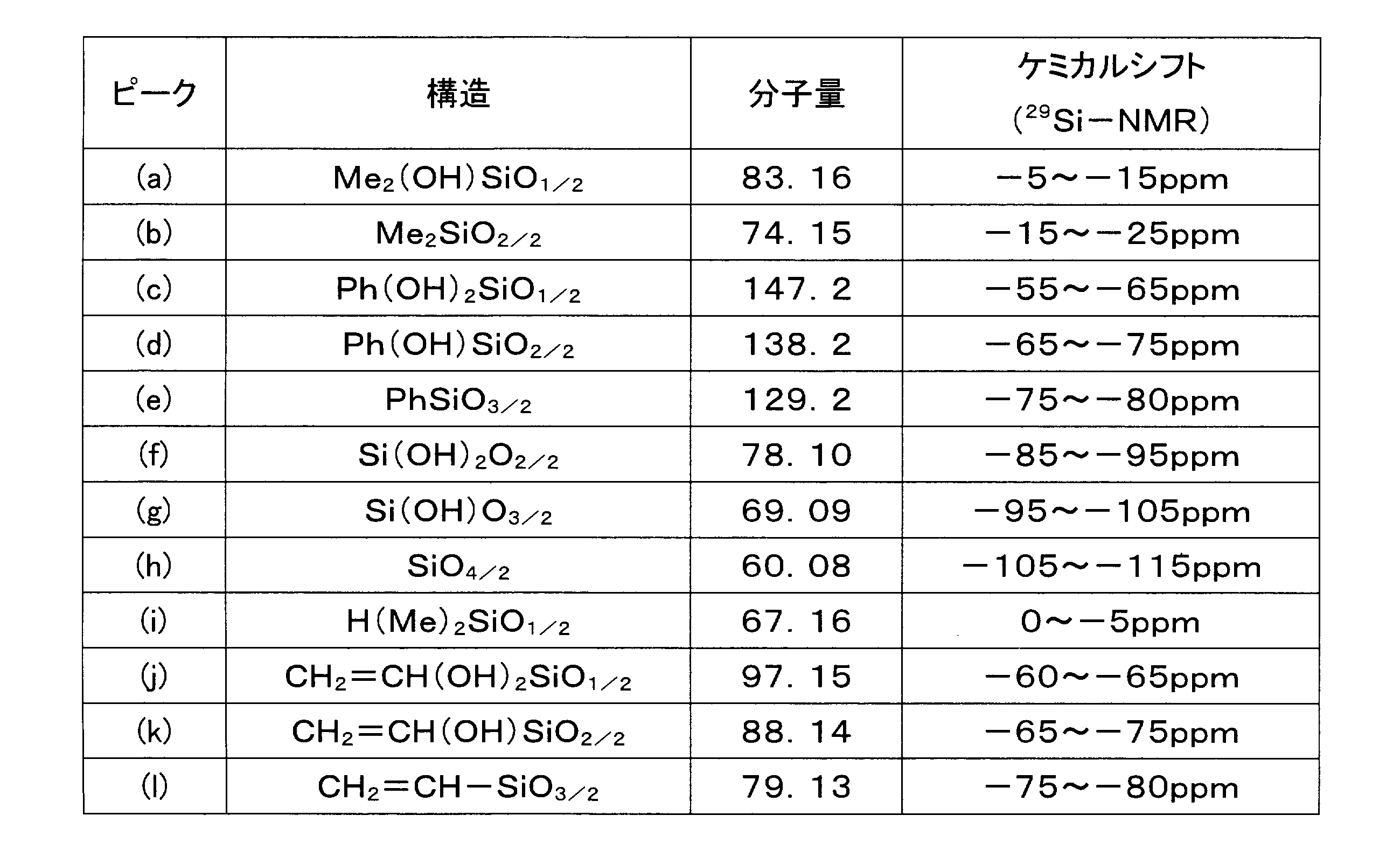
HO-Si基の含有量(mmol/g)は、上述の方法で算出した積分比から以下の式に従って決定した:
[A]= ピーク(a)積分比+2×ピーク(c)積分比+ピーク(d)積分比+2×ピーク(f)積分比+ピーク(g)積分比+2×ピーク(n)積分比+ピーク(o)積分比、
[B]=ピーク(a)積分比×83.16+ピーク(b)積分比×74.15+ピーク(c)積分比×147.2+ピーク(d)積分比×138.2+ピーク(e)積分比×129.2+ピーク(f)積分比×78.10+ピーク(g)積分比×69.09+ピーク(h)積分比×60.08+ピーク(i)積分比×67.16+ピーク(j)積分比×97.15+ピーク(k)積分比×88.14+ピーク(l)積分比×79.13、
HO-Si基の含有量(mmol/g)=([A]/[B])×1000。
シリコーン樹脂200mgに、0.5mLの重クロロホルムを加えて溶解させ、緩和剤としてクロム(III)アセチルアセトナート錯体を10mg加えた。これにより調製した溶液を29Si-NMRで測定した。検出したシグナルを、表1に示すように、ピーク(a)~(p)に分類し、それぞれのピークの積分値を全積分値の和から百分率(積分比)として算出した。なお、シリコーン樹脂の29Si-NMR測定には、共鳴周波数400MHzの核磁気共鳴装置(日本電子株式会社製、型番:JNM-AL400)を使用した。
[A]= ピーク(a)積分比+2×ピーク(c)積分比+ピーク(d)積分比+2×ピーク(f)積分比+ピーク(g)積分比+2×ピーク(n)積分比+ピーク(o)積分比、
[B]=ピーク(a)積分比×83.16+ピーク(b)積分比×74.15+ピーク(c)積分比×147.2+ピーク(d)積分比×138.2+ピーク(e)積分比×129.2+ピーク(f)積分比×78.10+ピーク(g)積分比×69.09+ピーク(h)積分比×60.08+ピーク(i)積分比×67.16+ピーク(j)積分比×97.15+ピーク(k)積分比×88.14+ピーク(l)積分比×79.13、
HO-Si基の含有量(mmol/g)=([A]/[B])×1000。
<質量平均分子量(Mw)の測定>
合成したシリコーン樹脂の質量平均分子量(Mw)は、下記条件のゲル浸透クロマトグラフィー(略称:GPC)法により、ポリスチレンを基準物質として検量線を作成して値を算出した:
装置:HLC-8320GPC(商品名;東ソー株式会社製)、
カラム:TSK gel Super HZ 2000x4, 3000x2(商品名;東ソー株式会社製)、
溶離液:テトラヒドロフラン。
合成したシリコーン樹脂の質量平均分子量(Mw)は、下記条件のゲル浸透クロマトグラフィー(略称:GPC)法により、ポリスチレンを基準物質として検量線を作成して値を算出した:
装置:HLC-8320GPC(商品名;東ソー株式会社製)、
カラム:TSK gel Super HZ 2000x4, 3000x2(商品名;東ソー株式会社製)、
溶離液:テトラヒドロフラン。
<粘度の測定>
合成したシリコーン樹脂の粘度は、回転粘度計(ブルックフィールド・エンジニアリング・ラボラトリーズ・インク製、品名:DV-II+PRO)と温度制御ユニット(ブルックフィールド・エンジニアリング・ラボラトリーズ・インク製、品名:THERMOSEL)を使用し、25℃において測定した。なお、後述のシリコーン樹脂1-3および1-5の粘度は、50℃において測定した。
合成したシリコーン樹脂の粘度は、回転粘度計(ブルックフィールド・エンジニアリング・ラボラトリーズ・インク製、品名:DV-II+PRO)と温度制御ユニット(ブルックフィールド・エンジニアリング・ラボラトリーズ・インク製、品名:THERMOSEL)を使用し、25℃において測定した。なお、後述のシリコーン樹脂1-3および1-5の粘度は、50℃において測定した。
<屈折率の測定>
屈折率計(京都電子工業株式会社製、型式:RA-600)を使用して、合成したシリコーン樹脂の屈折率を測定した。
屈折率計(京都電子工業株式会社製、型式:RA-600)を使用して、合成したシリコーン樹脂の屈折率を測定した。
<合成例1:シリコーン樹脂(A)>
[合成例1-1]
ポリテトラフルオロエチレン(PTFE)で被覆された攪拌子を備えた、500mLのナスフラスコに、178.46g(900mmol)のPh-Si(OMe)3、108.20g(900mmol)のMe2-Si(OMe)2、17.79g(120mmol)のCH2=CH-Si(OMe)3を採取した。次いで、トルエン(240g)、2-プロパノール(120g)、水(92g)をナスフラスコ内に加え、フラスコ内を40℃に加温したのち、1.48g(9.72mmol)のDBUを加えた。40℃のまま4時間撹拌し、反応を行った。その後、反応液を室温に戻し、2Lの分液ロートに移した。分液ロートに、3質量%塩酸900gを加え撹拌した後、二層分離した反応液の上層側有機層を回収した。同様の操作を3回繰り返した後、水900mLを用いて洗浄した。エバポレーターにて、有機層よりトルエンを減圧留去したところ、無色の粘性液体としてシリコーン樹脂(1-1)を192g得た。
シリコーン樹脂(1-1)の質量平均分子量(Mw)は7,100であり、屈折率は1.5115であり、粘度は520,000cPであり、CH2=CH-Si基の含有量は0.62mmol/gであり、HO-Si基の含有量は1.4mmol/gであった。
[合成例1-1]
ポリテトラフルオロエチレン(PTFE)で被覆された攪拌子を備えた、500mLのナスフラスコに、178.46g(900mmol)のPh-Si(OMe)3、108.20g(900mmol)のMe2-Si(OMe)2、17.79g(120mmol)のCH2=CH-Si(OMe)3を採取した。次いで、トルエン(240g)、2-プロパノール(120g)、水(92g)をナスフラスコ内に加え、フラスコ内を40℃に加温したのち、1.48g(9.72mmol)のDBUを加えた。40℃のまま4時間撹拌し、反応を行った。その後、反応液を室温に戻し、2Lの分液ロートに移した。分液ロートに、3質量%塩酸900gを加え撹拌した後、二層分離した反応液の上層側有機層を回収した。同様の操作を3回繰り返した後、水900mLを用いて洗浄した。エバポレーターにて、有機層よりトルエンを減圧留去したところ、無色の粘性液体としてシリコーン樹脂(1-1)を192g得た。
シリコーン樹脂(1-1)の質量平均分子量(Mw)は7,100であり、屈折率は1.5115であり、粘度は520,000cPであり、CH2=CH-Si基の含有量は0.62mmol/gであり、HO-Si基の含有量は1.4mmol/gであった。
[合成例1-2]
DBU(1.48g,9.72mmol)の代わりに12N塩酸(0.81mL)を用いた以外は実施例1と同様の操作により反応を行って、反応液を得た。この反応液を室温に戻し、1L-分液ロートに移した。二層分離した反応液の上層側有機層を回収し、該有機層を水(300mL)で洗浄した。エバポレーターにて、洗浄後の有機層からトルエンを減圧留去して、無色の粘性液体としてシリコーン樹脂(1-2)を183.76g得た。
シリコーン樹脂(1-2)の質量平均分子量(Mw)は860であり、屈折率は1.5019であり、粘度は2,900cPであり、CH2=CH-Si基の含有量は0.73mmol/gであり、HO-Si基の含有量は7.8mmol/gであった。
DBU(1.48g,9.72mmol)の代わりに12N塩酸(0.81mL)を用いた以外は実施例1と同様の操作により反応を行って、反応液を得た。この反応液を室温に戻し、1L-分液ロートに移した。二層分離した反応液の上層側有機層を回収し、該有機層を水(300mL)で洗浄した。エバポレーターにて、洗浄後の有機層からトルエンを減圧留去して、無色の粘性液体としてシリコーン樹脂(1-2)を183.76g得た。
シリコーン樹脂(1-2)の質量平均分子量(Mw)は860であり、屈折率は1.5019であり、粘度は2,900cPであり、CH2=CH-Si基の含有量は0.73mmol/gであり、HO-Si基の含有量は7.8mmol/gであった。
[合成例1-3]
12N塩酸(0.81mL)の代わりに水酸化ナトリウム(0.39g,9.75mmol)を用いた以外は合成例1-2と同様の操作を行った。その結果、無色の粘性液体としてシリコーン樹脂(1-3)を135.9g得た。
シリコーン樹脂(1-3)の質量平均分子量(Mw)は3,600であり、屈折率は1.5110であり、粘度は360,000cPであり、CH2=CH-Si基の含有量は0.59mmol/gであり、HO-Si基の含有量は1.4mmol/gであった。
12N塩酸(0.81mL)の代わりに水酸化ナトリウム(0.39g,9.75mmol)を用いた以外は合成例1-2と同様の操作を行った。その結果、無色の粘性液体としてシリコーン樹脂(1-3)を135.9g得た。
シリコーン樹脂(1-3)の質量平均分子量(Mw)は3,600であり、屈折率は1.5110であり、粘度は360,000cPであり、CH2=CH-Si基の含有量は0.59mmol/gであり、HO-Si基の含有量は1.4mmol/gであった。
[合成例1-4]
12N塩酸(0.81mL)の代わりにトリエチルアミン(NEt3)(984mg,9.72mmol)を用いた以外は合成例1-2と同様の操作を行った。その結果、無色の粘性液体としてシリコーン樹脂(1-4)を191.15g得た。
シリコーン樹脂(1-4)の質量平均分子量(Mw)は1,000であり、屈折率は1.5000であり、粘度は2,500cPであり、CH2=CH-Si基の含有量は0.74mmol/gであり、HO-Si基の含有量は10.0mmol/gであった。
12N塩酸(0.81mL)の代わりにトリエチルアミン(NEt3)(984mg,9.72mmol)を用いた以外は合成例1-2と同様の操作を行った。その結果、無色の粘性液体としてシリコーン樹脂(1-4)を191.15g得た。
シリコーン樹脂(1-4)の質量平均分子量(Mw)は1,000であり、屈折率は1.5000であり、粘度は2,500cPであり、CH2=CH-Si基の含有量は0.74mmol/gであり、HO-Si基の含有量は10.0mmol/gであった。
[合成例1-5]
ポリテトラフルオロエチレン(PTFE)で被覆された攪拌子を備えた、500mLのナスフラスコに、59.49g(300mmol)のPh-Si(OMe)3、36.07g(300mmol)のMe2-Si(OMe)2、5.93g(40mmol)のCH2=CH-Si(OMe)3を採取した。次いで、トルエン(100g)、2-プロパノール(500g)、水(30.65g)をナスフラスコ内に加え、フラスコ内を40℃に加温したのち、493mg(3.24mmol)のDBUを加えた。40℃のまま4時間撹拌し、反応を行った。その後、反応液を室温に戻し、1Lの分液ロートに移した。分液ロートに、3質量%塩酸300gを加え撹拌した後、二層分離した反応液の上層側有機層を回収した。同様の操作を3回繰り返した後、水300mLを用いて洗浄した。エバポレーターにて、有機層よりトルエンを減圧留去したところ、無色の粘性液体としてシリコーン樹脂(1-5)を61.52g得た。
シリコーン樹脂(1-5)の質量平均分子量(Mw)は4,000であり、屈折率は1.5104であり、粘度は310,000cPであり、CH2=CH-Si基の含有量は0.60mmol/gであり、HO-Si基の含有量は1.1mmol/gであった。
ポリテトラフルオロエチレン(PTFE)で被覆された攪拌子を備えた、500mLのナスフラスコに、59.49g(300mmol)のPh-Si(OMe)3、36.07g(300mmol)のMe2-Si(OMe)2、5.93g(40mmol)のCH2=CH-Si(OMe)3を採取した。次いで、トルエン(100g)、2-プロパノール(500g)、水(30.65g)をナスフラスコ内に加え、フラスコ内を40℃に加温したのち、493mg(3.24mmol)のDBUを加えた。40℃のまま4時間撹拌し、反応を行った。その後、反応液を室温に戻し、1Lの分液ロートに移した。分液ロートに、3質量%塩酸300gを加え撹拌した後、二層分離した反応液の上層側有機層を回収した。同様の操作を3回繰り返した後、水300mLを用いて洗浄した。エバポレーターにて、有機層よりトルエンを減圧留去したところ、無色の粘性液体としてシリコーン樹脂(1-5)を61.52g得た。
シリコーン樹脂(1-5)の質量平均分子量(Mw)は4,000であり、屈折率は1.5104であり、粘度は310,000cPであり、CH2=CH-Si基の含有量は0.60mmol/gであり、HO-Si基の含有量は1.1mmol/gであった。
<合成例2>
[合成例2-1]
フッ素樹脂製の撹拌翼、ジムロート型還流器を具備した容積2Lの3口フラスコに、120.2g(1.0mol)のMe2Si(OMe)2、198.3g(1.0mol)のPhSi(OMe)3を採取した。次いで、239.6gの2-プロパノール、185.0gの水および0.12gの酢酸を該フラスコ内に加えて、該フラスコ内を6時間、連続的に100℃にて加温し、反応を行った。その後、反応液を室温に戻し、2Lの分液ロートに移し、400mLのトルエンおよび400mLの水を加え、分液操作を行った後、水層を除去した。次いで400mLの水により有機層の洗浄操作を2回行った。その後、有機層を回収し、エバポレーターにて、トルエンを減圧留去し、無色の粘性液体としてシリコーン樹脂(2-1)を160.8g得た。
シリコーン樹脂(2-1)の質量平均分子量(Mw)は1,200であり、組成比は(Me2SiO2/2)0.49(PhSiO3/2)0.51であり、HO-Si基の含有量は6.1mmol/g(9.0質量%)であった。
[合成例2-1]
フッ素樹脂製の撹拌翼、ジムロート型還流器を具備した容積2Lの3口フラスコに、120.2g(1.0mol)のMe2Si(OMe)2、198.3g(1.0mol)のPhSi(OMe)3を採取した。次いで、239.6gの2-プロパノール、185.0gの水および0.12gの酢酸を該フラスコ内に加えて、該フラスコ内を6時間、連続的に100℃にて加温し、反応を行った。その後、反応液を室温に戻し、2Lの分液ロートに移し、400mLのトルエンおよび400mLの水を加え、分液操作を行った後、水層を除去した。次いで400mLの水により有機層の洗浄操作を2回行った。その後、有機層を回収し、エバポレーターにて、トルエンを減圧留去し、無色の粘性液体としてシリコーン樹脂(2-1)を160.8g得た。
シリコーン樹脂(2-1)の質量平均分子量(Mw)は1,200であり、組成比は(Me2SiO2/2)0.49(PhSiO3/2)0.51であり、HO-Si基の含有量は6.1mmol/g(9.0質量%)であった。
[合成例2-2]
フッ素樹脂製の撹拌翼、ディーンスターク、ジムロート型還流器を具備した2L-4ツ口フラスコに、合成例2-1と同じ操作を繰り返して調製したシリコーン樹脂1,000gを採取した。次いで、250gのトルエンを加えて、該フラスコ内を24時間、連続的に130℃にて加温し、加水分解および縮合反応を行った。その後、反応液を室温に戻し、トルエンを含むシリコーン樹脂(2-2)を調製した。
シリコーン樹脂(2-2)の質量平均分子量(Mw)は3,400であり、組成比は(Me2SiO2/2)0.49(PhSiO3/2)0.51であり、HO-Si基の含有量は4.9mmol/g(7.5質量%)であり、トルエン含有量は11.4質量%であった。
フッ素樹脂製の撹拌翼、ディーンスターク、ジムロート型還流器を具備した2L-4ツ口フラスコに、合成例2-1と同じ操作を繰り返して調製したシリコーン樹脂1,000gを採取した。次いで、250gのトルエンを加えて、該フラスコ内を24時間、連続的に130℃にて加温し、加水分解および縮合反応を行った。その後、反応液を室温に戻し、トルエンを含むシリコーン樹脂(2-2)を調製した。
シリコーン樹脂(2-2)の質量平均分子量(Mw)は3,400であり、組成比は(Me2SiO2/2)0.49(PhSiO3/2)0.51であり、HO-Si基の含有量は4.9mmol/g(7.5質量%)であり、トルエン含有量は11.4質量%であった。
[合成例2-3]
130.00gのシリコーン樹脂(2-2)、288.91gのトルエン、103.36gのメタノール、10.25gの1,1,3,3-テトラメチルジシロキサンおよび0.24mLの70%濃硝酸をフラスコ内に加え、室温で攪拌を行った。4時間後、分液ロートに反応溶液を移し、310gの水を加え、抽出操作をした後、有機層を回収した。同様の操作を4回繰り返すことにより、有機層を洗浄した。エバポレーターにより有機層からトルエンを留去した後、150℃、1時間の加熱による減圧留去を行った後、170℃、1時間の加熱による減圧留去を2回行い、無色透明な粘性液体としてシリコーン樹脂(2-3)を105.5g得た。
シリコーン樹脂(2-3)の質量平均分子量(Mw)は4,000であり、粘度は1,700cPであり、組成比は(Me2SiO2/2)0.36(PhSiO3/2)0.46(H(Me)2SiO1/2)0.18であり、H-Si基の含有量は1.58mmol/gであり、HO-Si基の含有量は2.4mmol/g(4.0質量%)であった。
130.00gのシリコーン樹脂(2-2)、288.91gのトルエン、103.36gのメタノール、10.25gの1,1,3,3-テトラメチルジシロキサンおよび0.24mLの70%濃硝酸をフラスコ内に加え、室温で攪拌を行った。4時間後、分液ロートに反応溶液を移し、310gの水を加え、抽出操作をした後、有機層を回収した。同様の操作を4回繰り返すことにより、有機層を洗浄した。エバポレーターにより有機層からトルエンを留去した後、150℃、1時間の加熱による減圧留去を行った後、170℃、1時間の加熱による減圧留去を2回行い、無色透明な粘性液体としてシリコーン樹脂(2-3)を105.5g得た。
シリコーン樹脂(2-3)の質量平均分子量(Mw)は4,000であり、粘度は1,700cPであり、組成比は(Me2SiO2/2)0.36(PhSiO3/2)0.46(H(Me)2SiO1/2)0.18であり、H-Si基の含有量は1.58mmol/gであり、HO-Si基の含有量は2.4mmol/g(4.0質量%)であった。
シリコーン樹脂(1-1)~(1-5)およびシリコーン樹脂(2-1)~(2-3)における各物性値(H-Si基またはCH2=CH-Si基の含有量、HO-Si基の含有量、質量平均分子量、屈折率および粘度)について、表2に示す。表2中、Vi-Si基はCH2=CH-Si基を表し、「―」は未測定であることを表す。

[実施例1~2および比較例1~3]
合成したシリコーン樹脂(1-1)~(1-5)とシリコーン樹脂(2-3)とを、CH2=CH-Si基とH-Si基のモル比が1:2となるように配合したものに対し、ヒドロシリル化触媒として白金触媒を混合して硬化性組成物(組成物1~2および比較用組成物1~3)をそれぞれ調製した。ここで、白金触媒としては、硬化性組成物全体量に対して、白金原子の含有量が質量単位で1ppmとなるように白金(0)-1,3-ジビニル-1,1,3,3-テトラメチルジシロキサン錯体を用いた。調製した硬化性組成物についてまとめたものを表3に示す。
合成したシリコーン樹脂(1-1)~(1-5)とシリコーン樹脂(2-3)とを、CH2=CH-Si基とH-Si基のモル比が1:2となるように配合したものに対し、ヒドロシリル化触媒として白金触媒を混合して硬化性組成物(組成物1~2および比較用組成物1~3)をそれぞれ調製した。ここで、白金触媒としては、硬化性組成物全体量に対して、白金原子の含有量が質量単位で1ppmとなるように白金(0)-1,3-ジビニル-1,1,3,3-テトラメチルジシロキサン錯体を用いた。調製した硬化性組成物についてまとめたものを表3に示す。
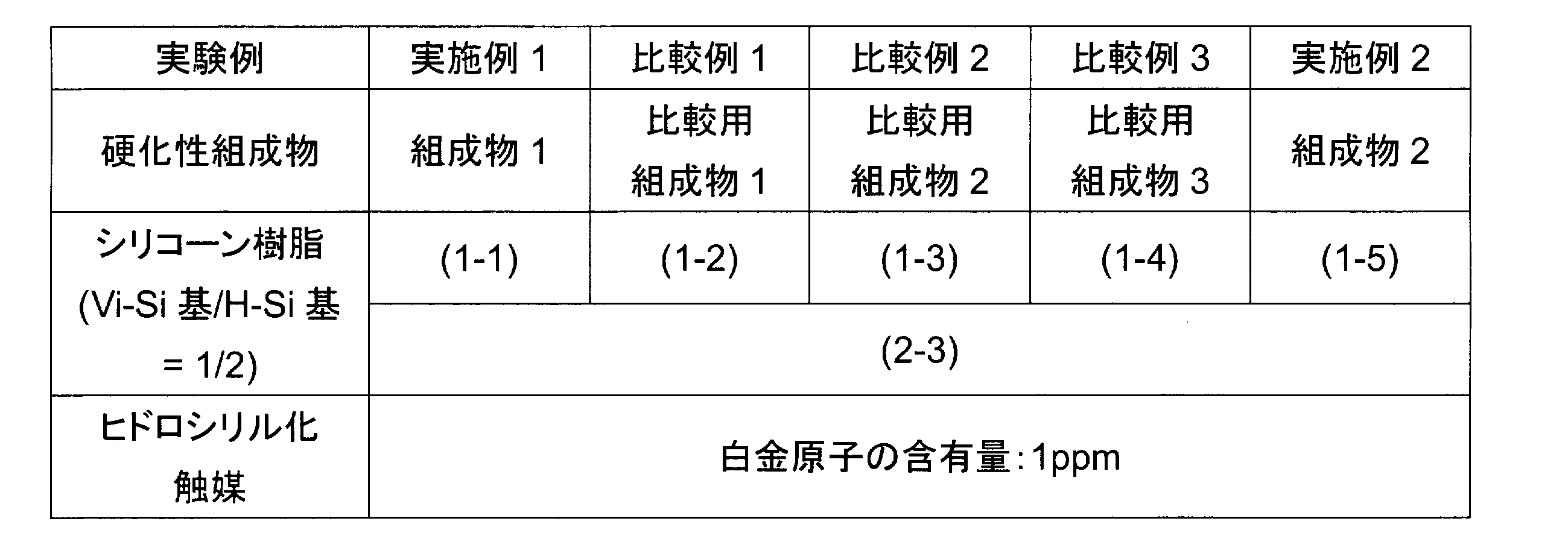
調製した硬化性組成物から得られる硬化物の物性は、以下に示す方法に従って評価した。その結果を表4に示す。
[硬化物の接着強度]
調製した硬化性組成物と、直径50μmのジルコニアボールとを混合したものを、ガラス基板(50mm×50mm×3.0mm)またはアルミナ基板(50mm×50mm×2.0mm)の上にポッティングし、ガラスチップ(5.0mm×5.0mm×1.1mm)をポッティングした該組成物上に置き、挟みこんだ状態で空気中90℃で1時間加熱し、さらに150℃で4時間加熱して前記硬化性組成物を硬化させて検体を作製した。同様にして計10個の検体を作製した。各検体の接着力(接着強度)をボンドテスター(デイジ・ジャパン株式会社製、型式:Dage4000Plus)により測定し、10検体の接着力の平均値を算出した。
調製した硬化性組成物と、直径50μmのジルコニアボールとを混合したものを、ガラス基板(50mm×50mm×3.0mm)またはアルミナ基板(50mm×50mm×2.0mm)の上にポッティングし、ガラスチップ(5.0mm×5.0mm×1.1mm)をポッティングした該組成物上に置き、挟みこんだ状態で空気中90℃で1時間加熱し、さらに150℃で4時間加熱して前記硬化性組成物を硬化させて検体を作製した。同様にして計10個の検体を作製した。各検体の接着力(接着強度)をボンドテスター(デイジ・ジャパン株式会社製、型式:Dage4000Plus)により測定し、10検体の接着力の平均値を算出した。
[硬化時の発泡、クラック、硬化物のタック性]
調製した硬化性組成物1gをガラスモールドレンズ(22mmφ)に薄く広げ、空気中90℃で1時間加熱し、さらに150℃で4時間加熱して硬化物を作製した。作製した硬化物を25℃に自然冷却した。同様にして、各組成物につき3個の硬化物を作製し、これらを試験体とした。これらの試験体について、硬化時の発泡、クラック、および硬化物のタック性を以下のように評価した。
発泡:試験体の外観を目視で確認し、全ての試験体において、透明で、発泡が観測されない状態を「○」、いずれかの試験体に泡が観測される状態を「×」と評価した。
クラック:全ての試験体において、硬化物にクラックが存在していない状態を「○」、いずれかの試験体にクラックが存在している状態を「×」と評価した。
タック性:試験体の表面にガラス棒を押し当て、べたつきの全くないものを「◎」、べたつきがほとんどないものを「○」、べたつきがあるものを「△」、接着を伴うべたつきがあるものを「×」と評価した。
調製した硬化性組成物1gをガラスモールドレンズ(22mmφ)に薄く広げ、空気中90℃で1時間加熱し、さらに150℃で4時間加熱して硬化物を作製した。作製した硬化物を25℃に自然冷却した。同様にして、各組成物につき3個の硬化物を作製し、これらを試験体とした。これらの試験体について、硬化時の発泡、クラック、および硬化物のタック性を以下のように評価した。
発泡:試験体の外観を目視で確認し、全ての試験体において、透明で、発泡が観測されない状態を「○」、いずれかの試験体に泡が観測される状態を「×」と評価した。
クラック:全ての試験体において、硬化物にクラックが存在していない状態を「○」、いずれかの試験体にクラックが存在している状態を「×」と評価した。
タック性:試験体の表面にガラス棒を押し当て、べたつきの全くないものを「◎」、べたつきがほとんどないものを「○」、べたつきがあるものを「△」、接着を伴うべたつきがあるものを「×」と評価した。
[弾性率、破断点応力、破断点ひずみ]
調製した硬化性組成物を型(90mm×90mm×2mm)に流し込み、空気中90℃で1時間加熱し、さらに150℃で4時間加熱して板状硬化物を作製した。JIS K 6251「加硫ゴムおよび熱可塑性ゴム-引張特性の求め方」に準じて、この板状硬化物からダンベル状8号形試験片を打ち抜き成形した。この試験片の弾性率、破断点応力、破断点ひずみを、JIS K 6251に規定の方法に準じて測定した。
調製した硬化性組成物を型(90mm×90mm×2mm)に流し込み、空気中90℃で1時間加熱し、さらに150℃で4時間加熱して板状硬化物を作製した。JIS K 6251「加硫ゴムおよび熱可塑性ゴム-引張特性の求め方」に準じて、この板状硬化物からダンベル状8号形試験片を打ち抜き成形した。この試験片の弾性率、破断点応力、破断点ひずみを、JIS K 6251に規定の方法に準じて測定した。
[硬化物の硬度(ショア硬度)]
調製した硬化性組成物を型(25mmφ)に流し込み、空気中90℃で1時間加熱し、さらに150℃で4時間加熱して厚さが6~7mmの硬化物を作製した。この硬化物のショア硬度を、デュロメーター(株式会社テクロック製、型式:GS-719R、GS-720R)を用いて、JIS K 7215「プラスチックのデュロメータ硬さ試験方法」に規定の方法に準じて測定した。
調製した硬化性組成物を型(25mmφ)に流し込み、空気中90℃で1時間加熱し、さらに150℃で4時間加熱して厚さが6~7mmの硬化物を作製した。この硬化物のショア硬度を、デュロメーター(株式会社テクロック製、型式:GS-719R、GS-720R)を用いて、JIS K 7215「プラスチックのデュロメータ硬さ試験方法」に規定の方法に準じて測定した。

表3に示されるように、実施例1~2および比較例1~3の全てにおいて、硬化物の発泡、クラックは確認されなかったが、比較例1~3では硬化物のタック性が観測された。実施例1の硬化物は特にタック性のない良好なものだった。
弾性率、破断点応力は実施例1が最も高い値が得られた。比較例1および3では硬化物が非常にもろく、弾性率、破断点応力、破断点ひずみは測定することができなかった。ショア硬度は実施例1~2および比較例1~3において、実施例1で最も硬い硬化物が得られた。
以上のことから、実施例1で得られた硬化物は、発泡、クラックは観測されず、タック性もなく、さらに機械的強度に優れる結果となった。
1…封止材、
2…光半導体素子、
3…ボンディングワイヤー、
4…反射材、
5…リードフレーム、
6…光半導体基板、
10…光半導体装置。
2…光半導体素子、
3…ボンディングワイヤー、
4…反射材、
5…リードフレーム、
6…光半導体基板、
10…光半導体装置。
Claims (22)
- 下記(A)成分、(B)成分および(C)成分を少なくとも含む、硬化性シリコーン樹脂組成物。
(A)成分:下記一般式[1]で表されるトリアルコキシシラン、一般式[2]で表されるジアルコキシシランおよび一般式[3]で表されるビニルトリアルコキシシランを少なくとも含む第1のアルコキシシラン組成物を加水分解重縮合することで得られる、質量平均分子量が3,800~20,000である、第1のシリコーン樹脂。

(B)成分:H-Si基を有する第2のシリコーン樹脂。
(C)成分:ヒドロシリル化触媒。 - 第1のアルコキシシラン組成物が、下記一般式[4]で表されるテトラアルコキシシランをさらに含む、請求項1に記載の硬化性シリコーン樹脂組成物。

- 第1のアルコキシシラン組成物において、一般式[1]で表されるトリアルコキシシランおよび一般式[2]で表されるジアルコキシシランのモル比が85:15~15:85であり、一般式[3]で表されるビニルトリアルコキシシランの配合量が、該トリアルコキシシランおよび該ジアルコキシシランの総量100モルに対し、1~40モルである、請求項1または2に記載の硬化性シリコーン樹脂組成物。
- 第1のアルコキシシラン組成物の加水分解重縮合を、pKa(20℃、水中)が9以上である塩基性有機化合物の存在下で行う、請求項1~3の何れかに記載の硬化性シリコーン樹脂組成物。
- 塩基性有機化合物が、1,8-ジアザビシクロ[5.4.0]-7-ウンデセン、1,5-ジアザビシクロ[4.3.0]-5-ノネン、グアニジン、テトラメチルグアニジン、7-メチル-1,5,7-トリアザビシクロ[4.4.0]-5-デセンおよび1,5,7-トリアザビシクロ[4.4.0]-5-デセンからなる群より選ばれる少なくとも一種である、請求項4に記載の硬化性シリコーン樹脂組成物。
- (B)成分が、下記(B-1)成分である、請求項1~5のいずれかに記載の硬化性シリコーン樹脂組成物。
(B-1)成分:下記一般式[5]で表されるトリアルコキシシランおよび一般式[6]で表されるジアルコキシシランを少なくとも含む第2のアルコキシシラン組成物を加水分解重縮合することで得られる、HO-Si基を有する加水分解重縮合物と、下記一般式[8-1]、[8-2]、[8-3]または[8-4]で表されるシラン化合物の少なくとも一種とを反応させて得られる、Si-H基を有するシリコーン樹脂。

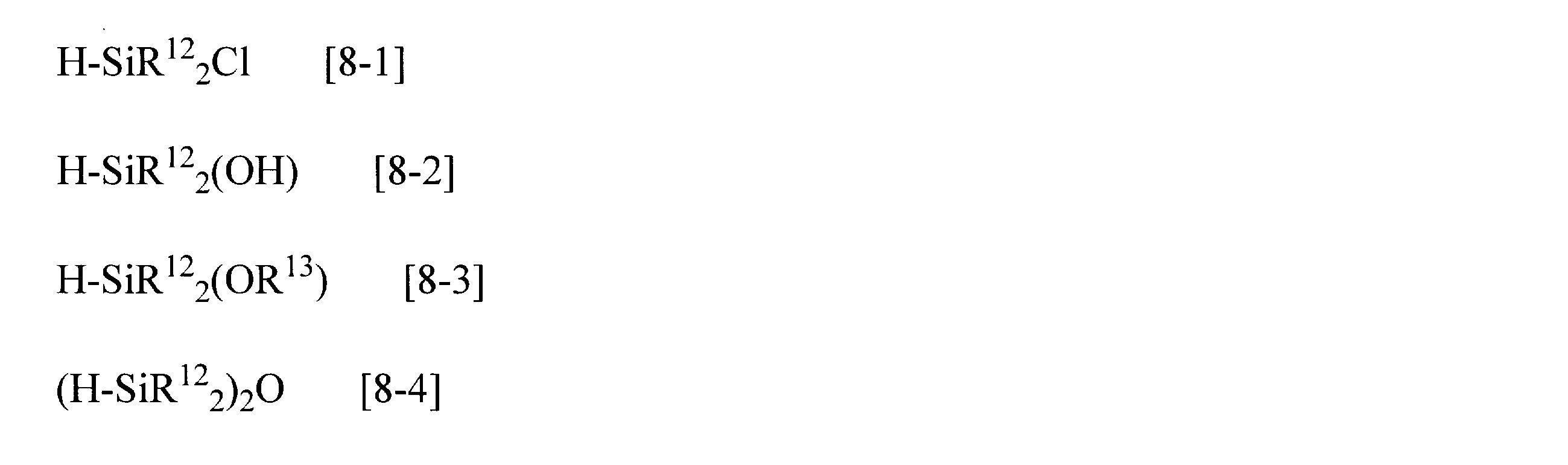
- 第2のアルコキシシラン組成物が、下記一般式[7]で表されるテトラアルコキシシランをさらに含む、請求項6に記載の硬化性シリコーン樹脂組成物。

- 第2のアルコキシシラン組成物において、一般式[5]で表されるトリアルコキシシランおよび一般式[6]で表されるジアルコキシシランのモル比が、85:15~15:85である、請求項6または7に記載の硬化性シリコーン樹脂組成物。
- (B)成分が、下記(B-2)成分である、請求項1~5のいずれかに記載の硬化性シリコーン樹脂組成物。
(B-2)成分:H-Si基を有する環状シロキサン。 - (B)成分が、下記(B-3)成分である、請求項1~5のいずれかに記載の硬化性シリコーン樹脂組成物。
(B-3)成分:下記一般式[9]で表されるジアルコキシシランおよび一般式[10]で表されるジアルコキシヒドロシランを少なくとも含む第3のアルコキシシラン組成物を加水分解縮合させて得られる、Si-H基を有するシリコーン樹脂。

- 硬化遅延剤、接着付与剤、酸化防止剤、光安定剤、蛍光体、無機粒子、離型剤、樹脂改質剤、着色剤、希釈剤、抗菌剤、防黴剤、レベリング剤およびタレ防止剤からなる群より選ばれる少なくとも一種をさらに含む、請求項1~10の何れかに記載の硬化性シリコーン樹脂組成物。
- 請求項1~11の何れかに記載の硬化性シリコーン樹脂組成物を硬化してなる、硬化物。
- 光半導体素子と、該光半導体素子を封止するように設けられた請求項12に記載の硬化物とを少なくとも備える、光半導体装置。
- 下記一般式[1]で表されるトリアルコキシシラン、一般式[2]で表されるジアルコキシシランおよび一般式[3]で表されるビニルトリアルコキシシランを少なくとも含む第1のアルコキシシラン組成物を加水分解重縮合することで得られる、質量平均分子量が3,800~20,000である、第1のシリコーン樹脂。

- 第1のアルコキシシラン組成物の加水分解重縮合を、pKa(20℃、水中)が9以上である塩基性有機化合物の存在下で行う、請求項14に記載の第1のシリコーン樹脂。
- 下記一般式[1]で表されるトリアルコキシシラン、一般式[2]で表されるジアルコキシシランおよび一般式[3]で表されるビニルトリアルコキシシランを少なくとも含む第1のアルコキシシラン組成物を加水分解重縮合して、質量平均分子量が3,800~20,000である、第1のシリコーン樹脂を製造する方法。

- 第1のアルコキシシラン組成物が、下記一般式[4]で表されるテトラアルコキシシランをさらに含む、請求項16に記載の方法。

- 第1のアルコキシシラン組成物において、一般式[1]で表されるトリアルコキシシランおよび一般式[2]で表されるジアルコキシシランのモル比が85:15~15:85であり、一般式[3]で表されるビニルトリアルコキシシランの配合量が、該トリアルコキシシランおよび該ジアルコキシシランの総量100モルに対し、1~40モルである、請求項16または17に記載の方法。
- 第1のアルコキシシラン組成物の加水分解重縮合を、pKa(20℃、水中)が9以上である塩基性有機化合物の存在下で行う、請求項16~18の何れかに記載の方法。
- 塩基性有機化合物が、1,8-ジアザビシクロ[5.4.0]-7-ウンデセン、1,5-ジアザビシクロ[4.3.0]-5-ノネン、グアニジン、テトラメチルグアニジン、7-メチル-1,5,7-トリアザビシクロ[4.4.0]-5-デセンおよび1,5,7-トリアザビシクロ[4.4.0]-5-デセンからなる群より選ばれる少なくとも一種である、請求項19に記載の方法。
- 下記(A)成分、(B)成分および(C)成分を少なくとも配合して、硬化性シリコーン樹脂組成物を製造する方法。
(A)成分:下記一般式[1]で表されるトリアルコキシシラン、一般式[2]で表されるジアルコキシシランおよび一般式[3]で表されるビニルトリアルコキシシランを少なくとも含む第1のアルコキシシラン組成物を加水分解重縮合することで得られる、質量平均分子量が3,800~20,000である、第1のシリコーン樹脂。
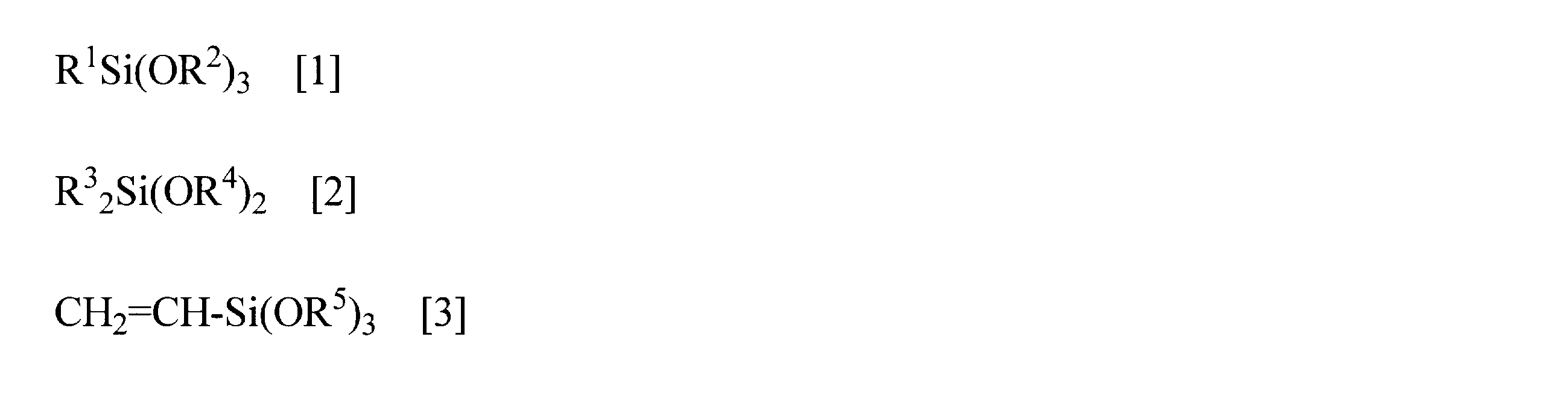
(B)成分:H-Si基を有する第2のシリコーン樹脂。
(C)成分:ヒドロシリル化触媒。 - 下記(A)成分、(B)成分および(C)成分を少なくとも配合して、硬化性シリコーン樹脂組成物を製造する方法。
(A)成分:下記一般式[1]で表されるトリアルコキシシラン、一般式[2]で表されるジアルコキシシランおよび一般式[3]で表されるビニルトリアルコキシシランを少なくとも含む第1のアルコキシシラン組成物を、1,8-ジアザビシクロ[5.4.0]-7-ウンデセン、1,5-ジアザビシクロ[4.3.0]-5-ノネン、グアニジン、テトラメチルグアニジン、7-メチル-1,5,7-トリアザビシクロ[4.4.0]-5-デセンおよび1,5,7-トリアザビシクロ[4.4.0]-5-デセンからなる群より選ばれる少なくとも一種である、塩基性有機化合物の存在下で、加水分解重縮合することで得られる、質量平均分子量が3,800~20,000である、第1のシリコーン樹脂。
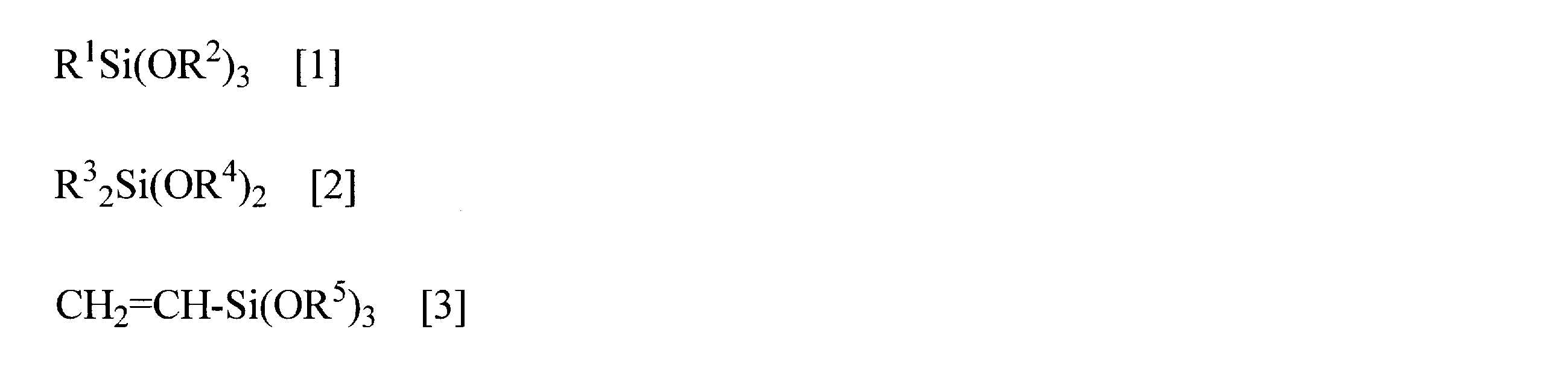
(B)成分:H-Si基を有する第2のシリコーン樹脂。
(C)成分:ヒドロシリル化触媒。
Applications Claiming Priority (4)
| Application Number | Priority Date | Filing Date | Title |
|---|---|---|---|
| JP2015-190566 | 2015-09-29 | ||
| JP2015190566 | 2015-09-29 | ||
| JP2016162357A JP2017066369A (ja) | 2015-09-29 | 2016-08-23 | 硬化性シリコーン樹脂組成物およびその硬化物、並びにこれらを用いた光半導体装置 |
| JP2016-162357 | 2016-08-23 |
Publications (1)
| Publication Number | Publication Date |
|---|---|
| WO2017056913A1 true WO2017056913A1 (ja) | 2017-04-06 |
Family
ID=58423363
Family Applications (1)
| Application Number | Title | Priority Date | Filing Date |
|---|---|---|---|
| PCT/JP2016/076543 Ceased WO2017056913A1 (ja) | 2015-09-29 | 2016-09-09 | 硬化性シリコーン樹脂組成物およびその硬化物、並びにこれらを用いた光半導体装置 |
Country Status (1)
| Country | Link |
|---|---|
| WO (1) | WO2017056913A1 (ja) |
Cited By (1)
| Publication number | Priority date | Publication date | Assignee | Title |
|---|---|---|---|---|
| CN115803366A (zh) * | 2020-07-10 | 2023-03-14 | Ams-欧司朗国际有限公司 | 用于制备聚硅氧烷的前体、聚硅氧烷、聚硅氧烷树脂、用于制备聚硅氧烷的方法、用于制备聚硅氧烷树脂的方法以及光电子器件 |
Citations (4)
| Publication number | Priority date | Publication date | Assignee | Title |
|---|---|---|---|---|
| WO2011162294A1 (ja) * | 2010-06-24 | 2011-12-29 | 積水化学工業株式会社 | 光半導体装置用封止剤及びそれを用いた光半導体装置 |
| WO2013021717A1 (ja) * | 2011-08-10 | 2013-02-14 | 株式会社Adeka | ケイ素含有硬化性組成物及びその硬化物 |
| JP2013253210A (ja) * | 2012-06-08 | 2013-12-19 | Sekisui Chem Co Ltd | 光半導体装置用硬化性組成物、光半導体装置及び光半導体装置の製造方法 |
| JP2014196462A (ja) * | 2013-03-07 | 2014-10-16 | Jsr株式会社 | 硬化性組成物、硬化物および光半導体装置 |
-
2016
- 2016-09-09 WO PCT/JP2016/076543 patent/WO2017056913A1/ja not_active Ceased
Patent Citations (4)
| Publication number | Priority date | Publication date | Assignee | Title |
|---|---|---|---|---|
| WO2011162294A1 (ja) * | 2010-06-24 | 2011-12-29 | 積水化学工業株式会社 | 光半導体装置用封止剤及びそれを用いた光半導体装置 |
| WO2013021717A1 (ja) * | 2011-08-10 | 2013-02-14 | 株式会社Adeka | ケイ素含有硬化性組成物及びその硬化物 |
| JP2013253210A (ja) * | 2012-06-08 | 2013-12-19 | Sekisui Chem Co Ltd | 光半導体装置用硬化性組成物、光半導体装置及び光半導体装置の製造方法 |
| JP2014196462A (ja) * | 2013-03-07 | 2014-10-16 | Jsr株式会社 | 硬化性組成物、硬化物および光半導体装置 |
Cited By (3)
| Publication number | Priority date | Publication date | Assignee | Title |
|---|---|---|---|---|
| CN115803366A (zh) * | 2020-07-10 | 2023-03-14 | Ams-欧司朗国际有限公司 | 用于制备聚硅氧烷的前体、聚硅氧烷、聚硅氧烷树脂、用于制备聚硅氧烷的方法、用于制备聚硅氧烷树脂的方法以及光电子器件 |
| CN115803366B (zh) * | 2020-07-10 | 2024-02-09 | Ams-欧司朗国际有限公司 | 制备聚硅氧烷的前体、聚硅氧烷及其制备方法、聚硅氧烷树脂及其制备方法和光电子器件 |
| US12404372B2 (en) | 2020-07-10 | 2025-09-02 | Ams-Osram International Gmbh | Precursor for producing a polysiloxane, polysiloxane, polysiloxane resin, method of producing a polysiloxane, method of producing a polysiloxane resin, and optoelectronic component |
Similar Documents
| Publication | Publication Date | Title |
|---|---|---|
| TWI624510B (zh) | 硬化性聚矽氧組合物、其硬化物及光半導體裝置 | |
| JP4911805B2 (ja) | 光半導体装置用封止剤及びそれを用いた光半導体装置 | |
| WO2011125463A1 (ja) | 光半導体装置用封止剤及び光半導体装置 | |
| KR101560062B1 (ko) | 발광 다이오드 | |
| WO2017010327A1 (ja) | 硬化性ポリボロシロキサン樹脂組成物およびその硬化物、並びにこれらを用いた光半導体装置 | |
| WO2013008842A1 (ja) | 光半導体装置用封止剤及び光半導体装置 | |
| TWI653295B (zh) | 硬化性聚矽氧組合物、其硬化物及光半導體裝置 | |
| JP2016169358A (ja) | 硬化性シリコーン樹脂組成物およびその硬化物、並びにこれらを用いた光半導体装置 | |
| JP2017020005A (ja) | 硬化性ポリボロシロキサン樹脂組成物およびその硬化物、並びにこれらを用いた光半導体装置 | |
| JP2012111836A (ja) | 光半導体装置用封止剤及びそれを用いた光半導体装置 | |
| JP2015115494A (ja) | 半導体発光装置 | |
| WO2013035736A1 (ja) | 光半導体装置用硬化性組成物 | |
| CN105452386A (zh) | 可固化树脂组合物 | |
| JPWO2018088316A1 (ja) | 硬化性シリコーン組成物およびそれを用いた光半導体装置 | |
| JP5323037B2 (ja) | 光半導体装置用封止剤及びそれを用いた光半導体装置 | |
| JP5323038B2 (ja) | 光半導体装置用封止剤及びそれを用いた光半導体装置 | |
| WO2017056913A1 (ja) | 硬化性シリコーン樹脂組成物およびその硬化物、並びにこれらを用いた光半導体装置 | |
| TWI540182B (zh) | A hardened silicone resin composition and a hardened product thereof, and a light-cured semiconductor device | |
| JP2013053186A (ja) | 光半導体装置用封止剤及びそれを用いた光半導体装置 | |
| JP2012197328A (ja) | オルガノポリシロキサンの製造方法、光半導体装置用組成物及び光半導体装置 | |
| JP2018111783A (ja) | 硬化性シリコーン樹脂組成物およびその硬化物、並びにこれらを用いた半導体装置 | |
| JP2012199345A (ja) | 光半導体装置用レンズ材料、光半導体装置及び光半導体装置の製造方法 | |
| JP2017128707A (ja) | 硬化性シリコーン樹脂組成物およびその硬化物、並びにこれらを用いた光半導体装置 | |
| JP2017066369A (ja) | 硬化性シリコーン樹脂組成物およびその硬化物、並びにこれらを用いた光半導体装置 | |
| JP2012197409A (ja) | 光半導体装置用封止剤及びそれを用いた光半導体装置 |
Legal Events
| Date | Code | Title | Description |
|---|---|---|---|
| 121 | Ep: the epo has been informed by wipo that ep was designated in this application |
Ref document number: 16851087 Country of ref document: EP Kind code of ref document: A1 |
|
| NENP | Non-entry into the national phase |
Ref country code: DE |
|
| 122 | Ep: pct application non-entry in european phase |
Ref document number: 16851087 Country of ref document: EP Kind code of ref document: A1 |