WO2017056569A1 - ゲームシステム、ゲーム制御装置、及びプログラム - Google Patents
ゲームシステム、ゲーム制御装置、及びプログラム Download PDFInfo
- Publication number
- WO2017056569A1 WO2017056569A1 PCT/JP2016/067514 JP2016067514W WO2017056569A1 WO 2017056569 A1 WO2017056569 A1 WO 2017056569A1 JP 2016067514 W JP2016067514 W JP 2016067514W WO 2017056569 A1 WO2017056569 A1 WO 2017056569A1
- Authority
- WO
- WIPO (PCT)
- Prior art keywords
- game
- user
- identification information
- user identification
- player character
- Prior art date
- Legal status (The legal status is an assumption and is not a legal conclusion. Google has not performed a legal analysis and makes no representation as to the accuracy of the status listed.)
- Ceased
Links
Images






Classifications
-
- A—HUMAN NECESSITIES
- A63—SPORTS; GAMES; AMUSEMENTS
- A63F—CARD, BOARD, OR ROULETTE GAMES; INDOOR GAMES USING SMALL MOVING PLAYING BODIES; VIDEO GAMES; GAMES NOT OTHERWISE PROVIDED FOR
- A63F13/00—Video games, i.e. games using an electronically generated display having two or more dimensions
- A63F13/70—Game security or game management aspects
- A63F13/79—Game security or game management aspects involving player-related data, e.g. identities, accounts, preferences or play histories
-
- A—HUMAN NECESSITIES
- A63—SPORTS; GAMES; AMUSEMENTS
- A63F—CARD, BOARD, OR ROULETTE GAMES; INDOOR GAMES USING SMALL MOVING PLAYING BODIES; VIDEO GAMES; GAMES NOT OTHERWISE PROVIDED FOR
- A63F13/00—Video games, i.e. games using an electronically generated display having two or more dimensions
- A63F13/30—Interconnection arrangements between game servers and game devices; Interconnection arrangements between game devices; Interconnection arrangements between game servers
-
- A—HUMAN NECESSITIES
- A63—SPORTS; GAMES; AMUSEMENTS
- A63F—CARD, BOARD, OR ROULETTE GAMES; INDOOR GAMES USING SMALL MOVING PLAYING BODIES; VIDEO GAMES; GAMES NOT OTHERWISE PROVIDED FOR
- A63F13/00—Video games, i.e. games using an electronically generated display having two or more dimensions
- A63F13/50—Controlling the output signals based on the game progress
- A63F13/53—Controlling the output signals based on the game progress involving additional visual information provided to the game scene, e.g. by overlay to simulate a head-up display [HUD] or displaying a laser sight in a shooting game
-
- A—HUMAN NECESSITIES
- A63—SPORTS; GAMES; AMUSEMENTS
- A63F—CARD, BOARD, OR ROULETTE GAMES; INDOOR GAMES USING SMALL MOVING PLAYING BODIES; VIDEO GAMES; GAMES NOT OTHERWISE PROVIDED FOR
- A63F13/00—Video games, i.e. games using an electronically generated display having two or more dimensions
- A63F13/55—Controlling game characters or game objects based on the game progress
- A63F13/58—Controlling game characters or game objects based on the game progress by computing conditions of game characters, e.g. stamina, strength, motivation or energy level
-
- A—HUMAN NECESSITIES
- A63—SPORTS; GAMES; AMUSEMENTS
- A63F—CARD, BOARD, OR ROULETTE GAMES; INDOOR GAMES USING SMALL MOVING PLAYING BODIES; VIDEO GAMES; GAMES NOT OTHERWISE PROVIDED FOR
- A63F13/00—Video games, i.e. games using an electronically generated display having two or more dimensions
- A63F13/60—Generating or modifying game content before or while executing the game program, e.g. authoring tools specially adapted for game development or game-integrated level editor
- A63F13/63—Generating or modifying game content before or while executing the game program, e.g. authoring tools specially adapted for game development or game-integrated level editor by the player, e.g. authoring using a level editor
-
- A—HUMAN NECESSITIES
- A63—SPORTS; GAMES; AMUSEMENTS
- A63F—CARD, BOARD, OR ROULETTE GAMES; INDOOR GAMES USING SMALL MOVING PLAYING BODIES; VIDEO GAMES; GAMES NOT OTHERWISE PROVIDED FOR
- A63F13/00—Video games, i.e. games using an electronically generated display having two or more dimensions
- A63F13/60—Generating or modifying game content before or while executing the game program, e.g. authoring tools specially adapted for game development or game-integrated level editor
- A63F13/69—Generating or modifying game content before or while executing the game program, e.g. authoring tools specially adapted for game development or game-integrated level editor by enabling or updating specific game elements, e.g. unlocking hidden features, items, levels or versions
-
- A—HUMAN NECESSITIES
- A63—SPORTS; GAMES; AMUSEMENTS
- A63F—CARD, BOARD, OR ROULETTE GAMES; INDOOR GAMES USING SMALL MOVING PLAYING BODIES; VIDEO GAMES; GAMES NOT OTHERWISE PROVIDED FOR
- A63F13/00—Video games, i.e. games using an electronically generated display having two or more dimensions
- A63F13/80—Special adaptations for executing a specific game genre or game mode
- A63F13/812—Ball games, e.g. soccer or baseball
-
- G—PHYSICS
- G07—CHECKING-DEVICES
- G07F—COIN-FREED OR LIKE APPARATUS
- G07F17/00—Coin-freed apparatus for hiring articles; Coin-freed facilities or services
- G07F17/32—Coin-freed apparatus for hiring articles; Coin-freed facilities or services for games, toys, sports, or amusements
- G07F17/326—Game play aspects of gaming systems
-
- A—HUMAN NECESSITIES
- A63—SPORTS; GAMES; AMUSEMENTS
- A63F—CARD, BOARD, OR ROULETTE GAMES; INDOOR GAMES USING SMALL MOVING PLAYING BODIES; VIDEO GAMES; GAMES NOT OTHERWISE PROVIDED FOR
- A63F13/00—Video games, i.e. games using an electronically generated display having two or more dimensions
- A63F13/80—Special adaptations for executing a specific game genre or game mode
- A63F13/822—Strategy games; Role-playing games
-
- A—HUMAN NECESSITIES
- A63—SPORTS; GAMES; AMUSEMENTS
- A63F—CARD, BOARD, OR ROULETTE GAMES; INDOOR GAMES USING SMALL MOVING PLAYING BODIES; VIDEO GAMES; GAMES NOT OTHERWISE PROVIDED FOR
- A63F13/00—Video games, i.e. games using an electronically generated display having two or more dimensions
- A63F13/80—Special adaptations for executing a specific game genre or game mode
- A63F13/828—Managing virtual sport teams
-
- A—HUMAN NECESSITIES
- A63—SPORTS; GAMES; AMUSEMENTS
- A63F—CARD, BOARD, OR ROULETTE GAMES; INDOOR GAMES USING SMALL MOVING PLAYING BODIES; VIDEO GAMES; GAMES NOT OTHERWISE PROVIDED FOR
- A63F2300/00—Features of games using an electronically generated display having two or more dimensions, e.g. on a television screen, showing representations related to the game
- A63F2300/50—Features of games using an electronically generated display having two or more dimensions, e.g. on a television screen, showing representations related to the game characterized by details of game servers
-
- G—PHYSICS
- G07—CHECKING-DEVICES
- G07F—COIN-FREED OR LIKE APPARATUS
- G07F17/00—Coin-freed apparatus for hiring articles; Coin-freed facilities or services
- G07F17/32—Coin-freed apparatus for hiring articles; Coin-freed facilities or services for games, toys, sports, or amusements
- G07F17/3286—Type of games
- G07F17/329—Regular and instant lottery, e.g. electronic scratch cards
Definitions
- the present invention relates to a game system, a game control device, and a program.
- At least one of a plurality of selection candidate game objects is selected as a game object to be given to the user based on a predetermined lottery process, and the selected game object is given to the user.
- a game having a function to be given for example, “gacha” is known.
- the present invention has been made in view of the above-described problems, and its object is to provide a game system and a game control device capable of reducing a burden on a game provider for changing the lineup of selection candidate game objects. And providing a program.
- a game system performs a predetermined lottery process as a game object that associates at least one of a plurality of selection candidate game objects with first user identification information.
- a game object associated with the second user identification information comprising: selection means for selecting based on; and game object association means for associating the game object selected by the selection means with the first user identification information, And a selection candidate setting means for setting a game object generated based on the game play by the second user identified by the second user identification information as one of the plurality of selection candidate game objects.
- At least one of a plurality of selection candidate game objects is selected and selected as a game object associated with the first user identification information based on a predetermined lottery process.
- the game object is associated with the second user identification information and is identified by the second user identification information.
- Selection candidate setting means for setting a game object generated based on game play by two users as one of the plurality of selection candidate game objects is included.
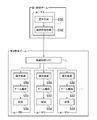
- FIG. 1 It is a functional block diagram of the game system which concerns on embodiment of this invention. It is a figure which shows an example of the process performed with a game system. It is a figure which shows an example of the other process performed with a game system. It is a figure which shows an example of the other process performed with a game system. It is a figure which shows an example of the other process performed with a game system. It is a figure which shows an example of the other process performed with a game system.
- FIG. 1 shows a configuration of a game system according to an embodiment of the present invention.
- the game system 1 according to the present embodiment includes a server 10, a first game terminal 30, and a second game terminal 50.
- the first game terminal 30 and the second game terminal 50 can perform data communication with each other via the server 10 and the network N.
- the server 10 is a server computer, for example. As shown in FIG. 1, the server 10 includes a control unit 11, a storage unit 12, and a communication unit 13.
- the control unit 11 includes at least one microprocessor (CPU), and executes information processing according to an operating system and other programs stored in the storage unit 12.
- the storage unit 12 includes a main storage unit (for example, RAM) and an auxiliary storage unit (for example, a nonvolatile semiconductor memory, a hard disk drive, or a solid state drive).
- the storage unit 12 is for storing programs and data.
- the communication unit 13 is for data communication with other devices via the network N.
- the server 10 can access the database 14.
- the database 14 may be constructed in the server 10 or may be constructed in a server computer different from the server 10.
- the first game terminal 30 is a computer used by a user to play a game.
- the first game terminal 30 includes a mobile phone (including a smartphone), a portable information terminal (including a tablet computer), a desktop computer, a laptop computer, a home game machine (stationary game machine), and a portable device. It is an arcade game machine installed in a game machine or a play facility.
- the first game terminal 30 includes a control unit 31, a storage unit 32, a communication unit 33, an operation unit 34, a display unit 35, and an audio output unit 36.
- the control unit 31, the storage unit 32, and the communication unit 33 are the same as the control unit 11, the storage unit 12, and the communication unit 13 of the server 10.
- the operation unit 34 is for the user to perform various operations.
- the operation unit 34 includes, for example, a button (key), a lever (stick), a touch panel, or a mouse.
- the operation unit 34 may be for the user to perform an operation by voice or gesture.
- the display unit 35 is for displaying various screen images, and is, for example, a liquid crystal display or an organic EL display.
- the audio output unit 36 is for outputting audio data, and is, for example, a speaker or headphones.
- the operation unit 34, the display unit 35, and the audio output unit 36 may be provided in the first game terminal 30 itself, or may be provided as an external device connected to the first game terminal 30.
- the second game terminal 50 is also a computer used by a user to play a game.
- the second game terminal 50 is an arcade game machine, a home game machine (stationary game machine), a portable game machine, a desktop computer, a laptop computer, a portable information terminal ( A tablet computer) or a mobile phone (including a smartphone).
- the second game terminal 50 is a different type of game terminal from the first game terminal.
- the second game terminal 50 includes a control unit 51, a storage unit 52, a communication unit 53, an operation unit 54, a display unit 55, and an audio output unit 56, which control the first game terminal 30.
- the program and data are supplied to the server 10, the first game terminal 30, or the second game terminal 50 from a remote location via the network N, and stored in the storage unit 12, the storage unit 32, or the storage unit 52.
- a component for example, an optical disk drive or a memory card slot
- an information storage medium for example, an optical disk or a memory card
- the terminal 50 may be provided.
- a program and data may be made to be supplied to the server 10, the 1st game terminal 30, or the 2nd game terminal 50 via an information storage medium.
- the first game terminal 30 is a smartphone (mobile phone) and the second game terminal 50 is an arcade game machine will be described as an example of the game system 1.
- a game executed on the first game terminal 30 will be described.
- a game in which a game object (game character or game item) is generated based on the user's game play is executed.
- a game in which a user trains a game character is executed on the first game terminal 30.
- a game based on baseball As an example of a game executed on the first game terminal 30, a game based on baseball will be described. Specifically, a baseball game in which a user develops a game character representing a baseball player (hereinafter referred to as “player character”) and creates his own original player character will be described. Hereinafter, for convenience, this baseball game is referred to as a “first baseball game”.
- the game story progresses by repeatedly selecting an action (practice, rest, play, etc.) that the user performs for the player character to be trained.
- an action practice, rest, play, etc.
- a game story is provided from the summer of the second year of high school until the player character becomes a professional baseball player.
- a player character belongs to a high school baseball club, participates in a baseball game (local qualifying tournament, national tournament, etc.) while practicing with teammates, and a professional baseball player in the fall of the third year of high school Aim to be scouted as.
- experience points are given to the player character based on the action selected by the user.
- the user can improve the ability of the player character using the experience points. For example, the basic ability of the player character can be increased, or the player character can acquire special ability.
- a game executed on the second game terminal 50 will be described.
- a game in which the user uses a game object is executed.
- a game in which a user battles using a game character is executed on the second game terminal 50.
- a game based on baseball As an example of a game executed on the second game terminal 50, a game based on baseball will be described. Specifically, a game in which a user forms his / her baseball team using player characters and plays a baseball game with an opponent (computer or other user) will be described. Hereinafter, for convenience, this baseball game is referred to as a “second baseball game”.
- the user can draw player characters by using game items or game points.
- the game item or game point for performing the lottery is given to the user as a reward for the user accessing the game system 1 or playing the game.
- the user may be able to purchase game items or game points.
- a player character selected based on a lottery process from among a plurality of candidate player characters is given to the user.
- the list of player characters of the plurality of selection candidates that is, a list of player character candidates that can be given to the user by lottery in the second baseball game is referred to as a “lottery candidate list”.
- the user collects player characters given as described above, and uses the collected player characters to form his baseball team. The user then uses his baseball team to play against his opponent.
- the user operates the batter or runner player character during the attack, and the pitcher and fielder player characters during the defense.
- the mode of the game is not limited to such a mode.
- the user may give a rough instruction to the player character while watching the situation from the manager's standpoint, or the team setting performed in advance by the user
- the game result may be automatically determined by a computer based on (starting member, player change plan, strategy, etc.) and ability parameters of each player character.
- the game system 1 has a function for changing the lineup of the lottery candidate list while suppressing an increase in the burden on the game provider.
- FIG. 2 is a diagram for explaining the above functions of the game system 1, and is a diagram illustrating a procedure performed by a user who plays the first baseball game or the second baseball game.
- a procedure performed by a user who plays the first baseball game (for example, user A) will be described.
- the user A creates an original player character (S30).
- the user A registers the player character created by the user A in the lottery candidate list L of the second baseball game (S32).
- the player characters registered in the lottery candidate list L of the second baseball game are in a state that can be given to other users in the second baseball game.
- FIG. 3 and 4 show examples of screen images for performing registration in the lottery candidate list L.
- FIG. These screen images are displayed on the display unit 35 of the first game terminal 30.
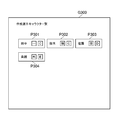
- FIG. 3 shows an example of a selection screen image for selecting a player character to be registered in the lottery candidate list L from among the player characters that the user A has created. As shown in FIG. 3, a list of player characters created by the user A is displayed on the selection screen image G300.
- Processing objects P301, P302, P303, and P304 are displayed on the selection screen image G300 shown in FIG.
- the “processing object” is an image, symbol, text, or the like with which processing is associated.
- the processing objects P301, P302, P303, and P304 respectively correspond to a plurality of player characters created by the user A, and each of the processing objects P301, P302, P303, and P304 has the player character's name, position, and total ability. It is displayed.
- the total ability is represented by alphabets “S, A, B, C, D, E, F, G”. “S” indicates that the total capacity is very high, and “G” indicates that the total capacity is very low.
- a process for selecting a player character (Tanaka) as a registration target in the lottery candidate list L is associated with the processing object P301. Therefore, when the user selects the processing object P301, a registration screen image for registering the player character (Tanaka) in the lottery candidate list L is displayed. The same applies to the other processing objects P302 to P304.
- FIG. 4 shows an example of a registration screen image.
- FIG. 4 shows an example of a registration screen image G310 displayed when the user A selects the processing object P301.
- the registration screen image G310 information related to the player character selected in the selection screen image G300 is displayed.
- an image of the player character is displayed in the area A311 of the registration screen image G310.
- the player character's name, position, batting form, and a hand used for pitching or batting are displayed.
- the basic ability parameters of the player character are displayed in the area A313.
- ballistic parameters, meat parameters, power parameters, running force parameters, shoulder force parameters, defense force parameters, and catching parameters are displayed in region A313.
- numerical values and alphabets are displayed in the area A313.
- the numerical value indicates the value of the basic ability parameter
- the alphabet indicates the level (stage) of the basic ability. For example, “S, A, B, C, D, E, F, G” is displayed in the area A313. “S” indicates that the ability is very high, and “G” indicates that the ability is very low.
- the ballistic parameter indicates how high the player character hits the ball.
- the meet parameter indicates the meet power of the player character (ability to hit the bat against the ball thrown by the pitcher).
- the power parameter indicates the power of the player character (the ability to fly away by hitting the ball thrown by the pitcher with a bat).
- the running force parameter indicates the speed of the player character's foot.
- the shoulder strength parameter indicates the speed at which the player character throws a ball.
- the defensive power parameter indicates skill of the player character.
- the special ability acquired by the player character is displayed in the area A314.
- the special abilities acquired by the player character are “chance ⁇ ”, “left pitcher ⁇ ”, “stolen ⁇ ”, “throwing ⁇ ”, “injury difficulty”, and “average hitter”. Is displayed in the area A314. Note that “ ⁇ ” and “ ⁇ ” indicate the level of special ability, and “ ⁇ ” indicates that the level of special ability is higher than “ ⁇ ”.
- “Chance ⁇ ” is a special ability that is very strong in chance. If the player character has acquired “Chance ⁇ ”, the basic ability of the player character greatly increases during the chance. “To the left pitcher ⁇ ” is a special ability that is strong against the left pitcher. When the player character has acquired “vs. left pitcher”, the basic ability of the player character increases when the opponent pitcher is the left pitcher. “Stolen ⁇ ” is a special ability to improve theft. If the player character has acquired “Stolen ⁇ ”, the player character is likely to succeed in stealing.
- “Ball throwing ⁇ ” is a special ability that makes pitching difficult. When the player character has acquired “throwing ⁇ ”, it is difficult for the player character to throw. “Near injury” is a special ability that rarely causes injury. If the player character has acquired “Injury difficulty ⁇ ”, the player character rarely gets hurt. “Average Hitter” is a special ability that makes it easier to hit hits. If the player character has acquired “Average Hitter”, the player character can easily hit.
- processing objects P315 and P316 are displayed.
- the processing objects P315 and P316 are associated with processing for changing the display contents of the area A314.
- the display content of the area A314 is changed. For example, information related to the character of the player character is displayed in the area A314.
- processing object P318 is displayed on the registration screen image G310. Processing for returning to the selection screen image G300 is associated with the processing object P318. For this reason, when the user selects the processing object P318, the selection screen image G300 is displayed on the display unit 35 again.
- a processing object P317 is displayed on the registration screen image G310.
- the processing object P317 is associated with processing for registering the player character in the lottery candidate list L of the second baseball game. For this reason, when the user selects the processing object P317, the player character displayed in the registration screen image G310 is registered in the lottery candidate list L of the second baseball game. In this case, the player character can be given to the user by lottery in the second baseball game.
- the user B obtains a player character by performing a lottery of player characters using game items or game points (S50).
- a lottery of player characters using game items or game points (S50).
- at least one of the plurality of player characters registered in the lottery candidate list L is selected based on the lottery process, and the selected player character is given to the user B.
- User B increases the number of player characters that the user B owns by acquiring player characters in this way.
- one player character registered in the lottery candidate list L may be given to a plurality of users. That is, one player character registered by the user A may be given to a plurality of users (for example, users B, C, D, etc.).
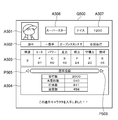
- FIG. 5 shows an example of a lottery result screen image that is displayed when a player character is drawn.
- the lottery result screen image G500 displays information related to the player character given to the user as a result of the lottery (in other words, the player character obtained by the user through the lottery).
- Regions A501, A502, A503 of the lottery result screen image G500 shown in FIG. 5 are the same as the regions A311, A312, A313 of the registration screen image G310 shown in FIG.
- the results stored by the player character are displayed.
- the area A504 displays the cumulative total of results that the one player character has entered in the game as a member of the baseball team of each other user.
- the cumulative totals of the number of hits, the number of home runs, the number of hits, and the number of steals are displayed in area A504.
- Hc the total number of hits that the player character A has entered and played as a member of the baseball team of the user C.
- Hc + Hd the number of hits in the area A504. Will be displayed.
- FIG. 5 shows an example of the lottery result screen image G500 when the player character given to the user is a fielder. However, when the player character given to the user is a pitcher, for example, victory The number, the number of saves, and the total number of strikeouts are displayed in area A504.
- processing objects P505 and P506 are displayed in the area A504.
- the processing objects P505 and P506 are associated with processing for changing the display content of the area A504. For this reason, when the user selects the processing objects P505 and P506, the display content of the area A504 is changed. For example, information related to the special ability of the player character (for example, display contents of the area A314 in FIG. 4) or information related to the character of the player character is displayed in the area A504.
- a nice point of the player character is displayed in the area A507.
- the nice point indicates an evaluation from the user using the player character with respect to the player character. It shows that evaluation with the user who used the player character is so high that there are many nice points. Details of the nice point will be described later.
- the popularity parameter of the player character is displayed in area A508.
- the popularity parameter indicates the popularity of the player character. For example, “regular”, “star”, or “superstar” is set as the popularity parameter of the player character. “Regular” indicates that it is not popular, and “Superstar” indicates that it is very popular. First, the popularity parameter of the player character is set to “regular”.
- the popularity parameter is related to the nice point. Specifically, when the nice point reaches a predetermined value, the popularity parameter increases by one level. For example, when the nice point reaches a first predetermined value while the popularity parameter of the player character is “regular”, the popularity parameter of the player character changes to “star”. Further, when the nice point reaches a second predetermined value (a value larger than the first predetermined value) while the popularity parameter of the player character is “star”, the popularity parameter of the player character changes to “superstar”. . As described above, the popularity of the player character increases as the evaluation from the user who uses the player character increases.
- the user refers to the above-mentioned areas A504, A507, A508, and when the player character given by the lottery is evaluated and popular from other users using the player character, or when used by another user It is possible to grasp how active the player character is.
- the user obtains player characters as described above. Then, as shown in FIG. 2, the user forms a baseball team using his / her player characters (S52), and uses the baseball team to play against the opponent (S54).
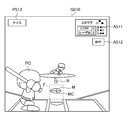
- FIG. 6 shows an example of a game screen image displayed during the game.
- the game screen image G510 shown in FIG. 6 shows a scene where the user is attacking. That is, the scene where the user is operating the player character PC which is a batter is shown. Note that the current game situation is displayed in the area A511, and the name of the player character PC operated by the user is displayed in the area A512.
- a frame F and a meet cursor M are displayed as operation images for allowing the user to hit the player character PC.
- a frame F is displayed on the home base and indicates a strike zone.
- the meat cursor M moves in accordance with the user's movement instruction operation and indicates the hit position.
- the player character PC swings the bat toward the hitting position indicated by the meet cursor M.
- the player character PC hits the ball B according to the positional relationship between the meat cursor M and the ball B. For example, when the meat cursor M overlaps the ball B, the ball B is hit. In this case, if the core MC of the meet cursor M is overlapped with the ball B, a strong hit ball will fly. On the other hand, if the meat cursor M does not overlap with the ball B, the player is idle. Note that even when the swing instruction operation is performed at a timing away from the time when the ball B passes through the plane including the frame F, the swinging motion is lost.
- the processing object P513 is also displayed in the game screen image G510.
- the processing object P513 is associated with processing for increasing the nice point of the player character PC. For example, when the player character PC is active, the user selects the processing object P513. In this case, the nice point of the player character PC is increased by 1 point.
- the processing object P513 is referred to as a “nice button”.
- the nice button when the nice button is selected, the nice point of the player character is increased by one point. Therefore, the nice point corresponds to the total number of times the nice button is selected for the player character.
- one player character may be given to a plurality of users, and a nice point of the one player character is selected by each of the plurality of users for the one player character. Indicates the cumulative number of times For example, the number of times that the player character A is given to the users B, C, and D, the user B selects the nice button for the player character A is “Nb”, and the user C uses the nice button for the player character A. If the selected number of times is “Nc” and the number of times that the user D has selected the nice button for the player character A is “Nd”, the value of the nice point of the player character A is Nb + Nc + Nd.
- a player character with many nice points is a player character with a high evaluation from a user who uses the player character. Become.
- the player character created by the user of the first baseball game is selected from the lottery candidate list for the second baseball game (the player character that can be given to the user of the second baseball game by lottery). (List of candidates).
- the lineup of the lottery candidate list for the second baseball game changes.
- the player character created by the user is registered in the lottery candidate list of the second baseball game, and therefore the user places his / her player character in the lottery candidate list. Whether to register or not can be selected.
- the game system 1 also has a function of giving a motivation to register the player character created by the user to the first baseball game user in the lottery candidate list of the second baseball game.
- the player character creator A reward is given to a certain user A.
- the reward is given to the user A when the nice point of the player character A reaches a predetermined value.
- game points or game items that can be used in the first baseball game are given as rewards.
- a game item that assists to make it easy to create a player character with high ability is given as a reward.
- experience points necessary for improving the ability of the player character being created are given as rewards.
- the configuration that motivates the user of the first baseball game is not limited to the example described above. Other examples will be described below.
- Example 1 When the cumulative number of times the player character A is used by another user reaches a predetermined value, a reward may be given to the user A. If it does in this way, the motivation which creates the player character which is often used by the other user can be given with respect to the user of a 1st baseball game.
- a reward may be given to the user A when the performance of the player character A used by another user satisfies a predetermined condition. For example, a reward may be given to the user A when the total number of hits of the player character A reaches a predetermined value. Alternatively, a reward may be given to the user A when the player character A reaches a predetermined rank or higher in the result ranking of the entire player character. In this way, it is possible to give a motivation to create a player character that has excellent results to the user of the first baseball game.
- Example 3 When the player character A created by the user A in the first baseball game is given to another user in the second baseball game, the reward may be given to the user A unconditionally. Even if it does in this way, the motivation which registers the player character which he created in the lottery candidate list of the 2nd baseball game can be given to the user of the 1st baseball game.
- Example 4 Instead of rewarding the user A, the basic ability of the player character A in the first baseball game may be increased, or the player character A may acquire special ability. Even if it does in this way, the motivation which registers the player character which he created in the lottery candidate list of the 2nd baseball game can be given to the user of the 1st baseball game.
- game system 1 is the 2nd baseball
- the game user is also provided with a function for giving motivation to use the player character.
- the total number of hits of the player character A is a predetermined value (for example, 500 , 1000, 1500, 2000, etc.)
- reward is given to user B.
- game points or game items that can be used in the second baseball game are given as rewards.
- a game point or a game item for lottery of player characters is given as a reward.
- a reward may be given to the user A who is the creator of the player character A.
- game points or game items that can be used in the first baseball game may be given to the user A as a reward.
- FIG. 7 shows an example of the first user table.
- the first user table TBL101 is data indicating information regarding each user who plays the first baseball game. As shown in FIG. 7, the first user table TBL101 includes “user ID”, “first game point”, and “first game item” fields.
- the “User ID” field indicates information for uniquely identifying each user.
- the “first game point” field indicates the amount of game points (game points that can be used in the first baseball game) held by the user.
- the “first game item” field indicates a list of game items held by the user (game items that can be used in the first baseball game).
- the “game points held by the user” or “game items held by the user” are game points or game items that can be used arbitrarily by the user.
- FIG. 8 shows an example of the first player character table.
- the first player character table TBL102 is data indicating a list of player characters created in the first baseball game. As shown in FIG. 8, the first player character table TBL102 includes “first player character ID”, “creator”, “name”, “position”, “total ability”, “basic ability parameter”, “special ability parameter”. ”And“ lottery candidate flag ”fields.
- the “first player character ID” field indicates information for uniquely identifying a player character created in the first baseball game.
- the “creator” field indicates the user ID of the user who is the creator of the player character.
- the “name” and “position” fields indicate the name and position of the player character.
- the “total ability” field indicates the level of the player character's overall ability.
- a basic ability parameter indicating the level of the player's basic ability is registered.
- a special ability parameter indicating whether or not the player character has acquired the special ability is registered.
- the “lottery candidate flag” field indicates whether the player character is set in the lottery candidate list of the second baseball game. For example, the value “0” or “1” is registered in the “lottery candidate registration flag” field. The value “0” indicates that the player character is not set in the lottery candidate list for the second baseball game, and the value “1” indicates that the player character is set in the lottery candidate list for the second baseball game. Show. In this case, the list of player characters whose “lottery candidate flag” field value is “1” corresponds to the lottery candidate list L shown in FIG.
- a field indicating an image of a player character a field indicating a player character's batting form, and a field indicating a hand used for throwing or hitting are also included in the first player character table TBL102.
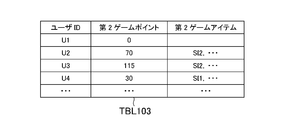
- FIG. 9 shows an example of the second user table.
- the second user table TBL103 is data indicating information regarding each user who plays the second baseball game. As shown in FIG. 9, the second user table TBL103 includes “user ID”, “second game point”, and “second game item” fields.
- the “user ID” field is the same as the “user ID” field of the first user table TBL101.
- a common user ID is used for the first baseball game and the second baseball game, but separate user IDs may be used for the first baseball game and the second baseball game.
- the “second game point” field indicates the amount of game points (game points that can be used in the second baseball game) held by the user.
- the “second game item” field indicates a list of game items held by the user (game items that can be used in the second baseball game).
- FIG. 10 shows an example of the second player character table.
- the second player character table TBL104 shows a list of player characters held by the user who plays the second game. As shown in FIG. 10, the second player character table TBL104 includes “second player character ID”, “owner”, “first player character ID”, “name”, “position”, “total ability”, “basic”. “Capacity parameter” and “Special ability parameter” fields.
- the “second player character ID” field indicates information for uniquely identifying a player character held by a user who plays the second game.
- the first player character ID of the player character given to the plurality of users is the same, but the second player character ID is different.
- the “owner” field indicates the user ID of the user who owns the player character.
- the “first player character ID” field indicates the first player character ID of the player character. In the case of a player character created by the user of the first baseball game, the first player character ID of the player character is registered in the “first player character ID” field. In the second baseball game, a player character created by the game provider may be given to the user, and the “first player character ID” field is blank for such a player character.
- the “name”, “position”, “total ability”, “basic ability parameter”, and “special ability parameter” fields are “name”, “position”, “total ability”, “basic ability” of the first player character table TBL102. This is the same as the “parameter” and “special ability parameter” fields.
- FIG. 11 shows an example of the usage result table.
- the use result table TBL105 is data indicating use results of the player character created by the user of the first baseball game in the second baseball game.
- the use result table TBL 105 includes “first player character ID”, “popularity”, “nice point”, “number of uses”, and “score” fields.
- the first player character ID of the player character is registered in the “first player character ID” field.
- the use result in the second baseball game is managed for each first player character ID.
- the popularity degree parameter of the player character is registered in the “popularity” field.
- the nice point of the player character is registered in the “nice point” field.
- the “Use Count” field indicates the number of times the player character has been used.
- player character when a player is registered as a member of a baseball team of a player character and a game is played, it may be considered that “player character has been used”, or when a player character actually participates in a game, It may be considered that the character has been used.
- one player character may be given to a plurality of users, and the total number of times that the one player character has been used by each of the plurality of users is registered in the “number of uses” field. .
- the result field shows the result of the player character.
- one player character may be given to a plurality of users, and the one player character participates in a game as a member of each of the plurality of users' baseball teams (for example, the number of hits) , The total number of home runs, number of hits, theft, number of wins, saves, or strikeouts) is registered in the “Results” field.
- FIG. 12 shows an example of functional blocks realized by the game system 1.
- the game system 1 includes a selection candidate setting unit 110, a selection unit 120, a game object association unit 130, a first reward association unit 140, a parameter update unit 150, a display control unit 160, and a second reward association. Part 170.
- These functional blocks are realized by the control unit 11 of the server 10 (game control device), for example.
- the selection candidate setting unit 110 the selection unit 120, and the game object association unit 130 will be described. After selecting the selection unit 120 and the game object association unit 130 first, the selection candidate setting unit 110 will be described.
- the selection unit 120 selects at least one of a plurality of selection candidate game objects as a game object associated with the first user identification information based on a predetermined lottery process. Then, the game object association unit 130 associates the game object selected by the selection unit 120 with the first user identification information.
- game object is a target that can be used in a game.
- a game character or a game item corresponds to an example of “game object”.
- the game character or game item may be displayed on the game screen in the form of a game card.
- a plurality of parameters are set for the game object.
- Parameter set in the game object is information indicating the performance of the game object, for example.
- the “parameter” is, for example, information indicating whether the performance of the game object is high or low, or information indicating whether the game object has a specific performance.
- the “parameter” may be information indicating the state of the game object, for example. That is, the “parameter” may be information indicating whether the state of the game object is good or bad, for example. Alternatively, the “parameter” may be information indicating the rarity or popularity of the game object, for example.
- the game object is a player character of a baseball game
- information indicating the height (or magnitude) of the pitcher ability, batting ability, defense ability, or running ability, or information indicating the presence or absence of special ability is “game object”.
- the information indicating the performance of the game corresponds to an example of“ information indicating the level of the stamina (or fatigue level) ”and the information indicating the condition (tone) is equivalent to an example of“ information indicating the state of the game object ”.
- the game object is a game character that fights against an enemy
- information indicating the level of attack power or defense power (or magnitude), or information indicating the presence or absence of a special ability is “information indicating the performance of the game object”.
- the hit point corresponds to an example of “information indicating the state of the game object”.
- the information indicating the magnitude (or level) of the effectiveness of the game item corresponds to an example of “information indicating the performance of the game object”, and the remaining number of times that the game item can be used.
- Information indicating the number of times the game item has been used corresponds to an example of “information indicating the state of the game object”.
- “Parameters” are not limited to numerical information, and may be information other than numerical information.
- “User identification information” is information for uniquely identifying a user.
- “user identification information” is information for identifying a user.
- a user ID, a user name, a user account, or an e-mail address corresponds to an example of “user identification information”.
- “First user identification information” is user identification information for identifying a first user.
- “Associating a game object with user identification information” means storing a game object in association with user identification information. In other words, “associating the game object with the user identification information” means giving the game object to the user identified by the user identification information. In other words, “associating a game object with user identification information” means adding a game object to a game object held by a user identified by the user identification information.
- the “game object held by the user” is a game object that can be arbitrarily used by the user.
- the game object associated with the user identification information is a game object stored in association with the user identification information.
- the “game object associated with the user identification information” is a game object to be given to the user identified by the user identification information.
- the “game object associated with the user identification information” is a game object added to the game object held by the user identified by the user identification information.
- Selection candidate is a candidate selected as a game object to be associated with the user identification information.
- the “selection candidate” is a game object that can be selected as a game object associated with the user identification information.
- the “lottery process” is a process for automatically selecting at least one of a plurality of selection candidate game objects as a game object associated with user identification information according to a predetermined probability.
- the “lottery process” is to automatically select at least one of a plurality of selection candidate game objects as a game object associated with the user identification information based on a random number (or randomly). It is processing of.
- the selection candidate setting unit 110 includes a plurality of game objects which are game objects associated with the second user identification information and generated based on the game play by the second user identified by the second user identification information. As one of the selection candidate game objects.
- the “second user identification information” is user identification information other than the first user identification information, and is user identification information for identifying a second user who is a user other than the first user.
- the “game object generated based on the user's game play” is a game object generated as a result of the user playing the game.
- the game object has parameters set based on the game play by the user.
- the game object is a game object in which the parameter is updated from the initial state and the parameter is determined based on the game play by the user.
- the “game object generated based on the user's game play” can be restated as a game object generated by the user. That is, the “game object generated based on the user's game play” can be rephrased as, for example, a game character nurtured by the user or a game item reinforced by the user.
- the “multiple selection candidate game objects” may include only game objects generated based on game play by the user, game objects generated based on game play by the user, And other game objects (for example, game objects created by a game provider) may be included.
- the selection candidate setting unit 110 sets a game object associated with the second user identification information as one of a plurality of selection candidate game objects when a predetermined setting request is received from the second user. To do.
- setting request refers to requesting setting as a selection candidate game object.
- accepting a setting request from the user means receiving data indicating that the setting is requested as a selection candidate game object from the user's terminal.
- accepting a setting request from the user may be an operation indicating requesting setting as a selection candidate game object.
- the game object association unit 130 associates the game object associated with the second user identification information with the first user identification information.
- “associating the game object associated with the second user identification information with the first user identification information” refers to associating a copy of the game object associated with the second user identification information with the first user identification information. is there.
- “associating the game object associated with the second user identification information with the first user identification information” means associating the game object itself associated with the second user identification information with the first user identification information. Also good.
- the game object associated with the second user identification information may be associated with each of a plurality of user identification information other than the second user identification information.
- the game object is displayed in the game played by the first user. It is ready to use.
- the “game object associated with the second user identification information” is, for example, a game object generated based on the play of the first game by the second user, and the game object is selected by the selection unit 120.
- the game object can be used in the second game (a game different from the first game) played by the first user.
- the “game different from the first game” is, for example, a game provided separately from the first game.
- the game is executed based on a second game program that is separate from the first game program for executing the first game.
- the game is provided on a game terminal of a different type from the game terminal for providing the first game.
- the first game is a game provided by a mobile phone (smartphone)
- the second game is a game terminal other than the mobile phone (smartphone) (for example, an arcade game machine, a home game machine (stationary game) Machine), portable game machine, desktop computer, etc.).
- the selection candidate setting unit 110 receives data indicating that the player character is requested to be registered in the lottery candidate list from the first game terminal 30 of the user A (an example of the second user).
- the lottery candidate flag of the player character is updated to “1”.
- the selection unit 120 selects at least one of the player characters registered in the first player character table TBL102 and the lottery candidate flag “1” as the user B (first user). Is selected based on a predetermined lottery process.
- the game object associating unit 130 gives the player character selected by the selecting unit 120 to the user B. Specifically, the game object associating unit 130 registers information related to the player character selected by the selecting unit 120 in the second player character table TBL104 in association with the user ID of the user B.
- the first reward associating unit 140 associates a reward with the second user identification information when the game object associated with the second user identification information is selected by the selection unit 120 and associated with the first user identification information.
- association the reward with the user identification information means giving a reward to the user identified by the user identification information.
- giving a game object to a user corresponds to an example of “associating a reward with user identification information”. That is, by giving a new game object that the user does not have to the user or by further giving the user a game object that the user already has, the number of the game objects that the user has is determined. The increase corresponds to an example of “associating a reward with user identification information”.
- the game object associated with the user identification information by associating the new game object with the user identification information or by further associating the game object with the user identification information in a state where the user identification information and the game object are associated with each other. Is equivalent to an example of “associating a reward with user identification information”.
- giving a game point to a user corresponds to an example of “associating a reward with user identification information”. That is, increasing the game points owned by the user corresponds to an example of “associating a reward with user identification information”. In other words, increasing the game points associated with the user identification information by further associating the game points with the user identification information and the game points associated with each other is an example of “associating the reward with the user identification information”. Equivalent to.
- Game points play a role as currency in the game.
- the points are used for obtaining a new game object (game item or the like).
- game points are not limited to those that play the role of currency in the game.
- the “game point” may be a point (for example, an experience point) for improving the performance of the game object. That is, it may be a point used to improve the performance of the game object.
- “Rewards” are not limited to game objects and game points, and various rewards can be set according to the content of the game.
- the “reward” may be a temporary or permanent change of parameters associated with the user (parameters other than game points) to be advantageous to the user.
- a reward is associated with second user identification information
- the object is associated with the first user identification information
- the reward is associated with the second user identification information based on a predetermined condition.
- the “predetermined condition” is a condition that needs to be satisfied in order to associate the reward with the first user identification information.
- the “predetermined condition” is a condition serving as a reference for determining whether or not a reward is associated with the first user identification information. For example, if the predetermined condition is satisfied, the association of the reward with the first user identification information is executed, and if the predetermined condition is not satisfied, the association of the reward with the first user identification information is not executed.
- the reward when the game object associated with the second user identification information is associated with the first user identification information, the reward is associated with the second user identification information” is associated with the second user identification information, for example.
- the reward may be unconditionally associated with the second user identification information.
- the first reward association unit 140 selects a player character A (an example of a game object associated with the second user identification information) created by the user A in the first baseball game.
- a player character A an example of a game object associated with the second user identification information
- the unit 120 and given to the user B an example of the first user
- a reward is given to the user A based on the evaluation of the player character A by the user B.
- evaluation of the player character by the user means that the user evaluates the presence / absence or degree of satisfaction with the player character.
- evaluation of the player character by the user means that the user evaluates the goodness of the player character.
- “giving a user a reward based on an evaluation of a player character” means determining whether to give a user a reward based on an evaluation of a player character. For example, “giving a user a reward based on evaluation of a player character” determines whether to give a reward to the user based on whether the evaluation of the player character satisfies a predetermined condition. It is to be.
- “giving a user a reward based on an evaluation of a player character” may be determining a type or amount of a reward that gives a user a reward based on an evaluation of the player character.
- “giving a user a reward based on an evaluation of a player character” means the type or amount of reward that gives a user a reward based on whether the evaluation of the player character satisfies a predetermined condition or not. May be determined.
- the type of reward given to the user may be different depending on whether the evaluation of the player character satisfies a predetermined condition and the evaluation of the player character does not satisfy the predetermined condition. Further, for example, when the evaluation for the player character satisfies a predetermined condition, the amount of reward to be given to the user may be increased as compared with the case where the evaluation for the player character does not satisfy the predetermined condition.
- the nice point of the player character corresponds to an example of “evaluation to the player character”.
- the 1st reward correlation part 140 gives a reward to the user A who is the creator of the player character A, when the nice point of the player character A becomes more than predetermined value.
- the first reward association unit 140 selects the player character A (an example of a game object associated with the second user identification information) created by the user A in the first baseball game by the selection unit 120 and selects the user B ( When given to an example of the first user, a reward may be given to the user A based on the use result of the player character A in the second baseball game played by the user B.
- “use of player character” means, for example, that the user operates with the player character as the operation target, or the user gives an instruction with the player character as the instruction target.
- “use of player character” means, for example, causing a player character to appear in the game.
- “use of player character” means to display the player character on the game screen.
- setting the player character as a member of the baseball team or letting the player character participate in the game corresponds to an example of “use of player character”.
- “use of game item” means, for example, generating an effect of the game item.
- “Use result” is, for example, whether or not a player character has been used.
- the “use result” may be, for example, the number of times the player character has been used or the length of the period in which the player character has been used.
- the “use result” may be, for example, the presence / absence or degree of contribution of the used player character in the game.
- the result that the used player character has stored in the game corresponds to an example of “the presence / absence or degree of contribution”.
- the number of hits, the number of home runs, the number of hits, the number of steals, the number of wins, the number of saves, or the number of strikeouts corresponds to an example of “score”.
- a score, the number of assists, a goal loss, or the like corresponds to an example of “score”.
- the number of defeated enemies, the amount of damage given to the enemies, or whether or not a specific enemy (for example, a boss) has been defeated corresponds to an example of “score” To do.
- the presence / absence or degree of the effect generated in the game due to the use of the player character corresponds to an example of “the presence / absence or degree of contribution”.
- the presence or absence of the improvement is determined as “contribution”.
- the use of a player character affects other game objects (for example, improving the performance of a player character of a teammate or reducing the performance of an opponent player character).
- the presence / absence or degree of the influence corresponds to an example of “the presence / absence or degree of contribution”.
- “To give a reward to the user based on the use result of the player character” is to determine whether to give a reward to the user based on the use result of the player character. For example, determining whether or not to give a reward to the user based on whether or not the use result of the player character satisfies a predetermined condition.
- “giving a user a reward based on the use result of the player character” may be determining the type or amount of the reward to be given to the user based on the use result of the player character.
- the type or amount of reward to be given to the user may be determined based on whether or not the use result of the player character satisfies a predetermined condition.
- the type of reward to be given to the user may be different depending on whether the player character use result satisfies a predetermined condition and the player character use result does not satisfy the predetermined condition.
- the amount of reward to be given to the user may be increased compared to a case where the player character use result does not satisfy the predetermined condition.
- the number of use of the player character corresponds to an example of “use result of player character”.
- the 1st reward correlation part 140 may give a reward to the user A, when the use frequency of the player character A reaches a predetermined value.
- the performance of the player character corresponds to an example of “use result of player character”.
- the first reward association unit 140 rewards the user A when the number of hits of the player character A (or the number of home runs, the number of batting points, the number of steals, the number of wins, the number of saves, the number of strikeouts) reaches a predetermined value. May be given.
- the parameter update unit 150 sets the parameter of the game object associated with the second user identification information. Update.
- the parameter update unit 150 selects, for example, a player character A (an example of a game object associated with the second user identification information) created by the user A in the first baseball game.
- a player character A an example of a game object associated with the second user identification information
- the parameter of the player character A is updated based on the evaluation of the player character A by the user B.
- “update the parameter of the player character based on the evaluation to the player character” is to determine whether or not to update the parameter of the player character based on the evaluation to the player character. For example, determining whether or not to update the parameters of the player character based on whether or not the evaluation of the player character satisfies a predetermined condition.
- “update the parameter of the player character based on the evaluation to the player character” may be to determine the degree of update of the parameter of the player character based on the evaluation to the player character.
- the degree of updating the player character parameter may be determined based on whether or not the evaluation of the player character satisfies a predetermined condition. For example, when the evaluation for the player character satisfies a predetermined condition, the degree of update of the parameter of the player character may be increased as compared with the case where the evaluation for the player character does not satisfy the predetermined condition.
- the nice point of the player character corresponds to an example of “evaluation to a player character”
- the popularity parameter of the player character corresponds to an example of “parameter”.
- the parameter update unit 150 updates the popularity parameter of the player character A when the nice point of the player character A reaches a predetermined value. For example, when the nice point of the player character A reaches the first predetermined value while the popularity parameter of the player character A is “regular”, the parameter update unit 150 changes the popularity parameter of the player character A to “star”. To do.
- the parameter update unit 150 displays the player character A Change the popularity parameter to “Superstar”.
- the parameter update unit 150 improves the basic ability of the player character A by updating the basic ability parameter of the player character A when the nice point of the player character A reaches a predetermined value, or improves the player character A.
- the player character A may be made to acquire a new special ability by updating the special ability parameter.
- the parameter update unit 150 may be configured such that, for example, the player character A (an example of a game object associated with the second user identification information) created by the user A in the first baseball game is selected by the selection unit 120 and the user B ( When given to an example of the first user, the parameter of the player character A may be updated based on the use result of the player character A in the second baseball game played by the user B.
- “update the player character parameters based on the player character use results” means to determine whether or not to update the player character parameters based on the player character use results. For example, it is to determine whether or not to update the parameter of the player character based on whether or not the use result of the player character satisfies a predetermined condition.
- “update the parameter of the player character based on the use result of the player character” may be to determine the degree of update of the parameter of the player character based on the use result of the player character.
- the update degree of the player character parameter may be determined based on whether or not the use result of the player character satisfies a predetermined condition. For example, when the use result of the player character satisfies a predetermined condition, the degree of update of the parameter of the player character may be increased as compared with the case where the use result of the player character does not satisfy the predetermined condition.
- the parameter update unit 150 may update the popularity parameter (or basic ability parameter, special ability parameter) of the player character A when the number of times the player character A is used reaches a predetermined value.
- the player character's performance (see FIG. 11) also corresponds to an example of “player character use result”. Therefore, the parameter update unit 150 determines the popularity of the player character A when the number of hits of the player character A (or the number of home runs, the number of hits, the number of steals, the number of wins, the number of saves, the number of strikes) reaches a predetermined value.
- the parameters (or basic ability parameters, special ability parameters) may be updated.
- the display control unit 160 is information regarding the use result of the game object in the game played by each of the plurality of users Is controlled to display on the display means.
- the “display means” is, for example, a display device provided in a terminal used by the user.
- a display unit of an arcade game machine, a portable game machine, a mobile phone (including a smartphone), a tablet computer, or a laptop computer corresponds to an example of “display means”.
- the “display unit” is, for example, a display device connected to a terminal used by the user.
- a display device connected to a stationary game machine or a desktop computer corresponds to an example of “display means”.
- Performing control for displaying information on the display means means, for example, generating a screen image indicating information and displaying it on the display means.
- “perform control for displaying information on the display unit” means, for example, transmitting screen image data indicating information to the user terminal device.
- the “screen image data” may be data indicating the screen image itself or data for generating a screen image.
- “Information about the use result of the game object” is, for example, statistical information about the use result of the game object.
- the “statistical information” is information obtained by, for example, statistically calculating a numerical value related to the use result of the game object. For example, the number of times the game object has been used corresponds to an example of “statistical information”.
- the total number of hits corresponds to an example of “statistical information”.
- the total score (or assist count, goal loss, etc.) corresponds to an example of “statistical information”.
- the number of defeated enemies corresponds to an example of “statistical information”.
- the “information regarding the use result of the game object” may be information other than statistical information. For example, it may simply be information indicating whether or not a game object has been used.
- the display control unit 160 performs control for displaying the lottery result screen image G500 on the display unit 55 of the second game terminal 50.
- the display control unit 160 performs control for displaying the lottery result screen image G500 on the display unit 55 of the second game terminal 50.
- the display control unit 160 performs control for displaying the lottery result screen image G500 on the display unit 55 of the second game terminal 50.
- the display control unit 160 performs control for displaying the lottery result screen image G500 on the display unit 55 of the second game terminal 50.
- the display control unit 160 performs control for displaying the lottery result screen image G500 on the display unit 55 of the second game terminal 50.
- the display control unit 160 performs control for displaying the lottery result screen image G500 on the display unit 55 of the second game terminal 50.
- the display control unit 160 performs control for displaying the lottery result screen image G500 on the display unit 55 of the second game terminal 50.
- the display control unit 160 performs control for displaying the lottery result screen image G500 on the display unit 55 of the second game terminal 50.
- the second reward associating unit 170 stores the results stored by the game character in the game played by each of the plurality of users.
- the reward is associated with at least one of the plurality of user identification information or the second user identification information.
- “Information related to results stored by game characters” is, for example, statistical information related to results stored by game characters.
- the “statistical information” is information obtained by, for example, statistics on numerical values related to the results stored by the game character.
- the total number of hits corresponds to an example of “statistical information”.
- the total score (or the number of assists, points lost, etc.) corresponds to an example of “statistical information”.
- the number of defeated enemies corresponds to an example of “statistical information”.
- the “statistical information” may be information other than the cumulative total, and the “information relating to the results collected by the game character” may be information other than the statistical information.
- the second reward associating unit 170 receives the information regarding the score from the state where the information regarding the score does not satisfy the predetermined condition according to the score stored by the game character in the game played by one of the plurality of users.
- the reward is associated with the user identification information for identifying the one user.
- “when the information related to the results collected by the game character satisfies a predetermined condition” means the number of hits of the player character (or the number of home runs, the number of hits, the number of steals, This is the case where the total number of wins, saves, strikeouts, etc. reaches a predetermined value.
- “when the information related to the results collected by the game character is in a state satisfying a predetermined condition” means that the cumulative number of scores (or the number of assists, etc.) of the player character is predetermined. This is when the value is reached.
- “when the information regarding the results stored by the game character satisfies a predetermined condition” means that the number of enemies defeated by the game character (or given to the enemy) This is a case where the amount of damage, the number of specific enemies defeated, etc.) reaches a predetermined value.
- “when the information changes from a state where the information does not satisfy the predetermined condition to a state where the information satisfies the predetermined condition due to the result of the game character stored in the game played by the user” means before the user plays the game At that time, the information regarding the score did not satisfy the predetermined condition. However, the information regarding the score satisfies the predetermined condition depending on the result of the user playing the game and the game character stored in the game. This is the case when the state has changed.
- good values such as 500, 1000, 1500, and 2000 are set as the “predetermined value” regarding the number of hits. Therefore, the player character A in the second baseball game played by the user B in a state where the player character A created by the user A in the first baseball game is given to a plurality of users including the user B in the second baseball game.
- the second reward associating unit 170 gives a reward to the user B.
- game items or game points that can be used in the second baseball game are awarded as rewards. For example, a game item or a game point necessary for a lottery for obtaining a player character is awarded as a reward.
- a game item that facilitates winning the game for example, a game item that increases the condition of the player character is awarded as a reward.
- the second reward associating unit 170 may also reward other users (users other than the user B) among the plurality of users to which the player character A is given. Good.
- the second reward association unit 170 may give a reward to the user A who is the creator of the player character A.
- game items or game points that can be used in the first baseball game may be given as rewards.
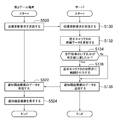
- FIG. 13 shows an example of processing executed when the user playing the first baseball game selects the processing object P317 of the registration screen image G310.
- the control unit 11 of the server 10 executes the process illustrated in FIG. 13 according to the program, the control unit 11 functions as the selection candidate setting unit 110.
- the process shown in FIG. 13 will be described assuming that the user A selects the process object P317 of the registration screen image G310 on which the player character A is displayed. That is, it is assumed that the user A registers the player character A in the lottery candidate list for the second baseball game.
- the user ID of user A is “U1”, and the first player character ID of player character A is “FC1”.
- the control unit 31 of the first game terminal 30 transmits a lottery candidate registration request to the server 10 via the communication unit 33 (S300), and the control unit 11 of the server 10 communicates the request. Received via the unit 13 (S100).
- “Lottery candidate registration request” is a request to register a player character created in the first baseball game in the lottery candidate list of the second baseball game.
- the user ID of the user A (U1) and the first player character ID (FC1) of the player character A are transmitted from the first game terminal 30 to the server 10 as a lottery candidate registration request.
- the control unit 11 registers the player character A, which is the target of the lottery candidate registration, in the lottery candidate list (S102).
- control unit 11 accesses the first player character table TBL102 and confirms the value of the “lottery candidate flag” field of the record in which “FC1” is registered in the “first player character ID” field.
- the control unit 11 updates the value of the “lottery candidate flag” field to “1”.
- the control unit 11 adds a new record to the use result table TBL105, and registers “FC1” in the “first player character ID” field of the record.
- the control unit 11 initially registers “regular” in the “popularity” field of the record, and registers an initial value (0) in the “nice point”, “use count”, and “score” fields of the record. .
- the control unit 11 transmits data of a completion screen image indicating completion of registration in the lottery candidate list to the first game terminal 30 via the communication unit 13 (S104).
- the control unit 31 of the terminal 30 receives the data via the communication unit 33 (S302). Then, based on the data, the control unit 31 displays a completion screen image on the display unit 35 (S304).
- the data of the completion screen image may be data indicating the completion screen image itself or data indicating information necessary for generating the completion screen image.
- FIG. 14 shows an example of processing executed when a user who plays the second baseball game requests lottery of player characters.
- the control unit 11 of the server 10 executes the processing shown in FIG. 14 according to the program, the control unit 11 functions as the selection unit 120, the game object association unit 130, and the display control unit 160.
- the process shown in FIG. 14 is demonstrated supposing the case where the user B requests
- the user ID of user B is “U2”.
- the control unit 51 of the second game terminal 50 transmits a lottery request to the server 10 via the communication unit 53 (S500), and the control unit 11 of the server 10 transmits the request to the communication unit 13. (S110).
- “Lottery request” is a request to execute a lottery for giving a player character to a user.
- the user ID (U2) of the user B who makes the lottery request is transmitted from the second game terminal 50 to the server 10 as the lottery request.
- control unit 11 selects a player character to be given to the user B based on the lottery process (S112).
- control unit 11 accesses the first player character table TBL102 and selects one of the player characters whose lottery candidate flag is “1” based on a predetermined probability.
- the control unit 11 may select any one of the player characters registered in the use result table TBL105 based on a predetermined probability. If there is a player character created when the user B plays the first baseball game, the player character may not be selected.
- control unit 11 gives the player character selected in step S112 to the user B (S114).
- the control unit 11 accesses the first player character table TBL102, and the player whose first player character ID is “FC1”. Read information about character.
- control part 11 adds a new record to 2nd player character table TBL104, and registers the said read information in the said record.
- the second automatically generated second player character ID is registered in the “second player character ID” field
- the user ID (U2) of user B is registered in the “owner” field, and is selected in step S112.
- the first player character ID (FC1) of the player character is registered in the “first player character ID” field.
- the information regarding the player character whose first player character ID is “FC1” remains in the first player character table TBL102
- the duplicate is registered in the second player character table TBL104. That is, the player character whose first player character ID is “FC1” remains in the creator's hand, and a copy thereof is given to the user B.
- control part 11 performs the process for consuming the game item or game point used in order to perform a lottery.
- control unit 11 accesses the second user table TBL103 and, for example, removes the game items used for performing the lottery from the game items held by the user B, or holds the user B.
- the game points used for the lottery are reduced from the game points.
- step S114 the control unit 11 transmits data of the lottery result screen image G500 indicating information regarding the player character given to the user B in step S114 to the second game terminal 50 via the communication unit 13 (S116). ), The control unit 51 of the second game terminal 50 receives the data via the communication unit 53 (S502). And based on the said data, the control part 51 displays the lottery result screen image G500 on the display part 55 (S504).
- the data of the lottery result screen image G500 may be data indicating the lottery result screen image G500 itself, or may be data indicating information necessary for generating the lottery result screen image G500.
- the data of the lottery result screen image G500 is generated based on information registered in the second player character table TBL104 and the use result table TBL105.
- FIG. 15 shows an example of processing executed when the user who plays the second baseball game selects the nice button (processing object P513) of the game screen image G510.
- the control unit 11 of the server 10 executes the process illustrated in FIG. 15 according to the program, the control unit 11 functions as the first reward association unit 140 and the parameter update unit 150.
- the process shown in FIG. 15 will be described assuming that the user B selects a nice button on the game screen image G510 in a scene where the player character A operated by the user B hits.
- the user ID of the user B is “U2”
- the second player character ID of the player character A is “SC2”.
- the control unit 51 of the second game terminal 50 transmits a nice point increase request to the server 10 via the communication unit 53 (S510), and the control unit 11 of the server 10 sends the request. Is received via the communication unit 13 (S120).
- “Nice point increase request” is a request to increase the nice point of the player character.
- the user ID (U2) of the user B who selects the nice button and the second player character ID (SC2) of the player character A that is the target of the nice button are sent from the second game terminal 50 to the server as a nice point increase request. 10 is transmitted.
- control unit 11 increases the nice point of the player character A that is the target of the nice button (S122).
- the control unit 11 accesses the second player character table TBL104, and acquires the first player character ID (FC1) of the player character A whose second player character ID is “SC2”. Thereafter, the control unit 11 accesses the use result table TBL105 and increases the nice point of the player character whose first player character ID is “FC1” by one point.
- step S122 the control unit 11 determines whether or not the increased nice point has reached a predetermined value (S124). When the nice point after the increase does not reach the predetermined value, the control unit 11 ends this process.
- the control unit 11 accesses the use result table TBL105 and increases the popularity parameter of the player character A by one level (S126). Moreover, the control part 11 provides a reward to the user who is the creator of the player character A (S128). For example, the control unit 11 accesses the first player character table TBL102 and acquires the user ID of the creator of the player character A. Then, the control unit 11 accesses the first user table TBL101 and increases the value of the “game point” field of the record in which the acquired user ID is registered in the “user ID” field, The game point or game item is given to the creator of the player character A by adding a game item ID to the field.
- the processing shown in FIG. 15 may be executed every time the player character's individual batting is finished. Further, when a reward is given to the creator of the player character A in step S128, the fact may be notified to the creator of the player character A. For example, when the creator of the player character A accesses the game system 1 next time (when the creator of the player character A plays the first baseball game next time, etc.), a message indicating that a reward has been granted is output. You may make it do. Alternatively, a message indicating that a reward has been granted may be transmitted to the address of the creator of the player character A. By doing in this way, satisfaction can be given to the creator of a player character, As a result, the motivation which produces the further player character can be given with respect to the said creator.
- FIG. 16 shows an example of processing executed when a match between the user playing the second baseball game and the opponent is completed.
- the control unit 11 of the server 10 executes the process illustrated in FIG. 16 according to the program, the control unit 11 functions as the second reward association unit 170.
- the process shown in FIG. 16 is demonstrated supposing the case where the game of the user B and an opponent is completed.
- the user ID of user B is “U2”.
- the control unit 51 of the second game terminal 50 transmits a player character score update request to the server 10 via the communication unit 53 (S520), and the control unit 11 of the server 10 requests the request. Is received via the communication unit 13 (S130).
- “Player character score update request” updates the score data (for example, cumulative number of hits, home runs, hits, steals, wins, saves, or strikeouts) of the player characters that participated in the game It is demanding that.
- the user ID (U2) of the user B who played the game the second player character ID of the player character who participated in the game, and the results (number of hits, etc.) the player character who participated in the game received in the game It is transmitted from the second game terminal 50 to the server 10 as a character score update request.
- a score update request for a player character A who has participated in a game is received.
- the second player character ID of the player character A is “SC2”.
- the control unit 11 updates the score data of the player character A (S132).
- the control unit 11 accesses the second player character table TBL104, and acquires the first player character ID (FC1) of the player character A whose second player character ID is “SC2”. Thereafter, the control unit 11 accesses the use result table TBL105, and updates the performance data (number of hits, etc.) of the player character A whose first player character ID is “FC1”. For example, when the player character A hits two hits in the game, 2 is added to the hit number of the player character A.
- step S132 the control unit 11 determines whether or not any of the number of hits of the player character A has reached a predetermined value (S134).
- the “predetermined value” is a good value such as 500, 1000, 1500, 2000 or the like in the case of hits, for example.
- the control unit 11 When any of the hit numbers of the player character A reaches a predetermined value, the control unit 11 gives a reward to the user B who is the user of the player character A (S136). For example, the control unit 11 accesses the second user table TBL103, and “U2” increases the value of the “game point” field of the record registered in the “user ID” field, or the “game item” field of the record. The game point or game item is given to the user B by adding the game item ID to the user B.
- the control unit 11 communicates to the second game terminal 50 data of notification screen images for notifying the user B of the updated grade data of each player character, granting of rewards to the user B, and the like.
- the data is transmitted through the unit 13 (S138), and the control unit 51 of the second game terminal 50 receives the data through the communication unit 53 (S522). And based on the said data, the control part 51 displays a notification screen image on the display part 55 (S524).
- the data of the notification screen image may be data indicating the notification screen image itself, or data indicating information necessary for generating the notification screen image.
- a player character created by a user who has played the first baseball game is a lottery candidate list for the second baseball game (a player character that can be given to a user who plays the second baseball game by lottery). List of candidates).
- the lineup of the lottery candidate list for the second baseball game changes. For this reason, according to the game system 1, it is possible to change the lineup of the lottery candidate list of the second baseball game while suppressing an increase in the burden on the game provider.
- a player character created by the user in the first baseball game is registered in the lottery candidate list for the second baseball game. In this way, the user can select whether or not to register the player character created by the user in the lottery candidate list.
- the player character A created by the user A in the first baseball game is given to another user in the second baseball game
- the user A who is the creator of the player character is given to the user A under a predetermined condition. Grant reward.
- users of the first baseball game are motivated to register their created player characters in the lottery candidate list of the second baseball game, and many nice points from other users. Motivation to create a player character that can be obtained can be provided.
- the player character A used by the user B in the game between the user B and the opponent hits a hit, so that the total number of hits of the player character A is a predetermined value (for example, 500, 1000, 1500). , 2000, etc.), the reward is given to the user B.
- a predetermined value for example, 500, 1000, 1500). , 2000, etc.
- the user refers to the regions A504, A507, and A508 of the lottery result screen image G500, so that the player character given by the lottery is evaluated and popular with other users who use the player character. It is possible to grasp how much the player character has been active when used by other users. That is, the user can infer from these pieces of information whether or not the player character given by the lottery is likely to be useful and whether or not the player character can be expected to be active.
- the game system 1 cooperation between the first baseball game and the second baseball game is realized.
- the user who played the first baseball game can be prompted to play the second baseball game, or the user who played the first baseball game can be prompted to play the second baseball game.
- the user who played the first baseball game provided by the smartphone can be prompted to play the second game provided by the arcade game machine installed in the amusement facility or the like.
- smartphone games can be played anytime, anywhere regardless of time and place, while games such as amusement facilities are actually placed in amusement facilities during business hours.
- the game contents are similar, the user has a tendency to play a game on a smartphone rather than a game facility or the like, which contributes to a decrease in the rate of attracting customers at the game facility or the like.
- the game system 1 it is possible to give the user a motivation to play a game at a play facility or the like.
- the nice button (processing object P513) may be displayed on the replay screen image for displaying the replay video or the game result screen image displayed after the match is over. In this way, the user may be able to select the nice button while watching the replay video, or select the nice button while watching the game result.
- a screen image including the display content of the area A504 of the lottery result screen image G500 is displayed on the first game terminal 30 (or the second game terminal 50) of the user who is the creator of the player character. Also good. By doing in this way, the user who is the creator of a player character can know whether the player character which he created is useful in the game which other users play (whether he is playing an active part). You may do it.
- the user may use a player character created by the user to form a baseball team so that the user can play against the opponent.
- the parameter update unit 150 evaluates the player character A by the user B ( Alternatively, based on the use result of the player character A by the user B), the parameters of the player character A used in the first baseball game (for example, basic ability parameters or special ability parameters stored in the first player character table TBL102). May be updated. By doing in this way, based on the evaluation to the player character A from the user B in the second baseball game, the ability of the player character A used by the user A in the first baseball game may be improved. .
- Both the first baseball game and the second baseball game may be executed on one game terminal.
- each of the first baseball game and the second baseball game may not be a separate game but may be a part of a certain game. That is, a part of one baseball game executed by one game program may be the first baseball game, and the other part may be the second baseball game.
- a game in which at least one of a plurality of selection candidate game objects is selected as a game object to be given to a user based on a predetermined lottery process and the selected game object is given to the user It is possible to apply.
- a game character selected based on a lottery process from among a plurality of selection candidate game characters is given to a user, and a team (group or the like) is created using the game character given by the user.
- a game that is constructed and played against an opponent "or a game card selected based on a lottery process from among a plurality of selection candidate game cards is given to the user, and the game card to which the user is given It can be applied to a game in which a deck is constructed and used to play against an opponent.
- a game system (1) provides a predetermined lottery as a game object that associates at least one of a plurality of selection candidate game objects (for example, player characters) with first user identification information.
- Selection means (120) for selection based on the processing, and game object association means (130) for associating the game object selected by the selection means (120) with the first user identification information, the second user identification A game object associated with the information and generated based on the game play by the second user identified by the second user identification information, the game object of the plurality of selection candidates
- the selection candidate setting means (110) to be set as one is further Including.
- the game control apparatus (10) selects at least one of a plurality of selection candidate game objects as a game object associated with the first user identification information based on a predetermined lottery process.
- the game control device (10) that performs control related to the game in which the selected game object is associated with the first user identification information, the game object associated with the second user identification information and the second Selection candidate setting means (110) for setting a game object generated based on the game play by the second user identified by the user identification information as one of the plurality of selection candidate game objects is included.
- a program according to an aspect of the present invention causes a computer to function as the game system (1) described in any one of 1) to 12) or the game control device (10) described in 13). It is a program.
- An information storage medium is a computer-readable information storage medium storing the program according to 14).
- control method of the game system (1) provides a predetermined lottery as a game object that associates at least one of a plurality of selection candidate game objects with the first user identification information.
- a selection step (S112) for selection based on the processing; and a game object association step (S114) for associating the game object selected in the selection step (S112) with the first user identification information.
- a predetermined lottery is used as a game object in which at least one of the plurality of selection candidate game objects is associated with the first user identification information.
- the game object associated with the second user identification information A selection candidate setting that sets a game object generated based on a game play by the second user identified by the second user identification information as one of the plurality of selection candidate game objects. Step (S102) is included.
- a game object generated based on a game play by a user is set as a selection candidate game object, whereby the game provider can create a new game object. Even if the selection object game object is not created, the line up of the selection candidate game object changes, so that it is possible to reduce the burden on the game provider for changing the line up of the selection candidate game object.
- the selection candidate setting means (110) is associated with the second user identification information when a predetermined setting request (for example, a lottery candidate registration request) is received from the second user.
- the game object may be set as one of the plurality of selection candidate game objects.
- a game object generated based on a game play by the user is set as a selection candidate game object. It becomes possible to select whether or not a game object generated based on play is set as a selection candidate game object.
- a reward associating unit (140) for associating a reward with information may be further included.
- the first user identification is performed. It may be possible to use the game object in the game played by the first user identified by the information.
- the reward association unit (140) A means for associating a reward with the second user identification information may be included based on the use result of the game object in the game to be played.
- the reward associating means (140) is configured such that the game object associated with the second user identification information is selected by the selecting means and associated with the first user identification information.
- a means for associating a reward with the second user identification information based on the evaluation of the game object by the first user may be included.
- the user when the game object generated based on the game play by the user is given to another user, the user is rewarded based on the evaluation of the game object by the other user. Will be granted. As a result, it is possible to provide the user with a motivation to generate a game object that can obtain good evaluation from other users and set it as a selection candidate game object.
- the first user identification is performed. It may be possible to use the game object in the game played by the first user identified by the information.
- the game object associated with the second user identification information is selected by the selection means (120) and associated with the first user identification information, the game object of the game played by the first user is selected.
- a means (150) for updating a parameter of the game object associated with the second user identification information based on the use result may be further included.
- generated based on the game play by a user is provided to the other user, based on the use result of the said game object in the game which another user plays.
- the parameter of the user's game object is updated. Since the game object generated by the user remains in the user's hand even after being given to another user, the user who generated the game object selects the game object according to the use result of the game object by the other user. It is possible to improve the parameters of the game object remaining at hand without any effort just by keeping the game object. In other words, the user can improve the parameters of the game object remaining in his / her hand by simply setting the game object as a selection candidate game object and borrowing the power of another user. become able to. As a result, it is possible to provide a user with a motivation to generate a game object that causes parameter updating and set it as a selection candidate game object.
- the first user when the game object associated with the second user identification information is selected by the selection means (120) and associated with the first user identification information, the first user Based on the evaluation of the game object by, it may further include means (150) for updating the parameter of the game object associated with the second user identification information.
- the game object of the user is based on the evaluation of the game object by the other user. Parameters will be updated. Since the game object generated by the user remains in the user's hand even after being given to another user, the user who generated the game object can delete the game object by evaluating the game object by the other user. It is possible to improve the parameters of the game object without any effort just by keeping the game object. In other words, the user can improve the parameters of the game object remaining in his / her hand by simply setting the game object as a selection candidate game object and borrowing the power of another user. become able to. As a result, it is possible to provide the user with a motivation to generate a game object that can obtain good evaluation from other users and set it as a selection candidate game object.
- the game object associated with the second user identification information may be associated with each of a plurality of user identification information other than the second user identification information.
- a game played by each of a plurality of users identified by the plurality of user identification information when a game object associated with the second user identification information is associated with each of the plurality of user identification information. It may be possible to use the object.
- the game system (1) when a game object associated with the second user identification information is associated with each of the plurality of user identification information, the game object in a game played by each of the plurality of users
- Display control means (160) for performing control for displaying information (for example, A504) on the use result of display on the display means (55) may be further included.
- the game object may be a game character.
- the information on the use result may be information (for example, A504) on the results stored by the game character in a game played by each of the plurality of users.
- the game object may be a game character.
- the game character associated with the second user identification information may be associated with each of a plurality of user identification information other than the second user identification information. In a game played by each of a plurality of users identified by the plurality of user identification information when a game character associated with the second user identification information is associated with each of the plurality of user identification information. It may be possible to use the character.
- the game system In the game played by each of the plurality of users when the game character associated with the second user identification information is associated with each of the plurality of user identification information, the game system (1) When the information related to the results stored in the state satisfies a predetermined condition (for example, when the cumulative number of hits of the player character reaches a predetermined value), at least one of the plurality of user identification information, or A second reward association means (170) for associating a reward with the second user identification information may be included.
- a predetermined condition for example, when the cumulative number of hits of the player character reaches a predetermined value
- a second reward association means (170) for associating a reward with the second user identification information may be included.
- a game character generated based on a game play by the user X when a game character generated based on a game play by the user X is given to a plurality of other users, the game character is played in a game played by each of the plurality of users.
- a reward is given to at least one of the plurality of users or the user X.
- the user X can be given a motivation to create a game character that can achieve good results and set the game character as a candidate for selection.
- the second reward associating means (170) may be configured such that the information related to the results is based on the results stored by the game character in a game played by one of the plurality of users. From a state where the predetermined condition is not satisfied (for example, the cumulative number of hits of the player character has not reached the predetermined value), a state where the information on the result satisfies the predetermined condition (for example, the cumulative number of hits of the player character is the predetermined value) When the state has changed to a state in which the user has reached, the reward may be associated with the user identification information for identifying the one user.
- the game object associated with the second user identification information is a game object generated based on a play of a first game (for example, a first baseball game) by the second user. There may be.
- a first game for example, a first baseball game
- the selection means (120) and associated with the first user identification information the first object identified by the first user identification information is identified.
- the user may be able to use the game object in a second game (for example, a second baseball game) different from the first game played by the user.
- the user who played the second game can be prompted to play the first game, or the user who played the first game can be prompted to play the second game.
- the game on the smartphone is It becomes possible to prompt the user who played the game to play a game such as a play facility.
- the user can play anytime and anywhere regardless of the time and place, but in the case of a game such as a play facility, the user needs to actually go to the play facility etc. within the business hours of the play facility etc. Yes, there are place and time restrictions for users.
- the user has a tendency to play a game on a smartphone rather than a game facility or the like, which contributes to a decrease in the rate of attracting customers at the game facility or the like.
- it becomes possible to give the user the motivation to play the game at the amusement facility or the like.
Landscapes
- Engineering & Computer Science (AREA)
- Multimedia (AREA)
- Physics & Mathematics (AREA)
- Business, Economics & Management (AREA)
- Computer Security & Cryptography (AREA)
- General Business, Economics & Management (AREA)
- Theoretical Computer Science (AREA)
- Human Computer Interaction (AREA)
- General Physics & Mathematics (AREA)
- Optics & Photonics (AREA)
- Management, Administration, Business Operations System, And Electronic Commerce (AREA)
Abstract
選出部(120)は、複数の選出候補のゲームオブジェクトのうちから少なくとも一つを、第1ユーザ識別情報と関連付けるゲームオブジェクトとして、所定の抽選処理に基づいて選出する。ゲームオブジェクト関連付け部(130)は、選出部(120)によって選出されたゲームオブジェクトを前記第1ユーザ識別情報と関連付ける。選出候補設定部(110)は、第2ユーザ識別情報と関連付けられたゲームオブジェクトであって、かつ、第2ユーザ識別情報によって識別される第2ユーザによるゲームプレイに基づいて生成されたゲームオブジェクトを、複数の選出候補のゲームオブジェクトのうちの一つとして設定する。
Description
本発明はゲームシステム、ゲーム制御装置、及びプログラムに関する。
複数の選出候補のゲームオブジェクト(例えばゲームキャラクタ又はゲームアイテム等)のうちから少なくとも一つを、ユーザに付与するゲームオブジェクトとして、所定の抽選処理に基づいて選出して、選出したゲームオブジェクトをユーザに付与する機能(例えば「ガチャ」)を備えたゲームが知られている。
上記ゲームでは、選出候補のゲームオブジェクトのラインアップが固定されていると、ユーザが飽きてしまうおそれがある。このため、従来、ラインアップを変化させることによってユーザを飽きさせないようにすべく、ゲーム提供者(ゲームの開発者又は運営者)が新たなゲームオブジェクトを次々と作成してラインアップに追加することが行われており、その負担はゲーム提供者にとって軽いものではなかった。
本発明は上記課題に鑑みてなされたものであって、その目的は、選出候補のゲームオブジェクトのラインアップを変化させるためのゲーム提供者の負担を軽減することが可能なゲームシステム、ゲーム制御装置、及びプログラムを提供することにある。
上記課題を解決するために、本発明の一態様に係るゲームシステムは、複数の選出候補のゲームオブジェクトのうちから少なくとも一つを、第1ユーザ識別情報と関連付けるゲームオブジェクトとして、所定の抽選処理に基づいて選出する選出手段と、前記選出手段によって選出されたゲームオブジェクトを前記第1ユーザ識別情報と関連付けるゲームオブジェクト関連付け手段と、を含み、第2ユーザ識別情報と関連付けられたゲームオブジェクトであって、かつ、前記第2ユーザ識別情報によって識別される第2ユーザによるゲームプレイに基づいて生成されたゲームオブジェクトを、前記複数の選出候補のゲームオブジェクトのうちの一つとして設定する選出候補設定手段をさらに含む。
本発明の一態様に係るゲーム制御装置は、複数の選出候補のゲームオブジェクトのうちから少なくとも一つが、第1ユーザ識別情報と関連付けるゲームオブジェクトとして、所定の抽選処理に基づいて選出され、選出されたゲームオブジェクトが前記第1ユーザ識別情報と関連付けられるゲームに関する制御を行うゲーム制御装置において、第2ユーザ識別情報と関連付けられたゲームオブジェクトであって、かつ、前記第2ユーザ識別情報によって識別される第2ユーザによるゲームプレイに基づいて生成されたゲームオブジェクトを、前記複数の選出候補のゲームオブジェクトのうちの一つとして設定する選出候補設定手段を含む。
以下、本発明の実施形態の例を図面に基づいて説明する。
[1.ゲームシステムの構成]図1は、本発明の実施形態に係るゲームシステムの構成を示す。図1に示すように、本実施形態に係るゲームシステム1はサーバ10と第1ゲーム端末30と第2ゲーム端末50とを含む。第1ゲーム端末30及び第2ゲーム端末50はサーバ10とネットワークNを介して相互にデータ通信を行うことが可能である。
サーバ10は例えばサーバコンピュータである。図1に示すように、サーバ10は制御部11、記憶部12、及び通信部13を含む。制御部11は少なくとも一つのマイクロプロセッサ(CPU)を含み、記憶部12に記憶されたオペレーティングシステムやその他のプログラムに従って情報処理を実行する。記憶部12は、主記憶部(例えばRAM)及び補助記憶部(例えば、不揮発性の半導体メモリ、ハードディスクドライブ、又はソリッドステートドライブ)を含む。記憶部12はプログラムやデータを記憶するためのものである。通信部13は、ネットワークNを介して他の装置とデータ通信するためのものである。
サーバ10はデータベース14にアクセスできるようになっている。データベース14はサーバ10内に構築されていてもよいし、サーバ10とは別のサーバコンピュータ内に構築されていてもよい。
第1ゲーム端末30は、ユーザがゲームをプレイするために使用するコンピュータである。例えば、第1ゲーム端末30は、携帯電話機(スマートフォンを含む)、携帯情報端末(タブレット型コンピュータを含む)、デスクトップ型コンピュータ、ラップトップ型コンピュータ、家庭用ゲーム機(据置型ゲーム機)、携帯用ゲーム機、又は遊戯施設等に設置される業務用ゲーム機である。
図1に示すように、第1ゲーム端末30は制御部31、記憶部32、通信部33、操作部34、表示部35、及び音声出力部36を含む。制御部31、記憶部32、及び通信部33はサーバ10の制御部11、記憶部12、及び通信部13と同様である。
操作部34は、ユーザが各種操作を行うためのものである。操作部34は、例えばボタン(キー)、レバー(スティック)、タッチパネル、又はマウス等を含む。操作部34は、ユーザが音声又はジェスチャによって操作を行うためのものであってもよい。表示部35は各種画面画像を表示するためのものであり、例えば液晶ディスプレイ又は有機ELディスプレイ等である。音声出力部36は音声データを出力するためのものであり、例えばスピーカ又はヘッドホン等である。操作部34、表示部35、及び音声出力部36は第1ゲーム端末30自体に設けられていてもよいし、第1ゲーム端末30に接続された外部装置として設けられてもよい。
第2ゲーム端末50も、ユーザがゲームをプレイするために使用するコンピュータである。例えば、第2ゲーム端末50は、遊戯施設等に設置される業務用ゲーム機、家庭用ゲーム機(据置型ゲーム機)、携帯用ゲーム機、デスクトップ型コンピュータ、ラップトップ型コンピュータ、携帯情報端末(タブレット型コンピュータを含む)、又は携帯電話機(スマートフォンを含む)である。第2ゲーム端末50は第1ゲーム端末と異なる種類のゲーム端末である。
図1に示すように、第2ゲーム端末50は制御部51、記憶部52、通信部53、操作部54、表示部55、及び音声出力部56を含み、これらは第1ゲーム端末30の制御部31、記憶部32、通信部33、操作部34、表示部35、及び音声出力部36と同様である。
プログラムやデータはネットワークNを介して遠隔地からサーバ10、第1ゲーム端末30、又は第2ゲーム端末50に供給されて、記憶部12、記憶部32、又は記憶部52に記憶される。なお、情報記憶媒体(例えば光ディスク又はメモリカード等)に記憶されたプログラムやデータを読み取るための構成要素(例えば光ディスクドライブ又はメモリーカードスロット等)がサーバ10、第1ゲーム端末30、又は第2ゲーム端末50に備えられるようにしてもよい。そして、プログラムやデータが情報記憶媒体を介してサーバ10、第1ゲーム端末30、又は第2ゲーム端末50に供給されるようにしてもよい。
以下では、ゲームシステム1の一例として、第1ゲーム端末30がスマートフォン(携帯電話機)であり、第2ゲーム端末50が業務用ゲーム機である場合について説明する。
[2.ゲームの概要]第1ゲーム端末30又は第2ゲーム端末50では、プログラムが実行されることによってゲームが実行される。第1ゲーム端末30又は第2ゲーム端末50では各種ゲームを実行することが可能である。
まず、第1ゲーム端末30で実行されるゲームについて説明する。例えば、第1ゲーム端末30では、ユーザのゲームプレイに基づいてゲームオブジェクト(ゲームキャラクタ又はゲームアイテム等)が生成されるゲームが実行される。例えば、ユーザがゲームキャラクタを育成するゲームが第1ゲーム端末30で実行される。
ここでは、第1ゲーム端末30で実行されるゲームの一例として、野球を題材としたゲームについて説明する。具体的には、ユーザが、野球の選手を表すゲームキャラクタ(以下「選手キャラクタ」と記載する。)を育成して、自分だけのオリジナルの選手キャラクタを作成する野球ゲームについて説明する。以下では、便宜上、この野球ゲームのことを「第1野球ゲーム」と記載する。
第1野球ゲームでは、ユーザが育成対象の選手キャラクタに行わせる行動(練習、休養、又は遊び等)を繰り返し選択することによってゲームストーリーが進行していく。例えば、第1野球ゲームでは、選手キャラクタが高校2年生の夏からプロ野球選手になるまでのゲームストーリーが提供される。このゲームストーリーでは、選手キャラクタが高校の野球部に所属して、チームメイトと練習を積みながら、野球の試合(地方予選大会及び全国大会等)に出場し、高校3年生の秋にプロ野球選手としてスカウトされることを目指す。
例えば、第1野球ゲームでは、ユーザの選択した行動に基づいて経験ポイントが選手キャラクタに付与される。ユーザは経験ポイントを使用して選手キャラクタの能力を向上させることができる。例えば、選手キャラクタの基本能力を上昇させたり、選手キャラクタに特殊能力を修得させたりすることができる。第1野球ゲームでは投手又は野手の選手キャラクタを作成することが可能である。ユーザによって作成された選手キャラクタの例に関しては後述する(図4参照)。
次に、第2ゲーム端末50で実行されるゲームについて説明する。例えば、第2ゲーム端末50では、ユーザがゲームオブジェクトを使用するゲームが実行される。例えば、ユーザがゲームキャラクタを使用して対戦を行うゲームが第2ゲーム端末50で実行される。
ここでは、第2ゲーム端末50で実行されるゲームの一例として、野球を題材としたゲームについて説明する。具体的には、ユーザが選手キャラクタを使用して自らの野球チームを編成し、対戦相手(コンピュータ又は他のユーザ)と野球の試合を行うゲームについて説明する。以下では、便宜上、この野球ゲームのことを「第2野球ゲーム」と記載する。
例えば、第2野球ゲームでは、ユーザはゲームアイテム又はゲームポイントを使用することによって選手キャラクタの抽選を行うことができる。この抽選を行うためのゲームアイテム又はゲームポイントは、ユーザがゲームシステム1にアクセスしたり、ゲームをプレイしたりしたことに対する報酬としてユーザに付与される。なお、ユーザがゲームアイテム又はゲームポイントを購入できるようにしてもよい。
選手キャラクタの抽選を行うと、複数の選出候補の選手キャラクタのうちから抽選処理に基づいて選出された選手キャラクタがユーザに付与される。なお以下では、便宜上、上記複数の選出候補の選手キャラクタのリスト、すなわち、第2野球ゲームで抽選によりユーザに付与され得る選手キャラクタの候補のリストのことを「抽選候補リスト」と記載する。
第2野球ゲームでは、ユーザは上記のようにして付与される選手キャラクタを収集し、収集した選手キャラクタを使用して自らの野球チームを編成する。そして、ユーザは自らの野球チームを使用して対戦相手と試合する。
対戦相手との試合において、ユーザは攻撃時に打者又は走者の選手キャラクタを操作し、守備時に投手及び野手の選手キャラクタを操作する。ただし、試合の態様はこのような態様に限られず、例えば、ユーザが監督の立場で状況を見ながら選手キャラクタに大まかな指示を与えるようにしてもよいし、ユーザによって事前に行われたチーム設定(スターティングメンバー、選手交代プラン、又は作戦等)や各選手キャラクタの能力パラメータに基づいてコンピュータによって試合結果が自動的に決定されるようにしてもよい。
このような第2野球ゲームでは、抽選候補リストのラインナップが固定されていると、ユーザが飽きてしまうおそれがある。この点、ゲームシステム1は、ゲーム提供者の負担の増大を抑制しつつ、抽選候補リストのラインアップを変化させるための機能を備えている。
図2はゲームシステム1の上記機能を説明するための図であり、第1野球ゲーム又は第2野球ゲームをプレイするユーザが行う手順について示す図である。
まず、第1野球ゲームをプレイするユーザ(例えばユーザA)が行う手順について説明する。図2に示すように、まず、ユーザAはオリジナルの選手キャラクタを作成する(S30)。その後、ユーザAは自らの作成した選手キャラクタを第2野球ゲームの抽選候補リストLに登録する(S32)。第2野球ゲームの抽選候補リストLに登録された選手キャラクタは、第2野球ゲームで他のユーザに付与され得る状態になる。
図3及び図4は、抽選候補リストLへの登録を行うための画面画像の一例を示す。これらの画面画像は第1ゲーム端末30の表示部35に表示される。
図3は、ユーザAが自らの作成した選手キャラクタのうちから抽選候補リストLに登録する選手キャラクタを選択するための選択画面画像の一例を示す。図3に示すように、選択画面画像G300には、ユーザAによって作成済みの選手キャラクタの一覧が表示される。
図3に示す選択画面画像G300には処理オブジェクトP301,P302,P303,P304が表示されている。「処理オブジェクト」とは、処理が関連づけられた画像、記号、又はテキスト等である。
処理オブジェクトP301,P302,P303,P304はユーザAによって作成された複数の選手キャラクタにそれぞれ対応しており、処理オブジェクトP301,P302,P303,P304の各々には選手キャラクタの名前、ポジション、総合能力が表示されている。なお、総合能力はアルファベット「S,A,B,C,D,E,F,G」で表される。「S」は総合能力が非常に高いことを示し、「G」は総合能力が非常に低いことを示す。
例えば、処理オブジェクトP301には、選手キャラクタ(田中)を抽選候補リストLへの登録対象として選択するための処理が関連付けられている。このため、ユーザが処理オブジェクトP301を選択すると、選手キャラクタ(田中)を抽選候補リストLに登録するための登録画面画像が表示される。他の処理オブジェクトP302~P304に関しても同様である。
図4は登録画面画像の一例を示す。図4は、ユーザAが処理オブジェクトP301を選択した場合に表示される登録画面画像G310の一例を示す。登録画面画像G310には、選択画面画像G300で選択された選手キャラクタに関する情報が表示される。
例えば、登録画面画像G310の領域A311には選手キャラクタの画像が表示される。また、領域A312には選手キャラクタの名前、ポジション、打撃フォーム、投球又は打撃に使用される手が表示される。
また、領域A313には選手キャラクタの基本能力パラメータが表示される。図4に示す例では、弾道パラメータ、ミートパラメータ、パワーパラメータ、走力パラメータ、肩力パラメータ、守備力パラメータ、捕球パラメータが領域A313に表示されている。また、図4に示す例では数値及びアルファベットが領域A313に表示されている。このうち、数値は基本能力パラメータの値を示し、アルファベットは基本能力の高さのレベル(段階)を示す。例えば、「S,A,B,C,D,E,F,G」が領域A313に表示される。「S」は能力が非常に高いことを示し、「G」は能力が非常に低いことを示す。
弾道パラメータは、選手キャラクタの打球がどの程度高く上がるのかを示す。ミートパラメータは選手キャラクタのミート力(投手が投げたボールにバットを当てる能力)を示す。パワーパラメータは選手キャラクタのパワー(投手が投げたボールをバットで打つことによって遠くに飛ばす能力)を示す。走力パラメータは選手キャラクタの足の速さを示す。肩力パラメータは選手キャラクタの送球の速さを示す。守備力パラメータは選手キャラクタの守備の巧さを示す。
また、領域A314には選手キャラクタが修得した特殊能力が表示される。図4に示す例では、選手キャラクタが修得した特殊能力として、「チャンス◎」、「対左投手○」、「盗塁○」、「送球○」、「ケガしにくさ◎」、「アベレージヒッター」が領域A314に表示されている。なお、「◎」及び「○」は特殊能力の高さの程度を示しており、「◎」は「○」よりも特殊能力の高さの程度が高いことを示している。
「チャンス◎」は、チャンスに非常に強いという特殊能力である。選手キャラクタが「チャンス◎」を修得していると、チャンスの際に選手キャラクタの基本能力が大きく上昇する。「対左投手○」は、左投手に強いという特殊能力である。選手キャラクタが「対左投手○」を修得していると、相手投手が左投手である際に選手キャラクタの基本能力が高くなる。「盗塁○」は、盗塁がうまくなるという特殊能力である。選手キャラクタが「盗塁○」を修得していると、選手キャラクタが盗塁に成功しやすくなる。
「送球○」は、送球がそれにくくなるという特殊能力である。選手キャラクタが「送球○」を修得していると、選手キャラクタの送球がそれにくくなる。「ケガしにくさ◎」は、めったにケガしなくなるという特殊能力である。選手キャラクタが「ケガしにくさ◎」を修得していると、選手キャラクタはめったにケガしなくなる。「アベレージヒッター」は、ヒット性の打球が出やすくなるという特殊能力である。選手キャラクタが「アベレージヒッター」を修得していると、選手キャラクタが安打を打ちやすくなる。
なお、領域A314には処理オブジェクトP315,P316が表示される。処理オブジェクトP315,P316には、領域A314の表示内容を変えるための処理が関連付けられている。ユーザが処理オブジェクトP315,P316を選択すると、領域A314の表示内容が変わる。例えば、選手キャラクタの性格に関する情報等が領域A314に表示される。
また、登録画面画像G310には処理オブジェクトP318が表示される。処理オブジェクトP318には、選択画面画像G300に戻るための処理が関連付けられている。このため、ユーザが処理オブジェクトP318を選択すると、選択画面画像G300が表示部35に再び表示される。
さらに、登録画面画像G310には処理オブジェクトP317が表示される。処理オブジェクトP317には、選手キャラクタを第2野球ゲームの抽選候補リストLに登録するための処理が関連付けられている。このため、ユーザが処理オブジェクトP317を選択すると、登録画面画像G310に表示されている選手キャラクタが第2野球ゲームの抽選候補リストLに登録される。この場合、選手キャラクタは、第2野球ゲームで抽選によりユーザに付与され得る状態になる。
次に、第2野球ゲームをプレイするユーザ(例えばユーザB)が行う手順について説明する。
図2に示すように、まず、ユーザBはゲームアイテム又はゲームポイントを使用して選手キャラクタの抽選を行うことによって選手キャラクタを入手する(S50)。この場合、抽選候補リストLに登録された複数の選手キャラクタのうちから抽選処理に基づいて少なくとも一つが選出され、選出された選手キャラクタがユーザBに付与される。ユーザBはこのようにして選手キャラクタを入手することによって、自らの保有する選手キャラクタを増やしていく。
なお、抽選候補リストLに登録された一つの選手キャラクタは複数のユーザに付与される場合がある。すなわち、ユーザAによって登録された一つの選手キャラクタは複数のユーザ(例えばユーザB,C,D等)に付与される場合がある。
図5は、選手キャラクタの抽選を行った場合に表示される抽選結果画面画像の一例を示す。図5に示すように、抽選結果画面画像G500には、抽選の結果としてユーザに付与された選手キャラクタ(言い換えれば、ユーザが抽選によって入手した選手キャラクタ)に関する情報が表示される。図5に示す抽選結果画面画像G500の領域A501,A502,A503は、図4に示す登録画面画像G310の領域A311,A312,A313と同様である。
抽選結果画面画像G500の領域A504には選手キャラクタが収めた成績が表示される。先述のように、一つの選手キャラクタは複数のユーザに付与される場合があるため、選手キャラクタAがユーザBに付与された時点で、選手キャラクタはすでに他のユーザに付与されて使用されている場合がある。このような場合、領域A504には、当該一つの選手キャラクタが他の各ユーザの野球チームのメンバとして試合に出場して収めた成績の累計が表示される。図5に示す例では安打数、本塁打数、打点数、及び盗塁数の各々の累計が領域A504に表示されている。例えば、選手キャラクタAがユーザBに付与された時点ですでに選手キャラクタAがユーザC,Dに付与されており、選手キャラクタAがユーザCの野球チームのメンバとして試合に出場して打った安打数の累計が「Hc」であり、選手キャラクタAがユーザCの野球チームのメンバとして試合に出場して打った安打数の累計が「Hd」であるとすると、Hc+Hdが安打数として領域A504に表示されることになる。
なお、図5は、ユーザに付与された選手キャラクタが野手である場合の抽選結果画面画像G500の一例を示しているが、ユーザに付与された選手キャラクタが投手である場合には、例えば、勝利数、セーブ数、及び奪三振数の累計が領域A504に表示される。
また図5に示すように、領域A504には処理オブジェクトP505,P506が表示される。処理オブジェクトP505,P506には、領域A504の表示内容を変えるための処理が関連付けられている。このため、ユーザが処理オブジェクトP505,P506を選択すると、領域A504の表示内容が変わる。例えば、選手キャラクタの特殊能力に関する情報(例えば図4の領域A314の表示内容)、又は、選手キャラクタの性格に関する情報等が領域A504に表示される。
また、領域A507には選手キャラクタのナイスポイントが表示される。ナイスポイントは、選手キャラクタに対する、当該選手キャラクタを使用したユーザからの評価を示している。ナイスポイントが多いほど、選手キャラクタを使用したユーザからの評価が高いことを示している。ナイスポイントの詳細については後述する。
さらに、領域A508には選手キャラクタの人気度パラメータが表示される。人気度パラメータは選手キャラクタの人気の高さを示す。例えば、「レギュラー」、「スター」、又は「スーパースター」が選手キャラクタの人気度パラメータとして設定される。「レギュラー」は人気が高くないことを示し、「スーパースター」は人気が非常に高いことを示す。最初、選手キャラクタの人気度パラメータは「レギュラー」に設定される。
人気度パラメータはナイスポイントと関連がある。具体的には、ナイスポイントが所定値に達すると、人気度パラメータが一段階上がる。例えば、選手キャラクタの人気度パラメータが「レギュラー」である状態でナイスポイントが第1所定値に達すると、選手キャラクタの人気度パラメータが「スター」に変わる。さらに、選手キャラクタの人気度パラメータが「スター」である状態でナイスポイントが第2所定値(第1所定値よりも大きい値)に達すると、選手キャラクタの人気度パラメータが「スーパースター」に変わる。このように、選手キャラクタを使用したユーザからの評価が高くなるのに伴って、選手キャラクタの人気度も上がるようになっている。
ユーザは上記の領域A504,A507,A508を参照することによって、抽選により付与された選手キャラクタに関して、当該選手キャラクタを使用した他のユーザからの評価及び人気や、他のユーザによって使用された際に当該選手キャラクタがどの程度活躍したのかを把握することが可能になっている。
上記のようにしてユーザは選手キャラクタ入手していく。そして図2に示すように、ユーザは自らの保有する選手キャラクタを使用して野球チームを編成し(S52)、当該野球チームを使用して対戦相手と試合する(S54)。
図6は、試合中に表示される試合画面画像の一例を示す。図6に示す試合画面画像G510はユーザが攻撃中である場面を示している。すなわち、ユーザが打者である選手キャラクタPCを操作している場面を示している。なお、領域A511には現在の試合状況が表示され、領域A512には、ユーザが操作している選手キャラクタPCの名前が表示される。
試合画面画像G510には、ユーザが選手キャラクタPCに打撃を行わせるための操作画像として、枠F及びミートカーソルMが表示される。枠Fはホームベース上に表示され、ストライクゾーンを示す。ミートカーソルMはユーザの移動指示操作に応じて移動し、打撃位置を示す。ユーザがスイング指示操作を行うと、選手キャラクタPCはミートカーソルMによって示される打撃位置に向けてバットを振る。
枠Fを含む平面をボールBが通過するタイミング又はその近傍タイミングでユーザがスイング指示操作を行うと、ミートカーソルMとボールBとの位置関係に応じて、選手キャラクタPCがボールBを打つ。例えば、ミートカーソルMがボールBに重なっていると、ボールBは打撃される。この場合、ミートカーソルMの芯MCがボールBに重なっていると強い打球が飛ぶ。一方、ミートカーソルMがボールBに重なっていないと空振りとなる。なお、枠Fを含む平面をボールBが通過するタイミングと離れたタイミングでスイング指示操作が行われた場合にも空振りとなる。
試合画面画像G510には処理オブジェクトP513も表示される。処理オブジェクトP513には、選手キャラクタPCのナイスポイントを増加させるための処理が関連付けられている。例えば、選手キャラクタPCが活躍した場合にユーザは処理オブジェクトP513を選択する。この場合、選手キャラクタPCのナイスポイントが1ポイント増加する。以下では、便宜上、処理オブジェクトP513のことを「ナイスボタン」と呼ぶ。
以上のように、ナイスボタンが選択されると選手キャラクタのナイスポイントが1ポイント増加するため、ナイスポイントは、選手キャラクタを対象としてナイスボタンが選択された回数の累計に相当する。また先述のように、一つの選手キャラクタは複数のユーザに付与される場合があり、当該一つの選手キャラクタのナイスポイントは、それら複数ユーザの各々が当該一つの選手キャラクタを対象としてナイスボタンを選択した回数の累計を示す。例えば、選手キャラクタAがユーザB,C,Dに付与され、ユーザBが選手キャラクタAを対象としてナイスボタンを選択した回数が「Nb」であり、ユーザCが選手キャラクタAを対象としてナイスボタンを選択した回数が「Nc」であり、ユーザDが選手キャラクタAを対象としてナイスボタンを選択した回数が「Nd」であるとすると、選手キャラクタAのナイスポイントの値はNb+Nc+Ndとなる。
ナイスボタンを選択することは、選手キャラクタに対して良い評価を与えることに相当しているため、ナイスポイントの多い選手キャラクタは、当該選手キャラクタを使用したユーザからの評価が高い選手キャラクタということになる。
以上に説明したように、ゲームシステム1では、第1野球ゲームのユーザによって作成された選手キャラクタが、第2野球ゲームの抽選候補リスト(第2野球ゲームのユーザに抽選により付与され得る選手キャラクタの候補のリスト)に登録されるようになっている。その結果、ゲーム提供者が新たな選手キャラクタを作成しなくても、第2野球ゲームの抽選候補リストのラインアップが変化するようになっている。
なお、ゲームシステム1では、ユーザが要求した場合に、当該ユーザによって作成された選手キャラクタが第2野球ゲームの抽選候補リストに登録されるため、ユーザは自らの作成した選手キャラクタを抽選候補リストに登録するか否かを選択できるようになっている。
ところで、以上のようにして第2野球ゲームの抽選候補リストのラインアップを変化させるためには、第1野球ゲームのユーザが作成した選手キャラクタを抽選候補リストに登録してもらう必要がある。この点、ゲームシステム1は、第1野球ゲームのユーザに対して、自らの作成した選手キャラクタを第2野球ゲームの抽選候補リストに登録する動機付けを与える機能も備えている。
具体的には、ゲームシステム1では、第1野球ゲームでユーザAが作成した選手キャラクタAが第2野球ゲームで他のユーザに付与された場合に、所定条件の下、選手キャラクタの作成者であるユーザAに報酬を付与する。例えば、選手キャラクタAのナイスポイントが所定値に達した場合にユーザAに報酬を付与する。この場合、例えば、第1野球ゲームで使用可能なゲームポイント又はゲームアイテムを報酬として付与する。具体的には、例えば、能力の高い選手キャラクタを作成しやすくなるように補助するゲームアイテムを報酬として付与する。または、作成中の選手キャラクタの能力を向上するために必要な経験ポイントを報酬として付与する。このようにすることによって、第1野球ゲームのユーザに対して、自らの作成した選手キャラクタを第2野球ゲームの抽選候補リストに登録する動機付けや、他のユーザから多くのナイスポイントを得ることができるような選手キャラクタを作成する動機付けを与えるようになっている。
第1野球ゲームのユーザに対して動機付けを与える構成は上記に説明した例に限られない。以下、他の例についても説明する。
(例1)他のユーザによって選手キャラクタAが使用された回数の累計が所定値に達した場合にユーザAに報酬を付与するようにしてもよい。このようにすれば、第1野球ゲームのユーザに対して、他のユーザによって多く使用されるような選手キャラクタを作成する動機付けを与えることができる。
(例2)他のユーザによって使用された選手キャラクタAの成績が所定条件を満足した場合にユーザAに報酬を付与するようにしてもよい。例えば、選手キャラクタAの安打数等の累計が所定値に達した場合にユーザAに報酬を付与するようにしてもよい。または、選手キャラクタ全体の成績ランキングで選手キャラクタAが所定順位以上になった場合にユーザAに報酬を付与するようにしてもよい。このようにすれば、第1野球ゲームのユーザに対して、優秀な成績を収めるような選手キャラクタを作成する動機付けを与えることができる。
(例3)第1野球ゲームでユーザAが作成した選手キャラクタAが第2野球ゲームで他のユーザに付与された場合に、無条件で、ユーザAに報酬を付与するようにしてもよい。このようにしても、第1野球ゲームのユーザに対して、自らの作成した選手キャラクタを第2野球ゲームの抽選候補リストに登録する動機付けを与えることができる。
(例4)ユーザAに報酬を付与する代わりに、第1野球ゲームにおける選手キャラクタAの基本能力を上昇させたり、選手キャラクタAに特殊能力を修得させたりするようにしてもよい。このようにしても、第1野球ゲームのユーザに対して、自らの作成した選手キャラクタを第2野球ゲームの抽選候補リストに登録する動機付けを与えることができる。
以上では、第1野球ゲームのユーザに対して、選手キャラクタを作成して第2野球ゲームの抽選候補リストに登録する動機付けを与えるための機能について説明したが、ゲームシステム1は、第2野球ゲームのユーザに対して、選手キャラクタを使用する動機付けを与えるための機能も備えている。
具体的には、ゲームシステム1では、ユーザBと対戦相手との試合においてユーザBの使用する選手キャラクタAが安打を打ったことによって、選手キャラクタAの安打数の累計が所定値(例えば、500,1000,1500,2000等)に到達した場合に、ユーザBに報酬を付与する。この場合、例えば、第2野球ゲームで使用可能なゲームポイント又はゲームアイテムを報酬として付与する。具体的には、例えば、選手キャラクタの抽選を行うためのゲームポイント又はゲームアイテムを報酬として付与する。このようにすることによって、第2野球ゲームのユーザに対して、選手キャラクタを使用してゲームをプレイする動機付けを与えるようになっている。
なお、上記のような場合にも、選手キャラクタAの作成者であるユーザAに報酬を付与するようにしてもよい。例えば、第1野球ゲームで使用可能なゲームポイント又はゲームアイテムを報酬としてユーザAに付与するようにしてもよい。
[3.データの構成]以下、上記に説明したような機能を実現するために必要なデータの一例を示す。図7~図11は、上記に説明したような野球ゲームを実現する場合のデータの一例を示す。これらのデータは例えばデータベース14に記憶される。
図7は第1ユーザテーブルの一例を示す。第1ユーザテーブルTBL101は、第1野球ゲームをプレイする各ユーザに関する情報を示すデータである。図7に示すように、第1ユーザテーブルTBL101は「ユーザID」、「第1ゲームポイント」、及び「第1ゲームアイテム」フィールドを含む。
「ユーザID」フィールドは各ユーザを一意に識別する情報を示す。「第1ゲームポイント」フィールドは、ユーザの保有しているゲームポイント(第1野球ゲームで使用可能なゲームポイント)の量を示す。「第1ゲームアイテム」フィールドは、ユーザの保有しているゲームアイテム(第1野球ゲームで使用可能なゲームアイテム)のリストを示す。なお、「ユーザの保有しているゲームポイント」又は「ユーザの保有しているゲームアイテム」とは、ユーザが任意に使用することが可能な状態にあるゲームポイント又はゲームアイテムである。
図8は第1選手キャラクタテーブルの一例を示す。第1選手キャラクタテーブルTBL102は、第1野球ゲームで作成された選手キャラクタの一覧を示すデータである。図8に示すように、第1選手キャラクタテーブルTBL102は「第1選手キャラクタID」、「作成者」、「名前」、「ポジション」、「総合能力」、「基本能力パラメータ」、「特殊能力パラメータ」、及び「抽選候補フラグ」フィールドを含む。
「第1選手キャラクタID」フィールドは、第1野球ゲームで作成された選手キャラクタを一意に識別する情報を示す。「作成者」フィールドは、選手キャラクタの作成者であるユーザのユーザIDを示す。「名前」及び「ポジション」フィールドは選手キャラクタの名前及びポジションを示す。「総合能力」フィールドは選手キャラクタの総合能力の高低を示す。
「基礎能力パラメータ」フィールドには、選手キャラクタの基礎能力の高低を示す基礎能力パラメータが登録される。「特殊能力パラメータ」フィールドには、選手キャラクタが特殊能力を修得しているか否かを示す特殊能力パラメータに登録される。
「抽選候補フラグ」フィールドは、選手キャラクタが第2野球ゲームの抽選候補リストに設定されているか否かを示す。例えば、値「0」又は「1」が「抽選候補登録フラグ」フィールドに登録される。値「0」は、選手キャラクタが第2野球ゲームの抽選候補リストに設定されていないことを示し、値「1」は、選手キャラクタが第2野球ゲームの抽選候補リストに設定されていることを示す。この場合、「抽選候補フラグ」フィールドの値が「1」である選手キャラクタのリストが図2に示す抽選候補リストLに相当している。
図8では省略されているが、例えば、選手キャラクタの画像を示すフィールド、選手キャラクタの打撃フォームを示すフィールドや、投球又は打撃に使用する手を示すフィールドも第1選手キャラクタテーブルTBL102に含まれる。
図9は第2ユーザテーブルの一例を示す。第2ユーザテーブルTBL103は、第2野球ゲームをプレイする各ユーザに関する情報を示すデータである。図9に示すように、第2ユーザテーブルTBL103は「ユーザID」、「第2ゲームポイント」、及び「第2ゲームアイテム」フィールドを含む。
「ユーザID」フィールドは第1ユーザテーブルTBL101の「ユーザID」フィールドと同様である。なお、ここでは、第1野球ゲームと第2野球ゲームとで共通のユーザIDを用いているが、第1野球ゲームと第2野球ゲームとで別個のユーザIDを用いるようにしてもよい。
「第2ゲームポイント」フィールドは、ユーザの保有しているゲームポイント(第2野球ゲームで使用可能なゲームポイント)の量を示す。「第2ゲームアイテム」フィールドは、ユーザの保有しているゲームアイテム(第2野球ゲームで使用可能なゲームアイテム)のリストを示す。
図10は第2選手キャラクタテーブルの一例を示す。第2選手キャラクタテーブルTBL104は、第2ゲームをプレイするユーザが保有する選手キャラクタのリストを示す。図10に示すように、第2選手キャラクタテーブルTBL104は「第2選手キャラクタID」、「保有者」、「第1選手キャラクタID」、「名前」、「ポジション」、「総合能力」、「基本能力パラメータ」、及び「特殊能力パラメータ」フィールドを含む。
「第2選手キャラクタID」フィールドは、第2ゲームをプレイするユーザが保有する選手キャラクタを一意に識別する情報を示す。なお、一つの選手キャラクタが複数のユーザに付与された場合、それら複数のユーザに付与された選手キャラクタの第1選手キャラクタIDは同一であるが、第2選手キャラクタIDは異なることになる。
「保有者」フィールドは、選手キャラクタを保有するユーザのユーザIDを示す。「第1選手キャラクタID」フィールドは、選手キャラクタの第1選手キャラクタIDを示す。第1野球ゲームのユーザによって作成された選手キャラクタの場合に、選手キャラクタの第1選手キャラクタIDが「第1選手キャラクタID」フィールドに登録される。なお、第2野球ゲームでは、ゲーム提供者によって作成された選手キャラクタがユーザに付与される場合もあり、このような選手キャラクタに関しては「第1選手キャラクタID」フィールドが空欄となる。
「名前」、「ポジション」、「総合能力」、「基本能力パラメータ」、及び「特殊能力パラメータ」フィールドは第1選手キャラクタテーブルTBL102の「名前」、「ポジション」、「総合能力」、「基本能力パラメータ」、及び「特殊能力パラメータ」フィールドと同様である。
図11は使用結果テーブルの一例を示す。使用結果テーブルTBL105は、第1野球ゲームのユーザによって作成された選手キャラクタの第2野球ゲームにおける使用結果を示すデータである。
図11に示すように、使用結果テーブルTBL105は「第1選手キャラクタID」、「人気度」、「ナイスポイント」、「使用回数」、及び「成績」フィールドを含む。
「第1選手キャラクタID」フィールドには、選手キャラクタの第1選手キャラクタIDが登録される。第2野球ゲームにおける使用結果は第1選手キャラクタIDごとに管理される。「人気度」フィールドには選手キャラクタの人気度パラメータが登録される。「ナイスポイント」フィールドには選手キャラクタのナイスポイントが登録される。
「使用回数」フィールドは選手キャラクタが使用された回数を示す。なお、選手キャラクタの野球チームのメンバとして登録されて試合が行われた場合に「選手キャラクタが使用された」とみなすようにしてもよいし、選手キャラクタが実際に試合に出場した場合に「選手キャラクタが使用された」とみなすようにしてもよい。また先述のように、一つの選手キャラクタが複数のユーザに付与される場合があり、当該一つの選手キャラクタがそれら複数ユーザの各々によって使用された回数の累計が「使用回数」フィールドに登録される。
「成績」フィールドは選手キャラクタが収めた成績を示す。先述のように、一つの選手キャラクタが複数のユーザに付与される場合があり、当該一つの選手キャラクタがそれら複数ユーザの各々の野球チームのメンバとして試合に出場して収めた成績(例えば安打数、本塁打数、打点数、盗塁数、勝利数、セーブ数、又は奪三振数)の累計が「成績」フィールドに登録される。
[4.機能ブロック]次に、ゲームシステム1で実現される機能ブロックについて説明する。図12はゲームシステム1で実現される機能ブロックの一例を示す。図12に示すように、ゲームシステム1は、選出候補設定部110、選出部120、ゲームオブジェクト関連付け部130、第1報酬関連付け部140、パラメータ更新部150、表示制御部160、及び第2報酬関連付け部170を含む。これらの機能ブロックは、例えばサーバ10(ゲーム制御装置)の制御部11によって実現される。
まず、選出候補設定部110、選出部120、及びゲームオブジェクト関連付け部130について説明する。選出部120及びゲームオブジェクト関連付け部130を先に説明した後で、選出候補設定部110について説明する。
選出部120は、複数の選出候補のゲームオブジェクトのうちから少なくとも一つを、第1ユーザ識別情報と関連付けるゲームオブジェクトとして、所定の抽選処理に基づいて選出する。そして、ゲームオブジェクト関連付け部130は、選出部120によって選出されたゲームオブジェクトを第1ユーザ識別情報と関連付ける。
ここで、「ゲームオブジェクト」とは、ゲームにおいて利用され得る対象である。例えば、ゲームキャラクタ又はゲームアイテム等が「ゲームオブジェクト」の一例に相当する。ゲームキャラクタ又はゲームアイテムは、ゲーム画面にゲームカードの形式で表示されるものであってもよい。例えば、ゲームオブジェクトには複数のパラメータが設定される。
ゲームオブジェクトに設定される「パラメータ」とは、例えば、ゲームオブジェクトの性能を示す情報である。すなわち、「パラメータ」とは、例えば、ゲームオブジェクトの性能の大小又は高低を示す情報、又は、ゲームオブジェクトが特定の性能を有しているか否かを示す情報である。
または、「パラメータ」とは、例えば、ゲームオブジェクトの状態を示す情報であってもよい。すなわち、「パラメータ」とは、例えば、ゲームオブジェクトの状態の良し悪しを示す情報であってもよい。あるいは、「パラメータ」とは、例えば、ゲームオブジェクトの希少度又は人気度を示す情報であってもよい。
例えば、ゲームオブジェクトが野球ゲームの選手キャラクタである場合、投手能力、打撃能力、守備能力、又は走塁能力等の高低(又は大小)を示す情報や、特殊能力の有無を示す情報が「ゲームオブジェクトの性能を示す情報」の一例に相当し、スタミナ(又は疲労度)の大小を示す情報や、コンディション(調子)の良し悪しを示す情報が「ゲームオブジェクトの状態を示す情報」の一例に相当する。
また例えば、ゲームオブジェクトがサッカーゲームの選手キャラクタである場合、パス能力、ドリブル能力、シュート能力、ディフェンス能力、又は走力等の高低(又は大小)を示す情報や、特殊能力の有無を示す情報が「ゲームオブジェクトの性能を示す情報」の一例に相当し、スタミナ(又は疲労度)の大小を示す情報や、コンディション(調子)の良し悪しを示す情報が「ゲームオブジェクトの状態を示す情報」の一例に相当する。
また例えば、ゲームオブジェクトが敵と戦闘するゲームキャラクタである場合、攻撃力又は守備力等の高低(又は大小)を示す情報や、特殊能力の有無を示す情報が「ゲームオブジェクトの性能を示す情報」の一例に相当し、ヒットポイントが「ゲームオブジェクトの状態を示す情報」の一例に相当する。
また例えば、ゲームオブジェクトがゲームアイテムである場合、ゲームアイテムの効力の大小(又は高低)を示す情報が「ゲームオブジェクトの性能を示す情報」の一例に相当し、ゲームアイテムを使用可能な残り回数を示す情報や、ゲームアイテムを使用した回数を示す情報が「ゲームオブジェクトの状態を示す情報」の一例に相当する。
「パラメータ」は数値情報に限られず、数値情報以外の情報であってもよい。
また、「ユーザ識別情報」とは、ユーザを一意に識別するための情報である。言い換えれば、「ユーザ識別情報」とは、ユーザを特定するための情報である。例えば、ユーザID、ユーザの名前、ユーザアカウント、又は電子メールアドレスが「ユーザ識別情報」の一例に相当する。「第1ユーザ識別情報」とは、第1ユーザを識別するユーザ識別情報である。
「ゲームオブジェクトをユーザ識別情報に関連付ける」とは、ゲームオブジェクトをユーザ識別情報と結びつけて記憶することである。言い換えれば、「ゲームオブジェクトをユーザ識別情報に関連付ける」とは、ユーザ識別情報によって識別されるユーザにゲームオブジェクトを付与することである。さらに言い換えれば、「ゲームオブジェクトをユーザ識別情報に関連付ける」とは、ユーザ識別情報によって識別されるユーザの保有するゲームオブジェクトにゲームオブジェクトを追加することである。ここで、「ユーザの保有するゲームオブジェクト」とは、ユーザが任意に使用することが可能な状態にあるゲームオブジェクトである。
「ユーザ識別情報と関連付けるゲームオブジェクト」とは、ユーザ識別情報と結びつけて記憶するゲームオブジェクトである。言い換えれば、「ユーザ識別情報と関連付けるゲームオブジェクト」とは、ユーザ識別情報によって識別されるユーザに付与するゲームオブジェクトである。さらに言い換えれば、「ユーザ識別情報と関連付けるゲームオブジェクト」とは、ユーザ識別情報によって識別されるユーザの保有するゲームオブジェクトに追加されるゲームオブジェクトである。
「選出候補」とは、ユーザ識別情報に関連付けるゲームオブジェクトとして選出される候補である。言い換えれば、「選出候補」とは、ユーザ識別情報に関連付けるゲームオブジェクトとして選出されることが可能な状態にあるゲームオブジェクトである。
「抽選処理」とは、複数の選出候補のゲームオブジェクトのうちから少なくとも一つを、ユーザ識別情報に関連付けるゲームオブジェクトとして、所定の確率に従って、自動的に選出するための処理である。言い換えれば、「抽選処理」とは、複数の選出候補のゲームオブジェクトのうちから少なくとも一つを、ユーザ識別情報に関連付けるゲームオブジェクトとして、乱数に基づいて(又はランダムに)、自動的に選出するための処理である。
選出候補設定部110は、第2ユーザ識別情報と関連付けられたゲームオブジェクトであって、かつ、第2ユーザ識別情報によって識別される第2ユーザによるゲームプレイに基づいて生成されたゲームオブジェクトを、複数の選出候補のゲームオブジェクトのうちの一つとして設定する。
ここで、「第2ユーザ識別情報」とは、第1ユーザ識別情報以外のユーザ識別情報であり、第1ユーザ以外のユーザである第2ユーザを識別するユーザ識別情報である。
「ユーザのゲームプレイに基づいて生成されたゲームオブジェクト」とは、ユーザがゲームをプレイした結果として生成されたゲームオブジェクトである。言い換えれば、ユーザによるゲームプレイに基づいてパラメータが設定されたゲームオブジェクトである。例えば、ユーザによるゲームプレイに基づいて、パラメータが初期状態から更新されて、パラメータが確定されたゲームオブジェクトである。「ユーザのゲームプレイに基づいて生成されたゲームオブジェクト」は、ユーザによって生成されたゲームオブジェクトと言い換えることができる。すなわち、「ユーザのゲームプレイに基づいて生成されたゲームオブジェクト」は、例えば、ユーザによって育成されたゲームキャラクタ、又は、ユーザによって強化されたゲームアイテムと言い換えることができる。
「複数の選出候補のゲームオブジェクト」には、ユーザによるゲームプレイに基づいて生成されたゲームオブジェクトのみが含まれるようにしてもよいし、ユーザによるゲームプレイに基づいて生成されたゲームオブジェクトと、それ以外のゲームオブジェクト(例えば、ゲーム提供者によって作成されたゲームオブジェクト)との両方が含まれるようにしてもよい。
例えば、選出候補設定部110は、第2ユーザから所定の設定要求を受け付けた場合に、第2ユーザ識別情報と関連付けられたゲームオブジェクトを、複数の選出候補のゲームオブジェクトのうちの一つとして設定する。
ここで、「設定要求」とは、選出候補のゲームオブジェクトとして設定することを要求することである。また、「ユーザから設定要求を受け付ける」とは、選出候補のゲームオブジェクトとして設定することを要求することを示すデータをユーザの端末から受信することである。または、「ユーザから設定要求を受け付ける」とは、選出候補のゲームオブジェクトとして設定することを要求することを示す操作を受け付けることであってもよい。
なお、第2ユーザ識別情報と関連付けられたゲームオブジェクトが選出部120によって選出された場合、ゲームオブジェクト関連付け部130は、第2ユーザ識別情報と関連付けられたゲームオブジェクトを第1ユーザ識別情報と関連付ける。
ここで、「第2ユーザ識別情報と関連付けられたゲームオブジェクトを第1ユーザ識別情報と関連付ける」とは、第2ユーザ識別情報と関連付けられたゲームオブジェクトの複製を第1ユーザ識別情報と関連付けることである。または、「第2ユーザ識別情報と関連付けられたゲームオブジェクトを第1ユーザ識別情報と関連付ける」とは、第2ユーザ識別情報と関連付けられたゲームオブジェクト自体を第1ユーザ識別情報と関連付けることであってもよい。
なお、第2ユーザ識別情報と関連付けられたゲームオブジェクトは、第2ユーザ識別情報以外の複数のユーザ識別情報の各々と関連付けられる場合がある。また、第2ユーザ識別情報と関連付けられたゲームオブジェクトが選出部120によって選出されて第1ユーザ識別情報と関連付けられた場合に、当該ゲームオブジェクトは、第1ユーザがプレイするゲームにおいて当該ゲームオブジェクトを使用することが可能な状態になる。
例えば、「第2ユーザ識別情報と関連付けられたゲームオブジェクト」は、例えば、第2ユーザによる第1ゲームのプレイに基づいて生成されたゲームオブジェクトであり、当該ゲームオブジェクトが選出部120によって選出されて第1ユーザ識別情報と関連付けられた場合、当該ゲームオブジェクトは、第1ユーザがプレイする第2ゲーム(第1ゲームとは異なるゲーム)において当該ゲームオブジェクトを使用することが可能な状態になる。
ここで、「第1ゲームとは異なるゲーム」とは、例えば、第1ゲームとは別個に提供されるゲームである。例えば、第1ゲームを実行するための第1ゲームプログラムとは別個の第2ゲームプログラムに基づいて実行されるゲームである。また例えば、第1ゲームを提供するためのゲーム端末とは別個の種類のゲーム端末で提供されるゲームである。例えば、第1ゲームが携帯電話(スマートフォン)で提供されるゲームである場合、第2ゲームは、携帯電話(スマートフォン)以外のゲーム端末(例えば、業務用ゲーム機、家庭用ゲーム機(据置型ゲーム機)、携帯用ゲーム機、又はデスクトップ型コンピュータ等)で提供されるゲームである。
先述の第1及び第2野球ゲームでは、登録画面画像G310の処理オブジェクトP317が選択された場合に、選手キャラクタを抽選候補リストに登録することを要求することを示すデータがサーバ10に送信される。この場合、選手キャラクタを抽選候補リストに登録することを要求することが「設定要求」の一例に相当する。また、選手キャラクタの抽選候補フラグを「1」に更新することが「ゲームオブジェクトを複数の選出候補のゲームオブジェクトのうちの一つとして設定する」ことの一例に相当する。さらに、抽選候補フラグが「1」である選手キャラクタが「複数の選出候補のゲームオブジェクト」の一例に相当する。
このため、選出候補設定部110は、選手キャラクタを抽選候補リストに登録することを要求することを示すデータがユーザA(第2ユーザの一例)の第1ゲーム端末30から受信された場合に、当該選手キャラクタの抽選候補フラグを「1」に更新する。
また、選出部120は、第1選手キャラクタテーブルTBL102に登録された選手キャラクタであって、かつ、抽選候補フラグが「1」である選手キャラクタのうちから少なくとも一つを、ユーザB(第1ユーザの一例)に付与する選手キャラクタとして、所定の抽選処理に基づいて選出する。
そして、ゲームオブジェクト関連付け部130は、選出部120によって選出された選手キャラクタをユーザBに付与する。具体的には、ゲームオブジェクト関連付け部130は、選出部120によって選出された選手キャラクタに関する情報を、ユーザBのユーザIDに関連付けて、第2選手キャラクタテーブルTBL104に登録する。
次に、第1報酬関連付け部140について説明する。
第1報酬関連付け部140は、第2ユーザ識別情報と関連付けられたゲームオブジェクトが選出部120によって選出されて第1ユーザ識別情報と関連付けられた場合に、第2ユーザ識別情報に報酬を関連付ける。
ここで、「ユーザ識別情報に報酬を関連付ける」とは、ユーザ識別情報によって識別されるユーザに報酬を付与することである。
例えば、ユーザにゲームオブジェクトを付与することが「ユーザ識別情報に報酬を関連付ける」ことの一例に相当する。すなわち、ユーザが保有していない新たなゲームオブジェクトをユーザに付与することや、ユーザがすでに保有しているゲームオブジェクトをさらにユーザに付与することによって、ユーザが保有している当該ゲームオブジェクトの数を増加することが「ユーザ識別情報に報酬を関連付ける」ことの一例に相当する。言い換えれば、新たなゲームオブジェクトをユーザ識別情報と関連付けることや、ユーザ識別情報とゲームオブジェクトが関連付けられた状態でさらに当該ゲームオブジェクトをユーザ識別情報と関連付けることによって、ユーザ識別情報と関連付けられたゲームオブジェクトの数を増加することが「ユーザ識別情報に報酬を関連付ける」ことの一例に相当する。
また例えば、ユーザにゲームポイントを付与することも「ユーザ識別情報に報酬を関連付ける」ことの一例に相当する。すなわち、ユーザの保有するゲームポイントを増加することが「ユーザ識別情報に報酬を関連付ける」ことの一例に相当する。言い換えれば、ユーザ識別情報とゲームポイントが関連付けられた状態でさらにゲームポイントを関連付けることによって、ユーザ識別情報と関連付けられたゲームポイントを増加することが「ユーザ識別情報に報酬を関連付ける」ことの一例に相当する。
「ゲームポイント」とは、例えば、ゲーム内で通貨としての役割を果たすものである。例えば、新たなゲームオブジェクト(ゲームアイテム等)を入手するための使用されるようなポイントである。ただし、「ゲームポイント」は、ゲーム内で通貨としての役割を果たすものに限られない。例えば、「ゲームポイント」は、ゲームオブジェクトの性能を向上させるためのポイント(例えば経験ポイント等)であってもよい。すなわち、ゲームオブジェクトの性能を向上するために使用されるようなポイントであってもよい。
「報酬」は、ゲームオブジェクトやゲームポイントに限られず、ゲームの内容に合わせて種々の報酬を設定することが可能である。なお、「報酬」は、ユーザと関連付けられたパラメータ(ゲームポイント以外のパラメータ)をユーザにとって有利となるように一時的又は永続的に変化させることであってもよい。
「第2ユーザ識別情報と関連付けられたゲームオブジェクトが第1ユーザ識別情報と関連付けられた場合に、第2ユーザ識別情報に報酬を関連付ける」とは、例えば、第2ユーザ識別情報と関連付けられたゲームオブジェクトが第1ユーザ識別情報と関連付けられた場合に、所定条件に基づいて、第2ユーザ識別情報に報酬を関連付けることである。
ここで、「所定条件」とは、第1ユーザ識別情報への報酬の関連付けが実行されるために満足される必要のある条件である。言い換えれば、「所定条件」とは、第1ユーザ識別情報に報酬を関連付けるか否かを決定するための基準となる条件である。例えば、所定条件が満足されれば、第1ユーザ識別情報への報酬の関連付けが実行され、所定条件が満足されていなければ、第1ユーザ識別情報への報酬の関連付けは実行されない。
なお、「第2ユーザ識別情報と関連付けられたゲームオブジェクトが第1ユーザ識別情報と関連付けられた場合に、第2ユーザ識別情報に報酬を関連付ける」とは、例えば、第2ユーザ識別情報と関連付けられたゲームオブジェクトが第1ユーザ識別情報と関連付けられた場合に、無条件に、第2ユーザ識別情報に報酬を関連付けることであってもよい。
先述の第1及び第2野球ゲームでは、第1報酬関連付け部140は、第1野球ゲームでユーザAによって作成された選手キャラクタA(第2ユーザ識別情報と関連付けられたゲームオブジェクトの一例)が選出部120によって選出されてユーザB(第1ユーザの一例)に付与された場合に、ユーザBによる選手キャラクタAへの評価に基づいてユーザAに報酬を付与する。
ここで、「ユーザによる選手キャラクタへの評価」とは、ユーザが選手キャラクタに対する満足度の有無又は程度を評価することである。言い換えれば、「ユーザによる選手キャラクタへの評価」とは、ユーザが選手キャラクタの良さを評価することである。
また、「選手キャラクタへの評価に基づいてユーザに報酬を付与する」とは、選手キャラクタへの評価に基づいて、ユーザに報酬を付与するか否かを決定することである。例えば、「選手キャラクタへの評価に基づいてユーザに報酬を付与する」とは、選手キャラクタへの評価が所定条件を満足したか否かに基づいて、ユーザに報酬を付与するか否かを決定することである。
または、「選手キャラクタへの評価に基づいてユーザに報酬を付与する」とは、選手キャラクタへの評価に基づいて、ユーザに報酬を付与する報酬の種類又は量を決定することであってよい。例えば、「選手キャラクタへの評価に基づいてユーザに報酬を付与する」とは、選手キャラクタへの評価が所定条件を満足したか否かに基づいて、ユーザに報酬を付与する報酬の種類又は量を決定することであってもよい。例えば、選手キャラクタへの評価が所定条件を満足する場合と、選手キャラクタへの評価が所定条件を満足しない場合とで、ユーザに付与する報酬の種類を異ならせるようにしてもよい。また例えば、選手キャラクタへの評価が所定条件を満足する場合には、選手キャラクタへの評価が所定条件を満足しない場合に比べて、ユーザに付与する報酬の量を多くするようにしてもよい。
先述の第1及び第2野球ゲームの場合、選手キャラクタのナイスポイントが「選手キャラクタへの評価」の一例に相当する。また、第1報酬関連付け部140は、選手キャラクタAのナイスポイントが所定値以上になった場合に、選手キャラクタAの作成者であるユーザAに報酬を付与する。
なお、第1報酬関連付け部140は、第1野球ゲームでユーザAによって作成された選手キャラクタA(第2ユーザ識別情報と関連付けられたゲームオブジェクトの一例)が選出部120によって選出されてユーザB(第1ユーザの一例)に付与された場合に、ユーザBがプレイする第2野球ゲームにおける選手キャラクタAの使用結果に基づいてユーザAに報酬を付与するようにしてもよい。
ここで、「選手キャラクタの使用」とは、例えば、選手キャラクタを操作対象としてユーザが操作したり、選手キャラクタを指示対象としてユーザが指示を与えたりすることである。また、「選手キャラクタの使用」とは、例えば、選手キャラクタをゲームに登場させることである。言い換えれば、「選手キャラクタの使用」とは、選手キャラクタをゲーム画面に表示させることである。先述の第1及び第2野球ゲームの場合であれば、選手キャラクタを野球チームのメンバとして設定すること、又は、選手キャラクタを試合に出場させることが「選手キャラクタの使用」の一例に相当する。なお、ゲームアイテムの場合であれば、「ゲームアイテムの使用」とは、例えば、ゲームアイテムが有する効果を発生させることである。
「使用結果」とは、例えば、選手キャラクタが使用されたか否かである。または、「使用結果」とは、例えば、選手キャラクタが使用された回数、又は、選手キャラクタが使用された期間の長さであってもよい。あるいは、「使用結果」とは、例えば、使用された選手キャラクタがゲームにおいて果たした貢献の有無又は程度であってもよい。
例えば、使用された選手キャラクタがゲームにおいて収めた成績が「貢献の有無又は程度」の一例に相当する。例えば、野球ゲームの選手キャラクタの場合、安打数、本塁打数、打点数、盗塁数、勝利数、セーブ数、又は奪三振数等が「成績」の一例に相当する。なお、サッカーゲームの選手キャラクタの場合であれば、得点、アシスト数、又は失点等が「成績」の一例に相当する。また、敵と戦闘するゲームキャラクタの場合であれば、倒した敵の数、敵に与えたダメージの量、又は特定の敵(例えばボス)を倒したか否か等が「成績」の一例に相当する。
なお、選手キャラクタが使用されたことによってゲームにおいて発生した効果の有無又は程度も「貢献の有無又は程度」の一例に相当する。例えば、選手キャラクタがチーム(グループ又はデッキ)に組み込まれたことによって、チーム(グループ又はデッキ)全体の性能が向上するようになっている場合であれば、その向上の有無又は程度が「貢献の有無又は程度」の一例に相当する。また例えば、選手キャラクタが使用されたことによって他のゲームオブジェクトに影響を及ぼす(例えば、味方の選手キャラクタの性能を向上させたり、又は、対戦相手の選手キャラクタの性能を低下させたりする)ようになっている場合であれば、その影響の有無又は程度が「貢献の有無又は程度」の一例に相当する。
「選手キャラクタの使用結果に基づいてユーザに報酬を付与する」とは、選手キャラクタの使用結果に基づいて、ユーザに報酬を付与するか否かを決定することである。例えば、選手キャラクタの使用結果が所定条件を満足したか否かに基づいて、ユーザに報酬を付与するか否かを決定することである。
または、「選手キャラクタの使用結果に基づいてユーザに報酬を付与する」とは、選手キャラクタの使用結果に基づいて、ユーザに付与する報酬の種類又は量を決定することであってもよい。例えば、選手キャラクタの使用結果が所定条件を満足したか否かに基づいて、ユーザに付与する報酬の種類又は量を決定することであってもよい。例えば、選手キャラクタの使用結果が所定条件を満足する場合と、選手キャラクタの使用結果が所定条件を満足しない場合とで、ユーザに付与する報酬の種類を異ならせるようにしてもよい。また例えば、選手キャラクタの使用結果が所定条件を満足する場合には、選手キャラクタの使用結果が所定条件を満足しない場合に比べて、ユーザに付与する報酬の量を多くするようにしてもよい。
先述の第1及び第2野球ゲームの場合、選手キャラクタの使用回数(図11参照)が「選手キャラクタの使用結果」の一例に相当する。このため、第1報酬関連付け部140は、選手キャラクタAの使用回数が所定値に達した場合にユーザAに報酬を付与するようにしてもよい。
また、選手キャラクタの成績(図11参照)も「選手キャラクタの使用結果」の一例に相当する。このため、第1報酬関連付け部140は、選手キャラクタAの安打数(又は本塁打数、打点数、盗塁数、勝利数、セーブ数、奪三振数)が所定値に達した場合にユーザAに報酬を付与するようにしてもよい。
次に、パラメータ更新部150について説明する。
パラメータ更新部150は、第2ユーザ識別情報と関連付けられたゲームオブジェクトが選出部120によって選出されて第1ユーザ識別情報と関連付けられた場合に、第2ユーザ識別情報と関連付けられたゲームオブジェクトのパラメータを更新する。
先述の第1及び第2野球ゲームでは、パラメータ更新部150は、例えば、第1野球ゲームでユーザAによって作成された選手キャラクタA(第2ユーザ識別情報と関連付けられたゲームオブジェクトの一例)が選出部120によって選出されてユーザB(第1ユーザの一例)に付与された場合に、ユーザBによる選手キャラクタAへの評価に基づいて選手キャラクタAのパラメータを更新する。
ここで、「ユーザによる選手キャラクタへの評価」とは、第1報酬関連付け部140の場合と同様である。
また、「選手キャラクタへの評価に基づいて選手キャラクタのパラメータを更新する」とは、選手キャラクタへの評価に基づいて、選手キャラクタのパラメータを更新するか否かを決定することである。例えば、選手キャラクタへの評価が所定条件を満足したか否かに基づいて、選手キャラクタのパラメータを更新するか否かを決定することである。
または、「選手キャラクタへの評価に基づいて選手キャラクタのパラメータを更新する」とは、選手キャラクタへの評価に基づいて、選手キャラクタのパラメータの更新の程度を決定することであってよい。例えば、選手キャラクタへの評価が所定条件を満足したか否かに基づいて、選手キャラクタのパラメータの更新の程度を決定することであってもよい。例えば、選手キャラクタへの評価が所定条件を満足する場合には、選手キャラクタへの評価が所定条件を満足しない場合に比べて、選手キャラクタのパラメータの更新の程度を大きくするようにしてもよい。
先述の第1及び第2野球ゲームの場合、選手キャラクタのナイスポイントが「選手キャラクタへの評価」の一例に相当し、選手キャラクタの人気度パラメータが「パラメータ」の一例に相当する。また、パラメータ更新部150は、選手キャラクタAのナイスポイントが所定値に達した場合に選手キャラクタAの人気度パラメータを更新する。例えば、選手キャラクタAの人気度パラメータが「レギュラー」である状態で選手キャラクタAのナイスポイントが第1所定値に達すると、パラメータ更新部150は選手キャラクタAの人気度パラメータを「スター」に変更する。さらに、選手キャラクタAの人気度パラメータが「スター」である状態で選手キャラクタAのナイスポイントが第2所定値(第1所定値よりも大きい値)に達すると、パラメータ更新部150は選手キャラクタの人気度パラメータを「スーパースター」に変更する。
また先述の第1及び第2野球ゲームの場合、選手キャラクタの基本能力パラメータ又は特殊能力パラメータも「パラメータ」の一例に相当する。このため、パラメータ更新部150は、選手キャラクタAのナイスポイントが所定値に達した場合に、選手キャラクタAの基本能力パラメータを更新することによって選手キャラクタAの基本能力を向上させたり、選手キャラクタAの特殊能力パラメータを更新することによって選手キャラクタAに新たな特殊能力を修得させたりするようにしてもよい。
なお、パラメータ更新部150は、例えば、第1野球ゲームでユーザAによって作成された選手キャラクタA(第2ユーザ識別情報と関連付けられたゲームオブジェクトの一例)が選出部120によって選出されてユーザB(第1ユーザの一例)に付与された場合に、ユーザBがプレイする第2野球ゲームにおける選手キャラクタAの使用結果に基づいて選手キャラクタAのパラメータを更新するようにしてもよい。
ここで、「選手キャラクタの使用」や「使用結果」とは、第1報酬関連付け部140の場合と同様である。
また、「選手キャラクタの使用結果に基づいて選手キャラクタのパラメータを更新する」とは、選手キャラクタの使用結果に基づいて、選手キャラクタのパラメータを更新するか否かを決定することである。例えば、選手キャラクタの使用結果が所定条件を満足したか否かに基づいて、選手キャラクタのパラメータを更新するか否かを決定することである。
または、「選手キャラクタの使用結果に基づいて選手キャラクタのパラメータを更新する」とは、選手キャラクタの使用結果に基づいて、選手キャラクタのパラメータの更新の程度を決定することであってもよい。例えば、選手キャラクタの使用結果が所定条件を満足したか否かに基づいて、選手キャラクタのパラメータの更新の程度を決定することであってもよい。例えば、選手キャラクタの使用結果が所定条件を満足する場合には、選手キャラクタの使用結果が所定条件を満足しない場合に比べて、選手キャラクタのパラメータの更新の程度を大きくするようにしてもよい。
先述の第1及び第2野球ゲームの場合、選手キャラクタの使用回数(図11参照)が「選手キャラクタの使用結果」の一例に相当する。このため、パラメータ更新部150は、選手キャラクタAの使用回数が所定値に達した場合に選手キャラクタAの人気度パラメータ(又は基本能力パラメータ、特殊能力パラメータ)を更新するようにしてもよい。
また先述の第1及び第2野球ゲームの場合、選手キャラクタの成績(図11参照)も「選手キャラクタの使用結果」の一例に相当する。このため、パラメータ更新部150は、選手キャラクタAの安打数(又は本塁打数、打点数、盗塁数、勝利数、セーブ数、奪三振数)が所定値に達した場合に選手キャラクタAの人気度パラメータ(又は基本能力パラメータ、特殊能力パラメータ)を更新するようにしてもよい。
次に、表示制御部160について説明する。
表示制御部160は、第2ユーザ識別情報と関連付けられたゲームオブジェクトが複数のユーザ識別情報の各々と関連付けられた場合に、複数のユーザの各々がプレイするゲームにおける当該ゲームオブジェクトの使用結果に関する情報を表示手段に表示するための制御を行う。
ここで、「表示手段」とは、例えば、ユーザが使用している端末に備えられた表示装置である。例えば、業務用ゲーム機、携帯ゲーム機、携帯電話(スマートフォンを含む)、タブレット型コンピュータ、又はラップトップ型コンピュータの表示部が「表示手段」の一例に相当する。または、「表示手段」とは、例えば、ユーザが使用している端末に接続された表示装置である。例えば、据置型ゲーム機又はデスクトップ型コンピュータに接続された表示装置も「表示手段」の一例に相当する。
「情報を表示手段に表示させるための制御を行う」とは、例えば、情報を示す画面画像を生成して表示手段に表示させることである。または、「情報を表示手段に表示させるための制御を行う」とは、例えば、情報を示す画面画像のデータをユーザの端末装置に送信することである。なお、「画面画像のデータ」は、画面画像自体を示すデータであってもよいし、画面画像を生成するためのデータであってもよい。
「ゲームオブジェクトの使用結果に関する情報」とは、例えば、ゲームオブジェクトの使用結果に関する統計情報である。なお、「統計情報」とは、例えば、ゲームオブジェクトの使用結果に関する数値を統計することによって得られる情報である。例えば、ゲームオブジェクトが使用された回数が「統計情報」の一例に相当する。
例えば、ゲームオブジェクトが野球ゲームの選手キャラクタである場合、安打数(又は本塁打数、打点、盗塁数、勝利数、セーブ数、奪三振数等)の累計が「統計情報」の一例に相当する。
また、ゲームオブジェクトがサッカーゲームの選手キャラクタである場合、得点数(又はアシスト数、失点等)の累計が「統計情報」の一例に相当する。
また、ゲームオブジェクトが敵と戦闘するゲームキャラクタである場合、倒した敵の数(又は敵に与えたダメージの量、倒した特定の敵の数等)が「統計情報」の一例に相当する。
なお、「ゲームオブジェクトの使用結果に関する情報」は統計情報以外の情報であってもよい。例えば、単に、ゲームオブジェクトが使用されたか否かを示す情報であってもよい。
先述の第1及び第2野球ゲームの場合、表示制御部160は、抽選結果画面画像G500を第2ゲーム端末50の表示部55に表示するための制御を行う。例えば、第1野球ゲームでユーザAによって作成された選手キャラクタAが複数ユーザに付与されて使用された場合、抽選結果画面画像G500の領域A504には、それら複数ユーザの各々がプレイする第2野球ゲームで選手キャラクタAが収めた成績に関する情報(安打数、本塁打数、打点数、盗塁数、勝利数、セーブ数、奪三振数等)が「選手キャラクタAの使用結果に関する情報」として表示される。
次に、第2報酬関連付け部170について説明する。
第2報酬関連付け部170は、第2ユーザ識別情報と関連付けられたゲームキャラクタが複数のユーザ識別情報の各々と関連付けられた場合において、複数のユーザの各々がプレイするゲームにおいてゲームキャラクタが収めた成績に関する情報が所定条件を満足する状態になった場合に、複数のユーザ識別情報のうちの少なくとも1つ、又は、第2ユーザ識別情報に報酬を関連付ける。
ここで、「ユーザ識別情報に報酬を関連付ける」や「報酬」等とは、第1報酬関連付け部130の場合と同様である。
「ゲームキャラクタが収めた成績に関する情報」とは、例えば、ゲームキャラクタが収めた成績に関する統計情報である。ここで、「統計情報」とは、例えば、ゲームキャラクタが収めた成績に関する数値を統計することによって得られる情報である。
例えば、野球ゲームの選手キャラクタの場合、安打数(又は本塁打数、打点数、盗塁数、勝利数、セーブ数、奪三振数等)の累計が「統計情報」の一例に相当する。
また例えば、サッカーゲームの選手キャラクタの場合、得点(又はアシスト数、失点等)の累計が「統計情報」の一例に相当する。
また例えば、敵と戦闘するゲームキャラクタの場合、倒した敵の数(又は敵に与えたダメージの量、倒した特定の敵の数等)が「統計情報」の一例に相当する。
なお、「統計情報」は累計以外の情報であってもよいし、「ゲームキャラクタが収めた成績に関する情報」は統計情報以外の情報であってもよい。
例えば、第2報酬関連付け部170は、複数のユーザのうちの一のユーザがプレイするゲームにおいてゲームキャラクタが収めた成績によって、上記成績に関する情報が所定条件を満足しない状態から、上記成績に関する情報が所定条件を満足する状態に変化した場合に、当該一のユーザを識別するユーザ識別情報に報酬を関連付ける。
例えば、野球ゲームの選手キャラクタの場合、「ゲームキャラクタが収めた成績に関する情報が所定条件を満足する状態になった場合」とは、選手キャラクタの安打数(又は本塁打数、打点数、盗塁数、勝利数、セーブ数、奪三振数等)の累計が所定値に達した場合である。
また例えば、サッカーゲームの選手キャラクタの場合、「ゲームキャラクタが収めた成績に関する情報が所定条件を満足する状態になった場合」とは、選手キャラクタの得点数(又はアシスト数等)の累計が所定値に達した場合である。
また例えば、敵と戦闘するゲームキャラクタの場合、「ゲームキャラクタが収めた成績に関する情報が所定条件を満足する状態になった場合」とは、ゲームキャラクタが倒した敵の数(又は敵に与えたダメージの量、倒した特定の敵の数等)が所定値に達した場合である。
また、「ユーザがプレイするゲームにおいてゲームキャラクタが収めた成績によって、情報が所定条件を満足しない状態から、情報が所定条件を満足する状態に変化した場合」とは、ユーザがゲームをプレイする前の時点では、成績に関する情報が所定条件を満足していない状態であったが、ユーザがゲームをプレイし、かつ、当該ゲームにおいてゲームキャラクタが収めた成績によって、成績に関する情報が所定条件を満足する状態へと変化した場合である。
先述の第1及び第2野球ゲームの場合、安打数に関する上記「所定値」として、500,1000,1500,2000のようなきりの良い値が設定される。このため、第1野球ゲームでユーザAによって作成された選手キャラクタAが第2野球ゲームでユーザBを含む複数のユーザに付与された状態において、ユーザBがプレイする第2野球ゲームにおいて選手キャラクタAが安打を打ったことによって選手キャラクタAの安打数の累計が「1999」から「2000」になった場合に、第2報酬関連付け部170はユーザBに報酬を付与する。この場合、第2野球ゲームで使用可能なゲームアイテム又はゲームポイントが報酬として付与される。例えば、選手キャラクタを入手するための抽選に必要なゲームアイテム又はゲームポイントが報酬として付与される。また例えば、試合に勝利しやすくなるゲームアイテム(例えば、選手キャラクタのコンディション(調子)を上げるゲームアイテム等)が報酬として付与される。
なお、上記のような場合に、第2報酬関連付け部170は、選手キャラクタAが付与された複数のユーザのうちの他のユーザ(ユーザB以外のユーザ)にも報酬を付与するようにしてもよい。
また、上記のような場合に、第2報酬関連付け部170は、選手キャラクタAの作成者であるユーザAに報酬を付与するようにしてもよい。この場合、第1野球ゲームで使用可能なゲームアイテム又はゲームポイントを報酬として付与するようにすればよい。
[5.処理]次に、上記に説明した機能ブロックを実現するためにゲームシステム1で実行される処理について説明する。
図13は、第1野球ゲームをプレイするユーザが登録画面画像G310の処理オブジェクトP317を選択した場合に実行される処理の一例を示す。サーバ10の制御部11が図13に示す処理をプログラムに従って実行することによって、制御部11が選出候補設定部110として機能するようになる。
以下では、ユーザAが、選手キャラクタAが表示された登録画面画像G310の処理オブジェクトP317を選択した場合を想定して、図13に示す処理について説明する。すなわち、ユーザAが選手キャラクタAを第2野球ゲームの抽選候補リストに登録する場合を想定する。なお、ユーザAのユーザIDは「U1」であり、選手キャラクタAの第1選手キャラクタIDは「FC1」であることとする。
図13に示すように、まず、第1ゲーム端末30の制御部31は抽選候補登録要求を通信部33を介してサーバ10に送信し(S300)、サーバ10の制御部11は当該要求を通信部13を介して受信する(S100)。
「抽選候補登録要求」は、第1野球ゲームで作成された選手キャラクタを第2野球ゲームの抽選候補リストに登録することを要求するものである。例えば、ユーザAのユーザID(U1)と、選手キャラクタAの第1選手キャラクタID(FC1)とが抽選候補登録要求として第1ゲーム端末30からサーバ10に送信される。
抽選候補登録要求が受信された場合、制御部11は、抽選候補登録の対象である選手キャラクタAを抽選候補リストに登録する(S102)。
例えば、制御部11は第1選手キャラクタテーブルTBL102にアクセスし、「第1選手キャラクタID」フィールドに「FC1」が登録されたレコードの「抽選候補フラグ」フィールドの値を確認する。
図13では省略しているが、「抽選候補フラグ」フィールドの値がすでに「1」である場合には、選手キャラクタが抽選候補リストに登録済みであるため、制御部11はその旨を示す画面画像データを第1ゲーム端末30に送信する。
一方、「抽選候補フラグ」フィールドの値が「0」である場合、制御部11は「抽選候補フラグ」フィールドの値を「1」に更新する。また、制御部11は使用結果テーブルTBL105に新たなレコードを追加し、当該レコードの「第1選手キャラクタID」フィールドに「FC1」を登録する。さらに、制御部11は当該レコードの「人気度」フィールドに「レギュラー」を初期登録し、当該レコードの「ナイスポイント」、「使用回数」、及び「成績」フィールドに初期値(0)を登録する。
ステップS102の完了後、制御部11は、抽選候補リストへの登録が完了したことを示す完了画面画像のデータを第1ゲーム端末30に通信部13を介して送信し(S104)、第1ゲーム端末30の制御部31は当該データを通信部33を介して受信する(S302)。そして、当該データに基づいて、制御部31は完了画面画像を表示部35に表示する(S304)。なお、完了画面画像のデータは、完了画面画像自体を示すデータであってもよいし、完了画面画像を生成するために必要な情報を示すデータであってもよい。
図14は、第2野球ゲームをプレイするユーザが選手キャラクタの抽選を要求した場合に実行される処理の一例を示す。サーバ10の制御部11が図14に示す処理をプログラムに従って実行することによって、制御部11が選出部120、ゲームオブジェクト関連付け部130、及び表示制御部160として機能するようになる。以下では、ユーザBが選手キャラクタの抽選を要求した場合を想定して、図14に示す処理について説明する。なお、ユーザBのユーザIDは「U2」であることとする。
図14に示すように、まず、第2ゲーム端末50の制御部51は抽選要求を通信部53を介してサーバ10に送信し(S500)、サーバ10の制御部11は当該要求を通信部13を介して受信する(S110)。
「抽選要求」は、選手キャラクタをユーザに付与するための抽選を実行することを要求するものである。例えば、抽選要求を行うユーザBのユーザID(U2)が抽選要求として第2ゲーム端末50からサーバ10に送信される。
抽選要求が受信された場合、制御部11は、ユーザBに付与する選手キャラクタを抽選処理に基づいて選出する(S112)。
例えば、制御部11は第1選手キャラクタテーブルTBL102にアクセスし、抽選候補フラグが「1」である選手キャラクタのうちのいずれかを所定の確率に基づいて選出する。なお、制御部11は使用結果テーブルTBL105に登録された選手キャラクタのうちのいずれかを所定の確率に基づいて選出するようにしてもよい。ユーザBが第1野球ゲームをプレイした際に作成した選手キャラクタが存在する場合には、当該選手キャラクタを選出しないようにしてもよい。
ステップS112の完了後、制御部11は、ステップS112で選出された選手キャラクタをユーザBに付与する(S114)。
例えば、ステップS112で選出された選手キャラクタの第1選手キャラクタIDが「FC1」である場合、制御部11は第1選手キャラクタテーブルTBL102にアクセスし、第1選手キャラクタIDが「FC1」である選手キャラクタに関する情報を読み出す。
そして、制御部11は第2選手キャラクタテーブルTBL104に新たなレコードを追加し、読み出した上記情報を当該レコードに登録する。この際、新たに自動生成される第2選手キャラクタIDが「第2選手キャラクタID」フィールドに登録され、ユーザBのユーザID(U2)が「保有者」フィールドに登録され、ステップS112で選出された選手キャラクタの第1選手キャラクタID(FC1)が「第1選手キャラクタID」フィールドに登録される。なお、この場合、第1選手キャラクタIDが「FC1」である選手キャラクタに関する情報は第1選手キャラクタテーブルTBL102に残ったまま、その複製が第2選手キャラクタテーブルTBL104に登録されることになる。すなわち、第1選手キャラクタIDが「FC1」である選手キャラクタは作成者の手元に残った状態で、その複製がユーザBに付与されることになる。
さらに、制御部11は、抽選を行うために使用されたゲームアイテム又はゲームポイントを消費するための処理を実行する。例えば、制御部11は第2ユーザテーブルTBL103にアクセスして、例えば、ユーザBの保有しているゲームアイテムから、抽選を行うために使用されたゲームアイテムを除いたり、ユーザBの保有しているゲームポイントから、抽選を行うために使用されたゲームポイントを減らしたりする。
ステップS114の完了後、制御部11は、ステップS114でユーザBに付与された選手キャラクタに関する情報を示す抽選結果画面画像G500のデータを第2ゲーム端末50に通信部13を介して送信し(S116)、第2ゲーム端末50の制御部51は当該データを通信部53を介して受信する(S502)。そして、当該データに基づいて、制御部51は抽選結果画面画像G500を表示部55に表示する(S504)。
なお、抽選結果画面画像G500のデータは、抽選結果画面画像G500自体を示すデータであってもよいし、抽選結果画面画像G500を生成するために必要な情報を示すデータであってもよい。抽選結果画面画像G500のデータは、第2選手キャラクタテーブルTBL104や使用結果テーブルTBL105に登録された情報に基づいて生成される。
図15は、第2野球ゲームをプレイするユーザが試合画面画像G510のナイスボタン(処理オブジェクトP513)を選択した場合に実行される処理の一例を示す。サーバ10の制御部11が図15に示す処理をプログラムに従って実行することによって、制御部11が第1報酬関連付け部140及びパラメータ更新部150として機能するようになる。
以下では、ユーザBが操作する選手キャラクタAが安打を打った場面でユーザBが試合画面画像G510のナイスボタンを選択した場合を想定して、図15に示す処理について説明する。なお、ユーザBのユーザIDは「U2」であり、選手キャラクタAの第2選手キャラクタIDは「SC2」であることとする。
図15に示すように、まず、第2ゲーム端末50の制御部51は、ナイスポイントの増加要求を通信部53を介してサーバ10に送信し(S510)、サーバ10の制御部11は当該要求を通信部13を介して受信する(S120)。
「ナイスポイントの増加要求」は、選手キャラクタのナイスポイントを増加することを要求するものである。例えば、ナイスボタンを選択したユーザBのユーザID(U2)や、ナイスボタンの対象となった選手キャラクタAの第2選手キャラクタID(SC2)がナイスポイントの増加要求として第2ゲーム端末50からサーバ10に送信される。
ナイスポイントの増加要求が受信された場合、制御部11は、ナイスボタンの対象である選手キャラクタAのナイスポイントを増加する(S122)。
例えば、まず、制御部11は第2選手キャラクタテーブルTBL104にアクセスし、第2選手キャラクタIDが「SC2」である選手キャラクタAの第1選手キャラクタID(FC1)を取得する。その後、制御部11は使用結果テーブルTBL105にアクセスし、第1選手キャラクタIDが「FC1」である選手キャラクタのナイスポイントを1ポイント増加する。
ステップS122の完了後、制御部11は、増加後のナイスポイントが所定値に達したか否かを判定する(S124)。増加後のナイスポイントが所定値に達していない場合、制御部11は本処理を終了する。
一方、増加後のナイスポイントが所定値に達した場合、制御部11は使用結果テーブルTBL105にアクセスし、選手キャラクタAの人気度パラメータを一段階上げる(S126)。また、制御部11は選手キャラクタAの作成者であるユーザに報酬を付与する(S128)。例えば、制御部11は第1選手キャラクタテーブルTBL102にアクセスし、選手キャラクタAの作成者のユーザIDを取得する。そして、制御部11は第1ユーザテーブルTBL101にアクセスし、取得されたユーザIDが「ユーザID」フィールドに登録されたレコードの「ゲームポイント」フィールドの値を増加したり、同レコードの「ゲームアイテム」フィールドにゲームアイテムIDを追加したりすることによって、ゲームポイント又はゲームアイテムを選手キャラクタAの作成者に付与する。
なお、図15に示す処理は選手キャラクタの個々の打席が終了するごとに実行されるようにしてもよい。また、ステップS128において選手キャラクタAの作成者に報酬を付与した場合には、その旨を選手キャラクタAの作成者に通知するようにしてもよい。例えば、選手キャラクタAの作成者がゲームシステム1に次回アクセスした際(選手キャラクタAの作成者が第1野球ゲームを次回プレイした際等)に、報酬が付与されたことを示すメッセージ等を出力するようにしてもよい。または、報酬が付与されたことを示すメッセージ等を選手キャラクタAの作成者のアドレス宛に送信するようにしてもよい。このようにすることによって、選手キャラクタの作成者に満足感を与えることができ、その結果、当該作成者に対して、さらなる選手キャラクタの作成を行う動機付けを与えることができる。
図16は、第2野球ゲームをプレイするユーザと対戦相手との試合が完了した場合に実行される処理の一例を示す。サーバ10の制御部11が図16に示す処理をプログラムに従って実行することによって、制御部11が第2報酬関連付け部170として機能する。以下では、ユーザBと対戦相手との試合が完了した場合を想定して、図16に示す処理について説明する。なお、ユーザBのユーザIDは「U2」であることとする。
図16に示すように、まず、第2ゲーム端末50の制御部51は選手キャラクタの成績更新要求を通信部53を介してサーバ10に送信し(S520)、サーバ10の制御部11は当該要求を通信部13を介して受信する(S130)。
「選手キャラクタの成績更新要求」は、試合に出場した選手キャラクタの成績データ(例えば、安打数、本塁打数、打点数、盗塁数、勝利数、セーブ数、又は奪三振数の累計)を更新することを要求するものである。例えば、試合を行ったユーザBのユーザID(U2)、試合に出場した選手キャラクタの第2選手キャラクタIDや、試合に出場した選手キャラクタが当該試合で収めた成績(安打数等)が、選手キャラクタの成績更新要求として、第2ゲーム端末50からサーバ10に送信される。なお以下では、試合に出場した選手キャラクタAの成績更新要求が受信された場合を想定して説明する。なお、選手キャラクタAの第2選手キャラクタIDは「SC2」であることとする。
選手キャラクタAの成績更新要求が受信された場合、制御部11は選手キャラクタAの成績データを更新する(S132)。
例えば、まず、制御部11は第2選手キャラクタテーブルTBL104にアクセスし、第2選手キャラクタIDが「SC2」である選手キャラクタAの第1選手キャラクタID(FC1)を取得する。その後、制御部11は使用結果テーブルTBL105にアクセスし、第1選手キャラクタIDが「FC1」である選手キャラクタAの成績データ(安打数等)を更新する。例えば、選手キャラクタAが試合で2本の安打を打った場合、選手キャラクタAの安打数に2を加算する。
ステップS132の完了後、制御部11は選手キャラクタAの安打数等のいずれかが所定値に達したか否かを判定する(S134)。なお、ここでの「所定値」とは、例えば安打数の場合であれば、500,1000,1500,2000等のきりの良い値である。
選手キャラクタAの安打数等のいずれかが所定値に達した場合、制御部11は、選手キャラクタAの使用者であるユーザBに報酬を付与する(S136)。例えば、制御部11は第2ユーザテーブルTBL103にアクセスし、「U2」が「ユーザID」フィールドに登録されたレコードの「ゲームポイント」フィールドの値を増加したり、同レコードの「ゲームアイテム」フィールドにゲームアイテムIDを追加したりすることによって、ゲームポイント又はゲームアイテムをユーザBに付与する。
ステップS136の完了後、制御部11は、更新後の各選手キャラクタの成績データやユーザBへの報酬の付与等をユーザBに通知するための通知画面画像のデータを第2ゲーム端末50に通信部13を介して送信し(S138)、第2ゲーム端末50の制御部51は当該データを通信部53を介して受信する(S522)。そして、当該データに基づいて、制御部51は通知画面画像を表示部55に表示する(S524)。なお、通知画面画像のデータは、通知画面画像自体を示すデータであってもよいし、通知画面画像を生成するために必要な情報を示すデータであってもよい。
以上に説明したゲームシステム1では、第1野球ゲームをプレイしたユーザによって作成された選手キャラクタが、第2野球ゲームの抽選候補リスト(第2野球ゲームをプレイするユーザに抽選により付与され得る選手キャラクタの候補のリスト)に登録される。その結果、ゲーム提供者が新たな選手キャラクタを作成しなくても、第2野球ゲームの抽選候補リストのラインアップが変化する。このため、ゲームシステム1によれば、ゲーム提供者の負担の増大を抑制しつつ、第2野球ゲームの抽選候補リストのラインアップを変化させることができる。
またゲームシステム1では、ユーザが要求した場合に、第1野球ゲームで当該ユーザによって作成された選手キャラクタが第2野球ゲームの抽選候補リストに登録される。このようになっていることによって、ユーザが自らの作成した選手キャラクタを抽選候補リストに登録するか否かを選択することができる。
またゲームシステム1では、第1野球ゲームでユーザAが作成した選手キャラクタAが第2野球ゲームで他のユーザに付与された場合に、所定条件の下、選手キャラクタの作成者であるユーザAに報酬を付与する。このようになっていることによって、第1野球ゲームのユーザに対して、自らの作成した選手キャラクタを第2野球ゲームの抽選候補リストに登録する動機付けや、他のユーザから多くのナイスポイントを得ることができるような選手キャラクタを作成する動機付けを与えることができる。
またゲームシステム1では、ユーザBと対戦相手との試合においてユーザBの使用する選手キャラクタAが安打を打ったことによって、選手キャラクタAの安打数の累計が所定値(例えば、500,1000,1500,2000等)に到達した場合に、ユーザBに報酬を付与する。このようになっていることによって、第2ゲームのユーザに対して、選手キャラクタを使用してゲームをプレイする動機付けを与えることができる。
またゲームシステム1では、ユーザが抽選結果画面画像G500の領域A504,A507,A508を参照することによって、抽選により付与された選手キャラクタに関して、当該選手キャラクタを使用した他のユーザからの評価及び人気や、他のユーザによって使用された際に当該選手キャラクタがどの程度活躍したのかを把握することができる。すなわち、ユーザは、抽選により付与された選手キャラクタが役に立ちそうであるか否かや、選手キャラクタの活躍が期待できるか否かをこれらの情報から推測することができる。
さらにゲームシステム1では、第1野球ゲームと第2野球ゲームとの連携が実現されている。その結果、例えば、第1野球ゲームをプレイしたユーザに第2野球ゲームもプレイするように促したり、第1野球ゲームをプレイしたユーザに第2野球ゲームもプレイするように促したりすることができる。
すなわち、スマートフォン(携帯電話)で提供される第1野球ゲームをプレイしたユーザに、遊戯施設等に設置される業務用ゲーム機で提供される第2ゲームもプレイするように促すことができる。一般的に、スマートフォンのゲームに関しては、時間や場所を問わずいつでもどこでもプレイすることができるのに対して、遊戯施設等のゲームに関しては、遊戯施設等の営業時間内に実際に遊戯施設等に行く必要があり、ユーザにとっては場所及び時間の制限がある。このため、ゲーム内容が類似していれば、ユーザは遊技施設等よりもスマートフォンでゲームをプレイする傾向があり、これが遊戯施設等での集客率の低下の一因となっている。この点、ゲームシステム1によれば、ユーザに対して、遊戯施設等でゲームをプレイしようとする動機付けを与えることができる。
[6.変形例]本発明は以上に説明した実施形態に限定されるものではない。
[6-1]ナイスボタン(処理オブジェクトP513)を、リプレイ映像を表示するリプレイ画面画像や、試合終了後に表示される試合結果画面画像に表示するようにしてもよい。このようにすることによって、ユーザがリプレイ映像を見ながらナイスボタンを選択したり、試合結果を見ながらナイスボタンを選択したりできるようにしてもよい。
[6-2]抽選結果画面画像G500の領域A504の表示内容を含む画面画像を、選手キャラクタの作成者であるユーザの第1ゲーム端末30(又は第2ゲーム端末50)に表示するようにしてもよい。このようにすることによって、選手キャラクタの作成者であるユーザが、自らの作成した選手キャラクタが他のユーザがプレイするゲームで役に立っているか否か(活躍しているか否か)を知ることができるようにしてもよい。
[6-3]第1野球ゲームでは、ユーザが自らの作成した選手キャラクタを使用して野球チームを編成して対戦相手と試合できるようにしてもよい。
この場合、パラメータ更新部150は、第1野球ゲームでユーザAによって作成された選手キャラクタAが選出部120によって選出されてユーザBに付与された場合に、ユーザBによる選手キャラクタAへの評価(又はユーザBによる選手キャラクタAの使用結果)に基づいて、第1野球ゲームで使用される選手キャラクタAのパラメータ(例えば、第1選手キャラクタテーブルTBL102に記憶されている基礎能力パラメータ又は特殊能力パラメータ)を更新するようにしてもよい。このようにすることによって、第2野球ゲームでのユーザBからの選手キャラクタAへの評価に基づいて、第1野球ゲームでユーザAが使用する選手キャラクタAの能力が向上するようにしてもよい。
[6-4]第1野球ゲームと第2野球ゲームとの両方は一つのゲーム端末で実行されてもよい。また、第1野球ゲームと第2野球ゲームの各々は別個のゲームでなくてもよく、ある一つのゲームの一部分であってもよい。すなわち、ある1つのゲームプログラムによって実行される一つの野球ゲームのうちの一部分が第1野球ゲームであり、他の部分が第2野球ゲームであってもよい。
[6-5]以上では、本発明を野球を題材としたゲームに適用した例について主に説明したが、本発明は他のゲームにも適用することが可能である。つまり、本発明は、野球以外を題材とするゲームにも適用することが可能である。なお、第1ゲームと第2ゲームとで題材は異なっていてもよい。
本発明は、「複数の選出候補のゲームオブジェクトのうちから少なくとも一つを、ユーザに付与するゲームオブジェクトとして、所定の抽選処理に基づいて選出して、選出されたゲームオブジェクトをユーザに付与するゲーム」に適用することが可能である。例えば、本発明は、「複数の選出候補のゲームキャラクタのうちから抽選処理に基づいて選出されたゲームキャラクタをユーザに付与し、ユーザが付与されたゲームキャラクタを使用してチーム(グループ等)を構築して対戦相手と対戦を行うようなゲーム」や、「複数の選出候補のゲームカードのうちから抽選処理に基づいて選出されたゲームカードをユーザに付与し、ユーザが付与されたゲームカードを使用してデッキを構築して対戦相手と対戦を行うようなゲーム」に適用することが可能である。
[7.付記]以上のような記載から、本発明は例えば以下のように把握される。なお、本発明の理解を容易にするために、適宜図面に記載された符号を括弧書きで記載するが、それにより本発明が図示の態様に限定されるものではない。
1)本発明の一態様に係るゲームシステム(1)は、複数の選出候補のゲームオブジェクト(例えば選手キャラクタ)のうちから少なくとも一つを、第1ユーザ識別情報と関連付けるゲームオブジェクトとして、所定の抽選処理に基づいて選出する選出手段(120)と、前記選出手段(120)によって選出されたゲームオブジェクトを前記第1ユーザ識別情報と関連付けるゲームオブジェクト関連付け手段(130)と、を含み、第2ユーザ識別情報と関連付けられたゲームオブジェクトであって、かつ、前記第2ユーザ識別情報によって識別される第2ユーザによるゲームプレイに基づいて生成されたゲームオブジェクトを、前記複数の選出候補のゲームオブジェクトのうちの一つとして設定する選出候補設定手段(110)をさらに含む。
13)本発明の一態様に係るゲーム制御装置(10)は、複数の選出候補のゲームオブジェクトのうちから少なくとも一つが、第1ユーザ識別情報と関連付けるゲームオブジェクトとして、所定の抽選処理に基づいて選出され、選出されたゲームオブジェクトが前記第1ユーザ識別情報と関連付けられるゲームに関する制御を行うゲーム制御装置(10)において、第2ユーザ識別情報と関連付けられたゲームオブジェクトであって、かつ、前記第2ユーザ識別情報によって識別される第2ユーザによるゲームプレイに基づいて生成されたゲームオブジェクトを、前記複数の選出候補のゲームオブジェクトのうちの一つとして設定する選出候補設定手段(110)を含む。
14)また、本発明の一態様に係るプログラムは、1)~12)のいずれかに記載のゲームシステム(1)、又は、13)に記載のゲーム制御装置(10)としてコンピュータを機能させるためのプログラムである。
15)また、本発明の一態様に係る情報記憶媒体は、14)に記載のプログラムを記録したコンピュータで読み取り可能な情報記憶媒体である。
16)また、本発明の一態様に係るゲームシステム(1)の制御方法は、複数の選出候補のゲームオブジェクトのうちから少なくとも一つを、第1ユーザ識別情報と関連付けるゲームオブジェクトとして、所定の抽選処理に基づいて選出する選出ステップ(S112)と、前記選出ステップ(S112)において選出されたゲームオブジェクトを前記第1ユーザ識別情報と関連付けるゲームオブジェクト関連付けステップ(S114)と、を含み、第2ユーザ識別情報と関連付けられたゲームオブジェクトであって、かつ、前記第2ユーザ識別情報によって識別される第2ユーザによるゲームプレイに基づいて生成されたゲームオブジェクトを、前記複数の選出候補のゲームオブジェクトのうちの一つとして設定する選出候補設定ステップ(S102)をさらに含む。
17)また、本発明の一態様に係るゲーム制御装置(10)の制御方法は、複数の選出候補のゲームオブジェクトのうちから少なくとも一つが、第1ユーザ識別情報と関連付けるゲームオブジェクトとして、所定の抽選処理に基づいて選出され、選出されたゲームオブジェクトが前記第1ユーザ識別情報と関連付けられるゲームに関する制御を行うゲーム制御装置(10)の制御方法において、第2ユーザ識別情報と関連付けられたゲームオブジェクトであって、かつ、前記第2ユーザ識別情報によって識別される第2ユーザによるゲームプレイに基づいて生成されたゲームオブジェクトを、前記複数の選出候補のゲームオブジェクトのうちの一つとして設定する選出候補設定ステップ(S102)を含む。
上記1)、14)~17)に記載の発明によれば、ユーザによるゲームプレイに基づいて生成されたゲームオブジェクトが選出候補のゲームオブジェクトとして設定されることによって、ゲーム提供者が新たなゲームオブジェクトを作成しなくても、選出候補のゲームオブジェクトのラインアップが変化するようになるため、選出候補のゲームオブジェクトのラインアップを変化させるためのゲーム提供者の負担を軽減することが可能になる。
2)本発明の一態様では、前記選出候補設定手段(110)は、前記第2ユーザから所定の設定要求(例えば抽選候補登録要求)を受け付けた場合に、前記第2ユーザ識別情報と関連付けられたゲームオブジェクトを、前記複数の選出候補のゲームオブジェクトのうちの一つとして設定するようにしてもよい。
2)に記載の発明によれば、ユーザが要求した場合に、当該ユーザによるゲームプレイに基づいて生成されたゲームオブジェクトが選出候補のゲームオブジェクトとして設定されるようになるため、ユーザは自らのゲームプレイに基づいて生成されたゲームオブジェクトを選出候補のゲームオブジェクトとして設定するか否かを選択できるようになる。
3)本発明の一態様では、前記第2ユーザ識別情報と関連付けられたゲームオブジェクトが前記選出手段(120)によって選出されて前記第1ユーザ識別情報と関連付けられた場合に、前記第2ユーザ識別情報に報酬を関連付ける報酬関連付け手段(140)をさらに含むようにしてもよい。
3)に記載の発明によれば、ユーザによるゲームプレイに基づいて生成されたゲームオブジェクトが他のユーザに付与された場合に、ユーザに報酬が付与されるようになる。その結果、自らのゲームプレイに基づいて生成されたゲームオブジェクトを選出候補のゲームオブジェクトとして設定する動機付けをユーザに与えることができる。
4)本発明の一態様では、前記第2ユーザ識別情報と関連付けられたゲームオブジェクトが前記選出手段(120)によって選出されて前記第1ユーザ識別情報と関連付けられた場合に、前記第1ユーザ識別情報によって識別される第1ユーザがプレイするゲームにおいて当該ゲームオブジェクトを使用することが可能な状態になってもよい。前記報酬関連付け手段(140)は、前記第2ユーザ識別情報と関連付けられたゲームオブジェクトが前記選出手段(120)によって選出されて前記第1ユーザ識別情報と関連付けられた場合に、前記第1ユーザがプレイするゲームにおける当該ゲームオブジェクトの使用結果に基づいて、前記第2ユーザ識別情報に報酬を関連付ける手段を含むようにしてもよい。
4)に記載の発明によれば、ユーザによるゲームプレイに基づいて生成されたゲームオブジェクトが他のユーザに付与された場合において、他のユーザがプレイするゲームにおける当該ゲームオブジェクトの使用結果に基づいて、ユーザに報酬が付与されるようになる。その結果、報酬の付与をもたらすようなゲームオブジェクトを生成して選出候補のゲームオブジェクトとして設定する動機付けをユーザに与えることができる。
5)本発明の一態様では、前記報酬関連付け手段(140)は、前記第2ユーザ識別情報と関連付けられたゲームオブジェクトが前記選出手段によって選出されて前記第1ユーザ識別情報と関連付けられた場合に、前記第1ユーザによる当該ゲームオブジェクトへの評価に基づいて、前記第2ユーザ識別情報に報酬を関連付ける手段を含むようにしてもよい。
5)に記載の発明によれば、ユーザによるゲームプレイに基づいて生成されたゲームオブジェクトが他のユーザに付与された場合において、他のユーザによる当該ゲームオブジェクトへの評価に基づいて、ユーザに報酬が付与されるようになる。その結果、他のユーザから良い評価を得ることができるようなゲームオブジェクトを生成して選出候補のゲームオブジェクトとして設定する動機付けをユーザに与えることができる。
6)本発明の一態様では、前記第2ユーザ識別情報と関連付けられたゲームオブジェクトが前記選出手段(120)によって選出されて前記第1ユーザ識別情報と関連付けられた場合に、前記第1ユーザ識別情報によって識別される第1ユーザがプレイするゲームにおいて当該ゲームオブジェクトを使用することが可能な状態になってもよい。前記第2ユーザ識別情報と関連付けられた前記ゲームオブジェクトが前記選出手段(120)によって選出されて前記第1ユーザ識別情報と関連付けられた場合に、前記第1ユーザがプレイするゲームにおける当該ゲームオブジェクトの使用結果に基づいて、前記第2ユーザ識別情報と関連付けられた前記ゲームオブジェクトのパラメータを更新する手段(150)をさらに含むようにしてもよい。
6)に記載の発明によれば、ユーザによるゲームプレイに基づいて生成されたゲームオブジェクトが他のユーザに付与された場合において、他のユーザがプレイするゲームにおける当該ゲームオブジェクトの使用結果に基づいて、ユーザのゲームオブジェクトのパラメータが更新されるようになる。ユーザによって生成されたゲームオブジェクトは他のユーザに付与された後もユーザの手元に残っているため、ゲームオブジェクトを生成したユーザは、他のユーザによる当該ゲームオブジェクトの使用結果によって、当該ゲームオブジェクトを保有し続けているだけで、労せずして、自らの手元に残っている当該ゲームオブジェクトのパラメータの向上を図ることができるようになる。言い換えれば、ユーザは、ゲームオブジェクトを選出候補のゲームオブジェクトとして設定するだけで、他のユーザの力を借りるような形で、自らの手元に残っている当該ゲームオブジェクトのパラメータの向上を図ることができるようになる。その結果、パラメータの更新をもたらすようなゲームオブジェクトを生成して選出候補のゲームオブジェクトとして設定する動機付けをユーザに与えることができる。
7)本発明の一態様では、前記第2ユーザ識別情報と関連付けられた前記ゲームオブジェクトが前記選出手段(120)によって選出されて前記第1ユーザ識別情報と関連付けられた場合に、前記第1ユーザによる当該ゲームオブジェクトへの評価に基づいて、前記第2ユーザ識別情報と関連付けられた前記ゲームオブジェクトのパラメータを更新する手段(150)をさらに含むようにしてもよい。
7)に記載の発明によれば、ユーザによるゲームプレイに基づいて生成されたゲームオブジェクトが他のユーザに付与された場合において、他のユーザによるゲームオブジェクトへの評価に基づいて、ユーザのゲームオブジェクトのパラメータが更新されるようになる。ユーザによって生成されたゲームオブジェクトは他のユーザに付与された後もユーザの手元に残っているため、ゲームオブジェクトを生成したユーザは、他のユーザによる当該ゲームオブジェクトへの評価によって、当該ゲームオブジェクトを保有し続けているだけで、労せずして、当該ゲームオブジェクトのパラメータの向上を図ることができるようになる。言い換えれば、ユーザは、ゲームオブジェクトを選出候補のゲームオブジェクトとして設定するだけで、他のユーザの力を借りるような形で、自らの手元に残っている当該ゲームオブジェクトのパラメータの向上を図ることができるようになる。その結果、他のユーザから良い評価を得ることができるようなゲームオブジェクトを生成して選出候補のゲームオブジェクトとして設定する動機付けをユーザに与えることができる。
8)本発明の一態様では、前記第2ユーザ識別情報と関連付けられたゲームオブジェクトは、前記第2ユーザ識別情報以外の複数のユーザ識別情報の各々と関連付けられる場合があってもよい。前記第2ユーザ識別情報と関連付けられたゲームオブジェクトが前記複数のユーザ識別情報の各々と関連付けられた場合に、前記複数のユーザ識別情報によって識別される複数のユーザの各々がプレイするゲームにおいて当該ゲームオブジェクトを使用することが可能な状態になってもよい。前記ゲームシステム(1)は、前記第2ユーザ識別情報と関連付けられたゲームオブジェクトが前記複数のユーザ識別情報の各々と関連付けられた場合に、前記複数のユーザの各々がプレイするゲームにおける当該ゲームオブジェクトの使用結果に関する情報(例えばA504)を表示手段(55)に表示するための制御を行う表示制御手段(160)をさらに含むようにしてもよい。
8)に記載の発明によれば、ユーザXによるゲームプレイに基づいて生成されたゲームオブジェクトが他の複数のユーザに付与された場合に、当該複数のユーザの各々がプレイするゲームにおける当該ゲームオブジェクトの使用結果に関する情報が表示されるようになる。その結果、複数のユーザの各々にとって、当該ゲームオブジェクトの、自ら以外のユーザがプレイするゲームにおける使用結果に関する情報を把握することが可能になり、例えば、ゲームオブジェクトが役に立ちそうであるか否かをこの情報から把握できるようになるという利点がある。または、ユーザXにとって、自らのゲームプレイに基づいて生成されたゲームオブジェクトの、他の複数のユーザの各々がプレイするゲームにおける使用結果に関する情報を把握することが可能になり、例えば、自らのゲームプレイに基づいて生成されたゲームオブジェクトが、他の複数のユーザの各々がプレイするゲームにおいて役に立っているか否かをこの情報から把握できるようになるという利点である。
9)本発明の一態様では、前記ゲームオブジェクトはゲームキャラクタであってもよい。前記使用結果に関する情報は、前記複数のユーザの各々がプレイするゲームにおいて前記ゲームキャラクタが収めた成績に関する情報(例えばA504)であってもよい。
9)に記載の発明によれば、ユーザXによるゲームプレイに基づいて生成されたゲームキャラクタが他の複数のユーザに付与された場合に、当該複数のユーザの各々がプレイするゲームにおいて当該ゲームキャラクタが収めた成績に関する情報が表示されるようになる。その結果、例えば、複数のユーザの各々にとって、ゲームオブジェクトの活躍が期待できるか否かを情報から推測できるようになるという利点がある。または、例えば、ユーザXにとって、自らのゲームプレイに基づいて生成されたゲームキャラクタが他の複数のユーザの各々がプレイするゲームにおいて活躍しているか否かを情報から把握することが可能になるという利点がある。
10)本発明の一態様では、前記ゲームオブジェクトはゲームキャラクタであってもよい。前記第2ユーザ識別情報と関連付けられたゲームキャラクタは、前記第2ユーザ識別情報以外の複数のユーザ識別情報の各々と関連付けられる場合があってもよい。前記第2ユーザ識別情報と関連付けられたゲームキャラクタが前記複数のユーザ識別情報の各々と関連付けられた場合に、前記複数のユーザ識別情報によって識別される複数のユーザの各々がプレイするゲームにおいて当該ゲームキャラクタを使用することが可能な状態になってもよい。前記ゲームシステム(1)は、前記第2ユーザ識別情報と関連付けられたゲームキャラクタが前記複数のユーザ識別情報の各々と関連付けられた場合において、前記複数のユーザの各々がプレイするゲームにおいて当該ゲームキャラクタが収めた成績に関する情報が所定条件を満足する状態になった場合(例えば選手キャラクタの安打数の累計が所定値に達した場合)に、前記複数のユーザ識別情報のうちの少なくとも1つ、又は、前記第2ユーザ識別情報に報酬を関連付ける第2報酬関連付け手段(170)を含むようにしてもよい。
10)に記載の発明によれば、ユーザXによるゲームプレイに基づいて生成されたゲームキャラクタが他の複数のユーザに付与された場合において、当該複数のユーザの各々がプレイするゲームにおいて当該ゲームキャラクタが収めた成績に関する情報が所定条件を満足する状態になった場合に、当該複数のユーザの少なくとも一人又はユーザXに報酬が付与されるようになる。その結果、例えば、他の複数のユーザに対して、ゲームキャラクタを使用して良い成績を収める動機付けを与えることができる。または、例えば、ユーザXに対して、良い成績を収めることができるようなゲームキャラクタを作成して選出候補のゲームオブジェクトとして設定する動機付けを与えることができる。
11)本発明の一態様では、前記第2報酬関連付け手段(170)は、前記複数のユーザのうちの一のユーザがプレイするゲームにおいて前記ゲームキャラクタが収めた成績によって、前記成績に関する情報が前記所定条件を満足しない状態(例えば選手キャラクタの安打数の累計が所定値に達していない状態)から、前記成績に関する情報が前記所定条件を満足する状態(例えば選手キャラクタの安打数の累計が所定値に達した状態)に変化した場合に、当該一のユーザを識別するユーザ識別情報に報酬を関連付けるようにしてもよい。
11)に記載の発明によれば、ユーザXによるゲームプレイに基づいて生成されたゲームキャラクタが他の複数のユーザに付与された場合において、当該複数のユーザのうちのユーザYがプレイするゲームにおいてゲームキャラクタが収めた成績によって、上記情報が所定条件を満足しない状態から、上記情報が所定条件を満足する状態に変化した場合に、ユーザYに報酬が付与されるようになる。その結果、ゲームオブジェクトが付与されたユーザに対して、当該ゲームキャラクタを使用してゲームをプレイする動機付けを与えることができる。
12)本発明の一態様では、前記第2ユーザ識別情報と関連付けられた前記ゲームオブジェクトは、前記第2ユーザによる第1ゲーム(例えば第1野球ゲーム)のプレイに基づいて生成されたゲームオブジェクトであってもよい。前記第2ユーザ識別情報と関連付けられた前記ゲームオブジェクトが前記選出手段(120)によって選出されて前記第1ユーザ識別情報と関連付けられた場合には、前記第1ユーザ識別情報によって識別される第1ユーザがプレイする、前記第1ゲームとは異なる第2ゲーム(例えば第2野球ゲーム)において当該ゲームオブジェクトを使用することが可能な状態になってもよい。
12)に記載の発明によれば、第1ゲームと第2ゲームとの連携を実現することが可能になる。その結果、例えば、第2ゲームをプレイしたユーザに第1ゲームもプレイするように促したり、第1ゲームをプレイしたユーザに第2ゲームもプレイするように促したりすることが可能になる。
例えば、第1ゲームがスマートフォン(携帯電話)でプレイされるゲームであり、第2ゲームが遊戯施設等に設置される業務用ゲーム機でプレイされるゲームである場合であれば、スマートフォンのゲームをプレイしたユーザに遊戯施設等のゲームもプレイするように促すことが可能になる。スマートフォンのゲームの場合、ユーザは時間や場所を問わずいつでもどこでもプレイすることができるが、遊戯施設等のゲームの場合、ユーザは遊戯施設等の営業時間内に実際に遊戯施設等に行く必要があり、ユーザにとっては場所及び時間の制限がある。このため、ユーザはゲーム内容が類似していれば、遊技施設等よりもスマートフォンでゲームをプレイする傾向があり、これが遊戯施設等での集客率の低下の一因となっている。この点、以上のようにすれば、ユーザに対して、遊戯施設等でゲームをプレイしようとする動機付けを与えることが可能になる。
1 ゲームシステム、N ネットワーク、10 サーバ、11 制御部、12 記憶部、13 通信部、14 データベース、30 第1ゲーム端末、31 制御部、32 記憶部、33 通信部、34 操作部、35 表示部、36 音声出力部、50 第2ゲーム端末、51 制御部、52 記憶部、53 通信部、54 操作部、55 表示部、56 音声出力部、110 選出候補設定部、120 選出部、130 ゲームオブジェクト関連付け部、140 第1報酬関連付け部、150 パラメータ更新部、160 表示制御部、170 第2報酬関連付け部、L 抽選候補リスト、G300 選択画面画像、P301,P302,P303,P304 処理オブジェクト、G310 登録画面画像、A311,A312,A313,A314 領域、P315,P316 処理オブジェクト、G500 抽選結果画面画像、A501,A502,A503,A504,A507,A508 領域、P505,P506 処理オブジェクト、G510 試合画面画像、A511,A512 領域、P513 処理オブジェクト、PC 選手キャラクタ、Bボール、F 枠、M ミートカーソル、MC 芯、TBL1 第1ユーザテーブル、TBL2 第1選手キャラクタテーブル、TBL3 第2ユーザテーブル、TBL4 第2選手キャラクタテーブル、TBL5 使用結果テーブル。
Claims (14)
- 複数の選出候補のゲームオブジェクトのうちから少なくとも一つを、第1ユーザ識別情報と関連付けるゲームオブジェクトとして、所定の抽選処理に基づいて選出する選出手段と、
前記選出手段によって選出されたゲームオブジェクトを前記第1ユーザ識別情報と関連付けるゲームオブジェクト関連付け手段と、
を含み、
第2ユーザ識別情報と関連付けられたゲームオブジェクトであって、かつ、前記第2ユーザ識別情報によって識別される第2ユーザによるゲームプレイに基づいて生成されたゲームオブジェクトを、前記複数の選出候補のゲームオブジェクトのうちの一つとして設定する選出候補設定手段をさらに含む、
ことを特徴とするゲームシステム。 - 請求項1に記載のゲームシステムにおいて、
前記選出候補設定手段は、前記第2ユーザから所定の設定要求を受け付けた場合に、前記第2ユーザ識別情報と関連付けられたゲームオブジェクトを、前記複数の選出候補のゲームオブジェクトのうちの一つとして設定する、
ことを特徴とするゲームシステム。 - 請求項1又は2に記載のゲームシステムにおいて、
前記第2ユーザ識別情報と関連付けられたゲームオブジェクトが前記選出手段によって選出されて前記第1ユーザ識別情報と関連付けられた場合に、前記第2ユーザ識別情報に報酬を関連付ける報酬関連付け手段をさらに含む、
ことを特徴とするゲームシステム。 - 請求項3に記載のゲームシステムにおいて、
前記第2ユーザ識別情報と関連付けられたゲームオブジェクトが前記選出手段によって選出されて前記第1ユーザ識別情報と関連付けられた場合に、前記第1ユーザ識別情報によって識別される第1ユーザがプレイするゲームにおいて当該ゲームオブジェクトを使用することが可能な状態になり、
前記報酬関連付け手段は、前記第2ユーザ識別情報と関連付けられたゲームオブジェクトが前記選出手段によって選出されて前記第1ユーザ識別情報と関連付けられた場合に、前記第1ユーザがプレイするゲームにおける当該ゲームオブジェクトの使用結果に基づいて、前記第2ユーザ識別情報に報酬を関連付ける手段を含む、
ことを特徴とするゲームシステム。 - 請求項3又は4に記載のゲームシステムにおいて、
前記報酬関連付け手段は、前記第2ユーザ識別情報と関連付けられたゲームオブジェクトが前記選出手段によって選出されて前記第1ユーザ識別情報と関連付けられた場合に、前記第1ユーザによる当該ゲームオブジェクトへの評価に基づいて、前記第2ユーザ識別情報に報酬を関連付ける手段を含む、
ことを特徴とするゲームシステム。 - 請求項1乃至5のいずれかに記載のゲームシステムにおいて、
前記第2ユーザ識別情報と関連付けられたゲームオブジェクトが前記選出手段によって選出されて前記第1ユーザ識別情報と関連付けられた場合に、前記第1ユーザ識別情報によって識別される第1ユーザがプレイするゲームにおいて当該ゲームオブジェクトを使用することが可能な状態になり、
前記第2ユーザ識別情報と関連付けられた前記ゲームオブジェクトが前記選出手段によって選出されて前記第1ユーザ識別情報と関連付けられた場合に、前記第1ユーザがプレイするゲームにおける当該ゲームオブジェクトの使用結果に基づいて、前記第2ユーザ識別情報と関連付けられた前記ゲームオブジェクトのパラメータを更新する手段をさらに含む、
ことを特徴とするゲームシステム。 - 請求項1乃至6のいずれかに記載のゲームシステムにおいて、
前記第2ユーザ識別情報と関連付けられた前記ゲームオブジェクトが前記選出手段によって選出されて前記第1ユーザ識別情報と関連付けられた場合に、前記第1ユーザによる当該ゲームオブジェクトへの評価に基づいて、前記第2ユーザ識別情報と関連付けられた前記ゲームオブジェクトのパラメータを更新する手段をさらに含む、
ことを特徴とするゲームシステム。 - 請求項1乃至7のいずれかに記載のゲームシステムにおいて、
前記第2ユーザ識別情報と関連付けられたゲームオブジェクトは、前記第2ユーザ識別情報以外の複数のユーザ識別情報の各々と関連付けられる場合があり、
前記第2ユーザ識別情報と関連付けられたゲームオブジェクトが前記複数のユーザ識別情報の各々と関連付けられた場合に、前記複数のユーザ識別情報によって識別される複数のユーザの各々がプレイするゲームにおいて当該ゲームオブジェクトを使用することが可能な状態になり、
前記ゲームシステムは、前記第2ユーザ識別情報と関連付けられたゲームオブジェクトが前記複数のユーザ識別情報の各々と関連付けられた場合に、前記複数のユーザの各々がプレイするゲームにおける当該ゲームオブジェクトの使用結果に関する情報を表示手段に表示するための制御を行う表示制御手段をさらに含む、
ことを特徴とするゲームシステム。 - 請求項8に記載のゲームシステムにおいて、
前記ゲームオブジェクトはゲームキャラクタであり、
前記使用結果に関する情報は、前記複数のユーザの各々がプレイするゲームにおいて前記ゲームキャラクタが収めた成績に関する情報である、
ことを特徴とするゲームシステム。 - 請求項1乃至9のいずれかに記載のゲームシステムにおいて、
前記ゲームオブジェクトはゲームキャラクタであり、
前記第2ユーザ識別情報と関連付けられたゲームキャラクタは、前記第2ユーザ識別情報以外の複数のユーザ識別情報の各々と関連付けられる場合があり、
前記第2ユーザ識別情報と関連付けられたゲームキャラクタが前記複数のユーザ識別情報の各々と関連付けられた場合に、前記複数のユーザ識別情報によって識別される複数のユーザの各々がプレイするゲームにおいて当該ゲームキャラクタを使用することが可能な状態になり、
前記ゲームシステムは、前記第2ユーザ識別情報と関連付けられたゲームキャラクタが前記複数のユーザ識別情報の各々と関連付けられた場合において、前記複数のユーザの各々がプレイするゲームにおいて当該ゲームキャラクタが収めた成績に関する情報が所定条件を満足する状態になった場合に、前記複数のユーザ識別情報のうちの少なくとも1つ、又は、前記第2ユーザ識別情報に報酬を関連付ける第2報酬関連付け手段を含む、
ことを特徴とするゲームシステム。 - 請求項10に記載のゲームシステムにおいて、
前記第2報酬関連付け手段は、前記複数のユーザのうちの一のユーザがプレイするゲームにおいて前記ゲームキャラクタが収めた成績によって、前記成績に関する情報が前記所定条件を満足しない状態から、前記成績に関する情報が前記所定条件を満足する状態に変化した場合に、当該一のユーザを識別するユーザ識別情報に報酬を関連付ける、
ことを特徴とするゲームシステム。 - 請求項1乃至11のいずれかに記載のゲームシステムにおいて、
前記第2ユーザ識別情報と関連付けられた前記ゲームオブジェクトは、前記第2ユーザによる第1ゲームのプレイに基づいて生成されたゲームオブジェクトであり、
前記第2ユーザ識別情報と関連付けられた前記ゲームオブジェクトが前記選出手段によって選出されて前記第1ユーザ識別情報と関連付けられた場合には、前記第1ユーザ識別情報によって識別される第1ユーザがプレイする、前記第1ゲームとは異なる第2ゲームにおいて当該ゲームオブジェクトを使用することが可能な状態になる、
ことを特徴とするゲームシステム。 - 複数の選出候補のゲームオブジェクトのうちから少なくとも一つが、第1ユーザ識別情報と関連付けるゲームオブジェクトとして、所定の抽選処理に基づいて選出され、選出されたゲームオブジェクトが前記第1ユーザ識別情報と関連付けられるゲームに関する制御を行うゲーム制御装置において、
第2ユーザ識別情報と関連付けられたゲームオブジェクトであって、かつ、前記第2ユーザ識別情報によって識別される第2ユーザによるゲームプレイに基づいて生成されたゲームオブジェクトを、前記複数の選出候補のゲームオブジェクトのうちの一つとして設定する選出候補設定手段を含む、
ことを特徴とするゲーム制御装置。 - 請求項1乃至12のいずれかに記載のゲームシステム、又は、請求項13に記載のゲーム制御装置としてコンピュータを機能させるためのプログラム。
Priority Applications (2)
| Application Number | Priority Date | Filing Date | Title |
|---|---|---|---|
| CN201680054859.8A CN108136260A (zh) | 2015-09-30 | 2016-06-13 | 游戏系统、游戏控制装置和程序 |
| US15/924,276 US10765951B2 (en) | 2015-09-30 | 2018-03-19 | Game system, game control device, and information storage medium |
Applications Claiming Priority (2)
| Application Number | Priority Date | Filing Date | Title |
|---|---|---|---|
| JP2015-194067 | 2015-09-30 | ||
| JP2015194067A JP6371749B2 (ja) | 2015-09-30 | 2015-09-30 | ゲームシステム、ゲーム制御装置、及びプログラム |
Related Child Applications (1)
| Application Number | Title | Priority Date | Filing Date |
|---|---|---|---|
| US15/924,276 Continuation US10765951B2 (en) | 2015-09-30 | 2018-03-19 | Game system, game control device, and information storage medium |
Publications (1)
| Publication Number | Publication Date |
|---|---|
| WO2017056569A1 true WO2017056569A1 (ja) | 2017-04-06 |
Family
ID=58423052
Family Applications (1)
| Application Number | Title | Priority Date | Filing Date |
|---|---|---|---|
| PCT/JP2016/067514 Ceased WO2017056569A1 (ja) | 2015-09-30 | 2016-06-13 | ゲームシステム、ゲーム制御装置、及びプログラム |
Country Status (4)
| Country | Link |
|---|---|
| US (1) | US10765951B2 (ja) |
| JP (1) | JP6371749B2 (ja) |
| CN (1) | CN108136260A (ja) |
| WO (1) | WO2017056569A1 (ja) |
Families Citing this family (10)
| Publication number | Priority date | Publication date | Assignee | Title |
|---|---|---|---|---|
| JP2018164710A (ja) * | 2017-03-29 | 2018-10-25 | 株式会社ユニバーサルエンターテインメント | 遊技機 |
| JP2018166534A (ja) * | 2017-03-29 | 2018-11-01 | 株式会社ユニバーサルエンターテインメント | 遊技機 |
| JP2018166538A (ja) * | 2017-03-29 | 2018-11-01 | 株式会社ユニバーサルエンターテインメント | 遊技機 |
| JP6530477B1 (ja) * | 2017-11-28 | 2019-06-12 | 株式会社コロプラ | ゲームプログラム、方法、および情報処理装置 |
| US11278812B2 (en) * | 2018-10-04 | 2022-03-22 | Nintendo Co., Ltd. | Game apparatus, storage medium storing game program, game system, and game processing method |
| JP7319650B2 (ja) * | 2019-03-04 | 2023-08-02 | 株式会社コナミデジタルエンタテインメント | ゲームシステム、ゲーム制御装置、プログラム、及びゲーム制御方法 |
| JP7241270B2 (ja) * | 2021-03-16 | 2023-03-17 | 株式会社カプコン | ゲームプログラム、ゲーム装置およびゲームシステム |
| JP7814130B2 (ja) * | 2021-09-29 | 2026-02-16 | 株式会社バンダイナムコエンターテインメント | 情報管理システムおよび情報管理方法 |
| US20230141621A1 (en) * | 2021-11-09 | 2023-05-11 | Wonder People Co., Ltd. | Method for providing battle royale game which allows players to search for sub items used for upgrading or repairing main items and game server using the same |
| WO2023085379A1 (ja) * | 2021-11-11 | 2023-05-19 | 株式会社Cygames | 情報処理プログラム、情報処理方法および情報処理システム |
Citations (4)
| Publication number | Priority date | Publication date | Assignee | Title |
|---|---|---|---|---|
| JP2002248264A (ja) * | 2001-02-22 | 2002-09-03 | Namco Ltd | ゲーム情報、情報記憶媒体、ゲームシステム、および、サーバシステム |
| JP2003210826A (ja) * | 2002-01-25 | 2003-07-29 | Namco Ltd | ゲーム情報処理システム、プログラム及び情報記憶媒体 |
| JP2009119049A (ja) * | 2007-11-15 | 2009-06-04 | Copcom Co Ltd | ゲームプログラム、そのゲームプログラムを記録した記録媒体及び上記ゲームプログラムが適用されるゲーム装置 |
| JP2014090742A (ja) * | 2012-10-31 | 2014-05-19 | Konami Digital Entertainment Co Ltd | ゲームシステム、それに用いられる制御方法及び、コンピュータプログラム |
Family Cites Families (15)
| Publication number | Priority date | Publication date | Assignee | Title |
|---|---|---|---|---|
| JP2002045572A (ja) * | 2000-08-01 | 2002-02-12 | Konami Computer Entertainment Osaka:Kk | ゲーム進行制御方法、ゲームシステム及びサーバ |
| US7970663B2 (en) * | 2007-05-02 | 2011-06-28 | Ganz | Method of calculating an estimated market value of a character |
| JP4642928B1 (ja) * | 2010-04-27 | 2011-03-02 | 株式会社バンダイナムコゲームス | コンピュータシステムおよびプログラム |
| JP5847082B2 (ja) * | 2010-07-26 | 2016-01-20 | 株式会社スクウェア・エニックス | サーバ及びゲーム装置、および該サーバで実行されるプログラム |
| JP5101716B1 (ja) * | 2011-06-06 | 2012-12-19 | 株式会社コナミデジタルエンタテインメント | ゲーム装置、ゲーム装置の制御方法、及びプログラム |
| JP5560259B2 (ja) * | 2011-11-30 | 2014-07-23 | 株式会社コナミデジタルエンタテインメント | ゲームシステム |
| JP5330556B2 (ja) * | 2012-02-23 | 2013-10-30 | 株式会社コナミデジタルエンタテインメント | ゲーム制御装置、ゲーム制御装置の制御方法、及びプログラム |
| WO2013157396A1 (ja) * | 2012-04-20 | 2013-10-24 | 株式会社コナミデジタルエンタテインメント | ゲーム制御装置、ゲーム制御方法、プログラム、記録媒体、ゲームシステム |
| JP5499137B2 (ja) * | 2012-11-06 | 2014-05-21 | 株式会社 ディー・エヌ・エー | サーバー装置、及び、ゲームプログラム |
| JP6030982B2 (ja) | 2013-03-28 | 2016-11-24 | 株式会社コナミデジタルエンタテインメント | ゲームシステム、並びにその制御方法及びコンピュータプログラム |
| US9005032B1 (en) * | 2013-05-01 | 2015-04-14 | Kabam, Inc. | System and method for allowing affiliations to utilize in-game items to assist other players |
| JP5546076B1 (ja) * | 2013-06-11 | 2014-07-09 | 株式会社 ディー・エヌ・エー | サーバー装置、及び、ゲームプログラム |
| WO2015143207A2 (en) * | 2014-03-19 | 2015-09-24 | Maurice Mills | On-line remote game system |
| US9792825B1 (en) * | 2016-05-27 | 2017-10-17 | The Affinity Project, Inc. | Triggering a session with a virtual companion |
| JP6895237B2 (ja) * | 2016-09-30 | 2021-06-30 | 株式会社バンダイナムコエンターテインメント | プログラム及びコンピュータシステム |
-
2015
- 2015-09-30 JP JP2015194067A patent/JP6371749B2/ja active Active
-
2016
- 2016-06-13 CN CN201680054859.8A patent/CN108136260A/zh active Pending
- 2016-06-13 WO PCT/JP2016/067514 patent/WO2017056569A1/ja not_active Ceased
-
2018
- 2018-03-19 US US15/924,276 patent/US10765951B2/en active Active
Patent Citations (4)
| Publication number | Priority date | Publication date | Assignee | Title |
|---|---|---|---|---|
| JP2002248264A (ja) * | 2001-02-22 | 2002-09-03 | Namco Ltd | ゲーム情報、情報記憶媒体、ゲームシステム、および、サーバシステム |
| JP2003210826A (ja) * | 2002-01-25 | 2003-07-29 | Namco Ltd | ゲーム情報処理システム、プログラム及び情報記憶媒体 |
| JP2009119049A (ja) * | 2007-11-15 | 2009-06-04 | Copcom Co Ltd | ゲームプログラム、そのゲームプログラムを記録した記録媒体及び上記ゲームプログラムが適用されるゲーム装置 |
| JP2014090742A (ja) * | 2012-10-31 | 2014-05-19 | Konami Digital Entertainment Co Ltd | ゲームシステム、それに用いられる制御方法及び、コンピュータプログラム |
Also Published As
| Publication number | Publication date |
|---|---|
| US10765951B2 (en) | 2020-09-08 |
| JP6371749B2 (ja) | 2018-08-08 |
| JP2017064086A (ja) | 2017-04-06 |
| CN108136260A (zh) | 2018-06-08 |
| US20180207537A1 (en) | 2018-07-26 |
Similar Documents
| Publication | Publication Date | Title |
|---|---|---|
| JP6371749B2 (ja) | ゲームシステム、ゲーム制御装置、及びプログラム | |
| JP6202447B2 (ja) | ゲーム制御装置、ゲームシステム、及びプログラム | |
| US10610785B2 (en) | Game system, game control device, and program | |
| TWI714900B (zh) | 遊戲系統、遊戲控制裝置及電腦程式產品 | |
| JP6643607B2 (ja) | ゲームシステム、ゲーム制御装置、及びプログラム | |
| JP6748810B2 (ja) | ゲームシステム、ゲーム制御装置、及びプログラム | |
| JP6284107B1 (ja) | ゲーム制御装置、ゲームシステム、及びプログラム | |
| JP6759495B2 (ja) | ゲームシステム、ゲーム制御装置、及びプログラム | |
| JP2020028785A (ja) | ゲームシステム、ゲーム制御装置、及びプログラム | |
| JP2019030699A (ja) | ゲーム制御装置、ゲームシステム、及びプログラム | |
| JP2017200641A (ja) | ゲーム制御装置、ゲームシステム、及びプログラム | |
| JP6420811B2 (ja) | ゲーム制御装置、ゲームシステム、及びプログラム | |
| JP2017127436A (ja) | ゲーム制御装置、ゲームシステム、及びプログラム | |
| JP7352312B2 (ja) | ゲームシステム、ゲーム制御装置、及びプログラム | |
| JP7010909B2 (ja) | ビデオゲーム処理プログラム及びゲームシステム | |
| JP2019080950A (ja) | ゲームシステム、ゲーム制御装置、及びプログラム | |
| JP2020116205A (ja) | ゲームシステム、ゲーム制御装置、プログラム、及びゲーム制御方法 | |
| JP6374042B2 (ja) | ゲームシステム、ゲーム制御装置、及びプログラム | |
| JP6767062B2 (ja) | ゲームシステム、ゲーム制御装置、及びプログラム | |
| JP6655227B2 (ja) | ゲームシステム、ゲーム制御装置、及びプログラム | |
| JP2018047272A (ja) | ゲーム制御装置、ゲームシステム、及びプログラム | |
| JP6707237B2 (ja) | プログラム、ゲーム制御方法、ゲーム制御装置、及びゲームシステム | |
| JP2016013175A (ja) | ゲーム制御装置、ゲームシステム、及びプログラム |
Legal Events
| Date | Code | Title | Description |
|---|---|---|---|
| 121 | Ep: the epo has been informed by wipo that ep was designated in this application |
Ref document number: 16850746 Country of ref document: EP Kind code of ref document: A1 |
|
| NENP | Non-entry into the national phase |
Ref country code: DE |
|
| 122 | Ep: pct application non-entry in european phase |
Ref document number: 16850746 Country of ref document: EP Kind code of ref document: A1 |