WO2017045648A1 - 一种氘代化合物的制备方法 - Google Patents
一种氘代化合物的制备方法 Download PDFInfo
- Publication number
- WO2017045648A1 WO2017045648A1 PCT/CN2016/099239 CN2016099239W WO2017045648A1 WO 2017045648 A1 WO2017045648 A1 WO 2017045648A1 CN 2016099239 W CN2016099239 W CN 2016099239W WO 2017045648 A1 WO2017045648 A1 WO 2017045648A1
- Authority
- WO
- WIPO (PCT)
- Prior art keywords
- group
- compound
- halogen
- deuterated
- deuterated compound
- Prior art date
- Legal status (The legal status is an assumption and is not a legal conclusion. Google has not performed a legal analysis and makes no representation as to the accuracy of the status listed.)
- Ceased
Links
- 0 C*N(c1ccccc1)N=O Chemical compound C*N(c1ccccc1)N=O 0.000 description 37
- IQXXEPZFOOTTBA-UHFFFAOYSA-N C(c1ccccc1)N1CCNCC1 Chemical compound C(c1ccccc1)N1CCNCC1 IQXXEPZFOOTTBA-UHFFFAOYSA-N 0.000 description 1
- UGUFVFJVVSCWQN-UHFFFAOYSA-N CC(C)(C)CCN(CN)N=O Chemical compound CC(C)(C)CCN(CN)N=O UGUFVFJVVSCWQN-UHFFFAOYSA-N 0.000 description 1
- NCWSGBTXTXGGPW-UHFFFAOYSA-N CC(c(cn1)c(N(C2CCCC2)C2=O)nc1[ClH+])=C2Br Chemical compound CC(c(cn1)c(N(C2CCCC2)C2=O)nc1[ClH+])=C2Br NCWSGBTXTXGGPW-UHFFFAOYSA-N 0.000 description 1
- WBNQDOYYEUMPFS-UHFFFAOYSA-N CCN(CC)N=O Chemical compound CCN(CC)N=O WBNQDOYYEUMPFS-UHFFFAOYSA-N 0.000 description 1
- NGXUJKBJBFLCAR-UHFFFAOYSA-N CN(Cc1ccccc1)N=O Chemical compound CN(Cc1ccccc1)N=O NGXUJKBJBFLCAR-UHFFFAOYSA-N 0.000 description 1
- MAXCWSIJKVASQC-UHFFFAOYSA-N CN(c1ccccc1)N=O Chemical compound CN(c1ccccc1)N=O MAXCWSIJKVASQC-UHFFFAOYSA-N 0.000 description 1
- WNSYEWGYAFFSSQ-UHFFFAOYSA-N O=NN(CC1)CCN1N=O Chemical compound O=NN(CC1)CCN1N=O WNSYEWGYAFFSSQ-UHFFFAOYSA-N 0.000 description 1
- FUCMFBXWLUGVIZ-UHFFFAOYSA-N O=NN(CCC1)CCN1N=O Chemical compound O=NN(CCC1)CCN1N=O FUCMFBXWLUGVIZ-UHFFFAOYSA-N 0.000 description 1
- SNKTZBNDUVWOAZ-UHFFFAOYSA-N O=NN1CCC1 Chemical compound O=NN1CCC1 SNKTZBNDUVWOAZ-UHFFFAOYSA-N 0.000 description 1
- KMMDWCATQYLYTE-UHFFFAOYSA-N O=Nc(cc1)ncc1N(CC1)CCN1N=O Chemical compound O=Nc(cc1)ncc1N(CC1)CCN1N=O KMMDWCATQYLYTE-UHFFFAOYSA-N 0.000 description 1
Classifications
-
- C—CHEMISTRY; METALLURGY
- C07—ORGANIC CHEMISTRY
- C07C—ACYCLIC OR CARBOCYCLIC COMPOUNDS
- C07C211/00—Compounds containing amino groups bound to a carbon skeleton
- C07C211/43—Compounds containing amino groups bound to a carbon skeleton having amino groups bound to carbon atoms of six-membered aromatic rings of the carbon skeleton
- C07C211/44—Compounds containing amino groups bound to a carbon skeleton having amino groups bound to carbon atoms of six-membered aromatic rings of the carbon skeleton having amino groups bound to only one six-membered aromatic ring
- C07C211/45—Monoamines
- C07C211/48—N-alkylated amines
-
- C—CHEMISTRY; METALLURGY
- C07—ORGANIC CHEMISTRY
- C07C—ACYCLIC OR CARBOCYCLIC COMPOUNDS
- C07C243/00—Compounds containing chains of nitrogen atoms singly-bound to each other, e.g. hydrazines, triazanes
- C07C243/04—N-nitroso compounds
-
- C—CHEMISTRY; METALLURGY
- C07—ORGANIC CHEMISTRY
- C07D—HETEROCYCLIC COMPOUNDS
- C07D205/00—Heterocyclic compounds containing four-membered rings with one nitrogen atom as the only ring hetero atom
- C07D205/02—Heterocyclic compounds containing four-membered rings with one nitrogen atom as the only ring hetero atom not condensed with other rings
- C07D205/04—Heterocyclic compounds containing four-membered rings with one nitrogen atom as the only ring hetero atom not condensed with other rings having no double bonds between ring members or between ring members and non-ring members
-
- C—CHEMISTRY; METALLURGY
- C07—ORGANIC CHEMISTRY
- C07D—HETEROCYCLIC COMPOUNDS
- C07D213/00—Heterocyclic compounds containing six-membered rings, not condensed with other rings, with one nitrogen atom as the only ring hetero atom and three or more double bonds between ring members or between ring members and non-ring members
- C07D213/02—Heterocyclic compounds containing six-membered rings, not condensed with other rings, with one nitrogen atom as the only ring hetero atom and three or more double bonds between ring members or between ring members and non-ring members having three double bonds between ring members or between ring members and non-ring members
- C07D213/04—Heterocyclic compounds containing six-membered rings, not condensed with other rings, with one nitrogen atom as the only ring hetero atom and three or more double bonds between ring members or between ring members and non-ring members having three double bonds between ring members or between ring members and non-ring members having no bond between the ring nitrogen atom and a non-ring member or having only hydrogen or carbon atoms directly attached to the ring nitrogen atom
- C07D213/60—Heterocyclic compounds containing six-membered rings, not condensed with other rings, with one nitrogen atom as the only ring hetero atom and three or more double bonds between ring members or between ring members and non-ring members having three double bonds between ring members or between ring members and non-ring members having no bond between the ring nitrogen atom and a non-ring member or having only hydrogen or carbon atoms directly attached to the ring nitrogen atom with hetero atoms or with carbon atoms having three bonds to hetero atoms with at the most one bond to halogen, e.g. ester or nitrile radicals, directly attached to ring carbon atoms
- C07D213/72—Nitrogen atoms
- C07D213/74—Amino or imino radicals substituted by hydrocarbon or substituted hydrocarbon radicals
-
- C—CHEMISTRY; METALLURGY
- C07—ORGANIC CHEMISTRY
- C07D—HETEROCYCLIC COMPOUNDS
- C07D215/00—Heterocyclic compounds containing quinoline or hydrogenated quinoline ring systems
- C07D215/58—Heterocyclic compounds containing quinoline or hydrogenated quinoline ring systems with hetero atoms directly attached to the ring nitrogen atom
-
- C—CHEMISTRY; METALLURGY
- C07—ORGANIC CHEMISTRY
- C07D—HETEROCYCLIC COMPOUNDS
- C07D217/00—Heterocyclic compounds containing isoquinoline or hydrogenated isoquinoline ring systems
- C07D217/02—Heterocyclic compounds containing isoquinoline or hydrogenated isoquinoline ring systems with only hydrogen atoms or radicals containing only carbon and hydrogen atoms, directly attached to carbon atoms of the nitrogen-containing ring; Alkylene-bis-isoquinolines
-
- C—CHEMISTRY; METALLURGY
- C07—ORGANIC CHEMISTRY
- C07D—HETEROCYCLIC COMPOUNDS
- C07D241/00—Heterocyclic compounds containing 1,4-diazine or hydrogenated 1,4-diazine rings
- C07D241/36—Heterocyclic compounds containing 1,4-diazine or hydrogenated 1,4-diazine rings condensed with carbocyclic rings or ring systems
- C07D241/50—Heterocyclic compounds containing 1,4-diazine or hydrogenated 1,4-diazine rings condensed with carbocyclic rings or ring systems with hetero atoms directly attached to ring nitrogen atoms
- C07D241/54—Nitrogen atoms
-
- C—CHEMISTRY; METALLURGY
- C07—ORGANIC CHEMISTRY
- C07D—HETEROCYCLIC COMPOUNDS
- C07D295/00—Heterocyclic compounds containing polymethylene-imine rings with at least five ring members, 3-azabicyclo [3.2.2] nonane, piperazine, morpholine or thiomorpholine rings, having only hydrogen atoms directly attached to the ring carbon atoms
- C07D295/22—Heterocyclic compounds containing polymethylene-imine rings with at least five ring members, 3-azabicyclo [3.2.2] nonane, piperazine, morpholine or thiomorpholine rings, having only hydrogen atoms directly attached to the ring carbon atoms with hetero atoms directly attached to ring nitrogen atoms
- C07D295/28—Nitrogen atoms
- C07D295/30—Nitrogen atoms non-acylated
-
- C—CHEMISTRY; METALLURGY
- C07—ORGANIC CHEMISTRY
- C07D—HETEROCYCLIC COMPOUNDS
- C07D401/00—Heterocyclic compounds containing two or more hetero rings, having nitrogen atoms as the only ring hetero atoms, at least one ring being a six-membered ring with only one nitrogen atom
- C07D401/02—Heterocyclic compounds containing two or more hetero rings, having nitrogen atoms as the only ring hetero atoms, at least one ring being a six-membered ring with only one nitrogen atom containing two hetero rings
- C07D401/04—Heterocyclic compounds containing two or more hetero rings, having nitrogen atoms as the only ring hetero atoms, at least one ring being a six-membered ring with only one nitrogen atom containing two hetero rings directly linked by a ring-member-to-ring-member bond
-
- C—CHEMISTRY; METALLURGY
- C07—ORGANIC CHEMISTRY
- C07D—HETEROCYCLIC COMPOUNDS
- C07D471/00—Heterocyclic compounds containing nitrogen atoms as the only ring hetero atoms in the condensed system, at least one ring being a six-membered ring with one nitrogen atom, not provided for by groups C07D451/00 - C07D463/00
- C07D471/02—Heterocyclic compounds containing nitrogen atoms as the only ring hetero atoms in the condensed system, at least one ring being a six-membered ring with one nitrogen atom, not provided for by groups C07D451/00 - C07D463/00 in which the condensed system contains two hetero rings
- C07D471/04—Ortho-condensed systems
Definitions
- the present invention relates to the field of chemical synthesis, and in particular to a method for preparing a deuterated compound.
- Hydrogen has three isotopes: ⁇ ( 1 H, Hydrogen, Protium), ⁇ ( 2 H, Deuterium) and ⁇ ( 3 H, Tritium).
- ⁇ ( 2 H or D) is one of the most widely used isotopes. It is a stable isotope of hydrogen ( 1 H, ⁇ ) present in nature. It is non-radioactive and was first discovered in water by Urey in 1932.
- the nucleus of ⁇ is composed of a neutron and a proton, while hydrogen ( ⁇ ) has only one proton.
- the content of strontium in nature is about 0.015%. At present, a large amount of strontium element is separated from the water in the form of deuterated water, and its content can reach 99.9%.
- the water of the dynasty is also called heavy water, which is the most economical and easily available source.
- Strontium isotope and its deuterated compounds are widely used in many research fields.
- Deuterated compounds can be used not only as an internal standard for clinical drug analysis, but also for studying pharmacokinetics, drug metabolism pathways and drug toxicology.
- the deuterated compound itself can be developed as a better drug.
- the synthesis of deuterated compounds includes the following:
- a deuterated small molecule compound as a starting progeny source method - for example, alkylation of a halogenated halogenated alkane, deuterated secondary amine and reductive amination of an aldehyde and ketone;
- the invention provides a preparation method of a deuterated compound which has low cost, high deuteration rate and simple preparation and easy operation.
- the present invention provides a method for preparing a deuterated compound I, which comprises preparing a deuterated compound I by reacting a non-deuterated compound I in the presence of a rhodium source and a base.
- the non-deuterated compound I is a compound containing at least one structural element of the formula CNX, and wherein the C atom of the structural element of the formula CNX is bonded to at least one hydrogen atom, and the N atom of the structural element of the formula CNX does not Hydrogen atomic connection,
- the deuterated compound I is a compound obtained by completely replacing a hydrogen atom on an atom directly connected to N with the halogen atom in the structural element of the non-deuterated compound I, and the compound contains at least one formula CNX a structural element, wherein the C atom of the structural element of the formula CNX is bonded to at least one deuterium atom, the N atom of the structural element of the formula CNX is not connected to a deuterium atom or a hydrogen atom, and the atom directly connected to N is not Connected to a hydrogen atom,
- X is a nitroso group, a nitro group, a hydroxyl group, a cyano group or a halogen.
- the invention also provides a preparation method of the deuterated compound II, which comprises preparing the deuterated compound II by reacting the deuterated compound I prepared by the preparation method of the invention in the presence of a reducing agent.
- the deuterated compound II is a compound obtained by converting the structural element of the formula C-N-X of the deuterated compound I into a structural element of the formula C-NH or C-ND or a salt thereof.
- the invention also provides a preparation method of the deuterated compound III, which comprises the preparation method of the invention, wherein the deuterated compound I is prepared by reacting in the presence of a reducing agent to prepare the deuterated compound III,
- the deuterated compound III is a compound obtained by converting the structural element of the formula CNX of the deuterated compound I into a structural element of the formula CN-NH 2 or a salt thereof.
- the deuterated compound I prepared according to the preparation method of the present invention is used for the preparation of a compound containing a deuterated compound I' structural fragment, which refers to all or part of the deuterated compound I
- the structural elements of CNX are transformed into structural fragments after the structural elements of the formula CN.
- deuterated compound II Preparation of a deuterated compound II according to the preparation method of the present invention for preparing a compound containing a deuterated compound II' structural fragment, wherein the deuterated compound II' structural fragment means all or part of the deuterated compound II A structural fragment in which a structural element of -NH or C-ND is converted into a structural element of the formula CN.
- deuterated compound III prepared according to the preparation method of the present invention for the preparation of a compound containing a deuterated compound III' structural fragment, which refers to all or part of the deuterated compound III
- the structural element of CN-NH 2 is converted into a structural fragment after the structural element of the formula CN.
- the present invention also provides a deuterated compound of the formula I,
- X 1 is selected from CH or N;
- a 1, A 2 or Z 1 each independently selected from hydrogen, halo, alkyl, alkenyl, alkynyl, cycloalkyl, heterocycloalkyl, aryl, heteroaryl , alkoxy, alkoxycarbonyl, alkylthio, cyano, hydroxy, nitro, nitroso, carboxy and amino, wherein said group is optionally substituted by one or more of the following substituents: halogen , hydroxy, nitro, nitroso, carboxy, amino, lower alkyl, halogen-substituted lower alkyl, cycloalkyl, halogen-substituted cycloalkyl, lower alkoxy, halogen-substituted lower alkoxy, lower An alkylthio group, a halogen-substituted lower alkylthio group, a mono-alkylamino group, a di-alkylamino
- the present invention also provides a deuterated compound of the formula II,
- X 1 is selected from CH or N; and A 1 , A 2 or Z 1 are each independently selected from the group consisting of hydrogen, halogen, alkyl, alkenyl, alkynyl, cycloalkyl, heterocycloalkyl, aryl, heteroaryl , alkoxy, alkoxycarbonyl, alkylthio, cyano, hydroxy, nitro, nitroso, carboxy and amino, wherein said group is optionally substituted by one or more of the following substituents: halogen , hydroxy, nitro, nitroso, carboxy, amino, lower alkyl, halogen-substituted lower alkyl, cycloalkyl, halogen-substituted cycloalkyl, lower alkoxy, halogen-substituted lower alkoxy, lower An alkylthio group, a halogen-substituted lower alkylthio group, a mono-alkylamino group, a
- the present invention also provides the following deuterated compounds,
- the preparation method of the deuterated compound of the invention is the heavy water or the deuterated alcohol, the plutonium source is easy to obtain, the price is low, the operation is simple and easy to prepare, the deuteration time is short, the deuteration rate is high, and the deuteration rate is high. More than 90%, the deuteration process and the subsequent transformation process do not use highly toxic reagents, and are environmentally friendly, and are particularly suitable for the development of deuterated drugs, making it possible to produce deuterated drugs on a large scale.
- the present invention provides a method for preparing a deuterated compound I, comprising preparing a deuterated compound I by reacting a non-deuterated compound I in the presence of a rhodium source and a base;
- the non-deuterated compound I is a compound containing at least one structural element of the formula CNX, and wherein the C atom of the structural element of the formula CNX is bonded to at least one hydrogen atom, and the N atom of the structural element of the formula CNX does not Hydrogen atomic connection;
- the deuterated compound I is a compound obtained by completely replacing a hydrogen atom on an atom directly connected to N with the halogen atom in the structural element of the non-deuterated compound I, and the compound contains at least one formula CNX a structural element, wherein the C atom of the structural element of the formula CNX is bonded to at least one deuterium atom, the N atom of the structural element of the formula CNX is not connected to a deuterium atom or a hydrogen atom, and the atom directly connected to N is not Connected to a hydrogen atom;
- the lanthanum source is selected from one or more of heavy water (D 2 O) or C 1 -C 4 deuterated alcohol, preferably heavy water, deuterated ethanol-D (EtOD), deuterated methanol-D ( MeOD) or one or more of deuterated methanol-D 4 (CD 3 OD), most preferably a mixed solvent of heavy water, deuterated ethanol-D, deuterated methanol-D, heavy water and deuterated ethanol-D, a mixed solvent of heavy water and deuterated methanol-D or a mixed solvent of heavy water and deuterated methanol-D 4 ;
- the C atom of the structural element of the formula CNX is bonded to at least one deuterium atom, but the hydrogen atom on the other group other than the structural element of CNX is not excluded. Replace.
- the cerium source contains heavy water, and the content of heavy water is 30% or more, preferably 50% or more, more preferably 70% or more, and most preferably 90% by volume.
- the heavy water in the mixed solvent of heavy water and deuterated ethanol-D accounts for 50% of the source; in other embodiments of the invention, the heavy water and deuterated methanol -
- the heavy water in the mixed solvent of D accounts for 50% of the cerium source; in still other embodiments of the present invention, the heavy water in the mixed solvent of the heavy water and the deuterated methanol-D 4 accounts for 50% of the cerium source; in the present invention
- the heavy water in the cesium source represents 100% of the cesium source by volume ratio;
- the temperature of the reaction is not more than 90 ° C, preferably not more than 85 ° C, most preferably not more than 80 ° C, in some embodiments of the invention, the temperature of the reaction is 70-80 ° C; in the present invention In some more specific embodiments, the temperature of the reaction Is 70 ° C, 75 ° C or 80 ° C;
- the base includes, but is not limited to, C 1 -C 4 sodium alkoxide, C 1 -C 4 potassium alkoxide, sodium carbonate (Na 2 CO 3 ), potassium carbonate (K 2 CO 3 ), cesium carbonate (Cs 2 CO) 3 ) one or more of lithium carbonate (Li 2 CO 3 ), sodium cerium oxide (NaOD), potassium oxyhydroxide (KOD), lithium t-butoxide (LiOtBu) or sodium hydride (NaD), preferably carbonic acid
- One or more of sodium, potassium carbonate, barium carbonate, lithium carbonate, sodium antimony oxide, potassium antimony oxide, sodium methoxide, sodium ethoxide, lithium t-butoxide, potassium t-butoxide, sodium t-butoxide or sodium hydride More preferably, it is one or more of sodium hydride (NaOD), sodium methoxide (NaOMe), sodium ethoxide (NaOEt) or lithium t-butoxide (
- reaction time can be 5-24 hours, for example can be 5 hours, 10 hours, 15 hours or 24 hours;
- system of the reaction may further comprise one or more organic solvents free of active hydrogen, such as tetrahydrofuran or dioxane; in some embodiments of the invention, the volume of tetrahydrofuran and lanthanum source The ratio is 2:1, the source of helium is heavy water; in other specific embodiments of the invention, the volume ratio of dioxane to helium source is 2:1, and the source of helium is heavy water;
- reaction may incorporate a phase transfer catalyst or a surfactant, non-limiting examples of which include tetrabutylammonium bromide or crown ether, non-limiting examples of which include Sodium lauryl sulfate or cetyltrimethylammonium bromide;
- a phase transfer catalyst or a surfactant non-limiting examples of which include tetrabutylammonium bromide or crown ether, non-limiting examples of which include Sodium lauryl sulfate or cetyltrimethylammonium bromide;
- reaction is carried out under the protection of nitrogen or argon.
- the non-deuterated compound I comprises Structural element, preferably inclusion Structural element, more preferably inclusion Structural element, most preferred inclusion Structural elements.
- the non-deuterated compound I comprises Structural element, and the N atom in the structural element is not in any one of the cyclic structures; preferably, the formula Structural element Structural element; more preferably Structural elements.
- the formula Structural element Structural element preferably Structural element, more preferably Further, the structural element is further preferably Structural element, most preferably, including the structural element Compound is not
- the non-deuterated compound I comprises Structural element Structural element, more preferably inclusion
- the structural element is further preferably an inclusion formula Structural element, most preferably inclusive Structural elements.
- the non-deuterated compound I comprises Structural element, preferably inclusion Structural element, more preferably inclusion Structural elements further preferably include Structural element, most preferably inclusive Structural elements.
- the structural elements of the formula CNX are Structural element, preferably Structural element; specifically, the structure of the non-deuterated compound I is
- R 1 , R 2 and R 3 are each independently selected from the group consisting of hydrogen, halogen, alkyl, alkenyl, alkynyl, cycloalkyl, heterocycloalkyl, aryl, heteroaryl, alkoxy, alkoxy a carbonyl group, an alkylthio group, a cyano group, a hydroxyl group, a nitro group, a nitroso group, a carboxyl group, and an amino group
- R 2 is not hydrogen, wherein the above group is optionally substituted with one or more of the following substituents: halogen, Hydroxy, nitro, nitroso, carboxyl, amino, lower alkyl, halogen substituted lower alkyl, cycloalkyl, halogen substituted cycloalkyl,
- R 1 and R 3 are each independently selected from the group consisting of hydrogen, halogen, alkyl, alkenyl, alkynyl, cycloalkyl, heterocycloalkyl, aryl, heteroaryl, alkoxy, alkoxycarbonyl
- R 2 is selected from the group consisting of alkyl groups; wherein the above groups are optionally substituted by one or more of the following substituents: halogen, Hydroxy, nitro, nitroso, carboxyl, amino, lower alkyl, halogen substituted lower alkyl, cycloalkyl, halogen substituted cycloalkyl, lower alkoxy, halogen substituted lower alkoxy, lower alkane Thio, halogen substituted lower alkylthio, mono-alkylamino, di-alky
- R 1 and R 3 are each independently selected from the group consisting of hydrogen, alkyl, phenyl and carboxy, and R 2 is selected from alkyl, wherein the alkyl is optionally substituted by phenyl or carboxy; or R 1 and R 2 interconnected to form a ring of 3-7 yuan.
- the structural elements of the formula CNX are Structural element, preferably Structural element; specifically, the structure of the non-deuterated compound I is
- R 4 and R 5 are each independently selected from the group consisting of hydrogen, halogen, alkyl, alkenyl, alkynyl, cycloalkyl, heterocycloalkyl, aryl, heteroaryl, alkoxy, alkoxycarbonyl, alkane a thio group, a cyano group, a hydroxyl group, a nitro group, a nitroso group, a carboxyl group, and an amino group, and R 5 is not hydrogen, wherein the above group is optionally substituted with one or more of the following substituents: halogen, hydroxy, nitric acid Base, nitroso, carboxyl, amino, lower alkyl, halogen-substituted lower alkyl, cycloalkyl, halogen-substituted
- R 4 is independently selected from the group consisting of hydrogen, halogen, alkyl, alkenyl, alkynyl, cycloalkyl, heterocycloalkyl, aryl, heteroaryl, alkoxy, alkoxycarbonyl, alkylthio a cyano group, a hydroxyl group, a nitro group, a nitroso group, a carboxyl group and an amino group
- R 5 is selected from the group consisting of alkyl groups, wherein the above groups are optionally substituted by one or more of the following substituents: halogen, hydroxy, nitro , nitroso, carboxyl, amino, lower alkyl, halogen-substituted lower alkyl, cycloalkyl, halogen-substituted cycloalkyl, lower alkoxy, halogen-substituted lower alkoxy, lower alkylthio, halogen Substituted lower alkylthio,
- R 4 is selected from the group consisting of hydrogen, alkyl, phenyl and carboxyl
- R 5 is selected from alkyl, wherein the alkyl is optionally substituted by phenyl or carboxy; or R 4 and R 5 are bonded to each other to form 3 -7 yuan ring.
- the structural elements of the formula CNX are Structural element, preferably Structural element; specifically, the structure of the non-deuterated compound I is
- R 6 , R 7 , R 8 , R 9 and R 10 are each independently selected from the group consisting of hydrogen, halogen, alkyl, alkenyl, alkynyl, cycloalkyl, heterocycloalkyl, aryl, heteroaryl, alkane
- R 6 , R 7 , R 8 , R 9 and R 10 are each independently selected from the group consisting of hydrogen, halogen, alkyl, alkenyl, alkynyl, cycloalkyl, heterocycloalkyl, aryl, heteroaryl, alkane
- R 6 , R 7 , R 8 , R 9 and R 10 are each independently selected from the group consisting of hydrogen, alkyl, phenyl and carboxy, wherein the alkyl group is optionally substituted by phenyl or carboxy; or R 6 and R 7 interconnected to form a ring of 3-7 yuan.
- the non-deuterated compound I has the structure or Correspondingly, the structure of the prepared deuterated compound I is or
- the structural elements of the formula CNX are Structural element, preferably Structural element; specifically, the structure of the non-deuterated compound I is
- R 11 , R 12 , R 13 and R 14 are each independently selected from the group consisting of hydrogen, halogen, alkyl, alkenyl, alkynyl, cycloalkyl, heterocycloalkyl, aryl, heteroaryl, alkoxy, Alkoxycarbonyl, alkylthio, cyano, hydroxy, nitro, nitroso, carboxy and amino, wherein said group is optionally substituted by one or more of the following substituents: halogen, hydroxy, nitro , nitroso, carboxyl, amino, lower alkyl, halogen-substituted lower alkyl, cycloalkyl, halogen-substituted cycloalkyl, lower alkoxy, halogen-substituted lower alkoxy, lower
- R 11 and R 12 are bonded to each other to form a 6-membered ring
- the ring formed is substituted with at least one halogen, hydroxyl group, nitro group, nitroso group, carboxyl group or amino group, or at least one substituted or unsubstituted.
- R 11 , R 12 , R 13 and R 14 are each independently selected from the group consisting of hydrogen, alkyl, phenyl and carboxy, wherein the alkyl group is optionally substituted by phenyl or carboxy; or R 11 and R 12 are bonded to each other. Together form a ring of 3-7 yuan.
- the structural elements of the formula CNX are Structural element, preferably Structural element; specifically, the structure of the non-deuterated compound I is
- R 15 , R 16 and R 17 are each independently selected from the group consisting of hydrogen, halogen, alkyl, alkenyl, alkynyl, cycloalkyl, heterocycloalkyl, aryl, heteroaryl, alkoxy, alkoxy a carbonyl group, an alkylthio group, a cyano group, a hydroxyl group, a nitro group, a nitroso group, a carboxyl group, and an amino group, wherein the above group is optionally substituted with one or more of the following substituents: halogen, hydroxy, nitro, nitrous oxide Base, carboxyl, amino, lower alkyl, halogen substituted lower alkyl, cycloalkyl, halogen substituted cycloalkyl, lower alkoxy,
- R 15, R 16 and R 17 are each independently selected from hydrogen, an alkyl group, a phenyl group and a carboxyl group, wherein alkyl is optionally substituted with phenyl or carboxy; or R 15 and R 16 together form a 3 interconnected -7 yuan ring;
- the ring formed is substituted with at least one halogen, hydroxyl group, nitro group, nitroso group, carboxyl group or amino group, or at least one substituted or unsubstituted.
- the structural elements of the formula CNX are Structural element, preferably Structural element; specifically, the structure of the non-deuterated compound I is
- R 18 and R 19 are each independently selected from hydrogen, halo, alkyl, alkenyl, alkynyl, cycloalkyl, heterocycloalkyl, aryl, heteroaryl, alkoxy, alkoxycarbonyl, alkyl a thio group, a cyano group, a hydroxyl group, a nitro group, a nitroso group, a carboxyl group, and an amino group, wherein the above group is optionally substituted with one or more of the following substituents: halogen, hydroxy, nitro, nitroso, carboxyl Amino, lower alkyl, halogen-substituted lower alkyl, cycloalkyl, halogen-substituted cycloalkyl, lower alkoxy, halogen
- the ring formed is substituted with at least one halogen, hydroxyl group, nitro group, nitroso group, carboxyl group or amino group, or at least one substituted or unsubstituted.
- R 18 and R 19 are each independently selected from the group consisting of hydrogen, alkyl, phenyl and carboxy, wherein the alkyl group is optionally substituted by phenyl or carboxy; or R 18 and R 19 are bonded to each other to form 3-7. Ring.
- the structure of the non-deuterated compound I is Correspondingly, the structure of the prepared deuterated compound I is
- the non-deuterated compound I has the structure
- the two adjacent groups of Y 1 to Y 7 are connected by a single bond or a double bond, and each adjacent two groups of Y 1 to Y 7 may also be Connecting together to form a 3-12 membered ring, for example, forming a substituted or unsubstituted benzene ring; preferably, when Y 1 -Y 3 are bonded to each other to form a 6-membered ring, the ring formed is at least one halogen or hydroxyl group.
- nitro, nitroso, carboxy or amino substituted or at least substituted or unsubstituted lower alkyl, halogen substituted lower alkyl, cycloalkyl, halogen substituted cycloalkyl, heterocycloalkyl, halogen Substituted heterocycloalkyl, lower alkoxy, halogen substituted lower alkoxy, lower alkylthio, halogen substituted lower alkylthio, mono-alkylamino, di-alkylamino or cycloalkylamino substituted .
- R 20 , R 21 , R 22 , R 23 , R 24 , R 25 and R 26 are each independently selected from the group consisting of hydrogen, halogen, alkyl, alkenyl, alkynyl, cycloalkyl, heterocycloalkyl, aryl a heteroaryl, alkoxy, alkoxycarbonyl, alkylthio, cyano, hydroxy, nitro, nitroso, carboxyl and amino group, wherein said group is optionally substituted by one or more of the following Base substitution: halogen, hydroxy, nitro, nitroso, carboxyl, amino, lower alkyl, halogen substituted lower alkyl, cycloalkyl, halogen substituted cycloalkyl, lower alkoxy, halogen substituted lower alkane Oxyl, lower alkylthio, halogen substituted lower alkylthio, mono-alkylamino, di-alkylamino, cycloalkylamino,
- the non-deuterated compound I has the structure
- X 1 is selected from CH or N;
- Z 1 is selected from Hydrogen, halogen, alkyl, alkenyl, alkynyl, cycloalkyl, heterocycloalkyl, aryl, heteroaryl, alkoxy, alkoxycarbonyl, alkylthio, cyano, hydroxy, nitro, a nitroso group, a carboxyl group and an amino group, wherein the above group is optionally substituted by one or more of the following substituents: halogen, hydroxy, nitro, nitroso, carboxyl, amino, lower alkyl, halogen substituted lower Alkyl, cycloalkyl, halogen-substituted cyclo
- the hydrogen atom on the group Z 1 may be partially or completely converted into a deuterium atom, or may not be converted into a deuterium atom at all.
- the non-deuterated compound I has the structure
- the prepared deuterated compound I is correspondingly Wherein X 1 is selected from CH or N; and A 1 , A 2 or Z 1 are each independently selected from the group consisting of hydrogen, halogen, alkyl, alkenyl, alkynyl, cycloalkyl, heterocycloalkyl, aryl, heteroaryl , alkoxy, alkoxycarbonyl, alkylthio, cyano, hydroxy, nitro, nitroso, carboxy and amino, wherein said group is optionally substituted by one or more of the following substituents: halogen , hydroxy, nitro, nitroso, carboxy, amino, lower alkyl, halogen-substituted lower alkyl, cycloalkyl, halogen-substituted cycloalkyl, lower alkoxy, halogen-substituted lower alkoxy, lower An alkylthio
- the hydrogen atom on the group Z 1 may be partially or completely converted into a deuterium atom, or may not be converted into a deuterium atom at all.
- the structure of the non-deuterated compound I is Correspondingly, the structure of the prepared deuterated compound I is
- the non-deuterated compound I has the structure
- X 1 is selected from CH 2 , O, S or NH Further preferably, when X 1 is CH 2 , m+n ⁇ 3. When m, n are both 0, it is a valence bond, indicating a four-membered ring.
- the non-deuterated compound I has the structure Correspondingly, the prepared deuterated compound I is
- the non-deuterated compound I has the structure
- X 1 and X 2 are each independently selected from CH or N;
- Z 2 is selected from the group consisting of hydrogen, halogen, alkyl, alkenyl , alkynyl, cycloalkyl, heterocycloalkyl, aryl, heteroaryl, alkoxy, alkoxycarbonyl, alkylthio, cyano, hydroxy, nitro, nitroso, carboxyl and amino, wherein The above groups are optionally substituted by one or more of the following substituents: halogen, hydroxy, nitro, nitroso, carboxy, amino, lower alkyl, halogen substituted lower alkyl, cycloalkyl, halogen substituted Cycloalkyl, lower alkoxy, halogen-substituted
- the non-deuterated compound I has the structure
- X 3 is selected from CH 2 , O, S or NH.
- the non-deuterated compound I has the structure
- the structure of the non-deuterated compound I is The prepared deuterated compound is correspondingly
- the non-deuterated compound I has the structure
- the hydrogen atom on the group X 4 may be partially or completely converted into a deuterium atom, or may not be converted into a deuterium atom at all.
- the non-deuterated compound I has the structure
- the prepared deuterated compound I is correspondingly Wherein the deuterated compound I can be further reacted accordingly
- the non-deuterated compound I can be prepared correspondingly by the following compounds, respectively:
- the non-deuterated compound I has the structure
- the non-deuterated compound I has the structure
- the non-deuterated compound I has the structure
- the non-deuterated compound I has the structure
- the prepared deuterated compound I is correspondingly Wherein A 3 , A 4 , A 5 , A 6 , A 7 and A 8 are each independently selected from the group consisting of hydrogen, halogen, alkyl, alkenyl, alkynyl, cycloalkyl, heterocycloalkyl, aryl, heteroaryl Alkoxy, alkoxy, alkoxycarbonyl, alkylthio, cyano, hydroxy, nitro, nitroso, carboxy and amino, wherein the above groups are optionally substituted by one or more of the following substituents: Halogen, hydroxy, nitro, nitroso, carboxy, amino, lower alkyl, halogen substituted lower alkyl, cycloalkyl, halogen substituted cycloalkyl, lower alkoxy, halogen substituted lower alkoxy, Lower alkylthio, halogen substituted lower alkylthi
- the non-deuterated compound I has the structure Correspondingly, the structure of the prepared deuterated compound I is
- the present invention provides a process for the preparation of the above non-deuterated compound I, which comprises converting a non-deuterated compound I' to the non-deuterated compound I in the presence of a reagent A, wherein the non-deuterated compound I' is a structural element of all the formulas CNX of the non-deuterated compound I corresponding to a compound corresponding to the structural element of the formula C-NH;
- X is a nitroso group, a nitro group, a hydroxyl group, a cyano group or a halogen, preferably a nitroso group;
- the reagent A refers to a compound capable of providing an X group and converting all the structural elements of the formula C-NH of the non-deuterated compound I′ into a structural element of the formula CNX; the reagent A is selected according to the difference of X,
- reagent A may be sodium nitrite; when X is a nitro group, reagent A may be dinitrogen tetroxide; when X is a hydroxyl group, reagent A may be hydrogen peroxide; when X is hydrogen peroxide;
- reagent A may be hydrogen cyanide; when X is halogen, reagent A may be sodium hypochlorite, t-butyl hypochlorite, iodine (I 2 ), bromine (Br 2 ) or
- reaction can be selected as appropriate, and in some embodiments of the invention the solvent used is water.
- the non-deuterated compound I' can be produced by a commercially available or prior art method depending on the specific structure.
- the present invention provides a method for producing the above non-deuterated compound I, which comprises converting a non-deuterated compound I' to the non-deuterated compound I in the presence of sodium nitrite and an acid;
- non-deuterated compound I' is a compound obtained by converting the structural elements of the formula C-N-X of the non-deuterated compound I into the structural elements of the formula C-NH;
- the acid may be a mineral acid (e.g. HCl, H 2 SO 4, H 3 PO 4 and the like) or organic acids (e.g. p-toluenesulfonic acid, formic acid, trifluoroacetic acid, etc.).
- mineral acid e.g. HCl, H 2 SO 4, H 3 PO 4 and the like
- organic acids e.g. p-toluenesulfonic acid, formic acid, trifluoroacetic acid, etc.
- H in the structural elements of the above formula C-NH may also be other groups as long as it can be converted into a structural CNX structural element; specifically, the structural element of the formula C-NH may also be a formula CN-X.
- the present invention provides a method for preparing a deuterated compound II, comprising deuterated compound I in the presence of a reducing agent to prepare a deuterated compound II;
- the deuterated compound I is a compound obtained by completely replacing a hydrogen atom on an atom directly bonded to N with the above-mentioned non-deuterated compound I, and the compound contains at least one structure of the formula CNX.
- An element, wherein the C atom of the structural element of the formula CNX is bonded to at least one deuterium atom, the N atom of the structural element of the formula CNX is not connected to a deuterium atom or a hydrogen atom, and the atom directly connected to N is not Hydrogen atomic connection;
- the deuterated compound II is a compound or a salt thereof after the structural element of the formula C-N-X of the deuterated compound I is converted into a structural element of the formula C-NH or C-ND;
- the deuterated compound I may be the deuterated compound I prepared by the above non-deuterated compound I;
- the reducing agent includes, but is not limited to, hydrochloric acid, deuterated hydrochloric acid (DCl), cerium iodide (SmI 2 ), Al-Ni alloy, Raney nickel, SnCl 2 , Fe(CO) 5 or NaBH 4 /NiCl 2 One or several;
- the reaction may be selected as appropriate, and in some embodiments of the invention, the solvent is heavy water, n-butyl ether or deuterated methanol-D.
- the reaction is carried out in the presence of deuterated hydrochloric acid, and further in the presence of deuterated hydrochloric acid and heavy water.
- the reaction is first carried out in the presence of an Al-Ni alloy and a base, followed by the addition of an acid (such as hydrochloric acid); further, the oxidation of the Al-Ni alloy and the ruthenium It is carried out in the presence of sodium or sodium methoxide, followed by the addition of an acid such as hydrochloric acid; further carried out in the presence of an Al-Ni alloy, sodium cerium oxide or sodium methoxide, and heavy water, followed by the addition of an acid such as hydrochloric acid.
- an acid such as hydrochloric acid
- reaction is carried out in the presence of Raney nickel; further in the presence of Raney nickel and deuterated methanol-D.
- the reaction is carried out in the presence of Fe (CO) 5; and further is carried out in the presence of n-butyl ether and 5 Fe (CO).
- the reaction is carried out in the presence of cesium iodide; further in the presence of cesium iodide and tetrahydrofuran; further in cesium iodide, tetrahydrofuran, water and amine It is carried out in the presence of (for example, triethylamine).
- the reaction is carried out in the presence of cesium iodide, tetrahydrofuran and methanol, followed by the reaction in the presence of an acid anhydride such as trifluoroacetic anhydride, and finally in cesium iodide.
- the reaction is carried out in the presence of tetrahydrofuran and hexamethylphosphoric triamide or methanol.
- reaction is carried out under the protection of nitrogen or argon.
- the present invention provides a method for preparing a deuterated compound III, comprising deuterated compound I in the presence of a reducing agent to prepare a deuterated compound III;
- the deuterated compound I is a compound obtained by completely replacing a hydrogen atom on an atom directly bonded to N with the above-mentioned non-deuterated compound I, and the compound contains at least one structure of the formula CNX.
- An element, wherein the C atom of the structural element of the formula CNX is bonded to at least one deuterium atom, the N atom of the structural element of the formula CNX is not connected to a deuterium atom or a hydrogen atom, and the atom directly connected to N is not Hydrogen atomic connection;
- the deuterated compound III is a compound or a salt thereof after the structural element of the formula CNX of the deuterated compound I is converted into a structural element of the formula CN-NH 2 ;
- the deuterated compound I may be the deuterated compound I prepared by the above non-deuterated compound I;
- the reducing agent includes, but is not limited to, one or more of lithium aluminum hydride, cesium iodide (SmI 2 ), NaBH 4 /AlCl 3 , Et 3 SiH, PhMe 2 SiH, Ph 2 MeSiH;
- reaction may be selected as appropriate, and in some embodiments of the invention, the solvent is tetrahydrofuran.
- the reaction is carried out in the presence of Et 3 SiH, PhMe 2 SiH or Ph 2 MeSiH, and further in Et 3 SiH, PhMe 2 SiH or Ph 2 MeSiH and BF 3 In the presence of.
- the reaction is carried out in the presence of cesium iodide; further in the presence of cesium iodide and tetrahydrofuran; further in the presence of cesium iodide, tetrahydrofuran and methanol Go on.
- the reaction is carried out in the presence of lithium aluminum hydride; more particularly in the presence of lithium aluminum hydride and tetrahydrofuran.
- reaction is carried out under the protection of nitrogen or argon.
- the deuterated compound III can be further reacted to prepare a deuterated compound II.
- a further object of the present invention is to provide the use of the above-described deuterated compound I for the preparation of a compound containing a deuterated compound I' structural fragment, which refers to all or part of the CNX of the above deuterated compound I.
- a structural fragment in which the structural element is converted into a structural element of the formula CN; wherein X is a nitroso group, a nitro group, a hydroxyl group, a cyano group or a halogen, preferably a nitroso group, more specifically, the structural element of the formula CNX is preferably It is a structural element of the formula CNN O.
- the present invention provides the use of the above-described deuterated compound II for the preparation of a compound comprising a deuterated compound II' structural fragment, wherein the deuterated compound II' structural fragment refers to all or part of the above-described deuterated compound II.
- the present invention provides the use of the above-described deuterated compound III for the preparation of a compound comprising a deuterated compound III' structural fragment, wherein the deuterated compound III' structural fragment refers to all or part of the formula CN of the above deuterated compound III
- the structural element of -NH 2 is converted into a structural fragment after the structural element of the formula CN.
- the present invention provides a process for the preparation of a compound of the formula XVII-1, which comprises reacting a compound of the formula XVI-1 in the presence of a ruthenium source and a base to prepare a compound of the formula XVII-1,
- the temperature of the reaction is not more than 90 ° C, preferably not more than 85 ° C, most preferably not more than 80 ° C, in some embodiments of the invention, the temperature of the reaction is 70-80 ° C; in the present invention In some more specific embodiments, the temperature of the reaction is 80 ° C;
- the base includes, but is not limited to, sodium carbonate, potassium carbonate, cesium carbonate, lithium carbonate, sodium cerium oxide, potassium cerium oxide, sodium methoxide, sodium ethoxide, lithium t-butoxide, potassium t-butoxide, sodium t-butoxide or hydrazine.
- sodium preferably one or more of sodium bismuth oxide, sodium methoxide, sodium ethoxide or lithium t-butoxide, most preferably sodium methoxide;
- reaction time can be 5-24 hours, for example can be 10 hours;
- reaction is carried out under the protection of nitrogen or argon.
- the above compound of the formula XVI-1 can be produced by reacting a compound of the formula XV-1 in the presence of sodium nitrite and an acid to prepare a compound of the formula XVI-1,
- the acid may be an inorganic acid or an organic acid
- examples of the inorganic acid include, but are not limited to, hydrochloric acid, sulfuric acid or phosphoric acid, and the like
- examples of the organic acid include, but are not limited to, p-toluenesulfonic acid, formic acid or trifluoroacetic acid, etc., in the present invention.
- the acid is hydrochloric acid;
- the compound of the formula XV-1 can be obtained commercially, or can be produced by a method of the prior art.
- the present invention provides a process for the preparation of a compound of the formula XVIII-1-0, which comprises reacting a compound of the formula XVII-1 in the presence of a reducing agent to prepare a compound of the formula XVIII-1-0,
- the reducing agent includes, but is not limited to, one or more of hydrochloric acid, deuterated hydrochloric acid, cesium iodide, Al-Ni alloy, Raney nickel, SnCl 2 , Fe(CO) 5 or NaBH 4 /NiCl 2 , preferably Is an Al-Ni alloy;
- the reaction may be selected according to requirements, including but not limited to sodium carbonate, potassium carbonate, cesium carbonate, lithium carbonate, sodium cerium oxide, potassium cerium oxide, sodium methoxide, sodium ethoxide, lithium t-butoxide.
- potassium t-butoxide, sodium t-butoxide or sodium hydride preferably one or more of sodium bismuth oxide, sodium methoxide, sodium ethoxide or lithium t-butoxide, most preferably sodium methoxide ;
- the compound of the formula XVIII-1-0 may form an acid salt of the compound of the formula XVIII-1-0 with a different acid as needed, and the acid may be an inorganic acid or an organic acid, and examples of the inorganic acid include, but are not limited to, hydrochloric acid, sulfuric acid. Or phosphoric acid, etc., examples of organic acids include, but are not limited to, p-toluenesulfonic acid, formic acid or trifluoroacetic acid, etc.
- the acid is hydrochloric acid, specifically, the formula XVIII-1-
- the acid salt of the 0 compound is a compound of the formula XVIII-1,
- the present invention provides a process for the preparation of a compound of the formula XVIII-6, which comprises reacting a compound of the formula XVIII-1-0 with 5-bromo-2-nitropyridine to prepare a compound of the formula XVIII-6,
- the compound of the formula XVIII-1-0 can be reacted in the form of an acid salt of the compound of the formula XVIII-1-0, which may be an inorganic or organic acid, examples of which include, but are not limited to, hydrochloric acid, sulfuric acid Or phosphoric acid, etc., examples of organic acids include, but are not limited to, p-toluenesulfonic acid, formic acid or trifluoroacetic acid, etc.
- the acid is hydrochloric acid, specifically, the formula XVIII-1-
- the acid salt of the 0 compound is a compound of the formula XVIII-1,
- the present invention provides a process for the preparation of a compound of the formula XVIII-7, which comprises reacting a compound of the formula XVIII-6 with di-tert-butyl dicarbonate to prepare a compound of the formula XVIII-7,
- the present invention provides a process for the preparation of a compound of the formula XVIII-8, which comprises reacting a compound of the formula XVIII-1-0 with di-tert-butyl dicarbonate to prepare a compound of the formula XVIII-8,
- the compound of the formula XVIII-1-0 can be reacted in the form of an acid salt of the compound of the formula XVIII-1-0, which may be an inorganic or organic acid, examples of which include, but are not limited to, hydrochloric acid, sulfuric acid Or phosphoric acid, etc., examples of organic acids include, but are not limited to, p-toluenesulfonic acid, formic acid or trifluoroacetic acid, etc.
- the acid is hydrochloric acid, specifically, the formula XVIII-1-
- the acid salt of the 0 compound is a compound of the formula XVIII-1,
- the invention provides a process for the preparation of a compound of formula XVIII-7, comprising a compound of formula XVIII-8 and 5-bromo-2-nitrate The pyridine is reacted to prepare a compound of the formula XVIII-7,
- the present invention provides a process for the preparation of a compound of formula XVIII-9, which comprises reacting a compound of formula XVIII-7 in the presence of a catalyst and a hydrogen source to produce a compound of formula XVIII-9,
- the catalyst comprises Pd(OH) 2 /C, Pd/C, PdCl 2 , Pd, Pd(OH) 2 , Raney nickel, etc., preferably Pd/C;
- the hydrogen source includes hydrogen, HCOOH, HCOONH 4 , NH 2 NH 2 , cyclohexene, strong acid, etc., preferably hydrogen.
- the present invention provides a process for the preparation of a compound of formula XVIII-11 comprising reacting a compound of formula XVIII-9 with a compound of formula XVIII-10 to produce a compound of formula XVIII-11,
- the present invention provides a process for the preparation of a compound of the formula XVIII-12, which comprises reacting a compound of the formula XVIII-11 with a compound of the formula XVIII-22-1 to prepare a compound of the formula XVIII-12,
- the present invention provides a process for the preparation of a compound of formula XVIII-13, which comprises reacting a compound of formula XVIII-12 to produce a compound of formula XVIII-13,
- the reaction is carried out in the presence of an acid
- the acid may be an inorganic acid or an organic acid
- examples of the inorganic acid include, but are not limited to, hydrochloric acid, sulfuric acid or phosphoric acid, and the like
- examples of the organic acid include, but are not limited to, p-toluenesulfonic acid, formic acid or trifluoroacetic acid, etc., in the present invention.
- the acid is hydrochloric acid.
- the present invention provides a process for the preparation of a compound of the formula XVII-6, which comprises reacting a compound of the formula XVI-6 in the presence of a ruthenium source and a base to prepare a compound of the formula XVII-6,
- the lanthanum source is selected from one or more of heavy water or a C 1 -C 4 decyl alcohol, preferably in heavy water, deuterated ethanol-D, deuterated methanol-D or deuterated methanol-D 4 One or several, most preferably heavy water;
- the temperature of the reaction is not more than 90 ° C, preferably not more than 85 ° C, most preferably not more than 80 ° C, in some embodiments of the invention, the temperature of the reaction is 70-80 ° C; in the present invention In some more specific embodiments, the temperature of the reaction is 80 ° C;
- the base includes, but is not limited to, sodium carbonate, potassium carbonate, cesium carbonate, lithium carbonate, sodium cerium oxide, potassium cerium oxide, sodium methoxide, sodium ethoxide, lithium t-butoxide, potassium t-butoxide, sodium t-butoxide or hydrazine.
- sodium preferably one or more of sodium bismuth oxide, sodium methoxide, sodium ethoxide or lithium t-butoxide, most preferably sodium ruthenium oxide;
- reaction time can be 5-24 hours, for example can be 10 hours;
- reaction is carried out under the protection of nitrogen or argon.
- the above compound of the formula XVI-6 can be produced by the following method:
- the compound of the formula XV-6 can be produced by a method of the prior art.
- the present invention provides a process for the preparation of a compound of the formula XVIII-16, which comprises reacting a compound of the formula XVII-6 in the presence of a reducing agent to prepare a compound of the formula XVIII-16,
- the reducing agent includes, but is not limited to, one or more of hydrochloric acid, deuterated hydrochloric acid, cesium iodide, Al-Ni alloy, Raney nickel, SnCl 2 , Fe(CO) 5 or NaBH 4 /NiCl 2 , preferably It is a combination of deuterated hydrochloric acid and SnCl 2 .
- the preparation of a compound of formula XVIII-16 comprises the steps of:
- step (1) is reacted in the presence of a base to prepare a compound of formula XVIII-16,
- the reducing agent in the step (1) includes, but is not limited to, one of hydrochloric acid, deuterated hydrochloric acid, cesium iodide, Al-Ni alloy, Raney nickel, SnCl 2 , Fe(CO) 5 or NaBH 4 /NiCl 2 or Several, preferably a combination of deuterated hydrochloric acid and SnCl 2 ,
- the base in the step (2) includes, but is not limited to, sodium carbonate, potassium carbonate, cesium carbonate, lithium carbonate, sodium hydroxide, potassium hydroxide, sodium methoxide, sodium ethoxide, lithium t-butoxide, potassium t-butoxide, and tert-butyl.
- sodium alkoxide or sodium hydride are preferably one or more of sodium hydroxide, sodium methoxide, sodium ethoxide or lithium t-butoxide, most preferably sodium hydroxide.
- the present invention provides a process for the preparation of a compound of the formula XVIII-17, which comprises reacting a compound of the formula XVIII-16 with di-tert-butyl dicarbonate to prepare a compound of the formula XVIII-17,
- the present invention provides a process for the preparation of a compound of formula XVIII-21, which comprises reacting a compound of formula XVIII-17 with a compound of formula XVIII-10 to produce a compound of formula XVIII-21,
- the present invention provides a process for the preparation of a compound of formula XVIII-22, which comprises reacting a compound of formula XVIII-21 with a compound of formula XVIII-22-1 to produce a compound of formula XVIII-22,
- the present invention provides a process for the preparation of a compound of formula XVIII-23, which comprises reacting a compound of formula XVIII-22 to produce a compound of formula XVIII-23,
- the reaction is carried out in the presence of an acid
- the acid may be an inorganic acid or an organic acid
- examples of the inorganic acid include, but are not limited to, hydrochloric acid, sulfuric acid or phosphoric acid, and the like
- examples of the organic acid include, but are not limited to, p-toluenesulfonic acid, formic acid or trifluoroacetic acid, etc., in the present invention.
- the acid is hydrochloric acid.
- the present invention provides a process for the preparation of a compound of the formula XVII-3, which comprises reacting a compound of the formula XVII-3 in the presence of a ruthenium source and a base to prepare a compound of the formula XVII-3,
- the lanthanum source is selected from one or more of heavy water or a C 1 -C 4 decyl alcohol, preferably in heavy water, deuterated ethanol-D, deuterated methanol-D or deuterated methanol-D 4 One or several, most preferably heavy water;
- the temperature of the reaction is not more than 90 ° C, preferably not more than 85 ° C, most preferably not more than 80 ° C, in some embodiments of the invention, the temperature of the reaction is 70-80 ° C; in the present invention In some more specific embodiments, the temperature of the reaction is 80 ° C,
- the base includes, but is not limited to, sodium carbonate, potassium carbonate, cesium carbonate, lithium carbonate, sodium cerium oxide, potassium cerium oxide, sodium methoxide, sodium ethoxide, lithium t-butoxide, potassium t-butoxide, sodium t-butoxide or hydrazine.
- sodium preferably one or more of sodium bismuth oxide, sodium methoxide, sodium ethoxide or lithium t-butoxide, most preferably sodium ruthenium oxide;
- reaction time can be 5-15 hours, for example can be 10 hours;
- reaction is carried out under the protection of nitrogen or argon.
- the above compound of the formula XVI-3 can be produced by the method of the compound of the formula XV-3 in the presence of sodium nitrite and an acid such as hydrochloric acid. The reaction is carried out to prepare a compound of the formula XVI-3,
- the compound of the formula XV-3 can be obtained commercially, or can be produced by a method of the prior art.
- the present invention provides a process for the preparation of a compound of the formula XVIII-3, which comprises reacting a compound of the formula XVII-3 in the presence of a reducing agent to prepare a compound of the formula XVIII-3,
- the reducing agent includes, but is not limited to, one or more of hydrochloric acid, deuterated hydrochloric acid, cesium iodide, Al-Ni alloy, Raney nickel, SnCl 2 , Fe(CO) 5 or NaBH 4 /NiCl 2 , preferably Al-Ni alloy,
- the reaction may be selected according to requirements, including but not limited to sodium carbonate, potassium carbonate, cesium carbonate, lithium carbonate, sodium cerium oxide, potassium cerium oxide, sodium methoxide, sodium ethoxide, lithium t-butoxide.
- potassium t-butoxide, sodium t-butoxide or sodium hydride preferably one or more of sodium bismuth oxide, sodium methoxide, sodium ethoxide or lithium t-butoxide, most preferably sodium methoxide .
- the preparation of a compound of formula XVIII-3 comprises the steps of:
- step (1) is reacted in the presence of a base to prepare a compound of the formula XVIII-3,
- the reducing agent in the step (1) includes, but is not limited to, one of hydrochloric acid, deuterated hydrochloric acid, cesium iodide, Al-Ni alloy, Raney nickel, SnCl 2 , Fe(CO) 5 or NaBH 4 /NiCl 2 or Several, preferably Al-Ni alloys;
- the base in the step (1) includes, but is not limited to, sodium carbonate, potassium carbonate, cesium carbonate, lithium carbonate, sodium hydroxide, potassium hydroxide, sodium methoxide, sodium ethoxide, lithium t-butoxide, potassium t-butoxide, and tert-butyl.
- sodium alkoxide or sodium hydride are preferably one or more of sodium hydroxide, sodium methoxide, sodium ethoxide or lithium t-butoxide, most preferably sodium methoxide.
- the present invention provides a process for the preparation of a compound of the formula XVIII-24, which comprises reacting a compound of the formula XVIII-3 with 5-bromo-2-nitropyridine to prepare a compound of the formula XVIII-24,
- the present invention provides a process for the preparation of a compound of the formula XVIII-25-0, which comprises reacting a compound of the formula XVIII-24 to prepare a compound of the formula XVIII-25-0,
- the compound of the formula XVIII-25-0 may form an acid salt of the compound of the formula XVIII-25-0 with a different acid as needed, and the acid may be an inorganic acid or an organic acid, and examples of the inorganic acid include, but are not limited to, hydrochloric acid, sulfuric acid. Or phosphoric acid, etc., examples of organic acids include, but are not limited to, p-toluenesulfonic acid, formic acid or trifluoroacetic acid, etc.
- the acid is hydrochloric acid, specifically, the formula XVIII-25-
- the acid salt of the 0 compound is a compound of formula XVIII-25,
- reaction is carried out in the presence of 1-chloroethyl chloroformate.
- the present invention provides a process for the preparation of a compound of formula XVIII-26, comprising a compound of formula XVIII-25-0 and a dicarbonic acid The di-tert-butyl ester is reacted to prepare a compound of the formula XVIII-26,
- the compound of the formula XVIII-25-0 may be reacted in the form of an acid salt of the compound of the formula XVIII-25-0, which may be an inorganic or organic acid, examples of which include, but are not limited to, hydrochloric acid, sulfuric acid Or phosphoric acid, etc., examples of organic acids include, but are not limited to, p-toluenesulfonic acid, formic acid or trifluoroacetic acid, etc.
- the acid is hydrochloric acid, specifically, the formula XVIII-25-
- the acid salt of the 0 compound is a compound of formula XVIII-25,
- the present invention provides a process for the preparation of a compound of the formula XVIII-27, which comprises reacting a compound of the formula XVIII-26 in the presence of a catalyst and a hydrogen source to prepare a compound of the formula XVIII-27,
- the catalyst comprises Pd(OH) 2 /C, Pd/C, PdCl 2 , Pd, Pd(OH) 2 , Raney nickel, etc., preferably Pd/C;
- the hydrogen source includes hydrogen, HCOOH, HCOONH 4 , NH 2 NH 2 , cyclohexene, strong acid, etc., preferably hydrogen.
- the present invention provides a process for the preparation of a compound of the formula XVIII-28, which comprises reacting a compound of the formula XVIII-27 with a compound of the formula XVIII-10 to prepare a compound of the formula XVIII-28,
- the present invention provides a process for the preparation of a compound of the formula XVIII-29, which comprises reacting a compound of the formula XVIII-28 with a compound of the formula XVIII-22-1 to prepare a compound of the formula XVIII-29,
- the present invention provides a process for the preparation of a compound of the formula XVIII-30, which comprises reacting a compound of the formula XVIII-29 to prepare a compound of the formula XVIII-30,
- the reaction is carried out in the presence of an acid
- the acid may be an inorganic acid or an organic acid
- examples of the inorganic acid include, but are not limited to, hydrochloric acid, sulfuric acid or phosphoric acid, and the like
- examples of the organic acid include, but are not limited to, p-toluenesulfonic acid, formic acid or trifluoroacetic acid, etc., in the present invention.
- the acid is hydrochloric acid.
- the present invention provides a process for the preparation of a compound of the formula XVIII-33, which comprises reacting a compound of the formula XVIII-32 in the presence of a ruthenium source and a base to prepare a compound of the formula XVIII-33,
- the lanthanum source is selected from one or more of heavy water or a C 1 -C 4 decyl alcohol, preferably in heavy water, deuterated ethanol-D, deuterated methanol-D or deuterated methanol-D 4 One or more, most preferably a mixed solvent of heavy water and deuterated methanol-D;
- the temperature of the reaction is not more than 90 ° C, preferably not more than 85 ° C, most preferably not more than 80 ° C, in some embodiments of the invention, the temperature of the reaction is 70-80 ° C; in the present invention In some more specific embodiments, the temperature of the reaction is 78 ° C,
- the base includes, but is not limited to, sodium carbonate, potassium carbonate, cesium carbonate, lithium carbonate, sodium cerium oxide, potassium cerium oxide, sodium methoxide, sodium ethoxide, lithium t-butoxide, potassium t-butoxide, sodium t-butoxide or hydrazine.
- sodium preferably one or more of sodium bismuth oxide, sodium methoxide, sodium ethoxide or lithium t-butoxide, most preferably sodium ruthenium oxide;
- reaction time can be 5 to 48 hours, for example, can be 34 hours;
- reaction is carried out under the protection of nitrogen or argon.
- the above compound of the formula XVIII-32 can be produced by the following method:
- step (1) is reacted in the presence of a base to prepare a compound of the formula XVIII-32,
- the temperature of the reaction is from -10 ° C to 15 ° C, preferably from -5 ° C to 5 ° C, most preferably 0 ° C,
- the base includes, but is not limited to, sodium carbonate, potassium carbonate, cesium carbonate, lithium carbonate, sodium hydroxide, potassium hydroxide, sodium methoxide, sodium ethoxide, lithium t-butoxide, potassium t-butoxide, sodium t-butoxide or hydrogenation.
- sodium hydroxide or potassium hydroxide most preferably sodium hydroxide
- the compound of the formula XVIII-31 can be produced by a method of the prior art.
- the present invention provides a process for the preparation of a compound of the formula XVIII-34, which comprises reacting a compound of the formula XVIII-33 in the presence of a reducing agent to prepare a compound of the formula XVIII-34,
- the reducing agent includes, but is not limited to, one or more of hydrochloric acid, deuterated hydrochloric acid, cesium iodide, Al-Ni alloy, Raney nickel, SnCl 2 , Fe(CO) 5 or NaBH 4 /NiCl 2 , preferably Al-Ni alloy,
- the reaction may be selected according to requirements, including but not limited to sodium carbonate, potassium carbonate, cesium carbonate, lithium carbonate, sodium cerium oxide, potassium cerium oxide, sodium methoxide, sodium ethoxide, lithium t-butoxide.
- potassium t-butoxide, sodium t-butoxide or sodium hydride preferably one or more of sodium bismuth oxide, sodium methoxide, sodium ethoxide or lithium t-butoxide, most preferably ruthenium oxide sodium;
- the present invention provides a process for the preparation of a compound of formula XVIII-34, comprising:
- the reducing agent includes, but is not limited to, one or more of hydrochloric acid, deuterated hydrochloric acid, cesium iodide, Al-Ni alloy, Raney nickel, SnCl 2 , Fe(CO) 5 or NaBH 4 /NiCl 2 , preferably Al-Ni alloy,
- the base of the step (1) includes, but is not limited to, sodium carbonate, potassium carbonate, cesium carbonate, lithium carbonate, sodium cerium oxide, potassium cerium oxide, sodium methoxide, sodium ethoxide, lithium t-butoxide, potassium t-butoxide, tert-butanol.
- sodium or sodium hydride preferably one or more of sodium bismuth oxide, sodium methoxide, sodium ethoxide or lithium t-butoxide, most preferably sodium ruthenium oxide;
- step (1) may be selected according to need, and the solvent is selected from one or more of heavy water or C 1 -C 4 deuterated alcohol, preferably heavy water, deuterated ethanol-D, deuterated methanol One or more of -D or deuterated methanol-D4, most preferably a mixed solvent of heavy water and deuterated methanol-D,
- step (1) can be selected according to the needs of a suitable reaction temperature, in some embodiments of the invention, the temperature of the reaction is 70-90 ° C; in some more specific embodiments of the invention, the reaction The temperature is 78 ° C,
- step (1) can be selected according to the needs of the appropriate reaction time, in some embodiments of the invention, the reaction time can be 1-24 hours, for example can be 5 hours,
- step (2) can be selected according to the needs of a suitable reaction temperature, in some embodiments of the invention, the temperature of the reaction is 35 ° C,
- step (2) can be selected according to the needs of the appropriate reaction time, in some embodiments of the invention, the reaction time can be 5-24 hours, for example can be 15 hours.
- the invention provides a deuterated compound of formula I,
- X 1 is selected from CH or N; and A 1 , A 2 or Z 1 are each independently selected from the group consisting of hydrogen, halogen, alkyl, alkenyl, alkynyl, cycloalkyl, heterocycloalkyl, aryl, heteroaryl , alkoxy, alkoxycarbonyl, alkylthio, cyano, hydroxy, nitro, nitroso, carboxy and amino, wherein said group is optionally substituted by one or more of the following substituents: halogen , hydroxy, nitro, nitroso, carboxy, amino, lower alkyl, halogen-substituted lower alkyl, cycloalkyl, halogen-substituted cycloalkyl, lower alkoxy, halogen-substituted lower alkoxy, lower An alkylthio group, a halogen-substituted lower alkylthio group, a mono-alkylamino group, a
- a 1 and A 2 are each independently selected from hydrogen, and Z 1 is selected from the group consisting of ethyl, hydroxyethyl, nitroso, phenyl, 6-nitro-pyridin-3-yl, benzyl, N- Piperazin-1-yl, morpholin-1-yl or 1H-pyrazol-1-yl.
- the present invention provides the following deuterated compounds,
- the present invention provides a deuterated compound of formula II,
- X 1 is selected from CH or N; and A 1 , A 2 or Z 1 are each independently selected from the group consisting of hydrogen, halogen, alkyl, alkenyl, alkynyl, cycloalkyl, heterocycloalkyl, aryl, heteroaryl , alkoxy, alkoxycarbonyl, alkylthio, cyano, hydroxy, nitro, nitroso, carboxy and amino, wherein said group is optionally substituted by one or more of the following substituents: halogen , hydroxy, nitro, nitroso, carboxy, amino, lower alkyl, halogen-substituted lower alkyl, cycloalkyl, halogen-substituted cycloalkyl, lower alkoxy, halogen-substituted lower alkoxy, lower An alkylthio group, a halogen-substituted lower alkylthio group, a mono-alkylamino group, a
- a 1 and A 2 are each independently selected from hydrogen, and Z 1 is selected from the group consisting of ethyl, hydroxyethyl, nitroso, phenyl, 6-nitro-pyridin-3-yl, benzyl, N- Piperazin-1-yl, morpholin-1-yl or 1H-pyrazol-1-yl;
- the present invention provides the following deuterated compounds,
- reaction can be carried out and purified using the manufacturer's instructions for use of the kit, or in a manner well known in the art or as described in the present invention.
- the above techniques and methods can generally be carried out in accordance with conventional methods well known in the art, in accordance with the description of the plurality of ⁇ RTIgt;
- the group and its substituents can be selected by those skilled in the art to provide stable structural moieties and compounds.
- the substituent When a substituent is described by a conventional chemical formula written from left to right, the substituent also includes the chemically equivalent substituent obtained when the structural formula is written from right to left.
- alkyl as used herein includes an optionally substituted alkyl group.
- group refers to a specific fragment or functional group in a molecule.
- a chemical moiety is generally considered to be a chemical entity that is embedded or attached to a molecule.
- optionally substituted alkyl as defined below means “alkyl” or “substituted alkyl”.
- the optionally substituted group may be unsubstituted (such as CH 2 CH 3 ), fully substituted (such as CF 2 CF 3 ), monosubstituted (such as CH 2 CH 2 F) or between fully substituted and monosubstituted The degree of substitution (such as CH 2 CHF 2 , CF 2 CH 3 , CFHCHF 2, etc.).
- a cycloalkyl group correspondingly, a cycloalkyl group is defined to include an optionally substituted alkyl group, and thus repeated).
- substituents are generally understood to have a maximum molecular weight of about 1,000 Daltons, and more typically, up to about 500 Daltons (except where it is apparent that large molecular substituents are desired, such as polypeptides, polysaccharides, polyethylidene) Glycols, DNA and RNA, etc.).
- hydrocarbon refers to a compound or chemical group containing only carbon atoms and hydrogen atoms.
- heteroatom refers to an atom other than carbon and hydrogen.
- the heteroatoms are independently selected from the group consisting of oxygen, nitrogen, sulfur, phosphorus, silicon, selenium, and tin, but are not limited to these atoms.
- the two or more heteroatoms may be identical to each other, or some or all of the two or more heteroatoms may be different from each other.
- alkyl refers to an optionally substituted straight or optionally substituted branched monovalent saturated hydrocarbon.
- Alkyl as used herein may have from 1 to about 18 carbon atoms, or from 1 to about 10 carbon atoms, preferably from 1 to 6 carbon atoms.
- lower alkyl alone or in combination, refers to an alkyl group having a lower carbon number, for example, having from 1 to about 8 carbon atoms, preferably from 1 to about 6 carbon atoms, or from 1 to about 4 carbon atoms.
- alkyl groups herein include, but are not limited to, methyl, ethyl, n-propyl, isopropyl, 2-methyl-l-propyl, 2-methyl-2-propyl, 2-methyl-1- Butyl, 3-methyl-l-butyl, 2-methyl-3-butyl, 2,2-dimethyl-1-propyl, 2-methyl-1-pentyl, 3-methyl -1-pentyl, 4-methyl-l-pentyl, 2-methyl-2-pentyl, 3-methyl-2-pentyl, 4-methyl-2-pentyl, 2,2- Dimethyl-l-butyl, 3,3-dimethyl-1-butyl, 2-ethyl-1-butyl, n-butyl, isobutyl, sec-butyl, tert-butyl, n-pentyl Base, isopentyl, neopentyl, tert-amyl and hexyl, and longer alkyl groups such as h
- C 1 -C 6 alkyl or “C 1-6 alkyl” means that one carbon atom, two carbon atoms, three carbon atoms, four carbon atoms, 5
- alkyl includes, but is not limited to, “alkyl” which is included in “alkoxy”, “alkylthio”, “mono-alkylamino” and “di-alkylamino” and the like.
- alkenyl refers to an optionally substituted straight or optionally substituted branched monovalent hydrocarbon having one or more carbon-carbon double bonds.
- the alkenyl group has, for example, from 2 to about 18 carbon atoms, or from 2 to about 10 carbon atoms, more preferably from 2 to about 6 carbon atoms.
- alkynyl refers to an optionally substituted straight or optionally substituted branched monovalent hydrocarbon having one or more carbon-carbon triple bonds.
- the alkynyl group has from 2 to about 18 carbon atoms or from 2 to about 10 carbon atoms, more preferably from 2 to about 6 carbon atoms.
- alkynyl groups herein include, but are not limited to, ethynyl, 2-propynyl, 2-butynyl, and 1,3-butadiynyl, and the like.
- halo-substituted alkyl refers to an optionally substituted alkyl group, as defined above, wherein one or more hydrogen atoms are replaced with a fluorine, chlorine, bromine or iodine atom or a combination thereof.
- two or more hydrogen atoms eg, difluoromethyl, trifluoromethyl
- two or more hydrogen atoms are replaced with the same halogen atom as each other; in other embodiments, two are replaced with halogen atoms that are not identical to each other.
- a plurality of hydrogen atoms for example, 1-chloro-1-fluoro-1-iodoethyl.
- Non-limiting examples of halogen-substituted alkyl groups are fluoromethyl and bromoethyl.
- ring means any covalently closed structure as described herein, including alicyclic, heterocyclic, aromatic, heteroaryl rings. And a polycyclic fused ring system or a polycyclic non-fused ring system.
- the ring can be optionally substituted.
- the ring can form a fused ring system moiety.
- member refers to the number of skeletal atoms that make up the ring.
- cyclohexane, pyridine, pyran and pyrimidine are six-membered rings
- cyclopentane, pyrrole, tetrahydrofuran and thiophene are five-membered rings.
- fused refers to a ring structure in which two or more rings have one or more bonds in common.
- cycloalkyl as used herein, alone or in combination, means an optionally substituted monovalent saturated hydrocarbon ring containing from 3 to about 15 ring-forming carbon atoms or from 3 to about 10 ring-forming carbon atoms, which may also be included as Other non-cyclic carbon atoms of the substituent (e.g., methylcyclopropyl).
- the cycloalkyl group may have 3 to about 10 or 3 to 8 or 3 to 6 or 3-5 ring atoms, and examples of the cycloalkyl group include, but are not limited to, cyclopropane, cyclobutane, cyclopentane. And cyclohexane.
- lower cycloalkyl refers to a cycloalkyl group having a smaller number of ring atoms, for example containing from 5 to about 10 or from 5 to about 6 or from 5 to 6 ring atoms or from 3 to 3 6 ring-forming atoms, for example having 3, 4, 5 or 6 ring-forming atoms.
- heterocycloalkyl examples include azinyl, azetidinyl, oxetanyl, thietanyl, homopiperidine Homopiperidinyl, oxepanyl, thiepanyl, oxazepinyl, diazepyl, aza sulphur Heteropyrene, 1,2,3,6-tetrahydropyridyl, 2-pyrroline, 3-pyrroline, indanyl, 2H-pyranyl, 4H-pyran , dioxanyl, 1,3-dioxolanyl, pyrazolinyl, dithianyl, dithiolanyl, Dihydropyranyl, dihydrothienyl, dihydrofuranyl, pyrazolidinyl, imidazolinyl, imidazolidinyl, 3-azabicyclo[3.1.0]hexyl, 3-azabicyclo[ 4.1.0]
- aryl refers to an optionally substituted aromatic hydrocarbon radical having from 6 to about 20 ring-forming carbon atoms and including both fused and non-fused aryl rings.
- the fused aryl group contains 2 to 4 fused rings wherein the linking ring is an aromatic ring, and each of the other rings may be an alicyclic ring, a heterocyclic ring, an aromatic ring, a heteroaryl ring or any combination thereof.
- aryl includes both fused and non-fused rings.
- aryl includes, but is not limited to, monocyclic, bicyclic, tricyclic or more.
- Aryl e.g., monocyclic aryl
- Aryl includes, for example, from 6 to about 12, from 6 to about 10, or from 6 to about 8 ring-forming carbon atoms.
- monocyclic aryl groups include phenyl, fused ring aryl includes naphthyl, phenanthryl, anthracenyl, azulenyl, and non-fused bis-aryl includes biphenyl.
- heteroaryl refers to an optionally substituted monovalent aryl group containing from about 5 to about 20 backbones to form a ring atom wherein one or more of the ring-forming atoms are heteroatoms, said hetero
- the atoms are independently selected from the group consisting of oxygen, nitrogen, sulfur, phosphorus, silicon, selenium, and tin, but are not limited thereto; the premise is that the ring of the group does not contain two adjacent O or S atoms.
- the two or more heteroatoms may be identical to each other, or some or all of the two or more heteroatoms may not each other with.
- heteroaryl includes an optionally substituted fused or non-fused heteroaryl having at least one hetero atom.
- heteroaryl also includes fused and non-fused heteroaryl groups containing from 5 to about 12 backbone-forming ring atoms, and fused and non-fused hetero-containing groups containing from 5 to about 10 backbone-forming ring atoms.
- Aryl It can be bonded to a heteroaryl group through a carbon atom or a hetero atom.
- an imidazolyl group may be through any of its carbon atoms (imidazol-2-yl, imidazol-4-yl or imidazol-5-yl) or its nitrogen atom (imidazol-1-yl or imidazole-3) -Base) is attached to the parent molecule.
- a heteroaryl group can be further substituted by any or all of its carbon atoms and/or any or all of the heteroatoms.
- the fused heteroaryl group may contain 2 to 4 fused rings wherein the linking ring is a heteroaryl ring, and each of the other rings may be an alicyclic ring, a heterocyclic ring, an aromatic ring, a heteroaryl ring or any combination thereof.
- Monocyclic heteroaryl groups include, but are not limited to, monocyclic heteroaryl groups having from 5 to about 12, from 5 to about 10, from 5 to about 7, or 6 ring-forming atoms.
- Non-limiting examples of monocyclic heteroaryl groups include pyridyl, fused ring heteroaryl including benzimidazolyl, quinolyl, acridinyl, and non-fused bis-heteroaryl including dipyridyl.
- heteroaryl groups include, but are not limited to, furyl, thienyl, oxazolyl, acridinyl, phenazinyl, benzimidazolyl, benzofuranyl, benzoxazolyl, benzothiazolyl, Benzothiadiazolyl, benzothiophenyl, benzooxadiazolyl, benzotriazolyl, imidazolyl, indolyl, isoxazolyl, isoquinolinyl, pyridazine Indolizinyl, isothiazolyl, isodecyloxadiazolyl, oxazolyl, pyridyl, pyridazyl, pyrimidinyl, pyrazinyl, pyrrolyl, pyrazolyl, fluorenyl, fluorenyl Pyridazyl, pteridinyl, quinolyl, quinazolinyl, quinoxaliny
- heterocyclyl/heterocycle refers to heteroalicyclic and heteroaryl.
- number of carbon atoms of the heterocyclic ring e.g., C 1 -C 6 heterocycle
- at least the ring bound to a non-carbon atom hetero atom.
- C 1 -C 6 heterocycle refers only to the number of carbon atoms in the ring, and does not relate to the total number of atoms in the ring.
- 4-6 membered heterocyclic ring refers to the total number of atoms contained in the ring (ie, a four-, five- or six-membered ring in which at least one atom is a carbon atom, at least one atom is a hetero atom, and the remaining 2-4 Each atom is a carbon atom or a hetero atom).
- the two or more heteroatoms may be the same or different from each other.
- the heterocyclic ring can be optionally substituted.
- the non-aromatic heterocyclic group includes a group having only 3 atoms in the ring, and the aromatic heterocyclic group ring must have at least 5 atoms.
- Heterocyclyl/heterocycle includes heterocycloalkyl.
- the "lower heterocyclic group” or “lower heterocycloalkyl group” and the like herein means a heterocyclic group having a smaller number of ring atoms, for example, having 5 to about 10 or 5 to about 8 or 5 or 6 ring-forming groups. atom.
- halogen means fluoro, chloro, bromo and iodo.
- alkoxy refers to an alkyl ether group, O-alkyl, which includes O-lipid and O-carbocyclyl, wherein alkyl, aliphatic and carbocyclyl can be used Optionally substituted, and wherein the terms alkyl, aliphatic and carbocyclyl are as defined above.
- alkoxy groups include methoxy, ethoxy, n-propoxy, isopropoxy, n-butoxy, isobutoxy, sec-butoxy, tert-butoxy and the like.
- alkylthio refers to "-S-alkyl” which includes -S-lipyl and -S-carbocyclyl.
- the alkyl group, the aliphatic group and the carbocyclic group are as defined above.
- Non-limiting examples of alkylthio groups include methylthio, ethylthio, propylthio, butylthio and the like.
- lower alkyl means from 1 to about 8, or from 1 to 6 or from 1 to 5 or 1 carbon atoms. ⁇ 4 or 1 to 3 or 1 to 2 of the alkyl group, alkoxy group and alkylthio group.
- the "structural element" used herein, alone or in combination, refers to a partial structure contained in the structure of the compound.
- inclusion The structural element of the compound can be or Inclusion
- the structural element of the compound can be Wait, but not
- C n , C m , (CH 2 ) n or (CH 2 ) m or the like used herein alone or in combination means that the compound has m or n C or CH 2 structural bonds in the structure, and when m or n is 0,
- the structure is a key.
- deuterated as used herein, alone or in combination, means that one or more hydrogen atoms of a compound are replaced by a deuterium atom.
- deuterated compound as used herein, alone or in combination, refers to a compound containing a deuterium atom.
- non-deuterated compound refers to a compound that does not contain a halogen atom.
- deuterated rate refers to the separation of the product after conversion of the non-deuterated compound to the target deuterated compound, and the percentage of deuterated product obtained by mass spectrometry of the isolated product, which represents the target position of the non-deuterated compound.
- the degree of conversion of hydrogen to helium refers to the separation of the product after conversion of the non-deuterated compound to the target deuterated compound, and the percentage of deuterated product obtained by mass spectrometry of the isolated product, which represents the target position of the non-deuterated compound. The degree of conversion of hydrogen to helium.
- primary deuteration rate refers to the rate of deuteration of a reaction that converts a non-deuterated compound to a target deuterated compound.
- second deuteration rate refers to the rate of deuteration in which the reaction to convert a non-deuterated compound to a target deuterated compound is repeated twice.
- deuterated alcohol refers to a compound in which a hydrogen atom on the hydroxyl group of the alcohol is replaced by a deuterium atom, and also includes a partially or fully substituted compound of another hydrogen atom on the alcohol, for example, deuterated methanol.
- D(CH 3 OD) refers to a compound in which a hydrogen atom on the hydroxyl group of methanol is substituted by a deuterium atom, and other hydrogen atoms are not substituted by a deuterium atom; deuterated methanol-D 4 (CD 3 OD) means all hydrogen on methanol A compound in which atoms are replaced by deuterium atoms.
- C 1 -C n as used herein includes C 1 -C 2 , C 1 -C 3 , ... C 1 -C n .
- the "C 1 -C 4 " group means having from 1 to 4 carbon atoms in the moiety, ie the group contains 1 carbon atom, 2 carbon atoms, 3 carbon atoms or 4 carbons The same is true for atoms, C 1 -C 2 and C 1 -C 3 .
- a C 1 -C 4 deuterated alcohol refers to a deuterated alcohol having from 1 to 4 carbon atoms, ie, the deuterated alcohol is selected from the group consisting of deuterated methanol, deuterated ethanol, deuterated propanol , deuterated isopropanol, deuterated n-butanol, deuterated isobutanol, deuterated sec-butanol and deuterated tert-butanol; and such as "C 1 -C 4 sodium alkoxide” means having 1-4 carbons
- the sodium alkoxide of the atom, ie the sodium alkoxide is selected from the group consisting of sodium methoxide, sodium ethoxide, sodium propoxide, sodium isopropoxide, sodium n-butoxide, sodium isobutoxide, sodium sec-butoxide and sodium t-butoxide.
- the preparation method of the deuterated compound I of the invention is that the source of the deuterium is heavy water or deuterated alcohol, the plutonium source is easy to obtain, the price is low, the operation is simple and easy to prepare, the deuteration time is short, the deuteration rate is high, and the deuteration rate is high. Up to 90% or more, the deuterated compound I can be easily converted into the deuterated compound II or the deuterated compound III in the subsequent process, and the deuteration process and the subsequent conversion process do not use a highly toxic reagent, which is environmentally friendly and is particularly suitable for application.
- the development of deuterated drugs has made it possible to produce deuterated drugs on a large scale.
- N-[D 3 ]methylaniline (Compound of Formula IV-1): CuCl (18.3 mg, 0.184 mmol) was dissolved in a 35% aqueous solution of DCl (10 mL) at 0 ° C. A three-necked flask of the compound of the formula III-1 (144 mg, 1.034 mmol) was stirred at room temperature for forty minutes, and a 10 mol/L NaOH solution was slowly added dropwise at 0 ° C to adjust the pH of the reaction solution to be greater than 9. The reaction mixture was extracted with methylene chloride. EtOAc (EtOAc)
- N-nitrosoazetidine (compound of formula XI-1): A compound of formula X-1 (5.0 g, 87.57 mmol), sodium nitrite (9.4 g, 136.24 mmol) was added to a round bottom flask. Methylene chloride (100 mL) was added, and p-toluenesulfonic acid (21.8 g, 126.59 mmol) was added thereto at 0 °C, and the mixture was stirred at room temperature for 1 hour, filtered, and anhydrous sodium sulfate (5.0 g) was added to the filtrate. Filtration, the filtrate was concentrated under reduced pressure and dried to give compound (1.
- the deuterated piperazine hydrochloride was prepared under the different reaction conditions by the method of Example 4. The results are shown in Table 2.
- a compound of the formula XV-3 (50.0 g, 0.284 mol) was added to the reaction flask, and a 2 mol/L aqueous solution of HCl (160 mL, 0.318 mol) was added dropwise, and the obtained mixture was stirred for 10 minutes, then NaNO 2 was added dropwise to the reaction.
- Aqueous solution (24.50 g, 0.335 mol of water added to 58 mL) was added dropwise over 40 minutes. The reaction was stirred at room temperature overnight. The reaction mixture was placed to precipitate a solid, and the solid product was separated by filtration, washed with water, and the aqueous layer was extracted with methylene chloride.
- Step (2) Preparation of 1-benzyl-[3,3,5,5-D 4 ]piperazine (compound of formula XVIII-3)
- Method 1 A compound of the formula XVII-3 (10.0 g, 47.78 mmol), Fe(CO) 5 (18.68 g, 95.56 mmol) and n-butyl ether (50 mL) were added to a reaction flask, and the reaction was carried out under reflux under nitrogen. After being cooled to room temperature, it was washed twice with water, dried over anhydrous magnesium sulfate, filtered, evaporated, evaporated, evaporated. ).
- Method 2 A compound of the formula XVII-3 (10.0 g, 47.78 mmol), sodium methoxide (7.74 g, 143.34 mmol) was added to a reaction flask, and under a nitrogen, heavy water (75 mL) and deuterated ethanol (d1) were slowly added to the reaction. 75 mL). It was then heated to 70 °C. After the reaction for 24 hours, the heating was stopped. After cooling to room temperature, an Al-Ni alloy (30.0 g) was added to the reaction several times, and after about 2 hours, the reaction mixture was stirred at room temperature overnight. The next day, the solid metal was removed by suction filtration, and the filtrate containing the product was collected. It was extracted with CH 2 Cl 2 and the combined organic layers were dried over anhydrous magnesium sulfate. Finally, the compound of the formula XVIII-3 (7.13 g, 82.8%) was obtained after drying under reduced pressure.
- reaction mixture was cooled to -10 ° C, and water (0.16 mL), 15% aqueous NaOH (0.16 mL) and water (0.48 mL) was slowly added to the reaction mixture, and the mixture was stirred at room temperature for 2 hours. After filtration, the filtrate was dried over anhydrous magnesium sulfate.
- the compound of the formula XVI-5 was prepared by substituting N-ethylpiperazine for N-benzylpiperazine and the procedure shown in the step (1) of Example 6.
- the compound of the formula XVII-5 was prepared by substituting N-ethyl-N-nitrosopiperazine for N-benzyl-N-nitrosopiperazine and the procedure shown in the step (2) of Example 6.
- a compound of the formula XVIII-6 (3.60 g, 12.12 mmol), di-tert-butyl dicarbonate (3.176 g, 14.55 mmol) was added to the reaction flask, respectively.
- Tetrahydrofuran 60 mL was stirred in a low temperature bath (6 ° C).
- a solution of potassium carbonate (2.51 g, 18.18 mmol, dissolved in 19 mL of water) was added dropwise to the reaction, and the addition was completed over about 30 minutes.
- the reaction was then heated to 25 ° C and after 1 hour, it was suction filtered (diatomaceous earth).
- XVIII-1 compound (4.0 g, 23.94 mmol), solid sodium hydroxide (1.01 g, 25.14 mmol), methanol (60 mL), After cooling to room temperature, the inorganic salt was removed by suction filtration. The filtrate was concentrated to give a white solid. Water (26mL), tert-butanol (30mL) was then added to the residue, and then cooled to cool, to which was added 2.5N sodium hydroxide (24 mL, 60 mmol), and then di-dicarbonate was added dropwise. A solution of butyl ester (2.61 g, 11.97 mmol) in tert-butanol. After the dropwise addition was completed, the mixture was stirred at room temperature overnight.
- Step (3) 4-(6-((6-Bromo-8-cyclopentyl-5-methyl-7-oxo-7,8-dihydropyridine[2,3-d]piperidin-2- Preparation of tert-butyl (meth) X-amino)pyridin-3-yl)-[2,2,3,3,5,5,6,6-D 8 ]piperazine-1-carbonate (compound of formula XVIII-11)
- Step (5) 6-acetyl-8-cyclopentyl-5-methyl-2-((5-([2,2,3,3,5,5,6,6-D 8 ] piperazine) Preparation of -1-yl)pyridin-2-yl)amino)pyridine [2,3-d]oxapiperidine-7(8H)-one hydrochloride (compound of formula XVIII-13)
- a compound of the formula XVIII-12 (1.0 g, 1.63 mmol) was added to a reaction mixture, and methylene chloride (20 mL) was evaporated. The reaction was then stirred in an ice bath and HCl gas was slowly introduced thereinto. The reaction system gradually precipitated from a solid, and the reaction was stirred at room temperature overnight. Finally, anhydrous diethyl ether (60 mL) was added to the mixture. The solid was dried in a vacuum oven at 50 ° C to give the compound of formula XVIII-13 (0.634 g) as pale yellow solid (yield 79.05%).
- Step (2) Preparation of 5-[3',3',5',5'-D 4 ]piperazine-1'-yl-pyridin-2-amine (compound of formula XVIII-16)
- Step (5) Preparation of 4-(6-nitropyridin-3-yl)-[2,2,6,6-D 4 ]piperazine-1-carbonate tert-butyl ester (compound of formula XVIII-20)
- Step (6) Preparation of 4-(6-aminopyridin-3-yl)-[2,2,6,6-D 4 ]piperazine-1-carbonate tert-butyl ester (compound of formula XVIII-17)
- Step (7) (6-((6-Bromo-8-cyclopentyl-5-methyl-7-oxo-7,8-dihydropyridine [2,3-d]piperidin-2-yl) Preparation of -amino)pyridin-3-yl)-[2,2,6,6-D 4 ]piperazine-1-carbonate tert-butyl ester (compound of formula XVIII-21)
- Step (8) 4-(6-((6-(1-n-butoxy)ethyl-8-cyclopentyl-5-methyl-7-oxo-7,8-dihydropyridine [2, 3-d]-piperidin-2-yl)-amino)pyridin-3-yl)[2,2,6,6-D 4 ]piperazine-1-carbonate tert-butyl ester (compound of formula XVIII-22) preparation
- Step (9) 6-acetyl-8-cyclopentyl-5-methyl-2-((5-([3,3,5,5-D 4 ]piperazin-1-yl)pyridine-2 Of -amino)amino)pyridine [2,3-d]oxapiperidine-7(8H)-one hydrochloride (compound of formula XVIII-23)
- the compound of the formula XVIII-25 (6.0 g, 24.13 mmol), (Boc) 2 O (6.32 g, 28.96 mmol), tetrahydrofuran (90 mL) was added to the reaction flask, and the reaction mixture was placed in a low temperature tank (6 ° C) and stirred. . Then, a solution of potassium carbonate (5.0 g, 36.20 mmol, dissolved in 36 mL of water) was added dropwise to the reaction, and the addition was completed over about 30 minutes. The reaction was then heated to 25 ° C and after 1 hour, it was suction filtered (diatomaceous earth).
- Step (4) Preparation of 4-(6-aminopyridin-3-yl)-[3,3,5,5-D 4 ]piperazine-1-carbonate tert-butyl ester (compound of formula XVIII-27)
- the compound of the formula XVIII-26 (5.72 g, 18.31 mmol), 10% Pd/C, (0.572 g), isopropanol was separately added to the hydrogenation reactor. (90 mL). Then, the exhaust gas was exhausted three times with nitrogen, and then the exhaust gas was replaced with hydrogen three times. Finally, the reaction is pressurized by a hydrogen valve, and the reaction is exothermic. After stirring for one hour, the internal temperature is lowered to 30 ° C, and the catalyst is filtered off under reduced pressure. The filtrate is concentrated under reduced pressure, and finally dried under reduced pressure to give a compound of formula XVIII-27. (4.964 g), as a brown solid.
- Step (5) 4-(6-((6-Bromo-8-cyclopentyl-5-methyl-7-oxo-7,8-dihydropyridine[2,3-d]piperidin-2 Preparation of -yl)-amino)pyridin-3-yl)-[3,3,5,5-D 4 ]piperazine-1-carbonate tert-butyl ester (compound of formula XVIII-28)
- Step (6) 4-(6-((6-(1-n-butoxy)ethyl-8-cyclopentyl-5-methyl-7-oxo-7,8-dihydropyridine [2,3] -d]piperidin-2-yl)-amino)pyridin-3-yl)-[3,3,5,5-D 4 ]piperazine-1-carbonate tert-butyl ester (compound of formula XVIII-29) preparation
- Step (2) (R)-2-(5-(6-[D 3 ]methylpyrimidin-4-yl)-2,3-dihydro-1H-indol-1-yl)-7-nitroso -[6,6,8,8-D 4 ]-2,7-diazaspiro[3.5]decane (Compound of formula XVIII-33)
- the compound of formula XVIII-32 (0.45g, 1.24mmol) was dissolved in aqueous NaOD weight (0.5M, 10mL) and CH 3 OD (2mL), heated to 78 deg.] C, stirred for 34 hours, the solvent was removed with CH 2 Cl 2 The extract was dried over anhydrous MgSO 4 to remove the desiccant and solvent to give the compound of formula XVIII-33 (0.42 g). The mass spectrometry was found to have a deuteration rate of more than 90% (D 7 ).
- the compound of the formula XVIII-33 (1.0 g, 2.70 mmol) was dissolved in 0.5 mol/L of NaOD heavy water and CH 3 OD mixed solution (20 mL) and CH 3 OD (5 mL), heated to 78 ° C, stirred for 5 hours, cooled Up to 35 ° C.
- the Al-Ni alloy (3.5 g) was slowly added. Stirring was continued for 15 hours after the addition.
- the preparation method of the deuterated compound provided by the embodiment of the present invention can be applied to the field of chemical synthesis, and is particularly suitable for preparing a deuterated compound, and is capable of industrially producing a deuterated drug on a large scale.
Landscapes
- Chemical & Material Sciences (AREA)
- Organic Chemistry (AREA)
- Organic Low-Molecular-Weight Compounds And Preparation Thereof (AREA)
- Pyridine Compounds (AREA)
Abstract
本发明属于化学合成领域,具体而言涉及一种氘代化合物的制备方法。本发明的制备方法,是在氘源的存在下,将至少含有一个式C-N-X的结构要素非氘代化合物转化为相应的氘代化合物,其中X为亚硝基、硝基、羟基、氰基或卤素,所用的氘源选自重水或氘代醇,氘源容易获得,且价格较低,操作简便易制备,氘代时间短,氘代率高,一次氘代率可达90%以上,所述氘代过程没有使用毒性大的试剂,绿色环保,特别适合应用于开发氘代药物。
Description
本发明涉及化学合成领域,具体而言涉及一种氘代化合物的制备方法。
氢有三种同位素:氕(1H,Hydrogen,Protium),氘(2H,Deuterium)和氚(3H,Tritium)。其中氘(2H或D)是得到最广泛使用的同位素之一,它是自然界中存在的氢(1H,氕)的一种稳定同位素,无放射性,是由Urey于1932首次在水中发现。氘的原子核是由一个中子和一个质子组成,而氢(氕)只有一个质子。氘在自然界中的含量大约为0.015%,目前大量的氘元素是从水中以氘代水的形式分离出来,其含量可达99.9%。氘代水又叫重水,是目前最经济而易得的氘源。
氘同位素及其氘代化合物在众多研究领域得到广泛地应用,氘代化合物不仅可以用作临床药品分析的内标、可以用于研究药代动力学、药物代谢途经和药物毒理学,近几年来,氘代化合物本身可以作为更好的药物来开发。
氘代化合物的合成,特别是氘代胺化合物的合成包括以下几种:
1)用氘代的小分子化合物为起始氘代源法-如氘代卤代烷烃的烷基化、氘代伯仲胺与醛酮的还原胺基化;
2)用氘代还原试剂法-如氘代四氢钾铝还原酰胺;
3)用金属催化的氢(H)与氘(D)交换法。
上述几种都有各自的缺点,从而限制了其应用。方法1)合成路线长和繁锁,氘代原料较贵;方法2)的氘代还原试剂价格高、不易得,目前氘代四氢钾铝(LiAlD4)市场短缺;方法3)的金属催化剂价格昻贵、氘代率难以达到要求。目前国外市场上有少量常用氘代胺类化合物供应,但不仅价格昂贵而且供应有限,如氘代哌嗪最多供应5克,价格每克高达500美元。昂贵的价格使开发氘代化合物及药物难以实现。因此,亟待开发一种成本低且制备简单易操作的氘代胺类化合物的制备方法。
发明内容
本发明提供一种成本低、氘代率高且制备简单易操作的氘代化合物的制备方法。
解决方案
本发明提供一种氘代化合物I的制备方法,包括在氘源和碱的存在下,非氘代化合物I进行反应制备氘代化合物I,
所述非氘代化合物I为至少含有一个式C-N-X的结构要素的化合物,且其中所述式C-N-X的结构要素的C原子至少与一个氢原子连接,所述式C-N-X的结构要素的N原子不与氢原子连接,
所述氘代化合物I为所述非氘代化合物I的所述结构要素中,与N直接相连接的原子上的氢原子被氘原子全部取代后得到的化合物,该化合物至少含有一个式C-N-X的结构要素,且其中所述式C-N-X的结构要素的C原子至少与一个氘原子连接,所述式C-N-X的结构要素的N原子不与氘原子或氢原子连接,且与N直接相连接的原子不与氢原子连接,
其中X为亚硝基、硝基、羟基、氰基或卤素。
本发明还提供一种氘代化合物II的制备方法,包括本发明的制备方法制备得到的氘代化合物I在还原剂的存在下进行反应制备氘代化合物II,
其中所述氘代化合物II为所述氘代化合物I的所有式C-N-X的结构要素转化为式C-NH或C-ND的结构要素后的化合物或其盐。
本发明还提供一种氘代化合物III的制备方法,包括本发明的制备方法制备得到氘代化合物I在还原剂的存在下进行反应制备氘代化合物III,
其中所述氘代化合物III为所述氘代化合物I的所有式C-N-X的结构要素转化为式C-N-NH2的结构要素后的化合物或其盐。
根据本发明的制备方法制备得到的氘代化合物I用于制备含有氘代化合物I’结构片段的化合物用途,所述氘代化合物I’结构片段是指所述氘代化合物I的全部或部分式C-N-X的结构要素转化为式C-N的结构要素后的结构片段。
根据本发明的制备方法制备得到氘代化合物II用于制备含有氘代化合物II’结构片段的化合物用途,所述氘代化合物II’结构片段是指所述氘代化合物II的全部或部分式C-NH或C-ND的结构要素转化为式C-N的结构要素后的结构片段。
根据本发明的制备方法制备得到的氘代化合物III用于制备含有氘代化合物III’结构片段的化合物用途,所述氘代化合物III’结构片段是指所述氘代化合物III的全部或部分式C-N-NH2的结构要素转化为式C-N的结构要素后的结构片段。
本发明还提供一种式I所示的氘代化合物,

其中X1选自CH或N;A1、A2或Z1各自独立的选自氢、卤素、烷基、烯基、炔基、环烷基、杂环烷基、芳基、杂芳基、烷氧基、烷氧基羰基、烷硫基、氰基、羟基、硝基、亚硝基、羧基和氨基,其中上述基团任选地被一种或多种下述取代基取代:卤素、羟基、硝基、亚硝基、羧基、氨基、低级烷基、卤素取代的低级烷基、环烷基、卤素取代的环烷基、低级烷氧基、卤素取代的低级烷氧基、低级烷硫基、卤素取代的低级烷硫基、单-烷基氨基、二-烷基氨基、环烷基氨基和任选被一个或多个卤素、羟基、硝基、亚硝基、羧基、氨基、低级烷基、低级烷氧基、低级烷硫基取代的芳基或杂芳基;优选地,A1和A2各自独立的选自氢,Z1选自乙基、羟乙基、亚硝基、苯基、6-硝基-吡啶-3-基、苄基、N-甲基哌嗪-1-基、吗啉-1-基或1H-吡唑-1-基;其中,当X1为N时,Z1不为甲基,优选不为甲基、亚硝基、硝基、羟基、氰基或卤素;其中,当X1为CH时,A1、A2、Z1不同时为氢,且当X1为CH,A1和A2同时为氢时,Z1不为氟或羟基。
本发明还提供一种式II所示的氘代化合物,

其中X1选自CH或N;A1、A2或Z1各自独立的选自氢、卤素、烷基、烯基、炔基、环烷基、杂环烷基、芳基、杂芳基、烷氧基、烷氧基羰基、烷硫基、氰基、羟基、硝基、亚硝基、羧基和氨基,其中上述基团任选地被一种或多种下述取代基取代:卤素、羟基、硝基、亚硝基、羧基、氨基、低级烷基、卤素取代的低级烷基、环烷基、卤素取代的环烷基、低级烷氧基、卤素取代的低级烷氧基、低级烷硫基、卤素取代的低级烷硫基、单-烷基氨基、二-烷基氨基、环烷基氨基和任选被一个或多个卤素、羟基、硝基、亚硝基、羧基、氨基、低级烷基、低级烷氧基、低级烷硫基取代的芳基或杂芳基;优选地,A1和A2各自独立的选自氢,Z1选自乙基、羟乙基、亚硝基、苯基、6-硝基-吡啶-3-基、苄基、N-甲基哌嗪-1-基、吗啉-1-基或1H-吡唑-1-基。
本发明还提供下列氘代化合物,

本发明氘代化合物的制备方法,所用氘源为重水或者氘代醇,氘源容易获得,且价格较低,操作简便易制备,氘代时间短,氘代率高,一次氘代率可达90%以上,所述氘代过程和后续转化过程没有使用毒性大的试剂,绿色环保,特别适合应用于开发氘代药物,使大规模工业化生产氘代药物成为可能。
一方面,本发明提供了一种氘代化合物I的制备方法,包括在氘源和碱的存在下,非氘代化合物I进行反应制备氘代化合物I;
所述非氘代化合物I为至少含有一个式C-N-X的结构要素的化合物,且其中所述式C-N-X的结构要素的C原子至少与一个氢原子连接,所述式C-N-X的结构要素的N原子不与氢原子连接;
所述氘代化合物I为所述非氘代化合物I的所述结构要素中,与N直接相连接的原子上的氢原子被氘原子全部取代后得到的化合物,该化合物至少含有一个式C-N-X的结构要素,且其中所述式C-N-X的结构要素的C原子至少与一个氘原子连接,所述式C-N-X的结构要素的N原子不与氘原子或氢原子连接,且与N直接相连接的原子不与氢原子连接;
其中X为亚硝基(N=O或NO)、硝基(NO2)、羟基(OH)、氰基(CN)或卤素,优选为亚硝基,更具体地,所述式C-N-X的结构要素优选为式C-N-N=O的结构要素;
其中所述氘源选自重水(D2O)或C1-C4的氘代醇中的一种或几种,优选为重水、氘代乙醇-D(EtOD)、氘代甲醇-D(MeOD)或氘代甲醇-D4(CD3OD)中的一种或几种,最优选为重水、氘代乙醇-D、氘代甲醇-D、重水与氘代乙醇-D的混合溶剂、重水与氘代甲醇-D的混合溶剂或者重水与氘代甲醇-D4的混合溶剂;
需要说明的是,在氘代化合物的制备过程中,所述式C-N-X的结构要素的C原子至少与一个氘原子连接,但并不排除C-N-X的结构要素以外的其它基团上的氢原子被氘取代。
在本发明的一些实施方案中,所述氘源中含有重水,且重水的含量以体积比表示占氘源的30%以上,优选占50%以上,更优选占70%以上,最优选占90%以上,在本发明的一些具体实施方案中,重水与氘代乙醇-D的混合溶剂中的重水占氘源的50%;在本发明的另一些具体实施方案中,重水与氘代甲醇-D的混合溶剂中的重水占氘源的50%;在本发明的再一些具体实施方案中,重水与氘代甲醇-D4的混合溶剂中的重水占氘源的50%;在本发明的还一些具体实施方案中,所述氘源中重水以体积比表示占氘源的100%;
其中所述反应的温度不大于90℃,优选为不大于85℃,最优选为不大于80℃,在本发明的一些具体实施方案中,所述反应的温度为70-80℃;在本发明的一些更加具体实施方案中,所述反应的温度
为70℃、75℃或80℃;
其中所述碱包括但不限于C1-C4的醇钠、C1-C4的醇钾、碳酸钠(Na2CO3)、碳酸钾(K2CO3)、碳酸铯(Cs2CO3)、碳酸锂(Li2CO3)、氘氧化钠(NaOD)、氘氧化钾(KOD)、叔丁醇锂(LiOtBu)或氘化钠(NaD)的一种或几种,优选为碳酸钠、碳酸钾、碳酸铯、碳酸锂、氘氧化钠、氘氧化钾、甲醇钠、乙醇钠、叔丁醇锂、叔丁醇钾、叔丁醇钠或氘化钠的一种或几种,更优选为氘氧化钠(NaOD)、甲醇钠(NaOMe)、乙醇钠(NaOEt)或叔丁醇锂(LiOtBu)中的一种或几种;
其中所述反应可以根据需要选择合适的反应时间,在本发明的一些具体实施方案中,所述反应时间可为5-24小时,例如可以是5小时、10小时、15小时或24小时;
任选的,其中所述反应的体系还可以包括一种或多种不含活泼氢的有机溶剂,例如四氢呋喃或二氧六环;在本发明的一些具体实施方案中,四氢呋喃与氘源的体积比为2:1,所述氘源是重水;在本发明的另一些具体实施方案中,二氧六环与氘源的体积比为2:1,所述氘源是重水;
任选的,其中所述反应可以加入相转移催化剂或表面活性剂,所述相转移催化剂的非限制性例子包括四丁基溴化铵或冠醚,所述表面活性剂的非限制性例子包括十二烷基硫酸钠或十六烷基三甲基溴化铵;
任选的,其中所述反应在氮气或氩气保护下进行的。
在本发明的一些实施方案中,所述非氘代化合物I包含式 的结构要素,优选为包含式
 的结构要素,更优选包含式
 的结构要素,最优选包含式
 的结构要素。
在本发明的一些实施方案中,所述非氘代化合物I包含式 的结构要素,且该结构要素中的N原子不在任何一个环状结构中;优选地,所述式
 的结构要素为式
 的结构要素;更优选为式
 的结构要素。
在本发明的一些实施方案中,所述非氘代化合物I包含至少两个式 的结构要素;优选地,至少有两个式
 的结构要素中的N原子在同一环状结构中;更优选为包含式
 的结构要素,其中n=0-7且m=0-7,优选为n=0-4且m=0-4;更优选地,n=1且m=1。
在本发明的一些实施方案中,所述非氘代化合物I包含式
 的结构要素,其中X选自C、N、O或S,其中n=0-7且m=0-7,优选为n=0-4且m=0-4;更优选地,当X选自C且n和m均为1时,该结构要素中至少有一个碳原子与非氢的基团相连接;更优选为当X选自C时,n和m不同时为1。
在本发明的一些实施方案中,所述非氘代化合物I包含式 的结构要素,其中n=1-4;优选地,当n=3时,该结构要素中至少有一个碳原子与非氢的基团相连接;更优选地,n不为3。
在本发明的一些具体实施方案中,所述式 的结构要素为式
 的结构要素,优选为式
 的结构要素,更优选为式
 的结构要素,进一步优选为式
 的结构要素,最优选地,含所述结构要素
 的化合物不为
在本发明的一些具体实施方案中,所述非氘代化合物I包含式 的结构要素,优选包含式
 的结构要素,更优选为包含式
 的结构要素,进一步优选为包含式
 的结构要素,最优选为包含式
 的结构要素。
在本发明的一些具体实施方案中,所述非氘代化合物I包含式 的结构要素,优选为包含式
 的结构要素,更优选为包含
 的结构要素,最优选为包含
 的结构要素;其中n=0-4、m=0-4、j=0-4且k=0-4,优选为n=0-1、m=0-1、j=0-1且k=0-1。
在本发明的一些更加具体实施方案中,所述非氘代化合物I包含式 的结构要素,优选为包含式
 的结构要素,更优选为包含式
 的结构要素,进一步优选包含
 的结构要素,最优选为包含式
 的结构要素。
在本发明的一些实施方案中,所述式C-N-X的结构要素为式 的结构要素,优选为式
 的结构要素;具体地,所述非氘代化合物I的结构为
 其中R1、R2和R3各自独立的选自氢、卤素、烷基、烯基、炔基、环烷基、杂环烷基、芳基、杂芳基、烷氧基、烷氧基羰基、烷硫基、氰基、羟基、硝基、亚硝基、羧基和氨基,且R2不为氢,其中上述基团任选地被一种或多种下述取代基取代:卤素、羟基、硝基、亚硝基、羧基、氨基、低级烷基、卤素取代的低级烷基、环烷基、卤素取代的环烷基、低级烷氧基、卤素取代的低级烷氧基、低级烷硫基、卤素取代的低级烷硫基、单-烷基氨基、二-烷基氨基、环烷基氨基和任选被一个或多个卤素、羟基、硝基、亚硝基、羧基、氨基、低级烷基、低级烷氧基、低级烷硫基取代的芳基或杂芳基;或者R1和R2相互连接共同形成3-12元的环;
优选地,R1和R3各自独立的选自氢、卤素、烷基、烯基、炔基、环烷基、杂环烷基、芳基、杂芳基、烷氧基、烷氧基羰基、烷硫基、氰基、羟基、硝基、亚硝基、羧基和氨基,且R2选自烷基;其中上述基团任选地被一种或多种下述取代基取代:卤素、羟基、硝基、亚硝基、羧基、氨基、低级烷基、卤素取代的低级烷基、环烷基、卤素取代的环烷基、低级烷氧基、卤素取代的低级烷氧基、低级烷硫
基、卤素取代的低级烷硫基、单-烷基氨基、二-烷基氨基、环烷基氨基和任选被一个或多个卤素、羟基、硝基、亚硝基、羧基、氨基、低级烷基、低级烷氧基、低级烷硫基取代的芳基或杂芳基;或者R1和R2相互连接共同形成3-7元的环;
更优选地,R1和R3各自独立的选自氢、烷基、苯基和羧基,且R2选自烷基,其中烷基任选的被苯基或羧基取代;或者R1和R2相互连接共同形成3-7元的环。
在本发明的一些实施方案中,所述式C-N-X的结构要素为式 的结构要素,优选为式
 的结构要素;具体地,所述非氘代化合物I的结构为
 其中R4和R5各自独立的选自氢、卤素、烷基、烯基、炔基、环烷基、杂环烷基、芳基、杂芳基、烷氧基、烷氧基羰基、烷硫基、氰基、羟基、硝基、亚硝基、羧基和氨基,且R5不为氢,其中上述基团任选地被一种或多种下述取代基取代:卤素、羟基、硝基、亚硝基、羧基、氨基、低级烷基、卤素取代的低级烷基、环烷基、卤素取代的环烷基、低级烷氧基、卤素取代的低级烷氧基、低级烷硫基、卤素取代的低级烷硫基、单-烷基氨基、二-烷基氨基、环烷基氨基和任选被一个或多个卤素、羟基、硝基、亚硝基、羧基、氨基、低级烷基、低级烷氧基、低级烷硫基取代的芳基或杂芳基;或者R4和R5相互连接共同形成3-12元的环;
优选地,R4独立的选自氢、卤素、烷基、烯基、炔基、环烷基、杂环烷基、芳基、杂芳基、烷氧基、烷氧基羰基、烷硫基、氰基、羟基、硝基、亚硝基、羧基和氨基,且R5选自烷基,其中上述基团任选地被一种或多种下述取代基取代:卤素、羟基、硝基、亚硝基、羧基、氨基、低级烷基、卤素取代的低级烷基、环烷基、卤素取代的环烷基、低级烷氧基、卤素取代的低级烷氧基、低级烷硫基、卤素取代的低级烷硫基、单-烷基氨基、二-烷基氨基、环烷基氨基和任选被一个或多个卤素、羟基、硝基、亚硝基、羧基、氨基、低级烷基、低级烷氧基、低级烷硫基取代的芳基或杂芳基;或者R4和R5相互连接共同形成3-7元的环;
更优选地,R4选自氢、烷基、苯基和羧基,且R5选自烷基,其中烷基任选的被苯基或羧基取代;或者R4和R5相互连接共同形成3-7元的环。
在本发明的另一些实施方案中,所述式C-N-X的结构要素为式 的结构要素,优选为式
 的结构要素;具体地,所述非氘代化合物I的结构为
 其中R6、R7、R8、R9和R10各自独立的选自氢、卤素、烷基、烯基、炔基、环烷基、杂环烷基、芳基、杂芳基、烷氧基、烷氧基羰基、烷硫基、氰基、羟基、硝基、亚硝基、羧基和氨基,其中上述基团任选地被一种或多种下述取代基取代:卤素、羟基、硝基、亚硝基、羧基、氨基、低级烷基、卤素取代的低级烷基、环烷基、卤素取代的环烷基、低级烷氧基、卤素取代的低级烷氧基、低级烷硫基、卤素取代的低级烷硫基、单-烷基氨基、二-烷基氨基、环烷基氨基和任选被一个或多个卤素、羟基、硝基、亚硝基、羧基、氨基、低级烷基、低级烷氧基、低级烷硫基取代的芳基或杂芳基;或者R6和R7相互连接共同形成3-12元的环;或者R6和R7相互连接共同形成3-12元的环并且R8和R9相互连接共同形成3-12元的环;
优选地,R6、R7、R8、R9和R10各自独立的选自氢、烷基、苯基和羧基,其中烷基任选的被苯基或羧基取代;或者R6和R7相互连接共同形成3-7元的环。
在本发明的一些具体实施方案中,所述非氘代化合物I的结构为 或者
或者 相应的,制备得到的氘代化合物I的结构为
 或者
或者
在本发明的另一些实施方案中,所述式C-N-X的结构要素为式 的结构要素,优选为式
 的结构要素;具体地,所述非氘代化合物I的结构为
 其中R11、R12、R13和R14各自独立的选自氢、卤素、烷基、烯基、炔基、环烷基、杂环烷基、芳基、杂芳基、烷氧基、烷氧基羰基、烷硫基、氰基、羟基、硝基、亚硝基、羧基和氨基,其中上述基团任选地被一种或多种下述取代基取代:卤素、羟基、硝基、亚硝基、羧基、氨基、低级烷基、卤素取代的低级烷基、环烷基、卤素取代的环烷基、低级烷氧基、卤素取代的低级烷氧基、低级烷硫基、卤素取代的低级烷硫基、单-烷基氨基、二-烷基氨基、环烷基氨基和任选被一个或多个卤素、羟基、硝基、亚硝基、羧基、氨基、低级烷基、低级烷氧基、低级烷硫基取代的芳基或杂芳基;或者R11和R12相互连接共同形成3-12元的环;
优选地,当R11和R12相互连接共同形成6元的环时,所形成的环至少被一个卤素、羟基、硝基、亚硝基、羧基或氨基取代,或者至少被一个取代或未取代的低级烷基、卤素取代的低级烷基、环烷基、卤素取代的环烷基、杂环烷基、卤素取代的杂环烷基、低级烷氧基、卤素取代的低级烷氧基、低级烷硫基、卤素取代的低级烷硫基、单-烷基氨基、二-烷基氨基或环烷基氨基取代;或者R11和R12相互连接共同形成3-12元的环并且R13和R14相互连接共同形成3-12元的环;
优选地,R11、R12、R13和R14各自独立的选自氢、烷基、苯基和羧基,其中烷基任选的被苯基或羧基取代;或者R11和R12相互连接共同形成3-7元的环。
在本发明的另一些实施方案中,所述式C-N-X的结构要素为式 的结构要素,优选为式
 的结构要素;具体地,所述非氘代化合物I的结构为
 其中R15、R16和R17各自独立的选自氢、卤素、烷基、烯基、炔基、环烷基、杂环烷基、芳基、杂芳基、烷氧基、烷氧基羰基、烷硫基、氰基、羟基、硝基、亚硝基、羧基和氨基,其中上述基团任选地被一种或多种下述取代基取代:卤素、羟基、硝基、亚硝基、羧基、氨基、低级烷基、卤素取代的低级烷基、环烷基、卤素取代的环烷基、低级烷氧基、卤素取代的低级烷氧基、低级烷硫基、卤素取代的低级烷硫基、单-烷基氨基、二-烷基氨基、环烷基氨基和任选被一个或多个卤素、羟基、硝基、亚硝基、羧基、氨基、低级烷基、低级烷氧基、低级烷硫基取代的芳基或杂芳基;或者R15和R16相互连接共同形成3-12元的环;
优选地,R15、R16和R17各自独立的选自氢、烷基、苯基和羧基,其中烷基任选的被苯基或羧基取代;或者R15和R16相互连接共同形成3-7元的环;
优选地,当R15和R16相互连接共同形成6元的环时,所形成的环至少被一个卤素、羟基、硝基、亚硝基、羧基或氨基取代,或者至少被一个取代或未取代的低级烷基、卤素取代的低级烷基、环烷基、卤素取代的环烷基、杂环烷基、卤素取代的杂环烷基、低级烷氧基、卤素取代的低级烷氧基、低级烷硫基、卤素取代的低级烷硫基、单-烷基氨基、二-烷基氨基或环烷基氨基取代。
在本发明的另一些实施方案中,所述式C-N-X的结构要素为式 的结构要素,优选为式
 的结构要素;具体地,所述非氘代化合物I的结构为
 其中R18和R19各自独立的选自氢、卤素、烷基、烯基、炔基、环烷基、杂环烷基、芳基、杂芳基、烷氧基、烷氧基羰基、烷硫
基、氰基、羟基、硝基、亚硝基、羧基和氨基,其中上述基团任选地被一种或多种下述取代基取代:卤素、羟基、硝基、亚硝基、羧基、氨基、低级烷基、卤素取代的低级烷基、环烷基、卤素取代的环烷基、低级烷氧基、卤素取代的低级烷氧基、低级烷硫基、卤素取代的低级烷硫基、单-烷基氨基、二-烷基氨基、环烷基氨基和任选被一个或多个卤素、羟基、硝基、亚硝基、羧基、氨基、低级烷基、低级烷氧基、低级烷硫基取代的芳基或杂芳基;或者R18和R19相互连接共同形成3-12元的环;
其中R18和R19各自独立的选自氢、卤素、烷基、烯基、炔基、环烷基、杂环烷基、芳基、杂芳基、烷氧基、烷氧基羰基、烷硫
基、氰基、羟基、硝基、亚硝基、羧基和氨基,其中上述基团任选地被一种或多种下述取代基取代:卤素、羟基、硝基、亚硝基、羧基、氨基、低级烷基、卤素取代的低级烷基、环烷基、卤素取代的环烷基、低级烷氧基、卤素取代的低级烷氧基、低级烷硫基、卤素取代的低级烷硫基、单-烷基氨基、二-烷基氨基、环烷基氨基和任选被一个或多个卤素、羟基、硝基、亚硝基、羧基、氨基、低级烷基、低级烷氧基、低级烷硫基取代的芳基或杂芳基;或者R18和R19相互连接共同形成3-12元的环;
优选地,当R18和R19相互连接共同形成6元的环时,所形成的环至少被一个卤素、羟基、硝基、亚硝基、羧基或氨基取代,或者至少被一个取代或未取代的低级烷基、卤素取代的低级烷基、环烷基、卤素取代的环烷基、杂环烷基、卤素取代的杂环烷基、低级烷氧基、卤素取代的低级烷氧基、低级烷硫基、卤素取代的低级烷硫基、单-烷基氨基、二-烷基氨基或环烷基氨基取代;
优选地,R18和R19各自独立的选自氢、烷基、苯基和羧基,其中烷基任选的被苯基或羧基取代;或者R18和R19相互连接共同形成3-7元的环。
在本发明的一些具体实施方案中,非氘代化合物I的结构为
 相应的,制备得到的氘代化合物I的结构为
在本发明的另一些具体实施方案中,所述非氘代化合物I的结构为
 其中所述结构中,Y1至Y7的每相邻的两个基团的连接方式为单键连接或者双键连接,所述Y1至Y7的每相邻的两个基团还可以相互连接共同形成3-12元的环,例如形成取代或未取代的苯环;优选地,当Y1-Y3相互连接共同形成6元的环时,所形成的环至少被一个卤素、羟基、硝基、亚硝基、羧基或氨基取代,或者至少被一个取代或未取代的低级烷基、卤素取代的低级烷基、环烷基、卤素取代的环烷基、杂环烷基、卤素取代的杂环烷基、低级烷氧基、卤素取代的低级烷氧基、低级烷硫基、卤素取代的低级烷硫基、单-烷基氨基、二-烷基氨基或环烷基氨基取代。
Y1至Y7的每个基团各自独立的选自C(R23)(R24)、N(R25)、N(C(O)R26)、NHC(O)、C(O)、S(O)2、C(O)O、OC(O)、C(O)NH、N(N=O)或N(NO2),优选为C(R23)(R24)、N(R25)、O、S或N(N=O),更优选为CH2、N(R25)、O、S或N(N=O);其中,R23和R24能够相互连接共同形成3-12元的环,优选形成4-6元的环;
其中R20、R21、R22、R23、R24、R25和R26各自独立的选自氢、卤素、烷基、烯基、炔基、环烷基、杂环烷基、芳基、杂芳基、烷氧基、烷氧基羰基、烷硫基、氰基、羟基、硝基、亚硝基、羧基和氨基,其中上述基团任选地被一种或多种下述取代基取代:卤素、羟基、硝基、亚硝基、羧基、氨基、低级烷基、卤素取代的低级烷基、环烷基、卤素取代的环烷基、低级烷氧基、卤素取代的低级烷氧基、低级烷硫基、卤素取代的低级烷硫基、单-烷基氨基、二-烷基氨基、环烷基氨基和任选被一个或多个卤素、羟基、硝基、亚硝基、羧基、氨基、低级烷基、低级烷氧基、低级烷硫基取代的芳基或杂芳基。
在本发明的另一些具体实施方案中,所述非氘代化合物I的结构为 相应的,制备得到的氘代化合物I为
 其中n=0-7;当n为0时,为价键,表示三元环;具体地,非氘代化合物I的结构为
 相应的,制备得到的氘代化合物I为
 优选地,非氘代化合物I的结构为
 相应的,制备得到的氘代化合物I为
在本发明的再一些具体实施方案中,所述非氘代化合物I的结构为 制备得到的氘代化合物I相应的为
 其中n=0-7且m=0-7,优选为n=1-7且m=1-7,更优选为n=1且m=1;X1选自CH或N;Z1选自氢、卤素、烷基、烯基、炔基、环烷基、杂环烷基、芳基、杂芳基、烷氧基、烷氧基羰基、烷硫基、氰基、羟基、硝基、亚硝基、羧基和氨基,其中上述基团任选地被一种或多种下述取代基取代:卤素、羟基、硝基、亚硝基、羧基、氨基、低级烷基、卤素取代的低级烷基、环烷基、卤素取代的环烷基、低级烷氧基、卤素取代的低级烷氧基、低级烷硫基、卤素取代的低级烷硫基、单-烷基氨基、二-烷基氨基、环烷基氨基和任选被一个或多个卤素、羟基、硝基、亚硝基、羧基、氨基、低级烷基、低级烷氧基、低级烷硫基取代的芳基或杂芳基,优选为乙基、羟乙基、亚硝基、苯基、6-硝基-吡啶-3-基、苄基、N-甲基哌嗪-1-基、吗啉-1-基或1H-吡唑-1-基;优选地,当X1为CH时,m、n不同时为1,且Z1不为氢;再优选地,当X1为N时,Z1不为亚硝基,优选不为亚硝基、硝基、羟基、氰基或卤素,进一步优选地,当X1为N时,Z1不为H;当m,n同时为0时,为价键,表示四元环。
需要说明的是,当非氘代化合物I转化为氘代化合物I时,所述基团Z1上的氢原子可以部分或全部转化为氘原子,也可以全部不转化为氘原子。
在本发明的再一些具体实施方案中,所述非氘代化合物I的结构为 制备得到的氘代化合物I相应的为
 其中X1选自CH或N;A1、A2或Z1各自独立的选自氢、卤素、烷基、烯基、炔基、环烷基、杂环烷基、芳基、杂芳基、烷氧基、烷氧基羰基、烷硫基、氰基、羟基、硝基、亚硝基、羧基和氨基,其中上述基团任选地被一种或多种下述取代基取代:卤素、羟基、硝基、亚硝基、
羧基、氨基、低级烷基、卤素取代的低级烷基、环烷基、卤素取代的环烷基、低级烷氧基、卤素取代的低级烷氧基、低级烷硫基、卤素取代的低级烷硫基、单-烷基氨基、二-烷基氨基、环烷基氨基和任选被一个或多个卤素、羟基、硝基、亚硝基、羧基、氨基、低级烷基、低级烷氧基、低级烷硫基取代的芳基或杂芳基;优选地,A1和A2各自独立的选自氢,Z1选自乙基、羟乙基、亚硝基、苯基、6-硝基-吡啶-3-基、苄基、N-甲基哌嗪-1-基、吗啉-1-基或1H-吡唑-1-基;优选地,当X1为CH时,A1、A2、Z1不同时为氢;优选地,当X1为N时,Z1不为亚硝基,优选不为亚硝基、硝基、羟基、氰基或卤素;进一步优选地,当X1为N时,Z1不为氢。
其中X1选自CH或N;A1、A2或Z1各自独立的选自氢、卤素、烷基、烯基、炔基、环烷基、杂环烷基、芳基、杂芳基、烷氧基、烷氧基羰基、烷硫基、氰基、羟基、硝基、亚硝基、羧基和氨基,其中上述基团任选地被一种或多种下述取代基取代:卤素、羟基、硝基、亚硝基、
羧基、氨基、低级烷基、卤素取代的低级烷基、环烷基、卤素取代的环烷基、低级烷氧基、卤素取代的低级烷氧基、低级烷硫基、卤素取代的低级烷硫基、单-烷基氨基、二-烷基氨基、环烷基氨基和任选被一个或多个卤素、羟基、硝基、亚硝基、羧基、氨基、低级烷基、低级烷氧基、低级烷硫基取代的芳基或杂芳基;优选地,A1和A2各自独立的选自氢,Z1选自乙基、羟乙基、亚硝基、苯基、6-硝基-吡啶-3-基、苄基、N-甲基哌嗪-1-基、吗啉-1-基或1H-吡唑-1-基;优选地,当X1为CH时,A1、A2、Z1不同时为氢;优选地,当X1为N时,Z1不为亚硝基,优选不为亚硝基、硝基、羟基、氰基或卤素;进一步优选地,当X1为N时,Z1不为氢。
需要说明的是,当非氘代化合物I转化为氘代化合物I时,所述基团Z1上的氢原子可以部分或全部转化为氘原子,也可以全部不转化为氘原子。
在本发明的另一些更加具体实施方案中,非氘代化合物I的结构为

 相应的,制备得到的氘代化合物I的结构为

在本发明的再一些具体实施方案中,所述非氘代化合物I的结构为 相应的,制备得到的氘代化合物I为
 其中n=0-7且m=0-7,优选为n=1-7且m=1-7,更优选为n=1且m=1;X1选自CH2、O、S或NH;再优选地,当X1为CH2时,m+n≠3。当m,n同时为0时,为价键,表示四元环。
在本发明的再一些更加具体实施方案中,所述非氘代化合物I的结构为 相应的,制备得到的氘代化合物I为
在本发明的再一些具体实施方案中,所述非氘代化合物I的结构为 制备得到的氘代化合物I相应的为
 其中n=1-7且m=1-7,优选为n=1且m=1;X1和X2各自独立的选自CH或N;
Z2选自氢、卤素、烷基、烯基、炔基、环烷基、杂环烷基、芳基、杂芳基、烷氧基、烷氧基羰基、烷硫基、氰基、羟基、硝基、亚硝基、羧基和氨基,其中上述基团任选地被一种或多种下述取代基取代:卤素、羟基、硝基、亚硝基、羧基、氨基、低级烷基、卤素取代的低级烷基、环烷基、卤素取代的环烷基、低级烷氧基、卤素取代的低级烷氧基、低级烷硫基、卤素取代的低级烷硫基、单-烷基氨基、二-烷基氨基、环烷基氨基和任选被一个或多个卤素、羟基、硝基、亚硝基、羧基、氨基、低级烷基、低级烷氧基、低级烷硫基取代的芳基或杂芳基,优选为氢。
其中n=1-7且m=1-7,优选为n=1且m=1;X1和X2各自独立的选自CH或N;
Z2选自氢、卤素、烷基、烯基、炔基、环烷基、杂环烷基、芳基、杂芳基、烷氧基、烷氧基羰基、烷硫基、氰基、羟基、硝基、亚硝基、羧基和氨基,其中上述基团任选地被一种或多种下述取代基取代:卤素、羟基、硝基、亚硝基、羧基、氨基、低级烷基、卤素取代的低级烷基、环烷基、卤素取代的环烷基、低级烷氧基、卤素取代的低级烷氧基、低级烷硫基、卤素取代的低级烷硫基、单-烷基氨基、二-烷基氨基、环烷基氨基和任选被一个或多个卤素、羟基、硝基、亚硝基、羧基、氨基、低级烷基、低级烷氧基、低级烷硫基取代的芳基或杂芳基,优选为氢。
在本发明的再一些具体实施方案中,所述非氘代化合物I的结构为 制备得到的氘代化合物I相应的为
 其中n=0-7、m=0-7、j=0-7且k=0-7,优选为n=1-7、m=1-7、j=1-7且k=1-7,更优选为n=1、m=1、j=1且k=1;X3选自CH2、O、S或NH。
在本发明的再一些具体实施方案中,所述非氘代化合物I的结构为 制备得到的氘代化合物I相应的为
 其中n=0-7且m=0-7,优选为n=0-1且m=0-1;当m,n为0时,为价键,表示为六元环。
在本发明的再一些更具体实施方案中,非氘代化合物I的结构为 制备得到的氘代化合物相应的为
在本发明的再一些具体实施方案中,所述非氘代化合物I的结构为 制备得到的氘代化合物I相应的为
 其中n=0-7、m=0-7、j=0-7且k=0-7,优选为n=0-1、m=0-1、j=0-1且k=0-1;更优选为n=0、m=0、j=1且k=1;当m、n、j或k为0时,为价键;其中X4为氢、卤素、取代或未
取代的烷基、取代或未取代的烯基、取代或未取代的炔基、取代或未取代的环烷基、取代或未取代的杂环烷基、取代或未取代的芳基、取代或未取代的杂芳基;优选X4不为氢。
其中n=0-7、m=0-7、j=0-7且k=0-7,优选为n=0-1、m=0-1、j=0-1且k=0-1;更优选为n=0、m=0、j=1且k=1;当m、n、j或k为0时,为价键;其中X4为氢、卤素、取代或未
取代的烷基、取代或未取代的烯基、取代或未取代的炔基、取代或未取代的环烷基、取代或未取代的杂环烷基、取代或未取代的芳基、取代或未取代的杂芳基;优选X4不为氢。
需要说明的是,当非氘代化合物I转化为氘代化合物I时,所述基团X4上的氢原子可以部分或全部转化为氘原子,也可以全部不转化为氘原子。
在本发明的一些具体实施方案中,所述非氘代化合物I的结构为
 制备得到的氘代化合物I相应的为
 其中所述氘代化合物I可分别进一步反应相应的得到
 其中所述非氘代化合物I可相应的分别通过下述化合物制备:

在本发明的再一些具体实施方案中,所述非氘代化合物I的结构为 制备得到的氘代化合物I相应的为
 其中n=0-7、m=0-7、j=0-7且k=0-7,优选为n=0-1、m=0-1、j=0-1且k=0-1;更优选为n=1、m=1、j=0-1且k=0-1;当m、n、j或k为0时,为价键;例如,所述非氘代化合物I的结构为
 时,制备得到的氘代化合物I相应的为
 其中所述氘代化合物I可分别进一步反应相应的得到
 其中所述非氘代化合物I可相应的分别通过下述化合物制备:

在本发明的再一些具体实施方案中,所述非氘代化合物I的结构为 制备得到的氘代化合物I相应的为
 其中n=1-7且m=1-7,优选为n=1且m=1。
在本发明的再一些具体实施方案中,所述非氘代化合物I的结构为 制备得到的氘代化合物I相应的为
 其中n=0-7,优选为n=0-3;当n为0时,为价键。
在本发明的还一些具体实施方案中,所述非氘代化合物I的结构为
 制备得到的氘代化合物I相应的为
 其中A3、A4、A5、A6、A7和A8各自独立的选自氢、卤素、烷基、烯基、炔基、环烷基、杂环烷基、芳基、杂芳基、烷氧基、烷氧基羰基、烷硫基、氰基、羟基、硝基、亚硝基、羧基和氨基,其中上述基团任选地被一种或多种下述取代基取代:卤素、羟基、硝基、亚硝基、羧基、氨基、低级烷基、卤素取代的低级烷基、环烷基、卤素取代的环烷基、低级烷氧基、卤素取代的低级烷氧基、低级烷硫基、卤素取代的低级烷硫基、单-烷基氨基、二-烷基氨基、环烷基氨基和任选被一个或多个卤素、羟基、硝基、亚硝基、羧基、氨基、低级烷基、低级烷氧基、低级烷硫基取代的芳基或杂芳基;优选地,A3、A4、A5、A6、A7和A8各自独立的选自氢。
在本发明的再一些更加具体实施方案中,所述非氘代化合物I的结构为
 相应的,制备得到的氘代化合物I的结构为
另一方面,本发明提供了一种上述非氘代化合物I的制备方法,包括在试剂A的存在下,将非氘代化合物I’转化为所述非氘代化合物I,其中非氘代化合物I’为所述非氘代化合物I的所有式C-N-X的结构要素相应的为式C-NH的结构要素所对应的化合物;
其中X为亚硝基、硝基、羟基、氰基或卤素,优选为亚硝基;
其中所述试剂A是指能够提供X基团,使非氘代化合物I’的式C-NH的结构要素全部转化为式C-N-X的结构要素的化合物;所述试剂A根据X的不同进行选择,例如当X为亚硝基时,试剂A可为亚硝酸钠;当X为硝基时,试剂A可为四氧化二氮;当X为羟基时,试剂A可为过氧化氢;当X为氰基时,试剂A可为氰化氢;当X为卤素时,试剂A可为次氯酸钠、次氯酸叔丁酯、碘(I2)、溴(Br2)或
其中所述反应可以根据需要选择合适的溶剂,在本发明的一些具体实施方案中,所用的溶剂为水。
所述非氘代化合物I’可以根据具体结构的不同通过市售获得或者现有技术的方法进行制备。
还一方面,本发明提供了提供一种上述非氘代化合物I的制备方法,包括在亚硝酸钠和酸的存在下,将非氘代化合物I’转化为所述非氘代化合物I;
其中非氘代化合物I’为所述非氘代化合物I的所有式C-N-X的结构要素转化为式C-NH的结构要素后的化合物;
其中X为亚硝基;具体而言,所述式C-N-X的结构要素为式C-N-N=O的结构要素;
其中所述酸可以是无机酸(例如HCl、H2SO4、H3PO4等)或有机酸(例如对甲苯磺酸、甲酸、三氟乙酸等)。
应当理解,上述式C-NH的结构要素中的H也可以是其它基团,只要能转化为式C-N-X结构要素即可;具体地说,式C-NH的结构要素也可以是式C-N-X'的结构要素,其中X'可以根据需要选择合适的基团,只要能够使得式C-N-X'的结构要素转化为式C-N-X结构要素即可。
还一方面,本发明提供了提供一种氘代化合物II的制备方法,包括氘代化合物I在还原剂的存在下进行反应制备氘代化合物II;
所述氘代化合物I为上述非氘代化合物I的所述结构要素中,与N直接相连接的原子上的氢原子被氘原子全部取代后得到的化合物,该化合物至少含有一个式C-N-X的结构要素,且其中所述式C-N-X的结构要素的C原子至少与一个氘原子连接,所述式C-N-X的结构要素的N原子不与氘原子或氢原子连接,且与N直接相连接的原子不与氢原子连接;
所述氘代化合物II为所述氘代化合物I的所有式C-N-X的结构要素转化为式C-NH或C-ND的结构要素后的化合物或其盐;
其中X为亚硝基(N=O或NO)、硝基(NO2)、羟基(OH)、氰基(CN)或卤素,优选为亚硝基;更具体地,所述式C-N-X的结构要素优选为式C-N-N=O的结构要素;
所述氘代化合物I可以是上述非氘代化合物I制备得到的氘代化合物I;
其中所述还原剂包括但不限于盐酸、氘代盐酸(DCl)、碘化钐(SmI2)、Al-Ni合金、Raney镍、SnCl2、Fe(CO)5或NaBH4/NiCl2中的一种或几种;
所述反应可以根据需要选择合适的溶剂,在本发明的一些具体实施方式中,所述溶剂为重水、正丁醚或氘代甲醇-D。
在本发明的一些具体实施方式中,所述反应是在氘代盐酸的存在下进行,更进一步的是在氘代盐酸和重水的存在下进行。
在本发明的另一些具体实施方式中,所述反应是先在Al-Ni合金和碱的存在下进行,然后再加入酸(例如盐酸);更进一步的是先在Al-Ni合金和氘氧化钠或甲醇钠的存在下进行,然后再加入酸(例如盐酸);更进一步是在Al-Ni合金、氘氧化钠或甲醇钠、以及重水的存在下进行,然后再加入酸(例如盐酸)。
在本发明的再一些具体实施方式中,所述反应是在Raney镍的存在下进行;更进一步的是在Raney镍和氘代甲醇-D的存在下进行。
在本发明的还一些具体实施方式中,所述反应是在Fe(CO)5的存在下进行;更进一步的是在Fe(CO)5和正丁醚的存在下进行。
在本发明的又一些具体实施方式中,所述反应是在碘化钐的存在下进行;进一步的是在碘化钐和四氢呋喃存在下进行;更进一步是在碘化钐、四氢呋喃、水和胺(例如三乙胺)的存在下进行。
在本发明的再一些具体实施方式中,所述反应是先在碘化钐、四氢呋喃和甲醇的存在下进行,再在酸酐(例如三氟乙酸酐)的存在下进行反应,最后在碘化钐、四氢呋喃和六甲基磷酰三胺或甲醇的存在下进行反应。
任选的,所述反应在氮气或氩气的保护下进行。
再一方面,本发明提供一种氘代化合物III的制备方法,包括氘代化合物I在还原剂的存在下进行反应制备氘代化合物III;
所述氘代化合物I为上述非氘代化合物I的所述结构要素中,与N直接相连接的原子上的氢原子被氘原子全部取代后得到的化合物,该化合物至少含有一个式C-N-X的结构要素,且其中所述式C-N-X的结构要素的C原子至少与一个氘原子连接,所述式C-N-X的结构要素的N原子不与氘原子或氢原子连接,且与N直接相连接的原子不与氢原子连接;
所述氘代化合物III为所述氘代化合物I的所有式C-N-X的结构要素转化为式C-N-NH2的结构要素后的化合物或其盐;
其中X为亚硝基(N=O或NO)、硝基(NO2)、羟基(OH)、氰基(CN)或卤素,优选为亚硝基;更具体地,所述式C-N-X的结构要素优选为式C-N-N=O的结构要素;
所述氘代化合物I可以是上述非氘代化合物I制备得到的氘代化合物I;
其中所述还原剂包括但不限于四氢锂铝、碘化钐(SmI2)、NaBH4/AlCl3、Et3SiH、PhMe2SiH、Ph2MeSiH中的一种或几种;
所述反应可以根据需要选择合适的溶剂,在本发明的一些具体实施方式中,所述溶剂为四氢呋喃。
在本发明的一些具体实施方式中,所述反应是在Et3SiH、PhMe2SiH或Ph2MeSiH的存在下进行,更进一步的是在Et3SiH、PhMe2SiH或Ph2MeSiH和BF3的存在下进行。
在本发明的另一些具体实施方式中,所述反应是在碘化钐的存在下进行;进一步的是在碘化钐和四氢呋喃存在下进行;更进一步是在碘化钐、四氢呋喃和甲醇的存在下进行。
在本发明的再一些具体实施方式中,所述反应是在四氢锂铝的存在下进行;更进一步的是在四氢锂铝和四氢呋喃的存在下进行。
任选的,所述反应在氮气或氩气的保护下进行。
所述氘代化合物III还可以进一步反应制备氘代化合物II。
本发明的又一目的在于提供上述氘代化合物I用于制备含有氘代化合物I’结构片段的化合物用途,所述氘代化合物I’结构片段是指上述氘代化合物I的全部或部分式C-N-X的结构要素转化为式C-N的结构要素后的结构片段;其中X为亚硝基、硝基、羟基、氰基或卤素,优选为亚硝基,更具体地,所述式C-N-X的结构要素优选为式C-N-N=O的结构要素。
还一方面,本发明提供了上述氘代化合物II用于制备含有氘代化合物II’结构片段的化合物用途,所述氘代化合物II’结构片段是指上述氘代化合物II的全部或部分式C-NH或C-ND的结构要素转化为式C-N的结构要素后的结构片段。
还一方面,本发明提供了上述氘代化合物III用于制备含有氘代化合物III’结构片段的化合物用途,所述氘代化合物III’结构片段是指上述氘代化合物III的全部或部分式C-N-NH2的结构要素转化为式
C-N的结构要素后的结构片段。
还一方面,本发明提供了一种式XVII-1化合物的制备方法,包括在氘源和碱的存在下,式XVI-1化合物进行反应制备式XVII-1化合物,

其中所述氘源选自重水或C1-C4的氘代醇中的一种或几种,优选为重水、氘代乙醇-D、氘代甲醇-D或氘代甲醇-D4中的一种或几种,最优选为重水;
其中所述反应的温度不大于90℃,优选为不大于85℃,最优选为不大于80℃,在本发明的一些具体实施方案中,所述反应的温度为70-80℃;在本发明的一些更加具体实施方案中,所述反应的温度为80℃;
其中所述碱包括但不限于碳酸钠、碳酸钾、碳酸铯、碳酸锂、氘氧化钠、氘氧化钾、甲醇钠、乙醇钠、叔丁醇锂、叔丁醇钾、叔丁醇钠或氘化钠的一种或多种,优选为氘氧化钠、甲醇钠、乙醇钠或叔丁醇锂中的一种或几种,最优选为甲醇钠;
其中所述反应可以根据需要选择合适的反应时间,在本发明的一些具体实施方案中,所述反应时间可为5-24小时,例如可以是10小时;
任选的,其中所述反应在氮气或氩气保护下进行的。
上述式XVI-1化合物可以通过如下方法制备:式XV-1化合物在亚硝酸钠和酸的存在下进行反应制备式XVI-1化合物,

其中所述酸可以是无机酸或有机酸,无机酸的例子包括但不限于盐酸、硫酸或磷酸等,有机酸的例子包括但不限于对甲苯磺酸、甲酸或三氟乙酸等,在本发明的一个具体实施方式中,所述酸为盐酸;
其中式XV-1化合物可以通过市售获得,也可以通过现有技术的方法制备。
还一方面,本发明提供了一种式XVIII-1-0化合物的制备方法,包括:式XVII-1化合物在还原剂的存在下进行反应制备式XVIII-1-0化合物,

其中所述还原剂包括但不限于盐酸、氘代盐酸、碘化钐、Al-Ni合金、Raney镍、SnCl2、Fe(CO)5或NaBH4/NiCl2中的一种或几种,优选为Al-Ni合金;
任选的,所述反应可以根据需要选择碱,所述碱包括但不限于碳酸钠、碳酸钾、碳酸铯、碳酸锂、氘氧化钠、氘氧化钾、甲醇钠、乙醇钠、叔丁醇锂、叔丁醇钾、叔丁醇钠或氘化钠的一种或多种,优选为氘氧化钠、甲醇钠、乙醇钠或叔丁醇锂中的一种或几种,最优选为甲醇钠;
其中式XVIII-1-0化合物可以根据需要与不同的酸形成式XVIII-1-0化合物的酸式盐,所述酸可以是无机酸或有机酸,无机酸的例子包括但不限于盐酸、硫酸或磷酸等,有机酸的例子包括但不限于对甲苯磺酸、甲酸或三氟乙酸等,在本发明的一个具体实施方式中,所述酸为盐酸,具体地,所述式XVIII-1-0化合物的酸式盐为式XVIII-1化合物,

还一方面,本发明提供了一种式XVIII-6化合物的制备方法,包括式XVIII-1-0化合物与5-溴-2-硝基吡啶进行反应制备式XVIII-6化合物,

应当理解,式XVIII-1-0化合物可以以式XVIII-1-0化合物的酸式盐的形式进行反应,所述酸可以是无机酸或有机酸,无机酸的例子包括但不限于盐酸、硫酸或磷酸等,有机酸的例子包括但不限于对甲苯磺酸、甲酸或三氟乙酸等,在本发明的一个具体实施方式中,所述酸为盐酸,具体地,所述式XVIII-1-0化合物的酸式盐为式XVIII-1化合物,

还一方面,本发明提供了一种式XVIII-7化合物的制备方法,包括式XVIII-6化合物与二碳酸二叔丁酯进行反应制备式XVIII-7化合物,

还一方面,本发明提供了一种式XVIII-8化合物的制备方法,包括式XVIII-1-0化合物与二碳酸二叔丁酯进行反应制备式XVIII-8化合物,
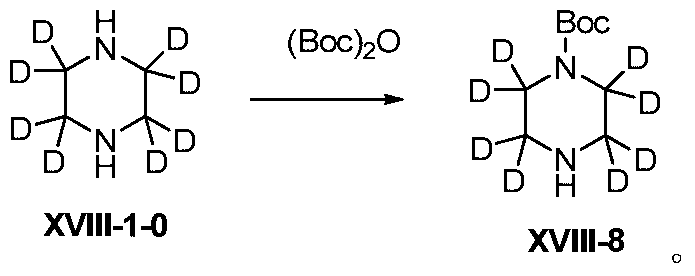
应当理解,式XVIII-1-0化合物可以以式XVIII-1-0化合物的酸式盐的形式进行反应,所述酸可以是无机酸或有机酸,无机酸的例子包括但不限于盐酸、硫酸或磷酸等,有机酸的例子包括但不限于对甲苯磺酸、甲酸或三氟乙酸等,在本发明的一个具体实施方式中,所述酸为盐酸,具体地,所述式XVIII-1-0化合物的酸式盐为式XVIII-1化合物,

还一方面,本发明提供了一种式XVIII-7化合物的制备方法,包括式XVIII-8化合物与5-溴-2-硝
基吡啶进行反应制备式XVIII-7化合物,

还一方面,本发明提供了一种式XVIII-9化合物的制备方法,包括式XVIII-7化合物在催化剂和氢源的存在下进行反应制备式XVIII-9化合物,

所述催化剂包括Pd(OH)2/C、Pd/C、PdCl2、Pd、Pd(OH)2、Raney镍等,优选为Pd/C;
所述的氢源包括氢气、HCOOH、HCOONH4、NH2NH2、环已烯、强酸等,优选为氢。
还一方面,本发明提供了一种式XVIII-11化合物的制备方法,包括式XVIII-9化合物与式XVIII-10化合物进行反应制备式XVIII-11化合物,

还一方面,本发明提供了一种式XVIII-12化合物的制备方法,包括式XVIII-11化合物与式XVIII-22-1化合物进行反应制备式XVIII-12化合物,

还一方面,本发明提供了一种式XVIII-13化合物的制备方法,包括式XVIII-12化合物进行反应制备式XVIII-13化合物,

在本发明的一些具体实施方式中,所述反应是在酸的存在下进行的,
其中所述酸可以是无机酸或有机酸,无机酸的例子包括但不限于盐酸、硫酸或磷酸等,有机酸的例子包括但不限于对甲苯磺酸、甲酸或三氟乙酸等,在本发明的一个具体实施方式中,所述酸为盐酸。
还一方面,本发明提供了一种式XVII-6化合物的制备方法,包括在氘源和碱的存在下,式XVI-6化合物进行反应制备式XVII-6化合物,

其中所述氘源选自重水或C1-C4的氘代醇中的一种或几种,优选为重水、氘代乙醇-D、氘代甲醇-D或氘代甲醇-D4中的一种或几种,最优选为重水;
其中所述反应的温度不大于90℃,优选为不大于85℃,最优选为不大于80℃,在本发明的一些具体实施方案中,所述反应的温度为70-80℃;在本发明的一些更加具体实施方案中,所述反应的温度为80℃;
其中所述碱包括但不限于碳酸钠、碳酸钾、碳酸铯、碳酸锂、氘氧化钠、氘氧化钾、甲醇钠、乙醇钠、叔丁醇锂、叔丁醇钾、叔丁醇钠或氘化钠的一种或多种,优选为氘氧化钠、甲醇钠、乙醇钠或叔丁醇锂中的一种或几种,最优选为氘氧化钠;
其中所述反应可以根据需要选择合适的反应时间,在本发明的一些具体实施方案中,所述反应时间可为5-24小时,例如可以是10小时;
任选的,其中所述反应在氮气或氩气保护下进行的。
上述式XVI-6化合物可以通过如下方法制备:
1)式XV-6化合物在酸(例如三氟乙酸)的存在下进行反应制备式XV-6-1化合物;
2)式XV-6-1化合物在亚硝酸钠和酸(例如盐酸)的存在下进行反应制备式XVI-6化合物;

其中式XV-6化合物可以通过现有技术的方法制备。
还一方面,本发明提供了一种式XVIII-16化合物的制备方法,包括:式XVII-6化合物在还原剂的存在下进行反应制备式XVIII-16化合物,

其中所述还原剂包括但不限于盐酸、氘代盐酸、碘化钐、Al-Ni合金、Raney镍、SnCl2、Fe(CO)5或NaBH4/NiCl2中的一种或几种,优选为氘代盐酸和SnCl2的组合。
在本发明的一些具体实施方案中,式XVIII-16化合物的制备包括如下步骤:
1)式XVII-6化合物在还原剂的存在下进行反应,
2)步骤(1)的产物在碱的存在下进行反应制备式XVIII-16化合物,
其中步骤(1)所述还原剂包括但不限于盐酸、氘代盐酸、碘化钐、Al-Ni合金、Raney镍、SnCl2、Fe(CO)5或NaBH4/NiCl2中的一种或几种,优选为氘代盐酸和SnCl2的组合,
其中步骤(2)所述碱包括但不限于碳酸钠、碳酸钾、碳酸铯、碳酸锂、氢氧化钠、氢氧化钾、甲醇钠、乙醇钠、叔丁醇锂、叔丁醇钾、叔丁醇钠或氢化钠的一种或多种,优选为氢氧化钠、甲醇钠、乙醇钠或叔丁醇锂中的一种或几种,最优选为氢氧化钠。
还一方面,本发明提供了一种式XVIII-17化合物的制备方法,包括式XVIII-16化合物与二碳酸二叔丁酯进行反应制备式XVIII-17化合物,

还一方面,本发明提供了一种式XVIII-21化合物的制备方法,包括式XVIII-17化合物与式XVIII-10化合物进行反应制备式XVIII-21化合物,

还一方面,本发明提供了一种式XVIII-22化合物的制备方法,包括式XVIII-21化合物与式XVIII-22-1化合物进行反应制备式XVIII-22化合物,

还一方面,本发明提供了一种式XVIII-23化合物的制备方法,包括式XVIII-22化合物进行反应制备式XVIII-23化合物,

在本发明的一些具体实施方式中,所述反应是在酸的存在下进行的,
其中所述酸可以是无机酸或有机酸,无机酸的例子包括但不限于盐酸、硫酸或磷酸等,有机酸的例子包括但不限于对甲苯磺酸、甲酸或三氟乙酸等,在本发明的一个具体实施方式中,所述酸为盐酸。
还一方面,本发明提供了一种式XVII-3化合物的制备方法,包括在氘源和碱的存在下,式XVI-3进行反应制备式XVII-3化合物,

其中所述氘源选自重水或C1-C4的氘代醇中的一种或几种,优选为重水、氘代乙醇-D、氘代甲醇-D或氘代甲醇-D4中的一种或几种,最优选为重水;
其中所述反应的温度不大于90℃,优选为不大于85℃,最优选为不大于80℃,在本发明的一些具体实施方案中,所述反应的温度为70-80℃;在本发明的一些更加具体实施方案中,所述反应的温度为80℃,
其中所述碱包括但不限于碳酸钠、碳酸钾、碳酸铯、碳酸锂、氘氧化钠、氘氧化钾、甲醇钠、乙醇钠、叔丁醇锂、叔丁醇钾、叔丁醇钠或氘化钠的一种或多种,优选为氘氧化钠、甲醇钠、乙醇钠或叔丁醇锂中的一种或几种,最优选为氘氧化钠;
其中所述反应可以根据需要选择合适的反应时间,在本发明的一些具体实施方案中,所述反应时间可为5-15小时,例如可以是10小时;
任选的,其中所述反应在氮气或氩气保护下进行的。
上述式XVI-3化合物可以通过如下方法制备:式XV-3化合物在亚硝酸钠和酸(例如盐酸)的存
在下进行反应制备式XVI-3化合物,

其中式XV-3化合物可以通过市售获得,也可以通过现有技术的方法制备。
还一方面,本发明提供了一种式XVIII-3化合物的制备方法,包括:式XVII-3化合物在还原剂的存在下进行反应制备式XVIII-3化合物,

其中所述还原剂包括但不限于盐酸、氘代盐酸、碘化钐、Al-Ni合金、Raney镍、SnCl2、Fe(CO)5或NaBH4/NiCl2中的一种或几种,优选为Al-Ni合金,
任选的,所述反应可以根据需要选择碱,所述碱包括但不限于碳酸钠、碳酸钾、碳酸铯、碳酸锂、氘氧化钠、氘氧化钾、甲醇钠、乙醇钠、叔丁醇锂、叔丁醇钾、叔丁醇钠或氘化钠的一种或多种,优选为氘氧化钠、甲醇钠、乙醇钠或叔丁醇锂中的一种或几种,最优选为甲醇钠。
在本发明的一些具体实施方案中,式XVIII-3化合物的制备包括如下步骤:
1)式XVII-3化合物在还原剂和碱的存在下进行反应,
2)步骤(1)的产物在碱的存在下进行反应制备式XVIII-3化合物,
其中步骤(1)所述还原剂包括但不限于盐酸、氘代盐酸、碘化钐、Al-Ni合金、Raney镍、SnCl2、Fe(CO)5或NaBH4/NiCl2中的一种或几种,优选为Al-Ni合金;
其中步骤(1)所述碱包括但不限于碳酸钠、碳酸钾、碳酸铯、碳酸锂、氢氧化钠、氢氧化钾、甲醇钠、乙醇钠、叔丁醇锂、叔丁醇钾、叔丁醇钠或氢化钠的一种或多种,优选为氢氧化钠、甲醇钠、乙醇钠或叔丁醇锂中的一种或几种,最优选为甲醇钠。
还一方面,本发明提供了一种式XVIII-24化合物的制备方法,包括式XVIII-3化合物与5-溴-2-硝基吡啶进行反应制备式XVIII-24化合物,

还一方面,本发明提供了一种式XVIII-25-0化合物的制备方法,包括式XVIII-24化合物进行反应制备式XVIII-25-0化合物,

其中式XVIII-25-0化合物可以根据需要与不同的酸形成式XVIII-25-0化合物的酸式盐,所述酸可以是无机酸或有机酸,无机酸的例子包括但不限于盐酸、硫酸或磷酸等,有机酸的例子包括但不限于对甲苯磺酸、甲酸或三氟乙酸等,在本发明的一个具体实施方式中,所述酸为盐酸,具体地,所述式XVIII-25-0化合物的酸式盐为式XVIII-25化合物,

在本发明的一个具体实施方式中,所述反应是在氯甲酸-1-氯乙酯的存在下进行的。
还一方面,本发明提供了一种式XVIII-26化合物的制备方法,包括式XVIII-25-0合物与二碳酸
二叔丁酯进行反应制备式XVIII-26化合物,

应当理解,式XVIII-25-0化合物可以以式XVIII-25-0化合物的酸式盐的形式进行反应,所述酸可以是无机酸或有机酸,无机酸的例子包括但不限于盐酸、硫酸或磷酸等,有机酸的例子包括但不限于对甲苯磺酸、甲酸或三氟乙酸等,在本发明的一个具体实施方式中,所述酸为盐酸,具体地,所述式XVIII-25-0化合物的酸式盐为式XVIII-25化合物,

还一方面,本发明提供了一种式XVIII-27化合物的制备方法,包括式XVIII-26化合物在催化剂和氢源的存在下进行反应制备式XVIII-27化合物,

所述催化剂包括Pd(OH)2/C、Pd/C、PdCl2、Pd、Pd(OH)2、Raney镍等,优选为Pd/C;
所述的氢源包括氢气、HCOOH、HCOONH4、NH2NH2、环已烯、强酸等,优选为氢。
还一方面,本发明提供了一种式XVIII-28化合物的制备方法,包括式XVIII-27化合物与式XVIII-10进行反应制备式XVIII-28化合物,

还一方面,本发明提供了一种式XVIII-29化合物的制备方法,包括式XVIII-28化合物与式XVIII-22-1进行反应制备式XVIII-29化合物,

还一方面,本发明提供了一种式XVIII-30化合物的制备方法,包括式XVIII-29化合物进行反应制备式XVIII-30化合物,

在本发明的一些具体实施方式中,所述反应是在酸的存在下进行的,
其中所述酸可以是无机酸或有机酸,无机酸的例子包括但不限于盐酸、硫酸或磷酸等,有机酸的例子包括但不限于对甲苯磺酸、甲酸或三氟乙酸等,在本发明的一个具体实施方式中,所述酸为盐酸。
还一方面,本发明提供了一种式XVIII-33化合物的制备方法,包括在氘源和碱的存在下,式XVIII-32化合物进行反应制备式XVIII-33化合物,

其中所述氘源选自重水或C1-C4的氘代醇中的一种或几种,优选为重水、氘代乙醇-D、氘代甲醇-D或氘代甲醇-D4中的一种或几种,最优选为重水和氘代甲醇-D的混合溶剂;
其中所述反应的温度不大于90℃,优选为不大于85℃,最优选为不大于80℃,在本发明的一些具体实施方案中,所述反应的温度为70-80℃;在本发明的一些更加具体实施方案中,所述反应的温度为78℃,
其中所述碱包括但不限于碳酸钠、碳酸钾、碳酸铯、碳酸锂、氘氧化钠、氘氧化钾、甲醇钠、乙醇钠、叔丁醇锂、叔丁醇钾、叔丁醇钠或氘化钠的一种或多种,优选为氘氧化钠、甲醇钠、乙醇钠或叔丁醇锂中的一种或几种,最优选为氘氧化钠;
其中所述反应可以根据需要选择合适的反应时间,在本发明的一些具体实施方案中,所述反应时间可为5-48小时,例如可以是34小时;
任选的,其中所述反应在氮气或氩气保护下进行的。
上述式XVIII-32化合物可以通过如下方法制备:
1)式XVIII-31化合物在亚硝酸钠的存在下进行反应,
2)步骤(1)的产物在碱的存在下进行反应制备式XVIII-32化合物,

其中所述反应的温度为-10℃-15℃,优选为-5℃-5℃,最优选为0℃,
其中所述碱包括但不限于碳酸钠、碳酸钾、碳酸铯、碳酸锂、氢氧化钠、氢氧化钾、甲醇钠、乙醇钠、叔丁醇锂、叔丁醇钾、叔丁醇钠或氢化钠的一种或多种,优选为氢氧化钠或氢氧化钾的一种或两种,最优选为氢氧化钠,
其中式XVIII-31化合物可以通过现有技术的方法制备。
还一方面,本发明提供了一种式XVIII-34化合物的制备方法,包括:式XVIII-33化合物在还原剂的存在下进行反应制备式XVIII-34化合物,

其中所述还原剂包括但不限于盐酸、氘代盐酸、碘化钐、Al-Ni合金、Raney镍、SnCl2、Fe(CO)5或NaBH4/NiCl2中的一种或几种,优选为Al-Ni合金,
任选的,所述反应可以根据需要选择碱,所述碱包括但不限于碳酸钠、碳酸钾、碳酸铯、碳酸锂、氘氧化钠、氘氧化钾、甲醇钠、乙醇钠、叔丁醇锂、叔丁醇钾、叔丁醇钠或氘化钠的一种或多种,优选为氘氧化钠、甲醇钠、乙醇钠或叔丁醇锂中的一种或几种,最优选为氘氧化钠;
更加具体地,本发明提供了一种式XVIII-34化合物的制备方法,包括:
1)式XVIII-33化合物、碱和溶剂形成混合溶液,
2)步骤(1)的混合溶液在还原剂的存在下进行反应制备式XVIII-34化合物,
其中所述还原剂包括但不限于盐酸、氘代盐酸、碘化钐、Al-Ni合金、Raney镍、SnCl2、Fe(CO)5或NaBH4/NiCl2中的一种或几种,优选为Al-Ni合金,
其中步骤(1)的碱包括但不限于碳酸钠、碳酸钾、碳酸铯、碳酸锂、氘氧化钠、氘氧化钾、甲醇钠、乙醇钠、叔丁醇锂、叔丁醇钾、叔丁醇钠或氘化钠的一种或多种,优选为氘氧化钠、甲醇钠、乙醇钠或叔丁醇锂中的一种或几种,最优选为氘氧化钠;
其中步骤(1)可以根据需要选择合适的溶剂,所述溶剂选自重水或C1-C4的氘代醇中的一种或几种,优选为重水、氘代乙醇-D、氘代甲醇-D或氘代甲醇-D4中的一种或几种,最优选为重水和氘代甲醇-D的混合溶剂,
其中步骤(1)可以根据需要选择合适的反应温度,在本发明的一些具体实施方案中,所述反应的温度为70-90℃;在本发明的一些更加具体实施方案中,所述反应的温度为78℃,
其中步骤(1)可以根据需要选择合适的反应时间,在本发明的一些具体实施方案中,所述反应时间可为1-24小时,例如可以是5小时,
其中步骤(2)可以根据需要选择合适的反应温度,在本发明的一些具体实施方案中,所述反应的温度为35℃,
其中步骤(2)可以根据需要选择合适的反应时间,在本发明的一些具体实施方案中,所述反应时间可为5-24小时,例如可以是15小时。
另一方面,本发明提供了式I所示的氘代化合物,

其中X1选自CH或N;A1、A2或Z1各自独立的选自氢、卤素、烷基、烯基、炔基、环烷基、杂环烷基、芳基、杂芳基、烷氧基、烷氧基羰基、烷硫基、氰基、羟基、硝基、亚硝基、羧基和氨基,其中上述基团任选地被一种或多种下述取代基取代:卤素、羟基、硝基、亚硝基、羧基、氨基、低级烷基、卤素取代的低级烷基、环烷基、卤素取代的环烷基、低级烷氧基、卤素取代的低级烷氧基、低级烷硫基、卤素取代的低级烷硫基、单-烷基氨基、二-烷基氨基、环烷基氨基和任选被一个或多个卤素、羟基、硝基、亚硝基、羧基、氨基、低级烷基、低级烷氧基、低级烷硫基取代的芳基或杂芳基;其中,当X1为N时,Z1不为甲基,优选地不为甲基、亚硝基、硝基、羟基、氰基或卤素;其中,当X1为CH时,A1、A2、Z1不同时为氢,且当X1为CH,A1和A2同时为氢时,Z1不为氟或羟基。优选地,A1和A2各自独立的选自氢,Z1选自乙基、羟乙基、亚硝基、苯基、6-硝基-吡啶-3-基、苄基、N-甲基哌嗪-1-基、吗啉-1-基或1H-吡唑-1-基。
在本发明的另一些更加具体实施方案中,式I所示的氘代化合物为


另一方面,本发明提供了以下氘代化合物,

还一方面,本发明提供了式II所示的氘代化合物,

其中X1选自CH或N;A1、A2或Z1各自独立的选自氢、卤素、烷基、烯基、炔基、环烷基、杂环烷基、芳基、杂芳基、烷氧基、烷氧基羰基、烷硫基、氰基、羟基、硝基、亚硝基、羧基和氨基,其中上述基团任选地被一种或多种下述取代基取代:卤素、羟基、硝基、亚硝基、羧基、氨基、低级烷基、卤素取代的低级烷基、环烷基、卤素取代的环烷基、低级烷氧基、卤素取代的低级烷氧基、低级烷硫基、卤素取代的低级烷硫基、单-烷基氨基、二-烷基氨基、环烷基氨基和任选被一个或多个卤素、羟基、硝基、亚硝基、羧基、氨基、低级烷基、低级烷氧基、低级烷硫基取代的芳基或杂芳基;
优选地,A1和A2各自独立的选自氢,Z1选自乙基、羟乙基、亚硝基、苯基、6-硝基-吡啶-3-基、苄基、N-甲基哌嗪-1-基、吗啉-1-基或1H-吡唑-1-基;
在本发明的另一些更加具体实施方案中,式I所示的氘代化合物为

另一方面,本发明提供了以下氘代化合物,


除非另有定义,否则本文所有科技术语具有的涵义与所声称的主题所属领域技术人员通常理解的涵义相同。除非另有说明,本文全文引用的所有专利、专利申请、公开材料通过引用方式整体并入本文。如果本文对术语有多个定义,以本章的定义为准。如果引用的是URL或其它这种标识符或地址,应理解这种标识符会改变,因特网上的特定信息来去自由,但是通过搜索因特网或其它合适的参考资源可以找到相应的信息。这里引用表明这些信息的可获得和公开传播。
可在参考文献(包括Carey and Sundberg"ADVANCED ORGANIC CHEMISTRY 4TH ED."Vols.A(2000)and B(2001),Plenum Press,New York)中找到标准化学术语的定义。除非另有说明,否则采用本领域技术范围内的常规方法,如质谱、NMR、HPLC、IR和UV/Vis光谱法和药理学方法。除非提出具体定义,否则本文描述的与分析化学、有机合成化学以及药物和药物化学的实验方法和技术有关的术语是本领域已知的。可在化学合成、化学分析、药物制备、制剂和递送,以及对患者的治疗中使用标准技术。例如,可利用厂商对试剂盒的使用说明,或者按照本领域公知的方式或本发明的说明来实施反应和进行纯化。通常可根据本说明书中引用和讨论的多个概要性和较具体地文献中的描述,按照本领域熟知的常规方法实施上述技术和方法。在本说明书中,可由本领域技术人员选择基团及其取代基以提供稳定的结构部分和化合物。
当通过从左向右书写的常规化学式描述取代基时,该取代基也同样包括从右向左书写结构式时所得到的在化学上等同的取代基。
除非另有说明,否则所用的通用化学术语,例如但不限于,“烷基”、“胺”、“芳基”等同于其任选取代的形式。例如,本文所用的“烷基”包括任选取代的烷基。
本文所用术语“基团”是指分子中的特定片段或官能团。化学部分通常被认为是嵌入或附加到分子上的化学实体。
术语“任选”或“任选地”是指随后描述的事件或情况可能发生或可能不发生,该描述包括发生所述事件或情况和不发生所述事件或情况。例如,下文定义的“任选取代的烷基”是指“烷基”或“取代的烷基”。此外,任选取代的基团可以是未被取代(如CH2CH3)、完全取代(如CF2CF3)、单取代(如CH2CH2F)或介于完全取代和单取代之间的取代程度(如CH2CHF2、CF2CH3、CFHCHF2等)。本领域技术人员可理解,对于包含一个或多个取代基的任何基团,不会引入任何在空间上不可能存在和/或不能合成的取代或取代模式(例如,取代烷基包括任选取代的环烷基,相应地,环烷基被定义为包括任选取代的烷基,如此反复)。因此,所述取代基通常应被理解为最大分子量为约1,000道尔顿,更通常地,最大约500道尔顿(除显然需要大分子取代基的情况之外,例如多肽、多糖、聚乙二醇、DNA和RNA等)。
本文单独或组合使用的术语“烃”是指仅包含碳原子和氢原子的化合物或化学基团。
本文单独或组合使用的术语“杂原子”或“杂”是指除碳和氢之外的原子。杂原子独立地选自氧、氮、硫、磷、硅、硒和锡,但不限于这些原子。在出现两个或更多杂原子的实施方式中,所述两个或更多杂原子可彼此相同,或者所述两个或更多杂原子中的一些或全部彼此不同。
本文单独或组合使用的术语“烷基”是指任选取代的直链或任选取代的支链的一价饱和烃。本文的“烷基”可具有1-约18个碳原子,或具有1-约10个碳原子,优选1-6个碳原子。本文单独或组合使用的“低级烷基”是指碳数较少的烷基,例如其具有1-约8个碳原子,优选1-约6个碳原子,或1-约4个碳原子。本文的烷基实例包括但不限于甲基、乙基、正丙基、异丙基、2-甲基-l-丙基、2-甲基-2-丙基、2-甲基-1-丁基、3-甲基-l-丁基、2-甲基-3-丁基、2,2-二甲基-1-丙基、2-甲基-1-戊基、3-甲基-1-戊基、4-甲基-l-戊基、2-甲基-2-戊基、3-甲基-2-戊基、4-甲基-2-戊基、2,2-二甲基-l-丁基、3,3-二甲基-1-丁基、2-乙基-1-丁基、正丁基、异丁基、仲丁基、叔丁基、正戊基、异戊基、新戊基、叔戊基和己基,以及更长的烷基基团,如庚基和辛基等。本文中出现数字范围时,例如“C1-C6烷基”或“C1-6烷基”是指可由1个碳原子、2个碳原子、3个碳原子、4个碳原子、5个碳原子或6个碳原子构成的烷基,本文
的烷基也包含未指定数字范围的情况。
本文组合使用的“烷基”包括但不限于包含在“烷氧基”、“烷硫基”、“单-烷基氨基”和“二-烷基氨基”等中的“烷基”。
本文单独或组合使用的术语“烯基”是指任选取代的直链或任选取代的支链的一价烃,其具有一个或多个碳-碳双键。所述烯基例如具有2-约18个碳原子,或具有2-约10个碳原子,更优选2-约6个碳原子。这些基团中的双键可以为顺式或反式构型,并应被理解为包含所述两种异构体。实例包括但不限于乙烯基(-CH=CH2)、1-丙烯基(-CH2CH=CH2)、异丙烯基(-C(CH3)=CH2)、丁烯基和1,3-丁二烯基等。
本文单独或组合使用的术语“炔基”是指任选取代的直链或任选取代的支链的一价烃,其具有一个或多个碳-碳三键。例如所述炔基具有2-约18个碳原子或2-约10个碳原子,更优选2-约6个碳原子。本文的炔基实例包括但不限于乙炔基、2-丙炔基、2-丁炔基和1,3-丁二炔基等。
本文单独或组合使用的术语“卤素取代的烷基”是指任选取代的烷基基团,如上定义的,其中一个或多个氢原子被替换成氟、氯、溴或碘原子或其组合。在一些实施方式中,使用彼此相同的卤素原子替换两个或多个氢原子(例如二氟甲基、三氟甲基);在其它实施方式中使用彼此并不完全相同的卤素原子替换两个或多个氢原子(例如1-氯-1-氟-1-碘乙基)。卤素取代的烷基的非限定性实例为氟甲基和溴乙基。
本文单独或组合使用的术语“环”、“环状”以及“……元环”是指如本文所述的任意共价闭合的结构,其包括脂环、杂环、芳环、杂芳环和多环稠合环系或多环非稠合环系。环可被任意取代。环可形成稠合环系部分。术语“元”是指组成环的骨架原子的数目。因此,举例而言,环己烷、吡啶、吡喃和嘧啶为六元环,而环戊烷、吡咯、四氢呋喃和噻吩为五元环。
本文单独或组合使用的术语“稠合”是指其两个或多个环共同具有一个或多个键的环结构。
本文单独或组合使用的术语“环烷基”是指任选取代的一价饱和烃环,其包含3-约15个成环碳原子或3-约10个成环碳原子,也可包括作为取代基的其它非成环碳原子(例如甲基环丙基)。环烷基可具有3至约10个或3-约8个或3-约6个或3-5个成环原子,环烷基的实例包括但不限于环丙烷、环丁烷、环戊烷和环己烷。
本文单独或组合使用的术语“低级环烷基”是指成环原子数较少的环烷基,例如含有5到约10个或5到约6个或5到6个成环原子或者3至6个成环原子,例如具有3、4、5或6个成环原子。
“杂环烷基”的非限制性实例包括吖嗪基(azinyl)、氮杂环丁烷基(azetidinyl)、氧杂环丁基(oxetanyl)、硫杂环丁基(thietanyl)、高哌啶基(homopiperidinyl)、氧杂环庚基(oxepanyl)、硫杂环庚基(thiepanyl)、氮杂氧杂环庚三烯基(oxazepinyl)、二氮杂环庚三烯(diazepinyl)、氮杂硫杂环庚三烯(thiazepinyl)、1,2,3,6-四氢吡啶基、2-吡咯啉基、3-吡咯啉基、二氢吲哚基、2H-吡喃基、4H-吡喃基、二氧杂环己基(dioxanyl)、1,3-二氧戊环基(1,3-dioxolanyl)、吡唑啉基、二硫环己基(dithianyl)、二硫环戊基(dithiolanyl)、二氢吡喃基、二氢噻吩基、二氢呋喃基、吡唑烷基、咪唑啉基、咪唑烷基(imidazolidinyl)、3-氮杂双环[3.1.0]己基、3-氮杂双环[4.1.0]庚基、3H-吲哚基和喹嗪基等。该术语还包括糖类的所有环状形式,包括但不限于单糖、二糖和寡糖。
本文单独或组合使用的术语“芳基”是指任选取代的芳香烃基,其具有6-约20个成环碳原子,并包括稠合环和非稠合芳基环。稠合芳基包含2-4个稠合的环,其中连接环是芳环,其它每个环可以为脂环、杂环、芳环、杂芳环或其任意组合。进一步的,术语芳基包括稠合和非稠合环。此外,术语芳基包括但不限于单环、双环、三环或更多环。芳基(例如单环芳基)包括例如6至约12个、6至约10个或6至约8个成环碳原子。单环芳基的非限制性实例包括苯基,稠合环芳基包括萘基、菲基、蒽基、薁基(azulenyl),非稠合的双-芳基包括联苯基。
本文单独或组合使用的术语“杂芳基”是指任意取代的一价芳基,其包含约5至约20个骨架成环原子,其中一个或多个成环原子为杂原子,所述杂原子独立地选自氧、氮、硫、磷、硅、硒和锡,但不限于此;其前提是所述基团的环不包含两个相邻的O或S原子。在环中出现两个或更多杂原子的实施方式中,所述两个或更多杂原子可彼此相同,或者所述两个或更多杂原子中的一些或全部彼此不
同。术语杂芳基包括任选取代的具有至少一个杂原子的稠合的或非稠合的杂芳基。术语杂芳基还包括含5至约12个骨架成环原子的稠合的和非稠合的杂芳基,以及含5至约10个骨架成环原子的稠合的和非稠合的杂芳基。可通过碳原子或杂原子与杂芳基结合。因此,非限制性的举例,咪唑基可通过其任一碳原子(咪唑-2-基、咪唑-4-基或咪唑-5-基)或其氮原子(咪唑-1-基或咪唑-3-基)与母体分子相连。类似地,杂芳基可通过其任意或全部碳原子和/或任意或全部杂原子被进一步取代。稠合的杂芳基可包含2-4个稠合环,其中连接环是杂芳环,其它每个环可以为脂环、杂环、芳环、杂芳环或其任意组合。单环杂芳基包括但不限于具有5至约12个、5至约10个、5至约7个或6个成环原子的单环杂芳基。单环杂芳基的非限定性实例包括吡啶基,稠合环杂芳基包括苯并咪唑基、喹啉基、吖啶基,非稠合的双-杂芳基包括二吡啶基。杂芳基的其它实例包括但不限于:呋喃基、噻吩基、噁唑基、吖啶基、吩嗪基、苯并咪唑基、苯并呋喃基、苯并噁唑基、苯并噻唑基、苯并噻二唑基(benzothiadiazolyl)、苯并噻吩基(benzothiophenyl)、苯并噁二唑基、苯并三唑基、咪唑基、吲哚基、异噁唑基、异喹啉基、吲嗪基(indolizinyl)、异噻唑基、异吲哚基噁二唑基、吲唑基、吡啶基、哒嗪基(pyridazyl)、嘧啶基、吡嗪基、吡咯基、吡唑基、嘌呤基、酞嗪基、蝶啶基(pteridinyl)、喹啉基、喹唑啉基、喹噁啉基(quinoxalinyl)、三唑基、四唑基、噻唑基、三嗪基和噻二唑基(thiadiazolyl)等,及其氧化物,例如吡啶基-N-氧化物等。
本文单独或组合使用的术语“杂环基/杂环”是指杂脂环和杂芳基。本文中指出杂环的碳原子数目时(例如C1-C6杂环),所述环中必然存在至少一个非碳原子(杂原子)。例如“C1-C6杂环”的命名仅涉及环中碳原子的数目,而不涉及环中原子的总数。如“4-6元杂环”的命名是指环中所含的原子总数(即四、五或六元环,其中至少一个原子为碳原子,至少一个原子为杂原子,且剩余的2-4个原子为碳原子或杂原子)。对于具有两个或更多杂原子的杂环而言,所述两个或更多杂原子可以彼此相同或不同。杂环可被任意取代。非芳香杂环基团包括环上仅具有3个原子的基团,而芳香杂环基团环上必须至少具有5个原子。可通过杂原子或碳原子与杂环相连(即连接到母体分子或进一步取代)。本文中的“杂环基/杂环”包括杂环烷基。本文的“低级杂环基”或“低级杂环烷基”等是指成环原子数较少的杂环基,例如具有5至约10个或5-约8个或5或6个成环原子。
本文单独或组合使用的术语“卤素”、“卤代”或“卤化物”是指氟、氯、溴和碘。
本文单独或组合使用的术语“烷氧基”是指烷基醚基,O-烷基,其包括O-脂基和O-碳环基,其中烷基、脂基和碳环基可被任选地取代,并且其中的术语烷基、脂基和碳环基如上文的定义。烷氧基的非限定性实例包括甲氧基、乙氧基、正丙氧基、异丙氧基、正丁氧基、异丁氧基、仲丁氧基和叔丁氧基等。
本文单独或组合使用的术语“烷硫基”是指“-S-烷基”,其包括-S-脂基和-S-碳环基。其中的烷基、脂基和碳环基如上文的定义。烷硫基的非限定性实例包括甲硫基、乙硫基、丙硫基和丁硫基等。
本文单独或组合使用的术语“低级烷基”、“低级烷氧基”、“低级烷硫基”是指碳原子数为1~约8个,或1~6个或1~5个或1~4个或1~3个或1~2个的所述烷基、烷氧基和烷硫基。
本文单独或组合使用的“结构要素”是指化合物结构中含有的部分结构。例如,包含式 结构要素的化合物可以是
 或者
或者 等;包含式
等;包含式 的结构要素的化合物可以是
 (当X为C,n=1且m=1时)或
 (当X为N,n=1且m=1时)等;而包含式
 结构要素的化合物可以是
 等,但不能是
本文单独或组合使用的Cn、Cm、(CH2)n或(CH2)m等,指化合物结构中具有m或n个C或者CH2结构连接,当m或n为0时,该结构为键。例如,“ 其中n=0且m=0”指结构
 式
式 的结构要素中,当n=0且m=0时为式
 的结构要素。
本文单独或组合使用的术语“氘代”是指化合物的某个或某些氢原子被氘原子取代。
本文单独或组合使用的术语“氘代化合物”是指含有氘原子的化合物。
本文单独或组合使用的术语“非氘代化合物”是指不含有氘原子的化合物。
本文单独或组合使用的术语“氘代率”是指非氘代化合物转化为目标氘代化合物后将产物进行分离,分离的产物通过质谱检测得到的氘代百分比,它代表非氘代化合物目标位置上的氢转化为氘的程度。
本文单独或组合使用的术语“一次氘代率”是指将非氘代化合物转化为目标氘代化合物的反应进行一次的氘代率。
本文单独或组合使用的术语“二次氘代率”是指将非氘代化合物转化为目标氘代化合物的反应重复两次的氘代率。
本文单独或组合使用的术语“氘代醇”是指醇的羟基上的氢原子被氘原子取代的化合物,也包括醇上的其它氢原子部分或者全部取代后的化合物,例如,氘代甲醇-D(CH3OD)是指甲醇的羟基上的氢原子被氘原子取代,而其它氢原子未被氘原子取代的化合物;氘代甲醇-D4(CD3OD)是指甲醇上的所有氢原子均被被氘原子取代后的化合物。
本文所用C1-Cn包括C1-C2、C1-C3、……C1-Cn。举例而言,所述“C1-C4”基团是指该部分中具有1-4个碳原子,即基团包含1个碳原子,2个碳原子、3个碳原子或4个碳原子,C1-C2和C1-C3也一样。因此,举例而言“C1-C4的氘代醇”是指有1-4个碳原子的氘代醇,即所述氘代醇选自氘代甲醇、氘代乙醇、氘代丙醇、氘代异丙醇、氘代正丁醇、氘代异丁醇、氘代仲丁醇和氘代叔丁醇;再如“C1-C4的醇钠”是指有1-4个碳原子的醇钠,即所述醇钠选自甲醇钠、乙醇钠、丙醇钠、异丙醇钠、正丁醇钠、异丁醇钠、仲丁醇钠和叔丁醇钠。
本发明氘代化合物I的制备方法,所用氘源为重水或者氘代醇,氘源容易获得,且价格较低,操作简便易制备,氘代时间短,氘代率高,一次氘代率可达90%以上,后续可以很容易的将氘代化合物I转化为氘代化合物II或氘代化合物III,所述氘代过程和后续转化过程没有使用毒性大的试剂,绿色环保,特别适合应用于开发氘代药物,使大规模工业化生产氘代药物成为可能。
实施例
本发明通过以下实施例可以更详细地说明本发明,它们仅仅是实施例,并不限制本发明,凡是基于本发明所实现的技术,均属于本发明的范围。
实施例1:N-[D3]甲基苯胺(式IV-1化合物)的制备

(E/Z)N-亚硝基-N-甲基苯胺(式II-1化合物)的制备:在0℃下将NaNO2(7.84g,112mmol)和水(20mL)的溶液慢慢滴加入到N-甲基苯胺(8.0g,74.68mmol)、水(9.6mL)和醋酸(48mL)组成的溶液中,滴加完毕后保持0℃搅拌反应2小时,反应完毕后用二氯甲烷萃取4次(每次20mL),二氯甲烷层用饱和氯化钠水溶液洗涤二次(每次10mL),加入无水碳酸钠和无水硫酸镁进行干燥,过滤,滤液减压浓缩,
将浓缩物用二氯甲烷溶解后用饱和碳酸钠溶液调节至pH大于7。将有机相用无水硫酸镁干燥后,过滤,滤液减压浓缩,得到9.5g黄绿色液体。
1HNMR(300MHz,CDCl3):δ7.56-7.53(2H,m),7.48(2H,m),7.36(1H,m),3.46(3H,m).HRMS(ESI,M+H+)m/z:137.0707.
N-亚硝基-N-[D3]甲基苯胺(式III-1化合物)的制备:将式II-1化合物(5.004g,36.7mmol)、MeOD(59mL)、D2O(59mL)和甲醇钠(5.964g,110.4mmol)加入三口瓶中。密封并用氮气冲洗五次后在氮气保护下加热至80℃反应24小时,反应毕加入甲苯后在40℃下减压浓缩,然后用二氯甲烷萃取,有机相用水洗至弱碱性再用饱和氯化钠水溶液洗涤。有机相用无水硫酸镁干燥,过滤,滤液减压浓缩至干,得到4.60g黄色油状物,质谱检测一次氘代率>95%(D3)。
1HNMR(300MHz,CDCl3):δ7.55-7.52(2H,m),7.48(2H,m),7.36(1H,m),在3.46ppm左右的质子峰消失;HRMS(ESI,M+H+)m/z 140.0905.
N-[D3]甲基苯胺(式IV-1化合物)的制备:在0℃下将CuCl(18.3mg,0.184mmol)溶于35%DCl的重水溶液(10mL)中,氮气保护下加入含有式III-1化合物(144mg,1.034mmol)的三口瓶中,室温搅拌四十分钟,0℃下缓慢滴加10mol/L的NaOH溶液,调节反应液PH值大于9。用二氯甲烷萃取反应液,将有机项用水洗涤,有机相用无水硫酸镁干燥,过滤,滤液减压浓缩至干,得式IV-1化合物(87mg)。
1HNMR(300MHz,D2O):δ7.18(2H,m),6.6(1H,m),6.5(2H,m),在2.75ppm左右的质子峰消失;HRMS(ESI,M+H+)m/z 111.0996.
实施例2:二-[D3]甲基胺盐酸盐(式VIII-1化合物)的制备

(E/Z)N-亚硝基二甲基胺(式VI-1化合物)的制备:称量式V-1化合物(45g,0.552mol)和2mol/L的HCl水溶液(165mL)于500mL两颈瓶中,降温到0℃,将NaNO2(57g,0.826mol)用180mL水溶解后,在0℃下滴加进入反应瓶中,滴加完毕后保持0℃反应2小时,室温下搅拌过夜,反应完毕后用二氯甲烷萃取4次,二氯甲烷层加入无水碳酸钠和无水硫酸镁进行干燥,过滤,滤液在不高于30℃下减压浓缩,得到式VI-1化合物(29.33g,黄绿色液体)。
1HNMR(300MHz,CDCl3):δ3.04(s,3H,与N=O基团同则异构体),3.76(ms,3H,与N=O基团反则异构体);MS(ESI,M+H+)m/z 75.1.
N-亚硝基二-[D3]甲基胺(式VII-1化合物)的制备:将式VI-1化合物(28.82g,0.389mol)置于单颈烧瓶中,加入D2O(360mL),分数次加入甲醇钠(10g,0.185mol),氮气保护下加热至80℃,保持该温度下反应24小时,用二氯甲烷对反应液进行萃取4次(每次100mL),有机层减压浓缩,得到式VII-1化合物(28.33g,黄色液体),质谱检测一次氘代率大于94%(D6)。
1HNMR(300MHz,CDCl3):在3.04和3.76ppm左右的质子峰消失;MS(ESI,M+H+)m/z 81.1;
二-[D3]甲基胺盐酸盐(式VIII-1化合物)的制备:将式VII-1化合物(2.10g,26.22mmol)、35%的DCl的重水溶液(18mL,216mmol)置于100mL两颈瓶中,于95℃下反应48小时,减压浓缩,得到油状液,向油状液中加入少量丙酮,搅拌,有透明晶体析出,抽滤得产物,置于50℃真空烘箱中干燥4小时,得透明状晶体式VIII-1化合物(1.124g)。
1HNMR(300MHz,D2O):在2.73ppm左右的质子峰消失;MS(ESI,M+H+)m/z 52.1.
参照实施例1的方法将其它链状亚硝基胺制备成相应的氘代亚硝基胺以及氘代胺,与实施例1和实施例2一起,汇总结果如表1。
表1链状氘代亚硝基胺以及链状氘代胺的结果

实施例3:[2,2,4,4-D4]氮杂环丁烷盐酸盐(式XIII-1化合物)的制备

N-亚硝基氮杂环丁烷(式XI-1化合物)的制备:在一圆底烧瓶中加入式X-1化合物(5.0g,87.57mmol)、亚硝酸钠(9.4g,136.24mmol)以及二氯甲烷(100mL).在0℃下一边搅拌一边加入对甲苯磺酸(21.8g,126.59mmol),室温下搅拌1小时,过滤,滤液中加入无水硫酸钠(5.0g)。过滤,滤液减压浓缩,干燥,得式XI-1化合物(7.2g)。
1HNMR(300MHz,CDCl3):2.31(t,2H),4.0(t,2H,Z/E异构体),4.73(t,2H,Z/E异构体);13CNMR:14.70,52.27(Z/E异构体),54.78(Z/E异构体);MS(ESI,M+H+)m/z 87.1.
N-亚硝基-[2,2,4,4-D4]氮杂环丁烷(式XII-1化合物)的制备:在一圆底烧瓶中加入式XI-1化合物(1.1g,12.89mmol)、重水(15mL)以及40%NaOD的重水溶液(3mL)。在80℃下搅拌6小时,用二氯甲烷萃取4次(每次20mL),再用无水硫酸钠干燥,过滤,滤液减压浓缩,干燥后得式XII-1化合物(0.98g),质谱检测一次氘代率大于98%(D4)。
1HNMR(300MHz,CD3OD):2.41(s);13CNMR:14.74,52.40(m,Z/E异构体),54.78(m,Z/E异构体);MS(ESI,M+H+)m/z 91.1.
[2,2,4,4-D4]氮杂环丁烷盐酸盐(式XIII-1化合物)的制备:在一圆底烧瓶中加入式XII-1化合物(6.1g,67.69mmol)、0.5mol/L的NaOD重水溶液(80mL),室温下加入Ni-Al合金(20g),25℃下搅拌2小时,过滤,滤液中加入36%HCl水溶液(3mL),过滤,滤液减压浓缩,干燥后得式XIII-1化合物(6.6g).
1HNMR(300MHz,CDCl3):2.38(s);13CNMR:17.46,46.81(m);MS(ESI,M+H+)m/z 62.1.
实施例4:[2,2,3,3,5,5,6,6-D8]哌嗪盐酸盐(式XVIII-1化合物)的制备

1,4-二亚硝基哌嗪(式XVI-1化合物)的制备:向反应瓶中加入式XV-1化合物(80g,930mmol),滴加2mol/L的HCl水溶液(1040mL,2080mmol),搅拌10分钟,然后向反应中滴加NaNO2的水溶液(152g,2196mmol),30分钟滴完。反应室温搅拌2小时,再将反应瓶放置析出固体,过滤分离出固体产物,水洗,干燥后得到式XVI-1化合物(123.21g),为淡黄色固体(产率92.02%)。
1HNMR(500MHz,CD3OD):4.54~4.55(d,J=6.7Hz,2H),4.38~4.41(t,J=11.5Hz,2H),4.02~4.05(t,J=11.5,2H),3.80~3.81(d,J=6.7Hz,2H).
HRMS(ESI,M+H+)m/z 145.0641.
1,4-二亚硝基[2,2,3,3,5,5,6,6-D8]哌嗪(式XVII-1化合物)的制备:分别向反应瓶中加入式XVI-1化合物(10.0g,69.4mmol),甲醇钠(15.0g,277.7mmol),氮气下,向反应瓶中加入重水(100mL,15.0mol),然后加热到80℃,10小时后停止加热,待冷却到室温后,再将反应瓶放置析出固体,过滤分离出固体产物,干燥后得到式XVII-1化合物(8.569g),为淡黄色固体(产率81.61%)。
1HNMR(300MHz,CD3OD):内标2,4,6-三溴甲苯峰,7.73(s,2H),2.50(s,3H),无1,4-二亚硝基哌嗪质子峰出现表明完全被氘取代。
HRMS(ESI,M+H+)m/z 153.1344.
[2,2,3,3,5,5,6,6-D8]哌嗪盐酸盐(式XVIII-1化合物)的制备:分别向反应瓶中加入式XVII-1化合物(3.0g,19.74mmol),甲醇钠(5.99g,0.110mol),氮气下,缓慢向反应液中加入重水(75mL)。分多次向反应中加入Al-Ni合金(24.0g),约2小时加完,过滤,收集滤液,进行蒸馏,待液体全部蒸出后,缓慢向其中滴加35%的HCl水溶液(4mL),减压浓缩,干燥后得到式XVIII-1化合物(2.865g),为白色固体(产率82.45%)。
1HNMR(300MHz,CD3OD):内标对硝基苯甲醚峰,8.18~8.21(d,2H),7.05~7.08(d,2H),3.91(s,3H).无哌嗪二盐酸盐峰的质子峰。
HRMS(ESI,M+H+)m/z 95.1545.
参考实施例4的方法在不同反应条件下制备氘代哌嗪盐酸盐,结果如表2。
表2制备氘代哌嗪盐酸盐不同反应条件下的结果
| 编号 | 反应试剂 | 反应温度/时间 | 一次氘代率D8 | 二次氘代率D8 |
| 1 | D2O/CD3OD(体积比1:1)/NaOD | 75℃/5小时 | 94% | ND |
| 2 | D2O/CH3OD(体积比1:1)/NaOD | 75℃/5小时 | 93% | ND |
| 3 | D2O/CH3CH2OD(1/1)/NaOD | 75℃/5小时 | 93% | ND |
| 4 | D2O/四氢呋喃(体积比1:2)/NaOD | 80℃/5小时 | 91% | ND |
| 5 | D2O/二氧六环(体积比1:2)/NaOD | 80℃/5小时 | 92% | ND |
| 6 | D2O/NaOD | 80℃/5小时 | 95% | >98% |
| 7 | D2O/NaOMe | 80℃/5小时 | 95% | >98% |
| 8 | D2O/K2CO3 | 80℃/5小时 | 94% | ND |
| 9 | t-BuONa/CH3CH2OD | 75℃/15小时 | 95% | ND |
| 10 | t-BuONa/CH3OD | 75℃/15小时 | 95% | ND |
注:ND表示未检测
实施例5:1,2,3,4-[2,2,3,3-D4]四氢喹喔啉(式XVIII-3化合物)的制备方法

1,4-二亚硝基-1,2,3,4-四氢喹喔啉(式XVI-2化合物)的制备方法:按实施例3制备N-亚硝基氮杂环丁烷的方法合成,所得产物为E/Z异构物混和物(-N=O不同取向)。
1HNMR(300MHz,CDCl3):4.12(s,4H),7.50(t,2H),8.25(d,2H);13CNMR:37.10,114.5,127.5;MS(ESI,M+H+)m/z 193.1.
1,4-二亚硝基-1,2,3,4-[2,2,3,3-D4]四氢喹喔啉(式XVII-2化合物)的制备方法:在一圆底烧瓶中加入式XVI-2化合物(1.1g)、MeOD(15mL)以及NaOtBu(1.0g)。在70℃下搅拌10小时,减压浓缩,用二氯甲烷萃取4次(每次20mL),减压浓缩,干燥后得式XVII-2化合物(0.97g),质谱检测一次氘代率94%(D4)。
1HNMR(300MHz,CDCl3):7.51(t,2H),8.25(d,2H);13CNMR:37.10(m),114.5,127.5;MS(ESI,M+H+)m/z 197.1.
1,2,3,4-[2,2,3,3-D4]四氢喹喔啉(式XVIII-2化合物)的制备方法:分别向反应瓶中加入式XVII-2化合物(2.0g,10.2mmol),MeOD(10mL),氮气下,向反应液中加入Raney镍粉末(2.0g)。在室温搅拌下用氢气取代氮气,反应混合物在室温下搅拌10小时,过滤,收集滤液,减压浓缩除去溶剂,干燥后得到式XVIII-2化合物(0.845g)。
1HNMR(300MHz,CDCl3):7.41(t,2H),8.15(d,2H);13CNMR:37.10(m),114.5,127.5;MS(ESI,M+H+)m/z 139.1.
实施例6:1-苄基-[3,3,5,5-D4]哌嗪(式XVIII-3化合物)制备
步骤(1)1-苄基-4-亚硝基哌嗪(式XVI-3化合物)制备

向反应瓶中加入式XV-3化合物(50.0g,0.284mol),滴加2mol/L的HCl水溶液(160mL,0.318mol),得到的反应液搅拌10分钟,然后向反应中滴加NaNO2的水溶液(24.50g,0.335mol加入水58mL),40分钟滴完。反应室温搅拌过夜。再将反应瓶放置析出固体,过滤分离出固体产物,水洗,水层再用二氯甲烷萃取,有机相合并,无水硫酸镁干燥,过滤,减压浓缩得到固体产物,50℃干燥后得到式XVI-3化合物(56.71g),为淡黄色固体(产率97.30%,两个异构体)。
1HNMR(300MHz,CDCl3):7.26~7.34(m,5H),4.23~4.27(t,J=10.4Hz,2H),3.81~3.85(t,J=10.7Hz,2H),3.60(s,2H),2.66~2.70(t,J=10.3Hz,2H),2.43~2.46(t,J=10.7Hz,2H);
13CNMR(300MHz,CDCl3):136.72,128.98,128.36,127.49,62.18,52.79,51.35,49.35,39.17;
MS(ESI,M+H+)m/z:206.1.
步骤(2):1-苄基-[3,3,5,5-D4]哌嗪(式XVIII-3化合物)的制备

1-苄基-4-亚硝基[3,3,5,5-D4]哌嗪(式XVII-3化合物)的制备:分别向反应瓶中加入式XVI-3化合物(20.0g,97.43mmol),甲醇钠(15.79g,292.29mmol),氮气下,缓慢向反应瓶中加入重水(120mL)。然后加热到80℃,10小时后停止加热,再将反应瓶放置析出固体,过滤分离出固体产物,50℃干燥后得到式XVII-3化合物(17.735g),为淡黄色固体(产率86.98%),质谱检测一次氘代率96%(D4)。
1HNMR(300MHz,CDCl3):7.25~7.33(m,5H),3.56(s,2H),2.64(s,2H),2.41(s,2H).
MS(ESI,M+Na)m/z:232.2.
1-苄基-[3,3,5,5-D4]哌嗪(式XVIII-3化合物)的制备:
方法1:分别向反应瓶中加入式XVII-3化合物(10.0g,47.78mmol)、Fe(CO)5(18.68g,95.56mmol)及正丁醚(50mL),氮气下,然后加热回流反应12小时,待冷却至室温后,水洗二次,无水硫酸镁干燥,过滤,减压浓缩得到固体产物,干燥后得到式XVIII-3化合物(7.13g),为淡黄色油状体(收率82.81%)。
方法2:向反应瓶中加入式XVII-3化合物(10.0g,47.78mmol),甲醇钠(7.74g,143.34mmol),氮气下,缓慢向反应中加入重水(75mL)及氘代乙醇(d1,75mL)。然后加热到70℃。反应24小时后停止加热,待冷却至室温后,分多次向反应中加入Al-Ni合金(30.0g),约2小时加完,反应混合物在室温下搅拌过夜。次日,通过抽滤除去固体金属,收集含有产物的滤液。再用CH2Cl2萃取,有机相合并,无水硫酸镁干燥,通过抽滤除去干燥剂,旋转蒸发除去溶剂得到固体产物。最后通过减压干燥后得到式XVIII-3化合物(7.13g,82.8%)。
方法3:分别向反应瓶中加入亚硝基化合XVII-3(146.4mg,0.70mmol),三乙胺(2.55g,25.2mmol)及重水(504mg,25.2mmol)。氮气下,加入碘化钐四氢呋喃溶液(0.1mol/L,42mL,4.2mmol),室温下搅拌2小时。反应完毕后,过量的碘化钐被通入空气氧化。加入CH2Cl2(20mL),用饱和氯化钠溶液洗一次,无水硫酸镁干燥,通过抽滤除去干燥剂,旋转蒸发除去溶剂得到式XVIII-3化合物(0.120g,收率95.0%)。
1HNMR(300MHz,CD3OD):7.20~7.31(m,5H),3.47(s,2H),2.39(s,4H).
MS(ESI,M+H+)m/z:181.2.
参照实施例3-5的方法将环状亚硝基胺制备成相应的氘代亚硝基胺以及氘代胺,与实施例3一起,汇总结果如表3。
表3环状氘代亚硝基胺以及环状氘代胺的结果

参照实施例4-6的方法将取代环状亚硝基胺制备成相应的氘代亚硝基胺以及氘代胺,与实施例5-7一起,汇总结果如表4。
表4取代环状氘代亚硝基胺以及取代环状氘代胺的结果

实施例7:1-氨基-4-苄基-[2,2,6,6-D4]哌嗪(式XIX-3化合物)的制备

1-氨基-4-苄基-[2,2,6,6-D4]哌嗪(式XIX-3化合物)的制备:分别向反应瓶中加入四氢锂铝(156.6mg,4.12mmol)和干燥的四氢呋喃(4mL),冷却反应液至-60℃,氮气下,缓慢向反应体系中加入式XVIII-3化合物(0.862g,4.12mmol)和干燥的四氢呋喃(2mL)的溶液,然后升温到25℃。反应完毕后,冷却反应液至-10℃,向反应中慢加入水(0.16mL),15%的NaOH水溶液(0.16mL)及水(0.48mL),反应混合物在室温下搅拌2小时。过滤,滤液用无水硫酸镁干燥,过滤,减压浓缩得到固体产物式XIX-3化合物(0.7g)。
1HNMR(300MHz,CD3OD):7.20~7.31(m,5H),3.47(s,2H),2.39(s,4H);
MS(ESI,M+H+)m/z:196.2.
实施例8:4-乙基-[2,2,6,6-D4]哌嗪-1-胺(式XVIII-5化合物)的制备

步骤(1)4-乙基-1-亚硝基哌嗪(式XVI-5化合物)的制备
用N-乙基哌嗪代替N-苄基哌嗪,并参照实施例6步骤(1)所示方法制备制备式XVI-5化合物。
1HNMR(300MHz,CDCl3):δ4.28(2H,t,J=5.13Hz,piper),3.86(2H,t,J=5.28Hz,piper),2.67(2H,t,J=5.22Hz,piper),2.47-2.54(2H,q,J=7.20Hz,CH3
CH2
),2.43(2H,t,J=5.40Hz,piper),1.12(3H,t,J=7.20Hz,CH3
CH2).
HRMS(ESI,M+H+)m/z:144.1383.
步骤(2)4-乙基-1-亚硝基-[2,2,6,6-D4]哌嗪(式XVII-5化合物)的制备
用N-乙基-N-亚硝基哌嗪代替N-苄基-N-亚硝基哌嗪,并参照实施例6步骤(2)所示方法制备制备式XVII-5化合物。
1HNMR(300MHz,CDCl3):δ2.64(2H,s,piper),2.45-2.52(2H,q,J=7.20Hz,CH3CH2),2.40(2H,s,piper),1.11(3H,t,J=7.20Hz,CH3
CH2).
HRMS(ESI,M+H+)m/z:148.1310.
步骤3)4-乙基-[2,2,6,6-D4]哌嗪-1-胺(式XVIII-5化合物)的制备
称取4-亚硝基-N-乙基哌嗪(0.6g,4.1mmol)置于反应瓶中,然后加入苯硅烷(907mg,8.4mmol)和少量KOH(11.7mg,0.21mmol),微波下加热,在120℃下反应1小时(戓油浴80℃,10h)。冷却后加入CH2Cl2(15mL),无水硫酸镁干燥,通过抽滤除去干燥剂,旋转蒸发除去溶剂得到粗产物.通过柱层析分离(DCM:MeOH=1:1至1:3),得式XVIII-5化合物(0.387g)。
1HNMR(300MHz,CDCl3):δ3.06(4H,s,piper),2.81-2.88(2H,q,J=7.23Hz,CH3
CH2
),1.23(3H,t,J=7.23Hz,CH3
CH2).
HRMS(ESI,M+H+)m/z:134.1479.
实施例9:氘代Palbociclib-1(式XVIII-13化合物)的制备方法
方法一
步骤(1)4-(6-硝基吡啶-3-基)-[2,2,3,3,5,5,6,6-D8]哌嗪-1-碳酸叔丁酯(式XVIII-7化合物)的制备
1-(6-硝基吡啶-3-基)-[2,2,3,3,5,5,6,6-D8]哌嗪(式XVIII-6化合物)的制备

分别向反应瓶中加入式XVIII-1化合物(4.05g,24.24mmol),固体氢氧化钠(2.69g,67.32mmol),正丁醇(30mL),加热到95℃,反应4个小时后,冷却至室温。加入无水硫酸镁除去生成的少量水,然后通过抽滤除去反应中固体。滤液转移到另一反应瓶中,同时加入5-溴-2-硝基吡啶(2.46g,12.12mmol),加热到95℃,反应大于40个小时,通过TLC检测反应完成后。放冷至室温,通过抽滤分离出固体产物,用乙酸异丙酯洗。最后通过减压烘箱50℃干燥后得到式XVIII-6化合物(3.60g),为黄色固体(产率83.52%)。
HNMRHRMS(ESI,M+H+)m/z:217.1657.
4-(6-硝基吡啶-3-基)-[2,2,3,3,5,5,6,6-D8]哌嗪-1-碳酸叔丁酯(式XVIII-7化合物)的制备

分别向反应瓶中加入式XVIII-6化合物(3.60g,12.12mmol),二碳酸二叔丁酯(3.176g,14.55mmol),
四氢呋喃(60mL),将反应混合物放入低温槽中(6℃)搅拌。然后向反应中滴加碳酸钾的溶液(2.51g,18.18mmol,溶于19mL水中),约三十分钟滴加完。然后反应加热到25℃,1小时后,抽滤(铺硅藻土)。将得到的滤液通过分液除去水相,有机相通过浓缩得到粗品产物,通过快速柱层析分离(石油醚:乙酸乙酯=5~2:1),最终得到式XVIII-7化合物(3.38g),为淡黄色固体(产率88.25%)。
1HNMR(300MHz,CDCl3):8.11~8.19(m,2H),7.17~7.21(dd,J=12.0.Hz,1H),1.49(s,9H);
MS(ESI,M+Na)m/z:339.1.
方法二
[2,2,3,3,5,5,6,6-D8]哌嗪-1-碳酸叔丁酯(式XVIII-8化合物)的制备

分别向反应瓶中加入XVIII-1化合物(4.0g,23.94mmol),固体氢氧化钠(1.01g,25.14mmol),甲醇(60mL),加热回流3个小时。冷却至室温后,通过抽滤除去无机盐。滤液浓缩得到白色固体,再向其中加入水(26mL),叔丁醇(30mL),溶清后低温冷却,向其中加入2.5N氢氧化钠(24mL,60mmol),再然后滴加二碳酸二叔丁酯(2.61g,11.97mmol)的叔丁醇溶液。滴加完毕后,室温搅拌过夜。通过旋转蒸发除去叔丁醇,再通过抽滤除去形成的固体副产物。得到滤液用用二氯甲烷萃取,合并有机相,无水硫酸钠干燥。最后通过抽滤除去干燥剂,浓缩除去溶剂。通过减压干燥后得到化合物XVIII-8(1.845g),为白色固体(产率79.53%)。
1HNMR(300MHz,D2O):1.45(s,9H);
HRMS(ESI,M+H+)m/z:195.1947.
4-(6-硝基吡啶-3-基)-[2,2,3,3,5,5,6,6-D8]哌嗪-1-碳酸叔丁酯(式XVIII-7化合物)的制备

氮气下,在微波反应瓶中将二甲基亚砜(4mL)和二异丙基乙胺(0.308g,2.38mmol)分别加入5-溴-2-硝基吡啶(0.483g,2.38mmol)中,后再向加入式XVIII-8化合物(0.6g,3.09mmol)。放入微波反应仪中,130℃,150PSI,100power,2个小时,滴加入水(6mL)淬灭反应,1个小时滴加完毕,将反应放冷至25℃超过2个小时。最后将得到的泥浆过滤,洗涤(先用正己烷:水=1:1洗涤,再用水洗涤(4×5mL)),通过减压烘箱45℃干燥后得到式XVIII-7化合物(0.635g),为淡黄色固体。(粗品产率84.33%)。
步骤(2)4-(6-氨基吡啶-3-基)-[2,2,3,3,5,5,6,6-D8]哌嗪-1-碳酸叔丁酯(式XVIII-9化合物)的制备

分别向加氢反应釜中加入式XVIII-7化合物(2.45g,7.75mmol),10%的Pd/C(0.37g),甲醇(37mL)。然后排气,氮气置换排气三次后,再用氢气置换排气三次。最后通过氢气阀加压反应,反应放热,搅拌一小时后,再等到内温降到30℃,打开反应釜,通过减压抽滤出去催化剂,滤液再通过减压蒸除溶剂,最后减压烘箱55℃干燥后得到式XVIII-9化合物(1.90g),为棕色固体(产率85.66%)。
1HNMR(300MHz,CDCl3):7.74~7.75(d,J=2.6Hz,1H),7.15~7.19(dd,J=11.7Hz,1H),6.48~6.51(d,J=8.82,1H),1.49(s,9H);.
HRMS(ESI,M+H+)m/z:287.2442.
步骤(3)4-(6-((6-溴-8-环戊基-5-甲基-7-氧-7,8-二氢吡啶[2,3-d]并哌啶-2-基)-氨基)吡啶-3-基)-[2,2,3,3,5,5,6,6-D8]哌嗪-1-碳酸叔丁酯(式XVIII-11化合物)的制备

氮气下,加入式XVIII-9化合物(1.76g,6.13mmol),甲苯(15mL)及1.2mol/L的双三甲基硅基胺基锂的THF溶液(5.11mL,6.13mmol),室温下10分钟搅拌形成深色溶液。同时在另外一个烧瓶中加入式XVIII-10化合物(1.0g,2.92mmol)及适量甲苯,在氮气下搅拌形成混悬液。在真空手套箱中,氮气下将式XVIII-10化合物的甲苯混悬液加入之前式XVIII-9化合物形成的深色溶液中。室温搅拌1个小时后,向反应混合物中缓慢滴加1mol/L的NaHCO3溶液淬灭反应。最后通过抽滤分离出固体产物,依次用甲苯,丙酮及水洗,抽干后通过真空烘箱60℃干燥,得到式XVIII-11化合物(1.074g),为灰黄色固体(产率62.08%)。
1HNMR(500MHz,CDCl3):8.80(s,1H),8.15~8.18(m,2H),8.04(s,1H),7.32~7.34(d,J=8.9Hz,1H),5.96~6.00(m,1H),2.61(s,3H),2.32~2.35(m,2H),2.11(m,2H),1.89(m,2H),1.69(m,2H),1.49(s,9H).
HRMS(ESI,M+H+)m/z:592.2399.
步骤(4)4-(6-((6-(1-正丁氧基烯乙基-8-环戊基-5-甲基-7-氧-7,8-二氢吡啶[2,3-d]并哌啶-2-基)-氨基)吡啶-3-基)-[2,2,3,3,5,5,6,6-D8]哌嗪-1-碳酸叔丁酯(式XVIII-12化合物)的制备

在35mL微波反应瓶中,氮气下加入式XVIII-11化合物(1.074g,1.81mmol),正丁基乙烯醚(0.555g,5.43mmol),二异丙基乙胺(0.291g,2.23mmol)及正丁醇(8mL),室温下搅拌成混悬物。然后在真空手套箱中,氮气冲洗两次,加入催化剂Pd(dppf)2Cl2(0.0307g)。微波反应,125℃,150PSI,100Power,反应两个小时后,加入异辛烷(6mL),反应冷却至5℃左右,向反应瓶中滴加饱和K2CO3溶液(2mL)。后通过抽滤,异辛烷洗(2mL×3)分离出产物,最后通过真空烘箱45℃干燥,得到粗品产物,通过快速柱层析分离提纯(石油醚:乙酸乙酯=2~1:1),得到式XVIII-12化合物(1.014g),为灰色固体(产率91.60%)。
1HNMR(300MHz,CDCl3):8.74(s,1H),8.26~8.29(m,2H),7.97(s,1H),7.37~7.40(d,J=9.2Hz,1H),5.86~5.95(m,1H),4.52(s,1H),4.17(s,1H),3.84~3.88(t,J=13.0Hz,2H),2.41(s,3H),2.37(m,2H),2.08~2.12(m,2H),1.85(m,2H),1.67~1.74(m,4H),1.49(s,9H),1.43~1.45(t,2H),0.92~0.97(t,J=14.6Hz,3H);
HRMS(ESI,M+H+)m/z:612.4005.
步骤(5):6-乙酰基-8-环戊基-5-甲基-2-((5-([2,2,3,3,5,5,6,6-D8]哌嗪-1-基)吡啶-2-基)氨基)吡啶[2,3-d]并哌啶-7(8H)-酮盐酸盐(式XVIII-13化合物)的制备

向反应瓶中加入式XVIII-12化合物(1.0g,1.63mmol),新蒸无水二氯甲烷(20mL),室温下搅拌溶清。然后将反应置于冰浴中搅拌,缓慢向其中通入HCl气体。反应体系中逐渐由固体析出,反应室温搅拌过夜。最后向反应中加入无水乙醚(60mL),在氮气保护下,抽滤分离固体产物,无水乙醚洗涤。得到固体通过真空烘箱50℃干燥,得到式XVIII-13化合物(0.634g),为淡黄色固体(产率79.05%)。
1HNMR(300MHz,CD3OD):9.11(s,1H),8.16~8.20(dd,J=13.0Hz,1H),7.98~7.99(d,J=2.8Hz,1H),7.59~7.62(d,J=9.2Hz,1H),5.98~6.04(m,1H),2.50(s,3H),2.43(s,3H),2.29~2.35(m,2H),2.09~2.15(m,2H),1.89~1.92(m,2H),1.70(m,2H);HRMS(ESI,M+H+)m/z:456.2878.
HPLC纯度:~99.19%;
非氘取代的相应化合物光谱:1HNMR(300MHz,CD3OD):9.12(s,1H),8.19~8.23(dd,J=12.4Hz,1H),7.99~8.00(d,J=2.Hz,1H),7.58~7.61(d,J=9.5Hz,1H),5.98~6.04(m,1H),3.54~3.57(m,4H),3.45~3.46(m,4H),2.50(s,3H),2.44(s,3H),2.29~2.33(m,2H),2.09(m,2H),1.89~1.92(m,2H),1.69~1.70(m,2H).
MS(ESI,M+H+)m/z:448.2.
实施例10:氘代Palbociclib-2(式XVIII-22化合物)的制备方法
步骤(1)1-(6-硝基-吡啶-3-基)-4-亚硝基哌嗪(式XVI-6化合物)的制备

氮气下,分别向反应瓶中加入式XV-6化合物(3.7g,0.012mol),二氯甲烷(50mL),三氟乙酸(4.75mL,0.0615mol),加热到回流。5小时后,旋蒸除去溶剂,加入2mol/L的盐酸水溶液(6.75mL,0.0135mol)。10分钟后,滴加NaNO2(0.95g,0.138mmol)的水溶液,约30分钟加完,然后搅拌2小时。再将反应瓶放置析出固体,通过抽滤,水洗,分离出固体产物。最后通过减压烘箱50℃干燥得到式XVI-6化合物(1.779g),为黄色固体。
1HNMR(300MHz,DMSO-d6):8.27~8.28(d,J=3.0Hz,1H),8.18~8.20(d,J=9.2.Hz,1H),7.49~7.52(dd,J=12.3Hz,1H),4.45~4.48(t,2H),3.82~3.85(m,4H),3.69~3.75(m,2H);
HRMS(ESI,M+H+)m/z:238.0940.
步骤(2):5-[3’,3’,5’,5’-D4]哌嗪-1’-基-吡啶-2-胺(式XVIII-16化合物)的制备

1-(6-硝基-吡啶-3-基)-4-亚硝基-[3,3,5,5-D4]哌嗪(式XVII-6化合物)的制备:氮气下,分别向反应瓶中加入式XVI-6化合物(2.0g,8.44mmol),甲醇钠(1.37g,25.32mmol),重水(30mL)及四氢呋喃(30mL),加热到90℃,反应24小时,减压浓缩,通过抽滤得到固体产物,减压烘箱60℃干燥后,得到式XVII-6化合物,为黄色固体,质谱检测一次氘代率94%(D4)。
1HNMR(300MHz,DMSO-d6):8.27~8.28(d,J=2.7Hz,1H),8.18~8.21(d,J=9.2.Hz,1H),7.48~7.52(dd,J=12.3Hz,1H),3.82(s,2H),3.69(s,2H).
HRMS(ESI,M+H+)m/z:242.1190.
5-[3’,3’,5’,5’-D4]哌嗪-1’-基-吡啶-2-胺(式XVIII-16化合物)的制备:分别向反应瓶中加入二水氯化亚锡(13.40g,59.36mmol),35%的DCl的重水溶液(30mL),室温下搅拌10分钟后,放入低温槽中0℃搅拌15分钟。向反应瓶中加入式XVII-6化合物(1.432g,5.94mmol),1.5小时后,水浴加热至35℃反应一个小时。加入去离子水(170mL),滴加50%的NaOH至强碱性后,二氯甲烷萃取,合并有机相,无水硫酸镁干燥。通过抽滤除去干燥剂,减压浓缩,减压干燥得到式XVIII-16化合物(1.06g,产率97.97%)。
1HNMR(300MHz,DMSO-d6):7.76~7.77(d,J=2.5Hz,1H),7.44~7.47(dd,J=11.67.Hz,1H),
6.73~6.76(d,J=8.88Hz,1H),3.02(s,4H).
HRMS(ESI,M+H+)m/z:183.1540.
步骤(3)4-(6-氨基吡啶-3-基)-[2,2,6,6-D4]哌嗪-1-碳酸叔丁酯(式XVIII-17化合物)的制备

分别向反应瓶中加入式XVIII-16化合物(0.33g,1.85mmol),二氯甲烷(5mL),(Boc)2O(0.404g,1.85mmol),0℃下搅拌。4小时后缓慢升至室温反应。12小时后,加入乙酸乙酯搅拌,通过抽滤除去不溶的杂质,减压浓缩,通过减压干燥得到式XVIII-17化合物。
1HNMR(300MHz,CDCl3):7.60~7.61(d,J=2.5Hz,1H),7.29~7.33(dd,J=11.7Hz,1H),6.56~6.59(d,J=8.9,1H),2.92(s,4H),1.47(s,9H).
MS(ESI,M+Na)m/z:305.2.
步骤(4)[2,2,6,6-D4]哌嗪-1-碳酸叔丁酯(式XVIII-19化合物)的制备

4-苄基-[2,2,6,6-D4]哌嗪-1-碳酸叔丁酯(式XVIII-18化合物)的制备:分别向反应瓶中加入化合物XVIII-3(2.0g,11.35mmol),(Boc)2O(2.48g,11.35mmol),加入I2(0.288g,1.135mmol)催化,室温搅拌。30分钟后,加入二氯甲烷(40mL),然后再加入5%硫代硫酸钠的水溶液(15mL),除去单质碘。通过二氯甲烷萃取,有机相合并后再用饱和碳酸钠的水溶液(15mL)洗,无水硫酸镁干燥。抽滤出去干燥剂,旋蒸除去溶剂。通过减压干燥得到式XVIII-18化合物(3.07g),为黄色固体(产率97.77%)。
1HNMR(300MHz,CDCl3):7.24~7.31(m,5H),3.50(s,2H),2.36(s,4H),1.45(s,9H);
MS(ESI,M+Na)m/z:303.2.
[2,2,6,6-D4]哌嗪-1-碳酸叔丁酯(式XVIII-19化合物)的制备:分别向加氢反应釜中加入式XVIII-18化合物(5.474g,19.52mmol),10%的Pd/C(0.55g),甲醇(90mL)。然后排气,氮气置换排气三次后,再用氢气置换排气三次。最后通过氢气阀加压反应,50℃反应6小时后,室温反应18小时后,通过减压抽滤出去催化剂,滤液再通过减压蒸除溶剂,最后减压烘箱40℃干燥后得到式XVIII-19化合物(3.98g),为白色固体。
1HNMR(300MHz,CDCl3):2.86(s,4H),1.46(s,9H);
MS(ESI,M+H+)m/z:191.2.
步骤(5):4-(6-硝基吡啶-3-基)-[2,2,6,6-D4]哌嗪-1-碳酸叔丁酯(式XVIII-20化合物)的制备

参照制备式XVIII-7化合物的方法制备。1HNMR(300MHz,CDCl3):8.13~8.19(m,2H),7.19~7.23(dd,J=11.9Hz,1H),3.44(s,4H),1.49(s,9H).MS(ESI,M+Na)m/z:335.2
步骤(6):4-(6-氨基吡啶-3-基)-[2,2,6,6-D4]哌嗪-1-碳酸叔丁酯(式XVIII-17化合物)的制备

参照制备式XVIII-9化合物的方法制备。1HNMR(300MHz,CDCl3):7.60~7.61(d,J=2.5Hz,1H),7.29~7.33(dd,J=11.7Hz,1H),6.56~6.59(d,J=8.9,1H),2.92(s,4H),1.47(s,9H).MS(ESI,M+Na)m/z:305.2.
步骤(7):(6-((6-溴-8-环戊基-5-甲基-7-氧-7,8-二氢吡啶[2,3-d]并哌啶-2-基)-氨基)吡啶-3-基)-[2,2,6,6-D4]哌嗪-1-碳酸叔丁酯(式XVIII-21化合物)的制备

参照制备式XVIII-11化合物的方法制备。
1HNMR(300MHz,CDCl3):8.81(s,1H),8.31(s,1H),8.18~8.21(d,J=9.0Hz,1H),8.03~8.04(d,J=2.5Hz,1H),7.32~7.36(dd,J=11.9,1H),5.92~6.04(m,1H),3.11(s,4H),2.61(s,3H),2.29~2.35(m,2H),2.11(m,2H),1.85~1.90(m,2H),1.67~1.71(m,2H),1.49(s,9H).
HRMS(ESI,M+H+)m/z:588.2290.
步骤(8):4-(6-((6-(1-正丁氧基烯乙基-8-环戊基-5-甲基-7-氧-7,8-二氢吡啶[2,3-d]并哌啶-2-基)-氨基)吡啶-3-基)[2,2,6,6-D4]哌嗪-1-碳酸叔丁酯(式XVIII-22化合物)的制备

参照制备式XVIII-12化合物的方法制备。
1HNMR(300MHz,CDCl3):8.78(s,1H),8.38(s,1H),8.20~8.24(d,J=9.0Hz,1H),8.04~8.05(d,J=2.4Hz,1H),7.32~7.36(dd,J=11.6,1H),5.84~5.96(m,1H),4.52~4.53(d,J=2.0Hz,1H),4.17~4.18(d,J=2.0Hz,1H),3.84~3.88(t,J=13.1,2H),3.10(s,4H),2.42(s,3H),2.33~2.39(m,2H),2.07(m,2H),1.84~1.87(m,2H),1.65~1.75(m,2H),1.49(s,9H),1.40~1.45(t,2H),0.92~0.97(t,J=14.73Hz,3H).
MS(ESI,M+H+)m/z:608.4.
步骤(9):6-乙酰基-8-环戊基-5-甲基-2-((5-([3,3,5,5-D4]哌嗪-1-基)吡啶-2-基)氨基)吡啶[2,3-d]并哌啶-7(8H)-酮盐酸盐(式XVIII-23化合物)的制备

参照制备式XVIII-13化合物的方法制备。
1HNMR(300MHz,CD3OD):9.14(s,1H),8.22~8.26(dd,J=12.09Hz,1H),8.02~8.03(d,J=2.34Hz,1H),7.58~7.61(d,J=8.67Hz,1H),5.95~6.07(m,1H),3.56(s,4H),2.50(s,3H),2.44(s,3H),2.27~2.35(m,2H),2.10~2.16(m,2H),1.90~1.96(m,2H),1.69~1.73(m,2H).
HRMS(ESI,M+H+)m/z:452.2716.
实施例11:氘代Palbociclib-3(式XVIII-30化合物)的制备
步骤(1)1-苄基-4-(6-硝基吡啶-3-基)-[3,3,5,5-D4]哌嗪(式XVIII-24化合物)的制备

氮气下,将二甲亚砜(15mL)和三乙胺(4.10mL,29.40mmol)分别加入5-溴-2-硝基吡啶(5.97g,29.40mmol)中,后再向加入式XVIII-3化合物(6.89g,38.22mmol)。反应混合物加热到70℃,反应过程中有固体析出。持续加热搅拌30个小时后,滴加水(12mL)淬灭反应,1个小时滴加完毕,将反应放冷至25℃超过2个小时。最后将得到的泥浆过滤,洗涤(先用正己烷:水=1:1洗涤,再用水洗涤(4×10mL)),通过减压烘箱45℃干燥后得到式XVIII-24化合物(8.807g,粗品),为淡黄色固体(产率99.07%)。
1HNMR(300MHz,CDCl3):8.10~8.16(m,2H),7.26~7.34(m,5H),7.14~7.18(dd,J=12.1Hz,1H),3.57(s,2H),2.61(s,4H);
MS(ESI,M+H+)m/z:303.2.
步骤(2)1-(6-硝基吡啶-3-基)-[2,2,6,6-D4]哌嗪盐酸盐(式XVIII-25化合物)的制备

分别向反应瓶中加入式XVIII-24化合物(8.458g,27.97mmol),氯仿(120mL),0℃下搅拌30分钟后,向其中滴加氯甲酸-1-氯乙酯(6.0g,41.96mmol)。搅拌30分钟后,取出低温槽,加热到回流,1小时后降温至室温。室温搅拌20小时后,减压浓缩,加入甲醇(80mL),加热至回流,1小时后放冷至室温,减压浓缩除去一半的甲醇,得到的悬浊液-20℃保存。24小时后,通过抽滤得到固体产物。最后通过减压烘箱50℃干燥后得到式XVIII-25化合物(6.397g),为淡黄色固体(产率91.91%)。
1HNMR(300MHz,D2O):8.24~8.27(d,J=9.27Hz,1H),8.15~8.16(d,J=2.79Hz,1H),7.50~7.54(dd,J=12.12Hz,1H),3.46(s,4H).
MS(ESI,M+H+)m/z:213.2.
步骤(3)4-(6-硝基吡啶-3-基)-[3,3,5,5-D4]哌嗪-1-碳酸叔丁酯(式XVIII-26化合物)的制备

分别向反应瓶中加入式XVIII-25化合物(6.0g,24.13mmol),(Boc)2O(6.32g,28.96mmol),四氢呋喃(90mL),将反应混合物放入低温槽中(6℃)搅拌。然后向反应中滴加碳酸钾的溶液(5.0g,36.20mmol,溶于36mL水中),约30分钟滴加完。然后反应加热到25℃,1小时后,抽滤(铺硅藻土)。将得到的滤液通过分液除去水相,有机相通过浓缩得到粗品产物,通过快速柱层析分离(石油醚:乙酸乙酯=5~2:1),最终得到式XVIII-26化合物(5.81g),为淡黄色固体(产率77.06%)
1HNMR(300MHz,CDCl3):8.15~8.18(d,J=9.1Hz,1H),8.11~8.12(d,J=2.9,1H),7.17~7.21(dd,J=12.1Hz,1H),3.62(s,4H),1.49(s,9H).
MS(ESI,M+Na)m/z:335.2.
步骤(4):4-(6-氨基吡啶-3-基)-[3,3,5,5-D4]哌嗪-1-碳酸叔丁酯(式XVIII-27化合物)的制备

分别向加氢反应釜中加入式XVIII-26化合物(5.72g,18.31mmol),10%Pd/C,(0.572g),异丙醇
(90mL)。然后排气,氮气置换排气三次后,再用氢气置换排气三次。最后通过氢气阀加压反应,反应放热,搅拌一小时后,再等到内温降到30℃,通过减压抽滤出去催化剂,滤液减压浓缩,最后减压干燥后得到式XVIII-27化合物(4.964g),为棕色固体。
1HNMR(300MHz,CD3OD):7.60~7.61(d,J=2.8Hz,1H),7.28~7.32(dd,J=11.7Hz,1H),6.56~6.58(d,J=8.9,1H),3.53(s,4H),1.47(s,9H).
步骤(5):4-(6-((6-溴-8-环戊基-5-甲基-7-氧-7,8-二氢吡啶[2,3-d]并哌啶-2-基)-氨基)吡啶-3-基)-[3,3,5,5-D4]哌嗪-1-碳酸叔丁酯(式XVIII-28化合物)的制备

参照制备式XVIII-11化合物的方法制备。
1HNMR(300MHz,CDCl3):8.82(s,1H),8.39(s,1H),8.16~8.19(d,J=9.0Hz,1H),8.05~8.06(d,J=3.81Hz,1H),7.30~7.34(dd,J=11.9,1H),5.93~6.04(m,1H),3.60(bs,4H),2.61(s,3H),2.29~2.35(m,2H),2.11(m,2H),1.85~1.90(m,2H),1.67~1.69(m,2H),1.49(s,9H).
HRMS(ESI,M+H+)m/z:588.2239.
步骤(6)4-(6-((6-(1-正丁氧基烯乙基-8-环戊基-5-甲基-7-氧-7,8-二氢吡啶[2,3-d]并哌啶-2-基)-氨基)吡啶-3-基)-[3,3,5,5-D4]哌嗪-1-碳酸叔丁酯(式XVIII-29化合物)的制备

参照制备式XVIII-12化合物的方法制备。
1HNMR(300MHz,CDCl3):8.85(s,1H),8.48(s,1H),8.18~8.23(d,1H),8.05(d,1H),7.32~7.35(dd,1H),5.85~5.96(m,1H),4.52(d,1H),4.17(d,1H),3.84~3.88(t,2H),3.60(s,4H),2.41(s,3H),2.37(m,2H),2.07(m,2H),1.86(m,2H),1.68~1.75(m,2H),1.49(s,9H),1.38~1.40(t,2H),0.93~0.97(t,3H);
MS(ESI,M-H)m/z:606.4.
步骤(7)6-乙酰基-8-环戊基-5-甲基-2-((4-([2,2,6,6-D4]哌嗪-1-基)吡啶-2-基)氨基)吡啶[2,3-d]并哌啶-7(8H)-酮盐酸盐(式XVIII-30化合物)的制备

参照制备式XVIII-13化合物的方法制备。
1HNMR(300MHz,CD3OD):9.15(s,1H),8.22~8.26(dd,J=9.57Hz,1H),8.01~8.02(d,J=2.58Hz,1H),7.57~7.60(d,J=9.5Hz,1H),5.95~6.07(m,1H),3.44(s,4H),2.50(s,3H),2.44(s,3H),2.27~2.38(m,2H),2.10(m,2H),1.86~1.96(m,2H),1.69~1.73(m,2H);
HRMS(ESI,M+H+)m/z:452.2705.
实施例12:氘代哌嗪衍生物(式XVIII-34化合物)的制备
步骤(1)(R)-2-(5-(6-甲基嘧啶-4-基)-2,3-二氢-1H-茚-1-基)-7-亚硝基-2,7-二氮杂螺[3.5]壬烷(式XVIII-32化合物)的制备

将(R)-2-(5-(6-甲基嘧啶-4-基)-2,3-二氢-1H-茚-1-基)-2,7-二氮杂螺[3.5]壬烷盐酸盐(式XVIII-31化合物,0.48g,1.18mmol)溶水(5mL)中,冷却至0℃,缓慢加入NaNO2水溶液(0.22g NaNO2+2mL H2O),室温下觉拌过夜,再冷却至0℃,滴加NaOH水溶液,调节反应液pH至10,用二氯甲烷提取,无水硫酸镁干燥,除去干燥剂及溶剂后得产物XVIII-32(0.35g).
MS(ESI,M+H+)m/z:364.3
步骤(2)(R)-2-(5-(6-[D3]甲基嘧啶-4-基)-2,3-二氢-1H-茚-1-基)-7-亚硝基-[6,6,8,8-D4]-2,7-二氮杂螺[3.5]壬烷(式XVIII-33化合物)的制备

将式XVIII-32化合物(0.45g,1.24mmol)溶于NaOD重水溶液(0.5M,10mL)和CH3OD(2mL)中,加热至78℃,搅拌34小时,除去溶剂,用CH2Cl2提取,无水MgSO4干燥,除去干燥剂及溶剂后得式XVIII-33化合物(0.42g),质谱检测一次氘代率大于90%(D7)。
13CNMR(400MHz,CD3OD):167.1,163.4,157.2,146.3,145.6,136.6,126.6,126.2,122.5,114.3,71.6,61.4,47.1,35.4,34.5,30.8,29.4,29.3.
MS(ESI,M+H+)m/z:371.5.
步骤(3)(R)-2-(5-(6-[D3]甲基[2-D]嘧啶-4-基)-2,3-二氢-1H-茚-1-基)-[6,6,8,8-D4]-2,7-二氮杂螺[3.5]壬烷(式XVIII-34化合物)的制备

将式XVIII-33化合物(1.0g,2.70mmol)溶于0.5mol/L的NaOD重水和CH3OD混和溶液(20mL)和CH3OD(5mL)中,加热至78℃,搅拌5小时,冷却至35℃。慢慢加入Al-Ni合金(3.5g)。加完后继续搅拌15小时。加CH2Cl2(10mL),过虑除去固体,滤液减压蒸馏,将残留物溶于CH2Cl2(20mL)。饱和氯化钠溶液洗2次,无水MgSO4干燥,除去干燥剂及溶剂后得式XVIII-34化合物(0.680g)。
1HNMR(400MHz,CDCl3):7.87(s,1H),7.81(d,1H),7.41(s,1H),7.30(d,1H),3.91(m,1H),3.01-3.10(m,4H),2.75-2.85(m,2H),2.02-2.17(m,4H),1.80-1.91(m,2H).
13CNMR(400MHz,CDCl3);167.2,163.6,145.2,136.6,126.5,126.1,122.5,116.1,71.5,63.1,52.8,36.1,35.5,34.3,31.1,29.5.
MS(ESI,M+H+)m/z:343.5
实用性
根据本发明实施例所提供的氘代化合物的制备方法可应用于化学合成领域,尤其适用于制备氘代化合物,能够大规模工业化生产氘代药物。
Claims (26)
- 一种氘代化合物I的制备方法,包括在氘源和碱的存在下,非氘代化合物I进行反应制备氘代化合物I,所述非氘代化合物I为至少含有一个式C-N-X的结构要素的化合物,且其中所述式C-N-X的结构要素的C原子至少与一个氢原子连接,所述式C-N-X的结构要素的N原子不与氢原子连接,所述氘代化合物I为所述非氘代化合物I的所述结构要素中,与N直接相连接的原子上的氢原子被氘原子全部取代后得到的化合物,该化合物至少含有一个式C-N-X的结构要素,且其中所述式C-N-X的结构要素的C原子至少与一个氘原子连接,所述式C-N-X的结构要素的N原子不与氘原子或氢原子连接,且与N直接相连接的原子不与氢原子连接,其中X为亚硝基、硝基、羟基、氰基或卤素;优选地,所述式C-N-X的结构要素为式C-N-N=O的结构要素;优选地,所述氘源选自重水或C1-C4的氘代醇中的一种或几种,优选为重水、氘代乙醇-D、氘代甲醇-D或氘代甲醇-D4中的一种或几种,最优选为重水、氘代乙醇-D、氘代甲醇-D、重水与氘代乙醇-D的混合溶剂、重水与氘代甲醇-D的混合溶剂或者重水与氘代甲醇-D4的混合溶剂;优选地,所述氘源中含有重水,且重水的含量以体积比表示占氘源的30%以上,优选占50%以上,更优选占70%以上,最优选占90%以上;优选地,所述反应的温度不大于90℃,优选为不大于85℃,最优选为不大于80℃;优选地,所述碱选自C1-C4的醇钠、C1-C4的醇钾、碳酸钠、碳酸钾、碳酸铯、碳酸锂、氘氧化钠、氘氧化钾、叔丁醇锂或氘化钠的一种或几种,优选为碳酸钠、碳酸钾、碳酸铯、碳酸锂、氘氧化钠、氘氧化钾、甲醇钠、乙醇钠、叔丁醇锂、叔丁醇钾、叔丁醇钠或氘化钠的一种或几种,更优选为氘氧化钠、甲醇钠、乙醇钠或叔丁醇锂中的一种或几种;优选地,所述反应时间为5-24小时。
- 权利要求1所述的制备方法,其中非氘代化合物I包含式的结构要素,优选为包含式
 的结构要素,更优选包含式
 或
或 的结构要素,最优选包含式
 或
或 的结构要素。
- 权利要求2所述的制备方法,其中所述非氘代化合物I包含式的结构要素,且该结构要素中的N原子不在任何一个环状结构中;优选地,所述式
 的结构要素为式或
 的结构要素;更优选为式
 或
或 的结构要素。
- 权利要求2所述的制备方法,其中所述非氘代化合物I包含至少两个式的结构要素;优选地,至少有两个式
 的结构要素中的N原子在同一环状结构中;更优选为包含式
 的结构要素,其中n=0-7且m=0-7,优选为n=0-4且m=0-4,或者n=1且m=1。
- 权利要求2的制备方法,其中非氘代化合物I包含式含式或
 的结构要素,其中X选自C、N、O或S,其中n=0-7且m=0-7;优选地,当X选自C且n和m均为1时,该 结构要素中至少有一个碳原子与非氢的基团相连接;更优选为当X选自C时,n和m不同时为1。
- 权利要求5的制备方法,其中非氘代化合物I包含式的结构要素,其中n=1-4;优选地,当n=3时,该结构要素中至少有一个碳原子与非氢的基团相连接;更优选地,n不为3;具体地,所述式
 的结构要素为式
 的结构要素,优选为式
 或
或 的结构要素,更优选为式
 的结构要素,进一步优选为式
 的结构要素,最优选地,含所述结构要素
 的化合物不为

- 权利要求5的制备方法,其中所述非氘代化合物I包含式的结构要素,优选为包含式
 的结构要素,更优选为包含
 的结构要素,最优选为包含
 的结构要素;其中n=0-4、m=0-4、j=0-4且k=0-4,优选为n=0-1、m=0-1、j=0-1且k=0-1;具体地,非氘代化合物I包含式
 的结构要素、包含式
 的结构要素或包含式
 的结构要素,优选包含式
 或
或 的结构要素,进一步优选包含
 或
或 的结构要素,最优选为包含式
 的结构要素。
- 权利要求1的制备方法,其中式C-N-X的结构要素为式的结构要素,优选为式
 的结构要素;具体地,所述非氘代化合物I的结构为
 其中R18和R19各自独立的选自氢、卤素、烷基、烯基、炔基、环烷基、杂环烷基、芳基、杂芳基、烷氧基、烷氧基羰基、烷硫基、氰基、羟基、硝基、亚硝基、羧基和氨基,其中上述基团任选地被一种或多种下述取代基取代:卤素、羟基、硝基、亚硝基、羧基、氨基、低级烷基、卤素取代的低级烷基、环烷基、卤素取代的环烷基、低级烷氧基、卤素取代的低级烷氧基、低级烷硫基、卤素取代的低级烷硫基、单-烷基氨基、二-烷基氨基、环烷基氨基和任选被一个或多个卤素、羟基、硝基、亚硝基、羧基、氨基、低级烷基、低级烷氧基、低级烷硫基取代的芳基或杂芳基;或者R18和R19相互连接共同形成3-12元的环。
- 权利要求6或8的制备方法,其中所述非氘代化合物I的结构为相应的,制备得到的氘代化合物I为
 其中n=0-7;具体地,非氘代化合物I的结构为
 或
或 相应的,制备得到的氘代化合物I为
 或
或 优选地,非氘代化合物I的结构为
 或
或 相应的,制备得到的氘代化合物I为
 或
或

- 权利要求5或8的制备方法,其中所述非氘代化合物I的结构为制备得到的氘代化合物I相应的为
 其中n=0-7且m=0-7,优选为n=1-7且m=1-7,更优选为n=1且m=1;X1选自CH或N;Z1选自氢、卤素、烷基、烯基、炔基、环烷基、杂环烷基、芳基、杂芳基、烷氧基、烷氧基羰基、烷硫基、氰基、羟基、硝基、亚硝基、羧基和氨基,其中上述基团任选地被一种或多种下述取代基取代:卤素、羟基、硝基、亚硝基、羧基、氨基、低级烷基、卤素取代的低级烷基、环烷基、卤素取代的环烷基、低级烷氧基、卤素取代的低级烷氧基、低级烷硫基、卤素取代的低级烷硫基、单-烷基氨基、二-烷基氨基、环烷基氨基和任选被一个或多个卤素、羟基、硝基、亚硝基、羧基、氨基、低级烷基、低级烷氧基、低级烷硫基取代的芳基或杂芳基,优选为乙基、羟乙基、亚硝基、苯基、6-硝基-吡啶-3-基、苄基、N-甲基哌嗪-1-基、吗啉-1-基或1H-吡唑-1-基;优选地,当X1为CH时,m、n不同时为1,且Z1不为氢;优选地,当X1为N时,Z1不为亚硝基,更优选不为亚硝基、硝基、羟基、氰基或卤素,进一步优选地,当X1为N时,Z1不为H。
- 权利要求5或8的制备方法,其中所述非氘代化合物I的结构为制备得到的氘代化合物I相应的为
 其中X1选自CH或N;A1、A2或Z1各自独立的选自氢、卤素、烷基、烯基、炔基、环烷基、杂环烷基、芳基、杂芳基、烷氧基、烷氧基羰基、烷硫基、氰基、羟基、硝基、亚硝基、羧基和氨基,其中上述基团任选地被一种或多种下述取代基取代:卤素、羟基、硝基、亚硝基、羧基、氨基、低级烷基、卤素取代的低级烷基、环烷基、卤素取代的环烷基、低级烷氧基、卤素取代的低级烷氧基、低级烷硫基、卤素取代的低级烷硫基、单-烷基氨基、二-烷基氨基、环烷基氨基和任选被一个或多个卤素、羟基、硝基、亚硝基、羧基、氨基、低级烷基、低级烷氧基、低级烷硫基取代的芳基或杂芳基;优选地,A1和A2各自独立的选自氢,Z1选自乙基、亚硝基、苯基、6-硝基-吡啶-3-基、苄基、N-甲基哌嗪-1-基、吗啉-1-基或1H-吡唑-1-基;优选地,当X1为CH时,A1、A2、Z1不同时为氢;更优选地,当X1为N时,Z1不为亚硝基,优选不为亚硝基、硝基、羟基、氰基或卤素;进一步优选地,当X1为N时,Z1不为氢;
 优选地,非氘代化合物I的结构为
 或
或 相应的,制备得到的氘代化合物I的结构为


- 权利要求5或8的制备方法,其中非氘代化合物I的结构为相应的,制备得到的氘代化合物I为
 其中n=0-7且m=0-7,优选为n=1-7且m=1-7,更优选为n=1且m=1;再优选地,当X1为CH2时,m+n≠3。;X1选自CH2、O、S或NH;进一步优选地,所述非氘代化合物I的结构为
 或
或 相应的,制备得到的氘代化合物I为
 或
或

- 权利要求5或8的制备方法,其中所述非氘代化合物I的结构为制备得到的氘代化合物I相应的为
 其中n=1-7且m=1-7,优选为n=1且m=1;X1和X2各自独立的选自CH或N;Z2选自氢、卤素、烷基、烯基、炔基、环烷基、杂环烷基、芳基、杂芳基、烷氧基、烷氧基羰基、烷硫基、氰基、羟基、硝基、亚硝基、羧基和氨基,其中上述基团任选地被一种或多种下述取代基取代:卤素、羟基、硝基、亚硝基、羧基、氨基、低级烷基、卤素取代的低级烷基、环烷基、卤素取代的环烷基、低级烷氧基、卤素取代的低级烷氧基、低级烷硫基、卤素取代的低级烷硫基、单-烷基氨基、二-烷基氨基、环烷基氨基和任选被一个或多个卤素、羟基、硝基、亚硝基、羧基、氨基、低级烷基、低级烷氧基、低级烷硫基取代的芳基或杂芳基,优选为氢。
- 权利要求5或8的制备方法,所述非氘代化合物I的结构为制备得到的氘代化合物 I相应的为
 其中n=0-7、m=0-7、j=0-7且k=0-7,优选为n=0-1、m=0-1、j=0-1且k=0-1;更优选为n=0、m=0、j=1且k=1;其中X4为氢、卤素、取代或未取代的烷基、取代或未取代的烯基、取代或未取代的炔基、取代或未取代的环烷基、取代或未取代的杂环烷基、取代或未取代的芳基、取代或未取代的杂芳基;优选X4不为氢;优选地,所述非氘代化合物I的结构为
 制备得到的氘代化合物I相应的为


- 权利要求5或8的制备方法,其中所述非氘代化合物I的结构为制备得到的氘代化合物I相应的为
 其中n=0-7且m=0-7,优选为n=0且m=0;优选地,所述非氘代化合物I的结构为
 或
或 制备得到的氘代化合物相应的为
 或
或

- 权利要求5或8的制备方法,其中所述非氘代化合物I的结构为或
 制备得到的氘代化合物I相应的为
 其中A3、A4、A5、A6、A7和A8各自独立的选自氢、卤素、烷基、烯基、炔基、环烷基、杂环烷基、芳基、杂芳基、烷氧基、烷氧基羰基、烷硫基、氰基、羟基、硝基、亚硝基、羧基和氨基,其中上述基团任选地被一种或多种下述取代基取代:卤素、羟基、硝基、亚硝基、羧基、氨基、低级烷基、卤 素取代的低级烷基、环烷基、卤素取代的环烷基、低级烷氧基、卤素取代的低级烷氧基、低级烷硫基、卤素取代的低级烷硫基、单-烷基氨基、二-烷基氨基、环烷基氨基和任选被一个或多个卤素、羟基、硝基、亚硝基、羧基、氨基、低级烷基、低级烷氧基、低级烷硫基取代的芳基或杂芳基;优选地,A3、A4、A5、A6、A7和A8各自独立的选自氢;优选地,所述非氘代化合物I的结构为
 或
或 相应的,制备得到的氘代化合物I的结构为

- 权利要求1-16任一项的制备方法,包括在试剂A的存在下,将非氘代化合物I’转化为非氘代化合物I,其中所述非氘代化合物I’为所述非氘代化合物I的所有式C-N-X的结构要素相应的为式C-NH的结构要素所对应的化合物,其中所述试剂A是指能够提供X基团,使所述非氘代化合物I’的式C-NH的结构要素全部转化为式C-N-X的结构要素的化合物。
- 权利要求1-16的制备方法,包括在亚硝酸钠和酸的存在下,将非氘代化合物I’转化为所述非氘代化合物I,其中非氘代化合物I’为所述非氘代化合物I的所有式C-N-X的结构要素转化为式C-NH的结构要素后的化合物,其中X为亚硝基。
- 一种氘代化合物II的制备方法,包括权利要求1-18任一项的制备方法制备得到的氘代化合物I在还原剂的存在下进行反应制备氘代化合物II,其中所述氘代化合物II为所述氘代化合物I的所有式C-N-X的结构要素转化为式C-NH或C-ND的结构要素后的化合物或其盐。
- 一种氘代化合物III的制备方法,包括权利要求1-18任一项的制备方法制备得到氘代化合物I在还原剂的存在下进行反应制备氘代化合物III,其中所述氘代化合物III为所述氘代化合物I的所有式C-N-X的结构要素转化为式C-N-NH2的结构要素后的化合物或其盐。
- 权利要求1-18任一项的制备方法制备得到的氘代化合物I用于制备含有氘代化合物I’结构片段的化合物用途,所述氘代化合物I’结构片段是指所述氘代化合物I的全部或部分式C-N-X的结构要素转化为式C-N的结构要素后的结构片段。
- 权利要求19的制备方法制备得到氘代化合物II用于制备含有氘代化合物II’结构片段的化合物用途,所述氘代化合物II’结构片段是指所述氘代化合物II的全部或部分式C-NH或C-ND的结构要素转化为式C-N的结构要素后的结构片段。
- 权利要求20的制备方法制备得到的氘代化合物III用于制备含有氘代化合物III’结构片段的化合物用途,所述氘代化合物III’结构片段是指所述氘代化合物III的全部或部分式C-N-NH2的结构要素转化为式C-N的结构要素后的结构片段。
- 式I所示的氘代化合物,
 其中X1选自CH或N;A1、A2或Z1各自独立的选自氢、卤素、烷基、烯基、炔基、环烷基、杂环烷基、芳基、杂芳基、烷氧基、烷氧基羰基、烷硫基、氰基、羟基、硝基、亚硝基、羧基和氨基,其中 上述基团任选地被一种或多种下述取代基取代:卤素、羟基、硝基、亚硝基、羧基、氨基、低级烷基、卤素取代的低级烷基、环烷基、卤素取代的环烷基、低级烷氧基、卤素取代的低级烷氧基、低级烷硫基、卤素取代的低级烷硫基、单-烷基氨基、二-烷基氨基、环烷基氨基和任选被一个或多个卤素、羟基、硝基、亚硝基、羧基、氨基、低级烷基、低级烷氧基、低级烷硫基取代的芳基或杂芳基;优选地,A1和A2各自独立的选自氢,Z1选自乙基、羟乙基、亚硝基、苯基、6-硝基-吡啶-3-基、苄基、N-甲基哌嗪-1-基、吗啉-1-基或1H-吡唑-1-基;其中,当X1为N时,Z1不为甲基,优选不为甲基、亚硝基、硝基、羟基、氰基或卤素;其中,当X1为CH时,A1、A2、Z1不同时为氢,且当X1为CH,A1和A2同时为氢时,Z1不为氟或羟基。
 - 式II所示的氘代化合物,
 其中X1选自CH或N;A1、A2或Z1各自独立的选自氢、卤素、烷基、烯基、炔基、环烷基、杂环烷基、芳基、杂芳基、烷氧基、烷氧基羰基、烷硫基、氰基、羟基、硝基、亚硝基、羧基和氨基,其中上述基团任选地被一种或多种下述取代基取代:卤素、羟基、硝基、亚硝基、羧基、氨基、低级烷基、卤素取代的低级烷基、环烷基、卤素取代的环烷基、低级烷氧基、卤素取代的低级烷氧基、低级烷硫基、卤素取代的低级烷硫基、单-烷基氨基、二-烷基氨基、环烷基氨基和任选被一个或多个卤素、羟基、硝基、亚硝基、羧基、氨基、低级烷基、低级烷氧基、低级烷硫基取代的芳基或杂芳基;优选地,A1和A2各自独立的选自氢,Z1选自乙基、羟乙基、亚硝基、苯基、6-硝基-吡啶-3-基、苄基、N-甲基哌嗪-1-基、吗啉-1-基或1H-吡唑-1-基。
 - 下列氘代化合物,


Priority Applications (1)
| Application Number | Priority Date | Filing Date | Title |
|---|---|---|---|
| CN201680053153.XA CN108026030B (zh) | 2015-09-18 | 2016-09-18 | 一种氘代化合物的制备方法 |
Applications Claiming Priority (2)
| Application Number | Priority Date | Filing Date | Title |
|---|---|---|---|
| CN201510601080.0 | 2015-09-18 | ||
| CN201510601080 | 2015-09-18 |
Publications (1)
| Publication Number | Publication Date |
|---|---|
| WO2017045648A1 true WO2017045648A1 (zh) | 2017-03-23 |
Family
ID=58288119
Family Applications (1)
| Application Number | Title | Priority Date | Filing Date |
|---|---|---|---|
| PCT/CN2016/099239 Ceased WO2017045648A1 (zh) | 2015-09-18 | 2016-09-18 | 一种氘代化合物的制备方法 |
Country Status (2)
| Country | Link |
|---|---|
| CN (1) | CN108026030B (zh) |
| WO (1) | WO2017045648A1 (zh) |
Cited By (13)
| Publication number | Priority date | Publication date | Assignee | Title |
|---|---|---|---|---|
| WO2018091687A1 (en) | 2016-11-18 | 2018-05-24 | Integrative Research Laboratories Sweden Ab | Novel azetidine derivatives useful as modulators of cortical catecholaminergic neurotransmission |
| WO2019082143A1 (en) | 2017-10-27 | 2019-05-02 | Fresenius Kabi Oncology Ltd. | IMPROVED PROCESS FOR THE PREPARATION OF RIBOCICLIB AND ITS SALTS |
| CN109748767A (zh) * | 2017-11-07 | 2019-05-14 | 朱允涛 | 一种利用微波反应装置制备氘代胺类化合物的方法 |
| CN111995569A (zh) * | 2019-05-27 | 2020-11-27 | 成都博腾药业有限公司 | 一种细胞周期蛋白依赖性激酶抑制剂中间体的制备方法 |
| CN113636973A (zh) * | 2021-09-07 | 2021-11-12 | 山东铂源药业有限公司 | 一种4-(6-氨基吡啶-3-基)哌嗪-1-羧酸叔丁酯的工业化制备方法 |
| CN114751380A (zh) * | 2022-04-11 | 2022-07-15 | 山东汉峰新材料科技有限公司 | 一种氘代盐酸的生产工艺 |
| CN114768866A (zh) * | 2022-03-08 | 2022-07-22 | 广东工业大学 | 一种手性氘代Maruoka相转移催化剂及其制备方法和在不对称催化反应中的应用 |
| CN115896823A (zh) * | 2022-03-29 | 2023-04-04 | 天津大学 | D2O为氘源电催化腈制备α,β-氘代胺类药物及药物前体的方法 |
| CN116162040A (zh) * | 2023-03-13 | 2023-05-26 | 上海电力大学 | 一种仲胺的亚硝化化合物的合成方法 |
| CN111302951B (zh) * | 2020-03-13 | 2023-10-17 | 深圳大学 | 一种n-氘甲基胺类化合物及其制备方法 |
| CN117383996A (zh) * | 2023-09-25 | 2024-01-12 | 宁波萃英化学技术有限公司 | 一种氘代醇的选择性氘代制备方法 |
| CN118756156A (zh) * | 2024-07-23 | 2024-10-11 | 无锡绿能电合科技有限公司 | 一种制备氘代环状化合物的方法 |
| CN119875043A (zh) * | 2025-01-17 | 2025-04-25 | 中国科学院上海有机化学研究所 | 一种氘代多聚甲醛的制备方法 |
Families Citing this family (2)
| Publication number | Priority date | Publication date | Assignee | Title |
|---|---|---|---|---|
| CN113061077B (zh) * | 2020-01-02 | 2023-03-21 | 北京奇点势能科技有限公司 | α,α-二氘代醇类化合物、氘代药物及其制备方法 |
| CN115784159B (zh) * | 2022-11-30 | 2024-07-19 | 派瑞科技有限公司 | 一种制备氯化氘的方法 |
Citations (2)
| Publication number | Priority date | Publication date | Assignee | Title |
|---|---|---|---|---|
| CN102190587A (zh) * | 2010-03-18 | 2011-09-21 | 苏州泽璟生物制药有限公司 | 氘代甲胺及其盐的合成及生产的方法和工艺 |
| WO2014081816A1 (en) * | 2012-11-21 | 2014-05-30 | Concert Pharmaceuticals, Inc. | Fluoro-derivatives of pyrazole-substituted amino-heteroaryl compounds |
-
2016
- 2016-09-18 CN CN201680053153.XA patent/CN108026030B/zh active Active
- 2016-09-18 WO PCT/CN2016/099239 patent/WO2017045648A1/zh not_active Ceased
Patent Citations (2)
| Publication number | Priority date | Publication date | Assignee | Title |
|---|---|---|---|---|
| CN102190587A (zh) * | 2010-03-18 | 2011-09-21 | 苏州泽璟生物制药有限公司 | 氘代甲胺及其盐的合成及生产的方法和工艺 |
| WO2014081816A1 (en) * | 2012-11-21 | 2014-05-30 | Concert Pharmaceuticals, Inc. | Fluoro-derivatives of pyrazole-substituted amino-heteroaryl compounds |
Non-Patent Citations (3)
| Title |
|---|
| D. ROGIC ET AL.: "SYNTHESES DE PYRROLIDINES DEUTERIEES", JOURNAL OF LABELLED COMPOUNDS, vol. 10, no. 4, 31 December 1974 (1974-12-31), pages 655 - 661 * |
| DATABASE REGISTRY STRUCTURE RESEAR 18 September 2011 (2011-09-18), "2, 2, 6, 6-Tetradeuterio-1-nitrosopiperidine-3-carboxylic acid", retrieved from STN Database accession no. 1329834-25-4 * |
| H. CERECETTO ET AL.: "Mass Spectrometry of 1, 2, 5-oxadiazole N-Oxide Derivatives. Use of Deuterated Analogues in Fragmentation Pattern Studies", JOURNAL OF THE BRAZILIAN CHEMICAL SOCIETY, vol. 15, no. 2, 31 December 2004 (2004-12-31), pages 232 - 240, XP055371810 * |
Cited By (20)
| Publication number | Priority date | Publication date | Assignee | Title |
|---|---|---|---|---|
| US10875829B1 (en) | 2016-11-18 | 2020-12-29 | Integrative Research Laboratories Sweden Ab | Azetidine derivatives useful as modulators of cortical catecholaminergic neurotransmission |
| WO2018091687A1 (en) | 2016-11-18 | 2018-05-24 | Integrative Research Laboratories Sweden Ab | Novel azetidine derivatives useful as modulators of cortical catecholaminergic neurotransmission |
| WO2019082143A1 (en) | 2017-10-27 | 2019-05-02 | Fresenius Kabi Oncology Ltd. | IMPROVED PROCESS FOR THE PREPARATION OF RIBOCICLIB AND ITS SALTS |
| US11440912B2 (en) | 2017-10-27 | 2022-09-13 | Fresenius Kabi Oncology Ltd | Process for the preparation of ribociclib and its salts |
| CN109748767A (zh) * | 2017-11-07 | 2019-05-14 | 朱允涛 | 一种利用微波反应装置制备氘代胺类化合物的方法 |
| CN111995569A (zh) * | 2019-05-27 | 2020-11-27 | 成都博腾药业有限公司 | 一种细胞周期蛋白依赖性激酶抑制剂中间体的制备方法 |
| CN111995569B (zh) * | 2019-05-27 | 2023-12-05 | 成都博腾药业有限公司 | 一种细胞周期蛋白依赖性激酶抑制剂中间体的制备方法 |
| CN111302951B (zh) * | 2020-03-13 | 2023-10-17 | 深圳大学 | 一种n-氘甲基胺类化合物及其制备方法 |
| CN113636973A (zh) * | 2021-09-07 | 2021-11-12 | 山东铂源药业有限公司 | 一种4-(6-氨基吡啶-3-基)哌嗪-1-羧酸叔丁酯的工业化制备方法 |
| CN114768866B (zh) * | 2022-03-08 | 2023-10-17 | 广东工业大学 | 一种手性氘代Maruoka相转移催化剂及其制备方法和在不对称催化反应中的应用 |
| CN114768866A (zh) * | 2022-03-08 | 2022-07-22 | 广东工业大学 | 一种手性氘代Maruoka相转移催化剂及其制备方法和在不对称催化反应中的应用 |
| CN115896823A (zh) * | 2022-03-29 | 2023-04-04 | 天津大学 | D2O为氘源电催化腈制备α,β-氘代胺类药物及药物前体的方法 |
| CN114751380B (zh) * | 2022-04-11 | 2024-02-06 | 山东汉峰新材料科技有限公司 | 一种氘代盐酸的生产工艺 |
| CN114751380A (zh) * | 2022-04-11 | 2022-07-15 | 山东汉峰新材料科技有限公司 | 一种氘代盐酸的生产工艺 |
| CN116162040A (zh) * | 2023-03-13 | 2023-05-26 | 上海电力大学 | 一种仲胺的亚硝化化合物的合成方法 |
| CN116162040B (zh) * | 2023-03-13 | 2024-12-10 | 上海电力大学 | 一种仲胺的亚硝化化合物的合成方法 |
| CN117383996A (zh) * | 2023-09-25 | 2024-01-12 | 宁波萃英化学技术有限公司 | 一种氘代醇的选择性氘代制备方法 |
| CN117383996B (zh) * | 2023-09-25 | 2025-09-02 | 宁波萃英化学技术有限公司 | 一种氘代醇的选择性氘代制备方法 |
| CN118756156A (zh) * | 2024-07-23 | 2024-10-11 | 无锡绿能电合科技有限公司 | 一种制备氘代环状化合物的方法 |
| CN119875043A (zh) * | 2025-01-17 | 2025-04-25 | 中国科学院上海有机化学研究所 | 一种氘代多聚甲醛的制备方法 |
Also Published As
| Publication number | Publication date |
|---|---|
| CN108026030B (zh) | 2020-10-09 |
| CN108026030A (zh) | 2018-05-11 |
Similar Documents
| Publication | Publication Date | Title |
|---|---|---|
| WO2017045648A1 (zh) | 一种氘代化合物的制备方法 | |
| US8859772B2 (en) | Selective bromination of perylene diimides and derivatives thereof under mild conditions | |
| CN105481925B (zh) | 一种奥贝胆酸及其中间体的制备方法 | |
| CN102256494A (zh) | (s)-3-氨甲基-7-(3-羟基-丙氧基)-3h-苯并[c][1,2]氧杂硼杂环戊-1-醇的多晶型物 | |
| Gay et al. | Lithiations of. alpha.-and. beta.-(dimethylaminomethyl) naphthalenes with n-butyllithium and condensations with benzophenone. Some related results | |
| CN103333134B (zh) | 2-(3-氰基-4-烷氧基)苯基-4-取代噻唑-5-甲酸类化合物、组合物及其制备方法和用途 | |
| CA2801968A1 (en) | Process for preparing crystalline 3,6,9-triaza-3,6,9-tris(carboxymethyl)-4-(4-ethoxybenzyl)undecanedioic acid and use for production of primovist® | |
| CN102249941A (zh) | 一种具有抗癌活性的单羟基二正癸基大黄素季铵盐 | |
| CN104478871B (zh) | 一种胆碱m受体拮抗剂阿地溴铵及其制备方法 | |
| KR101379988B1 (ko) | 결정상의 테트라벤질 보글리보스 및 그의 제조방법 | |
| CN103827105B (zh) | 作为胆固醇酯转移蛋白(cetp)抑制剂的取代的杂环胺化合物 | |
| Gouin et al. | Synthesis of two stereoisomeric polydentate ligands, trans and cis cyclopentane-1, 2-diaminotetraacetic acids, and complexation by 111In and 153Sm | |
| CN109574778B (zh) | 一种布瓦西坦及其中间体的制备方法 | |
| CN112645820B (zh) | 一种制备2-硝基烷-1-醇类化合物的方法及其应用 | |
| CN117929330A (zh) | 一种罗丹明类铜离子荧光探针荧光检测铜离子的方法 | |
| CN109678701B (zh) | 一种维兰特罗中间体的制备方法 | |
| JP7094942B2 (ja) | ベンズイミダゾール誘導体の製造方法 | |
| CN109134352A (zh) | 一种制备难溶性复合物或其溶剂合物的方法 | |
| CN114163446B (zh) | 一种喹啉酮骨架的pde4抑制剂及其制备方法与应用 | |
| CN103497150A (zh) | 一种高纯度罗氟司特的精制方法 | |
| CN113121578B (zh) | 苯并硼唑类化合物的制备方法 | |
| CN118184516A (zh) | 一种n1,n5-二取代基-1,5-萘二胺类化合物的制备方法 | |
| TW483890B (en) | A process for preparing naphthyridones and intermediates | |
| JP2005506337A (ja) | 酸化窒素シンターゼ阻害剤として使用するための2−アミノ−6−(2,4,5−置換フェニル)−ピリジン類 | |
| CN114181202A (zh) | 一种依匹哌唑的制备方法 |
Legal Events
| Date | Code | Title | Description |
|---|---|---|---|
| 121 | Ep: the epo has been informed by wipo that ep was designated in this application |
Ref document number: 16845762 Country of ref document: EP Kind code of ref document: A1 |
|
| NENP | Non-entry into the national phase |
Ref country code: DE |
|
| 122 | Ep: pct application non-entry in european phase |
Ref document number: 16845762 Country of ref document: EP Kind code of ref document: A1 |