WO2017014256A1 - 身体状態の評価方法、情報の提示方法、および身体状態を改善又は予防する物質のスクリーニング方法 - Google Patents
身体状態の評価方法、情報の提示方法、および身体状態を改善又は予防する物質のスクリーニング方法 Download PDFInfo
- Publication number
- WO2017014256A1 WO2017014256A1 PCT/JP2016/071355 JP2016071355W WO2017014256A1 WO 2017014256 A1 WO2017014256 A1 WO 2017014256A1 JP 2016071355 W JP2016071355 W JP 2016071355W WO 2017014256 A1 WO2017014256 A1 WO 2017014256A1
- Authority
- WO
- WIPO (PCT)
- Prior art keywords
- skin
- physical condition
- bacteria
- condition
- subject
- Prior art date
- Legal status (The legal status is an assumption and is not a legal conclusion. Google has not performed a legal analysis and makes no representation as to the accuracy of the status listed.)
- Ceased
Links
Images










Classifications
-
- G—PHYSICS
- G16—INFORMATION AND COMMUNICATION TECHNOLOGY [ICT] SPECIALLY ADAPTED FOR SPECIFIC APPLICATION FIELDS
- G16B—BIOINFORMATICS, i.e. INFORMATION AND COMMUNICATION TECHNOLOGY [ICT] SPECIALLY ADAPTED FOR GENETIC OR PROTEIN-RELATED DATA PROCESSING IN COMPUTATIONAL MOLECULAR BIOLOGY
- G16B40/00—ICT specially adapted for biostatistics; ICT specially adapted for bioinformatics-related machine learning or data mining, e.g. knowledge discovery or pattern finding
- G16B40/30—Unsupervised data analysis
-
- C—CHEMISTRY; METALLURGY
- C12—BIOCHEMISTRY; BEER; SPIRITS; WINE; VINEGAR; MICROBIOLOGY; ENZYMOLOGY; MUTATION OR GENETIC ENGINEERING
- C12Q—MEASURING OR TESTING PROCESSES INVOLVING ENZYMES, NUCLEIC ACIDS OR MICROORGANISMS; COMPOSITIONS OR TEST PAPERS THEREFOR; PROCESSES OF PREPARING SUCH COMPOSITIONS; CONDITION-RESPONSIVE CONTROL IN MICROBIOLOGICAL OR ENZYMOLOGICAL PROCESSES
- C12Q1/00—Measuring or testing processes involving enzymes, nucleic acids or microorganisms; Compositions therefor; Processes of preparing such compositions
- C12Q1/68—Measuring or testing processes involving enzymes, nucleic acids or microorganisms; Compositions therefor; Processes of preparing such compositions involving nucleic acids
- C12Q1/6869—Methods for sequencing
-
- C—CHEMISTRY; METALLURGY
- C12—BIOCHEMISTRY; BEER; SPIRITS; WINE; VINEGAR; MICROBIOLOGY; ENZYMOLOGY; MUTATION OR GENETIC ENGINEERING
- C12N—MICROORGANISMS OR ENZYMES; COMPOSITIONS THEREOF; PROPAGATING, PRESERVING, OR MAINTAINING MICROORGANISMS; MUTATION OR GENETIC ENGINEERING; CULTURE MEDIA
- C12N15/00—Mutation or genetic engineering; DNA or RNA concerning genetic engineering, vectors, e.g. plasmids, or their isolation, preparation or purification; Use of hosts therefor
- C12N15/09—Recombinant DNA-technology
-
- C—CHEMISTRY; METALLURGY
- C12—BIOCHEMISTRY; BEER; SPIRITS; WINE; VINEGAR; MICROBIOLOGY; ENZYMOLOGY; MUTATION OR GENETIC ENGINEERING
- C12Q—MEASURING OR TESTING PROCESSES INVOLVING ENZYMES, NUCLEIC ACIDS OR MICROORGANISMS; COMPOSITIONS OR TEST PAPERS THEREFOR; PROCESSES OF PREPARING SUCH COMPOSITIONS; CONDITION-RESPONSIVE CONTROL IN MICROBIOLOGICAL OR ENZYMOLOGICAL PROCESSES
- C12Q1/00—Measuring or testing processes involving enzymes, nucleic acids or microorganisms; Compositions therefor; Processes of preparing such compositions
- C12Q1/68—Measuring or testing processes involving enzymes, nucleic acids or microorganisms; Compositions therefor; Processes of preparing such compositions involving nucleic acids
-
- G—PHYSICS
- G01—MEASURING; TESTING
- G01N—INVESTIGATING OR ANALYSING MATERIALS BY DETERMINING THEIR CHEMICAL OR PHYSICAL PROPERTIES
- G01N33/00—Investigating or analysing materials by specific methods not covered by groups G01N1/00 - G01N31/00
- G01N33/48—Biological material, e.g. blood, urine; Haemocytometers
- G01N33/50—Chemical analysis of biological material, e.g. blood, urine; Testing involving biospecific ligand binding methods; Immunological testing
- G01N33/53—Immunoassay; Biospecific binding assay; Materials therefor
- G01N33/569—Immunoassay; Biospecific binding assay; Materials therefor for microorganisms, e.g. protozoa, bacteria, viruses
- G01N33/56911—Bacteria
-
- G—PHYSICS
- G16—INFORMATION AND COMMUNICATION TECHNOLOGY [ICT] SPECIALLY ADAPTED FOR SPECIFIC APPLICATION FIELDS
- G16B—BIOINFORMATICS, i.e. INFORMATION AND COMMUNICATION TECHNOLOGY [ICT] SPECIALLY ADAPTED FOR GENETIC OR PROTEIN-RELATED DATA PROCESSING IN COMPUTATIONAL MOLECULAR BIOLOGY
- G16B20/00—ICT specially adapted for functional genomics or proteomics, e.g. genotype-phenotype associations
-
- G—PHYSICS
- G16—INFORMATION AND COMMUNICATION TECHNOLOGY [ICT] SPECIALLY ADAPTED FOR SPECIFIC APPLICATION FIELDS
- G16B—BIOINFORMATICS, i.e. INFORMATION AND COMMUNICATION TECHNOLOGY [ICT] SPECIALLY ADAPTED FOR GENETIC OR PROTEIN-RELATED DATA PROCESSING IN COMPUTATIONAL MOLECULAR BIOLOGY
- G16B20/00—ICT specially adapted for functional genomics or proteomics, e.g. genotype-phenotype associations
- G16B20/20—Allele or variant detection, e.g. single nucleotide polymorphism [SNP] detection
-
- G—PHYSICS
- G16—INFORMATION AND COMMUNICATION TECHNOLOGY [ICT] SPECIALLY ADAPTED FOR SPECIFIC APPLICATION FIELDS
- G16B—BIOINFORMATICS, i.e. INFORMATION AND COMMUNICATION TECHNOLOGY [ICT] SPECIALLY ADAPTED FOR GENETIC OR PROTEIN-RELATED DATA PROCESSING IN COMPUTATIONAL MOLECULAR BIOLOGY
- G16B40/00—ICT specially adapted for biostatistics; ICT specially adapted for bioinformatics-related machine learning or data mining, e.g. knowledge discovery or pattern finding
-
- G—PHYSICS
- G01—MEASURING; TESTING
- G01N—INVESTIGATING OR ANALYSING MATERIALS BY DETERMINING THEIR CHEMICAL OR PHYSICAL PROPERTIES
- G01N2570/00—Omics, e.g. proteomics, glycomics or lipidomics; Methods of analysis focusing on the entire complement of classes of biological molecules or subsets thereof, i.e. focusing on proteomes, glycomes or lipidomes
-
- G—PHYSICS
- G01—MEASURING; TESTING
- G01N—INVESTIGATING OR ANALYSING MATERIALS BY DETERMINING THEIR CHEMICAL OR PHYSICAL PROPERTIES
- G01N2800/00—Detection or diagnosis of diseases
- G01N2800/20—Dermatological disorders
Definitions
- the present invention relates to a physical condition evaluation method, a useful component presentation method, and a screening method for a substance that improves or prevents the physical condition.
- indices such as firmness, texture, stains, wrinkles, moisture content, oil content, moisture transpiration (barrier function).
- evaluation methods questionnaire surveys, image analysis of the skin surface disclosed in Patent Document 1 (cone, texture, stains, wrinkles, etc.), measurement by equipment (water content, oil content, water transpiration amount, etc.) are used. It has been.
- the questionnaire survey has a problem that it is difficult to obtain an objective evaluation because it is greatly influenced by the subjectivity of the subject.
- an objective index can be obtained, but it is difficult to accurately evaluate the skin condition because the skin quality changes depending on the presence or absence of face washing, foundation or application of skin cream, etc. There was a problem of being.
- the factors affecting the skin condition are not necessarily limited to the above-described indicators, and there are skin states that are difficult to evaluate with the conventional technology that depends on the above-described indicators.
- the present invention has been made in view of the above-described conventional situation, and solves the problem of providing an evaluation method for a skin condition that can be objectively evaluated and is less susceptible to changes in skin quality due to face washing or the like.
- the present invention also provides a method capable of accurately evaluating various body conditions, a method for presenting information using the method, and a screening method for substances that improve or prevent the body condition.
- Humans are composed of about 60 trillion cells, whereas human surface is said to have more than 100 trillion bacteria. It is becoming clear that these resident bacteria are deeply related to human health and diseases. That is, it can be said that the human body is a symbiosis of human cells and microbiota (bacteria flora and fungi flora). As a result of measuring the microbiota of many human faces, the present inventors have reached the idea that the microbiota of the human skin surface can be used as an indicator of a new body condition. As a result of further diligent research, the present inventors have found that the presence ratio of specific resident bacteria existing on the surface of the skin is a good indicator of physical condition, and the present invention has been completed.
- a method for evaluating the physical condition of a subject, wherein a correlation standard with the physical condition has been created, and the presence ratio of skin resident microorganisms on the skin surface or a parameter based on the presence ratio A method comprising determining a value of a skin microflora collected from the skin surface and comparing the value with the correlation criterion.
- a method of presenting information to a subject (1) a step of evaluating the physical condition of the subject by the method described in the above; When it is evaluated that the physical state is not in the target state, the presence ratio or the numerical range indicated by the parameter is based on the correlation criterion when the physical state is in the target state.
- a method for screening a substance that improves or prevents a physical condition The step of selecting the candidate substance based on the change by the candidate substance regarding the existence ratio of the skin resident microorganisms on the skin surface or the value of the parameter based on the existence ratio for which the correlation standard with the physical condition has been created Having a method.
- the abundance ratio is an abundance ratio of at least one bacterium selected from the group consisting of a bacterium belonging to the Actinobacteria phylum, a bacterium belonging to the Proteobacteria phylum, and a bacterium belonging to the Firmictes genus (1) to (4) The method described.
- the body condition is at least one of skin age, oily skin, acne skin, skin blots, dullness, sagging, wrinkles, beam states, and pore states (1) to (6) the method of.
- the correlation criterion is a correlation criterion between the physical state and the abundance ratio or the parameter after eliminating the influence of at least one of the events known to correlate with the physical state (1 ) To (11).
- the correlation criterion is created for a quasi-population categorized by at least one selected from the group consisting of age, gender, residential area, nationality and race of the population (1) to ( 12) Any one of the methods.
- the analysis of bacterial flora on the skin surface is preferably performed by analyzing DNA present on the skin surface.
- the method of examining the bacterial flora by DNA can examine the bacterial flora more accurately than the method of estimating the bacterial flora by culturing bacteria collected from the skin surface on an agar medium. This is because the proportion of microorganisms that can be cultured on agar is said to be about 1%, and most microorganism species are difficult to culture.
- the method of analyzing DNA the bacterial flora collected from the skin surface can be accurately analyzed as it is.
- the adhesive member brought into contact with the skin surface is peeled off from the skin surface, and the bacteria present on the skin surface are collected while attached to the adhesive member (peeling step).
- the bacteria present on the skin surface the bacteria on the skin surface in contact with the adhesive member adhere to the adhesive member side and are collected as they are.
- the flora data will vary due to the difference in the force to be scraped and the range to be scraped.
- the bacterial flora on the skin surface can be faithfully copied.
- the adhesive member to which the bacteria are attached is brought into contact with the liquid to extract the DNA contained in the bacteria (extraction process). For this reason, compared to the method of separating the substance adhering to the surface of the adhesive member using a magnifying glass or the like and supplying it to the sample, it becomes a DNA solution that can measure the bacterial flora very quickly from the adhesive member to which bacteria have adhered. can do. For this reason, it is possible to minimize the change of the bacterial flora during the elapsed time for sampling. If the extracted DNA is analyzed by a next-generation sequencer (NGS) or the like, the bacterial flora present on the skin surface can be measured easily and uniformly.
- NGS next-generation sequencer
- the means for collecting microorganisms from the skin surface is not limited to the adhesive member, and may be a cotton swab or the like.
- DNA extraction means and analysis means are not particularly limited.
- the relative amount of a particular bacterial species correlates with the likelihood of other physical symptoms. For example, high uric acid levels (Rothia genus, Brevibacterium genus, Erythrobacteraceae family, etc.), osteoporosis (Pseudomonas genus, Methylobacterium genus), decreased liver function (Campylobacter genus, etc.), genus a s. ), The occurrence of diabetes (bacteria belonging to the order of Actinomycetals), etc., each correlated with the relative amount of bacterial species in parentheses.
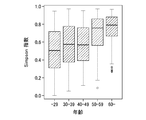
- the aging skin index calculated from the presence or absence of sagging, wrinkles, or firmness of the facial skin is the abundance of a group of bacteria that can be called “aging skin bacteria” consisting of bacteria species belonging to the Gammaproteobacteria class or Propionibacterium granulosum. And showed a correlation.
- FIG. 6 is a graph showing that the difference in relative amount of bacterial species belonging to each of Proteobacteria and Firmictes correlates with the occurrence of alveolar pyorrhea and periodontal disease.
- the results of analysis by multiple regression analysis of whether the relative amount and actual age correlate with various physical symptoms are shown. The physical symptoms that indicate are listed.
- One embodiment of the present invention is a method for assessing the physical condition of a subject, Regarding the existence ratio of skin resident microorganisms on the skin surface or a parameter based on the existence ratio for which the correlation standard with the physical condition has been prepared, the value of the skin microbiota collected from the skin surface of the subject is determined, A method comprising a step of contrasting with a correlation criterion.
- a method comprising a step of contrasting with a correlation criterion.
- Another embodiment of the present invention is a method for presenting information to a subject comprising: A step of evaluating the physical condition of the subject by the evaluation method; When it is evaluated that the physical state is not in the target state, the presence ratio or the numerical range indicated by the parameter is based on the correlation criterion when the physical state is in the target state. And presenting information registered in the database as a component capable of deriving the value of the parameter. Thereby, the information regarding improvement of a physical condition etc. can be personalized and shown to a test subject.
- the information here refers to the name of the ingredient or ingredient-containing preparation, the usage / dose of the ingredient / formulation, the expected improvement and degree of physical condition, side effects, and the like.
- the step of re-evaluating the subject's physical condition after ingesting the component by the above evaluation method further includes a step of updating the information based on the degree of improvement of the physical condition evaluated again.
- the information in the database is improved, and it is expected that the accuracy of improvement of the physical condition and the like will be further increased.
- the timing of re-evaluation is not particularly limited, and may be, for example, when the time when improvement of the physical condition is expected after use of the component (which can be included in the information in the database) has elapsed.
- Another embodiment of the present invention is a method of screening for a substance that improves or prevents a physical condition comprising: The step of selecting the candidate substance based on the change by the candidate substance regarding the existence ratio of the skin resident microorganisms on the skin surface or the value of the parameter based on the existence ratio for which the correlation standard with the physical condition has been created It is the method which has. Thereby, it is expected that a substance that improves or prevents the physical condition is screened with high probability.
- the screening in the present invention is sufficient if the existence probability of the substance that improves or prevents the physical condition is higher in the candidate substance group after the screening than the candidate substance group before the screening. You don't need to be able to improve or prevent your physical condition. Therefore, it is preferable to further perform a step of confirming that the screened candidate substance has an effect of improving or preventing the physical condition.
- the skin resident microorganism may be a bacterium or a fungus, and among them, a bacterium is preferable.
- the abundance may be related to any of the gates, classes, eyes, families, genera and species. For example, it may be an abundance ratio of at least one kind of bacteria selected from the group consisting of bacteria belonging to the Actinobacterium gate, bacteria belonging to the Proteobacteria gate, and bacteria belonging to the Firmices gate. The presence ratio of acnes bacteria.
- the parameter is not particularly limited as long as it is based on the abundance ratio of skin resident microorganisms, and may be a difference, sum, product, ratio, or a combination of abundance ratios of a plurality of skin resident microorganisms. It may be a combination. For example, the difference of the relative amount of the bacterial species which belongs to the Proteobacteria gate and the bacterial species which belongs to the Firmictes gate is mentioned. Alternatively, the parameter may be a diversity index of skin resident microorganisms.
- the body condition is not particularly limited as long as it has a correlation with the presence ratio of skin resident microorganisms on the skin surface or a parameter based on the presence ratio, and skin, hair, teeth, urine, bone, viscera, blood, urine , It can be a condition relating to any part such as a nerve.
- skin conditions include skin age, oily skin, acne skin, skin blots, dullness, sagging, wrinkles, burrs, pores, skin yellowing, and the like.
- Examples of the state of the hair include thin hair and hair loss.
- the dental condition include periodontal disease and alveolar pyorrhea.
- bone, visceral, blood, urine, and nerve states include liver function, high uric acid, knee pain, osteoporosis, autonomic dysfunction, diabetes, and the like.
- menstrual periods that can affect female hormones and beauty are also included in the physical condition.
- Correlation criteria are criteria that can qualitatively or quantitatively identify the goodness or severity of the physical condition to be evaluated based on the above-mentioned abundance ratio or parameter value obtained from the skin microflora.
- the correlation criterion is preferably after elimination of the effects of at least one of the events known to correlate with the physical condition. Thereby, it is possible to suppress the influence on the presence / absence and the degree of the above-mentioned other events related to the subject, and to more accurately evaluate the body condition based on the existence ratio of the skin microflora or the parameter value. Further, in the method of presenting information to the subject, it is possible to present more appropriate information in consideration of the presence or absence and the degree of the other events related to the subject.
- the correlation criterion may be created for a quasi-population classified by at least one selected from the group consisting of age, sex, residential area, nationality, and race of the population.
- the method of presenting information to the subject it is possible to present more appropriate information in consideration of the subject's age, sex, residential area, nationality, and race.
- at least one input selected from the group consisting of age, sex, residential area, nationality, and race regarding the subject is preferable.
- the screening method of the substance which improves or prevents a physical condition it becomes easy to acquire the substance which can improve or prevent a physical condition suitable for a user's age, sex, residence area, nationality, and race.
- the location where the skin microbiota is collected is not particularly limited, and may be the face, scalp, armpits, navel, etc. Among them, the face, particularly the forehead, may be mentioned. In addition, it is preferable that the collection location of the population sample for which the correlation criterion is created and the collection location of the subject sample match.
- Example 1 A questionnaire survey on age, skin quality, etc. was conducted on 1,100 Japanese women aged 18-69 who were arbitrarily selected from all prefectures except Okinawa. For the women who conducted the questionnaire survey, the bacterial flora of the facial skin was analyzed simultaneously with the questionnaire by the following method.
- the analysis of the bacterial flora was performed according to the flowchart shown in FIG. ⁇ Contact process S1 and peeling process S2 An adhesive tape 1 shown in FIG. 2 is prepared.
- the pressure-sensitive adhesive tape 1 has a structure in which a coating layer 3 made of a pressure-sensitive adhesive is provided on a flaky tape base material 2 serving as a base. For this reason, the contact process S1 can be easily performed by sticking to human skin in the same manner as a normal bandage or dressing tape.
- the adhesive tape 1 was affixed to a release paper (not shown), and was sent to the subject together with latex gloves in a sealed state in an aluminum bag containing a desiccant that could be sealed.
- the subject wears latex gloves immediately after getting up, opens the aluminum bag, takes out the release paper to which the adhesive tape 1 is attached, peels off the adhesive tape 1 and attaches it to the subject's forehead. And after maintaining the state made to adhere for 5 minutes, the adhesive tape 1 was peeled off, it was laid on the release paper, this was put into the aluminum bag with the desiccant, and was sealed. Thereafter, the sample was stored frozen until a DNA analysis test was performed.
- Genome analysis step S4 Using the DNA solution obtained as described above, the 16S ribosomal RNA gene contained in the solution was amplified using the PCR method, and then DNA was used using a sequencer (NGS) (trade name: Miseq, manufactured by Illumina). Analysis was performed.
- NGS sequencer
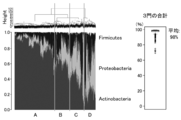
- FIG. 3 shows the result of clustering analysis based on the weighted UniFrac distance. This specimen was found to be divided into four groups. About half of the specimens belonged to the largest group, and the differences within the group were found to be relatively small.
- FIG. 4 shows the breakdown of the structure at the gate level.
- the facial flora was mostly occupied by bacteria belonging to the three gates of Actinobacterium, Protebacteria, and Firmices. It was found that the amount of Actinobacteria gate, which is the largest constituent species, changes roughly in response to the grouping obtained by clustering analysis.
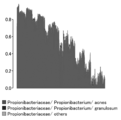
- Fig. 5 shows the same analysis performed by a department that is a lower classification group.
- the three abundances of the family were Protinobacteriaceae of Actinobacterium, Xanthomonedaceae of Proteobacteria, and Staphylococcusaceae of Firmicutes. These three families accounted for an average of 72% of the bacterial flora.
- the Staphylococcalaceae family includes the prominent skin resident bacteria, Staphylococcus epidermidis.
- P. is the largest constituent strain.
- P.I. The relative amount of Acnes bacteria is correlated with the actual age. It was found that the amount of acnes bacteria decreased (left of FIG. 10, box-and-whisker plot. Red indicates the average value of each age group).
- P.P. The amount of acnes bacteria also correlated with the skin oiliness. 1074 people were divided based on both age and skin quality (types of oily, normal, and dry skin). The average value of acnes bacteria amount was calculated and plotted (FIG. 10 right). As a result, P.I. The amount of acnes was found to correlate with the oily degree of skin independently of age.
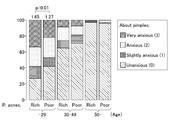
- Example 4 (Relationship between PF amount and acne) Next, it was found that the amount of PF (the difference in relative amount between the bacterial species belonging to the Proteobacteria phylum and the bacterial species belonging to the Firmictes genus) also correlated with acne symptoms. When the samples were divided into 3 groups according to the amount of PF, it was found that acne symptoms were strong in the group with a small value (specimens with a greater number of Firmucutes gates than Proteobacteria gates) (FIG. 13). In addition, since the amount of PF does not show a change correlated with age, the treatment for removing the age effect is not performed.
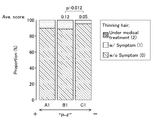
- FIG. 20 shows the result.
- the vertical axis represents the above-mentioned aging skin index normalized.
- Each specimen is grouped by age and abundance of the above bacterial species.
- the classification based on the amount of bacteria uses the sum of the relative abundance of the Gammaproteobacteria class and the relative abundance of Propionibacterium granulosum (referred to as “aged skin” bacteria amount), and this value is the highest in all samples. They are classified into 3 groups: people included in 25%, people included in lower 25%, and others.
Landscapes
- Life Sciences & Earth Sciences (AREA)
- Health & Medical Sciences (AREA)
- Engineering & Computer Science (AREA)
- Chemical & Material Sciences (AREA)
- Physics & Mathematics (AREA)
- Bioinformatics & Cheminformatics (AREA)
- Biotechnology (AREA)
- General Health & Medical Sciences (AREA)
- Organic Chemistry (AREA)
- Molecular Biology (AREA)
- Genetics & Genomics (AREA)
- Biophysics (AREA)
- Medical Informatics (AREA)
- Proteomics, Peptides & Aminoacids (AREA)
- Wood Science & Technology (AREA)
- Zoology (AREA)
- Analytical Chemistry (AREA)
- Immunology (AREA)
- Bioinformatics & Computational Biology (AREA)
- Evolutionary Biology (AREA)
- Spectroscopy & Molecular Physics (AREA)
- Theoretical Computer Science (AREA)
- Biomedical Technology (AREA)
- Biochemistry (AREA)
- Microbiology (AREA)
- General Engineering & Computer Science (AREA)
- Data Mining & Analysis (AREA)
- Databases & Information Systems (AREA)
- Artificial Intelligence (AREA)
- Public Health (AREA)
- Bioethics (AREA)
- Computer Vision & Pattern Recognition (AREA)
- Hematology (AREA)
- Epidemiology (AREA)
- Evolutionary Computation (AREA)
- Software Systems (AREA)
- Urology & Nephrology (AREA)
- Plant Pathology (AREA)
- Cell Biology (AREA)
- Virology (AREA)
Priority Applications (3)
| Application Number | Priority Date | Filing Date | Title |
|---|---|---|---|
| US15/745,468 US11802310B2 (en) | 2015-07-21 | 2016-07-21 | Method for evaluating physical conditions, method for presenting information, and method for screening for substance capable of improving or preventing physical conditions |
| CN201680042680.0A CN107922979B (zh) | 2015-07-21 | 2016-07-21 | 身体状态的评价方法、信息的提示方法、及改善或预防身体状态的物质的筛选方法 |
| EP16827816.6A EP3327136A4 (en) | 2015-07-21 | 2016-07-21 | Method for evaluating physical conditions, method for presenting information, and method for screening for substance capable of improving or preventing physical conditions |
Applications Claiming Priority (4)
| Application Number | Priority Date | Filing Date | Title |
|---|---|---|---|
| JP2015143583 | 2015-07-21 | ||
| JP2015-143583 | 2015-07-21 | ||
| JP2016-100475 | 2016-05-19 | ||
| JP2016100475A JP6046849B1 (ja) | 2015-07-21 | 2016-05-19 | 身体状態の評価方法、情報の提示方法、および身体状態を改善又は予防する物質のスクリーニング方法 |
Publications (1)
| Publication Number | Publication Date |
|---|---|
| WO2017014256A1 true WO2017014256A1 (ja) | 2017-01-26 |
Family
ID=57572376
Family Applications (1)
| Application Number | Title | Priority Date | Filing Date |
|---|---|---|---|
| PCT/JP2016/071355 Ceased WO2017014256A1 (ja) | 2015-07-21 | 2016-07-21 | 身体状態の評価方法、情報の提示方法、および身体状態を改善又は予防する物質のスクリーニング方法 |
Country Status (5)
| Country | Link |
|---|---|
| US (1) | US11802310B2 (https=) |
| EP (1) | EP3327136A4 (https=) |
| JP (2) | JP6046849B1 (https=) |
| CN (1) | CN107922979B (https=) |
| WO (1) | WO2017014256A1 (https=) |
Cited By (4)
| Publication number | Priority date | Publication date | Assignee | Title |
|---|---|---|---|---|
| WO2020004626A1 (ja) * | 2018-06-29 | 2020-01-02 | 国立大学法人大阪大学 | 眼表面組織を用いる結膜疾患検出方法及び老化バイオマーカー |
| CN111132615A (zh) * | 2017-09-15 | 2020-05-08 | 株式会社玫丽盼 | 评价方法、选定方法、评价辅助工具以及筛选方法 |
| KR20210081190A (ko) * | 2019-12-23 | 2021-07-01 | 주식회사 테라젠바이오 | 피부 유분 위험도 예측용 바이오마커 및 이의 용도 |
| JP2023544881A (ja) * | 2020-10-13 | 2023-10-25 | ジボダン エス エー | 微生物叢シグネチャ |
Families Citing this family (11)
| Publication number | Priority date | Publication date | Assignee | Title |
|---|---|---|---|---|
| JP2019062887A (ja) * | 2017-09-28 | 2019-04-25 | 日光ケミカルズ株式会社 | 皮膚常在細菌叢解析を用いた皮膚状態を予測する方法 |
| JP7081802B2 (ja) * | 2018-06-04 | 2022-06-07 | 日本メナード化粧品株式会社 | 赤ニキビを予測する方法 |
| JP7190266B2 (ja) * | 2018-06-19 | 2022-12-15 | ポーラ化成工業株式会社 | 特定の肌状態と相関のある特定の環境由来菌の菌量に基づく、肌状態の診断方法、皮膚常在細菌叢の多様性の推測方法、特定の環境由来菌の菌量の推測方法、特定の肌状態と相関のある菌の属性を解析する方法、肌状態改善作用を有する物質又は美容方法のスクリーニング方法 |
| JP6533930B1 (ja) * | 2018-08-23 | 2019-06-26 | 一般社団法人日本農業フロンティア開発機構 | 疾病評価指標算出方法、装置、システム、及び、プログラム、並びに、疾病評価指標を算出するためのモデル作成方法。 |
| EP4023745B1 (en) * | 2019-08-26 | 2025-10-08 | MySkin Corporation | Adhesive tape for collecting skin microorganisms or skin metabolites |
| CN114450534A (zh) * | 2019-09-30 | 2022-05-06 | 大金工业株式会社 | 信息处理装置 |
| JP7082354B2 (ja) * | 2020-03-26 | 2022-06-08 | 学校法人関西文理総合学園 | 体毛試料からのポリヌクレオチドサンプルの調製方法、rnaの発現解析方法、dnaの解析方法、体毛試料の保管試薬及び体毛試料の採取キット |
| US20230320707A1 (en) * | 2020-06-11 | 2023-10-12 | Agency For Science, Technology And Research | A skin microbe sampler and related methods |
| WO2022121864A1 (zh) * | 2020-12-08 | 2022-06-16 | 复旦大学 | 用于皮肤分型的标志物组合及其应用 |
| WO2023204570A1 (ko) * | 2022-04-19 | 2023-10-26 | 코스맥스 주식회사 | 피부 마이크로바이옴에 기초한 피부 정보 제공 장치 및 방법 |
| JP2025166278A (ja) * | 2022-09-30 | 2025-11-06 | 株式会社Kins | バイオマーカ及び判定補助方法 |
Citations (1)
| Publication number | Priority date | Publication date | Assignee | Title |
|---|---|---|---|---|
| JP2015512255A (ja) * | 2012-03-17 | 2015-04-27 | ザ リージェンツ オブ ザ ユニバーシティ オブ カリフォルニア | ざ瘡の高速診断および個人化された治療 |
Family Cites Families (12)
| Publication number | Priority date | Publication date | Assignee | Title |
|---|---|---|---|---|
| JP5635221B2 (ja) | 2004-12-24 | 2014-12-03 | 株式会社明治 | 皮膚改善用及び/又は治療用の発酵乳とその製造方法 |
| US7763442B2 (en) * | 2006-08-31 | 2010-07-27 | Kimberly-Clark Worldwide, Inc. | Method for detecting candida on skin |
| JP2008148629A (ja) * | 2006-12-18 | 2008-07-03 | Canon Inc | 複数種の微生物存在下における感染症起炎微生物を検出する方法 |
| JP2009126863A (ja) * | 2007-11-27 | 2009-06-11 | Koei Kogyo Kk | キノコから抽出したエルゴチオネインを高含有する組成物 |
| WO2010013182A1 (en) * | 2008-07-29 | 2010-02-04 | L'oreal | Cosmetic use of microorganism(s) for the treatment of scalp disorders |
| IT1404171B1 (it) * | 2011-02-10 | 2013-11-15 | Paladin Pharma S P A | Composizione per l'uso nel trattamento dei problemi/disturbi della menopausa e nel trattamento dell'invecchiamento generale dell'organismo |
| US20150044144A1 (en) * | 2012-03-06 | 2015-02-12 | Raymat Materials, Inc. | Disinfectant solution |
| JP6058902B2 (ja) | 2012-03-13 | 2017-01-11 | 株式会社 資生堂 | 肌状態解析方法、肌状態解析装置、及び、肌状態解析システム、並びに、該肌状態解析方法を実行させるためのプログラム、及び、該プログラムを記録した記録媒体 |
| AU2013248301B2 (en) * | 2012-04-16 | 2017-11-09 | Lubrizol Advanced Materials, Inc. | Compounds for the treatment and/or care of the skin and/or mucous membranes and their use in cosmetic or pharmaceutical compositions |
| WO2014023803A1 (en) | 2012-08-10 | 2014-02-13 | Galderma Research & Development | Method for the diagnosis of rosacea |
| AU2014281553A1 (en) | 2013-06-18 | 2016-01-28 | Prodermiq, Inc. | Customized skin care products and personal care products based on the analysis of skin flora |
| JP6637885B2 (ja) * | 2013-07-21 | 2020-01-29 | ペンデュラム セラピューティクス, インコーポレイテッド | マイクロバイオームの特性解明、モニタリング、および処置のための方法およびシステム |
-
2016
- 2016-05-19 JP JP2016100475A patent/JP6046849B1/ja active Active
- 2016-07-21 CN CN201680042680.0A patent/CN107922979B/zh active Active
- 2016-07-21 EP EP16827816.6A patent/EP3327136A4/en active Pending
- 2016-07-21 WO PCT/JP2016/071355 patent/WO2017014256A1/ja not_active Ceased
- 2016-07-21 US US15/745,468 patent/US11802310B2/en active Active
- 2016-11-16 JP JP2016223014A patent/JP6874244B2/ja active Active
Patent Citations (1)
| Publication number | Priority date | Publication date | Assignee | Title |
|---|---|---|---|---|
| JP2015512255A (ja) * | 2012-03-17 | 2015-04-27 | ザ リージェンツ オブ ザ ユニバーシティ オブ カリフォルニア | ざ瘡の高速診断および個人化された治療 |
Non-Patent Citations (4)
| Title |
|---|
| "NIH Human Microbiome Project defines normal bacterial makeup of the body", NIH PRESS RELEASE, 2012, XP055349012, Retrieved from the Internet <URL:https://www.genome.gov/ 27549144> [retrieved on 20160715] * |
| DIETERT.RODNEY R. ET AL.: "The microbiome and sustainable healthcare", HEALTHCARE, vol. 3, March 2015 (2015-03-01), pages 100 - 129, XP055349013 * |
| SCHLOSS. PATRICK D: "An integrated view of the skin microbiome", NATURE, vol. 514, 2014, pages 44 - 45, XP055349016 * |
| ZHANG ENSHI ET AL.: "Characterization of the skin fungal microbiota in patients with atopic dermatitis and in healthy subjects", MICROBIOLOGY AND IMMUNOLOGY, vol. 55, 2011, pages 625 - 632, XP055102061 * |
Cited By (8)
| Publication number | Priority date | Publication date | Assignee | Title |
|---|---|---|---|---|
| CN111132615A (zh) * | 2017-09-15 | 2020-05-08 | 株式会社玫丽盼 | 评价方法、选定方法、评价辅助工具以及筛选方法 |
| CN111132615B (zh) * | 2017-09-15 | 2023-10-31 | 株式会社玫丽盼 | 评价方法、选定方法、评价辅助工具以及筛选方法 |
| WO2020004626A1 (ja) * | 2018-06-29 | 2020-01-02 | 国立大学法人大阪大学 | 眼表面組織を用いる結膜疾患検出方法及び老化バイオマーカー |
| JPWO2020004626A1 (ja) * | 2018-06-29 | 2021-08-02 | 国立大学法人大阪大学 | 眼表面組織を用いる結膜疾患検出方法及び老化バイオマーカー |
| JP7312170B2 (ja) | 2018-06-29 | 2023-07-20 | 国立大学法人大阪大学 | 眼表面組織を用いる結膜疾患検出方法及び老化バイオマーカー |
| KR20210081190A (ko) * | 2019-12-23 | 2021-07-01 | 주식회사 테라젠바이오 | 피부 유분 위험도 예측용 바이오마커 및 이의 용도 |
| KR102297562B1 (ko) | 2019-12-23 | 2021-09-03 | 주식회사 테라젠바이오 | 피부 유분 위험도 예측용 바이오마커 및 이의 용도 |
| JP2023544881A (ja) * | 2020-10-13 | 2023-10-25 | ジボダン エス エー | 微生物叢シグネチャ |
Also Published As
| Publication number | Publication date |
|---|---|
| EP3327136A4 (en) | 2019-01-02 |
| JP2017029133A (ja) | 2017-02-09 |
| CN107922979B (zh) | 2022-04-05 |
| CN107922979A (zh) | 2018-04-17 |
| US20180208982A1 (en) | 2018-07-26 |
| EP3327136A1 (en) | 2018-05-30 |
| US11802310B2 (en) | 2023-10-31 |
| JP2017029174A (ja) | 2017-02-09 |
| JP6046849B1 (ja) | 2016-12-21 |
| JP6874244B2 (ja) | 2021-05-19 |
Similar Documents
| Publication | Publication Date | Title |
|---|---|---|
| JP6046849B1 (ja) | 身体状態の評価方法、情報の提示方法、および身体状態を改善又は予防する物質のスクリーニング方法 | |
| Kamaraj et al. | An evaluation of microbial profile in halitosis with tongue coating using PCR (polymerase chain reaction)-a clinical and microbiological study | |
| Zhang et al. | Microbiome variations in preschool children with halitosis | |
| JP7684903B2 (ja) | 皮膚常在微生物採取用粘着テープ、被験者の身体状態を評価する方法、被験者に情報を提示する方法及び身体状態を改善又は予防する物質をスクリーニングする方法、並びに、皮膚代謝物採取用粘着テープ | |
| JP6419654B2 (ja) | 発毛の状態及び頭皮の圧縮応力の評価方法 | |
| JP2007199053A (ja) | 角層蛋白質の検出方法並びにこれを利用する表皮ターンオーバーの評価方法及び肌状態評価方法 | |
| US20180136228A1 (en) | In-vitro method and kit for diagnosing the risk of suffering from caries | |
| Li et al. | Axillary fossaa microbial dysbiosis and its relationship with axillary osmidrosis patients | |
| JP2023057330A (ja) | 肌状態の推定方法 | |
| JP2023544881A (ja) | 微生物叢シグネチャ | |
| JP7190266B2 (ja) | 特定の肌状態と相関のある特定の環境由来菌の菌量に基づく、肌状態の診断方法、皮膚常在細菌叢の多様性の推測方法、特定の環境由来菌の菌量の推測方法、特定の肌状態と相関のある菌の属性を解析する方法、肌状態改善作用を有する物質又は美容方法のスクリーニング方法 | |
| Saravia et al. | Evaluation of chair-side assays in high microbiological caries-risk subjects | |
| JP7693380B2 (ja) | 被験者を層別化する方法 | |
| Hussein et al. | Caries risk assessment in children using salivary parameters | |
| JP7312170B2 (ja) | 眼表面組織を用いる結膜疾患検出方法及び老化バイオマーカー | |
| JP7795167B2 (ja) | 皮膚常在菌叢解析を用いて皮膚状態を予測する方法 | |
| CN114052666A (zh) | 评估脸部皮肤年龄的方法及在化妆品功效测试中的应用 | |
| Al-Tawil et al. | Inpatients’ satisfaction toward nursing services in the medical and surgical wards of Rizgary Teaching Hospital, Erbil, Iraq | |
| shirish Joshi et al. | Analysis of Salivary Flow Rate, Buffering Capacity and Isolation Of Strep-tococcus mutans Using Selective MSKB Media in Caries Active and Caries Free School Children | |
| KR20250057099A (ko) | 평가 방법, 선정 방법, 평가 지원 도구, 및 스크리닝 방법 | |
| JP2010088654A (ja) | 皮膚生理指標による肌の鑑別法 | |
| CN111132615A (zh) | 评价方法、选定方法、评价辅助工具以及筛选方法 | |
| Yuan | Exploratory research for pathogenesis of papulopustular rosacea and skin barrier research in Besançon and Shanghai | |
| Putri et al. | Relationship between history of household contact and rate of leprosy in Central Jakarta area in 2017 | |
| JP2023104355A (ja) | 記憶機能の測定方法 |
Legal Events
| Date | Code | Title | Description |
|---|---|---|---|
| 121 | Ep: the epo has been informed by wipo that ep was designated in this application |
Ref document number: 16827816 Country of ref document: EP Kind code of ref document: A1 |
|
| WWE | Wipo information: entry into national phase |
Ref document number: 15745468 Country of ref document: US |
|
| NENP | Non-entry into the national phase |
Ref country code: DE |