WO2017010339A1 - 車載機及びコンピュータプログラム - Google Patents
車載機及びコンピュータプログラム Download PDFInfo
- Publication number
- WO2017010339A1 WO2017010339A1 PCT/JP2016/069847 JP2016069847W WO2017010339A1 WO 2017010339 A1 WO2017010339 A1 WO 2017010339A1 JP 2016069847 W JP2016069847 W JP 2016069847W WO 2017010339 A1 WO2017010339 A1 WO 2017010339A1
- Authority
- WO
- WIPO (PCT)
- Prior art keywords
- telephone
- unit
- information
- selection
- setting
- Prior art date
- Legal status (The legal status is an assumption and is not a legal conclusion. Google has not performed a legal analysis and makes no representation as to the accuracy of the status listed.)
- Ceased
Links
Images


Classifications
-
- H—ELECTRICITY
- H04—ELECTRIC COMMUNICATION TECHNIQUE
- H04M—TELEPHONIC COMMUNICATION
- H04M1/00—Substation equipment, e.g. for use by subscribers
-
- H—ELECTRICITY
- H04—ELECTRIC COMMUNICATION TECHNIQUE
- H04W—WIRELESS COMMUNICATION NETWORKS
- H04W4/00—Services specially adapted for wireless communication networks; Facilities therefor
- H04W4/30—Services specially adapted for particular environments, situations or purposes
- H04W4/33—Services specially adapted for particular environments, situations or purposes for indoor environments, e.g. buildings
Definitions
- This disclosure relates to an in-vehicle device and a computer program.
- a configuration is provided in which a plurality of mobile phones are communicably connected to a single in-vehicle device. For example, when a user has a plurality of mobile phones and gets on the vehicle, and the plurality of mobile phones are registered in the in-vehicle device, the plurality of mobile phones are connected to be communicable with the in-vehicle device (for example, Patent Document 1 and Patent). Reference 2).
- a user is expected to select a desired mobile phone from the plurality of mobile phones and make a call. For example, if the radio field intensity differs depending on the carrier, a request to transmit from a mobile phone having the strongest radio field intensity is assumed. A carrier is also called a carrier. In this case, the user performs the following operation to select the mobile phone with the highest radio field intensity. First, the user selects one of a plurality of mobile phones. At this time, since the icon indicating the radio field intensity of the selected mobile phone is displayed, the user confirms the radio field intensity of the selected mobile phone. When the user determines that the mobile phone has the highest radio field intensity, the user makes a call from the selected mobile phone.
- the user determines that the mobile phone has the strongest radio field strength, determines that there is another mobile phone with the strongest radio field strength, and determines that it is necessary to check the radio field strength of another mobile phone, the user returns to the beginning. Select the mobile phone again. The user repeats reselection of the mobile phone until it is determined that the mobile phone has the highest radio field intensity. In this way, a complicated operation is required for a request to make a call from a mobile phone having the highest radio field intensity. In addition, it is assumed that there is a request to make a call by selecting a mobile phone whose destination phone number is registered in the phone book, as well as a request to make a call from a mobile phone having the strongest radio wave intensity. Even in this case, a complicated operation is required in the same manner.
- This disclosure is intended to provide an in-vehicle apparatus and a computer program that can be easily transmitted from a desired telephone in a situation where a plurality of telephones can be connected to the in-vehicle apparatus and can improve convenience.
- the in-vehicle device includes a connection unit that is communicably connected to a plurality of telephones, a setting reception unit that receives setting of a selection method from a user, and the selection method received by the setting reception unit.
- the selection receiving unit When the selection receiving unit accepts the selection of the transmission destination from the storage control unit that stores the setting in the storage unit as the setting information, the selection receiving unit that accepts the selection of the transmission destination from the user, at that time Information for acquiring setting information specifying unit for specifying setting information stored in the storage unit, and telephone information corresponding to the setting information specified by the setting information specifying unit for a plurality of telephones connectable to the connection unit An obtaining unit; a calling phone selection unit that selects one phone as a calling phone from a plurality of phones using the phone information obtained by the information obtaining unit; and And a transmission operation control unit to perform the transmission operation to a selected phone as originating telephone by machine selection unit.
- the computer program includes a setting reception procedure for receiving a setting of a selection method from a user in a control unit of the in-vehicle device having a connection unit that is communicably connected to a plurality of telephones , A storage control procedure for storing the setting method selected in the setting acceptance procedure in the storage unit as setting information, a selection acceptance procedure for accepting selection of a destination from the user, and a selection of a destination from the user.
- the setting information identifying procedure for identifying the setting information stored in the storage unit at that time, and the setting information identified by the setting information identifying procedure for a plurality of telephones connectable to the connecting unit Using the information acquisition procedure for acquiring the corresponding telephone information and the telephone information acquired by the information acquisition procedure, a plurality of power sources that can be connected to the connection unit are used. And originating telephone selection procedure for selecting one of the phone as originating telephone from the machine, and transmission operation control procedure to perform the transmission operation on the telephone selected as originating telephone by the originating telephone selection procedure, thereby running.
- the selection method setting is stored as setting information. Thereafter, when the user selects a destination, the stored setting information is used to select a telephone corresponding to the setting information as a calling telephone from a plurality of telephones that can be connected to the in-vehicle device. Make a call from the phone selected as. That is, by setting a selection method in advance, the user can make a call from a desired telephone simply by selecting a destination. Thereby, in a situation where a plurality of telephones can be connected to the in-vehicle device, it is possible to easily make a call from a desired telephone, and it is possible to improve convenience.
- FIG. 1 is a functional block diagram illustrating an embodiment of the present disclosure.
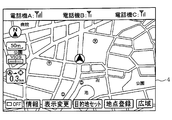
- FIG. 2 is a diagram showing a radio wave intensity display screen.
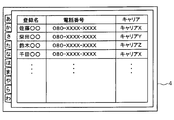
- FIG. 3 is a diagram showing a phone book data display screen.
- FIG. 4 is a flowchart showing the selection method setting process.
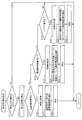
- FIG. 5 is a flowchart showing the destination selection process.
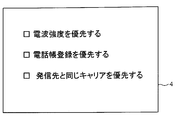
- FIG. 6 is a diagram showing a selection method setting screen.
- the in-vehicle device 1 mounted on the vehicle includes a control unit 2, a connection unit 3, a user interface (UI) unit 4, a storage unit 5, and a voice recognition unit 6.
- the control unit 2 includes a microcomputer having a CPU (Central Processing Unit), a ROM (Read Only Memory), a RAM (Random Access Memory), and an I / O (Input / Output).
- the control unit 2 executes a computer program stored in a computer-readable non-transitional recording medium, thereby executing processing corresponding to the computer program and controlling the overall operation of the in-vehicle device 1.
- ROM and RAM may correspond to an example of a computer-readable non-transitional recording medium.
- the connection unit 3 includes a plurality of BT chips 3a to 3n each having a Bluetooth (registered trademark) connection function.
- Bluetooth is referred to as BT.
- the connection unit 3 searches for a BT device to which a BT address registered in advance in the connection unit 3 is assigned.
- the search of the BT device is successful, the connection unit 3 and the BT chips 3a to 3n A BT device that has succeeded in the search is connected in a one-to-one relationship so that BT communication is possible.
- connection unit 3 is connected to the BT chip 3a. To 3n and mobile phones 11a to 11n are connected in a one-to-one relationship so that BT communication is possible.
- Each of the cellular phones 11a to 11n stores a plurality of (for example, several hundreds) phone book data in which registered names, telephone numbers, and carriers are associated as one data.
- a carrier is also called a telecommunications carrier.
- connection unit 3 When the connection unit 3 succeeds in searching for the mobile phones 11a to 11n and completes the pairing between the BT chips 3a to 3n and the mobile phones 11a to 11n and connects the BT line, the connection unit 3 conforms to the BT communication standard.
- HFP is a protocol that defines a hands-free call with short-range wireless connection.
- HFP is a protocol that defines a hands-free call with short-range wireless connection.
- the connection unit 3 transfers information related to the radio field strength of the mobile phones 11a to 11n from the mobile phones 11a to 11n, and acquires information related to the radio field strength of the mobile phones 11a to 11n.
- PBAP is a protocol that prescribes telephone directory data transfer for short-range wireless connection.
- the connection unit 3 transfers the phone book data of the mobile phones 11a to 11n from the mobile phones 11a to 11n, and stores information related to the phone book registration of the mobile phones 11a to 11n and information related to the carrier. Obtained from the mobile phones 11a to 11n.
- the BT chips 3a to 3n and the cellular phones 11a to 11n are specifications in which a plurality of profiles cannot be connected at the same time (single profile)
- the HFP and the PBAP are sequentially connected in a predetermined order. To do.
- the BT chips 3a to 3n and the mobile phones 11a to 11n are specifications capable of simultaneous connection of a plurality of profiles (multi-profile) between them, the HFP and the PBAP are simultaneously connected.
- the UI unit 4 is a display including, for example, a liquid crystal panel, an organic EL (Electro-Luminescence) panel, and the like.
- a mechanical switch is arranged around the display area and a touch panel is formed on the screen.
- the UI unit 4 outputs an operation detection signal indicating the operation content to the control unit 2.
- the display unit receives a display command signal from the control unit 2, the UI unit 4 displays (draws) a screen specified by the input display command signal.
- FIG. 2 exemplifies a situation where the radio field strengths of the three mobile phones A to C are strong in the order of the mobile phone A, the mobile phone C, and the mobile phone B.
- the control unit 2 displays the phone book data (phone book registration and carrier) in the state where the information related to the phone book registration and the information related to the carrier of the mobile phones 11a to 11n are acquired by the connection unit 3 as described above.
- 3 is output to the UI unit 4
- the phone book data display screen showing the phone book data of the cellular phones 11a to 11n is displayed on the UI unit 4, as shown in FIG.
- FIG. 3 illustrates telephone book data of “Sa line”.
- the phone book data displayed on the phone book data display screen is phone book data obtained by merging the phone book data individually registered in the mobile phones 11a to 11n. That is, for example, if the search of three mobile phones succeeds and the phone book data is transferred from the three mobile phones, the phone book in which the phone book data registered in each of the three mobile phones is merged It is data.
- FIG. 3 is illustrated based on the line of the Japanese syllabary which is a rule regarding Japanese kana characters.
- the Japanese syllabary is classified into 10 types of rows (“A”, “Sa” etc.).
- “Sa line” includes five kinds of sounds (sa, shi, shi, se, so). That is, the telephone book data having registered names starting with these five kinds of sounds is displayed in “Sa line” in the present embodiment.
- the present disclosure is not limited to the format shown in FIG. 3 and can be applied according to each language system.
- the storage unit 5 stores information on the radio wave intensity acquired by the connection unit 3 from the mobile phones 11a to 11n, information on phone book registration, and information on the carrier.
- the storage unit 5 stores setting information, which will be described later in detail.
- the voice recognition unit 6 is connected to a microphone 7 arranged at a predetermined location in the passenger compartment. When the microphone 7 captures the voice uttered by the user, the microphone 7 outputs the captured voice to the voice recognition unit 6. When speech is input from the microphone 7, the speech recognition unit 6 recognizes the input speech according to a predetermined speech recognition algorithm, and outputs the speech recognition result to the control unit 2.
- the control unit 2 includes a setting reception unit 2a, a storage control unit 2b, a selection reception unit 2c, a setting information specifying unit 2d, an information acquisition unit 2e, a calling telephone selection unit 2f, and a transmission operation control unit 2g. Have.
- Each of these units 2a to 2g is realized by software.
- the units 2a to 2g may be realized by hardware, or may be realized by a combination of hardware and software.
- the setting accepting unit 2a accepts the setting of the selection method from the user when the user sets the selection method.
- the user sets one of “radio field priority”, “phone book registration priority”, and “carrier priority” as the selection method.
- the method for setting the selection method by the user may be that the user operates the UI unit 4, or the voice related to the setting of the selection method issued by the user may be recognized by the voice recognition unit 6.
- the storage control unit 2b stores the accepted setting method setting in the storage unit 5 as setting information.
- the selection accepting unit 2c accepts selection of a destination from the user when the user selects the destination.
- the user may select the destination by operating the UI unit 4 or by the voice recognition unit 6 recognizing the voice related to the selection of the destination issued by the user.
- the setting information specifying unit 2d specifies the setting information stored in the storage unit 5 at that time.
- the information acquiring unit 2e acquires the telephone information corresponding to the setting information for the mobile phones 11a to 11n. That is, the information acquisition unit 2e acquires information related to radio wave strength when the setting information is “radio field priority”, and acquires information related to phone book registration when the setting information is “phone book priority”. When the setting information is “carrier priority”, information related to the carrier is acquired.
- the outgoing telephone selection unit 2f selects one mobile telephone from the mobile telephones 11a to 11n as the outgoing telephone using the acquired telephone information.
- the outgoing operation controller 2g causes the mobile phone selected as the outgoing telephone to perform an outgoing operation.
- the control unit 2 performs a selection method setting process illustrated in FIG. 4 and a destination selection process illustrated in FIG. 5 in relation to the present disclosure.
- a processing will be described.
- a case will be described in which a mobile phone is selected as a destination telephone.
- the control unit 2 starts the selection method setting process.
- the control unit 2 determines whether or not a display instruction for a selection method setting screen from the user has been received (S1).
- the control unit 2 determines that the display instruction of the selection method setting screen from the user has been received (S1: YES)
- the control unit 2 displays the selection method setting screen on the UI unit 4 as shown in FIG. 6 (S2).
- the control unit 2 displays one of “prioritize radio field strength”, “prioritize phone book registration”, and “prioritize the same carrier as the destination” so that the user can select.
- the control unit 2 determines whether the selection method setting from the user has been accepted while the selection method setting screen is being displayed (S3).
- S3 YES, setting acceptance procedure
- the control unit 2 stores the accepted selection method setting in the storage unit 5 as setting information (S4, storage control procedure).
- the selection method setting process is terminated, and the process returns to the main process.
- the control unit 2 determines that the user has set “prioritize radio field strength”
- the control unit 2 stores “radio field priority” as setting information.
- the control unit 2 determines that the user has set “priority for telephone book registration”
- the control unit 2 stores “phone book registration priority” as setting information.
- the control unit 2 determines that the user has set “prioritize the same carrier as the destination”, the control unit 2 stores “carrier priority” as setting information.
- the control unit 2 starts the destination selection process when a start condition for the destination selection process is satisfied during execution of the main process.
- the control unit 2 determines whether or not the selection of the destination from the user has been accepted (S11).
- S11 YES, selection acceptance procedure
- the control unit 2 identifies the setting information stored in the storage unit 5 at that time (S12, setting information identification procedure) ).
- the control unit 2 determines whether the specified setting information is “Radio field priority”, “Phonebook registration priority”, or “Carrier priority” (S13 to S15).
- the control unit 2 acquires information on the radio field intensity stored in the storage unit 5 (S16, information acquisition procedure).
- the control unit 2 refers to the information related to the acquired radio wave intensity, and selects a mobile phone having the strongest radio wave intensity from the mobile phones 11a to 11n as a caller (S17, caller selection procedure).
- the control unit 2 causes the mobile phone selected as the caller to perform a call operation to make a call from the mobile phone having the strongest radio wave intensity (S18, call operation control procedure), and ends the call destination selection process. To return to the main process.
- control unit 2 determines that the specified setting information is “phone book registration priority” (S14: YES)
- the control unit 2 acquires information related to phone book registration stored in the storage unit 5 (S19, Information acquisition procedure).
- the control unit 2 refers to the acquired information related to the phone book registration, and selects, from the mobile phones 11a to 11n, a mobile phone whose destination telephone number is registered in the phone book data as the outgoing phone. (S20, calling telephone selection procedure).
- the control unit 2 causes the mobile phone selected as the caller to perform a call operation so as to make a call from the mobile phone in which the destination telephone number is registered in the phone book data (S21, call operation control procedure). ), Finishes the destination selection process and returns to the main process.
- control unit 2 determines that the specified setting information is “carrier priority” (S15: YES)
- the control unit 2 acquires information related to the carrier stored in the storage unit 5 (S22, information acquisition procedure).
- the control unit 2 refers to the information related to the acquired carrier, and selects a mobile phone of the same carrier as the mobile phone to which the destination telephone number is assigned from the mobile phones 11a to 11n as the outgoing phone. (S23, calling telephone selection procedure).
- control unit 2 causes the mobile phone selected as the outgoing phone to perform the outgoing operation, thereby making the outgoing call from the mobile phone of the same carrier as the mobile phone to which the destination telephone number is assigned (S24, outgoing operation) Control procedure), the destination selection process ends, and the process returns to the main process.
- control unit 2 can select one mobile phone as the outgoing phone when selecting the mobile phone with the highest radio field intensity as the outgoing phone. Further, when the control unit 2 selects a mobile phone whose destination phone number is registered in the phone book data as the outgoing phone, the control unit 2 is registered only in the phone book data of the mobile phone whose destination phone number is one. If so, one mobile phone can be selected as the calling phone. On the other hand, the control unit 2 cannot select one mobile phone as a calling phone if the destination telephone number is registered in the phone book data of two or more mobile phones. In that case, the control unit 2 may set a condition in advance to select one mobile phone that satisfies the condition from the two or more mobile phones as a calling phone.
- control unit 2 may make a call from a mobile phone having the strongest radio field intensity by determining, for example, the radio field intensity of two or more mobile phones. Further, by determining, for example, carriers of two or more mobile phones, the mobile phone of the same carrier as that of the mobile phone to which the destination telephone number is assigned may be used.
- the control unit 2 uses the same carrier as the mobile phone to which the destination telephone number is assigned. In the case of one mobile phone, one mobile phone can be selected as the outgoing phone. On the other hand, if there are two or more mobile phones of the same carrier as the mobile phone to which the destination telephone number is assigned, the control unit 2 cannot select one mobile phone as the outgoing phone. Also in that case, the control unit 2 may set a condition in advance, and select one mobile phone that satisfies the condition from the two or more mobile phones as a calling phone.
- control unit 2 may make a call from a mobile phone having the strongest radio field intensity by determining, for example, the radio field intensity of two or more mobile phones. Further, it may be possible to make a telephone call in which the telephone number of the call destination is registered in the telephone book data by determining the telephone book data of two or more mobile telephones.
- the control unit 2 may select one mobile phone as the calling phone by setting conditions in advance. It ’s fine. Also, the control unit 2 may use any condition, for example, by using a call history, the mobile phone with the latest call date and time may be selected as the call phone. Then, by using the incoming call history, the mobile phone having the latest date and time of incoming call from the callee telephone number may be selected as the caller.
- connection unit 3 is configured to always connect the HFP between the plurality of mobile phones 11a to 11n
- the control unit 2 selects one of the mobile phones as the outgoing phone, and then makes a call with the connection unit 3. What is necessary is just to make a call from the mobile telephone selected as the calling telephone, without reconnecting HFP between the mobile telephones selected as a telephone.
- the connection unit 3 does not always connect the HFP between the plurality of mobile phones 11a to 11n
- the control unit 2 selects one of the mobile phones as the outgoing phone, and then makes a call with the connection unit 3 By reconnecting the HFP to the mobile phone selected as the telephone, the mobile phone selected as the outgoing telephone may be transmitted.
- the setting of the selection method is stored as setting information. Thereafter, when the user selects a destination, the stored setting information is used, and a mobile phone corresponding to the setting information is selected as a calling phone from among a plurality of mobile phones 11a to 11n that can be connected to the own device. Then, the mobile phone selected as the outgoing telephone is made to make a call.
- the user can set a selection method in advance, and then select a destination, and can make a call from a desired mobile phone without the need for re-selecting a conventional mobile phone. be able to. Thereby, in a situation where a plurality of mobile phones 11a to 11n can be connected to the in-vehicle device 1, it is possible to easily make a call from a desired mobile phone, and to improve convenience.
- the user can select one of “priority of radio wave intensity”, “priority of phone book registration”, and “priority of the same carrier as the destination” as a selection method.
- “priority of radio field strength” the mobile phone having the strongest radio field strength is selected as the outgoing phone from among the mobile phones 11a to 11n. Thereby, it is possible to make a call from a mobile phone having the highest radio field intensity.
- “prioritize phone book registration” the mobile phone in which the destination telephone number is registered in the phone book data is selected from the mobile phones 11a to 11n as the outgoing phone. .
- the mobile phone of the same carrier as the mobile phone to which the destination telephone number is assigned is selected as the outgoing phone from the mobile phones 11a to 11n. Configured. Thereby, it is possible to make a call from the mobile phone to which the telephone number of the call destination is given.
- the configuration in which the plurality of mobile phones 11a to 11n and the in-vehicle device 1 are connected by BT is exemplified, but a configuration in which wireless connection is made by a method compliant with another short-range wireless connection communication standard may be used. Further, a configuration in which all or a part of the plurality of mobile phones 11a to 11n and the in-vehicle device 1 are connected by wire may be used.
- a telephone to which the in-vehicle device 1 can be connected in addition to the mobile phones 11a to 11n brought into the vehicle interior, a mobile phone that cannot be removed from the vehicle interior may be included. In that case, a telephone corresponding to the setting information is selected as the calling telephone from the mobile telephones 11a to 11n and the automobile telephone.
- the configuration in which the phone book data of the mobile phones 11a to 11n is transferred by connecting the PBAP to the plurality of mobile phones 11a to 11n and the vehicle-mounted device 1 is exemplified.
- the profile is different from that of the PBAP. (For example, OPP (Object Push Profile)) may be connected to transfer the phone book data of the mobile phones 11a to 11n.
- OPP Object Push Profile
- This embodiment can take various forms such as a computer-readable non-transitory storage medium storing a program and a program product stored in a computer-readable non-transitory storage medium.
- each step is expressed as, for example, S1. Further, each step can be divided into a plurality of sub-steps, while a plurality of steps can be combined into one step.
Landscapes
- Engineering & Computer Science (AREA)
- Signal Processing (AREA)
- Computer Networks & Wireless Communication (AREA)
- Telephone Function (AREA)
- Mobile Radio Communication Systems (AREA)
Abstract
車載機は、複数の電話機と通信可能に接続する接続部(3)と、ユーザからの選択方法の設定を受付ける設定受付部(2a)と、選択方法の設定を設定情報として記憶部(5)に記憶させる記憶制御部(2b)と、ユーザからの発信先の選択を受付ける選択受付部(2c)と、設定情報を特定する設定情報特定部(2d)と、設定情報に対応する電話機情報を取得する情報取得部(2e)と、電話機情報を用い、複数の電話機の中から一の電話機を発信電話機として選択する発信電話機選択部(2f)と、電話機に発信動作を行わせる発信動作制御部(2g)と、を備える。
Description
本出願は、2015年7月16日に出願された日本国特許出願2015-142116号に基づくものであり、ここにその記載内容を参照により援用する。
本開示は、車載機及びコンピュータプログラムに関する。
複数の携帯電話機が一の車載機と通信可能に接続される構成が供されている。例えばユーザが複数の携帯電話機を所持して乗車し、それら複数の携帯電話機が車載機に登録されていると、複数の携帯電話機が車載機と通信可能に接続される(例えば特許文献1及び特許文献2参照)。
複数の携帯電話機が車載機と接続可能な状況では、ユーザにおいては、複数の携帯電話機の中から所望の携帯電話機を選択して発信させたい要望が想定される。例えばキャリアにより電波強度が異なれば、電波強度が最も強い携帯電話機から発信させたい要望が想定される。キャリアは通信事業者とも呼ぶ。この場合、電波強度が最も強い携帯電話機を選択するにはユーザは以下の操作を行う。最初にユーザは複数の携帯電話機の中から何れかを選択する。このとき、その選択した携帯電話機の電波強度を示すアイコンが表示されるので、ユーザは当該選択した携帯電話機の電波強度を確認する。そして、ユーザは電波強度が最も強い携帯電話機であると判断すると、その選択した携帯電話機から発信させる。
しかしながら、ユーザは電波強度が最も強い携帯電話機でないと判断し、電波強度が最も強い携帯電話機が別に存在すると判断し、別の携帯電話機の電波強度を確認する必要があると判断すると、最初に戻って携帯電話機を選択し直す。そして、ユーザは電波強度が最も強い携帯電話機であると判断するまで携帯電話機の選択し直しを繰り返す。このように電波強度が最も強い携帯電話機から発信させたい要望に対して煩雑な操作が必要となる。又、このような電波強度が最も強い携帯電話機から発信させたい要望に限らず、発信先の電話番号が電話帳に登録されている携帯電話機を選択して発信させたい要望も想定されるが、この場合でも同様にして煩雑な操作が必要となる。
本開示は、複数の電話機が車載機と接続可能な状況において、所望の電話機から容易に発信させることができ、利便性を高めることができる車載機及びコンピュータプログラムを提供することを目的とする。
本開示の一態様によれば、車載機は、複数の電話機と通信可能に接続する接続部と、ユーザからの選択方法の設定を受付ける設定受付部と、前記設定受付部により受付けられた選択方法の設定を設定情報として記憶部に記憶させる記憶制御部と、ユーザからの発信先の選択を受付ける選択受付部と、ユーザからの発信先の選択が前記選択受付部により受付けられると、その時点で前記記憶部に記憶されている設定情報を特定する設定情報特定部と、前記接続部と接続可能な複数の電話機について前記設定情報特定部により特定された設定情報に対応する電話機情報を取得する情報取得部と、前記情報取得部により取得された電話機情報を用い、複数の電話機の中から一の電話機を発信電話機として選択する発信電話機選択部と、前記発信電話機選択部により発信電話機として選択された電話機に発信動作を行わせる発信動作制御部と、を備える。
さらに、本開示の別の一態様によれば、コンピュータプログラムは、複数の電話機と通信可能に接続する接続部を有する車載機の制御部に、ユーザからの選択方法の設定を受付ける設定受付手順と、前記設定受付手順により受付けた選択方法の設定を設定情報として記憶部に記憶させる記憶制御手順と、ユーザからの発信先の選択を受付ける選択受付手順と、ユーザからの発信先の選択を前記選択受付手順により受付けると、その時点で前記記憶部に記憶されている設定情報を特定する設定情報特定手順と、前記接続部と接続可能な複数の電話機について前記設定情報特定手順により特定した設定情報に対応する電話機情報を取得する情報取得手順と、前記情報取得手順により取得した電話機情報を用い、前記接続部と接続可能な複数の電話機の中から一の電話機を発信電話機として選択する発信電話機選択手順と、前記発信電話機選択手順により発信電話機として選択した電話機に発信動作を行わせる発信動作制御手順と、を実行させる。
ユーザが予め選択方法を設定すると、その選択方法の設定を設定情報として記憶しておく。その後、ユーザが発信先を選択すると、その記憶しておいた設定情報を用い、車載機と接続可能な複数の電話機の中から当該設定情報に応じた電話機を発信電話機として選択し、その発信電話機として選択した電話機から発信させる。即ち、ユーザは予め選択方法を設定しておくことで、その後、発信先を選択するだけで所望の電話機から発信させることができる。これにより、複数の電話機が車載機と接続可能な状況において、所望の電話機から容易に発信させることができ、利便性を高めることができる。
本開示についての上記および他の目的、特徴や利点は、添付の図面を参照した下記の詳細な説明から、より明確になる。添付図面において
図1は、本開示の一実施形態を示す機能ブロック図であり、
図2は、電波強度表示画面を示す図であり、
図3は、電話帳データ表示画面を示す図であり、
図4は、選択方法設定処理を示すフローチャートであり、
図5は、発信先選択処理を示すフローチャートであり、
図6は、選択方法設定画面を示す図である。
以下、本開示の一実施形態について図面を参照して説明する。
車両に搭載されている車載機1は、図1に示すように、制御部2と、接続部3と、ユーザインタフェース(UI)部4と、記憶部5と、音声認識部6とを有する。制御部2は、CPU(Central Processing Unit)、ROM(Read Only Memory)、RAM(Random Access Memory)及びI/O(Input/Output)を有するマイクロコンピュータにより構成されている。制御部2は、コンピュータ読み取り可能な非遷移的記録媒体に格納されているコンピュータプログラムを実行することで、コンピュータプログラムに対応する処理を実行し、車載機1の動作全般を制御する。ROMおよびRAMは、コンピュータ読み取り可能な非遷移的記録媒体の一例に相当しうる。
接続部3は、それぞれがBluetooth(登録商標)接続機能を有する複数のBTチップ3a~3nを有する。本開示では、Bluetoothを、BTと称する。接続部3は、車載機1が電源オンすると、接続部3に予め登録されているBTアドレスが付与されているBTデバイスを探索し、BTデバイスの探索に成功すると、BTチップ3a~3nと当該探索に成功したBTデバイスとを1対1の関係でBT通信可能に接続する。BT接続機能を有する携帯電話機11a~11nが車室内に持込まれ、その携帯電話機11a~11nに付与されているBTアドレスが接続部3に予め登録されていれば、接続部3は、BTチップ3a~3nと携帯電話機11a~11nとを1対1の関係でBT通信可能に接続する。携帯電話機11a~11nは、それぞれ登録名と電話番号とキャリアとが1件のデータとして対応付けられた複数件(例えば数100件)分の電話帳データを記憶している。キャリアは、通信事業者とも呼ぶ。
接続部3は、携帯電話機11a~11nの探索に成功し、BTチップ3a~3nと携帯電話機11a~11nとの間でペアリングを正常に完了してBT回線を接続すると、BTの通信規格で定義されているHFP(Hands Free Profile)及びPBAP(Phone Book Access Profile)を接続する。HFPは近距離無線接続のハンズフリー通話を規定するプロトコルである。接続部3は、HFPを接続することで、携帯電話機11a~11nの電波強度に係る情報が当該携帯電話機11a~11nから転送され、携帯電話機11a~11nの電波強度に係る情報を取得する。PBAPは近距離無線接続の電話帳データ転送を規定するプロトコルある。接続部3は、PBAPを接続することで、携帯電話機11a~11nの電話帳データが当該携帯電話機11a~11nから転送され、携帯電話機11a~11nの電話帳登録に係る情報及びキャリアに係る情報を当該携帯電話機11a~11nから取得する。尚、BTチップ3a~3nと携帯電話機11a~11nとは、両者の間で複数のプロファイルの同時接続が不可能な(シングルプロファイルの)仕様であればHFP及びPBAPを所定の順序にしたがって順次接続する。また、BTチップ3a~3nと携帯電話機11a~11nとは、両者の間で複数のプロファイルの同時接続が可能な(マルチプロファイルの)仕様であれば、HFP及びPBAPを同時接続する。
UI部4は、例えば液晶パネルや有機EL(Electro-Luminescence)パネル等を含む表示機であり、その表示領域の周辺に機械的なスイッチが配置されると共に画面上にタッチパネルが形成される。UI部4は、ユーザが機械的なスイッチやタッチパネルを操作すると、その操作内容を示す操作検知信号を制御部2に出力する。又、UI部4は、制御部2から表示指令信号を入力すると、その入力した表示指令信号により特定される画面を表示する(描画する)。即ち、制御部2は、上記したように携帯電話機11a~11nの電波強度に係る情報を接続部3により取得した状態では、電波強度の表示を示す表示指令信号をUI部4に出力すると、図2に示すように、携帯電話機11a~11nの電波強度を示す電波強度表示画面をUI部4に表示させる。図2では、3個の携帯電話機A~Cの電波強度について、携帯電話機A、携帯電話機C、携帯電話機Bの順序で電波強度が強い状況を例示している。又、制御部2は、上記したように携帯電話機11a~11nの電話帳登録に係る情報及びキャリアに係る情報を接続部3により取得した状態では、電話帳データ(電話帳登録及びキャリア)の表示を示す表示指令信号をUI部4に出力すると、図3に示すように、携帯電話機11a~11nの電話帳データを示す電話帳データ表示画面をUI部4に表示させる。図3では、「さ行」の電話帳データを例示している。尚、電話帳データ表示画面に表示される電話帳データは、携帯電話機11a~11nの個々に登録されている電話帳データが合併された電話帳データである。即ち、例えば3個の携帯電話機の探索に成功し、3個の携帯電話機から電話帳データが転送されれば、3個の携帯電話機の個々に登録されている電話帳データが合併された電話帳データである。
尚、図3は、日本語の仮名文字に関する規則である、五十音の行に基づいて、例示されている。五十音は10種類の行(「あ行」、「さ行」など)に分類される。「さ行」には、5種類(さ、し、す、せ、そ)の音が含まれている。つまり、本実施形態の「さ行」には、この五種類の音から始まる登録名を持つ電話帳データが表示される。本開示は、図3で示される様式に限定されることなく、それぞれの言語体系に応じて、適用可能である。
記憶部5は、上記したように接続部3が携帯電話機11a~11nから取得した電波強度に係る情報、電話帳登録に係る情報及びキャリアに係る情報を記憶する。又、記憶部5は、詳しくは後述する設定情報を記憶する。音声認識部6は、車室内の所定箇所に配置されているマイクロホン7を接続している。マイクロホン7は、ユーザから発せられた音声を取り込むと、その取り込んだ音声を音声認識部6に出力する。音声認識部6は、マイクロホン7から音声を入力すると、その入力した音声を所定の音声認識アルゴリズムにしたがって音声認識し、その音声認識した結果を制御部2に出力する。
制御部2は、設定受付部2aと、記憶制御部2bと、選択受付部2cと、設定情報特定部2dと、情報取得部2eと、発信電話機選択部2fと、発信動作制御部2gとを有する。これら各部2a~2gはソフトウェアにより実現されている。尚、各部2a~2gがハードウェアにより実現される構成でも良いし、あるいは、ハードウェアとソフトウェアの組合せにより実現されても良い。
設定受付部2aは、ユーザが選択方法を設定することで、そのユーザからの選択方法の設定を受付ける。この場合、ユーザは「電波強度優先」、「電話帳登録優先」及び「キャリア優先」の中から何れかを選択方法として設定する。尚、ユーザが選択方法を設定する方法は、ユーザがUI部4を操作することでも良いし、ユーザから発せられた選択方法の設定に係る音声を音声認識部6により音声認識することでも良い。記憶制御部2bは、選択方法の設定が設定受付部2aにより受付けられると、その受付けられた選択方法の設定を設定情報として記憶部5に記憶させる。
選択受付部2cは、ユーザが発信先を選択することで、そのユーザからの発信先の選択を受付ける。ユーザが発信先を選択する方法は、ユーザがUI部4を操作することでも良いし、ユーザから発せられた発信先の選択に係る音声を音声認識部6により音声認識することでも良い。設定情報特定部2dは、ユーザからの発信先の選択が選択受付部2cにより受付けられると、その時点で記憶部5に記憶されている設定情報を特定する。
情報取得部2eは、設定情報が設定情報特定部2dにより特定されると、携帯電話機11a~11nについて設定情報に対応する電話機情報を取得する。即ち、情報取得部2eは、設定情報が「電波強度優先」であるときには電波強度に係る情報を取得し、設定情報が「電話帳登録優先」であるときには電話帳登録に係る情報を取得し、設定情報が「キャリア優先」であるときにはキャリアに係る情報を取得する。発信電話機選択部2fは、電話機情報が情報取得部2eにより取得されると、その取得された電話機情報を用い、携帯電話機11a~11nの中から一の携帯電話機を発信電話機として選択する。発信動作制御部2gは、発信電話機が発信電話機選択部2fにより選択されると、その発信電話機として選択された携帯電話機に発信動作を行わせる。
次に、上記した構成の作用について、図4から図6を参照して説明する。制御部2は、本開示に関連し、図4に示す選択方法設定処理、図5に示す発信先選択処理を行う。以下、それぞれの処理について説明する。尚、ここでは、発信先の電話機として携帯電話機を選択する場合を説明する。
(1)選択方法設定処理
制御部2は、メイン処理を実行中に選択方法設定処理の開始条件が成立すると、選択方法設定処理を開始する。制御部2は、選択方法設定処理を開始すると、ユーザからの選択方法設定画面の表示指示を受付けたか否かを判定する(S1)。制御部2は、ユーザからの選択方法設定画面の表示指示を受付けたと判定すると(S1:YES)、図6に示すように、選択方法設定画面をUI部4に表示させる(S2)。制御部2は、選択方法設定画面では「電波強度を優先する」、「電話帳登録を優先する」、「発信先と同じキャリアを優先する」の何れかをユーザが選択可能に表示させる。
制御部2は、メイン処理を実行中に選択方法設定処理の開始条件が成立すると、選択方法設定処理を開始する。制御部2は、選択方法設定処理を開始すると、ユーザからの選択方法設定画面の表示指示を受付けたか否かを判定する(S1)。制御部2は、ユーザからの選択方法設定画面の表示指示を受付けたと判定すると(S1:YES)、図6に示すように、選択方法設定画面をUI部4に表示させる(S2)。制御部2は、選択方法設定画面では「電波強度を優先する」、「電話帳登録を優先する」、「発信先と同じキャリアを優先する」の何れかをユーザが選択可能に表示させる。
制御部2は、選択方法設定画面を表示中ではユーザからの選択方法の設定を受付けたか否かを判定する(S3)。制御部2は、ユーザからの選択方法の設定を受付けたと判定すると(S3:YES、設定受付手順)、その受付けた選択方法の設定を設定情報として記憶部5に記憶させ(S4、記憶制御手順)、選択方法設定処理を終了してメイン処理にリターンする。即ち、制御部2は、ユーザが「電波強度を優先する」を設定したと判定すると、「電波強度優先」を設定情報として記憶させる。又、制御部2は、ユーザが「電話帳登録を優先する」を設定したと判定すると、「電話帳登録優先」を設定情報として記憶させる。又、制御部2は、ユーザが「発信先と同じキャリアを優先する」を設定したと判定すると、「キャリア優先」を設定情報として記憶させる。
(2)発信先選択処理
制御部2は、メイン処理を実行中に発信先選択処理の開始条件が成立すると、発信先選択処理を開始する。制御部2は、発信先選択処理を開始すると、ユーザからの発信先の選択を受付けたか否かを判定する(S11)。制御部2は、ユーザからの発信先の選択を受付けたと判定すると(S11:YES、選択受付手順)、その時点で記憶部5に記憶されている設定情報を特定する(S12、設定情報特定手順)。
制御部2は、メイン処理を実行中に発信先選択処理の開始条件が成立すると、発信先選択処理を開始する。制御部2は、発信先選択処理を開始すると、ユーザからの発信先の選択を受付けたか否かを判定する(S11)。制御部2は、ユーザからの発信先の選択を受付けたと判定すると(S11:YES、選択受付手順)、その時点で記憶部5に記憶されている設定情報を特定する(S12、設定情報特定手順)。
次いで、制御部2は、その特定した設定情報が「電波強度優先」、「電話帳登録優先」及び「キャリア優先」の何れであるかを判定する(S13~S15)。制御部2は、その特定した設定情報が「電波強度優先」であると判定すると(S13:YES)、記憶部5に記憶されている電波強度に係る情報を取得する(S16、情報取得手順)。次いで、制御部2は、その取得した電波強度に係る情報を参照し、携帯電話機11a~11nの中から電波強度が最も強い携帯電話機を発信電話機として選択する(S17、発信電話機選択手順)。そして、制御部2は、その発信電話機として選択した携帯電話機に発信動作を行わせることで、電波強度が最も強い携帯電話機から発信させ(S18、発信動作制御手順)、発信先選択処理を終了してメイン処理にリターンする。
又、制御部2は、その特定した設定情報が「電話帳登録優先」であると判定すると(S14:YES)、記憶部5に記憶されている電話帳登録に係る情報を取得する(S19、情報取得手順)。次いで、制御部2は、その取得した電話帳登録に係る情報を参照し、携帯電話機11a~11nの中から発信先の電話番号が電話帳データに登録されている携帯電話機を発信電話機として選択する(S20、発信電話機選択手順)。そして、制御部2は、その発信電話機として選択した携帯電話機に発信動作を行わせることで、発信先の電話番号が電話帳データに登録されている携帯電話機から発信させ(S21、発信動作制御手順)、発信先選択処理を終了してメイン処理にリターンする。
又、制御部2は、その特定した設定情報が「キャリア優先」であると判定すると(S15:YES)、記憶部5に記憶されているキャリアに係る情報を取得する(S22、情報取得手順)。次いで、制御部2は、その取得したキャリアに係る情報を参照し、携帯電話機11a~11nの中から発信先の電話番号が付与されている携帯電話機と同じキャリアの携帯電話機を発信電話機として選択する(S23、発信電話機選択手順)。そして、制御部2は、その発信電話機として選択した携帯電話機に発信動作を行わせることで、発信先の電話番号が付与されている携帯電話機と同じキャリアの携帯電話機から発信させ(S24、発信動作制御手順)、発信先選択処理を終了してメイン処理にリターンする。
尚、制御部2は、電波強度が最も強い携帯電話機を発信電話機として選択する場合には一の携帯電話機を発信電話機として選択可能である。又、制御部2は、発信先の電話番号が電話帳データに登録されている携帯電話機を発信電話機として選択する場合に、発信先の電話番号が一の携帯電話機の電話帳データのみに登録されていれば、一の携帯電話機を発信電話機として選択可能である。一方、制御部2は、発信先の電話番号が二以上の携帯電話機の電話帳データに重複して登録されていれば、一の携帯電話機を発信電話機として選択不可能である。その場合、制御部2は、予め条件を設定しておくことで、その二以上の携帯電話機の中から条件を満たす一の携帯電話機を発信電話機として選択すれば良い。即ち、制御部2は、二以上の携帯電話機の例えば電波強度を判定することで、電波強度が最も強い携帯電話機から発信させても良い。又、二以上の携帯電話機の例えばキャリアを判定することで、発信先の電話番号が付与されている携帯電話機と同じキャリアの携帯電話機から発信させても良い。
同様に、制御部2は、発信先の電話番号が付与されている携帯電話機と同じキャリアの携帯電話機を発信電話機として選択する場合に、発信先の電話番号が付与されている携帯電話機と同じキャリアの携帯電話機一であれば、一の携帯電話機を発信電話機として選択可能である。一方、制御部2は、発信先の電話番号が付与されている携帯電話機と同じキャリアの携帯電話機が二以上であれば、一の携帯電話機を発信電話機として選択不可能である。その場合も、制御部2は、予め条件を設定しておくことで、その二以上の携帯電話機の中から条件を満たす一の携帯電話機を発信電話機として選択すれば良い。即ち、制御部2は、二以上の携帯電話機の例えば電波強度を判定することで、電波強度が最も強い携帯電話機から発信させても良い。又、二以上の携帯電話機の電話帳データを判定することで、発信先の電話番号が電話帳データに登録されている電話機発信させても良い。
このように発信先の電話番号が二以上の携帯電話機に重複して登録されていたり二以上の携帯電話機でキャリアが重複していたりすると、「電話帳登録優先」や「キャリア優先」を設定情報として記憶させているときに一の携帯電話機を発信電話機として選択不可能な場合があり得るが、制御部2は、予め条件を設定しておくことで、一の携帯電話機を発信電話機として選択すれば良い。又、制御部2は、どのような条件を用いても良く、例えば発信履歴を用いることで、発信先の電話番号に過去に発信した日時が最も新しい携帯電話機を発信電話機として選択しても良いし、着信履歴を用いることで、発信先の電話番号から過去に着信した日時が最も新しい携帯電話機を発信電話機として選択しても良い。又、以上は、発信先の電話機として携帯電話機を選択した場合を説明したが、「キャリア優先」を設定情報として記憶させているときに発信先の電話機として固定電話機を選択した場合にも一の携帯電話機を発信電話機として選択不可能である。この場合でも上記した条件を用いて一の携帯電話機を発信電話機として選択すれば良い。
又、接続部3が複数の携帯電話機11a~11nとの間でHFPを常時接続する構成であれば、制御部2は、何れかの携帯電話機を発信電話機として選択した後に、接続部3と発信電話機として選択した携帯電話機との間でHFPを再接続させずに、その発信電話機として選択した携帯電話機から発信させれば良い。一方、接続部3が複数の携帯電話機11a~11nとの間でHFPを常時接続しない構成であれば、制御部2は、何れかの携帯電話機を発信電話機として選択した後に、接続部3と発信電話機として選択した携帯電話機との間でHFPを再接続させることで、その発信電話機として選択した携帯電話機から発信させれば良い。
車載機1において、ユーザが予め選択方法を設定すると、その選択方法の設定を設定情報として記憶しておく。その後、ユーザが発信先を選択すると、その記憶しておいた設定情報を用い、自機と接続可能な複数の携帯電話機11a~11nの中から当該設定情報に応じた携帯電話機を発信電話機として選択し、その発信電話機として選択した携帯電話機から発信させるように構成した。即ち、ユーザは予め選択方法を設定しておくことで、その後、発信先を選択するだけで、従来のような携帯電話機を選択し直す煩雑な手間を必要とせずに所望の携帯電話機から発信させることができる。これにより、複数の携帯電話機11a~11nが車載機1と接続可能な状況において、所望の携帯電話機から容易に発信させることができ、利便性を高めることができる。
この場合、ユーザが選択方法として「電波強度を優先する」、「電話帳登録を優先する」、「発信先と同じキャリアを優先する」の何れかを選択可能に構成した。ユーザが「電波強度を優先する」を選択すると、携帯電話機11a~11nの中から電波強度が最も強い携帯電話機を発信電話機として選択するように構成した。これにより、電波強度が最も強い携帯電話機から発信させることができる。又、ユーザが「電話帳登録を優先する」を選択すると、携帯電話機11a~11nの中から発信先の電話番号が電話帳データに登録されている携帯電話機を発信電話機として選択するように構成した。これにより、発信先の電話番号が電話帳データに登録されている携帯電話機から発信させることができる。ユーザが「発信先と同じキャリアを優先する」を選択すると、携帯電話機11a~11nの中から発信先の電話番号が付与されている携帯電話機と同じキャリアの携帯電話機を発信電話機として選択するように構成した。これにより、発信先の電話番号が付与されている携帯電話機から発信させることができる。
本開示は、上記した実施形態で例示したものに限定されることなく、その範囲を逸脱しない範囲で任意に変形又は拡張することができる。
本実施形態では、複数の携帯電話機11a~11nと車載機1とがBT接続する構成を例示したが、別の近距離無線接続の通信規格に準拠する方式により無線接続する構成でも良い。又、複数の携帯電話機11a~11nの全て又は一部と車載機1とが有線接続する構成でも良い。車載機1が接続可能な電話機として、車室内に持込まれる携帯電話機11a~11nに加え、車室内から取外し不可能な自動車電話機が含まれていても良い。その場合、携帯電話機11a~11nと自動車電話機との中から設定情報に応じた電話機を発信電話機として選択することになる。
本実施形態では、複数の携帯電話機11a~11nと車載機1とがPBAPを接続することで、携帯電話機11a~11nの電話帳データが転送される構成を例示したが、PBAPとは別のプロファイル(例えばOPP(Object Push Profile))を接続することで、携帯電話機11a~11nの電話帳データが転送される構成でも良い。
本実施形態は、プログラムを記録したコンピュータ読み取り可能な非一時的な記憶媒体、コンピュータ読み取り可能な非一時的な記憶媒体に保管されたプログラム製品など、種々の形態とすることができる。
ここで、この出願に記載されるフローチャート、あるいは、フローチャートの処理は、複数のステップ(あるいはセクションと言及される)から構成され、各ステップは、たとえば、S1と表現される。さらに、各ステップは、複数のサブステップに分割されることができる、一方、複数のステップが合わさって一つのステップにすることも可能である。
以上、本開示に係る車載機及びコンピュータプログラムの実施形態、構成、態様を例示したが、本開示に係る実施形態、構成、態様は、上述した各実施形態、各構成、各態様に限定されるものではない。例えば、異なる実施形態、構成、態様にそれぞれ開示された技術的部を適宜組み合わせて得られる実施形態、構成、態様についても本開示に係る実施形態、構成、態様の範囲に含まれる。
Claims (9)
- 複数の電話機(11a~11n)と通信可能に接続する接続部(3)と、
ユーザからの選択方法の設定を受付ける設定受付部(2a)と、
前記設定受付部により受付けられた選択方法の設定を設定情報として記憶部(5)に記憶させる記憶制御部(2b)と、
ユーザからの発信先の選択を受付ける選択受付部(2c)と、
ユーザからの発信先の選択が前記選択受付部により受付けられると、その時点で前記記憶部に記憶されている設定情報を特定する設定情報特定部(2d)と、
前記接続部と接続可能な複数の電話機について前記設定情報特定部により特定された設定情報に対応する電話機情報を取得する情報取得部(2e)と、
前記情報取得部により取得された電話機情報を用い、複数の電話機の中から一の電話機を発信電話機として選択する発信電話機選択部(2f)と、
前記発信電話機選択部により発信電話機として選択された電話機に発信動作を行わせる発信動作制御部(2g)と、を備える車載機。 - 請求項1に記載した車載機において、
前記設定受付部は、ユーザからの選択方法の設定として、少なくとも電波強度優先、電話帳登録優先及びキャリア優先の中から何れかの設定を受付け、
前記情報取得部は、設定情報が電波強度優先であるときには電波強度に係る情報を電話機情報として取得し、設定情報が電話帳登録優先であるときには電話帳登録に係る情報を電話機情報として取得し、設定情報がキャリア優先であるときにはキャリアに係る情報を電話機情報として取得する車載機。 - 請求項2に記載した車載機において、
前記発信電話機選択部は、前記情報取得部が電波強度に係る情報を取得した場合には、複数の電話機の中から電波強度が最も強い電話機を発信電話機として選択する車載機。 - 請求項2に記載した車載機において、
前記発信電話機選択部は、前記情報取得部が電話帳登録に係る情報を取得した場合には、複数の電話機の中から発信先の電話番号が電話帳データに登録されている電話機を発信電話機として選択する車載機。 - 請求項2に記載した車載機において、
前記発信電話機選択部は、前記情報取得部がキャリアに係る情報を取得した場合には、複数の電話機の中から発信先の電話番号が付与されている電話機と同じキャリアの電話機を発信電話機として選択する車載機。 - 請求項2から5の何れか一項に記載した車載機において、
前記接続部は、複数の電話機と近距離無線接続により通信可能に接続し、
前記情報取得部は、電波強度に係る情報を、近距離無線接続のハンズフリー通話を規定するプロトコルを用いて取得する車載機。 - 請求項2から5の何れか一項に記載した車載機において、
前記接続部は、複数の電話機と近距離無線接続により通信可能に接続し、
前記情報取得部は、電話帳登録に係る情報及びキャリアに係る情報を、近距離無線接続の電話帳データ転送を規定するプロトコルを用いて取得する車載機。 - 複数の電話機(11a~11n)と通信可能に接続する接続部(3)を有する車載機(1)の制御部(2)に、
ユーザからの選択方法の設定を受付ける設定受付手順と、
前記設定受付手順により受付けた選択方法の設定を設定情報として記憶部(5)に記憶させる記憶制御手順と、
ユーザからの発信先の選択を受付ける選択受付手順と、
ユーザからの発信先の選択を前記選択受付手順により受付けると、その時点で前記記憶部に記憶されている設定情報を特定する設定情報特定手順と、
前記接続部と接続可能な複数の電話機について前記設定情報特定手順により特定した設定情報に対応する電話機情報を取得する情報取得手順と、
前記情報取得手順により取得した電話機情報を用い、前記接続部と接続可能な複数の電話機の中から一の電話機を発信電話機として選択する発信電話機選択手順と、
前記発信電話機選択手順により発信電話機として選択した電話機に発信動作を行わせる発信動作制御手順と、を実行させるコンピュータプログラム。 - 請求項8に記載のコンピュータプログラムを記憶する、コンピュータ読み取り可能な非一時的な記憶媒体。
Applications Claiming Priority (2)
| Application Number | Priority Date | Filing Date | Title |
|---|---|---|---|
| JP2015142116A JP2017028367A (ja) | 2015-07-16 | 2015-07-16 | 車載機及びコンピュータプログラム |
| JP2015-142116 | 2015-07-16 |
Publications (1)
| Publication Number | Publication Date |
|---|---|
| WO2017010339A1 true WO2017010339A1 (ja) | 2017-01-19 |
Family
ID=57757013
Family Applications (1)
| Application Number | Title | Priority Date | Filing Date |
|---|---|---|---|
| PCT/JP2016/069847 Ceased WO2017010339A1 (ja) | 2015-07-16 | 2016-07-05 | 車載機及びコンピュータプログラム |
Country Status (2)
| Country | Link |
|---|---|
| JP (1) | JP2017028367A (ja) |
| WO (1) | WO2017010339A1 (ja) |
Citations (5)
| Publication number | Priority date | Publication date | Assignee | Title |
|---|---|---|---|---|
| JP2003218996A (ja) * | 2002-01-18 | 2003-07-31 | Alpine Electronics Inc | 携帯電話のハンズフリー装置 |
| JP2011072003A (ja) * | 2005-04-12 | 2011-04-07 | Fujitsu Ltd | 電子機器 |
| JP2012074788A (ja) * | 2010-09-28 | 2012-04-12 | Sanyo Electric Co Ltd | 端末発信制御装置 |
| JP2014204267A (ja) * | 2013-04-04 | 2014-10-27 | 株式会社デンソー | 近距離無線通信装置 |
| JP2015080264A (ja) * | 2006-12-08 | 2015-04-23 | 株式会社デンソー | 車載ハンズフリー装置およびデータ転送方法 |
-
2015
- 2015-07-16 JP JP2015142116A patent/JP2017028367A/ja active Pending
-
2016
- 2016-07-05 WO PCT/JP2016/069847 patent/WO2017010339A1/ja not_active Ceased
Patent Citations (5)
| Publication number | Priority date | Publication date | Assignee | Title |
|---|---|---|---|---|
| JP2003218996A (ja) * | 2002-01-18 | 2003-07-31 | Alpine Electronics Inc | 携帯電話のハンズフリー装置 |
| JP2011072003A (ja) * | 2005-04-12 | 2011-04-07 | Fujitsu Ltd | 電子機器 |
| JP2015080264A (ja) * | 2006-12-08 | 2015-04-23 | 株式会社デンソー | 車載ハンズフリー装置およびデータ転送方法 |
| JP2012074788A (ja) * | 2010-09-28 | 2012-04-12 | Sanyo Electric Co Ltd | 端末発信制御装置 |
| JP2014204267A (ja) * | 2013-04-04 | 2014-10-27 | 株式会社デンソー | 近距離無線通信装置 |
Also Published As
| Publication number | Publication date |
|---|---|
| JP2017028367A (ja) | 2017-02-02 |
Similar Documents
| Publication | Publication Date | Title |
|---|---|---|
| CN102420640B (zh) | 车内装置 | |
| JP5119869B2 (ja) | 車載ハンズフリー装置 | |
| JP5168371B2 (ja) | 近距離通信装置 | |
| JP2013102373A (ja) | ハンズフリー装置 | |
| JP2010263556A (ja) | 近距離無線通信機能付き電話帳データ記憶装置 | |
| JP4506813B2 (ja) | 車載ハンズフリー装置 | |
| EP2472835A1 (en) | Caller-information displaying method, cellular phone, and non-temporary computer-readable medium wherein program is stored | |
| JP5160598B2 (ja) | 車載端末及びその車載端末でのペアリング方法 | |
| KR101344863B1 (ko) | 음성인식 다이얼링 헤드셋 장치 | |
| JP5726008B2 (ja) | 接続機器一覧の表示制御装置および表示制御方法 | |
| JP6062293B2 (ja) | ハンズフリー通話装置及びコンピュータプログラム | |
| JP2015216598A (ja) | 情報表示装置、及び車載機並びにデータ更新方法 | |
| CN105487887B (zh) | 一种蓝牙启动方法及蓝牙设备 | |
| JP5603257B2 (ja) | 電話帳データ処理装置 | |
| US7702324B2 (en) | Information terminal control device and method | |
| WO2017010339A1 (ja) | 車載機及びコンピュータプログラム | |
| JP6827243B1 (ja) | ハンズフリー装置、データ転送方法、およびプログラム | |
| JP5582242B2 (ja) | 車載ハンズフリー装置 | |
| JP5541322B2 (ja) | 車載ハンズフリー装置 | |
| WO2014162672A1 (ja) | 近距離無線通信装置 | |
| JP4458883B2 (ja) | ハンズフリー通話装置及びその制御方法 | |
| JP2002335342A (ja) | 車両用通信装置 | |
| KR101776727B1 (ko) | 자동 다이얼링 시스템 및 그 방법이 구현된 컴퓨터로 판독 가능한 기록매체 | |
| KR20010017386A (ko) | 휴대용 무선전화기의 통화 대기 상태 제어 방법 | |
| JP2017034386A (ja) | 車載機及びコンピュータプログラム |
Legal Events
| Date | Code | Title | Description |
|---|---|---|---|
| 121 | Ep: the epo has been informed by wipo that ep was designated in this application |
Ref document number: 16824319 Country of ref document: EP Kind code of ref document: A1 |
|
| NENP | Non-entry into the national phase |
Ref country code: DE |
|
| 122 | Ep: pct application non-entry in european phase |
Ref document number: 16824319 Country of ref document: EP Kind code of ref document: A1 |