WO2017006966A1 - 設備台 - Google Patents
設備台 Download PDFInfo
- Publication number
- WO2017006966A1 WO2017006966A1 PCT/JP2016/070020 JP2016070020W WO2017006966A1 WO 2017006966 A1 WO2017006966 A1 WO 2017006966A1 JP 2016070020 W JP2016070020 W JP 2016070020W WO 2017006966 A1 WO2017006966 A1 WO 2017006966A1
- Authority
- WO
- WIPO (PCT)
- Prior art keywords
- glass
- less
- surface layer
- equipment table
- content
- Prior art date
- Legal status (The legal status is an assumption and is not a legal conclusion. Google has not performed a legal analysis and makes no representation as to the accuracy of the status listed.)
- Ceased
Links
Images


Classifications
-
- A—HUMAN NECESSITIES
- A47—FURNITURE; DOMESTIC ARTICLES OR APPLIANCES; COFFEE MILLS; SPICE MILLS; SUCTION CLEANERS IN GENERAL
- A47B—TABLES; DESKS; OFFICE FURNITURE; CABINETS; DRAWERS; GENERAL DETAILS OF FURNITURE
- A47B96/00—Details of cabinets, racks or shelf units not covered by a single one of groups A47B43/00 - A47B95/00; General details of furniture
- A47B96/18—Tops specially designed for working on
-
- C—CHEMISTRY; METALLURGY
- C03—GLASS; MINERAL OR SLAG WOOL
- C03C—CHEMICAL COMPOSITION OF GLASSES, GLAZES OR VITREOUS ENAMELS; SURFACE TREATMENT OF GLASS; SURFACE TREATMENT OF FIBRES OR FILAMENTS MADE FROM GLASS, MINERALS OR SLAGS; JOINING GLASS TO GLASS OR OTHER MATERIALS
- C03C21/00—Treatment of glass, not in the form of fibres or filaments, by diffusing ions or metals in the surface
Definitions
- the present invention relates to an equipment table such as a sink or a wash basin.
- Equipment tables such as sinks and washstands are required to have excellent aesthetics and functionality such as heat resistance and strength, and various colored materials are used.
- materials such as stainless steel, artificial marble, natural marble, engineered stone, ceramics, crystallized glass, and paint glass are used for equipment tables such as sinks or washstands.
- Artificial marble or engineered stone is widely used especially for general households that are aesthetically conscious.
- Patent Document 1 in an equipment table using a top plate as a glass plate, a composite comprising a glass top plate joined to and integrated with an upper glass plate and a lower surface of the glass plate, and a lower reinforcing plate material that backs up the glass plate. It is disclosed that a film such as a paint or a pattern or coloring is stuck on the lower surface of a glass plate for equipment that is a structure.
- the glass plate disclosed in Patent Document 1 having a painted or patterned or colored film on its lower surface is excellent in strength, but has low heat resistance because it contains a resin component as a paint or film.
- an object of the present invention is to provide an equipment table having excellent heat resistance and strength.
- the present inventors have found that the above problem can be solved by including a layer having a resin component content in a specific range and a bending strength in a specific range on the surface of the equipment base, and has completed the present invention. .
- this invention consists of the following. 1.
- the resin component content is 5% or less in terms of mass percentage, the bending strength is 80 MPa or more, and the total light reflectance from the outermost surface to a depth of 1 mm is 10 at any wavelength in the wavelength range of 380 nm to 720 nm.
- 7. The equipment table according to any one of items 3 to 6, wherein the glass is a tempered glass. 8).
- the equipment table of the present invention has excellent heat resistance and is not easily cracked during use, thus ensuring long-term reliability and design.
- FIG. 1 is a partial cross-sectional view showing an equipment table according to an embodiment of the present invention.
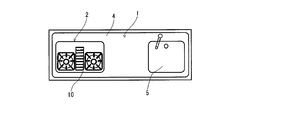
- FIG. 2 is a plan view showing an equipment table according to an embodiment of the present invention.
- FIG. 3 is a perspective view showing an equipment table according to another embodiment of the present invention.
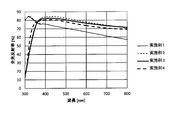
- FIG. 4 is a graph showing the total light reflectance of Examples 1 to 4.
- the content of the resin component is 5% or less in terms of mass percentage
- the bending strength is 80 MPa or more
- the total light reflectance from the outermost surface to a depth of 1 mm is a wavelength of 380 nm to 720 nm. It has a surface layer that is 10% or more at any wavelength in the range.
- the content of the resin component in the surface layer is 5% or less, the heat resistance is excellent. That is, even when a hot object is placed on the surface of the equipment table, the surface layer is not easily discolored.
- the content of the resin component is preferably 3% or less, more preferably 1% or less, and still more preferably substantially free.
- the resin for example, uses natural carbon resources such as petroleum, natural gas, and coal as main raw materials, and these are polymer-synthesized to convert atoms such as carbon, hydrogen, oxygen, nitrogen, chlorine, and fluorine into chain-like or It is a polymer linked in a network and has a molecular weight of 10,000 or more.
- examples of the resin include polymethyl methacrylate and polyester.
- the content of the resin component is the mass reduced by heating the surface layer to 1000 ° C. That is, a part of the surface layer is scraped and its mass is measured. Next, the sample is placed on a platinum dish and heated to 1000 ° C., and the mass of the heated sample is measured.
- the resin content ratio is calculated from the following formula 1.
- Resin content ratio (%) (mass of sample before heating ⁇ mass of sample after heating) / mass of sample before heating ⁇ 100
- the surface layer of the equipment table of this embodiment has no outgassing when a stainless steel flat plate heated to 350 ° C. is allowed to stand for 20 minutes, and the surface chromaticity change ⁇ E derived by the following equation 2 is 0 or more. It preferably has a property of 2 or less.
- the ⁇ E is preferably 2 or less, more preferably 1.5 or less, and even more preferably 1 or less.
- the surface layer exhibits higher heat resistance. As a result, it becomes an equipment table in which discoloration when a hot object is placed is further suppressed.
- the lower limit of ⁇ E is not particularly limited, but is typically 0 or more.
- the chromaticity change ⁇ E is obtained by calculating the chromaticity changes of the two colors from the respective L * a * b * values according to the above equation 2.
- the value of L * a * b * is standardized by the CIE (International Lighting Commission), and is calculated in accordance with L * a * b * color system measurement standardized by JIS (JISX8729) in Japan. . Specifically, it is measured using CR400 (manufactured by Konica Minolta Co., Ltd., color chromaticity meter), and is taken as the average value of the values selected and measured at three random locations under irradiation of the standard light source (D65).
- the generation of the outgas can be detected by, for example, visual observation, odor, or glass chromatography.
- the bending strength of the surface layer is 80 MPa or more.
- the bending strength of the surface layer is preferably 100 MPa or more, more preferably 120 MPa or more, and further preferably 200 MPa.
- the bending strength is measured by a method based on JIS K7171 (2008).
- the total light reflectance from the outermost surface to a depth of 1 mm is 10% or more at any wavelength in the wavelength range of 380 nm to 720 nm.
- the reflectance is preferably 20% or more, and more preferably 30% or more.
- the total light reflectance is the total of regular reflection and diffuse reflection on a smooth plane.
- the total light reflectance can be measured with a spectrophotometer by cutting out from the outermost surface to a depth of 1 mm to obtain a sample having a thickness of 1 mm.
- the surface of the surface layer may be a flat surface or an uneven pattern.
- the concavo-convex pattern may be formed by being sandwiched between rollers in which the glass is soft and the surface is uneven, or may be formed by pressing.
- the surface layer is made of glass, the surface may be a mirror surface, or may be ground glass by sandblasting, an abrasive, a grindstone, etching, or the like.
- the surface of the surface layer preferably has a surface roughness Ra of 0.001 to 1.5 ⁇ m from the viewpoint of effectively preventing dirt from penetrating and capable of being manufactured at low cost while maintaining aesthetic appearance.
- the surface roughness Ra of the surface layer is measured by a method based on JIS B0633 (2001).
- the surface roughness Ra of the surface layer is preferably 1.2 ⁇ m or less, more preferably 1.0 ⁇ m or less, further preferably 0.8 ⁇ m or less, and 0.1 ⁇ m or less. Most preferred. Moreover, it is 0.001 micrometer or more, it is preferable that it is 0.002 micrometer or more, and it is more preferable that it is 0.005 micrometer or more.
- the surface layer is glass, for example, it is preferable to polish and bond a material having desired smoothness.
- the specific conditions for polishing are, for example, preferably with 1 to 60 minutes, more preferably 2 to 30 minutes with CeO 2 , SiO 2 or diamond.
- the surface layer has a thermal expansion coefficient, is preferably 30 ⁇ 10 -6 / °C or less. If the coefficient of thermal expansion is within this range, even when a high-temperature or low-temperature object is in contact with the surface layer during use of the equipment table, expansion or contraction is unlikely to occur.
- the expansion coefficient is more preferably 3 to 20 ⁇ 10 ⁇ 6 / ° C., and further preferably 5 to 15 ⁇ 10 ⁇ 6 / ° C.
- the surface layer preferably has a steel ball drop height of 200 mm or more from the surface layer. If the drop height is 200 mm or more, it has sufficient strength in the specifications of the equipment table, and for example, even if a rigid body such as a vessel falls and collides, the surface layer can be prevented from being destroyed.
- the drop height is more preferably 300 mm or more, and further preferably 400 mm or more.
- the falling-ball strength test is performed by placing a test plate (surface layer) of 100 mm ⁇ 100 mm ⁇ 5 mm in thickness on a stainless steel flat plate (length 130 mm ⁇ width 130 mm ⁇ thickness 10 mm) with a hole of 67 mm and covering a 500 g steel ball.
- the test plate is dropped from a high position separated by a predetermined distance, and the presence or absence of breakage (for example, cracking) of the test plate is evaluated.
- the height of the steel ball when the test piece is destroyed is the height of the falling ball strength test.
- the surface layer preferably contains glass.
- the glass include phase separation glass (phase-separated glass) and crystallized glass. Among these, from the viewpoint of obtaining high heat resistance and strength and excellent aesthetic appearance, a phase separation glass is preferable, and a white phase separation glass is more preferable.
- Glass phase separation means that a single-phase glass is divided into two or more glass phases.
- Examples of the method for phase separation of glass include a method for heat-treating glass.
- a temperature 50 to 400 ° C. higher than the glass transition point is preferable.
- a temperature higher by 100 ° C. to 300 ° C. is more preferable.
- the time for heat treating the glass is preferably 1 to 64 hours, more preferably 2 to 32 hours. From the viewpoint of mass productivity, it is preferably within 24 hours, more preferably within 12 hours.
- the heat treatment time is preferably 1 minute to 10 hours.
- Whether the glass is phase-separated or not can be determined by SEM (scanning electron microscope, scanning electron microscope). That is, when the glass is phase-separated, it can be observed that it is divided into two or more phases when observed with an SEM.
- the state of the phase separation glass includes a binodal state and a spinodal state.
- the binodal state is a phase separation by a nucleation-growth mechanism and is generally spherical.
- the spinodal state is a state in which the phase separation is intertwined with each other in three dimensions with some degree of regularity.
- the average size of one phase in the phase separation state or the average particle size of the dispersed phase in the phase-separated glass is preferably 50 to 10,000 nm, more preferably 100 to 5000 nm. Typically, it is 200 nm or more or 2000 nm or less.
- the average particle size of the dispersed phase can be measured by SEM observation.
- the average size of one phase in the phase separation state is the average of the widths of the phases intertwined with each other in the spinodal state, and when one phase is spherical in the binodal state When the diameter of one phase is elliptical, it is the average value of the major axis and the minor axis.
- the average particle size of the dispersed phase is the average size in the binodal state.
- the difference in refractive index between the dispersed phase particles in the phase separation glass and the surrounding matrix is 0.01 or more.
- the refractive index difference is preferably 0.03 or more, more preferably 0.05 or more, and still more preferably 0.1 or more.
- the refractive index difference can be estimated by the Appen equation using the result of composition analysis by SEM-EDAX or a wet method.
- the proportion of the volume of the dispersed phase particles in the phase-separated glass is preferably 5% or more, and more preferably 10% or more.
- the volume ratio of the particles of the dispersed phase is estimated from the ratio of the dispersed particles by calculating the ratio of the dispersed particles distributed on the glass surface from the SEM observation photograph.
- the method for producing the phase separation glass is not particularly limited. For example, an appropriate amount of various raw materials are prepared, heated to about 1500 to 1800 ° C. and melted, and then homogenized by defoaming, stirring, etc. It is formed into a plate shape or the like by casting, a press method, a roll-out method or the like, and is formed into a block shape. After slow cooling, it is processed into an arbitrary shape and then subjected to phase separation.
- the glass is melted, homogenized, molded, slowly cooled, or shaped without any special phase separation process in steps such as melting, homogenizing, molding, annealing, or shaping.
- phase-divided glass by heat processing shall also be included in phase-separated glass, and the process of phase-separating glass in this case shall be included in the process of melting.
- the surface layer includes glass and a crystalline phase.
- the crystallization rate of the surface layer is preferably 90% or less, more preferably 70% or less, further preferably 50% or less, and most preferably 20% or less. By setting the crystallization rate of the surface layer to 90% or less, high smoothness can be obtained.
- the crystallization rate of the surface layer is preferably 5% or more, and more preferably 10% or more. By setting the crystallization rate of the surface layer to 5% or more, high aesthetics can be expressed.
- the crystallization ratio of the surface layer can be estimated by mixing a standard substance in the surface layer and measuring the mass ratio of the crystal phase by XRD.
- Crystallized glass is glass containing a crystal phase and a glass phase.
- Examples of a method for obtaining crystallized glass include a method of precipitating crystals by heat-treating glass containing only a glass phase.
- the heat treatment condition for crystallizing glass is typically a temperature 40 to 500 ° C. higher than the glass transition point. A temperature higher by 100 to 300 ° C. is more preferable.
- the time for heat treating the glass is preferably 1 to 64 hours, more preferably 2 to 32 hours. From the viewpoint of mass productivity, it is preferably 24 hours or less, and more preferably within 12 hours.
- the glass contains crystals can be determined by XRD (X-ray diffraction, X-ray diffraction method). That is, when the glass contains a crystal phase, it shows a diffraction peak of the crystal phase when measured by XRD.
- XRD X-ray diffraction, X-ray diffraction method
- the mass ratio of the crystal phase in the crystallized glass is preferably 5% or more, more preferably 10% or more in terms of percentage.
- the mass ratio of the crystal phase in the crystallized glass is preferably 90% or less, more preferably 70% or less, and further preferably 50% or less, Most preferably, it is 20% or less.
- the mass ratio of the crystal phase can be estimated by mixing a standard substance and performing XRD measurement.
- composition of the glass used for the equipment table of the present invention will be described.
- content of the glass component will be described using a mole percentage display unless otherwise specified.
- the glass preferably contains SiO 2 , Al 2 O 3 and MgO.
- glass contains SiO 2 , Al 2 O 3 and MgO, chemical strengthening is facilitated, and durability and strength are improved.
- SiO 2 is a basic component that forms a network structure of glass. That is, it has an amorphous structure and exhibits excellent mechanical strength, weather resistance, or gloss as glass.
- the content of SiO 2 is preferably 40 to 80%.
- the weather resistance and scratch resistance as glass are improved. More preferably, it is 50% or more, more preferably 55% or more, particularly preferably 60% or more, and most preferably 66% or more.
- the productivity of glass can be improved by setting it as 80% or less. More preferably, it is 75% or less, More preferably, it is 73% or less, Most preferably, it is 72% or less.
- the content of Al 2 O 3 is preferably 0 to 35%.
- Al 2 O 3 is 0 to 35%, it does not have to contain Al 2 O 3 , but when it is contained, it must be 35% or less (hereinafter the same).
- Al 2 O 3 improves the chemical durability of the glass, lowers the coefficient of thermal expansion, significantly improves the dispersion stability of SiO 2 and other components, and makes the phase separation of the glass uniform. There is an effect of imparting a function, and when the content of Al 2 O 3 is 0.5% or more, the effect is easily obtained. Is 1% or more, more preferably 4% or more.
- the content of Al 2 O 3 is more preferably 28% or less, further preferably 20% or less, particularly preferably 10% or less, particularly preferably 8% or less, more preferably 6% or less, and further preferably 5% or less. Most preferably, it is 4% or less.
- the content of Al 2 O 3 is preferably 2 to 15%, more preferably 4 to 12%, still more preferably 6 to 11% from the viewpoint of increasing strength. is there.
- the MgO content is preferably 0 to 30%. Since MgO has the effect of reducing the thermal expansion coefficient of glass and promoting phase separation in combination with SiO 2 and Na 2 O, it is preferably contained when the phase-separated glass is used for the glass plate. .
- the content of MgO is more preferably 5% or more, further preferably 9% or more, particularly preferably 13% or more, and most preferably 15% or more.
- the content of MgO is more preferably 27% or less, further preferably 25% or less, particularly preferably 24% or less, and most preferably 18% or less.
- the content of Na 2 O is preferably 0 to 20%.
- Na 2 O reduces viscosity and improves solubility. By making the content of Na 2 O 1% or more, the effect can be easily obtained. Therefore, when it is contained, the content is preferably 1% or more, more preferably 3% or more, and further preferably 5% or more.
- the Na 2 O can increase the weather resistance by 20% or less. More preferably, it is 14% or less, More preferably, it is 11% or less.
- the Na 2 O content in the glass is preferably at least 6%, more preferably 7% or more, more preferably 8% or more. By setting it to 6% or more, it becomes easy to form a desired surface compressive stress layer by ion exchange treatment.
- P 2 O 5 is a basic component that promotes phase separation in combination with SiO 2 , MgO, and Na 2 O
- the phase-separated glass is included when used for the glass plate in the equipment table of the present invention.
- the content of P 2 O 5 is preferably 0.5% or more, more preferably 1% or more, still more preferably 3% or more, and particularly preferably 4% or more. Further, it is preferably 15% or less, more preferably 14% or less, further preferably 10% or less, particularly preferably 7% or less, and most preferably 4.5% or less.
- the content of P 2 O 5 By setting the content of P 2 O 5 to 0.5% or more, the total light reflectance can be sufficiently obtained. Further, by setting the content of P 2 O 5 to 15% or less, volatilization hardly occurs and color unevenness hardly occurs.
- the SiO 2 content is 66 to 72%
- the Al 2 O 3 content is 0 to 4%
- the MgO content is 8 to 17%
- the Na 2 O content is 7 to 17%. It is preferable.
- the content of the alkali metal oxide is preferably 3 to 20%, more preferably 5 to 15%, still more preferably 7 to 11% from the viewpoint of increasing strength. is there.
- the glass used for the surface layer it may be preferable to contain the following components in addition to the components of SiO 2 , Al 2 O 3 , MgO and Na 2 O.
- the total content of the five components is preferably 80% or more, and typically 85% or more.
- ZrO 2 is not an essential component, but is preferably 4.5% or less, more preferably 4% or less, and even more preferably 3% or less in order to significantly improve chemical durability.
- the total light reflectance can be increased by setting the content of ZrO 2 to 4.5% or less.
- CaO, SrO and BaO are not essential components, but in order to improve the total light reflectance, it is preferable to contain one or more of these components in an amount of 0.2% or more, more preferably 0.5% or more. Preferably it is 1% or more.
- the content of CaO is preferably 5% or less.
- the content of CaO is preferably 5% or less, ion exchange is hardly inhibited.
- the mass percentage display content is typically 3% or less, and when it is desired to increase the DOL, it is preferable that CaO is not contained or the content is 0.5% or less. .
- the total content of CaO, SrO and BaO is preferably 12% or less, more preferably 8% or less, still more preferably 6% or less, and typically 5% or less. By making the total content 12% or less, the glass becomes difficult to devitrify.
- B 2 O 3 is not an essential component, but contains up to 9% in order to increase the meltability of the glass, improve the whiteness of the glass, lower the coefficient of thermal expansion, and further improve the weather resistance. Preferably, it is 6% or less, more preferably 4% or less, and particularly preferably 3% or less. By setting the content of B 2 O 3 to 9% or less, color unevenness hardly occurs.
- the glass may contain K 2 O.
- K 2 O is a component for improving the meltability, and is a component for increasing the ion exchange rate in chemical strengthening to obtain a desired surface compressive stress and stress layer depth.
- the effect is small at less than 1%.
- Preferably it is 1% or more.
- In order to improve the ion exchange rate it is preferably 2% or more, and typically 3% or more.
- the content of K 2 O is preferably 9% or less, more preferably 7% or less, and typically 6% or less.
- TiO 2 is suitable for crystallizing glass and can be contained in an amount of 0 to 10%, preferably 8% or less, more preferably 6% or less.
- the glass used for the surface layer may contain other components in addition to the above components in order to enhance design properties.
- Co, Mn, Fe, Ni, Cu, Cr, V, Zn, Bi, Er, Tm, Nd, Sm, Sn, Ce, Pr, Eu, Ag, or Au may be contained as a coloring component.
- the sum of these coloring components is typically 5% or less in terms of the mole percentage based on the minimum valence oxide.
- Examples of the glass used for the surface layer include glasses having the compositions shown in the following (1) to (9).
- (1) SiO 2 is 50 to 80%, Al 2 O 3 is 0 to 10%, MgO is 11 to 30%, Na 2 O is 0 to 15%, and P 2 O 5 is expressed in terms of mole percentage based on oxide. Glass containing 0.5-15%.
- (2) SiO 2 is 66 to 72%, Al 2 O 3 is 0 to 4%, MgO is 16 to 24%, Na 2 O is 4 to 10%, and P 2 O 5 is expressed in mole percentages based on oxide. Glass containing 0.5-15%.
- SiO 2 is 58% or more and less than 66% in terms of oxide-based molar percentage
- Al 2 O 3 is 2 to 6%
- MgO is 11 to 18%
- Na 2 O is 8 to 13%
- P 2 O Glass containing 3-7% of 5 SiO 2 60 to 73%, Al 2 O 3 0 to 5%, MgO 13 to 30%, Na 2 O 0 to 13%, P 2 O 5 Glass containing 0.5 to 4.5%.
- the glass used for the surface layer is preferably tempered glass.
- the strengthening process include a chemical strengthening process and a physical strengthening process.
- Chemical strengthening treatment is a method of forming a compressive stress layer on the glass surface and increasing the strength of the glass. Specifically, alkali metal ions (typically Li ions, Na ions) having a small ion radius on the surface of the glass plate by ion exchange at a temperature below the glass transition point are converted to alkali ions (typically Is a process of exchanging Na ions or K ions for Li ions and K ions for Na ions.
- alkali metal ions typically Li ions, Na ions
- alkali ions typically Li ions, Na ions
- the chemical strengthening method is not particularly limited as long as Li 2 O or Na 2 O on the glass surface layer and Na 2 O or K 2 O in the molten salt can be ion-exchanged.
- heated potassium nitrate (KNO 3 ) A method of immersing glass in molten salt.
- the conditions for forming a chemically strengthened layer having a desired surface compressive stress (surface compressive stress layer) on the glass vary depending on the thickness of the glass, but the temperature condition is preferably 350 to 550 ° C., preferably 400 to More preferably, it is 500 degreeC.
- the chemical strengthening time is preferably 1 to 144 hours, and more preferably 2 to 24 hours.
- the molten salt include KNO 3 and NaNO 3 . Specifically, for example, it is typical to immerse the glass in a KNO 3 molten salt at 400 to 550 ° C. for 2 to 24 hours.
- a polishing step may be performed.
- the grain size of polishing abrasive grains used for the final stage polishing is typically 2 to 6 ⁇ m, and such abrasive grains ultimately cause the glass surface to have a maximum of 5 ⁇ m micron. It is thought that a crack is formed.
- a surface compressive stress layer deeper than the microcracks formed on the glass surface In order to make the effect of improving the strength by chemical strengthening effective, it is preferable to have a surface compressive stress layer deeper than the microcracks formed on the glass surface, and the depth of the surface compressive stress layer generated by chemical strengthening is 6 ⁇ m. The above is preferable.
- the depth of the surface compressive stress layer of the chemically strengthened glass can be measured using an EPMA (electron probe micro analyzer) or a surface stress meter (for example, FSM-6000 manufactured by Orihara Seisakusho).
- EPMA electron probe micro analyzer
- FSM-6000 manufactured by Orihara Seisakusho
- the potassium ion concentration analysis in the depth direction of the phase separation glass is performed by EPMA, and the potassium ion obtained by the measurement
- the diffusion depth is regarded as the depth of the surface compressive stress layer.
- the sodium ion concentration analysis in the depth direction of the glass is performed by EPMA, and the sodium ion diffusion depth obtained by the measurement is measured. This is regarded as the depth of the surface compressive stress layer.
- “Physical strengthening treatment” refers to a technique for forming a residual stress distribution in a glass substrate by rapidly cooling the glass substrate from a high-temperature “ ⁇ ” state. In a normal case, the inside of the glass substrate is less susceptible to rapid cooling than the surface, and is cooled and solidified relatively slowly.
- the residual compressive stress increases from the inside to the surface of the glass substrate, and a depth profile of the residual compressive stress is obtained.
- a compressive stress layer is formed with a relatively deep thickness, whereby the strength of the glass substrate is improved as compared with that before the physical strengthening treatment.
- the conditions for forming a physical strengthening layer (residual compressive stress layer) having a desired surface compressive stress on the glass vary depending on the thickness of the glass. Specifically, for example, preferably from 400 to 900 ° C. to 0 to It is preferable to rapidly cool to 300 ° C, more preferably from 500 to 800 ° C to 30 to 200 ° C.
- the surface layer preferably has a surface chromaticity change ⁇ E derived by the following formula 2 of 10 or less, more preferably 8 or less, after irradiation with ultraviolet rays with an 800 W lamp for 22 hours. Is 6 or less, particularly preferably 1 or less.
- L represents lightness
- a represents red and green
- b represents yellow and blue.
- the chromaticity change ⁇ E is the same as described above.
- the ⁇ E When the ⁇ E is 10 or less, it is an equipment table that exhibits high light resistance and is resistant to discoloration for a long period of time. Further, the lower limit of ⁇ E is not particularly limited, but is usually 0 or more.
- the surface layer preferably has a pencil hardness of 6H or more, more preferably 7H or more, still more preferably 8H or more, according to the method defined in JIS K 5600-5-4 (1999).
- the pencil hardness is 6H or more, the surface hardness is high, and the equipment table is difficult to be damaged and hardly damaged.
- the surface layer preferably has a Vickers hardness (HV) of 100 or more according to a method defined in JIS K 5600-5-4 (1999), more preferably 300 or more, and further preferably 550 or more. Yes, particularly preferably 600 or more.
- HV Vickers hardness
- the surface layer is included on the surface of the equipment table, and is preferably contained 1 mm or more from the surface in the thickness direction of the equipment table, more preferably 1.5 mm or more, more preferably 2 mm or more. Yes, particularly preferably 3 mm or more.
- the upper limit is not particularly limited, but is usually 30 mm or less, preferably 10 mm or less.
- the content rate of the said surface layer in the thickness direction of an equipment stand is typically 2% or more.
- Portions other than the surface layer in the equipment table of the present invention can be configured using, for example, wood, stainless steel, or resin.
- the thickness of the glass is preferably 4 mm or more, more preferably 5 mm or more, and further preferably 6 mm or more.
- the thickness is preferably 4 mm or more, sufficient strength as an equipment table can be obtained.
- it is preferable that it is 20 mm or less, More preferably, it is 15 mm or less, More preferably, it is 12 mm or less.
- the surface layer preferably has a specific gravity of 3.0 g / cm 3 or less, more preferably 2.8 g / cm 3 or less.
- the specific gravity is 3.0 g / cm 3 or less, the weight can be reduced. Typically, it is preferably 2.5 g / cm 3 or more, more preferably 2.6 g / cm 3 or more, and still more preferably 2.7 g / cm 3 or more.
- the specific gravity can be measured by a method based on JIS Z 8807 (2012).
- the equipment table of the present invention can be used as equipment tables such as a sink, a wash basin, a work table, an office desk, and a drawing table.
- FIG. 1 is a partial sectional view showing an equipment table according to an embodiment of the present invention
- FIG. 2 is a plan view showing the equipment table.
- the equipment stand in the present embodiment is a sink 1 used in a general household, and as shown in FIG. 1, is integrated with a stove stand 2 to constitute a kitchen stand.
- a common top plate is formed by the surface layer 4.
- a notch portion for a pair of water tanks (not shown) is formed on the surface layer 4 on the sink 1 side, and a stainless steel water tank 5 with a flange is provided.
- the surface layer 4 and the water tank 5 are supported on the frame material 6 of the sink 1, and the outer peripheral portion of the surface layer 4 is inserted into the fitting groove 7 formed in the outer peripheral portion of the sink 1 and the stove base 2 through the packing 8. Are mated.
- the surface layer 4 is fitted in the fitting groove 7 so as to be slidable in the depth direction and the width direction of the sink 1 and the stove base 2, and the surface layer 4 is mounted on the sink 1 and the stove base 2 in a replaceable manner by this sliding structure. Yes.
- the sliding of the surface layer 4 is blocked by a fastening member 9 as shown in FIG. 1, and the sliding of the surface layer 4 is made possible by removing this fastening member 9.
- a cutout portion for stove accommodation is formed on the stove stand 2 side of the surface layer 4, and a stainless steel stove accommodation case 10 is provided in the cutout portion by the same means as the water tank 5.
- a plurality of storages or the like having casters with brakes on the bottom surface side can be freely stored in and out of the sink 1 and the stove table 2 having such a configuration, that is, in the space 11.
- FIG. 3 is a perspective view showing an equipment table according to another embodiment of the present invention.
- the equipment table of this embodiment is applied as a washstand with a vanity.
- the top plate of the washstand and the water tank 5 have substantially the same structure as that of the above-described embodiment.
- a storage unit with a door, a wagon type storage, a storage with a drawer, and the like can be stored freely.
- a box-shaped start On the back side of the top plate made of the surface layer 4 of the wash basin, a box-shaped start having a storage unit 14 with a door and a mirror 15 on the front side and a work plate 16 on the back side.
- the fall wall 13 stands up freely.
- the raising / lowering wall 13 is connected to the washstand main body by a connection fitting 17 so as to be able to rise and fall.
- Example 1 Glass materials were appropriately selected so as to have the composition shown in Table 1, and were melted, homogenized, and defoamed at 1650 ° C. After cooling to the phase separation treatment temperature at a cooling rate of 50 ° C. per minute, held at the phase separation treatment temperature for 30 minutes, poured into a mold material, held at a temperature 30 ° C. higher than the glass transition temperature, and kept at 1 ° C. / Cooled to room temperature at a cooling rate of minutes. It was observed by SEM that the glass was phase separated. The obtained glass was processed to a thickness of 5 mm, and the main surface was mirror finished. Thereafter, the glass plate was subjected to chemical strengthening treatment by immersing it in molten salt in which 100% of KNO 3 was heated to 450 ° C. for 6 hours.
- Example 2 to 4 Glass materials were appropriately selected so as to have the composition shown in Table 1, and were melted, homogenized, and defoamed at 1650 ° C. The mixture was poured into a mold material, held at a temperature 30 ° C. higher than the glass transition temperature for 1 hour, and then cooled to room temperature at a cooling rate of 1 ° C./min. Further, the temperature was raised to 10 ° C./min up to the heat treatment temperature listed in Table 1, and the heat treatment time listed in Table 1 was maintained. The temperature was lowered at 50 ° C./min and cooled to room temperature. It was confirmed by XRD that crystals were precipitated in the glass to form crystallized glass.
- the obtained glass was processed to a thickness of 5 mm, and the main surface was mirror finished. Thereafter, the glass plate was subjected to chemical strengthening treatment by immersing it in molten salt in which 100% of KNO 3 was heated to 450 ° C. for 6 hours.
- Total light reflectivity The total light reflectivity is obtained by processing a sample into 30 ⁇ 30 ⁇ 1 mm, and using this, the total light reflectivity (total of regular reflection and diffuse reflection) at a wavelength of 380 to 720 nm is spectrophotometric. It measured with the meter (Perkin Elmer company_made: Lamda950).
- Specific gravity The specific gravity was measured by a method based on JIS Z 8807 (2012).
- Thermal expansion coefficient The coefficient of thermal expansion was measured by a method based on EN-14617-11 (2005).
- Vickers hardness Vickers hardness was measured by a method based on JIS K 5600-5-4 (1999).
- Pencil hardness The pencil hardness was measured by a method based on JIS K 5600-5-4 (1999).
- Heat resistance A stainless steel flat plate heated to 350 ° C. was allowed to stand on each sample for 20 minutes, and generation of outgas was analyzed using gas chromatography.
- Heat resistance chromaticity change ⁇ E
- a stainless steel flat plate heated to 350 ° C. was allowed to stand on each sample for 20 minutes, and the chromaticity change of the two colors was determined by calculation from the respective L * a * b * values according to the following formula.
- L * a * b * is standardized by the CIE (International Commission on Illumination), and in Japan, in accordance with L * a * b * color system measurement standardized by JIS (JISX8729), CR400 ( Konica Minolta Co., Ltd., color chromaticity meter) was used, and the average of the values measured at three random locations under standard light source (D65) irradiation was used.
- L represents lightness
- a represents red and green
- b represents yellow and blue.
- the height of the steel ball when the test piece was broken was defined as the height (unit: mm) of the falling ball strength test.
- the test plate of Example 1 was 100 mm ⁇ 100 mm ⁇ 5 mm, and the test plates of Comparative Examples 1 and 2 were 100 mm ⁇ 100 mm ⁇ 10 mm.
- Table 2 The results are shown in Table 2 and FIG. In Table 2, a blank indicates that it has not been evaluated. In Examples 1 and 4, only the bending strength was evaluated for both the glass before chemical strengthening and the glass after chemical strengthening, and the other evaluations were performed using the glass after chemical strengthening.
- Examples 1 to 4 having a resin component content of 5% or less and a bending strength of 80 MPa or more are acrylic marble (Comparative Example 1) and engineered stone (Comparative Example 2). Compared to heat resistance and strength. Since the resin component is small and the bending strength is high, when Examples 1 to 4 are used for the surface layer of the equipment table, an equipment table having excellent heat resistance and strength can be obtained.
- the total light reflectance was 10% or more in the wavelength range of 380 nm to 720 nm.
- Example processing After cutting Examples 1 to 4 and Comparative Examples 1 to 2 to 30 ⁇ 30 ⁇ 2 mm, six samples were fixed to a surface plate with resin and ground by 100 ⁇ m or more with a # 1000 grindstone. Was then polished for 10 minutes under a stream of CeO 2 in a polishing machine state gave a 1kg of weight on (Engis Co.). The opposite surface was ground and polished under the above conditions to finally obtain a 30 ⁇ 30 ⁇ 1 mm sample.
- the surface roughness Ra of the obtained sample was measured by a method based on JIS B0633 (2001). The results are shown in Table 3.
Landscapes
- Chemical & Material Sciences (AREA)
- Life Sciences & Earth Sciences (AREA)
- Engineering & Computer Science (AREA)
- Chemical Kinetics & Catalysis (AREA)
- General Chemical & Material Sciences (AREA)
- Geochemistry & Mineralogy (AREA)
- Materials Engineering (AREA)
- Organic Chemistry (AREA)
- Glass Compositions (AREA)
Abstract
本発明は、耐熱性および強度に優れた設備台を提供することを目的とする。本発明は樹脂成分の含有量が質量百分率表示で5%以下であり、曲げ強度が80MPa以上であり、最表面から深度1mmまでの全光反射率が、波長380nmから720nmの範囲のいずれかの波長において10%以上である表面層を有する表面層を有する設備台に関する。
Description
本発明は、流し台または洗面台等の設備台に関する。
流し台または洗面台等の設備台には、優れた美観、並びに耐熱性および強度等の機能性が求められており、様々な着色材料が用いられている。従来、流し台または洗面台などの設備台には、ステンレス、人工大理石、天然大理石、エンジニアドストーン、セラミックス、結晶化ガラスおよびペイントガラス等の材料が用いられている。特に美観を意識する一般家庭用では、人工大理石またはエンジニアドストーンが広く用いられている。
特許文献1には、天板をガラス板とした設備台において、ガラス天板を上層のガラス板とガラス板の下面に接合一体化され、該ガラス板をバックアップする下層の補強板材とからなる複合構造体とした設備用ガラス板の下面に塗装、または模様若しくは着色等のフィルムを貼着することが開示されている。
人工大理石およびエンジニアドストーンは強度に優れるが、樹脂分を含むため、耐熱性が低いという問題がある。また、天然大理石、セラミックスおよび結晶化ガラスは、樹脂分を含まず耐熱性に優れるが、強度が低いという問題がある。
特許文献1に開示されている、下面に塗装、または模様若しくは着色等のフィルムを貼着したガラス板は、強度に優れるが、塗料またはフィルムとして樹脂分を含むため、耐熱性が低い。
このように、従来の着色材料では、耐熱性および強度を兼ね備えた設備台を実現することは困難であった。したがって、本発明は、耐熱性および強度に優れた設備台を提供することを目的とする。
本発明者らは、樹脂成分の含有量が特定範囲であり、かつ曲げ強度が特定範囲である層を設備台の表面に含むことにより、上記課題を解決できることを見出し、本発明を完成させた。
すなわち、本発明は以下よりなる。
1.樹脂成分の含有量が質量百分率表示で5%以下であり、曲げ強度が80MPa以上であり、最表面から深度1mmまでの全光反射率が、波長380nmから720nmの範囲のいずれかの波長において10%以上である表面層を有する設備台。
2.前記表面層は、350℃に加熱したステンレス製平板を20分間静置した際にアウトガスの発生が無く、且つ下式により導出される表面の色度変化ΔEが0以上2以下である前項1記載の設備台。
1.樹脂成分の含有量が質量百分率表示で5%以下であり、曲げ強度が80MPa以上であり、最表面から深度1mmまでの全光反射率が、波長380nmから720nmの範囲のいずれかの波長において10%以上である表面層を有する設備台。
2.前記表面層は、350℃に加熱したステンレス製平板を20分間静置した際にアウトガスの発生が無く、且つ下式により導出される表面の色度変化ΔEが0以上2以下である前項1記載の設備台。

3.前記表面層がガラスを含む前項1または2に記載の設備台。
4.前記表面層がガラスと結晶相を含み、表面層の結晶化率が90%以下である前項3に記載の設備台。
5.前記ガラスが分相ガラスである前項3または4に記載の設備台。
6.前記ガラスが酸化物基準のモル百分率表示で、Al2O3を0~35%含有し、アルカリ金属酸化物を0~20%含有する前項3~5のいずれか1項に記載の設備台。
7.前記ガラスが強化処理されたガラスである前項3~6のいずれか1項に記載の設備台。
8.前記表面層の表面粗度Raが0.001~1.5μmである前項1~7のいずれか1項に記載の設備台。
4.前記表面層がガラスと結晶相を含み、表面層の結晶化率が90%以下である前項3に記載の設備台。
5.前記ガラスが分相ガラスである前項3または4に記載の設備台。
6.前記ガラスが酸化物基準のモル百分率表示で、Al2O3を0~35%含有し、アルカリ金属酸化物を0~20%含有する前項3~5のいずれか1項に記載の設備台。
7.前記ガラスが強化処理されたガラスである前項3~6のいずれか1項に記載の設備台。
8.前記表面層の表面粗度Raが0.001~1.5μmである前項1~7のいずれか1項に記載の設備台。
本発明の設備台は、耐熱性に優れ、かつ、使用中に割れがおこりにくいので、長期の信頼性と意匠性が担保される。
本実施形態の設備台は、樹脂成分の含有量が質量百分率表示で5%以下であり、曲げ強度が80MPa以上であり、最表面から深度1mmまでの全光反射率が、波長380nmから720nmの範囲のいずれかの波長において10%以上である表面層を有する。
表面層の樹脂成分の含有量が5%以下であると、耐熱性に優れる。すなわち、設備台の表面に熱いものを乗せても、表面層が変色しにくい。前記樹脂成分の含有量は、3%以下が好ましく、1%以下がより好ましく実質的に含まないことがさらに好ましい。
前記樹脂は、例えば、石油、天然ガス、石炭といった天然炭素資源を主な原料とし、これらを高分子合成反応させて、炭素、水素、酸素、窒素、塩素およびフッ素などの原子を、鎖状や網状に連結したポリマーで、分子量10000以上のものである。具体的には、樹脂として、ポリメタクリル酸メチル、ポリエステルなどが挙げられる。
本発明において、樹脂成分の含有量は、表面層を1000℃に加熱して減少した質量である。すなわち、表面層の一部を削り取り、その質量を測定する。次に、試料を白金皿の上に置き、1000℃に加熱して、加熱後の試料の質量を測定する。以下の式1から樹脂含有割合を算出する。
(式1)樹脂含有割合(%)=(加熱前の試料の質量-加熱後の試料の質量)/加熱前の試料の質量×100
本実施形態の設備台の表面層は、350℃に加熱したステンレス製平板を20分間静置した際にアウトガスの発生が無く、且つ下式2により導出される表面の色度変化ΔEが0以上2以下である特性を有することが好ましい。

前記ΔEは、好ましくは2以下であり、より好ましくは1.5以下であり、さらに好ましくは1以下である。前記ΔEが2以下であることにより、表面層は、より高い耐熱性を示す。その結果、熱いものを乗せた際の変色がさらに抑えられた設備台となる。前記ΔEの下限は特に限定されないが、典型的には0以上である。
本明細書において色度変化ΔEは、前記式2により、2種の色の色度変化をそれぞれのL*a*b*の値から計算によって求めるものとする。L*a*b*の値は、CIE(国際照明委員会)で基準化され、日本でもJIS(JISX8729)に規格化されたL*a*b*表色系測定に準拠して算出される。具体的には、CR400(コニカミノルタ社製、色彩色度計)を用いて測定し、標準光源(D65)照射の下、無作為に3箇所選び測定した値の平均値とする。
前記アウトガスの発生は、例えば、例えば、目視、臭気、またはガラスクロマトグラフィーにより検出することができる。
表面層の曲げ強度は、80MPa以上である。表面層の曲げ強度は、好ましくは100MPa以上であり、より好ましくは120MPa以上であり、さらに好ましくは200MPaである。前記表面層の曲げ強度を80MPa以上とすることにより、使用中に割れにくい設備台となる。曲げ強度は、JIS K7171(2008年)に準拠した方法により測定する。
表面層は、最表面から深度1mmまでの全光反射率が波長380nmから720nmの範囲のいずれかの波長において10%以上である。前記反射率は、好ましくは20%以上であり、さらに好ましくは30%以上である。
ここで全光反射率とは平滑平面での正反射と拡散反射の合計を示す。該全光反射率を10%以上とすることにより、入射した光が多重散乱し、優れた美観を得ることができる。該全光反射率は、最表面から深度1mmまでを切り出すことで厚さ1mmのサンプルとし、分光光度計で測定することができる。
前記表面層の表面は、平面であってもよいし、凸凹模様であってもよい。前記表面層がガラスからなる場合、凸凹模様は、ガラスが軟化している状態で表面が凸凹状態であるローラーで挟みこんで形成してもよいし、プレスにより形成してもよい。また、前記表面層がガラスからなる場合、表面は鏡面であってもよいし、サンドブラスト、研磨剤、砥石またはエッチング等により、すりガラス状にしてもよい。
前記表面層の表面は、汚れの浸透を効果的に防止し、美観を維持したまま低コストで製造が可能である観点から、表面粗度Raが0.001~1.5μmであることが好ましい。該表面層の表面粗度RaはJIS B0633(2001年)に準拠した方法により測定する。
前記表面層の表面粗度Raは、1.2μm以下であることが好ましく、1.0μm以下であることがより好ましく、0.8μm以下であることがさらに好ましく、0.1μm以下であることが最も好ましい。また、0.001μm以上であり、0.002μm以上であることが好ましく、0.005μm以上であることがより好ましい。
前記表面粗度Raを1.5μm以下とするには、前記表面層がガラスである場合、例えば、研磨、所望の平滑性を有する素材を接着することが好ましい。研磨の具体的な条件は、例えば、CeO2、SiO2またはダイヤモンドにより、好ましくは1~60分間、より好ましくは2~30分間研磨することが好ましい。
前記表面層は、熱膨張率が、30×10-6/℃以下であることが好ましい。熱膨張率がこの範囲にあれば、設備台の使用時において、表面層に高温または低温の物体が接しても、膨張又は収縮が起こりにくい。前記膨張率は、3~20×10-6/℃がより好ましく、5~15×10-6/℃がさらに好ましい。
前記表面層は、下記の落球強度試験において、鋼玉の落下高さは表面層から200mm以上であることが好ましい。前記落下高さが200mm以上であれば、設備台の仕様において十分な強度を有し、例えば、器などの剛体が落下して衝突しても表面層が破壊されることを防止できる。前記落下高さは、300mm以上がより好ましく、400mm以上がさらに好ましい。
前記落球強度試験は、67mmの穴の開いたステンレス製平板(縦130mm×横130mm×厚み10mm)上に100mm×100mm×厚さ5mmの被試験板(表面層)を置き、500gの鋼玉を被試験板から所定の距離だけ離れた高い位置から落下させて、被試験板の破壊(例えば、割れ)の有無を評価する。被試験片が破壊された際の鋼玉の高さを落球強度試験の高さとする。
前記表面層はガラスを含むことが好ましい。該ガラスとしては、例えば、分相ガラス(分相したガラス)、および結晶化ガラスが挙げられる。これらの中でも、高い耐熱性および強度並びに優れた美観を得る観点から、分相ガラスであることが好ましく、白色分相ガラスであることがより好ましい。
ガラスの分相とは、単一相のガラスが、二以上のガラス相に分かれることをいう。ガラスを分相させる方法としては、例えば、ガラスを熱処理する方法が挙げられる。
ガラスを分相するために熱処理する条件としては、典型的には、ガラス転移点より50~400℃高い温度が好ましい。100℃~300℃高い温度がより好ましい。ガラスを熱処理する時間は、1~64時間が好ましく、2~32時間がより好ましい。量産性の観点からは24時間以内が好ましく、12時間以内がさらに好ましい。より短時間でガラスを分相させるためには、分相温度が1000℃以上のガラスを使用し、1000℃以上で熱処理することが好ましい。熱処理する時間は1分~10時間が好ましい。
ガラスが分相しているか否かは、SEM(scanning electron microscope、走査型電子顕微鏡)により判断できる。すなわち、ガラスが分相している場合、SEMで観察すると、2つ以上の相に分かれていることが観察できる。
分相ガラスの状態としては、バイノーダル状態およびスピノーダル状態が挙げられる。バイノーダル状態とは、核生成-成長機構による分相であり、一般的には球状である。また、スピノーダル状態とは、分相が、ある程度規則性を持った、3次元で相互かつ連続的に絡み合った状態である。
分相状態における一相の平均サイズまたは分相したガラスにおける分散相の平均粒子径は50~10000nmであることが好ましく、100~5000nmであることがより好ましい。典型的には200nm以上または2000nm以下である。分散相の平均粒子径はSEM観察をすることにより測定可能である。
ここで、分相状態における一相の平均サイズとは、スピノーダル状態にあっては相互かつ連続的に絡み合った相の幅の平均であり、バイノーダル状態にあっては一方の相が球状の場合はその直径、一方の相が楕円球状の場合はその長径と短径の平均値である。また、分散相の平均粒子径とはバイノーダル状態の場合の前記平均サイズである。
また、高い美観を発現するためには、分相ガラスにおける分散相の粒子とその周りのマトリックスにおける屈折率差が0.01以上であることが好ましい。該屈折率差は0.03以上であることが好ましく、より好ましくは0.05以上であり、さらに好ましくは0.1以上である。該屈折率差はSEM-EDAXまたは湿式法による組成分析結果を利用して、アッペンの式により見積もることができる。
高い美観を発現するためには、分相ガラスにおける分散相の粒子の体積の割合が5%以上であることが好ましく、10%以上であることがより好ましい。ここで、分散相の粒子の体積の割合は、SEM観察写真からガラス表面に分布している分散粒子の割合を計算し、該分散粒子の割合から見積もる。
分相ガラスの製造方法は特に限定されないが、例えば種々の原料を適量調合し、約1500~1800℃に加熱し溶融した後、脱泡、撹拌などにより均質化し、周知の、フロート法、ダウンドロー法、プレス法またはロールアウト法などによって板状等に、またはキャストしてブロック状に成形し、徐冷後、任意の形状に加工した後、分相させる処理をする。
なお、本発明においては、ガラスを溶融、均質化、成形、徐冷または形状加工等の工程において特段の分相させる処理を行うことなく、溶融、均質、成形、徐冷または形状加工のための熱処理によりガラスが分相したものも分相ガラスに含むものとし、この場合ガラスを分相させる工程は当該溶融等の工程に含まれるものとする。
前記表面層はガラスと結晶相を含むことがより好ましい。この場合、該表面層の結晶化率が90%以下であることが好ましく、70%以下であることがより好ましく、50%以下であることがさらに好ましく、20%以下であることが最も好ましい。表面層の結晶化率を90%以下とすることにより、高い平滑性を得ることができる。
前記表面層の結晶化率は5%以上であることが好ましく、10%以上であることがより好ましい。表面層の結晶化率を5%以上とすることにより、高い美観を発現することができる。ここで、表面層の結晶化率は、表面層に標準物質を混合して結晶相の質量割合をXRD測定することにより見積もることができる。
第一の相および該第二の相のうち一方の相がガラスからなり、一方の相が結晶相である表面層としては、結晶化ガラスからなる表面層が挙げられる。結晶化ガラスとは、結晶相とガラス相を含有するガラスのことである。結晶化ガラスを得るための方法としては、例えば、ガラス相のみを含有するガラスを熱処理して結晶を析出させる方法が挙げられる。
ガラスを結晶化するための熱処理する条件としては、典型的にはガラス転移点より40~500℃高い温度である。100~300℃高い温度がより好ましい。ガラスを熱処理する時間は、1~64時間が好ましく、2~32時間がより好ましい。量産性の観点からは24時間以下が好ましく、12時間以内がさらに好ましい。
ガラスが結晶を含有しているか否かは、XRD(X-ray diffraction、X線回折法)により判断できる。すなわち、ガラスが結晶相を含有している場合、XRDで測定すると、結晶相の回折ピークを示す。
高い美観を発現するためには、結晶化ガラスにおける結晶相の質量割合は百分率表示で5%以上であることが好ましく、10%以上であることがより好ましい。また、高い平滑性を得るためには、結晶化ガラスにおける結晶相の質量割合が90%以下であることが好ましく、70%以下であることがより好ましく、50%以下であることがさらに好ましく、20%以下であることが最も好ましい。ここで、結晶相の質量割合は、標準物質を混合してXRD測定することにより見積もることができる。
本発明の設備台に用いるガラスの組成について説明する。なお、本明細書において、ガラス成分の含有量は、特に断らない限りモル百分率表示を用いて説明する。
ガラスは、SiO2、Al2O3およびMgOを含有することが好ましい。ガラスが、SiO2、Al2O3およびMgOを含有することにより、化学強化しやすくなる、および耐久性、強度が向上する。
SiO2は、ガラスの網目構造を形成する基本的成分である。すなわち、非晶質構造をとり、ガラスとしての優れた機械的強度、耐候性、あるいは光沢を発揮する。SiO2の含有量は、40~80%であることが好ましい。
SiO2の含有量を40%以上とすることにより、ガラスとしての耐候性および耐傷性が向上する。より好ましくは50%以上、さらに好ましくは55%以上、特に好ましくは60%以上、最も好ましくは66%以上である。一方、80%以下とすることにより、ガラスの生産性を向上できる。より好ましくは75%以下、さらに好ましくは73%以下、特に好ましくは72%以下である。
Al2O3の含有量は0~35%であることが好ましい。Al2O3が0~35%というのは、Al2O3を含有しなくてもよいが、含有する場合は35%以下でなければならない、の意である(以下、同じ)。
Al2O3は、ガラスの化学的耐久性を向上させ、熱膨張率を低下させる働きとともに、SiO2と他の成分との分散安定性を著しく向上させ、ガラスの分相を均一にならしめる機能を付与させる効果があり、Al2O3の含有量を0.5%以上とすることにより、その効果が得られやすいため含有する場合は0.5%以上とすることが好ましく、より好ましくは1%以上、さらに好ましく4%以上である。
Al2O3の含有量が多すぎると、ガラスの溶解温度が高くなる、また、分相が生じにくくなり、全光反射率が低くなる。Al2O3の含有量は、より好ましくは28%以下、さらに好ましくは20%以下、特に好ましくは10%以下、特に好ましくは8%以下、より好ましくは6%以下、さらに好ましくは5%以下、最も好ましくは4%以下である。
ガラスを化学強化処理に供する場合、強度を高める観点から、Al2O3の含有量は、2~15%であることが好ましく、より好ましくは4~12%、さらに好ましくは6~11%である。
MgOの含有量は、0~30%であることが好ましい。MgOは、ガラスの熱膨張率を低下させ、SiO2、Na2Oと相俟って分相を促進する効果を有するため、分相したガラスを前記ガラス板に用いる場合、含有させることが好ましい。MgOの含有量は、より好ましくは5%以上であり、さらに好ましくは9%以上、特に好ましくは13%以上、最も好ましくは15%以上である。
MgOの含有量を30%以下とすることにより、ガラスを安定化させることができる。MgOの含有量は、より好ましくは27%以下、さらに好ましくは25%以下、特に好ましくは24%以下、最も好ましくは18%以下である。
Na2Oの含有量は0~20%であることが好ましい。Na2Oは粘性を低下させ、溶解性を向上する。Na2Oの含有量を1%以上とすることにより、その効果が得られやすいため含有する場合は1%以上とすることが好ましく、より好ましくは3%以上、さらに好ましく5%以上である。Na2Oを20%以下にすることで耐候性を高めることができる。より好ましくは14%以下、さらに好ましくは11%以下である。
化学強化を行い、ガラスの強度を強める場合には、ガラスにおけるNa2Oの含有量は、6%以上が好ましく、より好ましくは7%以上、さらに好ましくは8%以上である。6%以上とすることにより、イオン交換処理により所望の表面圧縮応力層を形成しやすくなる。
P2O5は、SiO2、MgO、Na2Oと相俟って分相を促進する基本成分であるため、分相したガラスを本発明の設備台におけるガラス板に用いる場合、含有させることが好ましい。P2O5の含有量は、0.5%以上であることが好ましく、より好ましくは1%以上、さらに好ましくは3%以上、特に好ましくは4%以上である。また、15%以下であることが好ましく、より好ましくは14%以下、さらに好ましくは10%以下、特に好ましくは7%以下、最も好ましくは4.5%以下である。
P2O5の含有量を0.5%以上とすることにより、全光反射率が十分に得られる。また、P2O5の含有量を15%以下とすることにより、揮散が生じにくくなり、色ムラが生じにくい。
SiO2の含有量が66~72%である場合、Al2O3の含有量は0~4%、MgOの含有量は8~17%、Na2Oの含有量は7~17%であることが好ましい。
ガラスを化学強化処理に供する場合、強度を高める観点から、アルカリ金属酸化物の含有量は、3~20%であることが好ましく、より好ましくは5~15%、さらに好ましくは7~11%である。
前記表面層に用いられるガラスにおいては、SiO2、Al2O3、MgOおよびNa2Oの成分の外に、以下のような成分を含有することが好適な場合がある。なお、この場合においても前記5成分の含有量の合計は80%以上であることが好ましく、典型的には85%以上である。
ZrO2は必須成分ではないが、化学耐久性を著しく向上させるために4.5%以下とすることが好ましく、より好ましくは4%以下、さらに好ましくは3%以下である。ZrO2の含有量を4.5%以下とすることにより全光反射率を高めることができる。
CaO、SrOおよびBaOはいずれも必須成分ではないが、全光反射率を向上させるためにこれら成分の1以上を0.2%以上含有することが好ましく、より好ましくは0.5%以上、さらに好ましくは1%以上である。
ガラスの表面圧縮応力層の深さ(以下DOLと略記することがある)を大きくするためには、CaOの含有量が5%以下であることが好ましい。CaOの含有量が5%以下であることにより、イオン交換が阻害されにくくなる。なお、CaOを含有する場合その質量百分率表示含有量は3%以下が典型的であり、DOLを大きくしたい場合などにはCaOは含有しないか同含有量が0.5%以下であることが好ましい。
CaO、SrOおよびBaOの含有量の合計は12%以下であることが好ましく、より好ましくは8%以下、さらに好ましくは6%以下、典型的には5%以下である。該含有量の合計を12%以下とすることにより、ガラスが失透しにくくなる。
B2O3は必須成分ではないが、ガラスの溶融性を増加させるとともに、ガラスの白度を向上させ、熱膨張率を低下させ、さらには耐候性も向上させるために9%まで含有してもよく、好ましくは6%以下、より好ましくは4%以下、特に好ましくは3%以下である。B2O3の含有量を9%以下とすることにより、色ムラが生じにくい。
ガラスは、K2Oを含有してもよい。K2Oは溶融性を向上させる成分であるとともに、化学強化におけるイオン交換速度を大きくして所望の表面圧縮応力と応力層深さを得るようにするための成分である。溶融性を向上するためには、1%未満ではその効果が小さい。好ましくは1%以上である。また、イオン交換速度を向上させるためには、好ましくは2%以上、典型的には3%以上である。耐候性の低下を防ぐためには、K2Oの含有量は9%以下が好ましく、より好ましくは7%以下、典型的には6%以下である。
TiO2はガラスを結晶化させるために好適であり、0~10%含有することができる、好ましくは8%以下、より好ましくは6%以下である。
前記表面層に用いられるガラスは上記成分の他に意匠性を高めるためにその他の成分を含有してもよい。たとえば着色成分として、Co、Mn、Fe、Ni、Cu、Cr、V、Zn、Bi、Er、Tm、Nd、Sm、Sn、Ce、Pr、Eu、AgまたはAuを含有してもよい。その場合は、最小価数の酸化物基準のモル百分率表示でこれら着色成分の合計は典型的には5%以下とすることが好ましい。
前記表面層に用いられるガラスとしては、以下の(1)~(9)に示す組成のガラスが挙げられる。
(1)酸化物基準のモル百分率表示でSiO2を50~80%、Al2O3を0~10%、MgOを11~30%、Na2Oを0~15%、P2O5を0.5~15%含有するガラス。
(2)酸化物基準のモル百分率表示でSiO2を66~72%、Al2O3を0~4%、MgOを16~24%、Na2Oを4~10%、P2O5を0.5~15%含有するガラス。
(3)酸化物基準のモル百分率表示でSiO2を58%以上66%未満、Al2O3を2~6%、MgOを11~18%、Na2Oを8~13%、P2O5を3~7%含有するガラス。
(4)酸化物基準のモル百分率表示でSiO2を60~73%、Al2O3を0~5%、MgOを13~30%、Na2Oを0~13%、P2O5を0.5~4.5%含有するガラス。
(5)酸化物基準のモル百分率表示でSiO2を50~72%、B2O3を0~8%、Al2O3を1~8%、MgOを0~18%、CaOを0~7%、SrOを0~10%、BaOを0~12%、ZrO2を0~5%、Na2Oを5~15%、P2O5を2~10%含有し、CaO、SrOおよびBaOの含有量の合計が1~20%、MgO、CaO、SrOおよびBaOの含有量の合計ROが6~25%、CaO含有量とROの比CaO/ROが0.7以下であるガラス。
(6)酸化物基準のモル百分率表示でSiO2を50~70%、B2O3を0~8%、Al2O3を1~8%、MgOを0~18%、CaOを0~7%、SrOを0~10%、BaOを0~12%、ZrO2を0~5%、Na2Oを5~15%、P2O5を2~10%含有し、CaO、SrOおよびBaOの含有量の合計が1~15%、MgO、CaO、SrOおよびBaOの含有量の合計ROが10~25%、CaO含有量とROの比CaO/ROが0.7以下であるガラス。
(7)酸化物基準のモル百分率表示でSiO2を50~72%、B2O3を0~8%、Al2O3を1~8%、MgOを0~18%、CaOを0~7%、SrOを0~10%、BaOを0~12%、ZrO2を0~5%、Na2Oを5~15%、P2O5を2~10%含有し、CaO、SrOおよびBaOの含有量の合計が1~20%、MgO、CaO、SrOおよびBaOの含有量の合計ROが6~25%、CaO含有量とROの比CaO/ROが0.7以下であるガラス。
(8)酸化物基準のモル百分率表示でSiO2を50~70%、B2O3を0~8%、Al2O3を1~8%、MgOを0~18%、CaOを0~7%、SrOを0~10%、BaOを0~12%、ZrO2を0~5%、Na2Oを5~15%、P2O5を2~10%含有し、CaO、SrOおよびBaOの含有量の合計が1~15%、MgO、CaO、SrOおよびBaOの含有量の合計ROが10~25%であるガラス。
(9)酸化物基準のモル百分率表示でSiO2を50~70%、B2O3を0~8%、Al2O3を5~25%、MgOを5~20%、Na2Oを10~20%、TiO2を2~10%を含有数するガラス。
(1)酸化物基準のモル百分率表示でSiO2を50~80%、Al2O3を0~10%、MgOを11~30%、Na2Oを0~15%、P2O5を0.5~15%含有するガラス。
(2)酸化物基準のモル百分率表示でSiO2を66~72%、Al2O3を0~4%、MgOを16~24%、Na2Oを4~10%、P2O5を0.5~15%含有するガラス。
(3)酸化物基準のモル百分率表示でSiO2を58%以上66%未満、Al2O3を2~6%、MgOを11~18%、Na2Oを8~13%、P2O5を3~7%含有するガラス。
(4)酸化物基準のモル百分率表示でSiO2を60~73%、Al2O3を0~5%、MgOを13~30%、Na2Oを0~13%、P2O5を0.5~4.5%含有するガラス。
(5)酸化物基準のモル百分率表示でSiO2を50~72%、B2O3を0~8%、Al2O3を1~8%、MgOを0~18%、CaOを0~7%、SrOを0~10%、BaOを0~12%、ZrO2を0~5%、Na2Oを5~15%、P2O5を2~10%含有し、CaO、SrOおよびBaOの含有量の合計が1~20%、MgO、CaO、SrOおよびBaOの含有量の合計ROが6~25%、CaO含有量とROの比CaO/ROが0.7以下であるガラス。
(6)酸化物基準のモル百分率表示でSiO2を50~70%、B2O3を0~8%、Al2O3を1~8%、MgOを0~18%、CaOを0~7%、SrOを0~10%、BaOを0~12%、ZrO2を0~5%、Na2Oを5~15%、P2O5を2~10%含有し、CaO、SrOおよびBaOの含有量の合計が1~15%、MgO、CaO、SrOおよびBaOの含有量の合計ROが10~25%、CaO含有量とROの比CaO/ROが0.7以下であるガラス。
(7)酸化物基準のモル百分率表示でSiO2を50~72%、B2O3を0~8%、Al2O3を1~8%、MgOを0~18%、CaOを0~7%、SrOを0~10%、BaOを0~12%、ZrO2を0~5%、Na2Oを5~15%、P2O5を2~10%含有し、CaO、SrOおよびBaOの含有量の合計が1~20%、MgO、CaO、SrOおよびBaOの含有量の合計ROが6~25%、CaO含有量とROの比CaO/ROが0.7以下であるガラス。
(8)酸化物基準のモル百分率表示でSiO2を50~70%、B2O3を0~8%、Al2O3を1~8%、MgOを0~18%、CaOを0~7%、SrOを0~10%、BaOを0~12%、ZrO2を0~5%、Na2Oを5~15%、P2O5を2~10%含有し、CaO、SrOおよびBaOの含有量の合計が1~15%、MgO、CaO、SrOおよびBaOの含有量の合計ROが10~25%であるガラス。
(9)酸化物基準のモル百分率表示でSiO2を50~70%、B2O3を0~8%、Al2O3を5~25%、MgOを5~20%、Na2Oを10~20%、TiO2を2~10%を含有数するガラス。
前記表面層に用いるガラスは強化処理されたガラスであることが好ましい。強化処理としては、例えば、化学強化処理、物理強化処理が挙げられる。
化学強化処理とは、ガラス表面に圧縮応力層を形成し、ガラスの強度を高める方法である。具体的には、ガラス転移点以下の温度でイオン交換によりガラス板表面のイオン半径が小さなアルカリ金属イオン(典型的には、Liイオン、Naイオン)をイオン半径のより大きいアルカリイオン(典型的には、Liイオンに対してはNaイオンまたはKイオンであり、Naイオンに対してはKイオン)に交換する処理である。
化学強化の方法としてはガラス表層のLi2OまたはNa2Oと溶融塩中のNa2OまたはK2Oとをイオン交換できるものであれば特に限定されないが、例えば加熱された硝酸カリウム(KNO3)溶融塩にガラスを浸漬する方法が挙げられる。
ガラスに所望の表面圧縮応力を有する化学強化層(表面圧縮応力層)を形成するための条件はガラスの厚さによっても異なるが、温度条件は、350~550℃であることが好ましく、400~500℃であることがより好ましい。また、化学強化する時間は、1~144時間であることが好ましく、2~24時間であることがより好ましい。溶融塩としては、例えば、KNO3およびNaNO3が挙げられる。具体的には、例えば、400~550℃のKNO3溶融塩に2~24時間ガラスを浸漬させることが典型的である。
化学強化ガラスの製造においては、ガラスが平板状である場合、研磨工程が行われることがある。ガラスの研磨工程においては、その最終段階の研磨に使用される研磨砥粒の粒径は2~6μmが典型的であり、このような砥粒によって、ガラス表面には最終的に最大5μmのマイクロクラックが形成されると考えられる。
化学強化による強度向上の効果を有効なものとするためには、ガラス表面に形成されるマイクロクラックより深い表面圧縮応力層があることが好ましく、化学強化によって生じる表面圧縮応力層の深さは6μm以上が好ましい。
なお、化学強化ガラスの表面圧縮応力層の深さは、EPMA(electron probe micro analyzer)または表面応力計(例えば、折原製作所製FSM-6000)等を用いて測定することができる。
例えば、イオン交換処理においてガラス表層のナトリウム成分と溶融塩中のカリウム成分とをイオン交換する場合、EPMAにて分相ガラスの深さ方向のカリウムイオン濃度分析を行い、測定により得られたカリウムイオン拡散深さを表面圧縮応力層の深さとみなす。
また、イオン交換処理においてガラス表層のリチウム成分と溶融塩中のナトリウム成分とをイオン交換する場合、EPMAにてガラスの深さ方向のナトリウムイオン濃度分析を行い、測定により得られたナトリウムイオン拡散深さを表面圧縮応力層の深さとみなす。
物理強化処理とは、ガラス基板を高温の「飴」状の状態から急冷することにより、ガラス基板内に残留応力分布を形成する技術を言う。通常の場合、ガラス基板の内部は、表面に比べて急冷の影響を受けにくく、比較的ゆっくりと降温固化される。
このため、急冷中は、ガラス基板の内部から表面に向かって、残留圧縮応力が大きくなり、残留圧縮応力の深さ方向プロファイルが得られる。最終的に得られるガラス基板の表面には、比較的深い厚さで圧縮応力層が形成され、これにより物理強化処理前に比べて、ガラス基板の強度が向上する。
ガラスに所望の表面圧縮応力を有する物理強化層(残留圧縮応力層)を形成するための条件はガラスの厚さによっても異なるが、具体的には、例えば、好ましくは400~900℃から0~300℃まで、より好ましくは500~800℃から30~200℃まで急冷することが好ましい。
前記表面層は、800Wのランプで紫外線を22時間照射した後の、下式2により導出される表面の色度変化ΔEが10以下であることが好ましく、より好ましくは8以下であり、さらに好ましくは6以下であり、特に好ましくは1以下である。下式において、Lは明度、aは赤色および緑色、bは黄色および青色を示す。色度変化ΔEについては、上記と同様である。

前記ΔEが10以下であることにより、高い耐光性を示し、長期間変色しにくい設備台となる。また、特にΔEの下限は限定されないが、通常0以上である。
前記表面層は、JIS K 5600-5-4(1999年)に規定される方法による鉛筆硬度が6H以上であることが好ましく、より好ましくは7H以上であり、さらに好ましくは8H以上である。鉛筆硬度が6H以上であることにより、表面硬度が高く、傷がつきにくく、且つ破損しにくい設備台となる。
前記表面層は、JIS K 5600-5-4(1999年)に規定される方法によるビッカース硬度(HV)が100以上であることが好ましく、より好ましくは300以上であり、さらに好ましくは550以上であり、特に好ましくは600以上である。ビッカース硬度(HV)が100以上であることにより、表面硬度が高く、傷がつきにくく、且つ破損しにくい設備台となる。
前記表面層は、設備台の表面に含まれており、設備台の厚み方向において、表面から1mm以上含まれていることが好ましく、よりこのましくは1.5mm以上、さらに好ましくは2mm以上であり、特に好ましくは3mm以上である。前記表面層の厚みを1mm以上とすることにより設備台の耐熱性および強度を高めることができる。なお、上限は特に制限されないが、通常30mm以下であり、好ましくは10mm以下である。また、設備台の厚み方向における前記表面層の含有割合は、典型的には2%以上であることが好ましい。本発明の設備台における表面層以外の部分は、例えば、木材、ステンレス、樹脂を用いて構成することができる。
前記表面層がガラスからなる場合、ガラスの厚みは4mm以上であることが好ましく、より好ましくは5mm以上であり、さらに好ましくは6mm以上である。厚みを4mm以上とすることにより、設備台として十分な強度が得られる。また、軽量化の観点から、20mm以下であることが好ましく、より好ましくは15mm以下、さらに好ましくは12mm以下である。
前記表面層は、比重が3.0g/cm3以下であることが好ましく、より好ましくは2.8g/cm3以下である。比重が3.0g/cm3以下であることにより、軽量化することができる。典型的には2.5g/cm3以上であることが好ましく、より好ましくは2.6g/cm3以上、さらに好ましくは2.7g/cm3以上である。比重はJIS Z 8807(2012年)に準拠した方法により測定できる。
本発明の設備台は、例えば、流し台、洗面台、工作台、事務机および図面台等の設備台として用いることができる。図1に、本発明の一実施形態である設備台を示す部分的断面図、図2はその設備台を示す平面図を示す。
本実施形態における設備台は、一般家庭などにおいて使用される流し台1とされ、図1に示すように、コンロ台2と一体化されて厨房台を構成している。互いに一体化された流し台1およびコンロ台2は、互いに共通な天板が表面層4によって形成されている。
また、表面層4の流し台1側には、図示していない一対の水槽用のくり抜き部が形成され、フランジ付きのステンレス製の水槽5が設けられている。表面層4および水槽5は、流し台1の骨組材6上に支持され、また表面層4の外周部は、流し台1およびコンロ台2の外周部に形成された嵌合溝7にパッキン8を介して嵌合されている。
表面層4は流し台1およびコンロ台2の奥行き方向および横幅方向にスライド可能に嵌合溝7に嵌合され、このスライド構造によって表面層4が取り換え可能に流し台1およびコンロ台2に装着されている。
なお、表面層4のスライドは図1に示すような締結部材9によって阻止され、この締結部材9を取り外すことにより、表面層4のスライドが可能とされるようになっている。
また、表面層4のコンロ台2側にもコンロ収容用のくり抜き部が形成され、このくり抜き部にステンレス製のコンロ収容ケース10が水槽5と同様な手段によって設けられている。このような構成からなる流し台1およびコンロ台2の各下方、すなわち空間11には、ブレーキ付きキャスタを底面側に有する収納庫等を複数出し入れ自在に収納することができる。
図3は、本発明の別の一実施形態である設備台を示す斜視図である。この実施形態の設備台は、化粧台付きの洗面台として適用されている。洗面台の天板および水槽5は、前記した実施形態と略同様な構造とされている。洗面台の下方の空間11には、扉付きの収納部、ワゴンタイプの収納庫、引出しを有する収納庫等を出し入れ自在に収納することができる。
洗面台の表面層4からなる天板上の背面側には、正面側に扉付きの収納部14および鏡15を有しているとともに背面側に作業板16を有しているボックス状の起倒壁13が起倒自在に起立されている。起倒壁13は接続金具17によって洗面台本体に起倒自在に接続されている。
[サンプルの調製]
(実施例1)
表1に示す組成となるように、ガラス原料を適宜選択し、1650℃で溶解、均質化、脱泡した。毎分50℃の冷却速度にて分相処理温度まで冷却した後、分相処理温度で30分保持し、型材に流し込み、ガラス転移温度から30℃高い温度にて1時間保持後、1℃/分の冷却速度にて室温まで冷却した。ガラスが分相したことをSEMにより観察した。得られたガラスを厚さ5mmに加工し、主表面を鏡面仕上げした。その後、ガラス板を、KNO3100%を450℃に加熱した溶融塩に6時間浸して化学強化処理をした。
(実施例1)
表1に示す組成となるように、ガラス原料を適宜選択し、1650℃で溶解、均質化、脱泡した。毎分50℃の冷却速度にて分相処理温度まで冷却した後、分相処理温度で30分保持し、型材に流し込み、ガラス転移温度から30℃高い温度にて1時間保持後、1℃/分の冷却速度にて室温まで冷却した。ガラスが分相したことをSEMにより観察した。得られたガラスを厚さ5mmに加工し、主表面を鏡面仕上げした。その後、ガラス板を、KNO3100%を450℃に加熱した溶融塩に6時間浸して化学強化処理をした。
(実施例2~4)
表1に示す組成となるように、ガラス原料を適宜選択し、1650℃で溶解、均質化、脱泡した。型材に流し込み、ガラス転移温度から30℃高い温度にて1時間保持後、1℃/分の冷却速度にて室温まで冷却した。さらに、表1に記載の熱処理温度まで10℃/分で昇温し、表1に記載の熱処理時間保持した。50℃/分で降温して室温まで冷却した。ガラス内に結晶が析出して結晶化ガラスになっていることをXRDにより確認した。得られたガラスを厚さ5mmに加工し、主表面を鏡面仕上げした。その後、ガラス板を、KNO3100%を450℃に加熱した溶融塩に6時間浸して化学強化処理をした。
表1に示す組成となるように、ガラス原料を適宜選択し、1650℃で溶解、均質化、脱泡した。型材に流し込み、ガラス転移温度から30℃高い温度にて1時間保持後、1℃/分の冷却速度にて室温まで冷却した。さらに、表1に記載の熱処理温度まで10℃/分で昇温し、表1に記載の熱処理時間保持した。50℃/分で降温して室温まで冷却した。ガラス内に結晶が析出して結晶化ガラスになっていることをXRDにより確認した。得られたガラスを厚さ5mmに加工し、主表面を鏡面仕上げした。その後、ガラス板を、KNO3100%を450℃に加熱した溶融塩に6時間浸して化学強化処理をした。

(比較例1)
アクリル系大理石(デュポン社製、コーリアンアーキテクトホワイト)を用いた。板厚は10mmであった。
アクリル系大理石(デュポン社製、コーリアンアーキテクトホワイト)を用いた。板厚は10mmであった。
(比較例2)
エンジニアドストーン(コセンティーノ社製、サイルストーンDaria 本磨き仕上げ)を用いた。板厚は10mmであった。
エンジニアドストーン(コセンティーノ社製、サイルストーンDaria 本磨き仕上げ)を用いた。板厚は10mmであった。
[評価方法]
実施例1~4および、比較例1~2のサンプルを用いて、以下の(1)~(10)の評価項目を下記の評価方法により分析した。結果を表2に示す。
(1)樹脂成分の含有量
試料10gを白金皿の上に置き、1000℃に加熱して、加熱後の試料の質量(単位:g)を測定して、以下の式から質量減少分を算出した。この質量減少分を樹脂含有量とみなし、以下の式から樹脂含有割合を算出した。
樹脂含有割合(%)=(10-加熱後の試料の質量)/10×100
(2)曲げ強度
曲げ強度は、JIS K7171(2008年)に準拠した方法により測定した。
(3)全光線反射率
全光反射率は、サンプルを30×30×1mmに加工し、これを用いて、波長380~720nmの全光反射率(正反射と拡散反射の合計)を分光光度計(パーキンエルマー社製:Lamda950)により測定した。
(4)比重
比重は、JIS Z 8807(2012年)に準拠した方法により測定した。
(5)熱膨張率
EN-14617-11(2005年)に準拠した方法により測定した。
(6)ビッカース硬度
ビッカース硬度は、JIS K 5600-5-4(1999年)に準拠した方法により測定した。
(7)鉛筆硬度
鉛筆硬度は、JIS K 5600-5-4(1999年)に準拠した方法により測定した。
(8)耐熱性(アウトガスの発生)
各サンプルの上に350℃に加熱したステンレス製平板を20分間静置し、ガスクロマトグラフィーを用いてアウトガスの発生を分析した。
(9)耐熱性(色度変化ΔE)
各サンプルの上に350℃に加熱したステンレス製平板を20分間静置し、下記式により、2種の色の色度変化をそれぞれのL*a*b*の値から計算によって求めた。L*a*b*の値は、CIE(国際照明委員会)で基準化され、日本でもJIS(JISX8729)に規格化されたL*a*b*表色系測定に準拠して、CR400(コニカミノルタ社製、色彩色度計)を用いて測定し、標準光源(D65)照射の下、無作為に3箇所選び測定した値の平均値とした。
下式において、Lは明度、aは赤色および緑色、bは黄色および青色を示す。
実施例1~4および、比較例1~2のサンプルを用いて、以下の(1)~(10)の評価項目を下記の評価方法により分析した。結果を表2に示す。
(1)樹脂成分の含有量
試料10gを白金皿の上に置き、1000℃に加熱して、加熱後の試料の質量(単位:g)を測定して、以下の式から質量減少分を算出した。この質量減少分を樹脂含有量とみなし、以下の式から樹脂含有割合を算出した。
樹脂含有割合(%)=(10-加熱後の試料の質量)/10×100
(2)曲げ強度
曲げ強度は、JIS K7171(2008年)に準拠した方法により測定した。
(3)全光線反射率
全光反射率は、サンプルを30×30×1mmに加工し、これを用いて、波長380~720nmの全光反射率(正反射と拡散反射の合計)を分光光度計(パーキンエルマー社製:Lamda950)により測定した。
(4)比重
比重は、JIS Z 8807(2012年)に準拠した方法により測定した。
(5)熱膨張率
EN-14617-11(2005年)に準拠した方法により測定した。
(6)ビッカース硬度
ビッカース硬度は、JIS K 5600-5-4(1999年)に準拠した方法により測定した。
(7)鉛筆硬度
鉛筆硬度は、JIS K 5600-5-4(1999年)に準拠した方法により測定した。
(8)耐熱性(アウトガスの発生)
各サンプルの上に350℃に加熱したステンレス製平板を20分間静置し、ガスクロマトグラフィーを用いてアウトガスの発生を分析した。
(9)耐熱性(色度変化ΔE)
各サンプルの上に350℃に加熱したステンレス製平板を20分間静置し、下記式により、2種の色の色度変化をそれぞれのL*a*b*の値から計算によって求めた。L*a*b*の値は、CIE(国際照明委員会)で基準化され、日本でもJIS(JISX8729)に規格化されたL*a*b*表色系測定に準拠して、CR400(コニカミノルタ社製、色彩色度計)を用いて測定し、標準光源(D65)照射の下、無作為に3箇所選び測定した値の平均値とした。
下式において、Lは明度、aは赤色および緑色、bは黄色および青色を示す。

(10)耐光性(色度変化ΔE)
各サンプルにUVランプ(800W、株式会社オーク製作所製 商品名:ORU-2161-J60)を22時間照射後、色度変化ΔEを調べた。ΔEは耐熱性の色度変化ΔEと同じ評価方法により算出した。
(11)落球強度
67mmの穴の開いたステンレス製平板(縦130mm×横130mm×厚み10mm)上に被試験板を置き、500gの鋼玉を被試験板から所定の距離だけ離れた高い位置から落下させて、被試験板の破壊の有無を評価した。被試験片が破壊された際の鋼玉の高さを落球強度試験の高さ(単位mm)とした。実施例1の被試験板は100mm×100mm×5mmであり、比較例1、2の被試験板は100mm×100mm×10mmであった。
各サンプルにUVランプ(800W、株式会社オーク製作所製 商品名:ORU-2161-J60)を22時間照射後、色度変化ΔEを調べた。ΔEは耐熱性の色度変化ΔEと同じ評価方法により算出した。
(11)落球強度
67mmの穴の開いたステンレス製平板(縦130mm×横130mm×厚み10mm)上に被試験板を置き、500gの鋼玉を被試験板から所定の距離だけ離れた高い位置から落下させて、被試験板の破壊の有無を評価した。被試験片が破壊された際の鋼玉の高さを落球強度試験の高さ(単位mm)とした。実施例1の被試験板は100mm×100mm×5mmであり、比較例1、2の被試験板は100mm×100mm×10mmであった。
結果を表2および図4に示す。表2において空欄は未評価であることを示す。実施例1および4では、曲げ強度に関してのみ、化学強化前のガラスと化学強化後のガラスの両方について評価し、他の評価は化学強化後のガラスを使用して評価した。
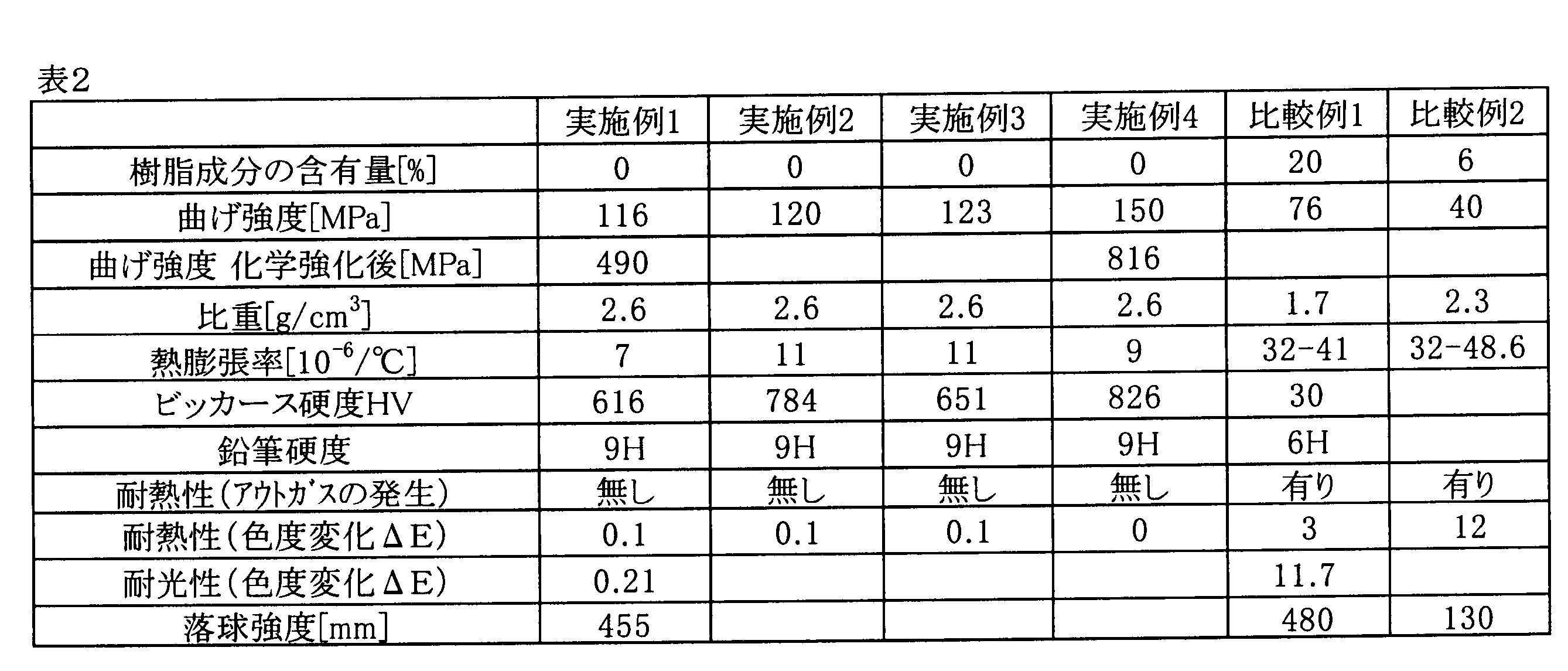
表2に示すように、樹脂成分の含有量が5%以下で、曲げ強度が80MPa以上である実施例1~4は、アクリル系大理石(比較例1)およびエンジニアドストーン(比較例2)と比較して、耐熱性および強度に優れる。樹脂成分が少なく曲げ強度が高いため、実施例1~4を設備台の表面層に用いれば、耐熱性および強度に優れる設備台が得られる。
さらに、図4に示すように、実施例1~4は全て、波長380nmから720nmの範囲において、全光反射率が10%以上であった。
[サンプルの加工]
実施例1~4および比較例1~2を30×30×2mmに切断後、6つのサンプルを定盤に樹脂で固定し、#1000の砥石で100μm以上研削した。その後、研磨機(エンギス社製)に1kgの重りを付けた状態でCeO2を流しながら10分間研磨した。反対側の面を前記条件で研削と研磨を行い、最終的に30×30×1mmのサンプルを得た。
実施例1~4および比較例1~2を30×30×2mmに切断後、6つのサンプルを定盤に樹脂で固定し、#1000の砥石で100μm以上研削した。その後、研磨機(エンギス社製)に1kgの重りを付けた状態でCeO2を流しながら10分間研磨した。反対側の面を前記条件で研削と研磨を行い、最終的に30×30×1mmのサンプルを得た。
得られたサンプルの表面粗度RaをJIS B0633(2001年)に準拠した方法により測定した。結果を表3に示す。

本発明を特定の態様を参照して詳細に説明したが、本発明の精神と範囲を離れることなく様々な変更および修正が可能であることは、当業者にとって明らかである。なお、本出願は、2015年7月6日付けで出願された日本特許出願(特願2015-135423)および2015年7月6日付けで出願された日本特許出願(特願2015-135424)に基づいており、その全体が引用により援用される。また、ここに引用されるすべての参照は全体として取り込まれる。
1……流し台
2……コンロ台
4……表面層
5……水槽
6……骨組材
7……嵌合溝
8……パッキン
9……締結部材
10……コンロ収容ケース
11……空間
12……側板
13……起倒壁
14……収納部
15……鏡
16……作業板
17……接続金具
2……コンロ台
4……表面層
5……水槽
6……骨組材
7……嵌合溝
8……パッキン
9……締結部材
10……コンロ収容ケース
11……空間
12……側板
13……起倒壁
14……収納部
15……鏡
16……作業板
17……接続金具
Claims (8)
- 樹脂成分の含有量が質量百分率表示で5%以下であり、曲げ強度が80MPa以上であり、最表面から深度1mmまでの全光反射率が、波長380nmから720nmの範囲のいずれかの波長において10%以上である表面層を有する設備台。
- 前記表面層は、350℃に加熱したステンレス製平板を20分間静置した際にアウトガスの発生が無く、且つ下式により導出される表面の色度変化ΔEが0以上2以下である請求項1記載の設備台。

- 前記表面層がガラスを含む請求項1または2に記載の設備台。
- 前記表面層がガラスと結晶相を含み、表面層の結晶化率が90%以下である請求項3に記載の設備台。
- 前記ガラスが分相ガラスである請求項3または4に記載の設備台。
- 前記ガラスが酸化物基準のモル百分率表示で、Al2O3を0~35%含有し、アルカリ金属酸化物を0~20%含有する請求項3~5のいずれか1項に記載の設備台。
- 前記ガラスが強化処理されたガラスである請求項3~6のいずれか1項に記載の設備台。
- 前記表面層の表面粗度Raが0.001~1.5μmである請求項1~7のいずれか1項に記載の設備台。
Applications Claiming Priority (4)
| Application Number | Priority Date | Filing Date | Title |
|---|---|---|---|
| JP2015135423 | 2015-07-06 | ||
| JP2015-135424 | 2015-07-06 | ||
| JP2015-135423 | 2015-07-06 | ||
| JP2015135424 | 2015-07-06 |
Publications (1)
| Publication Number | Publication Date |
|---|---|
| WO2017006966A1 true WO2017006966A1 (ja) | 2017-01-12 |
Family
ID=57685538
Family Applications (1)
| Application Number | Title | Priority Date | Filing Date |
|---|---|---|---|
| PCT/JP2016/070020 Ceased WO2017006966A1 (ja) | 2015-07-06 | 2016-07-06 | 設備台 |
Country Status (1)
| Country | Link |
|---|---|
| WO (1) | WO2017006966A1 (ja) |
Citations (3)
| Publication number | Priority date | Publication date | Assignee | Title |
|---|---|---|---|---|
| JPH0564606A (ja) * | 1991-03-11 | 1993-03-19 | Ontake Kogei Kk | 電磁調理器用テーブルおよびその製造方法 |
| JPH09132428A (ja) * | 1995-11-06 | 1997-05-20 | Nippon Electric Glass Co Ltd | 調理器具用トッププレート |
| JP2003170533A (ja) * | 2001-09-28 | 2003-06-17 | Nippon Sheet Glass Environment Amenity Co Ltd | 設備台用ガラス天板 |
-
2016
- 2016-07-06 WO PCT/JP2016/070020 patent/WO2017006966A1/ja not_active Ceased
Patent Citations (3)
| Publication number | Priority date | Publication date | Assignee | Title |
|---|---|---|---|---|
| JPH0564606A (ja) * | 1991-03-11 | 1993-03-19 | Ontake Kogei Kk | 電磁調理器用テーブルおよびその製造方法 |
| JPH09132428A (ja) * | 1995-11-06 | 1997-05-20 | Nippon Electric Glass Co Ltd | 調理器具用トッププレート |
| JP2003170533A (ja) * | 2001-09-28 | 2003-06-17 | Nippon Sheet Glass Environment Amenity Co Ltd | 設備台用ガラス天板 |
Similar Documents
| Publication | Publication Date | Title |
|---|---|---|
| JP7330932B2 (ja) | イオン交換可能なガラス、ガラスセラミック、およびその製造方法 | |
| US11390558B2 (en) | Colored glass-ceramics having petalite and lithium silicate structures | |
| US11161776B2 (en) | Black lithium silicate glass ceramics | |
| JP7115479B2 (ja) | 結晶化ガラスおよび化学強化ガラス | |
| JP6778290B2 (ja) | 二ケイ酸リチウム及びβ‐スポジュメン構造を有する高強度ガラスセラミック | |
| KR102435835B1 (ko) | 금속 산화물 농도 구배를 포함하는 유리-계 제품 | |
| JP6774339B2 (ja) | 透明ガラスセラミック物品、ガラスセラミック前駆体ガラス、およびその形成方法 | |
| TWI692456B (zh) | 低結晶性玻璃陶瓷 | |
| JP2025085692A (ja) | 結晶化ガラス、化学強化ガラスおよび半導体支持基板 | |
| CN106536441B (zh) | 用于制备涂布基板的方法、包括通过加热涂覆的至少两个层的平面基板、以及涂布基板的用途 | |
| WO2019022033A1 (ja) | 化学強化用ガラス、化学強化ガラスおよび電子機器筐体 | |
| JP2016529197A5 (ja) | ||
| JP2005325018A (ja) | 調理面となる半透明または不透明着色ガラスセラミック製品及びその使用 | |
| JPWO2016195015A1 (ja) | 光拡散板 | |
| JP2001354429A (ja) | 清掃容易ガラスセラミック体 | |
| CN112456806A (zh) | 微晶玻璃、微晶玻璃制品及其制造方法 | |
| TWI915315B (zh) | 積層構件 | |
| CN115335338A (zh) | 玻璃及包含玻璃的物品 | |
| DE102014220457A1 (de) | Verfahren zur Herstellung eines beschichteten Substrats, scheibenförmiges Substrat, umfassend wenigstens zwei mittels Erwärmen aufgebrachte Schichten und Verwendung des beschichteten Substrats | |
| CN108529872B (zh) | 化学强化玻璃和化学强化玻璃的制造方法 | |
| TW202104120A (zh) | 玻璃 | |
| CZ2009446A3 (cs) | Rubínové sklo barvené zlatem | |
| RU2820480C1 (ru) | Микрокристаллическое стекло, изделие из микрокристаллического стекла и способ их изготовления | |
| JP2023164073A (ja) | 分相ガラス | |
| WO2017077987A1 (ja) | ガラス及び強化ガラス |
Legal Events
| Date | Code | Title | Description |
|---|---|---|---|
| 121 | Ep: the epo has been informed by wipo that ep was designated in this application |
Ref document number: 16821435 Country of ref document: EP Kind code of ref document: A1 |
|
| NENP | Non-entry into the national phase |
Ref country code: DE |
|
| 122 | Ep: pct application non-entry in european phase |
Ref document number: 16821435 Country of ref document: EP Kind code of ref document: A1 |
|
| NENP | Non-entry into the national phase |
Ref country code: JP |