WO2017002484A1 - 吸収性物品用の複合シート - Google Patents
吸収性物品用の複合シート Download PDFInfo
- Publication number
- WO2017002484A1 WO2017002484A1 PCT/JP2016/065206 JP2016065206W WO2017002484A1 WO 2017002484 A1 WO2017002484 A1 WO 2017002484A1 JP 2016065206 W JP2016065206 W JP 2016065206W WO 2017002484 A1 WO2017002484 A1 WO 2017002484A1
- Authority
- WO
- WIPO (PCT)
- Prior art keywords
- woven fabric
- hydrophilic
- hydrophobic
- composite sheet
- nonwoven fabric
- Prior art date
- Legal status (The legal status is an assumption and is not a legal conclusion. Google has not performed a legal analysis and makes no representation as to the accuracy of the status listed.)
- Ceased
Links
Images


Classifications
-
- A—HUMAN NECESSITIES
- A61—MEDICAL OR VETERINARY SCIENCE; HYGIENE
- A61F—FILTERS IMPLANTABLE INTO BLOOD VESSELS; PROSTHESES; DEVICES PROVIDING PATENCY TO, OR PREVENTING COLLAPSING OF, TUBULAR STRUCTURES OF THE BODY, e.g. STENTS; ORTHOPAEDIC, NURSING OR CONTRACEPTIVE DEVICES; FOMENTATION; TREATMENT OR PROTECTION OF EYES OR EARS; BANDAGES, DRESSINGS OR ABSORBENT PADS; FIRST-AID KITS
- A61F13/00—Bandages or dressings; Absorbent pads
- A61F13/15—Absorbent pads, e.g. sanitary towels, swabs or tampons for external or internal application to the body; Supporting or fastening means therefor; Tampon applicators
- A61F13/45—Absorbent pads, e.g. sanitary towels, swabs or tampons for external or internal application to the body; Supporting or fastening means therefor; Tampon applicators characterised by the shape
- A61F13/49—Absorbent pads, e.g. sanitary towels, swabs or tampons for external or internal application to the body; Supporting or fastening means therefor; Tampon applicators characterised by the shape specially adapted to be worn around the waist, e.g. diapers, nappies
-
- A—HUMAN NECESSITIES
- A61—MEDICAL OR VETERINARY SCIENCE; HYGIENE
- A61F—FILTERS IMPLANTABLE INTO BLOOD VESSELS; PROSTHESES; DEVICES PROVIDING PATENCY TO, OR PREVENTING COLLAPSING OF, TUBULAR STRUCTURES OF THE BODY, e.g. STENTS; ORTHOPAEDIC, NURSING OR CONTRACEPTIVE DEVICES; FOMENTATION; TREATMENT OR PROTECTION OF EYES OR EARS; BANDAGES, DRESSINGS OR ABSORBENT PADS; FIRST-AID KITS
- A61F13/00—Bandages or dressings; Absorbent pads
- A61F13/15—Absorbent pads, e.g. sanitary towels, swabs or tampons for external or internal application to the body; Supporting or fastening means therefor; Tampon applicators
- A61F13/51—Absorbent pads, e.g. sanitary towels, swabs or tampons for external or internal application to the body; Supporting or fastening means therefor; Tampon applicators characterised by the outer layers of the pads
-
- B—PERFORMING OPERATIONS; TRANSPORTING
- B32—LAYERED PRODUCTS
- B32B—LAYERED PRODUCTS, i.e. PRODUCTS BUILT-UP OF STRATA OF FLAT OR NON-FLAT, e.g. CELLULAR OR HONEYCOMB, FORM
- B32B5/00—Layered products characterised by the non- homogeneity or physical structure, i.e. comprising a fibrous, filamentary, particulate or foam layer; Layered products characterised by having a layer differing constitutionally or physically in different parts
- B32B5/22—Layered products characterised by the non- homogeneity or physical structure, i.e. comprising a fibrous, filamentary, particulate or foam layer; Layered products characterised by having a layer differing constitutionally or physically in different parts characterised by the presence of two or more layers which are next to each other and are fibrous, filamentary, formed of particles or foamed
- B32B5/24—Layered products characterised by the non- homogeneity or physical structure, i.e. comprising a fibrous, filamentary, particulate or foam layer; Layered products characterised by having a layer differing constitutionally or physically in different parts characterised by the presence of two or more layers which are next to each other and are fibrous, filamentary, formed of particles or foamed one layer being a fibrous or filamentary layer
- B32B5/26—Layered products characterised by the non- homogeneity or physical structure, i.e. comprising a fibrous, filamentary, particulate or foam layer; Layered products characterised by having a layer differing constitutionally or physically in different parts characterised by the presence of two or more layers which are next to each other and are fibrous, filamentary, formed of particles or foamed one layer being a fibrous or filamentary layer another layer next to it also being fibrous or filamentary
-
- D—TEXTILES; PAPER
- D04—BRAIDING; LACE-MAKING; KNITTING; TRIMMINGS; NON-WOVEN FABRICS
- D04H—MAKING TEXTILE FABRICS, e.g. FROM FIBRES OR FILAMENTARY MATERIAL; FABRICS MADE BY SUCH PROCESSES OR APPARATUS, e.g. FELTS, NON-WOVEN FABRICS; COTTON-WOOL; WADDING ; NON-WOVEN FABRICS FROM STAPLE FIBRES, FILAMENTS OR YARNS, BONDED WITH AT LEAST ONE WEB-LIKE MATERIAL DURING THEIR CONSOLIDATION
- D04H1/00—Non-woven fabrics formed wholly or mainly of staple fibres or like relatively short fibres
- D04H1/40—Non-woven fabrics formed wholly or mainly of staple fibres or like relatively short fibres from fleeces or layers composed of fibres without existing or potential cohesive properties
- D04H1/42—Non-woven fabrics formed wholly or mainly of staple fibres or like relatively short fibres from fleeces or layers composed of fibres without existing or potential cohesive properties characterised by the use of certain kinds of fibres insofar as this use has no preponderant influence on the consolidation of the fleece
- D04H1/4374—Non-woven fabrics formed wholly or mainly of staple fibres or like relatively short fibres from fleeces or layers composed of fibres without existing or potential cohesive properties characterised by the use of certain kinds of fibres insofar as this use has no preponderant influence on the consolidation of the fleece using different kinds of webs, e.g. by layering webs
Definitions
- the present invention relates to a composite sheet for an absorbent article in which water on one surface side is transferred to the other surface side to evaporate.
- an outer hydrophilic sheet is a hydrophilic sheet having an inner hydrophilic sheet forming a skin contact surface, and an outer hydrophilic sheet disposed on the non-skin contact surface side of the inner hydrophilic sheet.
- a disposable diaper is disclosed in which a gather member is formed using a hydrophilic sheet having a higher liquid diffusivity than the inner hydrophilic sheet, thereby forming a waist part located around the wearer's waist (patent document See claim 1 of 1).
- the waist portion of the disposable diaper according to Patent Document 1 absorbs sweat absorbed by the wearer with the inner hydrophilic sheet, and the outer hydrophilic sheet having higher diffusivity of liquid than the inner hydrophilic sheet absorbs the sweat. It is made to move to the non-skin side and diffuse, that is, to evaporate. Thus, it is described that the sweat in the disposable diaper is evaporated to reduce the occurrence of eczema, cold, rash and the like.
- the inner sheet forming the skin contact surface is hydrophilic, and therefore retains moisture even if the outer sheet has high diffusivity. Therefore, sweat may remain on the skin contact surface of the inner hydrophilic sheet, and the sweat in the disposable diaper may not be sufficiently evaporated. As a result, skin problems such as eczema, cold and rash may occur.
- an object of the present invention is to absorb water on one side and evaporate from the other side, thereby reducing the amount of water on one side and forming one side. It is an object of the present invention to provide a composite sheet for an absorbent article which is made to retain substantially no moisture.
- a composite sheet for an absorbent article A first side and a second side opposite to the first side, A hydrophobic non-woven fabric forming the first surface, and a hydrophilic non-woven fabric forming the second surface;
- the hydrophobic non-woven fabric is higher in fiber density than the other portions by forming unevenness on at least the hydrophilic non-woven fabric of the hydrophobic non-woven fabric and the hydrophilic non-woven fabric.
- a protruding portion that protrudes relative to the nonwoven fabric of The hydrophobic non-woven fabric and the hydrophilic non-woven fabric are in direct contact with each other at at least a portion of the protrusions.
- Composite sheets are provided.
- the composite sheet includes an elastic member joined between the hydrophobic nonwoven fabric and the hydrophilic nonwoven fabric, and the hydrophobic nonwoven fabric and the hydrophilic nonwoven fabric are formed by the contraction of the elastic member. It is preferable that the said unevenness
- the fiber density is higher than in other parts due to the fibers being dense due to the short path length of the curved shape, and the water absorbency is thereby increased, so from the first surface of the composite sheet
- the movement of water to the second side can be promoted.
- unevenness is formed in the hydrophobic non-woven fabric, and in the portion of the hydrophobic non-woven fabric located on the first surface side that is curved so as to protrude to the first surface side, the path length of the curved shape is long As a result, the inter-fiber distance increases because the fibers are interspersed.
- the water permeability in the curved portion is high, the movement of water from the first surface to the second surface of the composite sheet can be promoted.
- the hydrophobic non-woven fabric is an elastic non-woven fabric, and the unevenness is formed on at least the hydrophilic non-woven fabric of the hydrophobic non-woven fabric and the hydrophilic non-woven fabric by contraction of the hydrophobic non-woven fabric. Is preferred.
- at least the hydrophilic non-woven fabric is formed with irregularities, and the projecting portion that is a curved portion of the hydrophilic non-woven fabric and that protrudes with respect to the hydrophobic non-woven fabric is in direct contact with the hydrophobic non-woven fabric.
- the fiber density is higher than in other parts due to the fibers being dense due to the short path length of the curved shape, and thus the absorbency is increased. The movement of water from the surface of the second to the second surface can be promoted.
- At least one of the hydrophobic non-woven fabric and the hydrophilic non-woven fabric be shaped such that the unevenness is formed.
- asperities are formed on the hydrophilic non-woven fabric, and a projecting portion which is a curved portion of the hydrophilic non-woven fabric and protrudes with respect to the hydrophobic non-woven fabric is in direct contact with the hydrophobic non-woven fabric.
- the fibers are dense due to the short path length of the curved shape, and the fiber density is higher than in the other parts, thereby increasing the absorbency.
- asperities are formed on the hydrophobic non-woven fabric, and in the portion of the hydrophobic non-woven fabric located on the first surface side that is curved so as to protrude to the first surface side, the path length of the curved shape is long Because of the interspersed fibers, the inter-fiber distance is increased, thereby increasing the water permeability. As a result, the movement of water from the first surface to the second surface of the composite sheet can be promoted.
- the hydrophobic non-woven fabric and the hydrophilic non-woven fabric include recesses and protrusions that are alternately repeated along a first direction and extend in a second direction orthogonal to the first direction.
- the non-forming area of the hydrophobic non-woven fabric and the non-forming area of the hydrophilic non-woven fabric are joined via the elastic member, and the concave and the convex in the shaping area are
- the convex portion of the hydrophobic non-woven fabric is formed in the composite sheet, and the convex portion of the hydrophobic non-woven fabric intrudes into the concave portion of the hydrophilic non-woven fabric, and the protrusion of the hydrophilic non-woven fabric
- the convex portion is the concave portion of the hydrophobic non-woven fabric It is preferable that enters therein.
- the convex portion of the hydrophilic non-woven fabric enters the inside of the concave portion of the hydrophobic non-woven fabric, and the inter-fiber distance between the fibers constituting the hydrophobic non-woven fabric increases in the concave portion of the hydrophobic non-woven fabric And in the convex part of a hydrophilic nonwoven fabric, fiber density becomes high.
- the convex portion of the hydrophilic non-woven fabric has a fiber density higher than that of other portions, thereby increasing the water absorbability, and the inter-fiber distance in the concave portion of the hydrophobic non-woven fabric increases and the water permeability increases. The movement of water from the first surface to the second surface of the composite sheet can be further promoted.
- the concavo-convex pitch of the shaping region is 0.5 mm to 2.0 mm when the composite sheet is in a 50% elongation state.
- the concavo-convex pitch is 2.0 mm or less, it is possible to secure more places where the projections of the hydrophilic non-woven fabric enter the inside of the recesses of the hydrophobic non-woven fabric.
- the unevenness pitch is 0.5 mm or more, it is possible to prevent the nonwoven fabric from being broken when shaping the nonwoven fabric.
- the hydrophilic non-woven fabric is in direct contact with the hydrophobic non-woven fabric in at least a part of the protruding portions by forming the unevenness on the hydrophilic non-woven fabric forming the second surface.
- the said protrusion part has a fiber density higher than another part and, thereby, water absorbency becomes high, transfer of the water
- the first surface is formed of a hydrophobic non-woven fabric, the moisture on the first surface side is not substantially retained by the non-woven fabric forming the first surface. As a result, the water content is absorbed by the hydrophilic non-woven fabric, and then the water absorbed on the second surface side of the composite sheet is evaporated, whereby the water content on the first surface side can be reduced.
- the composite sheet according to the present invention when used as a member of an absorbent article, for example, with the first surface facing the skin side of the disposable diaper, the hydrophobic non-woven fabric forming the first surface absorbs moisture. Moisture can be moved from the first surface side to the second surface side without being substantially held. As a result, the humidity inside the absorbent article can be reduced to reduce the occurrence of skin problems such as eczema, heat and rash.
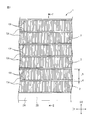
- FIG. 2 is a cross-sectional view taken along line II-II of FIG.
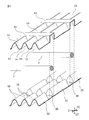
- FIG. 2 is a partial cross-sectional perspective view of the composite sheet of FIG. 1;
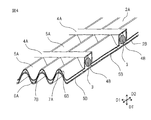
- FIG. 5 is an enlarged view of the periphery of a cross section of the elastic member in FIG. 4;
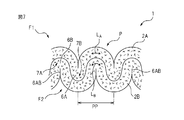
- FIG. 2 is a schematic cross-sectional view of the relief region of the composite sheet of FIG. 1 in a contracted state.
- (Embodiment) 1 and 2 show a composite sheet 1 according to an embodiment of the present invention.
- the composite sheet 1 is used to manufacture absorbent articles such as disposable diapers and sanitary napkins.
- the composite sheet 1 is used for a member that touches the skin of the wearer when worn, such as the waist of a disposable diaper.
- the composite sheet 1 is in the form of a sheet extending in a first direction D1 and a second direction D2 orthogonal to the first direction D1.
- the composite sheet 1 can expand and contract in the first direction D 1, and thus the first direction D 1 corresponds to the expansion and contraction direction of the composite sheet 1.
- FIG. 1 shows a state in which the composite sheet 1 is stretched in the first direction D1.
- the composite sheet 1 includes a hydrophobic non-woven fabric 2A which forms the first surface F1 and a hydrophilic non-woven fabric 2B which forms the second surface F2 opposite to the first surface F1. And a plurality of, for example, seven elastic members 3 disposed between the hydrophobic non-woven fabric 2A and the hydrophilic non-woven fabric 2B.
- the elastic members 3 extend in the first direction D1 while being spaced apart from each other by a predetermined distance in the second direction D2.
- the determination of whether the non-woven fabric is "hydrophobic" or “hydrophilic” is performed by the "one drop method” described below.
- the test method of the one drop method will be described below.
- the non-woven fabric of the sample is judged to be hydrophilic.
- the nonwoven fabric of the sample is It is judged to be hydrophobic.
- the hydrophobic non-woven fabric 2A includes a plurality of shaped regions 5A and at least one non-shaped region 4A that spaces the shaped regions 5A in the second direction D2.
- the hydrophilic non-woven fabric 2B includes a plurality of shaped regions 5B and at least one non-shaped region 4B that spaces the shaped regions 5B in the second direction D2.
- the hydrophobic nonwoven fabric 2A and the hydrophilic nonwoven fabric 2B are respectively provided with six shaping regions 5A, 5B and seven non-formation regions 4A, 4B.
- the length L4 in the second direction D2 of the non-forming areas 4A and 4B is about 1 mm
- the length L5 in the second direction D2 of the forming areas 5A and 5B is about 4 mm.
- the shaping area 5A of the hydrophobic non-woven fabric 2A includes a convex portion 6A and a concave portion 7A which are alternately repeated in the first direction D1 and extend in the second direction D2.
- the convex portions 6A respectively project from the position of the non-forming area 4A in the thickness direction DT toward the hydrophilic nonwoven fabric 2B.
- the non-forming area 4A does not have a convex portion and a concave portion.
- the shaping area 5B of the hydrophilic non-woven fabric 2B includes a convex portion 6B and a concave portion 7B alternately repeated in the first direction D1 and extending in the second direction D2.
- the convex portions 6B respectively project from the position of the non-forming area 4B in the thickness direction DT toward the hydrophobic nonwoven fabric 2A.
- the non-forming area 4B is not provided with a protrusion and a recess.
- convexes 6A and 6B project in the thickness direction DT from the corresponding reference plane, and concaves 7A and 7B correspond to the corresponding standard. It means that it has reached the side. Since the hydrophobic nonwoven fabric 2A and the hydrophilic nonwoven fabric 2B have flexibility, the reference surface is not necessarily a flat surface.
- the hydrophobic non-woven fabric 2A and the hydrophilic non-woven fabric 2B are such that the shaping regions 5A, 5B are adjacent to each other and the non- shaping regions 4A, 4B are separated from each other.
- the shaping regions 5A and 5B are opposed to each other, and the non-formation regions 4A and 4B are opposed to each other.
- the convex portion 6A of the hydrophobic nonwoven fabric 2A and the concave portion 7B of the hydrophilic nonwoven fabric 2B face each other, and the convex portion 6B of the hydrophilic nonwoven fabric 2B and the concave portion 7A of the hydrophobic nonwoven fabric 2A.
- the non-shaped areas 4A and 4B are separated from each other in the thickness direction DT. Therefore, as shown in FIG. 5, a space SP is formed between the non-forming areas 4A and 4B facing each other, and the elastic member 3 is disposed in the space SP.
- An adhesive 8 is applied to the circumferential surface of the elastic member 3 in advance, and the hydrophobic nonwoven fabric 2A and the hydrophilic nonwoven fabric 2B are bonded to each other by the adhesive 8. In another embodiment, the adhesive 8 is partially applied to the circumferential surface of the elastic member 3.
- the hydrophobic non-woven fabric 2A and the hydrophilic non-woven fabric 2B are indirectly joined via the elastic member 3. Further, no adhesive is present in the shaping regions 5A and 5B, and thus the hydrophobic non-woven fabric 2A and the hydrophilic non-woven fabric 2B are not directly bonded to each other. In this way, it is possible to suppress the decrease in the flexibility of the composite sheet 1 by the adhesive while reliably maintaining the bond between the hydrophobic nonwoven fabric 2A and the hydrophilic nonwoven fabric 2B.
- the stretchability in the first direction D1 is imparted to the composite sheet 1, and when the composite sheet 1 shrinks, a large number of wrinkles are formed in the shaping regions 5A and 5B.
- asperities are formed on both the hydrophobic nonwoven fabric 2A and the hydrophilic nonwoven fabric 2B.
- the state in which the tension of the elastic member 3 is released and the composite sheet 1 is contracted to form wrinkles is referred to as the natural state of the composite sheet 1.
- the "concave / convex" formed on the non-woven fabric refers to the unevenness of the surface of the non-woven fabric which is expressed by positively forming the uneven shape and / or wrinkles on the non-woven fabric. That is, the concavo-convex shape formed in the non-woven fabric by stretching and plastically deforming a part of the non-woven fabric using a shaping device 20 or the like described later is included in the “concavities and convexities”. Further, as in a composite sheet according to the present embodiment or a modified embodiment to be described later, a crease formed by shrinking an elastic member such as a pre-stretched thread rubber or an elastic nonwoven fabric after forming the composite sheet is also used here.
- the unevenness of the surface of the non-woven fabric caused by manufacturing errors such as the thickness and basis weight of the non-woven fabric material is not included in the “concave and convex” referred to here.
- the unevenness of the surface of the non-woven fabric due to processing requiring melting of the fibers constituting the non-woven fabric such as embossing does not contribute to the effects of the present invention, so it is not included in the “concave and convex” here. Do.
- the unevenness pitch PP which is the pitch length of the repeating pattern along the first direction D1 of the convex portions 6A, 6B and the concave portions 7A, 7B formed in the shaping regions 5A, 5B, is 50% of the composite sheet 1 In the stretched state, 0.5 mm to 2.0 mm is preferable.
- the convex portion 6B of the hydrophilic non-woven fabric 2B enters the inside of the concave portion 7A of the hydrophobic non-woven fabric 2A in a curved form as the concavo-convex pitch when the composite sheet 1 is 50% stretched is 2.0 mm or less. More points can be secured. As a result, the moisture on the first surface F1 side of the composite sheet 1 can be efficiently transferred to the second surface F2 side.
- the 50% stretched state refers to a state in which the composite stretchable material is stretched in the stretch direction so that the stretch ratio is 50%.
- LM Stretching direction length of the stretched composite stretchable material portion
- LM0 Stretching direction length of the composite stretchable material portion in the natural state
- the unevenness pitch in the 50% elongation state makes the composite sheet 1 50% elongation state, and the shaping area 5A along the expansion and contraction direction using a shape measurement instrument such as a laser shape measurement system (KS-1100 manufactured by KEYENCE) , 5B is detected by measuring the surface shape.
- the measurement conditions of the surface shape are a measurement range of 30 mm, a measurement pitch of 5 ⁇ m, and in the analysis stage after measurement, a moving average of 12 points before and after is taken.
- the concavo-convex pitch refers to the length of the measurement range (30 mm) divided by the number of wrinkles detected in the measurement, and the wrinkles protrude to one surface side beyond the average height of the surface shape Say the part that
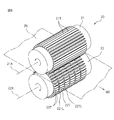
- the non-forming areas 4A, 4 and the forming areas 5A, 5B of the composite sheet 1 are formed by a forming apparatus 20 as shown in FIG. 6, for example.
- the shaping device 20 includes a pair of continuous gear rolls 21 and a toothless gear roll 22 which can rotate in mutually opposite directions and in mesh with each other around mutually parallel rotational axes 21A and 22A.
- the continuous gear roll 21 comprises a plurality of teeth 21T which extend continuously along the rotation axis 21A.
- the missing gear roll 22 comprises a plurality of teeth 22T extending discontinuously along the rotation axis 22A. That is, the teeth 22T are separated from each other in the direction of the rotation axis 22A by the non-toothed portions 22TL.
- a non-formed nonwoven sheet 2N having hydrophobicity is passed between the continuous gear roll 21 and the missing gear roll 22.
- the conveyance direction MD of the nonwoven fabric sheet 2N corresponds to the first direction D1
- the directions of the rotation axes 21A and 22A of the continuous gear roll 21 and the missing gear roll 22 correspond to the second direction D2.
- the non-woven fabric sheet 2N is partially stretched along the first direction D1.
- the convex portions 6A and the concave portions 7A are alternately and repeatedly formed along the transport direction MD. That is, the shaping area 5A is formed.
- an unformed nonwoven fabric sheet having hydrophilicity is passed between the continuous gear roll 21 and the missing gear roll 22.
- the convex portions 6B and the concave portions 7B are alternately and repeatedly formed along the transport direction MD.
- a shaped region 5B and a non-shaped region 4B are formed, and thus a shaped non-woven fabric 2B is formed.
- the elastic member 3 is attached to the nonwoven fabric sheet 10 while the shaped nonwoven fabric sheet 10 is conveyed.
- the elastic member 3 to which the adhesive 8 has been applied in advance is arranged, for example, in the non-forming area 4B of the hydrophilic nonwoven fabric 2B in a stretched state.
- the bonding magnification of the elastic member 3 (the length in the stretched state of the elastic member 3 bonded to the nonwoven fabric sheet 10 in the conveyance direction MD unit length / the length in the natural state of the elastic member 3)
- the form is set to 2.2.
- the hydrophobic non-woven fabric 2A and the hydrophilic non-woven fabric 2B are superimposed on each other while being transported.
- the hydrophobic nonwoven fabric 2A and the hydrophilic nonwoven fabric 2B are pressed in the thickness direction DT by, for example, a press roller.
- the projections 6A of the hydrophobic non-woven fabric 2A penetrates into the recesses 7B of the hydrophilic non-woven fabric 2B, and at least a portion of the projections 6B of the hydrophilic non-woven fabric 2B forms recesses of the hydrophobic non-woven fabric 2A. Get into 7A.
- the hydrophobic non-woven fabric 2A and the hydrophilic non-woven fabric 2B are bonded to each other by the adhesive 8 (FIG. 5) applied to the elastic member 3.
- the composite sheet 1 is formed.
- the convex portion 6A of the hydrophobic non-woven fabric 2A faces the concave portion 7B of the hydrophilic non-woven fabric 2B and the convex of the hydrophilic non-woven fabric 2B
- One of the hydrophobic non-woven fabric 2A and the hydrophilic non-woven fabric 2B is moved slightly in the first direction D1 relative to the other so that the portion 6B faces the recess 7A of the hydrophobic non-woven fabric 2A. This movement can be obtained, for example, by adjusting the tension of the hydrophobic nonwoven fabric 2A and the hydrophilic nonwoven fabric 2B during transport.
- the convex portion 6A of the hydrophobic non-woven fabric 2A enters into the concave portion 7B of the hydrophilic non-woven fabric 2B, and the convex portion 6B of the hydrophilic non-woven fabric 2B into the concave portion 7A of the hydrophobic non-woven fabric 2A. Get in.
- the hydrophobic non-woven fabric 2A and the hydrophilic non-woven fabric 2B are formed of, for example, a spunbonded non-woven fabric.
- the hydrophobic non-woven fabric 2A and the hydrophilic non-woven fabric 2B are, for example, meltblown non-woven fabric, SMS non-woven fabric combining spunbond non-woven fabric and meltblown non-woven fabric, heat roll non-woven fabric, air-through non-woven fabric, spun lace non-woven fabric, air-laid It is formed of non-woven fabric or the like.
- any nonwoven fabric having an arbitrary basis weight can be used for the hydrophobic nonwoven fabric 2A and the hydrophilic nonwoven fabric 2B, for example, a nonwoven fabric having a basis weight of 13 to 27 g / m 2 is used. It is preferable to use a hydrophilic non-woven fabric 2 B in which a hydrophilic agent is previously kneaded into a fiber, because the hydrophilic agent hardly flows off.
- the elastic member 3 is formed of Lycra (registered trademark) having a fineness of 470 dtex.
- it is formed from synthetic rubbers such as styrene-butadiene, butadiene, isoprene and neoprene, natural rubber, EVA, SIS, SEBS, SEPS, stretchable polyolefin, polyurethane and the like.
- the fineness of the elastic member 3 is preferably 30 to 1,500 dtex.
- the non-forming areas 4A and 4B are formed at equal intervals in the second direction D2, and therefore the elastic members 3 are arranged at equal intervals in the second direction D2.
- the non-forming areas 4A and 4B are formed at unequal intervals in the second direction D2, and the elastic members 3 are arranged at unequal intervals in the second direction D2.
- the operation and effect of the composite sheet 1 according to the present embodiment will be described.
- the elastic member 3 attached by applying tension at the time of manufacture is contracted.
- the entire composite sheet 1 shrinks, and the hydrophobic non-woven fabric 2A and the hydrophilic non-woven fabric 2B adjacent to each other in the shaping regions 5A and 5B are in close contact with each other as shown in FIG.
- the amount of moisture such as sweat adhering to the first surface F1 passing through the hydrophobic non-woven fabric 2A is usually It is a very small amount except where the fiber density is reduced due to the unevenness of the amount.
- asperities are formed in the shaping area 5B of the hydrophilic nonwoven fabric 2B, and the hydrophobic nonwoven fabric 2A and the hydrophilic nonwoven fabric 2B directly interact with each other directly without an adhesive or the like. Since they are in contact with each other, the hydrophilic non-woven fabric 2B can promote the transfer of moisture from the first surface F1 to the second surface F2 direction of the composite sheet 1. In such a manner, the water passing through the hydrophobic non-woven fabric 2A is absorbed by the hydrophilic non-woven fabric 2B, and then the water absorbed to the second surface F2 side of the composite sheet 1 is evaporated, The amount of water on the side F1 can be reduced.
- the fibers are scattered, whereby the distance between the fibers of the fibers is increased as compared with the other portion, and a gap is easily generated between the fibers. Permeability increases.
- the water adhering to the first surface F1 can more easily pass between the fibers of the hydrophobic nonwoven fabric 2A.
- the hydrophobic nonwoven fabric 2A is A constant compressive force is applied in the path length LB direction compared to the recess 7A.
- the convex portions 6B of the hydrophilic nonwoven fabric 2B have higher water absorbency than the other portions.
- the other part of the protrusion part of hydrophilic nonwoven fabric 2B means the recessed part 6A of hydrophilic nonwoven fabric 2B, and the part between recessed part 6A and convex part 6B.
- convex part 6B of hydrophilic non-woven fabric 2B enters into concave part 7A of hydrophobic non-woven fabric 2A in a curved form, it passes hydrophobic non-woven fabric 2A and hydrophilic non-woven fabric 2B The water reaching the side can be efficiently absorbed by the hydrophilic non-woven fabric 2B.
- the moisture having passed through the hydrophobic nonwoven fabric 2A is absorbed by the hydrophilic nonwoven fabric 2B, it hardly returns to the first surface F1 side of the composite sheet 1. Then, the water absorbed by the hydrophilic non-woven fabric 2B is evaporated from the second surface F2 side of the composite sheet 1. Thus, the amount of water on the first surface F1 side of the composite sheet 1 can be reduced.
- the composite sheet 1 is formed with an abutting portion 6AB in which the portion between the concave portion 6A and the convex portion 6B of the hydrophilic nonwoven fabric 2B abuts each other at the time of contraction. Ru.
- the contact portion 6AB By forming the contact portion 6AB in this manner, the moisture absorbed by the hydrophilic non-woven fabric 2B can efficiently move in the first direction D1 of the composite sheet 1.
- the second Water absorbed from the side F2 can be quickly evaporated.
- the waist portion of the disposable diaper is formed using the composite sheet 1 with the first face F1 as the skin side face of the wearer and the second face F2 as the outward face.
- the hydrophobic non-woven fabric forming the first surface can substantially retain the moisture such as the sweat of the wearer, and the moisture in the disposable diaper can be evaporated to the outside of the disposable diaper.
- the composite sheet 1 according to the present embodiment is not only disposable diapers, but also a sanitary napkin, a urine absorbing pad, and the like having members such as a top sheet, a cover sheet, leg gathers, solid gathers, etc. in direct contact with the skin of the wearer Can be used for absorbent articles of As a result, it is possible to reduce the amount of water inside the absorbent article and hence the humidity, thereby reducing the occurrence of skin problems.
- the composite sheet 1 can be formed by using a non-woven fabric with hydrophobic non-woven fabric 2A.
- the above-mentioned sticking ratio is set to 2.2.
- the non-formed hydrophilic non-woven fabric 2B is bonded with an adhesive.
- the bonding of the hydrophobic non-woven fabric 2A and the hydrophilic non-woven fabric 2B is performed by intermittently applying an adhesive, for example, linearly or spirally, to one of the bonding surfaces of the hydrophobic non-woven fabric 2A and the hydrophilic non-woven fabric 2B. After overlapping the hydrophobic nonwoven fabric 2A and the hydrophilic nonwoven fabric 2B, pressing is performed in the thickness direction DT.
- the composite sheet 1 which concerns on this modification embodiment is a state which only joined two nonwoven fabrics in the extended state, description of whole drawing is abbreviate
- the hydrophobic nonwoven fabric 2A which is a stretchable nonwoven fabric shrinks, and the distance between the bonding points of the hydrophobic nonwoven fabric 2A and the hydrophilic nonwoven fabric 2B becomes short.
- wrinkles are formed on at least the hydrophilic nonwoven fabric 2B, and unevenness is formed on the hydrophilic nonwoven fabric 2B.
- the unevenness is also formed on the adjacent hydrophobic nonwoven fabric 2A, and as a result, the unevenness is formed on both the hydrophobic nonwoven fabric 2A and the hydrophilic nonwoven fabric 2B. Be done.
- the convex portion 6B and the recess 7B are formed at least on the hydrophilic non-woven fabric 2B as in the above-described embodiment.
- the convex portion 6B of the hydrophilic nonwoven fabric 2B which is a projecting portion protruding toward the hydrophobic nonwoven fabric 2A, has a high fiber density, which increases the water absorbency by capillary action, It is possible to promote the movement of moisture from the first surface F1 to the second surface F2 side of the composite sheet 1 at a position where the hydrophobic nonwoven fabric 2A is in direct contact with each other.
- the hydrophobic non-woven fabric 2A which is an elastic non-woven fabric is shrunk to form asperities on the hydrophilic non-woven fabric 2B
- the hydrophobic non-woven fabric 2A and the hydrophilic non-woven fabric 2A are used as in the above embodiment.
- the shaping process may not be performed on the non-woven fabric 2B in advance.
- the non-shaped hydrophobic nonwoven fabric and the hydrophilic nonwoven fabric are formed to be joined via the elastic member to which the adhesive is applied as in the above-mentioned embodiment. , May be gathered. That is, when the composite sheet is used, at least the hydrophilic non-woven fabric has projections, which are in direct contact with the non-hydrophobic non-woven fabric and have a high fiber density. As it will be different, any other configuration may be used.
- gear stretching is performed so that unevenness is formed on either or both of the hydrophobic non-woven fabric and the hydrophilic non-woven fabric.
- a shaping process may be applied to the non-woven fabric by partially stretching the film by means of, for example.
- an "elastic nonwoven fabric” means the nonwoven fabric formed from an elastic fiber, or mainly containing an elastic fiber.
- stretchable fibers refer to fibers that are elastically stretchable and contractible. More specifically, the stretchable fiber has an elastic limit greater than the maximum stress applied during formation and expected use, and elastically within the range of maximum stress applied during formation and expected use It means a fiber to be stretched.
- the maximum stresses applied during the above formation and during the assumed use include, for example, stresses applied by non-uniform stretching steps, such as gear stretching.
- the material of the stretchable fiber is not particularly limited as long as it is a fiber having the stretchability, and examples thereof include a fiber made of a thermoplastic elastomer.
- the thermoplastic elastomer include polyolefin-based elastomers, polyurethane-based elastomers, polystyrene-based elastomers, polyamide-based elastomers, polyester-based elastomers, and combinations thereof.
- a polyolefin-based elastomer is preferable from the viewpoint of cost.
- non-crystalline or low crystalline polypropylene ethylene / ⁇ -olefin copolymer, propylene / ⁇ -olefin random copolymer, propylene / ethylene / ⁇ -olefin random copolymer, etc. or crystalline polyolefins
- crystalline polyolefins Mixtures with (for example, propylene homopolymer, copolymer of propylene and a small amount of ⁇ -olefin, high density polyethylene, medium density polyethylene, etc.) can be mentioned.
- polyolefin-based elastomers are commercially available.
- TAFMER trade name, manufactured by Mitsui Chemicals, Inc., ⁇ -olefin copolymer
- Engage trade name, Dupont Dow Elastomer, ethylene-octene copolymer
- Vistamaxx Name manufactured by ExxonMobil, a polypropylene-based elastomer
- the polyolefin-based elastomer is preferably a polypropylene-based elastomer, and a polypropylene-based elastomer having a propylene content of about 80 to about 90% by mass and a density of about 0.855 to about 0.880 g / cm 3 (
- a propylene / ⁇ -olefin copolymer is more preferable.
- the above-mentioned propylene / ⁇ -olefin copolymer having low propylene content and low density as compared with the conventional polypropylene elastomer has high stretchability as compared with the conventional polypropylene elastomer.
- the propylene / ⁇ -olefin copolymer is preferably about 1 to about 1000 g / 10 min, more preferably about 5 to about 500 g / 10 min, from the viewpoint of making spinnability, in particular, less likely to cause yarn breakage during spinning. More preferably, it has a melt flow rate of about 10 to about 100 g / 10 min: MFR (ASTM D1238 230 ° C., 2160 g load).
- examples of the ⁇ -olefin as the polymerization component include ⁇ -olefins having about 2 to about 20 carbon atoms, such as ethylene, 1-butene, 1-pentene, 3-methyl-1 -Butene, 1-hexene, 3-methyl-1-pentene, 4-methyl-1-pentene, 1-heptene, 1-octene, 1-nonene, 1-decene, 1-dodecene, 1-tetradecene, 1-hexadecene 1-octadecene, 1-eicosene etc., and any combination thereof, and ethylene and 1-butene are preferred.
- Comparative Examples 1 and 2 are composite sheets in which two non-shape-formed hydrophilic non-woven fabrics are joined via an elastic member having an adhesive applied to the periphery.
- the elastic member is Lycra (registered trademark) having a fineness of 470 dtex, and is bonded to the non-woven fabric at an interval of 5 mm with a bonding magnification of 2.2. That is, Comparative Examples 1 and 2 are general hydrophilic non-woven gather sheets.
- the material type and basis weight of the hydrophilic non-woven fabric forming the second surface are different.
- Example 1 is a composite sheet having the same structure as Comparative Examples 1 and 2 except that the non-woven fabric forming the first surface of the composite sheet is a hydrophobic non-woven fabric.
- Example 2 is a hydrophobic non-woven fabric made of a polyolefin elastomer which is not shaped and has elasticity, and the other is a hydrophilic non-woven fabric which is shaped and processed. It is a composite sheet of the same structure as in Example 1.
- the shaping shape of the hydrophilic non-woven fabric is the same as the above embodiment, and the adhesive applied to the non-forming region of the hydrophilic non-woven fabric in the direction in which the convex portion of the hydrophilic non-woven fabric faces the hydrophobic non-woven fabric Are joined by
- Example 3 is a composite sheet having the same structure as that of Example 2, except that it is a composite sheet composed of a hydrophobic nonwoven fabric and a hydrophilic nonwoven fabric, both of which are shaped.
- the shaping shapes of these non-woven fabrics are the same as in the above-described embodiment, and they are joined by an adhesive applied to the non-forming regions of the hydrophilic non-woven fabric in the direction in which the convex portions face each other.
- any amount of water can be transferred from the first surface side to the second surface side of the composite sheet for transpiration during a fixed time (one hour in this example). It is a test to evaluate the height.
- the water evaporation test is conducted in the following procedure. 1. The composite sheet to be tested is cut into 70 mm ⁇ 70 mm to prepare a sample. 2. Add 1 ml of saline to the watch glass. 3. Place the sample on the watch glass with the first side down, and apply a load of 500 g to the entire surface from the top of the sample while contacting the sample with saline from the first side, 1 Leave for a minute. After 1 minute, remove the load and start the test. 4.
- Transpiration rate (g / m 2 / h) D ⁇ transpiration rate (%) / 100 / S
- D Drop amount of physiological saline (1 ml in this example)
- S area of sample (in this example, 0.07 ⁇ 0.07 m 2 )
- the liquid return test is a test to evaluate how much the water absorbed from the first side to the composite sheet returns to the first side.
- the liquid return test is conducted in the following procedure. 1.
- the composite sheet to be tested is cut into 70 mm ⁇ 70 mm to prepare a sample. 2.
- 3. Add 0.5 ml saline to the stainless steel plate. 4.
- a 3.5 kg weight with a 10 cm ⁇ 10 cm side is placed on the sample with the side down and left for 1 minute. 6. Remove the weight and leave it for another minute. 7.
- Table 1 is shown below. Table 1 shows the configurations of Comparative Examples 1 and 2 and Examples 1 to 3 and the test results of the water evaporation and reversion.
- "nonwoven fabric I” and “nonwoven fabric II” of Table 1 respectively represent the nonwoven fabric which forms the 1st surface and 2nd surface of a composite sheet.
- the measurement value of the thickness of the composite sheet is obtained by measuring and averaging the thickness of the sample when the pressure is applied at 3 gf / cm 2 by holding the sample with a measuring device five times.
- SMS spunbond nonwoven fabric
- SC SMS (spunbond / meltblown / spunbond) nonwoven fabric
- SC stretchable NW
- the composite sheet according to Example 1 has a water-transpiration property and a liquid-returning property despite the fact that the non-woven fabric forming the first surface is a hydrophobic non-woven fabric as compared with Comparative Example 2, although the water permeability is low.
- the index of is substantially the same as Comparative Example 2 in which the non-woven fabric forming the first surface is a hydrophilic non-woven fabric.
- Examples 2 and 3 are superior to the Comparative Examples 1 and 2 in the index of water evaporation and reversion. This is attributed to the unevenness formed on the surface by the shaping treatment applied to the hydrophilic non-woven fabric in Example 2 and to both the hydrophilic non-woven fabric and the hydrophobic non-woven fabric in Example 3. It is.
Landscapes
- Health & Medical Sciences (AREA)
- Engineering & Computer Science (AREA)
- Vascular Medicine (AREA)
- Epidemiology (AREA)
- Biomedical Technology (AREA)
- Heart & Thoracic Surgery (AREA)
- Life Sciences & Earth Sciences (AREA)
- Animal Behavior & Ethology (AREA)
- General Health & Medical Sciences (AREA)
- Public Health (AREA)
- Veterinary Medicine (AREA)
- Textile Engineering (AREA)
- Absorbent Articles And Supports Therefor (AREA)
- Laminated Bodies (AREA)
- Nonwoven Fabrics (AREA)
Abstract
本発明は、一方の面側の汗等の水分を、当該一方の面に留めることなく他方の面側に移動させて蒸散させることによって、一方の面側の水分量を減少させかつ、一方の面を形成するシートで水分をほぼ保持しないようにされた複合シートを提供する。 本発明は、第一の面(F1)と第一の面の反対側に位置する第二の面(F2)とを有し、第一の面を形成する疎水性の不織布(2A)と、第二の面を形成する親水性の不織布(2B)とを有する複合シート1に関する。本発明の複合シートでは、疎水性の不織布と親水性の不織布とのうちの少なくとも親水性の不織布に凹凸が形成されて、疎水性の不織布と親水性の不織布は少なくとも一部が相互に直接的に接している。
Description
本発明は、一方の面側の水分を他方の面側に移動させて蒸散させる吸収性物品用の複合シートに関する。
従来から、肌当接面を形成する内側親水性シートと、内側親水性シートの非肌当接面側に配される外側親水性シートとを有する親水性シートであって、外側親水性シートが内側親水性シートよりも液体の拡散性が高い、親水性シートを用いてギャザー部材を形成して、それにより着用者の胴回りに位置する胴回り部を形成した使い捨てオムツが開示されている(特許文献1の請求項1参照)。
特許文献1に係る使い捨てオムツの胴回り部は、着用者がかいた汗を内側親水性シートによって吸収して、内側親水性シートよりも液体の拡散性が高い外側親水性シートによって、吸収した汗を非肌面側に移行させて拡散、つまり蒸散させるようにされている。それにより、使い捨てオムツ内の汗を蒸散させて、湿疹、あせも、かぶれ等の発生を軽減することが記載されている。
しかしながら、引用文献1に係る発明の使い捨てオムツでは、肌当接面を形成する内側シートは、親水性であるので外側シートの拡散性が高くても水分を保持してしまう。そのため、内側親水性シートの肌当接面に汗が残留してしまい、使い捨てオムツ内の汗を十分に蒸散させることができない場合がある。その結果、湿疹、あせも、かぶれ等の肌トラブルが発生するおそれがある。
また、使い捨てオムツの胴回り部分以外にも、様々な生理用ナプキンや尿取りパッドなどの吸収性物品において、吸収性物品の肌面側の汗等の水分を非肌面側に移動させて蒸散させることによって、吸収性物品内部の湿度を減少させて湿疹、あせも、かぶれ等の肌トラブルの発生を減少させることが求められている。
したがって、本発明の目的は、一方の面側の水分を吸収して他方の面側から蒸散させることによって、一方の面側の水分量を減少させることができかつ、一方の面を形成するシートで水分をほぼ保持しないようにされた吸収性物品用の複合シートを提供することにある。
上記課題を解決するために、本発明によれば、
吸収性物品用の複合シートであって、
第一の面と前記第一の面の反対側に位置する第二の面とを有し、
前記第一の面を形成する疎水性の不織布と、前記第二の面を形成する親水性の不織布とを有し、
前記疎水性の不織布と前記親水性の不織布とのうちの少なくとも前記親水性の不織布に凹凸が形成されることによって、前記親水性の不織布が、他の部分よりも繊維密度が高い、前記疎水性の不織布に対して突出する突出部を含んでおり、
前記疎水性の不織布と前記親水性の不織布は少なくとも一部の前記突出部において相互に直接的に接している、
複合シートが提供される。
吸収性物品用の複合シートであって、
第一の面と前記第一の面の反対側に位置する第二の面とを有し、
前記第一の面を形成する疎水性の不織布と、前記第二の面を形成する親水性の不織布とを有し、
前記疎水性の不織布と前記親水性の不織布とのうちの少なくとも前記親水性の不織布に凹凸が形成されることによって、前記親水性の不織布が、他の部分よりも繊維密度が高い、前記疎水性の不織布に対して突出する突出部を含んでおり、
前記疎水性の不織布と前記親水性の不織布は少なくとも一部の前記突出部において相互に直接的に接している、
複合シートが提供される。
さらに、前記複合シートは、前記疎水性の不織布と前記親水性の不織布との間に接合された弾性部材を備えており、前記弾性部材の収縮によって、前記疎水性の不織布と前記親水性の不織布との両方に前記凹凸が形成されていることが好ましい。これにより、疎水性の不織布及び親水性の不織布に凹凸が形成されて、親水性の不織布の湾曲した部分であって、疎水性の不織布に対して突出する突出部が疎水性の不織布に直接的に接する。突出部ではその湾曲形状の経路長が短いことに起因して繊維が密集することから繊維密度が他の部分よりも高くなり、それにより吸水性が高くなるので、複合シートの第一の面から第二の面側への水分の移動を促進させることができる。さらに、疎水性の不織布に凹凸が形成されて、第一の面側に位置する疎水性の不織布の、第一の面側に突出するように湾曲した部分では、その湾曲形状の経路長が長いことに起因して、繊維が散在することになるので繊維間距離が大きくなる。その結果、当該湾曲した部分において透水性が高くなるので、複合シートの第一の面から第二の面側への水分の移動を促進させることができる。
さらに、前記疎水性の不織布が伸縮性不織布であり、前記疎水性の不織布の収縮によって、前記疎水性の不織布と前記親水性の不織布とのうちの少なくとも前記親水性の不織布に前記凹凸が形成されていることが好ましい。これにより、少なくとも親水性の不織布に凹凸が形成されて、親水性の不織布の湾曲した部分であって、疎水性の不織布に対して突出する突出部が疎水性の不織布に直接的に接する。突出部ではその湾曲形状の経路長が短いことに起因して繊維が密集することから繊維密度が他の部分よりも高くなり、それにより吸収性が高くなるので、湾曲形状によって複合シートの第一の面から第二の面側への水分の移動を促進させることができる。
さらに、前記疎水性の不織布と前記親水性の不織布とのうちの少なくとも一方が、前記凹凸が形成されるように賦形されていることが好ましい。これにより、親水性の不織布に凹凸が形成されて、親水性の不織布の湾曲した部分であって、疎水性の不織布に対して突出する突出部が疎水性の不織布に直接的に接する。突出部ではその湾曲形状の経路長が短いことに起因して繊維が密集することから繊維密度が他の部分よりも高くなりそれにより吸収性が高くなる。あるいは、疎水性の不織布に凹凸が形成されて、第一の面側に位置する疎水性の不織布の、第一の面側に突出するように湾曲した部分では、その湾曲形状の経路長が長いことに起因して、繊維が散在することになるので繊維間距離が大きくなり、それにより透水性が高くなる。その結果、複合シートの第一の面から第二の面側への水分の移動を促進させることができる。
さらに、前記疎水性の不織布及び前記親水性の不織布には、第一の方向に沿って交互に繰り返されていると共に前記第一の方向に直交する第二の方向に延びている凹部及び凸部が賦形されて前記凹凸が形成されている賦形領域と、前記賦形領域を前記第二の方向に互いに離間させている非賦形領域と、が設けられており、互いに対向している前記疎水性の不織布の前記非賦形領域と前記親水性の不織布の前記非賦形領域とが、前記弾性部材を介して接合されており、前記賦形領域の前記凹部及び前記凸部が、前記複合シートに形成される前記凹凸を形成しており、前記疎水性の不織布の前記凸部が前記親水性の不織布の前記凹部内部に入り込んでいると共に、前記親水性の不織布の前記突出部である前記凸部が前記疎水性の不織布の前記凹部内部に入り込んでいることが好ましい。これにより、親水性の不織布の凸部が疎水性の不織布の凹部内部に入り込み、こうした幾何学的形状から疎水性の不織布の凹部では疎水性の不織布を構成する繊維同士の繊維間距離が大きくなり、かつ親水性の不織布の凸部では繊維密度が高くなる。その結果、親水性の不織布の凸部は繊維密度が他の部分よりも高くなりそれにより吸水性が高くなり、かつ疎水性の不織布の凹部において繊維間距離が大きくなり透水性が高くなるので、複合シートの第一の面から第二の面側への水分の移動をさらに促進させることができる。
さらに、前記複合シートが50%伸長状態であるときの、前記賦形領域の凹凸ピッチが0.5mm~2.0mmであることが好ましい。凹凸ピッチが2.0mm以下であることにより親水性の不織布の凸部が疎水性の不織布の凹部内部に入り込んでいる箇所をより多く確保することができる。その一方で、凹凸ピッチが0.5mm以上であることにより、不織布を賦形するときに不織布を破断してしまうことを防止することができる。
本発明に係る複合シートでは、第二の面を形成する親水性の不織布に凹凸が形成されることによって、親水性の不織布は、少なくとも一部の突出部において疎水性の不織布と直接的に接する。そして、当該突出部は繊維密度が他の部分よりも高くなりそれにより吸水性が高くなるので、複合シートの第一の面から第二の面方向への水分の移行を促進させることができる。さらに、第一の面が疎水性の不織布から形成されているので、第一の面側の水分を第一の面を形成する不織布でほぼ保持しない。その結果、親水性の不織布に水分が吸収されて、その後複合シートの第二の面側に吸収された水分が蒸散されることによって、第一の面側の水分量を減少させることができる。
そして、本発明に係る複合シートを吸収性物品の部材に、例えば使い捨てオムツの胴回り部に第一の面を肌面側にして使用すると、第一の面を形成する疎水性の不織布が水分をほぼ保持しないで、第一の面側から第二の面側に水分を移動させることができる。その結果、吸収性物品内部の湿度を減少させて湿疹、あせも、かぶれ等の肌トラブルの発生を減少させることができる。
本発明は上述の図面を参照しつつより詳細に記載される。なお、これらの図面は、本発明の理解を容易にすると共に図面の記載を簡略化するために、実際の構成要素の大きさ、縮尺、形状と同一に描かれていない場合があることに留意されたい。
(実施形態)
図1及び図2には、本発明による実施形態の複合シート1が示されている。この複合シート1は、使い捨てオムツや生理用ナプキンなどの吸収性物品を製造するのに用いられる。特に、複合シート1は、使い捨てオムツの胴回り部のように、着用時に着用者の肌に触れる部材に用いられる。
図1及び図2には、本発明による実施形態の複合シート1が示されている。この複合シート1は、使い捨てオムツや生理用ナプキンなどの吸収性物品を製造するのに用いられる。特に、複合シート1は、使い捨てオムツの胴回り部のように、着用時に着用者の肌に触れる部材に用いられる。
図1及び図2を参照すると、複合シート1は、第一の方向D1と、第一の方向D1に直交する第二の方向D2とに拡がるシート状をなしている。複合シート1は第一の方向D1に伸縮可能であり、したがって第一の方向D1は複合シート1の伸縮方向に対応する。図1は複合シート1が第一の方向D1に伸長された状態を示している。複合シート1は、互いに重ね合わされた、第一の面F1を形成する疎水性の不織布2A及び第一の面F1とは反対側に位置する第二の面F2を形成する親水性の不織布2Bと、疎水性の不織布2Aと親水性の不織布2Bとの間に配置された複数、例えば7本の弾性部材3とを備える。弾性部材3は第二の方向D2に所定の間隔で互いに離間されつつ第一の方向D1に延びる。
本発明では、不織布が「疎水性」又は「親水性」であるかの判別は、以下に記載の「一滴法」によって行われる。以下、一滴法の試験方法について説明する。
1.用意したろ紙の上に、10cm×10cmにカットした試験対象の不織布のサンプルを載置する。
2.ピペットで生理食塩水を一滴ずつ乗せる。
3.1分30秒間放置した後に、液滴がサンプル及び/又はろ紙に吸収された箇所を数えて、評価値とする。
4.1~3を同じサンプルの異なる箇所又は異なるサンプルで5回繰り返し、計20個の液滴の評価値を平均する。
2.ピペットで生理食塩水を一滴ずつ乗せる。
3.1分30秒間放置した後に、液滴がサンプル及び/又はろ紙に吸収された箇所を数えて、評価値とする。
4.1~3を同じサンプルの異なる箇所又は異なるサンプルで5回繰り返し、計20個の液滴の評価値を平均する。
この試験結果に基づいて、20個中15個以上の液滴がサンプル及び/又はろ紙に吸収された場合は、そのサンプルに係る不織布は親水性であると判断される。これに対して、20個中15個未満の液滴がサンプル及び/又はろ紙に吸収された場合、つまり5個以上の液滴がサンプルの表面に残っている場合は、そのサンプルに係る不織布は疎水性であると判断される。
また、疎水性の不織布2Aは、複数の賦形領域5Aと、これら賦形領域5Aを第二の方向D2に互いに離間させる少なくとも1つの非賦形領域4Aとを備える。同様に、親水性の不織布2Bは、複数の賦形領域5Bと、これら賦形領域5Bを第二の方向D2に互いに離間させる少なくとも1つの非賦形領域4Bとを備える。本実施形態では、疎水性の不織布2A及び親水性の不織布2Bにはそれぞれ、6つの賦形領域5A,5Bと、7つの非賦形領域4A,4Bとが設けられる。本実施形態では、非賦形領域4A,4Bの第二の方向D2の長さL4は約1mmであり、賦形領域5A,5Bの第二の方向D2の長さL5は約4mmである。
図3に示されるように、疎水性の不織布2Aの賦形領域5Aは、第一の方向D1に交互に繰り返されると共に第二の方向D2に延在する凸部6A及び凹部7Aを備える。凸部6Aはそれぞれ、非賦形領域4Aの位置から厚さ方向DTに親水性の不織布2Bに向かって突出している。非賦形領域4Aは凸部及び凹部を備えていない。
同様に、親水性の不織布2Bの賦形領域5Bは、第一の方向D1に交互に繰り返されると共に第二の方向D2に延在する凸部6B及び凹部7Bを備える。凸部6Bはそれぞれ、非賦形領域4Bの位置から厚さ方向DTに疎水性の不織布2Aに向かって突出している。非賦形領域4Bは凸部及び凹部を備えていない。
非賦形領域4A,4Bがそれぞれ仮想の基準面内に拡がっていると考えると、凸部6A,6Bは対応する基準面から厚さ方向DTに突出しており、凹部7A,7Bは対応する基準面まで到っているということになる。なお、疎水性の不織布2A及び親水性の不織布2Bは柔軟性を備えているので、基準面は必ずしも平坦面ではない。
その上で、図4に示されるように、賦形領域5A,5B同士が互いに隣接しかつ非賦形領域4A,4B同士が互いに離間するように、疎水性の不織布2A及び親水性の不織布2Bが重ね合わされている。この場合、第二の方向D2に関し、賦形領域5A,5B同士が互いに対向しており、非賦形領域4A,4B同士が互いに対向している。また、第一の方向D1に関し、疎水性の不織布2Aの凸部6Aと親水性の不織布2Bの凹部7Bとが対向し、親水性の不織布2Bの凸部6Bと疎水性の不織布2Aの凹部7Aとが対向している。その結果、疎水性の不織布2Aの少なくとも一部の凸部6Aが親水性の不織布2Bの凹部7B内に入り込むと共に、親水性の不織布2Bの少なくとも一部の凸部6Bが疎水性の不織布2Aの凹部7A内に入り込んでいる。
上述のように非賦形領域4A,4Bは厚さ方向DTに関し互いに離間している。したがって、図5に示されるように互いに対面する非賦形領域4A,4B同士間に空間SPが形成され、この空間SP内に弾性部材3が配置されている。弾性部材3の周面にはあらかじめ接着剤8が適用されており、接着剤8によって疎水性の不織布2A及び親水性の不織布2Bが互いに接合されている。別の実施形態では、接着剤8は弾性部材3の周面に部分的に適用されている。
言い換えると、疎水性の不織布2A及び親水性の不織布2B同士は弾性部材3を介して間接的に接合されている。また、賦形領域5A,5Bに接着剤は存在せず、したがって疎水性の不織布2A及び親水性の不織布2B同士は直接的に接合されていない。このようにすると、疎水性の不織布2A及び親水性の不織布2B同士間の接合を確実に維持しつつ、接着剤により複合シート1の柔軟性が低下するのが抑制される。
その結果、複合シート1に第一の方向D1の伸縮性が付与され、複合シート1が収縮すると、賦形領域5A,5Bに多数の皺が形成される。これにより、本実施形態では、疎水性の不織布2A及び親水性の不織布2Bの両方に凹凸が形成されることになる。本明細書では、このように、弾性部材3の張力が解放されて、複合シート1が収縮して皺が形成された状態を、複合シート1の自然状態という。
ここで、本明細書において、不織布に形成される「凹凸」とは、不織布に積極的に凹凸形状及び/又は皺を形成することによって発現される不織布の表面の起伏のことをいう。つまり、後述する賦形装置20等を用いて不織布の一部を延伸させて塑性変形させることによって不織布に形成された凹凸形状はここでいう「凹凸」に含むものとする。また、本実施形態や後述する変形実施形態に係る複合シートのように、予め伸長された糸ゴムや伸縮性不織布などの弾性部材を、複合シートの形成後に収縮させることによって形成された皺もここでいう「凹凸」に含むものとする。その一方で、不織布資材の厚さや坪量等の製造誤差に起因する不織布の表面の起伏はここでいう「凹凸」に含まないものとする。さらに、エンボス加工等の不織布を構成する繊維の溶融を必要とする加工による不織布の表面の起伏は、本発明の効果に貢献するものではないので、ここでいう「凹凸」には含まないものとする。
また、賦形領域5A、5Bに形成されている凸部6A、6B及び凹部7A、7Bの第一の方向D1に沿った繰り返しパターンのピッチ長である凹凸ピッチPPが、複合シート1が50%伸長状態において0.5mm~2.0mmであると好ましい。複合シート1が50%伸長状態であるときの凹凸ピッチが2.0mm以下であると、親水性の不織布2Bの凸部6Bが疎水性の不織布2Aの凹部7A内部に湾曲した形で入り込んでいる箇所をより多く確保することができる。その結果、複合シート1の第一の面F1側の水分を効率よく第二の面F2側に移行させることができる。しかしながら、複合シート1が50%伸長状態であるときの凹凸ピッチを0.5mm未満にすると、不織布2A、2Bの賦形処理時に、後述する連続ギアロール21及び欠歯ギアロール22の歯21T、22Tの歯先が鋭くなってしまい、不織布2A、2Bを破断させてしまうおそれがある。
ここでは、50%伸長状態とは、伸長率が50%になるように複合伸縮性材料を伸縮方向に伸長させた状態をいう。伸長率は次式で定義される。
伸長率(%)=(LM-LM0)/LM0・100
ここで、LM:伸長させた複合伸縮性材料部分の伸縮方向長さ
LM0:自然状態にある当該複合伸縮性材料部分の伸縮方向長さ
伸長率(%)=(LM-LM0)/LM0・100
ここで、LM:伸長させた複合伸縮性材料部分の伸縮方向長さ
LM0:自然状態にある当該複合伸縮性材料部分の伸縮方向長さ
そして、50%伸長状態の凹凸ピッチは、複合シート1を50%伸長状態にして、レーザ形状測定システム(KEYENCE製 KS-1100)等の形状測定器を用いて伸縮方向に沿って賦形領域5A、5Bの表面形状を測定することによって検出される。表面形状の測定条件は、測定範囲が30mmであり、測定ピッチが5μmであり、測定後の解析段階で前後12点の移動平均を取っている。ここでは、凹凸ピッチは、測定範囲の長さ(30mm)を測定で検知された皺の個数で割った長さをいい、皺とは表面形状の平均高さを超えて一方の面側に突出している部分のことをいう。
これより、複合シート1の製造工程について説明する。複合シート1の非賦形領域4A,4及び賦形領域5A,5Bは例えば図6に示されるような賦形装置20によって形成される。すなわち、賦形装置20は、互いに平行な回転軸線21A,22A回りに互いに逆向きにかつ互いに噛み合いながら回転可能な一対の連続ギアロール21及び欠歯ギアロール22を備える。連続ギアロール21は回転軸線21Aに沿って連続的に延びる複数の歯21Tを備える。これに対し、欠歯ギアロール22は回転軸線22Aに沿って不連続に延びる複数の歯22Tを備える。すなわち、歯22Tは欠歯部分22TLにより回転軸線22A方向に互いに離間されている。
例えば、これら連続ギアロール21及び欠歯ギアロール22の間に疎水性を有する未賦形の不織布シート2Nが通される。この場合、不織布シート2Nの搬送方向MDは第一の方向D1に対応し、連続ギアロール21及び欠歯ギアロール22の回転軸線21A,22A方向は第二の方向D2に対応する。その結果、連続ギアロール21の歯21Tと欠歯ギアロール22の歯22Tとが対面する領域では、第一の方向D1に沿って、不織布シート2Nが部分的に延伸されることによって賦形処理される。その結果、凸部6A及び凹部7Aが搬送方向MDに沿って交互に繰り返し形成される。すなわち、賦形領域5Aが形成される。一方、連続ギアロール21の歯21Tと欠歯ギアロール22の欠歯部分22TLとが対面する領域では、凸部及び凹部が形成されず、したがって非賦形領域4Aが形成される。その結果、賦形処理された疎水性の不織布2Aが形成される。
また、上述の疎水性の不織布2Aを形成する工程とは別工程において、これら連続ギアロール21及び欠歯ギアロール22の間に親水性を有する未賦形の不織布シートが通される。その結果、凸部6B及び凹部7Bが搬送方向MDに沿って交互に繰り返し形成される。その結果、疎水性を有する不織布シート2Nと同様に、賦形領域5B及び非賦形領域4Bが形成され、ひいては賦形処理された親水性の不織布2Bが形成される。
次いで、賦形処理された不織布シート10が搬送されながら、不織布シート10に弾性部材3が貼り付けられる。具体的には、接着剤8があらかじめ適用された弾性部材3が伸長状態で、例えば親水性の不織布2Bの非賦形領域4Bに配置される。この場合、弾性部材3の貼り付け倍率(搬送方向MD単位長さの不織布シート10に貼り付けられる弾性部材3の伸長状態における長さ/当該弾性部材3の自然状態における長さ)は、本実施形態では2.2に設定される。
次いで、疎水性の不織布2A及び親水性の不織布2Bが搬送されながら互いに重ね合わされる。次いで、疎水性の不織布2A及び親水性の不織布2Bが、例えばプレスローラにより、厚さ方向DTにプレスされる。その結果、疎水性の不織布2Aの少なくとも一部の凸部6Aが親水性の不織布2Bの凹部7B内に入り込み、親水性の不織布2Bの少なくとも一部の凸部6Bが疎水性の不織布2Aの凹部7A内に入り込む。また、弾性部材3に適用された接着剤8(図5)によって、疎水性の不織布2A及び親水性の不織布2Bが互いに接合される。このようにして、複合シート1が形成される。
なお、疎水性の不織布2A及び親水性の不織布2Bを互いに重ね合わせたときに、疎水性の不織布2Aの凸部6Aが親水性の不織布2Bの凹部7Bに対面しかつ親水性の不織布2Bの凸部6Bが疎水性の不織布2Aの凹部7Aに対面するように、疎水性の不織布2A及び親水性の不織布2Bのうち一方が他方に対し、第一の方向D1にわずかに移動される。この移動は、例えば搬送時における疎水性の不織布2A及び親水性の不織布2Bの張力を調整することによって、得ることができる。
その結果、上述のように、疎水性の不織布2Aの凸部6Aが親水性の不織布2Bの凹部7B内に入り込み、親水性の不織布2Bの凸部6Bが疎水性の不織布2Aの凹部7A内に入り込む。
本実施形態では、疎水性の不織布2A及び親水性の不織布2Bは、例えばスパンボンド不織布から形成される。別の実施形態では、疎水性の不織布2A及び親水性の不織布2Bは、例えばメルトブローン不織布、スパンボンド不織布とメルトブローン不織布とを組み合わせたSMS不織布、ヒートロール不織布、エアースルー不織布、スパンレース不織布、エアーレイド不織布等から形成される。疎水性の不織布2A及び親水性の不織布2Bには、任意の坪量の不織布を使用することができるが、例えば坪量が13~27g/m2の不織布を使用する。親水性の不織布2Bには、親水剤が予め繊維に練り込まれているものを用いると、親水剤が流れ落ち難くなるので好ましい。
また、本実施形態では、弾性部材3は、繊度が470dtexのLycra(登録商標)から形成される。別の実施形態では、スチレン-ブタジエン、ブタジエン、イソプレン、ネオプレン等の合成ゴム、天然ゴム、EVA、SIS、SEBS、SEPS、伸縮性ポリオレフィン、ポリウレタン等から形成される。弾性部材3の繊度は、30~1500dtexが好ましい。
更に、本実施形態では、非賦形領域4A,4Bが第二の方向D2に関し等間隔に形成され、したがって弾性部材3が第二の方向D2に等間隔に配置される。別の実施形態では、非賦形領域4A,4Bが第二の方向D2に関し不等間隔に形成され、弾性部材3が第二の方向D2に不等間隔に配置される。
これより、本実施形態に係る複合シート1の作用効果について説明する。複合シート1の使用時において、製造時に張力を付与して取り付けられていた弾性部材3が収縮する。その結果、複合シート1全体が収縮して、賦形領域5A、5Bにおいて互いに隣接する疎水性の不織布2A及び親水性の不織布2Bが、図7に示したように互いに密接した状態になる。複合シート1の第一の面F1が疎水性の不織布2Aによって形成されているので、疎水性の不織布2Aを通過する第一の面F1に付着している汗等の水分の量は通常、坪量のムラ等により繊維密度が小さくなっている箇所を除けばごく少量である。しかしながら、本実施形態では、親水性の不織布2Bの賦形領域5Bに凹凸が形成されて、疎水性の不織布2Aと親水性の不織布2Bが相互に直接的に、接着剤などを介さずに直接的に接しているので、親水性の不織布2Bが複合シート1の第一の面F1から第二の面F2方向への水分の移行を促進することができる。そのようにして、疎水性の不織布2Aを通過した水分が親水性の不織布2Bに吸収されて、その後複合シート1の第二の面F2側に吸収された水分が蒸散されることによって、第一の面F1側の水分量を減少させることができる。
さらにここで、本実施形態に係る複合シート1の構造に起因する作用効果についてさらに詳細に説明する。まず、疎水性の不織布2Aの凹部7Aに親水性の不織布2Bの凸部6Bが入り込んでいる箇所Pに着目する。この箇所Pでは、断面に沿った疎水性の不織布2Aの経路長LAは、親水性の不織布2Bの経路長LBよりも幾何学的に長くなることが理解できる。したがって、疎水性の不織布2Aの凹部7Aには、親水性の不織布2Bの凸部6Bと比較して経路長LA方向に一定の張力が付与されることになる。それにより、疎水性の不織布2Aの凹部7Aでは、繊維が散在することになり、それにより繊維の繊維間距離が他の部分と比較して大きくなり、これら繊維同士の間に隙間が生じやすくなって透水性が高くなる。その結果、疎水性の不織布2Aの凹部7Aでは、第一の面F1上に付着している水分が疎水性の不織布2Aの繊維同士の間をより通過しやすくなる。
その一方で、親水性の不織布2Bの凸部6Bにおける経路長LBは、疎水性の不織布2Aの経路長LAよりも短いため、親水性の不織布2Bの凸部6Bでは、疎水性の不織布2Aの凹部7Aと比較して経路長LB方向に一定の圧縮力が付与されることになる。それにより、親水性の不織布2Bの凸部6Bでは、すなわち親水性の不織布2Bの突出部では繊維が密集することから、他の部分と比較して繊維密度が高くなる。その結果、親水性の不織布2Bの凸部6Bは他の部分よりも高い吸水性を有することになる。なお、本明細書では、親水性の不織布2Bの突出部の他の部分とは、親水性の不織布2Bの凹部6Aや、凹部6Aと凸部6Bとの間の部分をいう。
そして、本実施形態では、親水性の不織布2Bの凸部6Bが疎水性の不織布2Aの凹部7A内部に湾曲した形で入り込んでいるので、疎水性の不織布2Aを通過して親水性の不織布2B側に到達した水分を親水性の不織布2Bによって効率よく吸収することができる。このように、疎水性の不織布2Aを通過した水分は、親水性の不織布2Bに吸収されるので、複合シート1の第一の面F1側に戻ることはほぼない。そして、親水性の不織布2Bに吸収された水分は、複合シート1の第二の面F2側から蒸散される。こうして、複合シート1の第一の面F1側の水分量を減少させることができる。
さらに、本実施形態では、図7に示すように、複合シート1には収縮時に、親水性の不織布2Bの凹部6Aと凸部6Bとの間の部分が互いに当接する当接部分6ABが形成される。このように当接部分6ABが形成されることによって、親水性の不織布2Bに吸収された水分が、複合シート1の第一の方向D1にも効率的に移動することができる。これにより、複合シート1に部分的に蒸散が早い箇所が存在する場合では、親水性の不織布2Bに吸収された水分の当該蒸散が早い箇所への移行を促進することができるので、第二の面F2側から吸収した水分を素早く蒸散させることができる。
例えば、複合シート1を用いて、第一の面F1を着用者の肌側の面として、そして第二の面F2を外向きの面として、使い捨てオムツの胴回り部を形成した場合を考える。この胴回り部は、第一の面を形成する疎水性の不織布が着用者の汗等の水分をほぼ保持しないで、使い捨てオムツ内部の水分を使い捨てオムツの外部に蒸散させることができる。その結果、使い捨てオムツ内部の水分量を、ひいては湿度を低下させて、湿疹、あせも、かぶれ等の肌トラブルの発生を減少させることができる。
本実施形態の複合シート1は、使い捨てオムツ以外にも、着用者の肌面と直接的に接する、トップシートやカバーシート、レッグギャザー、立体ギャザー等の部材を有する生理用ナプキンや尿取りパッド等の吸収性物品に使用することができる。その結果、吸収性物品内部の水分量を、ひいては湿度を低下させて、肌トラブルの発生を減少させることができる。
(その他の実施形態)
本発明の変形実施形態として、弾性部材を使用する代わりに、疎水性の不織布2Aに伸縮性不織布を使用して、複合シート1を形成することもできる。この変形実施形態に係る複合シート1を製造するにあたっては、賦形されていない疎水性の不織布2Aを一方向Dに伸長させた状態で、例えば上述の貼り付け倍率を2.2にして、賦形されていない親水性の不織布2Bに例えば接着剤で接合する。疎水性の不織布2A及び親水性の不織布2Bの接合は、疎水性の不織布2A及び親水性の不織布2Bのいずれか一方の接合面に接着剤を、例えば線状若しくはスパイラル状に間欠的に適用し、疎水性の不織布2A及び親水性の不織布2Bを重ね合わせた上で、厚さ方向DTにプレスすることによって行われる。なお、この変形実施形態に係る複合シート1は、伸長された状態では単に2つの不織布を接合した状態であるので、全体的な図面の記載を省略しており、上述の実施形態と同様の構成要素には同じ符号を付している。
本発明の変形実施形態として、弾性部材を使用する代わりに、疎水性の不織布2Aに伸縮性不織布を使用して、複合シート1を形成することもできる。この変形実施形態に係る複合シート1を製造するにあたっては、賦形されていない疎水性の不織布2Aを一方向Dに伸長させた状態で、例えば上述の貼り付け倍率を2.2にして、賦形されていない親水性の不織布2Bに例えば接着剤で接合する。疎水性の不織布2A及び親水性の不織布2Bの接合は、疎水性の不織布2A及び親水性の不織布2Bのいずれか一方の接合面に接着剤を、例えば線状若しくはスパイラル状に間欠的に適用し、疎水性の不織布2A及び親水性の不織布2Bを重ね合わせた上で、厚さ方向DTにプレスすることによって行われる。なお、この変形実施形態に係る複合シート1は、伸長された状態では単に2つの不織布を接合した状態であるので、全体的な図面の記載を省略しており、上述の実施形態と同様の構成要素には同じ符号を付している。
この変形実施形態では、複合シート1の使用時において、伸縮性不織布である疎水性の不織布2Aが収縮して、疎水性の不織布2Aと親水性の不織布2Bとの接合箇所同士の間隔が短くなることによって、少なくとも親水性の不織布2Bに皺が形成されて親水性の不織布2Bに凹凸が形成される。あるいは、親水性の不織布2Bに凹凸が形成されるのに伴って、隣接する疎水性の不織布2Aにも凹凸が形成され、ひいては疎水性の不織布2A及び親水性の不織布2Bの両方に凹凸が形成される。
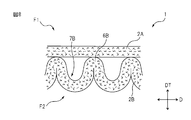
親水性の不織布2Bに凹凸が形成されることによって、図8に示すように、少なくとも親水性の不織布2Bには、上述の実施形態と同様に凸部6Bと凹部7Bとが形成される。上述の実施形態と同様に、疎水性の不織布2Aに向かって突出する突出部である親水性の不織布2Bの凸部6Bは繊維密度が高くなり、それにより毛細管現象による吸水性が高くなるので、疎水性の不織布2Aと相互に直接的に接している箇所において、複合シート1の第一の面F1から第二の面F2側への水分の移動を促進させることができる。
この変形実施形態では、伸縮性不織布である疎水性の不織布2Aが収縮することによって親水性の不織布2Bに凹凸が形成されるので、上述の実施形態のように疎水性の不織布2A及び親水性の不織布2Bに予め賦形処理がされていなくてもよい。別の変形実施形態では、賦形処理がされていない疎水性の不織布及び親水性の不織布を、上述の実施形態のように接着剤が適用された弾性部材を介して接合させるように形成された、ギャザーであってもよい。つまり、複合シートの使用時に、少なくとも親水性の不織布に凹凸が形成されていれば、親水性の不織布に疎水性の不織布と相互に直接的に接しかつ繊維密度が高くなる突出部が形成されることになるので、その他の構成はどのようなものであってもよい。
その他にも、複合シートに弾性部材や伸縮性不織布などの収縮する部材を用いず、疎水性の不織布と親水性の不織布のうちのいずれか一方又は両方に凹凸が形成されるように、ギア延伸等によって部分的に延伸することによって不織布に賦形処理を施してもよい。それにより、前記疎水性の不織布と前記親水性の不織布が相互に直接的に接する箇所を作ることができ、その結果、複合シート1の第一の面側F1から第二の面F2側への水分の移動を促進させることができるからである。
なお、本明細書において、「伸縮性不織布」とは、伸縮性繊維から形成された、又は伸縮性繊維を主に含む不織布のことをいう。
本明細書において、「伸縮性繊維」とは、弾性的に伸長かつ収縮可能な繊維のことをいう。より具体的には、上記伸縮性繊維は、形成時及び想定される使用時にかかる最大応力よりも大きな弾性限界を有し、形成時及び想定される使用時にかかる最大応力の範囲内で弾性的に伸長する繊維を意味する。上記形成時及び想定される使用時にかかる最大応力としては、例えば、不均一延伸ステップ、例えば、ギア延伸により加えられる応力が挙げられる。
上記伸縮性繊維の材料としては、上記伸縮性を有する繊維であれば、特に制限されるものではないが、例えば、熱可塑性エラストマーから成る繊維が挙げられる。
上記熱可塑性エラストマーとしては、例えば、ポリオレフィン系エラストマー、ポリウレタン系エラストマー、ポリスチレン系エラストマー、ポリアミド系エラストマー、ポリエステル系エラストマー、及びそれらの組み合わせを挙げることができる。上記熱可塑性エラストマーとしては、コストの観点から、ポリオレフィン系エラストマーが好ましい。
上記熱可塑性エラストマーとしては、例えば、ポリオレフィン系エラストマー、ポリウレタン系エラストマー、ポリスチレン系エラストマー、ポリアミド系エラストマー、ポリエステル系エラストマー、及びそれらの組み合わせを挙げることができる。上記熱可塑性エラストマーとしては、コストの観点から、ポリオレフィン系エラストマーが好ましい。
上記ポリオレフィン系エラストマーとしては、非晶性又は低結晶性のポリプロピレン、エチレン・α-オレフィンコポリマー、プロピレン・α-オレフィンランダムコポリマー、プロピレン・エチレン・α-オレフィンランダムコポリマー等、又はそれらと、結晶性ポリオレフィン(例えば、プロピレンホモポリマー、プロピレン及び少量のα-オレフィンのコポリマー、高密度ポリエチレン、中密度ポリエチレン等)との混合物が挙げられる。
上記ポリオレフィン系エラストマーは市販されており、例えば、TAFMER(商品名,三井化学(株)製,α-オレフィンコポリマー)、Engage(商品名、Dupont Dow Elastomer社製,エチレン-オクテンコポリマー)、Vistamaxx(商品名、エクソンモービル社製,ポリプロピレン系エラストマー)等が挙げられる。
上記ポリオレフィン系エラストマーは、ポリプロピレン系エラストマーであることが好ましく、そして約80~約90質量%のプロピレン含有率と、約0.855~約0.880g/cm3の密度とを有するポリプロピレン系エラストマー(例えば、プロピレン・α-オレフィンコポリマー)であることがより好ましい。
従来のポリプロピレン系エラストマーと比較して低いプロピレン含有率と、低い密度とを有する、上記プロピレン・α-オレフィンコポリマーは、従来のポリプロピレン系エラストマーと比較して、伸縮特性が高い。
上記プロピレン・α-オレフィンコポリマーは、紡糸性、特に、紡糸時の糸切れを起こしにくくする観点から、好ましくは約1~約1000g/10分、より好ましくは約5~約500g/10分、そしてさらに好ましくは約10~約100g/10分のメルトフローレート:MFR(ASTM D1238 230℃、2160g荷重)を有する。
上記プロピレン・α-オレフィンコポリマーにおいて、重合成分としてのα-オレフィンの例としては、炭素数約2~約20のα-オレフィン、例えば、エチレン、1-ブテン、1-ペンテン、3-メチル-1-ブテン、1-ヘキセン、3-メチル-1-ペンテン、4-メチル-1-ペンテン、1-ヘプテン、1-オクテン、1-ノネン、1-デセン、1-ドデセン、1-テトラデセン、1-ヘキサデセン、1-オクタデセン、1-エイコセン等、並びにそれらの任意の組み合わせが挙げられ、そしてエチレン及び1-ブテンが好ましい。
本実施例では、様々な構造を有する複合シートについて、水分蒸散性及び液戻り性に関する試験を行った。
これより、比較例1、2及び実施例1~3の特徴について説明する。比較例1、2及び実施例1~3の構成については、下記の説明の他にも表1の記載を参照されたい。
(比較例1、2)
比較例1、2は、賦形処理されていない2つの親水性の不織布を、周囲に接着剤が適用された弾性部材を介して接合された複合シートである。比較例1、2では、弾性部材は繊度が470dtexのLycra(登録商標)であり、貼り付け倍率を2.2にして5mm間隔で不織布に接合されている。つまり、比較例1、2は、一般的な親水性の不織布のギャザーシートである。なお、比較例1、2では、第二の面を形成する親水性の不織布の資材種及び坪量が異なる。
比較例1、2は、賦形処理されていない2つの親水性の不織布を、周囲に接着剤が適用された弾性部材を介して接合された複合シートである。比較例1、2では、弾性部材は繊度が470dtexのLycra(登録商標)であり、貼り付け倍率を2.2にして5mm間隔で不織布に接合されている。つまり、比較例1、2は、一般的な親水性の不織布のギャザーシートである。なお、比較例1、2では、第二の面を形成する親水性の不織布の資材種及び坪量が異なる。
(実施例1)
実施例1は、複合シートの第一の面を形成する不織布が疎水性の不織布であることを除いては、比較例1、2と同様の構造の複合シートである。
実施例1は、複合シートの第一の面を形成する不織布が疎水性の不織布であることを除いては、比較例1、2と同様の構造の複合シートである。
(実施例2)
実施例2は、一方が伸縮性を有する賦形処理のされていない、ポリオレフィンエラストマからなる疎水性の不織布であり、他方が賦形処理のされた親水性の不織布であることを除いては、実施例1と同様の構造の複合シートである。親水性の不織布の賦形形状は上述の実施形態と同じであり、親水性の不織布の凸部が疎水性の不織布に向く方向に、親水性の不織布の非賦形領域に塗布された接着剤によって接合されている。
実施例2は、一方が伸縮性を有する賦形処理のされていない、ポリオレフィンエラストマからなる疎水性の不織布であり、他方が賦形処理のされた親水性の不織布であることを除いては、実施例1と同様の構造の複合シートである。親水性の不織布の賦形形状は上述の実施形態と同じであり、親水性の不織布の凸部が疎水性の不織布に向く方向に、親水性の不織布の非賦形領域に塗布された接着剤によって接合されている。
(実施例3)
実施例3は、共に賦形されている疎水性の不織布及び親水性の不織布からなる複合シートであることを除いては、実施例2と同様の構造の複合シートである。これら不織布の賦形形状は上述の実施形態と同じであり、互いに凸部が向き合う方向に親水性の不織布の非賦形領域に塗布された接着剤によって接合されている。
実施例3は、共に賦形されている疎水性の不織布及び親水性の不織布からなる複合シートであることを除いては、実施例2と同様の構造の複合シートである。これら不織布の賦形形状は上述の実施形態と同じであり、互いに凸部が向き合う方向に親水性の不織布の非賦形領域に塗布された接着剤によって接合されている。
これより、水分蒸散性及び液戻り性に関する試験の試験方法及び評価方法を説明する。
(水分蒸散性試験)
水分蒸散性試験は、一定時間(本実施例では1時間)の間に、どの程度の量の水分を複合シートの第一の面側から第二の面側に移行させて蒸散させることができたかについて評価する試験である。
水分蒸散性試験は、以下の手順で行われる。
1. 試験対象の複合シートを70mm×70mmにカットして、サンプルを作成する。
2.時計皿に生理食塩水を1ml滴下する。
3.時計皿の上にサンプルを第一の面を下にして置き、サンプルの上から全面に対して500gの荷重を付与しつつ、サンプルに生理食塩水を第一の面側から接触させて、1分間放置する。1分間経過後、荷重を取り除いて試験を開始する。
4.試験開始から1時間後の全体重量Wt(サンプル+時計皿+残留した整理食塩水)を測定して、下記式から蒸散率を計算する。
蒸散率(%)=((Wo-Wt)/(Wo-W))×100
但し、W: サンプル+時計皿の重量
Wo:サンプル+時計皿+生理食塩水1mlの重量
また、蒸散速度は、一定時間(本実施例では1時間)の単位面積(1m2)あたりの蒸発した水分量であり、つまり下記式から計算される。
蒸散速度(g/m2/h)=D×蒸散率(%)/100/S
但し、D: 生理食塩水の滴下量(本実施例では、1ml)
S: サンプルの面積(本実施例では、0.07×0.07m2)
水分蒸散性試験では、蒸散率及び蒸散速度が高いほど、第一の面側の水分を第二の面側に移動させて蒸散させる機能に優れているということができる。
水分蒸散性試験は、一定時間(本実施例では1時間)の間に、どの程度の量の水分を複合シートの第一の面側から第二の面側に移行させて蒸散させることができたかについて評価する試験である。
水分蒸散性試験は、以下の手順で行われる。
1. 試験対象の複合シートを70mm×70mmにカットして、サンプルを作成する。
2.時計皿に生理食塩水を1ml滴下する。
3.時計皿の上にサンプルを第一の面を下にして置き、サンプルの上から全面に対して500gの荷重を付与しつつ、サンプルに生理食塩水を第一の面側から接触させて、1分間放置する。1分間経過後、荷重を取り除いて試験を開始する。
4.試験開始から1時間後の全体重量Wt(サンプル+時計皿+残留した整理食塩水)を測定して、下記式から蒸散率を計算する。
蒸散率(%)=((Wo-Wt)/(Wo-W))×100
但し、W: サンプル+時計皿の重量
Wo:サンプル+時計皿+生理食塩水1mlの重量
また、蒸散速度は、一定時間(本実施例では1時間)の単位面積(1m2)あたりの蒸発した水分量であり、つまり下記式から計算される。
蒸散速度(g/m2/h)=D×蒸散率(%)/100/S
但し、D: 生理食塩水の滴下量(本実施例では、1ml)
S: サンプルの面積(本実施例では、0.07×0.07m2)
水分蒸散性試験では、蒸散率及び蒸散速度が高いほど、第一の面側の水分を第二の面側に移動させて蒸散させる機能に優れているということができる。
(液戻り性試験)
液戻り性試験は、第一の面から複合シートに吸収された水分が、第一の面にどの程度戻るかについて評価する試験である。
液戻り性試験は、以下の手順で行われる。
1. 試験対象の複合シートを70mm×70mmにカットして、サンプルを作成する。
2.ろ紙を5枚準備し、初期重量Woを測定する。
3.ステンレス製プレートに0.5mlの生理食塩水を滴下する。
4.滴下した生理食塩水の上に、サンプルの第一の面が下になるようにサンプルを置く。
5.サンプルの上に10cm×10cmの面を有する3.5kgの重量の錘を、当該面を下にして置き、1分間放置する。
6.錘を取り除き、さらに1分間放置する。
7.準備したろ紙の上に、サンプルの第一の面が下になるようにサンプルを置く。
8.サンプルの上に3.5kgの重量の錘を置き、1分間放置する。
9.サンプル上の錘及びサンプルを取り除き、ろ紙の重量を測定する。
10.生理食塩水を吸収したろ紙の重量Wから、ろ紙の初期重量Woを引いて、液戻り量を算出する(W-Wo)。
液戻り量が少なければ、複合シートの第一の面から複合シートに吸収させた液体が、第一の面側に戻ってしまう量が少ないので、第一の面側の水分量を減少させる機能に優れているということができる。
液戻り性試験は、第一の面から複合シートに吸収された水分が、第一の面にどの程度戻るかについて評価する試験である。
液戻り性試験は、以下の手順で行われる。
1. 試験対象の複合シートを70mm×70mmにカットして、サンプルを作成する。
2.ろ紙を5枚準備し、初期重量Woを測定する。
3.ステンレス製プレートに0.5mlの生理食塩水を滴下する。
4.滴下した生理食塩水の上に、サンプルの第一の面が下になるようにサンプルを置く。
5.サンプルの上に10cm×10cmの面を有する3.5kgの重量の錘を、当該面を下にして置き、1分間放置する。
6.錘を取り除き、さらに1分間放置する。
7.準備したろ紙の上に、サンプルの第一の面が下になるようにサンプルを置く。
8.サンプルの上に3.5kgの重量の錘を置き、1分間放置する。
9.サンプル上の錘及びサンプルを取り除き、ろ紙の重量を測定する。
10.生理食塩水を吸収したろ紙の重量Wから、ろ紙の初期重量Woを引いて、液戻り量を算出する(W-Wo)。
液戻り量が少なければ、複合シートの第一の面から複合シートに吸収させた液体が、第一の面側に戻ってしまう量が少ないので、第一の面側の水分量を減少させる機能に優れているということができる。
以下に表1を示す。表1には、比較例1、2及び実施例1~3の構成並びに水分蒸散性及び液戻り性の試験結果が示されている。なお、表1の「不織布I」及び「不織布II」はそれぞれ、複合シートの第一の面及び第二の面を形成する不織布を表す。また、複合シートの厚さの測定値は、サンプルを測定装置で挟み、3gf/cm2の圧力を印加したときのサンプルの厚さを5回測定して、平均したものである。そして、表1の「資材種」の項目において、「SB」はスパンボンド不織布、「SMS」はSMS(スパンボンド/メルトブローン/スパンボンド)不織布、「伸縮NW」は伸縮性不織布であることを示す。

実施例1に係る複合シートは、比較例2と比較して、第一の面を形成する不織布が疎水性の不織布であることから透水性が低いにも関わらず、水分蒸散性及び液戻り性の指標が、第一の面を形成する不織布が親水性の不織布である比較例2とほぼ同じである。さらに、実施例2、3は、比較例1、2と比較して、水分蒸散性及び液戻り性の指標において優れていることが理解できる。これは、実施例2においては親水性の不織布に、さらに実施例3においては親水性の不織布及び疎水性の不織布の両方に、施された賦形処理によって表面に形成された凹凸に起因するものである。
本明細書、図面及び特許請求の範囲の記載から当業者によって理解できるような全ての特徴は、本明細書において、これらの特徴が特定の他の特徴に関連してのみ組み合わされて説明されたとしても、それらの特徴が明確に除外されない限り、又は技術的な態様が不可能な若しくは意味のない組み合わせにならない限りにおいて、独立して、またさらに、ここで開示された他の1又は複数の特徴と任意に組み合わせて、結合することができるものとする。
1 複合シート
2A 疎水性の不織布
2B 親水性の不織布
3 弾性部材
4A、4B 非賦形領域
5A、5B 賦形領域
6A、6B 凸部
7A、7B 凹部
F1 第一の面
F2 第二の面
2A 疎水性の不織布
2B 親水性の不織布
3 弾性部材
4A、4B 非賦形領域
5A、5B 賦形領域
6A、6B 凸部
7A、7B 凹部
F1 第一の面
F2 第二の面
Claims (6)
- 吸収性物品用の複合シートであって、
第一の面と前記第一の面の反対側に位置する第二の面とを有し、
前記第一の面を形成する疎水性の不織布と、前記第二の面を形成する親水性の不織布とを有し、
前記疎水性の不織布と前記親水性の不織布とのうちの少なくとも前記親水性の不織布に凹凸が形成されることによって、前記親水性の不織布が、他の部分よりも繊維密度が高い、前記疎水性の不織布に対して突出する突出部を含んでおり、
前記疎水性の不織布と前記親水性の不織布は少なくとも一部の前記突出部において相互に直接的に接している、
複合シート。 - 前記複合シートは、前記疎水性の不織布と前記親水性の不織布との間に接合された弾性部材を備えており、
前記弾性部材の収縮によって、前記疎水性の不織布と前記親水性の不織布との両方に前記凹凸が形成されている、
請求項1に記載の複合シート。 - 前記疎水性の不織布が伸縮性不織布であり、
前記疎水性の不織布の収縮によって、前記疎水性の不織布と前記親水性の不織布とのうちの少なくとも前記親水性の不織布に前記凹凸が形成されている、
請求項1に記載の複合シート。 - 前記疎水性の不織布と前記親水性の不織布とのうちの少なくとも一方が、前記凹凸が形成されるように賦形されている、
請求項1~3のいずれか1項に記載の複合シート。 - 前記疎水性の不織布及び前記親水性の不織布には、
第一の方向に沿って交互に繰り返されていると共に前記第一の方向に直交する第二の方向に延びている凹部及び凸部が賦形されて前記凹凸が形成されている賦形領域と、
前記賦形領域を前記第二の方向に互いに離間させている非賦形領域と、
が設けられており、
互いに対向している前記疎水性の不織布の前記非賦形領域と前記親水性の不織布の前記非賦形領域とが、前記弾性部材を介して接合されており、
前記賦形領域の前記凹部及び前記凸部が、前記複合シートに形成される前記凹凸を形成しており、
前記疎水性の不織布の前記凸部が前記親水性の不織布の前記凹部内部に入り込んでいると共に、前記親水性の不織布の前記突出部である前記凸部が前記疎水性の不織布の前記凹部の内部に入り込んでいる、
請求項2に記載の複合シート。 - 前記複合シートが50%伸長状態であるときの、前記賦形領域の凹凸ピッチが0.5mm~2.0mmである、
請求項5に記載の複合シート。
Applications Claiming Priority (2)
| Application Number | Priority Date | Filing Date | Title |
|---|---|---|---|
| JP2015130375A JP6324350B2 (ja) | 2015-06-29 | 2015-06-29 | 吸収性物品用の複合シート |
| JP2015-130375 | 2015-06-29 |
Publications (1)
| Publication Number | Publication Date |
|---|---|
| WO2017002484A1 true WO2017002484A1 (ja) | 2017-01-05 |
Family
ID=57608255
Family Applications (1)
| Application Number | Title | Priority Date | Filing Date |
|---|---|---|---|
| PCT/JP2016/065206 Ceased WO2017002484A1 (ja) | 2015-06-29 | 2016-05-23 | 吸収性物品用の複合シート |
Country Status (2)
| Country | Link |
|---|---|
| JP (1) | JP6324350B2 (ja) |
| WO (1) | WO2017002484A1 (ja) |
Cited By (2)
| Publication number | Priority date | Publication date | Assignee | Title |
|---|---|---|---|---|
| WO2019169989A1 (en) * | 2018-03-06 | 2019-09-12 | The Procter & Gamble Company | Wearable article comprising an elastic laminate |
| CN116367801A (zh) * | 2020-09-30 | 2023-06-30 | 尤妮佳股份有限公司 | 吸收性物品、以及芯包覆片的制造方法 |
Families Citing this family (9)
| Publication number | Priority date | Publication date | Assignee | Title |
|---|---|---|---|---|
| JP6613205B2 (ja) * | 2016-06-03 | 2019-11-27 | 積水化学工業株式会社 | シート |
| GB201911568D0 (en) | 2019-08-13 | 2019-09-25 | Croda Int Plc | Personal hygiene product |
| EP4188300B1 (en) | 2020-07-31 | 2025-12-10 | The Procter & Gamble Company | Wearable article comprising an elastic belt laminate having hydrophilic inner and outer web |
| CN115802991B (zh) | 2020-07-31 | 2025-06-13 | 宝洁公司 | 包括弹性层合体的可穿着制品 |
| WO2022021295A1 (en) | 2020-07-31 | 2022-02-03 | The Procter & Gamble Company | Wearable article comprising an elastic laminate having good wicking properties |
| WO2022021294A1 (en) | 2020-07-31 | 2022-02-03 | The Procter & Gamble Company | Wearable article comprising an elastic laminate |
| CN114305879B (zh) * | 2020-09-30 | 2026-01-23 | 尤妮佳股份有限公司 | 短裤型吸收性物品 |
| JP2022131817A (ja) * | 2021-02-26 | 2022-09-07 | ユニ・チャーム株式会社 | 吸収性物品 |
| EP4351498A1 (en) | 2021-06-07 | 2024-04-17 | The Procter & Gamble Company | Wearable article comprising a laminate |
Citations (7)
| Publication number | Priority date | Publication date | Assignee | Title |
|---|---|---|---|---|
| JPS5611058A (en) * | 1979-07-10 | 1981-02-04 | Uni Charm Corp | Sanitary article forming material |
| JPH0931823A (ja) * | 1995-07-19 | 1997-02-04 | Toyobo Co Ltd | 積層不織布 |
| JP2008029836A (ja) * | 2006-07-07 | 2008-02-14 | Uni Charm Corp | 使い捨ておむつ、シート部材およびプリーツシートの製造方法 |
| JP2008148819A (ja) * | 2006-12-15 | 2008-07-03 | Kao Corp | 吸収性物品 |
| WO2010119535A1 (ja) * | 2009-04-15 | 2010-10-21 | 大王製紙株式会社 | エンボスロール装置及びこれを用いた表面シートの製造方法並びにこの表面シートを用いた吸収性物品 |
| JP2014068907A (ja) * | 2012-09-28 | 2014-04-21 | Uni Charm Corp | 使い捨てオムツ |
| JP2015066369A (ja) * | 2013-09-30 | 2015-04-13 | ユニ・チャーム株式会社 | 使い捨てオムツ |
Family Cites Families (2)
| Publication number | Priority date | Publication date | Assignee | Title |
|---|---|---|---|---|
| JP4190332B2 (ja) * | 2003-03-31 | 2008-12-03 | ユニ・チャーム株式会社 | 使い捨て着用物品 |
| JP5889617B2 (ja) * | 2011-11-30 | 2016-03-22 | 花王株式会社 | 使い捨ておむつ |
-
2015
- 2015-06-29 JP JP2015130375A patent/JP6324350B2/ja active Active
-
2016
- 2016-05-23 WO PCT/JP2016/065206 patent/WO2017002484A1/ja not_active Ceased
Patent Citations (7)
| Publication number | Priority date | Publication date | Assignee | Title |
|---|---|---|---|---|
| JPS5611058A (en) * | 1979-07-10 | 1981-02-04 | Uni Charm Corp | Sanitary article forming material |
| JPH0931823A (ja) * | 1995-07-19 | 1997-02-04 | Toyobo Co Ltd | 積層不織布 |
| JP2008029836A (ja) * | 2006-07-07 | 2008-02-14 | Uni Charm Corp | 使い捨ておむつ、シート部材およびプリーツシートの製造方法 |
| JP2008148819A (ja) * | 2006-12-15 | 2008-07-03 | Kao Corp | 吸収性物品 |
| WO2010119535A1 (ja) * | 2009-04-15 | 2010-10-21 | 大王製紙株式会社 | エンボスロール装置及びこれを用いた表面シートの製造方法並びにこの表面シートを用いた吸収性物品 |
| JP2014068907A (ja) * | 2012-09-28 | 2014-04-21 | Uni Charm Corp | 使い捨てオムツ |
| JP2015066369A (ja) * | 2013-09-30 | 2015-04-13 | ユニ・チャーム株式会社 | 使い捨てオムツ |
Cited By (4)
| Publication number | Priority date | Publication date | Assignee | Title |
|---|---|---|---|---|
| WO2019169989A1 (en) * | 2018-03-06 | 2019-09-12 | The Procter & Gamble Company | Wearable article comprising an elastic laminate |
| JP2021514746A (ja) * | 2018-03-06 | 2021-06-17 | ザ プロクター アンド ギャンブル カンパニーThe Procter & Gamble Company | 弾性積層体を備える着用可能物品 |
| JP7175991B2 (ja) | 2018-03-06 | 2022-11-21 | ザ プロクター アンド ギャンブル カンパニー | 弾性積層体を備える着用可能物品 |
| CN116367801A (zh) * | 2020-09-30 | 2023-06-30 | 尤妮佳股份有限公司 | 吸收性物品、以及芯包覆片的制造方法 |
Also Published As
| Publication number | Publication date |
|---|---|
| JP2017012319A (ja) | 2017-01-19 |
| JP6324350B2 (ja) | 2018-05-16 |
Similar Documents
| Publication | Publication Date | Title |
|---|---|---|
| JP6324350B2 (ja) | 吸収性物品用の複合シート | |
| RU2723823C1 (ru) | Впитывающее изделие | |
| JP5075615B2 (ja) | 吸収性物品 | |
| US20200306096A1 (en) | Nonwoven suitable for use in absorbent article | |
| WO2016194247A1 (ja) | 吸収性物品 | |
| US9149395B2 (en) | Liner for incontinence | |
| JP7149771B2 (ja) | 吸収体 | |
| CN107072831B (zh) | 吸收性物品 | |
| EP3466386B1 (en) | Absorbent article | |
| JP6396753B2 (ja) | 吸収性物品 | |
| JP4219223B2 (ja) | シート材料 | |
| JP2019118799A (ja) | 吸収性物品 | |
| JP4712533B2 (ja) | 吸収性物品 | |
| JP6080323B2 (ja) | 吸収性物品 | |
| WO2022209913A1 (ja) | 吸収性物品用、及び吸収性物品の胴回り部用の複合シート | |
| JP7742239B2 (ja) | 不織布及びこれを構成部材として含む吸収性物品 | |
| JP2016077576A (ja) | 吸収性物品 | |
| WO2019131224A1 (ja) | 吸収性物品 | |
| WO2019116956A1 (ja) | 吸収性物品 | |
| JP6405221B2 (ja) | 吸収性物品 | |
| JP2004000344A (ja) | パンツ型おむつ | |
| JP7580428B2 (ja) | 吸収性物品用の複合シート | |
| JP2017012301A (ja) | バックシート及びバックシートを用いた吸収性物品 | |
| JP7548703B2 (ja) | 吸収性物品用不織布及び吸収性物品 | |
| CN205672142U (zh) | 吸收性物品和一次性尿布 |
Legal Events
| Date | Code | Title | Description |
|---|---|---|---|
| 121 | Ep: the epo has been informed by wipo that ep was designated in this application |
Ref document number: 16817593 Country of ref document: EP Kind code of ref document: A1 |
|
| NENP | Non-entry into the national phase |
Ref country code: DE |
|
| 122 | Ep: pct application non-entry in european phase |
Ref document number: 16817593 Country of ref document: EP Kind code of ref document: A1 |