WO2016195089A1 - 唾液分泌促進剤、口腔乾燥抑制剤及び口腔内うるおい付与剤、及び組成物 - Google Patents
唾液分泌促進剤、口腔乾燥抑制剤及び口腔内うるおい付与剤、及び組成物 Download PDFInfo
- Publication number
- WO2016195089A1 WO2016195089A1 PCT/JP2016/066641 JP2016066641W WO2016195089A1 WO 2016195089 A1 WO2016195089 A1 WO 2016195089A1 JP 2016066641 W JP2016066641 W JP 2016066641W WO 2016195089 A1 WO2016195089 A1 WO 2016195089A1
- Authority
- WO
- WIPO (PCT)
- Prior art keywords
- oral
- extract
- salt
- polyglutamic acid
- composition
- Prior art date
- Legal status (The legal status is an assumption and is not a legal conclusion. Google has not performed a legal analysis and makes no representation as to the accuracy of the status listed.)
- Ceased
Links
Images

Classifications
-
- A—HUMAN NECESSITIES
- A61—MEDICAL OR VETERINARY SCIENCE; HYGIENE
- A61K—PREPARATIONS FOR MEDICAL, DENTAL OR TOILETRY PURPOSES
- A61K8/00—Cosmetics or similar toiletry preparations
- A61K8/18—Cosmetics or similar toiletry preparations characterised by the composition
- A61K8/72—Cosmetics or similar toiletry preparations characterised by the composition containing organic macromolecular compounds
- A61K8/84—Cosmetics or similar toiletry preparations characterised by the composition containing organic macromolecular compounds obtained by reactions otherwise than those involving only carbon-carbon unsaturated bonds
- A61K8/88—Polyamides
-
- A—HUMAN NECESSITIES
- A61—MEDICAL OR VETERINARY SCIENCE; HYGIENE
- A61K—PREPARATIONS FOR MEDICAL, DENTAL OR TOILETRY PURPOSES
- A61K31/00—Medicinal preparations containing organic active ingredients
- A61K31/74—Synthetic polymeric materials
- A61K31/785—Polymers containing nitrogen
-
- A—HUMAN NECESSITIES
- A61—MEDICAL OR VETERINARY SCIENCE; HYGIENE
- A61K—PREPARATIONS FOR MEDICAL, DENTAL OR TOILETRY PURPOSES
- A61K36/00—Medicinal preparations of undetermined constitution containing material from algae, lichens, fungi or plants, or derivatives thereof, e.g. traditional herbal medicines
- A61K36/18—Magnoliophyta (angiosperms)
- A61K36/185—Magnoliopsida (dicotyledons)
- A61K36/48—Fabaceae or Leguminosae (Pea or Legume family); Caesalpiniaceae; Mimosaceae; Papilionaceae
-
- A—HUMAN NECESSITIES
- A61—MEDICAL OR VETERINARY SCIENCE; HYGIENE
- A61K—PREPARATIONS FOR MEDICAL, DENTAL OR TOILETRY PURPOSES
- A61K38/00—Medicinal preparations containing peptides
-
- A—HUMAN NECESSITIES
- A61—MEDICAL OR VETERINARY SCIENCE; HYGIENE
- A61K—PREPARATIONS FOR MEDICAL, DENTAL OR TOILETRY PURPOSES
- A61K8/00—Cosmetics or similar toiletry preparations
- A61K8/18—Cosmetics or similar toiletry preparations characterised by the composition
- A61K8/96—Cosmetics or similar toiletry preparations characterised by the composition containing materials, or derivatives thereof of undetermined constitution
- A61K8/97—Cosmetics or similar toiletry preparations characterised by the composition containing materials, or derivatives thereof of undetermined constitution from algae, fungi, lichens or plants; from derivatives thereof
- A61K8/9783—Angiosperms [Magnoliophyta]
- A61K8/9789—Magnoliopsida [dicotyledons]
-
- A—HUMAN NECESSITIES
- A61—MEDICAL OR VETERINARY SCIENCE; HYGIENE
- A61P—SPECIFIC THERAPEUTIC ACTIVITY OF CHEMICAL COMPOUNDS OR MEDICINAL PREPARATIONS
- A61P1/00—Drugs for disorders of the alimentary tract or the digestive system
- A61P1/02—Stomatological preparations, e.g. drugs for caries, aphtae, periodontitis
-
- A—HUMAN NECESSITIES
- A61—MEDICAL OR VETERINARY SCIENCE; HYGIENE
- A61P—SPECIFIC THERAPEUTIC ACTIVITY OF CHEMICAL COMPOUNDS OR MEDICINAL PREPARATIONS
- A61P43/00—Drugs for specific purposes, not provided for in groups A61P1/00-A61P41/00
-
- A—HUMAN NECESSITIES
- A61—MEDICAL OR VETERINARY SCIENCE; HYGIENE
- A61Q—SPECIFIC USE OF COSMETICS OR SIMILAR TOILETRY PREPARATIONS
- A61Q11/00—Preparations for care of the teeth, of the oral cavity or of dentures; Dentifrices, e.g. toothpastes; Mouth rinses
Definitions
- the present invention relates to a saliva secretion promoter, a mouth dryness inhibitor, a mouth moisture additive, and a composition.
- ⁇ Dry mice have abnormal saliva quality due to a decrease in saliva production, dry thirst and dry mouth, causing pain and discomfort. It is accompanied by sticky discomfort, difficulty in conversation, and bad breath. Furthermore, when it becomes pathological, not only oral function but also general health failure such as caries, periodontal disease, various infectious diseases, etc. occurs due to changes in oral flora.
- Symptomatic treatment includes moisturizing the oral cavity with artificial saliva, oral moisturizer / humectant, etc., but it is not a fundamental solution. Therefore, it is important to promote saliva secretion and moisturize the oral cavity in order to keep the oral cavity refreshed and prevent oral diseases and systemic diseases.
- salivary secretion promoter include polyglutamic acid and salts thereof, but a technique having a superior salivary secretion promoting effect has been desired.
- the present invention has been made in view of the above circumstances, and an object of the present invention is to provide a salivary secretion promoter, a mouth dryness inhibitor, a mouth moisture additive, and an oral and oral composition that are effective in improving dry mice.
- the present inventors have promoted salivation by using polyglutamic acid and / or a salt thereof and an Asparathus linearis extract in combination. It has been found that the dryness inside is soft and the sticky discomfort is removed, and the present invention has been made.
- a salivary secretion promoter comprising (A) polyglutamic acid and / or a salt thereof and (B) an extract of Asparathus linearis as active ingredients.
- An oral dryness inhibitor containing, as active ingredients, (A) polyglutamic acid and / or a salt thereof and (B) an extract of Asparathus linearis.
- An intraoral moisture imparting agent comprising (A) polyglutamic acid and / or a salt thereof and (B) an extract of Asparathus linearis as active ingredients.
- An oral composition for promoting saliva secretion or an oral composition for promoting saliva secretion comprising (A) polyglutamic acid and / or a salt thereof and (B) an extract of Asparathus lineias as active ingredients.
- An oral composition for inhibiting oral dryness or an oral composition for inhibiting oral dryness comprising (A) polyglutamic acid and / or a salt thereof and (B) an extract of Asparathus linearis as active ingredients.
- An oral composition for imparting oral moisture or an oral composition for imparting oral moisture containing (A) polyglutamic acid and / or a salt thereof and (B) an extract of Asparathus linearis as active ingredients object. [8].
- (A) The content of polyglutamic acid and / or a salt thereof is 0.001 to 50% by mass, and the content of (B) Asparathus linearis extract is 0.0001 to 80% by mass
- the present invention relates to a salivary secretion promoter, an oral dry inhibitor, and an oral moisture additive containing (A) polyglutamic acid and / or a salt thereof, and (B) an extract of Asparathus linearis as active ingredients. Provide the agent.
- polyglutamic acid chemically synthesized ⁇ or ⁇ -polyglutamic acid, natural ⁇ or ⁇ -polyglutamic acid obtained as a fermentation product from various strains, or a salt thereof can be used.
- natural polyglutamic acid is preferable because it is blended into oral compositions and foods, and ⁇ -polyglutamic acid that can be industrially mass-produced is most preferable.
- Polyglutamic acid may be D-form or L-form. Polyglutamic acid is insoluble in water, but becomes water-soluble when converted to a salt.
- Examples of the salt at this time include sodium salt, potassium salt, magnesium salt, calcium salt, ammonium salt, ethanolamine salt, basic amino acid salt and the like, and sodium or potassium salt is preferable.
- the degree of neutralization of the salt used in the present invention can be arbitrarily selected according to the purpose when the aqueous solution having a concentration of 1% by mass is in the range of pH 1 to pH 14.
- the viscosity of polyglutamic acid or a salt thereof is not particularly limited, and those having various viscosities can be used depending on the type of product, but the viscosity of a 4% by mass aqueous solution measured by the method described later is preferably 10 to 200 mPa ⁇ s. More preferably, it is in the range of 30 to 120 mPa ⁇ s.
- ⁇ Viscosity measurement method> To a 200 mL beaker, take 96 g of water and add 4.0 g of polyglutamic acid or a salt thereof to a 200 mL beaker while stirring with a stirrer to completely dissolve it. Next, after leaving still in a 25 degreeC thermostat for 1 hour, the viscosity after 1 minute is measured correctly using the following BL type
- BL type viscometer Tokyo Keiki: B type viscometer, model: BL, rotor: No. 2. Rotation speed: 60rpm, Measurement temperature: 25 ° C
- polyglutamic acid or a salt thereof can be used as polyglutamic acid or a salt thereof.
- ⁇ -polyglutamic acid sodium Meiji polyglutamic acid manufactured by Meiji Food Materia Co., Ltd. can be used.
- Asparathus linearis extract Asparathus linealis is also called rooibos (hereinafter sometimes abbreviated as “rooibos”), and belongs to the genus Asparatus (Fabaceae).
- the rooibos extract can be easily obtained by a method generally used for plant extraction, and the extraction method is not particularly limited as long as the effect of the present invention is obtained.
- commercially available rooibos tea extract powder can be used.
- the rooibos extraction site is not particularly limited and can be appropriately selected.
- a leaf part, a young leaf part, a branch part, a trunk part, a bark part, a flower part, a fruit part, a root part, etc. are mentioned.
- a young leaf part and a branch part are preferable.
- the rooibos used for extraction can be either fermented or unfermented.
- the fermented product refers to a product produced through an oxidation process
- the unfermented product refers to this oxidation process, that is, a product that does not undergo fermentation.
- the oxidation process of fermentation is not particularly limited, and a generally used method can be used. For example, it refers to an oxidation process in which water is contained and incubated at 20 to 40 ° C., or an oxidation process under sunlight.
- the rooibos extract can be obtained by further subjecting to a solvent extraction described later after a pulverization process using a crusher, a drying process, or a combination thereof.
- the drying process is not particularly limited, and a generally used method can be used. For example, it is preferable to carry out at 60 degrees C or less.
- the extraction method is not particularly limited and can be appropriately selected.
- the extraction part of rooibos as an extraction raw material is put into a treatment tank filled with an extraction solvent, and after eluting soluble components while stirring as necessary, the extract is removed by filtration to remove the extraction residue. Obtainable.
- the extraction solvent is not particularly limited and can be appropriately selected.
- water, a hydrophilic solvent, a hydrophobic solvent, or a mixed solvent thereof can be used.
- water include pure water, tap water, well water, mineral water, mineral water, hot spring water, spring water, fresh water, purified water, hot water, ion exchange water, physiological saline, phosphate buffer, phosphate buffered physiological. Examples include saline.
- hydrophilic solvent examples include lower alcohols having 1 to 6 carbon atoms such as methanol, ethanol, propyl alcohol, and isopropyl alcohol; lower aliphatic ketones such as acetone and methyl ethyl ketone; 1,3-butylene glycol, propylene glycol, glycerin, and the like. And polyhydric alcohols having 2 to 6 carbon atoms.
- hydrophobic solvent examples include aromatic carbons such as benzene and toluene; organic solvents such as ethyl acetate, acetonitrile and ether; halogenated carbons such as dichloromethane and chloroform.
- the said water, the said hydrophilic solvent, etc. can be mixed suitably and used.
- the ratio of the mixed solvent is preferably 1 to 90 parts by mass of lower alcohol, lower aliphatic ketone, polyhydric alcohol and the like with respect to 10 parts by mass of water.
- the extraction solvent is preferably water, ethanol, or a mixture of water and ethanol, more preferably a 0 to 20% by weight aqueous ethanol solution, and even more preferably water.
- the amount of the extraction solvent used is not particularly limited and can be appropriately selected according to the extraction solvent, the extraction method, and the like. For example, 1 to 1,000 parts by mass of the extraction solvent can be used per 1 part by mass of the extraction site.
- Extraction conditions are not particularly limited, and can be appropriately selected according to an extraction method such as an extraction solvent.
- the solvent is water
- the extraction temperature is preferably room temperature to hot water, more preferably hot water.
- the rooibos extract can be purified and used as necessary, and the purification method is not particularly limited and can be appropriately selected.
- purification methods such as liquid-liquid partition extraction, various types of chromatography, membrane separation, and supercritical fluid extraction can be mentioned.
- the specific embodiment of the rooibos extract is not particularly limited and can be appropriately selected.
- the extract itself the dried extract, the diluted extract, the dried extract, and the extract
- a concentrated solution (concentrated extract), a dried product of an extract concentrate, a dried product powder, and the like can be used.
- the extract a water extract is preferable, and a hot water extract is particularly preferable.
- rooibos extract for example, a commercially available rooibos tea extract can also be used.
- examples of commercially available rooibos tea extract include powder obtained by filtering hot water extract of rooibos fermented young leaves and concentrating and drying the filtrate.
- salivary secretion promoter The combination of the above (A) polyglutamic acid and / or salt thereof and (B) rooibos extract provides a remarkable salivary secretion promoting effect that cannot be obtained independently.
- This invention provides the salivary secretion promoter which uses this as an active ingredient.
- the amount of polyglutamic acid and / or a salt thereof and (B) rooibos extract to each agent is appropriately selected depending on the dosage form, intake (administration) form, and intake (administration) target.
- the effective amount of each agent for promoting saliva secretion and the like exerting the intended effect is as follows, and is appropriately selected from the state of the subject of intake (administration), age, and the like.
- the effective amount of polyglutamic acid and / or a salt thereof is preferably 0.01 to 5,000 mg / day, more preferably 0.05 to 1,000 mg / day per day per adult. More preferably, it is 1 to 500 mg / day. Further, the number of intake (administration) is not limited, and can be ingested (administered) 1 to 20 times a day.
- the effective amount of rooibos extract is, for example, preferably 1 to 10,000 mg / day, more preferably 10 to 1,000 mg / day, and further 20 to 500 mg / day. preferable. Such an amount may be taken (administered) once a day, or may be taken (administered) in a plurality of times (1 to 20 times) per day. When taking (administering) in multiple doses, it is preferably 5 to 50,000 mg / dose, more preferably 50 to 10,000 mg / dose, more preferably 100 to 5,000 mg in terms of dry rooibos before extraction. / Times is more preferable.
- the method for taking (administering) the agent of the present invention is not particularly limited, and it may be oral or parenteral.
- the dosage form is not particularly limited, and a solid, liquid, gel, cream, paste or the like can be appropriately selected.
- oral is preferred, and known dosage forms such as powders, tablets, orally disintegrating tablets, chewable tablets, capsules, films, sprays, and liquids can be selected.
- the solid may be taken up (administered) by dissolving it in a liquid such as water or diluting the liquid with water.
- a liquid such as water or diluting the liquid with water.
- orally disintegrating tablets, chewing tablets, and sprays are preferable.
- the present invention provides an oral or oral composition containing (A) polyglutamic acid and / or a salt thereof and (B) an extract of Asparathus linearias.
- A polyglutamic acid and / or a salt thereof
- B an extract of Asparathus linearias.
- the above-mentioned agent or Asparathus linearis extract is used as an active ingredient, for salivary secretion promotion, for oral dry suppression, for oral moisture provision It is suitable as a composition for oral cavity or internal use.
- the content of (A) polyglutamic acid and / or a salt thereof in the composition is preferably 0.001 to 50% by mass, and more preferably 0.01 to 10% by mass.
- the content of Aspalathus linearis extract (equivalent to dry matter) is preferably 0.0001 to 80% by mass, more preferably 0.001 to 70% by mass, and 0.01 to 60% More preferred is mass%.
- the blending mass ratio of component (B) to component (B) is preferably 0.001 to 1,000 / 1, and more preferably 0.01 to 100/1. When this ratio is smaller than 0.001 / 1, there is a possibility that the effect of suppressing dry mouth is inferior. On the other hand, when it is larger than 1,000 / 1, the effect of imparting moisture in the oral cavity may be inferior.
- the dosage form is preferably a solid agent such as a tablet such as an orally disintegrating tablet or a chewable tablet, preferably 0.001 to 1,000 / 1, more preferably 0.002 to 100/1, 0.005 to 10/1 is more preferable.
- a liquid agent such as a spray
- 0.001 to 1,000 / 1 is preferable, 1 to 100/1 is more preferable, and 50 to 100/1 is further preferable.
- the oral composition is “mainly intended for use in the oral cavity” and includes (i) ingestible and (ii) discharged after use. Specifically (i) what can be ingested includes troches, mouth freshener compositions, and the like. (Ii) To be discharged after use, toothpaste compositions such as toothpastes, liquid dentifrices, liquid dentifrices, powder dentifrices, mouthwash compositions, gargle compositions, oral coating compositions , Oral pasta, denture stabilizer composition and the like. However, in some cases, the oral coating composition, the oral pasta, and the like can be ingested.
- the internal composition is “mainly intended to be taken orally” and is not particularly limited, and examples thereof include pharmaceuticals, foods for specified health use, foods and the like.
- Foods for specified health use or foods such as candy, chewing gum, ramune, gummy, etc. that stay in the mouth for a long time
- beverages soft drinks, carbonated drinks, nutrition drinks, powdered drinks, fruit drinks, milk drinks, jelly drinks, etc.
- Food staple foods (cereals such as rice and wheat, noodles, bread, cereals, etc.), confectionery, dairy products, processed products such as meat, fish, vegetables and fruits, seasonings, etc., are not particularly limited.
- composition for oral cavity and the composition for internal use are each normal dosage form, and are not particularly limited. Solid, liquid, gel, cream, paste, etc. can be appropriately selected, and powder, tablet, orally disintegrating tablet can be selected. A chewable tablet, capsule, film, spray or the like can also be selected as appropriate.
- the dosage form is preferably an orally disintegrating tablet, a chewable tablet, a spray, and the like.
- an arbitrary amount of any component used in each preparation or composition can be blended within a range that does not impair the effects of the present invention.
- optional components include excipients, diluents, buffers, fragrances, colorants, antifoaming agents, coating agents, corrigents, binders, surfactants, humectants, thickeners, lubricants, Suspending agents, preservatives, chelating agents, antioxidants, abrasives, thickeners, binders, pH adjusters, brighteners, drugs, solvents, and the like can be mentioned. Can be used in appropriate combination.
- a viscous agent, a binder, a surfactant and the like can be blended.
- an abrasive can be blended.
- a surfactant, a solvent and the like can be blended.
- the ingestion (administration) method of the agent and composition of the present invention is not particularly limited, may be appropriately selected, and may be determined when the oral cavity is dry or the number of times per day may be determined.
- the number of times is not particularly limited, and is appropriately selected within a range of, for example, 1 to 20 times.
- the present invention can further provide the following inventions.
- the optimum components, amounts, etc. are the same as described above.
- the composition for oral cavity or oral composition described above has a salivary secretion effect, an oral dry suppression effect, or an oral moisture. How to give a given effect.
- Sodium polyglutamate is sodium ⁇ -polyglutamate (4% aqueous solution viscosity: 35.5 mPa ⁇ s (25 ° C)) manufactured by Meiji Food Materia Co., Ltd.
- MF filtered rooibos fermented hot water extract of rooibos and concentrated and dried the filtrate, containing 10% rooibos extract and 90% dextrin
- the amount of rooibos extract in Table 1 is a pure equivalent amount (corresponding to dry mass).
- Examples 1 to 13 Tablets having the compositions shown in Tables 2 to 4 below were tableted by a direct compression method using a rotary tableting machine (LIBURA2 manufactured by Kikusui Seisakusho Co., Ltd.).
- sodium polyglutamate is Meiji Polyglutamate ( ⁇ -polyglutamate, 4% aqueous solution viscosity: 35.5 mPa ⁇ s (25 ° C.)) manufactured by Meiji Food Materia Co., Ltd.
- the fermented rooibos tea extract of the component the rooibos tea dry extract F manufactured by Maruzen Pharmaceutical Co., Ltd.
- the non-fermented rooibos tea extract of the component is a green rooibos extract manufactured by Tama Seikagaku Co., Ltd. (which is a powder obtained by filtering a hot water extract of rooibos unfermented young leaves and concentrating and drying the filtrate.
- surface is a pure component conversion amount (equivalent to dry mass). The following evaluation was performed about the obtained tablet.
- Salivary secretion promoting action Sensory evaluation (5 persons) of salivary secretion promoting action was performed using a tablet. Specifically, one tablet was chewed and ingested, and evaluation was performed 60 minutes after swallowing. The “feeling that saliva secretion was promoted” was evaluated according to the following evaluation criteria. ⁇ Evaluation criteria> A: 5 out of 5 respondents felt that saliva secretion was promoted. ⁇ : 3 to 4 out of 5 responded that saliva secretion was promoted. ⁇ : 1 to 2 out of 5 respondents felt that saliva secretion was promoted. X: 0 out of 5 respondents felt that saliva secretion was promoted.
- Oral dryness suppression effect A sensory evaluation (5 persons) of oral dryness suppression effect was performed using a tablet. Specifically, one tablet was chewed and ingested, and evaluation was performed 60 minutes after swallowing. The “feeling that drying in the oral cavity is suppressed” was evaluated according to the following evaluation criteria. ⁇ Evaluation criteria> A: 5 out of 5 respondents feel that dryness in the oral cavity is suppressed. ⁇ : 3 to 4 out of 5 respondents feel that dryness in the oral cavity is suppressed. ⁇ : 1 to 2 out of 5 respondents feel that dryness in the oral cavity is suppressed. X: 0 out of 5 respondents feel that dryness in the oral cavity is suppressed.
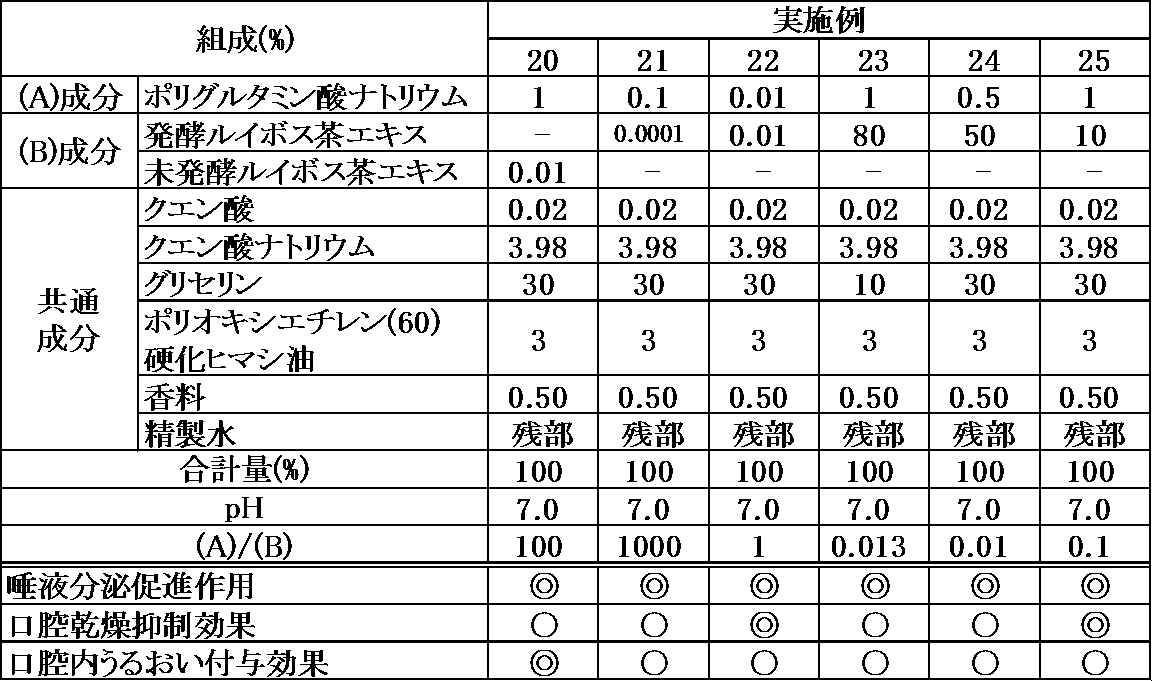
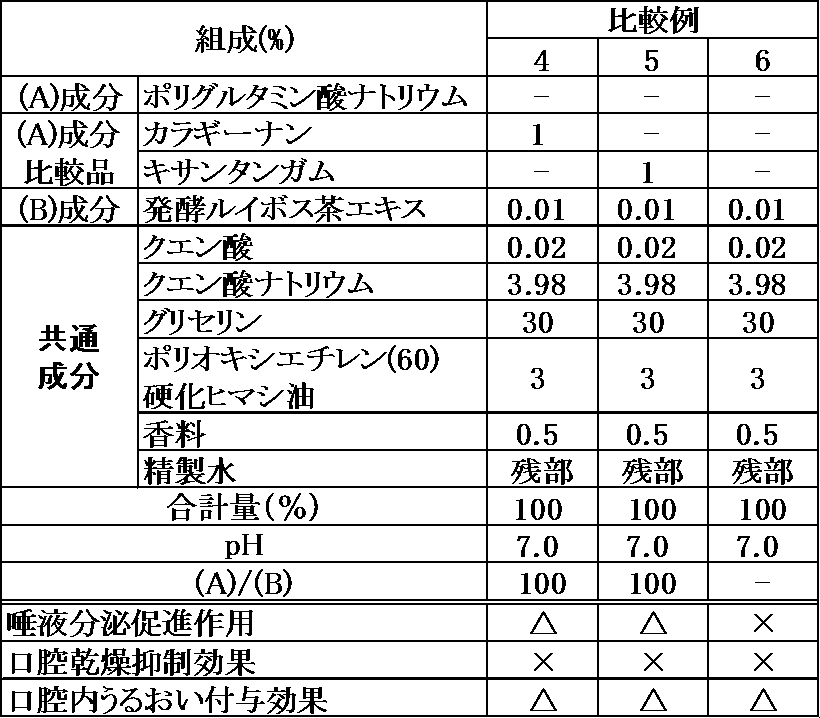
- Examples 14 to 25, Comparative Examples 4 to 5 The sprays having the compositions shown in Tables 5 to 7 below were prepared by measuring each component and mixing with a stirrer. 30 g of the prepared liquid was filled into a spray container (Y-70 dispenser manufactured by Yoshino Kogyo Co., Ltd., nozzle hole 0.55 mm, spray amount of one push was about 0.07 mL, capacity 30 mL polyethylene terephthalate bottle). The following evaluation was performed about the obtained spray agent.
- Salivary secretion promoting action A sensory evaluation (5 persons) of salivary secretion promoting action was performed using a spray agent. Specifically, the test preparation was sprayed into a 5 push (about 0.35 mL) mouth, and evaluation was performed 30 minutes later. The “feeling that saliva secretion was promoted” was evaluated according to the following evaluation criteria. ⁇ Evaluation criteria> A: 5 out of 5 respondents felt that saliva secretion was promoted. ⁇ : 3 to 4 out of 5 responded that saliva secretion was promoted. ⁇ : 1 to 2 out of 5 respondents felt that saliva secretion was promoted. X: 0 out of 5 respondents felt that saliva secretion was promoted.
- Oral dryness inhibiting effect A sensory evaluation (5 persons) of the oral dryness inhibiting effect was performed using a spray agent. Specifically, the test preparation was sprayed into a 5 push (about 0.35 mL) mouth, and evaluation was performed 30 minutes later. The “feeling that dryness in the oral cavity is suppressed” was evaluated according to the following evaluation criteria. ⁇ Evaluation criteria> A: 5 out of 5 respondents feel that dryness in the oral cavity is suppressed. ⁇ : 3 to 4 out of 5 respondents feel that dryness in the oral cavity is suppressed. ⁇ : 1 to 2 out of 5 respondents feel that dryness in the oral cavity is suppressed. X: 0 out of 5 respondents feel that dryness in the oral cavity is suppressed.
- the following examples showed excellent saliva secretion promoting effect, oral dryness inhibiting effect, and oral moisture moisturizing effect as in the above examples.
Landscapes
- Health & Medical Sciences (AREA)
- Life Sciences & Earth Sciences (AREA)
- Veterinary Medicine (AREA)
- Public Health (AREA)
- General Health & Medical Sciences (AREA)
- Animal Behavior & Ethology (AREA)
- Epidemiology (AREA)
- Engineering & Computer Science (AREA)
- Natural Medicines & Medicinal Plants (AREA)
- Chemical & Material Sciences (AREA)
- Medicinal Chemistry (AREA)
- Pharmacology & Pharmacy (AREA)
- Birds (AREA)
- Mycology (AREA)
- Biotechnology (AREA)
- Botany (AREA)
- Microbiology (AREA)
- Bioinformatics & Cheminformatics (AREA)
- Chemical Kinetics & Catalysis (AREA)
- General Chemical & Material Sciences (AREA)
- Nuclear Medicine, Radiotherapy & Molecular Imaging (AREA)
- Organic Chemistry (AREA)
- Alternative & Traditional Medicine (AREA)
- Medical Informatics (AREA)
- Oral & Maxillofacial Surgery (AREA)
- Immunology (AREA)
- Proteomics, Peptides & Aminoacids (AREA)
- Medicines Containing Plant Substances (AREA)
- Cosmetics (AREA)
- Pharmaceuticals Containing Other Organic And Inorganic Compounds (AREA)
Abstract
Description
[1].(A)ポリグルタミン酸及び/又はその塩と、(B)アスパラサス・リネアリス(Aspalathus linearis)抽出物とを有効成分として含有する唾液分泌促進剤。
[2].(A)ポリグルタミン酸及び/又はその塩と、(B)アスパラサス・リネアリス(Aspalathus linearis)抽出物とを有効成分として含有する口腔乾燥抑制剤。
[3].(A)ポリグルタミン酸及び/又はその塩と、(B)アスパラサス・リネアリス(Aspalathus linearis)抽出物とを有効成分として含有する、口腔内うるおい付与剤。
[4].(A)ポリグルタミン酸及び/又はその塩と、(B)アスパラサス・リネアリス(Aspalathus linearis)抽出物とを含有する、口腔用組成物又は内服組成物。
[5].(A)ポリグルタミン酸及び/又はその塩と、(B)アスパラサス・リネアリス(Aspalathuslinearis)抽出物とを有効成分として含有する、唾液分泌促進用口腔用組成物又は唾液分泌促進用内服組成物。
[6].(A)ポリグルタミン酸及び/又はその塩と、(B)アスパラサス・リネアリス(Aspalathus linearis)抽出物とを有効成分として含有する、口腔乾燥抑制用口腔用組成物又は口腔乾燥抑制用内服組成物。
[7].(A)ポリグルタミン酸及び/又はその塩と、(B)アスパラサス・リネアリス(Aspalathus linearis)抽出物とを有効成分として含有する、口腔内うるおい付与用口腔用組成物又は口腔内うるおい付与用内服組成物。
[8].(A)ポリグルタミン酸及び/又はその塩の含有量が、0.001~50質量%であり、(B)アスパラサス・リネアリス(Aspalathus linearis)抽出物の含有量が、0.0001~80質量%である[4]~[7]のいずれかに記載の組成物。
本発明は、(A)ポリグルタミン酸及び/又はその塩と、(B)アスパラサス・リネアリス(Aspalathus linearis)抽出物とを有効成分として含有する唾液分泌促進剤、口腔乾燥抑制剤、口腔内うるおい付与剤を提供する。
ポリグルタミン酸としては、化学的に合成されるα又はγ-ポリグルタミン酸、あるいは各種菌株からの発酵生産物として得られる天然α又はγ-ポリグルタミン酸、その塩が使用できる。この場合、口腔用組成物、食品に配合することから天然のポリグルタミン酸が好ましく、工業的に大量生産できるγ-ポリグルタミン酸が最も好適である。ポリグルタミン酸はD体でもよいしL体でもよい。ポリグルタミン酸は水に不溶であるが、塩にすると水溶性となる。この時の塩としては、ナトリウム塩、カリウム塩、マグネシウム塩、カルシウム塩、アンモニウム塩、エタノールアミン塩、塩基性アミノ酸塩等が挙げられるが、ナトリウム又はカリウム塩が好ましい。本発明に用いられる塩の中和度は、その1質量%濃度の水溶液がpH1~pH14の範囲で目的に応じて任意に選ぶことができる。
200mLビーカーに水96gをとり、スターラーで攪拌しながらこれにポリグルタミン酸又はその塩を4.0g加えて完全に溶解させる。次に、25℃恒温水槽中に1時間静置後、下記のBL型粘度計を用いて正確に1分後の粘度を測定する。
BL型粘度計:東京計器:B型粘度計、型式:BL、ローター:No.2、回転数:60rpm、測定温度:25℃
アスパラサス・リネアリス(Aspalathus linearis)は、ルイボスとも呼ばれ(以下、「ルイボス」と略す場合がある。)、マメ科(Fabaceae)アスパラトゥス属(Aspalathus)に属する。ルイボス抽出物は、植物の抽出に一般に用いられている方法により容易に得ることができ、その抽出方法は、本発明の効果が得られる限り特に制限されるものではない。また、市販のルイボス茶エキス粉末を用いることができる。
上記(A)ポリグルタミン酸及び/又はその塩と、(B)ルイボス抽出物との組み合わせにより、それぞれ単独では得られない顕著な唾液分泌促進効果が得られる。本発明はこれを有効成分とする唾液分泌促進剤を提供する。
上記(A)ポリグルタミン酸及び/又はその塩と、(B)ルイボス抽出物との組み合わせにより、それぞれ単独では得られない顕著な唾液分泌促進効果が得られ、口腔内の乾燥を抑制する効果が得られる。本発明はこれを有効成分とする口腔乾燥抑制剤を提供する。
上記(A)ポリグルタミン酸及び/又はその塩と、(B)ルイボス抽出物との組み合わせによりそれぞれ単独では得られない顕著な唾液分泌促進効果が得られ、口腔内にうるおい付与効果が得られる。本発明はこれを有効成分とする口腔内うるおい付与剤を提供する。
本発明は、(A)ポリグルタミン酸及び/又はその塩と、(B)アスパラサス・リネアリス(Aspalathus linearis)抽出物とを含有する口腔用又は内服組成物を提供する。上述したように、これらの組み合わせによって上記効果が得られるため、上記剤又はアスパラサス・リネアリス(Aspalathus linearis)抽出物を有効成分とする、唾液分泌促進用、口腔乾燥抑制用、口腔内うるおい付与用の口腔用又は内服組成物として好適である。
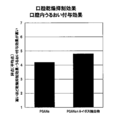
下記表1に示す組成の水溶液(組成%(g/100mL))20mLを30秒間口に含み、吐き出した。その後、吐唾法(30分間、安静時唾液質量を測定)により、唾液分泌量を測定した(n=5)。結果(平均値)を下記表1及び図1に示す。結果を水(コントロール)100%として示す。ポリグルタミン酸ナトリウムは(株)明治フードマテリア製のγ-ポリグルタミン酸ナトリウム(4%水溶液粘度:35.5mPa・s(25℃))を使用し、ルイボス抽出物としては、丸善製薬製ルイボス茶エキスパウダーMF(ルイボスの発酵した若葉の熱水抽出物をろ過し、ろ液を濃縮乾燥した粉末であり、ルイボス抽出物10%及びデキストリン90%を含む)を使用した。表1中のルイボス抽出物量は純分換算量(乾燥質量相当)である。
上記組成の水溶液を用いて口腔乾燥抑制作用の官能評価を行った。具体的には、吐き出してから30分後に評価を行った。「口の乾きが抑えられた感じ」について、下記評価基準で評価した。平均値の結果を表1及び図2に示す。
<評価基準>
7点;非常に感じた・非常にうるおいを感じた
6点;感じた・うるおいを感じた
5点;やや感じた・ややうるおいを感じた
4点;どちらとも言えない・どちらとも言えない
3点;あまり感じない・あまりうるおいを感じない
2点;感じない・うるおいを感じない
1点;全く感じない・全くうるおいを感じない

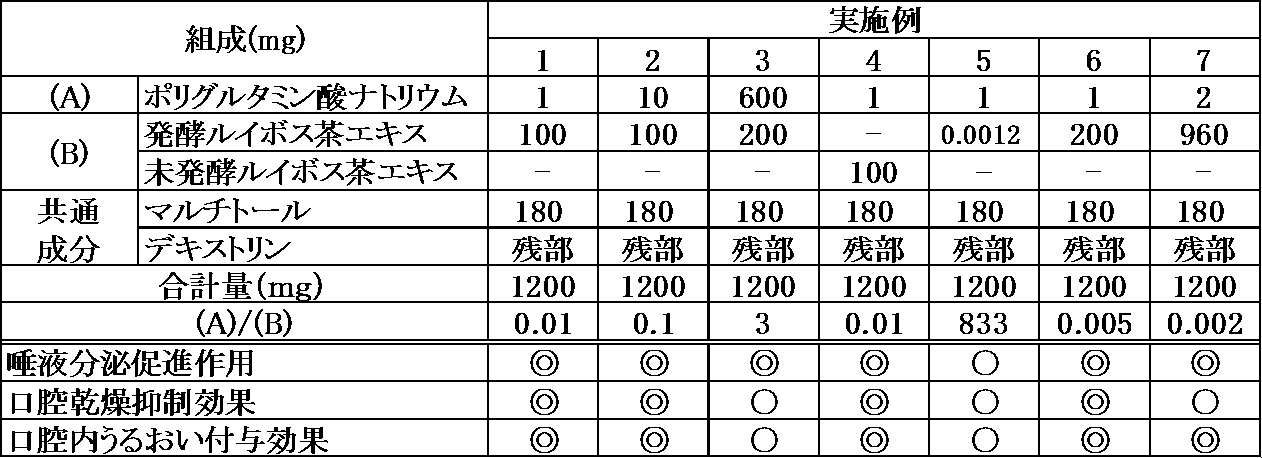
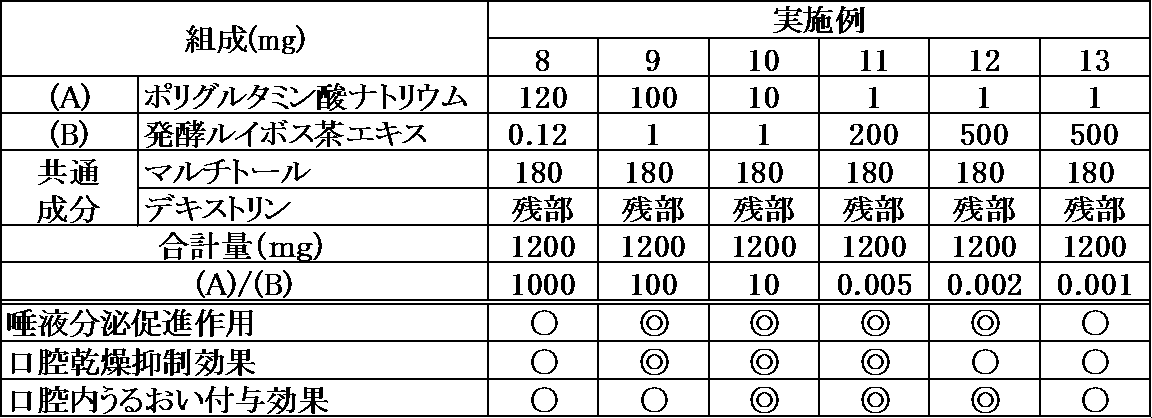
下記表2~4に示す組成のタブレットを、ロータリー式打錠機(菊水製作所(株)製 LIBURA2)を用いて直打法により打錠した。上記(A)成分のポリグルタミン酸ナトリウムは(株)明治フードマテリア製の明治ポリグルタミン酸(γ-ポリグルタミン酸ナトリウム、4%水溶液粘度:35.5mPa・s(25℃))を使用し、上記(B)成分の発酵ルイボス茶抽出物としては、丸善製薬社製ルイボス茶乾燥エキスF(ルイボスの発酵した若葉の熱水抽出物をろ過し、ろ液を濃縮乾燥した粉末)を使用し、上記(B)成分の未発酵ルイボス茶抽出物としては、タマ生化学社製のグリーンルイボスエキス(ルイボスの未発酵若葉の熱水抽出物をろ過し、ろ液を濃縮乾燥した粉末であり、ルイボス抽出物70%及びデキストリン30%を含む)を使用した。なお、表中のルイボス抽出物量は純分換算量(乾燥質量相当)である。得られたタブレットについて、下記評価を行った。
タブレットを用いて唾液分泌促進作用の官能評価(5名)を行った。具体的には、タブレット1錠を噛んで摂取し、飲み込んでから60分後に評価を行った。「唾液の分泌が促進された感じ」について、下記評価基準で評価した。
〈評価基準〉
◎:5名中5名が唾液の分泌が促進された感じがすると回答。
○:5名中3~4名が唾液の分泌が促進された感じがすると回答。
△:5名中1~2名が唾液の分泌が促進された感じがすると回答。
×:5名中0名が唾液の分泌が促進された感じがすると回答。
タブレットを用いて口腔乾燥抑制効果の官能評価(5名)を行った。具体的には、タブレット1錠を噛んで摂取し、飲み込んでから60分後に評価を行った。「口腔内の乾燥が抑制される感じ」について、下記評価基準で評価した。
〈評価基準〉
◎:5名中5名が口腔内の乾燥が抑制される感じがすると回答。
○:5名中3~4名が口腔内の乾燥が抑制される感じがすると回答。
△:5名中1~2名が口腔内の乾燥が抑制される感じがすると回答。
×:5名中0名が口腔内の乾燥が抑制される感じがすると回答。
タブレットを用いて口腔内うるおい付与効果の官能評価(5名)を行った。具体的には、タブレット1錠を噛んで摂取し、飲み込んでから60分後に評価を行った。「口腔内にうるおいが付与された感じ」について、下記評価基準で評価した。
〈評価基準〉
◎:5名中5名が口腔内にうるおいが付与された感じがすると回答。
○:5名中3~4名が口腔内にうるおいが付与された感じがすると回答。
△:5名中1~2名が口腔内にうるおいが付与された感じがすると回答。
×:5名中0名が口腔内にうるおいが付与された感じがすると回答。

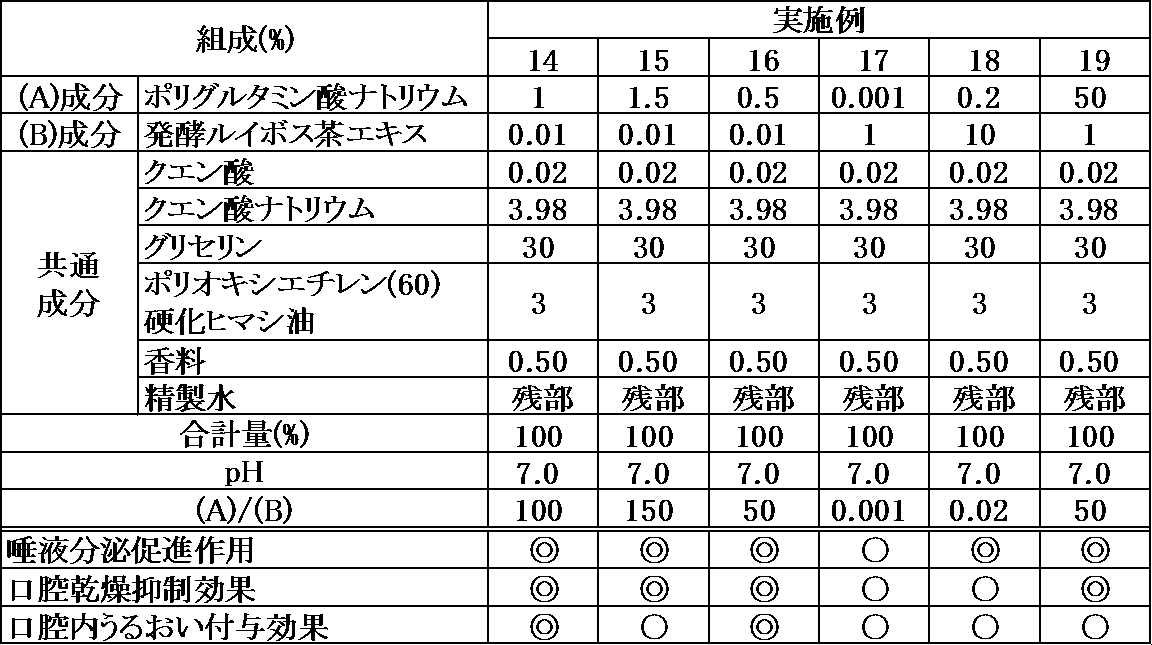
下記表5~7に示す組成のスプレー剤を、各成分を量り採り攪拌機で混合して調製した。調製した液30gを、スプレー容器(吉野工業所製Y-70ディスペンサー、ノズル孔0.55mm、1プッシュの噴霧量は約0.07mL,容量30mLポリエチレンテレフタレート製ボトル)に充填した。得られたスプレー剤について、下記評価を行った。
スプレー剤を用いて唾液分泌促進作用の官能評価(5名)を行った。具体的には、試験用製剤を5プッシュ(約0.35mL)口中に噴霧して、30分後に評価を行った。「唾液の分泌が促進された感じ」について、下記評価基準で評価した。
<評価基準>
◎:5名中5名が唾液の分泌が促進された感じがすると回答。
○:5名中3~4名が唾液の分泌が促進された感じがすると回答。
△:5名中1~2名が唾液の分泌が促進された感じがすると回答。
×:5名中0名が唾液の分泌が促進された感じがすると回答。
スプレー剤を用いて口腔乾燥抑制効果の官能評価(5名)を行った。具体的には、試験用製剤を5プッシュ(約0.35mL)口中に噴霧して、30分後に評価を行った。「口腔内の乾燥が抑制される感じ」について、下記評価基準で評価した。
<評価基準>
◎:5名中5名が口腔内の乾燥が抑制される感じがすると回答。
○:5名中3~4名が口腔内の乾燥が抑制される感じがすると回答。
△:5名中1~2名が口腔内の乾燥が抑制される感じがすると回答。
×:5名中0名が口腔内の乾燥が抑制される感じがすると回答。
スプレー剤を用いて口腔内うるおい付与効果の官能評価(5名)を行った。具体的には、試験用製剤を5プッシュ(約0.35mL)口中に噴霧して、30分後に評価を行った。「口腔内にうるおいが付与された感じ」について、下記評価基準で評価した。
<評価基準>
◎:5名中5名が口腔内にうるおいが付与された感じがすると回答。
○:5名中3~4名が口腔内にうるおいが付与された感じがすると回答。
△:5名中1~2名が口腔内にうるおいが付与された感じがすると回答。
×:5名中0名が口腔内にうるおいが付与された感じがすると回答。
洗口液(pH7.5)
組成
(A)ポリグルタミン酸ナトリウム 0.1
(B)発酵ルイボス茶エキス 0.01
ポリオキシエチレン硬化ヒマシ油(60) 0.5
プロピレングリコール 3
グリセリン 4.5
キシリトール 3
エタノール 2
クエン酸 0.07
クエン酸ナトリウム 0.25
サッカリンナトリウム 0.004
香料 0.2
精製水 残部
合計 100.0%
(A)/(B)=1/1
ガム
組成
(A)ポリグルタミン酸ナトリウム 1.0
(B)発酵ルイボス茶エキス 1.0
ガムベース 19.6
マルチトール 22.8
キシリトール 19.6
還元水飴 1.3
スクラロース 0.07
香料 1.96
(糖衣部)
アラビアガム 1.9
デキストラナーゼ製剤 0.1
香料 0.2
カルナウバワックス 0.04
マルチトール 残部
合計 100.0%
(A)/(B)=1/1

Claims (8)
- (A)ポリグルタミン酸及び/又はその塩と、(B)アスパラサス・リネアリス(Aspalathus linearis)抽出物とを有効成分として含有する唾液分泌促進剤。
- (A)ポリグルタミン酸及び/又はその塩と、(B)アアスパラサス・リネアリス(Aspalathus linearis)抽出物とを有効成分として含有する口腔乾燥抑制剤。
- (A)ポリグルタミン酸及び/又はその塩と、(B)アスパラサス・リネアリス(Aspalathus linearis)抽出物とを有効成分として含有する、口腔内うるおい付与剤。
- (A)ポリグルタミン酸及び/又はその塩と、(B)アスパラサス・リネアリス(Aspalathus linearis)抽出物とを含有する、口腔用組成物又は内服組成物。
- (A)ポリグルタミン酸及び/又はその塩と、(B)アスパラサス・リネアリス(Aspalathus linearis)抽出物とを有効成分として含有する、唾液分泌促進用口腔用組成物又は唾液分泌促進用内服組成物。
- (A)ポリグルタミン酸及び/又はその塩と、(B)アスパラサス・リネアリス(Aspalathus linearis)抽出物とを有効成分として含有する、口腔乾燥抑制用口腔用組成物又は口腔乾燥抑制用内服組成物。
- (A)ポリグルタミン酸及び/又はその塩と、(B)アスパラサス・リネアリス(Aspalathus linearis)抽出物とを有効成分として含有する、口腔内うるおい付与用口腔用組成物又は口腔内うるおい付与用内服組成物。
- (A)ポリグルタミン酸及び/又はその塩の含有量が、0.001~50質量%であり、(B)アスパラサス・リネアリス(Aspalathus linearis)抽出物の含有量が、0.0001~80質量%である請求項4~7のいずれか1項記載の組成物。
Priority Applications (3)
| Application Number | Priority Date | Filing Date | Title |
|---|---|---|---|
| KR1020177026591A KR20180011058A (ko) | 2015-06-04 | 2016-06-03 | 타액 분비 촉진제, 구강 건조 억제제 및 구강내 물기 부여제, 및 조성물 |
| JP2017522290A JP6841222B2 (ja) | 2015-06-04 | 2016-06-03 | 唾液分泌促進剤、口腔乾燥抑制剤及び口腔内うるおい付与剤、及び組成物 |
| CN201680031861.3A CN107613999B (zh) | 2015-06-04 | 2016-06-03 | 唾液分泌促进剂、口腔干燥抑制剂及口腔内湿润赋予剂 |
Applications Claiming Priority (2)
| Application Number | Priority Date | Filing Date | Title |
|---|---|---|---|
| JP2015-113824 | 2015-06-04 | ||
| JP2015113824 | 2015-06-04 |
Publications (1)
| Publication Number | Publication Date |
|---|---|
| WO2016195089A1 true WO2016195089A1 (ja) | 2016-12-08 |
Family
ID=57441331
Family Applications (1)
| Application Number | Title | Priority Date | Filing Date |
|---|---|---|---|
| PCT/JP2016/066641 Ceased WO2016195089A1 (ja) | 2015-06-04 | 2016-06-03 | 唾液分泌促進剤、口腔乾燥抑制剤及び口腔内うるおい付与剤、及び組成物 |
Country Status (4)
| Country | Link |
|---|---|
| JP (1) | JP6841222B2 (ja) |
| KR (1) | KR20180011058A (ja) |
| CN (1) | CN107613999B (ja) |
| WO (1) | WO2016195089A1 (ja) |
Cited By (1)
| Publication number | Priority date | Publication date | Assignee | Title |
|---|---|---|---|---|
| JP2020105102A (ja) * | 2018-12-27 | 2020-07-09 | ライオン株式会社 | 固形組成物及びその製造方法 |
Citations (4)
| Publication number | Priority date | Publication date | Assignee | Title |
|---|---|---|---|---|
| WO2005049050A1 (ja) * | 2003-11-19 | 2005-06-02 | Meiji Seika Kaisha, Ltd. | 唾液分泌促進剤並びにこれを配合した口腔用組成物及び食品組成物 |
| JP2006117563A (ja) * | 2004-10-20 | 2006-05-11 | Shiiai Medical:Kk | 口腔用組成物、及び、それを用いた口腔湿潤剤 |
| JP2009256271A (ja) * | 2008-04-18 | 2009-11-05 | Maruzen Pharmaceut Co Ltd | アクアポリン3mRNA発現促進剤及び皮膚水分保持機能改善剤 |
| JP2015107925A (ja) * | 2013-12-04 | 2015-06-11 | ライオン株式会社 | ムスカリン受容体活性化剤及び唾液分泌促進剤 |
-
2016
- 2016-06-03 CN CN201680031861.3A patent/CN107613999B/zh not_active Expired - Fee Related
- 2016-06-03 KR KR1020177026591A patent/KR20180011058A/ko not_active Withdrawn
- 2016-06-03 JP JP2017522290A patent/JP6841222B2/ja active Active
- 2016-06-03 WO PCT/JP2016/066641 patent/WO2016195089A1/ja not_active Ceased
Patent Citations (4)
| Publication number | Priority date | Publication date | Assignee | Title |
|---|---|---|---|---|
| WO2005049050A1 (ja) * | 2003-11-19 | 2005-06-02 | Meiji Seika Kaisha, Ltd. | 唾液分泌促進剤並びにこれを配合した口腔用組成物及び食品組成物 |
| JP2006117563A (ja) * | 2004-10-20 | 2006-05-11 | Shiiai Medical:Kk | 口腔用組成物、及び、それを用いた口腔湿潤剤 |
| JP2009256271A (ja) * | 2008-04-18 | 2009-11-05 | Maruzen Pharmaceut Co Ltd | アクアポリン3mRNA発現促進剤及び皮膚水分保持機能改善剤 |
| JP2015107925A (ja) * | 2013-12-04 | 2015-06-11 | ライオン株式会社 | ムスカリン受容体活性化剤及び唾液分泌促進剤 |
Cited By (2)
| Publication number | Priority date | Publication date | Assignee | Title |
|---|---|---|---|---|
| JP2020105102A (ja) * | 2018-12-27 | 2020-07-09 | ライオン株式会社 | 固形組成物及びその製造方法 |
| JP7182457B2 (ja) | 2018-12-27 | 2022-12-02 | ライオン株式会社 | 固形組成物及びその製造方法 |
Also Published As
| Publication number | Publication date |
|---|---|
| CN107613999B (zh) | 2021-07-20 |
| JPWO2016195089A1 (ja) | 2018-03-22 |
| CN107613999A (zh) | 2018-01-19 |
| KR20180011058A (ko) | 2018-01-31 |
| JP6841222B2 (ja) | 2021-03-10 |
Similar Documents
| Publication | Publication Date | Title |
|---|---|---|
| CA2545626C (en) | Sialogogue, oral composition and food product containing the same | |
| CA2350450A1 (en) | Flavour blend for masking unpleasant taste of zinc compounds | |
| JP2013520518A (ja) | 口腔ケア組成物 | |
| JP3241955B2 (ja) | 口腔用組成物 | |
| JP7362417B2 (ja) | 口腔内病原性細菌の生育抑制剤、口腔用組成物及び促進剤 | |
| JP2006016390A (ja) | プロアントシアニジン含有組成物 | |
| JP2002029952A (ja) | 歯磨用組成物 | |
| JPH08310931A (ja) | グルコシルトランスフェラーゼ阻害剤および口腔清浄化剤 | |
| JP5306626B2 (ja) | 粉末製剤並びにそれを用いた食品素材及び化粧品素材 | |
| JPH08175945A (ja) | 口腔用組成物 | |
| JP6841222B2 (ja) | 唾液分泌促進剤、口腔乾燥抑制剤及び口腔内うるおい付与剤、及び組成物 | |
| JP6505358B2 (ja) | 収斂用組成物 | |
| JP7333751B2 (ja) | ヒト抗菌ペプチド産生促進剤 | |
| JP6249588B2 (ja) | 口腔用組成物 | |
| WO2007020830A1 (ja) | 口腔用組成物 | |
| JP2017001957A (ja) | 唾液分泌促進剤、口腔乾燥抑制剤及び口腔内うるおい付与剤、及び組成物 | |
| JP7409775B2 (ja) | 低収斂性組成物 | |
| JP6628839B2 (ja) | 収斂用組成物 | |
| KR100495030B1 (ko) | 캡슐화된 생약추출물을 함유하는 구강위생 증진용 조성물 | |
| JP2001335498A (ja) | 美白組成物及びそれを含む食品及び化粧品 | |
| WO2017068805A1 (ja) | 唾液分泌促進剤、これを含有する口腔用組成物及び飲料用組成物 | |
| JP2026003867A (ja) | 嚥下機能改善剤 | |
| JP2001321123A (ja) | 抗う蝕性食品素材、およびその組成物 | |
| RU2777153C1 (ru) | Композиция для ухода за полостью рта для пациентов с метаболическими нарушениями | |
| KR102814752B1 (ko) | 침샘 자극을 통한 구강 건조 완화능 및 구취 제거능을 갖는 파라크레스를 포함하는 구강 붕해 필름 |
Legal Events
| Date | Code | Title | Description |
|---|---|---|---|
| 121 | Ep: the epo has been informed by wipo that ep was designated in this application |
Ref document number: 16803520 Country of ref document: EP Kind code of ref document: A1 |
|
| ENP | Entry into the national phase |
Ref document number: 2017522290 Country of ref document: JP Kind code of ref document: A |
|
| ENP | Entry into the national phase |
Ref document number: 20177026591 Country of ref document: KR Kind code of ref document: A |
|
| NENP | Non-entry into the national phase |
Ref country code: DE |
|
| 122 | Ep: pct application non-entry in european phase |
Ref document number: 16803520 Country of ref document: EP Kind code of ref document: A1 |