WO2016163353A1 - 光湿気硬化型樹脂組成物、電子部品用接着剤、及び、表示素子用接着剤 - Google Patents
光湿気硬化型樹脂組成物、電子部品用接着剤、及び、表示素子用接着剤 Download PDFInfo
- Publication number
- WO2016163353A1 WO2016163353A1 PCT/JP2016/061102 JP2016061102W WO2016163353A1 WO 2016163353 A1 WO2016163353 A1 WO 2016163353A1 JP 2016061102 W JP2016061102 W JP 2016061102W WO 2016163353 A1 WO2016163353 A1 WO 2016163353A1
- Authority
- WO
- WIPO (PCT)
- Prior art keywords
- curable resin
- resin composition
- meth
- moisture curable
- light
- Prior art date
- Legal status (The legal status is an assumption and is not a legal conclusion. Google has not performed a legal analysis and makes no representation as to the accuracy of the status listed.)
- Ceased
Links
Images

Classifications
-
- C—CHEMISTRY; METALLURGY
- C08—ORGANIC MACROMOLECULAR COMPOUNDS; THEIR PREPARATION OR CHEMICAL WORKING-UP; COMPOSITIONS BASED THEREON
- C08G—MACROMOLECULAR COMPOUNDS OBTAINED OTHERWISE THAN BY REACTIONS ONLY INVOLVING UNSATURATED CARBON-TO-CARBON BONDS
- C08G18/00—Polymeric products of isocyanates or isothiocyanates
- C08G18/06—Polymeric products of isocyanates or isothiocyanates with compounds having active hydrogen
- C08G18/28—Polymeric products of isocyanates or isothiocyanates with compounds having active hydrogen characterised by the compounds used containing active hydrogen
- C08G18/30—Low-molecular-weight compounds
- C08G18/302—Water
- C08G18/307—Atmospheric humidity
-
- C—CHEMISTRY; METALLURGY
- C08—ORGANIC MACROMOLECULAR COMPOUNDS; THEIR PREPARATION OR CHEMICAL WORKING-UP; COMPOSITIONS BASED THEREON
- C08F—MACROMOLECULAR COMPOUNDS OBTAINED BY REACTIONS ONLY INVOLVING CARBON-TO-CARBON UNSATURATED BONDS
- C08F2/00—Processes of polymerisation
- C08F2/44—Polymerisation in the presence of compounding ingredients, e.g. plasticisers, dyestuffs, fillers
-
- C—CHEMISTRY; METALLURGY
- C08—ORGANIC MACROMOLECULAR COMPOUNDS; THEIR PREPARATION OR CHEMICAL WORKING-UP; COMPOSITIONS BASED THEREON
- C08F—MACROMOLECULAR COMPOUNDS OBTAINED BY REACTIONS ONLY INVOLVING CARBON-TO-CARBON UNSATURATED BONDS
- C08F2/00—Processes of polymerisation
- C08F2/46—Polymerisation initiated by wave energy or particle radiation
- C08F2/48—Polymerisation initiated by wave energy or particle radiation by ultraviolet or visible light
-
- C—CHEMISTRY; METALLURGY
- C08—ORGANIC MACROMOLECULAR COMPOUNDS; THEIR PREPARATION OR CHEMICAL WORKING-UP; COMPOSITIONS BASED THEREON
- C08F—MACROMOLECULAR COMPOUNDS OBTAINED BY REACTIONS ONLY INVOLVING CARBON-TO-CARBON UNSATURATED BONDS
- C08F2/00—Processes of polymerisation
- C08F2/46—Polymerisation initiated by wave energy or particle radiation
- C08F2/48—Polymerisation initiated by wave energy or particle radiation by ultraviolet or visible light
- C08F2/50—Polymerisation initiated by wave energy or particle radiation by ultraviolet or visible light with sensitising agents
-
- C—CHEMISTRY; METALLURGY
- C08—ORGANIC MACROMOLECULAR COMPOUNDS; THEIR PREPARATION OR CHEMICAL WORKING-UP; COMPOSITIONS BASED THEREON
- C08G—MACROMOLECULAR COMPOUNDS OBTAINED OTHERWISE THAN BY REACTIONS ONLY INVOLVING UNSATURATED CARBON-TO-CARBON BONDS
- C08G18/00—Polymeric products of isocyanates or isothiocyanates
- C08G18/06—Polymeric products of isocyanates or isothiocyanates with compounds having active hydrogen
- C08G18/08—Processes
- C08G18/10—Prepolymer processes involving reaction of isocyanates or isothiocyanates with compounds having active hydrogen in a first reaction step
-
- C—CHEMISTRY; METALLURGY
- C08—ORGANIC MACROMOLECULAR COMPOUNDS; THEIR PREPARATION OR CHEMICAL WORKING-UP; COMPOSITIONS BASED THEREON
- C08J—WORKING-UP; GENERAL PROCESSES OF COMPOUNDING; AFTER-TREATMENT NOT COVERED BY SUBCLASSES C08B, C08C, C08F, C08G or C08H
- C08J11/00—Recovery or working-up of waste materials
- C08J11/04—Recovery or working-up of waste materials of polymers
- C08J11/06—Recovery or working-up of waste materials of polymers without chemical reactions
- C08J11/08—Recovery or working-up of waste materials of polymers without chemical reactions using selective solvents for polymer components
-
- C—CHEMISTRY; METALLURGY
- C08—ORGANIC MACROMOLECULAR COMPOUNDS; THEIR PREPARATION OR CHEMICAL WORKING-UP; COMPOSITIONS BASED THEREON
- C08J—WORKING-UP; GENERAL PROCESSES OF COMPOUNDING; AFTER-TREATMENT NOT COVERED BY SUBCLASSES C08B, C08C, C08F, C08G or C08H
- C08J11/00—Recovery or working-up of waste materials
- C08J11/04—Recovery or working-up of waste materials of polymers
- C08J11/10—Recovery or working-up of waste materials of polymers by chemically breaking down the molecular chains of polymers or breaking of crosslinks, e.g. devulcanisation
- C08J11/16—Recovery or working-up of waste materials of polymers by chemically breaking down the molecular chains of polymers or breaking of crosslinks, e.g. devulcanisation by treatment with inorganic material
-
- C—CHEMISTRY; METALLURGY
- C09—DYES; PAINTS; POLISHES; NATURAL RESINS; ADHESIVES; COMPOSITIONS NOT OTHERWISE PROVIDED FOR; APPLICATIONS OF MATERIALS NOT OTHERWISE PROVIDED FOR
- C09J—ADHESIVES; NON-MECHANICAL ASPECTS OF ADHESIVE PROCESSES IN GENERAL; ADHESIVE PROCESSES NOT PROVIDED FOR ELSEWHERE; USE OF MATERIALS AS ADHESIVES
- C09J11/00—Features of adhesives not provided for in group C09J9/00, e.g. additives
- C09J11/02—Non-macromolecular additives
- C09J11/04—Non-macromolecular additives inorganic
-
- C—CHEMISTRY; METALLURGY
- C09—DYES; PAINTS; POLISHES; NATURAL RESINS; ADHESIVES; COMPOSITIONS NOT OTHERWISE PROVIDED FOR; APPLICATIONS OF MATERIALS NOT OTHERWISE PROVIDED FOR
- C09J—ADHESIVES; NON-MECHANICAL ASPECTS OF ADHESIVE PROCESSES IN GENERAL; ADHESIVE PROCESSES NOT PROVIDED FOR ELSEWHERE; USE OF MATERIALS AS ADHESIVES
- C09J11/00—Features of adhesives not provided for in group C09J9/00, e.g. additives
- C09J11/02—Non-macromolecular additives
- C09J11/06—Non-macromolecular additives organic
-
- C—CHEMISTRY; METALLURGY
- C09—DYES; PAINTS; POLISHES; NATURAL RESINS; ADHESIVES; COMPOSITIONS NOT OTHERWISE PROVIDED FOR; APPLICATIONS OF MATERIALS NOT OTHERWISE PROVIDED FOR
- C09J—ADHESIVES; NON-MECHANICAL ASPECTS OF ADHESIVE PROCESSES IN GENERAL; ADHESIVE PROCESSES NOT PROVIDED FOR ELSEWHERE; USE OF MATERIALS AS ADHESIVES
- C09J175/00—Adhesives based on polyureas or polyurethanes; Adhesives based on derivatives of such polymers
- C09J175/04—Polyurethanes
-
- C—CHEMISTRY; METALLURGY
- C09—DYES; PAINTS; POLISHES; NATURAL RESINS; ADHESIVES; COMPOSITIONS NOT OTHERWISE PROVIDED FOR; APPLICATIONS OF MATERIALS NOT OTHERWISE PROVIDED FOR
- C09J—ADHESIVES; NON-MECHANICAL ASPECTS OF ADHESIVE PROCESSES IN GENERAL; ADHESIVE PROCESSES NOT PROVIDED FOR ELSEWHERE; USE OF MATERIALS AS ADHESIVES
- C09J4/00—Adhesives based on organic non-macromolecular compounds having at least one polymerisable carbon-to-carbon unsaturated bond ; adhesives, based on monomers of macromolecular compounds of groups C09J183/00 - C09J183/16
-
- Y—GENERAL TAGGING OF NEW TECHNOLOGICAL DEVELOPMENTS; GENERAL TAGGING OF CROSS-SECTIONAL TECHNOLOGIES SPANNING OVER SEVERAL SECTIONS OF THE IPC; TECHNICAL SUBJECTS COVERED BY FORMER USPC CROSS-REFERENCE ART COLLECTIONS [XRACs] AND DIGESTS
- Y02—TECHNOLOGIES OR APPLICATIONS FOR MITIGATION OR ADAPTATION AGAINST CLIMATE CHANGE
- Y02W—CLIMATE CHANGE MITIGATION TECHNOLOGIES RELATED TO WASTEWATER TREATMENT OR WASTE MANAGEMENT
- Y02W30/00—Technologies for solid waste management
- Y02W30/50—Reuse, recycling or recovery technologies
- Y02W30/62—Plastics recycling; Rubber recycling
Definitions
- the present invention relates to a light moisture curable resin composition that is excellent in applicability, shape retention, adhesion, and gap retention. Moreover, this invention relates to the adhesive agent for electronic components and the adhesive agent for display elements which use this optical moisture hardening type resin composition.
- liquid crystal display elements In recent years, liquid crystal display elements, organic EL display elements, and the like are widely used as display elements having features such as thinness, light weight, and low power consumption.
- a photocurable resin composition is usually used for sealing a liquid crystal or a light emitting layer, adhering various members such as a substrate, an optical film, and a protective film.
- a frame is being made (hereinafter also referred to as a narrow frame design).
- a photocurable resin composition may be applied to a portion where light does not reach sufficiently, and as a result, the photocurable resin composition applied to a portion where light does not reach is cured.
- a photothermosetting resin composition is used as a resin composition that can be sufficiently cured even when applied to a portion where light does not reach, and photocuring and thermosetting are also used in combination. There was a possibility of adversely affecting the elements and the like by heating.
- Patent Document 1 discloses a thermosetting adhesive containing an epoxy compound having a number average molecular weight of 600 to 1,000.
- the thermosetting adhesive as disclosed in Patent Document 1 is not suitable for bonding electronic components that may be damaged by heat.
- Patent Documents 2 and 3 a photo-moisture curable resin composition containing a urethane prepolymer having at least one isocyanate group and at least one (meth) acryloyl group in the molecule is used. Is disclosed. If such a light moisture curable resin composition is used, it is considered that the resin composition can be cured without heating at a high temperature. However, when the optical moisture curable resin composition as disclosed in Patent Documents 2 and 3 is used, the resin composition after application cannot be maintained in shape and spreads or adheres to an adherend such as a substrate. There has been a problem that the adhesiveness is insufficient. In addition, in electronic devices, display elements, etc., it is necessary to keep gap variation between electronic components, substrates, etc. extremely low, and electronic components that can achieve both gap retention and adhesiveness. Adhesives for display and adhesives for display elements have been demanded.
- An object of this invention is to provide the optical moisture hardening type resin composition excellent in applicability
- Another object of the present invention is to provide an adhesive for electronic parts and an adhesive for display elements using the light moisture curable resin composition.
- the present invention is a light moisture curable resin composition containing a radical polymerizable compound, a moisture curable resin, a photo radical polymerization initiator, and spacer particles.
- the present invention is described in detail below.
- a photo-moisture curable resin composition containing a radical polymerizable compound, a moisture curable resin, a photo radical polymerization initiator, and spacer particles has a coating property and a shape retention. Have been found to be excellent in all of properties, adhesiveness, and gap retention properties, and have completed the present invention.
- the light moisture curable resin composition of the present invention contains a radically polymerizable compound.
- the radical polymerizable compound is not particularly limited as long as it is a radical polymerizable compound having photopolymerizability, and is a compound having a radical reactive functional group in the molecule.
- a compound having a heavy bond is preferable, and a compound having a (meth) acryloyl group (hereinafter also referred to as “(meth) acrylic compound”) is particularly preferable from the viewpoint of reactivity.
- the “(meth) acryloyl” means acryloyl or methacryloyl
- the “(meth) acryl” means acryl or methacryl.
- (meth) acrylic compound for example, (meth) acrylic acid ester compound obtained by reacting (meth) acrylic acid with a compound having a hydroxyl group, (meth) acrylic acid and epoxy compound are reacted.
- examples include epoxy (meth) acrylates obtained, urethane (meth) acrylates obtained by reacting an isocyanate compound with a (meth) acrylic acid derivative having a hydroxyl group.
- the “(meth) acrylate” means acrylate or methacrylate.
- all the isocyanate groups of the isocyanate compound used as the raw material of the said urethane (meth) acrylate are used for formation of a urethane bond, and the said urethane (meth) acrylate does not have a residual isocyanate group.
- monofunctional ones include, for example, phthalimide acrylates such as N-acryloyloxyethyl hexahydrophthalimide, various imide acrylates, methyl (meth) acrylate, ethyl (meth) acrylate, propyl (Meth) acrylate, n-butyl (meth) acrylate, isobutyl (meth) acrylate, t-butyl (meth) acrylate, n-octyl (meth) acrylate, isooctyl (meth) acrylate, 2-ethylhexyl (meth) acrylate, isononyl (Meth) acrylate, isodecyl (meth) acrylate, lauryl (meth) acrylate, isomyristyl (meth) acrylate, stearyl (meth) acrylate, cyclohexyl (
- Examples of the bifunctional compound among the (meth) acrylic acid ester compounds include 1,3-butanediol di (meth) acrylate, 1,4-butanediol di (meth) acrylate, and 1,6-hexane.
- those having three or more functions include, for example, trimethylolpropane tri (meth) acrylate, ethylene oxide-added trimethylolpropane tri (meth) acrylate, propylene oxide-added trimethylolpropane tri ( (Meth) acrylate, caprolactone-modified trimethylolpropane tri (meth) acrylate, pentaerythritol tri (meth) acrylate, ethylene oxide-added isocyanuric acid tri (meth) acrylate, glycerol tri (meth) acrylate, propylene oxide-added glycerol tri (meth) acrylate, Tris (meth) acryloyloxyethyl phosphate, ditrimethylolpropane tetra (meth) acrylate, pentaerythritol tetra Meth) acrylate, dipentaerythritol pen
- Examples of the epoxy (meth) acrylate include those obtained by reacting an epoxy compound and (meth) acrylic acid in the presence of a basic catalyst according to a conventional method.
- Examples of the epoxy compound as a raw material for synthesizing the epoxy (meth) acrylate include bisphenol A type epoxy resin, bisphenol F type epoxy resin, bisphenol S type epoxy resin, and 2,2′-diallyl bisphenol A type epoxy resin. , Hydrogenated bisphenol type epoxy resin, propylene oxide added bisphenol A type epoxy resin, resorcinol type epoxy resin, biphenyl type epoxy resin, sulfide type epoxy resin, diphenyl ether type epoxy resin, dicyclopentadiene type epoxy resin, naphthalene type epoxy resin, phenol Novolac epoxy resin, orthocresol novolac epoxy resin, dicyclopentadiene novolac epoxy resin, biphenyl novolac epoxy resin, naphtha Ren phenol novolak type epoxy resin, glycidyl amine type epoxy resin, alkyl polyol type epoxy resin, rubber modified epoxy resin, glycidyl ester compounds, bisphenol A type episulfide resins.
- Examples of commercially available bisphenol A type epoxy resins include jER828EL, jER1001, jER1004 (all manufactured by Mitsubishi Chemical Corporation), Epicron 850-S (manufactured by DIC Corporation), and the like.
- As what is marketed among the said bisphenol F-type epoxy resins jER806, jER4004 (all are the Mitsubishi Chemical company make) etc. are mentioned, for example.
- As what is marketed among the said bisphenol S-type epoxy resins, Epicron EXA1514 (made by DIC Corporation) etc. are mentioned, for example.
- Examples of commercially available 2,2′-diallylbisphenol A type epoxy resins include RE-810NM (manufactured by Nippon Kayaku Co., Ltd.).
- Examples of commercially available diphenyl ether type epoxy resins include YSLV-80DE (manufactured by Nippon Steel & Sumikin Chemical Co., Ltd.).
- Examples of commercially available dicyclopentadiene type epoxy resins include EP-4088S (manufactured by ADEKA).
- Examples of commercially available naphthalene type epoxy resins include Epicron HP4032, Epicron EXA-4700 (both manufactured by DIC) and the like.
- Examples of commercially available phenol novolac epoxy resins include Epicron N-770 (manufactured by DIC).
- Examples of the ortho-cresol novolac type epoxy resin that are commercially available include epiclone N-670-EXP-S (manufactured by DIC).
- Examples of commercially available glycidylamine type epoxy resins include jER630 (manufactured by Mitsubishi Chemical), Epicron 430 (manufactured by DIC), and TETRAD-X (manufactured by Mitsubishi Gas Chemical).
- Examples of commercially available alkyl polyol type epoxy resins include ZX-1542 (manufactured by Nippon Steel & Sumikin Chemical Co., Ltd.), Epiklon 726 (manufactured by DIC), Epolite 80MFA (manufactured by Kyoeisha Chemical Co., Ltd.), Denacol EX-611. (Manufactured by Nagase ChemteX Corporation).
- Examples of commercially available rubber-modified epoxy resins include YR-450, YR-207 (both manufactured by Nippon Steel & Sumikin Chemical Co., Ltd.), Epolide PB (manufactured by Daicel Corporation), and the like.
- Examples of commercially available glycidyl ester compounds include Denacol EX-147 (manufactured by Nagase ChemteX Corporation).
- Examples of commercially available bisphenol A type episulfide resins include jER YL-7000 (manufactured by Mitsubishi Chemical Corporation).
- epoxy compounds include, for example, YDC-1312, YSLV-80XY, YSLV-90CR (all manufactured by Nippon Steel & Sumikin Chemical Co., Ltd.), XAC4151 (manufactured by Asahi Kasei Co., Ltd.), jER1031, jER1032 (all Also, Mitsubishi Chemical Corporation), EXA-7120 (DIC Corporation), TEPIC (Nissan Chemical Corporation) and the like.
- Examples of commercially available epoxy (meth) acrylates include EBECRYL860, EBECRYL3200, EBECRYL3201, EBECRYL3412, EBECRYL3600, EBECRYL3700, EBECRYL3701, EBECRYL3702, EBECRY370R ), EA-1010, EA-1020, EA-5323, EA-5520, EA-CHD, EMA-1020 (all manufactured by Shin-Nakamura Chemical Co., Ltd.), epoxy ester M-600A, epoxy ester 40EM, epoxy ester 70PA, Epoxy ester 200PA, Epoxy ester 80MF Epoxy ester 3002M, Epoxy ester 3002A, Epoxy ester 1600A, Epoxy ester 3000M, Epoxy ester 3000A, Epoxy ester 200EA, Epoxy ester 400EA (all manufactured by Kyoeisha Chemical Co., Ltd.), Denacol acrylate DA-141, Denacol acrylate DA-3
- the urethane (meth) acrylate can be obtained, for example, by reacting a (meth) acrylic acid derivative having a hydroxyl group with an isocyanate compound in the presence of a catalytic amount of a tin-based compound.
- isocyanate compound used as the raw material for the urethane (meth) acrylate examples include isophorone diisocyanate, 2,4-tolylene diisocyanate, 2,6-tolylene diisocyanate, hexamethylene diisocyanate, trimethylhexamethylene diisocyanate, and diphenylmethane-4,4.
- MDI '-Diisocyanate
- hydrogenated MDI polymeric MDI, 1,5-naphthalene diisocyanate, norbornane diisocyanate, tolidine diisocyanate, xylylene diisocyanate (XDI), hydrogenated XDI, lysine diisocyanate, triphenylmethane triisocyanate, tris (isocyanate) Phenyl) thiophosphate, tetramethylxylylene diisocyanate, 1,6,11-undecantrie Cyanate, and the like.
- MDI '-Diisocyanate
- XDI xylylene diisocyanate
- XDI hydrogenated XDI
- lysine diisocyanate triphenylmethane triisocyanate
- tris (isocyanate) Phenyl) thiophosphate tetramethylxylylene diisocyanate, 1,6,11-und
- the isocyanate compound is obtained by, for example, reacting a polyol such as ethylene glycol, propylene glycol, glycerin, sorbitol, trimethylolpropane, carbonate diol, polyether diol, polyester diol, polycaprolactone diol and an excess isocyanate compound. It is also possible to use chain-extended isocyanate compounds.
- Examples of the (meth) acrylic acid derivative having a hydroxyl group, which is a raw material of the urethane (meth) acrylate include, for example, ethylene glycol, propylene glycol, 1,3-propanediol, 1,3-butanediol, and 1,4-butane.
- Mono (meth) acrylates of dihydric alcohols such as diol and polyethylene glycol mono (meth) acrylates or di (meth) acrylates of trivalent alcohols such as trimethylolethane, trimethylolpropane and glycerin, bisphenol A type epoxy ( Examples include epoxy (meth) acrylates such as (meth) acrylate.
- Examples of commercially available urethane (meth) acrylates include M-1100, M-1200, M-1210, M-1600 (all manufactured by Toagosei Co., Ltd.), EBECRYL230, EBECRYL270, EBECRYL4858, EBECRYL8402, EBECRYL8411, EBECRYL8412, EBECRYL8413, EBECRYL8804, EBECRYL8803, EBECRYL8807, EBECRYL9260, EBECRYL1290, EBECRYL5129, EBECRYL4842, EBECRYL210, EBECRYL4827, EBECRYL6700, EBECRYL220, EBECRYL2220, KRM7735, KRM-8295 (both manufactured by Daicel Orunekusu, Inc.
- radical polymerizable compounds other than those described above can be used as appropriate.
- the other radical polymerizable compounds include N, N-dimethyl (meth) acrylamide, N- (meth) acryloylmorpholine, N-hydroxyethyl (meth) acrylamide, N, N-diethyl (meth) acrylamide, N -(Meth) acrylamide compounds such as isopropyl (meth) acrylamide, N, N-dimethylaminopropyl (meth) acrylamide, vinyl compounds such as styrene, ⁇ -methylstyrene, N-vinylpyrrolidone, N-vinyl- ⁇ -caprolactam, etc. Is mentioned.
- the radical polymerizable compound preferably contains a monofunctional radical polymerizable compound and a polyfunctional radical polymerizable compound from the viewpoint of adjusting curability.
- the monofunctional radical polymerizable compound and the polyfunctional radical polymerizable compound By containing the monofunctional radical polymerizable compound and the polyfunctional radical polymerizable compound, the resulting optical moisture curable resin composition becomes more excellent in curability and tackiness.
- the polyfunctional radically polymerizable compound is preferably bifunctional or trifunctional, and more preferably bifunctional.
- the radical polymerizable compound contains the monofunctional radical polymerizable compound and the polyfunctional radical polymerizable compound
- the content of the polyfunctional radical polymerizable compound is the same as the monofunctional radical polymerizable compound and the polyfunctional radical polymerizable compound.
- a preferable lower limit is 2 parts by weight and a preferable upper limit is 45 parts by weight with respect to a total of 100 parts by weight with the functional radical polymerizable compound.
- the content of the polyfunctional radical polymerizable compound is within this range, the resulting optical moisture curable resin composition is more excellent in curability and tackiness.
- the minimum with more preferable content of the said polyfunctional radically polymerizable compound is 5 weight part, and a more preferable upper limit is 35 weight part.
- the content of the radical polymerizable compound is such that a preferred lower limit is 10 parts by weight and a preferred upper limit is 80 parts by weight with respect to a total of 100 parts by weight of the radical polymerizable compound and the moisture curable resin.
- a preferred lower limit of the content of the radical polymerizable compound is 25 parts by weight
- a more preferred upper limit is 70 parts by weight
- a still more preferred lower limit is 30 parts by weight
- a still more preferred upper limit is 59 parts by weight.
- the optical moisture curable resin composition of the present invention contains a moisture curable resin.
- the moisture curable resin include a moisture curable urethane resin and a resin having a crosslinkable silyl group.
- a moisture hardening type urethane resin is preferable.
- the moisture curable urethane resin has a urethane bond and an isocyanate group, and the isocyanate group in the molecule is cured by reacting with moisture in the air or the adherend.
- the moisture curable urethane resin preferably has the isocyanate group at the end of the molecule.
- the moisture curable urethane resin may have only one isocyanate group in one molecule, or may have two or more. Especially, it is preferable to have an isocyanate group at both ends.
- the moisture curable urethane resin can be obtained by reacting a polyol compound having two or more hydroxyl groups in one molecule with a polyisocyanate compound having two or more isocyanate groups in one molecule.
- the range is 2.5.
- polyol compound the well-known polyol compound normally used for manufacture of a polyurethane can be used, For example, polyester polyol, polyether polyol, polyalkylene polyol, polycarbonate polyol etc. are mentioned. These polyol compounds may be used alone or in combination of two or more.
- polyester polyol examples include a polyester polyol obtained by a reaction between a polyvalent carboxylic acid and a polyol compound, a poly- ⁇ -caprolactone polyol obtained by ring-opening polymerization of ⁇ -caprolactone, and the like.
- polyvalent carboxylic acid used as a raw material for the polyester polyol examples include terephthalic acid, isophthalic acid, 1,5-naphthalic acid, 2,6-naphthalic acid, succinic acid, glutaric acid, adipic acid, pimelic acid, and suberin.
- examples include acid, azelaic acid, sebacic acid, decamethylene dicarboxylic acid, dodecamethylene dicarboxylic acid and the like.
- polyol compound used as a raw material for the polyester polyol examples include ethylene glycol, propylene glycol, 1,3-propanediol, 1,4-butanediol, neopentyl glycol, 1,5-pentanediol, 1,6- Examples include hexanediol, diethylene glycol, and cyclohexanediol.
- polyether polyol examples include ethylene glycol, propylene glycol, ring-opening polymer of tetrahydrofuran, ring-opening polymer of 3-methyltetrahydrofuran, and random copolymers or block copolymers of these or derivatives thereof, bisphenol Type polyoxyalkylene modified products.
- the modified bisphenol-type polyoxyalkylene is a polyether polyol obtained by addition reaction of alkylene oxide (for example, ethylene oxide, propylene oxide, butylene oxide, isobutylene oxide, etc.) to the active hydrogen portion of the bisphenol-type molecular skeleton, A random copolymer or a block copolymer may be used.
- the modified bisphenol-type polyoxyalkylene preferably has one or more alkylene oxides added to both ends of the bisphenol-type molecular skeleton. It does not specifically limit as a bisphenol type, A type, F type, S type etc. are mentioned, Preferably it is bisphenol A type.
- polyalkylene polyol examples include polybutadiene polyol, hydrogenated polybutadiene polyol, and hydrogenated polyisoprene polyol.
- polycarbonate polyol examples include polyhexamethylene carbonate polyol and polycyclohexane dimethylene carbonate polyol.
- polyisocyanate compound examples include diphenylmethane-4,4′-diisocyanate (MDI), a liquid modified product of MDI, polymeric MDI, tolylene diisocyanate, naphthalene-1,5-diisocyanate, and the like.
- MDI diphenylmethane-4,4′-diisocyanate
- polymeric MDI polymeric MDI
- tolylene diisocyanate polymeric MDI
- naphthalene-1,5-diisocyanate and the like.
- diphenylmethane diisocyanate and its modified products are preferred from the viewpoints of low vapor pressure and toxicity, and ease of handling.
- the said polyisocyanate compound may be used independently and 2 or more types may be used in combination.
- the said moisture hardening type urethane resin is obtained using the polyol compound which has a structure represented by following formula (1).
- a polyol compound having a structure represented by the following formula (1) it is possible to obtain a composition excellent in adhesiveness and a cured product that is flexible and has good elongation, and is compatible with the radical polymerizable compound. It will be excellent.
- a polyether polyol composed of a ring-opening polymerization compound of propylene glycol, a tetrahydrofuran (THF) compound, or a ring-opening polymerization compound of a tetrahydrofuran compound having a substituent such as a methyl group are preferable.
- R represents hydrogen, a methyl group, or an ethyl group
- n is an integer of 1 to 10
- L is an integer of 0 to 5
- m is an integer of 1 to 500.
- n is preferably 1 to 5
- L is preferably 0 to 4
- m is preferably 50 to 200.
- L is 0 means the case where carbon bonded to R is directly bonded to oxygen.
- the moisture curable urethane resin may have a radical polymerizable functional group.
- the radical polymerizable functional group that the moisture curable urethane resin may have is preferably a group having an unsaturated double bond, and more preferably a (meth) acryloyl group from the viewpoint of reactivity.
- the moisture curable urethane resin having a radical polymerizable functional group is not included in the radical polymerizable compound and is treated as a moisture curable urethane resin.
- the weight average molecular weight of the moisture curable urethane resin is not particularly limited, but a preferable lower limit is 800 and a preferable upper limit is 10,000. When the weight average molecular weight of the moisture curable urethane resin is within this range, the crosslink density does not become too high, the resulting optical moisture curable resin composition is excellent in coatability, and the resulting cured product is flexible. It will be better.
- the more preferable lower limit of the weight average molecular weight of the moisture curable urethane resin is 2000, the more preferable upper limit is 8000, the still more preferable lower limit is 2500, and the further preferable upper limit is 6000.
- the said weight average molecular weight is a value calculated
- GPC gel permeation chromatography
- Examples of the column for measuring the weight average molecular weight in terms of polystyrene by GPC include Shodex LF-804 (manufactured by Showa Denko KK). Moreover, tetrahydrofuran etc. are mentioned as a solvent used by GPC.
- the resin having a crosslinkable silyl group preferably has a crosslinkable silyl group at the terminal.
- examples of commercially available resins having a crosslinkable silyl group include Exter S2410, S2420, S3430 (all manufactured by Asahi Glass Co., Ltd.), XMAP SA-100S (manufactured by Kaneka Corp.), and the like.
- a preferable lower limit is 20 parts by weight and a preferable upper limit is 90 parts by weight with respect to a total of 100 parts by weight of the radical polymerizable compound and the moisture curable resin.
- the content of the moisture curable resin is within this range, the obtained light moisture curable resin composition is more excellent in moisture curable property and photo curable property.
- a more preferred lower limit of the content of the moisture curable resin is 30 parts by weight, a more preferred upper limit is 75 parts by weight, a still more preferred lower limit is 41 parts by weight, and a still more preferred upper limit is 70 parts by weight.
- the light moisture curable resin composition of the present invention contains a radical photopolymerization initiator.
- the photo radical polymerization initiator include benzophenone compounds, acetophenone compounds, acylphosphine oxide compounds, titanocene compounds, oxime ester compounds, benzoin ether compounds, thioxanthones, and the like.
- photo radical polymerization initiators examples include IRGACURE 184, IRGACURE 369, IRGACURE 379, IRGACURE 651, IRGACURE 784, IRGACURE 819, IRGACURE 907, IRGACURE 2959, IRGACUREO BASF), benzoin methyl ether, benzoin ethyl ether, benzoin isopropyl ether (all manufactured by Tokyo Chemical Industry Co., Ltd.) and the like.
- the content of the photo radical polymerization initiator is preferably 0.01 parts by weight and preferably 10 parts by weight with respect to 100 parts by weight of the radical polymerizable compound.
- the minimum with more preferable content of the said radical photopolymerization initiator is 0.1 weight part, and a more preferable upper limit is 5 weight part.
- the light moisture curable resin composition of the present invention contains spacer particles. By containing the spacer particles, the light moisture curable resin composition of the present invention is excellent in gap retention, and when a plurality of electronic components are laminated and bonded, the interval between the electronic components is constant. Can keep.
- the spacer particles preferably have a spherical shape.
- the spacer particles preferably have an aspect ratio of 1.1.
- the “aspect ratio” means the ratio of the length of the major axis of the particle to the length of the minor axis of the particle (length of major axis / length of minor axis). The closer the aspect ratio value is to 1, the closer the shape of the spacer particle is to a true sphere.
- the spacer particles have a preferable lower limit of the average particle diameter of 3 ⁇ m and a preferable upper limit of 200 ⁇ m. When the average particle diameter of the spacer particles is within this range, the effect of keeping the distance between the electronic parts and the like constant is excellent.
- the more preferable lower limit of the average particle diameter of the spacer particles is 5 ⁇ m, and the more preferable upper limit is 50 ⁇ m.
- the average particle size of the spacer particles is preferably 1.1 times or more the average particle size of other solid components added in addition to the spacer particles. When the average particle size of the spacer particles is 1.1 times or more than the average particle size of the other solid components, the effect of keeping the distance between the electronic components constant is excellent.
- the average particle size of the spacer particles is more preferably 1.2 times or more the average particle size of other solid components added in addition to the spacer particles.
- the average particle size of the spacer particles can be measured by dispersing the spacer particles in a solvent (water, organic solvent, etc.) using a particle size distribution measuring device such as NICOMP 380ZLS (manufactured by PARTICS SIZING SYSTEMS). it can.
- the upper limit of the CV value of the particle diameter of the spacer particles is 10%.
- the CV value of the particle diameter of the spacer particles is 10% or less, the dispersion of the particle diameter is small, and the effect of keeping the interval between the electronic components and the like is excellent.
- a more preferable upper limit of the CV value of the particle diameter of the spacer particles is 8%, and a more preferable upper limit is 6%.
- the spacer particles is preferably lower limit 980 N / mm 2 of K value represented by the following formula, and the desirable upper limit is 4900 N / mm 2.
- K (3 / ⁇ 2) ⁇ F ⁇ S -3/2 ⁇ R -1/2
- F represents a load value (kgf) at 10% compression deformation of the spacer particles
- S represents a compression displacement (mm) at 10% compression deformation of the spacer particles
- R represents a radius (mm) of the spacer particles.
- the “K value of spacer particles” can be measured by the following method. First, after dispersing the spacer particles on a steel plate having a smooth surface, one particle is selected from the particles, and the spacer particles are compressed with a smooth end face of a diamond cylinder having a diameter of 50 ⁇ m using a micro compression tester. To do. At this time, the compression load is electrically detected as an electromagnetic force, and the compression displacement is electrically detected as a displacement by the operating transformer. Then, the load value and compression displacement in 10% compression deformation are obtained from the obtained compression displacement-load relationship, and the K value is calculated from the obtained result.
- the spacer particles have a preferable lower limit of the compression recovery rate of 20% when released from the compression deformation state at 20 ° C. and 10%.
- the compression recovery rate of the spacer particles can be measured by the following method.
- the compression displacement is electrically detected as the displacement by the working transformer by the same method as the measurement of the K value, and after compressing to the reverse load value, the load is reduced, and the relationship between the load and the compression displacement at that time Measure.
- the compression recovery rate is calculated from the obtained measurement result.
- the end point in the removal load is not a load value of zero but an origin load value of 0.1 g or more.
- the spacer particles are not particularly limited as long as they are particulate, and examples thereof include resin particles, inorganic particles, and organic-inorganic hybrid particles. Among these, resin particles or organic-inorganic hybrid particles are preferable, and resin particles are more preferable.
- the resin constituting the resin particles include polyethylene, polypropylene, polymethylpentene, polyvinyl chloride, polytetrafluoroethylene, polystyrene, polymethyl acrylate, polymethyl methacrylate, polyethylene terephthalate, polybutylene terephthalate, polyamide, polyimide.
- Non-crosslinked resin such as polysulfone, polyphenylene oxide, polyacetal, etc., or epoxy resin, phenol resin, melamine resin, unsaturated polyester resin, divinylbenzene polymer, divinylbenzene-styrene copolymer, divinylbenzene-acrylate copolymer Examples thereof include cross-linked resins such as polymers, diallyl phthalate polymers, triallyl isocyanurate polymers, and benzoguanamine polymers.
- a crosslinked resin is preferable, a divinylbenzene polymer, More preferred are divinylbenzene-styrene copolymers, divinylbenzene- (meth) acrylate copolymers, and diallyl phthalate polymers.
- the organic-inorganic hybrid particles include particles containing an alkoxysilane polymer as a main component.
- the particles containing the alkoxysilane polymer as a main component can be obtained, for example, by hydrolytic polycondensation of alkoxysilane in accordance with the description in Japanese Patent No. 2698541.
- the spacer particles may be surface-treated as necessary. By subjecting the spacer particles to a surface treatment, the viscosity of the resulting light moisture curable resin composition can be easily adjusted to a desired range, and the coating property can be improved.
- the method for surface-treating the spacer particles include a method of imparting a hydrophilic group to the surface of the spacer particles when the light moisture curable resin composition exhibits hydrophobicity as a whole.
- Examples of a method for imparting a hydrophilic group to the surface of the spacer particle include a method of treating the surface of the resin particle with a coupling agent having a hydrophilic group when the resin particle is used as the spacer particle. It is done.
- the spacer particles may have conductivity.
- the conductive spacer particles are also referred to as “conductive spacer particles”.
- an anisotropic conductive material used for conductive connection between electrodes for example, JP 2005-314696 A discloses a curing agent that generates free radicals upon heating, a hydroxyl group-containing resin having a molecular weight of 10,000 or more, and a phosphate ester.
- a film-like anisotropic conductive circuit connecting material having a radical polymerizable substance and conductive particles as essential components are disclosed
- JP-A 2006-16580 discloses a curable component, a silane compound, An adhesive composition containing conductive particles is disclosed.
- the electrode width and the electrode interval have become extremely narrow due to demands for high integration and miniaturization, and conventional anisotropic conductive materials have sufficient adhesion and connection reliability.
- conventional anisotropic conductive materials have sufficient adhesion and connection reliability.
- highly reliable conductive connection is possible. That is, in addition to the effect of making the obtained optical moisture curable resin composition excellent in gap retention, the conductive spacer particles collectively connect a plurality of electrodes while ensuring insulation between adjacent electrodes. Has the effect of being able to.
- the conductive spacer particles are not particularly limited as long as at least the surface has conductivity.
- the conductive spacer particles are substantially coated with a metal layer on the surface of organic particles, inorganic particles, organic-inorganic hybrid particles, and the like. And metal particles composed of only metal.
- the conductive spacer particles include resin particles and a conductive layer formed on the surface of the resin particles. It is preferable.
- the conductive layer include a gold layer, a silver layer, a copper layer, a nickel layer, a palladium layer, and a metal layer containing tin.
- the conductive fine particles may be conductive fine particles in which at least the outer surface layer of the conductive layer is a solder layer.
- the material which comprises the said solder layer is not specifically limited, Based on JISZ3001: solvent term, it is preferable that it is a meltable material whose liquidus is 450 degrees C or less.
- the composition of the solder layer include metal compositions containing zinc, gold, lead, copper, tin, bismuth, indium, and the like. Among them, those not containing lead are preferable, and those having a low melting point and lead-free, such as tin-indium (117 ° C. eutectic) or tin-bismuth (139 ° C. eutectic), are more preferable.
- the preferable lower limit of the thickness of the conductive layer is 5 nm, and the preferable upper limit is 40,000 nm.
- the thickness of the conductive layer is 5 nm or more, the conductivity is more excellent.
- the thickness of the conductive layer is 40,000 nm or less, the difference in thermal expansion coefficient between the resin particles and the conductive layer is reduced, and the conductive layer is less likely to be peeled off.
- the more preferable lower limit of the thickness of the conductive layer is 10 nm, the more preferable upper limit is 30,000 nm, the still more preferable lower limit is 20 nm, the still more preferable upper limit is 20,000 nm, and the particularly preferable upper limit is 10,000 nm.
- the conductive spacer particles have a preferable lower limit of the average particle diameter of 0.5 ⁇ m and a preferable upper limit of 100 ⁇ m.
- the average particle diameter of the conductive fine particles is 0.5 ⁇ m or more, aggregation of the conductive spacer particles is suppressed, and connection reliability is improved.
- the average particle diameter of the conductive fine particles is 100 ⁇ m or less, the conductive fine particles can be easily used for connection when the electrode width and the electrode interval are narrow.
- the more preferable lower limit of the average particle diameter of the conductive fine particles is 1 ⁇ m, and the more preferable upper limit is 30 ⁇ m.
- the content of the spacer particles is preferably 0.01 parts by weight and preferably 10 parts by weight with respect to a total of 100 parts by weight of the radical polymerizable compound and the moisture curable resin.
- the content of the spacer particles is 0.01 parts by weight or more, the effect of keeping the distance between the electronic parts and the like constant is excellent.
- the content of the spacer particles is 10 parts by weight or less, the obtained light moisture curable resin composition is more excellent in applicability and flexibility of the cured body.
- a more preferred lower limit of the content of the spacer particles is 0.05 parts by weight, a more preferred upper limit is 1 part by weight, and a still more preferred upper limit is 0.5 parts by weight.
- the preferable lower limit of the content of the conductive spacer particles is 0 with respect to a total of 100 parts by weight of the radical polymerizable compound and the moisture curable resin. 0.5 parts by weight, and a preferred upper limit is 30 parts by weight.
- the content of the conductive spacer particles is within this range, the electrodes that should not be connected are electrically connected and the electrodes are stably conductively connected while suppressing deterioration of applicability. It will be more effective.
- a more preferable lower limit of the content of the conductive fine particles is 1 part by weight, and a more preferable upper limit is 20 parts by weight.
- the light moisture curable resin composition of the present invention preferably contains a filler.
- the light moisture curable resin composition of the present invention has suitable thixotropy and can sufficiently retain the shape after coating.
- the filler preferably has a primary particle diameter with a preferred lower limit of 1 nm and a preferred upper limit of 50 nm.
- the more preferable lower limit of the primary particle diameter of the filler is 5 nm
- the more preferable upper limit is 30 nm
- the still more preferable lower limit is 10 nm
- the still more preferable upper limit is 20 nm.
- the primary particle size of the filler can be measured in the same manner as the average particle size of the spacer particles.
- the filler may be present as secondary particles (a collection of a plurality of primary particles) in the light moisture curable resin composition of the present invention, and the preferred lower limit of the particle diameter of such secondary particles. Is 5 nm, the preferred upper limit is 500 nm, the more preferred lower limit is 10 nm, and the more preferred upper limit is 100 nm.
- the particle diameter of the secondary particles of the filler can be measured by observing the optical moisture curable resin composition of the present invention or a cured product thereof using a transmission electron microscope (TEM).
- an inorganic filler is preferable, and examples thereof include silica, talc, titanium oxide, zinc oxide, calcium carbonate and the like. Among these, silica is preferable because the resulting light moisture curable resin composition is excellent in ultraviolet transmittance. These fillers may be used alone or in combination of two or more.
- the filler is preferably subjected to a hydrophobic surface treatment.
- a hydrophobic surface treatment By the hydrophobic surface treatment, the resulting optical moisture curable resin composition is more excellent in shape retention after application.
- the hydrophobic surface treatment include silylation treatment, alkylation treatment, and epoxidation treatment. Especially, since it is excellent in the effect which improves shape retainability, a silylation process is preferable and a trimethylsilylation process is more preferable.
- Examples of the method for treating the filler with a hydrophobic surface include a method for treating the surface of the filler with a surface treatment agent such as a silane coupling agent.
- a surface treatment agent such as a silane coupling agent.
- the trimethylsilylated silica is prepared by, for example, synthesizing silica by a method such as a sol-gel method and spraying hexamethyldisilazane in a state where the silica is fluidized, in an organic solvent such as alcohol or toluene. Silica is added to the mixture, and further, hexamethyldisilazane and water are added, and then water and an organic solvent are evaporated and dried with an evaporator.
- the content of the filler is such that the preferred lower limit is 1 part by weight and the preferred upper limit is 20 parts by weight with respect to a total of 100 parts by weight of the radical polymerizable compound and the moisture curable resin.
- the content of the filler is within this range, the obtained light moisture curable resin composition is more excellent in coating properties and shape retention after coating.
- the more preferred lower limit of the content of the filler is 2 parts by weight, the more preferred upper limit is 15 parts by weight, the still more preferred lower limit is 3 parts by weight, the still more preferred upper limit is 10 parts by weight, and the particularly preferred lower limit is 4 parts by weight. .
- the light moisture curable resin composition of the present invention preferably contains a compound having at least one group selected from the group consisting of an isocyanate group, an isothiocyanate group, and a carbodiimide group.
- the compound having at least one group selected from the group consisting of the isocyanate group, isothiocyanate group, and carbodiimide group is highly reactive with moisture, and reacts with moisture-curable resin and moisture during storage. It has a role to prevent.
- the compound which has a urethane bond and an isocyanate group is handled as the said moisture hardening type urethane resin.
- the compound having at least one group selected from the group consisting of the isocyanate group, the isothiocyanate group, and the carbodiimide group needs to move through the system and rapidly react with moisture, and therefore has a low molecular weight.
- the preferable upper limit of the molecular weight is 500, and the more preferable upper limit is 300.
- a compound having an isocyanate group having an aromatic ring and a compound having an isothiocyanate group having an aromatic ring are suitable.
- the compound which has a carbodiimide group there is no restriction
- a compound having at least one group selected from the group consisting of an isocyanate group, an isothiocyanate group, and a carbodiimide group that did not react with moisture contributes to the curing of the moisture curable resin, and the crosslinking density is improved. By doing so, the cured product of the obtained light moisture curable resin composition is excellent in adhesiveness.
- the compound having at least one group selected from the group consisting of the isocyanate group, isothiocyanate group, and carbodiimide group may be monofunctional or polyfunctional, It is preferable that it is bifunctional because it has moderate reactivity.
- the compound having at least one group selected from the group consisting of the isocyanate group, the isothiocyanate group, and the carbodiimide group is for chemically removing moisture, but the light moisture curable type of the present invention.
- the crosslink density is improved, and the cured product of the resulting light moisture curable resin composition is obtained.
- a compound having an isocyanate group is preferred because it is excellent in the effect of having excellent adhesiveness.
- the compound having an isocyanate group may be the same as or different from the polyisocyanate compound that is a raw material of the moisture-curable urethane resin.
- the compound having an isocyanate group include isophorone diisocyanate, 2,4-tolylene diisocyanate, 2,6-tolylene diisocyanate, hexamethylene diisocyanate, trimethylhexamethylene diisocyanate, and diphenylmethane-4,4′-.
- MDI Diisocyanate
- NDI 1,5-naphthalene diisocyanate
- NDI norbornane diisocyanate
- tolidine diisocyanate xylylene diisocyanate
- XDI hydrogenated XDI
- lysine diisocyanate triphenylmethane triisocyanate
- tris Isocyanatophenyl) thiophosphate, tetramethylxylene diisocyanate, 1,6,11-undecane triisocyanate, etc. Is mentioned.
- the compound having an isothiocyanate group include benzyl isothiocyanate, phenyl isothiocyanate, 4-phenylbutyl isothiocyanate, and 3-phenylpropyl isothiocyanate.
- the compound having a carbodiimide group examples include N, N-dicyclohexylcarbodiimide, N, N-diisopropylcarbodiimide, 1-ethyl-3- (3-dimethylaminopropyl) carbodiimide hydrochloride, bis (2 , 6-diisopropylphenyl) carbodiimide, and examples of commercially available products include carbodilite LA-1 (manufactured by Nisshinbo Co., Ltd.). These may be used alone or in combination of two or more.
- the content of the compound having at least one group selected from the group consisting of the isocyanate group, isothiocyanate group, and carbodiimide group is preferable in 100 parts by weight of the entire optical moisture-curable resin composition of the present invention.
- the lower limit is 0.05 parts by weight, and the preferred upper limit is 10 parts by weight.
- the degree of crosslinking during curing of the moisture curable resin is increased.
- the resulting light moisture curable resin composition is more excellent in storage stability and adhesiveness while preventing it from becoming too hard and brittle.
- the more preferable lower limit of the content of the compound having at least one group selected from the group consisting of the isocyanate group, the isothiocyanate group, and the carbodiimide group is 0.1 parts by weight, and the more preferable upper limit is 3.0 parts by weight.
- a more preferred lower limit is 0.2 parts by weight, and a more preferred upper limit is 1.5 parts by weight.
- the light moisture curable resin composition of the present invention may contain a light shielding agent.
- the light moisture curable resin composition of the present invention has excellent light-shielding properties. For example, when used in a display element, light leakage can be prevented.
- the display element manufactured using the light moisture curable resin composition of the present invention containing the above light shielding agent is high because the light moisture curable resin composition has sufficient light shielding properties, and does not leak light. It has contrast and has excellent image display quality.
- the “light-shielding agent” means a material having an ability of hardly transmitting light in the visible light region.
- the light-shielding agent examples include iron oxide, titanium black, aniline black, cyanine black, fullerene, carbon black, and resin-coated carbon black. Further, the light-shielding agent does not have to be black, and materials such as silica, talc, titanium oxide, and the like mentioned as fillers can be used as long as they have the ability to hardly transmit light in the visible light region. Included in the light shielding agent. Of these, titanium black is preferable.
- Titanium black is a substance having a higher transmittance in the vicinity of the ultraviolet region, particularly for light having a wavelength of 370 to 450 nm, compared to the average transmittance for light having a wavelength of 300 to 800 nm. That is, the above-described titanium black sufficiently shields light having a wavelength in the visible light region, thereby imparting light shielding properties to the light moisture curable resin composition of the present invention, while transmitting light having a wavelength in the vicinity of the ultraviolet region. Is a light-shielding agent.
- the light of the photo moisture curable resin composition of the present invention can be used. Curability can be further increased.
- the light-shielding agent contained in the light moisture curable resin composition of the present invention is preferably a highly insulating material, and titanium black is also preferable as the highly insulating light-shielding agent.
- the titanium black preferably has an optical density (OD value) of 3 or more, and more preferably 4 or more.
- the titanium black preferably has a blackness (L value) of 9 or more, more preferably 11 or more. The higher the light shielding property of the titanium black, the better. There is no particular upper limit to the OD value of the titanium black, but it is usually 5 or less.
- the above-mentioned titanium black exhibits a sufficient effect even if it is not surface-treated, but the surface is treated with an organic component such as a coupling agent, silicon oxide, titanium oxide, germanium oxide, aluminum oxide, zirconium oxide
- an organic component such as a coupling agent, silicon oxide, titanium oxide, germanium oxide, aluminum oxide, zirconium oxide
- Surface-treated titanium black such as those coated with an inorganic component such as magnesium oxide can also be used.
- what is processed with the organic component is preferable at the point which can improve insulation more.
- titanium black examples include 12S, 13M, 13M-C, 13R-N (all manufactured by Mitsubishi Materials Corporation), Tilak D (manufactured by Ako Kasei Co., Ltd.), and the like.
- the preferable lower limit of the specific surface area of the titanium black is 5 m 2 / g
- the preferable upper limit is 40 m 2 / g
- the more preferable lower limit is 10 m 2 / g
- the more preferable upper limit is 25 m 2 / g.
- the preferable lower limit of the sheet resistance of the titanium black is 10 9 ⁇ / ⁇ when mixed with a resin (70% blending), and the more preferable lower limit is 10 11 ⁇ / ⁇ .
- the primary particle diameter of the light-shielding agent is appropriately selected depending on the application, such as the distance between the substrates of the display element, but the preferable lower limit is 30 nm and the preferable upper limit is 500 nm. It is. When the primary particle diameter of the light-shielding agent is within this range, the resulting optical moisture-curable resin composition is more excellent in coating properties and workability without significantly increasing viscosity and thixotropy.
- the more preferable lower limit of the primary particle diameter of the light shielding agent is 50 nm, and the more preferable upper limit is 200 nm.
- the primary particle size of the light shielding agent can be measured in the same manner as the average particle size of the spacer particles.
- the minimum with preferable content of the said light shielding agent in the whole optical moisture hardening type resin composition of this invention is 0.05 weight%, and a preferable upper limit is 10 weight%.
- the content of the light-shielding agent is within this range, the resulting light moisture-curable resin composition has excellent light-drawing properties, adhesion to a substrate, etc., and light-shielding properties while maintaining strength after curing. It will be excellent.
- a more preferable lower limit of the content of the light shielding agent is 0.1% by weight, a more preferable upper limit is 2% by weight, and a still more preferable upper limit is 1% by weight.
- the light moisture curable resin composition of the present invention may further contain additives such as a colorant, an ionic liquid, a solvent, metal-containing particles, and a reactive diluent as necessary.
- additives such as a colorant, an ionic liquid, a solvent, metal-containing particles, and a reactive diluent as necessary.
- a method for producing the light moisture curable resin composition of the present invention for example, using a mixer such as a homodisper, a homomixer, a universal mixer, a planetary mixer, a kneader, a three roll, And a method of mixing a moisture curable resin, a radical photopolymerization initiator, spacer particles, and an additive to be added as necessary.
- a mixer such as a homodisper, a homomixer, a universal mixer, a planetary mixer, a kneader, a three roll, and a method of mixing a moisture curable resin, a radical photopolymerization initiator, spacer particles, and an additive to be added as necessary.
- the moisture content of the light moisture curable resin composition of the present invention is 100 ppm or less.
- the water content is 100 ppm or less, the reaction between the moisture curable resin and moisture during storage is suppressed, and the optical moisture curable resin composition is more excellent in storage stability.
- the water content is more preferably 80 ppm or less.
- the water content can be measured by a Karl Fischer moisture measuring device.
- the preferable lower limit of the viscosity measured at 25 ° C. and 1 rpm using a cone plate viscometer is 50 Pa ⁇ s, and the preferable upper limit is 1000 Pa ⁇ s.
- the viscosity is within this range, when the light moisture curable resin composition is used as an adhesive for electronic components or an adhesive for display elements, it is more excellent in workability when applied to an adherend such as a substrate.
- a more preferable lower limit of the viscosity is 80 Pa ⁇ s
- a more preferable upper limit is 500 Pa ⁇ s
- and a still more preferable upper limit is 400 Pa ⁇ s.
- paintability can be improved by heating at the time of application
- the preferable lower limit of the thixotropic index of the light moisture curable resin composition of the present invention is 1.3, and the preferable upper limit is 5.0.
- the more preferable lower limit of the thixotropic index is 1.5, and the more preferable upper limit is 4.0.
- the thixotropic index is a viscosity measured at 25 ° C. and 1 rpm using a cone plate viscometer, and measured at 25 ° C. and 10 rpm using a cone plate viscometer. It means the value divided by the viscosity.
- the optical density (OD value) of a cured product having a thickness of 1 mm after curing is preferably 1 or more.
- the OD value is 1 or more, the effect of suppressing light leakage when used in a display element or the like is excellent, and high contrast can be obtained.
- the OD value is more preferably 1.5 or more. The higher the OD value, the better.
- the preferable upper limit of the OD value of the cured product is 4.
- the OD value after hardening of the said optical moisture curable resin composition can be measured using an optical densitometer.
- Examples of adherends that can be bonded using the light moisture curable resin composition of the present invention include various adherends such as metal, glass, and plastic.
- Examples of the shape of the adherend include a film shape, a sheet shape, a plate shape, a panel shape, a tray shape, a rod (rod-like body) shape, a box shape, and a housing shape.
- Examples of the metal include steel, stainless steel, aluminum, copper, nickel, chromium, and alloys thereof.
- Examples of the glass include alkali glass, non-alkali glass, and quartz glass.
- Examples of the plastic include polyolefin resins such as high density polyethylene, ultra high molecular weight polyethylene, isotactic polypropylene, syndiotactic polypropylene, and ethylene propylene copolymer resin, nylon 6 (N6), nylon 66 (N66), Nylon 46 (N46), Nylon 11 (N11), Nylon 12 (N12), Nylon 610 (N610), Nylon 612 (N612), Nylon 6/66 copolymer (N6 / 66), Nylon 6/66/610 Polymer (N6 / 66/610), nylon MXD6 (MXD6), nylon 6T, nylon 6 / 6T copolymer, nylon 66 / PP copolymer, polyamide 66 resin such as nylon 66 / PPS copo
- Aromatic polyester resins polyacrylonitrile (PAN), polymethacrylonitrile, acrylonitrile / styrene copolymer (AS), methacrylonitrile / styrene copolymer, methacrylonitrile / styrene / butadiene copolymer, etc.
- polycarbonate polymethacrylate resin such as polymethyl methacrylate (PMMA), polyethyl methacrylate, ethylene / vinyl acetate copolymer (EVA), polyvinyl alcohol (PVA), vinyl alcohol And polyvinyl resins such as vinyl / ethylene copolymer (EVOH), polyvinylidene chloride (PVDC), polyvinyl chloride (PVC), vinyl chloride / vinylidene chloride copolymer, vinylidene chloride / methyl acrylate copolymer, and the like.
- PMMA polymethyl methacrylate
- EVA polyvinyl alcohol
- PVDC polyvinylidene chloride
- PVDC polyvinyl chloride
- PVDC polyvinyl chloride
- PVDC polyvinyl chloride
- PVDC polyvinyl chloride
- vinyl chloride / vinylidene chloride copolymer vinylidene chloride / methyl acrylate copolymer
- Examples of the adherend include a composite material having a metal plating layer on the surface, and examples of the base material for plating the composite material include the metal, glass, and plastic described above. Furthermore, examples of the adherend include materials in which a passivation film is formed by passivating a metal surface. Examples of the passivating treatment include heat treatment and anodizing treatment. . In particular, in the case of an aluminum alloy or the like whose material is an international aluminum alloy name in the 6000 series, the adhesiveness can be improved by performing a sulfuric acid alumite treatment or a phosphoric acid alumite treatment as the passivation treatment.
- a step of applying the light moisture curable resin composition of the present invention to a first member a step of applying the light moisture curable resin composition of the present invention to a first member
- the step of irradiating the light moisture curable resin composition of the present invention applied to the member with light to cure the radical polymerizable compound in the light moisture curable resin composition of the present invention first curing step
- first curing step a step of bonding the first member and the second member via the light moisture curable resin composition after the first curing step
- bonding step the light moisture curing of the present invention after the bonding step.
- the first member and / or the second member is made of a material that transmits light, it is preferable to irradiate light through the first member and / or the second member that transmits light.
- the first member and / or the second member is a material that does not easily transmit light, the first member and the second member are interposed via the light moisture curable resin composition. It is preferable to irradiate the side surface of the bonded structure, that is, the portion where the light moisture curable resin composition is exposed.
- the light moisture curable resin composition of the present invention can be particularly suitably used as an adhesive for electronic parts or an adhesive for display elements.
- An adhesive for electronic components using the light moisture curable resin composition of the present invention and a display element adhesive using the light moisture curable resin composition of the present invention are also included in the present invention. It is.
- paintability, shape retainability, adhesiveness, and gap retainability can be provided.
- the adhesive for electronic components and the adhesive for display elements which use this optical moisture hardening type resin composition can be provided.
- (A) is a schematic diagram which shows the case where the sample for adhesive evaluation is seen from the top
- (b) is a schematic diagram which shows the case where the sample for adhesive evaluation is seen from the side.
- the “conductive spacer particles” in Table 1 are conductive fine particles in which a nickel plating layer is formed on the surface of divinylbenzene resin particles and a gold plating layer is formed on the surface of the nickel plating layer. (Average particle diameter 10 ⁇ m, particle diameter CV value 4%).
- Each optical moisture curable resin composition obtained in Examples and Comparative Examples was applied on an aluminum substrate so as to have a width of about 1 mm and a length of 30 mm using a dispensing apparatus.
- the UV-LED wavelength 365 nm
- the line width (t 0 ) and height (t 1 ) are set. It was measured.
- the shape retention property of the light moisture curable resin composition is defined as “ ⁇ ” when t 1 / t 0 is 0.3 or more, and “x” when t 1 / t 0 is less than 0.3. Evaluated.
- FIG. 1 is a schematic diagram (FIG. 1 (a)) showing a case where an adhesive evaluation sample is viewed from above, and a schematic diagram showing a case where the adhesive evaluation sample is viewed from the side (FIG. 1 (b)).
- each of the obtained samples for evaluating adhesiveness was placed in a constant temperature and humidity oven at 85 ° C. and 85 RH%, a 50 g weight was hung vertically with respect to the ground, and left for 24 hours.
- the light moisture curable resin composition is defined as “ ⁇ ” when the deviation after 24 hours of standing is 1 mm or less, “ ⁇ ” when it exceeds 1 mm and 3 mm or less, and “x” when it exceeds 3 mm.
- the adhesion of the object was evaluated.
- Each of the light moisture curable resin compositions obtained in Examples and Comparative Examples is photocured by irradiating UV light at 3000 mJ / cm 2 using a UV-LED (wavelength 365 nm), and then left overnight. And moisture cured.
- the hardness was measured with the A-type hardness meter (made by Asker Polymer Instruments Co., Ltd.). The case where the hardness was 40 or less was evaluated as “ ⁇ ”, and the case where the hardness exceeded 40 was evaluated as “X”.
- Each optical moisture curable resin composition obtained in Examples and Comparative Examples was applied onto a glass substrate using a dispenser, and another glass substrate was stacked on top of the applied optical moisture curable resin composition, and UV was applied.
- -Gap retention evaluation test pieces were prepared by curing by irradiating with ultraviolet rays 3000 mJ / cm 2 using LED (wavelength 365 nm).
- a semiconductor chip was used using a high-precision shape measurement system (“KS-1100”, manufactured by KEYENCE) equipped with a laser displacement meter (“LT9010M”, manufactured by KEYENCE). The distance between the gaps when laminated was measured.
- ⁇ indicates the maximum and minimum gap distances. At least one of them is outside the range of ⁇ 10% of the average value and within the range of ⁇ 20%, “ ⁇ ”, and at least one of the maximum point and the minimum point of the gap distance is the average value Gap retention was evaluated as “x” when the value was outside the range of ⁇ 20%.
- connection reliability The connection reliability of each light moisture curable resin composition obtained in Examples 5 to 8 using conductive spacer particles was evaluated by the following method.
- a flexible printed circuit board having a gold-plated Cu electrode pattern with a L / S of 100 ⁇ m / 100 ⁇ m and a length of 2 mm formed on the lower surface was prepared.
- Each of the light moisture curable resin compositions obtained in Examples 5 to 8 was applied on the glass substrate using a dispenser so as to have a width of 1 mm and a thickness of 40 ⁇ m, and UV-LED (wavelength 365 nm).
- connection reliability evaluation test piece was measured by the 4-terminal method, and the average of 100 connection resistances was calculated.
- paintability, shape retainability, adhesiveness, and gap retainability can be provided.
- the adhesive for electronic components and the adhesive for display elements which use this optical moisture hardening type resin composition can be provided.
Landscapes
- Chemical & Material Sciences (AREA)
- Organic Chemistry (AREA)
- Health & Medical Sciences (AREA)
- Chemical Kinetics & Catalysis (AREA)
- Medicinal Chemistry (AREA)
- Polymers & Plastics (AREA)
- Life Sciences & Earth Sciences (AREA)
- Sustainable Development (AREA)
- Inorganic Chemistry (AREA)
- Adhesives Or Adhesive Processes (AREA)
- Polymerisation Methods In General (AREA)
- Macromonomer-Based Addition Polymer (AREA)
Abstract
Description
ところで、携帯電話、携帯ゲーム機等、各種表示素子付きモバイル機器が普及している現代において、表示素子の小型化は最も求められている課題であり、小型化の手法として、画像表示部を狭額縁化することが行われている(以下、狭額縁設計ともいう)。しかしながら、狭額縁設計においては、充分に光の届かない部分に光硬化型樹脂組成物が塗布されることがあり、その結果、光の届かない部分に塗布された光硬化型樹脂組成物は硬化が不充分となるという問題があった。そこで、光の届かない部分に塗布された場合でも充分に硬化できる樹脂組成物として光熱硬化型樹脂組成物を用い、光硬化と熱硬化とを併用することも行われているが、高温での加熱により素子等に悪影響を与えるおそれがあった。
このような電子部品の接着に用いられる接着剤として、例えば、特許文献1には、数平均分子量が600~1000であるエポキシ化合物を含有する熱硬化型の接着剤が開示されている。しかしながら、特許文献1に開示されているような熱硬化型の接着剤は、熱により損傷する可能性のある電子部品の接着には適さないものであった。
また、電子機器、表示素子等においては、電子部品間、基板間等のギャップのばらつきを極めて低く抑えることが必要とされており、ギャップ保持性と接着性とを両立することが可能な電子部品用接着剤及び表示素子用接着剤が求められていた。
以下に本発明を詳述する。
上記ラジカル重合性化合物としては、光重合性を有するラジカル重合性化合物であればよく、分子中にラジカル反応性官能基を有する化合物であれば特に限定されないが、ラジカル反応性官能基として不飽和二重結合を有する化合物が好適であり、特に反応性の面から(メタ)アクリロイル基を有する化合物(以下、「(メタ)アクリル化合物」ともいう)が好適である。
なお、本明細書において、上記「(メタ)アクリロイル」は、アクリロイル又はメタクリロイルを意味し、上記「(メタ)アクリル」は、アクリル又はメタクリルを意味する。
なお、本明細書において、上記「(メタ)アクリレート」とは、アクリレート又はメタクリレートを意味する。また、上記ウレタン(メタ)アクリレートの原料となるイソシアネート化合物のイソシアネート基は、全てウレタン結合の形成に用いられ、上記ウレタン(メタ)アクリレートは、残存イソシアネート基を有さない。
上記ビスフェノールF型エポキシ樹脂のうち市販されているものとしては、例えば、jER806、jER4004(いずれも三菱化学社製)等が挙げられる。
上記ビスフェノールS型エポキシ樹脂のうち市販されているものとしては、例えば、エピクロンEXA1514(DIC社製)等が挙げられる。
上記2,2’-ジアリルビスフェノールA型エポキシ樹脂のうち市販されているものとしては、例えば、RE-810NM(日本化薬社製)等が挙げられる。
上記水添ビスフェノール型エポキシ樹脂のうち市販されているものとしては、例えば、エピクロンEXA7015(DIC社製)等が挙げられる。
上記プロピレンオキシド付加ビスフェノールA型エポキシ樹脂のうち市販されているものとしては、例えば、EP-4000S(ADEKA社製)等が挙げられる。
上記レゾルシノール型エポキシ樹脂のうち市販されているものとしては、例えば、EX-201(ナガセケムテックス社製)等が挙げられる。
上記ビフェニル型エポキシ樹脂のうち市販されているものとしては、例えば、jER YX-4000H(三菱化学社製)等が挙げられる。
上記スルフィド型エポキシ樹脂のうち市販されているものとしては、例えば、YSLV-50TE(新日鉄住金化学社製)等が挙げられる。
上記ジフェニルエーテル型エポキシ樹脂のうち市販されているものとしては、例えば、YSLV-80DE(新日鉄住金化学社製)等が挙げられる。
上記ジシクロペンタジエン型エポキシ樹脂のうち市販されているものとしては、例えば、EP-4088S(ADEKA社製)等が挙げられる。
上記ナフタレン型エポキシ樹脂のうち市販されているものとしては、例えば、エピクロンHP4032、エピクロンEXA-4700(いずれもDIC社製)等が挙げられる。
上記フェノールノボラック型エポキシ樹脂のうち市販されているものとしては、例えば、エピクロンN-770(DIC社製)等が挙げられる。
上記オルトクレゾールノボラック型エポキシ樹脂のうち市販されているものとしては、例えば、エピクロンN-670-EXP-S(DIC社製)等が挙げられる。
上記ジシクロペンタジエンノボラック型エポキシ樹脂のうち市販されているものとしては、例えば、エピクロンHP7200(DIC社製)等が挙げられる。
上記ビフェニルノボラック型エポキシ樹脂のうち市販されているものとしては、例えば、NC-3000P(日本化薬社製)等が挙げられる。
上記ナフタレンフェノールノボラック型エポキシ樹脂のうち市販されているものとしては、例えば、ESN-165S(新日鉄住金化学社製)等が挙げられる。
上記グリシジルアミン型エポキシ樹脂のうち市販されているものとしては、例えば、jER630(三菱化学社製)、エピクロン430(DIC社製)、TETRAD-X(三菱ガス化学社製)等が挙げられる。
上記アルキルポリオール型エポキシ樹脂のうち市販されているものとしては、例えば、ZX-1542(新日鉄住金化学社製)、エピクロン726(DIC社製)、エポライト80MFA(共栄社化学社製)、デナコールEX-611(ナガセケムテックス社製)等が挙げられる。
上記ゴム変性型エポキシ樹脂のうち市販されているものとしては、例えば、YR-450、YR-207(いずれも新日鉄住金化学社製)、エポリードPB(ダイセル社製)等が挙げられる。
上記グリシジルエステル化合物のうち市販されているものとしては、例えば、デナコールEX-147(ナガセケムテックス社製)等が挙げられる。
上記ビスフェノールA型エピスルフィド樹脂のうち市販されているものとしては、例えば、jER YL-7000(三菱化学社製)等が挙げられる。
上記エポキシ化合物のうちその他に市販されているものとしては、例えば、YDC-1312、YSLV-80XY、YSLV-90CR(いずれも新日鉄住金化学社製)、XAC4151(旭化成社製)、jER1031、jER1032(いずれも三菱化学社製)、EXA-7120(DIC社製)、TEPIC(日産化学社製)等が挙げられる。
上記その他のラジカル重合性化合物としては、例えば、N,N-ジメチル(メタ)アクリルアミド、N-(メタ)アクリロイルモルホリン、N-ヒドロキシエチル(メタ)アクリルアミド、N,N-ジエチル(メタ)アクリルアミド、N-イソプロピル(メタ)アクリルアミド、N,N-ジメチルアミノプロピル(メタ)アクリルアミド等の(メタ)アクリルアミド化合物、スチレン、α-メチルスチレン、N-ビニルピロリドン、N-ビニル-ε-カプロラクタム等のビニル化合物等が挙げられる。
上記湿気硬化型樹脂としては、湿気硬化型ウレタン樹脂、架橋性シリル基を有する樹脂等が挙げられる。なかでも、湿気硬化時の速硬化性に優れることから、湿気硬化型ウレタン樹脂が好ましい。上記湿気硬化型ウレタン樹脂は、ウレタン結合とイソシアネート基とを有し、分子内のイソシアネート基が空気中又は被着体中の水分と反応して硬化する。
上記湿気硬化型ウレタン樹脂は、上記イソシアネート基を分子の末端に有することが好ましい。
上記湿気硬化型ウレタン樹脂は、1分子中に2個以上の水酸基を有するポリオール化合物と、1分子中に2個以上のイソシアネート基を有するポリイソシアネート化合物とを反応させることにより、得ることができる。
なかでも、プロピレングリコール、テトラヒドロフラン(THF)化合物の開環重合化合物、又は、メチル基等の置換基を有するテトラヒドロフラン化合物の開環重合化合物からなるポリエーテルポリオールを用いたものが好ましい。

なお、Lが0の場合とは、Rと結合した炭素が直接酸素と結合している場合を意味する。
上記湿気硬化型ウレタン樹脂が有していてもよいラジカル重合性官能基としては、不飽和二重結合を有する基が好ましく、特に反応性の面から(メタ)アクリロイル基がより好ましい。
なお、ラジカル重合性官能基を有する湿気硬化型ウレタン樹脂は、ラジカル重合性化合物には含まず、湿気硬化型ウレタン樹脂として扱う。
なお、本明細書において上記重量平均分子量は、ゲルパーミエーションクロマトグラフィー(GPC)で測定を行い、ポリスチレン換算により求められる値である。GPCによってポリスチレン換算による重量平均分子量を測定する際のカラムとしては、例えば、Shodex LF-804(昭和電工社製)等が挙げられる。また、GPCで用いる溶媒としては、テトラヒドロフラン等が挙げられる。
上記架橋性シリル基を有する樹脂のうち市販されているものとしては、例えば、エクスターS2410、S2420、S3430(いずれも旭硝子社製)、XMAP SA-100S(カネカ社製)等が挙げられる。
上記光ラジカル重合開始剤としては、例えば、ベンゾフェノン系化合物、アセトフェノン系化合物、アシルフォスフィンオキサイド系化合物、チタノセン系化合物、オキシムエステル系化合物、ベンゾインエーテル系化合物、チオキサントン等が挙げられる。
上記スペーサー粒子は、アスペクト比の好ましい上限が1.1である。上記スペーサー粒子のアスペクト比が1.1以下であることにより、電子部品等を積層する際に、該電子部品等の間隔を安定して一定に保つことができる。
なお、本明細書において上記「アスペクト比」とは、粒子の短径の長さに対する粒子の長径の長さの比(長径の長さ/短径の長さ)を意味する。アスペクト比の値が1に近いほどスペーサー粒子の形状は真球に近くなる。
また、上記スペーサー粒子の平均粒子径は、スペーサー粒子以外に添加する他の固体成分の平均粒子径の1.1倍以上であることが好ましい。上記スペーサー粒子の平均粒子径が他の固体成分の平均粒子径の1.1倍以上であることにより、電子部品等の間隔を一定に保つ効果により優れるものとなる。上記スペーサー粒子の平均粒子径は、スペーサー粒子以外に添加する他の固体成分の平均粒子径の1.2倍以上であることがより好ましい。
なお、上記スペーサー粒子の平均粒子径は、NICOMP 380ZLS(PARTICLE SIZING SYSTEMS社製)等の粒度分布測定装置を用いて、上記スペーサー粒子を溶媒(水、有機溶媒等)に分散させて測定することができる。
なお、本明細書において、上記「粒子径のCV値」とは、下記式により求められる数値を意味する。
粒子径のCV値(%)=(粒子径の標準偏差/平均粒子径)×100
K=(3/√2)・F・S-3/2・R-1/2
上記式中、Fは、スペーサー粒子の10%圧縮変形における荷重値(kgf)、Sは、スペーサー粒子の10%圧縮変形における圧縮変位(mm)を表し、Rは該スペーサー粒子の半径(mm)を表す。
なお、上記「スペーサー粒子のK値」は、以下の方法により測定することができる。
まず、平滑表面を有する鋼板上に上記スペーサー粒子を散布した後、その中から1個の粒子を選び、微小圧縮試験機を用いてダイヤモンド製の直径50μmの円柱の平滑な端面でスペーサー粒子を圧縮する。この際、圧縮荷重を電磁力として電気的に検出し、圧縮変位を作動トランスによる変位として電気的に検出する。そして、得られた圧縮変位-荷重の関係から10%圧縮変形における荷重値及び圧縮変位を求め、得られた結果からK値を算出する。
なお、上記スペーサー粒子の圧縮回復率は、以下の方法により測定することができる。
上記K値の測定の場合と同様の手法によって圧縮変位を作動トランスによる変位として電気的に検出し、反転荷重値まで圧縮した後、荷重を減らしていき、その際の荷重と圧縮変位との関係を測定する。得られた測定結果から圧縮回復率を算出する。ただし、除荷重における終点は荷重値ゼロではなく、0.1g以上の原点荷重値とする。
上記樹脂粒子を構成する樹脂としては、例えば、ポリエチレン、ポリプロピレン、ポリメチルペンテン、ポリ塩化ビニル、ポリテトラフルオロエチレン、ポリスチレン、ポリメチルアクリレート、ポリメチルメタクリレート、ポリエチレンテレフタレート、ポリブチレンテレフタラート、ポリアミド、ポリイミド、ポリスルフォン、ポリフェニレンオキサイド、ポリアセタール等の非架橋樹脂、又は、エポキシ樹脂、フェノール樹脂、メラミン樹脂、不飽和ポリエステル樹脂、ジビニルベンゼン重合体、ジビニルベンゼン-スチレン共重合体、ジビニルベンゼン-アクリル酸エステル共重合体、ジアリルフタレート重合体、トリアリルイソシアヌレート重合体、ベンゾグアナミン重合体等の架橋樹脂が挙げられる。なかでも、スペーサー粒子の硬さと圧縮回復率とを調整しやすく、得られる光湿気硬化型樹脂組成物の硬化体の耐熱性を向上させることができることから、架橋樹脂が好ましく、ジビニルベンゼン重合体、ジビニルベンゼン-スチレン系共重合体、ジビニルベンゼン-(メタ)アクリル酸エステル共重合体、ジアリルフタレート重合体がより好ましい。
上記有機無機ハイブリッド粒子としては、例えば、アルコキシシランの重合体を主成分とする粒子等が挙げられる。
上記アルコキシシランの重合体を主成分とする粒子は、例えば、特許第2698541号公報の記載に準拠して、アルコキシシランを加水分解重縮合することにより得ることができる。
上記スペーサー粒子を表面処理する方法としては、例えば、光湿気硬化型樹脂組成物が全体として疎水性を示す場合には、スペーサー粒子の表面に親水基を付与する方法等が挙げられる。
上記スペーサー粒子の表面に親水基を付与する方法としては、例えば、スペーサー粒子として上記樹脂粒子を用いる場合には、該樹脂粒子の表面を、親水基を有するカップリング剤で処理する方法等が挙げられる。
電極間の導電接続に用いられる異方性導電材料として、例えば、特開2005-314696号公報には、加熱により遊離ラジカルを発生する硬化剤と、分子量10000以上の水酸基含有樹脂と、リン酸エステルと、ラジカル重合性物質と、導電性粒子とを必須成分とするフィルム状異方導電性回路接続材料が開示されており、特開2006-16580号公報には、硬化性成分と、シラン化合物と、導電性粒子とを含む接着剤組成物が開示されている。しかしながら、近年、半導体チップ等の電子部品では、高集積化及び小型化の要求から電極幅及び電極間隔が極めて狭くなっており、従来の異方性導電材料では、充分な接着性及び接続信頼性が得られなくなっていた。そこで、上記スペーサー粒子として導電性スペーサー粒子を含有する本発明の光湿気硬化型樹脂組成物を異方性導電材料として用いることにより、信頼性の高い導電接続が可能となる。
即ち、上記導電性スペーサー粒子は、得られる光湿気硬化型樹脂組成物をギャップ保持性に優れるものとする効果に加えて、隣接する電極間の絶縁性は確保したまま複数の電極を一括接続することができるものとする効果を有する。
なかでも、電極間の接続信頼性をより高める観点及び電極等の損傷を防止する観点から、上記導電性スペーサー粒子は、樹脂粒子と、該樹脂粒子の表面上に形成された導電層とを有することが好ましい。
上記導電層としては、例えば、金層、銀層、銅層、ニッケル層、パラジウム層、錫を含有する金属層等が挙げられる。上記導電性微粒子は、導電層の少なくとも外側の表面層が、はんだ層である導電性微粒子であってもよい。
上記はんだ層の組成としては、例えば、亜鉛、金、鉛、銅、錫、ビスマス、インジウム等を含む金属組成が挙げられる。なかでも、鉛を含まないものが好ましく、低融点で鉛フリーである錫-インジウム系(117℃共晶)又は錫-ビスマス系(139℃共晶)のものがより好ましい。
なお、上記スペーサー粒子として上記導電性スペーサー粒子を用いる場合、上記導電性スペーサー粒子の含有量は、上記ラジカル重合性化合物と上記湿気硬化型樹脂との合計100重量部に対して、好ましい下限が0.5重量部、好ましい上限が30重量部である。上記導電性スペーサー粒子の含有量がこの範囲であることにより、接続されてはならない電極間が電気的に接続されること及び塗布性の悪化を抑制しつつ、電極間を安定して導電接続させる効果により優れるものとなる。上記導電性微粒子の含有量のより好ましい下限は1重量部、より好ましい上限は20重量部である。
なお、上記充填剤の一次粒子径は、上記スペーサー粒子の平均粒子径と同様にして測定することができる。
また、上記充填剤は、本発明の光湿気硬化型樹脂組成物中において二次粒子(一次粒子が複数集まったもの)として存在する場合があり、このような二次粒子の粒子径の好ましい下限は5nm、好ましい上限は500nm、より好ましい下限は10nm、より好ましい上限は100nmである。上記充填剤の二次粒子の粒子径は、本発明の光湿気硬化型樹脂組成物又はその硬化体を、透過型電子顕微鏡(TEM)を用いて観察することにより測定することができる。
上記疎水性表面処理としては、シリル化処理、アルキル化処理、エポキシ化処理等が挙げられる。なかでも、形状保持性を向上させる効果に優れることから、シリル化処理が好ましく、トリメチルシリル化処理がより好ましい。
具体的には例えば、上記トリメチルシリル化処理シリカは、例えば、シリカをゾルゲル法等の方法で合成し、シリカを流動させた状態でヘキサメチルジシラザンを噴霧する方法、アルコール、トルエン等の有機溶媒中にシリカを加え、更に、ヘキサメチルジシラザンと水とを加えた後、水と有機溶媒とをエバポレーターで蒸発乾燥させる方法等により作製することができる。
なお、上記イソシアネート基、イソチオシアネート基、及び、カルボジイミド基からなる群より選択される少なくとも1種の基を有する化合物は、化学的に水分を除去するものであるが、本発明の光湿気硬化型樹脂組成物に使用する各材料を配合する前に、予め、必要に応じて、各材料に物理的な処理(ゼオライトのような水分吸着剤による水分の除去)を行っておいてもよい。
上記イソシアネート基を有する化合物は、上記湿気硬化型ウレタン樹脂の原料となるポリイソシアネート化合物と同様の化合物であってもよいし、異なっていてもよい。
また、イソチオシアネート基を有する化合物としては、具体的には例えば、ベンジルイソチオシアネート、フェニルイソチオシアネート、4-フェニルブチルイソチオシアネート、3-フェニルプロピルイソチオシアネート等が挙げられる。
また、カルボジイミド基を有する化合物としては、具体的には例えば、N,N-ジシクロヘキシルカルボジイミド、N,N-ジイソプロピルカルボジイミド、1-エチル-3-(3-ジメチルアミノプロピル)カルボジイミド塩酸塩、ビス(2,6-ジイソプロピルフェニル)カルボジイミド等が挙げられ、市販されているものとしては、例えば、カルボジライトLA-1(日清紡社製)等が挙げられる。
これらは、単独で用いられてもよいし、2種以上が組み合わせて用いられてもよい。
なお、本明細書において、上記「遮光剤」は、可視光領域の光を透過させ難い能力を有する材料を意味する。
上記チタンブラックは、光学濃度(OD値)が、3以上であることが好ましく、4以上であることがより好ましい。また、上記チタンブラックは、黒色度(L値)が9以上であることが好ましく、11以上であることがより好ましい。上記チタンブラックの遮光性は高ければ高いほど良く、上記チタンブラックのOD値に好ましい上限は特に無いが、通常は5以下となる。
なお、上記遮光剤の一次粒子径は、上記スペーサー粒子の平均粒子径と同様にして測定することができる。
なお、上記水分量は、カールフィッシャー水分測定装置により測定することができる。
なお、本発明の光湿気硬化型樹脂組成物の粘度が高すぎる場合は、塗布時に加温することで塗布性を向上させることができる。
なお、本明細書において上記チクソトロピックインデックスとは、コーンプレート型粘度計を用いて25℃、1rpmの条件で測定した粘度を、コーンプレート型粘度計を用いて25℃、10rpmの条件で測定した粘度で除した値を意味する。
上記OD値は高いほど良いが、上記OD値を高くするために遮光剤を多く配合しすぎると、増粘による作業性の低下等が生じることから、遮光剤の配合量とのバランスをとるため、上記硬化体のOD値の好ましい上限は4である。
なお、上記光湿気硬化型樹脂組成物の硬化後のOD値は、光学濃度計を用いて測定することができる。
上記被着体の形状としては、例えば、フィルム状、シート状、板状、パネル状、トレイ状、ロッド(棒状体)状、箱体状、筐体状等が挙げられる。
上記ガラスとしては、例えば、アルカリガラス、無アルカリガラス、石英ガラス等が挙げられる。
上記プラスチックとしては、例えば、高密度ポリエチレン、超高分子量ポリエチレン、アイソタクチックポリプロピレン、シンジオタクチックポリプロピレン、エチレンプロピレン共重合体樹脂等のポリオレフィン系樹脂、ナイロン6(N6)、ナイロン66(N66)、ナイロン46(N46)、ナイロン11(N11)、ナイロン12(N12)、ナイロン610(N610)、ナイロン612(N612)、ナイロン6/66共重合体(N6/66)、ナイロン6/66/610共重合体(N6/66/610)、ナイロンMXD6(MXD6)、ナイロン6T、ナイロン6/6T共重合体、ナイロン66/PP共重合体、ナイロン66/PPS共重合体等のポリアミド系樹脂、ポリブチレンテレフタレート(PBT)、ポリエチレンテレフタレート(PET)、ポリエチレンイソフタレート(PEI)、PET/PEI共重合体、ポリアリレート(PAR)、ポリブチレンナフタレート(PBN)、液晶ポリエステル、ポリオキシアルキレンジイミドジ酸/ポリブチレンテレフタレート共重合体等の芳香族ポリエステル系樹脂、ポリアクリロニトリル(PAN)、ポリメタクリロニトリル、アクリロニトリル/スチレン共重合体(AS)、メタクリロニトリル/スチレン共重合体、メタクリロニトリル/スチレン/ブタジエン共重合体等のポリニトリル系樹脂、ポリカーボネート、ポリメタクリル酸メチル(PMMA)、ポリメタクリル酸エチル等のポリメタクリレート系樹脂、エチレン/酢酸ビニル共重合体(EVA)、ポリビニルアルコール(PVA)、ビニルアルコール/エチレン共重合体(EVOH)、ポリ塩化ビニリデン(PVDC)、ポリ塩化ビニル(PVC)、塩化ビニル/塩化ビニリデン共重合体、塩化ビニリデン/メチルアクリレート共重合体等のポリビニル系樹脂等が挙げられる。
更に、上記被着体としては、金属表面を不動態化処理することにより不動態皮膜を形成した材料も挙げられ、該不動態化処理としては、例えば、加熱処理、陽極酸化処理等が挙げられる。特に、国際アルミニウム合金名が6000番台の材質であるアルミニウム合金等の場合は、上記不動態化処理として硫酸アルマイト処理又はリン酸アルマイト処理を行うことで、接着性を向上させることができる。
ポリオールとして100重量部のポリテトラメチレンエーテルグリコール(三菱化学社製、「PTMG-2000」)と、0.01重量部のジブチル錫ジラウレートとを500mL容のセパラブルフラスコに入れ、真空下(20mmHg以下)、100℃で30分間撹拌し、混合した。その後常圧とし、ジイソシアネートとして26.5重量部のPure MDI(日曹商事社製)を入れ、80℃で3時間撹拌し、反応させ、湿気硬化型ウレタン樹脂A(重量平均分子量2700)を得た。
表1に記載された配合比に従い、各材料を、遊星式撹拌装置(シンキー社製、「あわとり練太郎」)にて撹拌した後、セラミック3本ロールにて均一に混合して実施例1~9、比較例1の光湿気硬化型樹脂組成物を得た。
実施例及び比較例で得られた各光湿気硬化型樹脂組成物について以下の評価を行った。結果を表1に示した。
なお、表1中の「導電性スペーサー粒子」は、ジビニルベンゼン樹脂粒子の表面にニッケルめっき層が形成されており、かつ、該ニッケルめっき層の表面に金めっき層が形成されている導電性微粒子(平均粒子径10μm、粒子径のCV値4%)である。
実施例及び比較例で得られた各光湿気硬化型樹脂組成物30gを、口径4cmの濾過装置に150メッシュのフィルターを敷いて、0.2MPaの圧力で加圧濾過を行い、その通過時間を評価した。通過に必要な時間が30秒未満であった場合を「○」、通過に必要な時間が30秒以上5分未満であった場合を「△」、通過に必要な時間が5分以上であった場合を「×」として、光湿気硬化型樹脂組成物の塗布性(細孔通過性)を評価した。
実施例及び比較例で得られた各光湿気硬化型樹脂組成物を、ディスペンス装置を用いて、アルミ基板上に約1mmの幅で30mmの長さとなるように塗布した。次いで、UV-LED(波長365nm)を用いて、紫外線を3000mJ/cm2照射することによって、光湿気硬化型樹脂組成物を光硬化させ、線幅(t0)、高さ(t1)を測定した。t1/t0が0.3以上であった場合を「○」、t1/t0が0.3未満であった場合を「×」として、光湿気硬化型樹脂組成物の形状保持性を評価した。
実施例及び比較例で得られた各光湿気硬化型樹脂組成物を、ディスペンス装置を用いて、アルミ基板上に約2mmの幅で塗布した。次いで、UV-LED(波長365nm)を用いて、紫外線を3000mJ/cm2照射することによって、光湿気硬化型樹脂組成物を光硬化させた後、別のアルミ基板を重ね、20gの重りを置き、一晩放置することにより湿気硬化させて、接着性評価用サンプルを得た。
図1に接着性評価用サンプルを上から見た場合を示す模式図(図1(a))、及び、接着性評価用サンプルを横から見た場合を示す模式図(図1(b))を示した。
得られた各接着性評価用サンプルを85℃、85RH%の恒温恒湿オーブンに入れ、地面に対して50gの重りを垂直につるし、24時間静置した。24時間静置後のズレが1mm以下であった場合を「○」、1mmを超え3mm以下であった場合を「△」、3mmを超えた場合を「×」として、光湿気硬化型樹脂組成物の接着性を評価した。
実施例及び比較例で得られた各光湿気硬化型樹脂組成物について、UV-LED(波長365nm)を用いて、紫外線を3000mJ/cm2照射することによって光硬化させ、その後、一晩放置することにより湿気硬化させた。得られた各硬化体について、A型硬度計(アスカー高分子計器社製)により、硬度の測定を行った。硬度が40以下であった場合を「○」、40を超えた場合を「×」として、柔軟性を評価した。
実施例及び比較例で得られた各光湿気硬化型樹脂組成物を、ディスペンサーを用いてガラス基板上に塗布し、塗布した光湿気硬化型樹脂組成物の上部より別のガラス基板を重ね、UV-LED(波長365nm)を用いて紫外線3000mJ/cm2を照射することにより硬化させることにより、ギャップ保持性評価試験片を作製した。得られた各ギャップ保持性評価試験片について、レーザー変位計(「LT9010M」、KEYENCE社製)を備えた高精度形状測定システム(「KS-1100」、KEYENCE社製)を用いて、半導体チップを積層したときのギャップ間距離を測定した。1つの試験片につき20点測定し、ギャップ間距離の最大点、最小点がいずれも平均値の±10%の範囲内であった場合を「○」、ギャップ間距離の最大点、最小点のうち少なくともいずれかが平均値の±10%の範囲外でありかつ±20%の範囲内であった場合を「△」、ギャップ間距離の最大点、最小点のうち少なくともいずれかが平均値の±20%の範囲外であった場合を「×」としてギャップ保持性を評価した。
導電性スペーサー粒子を用いた実施例5~8で得られた各光湿気硬化型樹脂組成物について、以下の方法により、接続信頼性を評価した。
L/Sが100μm/100μm、長さ1mmのアルミニウム電極パターンが上面に形成されたガラス基板を用意した。また、L/Sが100μm/100μm、長さ2mmの金メッキされたCu電極パターンが下面に形成されたフレキシブルプリント基板を用意した。
上記ガラス基板上に、実施例5~8で得られた各光湿気硬化型樹脂組成物を、幅1mm、厚さ40μmとなるようにディスペンサーを用いて塗工し、UV-LED(波長365nm)を用いて、紫外線を3000mJ/cm2照射することによって光硬化させた。次に、上記光湿気硬化型樹脂組成物層上に上記フレキシブルプリント基板を電極同士が対向するように積層した。その後、上記フレキシブルプリント基板上に5kgのおもりを置き一晩放置することにより湿気硬化させて、接続信頼性評価用試験片を得た。
得られた各接続信頼性評価用試験片の上下の電極間の接続抵抗を4端子法により測定し、100箇所の接続抵抗の平均を算出した。なお、接続抵抗は、電圧=電流×抵抗の関係から、一定の電流を流したときの電圧を測定することにより求めることができる。接続抵抗の平均が3Ω未満であった場合を「○」、3Ω以上5Ω未満であった場合を「△」、5Ω以上であった場合を「×」として、接続信頼性を評価した。
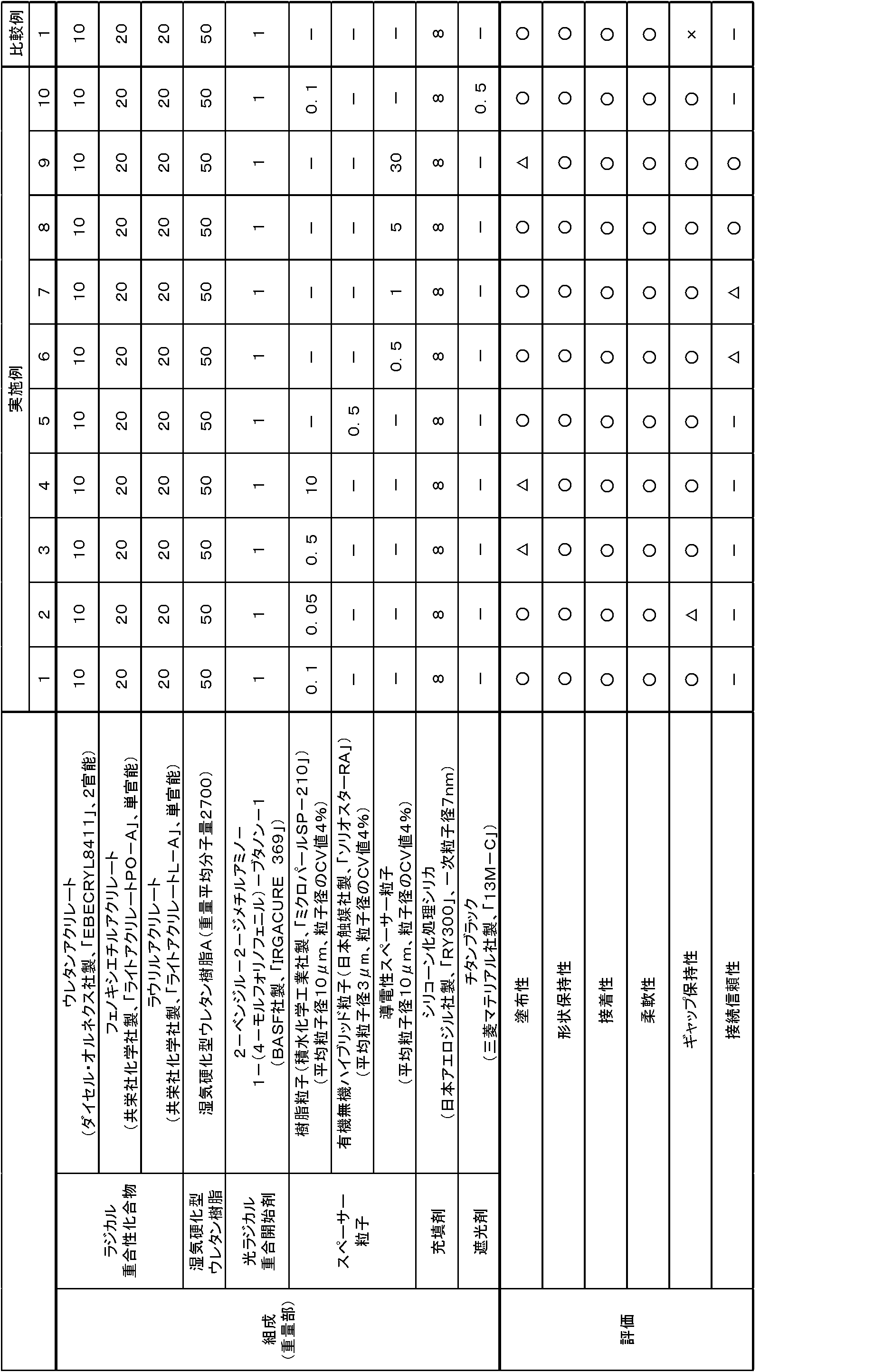
2 光湿気硬化型樹脂組成物
Claims (7)
- ラジカル重合性化合物と、湿気硬化型樹脂と、光ラジカル重合開始剤と、スペーサー粒子とを含有することを特徴とする光湿気硬化型樹脂組成物。
- スペーサー粒子は、粒子径のCV値が10%以下であることを特徴とする請求項1記載の光湿気硬化型樹脂組成物。
- スペーサー粒子は、樹脂粒子又は有機無機ハイブリッド粒子であることを特徴とする請求項1又は2記載の光湿気硬化型樹脂組成物。
- 湿気硬化型樹脂は、湿気硬化型ウレタン樹脂であることを特徴とする請求項1、2又は3記載の光湿気硬化型樹脂組成物。
- 遮光剤を含有することを特徴とする請求項1、2、3又は4記載の光湿気硬化型樹脂組成物。
- 請求項1、2、3、4又は5記載の光湿気硬化型樹脂組成物からなることを特徴とする電子部品用接着剤。
- 請求項1、2、3、4又は5記載の光湿気硬化型樹脂組成物からなることを特徴とする表示素子用接着剤。
Priority Applications (3)
| Application Number | Priority Date | Filing Date | Title |
|---|---|---|---|
| CN201680003399.6A CN107075061B (zh) | 2015-04-09 | 2016-04-05 | 光湿固化型树脂组合物、电子部件用粘接剂及显示元件用粘接剂 |
| JP2016522836A JP6859104B2 (ja) | 2015-04-09 | 2016-04-05 | 電子部品用接着剤、及び、表示素子用接着剤 |
| KR1020177010168A KR102633875B1 (ko) | 2015-04-09 | 2016-04-05 | 광 습기 경화형 수지 조성물, 전자 부품용 접착제, 및 표시 소자용 접착제 |
Applications Claiming Priority (4)
| Application Number | Priority Date | Filing Date | Title |
|---|---|---|---|
| JP2015-080365 | 2015-04-09 | ||
| JP2015080364 | 2015-04-09 | ||
| JP2015080365 | 2015-04-09 | ||
| JP2015-080364 | 2015-04-09 |
Publications (1)
| Publication Number | Publication Date |
|---|---|
| WO2016163353A1 true WO2016163353A1 (ja) | 2016-10-13 |
Family
ID=57072595
Family Applications (1)
| Application Number | Title | Priority Date | Filing Date |
|---|---|---|---|
| PCT/JP2016/061102 Ceased WO2016163353A1 (ja) | 2015-04-09 | 2016-04-05 | 光湿気硬化型樹脂組成物、電子部品用接着剤、及び、表示素子用接着剤 |
Country Status (5)
| Country | Link |
|---|---|
| JP (1) | JP6859104B2 (ja) |
| KR (1) | KR102633875B1 (ja) |
| CN (1) | CN107075061B (ja) |
| TW (1) | TWI720976B (ja) |
| WO (1) | WO2016163353A1 (ja) |
Cited By (1)
| Publication number | Priority date | Publication date | Assignee | Title |
|---|---|---|---|---|
| JPWO2021157624A1 (ja) * | 2020-02-05 | 2021-08-12 |
Families Citing this family (3)
| Publication number | Priority date | Publication date | Assignee | Title |
|---|---|---|---|---|
| JP6510788B2 (ja) * | 2014-10-03 | 2019-05-08 | 積水化学工業株式会社 | 光湿気硬化型樹脂組成物 |
| WO2022114186A1 (ja) * | 2020-11-30 | 2022-06-02 | 積水化学工業株式会社 | 湿気硬化性樹脂組成物、及び電子機器用接着剤 |
| KR102574109B1 (ko) * | 2022-10-18 | 2023-09-06 | (주)중앙종합안전기술연구원 | 구조물 안전 점검 및 진단용 균열 폭 측정기 |
Citations (7)
| Publication number | Priority date | Publication date | Assignee | Title |
|---|---|---|---|---|
| JP2001261725A (ja) * | 2000-03-21 | 2001-09-26 | Showa Highpolymer Co Ltd | 水反応性光硬化性ウレタン樹脂組成物,frpライニング用樹脂組成物,プライマー樹脂組成物及びそれらの硬化方法 |
| JP2002069387A (ja) * | 2000-08-28 | 2002-03-08 | Sekisui Chem Co Ltd | 接着剤組成物及び該接着剤組成物を用いた接合方法 |
| JP2008031307A (ja) * | 2006-07-28 | 2008-02-14 | Three Bond Co Ltd | 光硬化性オルガノポリシロキサン組成物 |
| JP2009530441A (ja) * | 2006-03-17 | 2009-08-27 | スリーエム イノベイティブ プロパティズ カンパニー | 迅速な電子デバイス組立に有用な、uvでb−ステージ化可能な湿気硬化性組成物 |
| JP2013035900A (ja) * | 2011-08-04 | 2013-02-21 | Kaneka Corp | Fpd貼り合わせ用光/湿分デュアルキュアー系硬化性組成物 |
| JP2014156585A (ja) * | 2013-01-16 | 2014-08-28 | Cemedine Co Ltd | 光硬化性組成物 |
| WO2015056717A1 (ja) * | 2013-10-18 | 2015-04-23 | 積水化学工業株式会社 | 光湿気硬化型樹脂組成物、電子部品用接着剤、及び、表示素子用接着剤 |
Family Cites Families (7)
| Publication number | Priority date | Publication date | Assignee | Title |
|---|---|---|---|---|
| US3864101A (en) * | 1972-04-19 | 1975-02-04 | Sherwin Williams Co | Process for preparing a resin-bonded grinding article containing stress-absorbing particulate material |
| JP2000178342A (ja) | 1998-12-17 | 2000-06-27 | Sumitomo Bakelite Co Ltd | 絶縁ペースト |
| JP5013585B2 (ja) | 2006-09-06 | 2012-08-29 | 日立化成ポリマー株式会社 | 反応性ホットメルト接着剤組成物及びそれを用いた接着方法 |
| JP5228370B2 (ja) | 2007-04-27 | 2013-07-03 | 東亞合成株式会社 | 一液湿気硬化型ウレタン系ホットメルト接着剤組成物及びその使用方法 |
| WO2011082327A1 (en) * | 2009-12-31 | 2011-07-07 | Bostik Inc. | Moisture curable adhesive composition and method for installing hardwood floors |
| CN103926795A (zh) * | 2013-01-16 | 2014-07-16 | 施敏打硬株式会社 | 光固化性组合物 |
| CN105814094B (zh) * | 2014-05-13 | 2019-01-18 | 积水化学工业株式会社 | 光湿固化型树脂组合物、电子部件用粘接剂及显示元件用粘接剂 |
-
2016
- 2016-04-05 CN CN201680003399.6A patent/CN107075061B/zh active Active
- 2016-04-05 WO PCT/JP2016/061102 patent/WO2016163353A1/ja not_active Ceased
- 2016-04-05 JP JP2016522836A patent/JP6859104B2/ja active Active
- 2016-04-05 KR KR1020177010168A patent/KR102633875B1/ko active Active
- 2016-04-07 TW TW105110846A patent/TWI720976B/zh active
Patent Citations (7)
| Publication number | Priority date | Publication date | Assignee | Title |
|---|---|---|---|---|
| JP2001261725A (ja) * | 2000-03-21 | 2001-09-26 | Showa Highpolymer Co Ltd | 水反応性光硬化性ウレタン樹脂組成物,frpライニング用樹脂組成物,プライマー樹脂組成物及びそれらの硬化方法 |
| JP2002069387A (ja) * | 2000-08-28 | 2002-03-08 | Sekisui Chem Co Ltd | 接着剤組成物及び該接着剤組成物を用いた接合方法 |
| JP2009530441A (ja) * | 2006-03-17 | 2009-08-27 | スリーエム イノベイティブ プロパティズ カンパニー | 迅速な電子デバイス組立に有用な、uvでb−ステージ化可能な湿気硬化性組成物 |
| JP2008031307A (ja) * | 2006-07-28 | 2008-02-14 | Three Bond Co Ltd | 光硬化性オルガノポリシロキサン組成物 |
| JP2013035900A (ja) * | 2011-08-04 | 2013-02-21 | Kaneka Corp | Fpd貼り合わせ用光/湿分デュアルキュアー系硬化性組成物 |
| JP2014156585A (ja) * | 2013-01-16 | 2014-08-28 | Cemedine Co Ltd | 光硬化性組成物 |
| WO2015056717A1 (ja) * | 2013-10-18 | 2015-04-23 | 積水化学工業株式会社 | 光湿気硬化型樹脂組成物、電子部品用接着剤、及び、表示素子用接着剤 |
Cited By (2)
| Publication number | Priority date | Publication date | Assignee | Title |
|---|---|---|---|---|
| JPWO2021157624A1 (ja) * | 2020-02-05 | 2021-08-12 | ||
| WO2021157624A1 (ja) * | 2020-02-05 | 2021-08-12 | 積水化学工業株式会社 | 光湿気硬化性樹脂組成物、電子部品用接着剤、電子部品の製造方法及び硬化体 |
Also Published As
| Publication number | Publication date |
|---|---|
| TW201702330A (zh) | 2017-01-16 |
| JP6859104B2 (ja) | 2021-04-14 |
| CN107075061A (zh) | 2017-08-18 |
| JPWO2016163353A1 (ja) | 2018-02-01 |
| KR20170135813A (ko) | 2017-12-08 |
| CN107075061B (zh) | 2021-08-24 |
| KR102633875B1 (ko) | 2024-02-05 |
| TWI720976B (zh) | 2021-03-11 |
Similar Documents
| Publication | Publication Date | Title |
|---|---|---|
| JP6427089B2 (ja) | 光湿気硬化型樹脂組成物、電子部品用接着剤、及び、表示素子用接着剤 | |
| JP6243969B2 (ja) | 硬化体、電子部品、及び、表示素子 | |
| JP6039080B2 (ja) | 狭額縁設計表示素子用接着剤 | |
| KR102260532B1 (ko) | 경화체, 전자 부품, 표시 소자 및 광 습기 경화형 수지 조성물 | |
| JP6499561B2 (ja) | 光湿気硬化型樹脂組成物 | |
| KR102271405B1 (ko) | 광 습기 경화형 수지 조성물, 전자 부품용 접착제, 및 표시 소자용 접착제 | |
| JP2016148034A (ja) | 光湿気硬化型樹脂組成物及び熱伝導性接着剤 | |
| JP6641255B2 (ja) | 電子部品用接着剤、及び、表示素子用接着剤 | |
| JP2016089174A (ja) | 光湿気硬化型樹脂組成物、電子部品用接着剤、及び、表示素子用接着剤 | |
| KR20190035597A (ko) | 접착제 조성물, 경화체, 전자 부품 및 조립 부품 | |
| JP6859104B2 (ja) | 電子部品用接着剤、及び、表示素子用接着剤 | |
| KR102331387B1 (ko) | 광 습기 경화형 수지 조성물, 전자 부품용 접착제, 및 표시 소자용 접착제 | |
| JP2016199743A (ja) | 光湿気硬化型樹脂組成物、電子部品用接着剤、及び、表示素子用接着剤 | |
| JP2018002925A (ja) | 光湿気硬化型樹脂組成物、電子部品用接着剤、及び、表示素子用接着剤 | |
| JP6921535B2 (ja) | 光湿気硬化型樹脂組成物、電子部品用接着剤、及び、表示素子用接着剤 | |
| JP2019065309A (ja) | 光湿気硬化型樹脂組成物硬化体 | |
| JP6755691B2 (ja) | 光湿気硬化型樹脂組成物、電子部品用接着剤、及び、表示素子用接着剤 | |
| JP2016199671A (ja) | 光湿気硬化型樹脂組成物 |
Legal Events
| Date | Code | Title | Description |
|---|---|---|---|
| ENP | Entry into the national phase |
Ref document number: 2016522836 Country of ref document: JP Kind code of ref document: A |
|
| 121 | Ep: the epo has been informed by wipo that ep was designated in this application |
Ref document number: 16776519 Country of ref document: EP Kind code of ref document: A1 |
|
| ENP | Entry into the national phase |
Ref document number: 20177010168 Country of ref document: KR Kind code of ref document: A |
|
| NENP | Non-entry into the national phase |
Ref country code: DE |
|
| 122 | Ep: pct application non-entry in european phase |
Ref document number: 16776519 Country of ref document: EP Kind code of ref document: A1 |