WO2016159384A1 - 比活性が向上したアマドリアーゼ - Google Patents
比活性が向上したアマドリアーゼ Download PDFInfo
- Publication number
- WO2016159384A1 WO2016159384A1 PCT/JP2016/061043 JP2016061043W WO2016159384A1 WO 2016159384 A1 WO2016159384 A1 WO 2016159384A1 JP 2016061043 W JP2016061043 W JP 2016061043W WO 2016159384 A1 WO2016159384 A1 WO 2016159384A1
- Authority
- WO
- WIPO (PCT)
- Prior art keywords
- amino acid
- seq
- amadoriase
- acid sequence
- oxidase
- Prior art date
- Legal status (The legal status is an assumption and is not a legal conclusion. Google has not performed a legal analysis and makes no representation as to the accuracy of the status listed.)
- Ceased
Links
Images


Classifications
-
- C—CHEMISTRY; METALLURGY
- C12—BIOCHEMISTRY; BEER; SPIRITS; WINE; VINEGAR; MICROBIOLOGY; ENZYMOLOGY; MUTATION OR GENETIC ENGINEERING
- C12N—MICROORGANISMS OR ENZYMES; COMPOSITIONS THEREOF; PROPAGATING, PRESERVING, OR MAINTAINING MICROORGANISMS; MUTATION OR GENETIC ENGINEERING; CULTURE MEDIA
- C12N9/00—Enzymes; Proenzymes; Compositions thereof; Processes for preparing, activating, inhibiting, separating or purifying enzymes
- C12N9/0004—Oxidoreductases (1.)
- C12N9/0012—Oxidoreductases (1.) acting on nitrogen containing compounds as donors (1.4, 1.5, 1.6, 1.7)
- C12N9/0026—Oxidoreductases (1.) acting on nitrogen containing compounds as donors (1.4, 1.5, 1.6, 1.7) acting on CH-NH groups of donors (1.5)
- C12N9/0032—Oxidoreductases (1.) acting on nitrogen containing compounds as donors (1.4, 1.5, 1.6, 1.7) acting on CH-NH groups of donors (1.5) with oxygen as acceptor (1.5.3)
-
- C—CHEMISTRY; METALLURGY
- C12—BIOCHEMISTRY; BEER; SPIRITS; WINE; VINEGAR; MICROBIOLOGY; ENZYMOLOGY; MUTATION OR GENETIC ENGINEERING
- C12Q—MEASURING OR TESTING PROCESSES INVOLVING ENZYMES, NUCLEIC ACIDS OR MICROORGANISMS; COMPOSITIONS OR TEST PAPERS THEREFOR; PROCESSES OF PREPARING SUCH COMPOSITIONS; CONDITION-RESPONSIVE CONTROL IN MICROBIOLOGICAL OR ENZYMOLOGICAL PROCESSES
- C12Q1/00—Measuring or testing processes involving enzymes, nucleic acids or microorganisms; Compositions therefor; Processes of preparing such compositions
- C12Q1/26—Measuring or testing processes involving enzymes, nucleic acids or microorganisms; Compositions therefor; Processes of preparing such compositions involving oxidoreductase
-
- C—CHEMISTRY; METALLURGY
- C12—BIOCHEMISTRY; BEER; SPIRITS; WINE; VINEGAR; MICROBIOLOGY; ENZYMOLOGY; MUTATION OR GENETIC ENGINEERING
- C12Y—ENZYMES
- C12Y105/00—Oxidoreductases acting on the CH-NH group of donors (1.5)
- C12Y105/03—Oxidoreductases acting on the CH-NH group of donors (1.5) with oxygen as acceptor (1.5.3)
-
- G—PHYSICS
- G01—MEASURING; TESTING
- G01N—INVESTIGATING OR ANALYSING MATERIALS BY DETERMINING THEIR CHEMICAL OR PHYSICAL PROPERTIES
- G01N33/00—Investigating or analysing materials by specific methods not covered by groups G01N1/00 - G01N31/00
- G01N33/48—Biological material, e.g. blood, urine; Haemocytometers
- G01N33/50—Chemical analysis of biological material, e.g. blood, urine; Testing involving biospecific ligand binding methods; Immunological testing
- G01N33/72—Chemical analysis of biological material, e.g. blood, urine; Testing involving biospecific ligand binding methods; Immunological testing involving blood pigments, e.g. haemoglobin, bilirubin or other porphyrins; involving occult blood
-
- G—PHYSICS
- G01—MEASURING; TESTING
- G01N—INVESTIGATING OR ANALYSING MATERIALS BY DETERMINING THEIR CHEMICAL OR PHYSICAL PROPERTIES
- G01N33/00—Investigating or analysing materials by specific methods not covered by groups G01N1/00 - G01N31/00
- G01N33/48—Biological material, e.g. blood, urine; Haemocytometers
- G01N33/50—Chemical analysis of biological material, e.g. blood, urine; Testing involving biospecific ligand binding methods; Immunological testing
- G01N33/72—Chemical analysis of biological material, e.g. blood, urine; Testing involving biospecific ligand binding methods; Immunological testing involving blood pigments, e.g. haemoglobin, bilirubin or other porphyrins; involving occult blood
- G01N33/721—Haemoglobin
- G01N33/723—Glycosylated haemoglobin
-
- C—CHEMISTRY; METALLURGY
- C12—BIOCHEMISTRY; BEER; SPIRITS; WINE; VINEGAR; MICROBIOLOGY; ENZYMOLOGY; MUTATION OR GENETIC ENGINEERING
- C12Q—MEASURING OR TESTING PROCESSES INVOLVING ENZYMES, NUCLEIC ACIDS OR MICROORGANISMS; COMPOSITIONS OR TEST PAPERS THEREFOR; PROCESSES OF PREPARING SUCH COMPOSITIONS; CONDITION-RESPONSIVE CONTROL IN MICROBIOLOGICAL OR ENZYMOLOGICAL PROCESSES
- C12Q1/00—Measuring or testing processes involving enzymes, nucleic acids or microorganisms; Compositions therefor; Processes of preparing such compositions
- C12Q1/26—Measuring or testing processes involving enzymes, nucleic acids or microorganisms; Compositions therefor; Processes of preparing such compositions involving oxidoreductase
- C12Q1/28—Measuring or testing processes involving enzymes, nucleic acids or microorganisms; Compositions therefor; Processes of preparing such compositions involving oxidoreductase involving peroxidase
-
- G—PHYSICS
- G01—MEASURING; TESTING
- G01N—INVESTIGATING OR ANALYSING MATERIALS BY DETERMINING THEIR CHEMICAL OR PHYSICAL PROPERTIES
- G01N2333/00—Assays involving biological materials from specific organisms or of a specific nature
- G01N2333/795—Porphyrin- or corrin-ring-containing peptides
- G01N2333/805—Haemoglobins; Myoglobins
Definitions
- the present invention relates to amadoriase with improved specific activity, a method for measuring hemoglobin A1c in a sample using the same, and a reagent kit for measurement containing amadoriase.
- Glycated proteins are produced by non-enzymatic covalent bond formation between the aldehyde group of aldoses (monosaccharides and derivatives thereof that potentially have aldehyde groups) such as glucose, and Amadori transfer It is.
- aldehyde group of aldoses monosaccharides and derivatives thereof that potentially have aldehyde groups
- Amadori transfer It is.
- the amino group of a protein include an ⁇ -amino group at the amino terminus and an ⁇ -amino group of a lysine residue side chain in the protein.
- Known glycated proteins generated in vivo include glycated hemoglobin in which hemoglobin in blood is glycated, glycated albumin in which albumin is glycated, and the like.
- HbA1c hemoglobin A1c
- ⁇ -chain a protein in which glucose is bound to the ⁇ -amino group of Val (valine) at the N-terminus (amino terminus) of the hemoglobin “ ⁇ -chain”. Since the HbA1c concentration in blood reflects the average blood glucose level over a certain period in the past, the value of HbA1c is an important index in the diagnosis and management of diabetes symptoms.
- Amadoriase catalyzes a reaction that oxidizes iminodiacetic acid or its derivative (also called “Amadori compound”) in the presence of oxygen to produce glyoxylic acid or ⁇ -ketoaldehyde, an amino acid or peptide, and hydrogen peroxide. It is a general term for enzymes to be used. Amadoriase is known as a useful enzyme for measuring HbA1c by an enzymatic method. As a substrate oxidized by amadoriase, for example, ⁇ -fructosyl valyl histidine (hereinafter referred to as ⁇ FVH) is known.
- ⁇ FVH ⁇ -fructosyl valyl histidine
- Amadoriase has been found so far in bacteria, yeasts and fungi, such as the genus Coniochaeta, Eupenicillium, Pyrenochaeta, Arthrinium, Curvularia. , Neocosmospora genus, Cryptococcus genus, Phaeosphaeria genus, Aspergillus genus, Emericella genus, Ulocladium genus, Penicillium F arium ), Achaetomiella, Achaetomium, Thielavia, Chaetomium, Gerasinospora, Microascus, Leptosphaeria, Ophiobolus, Pleospora, Conioketidium (Co Amadoriases from the genera niochaetidium, Pichia, Debaryomyces, Corynebacterium, Agrobacterium, Arthrobacter are reported (for example, (See Patent Documents 1, 6 to 15 and Non-Patent Document
- amadoriase may be described by expressions such as ketoamine oxidase, fructosyl amino acid oxidase, fructosyl peptide oxidase, and fructosylamine oxidase depending on the literature.
- HbA1c As a method for measuring HbA1c quickly and conveniently using various amadoriases as described above, HbA1c is decomposed with a protease or peptidase (hereinafter referred to as protease) excision enzyme, and the ⁇ -chain amino terminus of HbA1c is used.
- protease peptidase
- a method is known in which a specific measurement substance is liberated and the liberated measurement substance is quantified using the amadoriase as described above (see, for example, Patent Documents 1 to 7).
- HbA1c was digested with Glu-C protease, and glycated ⁇ -fructosyl hexapeptide ( ⁇ -fructosyl hexapeptide comprising ⁇ -amino acid-terminal valine)
- ⁇ F6P ktosylvalylhistidyl leucylthreonylprolyl glutamic acid
- This method is a method for measuring HbA1c with an enzyme in accordance with the HbA1c measurement method (see Non-patent Document 10) defined by IFCC (International Federation of Clinical Chemistry and Laboratory Medicine).
- proteases that can be used are limited. For example, when measuring ⁇ F6P derived from HbA1c, it is limited to those that cleave HbA1c at the C-terminal side of glutamic acid residues, such as Glu-C protease.
- proteases and the like have an action of hydrolyzing proteins, enzymes that are proteins are also hydrolyzed by proteases and the like. Therefore, amadoriase is also hydrolyzed by protease and inactivated, and as a result, the reaction of consuming glycated peptide and oxygen to produce hydrogen peroxide is inhibited.
- amadoriase As a countermeasure against this, it is conceivable that the prescription of amadoriase is increased and the measurement is finished before the amadoriase is completely inactivated.
- the increase of amadoriase is because protease etc. hydrolyzes amadoriase preferentially over HbA1c. This is not preferable in nature.
- peroxidase when HbA1c is measured by quantifying hydrogen peroxide generated by allowing amadoriase to act on a glycated peptide, peroxidase may be used for quantification of hydrogen peroxide. In this case, peroxidase is also undesirably hydrolyzed by protease and the like and deactivated.
- an automatic analyzer for HbA1c measurement by an enzyme.
- various biological markers such as HbA1c are simultaneously measured using one sample.
- each biomarker is measured using an enzyme or an antibody, if a protease or the like is contaminated, the enzyme or antibody contained in each biomarker measurement reagent is hydrolyzed, and a biomarker other than HbA1c is accurately measured.
- the reagent set in the automatic analyzer does not originally contain protease or the like.
- a reagent kit comprising:
- the modified amadoriase in which an amino acid substitution is introduced into an amadoriase derived from the genus Coniochaeta, etc., has a ratio to ⁇ F8P as compared with a conventional amadoriase. It was found that the activity was improved, and the present invention was completed.
- the present invention includes the following.
- Amadoriase selected from the group consisting of: (i) When the amino acid sequence of Amadoriase is aligned with the amino acid sequence shown in SEQ ID NO: 1, the amino acid at the position corresponding to position 64 in the amino acid sequence shown in SEQ ID NO: 1 is glycine, serine, methionine, leucine, threonine, valine And an amadoriase having an activity against a glycated peptide, which is an amino acid selected from the group consisting of isoleucine, and (ii) When the amino acid sequence of Amadoriase is aligned with the amino acid sequence described in SEQ ID NO: 1, the amino acid at the position corresponding to position 64 in the amino acid sequence shown in SEQ ID NO: 1 is glycine, serine, methionine, leucine, threonine, valine And an amadoriase having an activity against ⁇ -fructosyl
- Amadoriase according to 2.
- the amino acid sequence of the amadoriase is aligned with the amino acid sequence described in SEQ ID NO: 1, the following (i) or (j) of the amino acid sequence described in SEQ ID NO: 1, (I) position 68 of SEQ ID NO: 1, (J) position 356 of SEQ ID NO: 1,
- Amadoriase further has the following position in the amino acid sequence shown in SEQ ID NO: 1, (I) 262nd place, (Ii) 257th, (Iii) 249th, (Iv) 253rd (V) 337th, (Vi) 340th place (Vii) 232nd, (Viii) 129th, (Ix) 132nd, (X) 133rd, (Xi) 44th place, (Xii) 256th, (Xiii) 231, and (xiv) 81st, Having a substitution of one or more amino acid residues at a position corresponding to 6.
- amadoriase according to any one of 1 to 5 which may optionally have 3 amino acid residues deleted from the carboxyl terminus.
- the amadoriase according to any one of 1 to 6 which has a specific activity against ⁇ F8P of 0.1 U / mg or more.
- the amadoriase according to any one of 1 to 8 which has a specific activity for ⁇ F8P of 4 U / mg or more.
- Amadoriase is genus Coniochaeta, Eupenicillium, Pyrenochaeta, Arthrinium, Currvularia, Neocosmospora, Neocosmospora, Cryptococcus, Cryptococcus 10.
- the amadoriase according to any one of 1 to 9, which is derived from the genus Phaeosphaeria, Aspergillus, Emericella, Ulocladium, or Penicillium.
- Amadoriase is Coniochaeta sp., Eupenicillium terrenum, Pyrenochaeta sp., Arsurinium sp., Curvularia clavora, Curvularia cofora vasinfecta, Cryptococcus neoformans, Phaeosphaeria nodorum, Aspergillus nidulans, Emericella nidulans, Ulocridium sp.
- the amadoriase according to any one of 1 to 10, which is derived from Penicillium janthinelum) or Penicillium chrysogenum.
- Amadoriase selected from the group consisting of: (i) an amadoriase having the amino acid sequence shown in SEQ ID NO: 211 or 213, (ii) In the amadoriase of (i), in the amino acid sequence shown in SEQ ID NO: 1, positions 64, 99, 62, 63, 102, 106, 110, 113, 355, 419, 68 And an amadoriase having an activity against ⁇ F8P, comprising an amino acid sequence in which one or several amino acids at positions other than the position corresponding to position 356 are substituted, deleted or added, and (iv) In the amadoriase of the above (i) or (ii), the full-length amino acid sequence of the amadoriase has 70% or more sequence identity with the amino acid sequence of SEQ ID NO: 1, and positions 10 to 32 of SEQ ID NO: 1 36-41, 49-52, 54-58, 63-65, 73-75, 84-86, 88-90, 120
- amino acid sequence of the amadoriase When the amino acid sequence of the amadoriase is aligned with the amino acid sequence described in SEQ ID NO: 1, it corresponds to a position selected from the group consisting of (l) to (q) below of the amino acid sequence described in SEQ ID NO: 1.
- a reagent kit for measuring hemoglobin A1c comprising the amadoriase according to any one of 1 to 14.
- a method for measuring hemoglobin A1c in a sample using the amadoriase according to any one of 1 to 14.
- an amadoriase having a high specific activity for ⁇ F8P that can quantify HbA1c quickly, simply, accurately and satisfactorily. If such an amadoriase is used, HbA1c quantitative reaction can be performed in a short time, contributing to the improvement of the sensitivity of the HbA1c direct measurement method, reducing the prescription amount of amadoriase, and enabling a rapid test. Become.
- FIG. 1-1 It is a continuation of FIG. 1-2. It is a continuation of FIG. 1-3. This is continued from FIG. It is the 2nd figure which illustrates the identity in the amino acid sequence of various well-known amadoriases, and a similar amino acid. In addition to Co, Et, Py, Ar, Cc, and Nv, Cn, Pn, An, En, Ul, and Pj were aligned. This is continued from FIG. 2-1. It is a continuation of FIG. 2-2. This is continued from FIG. 2-3. It is a continuation of FIG.
- the glycated protein in the present invention refers to a non-enzymatically glycated protein.
- Glycated proteins exist both in vivo and externally. Examples of existing in vivo include glycated hemoglobin and glycated albumin in blood. Among glycated hemoglobins, the ⁇ -chain amino-terminal valine of hemoglobin is glycated. Glycated hemoglobin is particularly referred to as hemoglobin A1c (HbA1c). Examples that exist outside the body include foods and beverages such as liquid seasonings in which proteins, peptides and sugars coexist, and infusions.
- the glycated peptide in the present invention refers to a non-enzymatically glycated peptide derived from a glycated protein, a peptide that is directly non-enzymatically glycated, a peptide that is generated as a result of degradation of a glycated protein by a protease, A glycated (poly) peptide constituting a glycated protein is included.
- a glycated peptide may be referred to as a fructosyl peptide.
- the amino group on the side of the peptide to be glycated includes an ⁇ -amino group at the amino terminus, an ⁇ -amino group on the side chain of a lysine residue inside the peptide, and the glycated peptide in the present invention refers to More specifically, it is an ⁇ -glycated peptide ( ⁇ -fructosyl peptide).
- the ⁇ -glycated peptide is formed by releasing from the glycated protein in which the N-terminal ⁇ -amino acid is glycated by some means, for example, limited decomposition with a protease or the like.
- the corresponding ⁇ -glycated peptide refers to a glycated peptide cut out from the ⁇ chain of HbA1c in which the N-terminus is glycated.
- the ⁇ chain of HbA1c composed of 146 amino acids also corresponds to the ⁇ -glycated peptide.
- the measurement substance on which the amadoriase of the present invention acts is HbA1c, more specifically, the ⁇ chain of HbA1c.
- the measurement substance on which the amadoriase of the present invention acts is ⁇ F8P cleaved from the ⁇ chain of HbA1c, specifically, ⁇ -fructosyl valyl histidyl leucyl threonyl prolyl glutamyl glutamyl lysine. .
- the measurement substance on which the amadoriase of the present invention acts is ⁇ FVH ( ⁇ -fructosyl valylhistidine) or ⁇ FV ( ⁇ -fructosyl valine) or ⁇ F6P.
- ⁇ FVH ⁇ -fructosyl valylhistidine
- ⁇ FV ⁇ -fructosyl valine
- ⁇ F6P ⁇ -glycated peptide substrate having a longer chain length is also included in the measurement substance.
- Amadoriase is also referred to as ketoamine oxidase, fructosyl amino acid oxidase, fructosyl peptide oxidase, or fructosylamine oxidase. It refers to an enzyme that catalyzes a reaction that produces ketoaldehyde, an amino acid or peptide, and hydrogen peroxide.
- Amadoriase is widely distributed in nature and can be obtained by searching for microorganisms, enzymes of animal or plant origin. The microorganism can be obtained from, for example, filamentous fungi, yeast, or bacteria.
- amadoriase of the present invention acts directly on HbA1c.
- amadoriase directly acts on HbA1c.
- amadoriase acts on the fructosyl group at the N-terminal of the ⁇ chain of HbA1c, and 2-keto-D glucose and hydrogen peroxide, It means that the ⁇ chain of hemoglobin is generated.
- this does not exclude that the amadoriase reacts with the ⁇ -chain-derived fructosyl peptide of HbA1c, such as ⁇ F8P or a shorter ⁇ -fructosyl peptide.
- the amadoriase of the present invention not only directly acts on HbA1c but also reacts with fructosyl peptides derived from the ⁇ chain of HbA1c, such as ⁇ F8P and shorter ⁇ -fructosyl peptides. Have.
- Amadoriase variant The present invention is based on wild type amadoriase having the amino acid sequence shown in SEQ ID NO: 1, SEQ ID NO: 38, SEQ ID NO: 40, SEQ ID NO: 54, or SEQ ID NO: 62, or SEQ ID NO: 89, or SEQ ID NO: 99, ⁇ F8P
- a variant of Amadoriase that is reactive to HbA1c and acts directly on HbA1c is provided.
- a variant is used interchangeably with a variant, and means that a part of amino acids is substituted, deleted or added when the amino acid sequence of amadoriase is compared with a wild-type sequence. The addition here includes insertion.
- the present invention further relates to ⁇ F8P based on the wild type amadoriase having the amino acid sequence shown in SEQ ID NO: 113, SEQ ID NO: 115, SEQ ID NO: 117, SEQ ID NO: 119, SEQ ID NO: 121, SEQ ID NO: 123, SEQ ID NO: 145 or SEQ ID NO: 149.
- ⁇ F8P based on the wild type amadoriase having the amino acid sequence shown in SEQ ID NO: 113, SEQ ID NO: 115, SEQ ID NO: 117, SEQ ID NO: 119, SEQ ID NO: 121, SEQ ID NO: 123, SEQ ID NO: 145 or SEQ ID NO: 149.
- variants of amadoriase that are reactive to and act directly on HbA1c.
- a variant of amadoriase that directly acts on HbA1c can be obtained based on other wild-type amadoriases derived from the genus Coniochaeta.
- the modified amadoriase of the present invention may further have a mutation that modifies other properties of the enzyme as long as it has reactivity with ⁇ F8P and acts directly on HbA1c.
- the amadoriase of the present invention is a variant of an amadoriase that directly acts on HbA1c, which is produced based on the amadoriase derived from the genus Coniochaeta having the amino acid sequence shown in SEQ ID NO: 1.
- Sequence number 151, Sequence number 153, Sequence number 155, Sequence number 157, Sequence number 159, Sequence number 161, Sequence number 163, Sequence number 137, Sequence number 139, Sequence number 165, Sequence number 167, Sequence number 169, Sequence SEQ ID NO: 171, SEQ ID NO: 173, SEQ ID NO: 133, SEQ ID NO: 135, SEQ ID NO: 175, SEQ ID NO: 189, SEQ ID NO: 177, SEQ ID NO: 179, SEQ ID NO: 143, SEQ ID NO: 181, SEQ ID NO: 183, SEQ ID NO: 187, SEQ ID NO: 191 , SEQ ID NO: 141, SEQ ID NO: 185, SEQ ID NO: 199, SEQ ID NO: 203, SEQ ID NO: 209, SEQ ID NO: 211, or SEQ ID NO: 213 have high sequence identity (for example, 50% or more, preferably 60% or more, preferably Is 70% or more,
- CFP-T7-H38 having the amino acid sequence of SEQ ID NO: 211 and CFP-DH3 having the amino acid sequence of SEQ ID NO: 213 have an amadoriase having the amino acid sequence of SEQ ID NO: 209 and the amino acid of SEQ ID NO: 203, respectively. It is improved compared to the amadoriase with sequence and acts directly on HbA1c.
- one or several amino acids means 1 to 15, preferably 1 to 10, more preferably 1 to 5, more preferably 1 to 4 amino acid sequences with a total length exceeding 400 amino acids. More preferably, it refers to 1 to 3, more preferably 1 or 2 amino acids.
- one or several amino acids are 1 to 10, preferably 1 to 7, preferably 1 to 5, preferably 1 to 4, More preferably, it refers to 1 to 3, more preferably 1 or 2 amino acids.
- one or several amino acids are 1 to 5, preferably 1 to 4, preferably 1 to 3, more preferably 1 or 2.
- An amino acid refer to one or two amino acids when referring to a sequence having a total length of less than 40 amino acids.
- Amadoria encoded by the nucleotide sequence and having activity against ⁇ F8P Ze can act directly on HbA1c.
- hybridization under stringent conditions is described in Sambrook et al., MolecularlonCloning 2nd edition (Cold Spring Harbor Laboratory press) and Current protocols in molecular biology (Frederick M. Ausubel et al., Ed, 1987). .
- hybridization solution 50% formamide, 6-10 ⁇ SSC (0.15-1.5M NaCl, 15 mM sodium citrate, pH 7.0), 5 ⁇ Denhardt solution, 1% SDS, 10% dextran sulfate, 10 ⁇ g / ml denatured salmon sperm DNA, 50 mM phosphate buffer (pH 7.5)), and incubation at about 42 ° C. to about 50 ° C., followed by about 65 ° C. to about 70 ° C. using 0.1 ⁇ SSC, 0.1% SDS The conditions for washing can be mentioned.
- mutant of the present invention is, for example, Eupenicillium, Pyrenecata, Arsulium, Carbraria, Neocosmosspora as long as the conditions relating to substrate specificity and / or amino acid sequence described in the claims are satisfied.
- Cryptococcus spp. Feosferia spp.
- Produced based on amadoriase derived from other species such as Pleospora, Conioketidium, Pichia, Corynebacterium, Agrobacterium, or Arthrobacter.
- a variant based on Coniochaeta sp. NISL 9330-derived amadoriase may have one or more amino acid substitutions at the following positions.
- the one or more amino acid substitutions used for the modified amadoriase are 1, 2, 3, 4, 5, 6, 7, 8, 9, 10, 11, 12, 13, 14, 15, 16, 17 , 18, 19 or 20 amino acid substitutions, for example 1, 2, 3, 4, 5, 6, 7, 8, 9, 10, 11 or 12.
- the one or more amino acid substitutions used with an amadoriase variant are 1, 2, 3, 4, 5, 6, 7, 8, 9 or 10 amino acid substitutions.
- arginine at position 62 is alanine, asparagine or aspartic acid, glutamine, glutamic acid, glycine, valine, leucine, isoleucine, cysteine, serine, Substitution into methionine, threonine or proline.
- leucine at position 63 is replaced with histidine, alanine or glycine.
- glutamic acid at position 102 is substituted with lysine.
- aspartic acid at position 106 is replaced with alanine, lysine or arginine.
- glutamine at position 110 is replaced with leucine, tyrosine, phenylalanine or histidine.
- alanine at position 113 is substituted with lysine or arginine.
- alanine at position 355 is substituted with serine.
- alanine at position 419 may be substituted with lysine.
- aspartic acid at position 68 may be substituted with asparagine.
- (j) alanine at position 356 may be substituted with threonine.
- arginine at position 64 is substituted with glycine, serine, methionine, leucine, threonine, valine, or isoleucine.
- (l) histidine at position 99 is substituted with serine.
- the amadoriase from Coniochaeta sp. NISL 9330 may further have one or more amino acid substitutions at the following positions: (L) position 67 of SEQ ID NO: 1, (M) position 72 of SEQ ID NO: 1, (N) position 76 of SEQ ID NO: 1, (O) position 96 of SEQ ID NO: 1, (P) position 109 of SEQ ID NO: 1, (Q) position 116 of SEQ ID NO: 1.
- the amino acid at the position corresponding to position 67 of SEQ ID NO: 1 may be histidine.
- the amino acid at the position corresponding to position 72 of SEQ ID NO: 1 may be serine.
- the amino acid at the position corresponding to position 76 of SEQ ID NO: 1 may be alanine or phenylalanine.
- the amino acid at the position corresponding to position 96 of SEQ ID NO: 1 may be glutamic acid.
- the amino acid at the position corresponding to position 109 of SEQ ID NO: 1 may be arginine or lysine.
- the amino acid at a position corresponding to position 116 of SEQ ID NO: 1 may be arginine.
- a variant based on amadoriase from Phaeosphaeria nodorum may have one or more amino acid substitutions at the following positions: (A) Serine at position 62 (b) Leucine at position 63 (c) Lysine at position 102 (d) Aspartic acid at position 106 (e) Glycine at position 110 (f) Alanine at position 113 (g) Alanine at position 351 (H) Serine at position 416 (i) Aspartic acid at position 68 (j) Alanine at position 352 (k) Arginine at position 64 (l) Histidine at position 99
- (A) The serine at position 62 may not be substituted.
- serine at position 62 can be substituted with alanine, aspartic acid, asparagine, glutamine, glutamic acid, glycine, valine, leucine, isoleucine, cysteine, methionine, threonine or proline.
- leucine at position 63 is replaced with histidine, alanine or glycine.
- the lysine at position 102 may not be substituted.
- aspartic acid at position 106 is replaced with lysine, alanine or arginine.
- glycine at position 110 is replaced with leucine, tyrosine, phenylalanine or histidine.
- the alanine at position 113 is substituted with lysine or arginine.
- alanine at position 351 is substituted with serine.
- serine at position 416 may be substituted with lysine.
- aspartic acid at position 68 may be substituted with asparagine.
- (j) alanine at position 352 may be substituted with threonine.
- arginine at position 64 can be replaced with glycine, serine, methionine, leucine, threonine, valine, or isoleucine.
- (l) histidine at position 99 is substituted with serine.
- the amadoriase from Phaeosphaeria nodorum can further have one or more amino acid substitutions at the following positions: (L) position 67 of SEQ ID NO: 38 (M) position 72 of SEQ ID NO: 38, (N) position 76 of SEQ ID NO: 38, (O) position 96 of SEQ ID NO: 38, (P) position 109 of SEQ ID NO: 38, (Q) Position 116 of SEQ ID NO: 38
- the amino acid at position 67 of SEQ ID NO: 38 can be histidine.
- the amino acid at position 72 of SEQ ID NO: 38 may be serine.
- the amino acid at position 76 of SEQ ID NO: 38 may be alanine or phenylalanine.
- the amino acid at position 96 of SEQ ID NO: 38 may be glutamic acid.
- the amino acid at position 109 of SEQ ID NO: 38 may be arginine or lysine.
- the amino acid at position 116 of SEQ ID NO: 38 may be arginine.
- Neocosmospora vasinfecta derived amadoriase may have one or more amino acid substitutions at the following positions: (A) Arginine at position 62 (b) Leucine at position 63 (c) Glutamic acid at position 102 (d) Glycine at position 106 (e) Glutamic acid at position 110 (f) Lysine at position 113 (g) Serine at position 355 ( h) alanine at position 420 (i) aspartic acid at position 68 (j) alanine at position 356 (k) arginine at position 64 (l) serine at position 99
- a) Arginine at position 62 can be substituted with alanine, aspartic acid, asparagine, glutamine, glutamic acid, glycine, va
- leucine at position 63 is replaced with histidine, alanine or glycine.
- glutamic acid at position 102 is substituted with lysine.
- glycine at position 106 is replaced with lysine, alanine or arginine.
- glutamic acid at position 110 is replaced with leucine, tyrosine, phenylalanine or histidine.
- the lysine at position 113 may be unsubstituted or substituted with arginine.
- the serine at position 355 may not be substituted.
- alanine at position 420 may be substituted with lysine.
- aspartic acid at position 68 may be substituted with asparagine.
- alanine at position 356 may be substituted with threonine.
- arginine at position 64 can be replaced with glycine, serine, methionine, leucine, threonine, valine, or isoleucine.
- the Amadoriase from Neocosmospora vasinfecta may further have one or more amino acid substitutions at the following positions: (L) position 67 of SEQ ID NO: 54, (M) position 72 of SEQ ID NO: 54, (N) position 76 of SEQ ID NO: 54, (O) position 96 of SEQ ID NO: 54, (P) position 109 of SEQ ID NO: 54, (Q) Position 116 of SEQ ID NO: 54
- the amino acid at position 67 of SEQ ID NO: 54 may be histidine.
- the amino acid at position 72 of SEQ ID NO: 54 may remain serine.
- the amino acid at position 76 of SEQ ID NO: 54 may be alanine or phenylalanine.
- the amino acid at position 96 of SEQ ID NO: 54 may be glutamic acid.
- the amino acid at position 109 of SEQ ID NO: 54 may remain arginine or may be lysine.
- the amino acid at position 116 of SEQ ID NO: 54 may be arginine.
- a variant based on an amadoriase from Aspergillus nidulans may have one or more amino acid substitutions at the following positions: (A) Arginine at position 61 (b) Leucine at position 62 (c) Glutamic acid at position 101 (d) Glycine at position 105 (e) Lysine at position 109 (f) Serine at position 112 (g) Alanine at position 355 ( h) Alanine at position 420 (i) Aspartic acid at position 67 (j) Asparagine at position 356 (k) Arginine at position 63 (l) Serine at position 98
- a) Arginine at position 61 can be replaced with alanine, aspartic acid, asparagine, glutamine, glutamic acid, glycine, valine,
- leucine at position 62 is replaced with histidine, alanine or glycine.
- glutamic acid at position 101 is substituted with lysine.
- glycine at position 105 is replaced with lysine, alanine or arginine.
- lysine at position 109 is replaced with leucine, tyrosine, phenylalanine or histidine.
- the serine at position 112 is substituted with lysine or arginine.
- alanine at position 355 is replaced with serine.
- alanine at position 420 may be substituted with lysine.
- aspartic acid at position 67 may be substituted with asparagine.
- asparagine at position 356 may be replaced with threonine.
- arginine at position 63 can be replaced with glycine, serine, methionine, leucine, threonine, valine or isoleucine.
- the Amadoriase from Aspergillus nidulans can further have one or more amino acid substitutions at the following positions: (L) Position 66 of SEQ ID NO: 62 (m) Position 71 of SEQ ID NO: 62 (n) Position 75 of SEQ ID NO: 62 (o) Position 95 of SEQ ID NO: 62 (p) Position 108 of SEQ ID NO: 62 (q) SEQ ID NO:
- the position 115 of 62 may optionally be (l) the amino acid at position 66 of SEQ ID NO: 62 may be histidine.
- (m) the amino acid at position 71 of SEQ ID NO: 62 may be serine.
- the amino acid at position 75 of SEQ ID NO: 62 may be alanine or phenylalanine. In some cases (o) the amino acid at position 95 of SEQ ID NO: 62 may be glutamic acid. Optionally (p) the amino acid at position 108 of SEQ ID NO: 62 may be arginine or lysine. Optionally (q) the amino acid at position 115 of SEQ ID NO: 62 can be arginine. The same applies to the Amadoriase derived from Aspergillus nidulans of SEQ ID NO: 147.
- a variant based on Eupenicillium terrenum derived amadoriase may have one or more amino acid substitutions at the following positions: (A) Arginine at position 62 (b) Leucine at position 63 (c) Glutamic acid at position 102 (d) Asparagine at position 106 (e) Lysine at position 110 (f) Threonine at position 113 (g) Alanine at position 355 ( h) Glycine at position 419 (i) Aspartic acid at position 68 (j) Asparagine at position 356 (k) Arginine at position 64 (l) Serine at position 99
- leucine at position 63 is replaced with histidine, alanine or glycine.
- glutamic acid at position 102 is substituted with lysine.
- asparagine at position 106 is replaced with lysine, alanine or arginine.
- lysine at position 110 is substituted with leucine, tyrosine, phenylalanine or histidine.
- threonine at position 113 is replaced with lysine or arginine.
- alanine at position 355 is replaced with serine.
- glycine at position 419 may be substituted with lysine.
- aspartic acid at position 68 may be substituted with asparagine.
- asparagine at position 356 may be replaced with threonine.
- arginine at position 64 can be replaced with glycine, serine, methionine, leucine, threonine, valine, or isoleucine.
- Eupenicillium terrenum-derived amadoriase may further have one or more amino acid substitutions at the following positions: (L) position 67 of SEQ ID NO: 40, (M) position 72 of SEQ ID NO: 40, (N) position 76 of SEQ ID NO: 40, (O) position 96 of SEQ ID NO: 40, (P) position 109 of SEQ ID NO: 40, (Q) Position 116 of SEQ ID NO: 40
- the amino acid at position 67 of SEQ ID NO: 40 can be histidine.
- the amino acid at position 72 of SEQ ID NO: 40 may be serine.
- the amino acid at position 76 of SEQ ID NO: 40 may be alanine or phenylalanine. In some cases (o) the amino acid at position 96 of SEQ ID NO: 40 may be glutamic acid. Optionally (p) the amino acid at position 109 of SEQ ID NO: 40 may be arginine or lysine. In some cases (q) the amino acid at position 116 of SEQ ID NO: 40 may remain arginine.
- amadoriase derived from Eupenicillium terrenum of SEQ ID NO: 145.
- a variant based on fructosyl amino acid oxidase from Cryptococcus neoformans may have one or more amino acid substitutions at the following positions: (A) Arginine at position 62 (b) Isoleucine at position 63 (c) Glutamic acid at position 102 (d) Serine at position 106 (e) Serine at position 110 (f) Alanine at position 113 (g) Alanine at position 355 ( h) alanine at position 420 (i) aspartic acid at position 68 (j) asparagine at position 356 (k) arginine at position 64 (l) histidine at position 99 Fructosyl amino acid oxidase (CnFX, SEQ ID NO: 89 from the Cryptococcus neoformans) Or 149), preferably (a) the arginine at position 62 can be replaced with alanine, aspartic acid, asparagine, glutamine, gluta
- isoleucine at position 63 is replaced with histidine, alanine or glycine.
- glutamic acid at position 102 is substituted with lysine.
- serine at position 106 is substituted with lysine, alanine or arginine.
- the serine at position 110 is replaced with leucine, tyrosine, phenylalanine or histidine.
- the alanine at position 113 is substituted with lysine or arginine.
- alanine at position 355 is replaced with serine.
- alanine at position 420 may be substituted with lysine.
- aspartic acid at position 68 may be substituted with asparagine.
- asparagine at position 356 may be replaced with threonine.
- arginine at position 64 can be replaced with glycine, serine, methionine, leucine, threonine, valine, or isoleucine.
- histidine at position 99 is substituted with serine.
- the amadoriase from Cryptococcus neoformans can further have one or more amino acid substitutions at the following positions: (L) position 67 of SEQ ID NO: 89 or 149, (M) position 72 of SEQ ID NO: 89 or 149, (N) position 76 of SEQ ID NO: 89 or 149, (O) position 96 of SEQ ID NO: 89 or 149, (P) position 109 of SEQ ID NO: 89 or 149, (Q) position 116 of SEQ ID NO: 89 or 149
- the amino acid at position 67 of SEQ ID NO: 89 or 149 may be histidine.
- the amino acid at position 72 of SEQ ID NO: 89 or 149 may remain serine.
- the amino acid at position 76 of SEQ ID NO: 89 or 149 may be alanine or phenylalanine.
- the amino acid at position 96 of SEQ ID NO: 89 or 149 may be glutamic acid.
- the amino acid at position 109 of SEQ ID NO: 89 or 149 may be arginine or lysine.
- the amino acid at position 116 of SEQ ID NO: 89 or 149 may be arginine.
- a variant based on ketoamine oxidase (SEQ ID NO: 113) from Pyrenochaeta sp. May have one or more amino acid substitutions at the following positions: (A) Arginine at position 62 (b) Leucine at position 63 (c) Lysine at position 102 (d) Aspartic acid at position 106 (e) Alanine at position 110 (f) Threonine at position 113 (g) Alanine at position 353 (H) alanine at position 418 (i) aspartic acid at position 68 (j) alanine at position 354 (k) arginine at position 64 (l) histidine at position 99 Ketoamine oxidase derived from the above Pyrenochaeta sp.
- arginine at position 62 can be substituted with alanine, aspartic acid, asparagine, glutamine, glutamic acid, glycine, valine, leucine, isoleucine, cysteine, serine, methionine, threonine or proline.
- leucine at position 63 is replaced with histidine, alanine or glycine.
- lysine at position 102 may not be substituted.
- aspartic acid at position 106 is replaced with lysine, alanine or arginine.
- alanine at position 110 is replaced with leucine, tyrosine, phenylalanine or histidine.
- threonine at position 113 is replaced with lysine or arginine.
- alanine at position 353 is substituted with serine.
- alanine at position 418 may be substituted with lysine.
- aspartic acid at position 68 may be substituted with asparagine.
- (j) alanine at position 354 may be substituted with threonine.
- arginine at position 64 can be replaced with glycine, serine, methionine, leucine, threonine, valine, or isoleucine.
- (l) histidine at position 99 is substituted with serine.
- the amadoriase from Pyrenochaeta sp. May further have one or more amino acid substitutions at the following positions: (L) position 67 of SEQ ID NO: 113, (M) position 72 of SEQ ID NO: 113, (N) position 76 of SEQ ID NO: 113, (O) position 96 of SEQ ID NO: 113, (P) position 109 of SEQ ID NO: 113, (Q) position 116 of SEQ ID NO: 113
- the amino acid at position 67 of SEQ ID NO: 113 may be histidine. In some cases (m) the amino acid at position 72 of SEQ ID NO: 113 may remain serine.
- the amino acid at position 76 of SEQ ID NO: 113 may be alanine or phenylalanine.
- the amino acid at position 96 of SEQ ID NO: 113 may be glutamic acid.
- the amino acid at position 109 of SEQ ID NO: 113 may be arginine or lysine.
- the amino acid at position 116 of SEQ ID NO: 113 may be arginine.
- a variant based on ketoamine oxidase (SEQ ID NO: 115) from Arthrinium sp. May have one or more amino acid substitutions at the following positions: (A) Arginine at position 62 (b) Leucine at position 63 (c) Lysine at position 102 (d) Alanine at position 106 (e) Glutamine at position 110 (f) Threonine at position 113 (g) Alanine at position 356 ( h) Alanine at position 421 (i) Aspartic acid at position 68 (j) Alanine at position 357 (k) Arginine at position 64 (l) Glycine at position 99 In the ketoamine oxidase derived from Arthrinium sp.
- arginine at position 62 can be substituted with alanine, aspartic acid, asparagine, glutamine, glutamic acid, glycine, valine, leucine, isoleucine, cysteine, serine, methionine, threonine or proline.
- leucine at position 63 is replaced with histidine, alanine or glycine.
- lysine at position 102 may not be substituted.
- the alanine at position 106 may be substituted with lysine or arginine or may remain alanine.
- glutamine at position 110 is replaced with leucine, tyrosine, phenylalanine or histidine.
- threonine at position 113 is replaced with lysine or arginine.
- alanine at position 356 is substituted with serine.
- alanine at position 421 may be substituted with lysine.
- aspartic acid at position 68 may be substituted with asparagine.
- alanine at position 357 may be substituted with threonine.
- arginine at position 64 can be replaced with glycine, serine, methionine, leucine, threonine, valine, or isoleucine.
- (l) glycine at position 99 is substituted with serine.
- the Amadoriase from Arthrinium sp. Can further have one or more amino acid substitutions at the following positions: (L) position 67 of SEQ ID NO: 115, (M) position 72 of SEQ ID NO: 115, (N) position 76 of SEQ ID NO: 115, (O) position 96 of SEQ ID NO: 115, (P) position 109 of SEQ ID NO: 115, (Q) position 116 of SEQ ID NO: 115
- the amino acid at position 67 of SEQ ID NO: 115 can be histidine. In some cases (m) the amino acid at position 72 of SEQ ID NO: 115 may remain serine.
- the amino acid at position 76 of SEQ ID NO: 115 may be alanine or phenylalanine.
- the amino acid at position 96 of SEQ ID NO: 115 may be glutamic acid.
- the amino acid at position 109 of SEQ ID NO: 115 may be arginine or lysine.
- the amino acid at position 116 of SEQ ID NO: 115 may be arginine.
- a variant based on ketoamine oxidase (SEQ ID NO: 117) from Curvularia clavata may have one or more amino acid substitutions at the following positions: (A) Arginine at position 62 (b) Leucine at position 63 (c) Glutamic acid at position 102 (d) Aspartic acid at position 106 (e) Alanine at position 110 (f) Alanine at position 113 (g) Alanine at position 353 (H) alanine at position 418 (i) aspartic acid at position 68 (j) alanine at position 354 (k) arginine at position 64 (l) histidine at position 99 Ketoamine oxidase derived from the Curvularia clavata (SEQ ID NO: 117)
- (a) arginine at position 62 can be substituted with alanine or aspartic acid, asparagine, glutamine, glutamic acid, glycine, valine, leucine, isoleucine, cyste
- leucine at position 63 is replaced with histidine, alanine or glycine.
- glutamic acid at position 102 is substituted with lysine.
- aspartic acid at position 106 is replaced with lysine, alanine or arginine.
- alanine at position 110 is replaced with leucine, tyrosine, phenylalanine or histidine.
- the alanine at position 113 is substituted with lysine or arginine.
- alanine at position 353 is substituted with serine.
- alanine at position 418 may be substituted with lysine.
- aspartic acid at position 68 may be substituted with asparagine.
- alanine at position 354 may be substituted with threonine.
- arginine at position 64 can be replaced with glycine, serine, methionine, leucine, threonine, valine, or isoleucine.
- histidine at position 99 is substituted with serine.
- the Amadoriase from Curvularia clavata can further have one or more amino acid substitutions at the following positions: (L) position 67 of SEQ ID NO: 117, (M) position 72 of SEQ ID NO: 117, (N) position 76 of SEQ ID NO: 117 (O) position 96 of SEQ ID NO: 117, (P) position 109 of SEQ ID NO: 117, (Q) Position 116 of SEQ ID NO: 117
- the amino acid at position 67 of SEQ ID NO: 117 can be histidine. In some cases (m) the amino acid at position 72 of SEQ ID NO: 117 may remain serine.
- the amino acid at position 76 of SEQ ID NO: 117 may be alanine or phenylalanine. In some cases (o) the amino acid at position 96 of SEQ ID NO: 117 may be glutamic acid. Optionally (p) the amino acid at position 109 of SEQ ID NO: 117 can be arginine or lysine. Optionally (q) the amino acid at position 116 of SEQ ID NO: 117 may be arginine.
- a variant based on ketoamine oxidase (Cc95FX, SEQ ID NO: 99) with 95% amino acid sequence identity with ketoamine oxidase (SEQ ID NO: 117) from Curvularia clavata has one or more amino acid substitutions at the following positions:
- leucine at position 63 is replaced with histidine, alanine or glycine.
- glutamic acid at position 102 is substituted with lysine.
- aspartic acid at position 106 is replaced with lysine, alanine or arginine.
- alanine at position 110 is replaced with leucine, tyrosine, phenylalanine or histidine.
- the alanine at position 113 is substituted with lysine or arginine.
- alanine at position 353 is substituted with serine. In some cases, (h) serine at position 418 may be substituted with lysine.
- aspartic acid at position 68 may be substituted with asparagine.
- alanine at position 354 may be substituted with threonine.
- arginine at position 64 can be replaced with glycine, serine, methionine, leucine, threonine, valine, or isoleucine.
- histidine at position 99 is substituted with serine.
- Curvularia clavata derived amadoriase may further have one or more amino acid substitutions at the following positions: (L) position 67 of SEQ ID NO: 99, (M) position 72 of SEQ ID NO: 99, (N) position 76 of SEQ ID NO: 99, (O) position 96 of SEQ ID NO: 99, (P) position 109 of SEQ ID NO: 99, (Q) position 116 of SEQ ID NO: 99
- the amino acid at position 67 of SEQ ID NO: 99 may be histidine.
- the amino acid at position 72 of SEQ ID NO: 99 may remain serine.
- the amino acid at position 76 of SEQ ID NO: 99 may be alanine or phenylalanine.
- the amino acid at position 96 of SEQ ID NO: 99 may be glutamic acid.
- the amino acid at position 109 of SEQ ID NO: 99 may be arginine or lysine.
- the amino acid at position 116 of SEQ ID NO: 99 may be arginine.
- a variant based on fructosyl peptide oxidase (SEQ ID NO: 119) from Emericella nidulans may have one or more amino acid substitutions at the following positions: (A) Arginine at position 61 (b) Leucine at position 62 (c) Glutamic acid at position 101 (d) Lysine at position 105 (e) Arginine at position 109 (f) Serine at position 112 (g) Alanine at position 355 ( h) alanine at position 420 (i) aspartic acid at position 67 (j) asparagine at position 356 (k) arginine at position 63 (l) serine at position 98
- (a) arginine at position 61 can be substituted with alanine or aspartic acid, asparagine, glutamine, glutamic acid,
- leucine at position 62 is replaced with histidine, alanine or glycine.
- glutamic acid at position 101 is replaced with lysine.
- the lysine at position 105 may be unsubstituted or substituted with alanine or arginine.
- arginine at position 109 is replaced with leucine, tyrosine, phenylalanine or histidine.
- the serine at position 112 is substituted with lysine or arginine.
- alanine at position 355 is replaced with serine.
- alanine at position 420 may be substituted with lysine.
- aspartic acid at position 67 may be substituted with asparagine.
- asparagine at position 356 may be replaced with threonine.
- arginine at position 63 can be replaced with glycine, serine, methionine, leucine, threonine, valine or isoleucine.
- fructosyl peptide oxidase from Emericella nidulans may further have one or more amino acid substitutions at the following positions: (L) Position 66 of SEQ ID NO: 119 (m) Position 71 of SEQ ID NO: 119 (n) Position 75 of SEQ ID NO: 119 (o) Position 95 of SEQ ID NO: 119 (p) Position 108 of SEQ ID NO: 119 (q) SEQ ID NO: 119 of 119.
- the amino acid at position 66 of SEQ ID NO: 119 may be histidine.
- amino acid at position 71 of SEQ ID NO: 119 may be serine.
- the amino acid at position 75 of SEQ ID NO: 119 may be alanine or phenylalanine. In some cases (o) the amino acid at position 95 of SEQ ID NO: 119 may be glutamic acid. Optionally (p) the amino acid at position 108 of SEQ ID NO: 119 may be arginine or lysine. In some cases (q) the amino acid at position 115 of SEQ ID NO: 119 may be arginine.
- a variant based on fructosyl amino acid oxidase (SEQ ID NO: 121) from Ulocladium sp. May have one or more amino acid substitutions at the following positions: (A) Arginine at position 62 (b) Leucine at position 63 (c) Lysine at position 102 (d) Aspartic acid at position 106 (e) Alanine at position 110 (f) Alanine at position 113 (g) Alanine at position 353 (H) alanine at position 418 (i) aspartic acid at position 68 (j) alanine at position 354 (k) arginine at position 64 (l) histidine at position 99 Fructosyl amino acid oxidase derived from the Ulocladium sp.
- the arginine at position 62 can be substituted with alanine or aspartic acid, asparagine, glutamine, glutamic acid, glycine, valine, leucine, isoleucine, cysteine, serine, methionine, threonine or proline.
- leucine at position 63 is replaced with histidine, alanine or glycine.
- lysine at position 102 may not be substituted.
- aspartic acid at position 106 is replaced with lysine, alanine or arginine.
- alanine at position 110 is replaced by tyrosine, tyrosine, phenylalanine or histidine.
- the alanine at position 113 is substituted with lysine or arginine.
- alanine at position 353 is substituted with serine.
- alanine at position 418 may be substituted with lysine.
- aspartic acid at position 68 may be substituted with asparagine.
- (j) alanine at position 354 may be substituted with threonine.
- arginine at position 64 can be replaced with glycine, serine, methionine, leucine, threonine, valine, or isoleucine.
- (l) histidine at position 99 is substituted with serine.
- the amadoriase from Ulocladium sp. May further have one or more amino acid substitutions at the following positions: (L) position 67 of SEQ ID NO: 121, (M) position 72 of SEQ ID NO: 121, (N) position 76 of SEQ ID NO: 121, (O) position 96 of SEQ ID NO: 121, (P) position 109 of SEQ ID NO: 121, (Q) Position 116 of SEQ ID NO: 121
- the amino acid at position 67 of SEQ ID NO: 121 can be histidine. In some cases (m) the amino acid at position 72 of SEQ ID NO: 121 may remain serine.
- the amino acid at position 76 of SEQ ID NO: 121 may be alanine or phenylalanine.
- the amino acid at position 96 of SEQ ID NO: 121 may be glutamic acid.
- the amino acid at position 109 of SEQ ID NO: 121 may be arginine or lysine.
- the amino acid at position 116 of SEQ ID NO: 121 may be arginine.
- a variant based on fructosyl amino acid oxidase (SEQ ID NO: 123) from Penicillium janthinellum may have one or more amino acid substitutions at the following positions: (A) Arginine at position 62 (b) Leucine at position 63 (c) Glutamic acid at position 102 (d) Serine at position 106 (e) Lysine at position 110 (f) Aspartic acid at position 113 (g) Alanine at position 355 (H) Serine at position 419 (i) Aspartic acid at position 68 (j) Asparagine at position 356 (k) Arginine at position 64 (l) Serine at position 99 Fructosyl amino acid oxidase derived from the above Penicillium janthinellum (SEQ ID NO: 123)
- (a) arginine at position 62 can be substituted with alanine or aspartic acid, asparagine, glutamine, glutamic acid, glycine, valine, le
- leucine at position 63 is replaced with histidine, alanine or glycine.
- glutamic acid at position 102 is substituted with lysine.
- serine at position 106 is substituted with lysine, alanine or arginine.
- lysine at position 110 is substituted with leucine, tyrosine, phenylalanine or histidine.
- the aspartic acid at position 113 is replaced with lysine or arginine.
- alanine at position 355 is replaced with serine.
- serine at position 419 may be substituted with lysine.
- aspartic acid at position 68 may be substituted with asparagine.
- asparagine at position 356 may be replaced with threonine.
- fructosyl amino acid oxidase derived from Penicillium chrysogenum Preferably (k) arginine at position 64 can be replaced with glycine, serine, methionine, leucine, threonine, valine, or isoleucine.
- the amadoriase from Penicillium janthinellum can further have one or more amino acid substitutions at the following positions: (L) position 67 of SEQ ID NO: 123, (M) position 72 of SEQ ID NO: 123, (N) position 76 of SEQ ID NO: 123, (O) position 96 of SEQ ID NO: 123, (P) position 109 of SEQ ID NO: 123, (Q) Position 116 of SEQ ID NO: 123
- the amino acid at position 67 of SEQ ID NO: 123 can be histidine. In some cases (m) the amino acid at position 72 of SEQ ID NO: 123 may remain serine.
- the amino acid at position 76 of SEQ ID NO: 123 may be alanine or phenylalanine. In some cases (o) the amino acid at position 96 of SEQ ID NO: 123 may be glutamic acid. Optionally (p) the amino acid at position 109 of SEQ ID NO: 123 may remain arginine or may be lysine. Optionally (q) the amino acid at position 116 of SEQ ID NO: 123 may be arginine.
- the amadoriase that acts directly on hemoglobin A1c of the present invention preferably recognizes the ⁇ chain of hemoglobin A1c as a substrate, As an action, the ⁇ chain of hemoglobin A1c is oxidized to produce hydrogen peroxide, Having an optimum pH range of pH 6-8, Having a working pH range of pH 5-9, The working temperature is 25 ⁇ 40 °C, The molecular weight on SDS-PAGE can be about 45-55 KDa, for example about 48-50 KDa.
- amadoriase that does not show any activity against HbA1c is excluded from the amadoriase mutants or modifications of the present invention.
- amadoriase genes In order to obtain genes encoding these amadoriases (hereinafter also simply referred to as “amadoriase genes”), generally used gene cloning methods are used. For example, chromosomal DNA or mRNA can be extracted from microbial cells having an ability to produce amadoriase and various cells by a conventional method, for example, a method described in Current Protocols in Molecular Biology (WILEY Interscience, 1989). Furthermore, cDNA can be synthesized using mRNA as a template. A chromosomal DNA or cDNA library can be prepared using the chromosomal DNA or cDNA thus obtained.
- a suitable probe DNA is synthesized, and using this, a method for selecting the amadoriase gene from a chromosomal DNA or cDNA library, or a suitable primer DNA based on the amino acid sequence.
- Amplification of DNA containing the gene fragment of interest encoding amadoriase by an appropriate polymerase chain reaction (Polymerase Chain Reaction, PCR method) such as 5'RACE method or 3'RACE method, Can be ligated to obtain a DNA containing the full length of the target amadoriase gene.
- a preferred example of the gene encoding the amadoriase obtained in this way is the amadoriase gene derived from the genus Coniocaeta (Japanese Patent Laid-Open No. 2003-235585).
- amadoriase gene derived from Phaeosphaeria genus can be mentioned.
- Amadoriase gene derived from Neocosmospora genus can be mentioned.
- Amadoriase gene derived from Aspergillus genus can be mentioned.
- Amadoriase gene derived from Cryptococcus genus can be mentioned.
- amadoriase genes are linked to various vectors as usual.
- a recombinant plasmid pKK223-3-CFP-T7 International Publication No. 2007/12579 containing DNA encoding an amadoriase gene derived from Coniochaeta sp. NISL 9330, GenElute Plasmid Miniprep Kit (Sigma-Alcrich)
- a recombinant plasmid pKK223-3-CFP-T7 containing DNA encoding an amadoriase gene can be obtained by extraction and purification.
- amadoriase genes derived from other organisms those skilled in the art can obtain DNA by the same procedure according to conventional methods. Specifically, Escherichia coli carrying a recombinant plasmid pUTE100K′-EFP-T5 (International Publication No. 2007/1225779) containing DNA encoding the amadoriase gene derived from Eupenicillium terrenum ATCC 18547 strain is cultured, and GenElute Plasmid Miniprep By using Kit, a recombinant plasmid pUTE100K′-EFP-T5 containing DNA encoding an amadoriase gene can be obtained by extraction from cells and purification.
- a recombinant plasmid pET22b-AnFX containing DNA encoding the amadoriase gene can be obtained by extraction and purification.
- a recombinant plasmid pET22b-CnFX International Publication No.
- a recombinant plasmid pET22b-CnFX containing the encoding DNA can be obtained by extraction and purification. Further, by culturing Escherichia coli carrying a recombinant plasmid pET22b-NvFX (International Publication No.
- amadoriase gene derived from Neocosmospora vasinfecta
- the amadoriase gene is obtained by using GenElute Plasmid ⁇ Miniprep Kit.
- a recombinant plasmid pET22b-NvFX containing the encoding DNA can be obtained by extraction and purification.
- the vector that can be used in the present invention is not limited to the above plasmid, and any other vector known to those skilled in the art, such as bacteriophage and cosmid, can be used. Specifically, for example, pBluescript II SK + (Stratagene) is preferable.
- amadoriase gene mutation treatment The mutation process of the amadoriase gene can be performed by any known method depending on the intended mutant form. That is, a wide variety of methods such as a method of contacting and acting an amadoriase gene or a recombinant DNA incorporating the gene and a mutagen agent; an ultraviolet irradiation method; a genetic engineering method; or a method using a protein engineering method. Can be used.
- Examples of the mutagen used in the mutation treatment include hydroxylamine, N-methyl-N′-nitro-N-nitrosoguanidine, nitrous acid, sulfite, hydrazine, formic acid, and 5-bromouracil. be able to.
- the various conditions for the contact and action are not particularly limited as long as it is possible to adopt conditions according to the type of drug used and the like and a desired mutation can be actually induced in the amadoriase gene.
- a desired mutation can be induced by contact and action at a reaction temperature of 20 to 80 ° C. for 10 minutes or more, preferably 10 to 180 minutes, preferably at a drug concentration of 0.5 to 12M.
- a reaction temperature 20 to 80 ° C. for 10 minutes or more, preferably 10 to 180 minutes, preferably at a drug concentration of 0.5 to 12M.
- Even in the case of performing ultraviolet irradiation it can be carried out according to a conventional method as described above (Hyundai Kagaku, 024-30, June 1989 issue).
- a technique known as Site-Specific Mutagenesis can be generally used.
- the Kramer method Nucleic Acids Res., 12, 9441 (1984): Methods Enzymol., 154, 350 (1987): Gene, 37, 73 (1985)
- Eckstein method Nucleic ⁇ Acids ⁇ Res., 13, 8749 ( 1985): Nucleic Acids Res., 13, 8765 (1985): Nucleic Acids Res, 14, 9679) (1986)
- Kunkel method Proc. Natl. Acid. Sci. USA, 82, 488 (1985): Methods Enzymol. , 154, 367 (1987)).
- a technique known as a general PCR method can be used (see Technique, 1, 11 (1989)).
- a desired modified amadoriase gene can also be directly synthesized by an organic synthesis method or an enzyme synthesis method.
- the determination or confirmation of the DNA base sequence of the amadoriase gene obtained by the above method can be performed by using, for example, a multicapillary DNA analysis system Applied Biosystems 3130xl Genetic Analyzer (manufactured by Life Technologies).
- the amadoriase gene obtained as described above is incorporated into a vector such as a bacteriophage, a cosmid, or a plasmid used for transformation of prokaryotic cells or eukaryotic cells by a conventional method, and a host corresponding to each vector is selected by a conventional method.
- a microorganism belonging to the genus Escherichia as a host for example, using the obtained recombinant DNA, for example, Escherichia coli K-12 strain, preferably Escherichia coli JM109 strain, Escherichia coli DH5 ⁇ strain (both manufactured by Takara Bio Inc.), etc. Transform or transduce them to obtain the respective strain.
- amino acid sequence homology, identity or similarity The homology, identity, or similarity of amino acid sequences is determined by GENETYX (GENETYX) maximum matching and search homology programs, DNASIS Pro (Hitachi Solutions) maximum matching and multiple alignment, or CLUSTAL W multiple It can be calculated by a program such as alignment.
- GENETYX GENETYX
- DNASIS Pro Haitachi Solutions
- CLUSTAL W multiple CLUSTAL W multiple It can be calculated by a program such as alignment.
- amino acid sequence identity when two or more amadoriases are aligned, the amino acid positions that are identical in the two or more amadoriases can be examined. Based on such information, the same region in the amino acid sequence can be determined.
- the percent identity is defined by using the total number of amino acids in the region that can be aligned when the alignment of two or more amino acid sequences is performed using an algorithm such as Blosum62, as the denominator.
- the percentage when the number of positions occupied by the same amino acid is used as a molecule. Therefore, usually, when there is a region where no identity is found in two or more amino acid sequences, for example, when there is an additional sequence in one amino acid sequence where no identity is found at the C-terminal, there is no region with the identity. Cannot be used to calculate% identity because it cannot be aligned.
- amino acid positions that are similar in two or more amadoriases can be examined.
- CLUSTALW can be used to align multiple amino acid sequences.
- Blosum62 is used as an algorithm, and amino acids that are judged to be similar when multiple amino acid sequences are aligned are called similar amino acids.
- amino acid substitutions may be due to substitutions between such similar amino acids.
- the term “homology region” refers to a region in which, when two or more amadoriases are aligned, the amino acids at corresponding positions of a reference amadoriase and a comparison amadoriase are the same or consist of similar amino acids. It is a region composed of 3 or more, 4 or more, 5 or more, 6 or more, 7 or more, 8 or more, 9 or more, or 10 or more consecutive amino acids. For example, in FIG. 1, an amadoriase having a sequence identity of 74% or more of the full-length amino acid sequence was aligned. Among these, the 10th to 32nd positions are composed of the same or similar amino acids based on Coniochaeta sp.
- Amadoriase represented by SEQ ID NO: 1 and thus correspond to the homology region. Similarly, 36 to 41, 49 to 52, 54 to 58, 73 to 75, 84 to 86, 88 to 90, 120 to 122 with respect to Coniochaeta sp. Amadoriase represented by SEQ ID NO: 1.
- the homology region of amadoriase is from positions 11 to 32, 36 to 41, 50 to 52, 54 to 58, and 84 to 86 based on ConiochaetaConsp.
- Amadoriase represented by SEQ ID NO: 1. , 88-90, 145-150, 157-168, 202-205, 207-212, 215-225, 236-248, 258-261, 266-268, 270-273 275-287, 347-354, 357-363, 370-383, 385-387, and 405-410.
- the homology region of amadoriase is positions 11 to 18, 20 to 32, 50 to 52, 54 to 58, 266 to 268, based on Coniochaeta sp.
- the Amadoriase variant of the present invention has 50% or more, preferably 60% or more, preferably 70% or more, 71% or more, 72% or more, 73% when aligned with the amadoriase having the amino acid sequence shown in SEQ ID NO: 1. Or more, 74% or more, preferably 75% or more, preferably 80% or more, preferably 85% or more, more preferably 90% or more, more preferably 95% or more, most preferably 99% or more. And has high reactivity with ⁇ F8P.
- amino acid sequence in the homology region of the amadoriase variant of the present invention is 80%, preferably 85%, preferably 90%, 91%, 92%, 93%, with the amino acid sequence of the homology region in SEQ ID NO: 1. It has 94%, preferably 95%, preferably 98%, more preferably 99% or more sequence identity.
- the homology region of Amadoriase is positions 10-32, 36-41, 49-52, 54-58, 73-75 relative to the amadoriase of SEQ ID NO: 211 or SEQ ID NO: 213.
- the amadoriase of the present invention comprises (i) an amadoriase having an amino acid sequence in which one or several amino acid substitutions, deletions or additions are made to the amino acid sequence shown in SEQ ID NO: 211 or 213, or (ii) the amadoriase of (i)
- the full-length amino acid sequence of the amadoriase is 70% or more, 71% or more, 72% or more, 73% or more, 74% or more, 75% or more, 80% or more or 85% with the amino acid sequence of SEQ ID NO: 211 or 213 Having the above sequence identity, positions 10 to 32, 36 to 41, 49 to 52, 54 to 58, 73 to 75, 84 to 86, 88 to 88 of SEQ ID NO: 211 or 213, 88 -90th, 120-122, 145-150, 156-162, 164-170, 180-182, 202-205, 207-211, 21 ⁇ 224th, 227-230, 236-241,
- the amadoriase of the present invention has 95% or more sequence identity between the amino acid sequence in the homology region defined in (ii) above and the amino acid sequence in the homology region at the corresponding position of the amadoriase Amadoriase.
- the amadoriase of the present invention has the following position in the amino acid sequence shown in SEQ ID NO: 1, in addition to or independently of the above, (I) 68th, and (ii) 356th, Having one or more amino acid residue substitutions at positions corresponding to
- the amadoriase of the present invention has the following position in the amino acid sequence shown in SEQ ID NO: 1 in addition to the above, (I) 262nd place, (Ii) 257th, (Iii) 249th, (Iv) 253rd (V) 337th, (Vi) 340th place (Vii) 232nd, (Viii) 129th, (Ix) 132nd, (X) 133rd, (Xi) 44th place, (Xii) 256th, (Xiii) 231, and (xiv) 81st, One or more amino acid residue substitutions at positions corresponding to positions selected from the group consisting of:
- the amadoriase of the present invention may optionally lack 3 amino acid residues from the carboxyl terminus in addition to the above.
- the amadoriase of the present invention has the following position in the amino acid sequence shown in SEQ ID NO: 1 in addition to the above, (L) position 67 of SEQ ID NO: 1, (M) position 72 of SEQ ID NO: 1, (N) position 76 of SEQ ID NO: 1, (O) position 96 of SEQ ID NO: 1, (P) position 109 of SEQ ID NO: 1, (Q) position 116 of SEQ ID NO: 1,
- One or more amino acid residues may be substituted at a position corresponding to a position selected from the group consisting of:
- the amino acid at the position corresponding to position 67 of SEQ ID NO: 1 may be histidine.
- the amino acid at the position corresponding to position 72 of SEQ ID NO: 1 may be serine.
- the amino acid at the position corresponding to position 76 of SEQ ID NO: 1 may be alanine or phenylalanine.
- the amino acid at the position corresponding to position 96 of SEQ ID NO: 1 may be glutamic acid.
- the amino acid at the position corresponding to position 109 of SEQ ID NO: 1 may be arginine.
- the amino acid at a position corresponding to position 116 of SEQ ID NO: 1 may be arginine.
- the “corresponding position” in the amino acid sequence refers to the position in the amino acid sequence of an amadoriase derived from another species corresponding to the specific position of the amino acid sequence of the amadoriase derived from the genus Coniochaeta shown in SEQ ID NO: 1.
- the amino acid sequences are compared using a known algorithm such as the Lippmann-Person method, and the maximum conserved amino acid residue in the amino acid sequence of each amadoriase is determined. This can be done by giving identity.
- a known algorithm such as the Lippmann-Person method
- the homologous amino acid residues in the sequence of each amadoriase sequence regardless of insertions or deletions in the amino acid sequences.
- the homologous position is considered to exist at the same position in the three-dimensional structure, and it can be estimated that the homologous position has a similar effect on the specific function of the target amadoriase.
- the “position corresponding to position 64 of the amino acid sequence shown in SEQ ID NO: 1” means that the amino acid sequence of the target amadoriase is aligned with the amino acid sequence of the amadoriase shown in SEQ ID NO: 1 The position corresponding to the 64th position of 1 Amadoriase. This can be identified by the method described in the identification of the corresponding position in the above amino acid sequence.
- the amino acid at “position corresponding to position 64 of the amino acid sequence shown in SEQ ID NO: 1” is an amadoriase from Eupenicillium terrenum, a ketoamine oxidase from Pyrenochaeta sp., A ketoamine oxidase from Arthrinium sp., A ketoamine from Curvularia clavata 64th position in oxidase, ketoamine oxidase from Neocosmospora vasinfecta, fructosyl amino acid oxidase from Cryptococcus neoformans, fructosyl amino acid oxidase from Ulocladium sp., Fructosyl amino acid oxidase from Penicillium janthinellum, and fructosyl peptide oxidase from Phaeosphaeria nodorum In the fructosyl peptide oxidase derived from Emericella nidulans and the fructosyl amino
- the amino acid at “position corresponding to position 62 of the amino acid sequence shown in SEQ ID NO: 1” is an amadoriase from Eupenicillium terrenum, a ketoamine oxidase from Pyrenochaeta sp., A ketoamine oxidase from Arthrinium sp., A ketoamine from Curvularia clavata Oxidase, ketoamine oxidase from Neocosmospora vasinfecta, fructosyl amino acid oxidase from Cryptococcus neoformans, fructosyl amino acid oxidase from Ulocladium sp., Fructosyl amino acid oxidase from Penicillium janthinellum, arginine at position 62, fructosyl peptide from Phaeosphaeria nodorum Serine at position 62 for oxidase, arginine at position 61 for fructosyl peptide oxidase from
- the amino acid at “position corresponding to position 63 of the amino acid sequence shown in SEQ ID NO: 1” is an amadoriase from Eupenicillium terrenum, a ketoamine oxidase from Pyrenochaeta sp., A ketoamine oxidase from Arthrinium sp., A ketoamine from Curvularia clavata Oxidase, ketoamine oxidase from Neocosmospora vasinfecta, fructosyl peptide oxidase from Phaeosphaeria nodorum, fructosyl amino acid oxidase from Ulocladium sp., Fructosyl amino acid oxidase from Penicillium janthinellum, leucine at position 63, fructosyl amino acid from Cryptococcus neoformans Isoleucine at position 63 for oxidase, fructosyl amino acid oxidase from Aspergillus nid
- amino acids at “position corresponding to position 102 of the amino acid sequence shown in SEQ ID NO: 1” are amadoriase from Eupenicillium terrenum, ketoamine oxidase from Curvularia clavata, ketoamine oxidase from Neocosmospora vasinfecta, fructosyl amino acid oxidase from Cryptococcus neoformans In the case of fructosyl amino acid oxidase derived from Penicillium janthinellum, glutamic acid at position 102, ketoamine oxidase derived from Pyrenochaeta sp., Ketoamine oxidase derived from Arthrinium sp., Fructosyl peptide oxidase derived from Phaeosphaeria nodorum, fructosyl amino acid derived from Ulocladium sp.
- the amino acid at “position corresponding to position 106 in the amino acid sequence shown in SEQ ID NO: 1” is derived from asparagine at position 106 in the amadoriase derived from Eupenicillium terrenum, ketoamine oxidase from Pyrenochaeta sp., Ketoamine oxidase from Curvularia clavata, Phaeosphaeria nodorum Fructosyl peptide oxidase, aspartic acid at position 106 for fructosyl amino acid oxidase from Ulocladium sp., Alanine at position 106 for ketoamine oxidase from Arthrinium sp., Glycine at position 106 for ketoamine oxidase from Neocosmospora vasinfecta, Cryptococcus
- the amino acid at “position corresponding to position 110 of the amino acid sequence shown in SEQ ID NO: 1” is an amadoriase derived from Eupenicillium terrenum, a fructosyl amino acid oxidase derived from Penicillium janthinellum, a lysine at position 110, a ketoamine oxidase derived from Pyrenochaeta sp., Curvularia clavata-derived ketoamine oxidase, Ulocladium sp.-derived fructosyl amino acid oxidase at position 110 alanine, Arthrinium sp.-derived ketoamine oxidase from position 110, Neocosmospora vasinfecta-derived ketoamine oxidase from position 110, glutamic acid, Cryptococcus In the case of fructosyl amino acid oxidase derived from neoformans, serine at position 110, in the case of fructosyl peptide oxidas
- the amino acid at “position corresponding to position 113 of the amino acid sequence shown in SEQ ID NO: 1” is an amadoriase derived from Eupenicillium reterrenum, a ketoamine oxidase derived from Pyrenochaeta sp., A threonine at position 113 in a ketoamine oxidase derived from Arthrinium sp., Curvularia clavata From ketoamine oxidase from Cryptococcus neoformans, fructosyl peptide oxidase from Phaeosphaeria nodorum, fructosyl amino acid oxidase from Ulocladium sp., Alanine at position 113, and ketamine oxidase from Neocosmospora vasinfecta at position 113 Lysine, fructosyl amino acid oxidase from Aspergillus nidulans, fructosyl from Penicillium janthinell
- the amino acid at “position corresponding to position 355 of the amino acid sequence shown in SEQ ID NO: 1” is amadoriase from Eupenicillium terrenum, fructosyl amino acid oxidase from Cryptococcus neoformans, fructosyl amino acid oxidase from Aspergillus nidulans, fructosyl from Emericella nidulans Peptide oxidase, fructosyl amino acid oxidase derived from Penicillium janthinellum, alanine at position 355, ketoamine oxidase from Pyrenochaeta sp., Ketoamine oxidase from Curvularia clavata, alanine at position 353 in fructosylamino acid oxidase from Ulocladium sp., Arthrinium sp.-derived ketoamine oxidase at position 356, Neocosmosporapvasinfecta-derived ketoamine oxid
- the amino acid at “position corresponding to position 419 of the amino acid sequence shown in SEQ ID NO: 1” is glycine at position 419 in the amadoriase from Eupenicillium terrenum, ketoamine oxidase from Pyrenochaeta sp., Ketoamine oxidase from Curvularia clavata, Ulocladium sp For the fructosyl amino acid oxidase derived from A.
- alanine at position 420 in the fructosyl peptide oxidase derived from Phaeosphaeriaodornodorum, in serine at the position 416, in the fructosyl amino acid oxidase derived from Penicillium janthinellum, it is 419.
- Serine at position 4 fructosyl amino acid oxidase derived from Aspergillus nidulans is alanine at position 420.
- the amino acid at “position corresponding to position 68 of the amino acid sequence shown in SEQ ID NO: 1” is amadoriase from Eupenicillium terrenum, ketoamine oxidase from Pyrenochaeta sp., Ketoamine oxidase from Arthrinium sp., Ketoamine from Curvularia clavata 68th position of oxidase, ketoamine oxidase from Neocosmospora vasinfecta, fructosyl amino acid oxidase from Cryptococcus neoformans, fructosyl peptide oxidase from Phaeosphaeria nodorum, fructosyl amino acid oxidase from Ulocladium sp., Fructosyl amino acid oxidase from Penicillium janthinellum Aspartic acid, fructosyl peptide oxidase derived from Emericella nidulans and fructosyl amino
- amino acid at “position corresponding to position 356 of the amino acid sequence shown in SEQ ID NO: 1” is asparagine at position 356 in the amadoriase derived from Eupenicillium terrenum, alanine at position 354 in the ketoamine oxidase derived from Pyrenochaeta sp., Derived from Arthrinium sp.
- Ketoamine oxidase is 357-position alanine
- Curvularia ⁇ clavata-derived ketoamine oxidase is 354-position alanine
- Neocosmospora-vasinfecta-derived ketoamine oxidase is 356-position alanine
- Cryptococcus neoformans-derived fructosyl amino acid oxidase is 356-position asparagine
- Phaeosphaeria The nodorum-derived fructosyl peptide oxidase is alanine at position 352, the fructosyl amino acid oxidase from Aspergillus nidulans is the asparagine at position 356, and the fructosylpe from Emericella nidulans.
- the plastid oxidase 356 position asparagine, in Ulocladium sp. From fructosyl amino acid oxidase of 354 alanine, a fructosyl amino acid oxidase from Penicillium Janthinellum a 356 position asparagine.
- amino acid at “position corresponding to position 99 of the amino acid sequence shown in SEQ ID NO: 1” is derived from serine at position 99 in amadoriase derived from Eupenicillium terrenum, histidine at position 99 in ketoamine oxidase derived from Pyrenochaeta sp., Derived from Arthrinium sp.
- the amadoriase mutant of the present invention may be a single mutant or a multiple mutant having two or more amino acid substitutions.
- the present inventor has prepared an amadoriase (SEQ ID NO: 213) in which the amino acid at the position corresponding to position 64 in the amino acid sequence of SEQ ID NO: 203 is substituted with glycine, and the position corresponding to position 64 in the amino acid sequence of SEQ ID NO: 209 It was found that amadoriase (SEQ ID NO: 211) in which an amino acid was replaced with glycine surprisingly improved the specific activity for ⁇ F8P. These amadoriases are also considered to have improved activity against HbA1c.
- amadoriase having the amino acid sequence of SEQ ID NO: 163 this finding was very surprising in view of the fact that the amadoriase in which the amino acid at the 64th position was substituted with alanine, glutamic acid or histidine had reduced activity against ⁇ F6P.
- mutations at these positions are referred to as mutations that alter the substrate specificity of amadoriase or the substrate specificity of amadoriase. Is sometimes referred to as an amino acid substitution that changes.
- the amadoriase of the present invention has a specific activity (U / mg) for ⁇ F8P of 0.1 U / mg or more, 0.2 U / mg or more, 0.3 U / mg or more, 0.4 U / mg or more, 0.5 U / mg or more, 0.6 U / mg or more, 0.7 U / mg or more, 0.8 U / mg or more, 0.9 U / mg or more, for example, 1 U / mg or more.
- the amadoriase may have 1 or more, 2 or more, 3 or more, 4 or more, 5 or more, 6 or more, 7 or more, 8 or more, 9 or more, or 10 or more amino acid substitutions that change the substrate specificity.
- Such an amadoriase of the present invention directly acts on HbA1c and can be used in the HbA1c measurement method of the present invention.
- the amadoriase of the present invention with improved specific activity (U / mg) against ⁇ F8P is obtained when the amino acid sequence of amadoriase is aligned with the amino acid sequence set forth in SEQ ID NO: 1.
- A position 62 of SEQ ID NO: 1,
- B position 63 of SEQ ID NO: 1,
- C position 102 of SEQ ID NO: 1,
- D position 106 of SEQ ID NO: 1,
- E position 110 of SEQ ID NO: 1,
- F position 113 of SEQ ID NO: 1
- G position 355 of SEQ ID NO: 1,
- H position 419 of SEQ ID NO: 1
- i position 68 of SEQ ID NO: 1
- j position 356 of SEQ ID NO: 1
- k position 64 of SEQ ID NO: 1
- one or more amino acids at positions corresponding to positions selected from the group consisting of position 99 of SEQ ID NO: 1, 2 or more, 3 or more, 4 or more, 5 or more, 6 or more,
- the amino acid “position corresponding to position 62 of the amino acid sequence shown in SEQ ID NO: 1” is serine at position 62 in the fructosyl peptide oxidase derived from Phaeosphaeria nodorum (SEQ ID NO: 38). From the amino acid sequence of SEQ ID NO: 1, this is equivalent to the amino acid at the position corresponding to arginine at position 62 being serine, that is, substituted with serine.
- SEQ ID NO: 38 fructosyl peptide oxidase derived from Phaeosphaeria nodorum
- the amadoriase of the present invention having an improved specific activity (U / mg) against ⁇ F8P is an amino acid at a position selected from the group consisting of the following (a) to (l) of the amino acids set forth in SEQ ID NO: 1.
- amino acids at positions corresponding to 2 or more, 3 or more, 4 or more, 5 or more, 6 or more, 7 or more, 8 or more, 9 or more, 10 or more, 11 or more, for example 12, for example 11, for example 10 may be the amino acid residues described in each of the following: (A) the amino acid at the position corresponding to position 62 of SEQ ID NO: 1 is alanine, aspartic acid, asparagine, glutamine, glycine glutamate, valine, leucine, isoleucine, cysteine, serine, methionine, threonine or proline; (B) the amino acid at the position corresponding to position 63 of SEQ ID NO: 1 is alanine, histidine or glycine; (C) the amino acid at the position corresponding to position 102 of SEQ ID NO: 1 is lysine; (D) the amino acid at the position corresponding to position 106 of SEQ ID NO: 1 is alanine, lysine
- the Amadoriase mutant of the present invention includes those in which the amino acid at the position corresponding to position 60 of SEQ ID NO: 1 is glycine.
- Aspergillus nidulans-derived amadoriase is obtained by replacing the amino acid at position 59 in SEQ ID NO: 147 corresponding to position 60 in SEQ ID NO: 1 with serine in the wild type, but substituting it with glycine (SEQ ID NO: 62). It may be used as an amadoriase which is the basis for the variants of the invention. The same applies to Penicillium janthinellum (Pj) -derived amadoriase (SEQ ID NO: 123).
- the present inventors have confirmed that the tolerance to the surfactant can be improved by substituting the amino acid residue of amadoriase.
- the amadoriase of the present invention may optionally further have such an amino acid substitution.
- amino acid substitution that brings about the improvement of the surfactant resistance
- Substitution of glutamine at position 337 for example, substitution with lysine or arginine.
- Substitution of glutamic acid at position 340 for example, substitution with proline.
- Substitution of aspartic acid at position 232 for example, substitution with lysine or arginine.
- Substitution of aspartic acid at position 129 for example, substitution with lysine or arginine.
- Substitution of aspartic acid at position 132 for example, substitution with lysine or arginine.
- Substitution of glutamic acid at position 133 for example, substitution with alanine, methionine, lysine, arginine.
- Substitution of glutamic acid at position 44 for example, substitution with proline.
- Substitution of glycine at position 256 for example, substitution with lysine or arginine.
- Substitution of glutamic acid at position 81 for example, substitution with lysine or arginine.
- the variant of amadoriase with improved surfactant resistance only needs to have at least one amino acid substitution as described above, and may have a plurality of amino acid substitutions. For example, it may have 1, 2, 3, 4, 5, 6, 7, 8, 9, 10, 11, 12, 13 or 14 of the above amino acid substitutions.
- position corresponding to position 44 of the amino acid sequence shown in SEQ ID NO: 1 means that when the amino acid sequence of the target amadoriase is compared with the amino acid sequence of the amadoriase shown in SEQ ID NO: 1, The position corresponding to position 44 of 1 amadoriase. This can be specified by the method described above.
- amino acid at “position corresponding to position 44 of the amino acid sequence shown in SEQ ID NO: 1” is lysine at position 44 for amadoriase derived from Eupenicillium terrenum, proline at position 44 for ketoamine oxidase derived from Pyrenochaeta sp., Arthrinium sp.
- proline at position 44 in the case of fructosyl peptide oxidase derived from Phaeosphaeria nodorum, proline at position 43, in fructosyl peptide oxidase derived from Emericella nidulans 3-position of the proline, Ulocladium sp.
- the fructosyl amino acid oxidase derived from position 44 proline, the fructosyl amino acid oxidase from Penicillium Janthinelum a position 44 proline.
- amino acid at “position corresponding to position 81 of the amino acid sequence shown in SEQ ID NO: 1” is derived from asparagine at position 81 in the amadoriase derived from Eupenicillium terrenum, and from glutamic acid at position 81 in the ketoamine oxidase derived from Pyrenochaeta sp., Derived from Arthrinium sp.
- the ketidine oxidase is histidine at position 81
- the ketoamine oxidase from Curvularia clavata is glutamic acid at position 81
- the ketoamine oxidase from Neocosmospora vasinfecta is asparagine at position 81
- the fructosyl amino acid oxidase from Cryptococcus neoformans is asparagine at position 81
- the nodorum-derived fructosyl peptide oxidase is glutamic acid at position 81
- the fructosyl amino acid oxidase from Aspergillus nidulans is asparagine at position 80
- the fructosyl pe Emericella nidulans.
- amino acid “position corresponding to position 133 of the amino acid sequence shown in SEQ ID NO: 1” is derived from glutamic acid at position 133 in amadoriase derived from Eupenicillium terrenum, glutamic acid at position 133 in ketoamine oxidase from Pyrenochaeta sp., Derived from Arthrinium sp.
- Ketoamine oxidase at position 133 alanine Curvularia clavata-derived ketoamine oxidase from position 133 glutamate, Neocosmospora vasinfecta-derived ketoamine oxidase from position 133, Cryptococcus neoformans-derived fructosyl amino acid oxidase at position 133, Phaeosphaeria
- the nodorum-derived fructosyl peptide oxidase is glutamic acid at position 131
- the Aspergillus nidulans-derived fructosyl amino acid oxidase is the 132-position glutamic acid
- the Emericella nidulans-derived Glutamic acid at position 132 is fructosyl peptide oxidase, a Ulocladium sp.
- Lysine at position 133 is fructosyl amino acid oxidase derived from, position 133 aspartic acid in fructosy
- amino acid at “position corresponding to position 253 of the amino acid sequence shown in SEQ ID NO: 1” is alanine at position 253 in amadoriase derived from Eupenicillium terrenum, alanine at position 251 in ketoamine oxidase from Pyrenochaeta sp., Derived from Arthrinium sp.
- Ketoamine oxidase is glutamic acid at position 253, Ketoamine oxidase from Curvularia clavata is glutamic acid at position 251; Ketoamine oxidase from Neocosmospora vasinfecta is valine at position 253, and fructosyl amino acid oxidase from Cryptococcus Nodorum-derived fructosyl peptide oxidase is 249th arginine, Aspergillus nidulans-derived fructosyl amino acid oxidase is 253rd-position alanine, Emericella nidulans-derived fructosylpe 253 alanine at tides oxidase is Ulocladium sp.
- Glutamic acid position 251 is fructosyl amino acid oxidase derived from, position 253 glutamine with fructosyl amino acid oxidase from Penicillium janthinelum.
- amino acid at “position corresponding to position 256 of the amino acid sequence shown in SEQ ID NO: 1” is derived from asparagine at position 256 for amadoriase derived from Eupenicillium terrenum, aspartic acid at position 254 for ketoamine oxidase derived from Pyrenochaeta sp., Derived from Arthrinium sp.
- amino acid of “position corresponding to position 257 of the amino acid sequence shown in SEQ ID NO: 1” is derived from valine at position 257 in Eupenicillium terrenum-derived valine, threonine at position 255 in ketoamine oxidase from Pyrenochaeta sp., Derived from Arthrinium sp.
- Ketoamine oxidase is cysteine at position 257
- Ketoamine oxidase from Curvularia clavata is valine at position 255
- Ketoamine oxidase from Neocosmospora vasinfecta is cysteine at position 257
- Fructosyl amino acid oxidase from Cryptococcus neoformans is cysteine at position 257
- Phaeosphaeria The nodorum-derived fructosyl peptide oxidase is serine at position 253, the fructosyl amino acid oxidase from Aspergillus nidulans is threonine at position 257, and the fructosyl peptide oxidase from Emericella nidulans.
- amino acid at “position corresponding to position 262 of the amino acid sequence shown in SEQ ID NO: 1” is derived from aspartic acid at position 262 in the amadoriase derived from Eupenicillium terrenum, and asparagine at position 260 in the ketoamine oxidase derived from Pyrenochaeta sp., Derived from Arthrinium sp.
- amino acid “position corresponding to position 337 of the amino acid sequence shown in SEQ ID NO: 1” is lysine at position 337 in the amadoriase derived from Eupenicillium terrenum, lysine at position 335 in the ketoamine oxidase derived from Pyrenochaeta sp., Derived from Arthrinium sp.
- Ketoamine oxidase is glutamine at position 338, ketoamine oxidase from Curvularia clavata is threonine at position 335, ketoamine oxidase from Neocosmospora vasinfecta is lysine at position 337, fructosyl amino acid oxidase from Cryptococcus neoformans is lysine at position 337, Phaeosphaeria Nodorum-derived fructosyl peptide oxidase lysine at position 333, Aspergillus nidulans-derived fructosyl amino acid oxidase at position 337, asparagine, Emericella ⁇ nidulans-derived fructosyl peptide oxidase 337 of asparagine at zero, is Ulocladium sp. Threonine 335 of the fructosyl amino acid oxidase derived from, 337 of lysine with fructosyl
- amino acid “position corresponding to position 340 of the amino acid sequence shown in SEQ ID NO: 1” is derived from glutamic acid at position 340 in the amadoriase derived from Eupenicillium terrenum, and glutamic acid at position 338 in the ketoamine oxidase derived from Pyrenochaeta sp., Derived from Arthrinium sp.
- ketoamine oxidase glutamic acid at position 341, ketoamine oxidase from Curvularia clavata, glutamic acid at position 338, ketoamine oxidase from Neocosmospora vasinfecta, proline at position 340, glutamic acid at position 340 in fructosyl amino acid oxidase from Cryptococcus neoformans, Phucosyl peptide oxidase from Phaeosphaeria nodorum is lysine at position 336, fructosyl amino acid oxidase from Aspergillus nidulans is glutamic acid at position 340, 340 of glutamic acid in fructosyl peptide oxidase, a Ulocladium sp. Glutamate 338 of the fructosyl amino acid oxidase derived from, 340 of glutamic acid in fructosyl amino acid oxidase from Penicillium janthinelum
- amino acid at “position corresponding to position 129 of the amino acid sequence shown in SEQ ID NO: 1” is derived from glutamic acid at position 129 in the amadoriase derived from Eupenicillium terrenum, and aspartic acid from position 129 in the ketoamine oxidase derived from Pyrenochaeta sp., Derived from Arthrinium sp.
- Aspartic acid at position 129 for ketoamine oxidase Aspartic acid at position 129 for ketoamine oxidase, aspartic acid at position 129 for ketoamine oxidase from Curvularia clavata, aspartic acid at position 129 for ketoamine oxidase from Neocosmospora vasinfecta, position 129 for fructosyl amino acid oxidase from Cryptococcus neoformans Serine, Phasosphaeria nodorum derived fructosyl peptide oxidase, aspartic acid at position 127, fructosyl amino acid oxidase from Aspergillus nidulans, glutamic acid at position 128, Emericella nid In the fructosyl peptide oxidase derived from ulans, glutamic acid at position 128, aspartic acid in position 129 in fructosyl amino acid oxidase derived from Ulocladium sp.
- amino acid at “position corresponding to position 132 of the amino acid sequence shown in SEQ ID NO: 1” is aspartic acid at position 132 in the amadoriase derived from Eupenicillium terrenum, and aspartic acid at position 132 in the ketoamine oxidase derived from Pyrenochaeta sp., Derived from Arthrinium sp.
- Aspartic acid at position 132 ketoamine oxidase from Curvularia clavata at position 132, aspartic acid at position 132, ketoamine oxidase from Neocosmospora vasinfecta, glutamic acid at position 132, fructosyl amino acid oxidase from Cryptococcus neoformans at position 132
- Aspartic acid, aspartic acid at position 130 for fructosyl peptide oxidase from Phaeosphaeria nodorum aspartic acid at position 131 for fructosyl amino acid oxidase from Aspergillus nidulans, Eme In fructosyl peptide oxidase derived from ricella nidulans, aspartic acid at position 131, aspartic acid oxidase from Ulocladium ⁇ ⁇ ⁇ ⁇ ⁇ sp. is aspartic acid in position 132, and in fructosyl amino acid oxide
- amino acid “position corresponding to position 231 of the amino acid sequence shown in SEQ ID NO: 1” is derived from glutamic acid at position 231 in amadoriase derived from Eupenicillium terrenum, glutamic acid at position 229 in ketoamine oxidase from Pyrenochaeta sp., Derived from Arthrinium sp.
- Ketoamine oxidase is glutamic acid at position 231
- Ketoamine oxidase from Curvularia clavata is glutamic acid at position 229
- Ketoamine oxidase from Neocosmospora vasinfecta is glutamic acid at position 231
- Nodorum fructosyl peptide oxidase is 227 histidine
- Aspergillus nidulans fructosyl amino acid oxidase 231 is glutamic acid, due to Emericella nidulans Of the fructosyl peptide oxidase position 231 glutamic acid, the Ulocladium sp. From fructosyl amino acid oxidase of 229 of glutamine, in fructosyl amino acid oxidase from Penicillium Janthinelum a 231-position of glutamic acid.
- amino acid at “position corresponding to position 232 of the amino acid sequence shown in SEQ ID NO: 1” is aspartic acid at position 232 in the amadoriase derived from Eupenicillium terrenum, and aspartic acid at position 230 in the ketoamine oxidase derived from Pyrenochaeta sp., Arthrinium sp.
- amino acid “position corresponding to position 249 of the amino acid sequence shown in SEQ ID NO: 1” is lysine at position 249 in the amadoriase derived from Eupenicillium terrenum, lysine at position 247 in the ketoamine oxidase derived from Pyrenochaeta sp., Derived from Arthrinium sp.
- the ketidine oxidase is histidine at position 249
- the ketoamine oxidase from Curvularia clavata is glutamic acid at position 247
- the ketoamine oxidase from Neocosmospora vasinfecta is glutamic acid at position 249
- the fructosyl amino acid oxidase from Cryptococcus neoformans is the glutamic acid at position 249
- Phaeospha Nodorum fructosyl peptide oxidase is glutamic acid at position 245
- Aspergillus nidulans fructosyl amino acid oxidase is 249 alanine
- Emericella nidulans fructosyl 249 of the alanine at Petit de oxidase is Ulocladium sp.
- Serine position 247 is fructosyl amino acid oxidase derived from, position 249 glutamine with fructosyl amino acid
- This mutation is sometimes referred to as a mutation that improves the surfactant resistance of amadoriase or an amino acid substitution that improves the surfactant resistance of amadoriase.
- the amadoriase of the present invention may have mutations that further improve surfactant resistance in addition to mutations that alter substrate specificity.
- amadoriase of the present invention may further lack three amino acid residues from the carboxyl terminus in addition to the above substitution.
- “Position corresponding to the carboxyl-terminal deletion) “Position corresponding to 3 amino acid residues from the carboxyl terminus of the amino acid sequence shown in SEQ ID NO: 1” means that the amino acid sequence of Amadoriase is compared with the amino acid sequence of Amadoriase shown in SEQ ID NO: 1 The position corresponding to 3 amino acid residues from the carboxyl terminus of the described amino acid sequence.
- the sequence of 3 residues at this position consists of a proline at position 435, a lysine at position 436, and a leucine at position 437. Can be identified from FIG.
- the three amino acids at the carboxyl end consist of alanine at position 435, histidine at position 436 and leucine at position 437, and in ketoamine oxidase derived from Pyrenochaeta sp., The three amino acids at the carboxyl end are alanine at position 438, It consists of lysine at position 439 and leucine at position 440.
- ketoamine oxidase derived from Arthrinium sp. The 3 amino acids at the carboxyl terminus consist of histidine at position 450, lysine at position 451 and leucine at position 452, and ketoamine from Curvularia clavata.
- the 3 amino acids at the carboxyl terminal consist of serine at position 438, lysine at position 439, and leucine at position 440.
- the amino acid at the carboxyl terminal is 3 amino acids.
- Consists of an alanine at position 435, an asparagine at position 436, and a leucine at position 437 Consists of an alanine at position 435, an asparagine at position 436, and a leucine at position 437.
- the 3 amino acids at the carboxyl terminus consist of an alanine at position 436, a lysine at position 437, and a methionine at position 438.
- the 3 amino acids at the carboxyl terminal consist of alanine at position 436, the lysine at position 437, and the methionine at position 438, and in the fructosyl amino acid oxidase derived from Ulocladium sp.
- the 3 amino acids at the carboxyl end are alanine at position 435, a reposition at position 436. It consists of gin and leucine at position 437.
- deletion of these carboxyl terminal amino acid residues related to amadoriase is sometimes referred to as deletion that improves the thermal stability of amadoriase.
- the amadoriase of the invention may have a deletion that improves thermal stability in addition to a mutation that changes substrate specificity, a mutation that improves surfactant resistance.
- this strain may be cultured by a normal solid culture method, but a liquid culture method is adopted. It is preferable to culture.
- the present invention provides a method for producing amadoriase, comprising a step of culturing a strain having an ability to produce amadoriase under conditions capable of expressing amadoriase protein, and a step of isolating amadoriase from the culture or culture medium.
- a host cell transformed with a vector incorporating a gene encoding the amadoriase of the present invention can be used.
- the condition under which the amadoriase protein can be expressed means that the amadoriase gene is transcribed and translated, and a polypeptide encoded by the gene is produced.
- Examples of the medium for culturing the above strain include, for example, yeast extract, tryptone, peptone, meat extract, corn steep liquor or one or more nitrogen sources such as soybean or wheat bran leachate, sodium chloride, dihydrogen phosphate. Add one or more inorganic salts such as potassium, dipotassium hydrogen phosphate, magnesium sulfate, magnesium chloride, ferric chloride, ferric sulfate or manganese sulfate, and add sugar raw materials, vitamins, etc. as necessary. Used.
- the amount of the target enzyme produced by adding a substrate on which the amadoriase can act or a similar compound such as glycated amino acid, glycated peptide, glycated protein degradation product, or glycated protein such as glycated hemoglobin or glycated albumin. can be improved.
- the culture is carried out at a culture temperature of 20 to 42 ° C., preferably at a culture temperature of about 25 to 37 ° C. for 4 to 24 hours, more preferably at a culture temperature of about 25 to 37 ° C. for 8 to 16 hours, aeration and agitation deep culture, shaking. It is preferable to carry out by culture, stationary culture or the like.
- the cells are subjected to ultrasonic disruption treatment, grinding treatment, or the like, or the enzyme is extracted using a lytic enzyme such as lysozyme, or shaken or left in the presence of toluene or the like for lysis. This enzyme can be discharged out of the cells. Then, this solution is filtered, centrifuged, etc.
- a normal enzyme collecting means For example, the cells are subjected to ultrasonic disruption treatment, grinding treatment, or the like, or the enzyme is extracted using a lytic enzyme such as lysozyme, or shaken or left in the presence of toluene or the like for lysis. This enzyme can be discharged out of the cells. Then, this solution is filtered, centrifuged, etc.
- nucleic acid is removed with streptomycin sulfate, protamine sulfate, manganese sulfate or the like, and then ammonium sulfate, alcohol, acetone or the like is added thereto.
- the fraction is collected and the precipitate is collected to obtain a crude enzyme of amadoriase.
- amadoriase purified enzyme preparation from the crude enzyme of the above amadoriase, for example, gel filtration method using Sephadex, Superdex or Ultrogel, ion exchange carrier, hydrophobic carrier, adsorption elution method using hydroxyapatite, Select electrophoresis method using polyacrylamide gel, sedimentation method such as sucrose density gradient centrifugation, affinity chromatography method, fractionation method using molecular sieve membrane or hollow fiber membrane, etc.
- gel filtration method using Sephadex, Superdex or Ultrogel ion exchange carrier
- hydrophobic carrier hydrophobic carrier
- adsorption elution method using hydroxyapatite for example, gel filtration method using polyacrylamide gel, sedimentation method such as sucrose density gradient centrifugation, affinity chromatography method, fractionation method using molecular sieve membrane or hollow fiber membrane, etc.
- the amadoriase obtained by the above means can directly act on HbA1c as a result of mutation in its amino acid sequence by genetic modification or the like.
- the amadoriase of the present invention has improved specific activity against ⁇ F8p compared to that before modification.
- the specific activity of the amadoriase after modification when the specific activity (U / mg) of the amadoriase before modification is 1 is 1.1 or more, 1.2 or more, 1.3 or more 1.4 or more, 1.5 or more, 1.6 or more, 1.7 or more, or 1.75 or more.
- amadoriase of the present invention with improved specific activity include, for example, CFP-T7-H38 and CFP-DH3.
- Such amadoriase has improved reactivity to ⁇ F8P as compared with conventional amadoriase, and HbA1c can be measured quickly without using protease, which is very advantageous for industrial use.
- the amadoriase of the present invention can be used for the measurement of ⁇ F8P resulting from the treatment of HbA1c with, for example, Lys-C protease, etc., which is very advantageous for industrial use.
- Method for measuring amadoriase activity Various methods can be used as a method for measuring the activity of amadoriase. As an example, a method for measuring amadoriase activity used in the present invention will be described below.
- Examples of the method for measuring the enzyme activity of amadoriase in the present invention include a method for measuring the amount of hydrogen peroxide produced by the reaction of the enzyme and a method for measuring the amount of oxygen consumed by the enzyme reaction.
- a method for measuring the amount of hydrogen peroxide will be described.
- ⁇ F8P is used as a substrate unless otherwise noted. If necessary, ⁇ FV, ⁇ FVH, ⁇ F6P, HbA1c and the like can be used as a substrate.
- the enzyme titer is defined as 1 U of the amount of enzyme that produces 1 ⁇ mol of hydrogen peroxide per minute when measured using ⁇ F8P as a substrate.
- the specific activity (U / mg) is the enzyme titer (U) per 1 mg of enzyme.
- U the enzyme titer
- the same enzyme titer as that of an enzyme with a specific activity of 1 U / mg can be obtained by increasing the amount of the enzyme 10 times.
- amadoriase when referred to as “reactive to ⁇ F8P”, unless otherwise specified, it has a specific activity (U / mg) for ⁇ F8P of 0.1 U / mg or more, 0.2 U / mg or more, 0.3 U / mg or more, 0.4U / mg or more, 0.5U / mg or more, 0.6U / mg or more, 0.7U / mg or more, 0.8U / mg or more, 0.9U / mg or more, for example, 1U / mg or more, 2U / mg As mentioned above, the aspect which is 3U / mg or more, for example, 4U / mg or more is included.
- the amadoriase of the present invention has a specific activity (U / mg) against ⁇ F8P of 0.1 U / mg or more, 0.5 U / mg or more, 1 U / mg or more, 2 U / mg or more, 3 U / mg or more, 4 U / mg. mg or more, 5U / mg or more, or 6U / mg or more
- the amadoriase of the present invention has the above specific activity and resistance to a surfactant.
- the resistance to the surfactant can be evaluated by measuring the residual activity after the treatment with the surfactant as compared with the activity before the treatment with the surfactant.
- the residual activity can be expressed as a percentage (%) of the activity after the surfactant treatment when the activity before the surfactant treatment is 100.
- the amadoriase of the present invention having resistance to a surfactant has a residual activity (%) after the surfactant treatment of 5% or more, 10% or more, 15% or more, 20% or more, 25% or more, 30% or more, 35 % Or more, 40% or more, 50% or more, 60% or more, 70% or more, 80% or more, 90% or more, 95% or more, or 99% or more.
- glycated peptide such as ⁇ FV and ⁇ FVH
- ⁇ FV and ⁇ FVH those synthesized and purified based on the method of Sakagami et al. Can be used (see JP 2001-95598 A).
- HbA1c glycated hemoglobin
- Glu-C endoproteinase Glu-C
- ⁇ -glycated hexapeptide derived from the ⁇ chain subunit of glycated hemoglobin (HbA1c) (fructosyl Val-His-Leu-Thr-Pro-Glu) Is released (Clin. Chem., 43, 1994-1951 (1997)).
- HbA1c glycated hemoglobin
- ⁇ F8P and ⁇ F6P manufactured as synthetic substrates can also be used.
- Reagent 1 Preparation of reagent (Preparation example of reagent for measuring activity of amadoriase against ⁇ F8P, ⁇ F6P, ⁇ FVH or ⁇ FV)
- Reagent 1 0.1 M phosphate buffer pH 6.5 containing 5 U / ml peroxidase, 0.49 mM 4-aminoantipyrine 5.0 kU peroxidase (manufactured by Kikkoman) and 100 mg of 4-aminoantipyrine (manufactured by Wako Pure Chemical Industries, Ltd.) are dissolved in 0.1 M potassium phosphate buffer (pH 6.5) and adjusted to a volume of 1000 ml. .
- Reagent 2 A 15 mM TOOS solution 500 mg of TOOS (sodium N-ethyl-N- (2-hydroxy-3-sulfopropyl) -m-toluidine, manufactured by Dojindo Laboratories) was dissolved in ion-exchanged water to make 100 ml. Constant volume.
- Reagent 3 Substrate solution (30 mM; final concentration 1 mM) ⁇ F8P (manufactured by Peptide Institute) 334 mg, or ⁇ F6P (manufactured by Peptide Institute) 257.1 mg, or ⁇ FVH (manufactured by Kikkoman) 124.9 mg, or ⁇ FV (manufactured by Kikkoman) 83.8 mg was dissolved in ion-exchanged water, Make up to 10 ml.
- Activity measurement method (examples of methods for measuring the activity of amadoriase on ⁇ F8P, ⁇ F6P, ⁇ FVH or ⁇ FV) 2.7 ml of reagent 1, 100 ⁇ l of reagent 2, and 100 ⁇ l of enzyme solution are mixed and pre-warmed at 37 ° C. for 5 minutes. Thereafter, 100 ⁇ l of Reagent 3 was added and mixed well, and the time course of absorbance at 555 nm was observed with a spectrophotometer (U-3010A, manufactured by Hitachi High-Technologies Corporation), and the amount of change per minute in absorbance at 555 nm ( ⁇ As) is measured.
- a spectrophotometer U-3010A, manufactured by Hitachi High-Technologies Corporation
- the amount of change per minute ( ⁇ A0) in absorbance at 555 nm is measured in the same manner as described above except that 100 ⁇ l of ion-exchanged water is added instead of 100 ⁇ l of reagent 3.
- the number of micromoles of hydrogen peroxide produced per minute at 37 ° C. is defined as the activity unit (U) in the enzyme solution and is calculated according to the following formula.
- HbA1c HbA1c certified practical reference material JCCRM423 (manufactured by National Institute for Laboratory Medicine) Total hemoglobin concentration 133 g / l, HbA1c concentration 3 level (NGSP value 5.6%, 7.7%, 10.5%)
- Reagent A1 Sample pretreatment solution 5.0% n-dodecyl- ⁇ -D-maltoside (manufactured by Dojindo Laboratories)
- Reagent A2 Sample pretreatment solution 5.0% n-tetradecyl- ⁇ -D-maltoside (manufactured by Sigma-Aldrich)
- Reagent B leuco dye, peroxidase solution 150 mM potassium phosphate buffer, pH 6.5 0.30 mM N- (carboxymethylaminocarbonyl) -4,4′-bis (dimethylamino)
- sample diluent (sometimes referred to as “sample diluent” in this specification)
- 25 ⁇ l of the sample dilution is diluted with 50 ⁇ l of the reagent.
- ⁇ A (absorbance 5 minutes after addition of reagent C1) ⁇ (absorbance immediately before addition of reagent C1 ⁇ 0.75)
- the volume of the reaction solution is increased 1.33 times by the addition of the reagent C1, and thus the absorbance immediately before the addition of the reagent C1 multiplied by 0.75 is regarded as the absorbance immediately after the addition of the reagent C1.
- HbA1c Example of quantification method of acid-treated HbA1c
- a reagent for measuring HbA1c having the following composition is prepared, and HbA1c is measured using Bio Majesty JCA-BM1650 (manufactured by JEOL).
- HbA1c solution HbA1c certified practical reference material JCCRM423 (manufactured by National Institute for Laboratory Medicine) Total hemoglobin concentration 133 g / l, HbA1c concentration 3 level (NGSP value 5.6%, 7.7%, 10.5%)
- Reagent D Sample pretreatment solution 8.3% n-dodecyl- ⁇ -D-maltoside (Dojindo Laboratories) or polyoxyethylene (20) cetyl ether (Brij58, Wako Pure Chemical Industries) 0.1 M hydrochloric acid reagent E: leuco dye solution 30 mM Tris-potassium phosphate buffer pH 9.0 290 mM potassium phosphate buffer, pH 6.5 0.16 mM N- (carboxymethylaminocarbonyl) -4,4′-bis (dimethylamino) diphenylamine sodium (DA-64, manufactured by Wako Pure Chemical Industries, Ltd.)
- Reagent F1 Peroxidase, amadoriase
- reagent D 25 ⁇ l of a sample diluted 30-fold with reagent D is added to 125 ⁇ l of reagent E, incubated at 37 ° C. for 5 minutes, and then 50 ⁇ l of reagent F1 is added to quantify the hydrogen peroxide generated by oxidation of the ⁇ -chain amino terminus of HbA1c The reaction is allowed to proceed for 5 minutes at 37 ° C.
- HbA1c Example of quantification method of surfactant-treated HbA1c
- a reagent for measuring HbA1c having the following composition is prepared, and HbA1c is measured using Bio Majesty JCA-BM1650 (manufactured by JEOL).
- HbA1c solution HbA1c certified practical reference material JCCRM423 manufactured by National Institute for Laboratory Medicine
- Reagent G1 Sample pretreatment solution 0.80% tetradecyltrimethylammonium bromide (manufactured by Tokyo Chemical Industry)
- Reagent G2 Sample pretreatment solution 0.70% hexadecyltrimethylammonium bromide (manufactured by Tokyo Chemical Industry)
- Reagent H1 Leuco dye solution 120 mM MOPS-NaOH buffer pH 6.5 1.6% n-dodecyl- ⁇ -D-maltoside (Dojindo Laboratories) 0.16 mM N- (carboxymethylaminocarbonyl) -4,4′-bis (dimethylamino) diphenylamine sodium (DA-64, manufactured by Wako Pure Chemical Industries,
- HbA1c oxidase (Amadoriase) is allowed to act on a sample containing HbA1c.
- the action time is, for example, 5 seconds or more, 10 seconds or more, 20 seconds or more, 30 seconds or more, 1 minute or more, less than 180 minutes, less than 150 minutes, less than 120 minutes, less than 60 minutes, less than 50 minutes, less than 40 minutes, 30 Less than 20 minutes, less than 15 minutes, less than 15 minutes, less than 10 minutes, such as less than 5 minutes, such as 0.5 minutes to less than 120 minutes, 0.5 minutes to less than 60 minutes, 1 minute to less than 30 minutes, It can be from 1 minute to less than 20 minutes, from 1 minute to less than 15 minutes, for example from 1 minute to less than 10 minutes, for example from 1 minute to less than 5 minutes.
- HbA1c oxidase action time is 0.5 to 60 minutes, preferably 1 to 50 minutes, 1 to 40 minutes, 1 to 30 minutes, 1 to 20 minutes, 1 to 15 minutes, for example 1 to 10 minutes, for example 1 to 5 minutes By doing so, HbA1c can be measured quickly and satisfactorily.
- the working temperature depends on the optimum temperature of the enzyme used, it is, for example, 20 to 45 ° C., and the temperature used for normal enzyme reaction can be appropriately selected.
- a suitable amount of amadoriase used in the present invention depends on the amount of the substrate contained in the sample solution.
- the final concentration is 0.1 to 50 U / mL, preferably 0.2 to 10 U / mL. What is necessary is just to add.
- the pH at the time of action is preferably adjusted using a buffering agent so that the optimum pH of the amadoriase is taken into consideration, but is not limited to this as long as the pH is operable.
- the pH is 3 to 11, particularly preferably pH 5 to 9, such as pH 6 to 8.
- buffering agents include, for example, N- [tris (hydroxymethyl) methyl] glycine, phosphate, acetate, carbonate, tris (hydroxymethyl) -aminomethane, borate, citrate, dimethylglutamic acid Salt, tricine, HEPES, MES, Bis-Tris, ADA, PIPES, ACES, MOPSO, BES, MOPS, TES, DIPSO, TAPSO, POPSO, HEPPSO, EPPS, Tricine, Bicine, TAPS, phthalic acid, tartaric acid, etc.
- a surfactant (n-octyl- ⁇ -D-glucoside, n-octyl- ⁇ -D-thioglucoside, n-type) may be used as a solubilizer, stabilizer, reactivity improver, HbA1c modifier, etc.
- the surfactant used in the present invention is not particularly limited as long as it is a surfactant that enables the method for measuring HbA1c of the present invention, and is a nonionic surfactant or an ionic surfactant such as a cationic surfactant.
- Surfactant, anionic surfactant, amphoteric surfactant, etc. are mentioned. In this specification, when referring to a surfactant, this expression includes one or more surfactants unless otherwise specified.
- nonionic surfactant examples include polyoxyethylene alkyl ether, fatty acid sorbitan ester, alkyl polyglucoside, fatty acid diethanolamide, alkyl monoglyceryl ether and the like.
- Cationic surfactants include, for example, alkyl trimethyl ammonium salts, dialkyl dimethyl ammonium salts, alkyl benzyl dimethyl ammonium salts, pyridinium salts such as alkyl pyridinium salts, phosphonium salts such as alkyl phosphonium salts, imidazolium salts such as alkyl imidazolium. Salts, isoquinonium salts, such as alkylisoquinonium salts.
- examples of the cationic surfactant of the present invention include quaternary ammonium salts (I), pyridinium salts (II) and phosphonium salts (III) represented by the following general formula.
- R 1 to R 4 may be the same or different and each represents a substituted or unsubstituted C 1 to C 20 alkyl, alkenyl, aryl, or benzyl, and Z ⁇ represents a monovalent anion. . ]
- R 5 represents a substituted or unsubstituted C 1 to C 20 alkyl, and each R a may be the same or different, and is a hydrogen atom or a substituted or unsubstituted C 1 to C 20 alkyl; alkenyl, aryl or benzyl, n represents an integer of 1 ⁇ 5, Z - represents a monovalent anion.
- R 6 to R 9 may be the same or different and each represents a substituted or unsubstituted C 1 to C 20 alkyl, alkenyl, aryl, or benzyl, and Z ⁇ represents a monovalent anion. . ]
- quaternary ammonium salt examples include octyltrimethylammonium chloride (OTAC) and bromide (OTAB), decyltrimethylammonium chloride and bromide (DTAB), dodecyltrimethylammonium chloride and bromide, tetradecyltrimethylammonium chloride (TTAC) and bromide.
- OTAC octyltrimethylammonium chloride
- DTAB decyltrimethylammonium chloride and bromide
- TTAC tetradecyltrimethylammonium chloride
- TTAB hexadecyltrimethylammonium chloride
- CTAC hexadecyltrimethylammonium chloride
- STAB octadecyltrimethylammonium chloride and bromide
- BDDAB benzyldodecyldimethylammonium chloride and bromide
- BDTAC benzyltetradecyldimethylammonium chloride
- BCDAC benzyl cetyl dimethyl Le chloride
- BCDAC dioctyl dimethyl ammonium chloride and bromide
- pyridinium salts include 1-decylpyridinium chloride and bromide, 1-dodecylpyridinium chloride (1-DPC) and bromide, 1-tetradecylpyridinium chloride and bromide, 1-hexadecylpyridinium chloride (1-CPC) and bromide (1-CPB), N-cetyl-2-methylpyridinium chloride and bromide, N-cetyl-3-methylpyridinium chloride and bromide, N-cetyl-4-methylpyridinium chloride (4Me-1-CPC) and bromide, -Octadecylpyridinium chloride and bromide, 1-eicosylpyridinium chloride and bromide.
- 1-decylpyridinium chloride and bromide 1-dodecylpyridinium chloride (1-DPC) and bromide
- 1-tetradecylpyridinium chloride and bromide 1-
- Examples of the phosphonium salt include tetraethylphosphonium chloride and bromide, tributylmethylphosphonium chloride and bromide and iodide, tetrabutylphosphonium chloride and bromide, tetra-n-octylphosphonium chloride and bromide, tributyldodecylphosphonium chloride and bromide, tributylhexadecylphosphonium And chloride and bromide (TBCPB), methyltriphenylphosphonium chloride and bromide and iodide, tetraphenylphosphonium chloride and bromide.
- TCPB tributylhexadecylphosphonium And chloride and bromide
- the anion Z ⁇ as a pair of the cationic surfactant can be, for example, Cl ⁇ , Br ⁇ , I ⁇ and the like.
- anionic surfactant examples include linear alkylbenzene sulfonate, alkyl sulfate, alpha-olefin sulfonate, polyoxyethylene alkyl ether sulfate, ⁇ -sulfo fatty acid ester salt, and alkali metal salt of natural fatty acid. Is mentioned.
- An example of such a surfactant is sodium dodecyl sulfate (SDS).
- amphoteric surfactants examples include alkyl dimethylamine oxide and alkyl carboxybetaine.
- the present invention provides a method for measuring HbA1c by measuring a product or a consumable by the action of amadoriase, but it is a product that can be easily measured, and hydrogen peroxide is preferable as a measurement target.
- Hydrogen peroxide produced by the action of amadoriase may be detected by a chromogenic substrate or the like, and examples of the chromogenic substrate used in the present invention include ADOS (N-ethyl-N- () in addition to 4-aminoantipyrine.
- 2-hydroxy-3-sulfopropyl) -m-anisidine 2-hydroxy-3-sulfopropyl) -m-anisidine
- ALOS N-ethyl-N- (2-hydroxy-3-sulfopropyl) aniline
- TOOS N-ethyl-N- (2-hydroxy-3) -Sulfopropyl) -m-toluidine sodium
- DA-67 (10- (carboxymethylaminocarbonyl) -3,7-bis (dimethylamino) -phenocyanazine
- DA-64 N- (carboxymethylaminocarbonyl)- 4,4′-bis (dimethylamino) -diphenylamine) and the like.
- ADOS, ALOS, and TOOS develop color when condensed with 4-aminoantipyrine.
- DA-64 and DA-67 do not require 4-aminoantipyrine and develop color only by prescribing alone.
- the color reaction is catalyzed by peroxidase.
- the measurement of hydrogen peroxide is preferably performed simultaneously with the step of generating hydrogen peroxide, and is preferably performed simultaneously with the action of amadoriase.
- dissolved oxygen is mentioned as a consumable to measure, The amount of dissolved oxygen in a reaction liquid can be measured using a dissolved oxygen meter etc.
- the present invention provides a reagent for measuring the above-mentioned amadoriase and hydrogen peroxide, and a reagent for measuring HbA1c to which a buffering agent or the like is added if desired.
- a buffering agent or the like e.g., a surfactant, salts, buffers, pH adjusters, preservatives and the like can be appropriately selected and added to the reagent.
- the above-described reagent for measuring HbA1c of the present invention may be prepared by containing each reagent in a different container. For example, it may be provided as a liquid product, a frozen product of the liquid product, or a freeze-dried product.
- measuring reagents may be used in a dry product or dissolved state, or may be used by impregnating a carrier on a thin film, for example, a sheet-impregnated paper.
- the enzymes used for the measuring reagent can be used repeatedly after being immobilized by a conventional method.
- the reagent for measuring HbA1c of the present invention does not contain a protease or the like for cleaving an ⁇ -fructosyl peptide from a glycated protein.
- the reagent for measuring HbA1c of the present invention may contain any known protease, for example, a protease for cleaving ⁇ F8P from a glycated protein.
- protease include, but are not limited to, endoproteinase Lys-C, trypsin, trypsin-like protease, Achromobacter proteinase I, Lysobacter enzymogenes-derived Lys-C protease. Two or more suitable proteases may be combined.
- an optimal one may be selected according to the components contained therein, but for example, the measurement can be set to be performed at 20 to 45 ° C.
- the time required for the measurement can be appropriately selected depending on various measurement conditions. For example, 0.5 to 60 minutes, preferably 0.5 to 30 minutes, and more preferably 1 to 10 minutes are preferable.
- the degree of color development (change in absorbance) of the measurement reagent can be measured with a spectrophotometer, and compared with the standard absorbance, the glycated peptide or glycated protein contained in the sample can be measured.
- a normal automatic analyzer can also be used for the measurement.
- the HbA1c measurement method of the present invention may be qualitative, but may be a quantitative measurement method.
- the quantitative measurement method of HbA1c refers to a method of determining the concentration of HbA1c in a sample. That is, one embodiment of the present invention provides a method for quantifying HbA1c in a sample, comprising using amadoriase.
- This quantification method includes a step of bringing a sample containing HbA1c into contact with the amadoriase of the present invention, and a step of measuring a product or a consumer due to the action of the amadoriase on HbA1c.
- HbA1c here may be in a natural state or in a denatured state.
- the contact used for the quantification method includes any embodiment in which the amadoriase and the sample are physically combined so that the amadoriase of the present invention can catalyze the oxidation reaction of HbA1c.
- a mode in which a solution sample containing HbA1c is added to or dropped from the amadoriase of the present invention supported on a solid phase carrier is also included.
- the sample used in the HbA1c measurement method of the present invention can be any biological sample that may contain glycated hemoglobin, for example, a sample derived from blood, body fluid, lymph fluid or the like.
- the sample can be appropriately processed.
- denatured HbA1c may be used for the reaction with amadoriase.
- the modified HbA1c can be obtained by mixing with an appropriate surfactant, obtained by heat treatment, obtained by addition of a surfactant and heat treatment, or obtained by modification treatment with an acid / alkali.
- the heat treatment may be performed at a temperature and time sufficient to denature all or part of HbA1c.
- the treatment temperature can be, for example, 60 ° C. or higher, 70 ° C. or higher, 80 ° C. or higher, 90 ° C.
- the treatment time can be, for example, 10 seconds or more, 20 seconds, 30 seconds or more, 1 minute or more, or 2 minutes or more.
- the surfactant are as described above, and these can be added at an appropriate concentration.
- the absorbance of the detected luminescent substrate decreases proportionally as the amount of HbA1c added decreases.
- this concentration is sometimes referred to as a detection limit concentration.
- a calibration curve can be prepared in advance by performing regression analysis such as the least square method from measured values such as absorbance of a control containing HbA1c having a known concentration. By plotting the measured value of the sample whose HbA1c concentration is unknown with respect to the prepared calibration curve, the HbA1c concentration in the sample can be quantified.
- the present inventors have shown that the specific activity against ⁇ F8P of the Coniochaeta-derived amadoriase mutant CFP-T7-H38 having glycine at position 64 is improved compared to CFP-T7-H37 before substitution. Moreover, it was shown that CFP-DH3 having glycine at position 64 has improved specific activity against ⁇ F8P compared to CFP-DH2 before substitution. This is a surprising finding. Those skilled in the art understand that the reactivity of CFP-T7-H38 and CFP-DH3 to HbA1c will also be improved based on these findings.
- amadoriases having a glycine residue at the position corresponding to position 64 in the amino acid sequence shown in SEQ ID NO: 1 and showing good activity against ⁇ F8P also act directly on HbA1c and can be used for quantitative measurement thereof. I understand that I can do it. Those skilled in the art can appropriately set conditions such as the amount of enzyme (enzyme concentration) and reaction time for such quantitative measurement.
- the amino acid at the position corresponding to position 64 in the amino acid sequence shown in SEQ ID NO: 1 of Amadoriase is compared with that which is not glycine, or compared with the amino acid which is not serine, methionine, leucine, threonine, valine or isoleucine.
- amino acid at the position corresponding to position 62 (a) of the amino acid sequence of SEQ ID NO: 1 was changed to alanine, asparagine, aspartic acid, glutamine, glutamic acid, glycine, valine, leucine, isoleucine, cysteine, serine.
- amadoriase to be used may be introduced with a mutation that improves the surfactant resistance and / or may be deleted so as to improve the thermal stability. Moreover, as long as it has activity with respect to HbA1c, the mutation which changes the other characteristic of an enzyme can also be introduce
- the HbA1c measurement kit of the present invention may include other known stabilizers and contaminant elimination systems, if necessary, in addition to the above-described HbA1c measurement reagent.
- HbA1c containing the amadoriase of the present invention by appropriately modifying the techniques used in various conventional reagents and kits for the purpose of measuring HbA1c by enzymatic methods using proteases that act on HbA1c Can be used in kits.
- the HbA1c measurement kit of the present invention does not necessarily require such a protease.
- the kit for measuring HbA1c of the present invention does not contain a protease or the like for cleaving an ⁇ -fructosyl peptide from HbA1c.
- the kit for measuring HbA1c of the present invention may include Lys-C protease for cleaving ⁇ F8P from HbA1c.
- Example 1 Preparation of recombinant plasmid encoding amadoriase E. coli strain JM109 (pKK223-3-CFP-T7-H35) having a recombinant plasmid of the Amadoriase gene (SEQ ID NO: 142) derived from the genus Coniochaeta (International Publication No. 1) 2013/162035) 3 ml of LB-amp medium [1% (w / v) bactotryptone, 0.5% (w / v) peptone, 0.5% (w / v) NaCl, 50 ⁇ g / ml ampicillin] and cultured with shaking at 37 ° C. for 16 hours to obtain a culture.
- LB-amp medium 1% (w / v) bactotryptone, 0.5% (w / v) peptone, 0.5% (w / v) NaCl, 50 ⁇ g / ml ampicillin
- the culture was collected by centrifugation at 10,000 ⁇ g for 1 minute to obtain bacterial cells. From this microbial cell, the recombinant plasmid pKK223-3-CFP-T7-H35 was extracted and purified using GenElute Plasmid Miniprep Kit (Sigma-Aldrich), and 2.5 ⁇ g of the recombinant plasmid pKK223-3 was purified. -CFP-T7-H35 was obtained.
- Example 2 Site-specific modification of a recombinant plasmid encoding amadoriase Using the resulting recombinant plasmid pKK223-3-CFP-T7-H35 as a template, synthetic oligonucleotides SEQ ID NOS: 193 and 194, KOD Using -Plus- (Toyobo Co., Ltd.), PCR reaction was performed under the following conditions.
- the base sequence of DNA encoding amadoriase in the plasmid was determined using a multicapillary DNA analysis system Applied Biosystems 3130xl Genetic Analyzer (Life Technologies), and the aspartic acid at position 68 of the amino acid sequence described in SEQ ID NO: 141 was A recombinant plasmid (pKK223-3-CFP-T7-H36) encoding a modified amadoriase substituted with asparagine was obtained.
- the oligonucleotides of SEQ ID NOs: 195 and 196, and KOD-Plus- were used for PCR reaction under the same conditions as described above.
- the nucleotide sequence of DNA encoding amadoriase in the plasmid DNA held by the transformed and growing colonies was determined.
- a recombinant plasmid (pKK223-3-CFP-) encoding a modified amadoriase in which the aspartic acid at position 68 in the amino acid sequence shown in SEQ ID NO: 141 was replaced with asparagine and the alanine at position 356 was replaced with threonine. T7-H37) was obtained.
- the oligonucleotides of SEQ ID NOs: 205 and 206 and KOD-Plus- were used for PCR reaction under the same conditions as described above, The nucleotide sequence of DNA encoding amadoriase in the plasmid DNA held by the transformed and growing colonies was determined.
- the oligonucleotides of SEQ ID NOs: 205 and 220 and KOD-Plus- were used for PCR reaction under the same conditions as described above, The nucleotide sequence of DNA encoding amadoriase in the plasmid DNA held by the transformed and growing colonies was determined.
- the oligonucleotides of SEQ ID NOS: 222 and 223 and KOD-Plus- were used for PCR reaction under the same conditions as described above, E. coli JM109 And the nucleotide sequence of the DNA encoding amadoriase in the plasmid DNA retained by the growing colony was determined.
- aspartic acid at position 68 in the amino acid sequence shown in SEQ ID NO: 141 was replaced with asparagine, alanine at position 356 was replaced with threonine, arginine at position 64 was replaced with glycine, and leucine at position 110 was A recombinant plasmid (pKK223-3-CFP-T7-H38-GY) encoding a modified amadoriase substituted with tyrosine was obtained.
- aspartic acid at position 68 in the amino acid sequence shown in SEQ ID NO: 141 was replaced with asparagine, alanine at position 356 was replaced with threonine, arginine at position 64 was replaced with glycine, and leucine at position 110 was A recombinant plasmid (pKK223-3-CFP-T7-H38-GF) encoding a modified amadoriase substituted with phenylalanine was obtained.
- the oligonucleotides of SEQ ID NOs: 222 and 225 and KOD-Plus- were used for PCR reaction under the same conditions as described above, and E. coli JM109 And the nucleotide sequence of the DNA encoding amadoriase in the plasmid DNA retained by the growing colony was determined.
- aspartic acid at position 68 in the amino acid sequence shown in SEQ ID NO: 141 was replaced with asparagine, alanine at position 356 was replaced with threonine, arginine at position 64 was replaced with glycine, and leucine at position 110 was A recombinant plasmid (pKK223-3-CFP-T7-H38-GH) encoding a modified amadoriase substituted with histidine was obtained.
- the oligonucleotides of SEQ ID NOS: 226 and 227, and KOD-Plus- were used for PCR reaction under the same conditions as described above, E. coli JM109 And the nucleotide sequence of the DNA encoding amadoriase in the plasmid DNA retained by the growing colony was determined.
- aspartic acid at position 68 in the amino acid sequence shown in SEQ ID NO: 141 was replaced with asparagine, alanine at position 356 was replaced with threonine, arginine at position 64 was replaced with glycine, and leucine at position 110 was
- a recombinant plasmid (pKK223-3-CFP-T7-H38-GYS) encoding a modified amadoriase substituted with tyrosine and histidine at position 99 replaced with serine was obtained.
- CFP-DH1 modified CFP-T7-H36
- E44P / E133A / E253K / V257C / N262H / Q337K / E340P the present inventors have confirmed that this improves the surfactant resistance of amadoriase.
- the 1305 bp gene (including the stop codon TAA) shown in SEQ ID NO: 200, which encodes the amino acid sequence of SEQ ID NO: 199 and has a codon optimized for E. coli expression, is obtained by total synthesis of the gene fragment, which is a conventional method, by PCR. did. At this time, an EcoRI site and a HindIII site were added to the 5 ′ end and 3 ′ end of SEQ ID NO: 200, respectively. Subsequently, the following procedure was carried out in order to subclone the obtained CFP-DH1 gene into an E. coli expression plasmid.
- the nucleotide sequence of the DNA encoding the amadoriase in the plasmid was determined using a multicapillary DNA analysis system Applied Biosystems 3130xl Genetic Analyzer (manufactured by Life Technologies). In fact, the CFP- was found at the multicloning site of the pKK223-3 vector. It was confirmed that the recombinant plasmid pKK223-3-CFP-DH1 into which the DH1 gene had been inserted was obtained.
- the oligonucleotides of SEQ ID NOS: 207 and 208 and KOD-Plus- were used for PCR reaction, transformation of E. coli JM109 and The nucleotide sequence of the DNA encoding amadoriase in the plasmid DNA retained by the growing colonies was determined.
- a recombinant plasmid (pKK223-3-CFP-DH3) encoding a modified amadoriase in which alanine at position 356 in the amino acid sequence shown in SEQ ID NO: 199 was replaced with threonine and arginine at position 64 was replaced with glycine was used.
- Example 3 Production, purification and specific activity measurement of various amadoriases E. coli JM109 (pKK223-3-CFP-T7-H37) and E. coli JM109 (pKK223-3-3) producing the modified amadoriase obtained as described above CFP-T7-H38-G), E. coli JM109 (pKK223-3-CFP-T7-H38-A), E. coli JM109 (pKK223-3-CFP-T7-H38-V), E. coli JM109 (pKK223-3-CFP- T7-H38-I), E. coli JM109 (pKK223-3-CFP-T7-H38-L), E.
- coli JM109 (pKK223-3-CFP-DH3) were washed with 2 mM potassium phosphate buffer (pH 8.0), The body was suspended and subjected to ultrasonic disruption, and centrifuged at 20,000 ⁇ g for 10 minutes to prepare 40 ml of a crude enzyme solution.
- a column packed with Q-sepharose FF (manufactured by GE Healthcare) was equilibrated with 10 mM potassium phosphate buffer (pH 7.5), and then prepared CFP-T7-H37 or CFP-T7-H38-G, CFP-T7-H38-A, CFP-T7-H38-V, CFP-T7-H38-I, CFP-T7-H38-L, CFP-T7-H38-M, CFP-T7-H38-S, CFP- Each crude enzyme solution containing T7-H38-T, CFP-T7-H38-GY, CFP-T7-H38-GF, CFP-T7-H38-GH, and CFP-T7-H38-GYS was applied to shade the amadoriase.
- Binding to ion exchange resin 20 column volume integration was carried out with 10 mM potassium phosphate buffer (pH 7.5) containing 30 mM NaCl concentration to elute contaminating proteins, and then 10 mM potassium phosphate buffer (pH 7.7 containing 80 mM NaCl). In 5), the protein bound to the resin was eluted, and the fraction showing amadoriase activity was collected.
- a column packed with Q-sepharose FF (GE Healthcare) was equilibrated with 2 mM potassium phosphate buffer (pH 8.0), and the prepared crude enzyme solution containing CFP-DH2 or CFP-DH3 was applied. Amadoriase was then bound to the anion exchange resin. Thereafter, 20 column volume integration of 4 mM potassium phosphate buffer (pH 8.0) was carried out to elute contaminating proteins, and then bound to the resin with 4 mM potassium phosphate buffer (pH 8.0) containing 30 mM NaCl. The eluted protein was eluted, and the fraction showing amadoriase activity was collected.
- the obtained fractions showing amadoriase activity were concentrated with Amicon Ultra Ultra-30K (Millipore) and purified with HiLoad 26/60 Superdex200.
- a 10 mM potassium phosphate buffer (pH 6.5) containing 150 mM NaCl was used for equilibration and elution of the resin.
- the purity of each eluted fraction was evaluated by SDS-PAGE, and fractions containing no contaminating protein were recovered, and CFP-T7-H37, CFP-T7-H38-G, CFP-T7-H38-A, CFP-T7.
- the R64G mutation has the effect of improving the specific activity of two types of amadoriases (CFP-T7-H37 and CFP-DH2) against ⁇ F8P by 1.51 to 1.75 times. Became clear.
- mutations in which the amino acid at position 64 is V, I, L, M, S, T improved the specific activity of amadoriase to ⁇ F8P by 1.57 to 1.92 times. These results are also unexpected and extremely surprising.
- the combination of the mutation at position 64 and the mutation at position 110, or the combination of the mutation at position 99 further improved the specific activity of amadoriase for ⁇ F8P more than expected.
- Point mutation introduction into a fructosyl peptide oxidase gene derived from Phaeosphaeria nodorum SEQ ID NO: 187 is an amino acid sequence of a variant of Phaeosphaeria nodorum-derived fructosyl peptide oxidase (hereinafter referred to as PnFX) that acts on fructosyl hexapeptide,
- PnFX Phaeosphaeria nodorum-derived fructosyl peptide oxidase
- the recombinant plasmid pET22b-PnFX-62D / 63H / 106K / 110L / 113K / 351S harboring the gene encoding the amino acid sequence of SEQ ID NO: 188 can be produced by the E. coli BL21 (DE3) strain (International Publication No. WO2013 / No. 162035).
- the DNA thus obtained was treated with a restriction enzyme DpnI (manufactured by NEWLabENGLAND BioLabs), and the remaining template DNA was cleaved. Then, 2 ⁇ l of the reaction solution was taken, 5 ⁇ l of Ligation high and 1 ⁇ l of T4 polynucleotide kinase were added. 7 ⁇ l of sterilized water was added and reacted at 16 ° C. for 1 hour. Using this reaction solution, Escherichia coli JM109 was transformed and developed on an LB-amp agar medium. The grown colonies were inoculated into LB-amp medium and cultured with shaking, and plasmid DNA was isolated by the same method as in (1) above.
- the base sequence of DNA encoding amadoriase in the plasmid was determined using a multicapillary DNA analysis system Applied Biosystems 3130xl Genetic Analyzer (manufactured by Life Technologies). As a result, the 64th amino acid sequence described in SEQ ID NO: 187 was determined.
- a recombinant plasmid pET22b-PnFX-62D / 63H / 106K / 110L / 113K / 351S-64S encoding the PnFX gene in which arginine was replaced with serine was obtained.
- E. coli BL21 (DE3) strain Escherichia coli BL21 (DE3) (pET22b-PnFX-62D / 63H / 106K / 110L / 113K / 351S) strain, E. coli BL21 (DE3) (pET22b-PnFX-62D / 63H / 106K / 110L / 113K / 351S) strain, E. coli BL21 (DE3) (pET22b-PnFX-62D / 63H / 106K / 110L / 113K / 351S-64S) strain Obtained.
- ketoamine oxidase gene derived from Neocosmospora vasinfecta SEQ ID NO: 137 is the amino acid sequence of a modified variant of ketoamine oxidase derived from Neocosmospora vasinfecta (hereinafter referred to as NvFX) that acts on fructosyl hexapeptide
- NvFX ketoamine oxidase derived from Neocosmospora vasinfecta
- the recombinant plasmid pET22b-NvFX-62D / 106K / 110L inserted with a gene encoding the amino acid sequence of 138 can be produced by E. coli BL21 (DE3) strain (see International Publication No. WO2013 / 162035).
- the recombinant plasmid pET22b-NvFX-62D / 106K / 110L was used as a template, the synthetic oligonucleotides of SEQ ID NOs: 230, 231 and KOD-Plus-, Ligation high, Using T4 polynucleotide kinase (manufactured by Toyobo Co., Ltd.), PCR reaction, transformation of E. coli JM109 under the same conditions as in Example 4, and determination of the nucleotide sequence of the DNA encoding the NvFX mutant in the plasmid DNA retained by the growing colonies went.
- the DNA fragments obtained by PCR reaction using 106K / 110L were ligated by in-fusion reaction to obtain pKK223-3-NvFX-62D / 63H / 106K / 110L.
- Point mutation introduction into the fructosyl peptide oxidase gene derived from Curvularia clavata SEQ ID NO: 117 is the amino acid sequence of Curvularia clavata-derived ketoamine oxidase (hereinafter referred to as CcFX), and a set in which the gene encoding the amino acid sequence of SEQ ID NO: 240 has been inserted
- CcFX Curvularia clavata-derived ketoamine oxidase
- the recombinant plasmid pKK223-3-CcFX can be produced by E. coli strain JM109 (see International Publication No. WO2013 / 162035).
- the recombinant plasmid pKK223-3-CcFX was used as a template, the synthetic oligonucleotides of SEQ ID NOS: 241,242, KOD-Plus-, Ligation high, T4 polynucleotide kinase ( Using Toyobo Co., Ltd.), the PCR reaction, transformation of E. coli JM109, and determination of the DNA sequence encoding the CcFX mutant in the plasmid DNA held by the growing colony were performed under the same conditions as in Example 4 above. It was.
- arginine at position 62 of the amino acid sequence described in SEQ ID NO: 117 was obtained using pKK223-3-CcFX-62D as a template and the synthetic oligonucleotides of SEQ ID NOS: 241 and 243.
- a recombinant plasmid pKK223-3-CcFX-62D / 63H was obtained which encodes the CcFX gene in which is substituted with aspartic acid and leucine at position 63 is replaced with histidine.
- Recombinant plasmids pKK223-3-CcFX-62D / 63H / 102K / 106K / 64L, pKK223-3-CcFX-62D / 63H / 102K encoding the CcFX gene in which arginine at position 64 is replaced with leucine or threonine / 106K-64T was obtained.
- E. coli strain JM109 carrying these plasmids was used as a production strain for each modified CcFX.
- Example 5 Production and purification of various amadoriases (production and purification of fructosyl peptide oxidase from Phaeosphaeria nodorum) E. coli BL21 (DE3) (pET22b-PnFX-62D / 63H / 106K / 110L / 113K / 351S) strains having the ability to produce PnFX obtained as described above, E.
- coli BL21 (DE3) (pET22b-PnFX-62D / 63H) / 106K / 110L / 113K / 351S-64S) was inoculated into LB-amp medium supplemented with IPTG to a final concentration of 0.1 mM and cultured at 25 ° C. for 16 hours. Each of the obtained cultured cells was washed with 10 mM potassium phosphate buffer (pH 8.0), suspended in the same buffer solution, subjected to ultrasonic disruption, and centrifuged at 20,000 ⁇ g for 10 minutes. Separated to prepare a crude enzyme solution.
- 10 mM potassium phosphate buffer pH 8.0
- the prepared crude enzyme solution of PnFX was purified according to the method described in the above-mentioned non-patent literature (Biotechnology and Bioengineering, 106, 358-366, 2010). That is, the crude enzyme solution was fractionated with ammonium sulfate, dialyzed with 10 mM potassium phosphate buffer (pH 8.0), purified by anion exchange chromatography (in this example, using Q Sepharose Fast Flow), and gel Purification was performed by filtration chromatography (HiLoad 26/600 Suprdex 200 was used in this example). The obtained fraction was analyzed by SDS-PAGE to confirm that it had been purified to a purity free from other contaminating proteins, and was used as a purified PnFX preparation.
- E. coli JM109 (pKK223-3-NvFX-62D / 63H / 106K / 110L), E. coli JM109 (pKK223-3-NvFX-62D / 63H / 106K / 110L-64M), E. coli JM109 (pKK223-3-NvFX-62D / 63H) / 106K / 110L-64S) and E.
- coli JM109 (pKK223-3-NvFX-62D / 63H / 106K / 110L-64T) were inoculated into LB-amp medium supplemented with IPTG to a final concentration of 0.1 mM. And cultured at 25 ° C. for 16 hours. Each of the obtained cultured cells was washed with 10 mM potassium phosphate buffer (pH 8.0), suspended in the same buffer solution, subjected to ultrasonic disruption, and centrifuged at 20,000 ⁇ g for 10 minutes. Separated to prepare a crude enzyme solution.
- 10 mM potassium phosphate buffer pH 8.0
- the prepared crude enzyme solution was adsorbed on Q Sepharose Fast Flow resin (manufactured by GE Healthcare) equilibrated with 10 mM potassium phosphate buffer (pH 8.0), and then 10 mM potassium phosphate buffer (containing 20 mM NaCl) ( The resin was washed with pH 8.0), and the modified NvFX adsorbed on the resin was then eluted and recovered with 10 mM potassium phosphate buffer (pH 8.0) containing 300 mM NaCl.
- the obtained crude enzyme solution containing modified NvFX was applied to a HiLoad 26/600 Superdex 200 column equilibrated with 20 mM MES-NaOH buffer solution (pH 7.0) containing 150 mM NaCl, and wild-type NvFX with the same buffer solution.
- the modified NvFX was eluted, and a fraction showing fructosyl amino acid oxidase activity (amadoriase activity) was collected.
- the obtained fraction was analyzed by SDS-PAGE to confirm that it was purified to a purity free from other contaminating proteins, and used as a purified sample of wild type or modified NvFX.
- E. coli JM109 (pKK223-3-CcFX-62D / 63H / 102K / 106K), E. coli JM109 (pKK223-3-CcFX-62D / 63H / 102K / 106K-64L), E. coli JM109 (pKK223-3-CcFX-62D / 63H) / 102K / 106K-64T) was inoculated into LB-amp medium supplemented with IPTG to a final concentration of 0.1 mM, and cultured at 25 ° C. for 16 hours.
- Each of the obtained cultured cells was washed with 10 mM potassium phosphate buffer (pH 8.0), suspended in the same buffer solution, subjected to ultrasonic disruption, and centrifuged at 20,000 ⁇ g for 10 minutes. Separated to prepare a crude enzyme solution.
- the prepared crude enzyme solution was adsorbed on HiScreen Capto Q resin (manufactured by GE Healthcare) equilibrated with 10 mM potassium phosphate buffer (pH 8.0). Next, the resin is washed with 10 mM potassium phosphate buffer (pH 8.0) containing 0 mM NaCl, and then the NaCl concentration is linearly increased to 300 mM to elute and recover the modified CcFX adsorbed on the resin. did.
- the obtained crude enzyme solution containing modified NvFX was applied to a HiLoad 26/600 Superdex 200 column equilibrated with 20 mM MES-NaOH buffer (pH 7.0) containing 150 mM NaCl and modified CcFX with the same buffer. And fractions showing fructosyl amino acid oxidase activity (amadoriase activity) were collected. The obtained fraction was analyzed by SDS-PAGE to confirm that it was purified to a purity free from other contaminating proteins, and used as a purified sample of wild type or modified CcFX.
- the absorbance at 450 nm of each concentration of CFP-T7 solution was measured with a spectrophotometer (U-3010A, manufactured by Hitachi High-Technologies Corporation), and a calibration curve showing the correlation between the CFP-T7 concentration and the absorbance was prepared.
- a modified Phaeosphaeria nodorum-derived fructosyl peptide oxidase, a modified Neocosmospora vasinfecta-derived ketoamine oxidase, and a modified Curvularia clavata-derived ketoamine oxidase were used in the same manner.
- the absorbance of the enzyme solution at 450 nm was measured.
- the protein concentration of each enzyme solution was quantified by comparing the absorbance obtained by the measurement with the aforementioned calibration curve.
- the amadoriase introduced with a mutation that improves the specific activity for ⁇ F8P found in the present invention is estimated to have an improved specific activity for HbA1c itself, and a method for directly measuring HbA1c by amadoriase that does not require a protease. This contributes to improving the sensitivity of the product and reducing the amount of prescription of amadoriase, and is expected to have industrial utility value.
- the first glycated peptide in which lysine, a basic amino acid, appears from the N-terminal side of HbA1c is ⁇ F8P ( ⁇ -fructosyl valylhistidyl leucyl threonyl prolyl glutamyl glutamyl lysine). Therefore, the amadoriase of the present invention can be used to measure ⁇ F8P generated by digesting HbA1c using Lys-C protease or the like that cleaves the protein at the C-terminal side of the lysine residue.
- SEQ ID NO: 1 Amino acid sequence of Coniochaeta sp. NISL 9330-derived amadoriase (CFP-T7) SEQ ID NO: 2 Base sequence encoding the amino acid sequence of SEQ ID NO: 1-33 PCR primer SEQ ID NO: 34 PCR primer SEQ ID NO: 35 PCR primer SEQ ID NO: 36 Amino acid sequence of Aspergillus oryzae RIB40-derived amadoriase (FAOAo2) SEQ ID NO: 37: SEQ ID NO: 38 encoding the amino acid sequence of SEQ ID NO: 36 Amino acid sequence of Phaeosphaeria nodorum (PnFX) SEQ ID NO: 39 Nucleotide sequence SEQ ID NO: 40 encoding the amino acid sequence of SEQ ID NO: 38 Amino acid sequence derived from Eupenicillium terrenum-derived amadoriase (EFP-T5) SEQ ID NO: 41
- SEQ ID NO: 115 SEQ ID NO: 117 amino acid sequence of Amadoriase derived from Curvularia clavata
- Cc Curvularia clavata
- SEQ ID NO: 118 nucleotide sequence
- SEQ ID NO: 119 encoding amino acid sequence of SEQ ID NO: 117 amino acid sequence
- En Nucleotide sequence SEQ ID NO: 121 encoding the amino acid sequence of 119 amino acid sequence SEQ ID NO: 122 of the amadoriase derived from Ulocladium sp.
- nucleotide sequence SEQ ID NO: 123 encoding the amino acid sequence of SEQ ID NO: 121 Amadoriase derived from Penicillium janthinellum (Pj) Amino acid sequence SEQ ID NO: 124 Base sequence encoding the amino acid sequence of SEQ ID NO: 123 SEQ ID NO: 125 Aspergillus fumigatus derived amadoriase (Amadoriase I) amino acid sequence SEQ ID NO: 126 SEQ ID NO: 125 encoding the amino acid sequence SEQ ID NO: 127 Aspergillus oryzae Amadoriase (FAOAo1) amino acid sequence SEQ ID NO: 128 nucleotide sequence encoding SEQ ID NO: 127 amino acid sequence SEQ ID NO: 129 Aspergillus fumigatus-derived Amadoriase II amino acid sequence SEQ ID NO: 130 SEQ ID NO: 129 nucleotide sequence encoding SEQ ID NO: 131 Asper
- SEQ ID NO: 200 Base sequence encoding the amino acid sequence of SEQ ID NO: 199 No. 201-202 PCR primer SEQ ID NO: 203 amino acid sequence of CFP-DH1 (CFP-DH2) introduced with amino acid substitution of A356T SEQ ID NO: 204 nucleotide sequence encoding the amino acid sequence of SEQ ID NO: 203 .
Landscapes
- Health & Medical Sciences (AREA)
- Life Sciences & Earth Sciences (AREA)
- Chemical & Material Sciences (AREA)
- Engineering & Computer Science (AREA)
- Organic Chemistry (AREA)
- Molecular Biology (AREA)
- Zoology (AREA)
- Wood Science & Technology (AREA)
- Hematology (AREA)
- General Health & Medical Sciences (AREA)
- Biochemistry (AREA)
- Biomedical Technology (AREA)
- Immunology (AREA)
- Genetics & Genomics (AREA)
- Bioinformatics & Cheminformatics (AREA)
- Microbiology (AREA)
- Biotechnology (AREA)
- Urology & Nephrology (AREA)
- General Engineering & Computer Science (AREA)
- Medicinal Chemistry (AREA)
- Analytical Chemistry (AREA)
- Physics & Mathematics (AREA)
- Proteomics, Peptides & Aminoacids (AREA)
- Pathology (AREA)
- General Physics & Mathematics (AREA)
- Food Science & Technology (AREA)
- Cell Biology (AREA)
- Biophysics (AREA)
- Measuring Or Testing Involving Enzymes Or Micro-Organisms (AREA)
- Enzymes And Modification Thereof (AREA)
Abstract
従来のアマドリアーゼと比較して糖化基質に対する比活性が向上したアマドリアーゼを提供すること。 配列番号1のアミノ酸配列における64位に対応する位置のアミノ酸をグリシン、セリン、メチオニン、ロイシン、トレオニン、バリン、およびイソロイシンからなる群より選択されるアミノ酸に置換したアマドリアーゼ並びにこれを用いたHbA1cの測定方法及び測定試薬キット。 HbA1cを迅速、簡便に、かつ、精度よく定量できる測定方法、測定キットを提供できる。
Description
本発明は、比活性が向上したアマドリアーゼならびにこれを用いた試料中のヘモグロビンA1cの測定方法、およびアマドリアーゼを含む測定用試薬キットに関する。
糖化タンパク質は、グルコースなどのアルドース(アルデヒド基を潜在的に有する単糖およびその誘導体)のアルデヒド基と、タンパク質のアミノ基が非酵素的に共有結合を形成し、アマドリ転移することにより生成したものである。タンパク質のアミノ基としてはアミノ末端のα-アミノ基、タンパク質中のリジン残基側鎖のε-アミノ基が挙げられる。生体内で生じる糖化タンパク質としては血液中のヘモグロビンが糖化された糖化ヘモグロビン、アルブミンが糖化された糖化アルブミンなどが知られている。
これら生体内で生じる糖化タンパク質の中でも、糖尿病の臨床診断分野において、糖尿病患者の診断や症状管理のための重要な血糖コントロールマーカーとして、ヘモグロビンA1c(HbA1c)が注目されている。HbA1cは、へモグロビン「β鎖」のN末端(アミノ末端)のVal(バリン)の、α-アミノ基にグルコースが結合したタンパク質である。血液中のHbA1c濃度は、過去の一定期間の平均血糖値を反映することから、HbA1cの値は糖尿病の症状の診断や管理において重要な指標となっている。
このHbA1cを迅速かつ簡便に測定する方法として、従来、アマドリアーゼを用いる数種類の酵素的方法が知られている。
アマドリアーゼは、酸素の存在下で、イミノ2酢酸若しくはその誘導体(「アマドリ化合物」とも言う)を酸化して、グリオキシル酸若しくはα-ケトアルデヒド、アミノ酸若しくはペプチド、および過酸化水素を生成する反応を触媒する酵素の総称である。アマドリアーゼは、HbA1cを酵素的方法により測定するために有用な酵素として知られている。アマドリアーゼにより酸化される基質としては、例えば、α-フルクトシルバリルヒスチジン(以降αFVHと表す)が知られている。
アマドリアーゼはこれまでに、細菌、酵母、真菌から見出されており、例えば、コニオカエタ(Coniochaeta)属、ユーペニシリウム(Eupenicillium)属、ピレノケータ(Pyrenochaeta)属、アルスリニウム(Arthrinium)属、カーブラリア(Curvularia)属、ネオコスモスポラ(Neocosmospora)属、クリプトコッカス(Cryptococcus)属、フェオスフェリア(Phaeosphaeria)属、アスペルギルス(Aspergillus)属、エメリセラ(Emericella)属、ウロクラディウム(Ulocladium)属、ペニシリウム(Penicillium)属、フザリウム(Fusarium)属、アカエトミエラ(Achaetomiella)属、アカエトミウム(Achaetomium)属、シエラビア(Thielavia)属、カエトミウム(Chaetomium)属、ゲラシノスポラ(Gelasinospora)属、ミクロアスカス(Microascus)属、レプトスフェリア(Leptosphaeria)属、オフィオボラス(Ophiobolus)属、プレオスポラ(Pleospora)属、コニオケチジウム(Coniochaetidium)属、ピチア(Pichia)属、デバリオマイセス(Debaryomyces)属、コリネバクテリウム(Corynebacterium)属、アグロバクテリウム(Agrobacterium)属、アルスロバクター(Arthrobacter)属由来のアマドリアーゼが報告されている(例えば、特許文献1、6~15、非特許文献1~9参照。)。これらの属のことを本明細書においてコニオカエタ(Coniochaeta)属等と呼ぶことがある。なお、上記報告例の中で、アマドリアーゼは、文献によってはケトアミンオキシダーゼやフルクトシルアミノ酸オキシダーゼ、フルクトシルペプチドオキシダーゼ、フルクトシルアミンオキシダーゼ等の表現で記載されている場合もある。
上述のような各種のアマドリアーゼを用いて、HbA1cを迅速かつ簡便に測定する方法としては、プロテアーゼまたはペプチダーゼ(以下、プロテアーゼ等という)の切り出し用酵素でHbA1cを分解し、HbA1cのβ鎖アミノ末端より特定の測定用物質を遊離させ、遊離した測定用物質を、上述のようなアマドリアーゼを用いて定量する方法が知られている(例えば、特許文献1~7参照)。
具体的には、HbA1cを特定のプロテアーゼ等で分解し、そのβ鎖アミノ末端よりαFVHを遊離させたのちに、遊離したαFVHを定量する方法が知られており、この測定方法が、現在のHbA1c酵素的測定法の主流となっている。
さらに、アマドリアーゼを用いたHbA1cの測定方法としては、HbA1cをGlu-Cプロテアーゼを用いて消化し、糖化されたβ鎖アミノ末端のバリンを含む6アミノ酸からなるα-フルクトシルヘキサペプチド(α-フルクトシルバリルヒスチジルロイシルスレオニルプロリルグルタミン酸、以降αF6Pと表す)を遊離させたのちに、遊離したαF6Pを定量する方法がある(例えば、特許文献16-18参照。)。この方法は、IFCC(International Federation of Clinical Chemistry and Laboratory Medicine)により定められたHbA1c測定法(非特許文献10参照)に則った、酵素によるHbA1cの測定方法である。
しかしながら、前述のアマドリアーゼを用いたHbA1cの測定方法では、プロテアーゼまたはペプチダーゼ(以下、プロテアーゼ等という)によりHbA1cを消化し、そのβ鎖アミノ末端のバリンを含む糖化ペプチドを遊離させる工程を欠かすことはできない。したがって、HbA1c由来の糖化ペプチドを測定する試薬キットには必ずプロテアーゼ等を処方する必要があるが、これは以下に述べる理由により本来好ましいことではない。
まず、使用できるプロテアーゼが限定され、例えばHbA1c由来のαF6Pを測定する場合はGlu-Cプロテアーゼのような、グルタミン酸残基のC末端側でHbA1cを切断するものに限られる。またプロテアーゼ等はタンパク質を加水分解する作用を示すため、タンパク質である酵素もまたプロテアーゼ等により加水分解される。したがって、アマドリアーゼもまたプロテアーゼにより加水分解されて失活し、その結果、糖化ペプチドと酸素を消費して過酸化水素を生成する反応が阻害される。これに対する対処法としては、アマドリアーゼの処方量を増やし、アマドリアーゼが完全に失活する前に測定を終えることが考えられるが、アマドリアーゼの増量は、プロテアーゼ等がHbA1cよりもアマドリアーゼを優先的に加水分解することに繋がり、本来好ましくはない。
また、糖化ペプチドにアマドリアーゼを作用させて生じる過酸化水素を定量してHbA1cを測定する場合には、過酸化水素の定量にパーオキシダーゼを用いることがある。この場合、パーオキシダーゼもまたプロテアーゼ等により加水分解されて失活するため、好ましくない。
また別の側面として、酵素によるHbA1c測定には自動分析装置を使用することが一般的であり、この場合、一つの試料を用いてHbA1cを始めとする様々な生体マーカーを同時測定する。この際、各生体マーカーは酵素もしくは抗体を利用して測定するため、プロテアーゼ等がコンタミネーションすると、各生体マーカー測定試薬に含まれる酵素もしくは抗体が加水分解され、HbA1c以外の生体マーカーが正確に測定できない恐れがある。したがって、自動分析装置にセットする試薬には、本来プロテアーゼ等が含まれていないことが好ましい。
以上の理由により、アマドリアーゼで直接HbA1cのβ鎖を酸化して過酸化水素を生成させるアマドリアーゼと、それを利用したHbA1c測定法が求められていた。また、その際、短い反応時間でHbA1cを定量できるなど、実用的な方法及び試薬キットが望まれ、そのための、十分な比活性を有するアマドリアーゼが必要とされていた。
Biochem. Biophys. Res. Commun. 311, 104-11, 2003
Biotechnol. Bioeng. 106, 358-66, 2010
J. Biosci. Bioeng. 102, 241-3, 2006
Appl. Microbiol. Biotechnol. 74, 813-9, 2007
Eur. J. Biochem. 242, 499-505, 1996
Mar. Biotechnol. 6, 625-32, 2004
Biosci. Biotechnol. Biochem. 66, 1256-61, 2002
Biosci. Biotechnol. Biochem. 66, 2323-29, 2002
Biotechnol. Letters 27, 27-32, 2005
Jeppsson JO, et al;Approved IFCC reference method for the measurement of HbA1c in human blood. Clin. Chem. Lab. Med. 40, 78-89,2002
本発明が解決しようとする課題は、従来のアマドリアーゼと比較してα-フルクトシルオクタペプチド(αF8P)に対する比活性が向上したアマドリアーゼ、並びにそれを利用したHbA1c測定法及び該比活性の向上したアマドリアーゼを含む試薬キットを提供することである。
本発明者は、前記課題解決のために鋭意研究を重ねた結果、コニオカエタ(Coniochaeta)属等に由来するアマドリアーゼにアミノ酸置換が導入された改変型アマドリアーゼが、従来のアマドリアーゼと比較してαF8Pに対する比活性が向上していることを見出し、本発明を完成させた。
すなわち、本発明は以下を包含する。
[1] 以下からなる群より選択されるアマドリアーゼ、
(i) アマドリアーゼのアミノ酸配列を、配列番号1記載のアミノ酸配列とアライメントしたときに、配列番号1に示すアミノ酸配列における64位に対応する位置のアミノ酸がグリシン、セリン、メチオニン、ロイシン、トレオニン、バリン、およびイソロイシンからなる群より選択されるアミノ酸であり、かつ糖化ペプチドに対する活性を有するアマドリアーゼ、
(ii) アマドリアーゼのアミノ酸配列を、配列番号1記載のアミノ酸配列とアライメントしたときに、配列番号1に示すアミノ酸配列における64位に対応する位置のアミノ酸がグリシン、セリン、メチオニン、ロイシン、トレオニン、バリン、およびイソロイシンからなる群より選択されるアミノ酸であり、かつα-フルクトシルバリルヒスチジルロイシルスレオニルプロリルグルタミルグルタミルリジン(αF8P)に対する活性を有するアマドリアーゼ、
(iii) 前記(i)または(ii)のアマドリアーゼにおいて、配列番号1に示すアミノ酸配列における64位に対応する位置以外の位置における1又は数個のアミノ酸が置換、欠失又は付加されたアミノ酸配列からなり、かつ糖化ペプチドまたはαF8Pに対する活性を有するアマドリアーゼ、
(iv) 前記(i)または(ii)のアマドリアーゼにおいて、当該アマドリアーゼの全長アミノ酸配列が配列番号1のアミノ酸配列と70%以上の配列同一性を有し、配列番号1の第10位~32位、36~41位、49~52位、54~58位、63~65位、73~75位、84~86位、88~90位、120~122位、145~150位、156~162位、164~170位、180~182位、202~205位、207~211位、214~224位、227~230位、236~241位、243~248位、258~261位、266~268位、270~273位、275~287位、295~297位、306~308位、310~316位、324~329位、332~334位、341~344位、346~355位、357~363位、370~383位、385~387位、389~394位、405~410位及び423~431位のアミノ酸配列からなる相同性領域におけるアミノ酸配列と当該アマドリアーゼの対応する位置の相同性領域におけるアミノ酸配列とが90%以上の配列同一性を有し、かつ糖化ペプチドまたはαF8Pに対する活性を有するアマドリアーゼ。
[2] 前記アマドリアーゼのアミノ酸配列を、配列番号1記載のアミノ酸配列とアライメントしたときに、以下の(z)および(a)から(h)、
(z)配列番号1の99位、
(a)配列番号1の62位、
(b)配列番号1の63位、
(c)配列番号1の102位、
(d)配列番号1の106位、
(e)配列番号1の110位、
(f)配列番号1の113位、
(g)配列番号1の355位、
(h)配列番号1の419位、
よりなる群から選択される位置に対応する位置に、1以上のアミノ酸残基の置換を有する1に記載のアマドリアーゼ。
[3] (z)配列番号1の99位に対応する位置のアミノ酸がセリンである、
(a)配列番号1の62位に対応する位置のアミノ酸がアラニン、アスパラギン酸、アスパラギン、グルタミン、グルタミン酸、グリシン、バリン、ロイシン、イソロイシン、システイン、セリン、メチオニン、スレオニン又はプロリンである、
(b)配列番号1の63位に対応する位置のアミノ酸がアラニン又はヒスチジン又はグリシンである、
(c)配列番号1の102位に対応する位置のアミノ酸がリジンである、
(d)配列番号1の106位に対応する位置のアミノ酸がアラニン、リジン又はアルギニンである、
(e)配列番号1の110位に対応する位置のアミノ酸がフェニルアラニン、ヒスチジン、ロイシン又はチロシンである、(f)配列番号1の113位に対応する位置のアミノ酸がリジン又はアルギニンである、(g)配列番号1の355位に対応する位置のアミノ酸がセリンである、および/あるいは
(h)配列番号1の419位に対応する位置のアミノ酸がリジンである、
2に記載のアマドリアーゼ。
[4] 前記アマドリアーゼのアミノ酸配列を、配列番号1記載のアミノ酸配列とアライメントしたときに、配列番号1記載のアミノ酸配列の以下(i)または(j)、
(i)配列番号1の68位、
(j)配列番号1の356位、
の位置に対応する位置で1つまたは2つのアミノ酸残基の置換を有する、1~3のいずれかに記載のアマドリアーゼ。
[5](i) 配列番号1の68位に対応する位置のアミノ酸がアスパラギンである、および/または
(j) 配列番号1の356位に対応する位置のアミノ酸がスレオニンである、
である、4に記載のアマドリアーゼ。
[6] アマドリアーゼがさらに、配列番号1に示すアミノ酸配列における以下の位置、
(i)262位、
(ii)257位、
(iii)249位、
(iv)253位、
(v)337位、
(vi)340位、
(vii)232位、
(viii)129位、
(ix)132位、
(x)133位、
(xi)44位、
(xii)256位、
(xiii)231位、及び
(xiv)81位、
に対応する位置で1以上のアミノ酸残基の置換を有しており、
場合によりカルボキシル末端からの3アミノ酸残基を欠失していてもよい、1~5のいずれかに記載のアマドリアーゼ。
[7] αF8Pに対する比活性が0.1U/mg以上である、1~6のいずれかに記載のアマドリアーゼ。
[8] αF8Pに対する比活性が1U/mg以上である、1~7のいずれかに記載のアマドリアーゼ。
[9] αF8Pに対する比活性が4U/mg以上である、1~8のいずれかに記載のアマドリアーゼ。
[10] アマドリアーゼがコニオカエタ(Coniochaeta)属、ユーペニシリウム(Eupenicillium)属、ピレノケータ(Pyrenochaeta)属、アルスリニウム(Arthrinium)属、カーブラリア(Curvularia)属、ネオコスモスポラ(Neocosmospora)属、クリプトコッカス(Cryptococcus)属、フェオスフェリア(Phaeosphaeria)属、アスペルギルス(Aspergillus)属、エメリセラ(Emericella)属、ウロクラディウム(Ulocladium)属、またはペニシリウム(Penicillium)属由来である、1~9のいずれかに記載のアマドリアーゼ。
[11] アマドリアーゼがコニオカエタ エスピー(Coniochaeta sp.)、ユーペニシリウム テレナム(Eupenicillium terrenum)、ピレノケータ エスピー(Pyrenochaeta sp.)、アルスリニウム エスピー(Arthrinium sp.)、カーブラリア クラベータ(Curvularia clavata)、ネオコスモスポラ バシンフェクタ(Neocosmospora vasinfecta)、クリプトコッカス ネオフォルマンス(Cryptococcus neoformans)、フェオスフェリア ノドラム(Phaeosphaeria nodorum)、アスペルギルス ニードランス(Aspergillus nidulans)、エメリセラ ニードランス(Emericella nidulans)属、ウロクラディウム エスピー(Ulocladium sp.)、またはペニシリウム ヤンシネラム(Penicillium janthinelum)もしくはペニシリウム クリソゲナム(Penicillium chrysogenum)由来である、1~10のいずれかに記載のアマドリアーゼ。
[12] 以下からなる群より選択されるアマドリアーゼ、
(i) 配列番号211または213に示すアミノ酸配列を有するアマドリアーゼ、
(ii) 前記(i)のアマドリアーゼにおいて、配列番号1に示すアミノ酸配列における64位、99位、62位、63位、102位、106位、110位、113位、355位、419位、68位、および356位に対応する位置以外の位置における1又は数個のアミノ酸が置換、欠失又は付加されたアミノ酸配列からなり、かつαF8Pに対する活性を有するアマドリアーゼ、
(iv) 前記(i)または(ii)のアマドリアーゼにおいて、当該アマドリアーゼの全長アミノ酸配列が配列番号1のアミノ酸配列と70%以上の配列同一性を有し、配列番号1の第10位~32位、36~41位、49~52位、54~58位、63~65位、73~75位、84~86位、88~90位、120~122位、145~150位、156~162位、164~170位、180~182位、202~205位、207~211位、214~224位、227~230位、236~241位、243~248位、258~261位、266~268位、270~273位、275~287位、295~297位、306~308位、310~316位、324~329位、332~334位、341~344位、346~355位、357~363位、370~383位、385~387位、389~394位、405~410位及び423~431位のアミノ酸配列からなる相同性領域におけるアミノ酸配列と当該アマドリアーゼの対応する位置の相同性領域におけるアミノ酸配列とが90%以上の配列同一性を有し、かつαF8Pに対する活性を有するアマドリアーゼ。
[13] 前記アマドリアーゼのアミノ酸配列を、配列番号1記載のアミノ酸配列とアライメントしたときに、配列番号1記載のアミノ酸配列の以下(l)から(q)よりなる群から選択される位置に対応する位置で当該アマドリアーゼが1以上のアミノ酸残基の置換を有する1~12のいずれかに記載のアマドリアーゼ、
(l)配列番号1の67位、
(m)配列番号1の72位、
(n)配列番号1の76位、
(o)配列番号1の96位、
(p)配列番号1の109位、
(q)配列番号1の116位。
[14](l)配列番号1の67位に対応する位置のアミノ酸がヒスチジンである、
(m)配列番号1の72位に対応する位置のアミノ酸が、セリンである、
(n)配列番号1の76位に対応する位置のアミノ酸が、アラニンまたはフェニルアラニンである、
(o)配列番号1の96位に対応する位置のアミノ酸が、グルタミン酸である、
(p)配列番号1の109位に対応する位置のアミノ酸が、アルギニンまたはリジンである、および/あるいは
(q)配列番号1の116位に対応する位置のアミノ酸がアルギニンである13に記載のアマドリアーゼ。
[15] 1~14のいずれかに記載のアマドリアーゼを含む、ヘモグロビンA1c測定用試薬キット。
[16] 1~14のいずれかに記載のアマドリアーゼを用いる、試料中のヘモグロビンA1cの測定方法。
[1] 以下からなる群より選択されるアマドリアーゼ、
(i) アマドリアーゼのアミノ酸配列を、配列番号1記載のアミノ酸配列とアライメントしたときに、配列番号1に示すアミノ酸配列における64位に対応する位置のアミノ酸がグリシン、セリン、メチオニン、ロイシン、トレオニン、バリン、およびイソロイシンからなる群より選択されるアミノ酸であり、かつ糖化ペプチドに対する活性を有するアマドリアーゼ、
(ii) アマドリアーゼのアミノ酸配列を、配列番号1記載のアミノ酸配列とアライメントしたときに、配列番号1に示すアミノ酸配列における64位に対応する位置のアミノ酸がグリシン、セリン、メチオニン、ロイシン、トレオニン、バリン、およびイソロイシンからなる群より選択されるアミノ酸であり、かつα-フルクトシルバリルヒスチジルロイシルスレオニルプロリルグルタミルグルタミルリジン(αF8P)に対する活性を有するアマドリアーゼ、
(iii) 前記(i)または(ii)のアマドリアーゼにおいて、配列番号1に示すアミノ酸配列における64位に対応する位置以外の位置における1又は数個のアミノ酸が置換、欠失又は付加されたアミノ酸配列からなり、かつ糖化ペプチドまたはαF8Pに対する活性を有するアマドリアーゼ、
(iv) 前記(i)または(ii)のアマドリアーゼにおいて、当該アマドリアーゼの全長アミノ酸配列が配列番号1のアミノ酸配列と70%以上の配列同一性を有し、配列番号1の第10位~32位、36~41位、49~52位、54~58位、63~65位、73~75位、84~86位、88~90位、120~122位、145~150位、156~162位、164~170位、180~182位、202~205位、207~211位、214~224位、227~230位、236~241位、243~248位、258~261位、266~268位、270~273位、275~287位、295~297位、306~308位、310~316位、324~329位、332~334位、341~344位、346~355位、357~363位、370~383位、385~387位、389~394位、405~410位及び423~431位のアミノ酸配列からなる相同性領域におけるアミノ酸配列と当該アマドリアーゼの対応する位置の相同性領域におけるアミノ酸配列とが90%以上の配列同一性を有し、かつ糖化ペプチドまたはαF8Pに対する活性を有するアマドリアーゼ。
[2] 前記アマドリアーゼのアミノ酸配列を、配列番号1記載のアミノ酸配列とアライメントしたときに、以下の(z)および(a)から(h)、
(z)配列番号1の99位、
(a)配列番号1の62位、
(b)配列番号1の63位、
(c)配列番号1の102位、
(d)配列番号1の106位、
(e)配列番号1の110位、
(f)配列番号1の113位、
(g)配列番号1の355位、
(h)配列番号1の419位、
よりなる群から選択される位置に対応する位置に、1以上のアミノ酸残基の置換を有する1に記載のアマドリアーゼ。
[3] (z)配列番号1の99位に対応する位置のアミノ酸がセリンである、
(a)配列番号1の62位に対応する位置のアミノ酸がアラニン、アスパラギン酸、アスパラギン、グルタミン、グルタミン酸、グリシン、バリン、ロイシン、イソロイシン、システイン、セリン、メチオニン、スレオニン又はプロリンである、
(b)配列番号1の63位に対応する位置のアミノ酸がアラニン又はヒスチジン又はグリシンである、
(c)配列番号1の102位に対応する位置のアミノ酸がリジンである、
(d)配列番号1の106位に対応する位置のアミノ酸がアラニン、リジン又はアルギニンである、
(e)配列番号1の110位に対応する位置のアミノ酸がフェニルアラニン、ヒスチジン、ロイシン又はチロシンである、(f)配列番号1の113位に対応する位置のアミノ酸がリジン又はアルギニンである、(g)配列番号1の355位に対応する位置のアミノ酸がセリンである、および/あるいは
(h)配列番号1の419位に対応する位置のアミノ酸がリジンである、
2に記載のアマドリアーゼ。
[4] 前記アマドリアーゼのアミノ酸配列を、配列番号1記載のアミノ酸配列とアライメントしたときに、配列番号1記載のアミノ酸配列の以下(i)または(j)、
(i)配列番号1の68位、
(j)配列番号1の356位、
の位置に対応する位置で1つまたは2つのアミノ酸残基の置換を有する、1~3のいずれかに記載のアマドリアーゼ。
[5](i) 配列番号1の68位に対応する位置のアミノ酸がアスパラギンである、および/または
(j) 配列番号1の356位に対応する位置のアミノ酸がスレオニンである、
である、4に記載のアマドリアーゼ。
[6] アマドリアーゼがさらに、配列番号1に示すアミノ酸配列における以下の位置、
(i)262位、
(ii)257位、
(iii)249位、
(iv)253位、
(v)337位、
(vi)340位、
(vii)232位、
(viii)129位、
(ix)132位、
(x)133位、
(xi)44位、
(xii)256位、
(xiii)231位、及び
(xiv)81位、
に対応する位置で1以上のアミノ酸残基の置換を有しており、
場合によりカルボキシル末端からの3アミノ酸残基を欠失していてもよい、1~5のいずれかに記載のアマドリアーゼ。
[7] αF8Pに対する比活性が0.1U/mg以上である、1~6のいずれかに記載のアマドリアーゼ。
[8] αF8Pに対する比活性が1U/mg以上である、1~7のいずれかに記載のアマドリアーゼ。
[9] αF8Pに対する比活性が4U/mg以上である、1~8のいずれかに記載のアマドリアーゼ。
[10] アマドリアーゼがコニオカエタ(Coniochaeta)属、ユーペニシリウム(Eupenicillium)属、ピレノケータ(Pyrenochaeta)属、アルスリニウム(Arthrinium)属、カーブラリア(Curvularia)属、ネオコスモスポラ(Neocosmospora)属、クリプトコッカス(Cryptococcus)属、フェオスフェリア(Phaeosphaeria)属、アスペルギルス(Aspergillus)属、エメリセラ(Emericella)属、ウロクラディウム(Ulocladium)属、またはペニシリウム(Penicillium)属由来である、1~9のいずれかに記載のアマドリアーゼ。
[11] アマドリアーゼがコニオカエタ エスピー(Coniochaeta sp.)、ユーペニシリウム テレナム(Eupenicillium terrenum)、ピレノケータ エスピー(Pyrenochaeta sp.)、アルスリニウム エスピー(Arthrinium sp.)、カーブラリア クラベータ(Curvularia clavata)、ネオコスモスポラ バシンフェクタ(Neocosmospora vasinfecta)、クリプトコッカス ネオフォルマンス(Cryptococcus neoformans)、フェオスフェリア ノドラム(Phaeosphaeria nodorum)、アスペルギルス ニードランス(Aspergillus nidulans)、エメリセラ ニードランス(Emericella nidulans)属、ウロクラディウム エスピー(Ulocladium sp.)、またはペニシリウム ヤンシネラム(Penicillium janthinelum)もしくはペニシリウム クリソゲナム(Penicillium chrysogenum)由来である、1~10のいずれかに記載のアマドリアーゼ。
[12] 以下からなる群より選択されるアマドリアーゼ、
(i) 配列番号211または213に示すアミノ酸配列を有するアマドリアーゼ、
(ii) 前記(i)のアマドリアーゼにおいて、配列番号1に示すアミノ酸配列における64位、99位、62位、63位、102位、106位、110位、113位、355位、419位、68位、および356位に対応する位置以外の位置における1又は数個のアミノ酸が置換、欠失又は付加されたアミノ酸配列からなり、かつαF8Pに対する活性を有するアマドリアーゼ、
(iv) 前記(i)または(ii)のアマドリアーゼにおいて、当該アマドリアーゼの全長アミノ酸配列が配列番号1のアミノ酸配列と70%以上の配列同一性を有し、配列番号1の第10位~32位、36~41位、49~52位、54~58位、63~65位、73~75位、84~86位、88~90位、120~122位、145~150位、156~162位、164~170位、180~182位、202~205位、207~211位、214~224位、227~230位、236~241位、243~248位、258~261位、266~268位、270~273位、275~287位、295~297位、306~308位、310~316位、324~329位、332~334位、341~344位、346~355位、357~363位、370~383位、385~387位、389~394位、405~410位及び423~431位のアミノ酸配列からなる相同性領域におけるアミノ酸配列と当該アマドリアーゼの対応する位置の相同性領域におけるアミノ酸配列とが90%以上の配列同一性を有し、かつαF8Pに対する活性を有するアマドリアーゼ。
[13] 前記アマドリアーゼのアミノ酸配列を、配列番号1記載のアミノ酸配列とアライメントしたときに、配列番号1記載のアミノ酸配列の以下(l)から(q)よりなる群から選択される位置に対応する位置で当該アマドリアーゼが1以上のアミノ酸残基の置換を有する1~12のいずれかに記載のアマドリアーゼ、
(l)配列番号1の67位、
(m)配列番号1の72位、
(n)配列番号1の76位、
(o)配列番号1の96位、
(p)配列番号1の109位、
(q)配列番号1の116位。
[14](l)配列番号1の67位に対応する位置のアミノ酸がヒスチジンである、
(m)配列番号1の72位に対応する位置のアミノ酸が、セリンである、
(n)配列番号1の76位に対応する位置のアミノ酸が、アラニンまたはフェニルアラニンである、
(o)配列番号1の96位に対応する位置のアミノ酸が、グルタミン酸である、
(p)配列番号1の109位に対応する位置のアミノ酸が、アルギニンまたはリジンである、および/あるいは
(q)配列番号1の116位に対応する位置のアミノ酸がアルギニンである13に記載のアマドリアーゼ。
[15] 1~14のいずれかに記載のアマドリアーゼを含む、ヘモグロビンA1c測定用試薬キット。
[16] 1~14のいずれかに記載のアマドリアーゼを用いる、試料中のヘモグロビンA1cの測定方法。
本明細書は本願の優先権の基礎となる日本国特許出願番号2015-077112号の開示内容を包含する。
本発明によれば、HbA1cを迅速、簡便に、かつ、精度よく良好に定量できるαF8Pに対する比活性の高いアマドリアーゼを提供できる。このようなアマドリアーゼを用いれば、短時間でHbA1c定量反応を行うことができ、HbA1c直接測定法の感度向上に寄与し、アマドリアーゼの処方量を低減することができ、また、迅速な検査が可能となる。
以下、本発明を詳細に説明する。
(糖化タンパク質、ヘモグロビンA1c)
本発明における糖化タンパク質とは、非酵素的に糖化されたタンパク質を指す。糖化タンパク質は生体内、外を問わず存在し、生体内に存在する例としては、血液中の糖化ヘモグロビン、糖化アルブミンなどがあり、糖化ヘモグロビンの中でもヘモグロビンのβ鎖アミノ末端のバリンが糖化された糖化ヘモグロビンを特にヘモグロビンA1c(HbA1c)と言う。生体外に存在する例としては、タンパク質やペプチドと糖が共存する液状調味料などの飲食品や輸液などがある。
(糖化タンパク質、ヘモグロビンA1c)
本発明における糖化タンパク質とは、非酵素的に糖化されたタンパク質を指す。糖化タンパク質は生体内、外を問わず存在し、生体内に存在する例としては、血液中の糖化ヘモグロビン、糖化アルブミンなどがあり、糖化ヘモグロビンの中でもヘモグロビンのβ鎖アミノ末端のバリンが糖化された糖化ヘモグロビンを特にヘモグロビンA1c(HbA1c)と言う。生体外に存在する例としては、タンパク質やペプチドと糖が共存する液状調味料などの飲食品や輸液などがある。
(糖化ペプチド、フルクトシルペプチド)
本発明における糖化ペプチドとは、糖化タンパク質由来の非酵素的に糖化されたペプチドを指し、ペプチドが直接非酵素的に糖化されたものや、プロテアーゼ等により糖化タンパク質が分解された結果生じたものや糖化タンパク質を構成する(ポリ)ペプチドが糖化されたものが含まれる。糖化ペプチドをフルクトシルペプチドと表記することもある。糖化タンパク質において、糖化を受けるペプチド側のアミノ基としては、アミノ末端のα-アミノ基、ペプチド内部のリジン残基側鎖のε-アミノ基などが挙げられるが、本発明における糖化ペプチドとは、より具体的には、α-糖化ペプチド(α-フルクトシルペプチド)である。α-糖化ペプチドは、N末端のα-アミノ酸が糖化された糖化タンパク質から何らかの手段、例えば、プロテアーゼ等による限定分解などにより遊離させて形成される。例えば、対象の糖化タンパク質がヘモグロビンA1c(HbA1c)である場合、該当するα-糖化ペプチドは、N末端が糖化されているHbA1cのβ鎖から切り出される糖化されたペプチドを指す。146残基のアミノ酸により構成されているHbA1cのβ鎖もまたα-糖化ペプチドに該当する。
本発明における糖化ペプチドとは、糖化タンパク質由来の非酵素的に糖化されたペプチドを指し、ペプチドが直接非酵素的に糖化されたものや、プロテアーゼ等により糖化タンパク質が分解された結果生じたものや糖化タンパク質を構成する(ポリ)ペプチドが糖化されたものが含まれる。糖化ペプチドをフルクトシルペプチドと表記することもある。糖化タンパク質において、糖化を受けるペプチド側のアミノ基としては、アミノ末端のα-アミノ基、ペプチド内部のリジン残基側鎖のε-アミノ基などが挙げられるが、本発明における糖化ペプチドとは、より具体的には、α-糖化ペプチド(α-フルクトシルペプチド)である。α-糖化ペプチドは、N末端のα-アミノ酸が糖化された糖化タンパク質から何らかの手段、例えば、プロテアーゼ等による限定分解などにより遊離させて形成される。例えば、対象の糖化タンパク質がヘモグロビンA1c(HbA1c)である場合、該当するα-糖化ペプチドは、N末端が糖化されているHbA1cのβ鎖から切り出される糖化されたペプチドを指す。146残基のアミノ酸により構成されているHbA1cのβ鎖もまたα-糖化ペプチドに該当する。
ある実施形態において本発明のアマドリアーゼが作用する測定物質は、HbA1c、より具体的にはHbA1cのβ鎖である。別の実施形態において本発明のアマドリアーゼが作用する測定物質はHbA1cのβ鎖から切り出されるαF8Pであり、具体的には、α-フルクトシルバリルヒスチジルロイシルスレオニルプロリルグルタミルグルタミルリジンである。別の実施形態において本発明のアマドリアーゼが作用する測定物質はαFVH(α-フルクトシルバリルヒスチジン)またはαFV(α-フルクトシルバリン)またはαF6Pである。これよりも鎖長の長いα-糖化ペプチド基質も測定物質に包含される。
(アマドリアーゼ)
アマドリアーゼは、ケトアミンオキシダーゼ、フルクトシルアミノ酸オキシダーゼ、フルクトシルペプチドオキシダーゼ、フルクトシルアミンオキシダーゼともいい、酸素の存在下で、イミノ2酢酸若しくはその誘導体(アマドリ化合物)を酸化して、グリオキシル酸若しくはα-ケトアルデヒド、アミノ酸若しくはペプチド、および過酸化水素を生成する反応を触媒する酵素のことをいう。アマドリアーゼは、自然界に広く分布しており、微生物や、動物若しくは植物起源の酵素を探索することにより、得ることができる。微生物においては、例えば、糸状菌、酵母、若しくは細菌等から得ることができる。
アマドリアーゼは、ケトアミンオキシダーゼ、フルクトシルアミノ酸オキシダーゼ、フルクトシルペプチドオキシダーゼ、フルクトシルアミンオキシダーゼともいい、酸素の存在下で、イミノ2酢酸若しくはその誘導体(アマドリ化合物)を酸化して、グリオキシル酸若しくはα-ケトアルデヒド、アミノ酸若しくはペプチド、および過酸化水素を生成する反応を触媒する酵素のことをいう。アマドリアーゼは、自然界に広く分布しており、微生物や、動物若しくは植物起源の酵素を探索することにより、得ることができる。微生物においては、例えば、糸状菌、酵母、若しくは細菌等から得ることができる。
本発明のアマドリアーゼはHbA1cに直接作用する。本明細書において、アマドリアーゼがHbA1cに直接作用する、とは、アマドリアーゼが、酸素の存在下で、HbA1cのβ鎖のN末端のフルクトシル基に作用し、2-ケト-Dグルコースおよび過酸化水素、ヘモグロビンのβ鎖が生じることをいう。ただしこれは当該アマドリアーゼがHbA1cのβ鎖由来のフルクトシルペプチド、例えばαF8Pやより短鎖のα-フルクトシルペプチドに反応することを排除するものではない。すなわち、ある実施形態において本発明のアマドリアーゼは、HbA1cに直接作用するのみならず、HbA1cのβ鎖由来のフルクトシルペプチド、例えばαF8Pやより短鎖のα-フルクトシルペプチドに対しても反応性を有する。
(アマドリアーゼ改変体)
本発明は、配列番号1、配列番号38、配列番号40、配列番号54、又は配列番号62、又は配列番号89、又は配列番号99に示すアミノ酸配列を有する野生型アマドリアーゼに基づき作製される、αF8Pに対して反応性を有し、かつHbA1cに直接作用するアマドリアーゼの改変体を提供する。本明細書において改変体とは変異体と交換可能に用いられ、アマドリアーゼのアミノ酸配列を野生型の配列と比較したときに、一部のアミノ酸が置換、欠失又は付加されているものをいう。ここでいう付加には挿入も包含されるものとする。
本発明は、配列番号1、配列番号38、配列番号40、配列番号54、又は配列番号62、又は配列番号89、又は配列番号99に示すアミノ酸配列を有する野生型アマドリアーゼに基づき作製される、αF8Pに対して反応性を有し、かつHbA1cに直接作用するアマドリアーゼの改変体を提供する。本明細書において改変体とは変異体と交換可能に用いられ、アマドリアーゼのアミノ酸配列を野生型の配列と比較したときに、一部のアミノ酸が置換、欠失又は付加されているものをいう。ここでいう付加には挿入も包含されるものとする。
本発明はさらに、配列番号113、配列番号115、配列番号117、配列番号119、配列番号121、配列番号123又は配列番号145又は配列番号149に示すアミノ酸配列を有する野生型アマドリアーゼに基づき、αF8Pに対して反応性を有し、かつHbA1cに直接作用するアマドリアーゼの改変体を提供する。
また、本発明の知見に基づき、コニオカエタ(Coniochaeta)属等に由来する他の野生型アマドリアーゼに基づき、HbA1cに直接作用するアマドリアーゼの改変体を取得することができる。
本発明のアマドリアーゼ改変体は、αF8Pに対して反応性を有し、かつHbA1cに直接作用する限り、酵素の他の特性を改変する変異をさらに有しうる。
(Coniochaeta sp. NISL 9330由来アマドリアーゼに基づく改変体)
ある実施形態において本発明のアマドリアーゼは、配列番号1に示されるアミノ酸配列を有するコニオカエタ属由来のアマドリアーゼに基づき作製された、HbA1cに直接作用するアマドリアーゼの改変体である。
ある実施形態において本発明のアマドリアーゼは、配列番号1に示されるアミノ酸配列を有するコニオカエタ属由来のアマドリアーゼに基づき作製された、HbA1cに直接作用するアマドリアーゼの改変体である。
配列番号151、配列番号153、配列番号155、配列番号157、配列番号159、配列番号161、及び配列番号163、配列番号137、配列番号139、配列番号165、配列番号167、配列番号169、配列番号171、配列番号173、配列番号133、配列番号135、配列番号175、配列番号189、配列番号177、配列番号179、配列番号143、配列番号181、配列番号183、配列番号187、配列番号191、配列番号141、配列番号185、配列番号199、配列番号203、配列番号209、配列番号211又は配列番号213のアミノ酸配列と高い配列同一性(例えば、50%以上、好ましくは60%以上、好ましくは70%以上、好ましくは75%以上、好ましくは80%以上、より好ましくは85%以上、さらに好ましくは90%以上、さらに好ましくは95%以上、さらに好ましくは98%以上、最も好ましくは99%以上)のアミノ酸配列を有し、かつαF8Pに対する活性を有するアマドリアーゼは、HbA1cに直接作用しうる。例えば配列番号211のアミノ酸配列を有するCFP-T7-H38および配列番号213のアミノ酸配列を有するCFP-DH3は、αF8Pに対する比活性が、それぞれ配列番号209のアミノ酸配列を有するアマドリアーゼ及び配列番号203のアミノ酸配列を有するアマドリアーゼと比較して向上しており、かつHbA1cに直接作用する。
配列番号151、配列番号153、配列番号155、配列番号157、配列番号159、配列番号161、及び配列番号163、配列番号137、配列番号139、配列番号165、配列番号167、配列番号169、配列番号171、配列番号173、配列番号133、配列番号135、配列番号175、配列番号189、配列番号177、配列番号179、配列番号143、配列番号181、配列番号183、配列番号187、配列番号191、配列番号141、配列番号185、配列番号199、配列番号203、配列番号209、配列番号211または配列番号213のアミノ酸配列において、1又は数個のアミノ酸が改変若しくは変異、または、欠失、置換、付加および/または挿入されたアミノ酸配列を有し、かつαF8Pに対する活性を有するアマドリアーゼは、HbA1cに直接作用しうる。ここで1又は数個のアミノ酸とは、全長が400アミノ酸を超えるアミノ酸配列について言う場合は1~15個、好ましくは1~10個、より好ましくは1~5個、より好ましくは1~4個、より好ましくは1~3個、さらに好ましくは1又は2個のアミノ酸をいう。また、1又は数個のアミノ酸とは、全長が200~400アミノ酸の配列について言う場合は、1~10個、好ましくは1~7個、好ましくは1~5個、好ましくは1~4個、より好ましくは1~3個、さらに好ましくは1又は2個のアミノ酸をいう。1又は数個のアミノ酸とは、全長が40アミノ酸以上、200アミノ酸未満の配列について言う場合は、1~5個、好ましくは1~4個、好ましくは1~3個、さらに好ましくは1又は2個のアミノ酸をいう。1又は数個のアミノ酸とは、全長が40アミノ酸未満の配列について言う場合は、1又は2個のアミノ酸をいう。
また、配列番号152、配列番号154、配列番号156、配列番号158、配列番号160、配列番号162、及び配列番号164、配列番号138、配列番号140、配列番号166、配列番号168、配列番号170、配列番号172、配列番号174、配列番号134、配列番号136、配列番号176、配列番号190、配列番号178、配列番号180、配列番号144、配列番号182、配列番号184、配列番号188、配列番号192、配列番号142、配列番号186、配列番号200、配列番号204、配列番号210、配列番号212または配列番号214に示す塩基配列に相補的な配列と、ストリンジェントな条件下でハイブリダイズする塩基配列によりコードされ、αF8Pに対する活性を有するアマドリアーゼはHbA1cに直接作用しうる。ここでストリンジェントな条件下でのハイブリダイゼーションはSambrookら, Molecular Cloning第2版(Cold Spring Harbor Laboratory press)やCurrent protocols in molecular biology(Frederick M. Ausubel ら, 編, 1987)等に記載されている。ストリンジェントな条件として例えば、ハイブリダイゼーション液(50%ホルムアミド、6~10×SSC(0.15~1.5M NaCl, 15mM sodium citrate, pH 7.0)、5×Denhardt溶液、1% SDS、10% デキストラン硫酸、10μg/mlの変性サケ精子DNA、50mMリン酸バッファー(pH7.5))を用いて約42℃~約50℃でインキュベートし、その後0.1×SSC、0.1% SDSを用いて約65℃~約70℃で洗浄する条件を挙げることができる。また別のストリンジェントな条件において、ハイブリダイゼーション液として50%ホルムアミド、5×SSC(0.15M NaCl, 15mM sodium citrate, pH 7.0)、1×Denhardt溶液、1%SDS、10%デキストラン硫酸、10μg/mlの変性サケ精子DNA、50mMリン酸バッファー(pH7.5))を用いる条件を挙げることができる。
なお、本発明の変異体は、請求の範囲に記載された、基質特異性および/またはアミノ酸配列に関する条件を満たす限り、例えば、ユーペニシリウム属、ピレノケータ属、アルスリニウム属、カーブラリア属、ネオコスモスポラ属、クリプトコッカス属、フェオスフェリア属、アスペルギルス属、エメリセラ属、ウロクラディウム属、ペニシリウム属、フザリウム属、アカエトミエラ属、アカエトミウム属、シエラビア属、カエトミウム属、ゲラシノスポラ属、ミクロアスカス属、レプトスフェリア属、オフィオボラス属、プレオスポラ属、コニオケチジウム属、ピチア属、コリネバクテリウム属、アグロバクテリウム属、若しくはアルスロバクター属のような、他の生物種に由来するアマドリアーゼに基づき作製されたものでもよい。
Coniochaeta sp. NISL 9330由来アマドリアーゼ(配列番号1)に基づく改変体は、以下の位置において1又は複数のアミノ酸置換を有するものであり得る。ここで、アマドリアーゼ改変体に関して用いる1又は複数のアミノ酸置換とは、1、2、3、4、5、6、7、8、9、10、11、12、13、14、15、16、17、18、19又は20のアミノ酸置換、例えば1、2、3、4、5、6、7、8、9、10、11又は12のアミノ酸置換をいう。ある実施形態ではアマドリアーゼ改変体に関して用いる1又は複数のアミノ酸置換は1、2、3、4、5、6、7、8、9又は10のアミノ酸置換である。
(a)62位のアルギニン
(b)63位のロイシン
(c)102位のグルタミン酸
(d)106位のアスパラギン酸
(e)110位のグルタミン
(f)113位のアラニン
(g)355位のアラニン
(h)419位のアラニン
(i)68位のアスパラギン酸
(j)356位のアラニン
(k)64位のアルギニン
(l)99位のヒスチジン
(a)62位のアルギニン
(b)63位のロイシン
(c)102位のグルタミン酸
(d)106位のアスパラギン酸
(e)110位のグルタミン
(f)113位のアラニン
(g)355位のアラニン
(h)419位のアラニン
(i)68位のアスパラギン酸
(j)356位のアラニン
(k)64位のアルギニン
(l)99位のヒスチジン
上記Coniochaeta sp. NISL 9330由来アマドリアーゼ(配列番号1)において、好ましくは、(a)62位のアルギニンは、アラニン、アスパラギンまたはアスパラギン酸、グルタミン、グルタミン酸、グリシン、バリン、ロイシン、イソロイシン、システイン、セリン、メチオニン、スレオニン又はプロリンへと置換され得る。好ましくは(b)63位のロイシンは、ヒスチジン、アラニン又はグリシンへと置換される。好ましくは(c)102位のグルタミン酸は、リジンへと置換される。好ましくは(d)106位のアスパラギン酸は、アラニン、リジン、又はアルギニンへと置換される。好ましくは(e)110位のグルタミンはロイシン、チロシン、フェニルアラニン又はヒスチジンへと置換される。好ましくは(f)113位のアラニンはリジン又はアルギニンへと置換される。好ましくは(g)355位のアラニンはセリンへと置換される。場合により(h)419位のアラニンはリジンへと置換されていてもよい。場合により(i)68位のアスパラギン酸はアスパラギンへと置換されてもよい。場合により(j)356位のアラニンはスレオニンへと置換されてもよい。本発明において(k)64位のアルギニンはグリシン、セリン、メチオニン、ロイシン、トレオニン、バリン、又はイソロイシンへと置換される。本発明のある実施形態において(l)99位のヒスチジンはセリンへと置換される。
場合によりConiochaeta sp. NISL 9330由来アマドリアーゼはさらに、以下の位置において1以上のアミノ酸置換を有するものであり得る:
(l)配列番号1の67位、
(m)配列番号1の72位、
(n)配列番号1の76位、
(o)配列番号1の96位、
(p)配列番号1の109位、
(q)配列番号1の116位
場合により(l)配列番号1の67位に対応する位置のアミノ酸はヒスチジンでありうる。場合により(m)配列番号1の72位に対応する位置のアミノ酸はセリンでありうる。場合により(n)配列番号1の76位に対応する位置のアミノ酸はアラニンまたはフェニルアラニンでありうる。場合により(o)配列番号1の96位に対応する位置のアミノ酸はグルタミン酸でありうる。場合により(p)配列番号1の109位に対応する位置のアミノ酸はアルギニンまたはリジンでありうる。場合により(q)配列番号1の116位に対応する位置のアミノ酸はアルギニンでありうる。
(l)配列番号1の67位、
(m)配列番号1の72位、
(n)配列番号1の76位、
(o)配列番号1の96位、
(p)配列番号1の109位、
(q)配列番号1の116位
場合により(l)配列番号1の67位に対応する位置のアミノ酸はヒスチジンでありうる。場合により(m)配列番号1の72位に対応する位置のアミノ酸はセリンでありうる。場合により(n)配列番号1の76位に対応する位置のアミノ酸はアラニンまたはフェニルアラニンでありうる。場合により(o)配列番号1の96位に対応する位置のアミノ酸はグルタミン酸でありうる。場合により(p)配列番号1の109位に対応する位置のアミノ酸はアルギニンまたはリジンでありうる。場合により(q)配列番号1の116位に対応する位置のアミノ酸はアルギニンでありうる。
Phaeosphaeria nodorum由来アマドリアーゼ(PnFX、配列番号38)に基づく改変体は、以下の位置において1又は複数のアミノ酸置換を有するものであり得る:
(a)62位のセリン
(b)63位のロイシン
(c)102位のリジン
(d)106位のアスパラギン酸
(e)110位のグリシン
(f)113位のアラニン
(g)351位のアラニン
(h)416位のセリン
(i)68位のアスパラギン酸
(j)352位のアラニン
(k)64位のアルギニン
(l)99位のヒスチジン
上記Phaeosphaeria nodorum由来アマドリアーゼ(配列番号38)において、場合により(a)62位のセリンは置換されなくともよい。また、(a)62位のセリンはアラニン、アスパラギン酸、アスパラギン、グルタミン、グルタミン酸、グリシン、バリン、ロイシン、イソロイシン、システイン、メチオニン、スレオニン又はプロリンへと置換され得る。好ましくは(b)63位のロイシンはヒスチジン、アラニン又はグリシンへと置換される。場合により(c)102位のリジンは置換されなくともよい。好ましくは(d)106位のアスパラギン酸はリジン、アラニンまたはアルギニンへと置換される。好ましくは(e)110位のグリシンはロイシン、チロシン、フェニルアラニン又はヒスチジンへと置換される。好ましくは113位のアラニンはリジン又はアルギニンへと置換される。好ましくは351位のアラニンはセリンへと置換される。場合により(h)416位のセリンはリジンへと置換されてもよい。場合により(i)68位のアスパラギン酸はアスパラギンへと置換されてもよい。場合により(j)352位のアラニンはスレオニンへと置換されてもよい。好ましくは(k)64位のアルギニンはグリシン、セリン、メチオニン、ロイシン、トレオニン、バリン、又はイソロイシンへと置換され得る。本発明のある実施形態において(l)99位のヒスチジンはセリンへと置換される。
(a)62位のセリン
(b)63位のロイシン
(c)102位のリジン
(d)106位のアスパラギン酸
(e)110位のグリシン
(f)113位のアラニン
(g)351位のアラニン
(h)416位のセリン
(i)68位のアスパラギン酸
(j)352位のアラニン
(k)64位のアルギニン
(l)99位のヒスチジン
上記Phaeosphaeria nodorum由来アマドリアーゼ(配列番号38)において、場合により(a)62位のセリンは置換されなくともよい。また、(a)62位のセリンはアラニン、アスパラギン酸、アスパラギン、グルタミン、グルタミン酸、グリシン、バリン、ロイシン、イソロイシン、システイン、メチオニン、スレオニン又はプロリンへと置換され得る。好ましくは(b)63位のロイシンはヒスチジン、アラニン又はグリシンへと置換される。場合により(c)102位のリジンは置換されなくともよい。好ましくは(d)106位のアスパラギン酸はリジン、アラニンまたはアルギニンへと置換される。好ましくは(e)110位のグリシンはロイシン、チロシン、フェニルアラニン又はヒスチジンへと置換される。好ましくは113位のアラニンはリジン又はアルギニンへと置換される。好ましくは351位のアラニンはセリンへと置換される。場合により(h)416位のセリンはリジンへと置換されてもよい。場合により(i)68位のアスパラギン酸はアスパラギンへと置換されてもよい。場合により(j)352位のアラニンはスレオニンへと置換されてもよい。好ましくは(k)64位のアルギニンはグリシン、セリン、メチオニン、ロイシン、トレオニン、バリン、又はイソロイシンへと置換され得る。本発明のある実施形態において(l)99位のヒスチジンはセリンへと置換される。
場合によりPhaeosphaeria nodorum由来アマドリアーゼはさらに、以下の位置において1以上のアミノ酸置換を有するものであり得る:
(l)配列番号38の67位、
(m)配列番号38の72位、
(n)配列番号38の76位、
(o)配列番号38の96位、
(p)配列番号38の109位、
(q)配列番号38の116位
場合により(l)配列番号38の67位のアミノ酸はヒスチジンでありうる。場合により(m)配列番号38の72位のアミノ酸はセリンでありうる。場合により(n)配列番号38の76位のアミノ酸はアラニンまたはフェニルアラニンでありうる。場合により(o)配列番号38の96位のアミノ酸はグルタミン酸でありうる。場合により(p)配列番号38の109位のアミノ酸はアルギニンまたはリジンでありうる。場合により(q)配列番号38の116位のアミノ酸はアルギニンでありうる。
(l)配列番号38の67位、
(m)配列番号38の72位、
(n)配列番号38の76位、
(o)配列番号38の96位、
(p)配列番号38の109位、
(q)配列番号38の116位
場合により(l)配列番号38の67位のアミノ酸はヒスチジンでありうる。場合により(m)配列番号38の72位のアミノ酸はセリンでありうる。場合により(n)配列番号38の76位のアミノ酸はアラニンまたはフェニルアラニンでありうる。場合により(o)配列番号38の96位のアミノ酸はグルタミン酸でありうる。場合により(p)配列番号38の109位のアミノ酸はアルギニンまたはリジンでありうる。場合により(q)配列番号38の116位のアミノ酸はアルギニンでありうる。
Neocosmospora vasinfecta由来アマドリアーゼ(NvFX、配列番号54)に基づく改変体は、以下の位置において1又は複数のアミノ酸置換を有するものであり得る:
(a)62位のアルギニン
(b)63位のロイシン
(c)102位のグルタミン酸
(d)106位のグリシン
(e)110位のグルタミン酸
(f)113位のリジン
(g)355位のセリン
(h)420位のアラニン
(i)68位のアスパラギン酸
(j)356位のアラニン
(k)64位のアルギニン
(l)99位のセリン
上記Neocosmospora vasinfecta由来アマドリアーゼ(配列番号54)において、好ましくは(a)62位のアルギニンはアラニン、アスパラギン酸、アスパラギン、グルタミン、グルタミン酸、グリシン、バリン、ロイシン、イソロイシン、システイン、セリン、メチオニン、スレオニン又はプロリンへと置換され得る。好ましくは(b)63位のロイシンはヒスチジン、アラニン又はグリシンへと置換される。好ましくは(c)102位のグルタミン酸はリジンへと置換される。好ましくは(d)106位のグリシンはリジン、アラニンまたはアルギニンへと置換される。好ましくは(e)110位のグルタミン酸はロイシン、チロシン、フェニルアラニン又はヒスチジンへと置換される。場合により113位のリジンは置換されなくともよいか又はアルギニンへと置換されてもよい。場合により355位のセリンは置換されなくともよい。場合により(h)420位のアラニンはリジンへと置換されてもよい。場合により(i)68位のアスパラギン酸はアスパラギンへと置換されてもよい。場合により(j)356位のアラニンはスレオニンへと置換されてもよい。好ましくは(k)64位のアルギニンはグリシン、セリン、メチオニン、ロイシン、トレオニン、バリン、又はイソロイシンへと置換され得る。
(a)62位のアルギニン
(b)63位のロイシン
(c)102位のグルタミン酸
(d)106位のグリシン
(e)110位のグルタミン酸
(f)113位のリジン
(g)355位のセリン
(h)420位のアラニン
(i)68位のアスパラギン酸
(j)356位のアラニン
(k)64位のアルギニン
(l)99位のセリン
上記Neocosmospora vasinfecta由来アマドリアーゼ(配列番号54)において、好ましくは(a)62位のアルギニンはアラニン、アスパラギン酸、アスパラギン、グルタミン、グルタミン酸、グリシン、バリン、ロイシン、イソロイシン、システイン、セリン、メチオニン、スレオニン又はプロリンへと置換され得る。好ましくは(b)63位のロイシンはヒスチジン、アラニン又はグリシンへと置換される。好ましくは(c)102位のグルタミン酸はリジンへと置換される。好ましくは(d)106位のグリシンはリジン、アラニンまたはアルギニンへと置換される。好ましくは(e)110位のグルタミン酸はロイシン、チロシン、フェニルアラニン又はヒスチジンへと置換される。場合により113位のリジンは置換されなくともよいか又はアルギニンへと置換されてもよい。場合により355位のセリンは置換されなくともよい。場合により(h)420位のアラニンはリジンへと置換されてもよい。場合により(i)68位のアスパラギン酸はアスパラギンへと置換されてもよい。場合により(j)356位のアラニンはスレオニンへと置換されてもよい。好ましくは(k)64位のアルギニンはグリシン、セリン、メチオニン、ロイシン、トレオニン、バリン、又はイソロイシンへと置換され得る。
場合によりNeocosmospora vasinfecta由来アマドリアーゼはさらに、以下の位置において1以上のアミノ酸置換を有するものであり得る:
(l)配列番号54の67位、
(m)配列番号54の72位、
(n)配列番号54の76位、
(o)配列番号54の96位、
(p)配列番号54の109位、
(q)配列番号54の116位
場合により(l)配列番号54の67位のアミノ酸はヒスチジンでありうる。場合により(m)配列番号54の72位のアミノ酸はセリンのままでよい。場合により(n)配列番号54の76位のアミノ酸はアラニンまたはフェニルアラニンでありうる。場合により(o)配列番号54の96位のアミノ酸はグルタミン酸でありうる。場合により(p)配列番号54の109位のアミノ酸はアルギニンのままであるかまたはリジンでありうる。場合により(q)配列番号54の116位のアミノ酸はアルギニンでありうる。
(l)配列番号54の67位、
(m)配列番号54の72位、
(n)配列番号54の76位、
(o)配列番号54の96位、
(p)配列番号54の109位、
(q)配列番号54の116位
場合により(l)配列番号54の67位のアミノ酸はヒスチジンでありうる。場合により(m)配列番号54の72位のアミノ酸はセリンのままでよい。場合により(n)配列番号54の76位のアミノ酸はアラニンまたはフェニルアラニンでありうる。場合により(o)配列番号54の96位のアミノ酸はグルタミン酸でありうる。場合により(p)配列番号54の109位のアミノ酸はアルギニンのままであるかまたはリジンでありうる。場合により(q)配列番号54の116位のアミノ酸はアルギニンでありうる。
Aspergillus nidulans由来アマドリアーゼ(AnFX、配列番号62)に基づく改変体は、以下の位置において1又は複数のアミノ酸置換を有するものであり得る:
(a)61位のアルギニン
(b)62位のロイシン
(c)101位のグルタミン酸
(d)105位のグリシン
(e)109位のリジン
(f)112位のセリン
(g)355位のアラニン
(h)420位のアラニン
(i)67位のアスパラギン酸
(j)356位のアスパラギン
(k)63位のアルギニン
(l)98位のセリン
上記Aspergillus nidulans由来アマドリアーゼ(配列番号62)において、好ましくは(a)61位のアルギニンはアラニン、アスパラギン酸、アスパラギン、グルタミン、グルタミン酸、グリシン、バリン、ロイシン、イソロイシン、システイン、セリン、メチオニン、スレオニン又はプロリンへと置換され得る。好ましくは(b)62位のロイシンはヒスチジン、アラニン又はグリシンへと置換される。好ましくは(c)101位のグルタミン酸はリジンと置換される。好ましくは(d)105位のグリシンはリジン、アラニンまたはアルギニンへと置換される。好ましくは(e)109位のリジンはロイシン、チロシン、フェニルアラニン又はヒスチジンへと置換される。好ましくは112位のセリンはリジン又はアルギニンへと置換される。好ましくは355位のアラニンはセリンへと置換される。場合により(h)420位のアラニンはリジンへと置換されてもよい。場合により(i)67位のアスパラギン酸はアスパラギンへと置換されてもよい。場合により(j)356位のアスパラギンはスレオニンへと置換されてもよい。好ましくは(k)63位のアルギニンはグリシン、セリン、メチオニン、ロイシン、トレオニン、バリン、又はイソロイシンへと置換され得る。
(a)61位のアルギニン
(b)62位のロイシン
(c)101位のグルタミン酸
(d)105位のグリシン
(e)109位のリジン
(f)112位のセリン
(g)355位のアラニン
(h)420位のアラニン
(i)67位のアスパラギン酸
(j)356位のアスパラギン
(k)63位のアルギニン
(l)98位のセリン
上記Aspergillus nidulans由来アマドリアーゼ(配列番号62)において、好ましくは(a)61位のアルギニンはアラニン、アスパラギン酸、アスパラギン、グルタミン、グルタミン酸、グリシン、バリン、ロイシン、イソロイシン、システイン、セリン、メチオニン、スレオニン又はプロリンへと置換され得る。好ましくは(b)62位のロイシンはヒスチジン、アラニン又はグリシンへと置換される。好ましくは(c)101位のグルタミン酸はリジンと置換される。好ましくは(d)105位のグリシンはリジン、アラニンまたはアルギニンへと置換される。好ましくは(e)109位のリジンはロイシン、チロシン、フェニルアラニン又はヒスチジンへと置換される。好ましくは112位のセリンはリジン又はアルギニンへと置換される。好ましくは355位のアラニンはセリンへと置換される。場合により(h)420位のアラニンはリジンへと置換されてもよい。場合により(i)67位のアスパラギン酸はアスパラギンへと置換されてもよい。場合により(j)356位のアスパラギンはスレオニンへと置換されてもよい。好ましくは(k)63位のアルギニンはグリシン、セリン、メチオニン、ロイシン、トレオニン、バリン、又はイソロイシンへと置換され得る。
場合によりAspergillus nidulans由来アマドリアーゼはさらに、以下の位置において1以上のアミノ酸置換を有するものであり得る:
(l)配列番号62の66位
(m)配列番号62の71位
(n)配列番号62の75位
(o)配列番号62の95位
(p)配列番号62の108位
(q)配列番号62の115位
場合により(l)配列番号62の66位のアミノ酸はヒスチジンでありうる。場合により(m)配列番号62の71位のアミノ酸はセリンでありうる。場合により(n)配列番号62の75位のアミノ酸はアラニンまたはフェニルアラニンでありうる。場合により(o)配列番号62の95位のアミノ酸はグルタミン酸でありうる。場合により(p)配列番号62の108位のアミノ酸はアルギニンまたはリジンでありうる。場合により(q)配列番号62の115位のアミノ酸はアルギニンでありうる。配列番号147のAspergillus nidulans由来アマドリアーゼについても同様である。
(l)配列番号62の66位
(m)配列番号62の71位
(n)配列番号62の75位
(o)配列番号62の95位
(p)配列番号62の108位
(q)配列番号62の115位
場合により(l)配列番号62の66位のアミノ酸はヒスチジンでありうる。場合により(m)配列番号62の71位のアミノ酸はセリンでありうる。場合により(n)配列番号62の75位のアミノ酸はアラニンまたはフェニルアラニンでありうる。場合により(o)配列番号62の95位のアミノ酸はグルタミン酸でありうる。場合により(p)配列番号62の108位のアミノ酸はアルギニンまたはリジンでありうる。場合により(q)配列番号62の115位のアミノ酸はアルギニンでありうる。配列番号147のAspergillus nidulans由来アマドリアーゼについても同様である。
Eupenicillium terrenum由来アマドリアーゼ(配列番号40又は145)に基づく改変体は、以下の位置において1又は複数のアミノ酸置換を有するものであり得る:
(a)62位のアルギニン
(b)63位のロイシン
(c)102位のグルタミン酸
(d)106位のアスパラギン
(e)110位のリジン
(f)113位のスレオニン
(g)355位のアラニン
(h)419位のグリシン
(i)68位のアスパラギン酸
(j)356位のアスパラギン
(k)64位のアルギニン
(l)99位のセリン
上記Eupenicillium terrenum由来アマドリアーゼ(配列番号40に示したEFP-T5、又は配列番号145)において、好ましくは(a)62位のアルギニンはアラニン、アスパラギン酸、アスパラギン、グルタミン、グルタミン酸、グリシン、バリン、ロイシン、イソロイシン、システイン、セリン、メチオニン、スレオニン又はプロリンへと置換され得る。好ましくは(b)63位のロイシンはヒスチジン、アラニン又はグリシンへと置換される。好ましくは(c)102位のグルタミン酸はリジンへと置換される。好ましくは(d)106位のアスパラギンはリジン、アラニンまたはアルギニンへと置換される。好ましくは(e)110位のリジンはロイシン、チロシン、フェニルアラニン又はヒスチジンへと置換される。好ましくは113位のスレオニンはリジン又はアルギニンへと置換される。好ましくは355位のアラニンはセリンへと置換される。場合により(h)419位のグリシンはリジンへと置換されてもよい。場合により(i)68位のアスパラギン酸はアスパラギンへと置換されてもよい。場合により(j)356位のアスパラギンはスレオニンへと置換されてもよい。好ましくは(k)64位のアルギニンはグリシン、セリン、メチオニン、ロイシン、トレオニン、バリン、又はイソロイシンへと置換され得る。
(a)62位のアルギニン
(b)63位のロイシン
(c)102位のグルタミン酸
(d)106位のアスパラギン
(e)110位のリジン
(f)113位のスレオニン
(g)355位のアラニン
(h)419位のグリシン
(i)68位のアスパラギン酸
(j)356位のアスパラギン
(k)64位のアルギニン
(l)99位のセリン
上記Eupenicillium terrenum由来アマドリアーゼ(配列番号40に示したEFP-T5、又は配列番号145)において、好ましくは(a)62位のアルギニンはアラニン、アスパラギン酸、アスパラギン、グルタミン、グルタミン酸、グリシン、バリン、ロイシン、イソロイシン、システイン、セリン、メチオニン、スレオニン又はプロリンへと置換され得る。好ましくは(b)63位のロイシンはヒスチジン、アラニン又はグリシンへと置換される。好ましくは(c)102位のグルタミン酸はリジンへと置換される。好ましくは(d)106位のアスパラギンはリジン、アラニンまたはアルギニンへと置換される。好ましくは(e)110位のリジンはロイシン、チロシン、フェニルアラニン又はヒスチジンへと置換される。好ましくは113位のスレオニンはリジン又はアルギニンへと置換される。好ましくは355位のアラニンはセリンへと置換される。場合により(h)419位のグリシンはリジンへと置換されてもよい。場合により(i)68位のアスパラギン酸はアスパラギンへと置換されてもよい。場合により(j)356位のアスパラギンはスレオニンへと置換されてもよい。好ましくは(k)64位のアルギニンはグリシン、セリン、メチオニン、ロイシン、トレオニン、バリン、又はイソロイシンへと置換され得る。
場合によりEupenicillium terrenum由来アマドリアーゼ(EFP-T5)はさらに、以下の位置において1以上のアミノ酸置換を有するものであり得る:
(l)配列番号40の67位、
(m)配列番号40の72位、
(n)配列番号40の76位、
(o)配列番号40の96位、
(p)配列番号40の109位、
(q)配列番号40の116位
場合により(l)配列番号40の67位のアミノ酸はヒスチジンでありうる。場合により(m)配列番号40の72位のアミノ酸はセリンのままでもよい。場合により(n)配列番号40の76位のアミノ酸はアラニンまたはフェニルアラニンでありうる。場合により(o)配列番号40の96位のアミノ酸はグルタミン酸でありうる。場合により(p)配列番号40の109位のアミノ酸はアルギニンまたはリジンでありうる。場合により(q)配列番号40の116位のアミノ酸はアルギニンのままでもよい。
(l)配列番号40の67位、
(m)配列番号40の72位、
(n)配列番号40の76位、
(o)配列番号40の96位、
(p)配列番号40の109位、
(q)配列番号40の116位
場合により(l)配列番号40の67位のアミノ酸はヒスチジンでありうる。場合により(m)配列番号40の72位のアミノ酸はセリンのままでもよい。場合により(n)配列番号40の76位のアミノ酸はアラニンまたはフェニルアラニンでありうる。場合により(o)配列番号40の96位のアミノ酸はグルタミン酸でありうる。場合により(p)配列番号40の109位のアミノ酸はアルギニンまたはリジンでありうる。場合により(q)配列番号40の116位のアミノ酸はアルギニンのままでもよい。
配列番号145のEupenicillium terrenum由来アマドリアーゼについても同様である。
Cryptococcus neoformans由来のフルクトシルアミノ酸オキシダーゼ(配列番号89又は149)に基づく改変体は、以下の位置において1又は複数のアミノ酸置換を有するものであり得る:
(a)62位のアルギニン
(b)63位のイソロイシン
(c)102位のグルタミン酸
(d)106位のセリン
(e)110位のセリン
(f)113位のアラニン
(g)355位のアラニン
(h)420位のアラニン
(i)68位のアスパラギン酸
(j)356位のアスパラギン
(k)64位のアルギニン
(l)99位のヒスチジン
上記Cryptococcus neoformans由来のフルクトシルアミノ酸オキシダーゼ(CnFX、配列番号89又は149)において、好ましくは(a)62位のアルギニンはアラニン、アスパラギン酸、アスパラギン、グルタミン、グルタミン酸、グリシン、バリン、ロイシン、イソロイシン、システイン、セリン、メチオニン、スレオニン又はプロリンへと置換され得る。好ましくは(b)63位のイソロイシンはヒスチジン、アラニン又はグリシンへと置換される。好ましくは(c)102位のグルタミン酸はリジンへと置換される。好ましくは(d)106位のセリンはリジン、アラニンまたはアルギニンへと置換される。好ましくは(e)110位のセリンはロイシン、チロシン、フェニルアラニン又はヒスチジンへと置換される。好ましくは113位のアラニンはリジン又はアルギニンへと置換される。好ましくは355位のアラニンはセリンへと置換される。場合により(h)420位のアラニンはリジンへと置換されてもよい。場合により(i)68位のアスパラギン酸はアスパラギンへと置換されてもよい。場合により(j)356位のアスパラギンはスレオニンへと置換されてもよい。好ましくは(k)64位のアルギニンはグリシン、セリン、メチオニン、ロイシン、トレオニン、バリン、又はイソロイシンへと置換され得る。本発明のある実施形態において(l)99位のヒスチジンはセリンへと置換される。
(a)62位のアルギニン
(b)63位のイソロイシン
(c)102位のグルタミン酸
(d)106位のセリン
(e)110位のセリン
(f)113位のアラニン
(g)355位のアラニン
(h)420位のアラニン
(i)68位のアスパラギン酸
(j)356位のアスパラギン
(k)64位のアルギニン
(l)99位のヒスチジン
上記Cryptococcus neoformans由来のフルクトシルアミノ酸オキシダーゼ(CnFX、配列番号89又は149)において、好ましくは(a)62位のアルギニンはアラニン、アスパラギン酸、アスパラギン、グルタミン、グルタミン酸、グリシン、バリン、ロイシン、イソロイシン、システイン、セリン、メチオニン、スレオニン又はプロリンへと置換され得る。好ましくは(b)63位のイソロイシンはヒスチジン、アラニン又はグリシンへと置換される。好ましくは(c)102位のグルタミン酸はリジンへと置換される。好ましくは(d)106位のセリンはリジン、アラニンまたはアルギニンへと置換される。好ましくは(e)110位のセリンはロイシン、チロシン、フェニルアラニン又はヒスチジンへと置換される。好ましくは113位のアラニンはリジン又はアルギニンへと置換される。好ましくは355位のアラニンはセリンへと置換される。場合により(h)420位のアラニンはリジンへと置換されてもよい。場合により(i)68位のアスパラギン酸はアスパラギンへと置換されてもよい。場合により(j)356位のアスパラギンはスレオニンへと置換されてもよい。好ましくは(k)64位のアルギニンはグリシン、セリン、メチオニン、ロイシン、トレオニン、バリン、又はイソロイシンへと置換され得る。本発明のある実施形態において(l)99位のヒスチジンはセリンへと置換される。
場合によりCryptococcus neoformans由来アマドリアーゼはさらに、以下の位置において1以上のアミノ酸置換を有するものであり得る:
(l)配列番号89又は149の67位、
(m)配列番号89又は149の72位、
(n)配列番号89又は149の76位、
(o)配列番号89又は149の96位、
(p)配列番号89又は149の109位、
(q)配列番号89又は149の116位
場合により(l)配列番号89又は149の67位のアミノ酸はヒスチジンでありうる。場合により(m)配列番号89又は149の72位のアミノ酸はセリンのままでよい。場合により(n)配列番号89又は149の76位のアミノ酸はアラニンまたはフェニルアラニンでありうる。場合により(o)配列番号89又は149の96位のアミノ酸はグルタミン酸でありうる。場合により(p)配列番号89又は149の109位のアミノ酸はアルギニンまたはリジンでありうる。場合により(q)配列番号89又は149の116位のアミノ酸はアルギニンでありうる。
(l)配列番号89又は149の67位、
(m)配列番号89又は149の72位、
(n)配列番号89又は149の76位、
(o)配列番号89又は149の96位、
(p)配列番号89又は149の109位、
(q)配列番号89又は149の116位
場合により(l)配列番号89又は149の67位のアミノ酸はヒスチジンでありうる。場合により(m)配列番号89又は149の72位のアミノ酸はセリンのままでよい。場合により(n)配列番号89又は149の76位のアミノ酸はアラニンまたはフェニルアラニンでありうる。場合により(o)配列番号89又は149の96位のアミノ酸はグルタミン酸でありうる。場合により(p)配列番号89又は149の109位のアミノ酸はアルギニンまたはリジンでありうる。場合により(q)配列番号89又は149の116位のアミノ酸はアルギニンでありうる。
Pyrenochaeta sp.由来のケトアミンオキシダーゼ(配列番号113)に基づく改変体は、以下の位置において1又は複数のアミノ酸置換を有するものであり得る:
(a)62位のアルギニン
(b)63位のロイシン
(c)102位のリジン
(d)106位のアスパラギン酸
(e)110位のアラニン
(f)113位のスレオニン
(g)353位のアラニン
(h)418位のアラニン
(i)68位のアスパラギン酸
(j)354位のアラニン
(k)64位のアルギニン
(l)99位のヒスチジン
上記Pyrenochaeta sp.由来のケトアミンオキシダーゼ(配列番号113)において、好ましくは(a)62位のアルギニンはアラニン、アスパラギン酸、アスパラギン、グルタミン、グルタミン酸、グリシン、バリン、ロイシン、イソロイシン、システイン、セリン、メチオニン、スレオニン又はプロリンへと置換され得る。好ましくは(b)63位のロイシンはヒスチジン、アラニン又はグリシンへと置換される。場合により(c)102位のリジンへは置換されずともよい。好ましくは(d)106位のアスパラギン酸はリジン、アラニンまたはアルギニンへと置換される。好ましくは(e)110位のアラニンはロイシン、チロシン、フェニルアラニン又はヒスチジンへと置換される。好ましくは113位のスレオニンはリジン又はアルギニンへと置換される。好ましくは353位のアラニンはセリンへと置換される。場合により(h)418位のアラニンはリジンへと置換されてもよい。場合により(i)68位のアスパラギン酸はアスパラギンへと置換されてもよい。場合により(j)354位のアラニンはスレオニンへと置換されてもよい。好ましくは(k)64位のアルギニンはグリシン、セリン、メチオニン、ロイシン、トレオニン、バリン、又はイソロイシンへと置換され得る。本発明のある実施形態において(l)99位のヒスチジンはセリンへと置換される。
(a)62位のアルギニン
(b)63位のロイシン
(c)102位のリジン
(d)106位のアスパラギン酸
(e)110位のアラニン
(f)113位のスレオニン
(g)353位のアラニン
(h)418位のアラニン
(i)68位のアスパラギン酸
(j)354位のアラニン
(k)64位のアルギニン
(l)99位のヒスチジン
上記Pyrenochaeta sp.由来のケトアミンオキシダーゼ(配列番号113)において、好ましくは(a)62位のアルギニンはアラニン、アスパラギン酸、アスパラギン、グルタミン、グルタミン酸、グリシン、バリン、ロイシン、イソロイシン、システイン、セリン、メチオニン、スレオニン又はプロリンへと置換され得る。好ましくは(b)63位のロイシンはヒスチジン、アラニン又はグリシンへと置換される。場合により(c)102位のリジンへは置換されずともよい。好ましくは(d)106位のアスパラギン酸はリジン、アラニンまたはアルギニンへと置換される。好ましくは(e)110位のアラニンはロイシン、チロシン、フェニルアラニン又はヒスチジンへと置換される。好ましくは113位のスレオニンはリジン又はアルギニンへと置換される。好ましくは353位のアラニンはセリンへと置換される。場合により(h)418位のアラニンはリジンへと置換されてもよい。場合により(i)68位のアスパラギン酸はアスパラギンへと置換されてもよい。場合により(j)354位のアラニンはスレオニンへと置換されてもよい。好ましくは(k)64位のアルギニンはグリシン、セリン、メチオニン、ロイシン、トレオニン、バリン、又はイソロイシンへと置換され得る。本発明のある実施形態において(l)99位のヒスチジンはセリンへと置換される。
場合によりPyrenochaeta sp.由来アマドリアーゼはさらに、以下の位置において1以上のアミノ酸置換を有するものであり得る:
(l)配列番号113の67位、
(m)配列番号113の72位、
(n)配列番号113の76位、
(o)配列番号113の96位、
(p)配列番号113の109位、
(q)配列番号113の116位
場合により(l)配列番号113の67位のアミノ酸はヒスチジンでありうる。場合により(m)配列番号113の72位のアミノ酸はセリンのままでよい。場合により(n)配列番号113の76位のアミノ酸はアラニンまたはフェニルアラニンでありうる。場合により(o)配列番号113の96位のアミノ酸はグルタミン酸でありうる。場合により(p)配列番号113の109位のアミノ酸はアルギニンまたはリジンでありうる。場合により(q)配列番号113の116位のアミノ酸はアルギニンでありうる。
(l)配列番号113の67位、
(m)配列番号113の72位、
(n)配列番号113の76位、
(o)配列番号113の96位、
(p)配列番号113の109位、
(q)配列番号113の116位
場合により(l)配列番号113の67位のアミノ酸はヒスチジンでありうる。場合により(m)配列番号113の72位のアミノ酸はセリンのままでよい。場合により(n)配列番号113の76位のアミノ酸はアラニンまたはフェニルアラニンでありうる。場合により(o)配列番号113の96位のアミノ酸はグルタミン酸でありうる。場合により(p)配列番号113の109位のアミノ酸はアルギニンまたはリジンでありうる。場合により(q)配列番号113の116位のアミノ酸はアルギニンでありうる。
Arthrinium sp.由来のケトアミンオキシダーゼ(配列番号115)に基づく改変体は、以下の位置において1又は複数のアミノ酸置換を有するものであり得る:
(a)62位のアルギニン
(b)63位のロイシン
(c)102位のリジン
(d)106位のアラニン
(e)110位のグルタミン
(f)113位のスレオニン
(g)356位のアラニン
(h)421位のアラニン
(i)68位のアスパラギン酸
(j)357位のアラニン
(k)64位のアルギニン
(l)99位のグリシン
上記Arthrinium sp.由来のケトアミンオキシダーゼ(配列番号115)において、好ましくは(a)62位のアルギニンはアラニン、アスパラギン酸、アスパラギン、グルタミン、グルタミン酸、グリシン、バリン、ロイシン、イソロイシン、システイン、セリン、メチオニン、スレオニン又はプロリンへと置換され得る。好ましくは(b)63位のロイシンはヒスチジン、アラニン又はグリシンへと置換される。場合により(c)102位のリジンへは置換されずともよい。好ましくは(d)106位のアラニンはリジンまたはアルギニンへと置換されるかまたはアラニンのままでよい。好ましくは(e)110位のグルタミンはロイシン、チロシン、フェニルアラニン又はヒスチジンへと置換される。好ましくは113位のスレオニンはリジン又はアルギニンへと置換される。好ましくは356位のアラニンはセリンへと置換される。場合により(h)421位のアラニンはリジンへと置換されてもよい。場合により(i)68位のアスパラギン酸はアスパラギンへと置換されてもよい。場合により(j)357位のアラニンはスレオニンへと置換されてもよい。好ましくは(k)64位のアルギニンはグリシン、セリン、メチオニン、ロイシン、トレオニン、バリン、又はイソロイシンへと置換され得る。本発明のある実施形態において(l)99位のグリシンはセリンへと置換される。
(a)62位のアルギニン
(b)63位のロイシン
(c)102位のリジン
(d)106位のアラニン
(e)110位のグルタミン
(f)113位のスレオニン
(g)356位のアラニン
(h)421位のアラニン
(i)68位のアスパラギン酸
(j)357位のアラニン
(k)64位のアルギニン
(l)99位のグリシン
上記Arthrinium sp.由来のケトアミンオキシダーゼ(配列番号115)において、好ましくは(a)62位のアルギニンはアラニン、アスパラギン酸、アスパラギン、グルタミン、グルタミン酸、グリシン、バリン、ロイシン、イソロイシン、システイン、セリン、メチオニン、スレオニン又はプロリンへと置換され得る。好ましくは(b)63位のロイシンはヒスチジン、アラニン又はグリシンへと置換される。場合により(c)102位のリジンへは置換されずともよい。好ましくは(d)106位のアラニンはリジンまたはアルギニンへと置換されるかまたはアラニンのままでよい。好ましくは(e)110位のグルタミンはロイシン、チロシン、フェニルアラニン又はヒスチジンへと置換される。好ましくは113位のスレオニンはリジン又はアルギニンへと置換される。好ましくは356位のアラニンはセリンへと置換される。場合により(h)421位のアラニンはリジンへと置換されてもよい。場合により(i)68位のアスパラギン酸はアスパラギンへと置換されてもよい。場合により(j)357位のアラニンはスレオニンへと置換されてもよい。好ましくは(k)64位のアルギニンはグリシン、セリン、メチオニン、ロイシン、トレオニン、バリン、又はイソロイシンへと置換され得る。本発明のある実施形態において(l)99位のグリシンはセリンへと置換される。
場合によりArthrinium sp.由来アマドリアーゼはさらに、以下の位置において1以上のアミノ酸置換を有するものであり得る:
(l)配列番号115の67位、
(m)配列番号115の72位、
(n)配列番号115の76位、
(o)配列番号115の96位、
(p)配列番号115の109位、
(q)配列番号115の116位
場合により(l)配列番号115の67位のアミノ酸はヒスチジンでありうる。場合により(m)配列番号115の72位のアミノ酸はセリンのままでよい。場合により(n)配列番号115の76位のアミノ酸はアラニンまたはフェニルアラニンでありうる。場合により(o)配列番号115の96位のアミノ酸はグルタミン酸でありうる。場合により(p)配列番号115の109位のアミノ酸はアルギニンまたはリジンでありうる。場合により(q)配列番号115の116位のアミノ酸はアルギニンでありうる。
(l)配列番号115の67位、
(m)配列番号115の72位、
(n)配列番号115の76位、
(o)配列番号115の96位、
(p)配列番号115の109位、
(q)配列番号115の116位
場合により(l)配列番号115の67位のアミノ酸はヒスチジンでありうる。場合により(m)配列番号115の72位のアミノ酸はセリンのままでよい。場合により(n)配列番号115の76位のアミノ酸はアラニンまたはフェニルアラニンでありうる。場合により(o)配列番号115の96位のアミノ酸はグルタミン酸でありうる。場合により(p)配列番号115の109位のアミノ酸はアルギニンまたはリジンでありうる。場合により(q)配列番号115の116位のアミノ酸はアルギニンでありうる。
Curvularia clavata由来のケトアミンオキシダーゼ(配列番号117)に基づく改変体は、以下の位置において1又は複数のアミノ酸置換を有するものであり得る:
(a)62位のアルギニン
(b)63位のロイシン
(c)102位のグルタミン酸
(d)106位のアスパラギン酸
(e)110位のアラニン
(f)113位のアラニン
(g)353位のアラニン
(h)418位のアラニン
(i)68位のアスパラギン酸
(j)354位のアラニン
(k)64位のアルギニン
(l)99位のヒスチジン
上記Curvularia clavata由来のケトアミンオキシダーゼ(配列番号117)において、好ましくは(a)62位のアルギニンはアラニンまたはアスパラギン酸、アスパラギン、グルタミン、グルタミン酸、グリシン、バリン、ロイシン、イソロイシン、システイン、セリン、メチオニン、スレオニン又はプロリンへと置換され得る。好ましくは(b)63位のロイシンはヒスチジン、アラニン又はグリシンへと置換される。好ましくは(c)102位のグルタミン酸はリジンへと置換される。好ましくは(d)106位のアスパラギン酸はリジン、アラニンまたはアルギニンへと置換される。好ましくは(e)110位のアラニンはロイシン、チロシン、フェニルアラニン又はヒスチジンへと置換される。好ましくは113位のアラニンはリジン又はアルギニンへと置換される。好ましくは353位のアラニンはセリンへと置換される。場合により(h)418位のアラニンはリジンへと置換されてもよい。場合により(i)68位のアスパラギン酸はアスパラギンへと置換されてもよい。場合により(j)354位のアラニンはスレオニンへと置換されてもよい。好ましくは(k)64位のアルギニンはグリシン、セリン、メチオニン、ロイシン、トレオニン、バリン、又はイソロイシンへと置換され得る。本発明のある実施形態において(l)99位のヒスチジンはセリンへと置換される。
(a)62位のアルギニン
(b)63位のロイシン
(c)102位のグルタミン酸
(d)106位のアスパラギン酸
(e)110位のアラニン
(f)113位のアラニン
(g)353位のアラニン
(h)418位のアラニン
(i)68位のアスパラギン酸
(j)354位のアラニン
(k)64位のアルギニン
(l)99位のヒスチジン
上記Curvularia clavata由来のケトアミンオキシダーゼ(配列番号117)において、好ましくは(a)62位のアルギニンはアラニンまたはアスパラギン酸、アスパラギン、グルタミン、グルタミン酸、グリシン、バリン、ロイシン、イソロイシン、システイン、セリン、メチオニン、スレオニン又はプロリンへと置換され得る。好ましくは(b)63位のロイシンはヒスチジン、アラニン又はグリシンへと置換される。好ましくは(c)102位のグルタミン酸はリジンへと置換される。好ましくは(d)106位のアスパラギン酸はリジン、アラニンまたはアルギニンへと置換される。好ましくは(e)110位のアラニンはロイシン、チロシン、フェニルアラニン又はヒスチジンへと置換される。好ましくは113位のアラニンはリジン又はアルギニンへと置換される。好ましくは353位のアラニンはセリンへと置換される。場合により(h)418位のアラニンはリジンへと置換されてもよい。場合により(i)68位のアスパラギン酸はアスパラギンへと置換されてもよい。場合により(j)354位のアラニンはスレオニンへと置換されてもよい。好ましくは(k)64位のアルギニンはグリシン、セリン、メチオニン、ロイシン、トレオニン、バリン、又はイソロイシンへと置換され得る。本発明のある実施形態において(l)99位のヒスチジンはセリンへと置換される。
場合によりCurvularia clavata由来アマドリアーゼはさらに、以下の位置において1以上のアミノ酸置換を有するものであり得る:
(l)配列番号117の67位、
(m)配列番号117の72位、
(n)配列番号117の76位、
(o)配列番号117の96位、
(p)配列番号117の109位、
(q)配列番号117の116位
場合により(l)配列番号117の67位のアミノ酸はヒスチジンでありうる。場合により(m)配列番号117の72位のアミノ酸はセリンのままでよい。場合により(n)配列番号117の76位のアミノ酸はアラニンまたはフェニルアラニンでありうる。場合により(o)配列番号117の96位のアミノ酸はグルタミン酸でありうる。場合により(p)配列番号117の109位のアミノ酸はアルギニンまたはリジンでありうる。場合により(q)配列番号117の116位のアミノ酸はアルギニンでありうる。
(l)配列番号117の67位、
(m)配列番号117の72位、
(n)配列番号117の76位、
(o)配列番号117の96位、
(p)配列番号117の109位、
(q)配列番号117の116位
場合により(l)配列番号117の67位のアミノ酸はヒスチジンでありうる。場合により(m)配列番号117の72位のアミノ酸はセリンのままでよい。場合により(n)配列番号117の76位のアミノ酸はアラニンまたはフェニルアラニンでありうる。場合により(o)配列番号117の96位のアミノ酸はグルタミン酸でありうる。場合により(p)配列番号117の109位のアミノ酸はアルギニンまたはリジンでありうる。場合により(q)配列番号117の116位のアミノ酸はアルギニンでありうる。
Curvularia clavata由来のケトアミンオキシダーゼ(配列番号117)と95%のアミノ酸配列同一性を有するケトアミンオキシダーゼ(Cc95FX、配列番号99)に基づく改変体は、以下の位置において1又は複数のアミノ酸置換を有するものであり得る:
(a)62位のアルギニン
(b)63位のロイシン
(c)102位のグルタミン酸
(d)106位のアスパラギン酸
(e)110位のアラニン
(f)113位のアラニン
(g)353位のアラニン
(h)418位のセリン
(i)68位のアスパラギン酸
(j)354位のアラニン
(k)64位のアルギニン
(l)99位のヒスチジン
上記Curvularia clavata由来のケトアミンオキシダーゼ(配列番号117)と95%のアミノ酸配列同一性を有するケトアミンオキシダーゼ(配列番号99)において、好ましくは(a)62位のアルギニンはアラニンまたはアスパラギン酸、アスパラギン、グルタミン、グルタミン酸、グリシン、バリン、ロイシン、イソロイシン、システイン、セリン、メチオニン、スレオニン又はプロリンへと置換され得る。好ましくは(b)63位のロイシンはヒスチジン、アラニン又はグリシンへと置換される。好ましくは(c)102位のグルタミン酸はリジンへと置換される。好ましくは(d)106位のアスパラギン酸はリジン、アラニンまたはアルギニンへと置換される。好ましくは(e)110位のアラニンはロイシン、チロシン、フェニルアラニン又はヒスチジンへと置換される。好ましくは113位のアラニンはリジン又はアルギニンへと置換される。好ましくは353位のアラニンはセリンへと置換される。場合により(h)418位のセリンはリジンへと置換されてもよい。場合により(i)68位のアスパラギン酸はアスパラギンへと置換されてもよい。場合により(j)354位のアラニンはスレオニンへと置換されてもよい。好ましくは(k)64位のアルギニンはグリシン、セリン、メチオニン、ロイシン、トレオニン、バリン、又はイソロイシンへと置換され得る。本発明のある実施形態において(l)99位のヒスチジンはセリンへと置換される。
(a)62位のアルギニン
(b)63位のロイシン
(c)102位のグルタミン酸
(d)106位のアスパラギン酸
(e)110位のアラニン
(f)113位のアラニン
(g)353位のアラニン
(h)418位のセリン
(i)68位のアスパラギン酸
(j)354位のアラニン
(k)64位のアルギニン
(l)99位のヒスチジン
上記Curvularia clavata由来のケトアミンオキシダーゼ(配列番号117)と95%のアミノ酸配列同一性を有するケトアミンオキシダーゼ(配列番号99)において、好ましくは(a)62位のアルギニンはアラニンまたはアスパラギン酸、アスパラギン、グルタミン、グルタミン酸、グリシン、バリン、ロイシン、イソロイシン、システイン、セリン、メチオニン、スレオニン又はプロリンへと置換され得る。好ましくは(b)63位のロイシンはヒスチジン、アラニン又はグリシンへと置換される。好ましくは(c)102位のグルタミン酸はリジンへと置換される。好ましくは(d)106位のアスパラギン酸はリジン、アラニンまたはアルギニンへと置換される。好ましくは(e)110位のアラニンはロイシン、チロシン、フェニルアラニン又はヒスチジンへと置換される。好ましくは113位のアラニンはリジン又はアルギニンへと置換される。好ましくは353位のアラニンはセリンへと置換される。場合により(h)418位のセリンはリジンへと置換されてもよい。場合により(i)68位のアスパラギン酸はアスパラギンへと置換されてもよい。場合により(j)354位のアラニンはスレオニンへと置換されてもよい。好ましくは(k)64位のアルギニンはグリシン、セリン、メチオニン、ロイシン、トレオニン、バリン、又はイソロイシンへと置換され得る。本発明のある実施形態において(l)99位のヒスチジンはセリンへと置換される。
場合によりCurvularia clavata由来アマドリアーゼ(Cc95FX)はさらに、以下の位置において1以上のアミノ酸置換を有するものであり得る:
(l)配列番号99の67位、
(m)配列番号99の72位、
(n)配列番号99の76位、
(o)配列番号99の96位、
(p)配列番号99の109位、
(q)配列番号99の116位
場合により(l)配列番号99の67位のアミノ酸はヒスチジンでありうる。場合により(m)配列番号99の72位のアミノ酸はセリンのままでよい。場合により(n)配列番号99の76位のアミノ酸はアラニンまたはフェニルアラニンでありうる。場合により(o)配列番号99の96位のアミノ酸はグルタミン酸でありうる。場合により(p)配列番号99の109位のアミノ酸はアルギニンまたはリジンでありうる。場合により(q)配列番号99の116位のアミノ酸はアルギニンでありうる。
(l)配列番号99の67位、
(m)配列番号99の72位、
(n)配列番号99の76位、
(o)配列番号99の96位、
(p)配列番号99の109位、
(q)配列番号99の116位
場合により(l)配列番号99の67位のアミノ酸はヒスチジンでありうる。場合により(m)配列番号99の72位のアミノ酸はセリンのままでよい。場合により(n)配列番号99の76位のアミノ酸はアラニンまたはフェニルアラニンでありうる。場合により(o)配列番号99の96位のアミノ酸はグルタミン酸でありうる。場合により(p)配列番号99の109位のアミノ酸はアルギニンまたはリジンでありうる。場合により(q)配列番号99の116位のアミノ酸はアルギニンでありうる。
Emericella nidulans由来のフルクトシルペプチドオキシダーゼ(配列番号119)に基づく改変体は、以下の位置において1又は複数のアミノ酸置換を有するものであり得る:
(a)61位のアルギニン
(b)62位のロイシン
(c)101位のグルタミン酸
(d)105位のリジン
(e)109位のアルギニン
(f)112位のセリン
(g)355位のアラニン
(h)420位のアラニン
(i)67位のアスパラギン酸
(j)356位のアスパラギン
(k)63位のアルギニン
(l)98位のセリン
上記Emericella nidulans由来のフルクトシルペプチドオキシダーゼ(配列番号119)において、好ましくは(a)61位のアルギニンはアラニンまたはアスパラギン酸、アスパラギン、グルタミン、グルタミン酸、グリシン、バリン、ロイシン、イソロイシン、システイン、セリン、メチオニン、スレオニン又はプロリンへと置換され得る。好ましくは(b)62位のロイシンはヒスチジン、アラニン又はグリシンへと置換される。好ましくは(c)101位のグルタミン酸はリジンへと置換される。場合により(d)105位のリジンは置換されずともよいかまたはアラニンもしくはアルギニンへと置換され得る。好ましくは(e)109位のアルギニンはロイシン、チロシン、フェニルアラニン又はヒスチジンへと置換される。好ましくは112位のセリンはリジン又はアルギニンへと置換される。好ましくは355位のアラニンはセリンへと置換される。場合により(h)420位のアラニンはリジンへと置換されてもよい。場合により(i)67位のアスパラギン酸はアスパラギンへと置換されてもよい。場合により(j)356位のアスパラギンはスレオニンへと置換されてもよい。好ましくは(k)63位のアルギニンはグリシン、セリン、メチオニン、ロイシン、トレオニン、バリン、又はイソロイシンへと置換され得る。
(a)61位のアルギニン
(b)62位のロイシン
(c)101位のグルタミン酸
(d)105位のリジン
(e)109位のアルギニン
(f)112位のセリン
(g)355位のアラニン
(h)420位のアラニン
(i)67位のアスパラギン酸
(j)356位のアスパラギン
(k)63位のアルギニン
(l)98位のセリン
上記Emericella nidulans由来のフルクトシルペプチドオキシダーゼ(配列番号119)において、好ましくは(a)61位のアルギニンはアラニンまたはアスパラギン酸、アスパラギン、グルタミン、グルタミン酸、グリシン、バリン、ロイシン、イソロイシン、システイン、セリン、メチオニン、スレオニン又はプロリンへと置換され得る。好ましくは(b)62位のロイシンはヒスチジン、アラニン又はグリシンへと置換される。好ましくは(c)101位のグルタミン酸はリジンへと置換される。場合により(d)105位のリジンは置換されずともよいかまたはアラニンもしくはアルギニンへと置換され得る。好ましくは(e)109位のアルギニンはロイシン、チロシン、フェニルアラニン又はヒスチジンへと置換される。好ましくは112位のセリンはリジン又はアルギニンへと置換される。好ましくは355位のアラニンはセリンへと置換される。場合により(h)420位のアラニンはリジンへと置換されてもよい。場合により(i)67位のアスパラギン酸はアスパラギンへと置換されてもよい。場合により(j)356位のアスパラギンはスレオニンへと置換されてもよい。好ましくは(k)63位のアルギニンはグリシン、セリン、メチオニン、ロイシン、トレオニン、バリン、又はイソロイシンへと置換され得る。
場合によりEmericella nidulans由来のフルクトシルペプチドオキシダーゼはさらに、以下の位置において1以上のアミノ酸置換を有するものであり得る:
(l)配列番号119の66位
(m)配列番号119の71位
(n)配列番号119の75位
(o)配列番号119の95位
(p)配列番号119の108位
(q)配列番号119の115位
場合により(l)配列番号119の66位のアミノ酸はヒスチジンでありうる。場合により(m)配列番号119の71位のアミノ酸はセリンでありうる。場合により(n)配列番号119の75位のアミノ酸は、アラニンまたはフェニルアラニンでありうる。場合により(o)配列番号119の95位のアミノ酸はグルタミン酸でありうる。場合により(p)配列番号119の108位のアミノ酸はアルギニンまたはリジンでありうる。場合により(q)配列番号119の115位のアミノ酸はアルギニンでありうる。
(l)配列番号119の66位
(m)配列番号119の71位
(n)配列番号119の75位
(o)配列番号119の95位
(p)配列番号119の108位
(q)配列番号119の115位
場合により(l)配列番号119の66位のアミノ酸はヒスチジンでありうる。場合により(m)配列番号119の71位のアミノ酸はセリンでありうる。場合により(n)配列番号119の75位のアミノ酸は、アラニンまたはフェニルアラニンでありうる。場合により(o)配列番号119の95位のアミノ酸はグルタミン酸でありうる。場合により(p)配列番号119の108位のアミノ酸はアルギニンまたはリジンでありうる。場合により(q)配列番号119の115位のアミノ酸はアルギニンでありうる。
Ulocladium sp.由来のフルクトシルアミノ酸オキシダーゼ(配列番号121)に基づく改変体は、以下の位置において1又は複数のアミノ酸置換を有するものであり得る:
(a)62位のアルギニン
(b)63位のロイシン
(c)102位のリジン
(d)106位のアスパラギン酸
(e)110位のアラニン
(f)113位のアラニン
(g)353位のアラニン
(h)418位のアラニン
(i)68位のアスパラギン酸
(j)354位のアラニン
(k)64位のアルギニン
(l)99位のヒスチジン
上記Ulocladium sp.由来のフルクトシルアミノ酸オキシダーゼ(配列番号121)において、好ましくは(a)62位のアルギニンはアラニンまたはアスパラギン酸、アスパラギン、グルタミン、グルタミン酸、グリシン、バリン、ロイシン、イソロイシン、システイン、セリン、メチオニン、スレオニン又はプロリンへと置換され得る。好ましくは(b)63位のロイシンはヒスチジン、アラニン又はグリシンへと置換される。場合により(c)102位のリジンへは置換されずともよい。好ましくは(d)106位のアスパラギン酸はリジン、アラニンまたはアルギニンへと置換される。好ましくは(e)110位のアラニンはロイシンへ、チロシン、フェニルアラニン又はヒスチジンと置換される。好ましくは113位のアラニンはリジン又はアルギニンへと置換される。好ましくは353位のアラニンはセリンへと置換される。場合により(h)418位のアラニンはリジンへと置換されてもよい。場合により(i)68位のアスパラギン酸はアスパラギンへと置換されてもよい。場合により(j)354位のアラニンはスレオニンへと置換されてもよい。好ましくは(k)64位のアルギニンはグリシン、セリン、メチオニン、ロイシン、トレオニン、バリン、又はイソロイシンへと置換され得る。本発明のある実施形態において(l)99位のヒスチジンはセリンへと置換される。
(a)62位のアルギニン
(b)63位のロイシン
(c)102位のリジン
(d)106位のアスパラギン酸
(e)110位のアラニン
(f)113位のアラニン
(g)353位のアラニン
(h)418位のアラニン
(i)68位のアスパラギン酸
(j)354位のアラニン
(k)64位のアルギニン
(l)99位のヒスチジン
上記Ulocladium sp.由来のフルクトシルアミノ酸オキシダーゼ(配列番号121)において、好ましくは(a)62位のアルギニンはアラニンまたはアスパラギン酸、アスパラギン、グルタミン、グルタミン酸、グリシン、バリン、ロイシン、イソロイシン、システイン、セリン、メチオニン、スレオニン又はプロリンへと置換され得る。好ましくは(b)63位のロイシンはヒスチジン、アラニン又はグリシンへと置換される。場合により(c)102位のリジンへは置換されずともよい。好ましくは(d)106位のアスパラギン酸はリジン、アラニンまたはアルギニンへと置換される。好ましくは(e)110位のアラニンはロイシンへ、チロシン、フェニルアラニン又はヒスチジンと置換される。好ましくは113位のアラニンはリジン又はアルギニンへと置換される。好ましくは353位のアラニンはセリンへと置換される。場合により(h)418位のアラニンはリジンへと置換されてもよい。場合により(i)68位のアスパラギン酸はアスパラギンへと置換されてもよい。場合により(j)354位のアラニンはスレオニンへと置換されてもよい。好ましくは(k)64位のアルギニンはグリシン、セリン、メチオニン、ロイシン、トレオニン、バリン、又はイソロイシンへと置換され得る。本発明のある実施形態において(l)99位のヒスチジンはセリンへと置換される。
場合によりUlocladium sp.由来アマドリアーゼはさらに、以下の位置において1以上のアミノ酸置換を有するものであり得る:
(l)配列番号121の67位、
(m)配列番号121の72位、
(n)配列番号121の76位、
(o)配列番号121の96位、
(p)配列番号121の109位、
(q)配列番号121の116位
場合により(l)配列番号121の67位のアミノ酸はヒスチジンでありうる。場合により(m)配列番号121の72位のアミノ酸はセリンのままでよい。場合により(n)配列番号121の76位のアミノ酸はアラニンまたはフェニルアラニンでありうる。場合により(o)配列番号121の96位のアミノ酸はグルタミン酸でありうる。場合により(p)配列番号121の109位のアミノ酸はアルギニンまたはリジンでありうる。場合により(q)配列番号121の116位のアミノ酸はアルギニンでありうる。
(l)配列番号121の67位、
(m)配列番号121の72位、
(n)配列番号121の76位、
(o)配列番号121の96位、
(p)配列番号121の109位、
(q)配列番号121の116位
場合により(l)配列番号121の67位のアミノ酸はヒスチジンでありうる。場合により(m)配列番号121の72位のアミノ酸はセリンのままでよい。場合により(n)配列番号121の76位のアミノ酸はアラニンまたはフェニルアラニンでありうる。場合により(o)配列番号121の96位のアミノ酸はグルタミン酸でありうる。場合により(p)配列番号121の109位のアミノ酸はアルギニンまたはリジンでありうる。場合により(q)配列番号121の116位のアミノ酸はアルギニンでありうる。
Penicillium janthinellum由来のフルクトシルアミノ酸オキシダーゼ(配列番号123)に基づく改変体は、以下の位置において1又は複数のアミノ酸置換を有するものであり得る:
(a)62位のアルギニン
(b)63位のロイシン
(c)102位のグルタミン酸
(d)106位のセリン
(e)110位のリジン
(f)113位のアスパラギン酸
(g)355位のアラニン
(h)419位のセリン
(i)68位のアスパラギン酸
(j)356位のアスパラギン
(k)64位のアルギニン
(l)99位のセリン
上記Penicillium janthinellum由来のフルクトシルアミノ酸オキシダーゼ(配列番号123)において、好ましくは(a)62位のアルギニンはアラニンまたはアスパラギン酸、アスパラギン、グルタミン、グルタミン酸、グリシン、バリン、ロイシン、イソロイシン、システイン、セリン、メチオニン、スレオニン又はプロリンへと置換され得る。好ましくは(b)63位のロイシンはヒスチジン、アラニン又はグリシンへと置換される。好ましくは(c)102位のグルタミン酸はリジンへと置換される。好ましくは(d)106位のセリンはリジン、アラニンまたはアルギニンへと置換される。好ましくは(e)110位のリジンはロイシン、チロシン、フェニルアラニン又はヒスチジンへと置換される。好ましくは113位のアスパラギン酸はリジン又はアルギニンへと置換される。好ましくは355位のアラニンはセリンへと置換される。場合により(h)419位のセリンはリジンへと置換されてもよい。場合により(i)68位のアスパラギン酸はアスパラギンへと置換されてもよい。場合により(j)356位のアスパラギンはスレオニンへと置換されてもよい。Penicillium chrysogenum由来のフルクトシルアミノ酸オキシダーゼについても同様である。好ましくは(k)64位のアルギニンはグリシン、セリン、メチオニン、ロイシン、トレオニン、バリン、又はイソロイシンへと置換され得る。
(a)62位のアルギニン
(b)63位のロイシン
(c)102位のグルタミン酸
(d)106位のセリン
(e)110位のリジン
(f)113位のアスパラギン酸
(g)355位のアラニン
(h)419位のセリン
(i)68位のアスパラギン酸
(j)356位のアスパラギン
(k)64位のアルギニン
(l)99位のセリン
上記Penicillium janthinellum由来のフルクトシルアミノ酸オキシダーゼ(配列番号123)において、好ましくは(a)62位のアルギニンはアラニンまたはアスパラギン酸、アスパラギン、グルタミン、グルタミン酸、グリシン、バリン、ロイシン、イソロイシン、システイン、セリン、メチオニン、スレオニン又はプロリンへと置換され得る。好ましくは(b)63位のロイシンはヒスチジン、アラニン又はグリシンへと置換される。好ましくは(c)102位のグルタミン酸はリジンへと置換される。好ましくは(d)106位のセリンはリジン、アラニンまたはアルギニンへと置換される。好ましくは(e)110位のリジンはロイシン、チロシン、フェニルアラニン又はヒスチジンへと置換される。好ましくは113位のアスパラギン酸はリジン又はアルギニンへと置換される。好ましくは355位のアラニンはセリンへと置換される。場合により(h)419位のセリンはリジンへと置換されてもよい。場合により(i)68位のアスパラギン酸はアスパラギンへと置換されてもよい。場合により(j)356位のアスパラギンはスレオニンへと置換されてもよい。Penicillium chrysogenum由来のフルクトシルアミノ酸オキシダーゼについても同様である。好ましくは(k)64位のアルギニンはグリシン、セリン、メチオニン、ロイシン、トレオニン、バリン、又はイソロイシンへと置換され得る。
場合によりPenicillium janthinellum由来アマドリアーゼはさらに、以下の位置において1以上のアミノ酸置換を有するものであり得る:
(l)配列番号123の67位、
(m)配列番号123の72位、
(n)配列番号123の76位、
(o)配列番号123の96位、
(p)配列番号123の109位、
(q)配列番号123の116位
場合により(l)配列番号123の67位のアミノ酸はヒスチジンでありうる。場合により(m)配列番号123の72位のアミノ酸はセリンのままでよい。場合により(n)配列番号123の76位のアミノ酸はアラニンまたはフェニルアラニンでありうる。場合により(o)配列番号123の96位のアミノ酸はグルタミン酸でありうる。場合により(p)配列番号123の109位のアミノ酸はアルギニンのままでよいかまたはリジンでありうる。場合により(q)配列番号123の116位のアミノ酸はアルギニンでありうる。
(l)配列番号123の67位、
(m)配列番号123の72位、
(n)配列番号123の76位、
(o)配列番号123の96位、
(p)配列番号123の109位、
(q)配列番号123の116位
場合により(l)配列番号123の67位のアミノ酸はヒスチジンでありうる。場合により(m)配列番号123の72位のアミノ酸はセリンのままでよい。場合により(n)配列番号123の76位のアミノ酸はアラニンまたはフェニルアラニンでありうる。場合により(o)配列番号123の96位のアミノ酸はグルタミン酸でありうる。場合により(p)配列番号123の109位のアミノ酸はアルギニンのままでよいかまたはリジンでありうる。場合により(q)配列番号123の116位のアミノ酸はアルギニンでありうる。
ある実施形態において、本発明のヘモグロビンA1cに直接作用するアマドリアーゼは、好ましくは
基質としてヘモグロビンA1cのβ鎖を認識し、
作用としてヘモグロビンA1cのβ鎖を酸化して過酸化水素を生成し、
至適pH範囲をpH6~8の範囲に有し、
作用pH範囲をpH5~9の範囲に有し、
作用温度が25~40℃であり、
SDS-PAGE上での分子量が約45~55KDa、例えば約48~50KDaであるものであり得る。
基質としてヘモグロビンA1cのβ鎖を認識し、
作用としてヘモグロビンA1cのβ鎖を酸化して過酸化水素を生成し、
至適pH範囲をpH6~8の範囲に有し、
作用pH範囲をpH5~9の範囲に有し、
作用温度が25~40℃であり、
SDS-PAGE上での分子量が約45~55KDa、例えば約48~50KDaであるものであり得る。
本発明のアマドリアーゼ変異体又は改変体からは、HbA1cに対する活性を全く示さないアマドリアーゼは除くものとする。
(アマドリアーゼをコードする遺伝子の取得)
これらのアマドリアーゼをコードする遺伝子(以下、単に「アマドリアーゼ遺伝子」ともいう)を得るには、通常一般的に用いられている遺伝子のクローニング方法が用いられる。例えば、アマドリアーゼ生産能を有する微生物菌体や種々の細胞から常法、例えば、Current Protocols in Molecular Biology(WILEY Interscience,1989)記載の方法により、染色体DNAまたはmRNAを抽出することができる。さらにmRNAを鋳型としてcDNAを合成することができる。このようにして得られた染色体DNAまたはcDNAを用いて、染色体DNAまたはcDNAのライブラリーを作製することができる。
これらのアマドリアーゼをコードする遺伝子(以下、単に「アマドリアーゼ遺伝子」ともいう)を得るには、通常一般的に用いられている遺伝子のクローニング方法が用いられる。例えば、アマドリアーゼ生産能を有する微生物菌体や種々の細胞から常法、例えば、Current Protocols in Molecular Biology(WILEY Interscience,1989)記載の方法により、染色体DNAまたはmRNAを抽出することができる。さらにmRNAを鋳型としてcDNAを合成することができる。このようにして得られた染色体DNAまたはcDNAを用いて、染色体DNAまたはcDNAのライブラリーを作製することができる。
次いで、上記アマドリアーゼのアミノ酸配列に基づき、適当なプローブDNAを合成して、これを用いて染色体DNAまたはcDNAのライブラリーからアマドリアーゼ遺伝子を選抜する方法、あるいは、上記アミノ酸配列に基づき、適当なプライマーDNAを作製して、5’RACE法や3’RACE法などの適当なポリメラーゼ連鎖反応(Polymerase Chain Reaction、PCR法)により、アマドリアーゼをコードする目的の遺伝子断片を含むDNAを増幅させ、これらのDNA断片を連結させて、目的のアマドリアーゼ遺伝子の全長を含むDNAを得ることができる。
このようにして得られたアマドリアーゼをコードする遺伝子の好ましい一例として、コニオカエタ属由来のアマドリアーゼ遺伝子(特開2003-235585号公報)が挙げられる。
また、別の好ましい例として、Phaeosphaeria属由来のアマドリアーゼ遺伝子、Neocosmospora属由来のアマドリアーゼ遺伝子、Aspergillus属由来のアマドリアーゼ遺伝子、及びCryptococcus属由来のアマドリアーゼ遺伝子、及びCurvularia属由来のアマドリアーゼ遺伝子、及びEupenicillium属由来のアマドリアーゼ遺伝子が挙げられる。
これらのアマドリアーゼ遺伝子は、常法通り各種ベクターに連結されていることが、取扱い上好ましい。例えば、Coniochaeta sp. NISL 9330株由来のアマドリアーゼ遺伝子をコードするDNAを含む組換え体プラスミドpKK223-3-CFP-T7(国際公開第2007/125779号)から、GenElute Plasmid Miniprep Kit(Sigma-Alcrich社製)を用いることにより、アマドリアーゼ遺伝子をコードするDNAを含む組換え体プラスミドpKK223-3-CFP-T7を、抽出、精製して得ることができる。他の生物由来のアマドリアーゼ遺伝子についても、当業者であれば慣用法により、同様の手順でDNAを取得することができる。具体的には、Eupenicillium terrenum ATCC 18547株由来のアマドリアーゼ遺伝子をコードするDNAを含む組換え体プラスミドpUTE100K’-EFP-T5(国際公開第2007/125779号)を保持する大腸菌を培養し、GenElute Plasmid Miniprep Kitを用いることにより、アマドリアーゼ遺伝子をコードするDNAを含む組換え体プラスミドpUTE100K’-EFP-T5を、細胞から抽出、精製して得ることができる。また、Aspergillus nidulans FGSC A26株由来のアマドリアーゼ遺伝子をコードするDNAを含む組換え体プラスミドpET22b-AnFX(国際公開第2012/018094号)を保持する大腸菌を培養し、GenElute Plasmid Miniprep Kitを用いることにより、アマドリアーゼ遺伝子をコードするDNAを含む組換え体プラスミドpET22b-AnFXを、抽出、精製して得ることができる。また、Cryptococcus neoformans由来のアマドリアーゼ遺伝子をコードするDNAを含む組換え体プラスミドpET22b-CnFX(国際公開第2012/018094号)を保持する大腸菌を培養し、GenElute Plasmid Miniprep Kitを用いることにより、アマドリアーゼ遺伝子をコードするDNAを含む組換え体プラスミドpET22b-CnFXを、抽出、精製して得ることができる。また、Neocosmospora vasinfecta由来のアマドリアーゼ遺伝子をコードするDNAを含む組換え体プラスミドpET22b-NvFX(国際公開第2012/018094号)を保持する大腸菌を培養し、GenElute Plasmid Miniprep Kitを用いることにより、アマドリアーゼ遺伝子をコードするDNAを含む組換え体プラスミドpET22b-NvFXを、抽出、精製して得ることができる。
(ベクター)
本発明において用いることのできるベクターとしては、上記プラスミドに限定されることなく、それ以外の、例えば、バクテリオファージ、コスミド等の当業者に公知の任意のベクターを用いることができる。具体的には、例えば、pBluescriptII SK+(Stratagene社製)等が好ましい。
本発明において用いることのできるベクターとしては、上記プラスミドに限定されることなく、それ以外の、例えば、バクテリオファージ、コスミド等の当業者に公知の任意のベクターを用いることができる。具体的には、例えば、pBluescriptII SK+(Stratagene社製)等が好ましい。
(アマドリアーゼ遺伝子の変異処理)
アマドリアーゼ遺伝子の変異処理は、企図する変異形態に応じた、公知の任意の方法で行うことができる。すなわち、アマドリアーゼ遺伝子あるいは当該遺伝子の組み込まれた組換え体DNAと変異原となる薬剤とを接触・作用させる方法;紫外線照射法;遺伝子工学的手法;または蛋白質工学的手法を駆使する方法等を広く用いることができる。
アマドリアーゼ遺伝子の変異処理は、企図する変異形態に応じた、公知の任意の方法で行うことができる。すなわち、アマドリアーゼ遺伝子あるいは当該遺伝子の組み込まれた組換え体DNAと変異原となる薬剤とを接触・作用させる方法;紫外線照射法;遺伝子工学的手法;または蛋白質工学的手法を駆使する方法等を広く用いることができる。
上記変異処理に用いられる変異原となる薬剤としては、例えば、ヒドロキシルアミン、N-メチル-N’-ニトロ-N-ニトロソグアニジン、亜硝酸、亜硫酸、ヒドラジン、蟻酸、若しくは5-ブロモウラシル等を挙げることができる。
この接触・作用の諸条件は、用いる薬剤の種類等に応じた条件を採ることが可能であり、現実に所望の変異をアマドリアーゼ遺伝子において惹起することができる限り特に限定されない。通常、好ましくは0.5~12Mの上記薬剤濃度において、20~80℃の反応温度下で10分間以上、好ましくは10~180分間接触・作用させることで、所望の変異を惹起可能である。紫外線照射を行う場合においても、上記の通り常法に従い行うことができる(現代化学、024~30、1989年6月号)。
蛋白質工学的手法を駆使する方法としては、一般的に、Site-Specific Mutagenesisとして知られる手法を用いることができる。例えば、Kramer法(Nucleic Acids Res., 12, 9441 (1984): Methods Enzymol., 154, 350 (1987): Gene, 37, 73 (1985))、Eckstein法(Nucleic Acids Res., 13, 8749 (1985): Nucleic Acids Res., 13, 8765 (1985): Nucleic Acids Res, 14, 9679 (1986))、Kunkel法(Proc. Natl. Acid. Sci. U.S.A., 82, 488 (1985): Methods Enzymol., 154, 367 (1987))等が挙げられる。
また、一般的なPCR法として知られる手法を用いることもできる(Technique, 1, 11(1989)参照)。なお、上記遺伝子改変法の他に、有機合成法または酵素合成法により、直接所望の改変アマドリアーゼ遺伝子を合成することもできる。
上記方法により得られるアマドリアーゼ遺伝子のDNA塩基配列の決定若しくは確認を行う場合には、例えば、マルチキャピラリーDNA解析システムApplied Biosystems 3130xlジェネティックアナライザ(Life Technologies社製)等を用いることにより行うことができる。
(形質転換・形質導入)
上述のように得られたアマドリアーゼ遺伝子を、常法により、バクテリオファージ、コスミド、または原核細胞若しくは真核細胞の形質転換に用いられるプラスミド等のベクターに組み込み、各々のベクターに対応する宿主を常法により、形質転換または形質導入をすることができる。例えば、宿主として、エッシェリシア属に属する微生物、例えば得られた組換え体DNAを用いて、例えば、大腸菌K-12株、好ましくは大腸菌JM109株、大腸菌DH5α株(ともにタカラバイオ社製)等を形質転換またはそれらに形質導入してそれぞれの菌株を得る。
上述のように得られたアマドリアーゼ遺伝子を、常法により、バクテリオファージ、コスミド、または原核細胞若しくは真核細胞の形質転換に用いられるプラスミド等のベクターに組み込み、各々のベクターに対応する宿主を常法により、形質転換または形質導入をすることができる。例えば、宿主として、エッシェリシア属に属する微生物、例えば得られた組換え体DNAを用いて、例えば、大腸菌K-12株、好ましくは大腸菌JM109株、大腸菌DH5α株(ともにタカラバイオ社製)等を形質転換またはそれらに形質導入してそれぞれの菌株を得る。
(アミノ酸配列の相同性、同一性又は類似性)
アミノ酸配列の相同性、同一性又は類似性は、GENETYX(GENETYX社製)のマキシマムマッチングやサーチホモロジー等のプログラム、またはDNASIS Pro(日立ソリューションズ社製)のマキシマムマッチングやマルチプルアライメント、またはCLUSTAL Wのマルチプルアライメント等のプログラムにより計算することができる。アミノ酸配列同一性を計算するために、2以上のアマドリアーゼをアライメントしたときに、該2以上のアマドリアーゼにおいて同一であるアミノ酸の位置を調べることができる。こうした情報を基に、アミノ酸配列中の同一領域を決定できる。ここで2以上のアミノ酸配列について、同一性%とは、Blosum62等のアルゴリズムを利用して2以上のアミノ酸配列のアラインメントを行った際に、アラインメント可能であった領域の総アミノ酸数を分母とし、そのうち同一のアミノ酸によって占められる位置の数を分子としたときのパーセンテージをいう。故に、通常、2以上のアミノ酸配列に同一性が全く見られない領域がある場合、例えばC末端に同一性が全く見られない付加配列が一方のアミノ酸配列にある場合、当該同一性のない領域はアラインメント不可能であるため、同一性%の算出には利用されない。
アミノ酸配列の相同性、同一性又は類似性は、GENETYX(GENETYX社製)のマキシマムマッチングやサーチホモロジー等のプログラム、またはDNASIS Pro(日立ソリューションズ社製)のマキシマムマッチングやマルチプルアライメント、またはCLUSTAL Wのマルチプルアライメント等のプログラムにより計算することができる。アミノ酸配列同一性を計算するために、2以上のアマドリアーゼをアライメントしたときに、該2以上のアマドリアーゼにおいて同一であるアミノ酸の位置を調べることができる。こうした情報を基に、アミノ酸配列中の同一領域を決定できる。ここで2以上のアミノ酸配列について、同一性%とは、Blosum62等のアルゴリズムを利用して2以上のアミノ酸配列のアラインメントを行った際に、アラインメント可能であった領域の総アミノ酸数を分母とし、そのうち同一のアミノ酸によって占められる位置の数を分子としたときのパーセンテージをいう。故に、通常、2以上のアミノ酸配列に同一性が全く見られない領域がある場合、例えばC末端に同一性が全く見られない付加配列が一方のアミノ酸配列にある場合、当該同一性のない領域はアラインメント不可能であるため、同一性%の算出には利用されない。
また、2以上のアマドリアーゼにおいて類似であるアミノ酸の位置を調べることもできる。例えばCLUSTALWを用いて複数のアミノ酸配列をアライメントすることができ、この場合、アルゴリズムとしてBlosum62を使用し、複数のアミノ酸配列をアライメントしたときに類似(similar)と判断されるアミノ酸を類似アミノ酸と呼ぶことがある。本発明の変異体において、アミノ酸置換はこのような類似アミノ酸の間の置換によるものであり得る。こうしたアライメントにより、複数のアミノ酸配列について、アミノ酸配列が同一である領域及び類似アミノ酸によって占められる位置を調べることができる。こうした情報を基に、アミノ酸配列中の相同性領域(保存領域)を決定できる。
本明細書において「相同性領域」とは、2以上のアマドリアーゼをアライメントしたときに、ある基準となるアマドリアーゼと比較対象のアマドリアーゼの対応する位置におけるアミノ酸が同一であるか又は類似アミノ酸からなる領域であって、連続する3以上、4以上、5以上、6以上、7以上、8以上、9以上又は10以上のアミノ酸からなる領域をいう。例えば、図1では全長アミノ酸配列の配列同一性が74%以上であるアマドリアーゼをアライメントした。このうち、配列番号1で示されるConiochaeta sp.アマドリアーゼを基準として第10位~32位は同一又は類似アミノ酸からなり、よって相同性領域に該当する。同様に、配列番号1で示されるConiochaeta sp.アマドリアーゼを基準として36~41位、49~52位、54~58位、73~75位、84~86位、88~90位、120~122位、145~150位、156~162位、164~170位、180~182位、202~205位、207~211位、214~224位、227~230位、236~241位、243~248位、258~261位、266~268位、270~273位、275~287位、295~297位、306~308位、310~316位、324~329位、332~334位、341~344位、346~355位、357~363位、370~383位、385~387位、389~394位、405~410位及び423~431位は相同性領域に該当しうる。
好ましくは、アマドリアーゼの相同性領域は、配列番号1で示されるConiochaeta sp.アマドリアーゼを基準として、第11位~32位、36~41位、50~52位、54~58位、84~86位、88~90位、145~150位、157~168位、202~205位、207~212位、215~225位、236~248位、258~261位、266~268位、270~273位、275~287位、347~354位、357~363位、370~383位、385~387位、及び405~410位のアミノ酸配列からなる領域である。
さらに好ましくは、アマドリアーゼの相同性領域は、配列番号1で示されるConiochaeta sp.アマドリアーゼを基準として第11~18位、20~32位、50~52位、54~58位、266~268位、270~273位、277~286位、及び370~383位のアミノ酸配列からなる領域である。
本発明のアマドリアーゼ変異体は、配列番号1に示されるアミノ酸配列を有するアマドリアーゼとアライメントしたときに50%以上、好ましくは60%以上、好ましくは70%以上、71%以上、72%以上、73%以上、74%以上、好ましくは75%以上、好ましくは80%以上、好ましくは85%以上、より好ましくは90%以上、より好ましくは95%以上、最も好ましくは99%以上の全長アミノ酸配列同一性を有し、αF8Pに対して高い反応性を有する。さらに、本発明のアマドリアーゼ変異体の相同性領域におけるアミノ酸配列は、配列番号1における相同性領域のアミノ酸配列と80%、好ましくは85%、好ましくは90%、91%、92%、93%、94%、好ましくは95%、好ましくは98%、さらに好ましくは99%以上の配列同一性を有する。
ある実施形態において、アマドリアーゼの相同性領域は、配列番号211または配列番号213のアマドリアーゼを基準として第10位~32位、36~41位、49~52位、54~58位、73~75位、84~86位、88~90位、120~122位、145~150位、156~162位、164~170位、180~182位、202~205位、207~211位、214~224位、227~230位、236~241位、243~248位、258~261位、266~268位、270~273位、275~287位、295~297位、306~308位、310~316位、324~329位、332~334位、341~344位、346~355位、357~363位、370~383位、385~387位、389~394位、405~410位及び423~431位のアミノ酸配列からなる領域、好ましくは第11位~32位、36~41位、50~52位、54~58位、84~86位、88~90位、145~150位、157~168位、202~205位、207~212位、215~225位、236~248位、258~261位、266~268位、270~273位、275~287位、347~354位、357~363位、370~383位、385~387位、及び405~410位のアミノ酸配列からなる領域、さらに好ましくは第11~18位、20~32位、50~52位、54~58位、266~268位、270~273位、277~286位、及び370~383位のアミノ酸配列からなる領域である。
ある実施形態において、本発明のアマドリアーゼは、
(i) 配列番号211または配列番号213に示すアミノ酸配列に1又は数個のアミノ酸の置換、欠失又は付加がなされたアミノ酸配列を有するアマドリアーゼであるか、または(ii) 前記(i)のアマドリアーゼにおいて、当該アマドリアーゼの全長アミノ酸配列が配列番号211または配列番号213のアミノ酸配列と70%以上、71%以上、72%以上、73%以上、74%以上、75%以上、80%以上または85%以上の配列同一性を有し、配列番号211または配列番号213の第10位~32位、36~41位、49~52位、54~58位、73~75位、84~86位、88~90位、120~122位、145~150位、156~162位、164~170位、180~182位、202~205位、207~211位、214~224位、227~230位、236~241位、243~248位、258~261位、266~268位、270~273位、275~287位、295~297位、306~308位、310~316位、324~329位、332~334位、341~344位、346~355位、357~363位、370~383位、385~387位、389~394位、405~410位及び423~431位のアミノ酸配列からなる相同性領域におけるアミノ酸配列と当該アマドリアーゼの対応する位置の相同性領域におけるアミノ酸配列とが90%以上の配列同一性を有するアマドリアーゼである。ある実施形態において、本発明のアマドリアーゼは、前記(ii)に規定される相同性領域におけるアミノ酸配列と当該アマドリアーゼの対応する位置の相同性領域におけるアミノ酸配列とが95%以上の配列同一性を有するアマドリアーゼである。
(i) 配列番号211または配列番号213に示すアミノ酸配列に1又は数個のアミノ酸の置換、欠失又は付加がなされたアミノ酸配列を有するアマドリアーゼであるか、または(ii) 前記(i)のアマドリアーゼにおいて、当該アマドリアーゼの全長アミノ酸配列が配列番号211または配列番号213のアミノ酸配列と70%以上、71%以上、72%以上、73%以上、74%以上、75%以上、80%以上または85%以上の配列同一性を有し、配列番号211または配列番号213の第10位~32位、36~41位、49~52位、54~58位、73~75位、84~86位、88~90位、120~122位、145~150位、156~162位、164~170位、180~182位、202~205位、207~211位、214~224位、227~230位、236~241位、243~248位、258~261位、266~268位、270~273位、275~287位、295~297位、306~308位、310~316位、324~329位、332~334位、341~344位、346~355位、357~363位、370~383位、385~387位、389~394位、405~410位及び423~431位のアミノ酸配列からなる相同性領域におけるアミノ酸配列と当該アマドリアーゼの対応する位置の相同性領域におけるアミノ酸配列とが90%以上の配列同一性を有するアマドリアーゼである。ある実施形態において、本発明のアマドリアーゼは、前記(ii)に規定される相同性領域におけるアミノ酸配列と当該アマドリアーゼの対応する位置の相同性領域におけるアミノ酸配列とが95%以上の配列同一性を有するアマドリアーゼである。
ある実施形態において本発明のアマドリアーゼは、上記に加え、又は上記とは独立に配列番号1に示すアミノ酸配列における以下の位置、
(i)68位、及び
(ii)356位、
に対応する位置で1以上のアミノ酸残基の置換を有する。
(i)68位、及び
(ii)356位、
に対応する位置で1以上のアミノ酸残基の置換を有する。
ある実施形態において本発明のアマドリアーゼは、上記に加え、配列番号1に示すアミノ酸配列における以下の位置、
(i)262位、
(ii)257位、
(iii)249位、
(iv)253位、
(v)337位、
(vi)340位、
(vii)232位、
(viii)129位、
(ix)132位、
(x)133位、
(xi)44位、
(xii)256位、
(xiii)231位、及び
(xiv)81位、
よりなる群から選択される位置に対応する位置に1以上のアミノ酸残基の置換を有する。さらなる実施形態において、本発明のアマドリアーゼは、上記に加え、場合によりカルボキシル末端からの3アミノ酸残基を欠失していてもよい。
(i)262位、
(ii)257位、
(iii)249位、
(iv)253位、
(v)337位、
(vi)340位、
(vii)232位、
(viii)129位、
(ix)132位、
(x)133位、
(xi)44位、
(xii)256位、
(xiii)231位、及び
(xiv)81位、
よりなる群から選択される位置に対応する位置に1以上のアミノ酸残基の置換を有する。さらなる実施形態において、本発明のアマドリアーゼは、上記に加え、場合によりカルボキシル末端からの3アミノ酸残基を欠失していてもよい。
ある実施形態において本発明のアマドリアーゼは、上記に加え、配列番号1に示すアミノ酸配列における以下の位置、
(l)配列番号1の67位、
(m)配列番号1の72位、
(n)配列番号1の76位、
(o)配列番号1の96位、
(p)配列番号1の109位、
(q)配列番号1の116位、
よりなる群から選択される位置に対応する位置に1以上のアミノ酸残基の置換を有してもよい。場合により(l)配列番号1の67位に対応する位置のアミノ酸はヒスチジンでありうる。場合により(m)配列番号1の72位に対応する位置のアミノ酸はセリンでありうる。場合により(n)配列番号1の76位に対応する位置のアミノ酸はアラニンまたはフェニルアラニンでありうる。場合により(o)配列番号1の96位に対応する位置のアミノ酸は、グルタミン酸でありうる。場合により(p)配列番号1の109位に対応する位置のアミノ酸はアルギニンでありうる。場合により(q)配列番号1の116位に対応する位置のアミノ酸はアルギニンでありうる。
(l)配列番号1の67位、
(m)配列番号1の72位、
(n)配列番号1の76位、
(o)配列番号1の96位、
(p)配列番号1の109位、
(q)配列番号1の116位、
よりなる群から選択される位置に対応する位置に1以上のアミノ酸残基の置換を有してもよい。場合により(l)配列番号1の67位に対応する位置のアミノ酸はヒスチジンでありうる。場合により(m)配列番号1の72位に対応する位置のアミノ酸はセリンでありうる。場合により(n)配列番号1の76位に対応する位置のアミノ酸はアラニンまたはフェニルアラニンでありうる。場合により(o)配列番号1の96位に対応する位置のアミノ酸は、グルタミン酸でありうる。場合により(p)配列番号1の109位に対応する位置のアミノ酸はアルギニンでありうる。場合により(q)配列番号1の116位に対応する位置のアミノ酸はアルギニンでありうる。
(アミノ酸配列における対応する位置の特定)
本明細書において、ある基準となるアミノ酸配列中の特定の位置のアミノ酸が別の類似するアミノ酸配列中の特定の位置のアミノ酸と対応する場合、これを対応するアミノ酸といい、そのアミノ酸の位置を対応する位置という。本明細書では便宜上、配列番号1に示すConiochaeta属由来のアマドリアーゼのアミノ酸配列を基準として説明する。この場合、アミノ酸配列における「対応する位置」とは、配列番号1に示すConiochaeta属由来のアマドリアーゼのアミノ酸配列の特定の位置に対応する他の生物種由来のアマドリアーゼのアミノ酸配列における位置をいう。
本明細書において、ある基準となるアミノ酸配列中の特定の位置のアミノ酸が別の類似するアミノ酸配列中の特定の位置のアミノ酸と対応する場合、これを対応するアミノ酸といい、そのアミノ酸の位置を対応する位置という。本明細書では便宜上、配列番号1に示すConiochaeta属由来のアマドリアーゼのアミノ酸配列を基準として説明する。この場合、アミノ酸配列における「対応する位置」とは、配列番号1に示すConiochaeta属由来のアマドリアーゼのアミノ酸配列の特定の位置に対応する他の生物種由来のアマドリアーゼのアミノ酸配列における位置をいう。
アミノ酸配列における「対応する位置」を特定する方法としては、例えばリップマン-パーソン法等の公知のアルゴリズムを用いてアミノ酸配列を比較し、各アマドリアーゼのアミノ酸配列中に存在する保存アミノ酸残基に最大の同一性を与えることにより行うことができる。アマドリアーゼのアミノ酸配列をこのような方法で整列させることにより、アミノ酸配列中にある挿入、欠失にかかわらず、相同アミノ酸残基の各アマドリアーゼ配列における配列中の位置を決めることが可能である。相同位置は、三次元構造中で同位置に存在すると考えられ、対象となるアマドリアーゼの特異的機能に関して類似した効果を有することが推定できる。
本発明において、「配列番号1に示すアミノ酸配列の64位に対応する位置」とは、対象のアマドリアーゼのアミノ酸配列を、配列番号1に示されるアマドリアーゼのアミノ酸配列とアライメント比較した場合に、配列番号1のアマドリアーゼの64位に対応する位置をいう。これは上記のアミノ酸配列における対応する位置の特定に記載した方法で特定することができる。
以下の「配列番号1に示すアミノ酸配列の62位に対応する位置」、「配列番号1に示すアミノ酸配列の63位に対応する位置」、「配列番号1に示すアミノ酸配列の102位に対応する位置」、「配列番号1に示すアミノ酸配列の106位に対応する位置」、「配列番号1に示すアミノ酸配列の110位に対応する位置」、「配列番号1に示すアミノ酸配列の113位に対応する位置」、「配列番号1に示すアミノ酸配列の355位に対応する位置」、「配列番号1に示すアミノ酸配列の419位に対応する位置」、「配列番号1に示すアミノ酸配列の68位に対応する位置」、「配列番号1に示すアミノ酸配列の356位に対応する位置」、「配列番号1に示すアミノ酸配列の99位に対応する位置」についてもそれぞれ同様である。
「配列番号1に示すアミノ酸配列の64位に対応する位置」のアミノ酸は、Eupenicillium terrenum由来のアマドリアーゼ、Pyrenochaeta sp.由来のケトアミンオキシダーゼ、Arthrinium sp.由来のケトアミンオキシダーゼ、Curvularia clavata由来のケトアミンオキシダーゼ、Neocosmospora vasinfecta由来のケトアミンオキシダーゼ、Cryptococcus neoformans由来のフルクトシルアミノ酸オキシダーゼ、Ulocladium sp.由来のフルクトシルアミノ酸オキシダーゼ、Penicillium janthinellum由来のフルクトシルアミノ酸オキシダーゼおよび、Phaeosphaeria nodorum由来のフルクトシルペプチドオキシダーゼでは64位のアルギニンであり、Emericella nidulans由来のフルクトシルペプチドオキシダーゼ及びAspergillus nidulans由来のフルクトシルアミノ酸オキシダーゼでは63位のアルギニンである。
「配列番号1に示すアミノ酸配列の62位に対応する位置」のアミノ酸は、Eupenicillium terrenum由来のアマドリアーゼ、Pyrenochaeta sp.由来のケトアミンオキシダーゼ、Arthrinium sp.由来のケトアミンオキシダーゼ、Curvularia clavata由来のケトアミンオキシダーゼ、Neocosmospora vasinfecta由来のケトアミンオキシダーゼ、Cryptococcus neoformans由来のフルクトシルアミノ酸オキシダーゼ、Ulocladium sp.由来のフルクトシルアミノ酸オキシダーゼ、Penicillium janthinellum由来のフルクトシルアミノ酸オキシダーゼでは62位のアルギニン、Phaeosphaeria nodorum由来のフルクトシルペプチドオキシダーゼでは62位のセリン、Emericella nidulans由来のフルクトシルペプチドオキシダーゼでは61位のアルギニン、Aspergillus nidulans由来のフルクトシルアミノ酸オキシダーゼでは61位のアルギニンである。
「配列番号1に示すアミノ酸配列の63位に対応する位置」のアミノ酸は、Eupenicillium terrenum由来のアマドリアーゼ、Pyrenochaeta sp.由来のケトアミンオキシダーゼ、Arthrinium sp.由来のケトアミンオキシダーゼ、Curvularia clavata由来のケトアミンオキシダーゼ、Neocosmospora vasinfecta由来のケトアミンオキシダーゼ、Phaeosphaeria nodorum由来のフルクトシルペプチドオキシダーゼ、Ulocladium sp.由来のフルクトシルアミノ酸オキシダーゼ、Penicillium janthinellum由来のフルクトシルアミノ酸オキシダーゼでは63位のロイシン、Cryptococcus neoformans由来のフルクトシルアミノ酸オキシダーゼでは63位のイソロイシン、Aspergillus nidulans由来のフルクトシルアミノ酸オキシダーゼ、Emericella nidulans由来のフルクトシルペプチドオキシダーゼでは62位のロイシンである。
「配列番号1に示すアミノ酸配列の102位に対応する位置」のアミノ酸は、Eupenicillium terrenum由来のアマドリアーゼ、Curvularia clavata由来のケトアミンオキシダーゼ、Neocosmospora vasinfecta由来のケトアミンオキシダーゼ、Cryptococcus neoformans由来のフルクトシルアミノ酸オキシダーゼ、Penicillium janthinellum由来のフルクトシルアミノ酸オキシダーゼでは102位のグルタミン酸、Pyrenochaeta sp.由来のケトアミンオキシダーゼ、Arthrinium sp.由来のケトアミンオキシダーゼ、Phaeosphaeria nodorum由来のフルクトシルペプチドオキシダーゼ、Ulocladium sp.由来のフルクトシルアミノ酸オキシダーゼでは102位のリジン、Emericella nidulans由来のフルクトシルペプチドオキシダーゼ、Aspergillus nidulans由来のフルクトシルアミノ酸オキシダーゼでは101位のグルタミン酸である。
配列番号1に示すアミノ酸配列の106位に対応する位置」のアミノ酸は、Eupenicillium terrenum由来のアマドリアーゼでは106位のアスパラギン、Pyrenochaeta sp.由来のケトアミンオキシダーゼ、Curvularia clavata由来のケトアミンオキシダーゼ、Phaeosphaeria nodorum由来のフルクトシルペプチドオキシダーゼ、Ulocladium sp.由来のフルクトシルアミノ酸オキシダーゼでは106位のアスパラギン酸、Arthrinium sp.由来のケトアミンオキシダーゼでは106位のアラニン、Neocosmospora vasinfecta由来のケトアミンオキシダーゼでは106位のグリシン、Cryptococcus neoformans由来のフルクトシルアミノ酸オキシダーゼ、Penicillium janthinellum由来のフルクトシルアミノ酸オキシダーゼでは106位のセリン、Emericella nidulans由来のフルクトシルペプチドオキシダーゼでは105位のリジン、Aspergillus nidulans由来のフルクトシルアミノ酸オキシダーゼでは105位のグリシンである。
「配列番号1に示すアミノ酸配列の110位に対応する位置」のアミノ酸は、Eupenicillium terrenum由来のアマドリアーゼ、Penicillium janthinellum由来のフルクトシルアミノ酸オキシダーゼでは110位のリジン、Pyrenochaeta sp.由来のケトアミンオキシダーゼ、Curvularia clavata由来のケトアミンオキシダーゼ、Ulocladium sp.由来のフルクトシルアミノ酸オキシダーゼでは110位のアラニン、Arthrinium sp.由来のケトアミンオキシダーゼでは110位のグルタミン、Neocosmospora vasinfecta由来のケトアミンオキシダーゼでは110位のグルタミン酸、Cryptococcus neoformans由来のフルクトシルアミノ酸オキシダーゼでは110位のセリン、Phaeosphaeria nodorum由来のフルクトシルペプチドオキシダーゼでは110位のグリシン、Emericella nidulans由来のフルクトシルペプチドオキシダーゼでは109位のアルギニン、Aspergillus nidulans由来のフルクトシルアミノ酸オキシダーゼでは、109位のリジンである。
配列番号1に示すアミノ酸配列の113位に対応する位置」のアミノ酸は、Eupenicillium terrenum由来のアマドリアーゼ、Pyrenochaeta sp.由来のケトアミンオキシダーゼ、Arthrinium sp.由来のケトアミンオキシダーゼでは113位のスレオニン、Curvularia clavata由来のケトアミンオキシダーゼ、Cryptococcus neoformans由来のフルクトシルアミノ酸オキシダーゼ、Phaeosphaeria nodorum由来のフルクトシルペプチドオキシダーゼ、Ulocladium sp.由来のフルクトシルアミノ酸オキシダーゼでは113位のアラニン、Neocosmospora vasinfecta由来のケトアミンオキシダーゼでは113位のリジン、Aspergillus nidulans由来のフルクトシルアミノ酸オキシダーゼ、Emericella nidulans由来のフルクトシルペプチドオキシダーゼでは112位のセリン、Penicillium janthinellum由来のフルクトシルアミノ酸オキシダーゼでは113位のアスパラギン酸である。
「配列番号1に示すアミノ酸配列の355位に対応する位置」のアミノ酸は、Eupenicillium terrenum由来のアマドリアーゼ、Cryptococcus neoformans由来のフルクトシルアミノ酸オキシダーゼ、Aspergillus nidulans由来のフルクトシルアミノ酸オキシダーゼ、Emericella nidulans由来のフルクトシルペプチドオキシダーゼ、Penicillium janthinellum由来のフルクトシルアミノ酸オキシダーゼでは355位のアラニン、Pyrenochaeta sp.由来のケトアミンオキシダーゼ、Curvularia clavata由来のケトアミンオキシダーゼ、Ulocladium sp.由来のフルクトシルアミノ酸オキシダーゼでは353位のアラニン、Arthrinium sp.由来のケトアミンオキシダーゼでは356位のアラニン、Neocosmospora vasinfecta由来のケトアミンオキシダーゼでは355位のセリン、Phaeosphaeria nodorum由来のフルクトシルペプチドオキシダーゼでは351位のアラニンである。
「配列番号1に示すアミノ酸配列の419位に対応する位置」のアミノ酸は、Eupenicillium terrenum由来のアマドリアーゼでは419位のグリシン、Pyrenochaeta sp.由来のケトアミンオキシダーゼ、Curvularia clavata由来のケトアミンオキシダーゼ、Ulocladium sp.由来のフルクトシルアミノ酸オキシダーゼでは418位のアラニン、Arthrinium sp.由来のケトアミンオキシダーゼでは421位のアラニン、Neocosmospora vasinfecta由来のケトアミンオキシダーゼ、Cryptococcus neoformans由来のフルクトシルアミノ酸オキシダーゼ、Emericella nidulans由来のフルクトシルペプチドオキシダーゼでは420位のアラニン、Phaeosphaeria nodorum由来のフルクトシルペプチドオキシダーゼでは416位のセリン、Penicillium janthinellum由来のフルクトシルアミノ酸オキシダーゼでは419位のセリン、Aspergillus nidulans由来のフルクトシルアミノ酸オキシダーゼでは420位のアラニンである。
「配列番号1に示すアミノ酸配列の68位に対応する位置」のアミノ酸は、Eupenicillium terrenum由来のアマドリアーゼ、Pyrenochaeta sp.由来のケトアミンオキシダーゼ、Arthrinium sp.由来のケトアミンオキシダーゼ、Curvularia clavata由来のケトアミンオキシダーゼ、Neocosmospora vasinfecta由来のケトアミンオキシダーゼ、Cryptococcus neoformans由来のフルクトシルアミノ酸オキシダーゼ、Phaeosphaeria nodorum由来のフルクトシルペプチドオキシダーゼ、Ulocladium sp.由来のフルクトシルアミノ酸オキシダーゼ、Penicillium janthinellum由来のフルクトシルアミノ酸オキシダーゼでは68位のアスパラギン酸、Emericella nidulans由来のフルクトシルペプチドオキシダーゼ及びAspergillus nidulans由来のフルクトシルアミノ酸オキシダーゼでは67位のアスパラギン酸である。
「配列番号1に示すアミノ酸配列の356位に対応する位置」のアミノ酸は、Eupenicillium terrenum由来のアマドリアーゼでは356位のアスパラギン、Pyrenochaeta sp.由来のケトアミンオキシダーゼでは354位のアラニン、Arthrinium sp.由来のケトアミンオキシダーゼでは357位のアラニン、Curvularia clavata由来のケトアミンオキシダーゼでは354位のアラニン、Neocosmospora vasinfecta由来のケトアミンオキシダーゼでは356位のアラニン、Cryptococcus neoformans由来のフルクトシルアミノ酸オキシダーゼでは356位のアスパラギン、Phaeosphaeria nodorum由来のフルクトシルペプチドオキシダーゼでは352位のアラニン、Aspergillus nidulans由来のフルクトシルアミノ酸オキシダーゼでは356位のアスパラギン、Emericella nidulans由来のフルクトシルペプチドオキシダーゼでは356位のアスパラギン、Ulocladium sp.由来のフルクトシルアミノ酸オキシダーゼでは354位のアラニン、Penicillium janthinellum由来のフルクトシルアミノ酸オキシダーゼでは356位のアスパラギンである。
「配列番号1に示すアミノ酸配列の99位に対応する位置」のアミノ酸は、Eupenicillium terrenum由来のアマドリアーゼでは99位のセリン、Pyrenochaeta sp.由来のケトアミンオキシダーゼでは99位のヒスチジン、Arthrinium sp.由来のケトアミンオキシダーゼでは99位のグリシン、Curvularia clavata由来のケトアミンオキシダーゼでは99位のヒスチジン、Neocosmospora vasinfecta由来のケトアミンオキシダーゼでは99位のセリン、Cryptococcus neoformans由来のフルクトシルアミノ酸オキシダーゼでは99位のヒスチジン、Phaeosphaeria nodorum由来のフルクトシルペプチドオキシダーゼでは99位のヒスチジン、Aspergillus nidulans由来のフルクトシルアミノ酸オキシダーゼでは98位のセリン、Emericella nidulans由来のフルクトシルペプチドオキシダーゼでは98位のセリン、Ulocladium sp.由来のフルクトシルアミノ酸オキシダーゼでは99位のヒスチジン、Penicillium janthinellum由来のフルクトシルアミノ酸オキシダーゼでは99位のセリンである。
本発明のアマドリアーゼ変異体は、一重変異体であってもよいが、2以上のアミノ酸置換を有する多重変異体であってもよい。本発明者は、配列番号203のアミノ酸配列における第64位に対応する位置のアミノ酸をグリシンへと置換したアマドリアーゼ(配列番号213)、及び配列番号209のアミノ酸配列における第64位に対応する位置のアミノ酸をグリシンへと置換したアマドリアーゼ(配列番号211)が驚くべきことにαF8Pに対する比活性が向上することを見出した。これらのアマドリアーゼはHbA1cに対する活性も向上していると考えられる。配列番号163のアミノ酸配列を有するアマドリアーゼに関し、第64位のアミノ酸をアラニン、グルタミン酸又はヒスチジンへと置換したアマドリアーゼはαF6Pに対する活性が低下したことに鑑みれば、この知見は非常に驚きであった。
本明細書では、これらの位置(64/62/63/102/106/110/113/355/419及び68/356)の変異を、アマドリアーゼの基質特異性を変化させる変異又はアマドリアーゼの基質特異性を変化させるアミノ酸置換と呼ぶことがある。
ある実施形態において、本発明のアマドリアーゼはαF8Pに対する比活性(U/mg)が0.1U/mg以上、0.2U/mg以上、0.3U/mg以上、0.4U/mg以上、0.5U/mg以上、0.6U/mg以上、0.7U/mg以上、0.8U/mg以上、0.9U/mg以上、例えば1U/mg以上である。該アマドリアーゼは、基質特異性を変化させるアミノ酸置換を1以上、2以上、3以上、4以上、5以上、6以上、7以上、8以上、9以上又は10以上、有しうる。このような本発明のアマドリアーゼは、HbA1cに直接作用し、本発明のHbA1c測定方法に用いることができる。
ある実施形態において、αF8Pに対する比活性(U/mg)が向上している本発明のアマドリアーゼは、アマドリアーゼのアミノ酸配列を、配列番号1記載のアミノ酸配列とアライメントしたときに、
(a)配列番号1の62位、
(b)配列番号1の63位、
(c)配列番号1の102位、
(d)配列番号1の106位、
(e)配列番号1の110位、
(f)配列番号1の113位、
(g)配列番号1の355位、
(h)配列番号1の419位、
(i) 配列番号1の68位、
(j) 配列番号1の356位、
(k) 配列番号1の64位、及び
(l) 配列番号1の99位
からなる群より選択される位置に対応する位置のアミノ酸が1つまたはそれ以上、2以上、3以上、4以上、5以上、6以上、7以上、8以上、9以上、10以上、11以上、12以上、例えば10、置換されたものであり得る。なお、「配列番号1に示されるアミノ酸配列の62位に対応する位置」のアミノ酸は、Phaeosphaeria nodorum由来のフルクトシルペプチドオキシダーゼ(配列番号38)では62位のセリンである。これは配列番号1のアミノ酸配列から見れば62位のアルギニンに対応する位置のアミノ酸がセリンとなった、すなわちセリンに置換されたものと同等である。したがって天然のアマドリアーゼとして、Phaeosphaeria nodorum由来のフルクトシルペプチドオキシダーゼ(配列番号38)のような、配列番号1のアミノ酸配列の62位のアルギニンに対応する位置のアミノ酸がセリンであるアマドリアーゼも便宜上、本明細書では、配列番号1記載のアミノ酸配列とアライメントしたときに(a)配列番号1の62位のアルギニンに対応する位置にアミノ酸置換を有するアマドリアーゼに含めるものとする。
(a)配列番号1の62位、
(b)配列番号1の63位、
(c)配列番号1の102位、
(d)配列番号1の106位、
(e)配列番号1の110位、
(f)配列番号1の113位、
(g)配列番号1の355位、
(h)配列番号1の419位、
(i) 配列番号1の68位、
(j) 配列番号1の356位、
(k) 配列番号1の64位、及び
(l) 配列番号1の99位
からなる群より選択される位置に対応する位置のアミノ酸が1つまたはそれ以上、2以上、3以上、4以上、5以上、6以上、7以上、8以上、9以上、10以上、11以上、12以上、例えば10、置換されたものであり得る。なお、「配列番号1に示されるアミノ酸配列の62位に対応する位置」のアミノ酸は、Phaeosphaeria nodorum由来のフルクトシルペプチドオキシダーゼ(配列番号38)では62位のセリンである。これは配列番号1のアミノ酸配列から見れば62位のアルギニンに対応する位置のアミノ酸がセリンとなった、すなわちセリンに置換されたものと同等である。したがって天然のアマドリアーゼとして、Phaeosphaeria nodorum由来のフルクトシルペプチドオキシダーゼ(配列番号38)のような、配列番号1のアミノ酸配列の62位のアルギニンに対応する位置のアミノ酸がセリンであるアマドリアーゼも便宜上、本明細書では、配列番号1記載のアミノ酸配列とアライメントしたときに(a)配列番号1の62位のアルギニンに対応する位置にアミノ酸置換を有するアマドリアーゼに含めるものとする。
ある実施形態において、αF8Pに対する比活性(U/mg)が向上している本発明のアマドリアーゼは、配列番号1記載のアミノ酸の以下(a)から(l)よりなる群から選択される位置のアミノ酸に対応する位置のアミノ酸の1つまたはそれ以上、2以上、3以上、4以上、5以上、6以上、7以上、8以上、9以上、10以上、11以上、例えば12、例えば11、例えば10が以下の各々に記載されるアミノ酸残基であり得る:
(a)配列番号1の62位に対応する位置のアミノ酸がアラニン、アスパラギン酸、アスパラギン、グルタミン、グルタミン酸グリシン、バリン、ロイシン、イソロイシン、システイン、セリン、メチオニン、スレオニン又はプロリンである、
(b)配列番号1の63位に対応する位置のアミノ酸がアラニン又はヒスチジン又はグリシンである、
(c)配列番号1の102位に対応する位置のアミノ酸がリジンである、
(d)配列番号1の106位に対応する位置のアミノ酸がアラニン、リジン又はアルギニンである、
(e)配列番号1の110位に対応する位置のアミノ酸がロイシン、チロシン、フェニルアラニン又はヒスチジンである、
(f)配列番号1の113位に対応する位置のアミノ酸がリジン又はアルギニンである、
(g)配列番号1の355位に対応する位置のアミノ酸がセリンである、
(h)配列番号1の419位に対応する位置のアミノ酸がリジンである、
(i) 配列番号1の68位に対応する位置のアミノ酸がアスパラギンである、
(j) 配列番号1の356位に対応する位置のアミノ酸がスレオニンである、
(k) 配列番号1の64位に対応する位置のアミノ酸がグリシン、セリン、メチオニン、ロイシン、トレオニン、バリン、又はイソロイシンである、
(l) 配列番号1の99位に対応する位置のアミノ酸がセリンである。
(a)配列番号1の62位に対応する位置のアミノ酸がアラニン、アスパラギン酸、アスパラギン、グルタミン、グルタミン酸グリシン、バリン、ロイシン、イソロイシン、システイン、セリン、メチオニン、スレオニン又はプロリンである、
(b)配列番号1の63位に対応する位置のアミノ酸がアラニン又はヒスチジン又はグリシンである、
(c)配列番号1の102位に対応する位置のアミノ酸がリジンである、
(d)配列番号1の106位に対応する位置のアミノ酸がアラニン、リジン又はアルギニンである、
(e)配列番号1の110位に対応する位置のアミノ酸がロイシン、チロシン、フェニルアラニン又はヒスチジンである、
(f)配列番号1の113位に対応する位置のアミノ酸がリジン又はアルギニンである、
(g)配列番号1の355位に対応する位置のアミノ酸がセリンである、
(h)配列番号1の419位に対応する位置のアミノ酸がリジンである、
(i) 配列番号1の68位に対応する位置のアミノ酸がアスパラギンである、
(j) 配列番号1の356位に対応する位置のアミノ酸がスレオニンである、
(k) 配列番号1の64位に対応する位置のアミノ酸がグリシン、セリン、メチオニン、ロイシン、トレオニン、バリン、又はイソロイシンである、
(l) 配列番号1の99位に対応する位置のアミノ酸がセリンである。
(予備的な置換について)
アマドリアーゼは、配列番号1のアミノ酸配列の第60位に対応する位置のアミノ酸がセリンである場合、これをグリシンへと置換することによって、置換前にαFVH活性を示さなかった酵素が、置換後にαFVH活性を示すようになることが報告されている(特開2010-35469号公報、国際公開第2012/018094号参照)。したがって、本発明に用いるアマドリアーゼの配列番号1の第60位に対応する位置のアミノ酸がセリンである場合、これを予めグリシンへと置換しておくこともできる。あるいは、野生型において配列番号1の60位に対応する位置がグリシンであるアマドリアーゼを用いて、上記配列番号1の第64位、62位、63位、102位、106位、110位、113位、355位及び419位に対応する位置並びに68位及び356位に変異を導入してもよい。本発明のアマドリアーゼ変異体は、特に断らない限り、配列番号1の第60位に対応する位置のアミノ酸がグリシンであるものを包含する。例えば、Aspergillus nidulans由来アマドリアーゼは、配列番号1の60位に対応する配列番号147中の第59位のアミノ酸が野生型ではセリンであるが、これをグリシンに置換したもの(配列番号62)を本発明の変異体のための基となるアマドリアーゼとして用いてもよい。Penicillium janthinellum(Pj)由来アマドリアーゼ(配列番号123)についても同様である。
アマドリアーゼは、配列番号1のアミノ酸配列の第60位に対応する位置のアミノ酸がセリンである場合、これをグリシンへと置換することによって、置換前にαFVH活性を示さなかった酵素が、置換後にαFVH活性を示すようになることが報告されている(特開2010-35469号公報、国際公開第2012/018094号参照)。したがって、本発明に用いるアマドリアーゼの配列番号1の第60位に対応する位置のアミノ酸がセリンである場合、これを予めグリシンへと置換しておくこともできる。あるいは、野生型において配列番号1の60位に対応する位置がグリシンであるアマドリアーゼを用いて、上記配列番号1の第64位、62位、63位、102位、106位、110位、113位、355位及び419位に対応する位置並びに68位及び356位に変異を導入してもよい。本発明のアマドリアーゼ変異体は、特に断らない限り、配列番号1の第60位に対応する位置のアミノ酸がグリシンであるものを包含する。例えば、Aspergillus nidulans由来アマドリアーゼは、配列番号1の60位に対応する配列番号147中の第59位のアミノ酸が野生型ではセリンであるが、これをグリシンに置換したもの(配列番号62)を本発明の変異体のための基となるアマドリアーゼとして用いてもよい。Penicillium janthinellum(Pj)由来アマドリアーゼ(配列番号123)についても同様である。
(さらなる予備的な置換について-界面活性剤耐性を向上させる変異)
本発明者らは、アマドリアーゼのアミノ酸残基を置換することによりその界面活性剤に対する耐性を向上させることができることを確認している。本発明のアマドリアーゼは、場合により、さらにこのようなアミノ酸置換を有しうる。
本発明者らは、アマドリアーゼのアミノ酸残基を置換することによりその界面活性剤に対する耐性を向上させることができることを確認している。本発明のアマドリアーゼは、場合により、さらにこのようなアミノ酸置換を有しうる。
界面活性剤耐性の向上をもたらすアミノ酸の置換として、配列番号1に示すアミノ酸配列における以下の位置のアミノ酸に対応する位置のアミノ酸の置換が挙げられる。
(1)262位のアスパラギンの置換、例えば、ヒスチジンへの置換。
(2)257位のバリンの置換、例えば、システイン、セリン、スレオニンへの置換。 (3)249位のグルタミン酸の置換、例えば、リジン、アルギニンへの置換。
(4)253位のグルタミン酸の置換、例えば、リジン、アルギニンへの置換。
(5)337位のグルタミンの置換、例えば、リジン、アルギニンへの置換。
(6)340位のグルタミン酸の置換、例えば、プロリンへの置換。
(7)232位のアスパラギン酸の置換、例えば、リジン、アルギニンへの置換。
(8)129位のアスパラギン酸の置換、例えば、リジン、アルギニンへの置換。
(9)132位のアスパラギン酸の置換、例えば、リジン、アルギニンへの置換。
(10)133位のグルタミン酸の置換、例えば、アラニン、メチオニン、リジン、アルギニンへの置換。
(11)44位のグルタミン酸の置換、例えば、プロリンへの置換。
(12)256位のグリシンの置換、例えば、リジン、アルギニンへの置換。
(13)231位のグルタミン酸の置換、例えば、リジン、アルギニンへの置換。
(14)81位のグルタミン酸の置換、例えば、リジン、アルギニンへの置換。
(1)262位のアスパラギンの置換、例えば、ヒスチジンへの置換。
(2)257位のバリンの置換、例えば、システイン、セリン、スレオニンへの置換。 (3)249位のグルタミン酸の置換、例えば、リジン、アルギニンへの置換。
(4)253位のグルタミン酸の置換、例えば、リジン、アルギニンへの置換。
(5)337位のグルタミンの置換、例えば、リジン、アルギニンへの置換。
(6)340位のグルタミン酸の置換、例えば、プロリンへの置換。
(7)232位のアスパラギン酸の置換、例えば、リジン、アルギニンへの置換。
(8)129位のアスパラギン酸の置換、例えば、リジン、アルギニンへの置換。
(9)132位のアスパラギン酸の置換、例えば、リジン、アルギニンへの置換。
(10)133位のグルタミン酸の置換、例えば、アラニン、メチオニン、リジン、アルギニンへの置換。
(11)44位のグルタミン酸の置換、例えば、プロリンへの置換。
(12)256位のグリシンの置換、例えば、リジン、アルギニンへの置換。
(13)231位のグルタミン酸の置換、例えば、リジン、アルギニンへの置換。
(14)81位のグルタミン酸の置換、例えば、リジン、アルギニンへの置換。
界面活性剤耐性が向上したアマドリアーゼの変異体は、上記アミノ酸置換を少なくとも1つ有していればよく、複数のアミノ酸置換を有していてもよい。例えば、上記アミノ酸置換の1、2、3、4、5、6、7、8、9、10、11、12、13または14を有しうる。
本明細書において、「配列番号1に示すアミノ酸配列の44位に対応する位置」とは、対象のアマドリアーゼのアミノ酸配列を、配列番号1に示されるアマドリアーゼのアミノ酸配列と比較した場合に、配列番号1のアマドリアーゼの44位に対応する位置をいう。これは、上記に記載した方法で特定することができる。
以下の「配列番号1に示すアミノ酸配列の81位に対応する位置」、「配列番号1に示すアミノ酸配列の133位に対応する位置」、「配列番号1に示すアミノ酸配列の253位に対応する位置」、「配列番号1に示すアミノ酸配列の256位に対応する位置」、「配列番号1に示すアミノ酸配列の257位に対応する位置」、「配列番号1に示すアミノ酸配列の262位に対応する位置」、「配列番号1に示すアミノ酸配列の337位に対応する位置」、「配列番号1に示すアミノ酸配列の340位に対応する位置」、「配列番号1に示すアミノ酸配列の129位に対応する位置」、「配列番号1に示すアミノ酸配列の132位に対応する位置」、「配列番号1に示すアミノ酸配列の231位に対応する位置」、「配列番号1に示すアミノ酸配列の232位に対応する位置」、および「配列番号1に示すアミノ酸配列の249位に対応する位置」についてもそれぞれ同様である。
すなわち、「配列番号1に示すアミノ酸配列の44位に対応する位置」のアミノ酸は、Eupenicillium terrenum由来のアマドリアーゼでは44位のリジン、Pyrenochaeta sp.由来のケトアミンオキシダーゼでは44位のプロリン、Arthrinium sp.由来のケトアミンオキシダーゼでは44位のプロリン、Curvularia clavata由来のケトアミンオキシダーゼでは44位のプロリン、Neocosmospora vasinfecta由来のケトアミンオキシダーゼでは44位のプロリン、Cryptococcus neoformans由来のフルクトシルアミノ酸オキシダーゼでは44位のロイシン、Phaeosphaeria nodorum由来のフルクトシルペプチドオキシダーゼでは44位のプロリン、Aspergillus nidulans由来のフルクトシルアミノ酸オキシダーゼでは43位のプロリン、Emericella nidulans由来のフルクトシルペプチドオキシダーゼでは43位のプロリン、Ulocladium sp.由来のフルクトシルアミノ酸オキシダーゼでは44位のプロリン、Penicillium janthinelum由来のフルクトシルアミノ酸オキシダーゼでは44位のプロリンである。
「配列番号1に示すアミノ酸配列の81位に対応する位置」のアミノ酸は、Eupenicillium terrenum由来のアマドリアーゼでは81位のアスパラギン、Pyrenochaeta sp.由来のケトアミンオキシダーゼでは81位のグルタミン酸、Arthrinium sp.由来のケトアミンオキシダーゼでは81位のヒスチジン、Curvularia clavata由来のケトアミンオキシダーゼでは81位のグルタミン酸、Neocosmospora vasinfecta由来のケトアミンオキシダーゼでは81位のアスパラギン、Cryptococcus neoformans由来のフルクトシルアミノ酸オキシダーゼでは81位のアスパラギン、Phaeosphaeria nodorum由来のフルクトシルペプチドオキシダーゼでは81位のグルタミン酸、Aspergillus nidulans由来のフルクトシルアミノ酸オキシダーゼでは80位のアスパラギン、Emericella nidulans由来のフルクトシルペプチドオキシダーゼでは80位のアスパラギン、Ulocladium sp.由来のフルクトシルアミノ酸オキシダーゼでは81位のグルタミン酸、Penicillium janthinelum由来のフルクトシルアミノ酸オキシダーゼでは81位のアスパラギンである。
「配列番号1に示すアミノ酸配列の133位に対応する位置」のアミノ酸は、Eupenicillium terrenum由来のアマドリアーゼでは133位のグルタミン酸、Pyrenochaeta sp.由来のケトアミンオキシダーゼでは133位のグルタミン酸、Arthrinium sp.由来のケトアミンオキシダーゼでは133位のアラニン、Curvularia clavata由来のケトアミンオキシダーゼでは133位のグルタミン酸、Neocosmospora vasinfecta由来のケトアミンオキシダーゼでは133位のアラニン、Cryptococcus neoformans由来のフルクトシルアミノ酸オキシダーゼでは133位のグルタミン酸、Phaeosphaeria nodorum由来のフルクトシルペプチドオキシダーゼでは131位のグルタミン酸、Aspergillus nidulans由来のフルクトシルアミノ酸オキシダーゼでは132位のグルタミン酸、Emericella nidulans由来のフルクトシルペプチドオキシダーゼでは132位のグルタミン酸、Ulocladium sp.由来のフルクトシルアミノ酸オキシダーゼでは133位のリジン、Penicillium janthinelum由来のフルクトシルアミノ酸オキシダーゼでは133位のアスパラギン酸である。
「配列番号1に示すアミノ酸配列の253位に対応する位置」のアミノ酸は、Eupenicillium terrenum由来のアマドリアーゼでは253位のアラニン、Pyrenochaeta sp.由来のケトアミンオキシダーゼでは251位のアラニン、Arthrinium sp.由来のケトアミンオキシダーゼでは253位のグルタミン酸、Curvularia clavata由来のケトアミンオキシダーゼでは251位のグルタミン酸、Neocosmospora vasinfecta由来のケトアミンオキシダーゼでは253位のバリン、Cryptococcus neoformans由来のフルクトシルアミノ酸オキシダーゼでは253位のグルタミン酸、Phaeosphaeria nodorum由来のフルクトシルペプチドオキシダーゼでは249位のアルギニン、Aspergillus nidulans由来のフルクトシルアミノ酸オキシダーゼでは253位のアラニン、Emericella nidulans由来のフルクトシルペプチドオキシダーゼでは253位のアラニン、Ulocladium sp.由来のフルクトシルアミノ酸オキシダーゼでは251位のグルタミン酸、Penicillium janthinelum由来のフルクトシルアミノ酸オキシダーゼでは253位のグルタミンである。
「配列番号1に示すアミノ酸配列の256位に対応する位置」のアミノ酸は、Eupenicillium terrenum由来のアマドリアーゼでは256位のアスパラギン、Pyrenochaeta sp.由来のケトアミンオキシダーゼでは254位のアスパラギン酸、Arthrinium sp.由来のケトアミンオキシダーゼでは256位のグリシン、Curvularia clavata由来のケトアミンオキシダーゼでは254位のアスパラギン、Neocosmospora vasinfecta由来のケトアミンオキシダーゼでは256位のグリシン、Cryptococcus neoformans由来のフルクトシルアミノ酸オキシダーゼでは256位のグルタミン酸、Phaeosphaeria nodorum由来のフルクトシルペプチドオキシダーゼでは252位のアスパラギン、Aspergillus nidulans由来のフルクトシルアミノ酸オキシダーゼでは256位のアスパラギン、Emericella nidulans由来のフルクトシルペプチドオキシダーゼでは256位のアスパラギン、Ulocladium sp.由来のフルクトシルアミノ酸オキシダーゼでは254位のアスパラギン、Penicillium janthinelum由来のフルクトシルアミノ酸オキシダーゼでは256位のアスパラギン酸である。
「配列番号1に示すアミノ酸配列の257位に対応する位置」のアミノ酸は、Eupenicillium terrenum由来のアマドリアーゼでは257位のバリン、Pyrenochaeta sp.由来のケトアミンオキシダーゼでは255位のスレオニン、Arthrinium sp.由来のケトアミンオキシダーゼでは257位のシステイン、Curvularia clavata由来のケトアミンオキシダーゼでは255位のバリン、Neocosmospora vasinfecta由来のケトアミンオキシダーゼでは257位のシステイン、Cryptococcus neoformans由来のフルクトシルアミノ酸オキシダーゼでは257位のシステイン、Phaeosphaeria nodorum由来のフルクトシルペプチドオキシダーゼでは253位のセリン、Aspergillus nidulans由来のフルクトシルアミノ酸オキシダーゼでは257位のスレオニン、Emericella nidulans由来のフルクトシルペプチドオキシダーゼでは257位のスレオニン、Ulocladium sp.由来のフルクトシルアミノ酸オキシダーゼでは255位のバリン、Penicillium janthinelum由来のフルクトシルアミノ酸オキシダーゼでは257位のバリンである。
「配列番号1に示すアミノ酸配列の262位に対応する位置」のアミノ酸は、Eupenicillium terrenum由来のアマドリアーゼでは262位のアスパラギン酸、Pyrenochaeta sp.由来のケトアミンオキシダーゼでは260位のアスパラギン、Arthrinium sp.由来のケトアミンオキシダーゼでは262位のヒスチジン、Curvularia clavata由来のケトアミンオキシダーゼでは260位のアスパラギン、Neocosmospora vasinfecta由来のケトアミンオキシダーゼでは262位のヒスチジン、Cryptococcus neoformans由来のフルクトシルアミノ酸オキシダーゼでは262位のアスパラギン、Phaeosphaeria nodorum由来のフルクトシルペプチドオキシダーゼでは258位のアスパラギン、Aspergillus nidulans由来のフルクトシルアミノ酸オキシダーゼでは262位のアスパラギン酸、Emericella nidulans由来のフルクトシルペプチドオキシダーゼでは262位のアスパラギン酸、Ulocladium sp.由来のフルクトシルアミノ酸オキシダーゼでは260位のアスパラギン、Penicillium janthinelum由来のフルクトシルアミノ酸オキシダーゼでは262位のアスパラギン酸である。
「配列番号1に示すアミノ酸配列の337位に対応する位置」のアミノ酸は、Eupenicillium terrenum由来のアマドリアーゼでは337位のリジン、Pyrenochaeta sp.由来のケトアミンオキシダーゼでは335位のリジン、Arthrinium sp.由来のケトアミンオキシダーゼでは338位のグルタミン、Curvularia clavata由来のケトアミンオキシダーゼでは335位のスレオニン、Neocosmospora vasinfecta由来のケトアミンオキシダーゼでは337位のリジン、Cryptococcus neoformans由来のフルクトシルアミノ酸オキシダーゼでは337位のリジン、Phaeosphaeria nodorum由来のフルクトシルペプチドオキシダーゼでは333位のリジン、Aspergillus nidulans由来のフルクトシルアミノ酸オキシダーゼでは337位のアスパラギン、Emericella nidulans由来のフルクトシルペプチドオキシダーゼでは337位のアスパラギン、Ulocladium sp.由来のフルクトシルアミノ酸オキシダーゼでは335位のスレオニン、Penicillium janthinelum由来のフルクトシルアミノ酸オキシダーゼでは337位のリジンである。
「配列番号1に示すアミノ酸配列の340位に対応する位置」のアミノ酸は、、Eupenicillium terrenum由来のアマドリアーゼでは340位のグルタミン酸、Pyrenochaeta sp.由来のケトアミンオキシダーゼでは338位のグルタミン酸、Arthrinium sp.由来のケトアミンオキシダーゼでは341位のグルタミン酸、Curvularia clavata由来のケトアミンオキシダーゼでは338位のグルタミン酸、Neocosmospora vasinfecta由来のケトアミンオキシダーゼでは340位のプロリン、Cryptococcus neoformans由来のフルクトシルアミノ酸オキシダーゼでは340位のグルタミン酸、Phaeosphaeria nodorum由来のフルクトシルペプチドオキシダーゼでは336位のリジン、Aspergillus nidulans由来のフルクトシルアミノ酸オキシダーゼでは340位のグルタミン酸、Emericella nidulans由来のフルクトシルペプチドオキシダーゼでは340位のグルタミン酸、Ulocladium sp.由来のフルクトシルアミノ酸オキシダーゼでは338位のグルタミン酸、Penicillium janthinelum由来のフルクトシルアミノ酸オキシダーゼでは340位のグルタミン酸である。
「配列番号1に示すアミノ酸配列の129位に対応する位置」のアミノ酸は、Eupenicillium terrenum由来のアマドリアーゼでは129位のグルタミン酸、Pyrenochaeta sp.由来のケトアミンオキシダーゼでは129位のアスパラギン酸、Arthrinium sp.由来のケトアミンオキシダーゼでは129位のアスパラギン酸、Curvularia clavata由来のケトアミンオキシダーゼでは129位のアスパラギン酸、Neocosmospora vasinfecta由来のケトアミンオキシダーゼでは129位のアスパラギン酸、Cryptococcus neoformans由来のフルクトシルアミノ酸オキシダーゼでは129位のセリン、Phaeosphaeria nodorum由来のフルクトシルペプチドオキシダーゼでは127位のアスパラギン酸、Aspergillus nidulans由来のフルクトシルアミノ酸オキシダーゼでは128位のグルタミン酸、Emericella nidulans由来のフルクトシルペプチドオキシダーゼでは128位のグルタミン酸、Ulocladium sp.由来のフルクトシルアミノ酸オキシダーゼでは129位のアスパラギン酸、Penicillium janthinelum由来のフルクトシルアミノ酸オキシダーゼでは129位のグルタミン酸である。
「配列番号1に示すアミノ酸配列の132位に対応する位置」のアミノ酸はEupenicillium terrenum由来のアマドリアーゼでは132位のアスパラギン酸、Pyrenochaeta sp.由来のケトアミンオキシダーゼでは132位のアスパラギン酸、Arthrinium sp.由来のケトアミンオキシダーゼでは132位のアスパラギン酸、Curvularia clavata由来のケトアミンオキシダーゼでは132位のアスパラギン酸、Neocosmospora vasinfecta由来のケトアミンオキシダーゼでは132位のグルタミン酸、Cryptococcus neoformans由来のフルクトシルアミノ酸オキシダーゼでは132位のアスパラギン酸、Phaeosphaeria nodorum由来のフルクトシルペプチドオキシダーゼでは130位のアスパラギン酸、Aspergillus nidulans由来のフルクトシルアミノ酸オキシダーゼでは131位のアスパラギン酸、Emericella nidulans由来のフルクトシルペプチドオキシダーゼでは131位のアスパラギン酸、Ulocladium sp.由来のフルクトシルアミノ酸オキシダーゼでは132位のアスパラギン酸、Penicillium janthinelum由来のフルクトシルアミノ酸オキシダーゼでは132位のアスパラギン酸である。
「配列番号1に示すアミノ酸配列の231位に対応する位置」のアミノ酸は、Eupenicillium terrenum由来のアマドリアーゼでは231位のグルタミン酸、Pyrenochaeta sp.由来のケトアミンオキシダーゼでは229位のグルタミン酸、Arthrinium sp.由来のケトアミンオキシダーゼでは231位のグルタミン酸、Curvularia clavata由来のケトアミンオキシダーゼでは229位のグルタミン酸、Neocosmospora vasinfecta由来のケトアミンオキシダーゼでは231位のグルタミン酸、Cryptococcus neoformans由来のフルクトシルアミノ酸オキシダーゼでは231位のグルタミン酸、Phaeosphaeria nodorum由来のフルクトシルペプチドオキシダーゼでは227位のヒスチジン、Aspergillus nidulans由来のフルクトシルアミノ酸オキシダーゼでは231位のグルタミン酸、Emericella nidulans由来のフルクトシルペプチドオキシダーゼでは231位のグルタミン酸、Ulocladium sp.由来のフルクトシルアミノ酸オキシダーゼでは229位のグルタミン、Penicillium janthinelum由来のフルクトシルアミノ酸オキシダーゼでは231位のグルタミン酸である。
「配列番号1に示すアミノ酸配列の232位に対応する位置」のアミノ酸は、Eupenicillium terrenum由来のアマドリアーゼでは232位のアスパラギン酸、Pyrenochaeta sp.由来のケトアミンオキシダーゼでは230位のアスパラギン酸、Arthrinium sp.由来のケトアミンオキシダーゼでは232位のグルタミン酸、Curvularia clavata由来のケトアミンオキシダーゼでは230位のアスパラギン酸、Neocosmospora vasinfecta由来のケトアミンオキシダーゼでは232位のグルタミン酸、Cryptococcus neoformans由来のフルクトシルアミノ酸オキシダーゼでは232位のグリシン、Phaeosphaeria nodorum由来のフルクトシルペプチドオキシダーゼでは228位のグルタミン酸、Aspergillus nidulans由来のフルクトシルアミノ酸オキシダーゼでは232位のグルタミン酸、Emericella nidulans由来のフルクトシルペプチドオキシダーゼでは232位のグルタミン酸、Ulocladium sp.由来のフルクトシルアミノ酸オキシダーゼでは230位のアスパラギン酸、Penicillium janthinelum由来のフルクトシルアミノ酸オキシダーゼでは232位のアスパラギン酸である。
「配列番号1に示すアミノ酸配列の249位に対応する位置」のアミノ酸は、Eupenicillium terrenum由来のアマドリアーゼでは249位のリジン、Pyrenochaeta sp.由来のケトアミンオキシダーゼでは247位のリジン、Arthrinium sp.由来のケトアミンオキシダーゼでは249位のヒスチジン、Curvularia clavata由来のケトアミンオキシダーゼでは247位のグルタミン酸、Neocosmospora vasinfecta由来のケトアミンオキシダーゼでは249位のグルタミン酸、Cryptococcus neoformans由来のフルクトシルアミノ酸オキシダーゼでは249位のグルタミン酸、Phaeosphaeria nodorum由来のフルクトシルペプチドオキシダーゼでは245位のグルタミン酸、Aspergillus nidulans由来のフルクトシルアミノ酸オキシダーゼでは249位のアラニン、Emericella nidulans由来のフルクトシルペプチドオキシダーゼでは249位のアラニン、Ulocladium sp.由来のフルクトシルアミノ酸オキシダーゼでは247位のセリン、Penicillium janthinelum由来のフルクトシルアミノ酸オキシダーゼでは249位のグルタミンである。
本明細書ではこれらの位置(44位/133位/253位/257位/262位/337位/340位並びに249位/232位/129位/132位/256位/231位/81位)の変異を、アマドリアーゼの界面活性剤耐性を向上させる変異またはアマドリアーゼの界面活性剤耐性を向上させるアミノ酸置換と呼ぶことがある。ある実施形態において、本発明のアマドリアーゼは、基質特異性を変化させる変異に加え、さらに界面活性剤耐性を向上させる変異を有し得る。
(さらなる予備的な欠失について-カルボキシル末端からの3アミノ酸残基の欠失)
本発明者らは以前に、アマドリアーゼのカルボキシル末端から、3アミノ酸残基を欠失させることにより、その熱安定性を向上させうることを報告した(国際公開第2013/100006号明細書を参照のこと。参照によりその全内容を本明細書に組み入れる)。ある実施形態において、本発明のアマドリアーゼは上記の置換に加え、さらにカルボキシル末端からの3アミノ酸残基を欠失していてもよい。
本発明者らは以前に、アマドリアーゼのカルボキシル末端から、3アミノ酸残基を欠失させることにより、その熱安定性を向上させうることを報告した(国際公開第2013/100006号明細書を参照のこと。参照によりその全内容を本明細書に組み入れる)。ある実施形態において、本発明のアマドリアーゼは上記の置換に加え、さらにカルボキシル末端からの3アミノ酸残基を欠失していてもよい。
(カルボキシル末端の欠失箇所に対応する位置)
「配列番号1に示すアミノ酸配列のカルボキシル末端からの3アミノ酸残基に対応する位置」とは、アマドリアーゼのアミノ酸配列を、配列番号1に示されるアマドリアーゼのアミノ酸配列と比較した場合に、配列番号1記載のアミノ酸配列のカルボキシル末端からの3アミノ酸残基に対応する位置をいう。Coniochaeta属由来のアマドリアーゼにおける、この位置の3残基の配列は、435位のプロリン、436位のリジン及び437位のロイシンからなり、これらに対応する位置のアミノ酸配列も、上記の方法でアミノ酸配列を整列させた図1より特定することができる。
「配列番号1に示すアミノ酸配列のカルボキシル末端からの3アミノ酸残基に対応する位置」とは、アマドリアーゼのアミノ酸配列を、配列番号1に示されるアマドリアーゼのアミノ酸配列と比較した場合に、配列番号1記載のアミノ酸配列のカルボキシル末端からの3アミノ酸残基に対応する位置をいう。Coniochaeta属由来のアマドリアーゼにおける、この位置の3残基の配列は、435位のプロリン、436位のリジン及び437位のロイシンからなり、これらに対応する位置のアミノ酸配列も、上記の方法でアミノ酸配列を整列させた図1より特定することができる。
すなわちEupenicillium terrenum由来のアマドリアーゼではカルボキシル末端の3アミノ酸が435位のアラニン、436位のヒスチジンおよび437位のロイシンからなり、Pyrenochaeta sp.由来のケトアミンオキシダーゼではカルボキシル末端の3アミノ酸が438位のアラニン、439位のリジンおよび440位のロイシンからなり、Arthrinium sp.由来のケトアミンオキシダーゼではカルボキシル末端の3アミノ酸が450位のヒスチジン、451位のリジンおよび452位のロイシンからなり、Curvularia clavata由来のケトアミンオキシダーゼではカルボキシル末端の3アミノ酸が438位のセリン、439位のリジンおよび440位のロイシンからなり、Phaeosphaeria nodorum由来のフルクトシルペプチドオキシダーゼではカルボキシル末端の3アミノ酸が435位のアラニン、436位のアスパラギンおよび437位のロイシンからなり、Aspergillus nidulans由来のフルクトシルアミノ酸オキシダーゼではカルボキシル末端の3アミノ酸が436位のアラニン、437位のリジンおよび438位のメチオニンからなり、Emericella nidulans由来のフルクトシルペプチドオキシダーゼではカルボキシル末端の3アミノ酸が436位のアラニン、437位のリジンおよび438位のメチオニンからなり、Ulocladium sp.由来のフルクトシルアミノ酸オキシダーゼではカルボキシル末端の3アミノ酸が439位のアラニン、440位のリジンおよび441位のロイシンからなり、Penicillium janthinelum由来のフルクトシルアミノ酸オキシダーゼではカルボキシル末端の3アミノ酸が435位のアラニン、436位のリジンおよび437位のロイシンからなる。
本明細書ではアマドリアーゼに関するこれらのカルボキシル末端アミノ酸残基の欠失を、アマドリアーゼの熱安定性を向上させる欠失と呼ぶことがある。ある実施形態において、本発明のアマドリアーゼは、基質特異性を変化させる変異、界面活性剤耐性を向上させる変異に加え、熱安定性を向上させる欠失を有し得る。
(アマドリアーゼの生産)
上記のようにして得られたアマドリアーゼの生産能を有する菌株を用いて、当該アマドリアーゼを生産するには、この菌株を通常の固体培養法で培養してもよいが、液体培養法を採用して培養するのが好ましい。
上記のようにして得られたアマドリアーゼの生産能を有する菌株を用いて、当該アマドリアーゼを生産するには、この菌株を通常の固体培養法で培養してもよいが、液体培養法を採用して培養するのが好ましい。
すなわち、本発明は、アマドリアーゼの生産能を有する菌株を、アマドリアーゼタンパク質を発現しうる条件下で培養する工程、及び培養物又は培養液からアマドリアーゼを単離する工程を含む、アマドリアーゼの製造方法を提供する。この方法には、本発明のアマドリアーゼをコードする遺伝子を組み込んだベクターで形質転換された宿主細胞を用いることができる。ここでアマドリアーゼタンパク質を発現しうる条件とは、アマドリアーゼ遺伝子が転写、翻訳され、当該遺伝子によりコードされるポリペプチドが産生されることをいう。
また、上記菌株を培養する培地としては、例えば、酵母エキス、トリプトン、ペプトン、肉エキス、コーンスティープリカーあるいは大豆若しくは小麦ふすまの浸出液等の1種以上の窒素源に、塩化ナトリウム、リン酸2水素カリウム、リン酸水素2カリウム、硫酸マグネシウム、塩化マグネシウム、塩化第2鉄、硫酸第2鉄あるいは硫酸マンガン等の無機塩類の1種以上を添加し、さらに必要により糖質原料、ビタミン等を適宜添加したものが用いられる。
また、培地に当該アマドリアーゼが作用し得る基質やその類似化合物、例えば糖化アミノ酸、糖化ペプチド類、糖化タンパク質分解物、若しくは糖化ヘモグロビンや糖化アルブミン等の糖化タンパク質を添加することにより目的の酵素の製造量を向上させることができる。
培地の初発pHは、pH7~9に調整するのが適当である。培養は、20~42℃の培養温度、好ましくは25~37℃前後の培養温度で4~24時間、さらに好ましくは25~37℃前後の培養温度で8~16時間、通気攪拌深部培養、振盪培養、静置培養等により実施するのが好ましい。
培養終了後、該培養物よりアマドリアーゼを採取するには、通常の酵素採取手段を用いて得ることができる。例えば、常法により菌体を、超音波破壊処理、磨砕処理等するか、またはリゾチーム等の溶菌酵素を用いて本酵素を抽出するか、またはトルエン等の存在下で振盪若しくは放置して溶菌を行わせ、本酵素を菌体外に排出させることができる。そして、この溶液を濾過、遠心分離等して固形部分を除去し、必要によりストレプトマイシン硫酸塩、プロタミン硫酸塩、若しくは硫酸マンガン等により核酸を除去したのち、これに硫安、アルコール、アセトン等を添加して分画し、沈澱物を採取し、アマドリアーゼの粗酵素を得る。
上記アマドリアーゼの粗酵素よりさらにアマドリアーゼ精製酵素標品を得るには、例えば、セファデックス、スーパーデックス若しくはウルトロゲル等を用いるゲル濾過法、イオン交換性担体、疎水性担体、ヒドロキシアパタイトを用いる吸着溶出法、ポリアクリルアミドゲル等を用いる電気泳動法、蔗糖密度勾配遠心法等の沈降法、アフィニティクロマトグラフィー法、分子ふるい膜若しくは中空糸膜等を用いる分画法等を適宜選択し、またはこれらを組み合わせて実施することにより、精製されたアマドリアーゼ酵素標品を得ることができる。このようにして、所望のアマドリアーゼを得ることができる。
(本発明のアマドリアーゼのHbA1cに対する反応性)
上記のような手段で得られるアマドリアーゼは、遺伝子改変等により、そのアミノ酸配列に変異を生じた結果、HbA1cに直接作用しうる。
上記のような手段で得られるアマドリアーゼは、遺伝子改変等により、そのアミノ酸配列に変異を生じた結果、HbA1cに直接作用しうる。
ある実施形態において本発明のアマドリアーゼは、改変前のものと比較してαF8pに対する比活性が向上している。
本発明のアマドリアーゼに関し、改変前のアマドリアーゼのαF8Pに対する比活性(U/mg)を1としたときの、改変後のアマドリアーゼの比活性は、1.1以上、1.2以上、1.3以上、1.4以上、1.5以上、1.6以上、1.7以上、または1.75以上でありうる。
比活性の向上した本発明のアマドリアーゼの一例としては、例えば、CFP-T7-H38およびCFP-DH3が挙げられる。このようなアマドリアーゼは、従来のアマドリアーゼと比較してαF8Pに対する反応性が向上しており、プロテアーゼを使用することなく、迅速にHbA1cを測定することができ、産業利用上非常に有利である。また、本発明のアマドリアーゼは、HbA1cを例えばLys-Cプロテアーゼ等で処理し、その結果生じるαF8Pの測定に使用することができ、産業利用上非常に有利である。
(アマドリアーゼ活性の測定方法)
アマドリアーゼの活性の測定方法としては、種々の方法を用いることができるが、一例として、以下に、本発明で用いるアマドリアーゼ活性の測定方法について説明する。
アマドリアーゼの活性の測定方法としては、種々の方法を用いることができるが、一例として、以下に、本発明で用いるアマドリアーゼ活性の測定方法について説明する。
本発明におけるアマドリアーゼの酵素活性の測定方法としては、酵素の反応により生成する過酸化水素量を測定する方法や、酵素反応により消費する酸素量を測定する方法などが主な測定方法として挙げられる。以下に、一例として、過酸化水素量を測定する方法について示す。
本発明におけるアマドリアーゼの活性測定には、断りの無い限り、αF8Pを基質として用いる。必要に応じてαFV、αFVH、αF6P、HbA1c等も基質とすることができる。本明細書において、特に断らない限り酵素力価は、αF8Pを基質として測定した時の、1分間に1μmolの過酸化水素を生成する酵素量を1Uと定義する。
また、比活性(U/mg)は、酵素1mg当たりの酵素力価(U)である。例えばある酵素のαF8Pに対する比活性が0.1U/mgであれば、酵素量を10倍とすることで、比活性が1U/mgの酵素と同じ酵素力価が得られることとなる。
本明細書において、アマドリアーゼについて「αF8Pに対して反応性を有し」という場合、特に断らない限りこれはαF8Pに対する比活性(U/mg)が0.1U/mg以上、0.2U/mg以上、0.3U/mg以上、0.4U/mg以上、0.5U/mg以上、0.6U/mg以上、0.7U/mg以上、0.8U/mg以上、0.9U/mg以上、例えば1U/mg以上、2U/mg以上、3U/mg以上、例えば4U/mg以上である態様を含むものとする。
ある実施形態において、本発明のアマドリアーゼは、αF8Pに対する比活性(U/mg)が0.1U/mg以上、0.5U/mg以上、1U/mg以上、2U/mg以上、3U/mg以上、4U/mg以上、5U/mg以上、または6U/mg以上である。
ある実施形態において、本発明のアマドリアーゼは、上記の比活性を有し、かつ界面活性剤に対する耐性を有する。界面活性剤に対する耐性は、界面活性剤での処理前の活性と比較して、界面活性剤での処理後の残存活性を測定することにより評価することができる。残存活性は、界面活性剤処理前の活性を100とした場合の界面活性剤処理後の活性の割合をパーセンテージ(%)で表すことができる。界面活性剤に対する耐性を有する本発明のアマドリアーゼは、界面活性剤処理後の残存活性(%)が5%以上、10%以上、15%以上、20%以上、25%以上、30%以上、35%以上、40%以上、50%以上、60%以上、70%以上、80%以上、90%以上、95%以上又は99%以上でありうる。
αFV、αFVH等の糖化ペプチドは、例えば、阪上らの方法に基づき合成、精製したものを用いることができる(特開2001-95598号公報参照)。例えば糖化ヘモグロビン(HbA1c)を、エンドプロテイナーゼGlu-Cで処理することにより、糖化ヘモグロビン(HbA1c)のβ鎖サブユニット由来のα-糖化ヘキサペプチド(フルクトシルVal-His-Leu-Thr-Pro-Glu)が遊離する(Clin.Chem.,43,1994-1951(1997))。これをαF6P基質として使用することができる。また、合成基質として提供されるαF8PおよびαF6P(ペプチド研究所製)を用いることもできる。
A:試薬の調製
(アマドリアーゼのαF8P、αF6P、αFVHまたはαFVに対する活性の測定用試薬の調製例)
(試薬1):5U/ml パーオキシダーゼ、0.49mM 4-アミノアンチピリンを含む0.1M リン酸緩衝液 pH6.5
5.0kUのパーオキシダーゼ(キッコーマン社製)、100mgの4-アミノアンチピリン(和光純薬工業社製)を0.1Mのリン酸カリウム緩衝液(pH6.5)に溶解し、1000mlに定容する。
(試薬2):15mM TOOS溶液
500mgのTOOS(N-エチル-N-(2-ヒドロキシ-3-スルホプロピル)-m-トルイジンナトリウム、同仁化学研究所製)をイオン交換水に溶解し、100mlに定容する。
(試薬3):基質溶液(30mM; 終濃度1mM)
αF8P(ペプチド研究所製) 334mg、若しくはαF6P(ペプチド研究所製) 257.1mg、若しくはαFVH(キッコーマン社製) 124.9mg、若しくはαFV(キッコーマン社製) 83.8mgをイオン交換水に溶解し、10mlに定容する。
(アマドリアーゼのαF8P、αF6P、αFVHまたはαFVに対する活性の測定用試薬の調製例)
(試薬1):5U/ml パーオキシダーゼ、0.49mM 4-アミノアンチピリンを含む0.1M リン酸緩衝液 pH6.5
5.0kUのパーオキシダーゼ(キッコーマン社製)、100mgの4-アミノアンチピリン(和光純薬工業社製)を0.1Mのリン酸カリウム緩衝液(pH6.5)に溶解し、1000mlに定容する。
(試薬2):15mM TOOS溶液
500mgのTOOS(N-エチル-N-(2-ヒドロキシ-3-スルホプロピル)-m-トルイジンナトリウム、同仁化学研究所製)をイオン交換水に溶解し、100mlに定容する。
(試薬3):基質溶液(30mM; 終濃度1mM)
αF8P(ペプチド研究所製) 334mg、若しくはαF6P(ペプチド研究所製) 257.1mg、若しくはαFVH(キッコーマン社製) 124.9mg、若しくはαFV(キッコーマン社製) 83.8mgをイオン交換水に溶解し、10mlに定容する。
B:活性測定法
(アマドリアーゼのαF8P、αF6P、αFVHまたはαFVに対する活性の測定方法の例)
2.7mlの試薬1、100μlの試薬2、および100μlの酵素液を混和し、37℃で5分間予備加温する。その後、試薬3を100μl加えて良く混ぜた後、分光光度計(U-3010A、日立ハイテクノロジーズ社製)により、555nmにおける吸光度の経時変化を観測し、555nmにおける吸光度の1分間あたりの変化量(ΔAs)を測定する。なお、対照液は、100μlの試薬3の代わりに100μlのイオン交換水を加える以外は前記と同様にして、555nmにおける吸光度の1分間あたりの変化量(ΔA0)を測定する。37℃で1分間当たりに生成される過酸化水素のマイクロモル数を酵素液中の活性単位(U)とし、下記の式に従って算出する。
活性(U/ml)={(ΔAs-ΔA0)×3.0×df}÷(39.2×0.5×0.1)
ΔAs:反応液の1分間あたりの吸光度変化
ΔA0:対照液の1分間あたりの吸光度変化
39.2:反応により生成されるキノイミン色素のミリモル吸光係数(mM-1・cm-1)
0.5:1 molの過酸化水素による生成されるキノイミン色素のmol数
df:希釈係数。
(アマドリアーゼのαF8P、αF6P、αFVHまたはαFVに対する活性の測定方法の例)
2.7mlの試薬1、100μlの試薬2、および100μlの酵素液を混和し、37℃で5分間予備加温する。その後、試薬3を100μl加えて良く混ぜた後、分光光度計(U-3010A、日立ハイテクノロジーズ社製)により、555nmにおける吸光度の経時変化を観測し、555nmにおける吸光度の1分間あたりの変化量(ΔAs)を測定する。なお、対照液は、100μlの試薬3の代わりに100μlのイオン交換水を加える以外は前記と同様にして、555nmにおける吸光度の1分間あたりの変化量(ΔA0)を測定する。37℃で1分間当たりに生成される過酸化水素のマイクロモル数を酵素液中の活性単位(U)とし、下記の式に従って算出する。
活性(U/ml)={(ΔAs-ΔA0)×3.0×df}÷(39.2×0.5×0.1)
ΔAs:反応液の1分間あたりの吸光度変化
ΔA0:対照液の1分間あたりの吸光度変化
39.2:反応により生成されるキノイミン色素のミリモル吸光係数(mM-1・cm-1)
0.5:1 molの過酸化水素による生成されるキノイミン色素のmol数
df:希釈係数。
(熱処理HbA1cの定量法の例)
以下のHbA1c測定用試薬を調製する。
試料:HbA1c溶液
HbA1c認証実用標準物質JCCRM423(検査医学標準物質機構製)
総ヘモグロビン濃度133g/l、
HbA1c濃度3レベル(NGSP値 約5.6%、約7.7%、約10.5%)
試薬A1:試料前処理液
5.0% n-ドデシル-β-D-マルトシド(同仁化学研究所製)
試薬A2:試料前処理液
5.0% n-テトラデシル-β-D-マルトシド(シグマアルドリッチ社製)
試薬B:ロイコ色素、パーオキシダーゼ溶液
150mM リン酸カリウム緩衝液 pH6.5
0.30mM N-(カルボキシメチルアミノカルボニル)-4,4′- ビス(ジメチルアミノ)ジフェニルアミンナトリウム(DA-64、和光純薬工業製)
15U/ml パーオキシダーゼ(キッコーマン製)
試薬C1:アマドリアーゼ溶液
120mM リン酸カリウム緩衝液 pH6.5
120U/mlの本発明のアマドリアーゼ。
以下のHbA1c測定用試薬を調製する。
試料:HbA1c溶液
HbA1c認証実用標準物質JCCRM423(検査医学標準物質機構製)
総ヘモグロビン濃度133g/l、
HbA1c濃度3レベル(NGSP値 約5.6%、約7.7%、約10.5%)
試薬A1:試料前処理液
5.0% n-ドデシル-β-D-マルトシド(同仁化学研究所製)
試薬A2:試料前処理液
5.0% n-テトラデシル-β-D-マルトシド(シグマアルドリッチ社製)
試薬B:ロイコ色素、パーオキシダーゼ溶液
150mM リン酸カリウム緩衝液 pH6.5
0.30mM N-(カルボキシメチルアミノカルボニル)-4,4′- ビス(ジメチルアミノ)ジフェニルアミンナトリウム(DA-64、和光純薬工業製)
15U/ml パーオキシダーゼ(キッコーマン製)
試薬C1:アマドリアーゼ溶液
120mM リン酸カリウム緩衝液 pH6.5
120U/mlの本発明のアマドリアーゼ。
(アマドリアーゼのHbA1cに対する活性の測定方法の例)
試薬A1もしくは試薬A2で30倍希釈した試料(本明細書において試料希釈液と表記することがある)を高温で所定時間、例えば98℃で2分間インキュベートした後、試料希釈液25μlを50μlの試薬Bに添加して37℃で5分間インキュベートし、その後、25μlの試薬C1を添加してHbA1cのβ鎖アミノ末端の酸化により生じる過酸化水素の定量反応を37℃で5分間進行させる。溶液中に過酸化水素が生じる場合、パーオキシダーゼの作用によりロイコ色素が発色し、751nmの光の吸光度が増加する。試料のHbA1c濃度に応じて得られた結果を基に、試料のHbA1c濃度(NGSP値)と、過酸化水素の定量反応前後の751nmの光の吸光度差ΔAとをグラフにプロットすることができる。
試薬A1もしくは試薬A2で30倍希釈した試料(本明細書において試料希釈液と表記することがある)を高温で所定時間、例えば98℃で2分間インキュベートした後、試料希釈液25μlを50μlの試薬Bに添加して37℃で5分間インキュベートし、その後、25μlの試薬C1を添加してHbA1cのβ鎖アミノ末端の酸化により生じる過酸化水素の定量反応を37℃で5分間進行させる。溶液中に過酸化水素が生じる場合、パーオキシダーゼの作用によりロイコ色素が発色し、751nmの光の吸光度が増加する。試料のHbA1c濃度に応じて得られた結果を基に、試料のHbA1c濃度(NGSP値)と、過酸化水素の定量反応前後の751nmの光の吸光度差ΔAとをグラフにプロットすることができる。
なお、ΔAは下記の式に従って算出する。
ΔA=(試薬C1添加5分後の吸光度)-(試薬C1添加直前の吸光度×0.75)
ΔA=(試薬C1添加5分後の吸光度)-(試薬C1添加直前の吸光度×0.75)
上記の例では、試薬C1添加により、反応液の容積が1.33倍となるため、試薬C1添加直前の吸光度に0.75を掛けたものを、試薬C1添加直後の吸光度と見なす。
(酸処理HbA1cの定量法の例)
以下の組成を有するHbA1c測定用試薬を調製し、Bio Majesty JCA-BM1650(日本電子製)を利用してHbA1cを測定する。
試料:HbA1c溶液
HbA1c認証実用標準物質JCCRM423(検査医学標準物質機構製)
総ヘモグロビン濃度133g/l、
HbA1c濃度3レベル(NGSP値 約5.6%、約7.7%、約10.5%)
試薬D:試料前処理液
8.3% n-ドデシル-β-D-マルトシド(同仁化学研究所製)またはポリオキシエチレン(20)セチルエーテル(Brij58、和光純薬工業製)
0.1M 塩酸
試薬E:ロイコ色素溶液
30mM Tris-リン酸カリウム緩衝液 pH9.0
290mM リン酸カリウム緩衝液 pH6.5
0.16mM N-(カルボキシメチルアミノカルボニル)-4,4′- ビス(ジメチルアミノ)ジフェニルアミンナトリウム(DA-64、和光純薬工業製)
試薬F1:パーオキシダーゼ、アマドリアーゼ溶液
100mM リン酸カリウム緩衝液 pH6.5
40U/ml パーオキシダーゼ(キッコーマン製)
180U/mlの本発明アマドリアーゼ(例えばCFP-T7-H35等)
以下の組成を有するHbA1c測定用試薬を調製し、Bio Majesty JCA-BM1650(日本電子製)を利用してHbA1cを測定する。
試料:HbA1c溶液
HbA1c認証実用標準物質JCCRM423(検査医学標準物質機構製)
総ヘモグロビン濃度133g/l、
HbA1c濃度3レベル(NGSP値 約5.6%、約7.7%、約10.5%)
試薬D:試料前処理液
8.3% n-ドデシル-β-D-マルトシド(同仁化学研究所製)またはポリオキシエチレン(20)セチルエーテル(Brij58、和光純薬工業製)
0.1M 塩酸
試薬E:ロイコ色素溶液
30mM Tris-リン酸カリウム緩衝液 pH9.0
290mM リン酸カリウム緩衝液 pH6.5
0.16mM N-(カルボキシメチルアミノカルボニル)-4,4′- ビス(ジメチルアミノ)ジフェニルアミンナトリウム(DA-64、和光純薬工業製)
試薬F1:パーオキシダーゼ、アマドリアーゼ溶液
100mM リン酸カリウム緩衝液 pH6.5
40U/ml パーオキシダーゼ(キッコーマン製)
180U/mlの本発明アマドリアーゼ(例えばCFP-T7-H35等)
試薬Dで30倍希釈した試料25μlを、125μlの試薬Eに添加して37℃で5分間インキュベート後、50μlの試薬F1を添加してHbA1cのβ鎖アミノ末端の酸化により生じる過酸化水素の定量反応を37℃で5分間進行させる。
一例としてΔAは下記の式に従って算出することができる。
ΔA=(試薬F1添加5分後の吸光度)-(試薬F1添加直前の吸光度×0.75)
ΔA=(試薬F1添加5分後の吸光度)-(試薬F1添加直前の吸光度×0.75)
(界面活性剤処理HbA1cの定量法の例)
以下の組成を有するHbA1c測定用試薬を調製し、Bio Majesty JCA-BM1650(日本電子製)を利用してHbA1cを測定する。
試料:HbA1c溶液
HbA1c認証実用標準物質JCCRM423(検査医学標準物質機構製)
総ヘモグロビン濃度133g/l、
HbA1c濃度3レベル(NGSP値 約5.6%、約7.7%、約10.5%)
試薬G1:試料前処理液
0.80% テトラデシルトリメチルアンモニウムブロマイド(東京化成工業製)
試薬G2:試料前処理液
0.70% ヘキサデシルトリメチルアンモニウムブロマイド(東京化成工業製)
試薬H1:ロイコ色素溶液
120mM MOPS-NaOH緩衝液 pH6.5
1.6% n-ドデシル-β-D-マルトシド(同仁化学研究所製)
0.16mM N-(カルボキシメチルアミノカルボニル)-4,4′- ビス(ジメチルアミノ)ジフェニルアミンナトリウム(DA-64、和光純薬工業製)
試薬H2:ロイコ色素溶液
120mM PIPES-NaOH緩衝液 pH6.5
1.6% n-ドデシル-β-D-マルトシド(同仁化学研究所製)
0.16mM N-(カルボキシメチルアミノカルボニル)-4,4′- ビス(ジメチルアミノ)ジフェニルアミンナトリウム(DA-64、和光純薬工業製)
試薬I1:パーオキシダーゼ、アマドリアーゼ溶液
100mM MOPS-NaOH緩衝液 pH6.5
40U/ml パーオキシダーゼ(キッコーマン製)
160U/ml 本発明のアマドリアーゼ(例えばCFP-DH2等)
試薬I2:パーオキシダーゼ、アマドリアーゼ溶液
100mM PIPES-NaOH緩衝液 pH6.5
40U/ml パーオキシダーゼ(キッコーマン製)
160U/ml 本発明のアマドリアーゼ
以下の組成を有するHbA1c測定用試薬を調製し、Bio Majesty JCA-BM1650(日本電子製)を利用してHbA1cを測定する。
試料:HbA1c溶液
HbA1c認証実用標準物質JCCRM423(検査医学標準物質機構製)
総ヘモグロビン濃度133g/l、
HbA1c濃度3レベル(NGSP値 約5.6%、約7.7%、約10.5%)
試薬G1:試料前処理液
0.80% テトラデシルトリメチルアンモニウムブロマイド(東京化成工業製)
試薬G2:試料前処理液
0.70% ヘキサデシルトリメチルアンモニウムブロマイド(東京化成工業製)
試薬H1:ロイコ色素溶液
120mM MOPS-NaOH緩衝液 pH6.5
1.6% n-ドデシル-β-D-マルトシド(同仁化学研究所製)
0.16mM N-(カルボキシメチルアミノカルボニル)-4,4′- ビス(ジメチルアミノ)ジフェニルアミンナトリウム(DA-64、和光純薬工業製)
試薬H2:ロイコ色素溶液
120mM PIPES-NaOH緩衝液 pH6.5
1.6% n-ドデシル-β-D-マルトシド(同仁化学研究所製)
0.16mM N-(カルボキシメチルアミノカルボニル)-4,4′- ビス(ジメチルアミノ)ジフェニルアミンナトリウム(DA-64、和光純薬工業製)
試薬I1:パーオキシダーゼ、アマドリアーゼ溶液
100mM MOPS-NaOH緩衝液 pH6.5
40U/ml パーオキシダーゼ(キッコーマン製)
160U/ml 本発明のアマドリアーゼ(例えばCFP-DH2等)
試薬I2:パーオキシダーゼ、アマドリアーゼ溶液
100mM PIPES-NaOH緩衝液 pH6.5
40U/ml パーオキシダーゼ(キッコーマン製)
160U/ml 本発明のアマドリアーゼ
試薬G1で25倍希釈した試料25μlを、125μlの試薬H1に添加して37℃で5分間インキュベート後、50μlの試薬I1を添加してHbA1cのβ鎖アミノ末端の酸化により生じる過酸化水素の定量反応を37℃で5分間進行させる。また、試料を試薬G2で25倍希釈した場合は、希釈試料25μlを、125μlの試薬H2に添加して37℃で5分間インキュベートした後、50μlの試薬I2を添加してHbA1cのβ鎖アミノ末端の酸化により生じる過酸化水素の定量反応を37℃で5分間進行させた。
一例としてΔAは下記の式に従って算出することができる。
ΔA=(試薬I1またはI2添加5分後の吸光度)-(試薬I1またはI2添加直前の吸光度×0.75)
ΔA=(試薬I1またはI2添加5分後の吸光度)-(試薬I1またはI2添加直前の吸光度×0.75)
(HbA1cの測定)
HbA1cを含む試料にHbA1cオキシダーゼ(アマドリアーゼ)を作用させる。作用時間は例えば、5秒以上、10秒以上、20秒以上、30秒以上、1分以上、180分未満、150分未満、120分未満、60分未満、50分未満、40分未満、30分未満、20分未満、15分未満、10分未満、例えば5分未満、例えば0.5分以上~120分未満、0.5分以上~60分未満、1分以上~30分未満、1分以上~20分未満、1分以上~15分未満、例えば1分以上~10分未満、例えば1分以上~5分未満とすることができる。作用時間が短すぎる場合、試料中のHbA1cを十分に測定しきれず、良好な測定が行えない。一方、作用時間が長すぎる場合には、測定時間が延長し、測定処理の効率が悪いという問題に加え、試料及び測定試薬が測定条件下に長くさらされる結果、試料中の基質あるいは試薬中の成分の分解、変性を招くという問題を生じる。さらに、特に微量測定系においては、長時間経過による乾燥に起因する試料容量の減少による濃度変化なども誤差の原因となり得る。HbA1cオキシダーゼ作用時間を0.5~60分間、好ましくは1~50分間、1~40分間、1~30分間、1~20分間、1~15分間、例えば1~10分間、例えば1~5分間とすることにより、迅速かつ良好にHbA1cを測定できる。作用温度は、用いる酵素の至適温度にもよるが、例えば、20~45℃であり、通常の酵素反応に用いられる温度を適宜選択できる。
HbA1cを含む試料にHbA1cオキシダーゼ(アマドリアーゼ)を作用させる。作用時間は例えば、5秒以上、10秒以上、20秒以上、30秒以上、1分以上、180分未満、150分未満、120分未満、60分未満、50分未満、40分未満、30分未満、20分未満、15分未満、10分未満、例えば5分未満、例えば0.5分以上~120分未満、0.5分以上~60分未満、1分以上~30分未満、1分以上~20分未満、1分以上~15分未満、例えば1分以上~10分未満、例えば1分以上~5分未満とすることができる。作用時間が短すぎる場合、試料中のHbA1cを十分に測定しきれず、良好な測定が行えない。一方、作用時間が長すぎる場合には、測定時間が延長し、測定処理の効率が悪いという問題に加え、試料及び測定試薬が測定条件下に長くさらされる結果、試料中の基質あるいは試薬中の成分の分解、変性を招くという問題を生じる。さらに、特に微量測定系においては、長時間経過による乾燥に起因する試料容量の減少による濃度変化なども誤差の原因となり得る。HbA1cオキシダーゼ作用時間を0.5~60分間、好ましくは1~50分間、1~40分間、1~30分間、1~20分間、1~15分間、例えば1~10分間、例えば1~5分間とすることにより、迅速かつ良好にHbA1cを測定できる。作用温度は、用いる酵素の至適温度にもよるが、例えば、20~45℃であり、通常の酵素反応に用いられる温度を適宜選択できる。
本発明に使用するアマドリアーゼの好適な使用量は、試料溶液中に含まれる基質の量にもよるが、例えば、終濃度が、0.1~50U/mL、好ましくは0.2~10U/mLとなるように添加すればよい。作用させる際のpHは、アマドリアーゼの至適pHを考慮し、反応に適したpHとなるように緩衝剤を用いて調整することが好ましいが、作用可能なpHであればこれに限定されない。例えば、pH3~11、特に好ましくはpH5~9、例えばpH6~8である。
本発明の測定方法においては、酵素や試薬の安定化や反応性向上等の目的でpHを調節及び/又は維持するため、必要により適宜、各種の緩衝剤を使用することが好ましい。使用可能な緩衝剤としては、例えば、N-[トリス(ヒドロキシメチル)メチル]グリシン、リン酸塩、酢酸塩、炭酸塩、トリス(ヒドロキシメチル)-アミノメタン、硼酸塩、クエン酸塩、ジメチルグルタミン酸塩、トリシン、HEPES、MES、Bis-Tris、ADA、PIPES、ACES、MOPSO、BES、MOPS、TES、DIPSO、TAPSO、POPSO、HEPPSO、EPPS、Tricine、Bicine、TAPS、フタル酸、酒石酸等が挙げられる。さらに必要により、溶解補助剤、安定化剤、反応性向上剤、HbA1c変性剤等として、界面活性剤(n-オクチル-β-D-グルコシド、n-オクチル-β-D-チオグルコシド、n-ドデシル-β-D-マルトシド、n-テトラデシル-β-D-マルトシド、n-オクチル-β-D-マルトシド、1-ドデシルピリジニウム塩、ヘキサデシルトリメチルアンモニウム塩、テトラデシルトリメチルアンモニウム塩、ドデシルトリメチルアンモニウム塩、トリトンX-100、ブリッジ35、ブリッジ58、ツイーン80、コール酸塩、n-ヘプチル-β-D-チオグルコシド、3-オキサトリデシル-α-D-マンノシド、n-ノニル-β-D-チオマルトシド、n-デシル-β-D-マルトシド、n-ウンデシル-β-D-マルトシド、トレハロースC8、トレハロースC10、トレハロースC12、トレハロースC14、トレハロースC16、BIGCHAP、deoxy-BIGCHAP、MEGA-8、MEGA-9、MEGA-10、ヘキサデシルピリジニウム塩、オクタデシルトリメチルアンモニウム塩、デシルトリメチルアンモニウム塩、ノニルトリメチルアンモニウム塩、オクチルトリメチルアンモニウム塩、へキシルトリメチルアンモニウム塩、ドデシル硫酸ナトリウム等)、還元剤(ジチオスレイトール、メルカプトエタノール、L-システイン等)、牛血清アルブミン、糖類(グリセリン、乳糖、シュークロース等)等を適宜添加してもよい。
本発明に用いる界面活性剤としては、本発明のHbA1cの測定方法を可能とする界面活性剤であれば特に制限は無く、非イオン性界面活性剤やイオン性の界面活性剤、例えば、カチオン性界面活性剤、アニオン性界面活性剤、両性界面活性剤等が挙げられる。本明細書において界面活性剤というとき、特に断らない限り、この表現は1以上の界面活性剤を包含するものとする。
非イオン界面活性剤としては、例えば、ポリオキシエチレンアルキルエーテル、脂肪酸ソルビタンエステル、アルキルポリグルコシド、脂肪酸ジエタノールアミド、アルキルモノグリセリルエーテルなどが挙げられる。
カチオン性界面活性剤としては、例えば、アルキルトリメチルアンモニウム塩、ジアルキルジメチルアンモニウム塩、アルキルベンジルジメチルアンモニウム塩、ピリジニウム塩、例えばアルキルピリジニウム塩、ホスホニウム塩、例えばアルキルホスホニウム塩、イミダゾリウム塩、例えばアルキルイミダゾリウム塩、イソキノニウム塩、例えばアルキルイソキノニウム塩などが挙げられる。
また本発明のカチオン性界面活性剤としては、以下の一般式で表される第四級アンモニウム塩(I)、ピリジニウム塩(II)やホスホニウム塩(III)が挙げられる。
第四級アンモニウム塩としては、例えば、オクチルトリメチルアンモニウムクロリド(OTAC)及びブロミド(OTAB)、デシルトリメチルアンモニウムクロリド及びブロミド(DTAB)、ドデシルトリメチルアンモニウムクロリド及びブロミド、テトラデシルトリメチルアンモニウムクロリド(TTAC)及びブロミド(TTAB)、ヘキサデシルトリメチルアンモニウムクロリド(CTAC)及びブロミド、オクタデシルトリメチルアンモニウムクロリド及びブロミド(STAB)、エイコシルトリメチルアンモニウムクロリド及びブロミド、ベンジルドデシルジメチルアンモニウムクロリド及びブロミド(BDDAB)、ベンジルテトラデシルジメチルアンモニウムクロリド(BDTAC)及びブロミド、ベンジルセチルジメチルアンモニウムクロリド(BCDAC)及びブロミド、ジオクチルジメチルアンモニウムクロリド及びブロミド、が挙げられる。
ピリジニウム塩としては、例えば、1-デシルピリジニウムクロリド及びブロミド、1-ドデシルピリジニウムクロリド(1-DPC)及びブロミド、1-テトラデシルピリジニウムクロリド及びブロミド、1-ヘキサデシルピリジニウムクロリド(1-CPC)及びブロミド(1-CPB)、N-セチル-2-メチルピリジニウムクロリド及びブロミド、N-セチル-3-メチルピリジニウムクロリド及びブロミド、N-セチル-4-メチルピリジニウムクロリド(4Me-1-CPC)及びブロミド、1-オクタデシルピリジニウムクロリド及びブロミド、1-エイコシルピリジニウムクロリド及びブロミドが挙げられる。
ホスホニウム塩としては、例えば、テトラエチルホスホニウムクロリド及びブロミド、トリブチルメチルホスホニウムクロリド及びブロミド及びヨージド、テトラブチルホスホニウムクロリド及びブロミド、テトラ-n-オクチルホスホニウムクロリド及びブロミド、トリブチルドデシルホスホニウムクロリド及びブロミド、トリブチルヘキサデシルホスホニウムクロリド及びブロミド(TBCPB)、メチルトリフェニルホスホニウムクロリド及びブロミド及びヨージド、テトラフェニルホスホニウムクロリド及びブロミドが挙げられる。
カチオン性界面活性剤の対となる陰イオンZ-は例えばCl-、Br-、I-等でありうる。
アニオン性界面活性剤としては、例えば、直鎖状アルキルベンゼンスルホン酸塩、アルキル硫酸塩、アルファーオレフィンスルホン酸塩、ポリオキシエチレンアルキルエーテル硫酸塩、α-スルホ脂肪酸エステル塩及び天然脂肪酸のアルカリ金属塩などが挙げられる。このような界面活性剤としては例えばドデシル硫酸ナトリウム(SDS)が挙げられる。
両性界面活性剤としては、例えば、アルキルジメチルアミンオキシド、アルキルカルボキシベタインなどが挙げられる。
本発明は、アマドリアーゼの作用による生成物又は消費物を測定することによりHbA1cを測定する方法を提供するが、測定が容易な生成物であり、測定対象として好ましいものとして過酸化水素が挙げられる。アマドリアーゼの作用により生成した過酸化水素は、発色基質等によって検出してもよく、本発明に用いられる発色基質としては、4-アミノアンチピリンの他に、例えば、ADOS(N-エチル-N-(2-ヒドロキシ-3-スルホプロピル)-m-アニシジン)、ALOS(N-エチル-N-(2-ヒドロキシ-3-スルホプロピル)アニリン)、TOOS(N-エチル-N-(2-ヒドロキシ-3-スルホプロピル)-m-トルイジンナトリウム)、DA-67(10-(カルボキシメチルアミノカルボニル)-3、7-ビス(ジメチルアミノ)-フェノシアジン)、DA-64(N-(カルボキシメチルアミノカルボニル)-4、4’-ビス(ジメチルアミノ)-ジフェニルアミン)等が挙げられる。ADOS、ALOS、TOOSは4-アミノアンチピリンと縮合した際に発色する。DA-64、DA-67は4-アミノアンチピリンを必要とせず、単独で処方するだけで発色する。いずれの場合も、発色反応はパーオキシダーゼにより触媒される。過酸化水素の測定は、一般に、過酸化水素を生成する工程と同時に行うことが好ましく、アマドリアーゼの作用時と同時に進行させることが好ましい。また、測定する消費物としては、溶存酸素が挙げられ、溶存酸素計等を用いて反応液中の溶存酸素量を測定することができる。
本発明は、上述のアマドリアーゼと過酸化水素の測定用試薬、それに所望により緩衝剤等を添加したHbA1c測定用試薬を提供する。この試薬中には、各種既知の成分、例えば、界面活性剤、塩類、緩衝剤、pH調製剤や防腐剤などを適宜選択して添加することができる。上述の本発明のHbA1c測定用試薬は、各試薬を異なる容器に含むものとして調製すれば良く、例えば液状品及び液状品の凍結物あるいは凍結乾燥品として提供することもできる。また、これらの測定用試薬は、乾燥物又は溶解した状態で用いてもよく、薄膜上の担体、例えば、シート含浸性の紙等に含浸させて用いてもよい。また、測定用試薬に用いられる酵素類は、常法により固定化させて反復使用することもできる。ある実施形態において、本発明のHbA1c測定用試薬は、糖化タンパク質からα-フルクトシルペプチドを切り出すためのプロテアーゼ等を含まない。ある実施形態において、本発明のHbA1c測定用試薬は、任意の公知のプロテアーゼ、例えば糖化タンパク質からαF8Pを切り出すためのプロテアーゼを含んでもよい。プロテアーゼの例としてはエンドプロテイナーゼLys-C、トリプシン、トリプシン様プロテアーゼ、Achromobacter プロテイナーゼI、Lysobacter enzymogenes由来Lys-Cプロテアーゼ等が挙げられるが、これらに限られない。また適当なプロテアーゼを2以上組み合わせてもよい。
本発明のHbA1c測定用試薬の仕様や使用条件は、その含有成分等に応じて最適なものを選択すればよいが、例えば、測定を20~45℃において行うよう設定することができる。測定に要する時間も種々の測定条件により適宜選択できるが、例えば、0.5~60分間、好ましくは、0.5~30分間、さらに好ましくは1~10分間が好ましい。例えば、上記測定試薬の発色の程度(吸光度変化量)を分光光度計により測定し、標準の吸光度と比較して、試料中に含まれる糖化ペプチドあるいは糖化蛋白質を測定することができる。測定には、通常の自動分析装置を用いることもできる。
(HbA1cの定量)
本発明のHbA1c測定方法は、定性的であってもよいが、定量的な測定方法とすることもできる。ここでHbA1cの定量的測定方法とは、試料中のHbA1cの濃度を決定する方法をいう。すなわち本発明の一実施形態は、アマドリアーゼを使用することを含む、試料中のHbA1cの定量法を提供する。この定量法は、HbA1cを含む試料と本発明のアマドリアーゼとを接触させる工程、及び該アマドリアーゼのHbA1cに対する作用による生成物又は消費物を測定する工程を含む。ここでのHbA1cは天然の状態であってもよく、または変性した状態であってもよい。該定量法について用いる接触とは、本発明のアマドリアーゼがHbA1cの酸化反応を触媒しうるように、該アマドリアーゼと試料とを物理的に一緒にするあらゆる態様を包含し、例えば溶液中で遊離の酵素とHbA1cを混合する場合のみならず、固相担体に担持された本発明のアマドリアーゼにHbA1cを含む溶液試料を添加又は滴下するような態様も包含する。
本発明のHbA1c測定方法は、定性的であってもよいが、定量的な測定方法とすることもできる。ここでHbA1cの定量的測定方法とは、試料中のHbA1cの濃度を決定する方法をいう。すなわち本発明の一実施形態は、アマドリアーゼを使用することを含む、試料中のHbA1cの定量法を提供する。この定量法は、HbA1cを含む試料と本発明のアマドリアーゼとを接触させる工程、及び該アマドリアーゼのHbA1cに対する作用による生成物又は消費物を測定する工程を含む。ここでのHbA1cは天然の状態であってもよく、または変性した状態であってもよい。該定量法について用いる接触とは、本発明のアマドリアーゼがHbA1cの酸化反応を触媒しうるように、該アマドリアーゼと試料とを物理的に一緒にするあらゆる態様を包含し、例えば溶液中で遊離の酵素とHbA1cを混合する場合のみならず、固相担体に担持された本発明のアマドリアーゼにHbA1cを含む溶液試料を添加又は滴下するような態様も包含する。
本発明のHbA1c測定方法に用いる試料は、糖化ヘモグロビンを含む可能性のあるあらゆる生物学的試料、例えば血液、体液、リンパ液等に由来する試料とすることができる。試料は適宜、加工処理されたものでありうる。
アマドリアーゼとHbA1cとの反応効率を高めるためには、変性したHbA1cをアマドリアーゼとの反応に用いてもよい。変性HbA1cは、適当な界面活性剤との混合により取得でき、熱処理により取得でき、または界面活性剤添加および熱処理により取得でき、あるいは酸・アルカリでの変性処理により取得できる。変性処理として界面活性剤添加と熱処理の両方を行う場合、その順序は任意である。熱処理はHbA1cの全部または一部を変性させるのに十分な温度及び時間で行われうる。処理温度は例えば60℃以上、70℃以上、80℃以上、90℃以上、例えば98℃とすることができる。処理時間は温度にもよるが例えば10秒以上、20秒、30秒以上、1分以上、または2分以上であり得る。界面活性剤の例は上述したとおりであり、これらを適当な濃度で添加しうる。
用いるアマドリアーゼ変異体の酵素量及び反応時間(作用時間)を一定とし、添加するHbA1cの量を変化させた場合に、HbA1c添加量が減少するにつれて、検出される発光基質の吸光度も比例的に減少するHbA1c濃度範囲を調べることで、当該アマドリアーゼを用いた場合の検出可能な最低HbA1c濃度を決定することができる。この濃度を本明細書において検出限界濃度ということがある。本発明のHbA1c定量法では、HbA1cの検出限界が、測定試料中のHbA1c濃度又は血中糖化ヘモグロビン濃度よりも低くなるように酵素量及び反応時間を設定することが好ましい。
本発明の定量的測定では、予め、濃度既知のHbA1cを含む対照の吸光度等の測定値から最小二乗法などの回帰分析を行うことによって検量線を作成しておくこともできる。作成した検量線に対し、HbA1c濃度が未知である試料の測定値をプロットすることで、当該試料中のHbA1c濃度を定量できる。
本発明者らは、64位にグリシンを有するConiochaeta由来アマドリアーゼ変異体CFP-T7-H38が、置換前のCFP-T7-H37と比較してαF8Pに対する比活性が向上していることを示した。また64位にグリシンを有するCFP-DH3が置換前のCFP-DH2と比較してαF8Pに対する比活性が向上していることを示した。これは驚くべき知見である。当業者であれば、これらの知見に基づき、CFP-T7-H38およびCFP-DH3のHbA1cに対する反応性も向上しているであろうと理解する。また配列番号1に示すアミノ酸配列における64位に対応する位置にグリシン残基を有し、αF8Pに対する良好な活性を示す他のアマドリアーゼも同様にHbA1cに直接作用し、その定量的測定に用いることができるであろう、と理解する。当業者であればそのような定量的測定のための酵素量(酵素濃度)、反応時間等の条件を適宜設定することができる。
(スクリーニング方法)
ある実施形態において、上記の(アマドリアーゼ活性の測定方法)に記載の方法を用いて、あるアマドリアーゼがαF8Pに対する反応性を示すかや、当該アマドリアーゼのαF8P対する比活性が向上しているか否かを、決定することができる。候補となるアマドリアーゼとしては、種々の天然アマドリアーゼまたはそれらの改変体における配列番号1に示すアミノ酸配列の64位に対応する位置のアミノ酸をグリシン、セリン、メチオニン、ロイシン、トレオニン、バリン、又はイソロイシンとしたものが挙げられる。アマドリアーゼの、配列番号1に示すアミノ酸配列における64位に対応する位置のアミノ酸が、グリシンではないものと比較して、あるいは、セリン、メチオニン、ロイシン、トレオニン、バリン、又はイソロイシンではないものと比較して、前記の候補アマドリアーゼのαF8Pに対する比活性が向上しているか測定することができる。こうした改変体の作製に当たっては、配列番号1のアミノ酸配列の(a)62位に対応する位置のアミノ酸を、アラニン、アスパラギン、アスパラギン酸、グルタミン、グルタミン酸、グリシン、バリン、ロイシン、イソロイシン、システイン、セリン、メチオニン、スレオニン又はプロリンへと置換すること、(b)63位に対応する位置のアミノ酸をヒスチジン又はアラニン又はグリシンへと置換すること、(c)102位に対応する位置のアミノ酸をリジンへと置換すること、(d)106位に対応する位置のアミノ酸をアラニン、リジン、又はアルギニンへと置換すること、(e)110位に対応する位置のアミノ酸をロイシン、チロシン、フェニルアラニン又はヒスチジンへと置換すること、(f)113位に対応する位置のアミノ酸をリジン又はアルギニンへと置換すること、(g)355位に対応する位置のアミノ酸をセリンへと置換すること、(h)419位に対応する位置のアミノ酸をリジンへと置換すること、(i)68位に対応する位置のアミノ酸をアスパラギンへと置換すること、(j)356位に対応する位置のアミノ酸をスレオニンへと置換すること、(k)99位に対応する位置のアミノ酸をセリンへと置換すること、場合により67位に対応する位置のアミノ酸をヒスチジンへと置換すること、72位に対応する位置のアミノ酸をセリンへと置換すること、76位に対応する位置のアミノ酸をアラニンまたはフェニルアラニンへと置換すること、96位に対応する位置のアミノ酸をグルタミン酸へと置換すること、109位に対応する位置のアミノ酸をアルギニンまたはリジンへと置換すること、116位に対応する位置のアミノ酸をアルギニンへと置換することを参考にしてもよい。
ある実施形態において、上記の(アマドリアーゼ活性の測定方法)に記載の方法を用いて、あるアマドリアーゼがαF8Pに対する反応性を示すかや、当該アマドリアーゼのαF8P対する比活性が向上しているか否かを、決定することができる。候補となるアマドリアーゼとしては、種々の天然アマドリアーゼまたはそれらの改変体における配列番号1に示すアミノ酸配列の64位に対応する位置のアミノ酸をグリシン、セリン、メチオニン、ロイシン、トレオニン、バリン、又はイソロイシンとしたものが挙げられる。アマドリアーゼの、配列番号1に示すアミノ酸配列における64位に対応する位置のアミノ酸が、グリシンではないものと比較して、あるいは、セリン、メチオニン、ロイシン、トレオニン、バリン、又はイソロイシンではないものと比較して、前記の候補アマドリアーゼのαF8Pに対する比活性が向上しているか測定することができる。こうした改変体の作製に当たっては、配列番号1のアミノ酸配列の(a)62位に対応する位置のアミノ酸を、アラニン、アスパラギン、アスパラギン酸、グルタミン、グルタミン酸、グリシン、バリン、ロイシン、イソロイシン、システイン、セリン、メチオニン、スレオニン又はプロリンへと置換すること、(b)63位に対応する位置のアミノ酸をヒスチジン又はアラニン又はグリシンへと置換すること、(c)102位に対応する位置のアミノ酸をリジンへと置換すること、(d)106位に対応する位置のアミノ酸をアラニン、リジン、又はアルギニンへと置換すること、(e)110位に対応する位置のアミノ酸をロイシン、チロシン、フェニルアラニン又はヒスチジンへと置換すること、(f)113位に対応する位置のアミノ酸をリジン又はアルギニンへと置換すること、(g)355位に対応する位置のアミノ酸をセリンへと置換すること、(h)419位に対応する位置のアミノ酸をリジンへと置換すること、(i)68位に対応する位置のアミノ酸をアスパラギンへと置換すること、(j)356位に対応する位置のアミノ酸をスレオニンへと置換すること、(k)99位に対応する位置のアミノ酸をセリンへと置換すること、場合により67位に対応する位置のアミノ酸をヒスチジンへと置換すること、72位に対応する位置のアミノ酸をセリンへと置換すること、76位に対応する位置のアミノ酸をアラニンまたはフェニルアラニンへと置換すること、96位に対応する位置のアミノ酸をグルタミン酸へと置換すること、109位に対応する位置のアミノ酸をアルギニンまたはリジンへと置換すること、116位に対応する位置のアミノ酸をアルギニンへと置換することを参考にしてもよい。
用いるアマドリアーゼには、上記の界面活性剤耐性を向上させる変異を導入してもよく、かつ/又は上記の熱安定性を向上させる欠失を行ってもよい。また、HbA1cに対する活性を有する限り、酵素のその他の特性を改変する変異を導入することもできる。
本発明のHbA1c測定用キットには、上述のHbA1c測定用試薬に加え、必要に応じ、その他の公知の安定化剤や夾雑物質の消去系などを包含してもよい。HbA1cに作用するプロテアーゼ等を使用しHbA1cを酵素法により測定することを目的とした、従来の各種の試薬やキットに用いられている技術を、適宜改変して本発明のアマドリアーゼを含むHbA1c測定用キットに用いることができる。ただし、本発明のHbA1c測定用キットはそのようなプロテアーゼ等を必ずしも必要としない。すなわち、ある実施形態において、本発明のHbA1c測定用キットは、HbA1cからα-フルクトシルペプチドを切り出すためのプロテアーゼ等を含まない。ある実施形態において、本発明のHbA1c測定用キットは、HbA1cからαF8Pを切り出すためのLys-Cプロテアーゼ等を含みうる。
(実施例)
以下、実施例により、本発明をさらに具体的に説明する。ただし、本発明の技術的範囲は、それらの例により何ら限定されるものではない。
以下、実施例により、本発明をさらに具体的に説明する。ただし、本発明の技術的範囲は、それらの例により何ら限定されるものではない。
[実施例1]アマドリアーゼをコードする組換え体プラスミドの調製
Coniochaeta属由来アマドリアーゼ遺伝子(配列番号142)の組換え体プラスミドを有する大腸菌JM109(pKK223-3-CFP-T7-H35)株(国際公開第2013/162035号参照)を、3mlのLB-amp培地[1%(w/v)バクトトリプトン、0.5%(w/v)ペプトン、0.5%(w/v)NaCl、50μg/ml アンピシリン]に接種して、37℃で16時間振とう培養し、培養物を得た。
Coniochaeta属由来アマドリアーゼ遺伝子(配列番号142)の組換え体プラスミドを有する大腸菌JM109(pKK223-3-CFP-T7-H35)株(国際公開第2013/162035号参照)を、3mlのLB-amp培地[1%(w/v)バクトトリプトン、0.5%(w/v)ペプトン、0.5%(w/v)NaCl、50μg/ml アンピシリン]に接種して、37℃で16時間振とう培養し、培養物を得た。
この培養物を10,000×gで、1分間遠心分離することにより集菌して菌体を得た。この菌体より、GenElute Plasmid Miniprep Kit(Sigma-Aldrich社製)を用いて組換え体プラスミドpKK223-3-CFP-T7-H35を抽出して精製し、2.5μgの組換え体プラスミドpKK223-3-CFP-T7-H35を得た。
[実施例2]アマドリアーゼをコードする組換え体プラスミドの部位特異的改変操作
得られた組換え体プラスミドpKK223-3-CFP-T7-H35を鋳型として、配列番号193、194の合成オリゴヌクレオチド、KOD-Plus-(東洋紡績社製)を用い、以下の条件でPCR反応を行った。
得られた組換え体プラスミドpKK223-3-CFP-T7-H35を鋳型として、配列番号193、194の合成オリゴヌクレオチド、KOD-Plus-(東洋紡績社製)を用い、以下の条件でPCR反応を行った。
すなわち、10×KOD-Plus-緩衝液を5μl、dNTPが各2mMになるよう調製されたdNTPs混合溶液を5μl、25mMのMgSO4溶液を2μl、鋳型となるpKK223-3-CFP-T7-H35を50ng、上記合成オリゴヌクレオチドをそれぞれ15pmol、KOD-Plus-を1Unit加えて、滅菌水により全量を50μlとした。調製した反応液をサーマルサイクラー(エッペンドルフ社製)を用いて、94℃で2分間インキュベートし、続いて、「94℃、15秒」-「50℃、30秒」-「68℃、6分」のサイクルを30回繰り返した。
反応液の一部を1.0%アガロースゲルで電気泳動し、約6,000bpのDNAが特異的に増幅されていることを確認した。こうして得られたDNAを制限酵素DpnI(NEW ENGLAND BioLabs社製)で処理し、残存している鋳型DNAを切断した後、大腸菌JM109を形質転換し、LB-amp寒天培地に展開した。生育したコロニーをLB-amp培地に接種して振とう培養し、上記(1)と同様の方法でプラスミドDNAを単離した。該プラスミド中のアマドリアーゼをコードするDNAの塩基配列を、マルチキャピラリーDNA解析システムApplied Biosystems 3130xlジェネティックアナライザ(Life Technologies社製)を用いて決定し、配列番号141記載のアミノ酸配列の68位のアスパラギン酸がアスパラギンに置換された改変型アマドリアーゼをコードする組換え体プラスミド(pKK223-3-CFP-T7-H36)を得た。
続いて、組換え体プラスミドpKK223-3-CFP-T7-H36を鋳型として、配列番号195、196のオリゴヌクレオチド、およびKOD -Plus- を用い、上記と同一の条件でPCR反応、大腸菌JM109の形質転換および生育コロニーが保持するプラスミドDNA中のアマドリアーゼをコードするDNAの塩基配列決定を行った。その結果、配列番号141記載のアミノ酸配列の68位のアスパラギン酸がアスパラギンに置換され、かつ356位のアラニンがスレオニンに置換された改変型アマドリアーゼをコードする組換え体プラスミド(pKK223-3-CFP-T7-H37)を得た。
続いて、組換え体プラスミドpKK223-3-CFP-T7-H37を鋳型として、配列番号205、206のオリゴヌクレオチド、およびKOD -Plus- を用い、上記と同一の条件でPCR反応、大腸菌JM109の形質転換および生育コロニーが保持するプラスミドDNA中のアマドリアーゼをコードするDNAの塩基配列決定を行った。その結果、配列番号141記載のアミノ酸配列の68位のアスパラギン酸がアスパラギンに置換され、かつ356位のアラニンがスレオニンに置換され、かつ64位のアルギニンがグリシンに置換された改変型アマドリアーゼをコードする組換え体プラスミド(pKK223-3-CFP-T7-H38-G)を得た。
続いて、組換え体プラスミドpKK223-3-CFP-T7-H37を鋳型として、配列番号205、215のオリゴヌクレオチド、およびKOD -Plus- を用い、上記と同一の条件でPCR反応、大腸菌JM109の形質転換および生育コロニーが保持するプラスミドDNA中のアマドリアーゼをコードするDNAの塩基配列決定を行った。その結果、配列番号141記載のアミノ酸配列の68位のアスパラギン酸がアスパラギンに置換され、かつ356位のアラニンがスレオニンに置換され、かつ64位のアルギニンがアラニンに置換された改変型アマドリアーゼをコードする組換え体プラスミド(pKK223-3-CFP-T7-H38-A)を得た。
続いて、組換え体プラスミドpKK223-3-CFP-T7-H37を鋳型として、配列番号205、216のオリゴヌクレオチド、およびKOD -Plus- を用い、上記と同一の条件でPCR反応、大腸菌JM109の形質転換および生育コロニーが保持するプラスミドDNA中のアマドリアーゼをコードするDNAの塩基配列決定を行った。その結果、配列番号141記載のアミノ酸配列の68位のアスパラギン酸がアスパラギンに置換され、かつ356位のアラニンがスレオニンに置換され、かつ64位のアルギニンがバリンに置換された改変型アマドリアーゼをコードする組換え体プラスミド(pKK223-3-CFP-T7-H38-V)を得た。
続いて、組換え体プラスミドpKK223-3-CFP-T7-H37を鋳型として、配列番号205、217のオリゴヌクレオチド、およびKOD -Plus- を用い、上記と同一の条件でPCR反応、大腸菌JM109の形質転換および生育コロニーが保持するプラスミドDNA中のアマドリアーゼをコードするDNAの塩基配列決定を行った。その結果、配列番号141記載のアミノ酸配列の68位のアスパラギン酸がアスパラギンに置換され、かつ356位のアラニンがスレオニンに置換され、かつ64位のアルギニンがイソロイシンに置換された改変型アマドリアーゼをコードする組換え体プラスミド(pKK223-3-CFP-T7-H38-I)を得た。
続いて、組換え体プラスミドpKK223-3-CFP-T7-H37を鋳型として、配列番号205、218のオリゴヌクレオチド、およびKOD -Plus- を用い、上記と同一の条件でPCR反応、大腸菌JM109の形質転換および生育コロニーが保持するプラスミドDNA中のアマドリアーゼをコードするDNAの塩基配列決定を行った。その結果、配列番号141記載のアミノ酸配列の68位のアスパラギン酸がアスパラギンに置換され、かつ356位のアラニンがスレオニンに置換され、かつ64位のアルギニンがロイシンに置換された改変型アマドリアーゼをコードする組換え体プラスミド(pKK223-3-CFP-T7-H38-L)を得た。
続いて、組換え体プラスミドpKK223-3-CFP-T7-H37を鋳型として、配列番号205、219のオリゴヌクレオチド、およびKOD -Plus- を用い、上記と同一の条件でPCR反応、大腸菌JM109の形質転換および生育コロニーが保持するプラスミドDNA中のアマドリアーゼをコードするDNAの塩基配列決定を行った。その結果、配列番号141記載のアミノ酸配列の68位のアスパラギン酸がアスパラギンに置換され、かつ356位のアラニンがスレオニンに置換され、かつ64位のアルギニンがメチオニンに置換された改変型アマドリアーゼをコードする組換え体プラスミド(pKK223-3-CFP-T7-H38-M)を得た。
続いて、組換え体プラスミドpKK223-3-CFP-T7-H37を鋳型として、配列番号205、220のオリゴヌクレオチド、およびKOD -Plus- を用い、上記と同一の条件でPCR反応、大腸菌JM109の形質転換および生育コロニーが保持するプラスミドDNA中のアマドリアーゼをコードするDNAの塩基配列決定を行った。その結果、配列番号141記載のアミノ酸配列の68位のアスパラギン酸がアスパラギンに置換され、かつ356位のアラニンがスレオニンに置換され、かつ64位のアルギニンがセリンに置換された改変型アマドリアーゼをコードする組換え体プラスミド(pKK223-3-CFP-T7-H38-S)を得た。
続いて、組換え体プラスミドpKK223-3-CFP-T7-H37を鋳型として、配列番号205、221のオリゴヌクレオチド、およびKOD -Plus- を用い、上記と同一の条件でPCR反応、大腸菌JM109の形質転換および生育コロニーが保持するプラスミドDNA中のアマドリアーゼをコードするDNAの塩基配列決定を行った。その結果、配列番号141記載のアミノ酸配列の68位のアスパラギン酸がアスパラギンに置換され、かつ356位のアラニンがスレオニンに置換され、かつ64位のアルギニンがスレオニンに置換された改変型アマドリアーゼをコードする組換え体プラスミド(pKK223-3-CFP-T7-H38-T)を得た。
続いて、組換え体プラスミドpKK223-3-CFP-T7-H38-Gを鋳型として、配列番号222、223のオリゴヌクレオチド、およびKOD -Plus- を用い、上記と同一の条件でPCR反応、大腸菌JM109の形質転換および生育コロニーが保持するプラスミドDNA中のアマドリアーゼをコードするDNAの塩基配列決定を行った。その結果、配列番号141記載のアミノ酸配列の68位のアスパラギン酸がアスパラギンに置換され、かつ356位のアラニンがスレオニンに置換され、かつ64位のアルギニンがグリシンに置換され、かつ110位のロイシンがチロシンに置換された改変型アマドリアーゼをコードする組換え体プラスミド(pKK223-3-CFP-T7-H38-GY)を得た。
続いて、組換え体プラスミドpKK223-3-CFP-T7-H38-Gを鋳型として、配列番号222、224のオリゴヌクレオチド、およびKOD -Plus- を用い、上記と同一の条件でPCR反応、大腸菌JM109の形質転換および生育コロニーが保持するプラスミドDNA中のアマドリアーゼをコードするDNAの塩基配列決定を行った。その結果、配列番号141記載のアミノ酸配列の68位のアスパラギン酸がアスパラギンに置換され、かつ356位のアラニンがスレオニンに置換され、かつ64位のアルギニンがグリシンに置換され、かつ110位のロイシンがフェニルアラニンに置換された改変型アマドリアーゼをコードする組換え体プラスミド(pKK223-3-CFP-T7-H38-GF)を得た。
続いて、組換え体プラスミドpKK223-3-CFP-T7-H38-Gを鋳型として、配列番号222、225のオリゴヌクレオチド、およびKOD -Plus- を用い、上記と同一の条件でPCR反応、大腸菌JM109の形質転換および生育コロニーが保持するプラスミドDNA中のアマドリアーゼをコードするDNAの塩基配列決定を行った。その結果、配列番号141記載のアミノ酸配列の68位のアスパラギン酸がアスパラギンに置換され、かつ356位のアラニンがスレオニンに置換され、かつ64位のアルギニンがグリシンに置換され、かつ110位のロイシンがヒスチジンに置換された改変型アマドリアーゼをコードする組換え体プラスミド(pKK223-3-CFP-T7-H38-GH)を得た。
続いて、組換え体プラスミドpKK223-3-CFP-T7-H38-GYを鋳型として、配列番号226、227のオリゴヌクレオチド、およびKOD -Plus- を用い、上記と同一の条件でPCR反応、大腸菌JM109の形質転換および生育コロニーが保持するプラスミドDNA中のアマドリアーゼをコードするDNAの塩基配列決定を行った。その結果、配列番号141記載のアミノ酸配列の68位のアスパラギン酸がアスパラギンに置換され、かつ356位のアラニンがスレオニンに置換され、かつ64位のアルギニンがグリシンに置換され、かつ110位のロイシンがチロシンに置換され、かつ99位のヒスチジンがセリンに置換された改変型アマドリアーゼをコードする組換え体プラスミド(pKK223-3-CFP-T7-H38-GYS)を得た。
CFP-T7-H36の安定性を向上させた変異体を得るために、安定性向上効果のある7個の変異を導入し、かつC末端から3アミノ酸を除いた、配列番号199で示す434アミノ酸からなる改変型CFP-T7-H36(以降、CFP-DH1と称する)を大腸菌で発現させることを試みた。なお、CFP-DH1に導入した変異(E44P/E133A/E253K/V257C/N262H/Q337K/E340P)について、本発明者らは、これがアマドリアーゼの界面活性剤耐性を向上させることを確認している。具体的には20mM リン酸カリウム緩衝液(pH7.0)中の当該アマドリアーゼに0.04%のテトラデシルトリメチルアンモニウムクロリド(TTAC)を作用させても、変異を有しないCFP由来酵素の残存活性が29.2%となるのに対し、変異(E44P/E133A/E253K/V257C/N262H/Q337K/E340P)を導入したものが100%の残存活性を有することを確認している。これらの変異の効果は、国際公開2015/020200号に記載されており、これらの文献は参照によりその全内容を本明細書に組み入れるものとする。またCFP-DH1におけるカルボキシル末端のアミノ酸配列の欠失について、本発明者らは、これがアマドリアーゼの熱安定性を向上させることを報告した。該欠失の効果は国際公開第2013/100006号明細書に記載されている。
配列番号199のアミノ酸配列をコードし、かつ大腸菌発現用にコドンを最適化した、配列番号200で示す1305bpの遺伝子(終止コドンTAAを含む)を、定法である遺伝子断片のPCRによる全合成により取得した。このとき、配列番号200の5´末端、3´末端にはそれぞれEcoRIサイトとHindIIIサイトを付加した。続いて、取得したCFP-DH1の遺伝子を大腸菌発現用のプラスミドにサブクローニングするために以下の手順を行った。まず、上記で全合成した遺伝子、およびpKK223-3 Vector(ノバジェン社製)をEcoRIサイトとHindIII(タカラバイオ社製)の2種類の制限酵素で処理した後にライゲーションし、pKK223-3 VectorのマルチクローニングサイトにCFP-DH1の遺伝子が挿入された組換え体プラスミドpKK223-3-CFP-DH1を取得した。得られた組換え体プラスミドで大腸菌JM109を形質転換し、LB-amp寒天培地に展開した。生育したコロニーをLB-amp培地に接種して振とう培養し、実施例1と同様の方法でプラスミドDNAを単離した。該プラスミド中のアマドリアーゼをコードするDNAの塩基配列を、マルチキャピラリーDNA解析システムApplied Biosystems 3130xlジェネティックアナライザ(Life Technologies社製)を用いて決定し、実際に、pKK223-3ベクターのマルチクローニングサイトにCFP-DH1遺伝子が挿入された組換え体プラスミドpKK223-3-CFP-DH1が得られたことを確認した。
続いて、組換え体プラスミドpKK223-3-CFP-DH1を鋳型として、配列番号201、202のオリゴヌクレオチド、およびKOD -Plus- を用い、上記と同一の条件でPCR反応、大腸菌JM109の形質転換および生育コロニーが保持するプラスミドDNA中のアマドリアーゼをコードするDNAの塩基配列決定を行った。その結果、配列番号199記載のアミノ酸配列の356位のアラニンがスレオニンに置換された改変型アマドリアーゼをコードする組換え体プラスミド(pKK223-3-CFP-DH2)を得た。
続いて、組換え体プラスミドpKK223-3-CFP-DH2を鋳型として、配列番号207、208のオリゴヌクレオチド、およびKOD -Plus- を用い、上記と同一の条件でPCR反応、大腸菌JM109の形質転換および生育コロニーが保持するプラスミドDNA中のアマドリアーゼをコードするDNAの塩基配列決定を行った。その結果、配列番号199記載のアミノ酸配列の356位のアラニンがスレオニンに置換され、かつ64位のアルギニンがグリシンに置換された改変型アマドリアーゼをコードする組換え体プラスミド(pKK223-3-CFP-DH3)を得た。
[実施例3]各種アマドリアーゼの生産、精製および比活性測定
上記のようにして得られた改変型アマドリアーゼを生産する大腸菌JM109(pKK223-3-CFP-T7ーH37)、大腸菌JM109(pKK223-3-CFP-T7ーH38-G)、大腸菌JM109(pKK223-3-CFP-T7-H38-A)、大腸菌JM109(pKK223-3-CFP-T7-H38-V)、大腸菌JM109(pKK223-3-CFP-T7-H38-I)、大腸菌JM109(pKK223-3-CFP-T7-H38-L)、大腸菌JM109(pKK223-3-CFP-T7-H38-M)、大腸菌JM109(pKK223-3-CFP-T7-H38-S)、大腸菌JM109(pKK223-3-CFP-T7-H38-T)、大腸菌JM109(pKK223-3-CFP-T7-H38-GY)、大腸菌JM109(pKK223-3-CFP-T7-H38-GF)、大腸菌JM109(pKK223-3-CFP-T7-H38-GH)、大腸菌JM109(pKK223-3-CFP-T7-H38-GYS)、大腸菌JM109(pKK223-3-CFP-DH2)、大腸菌JM109(pKK223-3-CFP-DH3)を、終濃度0.1mMとなるようにIPTGを添加したLB-amp培地200mlに植菌し、25℃で16時間培養した。得られた各培養菌体を10mM リン酸カリウム緩衝液(pH7.0)で洗浄した後、同緩衝液に菌体を懸濁して超音波破砕処理を行い、20,000×gで10分間遠心分離し、粗酵素液40mlを調製した。大腸菌JM109(pKK223-3-CFP-DH2)および大腸菌JM109(pKK223-3-CFP-DH3)の培養菌体のみ、2mM リン酸カリウム緩衝液(pH8.0)で洗浄した後、同緩衝液に菌体を懸濁して超音波破砕処理を行い、20,000×gで10分間遠心分離し、粗酵素液40mlを調製した。
上記のようにして得られた改変型アマドリアーゼを生産する大腸菌JM109(pKK223-3-CFP-T7ーH37)、大腸菌JM109(pKK223-3-CFP-T7ーH38-G)、大腸菌JM109(pKK223-3-CFP-T7-H38-A)、大腸菌JM109(pKK223-3-CFP-T7-H38-V)、大腸菌JM109(pKK223-3-CFP-T7-H38-I)、大腸菌JM109(pKK223-3-CFP-T7-H38-L)、大腸菌JM109(pKK223-3-CFP-T7-H38-M)、大腸菌JM109(pKK223-3-CFP-T7-H38-S)、大腸菌JM109(pKK223-3-CFP-T7-H38-T)、大腸菌JM109(pKK223-3-CFP-T7-H38-GY)、大腸菌JM109(pKK223-3-CFP-T7-H38-GF)、大腸菌JM109(pKK223-3-CFP-T7-H38-GH)、大腸菌JM109(pKK223-3-CFP-T7-H38-GYS)、大腸菌JM109(pKK223-3-CFP-DH2)、大腸菌JM109(pKK223-3-CFP-DH3)を、終濃度0.1mMとなるようにIPTGを添加したLB-amp培地200mlに植菌し、25℃で16時間培養した。得られた各培養菌体を10mM リン酸カリウム緩衝液(pH7.0)で洗浄した後、同緩衝液に菌体を懸濁して超音波破砕処理を行い、20,000×gで10分間遠心分離し、粗酵素液40mlを調製した。大腸菌JM109(pKK223-3-CFP-DH2)および大腸菌JM109(pKK223-3-CFP-DH3)の培養菌体のみ、2mM リン酸カリウム緩衝液(pH8.0)で洗浄した後、同緩衝液に菌体を懸濁して超音波破砕処理を行い、20,000×gで10分間遠心分離し、粗酵素液40mlを調製した。
Q-sepharose FF(GEヘルスケア社製)を充てんしたカラムを10mM リン酸カリウム緩衝液(pH7.5)で平衡化した後、調製したCFP-T7-H37、またはCFP-T7-H38-G、CFP-T7-H38-A、CFP-T7-H38-V、CFP-T7-H38-I、CFP-T7-H38-L、CFP-T7-H38-M、CFP-T7-H38-S、CFP-T7-H38-T、CFP-T7-H38-GY、CFP-T7-H38-GF、CFP-T7-H38-GH、CFP-T7-H38-GYSを含む各粗酵素液をアプライしてアマドリアーゼを陰イオン交換樹脂に結合させた。その後、30mMのNaCl濃度を含む10mM リン酸カリウム緩衝液(pH7.5)で20カラム体積分送液し、夾雑タンパク質を溶出させた後、80mMのNaClを含む10mM リン酸カリウム緩衝液(pH7.5)で樹脂に結合したタンパク質を溶出させ、アマドリアーゼ活性を示す画分を回収した。
Q-sepharose FF(GEヘルスケア社製)を充てんしたカラムを2mM リン酸カリウム緩衝液(pH8.0)で平衡化した後、調製したCFP-DH2、またはCFP-DH3を含む粗酵素液をアプライしてアマドリアーゼを陰イオン交換樹脂に結合させた。その後、4mM リン酸カリウム緩衝液(pH8.0)を20カラム体積分送液し、夾雑タンパク質を溶出させた後、30mMのNaClを含む4mM リン酸カリウム緩衝液(pH8.0)で樹脂に結合したタンパク質を溶出させ、アマドリアーゼ活性を示す画分を回収した。
得られたそれぞれのアマドリアーゼ活性を示す画分を、Amicon Ultra Ultracel-30K(ミリポア社製)により濃縮し、HiLoad 26/60 Superdex200により精製した。樹脂の平衡化、溶出には150mMのNaClを含む10mM リン酸カリウム緩衝液(pH6.5)を用いた。溶出した各フラクションの純度をSDS-PAGEにより評価し、夾雑タンパク質を含んでいないフラクションを回収し、CFP-T7-H37、CFP-T7-H38-G、CFP-T7-H38-A、CFP-T7-H38-V、CFP-T7-H38-I、CFP-T7-H38-L、CFP-T7-H38-M、CFP-T7-H38-S、CFP-T7-H38-T、CFP-T7-H38-GY、CFP-T7-H38-GF、CFP-T7-H38-GH、CFP-T7-H38-GYS、CFP-DH2、およびCFP-DH3の精製標品とした。
CFP-T7-H37、CFP-T7-H38-G、CFP-T7-H38-A、CFP-DH2、およびCFP-DH3の精製標品を用いてαF8Pを基質とした時の比活性を測定した。結果を表1および表2に示す。比活性の算出に用いたタンパク質濃度は、280nmにおける吸光度を利用した紫外吸収法により測定した(Protein Sci. 4, 2411-23, 1995参照)。また、CFP-T7-H35の精製標品は国際公開第2013/162035号記載の方法に従って調製した。
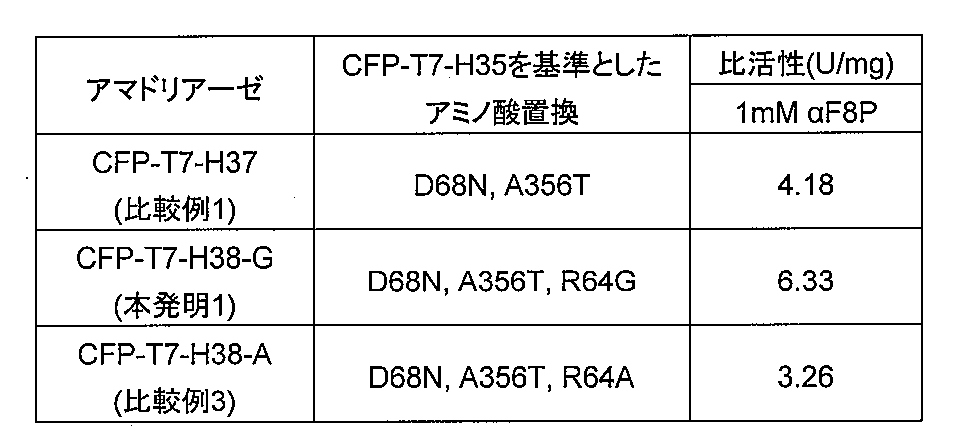
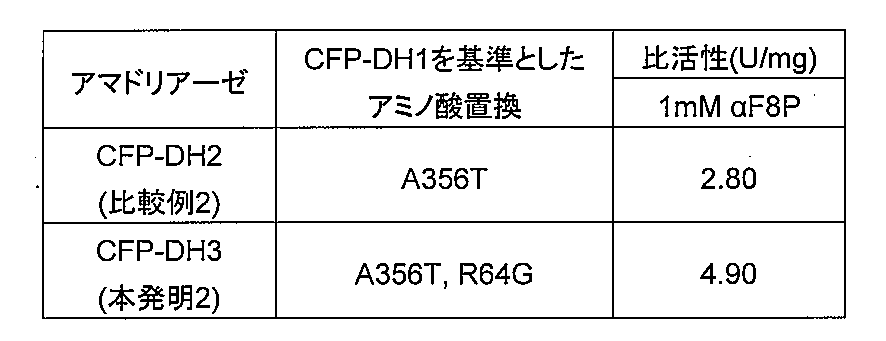
表1、2に示した結果からR64Gの変異は、2種類のアマドリアーゼ(CFP-T7-H37およびCFP-DH2)の、αF8Pに対する比活性を1.51~1.75倍向上させる効果があることが明らかとなった。
ところで、国際公開第2015/005258号では、Emericella nidulans由来のアマドリアーゼであるFPOX-16に対する、R63G、またはR63P、またはR63Aの置換により、αF6Pに対する活性が向上している。Emericella nidulans由来のアマドリアーゼの63位は、Coniochaeta sp.由来のアマドリアーゼ(例えば、CFP-T7-H37)では64位に対応する。一方で、国際公開第2013/162035号では、CFP-T7-H6(配列番号163)に対するR64A、R64EおよびR64Hの変異導入は、変異型CFP-T7-H6生産株の細胞抽出液のαF6Pに対する活性を下げる効果があると報告されている。また、本出願では、R64Aは、変異型CFP-T7-H37生産株のαF8Pに対する比活性を下げる効果があることを示した。従って、本発明で着目したR64Gの変異に、αF8Pに対する比活性向上効果が見出されたことは予想外であり、極めて驚くべきことである。
次に、CFP-T7-H37、CFP-T7-H38-G、CFP-T7-H38-V、CFP-T7-H38-I、CFP-T7-H38-L、CFP-T7-H38-M、CFP-T7-H38-S、CFP-T7-H38-T、CFP-T7-H38-GY、CFP-T7-H38-GYSの精製標品を用いて、10μMのαF8Pを基質とした時の比活性を測定した。結果を表3に示す。比活性の算出に用いたタンパク質濃度は、280nmにおける吸光度を利用した紫外吸収法により測定した(Protein Sci. 4, 2411-23, 1995参照)。
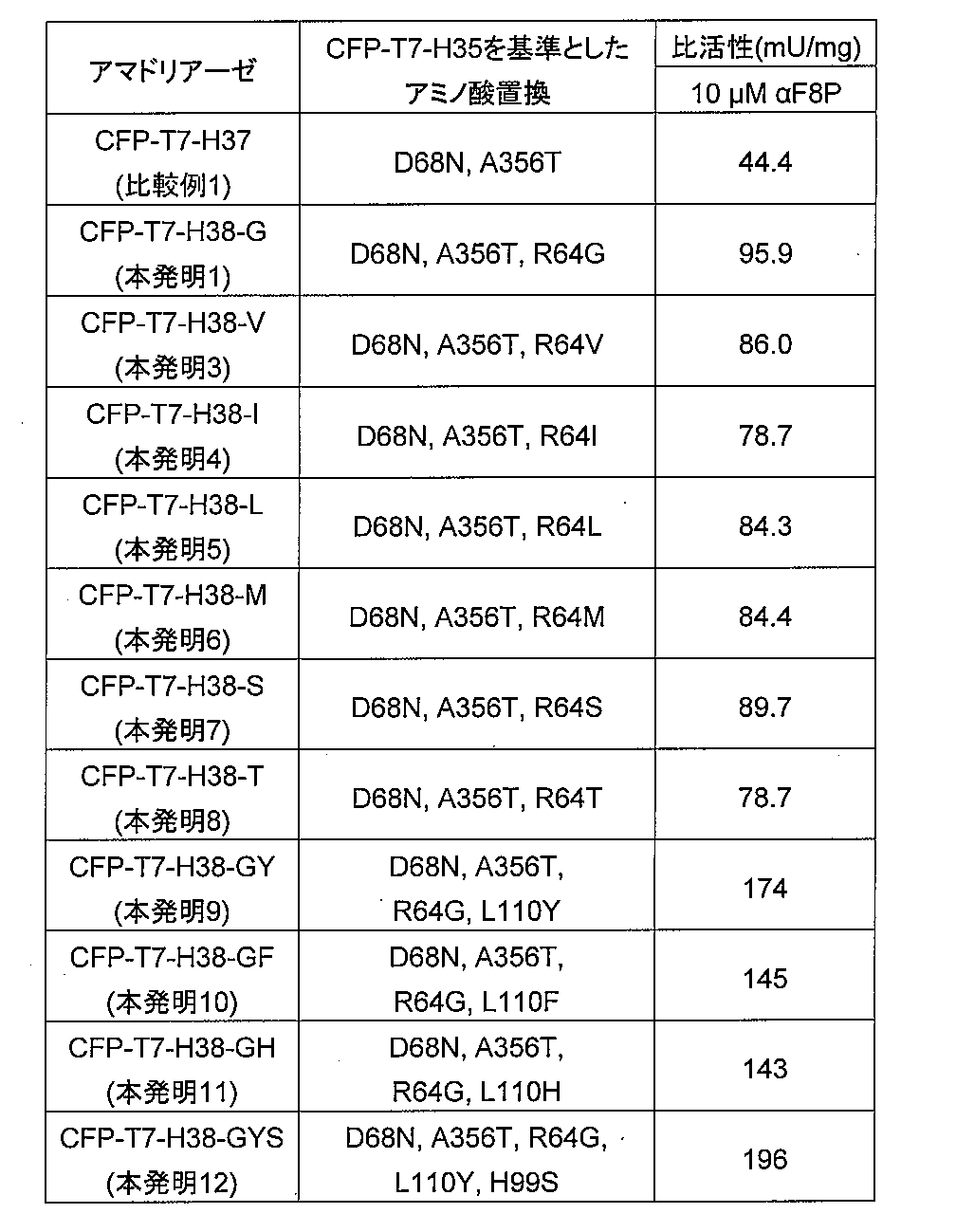
表3に示した結果から、64位のアミノ酸をV、I、L、M、S、Tとする変異はアマドリアーゼのαF8Pに対する比活性を1.57~1.92倍向上させた。これらの結果も予想外であり、極めて驚くべきことである。また、64位の変異と、110位の変異との組み合わせ、あるいはさらに99位の変異のと組み合わせによりアマドリアーゼのαF8Pに対する比活性が予想以上に向上した。
[実施例4]各種アマドリアーゼへの点変異導入
本発明の知見は、まずConiochaeta属由来のアマドリアーゼを用いて検証されたが、配列同一性に基づく公知の整列処理による情報を参考にして、その他の生物種由来のアマドリアーゼのアミノ酸配列における対応する位置に同様な変異を導入することにより、同様な効果を奏することが期待できるという示唆を与え得る。そこで、実際に本発明の知見を、Coniochaeta属由来のアマドリアーゼ以外の複数のアマドリアーゼにも導入して、この検証を行った。
本発明の知見は、まずConiochaeta属由来のアマドリアーゼを用いて検証されたが、配列同一性に基づく公知の整列処理による情報を参考にして、その他の生物種由来のアマドリアーゼのアミノ酸配列における対応する位置に同様な変異を導入することにより、同様な効果を奏することが期待できるという示唆を与え得る。そこで、実際に本発明の知見を、Coniochaeta属由来のアマドリアーゼ以外の複数のアマドリアーゼにも導入して、この検証を行った。
Phaeosphaeria nodorum由来のフルクトシルペプチドオキシダーゼ遺伝子への点変異導入
配列番号187はフルクトシルヘキサペプチドに対して作用する、Phaeosphaeria nodorum由来フルクトシルペプチドオキシダーゼ(以降PnFXと称する)の改変体のアミノ酸配列であり、配列番号188のアミノ酸配列をコードする遺伝子を挿入した組換え体プラスミドpET22b-PnFX-62D/63H/106K/110L/113K/351Sを保持する大腸菌BL21(DE3)株により生産できる(国際公開第WO2013/162035号参照)。
配列番号187はフルクトシルヘキサペプチドに対して作用する、Phaeosphaeria nodorum由来フルクトシルペプチドオキシダーゼ(以降PnFXと称する)の改変体のアミノ酸配列であり、配列番号188のアミノ酸配列をコードする遺伝子を挿入した組換え体プラスミドpET22b-PnFX-62D/63H/106K/110L/113K/351Sを保持する大腸菌BL21(DE3)株により生産できる(国際公開第WO2013/162035号参照)。
組換え体プラスミドpET22b-PnFXを鋳型として、配列番号228、229の合成オリゴヌクレオチド、KOD-Plus-(東洋紡績社製)、Ligation high(東洋紡績社製)、T4 polynucleotide kinase(東洋紡績社製)を用い、以下の条件でPCR反応を行った。
すなわち、10×KOD-Plus-緩衝液を5μl、dNTPが各2mMになるよう調製されたdNTPs混合溶液を5μl、25mMのMgSO4溶液を2μl、鋳型となるpET22b-PnFXを50ng、上記合成オリゴヌクレオチドをそれぞれ15pmol、KOD-Plus-を1Unit加えて、滅菌水により全量を50μlとした。調製した反応液をサーマルサイクラー(エッペンドルフ社製)を用いて、94℃で2分間インキュベートし、続いて、「94℃、15秒」-「50℃、30秒」-「68℃、6分」のサイクルを6回繰り返した。
こうして得られたDNAを制限酵素DpnI(NEW ENGLAND BioLabs社製)で処理し、残存している鋳型DNAを切断した後、その反応液を2μlとり、そこにLigation highを5μl、T4 polynucleotide kinaseを1μl、滅菌水を7μl加えて、16℃で1時間反応させた。この反応液を用いて、大腸菌JM109を形質転換し、LB-amp寒天培地に展開した。生育したコロニーをLB-amp培地に接種して振とう培養し、上記(1)と同様の方法でプラスミドDNAを単離した。該プラスミド中のアマドリアーゼをコードするDNAの塩基配列を、マルチキャピラリーDNA解析システムApplied Biosystems 3130xlジェネティックアナライザ(Life Technologies社製)を用いて決定し、その結果、配列番号187記載のアミノ酸配列の64位のアルギニンがセリン酸に置換されたPnFX遺伝子をコードする組換え体プラスミドpET22b-PnFX-62D/63H/106K/110L/113K/351S-64Sを得た。
そして、pET22b-PnFX-62D/63H/106K/110L/113K/351S、pET22b-PnFX-62D/63H/106K/110L/113K/351S-64Sを用いて、大腸菌BL21(DE3)株を形質転換し、大腸菌BL21(DE3)(pET22b-PnFX-62D/63H/106K/110L/113K/351S)株、大腸菌BL21(DE3)(pET22b-PnFX-62D/63H/106K/110L/113K/351S-64S)株を得た。
Neocosmospora vasinfecta由来のケトアミンオキシダーゼ遺伝子への点変異導入
配列番号137はフルクトシルヘキサペプチドに対して作用する、Neocosmospora vasinfecta由来ケトアミンオキシダーゼ(以降NvFXと称する)の改変体のアミノ酸配列であり、配列番号138のアミノ酸配列をコードする遺伝子を挿入した組換え体プラスミドpET22b―NvFX-62D/106K/110Lを保持する大腸菌BL21(DE3)株により生産できる(国際公開第WO2013/162035号参照)。
配列番号137はフルクトシルヘキサペプチドに対して作用する、Neocosmospora vasinfecta由来ケトアミンオキシダーゼ(以降NvFXと称する)の改変体のアミノ酸配列であり、配列番号138のアミノ酸配列をコードする遺伝子を挿入した組換え体プラスミドpET22b―NvFX-62D/106K/110Lを保持する大腸菌BL21(DE3)株により生産できる(国際公開第WO2013/162035号参照)。
NvFXに基質特異性改善型変異を導入するために、組換え体プラスミドpET22b―NvFX-62D/106K/110Lを鋳型にして、配列番号230、231の合成オリゴヌクレオチド、KOD-Plus-、Ligation high、T4 polynucleotide kinase(東洋紡績社製)を用い、実施例4と同様の条件でPCR反応、大腸菌JM109の形質転換および生育コロニーが保持するプラスミドDNA中のNvFX変異体をコードするDNAの塩基配列決定を行った。その結果、配列番号137記載のアミノ酸配列の63位のロイシンがヒスチジンに置換されたNvFX遺伝子をコードする組換え体プラスミドpET22b―NvFX-62D/63H/106K/110Lを得た。
続いて、In-Fusion HD Cloning Kit(クロンテック社)を使用して、キットに添付されたプロトコールに従って、NvFX-62D/63H/106K/110Lをコードする遺伝子と、pKK223-3プラスミドを連結して、NvFX遺伝子をコードする組換え体プラスミドpKK223-3-NvFX-62D/63H/106K/110Lを得た。具体的には、配列番号232、233の合成オリゴヌクレオチドおよびpKK223-3プラスミドを用いたPCR反応により得られたDNA断片と、配列番号234、235の合成オリゴヌクレオチドおよびpET22b―NvFX-62D/63H/106K/110Lを用いたPCR反応により得られたDNA断片とを、in-fusion反応により、連結させてpKK223-3-NvFX-62D/63H/106K/110Lを得た。
さらに、上記(実施例4)と同様にして、pKK223-3-NvFX-62D/63H/106K/110Lを鋳型とし、配列番号236、237、または配列番号236、238、または配列番号236、239の合成オリゴヌクレオチドを使用して、配列番号137記載のアミノ酸配列の64位のアルギニンがメチオニン、またはセリン、またはスレオニンに置換されたNvFX遺伝子をコードする組換え体プラスミドpKK223-3-NvFX-62D/63H/106K/110L-64M、pKK223-3-NvFX-62D/63H/106K/110L-64S、pKK223-3-NvFX-62D/63H/106K/110L-64Tを得た。これらのプラスミドを保持する大腸菌JM109株を、各改変型NvFXの生産株として用いた。
Curvularia clavata由来のフルクトシルペプチドオキシダーゼ遺伝子への点変異導入
配列番号117はCurvularia clavata由来ケトアミンオキシダーゼ(以降CcFXと称する)のアミノ酸配列であり、配列番号240のアミノ酸配列をコードする遺伝子を挿入した組換え体プラスミドpKK223-3-CcFXを保持する大腸菌JM109株により生産できる(国際公開第WO2013/162035号参照)。
配列番号117はCurvularia clavata由来ケトアミンオキシダーゼ(以降CcFXと称する)のアミノ酸配列であり、配列番号240のアミノ酸配列をコードする遺伝子を挿入した組換え体プラスミドpKK223-3-CcFXを保持する大腸菌JM109株により生産できる(国際公開第WO2013/162035号参照)。
CcFXに基質特異性改善型変異を導入するために、組換え体プラスミドpKK223-3-CcFXを鋳型にして、配列番号241、242の合成オリゴヌクレオチド、KOD-Plus-、Ligation high、T4 polynucleotide kinase(東洋紡績社製)を用い、上記(実施例4)と同様の条件でPCR反応、大腸菌JM109の形質転換および生育コロニーが保持するプラスミドDNA中のCcFX変異体をコードするDNAの塩基配列決定を行った。その結果、配列番号117記載のアミノ酸配列の62位のアルギニンがアスパラギン酸に置換されたCcFX遺伝子をコードする組換え体プラスミドpKK223-3-CcFX-62Dを得た。
さらに、上記(実施例4)と同様にして、pKK223-3-CcFX-62Dを鋳型とし、配列番号241、243の合成オリゴヌクレオチドを使用して、配列番号117記載のアミノ酸配列の62位のアルギニンがアスパラギン酸に、かつ、63位のロイシンがヒスチジンに置換されたCcFX遺伝子をコードする組換え体プラスミドpKK223-3-CcFX-62D/63Hを得た。
さらに、上記(実施例4)と同様にして、pKK223-3-CcFX-62D/63Hを鋳型とし、配列番号244、245の合成オリゴヌクレオチドを使用して、配列番号117記載のアミノ酸配列の62位のアルギニンがアスパラギン酸に、かつ、63位のロイシンがヒスチジンに、かつ、102位のグルタミン酸がリジンに、かつ、106位のアスパラギン酸がリジンに置換されたCcFX遺伝子をコードする組換え体プラスミドpKK223-3-CcFX-62D/63H/102K/106Kを得た。
さらに、上記(実施例4)と同様にして、pKK223-3-CcFX-62D/63H/102K/106Kを鋳型とし、配列番号246、247、又は配列番号246、248の合成オリゴヌクレオチドを使用して、配列番号117記載のアミノ酸配列の62位のアルギニンがアスパラギン酸に、かつ、63位のロイシンがヒスチジンに、かつ、102位のグルタミン酸がリジンに、かつ、106位のアスパラギン酸がリジンに、かつ、64位のアルギニンがロイシン、またはスレオニンに置換されたCcFX遺伝子をコードする組換え体プラスミドpKK223-3-CcFX-62D/63H/102K/106K-64L、pKK223-3-CcFX-62D/63H/102K/106K-64Tを得た。これらのプラスミドを保持する大腸菌JM109株を、各改変型CcFXの生産株として用いた。
[実施例5]各種アマドリアーゼの生産および精製
(Phaeosphaeria nodorum由来フルクトシルペプチドオキシダーゼの生産および精製)
上記のようにして得られたPnFX生産能を有する大腸菌BL21(DE3)(pET22b-PnFX-62D/63H/106K/110L/113K/351S)株、大腸菌BL21(DE3)(pET22b-PnFX-62D/63H/106K/110L/113K/351S-64S)株を、終濃度0.1mMとなるようにIPTGを添加したLB-amp培地に植菌し、25℃で16時間培養した。得られた各培養菌体を10mM リン酸カリウム緩衝液(pH8.0)で洗浄した後、同緩衝液に菌体を懸濁して超音波破砕処理を行い、20,000×gで10分間遠心分離し、粗酵素液を調製した。
(Phaeosphaeria nodorum由来フルクトシルペプチドオキシダーゼの生産および精製)
上記のようにして得られたPnFX生産能を有する大腸菌BL21(DE3)(pET22b-PnFX-62D/63H/106K/110L/113K/351S)株、大腸菌BL21(DE3)(pET22b-PnFX-62D/63H/106K/110L/113K/351S-64S)株を、終濃度0.1mMとなるようにIPTGを添加したLB-amp培地に植菌し、25℃で16時間培養した。得られた各培養菌体を10mM リン酸カリウム緩衝液(pH8.0)で洗浄した後、同緩衝液に菌体を懸濁して超音波破砕処理を行い、20,000×gで10分間遠心分離し、粗酵素液を調製した。
調製したPnFXの粗酵素液を前述の非特許文献(Biotechnology and Bioengineering, 106, 358-366, 2010)記載の方法に従い、精製した。すなわち、粗酵素液を硫酸アンモニウムにより分画し、10mM リン酸カリウム緩衝液(pH8.0)で透析し、陰イオン交換クロマトグラフィー(本実施例ではQ Sepharose Fast Flowを用いた)により精製し、ゲルろ過クロマトグラフィー(本実施例ではHiLoad 26/600 Sueprdex 200を用いた)により精製した。得られた画分をSDS-PAGEにより分析し、他の夾雑タンパク質を含まない純度まで精製されていることを確認し、PnFXの精製標品とした。
(Neocosmospora vasinfecta由来ケトアミンオキシダーゼの生産および精製)
大腸菌JM109(pKK223-3-NvFX-62D/63H/106K/110L)、大腸菌JM109(pKK223-3-NvFX-62D/63H/106K/110L-64M)、大腸菌JM109(pKK223-3-NvFX-62D/63H/106K/110L-64S)、大腸菌JM109(pKK223-3-NvFX-62D/63H/106K/110L-64T)を、終濃度0.1mMとなるようにIPTGを添加したLB-amp培地に植菌し、25℃で16時間培養した。得られた各培養菌体を10mM リン酸カリウム緩衝液(pH8.0)で洗浄した後、同緩衝液に菌体を懸濁して超音波破砕処理を行い、20,000×gで10分間遠心分離し、粗酵素液を調製した。
大腸菌JM109(pKK223-3-NvFX-62D/63H/106K/110L)、大腸菌JM109(pKK223-3-NvFX-62D/63H/106K/110L-64M)、大腸菌JM109(pKK223-3-NvFX-62D/63H/106K/110L-64S)、大腸菌JM109(pKK223-3-NvFX-62D/63H/106K/110L-64T)を、終濃度0.1mMとなるようにIPTGを添加したLB-amp培地に植菌し、25℃で16時間培養した。得られた各培養菌体を10mM リン酸カリウム緩衝液(pH8.0)で洗浄した後、同緩衝液に菌体を懸濁して超音波破砕処理を行い、20,000×gで10分間遠心分離し、粗酵素液を調製した。
調製した粗酵素液を10mM リン酸カリウム緩衝液(pH8.0)で平衡化したQ Sepharose Fast Flow樹脂(GEヘルスケア社製)に吸着させ、次に20mM NaClを含む10mM リン酸カリウム緩衝液(pH8.0)で樹脂を洗浄し、続いて300mM NaClを含む10mM リン酸カリウム緩衝液(pH8.0)で樹脂に吸着していた改変型NvFXを溶出させ回収した。
得られた改変型NvFXを含む粗酵素液を、150mM NaClを含む20mM MES-NaOH緩衝液(pH7.0)で平衡化したHiLoad 26/600 Superdex 200カラムにアプライして同緩衝液で野生型NvFX、または改変型NvFXを溶出させ、フルクトシルアミノ酸オキシダーゼ活性(アマドリアーゼ活性)を示す画分を回収した。得られた画分をSDS-PAGEにより分析し、他の夾雑タンパク質を含まない純度まで精製されていることを確認し、野生型または改変型NvFXの精製標品とした。
(Curvularia clavata由来ケトアミンオキシダーゼの生産および精製)
大腸菌JM109(pKK223-3-CcFX-62D/63H/102K/106K)、大腸菌JM109(pKK223-3-CcFX-62D/63H/102K/106K-64L)、大腸菌JM109(pKK223-3-CcFX-62D/63H/102K/106K-64T)を、終濃度0.1mMとなるようにIPTGを添加したLB-amp培地に植菌し、25℃で16時間培養した。得られた各培養菌体を10mM リン酸カリウム緩衝液(pH8.0)で洗浄した後、同緩衝液に菌体を懸濁して超音波破砕処理を行い、20,000×gで10分間遠心分離し、粗酵素液を調製した。
大腸菌JM109(pKK223-3-CcFX-62D/63H/102K/106K)、大腸菌JM109(pKK223-3-CcFX-62D/63H/102K/106K-64L)、大腸菌JM109(pKK223-3-CcFX-62D/63H/102K/106K-64T)を、終濃度0.1mMとなるようにIPTGを添加したLB-amp培地に植菌し、25℃で16時間培養した。得られた各培養菌体を10mM リン酸カリウム緩衝液(pH8.0)で洗浄した後、同緩衝液に菌体を懸濁して超音波破砕処理を行い、20,000×gで10分間遠心分離し、粗酵素液を調製した。
調製した粗酵素液を10mM リン酸カリウム緩衝液(pH8.0)で平衡化したHiScreen Capto Q樹脂(GEヘルスケア社製)に吸着させた。次に0mM NaClを含む10mM リン酸カリウム緩衝液(pH8.0)で樹脂を洗浄し、続いてNaCl濃度を300mMまで直線的に増加させて、樹脂に吸着していた改変型CcFXを溶出させ回収した。
得られた改変型NvFXを含む粗酵素液を、150mM NaClを含む20mM MES-NaOH緩衝液(pH7.0)で平衡化したHiLoad 26/600 Superdex 200カラムにアプライして同緩衝液で改変型CcFXを溶出させ、フルクトシルアミノ酸オキシダーゼ活性(アマドリアーゼ活性)を示す画分を回収した。得られた画分をSDS-PAGEにより分析し、他の夾雑タンパク質を含まない純度まで精製されていることを確認し、野生型または改変型CcFXの精製標品とした。
(Phaeosphaeria nodorum由来フルクトシルペプチドオキシダーゼ、Neocosmospora vasinfecta由来ケトアミンオキシダーゼ、Curvularia clavata由来ケトアミンオキシダーゼのタンパク質濃度の測定)
精製した改変型Phaeosphaeria nodorum由来フルクトシルペプチドオキシダーゼ、改変型Neocosmospora vasinfecta由来ケトアミンオキシダーゼ、改変型Curvularia clavata由来ケトアミンオキシダーゼのタンパク質濃度は、それぞれのタンパク質が有するFADに基づき、以下の方法で測定した。
精製した改変型Phaeosphaeria nodorum由来フルクトシルペプチドオキシダーゼ、改変型Neocosmospora vasinfecta由来ケトアミンオキシダーゼ、改変型Curvularia clavata由来ケトアミンオキシダーゼのタンパク質濃度は、それぞれのタンパク質が有するFADに基づき、以下の方法で測定した。
まず、0.3、1.0、3.0mg/ml のConiochaeta sp.由来のフルクトシルペプチドオキシダーゼ(CFP-T7)溶液を調製した。分光光度計(U-3010A、日立ハイテクノロジーズ社製)により、各濃度のCFP-T7溶液の450nmにおける吸光度を測定して、CFP-T7濃度と吸光度の相関性を示す検量線を作成した。続いて、資料として、CFP-T7の代わりに、改変型Phaeosphaeria nodorum由来フルクトシルペプチドオキシダーゼ、改変型Neocosmospora vasinfecta由来ケトアミンオキシダーゼ、改変型Curvularia clavata由来ケトアミンオキシダーゼを用いて、同様の方法により、各酵素溶液の450nmにおける吸光度を測定した。測定により得られた吸光度を、前述の検量線に照らし合わせることにより、各酵素溶液のタンパク質濃度を定量した。
次に、PnFX-62D/63H/106K/110L/113K/351S及びPnFX-62D/63H/106K/110L/113K/351S-64Sの精製標品を用いて、10μMのαF8Pを基質とした時の比活性を測定した。結果を表4に示す。
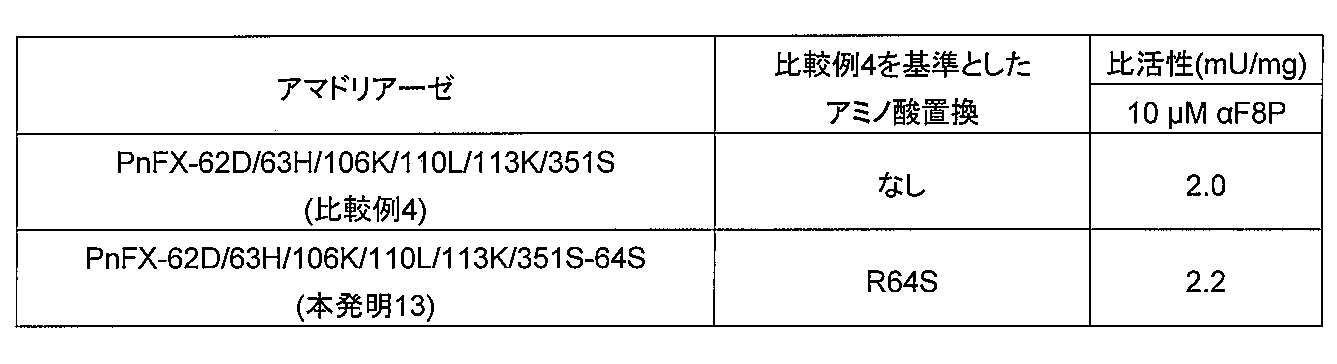
表4の結果から64位をSとする変異は、PnFXについてもアマドリアーゼのαF8Pに対する比活性を向上させた。
次に、CcFX-62D/63H/102K/106K、CcFX-62D/63H/102K/106K-64L、CcFX-62D/63H/102K/106K-64Tの精製標品を用いて、10μMのαF8Pを基質とした時の比活性を測定した。結果を表5に示す。
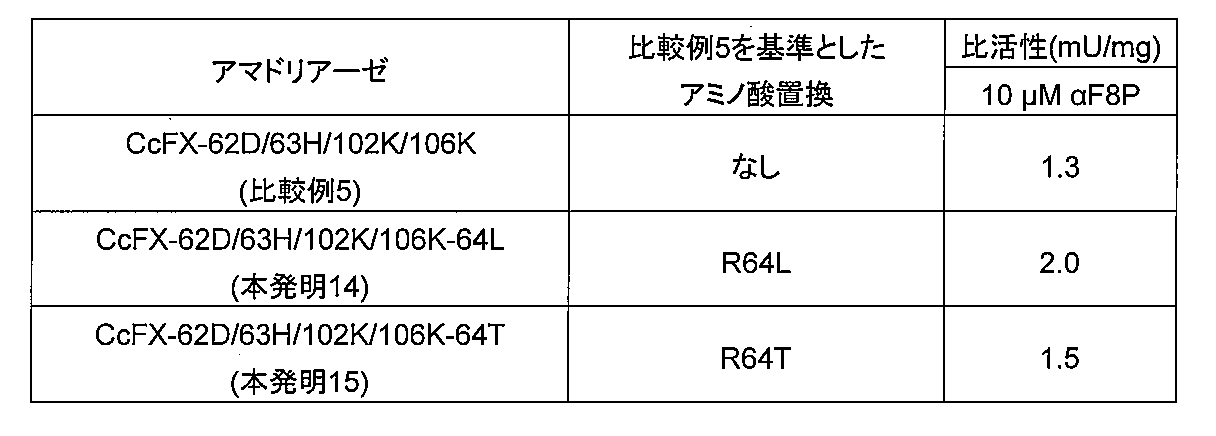
表5の結果から64位をL、Tとする変異は、CcFXについてもアマドリアーゼのαF8Pに対する比活性を向上させた。
次に、NvFX-62D/63H/106K/110L、NvFX-62D/63H/106K/110L-64M、NvFX-62D/63H/106K/110L-64S、NvFX-62D/63H/106K/110L-64Tの精製標品を用いて、10μMのαF8Pを基質とした時の比活性を測定した。結果を表6に示す。

表6の結果から64位をM、S、Tとする変異は、NvFXについてもアマドリアーゼのαF8Pに対する比活性を向上させた。
以上のとおり、本発明で見出した、αF8Pに対する比活性を向上させる変異を導入したアマドリアーゼは、HbA1cそのものに対する比活性も向上していると見積もられ、プロテアーゼを必要としないアマドリアーゼによるHbA1c直接測定法の感度向上、アマドリアーゼ処方量低減に貢献し、産業上の利用価値が期待される。
HbA1cのN末端側からみて、塩基性アミノ酸であるリジンが初めて現れる糖化ペプチドはαF8P(α-フルクトシルバリルヒスチジルロイシルスレオニルプロリルグルタミルグルタミルリジン)である。そのため、本発明のアマドリアーゼは、タンパク質をリジン残基のC末端側で切断するLys-Cプロテアーゼ等を使用してHbA1cを消化し、それにより生じるαF8Pの測定に用いることができる。
配列表の簡単な説明
配列番号1 Coniochaeta sp. NISL 9330由来アマドリアーゼ(CFP-T7)のアミノ酸配列配列番号2 配列番号1のアミノ酸配列をコードする塩基配列
配列番号3-33 PCRプライマー
配列番号34 PCRプライマー
配列番号35 PCRプライマー
配列番号36 Aspergillus oryzae RIB40由来アマドリアーゼ(FAOAo2)のアミノ酸配列配列番号37: 配列番号36のアミノ酸配列をコードする塩基配列
配列番号38 Phaeosphaeria nodorum由来アマドリアーゼ(PnFX)のアミノ酸配列
配列番号39 配列番号38のアミノ酸配列をコードする塩基配列
配列番号40 Eupenicillium terrenum由来アマドリアーゼ(EFP-T5)のアミノ酸配列
配列番号41 配列番号40のアミノ酸配列をコードする塩基配列
配列番号42-53 PCRプライマー
配列番号54 Neocosmospora vasinfecta由来アマドリアーゼ(NvFX)のアミノ酸配列
配列番号55 配列番号54のアミノ酸配列をコードする塩基配列
配列番号56-61 PCRプライマー
配列番号62 S59Gのアミノ酸置換を導入したAspergillus nidulans由来アマドリアーゼ(AnFX)のアミノ酸配列
配列番号63 配列番号62のアミノ酸配列をコードする塩基配列
配列番号64-88 PCRプライマー
配列番号89 Cryptococcus neoformans由来アマドリアーゼ(CnFX)のアミノ酸配列
配列番号90 配列番号89のアミノ酸配列をコードする塩基配列
配列番号91-98 PCRプライマー
配列番号99 Curvularia clavataケトアミンオキシダーゼと95%の配列同一性を示すアマドリアーゼ(Cc95FX)のアミノ酸配列
配列番号100 配列番号99のアミノ酸配列をコードする塩基配列
配列番号101-112 PCRプライマー
配列番号113 Pyrenochaeta sp.(Py)由来アマドリアーゼのアミノ酸配列
配列番号114 配列番号113のアミノ酸配列をコードする塩基配列
配列番号115 Arthrinium sp.(Ar) 由来アマドリアーゼのアミノ酸配列
配列番号116 配列番号115のアミノ酸配列をコードする塩基配列
配列番号117 Curvularia clavata(Cc) 由来アマドリアーゼのアミノ酸配列
配列番号118 配列番号117のアミノ酸配列をコードする塩基配列
配列番号119 Emericella nidulans(En) 由来アマドリアーゼのアミノ酸配列
配列番号120 配列番号119のアミノ酸配列をコードする塩基配列
配列番号121 Ulocladium sp.(Ul) 由来アマドリアーゼのアミノ酸配列
配列番号122 配列番号121のアミノ酸配列をコードする塩基配列
配列番号123 Penicillium janthinellum(Pj) 由来アマドリアーゼのアミノ酸配列
配列番号124 配列番号123のアミノ酸配列をコードする塩基配列
配列番号125 Aspergillus fumigatus由来アマドリアーゼ(Amadoriase I)のアミノ酸配列
配列番号126 配列番号125のアミノ酸配列をコードする塩基配列
配列番号127 Aspergillus oryzae由来アマドリアーゼ(FAOAo1)のアミノ酸配列
配列番号128 配列番号127のアミノ酸配列をコードする塩基配列
配列番号129 Aspergillus fumigatus由来アマドリアーゼ(Amadoriase II)のアミノ酸配列
配列番号130 配列番号129のアミノ酸配列をコードする塩基配列
配列番号131 Aspergillus terreus由来アマドリアーゼ(FAOD-A)のアミノ酸配列
配列番号132 配列番号131のアミノ酸配列をコードする塩基配列
配列番号133 CFP-T7-H20のアミノ酸配列
配列番号134 配列番号133のアミノ酸配列をコードする塩基配列
配列番号135 S62D、D106K、G110L、A113Kのアミノ酸置換を導入したPnFPOX の アミノ酸配列
配列番号136 配列番号135のアミノ酸配列をコードする塩基配列
配列番号137 R62D、G106K、E110Lのアミノ酸置換を導入したNvFX(NvFX-62D/106K/110L)のアミノ酸配列
配列番号138 配列番号137のアミノ酸配列をコードする塩基配列
配列番号139 R61D、G105K、K1091Lのアミノ酸置換を導入したAnFX(AnFX-61D/105K/109L)のアミノ酸配列
配列番号140 配列番号139のアミノ酸配列をコードする塩基配列
配列番号141 R62D、L63H、E102K、D106K、Q110L、A113K、A355Sのアミノ酸置換を導入したCFP-T7(CFP-T7-H35)のアミノ酸配列
配列番号142 配列番号141のアミノ酸配列をコードする塩基配列
配列番号143 R62D、L63H、D106K、K110L、T113K、A355Sのアミノ酸置換を導入したEFP-T5(EFP-T5-62D/63H/106K/110L/113K/355S)のアミノ酸配列
配列番号144 配列番号143のアミノ酸配列をコードする塩基配列
配列番号145 Eupenicillium terrenum由来野生型アマドリアーゼのアミノ酸配列
配列番号146 配列番号145のアミノ酸配列をコードする塩基配列
配列番号147 Aspergillus nidulans由来野生型アマドリアーゼのアミノ酸配列
配列番号148 配列番号147のアミノ酸配列をコードする塩基配列
配列番号149 Cryptococcus neoformans由来野生型アマドリアーゼのアミノ酸配列
配列番号150 配列番号149のアミノ酸配列をコードする塩基配列
配列番号151 R62Aのアミノ酸置換を導入したCFP-T7(CFP-T7-H1)のアミノ酸配列
配列番号152 配列番号151のアミノ酸配列をコードする塩基配列
配列番号153 R62Dのアミノ酸置換を導入したCFP-T7(CFP-T7-62D)のアミノ酸配列
配列番号154 配列番号153のアミノ酸配列をコードする塩基配列
配列番号155R62Dのアミノ酸置換を導入したEFP-T5(EFP-T5-R62D)のアミノ酸配列
配列番号156 配列番号155のアミノ酸配列をコードする塩基配列
配列番号157 R62A、Q110Lのアミノ酸置換を導入したCFP-T7(CFP-T7-H2)のアミノ酸配列
配列番号158 配列番号157のアミノ酸配列をコードする塩基配列
配列番号159 R62A、Q110Yのアミノ酸置換を導入したCFP-T7(CFP-T7-H4)のアミノ酸配列
配列番号160 配列番号159のアミノ酸配列をコードする塩基配列
配列番号161 R62N、Q110Lのアミノ酸置換を導入したCFP-T7(CFP-T7-H2-62N)のアミノ酸配列
配列番号162 配列番号161のアミノ酸配列をコードする塩基配列
配列番号163 R62D、Q110Lのアミノ酸置換を導入したCFP-T7(CFP-T7-H6)のアミノ酸配列
配列番号164 配列番号163のアミノ酸配列をコードする塩基配列
配列番号165 R62D、D106A、Q110Lのアミノ酸置換を導入したCFP-T7(CFP-T7-H10)のアミノ酸配列
配列番号166 配列番号165のアミノ酸配列をコードする塩基配列
配列番号167 R62D、D106K、Q110Lのアミノ酸置換を導入したCFP-T7(CFP-T7-H11)のアミノ酸配列
配列番号168 配列番号167のアミノ酸配列をコードする塩基配列
配列番号169 R62D、D106R、Q110Lのアミノ酸置換を導入したCFP-T7(CFP-T7-H12)のアミノ酸配列
配列番号170 配列番号169のアミノ酸配列をコードする塩基配列
配列番号171 R62D、Q110L、A113Kのアミノ酸置換を導入したCFP-T7(CFP-T7-H13)のアミノ酸配列
配列番号172 配列番号171のアミノ酸配列をコードする塩基配列
配列番号173 R62D、Q110L、A113Rのアミノ酸置換を導入したCFP-T7(CFP-T7-H14)のアミノ酸配列
配列番号174 配列番号173のアミノ酸配列をコードする塩基配列
配列番号175 R62D、D106K、Q110L、A113Rのアミノ酸置換を導入したCFP-T7(CFP-T7-H21)のアミノ酸配列
配列番号176 配列番号175のアミノ酸配列をコードする塩基配列
配列番号177 R62D、L63A、D106K、Q110L、A113Kのアミノ酸置換を導入したCFP-T7(CFP-T7-H24)のアミノ酸配列
配列番号178 配列番号177のアミノ酸配列をコードする塩基配列
配列番号179 R62D、L63H、D106K、Q110L、A113Kのアミノ酸置換を導入したCFP-T7(CFP-T7-H26)のアミノ酸配列
配列番号180 配列番号179のアミノ酸配列をコードする塩基配列
配列番号181 R62D、L63H、E102K、D106K、Q110L、A113Kのアミノ酸置換を導入したCFP-T7(CFP-T7-H28)のアミノ酸配列
配列番号182 配列番号181のアミノ酸配列をコードする塩基配列
配列番号183 R62D、L63H、D106K、Q110L、A113K、A419Kのアミノ酸置換を導入したCFP-T7(CFP-T7-H29)のアミノ酸配列
配列番号184 配列番号183のアミノ酸配列をコードする塩基配列
配列番号185 R61D、L62H、E101K、G105K、K109L、S112K、A355Sのアミノ酸置換を導入したAnFX(AnFX-61D/62H/101K/105K/109L/112K/355S)のアミノ酸配列
配列番号186 配列番号185のアミノ酸配列をコードする塩基配列
配列番号187 S62D、L63H、D106K、G110L、A113K、A351Sのアミノ酸置換を導入したPnFX(PnFX-62D/63H/106K/110L/113K/351S)のアミノ酸配列
配列番号188 配列番号187のアミノ酸配列をコードする塩基配列
配列番号189 R62D、S106K、S110L、A113Kのアミノ酸置換を導入したCnFX(CnFX-62D/106K/110L/113K)のアミノ酸配列
配列番号190 配列番号189のアミノ酸配列をコードする塩基配列
配列番号191 R62D、L63H、D106K、A110L、A113K、A353Sのアミノ酸置換を導入したCc95Fx(Cc95FX-62D/63H/106K/110L/113K/353S)のアミノ酸配列
配列番号192 配列番号191のアミノ酸配列をコードする塩基配列
配列番号193-198 PCRプライマー
配列番号199 E44P、D68N、E133A、E253K、V257C、N262H、Q337K、E340Pのアミノ酸置換を導入し、P435、K436、L437を欠失させたCFP-T7-H35(CFP-DH1)のアミノ酸配列
配列番号200 配列番号199のアミノ酸配列をコードする塩基配列
配列番号201-202 PCRプライマー
配列番号203 A356Tのアミノ酸置換を導入したCFP-DH1(CFP-DH2)のアミノ酸配列
配列番号204 配列番号203のアミノ酸配列をコードする塩基配列。
配列番号205-208 PCRプライマー
配列番号209 D68N、A356Tのアミノ酸置換を導入したCFP-T7-H35(CFP-T7-H37)のアミノ酸配列
配列番号210 配列番号209のアミノ酸配列をコードする塩基配列
配列番号211 R64G、D68N、A356Tのアミノ酸置換を導入したCFP-T7-H35(CFP-T7-H38)のアミノ酸配列
配列番号212 配列番号211のアミノ酸配列をコードする塩基配列
配列番号213 R64G、A356Tのアミノ酸置換を導入したCFP-DH1(CFP-DH3)のアミノ酸配列
配列番号214 配列番号213のアミノ酸配列をコードする塩基配列
配列番号215-239 PCRプライマー
配列番号240 配列番号117のアミノ酸配列をコードする塩基配列
配列番号241-248 PCRプライマー
配列番号1 Coniochaeta sp. NISL 9330由来アマドリアーゼ(CFP-T7)のアミノ酸配列配列番号2 配列番号1のアミノ酸配列をコードする塩基配列
配列番号3-33 PCRプライマー
配列番号34 PCRプライマー
配列番号35 PCRプライマー
配列番号36 Aspergillus oryzae RIB40由来アマドリアーゼ(FAOAo2)のアミノ酸配列配列番号37: 配列番号36のアミノ酸配列をコードする塩基配列
配列番号38 Phaeosphaeria nodorum由来アマドリアーゼ(PnFX)のアミノ酸配列
配列番号39 配列番号38のアミノ酸配列をコードする塩基配列
配列番号40 Eupenicillium terrenum由来アマドリアーゼ(EFP-T5)のアミノ酸配列
配列番号41 配列番号40のアミノ酸配列をコードする塩基配列
配列番号42-53 PCRプライマー
配列番号54 Neocosmospora vasinfecta由来アマドリアーゼ(NvFX)のアミノ酸配列
配列番号55 配列番号54のアミノ酸配列をコードする塩基配列
配列番号56-61 PCRプライマー
配列番号62 S59Gのアミノ酸置換を導入したAspergillus nidulans由来アマドリアーゼ(AnFX)のアミノ酸配列
配列番号63 配列番号62のアミノ酸配列をコードする塩基配列
配列番号64-88 PCRプライマー
配列番号89 Cryptococcus neoformans由来アマドリアーゼ(CnFX)のアミノ酸配列
配列番号90 配列番号89のアミノ酸配列をコードする塩基配列
配列番号91-98 PCRプライマー
配列番号99 Curvularia clavataケトアミンオキシダーゼと95%の配列同一性を示すアマドリアーゼ(Cc95FX)のアミノ酸配列
配列番号100 配列番号99のアミノ酸配列をコードする塩基配列
配列番号101-112 PCRプライマー
配列番号113 Pyrenochaeta sp.(Py)由来アマドリアーゼのアミノ酸配列
配列番号114 配列番号113のアミノ酸配列をコードする塩基配列
配列番号115 Arthrinium sp.(Ar) 由来アマドリアーゼのアミノ酸配列
配列番号116 配列番号115のアミノ酸配列をコードする塩基配列
配列番号117 Curvularia clavata(Cc) 由来アマドリアーゼのアミノ酸配列
配列番号118 配列番号117のアミノ酸配列をコードする塩基配列
配列番号119 Emericella nidulans(En) 由来アマドリアーゼのアミノ酸配列
配列番号120 配列番号119のアミノ酸配列をコードする塩基配列
配列番号121 Ulocladium sp.(Ul) 由来アマドリアーゼのアミノ酸配列
配列番号122 配列番号121のアミノ酸配列をコードする塩基配列
配列番号123 Penicillium janthinellum(Pj) 由来アマドリアーゼのアミノ酸配列
配列番号124 配列番号123のアミノ酸配列をコードする塩基配列
配列番号125 Aspergillus fumigatus由来アマドリアーゼ(Amadoriase I)のアミノ酸配列
配列番号126 配列番号125のアミノ酸配列をコードする塩基配列
配列番号127 Aspergillus oryzae由来アマドリアーゼ(FAOAo1)のアミノ酸配列
配列番号128 配列番号127のアミノ酸配列をコードする塩基配列
配列番号129 Aspergillus fumigatus由来アマドリアーゼ(Amadoriase II)のアミノ酸配列
配列番号130 配列番号129のアミノ酸配列をコードする塩基配列
配列番号131 Aspergillus terreus由来アマドリアーゼ(FAOD-A)のアミノ酸配列
配列番号132 配列番号131のアミノ酸配列をコードする塩基配列
配列番号133 CFP-T7-H20のアミノ酸配列
配列番号134 配列番号133のアミノ酸配列をコードする塩基配列
配列番号135 S62D、D106K、G110L、A113Kのアミノ酸置換を導入したPnFPOX の アミノ酸配列
配列番号136 配列番号135のアミノ酸配列をコードする塩基配列
配列番号137 R62D、G106K、E110Lのアミノ酸置換を導入したNvFX(NvFX-62D/106K/110L)のアミノ酸配列
配列番号138 配列番号137のアミノ酸配列をコードする塩基配列
配列番号139 R61D、G105K、K1091Lのアミノ酸置換を導入したAnFX(AnFX-61D/105K/109L)のアミノ酸配列
配列番号140 配列番号139のアミノ酸配列をコードする塩基配列
配列番号141 R62D、L63H、E102K、D106K、Q110L、A113K、A355Sのアミノ酸置換を導入したCFP-T7(CFP-T7-H35)のアミノ酸配列
配列番号142 配列番号141のアミノ酸配列をコードする塩基配列
配列番号143 R62D、L63H、D106K、K110L、T113K、A355Sのアミノ酸置換を導入したEFP-T5(EFP-T5-62D/63H/106K/110L/113K/355S)のアミノ酸配列
配列番号144 配列番号143のアミノ酸配列をコードする塩基配列
配列番号145 Eupenicillium terrenum由来野生型アマドリアーゼのアミノ酸配列
配列番号146 配列番号145のアミノ酸配列をコードする塩基配列
配列番号147 Aspergillus nidulans由来野生型アマドリアーゼのアミノ酸配列
配列番号148 配列番号147のアミノ酸配列をコードする塩基配列
配列番号149 Cryptococcus neoformans由来野生型アマドリアーゼのアミノ酸配列
配列番号150 配列番号149のアミノ酸配列をコードする塩基配列
配列番号151 R62Aのアミノ酸置換を導入したCFP-T7(CFP-T7-H1)のアミノ酸配列
配列番号152 配列番号151のアミノ酸配列をコードする塩基配列
配列番号153 R62Dのアミノ酸置換を導入したCFP-T7(CFP-T7-62D)のアミノ酸配列
配列番号154 配列番号153のアミノ酸配列をコードする塩基配列
配列番号155R62Dのアミノ酸置換を導入したEFP-T5(EFP-T5-R62D)のアミノ酸配列
配列番号156 配列番号155のアミノ酸配列をコードする塩基配列
配列番号157 R62A、Q110Lのアミノ酸置換を導入したCFP-T7(CFP-T7-H2)のアミノ酸配列
配列番号158 配列番号157のアミノ酸配列をコードする塩基配列
配列番号159 R62A、Q110Yのアミノ酸置換を導入したCFP-T7(CFP-T7-H4)のアミノ酸配列
配列番号160 配列番号159のアミノ酸配列をコードする塩基配列
配列番号161 R62N、Q110Lのアミノ酸置換を導入したCFP-T7(CFP-T7-H2-62N)のアミノ酸配列
配列番号162 配列番号161のアミノ酸配列をコードする塩基配列
配列番号163 R62D、Q110Lのアミノ酸置換を導入したCFP-T7(CFP-T7-H6)のアミノ酸配列
配列番号164 配列番号163のアミノ酸配列をコードする塩基配列
配列番号165 R62D、D106A、Q110Lのアミノ酸置換を導入したCFP-T7(CFP-T7-H10)のアミノ酸配列
配列番号166 配列番号165のアミノ酸配列をコードする塩基配列
配列番号167 R62D、D106K、Q110Lのアミノ酸置換を導入したCFP-T7(CFP-T7-H11)のアミノ酸配列
配列番号168 配列番号167のアミノ酸配列をコードする塩基配列
配列番号169 R62D、D106R、Q110Lのアミノ酸置換を導入したCFP-T7(CFP-T7-H12)のアミノ酸配列
配列番号170 配列番号169のアミノ酸配列をコードする塩基配列
配列番号171 R62D、Q110L、A113Kのアミノ酸置換を導入したCFP-T7(CFP-T7-H13)のアミノ酸配列
配列番号172 配列番号171のアミノ酸配列をコードする塩基配列
配列番号173 R62D、Q110L、A113Rのアミノ酸置換を導入したCFP-T7(CFP-T7-H14)のアミノ酸配列
配列番号174 配列番号173のアミノ酸配列をコードする塩基配列
配列番号175 R62D、D106K、Q110L、A113Rのアミノ酸置換を導入したCFP-T7(CFP-T7-H21)のアミノ酸配列
配列番号176 配列番号175のアミノ酸配列をコードする塩基配列
配列番号177 R62D、L63A、D106K、Q110L、A113Kのアミノ酸置換を導入したCFP-T7(CFP-T7-H24)のアミノ酸配列
配列番号178 配列番号177のアミノ酸配列をコードする塩基配列
配列番号179 R62D、L63H、D106K、Q110L、A113Kのアミノ酸置換を導入したCFP-T7(CFP-T7-H26)のアミノ酸配列
配列番号180 配列番号179のアミノ酸配列をコードする塩基配列
配列番号181 R62D、L63H、E102K、D106K、Q110L、A113Kのアミノ酸置換を導入したCFP-T7(CFP-T7-H28)のアミノ酸配列
配列番号182 配列番号181のアミノ酸配列をコードする塩基配列
配列番号183 R62D、L63H、D106K、Q110L、A113K、A419Kのアミノ酸置換を導入したCFP-T7(CFP-T7-H29)のアミノ酸配列
配列番号184 配列番号183のアミノ酸配列をコードする塩基配列
配列番号185 R61D、L62H、E101K、G105K、K109L、S112K、A355Sのアミノ酸置換を導入したAnFX(AnFX-61D/62H/101K/105K/109L/112K/355S)のアミノ酸配列
配列番号186 配列番号185のアミノ酸配列をコードする塩基配列
配列番号187 S62D、L63H、D106K、G110L、A113K、A351Sのアミノ酸置換を導入したPnFX(PnFX-62D/63H/106K/110L/113K/351S)のアミノ酸配列
配列番号188 配列番号187のアミノ酸配列をコードする塩基配列
配列番号189 R62D、S106K、S110L、A113Kのアミノ酸置換を導入したCnFX(CnFX-62D/106K/110L/113K)のアミノ酸配列
配列番号190 配列番号189のアミノ酸配列をコードする塩基配列
配列番号191 R62D、L63H、D106K、A110L、A113K、A353Sのアミノ酸置換を導入したCc95Fx(Cc95FX-62D/63H/106K/110L/113K/353S)のアミノ酸配列
配列番号192 配列番号191のアミノ酸配列をコードする塩基配列
配列番号193-198 PCRプライマー
配列番号199 E44P、D68N、E133A、E253K、V257C、N262H、Q337K、E340Pのアミノ酸置換を導入し、P435、K436、L437を欠失させたCFP-T7-H35(CFP-DH1)のアミノ酸配列
配列番号200 配列番号199のアミノ酸配列をコードする塩基配列
配列番号201-202 PCRプライマー
配列番号203 A356Tのアミノ酸置換を導入したCFP-DH1(CFP-DH2)のアミノ酸配列
配列番号204 配列番号203のアミノ酸配列をコードする塩基配列。
配列番号205-208 PCRプライマー
配列番号209 D68N、A356Tのアミノ酸置換を導入したCFP-T7-H35(CFP-T7-H37)のアミノ酸配列
配列番号210 配列番号209のアミノ酸配列をコードする塩基配列
配列番号211 R64G、D68N、A356Tのアミノ酸置換を導入したCFP-T7-H35(CFP-T7-H38)のアミノ酸配列
配列番号212 配列番号211のアミノ酸配列をコードする塩基配列
配列番号213 R64G、A356Tのアミノ酸置換を導入したCFP-DH1(CFP-DH3)のアミノ酸配列
配列番号214 配列番号213のアミノ酸配列をコードする塩基配列
配列番号215-239 PCRプライマー
配列番号240 配列番号117のアミノ酸配列をコードする塩基配列
配列番号241-248 PCRプライマー
本明細書で引用した全ての刊行物、特許及び特許出願はそのまま引用により本明細書に組み入れられるものとする。
Claims (16)
- 以下からなる群より選択されるアマドリアーゼ、
(i) アマドリアーゼのアミノ酸配列を、配列番号1記載のアミノ酸配列とアライメントしたときに、配列番号1に示すアミノ酸配列における64位に対応する位置のアミノ酸がグリシン、セリン、メチオニン、ロイシン、トレオニン、バリン、およびイソロイシンからなる群より選択されるアミノ酸であり、かつ糖化ペプチドに対する活性を有するアマドリアーゼ、
(ii) アマドリアーゼのアミノ酸配列を、配列番号1記載のアミノ酸配列とアライメントしたときに、配列番号1に示すアミノ酸配列における64位に対応する位置のアミノ酸がグリシン、セリン、メチオニン、ロイシン、トレオニン、バリン、およびイソロイシンからなる群より選択されるアミノ酸であり、かつα-フルクトシルバリルヒスチジルロイシルスレオニルプロリルグルタミルグルタミルリジン(αF8P)に対する活性を有するアマドリアーゼ、
(iii) 前記(i)または(ii)のアマドリアーゼにおいて、配列番号1に示すアミノ酸配列における64位に対応する位置以外の位置における1又は数個のアミノ酸が置換、欠失又は付加されたアミノ酸配列からなり、かつ糖化ペプチドまたはαF8Pに対する活性を有するアマドリアーゼ、
(iv) 前記(i)または(ii)のアマドリアーゼにおいて、当該アマドリアーゼの全長アミノ酸配列が配列番号1のアミノ酸配列と70%以上の配列同一性を有し、配列番号1の第10位~32位、36~41位、49~52位、54~58位、63~65位、73~75位、84~86位、88~90位、120~122位、145~150位、156~162位、164~170位、180~182位、202~205位、207~211位、214~224位、227~230位、236~241位、243~248位、258~261位、266~268位、270~273位、275~287位、295~297位、306~308位、310~316位、324~329位、332~334位、341~344位、346~355位、357~363位、370~383位、385~387位、389~394位、405~410位及び423~431位のアミノ酸配列からなる相同性領域におけるアミノ酸配列と当該アマドリアーゼの対応する位置の相同性領域におけるアミノ酸配列とが90%以上の配列同一性を有し、かつ糖化ペプチドまたはαF8Pに対する活性を有するアマドリアーゼ。 - 前記アマドリアーゼのアミノ酸配列を、配列番号1記載のアミノ酸配列とアライメントしたときに、以下の(z)および(a)から(h)、
(z)配列番号1の99位、
(a)配列番号1の62位、
(b)配列番号1の63位、
(c)配列番号1の102位、
(d)配列番号1の106位、
(e)配列番号1の110位、
(f)配列番号1の113位、
(g)配列番号1の355位、
(h)配列番号1の419位、
よりなる群から選択される位置に対応する位置に、1以上のアミノ酸残基の置換を有する請求項1に記載のアマドリアーゼ。 - (z)配列番号1の99位に対応する位置のアミノ酸がセリンである、
(a)配列番号1の62位に対応する位置のアミノ酸がアラニン、アスパラギン酸、アスパラギン、グルタミン、グルタミン酸、グリシン、バリン、ロイシン、イソロイシン、システイン、セリン、メチオニン、スレオニン又はプロリンである、
(b)配列番号1の63位に対応する位置のアミノ酸がアラニン又はヒスチジン又はグリシンである、
(c)配列番号1の102位に対応する位置のアミノ酸がリジンである、
(d)配列番号1の106位に対応する位置のアミノ酸がアラニン、リジン又はアルギニンである、
(e)配列番号1の110位に対応する位置のアミノ酸がフェニルアラニン、ヒスチジン、ロイシン又はチロシンである、(f)配列番号1の113位に対応する位置のアミノ酸がリジン又はアルギニンである、(g)配列番号1の355位に対応する位置のアミノ酸がセリンである、および/あるいは
(h)配列番号1の419位に対応する位置のアミノ酸がリジンである、
請求項2に記載のアマドリアーゼ。 - 前記アマドリアーゼのアミノ酸配列を、配列番号1記載のアミノ酸配列とアライメントしたときに、配列番号1記載のアミノ酸配列の以下(i)または(j)、
(i)配列番号1の68位、
(j)配列番号1の356位、
の位置に対応する位置で1つまたは2つのアミノ酸残基の置換を有する、請求項1~3のいずれか1項に記載のアマドリアーゼ。 - (i) 配列番号1の68位に対応する位置のアミノ酸がアスパラギンである、および/または
(j) 配列番号1の356位に対応する位置のアミノ酸がスレオニンである、
である、請求項4に記載のアマドリアーゼ。 - アマドリアーゼがさらに、配列番号1に示すアミノ酸配列における以下の位置、
(i)262位、
(ii)257位、
(iii)249位、
(iv)253位、
(v)337位、
(vi)340位、
(vii)232位、
(viii)129位、
(ix)132位、
(x)133位、
(xi)44位、
(xii)256位、
(xiii)231位、及び
(xiv)81位、
に対応する位置で1以上のアミノ酸残基の置換を有しており、
場合によりカルボキシル末端からの3アミノ酸残基を欠失していてもよい、請求項1~5のいずれか1項に記載のアマドリアーゼ。 - αF8Pに対する比活性が0.1U/mg以上である、請求項1~6のいずれか1項に記載のアマドリアーゼ。
- αF8Pに対する比活性が1U/mg以上である、請求項1~7のいずれか1項に記載のアマドリアーゼ。
- αF8Pに対する比活性が4U/mg以上である、請求項1~8のいずれか1項に記載のアマドリアーゼ。
- アマドリアーゼがコニオカエタ(Coniochaeta)属、ユーペニシリウム(Eupenicillium)属、ピレノケータ(Pyrenochaeta)属、アルスリニウム(Arthrinium)属、カーブラリア(Curvularia)属、ネオコスモスポラ(Neocosmospora)属、クリプトコッカス(Cryptococcus)属、フェオスフェリア(Phaeosphaeria)属、アスペルギルス(Aspergillus)属、エメリセラ(Emericella)属、ウロクラディウム(Ulocladium)属、またはペニシリウム(Penicillium)属由来である、請求項1~9のいずれか1項に記載のアマドリアーゼ。
- アマドリアーゼがコニオカエタ エスピー(Coniochaeta sp.)、ユーペニシリウム テレナム(Eupenicillium terrenum)、ピレノケータ エスピー(Pyrenochaeta sp.)、アルスリニウム エスピー(Arthrinium sp.)、カーブラリア クラベータ(Curvularia clavata)、ネオコスモスポラ バシンフェクタ(Neocosmospora vasinfecta)、クリプトコッカス ネオフォルマンス(Cryptococcus neoformans)、フェオスフェリア ノドラム(Phaeosphaeria nodorum)、アスペルギルス ニードランス(Aspergillus nidulans)、エメリセラ ニードランス(Emericella nidulans)属、ウロクラディウム エスピー(Ulocladium sp.)、またはペニシリウム ヤンシネラム(Penicillium janthinelum)もしくはペニシリウム クリソゲナム(Penicillium chrysogenum)由来である、請求項1~10のいずれか1項に記載のアマドリアーゼ。
- 以下からなる群より選択されるアマドリアーゼ、
(i) 配列番号211または213に示すアミノ酸配列を有するアマドリアーゼ、
(ii) 前記(i)のアマドリアーゼにおいて、配列番号1に示すアミノ酸配列における64位、99位、62位、63位、102位、106位、110位、113位、355位、419位、68位、および356位に対応する位置以外の位置における1又は数個のアミノ酸が置換、欠失又は付加されたアミノ酸配列からなり、かつαF8Pに対する活性を有するアマドリアーゼ、
(iv) 前記(i)または(ii)のアマドリアーゼにおいて、当該アマドリアーゼの全長アミノ酸配列が配列番号1のアミノ酸配列と70%以上の配列同一性を有し、配列番号1の第10位~32位、36~41位、49~52位、54~58位、63~65位、73~75位、84~86位、88~90位、120~122位、145~150位、156~162位、164~170位、180~182位、202~205位、207~211位、214~224位、227~230位、236~241位、243~248位、258~261位、266~268位、270~273位、275~287位、295~297位、306~308位、310~316位、324~329位、332~334位、341~344位、346~355位、357~363位、370~383位、385~387位、389~394位、405~410位及び423~431位のアミノ酸配列からなる相同性領域におけるアミノ酸配列と当該アマドリアーゼの対応する位置の相同性領域におけるアミノ酸配列とが90%以上の配列同一性を有し、かつαF8Pに対する活性を有するアマドリアーゼ。 - 前記アマドリアーゼのアミノ酸配列を、配列番号1記載のアミノ酸配列とアライメントしたときに、配列番号1記載のアミノ酸配列の以下(l)から(q)よりなる群から選択される位置に対応する位置で当該アマドリアーゼが1以上のアミノ酸残基の置換を有する請求項1~12のいずれか1項に記載のアマドリアーゼ、
(l)配列番号1の67位、
(m)配列番号1の72位、
(n)配列番号1の76位、
(o)配列番号1の96位、
(p)配列番号1の109位、
(q)配列番号1の116位。 - (l)配列番号1の67位に対応する位置のアミノ酸がヒスチジンである、
(m)配列番号1の72位に対応する位置のアミノ酸が、セリンである、
(n)配列番号1の76位に対応する位置のアミノ酸が、アラニンまたはフェニルアラニンである、
(o)配列番号1の96位に対応する位置のアミノ酸が、グルタミン酸である、
(p)配列番号1の109位に対応する位置のアミノ酸が、アルギニンまたはリジンである、および/あるいは
(q)配列番号1の116位に対応する位置のアミノ酸がアルギニンである請求項13に記載のアマドリアーゼ。 - 請求項1~14のいずれか1項に記載のアマドリアーゼを含む、ヘモグロビンA1c測定用試薬キット。
- 請求項1~14のいずれか1項に記載のアマドリアーゼを用いる、試料中のヘモグロビンA1cの測定方法。
Priority Applications (3)
| Application Number | Priority Date | Filing Date | Title |
|---|---|---|---|
| US15/563,054 US10934530B2 (en) | 2015-04-03 | 2016-04-04 | Amadoriase having improved specific activity |
| JP2017510274A JP6843740B2 (ja) | 2015-04-03 | 2016-04-04 | 比活性が向上したアマドリアーゼ |
| EP16773264.3A EP3279323B1 (en) | 2015-04-03 | 2016-04-04 | Amadoriase having improved specific activity |
Applications Claiming Priority (2)
| Application Number | Priority Date | Filing Date | Title |
|---|---|---|---|
| JP2015077112 | 2015-04-03 | ||
| JP2015-077112 | 2015-04-03 |
Publications (1)
| Publication Number | Publication Date |
|---|---|
| WO2016159384A1 true WO2016159384A1 (ja) | 2016-10-06 |
Family
ID=57007038
Family Applications (1)
| Application Number | Title | Priority Date | Filing Date |
|---|---|---|---|
| PCT/JP2016/061043 Ceased WO2016159384A1 (ja) | 2015-04-03 | 2016-04-04 | 比活性が向上したアマドリアーゼ |
Country Status (4)
| Country | Link |
|---|---|
| US (1) | US10934530B2 (ja) |
| EP (1) | EP3279323B1 (ja) |
| JP (1) | JP6843740B2 (ja) |
| WO (1) | WO2016159384A1 (ja) |
Cited By (2)
| Publication number | Priority date | Publication date | Assignee | Title |
|---|---|---|---|---|
| WO2019045052A1 (ja) | 2017-08-31 | 2019-03-07 | キッコーマン株式会社 | 糖化ヘモグロビンオキシダーゼ改変体及び測定方法 |
| WO2025018360A1 (ja) | 2023-07-19 | 2025-01-23 | 株式会社Provigate | フルクトシルアミノ酸オキシダーゼ、遺伝子、発現ベクター、糖化タンパク質センサ、糖化タンパク質の測定方法、及びフルクトシルアミノ酸オキシダーゼの製造方法 |
Families Citing this family (2)
| Publication number | Priority date | Publication date | Assignee | Title |
|---|---|---|---|---|
| US11198852B2 (en) * | 2014-11-07 | 2021-12-14 | Kikkoman Corporation | Amadoriase having enhanced anionic surfactant tolerance |
| WO2017183717A1 (ja) * | 2016-04-22 | 2017-10-26 | キッコーマン株式会社 | HbA1cデヒドロゲナーゼ |
Citations (4)
| Publication number | Priority date | Publication date | Assignee | Title |
|---|---|---|---|---|
| WO2013162035A1 (ja) * | 2012-04-27 | 2013-10-31 | キッコーマン株式会社 | フルクトシルヘキサペプチドに作用する改変型アマドリアーゼ |
| JP2014183786A (ja) * | 2013-03-25 | 2014-10-02 | Kikkoman Corp | 改変アマドリアーゼ |
| WO2015005258A1 (ja) * | 2013-07-09 | 2015-01-15 | 協和メデックス株式会社 | 糖化ヘキサペプチドオキシダーゼとその利用 |
| WO2015060431A1 (ja) * | 2013-10-25 | 2015-04-30 | キッコーマン株式会社 | 糖化ペプチドに作用するアマドリアーゼを用いたHbA1c測定法 |
Family Cites Families (18)
| Publication number | Priority date | Publication date | Assignee | Title |
|---|---|---|---|---|
| JPS61280297A (ja) | 1985-06-04 | 1986-12-10 | Noda Sangyo Kagaku Kenkyusho | アマドリ化合物の定量法及びその定量用試薬 |
| GB9116315D0 (en) | 1991-07-29 | 1991-09-11 | Genzyme Ltd | Assay |
| WO1997013872A1 (en) | 1995-10-12 | 1997-04-17 | Kyoto Daiichi Kagaku Co., Ltd. | Method and assaying amodori compounds |
| JP3949854B2 (ja) | 1999-10-01 | 2007-07-25 | キッコーマン株式会社 | 糖化蛋白質の測定方法 |
| JP4231668B2 (ja) | 2001-09-04 | 2009-03-04 | キッコーマン株式会社 | 新規なフルクトシルペプチドオキシダーゼ |
| US7329520B2 (en) | 2002-10-23 | 2008-02-12 | Daiichi Pure Chemicals Co., Ltd. | Fructosyl peptide oxidase and utilization thereof |
| JP4227820B2 (ja) | 2003-03-12 | 2009-02-18 | 旭化成ファーマ株式会社 | 新規な酵素 |
| JP4248900B2 (ja) | 2003-03-14 | 2009-04-02 | イチビキ株式会社 | 新規なフルクトシルアミンオキシダーゼをコードする遺伝子及びそれを用いての該フルクトシルアミンオキシダーゼの製造方法 |
| ATE490325T1 (de) | 2003-05-21 | 2010-12-15 | Asahi Kasei Pharma Corp | Verfahren zur messung von glykoliertem hämoglobin a1c, dafür zu verwendendes enzym und verfahren zur herstellung davon |
| ES2363228T3 (es) | 2003-11-19 | 2011-07-27 | Sekisui Medical Co., Ltd. | Procedimiento de ensayo de proteína glicosilada. |
| JP5442432B2 (ja) | 2007-03-05 | 2014-03-12 | キッコーマン株式会社 | 糖化ヘキサペプチドの測定方法 |
| JP5350762B2 (ja) | 2008-08-04 | 2013-11-27 | 東洋紡株式会社 | フルクトシルアミノ酸オキシダーゼ、およびその利用法 |
| JP5243878B2 (ja) | 2008-08-04 | 2013-07-24 | 東洋紡株式会社 | フルクトシルバリルヒスチジン測定用酵素、およびその利用法 |
| WO2010041715A1 (ja) | 2008-10-09 | 2010-04-15 | 協和メデックス株式会社 | 新規フルクトシルペプチドオキシダーゼ |
| US8993255B2 (en) | 2008-10-10 | 2015-03-31 | Toyo Boseki Kabushiki Kaisha | Protein having fructosyl valyl histidine oxidase activity, modified protein, and use of the protein or the modified protein |
| EP2281900A1 (en) | 2009-08-03 | 2011-02-09 | Roche Diagnostics GmbH | Fructosyl peptidyl oxidase and sensor for assaying a glycated protein |
| JP5927771B2 (ja) | 2010-04-09 | 2016-06-01 | 東洋紡株式会社 | ヘモグロビンA1cの測定方法 |
| US10006923B2 (en) | 2013-07-09 | 2018-06-26 | Kyowa Medex Co., Ltd. | Method for measuring glycated hemoglobin |
-
2016
- 2016-04-04 JP JP2017510274A patent/JP6843740B2/ja active Active
- 2016-04-04 WO PCT/JP2016/061043 patent/WO2016159384A1/ja not_active Ceased
- 2016-04-04 EP EP16773264.3A patent/EP3279323B1/en active Active
- 2016-04-04 US US15/563,054 patent/US10934530B2/en active Active
Patent Citations (4)
| Publication number | Priority date | Publication date | Assignee | Title |
|---|---|---|---|---|
| WO2013162035A1 (ja) * | 2012-04-27 | 2013-10-31 | キッコーマン株式会社 | フルクトシルヘキサペプチドに作用する改変型アマドリアーゼ |
| JP2014183786A (ja) * | 2013-03-25 | 2014-10-02 | Kikkoman Corp | 改変アマドリアーゼ |
| WO2015005258A1 (ja) * | 2013-07-09 | 2015-01-15 | 協和メデックス株式会社 | 糖化ヘキサペプチドオキシダーゼとその利用 |
| WO2015060431A1 (ja) * | 2013-10-25 | 2015-04-30 | キッコーマン株式会社 | 糖化ペプチドに作用するアマドリアーゼを用いたHbA1c測定法 |
Non-Patent Citations (1)
| Title |
|---|
| See also references of EP3279323A4 * |
Cited By (5)
| Publication number | Priority date | Publication date | Assignee | Title |
|---|---|---|---|---|
| WO2019045052A1 (ja) | 2017-08-31 | 2019-03-07 | キッコーマン株式会社 | 糖化ヘモグロビンオキシダーゼ改変体及び測定方法 |
| JPWO2019045052A1 (ja) * | 2017-08-31 | 2020-12-17 | キッコーマン株式会社 | 糖化ヘモグロビンオキシダーゼ改変体及び測定方法 |
| JP7157063B2 (ja) | 2017-08-31 | 2022-10-19 | キッコーマン株式会社 | 糖化ヘモグロビンオキシダーゼ改変体及び測定方法 |
| US12258589B2 (en) | 2017-08-31 | 2025-03-25 | Kikkoman Corporation | Glycated hemoglobin oxidase variant and method for measurement |
| WO2025018360A1 (ja) | 2023-07-19 | 2025-01-23 | 株式会社Provigate | フルクトシルアミノ酸オキシダーゼ、遺伝子、発現ベクター、糖化タンパク質センサ、糖化タンパク質の測定方法、及びフルクトシルアミノ酸オキシダーゼの製造方法 |
Also Published As
| Publication number | Publication date |
|---|---|
| EP3279323A4 (en) | 2018-10-24 |
| EP3279323A1 (en) | 2018-02-07 |
| US10934530B2 (en) | 2021-03-02 |
| US20180371429A1 (en) | 2018-12-27 |
| JP6843740B2 (ja) | 2021-03-17 |
| JPWO2016159384A1 (ja) | 2018-02-01 |
| EP3279323B1 (en) | 2023-03-08 |
Similar Documents
| Publication | Publication Date | Title |
|---|---|---|
| JP6726243B2 (ja) | フルクトシルヘキサペプチドに作用する改変型アマドリアーゼ | |
| JP6868662B2 (ja) | ヘモグロビンA1cの測定方法および測定キット | |
| JP7158108B2 (ja) | 改変型アマドリアーゼ及びその製造法、並びにアマドリアーゼの界面活性剤耐性向上剤及びこれを用いたHbA1c測定用組成物 | |
| JP2020141690A (ja) | 糖化ペプチドに作用するアマドリアーゼを用いたHbA1c測定法 | |
| JP2024036589A (ja) | アニオン性界面活性剤耐性が向上したアマドリアーゼ | |
| US10934530B2 (en) | Amadoriase having improved specific activity | |
| JP6068916B2 (ja) | 糖化ヘモグロビン測定用試薬組成物および糖化ヘモグロビン測定方法 | |
| JP7157063B2 (ja) | 糖化ヘモグロビンオキシダーゼ改変体及び測定方法 | |
| JP6764219B2 (ja) | グッド緩衝液に対して安定なアマドリアーゼ |
Legal Events
| Date | Code | Title | Description |
|---|---|---|---|
| 121 | Ep: the epo has been informed by wipo that ep was designated in this application |
Ref document number: 16773264 Country of ref document: EP Kind code of ref document: A1 |
|
| ENP | Entry into the national phase |
Ref document number: 2017510274 Country of ref document: JP Kind code of ref document: A |
|
| REEP | Request for entry into the european phase |
Ref document number: 2016773264 Country of ref document: EP |
|
| NENP | Non-entry into the national phase |
Ref country code: DE |