WO2016158871A1 - エポキシ樹脂硬化剤、エポキシ樹脂組成物、塗料、土木建築用部材、硬化物及び複合材料、並びにエポキシ樹脂硬化剤の製造方法 - Google Patents
エポキシ樹脂硬化剤、エポキシ樹脂組成物、塗料、土木建築用部材、硬化物及び複合材料、並びにエポキシ樹脂硬化剤の製造方法 Download PDFInfo
- Publication number
- WO2016158871A1 WO2016158871A1 PCT/JP2016/059958 JP2016059958W WO2016158871A1 WO 2016158871 A1 WO2016158871 A1 WO 2016158871A1 JP 2016059958 W JP2016059958 W JP 2016059958W WO 2016158871 A1 WO2016158871 A1 WO 2016158871A1
- Authority
- WO
- WIPO (PCT)
- Prior art keywords
- epoxy resin
- group
- curing agent
- resin composition
- reaction
- Prior art date
- Legal status (The legal status is an assumption and is not a legal conclusion. Google has not performed a legal analysis and makes no representation as to the accuracy of the status listed.)
- Ceased
Links
Classifications
-
- C—CHEMISTRY; METALLURGY
- C08—ORGANIC MACROMOLECULAR COMPOUNDS; THEIR PREPARATION OR CHEMICAL WORKING-UP; COMPOSITIONS BASED THEREON
- C08G—MACROMOLECULAR COMPOUNDS OBTAINED OTHERWISE THAN BY REACTIONS ONLY INVOLVING UNSATURATED CARBON-TO-CARBON BONDS
- C08G59/00—Polycondensates containing more than one epoxy group per molecule; Macromolecules obtained by polymerising compounds containing more than one epoxy group per molecule using curing agents or catalysts which react with the epoxy groups
- C08G59/18—Macromolecules obtained by polymerising compounds containing more than one epoxy group per molecule using curing agents or catalysts which react with the epoxy groups ; e.g. general methods of curing
- C08G59/40—Macromolecules obtained by polymerising compounds containing more than one epoxy group per molecule using curing agents or catalysts which react with the epoxy groups ; e.g. general methods of curing characterised by the curing agents used
- C08G59/50—Amines
-
- C—CHEMISTRY; METALLURGY
- C09—DYES; PAINTS; POLISHES; NATURAL RESINS; ADHESIVES; COMPOSITIONS NOT OTHERWISE PROVIDED FOR; APPLICATIONS OF MATERIALS NOT OTHERWISE PROVIDED FOR
- C09D—COATING COMPOSITIONS, e.g. PAINTS, VARNISHES OR LACQUERS; FILLING PASTES; CHEMICAL PAINT OR INK REMOVERS; INKS; CORRECTING FLUIDS; WOODSTAINS; PASTES OR SOLIDS FOR COLOURING OR PRINTING; USE OF MATERIALS THEREFOR
- C09D163/00—Coating compositions based on epoxy resins; Coating compositions based on derivatives of epoxy resins
Definitions
- the present invention relates to an epoxy resin curing agent, an epoxy resin composition using the same, a paint, a member for civil engineering, a cured product and a composite material, and a method for producing an epoxy resin curing agent.
- Epoxy resins give cured products with excellent moldability, mechanical strength, adhesion, etc. by curing with various curing agents, so casting materials, adhesives, molding materials, laminate materials, composite materials, etc. And is used for various purposes.
- fiber reinforced composite materials that use epoxy resin as a matrix resin especially carbon fiber reinforced composite materials that use carbon fibers, have lightweight properties and excellent mechanical properties, so they can be used in sports fields such as golf clubs, tennis rackets, and fishing rods. It is used in a wide range of fields, such as structural materials for aircraft and vehicles, and reinforcement of concrete structures.
- Such a carbon fiber reinforced composite material is generally obtained by laminating a prepreg obtained by impregnating an epoxy resin into a reinforced fiber.
- polyamino compounds are used as epoxy resin curing agents and their raw materials.
- Typical polyamino compounds include aliphatic polyamino compounds having an aromatic ring (for example, xylylenediamine); aliphatic polyamino compounds (for example, ethylenediamine, diethylenetriamine (DETA), triethylenetetramine (TETA), etc.); Formula polyamino compounds (for example, isophoronediamine (IPDA), bis (aminomethyl) cyclohexane, etc.) and the like can be mentioned.
- IPDA isophoronediamine
- These polyamino compounds have unique characteristics due to the reactivity of each amino group, that is, active hydrogen, and the epoxy resin is cured as it is or after modification suitable for each polyamino compound. It is used as an agent.
- Non-patent Document 1 Non-patent Document 1
- 1,3-bis (aminomethyl) cyclohexane has good curability but has high reactivity with the epoxy resin and tends to generate a large amount of heat.
- Patent Document 1 proposes an epoxy resin curing agent containing a polyamino compound and a phenethylated polyamino compound.
- Patent Document 2 proposes a technique in which an amino compound obtained by an addition reaction between a polyamino compound and styrene is used as an epoxy resin curing agent.
- Patent Document 3 also proposes a technique using a polyamino compound obtained by a reaction between a polyamino compound and styrene as an epoxy resin.
- Patent Document 4 proposes a technique in which an amino compound obtained by an addition reaction between a polyamino compound and acrylonitrile is used as an epoxy resin.
- Patent Document 5 discloses an epoxy resin curing agent comprising a polyamine compound containing 1,3-bis (aminomethyl) cyclohexane or a modified product thereof and an alkylamine compound having 16 to 18 carbon atoms. Proposed.
- Patent Document 6 a polyamine compound containing 1,3-bis (aminomethyl) cyclohexane and / or a modified product thereof, an aliphatic compound containing a component having an alkyl group having 12 carbon atoms, or having an iodine value of 50 or more
- An epoxy resin curing agent comprising an amine compound and a curing accelerator has been proposed.
- epoxy resin curing agents using DETA, TETA, IPDA as raw materials are also used.
- JP 2012-219115 A Japanese Patent No. 5140900 Japanese Patent No. 5509743 Japanese Patent Publication No. 47-001114 Japanese Patent Laid-Open No. 08-003282 JP 2001-163955 A
- the addition amount of the curing agent or the curing accelerator is decreased in order to suppress the heat generation, there arises a problem that the molding cycle becomes longer and the productivity and the economy are inferior. Furthermore, when the addition amount of the curing agent or the curing accelerator is small, the degree of curing becomes insufficient and the strength of the molded product may be inferior. In particular, when a prepreg is used, the curing speed tends to be an important factor. If the curing time can be shortened by increasing the curing speed, it can be expected that productivity can be improved without increasing the number of molds (molds) for molding the product. Such a request becomes remarkable especially when manufacturing a large-sized molded product.
- the technique disclosed in Patent Document 1 has a problem that the curing rate of the curing agent and the epoxy resin is slow, and the productivity is low when used for prepreg molding or the like.
- the technique disclosed in Patent Document 2 has a problem that the curing rate is slow and the productivity is lowered.
- the technique disclosed in Patent Document 3 is improved in the curing heat generation temperature, there is a problem that the mechanical properties are inferior.
- the technique disclosed in Patent Document 4 gives a good coating film appearance, there is a problem that the mechanical properties are inferior.
- the epoxy resin curing agent disclosed in Patent Document 5 has a problem that heat generation is not suppressed and the curing speed is not sufficiently improved during curing.
- the storage stability is inferior due to precipitation of crystals such as alkylamine during storage and solidification as a curing agent.
- the epoxy resin curing agent disclosed in Patent Document 6 has improved storage stability to some extent, there is still a problem that heat generation suppression during curing and improvement in curing speed are insufficient.
- heat generation suppression during curing and improvement in the curing rate are insufficient.
- an epoxy resin curing agent that cures quickly without excessive heat generation and provides good mechanical properties has not been realized yet.
- the present invention has been made in view of the above circumstances, and an object of the present invention is to provide an epoxy resin curing agent that can be rapidly cured without excessive heat generation and give good mechanical properties.
- curing agent containing the amino compound shown by following formula (1) R 1 HN-H 2 C- A-CH 2 -NHR 2 (1)
- A represents an o-phenylene group, an m-phenylene group, a p-phenylene group, a 1,2-cyclohexylene group, a 1,3-cyclohexylene group, or a 1,4-cyclohexylene group.
- R 1 and R 2 are a hydrogen atom or an aminopropyl group, and R 1 and R 2 may be the same or different, but at least one of R 1 and R 2 is an aminopropyl group.
- A is an o-phenylene group, an m-phenylene group or a p-phenylene group.
- A is a 1,2-cyclohexylene group, a 1,3-cyclohexylene group or a 1,4-cyclohexylene group.
- Epoxy resin The epoxy resin curing agent according to any one of the above [1] to [3]; An epoxy resin composition comprising: [5] The coating material containing the epoxy resin composition as described in said [4]. [6] A member for civil engineering and construction comprising the epoxy resin composition according to the above [4]. [7] Hardened
- R 1 HN-H 2 C- A-CH 2 -NHR 2 (1)
- A represents an o-phenylene group, an m-phenylene group, a p-phenylene group, a 1,2-cyclohexylene group, a 1,3-cyclohexylene group, or a 1,4-cyclohexylene group.
- R 1 and R 2 are a hydrogen atom or an aminopropyl group, and R 1 and R 2 may be the same or different, but at least one of R 1 and R 2 is an aminopropyl group.
- the epoxy resin curing agent according to the present invention has a low curing heat generation temperature and a high curing rate. Moreover, the epoxy resin composition using the epoxy resin curing agent according to the present invention gives good cured epoxy resin properties and is suitable for epoxy resin civil engineering / architecture use and fiber reinforced composite material use.
- the present embodiment a mode for carrying out the present invention (hereinafter simply referred to as “the present embodiment”) will be described in detail.
- the following embodiments are examples for explaining the present invention, and are not intended to limit the present invention to the following contents.
- the present invention can be implemented with appropriate modifications within the scope of the gist thereof.
- the epoxy resin curing agent of this embodiment is an epoxy resin curing agent containing an amino compound represented by the following formula (1).
- R 1 HN-H 2 C- A-CH 2 -NHR 2 (1) (In the formula (1), A represents an o-phenylene group, an m-phenylene group, a p-phenylene group, a 1,2-cyclohexylene group, a 1,3-cyclohexylene group, or a 1,4-cyclohexylene group.
- R 1 and R 2 are a hydrogen atom or an aminopropyl group, and R 1 and R 2 may be the same or different, but at least one of R 1 and R 2 is an aminopropyl group.
- the epoxy resin curing agent of the present embodiment contains an amino compound represented by the formula (1), excessive curing of heat can be suppressed and the curing speed is fast when the epoxy resin is cured.
- conventional epoxy resin curing agents metaxylylenediamine and the like are widely used as main components.
- such conventional epoxy resin curing agents absorb carbon dioxide and water vapor in the atmosphere to form carbamates and carbonates. Since it is easy to produce
- the epoxy resin curing agent of the present embodiment is particularly excellent in rapid curability and can provide a cured product excellent in appearance and flexibility.
- the amino compound in this embodiment can be obtained, for example, by the following method. First, at least one selected from the group consisting of o-xylylenediamine, p-xylylenediamine, and m-xylylenediamine (hereinafter, these may be collectively referred to as “xylylenediamine”), or 1, At least one selected from the group consisting of 2-bis (aminomethyl) cyclohexane, 1,3-bis (aminomethyl) cyclohexane and 1,4-bis (aminomethyl) cyclohexane (hereinafter referred to as “bis (aminomethyl) Cyclohexane ”may be collectively referred to), and acrylonitrile is subjected to an addition reaction to obtain a cyano compound containing a nitrile group.
- xylylenediamine At least one selected from the group consisting of 2-bis (aminomethyl) cyclohexane, 1,3-bis
- each adduct is an adduct (one adduct) in which one of R 1 and R 2 is an aminopropyl group and the other is a hydrogen atom in formula (1), and both are amino It means an adduct (2 adduct) which is a propyl group.
- the content of the 2-adduct is preferably 25% by mass or more, more preferably 50% by mass or more, still more preferably 70% by mass or more, 85 It is particularly preferable that the content is at least mass%. When the content of the 2-adduct in the epoxy resin curing agent is 25% by mass or more, fast curability tends to be easily developed.
- the total content of the compound represented by the formula (1) is 60 to 100% by mass from the viewpoint of rapid curing. It is preferably 70 to 100% by mass, more preferably 80 to 100% by mass.
- the epoxy resin curing agent of the present embodiment may contain unreacted xylylenediamine or bis (aminomethyl) cyclohexane in addition to the amino compound described above.
- the content of xylylenediamine or bis (aminomethyl) cyclohexane in the epoxy resin curing agent is preferably less than 30% by mass, more preferably less than 20% by mass, and less than 5% by mass. Further preferred.
- the lower limit of the content of xylylenediamine or bis (aminomethyl) cyclohexane is not particularly limited.
- the curing delay of the epoxy resin composition is further increased. It tends to be able to be suppressed.
- xylylenediamine examples include ortho (o-) xylylenediamine, meta (m-) xylylenediamine, para (p-) xylylenediamine, and the like. Of these, meta (m-) xylylenediamine is preferred.
- bis (aminomethyl) cyclohexane examples include 1,2-bis (aminomethyl) cyclohexane, 1,3-bis (aminomethyl) cyclohexane, 1,4-bis (aminomethyl) cyclohexane, and among these, 1,3-bis (aminomethyl) cyclohexane is preferred.
- the above reaction performed in the first step may be a homogeneous reaction or a heterogeneous reaction such as a two-layer reaction, but from the viewpoint of suppressing by-products, it is a homogeneous reaction. Preferably there is.
- the homogeneous reaction can be performed without a solvent, but a solvent is preferably used from the viewpoint that the reaction temperature can be controlled with high accuracy.
- the solvent used in the first step is not particularly limited.
- an alcohol solvent such as isopropanol, an ether solvent such as tetrahydrofuran, an aromatic solvent such as toluene, or the like.
- alcohol-based solvents are more preferable, and isopropanol is more preferable from the viewpoint of solubility of xylylenediamine or bis (aminomethyl) cyclohexane as a raw material and a solvent that can be used in the second step.
- the amount of the solvent used is usually preferably 0 to 200% by mass, more preferably 50 to 180% by mass, based on the total mass of xylylenediamine or bis (aminomethyl) cyclohexane and acrylonitrile. More preferably, it is ⁇ 160% by mass.
- the reaction molar ratio of acrylonitrile to xylylenediamine or bis (aminomethyl) cyclohexane in the first step is preferably 0.5 to 3.0, preferably It is more preferably 8 to 2.5, and further preferably 1.0 to 2.0. Since the lower limit of the reaction molar ratio is 0.5 or more, the amount of unreacted xylylenediamine or bis (aminomethyl) cyclohexane can be suppressed, so removal of unreacted xylylenediamine or bis (aminomethyl) cyclohexane It tends to be easy.
- the reaction temperature in the first step is not particularly limited, but is preferably 20 to 85 ° C. from the viewpoint of the solubility of the raw materials and the boiling point of the solvent and the like. Furthermore, from the viewpoint of easy control of the reaction temperature, it is more preferably 25 to 75 ° C.
- the reaction between xylylenediamine or bis (aminomethyl) cyclohexane and acrylonitrile is an exothermic reaction. Therefore, in order to keep the reaction temperature constant, it is preferable to control the temperature rise caused by heat generation. For example, the temperature rise can be controlled by adding acrylonitrile dropwise within the range of the constant reaction temperature. .
- the time required for dropwise addition of acrylonitrile is not particularly limited, but by adding dropwise such that the reaction temperature does not increase rapidly, the target cyano compound tends to be obtained simply and in high yield.
- the second step is a step of reducing the nitrile group of the cyano compound obtained in the first step to an amino group, and can be performed by, for example, a heterogeneous catalytic hydrogenation (hydrogenation) reaction.
- a heterogeneous catalytic hydrogenation (hydrogenation) reaction Although it does not specifically limit as a hydrogenation reaction, It is preferable that it is reaction performed in presence of a transition metal catalyst.
- catalysts include sponge metal catalysts such as sponge nickel and sponge cobalt, and supported catalysts in which a catalyst metal such as cobalt, palladium, platinum, rhodium, and ruthenium is supported on a carrier such as carbon.
- a sponge nickel catalyst is preferable from the viewpoint of shortening reaction time and reaction selectivity.
- the amount of the catalyst used is usually preferably 10 to 50% by mass, more preferably 15 to 45% by mass, based on the total amount of the raw material compounds.
- the solvent used in the second step is preferably an alcohol solvent such as isopropanol, an ether solvent such as tetrahydrofuran, an ammonia solvent, etc., more preferably an alcohol solvent, and still more preferably isopropanol.
- the solvent used at a 1st process is a solvent which can be used also at a 2nd process
- the solvent used at the 1st process can also be used at a 2nd process continuously.
- the amount of the solvent used is preferably 0 to 200% by mass, more preferably 50 to 180% by mass, and still more preferably 80 to 160% by mass with respect to the total mass of the cyano compound.
- the reaction temperature in the second step is not particularly limited, but is usually preferably 30 to 150 ° C., more preferably 40 to 100 ° C., and still more preferably 40 to 80 ° C.
- the reaction temperature in the second step is usually preferably 30 to 150 ° C., more preferably 40 to 100 ° C., and still more preferably 40 to 80 ° C.
- the lower limit of the reaction temperature By setting the lower limit of the reaction temperature to 30 ° C. or higher, the hydrogenation reaction rate of the cyano compound tends to be increased.
- By setting the upper limit of the reaction temperature to 150 ° C. or less undesirable side reactions tend to be effectively suppressed.
- the amino compound represented by the formula (1) may be used alone, or may be used by mixing with other amino compounds.
- Other amino compounds to be mixed include aliphatic polyamine compounds (for example, ethylenediamine, diethylenetriamine, etc.); aliphatic polyamine compounds having an aromatic ring (for example, xylylenediamine); alicyclic polyamine compounds (for example, mensendiamine) Etc.]; aromatic polyamine compounds (for example, phenylenediamine, diaminodiphenylmethane, etc.); other polyamino compounds having a polyether skeleton (for example, polyamino compounds having a norbornane skeleton) and the like.
- These may be mixed without modification, or modified by amide modification by reaction with a compound having a carboxyl group, adduct modification by addition reaction with an epoxy compound, or Mannich modification by reaction of formaldehyde and phenols. You may mix after.
- the epoxy resin composition of the present embodiment includes an epoxy resin and an epoxy resin curing agent.
- the epoxy resin used in the epoxy resin composition of the present embodiment is an epoxy resin having a glycidyl group that can crosslink by reacting with an active hydrogen derived from the amino group of the epoxy resin curing agent of the present embodiment, Any of a saturated or unsaturated aliphatic compound, an alicyclic compound, an aromatic compound, or a heterocyclic compound may be used.
- an epoxy resin having a glycidyl ether moiety derived from bisphenol A type an epoxy resin having a glycidyl ether moiety derived from bisphenol F type, and a glycidyl derived from 1,3-bis (aminomethyl) cyclohexane
- An epoxy resin having an amine moiety an epoxy resin having a glycidylamine moiety derived from diaminodiphenylmethane, an epoxy resin having a glycidylamine moiety derived from paraaminophenol, an epoxy resin having a glycidyl ether moiety derived from a phenol novolac, and And at least one epoxy resin selected from the group consisting of epoxy resins having a glycidyl ether moiety derived from resorcinol.
- an epoxy resin having a glycidyl ether portion derived from bisphenol A type is particularly preferable.
- modifying components such as fillers and plasticizers, reactive or non-reactive diluents, flow control components such as thixotropic agents, pigments, Components such as tackifiers and additives such as anti-repellent agents, spreading agents, antifoaming agents, ultraviolet absorbers, light stabilizers, and curing accelerators can be used as long as the effects of the present invention are not impaired. .
- the compounding amount of the epoxy resin curing agent in the epoxy resin composition of the present embodiment is preferably 0.6 to 1.2 as a ratio of the active hydrogen equivalent of the epoxy resin curing agent to the epoxy equivalent of the epoxy resin. More preferably, it is 7 to 1.0.
- the active hydrogen equivalent ratio is 0.6 or more, the degree of crosslinking of the cured product tends to be sufficient.
- the ratio of active hydrogen equivalent is 1.2 or less, introduction of hydrophilic amino groups can be appropriately suppressed, and thus water resistance tends to be further improved.
- Epoxy resin compositions are used in the coatings field such as anti-corrosion coatings for ships, bridges, land and sea iron structures, etc., lining, reinforcement and repair of concrete structures, flooring of buildings, linings of water and sewage equipment, paving materials, adhesives It is widely used in civil engineering and construction fields such as fiber reinforced composite materials.
- the cured epoxy resin obtained by curing the epoxy resin composition of the present embodiment is excellent in flexibility and can reduce brittleness, so that a molded body having good mechanical properties can be provided.
- the required properties in the field of fiber-reinforced composite materials such as prepregs have become increasingly severe in recent years, but by using the epoxy resin composition of this embodiment, further improvement in mechanical strength and low elastic modulus are achieved. Improvements in physical properties such as chemical conversion can be sufficiently expected.
- the epoxy resin composition can be used for various applications, and among them, it can be suitably used as a paint from the viewpoint of having a good coating film appearance. That is, the paint of this embodiment is a paint containing this epoxy resin composition.
- the paint is particularly desired to have excellent appearance when used as a coating film, such as gloss and transparency, but the paint of this embodiment is also excellent in such appearance when used as a coating film. .
- the epoxy resin composition can be suitably used as a member for civil engineering and construction from the viewpoint of having good cured product properties. That is, the member for civil engineering construction of this embodiment is a member for civil engineering building containing this epoxy resin composition.
- the civil engineering and building member is particularly desired to be excellent in mechanical strength, but the civil engineering and building member of the present embodiment is particularly excellent in mechanical strength.
- the epoxy resin composition of the present embodiment can be cured by a known method to obtain a cured epoxy resin (hereinafter also referred to as “cured product”).
- cured product a cured epoxy resin
- the curing conditions are appropriately selected depending on the application within the range not impairing the effects of the present invention, and are not particularly limited.
- the epoxy resin composite material of the present embodiment includes the cured product and fibers. Specifically, it consists of an epoxy resin composition and a fiber base material, and the fiber base material is a woven or non-woven fabric of inorganic fibers such as glass or boron fiber woven fabric, or a woven or non-woven fabric of organic fibers such as polyester or aramid. Etc. Then, reinforcing fiber base materials such as strands, woven fabrics, mats, knits, and blades are placed in the mold prior to resin injection. The reinforcing fiber base material may be cut and laminated into a desired shape and, if necessary, placed directly in the mold together with other materials such as a core material.
- composite material includes the cured product and fibers. Specifically, it consists of an epoxy resin composition and a fiber base material, and the fiber base material is a woven or non-woven fabric of inorganic fibers such as glass or boron fiber woven fabric, or a woven or non-woven fabric of organic fibers such as
- a preform in which the reinforcing fiber base is activated to a desired shape can be placed in the mold by a method such as stitching or applying a small amount of a binder resin and heating / pressing. Good.
- a reinforcing fiber base material and materials other than reinforcing fiber base materials, such as a core material can also be used for a preform.
- test pieces were prepared as follows.
- the epoxy resin composition was poured between two aluminum plates and cured under the above conditions to produce one plate. Then, it processed into the shape of the test piece with the cutting machine.
- Tensile strength compliant with JIS K7161.
- Flexural modulus compliant with JIS K7171.
- ⁇ Synthesis Example 1> (1) Metaxylylenediamine (manufactured by Mitsubishi Gas Chemical Co., Inc., hereinafter referred to as “MXDA”) is added to a 100-mL round bottom flask equipped with a stirrer, a thermometer, an argon inlet tube, a dropping funnel, and a condenser tube. 9.5 g and 20.0 g of 2-propanol (manufactured by Wako Pure Chemical Industries, Ltd.) were charged and sufficiently stirred under an argon stream, and 7.4 g of acrylonitrile (manufactured by Aldrich) was added dropwise over 10 minutes. After completion of dropping, the temperature was raised to 65 ° C.
- MXDA Metaxylylenediamine
- a hydrogenation catalyst having a cobalt content of 15% by mass (trefoil type, diameter: 1.2 mm ⁇ , manufactured by Johnson Matthey Japan; HTC Co 2000) was maintained at 120 ° C. for 1 hour under a hydrogen stream, and then heated to 240 ° C. and held for 4 hours or longer to reduce and activate.
- an autoclave (capacity: 150 mL, material: SUS316L) equipped with a stirrer and a heater was charged with 14.8 g of 2-propanol, the above catalyst and the reaction solution of (1) in total, and the gas phase portion was replaced with hydrogen.
- the content of one adduct having one aminopropyl group in the molecule was 5% by mass with respect to the total amount of the concentrate A.
- the identification data of GC / MS of each amino compound is shown below. 1 adduct; MS (SCI) [M + H] + 194 2 adducts; MS (SCI) [M + H] + 251
- a hydrogenation catalyst having a cobalt content of 15% by mass (trefoil type, diameter: 1.2 mm ⁇ , manufactured by Johnson Matthey Japan; HTC Co 2000) was maintained at 120 ° C. for 1 hour under a hydrogen stream, then the temperature was raised to 240 ° C. and maintained for 4 hours or longer to reduce and activate.
- an autoclave equipped with a stirrer and a heater (capacity 150 mL, material: SUS316L) was charged with 8.6 g of 2-propanol, the above catalyst and the reaction solution of (1) in total amount, and the gas phase part was replaced with hydrogen.
- the content of one adduct having one aminopropyl group in the molecule was 50% by mass with respect to the total amount of the concentrate B. Moreover, 18 mass% of metaxylylene diamine was contained with respect to the concentrate B whole quantity.
- the identification data of GC / MS of each amino compound is shown below. MXDA; MS (SCI) [M ⁇ H] + 135 1 adduct; MS (SCI) [M + H] + 194 2 adducts; MS (SCI) [M + H] + 251
- An epoxy resin composition was prepared using the concentrate obtained in each synthesis example as a curing agent (each example and each comparative example).
- Example 1 In a 200 mL polypropylene cup, the concentrate A obtained in Synthesis Example 1 and a bisphenol A type liquid epoxy resin (trade name “Epicoat 828”, epoxy equivalent 186, manufactured by Mitsubishi Chemical Corporation, hereinafter “Epoxy resin (Epicoat 828)”
- the epoxy resin composition was prepared by blending at a ratio shown in Table 1. The appearance, fast curability, maximum exothermic temperature and mechanical properties of the cured coating film of the obtained epoxy resin composition were evaluated. The evaluation results are shown in Table 1.
- Example 2 An epoxy resin composition was prepared in the same manner as in Example 1 except that the concentrate B obtained in Synthesis Example 2 and the epoxy resin (Epicoat 828) were blended in a ratio shown in Table 1 in a 200 mL polypropylene cup. did. And performance evaluation was performed like Example 1. FIG. The evaluation results are shown in Table 1.
- Table 1 shows epoxy resin curing agent (reaction product of MXDA and styrene, trade name “Gascamin 229 (G-229)”, manufactured by Mitsubishi Gas Chemical Co., Ltd.) and epoxy resin (Epicoat 828) in a 200 mL polypropylene cup.
- the epoxy resin composition was prepared by blending at the ratio shown. The appearance, quick curability, and maximum exothermic temperature of the cured coating film of the obtained epoxy resin composition were evaluated. The evaluation results are shown in Table 1.
- Table 1 shows epoxy resin curing agent (reaction product of MXDA and acrylonitrile, trade name “Gascamin 240 (G-240)”, manufactured by Mitsubishi Gas Chemical Co., Ltd.) and epoxy resin (Epicoat 828) in a 200 mL polypropylene cup.
- the epoxy resin composition was prepared by blending at the ratio shown.
- performance evaluation was performed like the comparative example 2. The evaluation results are shown in Table 1.
- a hydrogenation catalyst having a cobalt content of 15% by mass (trefoil type, diameter: 1.2 mm ⁇ , manufactured by Johnson Matthey Japan; HTC Co 2000) was maintained at 120 ° C. for 1 hour under a hydrogen stream, and then heated to 240 ° C. and held for 4 hours or longer to reduce and activate.
- an autoclave (capacity: 150 mL, material: SUS316L) equipped with a stirrer and a heater was charged with 14.8 g of 2-propanol, the above catalyst and the reaction solution of (1) in total, and the gas phase portion was replaced with hydrogen.
- the content of one adduct having one aminopropyl group in the molecule was 5% by mass with respect to the total amount of the concentrate E.
- the identification data of GC / MS of each amino compound is shown below. 1 adduct (stereoisomer-1); MS (SCI) [M + H] + 200 1 adduct (stereoisomer-2); MS (SCI) [M + H] + 200 2-adduct (stereoisomer-1); MS (SCI) [M + H] + 257 2-adduct (stereoisomer-2); MS (SCI) [M + H] + 257
- a hydrogenation catalyst having a cobalt content of 15% by mass (trefoil type, diameter: 1.2 mm ⁇ , manufactured by Johnson Matthey Japan; HTC Co 2000) was kept at 120 ° C. for 1 hour under a hydrogen stream, then heated to 240 ° C. and held for 4 hours or longer to reduce and activate.
- an autoclave equipped with a stirrer and a heater (capacity 150 mL, material: SUS316L) was charged with 8.6 g of 2-propanol, the above catalyst and the reaction solution of (1) in total amount, and the gas phase part was replaced with hydrogen.
- amino compound represented by the above formula (iv) was 49% by mass with respect to the total amount of the concentrate F. Further, it contained 19 mass% of 1,3-BAC based on the total amount of the concentrate F.
- identification data of GC / MS of each amino compound is shown below.
- An epoxy resin composition was prepared using the concentrate obtained in each synthesis example as a curing agent (each example and each comparative example).
- Example 3 In a 200 mL polypropylene cup, the concentrate E obtained in Synthesis Example 5 and the epoxy resin (Epicoat 828) were blended in the proportions shown in Table 2 to prepare an epoxy resin composition. The appearance, fast curability, maximum exothermic temperature and mechanical properties of the cured coating film of the obtained epoxy resin composition were evaluated. The evaluation results are shown in Table 2.
- Example 4 An epoxy resin composition was prepared in the same manner as in Example 3 except that the concentrate F obtained in Synthesis Example 6 and the epoxy resin (Epicoat 828) were blended in a ratio shown in Table 2 in a 200 mL polypropylene cup. did. And performance evaluation was performed like Example 3. FIG. The evaluation results are shown in Table 2.
- the epoxy resin curing agent of the present invention can quickly cure a large or thick molded product without excessive heat generation at a relatively low temperature. Moreover, since the obtained epoxy resin hardened
Landscapes
- Chemical & Material Sciences (AREA)
- Organic Chemistry (AREA)
- Health & Medical Sciences (AREA)
- Chemical Kinetics & Catalysis (AREA)
- Medicinal Chemistry (AREA)
- Polymers & Plastics (AREA)
- Life Sciences & Earth Sciences (AREA)
- Engineering & Computer Science (AREA)
- Materials Engineering (AREA)
- Wood Science & Technology (AREA)
- Epoxy Resins (AREA)
Abstract
下記式(1)で示されるアミノ化合物を含むエポキシ樹脂硬化剤。 R1HN-H2C-A-CH2-NHR2 (1) (式(1)中、Aは、o-フェニレン基、m-フェニレン基、p-フェニレン基、1,2-シクロヘキシレン基、1,3-シクロヘキシレン基又は1,4-シクロヘキシレン基であり、R1及びR2は、水素原子又はアミノプロピル基である。R1とR2は同一でも異なっていてもよいが、R1とR2の少なくとも1つは、アミノプロピル基である。)
Description
本発明は、エポキシ樹脂硬化剤、それを用いたエポキシ樹脂組成物、塗料、土木建築用部材、硬化物及び複合材料、並びにエポキシ樹脂硬化剤の製造方法に関する。
エポキシ樹脂は、種々の硬化剤を用いて硬化させることにより、成形性、機械強度、密着性等に優れた硬化物を与えることから、注型材、接着剤、成形材、積層材、複合材等の形態で、様々な用途に用いられている。例えば、エポキシ樹脂をマトリックス樹脂とした繊維強化複合材料、特に炭素繊維を用いた炭素繊維強化複合材料は、軽量性と優れた力学特性を有するため、ゴルフクラブ、テニスラケット、釣り竿等のスポーツ分野を始め、航空機や車両等の構造材料、コンクリート構造物の補強等、幅広い分野で使用されている。近年は、優れた力学特性のみならず、導電性を有する、炭素繊維との複合材料が優れた電磁波遮断性を有することから、ノートパソコンやビデオカメラ等の電子電気機器の筐体等にも使用され、筐体の薄肉化、機器の重量軽減等に役立っている。このような炭素繊維強化複合材料は、エポキシ樹脂を強化繊維に含浸して得られるプリプレグを積層して得るのが一般的である。
各種ポリアミノ化合物が、エポキシ樹脂硬化剤およびその原料として用いられていることは広く知られている。代表的なポリアミノ化合物として、芳香環を持った脂肪族ポリアミノ化合物(例えば、キシリレンジアミン等);脂肪族ポリアミノ化合物(例えば、エチレンジアミン、ジエチレントリアミン(DETA)、トリエチレンテトラミン(TETA)等);脂環式ポリアミノ化合物(例えば、イソホロンジアミン(IPDA)、ビス(アミノメチル)シクロヘキサン等)等が挙げられる。これらのポリアミノ化合物は、それぞれのアミノ基の反応性、すなわち活性水素に起因する固有の特徴を有し、これらのポリアミノ化合物をそのままで或いはそれぞれのポリアミノ化合物に適した変性を加えた後にエポキシ樹脂硬化剤として用いられている。
脂肪族ポリアミノ化合物の中でも、DETA、TETA等は、他のポリアミノ化合物と比較して、一般に、多く配合する場合には発熱量が多くなることが知られている。また、脂環式ポリアミノ化合物の中で、IPDAは、2つのアミノ基に反応性の差があるため、硬化が遅く、硬化促進剤が併用されるのが一般的である(非特許文献1)。
さらに、1,3-ビス(アミノメチル)シクロヘキサンは、硬化性は良好であるが、エポキシ樹脂との反応性が高く、発熱量が多くなる傾向にある。
例えば、特許文献1においては、ポリアミノ化合物とフェネチル化ポリアミノ化合物とを含有するエポキシ樹脂硬化剤が提案されている。また、特許文献2においては、ポリアミノ化合物とスチレンとの付加反応により得られるアミノ化合物を、エポキシ樹脂硬化剤として用いる技術が提案されている。さらに、特許文献3においても、ポリアミノ化合物とスチレンとの反応により得られるポリアミノ化合物をエポキシ樹脂として用いる技術が提案されている。また、特許文献4においては、ポリアミノ化合物とアクリロニトリルとの付加反応により得られるアミノ化合物を、エポキシ樹脂として用いる技術が提案されている。
さらに、例えば、特許文献5においては、1,3-ビス(アミノメチル)シクロヘキサンやその変性物を含むポリアミン化合物と、炭素数が16~18のアルキルアミン化合物を配合してなるエポキシ樹脂硬化剤が提案されている。特許文献6においては、1,3-ビス(アミノメチル)シクロヘキサン及び/又はその変性物を含むポリアミン化合物、炭素数12のアルキル基を有する成分を含有するか若しくはヨウ素価が50以上である脂肪族アミン化合物、及び硬化促進剤とからなるエポキシ樹脂硬化剤が提案されている。また、芳香環を有さない他の脂肪族ポリアミノ化合物として、DETA、TETA、IPDAを原料とするエポキシ樹脂硬化剤等も用いられている。
総説エポキシ樹脂、垣内弘著(2003)
しかしながら、上記したエポキシ樹脂やその硬化剤に関する技術は未だ改善の余地がある。まず、硬化発熱温度の抑制と硬化速度の向上とを両立させることについては未だ不十分である。エポキシ樹脂と硬化剤との硬化反応は、通常、発熱反応であり、大量の熱を遊離する。そして、硬化速度を向上させるため、樹脂単位当たりの硬化剤の配合量を多くすること等が試みられているが、硬化剤の配合量を増やすと発熱しやすくなるといった問題がある。かかる問題は、硬化物が肉厚である場合や、大形の成形体である場合等に顕著となる。激しい発熱が生じると、内部応力の歪みのために成形品にクラックが発生して不良品となったり、成形型のコンポーネントが劣化したりする。一方で、発熱を抑制するために硬化剤や硬化促進剤の添加量を少なくすると、成形サイクルが長くなり、生産性や経済性に劣るという問題が生じる。さらに、硬化剤や硬化促進剤の添加量が少ないと、硬化の程度が不十分となり、成形品の強度に劣る場合がある。特にプリプレグの用途とする際には、硬化速度が重要な要素となる傾向にある。硬化速度を向上させることによって硬化時間を短縮できれば、製品を成形する際の成形型(金型)の数を増やすことなく生産性を向上させることも期待できる。このような要望は、特に大形の成形品を製造する際に顕著となる。
この点、例えば、特許文献1に開示されている技術は、硬化剤とエポキシ樹脂の硬化速度が遅く、プリプレグの成形等に用いる場合、生産性が低いといった問題がある。また、特許文献2に開示されている技術は、硬化速度が遅く、生産性が低下するという問題がある。さらに、未反応のアミノ化合物の残留量を低減させることが難しいので、かかる硬化剤を用いてエポキシ樹脂を硬化させる際に、残留する未反応のアミノ化合物に由来する激しい発熱が起こるという問題もある。さらに、特許文献3に開示されている技術は、硬化発熱温度に改善が見られるものの、機械物性に劣るという問題がある。さらに、特許文献4に開示されている技術は、良好な塗膜外観を与えるものの、機械物性に劣るという問題がある。
また、特許文献5に開示されているエポキシ樹脂硬化剤は、硬化時の発熱抑制や硬化速度の向上が不十分であるという問題がある。それに加えて、保存中にアルキルアミン等の結晶が析出することによって硬化剤としても固化してしまい、保存安定性に劣るという問題もある。特許文献6に開示されているエポキシ樹脂硬化剤は、保存安定性はある程度改善されているが、やはり硬化時の発熱抑制や硬化速度の向上が不十分であるという問題がある。さらに、DETA、TETA及びIPDA等の脂肪族アミン化合物を原料とするエポキシ樹脂硬化剤においても、硬化時の発熱抑制や硬化速度の向上が不十分である。このように、過剰な発熱を伴わずに速硬化し、かつ、良好な機械物性を与えるエポキシ樹脂硬化剤は未だ実現されていない。
本発明は、上記事情に鑑みなされたものであって、過剰な発熱を伴わずに速硬化し、かつ、良好な機械物性を与えるエポキシ樹脂硬化剤を提供することを目的とする。
本発明者らは鋭意検討した結果、少なくともアミノプロピル基を有する特定のアミノ化合物を含むエポキシ樹脂硬化剤を用いることで、意外にも、過剰な発熱を伴わずに速硬化させることができることを見出し、本発明を完成させるに至った。
すなわち、本発明は以下のとおりである。
[1]
下記式(1)で示されるアミノ化合物を含むエポキシ樹脂硬化剤。
R1HN-H2C-A-CH2-NHR2 (1)
(式(1)中、Aは、o-フェニレン基、m-フェニレン基、p-フェニレン基、1,2-シクロヘキシレン基、1,3-シクロヘキシレン基又は1,4-シクロヘキシレン基であり、R1及びR2は、水素原子又はアミノプロピル基である。R1とR2は同一でも異なっていてもよいが、R1とR2の少なくとも1つは、アミノプロピル基である。)
[2]
前記Aは、o-フェニレン基、m-フェニレン基又はp-フェニレン基である、上記[1]に記載のエポキシ樹脂硬化剤。
[3]
前記Aは、1,2-シクロヘキシレン基、1,3-シクロヘキシレン基又は1,4-シクロヘキシレン基である、上記[1]に記載のエポキシ樹脂硬化剤。
[4]
エポキシ樹脂と、
上記[1]~[3]のいずれかに記載のエポキシ樹脂硬化剤と、
を含むエポキシ樹脂組成物。
[5]
上記[4]に記載のエポキシ樹脂組成物を含む塗料。
[6]
上記[4]に記載のエポキシ樹脂組成物を含む土木建築用部材。
[7]
上記[4]に記載のエポキシ樹脂組成物を硬化させて得られる硬化物。
[8]
上記[7]に記載の硬化物と、
繊維と、
を含む複合材料。
[9]
o-キシリレンジアミン、p-キシリレンジアミン、m-キシリレンジアミン、1,2-ビス(アミノメチル)シクロヘキサン、1,3-ビス(アミノメチル)シクロヘキサン及び1,4-ビス(アミノメチル)シクロヘキサンからなる群より選ばれる少なくとも1種と、アクリロニトリルとを付加反応させて、シアノ化合物を得る工程と、
前記シアノ化合物を水素添加することにより、式(1)で示されるアミノ化合物を得る工程と、
を含む、前記アミノ化合物を含む、エポキシ樹脂硬化剤の製造方法。
R1HN-H2C-A-CH2-NHR2 (1)
(式(1)中、Aは、o-フェニレン基、m-フェニレン基、p-フェニレン基、1,2-シクロヘキシレン基、1,3-シクロヘキシレン基又は1,4-シクロヘキシレン基であり、R1及びR2は、水素原子又はアミノプロピル基である。R1とR2は同一でも異なっていてもよいが、R1とR2の少なくとも1つは、アミノプロピル基である。)
[1]
下記式(1)で示されるアミノ化合物を含むエポキシ樹脂硬化剤。
R1HN-H2C-A-CH2-NHR2 (1)
(式(1)中、Aは、o-フェニレン基、m-フェニレン基、p-フェニレン基、1,2-シクロヘキシレン基、1,3-シクロヘキシレン基又は1,4-シクロヘキシレン基であり、R1及びR2は、水素原子又はアミノプロピル基である。R1とR2は同一でも異なっていてもよいが、R1とR2の少なくとも1つは、アミノプロピル基である。)
[2]
前記Aは、o-フェニレン基、m-フェニレン基又はp-フェニレン基である、上記[1]に記載のエポキシ樹脂硬化剤。
[3]
前記Aは、1,2-シクロヘキシレン基、1,3-シクロヘキシレン基又は1,4-シクロヘキシレン基である、上記[1]に記載のエポキシ樹脂硬化剤。
[4]
エポキシ樹脂と、
上記[1]~[3]のいずれかに記載のエポキシ樹脂硬化剤と、
を含むエポキシ樹脂組成物。
[5]
上記[4]に記載のエポキシ樹脂組成物を含む塗料。
[6]
上記[4]に記載のエポキシ樹脂組成物を含む土木建築用部材。
[7]
上記[4]に記載のエポキシ樹脂組成物を硬化させて得られる硬化物。
[8]
上記[7]に記載の硬化物と、
繊維と、
を含む複合材料。
[9]
o-キシリレンジアミン、p-キシリレンジアミン、m-キシリレンジアミン、1,2-ビス(アミノメチル)シクロヘキサン、1,3-ビス(アミノメチル)シクロヘキサン及び1,4-ビス(アミノメチル)シクロヘキサンからなる群より選ばれる少なくとも1種と、アクリロニトリルとを付加反応させて、シアノ化合物を得る工程と、
前記シアノ化合物を水素添加することにより、式(1)で示されるアミノ化合物を得る工程と、
を含む、前記アミノ化合物を含む、エポキシ樹脂硬化剤の製造方法。
R1HN-H2C-A-CH2-NHR2 (1)
(式(1)中、Aは、o-フェニレン基、m-フェニレン基、p-フェニレン基、1,2-シクロヘキシレン基、1,3-シクロヘキシレン基又は1,4-シクロヘキシレン基であり、R1及びR2は、水素原子又はアミノプロピル基である。R1とR2は同一でも異なっていてもよいが、R1とR2の少なくとも1つは、アミノプロピル基である。)
本発明に係るエポキシ樹脂硬化剤は、硬化発熱温度が低く、かつ、硬化速度が速い。また、本発明に係るエポキシ樹脂硬化剤を用いたエポキシ樹脂組成物は、良好なエポキシ樹脂硬化物物性を与え、エポキシ樹脂土木・建築用途、及び繊維強化複合材料用途に好適である。
以下、本発明を実施するための形態(以下、単に「本実施形態」という。)について詳細に説明する。以下の本実施形態は、本発明を説明するための例示であり、本発明を以下の内容に限定する趣旨ではない。本発明は、その要旨の範囲内で適宜に変形して実施できる。
本実施形態のエポキシ樹脂硬化剤は、下記式(1)で表されるアミノ化合物を含むエポキシ樹脂硬化剤である。
R1HN-H2C-A-CH2-NHR2 (1)
(式(1)中、Aは、o-フェニレン基、m-フェニレン基、p-フェニレン基、1,2-シクロヘキシレン基、1,3-シクロヘキシレン基又は1,4-シクロヘキシレン基であり、R1及びR2は、水素原子又はアミノプロピル基である。R1とR2は同一でも異なっていてもよいが、R1とR2の少なくとも1つは、アミノプロピル基である。)
R1HN-H2C-A-CH2-NHR2 (1)
(式(1)中、Aは、o-フェニレン基、m-フェニレン基、p-フェニレン基、1,2-シクロヘキシレン基、1,3-シクロヘキシレン基又は1,4-シクロヘキシレン基であり、R1及びR2は、水素原子又はアミノプロピル基である。R1とR2は同一でも異なっていてもよいが、R1とR2の少なくとも1つは、アミノプロピル基である。)
本実施形態のエポキシ樹脂硬化剤は、式(1)で表されるアミノ化合物を含むことにより、エポキシ樹脂を硬化させる際に、過剰な発熱を抑制でき、且つ、硬化速度が速い。従来のエポキシ樹脂硬化剤では、主成分としてメタキシリレンジアミン等が汎用されているが、かかる従来のエポキシ樹脂硬化剤では、大気中の二酸化炭素や水蒸気を吸収して、カルバミン酸塩や炭酸塩を生成し易いため、エポキシ樹脂硬化物物性の低下等が生じやすい。特に硬化物の白化現象を生じ、外観に劣るという欠点も起こりうる。この点、本実施形態のエポキシ樹脂硬化剤は、とりわけ速硬化性に優れ、外観や可撓性に優れた硬化物を与えることが可能である。
本実施形態におけるアミノ化合物は、例えば、以下の方法によって得ることができる。まず、o-キシリレンジアミン、p-キシリレンジアミン及びm-キシリレンジアミンからなる群より選ばれる少なくとも1種(以下、これらを「キシリレンジアミン」と総称する場合がある。)、又は1,2-ビス(アミノメチル)シクロヘキサン、1,3-ビス(アミノメチル)シクロヘキサン及び1,4-ビス(アミノメチル)シクロヘキサンからなる群より選ばれる少なくとも1種(以下、これらを「ビス(アミノメチル)シクロヘキサン」と総称する場合がある。)と、アクリロニトリルを付加反応させてニトリル基を含むシアノ化合物を得る。次いで、このシアノ化合物を水素化することでアミノ化合物を得ることができる。この場合、アミノ化合物は、各付加物の混合物であってもよい。ここで、各付加物とは、式(1)において、R1、R2のいずれか1つがアミノプロピル基であり残り1つが水素原子である付加物(1付加物)と、いずれもがアミノプロピル基である付加物(2付加物)とを意味する。本実施形態のエポキシ樹脂硬化剤中、2付加物の含有量は25質量%以上であることが好ましく、50質量%以上であることがより好ましく、70質量%以上であることが更に好ましく、85質量%以上であることが特に好ましい。エポキシ樹脂硬化剤中の2付加物の含有量が25質量%以上であると、速硬化性が発現しやすい傾向にある。
本実施形態のエポキシ樹脂硬化剤中における式(1)で表される化合物(1付加物及び2付加物の合計)の総含有量は、速硬化性の発現の観点から、60~100質量%であることが好ましく、70~100質量%であることがより好ましく、80~100質量%であることが更に好ましい。
本実施形態のエポキシ樹脂硬化剤には、上記したアミノ化合物の他に、未反応のキシリレンジアミン又はビス(アミノメチル)シクロヘキサン等が含まれていてもよい。エポキシ樹脂硬化剤中のキシリレンジアミン又はビス(アミノメチル)シクロヘキサンの含有量は、30質量%未満であることが好ましく、20質量%未満であることがより好ましく、5質量%未満であることが更に好ましい。キシリレンジアミン又はビス(アミノメチル)シクロヘキサンの含有量の下限は特に限定されない。このキシリレンジアミン又はビス(アミノメチル)シクロヘキサンの含有量を30質量%未満とすることにより、エポキシ樹脂硬化剤として用いてエポキシ樹脂組成物を調製する際に、エポキシ樹脂組成物の硬化遅延を一層抑制することができる傾向にある。
本実施形態におけるエポキシ樹脂硬化剤の製造方法としては、特に限定されないが、キシリレンジアミン又はビス(アミノメチル)シクロヘキサンをアクリロニトリルと付加反応させてシアノ化合物を得る工程(第1工程)と、このシアノ化合物を水素添加することにより、式(1)で示されるアミノ化合物を得る工程(第2工程)とを含む方法が好ましい。
キシリレンジアミンとしては、オルソ(o-)キシリレンジアミン、メタ(m-)キシリレンジアミン、パラ(p-)キシリレンジアミン等が挙げられる。これらの中でも、メタ(m-)キシリレンジアミンが好ましい。
ビス(アミノメチル)シクロヘキサンとしては、1,2-ビス(アミノメチル)シクロヘキサン、1,3-ビス(アミノメチル)シクロヘキサン、1,4-ビス(アミノメチル)シクロヘキサン等が挙げられるが、これらの中でも、1,3-ビス(アミノメチル)シクロヘキサンが好ましい。
第1工程で行われる上記反応は、均一系反応であってもよいし、二層系反応等の不均一系反応であってもよいが、副生成物の抑制の観点から、均一系反応であることが好ましい。均一系反応は、無溶媒でも行えるが、反応温度を高い精度で制御できるという観点から、溶媒を用いることが好ましい。
第1工程で使用される溶媒としては、特に限定されないが、例えば、イソプロパノール等のアルコール系溶媒、テトラヒドロフラン等のエーテル系溶媒、トルエン等の芳香族系溶媒等を用いることが好ましい。これらの中でも、原料であるキシリレンジアミン又はビス(アミノメチル)シクロヘキサンの溶解性や、第2工程においても使用可能である溶媒であるという観点から、アルコール系溶媒がより好ましく、イソプロパノールが更に好ましい。溶媒の使用量は、キシリレンジアミン又はビス(アミノメチル)シクロヘキサンとアクリロニトリルの総質量に対し、通常、0~200質量%であることが好ましく、50~180質量%であることがより好ましく、80~160質量%であることが更に好ましい。
第1工程におけるキシリレンジアミン又はビス(アミノメチル)シクロヘキサンに対するアクリロニトリルの反応モル比(アクリロニトリル/キシリレンジアミン又はビス(アミノメチル)シクロヘキサン)は0.5~3.0であることが好ましく、0.8~2.5であることがより好ましく、1.0~2.0であることが更に好ましい。反応モル比の下限が0.5以上であることで、未反応のキシリレンジアミン又はビス(アミノメチル)シクロヘキサンの量を抑制できるため、未反応キシリレンジアミン又はビス(アミノメチル)シクロヘキサンの除去が容易となる傾向にある。さらには、蒸留によってシアノ化合物を精製する場合においては、未反応のキシリレンジアミン又はビス(アミノメチル)シクロヘキサンを効率よく除去できる傾向にある。一方、反応モル比の上限が3.0以下であることで、好ましくない副反応を効果的に抑制できる傾向にある。
第1工程における反応温度は特に限定されないが、原料の溶解性及び溶媒等の沸点等の観点から、20~85℃であることが好ましい。さらに、反応温度の制御容易性の観点から、25~75℃であることがより好ましい。
第1工程では、キシリレンジアミン又はビス(アミノメチル)シクロヘキサンと、アクリロニトリルが少なくとも用いられるが、キシリレンジアミン又はビス(アミノメチル)シクロヘキサンと、アクリロニトリルとの反応は発熱反応である。そのため、反応温度を一定に保つために、発熱により生じる温度上昇を制御することが好ましく、例えば、アクリロニトリルを一定の反応温度の範囲内で滴下して添加することによって温度上昇を制御することができる。アクリロニトリルの滴下に要する時間は特に限定されないが、反応温度が急激に上昇することがないように滴下することで、目的のシアノ化合物を簡便かつ高収率で得ることが可能となる傾向にある。
第2工程は、第1工程で得られたシアノ化合物のニトリル基をアミノ基に還元する工程であり、例えば、不均一系接触水素化(水素添加)反応によって行うことができる。水素添加反応としては、特に限定されないが、遷移金属触媒の存在下で行う反応であることが好ましい。かかる触媒としては、スポンジニッケル、スポンジコバルト等のスポンジ金属触媒等や、コバルト、パラジウム、白金、ロジウム、ルテニウム等の触媒金属を炭素等の担体に担持した担持触媒が挙げられる。これらの中でも、反応時間の短縮及び反応選択性の観点から、スポンジニッケル触媒が好ましい。
触媒の使用量は、通常は原料化合物の総量に対して10~50質量%であることが好ましく、15~45質量%であることがより好ましい。触媒の使用量を上記範囲とすることで、反応速度を好適な速度に制御することができ、かつ経済性にも優れる傾向にある。
第2工程で使用される溶媒としては、反応選択性の観点から、イソプロパノール等のアルコール系溶媒やテトラヒドロフラン等のエーテル系溶媒、アンモニア系溶媒等が好ましく、アルコール系溶媒がより好ましく、イソプロパノールが更に好ましい。なお、第1工程で使用する溶媒が、第2工程でも使用できる溶媒である場合、第1工程で使用した溶媒を引き続き第2工程で使用することもできる。溶媒の使用量は、シアノ化合物の総質量に対して0~200質量%であることが好ましく、50~180質量%であることがより好ましく、80~160質量%であることが更に好ましい。
第2工程における反応温度は特に限定されないが、通常、30~150℃であることが好ましく、40~100℃であることがより好ましく、40~80℃であることが更に好ましい。反応温度の下限を30℃以上とすることで、シアノ化合物の水素化反応速度を速めることができる傾向にある。反応温度の上限を150℃以下とすることで、好ましくない副反応を効果的に抑制できる傾向にある。なお、第2工程で用いる各成分の反応比率、触媒の種類や使用量等も考慮して、適宜に反応温度を選択することが好ましい。
本実施形態のエポキシ樹脂硬化剤としては、式(1)で示されるアミノ化合物を単独で使用してもよいし、他のアミノ化合物と混合して使用してもよい。混合する他のアミノ化合物としては、脂肪族ポリアミン化合物(例えば、エチレンジアミン、ジエチレントリアミン等);芳香環を有する脂肪族ポリアミン化合物(例えば、キシリレンジアミン等);脂環式ポリアミン化合物(例えば、メンセンジアミン等);芳香族ポリアミン化合物(例えば、フェニレンジアミン、ジアミノジフェニルメタン等);その他ポリエーテル骨格のポリアミノ化合物(例えば、ノルボルナン骨格のポリアミノ化合物等)等が挙げられる。これらは変性せずに混合してもよいし、カルボキシル基を有する化合物との反応によるアミド変性、エポキシ化合物との付加反応によるアダクト変性、ホルムアルデヒドとフェノール類との反応によるマンニッヒ変性等の変性を行った後に混合してもよい。
本実施形態のエポキシ樹脂組成物は、エポキシ樹脂とエポキシ樹脂硬化剤とを含むものである。本実施形態のエポキシ樹脂組成物に使用されるエポキシ樹脂は、本実施形態のエポキシ樹脂硬化剤のアミノ基由来の活性水素と反応して架橋することが可能なグリシジル基を持つエポキシ樹脂であり、飽和又は不飽和の脂肪族化合物や、脂環式化合物、芳香族化合物、あるいは複素環式化合物のいずれであってもよい。具体的には、ビスフェノールA型から誘導されたグリシジルエーテル部位を有するエポキシ樹脂、ビスフェノールF型から誘導されたグリシジルエーテル部位を有するエポキシ樹脂、1,3-ビス(アミノメチル)シクロヘキサンから誘導されたグリシジルアミン部位を有するエポキシ樹脂、ジアミノジフェニルメタンから誘導されたグリシジルアミン部位を有するエポキシ樹脂、パラアミノフェノールから誘導されたグリシジルアミン部位を有するエポキシ樹脂、フェノールノボラックから誘導されたグリシジルエーテル部位を有するエポキシ樹脂、及びレゾルシノールから誘導されたグリシジルエーテル部位を有するエポキシ樹脂からなる群から選ばれる少なくとも1つのエポキシ樹脂が挙げられる。この中でも、ビスフェノールA型から誘導されたグリシジルエーテル部位を有するエポキシ樹脂が特に好ましい。
さらに本実施形態のエポキシ樹脂組成物には、用途に応じて、充填剤、可塑剤等の改質成分、反応性又は非反応性の希釈剤、揺変性付与剤等の流動調整成分、顔料、粘着付与剤等の成分や、ハジキ防止剤、流展剤、消泡剤、紫外線吸収剤、光安定剤、硬化促進剤等の添加剤を、本発明の効果を損なわない範囲で用いることができる。
本実施形態のエポキシ樹脂組成物におけるエポキシ樹脂硬化剤の配合量は、エポキシ樹脂のエポキシ当量に対するエポキシ樹脂硬化剤の活性水素当量の比として、0.6~1.2であることが好ましく、0.7~1.0であることがより好ましい。活性水素当量の比が0.6以上であると、硬化物の架橋度を十分な程度とすることができる傾向にある。活性水素当量の比が1.2以下であると、親水性のアミノ基の導入を適切に抑制することができるため、耐水性が一層向上する傾向にある。
エポキシ樹脂組成物は、特に船舶・橋梁・陸海上鉄構築物用防食塗料等の塗料分野、コンクリート構造物のライニング・補強・補修、建築物の床材、上下水道設備のライニング、舗装材、接着剤等の土木・建築分野、繊維強化複合材料用途等に広く利用されている。本実施形態のエポキシ樹脂組成物を硬化させてなるエポキシ樹脂硬化物は、可撓性に優れ、脆性も低減できるので、良好な機械物性を有する成形体の提供を可能とする。特に、プリプレグ等の繊維強化複合材料分野等での要求特性は近年ますます厳しくなってきているが、本実施形態のエポキシ樹脂組成物を用いることにより、更なる機械的強度の向上や低弾性率化等の物性改良等も十分に期待できる。
エポキシ樹脂組成物は、種々の用途に用いることができるが、その中でも、良好な塗膜外観を有するという観点から、塗料として好適に用いることができる。すなわち、本実施形態の塗料は、このエポキシ樹脂組成物を含む塗料である。塗料については、光沢や透明性といった、塗膜とした際の外観に優れることが特に望まれているが、本実施形態の塗料は、塗膜とした際にこのような外観にも優れている。
また、エポキシ樹脂組成物は、良好な硬化物物性を有するという観点から、土木建築用部材として好適に用いることができる。すなわち、本実施形態の土木建築用部材は、このエポキシ樹脂組成物を含む土木建築用部材である。土木建築用部材については、機械的強度に優れることが特に望まれているが、本実施形態の土木建築用部材は、特に機械的強度にも優れている。
本実施形態のエポキシ樹脂組成物は、公知の方法で硬化させ、エポキシ樹脂硬化物(以下、「硬化物」ともいう。)とすることができる。硬化条件としては、本発明の効果を損なわない範囲で用途に応じて適宜選択され、特に限定されない。
本実施形態のエポキシ樹脂複合材料(以下、「複合材料」ともいう。)は、上記硬化物と繊維とを含む。具体的には、エポキシ樹脂組成物と繊維基材からなり、繊維基材としては、ガラス、ボロン繊維織布等の無機質繊維の織布もしくは不織布、ポリエステル、アラミド等の有機質繊維の織布もしくは不織布等が挙げられる。そして、ストランド、織物、マット、ニット、ブレイド等の強化繊維基材を、樹脂注入に先立ち型内に配置する。強化繊維基材は、所望の形状に裁断、積層して、必要であればコア材等のその他の材料と共に直接型内に配置してもよい。さらには、裁断、積層後、ステッチや、少量の結着性樹脂を付与して加熱・加圧する方法等により、強化繊維基材を所望の形状に賦活したプリフォームを型内に配置してもよい。また、プリフォームには強化繊維基材と、コア材等の強化繊維基材以外の材料とを組み合わせたものを用いることもできる。
以下の実施例及び比較例により本発明を更に詳しく説明するが、本発明は以下の実施例により何ら限定されるものではない。なお、本実施例及び比較例で採用した評価法は以下の通りである。
<未反応アミン及び各付加物>
ガスクロマトグラフィー(以下、GC)を用いて分析した。
カラム:Agilent製 DB-1(長さ30m、内径0.53mm、Film厚1.5μm)
カラム温度:100℃/15分→(5℃/分)→150℃→(10℃/分)→280℃/15分
ガスクロマトグラフィー(以下、GC)を用いて分析した。
カラム:Agilent製 DB-1(長さ30m、内径0.53mm、Film厚1.5μm)
カラム温度:100℃/15分→(5℃/分)→150℃→(10℃/分)→280℃/15分
<アミノ化合物の同定>
ガスクロマトグラフ/質量スペクトル(以下、GC/MS)を用いて同定した。
カラム:Agilent製 DB-1MS(長さ30m、内径0.25mm、Film厚0.25μm)
カラム温度:100℃/15分→(5℃/分)→150℃→(10℃/分)→280℃/15分
イオン源温度:200℃
インターフェイス温度:250℃
ガスクロマトグラフ/質量スペクトル(以下、GC/MS)を用いて同定した。
カラム:Agilent製 DB-1MS(長さ30m、内径0.25mm、Film厚0.25μm)
カラム温度:100℃/15分→(5℃/分)→150℃→(10℃/分)→280℃/15分
イオン源温度:200℃
インターフェイス温度:250℃
<外観評価>
エポキシ樹脂組成物を、23℃、50%RHの条件下で、鋼板に200μmの厚みで塗装した。硬化7日後の塗膜外観(光沢、透明性)を目視で評価し、べたつき(乾燥性)は指触により評価した。
◎:優秀
○:良好
△:やや不良
×:不良
エポキシ樹脂組成物を、23℃、50%RHの条件下で、鋼板に200μmの厚みで塗装した。硬化7日後の塗膜外観(光沢、透明性)を目視で評価し、べたつき(乾燥性)は指触により評価した。
◎:優秀
○:良好
△:やや不良
×:不良
<速硬化性、硬化発熱温度>
エポキシ樹脂組成物50gを100mLのポリプロピレン製カップに入れ、約1分間混合した後、直ちに白金熱電対で硬化発熱-時間曲線を測定した。この曲線の最高発熱温度までの時間により、速硬化性を評価した。
エポキシ樹脂組成物50gを100mLのポリプロピレン製カップに入れ、約1分間混合した後、直ちに白金熱電対で硬化発熱-時間曲線を測定した。この曲線の最高発熱温度までの時間により、速硬化性を評価した。
<硬化物の機械物性評価>
エポキシ樹脂組成物を、23℃、50%RHの条件下で、7日間硬化させた後、80℃で1時間硬化させ、各試験片を作製した。具体的には以下のとおりに試験片を作製した。
2枚のアルミ板の間にエポキシ樹脂組成物を流し込み、上記条件で硬化させて1枚の板を作製した。その後、切削機で試験片の形に加工した。
引張強度:JIS K7161に準拠した。
曲げ弾性率:JIS K7171に準拠した。
エポキシ樹脂組成物を、23℃、50%RHの条件下で、7日間硬化させた後、80℃で1時間硬化させ、各試験片を作製した。具体的には以下のとおりに試験片を作製した。
2枚のアルミ板の間にエポキシ樹脂組成物を流し込み、上記条件で硬化させて1枚の板を作製した。その後、切削機で試験片の形に加工した。
引張強度:JIS K7161に準拠した。
曲げ弾性率:JIS K7171に準拠した。
<合成例1>
(1)攪拌装置、温度計、アルゴン導入管、滴下漏斗及び冷却管を備えた内容積100mLの丸底フラスコに、メタキシリレンジアミン(三菱瓦斯化学株式会社製、以下「MXDA」と記す。)9.5g、2-プロパノール(和光純薬工業株式会社製)20.0gを仕込み、アルゴン気流下、十分に攪拌した後、アクリロニトリル(Aldrich製)7.4gを10分かけて滴下した。滴下終了後、65℃まで昇温させて1時間保持した後室温まで冷却した。
(2)管状縦型水素化反応器(ガラス製、内径10mmφ)に、コバルト含有量15質量%である水素化触媒(三つ葉型、直径1.2mmφ、ジョンソン・マッセイ・ジャパン製;HTC Co 2000)を7.0g充填し、水素気流下120℃で1時間保持した後、240℃まで昇温させて4時間以上保持し、還元、活性化させた。冷却後、攪拌機及びヒーターを備えたオートクレーブ(容量150mL、材質:SUS316L)に、2-プロパノール14.8g、上記触媒及び(1)の反応液を全量仕込み、気相部を水素置換した。水素で3.5MPaGに加圧後、攪拌しながら昇温を開始し、20分間で液温を80℃にした後、圧力を8.0MPaGに調整した。その後、液温80℃の条件下、圧力を8.0MPaGに保つように水素供給を随時行いながら反応を3時間継続させた。反応液を真空下で完全に濃縮し、濃縮物Aを17.2g得た。
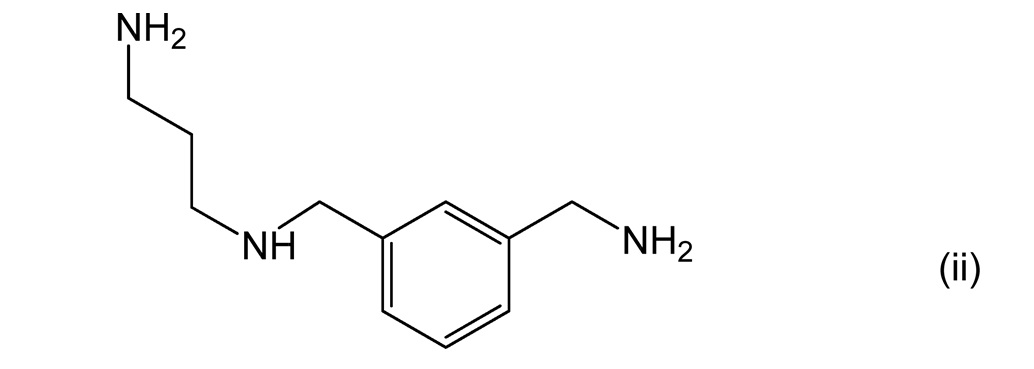
濃縮物Aの粘度は53mPa・s/25℃であった。分子内にアミノプロピル基を2つ有する2付加物(下記式(i)に示すアミノ化合物)の含有量は濃縮物A全量に対し89質量%であった。分子内にアミノプロピル基を1つ有する1付加物(下記式(ii)に示すアミノ化合物)の含有量は濃縮物A全量に対し5質量%であった。
各々のアミノ化合物のGC/MSの同定データを以下に示す。
1付加物;MS(SCI)[M+H]+194
2付加物;MS(SCI)[M+H]+251
(1)攪拌装置、温度計、アルゴン導入管、滴下漏斗及び冷却管を備えた内容積100mLの丸底フラスコに、メタキシリレンジアミン(三菱瓦斯化学株式会社製、以下「MXDA」と記す。)9.5g、2-プロパノール(和光純薬工業株式会社製)20.0gを仕込み、アルゴン気流下、十分に攪拌した後、アクリロニトリル(Aldrich製)7.4gを10分かけて滴下した。滴下終了後、65℃まで昇温させて1時間保持した後室温まで冷却した。
(2)管状縦型水素化反応器(ガラス製、内径10mmφ)に、コバルト含有量15質量%である水素化触媒(三つ葉型、直径1.2mmφ、ジョンソン・マッセイ・ジャパン製;HTC Co 2000)を7.0g充填し、水素気流下120℃で1時間保持した後、240℃まで昇温させて4時間以上保持し、還元、活性化させた。冷却後、攪拌機及びヒーターを備えたオートクレーブ(容量150mL、材質:SUS316L)に、2-プロパノール14.8g、上記触媒及び(1)の反応液を全量仕込み、気相部を水素置換した。水素で3.5MPaGに加圧後、攪拌しながら昇温を開始し、20分間で液温を80℃にした後、圧力を8.0MPaGに調整した。その後、液温80℃の条件下、圧力を8.0MPaGに保つように水素供給を随時行いながら反応を3時間継続させた。反応液を真空下で完全に濃縮し、濃縮物Aを17.2g得た。
濃縮物Aの粘度は53mPa・s/25℃であった。分子内にアミノプロピル基を2つ有する2付加物(下記式(i)に示すアミノ化合物)の含有量は濃縮物A全量に対し89質量%であった。分子内にアミノプロピル基を1つ有する1付加物(下記式(ii)に示すアミノ化合物)の含有量は濃縮物A全量に対し5質量%であった。
各々のアミノ化合物のGC/MSの同定データを以下に示す。
1付加物;MS(SCI)[M+H]+194
2付加物;MS(SCI)[M+H]+251

<合成例2>
(1)攪拌装置、温度計、アルゴン導入管、滴下漏斗及び冷却管を備えた内容積100mLの丸底フラスコに、MXDA9.5g、2-プロパノール(和光純薬工業株式会社製)20.0gを仕込み、アルゴン気流下、十分に攪拌した後、アクリロニトリル(Aldrich製)3.7gを5分かけて滴下した。滴下終了後25℃で1時間保持した。
(2)管状縦型水素化反応器(ガラス製、内径10mmφ)に、コバルト含有量15質量%である水素化触媒(三つ葉型、直径1.2mmφ、ジョンソン・マッセイ・ジャパン製;HTC Co 2000)を5.3g充填し、水素気流下120℃で1時間保持した後、240℃まで昇温させて4時間以上保持し、還元、活性化させた。冷却後、攪拌機及びヒーターを備えたオートクレーブ(容量150mL、材質:SUS316L)に、2-プロパノール8.6g、上記触媒及び(1)の反応液を全量仕込み、気相部を水素置換した。水素で3.5MPaGに加圧後、攪拌しながら昇温を開始し、20分間で液温を80℃にした後、圧力を8.0MPaGに調整した。その後、液温80℃の条件下、圧力を8.0MPaGに保つように水素供給を随時行いながら反応を3時間継続させた。反応液を真空下で完全に濃縮し、濃縮物Bを13.2g得た。
濃縮物Bの粘度は37mPa・s/25℃であった。分子内にアミノプロピル基を2つ有する2付加物(上記式(i)に示すアミノ化合物)の含有量は濃縮物B全量に対し27質量%であった。分子内にアミノプロピル基を1つ有する1付加物(上記式(ii)に示すアミノ化合物)の含有量は濃縮物B全量に対し50質量%であった。また、メタキシリレンジアミンを濃縮物B全量に対し18質量%含んでいた。
各々のアミノ化合物のGC/MSの同定データを以下に示す。
MXDA;MS(SCI)[M-H]+135
1付加物;MS(SCI)[M+H]+194
2付加物;MS(SCI)[M+H]+251
(1)攪拌装置、温度計、アルゴン導入管、滴下漏斗及び冷却管を備えた内容積100mLの丸底フラスコに、MXDA9.5g、2-プロパノール(和光純薬工業株式会社製)20.0gを仕込み、アルゴン気流下、十分に攪拌した後、アクリロニトリル(Aldrich製)3.7gを5分かけて滴下した。滴下終了後25℃で1時間保持した。
(2)管状縦型水素化反応器(ガラス製、内径10mmφ)に、コバルト含有量15質量%である水素化触媒(三つ葉型、直径1.2mmφ、ジョンソン・マッセイ・ジャパン製;HTC Co 2000)を5.3g充填し、水素気流下120℃で1時間保持した後、240℃まで昇温させて4時間以上保持し、還元、活性化させた。冷却後、攪拌機及びヒーターを備えたオートクレーブ(容量150mL、材質:SUS316L)に、2-プロパノール8.6g、上記触媒及び(1)の反応液を全量仕込み、気相部を水素置換した。水素で3.5MPaGに加圧後、攪拌しながら昇温を開始し、20分間で液温を80℃にした後、圧力を8.0MPaGに調整した。その後、液温80℃の条件下、圧力を8.0MPaGに保つように水素供給を随時行いながら反応を3時間継続させた。反応液を真空下で完全に濃縮し、濃縮物Bを13.2g得た。
濃縮物Bの粘度は37mPa・s/25℃であった。分子内にアミノプロピル基を2つ有する2付加物(上記式(i)に示すアミノ化合物)の含有量は濃縮物B全量に対し27質量%であった。分子内にアミノプロピル基を1つ有する1付加物(上記式(ii)に示すアミノ化合物)の含有量は濃縮物B全量に対し50質量%であった。また、メタキシリレンジアミンを濃縮物B全量に対し18質量%含んでいた。
各々のアミノ化合物のGC/MSの同定データを以下に示す。
MXDA;MS(SCI)[M-H]+135
1付加物;MS(SCI)[M+H]+194
2付加物;MS(SCI)[M+H]+251
<合成例3>
(1)攪拌装置、温度計、アルゴン導入管、滴下漏斗及び冷却管を備えた内容積100mLの丸底フラスコに、MXDA14.3g、2-プロパノール(和光純薬工業株式会社製)28.6gを仕込み、アルゴン気流下、十分に攪拌した後、アクリロニトリル(Aldrich製)11.1gを10分かけて滴下した。滴下終了後、65℃まで昇温させて1時間保持した後室温まで冷却した。
(2)攪拌機及びヒーターを備えたオートクレーブ(容量150mL、材質:SUS316L)に、スポンジニッケル触媒10.2g(ジョンソン・マッセイ・ジャパン製;A-4000)、(1)の反応液を全量仕込み、気相部を水素置換した。水素で3.5MPaGに加圧後、攪拌しながら昇温を開始し、20分間で液温を60℃にした後、圧力を8.0MPaGに調整した。その後、液温60℃の条件下、圧力を8.0MPaGに保つように水素供給を随時行いながら反応を3時間継続させた。反応液を真空下で完全に濃縮し、濃縮物Cを25.4g得た。
(1)攪拌装置、温度計、アルゴン導入管、滴下漏斗及び冷却管を備えた内容積100mLの丸底フラスコに、MXDA14.3g、2-プロパノール(和光純薬工業株式会社製)28.6gを仕込み、アルゴン気流下、十分に攪拌した後、アクリロニトリル(Aldrich製)11.1gを10分かけて滴下した。滴下終了後、65℃まで昇温させて1時間保持した後室温まで冷却した。
(2)攪拌機及びヒーターを備えたオートクレーブ(容量150mL、材質:SUS316L)に、スポンジニッケル触媒10.2g(ジョンソン・マッセイ・ジャパン製;A-4000)、(1)の反応液を全量仕込み、気相部を水素置換した。水素で3.5MPaGに加圧後、攪拌しながら昇温を開始し、20分間で液温を60℃にした後、圧力を8.0MPaGに調整した。その後、液温60℃の条件下、圧力を8.0MPaGに保つように水素供給を随時行いながら反応を3時間継続させた。反応液を真空下で完全に濃縮し、濃縮物Cを25.4g得た。
<合成例4>
(1)攪拌装置、温度計、アルゴン導入管、滴下漏斗及び冷却管を備えた内容積100mLの丸底フラスコに、MXDA14.3g、2-プロパノール(和光純薬工業株式会社製)28.6gを仕込み、アルゴン気流下、十分に攪拌した後、アクリロニトリル(Aldrich製)5.6gを5分かけて滴下した。滴下終了後25℃で1時間保持した。
(2)攪拌機及びヒーターを備えたオートクレーブ(容量150mL、材質:SUS316L)に、スポンジニッケル触媒8.0g(ジョンソン・マッセイ・ジャパン製;A-4000)、(1)の反応液を全量仕込み、気相部を水素置換した。水素で3.5MPaGに加圧後、攪拌しながら昇温を開始し、20分間で液温を60℃にした後、圧力を8.0MPaGに調整した。その後、液温60℃の条件下、圧力を8.0MPaGに保つように水素供給を随時行いながら反応を3時間継続させた。反応液を真空下で完全に濃縮し、濃縮物Dを19.9g得た。
(1)攪拌装置、温度計、アルゴン導入管、滴下漏斗及び冷却管を備えた内容積100mLの丸底フラスコに、MXDA14.3g、2-プロパノール(和光純薬工業株式会社製)28.6gを仕込み、アルゴン気流下、十分に攪拌した後、アクリロニトリル(Aldrich製)5.6gを5分かけて滴下した。滴下終了後25℃で1時間保持した。
(2)攪拌機及びヒーターを備えたオートクレーブ(容量150mL、材質:SUS316L)に、スポンジニッケル触媒8.0g(ジョンソン・マッセイ・ジャパン製;A-4000)、(1)の反応液を全量仕込み、気相部を水素置換した。水素で3.5MPaGに加圧後、攪拌しながら昇温を開始し、20分間で液温を60℃にした後、圧力を8.0MPaGに調整した。その後、液温60℃の条件下、圧力を8.0MPaGに保つように水素供給を随時行いながら反応を3時間継続させた。反応液を真空下で完全に濃縮し、濃縮物Dを19.9g得た。
各合成例で得られた濃縮物をそれぞれ硬化剤として用いて、エポキシ樹脂組成物を作製した(各実施例及び各比較例)。
<実施例1>
200mLのポリプロピレン製カップに、合成例1で得られた濃縮物AとビスフェノールA型液状エポキシ樹脂(商品名「エピコート828」、エポキシ当量186、三菱化学株式会社製、以下「エポキシ樹脂(エピコート828)」と記す。)を表1に示す割合で配合し、エポキシ樹脂組成物を調製した。得られたエポキシ樹脂組成物の硬化塗膜の外観、速硬化性、最高発熱温度及び機械物性を評価した。評価結果を表1に示す。
200mLのポリプロピレン製カップに、合成例1で得られた濃縮物AとビスフェノールA型液状エポキシ樹脂(商品名「エピコート828」、エポキシ当量186、三菱化学株式会社製、以下「エポキシ樹脂(エピコート828)」と記す。)を表1に示す割合で配合し、エポキシ樹脂組成物を調製した。得られたエポキシ樹脂組成物の硬化塗膜の外観、速硬化性、最高発熱温度及び機械物性を評価した。評価結果を表1に示す。
<実施例2>
200mLのポリプロピレン製カップに、合成例2で得られた濃縮物Bとエポキシ樹脂(エピコート828)を表1に示す割合で配合した点以外は実施例1と同様にして、エポキシ樹脂組成物を調製した。そして、実施例1と同様にして、性能評価を行った。評価結果を表1に示す。
200mLのポリプロピレン製カップに、合成例2で得られた濃縮物Bとエポキシ樹脂(エピコート828)を表1に示す割合で配合した点以外は実施例1と同様にして、エポキシ樹脂組成物を調製した。そして、実施例1と同様にして、性能評価を行った。評価結果を表1に示す。
<比較例1>
200mLのポリプロピレン製カップに、MXDAとエポキシ樹脂(エピコート828)を表1に示す割合で配合し、エポキシ樹脂組成物を調製した。そして、実施例1と同様にして、性能評価を行った。評価結果を表1に示す。
200mLのポリプロピレン製カップに、MXDAとエポキシ樹脂(エピコート828)を表1に示す割合で配合し、エポキシ樹脂組成物を調製した。そして、実施例1と同様にして、性能評価を行った。評価結果を表1に示す。
<比較例2>
200mLのポリプロピレン製カップに、エポキシ樹脂硬化剤(MXDAとスチレンの反応生成物、商品名「ガスカミン229(G-229)」、三菱瓦斯化学株式会社製)とエポキシ樹脂(エピコート828)を表1に示す割合で配合し、エポキシ樹脂組成物を調製した。得られたエポキシ樹脂組成物の硬化塗膜の外観、速硬化性、最高発熱温度を評価した。評価結果を表1に示す。
200mLのポリプロピレン製カップに、エポキシ樹脂硬化剤(MXDAとスチレンの反応生成物、商品名「ガスカミン229(G-229)」、三菱瓦斯化学株式会社製)とエポキシ樹脂(エピコート828)を表1に示す割合で配合し、エポキシ樹脂組成物を調製した。得られたエポキシ樹脂組成物の硬化塗膜の外観、速硬化性、最高発熱温度を評価した。評価結果を表1に示す。
<比較例3>
200mLのポリプロピレン製カップに、エポキシ樹脂硬化剤(MXDAとアクリロニトリルの反応生成物、商品名「ガスカミン240(G-240)」、三菱瓦斯化学株式会社製)とエポキシ樹脂(エピコート828)を表1に示す割合で配合し、エポキシ樹脂組成物を調製した。そして、比較例2と同様にして、性能評価を行った。評価結果を表1に示す。
200mLのポリプロピレン製カップに、エポキシ樹脂硬化剤(MXDAとアクリロニトリルの反応生成物、商品名「ガスカミン240(G-240)」、三菱瓦斯化学株式会社製)とエポキシ樹脂(エピコート828)を表1に示す割合で配合し、エポキシ樹脂組成物を調製した。そして、比較例2と同様にして、性能評価を行った。評価結果を表1に示す。

<合成例5>
(1)攪拌装置、温度計、アルゴン導入管、滴下漏斗及び冷却管を備えた内容積100mLの丸底フラスコに、1,3-ビス(アミノメチル)シクロヘキサン(三菱瓦斯化学株式会社製、以下「1,3-BAC」と記す。)10.0g、2-プロパノール(和光純薬工業株式会社製)20.0gを仕込み、アルゴン気流下、十分に攪拌した後、アクリロニトリル(Aldrich製)7.5gを10分かけて滴下した。滴下終了後、65℃まで昇温させて1時間保持した後室温まで冷却した。
(2)管状縦型水素化反応器(ガラス製、内径10mmφ)に、コバルト含有量15質量%である水素化触媒(三つ葉型、直径1.2mmφ、ジョンソン・マッセイ・ジャパン製;HTC Co 2000)を7.0g充填し、水素気流下120℃で1時間保持した後、240℃まで昇温させて4時間以上保持し、還元、活性化させた。冷却後、攪拌機及びヒーターを備えたオートクレーブ(容量150mL、材質:SUS316L)に、2-プロパノール14.8g、上記触媒及び(1)の反応液を全量仕込み、気相部を水素置換した。水素で3.5MPaGに加圧後、攪拌しながら昇温を開始し、20分間で液温を80℃にした後、圧力を8.0MPaGに調整した。その後、液温80℃の条件下、圧力を8.0MPaGに保つように水素供給を随時行いながら反応を3時間継続させた。反応液を真空下で完全に濃縮し、濃縮物Eを17.5g得た。
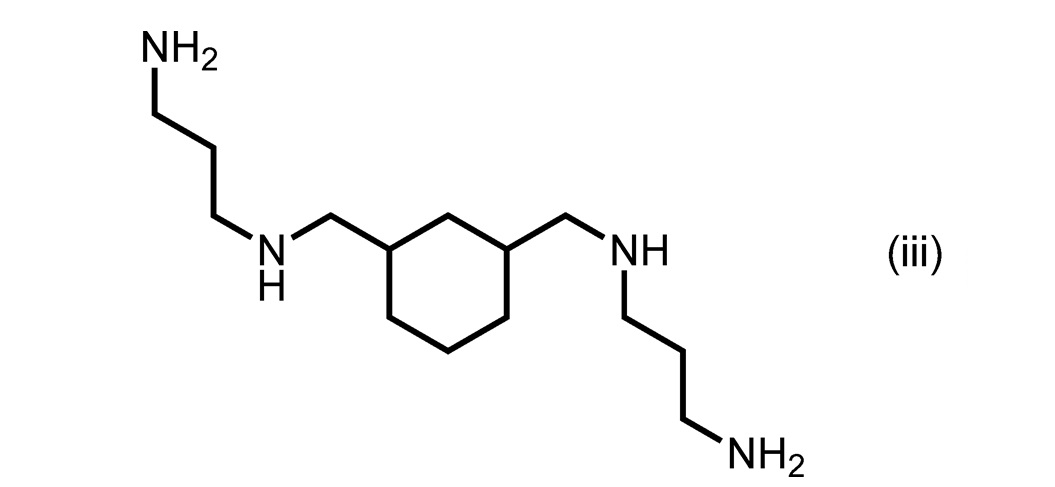
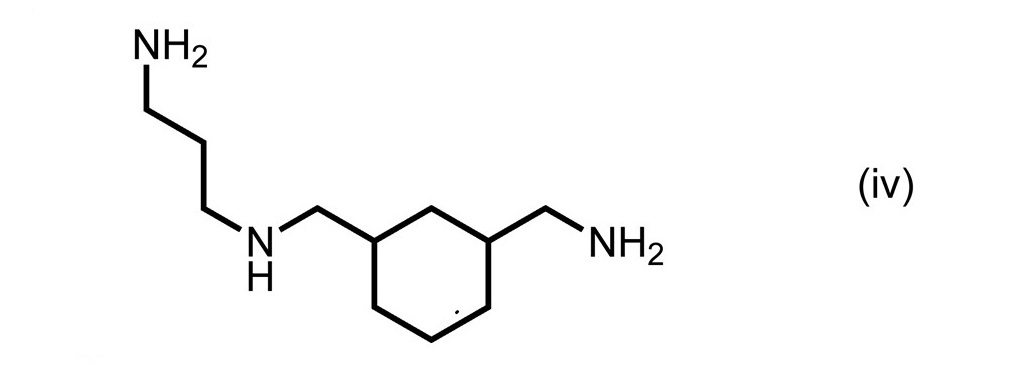
濃縮物Eの粘度は69mPa・s/25℃であった。分子内にアミノプロピル基を2つ有する2付加物(下記式(iii)に示すアミノ化合物)の含有量は濃縮物E全量に対し89質量%であった。分子内にアミノプロピル基を1つ有する1付加物(下記式(iv)に示すアミノ化合物)の含有量は濃縮物E全量に対し5質量%であった。
各々のアミノ化合物のGC/MSの同定データを以下に示す。
1付加物(立体異性体-1);MS(SCI)[M+H]+200
1付加物(立体異性体-2);MS(SCI)[M+H]+200
2付加物(立体異性体-1);MS(SCI)[M+H]+257
2付加物(立体異性体-2);MS(SCI)[M+H]+257
(1)攪拌装置、温度計、アルゴン導入管、滴下漏斗及び冷却管を備えた内容積100mLの丸底フラスコに、1,3-ビス(アミノメチル)シクロヘキサン(三菱瓦斯化学株式会社製、以下「1,3-BAC」と記す。)10.0g、2-プロパノール(和光純薬工業株式会社製)20.0gを仕込み、アルゴン気流下、十分に攪拌した後、アクリロニトリル(Aldrich製)7.5gを10分かけて滴下した。滴下終了後、65℃まで昇温させて1時間保持した後室温まで冷却した。
(2)管状縦型水素化反応器(ガラス製、内径10mmφ)に、コバルト含有量15質量%である水素化触媒(三つ葉型、直径1.2mmφ、ジョンソン・マッセイ・ジャパン製;HTC Co 2000)を7.0g充填し、水素気流下120℃で1時間保持した後、240℃まで昇温させて4時間以上保持し、還元、活性化させた。冷却後、攪拌機及びヒーターを備えたオートクレーブ(容量150mL、材質:SUS316L)に、2-プロパノール14.8g、上記触媒及び(1)の反応液を全量仕込み、気相部を水素置換した。水素で3.5MPaGに加圧後、攪拌しながら昇温を開始し、20分間で液温を80℃にした後、圧力を8.0MPaGに調整した。その後、液温80℃の条件下、圧力を8.0MPaGに保つように水素供給を随時行いながら反応を3時間継続させた。反応液を真空下で完全に濃縮し、濃縮物Eを17.5g得た。
濃縮物Eの粘度は69mPa・s/25℃であった。分子内にアミノプロピル基を2つ有する2付加物(下記式(iii)に示すアミノ化合物)の含有量は濃縮物E全量に対し89質量%であった。分子内にアミノプロピル基を1つ有する1付加物(下記式(iv)に示すアミノ化合物)の含有量は濃縮物E全量に対し5質量%であった。
各々のアミノ化合物のGC/MSの同定データを以下に示す。
1付加物(立体異性体-1);MS(SCI)[M+H]+200
1付加物(立体異性体-2);MS(SCI)[M+H]+200
2付加物(立体異性体-1);MS(SCI)[M+H]+257
2付加物(立体異性体-2);MS(SCI)[M+H]+257
<合成例6>
(1)攪拌装置、温度計、アルゴン導入管、滴下漏斗及び冷却管を備えた内容積100mLの丸底フラスコに、1,3-BAC10.0g、2-プロパノール(和光純薬工業株式会社製)20.0gを仕込み、アルゴン気流下、十分に攪拌した後、アクリロニトリル(Aldrich製)3.7gを5分かけて滴下した。滴下終了後25℃で1時間保持した。
(2)管状縦型水素化反応器(ガラス製、内径10mmφ)に、コバルト含有量15質量%である水素化触媒(三つ葉型、直径1.2mmφ、ジョンソン・マッセイ・ジャパン製;HTC Co 2000)を5.7g充填し、水素気流下120℃で1時間保持した後、240℃まで昇温させて4時間以上保持し、還元、活性化させた。冷却後、攪拌機及びヒーターを備えたオートクレーブ(容量150mL、材質:SUS316L)に、2-プロパノール8.6g、上記触媒及び(1)の反応液を全量仕込み、気相部を水素置換した。水素で3.5MPaGに加圧後、攪拌しながら昇温を開始し、20分間で液温を80℃にした後、圧力を8.0MPaGに調整した。その後、液温80℃の条件下、圧力を8.0MPaGに保つように水素供給を随時行いながら反応を3時間継続させた。反応液を真空下で完全に濃縮し、濃縮物Fを13.7g得た。
濃縮物Fの粘度は39mPa・s/25℃であった。分子内にアミノプロピル基を2つ有する2付加物(上記式(iii)に示すアミノ化合物)の含有量は濃縮物F全量に対し27質量%であった。分子内にアミノプロピル基を1つ有する1付加物(上記式(iv)に示すアミノ化合物)の含有量は濃縮物F全量に対し49質量%であった。また、1,3-BACを濃縮物F全量に対し19質量%含んでいた。
各々のアミノ化合物のGC/MSの同定データを以下に示す。
1,3-BAC(立体異性体-1);MS(SCI)[M+H]+143
1,3-BAC(立体異性体-2);MS(SCI)[M+H]+143
1付加物(立体異性体-1);MS(SCI)[M+H]+200
1付加物(立体異性体-2);MS(SCI)[M+H]+200
2付加物(立体異性体-1);MS(SCI)[M+H]+257
2付加物(立体異性体-2);MS(SCI)[M+H]+257
(1)攪拌装置、温度計、アルゴン導入管、滴下漏斗及び冷却管を備えた内容積100mLの丸底フラスコに、1,3-BAC10.0g、2-プロパノール(和光純薬工業株式会社製)20.0gを仕込み、アルゴン気流下、十分に攪拌した後、アクリロニトリル(Aldrich製)3.7gを5分かけて滴下した。滴下終了後25℃で1時間保持した。
(2)管状縦型水素化反応器(ガラス製、内径10mmφ)に、コバルト含有量15質量%である水素化触媒(三つ葉型、直径1.2mmφ、ジョンソン・マッセイ・ジャパン製;HTC Co 2000)を5.7g充填し、水素気流下120℃で1時間保持した後、240℃まで昇温させて4時間以上保持し、還元、活性化させた。冷却後、攪拌機及びヒーターを備えたオートクレーブ(容量150mL、材質:SUS316L)に、2-プロパノール8.6g、上記触媒及び(1)の反応液を全量仕込み、気相部を水素置換した。水素で3.5MPaGに加圧後、攪拌しながら昇温を開始し、20分間で液温を80℃にした後、圧力を8.0MPaGに調整した。その後、液温80℃の条件下、圧力を8.0MPaGに保つように水素供給を随時行いながら反応を3時間継続させた。反応液を真空下で完全に濃縮し、濃縮物Fを13.7g得た。
濃縮物Fの粘度は39mPa・s/25℃であった。分子内にアミノプロピル基を2つ有する2付加物(上記式(iii)に示すアミノ化合物)の含有量は濃縮物F全量に対し27質量%であった。分子内にアミノプロピル基を1つ有する1付加物(上記式(iv)に示すアミノ化合物)の含有量は濃縮物F全量に対し49質量%であった。また、1,3-BACを濃縮物F全量に対し19質量%含んでいた。
各々のアミノ化合物のGC/MSの同定データを以下に示す。
1,3-BAC(立体異性体-1);MS(SCI)[M+H]+143
1,3-BAC(立体異性体-2);MS(SCI)[M+H]+143
1付加物(立体異性体-1);MS(SCI)[M+H]+200
1付加物(立体異性体-2);MS(SCI)[M+H]+200
2付加物(立体異性体-1);MS(SCI)[M+H]+257
2付加物(立体異性体-2);MS(SCI)[M+H]+257
<合成例7>
(1)攪拌装置、温度計、アルゴン導入管、滴下漏斗及び冷却管を備えた内容積100mLの丸底フラスコに、1,3-BAC14.9g、2-プロパノール(和光純薬工業株式会社製)29.8gを仕込み、アルゴン気流下、十分に攪拌した後、アクリロニトリル(Aldrich製)11.1gを10分かけて滴下した。滴下終了後、65℃まで昇温させて1時間保持した後室温まで冷却した。
(2)攪拌機及びヒーターを備えたオートクレーブ(容量150mL、材質:SUS316L)に、スポンジニッケル触媒10.4g(ジョンソン・マッセイ・ジャパン製;A-4000)、(1)の反応液を全量仕込み、気相部を水素置換した。水素で3.5MPaGに加圧後、攪拌しながら昇温を開始し、20分間で液温を60℃にした後、圧力を8.0MPaGに調整した。その後、液温60℃の条件下、圧力を8.0MPaGに保つように水素供給を随時行いながら反応を3時間継続させた。反応液を真空下で完全に濃縮し、濃縮物Gを26.0g得た。
(1)攪拌装置、温度計、アルゴン導入管、滴下漏斗及び冷却管を備えた内容積100mLの丸底フラスコに、1,3-BAC14.9g、2-プロパノール(和光純薬工業株式会社製)29.8gを仕込み、アルゴン気流下、十分に攪拌した後、アクリロニトリル(Aldrich製)11.1gを10分かけて滴下した。滴下終了後、65℃まで昇温させて1時間保持した後室温まで冷却した。
(2)攪拌機及びヒーターを備えたオートクレーブ(容量150mL、材質:SUS316L)に、スポンジニッケル触媒10.4g(ジョンソン・マッセイ・ジャパン製;A-4000)、(1)の反応液を全量仕込み、気相部を水素置換した。水素で3.5MPaGに加圧後、攪拌しながら昇温を開始し、20分間で液温を60℃にした後、圧力を8.0MPaGに調整した。その後、液温60℃の条件下、圧力を8.0MPaGに保つように水素供給を随時行いながら反応を3時間継続させた。反応液を真空下で完全に濃縮し、濃縮物Gを26.0g得た。
<合成例8>
(1)攪拌装置、温度計、アルゴン導入管、滴下漏斗及び冷却管を備えた内容積100mLの丸底フラスコに、1,3-BAC14.9g、2-プロパノール(和光純薬工業株式会社製)29.8gを仕込み、アルゴン気流下、十分に攪拌した後、アクリロニトリル(Aldrich製)5.6gを5分かけて滴下した。滴下終了後25℃で1時間保持した。
(2)攪拌機及びヒーターを備えたオートクレーブ(容量150mL、材質:SUS316L)に、スポンジニッケル触媒8.2g(ジョンソン・マッセイ・ジャパン製;A-4000)、(1)の反応液を全量仕込み、気相部を水素置換した。水素で3.5MPaGに加圧後、攪拌しながら昇温を開始し、20分間で液温を60℃にした後、圧力を8.0MPaGに調整した。その後、液温60℃の条件下、圧力を8.0MPaGに保つように水素供給を随時行いながら反応を3時間継続させた。反応液を真空下で完全に濃縮し、濃縮物Hを20.5g得た。
(1)攪拌装置、温度計、アルゴン導入管、滴下漏斗及び冷却管を備えた内容積100mLの丸底フラスコに、1,3-BAC14.9g、2-プロパノール(和光純薬工業株式会社製)29.8gを仕込み、アルゴン気流下、十分に攪拌した後、アクリロニトリル(Aldrich製)5.6gを5分かけて滴下した。滴下終了後25℃で1時間保持した。
(2)攪拌機及びヒーターを備えたオートクレーブ(容量150mL、材質:SUS316L)に、スポンジニッケル触媒8.2g(ジョンソン・マッセイ・ジャパン製;A-4000)、(1)の反応液を全量仕込み、気相部を水素置換した。水素で3.5MPaGに加圧後、攪拌しながら昇温を開始し、20分間で液温を60℃にした後、圧力を8.0MPaGに調整した。その後、液温60℃の条件下、圧力を8.0MPaGに保つように水素供給を随時行いながら反応を3時間継続させた。反応液を真空下で完全に濃縮し、濃縮物Hを20.5g得た。
各合成例で得られた濃縮物をそれぞれ硬化剤として用いて、エポキシ樹脂組成物を作製した(各実施例及び各比較例)。
<実施例3>
200mLのポリプロピレン製カップに、合成例5で得られた濃縮物Eとエポキシ樹脂(エピコート828)を表2に示す割合で配合し、エポキシ樹脂組成物を調製した。得られたエポキシ樹脂組成物の硬化塗膜の外観、速硬化性、最高発熱温度及び機械物性を評価した。評価結果を表2に示す。
200mLのポリプロピレン製カップに、合成例5で得られた濃縮物Eとエポキシ樹脂(エピコート828)を表2に示す割合で配合し、エポキシ樹脂組成物を調製した。得られたエポキシ樹脂組成物の硬化塗膜の外観、速硬化性、最高発熱温度及び機械物性を評価した。評価結果を表2に示す。
<実施例4>
200mLのポリプロピレン製カップに、合成例6で得られた濃縮物Fとエポキシ樹脂(エピコート828)を表2に示す割合で配合した点以外は実施例3と同様にして、エポキシ樹脂組成物を調製した。そして、実施例3と同様にして、性能評価を行った。評価結果を表2に示す。
200mLのポリプロピレン製カップに、合成例6で得られた濃縮物Fとエポキシ樹脂(エピコート828)を表2に示す割合で配合した点以外は実施例3と同様にして、エポキシ樹脂組成物を調製した。そして、実施例3と同様にして、性能評価を行った。評価結果を表2に示す。
<比較例4>
200mLのポリプロピレン製カップに、1,3-BACとエポキシ樹脂(エピコート828)を表2に示す割合で配合し、エポキシ樹脂組成物を調製した。そして実施例3と同様にして、性能評価を行った。評価結果を表2に示す。
200mLのポリプロピレン製カップに、1,3-BACとエポキシ樹脂(エピコート828)を表2に示す割合で配合し、エポキシ樹脂組成物を調製した。そして実施例3と同様にして、性能評価を行った。評価結果を表2に示す。
<比較例5>
200mLのポリプロピレン製カップに、イソホロンジアミン(IPDA)とエポキシ樹脂(エピコート828)を表2に示す割合で配合し、エポキシ樹脂組成物を調製した。そして実施例3と同様にして、性能評価を行った。評価結果を表2に示す。
200mLのポリプロピレン製カップに、イソホロンジアミン(IPDA)とエポキシ樹脂(エピコート828)を表2に示す割合で配合し、エポキシ樹脂組成物を調製した。そして実施例3と同様にして、性能評価を行った。評価結果を表2に示す。
<比較例6>
200mLのポリプロピレン製カップに、ジエチレントリアミン(DETA;和光純薬工業株式会社製)とエポキシ樹脂(エピコート828)を表2に示す割合で配合し、エポキシ樹脂組成物を調製した。そして、実施例3と同様にして、性能評価を行った。評価結果を表2に示す。
200mLのポリプロピレン製カップに、ジエチレントリアミン(DETA;和光純薬工業株式会社製)とエポキシ樹脂(エピコート828)を表2に示す割合で配合し、エポキシ樹脂組成物を調製した。そして、実施例3と同様にして、性能評価を行った。評価結果を表2に示す。
<比較例7>
200mLのポリプロピレン製カップに、トリエチレンテトラミン(TETA;東京化成工業株式会社製)とエポキシ樹脂(エピコート828)を表2に示す割合で配合し、エポキシ樹脂組成物を調製した。そして、実施例3と同様にして、性能評価を行った。評価結果を表2に示す。
200mLのポリプロピレン製カップに、トリエチレンテトラミン(TETA;東京化成工業株式会社製)とエポキシ樹脂(エピコート828)を表2に示す割合で配合し、エポキシ樹脂組成物を調製した。そして、実施例3と同様にして、性能評価を行った。評価結果を表2に示す。
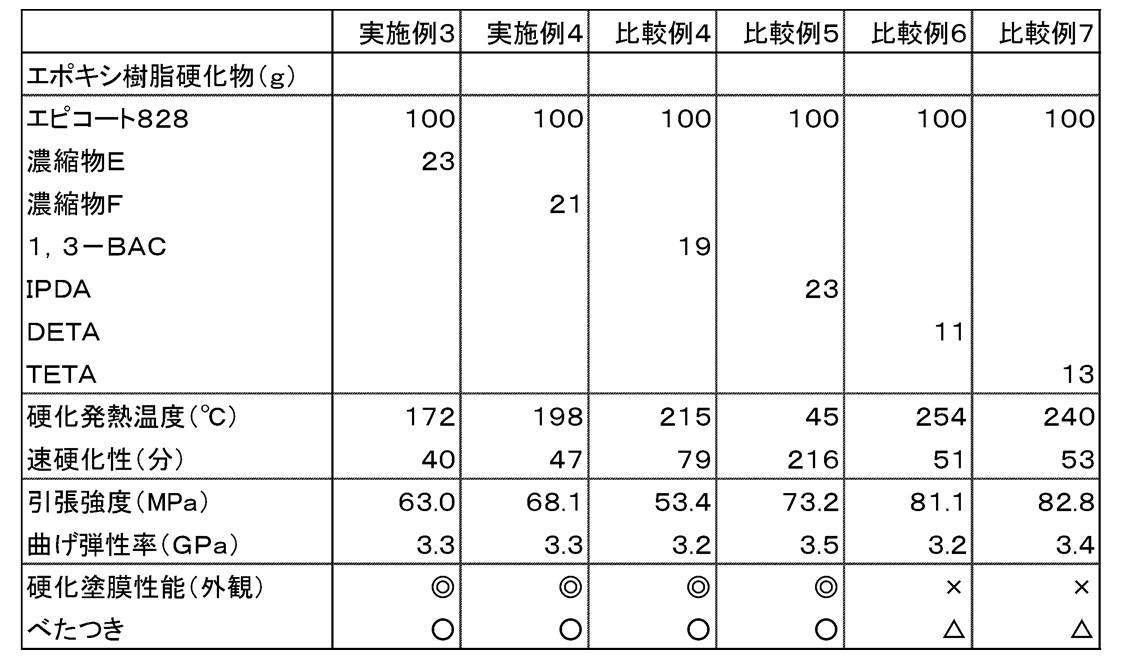
以上より、各実施例のエポキシ樹脂硬化剤を用いることで、硬化時の発熱温度が抑制でき、かつ硬化速度が速いことが少なくとも確認された。さらには、これによって得られる硬化物の物性も優れていることが確認された。
本出願は、2015年3月31日出願の日本国特許出願(特願2015-073533号及び特願2015-073541号)に基づくものであり、その内容はここに参照として取り込まれる。
本発明のエポキシ樹脂硬化剤は、大形や肉厚の成形品を過剰な発熱を伴わず、比較的低い温度で速硬化させることができる。また、得られたエポキシ樹脂硬化物も高い機械的物性や塗膜性能を有することから、熱硬化系樹脂硬化物として有用なものであり、工業的価値は高い。
Claims (9)
- 下記式(1)で示されるアミノ化合物を含むエポキシ樹脂硬化剤。
R1HN-H2C-A-CH2-NHR2 (1)
(式(1)中、Aは、o-フェニレン基、m-フェニレン基、p-フェニレン基、1,2-シクロヘキシレン基、1,3-シクロヘキシレン基又は1,4-シクロヘキシレン基であり、R1及びR2は、水素原子又はアミノプロピル基である。R1とR2は同一でも異なっていてもよいが、R1とR2の少なくとも1つは、アミノプロピル基である。) - 前記Aは、o-フェニレン基、m-フェニレン基又はp-フェニレン基である、請求項1に記載のエポキシ樹脂硬化剤。
- 前記Aは、1,2-シクロヘキシレン基、1,3-シクロヘキシレン基又は1,4-シクロヘキシレン基である、請求項1に記載のエポキシ樹脂硬化剤。
- エポキシ樹脂と、
請求項1~3のいずれか1項に記載のエポキシ樹脂硬化剤と、
を含むエポキシ樹脂組成物。 - 請求項4に記載のエポキシ樹脂組成物を含む塗料。
- 請求項4に記載のエポキシ樹脂組成物を含む土木建築用部材。
- 請求項4に記載のエポキシ樹脂組成物を硬化させて得られる硬化物。
- 請求項7に記載の硬化物と、
繊維と、
を含む複合材料。 - o-キシリレンジアミン、p-キシリレンジアミン、m-キシリレンジアミン、1,2-ビス(アミノメチル)シクロヘキサン、1,3-ビス(アミノメチル)シクロヘキサン及び1,4-ビス(アミノメチル)シクロヘキサンからなる群より選ばれる少なくとも1種と、アクリロニトリルとを付加反応させて、シアノ化合物を得る工程と、
前記シアノ化合物を水素添加することにより、式(1)で示されるアミノ化合物を得る工程と、
を含む、前記アミノ化合物を含む、エポキシ樹脂硬化剤の製造方法。
R1HN-H2C-A-CH2-NHR2 (1)
(式(1)中、Aは、o-フェニレン基、m-フェニレン基、p-フェニレン基、1,2-シクロヘキシレン基、1,3-シクロヘキシレン基又は1,4-シクロヘキシレン基であり、R1及びR2は、水素原子又はアミノプロピル基である。R1とR2は同一でも異なっていてもよいが、R1とR2の少なくとも1つは、アミノプロピル基である。)
Priority Applications (2)
| Application Number | Priority Date | Filing Date | Title |
|---|---|---|---|
| JP2017509985A JP6886641B2 (ja) | 2015-03-31 | 2016-03-28 | エポキシ樹脂硬化剤、エポキシ樹脂組成物、塗料、土木建築用部材、硬化物及び複合材料、並びにエポキシ樹脂硬化剤の製造方法 |
| CN201680017447.7A CN107406579B (zh) | 2015-03-31 | 2016-03-28 | 环氧树脂固化剂、环氧树脂组合物、涂料、土木建筑用构件、固化物和复合材料、以及环氧树脂固化剂的制造方法 |
Applications Claiming Priority (4)
| Application Number | Priority Date | Filing Date | Title |
|---|---|---|---|
| JP2015-073541 | 2015-03-31 | ||
| JP2015-073533 | 2015-03-31 | ||
| JP2015073541 | 2015-03-31 | ||
| JP2015073533 | 2015-03-31 |
Publications (1)
| Publication Number | Publication Date |
|---|---|
| WO2016158871A1 true WO2016158871A1 (ja) | 2016-10-06 |
Family
ID=57007233
Family Applications (1)
| Application Number | Title | Priority Date | Filing Date |
|---|---|---|---|
| PCT/JP2016/059958 Ceased WO2016158871A1 (ja) | 2015-03-31 | 2016-03-28 | エポキシ樹脂硬化剤、エポキシ樹脂組成物、塗料、土木建築用部材、硬化物及び複合材料、並びにエポキシ樹脂硬化剤の製造方法 |
Country Status (4)
| Country | Link |
|---|---|
| JP (1) | JP6886641B2 (ja) |
| CN (1) | CN107406579B (ja) |
| TW (1) | TWI711643B (ja) |
| WO (1) | WO2016158871A1 (ja) |
Cited By (4)
| Publication number | Priority date | Publication date | Assignee | Title |
|---|---|---|---|---|
| WO2019065248A1 (ja) * | 2017-09-29 | 2019-04-04 | 日鉄ケミカル&マテリアル株式会社 | 繊維強化複合材料用樹脂組成物及びそれを用いた繊維強化複合材料 |
| KR20190090800A (ko) * | 2016-12-05 | 2019-08-02 | 바스프 에스이 | N,n'-디아미노프로필-2-메틸시클로헥산-1,3-디아민 및 n,n'-디아미노프로필-4-메틸-시클로헥산-1,3-디아민 및 에폭시 수지에 대한 경화제로서의 이들의 용도 |
| US20230416450A1 (en) * | 2020-10-15 | 2023-12-28 | Mitsubishi Gas Chemical Company, Inc. | Epoxy resin curing agent, epoxy resin composition, paint, and adhesive |
| WO2024048481A1 (ja) | 2022-09-02 | 2024-03-07 | 三菱瓦斯化学株式会社 | 組成物、樹脂組成物、および、硬化物 |
Families Citing this family (1)
| Publication number | Priority date | Publication date | Assignee | Title |
|---|---|---|---|---|
| CN109320919A (zh) * | 2018-11-09 | 2019-02-12 | 陈鹏 | 一种桥梁减震支座用复合材料及其制备方法 |
Citations (4)
| Publication number | Priority date | Publication date | Assignee | Title |
|---|---|---|---|---|
| US4070400A (en) * | 1975-10-16 | 1978-01-24 | Merck & Co., Inc. | Diphenyl polyamides having a cyclohexylene moiety |
| EP1314716A1 (en) * | 2001-11-23 | 2003-05-28 | Sigma Coatings B.V. | Amine phenolic compounds and their use as hardener and/or accelerators in epoxy coatings |
| JP2006131661A (ja) * | 2004-11-02 | 2006-05-25 | Japan Epoxy Resin Kk | エポキシ樹脂組成物およびエポキシ樹脂硬化体 |
| JP2007537158A (ja) * | 2004-02-13 | 2007-12-20 | メディクエスト セラピューティックス インク | アンチザイムフレームシフトを活性化するポリアミン類似体 |
Family Cites Families (9)
| Publication number | Priority date | Publication date | Assignee | Title |
|---|---|---|---|---|
| US4321354A (en) * | 1978-07-17 | 1982-03-23 | Milliken Research Corporation | Polyamine substituted cycloaliphatic compounds |
| US6441238B1 (en) * | 2001-12-19 | 2002-08-27 | Air Products And Chemicals, Inc. | N-(aminopropyl)-toluenediamines and their use as epoxy curing agents |
| DE60316383T2 (de) * | 2002-06-18 | 2008-06-12 | Mitsubishi Gas Chemical Co., Inc. | Aminzusammensetzung und Verfahren zu ihrer Herstellung |
| US6914079B2 (en) * | 2002-09-23 | 2005-07-05 | Mediquest Therapeutics, Inc. | Polyamine analogs that activate antizyme frameshifting |
| WO2005105729A1 (en) * | 2004-02-13 | 2005-11-10 | Mediquest Therapeutics, Inc. | Polyamine analogs that activate antizyme frameshifting |
| EP1761581B1 (en) * | 2004-06-21 | 2007-10-24 | Huntsman Advanced Materials (Switzerland) GmbH | Curing agents for epoxy resins |
| US20080114094A1 (en) * | 2006-11-13 | 2008-05-15 | Dilipkumar Nandlal Shah | Use of a polyamine stream as curing agent in epoxy adhesive and flooring applications |
| US7993751B2 (en) * | 2007-02-07 | 2011-08-09 | Air Products And Chemicals, Inc. | Alkylated aminopropylated methylene-di-(cyclohexylamine) and uses thereof |
| WO2011032877A1 (de) * | 2009-09-18 | 2011-03-24 | Basf Se | Verwendung eines stereoisomerengemisches von diaminomethylcyclohexan als härter für epoxidharze |
-
2016
- 2016-03-28 JP JP2017509985A patent/JP6886641B2/ja active Active
- 2016-03-28 CN CN201680017447.7A patent/CN107406579B/zh active Active
- 2016-03-28 WO PCT/JP2016/059958 patent/WO2016158871A1/ja not_active Ceased
- 2016-03-29 TW TW105109796A patent/TWI711643B/zh active
Patent Citations (4)
| Publication number | Priority date | Publication date | Assignee | Title |
|---|---|---|---|---|
| US4070400A (en) * | 1975-10-16 | 1978-01-24 | Merck & Co., Inc. | Diphenyl polyamides having a cyclohexylene moiety |
| EP1314716A1 (en) * | 2001-11-23 | 2003-05-28 | Sigma Coatings B.V. | Amine phenolic compounds and their use as hardener and/or accelerators in epoxy coatings |
| JP2007537158A (ja) * | 2004-02-13 | 2007-12-20 | メディクエスト セラピューティックス インク | アンチザイムフレームシフトを活性化するポリアミン類似体 |
| JP2006131661A (ja) * | 2004-11-02 | 2006-05-25 | Japan Epoxy Resin Kk | エポキシ樹脂組成物およびエポキシ樹脂硬化体 |
Cited By (9)
| Publication number | Priority date | Publication date | Assignee | Title |
|---|---|---|---|---|
| KR20190090800A (ko) * | 2016-12-05 | 2019-08-02 | 바스프 에스이 | N,n'-디아미노프로필-2-메틸시클로헥산-1,3-디아민 및 n,n'-디아미노프로필-4-메틸-시클로헥산-1,3-디아민 및 에폭시 수지에 대한 경화제로서의 이들의 용도 |
| JP2020500888A (ja) * | 2016-12-05 | 2020-01-16 | ビーエーエスエフ ソシエタス・ヨーロピアBasf Se | N,n’−ジアミノプロピル−2−メチル−シクロヘキサン−1,3−ジアミンおよびn,n’−ジアミノプロピル−4−メチル−シクロヘキサン−1,3−ジアミン、ならびにエポキシ樹脂用の硬化剤としてのそれらの使用 |
| JP7051857B2 (ja) | 2016-12-05 | 2022-04-11 | ビーエーエスエフ ソシエタス・ヨーロピア | N,n’-ジアミノプロピル-2-メチル-シクロヘキサン-1,3-ジアミンおよびn,n’-ジアミノプロピル-4-メチル-シクロヘキサン-1,3-ジアミン、ならびにエポキシ樹脂用の硬化剤としてのそれらの使用 |
| KR102582502B1 (ko) | 2016-12-05 | 2023-09-26 | 바스프 에스이 | N,n'-디아미노프로필-2-메틸시클로헥산-1,3-디아민 및 n,n'-디아미노프로필-4-메틸-시클로헥산-1,3-디아민 및 에폭시 수지에 대한 경화제로서의 이들의 용도 |
| WO2019065248A1 (ja) * | 2017-09-29 | 2019-04-04 | 日鉄ケミカル&マテリアル株式会社 | 繊維強化複合材料用樹脂組成物及びそれを用いた繊維強化複合材料 |
| JPWO2019065248A1 (ja) * | 2017-09-29 | 2020-11-05 | 日鉄ケミカル&マテリアル株式会社 | 繊維強化複合材料用樹脂組成物及びそれを用いた繊維強化複合材料 |
| JP7221871B2 (ja) | 2017-09-29 | 2023-02-14 | 日鉄ケミカル&マテリアル株式会社 | 繊維強化複合材料用樹脂組成物及びそれを用いた繊維強化複合材料 |
| US20230416450A1 (en) * | 2020-10-15 | 2023-12-28 | Mitsubishi Gas Chemical Company, Inc. | Epoxy resin curing agent, epoxy resin composition, paint, and adhesive |
| WO2024048481A1 (ja) | 2022-09-02 | 2024-03-07 | 三菱瓦斯化学株式会社 | 組成物、樹脂組成物、および、硬化物 |
Also Published As
| Publication number | Publication date |
|---|---|
| TW201638138A (zh) | 2016-11-01 |
| JP6886641B2 (ja) | 2021-06-16 |
| TWI711643B (zh) | 2020-12-01 |
| CN107406579A (zh) | 2017-11-28 |
| JPWO2016158871A1 (ja) | 2018-01-25 |
| CN107406579B (zh) | 2020-10-30 |
Similar Documents
| Publication | Publication Date | Title |
|---|---|---|
| JP6147770B2 (ja) | 硬化性エポキシ組成物および短時間硬化法 | |
| CN103619900B (zh) | 含胺硬化剂的混合物与过量环氧基团的可固化环氧树脂体系 | |
| JP6886641B2 (ja) | エポキシ樹脂硬化剤、エポキシ樹脂組成物、塗料、土木建築用部材、硬化物及び複合材料、並びにエポキシ樹脂硬化剤の製造方法 | |
| JP5936556B2 (ja) | 直鎖状トリエチレンテトラアミンをエポキシ樹脂用の硬化剤として用いる使用 | |
| JP2010520924A5 (ja) | ||
| US20150018457A1 (en) | Use of linear triethylentetramine as curing agent for epoxy resins | |
| CA2912305A1 (en) | Epoxy-resin composition for fiber-matrix semifinished products | |
| KR20180045863A (ko) | 에폭시 수지 조성물 및 이로부터 제조된 섬유 강화 복합 재료 | |
| JP2016528355A (ja) | エポキシ樹脂用の硬化剤としてのポリプロピレンイミンの使用 | |
| CN116075538B (zh) | 环氧树脂固化剂、环氧树脂组合物和胺组合物的用途 | |
| JPH01215822A (ja) | 芳香族ジアミン硬化剤からなるエポキシ樹脂 | |
| KR102747425B1 (ko) | 알킬-치환된 에틸렌 아민을 함유하는 에폭시 수지-기재의 섬유 매트릭스 조성물 | |
| JP6939365B2 (ja) | アミン組成物の製造方法 | |
| US12617753B2 (en) | Urea derivatives and their use as curatives and curative accelerators for resin systems | |
| JP5509743B2 (ja) | 加熱硬化型エポキシ樹脂組成物 | |
| JP6246572B2 (ja) | ビシクロヘプタン化合物およびエポキシ樹脂硬化剤およびエポキシ樹脂組成物 | |
| JP2024542597A (ja) | エポキシ樹脂の硬化剤として使用される新規な脂肪族ポリアミン | |
| CN116113653B (zh) | 环氧树脂固化剂、环氧树脂组合物和胺组合物的用途 | |
| CN120118291A (zh) | 一种芳香胺固化剂组合物及其制备方法和应用 | |
| JP2025021398A (ja) | エポキシ樹脂組成物、プリプレグおよび炭素繊維強化複合材料とその製造方法並びに内装材 |
Legal Events
| Date | Code | Title | Description |
|---|---|---|---|
| 121 | Ep: the epo has been informed by wipo that ep was designated in this application |
Ref document number: 16772752 Country of ref document: EP Kind code of ref document: A1 |
|
| ENP | Entry into the national phase |
Ref document number: 2017509985 Country of ref document: JP Kind code of ref document: A |
|
| NENP | Non-entry into the national phase |
Ref country code: DE |
|
| 122 | Ep: pct application non-entry in european phase |
Ref document number: 16772752 Country of ref document: EP Kind code of ref document: A1 |