WO2016158189A1 - レトルト殺菌米飯の製造方法およびレトルト殺菌した容器詰米飯 - Google Patents
レトルト殺菌米飯の製造方法およびレトルト殺菌した容器詰米飯 Download PDFInfo
- Publication number
- WO2016158189A1 WO2016158189A1 PCT/JP2016/056576 JP2016056576W WO2016158189A1 WO 2016158189 A1 WO2016158189 A1 WO 2016158189A1 JP 2016056576 W JP2016056576 W JP 2016056576W WO 2016158189 A1 WO2016158189 A1 WO 2016158189A1
- Authority
- WO
- WIPO (PCT)
- Prior art keywords
- rice
- container
- retort
- cooked rice
- sterilized
- Prior art date
- Legal status (The legal status is an assumption and is not a legal conclusion. Google has not performed a legal analysis and makes no representation as to the accuracy of the status listed.)
- Ceased
Links
Images


Classifications
-
- A—HUMAN NECESSITIES
- A23—FOODS OR FOODSTUFFS; TREATMENT THEREOF, NOT COVERED BY OTHER CLASSES
- A23B—PRESERVATION OF FOODS, FOODSTUFFS OR NON-ALCOHOLIC BEVERAGES; CHEMICAL RIPENING OF FRUIT OR VEGETABLES
- A23B2/00—Preservation of foods or foodstuffs, in general
- A23B2/20—Preservation of foods or foodstuffs, in general by heating materials in packages which are progressively transported, continuously or stepwise, through the apparatus
- A23B2/203—Preservation of foods or foodstuffs, in general by heating materials in packages which are progressively transported, continuously or stepwise, through the apparatus with packages moving on the spot while being transported
-
- A—HUMAN NECESSITIES
- A23—FOODS OR FOODSTUFFS; TREATMENT THEREOF, NOT COVERED BY OTHER CLASSES
- A23B—PRESERVATION OF FOODS, FOODSTUFFS OR NON-ALCOHOLIC BEVERAGES; CHEMICAL RIPENING OF FRUIT OR VEGETABLES
- A23B2/00—Preservation of foods or foodstuffs, in general
- A23B2/30—Preservation of foods or foodstuffs, in general by heating materials in packages which are not progressively transported through the apparatus
-
- A—HUMAN NECESSITIES
- A23—FOODS OR FOODSTUFFS; TREATMENT THEREOF, NOT COVERED BY OTHER CLASSES
- A23B—PRESERVATION OF FOODS, FOODSTUFFS OR NON-ALCOHOLIC BEVERAGES; CHEMICAL RIPENING OF FRUIT OR VEGETABLES
- A23B9/00—Preservation of edible seeds, e.g. cereals
- A23B9/02—Preserving by heating
-
- A—HUMAN NECESSITIES
- A23—FOODS OR FOODSTUFFS; TREATMENT THEREOF, NOT COVERED BY OTHER CLASSES
- A23L—FOODS, FOODSTUFFS OR NON-ALCOHOLIC BEVERAGES, NOT OTHERWISE PROVIDED FOR; PREPARATION OR TREATMENT THEREOF
- A23L7/00—Cereal-derived products; Malt products; Preparation or treatment thereof
- A23L7/10—Cereal-derived products
-
- A—HUMAN NECESSITIES
- A23—FOODS OR FOODSTUFFS; TREATMENT THEREOF, NOT COVERED BY OTHER CLASSES
- A23L—FOODS, FOODSTUFFS OR NON-ALCOHOLIC BEVERAGES, NOT OTHERWISE PROVIDED FOR; PREPARATION OR TREATMENT THEREOF
- A23L7/00—Cereal-derived products; Malt products; Preparation or treatment thereof
- A23L7/10—Cereal-derived products
- A23L7/196—Products in which the original granular shape is maintained, e.g. parboiled rice
-
- A—HUMAN NECESSITIES
- A23—FOODS OR FOODSTUFFS; TREATMENT THEREOF, NOT COVERED BY OTHER CLASSES
- A23L—FOODS, FOODSTUFFS OR NON-ALCOHOLIC BEVERAGES, NOT OTHERWISE PROVIDED FOR; PREPARATION OR TREATMENT THEREOF
- A23L7/00—Cereal-derived products; Malt products; Preparation or treatment thereof
- A23L7/10—Cereal-derived products
- A23L7/196—Products in which the original granular shape is maintained, e.g. parboiled rice
- A23L7/1965—Cooked; Precooked; Fried or pre-fried in a non-aqueous liquid frying medium, e.g. oil
-
- A—HUMAN NECESSITIES
- A23—FOODS OR FOODSTUFFS; TREATMENT THEREOF, NOT COVERED BY OTHER CLASSES
- A23L—FOODS, FOODSTUFFS OR NON-ALCOHOLIC BEVERAGES, NOT OTHERWISE PROVIDED FOR; PREPARATION OR TREATMENT THEREOF
- A23L7/00—Cereal-derived products; Malt products; Preparation or treatment thereof
- A23L7/10—Cereal-derived products
- A23L7/197—Treatment of whole grains not provided for in groups A23L7/117 - A23L7/196
- A23L7/1975—Cooking or roasting
-
- A—HUMAN NECESSITIES
- A23—FOODS OR FOODSTUFFS; TREATMENT THEREOF, NOT COVERED BY OTHER CLASSES
- A23V—INDEXING SCHEME RELATING TO FOODS, FOODSTUFFS OR NON-ALCOHOLIC BEVERAGES AND LACTIC OR PROPIONIC ACID BACTERIA USED IN FOODSTUFFS OR FOOD PREPARATION
- A23V2002/00—Food compositions, function of food ingredients or processes for food or foodstuffs
Definitions
- the present invention relates to a method for producing retort-sterilized cooked rice that is sterilized by filling and encapsulating long grain rice in a container and then heating and pressurizing, and a retort-sterilized container-filled cooked rice.
- foods having a pH exceeding 4.6 and water activity exceeding 0.94 are distinguished from “low acid foods” and “acid foods” being foods having a pH of 4.6 or lower.
- the FDA defines that commercial sterility is ensured when the packaged food is distributed at room temperature.
- a low acid food is a method of heating at 120 ° C. for 4 minutes using botulinum as an indicator bacterium, or Sterilization (so-called retort sterilization) by a method having an effect equal to or greater than this is obligated by the Food Sanitation Law.
- cooked rice is usually classified as a low acid food, it was necessary to perform retort sterilization in order to distribute the cooked rice at room temperature in the form of a packaged food containing the cooked rice in a container.
- a retort food containing an object such as food in a bag-like container is filled with the object in a container and sealed, and then heated and pressurized, for example, 110 to 130.
- the sterilization conditions it is necessary to select conditions that allow sufficient sterilization of the retort food.
- Patent Document 1 discloses a method in which raw rice (Japonica rice) and water are filled in a container and sealed, and then cooked and sterilized simultaneously by retort. This method is rice cooking in a container, and in this method, the amount of oxygen gas in the container is adjusted with an inert gas so that the amount of oxygen gas is 4 to 12 mL per 100 g of raw rice at room temperature, thereby giving unflavored unpolished white rice. It was supposed to be able to make rice.
- Indica rice is a long grain rice and accounts for over 80% of the world's rice production. Indica rice is mainly produced in the Indochina peninsula including Thailand and Southeast Asia. These regions are developing economically, and the income middle class is expected to increase with lifestyle changes. Furthermore, it would be desirable if indica rice could be simply eaten as cooked rice as a measure against population growth expected in the future and global food difficulties.
- an object of the present invention is to provide a method for producing retort-sterilized cooked rice that can be distributed in a state that can be stored at room temperature in a state suitable for eating using indica rice as cooked rice, and a container-packed cooked rice that has been retort-sterilized.
- the first characteristic configuration of the method for producing retort sterilized cooked rice according to the present invention for achieving the above object is the Vickers hardness at the midpoint between the outermost point and the center point on the thickness line of the rice grain, Heat the raw rice having a hardness ratio of less than 1 calculated by dividing by the Vickers hardness at the center point to absorb water so that the weight of the rice grains after water absorption is 2.0 to 2.6 times the weight of the raw rice A heat absorption process, a filling process for filling the storage container with the rice grains after heat absorption, a sealing process for sealing the filled storage container, and heating and pressurizing the sealed storage container for sterilization treatment And a retort sterilization step.
- raw rice of a long grain type having a hardness ratio of less than 1 is used, and the raw rice is heated so that the weight of the rice grain after water absorption is 2.0 to 2.6 times the weight of the raw rice.
- the core of the rice grain can be left.
- the core of the rice grain is sufficiently heated so that the core does not remain. That is, in such retort sterilization, steaming and sterilization of cooked rice can be performed simultaneously.
- the amount of water absorbed is intentionally adjusted in advance so that the core remains on the rice grains. And it processes so that the said core may not remain by the heating and pressurization at the time of retort sterilization.
- long-grained raw rice having a hardness ratio of less than 1 can be used as, for example, retort-sterilized cooked rice (contained rice) in a state that provides a texture and flavor suitable for people of the long-grained locality to eat. it can.
- retort-sterilized cooked rice obtained rice
- Such container-packed cooked rice can be distributed in a state where it can be stored at room temperature, and further, for example, can be simply eaten simply by heating the container.
- a second characteristic configuration of the method for producing retort-sterilized cooked rice according to the present invention is a gas in which an inert gas is sealed so that the concentration of oxygen gas in the head space in the container is less than 1 to 2% after the filling step. The point is that it has a replacement step.
- the flavor of the cooked rice can be improved by sealing the inert gas so that the oxygen gas concentration in the head space is 1% or more and less than 2% by gas replacement.
- the odor index can be controlled to 6 or less.
- the third characteristic configuration of the method for producing retort-sterilized cooked rice according to the present invention is that the raw rice is indica rice.
- Indica rice is a long grain rice and accounts for over 80% of the world's rice production. Indica rice is mainly produced in the Indochina peninsula including Thailand and Southeast Asia. Therefore, according to this structure, it can be set as the aspect which eats indica rice simply as cooked rice as a countermeasure with respect to the population increase anticipated in the future in the said area, and global foodstuff difficulties.
- a fourth characteristic configuration of the method for producing retort-sterilized cooked rice according to the present invention is that the heating in the water-absorbing step is performed at 70 to 100 ° C. for 6 to 7 minutes.
- heating and water absorption process can be performed at a temperature higher than the pasting peak temperature of the long-grained raw rice, heating and water absorption can be performed efficiently.
- the first characteristic configuration of the retort-sterilized container-filled cooked rice according to the present invention is that the Vickers hardness at the midpoint between the outermost point and the center point on the thickness line of the rice grain is divided by the Vickers hardness at the center point. Heating the raw rice having a hardness ratio of less than 1 to absorb the water so that the weight of the rice grains after water absorption is 2.0 to 2.6 times the weight of the raw rice, Retort sterilized cooked rice.
- the amount of water to be absorbed is intentionally adjusted so that the core remains on the rice grains, and the container-filled rice can be processed so as not to leave the remaining core by heating and pressurizing during retort sterilization. it can.
- long-grained raw rice having a hardness ratio of less than 1 can be used as, for example, retort-sterilized cooked rice (contained rice) in a state that provides a texture and flavor suitable for people of the long-grained locality to eat. it can.
- retort-sterilized cooked rice obtained rice
- Such container-packed cooked rice can be distributed in a state where it can be stored at room temperature, and further, for example, can be simply eaten simply by heating the container.
- the second characteristic configuration of the refill-sterilized container-filled cooked rice according to the present invention is that an inert gas is sealed in the head space of the container so that the concentration of oxygen gas is less than 1 to 2%.
- the flavor of cooked rice can be improved by enclosing an inert gas in the head space.
- the third characteristic configuration of the refill-sterilized container-filled cooked rice according to the present invention is that the raw rice is indica rice.
- the container-filled cooked rice can be simply eaten using Indica rice as cooked rice simply by heating the container, and Indochina peninsula including Thailand, which is the main production area of Indica rice, and Southeast Asia Can be served in a state that provides a favorable texture and flavor to the people, that is, a state suitable for eating.
- it can be set as the aspect which eats indica rice simply as cooked rice as one countermeasure with respect to the population increase anticipated in the future in the said area, and global food difficulties.
- the fourth characteristic configuration of the refill-sterilized container-filled cooked rice according to the present invention is that the hardness of one grain of the cooked rice is 56 to 115 N and the moisture content is 54 to 64%.
- the physical properties of the rice grains of the retort-sterilized container-filled cooked rice can be defined, and the container-filled cooked rice that allows the texture and flavor to be allowed for a long time can be obtained.
- FIG. 1 shows the procedure of the manufacturing method of the retort sterilized cooked rice of this invention. It is explanatory drawing for calculating the hardness ratio of a rice grain. It is a graph which shows the hardness of 1 grain of cooked rice immediately after retort sterilization of container-packed cooked rice after 3 months and 6 months. It is a graph which shows the water content after 3 months and 6 months immediately after the retort sterilization of the container-packed rice. It is a graph which shows the odor parameter
- indica rice which is long grain rice
- indica rice is filled in a container and sealed, and then sterilized by heating and pressurization.
- the method for producing retort-sterilized cooked rice of the present invention has a Vickers at an intermediate point M located between the outermost point R and the central point O on the thickness line L of the rice grain.
- the gas replacement step C may be performed as necessary.
- the raw rice used in the present invention is a long grain variety, for example, indica rice, but is not limited to this.
- indica rice is characterized by its elongated shape, including Thai rice. This indica rice usually has a less sticky texture and has a crisp texture.
- japonica rice which is mainly grown in Japan and has a rounded oval shape, becomes sticky and glossy when heated. Thus, Indica rice has a different appearance and texture than Japonica rice.
- the method for producing retort-sterilized cooked rice of the present invention uses indica rice, which is a long grain type, it is preferable to use cooked rice that makes use of the unique texture and flavor of indica rice when indica rice is eaten. Therefore, it is considered that retort sterilization may be performed under conditions different from those of japonica rice. This embodiment demonstrates the case where indica rice is used.
- ⁇ Indica rice used in the present invention is one whose hardness ratio is less than 1.
- the hardness ratio is the Vickers hardness at the middle point M located between the outermost point R and the center point O on the thickness line L of the rice grain, as the Vickers hardness at the center point O. It can be calculated by dividing.
- Vickers hardness is a type of indentation hardness. From the length of the diagonal line of the dent that remains after the pyramid-shaped indenter made of regular square pyramid diamond is pushed into the material surface and the load is removed. Calculate the surface area. The value obtained by dividing the test load by the calculated surface area is the Vickers hardness (HV).
- type I Indica type
- type II Japonica type
- type Ia has a hardness ratio of less than 0.95 (the center is extremely hard)
- type Ib has a hardness ratio of less than 0.95 to 1.00 (the center is slightly hard)
- type IIc has a hardness ratio of 1.
- IId type has a hardness ratio of less than 1.10 to less than 1.18 (center part and dorsal abdominal line part is soft), and IIe type has a hardness ratio of 1.18 or more ( The central part and the dorsoventral line part are extremely soft).
- Such classification is closely related to the appearance of starch cell tissue, and has some relationship with the particle shape.
- the hard rice of Japonica rice is classified as type IIc, the soft rice of Japonica rice is classified as type IId, and the sake rice of Japonica rice is classified as type IIe.
- the weight of the rice grains after water absorption is adjusted to 2.0 to 2.6 times, preferably 2.2 to 2.4 times the weight of fresh rice.
- water is absorbed while heating raw rice by the boil method (bath removal method) or the steaming method. That is, the washed rice is immersed in hot water heated to a predetermined temperature for a predetermined time, and after the predetermined time has elapsed, the immersion is stopped and the hot water is drained.
- Washing rice may be performed by adding water, for example, twice the weight of raw rice and draining after stirring several tens of times, and this process may be repeated several times.
- Raw rice drained after washing is put into hot water heated to about 70 to 100 ° C., for example.
- the lower limit (70 ° C.) of this temperature range is the temperature at which indica rice begins to gelatinize, and the upper limit (100 ° C.) is the temperature of boiling water at normal pressure. Since the gelatinization peak temperature of indica rice is around 75 ° C., hot water can be absorbed efficiently when raw rice is poured into hot water heated to about 70 to 100 ° C. In addition, the gelatinization start temperature of japonica rice is about 60 ° C.
- the heated water absorption is not limited to hot water, and soup stock may be used.
- the immersion time is preferably about 5 to 8 minutes, and more preferably 6 to 7 minutes.
- Indica rice is usually steamed after boiling for about 10 to 15 minutes.
- it can be set as the state which left the core of the indica rice by setting it as processing time shorter than normal boiling. That is, in the heating and water absorption process A, the core of Indica rice is left, so that the weight of the rice grains after water absorption is soaked to be 2.0 to 2.6 times the weight of fresh rice (heat absorption rate). The time is adjusted. If the amount of hot water or the amount of raw rice to be added does not reach the desired water absorption rate only by adjusting the soaking time, adjust the water absorption rate to the desired value by adding moisture during the weight measurement after boiling. Is possible. This moisture can be applied by, for example, spraying water after absorbing water or adding water to the container with a nozzle or the like.
- the storage container is filled with the rice grains after heat absorption. It is possible not to add water during filling. Thus, when sealing without adding water, the moisture content of a rice grain does not change before and after retort sterilization. Therefore, sticky rice can be prevented after retort sterilization.
- the above-described steps such as spraying on the rice after water absorption or adding moisture to the container with a nozzle or the like can be performed in the filling process.
- the container is different from the container that has been subjected to the heat absorption step A.
- the container is not particularly limited as long as it is a container capable of containing rice and sterilized by retort.
- the container has heat resistance for heat sterilization at high temperatures, and can be distributed at room temperature. If it is a can-like container that has a barrier property to block light or oxygen gas absorbability, etc., and has a sealing property and practical strength, a retort pouch, a retort cup, a retort tray, etc. Good.
- the retort pouch is made of, for example, a film obtained by laminating a synthetic resin such as polypropylene on the food side and polyester (PET) on the outside and aluminum foil.
- the volume of the storage container is not particularly limited, but if it is about 100 to 600 mL, it is easy to handle at the time of retort sterilization, and considering the retort sterilization time etc., the size should be about 550 mL.
- gas replacement process In the gas replacement step C, an inert gas is sealed so that the concentration of oxygen gas in the head space in the storage container is less than 1 to 2%.
- the gas component and composition in the head space may affect the color and flavor of cooked rice. For example, when no oxygen is present in the headspace (when 100% of an inert gas, nitrogen, is filled), part of the protein is reduced and the rice grains have a bluish color. On the other hand, if the concentration of oxygen gas in the head space is high, the flavor of cooked rice becomes worse. Therefore, in the gas replacement step C of the present invention, the gas components in the head space are adjusted so that the concentration of oxygen gas in the head space is 1% or more and less than 2%.
- the gas to be sealed in addition to oxygen may be filled with carbon dioxide gas in addition to an inert gas such as nitrogen gas. The concentration of these gases can be appropriately set as long as the concentration of oxygen gas is less than 1 to 2%. For example, when the oxygen gas concentration is 1 to 1.2%, the carbon dioxide gas concentration may be 50 to 70%, and the gas may be sealed while being adjusted to 100% with nitrogen gas.
- each gas may be filled separately by injecting into the head space from a gas supply device via a syringe or the like, or all gases may be mixed in advance using a gas mixing device or the like. In this state, the head space may be injected and filled through the syringe or the like.
- the capacity of the head space may be set according to the size of the container. For example, if the container has a capacity of 400 mL, a head space of about 150 mL may be ensured.
- the container is sealed. What is necessary is just to perform sealing using the optimal well-known method according to the storage container to be used.
- the storage container is a container-shaped retort pouch, it can be performed by thermally welding the main body of the storage container and the lid using a known sealer or the like.
- a known sealer or the like for example, meat and vegetables prepared in an appropriate size, powdered seasonings, dried foods and the like may be added simultaneously.
- the retort sterilization process E performs sterilization by heating and pressurizing the sealed container.
- Retort sterilization refers to pressurized heat treatment. Steam or hot water of about 110 ° C to 130 ° C is used to pressurize the product filled in a heat-resistant container so that the container is not damaged by the internal pressure of the product as the product temperature rises. Heating for about 10 to 50 minutes to ensure commercial sterility.
- a batch type retort sterilizer or a continuous retort sterilizer can be used for the retort sterilization treatment.
- a hot water pressure heat sterilizer or a pressure pressure cooker may be used.
- a retort-sterilized container-packed cooked rice having a grain hardness of 56 to 115 N and a moisture content of 54 to 64% can be produced.
- the smell index can be 6 or less in the container-packed cooked rice. Therefore, the refill-sterilized container-packed cooked rice of the present invention can be cooked using the unique texture and flavor of indica rice. Therefore, for example, the container-filled cooked rice can be simply eaten using Indica rice as cooked rice simply by heating the container, and Indochina peninsula including Thailand, which is the main production area of Indica rice, and Southeast Asia Can be served in a state that provides a favorable texture and flavor to the people, that is, a state suitable for eating.
- the temperature is gradually lowered and cooled, and stored at an appropriate temperature and humidity.
- Example 1 The retort-sterilized container-packed cooked rice of the present invention is supposed to be eaten in Indochina Peninsula and Southeast Asia, including Thailand, which is the main production area of Indica rice, and it is preferred to have hardness and water content when eating Indica rice The rate and flavor were examined.
- the container used for the retort sterilized cooked rice was a ramicon cup LA 180 ⁇ 118-370WT (PP / adhesive layer / EVOH / adhesive layer / PP) for cooked rice.
- the original sheet thickness of the cup is 0.67 mm, and EVOH is 4 w / w%.
- the lid is 12XBJ15NBJ50RQ (12 ⁇ m vapor-deposited PET / 15 ⁇ m vapor-deposited nylon / 50 ⁇ m polypropylene from the outside).
- Retort sterilized cooked rice was produced as follows. After washing raw rice of Thai rice by the above method, it was transferred to a colander, drained, poured into boiling water at 100 ° C., boiled with occasional stirring, and heated to absorb water. The boil time was 5-9 minutes. Opened in a colander so that the rice grains were not crushed. The value obtained by dividing the total weight after boiling by the weight of the raw rice used was defined as the respective heat absorption rate.
- retort sterilization was performed under the following conditions. Heating is carried out primary heating 5 minutes, a preheating temperature 70 ° C., preheating time 5 minutes, secondary heating 10 minutes, the secondary temperature 100 ° C., 3 primary heating 10 minutes at a temperature 118 ° C. during the sterilization process, the final F 0 Processing was performed so that the value was 8. Cooling is performed at a primary temperature drop of 10 minutes, an initial cooling temperature of 90 ° C., a secondary temperature drop of 10 minutes, and a cooling temperature of 40 ° C., and is finished when the temperature (article temperature) in the center of the container reaches 40 ° C. did. The water chiller temperature was 15 ° C. After carrying out from the retort pot, the water
- cooked rice Of the cooked rice, nine types of water 1.1 to 1.9 per weight 1 of rice were used for sensory evaluation. As for the retort sterilized cooked rice, five kinds of boiled rice for 5 to 9 minutes were used for sensory evaluation. In order to make the temperature at the time of evaluation constant, in each case, 10 g of cooked rice was transferred to a white small dish, microwave-heated to about 55 ° C., and presented to the panel.
- the hardness of each sample due to sensuality was evaluated by the panelists as ⁇ when preferred, ⁇ inside the allowable range, and x outside the allowable range.
- the moisture content was measured at 105 ° C. based on the official method (105 ° C. in arbitrary amount, weight reduction method when dried for 5 hours).
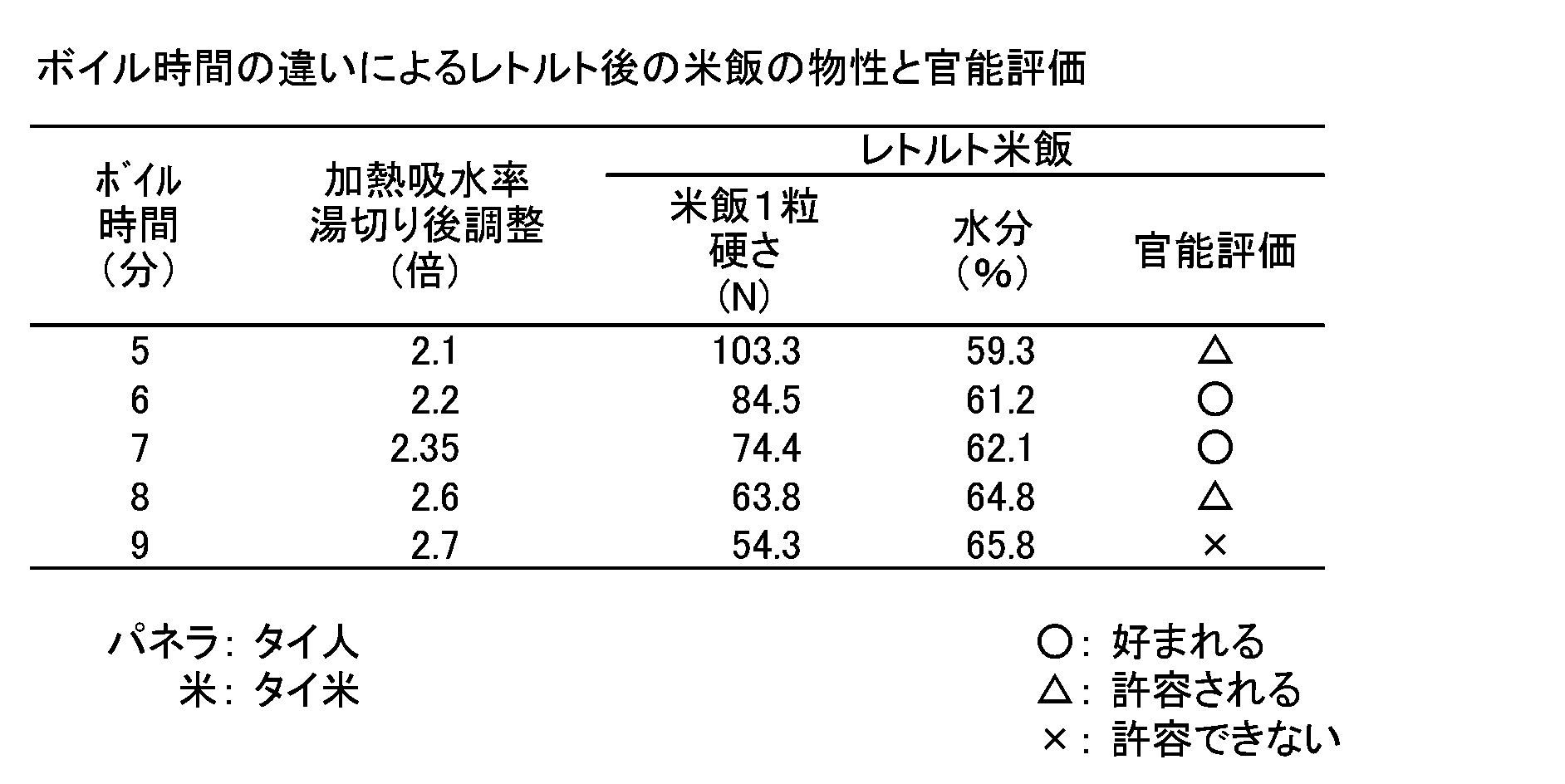
- Table 2 shows the physical properties, moisture content, and heat absorption rate of retort-sterilized cooked rice when the boil time is changed.
- the sensory evaluation results regarding the hardness of the retort-sterilized cooked rice are shown in Table 2.
- the hardness value of one grain of rice the hardness decreased as the boil time (heating water absorption process A) increased when the influence of boil time was compared.
- the “hardness” of Thai rice allowed by the panella was about 56 to 115 N, and the boil time to enter this range was 5 to 8 minutes (63.8 to 103.3 N).
- the water content at this time was 59.3 to 64.8%.
- the more preferred sample for sensory evaluation was when the boil time was 6-7 minutes.
- Example 2 The suitable gas composition of the head space in the container-packed cooked rice sterilized by retort was investigated.
- Thai rice used in Example 1 was washed according to the procedure of Example 1.
- Heat-absorbing step A is performed by boiling for 7 minutes and then pouring into a colander so as not to crush the rice grains.
- the weight of the rice grains after water absorption is 2.35 times the weight of fresh rice.
- the hot water was sprayed to adjust.
- a ramicon cup was filled with 180 g of rice after heat absorption (filling step B).
- the headspace gas replacement was performed with a mixed gas of nitrogen gas: oxygen gas or nitrogen gas: oxygen gas: carbon dioxide gas so that the concentration of oxygen gas in the headspace was 1% (gas replacement step C). ).
- the mixed gas was flushed from the gap between the cup and the lid at 0.2 MPa and a flow rate of 8 L / min for 25 seconds to replace the gas, and then sealed with the above-mentioned semi-automatic sealer at a welding temperature of 200 ° C. and a welding time of 2.0 seconds. And sealed (sealing step D).
- a container in which the container was placed in a gas-impermeable aluminum pouch (exterior) was also produced.
- the outer packaging was performed before or after retort sterilization. A list of samples is shown in Table 3.
- the exterior indicates a state where a ramicon cup and an oxygen scavenger are put in an aluminum pouch and sealed.
- the sample of the package before retort sterilization was subjected to retort sterilization after confirming that O 2 in the aluminum pouch was consumed by the oxygen scavenger.
- O 2 in the aluminum pouch was consumed by the oxygen scavenger.
- the retort sterilization process E was performed on the following conditions using the retort simulator mentioned above. Unless otherwise noted, temperature refers to the temperature of the kettle. Heating is performed by heating up to 70 ° C. over 5 minutes, holding at 70 ° C. for 5 minutes, heating up to 100 ° C. over 10 minutes, and heating up to 118 ° C. over 10 minutes. It was set to 118 degreeC. Processing was performed so that the final F 0 value was 8. Cooling was gradually lowered to 90 ° C. over 10 minutes, and ended when the temperature (article temperature) at the center of the container reached 40 ° C. The water chiller temperature was 15 ° C. After carrying out from the retort pot, the water
- the thus prepared retort sterilized cooked rice was evaluated.
- the physical properties (hardness) of the retort-sterilized cooked rice were measured using the small tabletop test machine used in Example 1. Furthermore, the water content was measured by the same method as in Example 1.
- the preference scale method is a scale in which 3.3 is an acceptable limit value and 6.6 or more is more preferable with a full score of 10. Five Thais were designated as panelists. From each sample, 10 g of cooked rice was transferred to a white small dish and presented to the panel after heating to a temperature of about 55 ° C. in order to keep the temperature at the time of evaluation constant.
- Example 2-1, Example 2-4, and Example 2-7 were all within the allowable range, but the score slightly increased between the three. Since the appearance state easily affects the overall evaluation, the overall evaluation has the same tendency as the appearance result. Other differences in scent, texture, and taste were slight. From this, it was recognized that oxygen entering the container after retort sterilization hardly affects the sensuality of cooked rice.
- Example 2-4 without an exterior, it was recognized that if a gas barrier cup and lid were used, each item would be a container-filled rice that would be acceptable to Thais for a long time without an exterior. It was.
- Example 2-4 was recognized to be a container-packed cooked rice acceptable to Thais, which is inferior to the cooked cooked rice as a control.
- the oxygen gas concentration in the head space is set to 1%.
- the inert gas may be sealed so that the oxygen gas concentration in the head space is 1 to less than 2%. If this is the case, similar results can be obtained.
- Example 3 Carnaroli rice, which is a long grain variety produced in Italy, was used as a raw material, washed in the same manner as in the above-described example of Indica rice (Thai rice), then poured into boiling water and boiled (heat absorption) for 12 minutes. After boiling, the hot water is drained and the water is adjusted so that the weight of the rice grains after water absorption is 2.35 of the weight of the raw rice. The lid was heat sealed while replacing the gas so that the concentration of oxygen gas was less than 1 to 2%, sterilized by retort (sterilization temperature 118 ° C., sterilization time 25 minutes), and then cooled. After carrying out from the retort pot, the water
- retort sterilization temperature 118 ° C., sterilization time 25 minutes
- the physical properties of the cooked rice after storage at room temperature for 1 week were a hardness of 103.9 N and a moisture content of 64.0%. These values were all in the range of the physical properties of the container-filled cooked rice of the present invention (the hardness of one grain of rice is 56 to 115 N and the moisture content is 54 to 64%).
- the physical properties of the cooked rice after storage at room temperature for 1 day was that the hardness of one grain of rice was 84.1N (average hardness of 10 grains), but the lower layer in the container was too sticky to absorb water.
- the water unevenness of the rice grains in the upper and lower layers in the container was large. This is because when the boil time is shortened to 7 minutes, the amount of water absorbed by the rice is reduced, and the amount of water that is insufficient at the time of filling the cup is added so that the heat absorption rate is 2.0 to 2.6. It was recognized that the rice grains in the lower layer became too soft after retort sterilization, and the upper rice was hardened.
- the present invention can be used for a method for producing retort-sterilized cooked rice that is sterilized by filling and encapsulating long-grain rice in a container, and then heating and pressurizing, and retort-sterilized container-filled cooked rice.
Landscapes
- Life Sciences & Earth Sciences (AREA)
- Engineering & Computer Science (AREA)
- Chemical & Material Sciences (AREA)
- Food Science & Technology (AREA)
- Polymers & Plastics (AREA)
- Health & Medical Sciences (AREA)
- Nutrition Science (AREA)
- Wood Science & Technology (AREA)
- Zoology (AREA)
- Cereal-Derived Products (AREA)
- Food Preservation Except Freezing, Refrigeration, And Drying (AREA)
Abstract
Description
さらに本構成によれば、当該地域において将来的に予想される人口増や、世界的な食糧難に対する一対策として、インディカ米を米飯として簡便に食する態様とすることができる。
本発明のレトルト殺菌米飯の製造方法は、長粒米であるインディカ米を収容容器に充填して密封したのち加熱および加圧することで殺菌処理するものである。
本発明で使用する生米は長粒種であり、例えばインディカ米とするのがよいが、これに限定されるものではなく、例えばイタリア産の長粒種であるカルナローリ米を使用してもよい。インディカ米は細長い形が特徴でタイ米もこれに含まれる。このインディカ米は、通常粘りけが少なくパサパサとした食感を呈する。一方、日本で主に栽培され、丸みのある楕円形をしているジャポニカ米は、熱を加えると粘りと艶が出る。このようにインディカ米はジャポニカ米とは外見や食感が異なる。本発明のレトルト殺菌米飯の製造方法は長粒種であるインディカ米を使用するため、インディカ米を食したときのインディカ米が有する独特の食感や風味等を生かした米飯とするのがよい。そのため、ジャポニカ米とは異なる条件でレトルト殺菌を行えばよいと考えられる。本実施形態ではインディカ米を使用した場合について説明する。
加熱吸水工程Aでは、吸水後の米粒の重量が生米の重量の2.0~2.6倍、好ましくは2.2~2.4倍となるように調節する。加熱吸水工程Aは、ボイル法(湯取り法)か蒸煮法で生米を加熱しながら吸水させる。即ち、洗米した生米を所定温度に加温した湯に所定時間浸漬し、当該所定時間経過後に浸漬を停止して湯切りを行う。
充填工程Bは、加熱吸水後の米粒を収容容器に充填する。充填時には加水は行わないようにすることが可能である。このように加水せずに密封する場合は、米粒の水分含有率はレトルト殺菌前後で変化しない。そのため、レトルト殺菌後に米飯がべたつくのを防止することができる。加水する場合は、上述した吸水後の米に噴霧する或いはノズル等で容器に水分を追加する等のステップを充填工程で行うことができる。
ガス置換工程Cは、収容容器におけるヘッドスペースの酸素ガスの濃度が1~2%未満となるよう不活性ガスを封入する。
密封工程Dは収容容器を密封する。密封は、使用する収容容器に応じた最適な公知の手法を用いて行えばよい。例えば収容容器が容器状のレトルトパウチであれば、公知のシーラー等を用いて、収容容器の本体および蓋材を熱溶着することによって行うことができる。密封の際には、加熱吸水後の米粒以外に、例えば適当な大きさに調製した肉や野菜、粉末の調味料、乾燥食品等を同時に添加してもよい。
レトルト殺菌工程Eは、密封した収容容器を加熱および加圧することで殺菌処理を行う。
具体的な加熱の方法としては、常圧下で食品対象物の内部温度が110℃~130に達するまで加熱をすることは困難であるため、加圧条件下で行う。例えば、熱水式の加圧加熱殺菌機や加圧式の圧力釜等を用いるとよい。
本発明のレトルト殺菌した容器詰米飯は、インディカ米の主要産地であるタイをはじめとするインドシナ半島や東南アジアにおいて食されるのを想定し、インディカ米を食したときに好まれる硬さ、水分含有率および風味を調べた。
タイ米の生米を上記手法で洗米した後、ザルに移し替えて水を切り、100℃の沸騰水に投入し、時々撹拌しながらボイルして加熱吸水した。ボイル時間は5~9分間とした。米粒を潰さないようにザルにあけて湯切りした。それぞれボイル後の全体の重量を、使用した生米の重量で割った値をそれぞれの加熱吸水率とした。
タイ人7名をパネラとした。パネラの適性能力は5味試験で調べた。5味以外に水を2つ混ぜて、7種類の中から5味を当てる試験を行い、間違いが2つ以下を合格とした。
(1)通常炊飯の米飯の物性および官能評価
タイ米を電気釜で炊いた通常炊飯の米飯の物性と水分測定値および加熱吸水率を表1に示した。硬さは、水分が多くなるほど減少した。硬さに関する官能評価の結果は表1の右端に示した。

ボイル時間を変えた場合のレトルト殺菌米飯の物性、水分含有率、加熱吸水率を表2に示した。レトルト殺菌米飯の硬さに関する官能評価結果を表2に示した。
レトルト殺菌した容器詰米飯におけるヘッドスペースの好適なガス組成を調べた。
実施例1で使用したタイ米を実施例1の手法に従って洗米した。加熱吸水工程Aは、ボイルを7分間行い、米粒を潰さないようにザルにあけて湯切り、重量測定時に、吸水後の米粒の重量が生米の重量の2.35倍となるように均一に湯を噴霧して調整した。加熱吸水後の米をラミコンカップに180g充填した(充填工程B)。

実施例1で使用した小型卓上試験機を用いてレトルト殺菌米飯の物性(硬さ)を測定した。さらに、実施例1と同様の手法で水分含有率を測定した。
におい指標=(PentanalおよびHexanalの合計濃度)÷Acetaldehydeの濃度
(1)レトルト殺菌した容器詰米飯の物性(硬さ)
米飯1粒の硬さの経時変化を図3に示した。その結果、実施例2-1~2-9は、容器詰米飯のレトルト殺菌直後、3ヶ月、6ヶ月後の何れも官能評価で許容される「硬さ」である56~115Nを満たした。
水分含有率の結果を図4に示した。その結果、実施例2-1~2-9は、容器詰米飯のレトルト殺菌直後、3ヶ月、6ヶ月後の何れも60~63%程度であった。
におい指標の算出結果を図5に示した。その結果、コントロールにおいてはレトルト殺菌の6ヶ月後のサンプルがにおい指標6を超え、許容できないにおいを有するものと認められた。一方、実施例2-1~2-9は、容器詰米飯のレトルト殺菌直後、3ヶ月、6ヶ月後の何れもにおい指標6を下回っていた。
30℃、80%RHで6ヶ月間保存後の残存酸素量の異なる容器詰米飯について嗜好尺度法でタイ人を対象に評価した。評価項目は、外観、香り、テクスチャ、味、総合とした。サンプルは外装無しのサンプル実施例2-1、実施例2-4、実施例2-7を使用した。結果を図6に示した。
イタリア産の長粒種であるカルナローリ米を原料として、上述したインディカ米(タイ米)での実施例と同様に洗米したのち沸騰水に投入して12分間ボイル(加熱吸水)した。ボイル後に湯切りして、吸水後の米粒の重量が生米の重量の2.35になるよう加水して調整した米を収容容器(ラミコンカップ)に180g充填し、タイ米での実施例と同様に、酸素ガスの濃度が1~2%未満となるようにガス置換しながら蓋材をヒートシールし、レトルト殺菌(殺菌温度118℃、殺菌時間25分間)したのち冷却した。レトルト釜から搬出後、容器に付着した水分をエアーガンで除去した。
日本産の短粒種である硬質米(IIc型(硬度比1.00~1.10未満))「ひとめぼれ」の精白米を原料として、上述したインディカ米(タイ米)での実施例と同様に洗米したのち沸騰水に投入して13分間ボイル(加熱吸水)した。ボイル後に湯切りして、吸水後の米粒の重量が生米の重量の2.35になるよう加水して調整した米を収容容器(ラミコンカップ)に180g充填し、タイ米での実施例と同様に、酸素ガスの濃度が1~2%未満となるようにガス置換しながら蓋材をヒートシールし、レトルト殺菌(殺菌温度118℃、殺菌時間25分間)したのち冷却した。レトルト釜から搬出後、収容容器に付着した水分をエアーガンで除去した。
B 充填工程
C ガス置換工程
D 密封工程
E レトルト殺菌工程
Claims (8)
- 米粒の厚さ線上の最外点と中心点との中間に位置する中間点のビッカース硬度を、前記中心点のビッカース硬度で除して算出した硬度比が1未満の生米を加熱して吸水させ、吸水後の米粒の重量が前記生米の重量の2.0~2.6倍となるようにした加熱吸水工程と、
加熱吸水後の米粒を収容容器に充填する充填工程と、
充填した前記収容容器を密封する密封工程と、
密封した前記収容容器を加熱および加圧することで殺菌処理を行うレトルト殺菌工程と、を有するレトルト殺菌米飯の製造方法。 - 前記充填工程の後に、前記収容容器におけるヘッドスペースの酸素ガスの濃度が1~2%未満となるよう不活性ガスを封入するガス置換工程を有する請求項1に記載のレトルト殺菌米飯の製造方法。
- 前記生米がインディカ米である請求項1または2に記載のレトルト殺菌米飯の製造方法。
- 前記加熱吸水工程における加熱を70~100℃で6~7分間行う請求項1~3の何れか一項に記載のレトルト殺菌米飯の製造方法。
- 米粒の厚さ線上の最外点と中心点との中間に位置する中間点のビッカース硬度を、前記中心点のビッカース硬度で除して算出した硬度比が1未満の生米を加熱して、吸水後の米粒の重量が前記生米の重量の2.0~2.6倍となるように吸水させ、当該吸水後の米粒をレトルト殺菌した米飯を有したレトルト殺菌した容器詰米飯。
- 収容容器におけるヘッドスペースに、酸素ガスの濃度が1~2%未満となるよう不活性ガスを封入してある請求項5に記載のレトルト殺菌した容器詰米飯。
- 前記生米がインディカ米である請求項5または6に記載のレトルト殺菌した容器詰米飯。
- 前記米飯の一粒の硬さが56~115N、水分含有率が54~64%である請求項5~7の何れか一項に記載のレトルト殺菌した容器詰米飯。
Priority Applications (3)
| Application Number | Priority Date | Filing Date | Title |
|---|---|---|---|
| JP2017509435A JP6575591B2 (ja) | 2015-03-30 | 2016-03-03 | レトルト殺菌米飯の製造方法およびレトルト殺菌した容器詰米飯 |
| CN201680018712.3A CN107404914A (zh) | 2015-03-30 | 2016-03-03 | 甑煮杀菌米饭的制造方法以及甑煮杀菌后的容器装米饭 |
| US15/562,375 US20180279656A1 (en) | 2015-03-30 | 2016-03-03 | Method of producing retort-sterilized cooked rice and retort-sterilized container-packed cooked rice |
Applications Claiming Priority (2)
| Application Number | Priority Date | Filing Date | Title |
|---|---|---|---|
| JP2015069722 | 2015-03-30 | ||
| JP2015-069722 | 2015-03-30 |
Publications (1)
| Publication Number | Publication Date |
|---|---|
| WO2016158189A1 true WO2016158189A1 (ja) | 2016-10-06 |
Family
ID=57005588
Family Applications (1)
| Application Number | Title | Priority Date | Filing Date |
|---|---|---|---|
| PCT/JP2016/056576 Ceased WO2016158189A1 (ja) | 2015-03-30 | 2016-03-03 | レトルト殺菌米飯の製造方法およびレトルト殺菌した容器詰米飯 |
Country Status (4)
| Country | Link |
|---|---|
| US (1) | US20180279656A1 (ja) |
| JP (1) | JP6575591B2 (ja) |
| CN (1) | CN107404914A (ja) |
| WO (1) | WO2016158189A1 (ja) |
Cited By (1)
| Publication number | Priority date | Publication date | Assignee | Title |
|---|---|---|---|---|
| CN114586925A (zh) * | 2022-01-21 | 2022-06-07 | 安徽农业大学 | 一种低gi大米的制备方法 |
Families Citing this family (3)
| Publication number | Priority date | Publication date | Assignee | Title |
|---|---|---|---|---|
| CL2014003604A1 (es) * | 2014-12-30 | 2015-03-06 | Inversiones Minuto Listo Chile Spa | Metodo de esterilizacion de alimentos empacados en envases retortables, comprende colocar el alimento empacado en envases retortables sellados dentro de un dispositivo de esterilizacion aumentar la temperatura al interior del dispositivo, mantener entre 5 y 60 minutos a una temperatura de esterilizacion maxima, enfriar el dispositivo y liberar la presion interna. |
| CN106264068A (zh) * | 2015-06-05 | 2017-01-04 | 佛山市顺德区美的电热电器制造有限公司 | 烹饪器具及烹饪器具的烹饪控制方法、装置 |
| CN119348943B (zh) * | 2024-12-24 | 2025-03-28 | 南京乐鹰科技股份有限公司 | 一种生产线的智能控制系统、方法、电子设备及介质 |
Citations (3)
| Publication number | Priority date | Publication date | Assignee | Title |
|---|---|---|---|---|
| JPS5283968A (en) * | 1975-12-30 | 1977-07-13 | Yoshizaki Kozo | Production of packaged boiled rice |
| JP2007000327A (ja) * | 2005-06-23 | 2007-01-11 | Matsushita Electric Ind Co Ltd | 炊飯器 |
| WO2012046272A1 (ja) * | 2010-10-05 | 2012-04-12 | 株式会社サタケ | レトルト米飯の製造方法及びレトルト米飯 |
Family Cites Families (3)
| Publication number | Priority date | Publication date | Assignee | Title |
|---|---|---|---|---|
| JPH0984535A (ja) * | 1995-09-26 | 1997-03-31 | Yukio Ishida | 飯粒安定化レトルト米飯食品 |
| JP3699709B2 (ja) * | 2002-05-28 | 2005-09-28 | ハウス食品株式会社 | 米飯の製造方法、成形米飯の製造方法及び成形米飯 |
| JP6343117B2 (ja) * | 2012-07-17 | 2018-06-13 | テーブルマーク株式会社 | 密封食品の製造方法 |
-
2016
- 2016-03-03 WO PCT/JP2016/056576 patent/WO2016158189A1/ja not_active Ceased
- 2016-03-03 US US15/562,375 patent/US20180279656A1/en not_active Abandoned
- 2016-03-03 JP JP2017509435A patent/JP6575591B2/ja active Active
- 2016-03-03 CN CN201680018712.3A patent/CN107404914A/zh active Pending
Patent Citations (3)
| Publication number | Priority date | Publication date | Assignee | Title |
|---|---|---|---|---|
| JPS5283968A (en) * | 1975-12-30 | 1977-07-13 | Yoshizaki Kozo | Production of packaged boiled rice |
| JP2007000327A (ja) * | 2005-06-23 | 2007-01-11 | Matsushita Electric Ind Co Ltd | 炊飯器 |
| WO2012046272A1 (ja) * | 2010-10-05 | 2012-04-12 | 株式会社サタケ | レトルト米飯の製造方法及びレトルト米飯 |
Non-Patent Citations (1)
| Title |
|---|
| SONOKO AYABE: "Indica-mai to Japonica-mai no Chori Tokusei no Hikaku", JOURNAL OF COOKERY SCIENCE OF JAPAN, vol. 41, no. 5, 2008, pages 283 - 288 * |
Cited By (2)
| Publication number | Priority date | Publication date | Assignee | Title |
|---|---|---|---|---|
| CN114586925A (zh) * | 2022-01-21 | 2022-06-07 | 安徽农业大学 | 一种低gi大米的制备方法 |
| CN114586925B (zh) * | 2022-01-21 | 2024-05-10 | 安徽农业大学 | 一种低gi大米的制备方法 |
Also Published As
| Publication number | Publication date |
|---|---|
| US20180279656A1 (en) | 2018-10-04 |
| JPWO2016158189A1 (ja) | 2018-02-01 |
| CN107404914A (zh) | 2017-11-28 |
| JP6575591B2 (ja) | 2019-09-18 |
Similar Documents
| Publication | Publication Date | Title |
|---|---|---|
| JP6575591B2 (ja) | レトルト殺菌米飯の製造方法およびレトルト殺菌した容器詰米飯 | |
| JPH01285169A (ja) | 予備加熱パスタ製品の製造方法 | |
| US6139898A (en) | Full moisture shelf stable rice product | |
| KR20140088987A (ko) | 간편편이식의 제조방법 | |
| JP6607645B2 (ja) | 密閉パック入り玄米飯の製造方法 | |
| JP4148810B2 (ja) | 容器入り粥の製造方法 | |
| JP7334085B2 (ja) | 包装米飯の製造方法、および包装米飯 | |
| TW200415076A (en) | Method of producing sterilized packed pasta | |
| JP4211963B2 (ja) | 米飯食品の製造方法 | |
| KR101992642B1 (ko) | 고온 레토르트 기술을 이용한 현미죽의 제조방법 | |
| JP2008212035A (ja) | チルド保存用容器入り炊飯米とその製造方法 | |
| JP3443081B2 (ja) | 玄米加工食品 | |
| JP5680300B2 (ja) | 個食用米飯の製造方法 | |
| JP2828849B2 (ja) | 加圧加熱殺菌処理麺の製造方法 | |
| JP2002281918A (ja) | 成形容器詰めレトルト食品の製造方法及びレトルト食品 | |
| JP2008517620A (ja) | 混合蔬菜の製造方法 | |
| JPS63207356A (ja) | 調理済み米飯類の製造法 | |
| JP2828850B2 (ja) | 加圧加熱殺菌処理中華麺の製造方法 | |
| JP2025019019A (ja) | パスタ食品包装体の製造方法及び使用方法 | |
| JP2025027479A (ja) | 包装米飯の製造方法、および包装米飯 | |
| JP2004248538A (ja) | 容器又は袋入り吸水米の製法 | |
| JP2001008646A (ja) | 米飯食品の製造方法 | |
| JP2006296276A (ja) | 包装食品の製法 | |
| JP2937771B2 (ja) | 包装麺の製造方法 | |
| EP1525806B1 (en) | Process for producing cooked noodles |
Legal Events
| Date | Code | Title | Description |
|---|---|---|---|
| 121 | Ep: the epo has been informed by wipo that ep was designated in this application |
Ref document number: 16772073 Country of ref document: EP Kind code of ref document: A1 |
|
| WWE | Wipo information: entry into national phase |
Ref document number: 15562375 Country of ref document: US |
|
| ENP | Entry into the national phase |
Ref document number: 2017509435 Country of ref document: JP Kind code of ref document: A |
|
| NENP | Non-entry into the national phase |
Ref country code: DE |
|
| 122 | Ep: pct application non-entry in european phase |
Ref document number: 16772073 Country of ref document: EP Kind code of ref document: A1 |