WO2016152974A1 - 熱可塑性樹脂フィルム積層体、及び熱可塑性樹脂フィルム積層体を含む成形品 - Google Patents
熱可塑性樹脂フィルム積層体、及び熱可塑性樹脂フィルム積層体を含む成形品 Download PDFInfo
- Publication number
- WO2016152974A1 WO2016152974A1 PCT/JP2016/059387 JP2016059387W WO2016152974A1 WO 2016152974 A1 WO2016152974 A1 WO 2016152974A1 JP 2016059387 W JP2016059387 W JP 2016059387W WO 2016152974 A1 WO2016152974 A1 WO 2016152974A1
- Authority
- WO
- WIPO (PCT)
- Prior art keywords
- thermoplastic resin
- resin film
- welding
- molded product
- film
- Prior art date
- Legal status (The legal status is an assumption and is not a legal conclusion. Google has not performed a legal analysis and makes no representation as to the accuracy of the status listed.)
- Ceased
Links
Images

Classifications
-
- B—PERFORMING OPERATIONS; TRANSPORTING
- B29—WORKING OF PLASTICS; WORKING OF SUBSTANCES IN A PLASTIC STATE IN GENERAL
- B29C—SHAPING OR JOINING OF PLASTICS; SHAPING OF MATERIAL IN A PLASTIC STATE, NOT OTHERWISE PROVIDED FOR; AFTER-TREATMENT OF THE SHAPED PRODUCTS, e.g. REPAIRING
- B29C66/00—General aspects of processes or apparatus for joining preformed parts
- B29C66/50—General aspects of joining tubular articles; General aspects of joining long products, i.e. bars or profiled elements; General aspects of joining single elements to tubular articles, hollow articles or bars; General aspects of joining several hollow-preforms to form hollow or tubular articles
- B29C66/51—Joining tubular articles, profiled elements or bars; Joining single elements to tubular articles, hollow articles or bars; Joining several hollow-preforms to form hollow or tubular articles
- B29C66/53—Joining single elements to tubular articles, hollow articles or bars
- B29C66/534—Joining single elements to open ends of tubular or hollow articles or to the ends of bars
- B29C66/5346—Joining single elements to open ends of tubular or hollow articles or to the ends of bars said single elements being substantially flat
-
- B—PERFORMING OPERATIONS; TRANSPORTING
- B29—WORKING OF PLASTICS; WORKING OF SUBSTANCES IN A PLASTIC STATE IN GENERAL
- B29C—SHAPING OR JOINING OF PLASTICS; SHAPING OF MATERIAL IN A PLASTIC STATE, NOT OTHERWISE PROVIDED FOR; AFTER-TREATMENT OF THE SHAPED PRODUCTS, e.g. REPAIRING
- B29C65/00—Joining or sealing of preformed parts, e.g. welding of plastics materials; Apparatus therefor
- B29C65/02—Joining or sealing of preformed parts, e.g. welding of plastics materials; Apparatus therefor by heating, with or without pressure
- B29C65/08—Joining or sealing of preformed parts, e.g. welding of plastics materials; Apparatus therefor by heating, with or without pressure using ultrasonic vibrations
-
- B—PERFORMING OPERATIONS; TRANSPORTING
- B29—WORKING OF PLASTICS; WORKING OF SUBSTANCES IN A PLASTIC STATE IN GENERAL
- B29C—SHAPING OR JOINING OF PLASTICS; SHAPING OF MATERIAL IN A PLASTIC STATE, NOT OTHERWISE PROVIDED FOR; AFTER-TREATMENT OF THE SHAPED PRODUCTS, e.g. REPAIRING
- B29C66/00—General aspects of processes or apparatus for joining preformed parts
- B29C66/01—General aspects dealing with the joint area or with the area to be joined
- B29C66/05—Particular design of joint configurations
- B29C66/10—Particular design of joint configurations particular design of the joint cross-sections
- B29C66/11—Joint cross-sections comprising a single joint-segment, i.e. one of the parts to be joined comprising a single joint-segment in the joint cross-section
- B29C66/112—Single lapped joints
-
- B—PERFORMING OPERATIONS; TRANSPORTING
- B29—WORKING OF PLASTICS; WORKING OF SUBSTANCES IN A PLASTIC STATE IN GENERAL
- B29C—SHAPING OR JOINING OF PLASTICS; SHAPING OF MATERIAL IN A PLASTIC STATE, NOT OTHERWISE PROVIDED FOR; AFTER-TREATMENT OF THE SHAPED PRODUCTS, e.g. REPAIRING
- B29C66/00—General aspects of processes or apparatus for joining preformed parts
- B29C66/01—General aspects dealing with the joint area or with the area to be joined
- B29C66/05—Particular design of joint configurations
- B29C66/10—Particular design of joint configurations particular design of the joint cross-sections
- B29C66/11—Joint cross-sections comprising a single joint-segment, i.e. one of the parts to be joined comprising a single joint-segment in the joint cross-section
- B29C66/114—Single butt joints
-
- B—PERFORMING OPERATIONS; TRANSPORTING
- B29—WORKING OF PLASTICS; WORKING OF SUBSTANCES IN A PLASTIC STATE IN GENERAL
- B29C—SHAPING OR JOINING OF PLASTICS; SHAPING OF MATERIAL IN A PLASTIC STATE, NOT OTHERWISE PROVIDED FOR; AFTER-TREATMENT OF THE SHAPED PRODUCTS, e.g. REPAIRING
- B29C66/00—General aspects of processes or apparatus for joining preformed parts
- B29C66/01—General aspects dealing with the joint area or with the area to be joined
- B29C66/05—Particular design of joint configurations
- B29C66/10—Particular design of joint configurations particular design of the joint cross-sections
- B29C66/12—Joint cross-sections combining only two joint-segments; Tongue and groove joints; Tenon and mortise joints; Stepped joint cross-sections
- B29C66/122—Joint cross-sections combining only two joint-segments, i.e. one of the parts to be joined comprising only two joint-segments in the joint cross-section
- B29C66/1222—Joint cross-sections combining only two joint-segments, i.e. one of the parts to be joined comprising only two joint-segments in the joint cross-section comprising at least a lapped joint-segment
-
- B—PERFORMING OPERATIONS; TRANSPORTING
- B29—WORKING OF PLASTICS; WORKING OF SUBSTANCES IN A PLASTIC STATE IN GENERAL
- B29C—SHAPING OR JOINING OF PLASTICS; SHAPING OF MATERIAL IN A PLASTIC STATE, NOT OTHERWISE PROVIDED FOR; AFTER-TREATMENT OF THE SHAPED PRODUCTS, e.g. REPAIRING
- B29C66/00—General aspects of processes or apparatus for joining preformed parts
- B29C66/01—General aspects dealing with the joint area or with the area to be joined
- B29C66/05—Particular design of joint configurations
- B29C66/10—Particular design of joint configurations particular design of the joint cross-sections
- B29C66/12—Joint cross-sections combining only two joint-segments; Tongue and groove joints; Tenon and mortise joints; Stepped joint cross-sections
- B29C66/122—Joint cross-sections combining only two joint-segments, i.e. one of the parts to be joined comprising only two joint-segments in the joint cross-section
- B29C66/1224—Joint cross-sections combining only two joint-segments, i.e. one of the parts to be joined comprising only two joint-segments in the joint cross-section comprising at least a butt joint-segment
-
- B—PERFORMING OPERATIONS; TRANSPORTING
- B29—WORKING OF PLASTICS; WORKING OF SUBSTANCES IN A PLASTIC STATE IN GENERAL
- B29C—SHAPING OR JOINING OF PLASTICS; SHAPING OF MATERIAL IN A PLASTIC STATE, NOT OTHERWISE PROVIDED FOR; AFTER-TREATMENT OF THE SHAPED PRODUCTS, e.g. REPAIRING
- B29C66/00—General aspects of processes or apparatus for joining preformed parts
- B29C66/01—General aspects dealing with the joint area or with the area to be joined
- B29C66/05—Particular design of joint configurations
- B29C66/20—Particular design of joint configurations particular design of the joint lines, e.g. of the weld lines
- B29C66/24—Particular design of joint configurations particular design of the joint lines, e.g. of the weld lines said joint lines being closed or non-straight
- B29C66/242—Particular design of joint configurations particular design of the joint lines, e.g. of the weld lines said joint lines being closed or non-straight said joint lines being closed, i.e. forming closed contours
- B29C66/2424—Particular design of joint configurations particular design of the joint lines, e.g. of the weld lines said joint lines being closed or non-straight said joint lines being closed, i.e. forming closed contours being a closed polygonal chain
- B29C66/24243—Particular design of joint configurations particular design of the joint lines, e.g. of the weld lines said joint lines being closed or non-straight said joint lines being closed, i.e. forming closed contours being a closed polygonal chain forming a quadrilateral
- B29C66/24244—Particular design of joint configurations particular design of the joint lines, e.g. of the weld lines said joint lines being closed or non-straight said joint lines being closed, i.e. forming closed contours being a closed polygonal chain forming a quadrilateral forming a rectangle
-
- B—PERFORMING OPERATIONS; TRANSPORTING
- B29—WORKING OF PLASTICS; WORKING OF SUBSTANCES IN A PLASTIC STATE IN GENERAL
- B29C—SHAPING OR JOINING OF PLASTICS; SHAPING OF MATERIAL IN A PLASTIC STATE, NOT OTHERWISE PROVIDED FOR; AFTER-TREATMENT OF THE SHAPED PRODUCTS, e.g. REPAIRING
- B29C66/00—General aspects of processes or apparatus for joining preformed parts
- B29C66/01—General aspects dealing with the joint area or with the area to be joined
- B29C66/05—Particular design of joint configurations
- B29C66/302—Particular design of joint configurations the area to be joined comprising melt initiators
- B29C66/3022—Particular design of joint configurations the area to be joined comprising melt initiators said melt initiators being integral with at least one of the parts to be joined
- B29C66/30223—Particular design of joint configurations the area to be joined comprising melt initiators said melt initiators being integral with at least one of the parts to be joined said melt initiators being rib-like
-
- B—PERFORMING OPERATIONS; TRANSPORTING
- B29—WORKING OF PLASTICS; WORKING OF SUBSTANCES IN A PLASTIC STATE IN GENERAL
- B29C—SHAPING OR JOINING OF PLASTICS; SHAPING OF MATERIAL IN A PLASTIC STATE, NOT OTHERWISE PROVIDED FOR; AFTER-TREATMENT OF THE SHAPED PRODUCTS, e.g. REPAIRING
- B29C66/00—General aspects of processes or apparatus for joining preformed parts
- B29C66/50—General aspects of joining tubular articles; General aspects of joining long products, i.e. bars or profiled elements; General aspects of joining single elements to tubular articles, hollow articles or bars; General aspects of joining several hollow-preforms to form hollow or tubular articles
- B29C66/51—Joining tubular articles, profiled elements or bars; Joining single elements to tubular articles, hollow articles or bars; Joining several hollow-preforms to form hollow or tubular articles
- B29C66/53—Joining single elements to tubular articles, hollow articles or bars
- B29C66/534—Joining single elements to open ends of tubular or hollow articles or to the ends of bars
- B29C66/5346—Joining single elements to open ends of tubular or hollow articles or to the ends of bars said single elements being substantially flat
- B29C66/53461—Joining single elements to open ends of tubular or hollow articles or to the ends of bars said single elements being substantially flat joining substantially flat covers and/or substantially flat bottoms to open ends of container bodies
- B29C66/53462—Joining single elements to open ends of tubular or hollow articles or to the ends of bars said single elements being substantially flat joining substantially flat covers and/or substantially flat bottoms to open ends of container bodies joining substantially flat covers and substantially flat bottoms to open ends of container bodies
-
- B—PERFORMING OPERATIONS; TRANSPORTING
- B29—WORKING OF PLASTICS; WORKING OF SUBSTANCES IN A PLASTIC STATE IN GENERAL
- B29C—SHAPING OR JOINING OF PLASTICS; SHAPING OF MATERIAL IN A PLASTIC STATE, NOT OTHERWISE PROVIDED FOR; AFTER-TREATMENT OF THE SHAPED PRODUCTS, e.g. REPAIRING
- B29C66/00—General aspects of processes or apparatus for joining preformed parts
- B29C66/70—General aspects of processes or apparatus for joining preformed parts characterised by the composition, physical properties or the structure of the material of the parts to be joined; Joining with non-plastics material
- B29C66/71—General aspects of processes or apparatus for joining preformed parts characterised by the composition, physical properties or the structure of the material of the parts to be joined; Joining with non-plastics material characterised by the composition of the plastics material of the parts to be joined
-
- B—PERFORMING OPERATIONS; TRANSPORTING
- B29—WORKING OF PLASTICS; WORKING OF SUBSTANCES IN A PLASTIC STATE IN GENERAL
- B29C—SHAPING OR JOINING OF PLASTICS; SHAPING OF MATERIAL IN A PLASTIC STATE, NOT OTHERWISE PROVIDED FOR; AFTER-TREATMENT OF THE SHAPED PRODUCTS, e.g. REPAIRING
- B29C66/00—General aspects of processes or apparatus for joining preformed parts
- B29C66/70—General aspects of processes or apparatus for joining preformed parts characterised by the composition, physical properties or the structure of the material of the parts to be joined; Joining with non-plastics material
- B29C66/73—General aspects of processes or apparatus for joining preformed parts characterised by the composition, physical properties or the structure of the material of the parts to be joined; Joining with non-plastics material characterised by the intensive physical properties of the material of the parts to be joined, by the optical properties of the material of the parts to be joined, by the extensive physical properties of the parts to be joined, by the state of the material of the parts to be joined or by the material of the parts to be joined being a thermoplastic or a thermoset
- B29C66/731—General aspects of processes or apparatus for joining preformed parts characterised by the composition, physical properties or the structure of the material of the parts to be joined; Joining with non-plastics material characterised by the intensive physical properties of the material of the parts to be joined, by the optical properties of the material of the parts to be joined, by the extensive physical properties of the parts to be joined, by the state of the material of the parts to be joined or by the material of the parts to be joined being a thermoplastic or a thermoset characterised by the intensive physical properties of the material of the parts to be joined
- B29C66/7311—Thermal properties
- B29C66/73115—Melting point
-
- B—PERFORMING OPERATIONS; TRANSPORTING
- B29—WORKING OF PLASTICS; WORKING OF SUBSTANCES IN A PLASTIC STATE IN GENERAL
- B29C—SHAPING OR JOINING OF PLASTICS; SHAPING OF MATERIAL IN A PLASTIC STATE, NOT OTHERWISE PROVIDED FOR; AFTER-TREATMENT OF THE SHAPED PRODUCTS, e.g. REPAIRING
- B29C66/00—General aspects of processes or apparatus for joining preformed parts
- B29C66/70—General aspects of processes or apparatus for joining preformed parts characterised by the composition, physical properties or the structure of the material of the parts to be joined; Joining with non-plastics material
- B29C66/73—General aspects of processes or apparatus for joining preformed parts characterised by the composition, physical properties or the structure of the material of the parts to be joined; Joining with non-plastics material characterised by the intensive physical properties of the material of the parts to be joined, by the optical properties of the material of the parts to be joined, by the extensive physical properties of the parts to be joined, by the state of the material of the parts to be joined or by the material of the parts to be joined being a thermoplastic or a thermoset
- B29C66/731—General aspects of processes or apparatus for joining preformed parts characterised by the composition, physical properties or the structure of the material of the parts to be joined; Joining with non-plastics material characterised by the intensive physical properties of the material of the parts to be joined, by the optical properties of the material of the parts to be joined, by the extensive physical properties of the parts to be joined, by the state of the material of the parts to be joined or by the material of the parts to be joined being a thermoplastic or a thermoset characterised by the intensive physical properties of the material of the parts to be joined
- B29C66/7311—Thermal properties
- B29C66/73115—Melting point
- B29C66/73116—Melting point of different melting point, i.e. the melting point of one of the parts to be joined being different from the melting point of the other part
-
- B—PERFORMING OPERATIONS; TRANSPORTING
- B29—WORKING OF PLASTICS; WORKING OF SUBSTANCES IN A PLASTIC STATE IN GENERAL
- B29C—SHAPING OR JOINING OF PLASTICS; SHAPING OF MATERIAL IN A PLASTIC STATE, NOT OTHERWISE PROVIDED FOR; AFTER-TREATMENT OF THE SHAPED PRODUCTS, e.g. REPAIRING
- B29C66/00—General aspects of processes or apparatus for joining preformed parts
- B29C66/70—General aspects of processes or apparatus for joining preformed parts characterised by the composition, physical properties or the structure of the material of the parts to be joined; Joining with non-plastics material
- B29C66/73—General aspects of processes or apparatus for joining preformed parts characterised by the composition, physical properties or the structure of the material of the parts to be joined; Joining with non-plastics material characterised by the intensive physical properties of the material of the parts to be joined, by the optical properties of the material of the parts to be joined, by the extensive physical properties of the parts to be joined, by the state of the material of the parts to be joined or by the material of the parts to be joined being a thermoplastic or a thermoset
- B29C66/731—General aspects of processes or apparatus for joining preformed parts characterised by the composition, physical properties or the structure of the material of the parts to be joined; Joining with non-plastics material characterised by the intensive physical properties of the material of the parts to be joined, by the optical properties of the material of the parts to be joined, by the extensive physical properties of the parts to be joined, by the state of the material of the parts to be joined or by the material of the parts to be joined being a thermoplastic or a thermoset characterised by the intensive physical properties of the material of the parts to be joined
- B29C66/7311—Thermal properties
- B29C66/73117—Tg, i.e. glass transition temperature
-
- B—PERFORMING OPERATIONS; TRANSPORTING
- B29—WORKING OF PLASTICS; WORKING OF SUBSTANCES IN A PLASTIC STATE IN GENERAL
- B29C—SHAPING OR JOINING OF PLASTICS; SHAPING OF MATERIAL IN A PLASTIC STATE, NOT OTHERWISE PROVIDED FOR; AFTER-TREATMENT OF THE SHAPED PRODUCTS, e.g. REPAIRING
- B29C66/00—General aspects of processes or apparatus for joining preformed parts
- B29C66/70—General aspects of processes or apparatus for joining preformed parts characterised by the composition, physical properties or the structure of the material of the parts to be joined; Joining with non-plastics material
- B29C66/73—General aspects of processes or apparatus for joining preformed parts characterised by the composition, physical properties or the structure of the material of the parts to be joined; Joining with non-plastics material characterised by the intensive physical properties of the material of the parts to be joined, by the optical properties of the material of the parts to be joined, by the extensive physical properties of the parts to be joined, by the state of the material of the parts to be joined or by the material of the parts to be joined being a thermoplastic or a thermoset
- B29C66/731—General aspects of processes or apparatus for joining preformed parts characterised by the composition, physical properties or the structure of the material of the parts to be joined; Joining with non-plastics material characterised by the intensive physical properties of the material of the parts to be joined, by the optical properties of the material of the parts to be joined, by the extensive physical properties of the parts to be joined, by the state of the material of the parts to be joined or by the material of the parts to be joined being a thermoplastic or a thermoset characterised by the intensive physical properties of the material of the parts to be joined
- B29C66/7311—Thermal properties
- B29C66/73117—Tg, i.e. glass transition temperature
- B29C66/73118—Tg, i.e. glass transition temperature of different glass transition temperature, i.e. the glass transition temperature of one of the parts to be joined being different from the glass transition temperature of the other part
-
- B—PERFORMING OPERATIONS; TRANSPORTING
- B29—WORKING OF PLASTICS; WORKING OF SUBSTANCES IN A PLASTIC STATE IN GENERAL
- B29C—SHAPING OR JOINING OF PLASTICS; SHAPING OF MATERIAL IN A PLASTIC STATE, NOT OTHERWISE PROVIDED FOR; AFTER-TREATMENT OF THE SHAPED PRODUCTS, e.g. REPAIRING
- B29C66/00—General aspects of processes or apparatus for joining preformed parts
- B29C66/70—General aspects of processes or apparatus for joining preformed parts characterised by the composition, physical properties or the structure of the material of the parts to be joined; Joining with non-plastics material
- B29C66/73—General aspects of processes or apparatus for joining preformed parts characterised by the composition, physical properties or the structure of the material of the parts to be joined; Joining with non-plastics material characterised by the intensive physical properties of the material of the parts to be joined, by the optical properties of the material of the parts to be joined, by the extensive physical properties of the parts to be joined, by the state of the material of the parts to be joined or by the material of the parts to be joined being a thermoplastic or a thermoset
- B29C66/735—General aspects of processes or apparatus for joining preformed parts characterised by the composition, physical properties or the structure of the material of the parts to be joined; Joining with non-plastics material characterised by the intensive physical properties of the material of the parts to be joined, by the optical properties of the material of the parts to be joined, by the extensive physical properties of the parts to be joined, by the state of the material of the parts to be joined or by the material of the parts to be joined being a thermoplastic or a thermoset characterised by the extensive physical properties of the parts to be joined
- B29C66/7352—Thickness, e.g. very thin
-
- B—PERFORMING OPERATIONS; TRANSPORTING
- B29—WORKING OF PLASTICS; WORKING OF SUBSTANCES IN A PLASTIC STATE IN GENERAL
- B29C—SHAPING OR JOINING OF PLASTICS; SHAPING OF MATERIAL IN A PLASTIC STATE, NOT OTHERWISE PROVIDED FOR; AFTER-TREATMENT OF THE SHAPED PRODUCTS, e.g. REPAIRING
- B29C66/00—General aspects of processes or apparatus for joining preformed parts
- B29C66/70—General aspects of processes or apparatus for joining preformed parts characterised by the composition, physical properties or the structure of the material of the parts to be joined; Joining with non-plastics material
- B29C66/73—General aspects of processes or apparatus for joining preformed parts characterised by the composition, physical properties or the structure of the material of the parts to be joined; Joining with non-plastics material characterised by the intensive physical properties of the material of the parts to be joined, by the optical properties of the material of the parts to be joined, by the extensive physical properties of the parts to be joined, by the state of the material of the parts to be joined or by the material of the parts to be joined being a thermoplastic or a thermoset
- B29C66/739—General aspects of processes or apparatus for joining preformed parts characterised by the composition, physical properties or the structure of the material of the parts to be joined; Joining with non-plastics material characterised by the intensive physical properties of the material of the parts to be joined, by the optical properties of the material of the parts to be joined, by the extensive physical properties of the parts to be joined, by the state of the material of the parts to be joined or by the material of the parts to be joined being a thermoplastic or a thermoset characterised by the material of the parts to be joined being a thermoplastic or a thermoset
- B29C66/7392—General aspects of processes or apparatus for joining preformed parts characterised by the composition, physical properties or the structure of the material of the parts to be joined; Joining with non-plastics material characterised by the intensive physical properties of the material of the parts to be joined, by the optical properties of the material of the parts to be joined, by the extensive physical properties of the parts to be joined, by the state of the material of the parts to be joined or by the material of the parts to be joined being a thermoplastic or a thermoset characterised by the material of the parts to be joined being a thermoplastic or a thermoset characterised by the material of at least one of the parts being a thermoplastic
- B29C66/73921—General aspects of processes or apparatus for joining preformed parts characterised by the composition, physical properties or the structure of the material of the parts to be joined; Joining with non-plastics material characterised by the intensive physical properties of the material of the parts to be joined, by the optical properties of the material of the parts to be joined, by the extensive physical properties of the parts to be joined, by the state of the material of the parts to be joined or by the material of the parts to be joined being a thermoplastic or a thermoset characterised by the material of the parts to be joined being a thermoplastic or a thermoset characterised by the material of at least one of the parts being a thermoplastic characterised by the materials of both parts being thermoplastics
-
- B—PERFORMING OPERATIONS; TRANSPORTING
- B32—LAYERED PRODUCTS
- B32B—LAYERED PRODUCTS, i.e. PRODUCTS BUILT-UP OF STRATA OF FLAT OR NON-FLAT, e.g. CELLULAR OR HONEYCOMB, FORM
- B32B27/00—Layered products comprising a layer of synthetic resin
-
- B—PERFORMING OPERATIONS; TRANSPORTING
- B32—LAYERED PRODUCTS
- B32B—LAYERED PRODUCTS, i.e. PRODUCTS BUILT-UP OF STRATA OF FLAT OR NON-FLAT, e.g. CELLULAR OR HONEYCOMB, FORM
- B32B27/00—Layered products comprising a layer of synthetic resin
- B32B27/06—Layered products comprising a layer of synthetic resin as the main or only constituent of a layer, which is next to another layer of the same or of a different material
- B32B27/08—Layered products comprising a layer of synthetic resin as the main or only constituent of a layer, which is next to another layer of the same or of a different material of synthetic resin
-
- B—PERFORMING OPERATIONS; TRANSPORTING
- B32—LAYERED PRODUCTS
- B32B—LAYERED PRODUCTS, i.e. PRODUCTS BUILT-UP OF STRATA OF FLAT OR NON-FLAT, e.g. CELLULAR OR HONEYCOMB, FORM
- B32B27/00—Layered products comprising a layer of synthetic resin
- B32B27/18—Layered products comprising a layer of synthetic resin characterised by the use of special additives
-
- B—PERFORMING OPERATIONS; TRANSPORTING
- B32—LAYERED PRODUCTS
- B32B—LAYERED PRODUCTS, i.e. PRODUCTS BUILT-UP OF STRATA OF FLAT OR NON-FLAT, e.g. CELLULAR OR HONEYCOMB, FORM
- B32B27/00—Layered products comprising a layer of synthetic resin
- B32B27/18—Layered products comprising a layer of synthetic resin characterised by the use of special additives
- B32B27/20—Layered products comprising a layer of synthetic resin characterised by the use of special additives using fillers, pigments, thixotroping agents
-
- B—PERFORMING OPERATIONS; TRANSPORTING
- B32—LAYERED PRODUCTS
- B32B—LAYERED PRODUCTS, i.e. PRODUCTS BUILT-UP OF STRATA OF FLAT OR NON-FLAT, e.g. CELLULAR OR HONEYCOMB, FORM
- B32B27/00—Layered products comprising a layer of synthetic resin
- B32B27/18—Layered products comprising a layer of synthetic resin characterised by the use of special additives
- B32B27/22—Layered products comprising a layer of synthetic resin characterised by the use of special additives using plasticisers
-
- B—PERFORMING OPERATIONS; TRANSPORTING
- B32—LAYERED PRODUCTS
- B32B—LAYERED PRODUCTS, i.e. PRODUCTS BUILT-UP OF STRATA OF FLAT OR NON-FLAT, e.g. CELLULAR OR HONEYCOMB, FORM
- B32B27/00—Layered products comprising a layer of synthetic resin
- B32B27/28—Layered products comprising a layer of synthetic resin comprising synthetic resins not wholly covered by any one of the sub-groups B32B27/30 - B32B27/42
-
- B—PERFORMING OPERATIONS; TRANSPORTING
- B32—LAYERED PRODUCTS
- B32B—LAYERED PRODUCTS, i.e. PRODUCTS BUILT-UP OF STRATA OF FLAT OR NON-FLAT, e.g. CELLULAR OR HONEYCOMB, FORM
- B32B27/00—Layered products comprising a layer of synthetic resin
- B32B27/30—Layered products comprising a layer of synthetic resin comprising vinyl (co)polymers; comprising acrylic (co)polymers
- B32B27/302—Layered products comprising a layer of synthetic resin comprising vinyl (co)polymers; comprising acrylic (co)polymers comprising aromatic vinyl (co)polymers, e.g. styrenic (co)polymers
-
- B—PERFORMING OPERATIONS; TRANSPORTING
- B32—LAYERED PRODUCTS
- B32B—LAYERED PRODUCTS, i.e. PRODUCTS BUILT-UP OF STRATA OF FLAT OR NON-FLAT, e.g. CELLULAR OR HONEYCOMB, FORM
- B32B27/00—Layered products comprising a layer of synthetic resin
- B32B27/30—Layered products comprising a layer of synthetic resin comprising vinyl (co)polymers; comprising acrylic (co)polymers
- B32B27/304—Layered products comprising a layer of synthetic resin comprising vinyl (co)polymers; comprising acrylic (co)polymers comprising vinyl halide (co)polymers, e.g. PVC, PVDC, PVF, PVDF
-
- B—PERFORMING OPERATIONS; TRANSPORTING
- B32—LAYERED PRODUCTS
- B32B—LAYERED PRODUCTS, i.e. PRODUCTS BUILT-UP OF STRATA OF FLAT OR NON-FLAT, e.g. CELLULAR OR HONEYCOMB, FORM
- B32B27/00—Layered products comprising a layer of synthetic resin
- B32B27/30—Layered products comprising a layer of synthetic resin comprising vinyl (co)polymers; comprising acrylic (co)polymers
- B32B27/308—Layered products comprising a layer of synthetic resin comprising vinyl (co)polymers; comprising acrylic (co)polymers comprising acrylic (co)polymers
-
- B—PERFORMING OPERATIONS; TRANSPORTING
- B32—LAYERED PRODUCTS
- B32B—LAYERED PRODUCTS, i.e. PRODUCTS BUILT-UP OF STRATA OF FLAT OR NON-FLAT, e.g. CELLULAR OR HONEYCOMB, FORM
- B32B27/00—Layered products comprising a layer of synthetic resin
- B32B27/32—Layered products comprising a layer of synthetic resin comprising polyolefins
-
- B—PERFORMING OPERATIONS; TRANSPORTING
- B32—LAYERED PRODUCTS
- B32B—LAYERED PRODUCTS, i.e. PRODUCTS BUILT-UP OF STRATA OF FLAT OR NON-FLAT, e.g. CELLULAR OR HONEYCOMB, FORM
- B32B27/00—Layered products comprising a layer of synthetic resin
- B32B27/34—Layered products comprising a layer of synthetic resin comprising polyamides
-
- B—PERFORMING OPERATIONS; TRANSPORTING
- B32—LAYERED PRODUCTS
- B32B—LAYERED PRODUCTS, i.e. PRODUCTS BUILT-UP OF STRATA OF FLAT OR NON-FLAT, e.g. CELLULAR OR HONEYCOMB, FORM
- B32B27/00—Layered products comprising a layer of synthetic resin
- B32B27/36—Layered products comprising a layer of synthetic resin comprising polyesters
-
- B—PERFORMING OPERATIONS; TRANSPORTING
- B32—LAYERED PRODUCTS
- B32B—LAYERED PRODUCTS, i.e. PRODUCTS BUILT-UP OF STRATA OF FLAT OR NON-FLAT, e.g. CELLULAR OR HONEYCOMB, FORM
- B32B27/00—Layered products comprising a layer of synthetic resin
- B32B27/36—Layered products comprising a layer of synthetic resin comprising polyesters
- B32B27/365—Layered products comprising a layer of synthetic resin comprising polyesters comprising polycarbonates
-
- B—PERFORMING OPERATIONS; TRANSPORTING
- B32—LAYERED PRODUCTS
- B32B—LAYERED PRODUCTS, i.e. PRODUCTS BUILT-UP OF STRATA OF FLAT OR NON-FLAT, e.g. CELLULAR OR HONEYCOMB, FORM
- B32B3/00—Layered products comprising a layer with external or internal discontinuities or unevennesses, or a layer of non-planar shape; Layered products comprising a layer having particular features of form
- B32B3/02—Layered products comprising a layer with external or internal discontinuities or unevennesses, or a layer of non-planar shape; Layered products comprising a layer having particular features of form characterised by features of form at particular places, e.g. in edge regions
- B32B3/06—Layered products comprising a layer with external or internal discontinuities or unevennesses, or a layer of non-planar shape; Layered products comprising a layer having particular features of form characterised by features of form at particular places, e.g. in edge regions for securing layers together; for attaching the product to another member, e.g. to a support, or to another product, e.g. groove/tongue, interlocking
-
- B—PERFORMING OPERATIONS; TRANSPORTING
- B32—LAYERED PRODUCTS
- B32B—LAYERED PRODUCTS, i.e. PRODUCTS BUILT-UP OF STRATA OF FLAT OR NON-FLAT, e.g. CELLULAR OR HONEYCOMB, FORM
- B32B7/00—Layered products characterised by the relation between layers; Layered products characterised by the relative orientation of features between layers, or by the relative values of a measurable parameter between layers, i.e. products comprising layers having different physical, chemical or physicochemical properties; Layered products characterised by the interconnection of layers
- B32B7/04—Interconnection of layers
-
- B—PERFORMING OPERATIONS; TRANSPORTING
- B29—WORKING OF PLASTICS; WORKING OF SUBSTANCES IN A PLASTIC STATE IN GENERAL
- B29C—SHAPING OR JOINING OF PLASTICS; SHAPING OF MATERIAL IN A PLASTIC STATE, NOT OTHERWISE PROVIDED FOR; AFTER-TREATMENT OF THE SHAPED PRODUCTS, e.g. REPAIRING
- B29C66/00—General aspects of processes or apparatus for joining preformed parts
- B29C66/80—General aspects of machine operations or constructions and parts thereof
- B29C66/82—Pressure application arrangements, e.g. transmission or actuating mechanisms for joining tools or clamps
- B29C66/824—Actuating mechanisms
- B29C66/8242—Pneumatic or hydraulic drives
-
- B—PERFORMING OPERATIONS; TRANSPORTING
- B29—WORKING OF PLASTICS; WORKING OF SUBSTANCES IN A PLASTIC STATE IN GENERAL
- B29C—SHAPING OR JOINING OF PLASTICS; SHAPING OF MATERIAL IN A PLASTIC STATE, NOT OTHERWISE PROVIDED FOR; AFTER-TREATMENT OF THE SHAPED PRODUCTS, e.g. REPAIRING
- B29C66/00—General aspects of processes or apparatus for joining preformed parts
- B29C66/80—General aspects of machine operations or constructions and parts thereof
- B29C66/83—General aspects of machine operations or constructions and parts thereof characterised by the movement of the joining or pressing tools
- B29C66/832—Reciprocating joining or pressing tools
- B29C66/8322—Joining or pressing tools reciprocating along one axis
-
- B—PERFORMING OPERATIONS; TRANSPORTING
- B29—WORKING OF PLASTICS; WORKING OF SUBSTANCES IN A PLASTIC STATE IN GENERAL
- B29C—SHAPING OR JOINING OF PLASTICS; SHAPING OF MATERIAL IN A PLASTIC STATE, NOT OTHERWISE PROVIDED FOR; AFTER-TREATMENT OF THE SHAPED PRODUCTS, e.g. REPAIRING
- B29C66/00—General aspects of processes or apparatus for joining preformed parts
- B29C66/90—Measuring or controlling the joining process
- B29C66/92—Measuring or controlling the joining process by measuring or controlling the pressure, the force, the mechanical power or the displacement of the joining tools
- B29C66/929—Measuring or controlling the joining process by measuring or controlling the pressure, the force, the mechanical power or the displacement of the joining tools characterized by specific pressure, force, mechanical power or displacement values or ranges
-
- B—PERFORMING OPERATIONS; TRANSPORTING
- B29—WORKING OF PLASTICS; WORKING OF SUBSTANCES IN A PLASTIC STATE IN GENERAL
- B29C—SHAPING OR JOINING OF PLASTICS; SHAPING OF MATERIAL IN A PLASTIC STATE, NOT OTHERWISE PROVIDED FOR; AFTER-TREATMENT OF THE SHAPED PRODUCTS, e.g. REPAIRING
- B29C66/00—General aspects of processes or apparatus for joining preformed parts
- B29C66/90—Measuring or controlling the joining process
- B29C66/94—Measuring or controlling the joining process by measuring or controlling the time
- B29C66/949—Measuring or controlling the joining process by measuring or controlling the time characterised by specific time values or ranges
-
- B—PERFORMING OPERATIONS; TRANSPORTING
- B29—WORKING OF PLASTICS; WORKING OF SUBSTANCES IN A PLASTIC STATE IN GENERAL
- B29K—INDEXING SCHEME ASSOCIATED WITH SUBCLASSES B29B, B29C OR B29D, RELATING TO MOULDING MATERIALS OR TO MATERIALS FOR MOULDS, REINFORCEMENTS, FILLERS OR PREFORMED PARTS, e.g. INSERTS
- B29K2105/00—Condition, form or state of moulded material or of the material to be shaped
- B29K2105/0005—Condition, form or state of moulded material or of the material to be shaped containing compounding ingredients
- B29K2105/0026—Flame proofing or flame retarding agents
-
- B—PERFORMING OPERATIONS; TRANSPORTING
- B29—WORKING OF PLASTICS; WORKING OF SUBSTANCES IN A PLASTIC STATE IN GENERAL
- B29K—INDEXING SCHEME ASSOCIATED WITH SUBCLASSES B29B, B29C OR B29D, RELATING TO MOULDING MATERIALS OR TO MATERIALS FOR MOULDS, REINFORCEMENTS, FILLERS OR PREFORMED PARTS, e.g. INSERTS
- B29K2105/00—Condition, form or state of moulded material or of the material to be shaped
- B29K2105/0088—Blends of polymers
-
- B—PERFORMING OPERATIONS; TRANSPORTING
- B29—WORKING OF PLASTICS; WORKING OF SUBSTANCES IN A PLASTIC STATE IN GENERAL
- B29K—INDEXING SCHEME ASSOCIATED WITH SUBCLASSES B29B, B29C OR B29D, RELATING TO MOULDING MATERIALS OR TO MATERIALS FOR MOULDS, REINFORCEMENTS, FILLERS OR PREFORMED PARTS, e.g. INSERTS
- B29K2105/00—Condition, form or state of moulded material or of the material to be shaped
- B29K2105/25—Solid
- B29K2105/253—Preform
-
- B—PERFORMING OPERATIONS; TRANSPORTING
- B29—WORKING OF PLASTICS; WORKING OF SUBSTANCES IN A PLASTIC STATE IN GENERAL
- B29K—INDEXING SCHEME ASSOCIATED WITH SUBCLASSES B29B, B29C OR B29D, RELATING TO MOULDING MATERIALS OR TO MATERIALS FOR MOULDS, REINFORCEMENTS, FILLERS OR PREFORMED PARTS, e.g. INSERTS
- B29K2667/00—Use of polyesters or derivatives thereof for preformed parts, e.g. for inserts
- B29K2667/006—PBT, i.e. polybutylene terephthalate
-
- B—PERFORMING OPERATIONS; TRANSPORTING
- B29—WORKING OF PLASTICS; WORKING OF SUBSTANCES IN A PLASTIC STATE IN GENERAL
- B29K—INDEXING SCHEME ASSOCIATED WITH SUBCLASSES B29B, B29C OR B29D, RELATING TO MOULDING MATERIALS OR TO MATERIALS FOR MOULDS, REINFORCEMENTS, FILLERS OR PREFORMED PARTS, e.g. INSERTS
- B29K2669/00—Use of PC, i.e. polycarbonates or derivatives thereof for preformed parts, e.g. for inserts
-
- B—PERFORMING OPERATIONS; TRANSPORTING
- B29—WORKING OF PLASTICS; WORKING OF SUBSTANCES IN A PLASTIC STATE IN GENERAL
- B29L—INDEXING SCHEME ASSOCIATED WITH SUBCLASS B29C, RELATING TO PARTICULAR ARTICLES
- B29L2022/00—Hollow articles
-
- B—PERFORMING OPERATIONS; TRANSPORTING
- B29—WORKING OF PLASTICS; WORKING OF SUBSTANCES IN A PLASTIC STATE IN GENERAL
- B29L—INDEXING SCHEME ASSOCIATED WITH SUBCLASS B29C, RELATING TO PARTICULAR ARTICLES
- B29L2031/00—Other particular articles
- B29L2031/34—Electrical apparatus, e.g. sparking plugs or parts thereof
- B29L2031/3481—Housings or casings incorporating or embedding electric or electronic elements
-
- B—PERFORMING OPERATIONS; TRANSPORTING
- B29—WORKING OF PLASTICS; WORKING OF SUBSTANCES IN A PLASTIC STATE IN GENERAL
- B29L—INDEXING SCHEME ASSOCIATED WITH SUBCLASS B29C, RELATING TO PARTICULAR ARTICLES
- B29L2031/00—Other particular articles
- B29L2031/712—Containers; Packaging elements or accessories, Packages
- B29L2031/7146—Battery-cases
-
- B—PERFORMING OPERATIONS; TRANSPORTING
- B32—LAYERED PRODUCTS
- B32B—LAYERED PRODUCTS, i.e. PRODUCTS BUILT-UP OF STRATA OF FLAT OR NON-FLAT, e.g. CELLULAR OR HONEYCOMB, FORM
- B32B2262/00—Composition or structural features of fibres which form a fibrous or filamentary layer or are present as additives
- B32B2262/10—Inorganic fibres
- B32B2262/101—Glass fibres
-
- B—PERFORMING OPERATIONS; TRANSPORTING
- B32—LAYERED PRODUCTS
- B32B—LAYERED PRODUCTS, i.e. PRODUCTS BUILT-UP OF STRATA OF FLAT OR NON-FLAT, e.g. CELLULAR OR HONEYCOMB, FORM
- B32B2262/00—Composition or structural features of fibres which form a fibrous or filamentary layer or are present as additives
- B32B2262/10—Inorganic fibres
- B32B2262/106—Carbon fibres, e.g. graphite fibres
-
- B—PERFORMING OPERATIONS; TRANSPORTING
- B32—LAYERED PRODUCTS
- B32B—LAYERED PRODUCTS, i.e. PRODUCTS BUILT-UP OF STRATA OF FLAT OR NON-FLAT, e.g. CELLULAR OR HONEYCOMB, FORM
- B32B2307/00—Properties of the layers or laminate
- B32B2307/30—Properties of the layers or laminate having particular thermal properties
- B32B2307/306—Resistant to heat
-
- B—PERFORMING OPERATIONS; TRANSPORTING
- B32—LAYERED PRODUCTS
- B32B—LAYERED PRODUCTS, i.e. PRODUCTS BUILT-UP OF STRATA OF FLAT OR NON-FLAT, e.g. CELLULAR OR HONEYCOMB, FORM
- B32B2307/00—Properties of the layers or laminate
- B32B2307/50—Properties of the layers or laminate having particular mechanical properties
- B32B2307/558—Impact strength, toughness
-
- B—PERFORMING OPERATIONS; TRANSPORTING
- B32—LAYERED PRODUCTS
- B32B—LAYERED PRODUCTS, i.e. PRODUCTS BUILT-UP OF STRATA OF FLAT OR NON-FLAT, e.g. CELLULAR OR HONEYCOMB, FORM
- B32B2307/00—Properties of the layers or laminate
- B32B2307/70—Other properties
- B32B2307/732—Dimensional properties
-
- B—PERFORMING OPERATIONS; TRANSPORTING
- B32—LAYERED PRODUCTS
- B32B—LAYERED PRODUCTS, i.e. PRODUCTS BUILT-UP OF STRATA OF FLAT OR NON-FLAT, e.g. CELLULAR OR HONEYCOMB, FORM
- B32B2398/00—Unspecified macromolecular compounds
- B32B2398/20—Thermoplastics
-
- B—PERFORMING OPERATIONS; TRANSPORTING
- B32—LAYERED PRODUCTS
- B32B—LAYERED PRODUCTS, i.e. PRODUCTS BUILT-UP OF STRATA OF FLAT OR NON-FLAT, e.g. CELLULAR OR HONEYCOMB, FORM
- B32B2439/00—Containers; Receptacles
- B32B2439/40—Closed containers
- B32B2439/62—Boxes, cartons, cases
Definitions
- the present invention relates to a resin laminate obtained by ultrasonic welding of a thin thermoplastic resin film and a thermoplastic resin molded product.
- Examples of other joining methods such as molded products include ultrasonic welding methods using friction between molded products described in Patent Documents 2 and 3.
- ultrasonic welding methods using friction between molded products described in Patent Documents 2 and 3.
- bonding between resins by the ultrasonic welding method generally bonding between thick injection molded products is the mainstream, and when performing a welding test between a film and a thick injection molded product, There is a problem that appearance defects are likely to occur due to welding marks when contacting the molded product.
- An object of the present invention is to provide a thermoplastic resin film laminate having an excellent appearance with high welding strength and few welding marks by ultrasonic welding of a thermoplastic resin film and a thermoplastic resin molded product.
- thermoplastic resin film As a result of repeated studies to solve the above problems, the present inventors have found that the difference in heat deformation temperature between the thermoplastic resin film and the thermoplastic resin molded product, and the welding allowance (energy director) installed on the surface of the thermoplastic resin molded product. ), It was possible to achieve both the good appearance and the welding strength of the film welded product, which was difficult in the past.
- the present invention relates to a thermoplastic resin film laminate in which the following thermoplastic resin film and a thermoplastic resin molded article are ultrasonically welded.
- the thermoplastic resin molded article (B) has at least one opening of 3 cm 2 or more, and the thermoplastic resin film (A) covers at least a part of the opening [1] to [ [3] The thermoplastic resin film resin laminate according to any one of [3].
- thermoplastic resin film laminate of the present invention obtained by ultrasonically welding a thermoplastic film and a thermoplastic resin molded product has excellent welding strength and good appearance.
- the thermoplastic resin film laminate of the present invention can be suitably used as, for example, a casing for electric / electronic OA equipment, a battery pack casing, and a transparent window / window frame integrated molded product.
- thermoplastic resin film and a thermoplastic resin molded product.
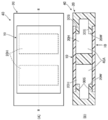
- a plan view showing a state in which the thermoplastic resin film covers the opening of the thermoplastic resin molded article, and a thermoplastic resin cut along the line II-II in FIG. 2 (A).
- FIG. 2 (B) sectional drawing
- FIG. 2 (B) shows the side shape of a molded article.
- FIG. 2 (B) shows the side shape of a molded article.
- thermoplastic resin film A
- thermoplastic resin molded product B
- thermoplastic resin molded product welding allowance energy director
- the styrenic resin examples include homopolymers such as styrene and ⁇ -methylstyrene, copolymers thereof, and copolymers with unsaturated monomers copolymerizable therewith.
- GPPS general-purpose polystyrene
- HIPS impact-resistant polystyrene
- HPS heat-resistant polystyrene
- ABS acrylonitrile / butadiene / styrene copolymer
- ABS Acrylonitrile-butadiene-styrene- ⁇ -methylstyrene copolymer
- ⁇ -methylstyrene heat-resistant ABS acrylonitrile-butadiene-styrene-phenylmaleimide copolymer (phenylmaleimide heat-resistant ABS), acrylonitrile-styrene copolymer ( AS), acrylonitrile-chlorin
- polyphenylene ether resin examples include homopolymers such as poly (2,6-dimethyl-1,4-phenylene) ether and poly (2-methyl-6-ethyl-1,4-phenylene) ether. It is also possible to use those modified with a styrene resin.
- polystyrene resin typically, homopolymers of ⁇ -olefins such as ethylene, propylene, butene-1, 3-methylbutene-1, 3-methylpentene-1, 4-methylpentene-1, or the like are used. Examples thereof include copolymers and copolymers of these with other copolymerizable unsaturated monomers.
- Typical examples are high density polyethylene, medium density polyethylene, low density polyethylene, linear low density polyethylene, ultrahigh molecular weight polyethylene, ethylene / vinyl acetate copolymer, ethylene / ethyl acrylate copolymer, ethylene / octene- Polyethylenes such as metallocene ethylene / ⁇ -olefin copolymers such as 1 copolymer, atactic polypropylene, syndiotactic polypropylene, isotactic polypropylene, or polypropylenes such as propylene / ethylene block copolymer or random copolymer, Examples thereof include polymethylpentene-1.
- polyvinyl chloride resin examples include vinyl chloride homopolymers and copolymers with unsaturated monomers copolymerizable with vinyl chloride. Specifically, vinyl chloride / acrylic acid ester copolymer, vinyl chloride / methacrylic acid ester copolymer, vinyl chloride / ethylene copolymer, vinyl chloride / propylene copolymer, vinyl chloride / vinyl acetate copolymer, And vinyl chloride / vinylidene chloride copolymer. In addition, those obtained by chlorinating these polyvinyl chloride resins to increase the chlorine content can also be used.
- polyamide resin examples include those obtained by ring-opening polymerization of a cyclic aliphatic lactam represented by 6-nylon (polyamide 6) or 12-nylon, 6,6-nylon, 6,10-nylon, 6 , 12-nylon or the like, and those obtained by polycondensation of aliphatic diamine and aliphatic dicarboxylic acid, or those obtained by copolycondensation of aromatic diamine and aromatic dicarboxylic acid in some cases.
- polyamide 6 cyclic aliphatic lactam represented by 6-nylon (polyamide 6) or 12-nylon, 6,6-nylon, 6,10-nylon, 6 , 12-nylon or the like
- PA polyamide resin
- polyester resins include those obtained by polycondensation of aromatic dicarboxylic acids and alkylene glycols such as ethylene glycol, propylene glycol, and butylene glycol. Specific examples include polyethylene terephthalate (PET), polypropylene terephthalate (PPT), polybutylene terephthalate (PBT), and the like.
- polycarbonate resin examples include 4,4′-dihydroxydiarylalkane polycarbonate.
- specific examples include bisphenol A polycarbonate (PC), modified bisphenol polycarbonate, copolymers thereof, and the like.
- acrylic resin examples include methacrylic acid esters, acrylic acid ester homopolymers or copolymers thereof, and copolymers of these with other copolymerizable unsaturated monomers.
- methacrylic acid ester and acrylic acid ester monomers include methyl, ethyl, n-propyl, isopropyl and butyl esters of methacrylic acid or acrylic acid.
- a typical example is poly (methyl) methacrylate (PMMA).
- the thickness of the thermoplastic resin film (A) is 0.4 mm or less. This means that in the thermoplastic resin film, the surface area of the region having a thickness of 0.4 mm or less is 70% or more of the surface area of the entire film.
- the preferred thickness of the thermoplastic resin film (A) is from 0.01 mm to 0.4 mm, more preferably from 0.1 mm to 0.4 mm, and most preferably from 0.2 mm to 0.3 mm.
- thermoplastic resin film (A) of this invention can use the film manufactured from the melt extrusion method using a T die, the solvent cast method, and the blow molding method.
- thermoplastic resin molded product (B) has an average thickness of 0.5 mm or more.
- examples of the molding method of the thermoplastic resin molded product (B) include injection molded products, press molded products, blow molded products, extruded molded products, vacuum molded products, and compressed air molded products. A molded article is preferably used.
- the shape of the thermoplastic resin molded product (B) is not limited to a flat plate, but may be a three-dimensional shape.
- the thermoplastic resin molded product (B) is a three-dimensional molded product having an opening of 3 cm 2 or more, for example, a housing, and the opening is made of the thermoplastic resin film (A).
- the coating configuration is preferably used in the present invention.
- thermoplastic resin molded product (energy director) (C) The welding allowance (energy director) (C) is installed on the welding surface of the thermoplastic resin molded product (B) in order to join the thermoplastic resin film (A) and the thermoplastic resin molded product (B).
- ultrasonic welding As a bonding method, ultrasonic welding is used. In ultrasonic welding, ultrasonic energy concentrates on the welding allowance (energy director) installed in the thermoplastic resin molded product (B), and the welding allowance (C) and thermoplasticity of the thermoplastic resin molded product (B). The melted welding allowance (energy director) and the thermoplastic resin film (A) are joined by heat generated by friction with the resin film (A).
- the energy director has a convex shape toward the thermoplastic resin film (A) to be joined, that is, upward, and the film thickness cross section is triangular.
- the film thickness cross section is triangular.
- an energy director with a vertex angle of 40 degrees to 120 degrees is used, preferably the vertex angle is 50 to 70 degrees, most preferably 60 degrees. That is, it is particularly preferable that the cross-sectional shape is an equilateral triangle.
- the cross-sectional shape of the welding allowance (energy director) (C) is a triangle, particularly a regular triangle, it is possible to concentrate the ultrasonic energy at the upper end, that is, the apex of the triangle in ultrasonic welding.
- thermoplastic resin molded product (B) side it is possible to sufficiently secure the welding margin region on the thermoplastic resin molded product (B) side, that is, on the bottom side of the triangle.
- a quadrangle should be avoided as a cross-sectional shape of the welding allowance (energy director) (C), and it is preferable to avoid a circular shape.
- the shape of the welding allowance (energy director) (C) can be imparted by a method of transferring from injection molding or hot press molding with a mold, machining of the molded product, processing by printing, and the like.
- welding allowance (C) is arrange
- the welding allowance (C) is preferably provided in a row on the welding surface of the thermoplastic resin molded product (B). This is because when a plurality of rows of welding allowances (C), for example, a plurality of parallel rows are provided on the welding surface of the thermoplastic resin molded product (B), ultrasonic energy is dispersed in the plurality of rows.
- the length 24H is preferably 72% to 130% of the thickness 10T of the thermoplastic resin film (A) 10. That is, when the thickness of the thermoplastic resin film (A) is A (mm) and the welding allowance (C) is C (mm), The value of C (mm) / A (mm) ⁇ 100 (%) is preferably 72% to 130%, The value of (1-C (mm) / A (mm)) ⁇ 100 (%) is preferably ⁇ 28% to 30%.
- the height 24H of the welding allowance 24 is 75 to 125%, more preferably 80 to 120%, particularly preferably 85 to 115% of the thickness 10T of the thermoplastic resin film (A) 10.
- the height 24H of the welding allowance (energy director) exceeds the upper limit, the welding strength can be obtained, but there may be a problem that appearance defects are likely to occur due to the pushing of the energy director.
- the height 24H of the welding allowance (energy director) does not satisfy the lower limit, a laminate having a good appearance can be obtained, but there may be a problem that the welding strength is lowered. As shown in FIG.
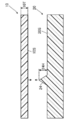
- thermoplastic resin film 10 and the thermoplastic resin are formed by ultrasonic welding in which the thermoplastic resin film 10 and the thermoplastic resin molded product 20 are welded as indicated by an arrow in a state of facing each other.
- a laminate with the molded product 20 is formed.
- the welding allowance 24 is melted by ultrasonic welding and becomes a joint part melt-mixed with the thermoplastic resin film 10.
- the surface of these members becomes substantially smooth, and the problem on an external appearance does not arise.
- Thermal deformation temperature of thermoplastic resin film (A) and thermoplastic resin molded product (B) is the glass transition temperature when these resins are amorphous resins, and when these resins are crystalline resins. Is the melting point.
- the heat distortion temperature can be measured by DSC (differential thermal scanning calorimetry). In the case of an incompatible polymer alloy material, the heat deformation temperature of the matrix resin is used.
- a combination having a difference in heat distortion temperature of 20 ° C. or less is preferably used.
- the difference in heat distortion temperature is 15 ° C. or less, and particularly preferably 10 ° C. or less.
- the thermoplastic resin film (A) and the thermoplastic resin molded product (B) are preferably highly compatible or highly reactive.
- the thermoplastic resin film (A) and the thermoplastic resin molded product (B) are formed of the same kind of resin material.
- the same kind of material here refers to a thermoplastic resin material having the same resin system shown in the paragraph [0013] and the following, more specifically, a thermoplastic resin material having the same kind of chemical bond.
- the same type of resin in the present invention can be used even if the molecular weight is different, the type of copolymerization, the copolymer composition ratio, and the amount of additives are different.
- the difference in thermal deformation temperature between the thermoplastic resin film (A) and the thermoplastic resin molded product (B) exceeds 20 ° C., when the appearance is given priority, the resin welding strength becomes insufficient, and the welding strength is given priority. In some cases, since higher ultrasonic energy is required, there is a problem that the appearance of the obtained thermoplastic resin film laminate (molded article) is inferior.
- thermoplastic resin film laminate In the method for producing a thermoplastic resin film laminate of the present invention, ultrasonic welding is used. That is, a thermoplastic resin film laminated body is manufactured by ultrasonically welding the above-mentioned thermoplastic resin film (A) and the welding margin (C) of the above-mentioned thermoplastic resin molded product (B). For example, by providing a welding allowance (C) around the opening of the thermoplastic resin molded product (B) and bonding the thermoplastic resin film (A) so as to cover the opening, the thermoplastic resin film laminate is obtained. can get.
- the thickness of the thermoplastic resin film (A) is adjusted to a value within a predetermined range, and the welding allowance (C) having a predetermined height is further adjusted to the thermoplastic resin molded product (B).
- the manufacturing method provided on the welding surface a laminate having good welding strength and appearance can be obtained, and further, the difference in thermal deformation temperature between the thermoplastic resin film (A) and the thermoplastic resin molded product (B) is obtained. By suppressing it, it is possible to ensure both high welding strength and good appearance.
- thermoplastic resin composition used in the present invention may contain components other than those described above as necessary as long as desired physical properties are not significantly impaired.
- other components include phosphates, heat stabilizers typified by phosphites, antioxidants typified by hindered phenol compounds, UV absorbers typified by benzotriazole compounds, antifogging agents, and anti-blocking agents.
- One of these resin additives may be contained, or two or more thereof may be contained in any combination and ratio.
- thermoplastic resin film 10 and the heat are so formed that the thermoplastic resin film 10 covers the opening 20H with respect to the thermoplastic resin molded article 20 having the opening 20H.
- a laminate with the plastic resin molded product 20 can be formed.
- the plastic resin molded product 20 is welded by ultrasonic welding.
- a wider internal space 40A is formed compared to the case where the entire surface is formed by the wall member 20W of the thermoplastic resin molded product 20 having a thickness larger than that of the thermoplastic resin film 10. For example, a space for accommodating internal components such as a battery is increased.
- the thermal deformation temperature (Tg) of the thermoplastic resin was measured with a differential thermal scanning calorimeter SSC-5200 (DSC) manufactured by Seiko Denshi Kogyo Co., Ltd. In the measurement, the temperature was raised to 20 ° C./min to a temperature at which the resin component melts in a nitrogen atmosphere (260 ° C.), rapidly cooled to ⁇ 30 ° C., and then again raised to 10 ° C./min (2nd run). The glass transition temperature and the melting point were determined from the obtained DSC curve by the starting point method.
- DSC-5200 differential thermal scanning calorimeter SSC-5200
- ⁇ Appearance evaluation> The appearance evaluation of the molded product laminate after ultrasonic welding of the film laminate was performed visually. Visual observation was performed from the film side. There is almost no surface damage due to the indentation of the welding allowance (energy director) on the film surface, particularly excellent conditions are excellent, there are few surface scratches, good conditions are good, surface defects are somewhat conspicuous, surface defects are somewhat poor, and surface damage is large A state inferior in appearance was regarded as defective.
- the polycarbonate resin was compounded according to the formulation shown in Table 1, and a commercially available polybutylene terephthalate was used.
- A-1 “Iupilon (registered trademark) S-3000F” manufactured by Mitsubishi Engineering Plastics Co., Ltd., bisphenol A type aromatic polycarbonate resin, heat distortion temperature (glass transition temperature) 145 ° C.
- A-2) “Novaduran (registered trademark) 5020” manufactured by Mitsubishi Engineering Plastics Co., Ltd., polybutylene terephthalate resin, heat distortion temperature (melting point) 224 ° C.
- the cylinder / die head temperature was set at 260 ° C. for polycarbonate and 235 ° C. for polybutylene terephthalate.
- the film thickness shown in Table 1 was used.
- the size of the film used for the ultrasonic welding test was cut to 150 mm ⁇ 40 mm to cover the thermoplastic resin molded product (B) shown in FIG.
- thermoplastic resin molded product (B)> A 150 mm ⁇ 100 mm ⁇ 1.2 mm thick flat resin plate of the composition described in Table 1 was molded by injection molding. By cutting the obtained injection molded product, a thermoplastic resin molded product having a welding allowance (ED, energy type) (C) 24 having the dimensions shown in FIG. 3 and the shape schematically shown in FIG. (B) 20 was produced.
- ED, energy type a welding allowance
- C welding allowance
- symbol in FIG. 3 and 4 shows the dimension (mm) of each member.
- thermoplastic resin molded product (B) 20 and the thermoplastic resin film (A) 10 were integrated to produce a welding allowance integral type thermoplastic resin molded product.
- the height of the welding allowance (ED, energy tyretor) (C) was set to a value of 0.1 to 0.4 mm shown in Table 1. Then, using the thermoplastic resin molded product (B) 20 having the shape shown in FIG. 3, the thermoplastic resin film 10 and the thermoplastic resin molded product 20 so that the thermoplastic resin film completely covers the two openings 20H. And were welded.
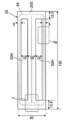
- the thickness of the thermoplastic resin molded product (B) 20 is 1.0 mm, the vertical and horizontal lengths are 4.0 cm and 15.0 cm, respectively, and the vertical and horizontal lengths of each opening 20H are 1. 0 cm and 12.5 cm, and the area of each opening 20H was 12.5 cm 2 (see FIG. 3).
- the welding allowance (C) 24 was provided in the position shown with the broken line so that the circumference
- thermoplastic resin film (A) 10 is made into a thermoplastic resin molded product ( B) It can be firmly fixed to 20.
- region I of the welding surface 20S the process which provides the welding margin becomes easy by providing the area
- ⁇ Ultrasonic welding method> For ultrasonic welding, a Branson 2000Xdt (20 kHz 2200 W) manufactured by Nippon Emerson Co., Ltd. was used, and a welding horn made of a titanium alloy suitable for the shape of the molded product was used. The welding test is performed on the mirror surface side of the thermoplastic resin film (A) and the surface on which the welding allowance of the thermoplastic resin molded product (B) is formed, and the thermoplastic resin molded product (B) is thermoplastic on the upper horn side. The resin film (A) was fixed to the lower horn cradle and a welding test was performed.
- thermoplastic resin film (A) In order to protect the mat pattern of the thermoplastic resin film (A), a test was conducted by bringing a protective film made of polyethylene having a thickness of 0.03 mm into contact with the film.
- the parameter settings in the ultrasonic welding test are as follows. That is, an ultrasonic welding test was performed under the conditions of an irradiation time of 0.3 sec (0.45 sec for polybutylene terephthalate resin), a hold time of 0.3 sec, an air cylinder pressure of 200 kPa, a trigger force of 250 N, and an amplitude of 100%.
Landscapes
- Engineering & Computer Science (AREA)
- Mechanical Engineering (AREA)
- Physics & Mathematics (AREA)
- Thermal Sciences (AREA)
- Lining Or Joining Of Plastics Or The Like (AREA)
- Laminated Bodies (AREA)
Abstract
Description
また他に、接着剤や両面テープを介してフィルムと射出成形品を貼り合せる方法などがあるが、いずれの方法によっても、局部的に接着部の厚みが増加するため外観の良いものは得られなかった。
[2]熱可塑性樹脂フィルム(A)と熱可塑性樹脂成形品(B)とが同種の樹脂材料で形成されている[1]に記載の熱可塑性樹脂フィルム積層体。
[3]熱可塑性樹脂フィルム(A)の厚みが0.2mmから0.3mmである、[1]又は[2]のいずれかに記載の熱可塑性樹脂フィルム積層体。
[4]熱可塑性樹脂成形品(B)が、3cm2以上の開口部を少なくとも1つ以上有し、開口部の少なくとも一部を熱可塑性樹脂フィルム(A)が覆っている[1]~[3]のいずれかに記載の熱可塑性樹脂フィルム樹脂積層体。
[5]上記[1]~[4]のいずれかに記載の熱可塑性樹脂フィルム積層体を含有する成形品。
本発明の樹脂組成物に含まれる熱可塑性樹脂には、特に制限はなく、従来、成形材料として使用されているものから任意に選択して使用することができる。例えば、スチレン系樹脂、ポリフェニレンエーテル系樹脂、ポリオレフィン系樹脂、ポリ塩化ビニル系樹脂、ポリアミド系樹脂、ポリエステル系樹脂、ポリカーボネート系樹脂及びアクリル系樹脂等が挙げられる。
本発明において、熱可塑性樹脂フィルム(A)の厚みは0.4mm以下である。これは熱可塑性樹脂フィルムにおいて、厚みが0.4mm以下である領域の表面積がフィルム全体の表面積の70%以上であるものをいう。熱可塑性樹脂フィルム(A)の厚みが0.4mmより大きいと、通常、射出成形での成形が容易となり、また充分な厚みを有するためエネルギーダイレクターの押込による外観不良が観察されないことから、本発明の効果が充分に得られない。熱可塑性樹脂フィルム(A)の好ましい厚みは0.01mmから0.4mm以下であり、さらに好ましくは0.1mmから0.4mm、最も好ましくは0.2mmから0.3mmである。熱可塑性樹脂フィルム(A)の厚みが0.01mmより小さいとフィルムが薄すぎるため、超音波溶着後の良好な外観が得られず、また筐体として用いた場合、内部部品の保護が不充分となる問題が生じ得る。なお、本発明の熱可塑性樹脂フィルム(A)は、Tダイを用いた溶融押出法、溶剤キャスト法、ブロー成形法から製造されたフィルムを用いることができる。
本発明において、熱可塑性樹脂成形品(B)は、厚みの平均が0.5mm以上である。また、熱可塑性樹脂成形品(B)の成形方法は、射出成形品、プレス成形品、ブロー成形品、押出成形品、真空成形品、圧空成形品などが挙げられるが、生産性の観点から射出成形品が好ましく用いられる。
溶着代(エネルギーダイレクター)(C)は、熱可塑性樹脂フィルム(A)と熱可塑性樹脂成形品(B)を接合するために、熱可塑性樹脂成形品(B)の溶着面に設置される。接合法としては、超音波溶着が用いられる。超音波溶着においては、熱可塑性樹脂成形品(B)に設置された溶着代(エネルギーダイレクター)に超音波エネルギーが集中し、熱可塑性樹脂成形品(B)の溶着代(C)と熱可塑性樹脂フィルム(A)との摩擦によって生じる発熱によって、溶融した溶着代(エネルギーダイレクター)と熱可塑性樹脂フィルム(A)が接合される。
エネルギーダイレクターは、接合される熱可塑性樹脂フィルム(A)側、すなわち上側に向かって凸の形状であり、フィルム厚み断面の形状が三角形であることが好ましい。この断面の三角形については、頂点の角度が40度から120度のエネルギーダイレクターが用いられ、好ましくは頂点の角度は50~70度、最も好ましくは60度である。すなわち、断面形状が正三角形であることが特に好ましい。このように、溶着代(エネルギーダイレクター)(C)の断面形状が三角形、特に正三角形であれば、超音波溶着において、超音波エネルギーを上端部、すなわち三角形の頂点に集中させることを可能にしつつ、熱可塑性樹脂成形品(B)側、すなわち三角形の底辺側の溶着代の領域を十分に確保できる。このような観点から、溶着代(エネルギーダイレクター)(C)の断面形状として、四角形を回避すべきであり、円状も回避することが好ましい。溶着代(エネルギーダイレクター)(C)の形状は、射出成形又は熱プレス成形から金型で転写する方法、成形品の機械切削、印刷等による加工によって付与できる。
なお、溶着代(C)は、熱可塑性樹脂成形品(B)の溶着面において、連なって列状(ライン状)に配置されていることが好ましい。特に、溶着代(C)は、熱可塑性樹脂成形品(B)の溶着面において一列に設けられていることが好ましい。熱可塑性樹脂成形品(B)の溶着面において溶着代(C)の複数の列、例えば、平行な複数の列を設けると、超音波エネルギーが複数の列に分散されるためである。
C(mm)/A(mm)×100(%)の値が、好ましくは72%~130%であり、
(1-C(mm)/A(mm))×100(%)の値が、好ましくは-28%~30%である。
なお好ましくは、溶着代24の高さ24Hは、熱可塑性樹脂フィルム(A)10の厚み10Tの75~125%、より好ましくは80~120%、特に好ましくは85~115%である。溶着代(エネルギーダイレクター)の高さ24Hが上限を超える場合は、溶着強度は得られるがエネルギーダイレクターの押込による外観不良が起こりやすいという問題が生じ得る。また溶着代(エネルギーダイレクター)の高さ24Hが下限を満たさない場合は、良好な外観の積層体が得られるが、溶着強度が低下する問題が生じ得る。
図1に示されるように、熱可塑性樹脂フィルム10と熱可塑性樹脂成形品20とを互いに対向させた状態で、矢印の示すように溶着させる超音波溶着により、熱可塑性樹脂フィルム10と熱可塑性樹脂成形品20との積層体が形成される。こうして得られる積層体の熱可塑性樹脂フィルム10と熱可塑性樹脂成形品20との間において、溶着代24は、超音波溶着により溶けて熱可塑性樹脂フィルム10と溶融混合された接合部となる。このため、製造された積層体における熱可塑性樹脂フィルム10と熱可塑性樹脂成形品20との接合領域では、これらの部材の表面はいずれも実質的に平滑になり、外観上の問題は生じない。
本発明における熱可塑性樹脂フィルム(A)と熱可塑性樹脂成形品(B)の熱変形温度は、これらの樹脂が非晶性樹脂の場合はガラス転移温度とし、これらの樹脂が結晶性樹脂の場合は融点とする。熱変形温度はDSC(示差熱走査熱量分析計)によって測定できる。非相溶系のポリマーアロイ材の場合は、マトリックス樹脂の熱変形温度とする。
熱可塑性樹脂フィルム(A)と熱可塑性樹脂成形品(B)の組合せは、好ましくは、熱変形温度の差が20℃以下のものを用いる。より好ましくは、熱変形温度の差は15℃以下であり、特に好ましくは10℃以下である。なかでも熱可塑性樹脂フィルム(A)と熱可塑性樹脂成形品(B)樹脂の種類は相溶性の高いもの、もしくは反応性の高いものが好ましく用いられる。特に、熱可塑性樹脂フィルム(A)と熱可塑性樹脂成形品(B)を、同種の樹脂材料で形成することが好ましい。ここでいう同種の材料とは、段落[0013]以下に示した樹脂の系統が同一のもの、より具体的には同種の化学結合を有する熱可塑性樹脂材料のことをいう。そのため、同種の分子構造を有する樹脂材料であれば、分子量が異なるもの、共重合の種類、共重合組成比、添加剤の配合量が異なっているものであっても、本発明における同種の樹脂材料と定義する。
熱可塑性樹脂フィルム(A)と熱可塑性樹脂成形品(B)の熱変形温度の差が20℃を超える場合、外観を優先にした場合は樹脂溶着強度が不充分となり、その溶着強度を優先した場合はさらに高い超音波エネルギーが必要となるため、得られた熱可塑性樹脂フィルム積層体(成形品)の外観が劣るといった問題が生じ得る。
本発明の熱可塑性樹脂フィルム積層体の製造方法においては、超音波溶着が用いられる。すなわち、熱可塑性樹脂フィルム積層体は、上述の熱可塑性樹脂フィルム(A)と、上述の熱可塑性樹脂成形品(B)の溶着代(C)とを超音波溶着することにより、製造される。例えば、熱可塑性樹脂成形品(B)の開口部の周囲に溶着代(C)を設け、開口部を覆うように熱可塑性樹脂フィルム(A)を接合させることにより、熱可塑性樹脂フィルム積層体が得られる。
こうして製造された筐体である積層体40においては、厚みが熱可塑性樹脂フィルム10よりも大きい熱可塑性樹脂成形品20の壁部材20Wにより全面を形成した場合に比べて、より広い内部空間40Aを確保することができ、例えば電池などの内部部品を収容するスペースが増すこととなる。
熱可塑性樹脂の熱変形温度(Tg)は、示差熱走査熱量分析計セイコー電子工業(株)製のSSC-5200(DSC)で測定した。測定においては、窒素雰囲気下で樹脂成分が溶融する温度(260℃)に20℃/minで昇温し、-30℃まで急冷した後、再度10℃/minで昇温(2nd run)した。得られたDSC曲線から始点法によってガラス転移温度及び融点を求めた。
超音波溶着強度の評価として、フィルム積層体の溶着後の成形品の成形品穴開き部を、成形品側から指で押込み破壊した。
特に良好:溶着部での破壊は見られなかった。
良好:一部、溶着代での破壊が見られた。
不良:溶着していたフィルムが剥離した。
フィルム積層体の超音波溶着後の成形品積層体の外観評価を目視にて行った。目視観察はフィルム側から行った。フィルム表面に溶着代(エネルギーダイレクター)の押込みによる表面傷がほとんどなく特に優れた状態を特に良好、表面傷が少なく良好な状態を良好、表面傷がやや目立つものをやや不良、表面傷が大きく外観に劣る状態を不良とした。
図3に示すように、2つの開口部を有し、図1及び2に示された成形品とは形状の異なる平板状の成形品にフィルム積層体を溶着させた後に、成形品積層のたわみの度合いを目視にて確認した。たわみがほとんどない状態を良好、たわみが大きい状態を不良とした。
<熱可塑性樹脂>
ポリカーボネート樹脂は表1の配合でコンパウンド化を実施、ポリブチレンテレフタレートは市販のものを用いた。
(a-1)三菱エンジニアリングプラスチックス(株)製「ユーピロン(登録商標)S-3000F」、ビスフェノールA型芳香族ポリカーボネート樹脂、熱変形温度(ガラス転移温度)145℃
(a-2)三菱エンジニアリングプラスチックス(株)製「ノバデュラン(登録商標)5020」、ポリブチレンテレフタレート樹脂、熱変形温度(融点)224℃
(a-3)三菱エンジニアリングプラスチックス(株)製「ノバデュラン(登録商標)5510S」、ポリブチレンテレフタレート樹脂、熱変形温度(融点)219℃
<難燃剤>
(b-1)大八化学工業(株)製 「PX-200」、芳香族縮合リン酸エステル系難燃剤、1,3-フェニレンビス(ジ-2,6-キシレニルホスフェート)
<樹脂ペレットの製造>
ポリカーボネート樹脂組成物のコンパウンド化には、1ベントを備えた日本製鋼所社製二軸押出機TEX30α(C18ブロック)を用いた。そして、スクリュー回転数200rpm、吐出量20kg/時間、バレル温度270℃の条件で各成分を混練し、ストランド状に押出した溶融樹脂を水槽にて急冷し、ペレタイザーを用いてペレット化してポリカーボネート樹脂組成物のコンパウンドを得た。
バレル直径32mm、スクリューのL/D=35の二軸押出機からなるTダイ溶融押出機を用い、吐出量20kg/h、スクリュー回転数200rpmで幅400mmのシートを成形した。シリンダー・ダイヘッド温度の設定は、ポリカーボネートは260℃、ポリブチレンテレフタレートは235℃で行った。フィルムの表面は、一方が鏡面、もう一方には表面粗さRa=1.5μmのマット形状が転写されたものを用いた。フィルム厚みは表1に示したものを用いた。超音波溶着試験に用いたフィルムの大きさは、図3に示した熱可塑性樹脂成形品(B)を覆うため150mm×40mmにカットしたものを用いた。
表1に記載した組成品の150mm×100mm×1.2mm厚平板の樹脂プレートを射出成形で成形した。得られた射出成形品を切削加工することによって、図3に示す寸法、及び図1に概略的に示した形状の溶着代(ED、エネルギータイレクター)(C)24を有する熱可塑性樹脂成形品(B)20を製造した。なお、図3及び4中の符号とは異なる数値は、各部材の寸法(mm)を示す。これらの数値は、各部材の寸法の一例であり、各部材の寸法を限定するものではない。
上述の熱可塑性樹脂成形品(B)20と、熱可塑性樹脂フィルム(A)10とが一体となった溶着代一体型熱可塑性樹脂成形品を作製した。溶着代(ED、エネルギータイレクター)(C)の高さは、表1に示す0.1~0.4mmの値とした。そして図3に示す形状を有する熱可塑性樹脂成形品(B)20を用いて、熱可塑性樹脂フィルムが2つの開口部20Hを完全に覆うように、熱可塑性樹脂フィルム10と熱可塑性樹脂成形品20とを溶着させた。熱可塑性樹脂成形品(B)20の厚さは1.0mm、縦及び横の長さはそれぞれ4.0cm及び15.0cmであり、各開口部20Hの縦及び横の長さはそれぞれ1.0cm及び12.5cmであり、各開口部20Hの面積は12.5cm2であった(図3参照)。そして、熱可塑性樹脂成形品(B)20の溶着面20S上に、開口部20Hの周囲を囲むように、溶着代(C)24を破線で示された位置に設けた。図4において、図3に示す溶着面20Sの領域I及びIIを拡大して示す。
このように、開口部20Hの実質的に全周を囲むように溶着代(C)24を設けて超音波溶着を行うことにより、熱可塑性樹脂フィルム(A)10を、熱可塑性樹脂成形品(B)20に対して強固に固定することができる。なお、溶着面20Sの領域Iにおいて、溶着代(C)24の途切れている領域20Dを設けることにより(図4参照)、溶着代を設ける加工が容易になる。

成形品開口部を覆うフィルムのたわみ状態について、超音波溶着品とインモールドフィルムによる射出成形品との比較を行うため、インモールドフィルムによる射出成形品を成形した。あらかじめ超音波溶着用成形品と同寸法(150×40mm)のポリカーボネート樹脂フィルムを金型内に設置、超音波溶着用金型の溶着代(C)の彫込がない金型にてポリカーボネート樹脂の射出成形を行った。以下の成形条件、すなわち、シリンダー温度320℃、金型温度95℃の条件で成形した。インモールドフィルム成形で得られた結果を比較例4に示す。

超音波溶着は、日本エマソン社製のBranson 2000Xdt(20kHz 2200W)を用い、成形品形状に合ったチタン合金製の溶着ホーンを使用した。溶着試験は熱可塑性樹脂フィルム(A)の鏡面側と熱可塑性樹脂成形品(B)の溶着代が形成されている面とで行い、熱可塑性樹脂成形品(B)を上部ホーン側、熱可塑性樹脂フィルム(A)を下部ホーン受け台に固定し溶着試験を行った。熱可塑性樹脂フィルム(A)のマット柄の保護のため、フィルムに厚さ0.03mmのポリエチレン製の保護フィルムを接触させて試験を行った。超音波溶着試験におけるパラメータの設定は以下の通りである。すなわち、照射時間0.3sec(ポリブチレンテレフタレート樹脂では0.45sec)、ホールド時間0.3sec、エアーシリンダ圧力200kPa、トリガーフォース250N、及び振幅100%の条件で超音波溶着試験を実施した。
10T 熱可塑性樹フィルムの厚み
20 熱可塑性樹脂成形品
20H 開口部
20S 溶着面
24 溶着代
24H 溶着代の高さ
Claims (5)
- 厚み0.4mm以下の熱可塑性樹脂フィルム(A)と、溶着代(C)を有する厚み0.5mm以上の熱可塑性樹脂成形品(B)の前記溶着代(C)とを超音波溶着して得られる熱可塑性樹脂積層体であって、
該溶着代(C)の高さが該熱可塑性樹脂フィルム(A)の厚みの72~130%であり、
前記熱可塑性樹脂フィルム(A)と前記熱可塑性樹脂成形品(B)の熱変形温度の差が20℃以下である熱可塑性樹脂フィルム積層体。 - 前記熱可塑性樹脂フィルム(A)と前記熱可塑性樹脂成形品(B)とが同種の樹脂材料で形成されている請求項1に記載の熱可塑性樹脂フィルム積層体。
- 前記熱可塑性樹脂フィルム(A)の厚みが0.2mm~0.3mmである、請求項1又は2のいずれかに記載の熱可塑性樹脂フィルム積層体。
- 前記熱可塑性樹脂成形品(B)が、3cm2以上の開口部を少なくとも1つ以上有し、前記開口部の少なくとも一部を前記熱可塑性樹脂フィルム(A)が覆っている請求項1~3のいずれか一項に記載の熱可塑性樹脂フィルム積層体。
- 請求項1~4のいずれか一項に記載の熱可塑性樹脂フィルム積層体を含有する成形品。
Priority Applications (4)
| Application Number | Priority Date | Filing Date | Title |
|---|---|---|---|
| KR1020177027781A KR102427367B1 (ko) | 2015-03-25 | 2016-03-24 | 열가소성 수지 필름 적층체 및 열가소성 수지 필름 적층체를 포함하는 성형품 |
| CN201680015816.9A CN107405890B (zh) | 2015-03-25 | 2016-03-24 | 热塑性树脂膜叠层体、以及包含热塑性树脂膜叠层体的成型品 |
| JP2017508421A JP6718863B2 (ja) | 2015-03-25 | 2016-03-24 | 熱可塑性樹脂フィルム積層体、及び熱可塑性樹脂フィルム積層体を含む成形品 |
| US15/559,184 US20180071995A1 (en) | 2015-03-25 | 2016-03-24 | Thermoplastic resin film laminate and molded article comprising thermoplastic resin film laminate |
Applications Claiming Priority (2)
| Application Number | Priority Date | Filing Date | Title |
|---|---|---|---|
| JP2015062837 | 2015-03-25 | ||
| JP2015-062837 | 2015-03-25 |
Publications (1)
| Publication Number | Publication Date |
|---|---|
| WO2016152974A1 true WO2016152974A1 (ja) | 2016-09-29 |
Family
ID=56978752
Family Applications (1)
| Application Number | Title | Priority Date | Filing Date |
|---|---|---|---|
| PCT/JP2016/059387 Ceased WO2016152974A1 (ja) | 2015-03-25 | 2016-03-24 | 熱可塑性樹脂フィルム積層体、及び熱可塑性樹脂フィルム積層体を含む成形品 |
Country Status (6)
| Country | Link |
|---|---|
| US (1) | US20180071995A1 (ja) |
| JP (1) | JP6718863B2 (ja) |
| KR (1) | KR102427367B1 (ja) |
| CN (1) | CN107405890B (ja) |
| TW (1) | TWI738642B (ja) |
| WO (1) | WO2016152974A1 (ja) |
Families Citing this family (4)
| Publication number | Priority date | Publication date | Assignee | Title |
|---|---|---|---|---|
| US20210146081A1 (en) * | 2017-02-22 | 2021-05-20 | Weinmann Emergency Medical Technology GMBH + Co., KG | Emergency resuscitation system with remote control |
| EP4043524B1 (en) * | 2020-10-19 | 2025-03-12 | LG Chem, Ltd. | Thermoplastic resin composition, preparation method therefor, and molded product comprising same |
| US11701736B2 (en) * | 2021-09-30 | 2023-07-18 | Wiegel Tool Works, Inc. | Systems and methods for making a composite thickness metal part |
| KR102561388B1 (ko) * | 2023-04-17 | 2023-08-01 | 김병진 | 골판지 인쇄용 조판지 제조방법 및 이에 의해 제조된 조판지 |
Citations (2)
| Publication number | Priority date | Publication date | Assignee | Title |
|---|---|---|---|---|
| JP2007253508A (ja) * | 2006-03-24 | 2007-10-04 | Toppan Printing Co Ltd | 超音波融着体 |
| WO2013069490A1 (ja) * | 2011-11-08 | 2013-05-16 | 大日本印刷株式会社 | 細胞培養容器の製造方法 |
Family Cites Families (20)
| Publication number | Priority date | Publication date | Assignee | Title |
|---|---|---|---|---|
| US3997677A (en) * | 1972-05-09 | 1976-12-14 | Standard Packaging Corporation | High temperature resistant hermetically sealed plastic tray packages |
| JPS52141880A (en) * | 1976-05-19 | 1977-11-26 | Ici Ltd | Laminated structure and method for its production |
| US4322480A (en) * | 1980-12-29 | 1982-03-30 | Allied Chemical Corporation | Polyamide-polyethylene laminates |
| JPS58160125A (ja) * | 1982-03-17 | 1983-09-22 | Hitachi Ltd | 成形体とその製造方法 |
| US4462849A (en) * | 1982-04-23 | 1984-07-31 | Cosden Technology, Inc. | Method of oscillatory bonding |
| JPS6254757A (ja) | 1985-05-23 | 1987-03-10 | Toray Ind Inc | ポリフエニレンスルフイド樹脂組成物 |
| US4865217A (en) * | 1987-08-31 | 1989-09-12 | Sumitomo Bakelite Company, Limited | Easily openable sealed container |
| US4909434A (en) * | 1988-05-20 | 1990-03-20 | The Procter & Gamble Company | Moisture impervious carton having one-piece pouring spout sealed to innermost and outermost surfaces |
| GB9110902D0 (en) * | 1991-05-21 | 1991-07-10 | Ici Plc | Polymeric film |
| US5912084A (en) * | 1994-08-10 | 1999-06-15 | E. I. Du Pont De Nemours And Company | Packaging seal layer |
| JP2000043915A (ja) * | 1998-07-29 | 2000-02-15 | Toppan Printing Co Ltd | 耐圧性蓋体 |
| JP2000179103A (ja) * | 1998-12-16 | 2000-06-27 | Tsutsunaka Plast Ind Co Ltd | 防水シート敷設用固定治具及び防水シートの敷設方法 |
| JP3947321B2 (ja) * | 1999-03-04 | 2007-07-18 | パイオニア株式会社 | 発泡成形体およびその成形方法およびそれによるスピーカ振動板 |
| JP2000326413A (ja) * | 1999-05-20 | 2000-11-28 | Meiwa Ind Co Ltd | 超音波溶着方法 |
| US7655457B2 (en) * | 2003-11-17 | 2010-02-02 | Hitachi, Ltd. | Cell culture vessel and cultured cell |
| JP4558374B2 (ja) | 2004-05-11 | 2010-10-06 | 上野製薬株式会社 | 液晶ポリエステル樹脂組成物の接合方法および液晶ポリエステル樹脂組成物接合体 |
| US20090045210A1 (en) * | 2007-08-18 | 2009-02-19 | Tilton Christopher R | Pliable ground calcium carbonates storage articles and method of making same |
| JP2013129077A (ja) | 2011-12-20 | 2013-07-04 | Teijin Dupont Films Japan Ltd | インモールド転写箔用積層ポリエステルフィルム |
| JP6083248B2 (ja) * | 2013-02-08 | 2017-02-22 | 東レ株式会社 | 繊維強化熱可塑性樹脂一体化構造体の製造方法 |
| WO2014208423A1 (ja) * | 2013-06-26 | 2014-12-31 | 三菱瓦斯化学株式会社 | 難燃性シートまたはフィルム、及びそれを用いた製品及びその製造方法 |
-
2016
- 2016-03-24 CN CN201680015816.9A patent/CN107405890B/zh active Active
- 2016-03-24 JP JP2017508421A patent/JP6718863B2/ja active Active
- 2016-03-24 US US15/559,184 patent/US20180071995A1/en not_active Abandoned
- 2016-03-24 KR KR1020177027781A patent/KR102427367B1/ko active Active
- 2016-03-24 WO PCT/JP2016/059387 patent/WO2016152974A1/ja not_active Ceased
- 2016-03-24 TW TW105109227A patent/TWI738642B/zh active
Patent Citations (2)
| Publication number | Priority date | Publication date | Assignee | Title |
|---|---|---|---|---|
| JP2007253508A (ja) * | 2006-03-24 | 2007-10-04 | Toppan Printing Co Ltd | 超音波融着体 |
| WO2013069490A1 (ja) * | 2011-11-08 | 2013-05-16 | 大日本印刷株式会社 | 細胞培養容器の製造方法 |
Also Published As
| Publication number | Publication date |
|---|---|
| TWI738642B (zh) | 2021-09-11 |
| KR102427367B1 (ko) | 2022-07-29 |
| JPWO2016152974A1 (ja) | 2018-01-18 |
| TW201702075A (zh) | 2017-01-16 |
| CN107405890B (zh) | 2020-09-29 |
| US20180071995A1 (en) | 2018-03-15 |
| KR20170131477A (ko) | 2017-11-29 |
| CN107405890A (zh) | 2017-11-28 |
| JP6718863B2 (ja) | 2020-07-08 |
Similar Documents
| Publication | Publication Date | Title |
|---|---|---|
| JP6718863B2 (ja) | 熱可塑性樹脂フィルム積層体、及び熱可塑性樹脂フィルム積層体を含む成形品 | |
| JP5888860B2 (ja) | 二軸延伸ポリブチレンテレフタレート系フィルム、およびそれを用いた冷間成形用電池ケース包材 | |
| WO2008018473A1 (en) | Conductive sheet | |
| CN1771281A (zh) | 可生物降解的树脂膜或片及其制造方法 | |
| WO2017170333A1 (ja) | 電池包装用積層体 | |
| CN102924890A (zh) | 一种可完全生物降解热收缩膜及其制备方法 | |
| JP5296400B2 (ja) | 表面機能層を有する樹脂成形体の製造方法及びその成形体 | |
| JP2016104565A (ja) | 二軸延伸ポリブチレンテレフタレート系フィルム、およびそれを用いた冷間成形用電池ケース包材 | |
| US20140345088A1 (en) | Molded Fastener Part | |
| JP2011241347A (ja) | ポリ乳酸系樹脂組成物、ポリ乳酸系耐熱シートおよび成形体 | |
| CN101152775B (zh) | 用于制造热成型制品的方法 | |
| CN113912326B (zh) | 一种无卤改性高填充可回收塑胶板材及其成型方法 | |
| JP2013056457A (ja) | 二軸延伸ポリブチレンテレフタレート系フィルムを含む冷間成形用プレススルーパック包材 | |
| CN1739206A (zh) | 电池用包装 | |
| JP2024050555A (ja) | ポリオレフィン系シート、プレススルーパッケージ包装用底材およびプレススルーパッケージ包装材 | |
| CN104797421A (zh) | 成型体及其制造方法 | |
| JP2013241504A (ja) | ポリ乳酸系樹脂組成物及びそれからなるシート | |
| JP2019142565A (ja) | 深絞り容器 | |
| TW201141945A (en) | Ignition resistant enclosure for electronic components | |
| KR20170113261A (ko) | 내열 용기의 제조 방법 | |
| JPS63309421A (ja) | 2軸延伸ポリエチレンテレフタレ−トシ−ト加工法 | |
| JP2015103072A (ja) | タッチパネルカバー | |
| KR102943472B1 (ko) | 기체 차단성 및 열 성형성이 향상된 생분해성 다층 플라스틱 시이트 | |
| JP7492893B2 (ja) | ポリ乳酸系樹脂発泡シート、および、シート成形品 | |
| JP2015174926A (ja) | ポリ乳酸系樹脂シート |
Legal Events
| Date | Code | Title | Description |
|---|---|---|---|
| 121 | Ep: the epo has been informed by wipo that ep was designated in this application |
Ref document number: 16768877 Country of ref document: EP Kind code of ref document: A1 |
|
| ENP | Entry into the national phase |
Ref document number: 2017508421 Country of ref document: JP Kind code of ref document: A |
|
| WWE | Wipo information: entry into national phase |
Ref document number: 15559184 Country of ref document: US |
|
| NENP | Non-entry into the national phase |
Ref country code: DE |
|
| ENP | Entry into the national phase |
Ref document number: 20177027781 Country of ref document: KR Kind code of ref document: A |
|
| 122 | Ep: pct application non-entry in european phase |
Ref document number: 16768877 Country of ref document: EP Kind code of ref document: A1 |