WO2016147817A1 - ドリル孔あけ用エントリーシート、及びそれを用いたドリル孔あけ加工方法 - Google Patents
ドリル孔あけ用エントリーシート、及びそれを用いたドリル孔あけ加工方法 Download PDFInfo
- Publication number
- WO2016147817A1 WO2016147817A1 PCT/JP2016/055332 JP2016055332W WO2016147817A1 WO 2016147817 A1 WO2016147817 A1 WO 2016147817A1 JP 2016055332 W JP2016055332 W JP 2016055332W WO 2016147817 A1 WO2016147817 A1 WO 2016147817A1
- Authority
- WO
- WIPO (PCT)
- Prior art keywords
- resin
- water
- resin composition
- drilling
- entry sheet
- Prior art date
- Legal status (The legal status is an assumption and is not a legal conclusion. Google has not performed a legal analysis and makes no representation as to the accuracy of the status listed.)
- Ceased
Links
Images

Classifications
-
- B—PERFORMING OPERATIONS; TRANSPORTING
- B26—HAND CUTTING TOOLS; CUTTING; SEVERING
- B26F—PERFORATING; PUNCHING; CUTTING-OUT; STAMPING-OUT; SEVERING BY MEANS OTHER THAN CUTTING
- B26F1/00—Perforating; Punching; Cutting-out; Stamping-out; Apparatus therefor
- B26F1/16—Perforating by tool or tools of the drill type
-
- B—PERFORMING OPERATIONS; TRANSPORTING
- B23—MACHINE TOOLS; METAL-WORKING NOT OTHERWISE PROVIDED FOR
- B23B—TURNING; BORING
- B23B35/00—Methods for boring or drilling, or for working essentially requiring the use of boring or drilling machines; Use of auxiliary equipment in connection with such methods
-
- B—PERFORMING OPERATIONS; TRANSPORTING
- B23—MACHINE TOOLS; METAL-WORKING NOT OTHERWISE PROVIDED FOR
- B23B—TURNING; BORING
- B23B41/00—Boring or drilling machines or devices specially adapted for particular work; Accessories specially adapted therefor
- B23B41/16—Boring or drilling machines or devices specially adapted for particular work; Accessories specially adapted therefor for boring holes with high-quality surface
-
- H—ELECTRICITY
- H05—ELECTRIC TECHNIQUES NOT OTHERWISE PROVIDED FOR
- H05K—PRINTED CIRCUITS; CASINGS OR CONSTRUCTIONAL DETAILS OF ELECTRIC APPARATUS; MANUFACTURE OF ASSEMBLAGES OF ELECTRICAL COMPONENTS
- H05K3/00—Apparatus or processes for manufacturing printed circuits
- H05K3/0011—Working of insulating substrates or insulating layers
- H05K3/0044—Mechanical working of the substrate, e.g. drilling or punching
- H05K3/0047—Drilling of holes
-
- H—ELECTRICITY
- H05—ELECTRIC TECHNIQUES NOT OTHERWISE PROVIDED FOR
- H05K—PRINTED CIRCUITS; CASINGS OR CONSTRUCTIONAL DETAILS OF ELECTRIC APPARATUS; MANUFACTURE OF ASSEMBLAGES OF ELECTRICAL COMPONENTS
- H05K3/00—Apparatus or processes for manufacturing printed circuits
- H05K3/007—Manufacture or processing of a substrate for a printed circuit board supported by a temporary or sacrificial carrier
-
- B—PERFORMING OPERATIONS; TRANSPORTING
- B23—MACHINE TOOLS; METAL-WORKING NOT OTHERWISE PROVIDED FOR
- B23B—TURNING; BORING
- B23B2250/00—Compensating adverse effects during turning, boring or drilling
- B23B2250/12—Cooling and lubrication
-
- B—PERFORMING OPERATIONS; TRANSPORTING
- B26—HAND CUTTING TOOLS; CUTTING; SEVERING
- B26F—PERFORATING; PUNCHING; CUTTING-OUT; STAMPING-OUT; SEVERING BY MEANS OTHER THAN CUTTING
- B26F2210/00—Perforating, punching, cutting-out, stamping-out, severing by means other than cutting of specific products
- B26F2210/02—Perforating, punching, cutting-out, stamping-out, severing by means other than cutting of specific products of stacked sheets
-
- H—ELECTRICITY
- H05—ELECTRIC TECHNIQUES NOT OTHERWISE PROVIDED FOR
- H05K—PRINTED CIRCUITS; CASINGS OR CONSTRUCTIONAL DETAILS OF ELECTRIC APPARATUS; MANUFACTURE OF ASSEMBLAGES OF ELECTRICAL COMPONENTS
- H05K2203/00—Indexing scheme relating to apparatus or processes for manufacturing printed circuits covered by H05K3/00
- H05K2203/01—Tools for processing; Objects used during processing
- H05K2203/0147—Carriers and holders
- H05K2203/0156—Temporary polymeric carrier or foil, e.g. for processing or transferring
-
- H—ELECTRICITY
- H05—ELECTRIC TECHNIQUES NOT OTHERWISE PROVIDED FOR
- H05K—PRINTED CIRCUITS; CASINGS OR CONSTRUCTIONAL DETAILS OF ELECTRIC APPARATUS; MANUFACTURE OF ASSEMBLAGES OF ELECTRICAL COMPONENTS
- H05K2203/00—Indexing scheme relating to apparatus or processes for manufacturing printed circuits covered by H05K3/00
- H05K2203/02—Details related to mechanical or acoustic processing, e.g. drilling, punching, cutting, using ultrasound
- H05K2203/0214—Back-up or entry material, e.g. for mechanical drilling
Definitions
- the present invention relates to an entry sheet for drilling and a drilling method using the same.
- a drilling method for a laminated board or multilayer board used as a printed wiring board material generally one or a plurality of laminated boards or multilayer boards are stacked, and an aluminum foil alone or A method is employed in which a sheet is formed by forming a resin composition layer on the surface of the aluminum foil (hereinafter, this “sheet” is referred to as “drill drilling entry sheet”).
- this “sheet” is referred to as “drill drilling entry sheet”.
- a “copper-clad laminate” is often used as the laminate, but “a laminate without a copper foil in the outer layer” may be used.
- the laminate refers to a “copper-clad laminate” and / or “a laminate without a copper foil in the outer layer”.
- Patent Document 1 proposes a drilling method using a sheet made of a water-soluble resin such as polyethylene glycol in order to meet the demands for improving the hole position accuracy and reducing the hole wall roughness described above.
- Patent Document 2 a drilling lubricant sheet in which a water-soluble resin layer is formed on a metal foil is proposed.
- Patent Document 3 proposes an entry sheet for punching in which a water-soluble resin layer is formed on an aluminum foil on which a thermosetting resin thin film is formed.
- Patent Document 4 proposes a lubricant sheet for drilling in which a non-halogen colorant is blended in a lubricating resin composition.
- an entry sheet for drilling a form composed of a metal foil and a resin composition layer formed on at least one side of the metal foil has been proposed.
- the metal foil and the resin composition layer have a low adhesive strength
- the drilling entry sheet structure in which the metal foil and the resin composition layer are in direct contact with each other is used in the drilling process. In many cases, this layer peels off, and the drill steps on the peeled resin composition layer, leading to deterioration in hole position accuracy and deterioration in drill breakage frequency.
- the drilling entry sheet is usually arranged on both surfaces of a plurality of laminated plates or multilayer plates and used as a set with a fixing tape for drilling.
- the fixing tape is made of a resin composition.
- the adhesive layer hinders the lubricating effect of the resin composition, which is an important characteristic required for an entry sheet for drilling.
- the hole position accuracy may be deteriorated.
- the adhesive strength between the metal foil and the resin composition layer is strong, and the hole punching entry sheet has excellent hole position accuracy. Development is anxious.
- an object of the present invention is an entry sheet for drilling in the form of a metal foil and a resin composition layer formed without interposing an adhesive layer on the metal foil.
- the present invention is to provide an entry sheet for drilling, which has high adhesion strength between the resin composition layer and the drilling process and has excellent hole positioning accuracy, and a drilling method using the same. .
- the inventors of the present invention have a drill including a metal foil and a resin composition layer formed without interposing an adhesive layer on the metal foil.
- An entry sheet for drilling in which the absorbance ratio (C) of the binding peak is in a specific range, has a high adhesive strength between the metal foil and the resin composition layer, and further has As a result, the present inventors have found that the hole position accuracy is excellent when drilling holes.
- the present invention is as follows.
- the resin composition layer has a carbon atom-oxygen atom double bond peak appearing at 1700-1750 cm -1 and a carbon atom-oxygen atom single bond peak appearing at 1080-1300 cm -1 in infrared spectroscopy.
- Have and The absorbance of the peak of the carbon atom-oxygen atom double bond appearing at 1700-1750 cm ⁇ 1 is Abs (C ⁇ O) L
- the absorbance of the peak of the carbon atom-oxygen atom single bond appearing at 1080-1300 cm ⁇ 1 is defined as Abs (C ⁇ O) L.
- An entry sheet for drilling wherein an absorbance ratio (C) of the layer of the resin composition represented by the following formula (1) is 0.12 to 1.80.
- Absorbance ratio (C) Abs (C ⁇ O) L / Abs (C—O) L
- the resin composition is a water-insoluble resin (A) having a carbon atom-oxygen atom double bond peak appearing at 1700 to 1750 cm ⁇ 1 in infrared spectroscopic analysis, and carbon appearing at 1080 to 1300 cm ⁇ 1 in infrared spectroscopic analysis.
- the entry sheet for drilling according to [1], which contains the water-soluble resin (B) having an atom-oxygen atom single bond peak.
- the water-insoluble resin (A) is one or more selected from the group consisting of polyurethane resins, polyester resins, acrylic resins, and polyolefin resins. entry sheet.
- the water-soluble resin (B) is polyethylene oxide, polypropylene oxide, cellulose derivative, polytetramethylene glycol, polyethylene glycol, polypropylene glycol, polyoxyethylene monoether compound, polyoxyethylene monostearate, polyoxyethylene sorbitan monosteare
- the water-soluble resin (B) is a high-molecular water-soluble resin (b1) having a mass average molecular weight of 50,000 or more and 1,000,000 or less, and a low-molecular water solution having a mass average molecular weight of 1,000 or more and 30,000 or less.
- a functional resin (b2), The polymer water-soluble resin (b1) includes at least one selected from the group consisting of polyethylene oxide, polypropylene oxide, and cellulose derivatives
- the low-molecular water-soluble resin (b2) is polytetramethylene glycol, polyethylene glycol, polypropylene glycol, polyoxyethylene monoether compound, polyoxyethylene monostearate, polyoxyethylene sorbitan monostearate, polyglycerin monostearate.
- the resin composition comprises 20 to 80 parts by mass of the water-insoluble resin (A) and 80 to 80 parts by mass with respect to 100 parts by mass of the total amount of the water-insoluble resin (A) and the water-soluble resin (B).
- an entry sheet for drilling with excellent hole position accuracy and a drilling method using the same can be provided.
- an entry sheet for drilling without an adhesive layer is economical in terms of both the raw material and the manufacturing process of the entry sheet.
- the present embodiment a mode for carrying out the present invention (hereinafter referred to as “the present embodiment”) will be described in detail.
- the present invention is not limited to this, and various modifications can be made without departing from the gist thereof. Is possible.
- An entry sheet for drilling according to the present embodiment includes a metal foil and a resin composition layer formed on the metal foil without interposing an adhesive layer, and the resin composition layer is an infrared ray.
- Abs (C—O) is the absorbance of the peak of the carbon atom-oxygen atom single bond appearing at 1080-1300 cm ⁇ 1.
- the absorbance ratio (C) of the resin composition layer represented by the following formula (1) is 0.12 to 1.80.
- Absorbance ratio (C) Abs (C ⁇ O) L / Abs (C ⁇ O) L (1)
- the entry sheet for drilling according to the present embodiment is composed of a metal foil and a resin composition layer formed on the metal foil without interposing an adhesive layer. That is, there is no adhesive layer (resin film) for bonding the metal foil and the resin composition between the metal foil and the resin composition layer, and the metal foil and the resin composition layer are in direct contact with each other. It is a form. This is because, with the above-described configuration, the adhesive strength is sufficiently practical without interposing an adhesive layer.
- the drill hole entry sheet of the present embodiment does not need to form an adhesive layer, so raw material costs and the process of forming the adhesive layer are unnecessary, and is more economical than the conventional drill hole entry sheet. Also excellent in terms.
- the layer of the resin composition may be formed on one side of the metal foil or may be formed on both sides. When forming the layer of the resin composition on both sides, the composition of the resin composition of the layer may be the same or different.
- the layer of the resin composition in this embodiment is also referred to as a carbon atom-oxygen atom double bond peak (hereinafter referred to as “C ⁇ O double bond peak”) appearing at 1700 to 1750 cm ⁇ 1 when infrared spectroscopy is performed. ) And a peak of carbon atom-oxygen atom single bond appearing at 1080-1300 cm ⁇ 1 (hereinafter also referred to as “C—O single bond peak”).
- the absorbance ratio (C) is preferably 0.13 to 1.45, particularly preferably 0.14 to 1.40. If the absorbance ratio (C) is in the range of 0.12 to 1.80, the adhesive strength between the metal foil and the resin composition layer is strong, and the machinability during drilling is good. Excellent hole position accuracy during drilling.
- Abs (C ⁇ O) L represents the absorbance of the peak of the C ⁇ O double bond in the resin composition layer in infrared spectroscopy
- Abs (C—O) L is: It shows the C-O bond of the absorbance peak of the layer of the resin composition in the infrared spectroscopy
- Abs (C O) L
- Abs (C-O) L respectively 1700 ⁇ 1750 cm -1 or 1080 ⁇ 1300 cm - This is the value at which the absorbance is highest among 1 .
- the absorbance ratio (C) can be adjusted depending on the type of resin used. For example, the water-insoluble resin (A) having a C ⁇ O double bond peak and a water-soluble peak having a C—O single bond described later. It can control by adjusting each content of resin (B).
- the peak position and absorbance of the C ⁇ O double bond, the peak position and absorbance of the C—O single bond, and the absorbance ratio (C) described above are obtained by performing infrared spectroscopy (IR) analysis of the surface of the resin composition layer. Can be measured.
- IR infrared spectroscopy
- ATR method Attenuated total reflection method
- the measurement can be performed using a general Fourier transform infrared spectrophotometer (for example, model number: FT / IR-6100, manufactured by JASCO).
- FT / IR-6100 manufactured by JASCO
- the background is measured without setting the measurement sample using a diamond ATR prism so that the influence of the light source from the outside and the influence of carbon dioxide are not reflected in the infrared absorption spectrum.
- infrared spectroscopic analysis of the surface of the resin composition layer is performed. Measurements can be, for example, in number of integration 16 times, the ordinate Absorbance: A (Abs Absorbance), to obtain an infrared absorption spectrum in the range of 4000 cm -1 from 700 cm -1.
- A Abs Absorbance
- the obtained infrared absorption spectrum is processed as follows to calculate the absorbance ratio (C).
- baseline correction is performed so that the absorbance in the range of 2000 to 2100 cm ⁇ 1 of the obtained infrared absorption spectrum becomes 0 (zero).
- the peak position of the C ⁇ O double bond and the peak position of the CO single bond are determined, and the absorbances Abs (C ⁇ O) L and Abs (CO) are determined. From L, the absorbance ratio (C) is calculated.
- the resin component constituting the layer of the resin composition is not particularly limited, and examples thereof include a water-insoluble resin, a water-soluble resin, or a mixture thereof.
- a water-insoluble resin (A) having a C ⁇ O double bond peak in infrared spectroscopic analysis and a water-soluble resin (B) having a CO single bond peak in infrared spectroscopic analysis are used in combination. Is preferred.
- the adhesive strength between the metal foil and the resin composition layer is further improved, and the hole position accuracy during drilling is improved. It tends to be excellent.
- water-soluble refers to a property that dissolves when mixed with water
- water-insoluble refers to a property that does not dissolve when mixed with water.
- the resin composition layer is formed of an aqueous dispersion of a water-insoluble resin (A) having a C ⁇ O double bond peak in infrared spectroscopy.
- a layer formed using the water-soluble resin (B) having a peak of C—O single bond in infrared spectroscopic analysis is particularly preferable.
- the absorbance ratio (D) represented by the following formula (2) of the water-insoluble resin (A) is preferably 0.7 or more, more preferably 0.7 to 4.5, and even more preferably 0. .8 to 4.5.
- the absorbance ratio (D) of the water-insoluble resin (A) can also be analyzed in the same manner as the absorbance ratio (C) of the resin composition layer.
- the absorbance ratio (D) of the water-insoluble resin (A) can be adjusted depending on the type of resin used.
- Absorbance ratio (D) Abs (C ⁇ O) A / Abs (C—O) A
- Abs (C ⁇ O) A represents the absorbance of the peak of the C ⁇ O double bond of the water-insoluble resin (A) in infrared spectroscopy
- the content of the water-insoluble resin (A) in the resin composition is 20 to 80 parts by mass with respect to 100 parts by mass of the total amount of the water-insoluble resin (A) and the water-soluble resin (B). Preferably, the amount is 30 to 70 parts by mass, and more preferably 45 to 70 parts by mass.
- the content of the water-insoluble resin (A) is 20 parts by mass or more, the adhesive strength between the metal foil and the resin composition layer is further improved, and the resin composition layer is peeled off during drilling. It tends to be less likely to occur.
- the content of the water-insoluble resin (A) is 80 parts by mass or less, the hole position accuracy tends to be more excellent when drilling.
- the water-insoluble resin (A) is not particularly limited, and examples thereof include polyurethane resin, polyester resin, acrylic resin, polyolefin resin, and polycarbonate resin. Among these, one type or two or more types selected from the group consisting of a polyurethane resin, a polyester resin, an acrylic resin, and a polyolefin resin are preferable.
- the absorbance ratio (C) of the resin composition layer described above tends to be 0.12 or more and 1.80 or less, and the metal foil and the resin composition layer There exists a tendency for the adhesive strength of to improve more.
- These resins may be used alone or in combination of two or more.
- polyurethane resin examples include a resin obtained by reacting a polyisocyanate compound, a polyol compound, and, if necessary, another compound.
- synthesis reaction of the polyurethane resin include an acetone method, a prepolymer mixing method, a ketimine method, and a hot melt dispersion method.
- the polyisocyanate compound is not particularly limited, and examples thereof include organic polyisocyanate compounds having two or more isocyanate groups in the molecule, which are used in the production of ordinary polyurethane resins. Specifically, 1,4-tetramethylene diisocyanate, 1,6-hexamethylene diisocyanate (HDI), 3-isocyanate methyl-3,5,5-trimethylcyclohexyl isocyanate, methylcyclohexyl-2,4-diisocyanate, methylcyclohexyl Aliphatic diisocyanates such as -2,6-diisocyanate, xylylene diisocyanate (XDI), tetramethylxylylene diisocyanate, lysine diisocyanate; 1,5'-naphthene diisocyanate, tolidine diisocyanate, diphenylmethylmethane diisocyanate, tetraalkyldiphenylmethane diis
- the polyol compound is not particularly limited, and examples thereof include a polyol compound having two or more hydroxyl groups in the molecule, which is used for the production of ordinary polyurethane.
- polyhydric alcohols such as ethylene glycol, diethylene glycol, propylene glycol, 1,4-butanediol, 1,6-hexanediol, neopentyl glycol, trimethylolpropane, glycerin; polyethylene glycol, polypropylene glycol, polytetra Polyether polyol compounds such as methylene ether glycol; adipic acid, sebacic acid, itaconic acid, maleic anhydride, terephthalic acid, isophthalic acid, fumaric acid, succinic acid, oxalic acid, malonic acid, glutaric acid, pimelic acid, suberic acid, Dicarboxylic acids such as azelaic acid, ethylene glycol, diethylene glycol, propylene glycol, 1,
- the polyurethane resin used as the water-insoluble resin (A) is preferably used for forming the layer of the resin composition of the present embodiment in the form of an aqueous dispersion.
- the solid content of the resin contained in the polyurethane resin aqueous dispersion is not particularly limited, but is preferably 20 to 50% by mass from the viewpoint of the stability of the aqueous dispersion.
- the method for producing the polyurethane resin aqueous dispersion is not particularly limited, and can be produced by a known method. Especially, it is preferable that the polyurethane resin synthesize
- hydrophilic group which mentioned above has a hydrophilic group in a molecule
- hydrophilic group anionic groups such as a sulfonyl group and a carboxyl group are preferable, and a carboxyl group is particularly preferable.
- the anionic group is preferably neutralized with a neutralizing agent.
- the neutralizing agent is not particularly limited, and examples thereof include tertiary amine compounds such as triethylamine and triethanolamine; inorganic alkali compounds such as sodium hydroxide; ammonia and the like.
- a compound serving as a chain extender may be used as necessary.
- the chain extender is not particularly limited, and examples thereof include diamines such as ethylenediamine, 1,4-butanediamine, and 1,6-hexanediamine; tertiary amino alcohols such as triethanolamine; monomers such as methanol, ethanol, and butanol. Examples include alcohol.
- the solvent for producing an aqueous dispersion of a polyurethane resin is usually an aqueous solvent, but an organic solvent not containing an isocyanate group can also be used in combination.
- an organic solvent not containing an isocyanate group can also be used in combination.
- ethyl acetate, acetone, methyl ethyl ketone, isopropyl alcohol, methanol, ethanol and the like can be used.
- the amount of the organic solvent added is usually 1 to 100 parts by mass with respect to 100 parts by mass of water in the polyurethane resin aqueous dispersion.
- polyurethane resin aqueous dispersion a commercially available product may be used as it is.
- examples of commercially available polyurethane resin aqueous dispersions include Superflex 210, Superflex 820, Superflex 860, Hydran AP10, Hydran AP201, and Hydran AP30F manufactured by DIC Corporation.
- the polyester resin that can be used as the water-insoluble resin (A) is a polycondensation of a raw material composed of a polyol compound having two or more hydroxyl groups and a polyvalent carboxylic acid having two or more carboxyl groups.
- the polyester resin obtained by doing is mentioned.
- the polyol compound is not particularly limited as long as it has two or more hydroxyl groups.
- ethylene glycol diethylene glycol, 1,3-propanediol, 1,2-propanediol, triethylene glycol, 2-methyl- 1,3-propanediol, 2,2-dimethyl-1,3-propanediol, 2-butyl-2-ethyl-1,3-propanediol, 1,4-butanediol, 2-methyl-1,4- Butanediol, 2-methyl-3-methyl-1,4-butanediol, 3-methyl-1,5-pentanediol, 1,5-pentanediol, 3-methyl-1,5-pentanediol, 1,6 -Hexanediol and the like.
- ethylene oxide adduct of bisphenol A propylene oxide adduct of bisphenol A as a glycol containing a divalent aromatic structure
- sorbitol, 1,2,3,6-hexanetetrol, 1,4-sorbitan penta Erythritol, dipentaerythritol, tripentaerythritol, 1,2,4-butanetriol, 1,2,5-pentanetriol, glycerol, 2-methylpropanetriol, 2-methyl-1,2,4-butanetriol, tri Examples include methylolethane, trimethylolpropane, 1,3,5-trihydroxymethylbenzene and the like. These compounds may be used individually by 1 type, or may be used in combination of 2 or more types.
- the polyvalent carboxylic acid is not particularly limited as long as it has two or more carboxyl groups.
- terephthalic acid isophthalic acid, orthophthalic acid, 2,6-naphthalenedicarboxylic acid, 1,2-cyclohexanedicarboxylic acid, 1,3-cyclohexanedicarboxylic acid, 1,4-cyclohexanedicarboxylic acid, 1,2,4-benzenetricarboxylic acid, 2,5,7-naphthalenetricarboxylic acid, 1,2,4-naphthalenetricarboxylic acid, 1,2, 4-butanetricarboxylic acid, 1,2,5-hexanetricarboxylic acid, 1,3-dicarboxyl-2-methyl-2-methylenecarboxypropane, 1,2,4-cyclohexanetricarboxylic acid, tetra (methylenecarboxyl) methane, 1,2,7,8-octanetetracarboxylic acid, t
- the polyester resin used as the water-insoluble resin (A) is preferably used for forming the layer of the resin composition of the present embodiment in the form of an aqueous dispersion.
- the content of resin solids contained in the aqueous dispersion of the polyester resin is not particularly limited, but is preferably 20 to 50% by mass from the viewpoint of the stability of the aqueous dispersion.
- the manufacturing method of the aqueous dispersion of the polyester resin is not particularly limited, and can be manufactured by a known method.
- the aqueous dispersion of polyester resin as used herein means that the polyester resin has a hydrophobic portion and a hydrophilic portion in the molecule, and the hydrophilic portion is stably dispersed in water so that the hydrophobic portion surrounds the hydrophobic portion. Refers to what you are doing.
- the polyester resin may be a resin obtained by further copolymerizing a component having a hydrophilic group such as a carboxyl group or a sulfonic acid group for the purpose of improving the water dispersibility of the polyester resin.
- a component having a hydrophilic group for example, trimellitic acid, pyromellitic acid, trimesic acid or the like can be used, and the obtained copolymer is neutralized with an inorganic alkali compound such as an amine compound, ammonia or sodium hydroxide.
- Polyester resin can be used.
- aqueous dispersion of the polyester resin a commercially available product may be used as it is.
- examples of commercially available water dispersions of polyester resin include Toyobo Co., Ltd.'s Bironal MD1100, Bironal MD1480, and Bironal MD1985.
- These aqueous dispersions are particularly preferable as the aqueous dispersion of the water-insoluble resin (A) that can be used when forming the layer of the resin composition of the present embodiment. This is because the adhesive strength between the metal foil and the resin composition layer can be particularly increased.
- the acrylic resin that can be used as the water-insoluble resin (A) in the present embodiment is not particularly limited as long as it is a copolymer having an unsaturated carboxylic acid compound as a main component.
- the unsaturated carboxylic acid compound is not particularly limited.
- the acrylic resin used as the water-insoluble resin (A) is preferably used for forming the layer of the resin composition of the present embodiment in the form of an aqueous dispersion.
- the content of the resin solid content contained in the acrylic resin aqueous dispersion is not particularly limited, but is preferably 20 to 50% by mass from the viewpoint of the stability of the aqueous dispersion.
- the manufacturing method of the acrylic resin aqueous dispersion is not particularly limited, and can be manufactured by a known method.
- an acrylic compound is copolymerized in an organic solvent such as methyl ethyl ketone, acetone, and ethyl acetate, and after evaporating the organic solvent, the carboxyl group is converted into an inorganic compound such as an amine compound, ammonia, or sodium hydroxide in an aqueous solvent.
- organic solvent such as methyl ethyl ketone, acetone, and ethyl acetate
- a method of neutralizing and dispersing with an alkali compound, an emulsifier having an acrylic compound and an anionic hydrophilic group such as a carboxyl group or a sulfonic acid group in an aqueous solvent, or a monoether compound or monoester such as polyethylene glycol or polypropylene glycol A method of mixing with a compound having a nonionic hydrophilic group, such as a compound, and emulsion polymerization, and a self-emulsification by copolymerizing a hydrophilic component such as a carboxyl group or a sulfonic acid group with an acrylic compound. The method etc. are mentioned.
- aqueous dispersion of acrylic resin a commercially available product may be used as it is.
- examples of commercially available aqueous dispersions of acrylic resins include Boncoat AK3090, Boncoat AN678AE, and Boncoat MAT200E manufactured by DIC Corporation. These aqueous dispersions are particularly preferable as the aqueous dispersion of the water-insoluble resin (A) that can be used when forming the layer of the resin composition of the present embodiment. This is because the adhesive strength between the metal foil and the resin composition layer can be particularly increased.
- polyolefin-based resin examples include resins in which olefins such as ethylene and propylene are main components.
- examples of such a resin include a copolymer of an olefin and an unsaturated carboxylic acid (hereinafter, also referred to as “olefin-unsaturated carboxylic acid copolymer”).
- the olefin is not particularly limited, but ethylene, propylene and butylene are preferable, and ethylene is particularly preferable.
- (meth) acrylic acid namely, acrylic acid or methacrylic acid
- maleic acid, itaconic acid, and fumaric acid are preferable
- (meth) acrylic acid is more preferable among these.
- the olefin-unsaturated carboxylic acid copolymer a copolymer of ethylene and (meth) acrylic acid and a copolymer of propylene and (meth) acrylic acid are particularly preferable.
- the polyolefin resin used as the water-insoluble resin (A) is preferably used for forming the layer of the resin composition of the present embodiment in the form of an aqueous dispersion.
- the solid content of the resin contained in the aqueous polyolefin resin dispersion is not particularly limited, but is preferably 20 to 50% by mass from the viewpoint of the stability of the aqueous dispersion.
- the manufacturing method of the aqueous dispersion of polyolefin resin is not particularly limited, and can be manufactured by a known method.
- a method of stirring the above-described olefin / unsaturated carboxylic acid copolymer, an aqueous solvent, and other components such as a base and an emulsifier as necessary using a solid-liquid stirring device or the like can be mentioned.
- bases used for the production of aqueous dispersions of polyolefin resins include amine compounds such as ammonia, diethylamine, triethylamine, monoethanolamine, dimethylethanolamine, diethylethanolamine, and sodium hydroxide.
- aqueous dispersion of polyolefin resin a commercially available product may be used as it is.
- Syxen AC manufactured by Sumitomo Seika Co., Ltd.
- Zaixen AC is particularly preferable as an aqueous dispersion of the water-insoluble resin (A) that can be used in forming the resin composition layer of the present embodiment. This is because the adhesive strength between the metal foil and the resin composition layer can be particularly increased.
- the water-soluble resin (B) is not particularly limited as long as it is a water-soluble resin, but it is preferable to use the polymer water-soluble resin (b1) and the low-molecular water-soluble resin (b2) in combination.
- a high-molecular water-soluble resin (b1) having a CO single bond peak in infrared spectroscopic analysis and a low-molecular water-soluble resin (b2) having a CO single bond peak in infrared spectroscopic analysis are used in combination. It is preferable to do.
- the content of the water-soluble resin (B) in the resin composition is preferably 20 to 80 parts by mass with respect to 100 parts by mass of the total amount of the water-insoluble resin (A) and the water-soluble resin (B). 30 to 70 parts by mass is more preferable, and 30 to 65 parts by mass is even more preferable. It exists in the tendency which can form the layer of a more uniform resin composition because content of water-soluble resin (B) is 20 mass parts or more. On the other hand, when the content of the water-soluble resin (B) is 80 parts by mass or less, the hole position accuracy tends to be more excellent at the time of drilling.
- polymer water-soluble resin (b1) It does not specifically limit as a polymer water-soluble resin (b1), It is preferable that it is 1 type, or 2 or more types selected from the group which consists of a polyethylene oxide, a polypropylene oxide, and a cellulose derivative. These compounds are resin components having a CO single bond peak at 1080 to 1300 cm ⁇ 1 in infrared spectroscopic analysis. These compounds may be used individually by 1 type, or may be used in combination of 2 or more types.
- the mass average molecular weight of the polymer water-soluble resin (b1) is preferably from 50,000 to 1,000,000 from the viewpoint of improving the film forming property of the resin composition layer.
- the low-molecular water-soluble resin (b2) is not particularly limited, and examples thereof include glycol compounds such as polyethylene glycol, polypropylene glycol, and polytetramethylene glycol; polyoxyethylene oleyl ether, polyoxyethylene cetyl ether, polyoxyethylene stearyl ether , Polyoxyethylene monoether compounds such as polyoxyethylene lauryl ether, polyoxyethylene nonyl phenyl ether, polyoxyethylene octyl phenyl ether; polyoxyethylene monostearate, polyoxyethylene sorbitan monostearate, polyglycerin monostearate Examples thereof include a compound and a polyoxyethylene propylene copolymer.
- glycol compounds such as polyethylene glycol, polypropylene glycol, and polytetramethylene glycol
- polyoxyethylene oleyl ether polyoxyethylene cetyl ether
- polyoxyethylene stearyl ether polyoxyethylene monoether compounds
- Polyoxyethylene monoether compounds such as polyoxyethylene lauryl
- polytetramethylene glycol polyethylene glycol, polypropylene glycol, polyoxyethylene monoether compound, polyoxyethylene monostearate, polyoxyethylene sorbitan monostearate, polyglycerin monostearate compound, and polyoxyethylene propylene
- copolymers are resin components having a CO single bond peak at 1080 to 1300 cm ⁇ 1 in infrared spectroscopic analysis. These compounds and copolymers may be used singly or in combination of two or more.
- the mass average molecular weight of the low molecular weight water-soluble resin (b2) is preferably 1,000 or more and 30,000 or less from the viewpoint of improving lubricity during drilling.
- the water-soluble resin (B) polyethylene oxide, polypropylene oxide, cellulose derivative, polytetramethylene glycol, polyethylene glycol, polypropylene glycol, polyoxyethylene monoether compound, polyoxyethylene monostearate, polyoxy It is preferable to use one type or two or more types selected from the group consisting of ethylene sorbitan monostearate, polyglycerin monostearate compound, and polyoxyethylene propylene copolymer.
- the film-forming property and the hole position accuracy of the resin composition layer tend to be further improved.
- the water-soluble resin (B) is a polymer water-soluble resin (b1) having a mass average molecular weight of 50,000 to 1,000,000 and a mass average molecular weight of 1,000 to 30,000.
- the low molecular weight water-soluble resin (b2), the high molecular weight water-soluble resin (b1) includes at least one selected from the group consisting of polyethylene oxide, polypropylene oxide, and cellulose derivatives.
- the water-soluble resin (b2) is polytetramethylene glycol, polyethylene glycol, polypropylene glycol, polyoxyethylene monoether compound, polyoxyethylene monostearate, polyoxyethylene sorbitan monostearate, polyglycerin monostearate compound, and Polyoxyethylene propylene co Preferably contains at least one selected from the group consisting of coalescence.
- the content of the polymer water-soluble resin (b1) is preferably 1 to 15 parts by mass, more preferably 100 parts by mass relative to the total amount of the water-insoluble resin (A) and the water-soluble resin (B).
- the amount is 2.5 to 10 parts by mass, and more preferably 5 to 8 parts by mass.
- the content of the low-molecular water-soluble resin (b2) is preferably 30 to 75 parts by mass, more preferably 100 parts by mass relative to the total amount of the water-insoluble resin (A) and the water-soluble resin (B).
- the amount is 40 to 75 parts by mass, and more preferably 45 to 72 parts by mass.
- the layer of the resin composition may contain an additive as necessary.
- the type of additive is not particularly limited, but for example, surface conditioner, leveling agent, antistatic agent, emulsifier, antifoaming agent, wax additive, coupling agent, rheology control agent, antiseptic, antifungal agent, oxidation Examples include inhibitors, light stabilizers, nucleating agents such as Na formate, solid lubricants such as graphite, organic fillers, inorganic fillers, heat stabilizers, and colorants.
- the thickness of the layer of the resin composition in the present embodiment is the diameter of the drill bit used when drilling or the drilling object to be processed (for example, a printed wiring board material such as a laminated board or a multilayer board). It is appropriately selected depending on the configuration. Among these, the thickness of the resin composition layer is preferably in the range of 0.02 to 0.3 mm, more preferably in the range of 0.02 to 0.2 mm, and 0.02 to 0. More preferably, it is in the range of 1 mm. When the thickness of the resin composition layer is 0.02 mm or more, a sufficient lubrication effect is obtained, and the load on the drill bit is reduced, so that the drill bit can be further prevented from breaking. It is in. Moreover, it exists in the tendency which can suppress the winding of the resin composition to a drill bit because the thickness of a resin composition layer is 0.3 mm or less.
- the metal foil used for the drill hole entry sheet of the present embodiment is not particularly limited, but is preferably a metal material that has high adhesion to the resin composition layer and can withstand the impact of the drill bit.
- a metal seed species of metal foil, aluminum is mentioned from a viewpoint of availability, cost, and workability, for example.
- the material of the aluminum foil aluminum having a purity of 95% or more is preferable. Examples of such aluminum foil include 5052, 3004, 3003, 1N30, 1N99, 1050, 1070, 1085, as defined in JIS-H4160. 8021.
- the impact of the drill bit is reduced and the biting property with the tip of the drill bit is improved, combined with the lubricating effect of the drill bit by the resin composition.
- the hole position accuracy of the processed hole can be further increased.
- the thickness of the metal foil is preferably 0.05 to 0.5 mm, more preferably 0.05 to 0.3 mm, and still more preferably 0.05 to 0.2 mm.
- the thickness of the metal foil is 0.05 mm or more, the occurrence of burrs on the drilling object (for example, a laminate) during drilling tends to be further suppressed.
- the thickness of the metal foil is 0.5 mm or less, the discharge of chips generated during drilling tends to be easier.
- each layer constituting the drill hole entry sheet of the present embodiment is measured as follows. First, using a cross section polisher (manufactured by JEOL Datum Co., Ltd., trade name “CROSS-SECTIONPOLISHERSM-09010”) or an ultramicrotome (Leica, product number “EMUC7”), the entry sheets are arranged in the stacking direction of each layer. Disconnect. Then, using a SEM (Scanning Electron Microscope, KEYENCE product number “VE-7800”), the section formed by observing the section from the vertical direction with respect to the section that has been cut and formed, for example, The thickness of the metal foil and the resin composition layer is measured. The thickness of five places is measured for one visual field, and the average value is taken as the thickness of each layer.
- a cross section polisher manufactured by JEOL Datum Co., Ltd., trade name “CROSS-SECTIONPOLISHERSM-09010” or an ultramicrotome (Leica, product number “EMUC7”
- SEM Scca
- the manufacturing method of the entry sheet for drilling of this embodiment is not specifically limited, For example, it can manufacture as follows.
- the entry sheet for drilling of this embodiment is manufactured by forming a layer of a resin composition on at least one side of a metal foil.
- the method for forming the resin composition layer is not particularly limited, and a known method can be used.
- a water dispersion of a water-insoluble resin (A) and a solution of a resin composition in which a water-soluble resin (B) is dissolved or dispersed in a solvent are coated by a method such as a coating method. Examples of the method include coating on a metal foil and further drying and / or cooling and solidifying.
- the solvent used in the resin composition solution has a boiling point higher than that of water and water.
- a mixed solution composed of a low solvent is preferred.
- the use of a mixed solution composed of water and a solvent having a boiling point lower than that of water contributes to the reduction of residual bubbles in the resin composition layer.
- the kind of solvent whose boiling point is lower than water is not specifically limited, For example, alcohol compounds, such as ethanol, methanol, and isopropyl alcohol, are mentioned, Low boiling solvents, such as methyl ethyl ketone and acetone, can also be used.
- the drill drilling method of the present embodiment includes a hole forming step of forming a hole in the laminated plate or the multilayer plate using the drill hole entry sheet. Further, when the drilling process is a drilling process using a drill bit having a diameter (drill bit diameter) of 0.30 mm ⁇ or less, the object of the present embodiment can be more effectively and reliably achieved. In particular, in the case of a drill bit having a diameter of 0.05 mm ⁇ to 0.30 mm ⁇ and a small diameter drill bit having a diameter of 0.05 mm ⁇ to 0.20 mm ⁇ in which the hole position accuracy is important, the hole position accuracy and the drill life are greatly improved. This is preferable in terms of points.
- the drill bit diameter of 0.05 mm ⁇ is the lower limit of the available drill bit diameter, and is not limited to the above as long as a drill bit having a smaller diameter becomes available.
- the drill hole entry sheet of this embodiment is adopted for drilling using a drill bit having a diameter of more than 0.30 mm ⁇ .
- the entry sheet for drilling according to the present embodiment can be suitably used for drilling a printed wiring board material, more specifically, a laminated board or a multilayer board.
- an entry sheet for drilling is arranged on at least the uppermost surface of one or a plurality of laminated boards or multilayer boards (printed wiring board material) so that the metal foil side is in contact with the printed wiring board material Then, drilling can be performed from the upper surface (the resin composition layer side) of the entry sheet.
- Polyethylene glycol is “PEG”
- Polyethylene oxide is “PEO”
- Polyurethane resin aqueous dispersion is “Polyurethane resin”
- Polyyester resin aqueous dispersion is “Polyester resin”
- Acrylic “Aqueous resin dispersion” may be abbreviated as “acrylic resin”
- polyolefin resin aqueous dispersion may be abbreviated as "polyolefin resin”.
- IR peak position of the resin composition layer, the absorbance ratio (C) of the resin composition layer, and the absorbance ratio (D) of the water-insoluble resin (A) in Examples and Comparative Examples were measured by Fourier transform infrared spectrophotometry. This was carried out using a meter (manufactured by JASCO, model number: FT / IR-6100). First, the background was measured without setting the measurement sample using a diamond ATR prism so that the influence of the light source from the outside and the influence of carbon dioxide were not reflected in the infrared absorption spectrum. Next, infrared spectroscopic analysis of the surface of the resin composition layer was performed.
- the number of integrations is 16 times, and the vertical axis the absorbance (Abs: Absorbance) a and the horizontal axis to obtain an infrared absorption spectrum which is the wavelength range of 4000 cm -1 from 700 cm -1.
- Baseline correction was performed so that the absorbance in the range of 2000 to 2100 cm ⁇ 1 of the obtained infrared absorption spectrum was 0 (zero).
- the peak position of the C ⁇ O double bond and the peak position of the CO single bond are determined, and the absorbances Abs (C ⁇ O) L and Abs (CO) are determined. From L, the absorbance ratio (C) was calculated.
- the absorbance “Abs (C ⁇ O) L” at the peak of the C ⁇ O double bond was the highest in the range of 1700 to 1750 cm ⁇ 1 in the infrared spectroscopic analysis of the resin composition layer. However, this value was used. Further, the absorbance “Abs (C—O) L” at the peak of the C—O single bond is the highest absorbance in the range of 1080 to 1300 cm ⁇ 1 in the infrared spectroscopic analysis of the resin composition layer. The value of
- Peak position of C O double bond of water-insoluble resin (A), peak position of CO single bond, and absorbance ratio (D), and peak of CO single bond of water-soluble resin (B)
- the position was also measured in the same manner as described above. Specifically, a layer consisting only of the water-insoluble resin (A) or the water-soluble resin (B) was prepared, and infrared spectroscopic analysis of the surface of the layer was performed in the same manner as described above.
- the absorbance “Abs (C ⁇ O) A” at the peak of the C ⁇ O double bond has the highest absorbance in the range of 1700 to 1750 cm ⁇ 1 in the infrared spectroscopic analysis of the water-insoluble resin (A). It was set as the value which became.
- the absorbance “Abs (C—O) A” at the peak of the C—O single bond has the highest absorbance in the range of 1080 to 1300 cm ⁇ 1 in the infrared spectroscopic analysis of the water-insoluble resin (A). The actual value was used.
- the adhesive force was measured as follows. First, three samples were prepared by cutting the drill hole entry sheets prepared in Examples and Comparative Examples into a width of 3 mm and a length of 100 mm. Next, a double-sided tape was affixed to the entire surface of the resin composition layer of the sample. Thereafter, one end of the sample to which the double-sided tape was attached was peeled off 10 mm, and a jig for attaching a spring balance was attached to the metal foil portion of the peeled sample.
- a spring balance (manufactured by SANKO, maximum measurable value 1000 gf) was attached to the jig, pulled at a speed of 1 cm / second, and the numerical value indicated by the spring balance was read. The measurement was performed on three samples, and the average value of the three times was used as the value of the adhesive force. When the metal foil and the resin composition layer were not peeled off, “> 1000” was indicated.
- the hole position accuracy was measured as follows. Examples and Comparative Examples on the upper surface of a copper clad laminate in which five sheets of a copper clad laminate having a thickness of 0.2 mm (trade name: HL832, copper foil thickness 12 ⁇ m, double-sided board, manufactured by Mitsubishi Gas Chemical Co., Ltd.) were stacked The drill hole entry sheet prepared in the above is placed so that the layer side of the resin composition is the upper surface, and a 1.5 mm thick backing plate (lower surface) is placed on the back surface (lower surface) of the stacked copper-clad laminate. Paper phenol laminate PS1160-G (manufactured by Risho Co., Ltd.) was placed.
- the difference between the hole position on the back surface (lower surface) of the bottom plate of the stacked copper clad laminate and the specified coordinates Measurement was performed using an analyzer (model number: HA-1AM, manufactured by Hitachi Via Mechanics Co., Ltd.). For each drill bit, an average value and a standard deviation ( ⁇ ) were calculated for the deviation, and “average value + 3 ⁇ ” was calculated. Then, the average value with respect to the value of “average value + 3 ⁇ ” for each of the two drill bits used was calculated as the hole position accuracy of the entire drilling process.
- the formula used to calculate the hole position accuracy is as follows.
- n indicates the number of drills used.
- Table 1 shows the specifications of the water-insoluble resin (A), the water-soluble resin (B), the additive, the solvent, and the metal foil used for the production of the drill hole entry sheets of Examples and Comparative Examples.
- the resin solid content in the water-insoluble resin (A) in Table 1 represents the amount (mass%) of the resin solid content in the aqueous dispersion of the water-insoluble resin (A).
- Polyethylene oxide and polyethylene glycol used as the water-soluble resin (B) have no carbon atom-oxygen atom double bond, and are therefore indicated as “-”.
- Example 1 Polyurethane resin water dispersion (trade name: Superflex 820, manufactured by Daiichi Kogyo Seiyaku Co., Ltd.) 100 parts by mass (30 parts by mass in terms of resin solid content), polyethylene oxide (trade name) as the polymer water-soluble resin (b1) : Alcox E-45, manufactured by Meisei Chemical Industry Co., Ltd., 7 parts by mass of weight average molecular weight 560,000, polyethylene glycol as a low molecular weight water-soluble resin (b2) (trade name: PEG4000S, manufactured by Sanyo Chemical Industries, Ltd., mass 63 parts by mass of an average molecular weight of 3,300) was dissolved in a water / methanol mixed solvent (mass ratio 50/50) to prepare a solution having a solid content concentration of the resin composition of 30% by mass.
- a water / methanol mixed solvent mass ratio 50/50
- Example 2 to 39 Comparative Examples 1 to 39>
- a resin composition solution was prepared with the types and content ratios of the materials shown in Tables 2 to 5, and the dried and solidified resin composition layer thickness was 0.05 mm.
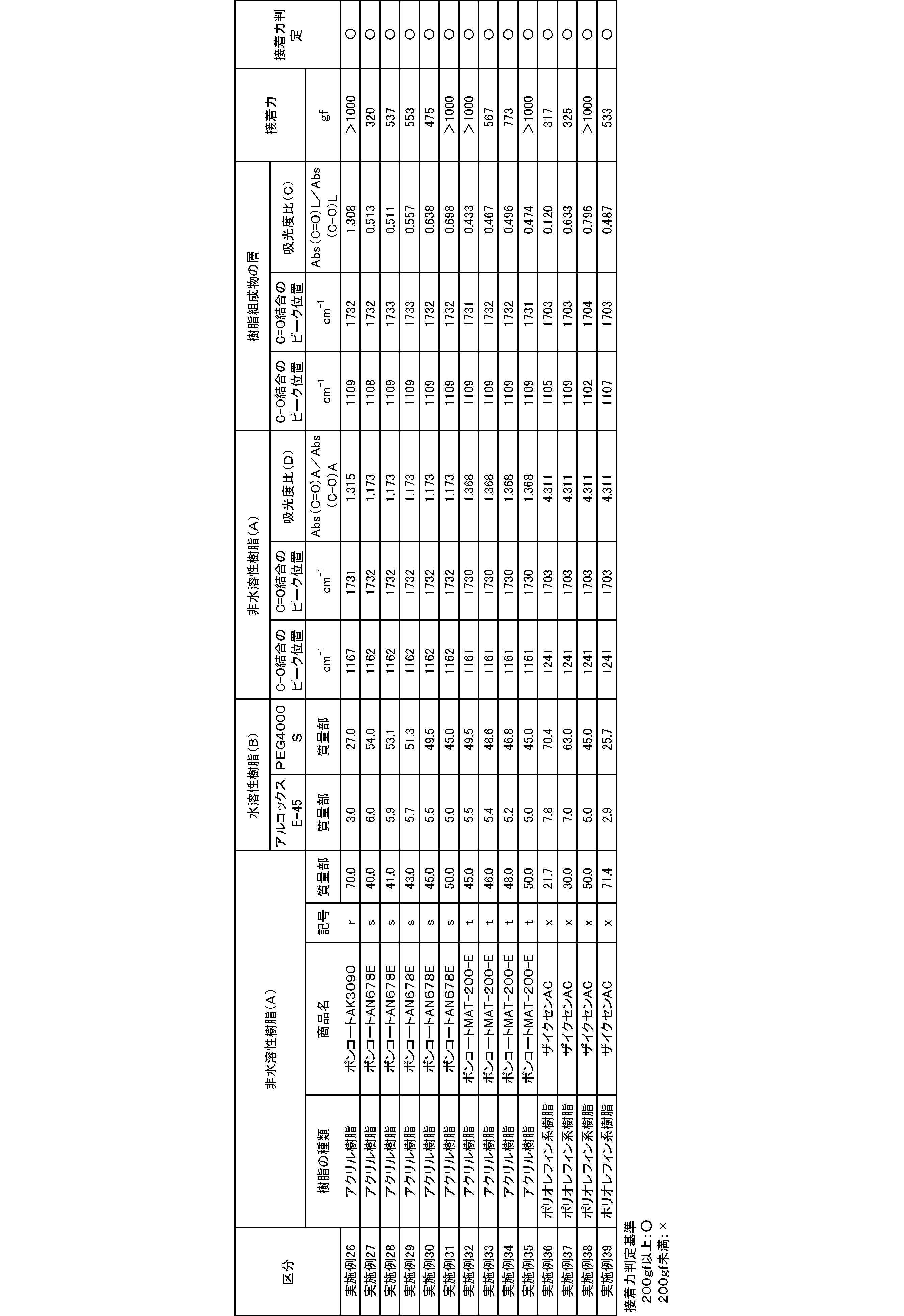
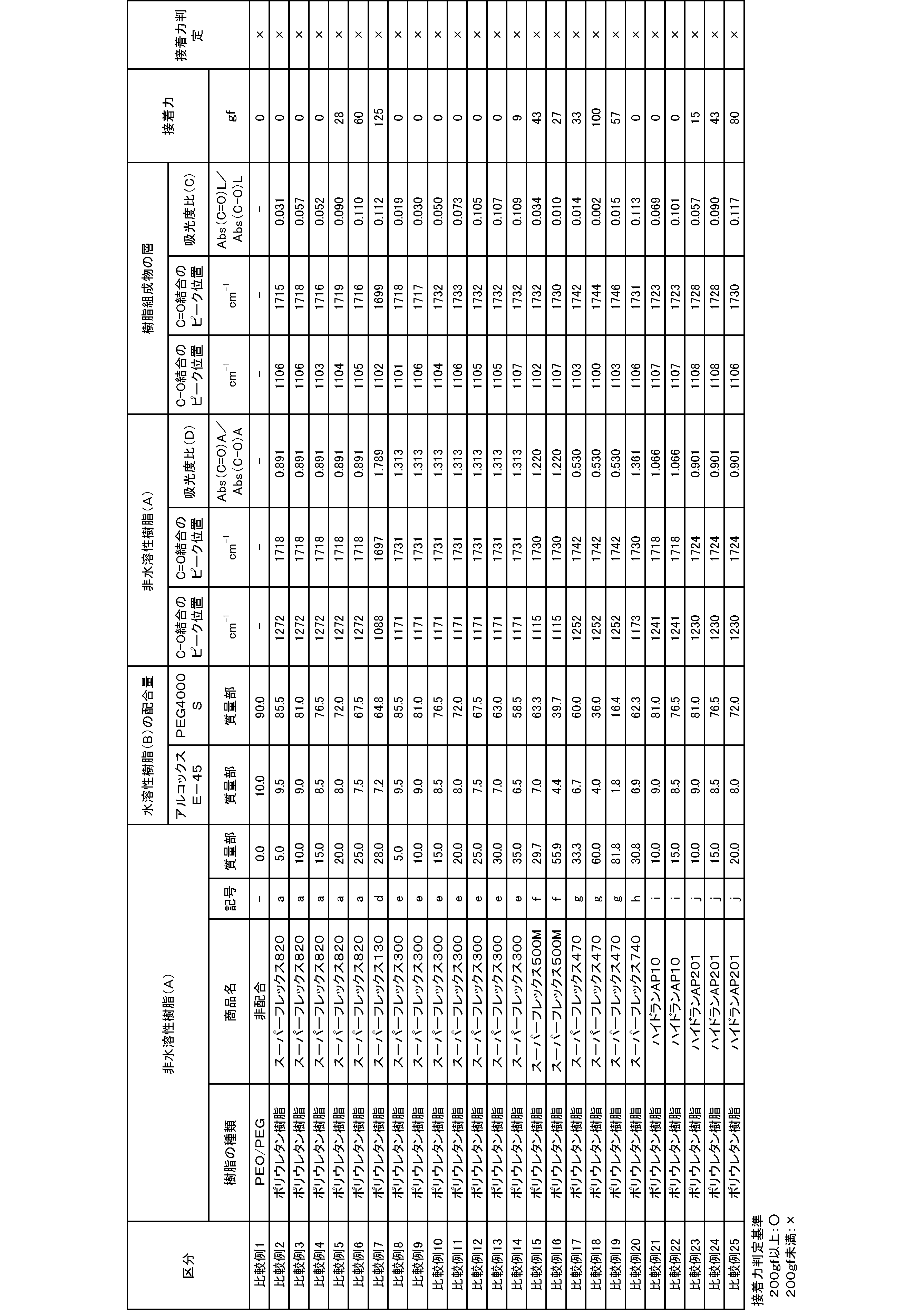
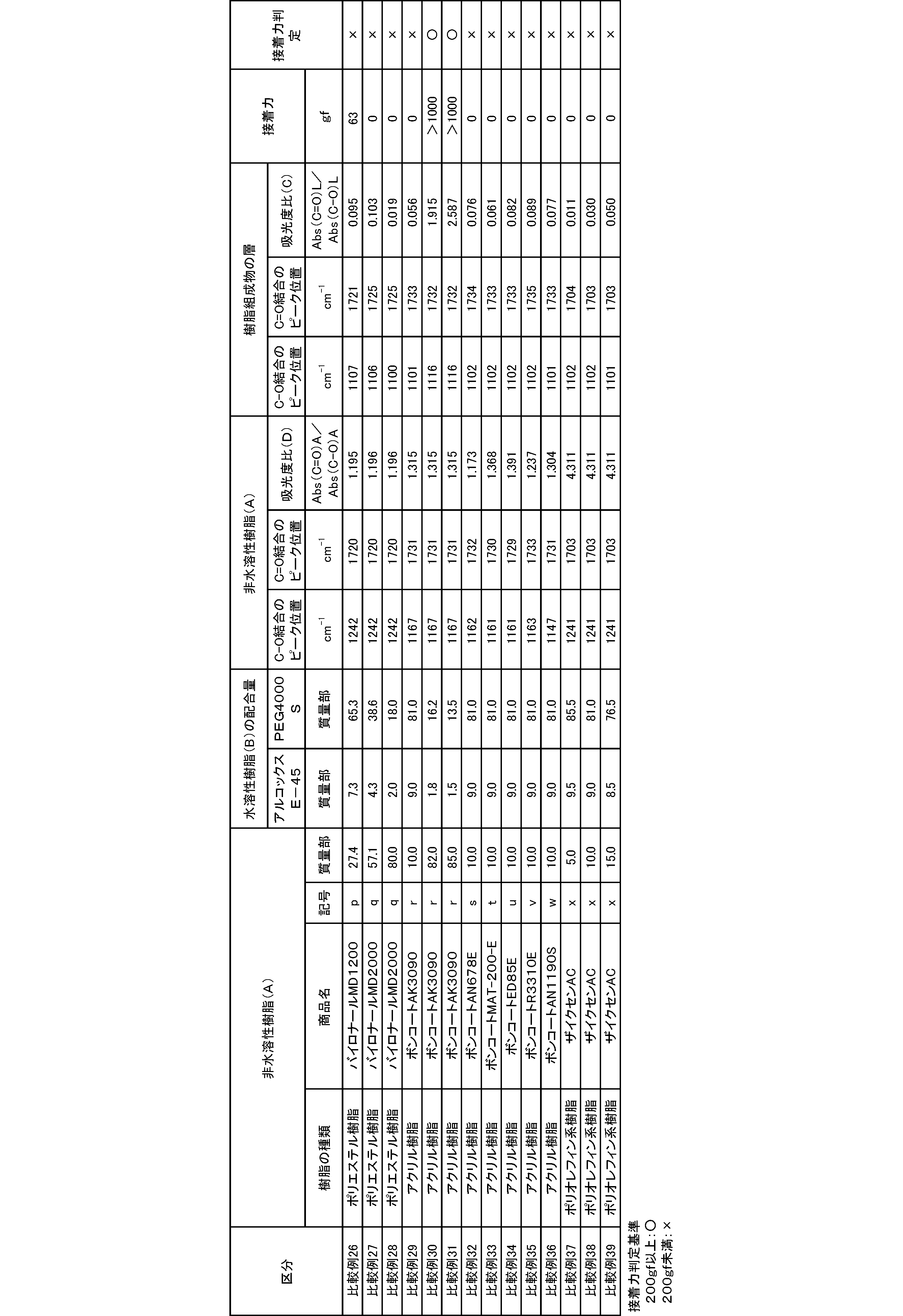
- An entry sheet for drilling was prepared. The obtained drill hole entry sheet was measured for IR peak position, absorbance ratio (C) of the resin composition layer, and adhesion between the metal foil and the resin composition layer. Tables 2 to 5 show these results together with the absorbance ratio (D) of the water-insoluble resin (A).
- the criteria for determining the adhesive strength shown in Tables 2 to 5 are as follows. In the drilling process, a load during processing is applied to the entry sheet. Therefore, if the adhesive force between the metal foil and the resin composition layer is weak, the resin composition layer is peeled off. As a result of diligent researches by the present inventors, it was found that if the adhesive strength is 200 gf or more, the resin composition layer does not peel off during drilling. Therefore, the criterion for determining the adhesive strength is 200 gf or more. “ ⁇ ”, and “x” if less than 200 gf.
- Table 6 is a table showing the relationship between the absorbance ratio (C) of the resin composition layer, the adhesive force, and the hole position accuracy.
- the criteria for determining the hole position accuracy are as follows. When the hole position accuracy calculated by the method of the above formula (3) is 20 ⁇ m or less, it is expressed as “ ⁇ ”, which is excellent in characteristics, and when it is larger than 20 ⁇ m, it is described as “x”. If both the hole position accuracy judgment and adhesive strength judgment are “ ⁇ ”, the adhesion strength between the metal foil and the resin composition layer is strong and the hole position accuracy is excellent, and “ ⁇ ” is indicated as a comprehensive judgment. When at least one of the hole position accuracy determination and the adhesive force determination is “x”, it is described as “x” as a comprehensive determination.
- FIG. 1 is a plot of the relationship between the absorbance ratio (C) of the resin composition layer and the adhesive strength of the metal foil and the resin composition layer in the examples and comparative examples. From FIG. 1, it can be seen that when the absorbance ratio (C) of the layer of the resin composition is 0.12 to 1.80 or less, the adhesive force is good.
- the absorbance ratio (C) of the resin composition layer is 0.12 to 1.80 or less in the entry sheets for drilling holes of Example 4, Example 22, Example 26, and Example 38. It can be seen that the adhesive strength between the metal foil and the resin composition layer is strong, and the hole position accuracy is also good. On the other hand, the adhesive strength between the metal foil and the resin composition layer of the drilling entry sheets of Comparative Example 1, Comparative Example 4, Comparative Example 28, and Comparative Example 39 having an absorbance ratio (C) of less than 0.12. Is weak, peeling of the resin composition layer occurred during drilling, and the hole position accuracy was poor.
- the present invention has industrial applicability as an entry sheet for drilling holes used for drilling holes in laminated boards and multilayer boards.
- the hole position accuracy is excellent, the drill breakage due to peeling between the metal foil and the resin composition layer is small, and the adhesive layer that has been conventionally required Therefore, it is possible to provide an entry sheet for drilling with excellent economic efficiency.
Landscapes
- Engineering & Computer Science (AREA)
- Mechanical Engineering (AREA)
- Manufacturing & Machinery (AREA)
- Microelectronics & Electronic Packaging (AREA)
- Life Sciences & Earth Sciences (AREA)
- Forests & Forestry (AREA)
- Laminated Bodies (AREA)
- Perforating, Stamping-Out Or Severing By Means Other Than Cutting (AREA)
- Drilling And Boring (AREA)
- Production Of Multi-Layered Print Wiring Board (AREA)
- Earth Drilling (AREA)
- Compositions Of Macromolecular Compounds (AREA)
Abstract
Description
〔1〕
金属箔と、該金属箔上に接着層を介在させることなく形成された樹脂組成物の層と、を備え、
前記樹脂組成物の層が、赤外線分光分析において1700~1750cm-1に現れる炭素原子-酸素原子二重結合のピークと、1080~1300cm-1に現れる炭素原子-酸素原子単結合のピークと、を有し、かつ、
前記1700~1750cm-1に現れる炭素原子-酸素原子二重結合のピークの吸光度をAbs(C=O)Lとし、前記1080~1300cm-1に現れる炭素原子-酸素原子単結合のピークの吸光度をAbs(C-O)Lとしたとき、
下記式(1)で表される前記樹脂組成物の層の吸光度比(C)が0.12~1.80である、ドリル孔あけ用エントリーシート。
吸光度比(C)=Abs(C=O)L/Abs(C-O)L 式(1)
〔2〕
前記樹脂組成物が、赤外線分光分析において1700~1750cm-1に現れる炭素原子-酸素原子二重結合のピークを有する非水溶性樹脂(A)、及び赤外線分光分析において1080~1300cm-1に現れる炭素原子-酸素原子単結合のピークを有する水溶性樹脂(B)を含有する、〔1〕に記載のドリル孔あけ用エントリーシート。
〔3〕
前記非水溶性樹脂(A)が、ポリウレタン樹脂、ポリエステル樹脂、アクリル系樹脂、及びポリオレフィン系樹脂からなる群より選択される1種類又は2種類以上である、〔2〕に記載のドリル孔あけ用エントリーシート。
〔4〕
前記水溶性樹脂(B)が、ポリエチレンオキサイド、ポリプロピレンオキサイド、セルロース誘導体、ポリテトラメチレングリコール、ポリエチレングリコール、ポリプロピレングリコール、ポリオキシエチレンのモノエーテル化合物、ポリオキシエチレンモノステアレート、ポリオキシエチレンソルビタンモノステアレート、ポリグリセリンモノステアレート化合物、及びポリオキシエチレンプロピレン共重合体からなる群より選択される1種類又は2種類以上である、〔2〕又は〔3〕に記載のドリル孔あけ用エントリーシート。
〔5〕
前記水溶性樹脂(B)が、質量平均分子量50,000以上1,000,000以下である高分子水溶性樹脂(b1)と、質量平均分子量1,000以上30,000以下である低分子水溶性樹脂(b2)と、を含み、
前記高分子水溶性樹脂(b1)が、ポリエチレンオキサイド、ポリプロピレンオキサイド、及びセルロース誘導体からなる群より選択される少なくとも1種を含み、
前記低分子水溶性樹脂(b2)が、ポリテトラメチレングリコール、ポリエチレングリコール、ポリプロピレングリコール、ポリオキシエチレンのモノエーテル化合物、ポリオキシエチレンモノステアレート、ポリオキシエチレンソルビタンモノステアレート、ポリグリセリンモノステアレート化合物、及びポリオキシエチレンプロピレン共重合体からなる群より選択される少なくとも1種を含む、
〔4〕に記載のドリル孔あけ用エントリーシート。
〔6〕
前記樹脂組成物が、前記非水溶性樹脂(A)と前記水溶性樹脂(B)の合計量100質量部に対して、20~80質量部の前記非水溶性樹脂(A)と、80~20質量部の前記水溶性樹脂(B)を含む、〔2〕~〔5〕のいずれか一項に記載のドリル孔あけ用エントリーシート。
〔7〕
前記樹脂組成物の層が、前記非水溶性樹脂(A)の水分散体と、前記水溶性樹脂(B)とを用いて形成されたものである、〔2〕~〔6〕のいずれか一項に記載のドリル孔あけ用エントリーシート。
〔8〕
前記樹脂組成物の層の厚さが、0.02~0.3mmである、〔1〕~〔7〕のいずれか一項に記載のドリル孔あけ用エントリーシート。
〔9〕
前記金属箔の厚さが、0.05~0.5mmである、〔1〕~〔8〕のいずれか一項に記載のドリル孔あけ用エントリーシート。
〔10〕
〔1〕~〔9〕のいずれか一項に記載のドリル孔あけ用エントリーシートを用いて、積層板又は多層板に孔を形成する孔形成工程を有する、ドリル孔あけ加工方法。
本実施形態のドリル孔あけ用エントリーシートは、金属箔と、該金属箔上に接着層を介在させることなく形成された樹脂組成物の層と、を備え、前記樹脂組成物の層が、赤外線分光分析において1700~1750cm-1に現れる炭素原子-酸素原子二重結合のピークと、1080~1300cm-1に現れる炭素原子-酸素原子単結合のピークとを有し、かつ、前記1700~1750cm-1に現れる炭素原子-酸素原子二重結合のピークの吸光度をAbs(C=O)Lとし、前記1080~1300cm-1に現れる炭素原子-酸素原子単結合のピークの吸光度をAbs(C-O)Lとしたとき、下記式(1)で表される前記樹脂組成物の層の吸光度比(C)が0.12~1.80である。
吸光度比(C)=Abs(C=O)L/Abs(C-O)L (1)
本実施形態における樹脂組成物の層は、赤外線分光分析した際に、1700~1750cm-1に現れる炭素原子-酸素原子二重結合のピーク(以下、「C=O二重結合のピーク」ともいう)と、1080~1300cm-1に現れる炭素原子-酸素原子単結合のピーク(以下、「C-O単結合のピーク」ともいう)を有する。ここで、1700~1750cm-1に現れる炭素原子-酸素原子二重結合のピークは、C=O二重結合の伸縮振動のピークであり、1080~1300cm-1に現れる炭素原子-酸素原子単結合のピークはC-O単結合の伸縮振動のピークである。これらのC=O二重結合及びC-O単結合のピークは、後述するように樹脂組成物の層を形成する樹脂成分に由来する。
非水溶性樹脂(A)の下記式(2)で表される吸光度比(D)は、好ましくは0.7以上であり、より好ましくは0.7~4.5であり、さらに好ましくは0.8~4.5である。吸光度比(D)が0.7以上であることにより、金属箔と樹脂組成物の層との接着強度がより向上し、ドリル孔あけ加工時に樹脂組成物の層の剥離がより起こりにくい傾向にある。なお、非水溶性樹脂(A)の吸光度比(D)も、樹脂組成物の層の吸光度比(C)と同様にして分析できる。また、非水溶性樹脂(A)の吸光度比(D)は、用いる樹脂の種類により調整することができる。
吸光度比(D)=Abs(C=O)A/Abs(C-O)A 式(2)
(式中、Abs(C=O)Aは、赤外線分光分析における非水溶性樹脂(A)のC=O二重結合のピークの吸光度を示し、Abs(C-O)Aは、赤外線分光分析における非水溶性樹脂(A)のC-O単結合のピークの吸光度を示し、Abs(C=O)A及びAbs(C-O)Aは、それぞれ1700~1750cm-1又は1080~1300cm-1のなかで最も吸光度が大きくなったところの値である。)
本実施形態において非水溶性樹脂(A)として用いることができるポリウレタン樹脂としては、ポリイソシアネート化合物と、ポリオール化合物と、必要に応じて他の化合物とを反応させて得られた樹脂が挙げられる。ポリウレタン樹脂の合成反応としては、アセトン法、プレポリマーミキシング法、ケチミン法、ホットメルトディスパージョン法等が例示できる。
本実施形態において非水溶性樹脂(A)として用いることができるポリエステル樹脂としては、2つ以上のヒドロキシル基を有するポリオール化合物と2つ以上のカルボキシル基を有する多価カルボン酸からなる原料を縮重合して得られるポリエステル樹脂が挙げられる。
本実施形態において非水溶性樹脂(A)として用いることができるアクリル系樹脂は、不飽和カルボン酸化合物を主な構成成分とする共重合体であれば特に限定されない。不飽和カルボン酸化合物としては、特に限定されず、例えば、メチル(メタ)アクリレート、エチル(メタ)アクリレート、n-プロピル(メタ)アクリレート、イソプロピル(メタ)アクリレート、n―ブチル(メタ)アクリレート、イソブチル(メタ)アクリレート、t-ブチル(メタ)アクリレート、n-オクチル(メタ)アクリレート、イソノニル(メタ)アクリレート、シクロへキシル(メタ)アクリレート、メチルシクロヘキシル(メタ)アクリレート、t-ブチルシクロヘキシル(メタ)アクリレート、シクロドデシル(メタ)アクリレート、イソボルニル(メタ)アクリレート、(メタ)アクリル酸2-ヒドロキシエチル、(メタ)アクリル酸3-ヒドロキシプロピル、(メタ)アクリル酸4-ヒドロキシブチル、(メタ)アクリル酸グリシジル、ポリエチレングリコール(メタ)アクリレート、ポリプロピレングリコール(メタ)アクリレート及びポリエチレン-ポリプロピレングリコールモノ(メタ)アクリレート等のα、β-不飽和カルボン酸エステル(エチレン性不飽和カルボン酸エステルともいう);イタコン酸モノエチルエステル、フマル酸モノブチルエステル等の不飽和ジカルボン酸のモノアルキルエステル;(メタ)アクリル酸、イタコン酸、マレイン酸、フマル酸などのα、β-不飽和カルボン酸(エチレン性不飽和カルボン酸ともいう)及び不飽和ジカルボン酸;アクリルアミド、N-メチロールアクリルアミド、N-メトキシメチルアクリルアミド、N-メトキシブチルアクリルアミド、ダイアセトンアクリルアミドなどのα、β-不飽和カルボン酸アミド(エチレン性不飽和カルボン酸アミドともいう)及びそのN-置換化合物;アリルアルコール等の不飽和アルコール;(メタ)アクリロニトリルなどのα、β-不飽和二トリル(エチレン性不飽和ニトリルともいう)、酢酸ビニル、などが挙げられる。これらの化合物は、1種単独で用いてもよく、又は2種類以上を組み合わせて用いてもよい。
本実施形態において非水溶性樹脂(A)として用いることができるポリオレフィン系樹脂としては、エチレンやプロピレンなどのオレフィンが主な構成成分である樹脂が挙げられる。そのような樹脂としては、例えば、オレフィンと不飽和カルボン酸との共重合体(以下、本明細書では、「オレフィン-不飽和カルボン酸共重合体」ともいう。)が挙げられる。オレフィンとしては、特に限定されないが、エチレン、プロピレン、ブチレンが好ましく、このなかでもエチレンが特に好ましい。不飽和カルボン酸としては、特に限定されないが、(メタ)アクリル酸(すなわち、アクリル酸又はメタクリル酸)、マレイン酸、イタコン酸、フマル酸が好ましく、このなかでも(メタ)アクリル酸がより好ましい。オレフィン-不飽和カルボン酸共重合体としては、エチレンと(メタ)アクリル酸の共重合体、プロピレンと(メタ)アクリル酸共重合体が、特に好ましい。
水溶性樹脂(B)としては、水溶性の樹脂であれば特に限定されないが、高分子水溶性樹脂(b1)と低分子水溶性樹脂(b2)とを併用することが好ましい。中でも、赤外線分光分析においてC-O単結合のピークを有する高分子水溶性樹脂(b1)と、赤外線分光分析においてC-O単結合のピークを有する低分子水溶性樹脂(b2)と、を併用することが好ましい。
樹脂組成物の層は、必要に応じて、添加剤を含有していてもよい。添加剤の種類は、特に限定されないが、例えば、表面調整剤、レベリング剤、帯電防止剤、乳化剤、消泡剤、ワックス添加剤、カップリング剤、レオロジーコントロール剤、防腐剤、防黴剤、酸化防止剤、光安定剤、ギ酸Naなどの核剤、黒鉛などの固体潤滑剤、有機フィラー、無機フィラー、熱安定化剤、および着色剤が挙げられる。
本実施形態のドリル孔あけ用エントリーシートに使用される金属箔は、特に限定されないが、上記樹脂組成物層との密着性が高く、ドリルビットによる衝撃に耐え得る金属材料であると好ましい。金属箔の金属種としては、入手性、コストおよび加工性の観点から、例えばアルミニウムが挙げられる。アルミニウム箔の材質としては、純度95%以上のアルミニウムが好ましい、そのようなアルミニウム箔としては、例えば、JIS-H4160に規定される、5052、3004、3003、1N30、1N99、1050、1070、1085、8021が挙げられる。金属箔にアルミニウム純度95%以上のアルミニウム箔を用いることによって、ドリルビットによる衝撃の緩和、およびドリルビット先端部との食いつき性が向上し、樹脂組成物によるドリルビットの潤滑効果と相俟って、加工孔の孔位置精度を一層高めることができる。
本実施形態のドリル孔あけ用エントリーシートの製造方法は、特に限定されず、例えば、次のようにして製造することができる。本実施形態のドリル孔あけ用エントリーシートは、金属箔の少なくとも片面上に樹脂組成物の層を形成して製造される。樹脂組成物の層を形成させる方法は特に限定されず、公知の方法が使用できる。そのような方法としては、例えば、非水溶性樹脂(A)の水分散体、及び水溶性樹脂(B)を溶媒に溶解又は分散させた樹脂組成物の溶液を、コーティング法などの方法で、金属箔上に塗工して、更に乾燥させる及び/又は冷却固化させる方法が挙げられる。
本実施形態のドリル孔あけ加工方法は、上記ドリル孔あけ用エントリーシートを用いて、積層板又は多層板に孔を形成する孔形成工程を有する。また、そのドリル孔あけ加工は、直径(ドリルビット径)0.30mmφ以下のドリルビットによるドリル孔あけ加工であると、本実施形態の目的を更に有効かつ確実に奏することができる。特に、直径0.05mmφ以上0.30mmφ以下、さらには孔位置精度が重要になる直径0.05mmφ以上0.20mmφ以下の小径のドリルビット用途であると、孔位置精度およびドリル寿命を大きく向上させる点で好適である。なお、0.05mmφのドリルビット径は、入手可能なドリルビット径の下限であり、これよりも小径のドリルビットが入手可能になれば、上記の限りではない。また、直径0.30mmφ超のドリルビットを用いるドリル孔あけ加工に、本実施形態のドリル孔あけ用エントリーシートを採用しても問題ない。
実施例及び比較例における樹脂組成物の層のIRピーク位置、樹脂組成物の層の吸光度比(C)、非水溶性樹脂(A)の吸光度比(D)の測定は、フーリエ変換赤外線分光光度計(JASCO製、型番:FT/IR-6100)を用いて行った。初めに、外部からの光源の影響、二酸化炭素の影響が赤外線吸収スペクトルに反映されないように、ダイヤモンドのATRプリズムを用いて、測定試料をセッティングせずにバックグラウンドの測定を行った。次いで、樹脂組成物の層の表面の赤外線分光分析を行った。測定は、この際、積算回数を16回とし、縦軸が吸光度(Abs:Absorbance)であり、横軸が700cm-1から4000cm-1の波長範囲である赤外線吸収スペクトルを得た。そして、得られた赤外線吸収スペクトルの2000~2100cm-1の範囲の吸光度が0(零)となるようにベースライン補正を行った。次に、補正後の該赤外線吸収スペクトルにおいて、C=O二重結合のピーク位置、C-O単結合のピーク位置を決め、これらの吸光度Abs(C=O)L及びAbs(C-O)Lから、吸光度比(C)を算出した。なお、C=O二重結合のピークの吸光度「Abs(C=O)L」は、樹脂組成物の層の赤外線分光分析において、1700~1750cm-1の範囲のなかで最も吸光度が大きくなったところの値とした。また、C-O単結合のピークの吸光度「Abs(C-O)L」は、樹脂組成物の層の赤外線分光分析において、1080~1300cm-1の範囲のなかで最も吸光度が大きくなったところの値とした。
接着力は、次のようにして測定した。まず、実施例及び比較例で作製したドリル孔あけ用エントリーシートを3mm幅、100mmの長さに切った試料を3つ用意した。次に、試料の樹脂組成物の層の表面の全体に両面テープを貼り付けた。その後、両面テープを貼り付けた試料の片端を10mmはがし、はがした試料の金属箔部分にバネ秤を取り付けるための治具を取り付けた。治具にバネ秤(SANKO製、最大計測可能値1000gf)を取り付け、1cm/秒の速さで引っ張り、バネ秤の指す数値を読み取った。測定を3つの試料について行い、3回の平均値を接着力の数値とした。金属箔と樹脂組成物の層とが剥がれなかった場合は「>1000」と表記した。
孔位置精度は、次のようにして測定した。厚さ0.2mmの銅張積層板(商品名:HL832、銅箔厚さ12μm、両面板、三菱ガス化学株式会社製)を5枚積み重ねた銅張積層板の上面に、実施例及び比較例で作製したドリル孔あけ用エントリーシートをその樹脂組成物の層側が上面になるように配置し、積み重ねた銅張積層板の最下板の裏面(下面)に厚さ1.5mmの当て板(紙フェノール積層板PS1160-G、利昌株式会社製)を配置した。そして、0.2mmφドリルビット(商品名:C-CFU020S、タンガロイ株式会社製)、回転数:200,000rpm、送り速度:2.6m/min、孔あけ回数:ドリルビット1本につき3,000孔の条件で、計6000孔のドリル孔あけ加工を行った。

(3)
(ここで、nは使用したドリルの本数を示す。)

<実施例1>
ポリウレタン樹脂の水分散体(商品名:スーパーフレックス820、第一工業製薬株式会社製)100質量部(樹脂固形分換算で30質量部)、高分子水溶性樹脂(b1)としてポリエチレンオキサイド(商品名:アルコックスE-45、明成化学工業株式会社製、質量平均分子量560,000)7質量部、低分子水溶性樹脂(b2)としてポリエチレングリコール(商品名:PEG4000S、三洋化成工業株式会社製、質量平均分子量3,300)63質量部を、水/メタノール混合溶媒(質量比50/50)に溶解して、樹脂組成物の固形分濃度が30質量%濃度の溶液を調製した。この溶液中の樹脂組成物固形分100質量部に対して、1.2質量部の表面調整剤(BYK349、ビックケミー・ジャパン株式会社製)を添加し、更に、溶液中の樹脂組成物固形分100質量部に対して、0.25質量部のギ酸ナトリウム(三菱瓦斯化学株式会社製)を添加して、均一に分散させ、樹脂組成物の層を形成するための樹脂組成物の溶液を得た。得られた樹脂組成物の溶液を、アルミニウム箔(使用アルミニウム箔:JIS-A1100H1.80、厚さ0.1mm、三菱アルミニウム株式会社製)に、バーコーターを用いて、乾燥、固化後の樹脂組成物の層の厚さが0.05mmになるように塗布した。次いで、乾燥機を用いて120℃、3分間乾燥し、その後、冷却、固化させて、ドリル孔あけ用エントリーシートを作製した。上述した方法で、ドリル孔あけ用エントリーシートの樹脂組成物の層の表面を赤外線分光分析し、得られた赤外線吸収スペクトルからAbs(C-O)LとAbs(C=O)Lを求め、吸光度比(C)を算出した。また、ドリル孔あけ用エントリーシートの金属箔と樹脂組成物の層との間の接着力を3回測定し、その平均値を求めた。表2にこれらの結果を示した。
実施例1に準じて、表2~5に示す各材料の種類及び含有割合にて樹脂組成物の溶液を調製し、乾燥・固化後の樹脂組成物の層の厚さが0.05mmのドリル孔あけ用エントリーシートを作製した。得られたドリル孔あけ用エントリーシートの、IRピーク位置、樹脂組成物の層の吸光度比(C)、及び金属箔と樹脂組成物の層との間の接着力を測定した。表2~5にこれらの結果を、非水溶性樹脂(A)の吸光度比(D)とあわせて示した。


Claims (10)
- 金属箔と、該金属箔上に接着層を介在させることなく形成された樹脂組成物の層と、を備え、
前記樹脂組成物の層が、赤外線分光分析において1700~1750cm-1に現れる炭素原子-酸素原子二重結合のピークと、1080~1300cm-1に現れる炭素原子-酸素原子単結合のピークと、を有し、かつ、
前記1700~1750cm-1に現れる炭素原子-酸素原子二重結合のピークの吸光度をAbs(C=O)Lとし、前記1080~1300cm-1に現れる炭素原子-酸素原子単結合のピークの吸光度をAbs(C-O)Lとしたとき、
下記式(1)で表される前記樹脂組成物の層の吸光度比(C)が0.12~1.80である、ドリル孔あけ用エントリーシート。
吸光度比(C)=Abs(C=O)L/Abs(C-O)L 式(1) - 前記樹脂組成物が、赤外線分光分析において1700~1750cm-1に現れる炭素原子-酸素原子二重結合のピークを有する非水溶性樹脂(A)、及び赤外線分光分析において1080~1300cm-1に現れる炭素原子-酸素原子単結合のピークを有する水溶性樹脂(B)を含有する、請求項1に記載のドリル孔あけ用エントリーシート。
- 前記非水溶性樹脂(A)が、ポリウレタン樹脂、ポリエステル樹脂、アクリル系樹脂、及びポリオレフィン系樹脂からなる群より選択される1種類又は2種類以上である、請求項2に記載のドリル孔あけ用エントリーシート。
- 前記水溶性樹脂(B)が、ポリエチレンオキサイド、ポリプロピレンオキサイド、セルロース誘導体、ポリテトラメチレングリコール、ポリエチレングリコール、ポリプロピレングリコール、ポリオキシエチレンのモノエーテル化合物、ポリオキシエチレンモノステアレート、ポリオキシエチレンソルビタンモノステアレート、ポリグリセリンモノステアレート化合物、及びポリオキシエチレンプロピレン共重合体からなる群より選択される1種類又は2種類以上である、請求項2又は3に記載のドリル孔あけ用エントリーシート。
- 前記水溶性樹脂(B)が、質量平均分子量50,000以上1,000,000以下である高分子水溶性樹脂(b1)と、質量平均分子量1,000以上30,000以下である低分子水溶性樹脂(b2)と、を含み、
前記高分子水溶性樹脂(b1)が、ポリエチレンオキサイド、ポリプロピレンオキサイド、及びセルロース誘導体からなる群より選択される少なくとも1種を含み、
前記低分子水溶性樹脂(b2)が、ポリテトラメチレングリコール、ポリエチレングリコール、ポリプロピレングリコール、ポリオキシエチレンのモノエーテル化合物、ポリオキシエチレンモノステアレート、ポリオキシエチレンソルビタンモノステアレート、ポリグリセリンモノステアレート化合物、及びポリオキシエチレンプロピレン共重合体からなる群より選択される少なくとも1種を含む、
請求項4に記載のドリル孔あけ用エントリーシート。 - 前記樹脂組成物が、前記非水溶性樹脂(A)と前記水溶性樹脂(B)の合計量100質量部に対して、20~80質量部の前記非水溶性樹脂(A)と、80~20質量部の前記水溶性樹脂(B)を含む、請求項2~5のいずれか一項に記載のドリル孔あけ用エントリーシート。
- 前記樹脂組成物の層が、前記非水溶性樹脂(A)の水分散体と、前記水溶性樹脂(B)とを用いて形成されたものである、請求項2~6のいずれか一項に記載のドリル孔あけ用エントリーシート。
- 前記樹脂組成物の層の厚さが、0.02~0.3mmである、請求項1~7のいずれか一項に記載のドリル孔あけ用エントリーシート。
- 前記金属箔の厚さが、0.05~0.5mmである、請求項1~8のいずれか一項に記載のドリル孔あけ用エントリーシート。
- 請求項1~9のいずれか一項に記載のドリル孔あけ用エントリーシートを用いて、積層板又は多層板に孔を形成する孔形成工程を有する、ドリル孔あけ加工方法。
Priority Applications (7)
| Application Number | Priority Date | Filing Date | Title |
|---|---|---|---|
| JP2017506165A JP6631851B2 (ja) | 2015-03-19 | 2016-02-24 | ドリル孔あけ用エントリーシート、及びそれを用いたドリル孔あけ加工方法 |
| MYPI2017703254A MY185904A (en) | 2015-03-19 | 2016-02-24 | Entry sheet for drilling and method for drilling processing using same |
| CN201680017029.8A CN107428021B (zh) | 2015-03-19 | 2016-02-24 | 钻孔用盖板和使用其的钻孔加工方法 |
| KR1020177024857A KR102374773B1 (ko) | 2015-03-19 | 2016-02-24 | 드릴 구멍뚫기용 엔트리 시트, 및 그것을 사용한 드릴 구멍뚫기 가공 방법 |
| US15/553,795 US10486324B2 (en) | 2015-03-19 | 2016-02-24 | Entry sheet for drilling and method for drilling processing using same |
| SG11201707061VA SG11201707061VA (en) | 2015-03-19 | 2016-02-24 | Entry sheet for drilling and method for drilling processing using same |
| PH12017501642A PH12017501642B1 (en) | 2015-03-19 | 2017-09-08 | Entry sheet for drilling and method for drilling processing using same |
Applications Claiming Priority (2)
| Application Number | Priority Date | Filing Date | Title |
|---|---|---|---|
| JP2015056155 | 2015-03-19 | ||
| JP2015-056155 | 2015-03-19 |
Publications (1)
| Publication Number | Publication Date |
|---|---|
| WO2016147817A1 true WO2016147817A1 (ja) | 2016-09-22 |
Family
ID=56918847
Family Applications (1)
| Application Number | Title | Priority Date | Filing Date |
|---|---|---|---|
| PCT/JP2016/055332 Ceased WO2016147817A1 (ja) | 2015-03-19 | 2016-02-24 | ドリル孔あけ用エントリーシート、及びそれを用いたドリル孔あけ加工方法 |
Country Status (9)
| Country | Link |
|---|---|
| US (1) | US10486324B2 (ja) |
| JP (1) | JP6631851B2 (ja) |
| KR (1) | KR102374773B1 (ja) |
| CN (1) | CN107428021B (ja) |
| MY (1) | MY185904A (ja) |
| PH (1) | PH12017501642B1 (ja) |
| SG (1) | SG11201707061VA (ja) |
| TW (1) | TWI680864B (ja) |
| WO (1) | WO2016147817A1 (ja) |
Families Citing this family (1)
| Publication number | Priority date | Publication date | Assignee | Title |
|---|---|---|---|---|
| CN113290626B (zh) * | 2021-05-12 | 2022-11-04 | 上海复合材料科技有限公司 | 一种承力筒后装配蒙皮制孔装置及制孔方法 |
Citations (3)
| Publication number | Priority date | Publication date | Assignee | Title |
|---|---|---|---|---|
| JP2001347493A (ja) * | 2000-06-05 | 2001-12-18 | Risho Kogyo Co Ltd | ドリル加工用エントリーボード |
| JP2009172752A (ja) * | 2007-12-26 | 2009-08-06 | Mitsubishi Gas Chem Co Inc | ドリル孔明け用エントリーシート |
| WO2010140333A1 (ja) * | 2009-06-01 | 2010-12-09 | 三菱瓦斯化学株式会社 | ドリル孔明け用エントリーシート |
Family Cites Families (20)
| Publication number | Priority date | Publication date | Assignee | Title |
|---|---|---|---|---|
| JP2855824B2 (ja) * | 1990-08-08 | 1999-02-10 | 三菱瓦斯化学株式会社 | プリント配線板の孔明け加工法 |
| JP3169026B2 (ja) | 1991-12-18 | 2001-05-21 | 三菱瓦斯化学株式会社 | 小孔あけ用滑剤シート |
| JP4106518B2 (ja) | 2001-10-31 | 2008-06-25 | 三菱瓦斯化学株式会社 | 孔明け用エントリーシート及びドリル孔明け加工法 |
| US20050003169A1 (en) * | 2003-01-28 | 2005-01-06 | Nobuyuki Ikeguchi | Lubricant sheet for drilling and method of drilling |
| JP4644414B2 (ja) | 2003-01-28 | 2011-03-02 | 三菱瓦斯化学株式会社 | 着色された孔あけ用滑剤シート |
| JP2004260038A (ja) * | 2003-02-27 | 2004-09-16 | Nitto Denko Corp | 複合絶縁層の形成方法及び配線基板の製造方法 |
| JP5012100B2 (ja) * | 2007-03-09 | 2012-08-29 | 三菱瓦斯化学株式会社 | ドリル孔明け用エントリーシート |
| TWI407854B (zh) * | 2007-12-26 | 2013-09-01 | Mitsubishi Gas Chemical Co | 鑽孔用蓋板之製造方法及蓋板 |
| US20090229750A1 (en) * | 2008-03-11 | 2009-09-17 | Sumitomo Chemical Company. Limited | Method for producing copper-clad laminate |
| KR20100012162A (ko) * | 2008-07-28 | 2010-02-08 | 전두표 | 드릴용 엔트리 시이트 |
| KR101297040B1 (ko) * | 2009-01-28 | 2013-08-14 | 히타치가세이가부시끼가이샤 | 프리프레그, 수지 부착 필름, 수지 부착 금속박, 금속박장 적층판 및 인쇄 배선판 |
| JP5445524B2 (ja) | 2011-06-27 | 2014-03-19 | 三菱瓦斯化学株式会社 | ドリル穴明け用エントリーシート |
| TWI423749B (zh) * | 2011-09-26 | 2014-01-11 | Uniplus Electronics Co Ltd | 用於印刷電路板之鑚孔輔助板 |
| BR112014021235A2 (pt) * | 2012-03-09 | 2021-02-17 | Mitsubishi Gas Chemical Company, Inc | folha de entrada para uso em perfuração |
| US9826643B2 (en) * | 2012-03-21 | 2017-11-21 | Mitsubishi Gas Chemical Company, Inc. | Entry sheet for drilling and drilling method |
| RU2603401C2 (ru) * | 2012-03-27 | 2016-11-27 | Мицубиси Гэс Кемикал Компани, Инк. | Прокладочный лист для сверления |
| TWI462662B (zh) * | 2013-02-06 | 2014-11-21 | Nanya Plastics Corp | 複合式雙面黑色銅箔及其製造方法 |
| MY180144A (en) * | 2013-03-27 | 2020-11-23 | Mitsubishi Gas Chemical Co | Entry sheet for cutting fiber reinforced composite material or metal, and cutting method for cutting fiber reinforced material or metal |
| US10478991B2 (en) * | 2015-03-19 | 2019-11-19 | Mitsubishi Gas Chemical Company, Inc. | Entry sheet for drilling and method for drilling processing using same |
| CN108025450B (zh) * | 2015-09-02 | 2018-12-07 | 三菱瓦斯化学株式会社 | 钻孔用盖板、和使用其的钻孔加工方法 |
-
2016
- 2016-02-24 MY MYPI2017703254A patent/MY185904A/en unknown
- 2016-02-24 SG SG11201707061VA patent/SG11201707061VA/en unknown
- 2016-02-24 JP JP2017506165A patent/JP6631851B2/ja not_active Expired - Fee Related
- 2016-02-24 KR KR1020177024857A patent/KR102374773B1/ko active Active
- 2016-02-24 US US15/553,795 patent/US10486324B2/en active Active
- 2016-02-24 CN CN201680017029.8A patent/CN107428021B/zh not_active Expired - Fee Related
- 2016-02-24 WO PCT/JP2016/055332 patent/WO2016147817A1/ja not_active Ceased
- 2016-02-25 TW TW105105575A patent/TWI680864B/zh active
-
2017
- 2017-09-08 PH PH12017501642A patent/PH12017501642B1/en unknown
Patent Citations (3)
| Publication number | Priority date | Publication date | Assignee | Title |
|---|---|---|---|---|
| JP2001347493A (ja) * | 2000-06-05 | 2001-12-18 | Risho Kogyo Co Ltd | ドリル加工用エントリーボード |
| JP2009172752A (ja) * | 2007-12-26 | 2009-08-06 | Mitsubishi Gas Chem Co Inc | ドリル孔明け用エントリーシート |
| WO2010140333A1 (ja) * | 2009-06-01 | 2010-12-09 | 三菱瓦斯化学株式会社 | ドリル孔明け用エントリーシート |
Also Published As
| Publication number | Publication date |
|---|---|
| TW201637850A (zh) | 2016-11-01 |
| KR20170131390A (ko) | 2017-11-29 |
| TWI680864B (zh) | 2020-01-01 |
| US20180050462A1 (en) | 2018-02-22 |
| SG11201707061VA (en) | 2017-09-28 |
| JPWO2016147817A1 (ja) | 2017-12-28 |
| CN107428021B (zh) | 2019-06-18 |
| JP6631851B2 (ja) | 2020-01-15 |
| CN107428021A (zh) | 2017-12-01 |
| KR102374773B1 (ko) | 2022-03-15 |
| PH12017501642A1 (en) | 2018-02-12 |
| PH12017501642B1 (en) | 2018-02-12 |
| US10486324B2 (en) | 2019-11-26 |
| MY185904A (en) | 2021-06-14 |
Similar Documents
| Publication | Publication Date | Title |
|---|---|---|
| JP4798308B2 (ja) | ドリル孔明け用エントリーシート | |
| JP6315226B2 (ja) | ドリル孔あけ用エントリーシート、及びそれを用いたドリル孔あけ加工方法 | |
| JPWO2017208912A1 (ja) | ドリル孔あけ用エントリーシート及びそれを用いたドリル孔あけ加工方法 | |
| JP6631943B2 (ja) | ドリル孔あけ用エントリーシート、及びそれを用いたドリル孔あけ加工方法 | |
| JP6631851B2 (ja) | ドリル孔あけ用エントリーシート、及びそれを用いたドリル孔あけ加工方法 | |
| JP7157931B2 (ja) | 微細径用ドリル孔あけ用エントリーシート、及びそれを用いたドリル孔あけ加工方法 | |
| JP6399375B2 (ja) | ドリル孔あけ用エントリーシート及びそれを用いたドリル孔あけ加工方法 | |
| WO2019187670A1 (ja) | ドリル孔あけ用エントリーシート及びそれを用いたドリル孔あけ加工方法 | |
| JP5288067B2 (ja) | ドリル孔あけ用エントリーシート | |
| JP6369796B2 (ja) | ドリル孔あけ用エントリーシート、及びそれを用いたドリル孔あけ加工方法 |
Legal Events
| Date | Code | Title | Description |
|---|---|---|---|
| 121 | Ep: the epo has been informed by wipo that ep was designated in this application |
Ref document number: 16764647 Country of ref document: EP Kind code of ref document: A1 |
|
| ENP | Entry into the national phase |
Ref document number: 2017506165 Country of ref document: JP Kind code of ref document: A |
|
| WWE | Wipo information: entry into national phase |
Ref document number: 15553795 Country of ref document: US |
|
| ENP | Entry into the national phase |
Ref document number: 20177024857 Country of ref document: KR Kind code of ref document: A |
|
| WWE | Wipo information: entry into national phase |
Ref document number: 11201707061V Country of ref document: SG |
|
| WWE | Wipo information: entry into national phase |
Ref document number: 12017501642 Country of ref document: PH |
|
| NENP | Non-entry into the national phase |
Ref country code: DE |
|
| 122 | Ep: pct application non-entry in european phase |
Ref document number: 16764647 Country of ref document: EP Kind code of ref document: A1 |